Author(s): Scott Douglas Jacobsen
Publication (Outlet/Website): In-Sight: Independent Interview-Based Journal
Publication Date (yyyy/mm/dd): 2020/03/15
Abstract
Dr. Giuseppe Corrente is a Computer Science teacher at Torino University. He earned a Ph.D. in Science and High Technology – Computer Science in 2013 at Torino University. He has contributed to the World Intelligence Network’s publication Phenomenon. He discusses: family background; facets of a larger self; influences on early formations; mentors; a sense of self through time; pivotal educational moments; formal postsecondary education; intelligence tests taken; participation in the high-IQ communities; and mains areas of intellectual interest.
Keywords: ability, academics, computer science, family, Giuseppe Corrente, Isaac Asimov, Jack London.
An Interview with Giuseppe Corrente on Family, Earlier Life, and Finding a Community of Common Ability (Part One)[1],[2]*
*Please see the footnotes, bibliography, and citation style listing after the interview.*
1. Scott Douglas Jacobsen: What is family background or lineage, e.g., surname(s) etymology (etymologies), geography, culture, language, religion/non-religion, political suasion, social outlook, scientific training, and the like?
Dr. Giuseppe Corrente: My mother and father were from two rural villages of South Italy. My family was a very patriarchal family, with strong traditional values, but not in a positive way for me so it could be sound. My mother never began her independent job of an Italian teacher because my father didn’t want her economic independence. My father was an Engineer first, with a career based on managing some industries above all in tile building, but also a touristic entrepreneur. My father was an atheist, my mother was Catholic, in a spiritual and not dogmatic way.
Politically my father was conservative, in a moderately right way, and my mother aligned to his political ideas, also if her opinion originally was more flexible. She was practically obliged to align also in many other aspects of life to his point of view.
Also, my brother and my sister practically adopted a strong father’s alignment for a lot of things. All three of us studied without economic problems to have a Master’s degree, but mainly in the Faculty that our father decided for us. In that period, I was a victim of familiar and job mobbing. Only in adulthood, I had some check that proved that my father wasn’t my natural one, too late for searching for my natural father with success. This is surely the main reason for the fact that his authoritarianism became a real strong familiar mobbing. This propagated to Company in which I was engaged in the ‘90s.
I noted that this Company was implicated with some bad affair concerning governments fund, and also the despotic style with which its directors managed the personnel. I opposed strongly both things. They used my family contrasts together with few invented facts as the begin of a prolonged psychological war against me.
2. Jacobsen: With all these facets of the larger self, how did these become the familial ecosystem to form identity and a sense of a self extended through time?
Corrente: This traditional, rural environment was in opposition to my Science passion and innovative ideas, but contributed strongly to my personality. I remember the very suggestive effect of first spatial flights on TV when I was five-year-old. I remember the long years spent in a family touristic sea village. The contact with Sea, the traditional family-directed in a despotic way by its family head, the scientific studies and passion for Science Fiction were the main environment of my adolescence.
I participated also in ecologist, anti-racist and pacifist initiatives and movements.
In a certain sense, my ecologist soul can be a continuation of the spiritual feeling that I had seeing and living near the Sea in the childhood, while anti-racist and pacifist fights could be seen as the continuation of the opposition to a despotic father.
3. Jacobsen: Of those aforementioned influences, what ones seem the most prescient for early formation?
Corrente: Passion for Science Fiction, mainly Asimov. From my strictly personal point of view of personality development, my passion for Science can be viewed as a continuation of an early passion for Science Fiction. More in detail superluminal travels in hyperspace, intelligent robots, psychohistorian that see the future, Mule’s paranormal superpower are all Asimov novels subjects continuing in my interests forever.
4. Jacobsen: What adults, mentors, or guardians became, in hindsight, the most influential on you?
Corrente: During adolescence, I was positively influenced by an uncle, the older brother of my mother; he was a real seaman that refused to do a fixed job in his life and he dedicated himself mainly to family, friends and his great passion: the sea. In my adulthood, I was positively influenced by the advisor professor of my Graph Theory MSc thesis. I think it was a great error of my life not to continue in first adulthood with academic life, but deviate in applicative research in Industry. Anyway in first Industry years I published some articles about object-oriented technologies, but was strongly opposed by its directors with contrasts sporadically present in my life also after decennials after resignation. Also if I did have no more contact with this professor after MSc, he was for me a strong spiritual point of inspiration, because of his strong adherence to Nature and to Science and a strong rational way of dealing with all types of problems.
5. Jacobsen: As a young reader, in childhood and adolescence, what authors and books were significant, meaningful, to worldview formation?
Corrente: One of my first books was “White Fang” by Jack London. The adventure that was described in that book, the wildlife, the wolves, nature and the fight for the life of characters were for me so a big life picture that I was very fascinated with all this. I read quickly Salgari and London books, and at thirteen years old I finished all the main Asimov’s books, above all those of The Foundation cycle and those describing the robot of his vision of the future world. Since that time Science, Technology and Science Fiction were and are also now my favourite matters. In late adolescence, I continued to read Science Fiction, but also some science authors as Paul Davies, and oriental philosophy authors as Suzuki and Watts.
6. Jacobsen: What were pivotal educational – as in, in school or autodidacticism – moments from childhood to young adulthood?
Corrente: My MSc in Computer Science in young adulthood, and my Ph.D. Degree in Computer Science with a thesis in opportunistic communications protocols and networking strategies had in middle age are the main two cardinal academic educational point. Between these points passed almost two decades engaged in different non-academic jobs and affairs. As an autodidact, I studied a lot of matters and problems. Only to cite someone: Psychology, Quantum Computing, Cryptography, Economics, Physics.
7. Jacobsen: For formal postsecondary education, what were the areas of deepest interest? What were some with a passion but not pursued? Why not pursue them?
Corrente: I liked very much Physics, but for familiar influences, I was obliged to choose a more applied science. This type of excessive familiar influence was repeated also in the job choice and this was a real ruin for my life.
Certainly, my most significant postsecondary area of study is Computer Science, indeed in this matter, I have an MSc and a Ph.D., very distant in time from each other. Between these two periods, I engaged myself in applied research in an Italian Company for the first time, but when I wanted to change for a more academic career I was mobbing victimized also by its directors, and so this objective shifted in 40 and past age old when I obtained a Ph.D. Now I have a temporary contract position in University, but my main jobs are outside academic ambient. The main obstacles I have now are elderly preconception, but above all the trend to occupy myself of a variety of jobs and occupation maximizing in my job career the INDEPENDENCE as value. I don’t know if this my preference is due to my character or it is a past mobbing consequence.
8. Jacobsen: What have been some of the intelligence tests taken and the scores earned over time – with standard deviations too, please?
Corrente: The first IQ test that I did was the Italian Mensa test at Torino University in which I had only 136 SD 24 IQ score that is not so good as I usually did after some years. For example, in 2018 I had 130 SD 15 score in first attempt Icon Test (untimed- mixed items) designed by Randy Myers, in 2019 I had 133 SD 15 in the first attempt at the Logicax test by C. Backlund, and 143 SD 15 in 2nd attempt LABCUBE test by Hans Sjòberg. This last test confirmed the first attempt result of the untimed Molecule test by J. Culkin in 2018.
So it is in the last couple of years that I have reached my main results. In fact, in 2018 and 2019 my best result is 143 SD 15. Substantially I suppose my IQ is between the second and third upper standard deviation. This collocates me fully among gifted.
9. Jacobsen: What has been the participation in the high-IQ community for you?
Corrente: My first adhesion to the high IQ community is in 2017 in AtlantIQ high IQ society. I am a member of many other high IQ societies as Callidus, Capabilis, the International High IQ Society, The High Intellect Society. My preferred one remains AtlantIQ. The discussions with AtlantIQ’s founder and many of its members are invaluable and source of inspiration.
Recently I published in Phenomenon, the journal of World Intelligent Network, a paper about an idea for an Environmental Surveillance Network in Urban Areas. It is a sketch project gathering some proof of concept projects and new technologies, among which some hints about using opportunistic networks as a base communication layer, together or in absence of communication infrastructure, for spreading data regarding geographic zones of interest, to empower an Internet of Things network for Smart Cities. Another good idea used as a hint, also if not fully original, is to publish API and data based on this Environmental Surveillance Network and collected information for people, citizens and Companies.
10. Jacobsen: What are the main areas of intellectual and reading interest for you?
Corrente: In this time of my life the main areas of intellectual and reading interest are Science, Industry 4.0 research and advanced technologies. Among these are Cybersecurity, Artificial Intelligence, Internet of Things, Project Management are matters that I study and try to apply when it is possible in some scientific jobs or papers.
I also like very much some readings about Psychology of Gifted above all in the field of adult Gifted Education and Coaching. Now I teach in University and in adult Schools, so these subjects can be a base for didactic experimentations and theoretical writings in my near future.
Appendix I: Footnotes
[1] Ph.D. (2013), Science and High Technology – Computer Science, Torino University.
[2] Individual Publication Date: March 15, 2020: http://www.in-sightjournal.com/corrente-one; Full Issue Publication Date: May 1, 2020: https://in-sightjournal.com/insight-issues/.
*High range testing (HRT) should be taken with honest skepticism grounded in the limited empirical development of the field at present, even in spite of honest and sincere efforts. If a higher general intelligence score, then the greater the variability in, and margin of error in, the general intelligence scores because of the greater rarity in the population.
License
In-Sight Publishing by Scott Douglas Jacobsen is licensed under a Creative Commons Attribution-NonCommercial-NoDerivatives 4.0 International License. Based on a work at www.in-sightpublishing.com.
Copyright
© Scott Douglas Jacobsen and In-Sight Publishing 2012-Present. Unauthorized use and/or duplication of this material without express and written permission from this site’s author and/or owner is strictly prohibited. Excerpts and links may be used, provided that full and clear credit is given to Scott Douglas Jacobsen and In-Sight Publishing with appropriate and specific direction to the original content. All interviewees and authors co-copyright their material and may disseminate for their independent purposes.
Share this:

Author(s): Scott Douglas Jacobsen
Publication (Outlet/Website): In-Sight: Independent Interview-Based Journal
Publication Date (yyyy/mm/dd): 2020/03/15
Abstract
Anja Jaenicke is a German Poet and Actor. She discusses: German culture in the 1960s and 1970s; good, bad, great poetry; intelligence and productivity, and creativity; motivation to write; happiness and meaning; awards and honours; the personal meaning of the awards and honours; the real purpose of honours for art types; support for artists in Germany; some poignant artistic productions on the current artistic scene about the political and social dynamics in Germany; individual expression without political or social commentary; and the work of an artist.
Keywords: Anja Jaenicke, art, creativity, Germany, happiness, intelligence, meaning, productivity.
An Interview with Anja Jaenicke on Germany, Creativity, and Art for Art’s Sake (Part Three)[1],[2]*
*Please see the footnotes, bibliography, and citation style listing after the interview.*
1. Scott Douglas Jacobsen: What was the culture of Germany in the 1960 and 1970s?
Anja Jaenicke: Well, I was a child at this time. As I mentioned before, I was born in the western part of the city of Berlin. After WW2, the city of Berlin was divided between the allied forces of the U.S., Great Britain, and France on one side, and the Russian sector on the other side of the Iron Curtain. The atmosphere in the city was dominated by the Cold War. The western part of Berlin was a free democratic island surrounded by the communistic dictatorship. West Berlin was connected to East Berlin by the famous Check Point Charlie and only had transit corridors to the rest of West Germany. Today, you can find many great books and films about this time. From John Le Carre’ to the film: “The Bridge of Spies” by Steven Spielberg. It was the great classical time of espionage and Berlin was in the center of it. Of course, as a small child, I had no clue about all this. At this time, I often went on the public bus with my granny. I saw the many sad and worn out faces, which made me very concerned. I decided to make people happy by singing songs to them. My cultural life at this time was mostly dominated by the newest Walt Disney movies. My mother worked for the Disney studios in Berlin. We got free tickets for the cinema. I loved the movies. A couple of years later, when the film “Cabaret” with Liza Minelli came out, I desperately wanted to go to it. Unfortunately, the film had an age rating of 18 years. So, my mother put some make up on my cheeks and dressed me up. She told the ticket seller that I was a 63-year-old dwarf and a bit challenged. She was my caretaker. It worked and I was in!
2. Jacobsen: What makes a bad poet, a good poet, and a rare great poet?
Jaenicke: His or her poetry.
3. Jacobsen: With your intelligence and level of productivity, what seems like the relationship between intelligence and productivity?
Jaenicke: Perhaps, we should distinguish between productivity and creativity. A productive hard working person does not necessarily need to have a very high intelligence. Farmers, toolmakers, and engineers, with an average intelligence can produce a multitude of great products by walking in the footsteps of others. A creative person has the urge to find new fertile lands by setting her/his own traces. Creativity is in the first place the ability to think outside the box and come up with new concepts and solutions, while high intelligence is the ability to process information. In some rare circumstances, both go hand in hand and can lead to a certain output.
4. Jacobsen: What motivates you? Why write, produce?
Jaenicke: As I said, it is an urge to do so.
5. Jacobsen: Everyone determines the happiness, or rather happinesses, for themselves. Those hills and valleys of potential, chosen and actualized to make meaning, significance, in life. What makes you happy? What gives you significance-meaning in life out of life?
Jaenicke: First of all, I can not remember when I was born into this life, that someone promised me to be happy, the deal was to be alive. I think every day, every hour of our life should have a meaning as you and me belong to the few lucky ones who have come into existence and actually have the possibility to live on this planet for a while. Many others aren’t so lucky and some of us even die after the first couple of hours. Since the dawn of time life has been associated with struggle, the first breath of a child is struggle. But life means also love, immense beauty, and the precious moments of happiness and contentment. If you look at nature, at birds fighting for survival in the long month of winter and bear mothers caring for their cubs, you might understand perfectly what the significance of life is. It is a learning curve. Homo sapiens has managed to take itself out of the direct impact of nature and now longs for some substitute for happiness. Those I love give meaning to my life and I try my best to give meaning to theirs. Concerning my own doubtful significance, I think you should not ask me, but those to whom I am in someway significant.
6. Jacobsen: You earned the Bavarian Film Award, Bambi Award, Deutscher Darstellerpreis, and the 2018 Distinguished Visionary of the Year Award from the VedIQ Guild Foundation. What was the reason for the honours – the production honoured – for you?
Jaenicke: The Bavarian Filmpreis has been awarded to me for the Film “The Swing” by Percy Adlon. The Bambi for the TV family series “Mensch Bachmann” where I played the youngest daughter called “Bunny”. The Deutsche Darstellerpreis was for a film with Franco Nero and the Distinguished Visionary of the Year Award has been awarded to me for the whole of my artistic work as a Visionary and Thinker cum Arte.
7. Jacobsen: What did the awards and honours mean to you?
Jaenicke: I see them as a conformation and feedback of my work but also as a major stimulus to go on and become better in what I do.
8. Jacobsen: What is the real purpose or positive purpose of awards for poets, people in the arts and humanities, especially when the pay for the vast majority stinks?
Jaenicke: It is an acknowledgment and a motivation for sure!
9. Jacobsen: How does Germany support artists? How does the European Union even in the current social and political climate?
Jaenicke: I think I mentioned before that Germany is a rather mediocre country with little free spaces for artists. Or as the Chinese painter Ai Wei Wei said: “Germany is not a good place for artists.” Filmmakers are almost entirely dependent on governmental subventions, which is a bit disturbing because a state where the government controls film and media is in danger of drifting away from democracy.
10. Jacobsen: What have been some poignant artistic productions on the current artistic scene about the political and social dynamics in Germany?
Jaenicke: After the fall of the Iron Curtain, there have been some internationally renowned films. For example, the Academy Award-winning film “Das Leben der Anderen” in 2006 by Florian Henckel von Donnersmarck. Unfortunately, such productions are rather rare because financing is too slow and complicated, Florian Henckel von Donnersmarck was only able to make this movie because the actors were willing to work for only 20% of their costume salary. And the filmmakers were running more than ten years to get a budget of two million Euros. Later, this film became the flagship of the German film industry. Germany has become very technocratic and ridged in some way. But the cars are still very good!
11. Jacobsen: What ones have been more art for art’s sake as individual expression without some political or social commentary implied to it.
Jaenicke: While the U.S. has a commercial studio film industry, the film market in Germany is crucially dependent of governmental funding and television co-productions. This kind of funding implies that filmmakers produce what pleases the media boards or is in a certain degree political and socially correct. The result is mainly a very unoriginal output, which is brought into line with the current social and political demands. Also, I think there are a lot of very talented young film makers and artists around. Every year, many people graduate from German Film Academies, but only a handful of them finds work. The rare group of dedicated filmmakers who make film to express themselves need years to get a decent free funding or have to pledge grandma’s heritage. They often make only one film or are financially ruined after their first work. It is a rather sad development.
12. Jacobsen: How do you see the world as a producer of original work, as an artist does? Most others either recreate some work in a technical manner, e.g., engineers, find something new once and then hand off to the recreators, e.g. scientists, or work a life of drudgery, e.g., most of human beings in history and now at an ordinary job?
Jaenicke: In my opinion you can only be good at what you love and if you love what you do, there is nothing ordinary about it. Whatever it is.
Appendix I: Footnotes
[1] German Poet and Actress; CEO, HIQ-MEDIA-POOL INC.; Member, Poetic Genius Society.
[2] Individual Publication Date: March 15, 2020: http://www.in-sightjournal.com/jaenicke-three; Full Issue Publication Date: May 1, 2020: https://in-sightjournal.com/insight-issues/.
*High range testing (HRT) should be taken with honest skepticism grounded in the limited empirical development of the field at present, even in spite of honest and sincere efforts. If a higher general intelligence score, then the greater the variability in, and margin of error in, the general intelligence scores because of the greater rarity in the population.
License
In-Sight Publishing by Scott Douglas Jacobsen is licensed under a Creative Commons Attribution-NonCommercial-NoDerivatives 4.0 International License. Based on a work at www.in-sightpublishing.com.
Copyright
© Scott Douglas Jacobsen and In-Sight Publishing 2012-Present. Unauthorized use and/or duplication of this material without express and written permission from this site’s author and/or owner is strictly prohibited. Excerpts and links may be used, provided that full and clear credit is given to Scott Douglas Jacobsen and In-Sight Publishing with appropriate and specific direction to the original content. All interviewees and authors co-copyright their material and may disseminate for their independent purposes.
Share this:
Author(s): Scott Douglas Jacobsen
Publication (Outlet/Website): In-Sight: Independent Interview-Based Journal
Publication Date (yyyy/mm/dd): 2020/03/15
Abstract
Richard Sheen is a young independent artist, philosopher, photographer and theologian based in New Zealand. He has studied at Tsinghua University of China and The University of Auckland in New Zealand, and holds degrees in Philosophy and Theological Studies. Originally raised atheist but later came to Christianity, Richard is dedicated to the efforts of human rights and equality, nature conservation, mental health, and to bridge the gap of understanding between the secular and the religious. Richard’s research efforts primarily focus on the epistemic and doxastic frameworks of theism and atheism, the foundations of rational theism and reasonable faith in God, the moral and practical implications of these frameworks of understanding, and the rebuttal of biased and irrational understandings and worship of God. He seeks to reconcile the apparent conflict between science and religion, and to find solutions to problems facing our environmental, societal and existential circumstances as human beings with love and integrity. Richard is also a proponent for healthy, sustainable and eco-friendly lifestyles, and was a frequent participant in competitive sports, fitness training, and strategy gaming. Richard holds publications and awards from Mensa New Zealand and The University of Auckland, and has pending publications for the United Sigma Intelligence Association and CATHOLIQ Society. He discusses: metaphysics; academic research into metaphysics; the nature of fundamental questions within the remit of metaphysics; being and free will; the nature of morality in relation to the freedom of the will and the nature of the world, of being; and the most coherent sense of the human experience and human life.
Keywords: epistemology, faith, God, metaphysics, philosophy, reason, religion, Richard Sheen, science, theism.
An Interview with Richard Sheen on Metaphysics, Being, Free Will, and More (Part Five)[1],[2]*
*Please see the footnotes, bibliography, and citation style listing after the interview.*
1. Scott Douglas Jacobsen: You studied metaphysics. What is metaphysics? What is within its purview and not within its purview, in theoretical terms and then in practical terms?
Richard Sheen: The term “metaphysics” is derived from Greek, which literally translates to “after” or “behind” physics. The term “meta” is used as a prefix to designate something as being more fundamental, foundational, or all-encompassing than which it refers to. In this case, “metaphysics” refers to the laws, patterns, and premises on which physics(nature) is made possible (and established upon).
As its name suggests, metaphysics pertains to the non-physical, which excludes any and all empirical information. This includes the understanding of the nature of being, of freedom and the human existence, of time and space, of modality of being, and of the nature of causality and logical relations. In this sense, many of what modern theoretical physics deal with are also metaphysical in nature, such as modern cosmological theories.
In short, metaphysics deals with logical, cognitive, and existential frameworks in which we assess and understand reality from the most “basic” or “foundational” perspective. It does not directly deal with experience or any form of empirical data (but does not exclude them as meaningless, precisely the opposite, good metaphysical frameworks ought to make sense of empirical reality to its best extent), but discusses the premises of experience and evidence, our ability to perceive or trust them, and the underlying a priori frameworks that makes them possible (“a priori” foundations, see Kant).
2. Jacobsen: What was the academic research in metaphysics for you – touched on briefly in some of the previous responses?
Sheen: My area of research primarily focused on epistemology, ethics (meta-ethics and free will problems), and the ontology of God/theological problems. Epistemology sets the foundations and limits of possible knowledge (logical, empirical, or even “spiritual knowledge”, if it makes sense), free will explicates the possibilities of our state of existence, meta-ethics defines possible frameworks of ethics based on free will (at least value-based, normative ethics), and the ontology of God as the final piece of the puzzle that unifies the entire system of truth, meaning, and purpose that a comprehensive logical, philosophical, scientific and axiological framework offers us.
3. Jacobsen: How does metaphysics deal with the nature of the world, of being? Does this relate to the soul, the mind, consciousness, qualia, and freedom of the will?
Sheen: There are as many metaphysical theories regarding the nature of our world as there are minds in the world, as every single one of us will eventually formulate some sort of metaphysical foundations for our experience of reality in one way or another. This is generally reflected in our world view, our positions on the nature of truth, value, meaning, and affects our interactions with others and reality in general in every conceivable way.
The simplest example would be absolutism versus relativism, which can be applied to many areas of epistemology, such as one’s theory of truth, and one’s frameworks of morality. Relativists would claim that truth and/or morality are relative to particular contexts, individuals, cultures, locations or time frames, while absolutists would claim that there exists objectively true statements and objectively correct moral values (although they do not necessarily assert that all objectively true statements and objectively correct moral values are knowable). Due to cultural shifts and popular ideologies, relativism is often embraced by many members of the newer generations today. However, absolute relativism cannot be stated without refuting itself, as the statement “there is no absolute truth” itself becomes absolute truth if the statement were true. In this sense, all forms of metaphysical world views are essentially absolutist in nature, the only difference lies in the scope and degree in which absolutism applies to each framework.
One’s metaphysical world view necessarily affects one’s position on the soul, mind, consciousness, qualia, and free will. Metaphysical naturalism, for example, forbids the possibility of anything existing beyond the scope of natural laws, as such it is a monistic and absolutist position. A metaphysical naturalist would claim that there necessarily exists no supernatural souls and/or qualia (though maybe if the soul existed, it must be natural or physical), that the mind and consciousness are the products of physical processes of the brain (hence they are “not real”, but merely “illusions” which we refer to as a way to make sense of life, like how “weather” isn’t “real” but is rather a cluster of physical phenomena that we refer to), although it may not always rule out the possibility of free will. Dualism on the other hand accepts the possibility of supernatural elements within our reality, that natural laws do not exhaustively define the nature of existence. A dualist would accept the possibility of souls beyond the physical world, supernatural miracles, qualia etc., and are usually more likely to accept the possibility of free will.
There are some popular, albeit misinformed ideologies that are vigorously against the legitimacy of metaphysics as a valid method of inquiry, all of which follow the tradition of logical positivism and other, less sophisticated forms of it, such as scientism or lay materialism in general. One need not further look into the validity of such claims if one possesses even the slightest understanding of metaphysics, as any claims that ultimately exclude anything that isn’t physical as real or meaningful, or at least claims that every aspect of reality necessarily supervenes on the physical, is a metaphysical claim (is the meaning and information in this statement itself physical…?). Unless one is ready to adopt the logical absurdity of rejecting metaphysics with metaphysics, consequently leading to the rejection of one’s own argument, one ought not further reside within the contemplation of such contradictory reasoning.
4. Jacobsen: In the most precise and generalized sense, what is being? How does freedom of the will play a role in the world?
Sheen: The first question is very broad, and may usually refer to two different subjects: either “being” as a “thing that exists”, or “the state of being in existence”. There is a third, albeit less common usage raised by Heidegger which refers to “being” as a sort of meta-cognitive framework or “intuition” in which our mind refers to in order to comprehend “being” in the two meanings mentioned formerly. Heidegger’s “being” can be logically understood as “nothingness”, which is the premise in which any idea or awareness of the state of “being in existence” is conceived, sometimes in a confused, subconscious sense. In this sense I would say that the most general and foundational understanding of “being” is probably Heidegger’s interpretation, as it seeks to provide the background in which other meanings of “being” are successfully interpreted.
The role of free will and how it interacts with the world is a different question, but a relatively linear one. To explain it in the simplest sense, we generally understand natural laws as necessary and consistent in order to make sense of our reality from our observation and experimentation in a largely consistent way. We observe natural causes and effects, and conclude, at least on the predictive level of empirical science, that the same sufficient cause necessarily leads to the same effect according to natural laws, while a chain of such natural causal reactions consistently results in a necessary chain of causal effects that are predictable through such natural laws. This is referred to as causal necessity, and grounds the entire foundations of our empirical understanding, e.g. gravity necessarily causes objects to fall if they are dropped. Free will, or at least the possibility of free will, on the other hand, is understood as a “first cause” – that is, it is not fully determined by an external causal effect, and hence does not always follow the rules of causal necessity that we observe in nature. As such, free will, when exercised to its fullest potential, is its own cause – it is capable of “transcending” the deterministic cage that causal necessity locks everything else within nature, and is able to rise above its chains to perform its very own miracle – the miracle of choice and agency.
5. Jacobsen: How does metaphysics deal with the nature of morality in relation to the freedom of the will and the nature of the world, of being?
Sheen: The primary focus of the metaphysics of free will and the nature of morality is the relation between agency, rights, and responsibility. If one’s metaphysics does indeed allow free will to be possible/real, then one must be held accountable for one’s actions and decisions (or at least held partially responsible, as in most, if not all cases we are always under at least some degree of external influence, and unless one is either completely mad or retarded one would retain some degree of free decision making abilities), as the consequences of one’s actions and decisions would at least partly originate from one’s own freedom of choice, or at the very least one would retain the possibility(however insignificant) to refuse the action in the first place.
On the other hand, if one’s metaphysics resists the possibility of free will entirely, then it would be morally unjustifiable to hold anyone responsible for their actions or decisions, for their thoughts and actions are not their own, they are fully determined by external causal effects – even worse, “they” would not even “exist”, as there is no “person” or “agent” to refer to, only a “module” that necessarily expresses an output given a particular input is provided, no different from a vending machine spitting out a drink (or at least is supposed to) when you pay for one. The vending machine cannot “refuse”, not out of its own “will” as it does not have one, hence, it cannot be held responsible if it failed to deliver a bottle of drink for any reason, as the error is merely the result of functional flaws of necessary, predetermined designs, rather than any “individual choices”.
Responsibility, on the other hand, leads to rights. Responsibility is more or less derived from rights, the history largely traces back to Enlightenment philosophy and political theory, where the roots of modern universal human rights were established. Responsibility and rights are mutual in the sense that responsibility is one’s unconditional obligation to protect one’s own and other’s fundamental human rights (as the old saying goes, “your right is my responsibility”). Hence one cannot demand rights without responsibility, and if one so chooses to violate the rights of others (as a result of moral negligence or even deliberate violation of one’s own responsibility), one necessarily forfeits, automatically, one’s own rights in the same respective area, and hence deserves a punishment if it is indeed (at least partly) one’s very own decision to do so.
6. Jacobsen: What philosophy, given prior responses and metaphysical beliefs, makes the most coherent sense of the natural world? What philosophy makes the most coherent sense of the human experience and human life from – to quote Dr. Cornel West’s oft-used phrase – “womb to tomb”?
Sheen: If one must, one way or another, separate the “natural” from the “existential”, then I am afraid to say I cannot answer this question, as I see no ways to reasonably separate the natural from the existential (or teleological, axiological, whatever you wish to refer to the realm of faith, values, meanings of human life and existence etc.). If I am allowed to give an answer where the natural and the existential are not seen through a dichotomy but rather a harmonious unity, then I would personally say a “panentheistic”(a type of philosophical theism) overall philosophy, as it encompasses both the natural – factual, and the supernatural – teleological under an umbrella of meaning that extends beyond our limited understanding. As I have mentioned earlier, I believe in God, and as I see it, God is ultimately the “link” between everything we perceive to be contradictory or contrary (or “severed”, “scattered apart”, if we want to be more theological/biblical), and is the ultimate reality that “holds together” a world that would otherwise be in pieces (or to lead everything to “come together into the right relationships”, again, if we want to be more theological/biblical).
Appendix I: Footnotes
[1] Independent Artist, Philosopher, Photographer, and Theologian.
[2] Individual Publication Date: March 15, 2020: http://www.in-sightjournal.com/sheen-five; Full Issue Publication Date: May 1, 2020: https://in-sightjournal.com/insight-issues/. Image Credit: Richard Sheen.
*High range testing (HRT) should be taken with honest skepticism grounded in the limited empirical development of the field at present, even in spite of honest and sincere efforts. If a higher general intelligence score, then the greater the variability in, and margin of error in, the general intelligence scores because of the greater rarity in the population.
License
In-Sight Publishing by Scott Douglas Jacobsen is licensed under a Creative Commons Attribution-NonCommercial-NoDerivatives 4.0 International License. Based on a work at www.in-sightpublishing.com.
Copyright
© Scott Douglas Jacobsen and In-Sight Publishing 2012-Present. Unauthorized use and/or duplication of this material without express and written permission from this site’s author and/or owner is strictly prohibited. Excerpts and links may be used, provided that full and clear credit is given to Scott Douglas Jacobsen and In-Sight Publishing with appropriate and specific direction to the original content. All interviewees and authors co-copyright their material and may disseminate for their independent purposes.
Share this:
Author(s): Scott Douglas Jacobsen
Publication (Outlet/Website): In-Sight: Independent Interview-Based Journal
Publication Date (yyyy/mm/dd): 2020/03/08
Abstract
Tim Roberts is the Founder/Administrator of Unsolved Problems. He self-describes in “A Brief and Almost True Biography” as follows: I was definitely born lower-middle class. Britain was (and probably still is) so stratified that one’s status could be easily classified. You were only working class if you lived in Scotland or Wales, or in the north of England, or had a really physical job like dustbin-man. You were only middle class if you lived in the south, had a decent-sized house, probably with a mortgage, and at work you had to use your brain, at least a little. My mother was at the upper end of lower-middle class, my father at the lower. After suffering through the first twenty years of my life because of various deleterious genetically-acquired traits, which resulted in my being very small and very sickly, and a regular visitor to hospitals, I became almost normal in my 20s, and found work in the computer industry. I was never very good, but demand in those days was so high for anyone who knew what a computer was that I turned freelance, specializing in large IBM mainframe operating systems, and could often choose from a range of job opportunities. As far away as possible sounded good, so I went to Australia, where I met my wife, and have lived all the latter half of my life. Being inherently lazy, I discovered academia, and spent 30 years as a lecturer, at three different universities. Whether I actually managed to teach anyone anything is a matter of some debate. The maxim “publish or perish” ruled, so I spent an inordinate amount of time writing crap papers on online education, which required almost no effort. My thoughts, however, were always centred on such pretentious topics as quantum theory and consciousness and the nature of reality. These remain my over-riding interest today, some five years after retirement. I have a reliance on steroids and Shiraz, and possess an IQ the size of a small planet, because I am quite good at solving puzzles of no importance, but I have no useful real-world skills whatsoever. I used to know a few things, but I have forgotten most of them.” He discusses: test scores; never taking mainstream intelligence tests; correction of interviewer misconceptions followed by commentary on some work; National Advanced Semiconductors work; state of online learning; if online learning will become more or less important into the future; predictions having flaws; thoughts on the hard problem of consciousness; opinions about Chalmers, Dennett, and Hofstadter; becoming wiser; and critical thinking on grand claims.
Keywords: America, Australia, Dan Dennett, David Chalmers, Douglas Hofstadter, intelligence, National Advanced Semiconductors, Tim Roberts, Unsolved Problems.
An Interview with Tim Roberts on National Advanced Semiconducters, Online Learning, Chalmers, Dennett, Hofstadter, and Becoming Wiser: Founder/Administrator, Unsolved Problems (Part Two)[1],[2]*
*Please see the footnotes, bibliography, and citation style listing after the interview.*
*I assumed “Professor” based on an article. I was wrong. I decided to keep the mistake because the responses and the continual mistake, for the purposes of this interview, adds some personality to the interview, so the humour in a personal error.*
Tests taken by Tim Roberts
| NAME | DESIGNER | DATE TAKEN | RAW SCORE | IQ |
| HIT | Martin | 25-Aug-15 | 47/50 | 184 |
| Titan | Hoeflin | 23-Feb-11 | 45/48 | 183 |
| Algebrica | Predavec | 26-Jan-15 | 22/32 | 179 |
| QuantIQ v2 | Ferrell | 09-Sep-15 | 17/25 | 178 |
| PIGS | Cooijmans | 07-Aug-11 | 46/46 | 175+ |
| COSMIC | Dorsey | 07-May-18 | 14/15 | 175 |
| Anoteleia | Predavec | 24-Aug-11 | 32/44 | 174 |
| INRC 2018 | Prousalis | 21-Jun-18 | 28/30 | 172 |
| Numerus Classic | Ivec | 28-Aug-11 | 31/36 | 172 |
| NGT II | Prousalis | 12-Aug-15 | 24/25 | 170 |
| NRA | Prousalis | 09-Aug-15 | 25/30 | 168 |
| QUINTIQ | Ferrell | 05-Dec-14 | 21/25 | 167 |
| Alphabet | Dorsey | 05-May-18 | 18/25 | 165 |
| OASIS | Dorsey | 03-May-18 | 14/15 | 164 |
| Hieroglyphica | Predavec | 21-Jan-15 | 25/32 | 163 |
| AdSub | Dorsey | 06-May-18 | 19/20 | 162 |
| NSC (NPRA) | Prousalis | 03-May-15 | 41/50 | 162 |
| X&Y | Laurent | 26-May-14 | 26.5/28 | 161 |
| FREE Fall | Ivec | 23-Nov-14 | 23/30 | 161 |
*Also, about half-a-dozen tests where Mr. Roberts exerted effort and scored less than 160. Please find P.D.F. link of the scores if this is easier for viewing.*
1. Scott Douglas Jacobsen: Any commentary on some of the tests listed above, in particular?
Tim Roberts: Not really. I have respect for all of the test designers listed above.
2. Jacobsen: How do alternative/non-mainstream tests stack up against mainstream tests like the RAPM or the WAIS?
Roberts: I don’t know. I’ve never taken either RAPM or WAIS.
3. Jacobsen: As a professor in the department of computer science at Central Queensland University, what was the academic journey for you? How did you come to the distinguished position of a professor of computer science from undergraduate training to professorship?
Roberts: There are some misconceptions in the question. First, as already stated, I was never a Professor in the Australian system, only in America. I started off as a consultant in the computer industry, working for such companies and organisations as Logica, and the Greater London Council, and Zambian Consolidated Copper Mines, and National Advanced Semiconductors, and others. Easy, because computers were exploding in use at that time, and almost no-one was trained in the field, so one only had to be average (like me) to be in demand.
After a few years, I decided to relax and lecture at a University instead, intending my sabbatical to last a couple of years at most. But I am inherently very lazy, and highly intolerant to stress of all kinds, and spent the rest of my career in Universities.
My journey comprised nothing of note, perhaps partly because of the “publish or perish” orthodoxy, which meant that one had to publish works of little or no value on a continuous basis. I have over 1,000 citations on Google Scholar, mostly on the topic of online learning, but the only paper I am proud of was one outside of my sphere of expertise relating to the hard problem of consciousness. This has zero citations, I think, but inspired some Swedish psychologist to include my name and brief biography in a weird book entitled “Being or Nothingness, the Collector’s Edition”.
So my intellectual development took place almost entirely outside of my academic career.
4. Jacobsen: What did you do at National Advanced Semiconductors?
Roberts: I spent the first three years after University learning my craft at Kodak and then the Greater London Council. Thereafter I turned freelance and hired my services out to a large number of companies, usually on three or six month contracts. Some wanted me to write applications – I was proficient in COBOL and PL/1 and Assembler. But most sought my advice regarding large IBM mainframe operating systems, such as OS/VS1, MVS, and VM/370. During this time I worked on three continents.
5. Jacobsen: What seems like the current state of online learning?
Roberts: Oh, well, advancing all the time, so that one can now learn via ‘phones or laptops or mobiles, at home or on the train or at work. Developers of online learning course are themselves learning how to compile online courses of quality.
6. Jacobsen: Will online learning become more or less important into the future?
Roberts: More and more, of course. There will doubtless always be a demand for person-to-person courses, but this demand will shrink, as future generations base their lives around devices.
7. Jacobsen: Any predictions on timelines there?
Roberts: No. Predictions are fraught with potholes.
8. Jacobsen: What is current thought, for you, on the hard problem of consciousness?
Roberts: Please read my “Kim Smith” paper (almost no-one else has). Or, even better, read Thomas Nagel’s paper, poorly entitled “What Is It Like to Be a Bat?”. And of course one should read the works of Douglas Hofstadter and Dan Dennett and David Chalmers.
After doing all of the above, you will be a much better person, but wiser, I am not so sure.
No-one really knows what consciousness is, or what biological purpose it serves. Even given that the world has evolved such that individuals with intelligence exist, no-one knows why any of them should be conscious.
Or even, what qualia (essentially, basic sensations) are. A computerized robot can sense yellow from green. But does it “see” the colors in the same sense we appear to do? Or does it just take in binary digits, and process them? And if so, is this what we do too? These are all unanswered questions.
9. Jacobsen: Why are Hofstadter, Dennett, and Chalmers great philosophers? Folks who think good.
Roberts: Anyone who has not read Doug Hofstadter’s “Godel, Escher, Bach” or “The Mind’s I” really should make sure they do so before they die. Both are extremely erudite, and informative, and witty. The latter was co-authored by Dan Dennett, who in my eyes stands alongside Richard Dawkins as two of the most prominent scientific authors least able to tolerate bullshit of any kind. David Chalmers wrote the definitive guide to consciousness, “The Conscious Mind”, some thirty years ago, and so far as I am aware, nothing better has been published on this topic since.
10. Jacobsen: What will make someone wiser?
Roberts: Ah, you have picked up on my throw-away remark. I’m really not sure. The wisest people I know are so often wrong in their predictions that I suspect wisdom may be over-rated.
But I always relate to the story told of Paul Erdos, an itinerant but brilliant mathematician. When a friend bet him he could not go for a month without artificial stimulants, Erdos took the bet, and won, but complained that the bet had set mathematics back by a month.
It is extremely unfashionable today to suggest that the use of psychotropic drugs may be beneficial to the pursuit of true knowledge and wisdom, but many cultures from across the world have in previous times believed this to be true. And still some today, of course. But hard evidence as to beneficial effects is scant at best…
11. Jacobsen: Any thoughts on those who claim to have solved any, or grandly, all, of those questions as a single mere mortal?
Roberts: Not really. Most such claims can be seen to be erroneous within a few minutes. Some take a little longer to reveal their ridiculousness.
Appendix I: Footnotes
[1] Founder/Administrator, Unsolved Problems.
[2] Individual Publication Date: March 8, 2020: http://www.in-sightjournal.com/roberts-two; Full Issue Publication Date: May 1, 2020: https://in-sightjournal.com/insight-issues/.
License
In-Sight Publishing by Scott Douglas Jacobsen is licensed under a Creative Commons Attribution-NonCommercial-NoDerivatives 4.0 International License. Based on a work at www.in-sightpublishing.com.
Copyright
© Scott Douglas Jacobsen and In-Sight Publishing 2012-Present. Unauthorized use and/or duplication of this material without express and written permission from this site’s author and/or owner is strictly prohibited. Excerpts and links may be used, provided that full and clear credit is given to Scott Douglas Jacobsen and In-Sight Publishing with appropriate and specific direction to the original content. All interviewees and authors co-copyright their material and may disseminate for their independent purposes.
Share this:
Author(s): Scott Douglas Jacobsen
Publication (Outlet/Website): In-Sight: Independent Interview-Based Journal
Publication Date (yyyy/mm/dd): 2020/03/08
Abstract
Bwambale Musubaho Robert is the School Director of the Kasese Humanist School (Rukoki/Muhokya/Kahendero). He discusses: family background; pivotal moments in childhood; pivotal moments in adolescence; religious community and young adulthood; important individuals; leaving religious fundamentalism; relevant works by prominent freethinkers; Kasese Humanist School development; standard religious curriculum in Kasese; standard Humanist curriculum in Kasese; the compare and contrast of the religious and Humanist school systems; comparing outcomes from the different educational curricula; prejudice against Humanist schools; prejudice against staff, students, and Robert; prejudice’s impact on students’ mental health and wellbeing; donors to the Kasese Humanist educational system; amounts, finances, and uses of the monies; plans for the school; Humanism; important mentors and role models; Humanists International; and the history of European-Christian and Arab-Muslim colonization in Africa.
Keywords: Bwambale Musubaho Robert, family, Humanism, Kahendero, Kasese, Muhokya, Rukoki, Uganda.
An Interview with Bwambale Musubaho Robert on Family Background, Humanism, Kasese Humanist School, and Uganda: School Director, Kasese Humanist School (Rukoki/Muhokya/Kahendero)[1],[2]*
*Please see the footnotes, bibliography, and citation style listing after the interview.*
1. Scott Douglas Jacobsen: Let’s start with the comprehensive interview at the natural starting point: the beginning. What is family background, e.g., geography, culture, language, and religion or lack thereof?
Robert Bwambale: I am a Ugandan by nationality, a native of Kasese district in western Uganda, I am Mukonzo by tribe, who live on the slopes of Mount Rwenzori. Our ancestral origin is in Eastern Congo. We speak Lhukonzo, which is among the Bantu-speaking languages. Before I lost my faith, I was originally an Anglican, tried to mingle with other religious communities to see what transpires on there. I had the chance of mingling with African traditional believers, Pentecostals, Adventists, Muslims, Catholics and these moments gave me a full insight on what religion is and this paved the way to me losing the faith.
2. Jacobsen: What were the pivotal moments in childhood? Those coming to mind for you.
Bwambale: When my mum dumped and abandoned us before our dad passed on.
Some good moments with my dad, we used to move together with him.
When I lost my dad, by then, was 5 years.
My times with my caring grandmother. She used to encourage us to pray and go to church. She was a devoted Anglican. She used to sell porridge and pancakes in a local market.
Good moments when I joined secondary school, from village life to town life.
Sad moments when I dropped out of school, was on the streets doing odd jobs for two years.
Back to school moments, from town school to a village school.
3. Jacobsen: What were the pivotal moments in adolescence? Those coming to mind for you.
Bwambale: I joined good pear groups where I did odd jobs, selling newspapers & magazines on Kampala streets, Made money sweeping outdoor markets in Kampala, worked as a caddie at Uganda golf club where we used to carry bags or pull trolleys of golfers as they play the game and were paid at each end of game.
I created friends with the opposite sex and made choices on whom to be my friends plus people to associate with.
I learned some skills in haircutting.
4. Jacobsen: When transitioning into young adulthood, how did the religious community continue to enforce an impact on physical space and mental life?
Bwambale: As I grew into young adulthood, I felt more attached to religious communities and was very active in their circles. I was confirmed as a Christian in the early years when I was in Senior 3 at Karambi Secondary School.
When I joined Rwenzori High School for high school, I became an active member of the Scripture Union. I attended service regularly and was much moved because everyone around me was taking religion seriously, but my senses were telling me to research more about beliefs.
When I joined Uganda Polytechnic Kyambogo, I used to pray at Kampala Pentecostal church and was a regular visitor there. At the college, I used to fellowship with Kyambogo Christian Union and enjoyed the prayer and worship moments.
As someone who was doing Biological sciences at the college, my urge to ask questions widened and would ask men and women of god some questions regarding faith, religion plus what I read in the Bible. I realized that the Bible is a mixture of words of comfort, confusion, hate, discrimination and total malice.
5.Jacobsen: Were there some important individuals who provided a means by which to exit the entrapments of religion for you?
Bwambale: There is none. Exiting religion was my personal choice and decision.
Jacobsen: How did you begin helping out others in leaving religious fundamentalism?
Bwambale: By enlightening them about the goodness of rational living by availing to them books on Humanism, Atheism, science, and freethinking.
Creating a library with books on beliefs, non-belief, and important personalities in the world of free thought.
Opening up schools and businesses that cherish humanism and science.
6. Jacobsen: Dr. Leo Igwe remarks on the importance of his mother and father in Nigeria as the best example of Humanism to him, not declarations – of which humanists are prone to make – or books on Humanism. Life was tough, living day-by-day, and the work to grind in, and out, of poverty was harsh and necessary. Taking a stand, taking charge of his destiny, and working to become the founder of the Nigerian Humanist movement, who have been some of the best examples of Humanism to you?
Bwambale: Works by Richard Dawkins, Christopher Hitchens, David Mills, Madelyn O’Hair, Robert Ingersoll, and Bertrand Russell inspired me a lot.
7. Jacobsen: Why was the Kasese Humanist educational system developed in the first place? How has this developed over the last, almost, a decade?
Bwambale: Our strong commitment and dedication to service is a great factor for our development.
The strong bond of Kasese humanist school with the international community support in the form of material and financial donations gives a great boost to our success.
The visionary efforts of myself in ensuring any penny donated goes to where it’s required has added value to our works.
My fundraising skills of availing to the general public what I do by documenting all of my works online makes people see what I do and gives chance to the generous ones to give funds, ideas or advice.
The need for an alternative to religious bigotry is one other key point. People are losing their faiths steadily globally, gone are the days of lying to humanity, feeding humanity with superstitions. You can fool people, but this can’t go on all the time. So, to some, they see some kind of hope in secularism since it only airs out facts, science, and encourages evidence-based learning.
We have developed from a rented property in 2011 to our own home acquired 3 years after (2014) at the Rukoki site.
We expanded and constructed on our other home in Muhokya often referred to as the Bizoha School.
We extended to creating another school at the land we acquired at the Kahendero Fishing village.
We right now have Nursery & Primary at all the campuses and a secondary school added at our Rukoki campus.
8. Jacobsen: What is considered the standard religious curriculum in Uganda?
Bwambale: In this kind of curriculum only two religions are taught, Islam and Christianity and a student is made to pick a particular religion to undertake and exams come on in that format where a student is made to choose to attempt only one religion.
9. Jacobsen: What is considered the standard Humanist curriculum for Kasese?
Bwambale: There are some lessons on Humanism, its history, humanist values, human rights, critical thinking lessons, documentaries on secularism, Evolution, secularism in the world. There is nothing like a standard humanist curriculum, it’s a mixture of several things all aimed at empowering our students with secular thinking.
10. Jacobsen: Relating the last two questions, how do these two systems compare and contrast with one another?
Bwambale: A humanist curriculum is broader than the standard religious curriculum
The humanist curriculum is livelier and enjoyed by learners since it involves daily things they see, find, or encounter in life.
There is no indoctrination in a humanist curriculum and there is always a chance to ask any questions.
There are no tenets, imaginaries, rituals or mention of god, gods, and spirits under the humanist curriculum, unlike the religious curriculums.
There is a limit of asking questions under religious curriculum while under humanist curriculums we encourage students to ask as many questions and get factual answers.
11. Jacobsen: If we look at those two educational curricula, or if we look at similar comparisons in Uganda, what educational curricula – and, indeed, system – produces better outcomes and life chances for the pupils or the students?
Bwambale: It should be noted that at the school we teach the national curriculum and we spice it with humanist curricula and the spiced version is the best for it gives children a wider scope to broaden their level of thinking and the way they look at things.
12. Jacobsen: What is the prejudice against Humanist schools there?
Bwambale: That we are devil worshippers.
Agents of Satan.
We go under deep seas to get money or wealth.
That we perform rituals to get fortunes.
That our children at the schools are possessed by evil spirits.
That we are anti-Christ.
That we are sinners and will burn in hell.
That we don’t pray.
That we don’t know god.
That we shall rot and never come to life again.
That we shall burn in hell.
That there is no eternity for humanists.
That we are homosexuals.
13. Jacobsen: What is the prejudice against staff and students, and you, in Uganda as humanists?
Bwambale: As mentioned above!
14. Jacobsen: How do these prejudices impact students’ mental health and wellbeing?
Bwambale: The children’s mental health and wellbeing are unaffected since all these are ignorant statements and are a product of ignorance that we are fighting against.
However such statements sometimes hinder some parents or children to join our school project.
15. Jacobsen: What makes parents weary of paying for their students to take part in Humanist education? How do you overcome those barriers?
Bwambale: We sensitize and try as much to tell the parents what we offer and the truth about Humanism, Atheism, Science and rational thinking.
16. Jacobsen: Who are donors to the Kasese Humanist educational system?
Bwambale: Local parents, International parents inform of child sponsors, well wishers from all parts of the world and some charitable non-profits in several parts of the world.
17. Jacobsen: What are the amounts? How is the money being used now? How has it been used in the past?
Bwambale: The amounts keeps varying, donations are not flowing in regularly and are realized one by one.
Money is being used to construct classrooms, buy or make school furniture, Scholastic supplies, lab instruments and reagents, paying staff salaries, utility bills, government taxes, building toilets, purchasing solar & its accessories, water tanks, planting trees and maintaining school income generating projects.
18. Jacobsen: What are the plans for the schools if the same or more funding continues to enter the system?
Bwambale: Build better classrooms, well-equipped book libraries, School Science laboratories, built computer rooms and stocking them. Build more hostels, build on-campus restaurants, put better playing materials and educational resources for the kids. Decent toilet facilities.
Raising salaries for my teachers, so that they improve their wellbeing and be happy.
Enroll more needy and disadvantaged children, so that they are in school.
Put in place Administration office blocks at the schools this lacks at the moment.
Create more income-generating projects for self-reliance.
19. Jacobsen: What is Humanism to you?
Bwambale: Humanism is my everything, It teaches me that am special, I have the brains, I have my body and all it takes I have to use my potential as a human being to solve my problems.
Humanism is real, it teaches unity, love, harmony, kindness and care amongst us.
Humanism helps us to understand the known and the unknown
Humanism empowers Humanity to be good always.
Humanism encourages how to think and not what to think.
Humanism helps us to distinguish facts from fiction.
Humanism helps us to understand our origin, where we are and the final destination.
20. Jacobsen: Who have been important mentors for you? Who have been important role models now? Why them?
Bwambale: Christopher Hitchens, he pointed out that God is not great and his book inspired me.
Richard Dawkins’s works help us to understand how god thing is an invention by humans.
comparing outcomes from the different educational curricula; prejudice against Humanist schools; prejudice against staff, students, and Robert; prejudice’s impact on students’ mental health and wellbeing; donors to the Kasese Humanist educational system; amounts, finances, and uses of the monies; plans for the school; Humanism; important mentors and role models; recommended authors, organizations, or speakers; the success of Humanism in Uganda; humanists coming together;
21. Jacobsen: Any recommended authors, organizations, or speakers?
Bwambale: Carl Sagan, Richard Dawkins, David Mills, Barbara Smoker, Robert Ingersoll, Michael Parenti.
Favourite organizations:
Atheist Alliance International
Humanist Canada
Halton Peel Humanist Community
Atheist Community of San Jose
Victoria Humanists Australia
Freedom from Religion Foundation
Atheist Foundation of Australia
Foundation Beyond Belief
Humanist Global Charity
Rationalist Society of Australia
Humanist International
Speakers include: Henri Pellissier, Leo Igwe, Ricky Gervais, Neil deGrasse Tyson, Matt Dillahunty.
22. Jacobsen: Why has Uganda been such a success for Humanist organizations and, thus, Humanism as a whole?
Bwambale: I think this has been attributed to what we do. Most of the successful projects are the schools, nobody hates schools, we do have health clinics, we do create forests & edible gardens, We do engage in active farming, We do help vulnerable children, empower locals to get started economically and speak for the voiceless, we do attend to economic and social issues and we do air something on political situations and good governance. All these mentioned above are very important and the locals plus the government see no harm in what we are doing.
We stick to our core vision of spreading Humanism and explaining to masses what it means, what it entails and its benefits in empowering humanity, I think locals have identified that we have the facts. And we continue to expose the fictions which people if well explained to can see it too. So we are great ambassadors advocating for a better world.
23. Jacobsen: How have intra-national and inter-national/regional efforts worked over time? The coming together of humanists to combat significant issues of superstition, lack of science and human rights education, and more.
Bwambale: We do have an umbrella for Uganda humanists called Uganda Humanist Association that unites all humanist organizations in Uganda, other secular organizations prevail, we do have seminars, debates, conferences among ourselves and once in a while our country hosting some international conferences.
Some of our members do get invited to international conferences and there are human rights advocacy activists working around the clock to ensure human rights are respected and not violated.
24. Jacobsen: How has Humanists International been a guiding light in many ways and funder of Humanist projects?
Bwambale: Humanists International is doing good work in bringing humanist organizations together and helping out in raising a voice and helping out with funding. I have seen them fund some organizations, which is a good thing. I think they are doing some good work for us and the world.
We however still need more charities like Humanist International to work with Ugandan secular organizations in creating change.
Most humanist projects are still small and we need to put in more effort to make our projects grow. The struggle to achieve this is possible. We need to think big and invest in big initiatives as well.
25. Jacobsen: What are some other core issues needing tackling in Africa in a post-colonial (European-Christian and Arab-Muslims colonization) context for the most part? One in which the pre-colonial superstitions can infect some of the societies too, even while the values of Ubuntu/Unhu reflect core Humanist principles before forced, violent contact with European-Christians and Arab-Muslims in the history of Africa.
Bwambale: Good governance is still missing in Africa; corruption is a song of the day. Our leaders want to rule instead of leading, they want an ignorant population which is bad for the world.
Illiteracy is still high
Religion and politics still go hand in hand, be it in courts of law and in public places
Homophobia is a strong disease that urgently needs a cure.
A switch from Religion to Secularism is a great need for Africa to move forward.
Xenophobia should be discouraged, Africans should look at themselves as brothers and sisters and we should work and live in good harmony with each other. All people are the same, race, religion, political affiliation or sexual orientation is not an issue here.
26. Jacobsen: Thank you for the opportunity and your time, Robert.
Bwambale: You are welcome.
Appendix I: Footnotes
[1] School Director, Kasese Humanist School (Rukoki/Muhokya/Kahendero).
[2] Individual Publication Date: March 8, 2020: http://www.in-sightjournal.com/robert; Full Issue Publication Date: May 1, 2020: https://in-sightjournal.com/insight-issues/.
License
In-Sight Publishing by Scott Douglas Jacobsen is licensed under a Creative Commons Attribution-NonCommercial-NoDerivatives 4.0 International License. Based on a work at www.in-sightpublishing.com.
Copyright
© Scott Douglas Jacobsen and In-Sight Publishing 2012-Present. Unauthorized use and/or duplication of this material without express and written permission from this site’s author and/or owner is strictly prohibited. Excerpts and links may be used, provided that full and clear credit is given to Scott Douglas Jacobsen and In-Sight Publishing with appropriate and specific direction to the original content. All interviewees and authors co-copyright their material and may disseminate for their independent purposes.
Share this:
Author(s): Scott Douglas Jacobsen
Publication (Outlet/Website): In-Sight: Independent Interview-Based Journal
Publication Date (yyyy/mm/dd): 2020/03/08
Abstract
Professor Duncan Pritchard is UC Distinguished Professor of Philosophy at the University of California, Irvine. His monographs include Epistemic Luck (Oxford UP, 2005), The Nature and Value of Knowledge (co-authored, Oxford UP, 2010), Epistemological Disjunctivism (Oxford UP, 2012), Epistemic Angst: Radical Skepticism and the Groundlessness of Our Believing (Princeton UP, 2015), and Skepticism: A Very Short Introduction (Oxford UP, 2019). He discusses: family background; a sense of self extended through time; inability to distinguish influences; lack of influential mentors; the influences of Graham Greene, Patricia Highsmith, JG Ballard, Anthony Burgess, Robert Aikman, and Shusaku Endo; the importance of reading fiction; formal postsecondary education; tasks and responsibilities with becoming a distinguished professor at the University of California, Irvine; provisions of UCIrvine; and current research.
Keywords: disjunctivism, Duncan Pritchard, epistemology, Irvine, knowledge, luck, philosophy, skepticism, University of California.
An Interview with Distinguished Professor Duncan Pritchard, FRSE on Family, Sense of Self Over Time, Philosophy, and the University of California, Irvine: Distinguished Professor, University of California, Irvine & Director, Graduate Studies, Philosophy, University of California, Irvine (Part One)[1],[2]*
*Please see the footnotes, bibliography, and citation style listing after the interview.*
1. Scott Douglas Jacobsen: What is family background or lineage, e.g., surname(s) etymology (etymologies), geography, culture, language, religion/non-religion, political suasion, social outlook, scientific training, and the like?
Professor Duncan Pritchard: There’s nothing remotely interesting in my family background. I know this because some years back a cousin of my father’s traced the Pritchards (an Anglicized contraction of the Welsh term for ‘son of Richard’) back to 1066 (incredible I know, but don’t ask me how he did this; I was too young to know the details). He was disappointed to discover that none of us ever amounted to anything. (I’m not sure what he expected. Perhaps statuette feet in the shifting sands with the inscription: ‘I am Daffyd Pritchard, Look on my Works, ye Mighty, and Despair!’) I must admit that I don’t find it disappointing at all; in fact, I think it’s rather funny. In any case, in the grand scheme of things, no-one ever amounts to anything, so it’s actually quite useful to have a lineage that removes all doubt about this. There’s no religion in the Pritchard family, except of the ‘Church of England’ variety, which is to say no religion at all. (There’s an old joke back in the UK: ‘Are you religious?’ ‘Good God no! We’re C of E.’) There’s no real politics either, except of the apathetic kind—I can’t remember anyone ever offering any sustained political arguments around the dinner table growing up. I’m from working class stock from a place called Wolverhampton, in central England. The area is known as the Black Country, on account of the industry and mining that used to be there, though there’s none of that now—it’s a very deprived, post-industrial urban sprawl. Very depressing, though this is mitigated a little by the fact that Black Country folk are the friendliest you could ever meet (though the local accent is usually regarded as by far the worst in the UK), and that makes going back there bearable. Plus all my family are there. (An odd fact about the Black Country is that people tend not to leave, even though there are zero opportunities there. Whenever I go back the first question anyone asks me is why I left, as if this were mysterious. Jeez, I currently live next to the Pacific Ocean in Southern California—does it really need an explanation?) My father worked his whole life, bar a brief spell in the army straight out of school (as was common in those days), in a local factory; my mother worked as a secretary in a local school. One of my earliest memories is the desire to leave Wolverhampton at the first opportunity. I rank it as one of my greatest achievements that I succeeded.
2. Jacobsen: With all these facets of the larger self, how did these become the familial ecosystem to form identity and a sense of a self extended through time?
Pritchard: Looking back, I think I have learnt the most from the (fiction) books I’ve read. Certain authors in particular have been particularly influential: Graham Greene, Patricia Highsmith, JG Ballard, Anthony Burgess, Robert Aikman, and Shusaku Endo spring to mind. It’s notable that many of these authors are pretty rootless, as that’s the way I feel too. I think I’m also drawn to writers who have a sense of mystery about the world, who think that there is a place for something beyond the natural. Unusually, I think, there’s both a kind of fideism and a kind of scepticism (Pyrrhonian, I would later discover, on the model of Montaigne) that runs through me like the text you get in a stick of seaside rock (I think it’s called rock candy in the US). It was there before I even knew what it was. I’m not sure how uncommon it is, but I occasionally come across people with the same affliction.
3. Jacobsen: Of those aforementioned influences, what ones seem the most prescient for early formation?
Pritchard: I’m not confident that I can distinguish between the ones listed in terms of influence.
4. Jacobsen: What adults, mentors, or guardians became, in hindsight, the most influential on you?
Pritchard: I’m not sure there was anyone, to be honest.
5. Jacobsen: As a young reader, in childhood and adolescence, what authors and books were significant, meaningful, to worldview formation?
Pritchard: Please see above.
6. Jacobsen: What were pivotal educational – as in, in school or autodidacticism – moments from childhood to young adulthood?
Pritchard: As I noted above, I think I’ve learnt the most from reading fiction.
7. Jacobsen: For formal postsecondary education, what were the areas of deepest interest? What were some with a passion but not pursued? Why not pursue them?
Pritchard: I stumbled into philosophy (I had originally wanted to be a writer, but that was a bullet dodged, as frankly I’m not talented enough to pursue that), but once I had stumbled upon it I was hooked. I basically realized that it was really ideas that interested me. I was fortunate to get a scholarship to study for my PhD (unusual in the UK, but essential for someone with my background), and thereafter I somehow managed to inveigle my way in academia. I’m very lucky to be able to make a living doing that which I’m especially suited to doing.
8. Jacobsen: As a distinguished professor at the University of California, Irvine, wtasks and responsibilities come with this position?
Pritchard: One thing that is wonderful about UCI is how there is a real ‘can-do’ attitude that permeates through the campus. This has meant that I’ve been able to indulge a lot of my interests here. For example, I have a long-standing concern, both in terms of pedagogy and from a research perspective (e.g., epistemology of education and philosophy of technology), in digital education. Almost as soon as I arrived I was able to run a project to create two interdisciplinary MOOCs (= Massive Open Online Courses), on ‘Skepticism’ and ‘Relativism’ (the latter led by my colleague Annalisa Coliva). I’ve since been given funding to enable me to start a new project that brings the intellectual virtues into the heart of the UCI curriculum as part of a series of online modules that I am helping to develop. This project is a collaboration with colleagues in Education, and will soon result in some cutting-edge research in this regard, which we hope can form the basis for a major external funding bid. I’ve also been encouraged to create a new online masters program devoted to Applied Philosophy, which is an exciting and growing field where UCI has special expertise.
Relatedly, there is a real enthusiasm for innovation in teaching at UCI, which I think is wonderful. I’ve been able to develop new online courses and embed them into the curriculum. It’s been great to see how the students have responded to working with the virtual learning environments that we have created.
In terms of my other commitments at UCI, I run the Philosophy Graduate Program, which like the Department of Philosophy is going from strength-to-strength, and I am the Director of a new research cluster (soon to be a research center) devoted to ‘Knowledge, Technology and Society’. I also have a UCI-wide administrative role devoted to fostering digital education, as part of the Division of Teaching Excellent and Innovation.
9. Jacobsen: We have some relationship with one another through the University of California, Irvine, through the institution without formal contact. What does UC Irvine provide for you?
Pritchard: As noted above, this is a wonderful work environment for someone with my professional interests, both in terms of the great research that takes place here and also the enthusiasm and support for pedagogical innovation. I think it’s also worth mentioning that being at UCI is advantageous in lots of other ways too, such as the beautiful campus, and the amazing location (I’m still not used to the fact that the weather is always beautiful, with the spectacular beaches, and much else besides, so close by).
10. Jacobsen: What are the main areas of research and research questions now?
Pritchard: I’m currently working on a range of research projects, some of them intersecting in various ways. I have a longstanding interest in scepticism in all its forms, including contemporary radical scepticism and the history of sceptical ideas from the ancients to the early moderns (especially with regard to Pyrrhonian scepticism, both in its original expression in antiquity and its later manifestations, especially the work of Montaigne). The later Wittgenstein is an abiding interest of mine, especially the hinge epistemology that is inspired by his remarks in On Certainty, both with regard to the sceptical problematic and concerning its implications more generally. On the latter front, I’ve developed an account of the rationality of religious belief (quasi-fideism) which draws on hinge epistemology, and also on the work of John Henry Newman, whose philosophical writings are a side-interest of mine. I’ve done a lot of work bringing philosophical attention to the notions of luck and risk, and their applications to a range of debates (e.g., in epistemology, philosophy of law, aesthetics, ethics, and so on). I continue to work on a range of topics in mainstream epistemology, such as theory of knowledge, virtue epistemology, understanding, the nature of inquiry, epistemic value, epistemology of disagreement, social epistemology, and so on. Finally, I also cover some topics in applied epistemology, such as the epistemology of education (e.g., the role of the intellectual virtues in education), epistemology of law (e.g., legal risk, legal evidence), and the epistemology of cognitive science (e.g., the epistemological ramifications of extended cognition).
My last proper monograph was Epistemic Angst; Radical Skepticism and the Groundlessness of Believing, Princeton UP), which came out at the very end of 2015. Last year saw the publication of a short book I wrote on scepticism (Scepticism: A Very Short Introduction, Oxford UP). I’m under contract to complete a more advanced book on scepticism with my colleague Annalisa Coliva for Routledge in the near future. After that, I tentatively have three book projects in mind (though I’m not sure what order I will attempt them): a mid-length book articulating the quasi-fideist proposal; a book on luck, risk and the meaning of life (which I’m hoping to pitch at the general educated reader if possible); and a substantial monograph exploring the role of truth of truth in epistemology, with the goal of bringing together a number of central epistemological debates under a common theoretical umbrella (the intellectual virtues, epistemic value, epistemic luck and risk, and the nature of inquiry).
Appendix I: Footnotes
[1] Distinguished Professor, University of California, Irvine; Director, Graduate Studies, Philosophy, University of California, Irvine.
[2] Individual Publication Date: March 8, 2020: http://www.in-sightjournal.com/pritchard-one; Full Issue Publication Date: May 1, 2020: https://in-sightjournal.com/insight-issues/.
License
In-Sight Publishing by Scott Douglas Jacobsen is licensed under a Creative Commons Attribution-NonCommercial-NoDerivatives 4.0 International License. Based on a work at www.in-sightpublishing.com.
Copyright
© Scott Douglas Jacobsen and In-Sight Publishing 2012-Present. Unauthorized use and/or duplication of this material without express and written permission from this site’s author and/or owner is strictly prohibited. Excerpts and links may be used, provided that full and clear credit is given to Scott Douglas Jacobsen and In-Sight Publishing with appropriate and specific direction to the original content. All interviewees and authors co-copyright their material and may disseminate for their independent purposes.
Share this:
Author(s): Scott Douglas Jacobsen
Publication (Outlet/Website): In-Sight: Independent Interview-Based Journal
Publication Date (yyyy/mm/dd): 2020/03/08
Abstract
Thomas Wolf is a Member of the Giga Society. He discusses: interests in information security, cryptology, and more; improving data privacy; financial services industry work; a fan of Edward Snowden, and liberty issues, mass surveillance, and privacy; the future of data privacy; more on liberty issues, mass surveillance, and privacy; nationalism and xenophobia; and professional interest in program and project management.
Keywords: cryptology, data privacy, general computers, Giga Society, information technology, liberty, mass surveillance, Thomas Wolf.
An Interview with Thomas Wolf on Information Security, Cryptology, Data Privacy, Liberty, and Mass Surveillance: Member, Giga Society (Part Two)[1],[2]*
*Please see the footnotes, bibliography, and citation style listing after the interview.*
*Original interview conducted between October 21, 2016 and February 29, 2020.*
1. Scott Douglas Jacobsen: You have an interest in information security, and general security and general computer topics. You headed the information security program at a leading international financial service industry (FSI) provider in addition to sending in an application for a cryptology patent. Where is the source of these interests?
Thomas Wolf: As a kid, I had already always been a big science fiction fan, so a major interest in computers had come naturally. Then, in the eighties and early nineties, hacking had become a big thing, and of course, I wanted to be at the front line of it. In 1990, I won a hacking competition, and I actively participated in the hacking community during my time at university. This interest was something that never left me. The cryptology patent application came up by chance. I had criticized my wife for using passwords being far too simple and in danger of being hacked. She asked me why I didn’t invent something to make that password hacking more difficult, so I did. Hopefully, this invention will be of benefit to data privacy for all.
2. Jacobsen: How did the invention to improve data privacy work?
Wolf: As the patent is granted now in Europe and the USA, I can go into some detail here. Somewhat simplifed, an unknown component is added to the password and needs to be brute-forced by the user’s system on any legitimate logon. The complexity for this is about a million tries, very little even for a current phone or notebook, but as the known and unknown password parts cannot be attacked separately, this factor becomes multiplicative for an attacker, raising the attack difficulty exponentially. This means that use of this invention will render today’s brute-force attacks, by e.g. an NSA supercomputer or a giant botnet, useless against even well humanly memorizable passwords – a major change in the game.
3. Jacobsen: What tasks and responsibilities came with the position in the financial services industry?
Wolf: Heading a major IT program is a great responsibility, although it is mostly standard program management work – strategy definition, projects organization, budget controlling, document review and approval, etc. In my case, however, a whole new dimension was added when I ran into the topic of ethics. In the position, I could utilize my IT security and hacking knowledge to dig a bit deeper than most program managers would have done. I cannot go into details here, as you do have to sign non-disclosure agreements in such positions, but I can say that my previous hacking experiences proved to be quite useful, though not everybody appreciates deep digging in all cases. My original assignment was intended for longer, but it was cut short by the CISO. But then it was replaced instead by some work in internal auditing by the direct mandate of the group’s board. I am happy that this proves I did a good and effective job. Allegorically speaking, sometimes when digging deep you encounter a Balrog, and when you successfully face him, it can make you a stronger person.
4. Jacobsen: You are a fan of Edward Snowden, and liberty issues, mass surveillance, and privacy. Why Snowden? What about him?
Wolf: Snowden is a modern hero, and his actions are a guiding light demonstrating how responsible persons should act – this includes being a role model for my own actions. Nowadays, there are a lot of whistleblowers, but Edward Snowden stands out for several reasons. Firstly, he showed extreme courage and skill – he actively pursued his mission of informing the public and did not leak some information to which he by luck had gained access in some random way. Moreover, he did this under great personal sacrifice, but he did it in an extremely responsible way, not spreading information insufficiently redacted like, e.g., Assange or Manning, but taking the greatest possible care to keep dangerous security-relevant information secret while exposing processes and structures that are morally and ethically wrong and do much more bad than good And perhaps most important of all, he did not blow the lid on some scandalous behaviour of one or another individual, he pointed out a crucial systemic flaw in our political system and a major danger to free society as a whole.
5. Jacobsen: What is the future of data privacy for citizens in the early to middle 21st century?
Wolf: I hate to say it, but this future looks bleak. Already today, ensuring data privacy is a challenge for companies and private IT professionals. For an amateur, it has become impossible. Orwell’s dystopia has not become a reality yet, but the technological base for it already exists, at least in the field of IT and data. unless we have a major paradigm change soon, I fear for the worst. Unfortunately, most people do not realize yet that governmental invasion of data privacy in all nations, including western democracies, already poses the real and current danger of all citizens being demoted to the level of small children or mental patients who have all their online activities and communication supervised and censored. In order to avoid this, it would by far not even be enough to carry on and not worsen things, it would be necessary to actively prioritize and implement data protection measures and controls. Which to my deep regret is not something that I see coming.
6. Jacobsen: What are the personal interests in liberty issues, mass surveillance, and privacy?
Wolf: The eighties and their free spirit are the time that shaped me. Information technology was far less advanced back then, but we all felt that we were part of a new age being created, whether you saw it from a hacker’s or from an entrepreneur’s view. Today, we have much greater technological possibilities, but they are, clearly put, broken. Due to bad IT design, unintentionally or intentionally, computers and computer communication often have become risks and problems rather than opportunities and benefits, and that is saddening. Humankind is going down the wrong road, not towards a free world but towards a controlled ant state. We must do everything we can to fix this, or we are giving away the future. The danger of a totalitarian regime has not died with communism, it is more real and strong than ever, only from another direction, i.e. nationalist and xenophobic sentiments. The election of a person like Trump to US presidency – who demanded a death sentence for Snowden – shockingly demonstrates that danger, but unfortunately that is by no means solely a US problem, it exists in all industrialized nations of today to a varying degree. This is hard to see yet for people not involved in the field of IT, but the decisions of today will shape our future, and the system will be almost impossible to correct in a few years already, if we do not start fixing it now. Besides overpopulation, this is the greatest challenge the world faces. Benjamin Franklin’s quote sums it up perfectly: “Those who would give up essential liberty, to purchase a little temporary safety, deserve neither liberty nor safety.”
7. Jacobsen: You mentioned President Trump. Other leaders hold similar nationalist and xenophobic sentiments. What other leaders reflect these views to you? How can the global community attenuate the sentiments and prevent the practices that come from them?
Wolf: We can perform a simulated time travel – or at least the dystopic possibility of it – by moving geographically. If you start in Merkel’s Germany (or pretty much any other continental European nation), you already face intelligence agencies with overly strong authority and capability to invade people’s data privacy. Move to Obama’s USA or Cameron’s UK, and you are where (or when) these activities have reached the point of being incompatible to constitutional provisions. But are being actively carried out anyway. With Trump – if he gets his way – net neutrality will be lost and the technological base for widespread censorship implemented, and probably already utilized to some degree; even worse, a complete loss of the public’s control over secret governmental institutions is unavoidable. In Xi’s China or Erdogan’s Turkey of today – or in a dystopic but well possible future USA and Europe – we see active human rights violations as well as common and strong limitations of free speech. In Kim Jong-un’s North Korea, which could be near-future Turkey or the mid-future western world if things continue to go wrong (at least in the data privacy field), we see a total control of data traffic by the state with every device being traced and monitored and no shred of data privacy at all remaining. The longer we travel into that direction, the harder it will be to still stop the momentum – if still possible at all. Due to technology leadership, the only places where we could still stop this trend would be the western world, i.e. America and Europe. What we would need is a proper and active prioritization of values, freedom over fear of crime and foreign powers. The sadly ironic thing is that exactly the people who advocate measures for physical liberty – through e.g. legal private gun ownership – most often, due to sentiments against foreigners and inevitable globalization, fail to see the real and imminent danger of loss of all liberty through loss of privacy. Even the theoretical right of gun ownership and resistance in case a dictatorship being erected will not help much if the government at some point has a full surveillance of all communication between its critics and of all commercial transactions (including buying guns) in place. People need to realize this topic as a top priority and to start enforce privacy strengthening. But I cannot see of how this could be accomplished easily, we cannot do much more than to continue raising the topic and educating the public about it – maybe interviews this will be of at least a tiny bit of help in that cause.
8. Jacobsen: What about the professional interest in program and project management, especially IT programs?
Wolf: In the seventies, I developed a great fascination with creating computer programs because you could shape an algorithm to perform amazing tasks, solve problems to make this algorithm run more efficiently, express your creativity through this. About twenty years down the road, when computer programs became much more complex and standardized, the programmer’s role (now verbally often downgraded to “coding”) began to change from creator of an individual work (or in some cases even individual piece of art) to manufacturer of pre-defined modules in pre-defined ways, a mere cog in the wheel. To escape this, I moved into software architecture, but this was too detached from actual algorithms. A natural career steep then was to move into IT project management first, then program management (for those unfamiliar with the technical terms: “program” here not in the sense of a computer program, but in the sense of a combined set of projects towards a common goal). To my delight, I experienced that this was bringing me back to what I had always wanted to do: creatively designing and optimizing systems that produced a positive output. Only that the system was no longer a computer program, it was an organizational program – less mathematically defined, but instead interacting with persons and groups, the team and other stakeholders – and offering the degree of freedom in the 2010s that computer programming had offered three to four decades ago.
Appendix I: Footnotes
[1] Member, Giga Society.
[2] Individual Publication Date: March 8, 2020: http://www.in-sightjournal.com/wolf-two; Full Issue Publication Date: May 1, 2020: https://in-sightjournal.com/insight-issues/.
*High range testing (HRT) should be taken with honest skepticism grounded in the limited empirical development of the field at present, even in spite of honest and sincere efforts. If a higher general intelligence score, then the greater the variability in, and margin of error in, the general intelligence scores because of the greater rarity in the population.
License
In-Sight Publishing by Scott Douglas Jacobsen is licensed under a Creative Commons Attribution-NonCommercial-NoDerivatives 4.0 International License. Based on a work at www.in-sightpublishing.com.
Copyright
© Scott Douglas Jacobsen and In-Sight Publishing 2012-Present. Unauthorized use and/or duplication of this material without express and written permission from this site’s author and/or owner is strictly prohibited. Excerpts and links may be used, provided that full and clear credit is given to Scott Douglas Jacobsen and In-Sight Publishing with appropriate and specific direction to the original content. All interviewees and authors co-copyright their material and may disseminate for their independent purposes.
Share this:
Author(s): Scott Douglas Jacobsen
Publication (Outlet/Website): In-Sight: Independent Interview-Based Journal
Publication Date (yyyy/mm/dd): 2020/03/08
Abstract
Anja Jaenicke is a German Poet and Actor. She discusses: high IQ societies; intelligence tests; other tests taken; true IQ; intelligence and genius; women and men, and high-range IQ tests; important genius in history; favourite authors, poets, painters, or composers; personal opinion on gods or God; and religion.
Keywords: Anja Jaenicke, intelligence, genius, gods, men, religion, women.
An Interview with Anja Jaenicke on Genius, Men and Women, and Religion: German Actor and Poet (Part Two)[1],[2]*
*Please see the footnotes, bibliography, and citation style listing after the interview.*
1. Scott Douglas Jacobsen: You are part of a large number of high IQ societies. What ones mean the most to you? Why?
Anja Jaenicke: The high IQ landscape has changed very much over the years. There are countless societies out there to choose from. Some make it and others don’t. When I began looking for high IQ groups online, there were not so many choices available as today. I am a founding member of the WGD (World Genius Directory founded by Dr. Jason Betts). As a poet, I have been very active in the Poetic Genius Society. Today, I think it is not so much the name of a certain society that matters, but the people who took the initiative and invested their effort, time, and love into the upbringing of these groups. Without naming anyone in particular, I would like to thank those among us who are working tirelessly to make the communication in high IQ groups and societies not only possible but highly enjoyable.
2. Jacobsen. What have been the mainstream intelligence tests taken by you before? What have been the scores and the standard deviations?
Jaenicke: As a child, I have taken the HAWIK (Hamburg-Wechsler Intelligence Scale für Kinder) and later the WAIS. Germany is mostly a mediocre country and in my childhood there were many concerns about measuring the IQ of children. The tendency was to foster the ordinary and not the extraordinary. Children with a higher IQ were often bullied and forced to adapt to the learning pace and capacity of the lesser talented. Germany had made bad experiences with the fostering of elites during the Third Reich and after the war the official aim was to create an education system based on the average population rather than one that promotes excellence. Everything above or below average was regarded as out of the norm or not normal. My scores as a child were very divergent, from Mensa entry criteria to ridiculously high, depending on the circumstances, but also on the particular state of my development. I do not think the results of these tests are very representative as a whole. Anyway, for me, the actual fixed number does not have such importance because, in my opinion, it is a fluid value. I try to fill my IQ potential with purpose and become the best me I can possibly be; that is enough work for one lifetime.
3. Jacobsen: What have been the alternative or non-mainstream intelligence tests taken by you before? What have been the scores and standard deviations of those scores?
Jaenicke: I have taken a couple of high-range tests. I think the average result of all tests taken gives a good and trustworthy result.
4. Jacobsen: What would be the most accurate IQ or true IQ for you?
Jaenicke: My shoe size is 37 (US 6 1/2). My body mass index and my true IQ are very personal, but the score of 153 S.D. (Standard Deviation) 15 listed in the World Genius Directory suits me most [Ed. A statistical rarity of 1-out-of-4,873 people out of the general population].
5. Jacobsen: What is intelligence to you? Do you identify as a genius?
Jaenicke: Intelligence is somehow recursive. Everything which is animate is in its own way intelligent and has a complex dynamic, connected to particular loci in a given verse. The root of the word genius is “geno-,” which includes the whole of mankind. I like that, but I would describe myself more as a polymath. I know a little bit of all kinds of something, but I really know nothing.
6. Jacobsen: Why do women appear to take fewer high-range IQ tests? Why do the highest scores appear to be almost dominated by men?
Jaenicke: That is an interesting question. One could say that the structure of IQ tests is more oriented toward male intelligence or that men are more competitive, but that is not the whole answer. Recently, I have read an article in a German newspaper, where someone suggested to separate boys and girls in science classes because of the lesser participation of girls in mixed classes. I think that is total nonsense! But in my opinion, there is a point that should be discussed more openly in high IQ groups and that is about mobbing. I have spoken to a lot of women and many say that they have been mobbed or insulted in the high IQ community at least one time. Some of them even left the groups or prefer to communicate on a private basis via email. It seems only too comprehensible that women with very high intelligence and sensitivity do not perform well under this kind of pressure. It is perfectly understandable when they back off and leave the high IQ community. While a high IQ score in a test is certainly something desirable, we should not forget our awareness for our fellow men and women. A high IQ is nothing without a minimum of empathy.
7. Jacobsen: Who do you consider some of the most significant or important geniuses in history?
Jaenicke: The first anonymous who ignited the flame.
8. Jacobsen: Any favorite authors, poets, painters, or composers?
Jaenicke: A.A. Milne, Edgar Allen Poe, Douglas Hofstadter, Bertrand Russel, J.W. Goethe, William Shakespeare, the unknown artists of the Lascaux and Chauvet cave in France, Vincent van Gogh, Lucas Cranach the Elder (I have some loose family ties to him), J.S. Bach, Mozart, The Rolling Stones, etc. We are all standing on the shoulders of giants.
9. Jacobsen: Do you have any personal opinion on God or gods?
Jaenicke: In your question lies the answer. Every opinion about God or gods is personal and entirely subjective. But the fact that you spelled the one God with a capital G suggests that the importance lies in the all comprising unity of One.
10. Jacobsen: This one is murky. It is hard to define. What is religion?
Jaenicke: Well, let’s see, first, we should differ between religion, spirituality, and, pure gnosis, which means knowledge. From early times on, humans have had an inborn spirituality, a connectedness to nature and the universe and the strong awareness of something greater. I would go so far to say that we are not alone with this concept. While I have been working with wolves for a behavioural study, I noticed that they have a sense for hyper-natural phenomena. Later, I have often noticed the same in my dogs. I think all intelligent large mammals are able to experience the overwhelming vastness of the universal realm to a certain grade. And nature is the key to spirituality. Religion, is a manmade construct, which has proven to be very useful to communicate a certain desirable moral or ethical codex. It is mostly based on myths and legends, which are very important because they are our connection to the past. But many religions use mediators to interpret between the direct spiritual and the people. These interpretations are often based on the principles of blind obedience and subjective beliefs without any proof or certainty. The unfortunate byproduct of this kind of blind faith is dogma and dogma can lead to error, fanaticism, and fatality. Nevertheless, religion has an important purpose to accompany humanity from infancy to adolescence. In a world where moral, ethical, and humanitarian aspects are often ignored, religion and prayer practiced in private has its very own and important standing. Or as Kierkegaard would have said: “The function of prayer is not to influence God but rather to change the nature of the one who prays.” My personal approach is an open one based on old and new knowledge, and science. I somehow don’t think it is heretical to state that a God is also a Dog. Is the light of the reflection from a mirror less light than the candle I hold? Everything is fractional and has multiply sides. One should not avoid a Void.
Appendix I: Footnotes
[1] German Poet and Actress; CEO, HIQ-MEDIA-POOL INC.; Member, Poetic Genius Society.
[2] Individual Publication Date: March 8, 2020: http://www.in-sightjournal.com/jaenicke-two; Full Issue Publication Date: May 1, 2020: https://in-sightjournal.com/insight-issues/.
*High range testing (HRT) should be taken with honest skepticism grounded in the limited empirical development of the field at present, even in spite of honest and sincere efforts. If a higher general intelligence score, then the greater the variability in, and margin of error in, the general intelligence scores because of the greater rarity in the population.
License
In-Sight Publishing by Scott Douglas Jacobsen is licensed under a Creative Commons Attribution-NonCommercial-NoDerivatives 4.0 International License. Based on a work at www.in-sightpublishing.com.
Copyright
© Scott Douglas Jacobsen and In-Sight Publishing 2012-Present. Unauthorized use and/or duplication of this material without express and written permission from this site’s author and/or owner is strictly prohibited. Excerpts and links may be used, provided that full and clear credit is given to Scott Douglas Jacobsen and In-Sight Publishing with appropriate and specific direction to the original content. All interviewees and authors co-copyright their material and may disseminate for their independent purposes.
Share this:
Author(s): Scott Douglas Jacobsen
Publication (Outlet/Website): In-Sight: Independent Interview-Based Journal
Publication Date (yyyy/mm/dd): 2020/03/08
Abstract
Andreas Gunnarsson is a Member of the Giga Society. He discusses: misrepresentation of facts and propaganda, rhetoric, and lies; denial of truths in science, and the apparent ability to make people believe anything; other areas of concern; big data; and developing an alternative/non-mainstream intelligence test.
Keywords: Andreas Gunnarsson, big data, Giga Society, ignorance, intelligence, lies, propaganda, rhetoric, Sweden.
An Interview with Andreas Gunnarsson on Propaganda, Rhetoric, Lies, Ignorance, Big Data, and the Giga Society: Member, Giga Society (Part Two)[1],[2]*
*Please see the footnotes, bibliography, and citation style listing after the interview.*
*Original interview from October 20, 2016.*
1. Scott Douglas Jacobsen: You have a concern about the ability of interest groups and rumors to misrepresent the facts. Can you explain those concerns in detail, please?
Andreas Gunnarsson: It’s my impression that propaganda, rhetoric and lies can be very efficient tools to manipulate people. The human mind has many flaws that can be abused to mislead, and everyone should in my opinion read a little about cognition biases in order to be aware of how we work. Democracy depends on people making informed decisions, and when powerful lobbyists, interest groups and politicians have the power to blur the picture of reality and influence people in opaque ways we’re down an unpleasant path. I think it’s a difficult problem to solve but it would be a good start if people start recognizing cognition biases, rhetorical tricks and how others try to manipulate them. This is probably not a new risk but there are new challenges with social media, the possibility to directly reach lots of people and the ease with who you can find echo chambers that never challenge you.
There is real science on this topic and I want to point out that I am not an expert so what I say here is only a layman’s opinion and I’m happy to be corrected if I got anything wrong. I don’t usually keep pointing that out, but one of the ways to mislead people is by arguing from false authority and I don’t want to give that impression. If you’re not expert in a field you should find out who is and listen to them, not to a random dude who may or may not be an expert in something totally different.
2. Jacobsen: You have an interest in the skewing of facts with examples such as the anti-vaccine movement, climate change denial, and creationism. What is the main set of concerns with each of these topics?
Gunnarsson: While I’m not interested in skewing the facts, I’m fascinated and worried about how easy it appears to be to convince people to believe anything. There is a long list of conspiracy theories and some are perhaps benign in themselves such as flat earth or the moon landing conspiracy while others can do real harm. I think that this ties in with the previous question and is related to cognitive biases. In some cases these myths can be built up and fuelled by interest groups that have some other motives. As for the three examples you give, anti-vaccine is obviously very concerning since it encourages people not to vaccinate their children or themselves, which leads to unnecessary suffering and death. Climate change is a complex issue where there is ignorance and misleading statements from both sides. Inflated statements, lies and misunderstandings, for example saying that the world will end in a few years, only makes the people who don’t think that climate change is due to human activities and/or bad more certain of their belief, and vice versa. Unless you go to the actual science and read the peer reviewed papers it’s difficult to know what the facts are. Since the earth climate has a big impact for us it’s important that decisions on what to do and not to do are informed by the best science we have. The risk with creationism is a little different, what worries me is the amount of effort spent to try to undermine and redefine science. If they were successful to redefine science in school then it could put the next generation of scientists at a disadvantage and that mindset could also play into the hands of the postmodern ideas that all truth is relative. Considering that today’s technology and medicine that we take for granted is based on science I think it’s important to embrace and improve it, and attempts to dismantle it are dangerous.
3. Jacobsen: Are there other areas of concern? What are the sets of concerns with them, too?
Gunnarsson: Of course. There are many areas of concern in the world on many different levels. War, people that are starving, diseases, violent crimes, discrimination and so on.
4. Jacobsen: There is the new phenomenon of big data. What are your worries about it? What are the potential pluses and minuses with them?
Gunnarsson: Big data can be used for a lot of good things. The amount of information and metadata being produced every day can help finding trends and patterns that can be used to come up with better solutions that improve people’s lives. For example, correct and up-to-date information about traffic and weather can help vehicle navigation and reduce traffic congestion. Availability of large data sets has helped machine learning take off. There are numerous other examples.
That said, there are also risks. One big concern is privacy. It’s possible to infer more information about individuals than I think most people would be comfortable with if they were aware of it. Location tracking apps on your smartphone collect data that can be used to learn a lot about your life. A single security breach can give criminals access to lots of sensitive data. Whether or not you trust your own government, there are other governments and well funded entities that you may not trust as much. The data collection performed by Cambridge Analytica has been widely discussed. Another risk is that flawed data can lead to the wrong conclusions even if the intentions are good. As a possibly hypothetical example, what if your insurance fee would increase because the insurance company noticed that you often buy some kind of medicine without knowing that you buy it for your neighbor?
I think that our understanding will improve over time and a reasonable trade-off will be reached. I do think that the expectation of privacy will be lowered though, something that I’m not at all comfortable with.
5. Jacobsen: You created an IQ test. You joined the Giga Society. What insights into the IQ world and IQ testing world in general comes from these experiences and qualifications?
Gunnarsson: Some of this was covered in a previous answer but I prefer not do go into too much detail. While I may have thoughts and ideas regarding this I am not an expert and there are others who are more qualified to give more insightful answers than I can. Although that in general does not stop me from expressing my opinion, under the circumstances of this interview I think that there is a risk that wild speculations from my part could be mistaken for well researched claims.
6. Jacobsen: Thank you for the opportunity and your time, Andreas.
Gunnarsson: Thank you, Scott.
Appendix I: Footnotes
[1] Member, Giga Society.
[2] Individual Publication Date: March 8, 2020: http://www.in-sightjournal.com/gunnarsson-two; Full Issue Publication Date: May 1, 2020: https://in-sightjournal.com/insight-issues/.
*High range testing (HRT) should be taken with honest skepticism grounded in the limited empirical development of the field at present, even in spite of honest and sincere efforts. If a higher general intelligence score, then the greater the variability in, and margin of error in, the general intelligence scores because of the greater rarity in the population.
License
In-Sight Publishing by Scott Douglas Jacobsen is licensed under a Creative Commons Attribution-NonCommercial-NoDerivatives 4.0 International License. Based on a work at www.in-sightpublishing.com.
Copyright
© Scott Douglas Jacobsen and In-Sight Publishing 2012-Present. Unauthorized use and/or duplication of this material without express and written permission from this site’s author and/or owner is strictly prohibited. Excerpts and links may be used, provided that full and clear credit is given to Scott Douglas Jacobsen and In-Sight Publishing with appropriate and specific direction to the original content. All interviewees and authors co-copyright their material and may disseminate for their independent purposes.
Share this:
Author(s): Scott Douglas Jacobsen
Publication (Outlet/Website): In-Sight: Independent Interview-Based Journal
Publication Date (yyyy/mm/dd): 2020/03/08
Abstract
Matthew Scillitani, member of The Glia Society and The Giga Society, is a web developer and SEO specialist living in North Carolina. He is of Italian and British lineage, and is predominantly English-speaking. He earned his bachelor’s degree in psychology at East Carolina University, with a focus on neurobiology and a minor in business marketing. He’s previously worked as a research psychologist, data analyst, and writer, publishing over three hundred papers on topics such as nutrition, fitness, psychology, neuroscience, free will, and Greek history. You may contact him via e-mail at mattscil@gmail.com. He discusses: political view development; workaholism and intelligence; more ideal social and governmental system; religion; God; economics; human nature; soul; language; and thought.
Keywords: East Carolina University, Giga Society, Glia Society, God, intelligence, Matthew Scillitani, politics, religion, society, workaholism.
An Interview with Matthew Scillitani on Society, God, the Soul, and Thought: Member, Giga Society; Member, Glia Society (Part Two)[1],[2]*
*Please see the footnotes, bibliography, and citation style listing after the interview.*
1. Scott Douglas Jacobsen: What have been the development of political views based on the lack of sufficient standard indoctrination of you?
Matthew Scillitani: My political views took much longer to develop than my peers, most likely because of low exposure to that topic. Something I noticed early on is that most people’s beliefs polarize the more they argue with opposing political party members.To avoid that, I try not to affiliate with any party or become too emotionally or intellectually invested in any political belief. This comes at a cost, however, since many party members have an ‘us versus them’ mentality, and not choosing a side means being their opponent. This is especially dangerous today since political tensions are so high.
2. Jacobsen: Does workaholism seem common among the more intelligent? In that, motivation becomes a core factor for the development of intellectual capacities to their true limits?
Scillitani: I think there is probably a weak correlation between workaholism and intelligence. Being able to delay gratification and having good foresight are more common features in intelligent people, which promotes conscientiousness. However, workaholism is probably more related to different personality or cultural features, or is the product of psychiatric disorders such as Asperger Syndrome or obsessive-compulsive personality disorder.
Regarding the second part of your question; the brain is very plastic and to reach one’s true intellectual potential one has to think often, think hard, and think clearly. Workaholism is one way to achieve that. At the extreme end, even workaholism can be pushed too far and become detrimental to one’s productivity and health though. If we can’t remember the last time we ate or slept then it is a sign we need to do those things and take a break.
3. Jacobsen: What seems like a more ideal social and governmental construction for the wellbeing of human beings in nations now?
Scillitani: An ideal system would probably not be very crowd pleasing. The first thing to go should be public voting, which I imagine would be met with some initial backlash. Public voting has and will always be in the best interest of the government and never in the best interest of its citizens. Because of public voting, politicians appeal to what a nations citizens want rather than what is best for them. Imagine if our parents asked us to vote on what we ate for dinner as children. Many of us would go to bed with pudding wrappers littered across the floor, clenching our stomachs in pain. The government must sometimes do things that are uncomfortable to its citizens in the short-term in order to improve overall human wellbeing in the long-term.
A dictatorship is probably best so long as the dictator is knowledgeable, intelligent, ethical, and chooses their advisers well. This will likely not happen in our lifetime, but it will lead to much rapid progress when it does. As an aside, many of the debates people have today about politics are ones that have already happened many times throughout history. All one needs to do is grab a history book and read what happened when each system was implemented. Contrary to popular belief, we are not much smarter now than we were two millennia ago, and failed governmental systems then will still fail today.
4. Jacobsen: What is religion? Why are much of the world religious? Why are a significant minority of the world not religious (in standard definitions)?
Scillitani: The function of religion differs between its founder and followers. To the founder, it’s a business or system of government. To the follower, religion can be a social or spiritual community, a path towards finding some meaning in life, or a prison in some unfortunate cases, such as Islam. Much of the world is still religious because it’s hard to break ancient traditions, especially when those traditions are still so influential in our cultures and governments.
There are many reasons why some people would not be religious. Lack of exposure to religion or being harmed by religious dogma are good examples (gay conversion therapy, as an example). Today, it’s also very trendy to be an atheist, and many ‘smart’ young people attack religion, typically Christianity, so they might feel smarter than they really are. The irony is that nearly all of these young people say nothing new or interesting during religious debates and just echo what they’ve heard on social media.
5. Jacobsen: Any stances on God, gods, uncertainty, or no gods? The old pickle question important to so many.
Scillitani: I think the universe has a creator and is not the product of chance. Without any intelligent design there would be no laws governing inanimate objects, which we know follow predictable behaviours. The odds that the universe as we know it was the result of chance alone is the same as flipping a fair coin infinite times and it landing on heads each time. Because our coin always behaves predictably, the only conclusion that makes sense would be if the coin wasn’t actually fair and that it landing on heads each time was by design.
6. Jacobsen: When you look at the current financial or economic systems, what ones make the most sense to the nature of human beings?
Scillitani: I don’t know enough about economics to give an educated answer. If given the choice, Paul Cooijmans’ proposed economic system in his hypothetical party program is the best one I’ve seen so far.
7. Jacobsen: Do human beings have a nature? If so, what is it?
Scillitani: There’s a duality to human nature, and people are either producers or consumers. Producers strive towards self-improvement, work hard, create, lead by example, and are inspiring. Consumers don’t strive towards self-improvement, are lazy, destroy, follow, and are uninspiring. The knee jerk reaction might be to think that consumers are entirely useless but that’s not the case. Without consumers, we’d eventually achieve perfection and then be robbed of any further self-improvement. We may all thank consumers for their role in slowing us down so we can continue to get better.
8. Jacobsen: Do you believe in a soul? If not, why not? If so, how do you define it?
Scillitani: I believe we have a soul and would define it as the intensity of the impression we make on others during and after our lifetime.
9. Jacobsen: What is language?
Scillitani: Language is any replicable form of communication that can be understood between at least two things, animate or inanimate. When my dog was a puppy I used to give him a treat when he’d stand on his hind legs because I thought it was very impressive. Now he’s learned to stand on his hind legs when he wants a treat, and I understand his intent. We’ve developed our own replicable form of communication or language.
10. Jacobsen: What is a thought? Can thought be separated from language?
Scillitani: I’d define a thought as any instance of mental awareness that can be understood to mean something to the one experiencing it. I doubt thought can be separated from language. It’s likely that language is a requisite to have thoughts in the first place since even basic feelings such as hunger and pain can be expressed in a rudimentary language.
Appendix I: Footnotes
[1] Member, Giga Society; Member, Glia Society. Bachelor’s Degree, Psychology, East Carolina University.
[2] Individual Publication Date: March 8, 2020: http://www.in-sightjournal.com/scillitani-two; Full Issue Publication Date: May 1, 2020: https://in-sightjournal.com/insight-issues/. Image Credit: Matthew Scillitani.
*High range testing (HRT) should be taken with honest skepticism grounded in the limited empirical development of the field at present, even in spite of honest and sincere efforts. If a higher general intelligence score, then the greater the variability in, and margin of error in, the general intelligence scores because of the greater rarity in the population.
License
In-Sight Publishing by Scott Douglas Jacobsen is licensed under a Creative Commons Attribution-NonCommercial-NoDerivatives 4.0 International License. Based on a work at www.in-sightpublishing.com.
Copyright
© Scott Douglas Jacobsen and In-Sight Publishing 2012-Present. Unauthorized use and/or duplication of this material without express and written permission from this site’s author and/or owner is strictly prohibited. Excerpts and links may be used, provided that full and clear credit is given to Scott Douglas Jacobsen and In-Sight Publishing with appropriate and specific direction to the original content. All interviewees and authors co-copyright their material and may disseminate for their independent purposes.
Share this:
Author(s): Scott Douglas Jacobsen
Publication (Outlet/Website): In-Sight: Independent Interview-Based Journal
Publication Date (yyyy/mm/dd): 2020/02/22
Abstract
Katherine Bullock received her Ph.D. in political science from the University of Toronto (1999). She is a Lecturer in the Department of Political Science, University of Toronto at Mississauga. Her teaching focus is political Islam from a global perspective, and her research focuses on Muslims in Canada, their history, contemporary lived experiences, political and civic engagement, debates on the veil, and media representations of Islam and Muslims. Her publications include: Muslim Women Activists in North America: Speaking for Ourselves, and Rethinking Muslim Women and the Veil: Challenging Historical and Modern Stereotypes which has been translated into Arabic, French, Malayalam, and Turkish. Bullock is President of Compass Books, dedicated to publishing top-quality books about Islam and Muslims in English. She is past President of The Tessellate Institute, a non-profit research institute in Canada, and of the Islamic Society of North America- Canada. She served as editor of the American Journal of Islamic Social Sciences (AJISS) from 2003 – 2008. She was Vice President of the North American Association of Islamic and Muslim Studies (NAAIMS) from 2013-2017. Originally from Australia, she lives in Oakville, Canada with her husband and children. She embraced Islam in 1994. She discusses: religious identity and national identity, and their relationship; the plurality of Canadian Muslim identity; generations of Canadian Muslims; denominational and interpretational differences between generations of Canadian Muslims; and identity issues facing generations of younger Muslims.
Keywords: Aboriginal, Canada, Canadian Muslim, generations, Islam, Katherine Bullock, Muslim, religion.
An Interview with Dr. Katherine Bullock: Past Chair, Islamic Society of North America-Canada (ISNA-Canada); Lecturer, Political Science, the University of Toronto at Mississauga; Past President, Tesselate Institute; President, Compass Books (Part One)[1],[2]
*Please see the footnotes, bibliography, and citation style listing after the interview.*
1. Scott Douglas Jacobsen: To make things transparent and upfront, you are a former Christian. Now, obviously, you are a highly prominent Muslim woman, a Canadian Muslim woman. We have been in correspondence since 2018 with the publication of an interview on October 8, 2018 (Jacobsen).
Since that time, I have been independently working to build relevant relations, as time and energy permits, and projects with some leading members of the Canadian Muslim community.
Our work in this series will continue in this ongoing work. In between 2018 and 2020, recently, you accepted an invitation to join the Advisory Board of In-Sight: Independent Interview-Based Journal.
Now, as per a proposal by me, you accepted moving forward with an educational series after a discussion on relevant topics to the Canadian Muslim public and needing some discussion.
Our trajectory will be three-fold: 1) internal issues, 2) external issues, and 3) ongoing or potential solutions to the issues. The first two, 1) and 2), will be leading, naturally, into 3), which is good.
I like happier endings; I assume the same for you. Our educational series here will focus on the statistical trends, which should exist in the back of the minds of the public in regard to the issues mentioned and the claims made here. Every single religious individual is – ahem – an individual.
To begin, let’s focus on the central issue facing Canadian Muslims as an internal issue, the actuality of identity and the relation of religious identity to national identity. What is religious identity compared to national identity in general? How are these related and not related to one another?
Dr. Katherine Bullock: A religious identity is how one connects to one’s spiritual self. I know that some people find religions can be dogmatic and domineering, but they still feel a spiritual connection to something larger than themselves, a link to an intangible presence in the universe. They will say, “I am not religious, but I am spiritual.” Back home in Australia, when I thought of myself as an atheist, I nevertheless, had spiritual experiences. For instance, I always found swimming in the ocean or the local outdoor swimming pool a spiritual experience. Underwater, I would watch the light rays dancing under the waves, separating into beams that faded at the edges into the grey-blue opaqueness of the water. I would hold my breath, watching the swaying light that seemed to be reaching down into the murky depth to illuminate my life with the knowledge of something other-worldly. Eventually, my spiritual experiences, which happened while thinking of myself as an atheist, led me down the path to embracing the concept of a Creator-God, and thence to Islam.
This spiritual journey took place in Australia, and later, in Canada. I am a proudly and blessedly a citizen of both. Nationality is one’s political, economic, social and cultural identity. There should not be any conflict between a spiritual or religious mode and one’s citizenship; especially in today’s multicultural, multi-ethnic, globalized world.
2. Jacobsen: In particular, what is Canadian Muslim identity as a concept, i.e., its components and relations between its parts? Naturally, I assume a plural category rather than a singular one.
Bullock: Canadian Muslims come from all over the world. Our communities are incredibly diverse. The most significant countries of origin are Pakistan, Iran, Algeria, Morocco, Afghanistan, Bangladesh, and India. According to the National Household Survey of 2011, there were also more than 1,000 Muslims who identified as Aboriginal (First Nation or Métis).[1]
There is also sectarian diversity, mirroring that of the world – Sunni; Shia; Ahmadi; Ismaili. Inside each of these broad groupings are also differing theological schools.
All this makes it hard to say, in a general way, “This is a Canadian Muslim Identity”!
3. Jacobsen: When it comes to the older and the younger generations, the older generations of Canadian Muslims – brushing over denominational or interpretational differences for the moment – may hold more firm beliefs and senses of self, i.e., firmer religious identities.
Young generations of Muslims may not have this. Youth exists in a state of uncertainty, sometimes producing anxiety, due to the inchoate state of one’s mind and sense of self-identity.
Without endorsement or not of religion, what is a concern amongst older generations of Canadian Muslims in terms of the passing of values, practices, and beliefs in a modern, technological, and largely secular society to younger generations of Canadian Muslims?
Bullock: I’m not sure that religious identity works like that. The 2016 Environics Survey of Canadian Muslim opinion, which I worked on, found some interesting statistics that complicate the way you’ve asked the question.[2]
First, 40% of those who had been in Canada less than ten years found that their attachment to Islam had increased since arriving. For those in Canada more than twenty years, it rose to 47%.
Second, perhaps counter-intuitively, stronger attachment to Islam was found amongst younger Muslims, who reported attending the mosque at least once a week, especially for non-prayer purposes (e.g. social events), which was more than older generations.
On the other hand, a frequent conversation I have with parents is concern over passing along the values and religious practices of the Islamic faith (remembering as I say that that we must be aware of denominational or interpretational diversity in what those look like, as you have noted above). Parents worry particularly about passing along the habit of praying five times a day – especially the morning prayer which is done at dawn – no easy thing in the summer at 4.00 am; about no alcohol or drugs; about no dating before marriage; and about not eating pork – i.e. no pepperoni on pizza and no marshmallows.
4. Jacobsen: Following from the previous question, does Islamic denomination or interpretation influence the kinds of concerns amongst the older generations of Canadian Muslims about the passing of Islamic values and practices, and beliefs, and Muslim identity?
Bullock: Denominational or interpretational concerns certainly exist, but I don’t think it’s generational. I see youth getting tied up into narrow views of Islam, or dissolving into broadness, as much as older people.
The more important concern I hear about from older people is about passing along customs and traditions that are not necessarily Islamic, but part of their cultural identity. Contentious issues are around dress and marriage, and careers – whether the child will wear “western” clothes or country-of-origin clothes; whether the family will choose the spouse or not; and whether the child will go into medicine/engineering or journalism; whether the woman will work outside the home or not. None of these are about Islam as worship. They do cause inter-generational conflict.
5. Jacobsen: From the younger generations of Canadian Muslims, what are the identity issues facing them now – not from the concerns of older generations but solely within their own perspectives on the world?
Bullock: Although I quoted the Environics survey’s findings on youth attendance at the mosque, there are other findings that suggest the picture is more complicated. A 2014 documentary, called Unmosqued,[3] found that many Muslims feel unwelcomed or uncomfortable in mosques, especially youth, women, converts, minority ethnicities in a mosque dominated by one ethnicity, and black Muslims. They don’t always leave the religion, though many do, rather, they try and establish other spaces (called “third spaces”) where they can be Muslim.
The Environics survey pointed to some troubling statistics:
- Only 41% of youth aged 18-34 reported a strong sense of belonging to Canada;
- 83% of Canadian born rejected traditional teachings about husband as breadwinner and head of household;
- 78% of Canadian born Muslims noted discrimination as the most important issue facing the country; it was 54% amongst the youth 18-34;
- 50% of Canadian born, and 41% of youth 18-34 believed they would face more discrimination in the future; and
- 32% of Canadian born and 24% of youth 18-34 24% feel inhibited in expressing their political or social opinions.
Together these tell a story of a cohort of young people who are not sure of their identity, rejecting aspects of traditional teachings, not sure where they belong, not sure if they fit in, and not sure about expressing themselves. They are un-moored.
I am not a psychologist, but I know enough about self-esteem and self-confidence to understand that to flourish individuals need to feel certain about their identity, comfortable fitting in with their society and expressing themselves. They need to feel moored.
A successful community can only be made up of individuals who are doing well. If we have some who do well, and others who do not, then we have work to do. Young people in this cohort need programming to assist with handling discrimination; counselling; self-defence; self-esteem; empowerment; they need teaching/guidance on hope, on coping tools; on addressing discrimination; on bystander training; and help feeling they belong to Canada.
6. Jacobsen: Thank you for the opportunity and your time, Dr. Bullock.
References
AboutIslam & Newspapers. (2018, September 17). Katherine Bullock: Woman Leading Canada’s Largest Muslim Group. Retrieved from https://aboutislam.net/muslim-issues/n-america/katherine-bullock-woman-leading-canadas-largest-muslim-group/.
Baig, F. (2018, July 6). How ISNA-Canada’s 1st female chair hopes to overcome a major scandal. Retrieved from https://www.cbc.ca/news/canada/toronto/isna-seniors-forum-1.4734877.
Bullock, K. (2019, October 28). ‘I Dream of Jeannie’ left us with enduring stereotypes. Retrieved from https://theconversation.com/i-dream-of-jeannie-left-us-with-enduring-stereotypes-119279.
Bullock, K. (2019, September 23). How the Arabian Nights stories morphed into stereotypes. Retrieved from https://theconversation.com/how-the-arabian-nights-stories-morphed-into-stereotypes-123983.
Bullock, K. (n.d.). Katherine Bullock, Ex-Christian, Canada. Retrieved from www.thedeenshow.com/katherine-bullock-ex-christian-canada/.
Hamid, M. (2018, September 17). Katherine Bullock, the new chair of ISNA. Retrieved from https://themedium.ca/features/katherine-bullock-the-new-chair-of-isna/.
Jacobsen, S.D. (2018, October 8). An Interview with Dr. Katherine Bullock. Retrieved from http://www.in-sightjournal.com/bullock.
Shah, S. (2019, August). Canadian Muslims: Demographics, Discrimination, Religiosity, and Voting. Institute of Islamic Studies.
Tessellate Institute. (2016, April). Survey of Canadian Muslims. Retrieved from www.tessellateinstitute.com/projects/national-survey/.
The University of Toronto Mississauga . (2020). Katherine Bullock. Retrieved from https://www.utm.utoronto.ca/political-science/katherine-bullock.
The University of Toronto Mississauga. (2018, August 2). UTM political science lecturer chosen as first female head of major Muslim non-profit. Retrieved from https://www.utm.utoronto.ca/main-news/utm-political-science-lecturer-chosen-first-female-head-major-muslim-non-profit.
UnMosqued. (2014). UnMosqued: A Documentary Film about Immigrant Founded Mosques in America. Retrieved from www.unmosquedfilm.com.
Appendix I: Footnotes
[1] Past Chair, Islamic Society of North America-Canada (ISNA-Canada); Lecturer, Political Science, University of Toronto at Mississauga; Past President, Tesselate Institute; President, Compass Books.
[2] Individual Publication Date: February 22, 2020: http://www.in-sightjournal.com/bullock-one; Full Issue Publication Date: May 1, 2020: https://in-sightjournal.com/insight-issues/. Image Credit: Richard Sheen.
[3] Sarah Shah, “Canadian Muslims: Demographics, Discrimination, Religiosity, and Voting,” Institute of Islamic Studies, Occasional Paper Series, August 2019.
[4] Tessellate Institute. (2016, April). Survey of Canadian Muslims. Retrieved from www.tessellateinstitute.com/projects/national-survey/.
[5] UnMosqued. (2014). UnMosqued: A Documentary Film about Immigrant Founded Mosques in America. Retrieved from www.unmosquedfilm.com.
License
In-Sight Publishing by Scott Douglas Jacobsen is licensed under a Creative Commons Attribution-NonCommercial-NoDerivatives 4.0 International License. Based on a work at www.in-sightpublishing.com.
Copyright
© Scott Douglas Jacobsen and In-Sight Publishing 2012-Present. Unauthorized use and/or duplication of this material without express and written permission from this site’s author and/or owner is strictly prohibited. Excerpts and links may be used, provided that full and clear credit is given to Scott Douglas Jacobsen and In-Sight Publishing with appropriate and specific direction to the original content. All interviewees and authors co-copyright their material and may disseminate for their independent purposes.
Share this:
Author(s): Scott Douglas Jacobsen
Publication (Outlet/Website): In-Sight: Independent Interview-Based Journal
Publication Date (yyyy/mm/dd): 2020/03/01
Abstract
Guillermo Alejandro Escárcega Pliego is the Founder of the Hall of Sophia. He discusses: family; early childhood; mentors; realization of talents; courses of study in high school; getting older and more freedom in the world; criticality of books and author while developing intellectually; formal qualifications; intelligence tests taken; reason for taking the tests; finding the high IQ communities; pluses and minuses of the community; important values of honesty and truthfulness; and some preliminary discussion about the Hall of Sophia.
Keywords: Catholics, Colegio de Ciencias y Humanidades Sur, Guillermo Alejandro Escárcega Pliego, Hall of Sophia, honesty, truthfulness, Universidad Nacional Autónoma de México.
An Interview with Guillermo Alejandro Escárcega Pliego on Family, Education, Talents, and Honesty and Truthfulness: Founder, Hall of Sophia (Part One)[1],[2]*
*Please see the footnotes, bibliography, and citation style listing after the interview.*
1. Scott Douglas Jacobsen: Let’s make this particular session about some family and personal background. Also, I express appreciation to Dr. Ronald Hoeflin for the recommendation of Mr. Guillermo Alejandro Escárcega Pliego from the Hall of Sophia for the interview. This creates a foundation upon which individuals may know more about you, and contextualizes some later responses – to the sensitive and astute. What was the family background, e.g., geography, culture, language, and religion or lack thereof?
Guillermo Alejandro Escárcega Pliego: I’m not the kind of person that likes to say too much about himself, so I will only say this.
I was born in Mexico City. I’m the firstborn of three brothers and one sister. My grandparents were Catholics. My mother considers herself a Catholic too. My first language is Spanish. My second language is English, which I learned when (if I remember well) I was fourteen years thanks to a wonderful teacher I had.
I consider myself a religious person too, but I haven’t chosen my religion.
My grandfather was a self-taught engineer and my mother has a Ph.D. in Pediatric Dentistry, so I grew up in a slightly culturally enriched family.
2. Jacobsen: In early childhood, were there any pivotal moments or memories crucial to identity formation for you? Those with sufficient fidelity to recall at this time.
Pliego: I grow up like a normal kid playing on fields, climbing trees, losing and winning marbles, playing football with my friends, watching television and once in a while reading the encyclopedias my mother bought. It was pretty much the same when I was an adolescent, but doing different things with different kinds of people. So, currently, I’m the kind of person that likes to have fun.
3. Jacobsen: Who were some crucial mentors in youth too? Often, successful intelligent adults had mentors or role models in youth, in specific ways as expressed by particular people.
Pliego: I didn’t have any, but I will always remember my grandma who always did the best she could for me.
4. Jacobsen: What made for a successful realization of talents and general abilities for you, as you made the transition from childhood to adolescence?
Pliego: I use to have fun solving math problems, which was something that helped me to realize that I was smart. I enjoyed and still enjoy intellectual endeavours.
5. Jacobsen: What courses of study took the most time in high school? In that, what areas were of the greatest interest to you?
Pliego: My pass through high school was kind of chaotic, to be honest. I never had a great interest in most of my courses. I just used to pass the exams to get the qualifications I needed to get out there. This doesn’t mean that I hated high school, since I met most of my closest friends and a lot of people that I consider friends during that period of my life.
6. Jacobsen: As you transitioned out of high school into young adulthood, what were the thoughts and feelings of the increased sense of freedom to explore the world in a personal and autonomous fashion?
Pliego: I have always been a very intellectually independent person, so I have always explored the world with my very particular way of seeing things drive by a desire of knowing the truth about me and creation.
7. Jacobsen: Were there any particular books or authors, in all this time, who stood out as particularly important to personal intellectual development?
Pliego: Not really, I’m a very critical person. I always take with a grain of salt all the things that I read or see, so even though I have read a bunch of books; I haven’t incorporated too much of them into myself.
8. Jacobsen: What have been the formal qualifications for you? This seems like a good primer to intelligence questions.
Pliego: The high school (Colegio de Ciencias y Humanidades Sur) and the university (Universidad Nacional Autónoma de México, the biggest university in Latin America) where I studied (both public) selects his students using an standardized test which I passed two times, the first time to gain a place to study in the CCH Sur and the second to gain a place to study in the UNAM.
Both schools highly demanded here in Mexico, so thinking about tests and scores I think passing both tests is pretty much a formal qualification for me.
9. Jacobsen: What have been the mainstream and alternative IQ tests taken by you? What have been the scores and the relevant standard deviations in the scores? What ones seem like the most reliable indicators of general intelligence?
Pliego: In one hand, I was tested by a psychologist when I was an adolescent, but I don’t know which test she used. I don’t know which score I got since I stopped going to the sessions.
I haven’t take any other mainstream test supervised by a psychologist since then.
In the other hand, I have taken over 33 high range I.Q. tests scoring from 120 sd15 to 168 sd15 which correspond to 1.282 and 4.533333333333333 standard deviations above the mean, and 1 out of 10 to 1 out of 300,000 in the sense of rarity.
In mainstream psychology, reliability “refers to the consistency of a measure” and tests are considered reliable if people get the same result repeatedly something that doesn’t happen in the field of high range I.Q. testing since every high range designer has his own way to norm and design tests and every test is designed with different ideas of how extreme intelligence should be measured, so we can’t really talk about reliability in the field of high range I.Q. testing since designers haven’t come into agreement of how to norm, how to design, and how a high range I.Q. test should measure extreme intelligence.
So, in my opinion, the most reliable tests on the field of high range I.Q. testing are those who have big samples and those which are designed with proper ideas of what extreme intelligence is, such as The Titan Test and the LAIT. Both with big samples and good ideas of how extreme intelligence should be measured.
10. Jacobsen: Why take the tests in the first place and over time? I note some individuals take a large number of tests.
Pliego: Personally, I take them to challenge myself and to entertain my mind while I don’t have anything interesting to do.
11. Jacobsen: When did you find the community of the high IQ? How did these provide some semblance of a community of mind for you?
Pliego: Most of my interest for the high I.Q. community started when I read “A Short And Bloody History Of The High IQ Societies” by Robert Miyaguchi on my adolescence from there I started to gain interest on the people that are part of the community such as Evangelos Katsioulis, who I added as a friend on Facebook. Later, he invited me to join the Facebook group of the “Giga Society” in 2012, the group was very fun. I used to post my scores on online tests and the members of the group joined the fun by posting his scores on the comments section of the post.
For most of the time, it doesn’t, but sure one finds people with above-average interests than in an average community.
12. Jacobsen: What are the pluses and minuses of taking part in these communities?
Pliego: That once in a while you can have an interesting conversation with other members of the high I.Q. community or make a new interesting friend, while the rest of the time you will find a lot of harassment by people that think differently than you.
13. Jacobsen: As you have come to this point in life now, what have been the important values inculcated externally, internally, and in this interplay and the external and the internal? Why those values? How do you live those out each day, or try to embody those in daily life?
Pliego: It is hard to say, but I have always tried to live in the best way possible. This means to live in the most honest and truthful way I can.
14. Jacobsen: Next, we can look more into the Hall of Sophia. To set the grounds, what came to mind in the original formulation of the Hall of Sophia?
Pliego: I wanted to found a high I.Q. society different from all others but keeping the best of what makes a high I.Q. society great, so I blended what inspired me about the big societies like The Mega Society, the ISPE Society, and The Prometheus Society among others into a single concept which is the Hall of Sophia.
Appendix I: Footnotes
[1] Founder, Hall of Sophia.
[2] Individual Publication Date: March 1, 2020: http://www.in-sightjournal.com/pliego-one; Full Issue Publication Date: May 1, 2020: https://in-sightjournal.com/insight-issues/.
*High range testing (HRT) should be taken with honest skepticism grounded in the limited empirical development of the field at present, even in spite of honest and sincere efforts. If a higher general intelligence score, then the greater the variability in, and margin of error in, the general intelligence scores because of the greater rarity in the population.
License
In-Sight Publishing by Scott Douglas Jacobsen is licensed under a Creative Commons Attribution-NonCommercial-NoDerivatives 4.0 International License. Based on a work at www.in-sightpublishing.com.
Copyright
© Scott Douglas Jacobsen and In-Sight Publishing 2012-Present. Unauthorized use and/or duplication of this material without express and written permission from this site’s author and/or owner is strictly prohibited. Excerpts and links may be used, provided that full and clear credit is given to Scott Douglas Jacobsen and In-Sight Publishing with appropriate and specific direction to the original content. All interviewees and authors co-copyright their material and may disseminate for their independent purposes.
Share this:
Author(s): Scott Douglas Jacobsen
Publication (Outlet/Website): In-Sight: Independent Interview-Based Journal
Publication Date (yyyy/mm/dd): 2020/03/01
Abstract
Anja Jaenicke is a German Poet and Actor. She discusses: family background, and family dynamics; autodidacticism; important professional capacities; intellectual development; discovery of high intelligence; nurturing in early life; development of intellectual interests and productions over time; taking part in the World Intelligence Network community; and important writers and speakers.
Keywords: Anja Jaenicke, Bertrand Russell, Charles Chaplin, Douglas Hofstadter, Phenomenon, poetry, Werner Herzog, WIN ONE, World Intelligence Network.
An Interview with Anja Jaenicke on Family, Autodidacticism, Work, Intelligence, and Guiding Lights: German Actor and Poet (Part One)[1],[2]*
*Please see the footnotes, bibliography, and citation style listing after the interview.*
1. Scott Douglas Jacobsen: What is some familial background? How did this produce some of the family dynamics for you?
Anja Jaenicke: I was born in the formerly divided city of Berlin/West, Germany. My mother was a well-known film, theater and TV actress. When I was a child we often went to the Kurfürstendamm Boulevard where her name was written in golden letters above the entrance of a theater. People recognized her in the street and even tried to touch her, which, as a child, I found very scary. I did not particularly enjoy this kind of public fame. I was a very introverted child. I am still an introvert. When I was about five years old; I have been asked what I want to be when I grew up and I answered: “Unknown.” In primary school, I experienced an extreme anxiety because I have been bullied for being different. My father comes from a Greek family in Istanbul. He is a writer and author of lyrics. My family lives everywhere from Istanbul to London and Berlin. So I can say, “Yes.” My childhood had, indeed, a lot of family life dynamics. Due to the profession of my mother, we moved a lot. I spent more time with grown ups than with children my age. When I was three years old I appeared in my first movie, but I didn’t enjoy it and quit the shooting albeit the producer tried to bribe me with some special toys. I thought this profession was full of silly infantile people who tried to boost their ego personalities. I told the producer in my own words and left the set without the toys.
2. Jacobsen: What where some formal postsecondary academic qualifications earned by you if any? If so why those.
Jaenicke: I am an autodidact par excellence. In some ways I did everything earlier than others my age. I finished them earlier too. I had to! When I was ten years old, my mother became very ill; and we changed roles. I had to grow up fast and take care of her. I became her mother. I had to feed her, dress her, and because she didn’t have an agent at this time, negotiate her film and theater contracts, so that she was able to fulfill them. I had to make sure that she was on stage in time, so I accompanied her to the theater. In this time, I learned a lot of my later directing skills because I watched the same show over two hundred times. The other actors knew that I was in the audience and continuously asked me what they could do better or different. I answered things like: “Did you notice that nobody laughed at this or that gag? Hold your breath longer before you speak.” Sometimes I also joined the rehearsals in the morning sitting next to the director. All in all, I spent lots of time in the dust of the stage or played in the puddles on a film set. Unfortunately, in the following year, the illness of my mother worsened. I could not continue my school education. We moved constantly and I spent my days at home working myself through all the moving boxes with books from my mother’s former library. I read the interesting mixture of Shakespeare, Goethe, Schopenhauer, Wittgenstein, Kant, Henry Miller, the diaries of Anais Nin, Bert Brecht, and Charles Bukowski. It must have been in this time that I started to question Kant’s a priori morals. I pulled together strings from my own eleven years of life experience and compared them with what I had read.
I questioned Kant by seeing events in the way film was made. You need many single cuts from different perspective angles to make a scene seem real. There could not be one a priori truth, but there had to be many and each one claims to be the absolute. I kept looking for answers and dived into mathematical philosophy. I read Bertrand Russell, who influenced my later years very much.
3. Jacobsen: What have been some important professional capacities for you?
Jaenicke: Well, I started my early career as an actress. I played my first lead role in the film “Das Heimkind.” A year later, I worked with the director Peter Lilienthal in the film “David.” By that time, I was officially recognized as gifted and excused from school by the German Minister of Education. I also performed in a Ballet company in Munich and played Shakespeare on stage. From there on, I received one offer after the other, mostly name over title roles. I worked with colleges like Goetz George, Franco Nero, Christoph Waltz, and many others. For the movie, “The Swing” about the youth of the writer and poet Annette Kolb. I have been awarded with the Bavarian Film Award. Later, I received the “BAMBI” and the “German Actors Award of the Federal Association of German Film and TV Directors.” All in all, I have participated in around a hundred film and television productions, When I was thirty, I stopped acting, became a professional dog musher, and took my twenty self bred and trained sled dogs on an expedition through the Canadian Arctic. After my return, I moved to a medieval Chateau in France and founded my own film developing company. Among others, I developed the motion picture: “Eagles Dance” and “The Perfect Job.” I wrote the script, directed, and played the female main role in the film “The Mirror Image of Being,” which was developed after my own novel. I was the writer, director, and producer of the documentary film “Lucky Me.” I wrote eight lyric books, a novel, a couple of short stories and many screenplays. I appeared as a guest writer in several other books I am also a published author of “Leonardo Magazine”, “City Connect Magazine- Cambridge”, “WIN One” and “Genius Journal” For my creative work, I have been honored with the Distinguished Visionary of the Year Award 2018 and the Genius of the Year Award 2019 by the VedIQ Guild Foundation. And I recently published two books about an insane penguin called Werner.
4. Jacobsen: Following from the previous two questions, how have those professional capacities and postsecondary academic qualifications helped intellectual and skill development for you?
Jaenicke: Oddly I perceive your question the other way around, but, maybe, that is the price for being an artist. My intellectual capacity has helped to pursue my artistic work of creating. I think the pure joy of creation shaped my mind and helped me to achieve academic qualifications. This is why I see myself as a Thinker cum Arte.
5. Jacobsen: When was high intelligence discovered for you?
Jaenicke: Somehow, I was a strange kid. I loved learning. I started to speak full sentences very early. I did so continuously. I talked and talked. Also, I became a rather silent child in later years. Maybe, I had the feeling that the talking straights out the many confusing questions I had.
My grandmother notoriously claimed that she has never, never told a single lie in her entire life. I started to ask myself what “never” meant and if “never” can ever be? I guess this was the moment where my interest in the miracles of the universe have been born. I started to teach myself how to read and write because I was too impatient to wait for school. My mother gave me some French children’s books. I started to read them all. At that time, I did not notice that I read in a foreign language. I just kept reading and filled the gaps with the illustrations of the book. After we have been on a holiday to Italy. I started to speak Italian quite fluently. I had never learned the language. I was still in diapers, but I understood and spoke perfectly. Until now, I have no explanation for that. In some way, it was a hindrance too because I never developed the right attitude to learn a language from school books or structured courses. It needed a lot of discipline in later years, but I finally got over it. My mother decided that I should enter school early, but, at this time, there was no way in Germany to do so. Finally, she got me into first grade public school. It was the greatest disappointment ever. I desperately wanted to learn and couldn’t wait to go to school and meet all the other kids of whom I thought they might have the same intention as I have, but, unfortunately, it turned out that they were a bunch of noisy idiots with sticky hands. I had to sit still in a stinky classroom and bore myself to death while the others practiced how to draw a straight line. The teacher forced me to write three pages of As, Bs, and Cs. I remember becoming very furious. I cried until they sent me home. It was decided that I should take an IQ test because teachers thought I might be overwhelmed by school and not quite ripe for it. I remember sitting in a room with a lady who called herself “Aunty.” I was very nervous; I didn’t want to make mistakes in the test. The test result turned out as a surprise and catapulted me right into second grade. Finally, I was allowed to write real words and I loved math. I had a wonderful little teacher, Miss Hoffmann. I loved to discuss numbers with her. A couple of years later, when I quit school, which officially was not allowed in Germany, I had to repeat IQ testing. I didn’t like these supervised tests. I felt a bit like a mouse in a laboratory. Much later, I took IQ tests by Nathan Haselbauer [Ed. Founder of the International High IQ Society, deceased by his own hand.] and Jason Betts. But I think that IQ testing is not an end in itself. Much more important is what you make out of it.
6. Jacobsen: How was this nurtured in an early life?
Jaenicke: As a single child growing up with a single parent I had many so called grown up talks with my mother from early age on. I never felt happy with other children and I spent much time alone. I loved it as I do today. I never feel lonely when I am alone. I think one big component in my early life was that I was forced to adapt frequently, to watch people and situations and to process circumstances fast. When I was fourteen, my mother got an offer for the TV series “Holocaust.” I joined her and made my math homework at the film set, which ended in discussing Dirichlet boundaries with the actor James Woods (IQ 185). He got so excited over it that he wrote notes on my math paper and I rewrote the paper together with him. For this paper, I got the worst grade in my whole school career. Obviously, my teacher didn’t understand the thought processes of James Woods.
7. Jacobsen: How did you develop intellectual interests and productions over time into the present, in adulthood?
Jaenicke: I am creative but I do not feel very adult. Although, as a renaissance person, I might be very old.
8. Jacobsen: How did you find WIN? How did this become taking part in WIN ONE & Phenomenon community?
Jaenicke: I entered WIN a couple of years ago. I am a member of about twenty-five High IQ societies, among others the Poetic Genius Society in which I used to be very active. I also wrote for Leonardo Magazine. From that time, I know Graham Powell who asked me if I want to write for WIN ONE and so I did.
9. Jacobsen: Who have been some important writers and speakers in your life as guiding lights or signposts as to what is meaningful and important to you.
Jaenicke: I think Bertrand Russell is important to me, Wittgenstein in some way and, of course, Douglas Hofstadter. But also Charles Chaplin and the director Werner Herzog who is the inspiration for my insane penguin Werner.
© for the answers by Anja Jaenicke 2020
Appendix I: Footnotes
[1] German Poet and Actress; CEO, HIQ-MEDIA-POOL INC.; Member, Poetic Genius Society.
[2] Individual Publication Date: March 1, 2020: http://www.in-sightjournal.com/jaenicke-one; Full Issue Publication Date: May 1, 2020: https://in-sightjournal.com/insight-issues/.
*High range testing (HRT) should be taken with honest skepticism grounded in the limited empirical development of the field at present, even in spite of honest and sincere efforts. If a higher general intelligence score, then the greater the variability in, and margin of error in, the general intelligence scores because of the greater rarity in the population.
License
In-Sight Publishing by Scott Douglas Jacobsen is licensed under a Creative Commons Attribution-NonCommercial-NoDerivatives 4.0 International License. Based on a work at www.in-sightpublishing.com.
Copyright
© Scott Douglas Jacobsen and In-Sight Publishing 2012-Present. Unauthorized use and/or duplication of this material without express and written permission from this site’s author and/or owner is strictly prohibited. Excerpts and links may be used, provided that full and clear credit is given to Scott Douglas Jacobsen and In-Sight Publishing with appropriate and specific direction to the original content. All interviewees and authors co-copyright their material and may disseminate for their independent purposes.
Share this:
Author(s): Scott Douglas Jacobsen
Publication (Outlet/Website): In-Sight: Independent Interview-Based Journal
Publication Date (yyyy/mm/dd): 2020/03/01
Abstract
Tim Roberts is the Founder/Administrator of Unsolved Problems. He self-describes in “A Brief and Almost True Biography” as follows: I was definitely born lower-middle class. Britain was (and probably still is) so stratified that one’s status could be easily classified. You were only working class if you lived in Scotland or Wales, or in the north of England, or had a really physical job like dustbin-man. You were only middle class if you lived in the south, had a decent-sized house, probably with a mortgage, and at work you had to use your brain, at least a little. My mother was at the upper end of lower-middle class, my father at the lower. After suffering through the first twenty years of my life because of various deleterious genetically-acquired traits, which resulted in my being very small and very sickly, and a regular visitor to hospitals, I became almost normal in my 20s, and found work in the computer industry. I was never very good, but demand in those days was so high for anyone who knew what a computer was that I turned freelance, specializing in large IBM mainframe operating systems, and could often choose from a range of job opportunities. As far away as possible sounded good, so I went to Australia, where I met my wife, and have lived all the latter half of my life. Being inherently lazy, I discovered academia, and spent 30 years as a lecturer, at three different universities. Whether I actually managed to teach anyone anything is a matter of some debate. The maxim “publish or perish” ruled, so I spent an inordinate amount of time writing crap papers on online education, which required almost no effort. My thoughts, however, were always centred on such pretentious topics as quantum theory and consciousness and the nature of reality. These remain my over-riding interest today, some five years after retirement. I have a reliance on steroids and Shiraz, and possess an IQ the size of a small planet, because I am quite good at solving puzzles of no importance, but I have no useful real-world skills whatsoever. I used to know a few things, but I have forgotten most of them.” He discusses: familial background, religion in the United Kingdom; guardian and mentor influence on him, if any; Martin Gardner and Bertrand Russell; discovery of high intelligence; social difficulties; and the Titan Test.
Keywords: Bertrand Russell, Hans Eysenck, intelligence, Martin Gardner, Paul Cooijmans, Ronald Hoeflin, Tim Roberts, Titan Test, Unsolved Problems.
An Interview with Tim Roberts on Background, Religion in the U.K., Familial Unsociability, Martin Gardner and Bertrand Russell, Intelligence, and Social Difficulties: Founder/Administrator, Unsolved Problems (Part One)[1],[2]*
*Please see the footnotes, bibliography, and citation style listing after the interview.*
*I assumed “Professor” based on an article. I was wrong. I decided to keep the mistake because the responses and the continual mistake, for the purposes of this interview, adds some personality to the interview, so the humour in a personal error.*
1. Scott Douglas Jacobsen: I wanted to open with an appreciation for taking the time for this interview today. Before starting, I will give an acknowledgement and due credit to Mr. Paul Cooijmans for the connection. For the beginning of this interview, I want to start with some, typically, more straightforward questions. Those on family background and personal development [Ed. Format changed to interpolation of more questions followed by more responses, etc.]. I like these ones because of the contextualization of the personality who is the focus of the interview. To begin, what is some family background, e.g., geography, culture, language, and religion or lack thereof?
(Ed. Former) Professor Tim Roberts: Well, up front I should make it clear that I only held the title “Professor” when I worked in the USA, where even quite junior academics are afforded such a title. In Australia, I never rose above “Senior Lecturer”, for good reason – I was not very good.
I am British by birth, living the first 30 years of my life in and around London. From a lower-middle-class family, striving to be middle-middle-class. We never had much money, but always enough for the basics, which included a roast dinner every Sunday.
My parents called themselves “Church of England”, but practiced religion almost not all. My brother, eight years my senior, was baptized in a church and “confirmed” in his teenage years, but that was the extent of our involvement with organized religion.
I learnt French and Latin and Greek in my primary school. I suspect that would be almost unheard of these days, but was not uncommon then.
I went to University College in London, gaining a BSc in Mathematics. I then found work in the computing field before moving to Australia in my late twenties.
2. Jacobsen: Is calling oneself “Church of England” while not practicing religion in a serious manner, or at all, a common family phenomenon in the United Kingdom? Is religion, more or less, in its death knell in the United Kingdom now?
Roberts: Yes to the first question. As to the second, religious belief is certainly declining. In the 2001 census, over 70% declared themselves as Christian. In 2011 (the most recent census), this had declined dramatically to below 60%. “No Religion” went up from 15% to 25%.
3. Jacobsen: When we look at some of the ways in which mentors and prominent members of the local community can impact a youth outside of parental or guardian influence, who were some for you? Why them?
Roberts: Our family was very unsociable, for several reasons. My father worked very hard to provide us with a reasonable lifestyle, but we seldom went out, and I don’t think we were members of any community groups whatsoever. My mother spent most of her time looking after her elderly parents. So my influences were not from anyone local, but rather more from people who wrote books.
A large part of my love for mathematics was derived from the works of Martin Gardner. My appreciation of philosophy, from Bertrand Russell. Such people were my heroes in my teenage years.
4. Jacobsen: How did these two individuals, Gardner and Russell, become important for the formation of personal intellectual identity and development, despite the local lack of interpersonal interactions with people or community groups in relation to family?
Roberts: Well, my family was not intellectual, in any sense. I don’t recall any conversations of substance at all in the areas of philosophy or psychology, for example. None of my parents or grandparents had been to University.
So it was with some delight that I found that others in the world shared my fascination with certain topics. Martin Gardner showed me that it was quite acceptable to find fun and enjoyment in numbers and mathematical puzzles. Bertrand Russell demonstrated to me that one could take an interest in serious issues affecting the whole of mankind, and that it was OK to challenge orthodoxy.
5. Jacobsen: When was high general intelligence discovered for you? Were educators and parents supportive of it?
Roberts: My parents were very proud that I was good at mathematics at primary school. In retrospect, I was probably high on the autism scale, but don’t recall ever hearing this term until I was an adult. For some reason, I bought the books “Know Your Own IQ” and “Check Your Own IQ” by Hans Eysenck, and self-tested to IQ levels around 150, which was higher than the tests in those books were designed for. I subsequently took an officially-authorised MENSA test, was amazed at how easy it was, and became a member of that organization. But I had such poor social skills that I only ever attended a couple of meetings, if that.
6. Jacobsen: Have these social difficulties persisted in current life?
Roberts: Oh yes, but I do not want to overstate this. I was a University lecturer for many years, and of course had to interact with colleagues and students all the time. I frequently riled colleagues, I think; but most of my students seemed to enjoy my style. I have always got on well with those junior in status, or younger in years. Not so well with those senior, or older. Maybe because I have never respected authority for its own sake.
After retirement I tutored kids in maths – I can honestly say that most of my students enjoyed my presence, I think. This may (or may not) be because kids are generally more honest than adults, and I find that refreshing.
7. Jacobsen: You scored highly on one of the legendary high-range tests, the Titan Test, developed by one of the most legendary test creators, Dr. Ronald Hoeflin. What was the score on the test? What is the implied rarity by the test score and SD on the Titan Test?
Roberts: I enjoyed the test, and scored 45/48, equivalent to an IQ of 183. But, as I recall, I had to spend several weeks on the test to achieve this score. And in any event I am very unsure as to the reliability of any scores above 165 or thereabouts.
Appendix I: Footnotes
[1] Founder/Administrator, Unsolved Problems.
[2] Individual Publication Date: March 1, 2020: http://www.in-sightjournal.com/roberts-one; Full Issue Publication Date: May 1, 2020: https://in-sightjournal.com/insight-issues/.
*High range testing (HRT) should be taken with honest skepticism grounded in the limited empirical development of the field at present, even in spite of honest and sincere efforts. If a higher general intelligence score, then the greater the variability in, and margin of error in, the general intelligence scores because of the greater rarity in the population.
License
In-Sight Publishing by Scott Douglas Jacobsen is licensed under a Creative Commons Attribution-NonCommercial-NoDerivatives 4.0 International License. Based on a work at www.in-sightpublishing.com.
Copyright
© Scott Douglas Jacobsen and In-Sight Publishing 2012-Present. Unauthorized use and/or duplication of this material without express and written permission from this site’s author and/or owner is strictly prohibited. Excerpts and links may be used, provided that full and clear credit is given to Scott Douglas Jacobsen and In-Sight Publishing with appropriate and specific direction to the original content. All interviewees and authors co-copyright their material and may disseminate for their independent purposes.
Share this:
Author(s): Scott Douglas Jacobsen
Publication (Outlet/Website): In-Sight: Independent Interview-Based Journal
Publication Date (yyyy/mm/dd): 2020/03/01
Abstract
Richard Sheen is a young independent artist, philosopher, photographer and theologian based in New Zealand. He has studied at Tsinghua University of China and The University of Auckland in New Zealand, and holds degrees in Philosophy and Theological Studies. Originally raised atheist but later came to Christianity, Richard is dedicated to the efforts of human rights and equality, nature conservation, mental health, and to bridge the gap of understanding between the secular and the religious. Richard’s research efforts primarily focus on the epistemic and doxastic frameworks of theism and atheism, the foundations of rational theism and reasonable faith in God, the moral and practical implications of these frameworks of understanding, and the rebuttal of biased and irrational understandings and worship of God. He seeks to reconcile the apparent conflict between science and religion, and to find solutions to problems facing our environmental, societal and existential circumstances as human beings with love and integrity. Richard is also a proponent for healthy, sustainable and eco-friendly lifestyles, and was a frequent participant in competitive sports, fitness training, and strategy gaming. Richard holds publications and awards from Mensa New Zealand and The University of Auckland, and has pending publications for the United Sigma Intelligence Association and CATHOLIQ Society. He discusses: faith and reason; misapplications of faith and reason; faith, reason, and science in the 21st-century spiritual person; science and God; and uncertainty and faith.
Keywords: faith, God, metaphysics, philosophy, reason, religion, Richard Sheen, science, theism.
An Interview with Richard Sheen on a ‘Doxastic Venture’: or, Reason, Purpose, and a Leap of Faith, the Nature of Faith and Its Relation to Reason and Adventure (Part Four)[1],[2]*
*Please see the footnotes, bibliography, and citation style listing after the interview.*
1. Scott Douglas Jacobsen: Let’s transition into faith and reason. Some pose these as separate sides of a partition. Others seem them as inextricably linked in a hierarchy. That is to say, faith above reason as respect and acknowledgement of the infinite, the unknown, and the unknowable and reason as the only basis for marginal or limited knowledge about anything; or, reason above faith with reason as a means to derive deep truths about the world and faith in the margins where reason becomes insufficient to solve that which seem not as problems for solving but as mysteries to be considered, respected, and left alone. Still others, they seem them as playing equal parts in an interplay of conscious discrimination about that which can be left outside human possibilities, for faith, and that which can be contemplated inside human possibilities, for reason. All this sets aside empiricism and science for the moment. To begin, what is faith? What is reason?
Richard Sheen: This is a very good question, and one that deserves far more attention than it is typically given today. I suppose Isaiah 7:9 would serve as an underlying theme in this entire discussion, even though it refers to a very specific event in the Bible, this verse serves as an important guidance in understanding the entire nature of faith and its relation to reason – “Unless you believe, you will not understand”.
My position on faith and reason is very Thomistic, with the greatest of faith and most exceptional of reason being not only mutually compatible, but complementary. Like the sun and the moon as they cross the horizons of day and night, and the light and the shadows that playfully flirt with each other as we venture through our moments of life, faith and reason are “married and inseparable” with each other in spite of their apparent “conflicts”, no different from how an elderly couple who have bonded for an eternity may still engage in quarrel every now and then.
We can begin by giving an outline to faith in general. I understand faith as distinct from mere belief. Belief, in general, is usually propositional (e.g. “p believes that q”), it is a dyadic relation constituted of the believer and the object of belief, and is limited in that its moral and epistemic implications are usually restricted within particular contexts. Faith (or at least the type of faith that is generally considered “religious” in nature) on the other hand, pertains to a much broader scope of our mind and reality, it constitutes an “overall” framework of understanding for reality, and is deeply entrenched in every aspect of our life. Such faith cannot be represented merely by a simple, dyadic relation like that of a belief, as it is closely intertwined within the entire frameworks of our moral and epistemic reality. In short, faith in the religious sense covers a far greater(perhaps greatest) scope of our reality than mere belief, as it must constitute the highest overarching stance of our perception and understanding, hence is subsequently monadic in nature in the sense that it “immerses” us within an entire framework or tradition of values and beliefs, rather than merely “relating” us to a particular or set of values or beliefs from an “outside perspective” – faith in the religious sense is essentially “one with us”.
Reason and faith are inseparable, it is not possible to discuss one without relating to the other. However, we can more or less conceptually isolate the purely calculative aspects of human reason, which Kant refers to as “pure reason”, though to do this in practice is impossible. “Pure reason” is the part of us that makes deductions, inferences, and calculations, somewhat similar to a computer — albeit for us, the perspective and creativity gained through our self-consciousness and our temporal awareness allow us to see beyond the purely formal and deductive, hence we are able to “discover” new ideas rather than simply “follow” a pre-determined series of deductions or events.
Pure reason is always an “outsider” regarding the human existential circumstance, as one cannot rely on calculations and deductions alone to truly “live” life to its fullest extent and “experience” every moment of reality with our complete selves, less love each other faithfully through the lens of divine perfection and eternity. However, pure reason is a necessary path in which we must take in order to reach genuine faith, as pure faith alone without the guidance of reason can easily lead us into superstition – this is the importance of critical reasoning in faith.
The limitations of (pure)reason can lead us toward the realm of faith as we attempt to pursue the deeper meanings of life and existence that lie beyond the scope of logic and evidence alone. As we assess the premises and foundations in which our rational instruments such as science and logic are established upon, we eventually “bump” into the limits of cognition, and hence necessarily require “a leap of faith” in order to continue our rational pursuits without the fear of inconsistency and illusion, or some sort of “grand trickery” (see Descartes, Hume, and Kant etc.).
Reason and faith must then “join forces” to make that “leap” across the boundaries of cognition and “rest within” the “completion” of truth and virtue that is attained only through a thorough assessment of our reality by our reason, combined with a genuine leap of faith towards what is ultimately beyond the limitations of logic and evidence. Hence, reason is more or less the “eye” of our mind and soul in which we perceive and discern our world, while faith is the “heart” that we use to “touch” and “feel” the love and beauty of our world as we immerse within the meaningful experience and purpose of the miracle of life.
Reason and faith together constitute our overall experience of life and reality as sentient, intelligent, and free agents/persons who are blessed with infinite possibilities, and imbued with the desire and purpose for love, peace, the highest good, and ultimately, for God.
2. Jacobsen: Following from the previous questions, what seems like a misapplication of faith? What seems like a misapplication of reason? In practical or real-life terms, how can proper application or misapplication of faith lead to positive or negative consequences, respectively, in life, directly or indirectly? Similarly, how can proper application or misapplication of reason lead to positive or negative consequences, respectively, in life, directly or indirectly?
Sheen: I believe reason necessarily leads to faith, although this faith is often implicit or “hidden beneath” the frameworks of our perception and cognition, and may not always be “well-placed” nor would it always lead to religious belief. Unlike in the previous section, I will now refer to reason, or “holistic/good reason” here as a very comprehensive ability that underlines the very essence of humanity, rather than merely the calculative aspects of “pure” reason that can be fully imitated by a computer.
Not only does this more “holistic” reason include our ability to perform logical deductions and make causal or probabilistic inferences based on our calculations and intelligent observation of the world, it also constitutes the part of us that allows us to love in spite of fear and uncertainty for our future, to cherish and appreciate in spite of the harshness and suffering of reality, to pursue peace and harmony in spite of our conflict and despair in life, and to transcend our immediate desires in order to reach out for a higher purpose in spite of our own limitations and the axiological imperfections of our world. The latter ability of our reason — the possibility for our will to transcend our inner selfishness and love each other in spite of the suffering of life, is what ultimately bestows us the possibility have faith beyond what is immediately perceivable or accessible to our logic, senses, and desires.
In this way, faith and reason are not two separated and somewhat contrary aspects of our cognition as is so often portrayed in the media and pop science, as they both hold real influence and consequences for each other. Nowadays as I see it, bad faith is often the result of bad reason, as it is often reason that leads us to faith(not only in God, but many other things, some proper, others misplaced. This is not to say that is always the case, as one can certainly have a preconceived belief or faith that is misplaced, distorting their reason and resulting in a vicious circle of disconnection with reality.
Bad faith and/or bad reason often occurs when faith and reason are divorced from each other, usually with one being infinitely magnified over the other as it attempts to transgress it’s own realm of jurisdiction in seek of dominating the other.
Stephen Jay Gould famously argued that science and religion are “non-overlapping magisteria”(NOMA), that is, science and religion each govern their own respective realms of facts and values. According to Gould, it is not reasonable to demand that science answer questions which pertain to values, nor is it reasonable to demand religion to explain the mechanisms of nature as derived through scientific observation and experimentation.
NOMA is an attempt to solve the apparent conflict between science and religion, and consequently, between reason and faith. While it has its virtues, NOMA does not provide us with the clear boundaries of science and religion(less reason and faith), as it is more or less merely a guidance framework in how we ought to treat these different domains of inquiry. Therefore in order to distinguish between what pertains to faith and what pertains to reason, we must approach God the Creator (the “premise” of facts and values in this context) and God’s creations (the natural world and our experience of reality) in a discerning way, and learn to distinguish not only between facts and values, but also between the mundane and natural, and the extraordinary and divine.
I will give some plain and simple examples of bad faith and bad reason, and how they ought to interact with each other on the basis of wisdom and discernment. I will start with two examples of bad faith:
1) James 2:24 tells us that “You see that a person is considered righteous by what they do and not by faith alone.” The first example of bad faith comes in the form of misplaced faith, which often replaces our action and removes from us any responsibility.
Consider if your car breaks down and that you notice a tyre is flat. What ought to be the best course of action for you? Do you stop, assess the situation, and decide what would be the best course of action to fix the simple issue at hand, or do you instead stop and pray hard in front of your car hoping that the tyre will somehow magically restore itself and be pumped full of air again? The latter is a classic example of misplaced faith, which is commonly seen in all forms of superstitious behaviour, particularly in strongly fundamentalist religious traditions and pagan superstitions of the past.
Misplaced faith happens when one leads one’s faith beyond the jurisdiction of its own divine realm (which pertains to the underlying purposive, teleological, and ultimately the divine, spiritual reality of our life), and consequently trivialises one’s faith in the divine, transcendent reality(God), “downgrading” it into a form of naïve and wishful thinking of trivial desires from the common aspects of life(which one believes could substitute for one’s own actions and responsibility). Misplaced faith is hence also a form of “theological blasphemy”, as it takes the glory and purpose of God and corrupts it with trivial, worldly functions.
Let us return to James 2:14-17. “What good is it, my brothers and sisters, if someone claims to have faith but has no deeds? Can such faith save them? Suppose a brother or a sister is without clothes and daily food. If one of you says to them, “Go in peace; keep warm and well fed,” but does nothing about their physical needs, what good is it? In the same way, faith by itself, if it is not accompanied by action, is dead.”
While faith is very important in our lives (often without some of us realising that it is there at all!), we ought to discipline our actions in accordance with our faith, but not replace our actions entirely with faith alone, particularly when it is directly contrary to the demonstrable laws of nature(if we do have genuine faith in God, we ought to have faith in nature as an extension of faith in God’s creations).
In this case, it is evident that we ought to either fix, or replace the flat tyre, whether by ourselves or through the aid of others (which also leads us to put faith in, and trust the good will of others as an extension from our faith in God); as even if it is not in principle impossible for supernatural miracles to happen as a result of divine intervention, we would have no good reasons to expect God to perform such an unimpressive miracle regarding a problem as mundane as a flat tyre, which on top of trivialising God’s transcendent divinity, would also consequentially jeopardise the integrity of the entire natural, physical world (as God’s creation) through the injection of an external, supernatural non-causal force within a set of natural, causal relations that are otherwise consistent with the rest of God’s creations. It would a completely unnecessary and contradictory action from God if He did actually fix your type in a flash of light(following Occam’s Razor), which could only logically undermine God’s infinite wisdom, and twist God into some caricature of a wish-granting lamp genie that bends to the ever trivial desires of mankind.
(The relation between prayer and the subsequent answers of prayers are another huge topic that deserves its own discussion, as it is heavily involved with the theological discussions of the nature of God and God’s relation to time and eternity. One view proposes that before anyone prays, God has already known about the prayers and determined the outcome of it even before the creation of the world, and hence has already “planned” the occurrence and outcome of the prayer via the complex chain of interactions of the laws of nature that He has already embedded within the creation of time and the universe. This means that all prayers and all answers to prayers are simply pre-determined events that God has masterfully crafted to play out within our experience of time. This of course brings in conceptual difficulties for free will and other issues, which deserves its own topic)
2) A second example of bad faith comes in the form of “transactional faith”, which often include superstitious “exchanges” or false, selfish acts of devotion. “Exchanges” are attempts by individuals to bargain for some sort of “favour” from a divine entity or supernatural force by performing certain rituals or presenting certain items as an “offering” to gain this supernatural entity’s favour.
While such patterns of behaviour are generally associated with primitive tribes and cultures, we can still observe such patterns of superstitious behaviour in many Asian cultures today, particularly within Chinese Buddhism/Taosim as I have often witnessed. (This is by no means an attack on genuine Buddhist and Taoist philosophy however)
In Taiwan, lucrative industries are established around the superstition of “karma gathering” through the “releasing” of all sorts of animals. Large amounts of caged pigeons are sold to believers intent on gaining “good karma” by “releasing” them into the wild in hopes that the deities of their choice would grant them good luck for their business to prosper, their health to retain, or even for them to win the lottery or be born into a wealthy family in their next life so they wouldn’t have to work again. The pigeons are often released in fixed locations so that the merchants could quickly recapture them for resale purposes. Fish would be sold beside a small pond, released by karma purchasers, and subsequently caught just a few meters away, sometimes within plain sight of the customers.
Such examples of bizarre superstition are not uncommon in our world even today, and are by no means unique to Buddhism or Taosim, but can be found in every religion, and even in secular cultures between limited agents(such as worship of money, status, attention, e.g. “Instagram influencers” etc.).
In Luke 6:46, Jesus says: “Why do you call me Lord, Lord, and don’t do what I say?”, it is very clear to us, even written so obviously in the Bible that genuine faith must be followed by consistent change and action for the purpose of the good (Will of God). One who only announces their faith in God in words cannot possibly be truly faithful if their actions are not consistent with their words and do not bear the fruits of love.
The idea of a promise of eternal life after death as long as one “follows” Jesus Christ – even if not accompanied by genuine action — in some fundamentalist Christian sects also gives rise to similar forms of superstitious “exchanges”, as this overly-simplistic interpretation of Christian faith may lead opportunistic individuals to adopt a form of “playacting” in Sunday church to “repent for their sins” so that they could gain a “free ticket to heaven” all the while disregarding all sorts of evil that they condone, or even endorse and commit during the rest of the 6 days of the week. Such individuals essentially follow the same mentality as the karma purchasers, hoping that their acted “obedience and repentance” in front of God and other believers would somehow gain them favour from God, regardless of how inconsistent their actions and behaviour are compared to their proclaimed beliefs in love and forgiveness outside of church.
Since God is all-knowing, is it even remotely possible for God to be fooled by the deceptive acting of such individuals? Would God not see through the true intentions of such individuals from the inconsistency between what they proclaim to believe in, and the selfish and disdainful conducts that they secretly engage in when they are outside of church? Would God, in all His omniscience, trust someone who has no genuine desire to follow the teachings of Christ and discipline one’s life around the essence and wisdom of love and forgiveness by serving others in the pursuit of the good, but only engage in hypocritical acting of devout faith and public displays of virtue that only result in their own personal gain…? It is no surprise that even the brightest of us can be fooled by the acts a skilled charlatan, but it makes no sense for God, who is infinitely wise, to be fooled by them.
In Romans 16:18, Paul talks about the beliefs and teachings of insincere believers: “For such people are not serving our Lord Christ, but their own appetites. By smooth talk and flattery they deceive the minds of naive people.” By “appetites”, Paul refers to the selfish, personal desires of power and worldly riches rather than a genuine love for God and the good. The nature of such false faith and obedience are no different from the type of empty conformism in ethics that I have mentioned in previous discussions where one simply “abides by” the laws of ethics for personal gain and benefits (or simply out of fear, in which one may still commit evil secretly when one perceives it to have no negative consequences on oneself), rather than truly believing in, and taking genuine action out of the pursuit of the good. Albeit, in this case, one is trying to appease God rather than merely evading the backlash from society.
In their deceptive pursuit of God, those who resort to such deception are only corrupting the true essence of genuine faith in the divine. They have secretly replaced God with the shameless pursuit and idolisation of their own selfish desires for worldly pleasures. In reality, those who subscribe to these forms of transactional faith are merely idolisers of themselves. It would take very flawed logical and moral reasoning for someone to delude themselves into such infantile deception against that which ultimately lies beyond their limited capabilities, if it is indeed the case that their flawed reasoning somehow convinced them of God’s existence in the first place.
Bad reason on the other hand is less explicit, but nonetheless extremely common in modern technological society. I will once again give two examples:
1) The first example of bad reason would be scientism, often championed by various non-scientists and a relatively small number of eminent scientists alike. Scientism resembles a more “extreme” expression of logical positivism, a historical movement that ended in complete and utter failure. Scientism is the belief, or more precisely, faith (since it is religious in nature and manifestation) in which science, as the object of worship, is the sole, objective gauge for every possible truth, fact, and value that there is to know in the world, and that science is the only valid form of inquiry regarding every aspect of reality.
Essentially a form of misplaced faith, scientism is a classic example of the transgression of pure reason, in which limited orders of logical and empirical frameworks are applied beyond their explanatory limitations and are forced onto the realm of faith and value. Such transgressions of pure reason often manifest from a completely reductionist view of faith/values, emergent qualities (where “the whole is more than the sum of its parts”) and complex relationships that pertain to the “human factor” (as depicted by sociologists and philosophers alike) while ignoring the irreducible complexity of many aspects of reality and the limitations and incompleteness of our cognitive frameworks.
The result of scientism is a delusion of methodological superiority and cognitive grandeur where either science, as the object of worship, is taken as the sole gauge of truth, or where every question that science cannot answer are judged as meaningless. We can readily observe such delusions manifest in the claims of some scientists and philosophers alike, such as in the beliefs of Steven Weinberg, Peter Atkins, and Mario Bunge, or even pop-culture authors like Richard Dawkins, Sam Harris and Daniel Dennett, in more or less the “omnipotence” of science or the supreme value of adopting a purely naturalistic world view (in the sense that refers only to the physical and material) where reality is confined within the narrow perspective through a tiny hole that consists of only the counting of atoms and the motion of objects.
Since reason and faith cannot be truly separated, the cure for scientism would be no different from the solution for bad faith, which is the proper application of reason and discernment in order to identify the correct categories of knowledge and their corresponding domains of inquiry – to “put reason and faith in their own respective thrones”. It is important however that one embrace humility and come to the acceptance of the real possibility that other perspectives and world views may be equally valid and worthwhile, and come to one’s senses regarding the doxastic foundations of the scientific method and accept them as involving a leap of faith rather than as something to take for granted – such as the existence of the external physical reality, of matter, of the consistency of causality etc..
Under the guidance of good reasoning and discernment, a good practitioner of science ought then to acknowledge the profound mysteries of existence, and be able to appreciate the beauty, poetry, significance, and the warmth of love and the faith in the divine without viewing them merely as objects of domination under the scalpels of scientific dissection, but as real possibilities of our living experience. One ought then discard the delusions of scientism as one becomes cognizant of the richness of life and existence and become truly involved in pursuing them on their journey.
2) A second example of bad reason, albeit relatively short, would be what I refer to as “calculated faith”. Pascal’s Wager is perhaps the hallmark example of calculated faith, as in Pascal’s reasoning, the belief in God is merely a result of calculative assessment where the limited stakes of believing in God returns the possibility of infinite reward, hence, it is logical that one always chooses to believe in God.
To put it simply, Pascal thought that if God did not exist, then whether or not you believed in Him is irrelevant, as the expectations of infinite reward after death is false; but if God did exist, one would reap infinite reward in life after death as a consequence of one’s belief in God(or infinite punishment if one didn’t believe in God, although I am sceptical), hence, it is always reasonable and beneficial for anyone considering whether or not to believe in God to always choose to believe in God.
Would any genuine believer rest their faith upon the mechanical calculations for self-interest of such a nature? Would God, in any way, be “moved” by the “devotion” of such a “believer”? I will quote William James, in his 1987 paper “The Will to Believe” as a humourous and straightforward response:
“You probably feel that when religious faith expresses itself thus, in the language of the gaming table, it is put to its last trumps.
Surely Pascal’s own personal belief in masses and holy water had far other springs; and this celebrated page of his is but an argument for others, a last desperate snatch at a weapon against the hardness of the unbelieving heart.
We feel that a faith in masses and holy water adopted willfully after such a mechanical calculation would lack the inner soul of faith’s reality; and if we were ourselves in the place of the Deity, we should probably take particular pleasure in cutting off believers of this pattern from their infinite reward.
It is evident that unless there be some pre-existing tendency to believe in masses and holy water, the option offered to the will by Pascal is not a living option. Certainly no Turk ever took to masses and holy water on its account; and even to us Protestants these means of salvation seem such foregone impossibilities that Pascal’s logic, invoked for them specifically, leaves us unmoved. As well might the Mahdi write to us, saying, “I am the Expected One whom God has created in his effulgence. You shall be infinitely happy if you confess me; otherwise you shall be cut off from the light of the sun. Weigh, then, your infinite gain if I am genuine against your finite sacrifice if I am not! ” His logic would be that of Pascal; but he would vainly use it on us, for the hypothesis he offers us is dead. No tendency to act on it exists in us to any degree.”
In conclusion, bad reason and/or faith leads us to the misplacement of faith and confusion between the natural world of facts and the world of values. It can heavily undermine our pursuit of truth and practical solutions to life, and lead us astray in the pursuit of God, love, responsibility and moral goodness. It leads us into superstition and moral corruption and devoids genuine faith of its divine holiness. It can also lead to delusional ideals of the superiority of instrumental reasoning and a false sense of completion of knowledge based on the very same confusion between facts and values.
Finally, it leads to arrogance and delusions of epistemic grandeur, and in many ways ultimately results in the loss of one’s humanity through the exclusion of the “human factor” as a part of our living experience of reality by resorting to rational calculation for every aspect of our life.
The proper application of faith and reason ought to remove such problems, and lead us to live life to its fullest potential through the acceptance of a diverse range of perspectives, integrated seamlessly through a holistic world view that is carefully crafted through our pursuit of knowledge regarding our natural, physical reality, and our understanding and appreciation of love, beauty, meaning, and purpose… and ultimately, a love and reverence for the divine, for God, as we experience and celebrate the mysteries of existence.
3. Jacobsen: When it comes to science, and the previous responses about the need for humility and acknowledgement of human limitations in some ultimate, ubiquitous knowledge base about life, the universe, meaning, and everything, how can faith, reason, and science play an orchestrated role in the life of a 21st-century religious or spiritual person?
Sheen: Science is the best tool we have ever devised for understanding the natural universe, there is nothing that can replace science in this respect. But science is still a tool, nothing more, nothing less, it does not offer us anything further than practical understandings of the mechanisms of reality. In this sense, science is a means to an end, but not the end itself.
The most important aspect of science in relation to religion and faith is that science is very good at telling us what not to believe in, or more precisely, it helps us identify what isn’t worthy of worship (a wooden carving, for example). But science offers zero guidance in what we ought to believe in, although it does sometimes indirectly inspires within us a sense of the divine and leads us towards faith as a result.
We cannot rely on a tool to define our reason or purpose for using it, as our purpose must be defined both logically and practically prior to the invention and utilisation of the tool: as cavemen we didn’t hunt in order to invent the bow and arrow, we invented the bow and arrow in order to hunt more efficiently – hunting is the purpose, the bow and arrow are merely a tool we invented for this purpose. This is where “holistic” reason, as I see it, our “soul” or “fullest image of God”, reveals its importance in guiding our faith and values, as holistic reason is concerned not merely with the means and the immediate, but yearns for the transcendent purpose that takes refuge across the horizons of eternity.
This guidance of purpose from reason and our knowledge provided by science for us to differentiate between the mundane/natural and the divine/transcendent is what helps us navigate safely through the minefields of madness and superstition in search for that which is truly worthy of worship.
Faith concerns the ultimate, it pertains to a supreme reality or ultimate destination that not only accounts for our own existence and purpose, but also encompasses the ultimate answer to why there is something rather than nothing – it must be, in some sense, omniprevalent in our life. The truly faithful hence sees God as “necessarily permeating throughout the entirety of reality”, with His magnificence endlessly reverberating within, and beyond, all that is, was, and will be.
As Paul Tillich beautifully put it, “Religion is the state of being grasped by an ultimate concern, a concern which qualifies all other concerns as preliminary and which itself contains the answer to the question of a meaning of our life.” Notice how he used the term “being grasped by”, rather than “grasping”, I see this as not a coincidence, as in Christianity we believe that it is God who “reached down” for us, rather than us “earning our way” up to Him.
I suppose, as John Calvin would say, the “sensus divinitatis”(sense of God) is naturally instilled within every single one of us, perhaps through our curiosity or yearning for the unconditional (following Kant), as long as we fully embrace and actualize our holistic reason (or as Plantinga would put it, controversially, as having a “fully developed” sensus divinitatis that is devoid of sin).
The role of reason and science, in this complex picture, is then to help us narrow down and refine our system of beliefs, which ultimately leads us to faith through extending and ascending our understanding of knowledge, values, and reality. One can, of course, end up somewhere completely different (which as I see it, involves a lot of contingency), such as mammonism (the worship of money), or scientism, all of which I see are the result of not utilising one’s reason to its fullest extent.
For example, the worship of money is often the result of selfishness and incomplete abstraction of freedom and possibility, where money (an abstraction of material wealth) is confused with freedom and individual power. Scientism on the other hand is usually the result of “optimistic hubris” combined with an incomplete understanding of reason, which leads one to confuse the means with the end itself. It takes a certain degree of arrogance for one to arbitrarily disqualify all other forms of inquiry in which one is incapable of grasping.
These are of course more sophisticated forms of misplaced faith/superstition, there are endless examples of where one fails to utilise reason and scientific knowledge (whether due to cognitive limitations or practical accessibility) and ends up in other less sophisticated forms of superstition, such as the examples of karma purchasing and transactional faith I have outlined earlier.
4. Jacobsen: What can science tell us and not tell us about God? What arguments make most sense against God? What arguments make most sense for God?
Sheen: This is a very broad question, with each of the three parts deserving of its own dedicated discussion. For the first part regarding what science can and cannot tell us about God, I believe my answer to the previous question may provide a good reference on my position: science is very good at telling us about “what isn’t God”, or “what God isn’t”, but science tells us absolutely nothing decisive about who or what God is, though science can more or less inspire us towards a sense of awe in regards to the beauty and perfection of the natural world. In fact our ubiquitous reference to the “existence” of God already poses logical and linguistic difficulties, as this generally presumes that existence is a property or state in which God possesses, or shares in, and frames God as a “thing of some sort”.
There are many different arguments for the existence of God given by philosophers and theologians alike throughout history, some overly sophisticated, others concise and eloquent. A simple Google search will reveal various classic arguments for God’s existence, they come in a variety of flavours, of which the most common forms include the Cosmological, the Ontological, and the Teleological arguments. I personally consider most, if not all of them to be somewhat useful, but I do not see any individual argument as decisive to establishing the existence of God as the history of theology is simply too rich and sophisticated for any simple description to fully capture, and as I will explain later, no amount of evidence or argumentation will convince an adamant atheist who is not ready to let go of their preconceived prejudice to start believing in God. I will not go further into detail as I am not about to write an entire encyclopedia of arguments for God.
On the other hand, I think the strongest argument against God’s existence (or at least an omnipotent, omniscient and omnibenevolent God’s existence) is the problem of evil. In theology, we refer to a solution for the problem of evil as a “theodicy”. Generally speaking, it is not difficult to resolve the problem of evil through a teleological perspective which argues that all evil serves an ultimate purpose that is beyond our limited understanding, as unlike God we cannot perceive and understand the entirety of the chain of causal relations in its complete temporal framework of our universe.
As long as evil serves some sort of higher purpose, one can always wiggle out of the problem of evil. The stronger version of the argument from evil is hence the existence of meaningless suffering. The problem however is that “meaningless” is context-dependent. Suppose that our world is all there is, there exists no after-life, then most suffering in the world would probably be largely meaningless (at least for the suffering individual, if it does not lead to some sort of worldly salvation). However, if one’s preconceived notion is that there is an after-life, and that an omnipotent, omniscient and omnibenevolent God is responsible for arranging the perfect moral judgement and compensation after one’s worldly demise, then all suffering would be ultimately bestowed with a greater meaning that extends beyond their own limited, worldly significance.
As I see it, all genuine arguments that are intellectually relevant regarding God would not only rely on any form of finite evidence such as found in the natural world, for the simple reason that finite evidence can never suffice to definitively prove or disprove a proposition which involves the infinite and transcendent. I refer to this phenomenon as “evidential insufficiency” – where the decisive truth or falsity of the proposition is not completely sensitive to evidential support. I will further explain this through an example:
Imagine yourself as an observer between two buildings in a thought experiment, as this “observer” you possess the full capabilities of reason, but no prior experience to the world as we know it – you are a “blank slate”, albeit sensible and intelligent, possessing all capacities of holistic reason. As you watch segments of a train pass before you through the gap between these two buildings, you notice the train does not seem to end. Some time down the process you may be tempted to conclude that either 1) the train is finitely long, albeit very long, of which you may not be bothered to observe in full; or 2) that the train is infinitely long. Suppose that 2) is true, that the train is infinitely long, at what point do you jump to either one of the conclusions? And what reasons do you have to definitively prove that your conclusion is correct? Suppose that you have an infinite attention span and infinite lifespan, do you remain unconvinced of either conclusion after a very extended period of observation? Or do you observe the train for eternity, hoping that it will end somewhere?
In many ways, the “evidence” for God are similar in nature, as limited observers within a finite world, we are incapable of grasping absolute infinity, eternity and transcendent perfection through our flawed lens of perception and our incomplete capacities of understanding, based on finite pieces of evidence that we are able to gather. As such, unless one is somehow capable of remaining completely adamant on one’s neutral position and live as a pure agnostic for one’s entire life, somewhere down the finite experience of life one would be forced to make a doxastic leap towards either the faith that God exists, or that God does not exist, if one is indeed led to carefully contemplate upon the context of the transcendent. As William James put it, this is a “forced” option, one that is unavoidable, and one that I see is necessarily “evidentially insufficient”, hence always involves a “doxastic venture beyond the evidence”, as my professor John Bishop would describe.
In real life, one would be repeatedly faced with such occasions that require us to make decisions for a “leap of faith” either towards or away from God, based on our contingent experience of reality and our ever-changing emotions in response to our reality. This process accompanies us throughout our life and in many ways forms the genuine interaction and relationship between us and God — whether we are trying to embrace Him, or trying very hard to push Him away. This is the journey of life that none of us can ever evade(unless one is severely cognitively impaired, hence lacking holistic reason).
One can of course argue that this entire thought experiment is unrealistic, and already excludes the importance of actual, real-world evidence and presupposes some sort of “real” infinity(“God”). This argument is extremely weak, for the very same empirical arguments that, as Dawkins would put it, “adds up probabilistically to the non-existence of God”, can be equally perceived as good evidence that “adds up probabilistically to the existence of God”. These very same empirical evidence are no different in nature from the limited exposure of the observer’s perception to a train that may be infinitely long, as they are all limited experience from the perspective of a finite observer that seeks to unravel the possibility of an infinite object of experience.
Perhaps the mathematical analogy that you cannot prove/disprove a superset from a subset would be a simpler way to put it, although the question remains: “is this superset actually infinite?” – and that is precisely where true faith lies, not in certainty, but within the seeming uncertainty that is hidden beneath an element of ultimate incomprehensibility and repeated struggle for truth that lies beyond our grasp.
In any case, perhaps the most obvious piece of evidence for the existence of God is the existence of our universe, that “something exists rather than nothing”. But those who are adamant against the idea of an ultimate reality beyond this limited universe would assert that the very existence of our universe provides every single reason to abandon the belief in a creator that is above it.
While Bertrand Russell is an extremely poor philosopher in almost every area outside of his expertise of logic and mathematics(of which he has contributed tremendously, mostly before 1911), his pop-literature article “Why I Am Not A Christian” explicates many common examples of these crude versions of atheism in relatively short and simple paragraphs. I myself do not find any of Russell’s arguments convincing, as I have went through the same thought process myself throughout my childhood all the way to high school, since I was raised in atheist indoctrination and later found my way out of it without any religious influence.
While it may be controversial, this means that any personal, subjective experience of God are also insufficient to prove, objectively, the existence of God, less convince a non-believer of it, as they are all ultimately merely segments of an entire reality observed from a particular perspective. They cannot account for another person’s reality nor can anyone justifiably proclaim a full understanding of our reality (apart from God of course) by simply extrapolating from such limited information.
As such, to an adamant unbeliever, it is never possible to convince them of God’s existence through any form of argumentation or evidence, as the way I often put it, “even if God appeared right in front of an adamant atheist and performed a miracle, they would still refuse to believe in the existence of God, and would more likely question their sanity instead of their dogmatic atheism, probably accompanied with an emergency appointment with a psychologist.”
I suppose, once again quoting Isaiah 7:9 “Unless you believe, you will not understand” — doxastic ventures beyond the evidence apply to both ways, not only regarding to faith in God, but also for atheism (or at least the doxastic foundations of an atheistic worldview, if one insists to push Antony Flew’s earlier atheistic rhetoric further and define atheism as “simply lacking the belief in God”, no different from how my chair or shoe equally “lacks belief in God”). Such leaps of faith of the individual is what ultimately defines the viability of any argument in these evidentially ambiguous(as a result of evidential insufficiency) circumstances.
My answer to your question on what arguments make most sense for God hence (I suppose you are referring to which arguments are the strongest), is that there are no arguments that “make sense” unless a person is ready to make that doxastic venture beyond the finite evidence in order to embrace a reality that will forever encompass an element of incomprehensibility for our finite rationality. This is also why as I see it, genuine faith combined with good reason is the only way for us to fully experience the entirety of life, and in some ways, the only transformation that will make us “fully human”, even though it is not accompanied by ultimate, full understanding of our reality.
While we may not necessarily place such strong faith in everything, it is not possible for one to live without faith at least in oneself, less without the faith in the love and trustworthiness of others in our lives(unless one is a complete psychopath, which would slot one into the cognitively impaired category where complete reason is ultimately inaccessible). The love, The trust, and the relationships that bond around their warmth and brilliance, is the most intimate “trace” or “presence” of God that we experience as finite beings as we journey through this ephemeral experience we call life.
The keen reader would have by now understood that the strength of an argument (either for or against God’s existence) is subjective to the individual and necessarily depends on one’s preconceived notions of God and the type of faith, or general inclination one holds towards the transcendent. As such, I would dare to say that the strongest arguments for or against God, is not an argument at all, but rather, one’s disposition towards God, and ultimately, one’s faith towards God’s existence or non-existence.
Like I have said earlier, an adamant atheist will never be convinced of God’s existence, and would rather sacrifice their own sanity rather than to give in to a supreme reality that is beyond their finite cognition. Likewise, a devoutly faithful believer will be incapable of seeing anything without recognising a trace of God’s transcendent perfection within, which necessarily flows among some sort of underlying pattern that serves a grand order. I call this order the “Grand Teleology of Design”, which I describe as a sense of complete perfection that is derived from every moment and aspect of reality — from the rustling of leaves and the flowing of waters, the brilliant sunrise and the blinking stars, I see God anywhere, and everywhere.
To an adamant atheist, I would be perceived as a mentally-ill individual whose hopes of salvation is based on nothing but laughable delusions, and likewise to me, I would see the adamant atheist in the same way. R.M Hare’s response to Antony Flew’s “Theology and Falsification” is a very good example of how faith, or as Hare puts it, “bliks”, define our overarching frameworks of reality, rather than the other way round like how people tend to believe in regards to more mundane and trivial matters.
Another thing people often talk about is the falsifiability of faith. This is a heavily misguided understanding of the philosophy of science and epistemology in general, as in this argument the falsifiability principle itself overarches as a principle framework above one’s standards of truth. The falsifiability principle does not allow its own verification within its own framework and offers no insight for anything beyond its finite horizon, hence its justification for itself as a higher order framework of truth above everything else is nonexistent.
The falsifiability demand is often made in conjunction to naive scientism, but the principle usually is only effective when applied to evidentially-sensitive propositions within the framework of science (finite evidence regarding finite objects of inquiry, which leads to decisive conclusions within a finite framework of truths).
To do science one must first accept or presume the validity and consistency of its principles and the natural principles that are the object of its inquiry. In case some principles or constants of known science are breached, one would not end up falsifying the entire framework of science, but rather only the particular conclusions derived from the inconsistency or a particular aspect of the framework (which then gives birth to better, more effective scientific methods, even if after bears no resemblance to the original after a certain amount of time such as the evolution from alchemy to chemistry).
In this sense the falsifiability principle acts merely as a failsafe mechanism for the scientific method, particularly the more experimentally-based branches of science. To applying it beyond the framework of science (and other evidentially-sensitive propositions in general) is a misapplication of a limited instrumental reasoning that is not designed to venture any further than its own playground.
Others such as Weinberg, who resist applying the falsifiability principle universally but nonetheless adheres to extreme scientism, often appeal to the consistency of falsifiable predictions of previous theories and the extended reliability of their predictions on unfalsifiable predictions, as many areas of particle physics and theoretical physics in general do not include much falsifiable experimentation. It would be a no-brainer for anyone with a bit of logical sense to realise that such an “extension” of consistency is nothing more than a “conditioned habit”, as there are zero purely rational reasons to trust any empirical pattern in absolute certainty (Hume vs Kant). Therefore, this position is still no more than a doxastic venture of faith, albeit placed within a far inferior object of worship that is the tool of science(or even worse, particular scientific theories). Though I should add this is still far better than worshipping a wooden carving or purchasing karma, as it does sometimes indirectly lead to important contributions as a result of chance.
(I should add that the types of God that scientists often proclaim to have “falsified” are nothing more than mere superstitions that are usually the product of infinitely magnified natural patterns or humanly characteristics (Hume has covered this in good detail). A “god” that “sits above a cloud” and literally looks and behaves like a grumpy old man is even less believable than Santa Claus, and certainly induces no sense of holiness nor even the slightest feeling of awe in us.)
5. Jacobsen: Does belief in God require uncertainty and, therefore, ultimately faith (with or without bolstering from formal reasoning and advanced modern science)?
Sheen: As I have mentioned earlier, true faith necessarily exists within a seeming uncertainty that is hidden beneath an element of ultimate incomprehensibility — at least true, meaningful faith in the religious and spiritual sense would always include some degree of uncertainty, otherwise it risks becoming little more than superficial indoctrination where the comfort of certainty replaces any and all effort in love, understanding and perseverance for God.
The same would apply to genuine faith in virtually everything, as without the element of unpredictability and the risk of being let down, one would not be required to take any “leaps” and need only be content within the certainty of one’s estimation, rendering faith indistinguishable from any form of common knowledge that our instrumental reasoning is capable of conceiving.
So my answer is yes, there is always an element of uncertainty in one’s journey with God. Anyone who proclaims faith in God but absolutely denies any such uncertainty probably isn’t too well-versed in the underlying philosophy and theology of faith, and are probably just “following the rules” rather than “actively adventuring with God”. On the other hand, an adamant atheist who denies any sort of uncertainty about their atheism probably wouldn’t be too open-minded about their bias, particularly when it is infused with rhetorical arguments from pop culture scientism.
(It is also important to understand that when a faithful believer describes their faith in an “absolute” sense, such as “I am sure God will lead you out of this”, they are usually professing a belief, not a proposition of facts, although it might sometimes be confused as a proposition of facts like “UY Scuti is the largest star currently known to us in the observable universe” in murkier contexts.)
Appendix I: Footnotes
[1] Independent Artist, Philosopher, Photographer, and Theologian.
[2] Individual Publication Date: March 1, 2020: http://www.in-sightjournal.com/sheen-four; Full Issue Publication Date: May 1, 2020: https://in-sightjournal.com/insight-issues/. Image Credit: Richard Sheen.
*High range testing (HRT) should be taken with honest skepticism grounded in the limited empirical development of the field at present, even in spite of honest and sincere efforts. If a higher general intelligence score, then the greater the variability in, and margin of error in, the general intelligence scores because of the greater rarity in the population.
License
In-Sight Publishing by Scott Douglas Jacobsen is licensed under a Creative Commons Attribution-NonCommercial-NoDerivatives 4.0 International License. Based on a work at www.in-sightpublishing.com.
Copyright
© Scott Douglas Jacobsen and In-Sight Publishing 2012-Present. Unauthorized use and/or duplication of this material without express and written permission from this site’s author and/or owner is strictly prohibited. Excerpts and links may be used, provided that full and clear credit is given to Scott Douglas Jacobsen and In-Sight Publishing with appropriate and specific direction to the original content. All interviewees and authors co-copyright their material and may disseminate for their independent purposes.
Share this:
Author(s): Scott Douglas Jacobsen
Publication (Outlet/Website): In-Sight: Independent Interview-Based Journal
Publication Date (yyyy/mm/dd): 2020/03/01
Abstract
Andreas Gunnarsson is a Member of the Giga Society. He discusses: family background; Ängelholm, Sweden culture in the late 1960s and 1970s; family environment; parents’ work life; schooling as a youngster; society memberships; favourite talented people; memorable experiences of student life; taking courses for intellectual interest rather than a degree; working as a network and computer security expert at Carlstedt Research & Technology in Gothenburg, Sweden; interests in cryptography, juggling, programming, puzzles, and skydiving; and the most challenging thing done.
Keywords: Andreas Gunnarsson, Ängelholm, Carlstedt Research & Technology, computer security, Giga Society, intelligence, Sweden, technology.
An Interview with Andreas Gunnarsson on Family, Sweden, Student Life, Network and Computer Security Expertise, and Interests: Member, Giga Society (Part One)[1],[2]*
*Please see the footnotes, bibliography, and citation style listing after the interview.*
*Original interview from October 20, 2016.*
1. Scott Douglas Jacobsen: What is your family’s background – culture, geography, language, and religious/irreligious affiliation?
Andreas Gunnarsson: I come from Sweden. The language is Swedish and I believe that Scandinavia in general is quite secular compared to many other places.
2. Jacobsen: You were born in 1969 in Ängelholm, Sweden. What was the culture like at the time?
Gunnarsson: I’m not sure how accurate my memory from my early days is, but I think it was quite open minded and inclusive.
3. Jacobsen: What was the family environment like for you?
Gunnarsson: I had a brother, a sister and two parents, and in general a great family environment.
4. Jacobsen: What did your parents do for work?
Gunnarsson: They owned a business where they both worked.
5. Jacobsen: Where did you go to school as a child and adolescent? Was the giftedness identified and nurtured early – at home and in school?
Gunnarsson: The school was not too far from where I lived. Most of my early teachers were good and helpful. For example, I was interested in astronomy, and the teacher I had in first to third grade spent quite a bit of her free time reading up on it so that she could engage in discussions and explain things to me. I found maths easy and got more advanced exercises when I finished the ordinary ones, but there was no other particular special education.
6. Jacobsen: You are a member in a number of high-IQ societies including Mensa Society, ISI-Society, and Giga Society. Each more exclusive than the last, especially the Giga Society with a 1-in-a-billion rarity.
Gunnarsson: I think it is fun to solve problems and puzzles, and doing IQ tests on the net was a bit of a hobby for a while. I have my doubts about the validity of most online tests although I am not trained in psychology so that is just a layman’s opinion. Although I have many thoughts on IQ testing and even made my own test foritensum together with a friend to learn more, I defer to the experts in the field for accurate information and research.
The reason I took the test for Giga society – apart from seeing it as a challenging puzzle that I enjoyed spending time on – was that I was skeptical that it’s possible to measure or even define IQ at the level of one in a billion. One way to falsify the validity of the test would be if many people would take the test and pass.
7. Jacobsen: Who are your favourite living/dead artists, philosophers, and scientists?
Gunnarsson: I’m surprised how difficult I found it to answer this question. If I name a few then there are too many left out and if I list too many then it becomes meaningless. When it comes to philosophers and scientists there are of course many very well known names who have participated in building up the foundation of science that we take for granted today. When it comes to artists that tends to change over time and with mood. To mention one, I recently found Tim Minchin whose musical comedy I find hilarious and clever.
8. Jacobsen: In 1990, you began studying engineering physics at Chalmers University of Technology. You started, but did not complete, an M.Sc. What were the memorable experiences of student life?
Gunnarsson: It’s always fun to learn new stuff and it was great to meet so many intelligent people. I have heard some people say that they did not know how to study before attending University and it came as a big surprise. I share that feeling. As the courses got more advanced and I could rely less on prior knowledge I noticed that I actually had to put in quite a bit of effort which I wasn’t prepared for.
9. Jacobsen: Any recent plans to finish the M.Sc.?
Gunnarsson: Not really. I think that a degree is valuable in general, but it’s in my experience most valuable in the beginning of the career. When you’ve worked for a while it’s more important to have work experience. I imagine that an academic degree can be more important in some countries than in others, and it’s probably very good if you want to change field. And of course a requirement in academia.
That said, I do still take courses at Chalmers every now and then, but that’s not in order to graduate but just because they are interesting.
10. Jacobsen: You have worked as a network and computer security expert at Carlstedt Research & Technology, which is in Gothenburg, Sweden. What main capacities developed from this professional experience?
Gunnarsson: I was part of a team with a broad and deep knowledge in computer security and networking. My own main focus was cryptography which I found very interesting. Although I still think it is interesting I haven’t been working professionally with it for many years and I notice how easy it is to hold the illusion that I still know everything about the field while the reality is that I haven’t kept up and must be humble to that fact. That’s a reality check I try to apply elsewhere too – I’m just as affected by the Dunning-Kruger effect as everyone else. If you are an expert in something it’s easy to see how non-experts are mistaken because you see what part of the picture they miss. You must make a mental effort to turn that around and realize that unless you have spent a lot of time and effort in a scientific approach to something there will be big holes in your understanding that you am not aware of. That of course also applies if you are an expert but then your task is to find and investigate those holes that haven’t been explored yet.
11. Jacobsen: You have interests in cryptography, juggling, programming, puzzles, and skydiving. Does some personality trait unify these interests?
Gunnarsson: I don’t know about personality traits but I do like to try new things. In general it’s inspiring and engaging to start learning something new. It’s also rewarding to keep working on something when you’re really good at it but I prefer to have a mix and find new interests every now and then. Of the things in that list, programming is the only thing I still engage in on a regular basis.
12. Jacobsen: What is the most challenging thing you have ever done? Why it?
Gunnarsson: This is another surprisingly difficult question. Things can be challenging in different ways but I can’t think of anything that really stands out. I try to be outside my comfort zone as often as reasonable, but not too far outside it. I think that’s a good way to learn. So I’m usually confident that my challenges are feasible. Of course there are situations that you don’t choose yourself such as funerals which can be very emotionally challenging.
Appendix I: Footnotes
[1] Member, Giga Society.
[2] Individual Publication Date: March 1, 2020: http://www.in-sightjournal.com/gunnarsson-one; Full Issue Publication Date: May 1, 2020: https://in-sightjournal.com/insight-issues/.
*High range testing (HRT) should be taken with honest skepticism grounded in the limited empirical development of the field at present, even in spite of honest and sincere efforts. If a higher general intelligence score, then the greater the variability in, and margin of error in, the general intelligence scores because of the greater rarity in the population.
License
In-Sight Publishing by Scott Douglas Jacobsen is licensed under a Creative Commons Attribution-NonCommercial-NoDerivatives 4.0 International License. Based on a work at www.in-sightpublishing.com.
Copyright
© Scott Douglas Jacobsen and In-Sight Publishing 2012-Present. Unauthorized use and/or duplication of this material without express and written permission from this site’s author and/or owner is strictly prohibited. Excerpts and links may be used, provided that full and clear credit is given to Scott Douglas Jacobsen and In-Sight Publishing with appropriate and specific direction to the original content. All interviewees and authors co-copyright their material and may disseminate for their independent purposes.
Share this:
Author(s): Scott Douglas Jacobsen
Publication (Outlet/Website): In-Sight: Independent Interview-Based Journal
Publication Date (yyyy/mm/dd): 2020/03/01
Abstract
Krystal Volney is an Editor of Phenomenon, and known for her computing interviews for WIN One (World Intelligence Network) as a tech writer, Co-Editor and publications in Award-winning/bestselling educational books that can be found in bookstores and libraries around the world, journals, blogs, forums & magazines such as Thoth Journal of Glia Society and City Connect Magazine since 2012-present. She is the author of Cosmos and Spheres poetry book and the ‘Dr. Zazzy’ children’s series. She discusses: Cosmos and Spheres; acceptance of the manuscript; polyglotism; appropriateness of the text; the early sections of the book; major themes of the text; opening with a poem on love, and “Bubo Scandiacus”; and “The Beauty”.
Keywords: editor, Glia Society, Krystal Volney, Phenomenon, poetry, World Intelligence Network, writer.
An Interview with Krystal Volney on First Parts of “Cosmos and Spheres,” and Actualization of Giftedness and Talents: Author & Editor, Phenomenon (Part Three)
*Please see the footnotes, bibliography, and citation style listing after the interview.*
1. Scott Douglas Jacobsen: Now, we come to the formal publishing of a book by you – in particular, a book of poetry for one. Cosmos and Spheres was published by Trafford Publishing from Victoria, British Columbia, Canada, which happens to connect some personal Canadian heritage for yourself and local geography to me (British Columbia) with the first appearance online in February of 2011 (some reports state 2010, though) with a publication revision in Trafford Publishing on March 28, 2012.
Krystal Volney: Cosmos and Spheres was first published online in 2010 on Amazon and then published by Trafford Publishing and Author Solutions in 2012. I wrote my first poem ‘The Flower’ in 2010 while I was meditating about life on my couch and looking at flowers with hummingbirds outside of the window. It is available in that book along with my other poem ‘The Immaculate Hacker’ which is a romance, mental health and thriller poem reviewed by Dr. Evangelos Katsioulis, Lord Graham Powell, Bertrand Arlain, Thomas J. Hally and Paul Cooijmans.
2. Jacobsen: Why select Trafford Publishing and Author Solutions?
Volney: Back in 2011, they liked and accepted my manuscript, choosing to publish it.
3. Jacobsen: You speak English, Spanish, and French. Why these languages? How does polyglotism, as a talent and skill set, help with personal and professional life?
Volney: I studied those languages in both primary and secondary school for literary and conversational purposes. Polyglotism helps with personal and professional life if you are always travelling to other countries and meeting various people from different backgrounds.
4. Jacobsen: Why was Cosmos and Spheres appropriate for family and minors?
Volney: The themes in the book are suitable for adults of all ages and there are children’s poems for minors as well.
5. Jacobsen: You reference some influences, which have been covered before. However, in the introductory portion of the text, you quote Voltaire, “Poetry is the music of the soul, and, above all, of great and feeling souls,” in the Acknowledgements. Intriguingly, and in the next section, you state the means by which to understand Cosmos and Spheres in Understanding Cosmos and Spheres, as follows:
The title of the book has a lot to do with how people live their lives. Cosmos connotes the universe and everything that exists anywhere. It also defines an orderly or harmonious system. Spheres connote a particular environment or walk of life. Ever since I was younger, I’ve been fascinated with stars in the night sky and fell in love with the artistic piece ‘Starry night’ from pa inter Van Gogh. I compare the planets to human beings based on the description of each one from scientific research and also each planet as a sphere in the solar system. To me, the earth is somewhat like the solar system and different peoples like the planets in relation to the sun. This of course is not a spiritual or religious theory. However, I believe in God.
Now, I reference these two sections as non-trivial, and parts of the sections, because of the one reference to someone who believed, by some accounts, either to a deistic interpretation of a Christian God or simply a Deity of some form without care, compassion, or concern for the earthly frail lives of human beings, and then the reference to the firm non-presentation of “a spiritual or religious theory” whilst believing in God. Was Voltaire another unstated, until the present, influence on you? What would formally comprise a spiritual theory to you? What would formally comprise a religious theory to you?
Volney: When I wrote Cosmos and Spheres poetry book in 2010 (ten years ago), I was a Roman Catholic (but not a prophet) which is why in some of the poems like the ‘Immaculate Hacker’ there is a mention of Exorcisms. For many years I lost faith in Christianity because of people who I saw as Hypocritical although I’ve met those who are genuine as well. I believe that God exists. I pray about it all of the time wondering why the Creator of everything brought so many human beings into the world from various financial, social, physical and religious backgrounds. For years I was agnostic but I started believing in God who I would like to truly discover completely again. I live a moral lifestyle hoping that He will show himself to me. When I became agnostic, I believed that there was just pure evil in the world and that good people don’t truly exist unless getting money or something socially was on the agenda but then I met honourable women who are some of the sincerest people around. I will never judge or condemn anyone spiritually or their religions as well because you don’t know what he or she experiences daily so it’s better not to judge him or her as nobody is perfect. Voltaire was an influence on me as I remember when I wrote the book. A spiritual and religious theory would have been that the planets and the billions of people on the earth are the reason that we exist for a purpose (the Solar System). That is not a valid theory though and it’s not my place to make that assumption about everything. I haven’t read about any evidence of life on any of the other planets even though filmmakers want people to believe that aliens do exist and that there are Martians from Mars, etc.
6. Jacobsen: Why the major themes of children, the environment, fashion, nature, and romance in Cosmos and Spheres?
Volney: I wanted to create a poetry book for families around the world which is why it was written about numerous countries including the place where I was born- Trinidad and Tobago.
7. Jacobsen: Why open Cosmos and Spheres with a poem on love, “Veux-Tu M’Espouser”? Some readers may jump, hop, and skip from page to page, but, still, others will read front to back. For the latter group, the first poem sets a tone, as the other sections provided a framework for comprehension. Why the themes of patience, waiting, courtship, and so on, intertwined with love in it? Once more, also, we see the echoing of themes with the reference to roses, forsythias, and cyclamen and animals with the feathered wing, fireflies, killer bees, serpents, and swans to another poem in the series entitled “Bubo Scandiacus.”
Volney: The first romance poem ‘Veux-Tu M’Epouser’ was written in 2010 to give couples a greater appreciation for love and marriage. It is deeper than the material things such as diamond rings and gifts. Although I’m not that way, I don’t judge anyone who likes that because everyone is different and jewellery is popular especially in Fashion. The themes of patience, waiting and courtship intertwined with love in it are meant for people in relationships as well as the married people to know that true romance is about loving someone through the ‘thick and thin’ as well as not being backstabbing or betraying the person who loves you. ‘Veux-Tu M’Epouser’ is about a man who is in love with a woman who betrays him for someone better off than him so he finds peace and love with God. The poem demonstrates that through the coldest weather such as in Russia (the fog, mist and clouds), he would be there for his love after romancing her in the secret garden. On the other hand, that was not good enough for her as she wanted someone wealthier than him and that broke his heart so he turned to God who would love him unconditionally.
8. Jacobsen: “The Beauty” opens with some prose, which made me giggle quietly to myself:
Beauty stared proudly at her reflection in the vermeil mirror, while her golden cup held a mixed glass of Perrier and Tasmanian rain. Spoke the mirror to her in a fervent dream-„Wake up from your egocentricity!” O how the tears of fizzing water splashed in her face as the beast Narcissus deemed her vain and stained.
Does this echo personal experience? You also speak to the dance of image and reality, internal character and external representation, and the ways in which many, probably most, women ‘question their beauty” again and again in cultures, and as a species, beholden to differential standards of what counts as valuable in men and women. You remark on the qualities of a woman with charisma, confidence, elegance, intelligence, and personality. How does this gentlewoman represent the “sensational woman called beauty”?
Volney: Yes certainly! Women “question their beauty” again and again in cultures, and as a species, beholden to differential standards of what counts as valuable in men and women. Beauty is in the eye of the beholder and various cultures reveal what is considered to be visually pleasing to them. By way of example, the long-necked women of Myanmar, lip stretching women in parts of Africa and South America, having pale skin in Asian countries as well as having coloured eyes are seen as beautiful in some parts of the world. The poem ‘The Beauty’ is about a woman who wanted to achieve physical perfection as she deemed that as being truly beautiful but her interior was not equally lovely. The focus of the poem at the end is that inner beauty is more significant as the woman should have charisma, elegance, confidence, intelligence or personality as a sensational beauty.
References
[BookVideos]. (2013, September 26). Cosmos and Spheres Poetry Book by Krystal Volney. Retrieved from https://www.youtube.com/watch?v=fEt22Sx-iEI.
[BookVideos]. (2019, April 26). The Flower Poem by Krystal Volney. Retrieved from https://www.youtube.com/watch?v=p_-aiAs0SkM.
AbeBooks.Com. (2019). Cosmos and Spheres. Retrieved from https://www.abebooks.com/9781466908871/Cosmos-Spheres-Krystal-Volney-1466908874/plp.
Airbit. (2019). Krystal Volney. Retrieved from https://airbit.com/profile/KrystalVolney.
Allfrey, P.S. (1980). Hurricane David: the skeleton of a survival tale. Retrieved from https://ro.uow.edu.au/cgi/viewcontent.cgi?referer=&httpsredir=1&article=1064&context=kunapipi.
Amazon.Com. (2019a). Cosmos and Spheres. Retrieved fromhttps://www.amazon.ca/Cosmos-Spheres-Krystal-Volney/dp/1466908874.
Amazon.Com. (2019). Phyllis Shand Allfrey: A Caribbean Life. Retrieved from https://www.amazon.com/Phyllis-Shand-Allfrey-Caribbean-Life/dp/081352265X/ref=sr_1_1?ie=.
Amazon.Com. (2019). Thomas J. Hally. Retrieved from https://www.amazon.com/Thomas-J.-Hally/e/B005WLA28M%3Fref=dbs_a_mng_rwt_scns_share.
Amazon.Com. (2019b). Cosmos and Spheres. Retrieved from https://www.amazon.com/Krystal-Volney/e/B008JBYVC0%3Fref=dbs_a_mng_rwt_scns_share.
Amazon.Com. (2019). The Shillingfords of Dominica and their Family Tree: With Notes on the Dominica Taverniers. Retrieved from https://www.amazon.com/Shillingfords-Dominica-their-Family-Tree/dp/1985780291.
Barnes & Noble. (2019). COSMOS AND SPHERES. Retrieved from https://www.barnesandnoble.com/w/cosmos-and-spheres-krystal-volney/1109698279.
BOL. (2019). Cosmos and Spheres. Retrieved from https://www.bol.com/nl/f/cosmos-and-spheres/9200000005007764/.
Booksamillion.Com. (2019). Cosmos and Spheres. Retrieved from https://www.booksamillion.com/p/Cosmos-Spheres/Krystal-Volney/9781466908871.
Coleman The Group. (2019). Coleman The Group. Retrieved from www.colemangrouptt.com.
Daynco Limited. (2019). Daynco Limited. Retrieved from https://dayncoltd.com.
DESIblitz. (2017, November 27). British Library Exhibition for Mughal India. Retrieved from https://www.desiblitz.com/content/british-library-exhibition-for-mughal-india.
Dymocks.Com. (2019). Cosmos and Spheres. Retrieved from https://www.dymocks.com.au/book/cosmos-and-spheres-by-krystal-volney-9781466908871.
eBay. (2019). Dr. Zazzy Saves Christmas by Krystal Volney Miss (English) Paperback Book Free S. Retrieved from https://www.ebay.com.sg/itm/Dr-Zazzy-Saves-Christmas-by-Krystal-Volney-Miss-English-Paperback-Book-Free-S-/380905810826.
Elite High IQ Society. (2019). Paul Edgeworth. Retrieved from https://www.eliteiqsociety.org/apps/profile/134808474/.
Fashionaires Model Agency. (2019). Fashionaires Model Agency. Retrieved from https://www.facebook.com/Fashionaires-131449506689/.
FictionDB.Com. (2019). Dr. Zazzy Saves Christmas – Krystal Volney. Retrieved from https://www.fictiondb.com/author/krystal-volney~dr-zazzy-saves-christmas~814830~b.htm.
Gerken, K.J. (2014, March 9). MARCH 2014 ISSUE OF YGDRASIL. Retrieved from https://canada.johntext.de/tag/krystal-volney.
Goodreads.Com. (2019a). Cosmos and Spheres. Retrieved from https://www.goodreads.com/en/book/show/10302153.
Goodreads.Com. (2019b). Krystal Volney > Quotes. Retrieved from https://www.goodreads.com/author/quotes/4602107.Krystal_Volney.
Google Books. (2019). COSMOS AND SPHERES. Retrieved from https://books.google.ca/books/about/COSMOS_AND_SPHERES.html?id=koC648K7rX8C&redir_esc=y.
GRIQ Society. (2019). Massimo Cliaro. Retrieved from https://gr.iqsociety.org/members/massimo-caliaro/.
HolmesACourt.Com. (2016, April 11). Josephine Allfrey. Retrived from www.holmesacourt.org/hac/3/6910.htm.
Insgain.Com. (2019). Krystal Volney (@krystal_volney_). Retrieved from http://www.insgain.com/user/krystal_volney_/2954215183.
Instagram.Com. (2019). Krystal_Volney_. Retrieved from https://www.instagram.com/krystal_volney_/?hl=en.
ISFDB Science Fiction. (2019). Award Bibliography: Krystal Volney. Retrieved from www.isfdb.org/cgi-bin/eaw.cgi?270246.
Jacobsen, S.D. (2019, April 22). An Interview with Graham Powell on WIN ONE, Contributors, and Selection (Part Two). Retrieved from http://www.in-sightjournal.com/powell-two.
Kobo. (2019). Cosmos and Spheres. Retrieved from https://www.kobo.com/us/en/ebook/cosmos-and-spheres-2.
Laurent, N. (2016, May 8). Nina Survived Child Abuse And Is Telling Her Story To Help Other Survive As Well. Retrieved from www.antoinespeaks.co.uk/this-woman-suffered-from-child-abuse-but-is-telling-her-story-to-give-advice-on-how-to-stop-it-and-help-other-victims/.
LinkedIn.Com. (2019). Krystal Volney. Retrieved from https://www.linkedin.com/in/krystalvolney/.
Lulu.Com. (2019). Dr. Zazzy Saves Christmas. Retrieved from http://www.lulu.com/spotlight/krystalvolney.
Mandy. (2019). Antoine Allen. Retrieved from https://www.mandy.com/actor/profile/antoineallen#.
Maria Regina Grade School. (2019). Maria Regina Grade School. Retrieved from www.mariaregina.edu.tt.
MDC (Metal Designs & Concepts Limited). (2019). MDC (Metal Designs & Concepts Limited. Retrieved from https://www.mdc-um.com.
Medical Associates Hospital. (2019). Medical Associates Hospital. Retrieved from www.medicalassociatestt.info.
MySpace.Com. (2019). Krystal Volney. Retrieved from https://myspace.com/krystalvolneyjapan.
One Great Family. (2019). Henry Alfred Alford Nicholls. Retrieved from https://www.onegreatfamily.com/fh/Henry-Nicholls/603343518.
Oxford Theatre Review. (2019). Krystal Volney. Retrieved from oxfordtheatrereview.co.uk/p/UH3BkL3URcy_pBdOXDx6yg.
Paravisini-Gebert, L. (1996, April 1). Phyllis Shand Allfrey: A Caribbean Life: Page 11, Empress Josephine. Retrieved from https://books.google.ca/books/about/Phyllis_Shand_Allfrey.html?id=Ybump8V_hmoC&printsec=frontcover&source=kp_read_button&redir_esc=y#v=onepage&q=empress%20josephine%20uncle&f=false.
Paravisini-Gebert, L. (1996, April 1). Phyllis Shand Allfrey: A Caribbean Life: Page 12, Marianne Felicité. Retrieved fromhttps://books.google.com/books?id=Ybump8V_hmoC&pg=PA11&dq=marianne+felicite&redir_esc=y#v=onepage&q=marianne%20felicite&f=false.
Picdeer. (2019). Krystal Volney. Retrieved from www.picdeer.com/krystal_volney_.
PoemHunter.Com. (2019). Krystal Volney. Retrieved from https://www.poemhunter.com/krystal-volney/.
Rizzoni’s Ristorante Italiano. (2019). Rizzoni’s Ristorante Italiano. Retrieved from https://www.rizzoni-italiano.com.
Robinson, D. (1986, May 15). BYU’s Angel(a). Retrieved from https://news.google.com/newspapers?nid=336&dat=19860515&id=peRNAAAAIBAJ&sjid=SYQDAAAAIBAJ&pg=3259,6287685&hl=en.
Safeway Access and Support Systems Limited. 92015). Safeway Access and Support Systems Limited. Retrieved from www.safewayaccesstt.com.
Science Fiction & Fantasy Poetry Association. (2019). 2019 Rhysling Award Candidates For poems published in 2018. Retrieved from https://www.sfpoetry.com/ra/rhyscand.html.
Seelal, N. (2003, June 2). Shot five times, jumps 20 feet to escape. Retrieved from https://archives.newsday.co.tt/2003/06/02/shot-five-times-jumps-20-feet-to-escape/.
SheWrites.Com. (2019). Krystal Volney. Retrieved from https://www.shewrites.com/profile/KrystalVolney.
Siegmund, M. (n.d.). I.Q. 160-179 Exceptionally Gifted 180+ Profoundly Gifted?. Retrieved from tetworld.tripod.com/gifted.html.
St. Dominic’s Children’s Home. (2019). St. Dominic’s Children’s Home. Retrieved from https://www.bordeglobal.org/dominic/index.php.
Stuart, A. (2011, May 16). Josephine: The Rose of Martinique: Empress Josephine. Retrieved from https://books.google.com/books?id=5tSq5awNgXUC&pg=PA1&dq=phyllis+allfrey+empress+josephine&hl=en&sa=X&redir_esc=y#v=onepage&q=phyllis%20allfrey%20empress%20josephine&f=false.
Stuart, A. (2011, May 16). Josephine: The Rose of Martinique: One, Childhood by Phyllis Allfrey. Retrieved from https://books.google.com/books?id=5tSq5awNgXUC&pg=PA1&dq=phyllis+allfrey&hl=en&sa=X&redir_esc=y#v=onepage&q=phyllis%20allfrey&f=false.
The Barbados advocate. (1951, March 2). The Barbados advocate ( Friday, March 02, 1951 ). Retrieved from https://ufdc.ufl.edu/UF00098964/02522/2j.
The Enid Blyton Society. (1938). The Secret Island. Retrieved from Retrieved from https://www.enidblytonsociety.co.uk/book-details.php?id=289.
The Glasgow Herald. (1983, August 18). George bridges a 26-year gap in his athletics career. Retrieved from https://news.google.com/newspapers?nid=2507&dat=19830818&id=wMFAAAAAIBAJ&sjid=66UMAAAAIBAJ&pg=5100,3607284&hl=en.
The Nobel Prize. (2019). All Nobel Prizes in Physics. Retrieved from https://www.nobelprize.org/prizes/lists/all-nobel-prizes-in-physics.
ThriftBooks.Com. (2019). Krystal Volney. Retrieved from https://www.thriftbooks.com/a/krystal-volney/2453750/.
Trafford Publishing. (2019). Trafford Publishing. Retrieved from https://www.trafford.com.
TRINRE Insurance Company Ltd. (2018). TRINRE Insurance Company Ltd. Retrieved from https://www.trinre.
Twitter.Com. (2019a). Krystal Volney: @KrystalVBooks. Retrieved from https://twitter.com/KrystalVbooks.
Ultra-Pharm Marketing Limited. (2019). Ultra-Pharm Marketing Limited. Retrieved from https://www.ultra-pharm.com.
United Sigma Korea. (2019). Krystal Volney: Journal Editor, USK (Editor, World Intelligence Network). Retrieved from https://unitedsigmakorea.org/organizer/.
Volney, K. (2019, July 13). Album. Retrieved from https://krystalvolneyfansite.shutterfly.com/pictures/2850.
Volney, K. (2013, December 1). Art, Philosophy and Poetics. Retrieved from https://wsimag.com/feature/6341-art-philosophy-and-poetics.
Volney, K. (2014, March). Art, Philosophy and Poetics. Retrieved from users.synapse.net/kgerken/Y-1403.pdf.
Volney, K. (2019). Calendar. Retrieved from https://krystalvolneyfansite.shutterfly.com/calendar.
Volney, K. (2012, June 20). Chronicles of Caniche. Retrieved from www.relatemag.com/tag/krystal-volney/.
Volney, K. (2011, February). Cosmos and Spheres. Victoria, BC: Trafford Publishing.
Volney, K. (2013, November 7). Dr. Zazzy Saves Christmas. Valley, California, US: CreateSpace Publishing.
Volney, K. (2014, March). For the elderly. Retrieved from users.synapse.net/kgerken/Y-1403.pdf.
Volney, K. (2014, June 1). For the Elderly. Retrieved from https://wsimag.com/feature/9440-for-the-elderly.
Volney, K. (n.d.). Follow the Fashion. Retrieved from jazzwritesandsingsforyou.com/Poetry-Krystal_Volney-fashion.html.
Volney, K. (2014, February 7). Global Communication and Mail. Retrieved from webcache.googleusercontent.com/search?q=cache:eeKxTxfojW8J:www.city-connect.org/global-communication-and-mail/+&cd=266&hl=en&ct=clnk&gl=ca.
Volney K. (2014, April 1). Global Communication and Mail. Retrieved from https://wsimag.com/science-and-technology/8334-global-communication-and-mail.
Volney, K. (2014, March). Golf. Retrieved from users.synapse.net/kgerken/Y-1403.pdf.
Volney, K. (2014, October 1). Golf. Retrieved from https://wsimag.com/sport/11150-golf.
Volney, K. (2019). Krystal Volney: Home. Retrieved from www.krystalvolney.com.
Volney, K. (n.d.). Krystal Volney’s blog. Retrieved from https://krystalvolney21.tumblr.com.
Volney, K. (2012, September 17). Krystal Volney photos. Retrieved from https://krystalvolneyfansite.shutterfly.com/pictures/10.
Volney, K. (2012, June). Human Cloning. Retrieved from https://paulcooijmans.com/others/krystal_volney/human_cloning.html.
Volney, K. (2016, August 12). Interview with Dr. Vinton Cerf. Retrieved from webcache.googleusercontent.com/search?q=cache:FK17Dh5j4AYJ:www.city-connect.org/interview-with-dr-vinton-cerf/+&cd=256&hl=en&ct=clnk&gl=ca.
Volney, K. (2013, February). INTERVIEW WITH PAUL COOIJMANS, ADMINISTRATOR OF THE GIGA SOCIETY. Retrieved from https://paulcooijmans.com/interviews/volney.html.
Volney, K. (2013, August 30). Interview with Paul Cooijmans, Administrator of the Giga Society. Retrieved from webcache.googleusercontent.com/search?q=cache:cr65IbgWRSAJ:www.city-connect.org/interview-with-paul-cooijmans-administrator-of-the-giga-society/+&cd=267&hl=en&ct=clnk&gl=ca.
Volney, K. (2013). Krystal Volney (Author Summary). Retrieved from http://www.krystalvolney.blogspot.com.
Volney, K. (2019). Krystal Volney Books: @KrystalVolney. Retrieved from https://twitter.com/krystalvolney.
Volney, K. (2012, August 16). Krystal Volney pictures. Retrieved from krystalvolneyfanclubworldwide.blogspot.com/2012/08/krystal-volney-pictures_16.html.
Volney, K (2018, December 2). KV’S BIOGRAPHY AND OTHER INFORMATION: FOR FANS AND FRIENDS. Retrieved from https://krystalvolneyfansite.shutterfly.com/88.
Volney, K. (2019). Message board. Retrieved from https://krystalvolneyfansite.shutterfly.com/forum.
Volney, K. (2013, October 4). Oil and Gas Exploration into the Arctic. Retrieved from webcache.googleusercontent.com/search?q=cache:7FdTjV7e4GMJ:www.city-connect.org/oil-and-gas-exploration-into-the-arctic/+&cd=265&hl=en&ct=clnk&gl=ca.
Volney, K. (2018, December 21). Perception and Impressions in Society. Retrieved from webcache.googleusercontent.com/search?q=cache:RqlxVuUQwLIJ:www.city-connect.org/perception-and-impressions-in-society/+&cd=6&hl=en&ct=clnk&gl=ca.
Volney, K. (2012, June 20). Poem: Chronicles of Caniche. Retrieved from www.relatemag.com/2012/06/poem-chronicles-of-caniche/.
Volney, K. (n.d.). Poetry-Krystal Volney. Retrieved from jazzwritesandsingsforyou.com/Poetry-Krystal_Volney-nature_love_life.html.
Volney, K. (n.d.). Poetry by Krystal Volney. Retrieved from www.jazzwritesandsingsforyou.com/Poetry-Krystal_Volney-fashion.html.
Volney, K. (2015, February 24). Poets Corner: The Bubo Scandiacus. Retrieved from https://www.caribbeannewsnow.com/2015/02/24/poets-corner-the-bubo-scandiacus/.
Volney, K. (2013, October 26). Quantum Computing in 2013. Retrieved from webcache.googleusercontent.com/search?q=cache:jO6BVfUQO9kJ:www.city-connect.org/quantum-computing-in-2013/+&cd=264&hl=en&ct=clnk&gl=ca.
Volney, K. & Anja, J. (2019, March 11). Race. Retrieved from winone.iqsociety.org/issues/WIN_ONE_16.pdf.
Volney, K. (2018, March 27). Random photographs. Retrieved from https://krystalvolneyfansite.shutterfly.com/pictures/1293.
Volney, K. (2019). Sign-up sheet. Retrieved from https://krystalvolneyfansite.shutterfly.com/signup.
Volney, K. (2018, March 27). Some of the Caribbean Volneys. Retrieved from https://krystalvolneyfansite.shutterfly.com/pictures/1281.
Volney, K. (2019). Store. Retrieved from https://krystalvolneyfansite.shutterfly.com/store.
Volney, K. (2012, August 21). Technology, Time and Ageing. Retrieved from webcache.googleusercontent.com/search?q=cache:SYlmQg8GvMgJ:www.city-connect.org/technology-time-and-aging/+&cd=3&hl=en&ct=clnk&gl=ca.
Volney, K. (2015, October 5). The Big Bang Theory. Retrieved from webcache.googleusercontent.com/search?q=cache:lg9mCDlhjNIJ:www.city-connect.org/the-big-bang-theory/+&cd=268&hl=en&ct=clnk&gl=ca.
Volney, K. (2017, May 25). The Flower poem(2010): (Published in Vogue Italia). Retrieved from https://krystalvolneyfansite.shutterfly.com/69.
Volney, K. (2010, March). The Flower Poem by Krystal Volney. Retrieved from https://www.frostmagazine.com/2015/03/the-flower-poem-by-krystal-volney/.
Volney, K. (2018, August 24). The Mysterious Hermit. Retrieved from https://krystalvolneyfanssite.blogspot.com/2018/08/the-mysterious-hermit.html.
Volney, K. (2014, May 1). Thoughts in a minor. Retrieved from https://wsimag.com/feature/8828-thoughts-in-a-minor.
Volney, K. (2013, July 30). Wall Street Money: never sleeps. Retrieved from https://wsimag.com/feature/4556-wall-street.
Volney, K. (2013, December 11). WIN ONE issue XI: Quantum Computing. Retrieved from winone.iqsociety.org/issues/WIN_ONE_11.pdf.
Volney, K. (2014, July 7). WIN ONE issue XII: Global Communication and Mail. Retrieved from winone.iqsociety.org/issues/WIN_ONE_12.pdf.
Volney, K. (2017, May 13). WIN ONE issue XV: Interview with Dr. Vinton Cerf. Retrieved from winone.iqsociety.org/issues/WIN_ONE_15.pdf.
Wall Street International. (2019). Krystal Volney. Retrieved from https://wsimag.com/authors/83-krystal-volney.
Wikipedia. (2019). Aruba. Retrieved from https://en.wikipedia.org/wiki/Aruba.
Wikipedia. (2019). Author Solutions. Retrieved from https://en.wikipedia.org/wiki/Author_Solutions.
Wikipedia. (2019). Child grooming. Retrieved from https://en.wikipedia.org/wiki/Child_grooming.
Wikipedia. (2019). Child sexual abuse. Retrieved from https://en.wikipedia.org/wiki/Child_sexual_abuse.
Wikipedia. (2019). Claude Monet. Retrieved from https://en.wikipedia.org/wiki/Claude_Monet.
Wikipedia. (2019). Dominica. Retrieved from https://en.wikipedia.org/wiki/Dominica.
Wikipedia. (2019). Edgar Degas. Retrieved from https://en.wikipedia.org/wiki/.
Wikipedia. (2019). Edison Pioneers. Retrieved from https://en.wikipedia.org/wiki/Edison_Pioneers.
Wikipedia. (2019). Email. Retrieved from https://en.wikipedia.org/wiki/Email.
Wikipedia. (2019). Frederic Thomas Nicholls. Retrieved from https://en.wikipedia.org/wiki/Frederic_Thomas_Nicholls.
Wikipedia. (2019). Henri François Pittier. Retrieved from https://en.wikipedia.org/wiki/Henri_François_Pittier.
Wikipedia. (2019). International Society for Philosophical Enquiry. Retrieved from https://de.wikipedia.org/wiki/International_Society_for_Philosophical_Enquiry.
Wikipedia. (2019). Jean-Marc Nattier. Retrieved from https://en.wikipedia.org/wiki/Jean-Marc_Nattier.
Wikipedia. (2019). John Wyndham. Retrieved from https://en.wikipedia.org/wiki/John_Wyndham.
Wikipedia. (2019). Leonardo da Vinci. Retrieved from https://en.wikipedia.org/wiki/Leonardo_da_Vinci.
Wikipedia. (2019). Lewis Carroll. Retrieved from https://en.wikipedia.org/wiki/Lewis_Carroll.
Wikipedia. (2019). Martinique. Retrieved from https://en.wikipedia.org/wiki/Martinique.
Wikipedia. (2019). Mira Publishing. Retrieved from https://en.wikipedia.org/wiki/Mira_Books.
Wikipedia. (2019). Oba (ruler). Retrieved from https://en.wikipedia.org/wiki/Oba_(ruler).
Wikipedia. (2019). Phyllis Shand Allfrey. Retrieved from https://en.wikipedia.org/wiki/Phyllis_Shand_Allfrey.
Wikipedia. (2019). Saint Kitts. Retrieved from https://en.wikipedia.org/wiki/Saint_Kitts.
Wikipedia. (2019). Silversmith. Retrieved from https://en.wikipedia.org/wiki/Silversmith.
Wikipedia. (2019). Sunsilk. Retrieved from https://en.wikipedia.org/wiki/Sunsilk.
Wikipedia. (2019). The Gaylords (Dominican band). Retrieved from https://en.wikipedia.org/wiki/The_Gaylords_(Dominican_band).
Wikipedia. (2019). The Legend of Zelda. Retrieved from https://en.wikipedia.org/wiki/The_Legend_of_Zelda.
Wikipedia. (2019). Trafford Publishing. Retrieved from https://en.wikipedia.org/wiki/Trafford_Publishing.
Wikipedia. (2019). Turing Award. Retrieved from https://en.wikipedia.org/wiki/Turing_Award.
Wise Famous Quotes. (2019). Krystal Volney Quotes. Retrieved from https://www.wisefamousquotes.com/krystal-volney-quotes/.
Yggdrasil: A Journal of the Poetic Arts. (2014, March). March 2014 VOL XXII, Issue 3, Number 251. Retrieved from users.synapse.net/kgerken/Y-1403.pdf.
Appendix I: Footnotes
[1] Author; Tech Writer & Part-Time Co-Editor, Phenomenon; Writer, Planet Ivy Magazine [Planet Ivy]; Writer, Desiblitz Magazine; Writer, Relate Magazine; Writer/Journalist, City Connect.
[2] Individual Publication Date: March 1, 2020: http://www.in-sightjournal.com/volney-three; Full Issue Publication Date: May 1, 2020: https://in-sightjournal.com/insight-issues/. Image Credit: Krystal Volney.
*High range testing (HRT) should be taken with honest skepticism grounded in the limited empirical development of the field at present, even in spite of honest and sincere efforts. If a higher general intelligence score, then the greater the variability in, and margin of error in, the general intelligence scores because of the greater rarity in the population.
License
In-Sight Publishing by Scott Douglas Jacobsen is licensed under a Creative Commons Attribution-NonCommercial-NoDerivatives 4.0 International License. Based on a work at www.in-sightpublishing.com.
Copyright
© Scott Douglas Jacobsen and In-Sight Publishing 2012-Present. Unauthorized use and/or duplication of this material without express and written permission from this site’s author and/or owner is strictly prohibited. Excerpts and links may be used, provided that full and clear credit is given to Scott Douglas Jacobsen and In-Sight Publishing with appropriate and specific direction to the original content. All interviewees and authors co-copyright their material and may disseminate for their independent purposes.
Share this:
Author(s): Scott Douglas Jacobsen
Publication (Outlet/Website): In-Sight: Independent Interview-Based Journal
Publication Date (yyyy/mm/dd): 2020/03/01
Abstract
Matthew Scillitani, member of The Glia Society and The Giga Society, is a web developer and SEO specialist living in North Carolina. He is of Italian and British lineage, and is predominantly English-speaking. He earned his bachelor’s degree in psychology at East Carolina University, with a focus on neurobiology and a minor in business marketing. He’s previously worked as a research psychologist, data analyst, and writer, publishing over three hundred papers on topics such as nutrition, fitness, psychology, neuroscience, free will, and Greek history. You may contact him via e-mail at mattscil@gmail.com. He discusses: family background; a self extended through time; early formation; influential mentors and guardians; important authors and books; pivotal educational moments; intellectual interests; exceptional intelligence discovery; and intelligence tests taken, scores earned, and the relevant standard deviations.
Keywords: East Carolina University, Giga Society, Glia Society, intelligence, Matthew Scillitani.
An Interview with Matthew Scillitani on Family, Early Formation, Important Mentors and Books, and Interests: Member, Giga Society; Member, Glia Society (Part One)[1],[2]*
*Please see the footnotes, bibliography, and citation style listing after the interview.*
1. Scott Douglas Jacobsen: What is family background or lineage, e.g., surname(s) etymology (etymologies), geography, culture, language, religion/non-religion, political suasion, social outlook, scientific training, and the like?
Matthew Scillitani: My father’s side of the family is Italian and my mother’s British, the former immigrating to the United States just a couple of generations ago. The Italian language fell out of use in the last generation on my paternal side, and I was raised speaking primarily English and some Spanish, which is typical in American schools. I’m an only child and was raised on the East coast in a middle-class, Christian home. My mother was non-denominational and my father Catholic, though I was brought up Methodist. My family is well-educated, with both of my parents having earned multiple degrees, one of which was in aeronautics. Watching my mom eat healthy and exercise also influenced my diet and fitness. Neither of my parents spoke much on politics when I was young, and I had a healthy blend of viewpoints along the political spectrum. This is also in large part because I lacked the political indoctrination so many others experience from the media, in education, and through their social groups as they move through childhood and adolescence.
2. Jacobsen: With all these facets of the larger self, how did these become the familial ecosystem to form identity and a sense of a self extended through time?
Scillitani: This is a difficult question to answer, primarily because I kept to myself as a child, so there was little environmental influence on my development. Some of the familial influences that had some impact on my identity were fitness behaviors and workaholism. My mother made sure to feed me healthy meals and inspired me to start long-distance running and weight training as a teenager. This led me to set strength records in my high school, run varsity track and field, and join the wrestling team my senior year. Fitness continues to have an impact in my life and day-to-day behaviors, and I continue to exercise with the goal of remaining healthy into an advanced age. One of my greatest fears is losing my mobility or mental faculties as a senior. Both my parents worked very hard while I was growing up, and being around two conscientious adults inspired me to do the same.
3. Jacobsen: Of those aforementioned influences, what ones seem the most prescient for early formation?
Scillitani: Workaholism from a young age, and the related ability to hyper-focus on a single task for long periods of time. As a child, I’d spend nearly the entire day drawing, and would occasionally pass out from exhaustion because I’d rather practice than sleep. As an adult, I treat my work just as seriously, and am prideful of my mental endurance. One week at university, I was studying physics as a hobby and was so focused that I didn’t realized I had gone without food or sleep for several days. I eventually fell asleep standing up, and a roommate saw me sleeping upright in the middle of the room and had to shake me awake. This workaholism later transferred into my working life after college, and I find it difficult to take any extended breaks from work.
4. Jacobsen: What adults, mentors, or guardians became, in hindsight, the most influential on you?
Scillitani: My weight training coach in high school had an enormous influence on my self-esteem. When I started weight training, I was the weakest student in the weight room. He saw how hard I worked and stood up for me when the other students mocked my weak physical constitution. The next year I was one of the strongest students at our school and could perform great feats of strength, such as strict barbell curling more than my body weight. Ironically, my track-and-field coach had the opposite view, but also achieved a similar effect on my fitness outcome. I was a mid-long distance runner on his team my freshman year of high school, and during sophomore year tryouts I suffered from heat stroke and didn’t perform well. Rather than give me a second chance I was cut from the team. I asked him why he wouldn’t let me try again and he said it was because he didn’t believe I’d ever be a good runner. This drove me to train harder than before, and a few months later I had cut my mile time down from 7 1/2 minutes to a hair over 5 minutes.
5. Jacobsen: As a young reader, in childhood and adolescence, what authors and books were significant, meaningful, to worldview formation?
Scillitani: Logic, by Immanuel Kant changed how I approached problems for the rest of my life. Had it not been for reading that book, I probably would not have been able to come up with the solutions to many of the I.Q. test problems or other puzzles I’ve worked on. The Illiad, by Homer, also drove my interest towards Greek mythology, and many of those stories influenced my art and writing for many years. I think reading, especially a blend of fiction and nonfiction, is essential for a child’s creative and intellectual development. It’s concerning that many children and teenagers today don’t read books outside of school, preferring to socialize or play video games, both of which are inferior to their cognitive development.
6. Jacobsen: What were pivotal educational – as in, in school or autodidacticism – moments from childhood to young adulthood?
Scillitani: Teaching myself how to draw was a pivotal time in my childhood. I would study the drawings of other great artists and then meticulously teach myself to emulate their styles, sometimes taking hundreds or even thousands of hours to master before moving on to the next artist. It was especially hard to emulate Leonardo Da Vinci’s drawings because his style is very unique and technically demanding. At age eight or nine, I spent hundreds of hours over several weeks trying to re-create a self-portrait of his. After passing out on the dinner table, I woke up to see my mother had taken three of my failed drawing attempts and framed them. The motive behind that was kind, and I appreciate the thought, but every time I saw those pictures it only reminded me of my lack of ability. A few months later, seeing them so often had motivated me to draw a near-exact replica of his portrait
Reading books on psychology and sociology also helped me learn how to socialize more effectively. The most interesting information being on ego strength, and how a weak ego negatively impacts social outcome for the disposed person. Those co-workers, students, friends, and family who would rather insult than give compliments, who would brag while claiming humility, and who can’t admit when they’re wrong are good examples of this. It takes someone with a strong ego to deal with these people, since we mustn’t take them seriously. Otherwise, avoidance is the only good option.
7. Jacobsen: For formal postsecondary education, what were the areas of deepest interest? What were some with a passion but not pursued? Why not pursue them? What were the eventual qualifications earned to this point in life?
Scillitani: Psychology and neurobiology were my main interests while attending university. I received my bachelor’s in psychology and took as many neurobiology classes as I could during that time. I was also passionate about mathematics and some physics problems on light, but only realized I wanted to pursue these after having already taken several years of psychology courses. I do plan on working a more math-focused vocation in the future, and will continue thinking about a couple of physics problems only as a hobby. At this point in life, I have many certificates for various computer programs (such as Microsoft, CSS, HTML, Dreamweaver, and so on) and computer engineering, as well as a bachelor’s degree in psychology.
8. Jacobsen: When was exceptional intelligence discovered by family, friends, and yourself?
Scillitani: In elementary school I took an I.Q. test and in spite of being very distracted and having put in little effort I still scored a couple of standard deviations above the mean. I wasn’t told about that until I was seventeen though. I think the ‘eye opener’ was when I was fifteen years old and realized I had skipped three or four math grades (depending on the curriculum of the school), taking college-level trigonometry as a sophomore in high school. I didn’t do very well in the class, but I was still proud to be there. I learned from the teacher that I was the youngest person to ever take that course in my high school, which was very large and had been active for over forty years.
9. Jacobsen: What have been the intelligence tests taken and the scores earned on them with the relevant SDs? Also, as an aside, what seems like the most robust non-pencil-and-paper proxy of general intelligence to you?
Scillitani: I’ve taken many I.Q. tests, voluntarily from age 19 on. In the beginning, I invested only a few hours of time in each test, and mostly scored in the 140s and 150s (S.D. 15). The first high-range I.Q. test I took was Dr. Jason Bett’s WIT, scoring 154 (S.D. 15). After taking a few more tests, I began spending ten or twenty hours of time on them and my scores crept up into the 150s and 160s (S.D. 15). The first test that I spent over forty hours on yielded an at-the-time high score of 167 (S.D. 15), on Paul Cooijman’s Marathon Test – Numerical section. It was only after asking some ultra-high I.Q. scorers for advice that I started scoring extremely high. The advice, which I recommend all I.Q. test-takers follow, was to work on a test until you can’t easily answer any more problems. Then, put the test down and wait a few months before coming back to it with a fresh start on the unsolved problems. Following this strategy, I received a perfect score on Paul Cooijmans’ Psychometric Qrosswords, scoring 190 (S.D. 15). I had spent probably around eighty hours on that test over the span of a year. Just a couple of weeks later I scored 176 (S.D. 15) on the verbal section of The Marathon Test, also by Paul Cooijmans, following the same strategy.
The most robust non-pencil-and-paper proxy of general intelligence is probably the ability to delay gratification. A large part of delaying gratification, and impulse control in general, is having the foresight to know the repercussions of one’s actions and choosing the most positive one, even if it comes at an immediate loss. This is a good indicator of intelligence because whether our intellect or emotions guide our actions is mostly determined by which of those we have more of.
10. Jacobsen: What responsibility, if any, comes with exceptional levels of general intelligence?
Scillitani: I’m not sure if there’s any responsibility that’s exclusive to intelligent people. Everyone should probably do what they’re best at, so long as it’s not criminal. Some of the most important vocations don’t require exceptional intelligence, and if everyone pursued careers in STEM (science, technology, engineering, and mathematics) fields we’d lose farmers, garbage men, police officers, teachers, firefighters, and so on.
Appendix I: Footnotes
[1] Member, Giga Society; Member, Glia Society. Bachelor’s Degree, Psychology, East Carolina University.
[2] Individual Publication Date: March 1, 2020: http://www.in-sightjournal.com/scillitani-one; Full Issue Publication Date: May 1, 2020: https://in-sightjournal.com/insight-issues/. Image Credit: Matthew Scillitani.
*High range testing (HRT) should be taken with honest skepticism grounded in the limited empirical development of the field at present, even in spite of honest and sincere efforts. If a higher general intelligence score, then the greater the variability in, and margin of error in, the general intelligence scores because of the greater rarity in the population.
License
In-Sight Publishing by Scott Douglas Jacobsen is licensed under a Creative Commons Attribution-NonCommercial-NoDerivatives 4.0 International License. Based on a work at www.in-sightpublishing.com.
Copyright
© Scott Douglas Jacobsen and In-Sight Publishing 2012-Present. Unauthorized use and/or duplication of this material without express and written permission from this site’s author and/or owner is strictly prohibited. Excerpts and links may be used, provided that full and clear credit is given to Scott Douglas Jacobsen and In-Sight Publishing with appropriate and specific direction to the original content. All interviewees and authors co-copyright their material and may disseminate for their independent purposes.
Share this:
Author(s): Scott Douglas Jacobsen
Publication (Outlet/Website): In-Sight: Independent Interview-Based Journal
Publication Date (yyyy/mm/dd): 2020/03/01
Abstract
Rick Rosner and I conduct a conversational series entitled Ask A Genius on a variety of subjects through In-Sight Publishing on the personal and professional website for Rick. According to some semi-reputable sources gathered in a listing here, Rick G. Rosner may have among America’s, North America’s, and the world’s highest measured IQs at or above 190 (S.D. 15)/196 (S.D. 16) based on several high range test performances created by Christopher Harding, Jason Betts, Paul Cooijmans, and Ronald Hoeflin. He earned 12 years of college credit in less than a year and graduated with the equivalent of 8 majors. Erik Haereid earned a score at 185, on the N-VRA80. Both scores on a standard deviation of 15. A sigma of ~6.13 for Rick – a general intelligence rarity of 1 in 2,314,980,850 – and ~5.67 for Erik – a general intelligence rarity of 1 in 136,975,305. Of course, if a higher general intelligence score, then the greater the variability in, and margin of error in, the general intelligence scores because of the greater rarity in the population. This amounts to a joint interview or conversation with Erik Haereid, Rick Rosner, and myself.
Keywords: America, Erik Haereid, intelligence, Norway, Rick Rosner, Scott Douglas Jacobsen, standard deviation.
Ask A Genius (or Two): Conversation with Erik Haereid and Rick Rosner on Intelligence (Part Six)[1],[2]*
*Please see the footnotes, bibliography, and citation style listing after the interview.*
Scott Douglas Jacobsen: Few people, statistically speaking, qualify for general intelligence quotients above 4 standard deviations. One reason remains the ceiling set on mainstream standardized intelligence tests. Another is the rarity of the population. A small number of people, internationally, developed some tests for above 4 standard deviations.
What is intelligence? What is IQ? Why the limits on the mainstream standardized tests? What is the reliability and validity of the alternative tests for above 4 standard deviations above the norm? How many have each of you done? What is the range of earned scores? What do this score or these scores indicate about the alternative tests, the mental abilities tapped, and the conceptualization of general intelligence?
Erik Haereid: Intelligence is, strictly, about the ability to think abstract and learn new stuff. It’s about the g factor; if you are good/bad at one thing you are probably good/bad at another thing too. Since there are a lot of opinions among scientists, psychologists (psychometricians) and laymen, I conclude that there is not one single definition. We don’t know what intelligence exactly is, but that it has to do with how we learn, adapt, solve problems and understand. It’s more about how we process knowledge than knowing per se.
IQ is a measure of intelligence. One of the main difficulties by making tests that are supposed to measure intelligence is that they can’t capture the culture’s knowledge; they discriminate because some know things other don’t and score higher (gaining higher IQ) without having a higher intelligence. Most people in the world would score poorly if the test was in the Chinese, Norwegian or Swahili language or using ancient Egyptian hieroglyphs.
Other disturbing factors are such as bad preparation and performance anxiety on proctored timed tests, which seem to be the only accepted psychometric IQ-tests today. If you have 20 minutes once in a lifetime to show your level of intelligence, those sort of tests obviously will discriminate on how good you are at dealing with that kind of pressure. As far as I know, that kind of nerves are not correlated with intelligence. Then ordinary timed IQ-tests are not measuring pure intelligence. But which tests are? No tests are, if you ask me. The experts, the psychometricians claim that tests like WAIS is optimal concerning measuring intelligence. So let’s stick with that.
Why the limits on the standardized IQ-tests? They have those limits, “low” ceiling, because they are supposed to measure correct IQs. To draw the right statistical distribution, e.g. the normal distribution which one has measured and calculated as the best statistical distribution on measuring IQs, you need plenty of data, scores, testees, in each area of IQs. But since there are fewer and fewer scores at the bottom and top, you can’t say for sure that it is the normal distribution, or any other distribution, that fits that area of IQs. The higher (and lower) you get on the IQ-scale, the more uncertain is the calculation of the IQs. We know that between let’s say 50 and 150 (standard deviation 15, which I consequently mean) in IQs, we have enough data (scorers and scores) to measure a quite correct statistical distribution; the normal one fits almost perfect. That’s not the case deciding IQs under 50 and over 150. That’s why you get on most (?) proctored, psychometric accepted IQ-tests have ceilings, and that it’s more right to achieve “Your IQ is 150+” than “Your IQ is 172”.
When you increase the ceiling (more difficult items, less time), you will also get more uncertainty connected to the highest IQs. So when you gain a 145 IQ on a WAIS-test, this is probably close to your g. If you gain >155 (or wherever that limited limit on that standardized test is) you probably have an IQ over that level (155+), but without knowing what it is. If you gain 175 on a WAIS-test, you still probably have an IQ>155 and also >160, but with increasing uncertainty. Maybe it’s 165, 170 or even 180; it is uncertainty connected to those high IQ-scores compared to those <155 on standardized tests.
The Mensa entrance test (e.g. FRT) is constructed for the purpose of dividing the top 2 percent from those below, so if you gain a >130 IQ on that short 20 minutes test with limited ceiling, you probably are at the top 2 percent of the population because of the many testees in that area, and the fact that the test is highly correlated with other psychometrical tools like WAIS.
Let’s say we have developed a perfect measure of intelligence, for every level (as many say the WAIS-test approximately is today for levels < 155 or so); we have a valid IQ-measure. Because of the huge amount (I guess) of testees in the area below 145-155 (let’s say on WAIS worldwide), we can be pretty sure about the coherence between the measured data (the scores) and the distribution; they follow the normal distribution let’s say up to 150-160 (that is 155). And since we here assume (for simplicity) that the test also measures exact intelligence from IQ-levels of 155 and infinitely (that means that no one will get the full score, never) we only have to destine the IQs related to the scores. But since there are few testees among those who scores over 155, we can’t for sure say that the normal distribution counts for these scorers. So far, based on their WAIS (or whatever “perfect” test we use)-scores, we can tell that they are above a certain IQ-level, even though the test measures IQ-levels all the way (has an infinite ceiling), but we can’t say that their scores follow a normal distribution over 155 because of the lack of data to confirm that. It becomes just a qualified guess.
So, when we talk about other HR-tests (e.g. high range untimed tests) with high ceilings (>160-170), and compare these scores with standardized tests like WAIS, we can’t say for sure that the HR-tests are reliable even though they are correlated with WAIS on the high levels. If you gain IQ 170 on WAIS, LS24 (spatial HR-test by Robert Lato) and SLSE1 (numerical HR-test by Jonathan Wai), you can’t claim a reliability on the 170-level even though it seems to be, because also WAIS-scores on that level are unsure. But there is, certainly, a correlation here. Maybe the theoretical true IQ is 180 on the WAIS-test. Then your real IQ (g) maybe is more like 175 than 170. Even though the tests are correlated (you gain the same score on several, different tests) it’s not sure that (on these high levels) the statistical distribution (the formula that calculates the IQ) is correct because of the few data to predict that distribution.
When we have few data we can use non-parametrical methods, which is the second best choice. If every person in the world took this test, we would have plenty of data to measure levels up to 180; deciding a parametrical statistical distribution, not necessarily normal, from the population with IQs over let’s say 155. Now we really don’t know if this distribution (IQ>155) is normal, but we use the normal distribution to decide IQs also in this area, because the normal distribution is right to use for everyone else (IQ<155). We presume that IQs follow the normal distribution also for people >155. But this is a vague anticipation.
I don’t have any insight to data from proctored, psychometrical accepted IQ-tests in this area, so I just speak theoretically.
I presumed that the best tests, like WAIS, measures intelligence. But this is also a definition of intelligence, and I mean that the psychologists (psychometricians) are the experts. One thing is that you have a nice test and plenty of observations (scores), and therefore can predict a solid distribution (like the normal). Another is if that the test and scores really measures intelligence.
As said, let’s say you force people to take one 20 minute IQ-test once in their lives, that is said to measure something that important as intelligence, you certainly measure much more than intelligence (nervousness, performance anxiety, your relation to authorities, the culture’s weight on such tests…). Then you at least not only discriminate on the mental capacities like intelligence. It’s a lot of statistical disturbance that is difficult or impossible to measure.
There are for example some, many, that believe that untimed high range IQ-tests measure something more than intelligence; perseverance, stamina, patience and so on, in addition to intelligence. I am one of those. So when you gain a 180 IQ-score on an untimed credible HRT, you probably do have a very high intelligence, but also a high degree of stamina.
Assume that a person A (preferably a future super AI-agent) take Lato’s LS24- and Hoeflin’s Titan-test in one hour with all items right. The second best achiever is, let’s say a person B that scored 20/24 on LS24 and 48/48 on Titan, but used totally one month. B is said to have 200 in IQ, based on a dozen or two of other testees in the same range (170-200). But how should we calculate A’s IQ?
In a parametrical distribution, like the normal one, we would calculate it directly. But is this normally distributed in the end of the tail? Maybe not. The problem is how we should decide, calculate, if A’s IQ is 300, 700 or 1,000. We have a lot of statistical methods to measure uncertainty, predicting something that makes it a qualified guess, and the common factor of those methods is that when the data become fewer the guess-factor becomes larger.
This illustrates the problem with little data at the end of the tail. We can say that extraordinary achievement, considering the short time used, deserves an extreme high IQ, but we can’t know how high. The distribution is unknown in this area.
I mention two factors that influence intelligence: 1) the ability to solve abstract problems, including different degrees of complexity and a diversity of cognitive problems like in a WAIS-test, and 2) the time used to do so. I can’t see any major obstacles creating extreme difficult IQ-tests, because it’s about combining degrees of difficulty and available time or time used. It’s not any problem creating an IQ-test that measures (theoretically) IQ’s at 900 or 1,000-level. If a person solves the Titan-test in six hours, with all items right, she/he/it would obviously have an IQ superior to the most intelligent person we know of today. The problem is to decide the IQ-level, not proclaiming that persons superior level of intelligence.
I have taken something like 30+ HR-tests since 2013, and one proctored standardized test in 2013 to get into Mensa (FRT). I am among the top scorers on several HR-tests with high credibility and ceiling. Before 2013 I was not concerned with IQ-tests. I am more interested in how we humans can use our intelligence than measuring it, but it’s a lot of fun doing these HR-tests; you sort of get addicted.
On the tests I have taken seriously I have scores in the range 145 to 185. I have a quite good assembling on some of the most accepted, respected and oldest HR-tests, like LS24, Algebrica, SLSE1, SLSE2, LSHR, some of T. Prousalis’ tests and some more. My IQ on these tests with high credibility is in the range 166-176, as I remember it, and maybe my g is about 170-171, maybe a couple of points higher since I score high on different type of tests (numerical, spatial, verbal); I don’t know, and I don’t care. I am pretty sure that my IQ (g) is in the range 0 to 200! And I am pretty sure that I am 56 years old.
Rick Rosner: Intelligence is generally finding consistencies in the world, consistencies and relationships. If you want to be slightly grandiose about it, then it is what separates human beings as generalists from other species whose search for exploitable consistencies don’t have as much fluidity as humans.
That’s it. It is figuring stuff out about the world. You do not know if something is inconsistent; until, you are aware of things. Chaos is just chaos when you haven’t pulled anything out of it. Until, you’ve pulled some things, some consistencies, out of it. Then you can find out what is consistent or not.
If you do not know anything about anything, then that means not knowing anything about what is inconsistent. IQ is an attempt to measure intelligence via testing, standardized testing. I don’t want to go into the whole history of IQ. You can look it up.
Basically, it started with – intelligence testing that leads to IQ – Binet in France who had a 5-point scale designed to help kids be designed appropriate educational resources. If you are a 1 or a 2, then you need extra help because you’re not that smart. If you get a 4 or a 5, then you get extra help because you’re smarter than average.
Terman put this on a 100-point scale where 100 is average. He probably is the one who came up with the ratio IQ. If the kid is 10, but scores on an IQ test like the average 12-year-old, then it is 12/10 for an IQ of 120 for the kid. Then largely in America, you had a small intelligence testing industry grow from there.
With the heyday of IQ testing probably being in the 50s and the 60s, people really believed in it. Kids get tested now, as part of school. In the 50s and 60s, kids reallygot tested. People entirely believed in the results of those tests. Now, they seem old-fashioned and superfluous. People have the same objections to IQ as aptitude and achievement testing, which is part of college admissions in America, e.g., SAT and ACT.
People are skeptical of those. They should be. They say, “This doesn’t help us differentiate between the rest of the student’s application. It doesn’t add anything to an application. A kid who scores 1420 on the SAT is no more likely to be a successful and good addition to your student body, then a kid who scores 1120, 1390, or 1510. SAT scores are not predictive. If you want more on this, I say this all the time with Lance [Ed. Richlin from “Lance vs. Rick“], “Just Google it! Read about it.”
Limits on mainstream standardized tests are for efficiency in two ways. One is on group-administered IQ tests. You don’t go below 50 or above 150. It goes to Binet’s original point of IQ tests. At institutions, people will have to address the kid’s needs and behaviours, regardless. It doesn’t necessarily help to know whether the kid has an IQ of 55 or 45.
At the extreme limits, or even within the normal range, there may not be differences that can be pinpointed within 5 or 10 points. I used to work with developmentally disabled people. Every kid with a low IQ is unique. You have to treat every kid as a kid, not as an IQ score. It takes work to differentiate between a 140 and 170 IQ.
The IQ testing industry was intended to differentiate at ultra-high levels. Because if you have a kid with an IQ of 140, then you have a smart kid. You have enough information to give this kid enough study materials outside of this kid’s study level. You see how the kid does on the study materials. It is a waste of effort to turn this into a sport, where people are competing to be Mr. 180.
The best test constructors – Hoeflin, anybody who tries to norm the tests. That is, figure out where the test performance stacks up to test-takers’ other self-reported IQ scores with a fairly large sample. Those tests are, I think, no worse, no less accurate, in their ranges, as long as you limit the ranges to below what a perfect score will get you.
Because every test blows up with 0 wrong or 1 wrong. It is hard to tell where you are at that point. If you are wondering what a score of 37 or 41 on the original Mega Test might equal in terms of IQ, those scores are no less accurate than a score from taking the group-administered test in a classroom in 3rd grade. They’re fine. They have a plus or minus of 8 points.
As long as people put adequate effort into those tests, which, in itself, is hard to put the adequate effort in because adequate effort on tests like the Mega is dozens of hours, if people put adequate effort in from test to test, the scores are bound to be consistent.
When I started taking the tests, I racked up scores from the 160s to the 190s, which is a big range. Also, some of the tests were sloppily normed. I was always looking for tests that were slutty to give me the highest possible scores. I didn’t put in the effort on some of the tests. If you look at the range of some of my scores, I have a range of 25 or 30 points.
Part of this is me. Part of this is the kinkiness of various tests. You might see a smaller range if you see someone who averages 120 and then give them a dozen different tests. they may show scores from 105 to 135, across the various tests. I don’t know if it was determined whether the Mega or the Titan had a higher ceiling.
As I said, it is hard to determine if it is possible to determine. I think Hoeflin, himself, would say, ‘The Titan is harder.’ I would say, “It is harder.” It is paradoxical. If you have taken the Mega and done a really good job, and worked the problems, it gives a skill-set that makes the Titan easier. Because you have already done the Mega and know how Ron thinks.
If you took a bunch of really smart people and gave half of them the Mega and half of them the Titan, people would probably find the Mega easier. The Titan has been called the hardest test ever. I would argue it is the highest rigorous test ever made. Cooijmans has come up with a bunch of really good, really challenging tests.
I would say that his problems need more leaps of faith. When you’ve got the correct answer on a Hoeflin problem, you know it. It is still pretty true about Cooijmans’s problems. But they are more idiosyncratic, have more personality. You may not be as confident in your answers. It makes them somewhat harder.
The hardness comes from a not exactly poetic and not exactly not poetic kind of freehandedness in the associations, patterns that you’re trying to find. That mirrors the world, though, where one indicator of intelligence is picking out the faint signal, the nebulous relationships. They are so faint among the noise.
You could call Cooijmans’s problems noisier. The signal that you’re trying to pull out will not provide as spiky a spike as a Hoeflin signal.
Jacobsen: As an interjection for the record, did you get a perfect score on the Titan Test on the first attempt?
Rosner: I got in an article in the Wall Street Journal for the perfect score on the Titan. Nothing really about the Titan, specifically. I almost got on T.V. because I scored really high on the Mega, but I fucked it up. I made the guest booker nervous. She cancelled me because I sounded like a lunatic. I thought you supposed to be a lunatic.
I thought you were supposed to be interesting. It was supposed to be a news show. I worked in bars. It was in the morning. I didn’t wake up in the fucking morning. I didn’t know it was supposed to be happy and soothing, and not some fucking lunatic in the morning.
I have done like 40 tests. None lately, I don’t even know if my brain works anymore. I have been sedated, general anesthetic, like two and a half times in the past year. All of the way out of propofol, which killed Michael Jackson. I was in a twilight sleep when they gave me the once in five years colonoscopy. Unless, you elect to be put all the way out.
Anyhow, I was in twilight sleep, which is sedated and still conscious. You are sedated and not supposed to still remember it. The last time, it was fine to be not asleep. It is watching a camera go up your butt. I was proud of myself. I did not see a bunch of flakes of poop floating around.
The tests have personal meaning to me. I felt like a loser until I started getting kickass scores on these tests. It is not justified because I am not an idiot. I know the tests still don’t mean that much. I couldn’t get a girlfriend. I was bad at P.E. My orientation was: if I couldn’t get a girlfriend, then I was shitty at stuff. A girlfriend was what I really wanted. I couldn’t get a girlfriend.
To me, it was a general indicator of my suckiness. I was proud of some of the stuff that I had done. I felt this overarching suckiness because I couldn’t hook up.
Appendix I: Footnotes
[1] Erik Haereid: “About my writing: Most of my journalistic work I did in the pre-Internet-period (80s, 90s), and the articles I have saved are, at best, aged in a box somewhere in the cellar. Maybe I can find some of it, but I don’t think that’s that interesting.
Most of my written work, including crime short stories in A-Magasinet (Aftenposten (one of the main newspapers in Norway, as Nettavisen is)), a second place (runner up) in a nationwide writing contest in 1985 arranged by Aftenposten, and several articles in different newspapers, magazines and so on in the 1980s and early 1990s, is not published online, as far as I can see. This was a decade and less before the Internet, so a lot of this is only on paper.
From the last decade, where I used more time doing other stuff than writing, for instance work, to mention is my book from 2011, the IQ-blog and some other stuff I don’t think is interesting here.
I keep my personal interests quite private. To you, I can mention that I play golf, read a lot, like debating, and 30-40 years and even more kilos ago I was quite sporty, and competed in cross country skiing among other things (I did my military duty in His Majesty The King’s Guard (Drilltroppen)). I have been asked from a couple in the high IQ societies, if I know Magnus Carlsen. The answer is no, I don’t :)”
Haereid has interviewed In-Sight: Independent Interview-Based Journal Advisory Board Member Dr. Evangelos Katsioulis, some select articles include topics on AI in What will happen when the ASI (Artificial superintelligence) evolves; Utopia or Dystopia? (Norwegian), on IQ-measures in 180 i IQ kan være det samme som 150, and on the Norwegian pension system (Norwegian). His book on the winner/loser-society model based on social psychology published in 2011 (Nasjonalbiblioteket), which does have a summary review here.
Erik lives in Larkollen, Norway. He was born in Oslo, Norway, in 1963. He speaks Danish, English, and Norwegian. He is Actuary, Author, Consultant, Entrepreneur, and Statistician. He is the owner of, chairman of, and consultant at Nordic Insurance Administration.
He was the Academic Director (1998-2000) of insurance at the BI Norwegian Business School (1998-2000) in Sandvika, Baerum, Manager (1997-1998) of business insurance, life insurance, and pensions and formerly Actuary (1996-1997) at Nordea in Oslo Area, Norway, a self-employed Actuary Consultant (1996-1997), an Insurance Broker (1995-1996) at Assurance Centeret, Actuary (1991-1995) at Alfa Livsforsikring, novice Actuary (1987-1990) at UNI Forsikring, and a Journalist at Norsk Pressedivisjon.
He earned an M.Sc. in Statistics and Actuarial Sciences from 1990-1991 and a Bachelor’s degree from 1984 to 1986/87 from the University of Oslo. He did some environmental volunteerism with Norges Naturvernforbund (Norwegian Society for the Conservation of Nature), where he was an activist, freelance journalist and arranged ‘Sykkeldagen i Oslo’ twice (1989 and 1990) as well as environmental issues lectures.
He has industry experience in accounting, insurance, and insurance as a broker. He writes in his IQ-blog the online newspaper Nettavisen. He has personal interests in history, philosophy, reading, social psychology, and writing.
He is a member of many high-IQ societies including 4G, Catholiq, Civiq, ELITE, GenerIQ, Glia, Grand, HELLIQ, HRIQ, Intruellect, ISI-S, ISPE, KSTHIQ, MENSA, MilenijaNOUS, OLYMPIQ, Real, sPIqr, STHIQ, Tetra, This, Ultima, VeNuS, and WGD.
Rick G. Rosner: “According to some semi-reputable sources gathered in a listing here, Rick G. Rosner may have among America’s, North America’s, and the world’s highest measured IQs at or above 190 (S.D. 15)/196 (S.D. 16) based on several high range test performances created by Christopher Harding, Jason Betts, Paul Cooijmans, and Ronald Hoeflin. He earned 12 years of college credit in less than a year and graduated with the equivalent of 8 majors. He has received 8 Writers Guild Awards and Emmy nominations, and was titled 2013 North American Genius of the Year by The World Genius Directory with the main “Genius” listing here.
He has written for Remote Control, Crank Yankers, The Man Show, The Emmys, The Grammys, and Jimmy Kimmel Live!. He worked as a bouncer, a nude art model, a roller-skating waiter, and a stripper. In a television commercial, Domino’s Pizza named him the “World’s Smartest Man.” The commercial was taken off the air after Subway sandwiches issued a cease-and-desist. He was named “Best Bouncer” in the Denver Area, Colorado, by Westwood Magazine.
Rosner spent much of the late Disco Era as an undercover high school student. In addition, he spent 25 years as a bar bouncer and American fake ID-catcher, and 25+ years as a stripper, and nearly 30 years as a writer for more than 2,500 hours of network television. Errol Morris featured Rosner in the interview series entitled First Person, where some of this history was covered by Morris. He came in second, or lost, on Jeopardy!, sued Who Wants to Be a Millionaire? over a flawed question and lost the lawsuit. He won one game and lost one game on Are You Smarter Than a Drunk Person? (He was drunk). Finally, he spent 37+ years working on a time-invariant variation of the Big Bang Theory.
Currently, Rosner sits tweeting in a bathrobe (winter) or a towel (summer). He lives in Los Angeles, California with his wife, dog, and goldfish. He and his wife have a daughter. You can send him money or questions at LanceVersusRick@Gmail.Com, or a direct message via Twitter, or find him on LinkedIn, or see him on YouTube.”
[2] Individual Publication Date: March 1, 2020: http://www.in-sightjournal.com/haereid-rosner-six; Full Issue Publication Date: May 1, 2020: https://in-sightjournal.com/insight-issues/.
*High range testing (HRT) should be taken with honest skepticism grounded in the limited empirical development of the field at present, even in spite of honest and sincere efforts. If a higher general intelligence score, then the greater the variability in, and margin of error in, the general intelligence scores because of the greater rarity in the population.
License
In-Sight Publishing by Scott Douglas Jacobsen is licensed under a Creative Commons Attribution-NonCommercial-NoDerivatives 4.0 International License. Based on a work at www.in-sightpublishing.com.
Copyright
© Scott Douglas Jacobsen and In-Sight Publishing 2012-Present. Unauthorized use and/or duplication of this material without express and written permission from this site’s author and/or owner is strictly prohibited. Excerpts and links may be used, provided that full and clear credit is given to Scott Douglas Jacobsen and In-Sight Publishing with appropriate and specific direction to the original content. All interviewees and authors co-copyright their material and may disseminate for their independent purposes.
Share this:
Author(s): Scott Douglas Jacobsen
Publication (Outlet/Website): In-Sight: Independent Interview-Based Journal
Publication Date (yyyy/mm/dd): 2020/03/01
Abstract
Thomas Wolf is a Member of the Giga Society. He discusses: family background; religion and science; family environment; environmental and innate aspects of giftedness; schooling and identification of giftedness; educational methods for the development of the young; joining the Giga Society in September, 1999, earning a perfect score on the NUMBERS subtest of the Test for Genius, as the second member; and benefits with membership; and confidence and “accumulated of self-doubt.”
Keywords: Education, Giftedness, Giga Society, Self-Doubt, Thomas Wolf.
An Interview with Thomas Wolf on Background, Religion, Giftedness, Education, Accumulated Self-Doubt: Member, Giga Society (Part One)[1],[2]*
*Please see the footnotes, bibliography, and citation style listing after the interview.*
*Original interview conducted between October 21, 2016 and February 29, 2020.*
1. Scott Douglas Jacobsen: What is your family’s background – culture, geography, language, and religious/irreligious affiliation? What did your parents do for work?
Thomas Wolf: I was born and raised in Regensburg, a medium-sized city in Bavaria, Germany, which is quite well known for several universities and therefore culturally comparable to much larger cities. My father, also born in Regensburg, was a professor of economics. My mother’s family were WW II refugees from Silesia, so she unfortunately never got the chance to attend college, although she was a smart woman. She briefly worked as a librarian, but after marriage became a housewife and mother (I have one brother), as most women at the time. My mother’s family was never religious to begin with, and although my father came from a Christian family, he was too smart to believe in religious teachings, so he left the church before I was born and I wasn’t baptized and grew up in a family believing in science rather than religion.
2. Jacobsen: What differentiates religion from science to you?
Wolf: Science (in the meaning of natural sciences) investigates our universe as a closed system, researching and trying to explain its natural laws. Philosophy is not a natural science, neither does it compete with natural sciences, but tries to explain the nature and origin of the universe outside of this closed system, whether it is idealism, deterministic materialism, godly creation or something else. Religion is the extension of one particular philosophic belief (i.e. the belief in a creator-god or several gods) into the realm of our perceived universe/nature, i.e. into the field of science. Unlike its root, philosophy, religion does compete with natural sciences in trying to understand and explain the system of the universe and its natural laws, but as it is solely based in assumptions and believes rather than in facts and logic, it blatantly fails to be a serious competitor for science. The existence of a higher being cannot be proven or disproven, but the teachings of any holy book I know can easily be shown to be simple human projections and/or extensions or alterations of predecessor religions with some political agenda of the author in the background. to begin with, the assumption that an almighty and perfect higher being (if existent) would require to teach its values by the imperfect means of forming and maintaining a religion is already self-contradicting and quite ridiculous.
3. Jacobsen: What was the family environment for you?
Wolf: I was lucky. My parents were extremely supportive but never pushing too hard. Many “helicopter” parents of gifted children today try to mould them into new Leonardo DaVincis by having them participate in a lot of activities they consider beneficial – art courses, language classes, violin lessons, kid chess clubs, more. All fine, but it can simply be too much. At the same time, those parents limit everything they consider “harmful” or “uncreative”, comics, TV, computer games. Certainly with good intentions, but the good intentions with which you pave the road to hell. My parents did not try to force me into anything, but whenever I expressed a maintained interest in some field, they strongly and actively supported it. They gave me a lot of liberties, were always there to help me study for school when I asked them, but also to tell me that a bad grade was no catastrophe. They bought me a high-end home computer in the late seventies, at a time when this was still expensive. They did everything to let me grow, but nothing to suffocate me.
4. Jacobsen: Does giftedness seem more innate or environmental to you?
Wolf: Both factors are important, and frankly I see little benefit in the long ongoing discussion which one is dominant. Quite the contrary, I regret that research in this field has in many cases become a tool to support a political position for either side of a pointless left-right struggle, mostly about education priorities. We can neither afford to neglect special education opportunities for gifted children, nor can we afford to neglect mass education on their behalf. We should strive to have different education opportunities to benefit every child.
5. Jacobsen: Where did you go to school as a child and adolescent? Was the giftedness identified and nurtured early – at home and in school?
Wolf: I attended a public school in Germany, as is normal there. Private schools are extremely rare in Germany and – at least back in my childhood – did not enjoy as good a reputation as they do in e. g. the USA. School and its teachers were a mixed blessing for me. In retrospective, to about two thirds of them I am grateful for supporting me and doing to encourage and stimulate me intellectually, but the last third gave me some pretty bad experiences as they considered me far too self-confident for a pupil. This was especially true for my first teacher, who took great offence at even the most polite and constructive criticism from a first-grader, although I meant no harm but simply was bored (having been taught skills reading and basic math well before school already), so I had to change classes in my first year already, a bit of a traumatic experience. Again, luckily my parents were full of understanding and were always on my side in battles with those teachers rather than simply telling me to “shut up and fit in”. This was a major bonus in my personal development.
6. Jacobsen: What educational methods seem best for the emotional, intellectual, and moral development of the gifted?
Wolf: The key to the right development is to help gifted children find out and decide what direction they want to take and what they want to be. Usually, gifted children will excel in a number of areas, and they need help in finding out what activities fit best. They should be given the opportunity to deepen or speed up their development in one or some areas, but they also should learn to limit their interests to a reasonable number of fields – they are still human and will not be able to accomplish everything in the world – a misconception that I see as a major danger especially for younger gifted children. If intellectual development is steered into the direction best suited for a person, emotional and moral development will usually be positive as well. Especially if it is supported by the actions you would recommend to any parent, to set a good example, to show its of love and to keep an open mind.
7. Jacobsen: You joined the Giga Society in September, 1999. You earned a perfect score on the NUMBERS subtest of the Test for Genius. You were the second member. What was the original interest in the Giga Society?
Wolf: It was mainly the simple ambition to prove to myself that I can do it. Other people run marathons or lift weights – I, never having been any good at sports, always had intellectual ambitions instead. I had joined another high IQ Society, Prometheus, before, and this was the natural next goal to achieve.
8. Jacobsen: What benefits have come with membership in it?
Wolf: The Giga Society unfortunately is not very active, with limited communication between the few and individual members. The only significant external benefit was some amount of acknowledgement. A few articles were written about me, and I was asked to appear in a few radio and TV formats, which I enjoyed. But I would say the greatest benefit was plain self-confidence, as I had finished my personal “intellectual marathon”. As a working adult, when not everything was measured in grades anymore, I had learned that often things won’t go your way, and at the time I joined Giga Society, I had accumulated a lot of self-doubt, which was counteracted by my Giga membership.
9. Jacobsen: You mentioned confidence in first grade. You mentioned confidence in achievement of membership in the Giga Society. In between, you “accumulated of self-doubt.” Between first grade and the membership of the Giga Society, what were the sources of the self-doubt?
Wolf: In everybody’s life at some time there comes the simple realization that you are only human. Again and again you will make mistakes, you will not succeed in something, somebody else will be better than you in something where you considered yourself unbeatable. For most people, this realization will come quite early in childhood, but the more gifted you are, the later that realization may sink in. If it comes quite late in life, especially if it comes at a time that people usually start careers, families, companies, this can become a confidence-shattering factor. This was the case for me. For quite some time, I felt that a few serious disappointments and setbacks I had were bad underachievement, before I later realized that they were normal life experiences.
Appendix I: Footnotes
[1] Member, Giga Society.
[2] Individual Publication Date: March 1, 2020: http://www.in-sightjournal.com/wolf-one; Full Issue Publication Date: May 1, 2020: https://in-sightjournal.com/insight-issues/.
*High range testing (HRT) should be taken with honest skepticism grounded in the limited empirical development of the field at present, even in spite of honest and sincere efforts. If a higher general intelligence score, then the greater the variability in, and margin of error in, the general intelligence scores because of the greater rarity in the population.
License
In-Sight Publishing by Scott Douglas Jacobsen is licensed under a Creative Commons Attribution-NonCommercial-NoDerivatives 4.0 International License. Based on a work at www.in-sightpublishing.com.
Copyright
© Scott Douglas Jacobsen and In-Sight Publishing 2012-Present. Unauthorized use and/or duplication of this material without express and written permission from this site’s author and/or owner is strictly prohibited. Excerpts and links may be used, provided that full and clear credit is given to Scott Douglas Jacobsen and In-Sight Publishing with appropriate and specific direction to the original content. All interviewees and authors co-copyright their material and may disseminate for their independent purposes.
Share this:
Author(s): Scott Douglas Jacobsen
Publication (Outlet/Website): In-Sight: Independent Interview-Based Journal
Publication Date (yyyy/mm/dd): 2020/02/15
Abstract
Richard Sheen is a young independent artist, philosopher, photographer and theologian based in New Zealand. He has studied at Tsinghua University of China and The University of Auckland in New Zealand, and holds degrees in Philosophy and Theological Studies. Originally raised atheist but later came to Christianity, Richard is dedicated to the efforts of human rights and equality, nature conservation, mental health, and to bridge the gap of understanding between the secular and the religious. Richard’s research efforts primarily focus on the epistemic and doxastic frameworks of theism and atheism, the foundations of rational theism and reasonable faith in God, the moral and practical implications of these frameworks of understanding, and the rebuttal of biased and irrational understandings and worship of God. He seeks to reconcile the apparent conflict between science and religion, and to find solutions to problems facing our environmental, societal and existential circumstances as human beings with love and integrity. Richard is also a proponent for healthy, sustainable and eco-friendly lifestyles, and was a frequent participant in competitive sports, fitness training, and strategy gaming. Richard holds publications and awards from Mensa New Zealand and The University of Auckland, and has pending publications for the United Sigma Intelligence Association and CATHOLIQ Society. He discusses: the human being, animals, and the human being in philosophical/metaphysical considerations; abstracting from the human being to humanity, and this connection to faith and the rationalist form of ethics; and a society that makes sense to him, and a thought experiment.
Keywords: CATHOLIQ, faith, God, metaphysics, New Zealand, philosophy, religion, Richard Sheen, science, theism, Tsinghua University.
An Interview with Richard Sheen on the Human Being, Humanity, and Human Society (Part Three)[1],[2]
*Please see the footnotes, bibliography, and citation style listing after the interview.*
1. Scott Douglas Jacobsen: What is a human being? What makes a human being part of the animal kingdom in the fundamental sense and, perhaps, not in some other senses (unlike other members of other species)?
Sheen: I think this question can be answered from two different perspectives: the scientific, and the philosophical/metaphysical. I will focus on the philosophical/metaphysical as I do not consider myself well-versed enough in biology to provide an interesting enough answer that one cannot easily find on Google.
A human being is, first of all, a person. While the nature of personhood is highly debated, it is generally accepted that a person is fundamentally distinguished from non-persons in the sense that they are able to experience and interact with the world in a self-conscious way, and are able to make decisions or take action based on this subjective, self-conscious experience of reality. In other words, a person possesses free will, and hence, is a free agent – their decisions and actions (hypothetically)originate from their very own free will, rather than as a necessary reaction or consequence locked within a deterministic chain of causal interactions external to the person him/herself.
Free will is a widely misunderstood concept in modern society. People often attribute free will, or what is loosely interpreted as “freedom”, as the ability to do whatever they wish to do. This cannot be further from the truth. Consider this simple hypothetical example:
A man, low in spirit and tired of the boredom that his empty and unexciting life offers, decides to “break free” of the chains that he believes is holding his life back from passion and enjoyment. He goes on a spending spree, and celebrates his decision with vast amounts of expensive food and alcohol. In this process, he is acquainted with a number of “friends” – a prostitute, a drug dealer, and a shady businessman. He became very intimate with the prostitute and distanced himself from his wife, and became increasingly addicted to the pleasure that the various sorts of recreational drugs his drug dealer friend offered. He later quit his job and lied to his wife and children during his absence from home, and proceeded to enjoy the next few months on his private savings. By the time he realized his pockets have been drained empty, he realized the mistakes he has made, but his former employer will no longer accept him, and he had no luck finding other means of income. In the depth of his despair, his businessman friend offered him a job that promises a fortune – to distribute parcels of “products” to various clients, none of whom provided any form of identifiable information. He was often told to meet individuals of particular descriptions at various reclusive locations to deliver the parcels, and was never allowed to open the parcels nor ask for the identity of the recipient. Later, an accident resulted in one of the parcels breaking apart, and he was horrified to discover that the contents were, in fact, human organs. The thought of justice flashed across his mind, but in spite of the call of decency, he insisted to keep the contents of the parcels secret and continued to deliver them in cooperation as long as his friend paid him handsomely. Months down the road, his friend’s illegal human organ trade was busted by the police, and he was sentenced to trail along with other accused.
In this hypothetical example, this man destroyed both his own life and his family’s future by quitting his job, abandoning his responsibilities, and pursued a form of so-called “freedom” in hopes of re-igniting passion and excitement for his life. He believed that he was following his free will, and chose what he believed would best provide him with passion and excitement that would add value to his boring, ordinary life. But in reality, instead of truly choosing for himself, his actions were simply the result of him gradually falling for the powers of lust, greed, and opportunistic thinking, as he failed to resist the lure of these lower desires that led to his moral corruption and eventual life downfall. While he had the choice and possibility in every single phase of this gradual downfall to resist further temptation and come back to his senses and moral responsibiltiy for his family and himself, he failed in every single circumstance, and for this reason, he is fully responsible for the harm that he has caused to himself and others, and is hence, deemed immoral and unethical and worthy of punishment.
This is an example of how in the pursuit of this so-called “freedom”, one, in reality, forfeits the actual essence of free will and instead submits oneself to the caprice of nature and chance by yielding to one’s lower desires and submitting to their corresponding external stimuli. In this sense, those who choose to follow this illusory “freedom” are precisely the most deprived of free will, for every aspect of their will and existence are chained or controlled by these negative external influences so that their life and existence become severely limited by these external factors (this does not mean all external influences are bad). Free will is hence decisively not “the freedom to do whatever you want”, but rather, the choice and possibility to overcome one’s own limitations and transcend the immediate, to rise up to the virtue and dignity of the gift of free agency by resisting the influence of negative external influences (such as the lust for immediate pleasure and power upon the slightest of temptation, often at the cost of others or one’s own future) to preserve that which is good and noble in spite of the risks, difficulties, or even at the threat of death (such as a civilian refusing to give away the hiding locations of Jewish refugees despite being forced at gunpoint by German soldiers during WWII). Free will is the possibility to resist the influences of evil in the pursuit of a higher purpose, to be able to resist and transcend the amoral desires(note: “amoral” rather than “immoral”, as natural desires by themselves are neither moral or immoral, they are only given moral or ethical qualities under relational context) that nature has hard-coded into us, and to be able to actualize this higher purpose for the realization of the ultimate good. The essence of free will, and hence, of humanity, is the ability or possibility to reject the temptations of evil, in spite of the dangers and potential costs. It is distinct from evolutionarily-wired natural desires and reflexes such as hunger, fear, jealousy, greed etc. which are irrational in nature.
The keen reader would have noticed that my answer has a superficial resemblance to Kantian metaphysics. However, to me, human beings share far more similarities with other members of the animal kingdom than Kant believed. As the Chinese philosopher Xunzi remarked, there is only a very thin line between humanity and bestiality. While the aforementioned possibility of free will opens the road for us to a higher dimension of virtue, meaning, and moral goodness, human beings are also very prone to the same limitations from our lower desires, no different from that of a wild beast. Human greed has resulted in centuries of devastation and massacre, while arrogance and envy provides fuel for all sorts of moral conflicts that often result in horrible tragedies. The Nanking Massacre demonstrated to the world the full capabilities of human malice and bestiality, and when pushed to extreme enough conditions, such horrors are bound to repeat themselves throughout the course of history. This reminded me of an unrelated quote by Joseph Conrad I have come across many years ago: “The belief in a supernatural source of evil is not necessary; men alone are quite capable of every wickedness”. Perhaps just as written in Ecclesiastes of the Bible, metaphorically speaking, there truly won’t be anything new under the sun.
2. Jacobsen: How does one abstract from the individual human person to humanity (or, perhaps, the human species) as an extension of the concept? In other words, what justifies the idea of humanity as a real one? What are the characteristics of humanity? How does this idea of humanity, and the concept of the human person, relate to the ideas laid out on faith and a rationalist form of ethics?
Sheen: I think there are two ways to make this abstraction, but both ways share the same path, which is through genuine relation between human individuals. By genuine, I refer to any sort of relation, whether direct or indirect, that results in at least some degree of perceivable impact on any of its members within this relation, whether willingly or unwillingly.
The first path is formal, or contractual, and is best represented by the Social Contract Theory. This path was primarily explored by Hobbes, Locke, and Rousseau, and focuses on the formal contract or agreement between members of a particular group or society that involve certain ethical obligations for each individual member or group. The Social Contract Theory has important influences in modern democratic political systems, and can be said to be the philosophical foundation of modern civilization. It is a rational process based on the evaluation of the individual existential circumstance, the collective existential circumstance, and the optimal relation between these two, hence it is calculative in nature.
The second path is, what I believe, transcendental. Purely formal, rational deductions in ethical issues can easily lead one into types of morally-detached self-interest theories, such as the subjective moral laws adopted by the type of individual that I have mentioned in the previous interview session, who regulates their behaviour and conforms to ethics not out of understanding and respect for the good, but rather to deceive others and gain an upper hand in social interactions, such as pretending to be honest and gain others’ trust before secretly betraying them and making it look like an accident. As such, for society to be truly humane (rather than simply the result of rational calculation), one must also account for the possibility of individual free will to transcend our natural weaknesses such as greed, envy, and arrogance etc.. This process, or “act” of transcending one’s inherent limitations and rising above purely self-interested calculations is only made possible through the understanding and realization of the purpose of the highest good, which as I see requires at least a minimal belief in the objective truth and value of the good in itself.
The second path of the abstraction from individual to humanity is what holds the determining element for the idea of humanity to qualify as a “real” one, for purely logical algorithms can equally come to a rational “contract” from a perspective of pure self-interest (we can, of course, program these algorithms to interact on the basis of the acceptance of some sort of absolute, collective good premise, but it would not be possible to say that these algorithms would thus have “faith” in this highest good, for deterministic processes are not individual agents, hence do not “believe”, less revere or worship, in any meaningful sense as they do not have free will, but can only mimic it — they are neither persons nor agents).
As the second path necessarily involves the aspect of free will, of possibility and transcendence, it naturally follows down the road of belief and faith – for free will is ultimately a metaphysical concept, we have no physical proof of its existence, nor do we have any evidence for its non-existence. We do nonetheless require faith in free will for our actions to truly possess any moral significance, as St. Augustine remarked, if Adam and Eve did not have the freedom or possibility to resist the temptation to consume the forbidden fruit, that their actions were fully predetermined and inevitable, then God would have no justification to punish them, for they cannot be held responsible for something they have no choice over. Moreover, “they” would not even “exist” from the perspective of personhood, as there is no free agent in which we can attribute these decisions to. In conclusion, the idea or concept of humanity is real in the sense that it has real impacts or implications on the human individual(s), while the nature of free will is what links humanity to faith and God, as a minimalist concept of God is that of the ‘ultimate first cause’, and as free agents, our own decisions are also the ‘first cause’ of our actions.
This, of course, begs the question that free will is real and that we do possess it to some extent, but then, this is what faith is. Unless any logical reasons are given to definitively reject its reality, the reasonable position is to maintain an agnostic believe in its reality. Since free will is an a priori concept, science and any other form of empirical arguments are entirely irrelevant and powerless in its verification, despite some ill-informed attempts as of recent. But if we were to take free will out of the equation of humanity, we might as well define humanity as a cluster of purely functional objects not much different from a collection of smartphones, computers, and roombas that are forever locked within a deterministic cage of causal cycle and repetition.
3. Jacobsen: What forms of society make most sense to you? In that, if you existed as some benevolent alien super-intelligence, given the forms of rationalist ethics, definitions of the individual human person and humanity, what form of societal organization for these organic creatures makes sense for them? Of course, this implies a targeted objective or end, even a moving target “end,” as the metric for success or failure of the societal organization for these human creatures. I leave the definition of this end or targeted objective as the metric based on the definitions of human person and humanity to you.
Sheen: Well, suppose that if I were a benevolent alien super-intelligence and am tasked to create an ideal society that “makes the most sense” for each individual according to the type of rationalist ethics I have laid out, I would probably focus on two aspects: the intellectual, and the emotional (assuming that this benevolent species possesses the capacity for reason and emotion just like humans, albeit at a far superior level in terms of sophistication).
The intellectual aspect must centre on understanding and communication. Understanding is first of all the most important aspect of social relations. We cannot engage in any meaningful relation with any sentient being if we cannot in some way understand each other, which means we must be able to communicate with each other effectively. Given the limited capacities of our understanding and means of communication (yes, even if we were a species of super-intelligent aliens with >200 IQ!), there are bound to be conflict and disagreement between individuals. Given my belief in the objectivity of human reason, any sufficiently intelligent and benevolent being ought to be able find ways to seek mutual understanding with other beings to the greatest possible extent in order to avoid conflict. If we assume that the power of the intellect in such beings are close to infinite, communication would be the only barrier that we face, as when given equal amounts of information, different individuals will likely arrive at the same objectively correct solution regarding most problems. Hence, some form of optimal communication must be achieved.
Emotional responses can often cloud our rational judgement, and may create obstacles in activities or pursuits that would otherwise not be of much challenge. Fear causes us to hesitate, while distrust can lead us to close off towards others. A super-intelligent alien species – suppose that they are truly super-intelligent in a way conceivable to us – ought to possess the ability to minimize the negative impact of emotions that often restrict our very own potential as human beings. This also requires extremely effective communication, particularly so since emotions are fundamentally distinct from logic, they are often descriptive rather than deductive, and are subjectively qualitative rather than objectively quantitative. They cannot be easily formulated and transferred as objective information, hence, require an even more “integrated”, or perhaps “personal” or even “spiritual” means of communication to optimally express. In some ways, we humans possess this form of communication through empathy, but our ability to truly link our mind and heart with others is very limited, and only rarely blossoms with the occasional “soul mate”, be it a friend or a spouse that only very fortunate individuals may come across once in their lifetime.
Communication is hence the most important element in the establishment of this ideal society. A conceivable, but technologically impossible (from our current understanding of science and reality) method is through some form of “mutual nexus” or “stream of thought” in which every aspect of the mind and heart of every participating individual is always perfectly linked together, which allows for absolute understanding without misconception between each and every individual, as everyone would be able to perfectly express their thoughts and emotions and lead others to reason and experience the exact same way as themselves. In some sense, this leads all subjective perspectives, emotions, and experiences to become objective, and “omnipresent” to every experiencer. Suppose that such beings possess incredibly superior intelligence, they would theoretically be able to process the thoughts and emotions of all other members simultaneously by accessing this nexus of thoughts, and in some ways, achieve some form of “spiritual union” with all other members, or even “Oneness with the Universe” in some sense. It would superficially resemble a hive-mind, but simply with every individual in consensus over every thought and decision, based on the full and complete understanding between each other and the universal pursuit of the highest good. The ultimate purpose of this society would be thus defined as the pursuit of the greatest possible degree of unity and communion through compassion, understanding, intimacy, and a universal goal to strive for the highest good.
Now that I think of it, in some ways this hypothetical society would resemble “heaven”, as in this society, there will be no conflict nor dissolution, only genuine union achieved through true and intimate understanding and empathy. “Heaven” is often understood by Christian philosophers as a place where we are “at One with God”. This “Oneness” entails an absolutely perfect form of union through love (which requires understanding and empathy, for we cannot love nor care for that which we do not know), and in this union, we find ultimate peace and eternal rest. This reminded me of something the Chinese philosopher Ye XiuShan expressed in his introduction for Professor Huang YuSheng’s Truth and Freedom (Beijing, 2002): “The refined soul may often catch a glimpse of heaven through the harmony of those which we often perceive as dichotomies, such as the divide between reason and emotion, or between idea and reality. As we transcend the limitation and conflict between our dualistic reality through the realization of this harmonious Unity through the gradual refinement of our soul, we are brought to an image of the Kingdom of God. As understood in Christian philosophy, our world is but a shadow of eternity, as it is merely a creation of God.” The ultimate goal or purpose of heaven would be unity and communion with the entirety of reality, and ultimately, to be “at One with God”. Similarly, if we understand things from this perspective, that which resembles “hell” would be a world of conflict, of separation, dissolution, exclusivity, antagonism and of deceit(which is fundamentally antithetical to mutual understanding and harmonious communion). In this sense, traces, or elements of both the highest good and of the greatest evil can be found within our limited world, where a semblance of the ideal world(heaven) is found in the coming together of a unity, such as friendship, community, marriage and family, and the image of evil(hell) is seen in the casting apart of such communions, such as the breaking of trust, dissolution of community, and divorce of marriage and family.
I would, however, say that such a society is impossible to achieve in this world. Even if all properties of such a super-intelligent species suffice for the establishment of such a “nexus”, there will always be external risks and limitations such as that of the physical constraints of our universe, and perhaps influence from other species or the caprice of nature alone. If we were to apply this principle to us humans, who are far more limited in every aspect of our capabilities, the only semi-realistic framework would be a completely decentralized social system where AI and blockchain technology are combined to create a platform for pure democratic voting for legislation, proposals and regulations for the collective good. This system would have no central government nor any other centralized forces such as corporate beneficiaries to make decisions for the rest(often unjustly), only a public executive agency that carries out the changes desired by most members of the community. Of course, I cannot even begin to fathom the degree of bloodshed and destruction that would follow if something like this were ever to be pushed for or implemented, for humanity will forever be enslaved by our lust for wealth and power, and those at the top will never allow power to be shared by the majority at the cost of their own pleasure and luxury.
Appendix I: Footnotes
[1] Independent Artist, Philosopher, Photographer, and Theologian.
[2] Individual Publication Date: February 15, 2020: http://www.in-sightjournal.com/sheen-three; Full Issue Publication Date: May 1, 2020: https://in-sightjournal.com/insight-issues/. Image Credit: Richard Sheen.
*High range testing (HRT) should be taken with honest skepticism grounded in the limited empirical development of the field at present, even in spite of honest and sincere efforts. If a higher general intelligence score, then the greater the variability in, and margin of error in, the general intelligence scores because of the greater rarity in the population.
License
In-Sight Publishing by Scott Douglas Jacobsen is licensed under a Creative Commons Attribution-NonCommercial-NoDerivatives 4.0 International License. Based on a work at www.in-sightpublishing.com.
Copyright
© Scott Douglas Jacobsen and In-Sight Publishing 2012-Present. Unauthorized use and/or duplication of this material without express and written permission from this site’s author and/or owner is strictly prohibited. Excerpts and links may be used, provided that full and clear credit is given to Scott Douglas Jacobsen and In-Sight Publishing with appropriate and specific direction to the original content. All interviewees and authors co-copyright their material and may disseminate for their independent purposes.
Share this:
Author(s): Scott Douglas Jacobsen
Publication (Outlet/Website): In-Sight: Independent Interview-Based Journal
Publication Date (yyyy/mm/dd): 2020/02/08
Abstract
Richard Sheen is a young independent artist, philosopher, photographer and theologian based in New Zealand. He has studied at Tsinghua University of China and The University of Auckland in New Zealand, and holds degrees in Philosophy and Theological Studies. Originally raised atheist but later came to Christianity, Richard is dedicated to the efforts of human rights and equality, nature conservation, mental health, and to bridge the gap of understanding between the secular and the religious. Richard’s research efforts primarily focus on the epistemic and doxastic frameworks of theism and atheism, the foundations of rational theism and reasonable faith in God, the moral and practical implications of these frameworks of understanding, and the rebuttal of biased and irrational understandings and worship of God. He seeks to reconcile the apparent conflict between science and religion, and to find solutions to problems facing our environmental, societal and existential circumstances as human beings with love and integrity. Richard is also a proponent for healthy, sustainable and eco-friendly lifestyles, and was a frequent participant in competitive sports, fitness training, and strategy gaming. Richard holds publications and awards from Mensa New Zealand and The University of Auckland, and has pending publications for the United Sigma Intelligence Association and CATHOLIQ Society. He discusses: the full scope of philosophy; and the ethics driving or motivating him.
Keywords: Auckland, CATHOLIQ, faith, God, New Zealand, philosophy, religion, Richard Sheen, science, theism, Tsinghua University.
An Interview with Richard Sheen on the Full Scope of Philosophy and Ethics (Part Two)[1],[2]
*Please see the footnotes, bibliography, and citation style listing after the interview.*
1. Scott Douglas Jacobsen: What is the full scope of philosophy to you? Does philosophy have limits?
Richard Sheen: I think every form of human reason, or more broadly speaking, all linguistic, logical and/or systems of meaning in general, are fundamentally limited in their scope to discover and comprehend truth and reality to their fullest extent. This includes all empirical frameworks as well, such as science, as empirical input must be processed by the mind via rational procedures that conform to a particular logical framework, e.g. probability and causal inference.
From one perspective, the world can be seen as a series of gigantic puzzle pieces, with each domain consisting of their own mysteries and wonders waiting for us to discover, but our ability to fully comprehend the completeness of truths in the form of information — any information — is fundamentally limited by the inherent incompleteness of formal logical systems and language in general (which I perceive as the “building blocks” of all other emergent properties). On the other hand, our experience of reality is limited by our perspective as observers, and in strange ways, elements of perception seem to influence our reality, as observed on the subatomic level in quantum physics. What this entails, is that our world of truths is fundamentally limited, or “capped”, by the inherent, systematic restrictions of the foundational building blocks (or perhaps the “operating system” of the universe) in which our reality is grounded upon. In some ways, this is analogously similar to how virtual realities such as computer games must be built upon coding systems called “engines”, with each “engine” having their own maximum processing rates and other systematic limitations. Our world in many ways resemble such a virtual reality, and comes with all the possibilities and limitations of its own “engine”, as seen in the limitations of logic, mathematics, and the laws of nature.
Aside from inherent limitations in the information and truth systems that formulate and describe our reality, as human beings we are also limited by our emotions, cognitive biases, fallacious reasoning, and other limitations in cognitive ability in general. As a result, we often find ourselves faced with a world filled with complex and seemingly chaotic information. As our mind struggles to find patterns and make sense out of the chaotic continuity of “sensory data” that fills our horizon, we inevitably contemplate upon the meaning behind our existence — what is the meaning, purpose, or at least a subtle reason for our own existence, and for the existence of the entirety of reality? Why is there something rather than nothing?
While scientists have wrestled with this question for ages, their answers fall short of the demands of reason itself — for what can be scientifically proven, must necessarily lie within the realm and expectation of tangible and repeatable observation and experimentation. But beyond the scopes of our observable universe, or even the possible multiverse, a priori laws or truths (such as the law of identity) formulate and sustain the “functional premise” of our physical reality, similar to how strings of basic code formulate the foundations of an operating system. These a priori laws must necessarily be unconditional in order to give rise to the conditional that is our universe (or other higher-order conditional functions and frameworks that are not yet known to science and logic/mathematics, but nonetheless provable through human reason) and its existents. As Immanuel Kant famously exclaimed, human reason is naturally inclined to deduce, from the limited existents of the conditional the unconditional that forms the foundations of the entirety of reality and existence, whereby the discovery, or even subtle awareness of the unconditional, may finally lead the mind to rest within the completion of knowledge, or at least the faith of it (this of course does not necessarily entail that the unconditional is already given).
Some may say that to seek the unconditional is a fool’s errand, for not every question can be answered, nor should every question have a definitive answer. I tend to agree, as there may very well be no answers for the greatest questions in life, the metaphysical and the philosophical — questions that go far beyond mere explanations of the scientific and the physical like the Big Bang; questions that seek to unravel the mystery of being itself: why there is something rather than nothing, instead of simply how the universe came to be.
Why, we ask? The keen thinker may have already noticed that the question “why?” pertains to reason and purpose. It seeks a motivation, rather than a mechanism. It seeks meaning amidst the coldness of time and space, and it is not satisfied with merely the explanations of the “how”. It seeks an answer of philosophical nature, of the purposive, the axiological, and the teleological. It is of course very easy, and extremely comforting to bury one’s head in the sand and proudly proclaim that such questions of meaning and purpose are “meaningless” or that the entire universe is “meaningless” (if such a claim is even sensible, given that we are a part of the universe), and that to even ask such questions requires a particular sort of naivety and foolishness that only a delusional daydreamer may entertain. However, reason is not satisfied with knowing only the functional relations of facts and numbers, no more than how humanity cannot survive only on food and other functional, biological and practical necessities alone. We require reason, motivation, value, and ultimately, purpose and meaning in order to find ourselves in this world, to truly actualise our potential, and testify to our freedom and dignity. We must align ourselves with the grand teleology of existence, and that answer lies far beyond the reaches of science and mathematics alone.
Philosophy is hence, the complex framework of thought that pertains to truth, reason, value, meaning, and ultimately faith, that constitutes the very nature of our humanity and existential reality. To philosophise is to ponder upon the eternal questions of life, questions of meaning that lie beyond science and logic/mathematics alone. As we struggle to piece together the grand puzzle of existence, by linking every domain of truth, applying every school of knowledge, and filling every blank as we seek to contemplate the “Mind of God”, we are attempting to understand, and appreciate, with great humility and reverence, the miracle that is life and existence itself. To understand, in spite of our weaknesses and limitations, and to love, despite our flaws and imperfections, and ultimately, to believe, despite our fears and uncertainties. This contemplation of the exalted, and this pursuit of the virtuous, I believe, is the ultimate purpose and the fullest scope of philosophy – philosophy is not only of the mind and thought, but also of action and application. Philosophy must change the world, beginning from the tiny, positive things that the virtue of thought brings in oneself, and gradually to share it with the world.
2. Jacobsen: What ethics drives or motivates moral acts and thoughts in life for you? Why those ethics?
Sheen: For me, ethics is one of the most important aspects of both one’s social life and one’s spiritual life. Ethics must not only consist of the attitudes and ways in which we treat others, but must also encompass all values that pertain to a good and healthy life in general. To be ethical, one must not simply conform to the standards of ethical laws or other forms of formal demands, but also wholeheartedly love the good, as it is entirely possible for one to have no regard for the inherent value of the good yet simply conform to ethical laws as a means to an end, e.g. getting their own way in society, or merely “following” ethical laws due to fear of punishment or simply as conditioned behaviour. As such, to me, ethics and morality must be treated as one and the same. While these terms cannot be used interchangeably from a strictly academic perspective as ethics generally refers to external, societal expectations while morals are largely internal values, I do not believe that one can truly respect and act ethically if one does not have faith in the value of ethics or at least believe that goodness itself is important to some degree, whether intrinsic or extrinsic.
The first part of my ethics stems from my firm belief in the power of rationality and the value of goodness in itself, in this sense I would refer to myself as a rationalist. I am confident that reason is capable of showing us objectively why some things are good and others bad, albeit just like all other areas of philosophy and all dimensions of science (and human reason in general), the ability for reason to arrive at objectively “correct” answers in ethics is also limited, and to a greater extent than the limitations in science and logic/mathematics. This is often seen in highly complex hypothetical scenarios that theoretical ethics deal with, such as the (in)famous trolley problem and its variations. However this does not imply that we should discard ethics, or at least objective normative ethics altogether and adopt a form of blissful, nihilist, and ultimately irresponsible (individual)relativism that so many resort to nowadays. I believe, just like how we cannot discover and prove the consistency and completeness of all truth systems there is to know within our reality, we cannot know for certain all objectively correct moral values and always apply the “best” ethical frameworks or solutions, for in many situations we cannot fully determine what the “best” frameworks or solutions must necessarily entail, less apply them effectively given each unique circumstance. But this does not render the pursuit of truth and goodness in itself meaningless like some would claim, for the pursuit of goodness is in itself its reward, and speaking from my past experience of a dark, lonely, and “wasted” childhood, I am confident that there are beautiful and meaningful things to be discovered even from the most mundane pursuits and the most mediocre perspectives. This then leads to the second part of my ethics: faith.
The incompleteness of truth and the limitations in our understanding of goodness in itself leads me to the realm of faith. I identify as Christian and believe in the transcendent ultimate reality that most of us would refer to as “God”. While my understanding of the term “God” may perplex many readers, the simplest way to express this understanding in our current context is to see God as “the highest good in itself”. The same understanding of God applies to all truths, facts, and all other possible existents and cognisable concepts. Of course this simplistic understanding brings in many logical dilemmas such as the problem of evil or the existence of the “perfect island”, and may strike a nerve for those who are sentimentally predisposed to scoff at the mere idea of a higher power. But the idea simply seeks to provide an ultimate foundational framework for us to interpret our reality, and more or less, to grant peace to our mind and soul, in spite of the fact that we cannot truly comprehend the unconditional ultimate reality within our limited minds. To me, just like if mathematics were false, we would have no good reason to trust in architecture; if the highest order laws and frameworks of the ultimate reality that formulate the foundations of our rationality and reality are false, then we would have no good reason to trust any lower order laws and frameworks of truth and interpretation that are derived from or necessarily “anchors” on them, such as logic, mathematics, causality and all patterns of nature and science in general.
It is of course possible to argue that such highest order laws, frameworks — the ultimate reality (God) which possesses, encompasses, upholds, or perhaps manifests itself as these unknowable truths that exceed our limited reality, are simply false, imaginary, and nonexistent. It is entirely possible, and relatively common today, for even highly educated individuals to subscribe to a form of naïve realism for our physical, empirical world and to adopt a non-realist position in logic, mathematics and abstract truths in general. One’s solution would necessarily depend on the order of supervenience in which one associates between the relation of the physical and the non-physical. It is equally logically untenable from a philosophical perspective to fully subscribe to a form of naïve realism and evidentialism, as Hume has proposed, we do not have purely logical reasons to account for the reliability and consistency of causality, as causal inferences are by definition non-deductive in nature. As such, purely evidentialist epistemic frameworks are also doxastic in nature – that is, they rely on the belief in a series of unprovable premises, such as the reality and existence of the external physical reality, the existence of material or matter itself, and the complete reliability and consistency of causality in nature in the particular way we experience it.
By far, many attempts have been made to debunk the validity of and to scoff at the nature or meaning of these questions raised against naïve realism and “pure” evidentialism, but none have successfully refuted them no more than how no attempts have successfully established truly logical reasons for us to trust in, and only in, the power of observation and evidence alone. The Logical Positivism movement of the Vienna Circle was by far the most sophisticated attempt at this endeavour, but the problems they faced, which ultimately led to the demise of the movement, have largely been forgotten today (As A.J Ayer, a major proponent for Logical Positivism later remarked, “nearly everything about it was false”). Similar to how the profound knowledge of medieval theologians and Enlightenment philosophers have been largely ignored or even forgotten by both the religious community and the academic community today, what we are often given now then, is merely a dumbed-down version of fanatic scientism/crass materialism and religious fundamentalism/blind faith, neither of which possess the merits of independent thought and rational analysis, and in many ways, devoids the human mind of its freedom and dignity as attained through the capacity to reason and discover truth by its own will and desire.
From a logical, and partly doxastic perspective based on my limited knowledge, I am inclined to believe that the physical supervenes on the informational (logical – mathematical) — otherwise we would have little reason to trust the consistencies of our scientific understanding and predictions through logic and mathematics –, and that the informational frameworks that sufficiently determine the existential state of our physical reality must necessarily anchor themselves upon a highest-order framework that transcends our limited epistemic and cognitive frameworks. This highest order framework that is necessarily required for the completeness, consistency, and predictive validity of our logical and empirical frameworks, would pertain to what we refer to as “God”, or at least what we should refer to as “God”. This however does not mean that I am proclaiming complete and definitive knowledge of God, I cannot and will not make such an arrogant statement regarding that which is ultimately beyond my limited scope of understanding, and so much transcends my horizon and very being in a way that exhausts even the wildest of my imagination. My statements only lay out a foundational framework for an order of hierarchy of truths and reality and its corresponding epistemology. It is a way for us to interpret reality from a more “holistic” or “complete” perspective, to make sense of reality by combining both the logical – factual, and the axiological – teleological.
The rationalist nature of my ethics and my faith in the ultimate reality leads to my conclusion that reason is, metaphorically, God’s greatest gift to mankind, and in some ways, bears the truest image of God. This means most of our questions regarding the ethical and moral may be answered through applying sound reasoning in the correct way, which has been the traditional endeavour in our philosophical traditions of ethics such as Deontology, Consequentialism, Utilitarianism and other newer or less popular philosophical traditions and systems.
One may reasonably ask, as a self-identified Christian, why I have not referred to the Bible or any sort of scripture for answers to ethics and morality in general? My answer is simple: in order to correctly interpret scripture or any form of information in general, one must first humble oneself down, and apply one’s reason and comprehension to its fullest extent. It is very easy to be lead astray if one simply follows, without independent thought or introspection regarding the soundness of, any sort of external guidance — be it divine revelation, humanly guidance, or perhaps from the patterns of nature. As such, while we can often find sound guidance from external references, it takes dumb luck to never be lead astray if one never applies introspection to the information one is given. Hence, reading the Bible, or any other book etc., also falls under the category of reason, for without reasonable interpretation, knowledge and wisdom is necessarily lost in the process, and are very often misinterpreted or even twisted, either deliberately, or as a result of cognitive immaturity.
What about Jesus, the central figure of Christianity? What is his purpose in this system of ethics? I would first answer by stating that, at least through the proper teachings of Christian philosophy and theology, it is generally understood that Jesus was the perfect embodiment of “the highest good in itself”, the “Son of God” (this is not to be understood in a purely literal way). He was the perfect human being who demonstrated the utmost highest moral and ethical qualities as laid out by the highest frameworks of goodness, both demanded, and later deduced via reason, and in the context of scripture revealed through divine revelation. Jesus was not a conventional Jew, but rather, a “heretic” to the Jewish tradition. He was a challenger to the old ways, and laid out many of the foundations of modern ethics through his teachings, such as the Golden Rule, later formally elucidated by Immanuel Kant as the Categorical Imperative. To be a Christian entails a very huge moral and ethical responsibility – to be more Christ-like in one’s beliefs, intentions, motivations, and ultimately actions and impact to this world. This includes learning from the teachings of Jesus Christ, most importantly to learn, understand and apply the nature and essence of love to one’s life– to fill oneself with a gentle patience and kindness through love, to cleanse one’s hatred and prejudice for this world with forgiveness, and to genuinely will for and aid in the good for others for its own sake, despite the dangers and risks. As I see it, this transformation of love is the greatest of all miracles that is possible for us – to transform oneself through learning and following of the teachings of Jesus, and subsequently, to find salvation within the embrace of love that is reflected in our truest image of God that is reason for the highest goodness itself.
To sum it up, rationalist ethics combined with an element of faith in the ultimate reality that is God and the perfect example of a good life as shown by Jesus is what drives my pursuit of moral goodness and my dedication to an ethical lifestyle. The element of faith is necessary for me because our reason is limited and highly fallible, and in order to account for the completeness of knowledge and the integrity of goodness in itself, we must go beyond the ambiguous evidence, and make a ‘doxastic venture’ into the realm of the highest epistemic and axiological frameworks and truths that forever lies beyond the reaches of our finite logic, rationality, and the limited and systematically ambiguous evidence in our world. (I will go further into this in the subsequent sessions)
Appendix I: Footnotes
[1] Independent Artist, Philosopher, Photographer, and Theologian.
[2] Individual Publication Date: February 8, 2020: http://www.in-sightjournal.com/sheen-two; Full Issue Publication Date: May 1, 2020: https://in-sightjournal.com/insight-issues/. Image Credit: Richard Sheen.
*High range testing (HRT) should be taken with honest skepticism grounded in the limited empirical development of the field at present, even in spite of honest and sincere efforts. If a higher general intelligence score, then the greater the variability in, and margin of error in, the general intelligence scores because of the greater rarity in the population.
License
In-Sight Publishing by Scott Douglas Jacobsen is licensed under a Creative Commons Attribution-NonCommercial-NoDerivatives 4.0 International License. Based on a work at www.in-sightpublishing.com.
Copyright
© Scott Douglas Jacobsen and In-Sight Publishing 2012-Present. Unauthorized use and/or duplication of this material without express and written permission from this site’s author and/or owner is strictly prohibited. Excerpts and links may be used, provided that full and clear credit is given to Scott Douglas Jacobsen and In-Sight Publishing with appropriate and specific direction to the original content. All interviewees and authors co-copyright their material and may disseminate for their independent purposes.
Share this:
Author(s): Scott Douglas Jacobsen
Publication (Outlet/Website): In-Sight: Independent Interview-Based Journal
Publication Date (yyyy/mm/dd): 2020/02/01
Abstract
Doug Thomas is the President of Secular Connexion Séculière. Greg Oliver is the President of Canadian Secular Alliance. Michel Virard is the President of Association humaniste du Québec. Dr. Lloyd Hawkeye Robertson is the Vice-President of Humanist Canada. They discuss: definition of Canadian Humanism;
Keywords: Association humaniste du Québec, Canadian Secular Alliance, Doug Thomas, Humanist Canada, Michel Virard, Dr. Lloyd Hawkeye Robertson, Secular Connexion Séculière.
Humanism in Canada: Canadian Humanism, Social and Political Discourse, Personal Views, and Opposition (Part Two)[1],[2]
*Please see the footnotes, bibliography, and citation style listing after the interview.*
*If no answer existent in the particular question, of the 5 total questions, for the particular leader/interviewee representative of the hierarchs of the humanist or humanistic organization in Canada, then the name does not become included in the responses for the question. Interviews based on open invitations to the leadership for interviews. If not appearing, then the others did not respond to request for interviews. If no appearance in future parts, then no responses provided by interviewees who accepted within the first part, i.e., conflicting demands on attention and time, or organizational resources. All responses in alphabetical order by the first-name first portion or institutional title (in one case).*
1. Scott Douglas Jacobsen: With some of the personal background, professional role, the backstory of the organization, pivotal moments and seminal individuals for the organization, change over time of the organization, and the targeted objectives and vision of it, let’s cover some the personal and community views of local and national humanism or, at least, humanistic values. What, in one word, encapsulates Canadian Humanism? Please unpack this one word in depth once provided.
Doug Thomas, President, Secular Connexion Séculière: Given the nature and condition of secular humanism in Canada, no one word can encapsulate it.
The best brief description of humanism, and this applies to Canadian humanism as much as to any other humanism, is that it is a philosophy through which one is good without god(s) by following the forty principle doctrines of Epicurus, the twelve principles developed in the Hague in 1952 or variations on those principles such as those listed on the Society of Freethinkers website.
Greg Oliver, President, Canadian Secular Alliance: Just one word? That’s a tricky one. I’ll go with ‘improvement’. Ultimately humanism seeks a holistic and well-rounded improvement of human welfare. Canada has humans.
Dr. Lloyd Hawkeye Robertson, Vice-President, Humanist Canada: The word I would use is “objectivity.” Everything we as humanists stand for including respect, fairness, compassion and reason depend on our capacity to overrule subjective prejudice on the balance of evidence. It is sometimes thought that the Age of Reason began with the Enlightenment; however, the capacity to differentiate between the objective and subjective began much earlier. I have argued that the rise of the world religions during the first millennium BCE was likely a reaction against the earlier emergence of a self that was both individual and volitional. Volitional individuals capable of evidenced-based forward planning represented a potential threat to existing collectivist societies. Although this ability was useful, it was constrained by religious dogma that often included self-renunciation. The Enlightenment released this self from such constraints resulting in a flowering of scientific and humanistic thought. It is this capacity for objective evaluation that allows us to understand what constitutes genuine respect, fairness, compassion and even reason.
Michel Virard, President, Association humaniste du Québec: Canadian Humanism is the local expression of a larger concept, Humanism as a modern, universal view about what it is to be human, what to expect and, as importantly, what not to expect as a human being. Although it is coloured by the specific Canadian life experience of each and every one of its banner holders, from Henry Morgentaler to Martin Frith, its core values remain remarkably sharable by all humanists of Planet Earth. This also means there are no significant differences between Quebec Humanism and the Rest of Canada Humanism, apart, of course, the communication channel peculiarities such as language and, sometimes, preferred references. Perhaps an example will underline the universality of Humanist concepts. Romain Gagnon, who lives in Montreal, has recently published a book: “Et l’Homme créa Dieu à son image”. Within months the English version was produced: “So Man Created God in his Own Image”. Romain open both books with a quote from a Humanist, a German Jew who lived in the USA, a wonderful epigraph encapsulating the humanist stand:
“Strange is our situation here upon Earth. Each of us comes for a short visit, not knowing why, yet sometimes seeming to a divine purpose. From the standpoint of daily life, however there is one thing we do know: that we are here for the sake of other men – above all for those upon whose smile and well-being our own happiness depends.”
Yes, that was from Albert Einstein. Our ability to extract the best of many cultures is, indeed, a humanist trait and I certainly wish it will stay that way forever.
Of course, there are differences of “priority” between Humanist groups on the face of Earth and within Canada as well. So, currently, Ontario Humanists are concerned about catholic state schools, BC Humanists seem to be more interested in our right to die with dignity and Quebec Humanists have been concerned mainly with the religious bias built in their provincial institutions. But that would hardly be a justification to pretend that Humanists think differently according to their province of residence or even the place of their upbringing.
2. Jacobsen: How does your organization reflect and embody – in values and actions in community – this description of Canadian Humanism?
Doug Thomas, President, Secular Connexion Séculière: SCS follows the principles in its dealings with government agencies by encouraging those in the agencies to pay attention to secular humanist principles and following the human rights laid out by the Canadian Charter of Rights and Freedoms.
Greg Oliver, President, Canadian Secular Alliance: To maintain as big a tent as possible, we decided it would be best if we had no formal affiliation with humanism or freethought. Our narrow mandate leaves the door open for any who share the ideal of secular government, including the religious. But admittedly, most of our members have a non-religious worldview and possess humanist values. And we are motivated by the desire to improve the welfare of Canadians – not unlike the organizations that best epitomize the values of Canadian Humanism previously described.
Dr. Lloyd Hawkeye Robertson, Vice-President, Humanist Canada: Humanist Canada embraces the idea that science and reason constitute the best way to understand the world around us, and this is displayed prominently on our website. Science and reason posit a reality outside of our selves which we can know and understand, at least to a proximal degree. This is more than an assumption. We have used the scientific method for over 400 years to produced a modern human civilization is longer lived, more educated and better fed than any preceding civilization. The scientific method is based on notions of objective thought modelled by ancient Greek, Indian and Chinese science 2,000 years earlier.
The alternative to science and reason is some form of revealed truth. When that revealed truth is attributed to a deity, Humanist Canada has a consistent record: a humanist Canada is a secular Canada. This does not mean that people cannot be religious, but in a secular world the state will not promote a religious belief, nor will it allow the levers of state to be used to promote such belief. The irony is that only a secular state can guarantee equality of expression to competing religions, but that is not the primary goal of our organization. Our goal for a secular Canada is to promote those very qualities of cognition that has permitted human civilization to flourish.
Humanists from across Canada meet regularly in local groups to discuss issues related to the advancement of science and reason. Often these meetings are in the form of self-education on topics and issues of current interest. With limited success, Humanist Canada attempts to network with these groups and share information between groups. Recently, we have hosted a national essay contest for high school students writing on humanist topics. One project that I think has promise involves the development of a national webinar series, and some of these webinars could be hosted by local humanist groups.
Michel Virard, President, Association humaniste du Québec: The Quebec Humanist Association, a francophone organisation, came to life much later than the original, English speaking, Humanist Association of Canada (now HC) so it should be no surprise that the fights carried and won by HC pioneers are no longer top priorities for the AHQ. Thus the right for women to choose to have a baby or not, a cause célèbre successfully defended, at a heavy personal cost, by HC first president, Henry Morgentaler, is no longer a hot topic in Montreal, where most AHQ members live. Another article of the Humanist main principles has emerged as a central figure of current Humanism. It is the secularity of the State, as represented by all three levels of government. We, Humanists of Quebec, have come to the conclusion that most of the great and small fights we have been involved with in the past were really the unavoidable, undesirable consequence of a major, anti-democratic, flaw of our governmental system: the influence of religious considerations permeating all our institutions, from top to bottom, and from Newfoundland to Yukon. It thus became evident that we had to aim at the head of this tentacular monster and this is what the AHQ has been doing since its creation, in 2005. This means constant interaction with various branches of the provincial government, mostly the Ministry of education, the opposition parties, the Justice department, and the influencing media. For example we write to la Presse and to Le Devoir fairly often and we do get many of our papers published.
However fighting for a secular state is one thing but, as important, is the building of a supporting community keen on critical thinking. In Quebec, that’s what we continuously do through our regular monthly events of significant film screenings and lectures. In addition we now organise thematic larger events once every two years with four of five speakers. We keep our supporters fed with the latest news from the humanosphere through a set of channels: website, Facebook page, a pdf and printed magazine, and Youtube videos (about 120).
3. Jacobsen: How does this description of Canadian Humanism expand into the outreach of the organization outside of the local community into the wider national social and political discourse?
Doug Thomas, President, Secular Connexion Séculière: SCS advocates are aware of the principles of humanism and apply them to their dealings with government agencies. Basically, they respect individual rights and work to gain respect for humanist principles, especially in regards to the Supreme Court of Canada’s statement in 1984 that the fundamental right to freedom of conscience and religion protects the right to freedom from religion as much as is protects the right to freedom of religion.
Dr. Lloyd Hawkeye Robertson, Vice-President, Humanist Canada: I think Humanist Canada has historically been more successful at impacting on the national discourse than in supporting the development of local humanist groups. I previously mentioned he abortion rights movement as fundamental to our early development. The notion that a fertilized human egg is a life within the definition of criminal law is inherently tied to a supernatural view that the embryo is infused with a supernatural soul at conception. Humanist Canada (at the time, Humanist Association of Canada) took a secular view that decisions on abortion laws should be based on science and reason. Our recent campaign to defund Catholic schools is similarly based on a desire to remove religious privilege in the provision of state funding. There is also a human rights issue tied to the separate schools controversy. The provision of a separate Catholic school system advantages Catholic teachers because they may apply for positions in both systems while non-Catholics are disadvantaged in applying for jobs with the separate system. This is discrimination on the basis of religious belief, and therefore, a violation of human rights although allowed under Canadian law.
Canada has a different philosophical basis than does the United States whose Declaration of Independence states “We hold these truths (the right to life, liberty and the pursuit of happiness) to be self-evident.” The evidentiary basis of human rights was alluded to by Chris DiCarlo’s slogan “We are all of African descent” which he used as the basis for an anti-racism campaign. From a humanist perspective, rights that are based on science and reason have a more solid grounding than those granted by a divinity. For example, DiCarlo faced a disciplinary hearing because his “we are all of African descent” campaign was thought to be “insensitive” to those of ancestry aboriginal to the America’s who believed they had been placed on this continent by a creator-god.
Michel Virard, President, Association humaniste du Québec: Whether it is Humanist Canada on Parliament Hill or Quebec Humanist Association in Commissions parlementaires in Quebec City, Canadian humanists attempt to sway the current governments toward an effective separation of Churches and State(s). Our action takes various forms, such as parliamentary petitions, memoirs to specific ministries, meeting ministers or opposition leaders, etc. Sometime we win, sometime we lose. Sometime we have to be content with the repealing of a little used, obsolete but still menacing law, such as the blasphemy law in the criminal code, sometime we hit big, like in Quebec, when after years of media pounding by us and our sister organisations, the government decided, in a momentous move, to declare Quebec as a secular state. I’m not sure the Rest of Canada, hypnotized by the religious sign quarrel, realizes the importance of this mere «one liner». The other great victory of recent years is, of course, the establishment of Right to die with dignity first in Québec, then in Canada. Since 2005, the AHQ has been instrumental in helping to create, man and finance an effective local DWD organisation, the AQDMD.
4. Jacobsen: Apart from the organization, does personal view differ from the organizational bounds of the definition of Canadian Humanism as an individual differentiation? If so, how? If not, why not?
Greg Oliver, President, Canadian Secular Alliance: Since the organization is officially neutral on the matter, my personal views are by definition different.
Dr. Lloyd Hawkeye Robertson, Vice-President, Humanist Canada: The Humanist Canada board declined to take a position on Quebec’s secularism bill. Those on the board who support the legislation do so from a position that provincial employees should not advance their religious beliefs while exercising positions of power. Opponents of the legislation believe the Quebec bill denies Muslim women, in particular, freedom of expression. On the surface, this appears to be a conflict between two values or “goods,” secularisms versus freedom of expression, but humanists are united in the belief that state power should not be used to advance supernatural belief. For humanists the issue is not freedom of expression per se, but whether the law would be used to target an identified minority. If the HC board refused to take a position until it is determined statistically whether the law is being enforced differentially, that would be consistent with a rational and scientific worldview.
Freedom of speech was an issue in the dismissal of Acadia University professor Rick Mehta a couple of years ago. The tenured professor had questioned the Truth and Reconciliation Commission into Indian Residential Schools and the practice of using special designated pronouns for transsexual people. If Mehta used his position of power to force students to conform to his belief system, then this would have been an abuse of power. On the other hand, the right for university professors to raise unpopular or controversial positions is protected to ensure that universities do not return to the dark ages of controlled thought. I would argue that this protection is fundamental to science and reason, and the removal of any tenured professor should, therefore, be transparent. I was disappointed that our board refused to ask Acadia for that transparency.
Michel Virard, President, Association humaniste du Québec: Personal views always differ somewhat, even on subjects where we all, basically, agree. Making it work is the name of the game, not marking points. So we tend to accept our mutual differences on specific subjects in order not to jeopardize the greater good we are aiming at. We know we are, at heart, humanists. This certainly does not mean we will be willing martyrs for the cause, but we do try to maintain a healthy distance between our personal interests and those of humanity. The doing is its own reward.
5. Jacobsen: Given the definition of Canadian Humanism provided, the internal actions reflecting this to the organizational community, the expansion of this in relationship with the wider Canadian cultural milieu, and the individual difference of opinion (or not), a natural question follows in its antipode, its (Canadian) humanistic polar opposite. What individuals, organizations, and even Canadian values, stand opposed in the past and into the present of these ideas behind Canadian Humanism?
Doug Thomas, President, Secular Connexion Séculière: The presence of “socially conservative”; that is fundamentalist religious individuals at all levels of government means that we always have to maintain a rational and legally supportable stance in regards to social issues. The assumed right of Christians to impose their religion on the rest of the population often puts on the opposite side of the table from these people. We are careful to make the distinction that we do not oppose their religion or their right to believe in that religion, but that we are opposed to their forcing their religion on others.
The legal construct of Canada has certainly been influenced by religious people in the past. The Criminal Code of Canada, the national anthem, the preamble to the Charter of Rights and Freedoms are all that they are because of the influence, directly or indirectly, of religion.
Our long-term goal is to make all of our governments places where people can participate in decision making on an equal basis, in a neutral milieu without religious interference.
Greg Oliver, President, Canadian Secular Alliance: Related to our mandate specifically, I’d say any individuals or organizations who seek preferential status in society for any religious worldview Our organization is essentially focused on equality rights – which is among the core principles of liberal democracy. Without secular government citizens who do not conform to the preferred religious worldview cannot truly be political equals. We strongly believe liberal democracy is essential to maximizing human well-being. Of course, by no means would this represent the totality of individuals and ideas opposed to humanist values.
Dr. Lloyd Hawkeye Robertson, Vice-President, Humanist Canada: Traditionally, Humanist Canada has been wary of the impositions of religion in undermining scientifically based rational discourse, and I think humanists of all stripes have been effective in countering these impositions. But the public’s belief in science and rational thought has been systematically undermined by at least two more recent threats. First, there is counter-culture that decries things “western” including medicine, diet and lifestyle. What is called “western medicine” is actually scientifically validated practise while so-called “alternative medicine” consists of unproven therapies. Although some of these unproven therapies, such as homeopathy, are of recent and western origin, the claim is made that these treatments are traditional, and “if they have been around for thousands of years they must be effective.” Scientists and medical doctors are then cast as co-conspirators keeping people from less invasive treatment. As I discussed in relation to a previous question, this can have devastating health consequences.
The religious and counter-culture attack on science and reason has been joined by the post-modernist turn in academia, particularly in the humanities. The seminal 20th-century post-modernist philosopher, Martin Heidegger, described intelligent thinking as “degenerate” to be corrected by the thought that is “more primordial.” This has led to a relativist view that there are equally valid “ways of knowing” based on ideological preference. Tom Strong described science as a “white, male way of knowing” in a peer-reviewed journal article. Another well-cited author, Kenneth Gergen, described all quantitative research as ideologically oppressive. Yet, without science and reason, the resolution of disputes about what constitutes reality ultimately comes down to brute force. Heidegger described himself and Hitler as “Dasien” with the ability to determine ultimate truths beyond those available to science. Religions privy ultimate truth to their deities and those who interpret the will of those deities. I think the upsurge of censorship, “de-platformings,” and even firings in universities is led by post-modernists who, because of their ideological stance, have no other ways of resolving ideological difference. I think humanists should be open to dealing with all challenges to science and reason irrespective of where on the political spectrum those challenges originate. Our civilization depends on it.
Michel Virard, President, Association humaniste du Québec: In short, who or what is opposing our actions? To be frank, direct opposition is relatively rare. When, in 2009, we managed to get the Montreal buses with a side advert stating «Probably God does not exist…» I received a single heinous message while we were expecting a lot of flack. The day before the buses were scheduled to be on the streets of Montreal, my wife was worried we could be the target of nasties. But no such things happened. To the opposite, we got a lot of new members and we received our biggest donation, ever. Even the archbishop of Montreal managed to state publicly something like «everyone has the right to his opinion»! This was the moment we realized the Quebec society was ripe for … real secularism.
Still, the opposition exists but it is now mostly behind curtains. We find that ethics committees are often packed with religious stalwarts disguised as ethicists, that educational boards are packed with former moral or catechism teachers. We still find invisible cassocks in the media and in the position of power in our Universities. They no longer have a monopoly on what can be said, but they are there, no doubt.
“Humanist” is a rather positively charge word, at least in Canada (not the US!), we get, most of the time, the right to expose our opinion providing we badger the media long enough. This is not a privilege we should sneeze at. We do get insulted sometimes by religious bigots, but also by political bigots from left and right. The major force opposing us is, really, the sheer weight of tradition. We are asking for CHANGE and that is, for most people, a dirty word.
But you also asked: what Canadian values, at large, might be opposed to Humanist values? If one considers that these Canadian values are somehow embedded in our current constitution (or what stands for it…), I would say we, Humanists of Quebec, are in agreement with most of it. There is, of course, this funny God reference in the preamble of the Canadian Charter of Rights. Well, the Supreme Court of Canada has already dismissed it could be used in any way to contradict the articles of Charter, so I won’t dig deeper on that. Far more important is the other elements of the Charter which have made waves within our ranks. Contrary to popular belief, there is no unanimity on the meaning and the reach of the principle called «multiculturalism». You have to understand that our humanist roots are in the deeply held belief that all humans should have the same set of basic rights. In other words, those rights are universal and may not be curtailed in any way without very good reasons. In particular, they may not be denied by reason of a particular attachment to particular cultural customs. This is why we will defend the rights of women, regardless of their origin, to be autonomous beings, equal to men in rights. However, multiculturalism has been used, even in courts of law, to deny the protection granted to women by the Charter against custom based abuses by members of their own ethnic community. Many of us believe this is unacceptable and that this Charter article commanding to promote multiculturalism gives a free pass to misogynistic religions. These glaring flaws have led us to give multiculturalism a closer examination.
What we have discovered is that multiculturalism has shaky parts and even shady friends. But first comes first. When and where was «multiculturalism» used first? Nope, it’s not in Canada. It became part of the law in Sweden in 1970. As of 2018, 48 years later, or two generations later, 73% of Swedes consider their politic of integration a failure. Yet this is the country which has spent the most to make immigration and multiculturalism a success.
Germany also gave it a try. Her chancellor, Mrs. Merkel declared in 2015: « “Multiculturalism leads to parallel societies and therefore remains a ‘life lie,’ ” or a sham, she said.
Other countries such as Netherland, Denmark, are rethinking their approach to Cultural Diversity. Cultural Diversity is also a loaded expression: it was used in South-Africa as a fig-leaf for the apartheid based Tricameral system. Even today, in South-Africa, the term multiculturalism is used to prettify the neo-apartheid programs of the white right-wing fringe. So beware: your mileage may vary.
For all its touted virtue, multiculturalism had its critics. Robert David Putnam, the author of “Bowling Alone” and Professor of Public Policy at Harvard University conducted a nearly decade-long study on how multiculturalism affects social trust. He surveyed 26,200 people in 40 American communities, finding that “people in diverse communities “don’t trust the local mayor, they don’t trust the local paper, they don’t trust other people and they don’t trust institutions,” What is worse, “In diverse communities, we don’t trust people who do look like us”. In effect “we act like turtles”, trying to shield ourselves. These are harsh words even if Putnam admits this effect tends to disappear over time.
When you look around, now, in 2019, it seems the only country where multiculturalism is not much of a problem is Canada. But the selection of immigration candidates with better credentials than in Europe or the USA may have a lot to do with this relative success. Yes, it may come as a surprise to many that on average, immigrants to Québec are LESS religious than the local population. Quite possibly the effect of a level of education somewhat higher than the local average.
But Humanists are concerned with other questions: how come a successful businessman from Afghanistan, Mohamed Shafia, could convince his wife and his son than killing his own girls was OK? Was he persuaded that «anything goes» in Canada. Did we telegraph the wrong message when the Shafia family landed? Is Canada image one of a country where you can import any tradition and nobody cares? By insisting on an ill-defined “multiculturalism” rather than on integration, are we advertising it’s OK to beat your wives? Humanists in Quebec are haunted by those tragic misunderstandings.
Perhaps Canada has been a bit too heavy on the «rights» and forgot that life in society does imply a certain number of «duties», and I don’t mean by this that you must merely obey the laws. A country does require much more than simply a set of criminal laws. It needs shared convictions otherwise it will eventually disintegrate. Multiculturalism is not promoting shared convictions; to the contrary, instead of integrating the existing groups, each new group is adding one more fault line within Canadian society. Granted, some fault lines are not very threatening but others, definitely, are dangerous. How Canadians can forget that the worst terrorist massacres in Canada (329 deaths) had its roots in the rift between Hindus and Sikhs in Canada. This massacre was worse than any of the Islamic terrorist attacks in Western Europe, beating by a large margin the bus-metro attack in London (52 deaths), the Bataclan massacre in Paris (129 deaths) and the trains in Madrid (190 deaths)?
How can we ignore these festering wounds in the social fabric of Canada? Unless we rethink what multiculturalism should mean I’m afraid the future will have some nasty surprises in store for us. Multiculturalism cannot be apartheid!
Could Secular Humanists, who have been leading many of the most significant, workable, social advances in this country, come with a workable solution to this very human problem?
License
In-Sight Publishing by Scott Douglas Jacobsen is licensed under a Creative Commons Attribution-NonCommercial-NoDerivatives 4.0 International License. Based on a work at www.in-sightpublishing.com.
Copyright
© Scott Douglas Jacobsen and In-Sight Publishing 2012-Present. Unauthorized use and/or duplication of this material without express and written permission from this site’s author and/or owner is strictly prohibited. Excerpts and links may be used, provided that full and clear credit is given to Scott Douglas Jacobsen and In-Sight Publishing with appropriate and specific direction to the original content. All interviewees and authors co-copyright their material and may disseminate for their independent purposes.
Share this:
Author(s): Scott Douglas Jacobsen
Publication (Outlet/Website): In-Sight: Independent Interview-Based Journal
Publication Date (yyyy/mm/dd): 2020/02/01
Abstract
Richard Sheen is a young independent artist, philosopher, photographer and theologian based in New Zealand. He has studied at Tsinghua University of China and The University of Auckland in New Zealand, and holds degrees in Philosophy and Theological Studies. Originally raised atheist but later came to Christianity, Richard is dedicated to the efforts of human rights and equality, nature conservation, mental health, and to bridge the gap of understanding between the secular and the religious. Richard’s research efforts primarily focus on the epistemic and doxastic frameworks of theism and atheism, the foundations of rational theism and reasonable faith in God, the moral and practical implications of these frameworks of understanding, and the rebuttal of biased and irrational understandings and worship of God. He seeks to reconcile the apparent conflict between science and religion, and to find solutions to problems facing our environmental, societal and existential circumstances as human beings with love and integrity. Richard is also a proponent for healthy, sustainable and eco-friendly lifestyles, and was a frequent participant in competitive sports, fitness training, and strategy gaming. Richard holds publications and awards from Mensa New Zealand and The University of Auckland, and has pending publications for the United Sigma Intelligence Association and CATHOLIQ Society. He discusses: background, philosophy, and views in general; interest in the high-IQ societies and community; and IQ scores, tests, and standard deviations.
Keywords: atheist, Auckland, CATHOLIQ, faith, God, New Zealand, religion, Richard Sheen, science, theism, Tsinghua University.
An Interview with Richard Sheen on Tests, Community, and Life Story (Part One)[1],[2]
*Please see the footnotes, bibliography, and citation style listing after the interview.*
1. Scott Douglas Jacobsen: How about background, philosophy and views, work, and looking to the future?
Richard Sheen: I am 26 years old from New Zealand, and have studied philosophy at Tsinghua University of Beijing, China, and The University of Auckland of New Zealand. As a young child, I always had an intense curiosity to understand our universe. I had very atypical interests since I was in kindergarten, as I had no interest for things that children would normally love, such as toys and cartoons, but was immersed in all sorts of science documentary and encyclopedias. My favourite show during my earliest years was the 1950s Bell Science series, and my favourite episode was the one that explains time, the universe, and general relativity in simple and interesting ways.
While professionally I work for a large international corporation, I consider myself a combination of many things, as I have a huge range of interests and hobbies. My life passions revolve around the pursuit of truth, love, and beauty, and I believe this can be realized in every aspect of our daily life, from even the most mundane moments of reality such as enjoying the sunset, or helping a stranger on the street — to understand, appreciate and dwell within the rich meaning and beauty that lies within the miracle that is life and existence.
My studies in university primarily focused on metaphysics at Tsinghua University, where I received heavy influence from Professor Huang YuSheng, a leading Continental Metaphysics and Phenomenology scholar in China. Depression due to social isolation and environmental destruction lead me to halt my studies at Tsinghua in my final year. Narrowly escaping several suicide attempts during my darkest hours, I later returned to New Zealand and continued my studies in philosophy of religion and theology under the guidance of Professor John Bishop of The University of Auckland, who is currently working on his next book outlining the ‘Euteleological’ concept of God, one that I highly identify with. My later research, including several papers and my dissertation, revolved around Philosophical Theism, which I describe as the form of rationally justified belief in God. My academic ambitions revolve around the formulation of ‘S-Theism’, which I deem as ‘Theism in its strongest form’, as opposed to the numerous forms of rationally unjustifiable or outright superstitious (and often morally dubious) beliefs in an inadequate understanding of God. Suffice to say I have been heavily influenced by traditional continental philosophy and medieval theology, as both of my instructors were top experts in these areas. I am however no longer working on my academic ambition, as I have other responsibilities that require my immediate attention.
Apart from my passion in science and philosophy, I am also an avid creator of art. I have been an amateur photographer since high school, where I founded Depictograph Productions with my two best friends. I am also involved in art, particularly machine and character design, during my free time. Music composition, particularly oriental-styled piano symphonies are also among my favourite, however I have not had the time to create anything as of late. I display my photographs, artwork, and music tracks at my personal website Richard Sheen – Home | Philosopher, Artist and Entrepreneur (http://www.richardsheen.com) , where I also occasionally post short segments of thought that come into my mind during any moment of my day.
Nature is one of my greatest passions, I am particularly interested in both adventuring and documenting the outdoors, and have been dedicating to a healthy and environmental lifestyle for quite a while. I used to be a very ‘nerdy’ teenager who focused on strategy gaming, and interestingly enough, I am also one of the best StarCraft players of all time in New Zealand, being the first and only New Zealand player to have ever achieved an international ranking of A-, and placing second in a minor tournament, losing 1:2 to a Polish player, one of the best foreign players in the world in 2017. I have some experience in competitive sports as I played for my faculty badminton team at Tsinghua University, and am now a casual fitness and nutrition guru. I believe that a healthy body and a healthy environment are crucial to the optimal survival of mankind and our peaceful coexistence with nature, and I strive to promote a healthy and environmental lifestyle whenever I can.
My future ambitions revolve around several different aspects, I shall categorize them in three different areas: 1) Academic; 2) Career; and 3) Family.
I have briefly mentioned my academic experience in previous paragraphs, but I have not stated an ultimate objective. My objective is not to further the debate between theism and atheism, but rather, finding mutual understanding between those of different positions through meticulous refining of existing logics and concepts regarding God. Ultimately, my purpose is to achieve an adequate understanding of God, and subsequently, a healthy spiritual life in the worship of God, either religious or non-religious. This relies heavily on dispelling the incorrect concepts and understandings of God that are very popular in both theist and atheist circles in modern debate, most of which have lost sight of the depth and richness of continental philosophy and classical theology. As such, my tasks consist primarily of deconstructing and disproving inadequate understandings of God, so that the issue may be focused in the correct direction — which I believe, humanity can then eventually achieve to mutual understanding and respect for each other’s faiths based on this holistic understanding of God.
My career aspirations lean towards strategic and upper managerial areas. I am a natural strategist and am good at leading and influence. This has been the case since high school despite my relative introversion at the time. However, I am not satisfied with merely advancing within the business and corporate world, as money and power are merely a means to an end, and I have far greater pursuits beyond the mere accumulation of wealth and the hoarding of worldly powers. My long term aspirations are focused on conservation charity and education, as I am particularly concerned for our environment, and possess great sympathy for mental health issues that our world is facing. The solution, I believe, is education. We must teach our next generation to think and act more responsibly, both on the collective level (environment and society) and the individual level (personal responsibility and well-being). I believe the mind is our greatest gift from God, and in many ways, constitutes our very ‘image’ of Him. To educate is to cultivate the ability to think and reason, to not be easily swayed by public opinion and political propaganda, and to be able to learn and understand novel information and apply them in healthy and productive ways. Our modern education focuses too much on knowledge and other formalities that the essence of learning — to equip a mind with the tools for rational discernment and individual thought — is often lost in the progress. We are taught by society to hoard degrees for ‘better employment opportunities’, but seldom taught to seek wisdom, morality, and virtue from our learning, and this, I believe, is the underlying reason for most of society’s problems — a short-sightedness that focuses on the immediate, rather than the long-term.
Family, which is the third and last of my future aspirations, is really quite simple. I come from a broken family, with a mother who is a hopeless romantic that desired love which never came, and a father who is on the autism spectrum — highly career-focused, but socially and emotionally dysfunctional. Just like every other child who was raised in a single-parent household, I have encountered many difficulties that had long-term negative effects on my identity and well-being. Only through extensive studying of psychology and the social sciences was I able to become aware of, and eventually overcome my shortcomings and strive to achieve excellence with the very limited amounts of resources that I was given. And if there is one thing I’ve learned from my past, its that there is perhaps nothing more devastating, both to society and the individual in general, than divorce or a loveless, or even violent marriage. Fatherlessness is a leading cause of the mental-health epidemic in younger generations, and studies have shown that children raised in single-parent households consistently do worse in every measurable aspect in life. While I understand that I cannot, and probably should not, intervene in the life of others, I am firm in my belief that I must not repeat the same failures of my parents. I desire to establish a healthy, stable, and permanent family in the traditional way of the atomic family unit. I desire to seek the support, intimacy, and understanding that comes from a deeply loving relationship with a significant other, to experience and actualize all the joys and romance in life, and to eventually raise a healthy and successful family, while leading a successful and balanced career myself. Perhaps, I believe, deep down I am taking on the wishes of my parents, of the dreams that they once bore, and the future that should have been. I seek to make their dreams come true, through both my own life, and together with my significant other’s/children’s life, and perhaps as an image to honour their ambitions and legacy, and as gratitude to all the things that they have given me, even though I certainly did not have the most privileged upbringing.
Apart from this, I am a semi-active member in several high IQ societies, which lead to this very opportunity since if I hadn’t submitted my paper to the USIA journal I would have never known you. So in many ways, I am also very happy and grateful for everything.
Once again thank you very much Scott for this opportunity. I am very intrigued about you and your work as well, I hope we can get to know more about each other in the future.
2. Jacobsen: What is the interest in the high-IQ community for you, including the various societies?
Sheen: For me it was largely a coincidence, as due to my upbringing I was very introverted as a child and teenager, and my peculiar interests did not help me get along with similarly aged peers. It is difficult to establish deep friendships with your classmates when your main interests in primary school lie somewhere between the biology of native New Zealand bivalve molluscs and the mechanics of nuclear fusion. Social isolation eventually led me to discover other means to connect with others, and it wasn’t long before my younger self discovered and embraced the perceived safety behind the computer screen, and the broad diversity that the internet offered.
I originally had no awareness of the existence of high IQ societies, and the discovery of my intellectual giftedness was more or less a coincidence. Growing up with very little self-esteem, I had always thought very less of myself. In middle school, a friend of mine sent me the 2003 Mensa Denmark mock test as a random challenge, and I was very surprised to find out that I managed to solve every question and reached the ceiling of the test, despite it being designed and normed for adults averaging 25 years of age. I still remember spending 15 minutes on the last item, which was extremely interesting to me at the time.
After gaining awareness of my differences with most of my peers (and in some ways, explaining my inability to fully ‘fit in’), I later joined and began participating in the high IQ community, and have formed lasting friendships with the diverse minds that I have come across, each with their own unique brilliance. It is the clarity of thought, unique perspectives, intellectual depth and often the passionate sincerity and generosity of these individuals that kept me in this community, and what I treasure the most is the rare and unique opportunity to connect deeply with other minds who share a similar vision and curiosity for the unknown.
3. Jacobsen: What have been the IQ scores, standard deviations, and tests (mainstream and alternative) taken by you?
Sheen: I am generally reluctant to disclose or compare IQ scores, as I believe a high IQ is a gift, a gift that I attribute to the works of God, as I am merely a lowly servant for the purpose of the good in the grander scheme of reality. As such I believe IQ, or any other sort of natural gifts, are never to be taken for our own credit, and in many ways, ought be treated as a gift to the entire world, rather than a ‘capital’ owned by, and at the sole disposal, of oneself. I wish to treat giftedness with gentleness and humility, and hope that one day I may be able to give back to the world for everything that I have had the privilege to receive in my brief experience of this vast universe of wonder as a mere servant of purpose and meaning.
To briefly answer your question, I seemed to have reached the ceiling for the official Mensa admissions test, which I found far easier than the type of experimental high-range tests that unusually selective groups use for admission purposes. The official ceiling for the Mensa test was around 145-150 (SD15), or around the 99.9th percentile, but nowadays they seem to artificially cap the score at the 99th percentile after a certain raw score threshold. My score in the experimental high range test that I have taken several years ago was 170 (SD15), which was the ‘Nydegger Intelligence Test Form – I’, where I answered three items incorrectly and used the test for admissions and documentation to high-IQ societies. To be truly honest, I have a feeling that I was simply lucky with my scores, as I seem to have an unusually strong ability for visual and spatial logical processing.
Appendix I: Footnotes
[1] Independent Artist, Philosopher, Photographer, and Theologian.
[2] Individual Publication Date: February 1, 2020: http://www.in-sightjournal.com/sheen-one; Full Issue Publication Date: May 1, 2020: https://in-sightjournal.com/insight-issues/. Image Credit: Richard Sheen.
*High range testing (HRT) should be taken with honest skepticism grounded in the limited empirical development of the field at present, even in spite of honest and sincere efforts. If a higher general intelligence score, then the greater the variability in, and margin of error in, the general intelligence scores because of the greater rarity in the population.
License
In-Sight Publishing by Scott Douglas Jacobsen is licensed under a Creative Commons Attribution-NonCommercial-NoDerivatives 4.0 International License. Based on a work at www.in-sightpublishing.com.
Copyright
© Scott Douglas Jacobsen and In-Sight Publishing 2012-Present. Unauthorized use and/or duplication of this material without express and written permission from this site’s author and/or owner is strictly prohibited. Excerpts and links may be used, provided that full and clear credit is given to Scott Douglas Jacobsen and In-Sight Publishing with appropriate and specific direction to the original content. All interviewees and authors co-copyright their material and may disseminate for their independent purposes.
Share this:
Author(s): Scott Douglas Jacobsen
Publication (Outlet/Website): In-Sight: Independent Interview-Based Journal
Publication Date (yyyy/mm/dd): 2020/01/22
Abstract
Prof. Pigliucci has a Ph.D. in Evolutionary Biology from the University of Connecticut and a Ph.D. in Philosophy from the University of Tennessee. He currently is the K.D. Irani Professor of Philosophy at the City College of New York. His research interests include the philosophy of science, the relationship between science and philosophy, the nature of pseudoscience, and the practical philosophy of Stoicism. Prof. Pigliucci has been elected fellow of the American Association for the Advancement of Science “for fundamental studies of genotype by environmental interactions and for public defense of evolutionary biology from pseudo-scientific attack.” In the area of public outreach, Prof. Pigliucci has published in national and international outlets such as the New York Times, Washington Post, and the Wall Street Journal, among others. He is a Fellow of the Committee for Skeptical Inquiry and a Contributing Editor to Skeptical Inquirer. He writes a blog on practical philosophy at patreon.com/FigsInWinter. At last count, Prof. Pigliucci has published 162 technical papers in science and philosophy. He is also the author or editor of 12 books, including the best selling How to Be A Stoic: Using Ancient Philosophy to Live a Modern Life (Basic Books). Other titles include Nonsense on Stilts: How to Tell Science from Bunk (University of Chicago Press), and The Philosophy of Pseudoscience (co-edited with M. Boudry, University of Chicago Press). He discusses: postmodernism and fundamentalism; smartest person; and his role model.
Keywords: Carl Sagan, doctorates, Elon Musk, fundamentalism, kindness, Massimo Pigliucci, postmodernism, Pythagorean Theorem, Stoics, truth, Virtue Ethics.
An Interview with Dr. Massimo Pigliucci on Postmodernism and Fundamentalism, Intelligence, and Role Models of Kindness: K.D. Irani Professor of Philosophy, City College of New York (Part Four)[1],[2]
*Please see the footnotes, bibliography, and citation style listing after the interview.*
1. Scott Douglas Jacobsen: Let us say someone is a postmodernist, and let us say someone is a fundamentalist ideologue…
Dr. Massimo Pigliucci: …that is an interesting combination. Okay [Laughing].
Jacobsen: Two separate people, they ask the question, “Mr. Pigliucci, what is truth?” They would ask this to you knowing that you have a secular humanist background, an atheist background. Of course, I know there is not a necessary overlap between those two words.
Pigliucci: I would give them a short course in epistemology 101. I would say, “Truth is actually a heterogeneous category.” It is not one thing. There are different notions if it, different theories of truth in philosophy.
There is no single answer to the question. It is instructive to look at the options that philosophers have put on the table. One of them is the correspondence theory of truth. Something is true only if it corresponds to the way things are in the world out there.
I mentioned before the example of the relative positions of Saturn and Jupiter to the Sun. Is it true that Saturn is farther away than Jupiter? It is. Why? Because if you check the data, Saturn is more distant from the Sun than Jupiter is. So, to speak the truth about empirical matters, you must find some way to establish – or if not establish then reasonably infer to the best of your abilities — the state of affairs out there.
The correspondence theory of truth is obviously useful in science. I know there are a lot of caveats there, like in order to establish the correspondence, shouldn’t you have a view from nowhere, where you are basically omniscient? No, you do not.
That is why I said, to the best of your abilities. I always start these discussions accepting the notion that we are human beings and, therefore, epistemically limited. I assume your readers and you are perfectly capable of understanding the thing about Jupiter and Saturn.
The correspondence theory of truth applies to everyday matters, too. If I say, ‘I am in New York City, not Rome,” it is (currently) true. Why? Because I live in Downtown Brooklyn. I can turn around the video camera and show you.
That is my window. You can see Manhattan in the distance. What I said corresponds to the best of our knowledge to the truth.
However, there are other concepts of truth that are useful in other areas, such as a coherence notion of truth, which is useful in logic and mathematics.
Consider the Pythagorean Theorem in geometry. Is it true? It is not true in the sense that it is true that I am here in New York. Geometry is the creation of the human mind, it does not correspond to anything out there. You do not need any actual triangle to understand the Pythagorean Theorem.
It is true in the sense that it is coherent. It is what you get out of certain axioms of Euclidean geometry. The coherence concept of truth is also useful in certain human affairs. We said earlier about that a philosophy of life better be coherent, because if it is incoherent, we create obstacles for ourselves, incurring in contradictions.
If I run into a given situation and my philosophy tells me to do contradictory things, what do I do?
In real life, you probably want a combination of those two notions of truth, correspondence and coherence. If you are talking about values, judgments, and prescriptions of what to do and not to do, you are probably using some version of a coherence notion of truth.
If you are asking about facts about the world as it is, then you are using the correspondence theory of truth.
Interestingly, in Virtue Ethics you must use both. Again, let me go back to the example of the Stoics, when they say, “A good human life is one in which you practice the four virtues of wisdom, courage, temperance, and justice.”
Where did they get that from? The prescription to practice those virtues is internally logically coherent. Chrysippus was the third head of the Stoic school, and a great logician. He was the one who made sure that Stoic principles were internally coherent.
But the philosophy also comes out of a certain understanding of human nature. And understanding human nature is an empirical issue. It is not a priori. Therefore, you can see the Stoic system as a combination of correspondence and coherence.
To live a good life, according to the Stoics, you must study two other things, other than ethics. First, logic. Meaning, you must reason well. Second, what they called physics, which is, essentially, natural science. Why? Because in order to live well you must understand the way the world works.
If you misunderstand how the world works, or cannot think straight about things, then you are not going to live a good life. If you think about it, these two areas of study that influence Stoicism, one is based on the correspondence theory of truth, the other is based on the coherence theory of truth.
2. Jacobsen: One last question, who is the smartest person you know or have met? You have three doctorates.
Pigliucci: As a philosopher, I reject the notion of “smartest person” for a couple reasons. For one, intelligence means different things to different people. Are we talking about intelligence as the ability to solve abstract problems, or intelligence to solve practical problems? They are not the same thing.
The notion of “smartest” implies that there is some sort of linear scale of intelligence, with someone at the top and others at the bottom. That’s hard to believe.
That said, there are some people who I think of as particularly smart in a way that is meaningful and interesting.
Socrates was smart. Actually, he was wise more than smart. He was not necessarily into solving mathematical or scientific problems. But he was certainly a person who seemed to be able to navigate society and culture in an intelligent way. Epictetus is another I would count as smart.
Among our contemporaries, there are individuals who I personally know and think are very smart, but who would not mean anything to your readers or you, because they are not famous. Among people your listeners might recognize I would count Carl Sagan, the astronomer. He was a model of an intelligent person, in my book.
I cannot think of a lot of other examples among people alive now, because most of the people that come to mind are smart in a technical sense, but they are not wise. For instance, Elon Musk is obviously smart in a technical sense. But he is one of the most unwise and obnoxious people walking the earth now. So, do I want him as a role model? No.
Jacobsen: [Laughing].
Pigliucci: So, I think a good question is, “Who would you pick as a role model?”
3. Jacobsen: Okay. Who would you pick as a role model?
Pigliucci: My grandfather.
Jacobsen: Why?
Pigliucci: He was a kind person. He was always trying to do his best towards other people. It was never about him. It was always about how he would interact with the rest of the family and society. So, my grandfather is my role model.
There are also people I know who have gone through hardship and come out the right way. My friend Larry Baker, who died last year, for example. He was a professor of philosophy. He went through his life after being hit by triple polio when he was young, and still managed to have a successful academic career.
He learned to grade students’ papers with his right foot. That kind of person is inspiring. He was also a nice guy. Role models to me are those who are concerned about others, who can overcome adversity when adversity comes to them, and who, nevertheless, maintain a cheerful demeanour and are a good example for other people.
Are they smart? Yes, in a sense, but not in the sense that most people would think of “smart.”
4. Jacobsen: Thank you for the opportunity and your time, Dr. Pigliucci.
Pigliucci: All right! It was a pleasure.
[1] K.D. Irani Professor of Philosophy, City College of New York.
[2] Individual Publication Date: January 22, 2020: http://www.in-sightjournal.com/pigliucci-four; Full Issue Publication Date: May 1, 2020: https://in-sightjournal.com/insight-issues/. Image Credit: Simon Wardenier/Massimo Pigliucci.
License
In-Sight Publishing by Scott Douglas Jacobsen is licensed under a Creative Commons Attribution-NonCommercial-NoDerivatives 4.0 International License. Based on a work at www.in-sightpublishing.com.
Copyright
© Scott Douglas Jacobsen and In-Sight Publishing 2012-Present. Unauthorized use and/or duplication of this material without express and written permission from this site’s author and/or owner is strictly prohibited. Excerpts and links may be used, provided that full and clear credit is given to Scott Douglas Jacobsen and In-Sight Publishing with appropriate and specific direction to the original content. All interviewees and authors co-copyright their material and may disseminate for their independent purposes.
Share this:
Author(s): Scott Douglas Jacobsen
Publication (Outlet/Website): In-Sight: Independent Interview-Based Journal
Publication Date (yyyy/mm/dd): 2020/01/15
Abstract
Prof. Pigliucci has a Ph.D. in Evolutionary Biology from the University of Connecticut and a Ph.D. in Philosophy from the University of Tennessee. He currently is the K.D. Irani Professor of Philosophy at the City College of New York. His research interests include the philosophy of science, the relationship between science and philosophy, the nature of pseudoscience, and the practical philosophy of Stoicism. Prof. Pigliucci has been elected fellow of the American Association for the Advancement of Science “for fundamental studies of genotype by environmental interactions and for public defense of evolutionary biology from pseudo-scientific attack.” In the area of public outreach, Prof. Pigliucci has published in national and international outlets such as the New York Times, Washington Post, and the Wall Street Journal, among others. He is a Fellow of the Committee for Skeptical Inquiry and a Contributing Editor to Skeptical Inquirer. He writes a blog on practical philosophy at patreon.com/FigsInWinter. At last count, Prof. Pigliucci has published 162 technical papers in science and philosophy. He is also the author or editor of 12 books, including the best selling How to Be A Stoic: Using Ancient Philosophy to Live a Modern Life (Basic Books). Other titles include Nonsense on Stilts: How to Tell Science from Bunk (University of Chicago Press), and The Philosophy of Pseudoscience (co-edited with M. Boudry, University of Chicago Press). He discusses: the impacts of the dual-phenomenon of extreme external reliance on authority as opposed to internal dynamic changes based on certain ethical principles built bottom-up; the problem as being about fundamentalism, at root, while also some issues extant with the term “fundamentalist” or “fundamentalism”; and communicating over 5 years ago into the present and the reason for selecting Stoicism.
Keywords: Discourses, Enchiridion, Epictetus, external authority, fundamentalism, Massimo Pigliucci, Marcus Aurelius, mega-churches, philosophy, Stoicism.
An Interview with Dr. Massimo Pigliucci on Imposed Morality and Inculcated Ethics, Fundamentalism as the Central Problem, and the Choice of Stoicism 5 Years Ago: K.D. Irani Professor of Philosophy, City College of New York (Part Three)[1],[2]
*Please see the footnotes, bibliography, and citation style listing after the interview.*
1. Scott Douglas Jacobsen: You mentioned internal change to change others. What about populations grounded in dependency on external authority figures well into their lives? For instance, we see this in a rather prominent phenomenon in your country in the form of mega-churches.
Dr. Massimo Pigliucci: Yes.
Jacobsen: These forms of worship are very simplistic, very colourful, and very vague and, often, lacking in content, but [Laughing] having quite a lot in terms of emotive content. Positive sayings that one can get every week.
How does that impact political discourse and social life when you are talking about virtuous people and making changes in society through internal change? How do those two rub when you are seeing this dual-phenomenon of extreme external reliance on authority as opposed to internal dynamic changes based on certain ethical principles built bottom-up?
Pigliucci: If we had an answer to that question, then [Laughing] we would have a much better society than we do, [Laughing] unfortunately. The danger there, with the situations you are talking about – mega-churches and so on – is what Marx pointed out: ‘Religion is the opium of the people.’
If you follow authority for authority’s sake, on the basis on simplistic reasoning, you, essentially, check out your brain and your ability to think critically. Early on, that is where the trouble starts. But to be fair, it is not just religion.
Jacobsen: Sure.
Pigliucci: There are political ideologies that fall into that category. That is how totalitarianism comes about, very often. I am reading now a fascinating and disturbing book on Mussolini and the rise of Fascism in Italy in the early 1920s, immediately after WWI. You can see people – little by little – rallying around simplistic ideas and the figure of a charismatic leader.
That has happened over and over in the history of the world. So, I do not think it is fair to blame just religion. Religion is one type of ideology, if followed blindly. But not all religions are like that. There are a lot of religions without charismatic leaders, that do not have a hierarchical structure, where people embrace them in their own personal ways and in a more dynamic.
Again, I think that is why the Stoic project or similar projects are important. Although it is true that going bottom-up is a very slow and painful process.
Jacobsen: [Laughing].
Pigliucci: But it also works. If I learn something on my own, and I develop something based on my own will to improve as a human being, it will stick. If I learn to simply repeat something that someone else told me, it is not going to stick, because it is not going to be a deep part of my being.
I do think that the bottom-up approaches are good ones. Whether they’re ever going to scale up to all society or not, that remains an open question. Then again, as the Stoics would say, “That is out of my control.” I can only control decisions in my life, not other people’s.
As you know, I put a lot of stuff out there about Stoicism and critical thinking. All sorts of stuff. However, I have no control over how people think or act on these things.
2. Jacobsen: In that expanded sense, does the problem seem as simple as fundamentalism?
Pigliucci: Yes, I think fundamentalism is one label that you can put on that. The problem is the word “fundamentalist,” nowadays means a very specific thing. So, I never, for instance, hear that word applied to political ideological positions. But it does.
In terms of origin, the word “fundamentalism” goes back to the publication of several books in the early 20th century in the United States, called The Fundamentals. They were meant to bring back a basic Christian religion: forget about those sophisticated things the theologians tell you, let’s go back to the basics.
In that sense, I like going back to the basics. If they mean: basic critical thinking, basic philosophical meanings of what it is to have a good life.
Jacobsen: [Laughing].
Pigliucci: I do. One of my favourite books is one by Epictetus, called the Enchiridion. It is going back to the basics [Laughing]. In this sense, it is a [Laughing] fundamentalist text. However, as I say, today, that word means something different. So I would stay away from it.
Narrow ideology, or blindly following an ideology, whether political or religious, is what the real problem is.
3. Jacobsen: Why pick Stoicism? We communicated, originally, 5 years ago. That is about the time that you began to take on Stoicism. Why?
Pigliucci: It was a combination of things at a stage in life at the time. It was a period where I was emerging from a mid-life crisis. Personal things happening, normal things, like my father dying and my wife divorcing me, a new job, moving to a new city.
However, all those things happened in the same year. Any psychologist will tell you that one of those is disruptive enough. All of them in the same year is a serious blow. Obviously, there are worse things in the world, but still!
That put me in the mood of looking for different answers to my question about how to live my life and make the best of it, the best of my time on Earth, answers that were different from what I had assumed before.
I started my life as a Christian, a Catholic. Then I left the church as a teenager. After that, I considered myself a secular humanist. Secular humanism has been a background condition for me. But it never provided guidance on how to live my life day to day, or in general, frankly. It was there. But it was not very useful.
That point in life also happened to be the time when I switched careers, from science to philosophy. So I started looking into philosophies of life more seriously. It was obvious to me, at least, that a satisfactory answer would come from the general area of virtue ethics, because it focuses on improving your character, making sure that you are making decisions that are meaningful to you. Virtue ethics teaches you how to interact with others in a constructive, positive way. So I started looking into it more seriously.
The first author to consider was Aristotle. He had a lot of interesting things to say, but he did not really click with me. He came across as a little aristocratic, based on if you had health, wealth, and even a bit of good looks, then your life is fine.
It did not seem right. Certainly, if you have those things, then your life is better. But to say that if you do not have those things then your life is not worth living, that seemed a bit much to me.
So I moved on to Epicurus, who is popular among secular humanists, and whose philosophy is also a type of virtue ethics.
The reason for his popularity among humanists is his treatment of religion. He was skeptical of gods, an afterlife, and so on. He was not an atheist. But he was still very skeptical of the whole thing. He was a materialist, an Atomist.
Epicurus does have a lot of good things to say. He resonated more than Aristotle. Then I hit the big snag, which is: the major goal of an Epicurean life is to stay away from pain. People often think of Epicureanism as a pleasure seeking philosophy but it is mostly about avoiding pain. Epicurus defines the highest pleasure as the complete avoidance of pain.
There is nothing wrong with avoiding the feeling of pain. But one major source of pain is social and political involvement, according to Epicurus. And he is right! But I do not think I could live a life without a social and political dimension. I think Aristotle was right there, when he said that human beings are essentially political animals.
At about that time this thing happened on my Twitter feed. I saw “Help us celebrate Stoic Week!”
Jacobsen: “Stoic Week” [Laughing].
Pigliucci: [Laughing] I thought, what the hell is Stoic Week? And why would anyone want to celebrate the Stoics? I was curious. I remembered reading Marcus Aurelius when I was in college, and translating Seneca from Latin in high school.
I also remembered that Stoicism is a type of virtue ethics. And it clicked immediately. Stoic Week happens every year around October or early November. You sign up, download a booklet, and start reading about Stoicism.
You read some of the texts and practice some of the exercises. Every day, you focus on a different area of Stoic philosophy. It can be meditation (for instance, by way of journalism) or physical exercises (for instance, mild self-deprivation, like fasting).
The very first day was about Epictetus. I started reading the Discourses, and it was “Wow!,” who is this guy? Why did I never hear about this before?
Epictetus was, in fact, a highly influential philosopher throughout the Middle Ages, Renaissance, and early modern period. But then he went into an eclipse at the beginning of the 20th century, which is why it is not taught in college or graduate school. I did a Ph.D. in philosophy and never heard of the guy. It is kind of strange [Laughing].
Jacobsen: [Laughing].
Pigliucci: He speaks plainly, no nonsense, but also with an interesting sense of humor. Sometimes, he gets in your face and frankly tells you things as he sees them. He does not mince words. It was kind of a shock. “Wow! I better pay attention to this.”
After Stoic Week, I committed myself, as if I were going on a diet, to stay on Stoicism for another month or two, which led to an end of the year. Then I committed to stay on for another year. And here we are, more than 5 years later, I still practice [Laughing].
[1] K.D. Irani Professor of Philosophy, City College of New York.
[2] Individual Publication Date: January 15, 2020: http://www.in-sightjournal.com/pigliucci-three; Full Issue Publication Date: May 1, 2020: https://in-sightjournal.com/insight-issues/. Image Credit: Simon Wardenier/Massimo Pigliucci.
License
In-Sight Publishing by Scott Douglas Jacobsen is licensed under a Creative Commons Attribution-NonCommercial-NoDerivatives 4.0 International License. Based on a work at www.in-sightpublishing.com.
Copyright
© Scott Douglas Jacobsen and In-Sight Publishing 2012-Present. Unauthorized use and/or duplication of this material without express and written permission from this site’s author and/or owner is strictly prohibited. Excerpts and links may be used, provided that full and clear credit is given to Scott Douglas Jacobsen and In-Sight Publishing with appropriate and specific direction to the original content. All interviewees and authors co-copyright their material and may disseminate for their independent purposes.
Share this:
Author(s): Scott Douglas Jacobsen
Publication (Outlet/Website): In-Sight: Independent Interview-Based Journal
Publication Date (yyyy/mm/dd): 2020/01/08
Abstract
Prof. Pigliucci has a Ph.D. in Evolutionary Biology from the University of Connecticut and a Ph.D. in Philosophy from the University of Tennessee. He currently is the K.D. Irani Professor of Philosophy at the City College of New York. His research interests include the philosophy of science, the relationship between science and philosophy, the nature of pseudoscience, and the practical philosophy of Stoicism. Prof. Pigliucci has been elected fellow of the American Association for the Advancement of Science “for fundamental studies of genotype by environmental interactions and for public defense of evolutionary biology from pseudo-scientific attack.” In the area of public outreach, Prof. Pigliucci has published in national and international outlets such as the New York Times, Washington Post, and the Wall Street Journal, among others. He is a Fellow of the Committee for Skeptical Inquiry and a Contributing Editor to Skeptical Inquirer. He writes a blog on practical philosophy at patreon.com/FigsInWinter. At last count, Prof. Pigliucci has published 162 technical papers in science and philosophy. He is also the author or editor of 12 books, including the best selling How to Be A Stoic: Using Ancient Philosophy to Live a Modern Life (Basic Books). Other titles include Nonsense on Stilts: How to Tell Science from Bunk (University of Chicago Press), and The Philosophy of Pseudoscience (co-edited with M. Boudry, University of Chicago Press). He discusses: cognitive limitations, consciousness, and qualia; mystical thinking; speculative metaphysics and religion; human rights as a new stoic; and bottom-up and top-down ethics and the implications for human life.
Keywords: consciousness, ethics, Massimo Pigliucci, mystical thinking, new stoic, qualia, religion, speculative metaphysics.
Interview with Dr. Massimo Pigliucci on Cognitive Limitations, Consciousness, and Qualia, and Mystical Thinking, and Human Rights: K.D. Irani Professor of Philosophy, City College of New York (Part Two)[1],[2]
*Please see the footnotes, bibliography, and citation style listing after the interview.*
1. Scott Douglas Jacobsen: With these cognitive limitations, how would you apply that to problems such as consciousness and qualia? I know you have attacked the distinctions that are attempted to be made between hard and soft problems.
Dr. Massimo Pigliucci: Yes. I think the hard problem is a misunderstanding, probably. I know a lot of people have gotten a lot of mileage out of it.
Jacobsen: [Laughing].
Pigliucci: I do not get it. I think it is what philosophers call a “category mistake.” It is asking the wrong question. The problem of consciousness is the problem of how a piece of matter organized in a certain way – the human brain and nervous system – can produce first person impressions, such as the feeling of seeing color.
Again, we may not get to solve it. But if we do, the solution will come from neuroscience. It will not come from quantum mechanics, because the fundamental physics is too low of a level of description for what we are talking about; it does not tell you anything relevant about consciousness.
Yes, brains are made of cells, which are made of molecules that are made of quarks. Absolutely, it is the same for a bunch of other things. I am made of quarks as well. But try to come up with a quantum mechanical description of human physiology and anatomy, good luck with that.
The solution to the problem of consciousness will be compatible with fundamental physics. Whatever we come up with, it better be compatible with fundamental physics. But I do not think that it will come from fundamental physics.
At the same time, I think this hard problem is not something that science cannot solve because it involves a first-person perspective. Let us assume for a minute that neuroscientists can tell you, mechanistically, how an arrangement of neurons and chemicals and so forth causes or triggers what we call first person experiences. Then there is nothing else to be added.
The fact that you say, “Yes, but I still have a first-person experience, a third person description cannot simulate or make me have a first person perspective,” is true. It is also irrelevant. The problem is the one I just stated. How is it possible that a bunch of matter organized in a certain way, with certain characteristics, makes it possible for certain beings to have first person experiences?
Obviously, only individuals can have first person experience. But that is a problem. It would be like saying, “I described everything there is to know about how bicycles work. But that, in and of itself, is not enough for you to drive a bike. You have to try it on your own.”
True!
Jacobsen: [Laughing].
Pigliucci: But it does not mean that a scientific description of bicycles is missing anything. It just means that human beings, being what they are, if they just read about bicycles, they will not be able to ride one [Laughing]. We must make the mistakes in order to learn.
There is no mystery there. What irks me about the hard problem of consciousness is that these are people who, on the one hand, fundamentally misunderstand the nature of the question itself, but, on the other hand, they propose alternatives that do not stand up to any scrutiny at all.
So, what? Are we supposed to be dualists?
Jacobsen: [Laughing].
Pigliucci: Dualism went out with Descartes, “Oh! But I am not talking about substance dualism. I am talking about property dualism.” Whatever! It still puts consciousness squarely outside of the physical universe. I am sorry [Laughing]. I do not think anything is outside of the physical universe [Laughing]
If you go there, you already lost me. You are not doing anything interesting as far as I am concerned. Also, they get into bizarre issues. Let’s talk about David Chalmers, for instance.
Chalmers has, for years (!), said, “Science will not have a solution to the problem of consciousness.” Then he proposes panpsychism, where consciousness is fundamental. In other words, he invented a problem that is not there and came up with a solution that goes against everything we know about how the world works.
It’s like, “Wait, what?! How does that even go?” I don’t understand why people take this stuff seriously.
2. Jacobsen: When do not sufficiently skeptical scientists step into forms of mystical thinking? In the sense that, if they are approaching the problem of consciousness as a non-technical problem, they attribute some form of magical property to it.
How do they tend to think about this when you are reviewing some of the things they write, they say?
Pigliucci: They are just bad scientists [Laughing].
Jacobsen: [Laughing].
Pigliucci: Remember, scientists are human beings. We are subject to all the foibles and cognitive biases and personal preferences for ideologies as every other human being. There is this notion, which many scientists, themselves, put forth, that science is objective. Science is not objective. It is no more objective than any other human endeavour. That is one of the reasons, I think, why Max Planck said, ‘Science does not make progress because people change their mind. It makes progress one funeral at a time.’
Because the older generation dies. A new one comes up with innovative ideas. They are familiar with it, and so on and so forth. Scientists make the same mistake as everyone else. Science as a human activity is special not because of the supposed objectivity of scientists.
What make science special as a human activity is two things.
First, there is a real world out there. You must continue to confront this world as you conduct science. You can come up with any idea that you want. But if it does not work out and keeps failing, then, eventually, you must face the music.
This was, for instance, the case with Lysenko’s genetics during the Cold War. It was in the Soviet Union. Lysenko, for ideological reasons, as it turns out, rejected Darwinism and Mendelian genetics, and, instead, opted for some form of Lamarckian genetics.
Soviet crops failed. People starved [Laughing]. There is a real world out there. It will stop you.
This will not happen to the Chalmers of the world because they think about things like Philosophical Zombies. You will never have a philosophical zombie in front of you. You say, “Oh crap! I was wrong about this.”
Jacobsen: [Laughing].
Pigliucci: That is the difference between speculative metaphysics and science. That is one reason science works well. The other reason is that there is a high premium on science to show that other people are wrong.
So, one of the best ways to make a career in science is to show a big shot is wrong. Darwin, Newton, Einstein, you name it. If you can show, as a young scientist, that one of the lofty ideas is incorrect or wrong, then hey! You made it. You will probably get a Nobel Prize. There is a competition to show others wrong. It makes science work.
There is a premium in philosophy too, to show that other people are wrong. Unfortunately, philosophy, by its nature, talks about possible and coherent worlds, not real worlds. Therefore, there is, as you know, the Chalmers type of argument.
The p-zombies argument was about conceivability. Is it conceivable that I am talking to you and nothing is going on there in my mind? Sure, it’s conceivable, but conceivability is such a low bar. All sorts of things are conceivable. I can think of notions that are obviously impossible. People have been conceiving the notion of squaring the circle for, literally, two millennia until someone proved that this is impossible.
Conceivability is such a low bar. I do not know why people are wasting their time with it.
3. Jacobsen: When it comes to speculative metaphysics with even lower bars, what are your thoughts on religion?
Pigliucci: Good if you have it [Laughing]? I suppose.
Jacobsen: [Laughing].
Pigliucci: Not for me [Laughing]. Religion, that is. It depends on what we mean by the term. It is an interesting cultural phenomenon, obviously. It helps many people get their lives together and adds meaning to those lives.
But when someone says, “There is a Creator God who started the universe,” then that it is worse than speculative metaphysics. There is no reason to think that it is the case. If you want to believe it, go ahead. But make no mistake, it is the same as believing in philosophical zombies.
4. Jacobsen: [Laughing] what do you think about a framework of ethics to do with human rights and their implementation in the world, especially as a new stoic?
Pigliucci: The concept of human rights is fundamental. It is important. So long as we agree rights are not some thing out there in the world, that is, they are not objective properties of the world, they are made up by human beings. So, when somebody says, “We have a right to choose…” (fill in the blanks), I want to know what they mean. The only way I can make sense of that is that we have agreed in society that people have a right to x. Outside of that, if you think that human rights somehow exist in some mind independent or objective fashion, my answer is the same as Jeremy Bentham’s: nonsense on stilts. Very tall nonsense.
Rights are human concepts. They are very important human concepts, but human concepts, nonetheless. Ethics is a human concept, a human creation. I do not believe in moral truths to be “discovered.” Moral truths are invented, not discovered. Some of them work much better than others.
You can adopt some frameworks for morality that are going to lead to disaster, in terms of human flourishing. Other frameworks are going to work much better. That, I think, is the way to judge ethical frameworks. Also, how internally coherent they are. Presumably, you do not want philosophical frameworks that are obviously incoherent.
But the crucial criterion is: does your preferred ethical framework bring about human flourishing? That is the reason for my interest in Stoicism. First, yt is highly internally coherent. The Stoics put a lot of effort into that. They were good very good logicians, after all.
For me, at least, Stoicism also just works, in terms of providing me a way to navigate tricky situations in life and to help build meaning, focusing on what I find important in life – and what I should pursue in my life. Still, I would never say, ‘Stoicism is the only way to do that.’ There are plenty of other – both religious and non-religious – philosophical systems that do just as well.
In fact, with two colleagues of mine, Skye C. Cleary and Daniel Kaufman, we are about to put out a collection of essays. It comes out January 7th, I think. It is called How to Live a Good Life. It is a collection of 15 essays written by people who practice a given religion or a philosophy of life.
Each author talks about this in terms of their experience with the philosophy. They explain their philosophy of life or religion. I think all 15 and more are valid approaches. One may work better for some people and not for others. It is a matter of personal choices. This, however, does not mean that every conceivable philosophy of life works fine.
Nazism, to take the obvious example, is also a philosophy of life. But I do not think that it is a good one. I do not think it leads or yields human flourishing. I think, if you follow it, that you are mistaken. But not mistaken in the same sense if you thought Saturn was closer to the Sun than Jupiter. The latter is a fact of nature, it’s out there, and it can be verified. Whether Nazism is a good or a bad philosophy of life, it is not in the same sense.
Of course, philosophies of life are constrained by facts of human nature. One of the things that I like about Stoicism is that it takes seriously the notion of human nature. The Stoics say, “We need to practice an ethics conceived as the practical study of human nature.” Now, for the Stoics, the two most important aspects of human nature are that we are capable of reason and that we are highly social animals.
From which they derived the fundamental axiom of their philosophy: a good human life is one in which we use reason to improve human society. I can get behind that because I am, in fact, a being – a living being – capable of reason and who is highly social. If I was missing one or both of those properties, it would not make sense to me. It would be like “What are you talking about?”
5. Jacobsen: If we are looking at Big Bang cosmology, evolutionary theory, or a human rights ethic, all of them work bottom-up and from a technical, empirical perspective rather than top-down and mystical, magical.
Pigliucci: Right.
Jacobsen: What about the social, political, and economic consequences of a system of thought asserting a top-down framework of ethics, of the origin and development of things – living and non-, and then using that as a political force in life?
We see this in various – or some – sub-denominations in the Christian churches in the United States. We see this elsewhere in the world, whether it is in Hindu nationalism, or in Iran or Saudi Arabia for Sunni and Shia Islam.
Pigliucci: Yes, that is a good question. I do not know if I have a ready answer for it. I tend to be distrusting of top-down ethics. I recognize there is a difference between ethics and law. You must have a top-down system of law in society, because you cannot have everybody behave as they want. The law emerges at a societal level in some fashion. The ancient Romans were very aware of this distinction between law and ethics. They and the Greeks made a distinction between the natural world or Natural Law, if you prefer, and social law, human-made law.
Cicero is probably the most famous author in that sense. My preferred way to think about it is that ethics should be a bottom-up approach. We should be working on our own behaviour, our own character, and then influence other people to do the same.
But it is up to them how to do that. It is up to their efforts. However, because we live in society, we need laws that govern our collective behaviors. Of course, our laws are — ideally, at least — informed by ethical principles.
The question then becomes, “How do you have the two meet in the middle, where ethics comes from the bottom-up and law comes from the top-down?” Cicero’s answer was that you need virtuous legislators.
Jacobsen: [Laughing].
Pigliucci: Unfortunately, there are few of those around; at least, not these days [Laughing]. I was in Philadelphia recently. I visited the Museum of the American Revolution. One of the interesting things, despite the limitations of the American Constitution and the Bill of Rights, is that these were documents written in a top-down fashion, but inspired by virtuous principles.
Yes, they say that men are created equal and women are not mentioned, and blacks of course were enslaved. That is why we had amendments to the constitution later on. The amendments were positive later additions. Still, the American Constitution is a set of legal principles put together by largely virtuous individuals. Would I trust a lot of modern or contemporary politicians in the U.S. and the U.K. to do the same?
Hell, no, and that is the problem. Ethics is a personal matter. Law is a societal matter. But laws are written by individuals. If you get individuals who are unvirtuous to write laws, then you are in trouble.
[1] K.D. Irani Professor of Philosophy, City College of New York.
[2] Individual Publication Date: January 8, 2020: http://www.in-sightjournal.com/pigliucci-two; Full Issue Publication Date: May 1, 2020: https://in-sightjournal.com/insight-issues/. Image Credit: Simon Wardenier/Massimo Pigliucci.
License
In-Sight Publishing by Scott Douglas Jacobsen is licensed under a Creative Commons Attribution-NonCommercial-NoDerivatives 4.0 International License. Based on a work at www.in-sightpublishing.com.
Copyright
© Scott Douglas Jacobsen and In-Sight Publishing 2012-Present. Unauthorized use and/or duplication of this material without express and written permission from this site’s author and/or owner is strictly prohibited. Excerpts and links may be used, provided that full and clear credit is given to Scott Douglas Jacobsen and In-Sight Publishing with appropriate and specific direction to the original content. All interviewees and authors co-copyright their material and may disseminate for their independent purposes.
Share this:
Author(s): Scott Douglas Jacobsen
Publication (Outlet/Website): In-Sight: Independent Interview-Based Journal
Publication Date (yyyy/mm/dd): 2020/01/01
Abstract
Prof. Pigliucci has a Ph.D. in Evolutionary Biology from the University of Connecticut and a Ph.D. in Philosophy from the University of Tennessee. He currently is the K.D. Irani Professor of Philosophy at the City College of New York. His research interests include the philosophy of science, the relationship between science and philosophy, the nature of pseudoscience, and the practical philosophy of Stoicism. Prof. Pigliucci has been elected fellow of the American Association for the Advancement of Science “for fundamental studies of genotype by environmental interactions and for public defense of evolutionary biology from pseudo-scientific attack.” In the area of public outreach, Prof. Pigliucci has published in national and international outlets such as the New York Times, Washington Post, and the Wall Street Journal, among others. He is a Fellow of the Committee for Skeptical Inquiry and a Contributing Editor to Skeptical Inquirer. He writes a blog on practical philosophy at patreon.com/FigsInWinter. At last count, Prof. Pigliucci has published 162 technical papers in science and philosophy. He is also the author or editor of 12 books, including the best selling How to Be A Stoic: Using Ancient Philosophy to Live a Modern Life (Basic Books). Other titles include Nonsense on Stilts: How to Tell Science from Bunk (University of Chicago Press), and The Philosophy of Pseudoscience (co-edited with M. Boudry, University of Chicago Press). He discusses: pivotal moments of becoming more skeptical, and early life; on science, pseudoscience, and skepticism as separate streams in life for him; state of science in America; state of pseudoscience in America; the ‘line’ between science and pseudoscience; psychology, evolutionary psychology, and the lack of an overarching theory in psychology; the definition of cultural evolution; and the difference between mysteries and problems.
Keywords: cultural evolution, evolutionary psychology, Massimo Pigliucci, mysteries, philosophy, problems, Pseudoscience, psychology, Science, Skepticism.
Interview with Dr. Massimo Pigliucci on Skepticism, Science, Pseudoscience, Cultural Evolution, and Mysteries and Problems: K.D. Irani Professor of Philosophy, City College of New York (Part One)[1],[2]
*Please see the footnotes, bibliography, and citation style listing after the interview.*
1. Scott Douglas Jacobsen: Of course, you are a very prominent skeptic and new stoic, and so on. Let us maybe, do a brief touching on early life and education to provide a context of what you are doing today. What were some early pivotal moments in terms of becoming more skeptical?
Dr. Massimo Pigliucci: Those are different questions. My attitude and interest toward science started very early, as far as I can remember. I was a kid, my family tells me, when I decided to become a scientist.
I wanted to become an astronomer and then switched to a biologist, which is what, in fact, I ended up doing. It is hard to tell where, exactly, that came from [Laughing] because I was so young. I was watching the Apollo 11 landing.
I am sure that had an impact on a five-year-old. My adoptive grandfather fostered this interest through buying me books on science, and eventually my first telescope. It helped in providing a nurturing environment.
The interest in skepticism came later. That is connected to a very specific episode in my life. After my post-doc at Brown University, I took my first academic position as a full-time faculty at the University of Tennessee-Knoxville. Knoxville is in the middle of the Bible belt.
I was surrounded by creationists.
Jacobsen: [Laughing].
Pigliucci: My neighbours were creationists. Some of my students were creationists. One of them, in particular, told his fellow students not to listen to what I was saying because, otherwise, they would end up in hell.
This brought to my attention the idea of science and pseudoscience, and attitudes such as creationism. I started doing some outreach. I organized one of the first Darwin Days at the University of Tennessee In 1997 with Douglas Joel Futuyma as a guest speaker.
He later became one of my colleagues at Stony Brook. As I started doing outreach, I was approached by a local skeptic group in Knoxville. They said, “Hey, there are a lot of other people out here trying to do the same thing. Maybe, you want to do stuff together.”
That is how it started. It is still going. I started writing for the Skeptical Inquirer. I wrote two books on the topic. One, specifically on creationism, called Denying Evolution: Creationism, Scientism, and the Nature of Science. Another one called Nonsense on Stilts: How to Tell Science from Bunk.
Jacobsen: [Laughing].
Pigliucci: It was on pseudoscience more generally and the nature of science. That is how it got started.
2. Jacobsen: Why separate the questions in skepticism? Why do those not necessarily come together as a knit package?
Pigliucci: They started out as separate streams of thought based on life experience and trajectory. Most scientists are not interested in pseudoscience. Most scientists just do their job because they like science. Most are not even aware of pseudoscience.
Because I was living in the South and exposed to that attitude to science and evolutionary biology in particular; that is why that second stream came in later. Interestingly, when I made the switch from science to pseudoscience, then the two came together quite nicely.
In the philosophy of science, now, people call this branch philosophy of pseudoscience. I deal with the Demarcation Problem between science and pseudoscience. The two streams are very connected from a philosophical viewpoint. They, definitely, come together.
3. Jacobsen: What is the state of science in America now? What is the state of pseudoscience in America now?
Pigliucci: That is a complicated question [Laughing]. The state of science is “meh, okay.” There is a general vibrant scientific community in the United States in all areas of science, e.g., physics, biology, and so on. There is a significant amount of funding that goes into research.
There are some prestigious research laboratories. The state of science in the United States is pretty healthy. But we have a divided population. About half rejects climate change. About half think autism is caused by vaccines. More than 50% are creationists and reject evolution. 25-40%, I think, believe in astrology and ghosts.
In that sense, the situation is pretty bad. Pseudoscience is rampant in the United States – more so than other Western countries. It is not like people in Western Europe do not believe in nonsense. Many do. But not nearly as many.
But the National Science Foundation puts out surveys every few years on pseudoscientific beliefs in the United States compared to other countries. It is pretty clear the United States is much worse by several percentage points when it comes to accepting pseudoscientific notions.
We have a president, right now, who is a climate changed denier, among other problems that he has [Laughing].
Jacobsen: [Laughing].
Pigliucci: I would not even say that that’s the worst. We have an entire party, the Republican Party, who are climate change deniers. Some believe what they say. There are some who do this for ideological reasons or financial reasons.
One of the reasons to deny climate change is because the solutions must include a large effort on the part of the government, especially a worldwide coordination in governmental efforts. Republicans and Libertarians are opposed to that, by definition.
It is an interesting thing that ideological position trumps, essentially, – want to be careful with that word! – other reasons.
One example is vaccinations. The number of people who vaccinate their kids has gone down significantly in several areas of the country. We have seen a resurgence of diseases that were almost wiped out until a few years ago. Pseudoscience has very, very practical and impactful consequences, it isn’t just a question of having some fun talking about people who deny reality. It is really not funny at all. It has consequences for all of us.
4. Jacobsen: What is the line between science and pseudoscience?
Pigliucci: It is not a line as much as a gray area. There are some fields that are obviously pseudoscientific. Nobody with a decent amount of education should seriously consider homeopathy or astrology or anything like that.
It is like, “No, it doesn’t make any sense.” Also, no one with any decent amount of education should question the scientific status of fundamental physics, evolutionary biology, or anything else like that. But it gets more interesting when you get to borderline situations.
Some notions are considered pseudoscientific, but there may be something to it. I do not know. Until recently, I would have put certain claims about paranormal phenomena into that area, e.g., telepathy, telekinesis. Up until recently, it was reasonable to think there might be something in there.
So, doing some research in that area was not an unreasonable thing to do. Now, those are also pretty clearly out. But those cases are far less obvious cases than, say, homeopathy or astrology.
On the science side, there are situations that are also borderline. Do I think evolutionary psychology is a full-fledged science? Not really. The basic idea is fine. The notion that human behaviour evolved in part via natural selection. Sure, human beings are animals. We are not an exception to the natural world.
So, we are not an exception to evolutionary biology either. But whether certain specific behaviours evolved in the Pleistocene, well, that is far more debatable. The evidence is not there. The connection between the claims and the evidence is far shakier.
So, I consider that not quite a pseudoscience, but borderline.
5. Jacobsen: Some prominent researchers in the area make very bold claims. I recall Buss making one claim that – he would hope – in the future evolutionary psychology would drop “evolutionary” and just be “psychology.”
Pigliucci: That is right. That is a bold claim. Now, that bold claim comes from the interesting reality that psychology still does not have an overarching theory, like physics has General Relativity and Quantum Mechanics. Evolutionary biology, too, has its general theory. Geology has Continental Drift. Psychology does not. Psychology tried. Freud tried. Then Jung tried to produce an overarching theory for all evidence in psychology. Behaviourists tried too.
They all failed. It is not clear why. Is it because psychology has not had its Darwin or Newton yet? Maybe. Is it because psychology is involving sub-sciences that do not admit of a unifying theory? That is also possible.
So, claims like the one from Buss, wherein evolutionary reasoning will be the reading key for psychology, are not out of the question. The proof is in the pudding. But I do not think it will happen. I think evolutionary psychology will go the same way of the other overarching attempts that have characterized psychology over the last century or so.
Again, I do not go as far as saying that evolution has nothing to do with present human behaviour. That would be silly, honestly. But I do not think biological evolution has a lot to say about that. Modern human behaviour is mostly the result of cultural evolution, not biological evolution.
Now, we can have a different discussion on “What is cultural evolution?” That is an active area of research. Biology, I think, in the case of human behaviour sets certain constraints and allows certain things to happen or not to happen.
But I think most of the behaviours are the product of cultural evolution, not biological evolution.
6. Jacobsen: What is cultural evolution?
Pigliucci: Cultural evolution is a descriptive term for how cultures change. I do not mean simply cultural artifacts, but also ideas and general theories about stuff, and how people think about stuff.
The question is, “How does that work?” There are a lot of ideas in the field. I am going to be somewhat neutral about it, which I think is the reasonable thing to do. Whenever experts in a field disagree, the most reasonable position for someone from the outside is “Okay! You guys figure it out.”
Some people think that cultural evolution is mostly or strongly bound by biological evolution. People like E.O. Wilson. Others are more flexible like the other Wilson, David Sloan.
Jacobsen: [Laughing].
Pigliucci: Then there are people like me who think biological parameters put constraints on what humans can do and allows us to do certain things and not others.
Culture depends heavily on the fact that we are large-brained mammals, and large brains certainly evolved biologically.[Laughing] There is no question of that. It is a biological characteristic. But I think biological-cultural dynamics are their own thing.
They emerge. I do not mean this in any mystical sense. I mean they result from the biological substrate. But cultural evolution has its own dynamics and its own rules. We still do not know a hell of a lot about it.
Let me give you an example. Food habits, eating. You can make the obvious case. That is biologically constrained. We need to eat as biological organisms. If you do not eat, you are dead. You must eat some things and not others.
You must eat certain combinations of proteins and carbohydrates. If you eat differently, you will get sick or be unhealthy. Great! But this tells you precisely nothing about the gourmet foods that you find in New York City.
Most of these restaurants, or much of the grocery stores nearby, are there because eating is a biological necessity. But biology is no explanation whatsoever for you why we need so many and different restaurants in New York. What is the difference between sushi and Italian restaurants? It is all cultural evolution.
If we do not make that distinction, we make the true but trivial statement: “Well! We have restaurants because we need to eat.” Yes, no kidding.
7. Jacobsen: What do you make of the difference between mysteries and problems?
Pigliucci: A mystery is a problem that we do not know how to attack yet. So, I do not think that there are mysteries in the mystical sense of the word. There are things that we do not understand. There are gradations of understanding.
There are things that we do not understand and do not know how to go about. There are things that we understand and do know how to go about. I am not one of those people who think science will eventually find the solution to every problem. I think that is a silly position to hold. Scientists are human beings. Human beings have epistemic limits. We do not have access to infinite amounts of information or access to all the relevant information.
Let me give you an example, the origin of life, it has been a problem since Darwin. Darwin did not touch it. [Laughing] he did not even go there. He said, ‘Somebody else is going to do that.” There are plenty of theories. There are a lot of books and papers published. If someone tells you, “We understand how life started,” they are either lying or they are deluded.
Some ideas are more plausible than others. Some ideas become more fashionable for some time and then go out of fashion. But nobody really has a clue. Will we ever solve that problem? We do not know. Because the necessary clues are probably gone.
Whatever the early organisms were, they were wiped out by geological changes. Geologists are even questioning the exact composition of the early Earth atmosphere. When you are questioning that, there is really no reason to favor certain theories over others.
Even if you could postulate certain theories based on the right knowledge of the physico-chemical conditions at that time, you still have no fossil record. You do not know where to begin. Even if, in the future, we were able to replicate life in the laboratory, that still wouldn’t solve the problem, since life could originate in several ways. So, the artificial path may not be the one along which it happened on Earth billions of years ago. I am skeptical of ever answering the origin of life question. It is a mystery to me. But not in the sense of “Oh, it shows the limitations of science. Some God must have put it there…” No! It shows the limitations of being human.
A colleague of mine, Richard Lewontin, is a retired geneticist at Harvard. He once wrote a dissenting article in a book on the evolution of cognition. Lewontin’s comment was that we should get out of the childish notion that if something is interesting, then we will solve it. Sometimes, this is the case. Other times, it is not. The evolution of cognition may be another example, for the same reason.
We can say a lot about cognition. We can say a lot about the neural correlates of consciousness and how the brain produces language. But why did language evolved? Why have we gotten big brains? If you check Darwin’s Unfinished Symphony: How Culture Made the Human Mind, by Kevin N. Laland, it is about cultural evolution, the evolution of language, and the evolution of large brains. And, we have no clue! Kevin has his own ideas. He is a great guy. But there is no reason to go one way or the other. He has his preferences as others do.
Here is another case What was there before the Big Bang? Who knows? The Big Bang destroyed what was there before, if there was a before. You can make inferences based on the current laws of nature. But it is all speculation.
[1] K.D. Irani Professor of Philosophy, City College of New York.
[2] Individual Publication Date: January 1, 2020: http://www.in-sightjournal.com/pigliucci-one; Full Issue Publication Date: May 1, 2020: https://in-sightjournal.com/insight-issues/. Image Credit: Simon Wardenier/Massimo Pigliucci.
License
In-Sight Publishing by Scott Douglas Jacobsen is licensed under a Creative Commons Attribution-NonCommercial-NoDerivatives 4.0 International License. Based on a work at www.in-sightpublishing.com.
Copyright
© Scott Douglas Jacobsen and In-Sight Publishing 2012-Present. Unauthorized use and/or duplication of this material without express and written permission from this site’s author and/or owner is strictly prohibited. Excerpts and links may be used, provided that full and clear credit is given to Scott Douglas Jacobsen and In-Sight Publishing with appropriate and specific direction to the original content. All interviewees and authors co-copyright their material and may disseminate for their independent purposes.
Share this:
Author(s): Scott Douglas Jacobsen
Publication (Outlet/Website): In-Sight: Independent Interview-Based Journal
Publication Date (yyyy/mm/dd): 2020/01/01
Abstract
Cameron Dunkin is the Acting CEO of Dying With Dignity Canada. Dr. Gus Lyn-Piluso is the President of Center for Inquiry-Canada. Doug Thomas is the President of Secular Connexion Séculière. Greg Oliver is the President of Canadian Secular Alliance. Michel Virard is the President of Association humaniste du Québec. Dr. Lloyd Hawkeye Robertson is the Vice-President of Humanist Canada. Seanna Watson is the Vice-President of Center for Inquiry-Canada. They discuss: finding the life stance and worldview of humanism; finding the formal institutions and earning leadership positions; backstory of the organizations; important evolutions and individuals of the organizations; and targeted objectives and overall visions entering into the leadership positions.
Keywords: Association humaniste du Québec, Cameron Dunkin, Canadian Secular Alliance, Center for Inquiry-Canada, Doug Thomas, Dying With Dignity Canada, Greg Oliver, Dr. Gus Lyn-Piluso, Humanist Canada, Michel Virard, Dr. Lloyd Hawkeye Robertson, Seanna Watson, Secular Connexion Séculière.
Humanism in Canada: Personal, Professional, and Institutional Histories (Part One)[1],[2]
*Please see the footnotes, bibliography, and citation style listing after the interview.*
*If no answer existent in the particular question, of the 5 total questions, for the particular leader/interviewee representative of the hierarchs of the humanist or humanistic organization in Canada, then the name does not become included in the responses for the question. Interviews based on open invitations to the leadership for interviews. If not appearing, then the others did not respond to request for interviews. If no appearance in future parts, then no responses provided by interviewees who accepted within the first part, i.e., conflicting demands on attention and time, or organizational resources. All responses in alphabetical order by the first-name first portion or institutional title (in one case).*
1. Scott Douglas Jacobsen: Let’s start from the top on a brief personal note. How did you find and come to orient personal life stance and worldview to humanist, or at least humanistic, values in personal and professional life?
Cameron Dunkin, Acting CEO, Dying With Dignity Canada: I have always been passionate about social justice and the pursuit of a more equal society. To me, humanism is embodied by working to ease the suffering of others. This entails creating the circumstances for them to not only survive and meet their needs, but also to walk alongside people as they thrive. This is a thread that’s woven through my work for different human rights causes and continues at Dying With Dignity Canada (DWDC), fostering empowerment for people across the country at end of life.
Doug Thomas, President, Secular Connexion Séculière: As a lifelong agnostic, I began to realize that this philosophy, while it clearly defined the path to truth for me, did not address matters of ethics and dealing with human problems. At the same time, I was looking for people with similar ideals and made the connection with humanist philosophers (Epicurus, Russel, etc.). I realized that there was a fit between my ethical thinking and the International Humanist and Ethical Union’s (now Humanists International’s) humanist principles as set out in the Hague document of 1952. From then on, I began to refer to those principles as a guideline for ethical principles when the answer was not obvious from my own ethical ideas.
Greg Oliver, President, Canadian Secular Alliance: I grew up non-religious. I’m actually 4th generation atheist on my father’s side, though my maternal grandparents were devout Catholics so I had some exposure to religious life. As I grew older and learned more about the world, I very quickly grew skeptical of religious metaphysical claims and the institutions that promoted them. Humanist values took precedence before I even knew what the term meant.
Dr. Gus Lyn-Piluso: I grew up in a Southern Italian family that had experienced fascism and WWII. There was always talk about politics, injustice and religious hypocrisy. Critique of the church (and religion in general) was fair game and I found myself doing the same. When the time came for my confirmation I refused and created a bit of an uproar in my school. My grandfather supported me saying that if they gave me any trouble “there would be hell to pay”. He survived Mussolini’s Blackshirts and was not afraid to take on a local priest in suburban Toronto. So, my first anti-religious action was really just standard operating procedures for my family and I was adhering to my family’s ethos.
As an undergrad, I was exposed to the writing of John Dewey – one of the signatures of the first Humanist Manifesto. His work gave me the foundation to understand the rebelliousness of my family. Their refusal to sit by as passive onlooker of the public sphere was what Dewey thought real citizenship was about. Democracy for Dewey required informed citizens, who were actively engaged in the decision-making process. True democracy required a skeptical attitude, and a thoughtful process of discovery. This “method of intelligence” is the scientific process democratized, allowing all citizens to engage in an on-going educational process that saw knowledge, personal reflection, and political action all part of the democratic citizen’s role.
So, my education, from early childhood on, lead me to a humanist worldview.
Michel Virard, President, Association humaniste du Québec: Two events oriented me. First, In 1980, out of necessity, I co-created a kindergarten together with about a dozen concerned parents. We all had small children (2 to 5) and it was obvious the offering at the time was for «Baby parking lots» and nothing more. This was at a time the Quebec government became open to NFP kindergartens staffed with trained childcare professionals and draw the framework to create them. We were among the very firsts to take advantage of this opportunity. Our Kindergarten was “Les Copains d’abord” (Chums First, if you will) and has evolved into a famed CPE (Centre de la petite enfance) and is still operating, 39 years later, still with a long waiting list. It was with a legitimate pride the original pioneers feted the 25th birthday of the Les Copains d’abord in 2005.
Since my landing in Montréal, in 1966, I had been puzzled by the apparent credulity of many Quebecers and was set to do something about it. I was dreaming of creating a real science museum in Montréal but that didn’t materialize. Thus the second event was the discovery in 1992 of a skeptic group, Les Sceptiques du Québec, founded barely four years before. This is where I learn the ropes of an NFP. I became administrator, played the evening show host and lent my business office to the board up until 2002, I think.
Parallel to this, the remnants of my Catholic upbringing had essentially evaporated by 1990. I had become an atheist many years before, since age 14, in fact, but I continued to pay lip service to my parents’ religion until their death. By 2003, both my parents were deceased and I felt free to do what I now wanted to do: create the first truly atheist francophone association in Québec.
Dr. Lloyd Hawkeye Robertson, Vice-President, Humanist Canada: I owe it all to fundamentalist Christianity, the U.S.-Vietnam War, and my mother. You see, after living a somewhat wildlife in young adulthood (during which time I was conceived) my mother decided to convert to the Church of Christ (Christian). She became very devout. We prayed without ceasing, and on our knees. We had to memorize bible scriptures and successfully recite them, chapter and verse, before our evening meal. She accepted my stepfather’s proposal for marriage only on the condition that he become a Christian. He had been a member of the United Church of Canada, but apparently, that did not count. In fact, the only other Christians on the planet were the Disciples of Christ and they were “fallen away” because they allowed instrumental music in their church services. I determined to wash away my sins through baptism at the age of 12, and found, afterward, that I had higher status in the church than my mother. I could lead the congregation in prayer, lead the singing and even preach from the pulpit, but my mother could not because she was a woman. My stepfather became secretary of the church elders, but my mother could never become an elder. I thought this odd because she was the most devout of all of us.
The congregation of which we were members was sustained by missionary activity from a church in Abilene, Texas. Half the Church of Christ Christians in the world hailed from Texas, and as a boy I considered it odd that half of the saved in heaven would speak with a Texas drawl. Then one day, a new missionary came to minister to our congregation and he had a bumper sticker that read “Kill a Commie for Christ.” I had already taken a somewhat different position on both the U.S. invasion in Vietnam and the morality of killing.
Years later my daughter, then age 6 or 7, told me she liked watching “the Simpsons” because they taught her how not to be. I guess you could say that the Church did the same for me. In searching for a higher and more universal morality I began espousing humanist values before I became acquainted with the concept in university. A few years after graduation I was invited to join the board of the Saskatchewan Association on Human Rights and I remained on that board for nearly 20 years, much of that time as its president.
Seanna Watson, CFI-Canada: My family background is Jewish, but mostly tending towards a humanistic/social justice approach to life. As a teenager, I was interested in figuring out how to answer the questions of life. As a girl geek interested in math and science, I was very unpopular at school. I encountered a group of evangelical Christians who welcomed me despite my background and inclinations, which convinced me that there must be something to the claims of Christianity.
Over the subsequent decades, conflict between the tenets of my religion vs my commitment to evidence and rationalism resulted in me becoming increasingly more liberal in my approach to Christianity, focusing on community building and social justice. As I continued readings in philosophy and cognitive neuroscience, I finally came to the point where there was an irresolvable conflict between my religious faith and rationalism, so I had to accept the fact that I had become an atheist.
2. Jacobsen: Following from the previous question, how did you find your organization, become involved, and earn your way to the highest levels of leadership in it?
Cameron Dunkin, Acting CEO, Dying With Dignity Canada: When I was in grade 9, I worked in a seniors’ home assisting residents and keeping them company. It was a formative experience for a young person, and I learned a lot while serving coffee and tea and helping people with their walkers. It was transformative to understand, at a young age, how the ever-present possibility of death affects people’s lives. In my 20s, I became a caregiver for a family member who had experienced a decline in health. Although her eventual passing was difficult for her family and friends, it was a “good death.” This person had access to treatment, was surrounded by people who advocated for her, and retained a certain amount of control over the circumstances of her death. That kind of peace is what I want for everyone.
The opportunity to contribute to Dying With Dignity Canada’s work is exciting, as the organization has been so instrumental in fighting for human rights and shaping the discourse around end-of-life choice in this country. After the 2016 passage of Bill C-14, Canada’s assisted dying law, DWDC’s work continues to fight for equal access to medical assistance in dying (MAID), eligibility for the procedure, support for patients, clinicians, and their families, and education for communities across the country. We are working to ensure that every person in Canada has access to a “good death” as they define it.
Doug Thomas, President, Secular Connexion Séculière: As a part of my internet research regarding the IHEU, I discovered the Humanist Association of Canada (now Humanist Canada) and its local affiliate The Kitchener, Waterloo, Guelph, Cambridge Humanist Association (now the Society of Freethinkers) and joined in order to have a community. Subsequently, I became involved in the leadership of both organizations. Earning one’s way to leadership was not difficult since, unfortunately, most secular humanists, like other human beings, seem reluctant to take on responsibility so it is a matter of stepping up to do jobs most people don’t seem to want. Once I took on the responsibility, I discovered that the membership of Humanist Canada did not have the same vision for promoting the rights of secular humanists as I did. This led to my leaving the organization to form Secular Connexion Séculière with Barrie Webster.
Greg Oliver, President, Canadian Secular Alliance: It was 2008, and at that point, I had become quite interested in religion and politics. I’ve always had a particularly strong contempt for illegitimate authority, and found theocracy quite odious. To me, it was obvious that while individuals should be free to worship as they please (provided of course that they don’t harm others), that government institutions should be strictly neutral with respect to religion. As I began to learn more and more about Canada’s political landscape, I realized it wasn’t the perfect secular liberal democracy I had hoped for. While the challenges we face are minuscule in comparison to many countries around the world, there was still much room for improvement. This prompted me to reach out to Justin Trottier, who at the time was running the Centre for Inquiry Canada. At the time CFI was pursuing charitable status, so their capacity to engage in political advocacy was restrained. So along with several others, we founded the Canadian Secular Alliance, an organization whose sole purpose was to advocate for the separation of religion and state in Canada. By 2011, I was the President of the organization.
Michel Virard, President, Association humaniste du Québec: I didn’t “find” an organization because there was none. I created it. Actually, by 2003, I was in touch with Bernard Cloutier and Pierre Cloutier (no relation), I knew both of them from the Skeptic Association. We had regular meetings in a restaurant on St-Denis street when we discovered a new movement started in California: the Brights. It defined itself as “a constituency” and nothing more. Pierre Cloutier created the Bright web site and it is still online. I managed it for a time. But it was not going anywhere so we looked at something else.
Dr. Lloyd Hawkeye Robertson, Vice-President, Humanist Canada: The idea of universal human rights flowed from secular understandings of the nature of humanity grounded in the Enlightenment, but the human rights movement has evolved to largely rely on simplistic heuristics rather than deeper understandings. Let me give you an example. Affirmative action, as originally implemented in my province, was centred on applied scientific research into every situation where an identified minority was underrepresented in an occupational group. If the problem involved discrimination, then that would be demonstrated in the affirmative action study and remedial action would be taken ensuring equality of opportunity. If the problem was a lack of educational attainment, then affirmative action would be focused on increasing educational skills so that more members of the targeted group would be qualified for the occupation in question. If the problem was a lack of interest because of a lack of role models, then appropriate role models would be brought to targeted communities to alert students to potentialities. If the problem was that graduates were choosing other options not available to other workers in the occupational group, as indeed happened with respect to graduating indigenous teachers in my province, then nothing needed to be done. We must respect the right of the individual to make their own best choices.
The heuristic that was applied by human rights tribunals was that such studies were not needed because whenever a group was underrepresented this indicated discrimination. To justify this heuristic the concept of systemic discrimination was broadened to include invisible discrimination that we cannot actually measure but is assumed. This has led to the establishment of quotas based on ascribed group membership irrespective of educational, aspirational and motivational variables. Equality of opportunity has been replaced with equality of results.
Humanism was attractive to me because it had not, philosophically, lost sight of the nature of the human person as a unique and volitional individual. I have argued that the self that embodies that ideal pre-dates the Axial Age of the first century B.C.E. (see: Free Will). I was influenced by Dr. Pat Duffy Hutcheon who had simultaneously won Humanist of the Year awards in both Canada and the United States. Pat and I had many conversations about the philosophy of humanism, and she also mentored me with respect to my first published academic journal articles. I was also interested in developing the humanist community, and I was trained as an officiant in 2002. I was content to provide weddings, conduct research and publish the occasional article from my base in northern Saskatchewan, but then in 2014 then-president Eric Thomas invited me to run for the HC board. It so happened I had recently finished a decades-long stint as a director of our local Indian and Metis Friendship Center and was open to a new volunteer experience. I became vice-president two years later.
Seanna Watson, Vice-President, CFI-Canada: I should perhaps note that my education and my entire work career has been as an electrical engineer (I am now retired) and almost all of my involvement both with religious groups and with humanist/atheist/secular groups has included some aspect of serving as a lay leader and/or volunteer. My personal inclination has always to become involved in the operations (and sometimes leadership) of groups in which I am a member.
In any case, having embraced my loss of faith, I was now faced with irreconcilable philosophical differences with a community that I (and in fact my entire family) had been an integral member of. Looking for a group that I hoped would offer community support as well as the opportunity to be involved in social justice locally, nationally, and globally, I came upon the Humanist Association of Ottawa (at the time part of Humanist Canada). I was encouraged to discover that this was a place where I could find common ground with people who shared my love of rationalism, skepticism, and philosophy, but also were interested in working towards building a better world – not because God said so, but just because they thought it was the right thing to do
3. Jacobsen: What is the backstory of the organization – its history, the rationale for its title and existence, and its original leadership?
Cameron Dunkin, Acting CEO, Dying With Dignity Canada: This interview comes at an exciting time, as 2020 marks the 40th anniversary of Dying With Dignity Canada. The organization started at a grassroots level, with a small number of dedicated volunteers banding together in a basement to fight an injustice they saw in society. They stood up for those who were suffering across Canada, even when the discourse around medically assisted death was cloaked in fear, secrecy, and stigma. The right to die movement has also influenced and intersected with other critical moments in the history of human rights. After returning from working in Kenya, I transitioned into work in HIV/AIDS advocacy in Canada. I began to understand the history of the AIDS crisis and that period in history’s role in increasing people’s awareness of suffering.
Our co-founder, Marilynne Seguin, worked with patients who did not yet have the legal access to a medically assisted death (including those suffering from HIV/AIDS) over her career as a nurse. She was dedicated to what have emerged as the pillars of our work: education, access, support, and eligibility at the end of life. She was guided by people’s experiences with suffering and lack of control over their deaths. In her book A Gentle Death, written in 1994, she wrote, “It is perhaps ironic that, through thinking about death, both patients and health-care professionals have acquired increased respect for human life.” Though that passage was written 25 years ago, we still find that to be the case today. Increasing options at the end of life only means more opportunities for quality treatment, palliative care, and the choice to access medical assistance in dying (MAID), if a patient chooses it.
Center for Inquiry-Canada as an Organization (Seanna Watson and Dr. Gus Lyn-Piluso): CFI Canada was initially started in 2006 as a branch of the US-based Center for Inquiry, in co-operation with members of two Toronto groups, the Toronto Secular Alliance (initially started as a University of Toronto student group), as well as the Toronto Humanist Association (part of the Humanist Association of Canada). Justin Trottier was CFI Canada’s first executive director. Subsequent Executive Directors leading CFIC include Michael Payton, Derek Pert, and Eric Adriaans.
Doug Thomas, President, Secular Connexion Séculière: Barrie Webster and I had the same discomfort with the lack of political action in Humanist Canada up to 2011. That year, we formed Secular Connexion Séculière1 specifically to engage in political action and lobbying. Our three goals were:
- to lobby government to eliminate systemic discrimination against atheists in Canada,
- to act as a communications hub for atheists in Canada, and
- to represent Canadian secular humanists to the world.
We spend most of our efforts on goal number 1, lobbying governments to eliminate systemic discrimination against Canadian atheists. Goal number 2 – acting as a communication hub or nexus for atheists in Canada is still a work in progress. We have left Goal number 3 “on the books, but since Humanist Canada is already doing this, we have not been active on it.
From the beginning, we wanted the organization to be national and felt that it should communicate as much as possible in both official languages, hence the bilingual title. We are particularly pleased with “Connexion” since it is a legitimate word in both languages. In English, it means the same as the modern spelling – a connection; in French, it means a nexus or place for many connections.
SCS has always had a small footprint, in terms of leadership – the bare minimum for legal purposes. This is partly by design, but also a result of reality. The number of non-believers who feel comfortable committing publicly is pretty small.
1 Originally Secular Connexion Séculaire until a retired government translator pointed out the Séculaire was French for something happening every hundred years and suggested Séculière.
Michel Virard, President, Association humaniste du Québec: At about the same time, two Quebec organizations, the Mouvement laïque québécois and Les Sceptiques du Québec, attempted to redefine themselves as atheist organizations. Following internal opposition, both failed in their attempt and had to revert to a non-committed religious status. They could not officially become atheist organizations.
This is when Bernard Cloutier and I decided to “do something about it”: a truly atheist organization. Bernard, being fairly wealthy, had in mind a “Foundation” where voting rights would be proportional to the sums invested in it but I had in mind an «Association» of equal members. We ended up by having both. Both of us were professional engineers and seasoned businessmen retired or on the verge of retiring. We hesitated on the name we should select for our two organizations. The first idea was to call our organizations «libres-penseurs» (Free-Thinkers) but the name was already squatted in Quebec by one website (wo)manned by Danielle Soulière. Although she would later join us and is the current proof-reader of our magazine, Québec humaniste, at the time, this was perceived as an unnecessary obstacle. We looked farther. From the American Brights forum, we received one suggestion: why not «humanist»? At the time, we were completely ignorant about what was a modern «humanist» so it was quite a discovery for us. We found the term was used mainly within Northern Europe, the British Commonwealth and the USA and in no Latin country. There was already a Humanist Association of Canada but it was purely an English speaking organization with essentially no members in Quebec. We looked at what Humanist associations were doing elsewhere and we liked it, so Humanist imposed itself without much further thinking. Still, we flirted for a while with the Center For Inquiry of Paul Kurtz but CFI insistence on having a French-speaking Quebec affiliate with an English name (no translation was allowed) killed the deal right from the start.
Dr. Lloyd Hawkeye Robertson, Vice-President, Humanist Canada: Our first president was Dr. Henry Morgantaler who is widely credited for being the man who almost single-handedly overturned Canada’s abortion laws. This tradition of social activism within a human rights framework has continued to this day with recent campaigns to legalize doctor-assisted suicide, outlaw so-called “conversion therapy, and to defend humanists who have been jailed for their activism in other countries. The organization has concurrently maintained a focus on separating church and state. Unlike the United States, Canada has not had such a tradition as can be seen by extensive public funding accorded to Roman Catholic schools, hospitals and social services. A historical review of our magazines and newsletters would reveal a decidedly anti-clerical stance.
The philosophy of humanism is centred in a belief that there is a reality that exists outside of ourselves and that human perception and reason is capable of discerning that reality without reliance on supernatural means. Thus our support for science and our challenging of religion flows from a desire to debunk ignorance and superstition. The philosophy of humanism assumes human agency emphasizing critical thinking and evidence as necessary to exercise agency. Unfortunately, this anti-dogmatic stance leads to a plethora of different possibilities. A former president, Dr. Robert Buckman, once despaired that organizing humanists are a lot like herding cats.
4. Jacobsen: What have been pivotal moments – and who have been seminal individuals – in the – ahem – evolution of the organization?
Cameron Dunkin, Acting CEO, Dying With Dignity Canada: After 40 years, Dying With Dignity Canada has seen enormous gains in the right to die movement. We’ve been involved in ground-breaking court cases with the aim of increasing access to the right to MAID, including the Truchon and Gladu case in Quebec that ruled criteria in the provincial and federal laws were too restrictive in September 2019. Pivotal moments in the right to die movement in Canada include Sue Rodriguez’s 1993 challenge to the Canadian Charter of Rights and Freedoms, the 2015 Carter decision, and subsequent 2016 passage of Bill C-14.
2020 will also mark the mandatory Parliamentary review of Bill C-14, Canada’s assisted dying law, and we hope Parliamentarians of all stripes will step up to ensure the law is amended to ensure equal access for all. There are still hurdles to overcome in access and eligibility, and in the way, the law is being interpreted across the country. We’re fighting for the rights of those in the Assessed and Approved category, as well as the right to advance requests for people suffering from dementia, Alzheimer’s, and other degenerative conditions. All through our organizational history, we have been supporting people through navigating their legal options and providing education on what they can control and understand about their deaths.
So many people have contributed to where DWDC is today — it’s the volunteers and supporters who have made our work, and our successes, possible throughout our history. I am inspired by the passion of our volunteers across Canada, as well as the staff, board, and partners who are dedicated to making the end of life a less fraught and dehumanizing experience.
Center for Inquiry-Canada as an Organization (Seanna Watson and Dr. Gus Lyn-Piluso): Dr. Robert Buckman and Dr. Henry Morgentaler, both deeply respected and valued for their contributions to healthcare (particularly women’s health and rights), humanism and human rights, worked with local humanists Don Cullen, Ron Burns, Jim Cranwell and George Baker to lay the essential foundation of this new group. Other individuals in leadership positions in CFIC include Nate Phelps, son of anti-gay activist Fred Phelps.
Eric Adriaans joined the organization as Executive Director in 2014. During Eric’s tenure, CFIC sponsored Bangladeshi refugee Raihan Abir, who had been part of the Mukto Mona blog network https://www.macleans.ca/news/world/in-toronto-a-bangladeshi-editor-pays-tribute-to-his-murdered-colleagues/. CFIC also became the only secular group working with the Conservative government’s “Office of Religous Freedom” (this work continues as CFIC representatives have been consulting with the current government’s “Office of Human Rights, Freedoms, and Inclusion”).
Sandra Dunham joined CFIC as Executive Director of Development in 2017. CFIC currently has 10 branches across Canada, from Victoria, BC to St John’s, NL, as well as an online “Virtual Branch” connecting members of the secular community who do not have physical access to attend branch events.
Doug Thomas, President, Secular Connexion Séculière:
May 2011 – Secular Connexion Séculière formed – somewhat based on the ideas of Freedom From Religion Foundation in the US.
February 2016 – SCS registered as a Lobbyist with the Government of Canada. This legitimizes our contacts with Parliamentary Committees, Ministers of the Crown and MPs.
April, 2017 – SCS added advocates in each region of Canada: BC and The Yukon,
Alberta and The Northwest Territories, Saskatchewan, Manitoba and Nunavut, Ontario and Québec, Maritimes.
April, 2019 – SCS registered as a lobbyist with the Province of Ontario to legitimize our lobbying efforts with the Ontario Provincial Government. This is intended to be the first province/territory to be so registered with others to follow.
Greg Oliver, President, Canadian Secular Alliance: In the early years, we focused much of our efforts into researching violations of religion and state separation and developing sensible and morally coherent policy positions. There were many significant contributors, but extra acknowledgement is due to Leslie Rosenblood, whose contributions have been indispensable since our founding. Since then we’ve met with dozens of politicians across the political spectrum to promote our ideas (with varying degrees of success). More recently, we’ve focused on legal challenges. We have intervened on two successful cases at the Supreme Court of Canada (with more on the horizon). And we also led a coalition of organizations in a successful campaign to repeal blasphemy law from the Canadian Criminal Code in 2018.
Michel Virard, President, Association humaniste du Québec: Bernard created the Fondation humaniste du Québec in December 2004. In June 2005, Bernard Cloutier, Normand Baillargeon and I signed the Letters Patent of the Association humaniste du Québec (AHQ). We were the three original administrators of the AHQ. After a year or so, Normand and Bernard disagreed on a side point: whether or not we should have our own publishing house. Normand, a famed philosopher, left and no longer participated in the administration of the Association but I remained in good terms with Normand up until now: I republish all his articles on education on our Facebook page and he invited me once on a Radio-Canada talk show he was co-animating.
Dr. Lloyd Hawkeye Robertson, Vice-President, Humanist Canada: In the mid-1990s Hutcheon warned us of the dark side of multiculturalism leading to tribalism and societal fragmentation. This was pivotal in that humanists were being warned to look deeper into concepts we have traditionally supported, that cultural evolution can bring about unexpected consequences. Later in that decade, the Ottawa Humanists led by Simon Parcher won the legal right to solemnize marriages in the province of Ontario, and this program was transferred to the Humanist Association of Canada. This pivotal development placed an emphasis on servicing the humanist community. Although humanist organizations have not yet won the right to solemnize marriage outside of Ontario, humanists in some provinces provide other ceremonies and in at least one other province in-house marriage commissioners perform weddings. Humanists have increasingly developed as a sense community through hospice care, mutual support, social opportunities, and in-house education.
5. Jacobsen: As one of the leaders in the national freethought community, what were the targeted objectives, and overall vision, for the organization entering into its leadership role?
Cameron Dunkin, Acting CEO, Dying With Dignity Canada: I see Dying With Dignity Canada at the forefront of revolutionizing healthcare in Canada. We are expanding end-of-life options that include but extend beyond MAID. This includes palliative care, advance care planning, and ensuring equitable access to assisted dying. I want to prioritize open communication and education that addresses fears and worries about what the choice to access to MAID means for people across Canada. We’re taking stock of the Canadian healthcare landscape and the ways that judgement and misinformation can have very serious consequences for people’s lives, and are also working towards improved legislation, education for patients and providers, and support for patients and their loved ones. Ultimately, opening up conversations around death and grief, and doing so with compassion, will empower people to live their lives to the fullest.
Center for Inquiry-Canada as an Organization (Seanna Watson and Dr. Gus Lyn-Piluso): CFIC’s Vision is to build a world where people value evidence and critical thinking, where superstition and prejudice are eliminated, and where science and compassion guide public policy.
CFIC’s Values:
- CFIC was founded by Humanists and continues to follow the principles of Humanism, as outlined in the International Humanist and Ethical Union’s Amsterdam Declaration of 2002.
- CFIC is committed to a just society and supports opportunities to improve social justice
- CFIC believes that all humans have a right to be treated fairly. We will defend the human rights of all persons, especially those protected by the Canadian Human Rights Act.
- CFIC promotes diversity, as a means of achieving more interesting conversations and more inclusive outcomes.
- CFIC is committed to active citizenship with a process based on robust dialogue rooted in sound evidence.
- CFIC believes that rationalism (critical thinking) is the basis for all good policy and decision making.
CFIC’s Mission:
Centre for Inquiry Canada fosters a secular society based on reason, science, freedom of inquiry, and humanist values
CFIC has 4 main areas of focus:
Secularism, Scientific Skepticism, Critical Thinking, and Building Community
CFIC’s Goals:
Critical Thinking: Educate members, the public and the government to interpret information effectively.
Scientific Skepticism: Improve science literacy in the public and government in order to promote decision making based on good science.
Building Community: Improve members’ access to the community through “on the ground” and virtual branches.
Secularism: Promote neutrality on matters of religious belief.
Enabling Activities:
Communications: Create a coordinated communications strategy that raises our public profile and engages our members.
Fund Development: Raise sufficient funds to stabilize and expand CFIC.
Partnerships: Develop mutually beneficial partnerships that increase our membership; benefit our members and further our mission.
Administration: Create processes which allow for the seamless transfer of key tasks and timing as a volunteer and paid personnel transition between role
(CFIC’s complete strategic plan is available here: http://centreforinquiry.ca/wp-content/uploads/2018/09/CFIC-Strategic-plan-final.pdf)
Doug Thomas, President, Secular Connexion Séculière:
SCS has always focused on eliminating systemic discrimination against atheists in Canada. We specialize in lobbying MPs, MPPs, and bureaucrats to change laws that perpetuate that discrimination.
That means we tend to work in the background, cultivating allies and contacts at all levels of government. Since 2011 we have learned a great deal about how to do this and how to develop contacts and allies.
We also attempt to promote conversations among secular humanist leaders, with limited success. That said, the national organizations seem to fly in a sort of loose, informal formation, supporting each other when they take any kind of action. For example, the elimination of Section 296 (anti-blasphemy) of the Criminal Code of Canada was a shared cause among all the national and some local organizations. There was no particular co-ordination; we just seem to put pressure on different parts of the government at the same time.
When Le Mouvement Laïque Québécois was successful in supporting Alain Simoneau in his court challenges to opening prayers at the City of Saguenay council meetings, SCS not only recognized the achievement, but made sure that our regional advocates understood the nationwide implications of the Supreme Court decision and that they confronted any local councils that were engaged in the practice.
We think it important that organizations like SCS work in concert with other organizations and we are always open to co-ordinating efforts. We may be a leader in one area while other organizations are leaders in others.
Greg Oliver, President, Canadian Secular Alliance: We have an intentionally narrow mandate. We are non-partisan and separation of religion and state is our sole objective. We’ve always felt this approach would build the largest number of supporters and maximize the probability of achieving our objectives. Though we have come to appreciate that progress can be frustratingly slow in politics, we are committed to continuing this fight over the long-term to make Canada a better place for all, regardless of religious (or non-religious) worldview.
Michel Virard, President, Association humaniste du Québec: After September 11th, 2001, it became apparent that religious fanaticism could be much more than annoying: it could be lethal on a large scale. I think I was not alone in thinking that, unless we take religious threats seriously we, Free-Thinkers, may not survive for long. As Voltaire put it: “Those who can make you believe absurdities can make you commit atrocities.” But the enemy was not circumscribed to Saudi Arabia, it was everywhere and took multiple forms. The roots of fanaticism is mostly ignorance, not only ignorance of facts but more importantly, ignorance of proper thinking, what we call «critical thinking». So, our endeavour would be an attempt at increasing the level of critical thinking in our society, which, for us, meant the French speakers within Quebec.
We have been doing that for the last 14 years, mostly with movie screenings and lectures, but also through our magazine, webpages, youtube sites and Facebook page. But that’s not all, we have been actively pursuing three other goals either directly or through sisters’ organizations: the separation of state and churches in our institutions, the right to die with dignity and the removal of discrimination against atheists in Quebec, especially in the Quebec Civil Code but also within the Criminal Code of Canada.
Dr. Lloyd Hawkeye Robertson, Vice-President, Humanist Canada: It is the mandate of Humanist Canada to provide a unifying forum to like-minded secularists across the country, but that has proven difficult. Let me give you an example. Humanist Canada is a national organization that has been legally solemnizing marriages in our largest province for over two decades. Humanists in two other provinces have applied to solemnize marriages in those jurisdictions, but have been turned down on the grounds that they are not religions. Yet the regulations in those, and other, jurisdictions hold that where a national organization solemnizes marriages in at least one other province, and has local adherents, that organization can solemnize marriages locally. One would think that the national and local organizations could work together on this issue, but the local organizations are jealous of their independence. One is reminded of Buckman’s cats.
In my opinion, it is vital that humanists, secularists, freethinkers, atheists and agnostics unite to save our civilization. There is a threat to our existence that is greater than global warming, it is the abandonment of science and reason. First, let us take some credit. We are part of a tradition that largely shook off the shackles of superstition permitting us to discover more closely how the universe actually works, and this has permitted technological advance that has, as Steven Pinker meticulously documents, give us a civilization that is healthier, more long-lived, more peaceful and law-abiding, with greater literacy and democracy than any prior civilization. We have even confounded Malthus. In our wake, we have dragged religious fundamentalists, such as those of my childhood, into the 21st century. Faith healing and prayer are no longer considered to be the equivalent of medicine and surgery. We have become proficient at debunking creationists, but the threat has been joined from two new directions.
In 2012 a toddler, Ezekiel Stephan died of bacterial meningitis. His parents believed in naturopathy and tried to treat him with garlic, onion and horseradish. They called an ambulance only after he had stopped breathing. A jury of their peers convicted them of child neglect, but they won a new trial on appeal. For the re-trial, they chose a judge without a jury. Amazingly, the judge ruled that reasonable parents could attempt alternate therapies. If you believe that there is a thing called “western medicine” and that there are alternative therapies, then your mind has been colonized by pseudoscience. In reality, there is only medicine and some therapies have been proven to work and some have not. But pseudoscientific anti-vaccination belief is so prevalent that diseases such as whooping cough and measles are making a comeback in many areas and some parents are even afraid to protect their children from the flu. This is not just an attack on medicine, it is an attack on science and reason.
Science has been undermined even in our universities where the philosophy of postmodernism, which holds that there is no “reality” that is not socially constructed, predominates. Since science is a “white male way of knowing” and that truth is arrived at “through the discourse of knowledgeable people (Strong, 2002, p. 221), science cannot be used to settle disagreements and who is knowledgeable will be determined by the acceptance of their conclusions. Hence censorship, rebranded as “de-platforming” becomes essential in establishing and maintaining a coherent canon. This begins to sound a lot like a religion with tenured professors who are dismissed for being politically incorrect, in effect, suffering ex-communication.
We humanists have a long history of being outsiders to the formal operations of power, but nonetheless, we have had had a gradual and profound influence on the public discourse through perseverance. We will need all of that to withstand the renewed attacks on science and reason, and it is essential that we do so, because the challenges facing humanity are immense.
References:
Pinker, S. (2018). Enlightenment now: The case for reason, science, humanism, and progress: Penguin.
Strong, T. (2002). Collaborative ‘expertise’ after the discursive turn. Journal of Psychotherapy Integration, 12(2), 218-232.
Jacobsen: Thank you for the opportunity and your time, everyone.
[1] Cameron Dunkin, Acting CEO, Dying With Dignity Canada; Dr. Gus Lyn-Piluso – President, Center for Inquiry-Canada; Doug Thomas – President, Secular Connexion Séculière; Greg Oliver – President, Canadian Secular Alliance; Michel Virard – President, Association humaniste du Québec; Dr. Lloyd Hawkeye Robertson – Vice-President, Humanist Canada; Seanna Watson – Vice-President, Center for Inquiry-Canada.
[2] Individual Publication Date: January 1, 2020: http://www.in-sightjournal.com/humanism-one; Full Issue Publication Date: May 1, 2020: https://in-sightjournal.com/insight-issues/.
License
In-Sight Publishing by Scott Douglas Jacobsen is licensed under a Creative Commons Attribution-NonCommercial-NoDerivatives 4.0 International License. Based on a work at www.in-sightpublishing.com.
Copyright
© Scott Douglas Jacobsen and In-Sight Publishing 2012-Present. Unauthorized use and/or duplication of this material without express and written permission from this site’s author and/or owner is strictly prohibited. Excerpts and links may be used, provided that full and clear credit is given to Scott Douglas Jacobsen and In-Sight Publishing with appropriate and specific direction to the original content. All interviewees and authors co-copyright their material and may disseminate for their independent purposes.
Share this:
Author(s): Scott Douglas Jacobsen
Publication (Outlet/Website): In-Sight: Independent Interview-Based Journal
Publication Date (yyyy/mm/dd): 2019/12/22
Abstract
His Lordship of Roscelines, Graham Powell, earned the “best mark ever given for acting during his” B.A. (Hons.) degree in “Drama and Theatre Studies at Middlesex University in 1990” and the “Best Dissertation Prize” for an M.A. in Human Resource Management from the University of Newcastle-upon-Tyne, England in 1994. Powell is an Honorary Member of STHIQ Society, Former President of sPIqr Society, Vice President of Atlantiq Society, and a member of British Mensa, IHIQS, Ingenium, Mysterium, High Potentials Society, Elateneos, Milenija, Logiq, and Epida. He is the Full-Time Co-Editor of WIN ONE (WIN-ON-line Edition) since 2010 or nearly a decade. He represents World Intelligence Network Italia. He is the Public Relations Co-Supervisor, Fellow of the Royal Society for the Encouragement of Arts, Manufactures and Commerce, and a Member of the European Council for High Ability. He discusses: Issue VIII; 12th Asia Pacific Conference on Giftedness; Gwyneth Wesley Rolph, electrical stimulation, and charlatans; a book review on Signs of Life: The Five Universal Shapes and How to Use Them; “Hyper-operating Life Forms”; “Being” by Eric Anthony Trowbridge; “‘Atheism’ as a Logical Negation of ‘Theism’” by Phil Elauria; “Leopards in the Sky: Foreword” by Dr. G.A. Grove; Alan W. Ho or Alan Wing-lun who wrote “The Angel and the Cherry Tree”; and some concluding materials of WIN-ONE Issue VIII.
Keywords: Alan W. Ho, AtlantIQ Society, British Mensa, editor, Eric Anthony Trowbridge, G.A. Grove, Graham Powell, Gwyneth Wesley Rolph, Phil Elauria, WIN ONE, World Intelligence Network.
An Interview with Graham Powell on the Asia Pacific, Mathematical Objects, “Dasein,” Atheism-Theism, and Freud and Einstein: Editor, WIN ONE & Vice President, AtlantIQ Society (Part Seven)[1],[2]
*Please see the footnotes, bibliography, and citation style listing after the interview.*
*A small mix-up, thus, Part Seven published after Part Eight.*
1. Scott Douglas Jacobsen: Issue VIII continued with the growth trajectory of the membership to 33 high IQ societies. The intriguing addition was IQID for the young. How important was the inclusion of younger members of the community for the member societies? One devoted to them alone.
Graham Powell: This was set up by Evangelos Katsioulis, his first talk at the 12th Asia-Pacific Conference on Giftedness explaining about it, especially as many parents attended that conference with their gifted children. I think it was a good idea, though restrictions on access to websites which (rightly) protect children, means that the group has not been as active as I would wish in an ideal world.
2. Jacobsen: Dr. Evangelos Katsioulis, Dr. Manahel Thabet, Marco Ripà, and others took part in the 12th Asia Pacific Conference on Giftedness. What were the main attractions of the conference? How did the book, by you, complement the in-person event? What have been the reactions from the community over the book and the event?
Powell: The workshops and presentations were varied and always of interest. On the opening day, Professor Howard Gardner gave an inspiring talk, one which was beamed in from his office in Harvard. The facilities were superb and I was proud to have contributed to it, the certificate now sitting proudly on the wall where I am living, which happens to be Dubai once more. I have also worked recently in Abu Dhabi, so it was doubly pleasing to visit some of the places I had researched all those years ago. The e-book was about the events at the conference, plus the scientific program of events organised to accompany the conference and which inspired youngsters to explore their great interest in various scientific exploits. I also advised on the program followed at that event, so was also doubly pleased about the success of it. I am still in contact with parents who sat with me during presentations and who attended my presentations too. I looked somewhat like Steve Jobs at the time, which they still joke about. The friendMathematially, inclusive atmosphere at the conference was a life-changer for many of the people who attended. I am immensely proud of all the people I managed to get to attend and participate during what was just four days in July 2012. The e-book also gave information about the places of interest to visit, like the Louvre Museum in Abu Dhabi, Ferrari World on Yas Island and, of course, the tallest building in the world, the Burj Khalifa, Dubai. The book helped make for a rounded experience for the attendees and the timetable of events at the conference was a very useful guide to help people focus on what was most meaningful for them.
3. Jacobsen: As described in the article by Gwyneth Wesley Rolph, electrical stimulation remained important as an area of research and practice, and pseudo-practice through charlatans and snake oil salesman. How did Rolph pitch this article to you? Any idea as to the state of the research now?
Powell: I knew Gwyneth was interested in this field of work, her life about to change as she applied to go to university and followed a course in neuroscience. I have met Gwyneth several times and the first occasion was around 20 months after the conference in Dubai. I hope to see her again as she pursues a PhD in a field related to intelligence and neurophysiology. It was really as a dilettante that Gwyneth ‘pitched it to me’, as you express it, which is not to underestimate Gwyneth’s serious intentions and reading upon the subject. I am currently involved in neuro-feedback, which has a solid base of research and development behind it, with continuous technological advances taking place. That area of biological feedback is proving useful in addressing ADHD and on improving more serious conditions, such as post-stroke recovery and stress management.
4. Jacobsen: Dr. Greg A. Grove wrote a book review on Signs of Life: The Five Universal Shapes and How to Use Them by Angeles Arrien and Jeremy P. Tarcher from 1992. Do these five shapes – the circle, the cross, the spiral, the square, and the triangle – represent truly universal human shapes, i.e., those mathematical objects reflected in visual patterns recognized as basic shapes with applicability, as a set, throughout all human “art,” “culture,” “intrapersonal perceptions,” “thinking,” and “time”? It seems bold as a claim, but it may, in fact, be true.
Powell: I know Greg believes these forms are significant, the analysis of colour also interesting him. I have participated in several of Dr Grove’s own tests based on this kind of analysis and to a certain extent the results have been indicative of my own feelings and approaches to aesthetics. The Lüscher Colour Test I enjoyed doing in the eighties and it was fascinating because the results varied according to my mood at various points in time. Images in literature also follow this idea, the circle, for example, being an image in Dante Alighieri’s great poem Inferno, his nine circles of Hell. I read that the Pyramids are meant to concentrate energy, gemstones too, which have a consistent molecular structure. Perhaps the most interesting research I have read about is the Japanese scientist who analyses the effect of emotion on snowflake formation. The effects on structure are wondrous to behold!
5. Jacobsen: “Hyper-operating Life Forms,” for those unfamiliar with the references, can seem mystifying. However, in essence, it can seem rather dark in the end. What was the inspiration for the poem?
Powell: I read about “Quants” and the big initial investment in a programme to create a research centre in America akin to CERN in Switzerland. That funding, however, was later withdrawn and the surplus of doctorate holders who emerged from university expecting a job at the research centre got sidelined into doing work towards stock exchange prediction and the creation of algorithms and formulae to facilitate that. The most famous was the work by Black and Scholes, the unfortunate outcome of the confidence in prediction and the transferring of debt across the globe being the financial meltdown which we are only just emerging from, though for many, it’s a continuous struggle, which the poem touches on.
6. Jacobsen: In “Being,” by Eric Anthony Trowbridge, it opens, rather humorously, with the famous definition of “is” or the query about its meaning by former president Bill Clinton. Making the distinction between myself as embedded in the universe and individuated, and dasein as factual and actual/ontic and ontological/being there and being itself, through the clear example in the hammer, the nail, and the hammerer, I enjoyed this piece, where being simply isn’t existence but more than it: “…it is, well, being..” What was the response to this particular piece from others or yourself?
Powell: I had no hesitation in putting this piece in the WIN book “The Ingenious Time Machine”. It has a timeless quality and Eric is, indeed, an amusing guy. It was a very useful introduction to the work of Heidegger, something taken even further later on by Paul Edgeworth. “Being and Time” is a difficult opus to read. I think people appreciated the assistance and enthusiastic appraisal of some of the considerations in it.
7. Jacobsen: “‘Atheism’ as a Logical Negation of ‘Theism’” by Phil Elauria provided an interesting depiction of the nature of the fundamental content of and logical relation between theism – “‘God (or Gods) exist’ or the even weaker claim, ‘I believe that God (or Gods) exist.’” – and atheism. In short, if p equals “God (or Gods) exist” or “I believe that God (or Gods) exist,” then ~p (not p) equals “God does not (or Gods do not) exist” or “I believe that God does not (or Gods do not) exist,” where ~p remains the born state/natural state and P becomes the acquired state/unnatural state of a human being as a propositional belief, in accordance with “classical logic,” with an ontological statement about the world. Does this argument convince you? Or does the argument miss elements of the perennial, longstanding topic of no gods, gods, or God?
Powell: Phil is rather good at precise, logical arguments. I don’t think he concerns himself too much about the perennial, longstanding topics of gods, no gods, or of God, and in that, looking back, Phil and I were rather similar at that point in time. I still do not wish to deny anyone the right to believe in a higher power, which many call God. It has, however, taken on a rather beautiful aspect in my life recently because the woman I love very deeply believes that our meeting was condoned by God – by ‘higher powers’, as she expresses it. If this is so, that a higher power is something akin to what Lena and I are experiencing each day, and did from the moment we met, well, so be it. It is something “supra-logical”. How we all manage that supra-logical, loving existence is, to me now, a large part of the philosophy of our finite existence.
8. Jacobsen: “Leopards in the Sky: Foreword” represents another piece by Dr. G.A. Grove to both provide some content and to plug a collection of 22 stories in one book by Dr. Grove. He states Freud, in statement of the conscious and the unconscious, hinted at the preconscious while Einstein provided due acknowledgement to the preconscious, not necessarily in a Freudian or psychoanalytic sense. Dr. Grove continues in “The Used Bookstore” and “Café a la verse.” The first with an interesting note about mysticism and intrigue, and following the preconscious indicators. The second a sweet note with a similar frame of intrigue behind it, but from a different angle. Dr. Grove is a good writer. What comes to mind on the reflection of the preconscious from Freud and Einstein?
Powell: Greg sent me the whole book, which was kind of him, and we have talked at some length over the years about the preconscious self, especially regarding creativity and the resolution of deeply-held problems and anxieties. I write most of my poetry in a preconscious state, one which often comes after writing numerous notes, almost as a brainstorming session; either that, or I just let the emotions stir and simmer for a period of time, the poem eventually emerging as a necessary measure to keep restore calm. I consider the best ideas come, as Einstein notes, in this state of mind.
9. Jacobsen: Alan W. Ho or Alan Wing-lun wrote “The Angel and the Cherry Tree.” A cute and enjoyable, almost, child’s story or a tale of finding the inner strength to change, to grow. What were some original thoughts upon receiving this?
Powell: Alan is, in the best sense, kind of childish in his ways, retaining a quite original view of the world, or at least a deeply questioning one. I met him in London shortly after he submitted this story. It reminded me of Oscar Wilde’s short stories. I think it would make an excellent tale to be told orally, much in the Irish tradition of ‘The Craic’.
10. Jacobsen: Dr. Grove wrote the “4HT Inventory” to tap into interests and preferences. There is the “G.P.R.Powell Sudoku” as well. Ho wrote “Codin’ Code Al Coda,” too, or more properly composed. Elisabetta di Cagno wrote “1996” with an editorial note about the “very strong language.” Intriguing, as of late, I note previous notions with modern linguistic preferences happening in some texts. For example, a previous cautionary note in some of the contents of books contained a “Disclaimer” while newer versions aim at a similar, though different and academic-bureaucratic-administrative culture influenced, idea with “Trigger Warning.” When do editorial notes seem appropriate for particular submissions? No doubt, the content remains sharp, stark, and saturated with “very strong language.” I agree. It makes the narrative powerful and appropriate to the content about drugs, the army, hallucinations, and the like. The article is really a… trip. When you first received this piece, “1966,” what was the reaction to it? Any responses from the public readership?
Powell: Elisabetta is a good friend and she is guarded about her work, so stipulated that it should have the ‘warning’. I felt rather honoured to have her story given for publication and duly obliged in every way to accommodate her opus. It also arrived at the last moment before publication, so was placed rapidly, yet precisely, near the end. She wished to have her autobiographical note included too, so that is a coda to the piece, a coda to the magazine. All that remained to position after her contributions were the pages with the answers to the puzzles. Nobody complained about the language. All in all, I thought the VIII edition a fascinating addition to the WIN ONE series of magazines.
11. Jacobsen: Thank you for the opportunity and your time, Graham.
[1] Editor, WIN ONE; Text Editor, Leonardo (AtlantIQ Society); Joint Public Relations Officer, World Intelligence Network; Vice President, AtlantIQ Society.
[2] Individual Publication Date: December 22, 2019: http://www.in-sightjournal.com/powell-seven; Full Issue Publication Date: January 1, 2020: https://in-sightjournal.com/insight-issues/.
License
In-Sight Publishing by Scott Douglas Jacobsen is licensed under a Creative Commons Attribution-NonCommercial-NoDerivatives 4.0 International License. Based on a work at www.in-sightpublishing.com.
Copyright
© Scott Douglas Jacobsen and In-Sight Publishing 2012-Present. Unauthorized use and/or duplication of this material without express and written permission from this site’s author and/or owner is strictly prohibited. Excerpts and links may be used, provided that full and clear credit is given to Scott Douglas Jacobsen and In-Sight Publishing with appropriate and specific direction to the original content. All interviewees and authors co-copyright their material and may disseminate for their independent purposes.
Share this:
Author(s): Scott Douglas Jacobsen
Publication (Outlet/Website): In-Sight: Independent Interview-Based Journal
Publication Date (yyyy/mm/dd): 2019/12/15
Abstract
Dr. Gordon Guyatt, OC, FRSC is a Distinguished University Professor in the Department of Health Research Methods, Evidence, and Impact at McMaster University. He is a Fellow of the Canadian Academy of Health Sciences. The British Medical Journal or BMJ had a list of 117 nominees in 2010 for the Lifetime Achievement Award. Guyatt was short-listed and came in second place in the end. He earned the title of an Officer of the Order of Canada based on contributions from evidence-based medicine and its teaching. He was elected a Fellow of the Royal Society of Canada in 2012 and a Member of the Canadian Medical Hall of Fame in 2015. For those with an interest in standardized metrics or academic rankings, he is the 15th most cited academic in the world in terms of H-Index at 245 and has a total citation count of more than 261,883 (at the time of publication). That is, he has among the highest H-Indexes, or the highest H-Index likely, of any Canadian academic living or dead. He discusses: ‘controversies’ over ordinary red meat intake and processed meat intake; coffee drinkers, reactions of the media; the GRADE approach in general; the GRADE approach applied to NMAs; making the research more precise; intellectual humility; and research in 2020; limits of automation intervention; technology and new advancements in medicine; and more advice to prospective medical students.
Keywords: anesthesiologist, Canada, evidence-based medicine, Gordon Guyatt, GRADE, McMaster University, medicine, NMA, P.J. Devereaux, red meat.
An Interview with Distinguished University Professor Gordon Guyatt, OC, FRSC on Red Meat and Processed Meat Intake, Smoking, Antioxidants, NMAs Combined with GRADE: Distinguished Professor, Health Research Methods, Evidence, and Impact, McMaster University; Co-Founder, Evidence-Based Medicine (Part Five)[1],[2]
*Please see the footnotes, bibliography, and citation style listing after the interview.*
1. Scott Douglas Jacobsen: I want to start a little bit more on a deep conversation on some of the recent research that has come out, which doesn’t have to do about “Branded Diets” as we talked about before.
It has to do with moderate red meat intakes and the previous recommendations to reduce those more. However, when you did a more GRADE-based approach, the recommendations came out that people are pretty much okay with their red meat and processed meat intake.
Can you walk us through some of the research there? And why and the previous research was not as robust? And why the GRADE research is better??
Distinguished Professor Gordon Guyatt: Perhaps, a slight correction, what you said is “people are okay to eat their meat,” not quite right. Our results were not very different from other people’s results.
So, they come largely from observational studies. Observational studies look at people who eat varying amounts of red meat and compare them to people who eat less red meat. Those observational studies show a relative increase of 10-15% in bad things happening.
Bad things being cardiovascular events, cancer, and cancer deaths. However, two things, I will go into it a little more. Whether the red meat is actually causing the heart disease or the cancer is uncertain, we would call this “Low Quality Evidence.”
Moreover, if it is true, the absolute effects are very small. In other words, for instance, if 1 were to stop one’s red meat intake by 3 servings per week, and average folks in Western countries eat about 3 servings of red meat a week, so, more or less, eliminating red meat for most folks, and if you did this for the rest of your life, you would reduce your cancer deaths by 7 in a 1,000.
Jacobsen: [Laughing].
Guyatt: Which most people would probably think is a small effect. So, there’s 2 things. First of all, the causal relationship is uncertain. Second, the effect, if it exists at all, is small. When you say, “It is okay to eat your read meat,” that depends on your attitude on a small, and some consider it a very small, and uncertain effect.
If you were the person who would say, “Well, it may be uncertain and the effect may be small. But I want to protect my health in any way that I possibly can,” then the message isn’t, “It’s okay to eat your red meat.” It should be, “You better cut down or starve.”
It really depends on your attitudes. We call them values and preferences. I will go back. We did a number of systematic reviews. We did systematic reviews of red meat and cardiovascular risk, red meat and cancer, and dietary patterns and cancer and cardiovascular.
They were consistent in showing 10-15% relative increases in those events for those people who ate more red meat rather than less red meat. Our results were not really that different. We did it more rigorously. We got all the studies available.
We did the GRADE approach. Our results were not that different. Our results were different in their interpretation. The nutritional epidemiologist before said, “On the basis of these observational studies, we conclude red meat causes cancer and cardiovascular disease.”
But the problem from the GRADE perspective is the problem with all observational studies. Germane to the nutritional world. I will give an obvious example, which everyone gets, easily, in terms of the problems with observational studies.
Let’s say you ask a question, “Are hospitals dangerous places?” You compare what happens to people in hospitals to people out of hospitals. You find that many more people die in the hospital. You, therefore, conclude that hospitals are dangerous places.
But if you want to avoid a premature death, then you should avoid the hospital. Most people understand there is a logical problem with the reasoning. It is more difficult to get that there is the same logical problem with red meat and these same bad events.
In other words, just as it isn’t that the hospital kills people, it is that the people in the hospital are different from the people who aren’t. Similarly, it may well be that the red meat does not causes cancer and cardiovascular disease. It is that the people who eat the meat are different from the people who don’t eat the meat.
There are a number of ways people who are in hospital – they’re sicker, clearly – are different than people out of hospital.
Jacobsen: [Laughing].
Guyatt: Here there may be a number of ways people are different, there may be a number of things going along with eating meat. Because the criminals in terms of the problems may not be the red meat but the things that go along with them.
What we saw in the dietary pattern studies support the hypothesis that it is, maybe, something else, secondly, maybe, they exercise differently. Or, maybe, they are more likely to live in areas where there is more pollution.
Or, maybe, their smoking is different, and so on and so forth. There may be things other than the red meat that are, in fact, causing it, just as there are things other than being in the hospital that causes you to be more likely to die in the hospital.
There’s one set of observational studies that highlights the issue. That is, the intake of antioxidant vitamins. So, as it turns out, big, nicely done observational studies of antioxidant vitamins showed that people who take antioxidant vitamins have less cardiovascular disease and less cancer than people who don’t take antioxidant vitamins.
It’s true! People who take antioxidant vitamins have less cardiovascular disease and less cancer than people who don’t take them. It just has nothing to do with antioxidant vitamins. So, when people have done the randomized trials of antioxidant vitamins, all the people who believe in the observational studies are saying, “For sure, we are going to show a reduction in cardiovascular disease and cancer.”
No reduction, zero! Zero reduction in cardiovascular disease and cancer. So, just like the people in the hospital are different than the people out of the hospital, that explains their increased risk of dying. The people who take antioxidant vitamins are different from the people who don’t take antioxidant vitamins.
It is those differences in the people rather than the antioxidant vitamins, which are responsible for the decreased cardiovascular risk and cancer. So, we are, for that reason, using a technical term, “confounding,” which means that the exposure of interest is associated with other differences in people that may, in fact, be responsible for the finding.
In the GRADE framework, we are mistrustful of observational studies. So, observational studies start as low-quality evidence. They, generally, end off as low-quality evidence.
Jacobsen: [Laughing].
Guyatt: If they have other problems, they may even be very low-quality evidence in the GRADE framework, which is high, moderate, low, and very low. Now, sometimes, there may be some things about the observational studies that make us raise the quality of the evidence and make results more trustworthy.
A great example of that is smoking and lung cancer. What makes us sure or very convinced that smoking causes lung cancer is that the relative effect is gigantic, in other words, it’s 10 times the relative effect if you’re a heavy smoker.
If you’re a heavy smoker, you have 10 times the chance of getting lung cancer than if you don’t. Secondly, there is a dose-response gradient. You smoke a little bit. Your risk goes up. You smoke a moderate amount. Your risk goes up more. Your smoke a lot. Your risk goes up even more. You smoke a ton. You have a very high risk.
So, it is those two things. To illustrate the difference, let’s say, you do not eat any red meat. Your risk of cancer is 1%. If you eat, according to the results of the studies, three servings of red meat a week, your risk goes up 1.15%.
Jacobsen: [Laughing].
Guyatt: Whereas with smoking, if your risk is 1%, and if you smoke heavily, the risk goes up to 10%. So, in those instances, when you have a very large relative risk like that, confounding cannot explain it. So, we believe it.
The relatively minor risk with red meat is very easily explained by confounding. So, where we disagree with the others in the nutritional community by applying the GRADE approach, we are much more skeptical of the results of observational studies and only consider low-quality evidence, and are not ready to declare red meat causes cardiovascular disease and cancer.
It might! It might. But the evidence is only low-quality. Previous authors have ignored the issue of the absolute effect. They have only presented the relative effects. They ignored or haven’t event calculated, in most cases, the absolute effects.
So, the other thing is, even if it is a true causal relationship, as I have just told you, the absolute effect is very small, and I gave you an example. Those are the two ways that we did things differently. By the way, we also looked at the randomized trials, which, further, have their own problems and only provide low-quality evidence.
But they have no association with the red meat in the bad outcomes at all in the most trustworthy randomized trials. Bottom lines: skepticism about whether there is a causal effect. If it is there, it is very small.
We also did a systematic review of looking at people’s values and preferences. We looked at how people like their red meat. Perhaps, no surprise, people like their red meat and are reluctant to give up their red meat.
Jacobsen: [Laughing].
Guyatt: Most people would want a convincing effect of some magnitude before giving up their red meat. Some would give up their red meat with a convincing effect of small magnitude. Most people would want something more than that.
That then led to the recommendation, a weak recommendation because people’s values and preferences differ if you’re only considering health effects.
2. Jacobsen: I recall some commentary by you. It had not to do with antioxidant intake, but with coffee drinkers and then some of the rather large claims about the health effects, positive health effects, of it.
Is the similar notion or set findings there too?
Guyatt: Sadly, you are about to uncover the limitations of my memory. I haven’t looked at coffee studies in a while; and I don’t really remember them. It would be the same issue. People who drink coffee.
In fact, most of us can say this by looking around us. People who drink coffee are different than the people who are abstainers. It might be any of the differences that are responsible for the different health outcomes.
3. Jacobsen: After the research with the GRADE approach on average levels of red meat intake and processed meat intake, by North Americans, say, there were mixed reactions in the popular media in general with varying levels of commentary too.
Some more emotive. Some questioning the studies legitimacy and validity. What were some of those? How would you respond to some of those commentaries?
Guyatt: You say there were varied responses. Overwhelmingly, the responses were hostile, I would say. In some cases, intensely hostile, and in some cases, verging on the hysterical, what are the responses?
The responses are really much as what I have just told you. Okay, I will tell you one. The response, “Observational studies are untrustworthy for the reasons that were said. Even if there is a true effect, which there may not be, the effect is very small. And when you look at people’s value and preferences, people are attached to their red meat. The evidence suggests people would be reluctant to reduce their red meat. Unless, there was really compelling evidence to do so.”
That is fundamentally our response.
There is one other thing. Some of the critics claim, “Nutrition should have different rules. GRADE is designed for randomized trials. Nutrition with its observational studies should have a different set of rules.”
Our answer to that. I try to illustrate it. Picture two bodies of evidence, that are identical. They are observational studies. Same number of studies. Same sample size in the studies. Same safeguards against bias. As far as one can tell, in terms of their credibility, they are identical bodies of evidence.
One is looking at the nutritional intervention in which there’s never going to be adequate randomized trials because of he obstacles. The other is a drug for which there will be randomized trials. But in terms of their credibility, sample size, risk of bias protection, and so on.
Is the credibility that you would give to causal inferences from those two bodies of evidence the same?
Jacobsen: [Laughing].
Guyatt: Or is it because in one you can do randomized trials and another is one in which you cannot? This is dealing with an area of study called Epistemology, which is how we know things. To us, it is profoundly illogical to say, “Two identical bodies of evidence, the strength of inference differs on whether you can do randomized trials or not.”
Something outside of the evidence should not determine the credibility of the evidence. So, we would argue rather strongly that one is making an epistemological error by saying, ‘We have different standards of knowledge for one body of evidence over another because what is possible in terms of randomized trials.
4. Jacobsen: When it comes to the GRADE approach in general, are the same critiques repeated when similar large-scale studies are done?
Guyatt: In general, and I should say I am sympathetic to this, the folks who do public health and toxicology, and, in this case, nutrition, have reservations about the GRADE approach. Their reservations are based on the fact that their evidence will seldom be better than “low.”
That makes them unhappy. But if I were in their position, I’d be unhappy too.
Jacobsen: [Laughing].
Guyatt: Because you want to sell your public health intervention, e.g., putting fluoride in the water or getting the public to stop eating red meat. Then someone says, “What is the quality of evidence supporting the advocacy for this public health position?”
They say a little embarrassed, “Oh, it is low-quality evidence But we still think that you should do it.” Not a particularly happy position to be in. But unfortunately, that is the way it is. That doesn’t mean that we shouldn’t act.
Perhaps, we should act on the basis of low-quality evidence. But it is low-quality evidence. These communities with low-quality evidence without randomized trials tend to not be enthusiastic about the GRADE approach.
5. Jacobsen: How are Network Meta-Analyses (NMA) linking up to the GRADE approach?
Guyatt: Historically, meta-analyses, systematic meta-analyses, compared Treatment A to Treatment B. It was a standard comparison. Starting 15 years ago, it started more and more with people presenting the same problem.
If you have 10, or in the case of antidepressants 25, different treatments, then they will seldom be compared A versus B, B versus C, and so on. A lot of the time there will not be a lot of parity comparisons.
A lot of people start to think, “Wouldn’t there be some nice way to summarize the evidence, so we can take all 25 treatments and say which ones are the better ones and the best one?” The statisticians went to work. They made a statistical methodology that compares A versus B and through C.
A versus C shows a big effect. B versus C shows no effect. A is probably better than C. These statistical methods have been around a decade or more. It is early in the game in terms of a new statistical approach.
So, there is lots of work going on now. A few years ago, 2014, maybe, it became very evident that the GRADE approach was needed with NMAs. When we first came up with the initial GRADE guidelines in 2004, it was based on dozens, perhaps hundreds, of examples that we applied GRADE.
It was pretty solid right from the beginning. With respect to this NMA, GRADE guidance was needed, but we hadn’t applied this in nearly so many vases. But we did offer it. Since then, as a result, we knew it was going to happen.
As we applied it more and more, we have refined guidance. There are, at least, 3 other articles out that provide updates and refinement to the GRADE applied to NMA. Bottom line, we have this new statistical approach.
It raises challenges for deciding on the quality and certainty of the evidence, to which GRADE has responded.
Jacobsen: When we’re talking about antioxidants and coffee, and the users thereof, those who come out healthier when using them. Rather than general statements, has or could NMA with a GRADE approach tell us in more detail? They exercise. They eat better, etc.
Guyatt: Probably not, or we’d be no further ahead, then you’d say, “It is the exercise.” But maybe, it isn’t the exercise.
Jacobsen: [Laughing].
Guyatt: The people who exercise are different than the people who don’t exercise is a whole host of ways in a similar way it is harder to do it.
6. Jacobsen: What are some of the next steps in making the research more precise?
Guyatt: The next step is to realize that sometimes: you never know. This is one of those times that we will never know. We may not like that. But we argue, “Better to recognize the best evidence you have is low-quality than to pretend you know when you don’t know.”
7. Jacobsen: [Laughing] would that be a good principle moving forward with intellectual humility, the old one?
Guyatt: Yes, I think so.
8. Jacobsen: [Laughing] so, we are in the end of the year. We did a review of some of the work being done for you. What are we looking forward to in 2020 in terms of some of the next steps in terms of the research?
Guyatt: In research in general, there are thousands of things ongoing. Immediately coming to mind is the work my colleague P.J. Devereaux is doing with perioperative medicine. It is really exciting and might make a big difference.
It has to do with monitoring after surgery. So, I think I told you at that last conversation that the complications of anesthesia have gone down 100-fold since the start. The reason: you have an anesthesiologist sitting by the bedside monitoring every aspect of the condition.
As soon as he or she notice something wrong on the monitor, they are able to react immediately. Then the patient finishes in the O.R. All these monitors are taken off. Then they go to a ward, where a nurse may look after them once every few hours.
We go from this intense monitoring reducing complications by 100-fold to in essence an unmonitored situation. So, we’ve eliminated – not eliminated – or next to eliminated bad things happening in the O.R.
Once people are in the O.R., bad things start to happen. What potentially allows us to do something is the changes in technology, which is relatively inexpensive, and allows people to wear these things for a long time, it may be that instead of walking around checking this patient, that patient, the next patient.
By the end of 8 hours, you have checked all the patients, but the first patient hasn’t been checked for an hour. The nurses can sit at the nurses’ station with the monitors in front of them. After 10 minutes, they can look at the monitors and then go back to the first monitor. In a much, much, much shorter period of time, you can pick up when something is wrong.
You can call the doctor. There are a number of actions that can be taken. I think that really could change the picture. Maybe, not quite in the same way with monitoring with the anesthesiologist with the bedside, but a lot; also, as it turns out, according to P.J. Devereaux’s research, 30% of the bad things that happen, like deaths, after surgery happen after people go home.
A surprising thing, I think most of us were surprised at that finding. Solution, they keep wearing the monitors when the bad events happen. So, I think P.J. says, “I want to cut post-operative mortality in half.”
He might just pull it off.
It, of course, would be a gigantic event. That’s, maybe, in the world of people who I work with, the most exciting potential.
9. Jacobsen: You mentioned something as one subtext to that. When you have an anesthesiologist by the bedside of a patient, followed by a nurse, followed by a nurse checking the readouts, say, there’s an automation of some healthcare there.
Where does that borderline hit where you will still need someone like an anesthesiologist or someone like a nurse to do consistent monitoring of a patient in those cases?
Guyatt: Always, until, we can teach patients to monitor themselves. There will always have to be someone who can understand the outputs.
10. Jacobsen: Any developments on the technology side that you know that are making things even more deep into that field?
Guyatt: The short answer is: what I know about all of this is what P.J. Devereaux has told me, so, the details are there. Certainly, the thing will go, “Beep! Beep! Beep!”, when something is not good. But [Laughing] someone will have to look at the thing if there is a problem.
11. Jacobsen: To any prospective medical students, they will look for various experts in different areas, or take advice. You have been doing this your whole professional life. Let’s take a note from a veteran.
What do prospective medical students need to know and have going into medical school?
Guyatt: I would like to think that they would, ideally, have a fair bit of intellectual curiosity, and they, ideally, would genuinely care about other people. One way to put it: if you cannot treat every patient as if it is your mother or father, of someone who you dearly care about, perhaps, medicine isn’t the right career for you.
The caring about people and being ready to make some degree of always putting the patient above, “It is late in the day. It is time to get for dinner. I do not feel like getting up early this morning,” or taking a short cut is tempting.
It is to care enough that you would put the patient first. I don’t know. That is the prime attribute that I would like to see.
12. Jacobsen: Thank you for the opportunity and your time, Professor Guyatt.
Guyatt: Alright, good!
[1] Distinguished Professor, Health Research Methods, Evidence, and Impact, McMaster University; Co-Founder, Evidence-Based Medicine.
[2] Individual Publication Date: December 15, 2019: http://www.in-sightjournal.com/guyatt-five; Full Issue Publication Date: January 1, 2020: https://in-sightjournal.com/insight-issues/.
License
In-Sight Publishing by Scott Douglas Jacobsen is licensed under a Creative Commons Attribution-NonCommercial-NoDerivatives 4.0 International License. Based on a work at www.in-sightpublishing.com.
Copyright
© Scott Douglas Jacobsen and In-Sight Publishing 2012-Present. Unauthorized use and/or duplication of this material without express and written permission from this site’s author and/or owner is strictly prohibited. Excerpts and links may be used, provided that full and clear credit is given to Scott Douglas Jacobsen and In-Sight Publishing with appropriate and specific direction to the original content. All interviewees and authors co-copyright their material and may disseminate for their independent purposes.
Share this:
Author(s): Scott Douglas Jacobsen
Publication (Outlet/Website): In-Sight: Independent Interview-Based Journal
Publication Date (yyyy/mm/dd): 2019/12/08
Abstract
Dr. Gordon Guyatt, OC, FRSC is a Distinguished University Professor is the Department of Health Research Methods, Evidence, and Impact at McMaster University. He is a Fellow of the Canadian Academy of Health Sciences. The British Medical Journal or BMJ had a list of 117 nominees in 2010 for the Lifetime Achievement Award. Guyatt was short-listed and came in second place in the end. He earned the title of an Officer of the Order of Canada based on contributions from evidence-based medicine and its teaching. He was elected a Fellow of the Royal Society of Canada in 2012 and a Member of the Canadian Medical Hall of Fame in 2015. For those with an interest in standardized metrics or academic rankings, he is the 15th most cited academic in the world in terms of H-Index at 245 and has a total citation count of more than 261,883 (at the time of publication). That is, he has among the highest H-Indexes or the highest H-Index, likely, of any Canadian academic living or dead. He discusses: developments of EBM throughout 2019; and EBM versus SBM.
Keywords: Canada, evidence-based medicine, Gordon Guyatt, McMaster University, medicine, science-based medicine.
An Interview with Distinguished University Professor Gordon Guyatt, OC, FRSC on 2019 EBM, and Science-Based Medicine and Evidence-Based Medicine: Distinguished Professor, Health Research Methods, Evidence, and Impact, McMaster University; Co-Founder, Evidence-Based Medicine (Part Four)[1],[2]
*Please see the footnotes, bibliography, and citation style listing after the interview.*
1. Scott Douglas Jacobsen: What are some new developments in EBM? We have talked about those before. We can reference those. Let’s range from January 1, 2019 to the present. Your own repertoire of research.
Distinguished Professor Gordan Guyatt: I can talk about research known to me. One guy doing the most dramatic is working in perioperative medicine named P.J. Devereaux. He is a leading person in cardiology, particularly related to perioperative medicine. What he has found is that a lot of the people who we didn’t recognize before having the equivalent of heart attacks when they are undergoing surgery. We didn’t know about it. Because when they were under surgery, they are under narcotics and painkillers, and sedation.
So, when they are having heart attacks and nobody notices, what he started to do was to routinely measure their – more and more sophisticated ways to – enzymes released from the heart when the heart is damaged, he measured them in higher-risk people. He did this routinely. He found 80% of the heart attacks occurring when people are undergoing surgery are never noticed. If you do not do this routine monitoring, so, that was a big deal. So, subsequently, he did a randomized trial.
Where he was taking people with these heart attacks and giving them anti-coagulants after the surgery or not, the standard, at the time, was to not give them anti-coagulants. He found that major cardiovascular events, subsequent heart attacks, were reduced by the anti-coagulants. It was a major change in how we monitor people. First of all, we are, now, monitoring troponins.
We never did this before in the research. We are finding all of these heart attacks. We are treating all these heart attacks that they, typically, were untreated before. Now, they would be treated with standard medications like aspirin and statins. Drugs to lower blood lipids and anti-coagulants. That is going to be a major worldwide change in practice.
First of all, monitoring the enzymes to detect the heart attacks, which we didn’t notice before, and then treating them, it is reduce subsequent events. That has been one major change, which will have a big worldwide impact. Based on the furtherance of P.J. Devereaux’s research, what will be some next steps? One of the next steps is that we were also finding that people were having small strokes.
We never noticed them before. Now, we have ways of imaging the brain, sophisticated imaging, to find small strokes that people did not notice. Now, we have found that the people who are having strokes; if you follow them for a year, they are having cognitive deterioration, which does not happen to others who do not have the strokes.
Further work will be done. The preliminary work will establish that this is going on, then the question will be, “Is there anything that we can do to prevent the strokes?” That is another aspect. The other major thing that he is doing is that he has found things. It all started with 40,000 people worldwide and following them through surgery and seeing what happens.
A lot of them run into trouble of one sort or another. The strokes being one thing, infections being another, various complications. His idea: he uses the idea of anesthesia. Anesthesia, when it got started in the 1850s, people would die because of the anesthesia, complications of the anesthesia. Gradually, we developed more and more sophisticated monitoring through surgery.
Now, deaths from anesthesia have been reduced, literally, 100-fold. They basically never happen, almost never happen. The reason is that there is an anesthesiologist. They not only have the surgeon, but they have the anesthesiologist by the bedside through surgery monitoring everything that is going on and making very quick adjustments if there are any problems.
The very careful monitoring with an expert physician trained to do just that, monitor people through surgery. It has basically eliminated the complications associated with anesthesia. P.J. says, ‘We monitor people.” No one wants to travel for their surgery. They to travel as soon as they go back to the ward after their surgery and the subsequent days.
He says, very reasonably, “That’s because we stopped monitoring them.” Nurses come by every few hours. They check something, and so on. Now, we have technology that can monitor continuously. So, they monitor the oxygen saturation, the heart rate, the blood pressure. When we are doing this in studies, we are finding people running into trouble. Nobody notices for a few hours.
So then, the question is, “If we monitor closely electronically without nurses checking, the nurses can sit at the nurses’ station and look at the monitors and say, ‘Look! Something is happening.” Go down and get the doctor involved and have them act much more quickly, we think this can further lower or have real potential for nipping the problem in the bud – to use that metaphor.
He also found out that a third of the deaths that happened after surgery happened in the first thirty days after people go home. People are discharged. Things look okay. They run into trouble when they go home. That is a major problem. What is the solution to that? Monitor them once they get home! Once they run into trouble, then you bring them back, this monitoring and quick response could – he says or wants – to cut the mortality in half.
He is an ambitious guy [Laughing].
Jacobsen: [Laughing].
Guyatt: So far, everything, all his leads, he has done has worked out. It kind of makes sense. The metaphor or analogy as to what happens with anesthesia and close monitoring. We eliminated bad things happening. As soon as we stop monitoring, bad things start happening. It, certainly, has huge potential.
2. Jacobsen: I want to dip a little bit into, in fact, a few news articles, actually, around red meat.
Guyatt: Yes, a lot of excitement about red meat [Laughing].
Jacobsen: In popular Canadian culture, there is so much fun people are having with it. I am told. And if you don’t want to be told, you will be told anyways. There are a lot of keto diets, red meat diets, and all-meat diets. All these phrases people are, basically, making up on the fly in the last year, or two, or three.
One, as a cultural comment, what do you think is the source of it? And two, what is the strongest evidence for and against this kind of dietary recommendation to people? Also, just compared to ordinary red meat intake, for example.
Guyatt: My impression is that the particular diets have been around and the enthusiasm for particular diets has been around a lot longer than a couple of years. Perhaps, people are talking about them more or, maybe, they’re getting a little stranger than they used to be. Certainly, in terms of weight loss, all the weight loss diets; we call them “Branded Diets.” Atkins Diet, so on and so forth, people have made a lot of money telling people, “This is the way to lose weight.” They have been around for a long time.
None of them are terribly successful in helping people lose weight over the long term. Although, they are well-advertised. But it is true that you have paleolithic diets, keto diets, and God knows what else. Fasting, as far as I understand it, is popular now. One might describe these as fads. The evidence supporting any of them is more or less absent.
Jacobsen: [Laughing] thank you. Also, with regards to comparing methodologies, EBM has been around since ’91, the older version…
Guyatt: …The term EBM has been around since ’91.
Jacobsen: Then values and preferences as an adjunct were much later.
Guyatt: That’s right.
3. Jacobsen: Speaking of the more modern forms of EBM and speaking of Science-Based Medicine, I am sure that you’ve read the literature and are aware of the critiques that have come your way. What are your thoughts on Science-Based Medicine (SBM)?
Guyatt: Maybe, you are monitoring the literature closer than I am. I have never heard the phrase Science-Based Medicine. As a historical note, when we were first developing the notion of what became EBM, my first idea of what to call it was Scientific Medicine. At the time, I was the Director of the Residency program in Internal Medicine at McMaster University. I presented this idea to my colleagues.
The basic scientists were completely enraged. They thought that they were the real scientists, not clinical epidemiologists like me. They were so angry. I said, ‘I have to come up with a different name than Scientific Medicine.’ The alternative was EBM, which turned out to be much more successful.
Jacobsen: Their emphasis in SBM is science in general rather than evidence in particular. It was proposed by “Yale neurologist Dr. Steven Novella… and surgical oncologist Dr. David Gorski (Karmanos Cancer Institute) in early 2008” (Ingraham, 2014):
EBM is a vital and positive influence on the practice of medicine, but it has its limitations. Most relevant to this blog is the focus on evidence to the exclusion of scientific plausibility. The focus on evidence has its utility, but fails to properly deal with medical modalities that lie outside the scientific paradigm, or for which the scientific plausibility ranges from very little to nonexistent. (Ibid.)
Guyatt: What are they saying? Are they implying that we should pay more attention to things like homeopathy? Or are they saying that we should pay less attention to homeopathy? From what you’ve read, I’m not sure which.
Jacobsen: Based on their orientation, there would be more emphasis on homeopathy in terms of critique. That tends to be the orientation.
Guyatt: That we shouldn’t take homeopathy too seriously. Is that the point?
Jacobsen: I think so.
Guyatt: Okay, I don’t see any EBM people advocating for homeopathy as far as I know.
Jacobsen: There you go. Further quote:
EBM, although a step forward over prior dogma-based medical models, ultimately falls short of making medicine as effective as it can be. As currently practiced, EBM appears to worship clinical trial evidence above all else and nearly completely ignores basic science considerations, relegating them to the lowest form of evidence, lower than even small case series. This blind spot has directly contributed to the infiltration of quackery into academic medicine and so-called EBM … (Ibid.)
Guyatt: This seems silly to me because they seem to, on the one hand, to be claiming that we should be paying more attention to what goes on in the laboratory. But we know that much of what goes on the laboratory or seems promising in the laboratory when tested in clinical practices turn out to be, certainly, not successful in the way one hopes.
Not infrequently, it is harmful in the way that one does not hope. In terms of quackery, if one sets standards for insisting on randomized trials, it ends quackery because when tested in randomized trials: things that don’t work, don’t work! So, people cannot claim that they work.
So, that seems silly. The part that you read to me is legitimate. It is the somewhat simplistic hierarchy of evidence that was initially proposed, which changed in 2004 with the first publication in the British Medical Journal in what we called the GRADE approach to assess the quality of evidence.
It said, “Randomized trials may start as high-quality evidence. But there are five categories of problems that may lower evidence for randomized trials.” Those were the risk of bias, randomized trials not being conducted optimally, inconsistent results from one trial to another, small trials with imprecise results, and indirectness of evidence.
Where, for instance, a lot of my patients are over 90 now. Randomized trials were all done in younger people. Can you apply those with the same confidence to people over 90? Probably not. There is a new and more sophisticated understanding of evidence in randomized trials. It also recognized that infrequently, but perhaps not that infrequently, evidence from what we call observational or non-randomized studies can be high-quality evidence.
We have a considerable list of such things including hip replacements, epinephrine for anaphylactic shock, or insulin for diabetic ketoacidosis, dialysis for renal failure, and they go on. These things, appropriately, have never been tried in randomized trials because their results are so large and dramatic. So, you don’t need randomized trials to show that they are effective.
The new and more sophisticated hierarchy of evidence, first of all, acknowledges limitations in randomized trials and, secondly, recognized situations when evidence from non-randomized studies can, nevertheless, end up as high-quality evidence leading to strong inferences. That is another way, I would say, that they are not recognizing the sophistication that has been around in EBM since 2004.
Jacobsen: One thing, did you want to close on a note of the progress of science?
Guyatt: So, here I am. On Tuesday, or seven days ago, I started to notice that my balance wasn’t what it should be. In the next 24 hours, by Wednesday afternoon, it was getting to be a real problem, when I was falling to the left.
Ironically, it so happened that the residency program, which I still help out in, has an EBM day. Where they bring all the residents together to learn EBM stuff, this was on the EBM stuff. They, usually, highlight my teaching on the EBM day.
I, usually, lecture to the whole group. They break into small groups. By the end of the day, they knew; I was in trouble. They said, “You’ve got to do something quick Dr. Guyatt.” They were nice to me. One accompanied me to down the general and bought me an Uber.
They came with me. We found a neurologist. They all just thought I was having a stroke. They brought me to have a CT scan. The new CT scan at the general. I was pretty impressed. It felt like it took two minutes or less to do the CT scan.
It used to be a big production sitting there for half an hour. I didn’t know I was in the machine. They said, “No! You do not have a stroke. You are having a subdural hematoma. This blood collecting around the brain and squeezing your brain. That’s what is going on.”
Within an hour of that, they didn’t even take me to the proper operating room. They didn’t need to. They took me to a procedure room, put a drain in. By the next morning, I was fine!
Pretty impressive modern medicine, I would say.
Jacobsen: Thank you.
References
Ingraham, P. (2014, August 26). Why “Science”-Based Instead of “Evidence”-Based?: The rationale for making medicine more science-based. Retrieved from https://www.painscience.com/articles/ebm-vs-sbm.php.
[1] Distinguished Professor, Health Research Methods, Evidence, and Impact, McMaster University; Co-Founder, Evidence-Based Medicine.
[2] Individual Publication Date: December 8, 2019: http://www.in-sightjournal.com/guyatt-four; Full Issue Publication Date: January 1, 2020: https://in-sightjournal.com/insight-issues/.
License
In-Sight Publishing by Scott Douglas Jacobsen is licensed under a Creative Commons Attribution-NonCommercial-NoDerivatives 4.0 International License. Based on a work at www.in-sightpublishing.com.
Copyright
© Scott Douglas Jacobsen and In-Sight Publishing 2012-Present. Unauthorized use and/or duplication of this material without express and written permission from this site’s author and/or owner is strictly prohibited. Excerpts and links may be used, provided that full and clear credit is given to Scott Douglas Jacobsen and In-Sight Publishing with appropriate and specific direction to the original content. All interviewees and authors co-copyright their material and may disseminate for their independent purposes.
Share this:
Author(s): Scott Douglas Jacobsen
Publication (Outlet/Website): In-Sight: Independent Interview-Based Journal
Publication Date (yyyy/mm/dd): 2019/12/01
Abstract
Professor Michael Ruse, FRSC is a British-born philosopher of science who lived and worked for a significant period of time in Canada, as a Canadian. He works on the lines and overlaps between religion and science, on the socio-political controversy between creationism and evolution (not intellectual or scientific controversy), and the line between science and non-science. He is the Lucyle T. Werkmeister Professor of Philosophy at Florida State University. He discusses: analysis of developments in biology and philosophy; the favourite moment in teaching; smartest person ever met; intriguing ideas in the philosophy of science; accolades; mentors; impactful books; current scientific state of the United States; the importance of secular alliances; and astonishing evolutionary research in the 20th century.
Keywords: evolution, Florida State University, Michael Ruse, philosophy of science, religion, science.
An Interview with Professor Michael Ruse, FRSC on Biology and Philosophy, Teaching, Accolades, Mentors, and Modern American Science: Lucyle T. Werkmeister Professor of Philosophy, Florida State University (Part Three)[1],[2]
*Please see the footnotes, bibliography, and citation style listing after the interview.*
1. Scott Douglas Jacobsen: I was asking a different question. But it also a good answer to a good question. We’re not divided on that particular issue.
However, given that you are a historian of science and a historian of ideas, I would be curious as to your analysis of some developments that may be coming down the pike or that are probable into the future as important developments in biology, in philosophy, and so on.
Professor Michael Ruse: Let’s try that one. At the obvious level, I don’t think there is any question that work being done on development is going to be hugely important. All this stuff about homologous genes between humans and fruit flies share the same genes working in the same way is absolutely gobsmacking.
It is incredibly important. It gives huge amounts of insight. But I don’t think that anybody would say, “Oh my God, my world has fallen apart.”
Jacobsen: [Laughing].
Ruse: That’s why epigenetics or epigenesis not only doesn’t worry me. It excites me. But it doesn’t excite me in the sense of saying, “Ah! You are going to get meaning in the world after all. I do not think that you are.”
However, I do think that there are issues where we have not scratched the surface. I think the consciousness is the big one. I think we can give all sorts of analogies for the states of the brain an can get certain thoughts by doing certain things to the brain.
I am not sure, at all, if anyone has gotten anywhere on saying what is consciousness or consciousness and the physical body. Dan Dennett wants to say, “If you give a fully materialistic account of the brain, then that does it.” That’s just not true.
Thinking is not the brain working, Leibniz told us that. Of course, these things, which are, as I say, staggering like quantum entanglement. How can something happening on one side of the universe have simultaneous effects on the other side?
This is not something violating the speed of light or anything. In some way, this is the transfer of information from one end of the universe to the other. I think there are some fantastic things out there.
Whether we will solve them or not, I do not know. It is as Haldane says the world is queerer than we think it is, but it queerer than we could think it is. Clearly, the world is queerer than we think it is. The question is whether or not we will be able to tackle the queerness.
At the moment, I am not particularly optimistic about finding the ultimate nature of consciousness. It does not mean that there is meaning in the world. I am happy to say that consciousness is not material. It is entirely natural. It is entirely a natural phenomenon.
So, maybe, consciousness does mean that it is all there. Maybe, it would mean reincarnation is possible. I do not think it would lead to Nirvana. I see no reason, even if there is reincarnation, that it will lead to Nirvana.
It is absurd as Camus was saying. There are some issues that we have scratched at. I think consciousness is one. One philosopher called himself a “New Mysterian” because he said, “I didn’t think that we will solve consciousness.” I am inclined to agree with him.
Because something is insoluble, it doesn’t mean that it will be religious. I am careful to say consciousness is material. I see no reason to invoke the supernatural for consciousness. As I say, maybe, there is, but it is something that neither turns me on or off.
I see nothing in consciousness that says to me, “Michael, meaning is out there in the world. You’ve just got to work harder at it, to find out.” I think if we could figure out the problem of consciousness, then we would be no closer to the problem of ultimate meaning than we are now.
Why would quantum entanglement prove God or prove that things are getting better? It doesn’t have anything to do with that.
I wrote a book called Taking Darwin Seriously: A Naturalistic Approach to Philosophy. I would say, “I am a naturalist.” I am certainly not a supernaturalist. I am not a materialist [Ed. Previous mentions to materialism within the context of being a naturalist and non-supernaturalist.].
I don’t think most people today, or anybody today who thinks about it, would think about themselves as materialists. A Lucretian-type atomist or something like this; everybody would agree that the physics of the last century, the quantum, show that electrons are sometimes particles and sometimes waves.
The idea of the universe as some type of massy stuff is just not true. It doesn’t stop you being a naturalist. For me, a naturalist is not finding meaning in the world.
2. Jacobsen: What has been your favourite moment in teaching?
Ruse: What is my favourite moment? I don’t know. It is like being married. There are a lot of favourite moments. There are a lot of tedious moments. I find marking papers tedious. When you see a student have a glimpse when they understood something that they did not understand before, or when a student gets onto something before that they didn’t, that is the favourite moment.
Teaching is a two-way thing. It is not just you teaching on your own. Teaching is working with other human beings. Favourite moments are going to be at some level shared or will occur in a social situation. Obviously, if you can get an idea across, sometimes, or a good analogy or something like that, you feel good about that.
Sometimes, you leave the class and say, “Oh, fuck it! I don’t know what went wrong today. Maybe, I’m bored. Maybe, they’re bored. It is the end of the semester of Thanksgiving is coming or something like that.” We all have those sorts of days.
But suddenly, you have an idea. Then a kid gets it. It is just wonderful. It works both ways. My own favourite moment, if you like. I don’t like marking. And that is related to the most non-favourite moment. When I have worked with the student and then it becomes clear. All they wanted was the mark.
That is a really bad thing. You’re working with the student. All they wanted was an A to get into medical school. They don’t care about the subject. All they wanted was the mark. That is a pretty deadening experience [Laughing].
3. Jacobsen: [Laughing] who is the smartest person you have ever met?
Ruse: Oh! Oh goodness, I don’t know. I will tell you something. That’s not a good question for me.
Jacobsen: [Laughing].
Ruse: Seriously, maybe, I’ve got to much of an Oedipus Complex. I often thought one of the main reasons that I couldn’t be a Christian is that I couldn’t follow another human being. Of course, Jesus said that he is not another human being.
I may admire someone like Karl Popper. But I recoil with horror at becoming a Karl Popper groupie or something like that.
Jacobsen: [Laughing].
Ruse: Of course, I have met people like Jim Watson. Clearly, Watson is a very clever guy. Some of the mathematicians that you read. They are very, very clever people. At that level, clearly, I have met some eminent people, historians, and that sort of thing.
As I say, I am never looking for that sort of thing. I am always looking for people who have interesting things to say and who want to share them. I am not looking for people who say, “I am a Nobel Prize Winner. Bow down before me, my name is Ozymandias, King of Kings.”
Jacobsen: [Laughing].
Ruse: “Look on my works and despair,” sort of thing; that’s never been my thing. As I say, I got along well with my father. I have a bit of an Oedipal thing. My headmaster, I am joking about him. At least, the tensions that I had with my headmaster came, at least, as much from me as much from him. Do you know what I mean?
Maybe, the most brilliant person who I have ever met has never, at some level, turned me on – the thought of it. Not that I am being cocky, not that I am saying, “I am the brightest person that I have met.”
Certainly, I am not. Some people have mathematical abilities way beyond mine. Obviously, if you were talking about the ability to write, I would point to Stephen Jay Gould and Richard Dawkins. I think The Selfish Gene is a work of genius. In other ways, I think The God Delusion is full of shit.
Jacobsen: [Laughing]
Ruse: It cuts both ways.
4. Jacobsen: What has been one of the more intriguing ideas that you have come across in the philosophy of science?
Ruse: As I say, thinking more and more about the mind-body problem, maybe, the mind is part of the world as much as material is. Some kind of panpsychism. I am not a philosopher of mind. I have not thought this through in any real way. I have not done any real work on it.
It does seem to me to make sense in certain sorts of ways. Certainly, it is something that I found very interesting. If you were thinking about what I have found as one of the most interesting projects in recent years, I was in South Africa about 5 years ago. I wanted to work on a project.
I was at Stellenbosch University. It is the Afrikaans university. The required library materials were just not there. I retooled things as it were. I wrote a book on Darwin and literature.
If I wanted to read a book on Emily Dickinson, I could do it in 10 seconds, and so on. I found it incredibly exciting working on Victorian and later things, and seeing what creative artists had done with Darwin.
One thing that was exciting were that there were so many women involved in it, like George Eliot, Emily Dickinson, and Edith Wharton and Mrs. Gaskell. So, I found that was probably the most exciting experience that I’ve had, certainly, in the last 10 years if not long before that.
I found that really was, almost, turning a corner and finding a whole new world, which I didn’t realize existed. Quite frankly, I don’t think that any of my fellow historians of science realized it existed. Obviously, some of the literary people knew about it.
They weren’t relating this back to the history of science. It was tremendously exciting coming in as a historian of philosophy and science and finding this whole dimension that was there. I felt like the soldier in the tinderbox. Every time, I went into a room.
I wanted to empty my pockets and then fill them up with what was there.
5. Jacobsen: [Laughing] people with long successful careers get awards. What accolade are you most proud of?
Ruse: I have four honorary degrees. I am not bragging about it. I have done pretty well. I have not won a Nobel Prize. I do not expect to. I have been acknowledged for what I have done. But in some sort of way, what I do, I do for myself.
I really do. I do this because it is important to me. Of course, one likes to have some acknowledgement of what one is doing. Particularly when people disagree with you, it is terrific. I don’t want to pretend that I am perfect on this.
But by and large, I don’t spend my time doing that. I have never asked any of my publishers to hook me up to book awards. Some want to do that and get some awards. I have never, ever said to one of my publishers, “I think we should hook me up to that.”
It is not where I am at.
6. Jacobsen: Did you have any mentors?
Ruse: When I was younger, some of my professors were very helpful and said, “Ruse, you’re better than you let yourself be.” I think that they weren’t necessarily important. Perhaps some. Stephan Körner who was a Kantian at Bristol. He was, certainly, a very kind man in my life. I wouldn’t say that he was a mentor in teaching.
As I say, I am a bit of an autodidact. My oedipal issues, I am not that good at doing that sort of thing. John Thomas at McMaster, he’s the father of Dave Thomas, the comedian. He was awfully supportive of me. Coming to Canada on my own, it was a very lonely experience. It was very rough at times. John Thomas, I found tremendously supportive. I had mentors in that way. But never had someone who I feel I could be a disciple of, or who pushed me in certain directions.
I’ve always been, to a great extent, my own person. Coming to Canada when you’re 22 on your own, it rather inclines you that way [Laughing].
Jacobsen: [Laughing].
Ruse: It really does. It really, truly does. Leaving England and everything like that, and striking out on my own, everything that I do; I have to do with my own bare hands. I did.
7. Jacobsen: What books have been most impactful on you?
Ruse: Obviously, The Origin of Species, I would not necessarily say The Critique of Pure Reason as such. Although I do love the Prolegomena. Shorter and simpler! However, I would say Kant’s philosophy, as a whole, particularly the third critique. For many years, I taught Plato’s Republic. I would say that has been important for me and as a teacher.
Another one, I did, very early in my philosophical career, Descartes’s Meditations. I found that I wasn’t the only person thinking if they were sleeping or awake. My wife tells me, ‘Everybody does that when they’re 9. Then they grew out of it.” Neither Descartes nor I did.
You asked me about other things. I found that very eye-opening if you like. I get such pleasure of reading Bleak House by Dickens or The Last Chronicle of Barset by Anthony Trollope.
8. Jacobsen: What do you make of the current scientific state of America?
Ruse: It is up and down. With the charter schools, I suspect that there is more creationism being taught now than at any other time in the country. I think there is an awful lot of creationism going on in these charter schools.
By and large, my experience of public-school education in America has not been glowing. My kids, to a certain extent, had to overcome their high-school educations. My youngest son did his high school at Tallahassee and went university at Toronto to read physics. He realized in the first week that he did not have the background and then switched to philosophy and did very well in Philosophy.
Without being a Jeremiah, I am not overly impressed by the quality of public education in America at the moment. It is difficult. Isn’t it? If we send our kids to private schools, it means that so many of the parents who really care are no longer around and supporting the public schools.
When I grew up in England, we had the grammar schools. They gave a terrific education. We know that they gave it through a certain or great extent at the cost of everyone else. It went into the 20%. If you went into a secondary mod., they lost it by the time they were 12.
It does not mean that it is necessarily a good thing. I remember state education as very good. I’m sure the same in New England. I’m sure a lot of good public schools in and around Boston. But if you look at Tallahassee or Florida, you don’t expect to find excellence – and you don’t.
9. Jacobsen: How important are secular alliances for keeping a secular place on campuses?
Ruse: It is difficult to say. My campus is probably way more religious than Simon Fraser University or others, or UBC. But there’s no question about that. I think they’re important. But quite frankly, we have this secular society, which I am the mentor of. I try to help.
I don’t get the feeling that an awful lot occurs through it. I think that we do better in trying to direct students to certain courses or programs, or things of that nature, than anything else. It is difficult to say. If I was probably younger, I would be more enthusiastic about these things.
I’ve done the job for 50-odd years now. I never found these things tremendously helpful. But to a certain extent, that is probably me. I am not much of a joiner. I am not social. I do not feel an inclination to join a church group or the Unitarians.
I just don’t seem to work that way.
10. Jacobsen: What piece of evolutionary research most astonished you, in the 20th century?
Ruse: The implications of the double helix. I think this opened up huge insights into the ways evolution works. I think of the work of people like Dick Lewontin in the 1960s and 70s. I am quite happy to say, going on to do the Human Genome Project.
Things like that. As I say, this whole question about homologies between insects and humans opens up things and surprised the hell out of me. It doesn’t surprise me like an explanation of consciousness would. But I think it has been tremendously exciting that way.
Again, I think that’s the way it goes. I think most people would want to say that. Biology gained a whole lot more status in the second half of the 20th century than the first. When I went to school in the 50s, by and large, biology was not a very high-status science.
Whereas, I think, any student today who says, “I want to be a molecular biology student,” or have an interest in ecology in nature, is onto a good thing. I think it is a lot more exciting, generally, as it were, without necessarily picking on one particular thing.
But if you’re going to talk about one discovery, then the double helix would be it. If you are going to broaden the question out to the history of science, I discovered that E. Ray Lankester, an eminent evolutionist at the end of the nineteenth-century could not get erections with women of his own class and had to go to Paris to find sexual relief in the brothels? I discovered this from some very private letters he wrote to a friend in Naples, Italy. Of course, I introduced it immediately into the book I was writing and made a big thing about it all being a metaphor for general feelings of decay – H. G. Wells, and the Time Machine, sort of thing. I wonder what posterity will make of me? I can assure you that there are no letters in Naples and I never had trouble with erections! That time between wives might bear closer examination!!
[1] Lucyle T. Werkmeister Professor, Philosophy, Florida State University; Director, HPS Program, Florida State University.
[2] Individual Publication Date: December 1, 2019: http://www.in-sightjournal.com/ruse-three; Full Issue Publication Date: January 1, 2020: https://in-sightjournal.com/insight-issues/.
License
In-Sight Publishing by Scott Douglas Jacobsen is licensed under a Creative Commons Attribution-NonCommercial-NoDerivatives 4.0 International License. Based on a work at www.in-sightpublishing.com.
Copyright
© Scott Douglas Jacobsen and In-Sight Publishing 2012-Present. Unauthorized use and/or duplication of this material without express and written permission from this site’s author and/or owner is strictly prohibited. Excerpts and links may be used, provided that full and clear credit is given to Scott Douglas Jacobsen and In-Sight Publishing with appropriate and specific direction to the original content. All interviewees and authors co-copyright their material and may disseminate for their independent purposes.
Share this:
Author(s): Scott Douglas Jacobsen
Publication (Outlet/Website): In-Sight: Independent Interview-Based Journal
Publication Date (yyyy/mm/dd): 2019/11/22
Abstract
Professor Michael Ruse, FRSC is a British-born philosopher of science who lived and worked for a significant period of time in Canada, as a Canadian. He works on the lines and overlaps between religion and science, on the socio-political controversy between creationism and evolution (not intellectual or scientific controversy), and the line between science and non-science. He is the Lucyle T. Werkmeister Professor of Philosophy at Florida State University. He discusses: orthogenesis, not believing in spiritual religions or secular religions, intelligent design, and evolution via natural selection; philosophy of science; creationism as not science; debates and dialogues with creationists; Dembski’s note on the god of intelligent design as, ultimately, the Christian God; and history as a window into the possibilities for the future..
Keywords: creationism, epigenetics, evolution, Florida State University, intelligent design, Michael Ruse, natural selection, philosophy of science, religion, science.
An Interview with Professor Michael Ruse, FRSC on Creationism, Intelligent Design, and Evolution, and History and the Future: Lucyle T. Werkmeister Professor of Philosophy, Florida State University (Part Two)[1],[2]
*Please see the footnotes, bibliography, and citation style listing after the interview.*
1. Scott Douglas Jacobsen: When it comes to orthogenesis and not really believing in spiritual religions or secular religions, what do you make of the current state of the sociopolitical context of the fringes of intelligent design and the modern progress and research of evolution via natural selection, and some of the advances in genetics, epigenetics, and so on?
Professor Michael Ruse: That’s a good question. In some way or another, I talk about it. That’s all I almost do. My own feeling is that biologists have made huge advances in the last 200 years, not only with evolutionary theory but with the double helix. There’s no question.
This has led to huge new insights. Are we going to have a whole new paradigm somewhere down the road? I would be very surprised if we did. It is to say. There might be an obvious big switch like with the Newtonian mechanics in the 19th century. Everything was still fine. Then it collapsed in the 20th century. Could it happen in the 21st century?
Of course, it could. However, I, myself, am not worried as a conventional Darwinian by epigenetics. I think we’ve always known that development one of the big – what shall we say? – unknown areas of evolutionary biology or molecular biology, which was formulated in the 1960s.
We tend to treat organisms as black boxes. Genes and phenotypes and that sort of thing. By and large, not everybody, we tend to ignore what goes between them. Clearly, with molecular genetics, they’re starting to find out a huge amount of the ways organisms work. These homologies between humans and fruit flies.
[Laughing] how amazing can it be? Yet, evolutionary biologists and molecular biologists would pull back and say, “Hey now! That’s an incredible finding. But it doesn’t make me go, at the end of the day, ‘Oh my God! Everything I thought was completely wrong. It will never be fixed.”
Obviously, it is going to lead into another area of research and that sort of thing. Somehow, it is not worrying. In this sense, let’s build on what we’ve got, we can take all sorts of new directions because of it.
If you say to me, “Ah, yes! This could include some kind of Lamarckism,” which a lot of people are hoping. That it will lead to some kind of direction that Darwinian evolution does not have and then lead to some progression. I very much doubt it. I could be wrong. However, I would be surprised.
My feeling: it will give us a hell of a lot of insight into the way selection works. We think this fits, eventually, in the context rather than start all over again. That’s my personal feeling about it. We know damn well selection works pretty well.
We run experiments. We learn so much about natural selection, e.g., skin color. All of those sorts of things. Natural selection is not going to be given up. The question, “Is it going to be pushed to one side?” As in, “There is selection, but…” It could be. But I will wait and see. I am not anticipating it in the next week or two. How does that sound?
I don’t like the idea that sunsets aren’t meaningful. I think we can put meaning into it. I think we can understand nature in our own ways. I think we can say, “Ah yes! This is why certain organisms have certain adaptations.” But it is a meaning that we ascribe to it. There is no meaning there that is put onto us. That’s why I call humanism a secular religion in this sense. It is not God. It is religion in some sort of way.
Gods don’t survive. But religions do. Catholic priests will die.
2. Jacobsen: How did you work on philosophy of science?
Ruse: I worked as a philosopher. Thanks to the influence of people like Thomas Kuhn, I got very interested in history. So, I worked on Darwin. It led me into sociobiology, whether or not biology applies to humans.
At the same time, I was getting involved in the creationism debate. It was something I really enjoyed. [Laughing] being a prof. could be awfully ivory tower at times.
Jacobsen: [Laughing].
Ruse: [Laughing] it appealed to the kind of personality I’ve got. Nobody ever calls me at 2 in the morning and says, “Oh my God, professor, I am worried about the synthetic a priori.”
Jacobsen: [Laughing].
Ruse: I am not in a profession where somebody might call at 2 in the morning and say, “Doctor, the baby is coming!” Not that I do not want to get up every night. I was certainly drawn to doing things a little more publicly. At the psychological level, if you like, I found this very rewarding.
The other thing, which I also found rewarding, it brought me back into contact with liberal Christians. I never felt, and still don’t feel, any urge to join them in their beliefs. Having grown up among the Quakers, it was really almost like coming home to spend time with these people.
Usually, I go to a conference with them in New England and have done for the last 40 years. I find that very enjoyable. In this sense, this is what I grew up with. It is my kind of people. I like that. There’s always been that.
I’ve always been prolifically working on books. Certainly, it led me to working on science and religion in the last 20 years or so. That, of course, is what I have been writing on a lot now. For instance, a book that I did on war. That is why I took my students through the war battlefields of the First World War.
I never do anything without writing a book. So, I wrote a book on Darwinism and Christianity, and their treatment of war. I found doing those sorts of things very rewarding. I don’t pretend that I am a mega-brain.
But I think that I have been damned lucky in that way, to be both a researcher and a teacher.
3. Jacobsen: If we look at young earth creationism, a Bishop James Ussher point of view, as well as old earth creationism, for those who may not have unpacked the reasons for why these are not scientific ideas, why aren’t they? For instance, why is prediction important in science?
Ruse: One thing that you’ve got to take into account is the peculiar state of America compared to Canada or Great Britain. Neither Canada or Great Britain do you have the absolute division between the secular and the religious.
Where you cannot bring religion in any sense into the general pool, for instance, in Ontario, you have a Catholic school system. When I grew up in England, we learned religion from a Church of England point of view. Unless, your parents said that you couldn’t be there, which most didn’t [Laughing].
In Canada and Britain, there has a been more comfortable relationship between science and religion. As you know, in America, it is absolutely forbidden to teach religion in state schools.
But as we know, the Americans tend to be a hell of a lot more religious than the rest of us. If you look at Canada 50 or 60 years ago, there was more religion. Today, Canada is not, basically, a religious country. Things are different in the US, particularly if you can look at the American South, where I live. There is effort to put religion in schools one way or another.
There is great tension about the teaching of evolution is taught. Evolution taken literally is against religion taken literally. You cannot have a world founded in 6 days and humans just a unique pair and then believe in modern evolutionary theory.
You need a hell of a lot of time. You never have a single pair of humans. They were not made out of mud. They were made out of monkeys. There is bound to be those sorts of clashes. There is always an effort to put religious ideas alongside or even instead of those evolutionary claims in the classroom.
You cannot say, “Just support religious schools.” Although, they’re trying to do it. They do this through charter schools. I think they’re succeeding. Note however is that what is going on is that the creationists don’t simply say, give us religion, they claim that, in some sense, their beliefs are equally validated by science.
Of course, this is what creation science was all about. It was trying to give creationism a justification with gaps in the fossil record showing evolution didn’t occur. These sorts of things. And because this is so obviously a move that flies in the face of conventional science, I would want to say that this shows that we have more of a political battle than an intellectual battle.
This all said, although I spend quite a bit of time fighting creationists, I have not spent the last 40 years working exclusively on creationism. Because, basically, I do not find it that interesting. Epigenetics, which you talked about 15 or 20 minutes ago, I find this much more interesting. I am not sure this has the implications that people think it has or hope it has. I think there is real science there and real philosophical questions.
So much of the creationism there, it is important to fight it. A lot of the work is not philosophical or intellectual, but political. That is not to say that it is not important work.
4. Jacobsen: In your debates and dialogues, and discussions, with Dr. William Dembski, and creationists, what have been the pluses and minuses of those debates, dialogues, or conversations?
Ruse: With the creationists, and the intelligent design people, by and large, we haven’t spent a great deal of time batting heads over the age of the Earth or the Adam and Eve thing. It is more on the question of design, which is the thing that intelligent design theorists seized upon.
On one level, they said, “We do not care that the Bible is literally true. What we want to argue for is some kind of design force through the world, which can only be explained by the invocation of a supernatural being.”
I think the intelligent design people go all the way from the hard six-day creationism perspective to those who are almost evolutionists, but guided evolution. I think someone like Michael Behe falls on that end of the spectrum as opposed to some of the others who, I think, like Paul Nelson, fall more on the literal side of the spectrum.
There’s no question. It has been the whole question with the matter of design, which has been the really crucial thing. I think, to be fair, this is an interesting philosophical problem. But there is only so far that you can take it. I look at this historically.
I wrote a whole book on purpose, for instance. It came out a couple of years ago. I am interested in the more historical level. I don’t find a great deal of joy or intellectual risk by spending time talking about design principles.
Because it does [Laughing] seem Darwin’s theory of natural selection moved that conversation along.
5. Jacobsen: Also, there have been admissions. Dr. William Dembski noted the designer of the intelligent design movement is the Christian God. So, it is every explicit.
Ruse: This is the thing. They do think it is the Christian God. They do not think it is a graduate student on Andromeda do an experiment on planet Earth.
Jacobsen: [Laughing].
Ruse: So, I won’t call them hypocrites. But the intelligent design that they talk about is the tip of a much larger iceberg. There’s no question about that. It is interesting. Dembski, basically, has withdrawn from this whole conversation over the last ten years or so.
At some level, he feels, on the other side, much as I do. We have had out say about it. There is not much more to say at this level. It is time to move onto other issues. So, Bill Dembski, whom I have a good relationship with, was, particularly, like me.
He felt that we battled for ten years or so. We got to the point where, clearly, if we could not beat one another on things. Then we wouldn’t. I was happy to write a book on purpose. But I am a historian of ideas.
For me, writing about purpose in Plato or something like that, that’s not just intelligent design today with people like Dembski or Mike Behe.
6. Jacobsen: History can provide insights into possibilities for the future. If we’re looking at the development of scientific ideas, whether it’s in revolutions via Kuhn or in developments in evolutionary biology, providing insights into things as important as the development of vaccines.
Ruse: Yes. As I say, I have the feeling that you and I may not see eye-to-eye on this. I am pretty hard line against trying to find any kind of meaning in the world. Atheism is less important, to me, than anti-religionism in some sort of sense.
I don’t find meaning in the world. Let’s face it, Buddhists are atheists in some very important sense, but they find meaning. You can find meaning in some sense. That’s my point. That’s what I don’t want to do.
I don’t want to find meaning in the world. For me, this is being an existentialist. That means, if I am going to find meaning, I am going to find meaning within myself. For me, not finding meaning in the world, it is a very positive thing as well as, if you like, a negative thing.
It liberates me from what I think is a false way of doing things. It forces me back onto the right way of doing things. I look back on my life. To say, “It is meaningless.” It is bullshit. It is like saying, “Is there free will?” Of course, there is free will. The question is, “How do you analyze it?” Of course, my life has been meaningful.
It is how I analyze it. This is, for me, what is so important. It is the liberation of not having to find it from outside. In this sense, I do not find it in a deity or in nature. Of course, I can give meaning to nature. Of course, I can.
Of course, I convey meaning and find meaning, but I do not find the meaning in nature. That’s the thing telling me what to do. Of course, my wife tells me what to do all the time. Bu you know what I mean.
Jacobsen: [Laughing].
Ruse: The key part of existentialism is that you are condemned to freedom. You, and you alone, have the obligation and the possibility to make meaning out of your own life. You are not going to find it outside. So, as I say, I find this kind of atheism about religion or meaning, external meaning, is liberating as much as a disappointment. How does that sound?
[1] Lucyle T. Werkmeister Professor, Philosophy, Florida State University; Director, HPS Program, Florida State University.
[2] Individual Publication Date: November 22, 2019: http://www.in-sightjournal.com/ruse-two; Full Issue Publication Date: January 1, 2020: https://in-sightjournal.com/insight-issues/.
License
In-Sight Publishing by Scott Douglas Jacobsen is licensed under a Creative Commons Attribution-NonCommercial-NoDerivatives 4.0 International License. Based on a work at www.in-sightpublishing.com.
Copyright
© Scott Douglas Jacobsen and In-Sight Publishing 2012-Present. Unauthorized use and/or duplication of this material without express and written permission from this site’s author and/or owner is strictly prohibited. Excerpts and links may be used, provided that full and clear credit is given to Scott Douglas Jacobsen and In-Sight Publishing with appropriate and specific direction to the original content. All interviewees and authors co-copyright their material and may disseminate for their independent purposes.
Share this:
Author(s): Scott Douglas Jacobsen
Publication (Outlet/Website): In-Sight: Independent Interview-Based Journal
Publication Date (yyyy/mm/dd): 2019/11/15
Abstract
Professor Michael Ruse, FRSC is a British-born philosopher of science who lived and worked for a significant period of time in Canada, as a Canadian. He works on the lines and overlaps between religion and science, on the socio-political controversy between creationism and evolution (not intellectual or scientific controversy), and the line between science and non-science. He is the Lucyle T. Werkmeister Professor of Philosophy at Florida State University. He discusses: personal background and intellectual history; and the flavours of belief structures influential on him.
Keywords: Britain, Canada, creationism, evolution, Florida State University, Michael Ruse, philosophy of science, religion, science.
An Interview with Professor Michael Ruse, FRSC on Personal Background and Intellectual History, and the Flavours of Belief: Lucyle T. Werkmeister Professor of Philosophy, Florida State University (Part One)[1],[2]
*Please see the footnotes, bibliography, and citation style listing after the interview.*
1. Scott Douglas Jacobsen: Let’s start from personal history, which is online. It is a question, in a way, that answers itself. Are there any parts of personal history and intellectual life that are not online that should be told, to start?
Professor Michael Ruse: I don’t really think so. Basically, my life has been pretty uncomplicated, starting with the first quarter of my life – I am 79 now – until 22; I was born and living in England and then moved to Canada.
It was rather fortuitous. It was not a long-thought-through decision. Because I had the opportunity to do an MA at McMaster University and financial support for it. I made the move. Like a lot of people who came to Canada in the 60s, or the 50s too, as soon as I got to Canada, I never thought of moving back [Laughing]. It seemed like my kind of place.
Going back to the life in England, I was raised very intently as a Quaker. That is a 2-fold thing. On the one hand, certainly, in my days, they were very intensely, not only theistic but, Christological. They believe in Jesus as the Son of God. On the other hand, Quakers are strange. They have no dogma and no priests. That sort of thing.
There are three parts to Quakerism that affected me. One, just mentioned, is dislike of the formal nature of religion – priests, ceremonies and that sort of thing. Second, is the intense urge for social work. I don’t mean to be a social worker. But to reach out to serve others. The pacifism is very much part of this. I do not think it is any chance that I would be a professor or a teacher than, say, a used-car salesman [Laughing].
Jacobsen: [Laughing].
Ruse: Nothing against car salesmen. I’m sure you know what I mean. There are plenty of good Quaker salesman. But the urge to help others was very strong in my childhood. I never wanted to be a schoolteacher, but, as soon as I walked into the classroom in 1965, I knew that was what I would be doing for the rest of my life. That’s what I have been doing.
The third thing is that Quakerism is very much Apophatic Theology. Quakers are very much better at saying what God is not rather than what God is. To Quakers, God is much more of a mystical experience; an old man in the sky with a long sheet and a long beard is not it.
Quakers believe in a theistic God. But they were very loath to say, “God is clearly good, all-powerful, and the Creator.” Exactly pinning God down on his nature. There was not much enthusiasm for law-breaking miracles. They didn’t deny the resurrection. They tended to interpret the resurrection more in naturalistic terms; the disciples were, on the third day, desperately downcast and suddenly felt, “Our Saviour lives.” The actual body was totally irrelevant. That was the third thing. It was important to me.
The Quakers are absolutely adamant about not asking or expecting children to believe what they believe. In other words, it is not like being Presbyterian or being a Catholic, where you’re taught what to believe like the Catechism. Quakers are loath to do that.
Like I say, by my early 20s, I was basically starting to lose my faith. My Quaker mentors, if you like, were incredibly sympathetic about that. They didn’t think that I was wrong in any sense or anything like that. That is what happened to me.
By the time I went to Canada, I thought, “When I get to 70, I can’t afford to not believe it.” [Laughing] You cannot afford to make too many mistakes there by the time that you meet Saint Peter. What is interesting, I do not feel any stronger urge to believe in God than I have for the last – well – 60 years.
I think this reflects my Quakerism too. I do not think that I have ever been a hardline atheist, like Richard Dawkins or others like him. If I were Thomas Henry Huxley, I would be called an agnostic. But think what this means. I’m sure as you know. To many, it means, “I don’t give a bugger.”
Jacobsen: [Laughing].
Ruse: Not me. Like Thomas Henry Huxley and his grandson, Julian Huxley, I am a deeply religious person, but without theology. I don’t know if there is something. I very much doubt that Christianity is true. If you want to pin me down on atheism, I would, by and large, say that I do not believe that Jesus was the Son of God or that his death on the Cross made possible my eternal salvation. I do not buy any of that.
By that standard, I am pretty atheistic. When I die, I rot. I would be less uncomfortable about saying that than when I made the joke about Saint Peter or sitting on the cloud playing the harp sitting on a sheet.
Jacobsen: [Laughing].
Ruse: I think the other thing is becoming a philosopher was, if you like, not chance. The whole thing about being a Quaker was that we were expected to do this thinking for ourselves and try to think what it means, what God means, and, particularly, after Second World War.
Because unlike the First World War, this was a good war in that one really had to fight for one’s land. This was important. The First World War was also tremendously important. But in a different way. You as a Canadian would know this. In some ways I think Canada was defined by the First World War. It was a growing-up experience. Basically, you turn around to the other country and say, “We have left the Mother Country and turn our own way.” Other countries said, ‘You’re damn right.” Every day, I used to walk past John McCrae’s [Laughing] birthplace – “in Flander’s fields the poppies grow.”
The Second World War, Canada was fighting as an equal and not just as an extension of the Mother Country.
Jacobsen: [Laughing] right.
Ruse: As I say, growing up in the 40s, the Second World War was a good war – Hitler had to be fought and beaten — in that sense. It wasn’t easy to be a pacifist. You are working these things through. By chance, I took a couple of philosophy courses, a subject in which you spend all day working things through.
Again, it was like teaching. It was my destiny, as it were. I was pre-adapted for it. I always felt that being a philosophy professor was something that I clearly enjoy, as I am still doing this at 79 [Laughing]. In spite of having to support my children having children in their 30s with babies, and all busy with their lives.
Oh dear, my wife is listening into this. She has heard me say this stuff so many times [Laughing].
Jacobsen: [Laughing].
Ruse: She is awful cynical about this whole thing [Laughing]. The whole thing made sense to me. I had gone to Canada. In ’65, I got a job at the newly formed University of Guelph. It was formed on the backs of the Ontario Agricultural College, the MacDonald Institute, and the Ontario Veterinary College. I taught there until 2000 quite happily. I taught philosophy.
I became interested in philosophy and science, and Darwin. I became interested in philosophy of science and its relationship to religion more. You cannot do Darwin without science and religion being a major factor. Whether that was part of my destiny, I am not sure.
Growing up in Britain, I loved the Victorian novels like Dickens and others. Not because I am an Empire loyalist or anything like that; rather, there always seemed to be something interesting about Victorians. I liked the Victorian architecture. I remember being a teenager in London and standing at the top of Parliament Hill Fields, which is at the bottom of Hampstead Heath. I was looking across London and seeing St. Pancras Station, which, in those days, they were threatening to knock down. Now, it is, of course, much beloved and the terminal for the Eurostar.
That whole Victorian thing appealed to me. Working on Darwin, it became natural for me. Like I say, once you get into working on Darwin, you don’t have any choice but to look at science and religion. As you may know, by the end of the 1970s, in other words halfway through my life, the creationists became a major force, particularly in America.
Obviously, I am not saying that I am especially talented. But I was called down from Guelph to Arkansas to challenge the idea of teaching creationism in schools. I felt strongly there. You should understand. The people fighting it. The ACLU had many expert witnesses who were Christians. They were not agnostics or atheists.
One of our big witnesses was Langdon Gilkey who was the eminent Protestant theologian from Chicago Divinity School. It was not atheism versus Christianity. It was certainly science versus a particularly dogmatic form of Christianity. That, as I say, is where I felt comfortable. I never felt threatened or hostile to religious people as such. I got along well with the creationists.
I have always been ecumenical. At the same time, I never felt as though I want to change the views from my early 20s. In that, I don’t believe in the existence of God. Certainly, I do not believe in the Christian God. On a more fundamental level, as I have said, I am an agnostic. The well-known geneticist J.B.S. Haldane said, “My own suspicion is that the Universe is not only queerer than we suppose, but queerer than we can suppose.”
I agree. Something like quantum entanglement blows my mind. Something happening on one side of the universe immediately impacting the other side. Possibly, I think the world is potentially queerer than I think it is. I am saying that it is a happy view, but it is not a bad view.
It means, at least, that God is not like my late headmaster who hated me on spot. God, for some reason, was always a bit of a Calvinist. He created human beings [Laughing] and rather disliked them.
Jacobsen: [Laughing].
Ruse: He didn’t want them to get into heaven. Obviously, I have written extensively in the second half of my life. It was the case that before the call south and part of the reason for the call south. I was working on a book, where I was talking about morality and why we can have a morality without God. Still am writing that sort of stuff. Yesterday, I was quoting C.S. Lewis who wants to argue that ethics proves a God. I want to say, “It bloody well does not.”
What shall I say? I am orthodox enough for Canadian atheists, which says I am not all-the-way atheist [Laughing]. How does that sound?
2. Jacobsen: [Laughing] it sounds reasonable to me. In my experience, I note flavours of atheism. Even flavours of agnosticism, it really depends on the premise or the premises.
Ruse: Yes, I think it does. I really think it does. It depends on what you are asserting. As I say, I have always been firm on what I don’t believe in. Certainly, I do not believe in the conventional Christian God. Yet, I was raised a traditional Christian. The most important parable for me is the parable of the talents. That, if we given these talents, then we not expected to do nothing but to do something with them [Laughing]. I don’t think that makes me a Christian. It means at that level I am very strongly influenced by Christian thought.
On the other hand, am not influenced by St. Paul when he said that you have to believe in order to get into heaven. That never appealed to me. But many aspects of Christianity, I imbibed as a child and still feel very comfortable with. But I am very surprised if Richard Dawkins rejected the parable of the talents. Anyone who works harder on this Earth, like Richard Dawkins, it would be hard to imagine. Wouldn’t it?
Jacobsen: When it comes to the idea orthogenesis and progress in biology…
Ruse: …this is the thing. This is when my agnosticism kicks in. I’m sure I talk about Dawkins, but I certainly talk about in the past people like Julian Huxley. Or my friend E.O. Wilson at Harvard. It seems, at some level, that these people are working to develop a secular alternative to Christianity. Often, these people call themselves secular humanists.
I feel that these people are attempting to create a secular religion with humanism. Some, like Philip Kitcher, are pretty explicit about this. I have always pulled back from that. I always said, “Having given up one religion, I do not want to take up another religion, even a secular one.” I have felt rather strongly about that.
Being Unitarian has absolutely no attractions to me, apart from the fact, that I have no desire to put ribbons on from Oak trees. It is pagan-like. Although let me add that there are aspects of paganism I find rather attractive. I think, “The Unitarians have a moral sense. But if being anything, then I will be a pagan and shag myself silly.” I have to say. Polyandry was a lot more attractive when I was 15 than when I am 79 now. You know what I mean.
Jacobsen: [Laughing].
Ruse: I have always been uncomfortable in trying to get meaning out of the world. We cannot get this out of God. So, we look to the world. We look to humans to provide moral insights. Which, of course, people like Herbert Spencer find.
But people like Julian Huxley and Edwin Wilson were also very keen on the idea of morality as not a subjective thing. That morality is laid on us, but not by God. It is laid on us by the way nature is. We see nature is, at some level, progressive, aiming for the good. It is our moral obligation to help this. It is a natural thing.
I am comfortable with that. Although, I am agnostic, at certain levels, I am rather Calvinistic agnostic, as you might say. In other words, my agnosticism is not an easy way out. In other words, I do not think of my agnosticism as a basic of way saying, “I don’t know. I don’t care. So, whatever.” I do not think in those terms at all.
That’s why I don’t believe in spiritual religions. I don’t believe in secular religions. That’s, basically, where I stand. That, to me, almost is more important than God exists or God doesn’t exists. Even if God exists, I describe myself as an existentialist, a Darwinian existentialist. There is a pretentious name.
Jacobsen: [Laughing].
Ruse: I am very empathetic to Sartre. He said, ‘As an atheist existentialist, the atheism isn’t really the point of my existentialism. My existentialism says, ‘Whether a God exists or not, that’s not the issue. The issue is that we get to freedom, if you like, and have our freedom, and what we do with our lives is what’s important and not somebody else’s.’”
I am empathetic to that view. I spent most of my life in Canada. Can you think, basically, of a better country to live in than Canada? Really, maybe Norway, or somewhere like that, Canada is a wonderful country.
I have had health. I have had a wonderful job. I enjoyed my job. My first marriage wasn’t very happy, but my second was. I practiced polyamory between them. I will put it this way. I do not have any regrets. I have been very fortunate.
I have this strong moral urge. I have these opportunities. I ought to do something with them. If you like, it is selfish in a sense. I think only through some self-realization is one going to find any kind of happiness.
I don’t think there is any question about that. I find working with my students, for instance, on the Second World War and taking them on a trip to the battlefields of the First World War, deeply fulfilling. I look at this. I say, “My goodness me, that is something which gives me John Stuart Mill kind of happiness.” Socrates is satisfied, but not in the way a pig is satisfied. I think that is true. It is trying to express yourself as a human being.
Kant said, “Two things fill the mind with ever new and increasing admiration and awe, the more often and steadily we reflect upon them: the starry heavens above me and the moral law within me.” I agree with Kant on this. Trying to understand the world through a good book or something like this, I think some of my books haven’t been quite all that bad, in a modest English sort of way.
At the same time, my wife and I have built a family together. It has been a very worthwhile relationship. As I say, the joy I have with my students and working with them, and the joy of family, are what count for me. I don’t go and build houses for the indigent in Uganda or other sorts of things. The very thought of doing that; it is just not me.
I do think that I have been able to give a lot to a lot of young people. That’s what I have done with my life. It really has meaning. It is so complex. Maybe, there is a God. Maybe, there is not. That is not the point of living.
It is not to get brownie points for the future. I think the point of living is to live it. That’s why I call myself a Darwinian existentialist. How is that?
Jacobsen: It’s excellent.
Ruse: I don’t know many people who talk as much as I do.
Jacobsen: It’s good. It is a richer reservoir of life experience than I have.
Ruse: That’s right.
[1] Lucyle T. Werkmeister Professor, Philosophy, Florida State University; Director, HPS Program, Florida State University.
[2] Individual Publication Date: November 15, 2019: http://www.in-sightjournal.com/ruse-one; Full Issue Publication Date: January 1, 2020: https://in-sightjournal.com/insight-issues/.
License
In-Sight Publishing by Scott Douglas Jacobsen is licensed under a Creative Commons Attribution-NonCommercial-NoDerivatives 4.0 International License. Based on a work at www.in-sightpublishing.com.
Copyright
© Scott Douglas Jacobsen and In-Sight Publishing 2012-Present. Unauthorized use and/or duplication of this material without express and written permission from this site’s author and/or owner is strictly prohibited. Excerpts and links may be used, provided that full and clear credit is given to Scott Douglas Jacobsen and In-Sight Publishing with appropriate and specific direction to the original content. All interviewees and authors co-copyright their material and may disseminate for their independent purposes.
Share this:
Author(s): Scott Douglas Jacobsen
Publication (Outlet/Website): In-Sight: Independent Interview-Based Journal
Publication Date (yyyy/mm/dd): 2019/11/08
Abstract
His Lordship of Roscelines, Graham Powell, earned the “best mark ever given for acting during his” B.A. (Hons.) degree in “Drama and Theatre Studies at Middlesex University in 1990” and the “Best Dissertation Prize” for an M.A. in Human Resource Management from the University of Newcastle-upon-Tyne, England in 1994. Powell is an Honorary Member of STHIQ Society, Former President of sPIqr Society, Vice President of Atlantiq Society, and a member ofBritish Mensa, IHIQS, Ingenium, Mysterium, High Potentials Society, Elateneos, Milenija, Logiq, and Epida. He is the Full-Time Co-Editor of WIN ONE (WIN-ON-line Edition) since 2010 or nearly a decade. He represents World Intelligence Network Italia. He is the Public Relations Co-Supervisor, Fellow of the Royal Society for the Encouragement of Arts, Manufactures and Commerce, and a Member of the European Council for High Ability. He discusses: patterns in the issues; additions to the formats and changes to the structure of the leadership; Kant and the highest good; meeting like-minded people; more on Kant’s highest good; corporations, British Mensa; the logic and philosophy of the nonexistent; and puzzles.
Keywords: AtlantIQ Society, British Mensa, editor, Graham Powell, Kant, puzzles, WIN ONE, World Intelligence Network.
An Interview with Graham Powell on Immanuel Kant, the Logic of the Nonexistent, and Major Milestones and Developments: Editor, WIN ONE & Vice President, AtlantIQ Society (Part Eight)[1],[2]
*Please see the footnotes, bibliography, and citation style listing after the interview.*
1. Scott Douglas Jacobsen: (Apology for the thick text in advance.) Issue IX was published on 12/12/12, as some may see the patterns – if they looked into the publication dates on the cover pages – of the materials with the publishing dates: 10/10/10, 4/4/11, 11/11/11/, 6/6/12, and 12/12/12, and so on. Why these patterns? A fine touch to the ideas of problem solving with numeric sequences within the dates of the publication too. So, in another tone of not only the fact of the patterns themselves, why these patterns, too?
Graham Powell: When I agreed to take over the role of WIN ONE editor, Evangelos Katsioulis mentioned that the date of publication could have some numerical sequence. Since that conversation, I have gained a certain amount of joy continuing the tradition, the first one having the obvious value of being all 10s. The second series is more subtle, 4 divided by 4 and then divided by 11 coming out with the series 0.09090909 (recurring). Some later dates, which you have not quoted, were Fibonacci sequences; others were prime number sequences; one was International Pi Day – which is also Einstein’s birthday. Therefore, it’s mainly just a quirky feature of the magazine. We’ve tended to produce the magazine every six months, so finding a sequence within a particular period of the year is a challenge. It is, in fact, what dictates the publication date. The next publication date will be 3-11-19, these being prime numbers.
2. Jacobsen: This issue works within the framework of “philosophical notions” challenging to “ardent intellectual brains” with an emphasis on the “thought-provoking” and “amusing” nature of the works. This issue continues to represent a stabilization in issue size and the complement to the eighth issue with the inclusion of the post-reportage on the 12th Asia Pacific Conference on Giftedness and announcements from WIN, including the appointment of Dr. Manahel Thabet as the Vice-President of the World Intelligence Network or WIN and the continuation of efforts by Dr. Katsioulis (the President) on work for WIN. How did these additions improve the format, the content, and the generality of the presentation to the WIN membership? How does the inclusion of a Vice-President help with the organization?
Graham Powell: Manahel Thabet has been a stalwart of the WIN for many years and she finances many aspects to it, which is very generous of her. She advises on how to run the WIN more efficiently and, though it is primarily a charitable, online entity, she makes it run in a more economically sound manner. This is mainly regarding the maintenance of the website – which inevitably had costs covered by the WIN administration, that is, before she intervened. I volunteered to help her organise the conference in Dubai and that developed into a series of workshops, which for me was a chance to put out into the world some thoughts, especially ones I had been developing during a sabbatical from work. I also wanted to include photographs from the conference and the cover shows the waterfall by the entrance to Dubai Mall, a place where Evangelos and I had dinner. It was a special few days during which we enjoyed each other’s company. From our discussions, a few more ideas became projects, the appointment of Manahel, for example, stemming from one such talk. I think overall, the WIN website is much better now than it was, the earlier versions being cumbersome and overly complex to navigate around easily. People just didn’t bother much – or took the easy route by asking me to advise them. Access to the magazine is also easier as a consequence of all that I’ve mentioned about the site.
3. Jacobsen: “The Importance of Kant’s Concept of the Highest Good (Pt. 1)” by Paul Edgeworth contained sections 8 through 11. He begins the issue with a philosophical mind wallop, with Kant’s conceptualization of virtue, happiness, and the highest good with fancy terminology including supremum, consummatum, originarium, perfectissimum, phenomenal, noumenal, and so on, where focus is on the modern commentators’ neglect of “his conception of the highest good.” Within the context of the nature of the think-piece, one idea comes from the idea of existence, personality, and rational being with the existence of a rational personality. Another comes from the Stoic idea of virtue and the Epicurean concept of happiness as an interplay and a hybrid between Stoicism and Epicureanism to come to the “highest good,” which appears to take on the Aristotelian maxim of moderation between virtue and happiness. Even so, Edgeworth places virtue as “cause” and happiness as “effect.” For the true attainment of the highest good, Kant requires the existence, through reason, of the soul and God. Without the eternality of the soul and the absolute existence of God, the cause of virtue and the effect of happiness cannot lead to the highest possible good. It begins to sound like lay notions of a Christian heaven. The rational being, through the eternality of the soul, must continue endlessly for the existence of the highest good. The complete subsuming of the will to the moral law for achievement of moral perfection becomes impossible in one’s own lifetime (thanks, Kant). However, one can strive towards the highest good through pure reason, as “the pursuit of the highest good.” As Edgeworth quotes in a statement, “Thus Kant declares, ‘We ought to strive to promote the highest good (which must therefore be possible).’”[3] This highest good is permitted in the light, as aforementioned, of an ultimate cause of “supreme being.” This may hold bearing on some of the previous articles on atheism. I like the explanation of the co-incident nature of nature and human rational beings as enacted virtue in line with moral law to produce happiness closer to the highest good with the explanatory framework around which nature’s larger manifestation – in a manifestor, i.e., God. Humans co-incide in the Good with God.
Edgeworth brings forth the work of Terry Godlove, Jr.[4] An argument for the non-coherence of moral acts by non-theists, not a-theists interestingly, without the supreme being, God, because the ultimate cause for a penultimate end of good acts in a highest good requires an omnipotent unifier of moral virtue, for moral law, where non-theist moral acts, even if moral, become disjunct from one another and in some sense foundational sense dis-unified and, therefore, worthless in an eternal view. This, to Edgeworth and Kant, paves the road to the “Kingdom of God” in which “nature and morals come into a harmony through a holy author who makes the derived highest good possible.” Intriguingly, Edgeworth describes the Christian ethic as heteronomous, or non-theological (counter-intuitively), and autonomous pure practical reason with devotion duly placed in duty. Happiness does not become the goal, but the result of a partial achievement in attainment of a targeted objective, the highest good: some worthy of happiness; others not worthy of happiness in proportion to their attainment of the good oriented towards the highest possible good bound to the eternality of the soul and the absolute existence of God and, in the end, leading to the necessity in some practical philosophic sense to the need for proper religion for proper moral virtue and real happiness of which one becomes worthy.
What was the reaction of the community to this article? What changed the orientation to a philosophically heavy one in this issue as an executive editorial decision? What seems right in Kant’s thinking about the highest good? What seems incomplete, if at all? What about a non-theist religion? Would this – a non-theist religion – by definition become impossible to attain in some manner?
Powell: Firstly, Scott, I must congratulate you on what is, without doubt, the longest introduction terminating with questions that I have ever had put to me. I will try to break it all down a little, and, indeed, this was the main factor in presenting this essay in the magazine. The notion of “an author who makes the highest good possible” summarises neatly the article, though the reaction of the community to the article was, as usual, not specific. Only Evangelos Katsioulis expressed appreciation of the content and tipped his intellectual hat towards the contributors, particularly Paul Edgeworth. Paul is a good friend – as are, still, the majority of people who contributed to edition IX. I think this steered the content towards the philosophical, it being part of the friendship I share to this day. As to what is ‘right’ in Kant, well, in retrospect, my girlfriend believes in the kind of predetermination that Kant and Paul describe, Lena being convinced that we are destined to emerge with our good intentions made reality, primarily by God’s will. This approach has fortified my altruistic mental framework, if I can express it that way for now. I sense that many people prefer to act on behalf of an extraneous force, or being, which, when genuine and demonstrable by action, is implicitly of ‘a higher good’. I think the current Pope, Francis, is of a similar line of thinking, the majority of great religious figures too. To have a sense that you are primarily doing things and creating thoughts for the benefit of the universe outside yourself, in whatever way that manifests itself (and towards whichever essence) is the highest good. I don’t necessarily believe that a god is necessary to attain that supreme level of goodness, to the point where I think such thinking is restrictive and ultimately, risks divisiveness. “Divine, divisive, divide” to summarise in three words. In short, I think a non-theist interpretation of the highest good is possible. Buddhism is a non-theist “religion”, though (and hence) the word “religion” is not usually ascribed to it by those who practice Buddhist thought. Taoism is also, by definition, “of the way”, to give another example. I don’t usually discuss religion in everyday life because, in my mind, I have a caveat that I call “Powell’s Law”, put simply, that discussing religion inevitably leads to division. I try to live peacefully and have no problem, per se, that people believe differently from each other, believe differently from me. I consider that the highest good.
4. Jacobsen: “Meeting of Minds” images presented interesting displays from the 12th Asia Pacific Conference on Giftedness. Christina Angelidou, Dr. Evangelos Katsioulis, Jonathan Wai, Marco Ripà, and yourself can be seen in some. I like the one with the gargantuan Burj Khalifa behind Wai and Katsioulis. What was meeting everyone in person like for you?
Powell: I have no doubt in placing the experience of meeting all the people you mention, plus colleagues from the European Council for High Ability, right at the pinnacle of my joyous existence. It was just wonderful! Everyone was so enthusiastic and ready to make a difference in the world. Meeting Christina Angelidou, then going around the arena at the centre of the conference, was delightful, and we discussed my first workshop too, which was intellectually rewarding. Christina is the founder member of Mensa Cyprus and she was introduced to me via my contacts in America: I was interested in getting Mensa members to the event, Mensa International being based in the USA. British Mensa, which I joined in January 1987, directed me to liaise with the Americans about attendance at the conference. Christina and I are still in regular contact. Dr Jonathan Wai was also a joy to meet, so calm and mild mannered, yet with a subtle, incisive sense of humour. We got on very well. I was also very pleased to meet Marco Ripà in person, something Evangelos arranged. I helped Marco with his presentation, which he was nervous about, quite naturally, because English is his second language and he doesn’t get a great number of opportunities to speak it. I was happy to reassure him about his ability to communicate, which he did very well in the end. It was also an opportunity for me to speak Italian, which was useful for me. Quintessentially, it was astonishing to reflect on the fact that I was often standing in front of four people, knowing that the SD 15 IQ points of those four people added up to well over 650. That is truly tremendous brain power!
5. Jacobsen: “The Importance of Kant’s Concept of the Highest Good (Pt. 2)” continued with sections 9 through 16 of the essay. Edgeworth starts with some commentary of the highest good made apparent, as a transcendent object, to the rational being through pure practical reason. This gives grounds to actualize the highest good here-and-now, to bring the Kingdom of God, according to Kant, into the present and the future. He – Kant – makes immanent the highest good. I like this point in the argument for extension from the theoretical into the practical with a Kantian ethic meaning someone must act in such a way as to do that which they have not ever done if it leads them into a state of approximation of the highest possible good further than before. A sub-argument for individual growth as axiomatic, or at least derivatively unavoidable. In describing the base of transcendent moral law, Kant eked out some normatives. In a sense, every individual rational being becomes, or can become, a locus of the highest good in the real world on the condition of promoting it “with all his capabilities.” The idea implied before through the endlessness of the soul becomes explicit with mention of an afterlife. Edgeworth notes a limitation or blindspot in the thought process of Kant with “the highest good” implying “the reincarnation or rephenomenalization of the moral self.” Only infinite existence, hence the soul, permits the arena in which the endless striving for moral perfection or towards the moral law exists. Edgeworth provides a tip of the hat to an accurate description of a physicalistic, naturalistic, and secular interpretation to ethics-in-action with morals as something achieved in the here-and-now by human beings, where Kant’s first two, earlier, works began as more theological and latter, and third, work began to lean more secular in orientation in the morality. In short, a secular interpretation of the targeted objective of Kant becomes social ethics. Also, the, apparent, in-between comes in the form of an ethical commonwealth, which reminds one of The Commons from Anglo-American law in which everyone contributes and all benefit. This ethical commonwealth as a means by which to attain a status of a “rational church,” back to religion as a foundation for a unified ethic with God and an eternal soul. As Edgeworth states, “We can therefore state without fear of contradiction that Kant’s formulation of the highest good makes it abundantly clear that it is fundamentally about a common and shared human destiny,” whether secular or religious and, in this sense, more humanistic but atemporal too. What was the final takeaway from this extensively researched and well-written academic essay for you? Of those in the community who read some or all of it, what was their commentary on it? By chance, any commentary by scholars of Immanuel Kant?
Powell: With these points that you make, Scott, I am now of the mind that a review and a prompting of discussion would be beneficial, a kind of ‘afterword’, as I would call it. The production of the WIN book was intended to put these notions out into the general public and to stimulate discussion and some reassessment of the current milieu. The most apparent result of publishing such well-researched pieces was, I think, the generation of enthusiasm to read further and to attempt to produce work of a high standard to publish on the internet, whether for the WIN ONE, or on other sites, in other blogs. I still wish to produce books that will have more of an impact on broader society, but the acceptance of that is still being negotiated. As mentioned earlier, from my part, ‘peacefulness’ as immanent in the highest good was what I carried away from the essay, though I remain sceptical about any eternality of self regarding that.
6. Jacobsen: “The Corporate Strategy Column” by Elisabetta di Cagno gives a punchy set of thou shalts and thou shalt nots about corporate culture – take from it what you may, I suppose. “Differentiating features of gifted children and dealing with high IQ societies” by Marco Ripà examined giftedness, identification, and, sometimes, problems, even “big PROBLEMS” encountered by the gifted young with some connection to hyperactivity. The orientation of the academic article comes in the form of a human rights perspective and a compassionate one, too, in which myths abound about the gifted and their needs in life. Does di Cagno miss anything about corporate culture and output? Does the article on giftedness sufficiently differentiate the identifications of the different levels of the gifted? How does British Mensa, of which you remain a member, help the gifted and talented and distinguish the needs of the levels of gifted, of cognitive rarity and exceptional mentation?
Powell: Elisabetta’s piece is fictional, yet with overtones from reality, as the best fiction does – it’s part of what makes prose ‘literature’. Having read it again, I see it primarily as a statement about preparing for an interview and how that asks people to transcend, even betray, their inherent instincts in the name of ‘Business’. As a postgraduate student of Human Resource Management, I was most interested in Organisational Culture as part of the course. Dr Jackson liked my contributions and essays. Even Hugh Scullion, Senior Lecturer in Human Resource Management, admitted to the class that the best way to earn a promotion and ‘getting on’ in an organisation was via getting involved in events outside of work hours. Elisabetta’s piece hints at that, plus an inordinate display of knowledge and expression about share pricing (which she calls ‘stock’) and basically kow-towing to those in a position of power. If I may enlarge the discussion for a moment, this pays homage to what we talked about earlier on in this series of interviews, when we talked about Hollingworth and the difficulties of communicating and relating across broad spans of intelligence. In the context here, the more recent writing of Michael Ferguson and his popular essay about The Inappropriately Excluded has many ‘hits’ on his blog, so I recommend people to read it, plus the discussion pieces that surround it.
Marco’s article was originally his presentation at the 12th Asia-Pacific Conference on Giftedness, a presentation I helped him with just prior to him delivering it. It helped forge our friendship. In no way is it an attempt to cover all aspects of giftedness in youth and the associated problems; it was more an attempt to open people’s minds to some of the almost universal aspects of giftedness, especially prejudices and the lack of understanding and identification of hypersensitivities. British Mensa does contribute to the aspects you mention, especially via its promotion of national entities which are dedicated to provision for the gifted. I contacted British Mensa with a view to it sending people to Dubai for the aforementioned conference, but I got deferred to Mensa International in order to get contributors. Amongst my numerous friends in the high IQ community, the most ardent people who are transforming matters for fellow high IQ folk are not members of Mensa anymore, if, indeed, they ever were.
7. Jacobsen: Dr. Manahel Thabet wrote “Organizing the 12th Asia-Pacific Conference on Giftedness.” A significant event, as stated, “6,000 participants, all of them experts, teachers, researchers, decision makers, parents and educators. 325 papers were presented, from 42 countries.” Dr. Chris Fischer, Christina Angelidou, Dr. Evangelos Katsioulis, Jonathan Wai, Dr. Lianne Hoogeveen, Marco Ripà, and yourself took part in the event as well. “Artistic License,” “Between You and You,” “Seventy Shades of Gray,” Safe Between the Fluffy Covers,” “The Sleeping, Roving Genius Among Us” in “Poems” by Dr. Greg A. Grove provided some reflection on, in many cases, stark contrasts without direct opposites. What did “Poems” evoke for you? How important was the post-event reportage of Dr. Thabet for wrapping up the event? Any further developments since that time?
Powell: I asked Doctor Thabet to write something, which I could have done myself, having been heavily involved in the organisation and supply of people for it, but I was already contributing much to the IX edition, so I wished for someone else to write an article. As it was, she was busy, so I outlined for her what I considered should be written, then added the summary at the end anyhow. I had hoped that the filming of the event would produce extensive courses and presentations for posterity, but that never happened. Several of the WIN members put their presentations on Youtube, but that was it. I was really looking forward to seeing my presentations, especially the second one: it went down really well and Manahel’s assistant came running up to me afterwards saying what fantastic feedback I had received. It’s all part of the low-key work I have done in the eyes of the majority these last ten years. As for Greg’s work, they were extracts from a book he produced and it is still available in Kindle format. They form part of a total assessment and expression of psychological states and attitudes. I enjoyed the read and have the entire kindle book “Leopards in the Sky” on my computer. I recommend people look for it and make what they want of it. It’s subtitle is “For the Preconscious Mind”.
8. Jacobsen: Then we come to “On the Epistemic Standing of Claims of the Nonexistent” by Phil Elauria. Another interesting twist on the content of old, often boring and sterile, debates found only in philosophy classes and theology seminars. The first two points remain salient with principles of non-contradiction as a point of thought contact for existence as a property and the knowledge of the non-existent, as in the statement of “formal (deductive) logic and mathematics are, when applicable, the highest form of certainty.” Paraconsistent logic in Dialetheism is an interesting notion. However, Elauria finds this dishonest approach dishonest. He runs through the logic of non-contradiction with the famous problem of evil, often seen as the most difficult problem to theologians within Abrahamic traditions in search of an omnibenevolent, omniscient, and omnipotent self-existent (with property aseity) being. Elauria asserts, “Indeed, the fact that there is apologetics concedes my point. For, if reason weren’t important in the defense of theistic claims, then apologetics would be a waste of time at least, and an elaborate red herring constructed to mislead people from the fact that reason actually plays no role in coming to the conclusion about the existence of God,” as Elauria identifies as an atheist (one can assume an absolute atheist). Does this problem of evil in the midst of the Law of Non-Contradiction seem like a serious problem to the hypothesis of a God? He makes other examples with 2-dimensional objects and the statements of a single object having the complete set of properties of two 2-dimensional objects at the same time: a square and a circle, which amounts to a contradiction, e.g., a square circle or a circle square. His next methodological placeholder ideas become plausibility and likelihood. Is a God plausible? Is a God likely? He presents science and fallibilism as the next premises.[5] These through contacts of plausibility, likelihood, science, and fallibilism form the basis for the argument called the Weak Knowledge of Non-Existents. Much of modern science seems premised on the opposite secondary part of the title with tentative of weak knowledge, ever-improving and searching and refining, of the existent. This becomes the basis for the doubt inherent in the position of atheism for Elauria. Does this argument convince you? The argument for the non-existence of God. Also, in personal experience with 2-sigma and higher high IQ community, what tendencies in religious and non-religious beliefs exist among them? Does a tendency exist more towards theism, whether mono-theism or poly-theism, or a-theism, or an agnosticism amongst members? Does Elauria’s professed atheism seem as if atheistic as an assertion in a philosophical sense and then agnosticism in an empirical – plausibility, likelihood, science, and fallibilism – sense?
Powell: In a literary context, the notion of evil was an initial criticism of John Milton’s Paradise Lost, his stated aim of ‘justifying the ways of God to man’ faltering because many thought the depiction of the Devil more engaging than that of God. People empathised with the fallen angel, who reacted to the vicissitudes of God and was punished eternally for it. The Epicurean Paradox, which Phil Elauria alludes to, has often fascinated me and I have talked to Phil about choices and how they make for life’s experience, because in life, we have choices, right up until our death – and even then, perhaps, there are more choices to take. We can not be certain about that, as we cannot be certain of the existence of God. I favour an approach which (to paraphrase Pascal) does not concern itself so much as to whether or not there is a god, but rather, focuses on the notion that we should behave as if there is one.
As for the ‘Weak Knowledge’ and the your interpretation that science proceeds via searching with the ever improvement and refinement of knowledge of the extant, again, this is a linear progression as stated, but knowledge does not proceed like that, according to Popper and Kuhn – for example. Phil Elauria chooses, as a corollary of his arguments, to be atheistic, though I prefer the agnostic stance whereby there is still a possibility of an alternative existence, even if it must remain within the realm of post-death. I actually think the confrontation with what is regarded as an inevitable in life (death) is the reason why mankind has confronted existence with the idea that there is something after death, preferably something good.
As for the high IQ community, discussions on belief and the existence of God always divide vehemently, the arguments for and against often becoming so intense that even the highly intelligent start resorting to ad hominem after ad hominem. I am loathed to try and define trends in the high IQ community regarding this topic, but most of the people I respect express strong arguments in their particular paradigm (as I wish to express it here) and that is intrinsically what retains my respect for them. My experience notes that those who believe in a god believe that there is only one, so they have monotheistic beliefs, and, moreover, this places them within a deistic stance. Those who counter the argument for the existence of God take a similar line of argument as Phil Elauria, so are atheistic. That’s my experience, Scott, especially online.
To summarise, your notion about atheism having a philosophical sense, agnosticism an empirical one, has credence, based, again, on my experience.
9. Jacobsen: Finally, we come to the “3D Lego Griddler ‘Chasing Nessie’” of Alan Wing-lun. Are puzzles an important inclusion for each issue? How do you vary the puzzles in order to maintain interest in these sections of the issues?
Powell: I like to have puzzles in the magazine, yes, the magazine genre demanding them to a certain extent. Most of the magazines pitched towards the high IQ sector have puzzles and quizzes and I produce most of them myself, which I also enjoy. Akin to the concept of having a series of numbers in the publication date (which began this interview) I like the inherent creativity involved in creating diverse and interesting puzzles. Alan certainly veers into the esoteric, which is very much his personality too. I was very pleased to meet him in London and we had a lively discussion about many things. I hope more people will contribute puzzles in the near future to maintain a diversity of interest and an enhanced expression of puzzle creativity. Most puzzles are derived from others. I read quite widely and, if I like a puzzle, I try to adapt it into something not seen before. I especially like puzzles which also tell a story.
10. Jacobsen: Thank you for the opportunity and your time, Graham.
Powell: You are welcome, Scott. It has been a very enjoyable interview.
References
Di Cagno, E. (2012, December 12). The Corporate Strategy Column. Retrieved from http://winone.iqsociety.org/issues/WIN_ONE_09.pdf.
Edgeworth, P. (2012a, December 12). The Importance of Kant’s Concept of the Highest Good (Pt. 1). Retrieved from http://winone.iqsociety.org/issues/WIN_ONE_09.pdf.
Edgeworth, P. (2012b, December 12). The Importance of Kant’s Concept of the Highest Good (Pt. 2). Retrieved from http://winone.iqsociety.org/issues/WIN_ONE_09.pdf.
Elauria, P. (2012, December 12). On the Epistemic Standing of Claims of the Nonexistent. Retrieved from http://winone.iqsociety.org/issues/WIN_ONE_09.pdf.
Grove, G.A. (2012, December 12). Poems. Retrieved from http://winone.iqsociety.org/issues/WIN_ONE_09.pdf.
Thabet, M. (2012, December 12). Organizing the 12th Asia-Pacific Conference on Giftedness. Retrieved from http://winone.iqsociety.org/issues/WIN_ONE_09.pdf.
Powell, G. (2012a, December 12). Introduction. Retrieved from http://winone.iqsociety.org/issues/WIN_ONE_09.pdf.
Powell, G. (2012b, December 12). A Meeting of Minds: pictures from Dubai.. Retrieved from http://winone.iqsociety.org/issues/WIN_ONE_09.pdf.
Ripà, M. (2012, December 12). Differentiating features of gifted children and dealing with high IQ societies. Retrieved from http://winone.iqsociety.org/issues/WIN_ONE_09.pdf.
Wing-lun, A. (2012, December 12). 3D Lego Griddler “Chasing Nessie”. Retrieved from http://winone.iqsociety.org/issues/WIN_ONE_09.pdf.
[1] Editor, WIN ONE; Text Editor, Leonardo (AtlantIQ Society); Joint Public Relations Officer, World Intelligence Network; Vice President, AtlantIQ Society.
[2] Individual Publication Date: November 8, 2019: http://www.in-sightjournal.com/powell-eight; Full Issue Publication Date: January 1, 2020: https://in-sightjournal.com/insight-issues/.
[3] Edgeworth in “The Importance of Kant’s Concept of the Highest Good” states:
Accordingly, the highest good in the world is possible only insofar as a supreme cause of nature having a causality in keeping with the moral disposition is assumed. Which is to say that the supreme cause of nature, if it is to be presupposed for the highest good, must be a being that is the cause of nature by understanding and will, that is to say, God.
Edgeworth, P. (2012, December 12). The Importance of Kant’s Concept of the Highest Good. Retrieved from http://winone.iqsociety.org/issues/WIN_ONE_09.pdf.
[4] “The Importance of Kant’s Concept of the Highest Good,” in full, states:
This question has both been raised and answered by Terry Godlove, Jr. In his response, he notes that while both the theist and non-theist may share an immediate action, only the former may undertake the moral life, for only he can truly intend to further the highest good. Thus without the hope of success in his moral life (since only an omnipotent moral law-giver could bring about such a state of nature), the non-theist cannot in actuality describe himself as working toward a unified moral end, the highest good, for he cannot intend to do what he knows to be impossible. Nor can he regard his conduct as furthering anything more than immediate ends, since he cannot aim at the final end of moral conduct. Consequently, the non-theist cannot set out to lead a moral life, where by “moral life” we signify “more than a brute concatenation of otherwise independent moral actions.”
Edgeworth, P. (2012, December 12). The Importance of Kant’s Concept of the Highest Good. Retrieved from http://winone.iqsociety.org/issues/WIN_ONE_09.pdf.
[5] “On the Epistemic Standing of Claims of the Nonexistent,” in full, states:
We can reject any claim involving the existence of some object or being to the extent that we can justifiably maintain confidence in a given scientific thesis that contradicts or refutes some necessary property of the object or being in question, which is to say, a property that the object or being must possess in order for us to continue to identify it as such…
…We can say that no object or being exists, with confidence, to the extent that we are epistemically justified in accepting a given scientific thesis that refutes or contradicts properties that are said to be necessary to identify some claimed object or being as such.
Elauria, P. (2012, December 12). On the Epistemic Standing of Claims of the Nonexistent. Retrieved from http://winone.iqsociety.org/issues/WIN_ONE_09.pdf.
License
In-Sight Publishing by Scott Douglas Jacobsen is licensed under a Creative Commons Attribution-NonCommercial-NoDerivatives 4.0 International License. Based on a work at www.in-sightpublishing.com.
Copyright
© Scott Douglas Jacobsen and In-Sight Publishing 2012-Present. Unauthorized use and/or duplication of this material without express and written permission from this site’s author and/or owner is strictly prohibited. Excerpts and links may be used, provided that full and clear credit is given to Scott Douglas Jacobsen and In-Sight Publishing with appropriate and specific direction to the original content. All interviewees and authors co-copyright their material and may disseminate for their independent purposes.
Share this:
Author(s): Dr. Mir Faizal and Scott Douglas Jacobsen
Publication (Outlet/Website): In-Sight: Independent Interview-Based Journal
Publication Date (yyyy/mm/dd): 2019/11/01
Keywords: atheism, God, Mir Faizal, science, theism.
Does God exist and what can science say about it?[1],[2]
*Please see the footnotes, bibliography, and citation style listing after the interview.*
1. Scott Douglas Jacobsen: When people talk about atheism or theism, it is important to know what is being asked. So, I would like to start the discussion with you by directly asking you if you think God exists.
Dr. Mir Faizal: To answer this question, we need to first define what we mean by God. The problem with this question is that the word ”God” has been used for so many different concepts, that it is hard to understand what one is talking about. This also causes problems in the discussion. It is known in physics that you cannot derive consistent results from a system, with unphysical gauge degrees freedom in it. So, to derive consistent results in such a system, we need to follow a procedure called gauge fixing to fix these unphysical degrees of freedom. Now in this question, we actually have unphysical degrees of freedom. This question actually contains two different questions. The first is about the meaning of the word “God,” and the second is about the existence of God. Usually, people try answering the second one without answering the first one, and this causes confusion. So, let us discuss the first question, then we will be more precise about better understand what we are discussing.
2. Jacobsen: So, you want to start by defining what you mean by the word “God.” Ok, then tell us, how would you define God?
Faizal: I would define God as the most fundamental aspect of reality from which all other aspects of reality are derived, and it is not derived from anything more fundamental. If it can be derived from something more fundamental, then it is not God, according to my definition, but that something from which it is derived is God. In other words, God by definition cannot “not” exist and everything that exists, exists because of God, and God does not exist because of anything more fundamental. Now this definition is pure tautology, and it does not provide any new information. It only fixes the unphysical degrees of freedom, and so we are now only left with one well defined question. Now we have assumed by definition that God is the most fundamental aspect of existence, it is meaningless to ask if God exists, as by definition it is equivalent to asking if existence exists. Now we are left with the unambiguous question about the nature of the most fundamental aspect of existence. This question is much more well defined than an ambiguous question about the existence of God, when we have not even fixed a definition of God.
3. Jacobsen: So, what is the most fundamental aspect of existence? May be start from telling us, what is the most fundamental aspect of physical reality?
Faizal: Well to understand that we need to understand an important concept in physics called as the effective field theories. If you are seeing any object around you, say a ball, it is actually a complex system of interacting atoms. But you do not need to know about atomic physics to know how the ball will move at your scale. All only need to know is Newton’s laws at that scale, as Newton’s laws are a good approximation to atomic physics. Going deeper, it is known that atoms are also made of fundamental particles. However, atomic physics is a good approximation to that system of fundamental particles. Now if you keep going deeper and deeper, you will come to a Length scale called the Planck scale. The physics here would be described by quantum gravity. Even though we do not have a full theory of quantum gravity, we have various approaches to it. String theory and loop quantum gravity are two famous approaches to quantum gravity, but there are several other approaches too. A universal prediction of quantum gravity is that space-time should break down at Planck scale. So, if you really look deep enough, you will discover that space-time and all objects in it are approximations to something more fundamental, and this fundamental aspect of existence is information. In other words, information is more fundamental than substance. In technical terms it is described as “it (substance) from bit (information), not bit from it.” So, the laws governing nature are more fundamental than nature itself. Instead of relativity existing because of space-time, space-time exists because of relativity. Physically the most fundamental aspect of reality is information, which is a mathematical structure. This structure is more fundamental than any physical structure like space-time, and hence cannot be possible derived from it. Even the multiverse exists as the level of it, and comes from some bit.
4. Jacobsen: So, would you say this is God?
Faizal: Well there is even a problem with that. A mathematical structure is an axiomatic structure. So, we start from some axioms, and derive consequences from those axioms. The problem now comes from Gödel’s incompleteness theorems. The first theorem states that any axiomatic structure is incomplete, or in simple words there are things which cannot be proved within an axiomatic structure. The second theorem states that the consistency of an axiomatic structure is one of those things. In other words, the consistency of a mathematical structure cannot be proved within that structure. Penrose has argued that even though formal proof cannot be provided for Gödel’s unprovable statements because of Gödel’s incompleteness theorems, human mathematicians can still prove them. In other words, we need consciousness to do mathematics, but reality is mathematics, and so I would say we also will need consciousness there to overcome this problem. However, it should be known that human consciousness occurs at low energies due to neurons in our brain, and now we are talking about a scale at which even space-time does not exist. So, rather the statement should be that a better linguistic approximation for the most fundamental aspect of reality is it has consciousness rather than the lack of it. However, this is still an approximation, and the actual nature of what produces this mathematics structure cannot be accurately expressed in language, which has evolved to express simple human actions.
5. Jacobsen: Can you give a simpler explanation about existence of God?
Faizal: We again start from the definition that God as the most fundamental aspect of existence. Then we can look at our universe and try to infer the nature of God from it. Now in popular discourse, theism is the assertion that the fundamental aspect of reality is infinitely intelligent, and atheism is the assertion that the fundamental aspect of reality has zero intelligence. It is difficult to deal with zero or infinity, and in physics usually a finite number is assumed during calculations, and this finite number is set to zero or infinity at the end of calculation. So, let us also do it here, and make the argument more precise. Let us assume that our universe is a simulation, and now what can we say about aliens who have simulated it. Well if they can simulate an complex living system, they would be intelligent. If they can simulate evolution on a planet, by which complex living system will evolve, they will be very intelligent. Finally, if they can write an mathematical structure, which produce correct physics, and which will cause the big bang and the right evolution of galaxies, and finally cause complex life to evolve from evolution, they have to be hyper-intelligent. If those aliens would be stupid, the universe would be full of inconsistencies, and would require corrections. As our universe is free from such inconsistencies, we can infer that the reality behind this universe is very intelligent. However, we cannot still prove if it is not a simulation, but that does not change the argument. As if this is a simulation, then the arguments just shift to the universe, where aliens have simulated us. Even if this is an infinite sequence, the argument will still hold using limits. After all infinite is just another number, and we can consistently deal with it using limits. Furthermore, the multiverse will just add another layer to it, as to simulate physics which will generate a multiverse is more difficult than to simulate physics which will generate a single universe. The problem with naive creationist argument is that they get stuck on biological evolution, and try to assume a God who breaks natural laws to spontaneously create complex life. The whole nature is exists because of God, and in this there is no need to assume that God will perform some miracle and spontaneously create complex life.
6. Jacobsen: How does this idea of God relate to the common religious ideas of God?
Faizal: There are again two aspects to it. Now in almost all religions there is a concept of the most fundamental aspect of existence, from which other existence proceeds, and it does not proceed from anything more fundamental. Interestingly it is also assumed that it conscious and it is not an object in space-time. So, Yahweh/God in Judaism, the Heavenly Father in Christianity, God/Allah in Islam, Ahura Mazda in Zoroastrianism, Brahnam in Hinduism, Tian in Confucianism all represent this idea. It may be noted that as in Christianity both Word and Spirit have a non-temporal causal origin from the Heavenly Father, who in turn does not have a causal origin from anything more fundamental, Heavenly Father in Christianity is linguistically equivalent to other terms in this list. Also it may be noted Tian in Confucianism has a will, and so again has consciousness and thus linguistically equivalent to other terms in the list. But then there is another aspect of these religions, in which earth or even humans are made the centre of existence. We humans are an insignificant species, living on an insignificant planet in an insignificant solar system in an insignificant galaxy, in possibly an insignificant universe. It is one thing to get inspiration from Moses or Jesus or Muhammad or Zoroaster or Confucius or Ram or Krishna or Buddha, and it is another thing to say that one of them is the most important being in the whole multiverse. There will be countless alien species, billions of times more intelligent than us. This anthropocentric view seems to be the result of our own imagination. Furthermore, the idea that a human is the most fundamental aspect of reality is totally meaningless. It is like saying a human being is gravity, or human being is evolution, which if taken literally is totally meaningless. It is not even wrong; it is simply meaningless.
7. Jacobsen: In this definition of God, how do you address the problem of evil, or the paradox relating to God’s ability to create a stone which God cannot lift?
Faizal: We have to differentiate between the most fundamental aspect of existence being conscious, and the linguistic approximation of this most fundamental aspect of reality in theology as God. The problem is that our language only evolved with us to express objects at our scale, and when we are dealing with such a fundamental reality, it breaks down. So, it is important to understand that any description of God, in any language is only a linguistic approximation of reality. So, as any approximation, this approximation will also break creating apparent paradoxes. Now these paradoxes occur due to breaking of linguistic structure rather than the concept that is being described. It is well known that deterministic mathematical structure cannot consistently explain nature. If we try to answer the question regarding the exact position and momentum of a quantum particle, we will not get consistent answers. It is not that we cannot obtain such information, but such information does not exist in the system. If we extract information about position, we are not left with any information about momentum. Now we cannot even ask this question. Similarly, we can adopt a non-deterministic language to solve such paradoxes. For example, God is good and God is powerful, but you cannot linguistically ask both questions at the same time. It is just like asking about momentum and position of a particle at the same time. Similarly, can God create any stone, and can God lift any stone, are two questions which cannot be asked at the same time. I think it would be nice to try to see how for such a non-deterministic language can be developed to rule out such paradoxes. But in any case, it is important to distinguish between fundamental reality and its linguistic approximation.
8. Jacobsen: How do you see miracles that break physical laws, which some religious people talk about?
Faizal: Another aspect that seems to be strange is to assume that certain miracles break natural laws. In our definition, God is the most fundamental aspect of reality. Now we also expected that space-time to break down at Planck scale, so this fundamental aspect of reality cannot be constrained by time. In other words, God’s nature would not change with time. As God’s action do not change with time, similar causes lead to similar effects, and this is why science works. However, it is possible that improbable events can occur (without breaking natural laws), and they can be interpreted as miracles. It may be noted that both the idea of God interfering only at specific points of time to do miracles, and God only interfering at the beginning of universe, as if that point is special, does not fit with this description of God. This is because in this description of God, as God is defined as the most fundamental aspect of existence, so linguistically we can say that God does everything. However, God does everything consistently, and there are no inconsistencies in the universe. So, even though we do not still have a consistent physical understanding of the physics at the point of big bang, big bang has to be explained physically. In simple words, God is not the God of gaps, with big bang being a big gap, but a God whose intelligence is so perfect that no gaps are left.
9. Jacobsen: Thank you!
[1] Adjunct Professor, Physics and Astronomy, University of Lethbridge; Visiting Professor, Irving K. Barber School of Arts and Sciences, University of British Columbia – Okanagan.
[2] Individual Publication Date: November 1, 2019: http://www.in-sightjournal.com/faizal-jacobsen; Full Issue Publication Date: January 1, 2020: https://in-sightjournal.com/insight-issues/.
License
In-Sight Publishing by Scott Douglas Jacobsen is licensed under a Creative Commons Attribution-NonCommercial-NoDerivatives 4.0 International License. Based on a work at www.in-sightpublishing.com.
Copyright
© Scott Douglas Jacobsen and In-Sight Publishing 2012-Present. Unauthorized use and/or duplication of this material without express and written permission from this site’s author and/or owner is strictly prohibited. Excerpts and links may be used, provided that full and clear credit is given to Scott Douglas Jacobsen and In-Sight Publishing with appropriate and specific direction to the original content. All interviewees and authors co-copyright their material and may disseminate for their independent purposes.
Share this:
Author(s): Scott Douglas Jacobsen
Publication (Outlet/Website): In-Sight: Independent Interview-Based Journal
Publication Date (yyyy/mm/dd): 2019/10/22
Abstract
Dr. Aubrey de Grey is a biomedical gerontologist based in Cambridge, UK and Mountain View, California, USA, and is the Chief Science Officer of SENS Research Foundation, a California-based 501(c) (3) charity dedicated to combating the aging process. He is also Editor-in-Chief of Rejuvenation Research, the world’s highest-impact peer-reviewed journal focused on intervention in aging. He received his BA and Ph.D. from the University of Cambridge in 1985 and 2000 respectively. His research interests encompass the characterisation of all the accumulating and eventually pathogenic molecular and cellular side-effects of metabolism (“damage”) that constitute mammalian aging and the design of interventions to repair and/or obviate that damage. Dr. de Grey is a Fellow of both the Gerontological Society of America and the American Aging Association, and sits on the editorial and scientific advisory boards of numerous journals and organisations. He discusses: new research on longevity and longevity escape velocity; promising anti-aging research; research all over the place; advancing research into the Hadwiger-Nelson problem; organizations to look into; books to look into; and final feelings and thoughts on the conversation.
Keywords: Aubrey de Grey, longevity, Rejuvenation Research, SENS Research Foundation.
An Interview with Dr. Aubrey de Grey on Longevity and Biomedical Gerontology Research Now: Chief Science Officer & Co-Founder, SENS Research Foundation; Editor-In-Chief, Rejuvenation Research[1],[2]
*Please see the footnotes, bibliography, and citation style listing after the interview.*
1. Scott Douglas Jacobsen: What is new about longevity escape velocity and research into it?
Dr. Aubrey de Grey: I could spend a half-hour just talking about that question. It has been a while. Remind me, how long ago was our last interview?
Jacobsen: 2014.
de Grey: All right, things are unrecognizable now. There is a private industry in this. In 2014/2015, it was the time when we created our first spinout. We took out a project philanthropically at SENS Research Foundation. An investor found us.
Jacobsen: Is this Peter Thiel?
de Grey: No, no, another person who had been one of our donors. A guy who was our second biggest donor back then. A guy named Jason Hope. He decided that one of our projects that we had been supporting at Rice University in Texas was ready to be commercialized.
Of course, it was early in terms of becoming a project. He felt that it was far enough along to invest as a project with his own money rather than as a donation. He created a biotech company of his own. He hired our people. He gave us a percent of the company and went off and tried to do it.
He did not have the faintest clue to run a biotech company.
Jacobsen: [Laughing].
de Grey: It changed our attitude to the whole thing. Since then, our business model has been to pursue this kind of thing. It is to pursue projects that are too early to be investible. It is to be in parallel with conversations with potential investors and to identify the right point, where the thing has achieved enough proof of concept.
So, it can be spun out into a company and can receive considerable amounts of support, more than can be provided philanthropically. We have done this half a dozen times. We have been able to do this due to increasing investments at an increasing rate, including deep pocketed ones.
Something that happened 3 years ago with an investor named Jim Mellon who had made his money in a variety of other completely unrelated fields decided that he wanted to get into this. It was the next important thing to him.
He approached me. We started talking. We became very good friends, very quickly. The long of the short is he is the chair of a company called Juvenescence. Its model is basically to invest in other companies.
So, they have already put quite a bit of money into quite several start-ups. Some are spinouts of SENS. Others are closely aligned with what we do. It is transforming everything. It is fantastic. Around the same time, a guy came to us from Germany. A guy named Michael Greve who made his fortune in the early days of the German internet.
He made some of the most successful German websites. He has wanted to do this for a while. He has been investing in a variety of start-ups. The good news is most of these new investors, especially Michael Greve, have been also donating to the foundation as well as investing in companies.
That is very, very important, of course. For the near future, there will be projects that are not far enough along to really join the dots to make a profit. They will need to be funded philanthropically. We try to make the case to investors, even if they are inherently more in an investor mindset than a donor.
We try to make the case. Even if they donate a smaller amount than they are investing, they have as much of my time as they want. They will have the opportunity to have the information, so they will be the founding investor of the next startup.
For me, it is extraordinarily gratifying. I am at the nexus of all of this. Everyone comes to me, whether the investors or the founders of companies who want to find investments. I spend a ridiculous amount of my time just making introductions.
What had not changed, we are still woefully low on the money throughout the foundation. Even though, I have been able, as I say, to put some money in; and we have some money from elsewhere. Nevertheless, it is far less than we need.
I am constantly spending my time on the road and camera trying to change that. That is the biggest thing that has changed. The next thing that we are changing is the huge spike in the value of cryptocurrencies. We benefitted quite a lot from that. Several of our investors who used to be relatively penniless and had not funded us financially suddenly became rather wealthy.
They ended up with a lot of money. We had four 7-digit donations adding up to a total of 6.5 million dollars. So, obviously, this was a windfall. That we are making us of now. Only one of the donors is likely to be a repeat donor because the others decided to give away most of their fortune.
That guy created Ethereum, Vitalik Buterin. He, basically, read my book when he was 14. He is now 26.
Jacobsen: [Laughing].
de Grey: He is one of these true children of the revolution who never had to change their mind about anything. They always grew up knowing it was a sad thing and tried to fix it. So, that is cool. My life is largely the same in broad strokes, but, in the specifics, in terms of the ways in which I can bring the right money to the right people; it has improved a lot.
2. Jacobsen: As aging is numerous processes, what programs of anti-aging, given individual processes of aging, seem the most promising within your remit?
de Grey: When I talk about what is more promising and less promising, I am always looking at the research. I am looking at how SENS is moving forward. Of course, there is a big spectrum to how far along things are.
On the easy end of the spectrum, we have hardly done anything throughout our 10-year existence on stem cell research, even though it is a key area of damage repair. It is a place for others too. Almost every area of stem cell research is important for cell damage and aging, which is being done by others and not us.
While at the other end of the spectrum, things like making backup copies of Mitochondrial DNA, hardly anyone else is working on it. That is a big spectrum. But if I look at the rate of progress, it is not the same at all.
One gratifying thing is making great advances in some difficult areas over the last few years. For mitochondrial DNA, we published a paper about 2 and a half years ago that sounded like only a modest step forward.
Basically, out of the 13 protein coding genes that we need to work in the nucleus, we were able to make two of them work at the same time, in the same cell. It sounds modest, but it is a huge progression from before. With the result now, we have a paper in review, which is a huge step forward from there.
We have these genes working now. We are understanding how we are getting them working. It is not so much trial-and-error now. More of the same thing is crosslinking. So, as you know, the extracellular matrix, this lattice of proteins that gives our tissue their elasticity. It gets less elastic over time because of chemical reaction with circulating sugar.
So, in 2015, the group that we were funding in that area, at Yale University, were able to publish a paper – our first paper in Science magazine – on the huge advance in that area. The advance sounded tangential at first hearing with the structure, which is one of the structures responsible for the loss of this elasticity. We want to break it, therefore.
The advance made that was published was ways to create it, to synthesize it, from simple agents. As it turns out, there is an enabling step. It allows us to perform experiments that would be impossible with the very trace amounts of this material that would have been previously available, just making antibody tissue or finding bacterial enzymes that break it down.
That work is proceeding very much faster now, as well. That is one of the companies that we are in the process of spinning out.
3. Jacobsen: If you look at the projections of research that looked very promising, what ones were very disappointing? What ones came out of nowhere and were promising?
de Grey: Of course, they are all over the place. Some of the most important ones were the ones no one cares about. One is pluripotent stem cells created 13 years ago, and CRISPR, which was very much more recent, like 6 years ago.
We have been exploiting those advances. Same with the entire medical profession. But there are also isolated things that have been unexpected. Let us go back to mitochondrial mutations, one thing that we were kicking ourselves over. It will be talked about in the upcoming paper.
It is codon optimization. It is well-known. Mitochondrial DNA has a separate DNA. Codons code different things, different amino acids, compared to the nucleus (in the mitochondria by comparison). One thing is true, which we thought was relevant.
Out of the range of the codons that code for a given single amino acid, let us say the 4 that encode for lysine, there may be one of them used more often than others. This will affect the speed of translation of the messenger RNA among other things.
Nobody had bothered to try to optimize that for expression of these genes in the nucleus. It turns out that if you do then things go far, far better. It was a serendipitous discovery. Science, itself, is full of serendipitous discoveries.
4. Jacobsen: Also, you solved a math problem, recently. What was it?
de Grey: [Laughing] right, that was about 18 months ago. It is a problem called the Hadwiger-Nelson problem named after some mathematicians from 1950s. The question is normally stated, “How many colors do you need to color all of the points on the plane in order that no pair of points that is one inch apart is the same color?”
The answer was immediately shown back in 1950 to be somewhere between 4 and 7 inclusive. I was able to exclude the 4 case. Many, many, many mathematicians have worked on this in the interim. So, it was quite surprising that I was able to do this, as I am a recreational mathematician. I got lucky, basically.
I would describe this as a game. What you do is, you have a two-player game. The playing surface is an initial blank sheet of paper. Player 1 has a black pen. Player 2 has a bunch of colored pens. The players alternate. When player 1 makes a move. The point is to make a new dot wherever player 1 likes.
Player 2 must color the dot. He must take one of his pens and put a ring around the new dot. The only thing that player 2 is not allowed to do is to use the same color as he used for a previous dot that is exactly one inch away from the new dot.
Of course, there may be more than one dot. Player 1 wins the game if he can arrange things so that the new dot cannot be covered. All the player 2’s pens have been used for other dots that are exactly an inch away from the new dot, right?
The question is, “How many pens does player 2 need to have in order so that player 1 cannot win?”
Jacobsen: Right.
de Grey: So, if player 2 only has one pen, obviously, player 1 can win with just two dots. He puts a dot down. Player 2 uses the red pen. Player 1 puts down a second dot exactly an inch away. Player 2 cannot move. If player 2 has two pens, then player 1 can win with three dots by just placing a dot; player 2 can uses the red pen, places another dot an inch away.
Player 2 uses the blue pen. Player 1 uses third dot in the triangle with the two, so an inch away from both oft hem, then player 2 cannot move. So, then, it turns out. If player 2 has 3 pens, player 1 can also win. It is a little more complicated.
Player 1 needs seven dots. But again, it is not very complicated. It was already worked out back in 1950 as soon as humans started thinking about this kind of question. The natural question would be the number of dots go up in some exponential way, but player 1 can always win.
It turns out that that is not true. It turns out if player 2 has seven pens. Then player 1 can never win, no matter how many dots that he puts down. But what I was able to show, if player 2 has 4 pens, then player 1 can win, but with a lot of dots.
The solution that I found took more than 1,500 dots. It has been reduced by other people since then, but it is still over 500 is the record.
5. Jacobsen: [Laughing] if we are looking at the modern landscape, especially with the increase in funding, what organizations should individuals look to – other than your own as well?
de Grey: Things are looking good. There is a huge proliferation of investment opportunities as well, in this area. They are certainly raising money, as they are investing in more start-ups. In the non-profit world, there are plenty of organizations as well.
I should probably mention the Methuselah Foundation, which is the organization from which SENS Research Foundation arose. They are funding a bunch of research as well as doing prizes. They are choosing well and the right things to fund.
Then there is the buck institute, which is a much more traditional organization on the surface. In other words, it is mostly funded by the NIH and by relatively conservative funding sources. But! They understand the scientific situation. It has become much more acceptable to do work that is overtly translational, even if you are getting money from these types of sources.
We work closely with them. We have two ongoing projects there. We send summer interns there. We have been able to work with them on funding, in terms of bringing in new sources of funding. That is something hat I would include.
In terms of the world, one important organization is called LEAF or Life Extension Advocacy Foundation. One in the UK. One in the US. One in Russia. They focus on advocacy and outreach. They are extraordinarily good and play a key role in elevating the level of debate in this whole area.
In Europe, the Healthy Life Extension Foundation was founded by two people from Belgium. They run a nice conference every year, every couple of years anyway. They have a vibrant mailing list and spread useful information about this area. They could use some more money. The list goes on now.
There are increased organizations, now, not just in this space but really know what they are doing. They know what the priorities ought to be. One thing I have always known since the beginning. No matter how good I get at outreach and advocacy. I could never do this all myself, not just for lack of time, but because different people resonate with different audiences.
So, there are people who will overall inspire. Others will not like people with beards.
Jacobsen: [Laughing].
de Grey: People may not like my act. So, there are people around now who are very capably complementing the kind of style that I have in communicating the value of this work. That is also extraordinarily important.
6. Jacobsen: Any new books that can provide a good introductory foundation into this kind of research? Also, what about advanced texts as well?
de Grey: On the introductory side, there is one guy named Jim Mellon. So, Jim, this businessperson, has a very interesting of going about his job. He preferentially gets into very emerging new sectors. What he does is, he creates his own competition.
He, essentially, writes newsletters and blogs and books about this new area whose intended audience is other investors. That is what I mean by making his own competition. The reason he does this is, basically, that when a sector is just beginning. That the faster it grows, then the better.
Essentially, it is floating all boats by increasing the buzz around something. He wrote a book based on conversations with me over the previous year or so. It is called Juvenescence, which is the same as the name as his company. It is targeted to other investors.
It is very good. I was able to help with this a fair bit with the technical part. But it is written in a style that is very, very appealing, which is not a way that I would be able to write. He has a second edition upcoming. This is one that I would highlight.
In terms of advanced texts, I would not move to texts right now. Things are moving so fast. One simply needs to read the primary literature. One needs to identify that, which is not necessarily an easy thing to do. I would point to our community’s effort.
Probably, the most important one is to fight aging in the blog done by Reason. Even though he has become one of the CEOs of our start-up companies, he is running the blog. He is extremely good at highlighting the important points of the research.
7. Jacobsen: Any final feelings or thoughts in conclusion based on the conversation today?
de Grey: I would say, “Thank you for having me on your show again,” and for the opportunity to give an update to your audience. I think, really, the conclusion that I would give is that it is extremely exciting that things are moving much faster than before. But we must not be complacent.
There is still a long way to go. My estimation for how long we must go has gone down, but it has not nearly gone down enough. We still need to be putting in every effort that we possibly can in whatever way.
8. Jacobsen: Thank you for the opportunity and your time, Dr. de Grey.
de Grey: My pleasure, Scott, thank you!
[1] Chief Science Officer & Co-Founder, SENS Research Foundation; Editor-In-Chief, Rejuvenation Research.
[2] Individual Publication Date: October 22, 2019: http://www.in-sightjournal.com/grey; Full Issue Publication Date: January 1, 2020: https://in-sightjournal.com/insight-issues/.
License
In-Sight Publishing by Scott Douglas Jacobsen is licensed under a Creative Commons Attribution-NonCommercial-NoDerivatives 4.0 International License. Based on a work at www.in-sightpublishing.com.
Copyright
© Scott Douglas Jacobsen and In-Sight Publishing 2012-Present. Unauthorized use and/or duplication of this material without express and written permission from this site’s author and/or owner is strictly prohibited. Excerpts and links may be used, provided that full and clear credit is given to Scott Douglas Jacobsen and In-Sight Publishing with appropriate and specific direction to the original content. All interviewees and authors co-copyright their material and may disseminate for their independent purposes.
Share this:
Author(s): Scott Douglas Jacobsen
Publication (Outlet/Website): In-Sight: Independent Interview-Based Journal
Publication Date (yyyy/mm/dd): 2019/10/15
Abstract
John Collins is an Author, and the Webmaster of William Branham Historical Research. Jennifer Hamilton runs Casting Pearls Project. They discuss: the overview of the abuse, the sexual abuse, of those who were or are followers of “The Message”; common sentiments among ex-followers; standard reaction to victims and individuals making claims of sexual abuse within “The Message” community; the activity of law enforcement; the consequences of the sexual assaulters, the rapists, and the sexual sadists abusing men and women, boys and girls, within “The Message” community; and facing justice.
Keywords: abuse, Christianity, John Collins, justice, Seek The Truth, sexual abuse, The Message, webmaster, William Marrion Branham, women.
An Interview with John Collins and Jennifer Hamilton on the Women in “The Message,” Casting Pearls Project, Abuse, and William Marrion Branham: Webmaster, William Branham Historical Research; Lead, Casting Pearls Project (Part Four)[1],[2]
*Please see the footnotes, bibliography, and citation style listing after the interview.*
1. Scott Douglas Jacobsen: Do many ‘Message’ followers of WMB raise issues or concerns about the sexual abuse in the community? What is the overview in terms of the abuse?
John Collins: For this portion of the interview, I’ve asked my friend and colleague Jennifer Hamilton for input. Jennifer has experience working with former members of William Branham’s “Message” cult, specifically with females who suffered many forms of abuse while they were part of the cult group. Jennifer runs the Casting Pearls Project, which is a safe place for women who suffered abuse in the “Message”.
According to Jennifer, victims are pressured into keeping silent about abuse. As a result, many members of the group are unaware that sexual abuse exists. Worse, some people that are aware of the abuse have become accustomed to it and view the abuse is “normal”. Some message followers rarely speak up against sexual abuse within the church because they are conditioned to keep silent. In many cases, there seems to be an unspoken rule that “if you speak about the problem, then you are the problem”.
When a religious cult becomes destructive, members of the group willingly submit supreme authority to a central figure (or figures) and do so without applying critical thought or raising questions when situations arise worth questioning. This often leads to sexual, physical, verbal, and emotional abuse by those with unquestioned power or control over their members.
2. Jacobsen: What is the common sentiment among ex-followers?
John: In my experience working with former members of the “Message” and other religious cult groups, it takes time before former members recognize the existence of abuse. With the conditioning for acceptance of certain types of abuse, some former members are unaware their environment was abusive until adjusting to a non-abusive environment. This is especially true of second and third-generation cult members who were raised under abuse. Those raised under parents practicing verbal or physical abuse as means of “correction” have limited or no understanding of positive reinforcement and continue the tradition with their own children. As awful as it sounds, some former members describe the transition from thinking sexual abuse was “normal” to realizing they were abused. Years of sexual molestation had become their “normal” life.
Jennifer Hamilton: Because abuse is so normalized within the church, it takes some time of de-programing to understand how toxic their church environment really was. For other former members, surfacing stories of sexual abuse may come as a shock because of the required silence of victims and families involved.
3. Jacobsen: What is the standard reaction to victims, or individuals making claims to being victims at least, of sexual abuse within the “Message’ community?
Collins: I personally know abuse victims whose “Message” cult pastor became informed of the situation during private consultation and was asked to intervene. One case in particular, the father was abusive to the mother and children. The pastor further victimized the mother and children by shaming them further into submission. In many cases, victims are shamed into silence, no matter how they badly were abused.
Hamilton: Typically, one of three scenarios happen when sexual abuse occurs. Unfortunately, more often than not, the victim of rape or sexual assault is afraid to speak up and the abuse is never mentioned to anyone in church authority. The second scenario is that the victim does speak to their pastor or church leader, but the pastor ‘handles’ the situation by either admonishing the abuser privately or dismissing the situation all together. The third scenario is the less common of the three, but the pastor might bring the offender before the congregation to reprimand them openly. In both instances of speaking out, the victim is almost always shamed and found at some fault. For sexual abuse towards girls and women, teachings of WMB place blame on the female body for being seductive and therefore a temptation.
Because of victim shaming and lack of appropriate response, there is a psychological sense of no escape for victims. If they did speak up at one time, they eventually feel trapped into silence. This creates the vicious cycle of abuse in some cases to continue on for years.
4. Jacobsen: Has law enforcement been active or not?
Collins: I know only of a few situations where law enforcement was involved, and only at the request of victims. “Message” cult churches are not properly trained in how to properly respond to abuse, and in many cases, make attempts to conceal abuse rather than report it. In most cases the statute of limitations has expired long before the victim escapes the cult, and correction is outside of the boundaries of the law.
Hamilton: Leaders and members distrust the secular legal and social services system. Very rarely is law enforcement involved. Therefore, when sexually abused members do speak out, the leader dictates complete control of the situation without reporting it to the local authorities. 1 Corinth 6:1-2 is most often used to justify this: “Does any one of you, when he has a case against his neighbor, dare to go to law before the unrighteous, and not before the saints? Or do you not know that the saints will judge the world? And if the world is judged by you, are you not competent to constitute the smallest laws courts?” Message pastors have no theological or counseling education and erroneously fail to understand that this passage is about settling civil cases, not criminal ones. In a criminal case, such as physical or sexual abuse, the state opposes the perpetrator in court, not the victim.
5. Jacobsen: What have been the consequences of the sexual assaulters, the rapists, and the sexual sadists abusing men and women, boys and girls, within the “Message” community?
Collins: There have been a handful of convictions in cases involving sexual abuse, usually in cases where the pastor or an elder in the church victimized others. Because of the shaming and silencing of victims by pastors, most cases reported by former members result in little more than a slap on the wrist. In one case, a pastor’s daughter was abusing male children in the church and was allowed to keep her position. In other cases, the fathers were not properly reported to authorities, and continued to abuse their daughters. Unfortunately, most of the situations described to me by former members were past the statute of limitations for the State they lived at the time.
Hamilton: Consequences for rapists and sexual assaulters is rarely appropriate for their actions. Most are never confronted, and if they are approached by church leadership, they are usually verbally admonished in private. In the cases of the abuser being the pastor or in leadership, the victims are likely labeled liars and disregarded. Abusers in the Message are more protected than their victims through the forced silence. The Message teaches that if the rapist or assaulter confesses, their sin is “placed under the blood of Jesus”, making them as “blameless” as if the crime literally had never happened. Therefore, anyone who speaks about it is shamed for bringing that sin “back out from under the blood”. In some very rare instances, law enforcement may be involved with or without the pastor’s consent.
6. Jacobsen: For those who have not faced justice, how can they face it?
Hamilton: Time unfortunately impedes most abusers from facing the justice they deserve. Victims that are now speaking out about the abuse are sometimes unfortunately past their state’s statute of limitations. After leaving the cult, there is a processing period for de-programming and realizing that the abuse had been normalized and that justice was not served. No matter the length of time, victims can contact their local police station or Salvation Army for resources and advocates.
Collins: The only way justice can be served is through education and accountability. Members of any church – cult or not – must hold elders of the church to an acceptable standard of accountability. Leaders of church bodies must be trained in how to respond to abuse, when to report abuse, and how to properly warn members of their church when another member has abusive tendencies. As the proverbial “shepherd of the flock”, they must be held accountable to provide protection for their congregation.
At the same time, members of the church must be educated to recognize signs of abuse and recognize abuse of power. This becomes problematic for leaders, however, in the case of a destructive cult. In all cases where members are trained to recognize abuse of power, those same members become former members.
Jacobsen: Thank you for the opportunity and your time, John and Jennifer.
[1] Author; Webmaster, William Branham Historical Research; Lead, Casting Pearls Project.
[2] Individual Publication Date: October 15, 2019: http://www.in-sightjournal.com/collins-four; Full Issue Publication Date: January 1, 2020: https://in-sightjournal.com/insight-issues/.
License
In-Sight Publishing by Scott Douglas Jacobsen is licensed under a Creative Commons Attribution-NonCommercial-NoDerivatives 4.0 International License. Based on a work at www.in-sightpublishing.com.
Copyright
© Scott Douglas Jacobsen and In-Sight Publishing 2012-Present. Unauthorized use and/or duplication of this material without express and written permission from this site’s author and/or owner is strictly prohibited. Excerpts and links may be used, provided that full and clear credit is given to Scott Douglas Jacobsen and In-Sight Publishing with appropriate and specific direction to the original content. All interviewees and authors co-copyright their material and may disseminate for their independent purposes.
Share this:
Author(s): Scott Douglas Jacobsen
Publication (Outlet/Website): In-Sight: Independent Interview-Based Journal
Publication Date (yyyy/mm/dd): 2019/10/08
Abstract
Dr. Gordon Guyatt, OC, FRSC is a Distinguished University Professor is the Department of Health Research Methods, Evidence, and Impact at McMaster University. He discusses: Cochrane Collaboration and EBM; Too Much Medicine; and the start of the Too Much Medicine movement.
Keywords: Canada, evidence-based medicine, Gordon Guyatt, medicine.
An Interview with Distinguished University Professor Gordon Guyatt, OC, FRSC on EBM and Too Much Medicine: Distinguished Professor, Health Research Methods, Evidence, and Impact, McMaster University; Co-Founder, Evidence-Based Medicine (Part Three)[1],[2],[3],[4]
*Footnotes in & after the interview, & citation style listing after the interview.*
*This interview has been edited for clarity and readability.*
1. Scott Douglas Jacobsen: Before the last calls over the last several months; we have talked about how to do effective speeches, for instance. We have talked about some of the talks that you have given on EBM. Some of the other things we could probably talk about would be the areas in which the Canadian public is known not to have a savvy attitude about science, as close to as desired as possible.
It hasn’t been talked about before, but it is something that they need to know. So, strongly, a bit of apart from this conversation on supplements and Chinese medicine compared to the methodology of EBM, in terms of getting some good information out.
Distinguished Professor Gordan Guyatt: So, in fact, I do not have much to say. That is not an area of my particular investigation now. There is attention being given to getting the information to the doctors and the other health professionals. There is work going on; they’re getting it out to patients,
Is there is much less being done and being studied in terms of how to get an opt out to patients? People are hoping that if you get it out to the health providers; the health providers will effectively communicate it to the patients.
Now, that may or may not be the case.
Jacobsen: [Laughing].
Guyatt: That is the hope. So, what do I do about this? The Cochrane Collaboration, which puts together systematic reviews, as plain language summaries for patients up to date, this electronic textbook now has hired somebody to try and get the material in a way that it can be communicated well to patients. So, you have a few initiatives like this, but nobody is doing an up to date for patients exclusively. Nobody is, I do not think that nobody is taking it seriously.
Having them helping patients to dealing with the incredible profusion of sometimes valuable, sometimes misleading, information on the internet, for instance. So long way, long way to go, in terms of there as well, so, one of my colleagues now has a focus on this. You said earlier on the skeptics about science.
Jacobsen: [Laughing].
Guyatt: So, the skeptics about science: their problem may be that they do not understand that there are ways of getting accurate, reliable, trustworthy inferences, in ways that aren’t useful. Their skepticism may be from not being able to make that distinction, or thinking it is impossible to make that distinction.
So, this colleague of mine by the name of Andy Oxman, he is about my age. So, he is in the latter part of his career. For the last few years, he has been focusing on getting – his goal is people – getting people to be able to assess health claims, to have the wherewithal. He has decided, looking at the world, that the only way to do this is to get them while they’re in school. When they’re out, subsequent to that, it is pretty difficult. Maybe not hopeless, but pretty difficult.
Although his research states, so I’ll show you. I’ll tell you about one of those results that suggests it is not complete.
Jacobsen: [Laughing].
Guyatt: He remarkably asked: where if you wanted to do this, where would you start?
He said, “Let’s start in grade schools in Uganda.” So, he goes; he teaches grade school kids in Uganda on how to assess health claims. He creates material that is appropriate for assessing health claims. Among again, school children.
And the he did a big randomized trial, where they went to their regular schools. They went to the schools where the teachers were provided with the materials to teach children how to assess health claims: big effects, big positive effects on children being assessed and able to assess health claims. Where the other interesting finding, the kids got to take their material home to the parents, show their parents the material, then there was some little extra material that they could give to the parents. Against all odds, the parents’ ability to assess health claims improved as well, having been taught by their children.
Jacobsen: Statistically, scientifically.
Guyatt: Interesting. So, he is now saying, “Now that we have done the easy part with Uganda, let’s take it to the Western world.” Now, we have done the easy part with the great school kids, let’s take it to the kids in high school. That is where he is doing ongoing work at the moment.
Jacobsen: That is interesting.
Guyatt: Yes.
2. Jacobsen: That is interesting. I recall some research, it was around that type of math, and then the age of the person in terms of their future interest in sciences, the STEM fields. So, if someone – it was Algebra, and it was age 12, I think, one is starting to learn some of these slightly more advanced math concepts relative to their age.
If they learn that, and they get the principles down, it is something about early, abstract manipulation of variables. That becomes a strong predictor for interest in Science. So, I’d be curious to know what the end result of all this research is, in terms of knowing; maybe, there is a general curve of possibility and then the decline.
Because you are noting after school, you are getting older, then more established cognitively. So, they’re more fixed in terms of their, unfortunately, sometimes non-critical thinking about what we were talking before alternative epistemologies.
Guyatt: Non-predictable, or sets of rules, they’re very critical but misguided.
Jacobsen: That is a good way to put it. What are some extra topics? We could cover the pressure research out all these new aspects, especially NMAs and, and then alternative medicine, big data, “Chinese medicine for 6,000 years,” outreach in Uganda.
Guyatt: Something else occurs to me. So, there is now a movement called Too Much Medicine.
Jacobsen: You are kidding.
Guyatt: No, no, no, a big movement, Too Much Medicine.
3. Jacobsen: Where did it start?
Guyatt: It started in the Clin-Epi (Clinical Epidemiology) in the EBM Clin-Epi world, or I would say this is the source of it. There is a campaign called Choosing Wisely. That is a related thing. Then it comes from an awareness that we are doing too many tests where are the benefits are questionable and we are giving up treatments where the benefits are questionable.
So, there is now a whole movement to say, “Wait a minute, we have gone too far. We need to scale back.” So, I’ll tell you about three of our relevant BMJ rapid recommendations. So, it used to be that when you hurt your knee, torn meniscus, as they say, the cartilage.
So, before the surgeons would operate, they had to be sure. It was hard to be sure, because the X rays can only show the bones; they cannot show the soft tissues. If you had an operation, it was a big deal. It took weeks to recover from your surgery. So, two things happened there. One was, we had MRI that could show the soft tissue. So, you can say, “Aha, that cartilage looks torn.”
We can fix that, arthroscopic surgery. We do not have to open anymore. We can stick the little thing. We can operate arthroscopically. A gigantic expansion in the surgeries, hundreds of thousands of them all the time, taking tens of millions of dollars. The patients go to the surgeon and they said, “Oh, thank you, doctor, I am better.”
Jacobsen: [Laughing].
Guyatt: They get going, and so a randomized trial. People are doing randomized trials of mock surgery, or placebo surgery.
Jacobsen: [Laughing].
Guyatt: What they do is they, for instance, whether you are getting real surgery or not, they will put up a screen between you and your knee.
Either they will do the real thing, or they will splash around some water to simulate this though, they will give you a little plat. Now, you need a little anesthesia to do this thing. Move your knee around, in the end, the patient does not know whether they got the surgery or not. As it turns out, the first one of these trials shows no benefit from the surgery. Surgeons do not want to hear this. They have all sorts of reasons.
All sorts of reasons not believe it. But then, there is a second trial, showing no difference. The third and the fourth and the fifth, and the surgeons won’t still believe it. So, now, we have about 10 trials.
Jacobsen: Wow.
Guyatt: By 10 of them, we can do a meta-analysis. So, now, we are able to pick up small effects. There is a small transient benefit. So, three months, people with the surgery do a little better, the effect seems to disappear by six months, but it is trivial. Our guideline panel, our rapid recommendations guideline panel, thought so clearly trivial that they were making a strong recommendation against this search.
Worldwide, there are probably, literally, millions of these surgeries happening every year that they are doing and having marginal, trivial benefit. So, this is an example of too much medicine. Then another one, when you break your bone, this putting a particular type of ultrasound is supposed to help heal and, maybe, radiologically it does. We did the biggest trial so far of this ultrasound machine. We failed to show any difference on radiologic healing, but clearly absolutely no difference in terms of function.
We did the meta-analysis and randomized trials, no difference in function, again, millions of dollars being spent on this stuff that isn’t doing anybody any good. I made a strong recommendation against this. Our latest one is shoulder. So, it is the same story as the knee. It used to be that you had to operate the shoulder, big deal. Surgeons were quite hesitant to do this.
We didn’t have the radiologic tools to investigate it. Then we got the MRI to show exactly what’s going on with shoulder. We can now do arthroscopic. So, so this takes off., bunch of randomized trials show a small benefit, then people do two of these blinded placebo surgery trials – no benefit.
Jacobsen: [Laughing].
Guyatt: So, and what we are finding out is surgery has substantial placebo effects. Right? Yes, people do feel better. But it isn’t the surgery. It isn’t. It isn’t that somebody with something biological happened. It is that surgery has big placebo effect. So, anyway, all these shoulders, so the latest it is not out yet being not quite out yet, it will be soon.
But our latest BMJ rapid recommendation is a strong recommendation against doing this surgery. So, our rapid recommendations have three examples, so far, of too much medicine.
4. Jacobsen: When did this movement start with Too much Medicine?
Guyatt: Five years ago.
Jacobsen: Who was the founder?
Guyatt: Oh, there is no one individual. If there is, I do not think there is one individually. There are a lot of people who contributed. I was at this too much medicine conference. So, there is now a regular too much medicine conference. People come together. They share stories of too much medicine. So, here is another, here is a good one that I heard of. So, a drug company starts to think that, “Well, first, there are these stories of how the companies, the first thing they do is they do a campaign to create a disease that was not there before.”
This disease that was not there before, is dry, itchy, uncomfortable eyes. Then they say, “There is an epidemic of this dry, itchy, uncomfortable eyes.” Then they have a drug, “This is what you need for your dry, itchy, uncomfortable eyes.” Again, randomized trials are in our margins, no benefits. But nevertheless, they have been able to create a big industry. Now, the funny part of this, so they were telling the story and it is probably problematic.
So, again, millions of people using this, huge amounts of money spent on this stuff. It is a drug that you use for chemotherapy that they’re putting in people’s eyes, believe it or not. Then thousands of people are doing that. Now, the funniest part is as we are talking about this, my eyes start to feel quite uncomfortable.
Anyway, I was talking to one of my various seniors. He said the same thing. I started on the power of suggestion, “Isn’t it?” So you have these advertising campaigns? “Oh, I feel my eyes like this. It is a little uncomfortable.” It is funny. I mean, I do not know.
Every time I talk about it, I get the same sensation in my eyes, not when I am not talking about what I am talking about it. So, here is another example, here is another example of too much medicine. So there are lots of these, there are real problems with too much medicine.
Jacobsen: Fair enough. When we talk of the grade, the NMA, the EBM, of either acronyms or initialisms coming into the medical fields, now, when a lot of this almost a medical yawn effect. So, maybe if someone’s reading this, they can come up with a YAWN acronym for this effect of someone yawning, it is contagious. Contagious, but not innocuous.
Guyatt: Good point. It is contagious the way the audience is contagious.
Jacobsen: That is stunning.
Guyatt: There was one, this conference and one story after another of these things.
Jacobsen: That I would like to explore next, if possible.
Guyatt: All right.
5. Jacobsen: Excellent. Thank you much for your time. Appreciate that.
Guyatt: Pleasure. Take care. Bye for now.
Appendix I: Footnotes
[1] Distinguished Professor, Health Research Methods, Evidence, and Impact, McMaster University; Co-Founder, Evidence-Based Medicine
[2] Individual Publication Date: October 8, 2019, at http://www.in-sightjournal.com/guyatt-three; Full Issue Publication Date: January 1, 2020, at https://in-sightjournal.com/insight-issues/.
[3] B.Sc., University of Toronto; M.D., General Internist, McMaster University Medical School; M.Sc., Design, Management, and Evaluation, McMaster University.
[4] Credit: McMaster University.
License
In-Sight Publishing by Scott Douglas Jacobsen is licensed under a Creative Commons Attribution-NonCommercial-NoDerivatives 4.0 International License. Based on a work at www.in-sightpublishing.com.
Copyright
© Scott Douglas Jacobsen and In-Sight Publishing 2012-Present. Unauthorized use and/or duplication of this material without express and written permission from this site’s author and/or owner is strictly prohibited. Excerpts and links may be used, provided that full and clear credit is given to Scott Douglas Jacobsen and In-Sight Publishing with appropriate and specific direction to the original content. All interviewees and authors co-copyright their material and may disseminate for their independent purposes.
Share this:
Author(s): Scott Douglas Jacobsen
Publication (Outlet/Website): In-Sight: Independent Interview-Based Journal
Publication Date (yyyy/mm/dd): 2019/10/01
Abstract
Dr. Gordon Guyatt, OC, FRSC is a Distinguished University Professor is the Department of Health Research Methods, Evidence, and Impact at McMaster University. He discusses: chinese medicine and evidence-based medicine; modern science and modern medicine; prognostic models; and PJ Devereaux.
Keywords: Canada, Chinese, Chinese medicine, evidence-based medicine, Gordon Guyatt, medicine.
An Interview with Distinguished University Professor Gordon Guyatt, OC, FRSC on Chinese Traditional Medicine and Evidence-Based Medicine: Distinguished Professor, Health Research Methods, Evidence, and Impact, McMaster University; Co-Founder, Evidence-Based Medicine (Part Two)[1],[2],[3],[4]
*Footnotes in & after the interview, & citation style listing after the interview.*
*This interview has been edited for clarity and readability.*
1. Scott Douglas Jacobsen: Now with regards to other methodologies, as you are methodologist, as others are statisticians. I remember taking a directed studies course in the epistemology of psychology, the foundations of psychology.
It was one-on-one with a professor of psychology, he was the chair of the department. He said, “We sneak in epistemology classes into psychology. We call them statistics and methodology.”
So, in a way, both the statisticians and methodologists in medicine, it makes you a medical technologist. In that sense, what other more speculative epistemologies in medicine are coming down the pipeline for evidence-based medicine, if any.
Distinguished Professor Gordon Guyatt: When I talk epistemology to people, it is all the threats to evidence-based medicine by alternative epistemologies.
Jacobsen: [Laughing].
It the most interesting in that regard, which is a big way the world is changing. It is the prominence of China.
I joke to people that in my research outfit here. There is a Chinese invasion going on. I know, it would take me a minute to try and figure out how many Chinese and Korean students and faculty members, and postdoctoral fellows.
One of the things is, some of them come from traditional Chinese medicine backgrounds. So, there is now this split within Chinese medicine. Even so, there is Western medicine and traditional Chinese medicine, and they have different epistemologies. Even within the traditional Chinese medicine, there are some people gravitating toward the EBM epistemology, and epistemology the way I understand it,
It is the science of how we know things. How do we know that something’s true? How do we know that is not true? So, evidence-based medicine has a particular epistemology, so traditional Western sides had an epistemology that was focused on basic science and biological action now.
EBM has an epistemology that is much more focused on experiments of human beings looking at patient important outcomes, randomized trials, and observational studies. So, that’s ok, little physiology is fine, but that only gets you so far.
How do you know things? You need to test them out in human beings in the real world. So, that is the EBM epistemology for when you go to traditional Chinese medicine. They know it, because it is being done for 6,000 years. 6,000 years of experience cannot be wrong. So, that is a different way of knowing.
Some of my Chinese colleagues are trying to rationalize these two ways of knowing. I may be wrong. I may be pessimistic, but I am telling them, “You’ve got two different epistemologies here, which will never come together. They represent different ways, different ideas of how things in the world work.”
So, that is my most dramatic epistemological issue that is around at the moment.
2. Jacobsen: Historically, we can look at the Western tradition going through its developments and even regression. There was a long period of regression. Where now someone’s frothing at the mouth on the ground, we go, “That person is having an epileptic seizure.”
Go back sufficient number of centuries, and people hadn’t known the answer in their own epistemology, the answers they came to were, “They’re possessed by the devil, or a demon.”
So I mean, that is a massive regression. But things have changed, become more concrete and EBM-based. So, outside of NMAs (Network Meta-Analyses), and the alternatives coming from of East Asia and general, China in particular, are there any others?
Guyatt: So, there is something called, there is a push toward, real world data and big data. You have these huge databases. You can then use machine learning. People think that you can figure out what treatments work out in the real world by looking at this real world data.
We do not think so. So, we point to the problems with this real data. Patients may do better if exposed to one treatment versus the other. But it may not have anything to do with the treatment.
It may be because the people who took the particular treatment, you are destined to do better, they took, and the one example that I… so I’ll give you two. I’ll give you one primitive example, then one that people thought, something works or didn’t. So, the primitive example is, let’s look at hospitalization as an intervention? Does hospitalization make people better?
Well, as it turns out, people die an awful lot in the hospital much more than they die out in the community. Therefore, clearly, hospitals are harmful. So, that is a vivid illustration that because people do badly in this environment, and not so badly in this environment, it may have nothing to do with the environment.
It might be the nature of the people who got into that environment. So, obviously, we know, “No, people do not die in hospitals because hospitals kill you. It is because the people who go to hospitals are sick.”
So, that when everybody sees that it is a mistake to think that hospitals kill people. It is not too difficult. But there was another one, dramatic one of antioxidant vitamins. Vitamin C, antioxidant vitamins, have what we call observational studies, you look at a big population who take antioxidant vitamins.
A big population does not take antioxidant vitamins. You look at what happens. These antioxidant vitamins, if you looked at the report, were supposed to do good things for you. It turned out that when they did the observational studies.
People with the antioxidant vitamins had less cancer and less cardiovascular disease than people who didn’t take antioxidant vitamins. Message, we should all take antioxidant vitamins. It will reduce cancer and cardiovascular disease. Fortunately, they decided to do the randomized trials.
The randomized trials showed no difference between people who took and did not take the antioxidant vitamins in, either cancer and cardiovascular disease, and in some instances, a possible suggestion of harm.
So, it was true that people in the real world who took antioxidant vitamins had less cancer and cardiovascular disease than people who did not. It had nothing to do with the antioxidant vitamins.
Jacobsen: [Laughing].
Guyatt: What it has to do with is the nature of the people who took antioxidant vitamins were different than the people who didn’t take antioxidant vitamins, we needed randomized trials to store data. Now, there is a push with this big data of real world data, which will tell us about treatments.
People do not seem to have learned the lesson of the antioxidant vitamins example. Yes, they may do better when they’re exposed or not exposed or more primitively to lessen the hospitalization.
They’re ready to attribute it to the treatment, but it may not be the treatment at all. Sometimes, it is. Sometimes, it isn’t. We would argue that you need randomized trials to be definitive to know whether it is or it isn’t. If we believe those observational studies, we would all be taking antioxidant vitamins, too, and no one would be benefiting.
So that is an interesting epistemological debate now. Can this big data that tell us what’s true? Or we need randomized trials?
3. Jacobsen: What were some of the more overblown claims?
Guyatt: That they can tell you what works and what does not work? That is the fundamental overblown.
Jacobsen: What are some secondary ones?
Guyatt: The other things that it is useful for is, for instance, development of prognostic models. So, it is often important to say, “Is this person at high risk or low risk of something?” The big data potentially can, by having huge amounts of data, they can come up with great prognostic blocks.
So, that is something. The only problematic part is the claim that it can tell us what works and what does not work.
4. Jacobsen: Are there any other areas in professional life that you want to explore?
Guyatt: I can do something more. As I say, I am methodologist, but I work with people who do, fortunately, frontline research. That is practical. I can tell you about one of my colleagues by the name of PJ Devereaux.
10 or 15 years, probably 15 years ago, now, maybe more, PJ, started to focus on non-cardiac surgery. So, people go into surgery. They’re not going for their heart. They’re going for all sorts of other regions.
So, the first big discovery that PJ made was lots of people are having heart attacks. Nobody is noticing. The reason they do not notice is you come out of undergoing this non-cardiac surgery, which has the metaphor of running a marathon.
Most of the people who go to non-cardiac surgery have not been training for six months to run a marathon.
Jacobsen: [Laughing].
Guyatt: A matter fact, they may not have been getting out there. Getting out of their seats in front of the television set much, so, now, you put them to a marathon and – lo and behold, perhaps no big surprise – a fair number are having heart attacks that nobody was noticing. Why not?
Because they come out of the operating room, they’re sedated. They’re out of it. If they were awake, they’d be saying, “Doc, I am having this terrible chest pain,” but they can tell you they do not know. They’re asleep or sedated.
What PJ said, “Hey, wait a minute, let’s take everybody or at least these high risk people coming, and let’s do electrocardiograms. Let’s do enzymes, which tells us what’s going on too hard.” He found out that 80% of the people having heart attacks were missed.
If you did the regular clinical day, you were missing 80% of people that had heart attacks. So, that was interesting; that was important. But the issue still remained, we know what to do with you. If you come into the emergency department with a heart attack, we have a hundred thousand people studied in randomized trials.
We know what to do with that. Should we be doing the same thing with people who are having these heart attacks coming out of surgery?
Jacobsen: [Laughing].
Guyatt: Maybe, but maybe they’re different. So, now we have to find out. We have to find out what we should do about that. Now, he is done the first big important study showing that if you give these people anticoagulants, blood thinners sometimes we called them, they do better.
The implications of that, I do not think we need to stay informed that the most important things we do for people coming to the emergency room with heart attacks, is give them aspirin and drugs to lower their lipids, the fats in the blood those things. We should be doing those things.
It is clear from the results of PJ’s works that we should be doing that to these people who have these otherwise unrecognized heart attacks after they’re not a cardiac surgeon, so PJ with his work is revolutionizing the perioperative medicine.
Of all the people I work with in terms of doing the biggest impact work with immediate impact in terms of medical care and improving outcomes, PJ’s doing the best stuff.
Appendix I: Footnotes
[1] Distinguished Professor, Health Research Methods, Evidence, and Impact, McMaster University; Co-Founder, Evidence-Based Medicine
[2] Individual Publication Date: October 1, 2019, at http://www.in-sightjournal.com/guyatt-one; Full Issue Publication Date: January 1, 2020, at https://in-sightjournal.com/insight-issues/.
[3] B.Sc., University of Toronto; M.D., General Internist, McMaster University Medical School; M.Sc., Design, Management, and Evaluation, McMaster University.
[4] Credit: McMaster University.
License
In-Sight Publishing by Scott Douglas Jacobsen is licensed under a Creative Commons Attribution-NonCommercial-NoDerivatives 4.0 International License. Based on a work at www.in-sightpublishing.com.
Copyright
© Scott Douglas Jacobsen and In-Sight Publishing 2012-Present. Unauthorized use and/or duplication of this material without express and written permission from this site’s author and/or owner is strictly prohibited. Excerpts and links may be used, provided that full and clear credit is given to Scott Douglas Jacobsen and In-Sight Publishing with appropriate and specific direction to the original content. All interviewees and authors co-copyright their material and may disseminate for their independent purposes.
Share this:
Author(s): Scott Douglas Jacobsen
Publication (Outlet/Website): In-Sight: Independent Interview-Based Journal
Publication Date (yyyy/mm/dd): 2019/09/22
Abstract
Dr. Sarah Lubik is the Director of Entrepreneurship, SFU Co-Champion, Technology Entrepreneurships Lecturer, Entrepreneurship & Innovation Concentration Coordinator, Innovation and Entrepreneurship. She discusses: qualifying or disqualifying a business idea; advice to impart to students; and final feelings and thoughts.
Keywords: Canada, Hariri, Industry, Kurzweil, Sarah Lubik, technology.
An Interview with Dr. Sarah Lubik on Qualifying and Disqualifying Business Ideas, Advice to Students, and Concluding Thoughts: Director of Entrepreneurship, SFU Co-Champion, Technology Entrepreneurships Lecturer, Entrepreneurship & InnovationConcentration Coordinator, Innovation and Entrepreneurship (Part Six)[1],[2]
*Please see the footnotes, bibliography, and citation style listing after the interview.*
1. Scott Douglas Jacobsen: These are more or less obscure to someone that doesn’t have their ear to the ground as you do with your position. I want to also go back to the undergraduate students.
When you’re working with them, they come with an idea. What’s the process that you’re running through your mind to qualify or disqualify a particular idea, whether it be a product or a business idea?
They’re pitching to you either for a course project or for some extracurricular thing that they’re trying out. They want to run it by you.
Lubik: I try to keep an open mind about every idea because one of the things that you learn when you spend that time around entrepreneurs is that you haven’t heard of everything yet. So, because it doesn’t make sense to me in my frame of reference doesn’t mean that it’s not a good idea. That’s how I teach and how we teach here.
So, what I’m looking for, have they done their homework? Have they gone out to talk to experts? Have they asked all of the questions that I’ll ask them? So, rather than me making a decision, my job is to help them reach a decision whether they should stop and pivot, stop entirely, go full force, or go but there is a good chance that you can hit a wall.
So, my job is less of a stage gate and more of a guide to that process. The things I would ask is, “Who have you talked to?”, “Why do this?”, “Have you thought of this?”, “What about other markets?”, “What about other people?”, “If you changed something in the health field, have you tried to make life better for doctors? Did you make life harder for nurses?”, “Have you spoken to people who are experts?”
So, I spent a lot of time saying, “Why do you think that?” Withy expertise is in advanced materials and advanced technologies; I can tell you how those work. I can give you an opinion based on my experience that I think ‘that’ will work’, ‘I haven’t seen that work’, and ‘this is why this is setting off a yellow or red light for me.’”
But if it’s a case of ‘I want to find a way to use food that might otherwise be thrown away to keep it out of the landfill and also to do some good with it, whether it’s how to feed other people or whether it’s turn it into a certain product.’
My answer is going to be: “Talk through the logic with me, then I will point you at someone who is in that industry.” Because it’s important for us; not as entrepreneurs, but as coaches, to realize where the limitations of our knowledge are and rather than be the be-all and end-all of entrepreneurship to say, “Why?”
I can guide you through the process, to tackle the challenges and gather all of this information. I will put you in touch with everyone that I know who can validate your assumptions. That can help you validate whether you are on the right path.
But I can still be surprised. I watched some students presenting and gave them some feedback
I thought, “I probably wouldn’t be going with that target market. They said, “We’re not in the class yet we sold 12.” I was like, “Fair enough, yes, I was wrong. I’m not the target market for this.”
That means my next job is to put them in touch with someone who might know more about that industry.
2. Jacobsen: So, we touched briefly now on what will be considered a reference frame for considering business ideas from students and not taking into account necessarily qualifying or disqualifying something based on the current reference frame, but taking into account would this potentially sell and keeping in mind that I might be wrong.
What advice, in general, do you try to impart to students either through an example of yourself or through simply telling them a narrative, “This was a successful business. They did X, Y, and Z,” or saying, “This principal will get you pretty far in the innovation and entrepreneurship fields?”
Lubik: It’s a good question. So, in the classes that I teach, part of delivering the content is all about being like a business coach and saying, “Here’s a different framework that you can employ and here’s how it works.”
But one of the things that I try to do, and this comes back to always questioning whether you’re right or not, is I immediately say, “Here’s the place that I found that this doesn’t necessarily work and here’s how I’ve modified the models for myself.” What I’m hoping will happen when I do that, they realize that absolutely nothing should be taken as gospel and never questioned, even the models that we use to explore these things.
For example, there’s the business model canvas, which is like a map of the different parts of your business. It’s taken as a standard tool no matter where you go and where you’re doing entrepreneurship, where the business model canvas is incomplete in my opinion is that it doesn’t asks for your vision for your company.
I ask my students to immediately draw another box, which is, “Tell me, rather than I’m going to make a thing because it’s cool, what problem are you trying to solve? What does the world gain if you’re successful? What is the vision that’s going to drive you?”
So, that’s probably one of the most important things I can impart. Figure out why you’re doing what you’re doing, what drives you and figure out that you can question pretty much everything, and that you should because nothing is perfect and no one is infallible.
3. Jacobsen: Last question. Based on what we’ve discussed today, do you have any thoughts or feelings in conclusion?
Lubik: Yes, one of the most important places that we can invest in is to create a more competitive society as well as a more compassionate society. We should look at the big picture, to create more people with those entrepreneurial skills that have tolerance for ambiguity and a desire to use them to make things better.
Most of the world is made up of people who don’t think like you, problems are only getting more complex, and we need to have the humility to understand that most of those big problems take time to sort out and take A wide range of expertise working together.
I think that’s one of the reasons why as the world changes we need an education that can let us keep up- be it a university education or any type of education –
That to understand how to question yourself, to keep an open mind, to search out people who don’t think like you, to understand what we’ve done in the past, understand how ideas fit together, to understand how you might use cutting-edge knowledge and cutting-edge technology, and also if you can use the resources of the university – whether it’s their networks or their internal resources – to help you to make a difference in the world, whether it’s as an organization or an entrepreneur or social innovator.
The reason entrepreneurship is all about teamwork and impact at SFU is that we all need this mindset and we all need each other if we are going to tackle future opportunities and take on serious challenges.
4. Jacobsen: Thank you for your time, Dr. Lubik.
Lubik: Thank you for the enjoyable conversation.
[1] Director of Entrepreneurship, SFU Co-Champion, Technology Entrepreneurships Lecturer, Entrepreneurship & Innovation Concentration Coordinator, Innovation and Entrepreneurship, Beedie School of Business, Simon Fraser University.
[2] Individual Publication Date: September 22, 2019: http://www.in-sightjournal.com/lubik-six; Full Issue Publication Date: January 1, 2020: https://in-sightjournal.com/insight-issues/.
License
In-Sight Publishing by Scott Douglas Jacobsen is licensed under a Creative Commons Attribution-NonCommercial-NoDerivatives 4.0 International License. Based on a work at www.in-sightpublishing.com.
Copyright
© Scott Douglas Jacobsen and In-Sight Publishing 2012-Present. Unauthorized use and/or duplication of this material without express and written permission from this site’s author and/or owner is strictly prohibited. Excerpts and links may be used, provided that full and clear credit is given to Scott Douglas Jacobsen and In-Sight Publishing with appropriate and specific direction to the original content. All interviewees and authors co-copyright their material and may disseminate for their independent purposes.
Share this:
Author(s): Scott Douglas Jacobsen
Publication (Outlet/Website): In-Sight: Independent Interview-Based Journal
Publication Date (yyyy/mm/dd): 2019/09/15
Abstract
Dr. Iona Italia is an Author and Translator, and a Sub-Editor for Areo Magazine, and Host of Two for Tea. She discusses: incentivization of the arts and humanities; responding to those who do not see the value in the arts and the humanities; varieties of strongmanism; the whys of the current situation and how to get out of it; and final feelings or thoughts in conclusion.
Keywords: Areo Magazine, human rights, Iona Italia, Two for Tea, UBI, strongmen.
An Interview with Dr. Iona Italia on Universal Basic Income, Strongmanism, Human Rights, and Fearlessness: Host, Two for Tea & Sub-Editor, Areo Magazine (Part Five)[1],[2]
*Please see the footnotes, bibliography, and citation style listing after the interview.*
1. Scott Douglas Jacobsen: If we’re looking to incentivize, in some manner, civic culture, arts and humanities culture, how do we do it? There is the obvious answer of it is coming out of the intrinsic need to express oneself, explore the world of ideas, of the history of the world. However, what else?
Dr. Iona Italia: I suggest UBI. I think that is currently the best, most practical suggestion. Of course, like any system, some people will “abuse” it. I do not think it is abuse. Some people will choose to live on the low income that UBI provides. I think it is $1,000 a month they are suggesting for the US, which is a small income for the US. That is about what I currently live off, but I live in Argentina.
I think most people will either go and get a job that earns much more than that or they will take the UBI and they will use it as that safety net to be able to put energy into things like Areo Magazine, into podcasts, into writing, into art. Those are all things that we cannot seem to monetize easily but which do enrich our lives. It will also enable people to do things like care for their elderly parents, disabled partners, et cetera, and it will cut down on bureaucracy, enormously.
It will not punish people for going back to work, for example, because if you go to work and earn your salary, you will still receive your $1,000 in UBI, so you will not be tempted to stay on welfare because otherwise you will be penalized financially for going to work. So, I am a big fan. I think that would be one good start.
2. Jacobsen: What would be a proper response to individuals who completely see no value, or little value in the arts and humanities and productions for or coming out of civic culture?
Italia: If people see no value in something, it is rather hard to persuade them. All you can say is, “You live in civil society and other people value this.” You can, I think, though, see a good example of what happens when education is entirely technical with the kinds of things that are coming out of India and the movement on the Indian far-right, which is very much driven by young men from technical colleges, who have degrees, who have PhDs but they have absolutely zero humanities education at all.
They know how to do programming or to build a bridge, but they have no background in literature or history. They’ve become absolute fodder for this worrying, troubling strong rise of a violent terrorist, ethnonationalist, far-right movement in India. That’s one cautionary tale, there.
3. Jacobsen: Also, we’re seeing this in many forms when we’re seeing it a form of strongmanism, and then men who identify with the form of strongmanism.
We can see this in a secular garb with Xi Jinping in mainland China with the elimination of terms limits. We can see the imposition of that through re-education camps, or at least, a million.
We can see this with Orbán in Hungary, saying the state stance is there are only male and female, which is a traditional fundamentalist Abrahamic religious stance. We can see this with, I think, Theresa May, in a bit. I think she’s one that comes up. We can also see this with Bolsonaro.
Italia: Bolsonaro.
Jacobsen: Who was at the top of the polls? Lula. Who is in prison? Lula. What happens when Bolsonaro gets into office? Immediately within a week, LGBTI+ rights and indigenous land rights are the first things to be targeted, in certain ways.
Italia: And of course, throughout the Muslim world you, you have strongmen in most of those countries. We’re already talking about the movement in India and “Modi the strongman”. You have Putin.
Jacobsen: Duterte.
Italia: Yes. You have people from the left, as well, who are doing this, left-wing authoritarians like Maduro. You already mentioned China.
Jacobsen: The typical story is men in most positions of power and influence and most of the men making those important decisions. We’re seeing a rise in the aggressive form of that, where it is you were noting it as “ethnonationalism,” sometimes connected to religious fundamentalist revivalism, or something like this.
Italia: Yes, in some African countries also.
4. Jacobsen: Two questions, whys and hows there, we have got a few minutes left. One, why? Two, how do we get out of it?
Italia: [Laughing] What an easy couple of questions! Why? I do not know. I officially studied English literature, but I did, of course, study lots of history because of my specialist period interest. One thing I can tell you is that history is highly contingent. You have one accidental event happening.
I am often asked to decide, for example, on Twitter, people often ask me, which is the greater threat, the far right or ultra-woke Social Justice excesses. I find the far right a bit scarier, but which is the greater threat? I have no idea because I do not have a crystal ball. It is impossible to predict the future. It is hard to know, even, how historical things happened. We can trace how but we cannot trace the why.
Perfect storms happen all the time. This thing happened. It led to this. That led to that. There are many, many feedback loops and snowball effects. I do not have a good answer to the “why”. “How”. I do not have a good answer to the “how” except that I think that we must keep returning—and it sounds so corny, I know—but we must keep returning to universal little humanism.
I used to think the liberal part of that was the most important part, but now I tend to think that the universal part may be the most important. I am currently reading Nick Christakis’s book, Blueprint, which is very much about this. We must abandon identity politics of all stripes, and we must return to a strong focus on the things that unite us.
5. Jacobsen: Does a return to human rights, or maybe a re-emphasis on human rights, provide such a framework? We see this in specific documents, for instance, on women’s rights with the Beijing Declaration from 1995. We can also see this 71 years ago with the foundation of the Universal Declaration of Human Rights, December 10, 1948. Would these suffice as bases?
Italia: No. Legislation never suffices on its own without cultural change, as well, but, as I said before, both cultural changes can drive legislation, also, legislation can drive cultural change. On its own, no, but it is a start.
Jacobsen: Any final feelings or thoughts, in conclusion, based on the conversation today?
Italia: I guess my final thought is that I think that one big problem is that there is too much fear around speech. Even when people’s free speech rights are guaranteed, people are, of course, and always will be, in certain situations, careful about what they say, and this can be a good thing.
But when you are discussing bigger philosophical or political or social issues, it is important to be fearless, to explore ideas by talking through them, i.e. to work out what you think about the issue over the course of discussion rather than coming with a fixed agenda, with your conclusions already in place, and then presenting that as if you were…This is the difference between real political discussion and high school debating, the type that Ben Shapiro does. You stand up and you’re going to win your point.
Not for reasons of ego, but also that means that you must even contemplate some ideas that are either politically incorrect, or that are evil-adjacent, let’s say, but are not actually evil. Sometimes the right answer is close to a wrong answer. That is the way that things are.
We need more fearlessness in what we’re willing to talk about and how we’re willing to talk about it. Only then will we come to the good solutions and will we be able to debunk the bad ones.
6. Jacobsen: Thank you much, and best of wishes with your chocolate chai and your keto diet.
Italia: Thanks. Bye-bye.
Jacobsen: Bye.
[1] Host, Two for Tea; Sub-Editor, Areo Magazine.
[2] Individual Publication Date: September 15, 2019: http://www.in-sightjournal.com/italia-five; Full Issue Publication Date: January 1, 2020: https://in-sightjournal.com/insight-issues/.
License
In-Sight Publishing by Scott Douglas Jacobsen is licensed under a Creative Commons Attribution-NonCommercial-NoDerivatives 4.0 International License. Based on a work at www.in-sightpublishing.com.
Copyright
© Scott Douglas Jacobsen and In-Sight Publishing 2012-Present. Unauthorized use and/or duplication of this material without express and written permission from this site’s author and/or owner is strictly prohibited. Excerpts and links may be used, provided that full and clear credit is given to Scott Douglas Jacobsen and In-Sight Publishing with appropriate and specific direction to the original content. All interviewees and authors co-copyright their material and may disseminate for their independent purposes.
Share this:
Author(s): Scott Douglas Jacobsen
Publication (Outlet/Website): In-Sight: Independent Interview-Based Journal
Publication Date (yyyy/mm/dd): 2019/09/08
Abstract
Dr. Gordon Guyatt, OC, FRSC is a Distinguished University Professor is the Department of Health Research Methods, Evidence, and Impact at McMaster University. He discusses: professional research in the fall of 2018; hopes of a reduction in the timelines of publication of guidelines; reducing communication time and update time; message to skeptics of medicine in the mainstream; other professional areas to explore; early hypothesized applications of network meta-analysis or NMA; limits to pairings of NMAs; 2010s as the decade of NMAs; and the integration of NMAs into guideline methodologies.
Keywords: Canada, evidence-based medicine, Gordon Guyatt, medicine, network meta-analysis, NMA.
An Interview with Distinguished University Professor Gordon Guyatt, OC, FRSC on GOBSAT, Guidelines, Living Documents, and Network Meta-Analysis: Distinguished Professor, Health Research Methods, Evidence, and Impact, McMaster University; Co-Founder, Evidence-Based Medicine (Part One)[1],[2],[3],[4]
*Footnotes in & after the interview, & citation style listing after the interview.*
*This interview has been edited for clarity and readability.*
1. Scott Douglas Jacobsen: With regards to professional research for the fall of 2018, what are some of the new projects arising? What are the new questions being asked?
Gordon Guyatt: I will tell you some, what I would consider highlights. So, clinicians nowadays are relying heavily on guidelines. So, there is a medical electronic textbook called up to date that provides recommendations.
That is probably the number one resource in the world, certainly in North America, and provides recommendations. There are specialty societies in heart and lung and kidney and everything else. Young and older clinicians are paying great attention to these guidelines.
Over the last 20 years, there have been standards developed for trustworthy guidelines. There was an older model of guidelines, which was affectionately referred to as “GOBSAT”.
Jacobsen: [Laughing]
Guyatt: GOBSAT means good old boys sitting around a table.
Jacobsen: [Laughing] That is right.
Guyatt: That is how guidelines used to be developed but now we have a science of producing guidelines. I have been fortunate to be involved in the development of some of those standards. So, you have these up to date standards. It produces recommendations quickly. I do consult for them, trying to make them more evidence-based.
So, they do a pretty good job, but the nature of what they do, they do not adhere fully to the standards of trustworthy guidelines. Pretty good. Then some, not far from all, but some of the specialty societies adhere to the standards of trustworthy guidelines.
But they put together a team and it is a big production and it takes them a year to get there to get their guideline together, and then they’re so exhausted that they have to wait another two years before they start the process again.
So, the guidelines, many of them become quickly out of date. So, the question is, “Can one have trustworthy guidelines that are also updated when there is new evidence that is quickly updated?” So, there is also a science of pulling together the literature.
We call it systematic reviews. Again, I have been privileged too, as that science has developed over, starting a little farther ago, maybe 30 years ago. We know how to do that. I have been involved.
So, it was a systematic review out there. A new piece of evidence, we can update it quickly. So, it is good to know. Then a colleague who trained with me from Norway, who was interested in the whole guideline endeavour. He said, “Somebody’s got to do it, so that we follow the trustworthy guidelines standards. We update quickly, you and your team show we can update our systematic reviews quickly.”
We do have a process for producing this the trustworthy guidelines quickly. I said, “Pierre, you are right, but who’s gonna listen to us? We are not up to date. We are not the American Thoracic Society or the American Heart Association, who is going to listen to us?”
So Pierre said, “What if one of the top journals put out our new recommendations and published it as their endorsed recommendations?” He persuaded the BMJ to buy into the idea. So, for the last couple of years, we have been producing what we call BMJ rapid recommendations. So, a new study is published, we think it’s practicing changing information. We get our systematic review done in a matter of several weeks.
We put our guideline panel together and target within 90 days of the publication then we have our updated recommendation. Ideally, it would come in that time frame, as we think we have done our part. BMJ [Laughing] has been a little slow.
But producing these BMJ rapid recommendations, it is exciting. We have provided the ability once before to say that success will be when and with a particular activity, we become redundant. It felt good at the time, 20 years later, when we start to become redundant; it does not feel quite so good.
So, I shouldn’t be worn. But hopefully, these BMJ rapid recommendations someday will be redundant, when they went out of date then they can bump up their standards of maybe making theirs more trustworthy, and or the sub-specialty societies realize that they shouldn’t be putting out these guidelines every two years.
They should be making them living guidelines and updating. But until they do that, and we become redundant, it is fun leading the field and providing a model that this can be done, and how it should be done.
2. Jacobsen: With some software, people do open source. So, you have these, as you phrase it “living documents,” but software. So, people have continually updated and improved, basically, algorithms to perform a specific task, which is an idea built into that.
By analogy is interesting, if you were to smooth out some of the rough edges of process, and, into 2020 say, what will be your hope in terms of not only reduction of the 90 days, but also in terms of big journals, like BMJ, in terms of their process of publication?
Guyatt: They could. It is tough for them. But I could tell them ways that they could do it. It requires resources. Even the top journals have limited resources and require a level of commitment and devoted staff, which is resource-intensive, it couldn’t be done.
It would be better if it didn’t need to be the journals. So, the specialty societies have their ‘why we gave up on them’ is they have their bureaucracy. As they pass through their board before it gets out, they need a way of streamline.
Because they should all have teams our BMJ rapid recommendation team ready to update continuously. It started, the journal publication process slows things down. They have their bureaucracy. They need to streamline that to get their living guidelines out quickly.
So, that is what we would hope would happen in the future. That is still the model we want to provide that will help them do that.
3. Jacobsen: Can there be a way in which to use something like an open-source platform to reduce, for instance, communication time and update time?
Guyatt: We have something called the system of developing these recommendations. It has been around for 15 years or so. We call it GRADE. So, it is a way of looking at the quality of the evidence and the strength of recommendations. It is this graded approach that is a crucial part of trustworthy guidelines. Pierre and his colleagues in Norway have come up with a nonprofit company that they call MAGIC, for “making great the irresistible choice.”
Jacobsen: [Laughing].
Guyatt: It includes the MAGIC app, which is an electronic platform.
And we think this platform is there. As soon as we finished, we have it on the platform. It can be disseminated. It is out there. As a link anybody can go to, but before we can put it out, we would likely have to get the pass to go through the BMJ peer review process.
Jacobsen: Yes.
Guyatt: We could do it for specialty societies and put it out in the same way. But it has to go through their process. So, we have got to the electronic communication part of it. We have got that. It is that the bureaucracy is saying, “Yes, you can disseminate it now.”
4. Jacobsen: This brings to mind something like a mild peripheral question. When people are excessively skeptical about the scientific process, especially in medicine, often, I get the sense that they do not understand how difficult getting good-quality evidence and robust guidelines of research out are in the end analysis. What will be your short message to them?
Guyatt: These are people who are skeptical about the whole medical scientific endeavour?
Jacobsen: Yes.
Guyatt: The fraud is extremely unusual – unusual, but it happens. Overwhelmingly, scientists are interested in making the world a better place. Where they need to be cautious is financial conflicts of interest, researchers being attached to their own research; everybody thinks that their study is the greatest.
That is the problem. So, there are dangers. But there is such a thing as high-quality science, which, as you say, is challenging to produce, challenging to summarize. But there are trustworthy sources of evidence. They have to get some help in recognizing them.
5. Jacobsen: Is there anything else that in the professional areas we want to explore?
Guyatt: Trouble is, I am not sure what; I am what’s called a methodologist. So what turns me on is not the latest discovery of this, that, and the other thing, which might be the general audience thing, but advancing the methods.
So, at the expense of not necessarily being the most interesting finding, we came up with systematic reviews, which take all the best evidence and have a scientific standard for putting together all the best evidence.
Now, we know how to do that and with a set of rigorously. But then we summarize it, we can get each outcome for death, heart attack, stroke. We have a summary that says, “Here is our best estimate of the effect of the treatment on mortality, sorry it does not affect mortality, on stroke it reduces stroke by a small amount. Sorry, it affected myocardial infarction. Oh, there is a big effect in reducing myocardial infarction,” so hard at times.
So, we have got the system and it is called meta-analysis. Meta-analysis is the statistical approach, where you put all the evidence together, and you come up with the best estimate of effect.
But you could compare two treatments. But now often we have six treatments, or sometimes 12 alternatives. So, for instance, there are probably 20 drugs out there. When you are depressed, there are 20 drugs out there.
You’ve got rheumatoid arthritis, we have these new biologic agents, there are 10 of these biologic agents. Which one is the best? Or what are the best?
What are the collections of ones that do better than others?
We didn’t have a way of doing this. In the last decade, the statisticians have come up with something called network meta-analysis, where you can simultaneously compare all these treatments.
This is new science. We are figuring out how to do it well, how to interpret the results. The results are coming out in these huge tables that are completely uninterpretable to anybody. How do we take that? How do we take that and summarize it in a way that is true to the data and is still useful to the condition?
This is all an adventure to get these networks. This network meta-analysis optimized, and to find ways of having an output that is true to the data and still makes sense so the conditions in our health are helpful to the conditions and to the patients. Our group was involved in that process. That is exciting for us.
6. Jacobsen: What are some of the early applications hypothesized with regards to network meta-analysis?
Guyatt: So here’s one of the things. It is an initially misguided approach. We thought that this will tell you the best treatment; seldom is there a best treatment, so it needs to be reframed as, “Here are the three that you might want to consider for these reasons. You probably do not want to even think about these other three.” So, your patient may fit best with one of these three, which have their merits.
So, we are able to say, “Here, of these dozen things out here, here’s the two or three that you might want to take that you are that are thought to be best for your patients.” So, there is an explosion of these network meta-analysis, providing that advice.
So, without this approach, it was much, much more difficult when you have a dozen things out there. You have this paired comparison with A versus B, and then another C versus D. But the drug companies all compared to placebo, they do not have too many comparisons of these things. When they do you have A to B, B to C, but he hasn’t been compared to D, and so on.
Jacobsen: Right.
Guyatt: So, how do you make sense of this? The network meta-analysis allows one to make sense of it.
7. Jacobsen: Is there a limit to the pairings in the network meta-analysis?
Guyatt: No. There is no limit to network meta-analysis.
Jacobsen: That is exciting.
Guyatt: The limits are when you have a net we have meta-analysis with a dozen treatments or 15 treatments, the output is this…
Jacobsen: …[Laughing]…
Guyatt: …gigantic, take A versus B, C, D, E, F, G, H, I, J, K, and CB vs. blah, blah, blah. Anyways, these giant tables reach outcomes that are extremely difficult to make any sense out of. Also the limitation, the arithmetic, the statistic goal, work and handling of any numbers comparisons.
It is more difficult to make sense with the more comparisons there are; the more difficult it is to make sense of the network that emerges. Our work is in making some things about the statistics and how to do that best, but also interpreting and making sense of the whole thing, and interpreting in a way that makes sense to clinicians.
8. Jacobsen: With regards to evidence-based medicine, could the 2010s be considered the network meta-analysis decade?
Guyatt: Yes, yes, yes, yes. There are other things. There are other things that I hope will be part of the next decade. But yes, definitely, meta-analysis itself, the first was a huge advance. This network meta-analysis definitely takes things forward.
Jacobsen: So if these updates to these rapid-fire guidelines happen, and if we do them in 90 days, we send them off to the journal; and they have their own margin of error.
Guyatt: 90 days is supposed to take into account the journal processing.
Jacobsen: [Laughing].
Guyatt: We had one or two that have made the 90 days, but not quite. We are supposed to do ours in 60 days. They give them 30.
Jacobsen: So then 60-120 days. The 60-120 days’ rapid-fire updates. So, basically getting, somewhere between six and three of these per year, given that timeline.
Guyatt: But we are working on some of them simultaneously.
Jacobsen: [Laughing] So, even more.
Guyatt: But, our capacities are limited, 6 to 9 per year.
9. Jacobsen: That is cool. So, you are doing this in the 2010s, with a network meta-analysis, and you are having these guidelines updated nine to 12 per year. How integrated is network meta-analysis into this guideline methodology in terms of producing them?
Guyatt: Good question, makes it more challenging. We have had two. We have done definitely closer to the 6 per year. So, we have done a dozen or so of them, which have involved network meta-analysis.
So, but again, we are getting better at doing the NMAs quickly. I must admit, the NMAs, the Network Meta-Analysis, that we have done has already involved a few treatments. We can try to do one quickly with a dozen treatments.
We’ll get there. But we need more experience before we can take that on. But we have done them with relatively small networks, and we have done NMAs in the updating process.
Appendix I: Footnotes
[1] Distinguished Professor, Health Research Methods, Evidence, and Impact, McMaster University; Co-Founder, Evidence-Based Medicine
[2] Individual Publication Date: September 8, 2019, at http://www.in-sightjournal.com/guyatt-one; Full Issue Publication Date: January 1, 2020, at https://in-sightjournal.com/insight-issues/.
[3] B.Sc., University of Toronto; M.D., General Internist, McMaster University Medical School; M.Sc., Design, Management, and Evaluation, McMaster University.
[4] Credit: McMaster University.
License
In-Sight Publishing by Scott Douglas Jacobsen is licensed under a Creative Commons Attribution-NonCommercial-NoDerivatives 4.0 International License. Based on a work at www.in-sightpublishing.com.
Copyright
© Scott Douglas Jacobsen and In-Sight Publishing 2012-Present. Unauthorized use and/or duplication of this material without express and written permission from this site’s author and/or owner is strictly prohibited. Excerpts and links may be used, provided that full and clear credit is given to Scott Douglas Jacobsen and In-Sight Publishing with appropriate and specific direction to the original content. All interviewees and authors co-copyright their material and may disseminate for their independent purposes.
Share this:
Author(s): Scott Douglas Jacobsen
Publication (Outlet/Website): In-Sight: Independent Interview-Based Journal
Publication Date (yyyy/mm/dd): 2019/09/08
Abstract
Dr. Iona Italia is an Author and Translator, and a Sub-Editor for Areo Magazine, and Host of Two for Tea. She discusses: Dr. Norman Finkelstein and Professor Alan Dershowitz; academe and probabilities of tenure; a trend in academe; and the how and why of the devaluing of the arts and the humanities.
Keywords: academe, Alan Dershowitz, American, Areo Magazine, British, Iona Italia, Norman Finkelstein, Two for Tea.
An Interview with Dr. Iona Italia on Dr. Norman Finkelstein and Professor Alan Dershowitz, American and British Academe, and Trends in Tenure: Host, Two for Tea & Sub-Editor, Areo Magazine (Part Four)[1],[2]
*Please see the footnotes, bibliography, and citation style listing after the interview.*
1. Scott Douglas Jacobsen: One, I am thinking of individuals who, either due to life circumstance or a change of purpose in life, made a deliberate choice to leave academe. A second category, I am thinking of individuals who were either blacklisted, kicked out, or defamed in some way such that they could not recover from it.
Italia: Of course, there are also people who did not get tenure, did not get enough publications et cetera, the usual things. In academe, that is common.
Jacobsen: That third category can relate to the second category. I think of the case of Norman Finkelstein at DePaul University. Here was a case of someone several books in, well-published, going for tenure at DePaul, not going for tenure at Yale or something, but a decent university.
Harvard’s youngest full law professor ever, Professor Alan Dershowitz, starts spreading rumours and lies, and defaming him, saying, “Do not let him get tenure.” Why does he say this? Because he was critical of some aspects of not necessarily Holocaust memorializing, but abusing the use of it for financial or political gain, and said The Case for Israel (2003) contained plagiarisms.
One example was a book called From Time Immemorial (Ed. Joan Peters). He went through the citations and references in the book. He found out the whole thing was one big, fat fraud. Professor Chomsky tells him, ‘You can do it, but if you do, you are going to show a certain category of intellectuals as frauds, and they are not going to like it, and they are going to come after you.’ He went ahead and did it anyway. He’s been maybe 10, 15 years, in his words: not unemployed, alone, but unemployable.
That third category can relate to the second category. There are not distinct cases of it.
Dr. Iona Italia: In the early 2000s, I taught at a liberal arts college in the US. I probably will not say the name, I think, even though I have nothing particularly bad to say about it, but it was one of the top-ten ranked colleges in the States. My CV is online, so if anybody wants to know, they can go and look. It is not secret. Then I taught at UEA.
In the UK, the atmosphere is much more relaxed in academe than it is in the US. In the US, at teaching colleges, you must pretend that you are ready to give a kidney for the students, as necessary. If you are not yet tenured, you are much on your best behaviour in all kinds of ways.
This was before Social Justice began taking off. The Social Justice movement with a capital S and a capital J. Nevertheless, toeing the line, being seen to agree with everybody, being decorous, it is a hierarchical system. Whether or not you get tenured, things like whether people like you are important to that. I can see that being a factor.
In the UK, academics are much more cynical. They tend to bitch about students and about each other. We had big fights at faculty meetings. People are relaxed. Your tenures depend on one thing, and one thing alone, and that is the number of publications that you have within that RAE cycle—Research Assessment Exercise cycle—because the department’s funding is dependent on the results of the RAE, so your job is also dependent on the results of the RAE.
That is a difference in emphasis which might well affect the atmosphere in the UK versus the US. Now, Social Justice has entered the mix as one of the ways in which you have to be on your best behaviour, I imagine, at many schools. It must depend on the department, the individuals there, et cetera.
I think that back when I was teaching, I do not recall it being an issue at all. I do remember that when I was teaching there, The Bell Curve came out, Charles Murray’s book. I read it. I thought it was boring. I read it because I had seen in the New York Times that it was some scandalous book, so I decided to read it.
I remember having this sudden shock when I got to the part where he surveys the IQ of the different groups. I thought, “I do not like this idea at all.” Then I turned the page and he was talking about how nobody knows if this is genetics, or environment, or some mixture, or whatever, and I disregarded it. A couple of other people in my department read it. They were like, “Nah.” Then it was never mentioned again, for example.
I do remember that somebody in the department used the word “fist-fuckers” in the title of one of their courses.
Anyway, the title of the course was “Dykes, Something, and Fist-Fuckers.” I cannot remember what the third thing is. The board of directors objected to this. Some parental committee objected. The Dean stood up for the person’s academic freedom. The course continued to have the word “fist-fuckers” in the title.
I think it was in sociology, or maybe it was in English. [Laughing] I cannot remember even which department, whether it was in our department or not. I do remember that being the one time that something blew up that was freedom of speech-related, at the college, whilst I was there.
We did have sexual harassment training, which was fun. We had to do roleplaying. I enjoyed that because I used to be a keen thespian. I used to do a lot of theatres when I was an undergraduate. I remember how enjoyable that was. Afterwards, though, I heard that—although there had been a couple of cases in which students had brought suits against other students—no student in the history of the college had brought a sexual harassment suit against a professor, so I relaxed again.
We did also have the instruction that you must never close the door when you are with a student, which was awkward because I was a student advisor. Sometimes students came to talk about personal things and the whole corridor was open plan, so it was easy to be overheard. Those students would immediately close the door. I would spring up and open the door again. Then they would spring up and close the door. I would spring up and open the door.
Those are the only work-related things I remember happening on campus. We also did have affirmative action. A few people whispered in a quiet voice that because of affirmative action, all the few African American students we had in the college were also always among the worst-performing students because they had all come from affirmative action.
I think there was one professor in our department who rarely came to social events with us, although he played on the faculty baseball team, for whom I scored a home run in our match against the students. We beat the students because the students were so drunk [Laughing] that we beat them. I scored the winning run.
Sorry, I am rambling a little bit. He was on that team but otherwise did not join us socially. It was whispered that this was because he was a Republican. Those are the anecdotes that I have about Social Justicey things.
I think the other thing that was vaguely related is that there was a compulsory literary theory course on the syllabus. Nobody wanted to teach literary theory, so always people who weren’t tenured had to teach literary theory. It was a poisoned chalice because most of us did not enjoy teaching it, but more importantly, the students mostly hated it, and then they would give us poor student evaluations, and that could put you at risk of not getting tenure.
Everybody was always trying to avoid having to teach that course. I had to teach it and it is tough. When you have to teach material you yourself hate or do not feel is worth learning but you have to convey that it is worth learning because the students have no choice but to take the course, that is a tough situation to be in pedagogically.
2. Jacobsen: How many would-be professors get tenure?
Italia: I do not know what the proportion is. Whilst I was there, three or four people came up for tenure. I think two were granted and two were refused, including one in my department. I think this wasn’t the case where I was, but at some of the Ivy League and other similar universities, they operate a shark embryo system, where there is one tenure position and four people are up for it. I think a lot of people do not get tenure.
I do not know what proportion of academics who fail to get tenure one place never manage to get tenure elsewhere. I knew a lot of people who never managed to get a tenure track position and who simply had one short-term position after another.
3. Jacobsen: Has this been a worsening trend? If so, what does this portend for the next five years?
Italia: I haven’t followed it closely, so I do not know. I haven’t been following the stats. I suspect so. My belief, my feeling, and what I gathered from a couple of articles I read is that colleges are hiring more and more admin in order to comply with diversity requirements and legal requirements that are Social Justice related.
Admin salaries are much, much higher than academic staff salaries. A lower and lower percentage of student fees are going towards academic salaries, so I am sure more people are being laid off. I think that, in general, there has been a strong devaluing of the arts and humanities.
4. Jacobsen: How? Why?
Italia: How? “How” is simply a question of money. Why? On the one hand, I think in general, there is a devaluation of writing. There is a sense that you can read everything you need to read online, and people will write for free.
I think that also there is a lack of understanding of what education is about, which to me, is not about sitting on your own, reading things and then writing your thoughts. What is crucial is having your thoughts challenged. The important thing is the feedback from the professor and from other people in your supervision group, or whatever you call it in your country, from professors and from other students, and that is something that you cannot get as an autodidact.
I think that is why so many people who are autodidacts have crazy opinions. Those opinions have never had to sustain the rigor of being strongly questioned. I think that is part of it. In the US it is such a harshly plutocratic, capitalist culture. I believe in capitalism. Communism is a failed system which doesn’t work. It goes against human nature. You need capitalism for wealth generation.
But I would like to see capitalism in which things are not only valued on their monetary value. So, “You have cancer, but your monetary value is low, so you can die.” “You cannot monetize the Shakespeare sonnets. There is no point in studying it.” That attitude, I feel, has been destructive.
[1] Host, Two for Tea; Sub-Editor, Areo Magazine.
[2] Individual Publication Date: September 8, 2019: http://www.in-sightjournal.com/italia-four; Full Issue Publication Date: January 1, 2020: https://in-sightjournal.com/insight-issues/.
License
In-Sight Publishing by Scott Douglas Jacobsen is licensed under a Creative Commons Attribution-NonCommercial-NoDerivatives 4.0 International License. Based on a work at www.in-sightpublishing.com.
Copyright
© Scott Douglas Jacobsen and In-Sight Publishing 2012-Present. Unauthorized use and/or duplication of this material without express and written permission from this site’s author and/or owner is strictly prohibited. Excerpts and links may be used, provided that full and clear credit is given to Scott Douglas Jacobsen and In-Sight Publishing with appropriate and specific direction to the original content. All interviewees and authors co-copyright their material and may disseminate for their independent purposes.
Share this:
Author(s): Scott Douglas Jacobsen
Publication (Outlet/Website): In-Sight: Independent Interview-Based Journal
Publication Date (yyyy/mm/dd): 2019/09/01
Abstract
Dr. Ronald K. Hoeflin founded the Prometheus Society and the Mega Society, and created the Mega Test and the Titan Test. He discusses: faux and real genius; validity to Professor Robert Sternberg’s Triarchic Theory of intelligence with practical intelligence, creative intelligence, and analytical intelligence; validity to Multiple Intelligences Theory of Professor Howard Gardner with musical-rhythmic, visual-spatial, verbal-linguistic, logical-mathematical, bodily-kinesthetic, interpersonal, intrapersonal, naturalistic, existential, and teaching-pedagogical intelligences; validity to general intelligence, or g, of the late Charles Spearman; the general opinion on the three main theories of intelligence; self-identification as a genius; personal opinions on the state of mainstream intelligence testing and alternative high-range intelligence testing; statistical rarity for apparent and, potentially, actual IQ scores of females who score at the extreme sigmas of 3, 4, and 5, or higher; reducing or eliminating social conflicts of interest in test creation; multiple test attempts; data on the Mega Test and the Titan Test; pseudonyms and test scores; and possible concerns of the test creators at the highest sigmas.
Keywords: Charles Spearman, Francis Galton, Hereditary Genius, Howard Gardner, intelligence, IQ, Mega Society, Mega Test, Robert Sternberg, Ronald K. Hoeflin, The Encyclopedia of Categories, Titan Test.
An Interview with Dr. Ronald K. Hoeflin on Theories of Intelligence, Sex Differences, and Issues of IQ Test Takers and Test Creators: Founder, Prometheus Society; Founder, Mega Society (Part Three)[1],[2],[3]
*Please see the footnotes, bibliography, and citation style listing after the interview.*
*Caption provided to the photo from Dr. Hoeflin in the third footnote.*
1. Scott Douglas Jacobsen: Before delving into the theories, so a surface analysis, what defines a faux genius? What defines a real genius to you? Or, perhaps, what different definitions sufficiently describe a fake and a true genius for non-experts or a lay member of the general public – to set the groundwork for Part Three?
Dr. Ronald K. Hoeflin: I would say that genius requires high general intelligence combined with high creativity. How high? In his book Hereditary Genius, Francis Galton put the lowest grade of genius at a rarity of one in 4,000 and the highest grade at a rarity of one in a million. Scientists love to quantify in order to give their subject at least the appearance of precision. One in 4,000 would ensure one’s being noticed in a small city, while one in a million would ensure one’s being noticed in an entire nation of moderate size.
2. Jacobsen: By your estimation or analysis, any validity to Professor Robert Sternberg’s Triarchic Theory of intelligence with practical intelligence, creative intelligence, and analytical intelligence?
Hoeflin: I like Sternberg’s attempt at analyzing intelligence, but clearly just three factors seems a bit skimpy for a really robust theory.
3.Jacobsen: Any validity to Multiple Intelligences Theory of Professor Howard Gardner with musical-rhythmic, visual-spatial, verbal-linguistic, logical-mathematical, bodily-kinesthetic, interpersonal, intrapersonal, naturalistic, existential, and teaching-pedagogical intelligences?
Hoeflin: Here we have a more robust set of factors, but Gardner fails to show how his factors cohere within a single theory.
4. Jacobsen: Any validity to general intelligence, or g, of the late Charles Spearman?
Hoeflin: General intelligence was based on the fact that apparently quite diverse forms of intelligence such as verbal, spatial, and numerical have positive correlations between each pair of factors, presumably based on some underlying general intelligence.
5. Jacobsen: Amongst the community of experts, what is the general opinion on the three main theories of intelligence listed before? What one holds the most weight? Why that one?
Hoeflin: These are three theories in search of an overarching theory of intelligence. My guess is that the so-called “experts” lack the intelligence so far to create a really satisfactory theory of intelligence, perhaps analogous to the problem with finding a coherent theory of superstrings.
6. Jacobsen: Do you identify as a genius? If so, why, and in what ways? If not, why not?
Hoeflin: I think my theory of categories shows genuine genius. It even amazes me, as if I were just a spectator as the theory does its work almost independently of my efforts.
7. Jacobsen: Any personal opinions on the state of mainstream intelligence testing and alternative high-range intelligence testing now?
Hoeflin: I’m not up on the current state of intelligence testing. I do feel that it has focused way too much on the average range of intelligence, say from 50 to 150 IQ, i.e., from the bottom one-tenth of one percent to the top one-tenth of one percent. Testing students in this range is where the money is in academia. It’s like music: all the money to be made is in creating pop music, which is typically of mediocre quality. Background music for movies is probably as close as music comes these days to being of high quality, presumably because there is money to be made from the movie studios in such music. I saw a movie recently called “Hangover Square,” which came out in 1945. The title is unappealing and the movie itself is a totally unsuspenseful melodrama about a homicidal maniac whose identity is revealed right from the start. The one amazing thing about the movie was that the composer, Bernard Herman, composed an entire piano concerto for the maniac to purportedly compose and perform, with appropriate homicidal traits in the music to reflect the deranged soul of the leading character, the maniac. One rarely sees such brilliant musical talent thrown at such a horrible film. So I guess genius can throw itself into things even when the audience it is aimed at is of extremely mediocre quality. Maybe intelligence tests, even when they are aimed at mediocre students, can show glints of genius. The fact that I could attain the 99th percentile on tests aimed at average high-school students despite my slow reading due to visual impairment suggests that some psychometrician (or group of psychometricians) must have been throwing their creativity and intelligence into their work in an inspired way that smacks of true genius!
8. Jacobsen: Do the statistical rarities at the extreme sigmas have higher variance between males and females? If so, why? If not, why not? Also, if so, how is this reflected in subtests rather than simple composite scores?
Hoeflin: By “variance between males and females,” I presume you are alluding to the fact that there tend to be more men at very high scores than women. This is especially obvious in spatial problems, as well as kindred math problems, presumably due to men running around hunting wild game in spatially complex situations while women sat by the fireside cooking whatever meat the men managed to procure. But it is also true that men outperform women on verbal tests. On the second Concept Mastery Test, a totally verbal test, of the 20 members of Terman’s gifted group who scored from 180 to 190, the ceiling to the test, 16 were men but only 4 were women. This is a puzzling phenomenon, given women’s propensity for verbalizing. Perhaps chasing game involves verbal communication, too, so that nature rewards the better verbalizers among men in life-or-death situations. Warfare as well as hunting for game probably has a significant role in weeding out the unfit verbalizers among men.
9. Jacobsen: Following from the last question, if so, what does this imply for the statistical rarity for apparent and, potentially, actual IQ scores of females who score at the extreme sigmas of 3, 4, and 5, or higher?
Hoeflin: It obviously would be possible to breed women eugenically to increase the percentage of them with very high IQ scores. Even now, there are more women graduating from law school than men in the United States, which suggests no deficit in verbal intelligence at the high end of the scale. Although, there may be other reasons why men of high verbal intelligence avoid law as a career compared to women. Maybe, they are drawn away by other lucrative careers, such as business or medicine.
10. Jacobsen: In the administration of alternative tests for the higher ranges of general intelligence, individuals may know the test creator, even on intimate terms as a close colleague and friend. They may take the test a second time, a third time, a fourth time, or more. The sample size of the test may be very small. There may be financial conflicts of interest for the test creator or test taker. There may be various manipulations to cheat on the test. There may be pseudonyms used for the test to appear as if a first attempt at the alternative test. There are other concerns. How do you reduce or eliminate social conflicts of interest?
Hoeflin: Some people have used pseudonyms to take my tests when they were afraid I would not give them a chance to try the test a second or third time. There is not much incentive to score very high on these tests, except perhaps the prestige of joining a very high-IQ society. People cheat on standardized college admission tests, as we know from news reports, by getting other people to take the tests for them, for example. Considering how expensive colleges have become these days, my guess is that they will go the way of the dodo bird eventually, and people will get their education through computers rather than spending a fortune in a college. One guy cheated on my Mega Test by getting members of a think tank in the Cambridge, Massachusetts area to help him. He was pleased that I gave him a perfect score of 48 out of 48. He admitted cheating to Marilyn vos Savant, who informed me, so I disqualified his score. This was before my Mega Test appeared in Omni. Why he wanted credit for a perfect score that he did not deserve is beyond my understanding. I’d be more proud of a slightly lower score that I had actually earned. Another person has kept trying my tests, despite a fairly high scoring fee of $50 per attempt. I finally told him to stop taking the tests. His scores were not improving, so his persistence seemed bizarre.
11. Jacobsen: The highest score on the Mega Test on the first attempt by a single individual with a single name rather than a single individual with multiple names was Marilyn vos Savant at 46 out of 48. Similarly, with other test creators, and other tests, there were several attempts at the same test by others. Do the multiple test attempts and then the highest of those attempts asserted as the score for the test taker present an issue across the higher sigma ranges and societies?
Hoeflin: Some European guy did achieve a perfect score on the Mega Test eventually, about 20 years after the test first came out in 1985. The test is no longer used by any high-IQ societies that I know of due to the posting of mostly correct answers online by a malicious psychiatrist. He probably needed to see a psychiatrist to figure out what snapped in his poor head to do such a thing. I guess it’s a profession that attracts people with psychological problems that they are trying to understand and perhaps solve.
12. Jacobsen: What were the final sample sizes of the Mega Test and the Titan Test at the height of their prominence? How do these compare to other tests? What would be a reasonable sample size to tap into 4-sigma and higher ranges of intelligence with low margins of error and decent accuracy?
Hoeflin: A bit over 4,000 people tried the Mega Test within a couple of years of its appearance and about 500 people tried the Titan Test within a similar time period. Langdon’s LAIT test is said to have had 25,000 participants. His test was multiple choice, whereas mine were not. A multiple-choice test is easier to guess on than a non-multiple-choice test. My tests were normed by looking at the previous test scores that participants reported and then trying to create a distribution curve for my tests what would jibe with the distribution on previously-taken tests. So I did not need to test a million or more people to norm my tests up to fairly high levels of ability.
13. Jacobsen: What are the ways in which test-takers try to cheat on tests? I mean the full gamut. I intend this as a means by which prospective test takers and society creators can arm themselves and protect themselves from cheaters, charlatans, and frauds, or worse. Same for the general public in guarding against them, whenever someone might read this.
Hoeflin: If people’s wrong answers are too often identical with one another and out of sync with typical wrong answers, that is a clue that they are copying from one another or from some common source.
14. Jacobsen: Why do test takers use pseudonyms? How common is this practice among these types of test-takers? It seems as if a brazen and blatant attempt to take a test twice, or more, and then claim oneself as smart as the higher score rather than the composite of two, or more, scores, or even simply the lower score of the two, or more, if the scores are not identical.
Hoeflin: I know of a group of 5 M.I.T. students who collaborated and gave themselves the collective name of Tetazoo. There was also a professor at Caltech who tried the test but did not want his score publicized so he used the pseudonym Ron Lee. In both cases, the score just barely hit the one-in-a-million mark of 43 right out of 48. One person scored 42 right and wanted to try again so he used a pseudonym and managed to reach 47 right out of 48 on his second attempt.
15. Jacobsen: What have been and continue to be concerns for test creators at the highest sigmas such as yourself or others, whether active or retired? This is more of a timeline into the present question of the other suite of concerns.
Hoeflin: I do not know what are the main concerns of test designers, past or present, other than myself. I was fortunate to have Triple Nine members as guinea pigs to try out my trial tests, so I could weed out the less satisfactory problems. One could usually tell just by looking at a problem whether it would be a good one or not, but the inspiration to come up with good problems would involve steady effort over the course of a year or so, yielding for me on average about one good problem per week, plus about four not too good problems per week.
[1] Founder, Mega Society (1982); Founder, Prometheus Society (1982); Founder, Top One Percent Society (1989); Founder, One-in-a-Thousand Society (1992); Founder, Epimetheus Society (2006); Founder, Omega Society (2006); Creator, Mega Test (April, 1985); Creator, Titan Test (April, 1990); Creator, Hoeflin Power Test; Author, The Encyclopedia of Categories; Ph.D., Philosophy, The New School for Social Research.
[2] Individual Publication Date: September 1, 2019: http://www.in-sightjournal.com/hoeflin-three; Full Issue Publication Date: January 1, 2020: https://in-sightjournal.com/insight-issues/.
[3] Image Credit: Ronald K. Hoeflin. Caption: “Kitty porn? No, just the author and his pals.”
License
In-Sight Publishing by Scott Douglas Jacobsen is licensed under a Creative Commons Attribution-NonCommercial-NoDerivatives 4.0 International License. Based on a work at www.in-sightpublishing.com.
Copyright
© Scott Douglas Jacobsen and In-Sight Publishing 2012-Present. Unauthorized use and/or duplication of this material without express and written permission from this site’s author and/or owner is strictly prohibited. Excerpts and links may be used, provided that full and clear credit is given to Scott Douglas Jacobsen and In-Sight Publishing with appropriate and specific direction to the original content. All interviewees and authors co-copyright their material and may disseminate for their independent purposes.
Share this:
Author(s): Scott Douglas Jacobsen
Publication (Outlet/Website): In-Sight: Independent Interview-Based Journal
Publication Date (yyyy/mm/dd): 2019/09/01
Abstract
Pascal Landa is the Founder and President AAVIVRE (Association qui Accompagne la Volonté des Individus a Vivre selon leur Ethique – Association that Accompanies the Will of those wishing to Live according to their personal Ethics). He discusses: real successes in the international community, honest failures in the international community, and the ways in which people can build on the successes and learn from the failures; bad things that have happened in history; and books recommended for people interested in the right to die, dying with dignity, euthanasia, and medical assistance in dying.
Keywords: AAVIVRE, dying with dignity, early life, euthanasia, France, medical assistance in dying, religion, right to die, Pascal Landa.
An Interview with Pascal Landa on Real Successes and Honest Failures, Bad Things in History, and Book Recommendations: Founder and President AAVIVRE (Association qui Accompagne la Volonté des Individus a Vivre selon leur Ethique – Association that Accompanies the Will of those wishing to Live according to their personal Ethics) (Part Four)[1],[2]
*Please see the footnotes, bibliography, and citation style listing after the interview.*
1. Scott Douglas Jacobsen: Let me think. In an international context, given that we have the history, given that we have the organizations, given that we have the progress in France. What have been real successes in the international community? What have been honest failures in the international community? How can people build on those successes and learn from those failures?
Pascal Landa: You are asking that question in the relationship of the right to die or in general?
Jacobsen: Yes. Right to die policies being implemented or furthered in some way.
Landa: The Oregon law, for example, and the Swiss practice and Holland practice that has now been there for the last what, 20 years, practically, those are major advances that have influenced the world. Every country, I think, today, is considering this question and understanding that this is an important issue.
We are no longer, at all, in the same situation as I remember it being in 1980. 1980, we were looking at death and dying and we were all studying Elisabeth Kübler-Ross books and fabulous reflections on death and dying.
Today, there are still some battles being fought. Look at our president of the World Federation who is being attacked in South Africa for having presumably murdered three persons while in fact, he just helped people die. Look at how hard it is in France to get legislation voted even though people have been asking for this for the last 30 years.
I am not sure how to answer your question clearly. I am just saying that there are some momentous decisions. There are some situations that have made us backtrack a lot. I am thinking of Doctor Death in America.
I believe, personally, that Philip Nitschke, for example, is not doing any good to the movement. That is a very personal feeling. He is interested in his own personal interest and his own personal glory but it is not helping the society evolve. I cannot abide by what he is doing even if his last “invention,” the death capsule, is a marketing beauty. I do not know everything he is doing, but the few exchanges I have had with him have not made me confident in his approach.
I think the Canadian government recently enacted an important law. I have cousins who are in the medical profession over there and who are saying that it is working out quite well, that people are getting to it. But again, we see that for the medical doctors trained in a “scientific way”, it is going to be a slow process for them. They were not educated for caretaking, only scientific knowledge. You must understand that medical doctors were never educated to help people die. It was never considered as part of their profession even if every doctor learned during his practice to accompany people all the way to their death.
It is like a mother raising her daughter and saying nothing about sex. Obviously, the girl must discover it by herself and it may take some time. She may have some bad experiences. The real fault is her mother not having a frank discussion with her about it. That can be dramatic. She can get pregnant without knowing that she is going to get pregnant and have consequences for the rest of her life.
The same thing with a man, a father that doesn’t tell his son that ejaculation is not a bad thing, and that becoming a person who’s copulating all over the place, you’d better well protect yourself otherwise you might get AIDS. Those are important things to tell people.
That is the case with dying with dignity. We do not teach doctors to face death, which poses big problems. We must remember doctors are human beings, first. They may be good and professional people, but if they cannot face their own death, then facing a patient who’s dying is a traumatic experience. In medical education in France, we are fighting to get doctors to have more than just a 2-hour course in 5 years on death and dying. To protect them we must limit their realm of the decision to medical decisions and not allow them to substitute themselves to their patients in deciding about treatment or care.
You might consider 3 periods for your life. One-third you are being born and growing up, one-third, you are being an adult in the achievement processes, and one-third you are declining physically heading towards death. [Laughing] That is basically what life is all about.
We can discuss and segment life much more, but really life is a series of phases in which we can live fully and each is important. I spend a lot of time working with people, helping them to understand that. This is the reason I am writing that book on the end of life. When you are 30, 40, you are in full expansion. You buy a house, you have a big house because you have got kids, you have got lots of friends coming over. When you get to be 60, 65, the kids are gone. You have this house with five bedrooms and three bathrooms, or whatever. You do not need all that. All it is is keeping you down. All those things, those things that you have around you that are just encumbering your life, you do not need them anymore. You better adapt your environment to your needs and live now if you want to live, daily, your own life. Too many live in an imagined life and not an experiential daily life of discoveries, pain, pleasure, emotions.
Younger generations know that much better. For example, they do not like old furniture. You know why? Because they can go to Ikea, buy the brand-new stuff for real cheap, and they can throw it away in 3 years and not worry about it. The new generations have learned, and are learning every day, I think, still, to get rid of stuff, to unburden their lives.
The old generations do not know that. The old generations just accumulate, accumulate, accumulate. One of my favourite statements is, “Why in the hell when I die, should I leave a bunch of shit behind me for my kids to deal with?”
Jacobsen: The Egyptians were the biggest example of this, in history, the pharaohs. They brought their slaves with them, sometimes their cats.
Landa: The Chinese, as well. Look at their armies.
Jacobsen: Right [Laughing].
Landa: To answer your question about what the biggest advance is. What is interesting in France is that you have had terrible cases, obvious cases of people suffering, and people eventually helping somebody die in a terrible situation, et cetera. Each time that those cases have come up, somehow or another, we have had legislators make a law, a good or a bad law, it doesn’t matter, but make a law to try to deal with it.
I think that is not the way to make laws. Laws should be long-term reflections and should envision all the systemic repercussions. That is why we have a lot of laws that are manipulated by rich people. When you are rich, you can have a good lawyer. If you have a good lawyer, he can have thousands of people working for him. You can always take all the texts of law and transform them because they are contradictory, and present to a judge a reading of the law that suits you. If you are poor, you cannot do that.
I think one of the biggest problems facing society today is that as we have computerized, we have become more and more complex. As we become more and more complex, we become more and more contradictory or we open loopholes for people to pass through beyond the will of the majority. Therefore, some people are getting rich on the backs of others without doing anything.
What is your next question, doctor?
2. Jacobsen: If an academic, or researcher, works on these specific topics and even potentially works with people at the end of life, what are some bad things that have, in the history, happened to their academic careers? Have they been torpedoed?
Landa: That is an interesting question. I am not sure I am competent to answer that. You are hitting the limits of my knowledge, there. I think I could answer that by taking the ball in another way. I have, in the last 30 years of working on this movement, been torpedoed by big bosses of the medical profession who have tried to ridicule me because I was a young punk, a 30-year-old, talking about something that was important. With their stature and their maturity, they simply dismissed me and I did not have the guts or assurance to tell them they were abusive.
I have had ministers basically tell me that I was a shit. Even though I am a courageous guy, and so forth, it is true that when you are 30 and you have got a 65-year-old guy who is a minister saying, “What does he know about this?” “Yes, it is true. I have only 30 years’ worth of knowledge about life. You have 65. You should know better, but you shouldn’t be such an asshole, either.” [Laughing] That is basically my encounters.
I think one of the things, to answer your question about intellectuals looking into subjects and being torpedoed initially and then veneered later. It is true of any subject that you open and then you achieve progress in. I made my career out of doing things that IT professionals were too scared of doing. I had the intuition things could be done because I had the right human contact with the knowledgeable people, I knew sufficiently the subjects through my readings, to know that what I proposed was possible and I had perseverance and essential quality for success. I had a successful career due to that.
When Windows 95 came out, which was a brand-new operating system, I was asked if it should be deployed. Apple, up to then, was considered the most user-friendly but in 1995 had been taken over by financiers with no vision. Windows 3.11 was just a piece of shit in terms of end-user interaction, but it worked well. It was just no longer viable. I had to put people who were using Macs into a Windows environment.
I went to Windows 95 and migrated 1700 people into that environment in 6 months, even though Windows 95 only had three or four months of age and was unproven. I became a hero because of that. I did it because I knew the guys who developed 95 and I knew the tests that had been made and I had confidence, but people around me were scared as hell.
In any profession, when you go into uncharted grounds, when you go into situations where you say things that are not the common way of saying things, you get to sometimes have broken careers and sometimes be put into the cupboard.
Look at the way the people who have revealed the Panama Papers, how they’ve been destroyed, or their lives have been impaired, it was the same thing in our movement, I think. When you are honest and you say things, clearly, you are putting souls who are dishonest into bad situations and they’ll use all their power to try to get to you.
Jacobsen: Why?
Landa: Because you are undermining their power. Simple. Their stature. What does a person have? He has money, or he has recognition. If you attack one of those two elements, you are attacking the individual. You cannot help but attack the individual on those bases if he is being an asshole saying stupid things, or if he is making money off the back of people that he is exploiting. There’s just no way you can avoid it.
The biggest war tomorrow is between the rich and the poor. The rich tomorrow are going to consider that the poor are using too many natural resources, so the survival of their well-being is going to dictate to eliminate the poor. It’s a natural selection process.
Jacobsen: We see this in many contexts, just in terms of clean water, drinking water.
Landa: Absolutely.
Jacobsen: There are places like Gaza. About one million kids, 70% identified as refugees since the 1948 situation. 97% of the water is unfit for human consumption. It is contaminated. In other words, of the approximate two million people there, one million who are children, one million children are being slowly poisoned by contaminated water. That is a microcosm of probably a larger context and concern around clean drinking water.
Landa: Sure. The Jewish extremists are happy to kill off as much as they can and contain the Gaza Arabs so that they can continue their expansion. It is a war between two populations. That war is being supported by the authorities that are in power all over the world, which is completely ludicrous but that is the way it is.
Which doesn’t mean that I am against the Jews! I am Jewish myself. My name is Landau originally, but during The Inquisition in the 1470’s, and they changed it to Landa to try to avoid being killed by the extremist Catholics.
3. Jacobsen: Just being mindful of time. With respect to becoming more informed in the international lingua franca, in terms of reading, what are some articles or books you would recommend for people interested in the right to die, dying with dignity, euthanasia, medical assistance in dying, and so on?
Landa: I would refer you to Derek Humphry for all his writings. I think he covers a large spectrum. I would recommend going to Elisabeth Kübler-Ross and to quite a few of the philosophers who have written on the subject, the social workers or the philosophers. Specific ones, I would not remember off hand. It depends on your culture, depends on your ability to read in different languages. I think there are thousands and thousands of books on the subject today.
I think also I would recommend films. There are some, good films at the end of life decision and why people have done it and taken it, Million Dollar Baby. Some are more big, public and big show kind of stuff, and others… but they’re all putting together this question about, “What is the meaning of life?”
I have put together in the past, and it can be found on most internet sites from associations on this subject, a bibliography for the French people. I would go to the World Federation web site WFRtD.
With the Internet today, it is so easy to get good reading material, and there’s so much of it. The problem is there’s too much of it. [Laughing] That is probably my answer to there’s too much of it, so anywhere you pick, you probably will fall, 80% of the time, on the good stuff.
Obviously, those who are more recognized philosophers, more recognized social workers, more social scientists, those who are more affiliated to a movement, probably have written most of the most accessible, easy material. The film “Jean’s way”, or Derek’s own autobiography is interesting. Finally, there is a landmark book that I would recommend. The Tibetan Book of the Dead, that is a fabulous book.
Jacobsen: How?
Landa: That is an immemorial book that one should have read as it dwells into the dimensions of life. But again, you can also read some of the religious philosophers of the 17th century, or 18th century – 18th century more likely, who have good questions about this stuff. [Laughing] It is a vast subject. What is life about?
Boudewijn Chabot wrote an interesting book on dying painlessly from hunger, another method I recommend for those who have time.
4. Jacobsen: Thank you for the opportunity and your time, Pascal.
[1] Founder and President AAVIVRE (Association qui Accompagne la Volonté des Individus a Vivre selon leur Ethique – Association that Accompanies the Will of those wishing to Live according to their personal Ethics).
[2] Individual Publication Date: September 1, 2019: http://www.in-sightjournal.com/landa-four; Full Issue Publication Date: January 1, 2020: https://in-sightjournal.com/insight-issues/.
License
In-Sight Publishing by Scott Douglas Jacobsen is licensed under a Creative Commons Attribution-NonCommercial-NoDerivatives 4.0 International License. Based on a work at www.in-sightpublishing.com.
Copyright
© Scott Douglas Jacobsen and In-Sight Publishing 2012-Present. Unauthorized use and/or duplication of this material without express and written permission from this site’s author and/or owner is strictly prohibited. Excerpts and links may be used, provided that full and clear credit is given to Scott Douglas Jacobsen and In-Sight Publishing with appropriate and specific direction to the original content. All interviewees and authors co-copyright their material and may disseminate for their independent purposes.
Share this:
Author(s): Scott Douglas Jacobsen
Publication (Outlet/Website): In-Sight: Independent Interview-Based Journal
Publication Date (yyyy/mm/dd): 2019/08/22
Abstract
Dr. Ronald K. Hoeflin founded the Prometheus Society and the Mega Society, and created the Mega Test and the Titan Test. He discusses: inspiration for the Mega Society – its title, rarity, and purpose; inspiration for the Prometheus Society – its title, rarity, and purpose; inspiration for the Top One Percent Society – its title, rarity, and purpose; inspiration for the One-in-a-Thousand Society – its title, rarity, and purpose; inspiration for the Epimetheus Society – its title, rarity, and purpose; inspiration for the Omega Society – its title, rarity, and purpose; the developments of each society over time; communications of high-IQ societies, and harshest critiques of high-IQ societies; overall results of the intellectual community facilitated for the gifted; Prometheus Society and the Mega Society kept separate from the Lewis Terman Society, and Top One Percent Society, One-in-a-Thousand Society, Epimetheus Society, and Omega Society placed under the aegis of the “The Terman Society” or “The Hoeflin Society”; disillusionment with high-IQ societies; notable failures of the high-IQ societies; changing norms of the Mega Test and the Titan Test; the hypothetical Holy Grail of psychometric measurements; other test creators seem reliable in their production of high-IQ tests and societies with serious and legitimate intent respected by Dr. Hoeflin: Kevin Langdon and Christopher Harding; societies societies helpful as sounding boards for the Encyclopedia of Categories; librarian work helpful in the development of a skill set necessary for independent psychometric work and general intelligence test creation; demerits of the societies in personal opinion and others’ opinions; virtues and personalities as mostly innate or inborn, and dating and mating; and publications from the societies attempted to be published at a periodic rate.
Keywords: Christopher Harding, Giftedness, intelligence, IQ, Kevin Langdon, Mega Society, Mega Test, Prometheus Society, Ronald K. Hoeflin, The Encyclopedia of Categories, Titan Test.
An Interview with Dr. Ronald K. Hoeflin on High-IQ Societies’ Titles, Rarities, and Purposes, and Personal Judgment and Evaluations of Them: Founder, Prometheus Society; Founder, Mega Society (Part Two)[1],[2],[3]
*Please see the footnotes, bibliography, and citation style listing after the interview.*
*Caption provided to the photo from Dr. Hoeflin in the third footnote.*
1. Scott Douglas Jacobsen: Perhaps, we can run down the timeline of the six societies in this part with some subsequent questions: Prometheus Society (1982), Mega Society (1982), Top One Percent Society (1989), One-in-a-Thousand Society (1992), Epimetheus Society (2006), and Omega Society (2006). What was the inspiration for the Mega Society – its title, rarity, and purpose?
Dr. Ronald K. Hoeflin: Kevin Langdon had a list of 600 or so people who had qualified for his Four Sigma Society from the 25,000 Omni readers who tried his LAIT (Langdon Adult Intelligence Test) that appeared in Omni in 1979. Four Sigma was given a cut-off of four standard deviations above the mean, which on a normal curve would be about one-in-30,000 in rarity or the 99.997 percentile. So approximately one-thirtieth of them should have been qualified for a one-in-a-million society. I suggested to him that he might ask the top 20 scorers if they’d like to form the nucleus of a one-in-a-million society, but he evidently thought this cut-off was too high to be practical. So when he let his Four Sigma Society languish, I decided to start Prometheus as a replacement for it, with the Mega Society as a follow-through on my suggestion to him about starting a one-in-a-million society, where “mega” means, of course, “million,” indicating how many people each member would be expected to exceed in intelligence. With slightly over 7 billion people, there would be a pool of about 7,000 potential Mega Society members, or slightly less if we exclude young children. I knew of a statistical method by which several very high scores from several tests could be combined to equal a one-in-a-million standard, as if the several tests constituted a single gigantic test. So I accepted members using this statistical method until my Mega Test appeared in Omni in April 1985. I put the cut-off at a raw score of 42 out of 48 initially, but then increased this to 43 after getting a larger sample. The test was eventually withdrawn from official use for admission to the Mega Society because some psychiatrist maliciously published a lot of answers online that others could search out and copy. At this time my other test, the Titan Test, is the only one that the Mega Society will accept, again at a raw score of 43 out of 48.
2. Jacobsen: What was the inspiration for the Prometheus Society – its title, rarity, and purpose?
Hoeflin: The Prometheus Society, as mentioned above, was intended as a replacement for the Four Sigma Society, which Langdon had allowed to languish. Prometheus was a figure in Greek mythology who was punished by the gods for giving fire to humans. I told Kevin, half in jest, that I was stealing his idea for the Four Sigma Society from him like Prometheus stealing fire from the gods! On my Mega and Titan Test, the qualifying score for Prometheus is a raw score of 36 out of 48, roughly equivalent to a rarity of one-in-30,000 or the 99.997 percentile, the same as Four Sigma’s cut-off, i.e., a minimum qualifying score.
3. Jacobsen: What was the inspiration for the Top One Percent Society – its title, rarity, and purpose?
Hoeflin: I wanted to make a living publishing journals for high-IQ societies. I initially was able to do so as the editor for the Triple Nine Society, for which I was paid just $1 per month per member for each monthly journal I put out. When I started as editor in late 1979, there were only about 50 members, but once Kevin’s test appeared in Omni the number of members swelled to about 750. With $750 per month, I could put out a journal and still have enough left over to live on, since my monthly rent was just $75 thanks to New York City’s rent laws. When Kevin heard that I was able to do this, he was not amused, since he thought the editorship should be an unpaid position. So I started the Top One Percent Society from people who had taken my Mega Test in Omni in April 1985 and my Titan Test in April 1990, thus removing myself from any disputes with Kevin or other members of the Triple Nine Society. I liked being self-employed rather than work as a librarian, which had been my profession from 1969 to 1985, because difficulties with higher-ups in the library field could crop up if there were personality conflicts.
4. Jacobsen: What was the inspiration for the One-in-a-Thousand Society – its title, rarity, and purpose?
Hoeflin: I started the One-in-a-Thousand Society when income from my Top One Percent Society started to seem insufficient, even when I put out two journals per month rather than one for the Top One Percent Society. The third journal per month was a bit more hectic, but within my capacity.
5. Jacobsen: What was the inspiration for the Epimetheus Society – its title, rarity, and purpose?
Hoeflin: In Greek mythology, Epimetheus was a brother to Prometheus. I’d let the Prometheus and Mega societies fall into the control of other people, so I decided to create new societies at their same cut-offs but with different names and under my control. I don’t recall the motivation for founding Epimetheus, since starting in 1997 I qualified for Social Security Disability payments due to my poor vision and low income, and that completely solved all my financial worries, even when my rent gradually crept up from $75 to $150 from 1997 to around 2003. It is now permanently frozen at $150 a month due to an agreement with an earlier landlord, who wanted the City to give him permission to install luxury apartments where I live, for which he could charge $2,000 to $4,000 a month due to the proximity to Times Square, which is just ten minutes’ walk away. I think that the Prometheus Society was restricting the tests it accepted to just a very small number of traditional supervised IQ tests, excluding unsupervised amateur-designed tests like mine. I wanted my tests to still serve a practical purpose at the Prometheus and Mega cut-offs.
6. Jacobsen: What was the inspiration for the Omega Society – its title, rarity, and purpose?
Hoeflin: Chris Harding of Australia was forever founding new high-IQ societies with new names but whose existence was largely known only to him and the people he awarded memberships to. He founded an Omega Society at the one-in-3,000,000 cut-off, but I assumed after several years of hearing nothing about it that it must be defunct, so I decided to call my new one-in-a-million society the Omega Society, since “Omega” seemed a nice twin word for “Mega” just as “Epimetheus” served as a twin word for “Prometheus.” Chris wrote to me about this appropriation of his society’s name and I explained my reason for adopting it. He offered no further complaint about it.
7. Jacobsen: What were the developments of each society over time?
Hoeflin: I decided to devote my full-time attention to a massive multi-volume opus titled “The Encyclopedia of Categories,” of which I’d published a couple of one-volume versions in 2004 and 2005. When I noticed that Samuel Johnson’s great unabridged dictionary of 1755 could now be bought for just $9.99 from Kindle, the computer-readable format that avoids paper printing, I decided I could make an affordable multi-volume treatment of my “Encyclopedia of Categories.” I’d also discovered that quotations from collections of quotations could be analyzed in terms of my theory of categories, giving me a virtually inexhaustible source of examples considering how many quotation books there are out there. So I sold the four societies that were still under my control to Hernan Chang, an M.D. physician living in Jacksonville, Florida, as well as all of my IQ tests. Although, he lets me score the latter for him and collect the fee, since he is too busy to handle that. I began my multi-volume opus in late 2013 and believe I can complete a 10-volume version by the end of this year, 2019. I was initially aiming at a 13-volume version, in harmony with the number of basic categial niches I employ, but it would take until early 2021 to complete the extra 3 volumes, so I’ll publish a 10-volume version in January of 2020. The year 2020 as a publication date appealed to me because of its irony, given that my visual acuity falls far short of 20/20, and the year 2020 rolls around only once in eternity, if we stick to the same calendar. I could still put out more volumes in later editions if I felt so inclined, but I let readers voice an opinion on the optimum number of volumes.
8. Jacobsen: What was the intellectual productivity and community of the societies based on self-reports of members? What have been the harshest critiques of high IQ societies from non-members, whether qualifying or not?
Hoeflin: I think the focus of the higher-IQ societies has been on communication with other members through the societies’ journals. I never tried to keep track of the members’ “intellectual productivity.” As for harsh critiques of the high-IQ societies, the only thing that comes to mind is Esquire magazine’s November 1999 so-called “Genius” issue. It focused on four high-IQ-society members, including myself. I never read the issue except for the page about myself, and it took me two weeks to get up enough nerve to read even that page. I was told by others that the entire issue was basically a put-down of high-IQ societies and their members, although people said the treatment of me was the mildest of the four. I did notice that they wanted a photo of me that looked unattractive, me using a magnifying glass to read. I suggested a more heroic picture, such as me with one of my cats, but they kept taking pictures of me peering through that magnifying glass in a rather unflattering pose, with zero interest in alternative poses. Kevin Langdon was sarcastic about our willingness to expose ourselves to such unflattering treatment. (He was not among the four that they covered in that issue.)
9. Jacobsen: What have been the overall results of the intended goals of the provision of an intellectual community of like-gifted people who, in theory, may associate more easily with one another? I remain aware of skepticism around this idea, which may exist in the realm of the naive.
Hoeflin: I had found that I could not interact with members of Mensa, who generally treated me as a nonentity. I was also very shy and unable to put myself forward socially in Mensa groups. At the higher-IQ levels, however, I had the prominent role of editor and even founder, which made it possible for others to approach me and break through that shyness of mine. So I did manage to meet and interact with quite a few people by virtue of my participation in the high-IQ societies, although the ultimate outcome seems to be that I will probably end my life in total isolation from personal friends except a few people who reach out to me by phone or email, as in the present question-and-answer email format. As for other people, they will have to tell you their own stories, since people are quite diverse, even at very high IQ levels.
10. Jacobsen: Why were the Prometheus Society and the Mega Society kept separate from the Lewis Terman Society? Why were the Top One Percent Society, One-in-a-Thousand Society, Epimetheus Society, and Omega Society placed under the aegis of the Lewis Terman Society? Also, what is the Lewis Terman Society?
Hoeflin: I think Hernan Chang adopted the name “The Hoeflin Society” in preference to “The Terman Society” as an umbrella term for the four societies he purchased from me.
11. Jacobsen: What have been the merits of the societies in personal opinion and others’ opinions?
Hoeflin: Speaking personally, I have lost almost all interest in the high-IQ societies these days, although I am still a nominal, non-participatory member of several of them. One group I joined recently as a passive member named the “Hall of Sophia” unexpectedly offered to publish my multi-volume book in any format I like for free. The founder had taken my Mega or Titan test earlier this year (February 2019) and did quite well on it, and was sufficiently impressed to classify me as one of the 3 most distinguished members of his (so far) 28-member society. I was going to send out my book for free as email attachments fo people listed in the Directory of American Philosophers as well as to any high-IQ-society members who might be interested. So for me, the one remaining merit of the high-IQ societies would be to have a potential audience for my philosophical opus.
12. Jacobsen: When did you begin to lose interest or become disillusioned, in part, in high-IQ societies? My assumption: not simply an instantaneous decision in 2019.
Hoeflin: Editing high-IQ-society journals from 1979 onwards for many years, at first as a hobby and then as a livelihood, kept me interested in the high-IQ societies. I gave up the editing completely around 2009. Thirty years is plenty of time to become jaded. Getting Social Security Disability payments in 1997 removed any financial incentive for publishing journals. Over the years I’d travelled to such destinations as California and Texas and Illinois for high-IQ-society meetings, not to mention meetings here in New York City, when I had sufficient surplus income, but all things peter out eventually.
13. Jacobsen: What have been the notable failures of the high-IQ societies?
Hoeflin: There was actually talk of a commune-like community for high-IQ people, but after I saw how imperious some high-IQ leaders like Kevin Langdon were, this would be like joining Jim Jones for a trip to Guyana–insane! That’s hyperbole, of course. Langdon actually ridiculed the followers of Jim Jones for their stupidity in following such a homicidal and suicidal leader, not to mention his idiotic ideas. Langdon advocates a libertarian philosophy, but in person he is very controlling. I guess we just have to muddle through on our own, especially if we have some unique gift that we have to cultivate privately, not communally. Langdon often ridiculed my early attempts to develop a theory of categories, but I’m very confident in the theory now that I have worked at it for so long. Human beings tend to organize their thoughts along the same systematic lines, just like birds instinctively know how to build nests, spiders to build webs, and bees to build honeycombs. My analyses are so new and startling that I’m sure they will eventually attract attention. If I’d been an epigone of Langdon, I’d never have managed to develop my theory to its present marvellous stage.
14. Jacobsen: With the Flynn Effect, does this change the norms of the Mega Test and the Titan Test used for admissions purposes in some societies at the highest ranges?
Hoeflin: A lot of people suddenly started qualifying for the Mega Society, perhaps from copying online sources or perhaps from the test suddenly coming to the attention of a lot of very smart people. So initially higher scores on that test were required and then the test was abandoned entirely as an admission test for the Mega Society. Terman found that his subjects achieved gradually higher IQ scores on his verbal tests the older they got. One theory is that as people gradually accumulate a larger vocabulary and general knowledge (crystallized intelligence) their fluid intelligence, especially on math-type tests, gradually declines, so that if one relies on both types of intelligence, then your intelligence would remain relatively stable until extreme old age. There has been no spurt in extremely high scores on the Titan Test, however.
15. Jacobsen: What would be the Holy Grail of psychometric measurements, e.g., a non-verbal/culture fair 5-sigma or 6-sigma test?
Hoeflin: The main problem with extremely difficult tests is that few people would be willing to attempt them, so norming them would be impossible. I was astonished that the people who manage the SAT have actually made the math portion of that test so easy that even a perfect score is something like the 91st percentile. Why they would do such an idiotic thing I have no idea. Terman did the same thing with his second Concept Mastery Test, so that a Mensa-level performance on that test would be a raw score of 125 out of 190, whereas a Mensa-level performance on the first CMT was 78 out of 190. Twenty members of his gifted group had raw scores of 180 to 190 on the second CMT whereas no member of his group had a raw score higher than 172 out of 190 on the first CMT. His reason was to be able to compare his gifted group with more average groups such as Air Force captains, who scored only 60 out of 190 on the second test, less than half as high as Mensa members. A lot of amateur-designed intelligence tests have such obscure and difficult problems that I am totally unable to say if those tests have any sense to them or not. Perhaps games like Go and Chess are the only ways to actually compare the brightest people at world-record levels. But such tests yield to ever-more-careful analysis by the competitors, so that one is competing in the realm of crystallized intelligence (such as knowledge of chess openings) rather than just fluid intelligence. Even the brightest people have specialized mental talents that help them with some tests but not with others, like people who compete in the Olympic Decathlon, where some competitors will do better in some events and others in other events, the winner being the one with the best aggregate score. General intelligence means that even diverse tests like verbal, spatial, and numerical ones do have some positive intercorrelation with each other–they are not entirely independent of each other. The best tests select problems that correlate best with overall scores. But few if any of the amateur-designed tests have been subjected to careful statistical analysis. Some people did subject my Titan Test to such statistical analysis and found that it had surprisingly good correlations with standard intelligence tests, despite its lack of supervision or time limit.
16. Jacobsen: Other than some of the work mentioned. What other test creators seem reliable in their production of high-IQ tests and societies with serious and legitimate intent? Those who you respect. You have the historical view here – in-depth in information and in time. I don’t.
Hoeflin: I think Kevin Langdon’s tests are very well made and intelligent, but he tends to focus on math-type problems. Christopher Harding, by contrast, focuses on verbal problems and does poorly in math-type problems. For international comparisons across languages, I guess one would have to use only math-type problems, as I did in my Hoeflin Power Test, which collected the best math-type problems from the three previous tests (Mega, Titan, and Ultra). But English is virtually a universal language these days, so perhaps verbal tests that focus on English or perhaps on Indo-European roots could be used for international tests, except that Indo-European languages constitute only 46% of all languages, by population. I think Chinese will have difficulty becoming culturally dominant internationally because the Chinese language is too difficult and obscure for non-Chinese to mess with.
17. Jacobsen: Were the societies helpful as sounding boards for the Encyclopedia of Categories?
Hoeflin: I used high-IQ-society members as guinea pigs to develop my intelligence tests, but my work on categories I have pursued entirely independently, except for the precursors I rely on, notably the philosopher Stephen C. Pepper (1891-1972), who taught at the University of California at Berkeley from 1919 to 1958. Oddly enough, in his final book titled Concept and Quality (1967) he used as a central organizing principle for his metaphysics what he called “the purposive act,” of which he said on page 17: “It is the act associated with intelligence”!!! I simply elaborated this concept from 1982 when I first read Concept and Quality onward, elaborating it into a set of thirteen categories by means of which virtually any complete human thought or action, as in a quotation, can be organized. In my introductory chapter, which currently traces the development of my theory from William James last book, A Pluralistic Universe, to the present, I now plan to trace the thirteen categories not just to the Greeks and Hebrews but back to animal life and ultimately back to the Big Bang, breaking the stages of its development into 25 discrete ones including my own contributions toward the end. I may begin with Steven Weinberg’s book The First Three Minutes and end with Paul Davies kindred book, The Last Three Minutes, if I can manage to extract convincing 13-category examples from each of these books.
18. Jacobsen: How was librarian work helpful in the development of a skill set necessary for independent psychometric work and general intelligence test creation?
Hoeflin: It was mostly helpful to me because I could work part-time during the last ten years of my 15 or 16 years as a librarian, which gave me the leisure for independent hobbies, thought, and research.
19. Jacobsen: What have been the demerits of the societies in personal opinion and others’ opinions?
Hoeflin: There tends to be a lot of arrogance to be found among members of the high-IQ societies, so charm is typically not one of their leading virtues. They generally assume that virtually everyone they speak to is stupider than they are.
20. Jacobsen: How can members be more humble, show more humility? Also, what are their leading virtues?
Hoeflin: I think personalities are largely inborn and can’t be changed much. Perhaps there should be sister societies, analogous to college sororities, for women who have an interest in socializing with high-IQ guys for purposes of dating and mating. In the ultra-high-IQ societies, women constitute only about 6% of the total membership. (Parenthetically, if you look at the Wikipedia list of 100 oldest living people, one usually finds about 6 men and 94 women.) In Mensa, the percentage of women typically ranges from 31% to 38%.
21. Jacobsen: How many publications come from these societies? What are the names of the publications and the editors in their history? What ones have been the most voluminous in their output – the specific journal? Why that journal?
Hoeflin: Each society generally has a journal that it tries to publish on a regular basis. Kevin Langdon puts out Noesis, the journal for the Mega Society, about twice per year. I also get journals from Prometheus and Triple Nine and Mensa. The four societies Hernan Chang operates all function entirely online, and I have never seen any of their communications. Even the journals I get I only glance at, never read all the way through. Due to my very slow reading speed, I tend to focus my reading on books that seem worthwhile from which to collect examples for my “Encyclopedia of Categories.”
[1] Founder, Mega Society (1982); Founder, Prometheus Society (1982); Founder, Top One Percent Society (1989); Founder, One-in-a-Thousand Society (1992); Founder, Epimetheus Society (2006); Founder, Omega Society (2006); Creator, Mega Test (April, 1985); Creator, Titan Test (April, 1990); Creator, Hoeflin Power Test; Author, The Encyclopedia of Categories; Ph.D., Philosophy, The New School for Social Research.
[2] Individual Publication Date: August 22, 2019: http://www.in-sightjournal.com/hoeflin-two; Full Issue Publication Date: September 1, 2019: https://in-sightjournal.com/insight-issues/.
[3] Image Credit: Ronald K. Hoeflin. Caption: “Kitty porn? No, just the author and his pals.”
License
In-Sight Publishing by Scott Douglas Jacobsen is licensed under a Creative Commons Attribution-NonCommercial-NoDerivatives 4.0 International License. Based on a work at www.in-sightpublishing.com.
Copyright
© Scott Douglas Jacobsen and In-Sight Publishing 2012-Present. Unauthorized use and/or duplication of this material without express and written permission from this site’s author and/or owner is strictly prohibited. Excerpts and links may be used, provided that full and clear credit is given to Scott Douglas Jacobsen and In-Sight Publishing with appropriate and specific direction to the original content. All interviewees and authors co-copyright their material and may disseminate for their independent purposes.
Share this:
Author(s): Scott Douglas Jacobsen
Publication (Outlet/Website): In-Sight: Independent Interview-Based Journal
Publication Date (yyyy/mm/dd): 2019/08/15
Abstract
Dr. Iona Italia is an Author and Translator, and a Sub-Editor for Areo Magazine, and Host of Two for Tea. She discusses: emergent of linguistic talent and capitalizing on it; a book published; and coaching people for writing.
Keywords: Areo Magazine, Book, Conatus News, Iona Italia, Language, Two for Tea, Uncommon Ground Media Ltd.
An Interview with Dr. Iona Italia on Language, a Book, and Conatus News & Uncommon Ground Media Ltd.: Host, Two for Tea & Sub-Editor, Areo Magazine (Part Three)[1],[2]
*Please see the footnotes, bibliography, and citation style listing after the interview.*
1. Scott Douglas Jacobsen: Let’s take a step back. We have some of the religious and ethnic background – Gujarat, Bombay, Zoroastrianism, Parsi. We also have some of the background with regards to the doctorate level research, earned, we should note, at the University of Cambridge, in English Lit.
Italia: In English Literature, yes.
Jacobsen: If we’re looking at the breadth of background, and a high-level education at one of the world’s most prestigious institutions, you also do translation work from Spanish and German to English.
Italia: That is correct.
Jacobsen: Most people cannot speak two languages or multiple languages, and at the level of translation, in a professional way. When did this talent emerge, and how did you find a way to capitalize on it?
Italia: I did German at school, and French. My French is not so good, though. I can converse in French, but it is not good enough to do translation. Then I learned Spanish when I moved here to Argentina, which was in 2006. I’ve been here, mostly, in Buenos Aires since 2006. I spent two years in India, and I returned in October of last year, from India. Most of the time, I have been here, in Buenos Aires. That is how I learned the languages. I also speak a bit of Gujarati. Those are my languages.
How did I develop the skill? I have had a misspent life in which I have made many bad decisions.
What happened was in 2006, I made this huge mistake. Up until then, I was a respectable member of society. I was married and living in London. I was an academic. I taught at the University of East Anglia. I taught 18th century English Literature at UEA.
2. Jacobsen: You published a book on it?
Italia: I published a book, yes. In 2003, I published my Ph.D. in book form. It was published by Routledge. It is still in print, but it is an academic book, so it is ridiculously expensive. It was mostly sold to libraries. It is called Anxious Employment, which, unfortunately, has become an extremely autobiographical title [Laughing].
In 2006, my then-husband and I both took a year out. I took an unpaid sabbatical from my academic job. Medics in the UK can get what is called a “work-life balance year”. He took a “work-life balance year.” We came here to Argentina because we both danced the tango. We were both passionate about dancing the tango. We came here to do an intensive year of studying tango.
At the end of that year, I really did not want to go back. At that time, I was married, and my husband earned a good income and he really enjoys his job. He works now in neuroscience research. He did some work here, and some in London. He went back and forth. I stayed here. We lived off his salary plus the rent of the London flat, which was also his flat.
I lived like that for a few years, and then, unfortunately, for reasons I am not going to get into, but I got divorced, which I was never expecting. Suddenly, I had given up my academic career, which was totally my choice, but it is almost impossible to go back to academe once you have left. I had no money because the flat does not belong to me. The money did not belong to me. I was in this completely penniless situation.
In fact, my ex helped me out for a little while I had no money and was trying to find my feet, but basically, I had to reinvent myself, so I decided to do something I could do online so I could stay in Argentina. I started doing translation work from German, at that time. I worked for a friend of mine who had a little, small translation company. I worked for him. I also taught tango. That is what happened.
My friend’s company, though, folded, and so I ended up with little translation work. I started also doing professional editing work. I do, now, editing for academics and fiction writers and people, freelance. I still teach a bit of tango. I am also doing the copy editing for Areo magazine. I am the subeditor of Areo. And I have a podcast.
That is what I am doing to try to make ends meet. It is only possible here. I would not be able to live back in the First World. That would be impossible on my salary. Here, it is possible. I am contemplating perhaps going back to India because I do not know that I can financially survive in Argentina. India is cheaper. My life has gone wrong, unfortunately, as far as professional achievements have gone.
I published a book on tango culture, which is called Our Tango World. I published with a small press in the UK, but it is not being marketed well, and so I do not think it has sold so many copies.
I would like to write a third book now. I made a start towards that. I am not publishing it as I go along, but I published a few small extracts. I also read and made a Youtube video of the preface to the third book, which is about mixed-race identities, which I am calling The Half Caste. That is the working title.
Jacobsen: You did some writings in Conatus News, now Uncommon Ground Media Ltd., on some of this.
Italia: Yes. I’ve written about 5 articles for Conatus News, and probably 12 to 15 articles for Areo. Before I had written all academic articles and the academic book, and a lot more creative writing about dance, which is what grew into the book Our Tango World. I write poetry and short sci-fi fiction. I would like to publish a volume of … I have a volume of short stories, which is unpublished.
But I had never written any political commentary at all until about two years ago. Then, Malhar Mali, who was the founder of Areo and the previous editor, was following me on Twitter. That time I had like 40 followers or something. It was tiny, but I used to write these long threads.
He liked my threads and my approach to thinking about things. He asked me to write a film review for Areo, as it was then, under the old gubernatorial period. I did and then I started writing more political commentary stuff. That is what has happened in my trajectory.
Now I try to do little bits of various things to keep body and soul together. I teach business English. I am, once a week, doing that. I have also, recently, been coaching people who are writing essays and dissertations for their MBA.
3. Jacobsen: How do you coach someone in terms of writing for an MBA?
Italia: I do not try to teach them the MBA material. I am not an expert on that; although, I have now read a lot of books about business, so that I, at least, can have some feedback as to what they are referring to. I try to help them organize their thoughts. I do not write the essays for them, but I help them create an essay plan.
A lot of people, first, are not sure what topic to pick. I help them to find a topic. Then I help them to structure it into a plan. I help them to think about what material they are going to use to illustrate their arguments there. Then I polish the prose. That is what it involves. It is essay coaching, but more specialized.
[1] Host, Two for Tea; Sub-Editor, Areo Magazine.
[2] Individual Publication Date: August 15, 2019: http://www.in-sightjournal.com/italia-three; Full Issue Publication Date: September 1, 2019: https://in-sightjournal.com/insight-issues/.
License
In-Sight Publishing by Scott Douglas Jacobsen is licensed under a Creative Commons Attribution-NonCommercial-NoDerivatives 4.0 International License. Based on a work at www.in-sightpublishing.com.
Copyright
© Scott Douglas Jacobsen and In-Sight Publishing 2012-Present. Unauthorized use and/or duplication of this material without express and written permission from this site’s author and/or owner is strictly prohibited. Excerpts and links may be used, provided that full and clear credit is given to Scott Douglas Jacobsen and In-Sight Publishing with appropriate and specific direction to the original content. All interviewees and authors co-copyright their material and may disseminate for their independent purposes.
Share this:
Author(s): Scott Douglas Jacobsen
Publication (Outlet/Website): In-Sight: Independent Interview-Based Journal
Publication Date (yyyy/mm/dd): 2019/08/15
Abstract
Dr. Ronald K. Hoeflin founded the Prometheus Society and the Mega Society, and created the Mega Test and the Titan Test. He discusses: family geographic, cultural, linguistic, and religious background; depth of known family history; feelings about some distinguished family members in personal history; upbringing for him; discovery and nurturance of giftedness; noteworthy or pivotal moments in the midst of early life; and early aptitude tests.
Keywords: Giftedness, intelligence, IQ, Mega Society, Mega Test, Prometheus Society, Ronald K. Hoeflin, The Encyclopedia of Categories, Titan Test.
An Interview with Dr. Ronald K. Hoeflin on “The Encyclopedia of Categories,” Family History and Feelings, Upbringing and Giftedness, and Aptitudes: Founder, Prometheus Society; Founder, Mega Society (Part One)[1],[2],[3]
*Please see the footnotes, bibliography, and citation style listing after the interview.*
*Caption provided to the photo from Dr. Hoeflin in the third footnote.*
1. Scott Douglas Jacobsen: In due course of this personal and educational comprehensive interview, we will focus, in-depth, on the monumental life work of the (currently) 10-volume The Encyclopedia of Categories – a truly colossal intellectual endeavour. You founded some of the, if not the, most respected general intelligence tests in the history of non-mainstream general intelligence testing: The Mega Test and the Titan Test. Also, you founded the Mega Society in 1982. Another respected product of a distinguished and serious career in the creation of societies for community and dialogue between the profoundly and exceptionally gifted individuals of society. Before coverage of this in the interview, let’s cover some of the family and personal background, I intend this as comprehensive while steering clear of disagreements or political controversies between societies, or clashes between individuals in the history of the high IQ societies – not my territory, not my feuds, not my business. Almost everything at the highest sigmas started with you [Ed. some integral founders in the higher-than-2-sigma range include Christopher Harding and Kevin Langdon], as far as I can tell, I want to cover this history and give it its due attention. What was family background, e.g., geography, culture, language, and religion or lack thereof?
Dr. Ronald K. Hoeflin: I recently wrote a 51-page autobiographical sketch for inclusion in my upcoming multi-volume treatise titled The Encyclopedia of Categories, a 10-volume version of which will probably be available for free as ten email attachments by January of 2020. I was aiming for a 13-volume version, but I don’t think I can complete that length before the end of 2020. Given that my vision is way below 20/20, I liked the irony of publishing this final magnum opus of mine in the year 2020. I can always stretch it to 13 or more volumes in subsequent editions. I will not quote what I say in that autobiographical sketch, although the information provided will be roughly the same. My mother’s ancestors came from the British Isles (England, Scotland, and Ireland) mostly in the 1700s. My mother’s father was a hellfire-and-brimstone Southern Methodist itinerant preacher in the state of Georgia. He’s the only one of my four grandparents I never met. My mother brought me up as a Methodist, but I asked a lot of questions by my mid-teens and became a complete atheist by the age of 19, which I have remained ever since (I’m now 75). I gave my mother Bertrand Russell’s essay “Why I Am Not a Christian” to read aloud to me so we could discuss it. It seemed to convince her to give up religion, which shows unusual flexibility of mind for a person in her 50s. She had previously read such books as The Bible as History and Schweitzer’s Quest of the Historical Jesus, his doctoral dissertation in theology. My father’s parents came to this country in the late 1890s, his mother from the Zurich region of Switzerland and his father from the Baden region of Germany. His father was a pattern maker, a sort of precision carpentry in which he made moulds for machine parts to be poured from molten metal in a foundry. My father became an electrical engineer, initially working on power lines in the state of Missouri, then becoming a mid-level executive for the main power company in St. Louis, Missouri, doing such things as preparing contracts with hospitals for emergency electrical power generation if the main city-wide power cut off. He had worked his way through college by playing the violin for dance bands, and as an adult he taught ballroom dancing in his own studio as a hobby. My mother was an opera singer. In my autobiography, I list the 17 operas she sang in during her career, usually with leading roles due to the excellence of her voice. My father initially spoke German up to the age of 2, but his parents decided they did not want their daughter doing so, so they started speaking English at home, so she never learned German. My father’s mother became a devoted Christian Scientist and got her husband and two daughters to adopt this religion. My father became an atheist, and when he heard that my brother was thinking of becoming a Methodist minister sent him a copy of Thomas Paine’s book The Age of Reason, which promotes Paine’s deism, in which he accepted a deity and an afterlife but rejected the Bible as a guide, regarding the universe itself as God’s true bible. My brother never read the book but I did, and I told my father I enjoyed the critique of the Bible but did not accept a God or afterlife, and my father said that these two beliefs could readily be discarded, but that Paine should be given credit for his advanced thinking in an era and country that so fiercely rejected atheism. My brother ultimately became a computer programmer for the pension system for employees of the state of California. My sister became a ballet dancer for the Metropolitan Opera in New York City. I list 25 operas she danced in in my autobiography. She went on to teach ballet at an upstate New York college, being honored one year as the college’s most distinguished teacher.
2. Jacobsen: How far back is knowledge of the family history for you?
Hoeflin: I don’t know much beyond what is stated above. My sister has more detailed records. One of my mother’s grandfathers apparently owned over a hundred slaves in the South before the Civil War. My mother was occasionally treated badly in St. Louis due to her Southern accent, but she actually was very kindly toward black people and she once gave a black woman a ride in her car for a mile or so while I moved to the back seat. I do have memories of visits to my mother’s mother in Atlanta, Georgia. She died before my third birthday, but my memories go back much further than is normal with most people. I liked to swing on the swing in my mother’s mother back yard with one of her chickens in my lap. She raised the chickens to sell their eggs, but evidently also killed them for dinner. I am even now very tender-hearted towards animals and would never kill a chicken or cow or what have you. But I still do eat meat out of habit, even though I regard it as not very ethical to do so. If I had a better income I’d arrange to eat just a vegetarian diet, mostly fruits and oatmeal. I loathe cooked green vegetables except in soups.
3. Jacobsen: Some harbour sentiments and feelings based on distinguished family members from centuries or decades ago. Those who died with great achievements or honourable lives in the sense of a well-lived life – whether prominent or not. Any individuals like this for you? Any sentiments or feelings for you?
Hoeflin: A genealogist traced my mother’s ancestors to a close relative of a governor of Virginia. My mother said some of her relatives were distinguished doctors (M.D.s). I have a close friend who lives in Poland now, where she was raised, who is a great-great-great-great granddaughter of Catherine the Great (one of her great-grandmothers was a great-granddaughter of Catherine the Great). She shares a surprising number of characteristics that Catherine had despite the rather distant ancestry: a significant talent for learning languages, a love of art, an imperious attitude, and an embarrassing number of superstitions. I also dated a woman who was an out-of-wedlock daughter of Pablo Picasso, and there again there were striking similarities between the daughter and her father, even though she did not learn from her mother that he was her real father until 1988, some 15 year after his death in 1973. She started out as a virtuoso violinist, but by her 20s became a painter and had works of art in five different museums by the time she learned who her true father was. She also had facial features very much like Picasso’s, even though she was raised in a German family. I am proud that my mother and sister were so gifted in their respective arts (singing and ballet). When I drew up a list of my favourite classical musical pieces for my autobiography, I looked at YouTube to see the actual performances, and it struck me what a lot of amazingly talented people could perform these magnificent pieces of music, and I regret how limited I am in my talents. I can’t even drive a car due to my poor eyesight! It is chiefly or only in these incredible aptitude test scores that I seem to shine way beyond the norm. I read when I was in high school that the average high-school graduate could read 350 words per minute, so I tested myself, and I found that on a few pages of a very easy sci-fi novel I could read only 189 words per minute at top speed, which works out to just 54% as fast as the average high-school graduate. Yet on timed aptitude tests as a high-school sophomore, I reached the 99th percentile in verbal, spatial, and numerical aptitude despite this huge speed deficit. And on the verbal aptitude section of the Graduate Record Exam I reached the top one percent compared to college seniors trying to get into graduate school, an incredible achievement given my dreadful reading speed. As I mention in my autobiographical sketch, if I had to read aloud, even as an adult I read so haltingly that one would assume that I am mentally retarded if one did not know that the cause is poor eyesight, not poor mental ability.
4. Jacobsen: What was upbringing like for you?
Hoeflin: My parents were divorced when I was 5 and my mother went through hours-long hysterical tantrums every 2 or 3 weeks throughout my childhood, which were emotionally traumatic and nightmarish. My father had an affable and suave external demeanour but was very selfish and cruel underneath the smooth facade. My brother pushed me downstairs when I was 3 and I stuck my forehead on the concrete at the bottom, causing a gash that had to be clamped shut by a doctor. It was discovered that I had a detached retina when I was 7 (because I could not read the small print in the back of the second-grade reader that the teacher called on me to read), and I spent my 8th birthday in the hospital for an eye operation, for which my father refused to pay since he did not believe in modern medicine, just healthy living as the cure for everything. So even though he was an engineer, my mother had a more solid grasp of physical reality than he did, as I mentioned to her once. I flunked out of my first and third colleges due in large measure to my visual problems, but I eventually received two bachelor’s degrees, two master’s degrees, and a doctorate after going through a total of eight colleges and universities. So all in all my childhood was rocky and unpleasant. As an adult, I took the personality test in the book Personality Self-Portrait and my most striking score was on a trait called “sensitivity,” on which I got a perfect score of 100%. On the twelve other traits, I scored no higher than 56% on any of them. I never tried sexual relations until the age of 31, and I found that I could never reach a climax through standard intercourse. I had a nervous breakdown after trying group psychotherapy for a few sessions when the group’s criticism of the therapist after he left the room reminded me of my mother’s criticisms of my father, crying for 12 hours straight. When I mentioned this at the next therapy session, one of the other people in the group came up to me afterward and told me he thought I was feeling sorry for myself, despite the fact that my report to the group was very unemotional and matter-of fact, not dramatic. I accordingly gave up group therapy after that session. On the personality test, on the trait called “dramatic”, I actually scored 0%, probably because pretending to be unemotional discourages needling from sadistic people who love to goad a highly sensitive person like me.
5. Jacobsen: When was giftedness discovered for you? Was this encouraged, supported, and nurtured, or not, by the community, friends, school(s), and family?
Hoeflin: At the age of 2 my mother’s mother picked me up when I was running to her back yard upon arriving in Atlanta to grab one of her chickens to swing with it on my lap. At first I ignored her, but then I surmised that she wanted to ask me a question, so I looked at her face, waiting for her question, which never came. Maybe she didn’t realize that my command of the language had improved since my previous visit. She eventually tapped me on the head and told my mother “You don’t have to worry about this one, he’s got plenty upstairs.” My mother told me this story several times over the years, and I finally put two and two together and told my mother I recalled the incident, which shocked her considering how young I had been. I told her that her mother had probably been impressed by my long attention span. My mother then thought that the incident was not as important and mysterious as she has thought, but actually a long attention span at such a young age is probably a good sign of high intelligence. It was not until I was in the fifth grade that I was given aptitude tests and the teacher suddenly gave me eighth-grade reading books and sixth-grade math books. This was in a so-called “sight conservation class” for the visually impaired that I attended in grades 3 through 5. The teacher taught students in grades 1 through 8 in a single classroom because very poor vision is fairly rare even in a city as large as St. Louis, at that time the tenth-largest city in the United States. That gave me plenty of time to explore my own interests, such as geography using the world maps they had on an easel. In grade 8, back in a regular classroom, we were given another set of aptitude tests, and the teacher mentioned to the class that I had achieved a perfect score on a test of reading comprehension, meaning I was already reading at college level. The teacher gave us extra time on the test so I would have time to finish the test. A problem toward the end of the test clued me in on how to solve a problem that had stumped me earlier in the test, so I went back and corrected that previous answer. Then there were those three 99th percentile scores as a high-school sophomore that I’ve already mentioned. When I learned that my reading speed was so slow compared to others, I realized that my true aptitudes (minus the visual handicap) must be well within the top one percent on each of the three tests.
6. Jacobsen: Any noteworthy or pivotal moments in the midst of early life in school, in public, with friends, or with family?
Hoeflin: In the seventh grade I suddenly started creating crossword puzzles and mazes, a harbinger of my later creation of the two tests that appeared in Omni magazine in April 1985 and in April 1990. I also collected lists of fundamental things such as independent countries of the world, the Western Roman emperors, the chemical elements, the planets and their moons, etc., in keeping with my much earlier childhood ambition to know everything. If you can’t know everything, then at least know the basic concepts for important subjects like geography, history, chemistry, astronomy, etc. These lists were a harbinger of my current multi-volume treatise on categories.
7. Jacobsen: Were there early aptitude tests of ability for you? What were the scores and sub-test scores if any? Potentially, this is connected to an earlier question.
Hoeflin: The only other test I should mention is the Concept Mastery Test. Lewis Terman collected a group of 1,528 California school children in grades 1 through 12 with IQs in the 135 to 200 range. To test their abilities as adults he and his colleagues constructed two 190-problem tests covering mostly vocabulary and general knowledge, which are easy problems to construct but are known to correlate well with general intelligence, the first test (Form A) administered to his group in 1939-1940 and the second one (Form B, latter called Form T) in 1950-52. About 954 members of his group tried the first one and I think 1,024 tried the second test. But Terman made the second test much easier than the first in order to make it easier to compare his group to much less intelligent groups such as Air Force captains. So the Mensa (98th percentile) cut-off would be a raw score of about 78 out of 190 on the first test and about 125 out of 190 on the second. I was editor for the Triple Nine Society (minimum requirement: 99.9 percentile) for a few years starting in 1979, and some members sent me copies of the two CMT tests so I could test TNS members. Since the CMT tests were untimed, I was not handicapped by the speed factor. Compared to Terman’s gifted group I reached the top one percent on both tests. According to Terman’s scaling of Form A, my raw score of 162.5 would be equivalent to an IQ of 169.4 (assuming a mean of 100 and a standard deviation of 16 IQ points), where an IQ of 168.3 would be equivalent to the 99.999 percentile or one-in-100,000 in rarity. By comparing adult CMT IQs with childhood Stanford-Binet IQs for Terman’s group, I calculated that my adult 169.4 IQ would be equivalent to a childhood IQ of 192. The one-in-a-million level on the two tests (the 99.9999 percentile) would be about 176 IQ on the CMT and 204 IQ on the Stanford-Binet, respectively.
The Guinness Book of World Records abandoned its “Highest IQ” entry in 1989 because the new editor thought (correctly) that it is impossible to compare people’s IQs successfully at world-record level. The highest childhood IQ I know of was that of Alicia Witt, who had a mental age of 20 at the age of 3. Even if she had been 3 years 11 months old, this would still amount to an IQ of over 500! At the age of 7, she played the super-genius sister of the hero in the 1984 movie Dune. On a normal (Gaussian) curve such an IQ would be impossible since an IQ of 201 or so would be equivalent to a rarity of about one-in-7-billion, the current population of the Earth. But it is well known to psychometricians that childhood IQs using the traditional method of mental age divided by chronological age fail to conform to the normal curve at high IQ levels. The Stanford-Binet hid this embarrassing fact in its score interpretation booklet (which I found a copy of in the main library of the New York Public Library) by not awarding any IQs above 169, leaving the space for higher IQs blank! The CMT avoids the embarrassment of awarding IQs of 500 or more by having a maximum possible IQ on Form A (the harder of the two CMTs) of 181. Leta Speyer and Marilyn vos Savant, both of whom I had dated for a time, had been listed in the Guinness Book of World Records as having world-record IQs of 196 and of 228, respectively, Marilyn having displaced Leta in the 1986 edition. Leta felt that the 228 IQ of Marilyn was fake, but I was aware that these childhood scores could go well beyond 200 IQ because they fail to conform to the normal curve that Francis Galton had hypothesized as the shape of the intelligence curve in his seminal book Hereditary Genius (first edition 1869, second edition 1892). I was unable to contact Alicia Witt to see if she would be interested in joining the Mega Society. I should note that the three key founders of the ultra-high-IQ societies (99.9 percentile or above) were Chris Harding, Kevin Langdon, and myself. Harding founded his first such society in 1974, Langdon in 1978, and myself in 1982. Mensa, the granddaddy of all high-IQ societies with a 98th percentile minimum requirement, was founded in 1945 or 1946 by Roland Berrill and L. L Ware, and Intertel, with a 99th percentile minimum requirement, was founded in 1966 or 1967 by Ralph Haines. I don’t care to quibble about the precise dates that Mensa and Intertel were founded, so I have given two adjacent dates for each. In its article “High IQ Societies” Wikipedia lists just 5 main high-IQ societies: Mensa, Intertel, the Triple Nine Society, the Prometheus Society, and the Mega Society (minimum percentile requirements: 98, 99, 99.9, 99.997, and 99.9999, respectively; or one-in 50, one-in-100, one-in-1,000, one-in-30,000, and one-in-1,000,000; dates founded: roughly 1945, 1966, 1979, 1982, and 1982; founders: Berrill and Ware, Haines, Kevin Langdon, Ronald K. Hoeflin, and Ronald K. Hoeflin, respectively.
[1] Founder, Mega Society (1982); Founder, Prometheus Society (1982); Founder, Top One Percent Society (1989); Founder, One-in-a-Thousand Society (1992); Founder, Epimetheus Society (2006); Founder, Omega Society (2006); Creator, Mega Test (April, 1985); Creator, Titan Test (April, 1990); Creator, Hoeflin Power Test; Author, The Encyclopedia of Categories; Ph.D., Philosophy, The New School for Social Research.
[2] Individual Publication Date: August 15, 2019: http://www.in-sightjournal.com/hoeflin-one; Full Issue Publication Date: September 1, 2019: https://in-sightjournal.com/insight-issues/.
[3] Image Credit: Ronald K. Hoeflin. Caption: “Kitty porn? No, just the author and his pals.”
License
In-Sight Publishing by Scott Douglas Jacobsen is licensed under a Creative Commons Attribution-NonCommercial-NoDerivatives 4.0 International License. Based on a work at www.in-sightpublishing.com.
Copyright
© Scott Douglas Jacobsen and In-Sight Publishing 2012-Present. Unauthorized use and/or duplication of this material without express and written permission from this site’s author and/or owner is strictly prohibited. Excerpts and links may be used, provided that full and clear credit is given to Scott Douglas Jacobsen and In-Sight Publishing with appropriate and specific direction to the original content. All interviewees and authors co-copyright their material and may disseminate for their independent purposes.
Share this:
Author(s): Scott Douglas Jacobsen
Publication (Outlet/Website): In-Sight: Independent Interview-Based Journal
Publication Date (yyyy/mm/dd): 2019/08/08
Abstract
Pascal Landa is the Founder and President AAVIVRE (Association qui Accompagne la Volonté des Individus a Vivre selon leur Ethique – Association that Accompanies the Will of those wishing to Live according to their personal Ethics). He discusses: central opposition to the work of the right to die in France; religion and choice; and Philosophy, Wisdom, and Poetry.
Keywords: AAVIVRE, dying with dignity, early life, euthanasia, France, religion, right to die, Pascal Landa.
An Interview with Pascal Landa on Right to Die France, Collective Religion and Individual Choice, and Philosophy, Wisdom, and Poetry: Founder and President AAVIVRE (Association qui Accompagne la Volonté des Individus a Vivre selon leur Ethique – Association that Accompanies the Will of those wishing to Live according to their personal Ethics) (Part Three)[1],[2]
*Please see the footnotes, bibliography, and citation style listing after the interview.*
1. Scott Douglas Jacobsen: Who has been central opposition to the work of right to die in France?
Pascal Landa: I think the central opposition has been multiple but similar to anywhere else that I can see. There are, obviously, the religious, who still have this belief that redemption comes from suffering, still have this belief that God has made you, and therefore you should not touch what God has made. You have no right to disturb. Et cetera. That is the religious communities.
You have also, I think, a big lobby from the financial groups. As I mentioned, the end of life is big business. If we start touching that and saying it is the individual concerned that decides, which we are doing more and more, financial groups could lose 30% to 60% of their revenues. We are recognizing that the individual has a right to say what he thinks is right about his health, but not yet to decide. That is starting to pose problems for those who are using us as test cases for their drugs or for their equipment. The equipment makers, for example, the sophisticated scanners, or the expensive drugs; some drugs cost more than $100,000 a month for the person to take for cancer. Those people are saying, “If we let people decide when they want to die, we won’t get the last 6 months where we can test equipment and amortize it”.
Basically, today, the medical profession just has to say “We are trying to keep Mr. Landa alive a little longer.” Who can object to that? And yet, in reality, more than 50% of even the doctors say that of operations and medical acts realized in the last 6 months, 50% of those acts are totally useless.
If 50% are totally useless and this represents billions of dollars, well, A, as good managers and caretakers we should be eliminating those useless acts. B, those medical industries impacted need to invest differently to maintain revenue. C, we should be re-allocating that money to preventative care, to the kind of care like dental care, eyeglasses, … the kind of care that is going to make that the individual lives better. The lobbies I believe are still today over influencing our legislators.
Religion, finance and thirdly the fact that we are directed by people who are old. People who are old are of a generation that has basically played the game of, “I am not going to die. Never. I am going to stay forever young,” like Bob Dylan sang; the myth of that kind of culture.
This is less the case with the younger generation. A little bit less. When elected, people get into positions of power, voting law for the right to die with dignity means that they must confront themselves to their own death, and they can’t escape it. That is a difficult thing if they’re not properly prepared to face their own destiny.
I think those are the three major reasons. You could also say that now, there are multiple cultural phenomena that join religious concepts. I know in France, for example, the Muslims and the Catholics are against it, the religious authorities, not the individuals, but the religious authorities are basically against it.
The religious authorities used to shut their eyes on the fact that priests were violating young kids. Things change. We are starting to see that issue come out of the woods. Well, we’ll see death come out of the woods at some point, as well.
2. Jacobsen: In the United States, there’s a group called “Catholics for Choice”. The group focuses on pro-choice policies and implementation and initiatives, and programs, and so on. One thing that came through in an interview with the president of the organization was the split between the Roman Catholic Christian hierarchs, even with the pope putting out these turgid encyclicals, and then the laity, where if an advanced industrial economy and an accessible, the women will get contraceptives and reproductive health in spite of those dry encyclicals.
Landa: Absolutely. In France over 60% of “Catholics”, people who claim to be Catholics, are for legislation that allows medically assisted dying at the request of the individual.
There’s something else that deserves to be mentioned. If you lived as close as 50 years ago, we considered the elders to be people with wisdom and with things to teach us and things to tell us about.
But the world since 1950 has been speeding up at the rate of what we call, “Moore’s Law”. Initially, it was computer science that moved at that speed for the first 20 or 30 years but since the 21st-century computerization has entered the life of every profession, of the activity of humankind, we are moving at an incredible pace.
That means that the old people are less competent than the new ones at an ever-increasing pace. Especially since the old people are getting older and even older since we started prolonging their lifespan. That means that when you need to deal with society, need to deal with major issues like climatic change or human welfare, the knowledge of the elders is no longer relevant because the world has changed too much. It is the knowledge of those that are 30, or, 40, or 50 that is pertinent, or even 20 to 30.
I think that this is a major change in our society and a big change in everyday life. We are still living under the old habits of thinking that the old are wise. We are being led by people who are 60 or often much older, which is ludicrous. We can see that when you get a person like Barack Obama or Macron in France. Their vision and comprehension of things compared to guys like Trump or Bush illustrates the generation gap. It’s not only age, more a question of mentality.
Most of our elected representatives, at least in Europe- I think it is getting less and less so in America- have traditionally been old people. We speak of the “old Europe”. Society needs to go at the same rhythm as the rhythm in which jobs change and the rhythm in which discoveries are made, and the rhythm in which processes and methodology and everything that makes modern life. Difficult to face this everchanging world for most people. Hard to manage a society which is condemned to change or else to be obsolete.
Ecological concerns are part of that process. We are still living in a world that considers that nature is here to serve us. If we do not start thinking that we are a partner of nature, and no longer the oppressor of nature, then we are not going to survive, ourselves. Then we have got a real problem.
This thing about the old people directing the world or at least being in positions of importance is a real the handicap for moving forward, and for the right to die with dignity, of course.
3. Jacobsen: I like an easy argument for what you have presented. It goes like this. It is basically an argument for age independence of wisdom or correct views of the world. If an individual is 15 and they believe in Young Earth creationism, that person ages 60 years. Now, they’re 75-years-old. They’re still a Young Earth creationist. Does this ageing make Young Earth creationism any more correct?
Landa: Of course not.
Jacobsen: In that way, I think it is with wisdom as well.
Landa: For me, what you are touching on is the fact that one of the things that we have lost in the last 40 years, is we have lost the respect for philosophy. Poetry, which has been the mouthpiece of emotions, philosophy, which has been the mouthpiece of values. Those are things that through zero and one of the computer ages, we have put aside, and considered were unimportant.
I am absolutely convinced that we will soon be coming back to that because we must face a certain number of issues which can only be solved by respecting emotions, philosophy, intellectual honesty.
Those issues are all linked to Quality of life. A good illustration of this is the “augmented man” debate. Today, we can put an electronic piece in a person’s brain and enable him to drive mechanical arms. Today We are able to replace the leg of a guy, that got amputated and put in a leg that makes him run faster than a human being. Today We are able to make a human being see in the dark where he couldn’t see before, through the red-light spectrum.
The augmented man is clearly “more powerful” than the natural man. We can see that in those people who have used cocaine. Cocaine allows you to be more efficient, more effective- amphetamines as well, but only for a certain period. It destroys you, but “economic society” does not give a damn about destruction. Remember, the only law of nature is self-reproduction.
We are facing with the augmented man a new big dilemma. Is being human a specific value or are we just on the verge of a new evolutionary landmark, the meeting between the organic world and the mineral world of computer chips. Remember, silicon is a mineral, right? What we are discovering is that the organic world augmented by the silicon world, organic and mineral, is more powerful and more capable of dealing with things that either the organic or the mineral world, by itself.
What We are maybe experiencing is a whole new evolutionary process, where man will no longer be what we know as man, homo sapiens, but he will be “homo mineralis”, and we will replace defective parts either by organic or mineral elements either to correct of to improve the individual. As a joke, I suggest to manual workers (cooks, plumbers, woodworkers, gardeners…) that they could use 6 arms like Shiva!
Look at how many people are being, today, surgically modified to look better. Millions, and young people. How many people tomorrow will say, “Put a chip in my arm. That way I can go and pay without having to bring out my chip card. I can go to the night club and be recognized like in Mexico” How many people will say, “Put a chip in my brain? I am going to be much more intelligent when plugged into the internet.”
When you look at big data, imagine having the knowledge of the world as part of yourself. Observe how we already react today. Today, if I ask you a question and you do not know the answer, what do you do? You go on the Internet and you find the answer. Big data could be implemented in your head so that whenever you think of something, you go to big data to get it. That is a real possibility.
The question is, “What is it to be human?” Where are the emotions in this? Where is the philosophy? At what point do you say, “Whoa. I am being manipulated.” At what moment in time do you enter the perfect world of Hitler with his blonde, blue-eyed perfect race? In the world of Google, Apple, Microsoft etc., where if you do not accept “cookies” (electronic spies) then you are simply excluded from the joys of the NET. Look at the Japanese creation of an electronic pet or the proposed inflatable sexual objects with sensual electronics. Those are the issues that face you in which we as old people can contribute by giving perspective … a little bit. But the real issue is for you the individual to act upon daily.
The biggest revolution in the next 40 years is going to be the medical revolution. In 40 years, we’ll look at medicine as practiced today and consider it the same way as medicine was practiced in the 1700s.
Your lifespan as a 20-year-old born in the year 2000 is most likely going to be 150 years. It is no longer 100 years. My life expectancy is probably 100 years. My father’s life expectancy was probably 50, 60 years. We are in an incredibly revolutionary world.
Any other questions? I seem to be making you perplexed. [Laughing]
[1] Founder and President AAVIVRE (Association qui Accompagne la Volonté des Individus a Vivre selon leur Ethique – Association that Accompanies the Will of those wishing to Live according to their personal Ethics).
[2] Individual Publication Date: August 8, 2019: http://www.in-sightjournal.com/landa-three; Full Issue Publication Date: September 1, 2019: https://in-sightjournal.com/insight-issues/.
License
In-Sight Publishing by Scott Douglas Jacobsen is licensed under a Creative Commons Attribution-NonCommercial-NoDerivatives 4.0 International License. Based on a work at www.in-sightpublishing.com.
Copyright
© Scott Douglas Jacobsen and In-Sight Publishing 2012-Present. Unauthorized use and/or duplication of this material without express and written permission from this site’s author and/or owner is strictly prohibited. Excerpts and links may be used, provided that full and clear credit is given to Scott Douglas Jacobsen and In-Sight Publishing with appropriate and specific direction to the original content. All interviewees and authors co-copyright their material and may disseminate for their independent purposes.
Share this:
Author(s): Scott Douglas Jacobsen
Publication (Outlet/Website): In-Sight: Independent Interview-Based Journal
Publication Date (yyyy/mm/dd): 2019/08/08
Abstract
Dr. Sarah Lubik is the Director of Entrepreneurship, SFU Co-Champion, Technology Entrepreneurships Lecturer, Entrepreneurship & Innovation Concentration Coordinator, Innovation and Entrepreneurship. She discusses: the next big trends in technology innovation and the impact on North American lives into the future; personalized medicine, Moore’s Law, The Law of Accelerating Returns, Ray Kurzweil, Hariri, and X Prize founder Peter Diamandis, and the future of technologies; and an impressive entrepreneur and entrepreneurship from Canada.
Keywords: Canada, entrepreneurship, Yuval Noah Hariri, innovation, Peter Diamandis, Ray Kurzweil, Sarah Lubik, science, SFU, technology.
An Interview with Dr. Sarah Lubik on Technology Innovation, Kurzweil and Diamandis and Hariri, the Future of Technology, and Canadian Industry: Director of Entrepreneurship, SFU Co-Champion, Technology Entrepreneurships Lecturer, Entrepreneurship & InnovationConcentration Coordinator, Innovation and Entrepreneurship (Part Five)[1],[2]
*Please see the footnotes, bibliography, and citation style listing after the interview.*
1. Scott Douglas Jacobsen: What do you think is the next big trend in technology innovation? What will impact North American lives the most as a technology and as an industry in the next ten years?
Dr. Sarah Lubik: To be totally honest with you, our ability to predict what’s going to happen in the next ten years has gotten worse and worse because humans tend to think only in a linear way, but technology is moving faster and faster.
We need to be mindful that technology is not a single thing anymore. That technology underpins, whether we like it or not, everything that we do. So, what that means is that, when we look at some of the fastest-growing businesses in Canada.
they don’t say they’re in the tech sector, but they’re heavily underpinned by tech. So, something that’s an HR company, but online, may be underpinned by a business model that means I can access a great deal more data than anyone else because of the technology they use, for example, employing artificial intelligence or machine learning.
Things that claim to be health companies are often technology companies now. One of the trends we’re going to see is that we’re going to need tech in education systems and in businesses that have traditionally just been about having highly trained people. For example, if easier tasks can be automated, the people in those jobs are going to need new skills and hopefully, have the mindset to learn those skills.
In the next ten years, I would hope to see changes to the health system, and to health innovation and to the energy sector.
One of the interesting possible advantages I’ve heard health entrepreneurs talk about for Canada is that we have an opportunity as a country with a single healthcare system. If we can organize it properly, that would make us a fantastic place to innovate in areas like personalized medicine, which is where a great deal of interest is. That could mean nationwide improvements to health through the use and integration of health better data.
Where these things are coming together will be places with the need for other technologies, and so, we are back to comment about interdisciplinarity. This is going to a place where material science meets big data meets genomics meets personalized medicine, meets social innovation and more.
So, this is why those skills and that mindset can be so important because you can only imagine the things are coming out now. I was reading in the New Scientist there is always some new use for technology that could have serious implications for the world and the economy. For example, tracking your health so precisely your watch knows when you’re going to get sick before you do.
So, it can alert you that you’re starting a fever before you feel anything. So, those are the places where all of those technologies come together and that’s the part that much excites me. So, I’m not sure that I can say what you would see in ten years. I keep being surprised, thinking, “What will come out now?”
2. Jacobsen: Much of the subject matter you’re touching on now, such as personalized medicine, is a big trend, also one minor phenomenon, but growing among people that were previously on the fringe.
So, some of the names that come to mind would be people that talk typically about information technology along Moore’s Law, The Law of Accelerating Returns, for instance, of Ray Kurzweil, as well as the X Prize founder Peter Diamandis.
Do these people have an influence on your view of where the future of these technologies will go?
Lubik: Ray Kurzweil does for sure. He speaks often about how human beings usually think in a linear fashion, which is fine for simple things but not for envisioning the future.
But if you look at technology and innovation, it happens exponentially. So, when it comes to my teaching, I’m increasingly asking people to think not what’s happening now. But can you try to forecast where things are going to be when you’d actually be in the market? How about past that?
One of our alumni who now works for a big European company heading up their cloud division because, back in the day in Vancouver, he sat down and thought to himself, “What will the next big thing be?”
Then he’d heard about the cloud. He started a company based on the technology, sold the company, now runs those divisions in large firms.
There’s an ambition that comes with that, which is that whatever happens, it’s going to be bigger and faster than you think. So, to be aware of that and excited about that, those people with those mindsets are going to be the ones to watch
That said, I’m also influenced by the work of Yuval Noah Harari, who wrote Sapiens. He cautioned that humans don’t usually see the repercussions of our actions when we innovate and we often make further problems for ourselves, so it’s important to realize there may also be negative consequences to innovation, too, and think about what they can be and what we can do about them.
3. Jacobsen: Who’s an entrepreneur in Canada that impresses you? Either the scale of their industry that they possibly founded, the product that they’re selling that might not be large, or the way they are able to collaborate with a broad swath of different industries to bring about their vision?
Lubik: Oh wow! That’s an excellent question. Who impresses me? Oh! So many people, but still, I’d like to try and pick a famous star in the sky. People impress me for a lot of different reasons. Greg Malpass who is the CEO of Traction on Demand, which is one of the fastest-growing companies in Canada and based here in Vancouver.
He’s an SFU alumnus. He impresses me with both the vision he has for his company and the humility with which he leads it. So, it’s not all about him. It’s about creating this environment and creating a fantastic workplace in the place that he lives and grew up.
They also started Traction for Good, which is the arm of Traction that tries to do good things in their communities. I’m impressed with having a locally created, growing company that hasn’t lost sight of why it’s doing what it’s doing.
That it is part of its community and wants to give back and create those great jobs. Greg has been vocal about not having interest in selling the company There are not many players that grow to that size and remain independent rather than selling.
Then I have early-stage entrepreneurs who impress me as much as the big companies.
They impress me with their vision and with what it is they want to achieve in the world. a few years ago we had a team from the Technology Entrepreneurship at SFU program made up of entrepreneurship students and mechatronics engineers Their goal was to create a hearing device that doesn’t require an audiologist and can be self tuned because people in developing countries have so little access to hearing care.
They were inspired to create a solution because trouble hearing isolates you from your community and your family. So, they were interested in figuring out how you create a business model that lets you go into the world with a product like that and move it into the places in the world that need it the most, not necessarily the places in the world that’ll pay the most for it.
So, I’m impressed with the many early-stage companies. I’m also impressed with the late-stage companies. There’s a number of Internet of Things companies that are doing incredible things. I might be spoiled for choice at the moment.
Then I’m always impressed by social movements and by the people who want to make systems change because those companies have fantastic potential. For example, people trying to take charge of their own genomic information for health.
There are those movements within the research that are all so intriguing. As to where is this going to go next, I’m impressed with people who are creating non-humanoid robots realizing that our first interest in robotics seems to be building machine versions of ourselves.
For example, you see marine biologists working with engineers, working with artificial intelligence, in order to do things like U-CAT (Underwater Curious Archaeology Turtle). They realized that for underwater archaeology, using drones with propellers meant moving too fast to properly scan what’s happening in the sea.
So, they created a robot with flippers that swims like a turtle. Then looks for anything that’s out of the ordinary, then goes and investigates.
I mentioned that to a friend of mine who works here in the environmental physiology lab.
She told me that researchers are thinking of using something like that to explore water moons on other planets. All of a sudden you realize quite how far this research can go when we collaborate across fields.
So, I suppose that’s one of the greatest things about the job that I have is I get to hear about these things and watch people do them and help where I can.
[1] Director of Entrepreneurship, SFU Co-Champion, Technology Entrepreneurships Lecturer, Entrepreneurship & Innovation Concentration Coordinator, Innovation and Entrepreneurship, Beedie School of Business, Simon Fraser University.
[2] Individual Publication Date: August 8, 2019: http://www.in-sightjournal.com/lubik-five; Full Issue Publication Date: September 1, 2019: https://in-sightjournal.com/insight-issues/.
License
In-Sight Publishing by Scott Douglas Jacobsen is licensed under a Creative Commons Attribution-NonCommercial-NoDerivatives 4.0 International License. Based on a work at www.in-sightpublishing.com.
Copyright
© Scott Douglas Jacobsen and In-Sight Publishing 2012-Present. Unauthorized use and/or duplication of this material without express and written permission from this site’s author and/or owner is strictly prohibited. Excerpts and links may be used, provided that full and clear credit is given to Scott Douglas Jacobsen and In-Sight Publishing with appropriate and specific direction to the original content. All interviewees and authors co-copyright their material and may disseminate for their independent purposes.
Share this:
Author(s): Scott Douglas Jacobsen
Publication (Outlet/Website): In-Sight: Independent Interview-Based Journal
Publication Date (yyyy/mm/dd): 2019/08/08
Abstract
His Lordship of Roscelines, Graham Powell,earned the “best mark ever given for acting during his” B.A. (Hons.) degree in “Drama and Theatre Studies at Middlesex University in 1990” and the “Best Dissertation Prize” for an M.A. in Human Resource Management from the University of Newcastle-upon-Tyne, England in 1994. Powell is an Honorary Member of STHIQ Society, Former President of sPIqr Society, Vice President of Atlantiq Society, and a member ofBritish Mensa, IHIQS, Ingenium, Mysterium, High Potentials Society, Elateneos, Milenija, Logiq, and Epida. He is the Full-Time Co-Editor of WIN ONE (WIN-ON-line Edition) since 2010 or nearly a decade. He represents World Intelligence Network Italia. He is the Public Relations Co-Supervisor, Fellow of the Royal Society for the Encouragement of Arts, Manufactures and Commerce, and a Member of the European Council for High Ability. He discusses: issues VI and VII; the production methodology and design of WIN ONE; and more content of the publication issues.
Keywords: AtlantIQ Society, editor, Graham Powell, WIN ONE, World Intelligence Network.
An Interview with Graham Powell on Issue VI and Issue VII, Production Methodology and Design, and Published Content of WIN ONE: Editor, WIN ONE & Vice President, AtlantIQ Society (Part Six)[1],[2]
*Please see the footnotes, bibliography, and citation style listing after the interview.*
1. Scott Douglas Jacobsen: We examined, in part or in brief, issues I (Florian Schröder), II (Florian Schröder), III (Florian Schröder), IV (Owen Cosby), and V (Graham Powell). Let’s move the sixth issue and the seventh issue, all editorial work in future issues done by you, so no parenthetical explicit mentions needed now. Issue VI was about half the size of the bumper issue, but substantially larger than the other editors’ issues too.
By the sixth issue, WIN reached a staggering 170 countries. The content included commentary on different strengths of learners in different areas including verbal and visualization, auditory and visual, awareness of space and time, whole versus sequential apprehension, eureka versus linear learning, and more. It’s a nice point-by-point breakdown.
Other parts included a nice homage Sudoku puzzle, different forms of visual art productions, announcement of a prize winner, poetry, commentary on signification and African-American or black literary expression in America in addition to the Afro-American culture, and concluding with more work on contemplation and eudaimonia (well-being or happiness in the broadest sense, which was another long think piece).
What was the frame of mind for this issue?
Graham Powell: The new format and layout was proving popular, for the reasons already stated. The sixth edition was entirely my own work, as far as editor and illustrator was concerned, plus I put in an essay based on Dr. Elisabetta Basciu’s research, which I had access to. I translated it and made a summary, the sub-motive being a piece which was primarily about literature which had not been discussed previously within the magazine. I wanted to appeal to a broader ethnic group and be didactic too. Your comment about the WIN reaching 170 countries at that point gives credence to this notion of appealing to a broad audience, especially as anyone can access the magazines on the WIN website!
2. Jacobsen: For issue six and seven, what is the production methodology for these issues? How did you produce the design – e.g., the color scheme, the font, font size, and so on – for these issues? Why choose those as the format and that as the production methodology?
Powell: The fundamental colour scheme derives from the cover, the subsequent pages taking on the background colour used for it. I like to use my own photos, especially for the cover, or, as used for the sixth Edition, a beautiful writing paper design which I bought in England. The font has generally been size 12, which is quite easy to read. I also set my target to have at least 40 pages, this being achieved during most of the WIN ONE productions. This is in line with the AtlantIQ Society magazine, which is now called Leonardo. It also has at least 40 pages to each edition. I find the inclusion of photos during essays makes the magazine very much better to read. It also clarifies matters from time to time, or at least makes it more ‘human’ – the reader can see the person being talked about, or who has produced the primary source. The choice of font is usually for clarity, or it combines well with the cover design. Occasionally the font is varied slightly due to typesetting considerations, basically, a case of ‘fitting it all on the page’. Laying it all out on a contents page has also been appreciated, according to feedback. Feedback has also meant encouraging debate, some people contacting me to ask if they can discuss, even dispute things in the magazine. Of course, as long as it is ‘civil’, I encourage that.
3. Jacobsen: Issue VII covered a different set of topics. These were intended to “incite people to comment on the opinions offered.” As can be seen, the content ranges from an argument against “at least one type of God,” two poems by you, a psychological self-analysis, a series of 50-word stories, a “neoclassical criticism method” applied to the Second Gulf War “Ultimatum Speech,” a scholarly look at the conceptualization of truth by Heidegger, and more.
These move into a puzzle, a cutesy introduction to literary terms in a sketch-based cartoon, reflections on Aristotle and Martin Luther King, Jr., some further commentary on Ishmael Reed, clips of dialogue over coffee at the el Lugar Stop & Shop. What particular articles or publications produced the most waves based on the introductory letter at the outset of the seventh issue?
Powell: It is said to be the sign of intelligence that different views can be held in the mind whilst not agreeing with any of them. There were some contentious opinions raised, in my opinion, from the content commissioned for this Edition, so I anticipated responses by ‘opening the door’ to further comment. I was also beginning to write more and more of the magazine using my own material, or I had to create some in order to achieve the target 40 pages of content. I was trying to encourage more people to give opinions, and hence, give content. In the end, it took a couple more editions to stimulate a little dialogue between Phil Elauria and Claus-Dieter Volko. The ‘waves’ produced were really more of a personal nature, the production of the magazine stimulating me to research more and more and to broaden my intellectual horizons. This edition also forged my friendships with Tahawar Khan, Paul Edgeworth and Eric Trowbridge. Much of this edition went on to appear in the WIN book “The Ingenious Time Machine” – which came out on Amazon this year. That was the biggest post-publication ‘wave’, alongside the presence of the WIN at the 12th Asia-Paciic Conference on Giftedness, which I helped organise in Dubai in 2012. Much of the credence for the WIN’s presence at the conference stemmed from the production of the WIN ONE. Evangelos gave a presentation about the WIN; I spoke specifically about the WIN with reference to the WIN ONE production. It also gave us more opportunities for photos, which had not been the case since Owen Cosby’s edition. These photos appeared in subsequent editions of the WIN ONE and the hierarchy of the WIN increased via the addition of Dr. Manahel Thabet as Vice President. By the end of July 2012, we had a revamped WIN which was looking to expand its influence on the high IQ milieu.
[1] Editor, WIN ONE; Text Editor, Leonardo (AtlantIQ Society); Joint Public Relations Officer, World Intelligence Network; Vice President, AtlantIQ Society.
[2] Individual Publication Date: August 8, 2019: http://www.in-sightjournal.com/powell-six; Full Issue Publication Date: September 1, 2019: https://in-sightjournal.com/insight-issues/.
Appendix II: Citation Style Listing
American Medical Association (AMA): Jacobsen S. An Interview with Graham Powell on Issue VI and Issue VII, Production Methodology and Design, and Published Content of WIN ONE (Part Six) [Online].August 2019; 20(A). Available from: http://www.in-sightjournal.com/powell-six.
American Psychological Association (APA, 6th Edition, 2010): Jacobsen, S.D. (2019, August 8). An Interview with Graham Powell on Issue VI and Issue VII, Production Methodology and Design, and Published Content of WIN ONE (Part Six). Retrieved from http://www.in-sightjournal.com/powell-six.
Brazilian National Standards (ABNT): JACOBSEN, S. An Interview with Graham Powell on Issue VI and Issue VII, Production Methodology and Design, and Published Content of WIN ONE (Part Six). In-Sight: Independent Interview-Based Journal. 20.A, August. 2019. <http://www.in-sightjournal.com/powell-six>.
Chicago/Turabian, Author-Date (16th Edition): Jacobsen, Scott. 2019. “An Interview with Graham Powell on Issue VI and Issue VII, Production Methodology and Design, and Published Content of WIN ONE (Part Six).” In-Sight: Independent Interview-Based Journal. 20.A. http://www.in-sightjournal.com/powell-six.
Chicago/Turabian, Humanities (16th Edition): Jacobsen, Scott “An Interview with Graham Powell on Issue VI and Issue VII, Production Methodology and Design, and Published Content of WIN ONE (Part Six).” In-Sight: Independent Interview-Based Journal. 20.A (August 2019). http://www.in-sightjournal.com/powell-six.
Harvard: Jacobsen, S. 2019, ‘An Interview with Graham Powell on Issue VI and Issue VII, Production Methodology and Design, and Published Content of WIN ONE (Part Six)‘, In-Sight: Independent Interview-Based Journal, vol. 20.A. Available from: <http://www.in-sightjournal.com/powell-six>.
Harvard, Australian: Jacobsen, S. 2019, ‘An Interview with Graham Powell on Issue VI and Issue VII, Production Methodology and Design, and Published Content of WIN ONE (Part Six)‘, In-Sight: Independent Interview-Based Journal, vol. 20.A., http://www.in-sightjournal.com/powell-six.
Modern Language Association (MLA, 7th Edition, 2009): Scott D. Jacobsen. “An Interview with Graham Powell on Issue VI and Issue VII, Production Methodology and Design, and Published Content of WIN ONE (Part Six).” In-Sight: Independent Interview-Based Journal 20.A (2019):August. 2019. Web. <http://www.in-sightjournal.com/powell-six>.
Vancouver/ICMJE: Jacobsen S. An Interview with Graham Powell on Issue VI and Issue VII, Production Methodology and Design, and Published Content of WIN ONE (Part Six)[Internet]. (2019, August 20(A). Available from: http://www.in-sightjournal.com/powell-six.
License
In-Sight Publishing by Scott Douglas Jacobsen is licensed under a Creative Commons Attribution-NonCommercial-NoDerivatives 4.0 International License. Based on a work at www.in-sightpublishing.com.
Copyright
© Scott Douglas Jacobsen and In-Sight Publishing 2012-Present. Unauthorized use and/or duplication of this material without express and written permission from this site’s author and/or owner is strictly prohibited. Excerpts and links may be used, provided that full and clear credit is given to Scott Douglas Jacobsen and In-Sight Publishing with appropriate and specific direction to the original content. All interviewees and authors co-copyright their material and may disseminate for their independent purposes.
Share this:
Author(s): Scott Douglas Jacobsen
Publication (Outlet/Website): In-Sight: Independent Interview-Based Journal
Publication Date (yyyy/mm/dd): 2019/08/08
Abstract
Krystal Volney is the new Journal Editor of United Sigma Korea. Volney is known for her computing interviews for WIN ONE Magazine (World Intelligence Network) as a tech writer, Co-Editor and publications in Award-winning/bestselling educational books that can be found in bookstores and libraries around the world, journals, blogs, forums & magazines such as Thoth Journal of Glia Society and City Connect Magazine since 2012-present. She is the author of Cosmos and Spheres poetry book and the ‘Dr. Zazzy’ children’s series. She discusses: writers and fans; early life; general giftedness; talents in writing and poetry; Nancy Drew Files, the Babysitter’s Club, Goosebumps, the Sherlock Holmes Series, and The Famous Five; children’s poetry, the environment, fashion, and romance; human beings exemplifying both emperor butterfly and monarch butterfly characteristics; identifying with the floral; hibiscus flowers and tiger lilies; and Claude Monet, Emily Dickinson, Mozart, and Van Gogh.
Keywords: editor, Krystal Volney, United Sigma Korea, WIN ONE, World Intelligence Network, writer.
An Interview with Krystal Volney on Early Personal Life, and Discovery of Giftedness and Talents: Author & Editor, WIN ONE (Part Two)[1],[2]
*Please see the footnotes, bibliography, and citation style listing after the interview.*
1. Scott Douglas Jacobsen: As with many writers, fans emerge. Who is Jessica? How did Jessica come to run a fan site for you, if you happen to know this? The link to the website can be found here: https://www.blogger.com/profile/02970796058419170292.
Krystal Volney: I don’t know of a fan named Jessica. I would like to though.
2. Jacobsen: What was early life like for you?
Volney: My early life was very restricted as I had a very strict upbringing. I wanted to fit in with my friends so I rebelled against my parents and was closely associated with a pedophile best friend like a ‘Second mother’ as she was trusted who took me places as well to see my ‘friends’ but it was manipulation on her path. How could a pedophile have honestly wished well on me or been like ‘second family’ truly? She wanted me to be a failure in life and be a menace. When I look back at my childhood, I want to inspire children out there and let them know how important it is to tell their parents, guardians or family if someone is child grooming or sexually abusing them even if it means that they would be controlled more. My childhood abuser did not want me to tell my teachers, family, friends or parents and wanted me to see her as my ‘best friend’.
3. Jacobsen: When was general giftedness discovered? What was the reaction of family and friends? Was this nurtured or not?
Volney: Honestly, I am an aspiring polymath and studied various subjects at university but in my opinion, I would have to be like Leonardo da Vinci whose areas of interest included invention, drawing, painting, sculpting, architecture, science, music, mathematics, engineering, literature, anatomy, geology, astronomy, botany, writing, history, and cartography to truly accomplish my goal as an astonishing genius. I know that general giftedness can mean anything once you are outstanding in your respective field such as fashion, the Social Sciences, Medicine, the arts, music, Computing and the list goes on.
4. Jacobsen: When were talents in writing and poetry discovered? What was the reaction of family and friends? Were these nurtured or not?
Volney: When I was 20, I became a poet and I grew to love English, American, French, Caribbean and Russian Literature from reading as an autodidact. In my first poetry book Cosmos and Spheres, I was influenced by William Shakespeare and Lewis Carroll.
5. Jacobsen: How did the Nancy Drew Files, the Babysitter’s Club, Goosebumps, the Sherlock Holmes Series, and The Famous Five influence you?
Volney: I loved those books as a child. Every Friday after school, I would go to the mall and purchase a new Goosebumps book or one of the books from the Famous Five series. Enid Blyton was a grand influence on my sense of belonging in the world as I loved stories about adventure, the dog Timmy and the character Georgina known as George. I was a tomboy as a child like many people who grew up in this way so I related to her character in the book. My favorite book from the series was ‘Five on Kirrin Island again’.
6. Jacobsen: Your subject areas of interest are children’s poetry, the environment, fashion, and romance. Why those particular areas?
Volney: I like trying new things and to me, writing about those subject areas interested me so much that I dedicated my first book of poetry to them.
7. Jacobsen: You consider human beings exemplifying both emperor butterfly and monarch butterfly characteristics. How? Why those examples and not others?
Volney: Emperor butterflies are easily recognized because of their lovely, iridescent blue wings. Monarch butterflies are the loveliest of all butterflies, some say, and are viewed as the “king” of the butterflies, hence the name “monarch”. I compare humans to these type of butterflies because I believe that most people have a story to tell in life and are conflicted. It’s my opinion that people have stages that they go through like butterflies and in the end their experiences make them beautiful as well as mature people like these insects.
8. Jacobsen: At age 21, you identified as a floral character. What does this mean now? What have been some of the metamorphoses over time for you? Any re-evaluation of personal character representation now?
Volney: I saw myself as bright and new, like the flower in the spring at age 21. I used to be easily bothered by what people thought of me, but for years now; I’ve become nonchalant telling myself their opinions don’t matter and the fact that people had negative things to say about me means they obviously feel disheartened by something about my character. There are those so wicked and spiteful that they mock modesty like the ‘branches’ in the ‘Flower poem’ and still want to stand out as something greater than your existence. Most of the time people hate on others because they want what they have, for themselves or they see you as their competitor. You asked what have been some of the metamorphoses over time for me. I can safely say that I’m much older and wiser now than I used to be. I’ve been through a lot of pain and hurt in my life that has shaped who I am today.
9. Jacobsen: Why do hibiscus flowers and tiger lilies better represent the meaning of a lady and a woman to you? In general, why flowers?
Volney: I am a big fan of flowers. Although I grew up as a tomboy, I loved all types of flowers especially hibiscus, white roses, Jasmine, orchids and tiger lilies. They are so beautiful to me is why.
10. Jacobsen: How were Claude Monet, Emily Dickinson, Mozart, and Van Gogh influential on you?
Volney: There is poetic, musical, and painting art. I love those people’s works because I can relate to them. Claude Monet was one of the best artists in the world to me because of his painting style of the landscape and of feminine things. Who can’t relate to Emily Dickinson? Her poem “I’m Nobody! Who are you? Are you – Nobody – too?”; many poets would be able to understand her message and this could be interpreted in many ways. I love her sarcasm. Mozart’s music is breath-taking as well and Van Gogh’s ‘Starry Night’ piece is one of my favourite choices of art in contemporary society.
References
[BookVideos]. (2013, September 26). Cosmos and Spheres Poetry Book by Krystal Volney. Retrieved from https://www.youtube.com/watch?v=fEt22Sx-iEI.
[BookVideos]. (2019, April 26). The Flower Poem by Krystal Volney. Retrieved from https://www.youtube.com/watch?v=p_-aiAs0SkM.
AbeBooks.Com. (2019). Cosmos and Spheres. Retrieved from https://www.abebooks.com/9781466908871/Cosmos-Spheres-Krystal-Volney-1466908874/plp.
Airbit. (2019). Krystal Volney. Retrieved from https://airbit.com/profile/KrystalVolney.
Allfrey, P.S. (1980). Hurricane David: the skeleton of a survival tale. Retrieved from https://ro.uow.edu.au/cgi/viewcontent.cgi?referer=&httpsredir=1&article=1064&context=kunapipi.
Amazon.Com. (2019a). Cosmos and Spheres. Retrieved fromhttps://www.amazon.ca/Cosmos-Spheres-Krystal-Volney/dp/1466908874.
Amazon.Com. (2019). Phyllis Shand Allfrey: A Caribbean Life. Retrieved from https://www.amazon.com/Phyllis-Shand-Allfrey-Caribbean-Life/dp/081352265X/ref=sr_1_1?ie=.
Amazon.Com. (2019). Thomas J. Hally. Retrieved from https://www.amazon.com/Thomas-J.-Hally/e/B005WLA28M%3Fref=dbs_a_mng_rwt_scns_share.
Amazon.Com. (2019b). Cosmos and Spheres. Retrieved from https://www.amazon.com/Krystal-Volney/e/B008JBYVC0%3Fref=dbs_a_mng_rwt_scns_share.
Amazon.Com. (2019). The Shillingfords of Dominica and their Family Tree: With Notes on the Dominica Taverniers. Retrieved from https://www.amazon.com/Shillingfords-Dominica-their-Family-Tree/dp/1985780291.
Barnes & Noble. (2019). COSMOS AND SPHERES. Retrieved from https://www.barnesandnoble.com/w/cosmos-and-spheres-krystal-volney/1109698279.
BOL. (2019). Cosmos and Spheres. Retrieved from https://www.bol.com/nl/f/cosmos-and-spheres/9200000005007764/.
Booksamillion.Com. (2019). Cosmos and Spheres. Retrieved from https://www.booksamillion.com/p/Cosmos-Spheres/Krystal-Volney/9781466908871.
Coleman The Group. (2019). Coleman The Group. Retrieved from www.colemangrouptt.com.
Daynco Limited. (2019). Daynco Limited. Retrieved from https://dayncoltd.com.
DESIblitz. (2017, November 27). British Library Exhibition for Mughal India. Retrieved from https://www.desiblitz.com/content/british-library-exhibition-for-mughal-india.
Dymocks.Com. (2019). Cosmos and Spheres. Retrieved from https://www.dymocks.com.au/book/cosmos-and-spheres-by-krystal-volney-9781466908871.
eBay. (2019). Dr. Zazzy Saves Christmas by Krystal Volney Miss (English) Paperback Book Free S. Retrieved from https://www.ebay.com.sg/itm/Dr-Zazzy-Saves-Christmas-by-Krystal-Volney-Miss-English-Paperback-Book-Free-S-/380905810826.
Elite High IQ Society. (2019). Paul Edgeworth. Retrieved from https://www.eliteiqsociety.org/apps/profile/134808474/.
Fashionaires Model Agency. (2019). Fashionaires Model Agency. Retrieved from https://www.facebook.com/Fashionaires-131449506689/.
FictionDB.Com. (2019). Dr. Zazzy Saves Christmas – Krystal Volney. Retrieved from https://www.fictiondb.com/author/krystal-volney~dr-zazzy-saves-christmas~814830~b.htm.
Gerken, K.J. (2014, March 9). MARCH 2014 ISSUE OF YGDRASIL. Retrieved from https://canada.johntext.de/tag/krystal-volney.
Goodreads.Com. (2019a). Cosmos and Spheres. Retrieved from https://www.goodreads.com/en/book/show/10302153.
Goodreads.Com. (2019b). Krystal Volney > Quotes. Retrieved from https://www.goodreads.com/author/quotes/4602107.Krystal_Volney.
Google Books. (2019). COSMOS AND SPHERES. Retrieved from https://books.google.ca/books/about/COSMOS_AND_SPHERES.html?id=koC648K7rX8C&redir_esc=y.
GRIQ Society. (2019). Massimo Cliaro. Retrieved from https://gr.iqsociety.org/members/massimo-caliaro/.
HolmesACourt.Com. (2016, April 11). Josephine Allfrey. Retrived from www.holmesacourt.org/hac/3/6910.htm.
Insgain.Com. (2019). Krystal Volney (@krystal_volney_). Retrieved from http://www.insgain.com/user/krystal_volney_/2954215183.
Instagram.Com. (2019). Krystal_Volney_. Retrieved from https://www.instagram.com/krystal_volney_/?hl=en.
ISFDB Science Fiction. (2019). Award Bibliography: Krystal Volney. Retrieved from www.isfdb.org/cgi-bin/eaw.cgi?270246.
Jacobsen, S.D. (2019, April 22). An Interview with Graham Powell on WIN ONE, Contributors, and Selection (Part Two). Retrieved from http://www.in-sightjournal.com/powell-two.
Kobo. (2019). Cosmos and Spheres. Retrieved from https://www.kobo.com/us/en/ebook/cosmos-and-spheres-2.
Laurent, N. (2016, May 8). Nina Survived Child Abuse And Is Telling Her Story To Help Other Survive As Well. Retrieved from www.antoinespeaks.co.uk/this-woman-suffered-from-child-abuse-but-is-telling-her-story-to-give-advice-on-how-to-stop-it-and-help-other-victims/.
LinkedIn.Com. (2019). Krystal Volney. Retrieved from https://www.linkedin.com/in/krystalvolney/.
Lulu.Com. (2019). Dr. Zazzy Saves Christmas. Retrieved from http://www.lulu.com/spotlight/krystalvolney.
Mandy. (2019). Antoine Allen. Retrieved from https://www.mandy.com/actor/profile/antoineallen#.
Maria Regina Grade School. (2019). Maria Regina Grade School. Retrieved from www.mariaregina.edu.tt.
MDC (Metal Designs & Concepts Limited). (2019). MDC (Metal Designs & Concepts Limited. Retrieved from https://www.mdc-um.com.
Medical Associates Hospital. (2019). Medical Associates Hospital. Retrieved from www.medicalassociatestt.info.
MySpace.Com. (2019). Krystal Volney. Retrieved from https://myspace.com/krystalvolneyjapan.
One Great Family. (2019). Henry Alfred Alford Nicholls. Retrieved from https://www.onegreatfamily.com/fh/Henry-Nicholls/603343518.
Oxford Theatre Review. (2019). Krystal Volney. Retrieved from oxfordtheatrereview.co.uk/p/UH3BkL3URcy_pBdOXDx6yg.
Paravisini-Gebert, L. (1996, April 1). Phyllis Shand Allfrey: A Caribbean Life: Page 11, Empress Josephine. Retrieved from https://books.google.ca/books/about/Phyllis_Shand_Allfrey.html?id=Ybump8V_hmoC&printsec=frontcover&source=kp_read_button&redir_esc=y#v=onepage&q=empress%20josephine%20uncle&f=false.
Paravisini-Gebert, L. (1996, April 1). Phyllis Shand Allfrey: A Caribbean Life: Page 12, Marianne Felicité. Retrieved fromhttps://books.google.com/books?id=Ybump8V_hmoC&pg=PA11&dq=marianne+felicite&redir_esc=y#v=onepage&q=marianne%20felicite&f=false.
Picdeer. (2019). Krystal Volney. Retrieved from www.picdeer.com/krystal_volney_.
PoemHunter.Com. (2019). Krystal Volney. Retrieved from https://www.poemhunter.com/krystal-volney/.
Rizzoni’s Ristorante Italiano. (2019). Rizzoni’s Ristorante Italiano. Retrieved from https://www.rizzoni-italiano.com.
Robinson, D. (1986, May 15). BYU’s Angel(a). Retrieved from https://news.google.com/newspapers?nid=336&dat=19860515&id=peRNAAAAIBAJ&sjid=SYQDAAAAIBAJ&pg=3259,6287685&hl=en.
Safeway Access and Support Systems Limited. 92015). Safeway Access and Support Systems Limited. Retrieved from www.safewayaccesstt.com.
Science Fiction & Fantasy Poetry Association. (2019). 2019 Rhysling Award Candidates For poems published in 2018. Retrieved from https://www.sfpoetry.com/ra/rhyscand.html.
Seelal, N. (2003, June 2). Shot five times, jumps 20 feet to escape. Retrieved from https://archives.newsday.co.tt/2003/06/02/shot-five-times-jumps-20-feet-to-escape/.
SheWrites.Com. (2019). Krystal Volney. Retrieved from https://www.shewrites.com/profile/KrystalVolney.
Siegmund, M. (n.d.). I.Q. 160-179 Exceptionally Gifted 180+ Profoundly Gifted?. Retrieved from tetworld.tripod.com/gifted.html.
St. Dominic’s Children’s Home. (2019). St. Dominic’s Children’s Home. Retrieved from https://www.bordeglobal.org/dominic/index.php.
Stuart, A. (2011, May 16). Josephine: The Rose of Martinique: Empress Josephine. Retrieved from https://books.google.com/books?id=5tSq5awNgXUC&pg=PA1&dq=phyllis+allfrey+empress+josephine&hl=en&sa=X&redir_esc=y#v=onepage&q=phyllis%20allfrey%20empress%20josephine&f=false.
Stuart, A. (2011, May 16). Josephine: The Rose of Martinique: One, Childhood by Phyllis Allfrey. Retrieved from https://books.google.com/books?id=5tSq5awNgXUC&pg=PA1&dq=phyllis+allfrey&hl=en&sa=X&redir_esc=y#v=onepage&q=phyllis%20allfrey&f=false.
The Barbados advocate. (1951, March 2). The Barbados advocate ( Friday, March 02, 1951 ). Retrieved from https://ufdc.ufl.edu/UF00098964/02522/2j.
The Enid Blyton Society. (1938). The Secret Island. Retrieved from Retrieved from https://www.enidblytonsociety.co.uk/book-details.php?id=289.
The Glasgow Herald. (1983, August 18). George bridges a 26-year gap in his athletics career. Retrieved from https://news.google.com/newspapers?nid=2507&dat=19830818&id=wMFAAAAAIBAJ&sjid=66UMAAAAIBAJ&pg=5100,3607284&hl=en.
The Nobel Prize. (2019). All Nobel Prizes in Physics. Retrieved from https://www.nobelprize.org/prizes/lists/all-nobel-prizes-in-physics.
ThriftBooks.Com. (2019). Krystal Volney. Retrieved from https://www.thriftbooks.com/a/krystal-volney/2453750/.
Trafford Publishing. (2019). Trafford Publishing. Retrieved from https://www.trafford.com.
TRINRE Insurance Company Ltd. (2018). TRINRE Insurance Company Ltd. Retrieved from https://www.trinre.
Twitter.Com. (2019a). Krystal Volney: @KrystalVBooks. Retrieved from https://twitter.com/KrystalVbooks.
Ultra-Pharm Marketing Limited. (2019). Ultra-Pharm Marketing Limited. Retrieved from https://www.ultra-pharm.com.
United Sigma Korea. (2019). Krystal Volney: Journal Editor, USK (Editor, World Intelligence Network). Retrieved from https://unitedsigmakorea.org/organizer/.
Volney, K. (2019, July 13). Album. Retrieved from https://krystalvolneyfansite.shutterfly.com/pictures/2850.
Volney, K. (2013, December 1). Art, Philosophy and Poetics. Retrieved from https://wsimag.com/feature/6341-art-philosophy-and-poetics.
Volney, K. (2014, March). Art, Philosophy and Poetics. Retrieved from users.synapse.net/kgerken/Y-1403.pdf.
Volney, K. (2019). Calendar. Retrieved from https://krystalvolneyfansite.shutterfly.com/calendar.
Volney, K. (2012, June 20). Chronicles of Caniche. Retrieved from www.relatemag.com/tag/krystal-volney/.
Volney, K. (2011, February). Cosmos and Spheres. Victoria, BC: Trafford Publishing.
Volney, K. (2013, November 7). Dr. Zazzy Saves Christmas. Valley, California, US: CreateSpace Publishing.
Volney, K. (2014, March). For the elderly. Retrieved from users.synapse.net/kgerken/Y-1403.pdf.
Volney, K. (2014, June 1). For the Elderly. Retrieved from https://wsimag.com/feature/9440-for-the-elderly.
Volney, K. (n.d.). Follow the Fashion. Retrieved from jazzwritesandsingsforyou.com/Poetry-Krystal_Volney-fashion.html.
Volney, K. (2014, February 7). Global Communication and Mail. Retrieved from webcache.googleusercontent.com/search?q=cache:eeKxTxfojW8J:www.city-connect.org/global-communication-and-mail/+&cd=266&hl=en&ct=clnk&gl=ca.
Volney K. (2014, April 1). Global Communication and Mail. Retrieved from https://wsimag.com/science-and-technology/8334-global-communication-and-mail.
Volney, K. (2014, March). Golf. Retrieved from users.synapse.net/kgerken/Y-1403.pdf.
Volney, K. (2014, October 1). Golf. Retrieved from https://wsimag.com/sport/11150-golf.
Volney, K. (2019). Krystal Volney: Home. Retrieved from www.krystalvolney.com.
Volney, K. (n.d.). Krystal Volney’s blog. Retrieved from https://krystalvolney21.tumblr.com.
Volney, K. (2012, September 17). Krystal Volney photos. Retrieved from https://krystalvolneyfansite.shutterfly.com/pictures/10.
Volney, K. (2012, June). Human Cloning. Retrieved from https://paulcooijmans.com/others/krystal_volney/human_cloning.html.
Volney, K. (2016, August 12). Interview with Dr. Vinton Cerf. Retrieved from webcache.googleusercontent.com/search?q=cache:FK17Dh5j4AYJ:www.city-connect.org/interview-with-dr-vinton-cerf/+&cd=256&hl=en&ct=clnk&gl=ca.
Volney, K. (2013, February). INTERVIEW WITH PAUL COOIJMANS, ADMINISTRATOR OF THE GIGA SOCIETY. Retrieved from https://paulcooijmans.com/interviews/volney.html.
Volney, K. (2013, August 30). Interview with Paul Cooijmans, Administrator of the Giga Society. Retrieved from webcache.googleusercontent.com/search?q=cache:cr65IbgWRSAJ:www.city-connect.org/interview-with-paul-cooijmans-administrator-of-the-giga-society/+&cd=267&hl=en&ct=clnk&gl=ca.
Volney, K. (2013). Krystal Volney (Author Summary). Retrieved from http://www.krystalvolney.blogspot.com.
Volney, K. (2019). Krystal Volney Books: @KrystalVolney. Retrieved from https://twitter.com/krystalvolney.
Volney, K. (2012, August 16). Krystal Volney pictures. Retrieved from krystalvolneyfanclubworldwide.blogspot.com/2012/08/krystal-volney-pictures_16.html.
Volney, K (2018, December 2). KV’S BIOGRAPHY AND OTHER INFORMATION: FOR FANS AND FRIENDS. Retrieved from https://krystalvolneyfansite.shutterfly.com/88.
Volney, K. (2019). Message board. Retrieved from https://krystalvolneyfansite.shutterfly.com/forum.
Volney, K. (2013, October 4). Oil and Gas Exploration into the Arctic. Retrieved from webcache.googleusercontent.com/search?q=cache:7FdTjV7e4GMJ:www.city-connect.org/oil-and-gas-exploration-into-the-arctic/+&cd=265&hl=en&ct=clnk&gl=ca.
Volney, K. (2018, December 21). Perception and Impressions in Society. Retrieved from webcache.googleusercontent.com/search?q=cache:RqlxVuUQwLIJ:www.city-connect.org/perception-and-impressions-in-society/+&cd=6&hl=en&ct=clnk&gl=ca.
Volney, K. (2012, June 20). Poem: Chronicles of Caniche. Retrieved from www.relatemag.com/2012/06/poem-chronicles-of-caniche/.
Volney, K. (n.d.). Poetry-Krystal Volney. Retrieved from jazzwritesandsingsforyou.com/Poetry-Krystal_Volney-nature_love_life.html.
Volney, K. (n.d.). Poetry by Krystal Volney. Retrieved from www.jazzwritesandsingsforyou.com/Poetry-Krystal_Volney-fashion.html.
Volney, K. (2015, February 24). Poets Corner: The Bubo Scandiacus. Retrieved from https://www.caribbeannewsnow.com/2015/02/24/poets-corner-the-bubo-scandiacus/.
Volney, K. (2013, October 26). Quantum Computing in 2013. Retrieved from webcache.googleusercontent.com/search?q=cache:jO6BVfUQO9kJ:www.city-connect.org/quantum-computing-in-2013/+&cd=264&hl=en&ct=clnk&gl=ca.
Volney, K. & Anja, J. (2019, March 11). Race. Retrieved from winone.iqsociety.org/issues/WIN_ONE_16.pdf.
Volney, K. (2018, March 27). Random photographs. Retrieved from https://krystalvolneyfansite.shutterfly.com/pictures/1293.
Volney, K. (2019). Sign-up sheet. Retrieved from https://krystalvolneyfansite.shutterfly.com/signup.
Volney, K. (2018, March 27). Some of the Caribbean Volneys. Retrieved from https://krystalvolneyfansite.shutterfly.com/pictures/1281.
Volney, K. (2019). Store. Retrieved from https://krystalvolneyfansite.shutterfly.com/store.
Volney, K. (2012, August 21). Technology, Time and Ageing. Retrieved from webcache.googleusercontent.com/search?q=cache:SYlmQg8GvMgJ:www.city-connect.org/technology-time-and-aging/+&cd=3&hl=en&ct=clnk&gl=ca.
Volney, K. (2015, October 5). The Big Bang Theory. Retrieved from webcache.googleusercontent.com/search?q=cache:lg9mCDlhjNIJ:www.city-connect.org/the-big-bang-theory/+&cd=268&hl=en&ct=clnk&gl=ca.
Volney, K. (2017, May 25). The Flower poem(2010): (Published in Vogue Italia). Retrieved from https://krystalvolneyfansite.shutterfly.com/69.
Volney, K. (2010, March). The Flower Poem by Krystal Volney. Retrieved from https://www.frostmagazine.com/2015/03/the-flower-poem-by-krystal-volney/.
Volney, K. (2018, August 24). The Mysterious Hermit. Retrieved from https://krystalvolneyfanssite.blogspot.com/2018/08/the-mysterious-hermit.html.
Volney, K. (2014, May 1). Thoughts in a minor. Retrieved from https://wsimag.com/feature/8828-thoughts-in-a-minor.
Volney, K. (2013, July 30). Wall Street Money: never sleeps. Retrieved from https://wsimag.com/feature/4556-wall-street.
Volney, K. (2013, December 11). WIN ONE issue XI: Quantum Computing. Retrieved from winone.iqsociety.org/issues/WIN_ONE_11.pdf.
Volney, K. (2014, July 7). WIN ONE issue XII: Global Communication and Mail. Retrieved from winone.iqsociety.org/issues/WIN_ONE_12.pdf.
Volney, K. (2017, May 13). WIN ONE issue XV: Interview with Dr. Vinton Cerf. Retrieved from winone.iqsociety.org/issues/WIN_ONE_15.pdf.
Wall Street International. (2019). Krystal Volney. Retrieved from https://wsimag.com/authors/83-krystal-volney.
Wikipedia. (2019). Aruba. Retrieved from https://en.wikipedia.org/wiki/Aruba.
Wikipedia. (2019). Author Solutions. Retrieved from https://en.wikipedia.org/wiki/Author_Solutions.
Wikipedia. (2019). Child grooming. Retrieved from https://en.wikipedia.org/wiki/Child_grooming.
Wikipedia. (2019). Child sexual abuse. Retrieved from https://en.wikipedia.org/wiki/Child_sexual_abuse.
Wikipedia. (2019). Claude Monet. Retrieved from https://en.wikipedia.org/wiki/Claude_Monet.
Wikipedia. (2019). Dominica. Retrieved from https://en.wikipedia.org/wiki/Dominica.
Wikipedia. (2019). Edgar Degas. Retrieved from https://en.wikipedia.org/wiki/.
Wikipedia. (2019). Edison Pioneers. Retrieved from https://en.wikipedia.org/wiki/Edison_Pioneers.
Wikipedia. (2019). Email. Retrieved from https://en.wikipedia.org/wiki/Email.
Wikipedia. (2019). Frederic Thomas Nicholls. Retrieved from https://en.wikipedia.org/wiki/Frederic_Thomas_Nicholls.
Wikipedia. (2019). Henri François Pittier. Retrieved from https://en.wikipedia.org/wiki/Henri_François_Pittier.
Wikipedia. (2019). International Society for Philosophical Enquiry. Retrieved from https://de.wikipedia.org/wiki/International_Society_for_Philosophical_Enquiry.
Wikipedia. (2019). Jean-Marc Nattier. Retrieved from https://en.wikipedia.org/wiki/Jean-Marc_Nattier.
Wikipedia. (2019). John Wyndham. Retrieved from https://en.wikipedia.org/wiki/John_Wyndham.
Wikipedia. (2019). Leonardo da Vinci. Retrieved from https://en.wikipedia.org/wiki/Leonardo_da_Vinci.
Wikipedia. (2019). Lewis Carroll. Retrieved from https://en.wikipedia.org/wiki/Lewis_Carroll.
Wikipedia. (2019). Martinique. Retrieved from https://en.wikipedia.org/wiki/Martinique.
Wikipedia. (2019). Mira Publishing. Retrieved from https://en.wikipedia.org/wiki/Mira_Books.
Wikipedia. (2019). Oba (ruler). Retrieved from https://en.wikipedia.org/wiki/Oba_(ruler).
Wikipedia. (2019). Phyllis Shand Allfrey. Retrieved from https://en.wikipedia.org/wiki/Phyllis_Shand_Allfrey.
Wikipedia. (2019). Saint Kitts. Retrieved from https://en.wikipedia.org/wiki/Saint_Kitts.
Wikipedia. (2019). Silversmith. Retrieved from https://en.wikipedia.org/wiki/Silversmith.
Wikipedia. (2019). Sunsilk. Retrieved from https://en.wikipedia.org/wiki/Sunsilk.
Wikipedia. (2019). The Gaylords (Dominican band). Retrieved from https://en.wikipedia.org/wiki/The_Gaylords_(Dominican_band).
Wikipedia. (2019). The Legend of Zelda. Retrieved from https://en.wikipedia.org/wiki/The_Legend_of_Zelda.
Wikipedia. (2019). Trafford Publishing. Retrieved from https://en.wikipedia.org/wiki/Trafford_Publishing.
Wikipedia. (2019). Turing Award. Retrieved from https://en.wikipedia.org/wiki/Turing_Award.
Wise Famous Quotes. (2019). Krystal Volney Quotes. Retrieved from https://www.wisefamousquotes.com/krystal-volney-quotes/.
Yggdrasil: A Journal of the Poetic Arts. (2014, March). March 2014 VOL XXII, Issue 3, Number 251. Retrieved from users.synapse.net/kgerken/Y-1403.pdf.
[1] Author; Tech Writer & Part-Time Co-Editor, WIN ONE (WIN-ON-line Edition); Journal Editor, United Sigma Korea; Writer, Planet Ivy Magazine [Planet Ivy]; Writer, Desiblitz Magazine; Writer, Relate Magazine; Writer/Journalist, City Connect.
[2] Individual Publication Date: August 1, 2019: https://in-sightjournal.com/2019/08/01/volney-two; Full Issue Publication Date: September 1, 2019: https://in-sightjournal.com/insight-issues/.
License
In-Sight Publishing by Scott Douglas Jacobsen is licensed under a Creative Commons Attribution-NonCommercial-NoDerivatives 4.0 International License. Based on a work at www.in-sightpublishing.com.
Copyright
© Scott Douglas Jacobsen and In-Sight Publishing 2012-Present. Unauthorized use and/or duplication of this material without express and written permission from this site’s author and/or owner is strictly prohibited. Excerpts and links may be used, provided that full and clear credit is given to Scott Douglas Jacobsen and In-Sight Publishing with appropriate and specific direction to the original content. All interviewees and authors co-copyright their material and may disseminate for their independent purposes.
Share this:
Author(s): Scott Douglas Jacobsen
Publication (Outlet/Website): In-Sight: Independent Interview-Based Journal
Publication Date (yyyy/mm/dd): 2019/08/01
Abstract
Rick Raubenheimer is the President and Jani Schoeman is the Former President of the South African Secular Society. They discuss: silver linings; niche needing filling by SASS; freedom from and to religion, and secularism; representation; fun activities of community; and final thoughts.
Keywords: Jani Schoeman, Rick Raubenheimer, secularism, South African Secular Society.
An Interview with Rick Raubenheimer and Jani Schoeman on Silver Linings, Secularism and South Africa, and Community: President and Former President, SASS (Part Two)[1],[2]
*Please see the footnotes, bibliography, and citation style listing after the interview.*
1. Scott Douglas Jacobsen:I want to focus on two or three gray threads, there. One, unfortunately, you lost your father at age eight. I’m sorry to hear that. But also, when you were going through the Christian education, the Jewish education, transcendental meditation, these yogis, and an IM, you meet your wife, or who would become your wife, Judith.
Rick Raubenheimer: Yes.
Jacobsen: Within that context, you noted that you were consistently skeptical of these belief structures, or these belief structures around these practices, coming to a head with Dawkins and Dennett in the latter 2000s. What does this state about these practices, whether it’s the spiritual but not religious, or the formal religions, as being not entirely bad in terms of some of their consequences or derivatives?
Raubenheimer: Particularly from the i am training, I certainly grew. I think I became a better person. It was said of the i am training that one-third of the people, it had no effect on, one third got worse, and one third got better [Laughing].
Jacobsen: [Laughing] That’s good.
Jani Schoeman: Certainly, the techniques didn’t have a favourable effect on everybody. It was derided as a cult at various times, and so on.
I think there’s only one offshoot of it still going, which is called Quest. If you look for that on various blogs, there are people who refer to it as a cult, as well, and using psychological techniques, which is actually illegal in South Africa because there’s this Act which reserves doing psychology for people who are qualified psychologists, or psychotherapists.
2. Jacobsen: What was the niche needing filling through the foundation or the organization?
Schoeman: I think there wasn’t really an existing atheist community, especially in Johannesburg, that regularly met up in person when I first started the group. That was something that I couldn’t find when I was looking, and when I was going through my hard times and my deconversion. That’s why I started the group.
Ever since, we’ve discovered a few more niches within the secular community, I guess you could call it. There’s another organization that we support quite a bit, which is an organization that took the public schools to court last year in order to… Rick maybe you can say what was happening there. I think you will be able to describe it better.
Raubenheimer: Essentially, South Africa, as you probably know, in 1994, had a transition to democracy from the Apartheid system. Along with that came a largely secular constitution, rather like yours. There’s an invocation to God at the beginning, and then after that, it doesn’t get mentioned, basically.
We have a Bill of Rights which says that the state and people in the country may not discriminate against people on various grounds, including religion, belief, lack thereof, sexual orientation, skin colour, age, et cetera. The Constitution, particularly with the background of Apartheid that was based on racial discrimination, the new constitution very much focused on human rights, liberal model of treating everybody equally.
In fact, the orientation of the Constitution was not that difference is tolerated, but that we are the rainbow nation; and our differences are celebrated. This was built into the school curriculum as well. The idea was that schooling would be inclusive. The schools’ policy is such that schools may not favour, push, indoctrinate, proselytize any religion, or lack thereof.
This didn’t find great favour with the people who had come from the Christian National Education background. It’s been an ongoing battle since then to convince them that yes, actually, it’s not okay to state that a school’s ethos is a Christian ethos, that, “We follow Christian principles at this school,” that, “We will start assembly with prayer,” and things like that.
This active gentleman in the Cape, in Stellenbosch, called Hans Pietersen, who has some children in school and was finding this was happening – and he’s an atheist – found a set of pro bono lawyers, and they took six schools to court because they were favouring religion in school which was, in fact, against the state schools policy.
The Department of Education came in as a friend of the court to support the application. The long and the short was that the– A full bench of three judges found that the school’s policy must be upheld, and religion may not be favoured in schools. There may be religious education. In other words, people may be taught about religions, but they may not be religious – I’m looking for the right word here – indoctrination. Jani, give me the right word.
Schoeman: They can’t be coerced into a religion. They can’t be indoctrinated. That’s the right word, I think.
Raubenheimer: In other words, they can’t be taught religious observances, or to observe their religion. They can be taught about what the various religions do. Equal time must be given to all religions, as the court emphasized that our differences are not tolerated, they are celebrated.
They have an ongoing battle where parents of secular humanist children report their schools when the schools try to force religion on the children, which still happens regularly. The organization, which is called OGOD, which is quite a fun acronym, and has offended many people, much to Hans’s delight, then sends them a letter and points out the court judgement to them, and says that, “We will take you to court as well if you do not toe the line.”
3. Jacobsen: One thing, with secularism and the cases you gave, how does that respect the freedom to, and freedom from, religion? How does the principle of secularism do that, in other words, making a fairer society for everyone?
Schoeman: The thing is, secularism is the principle, but in South Africa. I’m thinking again about public schools. Because we have so many religious people, and especially Christians, they just bulldoze over that principle. I don’t know. It’s going to have to be people like us, and people that care to stand up. That try and personally just bring it under people’s attention and then hope; it’s difficult to do in practice.
Raubenheimer: Yes. There’s a lot of work to do because the schools are one issue. As happens in the United States, I’m not too sure what degree in Canada, but the schools tend to support religious activities, like religious camps, and school premises being used for services, even if it’s after hours, which they can do. There are lots of cases where we really need this.
One of our big projects, which I think you need to be aware of, is the secular marriage officers, for example.
Schoeman: Up until now, there have been no secular marriage officers officially in South Africa, up until our organization started registering them a few months ago. This was another battle that we have with the government because we are only the second organization that’s managed to convince Home Affairs to give us the authority to do that. The first institution that did manage to do that only, I think, had two marriage officers, and they weren’t existing for 10 years, so they weren’t really succeeding in that way.
Raubenheimer: They’re Cape-based. They don’t have a national footprint. If you think of the geography of South Africa, there’s Cape Town way at the south-west corner, and we’re more up in the north-east. We’re the economic hub, and Cape Town is more of the holiday hub.
Schoeman: Touristy.
Raubenheimer: There are very different vibes between the two. Cape Town is very laid back. Johannesburg is very industrialized, go-getters and so on. We do have associates in Cape Town, as well, and we’re trying to establish a branch there, as well, but they’re very laid back, as I say.
Schoeman: So, laid back.
Raubenheimer: Just to get back onto the marriage officer. Since we announced that we were able to get marriage officers certified, we’ve had about 20 applications. We’ve got them in various processes. We have our first certified marriage officer certified last year, and we have a few others who must write their exams still with their Department of Home Affairs.
Jacobsen: Well done.
Raubenheimer: Before that, essentially, if a secular couple wanted to get married, they would need to either find a compliant pastor of some sort of religion, and they do exist- which in fact, Jani did – or one would go to a magistrate for the official ceremony, and then have somebody do an unofficial ceremony.
Schoeman: You have a court wedding. That was our choice. You have a court wedding, or you convince some sort of pastor to do a lekker secular ceremony for you, which, at Home Affairs, is unlawful.
Raubenheimer: The other thing with Home Affairs is that we have two acts that govern marriages, essentially. There is a Marriage Act. The Marriage Act declared that marriage was between a man and a woman. This fell afoul of the Constitution because it says that there may not be discrimination based on sexual orientation.
What they should have done then, was simply to amend the Marriage Act, but to mollify the churches, they passed a new act called the Civil Union Act, which allows for same-sex marriages, and heterosexual marriages. Our officers are certified under the Civil Union Act. We require them to do both same-sex and heterosexual marriages, which has brought a lot of the gay community in to either want to become marriage officers or essentially support us. That’s been quite handy.
There was an exemption in the Civil Union Act, that a state official, who is officially obliged to marry people, could because of religious convictions, opt out of marrying same-sex couples. In practice, this meant that in pretty much all the smaller Home Affairs offices, anywhere outside the major centres, a same-sex couple couldn’t find anyone who would marry them.
Thanks to one of our smaller political parties (COPE), that provision has now been removed from the act. However, the department has got a year to implement that, so we’re probably still going to be at the forefront of organizing a gay marriage.
4. Jacobsen:With bringing in homosexuals into the fold, through secularism, what has been a relatively perennial issue in the secular community across the globe, as far as I can tell, there tends to be a lack of women being represented in leadership positions. That shows up in who are the public intellectuals, who are the ones doing the speaking tours, and engagements, and who are the ones writing the most popular books. I think that’s generally true.
Jani, as the founder and [Ed. Former] president, as a woman of a secular organization, and to your point, Rick, about bringing homosexuals into the fold, what can we do within community to better represent women in those leadership positions, as well as finding a context in which women feel more comfortable coming into the fold because often neither of those are the case?
Schoeman: I wouldn’t say we are actively doing anything about that right now, which is something for us to consider. It is a difficult thing to do. I don’t know what can be done. I’ll have to think about how we can do this or focus on this a little bit more.
Raubenheimer: In fact, it is so that SASS is largely male and white. We’ve had a lot of good interest from women as secular marriage officers. Several of them are lesbians and active in the gay community. Because our marriage officers will be part of the leadership structure, that will, I think, bring quite a balance in, both from the gender point of view and from the sexual orientation point of view because we haven’t had much representation of gays in leadership in SASS either.
For us, even the more pressing question is how we bring people of another race in. As I say, SASS is largely white now, and that’s a concern for us because the population is largely black and Christian.
Schoeman: I don’t know how much of the SASS leadership knows this, but I’m bisexual. It’s not something I go around advertising but I’m thinking maybe I should do it a bit more. Obviously, we have a lot of overlap when we’re finding that we have overlap with the gay community and the LGBT community.
We have had interested black and Indian people, and Asian people. We’ve had various people come to the meetings, and stuff, and show interest, but I’d like to up that a bit more.
5. Jacobsen: What are some of the fun activities that you do within the community, as the original organization was, essentially, an atheist Meetup?
Jani: We still have that component. We still do our Meetups. It’s a mix between exploring Joburg. We do especially scientifically orientated sorts of outings. Just this Sunday, we went to a science museum called Sci-Bono. It’s mostly for children. There was a rock art expedition there, and a whole thing on archaeology, which I so, so, so loved. It was amazing.
We’ve been to the Cradle of Humankind. I don’t know if you know about the Cradle of Humankind in South Africa. We’ve got some cool paleontological, and archaeological sites in Africa, and specifically South Africa, so we do a lot of those sorts of outings. We’ve done outings where we go to the breweries and just drink beer and gin, and stuff. We do all of it.
The other sorts of things we do are more discussion-orientated Meetups. These normally take place at somebody’s home. Most of the time it’s at Rick’s home, Rick’s and Judith’s home. We’ve had everything from, “Why are you an atheist?”, to secular parenting, is another one. We had a psychologist come and talk to us about secular parenting once. We do all sorts of things.
Raubenheimer: One of our leaders is looking this year at establishing Camp Quest in South Africa. You’re aware of Camp Quest?
Jacobsen: Yes.
Raubenheimer: They’re looking to broaden internationally and we’re looking to possibly, in about a bit short of a year’s time, have the first Camp Quest camp in South Africa. That will be great fun, as well. That joins in with secular parenting.
Schoeman: I must say, something I also discovered quickly upon establishing SASS was that there’s really a need for people, for parents who have no- there are no activities for non-religious activities for children. The Christians and the churches have all their camps, but there’s nothing really for the atheist kids, if you can call them that. Kids of atheist parents. People have a lot of questions around parenting when it comes to secularism and atheism and bringing up your child as a free thinker.
That’s also a niche, I think, that still needs to come to existence in South Africa, that we haven’t really tapped into yet, but we have touched on it.
6. Jacobsen: Any final feelings or thoughts in conclusion based on the conversation today?
Raubenheimer: I think we should have another one [Ed. Search “Ask SASS…” at www.canadianatheist.com.]
Schoeman: I wanted to mention in my history, quickly, that I was a Young Earth Creationist up until the age of 21. Just something I didn’t say, which I think is significant because I went basically from that to atheism. There was no in-between.
7. Jacobsen: Thank you for the opportunity and your time, Jani and Rick.
[1] Rick Raubenheimer, President, SASS; Jani Schoeman, Former President, SASS.
[2] Individual Publication Date: August 1, 2019: http://www.in-sightjournal.com/sass-two; Full Issue Publication Date: September 1, 2019: https://in-sightjournal.com/insight-issues/.
License
In-Sight Publishing by Scott Douglas Jacobsen is licensed under a Creative Commons Attribution-NonCommercial-NoDerivatives 4.0 International License. Based on a work at www.in-sightpublishing.com.
Copyright
© Scott Douglas Jacobsen and In-Sight Publishing 2012-Present. Unauthorized use and/or duplication of this material without express and written permission from this site’s author and/or owner is strictly prohibited. Excerpts and links may be used, provided that full and clear credit is given to Scott Douglas Jacobsen and In-Sight Publishing with appropriate and specific direction to the original content. All interviewees and authors co-copyright their material and may disseminate for their independent purposes.
Share this:
Author(s): Scott Douglas Jacobsen
Publication (Outlet/Website): In-Sight: Independent Interview-Based Journal
Publication Date (yyyy/mm/dd): 2019/08/01
Abstract
Krystal Volney is the new Journal Editor of United Sigma Korea. Volney is known for her computing interviews for WIN ONE Magazine (World Intelligence Network) as a tech writer, Co-Editor and publications in Award-winning/bestselling educational books that can be found in bookstores and libraries around the world, journals, blogs, forums & magazines such as Thoth Journal of Glia Society and City Connect Magazine since 2012-present. She is the author of Cosmos and Spheres poetry book and the ‘Dr. Zazzy’ children’s series. She discusses: intriguing family facts; biggest changes between 18 and 30; definition of genius; family national background meaning for the ethnic background, and some of the linguistic, educational, and religious or lack thereof, influences from them; Dominica important to family history, and Empress Josephine; Robert-Marguerite Tascher, baron de La Pagerie and Marianne Felicité, Henry Alfred Alford Nicholls, and Henri François Pittier; forms of love missing in early life, and moral courage.
Keywords: editor, Krystal Volney, United Sigma Korea, WIN ONE, World Intelligence Network, writer.
An Interview with Krystal Volney on Family History: Author & Editor, WIN ONE (Part One)[1],[2]
*Please see the footnotes, bibliography, and citation style listing after the interview.*
1. Scott Douglas Jacobsen: As a Millennial – using the term to satisfy demographers, or a 30-year-old, the parental background and personal background become more or less better known, statistically speaking. However, some knowledge only becomes understood if presented in the tone of the person. What intriguing family facts emerged later in life for you? Those unknown in youth and unlisted to the public, so far.
Krystal Volney: When I was a child I wasn’t aware. but as a teenager, I was given evidence that my Volney relatives and I are descendants of the notable Count, Count Volney. I only told my close friends and some of my maternal cousins. I did not see it as a big deal. I did not want to be treated differently from other people my age. The person that I once was over 12 years ago is a completely different person to who I am now as a result of experiences in my life. I never aspired to be a genius until my later years and never knew what I wanted to do with my life initially. My family controlled me. When I was very young, I was enthralled by Ancient Egyptian culture and thought of becoming an Egyptologist when I grew up, reading many books on that. I loved the culture of Cleopatra, Nefertiti and the Pharoah Tutankhamun.
Other family facts that emerged later in life for me is information about my Dominican (paternal), Barbadian (maternal) and Martiniquais (paternal) heritage. I read an extraordinary book in 2016 about my grandmother’s first cousin Phyllis Shand Allfrey called A Caribbean Life published in 1996 about my family’s relation to Empress Josephine’s Uncle and her cousin Marianne Felicité through my grandmother Rosalind Enid Alford Nicholls-Volney’s father Ralph Nicholls, grandson of Marianne Felicité. Having a turbulent past, that sort of information was intriguing to me; even though, I did not expect to be treated differently from anyone out there. I prefer having my own achievements; although, I do respect those who want to be elevated because of their families and ancestries. I believe I would make a great impact on the globe, helping others by sharing my childhood issues, so that this useful information would stop innocent minors from being sexually abused by trusted employees in their family homes. I want people to know that child sexual abuse can happen to the most intelligent of people’s children as you can see priests and nuns are trustworthy people and even they have been accused of pedophilia. As a child, I did not know what my childhood pedophile did was wrong but as a mature woman now, I could definitely look back at my past and know that she manipulated and groomed me.
2. Jacobsen: What have been the biggest changes between the ages of 18 and 30?
Volney: I have definitely become a more mature individual and although it is said that ‘Age is just a number’ , the once ‘Being popular and being cool’ vibe from my younger years has definitely changed. I value the friends that I have now and are thankful for them. I live a life of gratitude for what I have and try to not focus on any negativity in life. At the same time, as I get older I try to become more mature but still maintain a youthful mentality in certain aspects.
3. Jacobsen: What defines a genius to you? Or, perhaps, what different definitions of genius suffice for you?
Volney: Someone who is exceptional or gifted in his or her respective field/s.
4. Jacobsen: Some biographical information exists on the website, which states, “Her family comes from Martinique, Venezuela, Dominica island, Montserrat, Barbados, Trinidad, Dominican Republic, Cayman Islands, Scotland, Canada, Aruba, St. Kitts, Jamaica, Norway and USA.” What does this family national background mean for the ethnic background? What were some of the linguistic, educational, and religious or lack thereof, influences from them?
Volney: Oh ethnic background? My family is of Mestizo heritage. My father is Mestizo and my mother has African mainly, Portuguese and British heritage. My maternal grandmother is Biracial and my deceased grandfather was predominantly African. I identify as multiracial race or ‘Black’ physically. However, race and ethnicity should not matter though! Personality is more important than what a person looks like right? Generally, my entire family is well-educated as you asked about educational influences from them. Having a solid education means a lot to my maternal and paternal relatives. However, my personal views are that I stand on my feet independently and have my own achievements than rely on those of my families’. On the other hand, I don’t judge anyone who depends on theirs as it’s not my place to condemn anyone.
5. Jacobsen: Why is Dominica important to family history, i.e., in regards to the Volneys and the Cromptons? Who was Empress Josephine?
Volney: My family history in Dominica is lovely to me as I did not know of it until my mid-twenties. Empress Josephine? Oh, she was a French Queen born on Martinique.
6. Jacobsen: Who were Robert-Marguerite Tascher, baron de La Pagerie and Marianne Felicité? Who was Henry Alfred Alford Nicholls? What was the relationship between Henry Nicholls and Henri François Pittier?
Volney: You will have to ask a historian about that but by reading from distinguished books, Robert-Marguerite Tascher, baron de La Pagerie and Marianne Felicité were relatives of Empress Josephine’s… honestly, I would like to know the intimate relationship myself between Henry Nicholls my great-great-grandfather and Henri François Pittier from Venezuela as they wrote a book on Botany together.
7. Jacobsen: What were the forms of love missing most in early life? As to childhood sexual abuse, we can cover this in one on the next parts more fully. Thank you for sharing this, and with a full name, this takes moral courage and emotional resilience, and the commitment to the truth, to represent oneself this open and vulnerable to the public.
Volney: Child sexual abuse and child grooming that happened to me as a little girl from 5 to 13 years old secretly gave me a wrong understanding of love from an early age. I enjoy single life as an adult now but don’t need anyone in that regard and if I date the right man, it would be for us to add to each other’s lives not subtract, and grow older together. Otherwise, I can remain single for the rest of my life.
Sure Scott, I enjoyed sharing this and thank you for seeing it as moral courage and being emotionally resilient to represent myself this openly and vulnerably to the public…
References
[BookVideos]. (2013, September 26). Cosmos and Spheres Poetry Book by Krystal Volney. Retrieved from https://www.youtube.com/watch?v=fEt22Sx-iEI.
[BookVideos]. (2019, April 26). The Flower Poem by Krystal Volney. Retrieved from https://www.youtube.com/watch?v=p_-aiAs0SkM.
AbeBooks.Com. (2019). Cosmos and Spheres. Retrieved from https://www.abebooks.com/9781466908871/Cosmos-Spheres-Krystal-Volney-1466908874/plp.
Airbit. (2019). Krystal Volney. Retrieved from https://airbit.com/profile/KrystalVolney.
Allfrey, P.S. (1980). Hurricane David: the skeleton of a survival tale. Retrieved from https://ro.uow.edu.au/cgi/viewcontent.cgi?referer=&httpsredir=1&article=1064&context=kunapipi.
Amazon.Com. (2019a). Cosmos and Spheres. Retrieved fromhttps://www.amazon.ca/Cosmos-Spheres-Krystal-Volney/dp/1466908874.
Amazon.Com. (2019). Phyllis Shand Allfrey: A Caribbean Life. Retrieved from https://www.amazon.com/Phyllis-Shand-Allfrey-Caribbean-Life/dp/081352265X/ref=sr_1_1?ie=.
Amazon.Com. (2019). Thomas J. Hally. Retrieved from https://www.amazon.com/Thomas-J.-Hally/e/B005WLA28M%3Fref=dbs_a_mng_rwt_scns_share.
Amazon.Com. (2019b). Cosmos and Spheres. Retrieved from https://www.amazon.com/Krystal-Volney/e/B008JBYVC0%3Fref=dbs_a_mng_rwt_scns_share.
Amazon.Com. (2019). The Shillingfords of Dominica and their Family Tree: With Notes on the Dominica Taverniers. Retrieved from https://www.amazon.com/Shillingfords-Dominica-their-Family-Tree/dp/1985780291.
Barnes & Noble. (2019). COSMOS AND SPHERES. Retrieved from https://www.barnesandnoble.com/w/cosmos-and-spheres-krystal-volney/1109698279.
BOL. (2019). Cosmos and Spheres. Retrieved from https://www.bol.com/nl/f/cosmos-and-spheres/9200000005007764/.
Booksamillion.Com. (2019). Cosmos and Spheres. Retrieved from https://www.booksamillion.com/p/Cosmos-Spheres/Krystal-Volney/9781466908871.
Coleman The Group. (2019). Coleman The Group. Retrieved from www.colemangrouptt.com.
Daynco Limited. (2019). Daynco Limited. Retrieved from https://dayncoltd.com.
DESIblitz. (2017, November 27). British Library Exhibition for Mughal India. Retrieved from https://www.desiblitz.com/content/british-library-exhibition-for-mughal-india.
Dymocks.Com. (2019). Cosmos and Spheres. Retrieved from https://www.dymocks.com.au/book/cosmos-and-spheres-by-krystal-volney-9781466908871.
eBay. (2019). Dr. Zazzy Saves Christmas by Krystal Volney Miss (English) Paperback Book Free S. Retrieved from https://www.ebay.com.sg/itm/Dr-Zazzy-Saves-Christmas-by-Krystal-Volney-Miss-English-Paperback-Book-Free-S-/380905810826.
Elite High IQ Society. (2019). Paul Edgeworth. Retrieved from https://www.eliteiqsociety.org/apps/profile/134808474/.
Fashionaires Model Agency. (2019). Fashionaires Model Agency. Retrieved from https://www.facebook.com/Fashionaires-131449506689/.
FictionDB.Com. (2019). Dr. Zazzy Saves Christmas – Krystal Volney. Retrieved from https://www.fictiondb.com/author/krystal-volney~dr-zazzy-saves-christmas~814830~b.htm.
Gerken, K.J. (2014, March 9). MARCH 2014 ISSUE OF YGDRASIL. Retrieved from https://canada.johntext.de/tag/krystal-volney.
Goodreads.Com. (2019a). Cosmos and Spheres. Retrieved from https://www.goodreads.com/en/book/show/10302153.
Goodreads.Com. (2019b). Krystal Volney > Quotes. Retrieved from https://www.goodreads.com/author/quotes/4602107.Krystal_Volney.
Google Books. (2019). COSMOS AND SPHERES. Retrieved from https://books.google.ca/books/about/COSMOS_AND_SPHERES.html?id=koC648K7rX8C&redir_esc=y.
GRIQ Society. (2019). Massimo Cliaro. Retrieved from https://gr.iqsociety.org/members/massimo-caliaro/.
HolmesACourt.Com. (2016, April 11). Josephine Allfrey. Retrived from www.holmesacourt.org/hac/3/6910.htm.
Insgain.Com. (2019). Krystal Volney (@krystal_volney_). Retrieved from http://www.insgain.com/user/krystal_volney_/2954215183.
Instagram.Com. (2019). Krystal_Volney_. Retrieved from https://www.instagram.com/krystal_volney_/?hl=en.
ISFDB Science Fiction. (2019). Award Bibliography: Krystal Volney. Retrieved from www.isfdb.org/cgi-bin/eaw.cgi?270246.
Jacobsen, S.D. (2019, April 22). An Interview with Graham Powell on WIN ONE, Contributors, and Selection (Part Two). Retrieved from http://www.in-sightjournal.com/powell-two.
Kobo. (2019). Cosmos and Spheres. Retrieved from https://www.kobo.com/us/en/ebook/cosmos-and-spheres-2.
Laurent, N. (2016, May 8). Nina Survived Child Abuse And Is Telling Her Story To Help Other Survive As Well. Retrieved from www.antoinespeaks.co.uk/this-woman-suffered-from-child-abuse-but-is-telling-her-story-to-give-advice-on-how-to-stop-it-and-help-other-victims/.
LinkedIn.Com. (2019). Krystal Volney. Retrieved from https://www.linkedin.com/in/krystalvolney/.
Lulu.Com. (2019). Dr. Zazzy Saves Christmas. Retrieved from http://www.lulu.com/spotlight/krystalvolney.
Mandy. (2019). Antoine Allen. Retrieved from https://www.mandy.com/actor/profile/antoineallen#.
Maria Regina Grade School. (2019). Maria Regina Grade School. Retrieved from www.mariaregina.edu.tt.
MDC (Metal Designs & Concepts Limited). (2019). MDC (Metal Designs & Concepts Limited. Retrieved from https://www.mdc-um.com.
Medical Associates Hospital. (2019). Medical Associates Hospital. Retrieved from www.medicalassociatestt.info.
MySpace.Com. (2019). Krystal Volney. Retrieved from https://myspace.com/krystalvolneyjapan.
One Great Family. (2019). Henry Alfred Alford Nicholls. Retrieved from https://www.onegreatfamily.com/fh/Henry-Nicholls/603343518.
Oxford Theatre Review. (2019). Krystal Volney. Retrieved from oxfordtheatrereview.co.uk/p/UH3BkL3URcy_pBdOXDx6yg.
Paravisini-Gebert, L. (1996, April 1). Phyllis Shand Allfrey: A Caribbean Life: Page 11, Empress Josephine. Retrieved from https://books.google.ca/books/about/Phyllis_Shand_Allfrey.html?id=Ybump8V_hmoC&printsec=frontcover&source=kp_read_button&redir_esc=y#v=onepage&q=empress%20josephine%20uncle&f=false.
Paravisini-Gebert, L. (1996, April 1). Phyllis Shand Allfrey: A Caribbean Life: Page 12, Marianne Felicité. Retrieved fromhttps://books.google.com/books?id=Ybump8V_hmoC&pg=PA11&dq=marianne+felicite&redir_esc=y#v=onepage&q=marianne%20felicite&f=false.
Picdeer. (2019). Krystal Volney. Retrieved from www.picdeer.com/krystal_volney_.
PoemHunter.Com. (2019). Krystal Volney. Retrieved from https://www.poemhunter.com/krystal-volney/.
Rizzoni’s Ristorante Italiano. (2019). Rizzoni’s Ristorante Italiano. Retrieved from https://www.rizzoni-italiano.com.
Robinson, D. (1986, May 15). BYU’s Angel(a). Retrieved from https://news.google.com/newspapers?nid=336&dat=19860515&id=peRNAAAAIBAJ&sjid=SYQDAAAAIBAJ&pg=3259,6287685&hl=en.
Safeway Access and Support Systems Limited. 92015). Safeway Access and Support Systems Limited. Retrieved from www.safewayaccesstt.com.
Science Fiction & Fantasy Poetry Association. (2019). 2019 Rhysling Award Candidates For poems published in 2018. Retrieved from https://www.sfpoetry.com/ra/rhyscand.html.
Seelal, N. (2003, June 2). Shot five times, jumps 20 feet to escape. Retrieved from https://archives.newsday.co.tt/2003/06/02/shot-five-times-jumps-20-feet-to-escape/.
SheWrites.Com. (2019). Krystal Volney. Retrieved from https://www.shewrites.com/profile/KrystalVolney.
Siegmund, M. (n.d.). I.Q. 160-179 Exceptionally Gifted 180+ Profoundly Gifted?. Retrieved from tetworld.tripod.com/gifted.html.
St. Dominic’s Children’s Home. (2019). St. Dominic’s Children’s Home. Retrieved from https://www.bordeglobal.org/dominic/index.php.
Stuart, A. (2011, May 16). Josephine: The Rose of Martinique: Empress Josephine. Retrieved from https://books.google.com/books?id=5tSq5awNgXUC&pg=PA1&dq=phyllis+allfrey+empress+josephine&hl=en&sa=X&redir_esc=y#v=onepage&q=phyllis%20allfrey%20empress%20josephine&f=false.
Stuart, A. (2011, May 16). Josephine: The Rose of Martinique: One, Childhood by Phyllis Allfrey. Retrieved from https://books.google.com/books?id=5tSq5awNgXUC&pg=PA1&dq=phyllis+allfrey&hl=en&sa=X&redir_esc=y#v=onepage&q=phyllis%20allfrey&f=false.
The Barbados advocate. (1951, March 2). The Barbados advocate ( Friday, March 02, 1951 ). Retrieved from https://ufdc.ufl.edu/UF00098964/02522/2j.
The Enid Blyton Society. (1938). The Secret Island. Retrieved from Retrieved from https://www.enidblytonsociety.co.uk/book-details.php?id=289.
The Glasgow Herald. (1983, August 18). George bridges a 26-year gap in his athletics career. Retrieved from https://news.google.com/newspapers?nid=2507&dat=19830818&id=wMFAAAAAIBAJ&sjid=66UMAAAAIBAJ&pg=5100,3607284&hl=en.
The Nobel Prize. (2019). All Nobel Prizes in Physics. Retrieved from https://www.nobelprize.org/prizes/lists/all-nobel-prizes-in-physics.
ThriftBooks.Com. (2019). Krystal Volney. Retrieved from https://www.thriftbooks.com/a/krystal-volney/2453750/.
Trafford Publishing. (2019). Trafford Publishing. Retrieved from https://www.trafford.com.
TRINRE Insurance Company Ltd. (2018). TRINRE Insurance Company Ltd. Retrieved from https://www.trinre.
Twitter.Com. (2019a). Krystal Volney: @KrystalVBooks. Retrieved from https://twitter.com/KrystalVbooks.
Ultra-Pharm Marketing Limited. (2019). Ultra-Pharm Marketing Limited. Retrieved from https://www.ultra-pharm.com.
United Sigma Korea. (2019). Krystal Volney: Journal Editor, USK (Editor, World Intelligence Network). Retrieved from https://unitedsigmakorea.org/organizer/.
Volney, K. (2019, July 13). Album. Retrieved from https://krystalvolneyfansite.shutterfly.com/pictures/2850.
Volney, K. (2013, December 1). Art, Philosophy and Poetics. Retrieved from https://wsimag.com/feature/6341-art-philosophy-and-poetics.
Volney, K. (2014, March). Art, Philosophy and Poetics. Retrieved from users.synapse.net/kgerken/Y-1403.pdf.
Volney, K. (2019). Calendar. Retrieved from https://krystalvolneyfansite.shutterfly.com/calendar.
Volney, K. (2012, June 20). Chronicles of Caniche. Retrieved from www.relatemag.com/tag/krystal-volney/.
Volney, K. (2011, February). Cosmos and Spheres. Victoria, BC: Trafford Publishing.
Volney, K. (2013, November 7). Dr. Zazzy Saves Christmas. Valley, California, US: CreateSpace Publishing.
Volney, K. (2014, March). For the elderly. Retrieved from users.synapse.net/kgerken/Y-1403.pdf.
Volney, K. (2014, June 1). For the Elderly. Retrieved from https://wsimag.com/feature/9440-for-the-elderly.
Volney, K. (n.d.). Follow the Fashion. Retrieved from jazzwritesandsingsforyou.com/Poetry-Krystal_Volney-fashion.html.
Volney, K. (2014, February 7). Global Communication and Mail. Retrieved from webcache.googleusercontent.com/search?q=cache:eeKxTxfojW8J:www.city-connect.org/global-communication-and-mail/+&cd=266&hl=en&ct=clnk&gl=ca.
Volney K. (2014, April 1). Global Communication and Mail. Retrieved from https://wsimag.com/science-and-technology/8334-global-communication-and-mail.
Volney, K. (2014, March). Golf. Retrieved from users.synapse.net/kgerken/Y-1403.pdf.
Volney, K. (2014, October 1). Golf. Retrieved from https://wsimag.com/sport/11150-golf.
Volney, K. (2019). Krystal Volney: Home. Retrieved from www.krystalvolney.com.
Volney, K. (n.d.). Krystal Volney’s blog. Retrieved from https://krystalvolney21.tumblr.com.
Volney, K. (2012, September 17). Krystal Volney photos. Retrieved from https://krystalvolneyfansite.shutterfly.com/pictures/10.
Volney, K. (2012, June). Human Cloning. Retrieved from https://paulcooijmans.com/others/krystal_volney/human_cloning.html.
Volney, K. (2016, August 12). Interview with Dr. Vinton Cerf. Retrieved from webcache.googleusercontent.com/search?q=cache:FK17Dh5j4AYJ:www.city-connect.org/interview-with-dr-vinton-cerf/+&cd=256&hl=en&ct=clnk&gl=ca.
Volney, K. (2013, February). INTERVIEW WITH PAUL COOIJMANS, ADMINISTRATOR OF THE GIGA SOCIETY. Retrieved from https://paulcooijmans.com/interviews/volney.html.
Volney, K. (2013, August 30). Interview with Paul Cooijmans, Administrator of the Giga Society. Retrieved from webcache.googleusercontent.com/search?q=cache:cr65IbgWRSAJ:www.city-connect.org/interview-with-paul-cooijmans-administrator-of-the-giga-society/+&cd=267&hl=en&ct=clnk&gl=ca.
Volney, K. (2013). Krystal Volney (Author Summary). Retrieved from http://www.krystalvolney.blogspot.com.
Volney, K. (2019). Krystal Volney Books: @KrystalVolney. Retrieved from https://twitter.com/krystalvolney.
Volney, K. (2012, August 16). Krystal Volney pictures. Retrieved from krystalvolneyfanclubworldwide.blogspot.com/2012/08/krystal-volney-pictures_16.html.
Volney, K (2018, December 2). KV’S BIOGRAPHY AND OTHER INFORMATION: FOR FANS AND FRIENDS. Retrieved from https://krystalvolneyfansite.shutterfly.com/88.
Volney, K. (2019). Message board. Retrieved from https://krystalvolneyfansite.shutterfly.com/forum.
Volney, K. (2013, October 4). Oil and Gas Exploration into the Arctic. Retrieved from webcache.googleusercontent.com/search?q=cache:7FdTjV7e4GMJ:www.city-connect.org/oil-and-gas-exploration-into-the-arctic/+&cd=265&hl=en&ct=clnk&gl=ca.
Volney, K. (2018, December 21). Perception and Impressions in Society. Retrieved from webcache.googleusercontent.com/search?q=cache:RqlxVuUQwLIJ:www.city-connect.org/perception-and-impressions-in-society/+&cd=6&hl=en&ct=clnk&gl=ca.
Volney, K. (2012, June 20). Poem: Chronicles of Caniche. Retrieved from www.relatemag.com/2012/06/poem-chronicles-of-caniche/.
Volney, K. (n.d.). Poetry-Krystal Volney. Retrieved from jazzwritesandsingsforyou.com/Poetry-Krystal_Volney-nature_love_life.html.
Volney, K. (n.d.). Poetry by Krystal Volney. Retrieved from www.jazzwritesandsingsforyou.com/Poetry-Krystal_Volney-fashion.html.
Volney, K. (2015, February 24). Poets Corner: The Bubo Scandiacus. Retrieved from https://www.caribbeannewsnow.com/2015/02/24/poets-corner-the-bubo-scandiacus/.
Volney, K. (2013, October 26). Quantum Computing in 2013. Retrieved from webcache.googleusercontent.com/search?q=cache:jO6BVfUQO9kJ:www.city-connect.org/quantum-computing-in-2013/+&cd=264&hl=en&ct=clnk&gl=ca.
Volney, K. & Anja, J. (2019, March 11). Race. Retrieved from winone.iqsociety.org/issues/WIN_ONE_16.pdf.
Volney, K. (2018, March 27). Random photographs. Retrieved from https://krystalvolneyfansite.shutterfly.com/pictures/1293.
Volney, K. (2019). Sign-up sheet. Retrieved from https://krystalvolneyfansite.shutterfly.com/signup.
Volney, K. (2018, March 27). Some of the Caribbean Volneys. Retrieved from https://krystalvolneyfansite.shutterfly.com/pictures/1281.
Volney, K. (2019). Store. Retrieved from https://krystalvolneyfansite.shutterfly.com/store.
Volney, K. (2012, August 21). Technology, Time and Ageing. Retrieved from webcache.googleusercontent.com/search?q=cache:SYlmQg8GvMgJ:www.city-connect.org/technology-time-and-aging/+&cd=3&hl=en&ct=clnk&gl=ca.
Volney, K. (2015, October 5). The Big Bang Theory. Retrieved from webcache.googleusercontent.com/search?q=cache:lg9mCDlhjNIJ:www.city-connect.org/the-big-bang-theory/+&cd=268&hl=en&ct=clnk&gl=ca.
Volney, K. (2017, May 25). The Flower poem(2010): (Published in Vogue Italia). Retrieved from https://krystalvolneyfansite.shutterfly.com/69.
Volney, K. (2010, March). The Flower Poem by Krystal Volney. Retrieved from https://www.frostmagazine.com/2015/03/the-flower-poem-by-krystal-volney/.
Volney, K. (2018, August 24). The Mysterious Hermit. Retrieved from https://krystalvolneyfanssite.blogspot.com/2018/08/the-mysterious-hermit.html.
Volney, K. (2014, May 1). Thoughts in a minor. Retrieved from https://wsimag.com/feature/8828-thoughts-in-a-minor.
Volney, K. (2013, July 30). Wall Street Money: never sleeps. Retrieved from https://wsimag.com/feature/4556-wall-street.
Volney, K. (2013, December 11). WIN ONE issue XI: Quantum Computing. Retrieved from winone.iqsociety.org/issues/WIN_ONE_11.pdf.
Volney, K. (2014, July 7). WIN ONE issue XII: Global Communication and Mail. Retrieved from winone.iqsociety.org/issues/WIN_ONE_12.pdf.
Volney, K. (2017, May 13). WIN ONE issue XV: Interview with Dr. Vinton Cerf. Retrieved from winone.iqsociety.org/issues/WIN_ONE_15.pdf.
Wall Street International. (2019). Krystal Volney. Retrieved from https://wsimag.com/authors/83-krystal-volney.
Wikipedia. (2019). Aruba. Retrieved from https://en.wikipedia.org/wiki/Aruba.
Wikipedia. (2019). Author Solutions. Retrieved from https://en.wikipedia.org/wiki/Author_Solutions.
Wikipedia. (2019). Child grooming. Retrieved from https://en.wikipedia.org/wiki/Child_grooming.
Wikipedia. (2019). Child sexual abuse. Retrieved from https://en.wikipedia.org/wiki/Child_sexual_abuse.
Wikipedia. (2019). Claude Monet. Retrieved from https://en.wikipedia.org/wiki/Claude_Monet.
Wikipedia. (2019). Dominica. Retrieved from https://en.wikipedia.org/wiki/Dominica.
Wikipedia. (2019). Edgar Degas. Retrieved from https://en.wikipedia.org/wiki/.
Wikipedia. (2019). Edison Pioneers. Retrieved from https://en.wikipedia.org/wiki/Edison_Pioneers.
Wikipedia. (2019). Email. Retrieved from https://en.wikipedia.org/wiki/Email.
Wikipedia. (2019). Frederic Thomas Nicholls. Retrieved from https://en.wikipedia.org/wiki/Frederic_Thomas_Nicholls.
Wikipedia. (2019). Henri François Pittier. Retrieved from https://en.wikipedia.org/wiki/Henri_François_Pittier.
Wikipedia. (2019). International Society for Philosophical Enquiry. Retrieved from https://de.wikipedia.org/wiki/International_Society_for_Philosophical_Enquiry.
Wikipedia. (2019). Jean-Marc Nattier. Retrieved from https://en.wikipedia.org/wiki/Jean-Marc_Nattier.
Wikipedia. (2019). John Wyndham. Retrieved from https://en.wikipedia.org/wiki/John_Wyndham.
Wikipedia. (2019). Leonardo da Vinci. Retrieved from https://en.wikipedia.org/wiki/Leonardo_da_Vinci.
Wikipedia. (2019). Lewis Carroll. Retrieved from https://en.wikipedia.org/wiki/Lewis_Carroll.
Wikipedia. (2019). Martinique. Retrieved from https://en.wikipedia.org/wiki/Martinique.
Wikipedia. (2019). Mira Publishing. Retrieved from https://en.wikipedia.org/wiki/Mira_Books.
Wikipedia. (2019). Oba (ruler). Retrieved from https://en.wikipedia.org/wiki/Oba_(ruler).
Wikipedia. (2019). Phyllis Shand Allfrey. Retrieved from https://en.wikipedia.org/wiki/Phyllis_Shand_Allfrey.
Wikipedia. (2019). Saint Kitts. Retrieved from https://en.wikipedia.org/wiki/Saint_Kitts.
Wikipedia. (2019). Silversmith. Retrieved from https://en.wikipedia.org/wiki/Silversmith.
Wikipedia. (2019). Sunsilk. Retrieved from https://en.wikipedia.org/wiki/Sunsilk.
Wikipedia. (2019). The Gaylords (Dominican band). Retrieved from https://en.wikipedia.org/wiki/The_Gaylords_(Dominican_band).
Wikipedia. (2019). The Legend of Zelda. Retrieved from https://en.wikipedia.org/wiki/The_Legend_of_Zelda.
Wikipedia. (2019). Trafford Publishing. Retrieved from https://en.wikipedia.org/wiki/Trafford_Publishing.
Wikipedia. (2019). Turing Award. Retrieved from https://en.wikipedia.org/wiki/Turing_Award.
Wise Famous Quotes. (2019). Krystal Volney Quotes. Retrieved from https://www.wisefamousquotes.com/krystal-volney-quotes/.
Yggdrasil: A Journal of the Poetic Arts. (2014, March). March 2014 VOL XXII, Issue 3, Number 251. Retrieved from users.synapse.net/kgerken/Y-1403.pdf.
[1] Author; Tech Writer & Part-Time Co-Editor, WIN ONE (WIN-ON-line Edition); Journal Editor, United Sigma Korea; Writer, Planet Ivy Magazine [Planet Ivy]; Writer, Desiblitz Magazine; Writer, Relate Magazine; Writer/Journalist, City Connect.
[2] Individual Publication Date: August 1, 2019: https://in-sightjournal.com/2019/08/01/volney-jacobsen/; Full Issue Publication Date: September 1, 2019: https://in-sightjournal.com/insight-issues/.
License
In-Sight Publishing by Scott Douglas Jacobsen is licensed under a Creative Commons Attribution-NonCommercial-NoDerivatives 4.0 International License. Based on a work at www.in-sightpublishing.com.
Copyright
© Scott Douglas Jacobsen and In-Sight Publishing 2012-Present. Unauthorized use and/or duplication of this material without express and written permission from this site’s author and/or owner is strictly prohibited. Excerpts and links may be used, provided that full and clear credit is given to Scott Douglas Jacobsen and In-Sight Publishing with appropriate and specific direction to the original content. All interviewees and authors co-copyright their material and may disseminate for their independent purposes.
Share this:
Author(s): Scott Douglas Jacobsen
Publication (Outlet/Website): In-Sight: Independent Interview-Based Journal
Publication Date (yyyy/mm/dd): 2019/08/01
Abstract
His Lordship of Roscelines, Graham Powell, earned the “best mark ever given for acting during his” B.A. (Hons.) degree in “Drama and Theatre Studies at Middlesex University in 1990” and the “Best Dissertation Prize” for an M.A. in Human Resource Management from the University of Newcastle-upon-Tyne, England in 1994. Powell is an Honorary Member of STHIQ Society, Former President of sPIqr Society, Vice President of Atlantiq Society, and a member ofBritish Mensa, IHIQS, Ingenium, Mysterium, High Potentials Society, Elateneos, Milenija, Logiq, and Epida. He is the Full-Time Co-Editor of WIN ONE (WIN-ON-line Edition) since 2010 or nearly a decade. He represents World Intelligence Network Italia. He is the Public Relations Co-Supervisor, Fellow of the Royal Society for the Encouragement of Arts, Manufactures and Commerce, and a Member of the European Council for High Ability. He discusses: debut as an editor with the publication on October 10, 2010; content of the fifth issue; most popular points of the publications; and setting a new tone for the leadership of the publication.
Keywords: AtlantIQ Society, editor, fifth issue, Graham Powell, WIN ONE, World Intelligence Network.
An Interview with Graham Powell on Editorial Leadership Transition and a New Tone for WIN ONE: Editor, WIN ONE & Vice President, AtlantIQ Society (Part Five)[1],[2]
*Please see the footnotes, bibliography, and citation style listing after the interview.*
1. Scott Douglas Jacobsen: Your first editorial production debut was on October 10, 2010, with the fifth issue of WIN ONE, if including Genius 2 Genius Manifest. You characterized this issue as a “bumper issue” at the time, correctly, especially with the massive increase in the size of this particular issue. The largest chunk of the material belongs to the statistical analysis of Dr. Evangelos Katsioulis of the first decade of the World Intelligence Network. What was behind the selection of the particular colour of blue and design of the border, and picture of the village of Oios (Oia) on the island of Santorini, Greece? The border of the issue and the colouring appear decidedly Greek. It sets a tone. The famous picture of Oios may be the giveaway hint.
Graham Powell: I approached Beatrice Rescazzi early in the preparation process of this Edition and asked if she would mind illustrating it. In the end, she reformatted all of it, and, I think under the influence of Evangelos being Greek, chose the font which dominates this issue. Evangelos was the last to submit his huge analysis, after which the edition went to Beatrice – this being within a few days of the publication date. She was suddenly taken ill and the magazine was uploaded a few days after the 10th, with an appropriate note going on the WIN website. When Beatrice sent back the finished copy, the size of the file was immense and covered as many pages as all the previous editions put together. I decided to label it a ‘bumper edition’ at that point. It marked a grand return to the arena and the next few magazines had people eagerly contributing, the feedback about the format being positive. I think the blue and white obviously reflected not only the colours in the Greek flag, but the dominant colours within the photo of Santorini. I also like to have a background colour to the magazine pages, plus a watermark, and often the watermark reflects a deep theme within the edition.
2. Jacobsen: The entrance into the fifth issue includes some work on, appropriately, an invitation to a new IQ test, some things to consider for systematizing the construction of a meaningful life, the ways in which religion may play a role in public life and the formation of the individual citizens’ political and personal choices in the public sphere (long think piece), on divisibility and the number 3, a nice puzzle set, a consideration of the application of the Socratic method – as opposed to rhetoric – to political concerns (with a nice separation between “first-order philosophical knowledge,” “second-order philosophical knowledge,” and “third-order philosophical knowledge”), and the representation of the truly bold vision-in-action for WIN Dr. Katsioulis harbors. If you can recall, granted it has been almost another decade since its publication, what articles took the most negotiation with the authors, e.g., Marco Ripa and the translation from Italian into English?
Powell: As previously inferred, Marco’s was the most complex composition to interpret and of course translate. I had to liaise with him to make sure it was accurate and indeed I made a slight correction to it, if I remember correctly. (And to be fair to Marco, it was just a typo.) Anyway, the other notable challenge was breaking down the long articles via the addition of illustrative photos and subtitles. I conferred with Paul Edgeworth, though he trusted my judgement from the beginning and after the edition came out, he said how pleased he was with the result. It is also quite noticeable how many errors appear in some essays, so I read them very carefully and researched anything I thought awry. This was also appreciated after the publication date. Rich Stock was particularly thankful for my contribution to his essay, which he wrote specifically for the magazine. It certainly forged our friendship which, as you mentioned, goes back over a decade now.
3. Jacobsen: Within the previous question’s framing, what were the most popular points of the publications in the bumper issue, the fifth issue?
Powell: Evangelos Katsioulis loved the cover design. He also appreciated the font, which was reassuring. Furthermore, with a huge interest, 2010 was, indeed, the pinnacle of interest and participation, that ‘high curve’ of participation being bolstered by the fact that only a few magazines from the member societies existed at that point in time, plus people were not so interested in writing for cash. That has changed now, as far as I can surmise, the plethora of blogs and magazines created with the raison d’être of earning money, resulting in, I think, the demise of magazines like the WIN ONE. Also, the increase in Asian interest in high IQ societies, from new members without the English skills or easy access to western societies’ discussions, means that the participation in magazines which predominantly promote western culture is considered unwise, or, at least, is not openly encouraged. Additionally, the WIN ONE was a sounding board used by people to show off their skills and talents, which the World Genius Directory “Genius of the Year” award also encouraged in the early years of my tenure as editor. What is more, people expressed their appreciation of the simplicity of design coupled with the large variety of content. The bumper edition set a standard for the way the magazine was now going to be presented and it was liked by most. I also enjoyed creating the puzzles that have become a regular feature. I think, through all of what I have just mentioned, people identified with the person predominantly creating each edition, and they appreciated the guidance given too.
4. Jacobsen: As the publication went on a slight hiatus over time between the fourth and the fifth issues, what were the important points about setting a tone for the new editorial leadership here?
Powell: The Plain English books have long been an influence on me, going back to Sir Ernest Gowers at Oxford. The Critical Sense: Practical Criticism of Prose and Poetry by James Reeves, has also been at the core of how I present myself in writing, resulting in, fundamentally, an ability to adapt and present work that is as easy as possible to access, whilst being fun to experience as well. Going by the feedback I have received over the years, I think I have achieved that goal, that balance between the complexity of content and the clarity of presentation.
[1] Editor, WIN ONE; Text Editor, Leonardo (AtlantIQ Society); Joint Public Relations Officer, World Intelligence Network; Vice President, AtlantIQ Society.
[2] Individual Publication Date: August 1, 2019: http://www.in-sightjournal.com/powell-five; Full Issue Publication Date: September 1, 2019: https://in-sightjournal.com/insight-issues/.
License
In-Sight Publishing by Scott Douglas Jacobsen is licensed under a Creative Commons Attribution-NonCommercial-NoDerivatives 4.0 International License. Based on a work at www.in-sightpublishing.com.
Copyright
© Scott Douglas Jacobsen and In-Sight Publishing 2012-Present. Unauthorized use and/or duplication of this material without express and written permission from this site’s author and/or owner is strictly prohibited. Excerpts and links may be used, provided that full and clear credit is given to Scott Douglas Jacobsen and In-Sight Publishing with appropriate and specific direction to the original content. All interviewees and authors co-copyright their material and may disseminate for their independent purposes.
Share this:
Author(s): Scott Douglas Jacobsen
Publication (Outlet/Website): In-Sight: Independent Interview-Based Journal
Publication Date (yyyy/mm/dd): 2019/07/22
Abstract
Gita Sahgal is the Executive Director of the Centre for Secular Space. She discusses: secularism and pluralistic democracy; Sharia courts; most judges as men in religious courts; impacts of the community through ostracism.
Keywords: Centre for Secular Space, Gita Sahgal, pluralistic democracy, secularism, Sharia Courts.
An Interview with Gita Sahgal on Secularism, Pluralistic Democracy, and Religious Courts: Executive Director, Centre for Secular Space (Part Three)[1],[2]
*Please see the footnotes, bibliography, and citation style listing after the interview.*
*This interview edited for clarity and readability. Some information may be incorrect based on audio quality.*
*This interview was conducted November 13, 2016.*
*Please see the footnotes, bibliography, and citation style listing after the interview.*
1. Scott Douglas Jacobsen: The roots, by which I mean that which it embeds in, seem two-fold. One, the nature of secularism as a must in pluralistic democracies. On the other hand, the nature of religion. On the first, the former, secularism is a must because this permits everyone freedom to or from religion.
In that, if an individual society, partially or fully theocratic, then it will basically support one religion over all other religions and irreligion. In addition, you can even have a pluralistic but only religion.
In some countries, like the United Arab Emirates, you cannot sign yourself as irreligious in your marking, even if you are an expat and not necessarily an Emirati. On the latter, the nature of religion, to me, seems to be that it is not only a comprehensive worldview theory but also a comprehensive practice.
It embeds itself in all aspects of society. We saw it in Christendom. We see it during the Caliphate. We see it in other parts of the world. Therefore, in secular democracies where they give up their power of secular rule of law and socio-cultural contexts, then religion will begin to fill in the hole that it probably considers itself to have a rightful place too.
Gita Sahgal: Yes, there is an aspect of Britain, which is particularly tragic. Unlike the US, the British, as a whole – and I think this is across minorities, were not religious. One, Britain is not a religious state. Two, the Queen is the head of the Church of England. The Church of England is the established church of the state.
But as a Christian state, you are free to believe what you want. Because it is fundamentally a liberal society, not the state. A lot of social life is lived around the religious community. You have America as a secular state where there is a huge marketplace of religions.
As we found with the Trump campaign, there is an evangelical strong vote. There is no power of evangelicalism in Britain politically. In Britain, Christianity has no real political force. People do not go to church.
Even if they call themselves religious, and then put it down, they tend not to attend church. Society is very secularized. Yet, for political reasons, the government is promoting religious groups. One of the reasons and this is t least related to the Rushdie affair.
“There is the Christian stuff. Therefore, in the interest of equity, we will have other faiths.”
Jacobsen: Right.
Sahgal: We have Christians as lawmakers, not simply Christians who are Christians but Christians who sit in the House of Lords. It is so bloated that it is bigger than the House of Commons. It is mad. It is insane that this is the case.
There are 800 people or something. It is bigger than the House of Commons. It is mad. Bishops are taking up the House. So, they have to put more Muslims, Hindus, other religious people into the Upper House. Not because of the societal reasons, but also because they want more of those religions.
These are state-funded Church of England and Catholic schools, so they had to allow Jewish schools – and so they had to allow Muslim schools. So, in the interest of equity, we have more and more religious discrimination in the religious arena.
[Laughing] that is what will happen with the Sharia courts as they have the Jewish marriage courts. So, they have religious marriage and civil marriage. There are a civil marriage and a religious marriage of minorities.
People are voting to promote religious marriage only. Then they are marrying more and more women because those marriages are recognized as not breaking the law.
Jacobsen: [Laughing].
Sahgal: It has become a social fact. Women are saying, “We are having these religious marriages to be respectable.” My generation: if you wanted to live with a man, you shacked up with him like a white person in this country, or your boyfriend or girlfriend or whatever.
They may get married or not. They may marry in middle age because their pension is coming up. So, they figure, “I might as well marry now” [Laughing]. They want to stay together anyway.
Jacobsen: [Laughing].
Sahgal: Muslims are making the same kinds of decisions as other people because of the hassle of their parents and some hide for a while. Then some eventually get married. They settled down. Now, you hear these young people influenced by fundamentalist versions of Islam.
They want to go over with some man who their parents approve of to have a religious marriage. Many feel as though they have to do that. Then the man wants to dump the woman with some children.
Then the woman finds the marriage is not recognized in English law. So, she can claim welfare benefits as a single mother, but she cannot dissolve the marriage and then she has no choice but to go to a Sharia court. People with civil marriages do this too. These are being allowed to exist.
Even though, there hasn’t been a huge demand for them. That is the horror of religion; people are not madly religious. They do not think that if you ask people if they believe in creationism and humans and dinosaurs walked the Earth at the same time. That the world was made exactly as this 6,000 years ago.
A lot of the wrong views are erroneous views rather than strongly held erroneous views, probably. For them to have real influence, they would need to take advantage of the education system.
2. Jacobsen: If you take the Sharia courts or the education system, or arguing for human rights and women’s rights, what are some moves people can do to implement and instantiate women’s rights and provide a feeling of not feeling trapped to not have to go to Sharia courts for some women some of the time?
Sahgal: It is not where the groups exist that provide an alternative to women. The women do not go. The two organizations providing frontline services around domestic violence provide long-term therapeutic work with women.
We have been having a lot of attacks calling us secular extremists on the women, on Twitter and stuff like that. There is one woman who is attacking Maryam. Maryam said to look at these ex-Muslims being murdered. The woman said that this is not her problem.
Jacobsen: [Laughing] Wow.
Sahgal: What kind of response is that? [Laughing] that is anti-human rights approach, where it is not your concern. Nobody has a ban on what politics or views you hold for the provision of a service.
People come because they need a service. They need to leave their husband, have been facing their violence, need therapy, to talk to somebody in a safe space. The women may be religious or not or may move from one to another.
We do not evangelize people in that space. Nobody evangelizes in terms of how we deal with individuals who need help. Unlike, the Christian or the Muslim organizations where evangelization is built into their work.
We provide services where we think there is a need for services. We send them to where we think they will be served properly. We talked to the head of the Sharia council. They are encouraged to head there or told to go there. They may end up there.
But the fact is they do not end up there because they have detailed work and their own court work. Some end up there. It is harder, but then you have to do the level of work that you need. You do not have a one-size-fits-all form of service.
A lot of services that do domestic violence are getting worse and worse. We know it works. We are not talking about something we do not know about. Southall Black Sisters has generations of women. Who come in destitute with their children who are suicidal or contemplated suicide before they came in, this was something I was doing with service delivery in the 80s; their children are grown up and lawyers or things like that.
They do art design or something like that. They survive. Their children survive. They help them stand on their two feet and then get out of these religious services. We know it can be done. It can be done. It is not something out there. We are saying, “We have done it. We are doing it,” to understand that it is possible.
If you get someone who is running a Muslim women’s center and their main job is to keep a woman in Islam, a woman comes in and says, “I need help. I am in distress I need this divorce.” They will say, “Come with us to the Sharia court, we will take you there. We know the guys. They are very nice.”
There was a case of one woman giving evidence to the Home Select Committee. She said that she had taken more than 100 women to the Sharia court. How an organization lost funding because its service was so rotten, they lost funding, which was given to another group to provide for the service.
Nobody knew what was happening to women. There were not dealing properly with the cases because they did not think any religious solutions or putting women in the hands of these so-called Sharia judges.
It was allowed to be rotten. We are talking about basic common sense. We have an evidence base for it. Yet, it seems like something arcane. “Women want these services. We are told.” They want those services because they do not have any other services to go to.
They end up going there as their destination. As I said, one woman who works with the United Iranian-Kurdish Rights organization said, the Sharia councils themselves can be considered violence against women.
It is not some discriminate and others do not. It is systematic of the form of violence against women themselves.
3. Jacobsen: Are these judges mostly or all men?
Sahgal: They are not all men. There are some women. The women are as bad as the men and they out there on TV at the Home Select Committee. While all of the men run these operations. [Laughing] it is very interesting the rebranding going on.
They always call themselves councils. They cheated in divorce courts. They call themselves judges, issue rulings, and issue fatwas, and issue divorce certificates, which are not legal in any sense. However, they are treated as legal tender.
Not money, but no actual document; they say that they are mediation and arbitration courts now. It is getting to understand the endless academic accounts of having these Sharia councils and having women there and having them called mediation services.
These academics are wide-eyed to this [Laughing]. They are legal pluralists. You talk about secular democracy. There is a very, very strong argument for legal pluralism. In Canada, you have it around First Nations as secular groups, which denounce Canada in wanting their own laws.
There is a famous case called Lovelace. I am not sure who it came up in a human rights document. The Lovelace case was a woman who married out and lost her status as an Indigenous woman in a group, in her nation.
She was not allowed to hand down property or something like that. It showed even if the intention is supposedly progressive, which I understand with many of the First Nations is about long histories of oppression and marginalization and so on.
They feel they can best get it if they have their own cultural legal system-services and run internal courts according to norms that they want. They have been extremely restrictive on women’s rights. So, women have to be married within the group to pass on.
They are making things pretty difficult. Since then, they have done marvellous things. However, it is interesting that one of the cases against the human rights framework is by a woman who was denied her rights by the Indigenous court of her own group.
Not by the racist white system in that case. What happens, the racist white system allows people to fall through the cracks. What we find, when you have parallel systems, one system will set you back into the parallel system or will be hands-off.
They do not, in the end, protect your rights. The Supreme Court, they do not protect your rights. So, you have minorities having these systems in lots of different countries because there are whole systems of personal family law in India, Pakistan, Bangladesh.
In India, the Hindu person law got changed. It was not ended, but it ended polygamy. There was a reform in the 50s. In Pakistan, in the early 60s, there was another change. Pakistan-Hindu law, Hindu marriages are only just being allowed to be registered in Pakistan. Hindu law did not change.
It was horrific. In India, the law was not the problem. India was probably the most backward Muslims, or anywhere in the world, in secular India. Because where you have legal pluralism, the laws are not viewed as needed for minorities.
It is precisely a way to keep minority women subjugated in their own communities. The state says, “We are hands-off because we are listening to the community.”
Jacobsen: It is PR on the part of the state.
Sahgal: Yes, the state has always said that.
4. Jacobsen: Canada and the UK are a little different. Things would be different if you were a Brahmin compared to a Harijan in law but also in culture. That makes me think of the United Kingdom, where if a woman goes to a court system and gets the divorce.
Then it is accepted. How does that impact her life within the community in many cases that she has grown up in her whole life? Is there shunning and ostracism in general?
Sahgal: There has been some of that. Some women have to then build their lives. They get some professional qualifications. The two women in the case study. They were two older one. One woman rebuilt her life.
She got herself educated. Late in life, but she got educated, she remarried as well. So, she rebuilt her life. Some women, they may end up pretty isolated and devastated. Even if there is a women’s center in the community, like Southall Black Sisters, it becomes another community.
They have something to celebrate and come together. I am not part of Southall Black Sisters any longer, but I feel very emotionally attached to them. It becomes like an alternative community. I find some women stayed in the area and then do go on living their lives.
They do withstand that. Then there are lots of complicated and different stories. These groups where you can at least create a space like the Center for Secular Space. One is called Secular Spaces: Asian Women Organizing.
S, whatever society is doing, we can create our own space. It was an autonomous group. It was originally a black group – meaning Asian and African. It was a very, very out there space. Now there are a lot of African women because there are more Somali women who have settled in the area, into SPS.
It was autonomous. In that, it was a time when we felt that we were feminists and part of a broader feminist movement. We were not anti-feminist or anti-all white feminists. They were not taking on the same issues as us.
A much more problematic space for us. We wanted to deal more politically with those issues, but along with the domestic violence stuff. We began to raise issues of religious fundamentalism. In Britain, our first meeting had fundamentalism and International Women’s Day. We had the Rushdie days.
Then we were like “Why are we talking about religion?” rather than Solidarity with South Africa [Laughing]]. Why does it have to be about religion? Religion was not felt as much of a that at the time.
It is a threat. Religious fundamentalism is a threat. It was very much from that minority women’s perspective that we began to discuss these issues.
5. Jacobsen: Thank you for the opportunity and your time, Gita.
[1] Executive Director, Centre for Secular Space.
[2] Individual Publication Date: July 22, 2019: http://www.in-sightjournal.com/sahgal-four; Full Issue Publication Date: September 1, 2019: https://in-sightjournal.com/insight-issues/.
License
In-Sight Publishing by Scott Douglas Jacobsen is licensed under a Creative Commons Attribution-NonCommercial-NoDerivatives 4.0 International License. Based on a work at www.in-sightpublishing.com.
Copyright
© Scott Douglas Jacobsen and In-Sight Publishing 2012-Present. Unauthorized use and/or duplication of this material without express and written permission from this site’s author and/or owner is strictly prohibited. Excerpts and links may be used, provided that full and clear credit is given to Scott Douglas Jacobsen and In-Sight Publishing with appropriate and specific direction to the original content. All interviewees and authors co-copyright their material and may disseminate for their independent purposes.
Share this:
Author(s): Scott Douglas Jacobsen
Publication (Outlet/Website): In-Sight: Independent Interview-Based Journal
Publication Date (yyyy/mm/dd): 2019/07/22
Abstract
His Lordship of Roscelines, Graham Powell,earned the “best mark ever given for acting during his” B.A. (Hons.) degree in “Drama and Theatre Studies at Middlesex University in 1990” and the “Best Dissertation Prize” for an M.A. in Human Resource Management from the University of Newcastle-upon-Tyne, England in 1994. Powell is an Honorary Member of STHIQ Society, Former President of sPIqr Society, Vice President of Atlantiq Society, and a member ofBritish Mensa, IHIQS, Ingenium, Mysterium, High Potentials Society, Elateneos, Milenija, Logiq, and Epida. He is the Full-Time Co-Editor of WIN ONE (WIN-ON-line Edition) since 2010 or nearly a decade. He represents World Intelligence Network Italia. He is the Public Relations Co-Supervisor, Fellow of the Royal Society for the Encouragement of Arts, Manufactures and Commerce, and a Member of the European Council for High Ability. He discusses: the first three issues of WIN ONE under the aegis of Florian Schröder and the formats of the issues; the issue under the editorial leadership of Owen Cosby; and the influence of the prior issues on the editorial guardianship of Powell.
Keywords: AtlantIQ Society, editor, Florian Schröder, Graham Powell, intelligence, IQ, Owen Cosby, WIN ONE, World Intelligence Network.
An Interview with Graham Powell on Florian Schröder, Owen Cosby, Genius 2 Genius Manifest, and WIN ONE Editorial Direction Set in the Past: Editor, WIN ONE & Vice President, AtlantIQ Society (Part Four)[1],[2]
*Please see the footnotes, bibliography, and citation style listing after the interview.*
1. Scott Douglas Jacobsen: If we look at the ways in which the publications have changed over time for the World Intelligence Network, or WIN, one of the more noticeable changes has been the transition from the previous title of Genius 2 Genius Manifest to WIN ONE.
The first three issues were under the auspices of Florian Schröder. The fourth issue was under the aegis of Owen Cosby. Now, the formats remained relatively similar for Genius 2 Genius Manifest with a word from the editor, art, poetry, essays, riddles, and then one change with the inclusion of a section for photos. Any idea as to the reason for this specific format to the publication in its prior manifestations?
Graham Powell: Dr. Florian Schröder would have to definitively answer that question, Scott, though the format may have been influenced by Dr. Evangelos Katsioulis as well. Evangelos supervised the early editions I produced, as one might expect from the Founder and President of the WIN. The impression I got from the early magazines was that they were akin to research papers, the origin of some of them coming from research, so I hypothesize that this origin influenced the layout and format.
2. Jacobsen: Also, following from the previous question, we can note the content with Pascal’s Wager and Kraïtchik’s Paradox, Martin Gardner, IQ and EQ, intercultural competence, phenomenology and theology, nonverbal communication, haikus, analysis of the early demographics of WIN (findings: mostly male members in several societies), and intelligence and competence (highly in-depth).
When Cosby took over as the main editor, the content, for his one issue of editorial leadership, contained some photographs with Chris Chsioufis, Julie Tribes, Thomas Baumer, and Evangelos Katsioulis, part two of the content on intelligence and competence, an interesting take on the ontological status of “GOD” through smushing the lines of epistemology into an penultimate and eternal agnostic epistemic state on the question (can’t say one way or the other), on the work of Descartes, Baruch de Spinoza, and some commentary on intelligence tests in a framework of logical art.
Prior to working on the fifth issue as the editor for WIN ONE, as the name changed – as noted, how did this prior work and content inform the fifth issue?
Powell: I wanted the WIN ONE to be more like a magazine, not a collection of research papers. In May 2010 I helped Beatrice Rescazzi produce the first magazine for the AtlantIQ Society, the layout and colourfulness of the design appealing to me. Beatrice was largely responsible for that, plus I was interested in putting more artistic elements into the WIN ONE. After a near four-year gap in production, I eagerly contacted my friends in the WIN and put advertisements on the website. In a short time, many publications were supplied, most notably, a paper on mathematics in Italian, which I decided to translate. I only had 15 or so days to do that translation, but I liaised with Marco Ripà and we got it done. This increased the content significantly. Evangelos also volunteered to supply an overview of the WIN, largely due to the increase in society membership during the first half of 2010. The average IQ of the meta-society was now lower than before, which also influenced my approach to the design. I wanted it to appeal to a broader spectrum of membership.
3. Jacobsen: Continuing from the last question, how did this begin to inform future issues past the fifth? How did you adapt the content and the format into something entirely personal while within the framework of the World Intelligence Network for WIN ONE?
Powell: In 2011 I took a year out from work, my interests in creativity and innovation occupying my days. I read The Language Instinct by Steven Pinker and extrapolated from it thoughts and ideas which I later found to be aligned with concepts in Positive Psychology and philosophy, the essay by Paul Edgeworth on Contemplation strongly influencing my approach to didactic planning, for example. This was reflected in the WIN ONE production as I wanted creativity to be featured within it much more, the overall layout and design also being quite simple, yet visually appealing, as well as duly stimulating cognitively.
[1] Editor, WIN ONE; Text Editor, Leonardo (AtlantIQ Society); Joint Public Relations Officer, World Intelligence Network; Vice President, AtlantIQ Society.
[2] Individual Publication Date: July 22, 2019: http://www.in-sightjournal.com/powell-four; Full Issue Publication Date: September 1, 2019: https://in-sightjournal.com/insight-issues/.
License
In-Sight Publishing by Scott Douglas Jacobsen is licensed under a Creative Commons Attribution-NonCommercial-NoDerivatives 4.0 International License. Based on a work at www.in-sightpublishing.com.
Copyright
© Scott Douglas Jacobsen and In-Sight Publishing 2012-Present. Unauthorized use and/or duplication of this material without express and written permission from this site’s author and/or owner is strictly prohibited. Excerpts and links may be used, provided that full and clear credit is given to Scott Douglas Jacobsen and In-Sight Publishing with appropriate and specific direction to the original content. All interviewees and authors co-copyright their material and may disseminate for their independent purposes.
Share this:
Author(s): Scott Douglas Jacobsen
Publication (Outlet/Website): In-Sight: Independent Interview-Based Journal
Publication Date (yyyy/mm/dd): 2019/07/15
Abstract
Dr. Iona Italia is an Author and Translator, and a Sub-Editor for Areo Magazine, and Host of Two for Tea. She discusses: Margaret Atwood, a feminist frame for research, feminisms, and 1694 to 1770; equality playing out in the daily lives of ordinary women; social equality and legal equality; impacts on the further equality of women; the reaction of men when they came back from the war, and the counter-reaction of women; precedents of women entering into new arenas as a trend; sex and gender divide by disciplines; and sympathy.
Keywords: Areo Magazine, Iona Italia, Margaret Atwood, Parsi, Two for Tea, Zoroastrianism.
An Interview with Dr. Iona Italia on 1694-1770, Sex and Gender Dynamics in History, and Universal Sympathy: Host, Two for Tea & Sub-Editor, Areo Magazine (Part Two)[1],[2]
*Please see the footnotes, bibliography, and citation style listing after the interview.*
1. Scott Douglas Jacobsen: When you were talking earlier about a feminist frame for the research, what was the understanding of a women’s movement, of feminism, at that time?
Because we live in a time when there are, more properly framed, “feminisms.” I know Margaret Atwood commonly states it is probably at least 50 things, depending on who you’re talking to. At the time, from 1694 to 1770, what did they mean?
Dr. Iona Italia: When I was doing my Ph.D., I was interested in women’s position in society and how the way that they talked about themselves and they represented themselves as women reflected those kinds of stereotypes. The way that they played with those stereotypes, e.g., the old maid being one of the obvious ones.
Jacobsen: Right.
Italia: Yes. It wasn’t necessarily that those stereotypes created a victimhood stance. I was interested in that, in women, their position in society, women as writers, et cetera. I wasn’t exclusively interested in that, but that was what I began being interested in for my Ph.D.
Then I noticed that there were five women – well, four and the maybe. They are all anonymous. The one whose identity we haven’t yet discovered was probably a woman. There are various theories, though. I thought five is the perfect number for a Ph.D. It is one per chapter, and then the introduction and conclusion. That is why I decided to focus on the women essayists, rather than looking at women poets or novelists.
They did not think of themselves as feminist. That term wasn’t used. Feminism as we know it, I would say, did not begin until 1788, with the publication of Mary Wollstonecraft’s A Vindication of the Rights of Woman. What we have in earlier works, pre-Wollstonecraft, with people like Mary Astell, I would say they are classic battle-of-the-sexes style things. It is all about which sex is better, men or women.
There were some people in the early 18th century. A lot of people published. For example, there is one called From Abbasia to Zenobia. It is a biographical mini-encyclopedia or dictionary of famous women. It is a book celebrating famous women throughout history.
There are also some works that are addressed to usually upper-class women, which are educational works, which are encouraging women to study botany or astronomy or mathematics, often framing that as a man teaching his daughter or a brother teaching his sister and it is “The Lady’s Guide to” whatever. There are also those kinds of works.
There are some works, like Mary Astell’s, which advocate a pseudo-nunnery style situation, a pseudo-university for women. (What Mary Astell is advocating is a college.) Then there are also a lot of polemical works that have titles like “The Proof that Woman is Superior to Man,” and things like that. This is the battle of the sexes. None of those things are what I would describe as feminism. Although, you could say that these are women-centric writings and concerns.
But feminism begins where it is not a battle, but it is about equal rights. That begins with Mary Wollstonecraft. The systematic definition of that begins with Mary Wollstonecraft.
2. Jacobsen: How was women’s position in society transitioning towards more equality in the 1694 – 1770 period? How was this played out, not necessarily in thematic things like a battle-of-the-sexes form? How was this playing out in the daily lives of ordinary women?
Italia: I would say that I do not think there were a huge number of legal changes happening, but, of course, the Enlightenment was happening. That had a couple of knock-on effects for women, I think. One was that education became much more highly valued, so the proportion of women who were illiterate went down considerably over this period.
Then also, because of this emphasis on rationality, there was more emphasis on education. I was talking earlier about, mostly for upper-class women, this spread of books teaching women different subjects. That became democratized in the 1760s with the magazines.
The original magazines were huge tomes, monthly tomes. They had lots of this educational material inside them. You would pick up a magazine, open it up. There would be an article on the flora and fauna of Sri Lanka with fold-out illustrations and things like that.
Magazines were affordable. They were often available in public spaces, like cafes and coffee houses and in people’s houses, where domestic servants would have access to reading them. You did not have to buy a copy to be able to see it. I think that also helped women’s education and self-awareness.
The decline in superstition. 1733 was the last time that a witch was burned in Great Britain, in Tring, in Hertfordshire. Clearly, that also improved women’s lots.
In general, during the Enlightenment, there was a strong emphasis on questioning authority, on not accepting authority, of any kind, blindly. That began with not accepting the divine right of kings. That began with The Glorious Revolution.
Then, of course, the questioning of religion and Christianity, which the church was able to fight back against in Europe. But in the UK much less so, the church was so much weakened by what had happened during The Glorious Revolution. Of course, it was a logical next step from there to questioning the authority of husbands over wives.
3. Jacobsen: What came first, social equality or legal equality?
Italia: I think it depends on the specific law. Sometimes, laws are changed to reflect what is already common behaviour. Other times, laws are changed first and then behaviours gradually change.
4. Jacobsen: After 1770, what were some major developments in other parts of the world that were directly or even derivatively impacted by this development of further equality for women?
Italia: That is a good question. If you’re talking globally, then I do not know. If you’re talking about the West, then, eventually, women began to enter the professions. That happened around the 1870s, 1880s, starting with medicine. There were a couple of famous women in the 18th century who dressed and lived as men and entered the medical profession, as everybody knows. Women began officially entering the professions starting with medicine in the 1870s, ’80s.
Then you had the suffrage movement. Women got the vote. I think largely as a result of the First World War; women began entering the workforce in greater numbers. Those are some of the larger developments that happened.
5. Jacobsen: After the world wars, when the men came back, what was the reaction of the men? What was the counter-reaction of the women, in general?
Italia: There was a strong backlash against feminism after the Second World War, after the First World War I think even more so. There was a strong backlash among many men who had been to war who felt that women were complaining about nothing. They had it too easy because they hadn’t had to go to war.
In the meantime, of course, during the war, women had had to take over many jobs that had previously been male jobs. For example, here in Buenos Aires, there is a bridge called Puente de la Mujer, the “Woman’s Bridge,” which was entirely designed by women engineers and built by women construction workers because the men were at war. That was a genie that it was not possible to put back into the bottle.
6. Jacobsen: Does this reflect a common trend for centuries, women seen as not being able to do something, some cultural or historical event requires women to simply do something when the men are not there, or the women making their way in some way and then that basically being continual waves of genies’ bottles being opened up and then the genies not being able to put back into the bottles? I guess the current example is Will Smith now, in the new Aladdin.
Italia: [Laughing] I think so. There is also the question of average preferences. This is the other side to the coin, which is if women are not within a profession, to what extent is that social? To what extent do women prefer certain professions over others?
Also, I do not think there is anything particularly and intrinsically good about every profession having a 50/50 male/female balance. That is only good if otherwise, it is stopping people who would be happier doing that profession from being in that profession. Otherwise, there is no intrinsic reason why every profession must have 50/50.
There may be a reinforcing factor, which, maybe, also, that women prefer to be in professions where there are some other women around. That may also put the brakes on opening of new areas. Then, obviously, there are things that require more upper-body strength, or which call for more risk. Women are less keen to take physical risk than men.
I do not know. I think that it is hard to tell always how much of a thing is socialized and how much is nature. That is an impossible question to answer unless we do “the forbidden experiment.” I do not know if you have heard about this. You would kidnap a bunch of babies and throw them together on a deserted island and leave them with enough food and resources that they wouldn’t die and wait to see what society they would build.
A few people have attempted to do crazy things like this, like Rousseau, on a small scale. Since you cannot do that experiment—it is not ethical—we do not know how that experiment would turn out, so we’re always working with what we have and developing from where we are. I think that there is a tendency in some strings of feminism—I’ve noticed it a lot in the men’s rights movement, as well—to completely disregard biology.
For example, the wage gap may not at all be at all due to discrimination, but it may be due to women’s voluntary choices of certain professions and those professions being less well paid. “Why they are less well paid?” is another question, but it may not be a sexual discrimination factor.
And then men’s rights activists always complaining about men are committing suicide more often, living less time, I think it is a nine-year average shorter lifespan and performing less well in academics during puberty and early adulthood. All of those could be due to biology, for obvious reasons. Testosterone is not conducive to concentrating or focusing. One would expect men to have more trouble focusing during the period when your testosterone is highest, which is school, early university.
Also, men dying sooner than women is what we would expect from biology. There is a cuts-both-ways thing, here, going on. When we see disadvantages, we do not know if disadvantages are the result of discrimination, or the result of biological factors which we could mitigate, as we did, for example, with birth control, or biological factors that we cannot easily mitigate. Hard to say, but it is a complicated issue.
7. Jacobsen: It is a complicated issue. It requires extensive conversation. It also requires a courage, in the current moment somewhat limited, to look at the facts, admit them, of which there are fair points on all sides, not two, and then having a distanced, relatively objective analysis of things insofar as one can attain it.
However, if we look at English literature, or English, psychology, and medicine, we can see a stark split by sex and gender, in general, compared to physics, cosmology, mathematics, engineering. We see these. We note them. In some reportage, there does seem to be an indication of quiet – within admissions offices – selection for more men in certain areas, simply to balance things out in terms of the ledger of gender or sex in the universities.
Italia: There seem to be some preference things at stake, as I understand it, at school, if they are taking sciences. In some educational systems, you can stop taking it at a certain age, like 16. Girls’ and boys’ performances are equal, or girls generally outperform boys in all subjects except maths.
They outperform them in sciences at school, but they do not choose to take science at university in the same numbers. Certain sciences, they do. Biology, I think, is now equal. Medicine has more women than men, but physics, engineering, et cetera. That suggests that something is going on, some factor is going on there that is not aptitude related. It could be socialization. It could be choice. We do not know.
I do slightly have some sympathy with positive discrimination in favour of men in arts and humanities. Because, I feel, in science, it is not important what the sex is of the person doing the work; although, I would love to see more women in science. I do not think science suffers from having fewer women in it.
I do not think there is a feminine approach that would benefit science. However, in arts and humanities, I think that your subjective approach can be much more coloured by your personal experience, so I think it is actually more important to have more gender balance in those subjects. That is my personal feeling. But I do not think it should be forced, either. I do not generally like positive discrimination much because it is unfair, but I have a little more sympathy with it in that case.
8. Jacobsen: In my own perspective, everyone has my sympathy because, in a way, we’re at a historically unprecedented moment. I think everyone is trying to figure it out at the same time, and not on this question or this set of questions alone, and so everyone has my sympathy.
Italia: [Laughing].
[1] Host, Two for Tea; Sub-Editor, Areo Magazine.
[2] Individual Publication Date: July 15, 2019: http://www.in-sightjournal.com/italia-two; Full Issue Publication Date: September 1, 2019: https://in-sightjournal.com/insight-issues/.
License
In-Sight Publishing by Scott Douglas Jacobsen is licensed under a Creative Commons Attribution-NonCommercial-NoDerivatives 4.0 International License. Based on a work at www.in-sightpublishing.com.
Copyright
© Scott Douglas Jacobsen and In-Sight Publishing 2012-Present. Unauthorized use and/or duplication of this material without express and written permission from this site’s author and/or owner is strictly prohibited. Excerpts and links may be used, provided that full and clear credit is given to Scott Douglas Jacobsen and In-Sight Publishing with appropriate and specific direction to the original content. All interviewees and authors co-copyright their material and may disseminate for their independent purposes.
Share this:
Author(s): Scott Douglas Jacobsen
Publication (Outlet/Website): In-Sight: Independent Interview-Based Journal
Publication Date (yyyy/mm/dd): 2019/07/15
Abstract
Dr. Sarah Lubik is the Director of Entrepreneurship, SFU Co-Champion, Technology Entrepreneurships Lecturer, Entrepreneurship & Innovation Concentration Coordinator, Innovation and Entrepreneurship. She discusses: innovation, science, and economics; and the innovation and entrepreneurship agenda of Canada.
Keywords: Canada, entrepreneurship, innovation, Sarah Lubik, science, SFU, technology.
An Interview with Dr. Sarah Lubik on Innovation, Science, and Economic Development: Director of Entrepreneurship, SFU Co-Champion, Technology Entrepreneurships Lecturer, Entrepreneurship & InnovationConcentration Coordinator, Innovation and Entrepreneurship (Part Four)[1],[2]
*Please see the footnotes, bibliography, and citation style listing after the interview.*
1. Scott Douglas Jacobsen: So, there’s an article in 2016, where the first sentence described you as “one of Canada’s 10 Innovation Leaders who will help form the nation’s Innovation Agenda.” (SFU News, 2016). I’m referencing with respect to that time stamp.
This is being spearheaded by Navdeep Bains, the Minister of Innovation, Science and Economic Development. What is your particular role? What is the overall vision? How will this Innovation Agenda be implemented?
Dr. Sarah Lubik: Lot of good questions. Navdeep Bains and his ministry are spearheading the formation and implementation of Canada’s Inclusive Innovation Agenda. This was started in collaboration with the Ministers of Science, and Small Business
Ten leaders were picked from across the country as people who could help, gather, activate, and excite Canadians across the country about innovation and to gather grassroots and bottom-up ideas for what the Innovation Agenda should look like.
One of the things that is important to understand, that I’m glad our government understands, is that you cannot top-down command innovation, at least that I’ve seen. Passion drives innovation and entrepreneurship, if you try to create an innovation strategy nationally without getting buy-in from people in the country, you will end up with a great deal of shelf ware. Recommendations and reports that will be difficult to do anything about in practice.
What you need is to find out what do people actually want to do and what do they see as the challenges and how might you get around those challenges, and when you set that big vision, how will people across the country see themselves in it?
So, our job was to bring together these members of the community across the country and host roundtables and events with experts, one of the other reasons they asked the innovation leaders rather than run it through the government was because they also wanted to get the perspective of people who were not the usual suspects,
That they wouldn’t necessarily have thought of or had access to.
The outside perspectives also led to more outside perspectives. One of the other innovation leaders from back East went down to the States and to learn what we could learn from them. Back to my trend of being opportunistic, I was going over to Cambridge, England to be at an R&D management conference with some European leaders around innovation.
So, I enlisted a roundtable there to talk about what we learned from places around the world and what would be their advice for Canada, given what they’d seen work, and not work, elsewhere.
One of the other things that we did was bring together a number of different communities.
That’s why it can be so helpful to have a university’s backing when you’re doing innovation. SFU actually hosted a sold-out event of 170 people at the Center for Dialogue, partnering with the Center for Dialogue and Public Square at SFU, but also the early stage incubator Venture Connection, RADIUS Futurepreneur, the Beach Association a more. The whole point of this was to get as many different communities as possible. We set the scene, and asked “How do we create a more entrepreneurial and socially innovative society?”
It was a friendly conversation with the public as well as leaders from the First Nations Community and from Social Innovation Community and a Tech Community -To get the public and the experts talking across communities.
What we found from having that event was actually a lot of the challenges these communities of people were facing where the same, and that we could learn a lot for each other.
With regard to wanting people to be more entrepreneurial, no matter what community you came from, people were concerned about things like if you want too entrepreneurial, will there be security for you, what will the rewards be? Can our national systems be better set up to take care of innovators and entrepreneurs?
If you have come up with a great idea or a great initiative, whether you’re social or tech, do we know how to scale them effectively in Canada? How can we support that? Then how can we create and maintain talents?
We have many fantastic international students with entrepreneurial hopes but then if they come up with a venture they want to take forward, how can they do that if they can only stay if they work for someone else’s company?
How do we bring in leaders? Because again, we’re a small country. The people who have grown 100 million dollar companies in Canada are few and far between us.
The thought process was that if we can bring in more of them, more people can learn at the feet of giants.
A big take away from that event was that these communities have a lot in common and a lot to learn from each other. We need to make sure that in the Canadian Innovation Agenda, we were speaking to a diverse range of people and that the Canadian entrepreneurial community has a lot of communities within it.
These findings were delivered to the ministries to help inform Canada’s next steps around innovation.
There was also a website where Canadians were asked to tweet or submit their ideas for a more innovative is Canada. What can we do to use innovation to make the lives of Canadians better?
There are so many excellent pieces of feedback including “focus on problems that matter to the world”. The innovation leaders have also been invited Ottawa and other ventures to talk to different leaders and communities.
What did we learn? What did we hear? What would our advice be? We came back with more interesting perspectives like from a woman who said, “How do we make innovation as Canadian as hockey? Everyone gets that here. Most Canadians get their first pair of skates or have their first hockey lesson, what’s the innovation equivalent?”
Can we answer that question? I thought that was brilliant. With my own experience of bringing those different communities together, one of the pieces of feedback that I thought was important to give way that is an opportunity for Canada to build its own brand of innovation.
Are we in place that solves problems that matter to Canada and the world? That comes back to your question on why would people stay. That’s also important to say, “What does Canada mean when it says that it’s going to be an innovative nation?”
That we are collaborators and peacekeepers, whether you like that or not; it’s the reputation we have internationally. There’s a reason why we usually travel pretty happily with a Canadian flag on our back.
So, building on what’s already established as this friendly, collaborative, intelligent country, can we be the place you come to solve problems that matter to Canada and the world? So, those are the pieces of feedback I gave.
Regardless of what innovation leader talked to who and where, coming back to where you and I started, entrepreneurial talent came to the forefront. The culture and the mindset of it.
The culture and the mindset that comes with being entrepreneurial, whether it’s your need to start your own company or being an agent of innovation – being that person that finds a way to make sustainable economic and social value from innovation.
With that definition, you can be an entrepreneur whether you’re in a big company or government or a small company or non-profit. So, right across the board, no matter what sector you’re in.
When I met different officials, they asked great questions around, “How can we either help or boost with the systems we already have, the resources we already have?” One of the things that makes me happy is to look at the government and seeing them actively try to strengthen our system of innovation and spurring innovation through investment in talent.
But also, are there systems that need to change?’ Yes, there are.
2. Jacobsen: Where is an area where Canada is a complete whole in its innovation and entrepreneurship agenda? And what are we not succeeding in where you need to get on because it’s one of the major future industries that Canada with its current talent pool could capitalize on?
Lubik: So, I have to unpack that question because with the current talent pool that might be one of the challenges of making sure that those translational skills we talked about at the beginning, that ability to speak across disciplines to deeply understand probable outcomes, etc., haven’t been part of traditional curriculum In particular, it’s important to not to confuse technology talent with entrepreneurial talent. It’s easy to talk about innovation and think we need to learn tech, and we do, but we need entrepreneurs from every sector and background.
We have good schools; we graduate smart people. But are their skills and mindset necessarily the skills and mindset you need for innovation when you look at Canada’s performance on international indexes? We don’t do nearly as well as you’d think. In particular, we don’t rank highly on the commercialization of the world-class research we have, because we do rank pretty highly on global research rankings.
However, on getting that research out into the world, we do poorly. So, we have to get better translating it into a useful application, then into companies or ventures. Hence the commercialization program I mentioned earlier.
This is a place where that talent creation is going to be so critical. It’s also where systems are going to be important because one of the things that is not been happening is what I’ve seen in my own research, and looking in other countries, has been people taking bets on innovation in the earlier, less risky stages.
So, waiting until you get to the point where venture capitalists or at least angel investors can invest and say, “We’re going to put all our money there.” The problem with that, going back to what we originally talked about, is that innovation happens on a continuum and in a social system.
So, if you haven’t built that talent that understands translation and understands how to work in teams and how to actually take those great ideas forward, then none of that moves any farther forward. A lot of that great work and research is going to go nowhere because you don’t have the talent to create those big visions and take them forward. That means pouring investments onto a few good ideas that got through, which is not what we should be doing.
If you look at how innovation usually works, you want a lot of tries. Few people are successful on the first go. So, you want people who have been serial entrepreneurs before they’ve been out of school or people who have tried and learned.
Then by the time you get to that later stage, there should be more to choose from. So, one of the keys of how we could do right with this – one of the things Canada could do – if we looked at innovation as a system, as a continuum, and make sure that investment is going in all the different stages.
You need quality and quantity is the beginning, those people who can be serial entrepreneurs or serial innovators, who have taken shots and created teams.
They’ve dealt with ambiguity, who have connections into the ecosystem, who have connections into all the resources that they need and then you’re going to get a bigger quantity of saleable businesses and of high growth and high impact businesses etc.
That will help take the Innovation Agenda forward and help, I hope.
[1] Director of Entrepreneurship, SFU Co-Champion, Technology Entrepreneurships Lecturer, Entrepreneurship & Innovation Concentration Coordinator, Innovation and Entrepreneurship, Beedie School of Business, Simon Fraser University.
[2] Individual Publication Date: July 15, 2019: http://www.in-sightjournal.com/lubik-four; Full Issue Publication Date: September 1, 2019: https://in-sightjournal.com/insight-issues/.
License
In-Sight Publishing by Scott Douglas Jacobsen is licensed under a Creative Commons Attribution-NonCommercial-NoDerivatives 4.0 International License. Based on a work at www.in-sightpublishing.com.
Copyright
© Scott Douglas Jacobsen and In-Sight Publishing 2012-Present. Unauthorized use and/or duplication of this material without express and written permission from this site’s author and/or owner is strictly prohibited. Excerpts and links may be used, provided that full and clear credit is given to Scott Douglas Jacobsen and In-Sight Publishing with appropriate and specific direction to the original content. All interviewees and authors co-copyright their material and may disseminate for their independent purposes.
Share this:
Author(s): Scott Douglas Jacobsen
Publication (Outlet/Website): In-Sight: Independent Interview-Based Journal
Publication Date (yyyy/mm/dd): 2019/07/15
Abstract
Sufi Imam Syed Soharwardy is the Founder of the Islamic Supreme Council of Canada and the Founder of the Muslims Against Terrorism. He discusses: narratives of Canadian Muslims; certain media outlets or anchors who are fanning the flames of anti-Muslim sentiment; countering hate groups and hate movements; conversations within Islamic theology; leading Sufi scholars; concerns and hopes as we’re moving forward as a country further into 2019; and negotiable and non-negotiable aspects of Islamic theology.
Keywords: Islam, Islamic Supreme Council of Canada, Muslim, Muslims Against Terrorism, Sufi, Syed Soharwardy.
An Interview with Sufi Imam Syed Soharwardy on Canadian Muslim Narratives and Theology: Founder, Islamic Supreme Council of Canada; Founder, Muslims Against Terrorism[1],[2],[3]
*Please see the footnotes, bibliography, and citation style listing after the interview.*
1. Scott Douglas Jacobsen: If you were to relay some stories or narratives in conversation with Canadian Muslims about their own experiences, what would those be? What would their experiences be of a rise of hate crimes, of the experiences of some Canadian Muslims in Canada?
Imam Syed Soharwardy: With the rise in Islamophobia and hate crimes, we still believe Canada is the best country on the planet. We believe in the Canadian system and the Canadian leaders, whether the background is religious or ethnic.
It is a place where people of faith and non-faith can come together and live in peace and harmony. There are some people who come and spread hate, who are in the minority. Unfortunately, hate and violence are more viable than love and peace. The stories of this country for Canadian Muslims is that we live in the best country; that God has blessed us with a place like Canada as a home.
2. Jacobsen: Are there certain media outlets or anchors who are fanning the flames of anti-Muslim sentiment? Or is this something simply coming out in the media more?
Soharwardy: Yes, I know there are some outlets. I don’t want to give them an advertisement.
Jacobsen: [Laughing].
Soharwardy: I have confronted them. They have confronted me, in the past. They dislike Islam anywhere. No matter how good a Muslim becomes. They hate him, or her. In the past, when I had to face these people, they are 25 or 30 people at most.
They were putting anti-Muslim comments on websites. They are very active. It looks like a lot. But no, they are very small. We have seen the Yellow Vest movement in Canada. The Yellow Vest movement was all about the economic prosperity and the crunch Canada is facing, as in France.
Those kinds of things have all symptoms of being frustrated within the nation; thus, they became anti-immigrant. Those people are very small. They can get into many of the good organizations and then contaminate the whole environment.
But we are not represented by those people. Even though, they cause concern. The majority of Canadians are decent people, tolerant and accepting people. They have no problem with ant segment of the society.
We stand side by side. Those who are hatemongers. We pray for them that God changes their heart.
3. Jacobsen: Who has been important in the efforts to counter hate groups and hate movements, or those who want incite, very consciously, hatred against individuals or groups in this country?
Soharwardy: I think it is at all levels of the government being worked on, as they can. I always say, “They are not doing enough.” But the law enforcement is doing their best to monitor and see those people who are inciting violence against anybody.
They are the ones who have the responsibility to protect all Canadians equally. But the same, Muslims in this place of the world acknowledge the Indigenous peoples have been here since God knows when.
Muslims know the history of this part of the world. Whenever we come, we had to face a hard time. When the Jews came, they had to face a hard time. When the Sikhs from India came, we know what happened to them. When the Japanese came, we know what happened to them.
When the Chinese came, we know what happened to them. We did not face a hard time like the Chinese, Sikhs, Jews, and others, in the past. We were lucky. Civilization has matured. People understand diversity.
There are bad elements that cause racism and violence against minorities anyway.
4. Jacobsen: When it comes to the more advanced and graduate-level, professional theologian levels, of Islam, what is the conversation right now? How are things developing along those more advanced lines? The nuances of the faith being discussed intellectually. I mean the specialist-intellectuals who professionally read, research, and think about Sufi Islam.
Soharwardy: I think it people who research and have a modern interest. People are getting inclined towards the Sufi interpretation of Islam, especially Sunni-Sufi Islam. It focuses on the main meditation and centrality of the person and life of the Prophet (pbuh).
There is quite a bit of research happening in theology departments around the world. There are all levels of degrees offered in many places around the world. There were many Ph.D. students working on various Sufis of Islam and Sufi theology of Islam.
They were doing those things. There was a tremendous interest in the Sufi interpretation of Islam. I am so happy that several bridge-minded academics who used to be in their past life quite supportive of Salafi-Wahabbi school of thought are changing their mind.
I see it in Pakistan, where, in the past, even currently, there is a lot of Saudi influence. It has brought Wahabbism in Afghanistan and Iraq, and elsewhere. People are realizing that this Salafi-Wahabbism is violent, the Devil’s interpretation of Islam.
They are coming back to the Sufi version or interpretation of Islam; that this is the correct or true interpretation of Islam. That is what caused Muslim deaths. We never hated God’s creation. We live in peace with our Christian, Jewish, and other people of different faiths.
They have a different faith than us. They practice their faith. We practice our faith. It depends on the faith. We still love each other as creations of God.
5. Jacobsen: Who would you consider some of the leading Sufi scholars today?
Soharwardy: There are many Sufi scholars, especially in North Africa. There is Shaykh Abdalqadir as-Sufi who is very respected in Morocco. He lives in France. There is the chancellor at Al-Azhar. There are several scholars in Egypt.
I met some scholars in Syria. I met some who came as refugees in Canada. They have been quite intellectual on the Sufi Islam. So, there are many others in Pakistan. There are people who are quite learned people of the Sufi version of Islam.
Shaykh Habib in Yemen, he is a very good Sufi person. There are many in Canada now. It is a growing population around the world.
6. Jacobsen: If we’re now back to Canada rather than the international perspective, as we’re moving more into 2019, what are your concerns and hopes as we’re moving forward as a country further into 2019?
Soharwardy: 2019 is going to be a very important year because there are the federal elections upcoming. We hope that the next government, whoever the government will be, will stay on the path of tolerance and diversity.
That they do not take an extreme path and do not follow the Donald Trump line. Our government in Canada should continue in the way of our traditions. We are peacemakers and not warriors.
We do not get into wars. We work towards peace. This is the stance of Canada in the world. We hope the economic prosperity will continue. In Alberta, we have problems because of this oil price and the pipeline.
I am hoping that because I am Albertan and have been here more than a quarter of a century. It is my home. [Laughing] I would hope the government would realize that it is affecting thousands and thousands of families in Alberta because of this pipeline issue.
It is a survival issue for many, many families. I know many families. They have no jobs. They are hand to mouth. They are below the poverty level. I know how many Muslim families are depending on the food banks.
They can even be professionals. This is the issue in Alberta. I would hope 2019 would bring some senses to the people who are causing these kinds of uncertainties in our country. And that the federal government continues on the path of immigration.
I know Mr. Trudeau stated that they will bring 1,000,000 immigrants in the next 2-4 years. I think this is good for making a good tax base for the government. This is the secret of the United States being the world power. It is immigration.
With Canada, it is on the right path. Hopefully, this continues and the economic prosperity will help each and every Canadian be treated with dignity and respect. I want people to realize that this pipeline issue should be resolved.
It is 2019. I think in British Columbia; they’re seeing this as an environmental issue. We are concerned about it. It is my faith requirement to keep the environment clean because it is God’s gift to us.
We should not be polluting the environment. But there are thousands and thousands and thousands of families who should not be deprived of their basic needs.
7. Jacobsen: Now, if you looked at, let’s say, primary aspects of the faith, and if you looked at secondary aspects of the faith, of the Sufi interpretation of Islam, what is negotiable? What is non-negotiable?
Soharwardy: What is non-negotiable is the teachings of the Holy Quran and the life and teachings of Prophet Muhammad (pbuh), those cannot be interpreted. That is totally unacceptable. I will not allow others to misinterpret it, as with this Victoria, B.C. imam. This thing about Christmas.
It is non-negotiable. I am 100% sure that he is wrong. It is against our scriptures. It is against the prophet’s teachings (pbuh). It is against the faith. What is negotiable within the Muslim community, we have been different definitions and different internal positions and perspectives, and way of life, as long as we are law-abiding citizens of this country.
We can accept and disagree. What I cannot accept, violence against innocent people, hatemongering, or rigged and narrow-minded views towards any segment of the society; this goes against basis and the foundation of my society.
This is what the Sufis always believe. You have to always believe to accept diversity and acceptance. You have to understand all humanity has created differences intentionally, not all people are the same. The Quran says that God created us different nations, and colours, and peoples so that we can unite. This has to happen.
This is the Sufi tradition, which is the basic Islamic tradition.
8. Jacobsen: Thank you for the opportunity and your time, Imam Soharwardy.
Soharwardy: Thank you very much, Scott, thank you very much, bye.
Appendix I: Footnotes
[1] Founder, Islamic Supreme Council of Canada; Founder, Muslims Against Terrorism.
[2] Individual Publication Date: July 15, 2019: http://www.in-sightjournal.com/an-interview-with-sufi-imam-syed-soharwardy-on-canadian-muslim-narratives-and-theology-part-two/; Full Issue Publication Date: September 1, 2019: https://in-sightjournal.com/insight-issues/.
[3] Image Credit: Imam Syed Soharwardy.
License
In-Sight Publishing by Scott Douglas Jacobsen is licensed under a Creative Commons Attribution-NonCommercial-NoDerivatives 4.0 International License. Based on a work at www.in-sightpublishing.com.
Copyright
© Scott Douglas Jacobsen and In-Sight Publishing 2012-Present. Unauthorized use and/or duplication of this material without express and written permission from this site’s author and/or owner is strictly prohibited. Excerpts and links may be used, provided that full and clear credit is given to Scott Douglas Jacobsen and In-Sight Publishing with appropriate and specific direction to the original content. All interviewees and authors co-copyright their material and may disseminate for their independent purposes.
Share this:
Author(s): Scott Douglas Jacobsen
Publication (Outlet/Website): In-Sight: Independent Interview-Based Journal
Publication Date (yyyy/mm/dd): 2019/07/08
Abstract
Dr. James Robert Flynn, FRSNZ is an Emeritus Professor of Political Studies at the University of Otago in Dunedin, New Zealand. He discusses: declines or apparent declines in IQ over the last decade or so; the changes in the notions, or the formal definitions, and research, and trends into race, class, and IQ over time; general thoughts about the state of academic freedom and the state of graduates; modern developments of things like research ethics boards, REB and IRB; what the socio-political left and right are doing right and wrong in the academic system, in the humanities, regarding academic freedom; justifications for an ethics review or not; historical precedents of adherence to the principles of freedom of academic inquiry; persecution comparable to The Red Scare and the McCarthy Era; egregious cases in the modern period of persecution; trajectories into research on IQ and intelligence; the future of the academic system regarding freedom of expression (and so freedom of speech); and overall thoughts on life’s work.
Keywords: academic freedom, general intelligence, intelligence, IQ, James Flynn, political studies.
An Interview with Emeritus Professor James Robert Flynn, FRSNZ on Intelligence, Academic Freedom, and Life’s Work: Emeritus Professor, Political Studies, University of Otago in Dunedin, New Zealand (Part Three)[1],[2],[3]
*Please see the footnotes, bibliography, and citation style listing after the interview.*
1. Scott Douglas Jacobsen: What about the declines, or apparent declines, in IQ over the last decade or so?
Professor James Flynn: People have never understood that the factors that feed into IQ gains are quite complex and interlinked. I do not know if you have seen the article with the very distinguished British psychologist, Michael Shayer, that we published in Intelligence.
People focus on Scandinavia but most of the Scandinavian data are young adults taking military tests, and it could well be that the environmental triggers for IQ gains have declined for that age-group while they have not declined for other age-groups. For example, in all cultures today, including Scandinavia, there is much more emphasis on cognitive exercise in old age. This may still be progressing today and if you looked at the aged in Scandinavia, you would find gains.
I have studied the Dutch. I suspect that the Dutch are still treating their aged better, making them healthier, and giving them more food, and more cognitive stimulation. Then we go down to mature adults who are in the world of work. There is some Wechsler data showing that in that age group, IQ gains are still proceeding, meaning the world of work in Holland is still more cognitively challenging than it was 30 years ago.
Then you come down to the kids just out of school who aren’t in the world of work. There is overwhelming data that in most Western societies, males are interfacing with formal education worse than they did in the past: more expulsions, less homework, more rebellion. At that age, Dutch IQ may be slightly lower than in the previous generation.
Then you look at the Dutch down at preschool and you find, essentially, stasis. This is before kids go to school. It appears that their environment is neither better nor worse. Perhaps parents have exhausted their bag of tricks for making the childhood environment cognitively demanding, but they haven’t lost any ground either.
The question of IQ gains over time must be looked at in the light of full data that involves all age groups. Remember, again, my point, that whether we have slight increases in IQ during the 21st century, is far less important than the level of ignorance during the 21st century.
2. Jacobsen: [Laughing] Looking at the research since 2000, how have the notions, or the formal definitions, and research, and trends into race, class, and IQ changed over time as further research has been done?
Flynn: As for race, those who want to evade the issue still say, “Oh, the races just differ in term of class.” This is ludicrous because as you know, if you match black and whites for socioeconomic status, it does almost nothing to eliminate the IQ gap.
Then you say: “But the black class is more insecure, they are more recently arrived at middle-class status, and thus class does not mean the same thing for black and white.” Note those words. Although it is never admitted, you have slipped from a class analysis into a black subculture analysis. You are saying that you can no longer look at this issue purely in terms of socioeconomic status. You must look behind matching for SES and see what is going on in the minds and hearts of people. Despite this, there is an enormous inhibition against using the notion of subculture. This has to do with weird notions about praise and blame.
If you look at Elsie Moore, you think, “Isn’t she saying that black mothers are less efficient mothers than white mothers? Isn’t she saying that they are more negative? Isn’t more corporal punishment waiting in the wings?” Maybe there is. If so, these things must be isolated and altered. But they make white scholars shudder. If they talk about black subculture, they will be accused of “blaming the victim”.
The cover is to talk vaguely about the fact that blacks have a history of slavery for which they are not to blame. And that they are poor for which they are not to blame. This is a sad evasion. Unless the history of blacks has current effects on their subculture, it would be irrelevant. Once again, you must come back to subculture. Note that the Chinese have a history of persecution but that is irrelevant because their subculture today is not affected in a way that lowers their mean IQ.
I do think that there has been a rise in the number of people who take Jensen’s hypotheses seriously. I have. Dick Nisbett has. Steve Cici has. Bill Dickens has. How do you balance that against this deeply rooted feeling that any investigation in this area has to be subject to a moral censor?
Jacobsen: This leads into the book you are going to be publishing later.
Flynn: The one on the universities?
3. Jacobsen: Yes. It has to do with academic freedom and the prevention of certain research. Also, in terms of what is coming out of the universities in terms of the graduates, what are your first general thoughts about the state of academic freedom and the state of graduates?
Flynn: There is a sad intolerance on the parts of students when they encounter people who hold ideals or ideas that they find repugnant. Look at the persecution of Charles Murray. I do not, by the way, deny that this sort of thing happened in the past. When I was a young academic, I was persecuted for being a social democrat and driven out of US academia, so I am not one of these elderly people who say, “It was nice in my day.”
It is ironic that the left today seem as intolerant as the right were in my day. When students banished Charles Murray at Middlebury University, they merely proved they were more powerful than he was and could threaten him with violence. There was not one person in that mob educated enough to argue effectively against his views. They did not know what he had to say and never having heard him, they will never know. They mimicked lecturers who said, “This man is a racist. Let us keep him off campus.” That is one force against academic freedom.
The is also the fact that no young academic has security. Over half of the courses in America today are taught by adjunct professors.
They have no tenure and can be fired at the drop of the hat. They know where their careers lie. Imagine giving a vita to a university and saying on it, “One of my chief interests is research into racial differences and intelligence and the necessity of an evidential approach to the work of Arthur Jensen.” What chance do you think you would have? You wouldn’t get hired. You wouldn’t get given tenure. You might as well jump off a bridge.
People are being fired in American universities today, merely because they use the term “wetback” in a lecture, which is considered so offensive that they could not possibly apologize for it.
The administrators, of course, are supine. They just want as little trouble as possible, and the least trouble possible is to have a speech code. When a student is upset, you get the lecturer fired. If the lecturer remains, there is trouble and controversy. What other people do to academics is one source.
The second source is what academics do to themselves. There are certain departments where there is what I call “a Walden Code”. The phrase is taken from Skinner’s book Walden Two, which has a code that describes what is permissable. Various academic departments tend to enforce such a code.
In anthropology, if you are a Piagetian, and you think that societies could be ranked in terms of mental maturity, you are considered unholy. If you are in education and you think that IQ tests have a role to play, people recoil in horror. IQ tests rank people, and what education is all about is producing a society in which no-one ranks anyone else.
Then there are the new groups like black studies where there is often a fierce fight between ideologies as to who gets control. Who gets control is very likely to banish the others. Whether you are a revolutionary black Marxist, or whether you are this or that. There is a great deal of intolerance.
The same is true of women’s studies, though by no means in all departments. My department here at Otago is good. But in many of them, you cannot seriously investigate the reasons why women have less pay than men. It is automatically attributed to male malice without looking at all the sociological variables.
There is also the larger issue of what universities are doing to their students in general. They do not educate them for critical intelligence but to just get a certificate for a job. And some departments see themselves as sending out missionaries, for example, Schools of Education send students out to turn the schools into an imitation of a “liberated” society.
The teachers and students bat ideas around, but the teacher steers the conversation toward America’s ills points out that there are poor people in America, and that rich people profit from the poor, and that blacks and gays suffer. All very true. But the students arrive at university without learning what they need to cope.
My book gives a classical defence of free speech. It details the knowledge I would have been cheated out of had I not benefited from arguing against Jensen, and Murray, and Lynn, and Eysenck. It details all the threats to free speech posed by the university environment.
4. Jacobsen: How important are modern developments of things like research ethics boards, REB and IRB?
Flynn: Some of these, of course, are appropriate. You do not want psychologists experimenting with how students perform at various levels of inebriation, and then let them drive home and kill each other in traffic accidents. Certain ethical codes are important. The abuse is when they are used to ban research that the university knows is unpopular.
A point that I haven’t touched on. The natural sciences, the mathematical sciences, and professions like law and medicine are not exempt from pressures toward conformity, but they do have to educate for the relevant knowledge, and they are less subject to corruption. I guess you could take an ideological line in favour of Newton, an Englishman, and against Leibniz, a Frenchman. I once knew a lecturer who turned his Accounting classes into a plea for Social Darwinism. But still, students have got to learn to do the math.
In physics, it is hard to take an ideological line when you teach the oxygen theory of combustion against the phlogiston theory. The same is true of chemistry. After all, your graduates go on to graduate schools and you don’t want them to embarrass you by seeming woefully inept. Someone must be able to do surgery without always nicking the tonsils in the process.
The hard sciences have an incentive to maintain a higher standard of intellectual training than the humanities and social sciences. Yet they can easily be corrupted by the fact that they usually require lots of money. The government put strings on what money it is willing to give, and corporations put strings on what money they are willing to give. They can effectively forbid research that they dislike.
My book does not go into that. It is mainly about the humanities and the social sciences. I am told that the Trump administration is trying to do awful things to the biological sciences when funding the National Health Foundation. He is certainly discouraging research into climate change.
5. Jacobsen: If you were to take what would be termed the socio-political left and the socio-political right in the academic system, in the humanities, what are they doing right and what are they doing wrong regarding academic freedom?
Flynn: They are doing something right insofar as they are scientific realists, and they are doing something wrong insofar as they are not. [Laughing] Of course, that is not purely a political divide. There are plenty of people both on the so-called left and on the right who live in an ideological dream world, an image of man and society which they try to “protect” by getting people fired they disagree with.
But fortunately, on both right and left, there are people who say, “We have got the scientific method. It is the only method that actually teaches us what the real world is like, and we’re going to fight like crazy to apply it despite all of the forces against us.
6. Jacobsen: If an academic on either side of the aisle want to make a point as in the ends justify the means, is it justified for them to simply ignore or skip an ethics review and potential need for ethics approval in a university when they are doing research?
Flynn: The notion that the end justifies the means, if stretched far enough, will open the door to censorship. There are limits, of course. I wouldn’t be in favour of a physics department that spent all of its time trying to develop a doomsday machine: how to dig a hole, and put enough nuclear weapons in there, so that any nuclear attack on your soil would trigger a nuclear explosion that would tilt the earth on its axis. [Laughing]
There are also limits in the humanities. To have a whole department of geology dominated by people who believe in crop circles, would also be bizarre. What you have got to do is say, “The scientific community recognizes that there are screwballs out there. We have got to take efforts to try to limit their presence in the classroom. But we must always, always be alert to the difference between necessary guidelines and censorship guidelines that allow us to shut up people we disagree with.”
Aristotle called finding this balance “practical wisdom”. I do not know how to give say 90% of academics practical wisdom so they can tell the difference between the two, but it is what academics have got to strive for whether they are right or left.
7. Jacobsen: In what contexts in history have there been academics as a majority who have adhered to those freedom of academic inquiry principles?
Flynn: I am not sure that they have ever been a majority. It is better to ask, “Are there universities today that sin less than others?” I would say that the University of Chicago sins much less than Harvard or Yale. In my book, I detail the extent to which the University of Chicago tries to deal with the forces against free speech on campus, and the extent to which Yale and Harvard have succumbed to these.
When you look at the history of universities, there sure as hell was not much tolerance before let us say about 1920, if only because of the influence the churches and their respectable members. In the 1920s, the Red Scare intimidated thousands of academics. Later, there was the McCarthy period. But in all those periods, there were academics who fought for free speech come hell or high water.
It is hard for me to say what the ebb and flow has been over history. It is much better to look at universities today and see who the worst sinners are.
8. Jacobsen: If you were to take a period-based qualitative analysis, is the persecution now from the so-called left, as you labelled them, worse than those from the so-called right towards the left during, for instance, The Red Scare, or the McCarthy era?
Flynn: I am trying to say that it is too hard to tell. I lived through the McCarthy period. I was damaged by it. My wife was damaged by it. My friends were damaged by it. Obviously, it has an immediacy for me. But at that time, even then, I felt I could probably find somewhere in the academic world where I might find a home.
Today, I look at the young adjunct professor in Virginia frantically trying, despite being an outstanding researcher, to find a berth somewhere, and being terrified of being thought unorthodox. I think today is at least comparable to what went on in the McCarthy period. It shouldn’t be thought of as somehow a lesser influence against freedom of inquiry than what went on then.
9. Jacobsen: What are the more egregious cases in the modern period that come to mind regarding this?
Flynn: The continual firing of adjunct professors because of a slip of the tongue. In my book, I also examine cases in which tenured professors have either been fired or have had their research curtailed. All sorts of things are done to them because they were investigating the wrong issue at the wrong time. Hiring policies. The banning of speakers on campus. All these things are at present in full swing.
10. Jacobsen: What do you see as the trajectory of research into the 2020s on IQ and on intelligence?
Flynn: If you look at problems that do not raise the spectre of race, there’ll be very considerable progress, particularly from the brain physiologists. Also people are becoming more sophisticated in understanding that you must deal with g and not be hypnotized by it.
11. Jacobsen: What about the future of the academic system regarding freedom of expression, not just freedom of speech?
Flynn: There is a real reaction against what is going on. The interesting thing will be to see how far it will go. It will go far only if principled university lecturers get behind the various groups that are fighting like crazy to have a more open university. Heterodox Academy is one such.
I do not know how many university staff still retain academic integrity. I do not know how many of them, integrity aside, can no longer think clearly about issues. I do not know how many of them have sold out to careerist interests, but there do seem to be encouraging signs. A lot of academics are saying, “We’d rather teach in a place like Chicago, and not a place like Yale.” Let us just hope we can turn the tide.
A lot of it will have to do with exterior events. If you get a wartime climate, all reason goes out of the window. What the effects will be of global warming, I would hate to guess. I have no crystal ball, but the universities are in the balance. There are significant pressures against the forces of reaction.
12. Jacobsen: Do you have any further thoughts, overall, just on your life’s work?
Flynn: I do not want to comment on my life’s work. Either it has had an influence, or it hasn’t. [Laughing]
Jacobsen: I think it has. It was nice to talk to you again. Take care. I hope you have a wonderful evening.
Flynn: We will be in touch.
13. Jacobsen: Excellent. Thank you very much.
Flynn: Good-bye.
[1] Emeritus Professor, Political Studies, University of Otago in Dunedin, New Zealand.
[2] Individual Publication Date: July 8, 2019: http://www.in-sightjournal.com/flynn-three; Full Issue Publication Date: September 1, 2019: https://in-sightjournal.com/insight-issues/.
[3] Image Credit: James Flynn.
License
In-Sight Publishing by Scott Douglas Jacobsen is licensed under a Creative Commons Attribution-NonCommercial-NoDerivatives 4.0 International License. Based on a work at www.in-sightpublishing.com.
Copyright
© Scott Douglas Jacobsen and In-Sight Publishing 2012-Present. Unauthorized use and/or duplication of this material without express and written permission from this site’s author and/or owner is strictly prohibited. Excerpts and links may be used, provided that full and clear credit is given to Scott Douglas Jacobsen and In-Sight Publishing with appropriate and specific direction to the original content. All interviewees and authors co-copyright their material and may disseminate for their independent purposes.
Share this:
Author(s): Scott Douglas Jacobsen
Publication (Outlet/Website): In-Sight: Independent Interview-Based Journal
Publication Date (yyyy/mm/dd): 2019/07/08
Abstract
Mahua Mukherjee is a Reporter for The Times of India. She discusses: family background; personal story; the Times of India; religion in Indian politics; Hindu nationalism; favourite professional moments; becoming involved in India’s journalistic world as a foreigner; and final feelings and thoughts.
Keywords: journalism, Mahua Mukherjee, politics, religion, reporter, Times of India, writing.
An Interview with Mahua Mukherjee on Life Story, the Times of India, Religion and Politics in India, and Journalism: Reporter, The Times of India[1],[2]
*Please see the footnotes, bibliography, and citation style listing after the interview.*
1. Scott Douglas Jacobsen: Let us start from the top. What is family background, geography, culture, language, and so on?
Mahua Mukherjee: Well I am Mahua Mukherjee and I am from Bihar. I was born in a small border town of Farakka in West Bengal and was brought up in Patna the capital city of Bihar. My parents are from Bengal and shifted to Patna when my father joined the State Bank Of India. I was educated in Notre Dame Academy and then went To Patna Women’s College. Thereafter, I did a crash course in Business Journalism from the Times Centre of Media Studies and joined the Times of India. I can speak three languages English, Hindi and Bengali.
2. Jacobsen: What is your personal story? How did you become involved in journalistic and other work?
Mukherjee: There is nothing great about my personal story. It is an endless saga of trials and tribulations. I wanted to go into academics and had started writing about offbeat stuff right from my college days. I was supported by Mr Uttam Sengupta the resident editor of Patna Times of India. My first story was about A homeopathic doctor Dr Bandhu Sahani who transmitted homeo drugs through hair and you can get cured any where across the globe provided your hair is with him. It sounded fascinating as I was his patient, so I did it I got very good response and he literally long queues outside his clinic in Shivpuri way back in 1990s. Thereafter Uttam sir kept on giving me assignments and I would travel across the city in search of stories. I got into the mode of being the first one to get the news and tell others. It was like an opium for me. So much so that even after getting a chance to join the prestigious Jawaharlal Nehru University I opted for Times of India. I broke many important stories as a business journalist and one of my stories about McKinsey report revamp of State Bank Of India was raised in the Parliament and I was very scared. I also received death threats for breaking a major fraud and thereafter I switched to desk reporting. It was during this period I decided to be less adventurous and stay grounded. I wanted to do something different and was given the task of conceptualizing the NIE (Newspaper in education) edition. It was great fun as well as learning experience. All my experiments of telling the news items as stories to my daughter came to use. It was well appreciated. I have also written and designed a kid’s magazine and want to distribute it free of cost to under privileged kids from government aided schools, but I do not have enough funds to do it. As of now I am working on the political desk and cater to Western Uttar Pradesh in northern part of the sub-continent.
3. Jacobsen: You have written for the Times of India (TOI). It is huge and prominent Indian publication. To give a sense to the audience here, what is the level of influence of the Times of India on public and public intellectual discourse in the world’s largest democracy?
Mukherjee: It is very true that TOI is very prominent not only in India but also in this part of the globe. Many a times during my stint as a business journalist on global junkets, fellow journalists were literally in awe of the paper and that gave me a kick. We do have various campaigns by our paper, and it acts as a pressure group on the government of the day. Also, some of our campaigns like the current organ donation helps in putting across the message loud and clear to the masses who come forward in large numbers to be a part of the movement initiated by the paper. Also, many a times our human-interest stories have a significant impact on the people. Once a journalist did a story on how an Olympic level archer Limba Ram was living a life of penury and was very unwell. Within 24 hours the apex Olympic Body got him admitted to the All India Institute of Medical Sciences in new Delhi. The minister announced ex-gratia and numerous individuals and NGOs came forward to help him. Not only in India but people across the globe follow Times of India. Way back in 1997 I did a story based on NIMHANS study about nearly 80 percent of Delhi Police personnel being depressed. The next day I got a call from BBC London about how they had got a call from some NGO there who wanted to help the Delhi Police personnel come out of their depression and what was the route they should take and the best way they found was to contact the Times of India through their London office. What I want to prove that Times of India is still followed by the elite and we do make a difference in people’s lives so our stories and whatever we report must be true. We cannot afford to be casual because if we dare to the next day we are literally torn apart. Even small thing like a single column picture of African elephant instead of Indian one tucked somewhere down the inside pages is noticed by our readers. Yes, it feels great to be a part of tradition called the Times of India.
4. Jacobsen: You have written a bit on religion and its influence on politics, where personal identity impacts political trajectory. How important is religion in today’s India?
Mukherjee: Frankly speaking it is some stupid notion fed by some equally stupid journalist to the world and it refuses to go. I have been closely associated with Syed Shah Nawaz Hussein, who being a staunch Muslim, is the national spokesperson the BJP, which for some very strange reason is a communal party. And let me assure you that I have not seen religion being so important to overshadow his political life. Well the great Karl Marx was very right when he said ‘Religion is the opium of the masses’ but here I need to define the word masses. In Indian context masses are the illiterate people who are literally herded by the political leaders for their petty gains. For the educated Indian youth religion is to be practiced inside the four walls of your homes and left there only when you step out. Because they have understood religion is not going to lead them anywhere, so it is very personal. Talking of Shahnawaz Hussein, his wife is a Hindu Brahmin and their sons, studying in London, think religion is as personal as your body. As you do not take off your clothes before everyone, so your belief and how you follow your religion should not be of concern to anybody. On the other end of the spectrum we do have a sizable chunk of the so-called masses for whom religion and politics are the same thing and want to garner votes by dividing the voters. It might work in the interiors of the nation but certainly not among the educated ones.
5. Jacobsen: Is the influence of Hindu nationalism healthy or unhealthy, overall, in India?
Mukherjee: I do not think there is any thing called Hindu nationalism as I have said before for the educated Indian there is no concept of Hindu nationalism. Only because some not so great leader coined some stupid term does not mean it rules our lives. If some government takes steps to protect the cow or clean the Ganga river it does not make them Hindu nationalist. We are secular country and I am very proud of the fact in my country every person is free to follow his or her religion without any fear. Some stray incidents here and there do not make the country Hindu nationalists. Nationalism is just nationalism and religion have no place in it. I refuse to believe in the concept of Hindu nationalism.
6. Jacobsen: What have been your favored moments in professional life so far? What writings are you most proud of looking back now?
Mukherjee: The Mckinsey report,
MS shoes fraud
Urea fraud
Launching of NIE
Branding of Apollo Hospitals
Conceptualising of my kid’s magazine ‘Kalpana’ (PDF Attached)
7. Jacobsen: If a foreigner wanted to become involved in Indian political culture, writing, and journalism, how would they do it? Any recommendations for them?
Mukherjee: To begin with you must become a part of India. You must understand the nuances of the Indian culture which varies from state to state to be able to do justice to your writings. You must learn to love and accept India and Indians with all their shortcomings and follies and begin by reading a lot about India. Where do you start well, come to India be a part of it and the best place to start would be to begin with writing blogs and take it forward and the best place of course in The Times of India .
8. Jacobsen: Any final feelings or thoughts in conclusion?
Mukherjee: Journalism is a great responsibility so one must choose their words carefully. A casual question mark at the end of a sentence can create havoc. Be impartial and just be a reporter. We must report facts and do not try to colour your reports with your own thoughts.
9. Jacobsen: Thank you for the opportunity and your time, Mahua.
Appendix I: Footnotes
[1] Reporter, Times of India.
[2] Individual Publication Date: July 8, 2019: http://www.in-sightjournal.com/mukherjee; Full Issue Publication Date: September 1, 2019: https://in-sightjournal.com/insight-issues/.
License
In-Sight Publishing by Scott Douglas Jacobsen is licensed under a Creative Commons Attribution-NonCommercial-NoDerivatives 4.0 International License. Based on a work at www.in-sightpublishing.com.
Copyright
© Scott Douglas Jacobsen and In-Sight Publishing 2012-Present. Unauthorized use and/or duplication of this material without express and written permission from this site’s author and/or owner is strictly prohibited. Excerpts and links may be used, provided that full and clear credit is given to Scott Douglas Jacobsen and In-Sight Publishing with appropriate and specific direction to the original content. All interviewees and authors co-copyright their material and may disseminate for their independent purposes.
Share this:
Author(s): Scott Douglas Jacobsen
Publication (Outlet/Website): In-Sight: Independent Interview-Based Journal
Publication Date (yyyy/mm/dd): 2019/07/08
Abstract
Alix Jules is a Writer at Patheos Nonreligious. He discusses: secular communities and positive work; the proportion of African Americans who identify, not simply as secular, but as an atheist, in America; the slower trajectory for the black community compared to the white community in America in secularization; and communicating and socializing.
Keywords: Alix Jules, atheism, Catholic, intellectual trajectory, Patheos, secularism.
An Interview with Alix Jules on Background and Meeting an Atheist: Writer (Part One)[1],[2]
*Please see the footnotes, bibliography, and citation style listing after the interview.*
1. Scott Douglas Jacobsen: In terms of the narrative or story provided before, or the personal ups and downs about the trajectory of world view, this has a lot of overlays. Some of them not necessarily stated explicitly, but they’ve come up in other conversations in personal journalistic work, for me, talking to other people in secular communities.
One of them has to do with the explicit and implicit bias, if not outright prejudice, against the secular from the nonsecular, from the religious. Sometimes, it can go the other way. That’s an internal conversation secular communities need to have about civility standards, providing dignity to even those one opposes.
However, in other conversations, we could find sectors of the secular community having conversations about inclusion, the inclusion of more women, the inclusion of more people of colour, not simply having the conversations, but actually doing things about it. In terms of American secular communities, for those who would like to help or include more people of colour, and more women, what would be a baseline recommendation? What has been some positive work that has been done?
Alix Jules: That is a tough one. I used to travel, talking about how we need to build bridges in the secular community. This was one of the first things I did in terms of outreach. My guidance then was first an explanation to these communities as to why it is so difficult to build these bridges.
Even though you’re an atheist- and you may be a white atheist, however you identify, ethnically- when you take a look at black atheists, or atheists of colour, and women, we still exist in a much broader context. This one thing that we share in common, may not be enough to bring us together. In fact, that’s what we’ve seen. If you consider that there was a much larger, much broader big-time atheist movement in the US. There’s been a lot of fracturing and factionalization.
I would argue, no, it’s just what someone would call “dividing lines” have been defining lines, all along. Just because you’re an atheist on those side of the tracks, doesn’t mean that you’re going to cross those tracks to come to see me. So, just saying that, “Hey, I’m an atheist now and we should all just come together and form a large community,” doesn’t work.
The first thing that I tell people is, “You’ve got to be cognizant of all the biases that still exist, even within your own community.” Even if we just say, “I’m a big atheist community.” But 98% are white males. That’s not necessarily inviting because there is the rest of who I am that is built, as a black person, or a person of colour, around the identity of being an atheist.
I have not been profiled in the US driving while being an atheist. I’ve been profiled driving while being black. I’ve been pulled over because I was black. I’ve been stopped in the street because I was black. I was followed in stores because I was black. I had to run away from groups of Confederate-wielding youth because I was black, not because I was an atheist. We have not addressed those issues within the larger context.
If you want me to meet you where you’re at, the first thing you have to do, not necessarily ideologically, but physically, is meet me where I’m at. You need, because of the issue of trust that just exists between these communities, plain black communities. Within those subsets, there are groups of atheists, humanists, et cetera.
First, you’ve got to break down that barrier, which in itself, is very difficult. You’ve got to show up on my other issues, what you would call “fringe issues” or what others have just called “identity politics”. Those “identity politics” allow me to vote, allow me to buy and purchase equally, allow me to scream and get heard when police are harassing me. That’s the first thing, is meet me where I’m at.
The second one is to realize that these what you call “fringe issues”, or what some call “fringe issues”, aren’t. They’re issues that define my humanity. I didn’t ask for them. I didn’t ask for them. I want them gone, as much as anyone else.
I often get into the discussion. “Why are we all so hung up on race? Race is a social construct.” Well, we live in a society. The beginning of the word “society” is S-O-C. It’s all a related social construct. It exists in society. We are social creatures. We are influenced by societal norms. You can’t say that you’re immune to them just because you’re an atheist.
Just like Christianity, there was magical thinking. In various religious thought and circles, there’s magical thinking. You can’t have the same magical thinking in the atheist community if you say that you are evidence-based. It’s incongruent. It doesn’t happen.
If you can look at me and say, “I understand that you have issues outside of Christianity, regardless of what the root cause is. If you take a big step back, yes, absolutely, in the beginning, when we take a look at how we even define what race is, you take a look at The Inquisition; how do we define bloodlines, and “the other”? Yes, it’s tied to race, but the racial construct is more tied to religion that most people will even acknowledge. Sure, I get that, totally.
But regardless of where it came from, where we are today being this is still my reality. Acknowledge the reality. You want to be an ally; you have to show up. Once you gain that trust, I’ll meet you where you want me to be.
2. Jacobsen: One thing pointed out to me. It was the notion, or the idea, or the reality of if in the African American or the black community in America, not religious, then not fully black, or African American. How does this play out in practical terms in the life of an African American male, or a black woman?
Jules: I can say that, for me, in my generation- I’m Generation X, if that means anything. Previous generations, it was infinitely more taboo to be non-religious. In fact, it was once you become a doubting Thomas, you become an Uncle Tom. That’s true.
We saw that in the ‘60s and ‘70s. You get a little bit of education from the white man. I’ll be blunt. You come back home and you’re doubting God. How dare you? It doesn’t matter who gave you the god. All those arguments just do not matter because the identity of being black, or African American, in the United States, is so tied to religion. It’s Moses. It’s Harriet Tubman. Her story is tied to lore, of course, or the meso-self of the Bible and the Christian Moses.
The fact that so much of the civil rights movement itself was enabled, to a certain extent, by black churches. Of course, you had really strong secular influences, as well, that just never got the attention as secular influences. It was “brethren so-and-so”, “pastor so-and-so”. We can’t ignore the truth that the church has played a galvanizing force in the African America community for so long. You just can’t undo that.
I think that was generational. “You say that you don’t believe. I say that you’re not black.” I think that’s changed. I think we’re changing. I think a lot of what we’re seeing, in the US anyway, is an artefact of the black civil rights movement, where we are beginning to see, even in the streets when there were significantly more protests, or significant more coverage regarding the protests.
I would talk to young organizers and they would tell me, “God hasn’t done anything for me. The church isn’t here. They’re not doing anything. Why would I believe in that?” So, there are challenges that we’re seeing with the younger generation, the Millennials and younger, that show a significant dip in religiosity in the African community. It’s significant. Even if it’s single-digit, 5%, 8%, 9%, that’s pretty significant given that when you take a look at their cohorts in different strata.
Whites, we’re seeing 70% religiosity, 30% “nones” or atheists, if you lump it all together. Even the Hispanic community was actually more or less secular than the white community. What we saw, at least if you use solid polls, is within the African American community, we saw about a 95% of the African American community identified as being heavily religious. That’s changed. It’s below 90%. I think it’s 80-something percent. That’s a big change. That’s a big shift.
The churches we still have, obviously, they’re strong church groups. That’s not going to go away but we’re not seeing the coherence to that identity as much. It is loosening. That, right there, has also, in the US, played a role in why we’ve seen it be so sticky. When you had your identity taken from you, stolen from you, and a new one given to you, or you created one and even the one that you created, you were told was ugly, and lazy, and dumb.
Again, many of those are Christian sentiments from the past and the South in the US that were just pushed onto the negro from about the 1600s all the way through to Jim Crow. It’s the reason why those stereotypes still exist, this identity that African Americans were able to cohere. Identity is complex. It just stuck. Yes, black is beautiful but black also includes this. Fortunately, we’re seeing that black identity is no longer monolithic. It’s wonderful.
3. Jacobsen: What would be the proportion of African Americans who identify, not simply as secular, but as an atheist, in America?
Jules: I think it’s still less than 1% It’s been a while since I looked up the numbers but it’s hovered around the 1% to 2%. It’s going to be low. It’s going to be low, but the ones that identify as “nones”, or say that– I think we’ve reached a tipping point in the US, as a whole, where secularism is just becoming significantly more wide-spread.
We are seeing the lashing out from the other side, especially the evangelical movement. They’re not happy about it. I don’t believe it’s in the death throes. I think we still have a few generations of them being there, but white evangelical children are not going to church anymore. They’re just not.
As that becomes more common, I think we’ll see more of that on the African American side. It’ll be slower but as those numbers really begin to dip, I think you’ll see more people identify as atheist. Even if they won’t call themselves atheist, they’ll know that they are. Just like me. I stayed in that bubble for years.
4. Jacobsen: Why is that trajectory slower for the black community compared to the white community in America?
Jules: I think one of them is the need for the church. The church has been there for childcare. It has been there for education. It’s been there as a safe haven. There’s a lot of reasons why the church exists in some communities, as well. Good and bad comes with the church.
The idea of community itself is necessary with the church. You have the moms. You have the grandmas, the aunts. “We’re going to see you in church, right? I’m taking her to church.” Continuously. It’s a conveyor belt system, to that extent. [Laughing]
Just wanting to continue to be part of that community. That community has, in numbers, been able to push the needle on civil rights movements where no other driving, massive force has. It is still going to be a little bit.
Jacobsen: I’m out of questions. I’m trying to think of another one.
Child: Dad.
Jacobsen: Is that your kid?
Jules: You heard that. Yes. She just ran in from one room to the other.
Jacobsen: Kids are almost like apparitions, sometimes. They just go in and out.
Jules: Yes.
5. Jacobsen: Aside from internal demographic, and inclusion, and dignity issues, and civility issues of the secular communities in North America, how can secular people, for want of better terminology, learn, potentially, some better social skills in communicating, in socializing, and in interacting with those who harbour more supernatural sentiments than them, in public, and in private? This has come up as an issue in some commentary.
Jules: I don’t know that there is a lot of work outside of the human dignity piece that is going to drive people together. One of the problems with not being able to bridge that first. If an outside group comes knocking on a black door, you wind up having the concerns about a white saviour. “Why are you here? Why are you trying to deconvert me? Why are you doing this?” Again, the trust issue is a significant issue. “Why are you trying to sell me this?”
Regardless of the fact that you were sold on the opposite message by the same person, or your core belief system. That’s really difficult. I think it still winds up being interfaith issues or interfaith initiatives. If you can find the white youth in the US, some of them- I know a lot of atheists have issues with churches and their acceptance of magical thinking, or just the acceptance of everyone, but those wind up being really fertile grounds for cross-cultural communication and “contamination”, in the best way.
I will drive down in some areas around here and I will see a huge “black lives matter” banner out front on the church. I already know that’s a UU church, right there, and they’re at least 70% white. I walk in there. Maybe it’s 90% white, but they’re taking the initiative to roll out the carpet and say, “Number one, I hear you. Number two, I acknowledge what’s going on. Three, if you want a place to be, here I am.” That’s something that UUs, Unitarian Universalists, have done well.
In fact, I guess it was in Ferguson, and during the uprising in Ferguson, Missouri, after the Michael Brown murder, and then again in Baltimore, after the Freddie Gray murder. The people that are out there, if they were white, they usually were carrying a UU pin or UU banner. If you are able to get close to them and build enough bridges there, sometimes it comes.
I have got a very quick story. A few years ago, we did- it was The North Texas Food Bank. They had what was called a “full on faith” week, where they would invite all these churches to work at the food bank and package food and ship food, et cetera.
One of my colleagues, Dr. Zachary Moore, found out about it, and said, “Wait a minute. Why aren’t we doing this as well?” He reached out to them. They said, “You’re not really a church. You’re faithless. It’s like, “Yes, but it doesn’t mean that we don’t do exactly the same thing. It’s not that we aren’t without charity, without motivation. We’re humanist as well.”
The first event that we went to, I want to say there were maybe 30 people that showed up, which I thought was a great number. We were there and we were mixing it up with other- Christians. Maybe five people, one person, in particular, asked me, “What church are you with?” I explained the organization that I was with. I said “atheist” and “humanist”. She said, “I’m not familiar with that denomination.”
Jacobsen: [Laughing]
Jules: Right. Exactly. I enjoyed the internal giggles for about a good 15 minutes, maybe, but as we worked together, as we were bumping into each other and helping each other, at the end of that, we were, “Where do we learn more about you all?” They had questions. I was probably one of the only black atheists there. There were maybe one or two more.
Even the black church members were very generous and wanted to talk. Some of them kept in contact. One of them is no longer Christian. She was like, “I knew I had questions but I didn’t know who to ask.” That’s one person that was able to leave religion and say, “It’s not that I hate religion. It’s just I don’t need it for what I thought I needed it for.”
That’s a great example of bumping into people doing service, and just being out where people are and having an atheist spin, a human spin. You don’t necessarily need to be competition. You just need to show them that you’re there, and you’re there to help. Sometimes it just takes that much, or at least, that’s a good first step.
6. Jacobsen: I think that’s a perfect place to end on. Thank you for the opportunity and your time, Alix.
Jules: You’re very welcome. It was fun. [Laughing] I get to go back. It’s been a very long work day. I was like, “Wait. What’s going on?” [Laughing] This was good, thank you. I appreciate the conversation.
Jacobsen: It’s one drop at a time.
Jules: All right. Yes, absolutely.
Appendix I: Footnotes
[1] Writer, Patheos Nonreligious.
[2] Individual Publication Date: July 8, 2019: http://www.in-sightjournal.com/jules-two; Full Issue Publication Date: September 1, 2019: https://in-sightjournal.com/insight-issues/.
License
In-Sight Publishing by Scott Douglas Jacobsen is licensed under a Creative Commons Attribution-NonCommercial-NoDerivatives 4.0 International License. Based on a work at www.in-sightpublishing.com.
Copyright
© Scott Douglas Jacobsen and In-Sight Publishing 2012-Present. Unauthorized use and/or duplication of this material without express and written permission from this site’s author and/or owner is strictly prohibited. Excerpts and links may be used, provided that full and clear credit is given to Scott Douglas Jacobsen and In-Sight Publishing with appropriate and specific direction to the original content. All interviewees and authors co-copyright their material and may disseminate for their independent purposes.
Share this:
Author(s): Scott Douglas Jacobsen
Publication (Outlet/Website): In-Sight: Independent Interview-Based Journal
Publication Date (yyyy/mm/dd): 2019/07/08
Abstract
Pascal Landa is the Founder and President AAVIVRE (Association qui Accompagne la Volonté des Individus a Vivre selon leur Ethique – Association that Accompanies the Will of those wishing to Live according to their personal Ethics). He discusses: early life, or his superhero origin story, some more.
Keywords: AAVIVRE, dying with dignity, early life, euthanasia, France, religion, right to die, Pascal Landa.
An Interview with Pascal Landa on Early Life, Some More: Founder and President AAVIVRE (Association qui Accompagne la Volonté des Individus a Vivre selon leur Ethique – Association that Accompanies the Will of those wishing to Live according to their personal Ethics) (Part Two)[1],[2]
*Please see the footnotes, bibliography, and citation style listing after the interview.*
Pascal Landa: To backtrack a little bit. While I was the President of AAVIVRE, which I founded five years ago, I wrote two booklets. One is a new self-deliverance booklet in which I explain clearly, with all the precautions and so forth, about life being precious, that how, if one wants to end his life, he can do it easily, safely and with no investment. It is not difficult to do that.
I detail what we call “the plastic bag method” originally promoted by Dereck Humphry. It is the method where you inhale your own carbon dioxide which puts you into a deep coma and in a matter of generally less than an hour, kills you. The advantage of that is that everybody can get a plastic bag. Everybody can get a scarf to put it around your neck for comfort and scotch tape to make sure it is held in place. Everybody can take sleeping pills, which you do beforehand so that you are sure to sleep throughout the process.
The nice thing about it is when you take the bag off the person’s head, he looks like he is just gone to sleep and had an easy death. What is most important about that method is that most people are horrified about it, and that is essential because of those people who are horrified are clearly not people who are in a phase of their life where they are facing the fact that their life needs to end.
If you are facing, either through pain, or loss of consciousness, or knowing that you are going to be completely debilitated, you are no longer worried about the plastic bag. You are worried about being sure to end your life. I only sell the book to people who are members of an association affiliated to the World Federation of Right to Die with Dignity and any profit is used to finance the movement.
I have observed that experience myself many times while accompanying people. Frankly, the fear that you have of not being able to breathe is not right at all. You breathe easily. You are breathing your own carbon dioxide, but you are breathing and there is NO suffocation. You go progressively. First, you go into sleep because you have taken the right number of pills to go long-term into deep sleep. Then your breath becomes shorter and shorter until you are into a deep coma and you die.
That is good for people who can still manipulate things enough to be able to do that process, but it is not good for those people who are paraplegics, who are unable to physically handle their own lives. Therefore, the law is still needed for those who want or need to be assisted. In the last 35 years, I have spent probably 25 years saying we need a law called “the right to die with dignity law”.
Finally today, I have become aware that we were going the wrong path for legislation. We were going the wrong path because the opponents to our movement oppose us on two principles. The first principle is that a society of persons is a contract between people who live together. One of the foundation stones of that contract is, “Thou shalt not kill.” If we want a law that says we can kill, we are obviously stepping into the mouth of the wolf who is then able to say, “This is not the right way to go.”
However, there is a good way to go. The good way to go, as far as I am concerned, and particularly in Southern European mentalities, which are emotional rather than rational. Latins are a different type of society than the puritan, rather logical and strict mechanical societies that we know in America, in Australia, in England. In France and in Italy and in Spain, the mentality is such that- and it is not just playing on words. It reveals the real basic issues that rule those societies.
The right path is to write a law for the irreversible medical acts. Know that in France, one specialist out of two every year, gets attacked in court. One generalist out of ten, every year, gets attacked in court. All of that is because the powers of the medical profession have been trying to sell us the idea that medicine is a science, which it is not.
Medicine is not a science by the simple fact that drugs that operate on you and drugs that operate on me are going to act differently. We are, each of us, individuals. We are, each of us, different. So the act of medical caring is not just a mechanical process of distributing drugs or operating. It is primarily a human adaptation and accompaniment process. We know that psychology also plays a large part of human well-being or not well-being. Thus medicine is an art.
If we understand that medicine is an art, then we cannot guarantee the results. If we cannot guarantee the results, then we need to have a process when we do a medically irreversible act. A codified process for the amputation of an arm, a leg, the extraction of part of a liver, the extraction of whatever it is, the replacement of a heart ….something that irremediably changes a person’s life.
Several things qualify an “irreversible medical act”. One is that the person is going to change his life fundamentally, for the rest of his life. We need social accompaniment, but a doctor is not a social worker. We need a social accompaniment of that process. We need to guarantee that a diagnostic of the doctor is a good diagnostic. That means that we need to have a second opinion that confirms the first opinion. “This is what is going on and this is what the problem is.”
The third thing is we need to be able to offer, as a professional medical practitioner, a large set of solutions. One is to do nothing. The other is to amputate. The third is to try to treat with drugs but with the risk of having gangrene and dying. Et cetera.
One of the options that doctors often must face is there is that there are no treatment issues to your problem. I am thinking of sicknesses such as those in which you die of suffocation because your lungs cannot do it anymore, which are terrible deaths, or those in which you cannot control the pain anymore because drugs do not work. Despite all the false data and the statements of lobby paid researchers, we know that about 5% – 6% of painful situations cannot be dealt with at end of life. In those situations, one of the options must be assisted medical dying.
Who are we to say when is the right time to say, ‘Deciding to die is the right option?” I am sure you would not want me to tell you when it is the right option for you. I can tell you that I do not want you to tell me what the right option for me. In fact, I want to protect you so that you can also decide that until every single cell in your body is dead, you are alive, and you want medical treatment. That is fine for you. But it is not fine for me.
Me I want the law to state that in a medical process of the irreversible act, that if a certain protocol is followed that guarantees all of the protection of the individual, then we should be in a situation where I can ask for medically assisted dying, and you, the doctor, can give me that prescription or do the actual injection if I choose it. That must be one of the options for care at end of life.
This is what happens in Switzerland. When you go to Switzerland, you provide a medical record that shows that you are in a terminally ill situation of one way or another. It doesn’t have to be terminally ill in the next six months. It just must be terminally ill. But remember, life is a terminal illness. We are all going to die. If we are in a situation where that is the case, and if the patient is not mentally disturbed, and is capable of making concious decisions, then he can choose to have a doctor prescribe a death giving cocktail, but only the patient can “open the valve” or drink the substance. It does not work for those who cannot even move a finger.
I am thinking of, for example, the young man who says, “She has left me. Life is no longer worth living because my sweetheart has left me,” or vice versa. Those kinds of situations are psychological situations where the person has not the required perspective to decide to die. We need, as a responsible society, to be able to determine those cases. Yet we must also be able to say, “You have the right to decide what is a life worth living and what is a life not worth living.” Only a well-codified process can allow this.
You should be able to die with your friends around you. I know a lot of people who like to play cheerful, joyful music. I have friends who said to me, “Pascal, I want you to drink champagne on the day of my death because it is the end of my life and I think everybody should celebrate the fact that I have had a good life.”
To make a long story short, I think that is one of the rights that we will have to recognize, and it is being recognized by more and more people. Unhappily, there’s a lot of issues with the way it is being recognized. For example, in America, they want you to sign off a list of situations in which you say you want to die. That is stupid. The one thing we know is that we do not know when or in what context with what situation we are going to die.
In the French law today, we have been able to get the right for terminal sedation under specific circumstances, and more importantly, the right for a person to say that he is not willing to accept certain types of medical treatment. That includes force-feeding and all treatments that do not pertain to his total recovery. But you can never anticipate, so anticipated directives, as we call them, are just a philosophical statement to guide the persons around you as to how you would like to end your life.
The real key is having somebody who is your person of confidence, a person with whom you have talked and who is going to be a valid person to talk with for the medical profession because the medical profession facing somebody dying has got a huge problem. The huge problem is that he can act like a professional, but he is being asked to make decisions as if he was the person. These are two different roles that require a dialogue and cannot be assumed by a single person.
What he needs is he needs a person to talk to. Often, the patient is no longer able to communicate correctly. What he needs is for the patient to have named somebody who is a person of confidence, who has his full confidence, and who is able to adjust the patient’s will to the real situation.
The real situation could be a car accident and to find yourself in a coma. Do we decide, because you marked on the questionnaire, “I do not want artificial respiration”, that we should decide to let you die? Even though if we give you artificial respiration for three weeks or even two weeks, you’ll be able to recuperate fully and then he’ll be able to live? NO!
We need to have somebody who is fully conscious, fully aware of the person’s wishes and desires, of course, and who can speak for the person. That seems to me more important than anticipated directives.
We must avoid, also, the bad path that codifies what the medical professional one has to do the multiple response questionnaire. Do you want us to do this? Do you want us to do that? Do you want us to do this?” That is ludicrous because the situation is in constant evolution. Those questionnaires only pertain to things that are black and white, but life is not black and white. Life is always specific to the individual, specific to the case at a moment in time.
Exchange and participation are essential. We know, for example, that a person going to see a doctor, when the doctor talks with him and has an exchange, he has 30% more chance of recovery than a person who doesn’t talk to his doctor because medical care is a mutual trust space between a practitioner who knows medical practices and a patient who knows himself. We also know that it reduces costs by 30%, as well, which is an impressive amount.
Last, of all, I think one of the important things we need to keep in mind is that end of life today represents somewhere between 60% and 80% of all medical expenses during your whole lifetime. That means that the end of life is big business for some people. We cannot let financial big business interests be above concerns for that a person that is supplicating that he wants to end his life because he has had enough, enough of suffering, enough of mental torture, enough of seeing those around him suffer, et cetera.
As a responsible society, we also must remember that a person who is in a situation of sickness or end of life, has tremendous pressures from external sources, the wife that tells the doctor, “I want you to keep him alive by all means because as long as he is alive, I am getting my pension. The day he dies, I get nil.” Or the kids who say, “Speed him up. I want to get that inheritance. I can use the money dads got better than he does. Look at what condition he is in.” I just gave examples, but there are millions of motivations.
As a responsible society, we must have a law that saves the individual from torture by the medical industry. End of life people today are test grounds for lots of medications. That is not acceptable unless the person says it is okay but often, they never ask the person or omit this experimental aspect for a proposed treatment.
Today in France, 30,000 people die because doctors, mostly by compassion, help them die. Even that is not acceptable because, first of all for 1% or 2%, we question the fact that is the right decision, but more important, is that they never asked the opinion of the person concerned, and there is no reason we should allow this, it’s like playing “god”. When you do not have the agreement or request of the person, it is called murder. If you ask the person and the person wants it, it is called assisted dying and compassion. Two different concepts.
The other reason is that as a society, we cannot let the medical profession be attacked permanently because people think that medicine is a science and not an art. If we develop a the protocol that protects the medical profession, we’ll find more and more medical professionals having human compassion, human interest in their patients, and doing their job which is helping us to live as well as we can, as long as we can, and in a state that is compatible with an individual’s will to live.
I think I have covered the three basic subjects. My own personal life is not interesting in all this except to say that perhaps I started this movement when I was 30, replacing my father as president of the association in France, and that I have done a successful IT career as an international director of IT while continuously being an active member of the right to die with dignity movement in France and internationally.
That shows that I am not interested in glamour. I just want that law, some day or another, to be enacted. I wrote a book on how to write your personal directives and how to designate the person of confidence so that people can read that book and know how to do that because it seems to be a difficult thing for people to do. It is a book written in French and if you turn the book around, it is in English because I am both a French and English speaker.
I think I have covered the law in France today. In 2005, the law allowed recognition for anticipated directives and the fact that a person you choose “personne de confiance” (person you trust) could be more important than the family as advice for the medical profession.
In 2016, it reinforced the law and said, “Directives are now an obligation for the medical profession and the person of trust is still an advisory, but a much more an important advisory than it ever was stated before.” Otherwise, the law used to say, “We cannot kill people. We can just put them in terminal sedation.” The 2016 law said, “Terminal sedation, the doctor does not have to wake up the patient regularly to check that he is not killing him.”
But terminal sedation today, as practiced in France, can take one day to one month, depending on the state of health of the individual. We think that is totally unacceptable. It is unacceptable for the individual because we cannot say that he is not suffering. It is unacceptable for the family and those around them because we know that they are suffering. We can see it clearly.
There’s still a long way to go but I think this road must pass through a protocol for irreversible medical acts and not a law for directing doctors on how we can kill people when they choose it. That will neither be accepted by the doctors, nor by the religious people, nor by the basic community, even though 90% of the French citizens all say, since about 30 years now, that they want legislation for the right to die with dignity.
Dying is not an easy thing. I am in the middle of writing a book on how you live the best way the last part of your life. Living at the end of your life is a tremendous adventure. At the end of your life, one of the things that happen, whether we like it or not, is you can no longer lie to yourself.
All our lives, we can lie to ourselves, and say, “Life, it is going to continue. I am not going to die,” or any other lies that we do for ourselves, but the one thing that you can no longer do when you are nearing death is you can no longer lie to yourself. That is a period when you can do a lot of progress in your own mentality and on your own awareness of life.
It is too bad you do not do it beforehand. So many people would rather act like the ostrich and keep their heads in the sand until the moment arrives. That is not acceptable, for me. If somebody else wants to live that way, I have no objections. A corner stone of the right to die movement is: We are not asking that others live the way we want to, we are just asking that we be able to live the way we want.
We defend also the person that wants to live until the last second of the last cell that survives in his body. One of the things that I wanted to do at one point was to attacked the state because in today’s life, today’s scientific community knowledge about organisms and their way of living, we are able to grow meat, we are able to grow skin, we are able to grow organs, we are able to create stem cells out of any other cell in the body. We can now, very recently, replace parts of the DNA. In fact, we could say that we shouldn’t ever let anybody die. We could keep a body alive forever. Is living being just a body and the cells that function? We do not think so.
An important issue that is being raised today by the right to die with dignity movement is what is the real meaning of life? Is the real meaning of life having cells that are alive or is the real meaning of life that of being conscious, being able to love, being able to have emotions? Those are the real questions that we must deal with as a society.
Do you have any other questions?
[1] Founder and President AAVIVRE (Association qui Accompagne la Volonté des Individus a Vivre selon leur Ethique – Association that Accompanies the Will of those wishing to Live according to their personal Ethics).
[2] Individual Publication Date: July 8, 2019: http://www.in-sightjournal.com/landa-one; Full Issue Publication Date: September 1, 2019: https://in-sightjournal.com/insight-issues/.
License
In-Sight Publishing by Scott Douglas Jacobsen is licensed under a Creative Commons Attribution-NonCommercial-NoDerivatives 4.0 International License. Based on a work at www.in-sightpublishing.com.
Copyright
© Scott Douglas Jacobsen and In-Sight Publishing 2012-Present. Unauthorized use and/or duplication of this material without express and written permission from this site’s author and/or owner is strictly prohibited. Excerpts and links may be used, provided that full and clear credit is given to Scott Douglas Jacobsen and In-Sight Publishing with appropriate and specific direction to the original content. All interviewees and authors co-copyright their material and may disseminate for their independent purposes.
Share this:
Author(s): Scott Douglas Jacobsen
Publication (Outlet/Website): In-Sight: Independent Interview-Based Journal
Publication Date (yyyy/mm/dd): 2019/07/08
Abstract
Faisal Saeed Al Mutar is the founder of Ideas Beyond Borders and Bayt Al-Hikma 2.0, Global Secular Humanist Movement, and a columnist for Free Inquiry. He discusses: stories, religions, cultural differences, and science.
Keywords: Bayt Al-Hikma 2.0, Faisal Saeed Al Mutar, Global Secular Humanist Movement, Ideas Beyond Borders.
An Interview with Faisal Saeed Al Mutar on Stories and Cultural Differences: Founder, Ideas Beyond Borders & Founder, Bayt Al-Hikma 2.0 (Part Three)[1],[2]
*Please see the footnotes, bibliography, and citation style listing after the interview.*
1. Scott Douglas Jacobsen: Also, Mohammed’s story in another respect, in a minor way. It is teaching Canadians that they also have secret service.
Faisal Saeed Al Mutar: [Laughing].
Jacobsen: It is important to know about CSIS. I did an interview with her. I quoted this part of the interview as the title. It is a beautiful quote. Most Canadians do not know about it. It is important to know in a similar way.
For instance, by analogy, when people used to talk about these pseudoscientific categories of race, in terms of Caucosoid, Mongoloid, and Negroid, they were shown relatively clearly as pseudoscience in a similar way as Phrenology in psychology.
It is the ‘science’ of bumps on the head corresponding to traits of an individual such as intelligence or various personality aspects. In evolutionary theory, if you look at geographies over time, what they talk about more is, traits in a species that differ geographically along a gradient.
Those are called clines. I think in a similar way. It is looking at the stories common to us all. It is just the different ratios you’re going to get in different parts of the world. So, it is not going to happen as much in Canada. But it is going to happen in Canada.
Al Mutar: It already happened in Canada few times. There are definitely chances that it is going to happen more. Despite the signs of the world getting better, less poverty, less hunger, and so on, I do not see signs of extremism declining.
I would argue political extremism and polarization is on the rise.
Jacobsen: I agree.
Al Mutar: In Europe, you can see parties. Marine le Pen is in the parliament. You can see Jeremy Corbyn with the Far Left in the Labour Party openly saying crazy things. That can be perceived as antisemitic by many people.
While Canada remains a beacon of hope in some regards, the UK was a beacon of hope for many years. But it is not working well for them right now. There’s nothing in Canada that makes it immune to being a crazy place.
I have been to Canada many times. Yes, because of their geography and America being on South of them, it is different than America having South America on the South of them. It makes them an obscure place. They Canada enter Canada without a visa.
It puts them in a position that attracts fewer individuals from other parts of the world. They are lucky in that regard. But I do not if there is anything in Canada that makes them immune from really going through the deep end in terms of extremism.
Canadian is not that different from American DNA.
Jacobsen: You could have someone moving from Nova Scotia to Iqaluit. They are cranky because they are cold.
Al Mutar: [Laughing].
Jacobsen: “There’s not even a Tim Horton’s, eh? I don’t even know” [Laughing].
Al Mutar: Especially in big cities like Montreal or Toronto, or Vancouver, they look as American as they can get.
Jacobsen: Yes, different labels of companies and corporations.
Al Mutar: Yes, very similar, almost the same thing, it is almost the same diversity. I would say Vancouver is more Asian than the rest.
Jacobsen: The closer you get to Richmond for sure.
Al Mutar: That has always been my hypothesis, in a way, for extremism or resentment. Canada compared to America has a better welfare system. With the recent migration, Justin Trudeau accepted many Syrian refugees.
Jacobsen: That started with Brian Mulroney at quarter of a million per year.
Al Mutar: Many of the Syrian refugees, not negatively but, coming from the different country will not see the welfare system as a welfare system but as a way of life. As a result, it is possible that many will use the welfare system.
Because many are refugees and need time to move up in the economic ladder. As a result, the people who pay taxes in Canada will be angry. I can see that happening a lot in Scandinavia. Every time I go there and call a friend from Sweden or Denmark, social welfare is above what I would consider normal.
There is a lot of resentment from many Danish citizens, Norwegian citizens who say, “I work my ass off all the time. I pay 50% income tax,” which is crazy already and in America 30% considered insane.
“Then I am guaranteed this social contract. I will get education for my son. My neighbours’ sons will get an education. We have a social contract in which we help each other out. They are homogeneous. They know each other. They help each other. They form the social contract.”
Then there are people coming from different culture who do not even know the social contract. Because of the cultural difference, they will say, “I can live and not work for $5,000 per month. Cool!”
Especially in this age of polarization, they do not see themselves as part of the social contract. They see themselves Syrians who think, “Why the fuck should I pay for other people at 50% of my income? Why am I doing this? I do not know anybody. Most of my friends are Syrians. Why am I paying into this system?”
I am afraid Canada will have the same problem. That many Canadians will think, “I am working my ass off all the time. I am barely able to buy a house, maybe not even an apartment or condo. Then there are people who come from overseas and who do not pay taxes and then live on welfare.”
That is the right-wing rhetoric. There are many refugees who do not live on welfare. I am an Iraqi refugee myself. I do not live on welfare. I have a salary. I pay taxes as well. But that is the stereotype of living on welfare. They (the right-wing) can find examples that they can utilize. I am afraid that rhetoric will gain steam in Canada.
Where if you give Canada 10 or 20 years, you might have a Far Right party.
Jacobsen: It is usually 10 years after the US. There was a split with the People’s Party of Canada founded by Maxime Bernier splitting off the Conservative Party of Canada of Andrew Scheer.
Al Mutar: Yes, also, centre-left will be considered right-wingers by the far-left and centre -right will be considered cucks by the far-right [Laughing].
Jacobsen: It will be more egregious in America. We know the ‘news networks’ that will use that as political ammo for a right-wing narrative. In Canada, we have some similar ones. But they are too obviously bombastic and not big enough.
As well, Fox News tried to get a branch over here. It didn’t turn out well [Laughing]. It didn’t start. That kind of sentiment, at least among the portion of North American and Western European examples.
But it can be stoked by fanning those flames in, back to the example, Canada. I see some of it being used. For instance, there was a young Canadian woman. She was murdered by a refugee. So, that was used as a news story to demonize Syrian refugees as group.
One person does it. Therefore, the group is bad, which is the basis of xenophobia.
Al Mutar: Yes, I am afraid some of these groups will do it. Then we will face some bad consequences.
Jacobsen: Back to clines, gradients, as the analogy of phenomena, there are human universals. There are different ratios of people’s experiences. You lived in a liberal household. Yasmine Mohammed lived in a more fundamentalist household, especially with her mom. Honey I Married a Jihadi, basically [Laughing].
Al Mutar: [Laughing] yes.
Jacobsen: The experience of people. To bridge the gap with telling the stories across the language, culture, and religion divide, a good way to do this. It is looking at your own experience in 2010 of fear simply through going onto a religion forum or fora.
It is similar to the founder of the Council of Ex-Muslims of France, Waleed Al-Husseini, when he was in Palestine territories. He was in a coffee shop because he didn’t want to be home writing these blogs.
He got fond out and placed into a military tribunal and tortured for several months. I think the more common example, in either case of Canada or Palestine or others throughout the MENA region, is the social bullying, being afraid.
Al Mutar: Yes.
Jacobsen: People who are openly secular in Canada. If they work in a student union, in a campus, in a profession, if they are in a church community but lost their faith, they will undergo social bullying in the family, the community, at work, and in the school.
Those stories bridge the gap. A similar phenomena of bullying – public humiliation and so on – to prevent them from being open about their own beliefs. With the barrier, in the extreme cases, with death threats and actions following them, which make the threats legitimate, for the most part, there is the big hunk of sameness.
Al Mutar: One of the reasons why I prior to starting IBB that I started the Global Secular Humanist Movement was to make the people share stories of how much suffering they’re facing or persecution from different parts of the world and make them connected to each other.
People really realizing how they can inspire each other. The ways people can inspire each other. I get emails many times, mostly from individual from the Middle East but also from the West. They say, “Faisal, I saw what you have been through. You have courage to go through what you went through. You are inspiring me to do this for other people and pay it forward. Also, I am not afraid now.”
I always get questions from ex-Muslims in the region, who I always happy mentor. I have 5 activists who I always mentor on how to be safe. I always get the question, “So, my cousin saw me drinking beer. Should I apologize to him and say I will never do it again? Or should I own it?”
I try to listen to them and see their situation, ask them not to do something crazy, and figure out a way to survive until their cousin becomes more secular. I am constantly reminded that there are many people who are facing persecution because of their beliefs.
These people always are looking for stories to be inspired by. There were times when they were constantly thinking and reached a point of depression & defeatism. They need each other. We always need to pull them out and prove them again, and get them optimistic about life.
A life without goals and optimism is not a life worth living to me. It is torture.
Jacobsen: Shakespeare had the phrase, “Oh Friar, damned souls use the word banishment to describe hell.” No community is hugely painful for people.
Al Mutar: Of course, it is. We are social animals. We get our energy from other people. There are people who live on farms. But they get contact with other people, not as much as us in the cities. But they still have human interaction.
They cannot live by themselves because we need each other for survival and mental-social reasons.
2. Jacobsen: Thank you for the opportunity and your time, Faisal.
Al Mutar: Wonderful, thank you, Scott!
[1] Founder, Ideas Beyond Borders & Founder, Bayt Al-Hikma 2.0; Founder, Global Secular Humanist Movement.
[2] Individual Publication Date: July 8, 2019: http://www.in-sightjournal.com/mutar-three; Full Issue Publication Date: September 1, 2019: https://in-sightjournal.com/insight-issues/.
License
In-Sight Publishing by Scott Douglas Jacobsen is licensed under a Creative Commons Attribution-NonCommercial-NoDerivatives 4.0 International License. Based on a work at www.in-sightpublishing.com.
Copyright
© Scott Douglas Jacobsen and In-Sight Publishing 2012-Present. Unauthorized use and/or duplication of this material without express and written permission from this site’s author and/or owner is strictly prohibited. Excerpts and links may be used, provided that full and clear credit is given to Scott Douglas Jacobsen and In-Sight Publishing with appropriate and specific direction to the original content. All interviewees and authors co-copyright their material and may disseminate for their independent purposes.
Share this:
Author(s): Scott Douglas Jacobsen
Publication (Outlet/Website): In-Sight: Independent Interview-Based Journal
Publication Date (yyyy/mm/dd): 2019/07/01
Abstract
Stacey Piercey is the Co-Chair of the Ministry of Status of Women Sub-Committee of Human Rights for CFUW FCFDU and Vice Chair of the National Women’s Liberal Commission for the Liberal Party of Canada. She discusses: true self; newfound joy; changes in daily life; things to do on a Friday evening, a Saturday afternoon, and a Sunday morning; dating life now – difficulties, novelties, and amusing stories; and enough money, time, and access for an ideal life.
Keywords: Co-Chair, Liberal Party of Canada, Ministry of Status of Women, Stacey Piercey, Vice Chair.
Interview with Stacey Piercey onCommunity: Co-Chair – Ministry of Status of Women Sub-Committee of Human Rights, CFUW FCFDU; Vice Chair National Women’s Liberal Commission at Liberal Party of Canada | Parti libéral du Canada (Part Five)[1],[2]
*Please see the footnotes, bibliography, and citation style listing after the interview.*
1. Scott Douglas Jacobsen: Let’s focus on the woman you are now. For those who have made a comfortable transition, what are the last parts of your true self to come forward and integrate with the new life?
Stacey Piercey: Well to truly understand where I am in life, you must realize in my mind, I am making up for lost time. When I presented as a male, there were many opportunities that I could not pursue in the past. While I was on this road of discovery, I was learning for myself who I was again. I was not available in many ways. Then I started to rebuild my life as a woman. My career lagged, but I was fortunate to have travelled so all was not lost.
I believe, my life is starting to reflect who I am. I have gone through some significant changes in just a few short years. I have my doubts and wonder what the future may hold. I have friends, but I don’t have that special someone in my life. I am terrible at dating, and I’m busy as an entrepreneur. To be true to who I am, I am re-establishing a career and home life that I consider to be mine, as it would have been as if I was born a woman.
2. Jacobsen: For those reading this at the moment or at some future present, what is the newfound joy in being your real self?
Piercey: Within the last while, I moved to Newfoundland where I grew up. It is familiar, yet I am having a different experience than before. Most of the people I knew from my past are gone, and I have lost touch with many from my travels. At the same time, I am meeting all new people from Newfoundland as the woman I am now. It is an excellent time to be here as I am getting grounded in what is familiar. It is a much quieter life, and it suits me just fine.
I did some living these past twenty years. I understand that now as I have had time to reflect. I am putting everything together that I was, and that I did. I see it for myself, who I have become. Funny how you are always the last to know. That transgender girl, human rights advocate, board room executive, former Judge and political candidate, plus everything I was before my transition is coming together fast. That person lives in St. John’s, NL and she has been around the block. I can say that I like who I am and where I am going in this life again.
3. Jacobsen: This may be banal or trite. However, some may wonder: how does everyday life change when you’re finally able to have acceptance, in general, within the culture as your true gender?
Piercey: My life took off when I accepted who I was. It was never about what other people or society thinks. I have my journey to live. I remember a time when I was ashamed of being feminine, and I would hide that part of me. I find it liberating to be myself. I don’t have to worry about a secret or that someone might expose me. That followed me for years. Then I found my way as a woman. I am more comfortable with myself, and I do have my confidence back.
I know that I did struggle with survivors’ guilt. For a while, I felt like one of the lucky ones that made it. Then I realized I was a trailblazer, creating the way for others to follow. I changed when I decide to live for those who couldn’t. Then I was happy that I woke up every morning and I try to see the sunrise every day. I don’t think about my gender anymore, and I am glad that is behind me.
4. Jacobsen: What do you like to do on a Friday evening, a Saturday afternoon, and a Sunday morning?
Piercey: I appreciate it when I get to unplug. I like listening to the radio, going for walks, and finding art. I have adventures, where I go out and do my thing. I go with the flow, talk to the people, and drift impulsively. That is the Trans girl; her street nickname was ”Mary Poppins,” and that was me, popping into different worlds, expressing different sides of myself. Her free spirit will rule me forever. She has a different life than most, that is the executive having fun and using her powers for good. I am always learning and growing as an individual. It amazes me what I stumble into at times.
5. Jacobsen: How is dating life now – difficulties, novelties, and amusing stories?
Piercey: As with dating, I am terrible at expressing my sexuality. I worry more about being taken advantage of, and therefore I am guarded. I have talked to some men, and I have been on a few dates in the past years. I’m just getting to know myself. I do wonder how does a relationship fit into my life. I know that it is where I am going, as I was married before. I have been thinking about who Mr. Right is, and I can’t wait to meet him. It will take a while for me to find someone to spend my life with and I am okay with that.
As for exciting stories, I think I managed to talk to someone for two weeks. It was nice to have someone to look forward to chatting too. I have lots of people that ask me out, but not anybody serious about a relationship. I did have a spell where I was getting hit on and asked out so much that I felt like prey. I became shy from all the attention. I don’t see it myself. I even dress down now when I go out to avoid such silliness. I meet so many people, as I run around town. I am honest in saying, I can’t wait to see on my calendar “Coffee with Husband 3:00 pm and don’t be late this time, or he will ask questions.”
6. Jacobsen: If you could have enough money, time, and access in the future, what would be your ideal life? How would you go about building it?
Piercey: This Newfoundland version of me is that of a writer and business owner. It is the life that I always wanted. I am rather new at it, and I haven’t received the benefits as of yet. I feel as if I am so far behind compared to my peers in many ways. Mostly though, I am starting a new career after some life changes. I have been building my ideal life, and I have been busy too. I like it, I walk out on the streets, and I know everyone. I feel safe in my neighbourhood, and I feel safe online too with the friends I made away. I have street smarts, excellent credentials and great potential.
I know many people in my new town. I see familiar faces everywhere, and I have some social groups that I joined that I like. In this next year, I will be putting together my business, finding associates and I am extremely confident I will be successful in this endeavour. I hope to have a great life as well to go with that.
7. Jacobsen: Thank you for the opportunity and your time, Stacey.
[1] Co-Chair – Ministry of Status of Women Sub-Committee of Human Rights, CFUW FCFDU; Vice Chair National Women’s Liberal Commission at Liberal Party of Canada | Parti libéral du Canada; Mentor, Canadian Association for Business Economics.
[2] Individual Publication Date: July 1, 2019: http://www.in-sightjournal.com/piercey-five; Full Issue Publication Date: September 1, 2019: https://in-sightjournal.com/insight-issues/.
License
In-Sight Publishing by Scott Douglas Jacobsen is licensed under a Creative Commons Attribution-NonCommercial-NoDerivatives 4.0 International License. Based on a work at www.in-sightpublishing.com.
Copyright
© Scott Douglas Jacobsen and In-Sight Publishing 2012-Present. Unauthorized use and/or duplication of this material without express and written permission from this site’s author and/or owner is strictly prohibited. Excerpts and links may be used, provided that full and clear credit is given to Scott Douglas Jacobsen and In-Sight Publishing with appropriate and specific direction to the original content. All interviewees and authors co-copyright their material and may disseminate for their independent purposes.
Share this:
Author(s): Scott Douglas Jacobsen
Publication (Outlet/Website): In-Sight: Independent Interview-Based Journal
Publication Date (yyyy/mm/dd): 2019/07/01
Abstract
Faisal Saeed Al Mutar is the founder of Ideas Beyond Borders and Bayt Al-Hikma 2.0, Global Secular Humanist Movement, and a columnist for Free Inquiry. He discusses: clever obstacles placed by governments; books being translated through Bayt Al-Hikma 2.0; and selection of who leads the conversations.
Keywords: Bayt Al-Hikma 2.0, Faisal Saeed Al Mutar, Global Secular Humanist Movement, Ideas Beyond Borders.
An Interview with Faisal Saeed Al Mutar on Bayt Al-Hikma 2.0: Founder, Ideas Beyond Borders & Founder, Bayt Al-Hikma 2.0 (Part Two)[1],[2]
*Please see the footnotes, bibliography, and citation style listing after the interview.*
1. Scott Douglas Jacobsen: What are the clever obstacles some of the governments are putting up or would potentially put up?
Faisal Al Mutar: One of the main things is the tracking stuff. These governments track behaviour. They are able to see what other people see. They can track the location and then be able to arrest the perpetrators. One of the other main things; that many, at least 100, people I know get exposed.
One of my writer friends, two months ago, is a Tunisian. Not through Al-Qaeda, but there were many extremist websites sharing her name and address on webpages, they said, “She is an infidel, kill her.” They do not say, “Kill her.” They say, “Do something,” with the implication there.
That way, Facebook cannot track them as easily. This is one of the tactics that the extremists use. I have had this happen many times to me. I “are less, because I live in the West. But there are days when I went to a chat room about religion. Somebody said, “What is your email? I would like to take the conversation to private.” It’s not smart. I know.
I think a guy has a device or something to get the IP Address from the email. He took it to a page. This is when I was living in Malaysia. He took it to a page and out my photo online. They said, “This guy this in this neighbourhood around here.” It got 10,000 likes.
That was in 2010/11. Lots of comments, “I am going to kill this guy.” I freaked out at the time, rightly so. Nothing happened. But I was scared for a week. Because the address put online was within three blocks.
Many of the people saying, “I am going to kill him,” probably lived in Indonesia and not Malaysia. This is the trouble people who consume our content may face death threats, being killed, and so on.
We, as an organization, in terms of dealing with translators is wanting to empower the translators. We want to pay for these people. Other than them working as an Uber driver. We would like them to get as much money as they get from Uber but from us – translating the most important ideas of the 21st century.
Some issues faced by translators, not all. Because of the blasphemy laws, the translator is afraid of translating the book, because they would be breaking the blasphemy laws. We had a translator who lived in Egypt.
He said, “Look, Faisal, I agree with everything. I love Steven Pinker. But I cannot translate it. There are blasphemy laws. I can be persecuted in my country, even though these things are not my ideas. I can be punished through blasphemy laws for translating.”
For example, they cannot make a contract with us. We have to work entirely on trust. They translate the book. We give them money. If there was a physical contract, their lives would be in danger. This has been one of the issues faced by us. It is looking for translators.
Most of our translators live in the Middle East. It is the policy that I take. One is the lower cost. Another is empowering those people over there. It has been a big obstacle. But so far, we have been really successful in finding really high-quality translators, who are so excited.
They are probably so much more excited than me. Because they are translators. They speak the same language. They recognize that many people because of language barriers, blasphemy laws, and so on, cannot access this stuff and need it.
It is about stopping extremism before it takes root. This is the idea behind IBB.
Jacobsen: By the way, 35 million people, that is the size of my country [Laughing].
Al Mutar: [Laughing] there are many people who speak Arabic. There are about 500 million people who speak Arabic, but not all of them are experts. It is good. One of our policies is generally not reinventing the wheel.
We are trying to improve the already existing systems. The people who are bloggers and have pages related to our cause. We are partnering all together to distribute each others’ content.
Jacobsen: It centralizes through an umbrella but decentralizes because it is distributed as a network.
Al Mutar: Exactly, yes.
2. Jacobsen: Why start with Lying by Sam Harris? Why The Future of Tolerance, which is a conversation between Maajid Nawaz, former extremist, and Sam Harris, an inactive neuroscientist?
Al Mutar: There was no holy reason why we started with lying. It is a small book. We wanted to test the model with small books before moving to big ones. The reason why I think this book is important, whether we started with it or not.
Many people who live in authoritarian regimes, like my own, Iraq, live with a constant state of fear. They don’t trust anyone. My mom, who I adore a lot, lived through the revolution before the Iraq-Iran War, the Iraq-Iran War, the Gulf War, then the sanctions, then the Second Gulf War.
In a lifetime, she lived through all these things. Her generation who grew up in the 1950s. They live in a constant state of fear of each other. Because the neighbour may be part of the militia. As a result of the climate, there is a climate of lying.
You lie about how much money you make. If you are rich, you say you’re poor; if you’re poor, you are you’re rich. Because the whole of society is based on lies. Many of the things people talk to each other about are not true.
When I grew up, people ask, “Do you like Saddam Hussein?” Of course, I say, “Yes, I love Saddam Hussein.” I have to lie. This book by Sam Harris really explores many of these dimensions of really lying for survival to white lies if your girlfriend asks, “Do I look fat in this dress?”
It even asks if white lies are good for society or not. Even though, they are not detrimental in terms of consequences. I think the Arab audience will learn a lot by looking at the different dimensions of the concept of lying and white lies, and others.
As for Islam and the Future of Tolerance, it is the right audience, in my opinion [Laughing]. There are three things that I think people can learn from it. Number one, it is that you can have a civil discourse about one of the most complicated and also emotional cases of our time.
It is Islam, Islamism, and so on, in which it is so easy for emotions to run high and so easy for people to get defensive/offensive – to advocate for barbaric policies. It is so easy for things to go crazy. The fact two people come from two different sides of the world. A neuroscientist atheist who studied at Stanford and went with Buddhist monks.
Jacobsen: Being a security guard for the Dalai Lama.
Al Mutar: [Laughing] yes, being a security guard for the Dalai Lama, then writing a book about a call for the end of religion. Then there is Maajid Nawaz who grew up in a moderate family but gets radicalized.
His life mission became political from being a minority Muslim in Britain to being beaten up by neo-Nazis, being an Islamist and recruiting people to destroy his home country that he is born in, and into being jailed in Egypt.
Sam Harris went to overseas to study Buddhism. Maajid Nawaz went overseas to establish a Caliphate [Laughing]. These are people from completely different backgrounds.
Jacobsen: [Laughing].
Al Mutar: I am honoured to know them personally. They are able to maintain a civil discourse. Maajid is really trying to change the Muslim world from within. His point of addressing abrogation and extremism, and the diversity in the Muslim or the lack of it.
It is something many Muslims need to listen to the perspective. Hopefully, it is bringing the conversation together. This is an example of a conversation. I am hoping through the translation work getting the word out there is good.
I am hoping there will be Lebanese Christian and Syrian Muslim having a conversation. They can take the example of Maajid and Sam and people of different backgrounds into having their own conversations about the future of tolerance, whether about Islam or other subjects.
It is a region filled with civil wars and other conflicts.
3. Jacobsen: If we look at the mainstream conversation of the secular community in North America and Western Europe, more often, it’s led by men. There’s a number of reasons for that, at least arguments put forward about it.
Not in favour of it, but in terms of description. Would it be powerful to some of the audience, the 35 million or the 8-10% of people reached, via people like Harris and Nawaz but with a woman who was a former Buddhist and a woman who was a former Muslim?
Al Mutar: Sure, definitely, I am very honoured by some of the translators and the lead advisor in the Advisory Board, including a woman, Dr. Nadia Owediat. She has an incredible story and courage.
I am in favour of empowering. It is far more difficult to come out. It is so difficult to be a woman in the Middle East.
Jacobsen: That’s boilerplate.
Al Mutar: Add to that, it is to be an uncovered woman in the Middle East. If you are a woman who didn’t wear a hijab, you are also at a disadvantage because people think less of you. Some may see you as a prostitute, at least in some parts of the Middle East.
Others will be more liberal and more open-minded on that subject. Let’s say you’re an ex-Muslim, a liberal Muslim, and so on, through my organization, I am in favour of empowering these voices of courage and inspiration.
There are some new voices popping up in the Middle East including Manal al-Sharif. A Saudi woman who led the driving campaign. I saw her speaking at the Lincoln Center in New York There is Yasmine Mohammed travelling across the United States and Europe to give talks and not to forget, also, Ayaan Hirsi Ali who has been outspoken about this stuff.
We definitely need more. I think that we are definitely a community and need to help each other out in this regard. I am always looking for helping out. This is out of the organization. But as an individual, I have 400,000 followers on Facebook and 30,000 on Twitter.
I am always willing to retweet or share other voices, whether men or women, LGBT, and so on. Those underrepresented groups. I am a straight male. I am happy being one. But I am definitely in favour of getting these underrepresented voices more representation.
I do not know how much a retweet can help. But I am followed by many journalists and many people who book events and many organizers, and many CEOs. All of that. Just giving some exposure to them and hoping they will be picked up by someone else, it would be incredible.
I am doing my part. I am asking all of the others, not necessarily leaders as there is no leadership here but those, with influence to try to create more influencers. There are two reasons. Obviously, there is a collectivist reason.
We try to help each other out. Also, I think it is in the benefit of us as a cause and individually to help one another. For example, one of the main things I have been facing in North America. Whenever I talk about extremism, Al-Qaeda, etc., people say, “You have an accent. You’re from Iraq. It is too far. You do not know what you’re talking about. We do not have extremism here.”
Jacobsen: [Laughing].
Al Mutar: They look at me as some sort of alien, as if I am from some foreign land. My issues aren’t relevant here. One of the best counterexamples to that is Yasmine Mohammed.
Jacobsen: Yes.
Al Mutar: She was married to an extremist guy. This was in fucking North America. She didn’t grow up in Egypt or Palestine. She grew up in Vancouver (Canada). This is in the context of North America.
People like her and others. Those who live and grow up here. They have been helping me as well. Because when I speak about extremism, I can speak about them with extremism here. I have been dismissed in the terms mentioned before.
I get a personal benefit, not simply the charitable benefit of helping these people out. But I get the benefit of saying, “Okay, my friend grew up in an extremist household.” If someone says, “You have a foreign problem,” I can reply, “No, my friend grew up here and had the same problem.”
In fact, I would argue that I grew up more liberal in Baghdad than Mohammed in Vancouver. My parents were more liberal. So, what the fuck are you talking about here? Extremism, as with IBB, is also beyond borders.
Now, most of the world is infected by it. There needs to be a holistic and global solution to this international problem of extremism.
[1] Founder, Ideas Beyond Borders & Founder, Bayt Al-Hikma 2.0; Founder, Global Secular Humanist Movement.
[2] Individual Publication Date: July 1, 2019: http://www.in-sightjournal.com/mutar-two; Full Issue Publication Date: September 1, 2019: https://in-sightjournal.com/insight-issues/.
License
In-Sight Publishing by Scott Douglas Jacobsen is licensed under a Creative Commons Attribution-NonCommercial-NoDerivatives 4.0 International License. Based on a work at www.in-sightpublishing.com.
Copyright
© Scott Douglas Jacobsen and In-Sight Publishing 2012-Present. Unauthorized use and/or duplication of this material without express and written permission from this site’s author and/or owner is strictly prohibited. Excerpts and links may be used, provided that full and clear credit is given to Scott Douglas Jacobsen and In-Sight Publishing with appropriate and specific direction to the original content. All interviewees and authors co-copyright their material and may disseminate for their independent purposes.
Share this:
Author(s): Scott Douglas Jacobsen
Publication (Outlet/Website): In-Sight: Independent Interview-Based Journal
Publication Date (yyyy/mm/dd): 2019/06/22
Abstract
Dr. Iona Italia is an Author and Translator, and a Sub-Editor for Areo Magazine, and Host of Two for Tea. She discusses: personal background, and ethnicity and religion; Zoroastrianism; approximate global population; outside of Bombay; Ph.D. from Cambridge; reclusive caves of doctoral students; and 1694 and the Scottish Enlightenment.
Keywords: Areo Magazine, Iona Italia, Parsi, Zoroastrianism.
An Interview with Dr. Iona Italia on Parsi and Zoroastrianism: Host, Two for Tea & Sub-Editor, Areo Magazine (Part One)[1],[2]
*Please see the footnotes, bibliography, and citation style listing after the interview.*
1. Scott Douglas Jacobsen: What is personal background for you? How is ethnicity and religion intertwined in this backdrop?
Dr. Iona Italia: Parsi is the ethnicity. Zoroastrianism is the religion. It is ethnic religion. You cannot convert to Zoroastrianism. Your father must have been Parsi – it is patrilineal – for you to be Parsi and Zoroastrian. You can, obviously, also be Parsi and be an atheist, but you cannot be Zoroastrian. Unless you are Parsi.
The requirements are that your father was Parsi. It doesn’t matter whether or not your father was an atheist, but the requirements are that your father was Parsi and that you have had an initiation ceremony which we call the Navjote, which literally means “new flame” and which is usually performed in the ancestral homeland of Iran at around age 15, 16, but now in India, usually between ages 8 and 12.
I had it done originally in Karachi at age 8. You can have it done at any time in life. There is a famous example of someone who had his Navjote at age 70.
Once you have had your Navjote, if you are Parsi and you have had your Navjote, then you are a Zoroastrian and at that point, you can enter the Agiary. Obviously, you can enter to have your actual Navjote, but until the ceremony is done, you cannot otherwise enter the Agiary, which is the fire temple. We have a ritual garment. It is called the Sudreh Kusti. It is a cotton “wife-beater,” I rather irreverently call it, with a string belt.
The main worship that we do involves going to the Agiary, and then there is a ritual you follow with handwashing and various things. You wear this Sudreh Kusti and you undo the belt and you re-tie it, and as you re-tie it, you recite certain prayers. There are a few little gestures that go along with it, as well.
You tie and then you take off your shoes, you go inside, and there are a few other little gestures like touching the painting of Zoroaster, which we always have in the Agiary, and going into the place where the actual fire is, saying a small prayer at the fire, and putting a little bit of ash on your forehead. That is the main mode of worship. This is probably way more information than you need.
It is not like church, where there is a service. We do have a few servicey-style things, but mostly you go in and it is like visiting a shrine. You go in, you say your prayers, and you sit for a while, if you feel like it, or not, and you leave.
Zoroastrianism was the ancestral religion of Iran until the Islamization of Iran in the 8th century. When Islam arrived in Iran and everyone was converted by the sword, a group of Zoroastrians, so legend has it, got into a boat and fled to India to the Gujarat coast, where they settled. They agreed that they would follow the Indian customs, wear the Indian clothes, eat Indian food and have weddings after sunset, which is a Hindu thing – if they could follow their religion. The Parsis are mostly settled in India now, for more than a millennium, and mostly in Bombay. That is a little tale, maybe rather too long an answer about Parsis and Zoroastrianism.
2. Jacobsen: When was Zoroastrianism originated? What’s the – if known – definitive point?
Italia: It is not known. It probably predates Judaism. Whether or not it predates Hinduism is unknown, it is one of the oldest world religions.
3. Jacobsen: What is the approximate global population at this point, in terms of the Zoroastrian diaspora?
Italia: It depends if you count Iranians as ancestral Zoroastrians, as some people do. I said that you cannot convert, but there is an exception, which is if you are Iranian, so some people are attempting to revive this in Iran, which is why Armin [Navabi] wanted to talk to me. [Please note: Armin and I discussed this here, https://soundcloud.com/user-761174326/episode-028-armin-navabi-the-battle-for-iran, from around the 32–53 minute marks).]
If you do not count that, then the population is small. We have always been a tiny, tiny minority. We have always been a small group. Probably in the 8th century when the Parsis arrived, there were probably only 4,000, 5,000. I think now there is around 100,000. Half are in India, and the other half are in the diaspora.
4. Jacobsen: Outside of Bombay, where else do you find those who have that form of ethnic/religious background?
Italia: The majority are in Bombay. There are a few scattered around elsewhere in India. Then there are some small diaspora communities in London, I know there is one in Toronto, and, for example, there is a small community in Texas. There is one in upstate New York, which I have visited. I have been to the temple in upstate New York. That is the only diaspora community that I visited, in fact.
5. Jacobsen: In the UK, when you did your Ph.D. in Cambridge, did you happen to meet some of the diaspora there, as well?
Italia: No. I did not meet anybody in Cambridge, no Parsis. [Please note that I met many other people!]
6. Jacobsen: Is part of that a consequence of being in the reclusive caves that doctoral students put themselves in when they are doing their research and their work?
Italia: I was, at that stage, not interested in exploring that side of my heritage. My parents died when I was young. My father died in 1980. After I came to the UK, and my parents died, I was 11 at this stage, and I went to boarding school. I had a complete break from that entire side of my family. I grew up with no Indian relatives, with no Parsi relatives.
I was at boarding school. In the holidays, I spent time with my much older sister. She was 19 years old, my half-sister on my mother’s side, who I did not consciously meet until that stage, and with a few aunts, and a few times with non-relatives also assigned by the state. I left that entire culture behind at that stage. I rediscovered it much, much later.
7. Jacobsen: What was your doctorate question or research? What was the answer or the findings?
Italia: I did my doctorate in English literature, so we do not have a question, like that. I do not know if that is a social sciences thing.
I did my undergraduate degree in English literature. I did my Ph.D. on 18th-century periodical essays. I began my writing on women writers from the period, so I looked at five journalists. Then I later, after I finished my Ph.D., expanded it into a book. I looked at ten journalists for the book. I had them all in sexed pairs, so there were one man and one woman in each, as the feature of each chapter.
Journalism as we know it began in the 1690s, in 1694. Before that there were broadsides and pamphlets that were issued in response to specific events, so they were like one-off flyers. What we would think of as a periodical, is a regular publication, those began coming out in 1694. I will not go into the whole history.
There was a reason for the specific date. The things that I was interested in were not news reporting. They were essay periodicals, as they were called. Later, I also looked at magazines, which were basically social and political commentary. The writers that I looked at approached that in an especially witty way. They usually had pseudonyms. They invented backstories for themselves. They wrote in the voices of these sometimes ludicrous figures.
One of them, for example, wrote as “Miss Mary Singleton, Spinster.” They wrote about how they conceived of their role as social and political commentators, which was a new role at that time.
At first, my approach was more of a feminist approach, so I was interested in women writers. Four of them women and one was probably a woman. We cannot tell because men did often write under female pseudonyms, too, in this period. Women writers negotiated that and represented themselves. [This doesn’t make sense—maybe the tape is unclear? I’d leave it out.] Later, I was more interested in, in general, how writers saw their role during this period when journalism was beginning.
I looked at the period in London from 1694 up to 1770. It is in London, the main chunk of the Enlightenment period in the UK, in England. The Scottish Enlightenment got going a little later towards the end of the period. This is the core period of the English Enlightenment.
8. Jacobsen: Two questions: Why 1694? Why did the Scottish Enlightenment take a little bit longer to get online?
Italia: 1694 was the lapse of the licensing act, which meant that the government was no longer pre-censoring printed material. Up until 1694, you could not publish things without having them first pass the government censors. That made it impossible to run a newspaper. That was one thing.
The other thing was some major technological innovations that made it possible to print off more copies of one thing at once. If you’re printing a book, then it doesn’t matter so much if it takes you six months to print off 500 copies because the book is not going to go out of date, but you cannot run a newspaper that way. You must be able to print enough copies at once.
There were technological innovations. Also, before the licensing act lapsed, the government had control of all printing presses, as well. If you wanted to print something, you had to get it past the censors and then get the government to print it on their press. Once that ceased to be the case, people started buying their own presses. Then they were able to create their own journals.
As for the Scottish Enlightenment, I do not know that it took longer to get going, as such. It is that these things tend to be virtuous circles, where you have people who are influential, and they encourage others. Then you get a burgeoning group of thinkers and writers. A similar thing happened, for example, with the Lunar Men in Derby in the 1760s.
That is what happened in Scotland, in Edinburgh, and in Aberdeen from about the 1770s onwards. There were some Scottish people also involved in the English Enlightenment, but who were based in London. I am talking about a Scotland-based Enlightenment when I talk about the Scottish Enlightenment.
[1] Host, Two for Tea; Sub-Editor, Areo Magazine.
[2] Individual Publication Date: June 22, 2019: http://www.in-sightjournal.com/italia-one; Full Issue Publication Date: September 1, 2019: https://in-sightjournal.com/insight-issues/.
License
In-Sight Publishing by Scott Douglas Jacobsen is licensed under a Creative Commons Attribution-NonCommercial-NoDerivatives 4.0 International License. Based on a work at www.in-sightpublishing.com.
Copyright
© Scott Douglas Jacobsen and In-Sight Publishing 2012-Present. Unauthorized use and/or duplication of this material without express and written permission from this site’s author and/or owner is strictly prohibited. Excerpts and links may be used, provided that full and clear credit is given to Scott Douglas Jacobsen and In-Sight Publishing with appropriate and specific direction to the original content. All interviewees and authors co-copyright their material and may disseminate for their independent purposes.
Share this:
Author(s): Scott Douglas Jacobsen
Publication (Outlet/Website): In-Sight: Independent Interview-Based Journal
Publication Date (yyyy/mm/dd): 2019/06/22
Abstract
Dr. James Robert Flynn, FRSNZ is an Emeritus Professor of Political Studies at the University of Otago in Dunedin, New Zealand. He discusses: IQ gains as not necessarily g, or general intelligence, gains; racial differences and definitions in intelligence research; and ethnic groupings, species, and getting to the roots of the research regardless.
Keywords: ethnicity, g, general intelligence, intelligence, IQ, James Flynn, morals, political studies, race.
An Interview with Emeritus Professor James Robert Flynn, FRSNZ on IQ, g, Racial Differences, Ethnicity, Species, and Affluence: Emeritus Professor, Political Studies, University of Otago in Dunedin, New Zealand (Part Two)[1],[2],[3]
*Please see the footnotes, bibliography, and citation style listing after the interview.*
1. Scott Douglas Jacobsen: Why are IQ gains not g gains, that is, general intelligence gains?
Professor James Flynn: Simply because IQ gains over time have occurred on all IQ subtests and have not been greater on those subtests that are of the greatest cognitive complexity. However, I do not think that the fact that IQ gains fail to particularly load on g (or cognitive complexity) is a reason to discount their significance. IQ gains on subtests like vocabulary (among adults), matrices, block design, classification, should be very important even if gains are equivalent on other less demanding subtests like digit span, which mainly tests rote memory.
G has an appeal as a concept of intelligence. It shows that individuals who do well on IQ tests beat the average person more and more as problems become more cognitively complex. If you and I were to sit down and say, “What would be one of the characteristics of intelligence?”, we would probably reply, “The person who is intelligent can beat the average person more on complex problems than easy problems,” wouldn’t we?
This mistakenly leads to the conclusion that IQ gains are not really “intelligence” gains and must lack significance. I am not going to get into defining intelligence, but certainly gains on vocabulary are highly socially significant no matter what has happened to other cognitive skills. If you really want to see why IQ gains have not been as significant as they might be, you would do better to focus on the fact that universities are doing such a bad job of educating.
I have a book coming out this year, in September, called In Defence of Free Speech: The University as Censor. At present, universities spend as much time censoring as teaching. Anyone who has unpopular views on race or gender or practically anything is banned: they can’t speak on campus, they are not read, they are derided ignorantly.
In my book, I detail all the things I learned, precisely because I read Jensen, and Murray, and Lynn, and Eysenck. It is wonderful when you encounter a highly intelligent, highly educated opponent, who takes a point of view contrary to your own. You must reassess your arguments. You often find that you have been simplistic, and that arguing with these opponents teaches you ten times as much as you knew when you were naive.
Let us go back to our friend, g. The is overwhelming evidence that cognitive abilities, even when taken individually, are significant. This is true of individual skill in all areas. If we studied drivers in New York, or in Boston, some would be better drivers and some worse drivers. We could rank driving tasks in terms of complexity. We would probably find a “g pattern: that the better drivers bested the average person the more as the complexity of skills rose. I am sure that the better and the worst drivers would not differ much on the simple task of turning on the ignition. But note that the presence or absence of the g pattern would tell us nothing about the causes at work, not even as often thought whether the causes were environmental or genetic
For ordinary city driving, the better drivers would start to forge ahead of the worse ones. This would become more pronounced if you looked at driving around the cities on beltways: that is one of the first things elderly people give up. There are so many cars coming in so many directions and changing lanes. Many elderly people who still drive will not do beltway driving. The better group would be much better at it. Finally, there is the question of parallel parking, which is the part of the driving test most people fear. The better group might better the average person most of all on that.
When we look at these two groups, how useful would it be to derive a g factor? It would be disastrous to assume that since g is influenced by genes the better drivers were somehow a genetic elite. G would tell you nothing about causes. For example, you may discover that the people who are the worst drivers are new arrivals in New York City who have had no experience in beltway driving. You also find that in their town, you just drove into a parking space and didn’t have to know how to come in on a parallel park.
On the other hand, we might find that none of this is true. We might find that they were equally experienced, and then we would say to ourselves, “I bet there is a genetic factor. Perhaps some of these people are better at spatial visualization. Perhaps some of them are better at information processing. Perhaps some of them are better at manual dexterity.” Our minds would go in the direction of skill influence by genes. But it would depend on the case. You must approach each case with fresh eyes, and not be hypnotized by g.
I am quite sure that any two groups can be differentiated by genetic factors, and that this would affect performance. For example, if one group was a lot taller than another, it would affect their basketball performance. But you must take these cases one by one.
I looked at black/white IQ differences in Germany. Blacks in America fall further behind whites the more cognitively complex the task, which leads some to infer that they are lower on g and are genetically inferior. But then you study Eyferth’s children in Germany. These were half-black and all-white children left behind by black and white Ameican servicemen in post-war Germany. The g pattern had disappeared. There was no tendency whatsoever for the half-black kids to fall behind more and more as you go up the complexity ladder.
That seems to imply that this group difference has something to do with culture. The first thing that comes to your mind is that these half-black kids were raised by white German women. There was no real black subculture in Germany after World War II. The black subculture element is totally absent. Then you go to someone like Elsie Moore.
She did a wonderful study in the 1980s. No-one, of course, will repeat it again because of political correctness. She had, as I recall, it was something like 40 kids – or maybe it was 48, that sounds more like it – all of who were black. Half of them were adopted by black parents of high SES and half of whom were adopted by white parents of high SES. At the age of eight and a half, the black kids adopted by white parents of high SES were 13 points ahead of the black kids adopted by black parents.
Elsie Moore called the mothers and kids in. She found that white mothers were universally positive. “That is a good idea. Why don’t we try this?” The black children came in with their black foster mothers. The mother was negative. “You are not that stupid. You know better than that.”
It became quite clear that even though both sets of families had elite SES, there was something in black subculture that found it unwelcome to confront complex cognitive problems. Once again, by the age of eight and a half, the black children adopted by whites of high education and SES were 13 points above the blacks adopted by blacks
You can say, “Is that evidence enough?” It is not enough, of course, but it does tie in with the German data. There, black subculture was absent, and the g effect was absent. In America, black subculture is thriving. Even the black children being raised by white parents, as they grew up, would tend to merge into the black teenage subculture, the “shopping mall” subculture.
My main point is that we must approach all this with an open mind. I am not saying that Jensen’s concept of g does not pose interesting questions. It does, but it cannot be taken as an automatic piece of litmus paper as to when one group is genetically privileged over another. Both options must be open.
I think that a genetically influenced g effect occurs between individuals. I think that when you have sexual reproduction, the higher cognitive abilities are more at risk of “damage” than the lower ones. You can imagine that would be true. You have two siblings. If one had bad luck, he will have more deleterious recessive genes paired. This may damage complex cognitive skills more than less complex ones. The bad luck twin will probably be below his brother more on Raven’s than on rote memory. I published this opinion recently and Woodley took notice of it. Do you know who Woodley is?
Jacobsen: I have heard that name before, but that is about all.
Flynn: He’s a very prolific British researcher, very good indeed. I supplemented my remarks by saying that it was interesting that the higher cognitive abilities were the ones that would have come along latest in the human evolutionary history and, therefore, they might be more fragile in the genome. Woodley is now pursuing this possibility
The concept of g shouldn’t be dismissed. Whenever anything describes a phenomenon in intelligence, we must probe for its causes. It is terribly sad that it is gotten side-tracked: into a debate over whether the fact one group falls further behind another as cognitive complexity increases is an indication that they’ve got to be genetically defective.
As you know, I have done research with Bill Dickens that showed that blacks gained on whites about 5 points in the generation between 1972 and 2002. This correlated with evidence from educational tests, as well. What are we going to say if they gain another 5 points? Are we going to conclude that the g pattern is not as pronounced as we once thought it was? That would fly in the face of evidence in its favour. So, g, to me, is an interesting concept for research but it is not the be all and end all of what we do when we do intelligence research.
2. Jacobsen: Racial differences also lead to some questions around definitions. For instance, is it a scientific category, race? In other words, is it proper to even talk, in a modern scientific context, about the category “race” when talking about intelligence?
Flynn: I do not have much patience with that. I see that as an evasion of real issues. Imagine that a group of Irish came to America in about 1900. Of course, the Irish have not been a pure race through all of history, but they have much more in common in terms of heredity than they do with Slovaks.
These Irishmen in America settle in a community down by the Mississippi. You will find that when the children send them to school, some Irish kids will do better than others; and the ones who do better will, on average, will grow up to buy more affluent homes.
Thus they divide into two groups. Below the railway tracks near the Mississippi, where it is not so nice, you will have what we used to call “shanty Irish”. Above the railway tracks, where things are much nicer, you will have what we used to call “lace curtain Irish”. If you compare these two groups, you will find an IQ gap between them that has a genetic component.
You can try to dismiss this by repeating the mantra “They are not pure races.” Of course, they are not pure races. They are sociological constructs that have a different sociology because of somewhat different histories. But it still makes perfectly good sense to ask whether there would be a genetic difference in IQ between the shanty Irish and the lace curtain Irish.
When individuals within a group compete, genetically influenced cognitive skills are involved. Some people, as I have said, will do better at school and, on average, they will have a better genetic endowment. It will not be a huge gulf. American children from parents in the top and bottom third of SES tend to have an IQ gap of 10 points; and perhaps 5 of these may be genetic rather than environmental.
I hope this cuts through all of this nonsense. Also, the “irrelevance” of race seems to be special pleading. If we cannot talk about blacks as a “pure race”, and that disqualifies grouping them together, how can we have anything like affirmative action? The answer will be, “Well of course they are not a pure race. But they identify themselves as black, and whites identify them as black, and despite the fact that they are a social construct, they get the short end of the stick.”
If you can compare blacks and whites as to who gets the short end of the stick, you can also give them IQ tests, and you can also ask yourself as to whether in the histories of these two peoples, there has not been sufficient genetic diversity that one has built up an advantage over the other.
The causes of the black-white IQ gap are an empirical question. It has nothing to do with the stuff about pure races. There are groups that are socially identified as different, groups that identify themselves as socially different, groups that have histories that could conceivably lead to a genetic gap between them. You have got to look at the evidence.
It is an evasion. You ignore the fact that there are no pure races when you say, “more blacks live in poverty.” Why drag it in when you compare races for genetic differences?
3. Jacobsen: What about the shift in the conversation in terms of talking more about species rather than races, and then looking at different ethnic groupings? So, it is doing it within what probably are more accurate depictions than terminology such as “race”.
In terms of reframing it within a more modern scientific context, in terms of having species, and then having different groupings, as you noted, it is with ethnic groupings with different histories, rather than talking about races.
Flynn: That is fine. I have no objection to that, but it is not going to make anything go away, is it?
Jacobsen: No.
Flynn: There are still going to be 10% of Americans who self-identify as “black” and virtually all whites will identify blacks as “black”, and then we will still have to ask the question, “Do black and white at this point in time differ for cognitive abilities entirely environmentally?” I do not see how any verbal device will change this
There used to be academics who said that since humans share 99% of their genes with bonobos, you could dismiss the notion that genes have something to do with intelligence. The significance of this was exactly the opposite. If one percent difference made a huge difference in intelligence, then if racial groups differed by 1/100 of a percent, it might create the IQ gap difference that we see today.
I haven’t found any argument yet for sweeping the race and IQ debate under the carpet which is anything but special pleading. I do not think these arguments would be used in any other context whatsoever. They are used in this context so that we can all say, “We do not have to investigate these matters. We can pat ourselves on the back.” When actually, we should feel scholarly remiss.
[1] Emeritus Professor, Political Studies, University of Otago in Dunedin, New Zealand.
[2] Individual Publication Date: June 22, 2019: http://www.in-sightjournal.com/flynn-two; Full Issue Publication Date: September 1, 2019: https://in-sightjournal.com/insight-issues/.
[3] Image Credit: James Flynn.
License
In-Sight Publishing by Scott Douglas Jacobsen is licensed under a Creative Commons Attribution-NonCommercial-NoDerivatives 4.0 International License. Based on a work at www.in-sightpublishing.com.
Copyright
© Scott Douglas Jacobsen and In-Sight Publishing 2012-Present. Unauthorized use and/or duplication of this material without express and written permission from this site’s author and/or owner is strictly prohibited. Excerpts and links may be used, provided that full and clear credit is given to Scott Douglas Jacobsen and In-Sight Publishing with appropriate and specific direction to the original content. All interviewees and authors co-copyright their material and may disseminate for their independent purposes.
Share this:
Author(s): Scott Douglas Jacobsen
Publication (Outlet/Website): In-Sight: Independent Interview-Based Journal
Publication Date (yyyy/mm/dd): 2019/06/22
Abstract
Annie Laurie Gaylor is the Co-President of the Freedom From Religion Foundation. She discusses: looking forward into 2019; the Trump Administration Vice President Mike Pence; the dual issues of fervour and zeal; a secular nation; and #MeToo and women’s rights.
Keywords: Annie Laurie Gaylor, Co-President, Freedom From Religion Foundation, women’s rights.
An Interview with Annie Laurie Gaylor on 2019, Vice President Mike Pence, Fervour and Zeal, a Truly Secular Nation, and Women’s Right: Co-President, Freedom From Religion Foundation (Part Two)[1],[2]
*Please see the footnotes, bibliography, and citation style listing after the interview.*
1. Scott Douglas Jacobsen: How does this then look going forward into 2019? I do recall a Guttmacher Institute publication noting that legalization of abortion in the cases studied by the Institute, or its team, reduced the instance of abortion, in addition to all the associated harms that come along with illicit abortions that women will get anyway.
Annie Laurie Gaylor: Of course. The Freedom from Religion Foundation wouldn’t exist were it not for the religious battles against abortion and contraceptive rights. My mother and I cofounded FFRF as a regional group in 1976, when I was a college student. She had been, basically, a full-time feminist activist for several years, especially working for abortion rights in Wisconsin.
It opened our eyes to the harm of any kind of religious control over our secular government because we could see very clearly that the only organized opposition to abortion rights was religious in nature. We’re still fighting the same battles.
There’s just no question that we must keep religious dogma out of our secular laws, and that the crusaders against abortion rights are all doing it in the name of religion. It’s fine if they don’t want an abortion, or they don’t want to use contraception, but they should jolly well stop trying to impede the reproductive rights of other people.
Of course, this is a huge fight. It’s a huge battle but most Americans support abortion rights and certainly support contraceptive rights. We’re in danger that we could lose these rights. We think that politicians may have had a wakeup call with the midterm elections, as well.
One out of three women having had an abortion, this is an awful lot of people. That’s why the abortion rights movement encourages people who have had abortions to speak up so that it isn’t stigmatized.
2. Jacobsen: Is Trump Administration Vice President Mike Pence a symbolic threat, a legitimate threat, or both, to those rights?
Gaylor: I think it’s both. I think that Trump has turned over much of his domestic policy to Pence. That was a deal that they made and he has continually reminded the religious right of all the things that he has done for them. He does it almost every time he goes before a religious body and, hence, has wielded a lot of power.
There have been some ruptures that have been gossiped about recently. We were talking about how he might cast aside Pence if he runs again, when he runs again. Who knows what’s going on behind the scenes, but there’s clearly been a deal?
We have seen Mike Pompeo, our top diplomat, Secretary of State, believe in the rapture. There was this expose of his remarks in 2015 to that effect, talking about how he wants to work for Jesus Christ, and how there will be a rapture.
This is a level of ignorance that we have never seen before. We’ve seen the religious right in the Reagan administration, Bush administration, but we have never seen so many foxes guarding the chicken coop as in the Trump administration, so many of them just sincerely fundamentalist Christians.
It’s like you want to be in the Trump administration, you better have that kind of pedigree. He’s just clearly selling out completely to the religious right, and he’s going to continue to do it, and they don’t seem to care a bit about his moral failings. They just want to get their agenda passed. I think that it’s been quite a wake-up for us that the Christian right has completely ceded any moral high ground.
3. Jacobsen: How does a population of secular women, who aren’t necessarily the best represented even within the community, combat the motivational forces of zeal and fervour found unlike any other place in the Western world, as found in evangelical fundamentalist Christian communities in the United States?
Gaylor: We have held a wonderful Women’s March In 2017, with all the Pussy hats, and we have seen continual push-back at the rallies with women dressed like they were part of The Handmaid’s Tale.
Jacobsen: Those are pretty good, actually.
Gaylor: It’s become a very iconic sight. I think we’re making our position very known and very clear. I think an awful lot of women got a wakeup call. That’s why so many of them, an unprecedented number, and an unprecedented number of minority women did run for office. They didn’t all make it, of course, but it was a tremendous outpouring of legislative activism by women who were fed up.
I think that we’re doing well in terms of making known our dissent from the current administration, as far as we can. Obviously, women are still grossly underrepresented in the House. You can forget about it in the Senate. It was fascinating that there wasn’t any change in the number of Republican women in the US Senate. It’s pathetic. That stayed at 13. The Republican party is obviously losing women.
I wouldn’t be in this business if I wasn’t an optimist. It’s an uphill battle—
Jacobsen: That’s true.
Gaylor: – working for freethought, being an atheist, working for the separation of church and state in the United States.
I’ve lived through a lot, but we do have to be especially alarmed now that we have the Kavanaugh appointment, and we have several elderly liberal justices in their 80, one of them has just gotten another cancer, on the Supreme Court. There’s just no question that in terms of the Supreme Court, we are in trouble, but I do think that political pendulum can swing back very quickly.
The trouble with the Supreme Court is it will be there for several generations, and there is already talk by the Democrats about what they might do to fix that. They don’t have to have nine members on the Supreme Court. They could add more. They’re talking about different things that they might do. It may come to that. These things get out of hand.
Or it may be that Roberts, who is cognizant of, I think, how he wants to go down in history may be able to guide the court and avert some of the worst disasters. I do not think that separation of church and state, that keeping our country secular, is going to be top of the list on the Roberts court. He may come through for abortion or the worst of the abortion attacks, but I don’t know whether we will be able to salvage as much as we can for a separation of church and state.
If the Supreme Court takes a position with the Bladensburg case that the government can put up a Christian cross as a war memorial, we have lost enormous ground. We are not a secular nation anymore. We will have to see. We fight very hard against that.
4. Jacobsen: Was America ever a truly secular nation?
Gaylor: Our constitution is truly secular. It is completely godless and the only references to religion are exclusionary, such that there should be no religious tests for public office. It was first among nations to not claim a pipeline to a divinity. There is no god in our constitution. It’s godless.
We, theoretically, are a secular republic, but as soon as it was adopted, there was pushback. The Christian Party in Politics became very active, especially in the 1820s, and one of their first victories was to stop the mail delivery on Sundays, for example.
We were secular. The mail was being delivered on Sundays. Only 7% of Americans were church-going at the time of the adoption of the constitution. That doesn’t mean that they might not have been religious, but it wasn’t a hugely religious country. But we’ve had so many eras of revivals, and it’s taken its toll.
We’ve had so many violations in the 1950s that have rewritten history. “In God we trust” adopted as a motto, putting the words, “under God” in the Pledge of Allegiance. These have had a very deleterious effect because whole generations have grown up thinking that there is a relationship between God and our government, or that somehow, we are a godly country. They assume that if most people are Christian, then we are a Christian nation, but we have a neutral government.
It is an uphill battle reminding people about the secular roots of our country.
5. Jacobsen: I have one more. This is less legal, but more socio-political, or just maybe cultural, secular culture. As we’re seeing the 2006 Tarana Burke #MeToo come forward into October 2017 with Alyssa Milano giving it an extra boost, and then this being taken in various contexts, and particularly some of the religious ones, #MosqueToo, #ChurchToo, and so on, we’re seeing men who have acted badly in their personal or professional lives, being called out in religious and in secular domains.
What can secular men do, but also secular community do, to perhaps give a more sympathetic and respectful ear to women coming forward with claims of sexual mistreatment or mistreatment generally? I take this in a serious note because looking at the FBI reports, they would estimate that about 8% of the rape claims are unfounded. In other words, it’s an extreme form of sexual violence, so any allegation should be taken very seriously in addition to some of the statistics provided by the FBI – and the Home Office of the UK indicating relatively reliable findings on a surface analysis.
Gaylor: At the Freedom From Religion Foundation, in 40 years, we’ve only had a few incidents. In our early days, we had a male speaker who happened to be on our board, accost one of my friends, a young student, in the elevator at the end of our convention, grab her in this bear hug and kiss her all the way down the elevator. She was a rape survivor. She was upset. Fortunately, she told me. My mother called that guy up and said, “You’re off our board. We don’t want to see you again.” We weren’t going to put up with that.
A couple of other minor episodes where we immediately took action. Those are unusual, but we act. We were started by two women. We’ve always had a feminist bent. I don’t think that I would assume that secular groups haven’t been responsive. I think maybe FFRF is unusual, in that we were very feminist-oriented.
I think that American Atheists, I can’t speak for them, but they did get rid of their executive director who was accused of some very nasty things. Maybe it took them a little longer, but apparently, they say the board did not know about these things beforehand. That at least sends a message that you’re not going to tolerate it. Yes, it can happen in secular and religious cultures.
I think secular cultures are more apt to be a little more feminist, but you can’t always count on that. In general, I think that the freethought movement has been such a good friend of feminism. Certainly, when I did a lot of work on a book I edited, Women without Superstition, about 19 to 20th-century feminists, freethinkers, you would run into that repeatedly.
People like Elizabeth Cady Stanton were very lauded by the freethought movement. They loved her. They adopted her. They appreciated her even before she wrote The Women’s Bible. They saw what an asset she was.
I think, in general, the free thought movement has been much more sympathetic to women and women’s rights, of course, partly thanks to the feisty women freethinkers who have started groups and written books, and been activists and made sure that our voices were also heard. But I do think that freethought and feminism are natural allies, whereas religion has got that awful book, the Bible, which is like a handbook for women’s subjection.
That gives religion, a hard way to overcome its past. Certainly, many denominations do embrace some feminism now but it’s not because of their Bible. It’s because of the women activists who forced them to change.
I think that secular government is women’s salvation. When you see what happens around the world, and how women are treated in Islamist nations or theocratic nations, we can see it’s a matter of life and death that we should have secular government.
6. Jacobsen: Thank you for the opportunity and your time, Annie Laurie.
Gaylor: Thank you for listening. Hope I didn’t talk your ear off.
Jacobsen: It was lovely.
Gaylor: All right. It was a pleasure to talk to you. Thank you.
Jacobsen: Excellent. Pleasure to talk to you too.
[1] Co-President, Freedom From Religion Foundation.
[2] Individual Publication Date: June 22, 2019: http://www.in-sightjournal.com/annie-laurie-two; Full Issue Publication Date: September 1, 2019: https://in-sightjournal.com/insight-issues/.
License
In-Sight Publishing by Scott Douglas Jacobsen is licensed under a Creative Commons Attribution-NonCommercial-NoDerivatives 4.0 International License. Based on a work at www.in-sightpublishing.com.
Copyright
© Scott Douglas Jacobsen and In-Sight Publishing 2012-Present. Unauthorized use and/or duplication of this material without express and written permission from this site’s author and/or owner is strictly prohibited. Excerpts and links may be used, provided that full and clear credit is given to Scott Douglas Jacobsen and In-Sight Publishing with appropriate and specific direction to the original content. All interviewees and authors co-copyright their material and may disseminate for their independent purposes.
Share this:
Author(s): Scott Douglas Jacobsen
Publication (Outlet/Website): In-Sight: Independent Interview-Based Journal
Publication Date (yyyy/mm/dd): 2019/06/22
Abstract
Gita Sahgal is the Executive Director of the Centre for Secular Space. She discusses: those forced into change; racism, a collective history; and oppression.
Keywords: actual violence, Centre for Secular Space, change, Gita Sahgal, racism.
An Interview with Gita Sahgal on Racism, Change, and Actual Violence: Executive Director, Centre for Secular Space (Part Two)[1],[2]
*Please see the footnotes, bibliography, and citation style listing after the interview.*
*This interview edited for clarity and readability. Some information may be incorrect based on audio quality.*
*This interview was conducted November 13, 2016.*
1. Scott Douglas Jacobsen: Are there other groups that are Right or far-Right that are forced to change? Not just a PR campaign by putting a smiley face on it but effectuating proper change.
Gita Sahgal: I do not think they change. What I think what happens with white fascist groups, they do not get the time of day. This is where these issues of no-platforming because difficult to discuss. Or, rather, we need to discuss them.
There is a free speech lobby, which is fine. It says, “Talk to anybody and put anybody on a platform,” but the way people like fascists were marginalized was by not putting on platforms. There was a red line across which we were not really prepared to go.
What has happened now with safe space policies, and no-platforming is that if you’re a white fascist or far-Right as a movement like the English Defense League, that claims it is not fascist and does not Muslims or Islamists very much.
They do not make much of a discussion between Muslims and Islamism, though. They would never, in a British university, think of bringing them to a meeting to hold a meeting. Even the free speech lobbyists would not do it; while, the Islamists are in there all the time [Laughing].
They are connected to movements. That commit mass murder abroad. That is much stronger and more dangerous. I am not saying the EDL is not dangerous. It is dangerous. However, there are other things going on.
Near where I live, there was an Islamic center, which is like an afterschool Mosque type place. It was burned to the ground.
Jacobsen: Ugh.
Sahgal: There was a lot of interreligious violence with shootings in the street. They were very serious levels of violence going on – discrimination and actual violence, and fire bombings of mosques and places of worship and so on.
However, the Islamists are involved with massive hate campaigns. Tonight, I couldn’t make it because there was a huge transport disruption. There is a meeting of Bangladeshis who are highlighting minorities and Buddhists being driven from their homes and attacked.
They are being thrown into the streets with the onset of Winter. This is happening again, and again, and again, and happening more and more. What is supposed to be a secular government, they often standby or do nothing; this is a serious problem.
They connect it here, but they treat it as respectable people to be given platforms. However, it is the no-platforming that helped to make fascism not respectable in places like football clubs, who come down very heavily and fine clubs where people are doing racist chants.
It was one time when racism in a football field against black footballers, and on the terraces, was standard. Black footballers had to play against a barrage of racist insults and things being hurled at them.
It was only by fans of the opposing side, or even by their own side, who did something. They had to work through horrific abuse, but that has been ruled out of order by the football authorities. Also, young people who are football fans themselves went down and protested the racist violence.
The regulatory bodies worked against it because these activists were working against it all the time. We changed these ideas to racism. So, with state attitudes to racism, and so on, there has been progressing.
However, with the Islamists, it is largely ignored because the Islamists are seen as almost analogous to rebellious black youth and, therefore, had a democratic point because, of course, the young black youth kept getting arrested, stopped and search, chucked in jail, beaten up, and so on.
There were police who belonged to fascist groups. It was only when Britain began to crack down on it. The main police are backing down from all that because they think they are moving into Muslim communities.
It is a different picture. So, we cannot do what we did before. But what is interesting now is that the people who did it before, they do not have to go through racist violence. They do not understand what happened. They do not think there is any problem with what happened because of mostly the PC Left.
For those who did fight racism and did fight it back, we always know it is right there around the corner. For the political atmosphere created, and formed on the streets, it is reminiscent to us of the worst days of the 60s and 70s.
I hear young people sneer, “They are going on about it. What do they know?” Because we told them that the 70s were bad. They didn’t know how bad the things were. They do not see the difference. They do not understand white people are being assaulted with Brexit as well.
I have many people who speak various German languages. The Italians speak Italian. It is not simply those of us who speak Hindi or something who bring suspicion. I have been in London for 30 years.
I do not feel treated with suspicion. I dress very conservatively, mostly with Asian clothes – quite often not but mostly. I often have my head covered in a wrap [Laughing] and so on. I do not expect to meet racism.
I don’t on a normal day. I do not expect it. Now, you do wonder. You hear people talking loudly about immigrants sitting next to you, wondering when they are going to leave and things like that. It is not a pleasant atmosphere.
So, we drove it back, but it is back in some ways. However, we got the opposite problem when we succeeded with the state. Obviously, not getting rid of all forms of racism, it was getting them as considering racism as a crime, recognizing hate crimes.
The police are better on homophobia than they used to be. I know friends who have been subject to repeated and recurring homophobic attacks and serious attacks by organized gangs and things of these things.
The police collect evidence and bring them to court. We have had huge changes. But the government acts differently and people act differently. Also because of the challenge to fundamentalism, it is seen as part of a government agenda.
The Left, in general, is not on board with it. Even with the people who are leftist-Islamists, some are not, but they are also anti-government in general. There is a difficulty there in taking a stand. It is difficult.
However, we have built up a voice. Even though, it is difficult. There is an alternate voice out there. It is different than the voice in the States. It is not far-Right. It is Liberal to Left. It is not for any racism or fundamentalism, but it is a small voice.
Of course, those are the people who criticize Islam as such or Islamism, but they are doing it from the point of view that Muslim immigration has to be stopped and the country is unsafe because of Muslims.
We do not buy into any of that. Southall Black Sisters or I, those similar organizations; there is a huge movement in the Kurdish movements connected to the activism going on in Rajavah.
The Sunnis are there, but also the progressives are there. They are still raising the issues of the Bangladeshis, Kurds, Iranians, Indians, Pakistanis [Laughing], and so on. We work together. That is good. All those things are good.
2. Jacobsen: If we take into account the difficulties in conveyance of the emotional problems that are felt when having racist slurs thrown at one being a footballer or when witnessing it in sympathy for the person that is a victim of it, in addition to seeing the change over time and then having young people saying, “It doesn’t really happen.”
The youth tend to be the ones that have more energy, more time, and, therefore, more influence in terms of making effective change in socio-cultural contexts in this particular case, the United Kingdom.
How can we convey to the youth the difficulties of the very real racism? That you witnessed and, possibly, felt yourself in the 70s to the youth now.
Sahgal: There are two different sets of people. There are some people who are completely buried in the racist argument. People think that Britain is a slave country or something. It is a [Laughing] mad argument.
Jacobsen: [Laughing].
Sahgal: They will talk about slavery and imperialism. Not that these aren’t issues. I am not with the people who say, “This is a load of bullocks. Do not talk about it.” If you look at the slaveholders in Britain, I did not know this, but the government compensated them at the end of slavery.
They have lots of records. They weren’t all super-rich people. They were quite ordinary people many of them. They had this huge project that looked into where they were, where they’d been, and what they were compensated with.
Slavery is embedded in Britain. Not as much as America where the entire economy was run on it, Britain exported it. The British wealth, the Tate is a great museum. It is also the sugar manufacturer, the Tate.
Now, the manufacturer, what does that mean? They, at some stage, must have been involved in the slave trade in the West Indies or something like that. The sugar plantations in the West Indies. You still can’t point fingers.
They will go heavy on trying to talk about it. They do not have the same resonance as the States. It was the form of racial segregation in the same way. The working-class communities have intermarried for a very long time.
My old Caribbean boss said, “You cannot compare it to the American racism because we have always worked in these communities, particularly working-class communities. People who settled here then intermarried here.”
What is happening now, it might be more segregated than people when they first came in large numbers. How do we convey that history? We need to have that cross-conversation. Some people only need to talk about racism.
Some people think talking about racism is a form of racism. Some people who talk about fundamentalism and, therefore, think any talk about racism is changing the subject and is total nonsense, when, in fact, they are on to the worst form of oppression there is.
To me, it is about similar kinds of harms and similar forms of persecution. One based on religious origin. One based on skin and racial origin. We need to be simultaneously opposing both. We worked to do this with a book that we wrote.
Not as a policy paper with recommendations to MPs or anything like that, but more for an intelligence 17, 18, 19, or 20-year-old. A high schooler or a university student, it is called Double Bind: The Muslim Right, the Anglo-American Left, and Universal Human Rights.
That is how you can oppose the war on Terror without being pro-fundamentalist. It looks at the issue of amnesty in this specific organization called GAGE, and now called GAGE. It is a public relations front for Al Qaeda and so on.
Now, they have portrayed themselves as an organization for counter-extremism. They are working with the S. They have a distribution problem. There is a problem of getting it out there.
It is still very relevant. We need that material. I take it to meetings and things like that. There is a problem of getting it out there. We need more of that material, which is written by Meredith Tax. She is American. She lives in New York.
She has been an activist for many years. She is an older woman. She is older than I am. She was there at the start of Second Wave Feminism. She was a Bernie Sanders supporter. She is brilliant at the political writing, which, without dumbing down a subject, can explain the subject without jargon. She explains the mess the left gets into.
I enjoyed it. It is from the left-liberal perspective. She wrote a history on the Kurds. Not many people in North America know about them. The book is called A Road Unforeseen: Women Fight the Islamic State.
It looks at how feminism became central to this. The struggle for Rajah and the enclaves carved out of Syria and so on, which have been done by Kurdish groups. So, she has written a book to cover this complex history.
It is about how to make a new society from where we are, which is quite an amazing idea. So, she is doing that work. So, we go on doing our work. We have not won the argument. But we are providing a space for people to speak up.
For instance, campaigning against Sharia, Maryam Namazie founded the One Law for All campaign. She was quite isolated then. There were women against fundamentalism. I went to one of Maryam’s meetings. I thought she was great.
But much later, there is a coalition for the One Law for All banner with people have and groups have specific expertise. We have all done a huge amount of work as feminists and human rights activists. We come together to work on terrorism and sharing our common understanding of the things with Sharia councils, put different testimonies online, and even carrying an inquiry, recently.
There was a secret inquiry, which we boycotted because it seemed like a theological inquiry. The Home Select Committees across parliamentary groups. I do not know how it works in Canada. You look at certain issues.
Everything that you do then goes on the parliamentary record as part of the parliamentary inquiry. It is an important venue. We have produced a lot of material of thinking that through. For me, it is not so much about winning.
The process is as important as anything else. The tide is still running very strongly against us. But what we have done is built a movement, which is where we trust each other and share a common platform, it is about secularism and opposing all forms of religious fundamentalism as well as racial bigotry.
We trust each other to share information. The thing in the Mail on Sunday is about trying to get out voices out there by being on news interviews. Maryam is the main spokeswoman for the whole thing, but all of us have been trying to help.
She has been amazing in trying to promote our work, even though the media will go to her because she is personable. It is a situation where money is short, and organizations are campaigning for the same small pots of money and trying to put in grant applications.
There is a lot of backbiting and nastiness and things among women’s groups, the Left, among progressive groups, and a lot of different places. To help build that up, it is really important. It is really sad because we cannot relate too much to this huge movement in the Labour Party.
It is now the largest political party in Europe. It has something like half of a million members. The Labour Party is so large, but it is controlled by people who are in bed with Islamists. So, we cannot expect any support from them.
Even though, many of us have known many of the leaders for many years. Jeremy Corbyn has been supportive of the Kurdish issue The Kurdish activists do not talk to him anymore, the Kurdish rebels.
It is sad. This moment when there should be this wonderful alignment with feminists fighting for secular values and particularly those from minority backgrounds. Those who have been labeled and have been supported by the Labour Party.
The Right has this narrative. Because we talked about how we were let down by the Labour Party by these multicultural parties. The Right has this narrative about how the Labour party harms women. But it is a more complicated story.
The Right when they came to power were trying to cut our parties down. We had a difficult relationship with the Labour Party before, but they were the ones who founded and supported us.
When it came to the Hindu Right and the Muslim Right, and the women’s groups, there is a broad umbrella. We have been struggling women being helped. But the Right does not tell that story. It only tells the story of the labor Party being horrible to poor brown women such as myself.
That is not the story that I want to be told. It is hard with the Labour Party because there is such vicious and organized attack on many of us. It is coming specifically within the Labour Party including Muslim Labour MPs.
It is not a good situation at all. So, it is a constant struggle. How do you get to youth? Many of the youth are in the movement. This side movement that has energized the Labour Party and led to Jeremy Corbyn not once but twice in the recent past.
I feel despair the way the Labour Party has gone because the parliamentary Labour Party did not understand the power of this outside movement. They have tried to unseat Corbyn. There are a lot of reasons for them to be pissed off with him, but they also behaved very badly.
A lot of people got fed up with them for that because they were constantly writing in student papers. They thought that they could stage some unseating. But they did not have the strength. It is quite clear. Nobody heard; nobody really wanted to stand against Corbyn.
A lot of precious time when they should have been opposing conservatives was wasted on that. Meanwhile, Corbyn seems not interested in parliament, but in forming a huge movement. It is fine. But why is he the head of the Labour Party? He should be leading some extra-parliamentary party and stomp the country making speeches
It is perfectly okay. He is not forming in parliament. He is all over the place. Those of us who want to see a revival of popular movements in the country – because there are many things to oppose – do not see – and here is where we differ from the counter-extremism people – cuts to welfare, cuts in medical and health services, cuts in services for women as absolutely central to our fight.
Because if you do not have a society, which does this work on the ground, you cannot fight extremism. Our secular services and still have, most have been decimated except for the Southall Black Sisters and the Kurdish Women’s Rights Organizations, which we work within the One Law for All movement.
These are very strongly secular somehow managed to survive all these massive cuts. But many of the groups have gone to the wall. We see our fight as being to defend this kind of work, which the counter-extremism experts have not written one single report about.
They are not even very interested in it. The government is interested in women’s rights. But to criminalize violations of women’s rights, where is the money for it? You can stop it. You could get the campaigners and others excited with the governmental support.
However, if you do not have the other structures and the policies and all of the other boring stuff and actually people doing the work, then having the government does not help. Because having the air of the government, it does not help in these ways without the support structure.
When the Sharia councils were saying that you have to restore legal aid because they cut legal aid for family matters, women are struggling in family courts by themselves. Britain had the gold standard legal aid services. Canada is different. The US, historically, has had it.
In Britain, we had these things. This is a country. We had a free health service, which had some problems. But it was a good service. It is being eroded from within. The government didn’t dare bring in fees.
They had fees for lots of it. But they could not bring fees for use. So, they marketed the services within it. It cost more. It forced closings. What they have done is a disaster, it has made things worse, but what has happened is that most people fighting that stuff think the fundamentalism is irrelevant.
We are saying, “It is absolutely relevant.” You see this in America. The religious groups will provide care homes, hospitals, legal services for marriage, and so on. The Sharia issue is not an issue on its own.
It is intrinsically linked to control of the state through social services. That is what is being pushed. Those are the two things that are going together. It is shrinking the state. It means they seek not just welfare services but the means for people to have lifelines.
They are being smashed. Religious organizations are encouraged to step in when the secularism isn’t supportive. It is terrifying, few people make the connections.
Appendix I: Footnotes
[1] Executive Director, Centre for Secular Space.
[2] Individual Publication Date: June 22, 2019: http://www.in-sightjournal.com/sahgal-two; Full Issue Publication Date: September 1, 2019: https://in-sightjournal.com/insight-issues/.
License
In-Sight Publishing by Scott Douglas Jacobsen is licensed under a Creative Commons Attribution-NonCommercial-NoDerivatives 4.0 International License. Based on a work at www.in-sightpublishing.com.
Copyright
© Scott Douglas Jacobsen and In-Sight Publishing 2012-Present. Unauthorized use and/or duplication of this material without express and written permission from this site’s author and/or owner is strictly prohibited. Excerpts and links may be used, provided that full and clear credit is given to Scott Douglas Jacobsen and In-Sight Publishing with appropriate and specific direction to the original content. All interviewees and authors co-copyright their material and may disseminate for their independent purposes.
Share this:
Author(s): Scott Douglas Jacobsen
Publication (Outlet/Website): In-Sight: Independent Interview-Based Journal
Publication Date (yyyy/mm/dd): 2019/06/22
Abstract
Faisal Saeed Al Mutar is the founder of Ideas Beyond Borders and Bayt Al-Hikma 2.0, Global Secular Humanist Movement, and a columnist for Free Inquiry. He discusses: Ideas Beyond Borders and its work; different audiences; and the Reason interview.
Keywords: Bayt Al-Hikma 2.0, Faisal Saeed Al Mutar, Global Secular Humanist Movement, Ideas Beyond Borders.
An Interview with Faisal Saeed Al Mutar on Ideas Beyond Borders: Founder, Ideas Beyond Borders & Founder, Bayt Al-Hikma 2.0 (Part One)[1],[2]
*Please see the footnotes, bibliography, and citation style listing after the interview.*
1. Scott Douglas Jacobsen: So, when it comes to some of the more recent initiatives of IBB, Ideas Beyond Borders, what’s going on? What’s new?
Faisal Saeed Al Mutar: There have been some amazing updates. One of the things since we started the organization; it has been important to have a system of translations to me. That the moment we get a book, article, or content.
That it will go through a system and get the highest quality in the fastest time possible. The latest update is that we have built a great system. Once we have a book, we have a deadline for when it will be publishers. We have translators, followed by editors, followed by proofreaders, and followed by linguists to make sure the words used by editors and translators approved, etc., will be the ones used.
We try to produce a piece of art translation. That system has been finalized, roughly, around August and beginning of September (2018). I can, honestly, say that we have two books successfully translated. One is Lying by Sam Harris. Another is Maajid Nawaz and Sam Harris, Islam and the Future of Tolerance.
There will be the premiere of the moving in November. We will launch the book as a celebration alongside the premiere of the movie. There is an Arabic version that will spread across the Arab world like wildfire, for those who desperately need it.
We tried to translate the book Radical from Maajid Nawaz. It is interesting that there is no Arabic translation, which shows we need to exist. Part of Maajid’s life was in jail in Egypt for 4 years. He did a year of college in Egypt.
Yet, he mostly is known to Western audiences. But I think the people who most need to know him are people in the Arab world. For your audience and the others, for getting shit done, there will be, at least, 10 books done by the end of the year.
We are building an online library. We have a company, affiliated with WordPress, who will work pro bono for us, make the access easy for us. Hopefully, it will be designed with quotes and derivatives, small derivatives, an audiobook, a video, and so on, to make the information as accessible as possible.
We are trying to reach as many people as possible. We are an educational organization in the end, try to reach people of all ages and attention spans [Laughing].
Jacobsen: [Laughing].
Al Mutar: Those who want to read the whole thing. Those who want to read some of it. We are also tapping into another case, which I realized recently. This is something for people to search today, not when things will be changing.
If you look at Wikipedia, many important pages like the Civil Rights Movement, it is only 1 sentence in Arabic. In English, it is 25 pages.
Jacobsen: [Laughing].
Al Mutar: It is a movement for anti-racism in America: “Oh, really?” Things to do with human rights, LGBT rights, science, medicine, new discoveries. None of them exist in Arabic. If they exist, they exist as a sentence or two, but not many.
Your audience should also expect that working with many partners across the Middle East who have expertise in writing, translating, and editing. We are hoping for 50 articles per month, maybe 100. Some things may not work as we always want, though – so 50-100 per month.
Articles ranging, as we translate them, from Utilitarianism, scientists who are Arabs but live in the West and the way the people in the Middle East do not know that they exist, e.g., four Iraqis writing about biology and live in the UK. Many do not know about them.
We try to make many of these Arab scientists, liberals, and thinkers to be known in their audiences. We are also translating Arab, liberal, secular, and Enlightenment thought, and open-mindedness of Arab thinkers into English.
There is an Iraqi sociologist who is a pretty amazing person, Ali Al-Wardi. He is not known to many in the West, but he is well-known in Iraq. He wrote a book called The Mockery of the Human Mind (Arabic: مهزلة العقل البشري).
He is a sociologist who tried to understand the nuances and contradictions of Arab society: why would someone want a girlfriend but also a virgin for marriage? He taps into all of these contradictions and tries to explain them.
This is something many in the West would want to understand, because these are complicated. It is seeing things from local writers and authors, which would be fascinating. We are doing a lot of things.
Our campus program with the AHA program expanded from 6 campuses to 24 across the United States, Canada included We have York University in Canada, then we have Harvard, Columbia, Dartmouth, UCBerkley, Texas A&M, and so on. All over the place: South, Midwest, East coast, West coast, and so on.
Now, we are in Toronto. People from other areas of Canada. We are more than happy to reach out to them. The plan is to make 12 events this Fall semester. The conversations that we are mostly interested in is the women’s rights in the Islamic world, female genital mutilation, free speech in the Islamic world, secularism, separation of mosque and state, and the conflicts in the region.
We have a speakers list that is expanding such as Yasmine Mohammed, myself, and others. We are expanding to experts in extremism and experts in defeating and fighting extremism. Unfortunately, many students across the US and Canada and, hopefully, expanding into European, which they are not familiar with.
They are mostly listening to, in my opinion, a narrative that is not the full picture. They listen to people who portray America as racist and Islamophobic, which is, of course, somewhat true. But they portray the Middle East as a beacon of victimhood. And if not for America, then everything would be good.
We say, “Things are more complicated. There were civil wars before even America existed.” It is listening to more than one narrative coming from the Linda Sarsours of the world and others. The goal is to diversify the set of knowledge the Arab youth have access to, but also to those Westerners on campus – especially on the Middle East and elsewhere.
We are in connection with organizations that work on the ground in Iraq, Lebanon, and Kurdistan, and some parts of North Africa. It is starting to do workshops about the books that we translate on the subjects like extremism and others.
We start on campuses because these are the places where people are receptive to ideas, to have a place for conversation and workshops about why we have extremism in the Middle East and how to defeat it.
It is engaging with the local communities, the young people. Many people do not know this. But the Middle East is considered one of the youngest people in the world. Many are wondering about life, more than any other place of the world.
Because they are bombarded with terrorists and with words. Many of them are questioning the old way of life, the extremist way of life. Definitely, we have plans for the end of this year and next year to open branches of Ideas Beyond Borders in Baghdad, Kurdistan, Tunisia, Iraq, and Morocco.
We will start to work underground with people. The translation, campus, and workshops are the main things that we are doing. Hopefully, as we grow, people will be expecting more programs for us.
Hopefully, our programs will be expanded as possible. It is hard to translate these texts into Arabic, where most of the knowledge is not available. Our programs are definitely scalable. There is always a need for transiting more content, more books are being written every day if not every minute.
Lots of the content existing in thee books could be relevant to our target audience, which is, as of now, the Arab youth. This will expand to the Kurdish youth, Iranian youth, Turkish youth, Indonesian youth, and Pakistani youth.
My role as the ED and founder is to build a model that is so successful that can be multiplied in other places. I would rather do one thing super well than do a bunch of things with half-assed work.
We focus on the Arab world. We build a successful model there, where we are at 80% now. Our partners and amazing staff and board have done amazing work. I am proud of them. I think that as we progress; we are going to build the model the world has ever known in terms of the translation and getting access to knowledge there.
2. Jacobsen: People who tend to be more open minded or liberalized in terms of their ideas, or the consideration of new ideas. You noted one of the key demographics, young people, as well as university educated people.
Are metropolis residents another consideration for target audiences?
Al Mutar: A big segment of them are there. Also, one of the main obstacles: because many of the books cannot be published inside of these countries because of blasphemy laws and the banning of content from authoritarian regimes.
It is difficult to get the knowledge available for the places that do have access. That being said, there are multiple developments happening in the region now, which allows rural people to have access to the internet.
Also, the ability of many cheap laptops and many cheap Kindles and all that to be accessible. It would be amazing for a company listening to this interview if they donated more and more laptops and internet access to many of these remote areas.
Because as of now, the only means by which to reach as many people as possible is limited. The influence can be viewed in multiple ways and in multiple directions. As of now, through our partners in the region, distribution partners, we have access to between 25 million and 35 million people.
That’s a lot of people [Laughing]. Many of these people, there are two policies of influence, which I have studied and want to implement. You can either be the influencer or influence the influencers.
Let’s say 30-40 million people having access to the knowledge, they can be influential and can take the knowledge into more remote areas. These individuals can be who are influenced. These can be influencers themselves to influence through recommending a book to a friend, tell a friend about us, print the book and give this to a friend who does not have access to the internet.
Or even, they could take the ideas and absorb and then use them in their own language and in their own way, to the people who live next to them. Even if we don’t influence everybody, everybody can be influenced by an influencer. That is the goal as well.
It is reaching 500 million Arabic speakers. But if we influence 10% of them, and really well, they can take the knowledge, process this in their own way, and then explain it. It is the way I was influenced by other authors.
It is like the way I became an influencer to other people.
3. Jacobsen: Also, a recent Reason interview: you talked about evolutionary theory and its Wikipedia page in Arabic. What is the story there?
Al Mutar: Yes, so, many of my Saudi friends, and Turkish friends, the theory of evolution page has been banned, which is for obvious reasons why. Then Turkey, and Iraq unfortunately, started to remove any reference to evolution in the biology books.
They are afraid the ideas will come to their country. They are trying to ban them. But we are working really hard with a major partner who has a project called The Theory of Evolution Arabic. They are developing Q&As, everything.
It is 0 to 100, from somebody who is a beginner and doesn’t understand anything about evolution into somebody that is advanced. This can answer many of the questions many people have in the region. Are we still monkeys? If you believe in it, does this mean your parents are monkeys?
Jacobsen: [Laughing].
Al Mutar: These basic questions that most people do not understand. They try to make this simply understood. They are one of our main partners that are part of this. Hopefully, we will get a digital library built fully fleshed out on evolution.
Maybe, we can tap into other sources like Wikipedia and others, also translating. It is to make the resources available. We are also trying to work with many tech companies over the past few years, where we have developed relationships with software engineers at Facebook and Google.
We want to, hopefully, use some of the tools they developed and then use them for our purposes. There is a USB drive, where the computer will make its own VPN. That way, the authoritarian governments and others will not be able to track people.
In a meeting, I said I am more than happy to distribute some of these tools, e.g., the VPN self-generating computers, and so on. Also, our website and the digital library, one of the main requirements asked of the engineers and web designers is to create multiple versions of this website.
In a way, the authoritarian regimes – Saudi Arabia and others – will block the website, which I expect to happen. There will be multiple other websites and, constantly, new URLs popping up all the time, of all the PDFs and the things that we do.
That way, the book can be found somewhere else. The idea, we are not making money. We are more than happy to let people upload the books in their own serves, as we are a non-profit. The more servers, the more versions are available elsewhere.
In Saudi Arabia, unless, they decide to block the whole internet.
Jacobsen: [Laughing].
Al Mutar: There will always be a place or website for people to access our content.
[1] Founder, Ideas Beyond Borders & Founder, Bayt Al-Hikma 2.0; Founder, Global Secular Humanist Movement.
[2] Individual Publication Date: June 22, 2019: http://www.in-sightjournal.com/mutar-one; Full Issue Publication Date: September 1, 2019: https://in-sightjournal.com/insight-issues/.
License
In-Sight Publishing by Scott Douglas Jacobsen is licensed under a Creative Commons Attribution-NonCommercial-NoDerivatives 4.0 International License. Based on a work at www.in-sightpublishing.com.
Copyright
© Scott Douglas Jacobsen and In-Sight Publishing 2012-Present. Unauthorized use and/or duplication of this material without express and written permission from this site’s author and/or owner is strictly prohibited. Excerpts and links may be used, provided that full and clear credit is given to Scott Douglas Jacobsen and In-Sight Publishing with appropriate and specific direction to the original content. All interviewees and authors co-copyright their material and may disseminate for their independent purposes.
Share this:
Author(s): Scott Douglas Jacobsen
Publication (Outlet/Website): In-Sight: Independent Interview-Based Journal
Publication Date (yyyy/mm/dd): 2019/06/22
Abstract
Sadia Hameed is a Spokesperson for the Council of Ex-Muslims of Britain. She discusses: religious authorities providing a counter push; age demographics; looking to latter 2019; and Maryam Namazie and other resources.
Keywords: Britain, Council of Ex-Muslims of Britain, Ex-Muslims, Islam, Maryam Namazie, Sadia Hameed.
An Interview with Sadia Hameed on Religious Authorities, Age Demographics, and Maryam Namazie: Spokesperson, Council of Ex-Muslims of Britain (Part Two)[1],[2]
*Please see the footnotes, bibliography, and citation style listing after the interview.*
1. Scott Douglas Jacobsen: How are the religious authorities providing any form of counter-push to either effort to support those who are leaving the religion or a religion? What are some communities, religious, across the board supportive of the work of CEMB?
Sadia Hameed: We have been engaging more. I do not know if you attended the 2017 conference. There was a female imam. We always support the progressives and liberals, or the true progressives and true liberals.
They also tend to stab us in the back. Our last conference, we have been trying for an entire year to be part of the inclusive mosque initiative. They are more of a liberal mosque.
They allow transgender and LGBT members to come and pray. It is unheard of. They then through our secular conference held a counter-conference, when we had asked them to engage with us anyway rather than this; they passively aggressively held another conference.
They talked about how secularism was a Western and colonialist, and imperialist, construct. It was not for the brown person. They named and attacked specific speakers. Sometimes, I think what ends up happening is the liberal-progressives, and some of the LGBT Muslim groups; we need to support them wholeheartedly.
We know that the community that they are so desperate to be a part of wants them dead. We do stand in solidarity with them. They attack us. We stand in solidarity with them, because we are both considered unwanted by the community.
It is the same with LGBT Muslims. They think that if they do something that those who are against them do; then they will be accepted. Conservative Muslims are never going to say, “Oh, those LGBT Muslim groups hate CEMB too.”
“We’ve obviously got the one thing in common. We’ll be friends.” It is not going to happen. If you are LGBT, there might be some who accept you. But the conservative and fundamentalist groups in our country, they will not change their mind on you.
The institutions will not, even though the individuals will, because the institutions have made their position very, very clear on that.
2. Jacobsen: What about the age demographics? I note most of those coming to Councils or organizations tend to be on the younger side. I do not hear much from those who may be from the elder set or, at least, the near-retired set.
Hameed: Our age range ranges between 16 and to the oldest member who is 67 or 70. The largest proportion of our members are between 20 and 40.
3. Jacobsen: If we are looking at the latter half or latter portion of 2019, what are some of the other initiatives that are going to be coming online? What will be some of the extensions of some of the programs already in place?
Hameed: We have done Fast Defying for many years. We are carrying on with the asylum seekers. We do quite a lot around misogyny and opening our service and making our service more accessible to women.
It is putting a lot of time and effort into it. We are doing stuff around the rights of children. We were supposed to protest outside the steps of a place that created the child veil to put on 6-year-old children last year.
But because of the weather warnings, we got stuck. We will carry on next year. We also have been doing a lot around child fasting issues. We have some projects coming around later in the year. They are not quite ready enough to announce yet.
There are half-finished projects this year [Laughing].
4. Jacobsen: The main name in my experience with interviews is Maryam Namazie, of course. Who are other inspiring women ex-Muslims? Who are other inspiring men ex-Muslims?
What are some books for individuals who are curious about the issue or for questioning Muslims if they are simply in terms of their freedom of religion rights not seeing that faith as one for them to practice?
Wherein, they simply want to live a life without one.
Hameed: What I would recommend to people to look for inspiring ex-Muslim women, I would look online at past conferences with lists of ex-Muslim women who are phenomenal who you can engage with.
This year’s atheist conference, there was a YouTuber called Mimzy Vidz. She does accessible videos for young people. It is with a lot of videos. She attended a faith school herself. Her dad ran one.
Then they both changed. Her dad is an agnostic. Mimzy is an atheist. They would be really, good people. They are easy to engage when you are young and do not have a lot of time.
Annie Laurie Gaylor, she is the co-president of the Freedom From Religion Foundation. She is a sort of female atheist who is good go to. There was a woman who had her husband murdered in Bangladesh.
She is doing magnificent work now. She has been quite heavily involved in the movement. Now, there is Jamilah Ben Habib. She is a women’s rights activist. There is a Muslim professor and human rights campaigner who is fantastic.
She has written a book about women and Sharia law. It is an academic read; it is very, very wordy. It depends on the type of reader that you are. It took me months, months, and months, to read. It can come across as a bit of an ego-drive flip-flop.
Jacobsen: [Laughing].
Hameed: If you are interested in that stuff, it is a delightful read. Fauzia Iliyah. She is the Founder of the Atheist and Agnostic Alliance of Pakistan. Deeyah Khan, she is the spokesperson of One Law for All. She is an ex-Muslim herself.
She is a human rights activist and researcher. She is outspoken and a great speaker herself. Gita Saghal is the director of Centre for Secular Spaces. Again, she is fantastic to read.
There is a playwright as well if you are interested in artsy stuff. Her name is Gurpreet Kaur Bhatti who wrote a play called Behzti. It was about “dishonour.” It was about a young woman who was raped in a Sikh Gurdwara. She was attacked. Her play was shut down. There were riots.
There was controversy around the play. Yes, she is one. She is a really, interesting woman. If you are looking for inspiring women, there are so, so many out there. They are worth looking up
If you go to our website, there are plenty. There have been many doing the work that we have been doing for a long time, including Southall Black Sisters. It is about combatting violence in our own communities to do our battle.
Our work on religious fundamentalism and saving apostates; those are our two remits. They fit together quite nicely. There were so many. I had to start reading this literature after I left home.
This would have been problematic in my home. It probably would have gotten me a beating, to be honest. If you look at these sources, there are some to direct you too, e.g., Women Against Fundamentalism, Your Fatwa Doesn’t Apply Here.
There is so much literature out there. I could send so much to you. I could suggest so much to you, the readers.
Jacobsen: Thank you for the opportunity and your time, Sadia.
Hameed: Brilliant, thank you so much.
[1] Spokesperson, Council of Ex-Muslims of Britain.
[2] Individual Publication Date: June 22, 2019: http://www.in-sightjournal.com/hameed-one; Full Issue Publication Date: September 1, 2019: https://in-sightjournal.com/insight-issues/.
License
In-Sight Publishing by Scott Douglas Jacobsen is licensed under a Creative Commons Attribution-NonCommercial-NoDerivatives 4.0 International License. Based on a work at www.in-sightpublishing.com.
Copyright
© Scott Douglas Jacobsen and In-Sight Publishing 2012-Present. Unauthorized use and/or duplication of this material without express and written permission from this site’s author and/or owner is strictly prohibited. Excerpts and links may be used, provided that full and clear credit is given to Scott Douglas Jacobsen and In-Sight Publishing with appropriate and specific direction to the original content. All interviewees and authors co-copyright their material and may disseminate for their independent purposes.
Share this:
Author(s): Scott Douglas Jacobsen
Publication (Outlet/Website): In-Sight: Independent Interview-Based Journal
Publication Date (yyyy/mm/dd): 2019/06/15
Abstract
Dr. Sarah Lubik is the Director of Entrepreneurship, SFU Co-Champion, Technology Entrepreneurships Lecturer, Entrepreneurship & Innovation Concentration Coordinator, Innovation and Entrepreneurship. She discusses: the principles of an innovation culture; retaining talent; and Canada, China, and India.
Keywords: Canada, entrepreneurship, generational differences, innovation, professional women, Sarah Lubik, SFU, technology.
An Interview with Dr. Sarah Lubik on Principles of Innovation, Talent Retainment, and China, India, and Canada: Director of Entrepreneurship, SFU Co-Champion, Technology Entrepreneurships Lecturer, Entrepreneurship & InnovationConcentration Coordinator, Innovation and Entrepreneurship (Part Three)[1],[2]
*Please see the footnotes, bibliography, and citation style listing after the interview.*
1. Scott Douglas Jacobsen: Then with the broadening of the horizon for looking into various business models as how to build the next generation of entrepreneurs and innovators, what are some principles that we should take into account if we’re wanting to build that culture of innovation aside from those implied from this discussion?
So, modern universities focus on diversity, inclusion, and experimentation.
Dr. Sarah Lubik: Absolutely. One of the other principles is going to be teams, if you call that a principle or not, but back to the original point: statistically you’re probably not going to make an amazing professor also an amazing entrepreneur. They exist, but they’re not common.
You’re not going to make a grad student do his or her entrepreneurial venture by themselves. A CEO or a CTO needs a co-founder of their company. That’s where you want those diverse skill sets. So, you want to teach entrepreneurship as something team-based rather than something about just yourself and ideas you can’t take forward alone.
So, building those communication skills and those cross-disciplinary skills early is incredibly important because most people, once they get out of school, they realize quite quickly that not everyone went to business school or engineering, etc. You need people with other skills and they probably don’t think like you.
Not everyone spent four years in engineering or business. Yet, we’ve spent four years in a world where everyone thinks like us. That can be a shock to the system, especially when you’re doing entrepreneurship.
One of the things we often hear from people who started a company is that they need to build a team, but the team needs to understand each other. They need to be able to work effectively with each other.
But you get different work principles and even languages when you’re in different disciplines. So, learning about how to thrive in a diverse team is one of the key things that we work on here.
Another core value is the ability to go out of the world with confidence and to want to go out into the world.
First, make your assumptions about what people want and where problems lie, but then be aware that you need to validate your assumptions and that is not looking for people who agree with you, but also, looking for people who don’t. It is also a challenge.
Because we’re humans and we like to be right.
The final core value is that to be a good entrepreneur, you need to be looking at solving problems that matter and curious mindset deeply understand them. So often, you get entrepreneurs, or would be entrepreneurs, who are interested in solving problems, but because they don’t know much about the problem they’re not humble enough or knowledgeable enough yet to realize what they don’t know and still need to find out.
If they can get a surface impression of a problem, say you’re interested in homelessness and want to help find a solution, it turns out to be a complex problem, and that your solution would make sense for you, but makes absolutely no sense for that community, or for that user.
So, that ability to step back and learn to understand problems and where you might take a wicked problem like climate change or homelessness and deeply understand one piece of it and how that fits into this bigger system and how that might be addressed. But you may also realize that you’re probably not going to solve that entire global problem by yourself, so need to either be really specific about the part of the problem you can solve, or figure out how to be part of something bigger.
2. Jacobsen: Another issue is retainment. So, if a university, a province, territory, or a country at large develops a culture that is inclusive and diverse, provides the ability and citizens with the willingness to work in teams on various projects, then the businesses begin to flourish from small to medium and large.
The transportation between countries is much easier than at any other time, too.
Lubik: Wow! I’m still recovering.
Jacobsen: [Laughing] Yes, point taken. Even with that an individual can travel more or less, compared to 50 years ago, some recent time, it’s easy to travel. So, an entrepreneur and innovator could go to another country and begin a business there.
For instance, the United States has these H-1Bs. So, these probably are what are called the genius passports. People that would previously have stayed in the United States and created multi-million dollar businesses there have gone back to India and China, for examples.
Who are two major countries that the United States gets some brains from, they’re now creating those multi-million dollar businesses within their country that they were born and raised in.
So, it’s a loss of not only talent but also potential innovation and revenue for whatever local industry they have in the United States at large. Another principle that I wouldn’t call secondary, but I wouldn’t necessarily associate it with the other ones because it’s distinct in a way.
So, how do you encourage innovators and entrepreneurs to stay with a particular university or country?
Lubik: It’s a good question. What would make someone stay? I have a couple of colleagues who recently enrolled here. They came here. They loved the culture and the system of SFU. They liked the community.
They like the willingness to be learning and working for meaningful change in the education system and community. They also love the lifestyle of BC, where we get to live, how beautiful it is, and how nice the people are. So, we have a built-in advantage of people wanting to live here.
It’s lovely. The culture is great. It also has had its problems, it’s not Silicon Valley, etc.
So, how you get people to stay here? It totally depends on the person. But some of the things that I’ve been hearing lately, especially as I talk to people across the country about what do we need for entrepreneurship and improved innovation, are around our specific resources and being near things you can’t get elsewhere.
So, for example, if you’re a material science company, you can get access SFU’s facility called 4D labs, it’s a material science facility where industry members use the equipment, work with the students and with cutting-edge researchers. It’s like having your industry lab but without having to pay for it yourself.
So, there aren’t many places where you can go and get that access to that knowledge, and not many resources. If you start a company here, leaving could be more challenging because you’re going to have to wield those resources yourself.
Another thing that can make people say, and I feel like my culture is my word of the day, is being part of something you believe in. Beedie put on an event about how to grow large companies in Vancouver. and we asked a number of CEOs who had grown multi-million dollar companies in Vancouver, “How do you get people to stay? It’s an expensive place to live, no start-up company can necessarily pay what a Google or an Amazon could?”
They said, “You have to create the vision. You have to be able to sell the culture. You have to be able to sell being part of something that is bigger than what you are.”
There are companies in Vancouver creating solutions to problems people want to solve, and having a big enough community of leaders in one place can be attractive. How are we going to help with the stress in the workplace? How are we making life better for people in Downtown Eastside? So, being brought into a culture where you’re making a difference, that seems to be worth staying.
We also have a fantastic quality of life, because we are lucky in Canada, we have these systems, whether they are flawed or not, that takes care of people.
having that relatively safe, peaceful place to live with meaningful work appeals to a lot of people. Then, of course, having those special resources to work with, and creating places where you can work on things that matter, We’ve got a lot going for us.
Another piece that’s come out of the work we’ve been doing in the federal government is talent. As a company or an entrepreneur, you want to be where the great talent is, and the Vancouver area is increasingly known as a place to get fantastic tech and entrepreneurship talents.
For entrepreneurship, that can be incredibly attractive. So, you want to make sure companies know they can access these resources, hire enough talent. You want that lifestyle that attracts more talent. Then these make the area competitive for Canada.
But we also have to take steps to make sure the talent can afford to stay, too.
3. Jacobsen: At the same time, Canada has maybe 37 million people, when compared to the United States’ 325 million people. India and China coming around a billion and a half each. So, their talent pool that they can pull from internally is much bigger.
So, they have a lot more leverage internally with respect to that. Canada’s main strength then would be in the way that it can pull people in based on the quality of life or even basic freedoms that they may not have in their host country, possibly.
Lubik: Yes, we can speak more for the West coast at this point, but we’re right up from one of the biggest markets in the world. We are a short trip from some of the biggest markets in the world. We’re often called the Gateway to The Pacific. We’re a jumping off point to some of the world’s largest markets and with it becoming easier and easier to telecommute or travel, that better access is a benefit to Canada at large.
But we also have to realize that while we’re a great place to have a company, we also have to help companies access those large markets because our local one isn’t big enough if you what you want to grow is a large company.
[1] Director of Entrepreneurship, SFU Co-Champion, Technology Entrepreneurships Lecturer, Entrepreneurship & Innovation Concentration Coordinator, Innovation and Entrepreneurship, Beedie School of Business, Simon Fraser University.
[2] Individual Publication Date: June 15, 2019: http://www.in-sightjournal.com/lubik-three; Full Issue Publication Date: September 1, 2019: https://in-sightjournal.com/insight-issues/.
License
In-Sight Publishing by Scott Douglas Jacobsen is licensed under a Creative Commons Attribution-NonCommercial-NoDerivatives 4.0 International License. Based on a work at www.in-sightpublishing.com.
Copyright
© Scott Douglas Jacobsen and In-Sight Publishing 2012-Present. Unauthorized use and/or duplication of this material without express and written permission from this site’s author and/or owner is strictly prohibited. Excerpts and links may be used, provided that full and clear credit is given to Scott Douglas Jacobsen and In-Sight Publishing with appropriate and specific direction to the original content. All interviewees and authors co-copyright their material and may disseminate for their independent purposes.
Share this:
Author(s): Scott Douglas Jacobsen
Publication (Outlet/Website): In-Sight: Independent Interview-Based Journal
Publication Date (yyyy/mm/dd): 2019/06/15
Abstract
Sufi Imam Syed Soharwardy is the Founder of the Islamic Supreme Council of Canada and the Founder of the Muslims Against Terrorism. He discusses: recent events; similar instances; having difficult conversations; concerns of some Canadian Muslims; and seeing Muslims as Arab and as a bloc.
Keywords: Imam Soharwardy, Islam, Islamic Supreme Council of Canada, Muslims Against Terrorism, Sufi.
An Interview with Sufi Imam Syed Soharwardy on Some Recent Developments: Founder, Islamic Supreme Council of Canada; Founder, Muslims Against Terrorism (Part One)[1],[2]
*Please see the footnotes, bibliography, and citation style listing after the interview.*
1. Scott Douglas Jacobsen: There was a recent event. It provides an insight into the dynamics of the community. What happened there?
Imam Syed Soharwardy: The imam regarding the Merry Christmas thing. This imam is not part of our organization. He was claiming that saying Merry Christmas to anyone – Christian, Muslim – that it was equivalent to or worse than murder.
Jacobsen: [Laughing].
Soharwardy: That was a very foolish and ignorant statement made by this person. I have no clue. His statements were absolutely un-Islamic in my opinion and calling “Merry Christman” to Christians or anybody is not equal to murder.
It is not in the Quran or in Sharia. There is no such thing. This is why I condemned it. I challenged him by the way, if he had the guts to come and talk to me face to face. I had the chance to talk to this guy and prove him wrong.
2. Jacobsen: What are some similar instances of things like that in Canada?
Soharwardy: There are people in the Muslim, Christian, Jewish, and atheist community who just take an extreme path and do not take disagreements, take diversity, do not accept difference of opinion.
Those people exist in all communities, including Muslim communities. There are Muslims who say you can not be with Jews and Christians. They misinterpret the verses of the Quran. Muslims have been directed in our scriptures to other Jews and Christians and other faith groups.
Those verses in the Quran have to be taken in a specific context. It cannot be generalized for all Jews, all Christians, and all people of non-faith. There are others who say Muslims cannot celebrate Christmas. But they are already a minority.
There are Muslim scholars from around the world, especially Egypt, Bolivia, and Pakistan, and Canada and the United States who see Christmas as perfectly allowed. It is normal. There is no such thing as not practicing Christmas in Islam. There may be extremists who will disagree with them.
They disagree with us. We disagree with them.
3. Jacobsen: If you were to sit down and converse with someone making essentially something out of nothing, how would you go about inviting them to the conversation? How has that conversation played out in the past?
Soharwardy: I don’t want to debate with anyone for the sake of having a debate. I want to have a fruitful, logical, and so on, debate and dialogue. I don’t have time to waste on moving someone along or somebody moving me along. We can disagree. From what I studied, from what I have learned about my faith, my Islam is common sense, natural, normal way of life.
People do abuse Islam, do abuse the Quran, and do abuse our Prophet’s (pbuh) teachings. It is my obligation as a Muslim to counter them and to refute their interpretation of my faith. I do not want to get into a useless debate.
I am happy to visit anyone. But definitely, it has to be a meaningful and thoughtful, and special dialogue, to learn from one another. If someone has a bad understanding of Islam, I want to teach them, who is rational and will learn – not simply being arrogant and denying all that Quran or Islamic teaching says.
4. Jacobsen: If we expand the question or line of questioning to broader community issues, what are some of the concerns of Muslim communities in Canada insofar as you have found them based on conversations around the country?
Soharwardy: The biggest issue, which we see right now, is not only in Canada, but in the United States and in Europe. I think it is a worldwide problem. The lies of racism, discrimination, and violence.
Muslims in Canada definitely are sensitive about Islamophobia and anti-Muslim sentiment. As you know, there were the latest attacks of law enforcement in Malaysia of a huge increase against Muslims in Canada as well as anti-semitism on the rise and Islamophobia on the rise. Those movements are a huge concern, not only for Muslims for also for a majority of Canadians. That is a concern.
I think the Muslims in Canada have a concern around the issue of what is happening south of the border and its impacts on Canada, in Calgary and elsewhere, and the relations of Canada to China.
It is not just the Muslim community. I say the Muslim community because most people are immigrants, don’t have jobs, and are struggling. This is more impactful compared to those who have been here for five generations.
There are violence and hate. There are global issues of these trade wars, which are a major concern at this time.
5. Jacobsen: Is part of the issue, in this country and elsewhere, the notion of Muslims as a bloc, simply being of Arab ethnic background?
Soharwardy: The overwhelming majority of Muslims are immigrants or ethnic people from the Middle East, South Asia, or Africa. That would be a visible minority regardless of the country of origin.
Muslims have been seen by mainstream Canadians as a block, whether black, brown, or white Muslims. Definitely, it causes a major concern on the part of the people who see that there is a, in a political arena, weight that the Muslims are gaining in Canada. It is maybe 1.2, or 1.3, million Muslims in Canada.
It is good for Canada. Definitely, for Muslims, can cause some reason for concern because Muslims are not going to budge with the discrimination that we’re facing. We are going to stand up against racism, against anybody.
I stand up against violence. I stand up against the anti-Muslims, against the anti-Christians, and so on. The people of faith stand together to fight hatred and violence that is coming at us.
[1] Founder, Islamic Supreme Council of Canada; Founder, Muslims Against Terrorism.
[2] Individual Publication Date: June 15, 2019: http://www.in-sightjournal.com/syed-soharwardy-one; Full Issue Publication Date: September 1, 2019: https://in-sightjournal.com/insight-issues/.
License
In-Sight Publishing by Scott Douglas Jacobsen is licensed under a Creative Commons Attribution-NonCommercial-NoDerivatives 4.0 International License. Based on a work at www.in-sightpublishing.com.
Copyright
© Scott Douglas Jacobsen and In-Sight Publishing 2012-Present. Unauthorized use and/or duplication of this material without express and written permission from this site’s author and/or owner is strictly prohibited. Excerpts and links may be used, provided that full and clear credit is given to Scott Douglas Jacobsen and In-Sight Publishing with appropriate and specific direction to the original content. All interviewees and authors co-copyright their material and may disseminate for their independent purposes.
Share this:
Author(s): Scott Douglas Jacobsen
Publication (Outlet/Website): In-Sight: Independent Interview-Based Journal
Publication Date (yyyy/mm/dd): 2019/06/15
Abstract
Rick Raubenheimer is the President and Jani Schoeman is the Former President of the South African Secular Society. They discuss: origin story; transition from religion to non-religion; social and family reactions; and another superpower development.
Keywords: Jani Schoeman, Rick Raubenheimer, secularism, South African Secular Society.
An Interview with Rick Raubenheimer and Jani Schoeman on Acquiring Superpowers and Superhero Origin Stories: President and Former President, SASS (Part One)[1],[2]
*Please see the footnotes, bibliography, and citation style listing after the interview.*
1. Scott Douglas Jacobsen: Start from the top, like a superhero origin to the story. In brief, let’s provide some context. What was your background? Let’s start with the founder, Jani.
Jani Schoeman: How much do you want to know? I could tell you my whole childhood story, but I don’t think I’ll do that. I come from what you guys would perhaps call an evangelical Christian background. My dad is a minister. My mother is a Christian schoolteacher. I was religious up until the time I did my postgraduate degree, and then I fell off the bus.
After a few years of not knowing any other atheists or really anyone who’s non-religious, I, in 2014, started the South African Secular Society. At that time, it wasn’t what it was called. It was just the atheist Meetup group. I think in 2017, we got registered as a Nonprofit Organisation. Rick, is that correct?
Rick Raubenheimer: Yes. We only got our certificate in February 2018.
Schoeman: Yes. We applied in 2017. I don’t know how much more than that you want to know. Do you want to know about the organization or just my history?
2. Jacobsen: Both of your histories first, then that sets a context, so people know a little bit more where you’re coming from. The one thing, you stated it as ‘falling off the bus.’ What was that transition point from evangelical to not-so evangelical?
Schoeman: I think most people would answer in this way. It’s not really a moment where you like, “Oh, okay. It’s all made up.” It’s a slow transition. You lose a little bit. You get a little bit of doubt here, a little bit of doubt there.
I think the main thing that was the nail in the coffin for me was when I did my master’s degree, my thinking started to change in terms of getting a scientific mindset. I was in a scientific degree. I learned about how to test evidence, for example, how to find out if something is truth or a placebo effect, and just general stuff like that.
I don’t know how some people can get an education like that and still be religious. I think they really must compartmentalize, then. That’s not something I could do. If I learn something, your our brain gets rewired, I think. If you’re doing science in an honest way, then you kind of must. That’s where you’re going to end up, I think. That’s where I ended up.
3. Jacobsen: One last question on that note. Was there a difference in the way social and family life, as you made that transition?
Schoeman: Yes. I went to see a psychologist when I realized I had lost my faith because my parents are hectically religious. My entire family is very religious. I was okay with the whole fact of losing my religion and all of that, but the social implications for me was the thing that I really struggled with because I knew I was going to gravely disappoint my parents, and people were going to see me differently in the family, my extended family.
My mum’s parents were missionaries. It’s so much a part of them. They were missionaries in Africa. I grew up with all those missionary stories and things.
My grandparents, right now, I can’t really have a relationship with them anymore. Every time I see them, they’re like, “The Prodigal Son needs to return,” all this type of stuff. They’re really in my face about it. My husband really doesn’t appreciate it. I’m a bit more tolerable, but he really doesn’t like that. So, I don’t really see them that much anymore, unfortunately. They are old now, in their 80s.
My parents, on the other hand, I didn’t immediately tell them that I was no longer a Christian, but at a certain point, about maybe a year or so after I lost my faith. I told my mother, “I’m starting from scratch now. I don’t believe anything anymore. I’m going on a journey now to find truth.” Even saying that, she couldn’t really respond to that. I could see she was very upset.
A year or two later, there was an incident where my grandmother was visiting, and she made a comment at the dinner table about evolution not being true, “People think that humans actually came from fish.” I was like, “You know what?” Then, during that conversation, it came out that I was an atheist. There was a bit of a disagreement.
Then I didn’t speak to my family for about six months, which was very difficult for me. My parents live about 20 minutes away, 25 minutes away from my house, and we did see them quite often. After six months, I wrote them a letter and told them, “Let’s still be friends. I don’t think we have to break up over this.” We gradually got the relationship starting again.
This was maybe three or four years ago. Now, I think I have the best relationship I’ve ever had with my parents, and with my family because it’s honest. I don’t have to pretend anymore.
As a Christian, growing up, I didn’t get with it very well. I had major issues in my teenage years with my mother, and my parents. I ran away from home at a certain point. All that stuff. I was boiling on the inside, and I didn’t know why, but it was from all this Christian guilt that I was carrying around because living according to the Bible, especially the way my parents taught me, was an impossible way to live in a modern society. That really messed me up as a teenager, I think.
All that stuff is history, now. Now that I’m out, my parents don’t ask me to come to church anymore, which I’m so happy about. I have a good relationship now with my parents. My sister is also very religious. I have two brothers as well. They’re both agnostic, but hectically in the closet.
4. Jacobsen: Rick, how did you gain your superpowers?
Raubenheimer: My parents were both schoolteachers. My father was a school principal. They retired from teaching and brought a small holiday resort in the Magaliesberg, which is a mountain range in what was then the Transvaal – which is now Northwest Province.
My father was a free thinker from an Afrikaans background, which was quite unusual. He preferred to be in the English-speaking community, which he found more liberal. My mother was Jewish, and her marrying outside the faith caused quite a rift in the family. Her brothers didn’t speak to her for years, but they eventually reconciled.
I wasn’t brought up with any religion. I encountered religion at school, first, which was in the form of [with accent] Christian National Education. Jani will recognize the accent.
[Laughing]
Jacobsen: I got the accent.
Raubenheimer: Where the schoolteacher, and I say the schoolteacher because it was a very small farm school, which had exactly two members of staff: a teacher, and a principal. The teacher took what was then Grade 1 and Grade 2, Standard 1, Standard 2; and the principal took Standard 3, Standard 4, and Standard 5; and that was where the school got to. That would have taken one to about 12, 13 of age.
When the teacher heard that we didn’t pray at home, she was quite taken aback, and she taught me to pray, which I tried out at home one evening, I think possibly to the consternation of my mother, but she hid it quite well, and spoke to me afterward. I forget what she said, but I didn’t actually pray again. Presumably, she pointed out to me that it didn’t work, or wasn’t necessary, or that we didn’t believe that sort of stuff, or something.
My father then died when I was eight. My mother decided that it would be a good thing if I was brought up Jewish. I, somewhat belatedly, started what was called Haida lessons. That was the equivalent of a Jewish catechism. I had a bar mitzvah at age 13. For a while, I was nominally Jewish.
After school, in matric, we had conscription, so I was taken up into the army, where I was nominally Reform Jewish, which was terribly useful because I was posted to Pretoria. Jani will know Voortrekker Hoogte, as it was called in those days.
We lived in Johannesburg, which is about 50 kilometers away. I would go in from camp on the Friday night bus to attend synagogue. I would then go absent without leave and hitch-hike home to Joburg. I would then hitch-hike back on the Sunday and come in on the bus from church with the Christians. That all worked out very nicely.
I then went to university at Wits University, University of the Witwatersrand where I studied civil engineering. There I encountered Transcendental Meditation which I took up and practiced for seven years, which got me into various advanced techniques. At that stage, they were developing a thing called the Siddhis, which is Sanskrit for “perfections,” which was supposed to be things like “knowing things at a distance”, “walking through solid objects”.
I forget what they all were. I learned the first four of them, which didn’t appear to be terribly successful. The ultimate one was the “flying Siddhi”, as they called it, which was levitation. We went on various retreats for weekends, and weeks sometimes, at a time, and spent a lot of money on the Maharshis organization.
I became disillusioned with it after I had sneaked into one of the advanced ones where they had the people flying, and the flying turned out to be essentially sitting on a foam rubber mattress and hopping up and down. They actually produced photographs of people supposedly flying, and they were at a distance above the surface they were on, but if one looked very carefully, one could see that they were in motion because the hair was flying, or their clothes were flying, and so on.
I moved on from there, and I went into other forms of meditation. I had meditation from a chap called Gururaj Ananda Yogi and found that to be too Hindu orientated for my liking.
Somewhere along the lines, I went into a derivative of est, Erhard Seminars Training. Probably doesn’t exist anymore because this was in the 1980s. This one was called the I am training, run by a fellow called Pat Grove, using high-pressure psychological techniques to get people to change their lives.
I was involved in that for quite a long time. I met my wife there. The movement fell apart and schismed into about three different factions, at which point I stopped being actively involved, but I think I got quite a lot of benefit out of that.
Then, Judith and I moved into the New Age movement, and we did things like rebirthing, which was a breathing technique intended to recapture and release the birth trauma. We had groups at our house where we would have fire ceremonies, sitting around a bonfire at night.
Schoeman: I did not know any of this, Rick. I’m just saying. This is so interesting to me now [Laughing].
Raubenheimer: Yes, you missed the meetup where we did our spiritual background. I’ve still got a video of it, which I must still post. I’ve just got a backlog on the videos.
We would have these fire ceremonies. We had a healer called Hilda Light- or so she called herself. That wasn’t her real surname – who did the rebirthing, and talked to us, and brought messages from gurus and things, and told us about supposed prophecies of what was supposed to happen. I’d always regarded this with a degree of skepticism, and gradually became more skeptical about it, and started questioning it more.
Somewhere along the line, I read a book by Dave Mills called “Atheist Universe.” This crystallized for me what I believed, that I preferred reason and science. I went on from there to read most of Richard Dawkins’s work, and Sam Harris, and Christopher Hitchens.
Schoeman: Can I interrupt you?
Raubenheimer: Yes.
Schoeman: When was this, Rick?
Raubenheimer: This was around 2008.
Schoeman: Okay.
Raubenheimer: About age 55 or so. About 10 years ago, or thereabouts. I got involved in online atheist groups. Because I was posting a lot, without being asked at all, I was made an admin of South African Atheist Movement, which is a Facebook group. That’s the public Facebook group, probably the most prominent one, of atheists in South Africa.
There is another one called South African Atheist, which is a closed group, or private group, a secret group. People there discuss more fractious things, and so on, whereas SAAM tends to be more of the public face of atheism. I delete posts that are deliberately provocative and tend to provoke people. I’m still an admin there.
I think it was through a Meetup that I got to know about Jani wanting to have an atheist Meetup at Zoo Lake and went along to that. Then, from that, we grew that into the South African Secular Society. I think that’s it.
[1] Rick Raubenheimer, President, SASS; Jani Schoeman, Former President, SASS;
[2] Individual Publication Date: June 15, 2019: http://www.in-sightjournal.com/sass-one; Full Issue Publication Date: September 1, 2019: https://in-sightjournal.com/insight-issues/.
License
In-Sight Publishing by Scott Douglas Jacobsen is licensed under a Creative Commons Attribution-NonCommercial-NoDerivatives 4.0 International License. Based on a work at www.in-sightpublishing.com.
Copyright
© Scott Douglas Jacobsen and In-Sight Publishing 2012-Present. Unauthorized use and/or duplication of this material without express and written permission from this site’s author and/or owner is strictly prohibited. Excerpts and links may be used, provided that full and clear credit is given to Scott Douglas Jacobsen and In-Sight Publishing with appropriate and specific direction to the original content. All interviewees and authors co-copyright their material and may disseminate for their independent purposes.
Share this:
Author(s): Scott Douglas Jacobsen
Publication (Outlet/Website): In-Sight: Independent Interview-Based Journal
Publication Date (yyyy/mm/dd): 2019/06/15
Abstract
Pascal Landa is the Founder and President AAVIVRE (Association qui Accompagne la Volonté des Individus a Vivre selon leur Ethique – Association that Accompanies the Will of those wishing to Live according to their personal Ethics). He discusses: early life, or his superhero origin story.
Keywords: AAVIVRE, France, religion, right to die, Pascal Landa.
An Interview with Pascal Landa on Early Life: Founder and President AAVIVRE (Association qui Accompagne la Volonté des Individus a Vivre selon leur Ethique – Association that Accompanies the Will of those wishing to Live according to their personal Ethics) (Part One)[1],[2]
*Please see the footnotes, bibliography, and citation style listing after the interview.*
1. Scott Douglas Jacobsen: Let us start from the top like a superhero origin story. What is early life?
Pascal Landa: Let us start from the genesis of the right to die movement in France, a movement which was created by my father following an article he wrote called “A Right” (Le Monde November 1979) in which he explained that being able to at one point in one’s life say, “Stop,” to a situation of life that is no longer wanted by the individual should be available to all and be accompanied; and that there is no reason we should treat people less well than we treat animals that we euthanize.
The reason he wrote that article was that as he was a philosopher, a Doctor of Philosophy and History of Philosophy, from Berkeley, he had in the Second World War (1943-4), participated in a Maquis at 16. When his fellow mates would be hit in the stomach by German bullets, they would be condemned to a slow death and know that they would die after three, four, five, ten days of tremendous suffering. To avoid the suffering, they asked their fellow members and the head of the group to just put a bullet through their heads, which was regularly done. That impressed him a lot.
In 1959, his mother was dying of generalized cancer in a hospital in Paris. She was screaming in pain most nights. He asked her over time if she wanted to stop this, and she said, of course, yes, so he helped her pass away. You must remember in those days, the common belief was that suffering was a way of gaining redemption in heaven. It is still believed by some people, which is fine, but certainly not our way of seeing things.
In 1977, my grandfather, who had been travelling around the world all his life, came and lived next to us. He arrived in October, ‘77 and quickly we learned he had terminal cancer. We accompanied him until March, to his death. He was a person who refused to look at the fact that he was dying. He refused to look at the fact that he was terminally ill.
One of the experiments that had been done in the Northern countries in Europe, was to help people reconcile themselves with the end of life using LSD, lysergic acid a drug that reduces inhibitions . In fact, it worked extremely well with my grandfather. He did maybe a dozen trips from October to March. It was amazing for me, I was 22 at the time, to see him open up, become a person that would discuss with us, a person that would give us a chance to exchange with him and learn about his emotions, learn about what he felt about life. I had known him as a closed-up human being. Through the LSD experience, he opened and reconciled himself with life. He was a known stock exchange expert. He, at the end of his life, would just make fun of those experts while looking at them on TV.
That shows that one of the issues of the end of life is being able to look at your end of life as another step and another phase of your life. My father helped him die at that time. We all accompanied him. One day out of three, either I or my mother or my father would be alongside him and sleep at night with him and massage him and give him the right kind of food and all the things that made him comfortable. Then one day, he decided that it was just too much pain and my father helped him die.
All of these experiences led my father to write that article in 1979. After his article was published, hundreds of people wrote to him saying, “We should do something about this. You are right. Your article says clearly what we believe. We should not be treating people worse than animals. We should have the individual right to decide about our own end of life, and be accompanied in this.”
He proposed to senator Caillavet in France, who in 1978 had proposed legislation in the Senate asking for the right to die with dignity, to head the movement. The senator said to Michel, my father, “You need to be the president because as a senator, I cannot be both the president of an association and a senator.” My father created this association in June of 1980.
In November of 1980 he fell ill and had to get a triple heart bypass due to a serious heart affection. Right before his operation in December, we discovered he had lung cancer, a tumor as big as an orange. They stopped the operation and he fought against this cancer for the next six months of his life. I myself came back from where I used to work in the US and accompanied him to his death.
He did the treatment, the chemotherapy and all the drug-taking that modern medicine suggests. But at one point, he said, “This is enough. I am not going to do the radiotherapy because things are not improving anyhow. It is just spreading, and now it has metastasized.” He said to his doctors, “Give me the drugs that will keep me alive and clear of mind without intolerable pain as long as possible.”
At that time you must remember, it was 1980, beginning ‘81. Doctors still refused, at least in France, to give you medicine able to keep you intellectually aware without pain because they said, “You are going to become an addict.” There are still some doctors today that say that. “Even though you are six months away from dying, you are still going to get addicted.” This is crazy, insane.
Hopefully, now, most of the doctors understand that pain is not a redeeming value and that people who are near death do not need to be worried about taking too much drug. The objective is to keep them as intellectually aware and able as we can, but not put them into a mindless state.
This is one of the issues with the movement, palliative care. Of course we support palliative care, but palliative care is a phase of treatment, it is not for many the end treatment. Palliative care extremists say, “If the person is not feeling well, we just give him more and more drugs, and then he dies drugged.” We do not want to die drugged. We want to die aware and conscious of what we are doing. There is no meaning in life to lie in drugged unconsciousness for weeks or months.
One day my father said, maybe in June, “The day I can no longer get up and take my shower myself, and the day I have less than one hour of intellectual capacity, is the day I will decide to go away because there’s no reason for me to continue living.’ On the 15th of August, he said, “This is the day.” Remember that he was a political figure or at least a public figure, and it was considered killing people to help somebody die.
He had made everything clear. He was going to take the right drugs and go by himself, but he wanted to have a last dinner with us. My brother and sister are 15 years younger than me, so they were 14 and 15 at the time. We had a last dinner with him and then friends took them away to protect them should the police make an enquiry.
Listening to Bach’s suites for unaccompanied cello, he an insulin overdose meant to bring him into an irreversible coma followed by death. My mother and I were shocked that at one o’clock in the morning, 6 hours after he had taken insulin, we could see he was, agitated. It was that he wanted to go to the bathroom, so that he would not pee under himself.
This is first to remind you that life is tenacious to our bodies. Killing oneself is not an easy thing. We can know how to do it, but life does not give up easily. The second is that the individual is conscious until the end and primarily wants self-respect. That is one of the big issues of ending one’s life.
We brought him to the bathroom and put him back in bed and he fell back into his deep coma. The death process continued and continued. In 1981, the law was so restrictive, and he was such a public figure that at six o’clock in the morning, we decided, my mother and I, that we had to help him. Thank goodness we had a backup solution with morphine. I gave him an intravenous shot of morphine. In 10 seconds, not even, 3 seconds, it was over.
I do not wish for any son to have to do this for his father. It is a terrible thing to kill your own father. I did not kill him. I just gave him what he wanted, ultimately, but it still is a difficult thing for a son to do with a father. It is much better if it is a third party who is not emotionally affected and emotionally implicated. I gave him death with the same love as he gave me life.
As he died, he left the leadership of the right to die movement in France, called the ADMD, bereft. He had asked me to do two things before he died. First thing was to guarantee ADMD would survive him because I had, of course, helped him build the movement. At that time, we had about 600 people in the movement. He wanted me to guarantee him that the movement would become self-sustaining.
The other thing he wanted was for me to publish a little booklet that he had started writing, called Self Deliverance, in which he had written the precepts, well, a few notes on what he wanted to say to people about taking one’s life and deciding to die.
Mostly he had used the work of a Dr Admiral physician in Holland. This man had put together lists of all the drugs witch existed at that time, a lot of barbiturates, that would enable you, in a cocktail, to end your life in a reasonably safe manner. Based on his notes I wrote the booklet. I had a team of pharmacologists review the drugs and make sure that the French drug names and compositions corresponded to the nomenclature of drugs from Holland.
I had the booklet published by the ADMD with a lot of arm-twisting of the Board of Directors of the association because they were all scared of their shadows, but I was 30 at the time, so I was gung-ho and clear about getting things done. I had already created 2 firms at that time so I had some experience in management.
In publishing this booklet, we got hundreds and hundreds of requests for the booklet “Autodélivrance”. To be able to buy the booklet, you had to be a member of the association for at least three months which meant many new members. We sold if for ₣F50 at the time, which in today’s money is $50. This helped finance the association for the long term and made sure that we could hire good lawyers if we were to run into a court case.
I ran the association as its president for two and a half years. At that point, I was 30. I was just starting my career. The old folks on the board of the ADMD wanted to take the lead and continue the movement. I remained as a member of the board as the vice president, for I think ten years or so, and was a member of the board for 30 years.
In my term as President we grew to 17,000. Today that association is 60,000. For over 30 years, we built a reputation for that association that made the Right to Die Movement be recognized and considered as a responsible, reasonable movement. UN-happily, 10 years ago, a politician took over the leadership and he has turned the whole association into his own promotional tool and changed the statutes to enable him to lead without any opposition possible.
That is a frequent issue in the right to die movements. Because of ego issues and greed people fight and cheat financially. We have a lot of members who are old and who do not particularly care or are concerned about how the association works, they just want to contribute to get the right to die legislation in place. Unethical persons then take over and exploit this.
The active persons left the original movement in France because of this. It is of no use spending energy in futile wars. We denounced to the authorities sustained by facts to say, “This guy is doing illegal stuff,” but the authorities have not reacted despite newspaper articles to this effect. We would rather focus on helping the movement move ahead than focus on going against this guy.
To make a long story short, five years ago, I created with a few ex-ADMD members a new association called AAVIVRE (Association qui Accompagne la Volonté des Individus a Vivre selon leur Ethique – Association that Accompanies the Will of those wishing to Live according to their personal Ethics). That went on for 3, 4 years, but since my retirement, I have been sailing. I had to pass the hand on to other people, who decided to create a new association called Citizens for Choice at the End of their Lives “LE CHOIX” (The Choice).
I joined this association because they have the same spirit as those who originally created the movement. They are working for the right thing: The right for an individual to be able to choose, not to impose, but to choose. We are now on 10,000 people in that movement and it is growing fast, it is only a year old. I think it will be the new right to die movement in France, as time goes on.
[1] Founder and President AAVIVRE (Association qui Accompagne la Volonté des Individus a Vivre selon leur Ethique – Association that Accompanies the Will of those wishing to Live according to their personal Ethics).
[2] Individual Publication Date: June 15, 2019: http://www.in-sightjournal.com/landa-one; Full Issue Publication Date: September 1, 2019: https://in-sightjournal.com/insight-issues/.
License
In-Sight Publishing by Scott Douglas Jacobsen is licensed under a Creative Commons Attribution-NonCommercial-NoDerivatives 4.0 International License. Based on a work at www.in-sightpublishing.com.
Copyright
© Scott Douglas Jacobsen and In-Sight Publishing 2012-Present. Unauthorized use and/or duplication of this material without express and written permission from this site’s author and/or owner is strictly prohibited. Excerpts and links may be used, provided that full and clear credit is given to Scott Douglas Jacobsen and In-Sight Publishing with appropriate and specific direction to the original content. All interviewees and authors co-copyright their material and may disseminate for their independent purposes.
Share this:
Author(s): Scott Douglas Jacobsen
Publication (Outlet/Website): In-Sight: Independent Interview-Based Journal
Publication Date (yyyy/mm/dd): 2019/06/15
Abstract
Dr. Leo Igwe is the Founder of the Humanist Movement in Nigeria. He discusses: recommendations for leaving religion; exciting developments of humanism and secularism in Nigeria; and a historical perspective.
Keywords: Christianity, humanism, Islam, Leo Igwe, Nigeria, religion.
An Interview with Dr. Leo Igwe on Advice, Developments for Humanism and Secularism, and a Historical Perspective: Founder, Nigerian Humanist Movement (Part Two)[1],[2]
*Please see the footnotes, bibliography, and citation style listing after the interview.*
1. Scott Douglas Jacobsen: For those men who are leaving religion and looking for a safe place when they leave religion, what are recommendations for them? For women who are looking for a safe place when they are leaving religion, what are recommendations for them as well?
My assumption is such that women and men leaving religion will different difficulties on average. Of course, there will be overlap.
Dr. Leo Igwe: Religious people are usually not happy when one renounces religion. Both men and women are usually unpleased to hear that one no longer believes. They find it annoying and regard it as a form of betrayal. They can respond subtly in terms of severing family ties or relationships, refraining from helping the person when he or she is in need.
So there is a price to pay for leaving religion. Incidentally, men do not get the same treatment as women because men are in a stronger social and cultural position. So, it is always important for people who leave religion to try and become independent in terms of finance and other means of livelihood. They have to be in a position to fend for themselves, to exert material and financial independence otherwise they could come under pressure and persecution, even to the point of religious people denying them familial or social support.
2. Jacobsen: What are some exciting developments of humanism in Nigeria now? What, also, are some positive developments of secularism in general?
Igwe: There are many positive developments. One of them is the fact that today there is a space for nonreligious persons, an official platform for those who are critical of religion or of religious ideas in Nigeria. People are expected in many countries to simply believe, and not question. But today, things have changed. We have a space for people who are non-believers including those who are undecided, those who are “confused.” People who are questioning their beliefs or who are unsure about the existence of the supernatural. Those who do not want to be associated with religion. This is one exciting development.
We also have the benefit of having a forum to challenge religious claims. Very often, you can’t question religious beliefs in many places. You either believe or preach one or another religion. Right now, we have a trend of challenging and questioning openly the existence of God, Islamic teachings, Christian teachings, the idea of an afterlife and the content of the Quran, the Bible, and all these holy books (if they make sense or if we find them reasonable, ethical, or moral), and so on.
Non-religion has gone to the table of religious discourses. So, this is a very important development. Also, we are seeing humanism recognized and being a significant part in the campaign against superstition in the region, against witchcraft related abuses, and the campaign against harmful traditional practices. We are witnessing a kind of cultural renaissance. Some reformation, an intellectual awakening that seeks to liberate people from religious chains and shackles is sweeping across the region. I think that as the movement grows and blossoms, we will see some more positive developments.
Jacobsen: Can you hear me now?
Igwe: It is clear now.
Jacobsen: One last question keeping in mind the time limit.
Igwe: It is very clear now [Laughing].
Jacobsen: I know! Finally, right [Laughing]? You know what, I paid $10 million for my new WiFi. It was due to the wonderful Nigerian prince who sent me a Spam email was desperately saying, “Sir, I have to give you money.” He said, “Dear Brother, Mr. Scott…”
Igwe: Yes [Laughing].
3. Jacobsen: Let’s take a serious historical perspective, if we are looking at individuals who are seen as emancipatory figures, whether intellectually or by their life, individuals like Kwame Nkrumah or Nelson Mandela.
We are looking at people providing an image of an Africa in a post-colonial or, at least, slowly exiting a colonial context, not simply on paper, but the derivative impacts that are noticeable.
If we are looking at a Nigerian context, of a post-colonial context, what can be done to make that transition more rapid, more healthy, for Nigerian citizens on Nigerian citizenry’s terms?
Igwe: I think it is very complicated, okay? Because, first of all, many people try to survive. For them, it is a case of: “Let’s see what we can do and make the best of the situation.”
Sometimes, they find their efforts encumbered by other interests, by global-international schemes, by cultural policing forces from the east and the west. Many Nigerians are fighting for the basics of life in terms of food, shelter, and clothing.
They want to enjoy what life has to provide, the innovations and inventions of this world. They want to move around freely. They want to have a vibrant economy. They do not want an economy that continues to worsen daily, weekly, and yearly.
They want an economy that provides the basics of life. Unfortunately, things are getting worse. Every change that has been made in the post-colonial context has not yielded the benefits of emancipation and economic empowerment.
We have seen more devastation, more poverty, more penury, suffering, despair, hopelessness. This is how the whole trajectory has played out. The basics of housing, better salaries, food, good living standards have continued to elude many.
Living conditions continue to worsen. This is not only encumbered by local conditions but also by global forces of greed and deceit, by interests driven by profit and the quest to exploit whatever can be exploited in the region. People find themselves in a hostage situation which they cannot break away. The goods of this life are not translatable at least on account of their own efforts or aspirations. They hear about prosperity, wealth, and development, but never possess them.
Sometimes, these goods are only in the West or come only to the West, not to the rest. The good of this world has eluded the most in the world. People feel disconnected, and disempowered. They do not see how the efforts that they are making would help them connect or live well, or help them realize their basic yearnings and aspirations. That is why today; we are seeing the waves of migration of those most affected by the prevailing global inequalities. Global equality is forged and maintained by the powerful nations who gain most from it. But many African people are making perilous journeys across the desert and the Mediterranean because they have been betrayed; they have been left behind by the world. They have been duped by the east and the west, by the north and the south. They feel that the whole project of African emancipation has failed. Globalization is a pernicious process that has brought alienation and devastation. African development has become an illusion.
4. Jacobsen: Thank you for the opportunity and your time, Dr. Igwe.
[1] Founder, Nigerian Humanist Movement.
[2] Individual Publication Date: June 15, 2019: http://www.in-sightjournal.com/igwe-two; Full Issue Publication Date: September 1, 2019: https://in-sightjournal.com/insight-issues/.
License
In-Sight Publishing by Scott Douglas Jacobsen is licensed under a Creative Commons Attribution-NonCommercial-NoDerivatives 4.0 International License. Based on a work at www.in-sightpublishing.com.
Copyright
© Scott Douglas Jacobsen and In-Sight Publishing 2012-Present. Unauthorized use and/or duplication of this material without express and written permission from this site’s author and/or owner is strictly prohibited. Excerpts and links may be used, provided that full and clear credit is given to Scott Douglas Jacobsen and In-Sight Publishing with appropriate and specific direction to the original content. All interviewees and authors co-copyright their material and may disseminate for their independent purposes.
Share this:
Author(s): Scott Douglas Jacobsen
Publication (Outlet/Website): In-Sight: Independent Interview-Based Journal
Publication Date (yyyy/mm/dd): 2019/06/15
Abstract
Sheryl Fink is the Director of Canadian Wildlife Campaigns for IFAW – International Fund for Animal Welfare. She discusses: climate change; indigenous traditions; myths and truths around sealing in Canada; becoming involved; recommended people; final feelings or thoughts; science now; and the main reason for the rejection of science.
Keywords: Canada, Canadian Wildlife Campaigns, International Fund for Animal Welfare, Sheryl Fink.
An Interview with Sheryl Fink on Climate Change, Indigenous Traditions, Myths and Truths, and Scientific Methodology and Findings: Director, Canadian Wildlife Campaigns, IFAW (Part Two)[1],[2]
*Please see the footnotes, bibliography, and citation style listing after the interview.*
1. Scott Douglas Jacobsen: What about issues around climate change? Although, I note a mis-reportage in the title when individuals in the news may say, “Climate change,” or, “Global warming.” They should say, “Anthropogenic climate change,” or , “Human-induced global warming,” for clarity.
Sheryl Fink: Totally.
Jacobsen: How does this play into the long-term future impacting the population levels and health and wellness of seals?
Fink: We have been seeing climate change impacts on seals in 2006. Because we were waking up to it. The ice is not there on the East Coast like it used to be. Harp seal are an ice dependent species. They need a stable ice surface to give birth to their pups.
They do not give birth on land or have not been found to do so. If there is no ice or if the ice is not thick enough, the moms will abort the pups in water rather than go on land. We have increased abortions of pups in recent years.
Another thing that will happen is the mother will give birth on ice. But if it is not thick enough, and if it breaks up in the storms before the pups are weaned and able to feed themselves, a lot will be crushed or starved to death on shore.
We saw that several years in the past. That is going to have an impact. We are not seeing it so much in the population. Yet, I do not think. As it takes them a bit to mature and for these to show in the adult population, these things are highly variable and thought to be dependent on the ice conditions.
We are seeing years with climate change the numbers being hunted. In some years, the complete set of cubs born in a class year may be wiped out.
2. Jacobsen: What about Indigenous traditions around or my involved sealing? How can we respect those as well?
Fink: We are not against Inuit seal hunting. The Inuit hunt seal in Northern Canada. It is a different seal. It is a different hunt. It is a hunt for food. They use the skin to make clothing and other artifacts. We do not campaign against that.
They have the right to harvest seal. It is their culture, their tradition. We generally are not seeing the large-scale slaughter as seen on the East Coast, which is, as I said, profit-driven. 92% of the meat is wasted and then left on the ice. That is why we focus on the East Coast hunt.
It is unnecessary. It costs Canadian taxpayers dollars to run this year to year. We can find people another source of income rather than paying them to club seals.
3. Jacobsen: Often, or sometimes, there can be a variety of misrepresentations, lies, obfuscations, and so on. At the same time, there can be very good reportage. To the former category, what are some around sealing in Canada? What are some truths that dispel them, just to clear the water?
Fink: We went through a period where the media was content to repeat the Canadian Government talking points. It is humane. It was sustainable. It was well-regulated. They would be repeating this very uncritically. When we showed them the footage of what was happening out there, they would say, “That’s only on a couple of boats. This is not everything.”
We’d say, “This is being captured. The boats know they are being filmed. This is what happens when people know that they are being filmed. I am sure it is not much better when people aren’t being filmed.”
This is very frustrating. The lack of willingness of certain media outlets to question the government talking points. That what the government was telling you was fact or was truth. But in fact, it was not.
I think it has changed, thankfully, in recent years. We are seeing more balanced reporting. We still see a lot of media covering the position. There are too many fish and need to be hunted. Yet, they are not giving equal or adequate coverage of the scientific side saying, “It is not true. At all. There is no evidence for culling seals helping them to recover their numbers.”
It is repeating one side of the story and not realty digging deep int whether there is any scientific basis for the belief, simply repeating as if it were fact. It is very frustrating [Laughing[.
4. Jacobsen: I can imagine. Are there any ways in which individuals can become involved, donating time or professional networks, volunteering hours, or becoming professional trained and then a staff member, and so on?
Fink: Seals specifically, the most important thing that people can do. The reason for its continuance is politics. It was revived because of politics. Brian Tobin saw this to get easy votes on the West Coast of Canada.
To me, it is a political issue. We need to stop funding this thing and start finding alternatives. We need to contact their member of parliament and the government of Canada. Tell them, the politics and policy need to be based on evidence rather than the opinions of sealers or ones not validated by science.
That there are better ways to use taxpayer dollars such as clubbing seals, which has no future. The markets are gone. The markets are not coming back. We spent tens of millions of dollars trying to fond seal markets over the past decades. All of them have failed [Laughing].
Jacobsen: [Laughing].
Fink: Why are we still doing this? Why are we keeping this industry afloat? The answer: the only reason is for votes. We know that politicians, even on the East Coast. In Newfoundland, people say, “It was useful before. It is not the jobs that young people want for the future.”
They need to start providing real alternatives for people.
5. Jacobsen: Ayn recommended authors or speakers?
Fink: Let me look at my book selection here [Laughing].
Jacobsen: [Laughing].
Fink: One is Linda Peloso. It looks at the political hypocrisy around the whole situation and how much effort is put into finding ways to killing seals and justify killing seals, to placate a very small but vocal minority. People who want to kill seals.
6. Jacobsen: Any final feelings or thoughts in conclusion based on the conversation today?
Funk: It is hard to pack into an hour, isn’t it? [Laughing]
Jacobsen: It is.
Fink: It has gone on for centuries. With some of the schemes over the past couple of years, the idea of killing seals to make aphrodisiacs out of their penises to sell to Asian markets, proposals to kill seals and grind their meat and to make protein powder for body builders.
These were proposals seriously considered by the federal government to justify going out and killing more seals. [You noted sending some more reports to me here.]
This is what the government is spending time and money on, paying for these proposals. They want to slaughter 200,000 seals on Sable Island. It is one of the more popular breeding areas now.
The question is what to do with 200,000 dead seals with no market for it. The idea was what to do with 200,000 dead seals without a market for them. They were going to use modified logging equipment to pick up the bodies and then portable incineration chambers to burn the seals [Laughing] in these incineration chambers, and then dump them in the ocean.
This was going to cost Canadians $26 million dollars. This was the Canadian government [Laughing]. This was back in the Harper days, but still. It is like, really [Laughing]? This is what is going on.
7. Jacobsen: For those who may not be aware, is this a time when science, scientific methodology and facts in other words, were not respect?
Fink: Completely ignored. The Trudeau liberals, they have given a lot of lip service to respecting the science. They have been a lot better. We have a Fisheries Minister who has acknowledged that there is no science supporting the idea of needing to cull seals, kill seals, which is very refreshing.
The role of science plays in policymaking and decision-making is shockingly small in some form. I think particularly in wildlife policy. The other issue that I am working on. Alberta is poisoning wolves.
This is being done because politicians will see endangered Cariboo. We do not see the poisoning the wolves and others with foresting, mining, and all of that. It is killing them. It is killing wolves. Killing wolves is an easy answer and looks good, it makes people think that they are doing something by killing predators.
8. Jacobsen: What is the main reason for the rejection of science? I ask s an expert and as a scientist, to you.
Funk: I think politicians are looking out for themselves. They want to get re-elected in 4 years. It is very difficult for a politician to look beyond the 4-year time frame in a lot of cases. Science is a long-term process.
We need to look at long-term trends to see where things are going. I think all humans have that problem. It is doing what is best in the long-term rather than what seems to be immediately the most gratifying.
In a political sense, getting re-elected or getting the votes, it can often be the main driver in decision-making, not scientific bases or evidence.
Jacobsen: I am out of questions.
Fink: [Laughing] excellent questions.
9. Jacobsen: Thank you very much for the opportunity and your time, Sheryl.
Fink: Well, thank you, I look forward to what comes out of it.
Appendix I: Footnotes
[1] Director, Canadian Wildlife Campaigns, IFAW.
[2] Individual Publication Date: June 15, 2019: http://www.in-sightjournal.com/fink-two; Full Issue Publication Date: September 1, 2019: https://in-sightjournal.com/insight-issues/.
License
In-Sight Publishing by Scott Douglas Jacobsen is licensed under a Creative Commons Attribution-NonCommercial-NoDerivatives 4.0 International License. Based on a work at www.in-sightpublishing.com.
Copyright
© Scott Douglas Jacobsen and In-Sight Publishing 2012-Present. Unauthorized use and/or duplication of this material without express and written permission from this site’s author and/or owner is strictly prohibited. Excerpts and links may be used, provided that full and clear credit is given to Scott Douglas Jacobsen and In-Sight Publishing with appropriate and specific direction to the original content. All interviewees and authors co-copyright their material and may disseminate for their independent purposes.
Share this:
Author(s): Scott Douglas Jacobsen
Publication (Outlet/Website): In-Sight: Independent Interview-Based Journal
Publication Date (yyyy/mm/dd): 2019/06/15
Abstract
Alix Jules is a Writer at Patheos Nonreligious. He discusses: early life, pivotal moments, and intellectual trajectory; and the feeling of meeting an atheist for the first time.
Keywords: Alix Jules, atheism, Catholic, intellectual trajectory, Patheos, secularism.
An Interview with Alix Jules on Background and Meeting an Atheist: Writer (Part One)[1],[2]
*Please see the footnotes, bibliography, and citation style listing after the interview.*
1. Scott Douglas Jacobsen: Let’s start with a little bit of background so people know where you’re coming from. What was some early life like? What were some, if there were any, pivotal moments that influenced your own intellectual trajectory and your own outlook on the world, orientation side?
Alix Jules: I grew up very religious. I grew up in New York, grew up in Brooklyn, inner-city kid, child of an immigrant from a specifically West Indian background. It was the ‘70s, ‘90s. I’m more of an ‘80s kid. I grew up Catholic. I grew up very much Catholic. I used to say that going to the schools that I went to, which were private schools, parochial schools, that I wound up praying a significant amount of time. I think I was praying more than five times a day at one point.
I went to Catholic Church, grew up in the Catholic Church. My mother actually didn’t think the Catholic Church did a very good job of teaching the Bible, although she subscribed to the doctrine, and she actually sent me to a Seventh-day Adventist parochial school for the first part of my life.
Still, I wanted to be a Catholic priest. If you understand a little bit of the differences in the doctrine between the SdA, or Seventh-day Adventist and Catholic, they really very much saw the Catholic Church as The Whore of Babylon.
That’s the environment that I went to school in. There was some bullying. I was the shy kid, but I was always curious. I was always really interested in science and math. When I was really young, I said, “I’m going to be Galileo.” Someone pointed out to me, “You know how that ends, right?”
Jacobsen: [Laughing].
Jules: I really thought that I was going to be able to reconcile my faith and my emerging belief with science and how I was developing my world view. That much more was possible then, than what was allowed in the Catholic Church. Of course, being exposed to some of the Adventist, that was tough because, like I said, it was ongoing bullying.
Then, really around middle school or so, we wound up having too many issues at the Seventh-day Adventist school. My mother sent me to a Lutheran school where I was exposed, once again, to a completely different set of beliefs.
At this point, when I retrospectively look back, although my mother hates the idea that I’m an atheist, I look back at it and say she set me up to be an atheist, specifically because of all the different exposures that she was indiscriminately, and very much unwittingly, exposing me to.
By the time I got into high school, I had really been exposed to several of the various sects in Christendom. For the first time, I wound up really seeing other religions, as well, Abrahamic and non-Abrahamic. I went to a very science-focused high school, a science magnate. I was the kid with the Bible in the backpack because, of course, I was a Christian crusader at that point, still, but when you’re exposed to so many different ideas– I met my first atheist in high school. I didn’t know that that actually existed.
2. Jacobsen: May I pause it? What was the feeling when you met the first atheist in life?
Jules: I didn’t understand how that was possible. You had to believe in something, right? I was like, “What do you mean you don’t believe in a god or a higher being? How did we get there?” It’s funny in a more ironic sense where when I get into those conversations now, I can empathize a little bit because I’ve been there. I understand where it’s coming from. You have such a dominant world view that says, “This is how it’s done, with certainty.”
My particular journey, I went from ready to debate anyone about Christianity- I was like, “Come on. Let’s go. We can do it for days. We can do it for hours.” I was ready. I carried two Bibles. [Laughing] I don’t remember which versions I had, but I know at the end, I needed something else in my backpack.
I think it really hit me when I remember someone asking, “But what if you’re wrong?” I never actually examined that idea. I hadn’t thought about, “What if you and everyone else is wrong?” “Yes, absolutely.” “How do you know?” “Because what tells you so.” I would continuously get into this loop and not able to break out of that thinking. Looking back, it was circular logic, but that was all I knew.
It took a couple of years, still. A Bible-thumper, a holy roller, everything that I’ve heard other people call other Christians, that was me. I was proud to be it, too. It was about my junior year or so, where I had been pushed so far in my belief that I left my Bibles in my backpack. I actually, “This can’t be right. There’s got to be more.”
Again, the exposure to other beliefs really wound up taking me to explore Judaism. I’m like, well, “That’s not right. That’s just the beginning of the story. Christianity, that’s the continuation of the story.” What I’m finding is some of the most basic questions, I got conflicting answers.
I would go to my church parish, and talk to my parish priest and ask him questions on, “What do you think about good and evil? What do you think about the tautology? What do you even think about the creation story? Is that literal or non-literal?” His response was, “It’s a fable. Jesus spoke them all the time, so, of course, we don’t really believe that.”
Then, take a trip to Manhattan, from Brooklyn, to have a conversation with an archbishop at the Catholic diocese, or stroll over to a synagogue somewhere and have a conversation with the rabbi. He’s like, “Of course we don’t believe that that’s literal. It’s figurative. It’s so plain.” Then, go to talk to the bishop. The bishop’s like, “It’s absolutely literal.” “Wait a minute, I just got a different answer from someone that kind of, sort of, reports to you, in the grand scheme of things. What do you have?”
For me, I actually explored Islam. I went through the process. My mother was very supportive. My family was a little forgiving because I had not walked away from the idea or the conceptualization of this higher being because, of course, “You still believed in something.” I did. I still believed in something. I just was really reaching and struggling to define what that something was, and so it was Allah.
I spent about a good year and a half really exploring Islam. I found myself, on the other side, asking the same questions, with no good answers, just no good answers to submit. It is what it is.” No, that’s not really a good answer because I was still being intellectually stimulated. I was still asking the same stuff. My love of science and belief in God was still there, so what’s next?
I walked away from the church. I walked away from believing, for a while. I did the college thing. What did I call myself? I was “spiritual but not religious” for a long time. Married, children, left New York, came to Texas. One of the first things that they’ll ask you as you walk into your job, it almost doesn’t matter what position you have it’s, “Hey. You’re not from around here.” “No, I’m not. I’m from so-and-so, up north.” “Have you gone to church yet?”
It was stifling. It was suffocating, the level of religiosity that was there but I still had a wife, my ex-wife now, who was a believer. I had my first child. Trying to explain to your mother-in-law that, “I think we’re going to skip baptism because I don’t buy any of that,” that’s just not going to keep the peace. “You’ve already taken the family 1,200 miles away for work and now you’re telling me that you’re taking them away from God, too?”
Mind you, these are some of the same people that go to church three times a year and break every single law out there, or maybe 200 out of the so commandments that are out there. They’ll go break it in a weekend. It is what it is.
In the ‘90s, I was part of the church, but not really. I was more of a social Christian or a cultural Christian, and only in name. I knew what I was becoming. I felt it. I went through some personal tribulation when I was really thinking it through. There were a lot of times I closed the door on questioning because it was just, “I can’t do this anymore because what’s my next step? What am I going to call myself tomorrow? Agnostic? Okay, that’s cool. I can deal with agnostic. I don’t know.”
I was okay up until September 11. Being from New York, I heard about what had happened. Someone calls me up and says, “Have you seen the news as to what’s going on right now?” I was like, “No, I haven’t.” I turn on the TV and I see it. A couple of days later, I’m on a flight to New York.
We couldn’t find a couple of people. I’m there, and I’m walking with people, and I’m talking with people that are looking for their loved ones. By that time, I had given up the idea of becoming a priest. “I can’t. I’m good.” Got married, and the whole thing kind of messes it up. I wanted to be a priest up until high school. I was still saying it in high school.
I was walking and talking to these people who were in pain, and suffering. I knew then because I had studied both sides of the argument. I understood what it was to be a Christian and ask the questions, “Why?” but I also understood why Muslims, although extremist- and these were extremist, these were not just ordinary Muslims. No, this was the extremist faction- I understand why they felt they were emboldened to do this.
At that point, I looked at it and said, “I don’t believe in a god that would justify this, either way, or allow this to happen, either way. Neither one of you can claim this, in any sense.” It was right then that I said, “You know what? I am totally okay with calling myself an atheist, at this point.” It was September 13th that I called myself an atheist. I said it out loud.
It wasn’t long after that. My mom knew that I was drifting, but when I used that word, that was a monumental point in my family relationship. It was like, “We don’t know what to do with you.” From then on, my life has just taken some really interesting twists and turns, much for the good, I think.
Appendix I: Footnotes
[1] Writer, Patheos Nonreligious.
[2] Individual Publication Date: June 15, 2019: http://www.in-sightjournal.com/jules-one; Full Issue Publication Date: September 1, 2019: https://in-sightjournal.com/insight-issues/.
License
In-Sight Publishing by Scott Douglas Jacobsen is licensed under a Creative Commons Attribution-NonCommercial-NoDerivatives 4.0 International License. Based on a work at www.in-sightpublishing.com.
Copyright
© Scott Douglas Jacobsen and In-Sight Publishing 2012-Present. Unauthorized use and/or duplication of this material without express and written permission from this site’s author and/or owner is strictly prohibited. Excerpts and links may be used, provided that full and clear credit is given to Scott Douglas Jacobsen and In-Sight Publishing with appropriate and specific direction to the original content. All interviewees and authors co-copyright their material and may disseminate for their independent purposes.
Share this:
Author(s): Scott Douglas Jacobsen
Publication (Outlet/Website): In-Sight: Independent Interview-Based Journal
Publication Date (yyyy/mm/dd): 2019/06/15
Abstract
Tarek Fatah is a Columnist for the Toronto Sun and the Founder of the Muslim Canadian Congress. He discusses: singular secular public school system; a God who needs help; universalization of particulars; Rahaf al-Qunun; rights; men and ideoogies; and final feelings and thoughts.
Keywords: Canada, ethics, God, Islam, Karachi, Pakistan, Rahaf, religion, rights, Tarek Fatah, universals.
An Interview with Tarek Fatah on God, Universals, Conversations, Rahaf, Rights, and Ethics: Columnist, Toronto Sun & Founder, Muslim Canadian Congress (Part Two)[1],[2]
*Please see the footnotes, bibliography, and citation style listing after the interview.*
1. Scott Douglas Jacobsen: What does this mean for the larger conversation around a single secular public-school system?
Tarek Fatah: It must be. When you started with the Catholic school system, it began some of the vote banks. Then the Indians and the others started their own.
We learned that there was a subject about character building. We learned how a Muslim, a Christian, and a Jew lived together. They are no longer in Pakistan. We learned what was geography, history, mathematics, geometry, trigonometry, and, also, we had character building, where ethics and morals were taught to us.
We were supposed to write about the character. We had a thing about doing one good deed a day. It did not matter what. My patrol leader was Catholic. The real victims were the Muslims who were willing to become American aid and tanks, and money, to become the foot soldiers of the United States.
Because the Serbs did not want to fight the Soviets after Vietnam. With Afghanistan, Iran, and Pakistan have been ruined now, Iran with Khomeini, The Americans got in there. It is not as if Khomeini was with the USSR.
The Americans overthrew the elected Prime Minister Mohammad Mosaddegh. He was a socialist. It was people sitting in the House of Representatives [Laughing]. If we do not wake up, we might survive – secular democracy and liberalism, and ethics in government by humanity rather than ordered by the divine.
We can get religion as a moral compass. We can get our guidance. I am not going to get guidance necessarily. I am not a copy. I do not think God wanted me to tell people what to do in their backyard, “No pig rolls there!”
2. Jacobsen: Some people have an idea of an omniscient and omnipotent, omnibenevolent, and so on, being with property aseity who also needs help. Right? Who can do everything, knows everything, and needs help, as you know, the need for someone to be the police officer for him, in other words?
Fatah: There are enough hells on Earth, brother. If you go to the Congo, it is hell. Could it be worse than 30 million people died, and nobody noticed? Imagine a genocide as in Darfur. We had a genocide of Arabs killing African Muslims in 2005, half of a million in one year.
They wanted independence. They are eating each other up as to who is a better Christian over there. For the Christians, it means the more Western, who wears the more Western hat. I do not know about sub-Saharan Africans named Mr. Goodfellow.
Then the Sudanese wearing these hats, hunting somewhere [Laughing], as if in Northern England. It is silly. How many people have died in South Sudan due to tribalism, religion? Look at Rwanda, it was Christian versus Christian, right?
It was a genocide when Christians slaughtered Christians. Look at Bangladesh in 1991, nobody even knows now. George Harrison kept singing about Bangladesh. Ted Kennedy went there. We forget everything.
Nobody would remember the New York Madison Square, where they had the great George Harrison singing about Bangladesh. They raise millions for the children and the orphans who had been slaughtered by the Pakistanis.
A Muslim army killed 3 million Muslims [Laughing]. George Harrison sang. I do not know anyone who else did it in the Islamic world. All of them were supporting Pakistanis. So, religion’s role outside of being a moral compass makes you irrational.
There is always something about the hair and the head as very primitive. That is where the head shines. You put the cloth over the head to absorb it or show it. It is across many religions. But it is symbols of pre-science, “I can’t think. I have a headache. What if I put a piece of cloth over it? If I work in the fields of India or Punjab…”
You would cover the nose if on a camel in the desert. Why cover the nose if in Switzerland?
Jacobsen: These become signifiers of culture and identity.
Fatah: Yes, you start believing this as God’s deal. What Surah of God talks about this covering hair or nose? Imagine God like this, a God is checking, “Nuh-uh, your eyes. You squinted too hard. I am going to get you.” What about 11-year-old girls are being told that you need to cover yourself at school and the rest of the girls are sluts?
That is said to a lot of girls. “The rest of the Canadian girls are sluts.”
3. Jacobsen: Sorry to interrupt, how do we shift this conversation from where, typically, someone’s own religion is seen as universal into a situation in which humanity is seen as the universal and religion is seen as a flavour – so to speak – or the particulars of that universal?
Fatah: You cannot change this overnight. Muslims will be 2 billion soon. Most Muslim imams think that the more Muslims there are the better. 1 billion was not enough. So, they want 2 billion [Laughing]. The only way to do this is to separate religion and state public policy and public life.
You cannot respect someone for being stupid. He has a right. She has a right to be an idiot. You are not asking anyone to take away that right. But to fund it?! You give tax breaks to someone who is cursing Jews. Do you see this?
Can you imagine someone having a memorial for Hitler? India has memorials for Muslim invaders that destroyed their cities! I am visiting India very soon. The holiest place in India is the confluence of three rivers.
Every 12 years when Jupiter and Earth are in line; there is a festival. I have calculated that this could be my last time to visit it, as I am 70. I will 82 next time. I better visit this place now. The holiest place in Hinduism. Guess its name?
Allahabad [Laughing], they put “Allah” right in the name.
Jacobsen: It is like Lynchburg, Virginia. To have the title “lynch” in the United States, it is dramatic.
Fatah: Over here, the invaders came here, took over the holiest city, named it after their God, and then said, “Anyone who changes it is against India.” Give me another example of it. So, it only stems when people either lose self-respect, which I think many Canadians are losing.
They are losing self-respect. They are embarrassed. They do not know what their parents left for them. They did not get it by working hard. Your parents’ generation is responsible for the Charter or the UN Declaration and the concept of individual liberty and the concept of the man and the woman, the respect for the child, the court system that says that you are innocent until proven guilty.
These are new things. It used to be that you are guilty until you are proven innocent. We, as a civilization, turned this around. We are tolerating a king that killed Turkey. We are calling him a reformer. A murder takes place in a sovereign country.
As soon as Trump got in, he is only a one-term president. What is going to do? It is for businesses. This is the level at which we have sunk here. Kudos to our prime minister, I am not much of a liker of the Liberals. But Trudeau gave a kick and stood up; it hurt the Saudis. I salute him for it.
There is one woman. Chrystia Freeland said, “I am getting this girl, giving her citizenship, and making sure that she has full protection. This is Canada.”
4. Jacobsen: How is Rahaf doing?
Fatah: [Laughing] She is under different imprisonment now. She is under the NGOs.
Jacobsen: [Laughing].
Fatah: They do not want to say she was in trouble to denying Islam. It is punishable by death. The Canadian media said its own lies. I said, “Oh, she is against…” Because that was what they were supposed to accurately report on.
She is not coming from a battered home. They sent her to an Italian neighbourhood. On the record, I was told that she was told not to contact “bad Muslims.” Bad Muslims are Muslims like me. So, she went around. Whoever she has met has been approved by [did not get it], this is how stupid we have become.
That an Italian settlement agency is taking care of a Saudi woman who says, “There is no God. There is no Allah. I reject it.” Don’t you think it would be better if she was with some secular and liberal Muslims who understand her language, joked with her, made her comfortable?
“No, we will send her to an Italian group. This way, one or another organization will get money, social workers will get money.” I would not be surprised if Punjabi workers said, “Come here, it will make you look good.”
I told her, “Good luck, anytime you need help. We will be here. Otherwise, goodbye.” Yasmine Mohammed who is in Victoria. She and I raised $11,000 in 10 hours for Rahaf. I do not want to say some things on the record [Laughing].
She turned it down because there was no acknowledgement from anyone. We could have raised $100,000 for her. It could have gotten her through education, paid for the rental. People from Canada across the spectrum came to help her, sea to sea. They donated money to this case.
5. Jacobsen: I like hearing those type of stories across the board helps. It is showing that notion or, maybe, that value set talked about before, of religion as a particular and human needs and wants and concerns – as exemplified in December 10, 1948, Universal Declaration of Human Rights – becoming more universal, where some religious values are emergent within it.
Fatah: Absolutely, I think religion has a significant role to play in the individual’s life as a moral compass. It is not a license to dictate to the village.
Jacobsen: We get these great traditions. You get the Christian tradition. You see the Song of Songs. You see the Parable of the Hypocrite. You see the Sermon on the Mount. You get the Golden Rule. You get these great guides. But we also get myths as guides.
As Margaret Atwood notes, we eventually all become stories. Our narratives are extraordinarily important to us, especially to the young.
Fatah: It is true. Our nursery rhymes, you should look at how Hindus, young kids. There is so much magic in their mythology. 5 or 6 years old, there are so many stories. They are wrapped in the faith without hostility to anyone. The great Buddhist Brahman clashes of the 5th century.
Now, they mesh into one syrup. Even into Islam, it is very different. We have the Hindus praying and others over there. [Laughing] It is wonderful. I am not very religious. I remember going to Delhi and seeing these guys sitting there.
There was one guy from Bangladesh who danced all day. I said, “What are you doing?” He said, “What am I doing?” He was in a trance. He did not think he was dancing. I remember one man with bells between his fingers. He was dancing.
I thought, “This is wonderful. I like this religion. This is my type of Muslim. He is not lecturing everyone.” Like, “Your knees are showing!” I think it is an answer. You can see the Catholics. In Canada, they discovered Christmas when the Europeans came. They were Christian but did not know Christmas.
So, it is breathtaking. People are Jewish. They are also in the South. It is the only place on Earth where the Jews have not been slaughtered. It is amazing. If not slaughtered, those who have been mocked with derision.
Jacobsen: It is the similar sentiment many women went through for generations prior. It was the sort of jocular contempt [Laughing].
Fatah: [Laughing] I know.
6. Jacobsen: When we look at the literalists in every tradition or the fundamentalists in the secular and in the ideologies, most of the violent offenders, of those literalist fundamentalist interpreters of a faith, which is not necessarily an interpretation, are men.
Why are men more often attracted to these kinds of interpretations – so to speak – or these ideologies?
Fatah: Men and women are very different, constructed in very different ways. I just bought a book on it. The thought processes are different. The entire biologies are different. Women create people. We create a mess. They are supposed to clean it up.
Therefore, you do not have as many female warriors. They are in the business of nurturing. I am strictly speaking of biology and the neuroscience. They are wired differently; the female brain is different. You also must understand that the mobility issues for women were being locked up.
A woman could not go about a month’s travel without a problem. On a horse, probably, she had to sit cross-legged. A major development in women’s independence was the pill; I think it was the pad. I think the mobility was it. The lessened restrictedness at that time and now. Where do you go now?
There was nothing to do. This was in the 20th century. They could not do anything. Women were dependent on men. So, men have dominated and exploited and made sure that the woman does not come up. Therefore, you have polygamy, but you do not have polygyny to the same extent.
There are some places. This needs to be studied more. I am not an expert. But the main impediment in Muslim development has been, even in the Christians in this sense, polygamy, multiple wives and this means multiple heirs to the throne and multiple wars over it.
Europe, you must understand; one wife, one prince, two brothers or three brothers maximum, right? In the European empires, there were the issues of 200 princes fighting it out. I am giving you context at that level. Women, how are they subjugated? It is primarily for this reason. It will take a few hundred years for things to change.
Because this is how a gene pool happened and changed, and how certain traits were passed onto men, how we think of our sons, how we think of our daughters, and so on. Why do men go into bodybuilding? The odd woman will go to work in wrestling.
The most educated and enlightened woman still wear heels. [Laughing] Women, we saw what happened at 9/11. There were hundreds of thousands of heels left over there. The men ran and then women had to throw their stilettoes and others down, so they ran barefoot. They were impeded in running and escaping.
It is a story ongoing of dependency. It will, it will, come to a balance. In many ways, religion, the moment it goes into being a moral compass, will allow women to be free. Imagine Indian women who love to wear black shrouds voluntarily, all their lives; all their lives. That is a great challenge.
If the world cannot stand up and ban the burqa, then they are cowards.
7. Jacobsen: Any final feelings or thoughts in conclusion based on the conversation today?
Fatah: I am hoping someone will listen. As a Muslim, I am Muslim. I am terrified that future generations of Muslims will not be able to fly planes. I have been in a hospital as a patient, where another patient wanted to know if the guy giving him anesthesia was a Muslim or not.
People are scared sometimes. If it comes to that, it is worrying all of us. What sort of society we have created, where there is fear on our streets, every time a woman in a hijab or a burqa is beaten up; it is a victory for the jihadis. They love it.
Because then, they can say, “You see. I told you. The white man is evil. I am hoping Canada can export its values. I look forward to both Canada, India, in some ways showing a light to the rest of the world.
8. Jacobsen: Thank you for the opportunity and your time, Tarek.
Fatah: Thank you! Take care.
Appendix I: Footnotes
[1] Columnist, Toronto Sun; Founder, Muslim Canadian Congress.
[2] Individual Publication Date: June 15, 2019: http://www.in-sightjournal.com/fatah-two; Full Issue Publication Date: September 1, 2019: https://in-sightjournal.com/insight-issues/.
License
In-Sight Publishing by Scott Douglas Jacobsen is licensed under a Creative Commons Attribution-NonCommercial-NoDerivatives 4.0 International License. Based on a work at www.in-sightpublishing.com.
Copyright
© Scott Douglas Jacobsen and In-Sight Publishing 2012-Present. Unauthorized use and/or duplication of this material without express and written permission from this site’s author and/or owner is strictly prohibited. Excerpts and links may be used, provided that full and clear credit is given to Scott Douglas Jacobsen and In-Sight Publishing with appropriate and specific direction to the original content. All interviewees and authors co-copyright their material and may disseminate for their independent purposes.
Share this:
Author(s): Scott Douglas Jacobsen
Publication (Outlet/Website): In-Sight: Independent Interview-Based Journal
Publication Date (yyyy/mm/dd): 2019/06/15
Abstract
Gita Sahgal is the Executive Director, Centre for Secular Space. She discusses: becoming involved in writing and documentary filmmaking; and secularism and Islamism.
Keywords: Centre for Secular Space, documentary, filmmaking, Gita Sahgal, secularism, writing.
An Interview with Gita Sahgal on Writing and Documentary Filmmaking: Executive Director, Centre for Secular Space (Part One)[1],[2]
*Please see the footnotes, bibliography, and citation style listing after the interview.*
*This interview edited for clarity and readability. Some information may be incorrect based on audio quality.*
*This interview was conducted November 13, 2016.*
1. Scott Douglas Jacobsen: How did you become involved in writing and documentary filmmaking?
Gita Sahgal: I joined a film company in the mid-80s. People thought it was a tourism program. However, it was radical or Left-wing Progressive in the old sense. It is African and Asians producing a black current affairs program. In Britain, I should say, a lot of Asian people call themselves black as part of the broader black movement. Asians tend to refer to East Asians in America. However, in Britain, Asian refers to South Asians, as in Bangladeshis, Indians, Pakistanis, Sri Lankans, by origin, and so on.
They tend to use black as a solidarity term with the black movement. There were a bunch of autonomous organizations that started in the late 70s and early 80s. I was already part of Southall Black Sisters when I was part of this
his television program called Bangdam Files. It was run by a famous Trotskyite who is now appalling on the War on Terror. He was then a very progressive Pakistani who had his hay day in Vienna and the bombing of Vietnam.
We brought together various left-wing groups and a publishing company called Bercer. He had gotten together with another black activist, who had come from left-wing black tradition. That had come out of various confrontations with police.
It was an incredibly exciting time to be an activist on television. Channel 4 is a strange British mix. It is funded commercially. It had a charter with the government. That said it had to deal with minority interests and other issues – a minority in the widest way.
It had very exciting films and obscure documentaries, which were artistically challenging as well as not being straight documentary coverage Documentary filmmaker from all over the world – including North America – looked to Channel 4 to make films with funding – films the way they wanted.
They had films with different takes on things, e.g. feminism, LGBT activism, black things, and so on. Before that, the work was very basic, how to settle into British life. Somehow, we all the sudden had this program that dealt with police violence.
We had investigative stories. One of the first things that it did was an investigation into the influence on Hindu Right and being treated as a cultural group and being given money by labour councils from all over London.
In fact, it is a story still going on. Now, it is the Muslim Right. Under multiculturalism, it is treated as a cultural group and the given money like Labour councils all over London and other places.
Fundamentalist groups have been given money by local councils for ages. We exposed it with the Hindu Right in 1986. Something like that I started by reading the news. I did not want to be doing that, but the job was available.
Then I became a researcher and became a director. Later, I went freelance and became a director and producer and so on. I did these amazing stories on racism in employment. Police racism with the beating of a young man who turned up in prison with a concussion.
The police and prison authorities helped each other. Nobody would have admitted to having been caught in that state. We had a lot of run-ins. We could not go into areas with riots, where the police said that these were no-go areas.
But we went into these areas because we were the people. I did stuff on racism in employment and work practices with Heathrow strikes and other things like women’s rights. I did things on dowry murders in India.
The revival of the practice of Sati that is killing women all over with putting the women on the pyre of the deceased husband. Then later, when the Rushdie affair broke, I was still working with Bangdo. It was public.
There were some rumblings in India and elsewhere. It found its way to Britain from there. There were people marching on the streets in Britain. We started formulating it. I did an interview with Rushdie. I did a program called [… Satanic Verse]. That went out on the 14th of February, which was on the night of the fatwa.
Nobody knew it would grow that large and that bad [Laughing]. I chose passages for Rushdie to read. I was talking to the director. One of that passages I chose was in the Satanic Verses in which a character he jokes about this Khomeini-type character about this stopping history and a blood tide.
The director said, “I do not understand this passage” I said, “We’ve got to have this! This is crucial.”
Jacobsen: [Laughing].
Sahgal: He had no idea what we were up against. It is up on YouTube. Then we did another a few months later, which started being directed by someone else and then I took it over. It was on a demonstration supporting Rushdie. 40 women were protesting and supporting Rushdie against 20,000.
Jacobsen: [Laughing].
Sahgal: So, I wasn’t filming at that point. As I said, I wasn’t the director. The film was very much about racism, I think. I made a film about secular values and feminism, and secularism, in relation to the Rushdie affair. I did two big films there. I worked with independent filmmakers in India on films.
I worked on various other things. I continued to work on several major films in Britain, which broke new ground, politically. One major film, which became part of a campaign, was about women who kill their husbands because of domestic violence. That was the first done in Britain about that issue.
There had been issues done about this in America. There were several cases. We focused on Kiranjit. He was an old man in jail. We followed their stories. Southall Black Sisters, which I was a part of, campaigned to get her out. Absolutely against the odds, we were able to re-open the case. We had no legal aid.
In Britain, there is no automatic right to appeal, so she was already in jail. It was completely hopeless. Partly because of the film and partly because of intense legal work was mainly done by Southall Black Sisters, we found a way to force the case open.
It became case law. Her sentence was squashed. Then it was sent back to retrial, and then a new retrial. It made case law, changing the law of provocation. That was incredibly exciting work, to be a part of that campaign and being fortunate enough to be through a film and get the work done.
Another central on was called The War Crimes File. It is on YouTube. That was about three British men who were from Bangladesh, who we found were being involved with either issuing fatwas or death squads in Bangladesh, or leading lynch mobs.
The extraordinary thing about that. One of those three now died. The other two rose to high positions in Britain, even though the material was handed to the police. A lot of the films I have done have underlying human rights arguments, not just underlying and even up front. What are these men doing?
They should have been tried under British law of war crimes, which allows for extraterritorial jurisdiction. Some crimes are so serious. Even if they have been committed abroad, they can be tried in the country that they are in now.
So, Britain in this case; some countries have broad definitions like Belgium, but Britain is quite narrow. We tried because we felt at least one could be prosecuted. But there was no political appetite to do that.
One man involved in death squads and taking people to torture centers was eventually convicted in absentia in the tribunal set up in Bangladesh. The film eventually became part of a movement for justice and accountability.
I believe, it became the most popular issue around war crimes that ever existed anywhere in the world. You may not know about it because no one talks about it abroad. There was a film made in the last few years.
The other film was made much more recently with larger international news, which led to huge discussions about genocidal killings in Indonesia in the 60s. I think my film made in the mid-90s was that equivalent.
It energized a movement within Bangladesh. It is interesting to me for people to talk about terrorism, Islam, and Islamic terrorism, but they pay no attention to popular movements against it. None. The whole counter-extremism exercise is totally divorced from where people are.
Not much government backing or help. That movement that I have been a part of has had a lot of problems. I do not believe in the death penalty. But I think they arrested the right people who were the leaders of the Dawateislami.
It was a fundamentalist group acting alongside the Pakistan army, which was the main people who are killing civilians. We do not know how many. We do not have the figures, but thousands of people. 10 million refugees fled.
These are killings on the scale of Syria now, even the refugee crisis was even bigger. The US was backing the Pakistani government. I am trying to shut down this thing. There was a guerilla war with the people in the Bangladesh army.
The government that came to power had a huge democratic landing. Unlike Syria, which went on for four years or something, there was a humanitarian intervention by India, which the elected government got out of the country and ended the slaughter.
Many refugees went back. So, it is an amazing history that is not told. People do not remember it when they talk about Syria or anything. My small part is to be part of this investigative film with these people in Bangladesh and the people who have families killed by the fundamentalists.
People who helped us dig out and find people to interview and who are witnesses. We found journalists and other people who have been eyewitnesses at the time. This was in the mid-90s when there was no political appetite for it.
Later, a friendlier government got elected into power and, as a result, it is never only one thing. However, the film became part of a Campaign in Bangladesh. The government came to power on a promise that they would set up a war crimes tribunal. That is an extraordinary thing. How seldom that happens in history, people get away with murder and governments do not want to take it all up.
Because it can cause a backlash. That backlash against the Bangladeshi bloggers is a big issue. The reason for the backlash is because they were atheists. So, a lot of them were caught up in the movement.
It was an accident when the help came when it did. The War Crimes Files was in the 90s. It was my last big work. After that, I did some other smaller work. I write, occasionally. I have never been able to make a living from writing. I went into Amnesty International for several years.
I was doing policy work rather than writing work. The writing has been quite intermittent, but important to me in talking about issues of fundamentalism. It speaks to fundamentalism. Two people, including myself, wrote something called Holy Rollers, which is available online.
Women Living Under Muslim Rule published an online version of it. That became a point for people to discuss fundamentalism in religions. It has been always important to me to look across religion and not simply at one threat.
2. Jacobsen: I want to touch on something when you talked 1986 and doing an expose on fundamentalist Hindu sectors of the population. You mentioned the reaction to it. What was the reaction to it? Does this reflect a lot of the exposes occurring, and ongoing now, about some fundamentalist Muslims sects with Britain, for instance?
Gita Sahgal: I think the reaction is a lot worse, a lot worse, but a lot of people who are more prominent in the fundamentalist sects get death threats like the activists from the Muslim fundamentalists. If on email, then by email; if on Twitter, then on Twitter.
We have interviewed a person who became the mayor of London. He becomes infamous for being a Holocaust denier and embracing Shayk Qaradawi of the Muslim Brotherhood and hanging out with Hamas and Hezbollah.
It was more Jeremy Corbyn. However, he embraced Qaradawi. He gave him a platform and engaged him on a platform. When we interviewed him about the Hindu right, we did not know that they were fascists. We were mistaken [Laughing].
Jacobsen: [Laughing].
Sahgal: He knows what he was doing. They continue to do it. That was pretty much what has happened in Britain since then. The Islamist groups get exposed and then they do not back off. They go online.
They have a lot of supporters in parliament and continue doing what they are doing [Laughing].
Appendix I: Footnotes
[1] Executive Director, Centre for Secular Space.
[2] Individual Publication Date: June 15, 2019: http://www.in-sightjournal.com/sahgal-one; Full Issue Publication Date: September 1, 2019: https://in-sightjournal.com/insight-issues/.
License
In-Sight Publishing by Scott Douglas Jacobsen is licensed under a Creative Commons Attribution-NonCommercial-NoDerivatives 4.0 International License. Based on a work at www.in-sightpublishing.com.
Copyright
© Scott Douglas Jacobsen and In-Sight Publishing 2012-Present. Unauthorized use and/or duplication of this material without express and written permission from this site’s author and/or owner is strictly prohibited. Excerpts and links may be used, provided that full and clear credit is given to Scott Douglas Jacobsen and In-Sight Publishing with appropriate and specific direction to the original content. All interviewees and authors co-copyright their material and may disseminate for their independent purposes.
Share this:
Author(s): Scott Douglas Jacobsen
Publication (Outlet/Website): In-Sight: Independent Interview-Based Journal
Publication Date (yyyy/mm/dd): 2019/06/08
Abstract
Dr. James Robert Flynn, FRSNZ is an Emeritus Professor of Political Studies at the University of Otago in Dunedin, New Zealand. He discusses: current intelligence research; evolutionary biology; and the correlation between IQ gains and the advanced moral views.
Keywords: evolutionary biology, intelligence, IQ, James Flynn, morals, political studies.
An Interview with Emeritus Professor James Robert Flynn, FRSNZ on Intelligence Research, Evolutionary Biology, and IQ Gains and Advanced Moral Views: Emeritus Professor, Political Studies, University of Otago in Dunedin, New Zealand (Part One)[1],[2],[3]
*Please see the footnotes, bibliography, and citation style listing after the interview.*
1. Scott Douglas Jacobsen: Let us start from the current empirics of intelligence research. What are the overall findings now? What is the consensus of the field, if there is one?
Professor James Flynn: One of the consensuses of the field is one that I will not explore, that is, the relationship of intelligence to brain physiology. People seem to be inventing all sorts of wonderful new tools to investigate the brain beyond magnetic resonance imaging and see what type of thought processes are going on, and that should be extremely illuminating.
Obviously, cognition has a physiological basis. If we have illusions as to just what the physiological basis of certain cognitive abilities are, they certainly need correcting.
As to other areas of research, many people are not sufficiently sophisticated about the phenomenon of IQ gains over time. They do not seem to entirely grasp its significance and its limitations.
For example, the fact that people are better at generalization often produces a rise in moral reasoning. If you talked to my grandfather about race, he had certain fixed racial mores. But if you take a young person today, they are more flexible. If you ask, “Should you be underprivileged because your skin is black?”, and then ask, “What if your skin turned black?”, they would see the point. You must render your moral principles logically consistent.
They would not do what my father would do. He would say, “That is the stupidest thing I have ever heard of. Who do you know whose skin turned black?” He would not take a hypothetical seriously, or the demands it entails for logical consistency. And once you concede that sheer “blackness” does not count, you would have to list personal traits that made someone worthy of persecution. That immediately gets you down to individuals as individuals, not individuals as a member of a particular race.
In my lifetime; students are less subject to racist and sexist stereotypes. That has had a good deal to do with the nature of the IQ gains over time, our ability to take hypothetical situations seriously, our ability to generalize and to see moral maxims as things that ought to have some type of universal applicability, rather than be just a tribal inheritance.
2. Jacobsen: Does a modern understanding of evolutionary biology help with this?
Flynn: They do not need anything as sophisticated as that. However, in saying that people today are better at moral assessments, I may give a false impression. Because they do need basic knowledge about the world and its history. You can have a very enlightened point of view towards social justice, and you can be free of racial stereotypes and yet, you can be colossally ignorant. All recent studies show that Americans are reading less and are less aware of how nations and their histories differ.
I emphasize this point in several of my books such as The Torchlight List and More Torchlight Books. People are surrounded by the babble of the media, Fox News and even CBS News. They are surrounded by the rhetoric of politicians. When people reach false conclusions about what ought to be done, it is often just sheer lack of the background knowledge that will allow them to put their egalitarian ideals to work.
Remember how America was talked into going into Iraq. This was not to wreak devastation on Iraqis, it was going to help Iraqis. This was going to give them a modern, stable society. Put that way, it sounds very good, does it not?
All people would have had to do would have been to have read one book on the Middle East, like Robert Fisk’s The Great War for Western Civilisation. They would have found that no Western power that sent troops into the Middle East has had a credit balance. They have always managed to get more people killed than would have been killed otherwise, and when they left, they left behind nations that had to “nation build” themselves, like every other nation in history.
I have often used an example that any properly educated person would think of immediately. That is The Thirty Years’ War in Germany (1618-1648), between Catholic and Protestant. It killed off half of the population. Let us imagine that a Turkish sultan, who in 1618, looked at Germany and said, “Look at how these Catholics and Protestants are torturing each other. Surely if I go in with a Turkish army, I can punish the wicked ones who do the most drawing and quartering, and I can reward the people who are more tolerant, and I will teach Catholic and Protestant to live to together in a nation-built Germany.”
We can all see the absurdity of this. But we can’t see the absurdity of a “benevolent” America sending an army into the Middle East to punish the bad guys and help the good guys, and make Sunnis and Shias love one another and nation build together.
The Thirty Years’ war also teaches us a lesson about Israel’s policy in the Middle East. What was Cardinal Richelieu’s policy from1618 to 1648? He said, “I am a Frenchman first, and a Catholic second. What I am going to do is meddle in this war and whoever is losing, I will back. I want these wars to go on forever. The more dead Germans, Catholic or Protestant, the better for France.”
This foreshadows Israel’s stand about the wars that rage in the Middle East. Israel believes that the Arabs will never accept them. It will always have to be stronger than the Arab nations to defend itself, and the weaker and the more divided the Arabs the better. This, of course, has nothing to do with the interests of American foreign policy. America must be talked into creating chaos in the Middle East so as “to do good”.
America is going through a trauma now. We backed Saudi Arabia against Iran, and now it turns out that Saudi Arabia is at least as wicked as Iran, killing people by the millions in Yemen. It still lops people’s hands off for theft. The women who pioneered against the restrictions on driving are all in jail. Until recently the Shiite population could not have cellars because they were suspected of conducting filthy rites down there.
Americans do not know enough to assess either US or Israeli policy. The average person’s “knowledge” is limited to what they are told. They may be well-meaning. But they are told that Saddam Hussein is a tyrant. They meet exiles who dress like Westerners and look like themselves. These exiles use the language of democracy and free speech. However, their real goal is to get back into power in Iraq and their only hope of that is American intervention.
Academics are fixated on whether the 21st Century will see IQ gains or IQ losses. The real question for the 21st century is whether we can produce a better-educated population. The odds seem to be all against it.
I have a book coming out this year called In Defense of Free Speech: The University as Censor. More and more of America’s students lack either the knowledge or the critical intelligence to come to terms with the modern world. There is nothing the matter with our hearts but the problem is our heads.
If anyone had told me, 50, 60 years ago, when I began lecturing, that we would double the number of university graduates, and have a smaller elite of well-educated critics of our time, I would say that was insane. But all the studies show that adults today read less serious literature, less history than they did 30 or 40 years ago, that they are at least as ignorant of the same basic facts as they were 30 or 40 years ago.
To some degree, America is a special case – it is strange beyond belief. In other countries, people may not be well-educated. But few of them have an alternative view of the world that challenges science and makes education almost impossible. About 35 percent of Americans are raised in a way that provides them with a kind of world view that makes them suspicious of science.
At least in France, over one-third of people do not believe that the solar system began ten thousand years ago, that dinosaurs and human beings existed at the same time, and that if one species differs from another it was because God designed them that way.
This world-view was typical in many nations in the late 19th century. Take Britain: people were enraged by Darwin and thought their next-door neighbour was going to hell because they didn’t baptize their kids correctly. But slowly this world view faded in Britain, and Canada, and Australia, and England, and Spain, and Portugal. People who thought of modern science as an enemy, and had this 19th-century perspective, began to disappear.
What the hell happened to America? It is as if a third of the population was taken to Mars, and then came back a hundred years later, and their minds had been in a refrigerator. That is a terrible burden America must carry: about a third of its population has a world view that makes them systematically opposed to learning and critical intelligence.
3. Jacobsen: How much is there a correlation between IQ gains and the advanced moral views that you mentioned before?
Flynn: That is hard to tell. I am only familiar with data within the US. The mean IQ is lower in the South than in states like Minnesota, or like Massachusetts. Despite the preaching of the Southern Baptists and Southern Methodists about the value of fundamentalist Christianity, you have more murder, rape, and early pregnancies than you have up north.
You find a correlation that as IQ rises, people have what I would call more enlightened moral judgment. But you must look at all the confounding variables. Ever since the Civil War, the South has been in a state of schizophrenia. Of course, it is a less prosperous part of the nation. It is a more rural part of the nation. It is a more religious part of the nation. How is one to pick out the causes here? I suspect that thanks to IQ gains over time, some kids raised as Southern Baptists, have learned to be skeptical and to think for themselves. But why has the number been so small?
[1] Emeritus Professor, Political Studies, University of Otago in Dunedin, New Zealand.
[2] Individual Publication Date: June 8, 2019: http://www.in-sightjournal.com/flynn-one; Full Issue Publication Date: September 1, 2019: https://in-sightjournal.com/insight-issues/.
[3] Image Credit: James Flynn.
License
In-Sight Publishing by Scott Douglas Jacobsen is licensed under a Creative Commons Attribution-NonCommercial-NoDerivatives 4.0 International License. Based on a work at www.in-sightpublishing.com.
Copyright
© Scott Douglas Jacobsen and In-Sight Publishing 2012-Present. Unauthorized use and/or duplication of this material without express and written permission from this site’s author and/or owner is strictly prohibited. Excerpts and links may be used, provided that full and clear credit is given to Scott Douglas Jacobsen and In-Sight Publishing with appropriate and specific direction to the original content. All interviewees and authors co-copyright their material and may disseminate for their independent purposes.
Share this:
Author(s): Scott Douglas Jacobsen
Publication (Outlet/Website): In-Sight: Independent Interview-Based Journal
Publication Date (yyyy/mm/dd): 2019/06/08
Abstract
Dr. Sarah Lubik is the Director of Entrepreneurship, SFU Co-Champion, Technology Entrepreneurships Lecturer, Entrepreneurship & Innovation Concentration Coordinator, Innovation and Entrepreneurship. She discusses: a glass ceiling; generational differences; and large amounts of funding.
Keywords: Canada, entrepreneurship, generational differences, innovation, professional women, Sarah Lubik, SFU, technology.
An Interview with Dr. Sarah Lubik on Generational Differences of Professional Women: Director of Entrepreneurship, SFU Co-Champion, Technology Entrepreneurships Lecturer, Entrepreneurship & InnovationConcentration Coordinator, Innovation and Entrepreneurship (Part Two)[1],[2]
*Please see the footnotes, bibliography, and citation style listing after the interview.*
1. Scott Douglas Jacobsen: As you mentioned about five to ten minutes ago, the glass ceiling was not an issue for you. It was something that didn’t necessarily come up.
Dr. Sarah Lubik: Oh! It wasn’t something I was introduced to growing up. But I wouldn’t say it was not an issue. I was lucky because I grew up with two sisters, a strong mother and a supportive father. Our family motto might also well have been: “Give ‘em hell.”
Because that’s all we got told when we got dropped off in the morning. So, there was never an issue of not being able to do anything. It was almost taken for granted that we could do whatever we wanted to and should, having a family that was hugely supportive.
A number of my female relatives were also mentors, not necessarily in business, but in how they live. They set examples. It was a culture in my family of being whatever you want. That importance of culture is actually something guiding how we are setting up the programs at SFU.
Even the work that I’m doing now with the federal government, culture might be one of the most important areas we can work on to build a more entrepreneurial society. If you have that culture and resilience, that drive, there is a feeling of security even when bad things may happen around us. That we can handle it.
I was lucky to have grown up with those mentors and that culture, but, when I moved away, that was the first time people just assumed I was my boss’ assistant.” The first time that happened I was shocked.
That was one of my first run-ins with that kind of experience, far from the last, but I didn’t experience a lot of that here. If I can make one more note there, still; I’m lucky and I’m aware of it. Even other women growing up on the west coast at the same time as me have experienced far worse.
And it’s still a challenge.
Jacobsen: Right, it’s one of those things where the trend line is clear, but individually it’s different.
Lubik: The trend line is clear: lots of strong role models. It’s one of some things that I experienced a lot of, but also, my co- my first co-op job was for a company run by women. The job working with SFU, MIT and Cambridge, was working with a strong, impressive woman here in SFU.
The woman I went to work with in Cambridge is also a powerhouse. It’s not all women, had a fantastic gentleman at MIT, but I didn’t spend much time with him. So I did have strong females all the way through.
2. Jacobsen: In the larger perspective, as we have what seems to be a complicated situation with two trend lines, one as we’ve discussed, which is the glass ceiling more seen in previous generations but still seen in current generations for women in, for instance, undergraduate education.
I’ll keep that there: the glass ceiling identified by women in previous generations.
Now, as you’re not only teaching, but you’re also mentoring, I suspect that you’re mentoring people that have had post-undergraduate training. There is in many developed nations more young women in undergraduate training than young men, as they are graduating, as far as I know, with higher honors, better grades, and at higher rates than their male cohort peers.
What seems to be going on there is not necessarily any glass ceiling, of course, it’s more of a motivational ceiling.
Since you have more of an on-the-ground, or your finger-on-the-pulse, interaction with youth in terms of their undergraduate training, does that seem to reflect another trend?
Lubik: So, what I can speak to is my own program at SFU, specifically around entrepreneurship and tech entrepreneurship. I’ve found about 50/50, male and female, in the first, 200-level, entrepreneurship class.
What used to happen was that, in my second and third year entrepreneurship classes, we have about one-third female. When you got to the higher levels, it was usually closer to a quarter. So, while the original trend of women at least having the same graduation level, et cetera, as men is fair enough. What I was seeing in entrepreneurship was still fewer women going into it; however, that trend might be reversing. My most recent classes had much higher percentages of women, and some of the new tech and social innovation companies being formed do seem to have more women in them, which is encouraging to see.
This might also have to do with role models. When SFU’s early stage incubator came under my portfolio, we immediately increased the number of female mentors to make sure everyone has those role models. There is literature that points to role models being important for career choice. Then if you don’t see an entrepreneurial woman as a young woman, you might be less likely to enter entrepreneurship period.
I’ve been told there is this feeling in a lot of entrepreneurship spaces that this is still a “boys’ club” or because it’s most men, women feel less welcome. which can be off-putting. So, my experience has been that there’s work to do to do in entrepreneurship to make sure that it is an environment that is welcoming to everyone.
We’ve seen from research that women make excellent entrepreneurs, and have some natural or socialized traits like being able to make a connection across different disciplines, building relationships, and so on, that are beneficial in that environment.
These kinds of fields are where women could and do excel, but these aren’t fields that they get into as often as we’d like to see. That said, we’re seeing a rise in women in entrepreneurship at SFU since we’ve started to focus more on social innovation and entrepreneurship in all faculties, including arts, health science. We also get a good percentage, higher than the national average, in our commercialization programs. That’s very encouraging and it’s better for the community, bringing in lots of diverse views and skills.
It comes back to culture. If you feel like are welcome and valued, and you can see people to look up to, you’re more likely to come and more likely to stay there.
Jacobsen: If those programs aren’t set up to capture that domain of interest for particular entrepreneurs and innovators, Canada does lose out in the long run in that particular domain because we lose out on those innovators and entrepreneurs. Their talent and skills and interest.
Lubik: Absolutely! It’s a conversation that’s being had incredibly publicly right now. The value of diversity. In a lot of other ways, having those different perspectives is key to innovation because innovation happens when new ideas collide. An excellent way to have high quality innovation is to have a whole bunch of people who don’t think like each other in one room.
So, making sure that you always have a different perspective is incredibly valuable, there is research that says companies with more diverse boards and leadership teams are more successful, whether it’s men and women, or whether it’s people from different backgrounds.
That said, it can also be more challenging. You have to spend more time developing empathy and understanding, and realizing the different interpretations or ideas people give might not be what you’re used to. But at the same time that leads to a much stronger performance It leads to far more innovation.
3. Jacobsen: I believe we both know the quote from Prime Minister Trudeau, where “Diversity is Canada’s Strength.” So, it’s reflected in commentary from the highest office in the land, and as you’ve recently earned a ten-million-dollar gift to look at innovation at large.
Can you describe a little bit about what that’s about and where you’re currently exploring its implementation?
Lubik: It’s a ten-million-dollar philanthropic gift that Charles Chang, the alumni of SFU Beedie who founded Vega, the vegan nutrition company. He gave that to the university specifically around fostering the entrepreneurial mindset in all of our students across SFU.
The core of the idea is to support entrepreneurship education across all of SFU. So the Chang Institute is the interdisciplinary home for entrepreneurship mindset creation. Through the Institute, Beedie, in partnership with all of our other faculties can support entrepreneurship from before students even get here, working with high schools and elementary schools, to bringing together programs and faculty from all disciplines to develop and support programs, to working early stage incubation at Venture Connection and SFU’s social innovation lab and accelerator, RADIUS. The collaborative approach is getting us known as a leader across Canada, and farther.
Because we’re much stronger together. We’ve come together around four core values: interdisciplinary learning, teams, social impact and experiential education: making sure that our students have hands on experience working and making a difference in the real world.
So we make them leave the classroom almost immediately, getting out and meeting people, experts and possible users in the community, learning what is really needed. That’s fantastic.
We also created, with this funding and some other funding for the provincial government a paid team entrepreneurship co-op. Also a very rare program.
This is a competitive award that allows students or student teams who have an idea they want to take forward, the ability to focus on just that for a semester. They each get a ten-thousand-dollar award, co-op credit, space in the early stage incubator and mentorship in bi-weekly mentorship sessions.
Not having to choose between dropping these fantastic ideas, putting them on the back burner, and getting a job, makes perfect sense in an entrepreneurial school. We give scholarships to athletic and academic students so they can focus, why not entrepreneurs?
We have also been doing some research on where entrepreneurship is actually coming from in universities.
The short story is that university entrepreneurship and literature around university entrepreneurship until recently focused on first technology transfer, and by that I mean getting intellectual property and research out of the university out, then commercializing it somehow, often through being licensed to companies to integrate into what they do.
Then there is also a fascination with the rockstar scientist, or this idea that you can build an award-winning scientist into an entrepreneur, which has become interesting as people look at places like Cambridge, MIT and Stanford.
It may make sense there, but it’s an unrealistic model in a lot of places because most university systems are set up to reward academics for publishing research and teaching, not spinning off your work into companies. If someone is working toward a successful career in academia and publishing, then stopping all of that to start a business, isn’t usually going to make it have a sense.
So, more recent literature looked at: “Then where should we place our bets?” One of the answers was “We should put them on science and tech grad students.” They are deeply familiar with research, and sadly, we don’t have enough jobs in academia
All people who get a Ph.D. aren’t necessarily going to be professors. So, they’re going to need those transferable skills. And, ideally, there is a great opportunity for someone to take that knowledge out of the university.
For that reason, Professor Elicia Maine, that SFU researcher who was my mentor, started a program here at SFU called Invention to Innovation, which is also supported by the new institute.
That’s where our grad students, postdocs, and even some professors, as well as industry researchers use their own research in the case studies developed commercialization skills, with guidance from thought leaders, professors and serial entrepreneurs.
In that program, one of the things you also see is this mindset shift from the way you think about what you’re going to do in the lab and how you go through research, and toward how you see opportunities for getting thing into the world. For example, what problems you could solve with this how you deal with relationships, users, etc.
Jumping back to the research, I thought, “Why are researchers stopping at science and tech grads? Is entrepreneurship not coming from other faculties, too?”
To put it another way, “Where is the university entrepreneurship is coming from? Is it being tracked?” University entrepreneurship is often measured through technology transfer, as if you count the spin-off companies taking forward research and you can count the patent licensed to companies.
Traditionally, that’s how you tell it whether you’re successful or not as an entrepreneurial university. Usually with some measure of either revenue is coming back to the university or company-created per research dollar or something to that effect.
That is pretty narrow. The research we’ve been doing more has been looking at where such university entrepreneurship is coming from by looking right across the university. It is coming from absolutely everyone. We found people creating companies in every faculty, including undergrads, faculty and staff. Which just makes sense, opportunities can be found everywhere. And in programs like ours where you to start teaching entrepreneurship early, especially if you teach it in a real world way, then you see students who are serial entrepreneurs before they’ve even graduated.
So, the outcome of that is that if you want an entrepreneurial culture you should be focusing as early in the education as possible, and you should be looking at everyone.
Changing those that mindsets early and make those resources and programs available as soon as students get to school or even through high school partnerships, then, by virtue, no matter what students do after that, grad school, jobs, etc, they’re looking for those real-world applications and opportunities.
These are skills to take them further. So, what that suggests is, maybe, depending on what entrepreneurial university you want to be, your focus might be different. If you want to just focus on getting research out through companies and licenses, that’s one thing. If you want everyone to be able to think like an entrepreneur, that’s more our style. It also means your strategies are going to be different: where you put your resources, how you build your community, how you build your systems. Hence the very inclusive programs and research at the new institute.
[1] Director of Entrepreneurship, SFU Co-Champion, Technology Entrepreneurships Lecturer, Entrepreneurship & Innovation Concentration Coordinator, Innovation and Entrepreneurship, Beedie School of Business, Simon Fraser University.
[2] Individual Publication Date: June 8, 2019: http://www.in-sightjournal.com/lubik-two; Full Issue Publication Date: September 1, 2019: https://in-sightjournal.com/insight-issues/.
License
In-Sight Publishing by Scott Douglas Jacobsen is licensed under a Creative Commons Attribution-NonCommercial-NoDerivatives 4.0 International License. Based on a work at www.in-sightpublishing.com.
Copyright
© Scott Douglas Jacobsen and In-Sight Publishing 2012-Present. Unauthorized use and/or duplication of this material without express and written permission from this site’s author and/or owner is strictly prohibited. Excerpts and links may be used, provided that full and clear credit is given to Scott Douglas Jacobsen and In-Sight Publishing with appropriate and specific direction to the original content. All interviewees and authors co-copyright their material and may disseminate for their independent purposes.
Share this:
An Interview with Annie Laurie Gaylor on the Work of the Freedom From Religion Foundation (Part One)
Author(s): Scott Douglas Jacobsen
Publication (Outlet/Website): In-Sight: Independent Interview-Based Journal
Publication Date (yyyy/mm/dd): 2019/06/08
Abstract
Annie Laurie Gaylor is the Co-President of the Freedom From Religion Foundation. She discusses: recent victories; notable cases; and women’s rights.
Keywords: Annie Laurie Gaylor, Co-President, Freedom From Religion Foundation, women’s rights.
An Interview with Annie Laurie Gaylor on the Work of the Freedom From Religion Foundation: Co-President, Freedom From Religion Foundation (Part One)[1],[2]
*Please see the footnotes, bibliography, and citation style listing after the interview.*
1. Scott Douglas Jacobsen: What have been the recent victories?
Annie Laurie Gaylor: We entered the year with a court victory. It was an affirmation by the Ninth Circuit Court of Appeals last weeks, that refused to hear a petition for an en banc review. A decision by the Ninth Circuit, earlier this fall, in our favour, with a very firm victory against school board prayer, a lot of devotions and prayer by Chino Valley school district in California where the prayer and religious ritual made the school board meeting opening seem more like a church, more like a revival.
We had had some complaints. When we filed our lawsuit, with just two or three plaintiffs, we were contacted by dozens of parents, and people in the school district who were upset with the practice, to the point where we had 20 plaintiffs.
This is a school district near Los Angeles. The school board had been taken over basically by a megachurch. We trounced them at the federal level, and then we won at the Ninth Circuit, and then the school board asked a whole panel to review it, and so the victory that we had at the end of the year was that they would not take the petition for rehearing, which affirmed our strong decision in our favour.
The school board had voted to take this case to the Supreme Court but we’re glad to report that at the midterm elections, several the school board members that were part of the megachurch were defeated. There’s going to be a meeting next week about whether they will appeal. We’re hoping that they will drop the case, which has already cost the community over $200,000. [Postscript: The U.S. Supreme Court refused to hear the school board appeal and this case is a final victory.]
Jacobsen: Holy smokes.
Gaylor: For our costs. That doesn’t include their costs. It doesn’t include our extra-legal costs for the en banc review petition. That was very expensive even before that we had another victory earlier in December.
The other victory that we had was at the end of the year. We thought we were ending already on a very high note. An appeals court in West Virginia sided with us over a continuation of a very strong lawsuit against a bible class in the schools in Mercer County, West Virginia. This was where very small children, starting at first grade, were being indoctrinated in a fundamentalist Bible curriculum.
Among the curriculum items was something that said to the children, “Imagine how much fun Adam and Eve must have had sliding down the neck of a brontosaurus in the garden of Eden,” so it was creationist as well as fundamentalist. Just appalling.
When we filed the lawsuit, they suspended the classes, but then they refused to put anything in writing that they wouldn’t bring the classes back. Yet, when we continued our lawsuit, they said that our plaintiff did not have standing to sue, so although we had a victory, we had stopped the classes, we were very concerned that they could bring them back. We were concerned, also, with the legal standing that our plaintiff hadn’t been injured.
So, we appealed that to the federal Appeals Court and they strongly agreed with US, and the plaintiff who the school district said didn’t have the right to sue. She was a mother who had had to pull her child out of the school district and go to a different district in order to avoid the religious classes, and there had already been regular bullying that the child had received until she made that decision.
There was a CBS news program, a national program, about it, where they were interviewing a little girl who was talking about how bad it wasif children didn’t take the class. It was obvious what a bad environment this was and how wrong it was. Religion in schools builds walls between children and it’s wrong to proselytize other people’s children in a public-school district.
That case goes back to the federal court, where we hope that we’ll get the school district to go on record that they will not resume these classes.
2. Jacobsen: Are there any other cases that either come to mind or should be noted for the record?
Gaylor: Yes. We won a unanimous decision by the New Jersey Supreme Court in our favour this past year, saying the taxpayer money couldn’t be raided to repair houses of worship. This was a case in the state court in New Jersey. We had lost at the county level, and then it got appealed immediately to the state supreme court, and every single one of them agreed with us. This was where hundreds of thousands of dollars had been used to repair ongoing houses of worship. It was very bad use of taxpayer money.
That’s where the county that we’re suing had appealed to the US Supreme Court. We were represented by Erwin Chemerinsky, who is one of the most distinguished law professors in the United States. We’re very pleased to have him on our side, and pleased that this spring the Supreme Court turned back the appeal.
This had been closely watched for various reasons, because there was a bad decision by the Supreme Court negating state constitutional language barring tax funds going to churches. Our case hinged on the very strict language in the New Jersey state’s constitution, and we’re delighted our side has prevailed.
We have yet another victory at the Appeals Court in the Eleventh Circuit, which is in Atlanta, in a case involving a very large cross in a city park in Pensacola, Florida. We won that last year at the district level, and then we won it at the appeals court level this year, but they were very begrudging decisions in which the judges outright said that they only were ruling in our favour because the precedent forced them to.
Then they wanted the supreme court to overturn precedent against Christian crosses on government property. So, this is a little bit alarming. We are seeing an emboldened judiciary, that the religious right on the judiciary, of course, are emboldened and this is even before we had the latest appointment to the US Supreme Court, which is given the religious right a majority.
It’s very odd. We’re seeing pages and pages where they’re ruling in our favour, and then they’re saying why they wish they didn’t have to. The Appeals Court did that, the Eleventh Circuit did that. The other side, Pensacola with aid of a Christian legal group, is asking the Supreme Court to take our case, but nothing’s happened yet. They haven’t definitively said no, and this could go on for quite a while. We’re watching that one carefully.
That’s quite a concern because we don’t have a supreme court that we think is very friendly right now, but we do think these cases will not be heard by the Supreme Court. We think we will hold onto these rights now.
This year we won at the appeals court level in Lehigh County, Pennsylvania, where they have a cross on the city seal, and then the city seal is used on the flag at the airport. It’s used on letterhead and stationery. It’s very ubiquitous in the county. It’s not just a seal that nobody sees. It has a cross in the middle of it. We’ve won that case.
We won it at the appeals level, and then, when the Supreme Court accepted a different case, not our case, a cross case, it’s been put on hold. The other side is asking the Supreme Court to do something and it’s all just in limbo right now. That case is the Bladensburg case in Virginia. That’s the case by the American Humanist Association, where it’s a large cross that was termed a war memorial. It used to be on private property.
That case is going to be decided by the Supreme Court. FFRF briefed it with several other groups. We have a pro bono representation by a law firm, which we’re very pleased about, that will be writing the brief for us. That case will have a lot of impact for us.
We also won a federal court ruling in 2018 that we were very proud of, which was that Governor Abbott of Texas was found to have violated our rights when he censored our Bill of Rights “nativity display” that we put up in the capitol there in Texas, after they allowed a Christian nativity display to go up. We had a proper sponsorship by a state representative. We had members who wanted it there, and Abbott called it obscene.
I don’t know if you’re familiar with it, but it shows some of the Founding Fathers and the Statue of Liberty. It’s a cartoon. It’s whimsical. They’re gazing adoringly at a manger, which has in it the Bill of Rights. It’s the nativity of the Bill of Rights, which was adopted on December 15th, 1791, so we think that’s appropriate to put in a governmental building, whereas we don’t think Christian crosses are. But why not celebrate the Bill of Rights, which defends all of our rights?
Governor Abbott, who’s a fundamentalist Christian, termed that “obscene” and ordered it removed. In June, we won a firm ruling in our favour. Abbott, of course, is appealing this to the Fifth Circuit. It is a free speech case, and so we think we will win because we think that it’s very clear that he has discriminated. He’s shown preference for one kind of speech over another.
We have a lot of new litigation, as well, a lot of interesting litigation.
One loss that we did have was Barker v. Conroy. That’s where Dan Barker, who is co-president with me at FFRF and is a former minister, was invited by his state Representative, his US Representative, Mark Pocan to give the invocation to be a guest chaplain, they call it, before Congress, to open the house.
He was turned down. He was treated very badly by Patrick Conroy, who was the House Chaplain, who’s the Roman Catholic priest, and he kept putting stumbling blocks in the way of the request. Dan met a lot of these de facto requirements. He does have a good ordination. He was a minister. Conroy said, “You wouldn’t be able to invoke a higher power.” Dan wrote an invocation that invoked the higher power of “We the People” in The Constitution, and Conroy discriminated against him.
We sued and we lost. It’s complicated to sue Congress. We appealed to the DC Circuit. Unfortunately, the DC Appeals Court ruled against us this spring. In any case, we think it’s very important to point out how discriminatory it is that in what’s called the People’s House, an atheist cannot give the opening remarks.
This Chaplain is paid a lot of money, but his only duty is to deliver prayers, but 40% of the prayers every year are delivered by guest chaplains. It has never been done by an “out” atheist, but there have been others done by people who were not ministers and of minority religions. It certainly is a discriminatory situation against atheists and nonbelievers in the United States.
We had been winning our lawsuit against the IRS, wherein ministers of the gospel are given a housing allowance, can be paid through a housing allowance that can be deducted from their taxable income. This is a unique situation, where if you’re a minister, say your salary is $60,000, they can say $20,000 of that is for your housing expenses, so you’ll only be taxed on $40,000.
It’s an enormous benefit because, of course, tax-free dollars go a lot further, so it also benefits the churches. They don’t have to pay them as high a salary. It’s to reward ministers of the gospel for fighting godlessness, according to the Bill’s sponsor in the 1950s.
We’ve tried to fight these various ways. We’re on our fourth permutation. FFRF now pays Dan and me with a housing allowance that we are not able to claim. We asked for a refund. We weren’t given it. That gave us standing to sue. We won at a district level. We won before, but it got thrown out.
Unfortunately, this spring the Seventh Circuit Court of Appeals in Chicago, a not very favourable panel, ruled against us. We’ve been on a winning the streak, but when you count heads, or you look at the Republican versus Democratic majorities on appeals courts, it’s getting to be very ticklish to go to court.
3. Jacobsen: If we also look at what are called David versus Goliath situations post-2016 election results, how are women’s rights, especially secular women, potentially under continual threat with that emboldened fundamentalism that you were talking about before?
Gaylor: There’s no question that women’s reproductive rights are in jeopardy in the United States. Nothing’s going to happen immediately, but we saw that an anti-abortion referendum, for example, passed in November in Alabama. We see legislatures in conservative states passing anti-abortion legislation and saying outright that these are intended to go to the Supreme Court.
We’ve managed to hold firm to most of Roe. v Wade this way, but there’s no question that they are gunning for Roe v. Wade, and that we are now in a situation where the swing vote is going to a very conservative person, and we’re hoping that Chief Justice Roberts will come forward for us, because Kavanaugh was replacing Kennedy, who was firmly pro-choice. He wasn’t that great a swing vote. He didn’t usually swing the right way, but he had held firm on abortion rights. We do not expect that to be true for Kavanaugh.
But we also don’t think that anything’s going to happen immediately. There’s a lot of speculation that Supreme Court Justice Roberts is going to try to make sure that the court doesn’t take a lot of controversial cases right away, following that very controversial hearing. Of course, we are sustained by the midterm elections.
It was very exciting to see our first two Native American women, very exciting to see a much higher percentage of African American women, all the women, much more of a cross-section of America in the US House than we’ve ever had before, and a lot of that a reaction to Trump and Kavanaugh. They’re going to be fighting very hard for our rights. I was very thrilled to see it.
[1] Co-President, Freedom From Religion Foundation.
[2] Individual Publication Date: June 8, 2019: http://www.in-sightjournal.com/annie-laurie-one; Full Issue Publication Date: September 1, 2019: https://in-sightjournal.com/insight-issues/.
License
In-Sight Publishing by Scott Douglas Jacobsen is licensed under a Creative Commons Attribution-NonCommercial-NoDerivatives 4.0 International License. Based on a work at www.in-sightpublishing.com.
Copyright
© Scott Douglas Jacobsen and In-Sight Publishing 2012-Present. Unauthorized use and/or duplication of this material without express and written permission from this site’s author and/or owner is strictly prohibited. Excerpts and links may be used, provided that full and clear credit is given to Scott Douglas Jacobsen and In-Sight Publishing with appropriate and specific direction to the original content. All interviewees and authors co-copyright their material and may disseminate for their independent purposes.
Share this:
Author(s): Scott Douglas Jacobsen
Publication (Outlet/Website): In-Sight: Independent Interview-Based Journal
Publication Date (yyyy/mm/dd): 2019/06/08
Abstract
Md. Sazzadul Hoque is the Founder of the Council of Ex-Muslims of Bangladesh. He discusses: early life; tenets and beliefs of Islam; reaction of family to non-belief; story now; media coverage; founding the Council of Ex-Muslims of Bangladesh; overarching purpose; planned developmental stages of the council; councils; general public support; expected difficulties and risks; prominent ex-Muslims; and learning more.
Keywords: Bangladesh, blogger, Council of Ex-Muslims of Bangladesh, human rights, Md. Sazzadul Hoque.
An Interview with Md. Sazzadul Hoque on Personal Journey[1],[2]
*Please see the footnotes, bibliography, and citation style listing after the interview.*
Md. Sazzadul Hoque is an exiled Bangladeshi secularist blogger, human rights activist, and atheist activist. His writing covers a wide range of issues, including religious superstition, critical thinking, feminism, gender equality, homosexuality, and female empowerment. He’s protested against blogger killings and past/present atrocities against Bangladeshi minorities by the dominant Muslim political establishment. He’s also written about government-sponsored abductions and the squashing of free speech; the systematic corruption in everyday life of Bangladeshis; and the denial of the pursuit of happiness.
In 2017, after receiving numerous threats, he was forced to leave Bangladesh out of safety concerns.
1. Scott Douglas Jacobsen: What was early life like for you?
Md. Sazzadul Hoque: I grew up in a conservative religious inclined family and also the place where we used to live is one of the centers of Bangladesh fundamentalism historically. Growing up, I had an insatiable quest for knowledge always asked, why this or why that. When I was in 8th grade I was lucky to have a teacher, with whom I argued a lot about theology and the existence of God, it was He who triggered the fire in my head. Since then I could not simply keep my little mouth shut. I have been talking and running from being decapitation by the Islamist.
2. Jacobsen: How did you come to question the tenets and beliefs of Islam?
Hoque: Primarily when I was able to empathize with the minority of Bangladesh. That’s how these people are treated by a fellow human being just because they simply believe something else.
3. Jacobsen: What was the reaction of family to this non-belief?
Hoque: Violent rejection, for which I had to flee my home country. Now I do not have any communication with my immediate and distant family member or my friends.
4. Jacobsen: What has been the story on the run now? What countries have you been to now?
Hoque: To run has been bittersweet adventure, an uphill learning curve, I travel to India and Nepal so far.
5. Jacobsen: Who else has interviewed you? What publications have documented the story of yours?
Hoque: I was interviewed by
6. Jacobsen: What triggered the need to found the Council of Ex-Muslims of Bangladesh?
Hoque: There is no unified platform for ex-Muslim in Bangladesh.
7. Jacobsen: What is the overarching purpose of Council of Ex-Muslims of Bangladesh?
Hoque: To reach the undeveloped mind who needs a little nourishment like I have received in the past.
8. Jacobsen: What will be the planned developmental stages of Council of Ex-Muslims of Bangladesh?
Hoque: Create information that is easily accessible to the people of Bangladesh in their own native language. And to create a support system and network of people who is willing to lend their hand when one is in dire need.
9. Jacobsen: How can other councils help it?
Hoque: Recognition, and help with material which they already have posted can be translated into Bangla and technical knowledge transfer so we can effectively work to propagate information we with people to see.
10. Jacobsen: How can the general public support Council of Ex-Muslims of Bangladesh?
Hoque: Unless social, political view changes general public will never openly support such council, but their support would be silent, they would be reading, they will be watching, the intent of this council is to trigger General people mind to ask questions. It is that question that would lead them to enlightenment.
11. Jacobsen: What will be the expected difficulties and risks of it?
Hoque: The difficulties are to stay alive on Facebook, the way Islamist is organizing their attack on organization for digital association is unprecedented, the difficulties are to reach the general masses, the difficulties become time tested,
12. Jacobsen: Who are prominent ex-Muslims to read and listen to now?
Hoque: There are many out there, Taslima Nasrin, Asif Mohiuddin, Susupto Pathok.
13. Jacobsen: How can others learn more about the story of you?
Hoque: Not sure how but I think it depends on my writing. If I can continue to write and write well that measure up to the test of the readers, then perhaps they will tell their friends and that is how it may reach to others.
14. Jacobsen: Thank you for the opportunity and your time, Sazza.
[1] Founder, Council of Ex-Muslims of Bangladesh.
[2] Individual Publication Date: June 8, 2019: http://www.in-sightjournal.com/hoque; Full Issue Publication Date: September 1, 2019: https://in-sightjournal.com/insight-issues/.
License
In-Sight Publishing by Scott Douglas Jacobsen is licensed under a Creative Commons Attribution-NonCommercial-NoDerivatives 4.0 International License. Based on a work at www.in-sightpublishing.com.
Copyright
© Scott Douglas Jacobsen and In-Sight Publishing 2012-Present. Unauthorized use and/or duplication of this material without express and written permission from this site’s author and/or owner is strictly prohibited. Excerpts and links may be used, provided that full and clear credit is given to Scott Douglas Jacobsen and In-Sight Publishing with appropriate and specific direction to the original content. All interviewees and authors co-copyright their material and may disseminate for their independent purposes.
Share this:
Author(s): Scott Douglas Jacobsen
Publication (Outlet/Website): In-Sight: Independent Interview-Based Journal
Publication Date (yyyy/mm/dd): 2019/06/01
Abstract
Sadia Hameed is a Spokesperson for the Council of Ex-Muslims of Britain. She discusses: asylum seeker screening and key issues; English and language issues; assistance within and across organizations; women and men coming to CEMB; and handling of male and female cases by the British authorities.
Keywords: Britain, Council of Ex-Muslims of Britain, Ex-Muslims, Islam, Sadia Hameed.
An Interview with Sadia Hameed on Developments for Ex-Muslims in Britain: Spokesperson, Council of Ex-Muslims of Britain (Part One)[1],[2]
*Please see the footnotes, bibliography, and citation style listing after the interview.*
1. Scott Douglas Jacobsen: In terms of the Spring of 2019, what have been some of the more prominent initiatives that are a continuation of initiatives that have been ongoing before? What have been some of the outcomes?
Sadia Hameed: One of the things that the CEMB has done is work with refugees and asylum seekers and working in an advocacy capacity. People are wanting help all over the world to get in touch with us.
If they are coming into the countries, it is making sure that they are safe and writing letters of support for their asylum, letters of support for their cases. That is grown quite substantially in the last couple of years.
When I first joined the CEMB, we were working on 300 cases per month. Now, we work on 600 cases per month. Generally, our workload is 50% international and 50% national.
So, my asylum seeker caseload has doubled in the last two years as well. We are doing more advocacy work as well. We are doing more campaigning around the asylum issue as well.
The issue of Home Office treatment of asylum seekers. That has grown quite substantially as well.
2. Jacobsen: In terms of the asylum seekers as well, what is the screening process for them coming to you? What are their key issues?
Hameed: So, we do not have an official screening process because we do not need one. When someone has been in touch with us internationally, largely, we take this at face value. There is no one.
Thankfully, we have no one who wants to cause us harm from the international community. Nationally, we have a couple of basic screen questions. They are more questions to assess what the support needs are.
Through that, if there is not anyone that is not genuine, this helps generally sift those out as well. We ask them about how they became atheists and what made them become atheists. The basic questions around that and what their family situation is like.
It is less of a vetting process and more of a risk assessment to find out what their needs are. That they are safe. It is trying to find out what they are needs are. If it is an issue that we can meet it, we can meet their needs. But if we cannot, then what additional services can help them.
3. Jacobsen: For those, does the English language as a lingua franca become an issue for them?
Hameed: Not always, largely, the people who get in touch with us speak English. On the occasion that someone emails in another language, we have Google translate and bilingual or trilingual staff.
If we do have any issues, then we can outsource interpreters for that. But largely, I would say it does not happen. Maybe, 1% of my caseload has this happen.
4. Jacobsen: If you are looking at the reasons for coming to CEMB rather than other organizations, if they are looking for asylum or assistance, why CEMB? What have been some of the feedback based on some of their stories?
Hameed: I have never asked why someone went to CEMB and not another organization. It would not seem like a question to ask someone when they are asking you for help.
I would assume it is because we are quite visibly people who have left Islam specifically. Also, there are atheist, secularist, and humanist organizations out there. But we focus on people who have left Islam specifically. We challenge Islamic states like Iran.
Religion and religious institutions have been, unfortunately, simply used to making interfaith stuff rather than continuing the stuff for specifically atheists. There is a stigma for atheists. It seems like we are going backwards. There always has been a stigma for atheists.
Those organizations wanting to distance themselves from atheism and apostasy. Apostasy not so much, they can come out in apostasy – they feel, but do not find the word helpful.
To me, as an atheist, I find this as a huge betrayal of the atheists who come to us. Because those atheists who get the support of their loved ones on the grounds that they believe what their family members believe.
If the nonbelieving community all the sudden says, “We’re not atheists. It is a dirty label,” they are being re-victimized, essentially. They are being told once again, as they have been told all their lives.
That they are not believing exactly as what they believe; that something is wrong with them. It is confirmed again, essentially, when the nonbelieving community also does that. Who cares how people want to identify?
If they want to identify as atheist, that is their fucking right. I think it is just as disgusting when a lot of nonbelieving organizations are proselytizing. I know a lot of atheists who want to turn the entire world atheist.
It is not your problem. It is not your job. You could have behaved badly as a religious or a nonreligious person. It is allowing anybody to identify how ever they want whether belief or nonbelief.
If they call themselves an atheist, I think it is a huge betrayal if organizations call atheist a dirty word. You should use an alternative label. That must change. That must change right now.
Because, right now, atheists are still being killed around the world.
5. Jacobsen: Are more men or women coming to you? Why?
Hameed: Largely, we have more men. It is growing more in terms of the females coming to our service. We have done everything that we can to make it more accessible for female atheists.
When a few years ago, it was largely men. Because it is easier. When women become atheists in the Muslim community, they are visibly distancing themselves. They start challenging the whole modesty culture.
Their appearance; their personality, shifts. For men, it is always easier. It always has been easier for them. They are visibly becoming different. A man and a woman who both pretend to pray or not pray. They lie to their families saying, “We are praying.”
Women change their attire. Their behaviour changes. The basic things that change for them. It is much, much harder for them. It incurs a backlash, which it would not do for the men. There is a saying. After marriage, the men come back into line.
So, they must be patient with the men, but they are not patient when it comes to the women. Women are a commodity in our community. The modest, quiet, meek, virgin as it were, is more sellable.
You must think about her marriage. If she is too loud, too abrupt, too brash, she is not going to get married. There is no hope if she has left Islam. Although, we do have one of those key issues that ex-Muslims in Britain face.
It is not so easy to kill an ex-Muslim in Britain. I am not saying that it has not happened. We have families secretly killing their kids. We have honour killings. It happens, but rarely in comparison to Pakistan or Afghanistan, or Iraq or Iran, where the state condones the murder of apostates.
It gives small protection. In Britain, we see forced marriages to bring women back in line – men too, but mostly women. We see statistics with the male-female ratio as the same with a 1% fluctuation.
We see 80% more women and 20% men. You can see that it is a larger number of men. But for our cases, forced marriage, it is a huge, huge, huge risk, which then entails daily rape. If you have corrective rape, too, in one instance, it is raping girls to bring them back to faith and bring them back into line.
I have a case in Pakistan; I am working on where the dad tried to rape his daughter to bring her back in line. The brother had to rescue her. The brother had to escape the house with her three sisters. The dad and family are hunting them like dogs.
Then we see corrective rape in the LGBT cases, largely lesbian cases. Obviously, there are some gay cases as well. There are cases of raping lesbians to make them straight again. This is happening again right in Britain.
6. Jacobsen: How are the authorities in Britain handling the male cases and the female cases? What are the consequences in the differential if there is one?
Hameed: It is a bit of a lottery. It depends entirely on where you are in the country. If you are in London, you will get the same shit response. They will give the same shitty response every time. “We haven’t got the resources. We haven’t got the workforce.”
Who does not? I am working on my own time. I get calls 2, 3, or 4 in a night when somebody needs help. But that is not a good enough excuse anymore. Nobody has the money or the resources. The failing of victims. Other excuses are about not enough training, etc.
In one part of the country with a lot of cases, they do not have the workforce or the resources. It depends on the willingness on the constabulary to deal with it. Outside of London, I have spent the last 10 years working with the police to understand some of the cases that we work with.
Their response is much, much better. However, when you focus on some place like London, it is its own standalone place. It is like its own country. Nobody can compare themselves to it.
I had a case last year. An ex-Muslim told me that a Muslim attendant said, “I will kill you.” The police said, “He hasn’t killed him yet. There is no crime yet. There is nothing that we can do.” He was a male.
In terms of male-female response, again, it is the same. It depends on the constabulary and the willingness to learn. Some constabulary knows this is an issue in their part of the country. But there is not a willingness to learn.
You point out the mistakes. But they get defensive; that is not the time to become defensive. How many more of our members need to be killed before they take us seriously? It is an issue.
Most of our ex-Muslims face honour crimes. It could be forced marriage, honour crimes, and honour-based depression. It has not gotten to abuse. But they know that they have instilled enough fear and terror in their kids; they know that they will not kick back.
Then they know that they are not a problem. We have done all of that. However, in cases of honour killings with honour killings painted as not existing, it is an apostasy issue. One of my female clients contacted an organization focusing on honour-based violence, and so on.
They become the famous face of it in the UK. However, the moment that she mentioned apostasy. She ran away from home to make a call and got home before anybody noticed. The woman on the phone said, “Parents and children have disagreements all of the time. It is best to go back home and try harder.”
If this is the police response, how is it that organizations that focus on honour crimes do not understand these issues? If we put apostasy to one side for one moment, if you look at the number one cause for honour-based crimes and honour violence in the UK, it is ideological differences between parent and children: how they believe, what they believe, or a different way to live one’s life.
We have seen this in the country. One girl was murdered wearing jeans and a t-shirt and was living a more Western style of life. Those who were Pakistani Muslims. This problem is that apostasy fits into that category.
That’s why maybe all of our cases have this honour-based violence and aggression, and problem; however, people are willing to turn a blind eye when it comes to ex-Muslims when it comes to apostates and ex-Muslims because they do not want the tough challenge of challenging religion and the religious community.
[1] Spokesperson, Council of Ex-Muslims of Britain.
[2] Individual Publication Date: June 1, 2019: http://www.in-sightjournal.com/hameed-one; Full Issue Publication Date: September 1, 2019: https://in-sightjournal.com/insight-issues/.
License
In-Sight Publishing by Scott Douglas Jacobsen is licensed under a Creative Commons Attribution-NonCommercial-NoDerivatives 4.0 International License. Based on a work at www.in-sightpublishing.com.
Copyright
© Scott Douglas Jacobsen and In-Sight Publishing 2012-Present. Unauthorized use and/or duplication of this material without express and written permission from this site’s author and/or owner is strictly prohibited. Excerpts and links may be used, provided that full and clear credit is given to Scott Douglas Jacobsen and In-Sight Publishing with appropriate and specific direction to the original content. All interviewees and authors co-copyright their material and may disseminate for their independent purposes.
Share this:
Author(s): Scott Douglas Jacobsen
Publication (Outlet/Website): In-Sight: Independent Interview-Based Journal
Publication Date (yyyy/mm/dd): 2019/06/01
Abstract
Sheryl Fink is the Director of Canadian Wildlife Campaigns for IFAW – International Fund for Animal Welfare. She discusses: family background; building a specialization and a reputation; pivotal moments regarding seal hunts; an ethic around cruelty to non-human animals; important collaborations; blunt force trauma; the developmental trajectory of seals; clubbings gone wrong; ignoring an issue as a culture; noteworthy cruelties; impacts of seals; and appeal to reason rather than pity.
Keywords: Canada, Canadian Wildlife Campaigns, International Fund for Animal Welfare, Sheryl Fink.
An Interview with Sheryl Fink on Canadian Wildlife Campaigns and the International Fund for Animal Welfare: Director, Canadian Wildlife Campaigns, IFAW (Part One)[1],[2]
*Please see the footnotes, bibliography, and citation style listing after the interview.*
1. Scott Douglas Jacobsen: Let us start from the top to provide some background for the audience. What is some personal or familial background, e.g., geography, culture, language, and so on?
Sheryl Fink: Personal stuff, I do not even know my culture. I am a cishet white girl [Laughing]. I live in Ontario. I did not know what I wanted to be growing up. I wanted to help animals at the time.
I thought the only way to do that was to be a veterinarian or work at the zoo. I realized at university that I could get into wildlife biology. I did that. I did an undergraduate at the University of Guelph. I did not really know what I want to do. I wanted to work for the government of natural resources or something.
It did not work out that way. I found IFAW. I describe myself as an animal wildlife advocate now. We try to make better policies and better legislation for animals and wildlife around the world.
2. Jacobsen: In term of your own focus in Canada, how are you building a reputation in addition to a specialization in work within Canada?
Fink: IFAW was founded in Canada in 1969. It was started by one man named Brian Davies who was with the New Brunswick SPCA. He went out to the ice flows on the East Coast. He saw the seal hunt there.
He was brought by the government of Canada to see how the hunt could be more humane. After seeing the hunt, he saw that the hunt could never be humane. He donated his life to stopping it. Our first campaign was 50 years ago with it.
We are still fighting the fight in Canada today and others too. We have expanded in Canada. We are working to protect the endangered North Atlantic Right Whale.
3. Jacobsen: What was a pivotal moment in terms of seal hunts becoming a danger to the populations in general, especially in terms of simply unreasonable amounts of seal hunting?
Fink: Seal hunts are interesting in Canada. They have hunted seals off the East Coast for hundreds of years back to the 1700s and 1800s for the blubber rendered down into blubber and then sent to Europe to fuel lights and make all sorts of products.
But with the advent of electricity, the demand for seal blubber dropped, obviously. It shifted in the early 1900s to a hunt for fur. The Norwegian companies primarily run it. So, the hunt continued for fur up until the 80s when the world became aware of what was happening on the East Coast of Canada with the images of seal cubs being clubbed and slaughtered on the ice in front of their mothers and the mothers chasing the skinned carcass of the seal cub as the hunters dragged it away.
These images quickly made their way across the world through television and journals. The seal hunt was one of the first animal welfare issues that took the international stage, which is interesting.
Because of the public outcry and groups like IFAW, Europe banned the import of white coat seal products in 1983. That had the effect of almost ending the hunt here in Canada. Canada stopped hunting white coats. They stopped the large vessel hunt for seals.
The hunt pretty much died down to a few tens of thousands of animals each year. The pivotal moment – and the only reason we have the seal hunt now is because of the Liberal Government and Brian Tobin – was the Cod fisheries around 1992. Tens of thousands of fishers being put out of work. Brian Tobin promised the moratorium on the cd fisher would be 2 years.
Then it was like 20-25 years until we can fish these areas again. A politician does not want to hear that or deliver that message; that you are going to be out of a job for 20 years. But 2 years came and went, and the cod stocks had not recovered. He stood up and blamed seals.
He literally stood up and said, “There is one player in fish stocks. His first name is harp. His second name is seal.” Not taking any responsibility for mismanagement or overfishing, it was the seals.
He increased the quota for seals. He started putting tens of millions of dollars into the seal hunt to have seal products, developing marketing campaigns for seal products. They started paying individual sealers a per pound subsidy for meat that was landed.
That was what reinvigorated the seal hunt in the 1990s. It brought it back up. It had the highest quota of seals in the world, 400,000 seals. 400,000 seal pups could be killed every now. It reinvigorated the seal hunts to levels that had not been seen before. In 2009, the EU banned seal products once again. This time banning products from all seals, not just white coat seals.
This brought the seal hunt number down to tens of thousands. We are working again today to bring it lower than that. We are at a position in which there is no need to be killing seals for their fur to make luxury products. It is not a hunt for meat or sustenance.
It is to make purses, coats, and mittens. Those sorts of things.
4. Jacobsen: What about an ethic around the cruelty down to animals? How does this play into living in an age of less innocence, especially as per the note about the documentation, the video documentation, of the clubbings? How does an ethic of reduced cruelty to animals and seals play into some of the work of IFAW and others?
Fink: The seal hunt, I have been part of this for 12 years and witnessed this firsthand. Even if you are in the position of thinking that it is okay to eat and use animals, I think most people would agree that it needs to be done in the most humane way possible if you want to kill another creature.
It should be for a good purpose. I do not think purses and multi-thousand-dollar coats are good examples. Some will say, “It is humane. It is well-regulated.” Being there, it is not. I have seen some horrible disrespect for the lives of these animals.
People chasing them and swinging their clubs like a bat, tossing them on the ice. People hooking animals through the face with a steel hook while they are still alive and conscious. They are barking and biting at the hook trying to defend themselves.
To hook an animal and haul it onto a boat while it is alive and conscious, it is one of the most horrible things that you can ever view. I do not think that is a situation that could be called human, necessary, or justified in any way.
5. Jacobsen: What are some important collaborations that may be necessary to reduce the amount of clubbings, killings, and post-hoc justifications given for the violence against seals in Canada at least?
Fink: The thing that has been most successful in our experience is reducing the demand for seal products and closing the markets for seal products. A lot of people are not aware of where the big seal products or seal products come from; they are not aware of the suffering going into the product.
Getting people to think about where their clothing comes from, where that fur comes from, how was it obtained? Once they realize that, once they see that, once they are faced with the video footage, it is compelling. I think helps to pack a lot of people to change their position on wearing fur.
6. Jacobsen: As a biologist, what does, as one example, blunt force trauma from clubbing to various parts of a seal’s body do to it?
Fink: It is horrible. By law, they are supposed to club the animal on the skull. These are very young animals. The skulls are not completely formed yet. It is a relatively soft thing. In a perfect world or a laboratory setting, if you are clubbing the skull of an animal, crushing both hemispheres of the brain, the death could be relatively quick and painless.
What we see on the ice, this does not happen. Because you are not in a laboratory setting; you are chasing an animal fleeing on the ice with a bat. It is hard to get a clean or accurate blow. We see seals beaten all over their body with this bat or a pick. It is a stick with a spiked metal end on it.
It is horrible. Seals are being bashed alive. They are not being killed quickly and cleanly, as the government would have you believe. It is a horrible thing to watch.
7. Jacobsen: What is the developmental trajectory of the seals in question here? What timeline does it take for them to become adults? What is a relative estimate at to when their skulls, for instance, in an ideal situation of this form, are being clubbed in, to crush the hemispheres?
Fink: That is a good question. Harp seals live to 20 to 25 years of age and are sexually mature at around 5 or 6 years of age. It is a long-lived species. The adults give birth to one pup per year. When the pups are born, they are born with this white, fluffy coat that people are familiar with.
They have the coat for 2 weeks after they are born and nurse with their mother. After 2 weeks, the mothers will leave the pups and leave off to mate with the males for the next season. Currently, the pups are not feeding. They are lying there and feeding off their blubber supplies from the mother.
This is a time when the seal hunt opens. They are 2-3 weeks old. They have been abandoned by their mothers. They are trying to shed their coat. A new silvery coat will come in. That is why the hunters get them currently. It is fresh and new fur. It has not been scarred by life in the water.
The pups are helpless. They have not learned to swim yet. They are lying on the ice when they were born. That makes it easy for the hunters to go out and kill the seals in a brief period. I get criticized a lot for calling them baby seals.
The government will say, “We don’t kill baby seals anymore.” They do not kill the white coat seals anymore, during the first 2 weeks of life, but 98% of the animals are killed between 3 week and 3 months of age. For an animal that is not sexually mature until 5 or 6, I would say very much that they are baby seals.
8. Jacobsen: In a non-laboratory setting, in other words, in the real-world setting in which the clubbings are taking place with the bat or the bat with spikes, what are some things that can go wrong in terms of people thinking they’re working within the bounds of the law but also enacting violence against harp seals or other seals?
Fink: The thing is that these are mostly within the bounds of the law. Sealers can go out and club seals in this way. There are two big causes of the problems and why this cannot be conducted humanely and why mane veterinarian experts say that it cannot be done humanely.
One is the competitive nature of the hunt. It is not about a hunt for food or feeding family. It is about getting as many pelts as quickly as possible before the weather turns bad, before the seals learn to swim and get to the water and are hard to find, before the quota is reached some years and the hunt is turned down.
It is basically getting in, kill as much as you can, and then get out. Killing methods are not a priority and the welfare is not a priority, the main purpose is profit-making. That is why we see a lot of killing. It is about killing quickly rather than properly.
The second thing that we see is because for the weather conditions here with a boat or a slippery ice flow. In the case of clubbing, you are on a slippery ice flow with an animal that is panicked and trying to get away while trying to get at it with a club.
They also shoot seals in some circumstances. In which case, you are trying to shoot an animal from a moving boat with a moving animal, on a moving ice flow, trying to get a shot that will kill quickly. It is very, very difficult. We see animals shot and left to suffer, trying to escape again, until the hunter gets another shot, or the sealer needs to club the seal after getting off the boat. Then it is finally killed.
You cannot control many variables. There are many things out there. Those combine to make for a horrible experience on the ice.
9. Jacobsen: Does the culture consciously ignore this issue or simply not have it brought to their attention in a proper way?
Fink: People want things to be done humanely. They do not want to believe things are being done cruelly. They want to believe they are being done quickly and humanely. That is part of it. That is why it was important for IFAW to go, get the footage, and show what is going on out there.
Another part of it. There is still a feeling that seals are different. They are considered fish under the law. There is this feeling seals are fish. It had to do with Easter. It goes back to a Pope declaring seals are fish, so Catholics could eat them on Good Friday. It is called a “Seal Fishery.”
Many people do not recognize the fact that these are sentient animals. They are mammals [Laughing]. It is interesting. You see how fishers feel about whales and how they feel about seals. Whales are given more respect. Seals are treated as another fish that should be fished.
10. Jacobsen: Have there been any noteworthy cases of obscene levels of cruelty to any of the seal species?
Fink: Yes. A lot of it before my time. I will speak to it. I have seen animals hooked through the face while alive. We filmed a sealer’s boat that had an animal pup in the bottom of the boat. It was sliced open from the belly to its throat, to its tail. It was still alive. It was breathing.
It was clenching its fore flippers. It was gasping for air. The sealers, I do not understand. They could see the animal was alive in their boat. They were not doing anything about it. They were going along and shooting more animals
We have come across stockpiles of seal carcass on the ice. This used to happen a lot while we were there. There would be on there still alive, gasping, trying to breathe, crying out. They just left it there.
There is some horrible stuff that you find out there.
11. Jacobsen: Some individuals in popular culture or the general citizenry in some sub-cultures. They may say, “Do not appeal to my pity. Do not appeal to my emotions. I want to know the facts.” Thus, I ask you. What are the facts in terms of the extent of the issue around seal populations and the impacts on the ecosystem, on other species, and potentially on human beings as well?
Fink: In terms of the population, I think it is interesting. We hear a lot of fishers say that there are too many seals. We need to kill them. They are eating too many fish. If you want to talk about the facts, the government scientists have been looking at this for three or four decades now.
There is no suggestion, no scientific suggestion, or evidence that there are too many seals. We are seeing a recovery of seal populations to the pre-exploitation levels before humans drastically overexploited them.
Almost everyone alive today, we have never lived with healthy abundant populations of marine mammals on any of our coast because we have overexploited them for so long. So, it is easy to look out and say, “There are more seals than when I was a kid.”
Of course, they were overexploited in the 60s and 70s. 70% of the population was depleted. The populations are in recovery. There is nothing o suggest that there is too many or the ecosystem is in balance or that we need to kill seals to maintain some mythical balance in nature.
As far as the facts go and as far as science goes, we are returning to a normal and healthy ecosystem. I think that if we can manage our activities and make sure that we leave enough fish for the other creatures in the ocean rather than keeping them all for ourselves.
Nature has a way of finding its own resilience and a way to maintain.
[1] Director, Canadian Wildlife Campaigns, IFAW.
[2] Individual Publication Date: June 1, 2019: http://www.in-sightjournal.com/fink-one; Full Issue Publication Date: September 1, 2019: https://in-sightjournal.com/insight-issues/.
License
In-Sight Publishing by Scott Douglas Jacobsen is licensed under a Creative Commons Attribution-NonCommercial-NoDerivatives 4.0 International License. Based on a work at www.in-sightpublishing.com.
Copyright
© Scott Douglas Jacobsen and In-Sight Publishing 2012-Present. Unauthorized use and/or duplication of this material without express and written permission from this site’s author and/or owner is strictly prohibited. Excerpts and links may be used, provided that full and clear credit is given to Scott Douglas Jacobsen and In-Sight Publishing with appropriate and specific direction to the original content. All interviewees and authors co-copyright their material and may disseminate for their independent purposes.
Share this:
Publisher: In-Sight Publishing
Publisher Founding: February 1, 2014
Web Domain: http://www.in-sightpublishing.com
Location: Fort Langley, Township of Langley, British Columbia, Canada
Journal: In-Sight: Independent Interview-Based Journal
Journal Founding: August 2, 2012
Frequency: Three (3) Times Per Year
Review Status: Non-Peer-Reviewed
Access: Electronic/Digital & Open Access
Fees: None (Free)
Volume Numbering: 11
Issue Numbering: 2
Section: B
Theme Type: Idea
Theme Premise: “Outliers and Outsiders”
Theme Part: 27
Formal Sub-Theme: None.
Individual Publication Date: February 15, 2023
Issue Publication Date: May 1, 2023
Author(s): Richard May/May-Tzu
Author(s) Bio: Richard May (“May-Tzu”/“MayTzu”/“Mayzi”) is a Member of the Mega Society based on a qualifying score on the Mega Test (before 1995) prior to the compromise of the Mega Test and Co-Editor of Noesis: The Journal of the Mega Society. In self-description, May states: “Not even forgotten in the cosmic microwave background (CMB), I’m an Amish yuppie, born near the rarified regions of Laputa, then and often, above suburban Boston. I’ve done occasional consulting and frequent Sisyphean shlepping. Kafka and Munch have been my therapists and allies. Occasionally I’ve strived to descend from the mists to attain the mythic orientation known as having one’s feet upon the Earth. An ailurophile and a cerebrotonic ectomorph, I write for beings which do not, and never will, exist — writings for no one. I’ve been awarded an M.A. degree, mirabile dictu, in the humanities/philosophy, and U.S. patent for a board game of possible interest to extraterrestrials. I’m a member of the Mega Society, the Omega Society and formerly of Mensa. I’m the founder of the Exa Society, the transfinite Aleph-3 Society and of the renowned Laputans Manqué. I’m a biographee in Who’s Who in the Brane World. My interests include the realization of the idea of humans as incomplete beings with the capacity to complete their own evolution by effecting a change in their being and consciousness. In a moment of presence to myself in inner silence, when I see Richard May’s non-being, ‘I’ am. You can meet me if you go to an empty room.” Some other resources include Stains Upon the Silence: something for no one, McGinnis Genealogy of Crown Point, New York: Hiram Porter McGinnis, Swines List, Solipsist Soliloquies, Board Game, Lulu blog, Memoir of a Non-Irish Non-Jew, and May-Tzu’s posterous.
Word Count: 7
Image Credit: Richard May
International Standard Serial Number (ISSN): 2369-6885
*Please see the footnotes, bibliography, and citations, after the publication.*
*Excerpt from Stains Upon the Silence.*
Abstract
A short piece by May.
Keywords: dark energy, May-Tzu, Richard May.
Dark Energy
The universe is just a rounding error.
Bibliography
None
Footnotes
None
Citations
American Medical Association (AMA 11th Edition): May R. Dark Energy. February 2023; 11(2). http://www.in-sightpublishing.com/dark-energy
American Psychological Association (APA 7th Edition): May, R. (2023, February 15). Dark Energy. In-Sight Publishing. 11(2). http://www.in-sightpublishing.com/dark-energy.
Brazilian National Standards (ABNT): MAY, R. Dark Energy. In-Sight: Independent Interview-Based Journal, Fort Langley, v. 11, n. 2, 2023.
Chicago/Turabian, Author-Date (17th Edition): May, Richard. 2023. “Dark Energy.” In-Sight: Independent Interview-Based Journal 11, no. 2 (Winter). http://www.in-sightpublishing.com/dark-energy.
Chicago/Turabian, Notes & Bibliography (17th Edition): May, R “Dark Energy.” In-Sight: Independent Interview-Based Journal 11, no. 2 (February 2023). http://www.in-sightpublishing.com/dark-energy.
Harvard: May, R. (2023) ‘Dark Energy’, In-Sight: Independent Interview-Based Journal, 11(1). <http://www.in-sightpublishing.com/dark-energy>.
Harvard (Australian): May, R 2023, ‘Dark Energy’, In-Sight: Independent Interview-Based Journal, vol. 11, no. 2, <http://www.in-sightpublishing.com/dark-energy>.
Modern Language Association (MLA, 9th Edition): May, Richard. “Dark Energy.” In-Sight: Independent Interview-Based Journal, vo.11, no. 2, 2023, http://www.in-sightpublishing.com/dark-energy.
Vancouver/ICMJE: Richard M. Dark Energy [Internet]. 2023 Feb; 11(2). Available from: http://www.in-sightpublishing.com/dark-energy
License
In-Sight Publishing by Scott Douglas Jacobsen is licensed under a Creative Commons Attribution-NonCommercial-NoDerivatives 4.0 International License.
Based on work at www.in-sightpublishing.com.
Copyright
© Scott Douglas Jacobsen and In-Sight Publishing 2012-Present. Unauthorized use and/or duplication of this material without express and written permission from this site’s author and/or owner is strictly prohibited. Excerpts and links may be used, provided that full and clear credit is given to Scott Douglas Jacobsen, or the author(s), and In-Sight Publishing with appropriate and specific direction to the original content. All interviewees and authors copyright their material, as well, and may disseminate for their independent purposes.
Share this:

Publisher: In-Sight Publishing
Publisher Founding: February 1, 2014
Web Domain: http://www.in-sightpublishing.com
Location: Fort Langley, Township of Langley, British Columbia, Canada
Journal: In-Sight: Independent Interview-Based Journal
Journal Founding: August 2, 2012
Frequency: Three (3) Times Per Year
Review Status: Non-Peer-Reviewed
Access: Electronic/Digital & Open Access
Fees: None (Free)
Volume Numbering: 11
Issue Numbering: 2
Section: B
Theme Type: Idea
Theme Premise: “Outliers and Outsiders”
Theme Part: 27
Formal Sub-Theme: None.
Individual Publication Date: February 15, 2023
Issue Publication Date: May 1, 2023
Author(s): Richard May/May-Tzu
Author(s) Bio: Richard May (“May-Tzu”/“MayTzu”/“Mayzi”) is a Member of the Mega Society based on a qualifying score on the Mega Test (before 1995) prior to the compromise of the Mega Test and Co-Editor of Noesis: The Journal of the Mega Society. In self-description, May states: “Not even forgotten in the cosmic microwave background (CMB), I’m an Amish yuppie, born near the rarified regions of Laputa, then and often, above suburban Boston. I’ve done occasional consulting and frequent Sisyphean shlepping. Kafka and Munch have been my therapists and allies. Occasionally I’ve strived to descend from the mists to attain the mythic orientation known as having one’s feet upon the Earth. An ailurophile and a cerebrotonic ectomorph, I write for beings which do not, and never will, exist — writings for no one. I’ve been awarded an M.A. degree, mirabile dictu, in the humanities/philosophy, and U.S. patent for a board game of possible interest to extraterrestrials. I’m a member of the Mega Society, the Omega Society and formerly of Mensa. I’m the founder of the Exa Society, the transfinite Aleph-3 Society and of the renowned Laputans Manqué. I’m a biographee in Who’s Who in the Brane World. My interests include the realization of the idea of humans as incomplete beings with the capacity to complete their own evolution by effecting a change in their being and consciousness. In a moment of presence to myself in inner silence, when I see Richard May’s non-being, ‘I’ am. You can meet me if you go to an empty room.” Some other resources include Stains Upon the Silence: something for no one, McGinnis Genealogy of Crown Point, New York: Hiram Porter McGinnis, Swines List, Solipsist Soliloquies, Board Game, Lulu blog, Memoir of a Non-Irish Non-Jew, and May-Tzu’s posterous.
Word Count: 145
Image Credit: Richard May.
International Standard Serial Number (ISSN): 2369-6885
*Please see the footnotes, bibliography, and citations, after the publication.*
*Excerpt from Stains Upon the Silence.*
Abstract
A nuanced presentation of intuitions formalized into reasoning by Richard May with the incorporation, naturally, of concepts from physics and mathematics.
Keywords: constants, cosmos, Kurt Goedel, Ludwig Wittgenstein, May-Tzu, n-dimensional matrix, physical reality, Richard May, spatio-temporal scale.
Physical Laws as Sampling Error
There is no fundamental ordered physical reality. So-called “constants” are actually variables with a very slow rate of change at the level of scale of the “observer.” As in an infinite n-dimensional matrix of random numbers, every possible ordered series of numbers occurs somewhere by chance alone, there are pockets or subsets of apparent order within the multiverse at certain levels of scale. “Physical laws” and “observers,” themselves, are merely sampling errors within random subsets of data values at a particular level of spatio-temporal scale. This hypothesis cannot be disconfirmed within a finite interval of “time” at any level of scale. Propositions within “physics” cannot ultimately be disconfirmed, as there are propositions within a mathematical system that are true but cannot be proven, a la Kurt Goedel. Cosmos is chaos.
“A serious and good philosophical work could be written consisting entirely of jokes.”
—Ludwig Wittgenstein
Bibliography
None
Footnotes
None
Citations
American Medical Association (AMA 11th Edition): May R. Physical Laws as Sampling Error. February 2023; 11(2). http://www.in-sightpublishing.com/physical-laws
American Psychological Association (APA 7th Edition): May, R. (2023, February 15). Physical Laws as Sampling Error. In-Sight Publishing. 11(2). http://www.in-sightpublishing.com/physical-laws.
Brazilian National Standards (ABNT): MAY, R. Physical Laws as Sampling Error. In-Sight: Independent Interview-Based Journal, Fort Langley, v. 11, n. 2, 2023.
Chicago/Turabian, Author-Date (17th Edition): May, Richard. 2023. “Physical Laws as Sampling Error.” In-Sight: Independent Interview-Based Journal 11, no. 2 (Winter). http://www.in-sightpublishing.com/physical-laws.
Chicago/Turabian, Notes & Bibliography (17th Edition): May, R “Physical Laws as Sampling Error.” In-Sight: Independent Interview-Based Journal 11, no. 2 (February 2023). http://www.in-sightpublishing.com/physical-laws.
Harvard: May, R. (2023) ‘Physical Laws as Sampling Error’, In-Sight: Independent Interview-Based Journal, 11(1). <http://www.in-sightpublishing.com/physical-laws>.
Harvard (Australian): May, R 2023, ‘Physical Laws as Sampling Error’, In-Sight: Independent Interview-Based Journal, vol. 11, no. 2, <http://www.in-sightpublishing.com/physical-laws>.
Modern Language Association (MLA, 9th Edition): May, Richard. “Physical Laws as Sampling Error.” In-Sight: Independent Interview-Based Journal, vo.11, no. 2, 2023, http://www.in-sightpublishing.com/physical-laws.
Vancouver/ICMJE: Richard M. Physical Laws as Sampling Error [Internet]. 2023 Feb; 11(2). Available from: http://www.in-sightpublishing.com/physical-laws
License
In-Sight Publishing by Scott Douglas Jacobsen is licensed under a Creative Commons Attribution-NonCommercial-NoDerivatives 4.0 International License.
Based on work at www.in-sightpublishing.com.
Copyright
© Scott Douglas Jacobsen and In-Sight Publishing 2012-Present. Unauthorized use and/or duplication of this material without express and written permission from this site’s author and/or owner is strictly prohibited. Excerpts and links may be used, provided that full and clear credit is given to Scott Douglas Jacobsen, or the author(s), and In-Sight Publishing with appropriate and specific direction to the original content. All interviewees and authors copyright their material, as well, and may disseminate for their independent purposes.
Share this:

Author(s): Scott Douglas Jacobsen
Publication (Outlet/Website): In-Sight: Independent Interview-Based Journal
Publication Date (yyyy/mm/dd): 2019/06/01
Abstract
Tarek Fatah is a Columnist for the Toronto Sun and the Founder of the Muslim Canadian Congress. He discusses: personal background; national trajectory; walking on eggshells; examples of some religious rhetoric in prayers; mixed ordering of the surahs; contextualization of religious stances; and building bonds and creating secular and progressive changes.
Keywords: Canada, Islam, Karachi, Pakistan, religion, Tarek Fatah.
An Interview with Tarek Fatah on Personal and National Trajectory: Columnist, Toronto Sun & Founder, Muslim Canadian Congress (Part One)[1],[2]
*Please see the footnotes, bibliography, and citation style listing after the interview.*
1. Scott Douglas Jacobsen: What was personal background?
Tarek Fatah: I was born in Karachi, which is now Pakistan. It used to be the capital of the part of British India. I grew up there. I went to a Catholic School. I went to college over there. I went to prison over there. I got thrown out from Pakistan television in 1979.
It was a charge of sedition or treason, but formally “sedition.” I spent about 10 years in Saudi Arabia doing advertising. I have spent 30 years now in Canada, living one day at a time, watching things go down the drain.
2. Jacobsen: Over those 30 years, in reflection, based on the phrase, “Going down the drain,” can you unpack that for us, please?
Fatah: When I came here in 1987, you had leaders like Jean Chretien, Brian Mulroney, Joe Clark, the Quebec Separatists, the BQ. Everything was discussed was political in nature, whether the Oka Crisis or otherwise.
It was about ideas across social, political, and economic issues. Mr. Broadbent from Oshawa had one aspect. Mr. Mulroney had a different one. Mr. Clark had a different one. The British Columbians had a viewpoint. Over the last 30 years, it has descended into a very low standard of leadership, where ethnic vote banks have risen.
There always used to be. The Orange Order would determine who ran Toronto. The Catholics must live North of a certain street in Toronto [Laughing]. I used to get bashed by the Orange Order. The Jews got beaten up in a very famous place, a park in Toronto.
All that aside, most were small. It came down to the idea of this as a battle of ideas. All the concepts settled down into a balance, then came the collapse of the Soviet Union. Now, the ideas do not matter anymore.
The background matters more, “I am proud to be from Latvia.” What does that mean?!
Jacobsen: [Laughing].
Fatah: Everyone is proud to be a Lithuanian. How does it matter between Bolivian, and an Ecuadorian, or an Indian and a Pakistani? But the crafty manner, the dumbest of political activists manipulated the nominated system of the political party candidates.
To be very honest, a white person cannot get nominated from any part of Mississauga or Brampton. White people do not have tribes anymore. So, the Sikhs can get anyone elected, even anyone as right-wing as Jagmeet Singh.
By “right-wing,” his thinks in terms of religion. It means he is medieval rather than right-wing and can pose as a left-wing activist. He can afford to say, “Who said what to whom about white supremacy?”
Now, it is the latest. He can become the leader of the NDP. In 1988, can you imagine Broadbent stepping down and being replaced by Jagmeet Singh or Brian Mulroney being replaced by Mr. Scheer who has no personality?
Or the Conservative Party leader who has become a leader in Brampton. You simply must have props with you, to look more exotic. People like me are like circus animals. We need to stand behind politicians. You are younger than me.
You would not know that there was never a time to stand behind politicians as props and not look someone in the face and cheering him. That is the norm today! You have been selected to sit or stand at the back of the person speaking without watching their face and getting enamoured. That is dumb! – Capital D.
That’s where we are today. The mayor of the City of Toronto does not know about the major issue of the Saudi woman landing in her city. He does not know which vote bank to get. It is hilarious.
You can do the Oka Crisis today. You would not know who to deal with. It is like the pipeline. The band councils think it is fine. Then you find out about the other issue o the heritage treaties. No one is interested in factual issues.
It is how you cajole how you were born. The disgrace has been that ideas went away for my DNA. It means a person cannot speak, cannot have ideas. We have dropped that way in 30 years before my eyes.
I ran for politics on the NDP ticket. I voted NDP most of my life. I cannot imagine voting for someone who thinks hair is the most important thing to them in a turban. I cannot say that. What I would be, anti-Sikh?
A high percentage of the Sikhs do not wear turbans. Similarly, I cannot be taken as a Muslim because I am not ugly enough to be considered Muslim so far. To be a Muslim, I must have a beard, no moustaches.
The moment I do that. I will have MPs standing next to me. I can put on a guttural accent. We cannot even stand up and say that a burqa is a disgrace on the face of women. We cannot say that. I can say that. Nobody else can say that.
The layers of the burqa. Someone asked me if it was a choice. I said, “Next time some drug addict walks into a train. You say, ‘Oh, he made a choice. It is a democracy!'” When someone wants to commit suicide, back in Toronto, they made a choice.
A person who disguises a persona, not showing their face, is being tolerated. Because otherwise, you would be called a racist. Nobody wants to be a racist. This is what we are facing as crises.
3. Jacobsen: You could get Regis Philbin for Who Wants to Be a Millionaire? but Who Wants to Be a Racist? People could be duelling up [Laughing].
Fatah: It could be a popular game [Laughing].
Jacobsen: If we are looking at the growth of arguments dependent on identity, something that someone was not merited with; they were born with it. It is congenital rather than acquired in this sense.
With this, it makes conversations more difficult, more fraught, and, in the phrase, as if one is ‘walking on eggshells.’ How does this prevent, as you are noting and getting at, more serious political conversations and social dialogues?
Fatah: We are at war. There is a world war ongoing between international Islamism and secular liberal Western democracy. Effectively, the enemy, which is essentially The Muslim Brotherhood, the Taliban, or ISIS, there are 50 different bodies that are enemy Muslims within our countries.
They can shut us down. It has become the story. A Muslim woman who is a young student refused to go to the prom but is perfectly happy to become the wife of the jihadis under ISIS. The places like Tunisia have tens of thousands of pregnant women coming back after willingly, accepting, that rape by jihadis as an act of worship.
It is half of a million dead in Syria. They cannot seem to figure out that what we own today has been inherited by those who worked in the far North over 200-300 years ago. They would lay down their workers who did not have central heating.
When people say, “I pay my taxes.” Those assets were invested by people who did not have running water. I lived in a neighbourhood called Cabbagetown in Toronto. It is not a joke there. People over there literally grow cabbages in their front yards.
That is what their food was, Irish, and others. Other than getting beat up by the Orange Order. They made food to make liberal democracy what it is today, especially after the Second World War. The idea of individual liberty got embedded in the United Nations 1948 Universal Declaration of Human Rights.
This is core to civilization. It is the crystallization of Britain, France, and the United States. Even after Osama Bin Laden comes in a burqa, we say, “Who could that be behind it? Is it a bank robber?” You cannot say it. But that guy wears a leather jacket and rides a motorbike.
Therefore, we better take him down. That is how stupid we are. To sum, we are going downhill. Unless, we recognize the idea that our enemies are in philosophy in a way. The fighting of Nazis before fighting the Nazis.
As with the First World War, how many millions died? We still have not learned. We keep going back to the same thing. 17 times a day, Jews are cursed in Muslim prayer. Every mosque.
4. Jacobsen: Is this in Canada as well?
Fatah: Every mosque around the world. 17 times a day, a Muslim denigrates the Jews.
Jacobsen: What would be an example of this?
Fatah: It is the opening prayer of Islam. Surah Al-Fatiha, “The path of those on whom You have bestowed your grace, not (the way) of those who have earned Your anger, nor of those who went astray.” [Not the one used, I had trouble finding it, and hearing it properly.]
It is the opening thing. Now, if the mullahs say, ‘We denounce the hadiths.” It becomes a different story. Then it becomes, “Well, the short and straight path,” but not the path of the murderer, of the pedophile, of the smuggler. Right?
But when you publicly say one thing when the microphone is on, then someone asks. You say, “Brother, it is the Jews.” Every Muslim knows that this is going on. On Fridays, we literally pray to Allah to give Muslims the better treatment over the kafirun. That is, you, the kafir.
Nobody is coming to speak out against it, and saying, “Don’t spread hate. We will not finance you with taxpayer money.” The cooperation of the government is funding a situation. There are the issues of anti-Semitism in the 1930s. They would rather have that conversation.
We are focusing on the Maple Leafs, the Blue Jays, and so on. Everyone wearing the same hat. The gladiators who are coming home, the BBQ. People are laughing at us. There is nobody in Pakistan, Saudi Arabia, Iran, Yemen, who believes 9/11 happened.
There is nobody. I can tell you 90% of Canadian Muslims, in my community, who openly say, “5,000 Jews didn’t die.” As soon as you ask them, “Do you condemn it?” They say, “Yes, it is very bad.” They say one thing in one context and another thing in another context.
The leaders, no one believes anyone unless they are a Saudi style or other dress. They see this as the Islam way. Most of what is Islam has no relation to any Islamic ideology. There were Muslims before the Quran was written.
There were Muslims who did things before fasting, praying, and the like. How did they become Muslims? The Quran is not a chronological order in which it was revealed. But we shall make you memorize it. It makes it hard to learn. The mullah says, “You do not have read the book in Arabic.”
Because many have memorized it. We can not go back. Because the people who have memorized it will fail the test.
Jacobsen: Right [Laughing].
Fatah: They have memorized it in an order, which is incorrect. Something fundamental to Islam is no priest class. There is nothing between yourself and the divine. The Pope, the priest, the rabbi, the mullah, this was an attraction; you were free.
The some said, “The Christians have a good thing going. They have a Dome.” This is how this came. There was no Dome in Islam. It was the Eastern Orthodox. The Sikhs took it, too. It is an Eastern Orthodox Church replica from Damascus.
What I am saying, it is historically accurate, but, from the Islamic point of view, blasphemy. To save ourselves from blasphemy, we have been becoming dumber and dumber, day by day.
Jacobsen: By which you mean, more historically illiterate in its development and history.
Fatah: I have never met an illiterate radical Muslim. 80% of Muslims still cannot read or write. You will never find a terrorist who cannot read or read. It means all jihadis and others come from the educated class.
When Malala says, “Give me a book, give me a book,” nothing! The moment you read the book; you become crazy because you have enemies. You realize, “Th computer, I have nothing to with it. The light, no! The chair, no!” There is no contribution to our community to any invention in the last 200 years.
What do we have? We have the 8th century to look up to. So, should we move forward or put the car in reverse gear? Then we complain. Gear number one should be forward. The Sun does not set in a rule of mud.
It is not fair. I have seen it. Why would I believe in scholars who believe the world was flat? Can some imam ride a bicycle in the 8th century or 9th century? I can; therefore, I am better than him. Just because he had a guttural accent and a long name, a name that never ends.
Who is he? There are 17 diverse types of the same guy. Tell that to a Pakistani, they will say, “Tarek is lying.” Why? Because that person has the imam telling them. Because Islam came to ordinary men from the priests.
Islam’s last verse – it is very interesting – or the last words of the revelation are “I have completed the faith for you.” The Arabs said, “No, no, no.” 100% of the text has been written after supposedly God said, “Today, I have finished everything.”
By the way, what I am discussing with you, there is no place on Earth that this can be discussed.
5. Jacobsen: What is the last Surah given the mixed ordering?
Fatah: I do not memorize, but I know. It says, “In the name of God who created you.” They preach it. For people who have been asked to read and write, they are 80% illiterate. That is a problem! [Laughing] When you proclaim, “My God told me to read and write. But I have decided not to do it.”
It is the first verse. It is absolutely stunning in its beauty. What did Muslims do? It probably means the guy who compiled by size did not know how to read and write. It is very primitive thought, “Big is better. Small is not so better.”
6. Jacobsen: If you look at the Eastern Orthodox Church and its very satellites, they have their own issues with the Russian Orthodox and the Ecumenical Patriarch Bartholomew. If you look at the Roman Catholics and Protestants, etc., we can note the same issue of textual analysis.
Them asking themselves, at least the scholars or theologians, tacitly, “How do we properly contextualize this within our particular dogmatic stance?” I would not apply this to the liberal-progressive branches of these.
Fatah: But this has happened in Islam. It happened in the year 900. The rationalists of Islam were slaughtered. In fact, there were a couple of Caliphs who were declaimed as apostates because they nurtured the rationalist view.
The whole debate was if the Quran was a created book or a divine book, the debates of the 10th century were far more progressive than the 20th century. They were brighter than the dumb people now who go around in robes.
So, the Christian divide is, essentially, a European awakening based on Greek thought and Roman tradition. All of that is a European tradition. I keep reminding my Muslim friends. There is a world East of Greece and Japan; that is a different world altogether.
No John Smith is ashamed to be a John Smith. No one says, “I am not going to name my son John. It is a good name.” If you go to Pakistan, you can find people looking for names. It shows the weakness of your identity. “Who are we?”
We cannot even invest in making a bicycle. Imagine if you are an idiot, you find out nothing that works is made in your country; other than bombs that explode. Even those too, we smuggle through deliveries through the Merchants of Death bring Russian materials through Yemen and elsewhere.
We know how to use AK-47s. We just do not know how to make them. We have become so stupid that we fire the AK-47s during weddings. I asked, “Why?” He said, “This is our tradition.” I said, “No, your tradition is in bows and arrows. You did not make them. The Chinese made gunpowder. The Westerners made the cannon. You had spears and bows and arrows. I would you see bows and arrows at your sister’s wedding and then tearing things up.”
Imagine the concept that says, at your wedding, “You need to hear gunfire.” It is bizarre, but true.
7. Jacobsen: For any long-term civilization or culture, there will, typically, whether the Navajo, the Orthodox Jewish community, the Hopis, have strong bonds between generations.
In terms of the more sophisticated secularist, typically, branches of faiths, which implies a certain respect for other people’s beliefs by having that separation, what do you think that we can do in our own countries and in our own communities to build those bonds to make that more progressive and secular branch of faiths more robust across time?
Fatah: It is very simple. There must be no road of religion in any political area of life from the school trustees. The infiltration is taking place. The political party memberships as well, I will give an example of the recent nomination listing in Mississauga-Erindale.
1 in 3 is a sitting liberal. There was one MP He is a former sitting MP [Didn’t get the name], sitting MP who came 3rd. The nomination was won by the group candidate who only had Egyptian Coptic Christians in the nomination.
Number 2 was only a candidate who had Vietnamese people. The two tribes and white Canadians fought. The white Canadians cannot go out and fight with their tribe. People would laugh in their tribe, “Let’s get together” [Laughing].
This is happening now. The Conservative Party nominated someone solely based on being an Egyptian Coptic Christian who would fight against the Muslim Pakistani woman who wants Sharia. Is this what we turned this country into?
The Egyptian Copts and the Pakistani Muslims [Laughing] are contending the next Mississauga-Erindale election. To answer your question, there must be religion taken out of schools. There should be one school board. There should not be a prayer room.
Every prayer room means one thing. Muslims monopolize it. How many Buddhists stop work to stop for prayer? This is how you capture power, by taking over public tax money and every high school in Ontario, all over North America; public money is being taken by Muslims in high schools to take over a room at taxpayer expense.
It does not just become a prayer room. There is a newspaper office with a prayer room. When was the last time that you found a Catholic who says, “Uh oh, I need to prayer”? Go home and pray.
Who are we feeling Why are we lying? York University has a prayer hall. The city of Toronto has the prayer hall. Who is there? No Baha’is are coming and demanding, “We want to pray. We want to pray!”
Canada is being screwed by making sure that it gets screwed well. Hockey players brandish their hockey sticks like gladiators from the Roman days. Get religion out of public life. If you want to survive, if you introduce religion, it becomes one religion.
That is not even Islam. It is what enemies of Muslims made, wrote of Sharia, and The Muslim Brotherhood, and, by the way, backed the CIA to combat communism, “Use Muslims, they are idiots.”
We turned this USSR issue with Iran, Pakistan, and Turkey, and then make them fight the communists because it was crazy. Ours will not die. Muslims will die fighting communists. Muslims turned out to be people who love to die because they believe life begins after death there.
This may sound bizarre to listeners or you. The Earth is a transit lounge. “You want to live. We want to die.” Who is going to win?
[1] Columnist, Toronto Sun; Founder, Muslim Canadian Congress.
[2] Individual Publication Date: June 1, 2019: http://www.in-sightjournal.com/fatah-one; Full Issue Publication Date: September 1, 2019: https://in-sightjournal.com/insight-issues/.
License
In-Sight Publishing by Scott Douglas Jacobsen is licensed under a Creative Commons Attribution-NonCommercial-NoDerivatives 4.0 International License. Based on a work at www.in-sightpublishing.com.
Copyright
© Scott Douglas Jacobsen and In-Sight Publishing 2012-Present. Unauthorized use and/or duplication of this material without express and written permission from this site’s author and/or owner is strictly prohibited. Excerpts and links may be used, provided that full and clear credit is given to Scott Douglas Jacobsen and In-Sight Publishing with appropriate and specific direction to the original content. All interviewees and authors co-copyright their material and may disseminate for their independent purposes.
Share this:
Author(s): Scott Douglas Jacobsen
Publication (Outlet/Website): In-Sight: Independent Interview-Based Journal
Publication Date (yyyy/mm/dd): 2019/06/01
Abstract
Dr. Leo Igwe is the Founder of the Humanist Movement in Nigeria. He discusses: family background; personal background; benefits and downsides of conversion; and how one founds a national humanist movement.
Keywords: Christianity, humanism, Islam, Leo Igwe, Nigeria, religion.
An Interview with Dr. Leo Igwe on Founding the Nigerian Humanist Movement: Founder, Nigerian Humanist Movement (Part One)[1],[2]
*Please see the footnotes, bibliography, and citation style listing after the interview.*
1. Scott Douglas Jacobsen: You’re from Nigeria. You’re the founder of the humanist movement in Nigeria. It’s the most populated African nation-state as well.
Dr. Leo Igwe: Yes.
Jacobsen: There is a there, there. What is geographic, cultural, religion or lack thereof, background for you?
Igwe: I was born into a religious family in a village in Southeastern Nigeria. Nigerian villages are known to be more religious for many reasons. Sometimes, it is because of a lack of effective education, and necessary infrastructure.
Sometimes, development comes with infrastructure that makes people question and that liberates them from primitive fears and uncertainties. Born shortly after the Nigerian civil war, life was very hard. My part of the country was devastated. Life was very challenging for me and my family members. Religion was what gave a lot of people some sense of hope and enabled them to cope with the dire situation. Religion per se may not have delivered substantial relief. Religious organizations were providing humanitarian aid to my part of Nigeria. So, a lot of people were moved by such initiatives.
As we all know, religion is not only all about charity. Religion is about so many other things. So, as I was also growing up, I started noticing a lot of abuses, a lot of excesses in the name of religion. Rampant imputations of magic, witchcraft and superstition, claims of faith healing, as the case may be, made me question religious and supernatural notions.
I started to question things as I advanced in my education. Eventually, everything translated into my founding the humanist movement in Nigeria.
2. Jacobsen: For those who grew up in a non-religious home in Nigeria, and became religious, what are their reasons for doing so, typically? Also, when someone grows up in a religious home in Nigeria, leaves the religion later on, and then rejoins another religion at a later point, what are their reasons for doing so as well?
Igwe: I must say that people who describe themselves in Nigeria as non-religious are in the minority. Those who veer from religion to non-religion are “first-generation” humanists. These persons constitute the humanist or the non-religious movement today. Otherwise what applies is more of people moving from one religion to another religion.
Conversion by force and by choice has been going on since the Western missionaries came to Nigeria and Africa, and Islamic and Arab colonizers came from the Middle East. But what we have is mainly people moving from African traditional religion to Christianity, or people moving from Christianity to Islam or Islam to Christianity as the case may be.
I have known people who moved from being non-religious to being religious. It is not something very significant in our own part of Nigeria. What happens more often is people changing from one religion to another. Switching religion is risky but it depends on which religion and in which part of Nigeria the switching is done.
In terms of people leaving from non-religion to religion, we don’t have this tradition yet. People in most cases are born into one religion or the other. Even though, recently, there are people who say to me: “Yes, I used to be like you. I used to be an atheist. But now I have found God.”
As I have earlier noted the risk in changing religion depends on where one resides and which religion is dominant there. Is a Christian converting to Islam in a Christian environment or in a Muslim dominated area? When persons who profess Christianity change to another religion or non-religion, they face persecution if they live in predominantly Christian areas; it is the same for Muslims converting to Christianity or non-religion in a Muslim dominated environment. Comparatively, those who renounce Islam are worse of.
3. Jacobsen: What are the benefits of conversion to a Nigerian citizen? What are the costs that they may not be taking into account?
Igwe: The benefits are enormous because religion constitutes the basis of identity and solidarity. Religion makes people feel at home and become socially connected. People risk a lot by converting or leaving religion. It is like disconnecting from society. Religion makes it easier for people to access certain amenities more easily, e.g., education, because the schools are controlled by religious organizations. If you want to teach or attend these schools, there is enormous pressure to convert to the school’s religion. Sometimes, religion can help access healthcare programs because missionaries introduced these healthcare centres. Hospitals have become platforms for the propagation of religion. People are under pressure to take on the religion of the institution that owns these places. Religion has enormous political value. Political Christianity and political Islam are immersed in a stiff battle to dominate Nigeria. If you want to succeed politically, a former president of Nigeria once said, “You cannot oppose Islam”. And I want to add, you cannot oppose Christianity.
So, religion is a potent tool for political mobilization and legitimation. “I am a Muslim like you.” “I am a Catholic like you.” “Yes, let’s have a Catholic for president.” “Yes, let’s have a Muslim for president.” A one time governor of Zamfara campaigned on the platform to introduce sharia law which he eventually did. So politicians find religion useful. During the election period, the politicians become more religious. They go to church or mosque more often. They do a lot to appeal to the religious voters; to the religious base.
4. Jacobsen: Founding a freethought movement via humanism in Nigeria, that’s an incredible feat. It is unusual. By implication, it makes you an outstanding person. How did that happen for you, in terms of finding humanism? How did this happen for a Nigerian subculture in terms of founding the humanist community there?
Igwe: Yes, I am happy that you used the word “subculture.” That is the way that I describe humanism or the irreligious culture. Humanism could become the dominant culture some day. There are subcultural trends that are critical of religion. They’re not very visible. They are not prominent. While growing up in this society, a lot of people were critical of religious claims. But they were not outspoken and did not found a movement. At best they were individual freethinkers. This is because a lot of stigma is attached to atheism, irreligion or religious criticism.
While growing up, I studied the works of many philosophers. I noticed that the subculture of humanism has reached a point where it could be more visible than in the past. I thought that humanism could be brought to the cultural table, to compete with the dominant culture, religion. If possible, humanism could beat back the religious cultural trend and check its excesses.
What made me do it is because there is a lot of benefit in founding a humanist movement in a religious country such as Nigeria. I found it socially valuable, beneficial, and advantageous. I think that my own society would be better off if the subculture of freethought and critical thinking get noticed and gets positioned at the table, and able to challenge the dominant religious culture and its excesses.
Look at the world and how the forces of religious extremism are ravaging different parts of the globe. Look at the horrific scale of human sacrifice and persecution of women, the abuse of children, and inhumane and degrading treatment going on in the name of religion.
When religious bandits perpetuate these abuses, they think that they can get away with them. Religion operates with this veneer of unquestionability and impunity. Religious claims are presented as if they are eternally right and true. With this, religious actors, experts, or personalities get away with a lot, a lot of lies and falsehoods, a lot of criminalities and atrocities.
Because they know that nobody can question those things.
I found questioning religious claims liberating. In a situation where these claims are not questioned, a lot of people are misled. A lot of people suffer. A lot of people have been unable to question religious claims in my society. If they had done so, they could have known that one cannot make money using human body parts. They won’t engage in the murder and mutilation of human beings. The subculture of critical thinking and freethought is gaining ground and inspiring cultural renaissance. I founded the humanist movement for this purpose, to help move the society forward.
[1] Founder, Nigerian Humanist Movement.
[2] Individual Publication Date: June 1, 2019: http://www.in-sightjournal.com/igwe-one; Full Issue Publication Date: September 1, 2019: https://in-sightjournal.com/insight-issues/.
License
In-Sight Publishing by Scott Douglas Jacobsen is licensed under a Creative Commons Attribution-NonCommercial-NoDerivatives 4.0 International License. Based on a work at www.in-sightpublishing.com.
Copyright
© Scott Douglas Jacobsen and In-Sight Publishing 2012-Present. Unauthorized use and/or duplication of this material without express and written permission from this site’s author and/or owner is strictly prohibited. Excerpts and links may be used, provided that full and clear credit is given to Scott Douglas Jacobsen and In-Sight Publishing with appropriate and specific direction to the original content. All interviewees and authors co-copyright their material and may disseminate for their independent purposes.
Share this:
Author(s): Scott Douglas Jacobsen
Publication (Outlet/Website): In-Sight: Independent Interview-Based Journal
Publication Date (yyyy/mm/dd): 2019/06/01
Abstract
Tim Moen is the President of the Libertarian Party of Canada. Dr. Oren Amitay, Ph.D., C.Psych. is a Registered Psychologist and a Media Consultant. Dr. Lloyd Hawkeye Robertson is the Vice-President of Humanist Canada. David Rand is the President of Atheist Freethinkers of Canada. Dr. Rick Mehta is a Former Professor at Acadia University. They discuss: moments in national political history represent pivotal moments in the fight for one basic right: freedom of expression; moments in national social history representative of pivotal moments in the fight for one basic right: freedom of expression; moments in Academia representative of pivotal moments in the fight for one basic right: freedom of expression; and important aspects of the work to create more freedom of expression for more citizens.
Keywords: David Rand, freedom of expression, freedom of speech, Lloyd Hawkeye Robertson, Oren Amitay, Rick Mehta, Tim Moen.
On Free Speech and Free Expression (Part Three)[1],[2]
*Please see the footnotes, bibliography, and citation style listing after the interview.*
*Interviewees only answered questions in which they felt appropriate for them.*
1. Scott Douglas Jacobsen: What moments in national political history represent pivotal moments in the fight for one basic right: freedom of expression?
Tim Moen: In Canada the Charter of Rights and Freedoms was passed in 1982 and instantiated freedom of expression as a fundamental freedom. Unfortunately, Section 1 of the Charter allows government to find exceptions where the rights enumerated may be violated by government.
Most provinces have Human Rights Commissions which are quasi-judicial bodies that pass judgement on perceived human rights violations. There have been a number of complaints about speech adjudicated by these Commissions including fining comedians for offensive speech. So freedom of expression is certainly not protected in Canada like it is in the US.
Dr. Oren Amitay: In Canada, it has been Bill C16 in July 2017 (it was introduced by Trudeau’s government in May 2016) and M103 in March 2017; this latter one is not a law but a non-binding resolution or “motion.” Still, it sets the stage to prevent anyone from holding honest, important and fact-based discussions about Canadian policy because anyone who does raise relevant questions will be branded an Islamophobe and potentially face dire personal, social, professional and/or legal consequences.
Dr. Lloyd Hawkeye Robertson: In Canada, I think it would be the invocation of the War Measures Act in 1970. By way of background, a terrorist group, La Front de liberation du Quebec, kidnapped two people – a Quebec cabinet minister and a British diplomat. The then prime minister, father of our current prime minister, declared this to be an armed insurrection. The War Measures Act was invoked suspending civil liberties across the nation. This allowed police to arrest people without charge and without recourse to legal counsel, allowed for press censorship, and allowed the federal cabinet to run the country without having to go through parliament. Nearly 500 people were arrested incognito, often because they were believed to have voiced sympathy for some of the aims of the FLQ. Union literature that had nothing to do with the FLQ but which was deemed to be offensive was seized outside of Quebec.
The lesson I take from all this is how fragile our freedoms are. In the hysteria that was whipped up after these kidnappings the public overwhelmingly supported the suspension of their own civil liberties. This hysteria was shared by the Canadian parliament that voted overwhelmingly to make itself irrelevant and invest all power in the prime minister. Today we see an erosion of due process in Canada, following a similar dynamic. Due to a hysteria whipped up by generally unsubstantiated allegations, our present government has amended the criminal code to force defence counsel to share evidence that complainants in sexual abuse cases are lying with the prosecution and complainant’s lawyers before trial. This ultimately allows complainants to know what evidence the defence has so that they can modify their testimony accordingly. This aspect of Bill-C51 to amend Canada’s criminal code only applies to charges of sexual assault and not to other crimes like murder, arson or theft. It’s an erosion of due process.
Dr. Rick Mehta: Probably, in Canada, it would have to be Jordan Peterson’s stand on Bill C-16.
2. Jacobsen: Following from the previous question, what moments in national social history represents pivotal moments in the fight for one basic right: freedom of expression?
Moen: A recent example that comes to mind is the controversy that Jordan Peterson triggered when he refused to be compelled to use pronouns of choice at the University of Toronto.
Robertson: Delbert and Laroche were Metis brothers from northern Saskatchewan, Canada, in the 1960s. Laroche was a swarthy, dark-skinned man with a zest for life sports. Delbert suffered from asthma and had not done well in school as compared to his brother. He was light-skinned and could pass for “white.” They applied for jobs at the mine in Flin Flon on the Saskatchewan-Manitoba border. Delbert was hired, Laroche was not. This was part of a pattern where the good jobs generally went to Delbert. Their example was used as evidence for anti-racism funding and legislation.
About a decade later I participated in a social experiment. It had been rumoured that a lounge in Regina was using a dress code as a pretext for discriminating against aboriginal people. We recruited a group of dark-skinned aboriginals and had them dress in sports jackets and dress pants. We also recruited some lighter skinned people and had them dress in blue jeans. The aboriginal people were turned away while the non-aboriginal appearing people were not. We used this as a case with the Human Rights Commission and the establishment was forced to change its practices.
Today examples of overt discrimination are comparatively rare. A recent study by John Richards as Simon Fraser University has shown, for example, that aboriginal people with university degrees are just as likely, even slightly more likely, to be employed at a level commensurate with their degree as compared to non-aboriginal Canadians. The pivotal moment involved the activism of the 60s and 70s. Our society is so lacking in racism that people who for personal or political reasons want to find it have been reduced to looking for it in the innocuous names of sports teams and in the so-called “dog whistle” communication of their political opponents where nothing racist is actually said but the words are supposed to connote some secret signal. A short while ago a leader of one of Canada’s political parties was accused of being racist because while he condemned a mass murderer in New Zealand and expressed sympathy for the victims, he failed to mention that the victims were Muslim. I am sorry, but irrespective of the fact that Islam is a religion not a race, the failure to recite some political script is not evidence of racism. I am angry at the racialists who engage in this behaviour. They are basically saying that someone who cheers for the McGill Varsity Redmen (a name chosen because their earliest sports teams included Irish immigrants with red hair) are equally guilty of racism as the employer who hires people based on the depth of brown that makes up their skin colouring. Frankly, it trivializes racism and brings disrespect to the once honourable term “social justice advocate.”
David Rand: (Canada) Motion M-103 (adopted by federal parliament) and other motions (e.g. adopted by National Assembly in Quebec) which condemn the fictional “racism” known as “Islamophobia” are examples of major threats to freedom of expression here in Canada. The recent repeal of Canada’s anti-blasphemy law is very good news, but much mitigated by the previously mentioned motions. In summary: “Islamophobia” is the blasphemy of the 21st century.
Amitay: At the risk of appearing self-congratulatory, the largest Free Speech talk in Canada was held on November 11, 2017, in Toronto, Canada. It was organized entirely by one woman, my former student Sarina Singh, and featured myself and Drs. Jordan Peterson and Gad Saad.
3. Jacobsen: Also, what moments in Academia represent pivotal moments in the fight for one basic right: freedom of expression?
Moen: The seemingly endless examples of censorship of conservative and classically liberal speakers in North America seems to be bringing attention to the degradation of expression and speech in the Academy.
Amitay: I know there are earlier moments but I cannot invest the time in recalling them. So, more recently, I would say the Evergreen State College debacle beginning in May 2017, whereby Dr. Bret Weinstein and his wife, Dr. Heather Heying, fought against the insanity of their College colleagues and students. I would also say Dr. Jonathan Haidt’s efforts to bring sanity to College Campuses, including his formation of Heterodox Academy, and perhaps most importantly, the Chicago Principles established following the University of Chicago’s engagement with Foundation for Individual Rights in Education in 2014.
Robertson: I think we are in such a moment right now, and I don’t know how it will end. Let me back up for a moment. The Enlightenment that I referred to earlier began in academia over the nature of knowledge. Enlightenment scholars viewed knowledge as something humans could attain through application of reason and observation. Our human rights that are centered on the respect given individuals and their ability to ascertain for themselves truth is grounded in this Enlightenment ideal.
Post Modernism holds that truth cannot be ascertained through reason and empiricism. For example, one of my old post-modernist university professors stated, in a journal article, that science is “just a white, male way of knowing.” Well, if you remove the authority of reason and empiricism, how does one settle competing truth claims? The answer is, of course, through appeals to authority that ultimately rest on naked power, which was the system used by monastic universities to maintain doctrinaire purity prior to the Enlightenment.
Just how this anti-intellectual way of maintaining academic didactic purity operates may have been illustrated by Acadia University’s firing of a tenured professor. Rick Mehta publicly disagreed with the findings of Canada’s “Truth and Reconciliation Commission” into historical grievances faced by people who are indigenous to this country. He also refused to bend grammatical rules to use words like “they” when referring to transsexual people, nor did he use newly invented pronouns like “ze.” This all is evidence that he failed to follow the party line. The university was not forthcoming in releasing the reports they used to justify his firing, but the seriousness of firing a tenured professor demand transparency.
The improper disciplinary action against Lindsay Shepherd by Wilfred Laurier University leads to further questions of academic freedom. In this case, Shepherd was a teaching assistant who showed a debate between two University of Toronto professors on the use of special transgender pronouns to her students. As a professional educator, I can tell you that this is sound educational practise; however, Shepherd’s supervisors disagreed and said the showing of the debate was like showing a video of Adolph Hitler. Although the university subsequently apologized to Shepherd for this improper disciplinary hearing, she reports that she is now blacklisted from Canadian universities. Her supervisors, Nathan Rambukkana and Herbert Pimlott, still have tenure.
An irony in all this is that the leading post-modernist of the twentieth century was Martin Heidegger, a Nazi. He argued that human reason was deficient and that the German volk should put their trust those who were “Dasein,” specifically, himself and the Fuehrer, to determine ultimate truth. While Hitler described himself as a Roman Catholic and was totalitarian in his approach, Shepherd describes herself as an atheist who believes in diversity and the use of reason and science. But she evidently receive the memo from the modern “Dasein” that some people were to be censored even if in debate with a person holding an opposing view. Will this pivotal moment in our history end with a return to authoritarian universities, or will we retain the humanist vision of the Enlightenment? I believe our continuing civilization will ultimately be determined by how we answer that question.
Rand: Here in Canada, freedom of speech and expression are threatened mainly by social censorship, not political (government) censorship. Specifically, social censorship is imposed via overwhelming waves of gratuitous and defamatory accusations of “racism” or “xenophobia” or “Islamophobia” or “far-right” tendencies or various other slanderous insults. The result is to poison any debate and bully dissenters into silence. This is what the regressive pseudo-left is all about. It has ruined the left. The question remains: Is there any left left? The two most important moments in recent Canadian history where this occurred both involve Quebec: (1) 2013-2014, when the government (PQ) attempted to pass a secularism charter and (2) currently, 2019, as the government (CAQ) plans to pass a new law implementing State secularism in Quebec. In both situations, the media, especially the English-language media went (and continue to go) ballistic.
Mehta: That one, I am not sure if they is anyone pivotal big moment because there are so many. I think it is a lot of small moments that build on one another. I think it is partly because, in Canada, we do not have an equivalent in Canada, as they do in America like the Chronicles of Higher Education. It is hard to really know, because I do not really know all the ins-and-outs of what is happening in Academia. All I can tell is the limited information from Facebook groups like Academics for Academic Freedom.
It is hard to give an informed answer because I do not have the data or the information to give an articulate answer.
4. Jacobsen: On the international level, and as a final question, what have been important aspects of the work to create more freedom of expression for more citizens, as a branch of social justice – understood as human rights and equality? That is to say, more equality in the provision of the right to freedom of expression.
Moen: The biggest boon to social justice has been markets and entrepreneurship. The decline of absolute poverty and access to devices that allow more individuals around the world to broadcast their ideas and content has done more to empower expression than anything else. Governments around the world continue to be tempted to use their power to limit speech, and many people are pushing back, however I think the increasing access to technology and wealth and more speech innovations will make it nearly impossible to stifle expression. Government is just too cumbersome to keep up.
Amitay: I do not quite understand the question, but I would say that we have not seen much impact of such efforts with respect to compelling people to accept that such freedoms are perhaps the most important element of “social justice” or human rights and equality. If anything, we have seen a significant degradation of such principles internationally. Unfortunately, the result has been the boomerang ascent of a number of *truly* “far right” and/or “White Supremacist” organizations, political parties and ruling governments, particularly in Eastern Europe. This is highly predictable because, although “the powers that be” in numerous countries have inexplicably determined that a lot of non-hateful speech somehow constitutes “hate speech” or some other form of “criminal” expression, this is true only if the recipients of the supposedly “offensive” speech are not White, heterosexual, non-Transgender (Christian/Catholic/Protestant/Baptist) males and sometimes females. In other words, it is “open season” against White, heterosexual, non-Transgender (Christian/Catholic/Protestant/Baptist) males and sometimes females, hence they seek out and/or support those who appear to represent and to defend their own interests. If Free Speech or Free Expression were embraced by all, most people who are *not* hateful or bigoted would not feel they need to seek refuge among “extreme/radical” groups such as those mentioned above. Instead, they would feel that they could have honest and fact-based discussions about important issues in any context, rather than being called hateful, racist, sexist, bigoted, misogynistic, misanthropic, homophobic, Transphobic, Islamophobic or any other kind of ___ist/___phobic for daring to say anything that does not conform exactly to what is currently deemed as “proper.”
Robertson: Although the United Nations is much maligned, and sometimes deservedly so, it has served as a conduit for communication from different societies and this has facilitated a common ethic governing such communication. The default for such communication is secular because the organization cannot privilege one religion above another and continue to function. Thus the U.N. through its advocacy of human rights, and its communication generally, has advanced secularism. The greatest threat to freedom of expression is religionism. Without religion, dictators lack moral authority and rule through brute force. Religion provides the moral authority whereby good hearted people do evil things. It worries me that we do not support sufficiently secularists from priest and imam ridden countries. I commend the work of Humanists International, but we need to do more.
Rand: First of all, the very expression “social justice” has become suspect because it has been hijacked by the regressive pseudo-left in the form of “social justice warriors” who in practice enforce, dogmatically and aggressively (and sometimes with violence), the repressive politics of that movement, including social suppression of freedom of speech and expression. This is happening in several countries: Canada, USA, UK, France and other European countries. At the international level, one very important issue is efforts by the OIC (Organisation of Islamic Cooperation) to impose an international anti-blasphemy law under the guise of proscribing “defamation of religion.” The work of the IHEU to document anti-atheist persecution around the world is a very important aspect of the fight against this kind of campaign for censorship.
Mehta: I think what is happening internationally, to make sure I understand the question, is that right now with the social justice movement. It is actually the antithesis of more freedom of expression. Your right to speak, your right to express yourself, is a function of your identity. So, how much you deviate from being a white, heterosexual, Christian male, who is in good shape? Probably, too, if we are going to include physical fitness, that is deemed the enemy.
The more you deviate from that in the so-called hierarchy of power. That then gives you the greater right to speak. The social justice movement is the exact opposite to giving one’s right to freedom of expression. This could be answer to an earlier question. The University of Chicago’s Principles on Freedom of Expression. That’s probably the one set of principles that is allowing for the greatest expression of freedom of expression in the academic setting, in the universities right now.
Jacobsen: Thank you for the opportunity and your time, everyone.
[1] Tim Moen, President, Libertarian Party of Canada; Dr. Oren Amitay, Ph.D., C.Psych., Registered Psychologist and Media Consultant; Dr. Lloyd Hawkeye Robertson, Vice-President, Humanist Canada; David Rand, President, Atheist Freethinkers of Canada; Dr. Rick Mehta, Former Professor, Psychology, Acadia University.
[2] Individual Publication Date: June 1, 2019: http://www.in-sightjournal.com/speech-expression-two; Full Issue Publication Date: September 1, 2019: https://in-sightjournal.com/insight-issues/.
License
In-Sight Publishing by Scott Douglas Jacobsen is licensed under a Creative Commons Attribution-NonCommercial-NoDerivatives 4.0 International License. Based on a work at www.in-sightpublishing.com.
Copyright
© Scott Douglas Jacobsen and In-Sight Publishing 2012-Present. Unauthorized use and/or duplication of this material without express and written permission from this site’s author and/or owner is strictly prohibited. Excerpts and links may be used, provided that full and clear credit is given to Scott Douglas Jacobsen and In-Sight Publishing with appropriate and specific direction to the original content. All interviewees and authors co-copyright their material and may disseminate for their independent purposes.
Share this:
Author(s): Scott Douglas Jacobsen
Publication (Outlet/Website): In-Sight: Independent Interview-Based Journal
Publication Date (yyyy/mm/dd): 2019/05/22
Abstract
Dr. Sarah Lubik is the Director of Entrepreneurship, SFU Co-Champion, Technology Entrepreneurships Lecturer, Entrepreneurship & Innovation Concentration Coordinator, Innovation and Entrepreneurship. She discusses: background; qualifications and intentions behind the credentials; and the importance for a variety of experiences for a diverse upbringing.
Keywords: business, Canada, entrepreneurship, innovation, Sarah Lubik, SFU, technology.
An Interview with Dr. Sarah Lubik Background, Qualifications, and Upbringing: Director of Entrepreneurship, SFU Co-Champion, Technology Entrepreneurships Lecturer, Entrepreneurship & InnovationConcentration Coordinator, Innovation and Entrepreneurship (Part One)[1],[2]
*Please see the footnotes, bibliography, and citation style listing after the interview.*
1. Scott Douglas Jacobsen: So, we will start at the beginning naturally. Tell us a little bit about your background in terms of family environment, upbringing, so culture, geography, language.
Dr. Sarah Lubik: I grew up in Coquitlam, in the suburbs of Vancouver. I’m lucky to have had a mom at home and a father with a job at Imperial Oil and all the benefits that come along with it.
So, I’m not sure it was that exciting in upbringing as far as the story goes, but I can tell what’s one of the things that has been interesting for me, and that I like to think has shaped me. My parents both come from very hardworking families. My father is the second generation from Eastern European.
They were all entrepreneurs and were always hard workers. That’s something that’s been passed on to my sisters and I. We’ve never had brothers and had a matriarchal family. Mom’s family, in particular, is strong.
So, there’s never been any question for my sisters and I of not being able to do anything or ever being restricted because we are women. We were lucky enough to have a cabin that my father built, up in Indian Arm, when we were growing up, where we would spend the summers.
Being in a place without electricity, you constantly have use of your imagination, like building houses for plastic dinosaurs out in the back with leaves and sticks, and helping dad fix things. So, we started off feeling empowered and capable. It wasn’t until I ended up going away to school in England for my Master’s and Ph.D. that I fully realized there was still a long way to go in many places.
I’d heard of glass ceilings, but I didn’t have much experience it Until much later.
2. Jacobsen: When you were getting your qualifications, what was the intention there? What were those degrees’ purposes towards what you had as a long term vision, if there was one at the time?
Lubik: Your last point was incredibly relevant. There was not much in the way of vision, more a series of opportunities that makes sense in hindsight. There were never questions in my house growing up that we wouldn’t go to University. We were going to University. The question was where.
I was told that my grades are good in science, which meant I could probably get a science scholarship. When I wrote a scholarship essay, I showed it to my English teacher and he said, “Cool! You’re going not going to SFU.”
I was shocked. I said, “No, I wanted to go to SFU, how would I change this?”, and he told me to rip it up. “Because they’re looking for something interesting, they’re looking for someone who thinks differently. This is a -written, structured essay. It’s not particularly insightful or genuine. It’s not going to get their attention.”
Having heard that SFU was a place where they wanted people who thought differently and wanted people to be themselves, immediately, SFU was, even more, my school of choice, and I was accepted with a science scholarship. Interestingly, the scholarship essay was about how I might not say in science, because the most important part of the university was self-discovery, and I might discover science wasn’t where my heart was.
While I had good grades in science and was interested in experiments, I knew was it was unlikely that I was going to stay because I used to like to debate with people, so I wanted to be a lawyer. My grade 12 law teacher was a hero of mine, he even helped me get into some legal public speaking competitions.
I didn’t do well in them, but I enjoyed it, so at the time, I wanted to be a lawyer. So, I transferred from science to business and liked marketing. There was room for creativity in it, and I took international business because, wrongly, I thought that it helped you travel for work.
It wasn’t until my mother came home with the story of ‘my friend’s son is in co-op, loves it, so you need to be in a co-op.’ I wasn’t originally convinced, but I did not win that argument with my mom and ended up in co-op. It was transformative.
I went out and experienced a bunch of different work environments, then found out that there’s a whole bunch of things that I didn’t want to do at all. I learned that event management was not glamorous and how to survive a toxic work culture before I landed what surprisingly became my dream job: I was hired as a research assistant for a professor at SFU, who was studying the commercialization of fuel cells and materials.
My job was to call companies who were coming up with things that sounded like science fiction at the time, to call up their founders and CEOs and say, “Tell me your story and tell me what your challenges were. Let’s see if we can draw conclusions. Maybe, we can find patterns or strategies with other companies that might be able of help ot you.”
It never occurred to me that this was a career option before. No one had ever told me that. I absolutely loved it. I didn’t want the co-op term to end. As it turned out, this project was between SFU, MIT, and Cambridge University in England, and there was more work to do.
I asked my supervisor, “If I do a good job, for me, can you help me go see some of our partners in other parts the world?” She said, “Sure, where?” So, she helped me visit Cambridge for a semester to do the same thing, visiting those amazing companies and calling these incredible entrepreneurial people to find out their stories,
I had a high success rate with getting interviews, enthusiasm goes a long way, and that got the attention of people who we were working with. One day my supervisor in England brought me out into her garden for tea, as you do, and said, “We have some money for around this research. You clearly love what you’re doing. Have you ever considered doing a master’s degree?”
That was the first time I’d actually thought of it, but when someone says, “Do you want a master’s degree from Cambridge?” You don’t say, “No.”
Jacobsen: [Laughing].
Lubik: So, we thought we’ll try it. It was incredibly fun. It was a fantastic way to see the world.
So, I got a way to travel after all, and I got to learn from experts and entrepreneurs all across Europe, which was amazing. Then part way through, I realized that I wanted to do a Ph.D. I wondered, “How do I tell [my supervisor] that I want to do a Ph.D.? Where are we going to find the money for this?”
Then she sat down in a meeting one day and told my department head, “We’re looking for money for Sarah to do her Ph.D.” I realized that she’s known for quite a while. So, that got past the problem of having to tell anyone or having to explain to her that I needed finances.
So, that was what happened. I loved the research side of things, but I also needed a job. I got the job supporting start-up companies because I walked into my advisor’s office and said, “I probably need to get a job to pay the rent, etc. Do you have anyone that you know who needs help?”
He checked post-it note on his office computer and said, “Actually, I do. He works helping startups for start-ups. You work on startups. So, here you go.” It all snowballed. That job was administration, which turned into coordinating pan-European projects and turned into working with all the different tools to support start-up companies and becoming a business coach.
Becoming a business coach let me meet a lot of interesting startups, one of my clients was fantastic, technologically, but could use help, commercially. So, I ended up getting together with those guys and we used their technology to start a new venture
So, I suppose my journey so far is opportunistic. I love supporting entrepreneurship. I love the creativity that comes with being in that world and being part of creating a lot of different opportunities
In line with that, I was studying commercialization of advanced materials through university ventures. The support structures and ecosystems that need to be built to support the university on innovation and entrepreneurship were key.
When I was thinking of whether or not I should move home to Canada, that was about the same time friends back at SFU, the Beedie School, in particular, were talking about how we need someone to lead the charge in this.
3. Jacobsen: When you were having a regular upbringing relative to Canada, you’re going to the cabin, exploring and using your imagination, as well having a key mentor in high school for law, do you think that you would be able to launch into innovation and entrepreneurship as a career path without those experiences?
Lubik: Interesting question. In my journey mentorship has definitely played a significant role, employers and teachers, but also peers.
I did get some exposure to entrepreneurship at the end of my undergraduate career in case competitions, but this was before entrepreneurship was sexy and before our school had entrepreneurship programs. I had already done my first co-op and experienced what I didn’t want to do. When I came back to school, I wanted to make sure that I made the most of the rest of my university experience because I wanted to have a meaningful life and job.
After my first co-op job, I knew nine-to-five job didn’t appeal to me, I wasn’t seeing my friends at school, I was only taking one class. I thought, “How boring and unfulfilling.”
So, I watched other people who were excelling in school. One of the things that was common was they were doing case competitions. I thought, “I’m going to get into that. That’s where the ambitious people are”. They were recruiting for a large case competition: the first JDC West. We had an entrepreneurship team, but we had no entrepreneurship classes.
The person who was creating the team who said, “Sarah thinks on her feet, put her in entrepreneurship.” I went, “I don’t know anything about that, but sure.” I loved it. I loved the problem-solving aspect of it. I loved the strategy aspect of entrepreneurship, but at that point, I’d never studied it or spend time with entrepreneurs.
When I studied it later, I spent a lot of time with start-up companies and with the academics and entrepreneurs who were starting them. So, in a lot of ways, I learned at the feet of the giants. Many of those companies are still going today.
The mentor that I had running the European projects in Cambridge whose mentorship style was the better I did then the more stuff he gave me. That was also experienced with a different kind of entrepreneurship, being let loose to create my own path as long as I got things done.
I’ve been lucky that the person who employed me at SFU also had a similar standpoint on mentorship, which was, “I’m going to give you things that excite you. I’m going to tell you what you need to get done, but how you do it is up to you.”
That’s one of the most important things that I now teach. I want some ambiguity and flexibility. Learning to just start when you don’t know how to start or where to start is a key entrepreneurial trait.
The other thing that took me down this path is that I was in a place like Cambridge. Cambridge is one of the biggest start-up hubs. Maybe not the biggest, one of the most thriving start-up hubs.
The energy and culture there are that people start start-up companies for fun. There are people who you’ll meet who you would not think, “This is an entrepreneur.” But even those people are thinking t, “I’m going to see if I can commercialize my Ph.D. research.” Why? Everyone around you is doing it.”
So, being in that setting, where this is not just possible, it’s the norm, energizes you to take that leap.
[1] Director of Entrepreneurship, SFU Co-Champion, Technology Entrepreneurships Lecturer, Entrepreneurship & Innovation Concentration Coordinator, Innovation and Entrepreneurship, Beedie School of Business, Simon Fraser University.
[2] Individual Publication Date: May 22, 2019: http://www.in-sightjournal.com/lubik-one; Full Issue Publication Date: September 1, 2019: https://in-sightjournal.com/insight-issues/.
License
In-Sight Publishing by Scott Douglas Jacobsen is licensed under a Creative Commons Attribution-NonCommercial-NoDerivatives 4.0 International License. Based on a work at www.in-sightpublishing.com.
Copyright
© Scott Douglas Jacobsen and In-Sight Publishing 2012-Present. Unauthorized use and/or duplication of this material without express and written permission from this site’s author and/or owner is strictly prohibited. Excerpts and links may be used, provided that full and clear credit is given to Scott Douglas Jacobsen and In-Sight Publishing with appropriate and specific direction to the original content. All interviewees and authors co-copyright their material and may disseminate for their independent purposes.
Share this:
Author(s): Scott Douglas Jacobsen
Publication (Outlet/Website): In-Sight: Independent Interview-Based Journal
Publication Date (yyyy/mm/dd): 2019/05/22
Abstract
His Lordship of Roscelines, Graham Powell, earned the “best mark ever given for acting during his” B.A. (Hons.) degree in “Drama and Theatre Studies at Middlesex University in 1990” and the “Best Dissertation Prize” for an M.A. in Human Resource Management from the University of Newcastle-upon-Tyne, England in 1994. Powell is an Honorary Member of STHIQ Society, Former President of sPIqr Society, Vice President of Atlantiq Society, and a member ofBritish Mensa, IHIQS, Ingenium, Mysterium, High Potentials Society, Elateneos, Milenija, Logiq, and Epida. He is the Full-Time Co-Editor of WIN ONE (WIN-ON-line Edition) since 2010 or nearly a decade. He represents World Intelligence Network Italia. He is the Public Relations Co-Supervisor, Fellow of the Royal Society for the Encouragement of Arts, Manufactures and Commerce, and a Member of the European Council for High Ability. He discusses: cognitive and written content in WIN ONE; English as a second language, intelligence, and other barriers to some content; mental attributes tied to higher intelligence; Text Editor for Leonardo of AtlantIQ Society (WIN registered) work; the (Joint) Public Relations Officer for WIN, and the Vice President of the AtlantIQ Society, work; most exhausting and try parts of the jobs; most rewarding aspects of the jobs; and intelligence and creativity.
Keywords: AtlantIQ Society, creativity, editor, Graham Powell, intelligence, IQ, language, WIN ONE, World Intelligence Network.
An Interview with Graham Powell on WIN ONE, Contributors, and Selection (Part Three)[1],[2]
*Please see the footnotes, bibliography, and citation style listing after the interview.*
1. Scott Douglas Jacobsen: Let’s dig deeper into the form of thought represented in the written word with a focus on English in WIN ONE and then the differentiation of sigma levels. Mostly, adults will write for it. Therefore, the sigmas per individual will not fluctuate much.
There may not exist a definitive metric in terms of the written word for some of the aforementioned reasons, by you, in Part Two of the interview. However, upper limits will exist on content complexity or cognitive load, for example, for lower sigmas. We can start there.
What subject matter may be out of the cognitive reach of some in the community submitting to WIN ONE – not as a judgment of character or virtue, but, rather, a possible fact of life?
Graham Powell: I appreciate both your diplomacy and candour, Scott. It is indeed, not about virtue or about being judgemental regarding a person’s character. Previously, however, I said that philosophical texts, plus other articles and essays which have a highly mathematical content, distinguish the work produced by the high IQ community from other members of society. Both these types of text can get very complicated, even for people at the 2 sigma level above the mean IQ of the general population, the oft-quoted research by Hollingworth indicating that a 30 point gap between intelligence scores is likely to present an impenetrable barrier to cognitive understanding. Secondly, research by Dean Keith Simonton brings into question the level of creativity that can be gained at higher intelligence levels, the mode of expression and need for intricacy in both detail and precision being too much for many people with very high IQs to deviate from. So, though very high IQ people will probably understand highly creative content, they will not be as good at producing it, and perhaps restrictively critical of the content that is produced. To further illustrate my first point, “Being and Time”, “Sein und Zeit”, by Heidegger presents an ardent challenge to even the most intelligent of individuals, so any further discussion and extension of Heidegger’s concepts and conclusions is likely to be incomprehensible to many readers, including WIN ONE readers and contributors; however, to put things more in perspective for your readers, Scott, the WIN is now open to people to join if they have an IQ from 115 SD15 and upwards. Some of the members of the WIN are leading proponents in their fields, so potentially they can produce work which is too specialized and, in colloquial terms, too esoteric for the majority to fully understand, or even relate to sufficiently – again, talking within the parameters that you state in the question.
2. Jacobsen: After a certain sigma, barring extenuating circumstances of a barrier to English as an understood language, what level of intelligence provides a general ability to comprehend all possible content reasonably published in WIN ONE?
Powell: It has been my experience that those within the three sigma range of IQ can fully understand the kind of content that is submitted. I remember statistics produced in 2010, which evaluated the average IQ within the World Intelligence Network, put it at around the 140 mark, SD 15, the original WIN which was conceived and created by Evangelos Katsioulis having a minimum IQ requirement stipulated by the CIVIQ Society, so at 3 Sigma, though by May 2010, other societies with lower IQ entrance requirements had joined the meta-society. Most contributions to the WIN ONE, in my experience, have been summaries with conclusions gained from that particular approach to subjects. New, wholly original written content, is not usually submitted, mainly because other avenues for that kind of material are preferred by WIN members – though I have assisted in producing that kind of work. Quintessentially, then, work of a complexity which is beyond the understanding of those within the 3rd Sigma level of IQ scores does not appear in the WIN ONE.
3. Jacobsen: Do any negative mental attributes positively, and statistically significantly, correlate with higher intelligence levels? When do these, if they exist, manifest to egregiously bad levels? Or is this an incorrect framing, where intelligence simply acts as an amplifier of regular human vices or negative traits?
Powell: Wow, Scott! That is a broad question which would require a substantial answer covering the equivalent of several theses; but I shall attempt to answer it as succinctly as possible, steering readers towards other sources which will give them further information on the issues.
Firstly, on a neurological level, the areas of the brain responsible for cognitive function have been found to have shorter axons and a myelin sheath which affords quicker responses. In fact, the notion of ‘a big brain’ does not usually correspond to actuality, the neurological structure of grey and white matter being more compact
In terms of mental attributes, the speed of response to impulses produces hypersensitivities which can be detrimental to a tranquil existence. Existential angst, as it is often termed, is a corollary of the deeper, more extensive analysis of what Heidegger named Dasein. Reading any of the biographies of one of the most famous people with a high IQ (perhaps a person who had the highest ever IQ) William James Sidis, will inform people interested in this topic. The Sidis family were prone to exaggeration, yet the core analysis of the life of William Sidis reveals a man of considerable talents, plus lamentable eccentricities and a tragically early death.
As for egregiously bad traits, well, these appear in all parts of society and not wholly due to intelligence levels, though the most common trait that I have experienced and consider lamentable is an overly inflated opinion concerning ability (most commonly cited at lower intelligence levels as the Dunning Kruger Effect, yet applicable to higher levels of cognitive ability too). It’s an unwise person who exhibits this effect within an environment where they are likely to have their limitations made apparent, something which often results in an exchange of insults and, as I have also experienced, a person deliberately creating some alternative profiles on-line to give the impression that others are fully backing up their claims.
Aside from this, autism, though not egregious in itself, of course, has a 25% positive correlation with higher cognitive abilities, according to research done in 2015 by Edinburgh University (so I read recently) especially amongst those who are classified with Asperger’s Syndrome. As a teacher, I always flagged up these youngsters in the class register, because, though I taught English and Drama, their perspective was likely to develop and be influenced greatly via their mathematical ability, plus evolve with some difficulty when they had trouble empathising with other opinions. In general, they tend to be reticent about expressing themselves as a result.
As for ‘framing’, as you express it, noting attributes as ‘positive’ or ‘negative’ is open to interpretation, the positivist perspective on intelligence veering towards the phenomenological, or the Marxist. If someone perceives something to be real, it is real in its consequences, as a contemporary statement of the Thomas Theorem would have it. Intelligent people tend to question everything and not to take things for granted, nor register matters as eternally how the majority perceive them. This can be resented and be seen as ‘bad’ within the milieu of the majority, and, in history, I instantly think of Pythagoras, of Socrates, of, even, the ‘upstart’ Shakespeare and the watchmaker Harrison, the last example producing extraordinarily complex timepieces that revolutionized horology, yet upset the upper echelons of British society because he was, to put it simply, ‘not one of them’.
My research into group dynamics has also revealed that highly intelligent people tend not to work very well collectively compared with other more diversely comprised groups. Basically, having highly smart people gathered in a room will not necessarily produce the best results in every situation and discussion. In conclusion, then, I think both broad aspects to your line of inquiry are correct: intelligence in itself has negative traits and can amplify other detrimental factors in society as well.
4. Jacobsen: As the Text Editor for Leonardo of AtlantIQ Society (WIN registered), what have been notable projects and initiatives, publications and experiences, from this station?
Powell: My involvement in the production of this journal, Scott, occurs over a brief number of hours close to the publication date, and this is something I have committed myself to almost every three months, towards the end of February, May, August and November, since May 2010. Beatrice Rescazzi does a really great job pulling together the content and I work on the journal utilizing Publisher. On the first of June, September, December and March, the Leonardo magazine is uploaded. In it we have promoted science initiatives, most notably IQ For Science, whereby participants can use their skills to resolve gene-related problems or abnormalities. We have a competition running at the moment which is centred around high IQ people proposing solutions to world problems, ‘real ones’, not ones of the hypothetical variety. Leonardo is a magazine which represents the members of three societies, AtlantIQ (as you note) the STHIQ Society, plus The Creative Genius Society. I am proud to be an Honorary Member of the STHIQ Society. The founder of STHIQ is a genius named Gaetano Morelli, whose work on dynamic IQ tests, called “Retro-analytical Reasoning IQ Tests” (which he did with European Genius of the Year, 2014, Marco Ripà) I am also proud to say I helped with, if only minimally. I would not have interacted with Gaetano if it were not for the Leonardo magazine. My most amazing memories are of the places in which I have done the text editing, a kitchen in Tecom, Dubai, at 2 am being one of them, then an apartment in Izmir, Turkey, after an argument with my girlfriend about my commitment to the magazine – and not to her! (This was part of the joy of having a girlfriend with Narcissistic Personality Disorder!) My latest editing session was done in the Heraldic Room of The Bugibba Hotel, Malta, just a few hours before midnight. Some of the articles have been very difficult to correct. Correcting anacoluthon, which means the incorrect syntax of sentences, is very difficult when coupled with incorrect word choice. One recent article took hours to get into a readable state, but, ho hum, I did it! It’s also quite an art correcting poetry, the intentions of the poet being uncertain sometimes, and, of course, it is their work of art. As a poet, I am especially aware of how a piece of verse is a unique, personal mode of expression. If I have time, I contact the poet, but sometimes it is not possible. It is then that the art of the editor is an acutely diplomatic one.
5. Jacobsen: As the (Joint) Public Relations Officer for WIN, and the Vice President of the AtlantIQ Society, what tasks and responsibilities come with these positions?
Powell: To be honest, the positions are rather benign ones, though I suppose my help in organising the 12th Asia-Pacific Conference on Giftedness, seven years ago, was, in effect, done in the name of the WIN, so constituted me fulfilling the role of Joint Public Relations Officer whilst in Dubai. As for the AtlantIQ Society, Beatrice Rescazzi is the society President and we sometimes talk via Skype and are in monthly contact via e-mail. We often decide on competitions and discuss how to adapt and refresh the look and purpose of the society. The AtlantIQ Society, like any social entity, needs to be changed as time passes and the zeitgeist of the high IQ planet varies. Evangelos Katsioulis and I met in Dubai and spent wonderful evenings discussing how the WIN might develop. This later involved Manahel Thabet as well and, as I mentioned before, I hope this role of getting people together will flourish this year.
6. Jacobsen: What are the most exhausting or trying parts of the jobs?
Powell: I like to think I am diplomatic when dealing with disputes within the societies. Some egos in the high IQ world are ‘stratospheric’, which links with the earlier discussion about some egregious manifestations of being labelled ‘intelligent’. Some members have been disqualified due to cheating, which is just plain disappointing. Some members have shared their problems with us, sometimes at an extremely deep, emotional level. That takes a lot of energy, sometimes, but I don’t wish to give the idea that the notion of support is necessarily a terrible burden. It can be very rewarding.
7. Jacobsen: What are the most rewarding aspects of the jobs?
Powell: For me, it has been the varied opportunities to meet the members, then further interact, help, encourage and appreciate what they have to offer the world. Being supportive during what are, occasionally, tragic circumstances, I have found to be rewarding and truly memorable. The opportunities for working in five different countries have arisen during my tenure in these posts and I am thankful for that broadening of horizons and cultural experience.
8. Jacobsen: Does intelligence level correlate with creativity? Who are the most creative people that you have ever met in life? Why them?
Powell: As inferred earlier, it’s a moot point that I don’t hold as having been validated definitively. I read that to a certain extent, the structures of the brain which afford more creative, divergent thinking are antagonistic to the kind of structures which promulgate fast thinking. It’s partly why studying Einstein’s brain holds such an interest, he being a man of intelligence and creativity – especially via his visions and intuitive insights. Poincaré was a far superior mathematician than Einstein, in my opinion, with similar intuitive, creative solutions to problems. Later physicists of disputed IQ levels, yet with tremendous impacts within their specific fields of study (and here I’m thinking, in particular, of Richard Feynman) also developed a flair for art. I wish I’d been able to meet Goethe and to have seen him in action. I have seen Evangelos assimilate and compile large amounts of data in a short time, but I could not say how creative I think he is. I’ve worked with the chess Grandmaster Raymond Keene, who certainly played some creative games, and I’ve met mind mapping world champions; but, as regards the most creative people that I’ve met, I must admit, I have a higher opinion of the young French boy who did my task in class of creating an island of his dreams. For a start, he put it on a cloud… he certainly proposed ideas never seen by me before and I have never seen since. I think of my friend Gillian “Wiggy” Wilson, an artist, scenery designer, costume maker and modeller: whatever comes to her mind she seems able to make. My fellow drama student, Brian McDermott (who I recently connected with once more on social media) was, and I believe, still is, an original thinker with a strong sense of wonder akin to a youngster’s… I think of my marvellous friend Martine, who is a foreign languages and computing teacher. Her linguistic ability and her fervour for communicating ideas, plus her enjoyment of nature, is exemplary. I will see Martine soon. I hope to see Brian and “Wiggy” again too. They make every day like the first day of your life. Everything is out there, ready to explore. I love that!
9. Jacobsen: Thank you for the opportunity and your time, Graham.
[1] Editor, WIN ONE; Text Editor, Leonardo (AtlantIQ Society); Joint Public Relations Officer, World Intelligence Network; Vice President, AtlantIQ Society.
[2] Individual Publication Date: May 22, 2019: http://www.in-sightjournal.com/powell-three; Full Issue Publication Date: May 1, 2019: https://in-sightjournal.com/insight-issues/.
License
In-Sight Publishing by Scott Douglas Jacobsen is licensed under a Creative Commons Attribution-NonCommercial-NoDerivatives 4.0 International License. Based on a work at www.in-sightpublishing.com.
Copyright
© Scott Douglas Jacobsen and In-Sight Publishing 2012-Present. Unauthorized use and/or duplication of this material without express and written permission from this site’s author and/or owner is strictly prohibited. Excerpts and links may be used, provided that full and clear credit is given to Scott Douglas Jacobsen and In-Sight Publishing with appropriate and specific direction to the original content. All interviewees and authors co-copyright their material and may disseminate for their independent purposes.
Share this:
Author(s): Scott Douglas Jacobsen
Publication (Outlet/Website): In-Sight: Independent Interview-Based Journal
Publication Date (yyyy/mm/dd): 2019/05/22
Abstract
Tim Moen is the President of the Libertarian Party of Canada. Dr. Oren Amitay, Ph.D., C.Psych. is a Registered Psychologist and a Media Consultant. Dr. Lloyd Hawkeye Robertson is the Vice-President of Humanist Canada. David Rand is the President of Atheist Freethinkers of Canada. Dr. Rick Mehta is a Former Professor at Acadia University. They discuss: authors and speakers on freedom of expression and freedom of speech now; issues of freedom of expression and freedom of speech affecting their personal lives; and freedom of expression and freedom of speech affecting professional lives.
Keywords: David Rand, freedom of expression, freedom of speech, Lloyd Hawkeye Robertson, Oren Amitay, Rick Mehta, Tim Moen.
On Free Speech and Free Expression (Part Two)[1],[2]
*Please see the footnotes, bibliography, and citation style listing after the interview.*
*Interviewees only answered questions in which they felt appropriate for them.*
1. Scott Douglas Jacobsen: Who are authors or speakers who represent high-level thoughts on the importance of freedom of expression and freedom of speech now?
Tim Moen: I think most free speech authors and speakers today are generally pretty boring in that they aren’t saying anything new. At best they are regurgitating work of previous scholars and sometimes they are advocating for the undermining of property rights in the name of “free speech”.
I think that Jordan Peterson has said some interesting things on the importance of speech ie “Freedom of speech is freedom to engage in the processes that we use to formulate the problems in our society, to generate solutions to them and reach a consensus. It’s actually a mechanism, it’s not just another value.”
A little known author and thinker that I think is breaking new ground is Stephan Kinsella who is an IP lawyer and libertarian scholar. Kinsella makes a compelling argument that Intellectual Monopoly law is one of the most destructive violations of freedom of expression.
Dr. Oren Amitay: I consider Dave Rubin and Ben Shapiro to be important voices in this regard. Given my work schedule, I do not invest any effort into remembering names of others who would be further examples.
David Rand: Djemila Benhabib, Zineb El Rhazoui, Sam Harris, Normand Baillargeon, spokespersons for the magazine Charlie Hebdo, as well as anyone who criticizes the regressive pseudo-left, sometimes called the identitarian pseudo-left or the Islamolatric pseudo-left.
Dr. Lloyd Hawkeye Robertson: In response to this question, I immediately thought of Roy Bhaskar who said that human freedom depends upon understanding the truth about reality and acting towards it. Ultimately, then science is, as he contended, about human liberation.
My life has been significantly informed by Eric Fromm who said in the now classic, Escape From Freedom, that people fear the conflicts, risks, doubts and aloneness that individual freedom implies, and that the wish to submit to an overwhelmingly strong power, a religion or a totalitarian ideology, is a function of wanting to annihilate that unwanted self and so enjoy the bliss of unthinking certainty and the shared glory of a righteous collectivity.
Dr. Rick Mehta: I think in the present time. I would be remiss if I did not say, “Jordan Peterson,” as we he was a big motivation for me and a big motivation to speak out. The big speakers, definitely, Jordan Peterson, and Janice Fiamengo was one of the pioneers in Canada. Gad Saad is one of the big name figures.
Then there are others who may not have the same fame, but are doing excellent work, e.g., Mark Mercer at St. Mary’s University who is the president of the Society for Academic Freedom and Scholarship. One person from the University of British Columbia. He is in the philosophy department.
I think many are from the philosophy department. Because it means tackling a problem from all different angles. They are in favour of free speech to allow them to do their thinking.
2. Jacobsen: How have issues around freedom of expression and freedom of speech impacted personal life for you?
Moen: I can’t think of any instances where my negative rights have been violated for expressing myself.
Amitay: My upbringing does not allow me to sit around silently as extremely manipulative, dubious, self-serving, nonsensical and/or pernicious machinations develop and flourish around us.
I have seen ostensibly “good” people and organizations become corrupted and tyrannical after having been granted even a tiny semblance of some form or perception of “power” or “authority.”
They believe (only) *they* (should) have the intelligence, wisdom, virtue, righteousness and right to determine who should be allowed to say what to whom. I have spoken out about such matters on Twitter and Facebook (my personal and professional pages), as well as in the media, on many podcasts, on my professional listserv (the Ontario Psychological Association) and in my classes–when I can show that it is relevant in some manner to the course, especially with respect to critical thinking.
Thus far, I have been suspended from Twitter on four occasions—I am still suspended—and have been banned from the OPA listserv at least four times; they have also censored my messages to the listserv, including not allowing *any* of them to make it through for the past two months.
I consequently quit the OPA in protest this month but may have to return because my only other option (the Canadian Psychological Association; I need to belong to at least one of them) does not have a referral service as the OPA does. In addition, several people have made official Complaints to my regulatory body, the College of Psychologists of Ontario, about my online conduct.
Thus far, I have suffered no sanctions from the CPO. Lastly, I have lost a number of “friends” in real life and on Facebook, but I have no time, use nor patience for such people if they cannot handle the Truth I convey.
Robertson: I marched with Women’s Liberation back in the 1960s as much for my own liberation as for equality for women. While the women wanted equal opportunity to establish careers, I wanted the equal right to not have a career.
I had watched my stepfather have the stress of being solely responsible for the family finances while attempting to satisfy society’s (and my mother’s) definition of “good provider.” He died young from a heart condition.
I wanted relationships where women were equally responsible. To some extent we have achieved that but throughout the 1990s I counselled men who had severe self-identity issues because they stayed at home raising their children while their wives were the breadwinners.
I hoped this would change in the 21st century; however, in a recent study (Robertson, 2018) I interviewed men who were still described socially as “deadbeats,” because they stay at home while their wives work.
What does all of this have to do with freedom of expression? Well, about a quarter of the people who marched with Women’s Liberation were men. Then at one meeting I attented, a series of women got up to say that some women were afraid to speak because there were men present, and they asked the men to leave. Without protest, we left.
This was repeated at meetings across North America. Since then, the discourse has been rather one-sided. Men who do speak about men’s issues are often derided, even shamed, in so-called “progressive” circles. It is time to use our freedoms to restart the dialogue.
Rand: As a secular activist, I have been subjected to social censorship (but not legal censorship by government) by anti-secular regressive pseudo-leftists, some of whom claim hypocritically to be secularists.
Mehta: Probably loss of friends in real life or in social media. But also, it is made up for by gains in friends. I think that is how it is. Your interaction with others. Your friends and neighbours.
In my own context, mostly, as a professor who had Facebook friends, especially when I started speaking out. Former students, even those who had written letters of thanks, suddenly unfriended me on Facebook as an example.
On the other hand, I gained other friends who replaced them. I probably had more gains than losses in speaking out.
3. Jacobsen: How have issues around freedom of expression and freedom of speech impacted professional life for you?
Moen: At a previous job I have been threatened with termination and ultimately took an unpaid suspension for writing an article as a concerned citizen critical of land expropriation by my Municipal government. I was a Municipal employee at the time but didn’t think I was prohibited from expressing a political opinion about my employer.
Corporate language is much more generic and careful these days for fear of accidentally offending someone. As a firefighter some degree of hazing (ie doing menial chores, taking some ribbing etc) is a rite of passage, this is now heavily frowned upon and you could face discipline.
This seems like a good idea on the surface, it limits the corporations liability and has good intentions, however when your job is to fight fires where team members safety and effectiveness depends on a high level of trust, rites of passage are often an important mechanism to establish that trust and bond with your team.
None of the examples I listed require a law to correct. I think employers are well within their rights to expect certain types of speech and not tolerate others and I wouldn’t want to see this undermined. However, this shift in culture is worrisome in that it is likely to migrate into law that compels or prohibits certain types of speech.
Amitay: Please see above (Ed. his response above, or in the previous questions.)
Robertson: I was Director of Health and Social Development for the Federation of Saskatchewan Indian Nations during the early 1980s. We did some good research on such issues as alcoholism and child welfare. I had discussed running for the NDP nomination in a provincial constituency with the Vice-Chief to whom I reported, and he supported the idea.
A month into the campaign he told me I would have to withdraw because the FSIN chief had negotiated a political deal with the Liberals promising to deliver the “Indian vote” to that party. I protested that the deal was with the federal Liberals and I was running provincially, but my boss said that did not matter. I refused to withdraw and some time later I won an unjust dismissal case against the FSIN.
At this time a lot of federal money was flowing to indigenous organizations to do research, and frankly many of the recipients just did not have the skills to deliver. So I became a private consultant.
A tribal council or FSIN bureaucrat would accept research dollars from the feds, spend half of it, then a month or two before the deadline hire my associates and I to do the work. This is how I worked my way through university to get my masters.
In attempting to deny my right to run for office due to a backroom deal, was an attempt to deny my right to political expression. One of my objectives as Vice-President of Humanist Canada is to protect the rights of people to freedom of speech and freedom of expression, and to define reasonable limits to those rights.
Mehta: As I had an extended period of opposition to what I was saying, most of the academic mobbing was via email and happening behind the scenes. From an average person’s view, from the outside, they would not see as much compared to what you might see on YouTube with video footage of being recorded in class. There were some incidences in class. I have audio recordings but not video recordings of those incidents. Most of mine came from colleagues at university.
They ended up being complainants in confidential reports that were the grounds for my dismissal. There were accusations that I was creating a climate of fear. Some saying that they did not feel comfortable staying late at night working or that they had panic buttons in their offices.
One person saying there was a fear of terrorism. Although, the probability of that is low based on my conduct. Yes, there was that aspect. Another questioned my professional credentials, the recordings of my classes and every word was used against me, to say that I was not teaching psychology as an example or saying what I was saying was bogus. Or, they said I used my classroom for my personal politics.
Jacobsen: Thank you for the opportunity and your time, everyone.
[1] Tim Moen, President, Libertarian Party of Canada; Dr. Oren Amitay, Ph.D., C.Psych., Registered Psychologist and Media Consultant; Dr. Lloyd Hawkeye Robertson, Vice-President, Humanist Canada; David Rand, President, Atheist Freethinkers of Canada; Dr. Rick Mehta, Former Professor, Psychology, Acadia University.
[2] Individual Publication Date: May 22, 2019: http://www.in-sightjournal.com/speech-expression-two; Full Issue Publication Date: September 1, 2019: https://in-sightjournal.com/insight-issues/.
License
In-Sight Publishing by Scott Douglas Jacobsen is licensed under a Creative Commons Attribution-NonCommercial-NoDerivatives 4.0 International License. Based on a work at www.in-sightpublishing.com.
Copyright
© Scott Douglas Jacobsen and In-Sight Publishing 2012-Present. Unauthorized use and/or duplication of this material without express and written permission from this site’s author and/or owner is strictly prohibited. Excerpts and links may be used, provided that full and clear credit is given to Scott Douglas Jacobsen and In-Sight Publishing with appropriate and specific direction to the original content. All interviewees and authors co-copyright their material and may disseminate for their independent purposes.
Share this:
Author(s): Scott Douglas Jacobsen
Publication (Outlet/Website): In-Sight: Independent Interview-Based Journal
Publication Date (yyyy/mm/dd): 2019/05/15
Abstract
Tim Moen is the President of the Libertarian Party of Canada. Dr. Oren Amitay, Ph.D., C.Psych. is a Registered Psychologist and a Media Consultant. Dr. Lloyd Hawkeye Robertson is the Vice-President of Humanist Canada. David Rand is the President of Atheist Freethinkers of Canada. Dr. Rick Mehta is a Former Professor at Acadia University. They discuss: freedom of speech and freedom of expression in general; freedom of speech and freedom of expression in practice and in theory; and thinkers and writings on the topic in the current moment.
Keywords: David Rand, freedom of expression, freedom of speech, Lloyd Hawkeye Robertson, Oren Amitay, Rick Mehta, Tim Moen.
On Free Speech and Free Expression (Part One)[1],[2]
*Please see the footnotes, bibliography, and citation style listing after the interview.*
*Interviewees only answered questions in which they felt appropriate for them.*
1. Scott Douglas Jacobsen: Freedom of speech is protected within the First Amendment to the American constitution. Freedom of expression, internationally and nationally, is protected in other nations around the world. These different phrases have different meanings. In a coarse view or general perspective, what makes them more the same than different?
Tim Moen: Freedom of speech and freedom of expression in the legal sense are negative rights. Negative rights are essentially an obligation to not physically violate another person, or by extension, their property. So freedom of speech would be an obligation to not physically violate a person or their property for speech. The term “freedom of expression” is likely an attempt to ensure this negative right applies to all forms of communication including non-verbal.
So freedom of speech and expression ultimately means that neither individuals, nor the government they delegate authority to, have the right to use physical force to violate your person or confiscate your property for speech/expression. I think its important to note that the right to be left alone means that I cannot confiscate your property or punch you for insulting me on your property, or in the public space, but it also means that I don’t have to tolerate your insults at my dinner table and can exclude you from my domain.
Dr. Lloyd Hawkeye Robertson: Freedom of speech is a subset of freedom of expression; that is, freedom of expression includes freedom of speech along with other ways of communicating.
David Rand: Obviously, speech is a very common mode of expression, so that the two freedoms overlap greatly.
Dr. Rick Mehta: The way I see it. Freedom of speech has to do with the means of communication being a bit more narrow. It is about how you express yourself verbally, through written or oral forms of communication. Freedom of expression, my understanding is more general. It could include arts, such as painting as an example.
It could include sculptures too. Freedom of expression can include music. It covers much more and a much wider base with freedom of speech being one specific example within the broad realm of expression.
2. Jacobsen: In a more nuanced view, what separates freedom of speech from freedom of expression in theory and in practice?
Moen: Often freedom of speech and expression are used outside the legal concept of negative rights and individuals think it is a good policy for private institutions to promote or tolerate all types of speech. I think it is dangerous to conflate the two ideas because it undermines the legal foundation of freedom of speech (negative rights) to suggest that I must tolerate insults at my dinner table in the name of “free speech”. I often see free speech advocates promote government interference in the private domain because private property owners won’t tolerate certain types of speech. Using threats of physical force or confiscation of property to prevent exclusion from the private domain is an equally dangerous threat as using threats of physical force or confiscation of property to prevent certain types of speech.
Conflation of these two ways in which the “freedom of speech” is used also creates confusion around other issues. It’s not clear on what basis a “free speech absolutist” (ie someone who thinks property owners should be required to tolerate all speech) would argue that falsely yelling “fire” in a crowded theatre would be a problem. It’s not clear how they would argue in favour of rules of debate where speakers are each allotted time to speak and time to be silent, or how rules about the audience being required to be silent wouldn’t be a violation of their conception of free speech.
In my conception of free speech falsely yelling “fire” in a crowded theatre is a violation of negative rights for the theatre owner who relies on an enjoyable experience for his patrons, and a violation of the rights of paying customers to enjoy the product they paid for. Likewise having rules around debate in a public forum is necessary to properly communicate ideas and violating these rules violates the negative rights of the debate organizers and everybody who came to enjoy the debate.
Dr. Oren Amitay: We do not have “freedom of speech” in Canada, as we have hate laws in place. We consequently do not really have “freedom of expression” either, as saying “the wrong thing” can result in harsh legal, professional and/or financial consequences, for instance being dragged to the Human Rights Tribunal (provincial or federal) or taken to criminal or civil court. Others have lost their jobs. To be clear, these are not always cases in which someone has called for the outright harming of identifiable groups or individuals.
Robertson: I don’t think they can be separated in practise. In a nuanced view, freedom of speech has to do with the uncensored communication of ideas whereas freedom of expression also includes the ideal of living one’s life according to one’s beliefs. The first is essential to democracy, the second to diversity. But of course, that diversity includes diversity of belief which, if uncommunicated, is inert.
Rand: Freedom of expression may also include modes of expression other than speech, such as dress, music or other art forms.
Mehta: In theory, we’re supposed to be able to express ourselves freely. Basically, freedom of speech and freedom of expression means that you will not get intervention from the government. In practice, that doesn’t protect you from social norms. If people don’t like your painting, and if they decide to have it removed as an example, it protects from the state, not necessarily from what others may do or in social media with increasing regulation on Twitter, YouTube, Facebook. On YouTube, they demonetize videos within minutes of being released.
In practice, it can work very differently. Some service workers, we’re told the customer is always right. So, employers can tell employees how to behave on the job. In theory, we’re supposed to have freedom of expression in all areas of life. But depending on the workplace and social norms, there can be consequences for the actions if they are offended.
3. Jacobsen: What thinkers and writings represent crystalline and comprehensive statements on freedom of expression and freedom of speech?
Moen: “To suppress free speech is a double wrong. It violates the rights of the hearer as well as those of the speaker.” – Frederick Douglass
“My own opinion is a very simple one. The right of others to free expression is part of my own. If someone’s voice is silenced, then I am deprived of the right to hear. Moreover, I have never met nor heard of anybody I would trust with the job of deciding in advance what it might be permissible for me or anyone else to say or read. That freedom of expression consists of being able to tell people what they may not wish to hear, and that it must extend, above all, to those who think differently is, to me, self-evident.” – Christopher Hitchens
https://www.dartmouth.edu/~milton/reading_room/areopagitica/text.html – John Milton
https://www.utilitarianism.com/ol/two.html – John Stuart Mill
https://mises.org/library/human-rights-property-rights – Murray Rothbard
Robertson: Humanist thought is predicated on the Enlightenment idea that knowledge creation is done by people. We may consider this axiomatic now; however, through much of human history knowledge was considered to be given through divine revelation. All ideas that did not conform to such revealed truths were, at best, folly and at worst, the work of evil. Enlightenment thinkers like Voltaire, Locke and Spinoza rebelled against the resultant culture of censorship which served to stunt the growth of knowledge. Spinoza in particular held the view, still radical to this day, that no ideas should be censored.
David Rand: Not sure. Perhaps John Stuart Mill.
Mehta: I think probably our earliest were the people who said something. One quote is credited to Voltaire, “I wholly disapprove of what you say and will defend to the death your right to say it.” So, that’s probably the classic line. I hope that I am citing and giving credit to the right person.
That, I think, is an age-old adage. Now, whether that happens in practice, I think this comes and goes with the times. Right now, we are living in a time of a moral panic with the Me Too movement and the social justice movement.
Jacobsen: Thank you for the opportunity and your time, everyone.
[1] Tim Moen, President, Libertarian Party of Canada; Dr. Oren Amitay, Ph.D., C.Psych., Registered Psychologist and Media Consultant; Dr. Lloyd Hawkeye Robertson, Vice-President, Humanist Canada; David Rand, President, Atheist Freethinkers of Canada; Dr. Rick Mehta, Former Professor, Psychology, Acadia University.
[2] Individual Publication Date: May 15, 2019: http://www.in-sightjournal.com/speech-expression-one; Full Issue Publication Date: September 1, 2019: https://in-sightjournal.com/insight-issues/.
License
In-Sight Publishing by Scott Douglas Jacobsen is licensed under a Creative Commons Attribution-NonCommercial-NoDerivatives 4.0 International License. Based on a work at www.in-sightpublishing.com.
Copyright
© Scott Douglas Jacobsen and In-Sight Publishing 2012-Present. Unauthorized use and/or duplication of this material without express and written permission from this site’s author and/or owner is strictly prohibited. Excerpts and links may be used, provided that full and clear credit is given to Scott Douglas Jacobsen and In-Sight Publishing with appropriate and specific direction to the original content. All interviewees and authors co-copyright their material and may disseminate for their independent purposes.
Share this:
Author(s): Scott Douglas Jacobsen
Publication (Outlet/Website): In-Sight: Independent Interview-Based Journal
Publication Date (yyyy/mm/dd): 2019/05/08
Abstract
Amanda Parker is the Chief Financial Officer and Senior Director of the AHA Foundation. She discusses: background; tasks and responsibilities; prevalence of FGM, clitoridectomy, infibulation, and so on, other organizations; mental health and physical and sexual health problems, and negative outcome for girls and women who have undergone FGM; parsing of the context, or the environment in which this occurs, whether within the US or around the world; moving into 2019 and 2020; and final feelings and thoughts.
Keywords: Amanda Parker, Ayaan Hirsi Ali, child marriage, FGM, girls, violence against women, women.
Interview with Amanda Parker on the Ayaan Hirsi Foundation, Violence Against Women, FGM, and Child Marriage[1],[2]
*Please see the footnotes, bibliography, and citation style listing after the interview.*
1. Scott Douglas Jacobsen: What is background life, e.g., geography, culture, religion or lack thereof?
Amanda Parker: I am originally from Southwest Kansas. I am a Christian, Protestant. I moved from Southwest Kansas to New York City after college. I worked in finance. I worked in Residential Mortgage-backed Securities before the Subprime Crisis.
My entire department closed. I was telling a girlfriend of mine. I was interested in doing something more warm and fuzzy in terms of the content of the work. I was thinking of going into publishing or the nonprofit world. Because I could imagine getting out of bed for either of those things in the world.
My friend said, “Oh! You have to meet my friend, Ayaan Hirsi Ali. She is a New York Times bestselling author. She has a women’s rights foundation.” She introduced me to Ayaan. Ayaan and I hit it off right away.
The foundation, however, didn’t yet have staff. It was still in the process of getting itself organized. The board was forming. They were getting all the necessary insurance and bylaws. Those sorts of things.
I have been working with Ayaan personally to help her be organized on a personal level. Then when the foundation had seed money, I shortly moved over to the foundation. I have been there since.
2. Jacobsen: If you’re looking at some of the tasks and responsibilities of the position, what have been the impacts of those on the development of the organization?
Parker: That’s a great question. Our primary focus is to protect women and girls here in The United States from honor violence, forced marriage, female genital mutilation, and child marriage. We have a second wing of work. It deals with Islamism in the United States.
My focus is the women’s rights side of the work. I oversee all of our women’s programs. Those include honor violence, forced marriage, female genital mutilation, and child marriage. Within those areas of focus, what we do, we work to raise awareness, particularly with professionals, but also in general or with a general audience.
Those professionals who are likely to encounter survivors or at-risk individuals of the specific nature of these types of abuses and best practices for handling cases, and how to work with communities in a culturally sensitive manner.
We also work to educate legislators and encourage them to put in place laws that protect women and girls from these issues in the U.S. That is both on the federal and the state level. Our focus in those two areas are, really, mostly female genital mutilation and child marriage legislation in the U.S.
We do some research. It is new. We have done preliminary studies on forced marriage and honor violence in the United States. Finally, we work directly with women and girls facing these issues in the U.S. to find appropriate services, wherever they are.
To clarify, when I say women and girls in the U.S., it is primarily women and girls in the U.S. It is a sweet spot. But we have worked with men and boys who are facing these issues in the U.S., forced marriage and honor violence.
We also occasionally work with individuals who are overseas, because there are so few organizations working to fight these issues that we do have individuals coming to us from overseas to find support in whatever they are looking for.
I am going to bring this back to the U.S. It could be anything from someone needing legal help to get an order or protection or looking for a domestic violence shelter, or it could be someone who has been taken overseas for help to get repatriated to the United States and getting back on their feet here.
It could be someone facing a crisis of honor violence who needs immediate law enforcement help. All of this is based on a case-by-case, never know what you’re going to get, when people reach out for help.
We do not know what to expect every time. It is a lot of problem-solving and figuring out what each individual needs and then supporting them. That is the overall of our women’s program. I do a lot of policy work.
I do a lot of the training myself, whether working with professionals on how to handle these cases. We have had a lot of successes in all the areas that I mentioned. We worked with a number of states to put in anti-female genital mutilation laws.
We have, recently, worked with Michigan to put in place the most comprehensive laws on the books to protect women and girls from female genital mutilation. We have also worked in a number of states to encourage them, and successfully so, to limit or ban child marriage and have done some federal work on these issues as well.
We have had a lot of successes there. We have trained between 2,000 and 3,000 professionals on how to appropriately handle these cases. I know that those professionals are saving lives. One of the things that we talked to them about is that an individual facing these issues might only have one chance to ask for help.
When they do, they need to encounter a professional who understands the danger that they facing and to take them seriously. That is the main issue in working to protect these girls. There have, unfortunately, been these cases in all the ones mentioned.
People reach out to teachers, law enforcement, or some adult; that should have been able to help them or find help. Unfortunately, that is just not happening in every case. It is raising awareness and helping every professional in the United States understand that these should be taken seriously, which is important.
I used to be the person who handled help requests. Now, we have a couple of therapists who work with us to do that, which is terrific. In all of our programmatic areas, we have had a lot of success. I am proud of each of the individuals we have worked with.
I know the laws we are helping to put in place are having a big impact, and so is the training of the professionals.
3. Jacobsen: I have seen statistics of female genital mutilation of women and girls running from 100 million and 200 million in the world.
This also relates to the general categorization of FGM, of clitoridectomy, of infibulation, and so on, as, in essence, extreme forms of violence against women committed by families, communities, men and women elders within the family even, and so on.
With the United States, as this is the focus of the AHA, what is the prevalence of FGM, clitoridectomy, infibulation, and so on? And what other organizations are impactful in coordination against this extreme form of violence against girls and women?
Parker: Unfortunately, we cannot know exactly how prevalent FGM is, because it is held so much behind closed doors. It is so underground. However, the CDC estimates there are 513,000 women and girl in the US who have gone through FGM or who are at risk of the procedure.
That is and should be shocking to most Americans. That there are half of a million women and girls in this country. There are a number of organizations doing really terrific work on the ground in the United States on this.
One is SAHIYO – United Against Female Genital Cutting. It is founded by a survivor and works particularly with those looking for community. It does amazing work around helping survivors to get their stories out and to empower them.
They also do some legislative work as well. There’s an organization called Equality Now. It does international work and on the federal herein the US. They are doing great work to end FGM. Then there are some smaller players.
There is an organization called Forma founded by Joanna Berkoff, who is an amazing psychotherapist who has done a lot of really amazing work to support women and girls who have undergone female genital mutilation.
There are a number of organizations working on this and we’re coordinating to be complimentary and supportive of each others’ work.
4. Jacobsen: Even with the difficulty of finding those estimates, and even though we have those approximations at an international level, or in the US with 513,000 through the CDC, if we look at the mental health and physical and sexual health problems that follow from this extreme form of violence against women, what are they?
What provisions seem to work for the very negative outcome for girls and women who have undergone FGM?
Parker: I think that that’s a really important topic to talk about. I think that one thing that we should clarify is, as you mentioned, the WHO said this is an extreme form of violence against women and girls. An extreme form of gender discrimination.
We’re not talking about male circumcision; I am not suggesting that we’re pro-male circumcision at the AHA Foundation. The underlying reason for FGM is to control the sexuality of women and girls.
There are no health benefits and potentially lifelong health and psychological consequences that come along with it. Immediately following the procedure, it can include extreme pain, shock, hemorrhage, sores, infection, injury to nearby tissue, and so on.
Long-term women and girls suffer from urinary and bladder infections, infertility. Obviously, if you have gone through a more severe form of FGM, there is scarring, difficulty during childbirth, and so on. There are higher rates of death for babies born via women who have gone through FGM.
Even in a world where FGM is not causing any form of physical impact on the individual, which happens but it is difficult, if you speak with a medical provider about how possible and easy it is to perform the least physically invasive form of FGM, e.g., pricking, nicking, and piercing types labelled Type IV by the WHO, it is very, incredibly difficult to even those less severe forms to perform on an infant girl without causing scar tissue or some more of damage to the area – in a way that is not intended.
Back to the WHO, they make it very clear that it is a procedure that is not to be done in any of its forms, even by a healthcare provider. With that as an understanding, even if there are no physical impacts to a woman or girl who has gone through FGM, she could undergo lifelong psychological consequences, e.g., PTSD, depression, suicidal ideation, anxiety, guilt.
Obviously, this is not in every case, but in many cases, I’ve seen. Women face retraumatization in many different instances throughout their lifetime following FGM. That first instance of trauma was when they were cut initially. Following that, they may be retraumatized when they get first their period or when they’re married.
Their first sexual encounter could be an event that is traumatizing to them. Going to an obstetrician or gynecologist can be difficult. We have heard horror stories when they go to a gynecologist.
When they are being examined, the physician, if they are not expecting to see a girl who has undergone FGM, they have audibly gasped or made a facial reaction, a normal human reaction, to something disturbing to them.
We have had doctors have their colleagues come in to be an educational experience to them. All of this can be incredibly traumatic to them. Women and girls who come to us following FGM are seeking medical care and psychological care in many cases.
In looking for medical care, they are looking for someone who can alleviate the symptoms of what I am looking for, in the cases of infibulation. All possible flesh is removed: clitoris and inner and outer labia are removed. The wound that is left is almost entirely closed except a small hole for menstruation or urination
Many women experience an infection due to urine and fluids being backed up, and not released. Many women will have symptoms. There are women who go to doctors that provide something called reconstructive surgery following FGM.
If you have had the tissue removed, obviously, it is not something that you can add back to someone who has had healthy parts of their anatomy removed. You cannot put it back. There are doctors do what they can, doing great work, trying to restore a woman back to the way she was born to what was originally formed, as well as helping alleviate the physical symptoms.
Certainly, psychological support is called for, in many cases. We have women and girls reaching out to us to have a therapist to help with the trauma and the PTSD, and the guilt, anxiety, and other issues that I have talked about.
5. Jacobsen: If we look at the parsing of the context, or the environment in which this occurs, whether within the US or around the world, some will claim this happens within the context of religion. Others will claim this happens within the context of culture.
What is the general ratio there in terms of the context as a source of this form of acceptance in many subcultures or in many cultures around the world?
Parker: FGM is a practice, or a cultural practice, that predates all major religions. It is not mandated by any major religion. But there are certainly patriarchal societies and religious sects that have picked this up and promote it.
It is not required by Islam for example. However, the Bohra sect of Islam has picked up this practice in India. It now has that as part of their religious practices. When you talk to families about why they are doing this, the underlying reason for FGM in almost all cases is to control sexuality of women and girls.
They are trying to prove virginity on the wedding night, in the more severe forms. They are trying to curb a woman’s libido, so she is not having sex outside of marriage. Even given these ideas, there are a number of old wives’ tales that the families think are their reason behind why they need to perform female genital mutilation.
That can include things like removing body parts that are considered unclean. They are afraid the clitoris will turn into a tail if not cut. This is what they think of as far as what beautiful women look like; someone who has been cut.
In many cultures where FGM is practiced, a girl is not considered marriageable until she has been cut. So, I think that’s something that we should talk a little bit about, because when I started working at the AHAH Foundation.
I would wonder how a mom could do this to her daughter – the moms, grandmoms, and females perpetuating the practice, and the men and boys, the family, and the society. How is it that a mother can do this to her child? Why would they ever do this?
After working in this field for a while, I realized they do not do this to hurt their child. They love their children. They are not trying to do something harmful to them. They are doing what they think is best as a parent.
Someone who has undergone FGM. This might seem like the only instance of abusive experience in their family. It can be a completely loving family. It can be mothers do what they think can do to ensure a future for their daughters.
In these cultures, they’re not considered marriageable until they have been cut. It is important for the daughter and her future, and the family as a whole. Marriage is, in addition to being a way to provide for your daughter’s future, an alliance between families.
It is important for the family as a whole. These are families doing this to protect their daughters and to do the best for their families as a whole.
6. Jacobsen: Looking ahead into 2019 and even 2020, what seem like some of the more and major initiatives and programs, and partnerships, of the AHA Foundation?
Parker: We are, this year, working on a number of initiatives in terms of policy; that we are feeling really hopeful about. There is a trial happening in Michigan of the doctor who has been accused of cutting girls in the state of Michigan in a medical clinic there.
This went to trial and the doctor may have cut over 100 girls over the course of a decade according to the prosecutors. There are 9, I think, involved in the case. The judge in the federal female genital mutilation charge said that it is the anti-FGM law is unconstitutional due to federalism. It is the job of the states, they said, to outlaw and ban FGM.
During that case, the AHA Foundation submitted an amicus or friend of the court brief to support the prosecution, which, in this case, is the government. The government is appealing the case. We will submit another brief.
The result of the case is, certainly, going to be hugely impactful in the US. This is something that could be appealed up to the Supreme Court. If it is, and if the law is struck down, which we are very hopeful that it won’t be struck down, it could render the federal anti-FGM law to be null and void, which would be sad and send a horrible message.
The judges initial ruling, I think, already sends a bad message; that the US is not serious enough about protecting girls and women from this abusive practice. The appeals will be hugely impactful on women and girls in the US.
From working with women and families in the US through the AHA Foundation, the law will be something they use as an excuse or as family members, even if they are on the fence. They can get in trouble. It could be a ‘great’ tool for families to avoid cutting their girls.
One result that we have seen from this case. There is some great momentum on the state level. We have worked all along on the state level to encourage lawmakers to put in place state anti-FGM laws. This is something important for a lot of reasons.
It sets precedence in law that is not filled. It is law enforcement and prosecutors who have the tools to deal with this on a state level, which is most likely where this would be handled. Following the judge’s ruling in Michigan, that the anti-FGM law is unconstitutional; we have seen some good momentum.
Some lawmakers realizing that this is something that they need to pick up and run with if they want to protect the girls in their state. This is something that we’re excited about, including Pennsylvania, Massachusetts, California which has a law and we’re helping to strengthen it, and Utah.
We’re working with a lot of states. We are working with them to make sure that they are putting in place strong laws that act as the punishment for the perpetrators and also include education and outreach for professionals and communities to prevent this practice.
We are also putting in measures to help survivors in the court of law and empowers them to take action when they become an adult if they want to do it. There are more pieces of the legislation that we would like to see put in place.
That is a big part of our work in 2019 and beyond, to make sure that the girls are protected from FGM to the extent that we can; we are also working on the state level on the child marriage issue as well.
There are also federal efforts as well; that are hugely important to us. One is to clarify the existing federal anti-FGM law. That it is okay for Congress to put in place due to the commerce clause of the constitution.
We are also looking to include FGM as part of VAWA (Violence Against Women Act) in 2019. Even though, as we discussed, this is an extreme form of violence against women and girls. It is not eligible for VAWA funding. It is a huge thing for us, and definitely a priority.
7. Jacobsen: Any feelings or thoughts in conclusion based on the conversation today?
Parker: Honestly, I just want to say, “Thank you,” to you, for bringing awareness to this. Every person that understands that this is an issue in the United States, understands that there are no health benefits and lifelong health and psychological benefits that can come along with it.
It is one more person that we can reach with this message who can talk about this with our president, hopefully, share on social media, and, maybe, call their congressperson and say they want to see the end to this in the United States.
I am super grateful to you for helping to raise awareness about this, because it is personally important to me; it is something that is really under-recognized in the US as something that might be impacting our neighbours, our classmates, our coworkers, our colleagues.
It is not something simply happening overseas. It is happening here. It is happening to American citizens. It is something that we should care about. It is something right on our doorstep and to people that we care about. We really need to start acting like it.
8. Jacobsen: Thank you very much for the opportunity and your time, Amanda.
Parker: Thank you so much, Scott.
[1] Ayaan Hirsi Ali Foundation
[2] Individual Publication Date: May 8, 2019: http://www.in-sightjournal.com/parker; Full Issue Publication Date: September 1, 2019: https://in-sightjournal.com/insight-issues/.
License
In-Sight Publishing by Scott Douglas Jacobsen is licensed under a Creative Commons Attribution-NonCommercial-NoDerivatives 4.0 International License. Based on a work at www.in-sightpublishing.com.
Copyright
© Scott Douglas Jacobsen and In-Sight Publishing 2012-Present. Unauthorized use and/or duplication of this material without express and written permission from this site’s author and/or owner is strictly prohibited. Excerpts and links may be used, provided that full and clear credit is given to Scott Douglas Jacobsen and In-Sight Publishing with appropriate and specific direction to the original content. All interviewees and authors co-copyright their material and may disseminate for their independent purposes.
Share this:
Author(s): Scott Douglas Jacobsen
Publication (Outlet/Website): In-Sight: Independent Interview-Based Journal
Publication Date (yyyy/mm/dd): 2019/05/01
Abstract
Sandy Marshall is the Founder and CEO of Project Scientist. She discusses: numbers leaving programs; retention; major initiatives and programs of Project Scientist; partnerships with individuals and educational institutes; expanding the scope for boys and girls; analysis of effects; countermovements, and counter trends and organizations; abilities versus preferences; and organizations, books, and speakers.
Keywords: Girls, Mentorship, Project Scientist, Sandy Marshall, STEM, Women.
An Interview with Sandy Marshall on Project Scientist, Girls and Women in STEM, and Mentorship[1],[2]
*Please see the footnotes, bibliography, and citation style listing after the interview.*
1. Scott Douglas Jacobsen: Let’s start on the pivotal moment, in personal life for you.
Sandy Marshall: Having the child, I was instantly overwhelmed. I don’t know if this was hormones or what. Once I had this child, “Oh my God, I only have 18 years to solve so many global issues. Where do I put my time?” It was a real concern.
I started to do the research. Why do we have hunger? Why do we have climate issues and environmental issues? Why do we even have those when we have pharmaceutical drugs? How do we get that when we can’t fix hunger?
I started to research into if I had continued on to my STEM major. I wanted to be a doctor. When I hit some challenges with Organic Chemistry, and if I had continued and was an engineer, I certainly would use that knowledge for good, especially if you’re having children.
So, why aren’t more women doing that? I started to research what happens to girls and women in STEM. From ages 4 through Ph.D. and working, there’s a variety of reasons why they drop out and don’t get to where they want to get, and can’t solve these issues that most women have concerns about.
I wanted to change that, at least as young as 4, 5, and 6 when everyone has an interest in science and mathematics. It is such a good tool to grab these girls by the hand and continue with their confidence and interest through middle school and high school.
So, they can solve these issues one day. It is a huge hurdle for representation and the top seats. Even in Academia, the way women are seen, treated and valued. There is a lot of work.
2. Jacobsen: If you were looking or are looking at adolescent girls in STEM and young women in their first years of college who are thinking, maybe, of changing a major into a STEM major, what do you see as their barriers based on the research or the anecdotal evidence that has come to you?
Marshall: With the middle school girls, if you have an interest by the time you get to middle school, which is unusual, you continue with it. What happens in middle school, most kids are challenged by math.
If you’re a bright kid with an aptitude for math, somewhere around middle school, you might finally be challenged. With the research on the boys, they take that challenge on, “Oh, if I work hard enough. I can get through this. If I get a C, it means I can be okay. It means I won’t be a doctor or a chemist.”
With girls, we don’t find that growth mindset. The research says, “Oh, I wasn’t born good at math. I need to change majors to English or walk down the hall to English.” We are trying to change that.
There is a ton of research, by Carol S. Dweck from Stanford. She coined the term “Growth Mindset.” Not bad! That is some of the work that we do with girls, especially around math. We have female STEM professionals come and talk to them.
They talk about math, whether they were good or not. Even if you got through it, with a C, it doesn’t mean that you can’t be whatever you want to be. It takes practice: “I had to get a tutor. I had to work hard.”
A lot of time, that is what happens in middle school. Of course, you don’t have a lot of female instructors around STEM subjects in middle school and high school. An absence of that. If you have a male instructor and mostly male in the classroom, especially an AP class, you start to lose confidence.
You don’t have anyone to study with, or who thinks like you or represents you. You start to lose confidence. We need more female teaching. We need more female professors in STEM. Taking that perspective to girls and that orientation.
As far as the college is interesting, I am U of C tomorrow, which is for undergraduate female scientists. They are already in STEM. Switching to STEM, obviously, you will have fewer female classmates and fewer female professors.
The stereotyping is still there. I was at a party before Thanksgiving. I met a prominent neuroscientist, a professor. When my husband told him what I do, he said, “There is only one thing women need to worry about in science. And that’s menstruation.”
He is a professor at a prominent school. We all need, unfortunately, our scripts. I still need them. You practice them with their colleagues, how women react to those things. You still don’t know how to react to those things.
You fall into these patterns of how we have always reacted to it, I guess. “I guess they’re right. I need to change my major. I need to change my class. I need to change my this.” We start developing scripts for girls and women to practice in these situations, so it starts from a better place.
3. Jacobsen: What about guidance to young women, say college age, by older women, whether in or out of university, in terms of what they might expect as they’re moving through their early professional lives, in their training, in their education?
Now, they may not necessarily expect the young women to get through the exact same things that they went through, say two generations ago, but they can, certainly, expect, and, therefore, guide them with anecdotes about what they might expect similarly in a, maybe, marginally attenuated form.
So, there is a certain psychological preparedness for it, similar to what you’re saying about having those scrips.
Marshall: There are a lot of programs out there like that. There is one called WISTEM. Their pilot is program is doing exactly that. It is connecting professional women with college-age women, to mentor them.
I want to preface. This conversation is around what girls and women can do with the current state, to make it a better situation. There’s equal input, equal value, equal time to both. I am not saying it should all fall on women’s shoulders to solve it.
It is super valuable. Some of the schools, like the engineering schools. Where, in recent years, the statistics have been deplorable. One in having women accepted. Once accepted, how many change majors? A lot of engineering schools are having mentoring programs for it.
4. Jacobsen: Is it large numbers leaving it?
Marshall: The numbers have improved. In Cal Tech, their numbers have jumped, how many females they’re accepting. I know UCIrvine for engineering has increased. USC has too. We will see in the next few years if they can maintain those numbers by their senior year.
5. Jacobsen: What have been shown, empirically, as effective retention methodologies apart from more women professors graduate students who can mentor or friendly policies for better environments? That may be more conducive to healthy college life, engineering school life, for young women.
Marshall: The challenges come with more postdocs and female professors. There are policies around sexual harassment and gender equality. It is still hard for people to come forward. The stories are not public.
They are not coming out. Because people [Laughing] don’t want to lose their jobs. At least, it is better. There are policies in place. At least, there are departments that people are told to go to. It is mostly women telling other women what is happening.
But people are not comfortable with it. There needs to be more active.
6. Jacobsen: If we are looking at major programs and initiatives of Project Scientist, what are those?
Marshall: [Laughing] Yeah! [Ed. There was an approximately hour-long in-depth discussion prior to the interview.]
So, we target young girls. Obviously, we work with women at the university level and in countries all over the world. Our goal at Project Scientist is to grab girls at 4, 5, and 6 when everyone has an interest in science.
It is to make sure they are confident in their interest and do not lose it by middle school. We are the only program nationally (US) to focus on girls as young as 4, 5, and 6. We go to age 12. We have a program just for girls on university campuses.
Every day, male and female STEM professionals talk to them about their careers, their educations, failures they have had to overcome, and really build that resiliency and variety in STEM careers and majors.
Wednesdays, our girls get on a bus and visit STEM companies and universities, so girls can see women firsthand in this space. What they do and excelling in this space, we also only hire teachers, because we want to help that workforce be better as well.
To make them more confident in their skills, so the girls are as confident as the boys, it is bringing that attitude back into it. In elementary school, there is research. When girls have a female teacher that says, “I was never good at math.” That resonates with them, “Oh, girls aren’t good at math.”
We are working to help elementary teachers feel more confident. We run 6-week summer academies on university campuses like Cal Tech, USC, LSU, North Carolina, and in Orange County California.
We serve 40% of our girls coming from low-income households. We have a very diverse group of girls. That is intentional as well. The girls in our program are the girls that really love math and science, and want to be there.
They are in there all day for 6 weeks, every day. They are meeting other girls from other neighbourhoods, other income levels, and other schools. Those who have the same interest. It normalizes that.
Especially if you’re a Latina girl in a low-income school, you may 1) not get recognized that you might have an aptitude. So, you’re not given the challenge that you need. 2) There might not be other kids with interest or knowledge.
You might feel like an outsider. Those lifelong friendships through the Ph.D. It can help keep them on task and pulling through. We work with a lot of women who inspire girls and then women in a variety of fields that STEM encompasses.
It is not only during the school year but also when the school year is over. Martin Luther King Day, for example, we had 50 girls in Irvine visit Johnson&Johnson. We have them go to Google and Medtronic. A ton of companies that specialize.
Then we do pre- and post-testing for our research purposes to prove our outcomes. The first day, girls will draw a scientist. The last day, they will draw too. It is looking for a change in gender, in ideas of what is a scientist and what a scientist does.
Often, we will have girls who say, “I am a scientist on the first day.” On the last day, they are drawing themselves out in the field, in the ocean studying ocean life. They learn. You don’t have to wear a lab coat. You don’t have to be a male.
You don’t have to have glasses. There are a variety of fields in STEM. So, now, when I first started Project Scientist, it was, “How do we build girls’ confidence in their voice.” So, they go back to school in the Fall and work in groups.
Boys say, “I will do the math part. You do the writing.” The girls that we work with are, potentially, better at math or want to do the math more than the writing. It is helping build their voice to say, “I am going to do the math part. I am going to do the engineering part.”
Now, we see with the Me Too movement. Things are changing. Girls are coming in way more confident. Our college interns are way more confident. We are seeing a big change in that, in their confidence level.
For me, I am seeing more work for us to work with the parents, really. A lot of our parents work at STEM companies. We do a family orientation before the Summer starts. It is logistics. We give the parents tools at home.
So, they can inspire the girls in the home and work against the stereotypes that the girls are having. We are having to work more with our parents and have them understand; the STEM companies that they work at, “These are some things that you may not be seeing.”
We make it a better place for women. Even with the girls there, they are thriving, have them be comfortable. This is something that we can probably do more. We have these really brilliant STEM professionals.
7. Jacobsen: Have there been partnerships with, in two ways, from individuals and educational institutes to groups of girls? For instance, as we know, an older woman scientist mentor can make a huge difference in the trajectory, success trajectory, of a girl or young woman who is interested in pursuing a STEM field.
Is there a similar way in which it’s, for instance, a Latina girl or someone who comes from a lower SES or background, matching up with someone older who knows the struggles and has overcome them? The institute to group question: is their partnerships with institutes or centres with girls who are interested in STEM with these co-op opportunities, these intern opportunities.
Marshall: There are some programs out there. As our girls age out, for example, we are working more with the university campuses and the other programs that exist, to make sure our girls are ageing into the STEM programs.
Some of them focus on exactly what you’re talking about. At CalTech, for example, our girls are starting to age into hands-on research in CalTech labs with postdocs and professors. We are doing that.
Our college internships is a big program for us. They are influencing the girls during the Summer. They are meeting the STEM professionals every day. They visit these companies. They are making relationships and mentorships on their own. We have had some post-interviews with them, with these interns.
How Project Scientist has impacted them, and their interest in their major in STEM, they stated two ways. One way is when they work with the younger students and inspiring them. They are inspiring themselves.
They are gaining confidence in themselves. I am teaching them and talking to them about what they do, how the young girls look up to them. That is good in terms of keeping them on track. They have also mentioned seeing and speaking with these women in the field.
They are learning from them and making relationships as they see fit. That is one thing. We have also started a new relationship with an organization called Boundless Brilliance. It was started by females that attend Occidental College in LA.
They were all STEM majors and started it for themselves. They created a curriculum with Occidental professors around building confidence, leadership skills, interest in STEM for girls, and the women in this program are training on these tools and techniques.
They are also training on a variety of experiments. They go into schools a couple of times a month. Typically, it is lower income schools. They will teach them these skills. Their experience of that.
The classroom is mixed with boys and girls. But again, bringing out these women to show boys and girls, these are women in the field and in these majors. It is normalizing that. So, we are working with them to help to train our interns and then hire their trained undergraduates to serve as our interns here into the summer.
It is giving us better interns, more experienced and better trained. It is giving us a year-round reach with our schools.
8. Jacobsen: What indirect ways in which to advance what is, for the most part, what the international community is aiming for, which is the empowerment of girls of women? Certainly, they have been disenfranchised in many ways to varying degrees.
For instance, could an indirect way to empower girls and women come through almost encouraging the men who have a mediocre talent for engineering but they have a great talent for the caring professions, e.g., nursing? It is encouraging boys and young men into the fields requiring skills not necessarily core requirements for engineering.
You might find someone with a wonderful bedside manner as a GP, a nurse, a nurse practitioner, and so on. The guys that would be going into engineering, but instead are going into the caring professions.
In that way, it is providing almost an example of the flexibility and better balance within the general culture compared to what we currently have, which, as we both know, guys simply have to achieve, achieve, achieve in just one domain.
It is a very narrow of things, but it is also doing whatever you want – but along certain stereotypical patterns. It may not be healthy for them. It may not be healthy examples for the women and men in their lives, or the culture in general.
Marshall: You’re absolutely right. It all needs to be normalized, right? [Laughing] Both sides. It is funny. My 8-year-old was in a talent show for their elementary school. I said to my sister, “It is so sad. 80% of the participants were female. Why aren’t there more boys?”
Jacobsen: What was the special talent?
Marshall: It was anything: puppet show, anything. There is still competition to get into it. As long as you’re confident, you can get into it. There was one boy group. I think it’s just women are conditioned more to do it.
I don’t know. It isn’t normalized. So, to have that culture where boys can do that too, it is interesting. The backbone of our product is SciGirls, which is a PBS show out of Minneapolis, Minnesota. It is really great shows featuring girls ages 12 to 13 doing real science with women in the field and real research.
Off those shows, they build the curriculum. It is free for any school, anyone, to use. But we are trained in the SciGirls curriculum. We train teachers to use it, to utilize the videos and the curriculum.
The SciGirls 7 is based on research on how to best teach girls STEM. Girls like to be collaborative. Many boys, whether it is taught/learned or not, prefer competition to excel; whereas, most girls would prefer to collaborate.
Our projects are done in groups of 4. They take turns collaborating. They seem to enjoy that. You don’t have coding competitions or things like this on Project Scientist. Girls, in STEM, like to know what they are learning is going to further help them or help someone improve the world.
Whether the experiments will have a dotted line to, “Okay, you learned about buoyancy. Here is a quick clip about a woman who works with buoyancy in her field. How is learning about buoyancy help you help the world?” Then we discuss that.
It really engages the girls into why they’re learning things, what it could potentially mean for them the world and the future. There is a good study from the Girl Scouts. It is, I think, 90% of STEM girls want to use the knowledge to help people solve the world’s problems.
9. Jacobsen: That makes me think back to the example of the drawings. When girls enter the drawings, they draw a scientist. When they leave, they draw themselves. You have a pre and post set of conditions.
What about a post-post condition in a similar time frame as between the pre and the first post? Where they are outside and not connected directly to the program. But then, they are brought back in, and they draw pictures under similar conditions again, to see if this has been a relatively crystallized internalization or something that has dissipated completely or has dissipated to some degree in between.
Marshall: Yes, you mean if they have aged out of the program.
Jacobsen: Yes.
Marshall: I would love that. If you could talk to the National Science Foundation, we would love a longitudinal study [Laughing].
Jacobsen: [Laughing].
Marshall: We would love it. We want a longitudinal study. Are we really having an impact? The first cohort of girls I had in the guest house. They are ageing out this year. They are just ageing out. Those girls, they are phenomenal. They are going to gifted charter schools and winning international innovation competitions.
But as we grow, and as we serve a wider group of girls and cities all over, it would be really interesting, especially as they are hitting that middle school age when girls drop out. It would be useful to compare girls who had our program and girls did not have our program.
Our theory is that we’re building up their confidence in a variety of ways. They are seeing these women in research. If you see these women in so many careers, so many fields, and so many companies, you should be able to lay back on that, as you encounter some challenges in middle school and high school.
10. Jacobsen: So, of course, with any social good movement or institution, there, typically, is a concomitant countermovement or set of counter-institutions that can arise in culture. Typically, this will arise in a culture with the finances to found both.
This raises some questions. I will try to narrow down to one if I can. Who, or what, tend to be trends or organizations within American society that work against the advancement and empowerment of girls in STEM, basically, as a whole? And why those particular trends and forces, and organizations?
Marshall: It is the fact that our transparency and policies have not caught up with what we’re saying and trying to do if that makes sense. It is still not a safe place to be a whistleblower in a variety of instances [Laughing].
Even if, as we highlight girls from our program doing amazing things, for example, two sisters from Santa Ana who have scholarships. One of them got accepted to a very prestigious private middle school-high school, full ride, which is 6 years: transportation, computers, sports, whatever she needs.
We love to highlight those stories. When we talk so much in the media where we’re failing, we lose sight of where we’re succeeding. Girls need to hear and see the success stories. We also need to have a way for people to come forward. It’s not working.
I am not sure anything is there yet in corporate America or Academia. People are trying. But there’s a lot of people being silent about what is really happening.
11. Jacobsen: That’s a topic that needs to be talked about more. That’s where the damage is being done, for sure. It seems like conscious negligence in many instances. “Why should we empower them? Haven’t you seen these innate differences?” These sorts of argument. I think they have dropped the argument.
Now, “it’s innate preference differences,” which sounds like some of these forces are losing a lot of ground.
Marshall: If a company were to excel at this and truly have this transparency, a lot of them are trying. They are talking about it. They have learned through [Laughing] lawsuits and other high-profile instances.
There is a shortage of – they all say – female talent. They are all clamouring to get these women coming out of college. They would attract these women. They are super successful if they were to have a culture like this.
That goes to all the research on women employees and how productive, more efficient, and the team players in culture. All the benefits this produces.
12. Jacobsen: What organizations or books, or speakers, would you recommend for the audience today?
Marshall: For parents, the girls 4 to 12. There is a website called Mighty Girl. They have a great Facebook and newsletter. We are constantly reposting their information. It is a great resource. They have a book resource by age. It is anything from STEM to bullying to issues around girls.
Mighty Girls is a great organization to look at resources for parents. For women, as you mentioned earlier, especially the college women, find a mentor, there is the Million Mentors program.
To find a mentor to go to, for all of us, even internally in companies, it is important. That’s it.
13. Jacobsen: Thank you much for the opportunity and your time, Sandy.
Marshall: Yes! Thank you.
[1] Founder and CEO, Project Scientist.
[2] Individual Publication Date: May 1, 2019: http://www.in-sightjournal.com/marshall; Full Issue Publication Date: September 1, 2019: https://in-sightjournal.com/insight-issues/.
License
In-Sight Publishing by Scott Douglas Jacobsen is licensed under a Creative Commons Attribution-NonCommercial-NoDerivatives 4.0 International License. Based on a work at www.in-sightpublishing.com.
Copyright
© Scott Douglas Jacobsen and In-Sight Publishing 2012-Present. Unauthorized use and/or duplication of this material without express and written permission from this site’s author and/or owner is strictly prohibited. Excerpts and links may be used, provided that full and clear credit is given to Scott Douglas Jacobsen and In-Sight Publishing with appropriate and specific direction to the original content. All interviewees and authors co-copyright their material and may disseminate for their independent purposes.
Share this:
Author(s): Scott Douglas Jacobsen
Publication (Outlet/Website): In-Sight: Independent Interview-Based Journal
Publication Date (yyyy/mm/dd): 2019/04/22
Abstract
His Lordship of Roscelines, Graham Powell, earned the “best mark ever given for acting during his” B.A. (Hons.) degree in “Drama and Theatre Studies at Middlesex University in 1990” and the “Best Dissertation Prize” for an M.A. in Human Resource Management from the University of Newcastle-upon-Tyne, England in 1994. Powell is an Honorary Member of STHIQ Society, Former President of sPIqr Society, Vice President of Atlantiq Society, and a member ofBritish Mensa, IHIQS, Ingenium, Mysterium, High Potentials Society, Elateneos, Milenija, Logiq, and Epida. He is the Full-Time Co-Editor of WIN ONE (WIN-ON-line Edition) since 2010 or nearly a decade. He represents World Intelligence Network Italia. He is the Public Relations Co-Supervisor, Fellow of the Royal Society for the Encouragement of Arts, Manufactures and Commerce, and a Member of the European Council for High Ability. He discusses: the current trajectory of WIN ONE; prolific contributors to WIN ONE; differentiation of gifted and talented, and not, content; striking poems; soliciting material; selection processes; and determination of an aspect of mind behind produced content.
Keywords: content, contributors, editor, Graham Powell, IQ, WIN ONE, World Intelligence Network.
An Interview with Graham Powell on WIN ONE, Contributors, and Selection (Part Two)[1],[2]
*Please see the footnotes, bibliography, and citation style listing after the interview.*
1. Scott Douglas Jacobsen: Now, with the current trajectory of WIN ONE, what will be the plans for 2019/2020?
Graham Powell: I am about to collaborate with Krystal Volney, a long-time member of the WIN, on the production of the WIN ONE. Some ideas that are proposed include getting experts from outside the WIN to contribute, the magazine up to now consisting exclusively of material from WIN members. This will involve Evangelos Katsioulis too, the WIN being his creation, and it will need his approval. As hinted at earlier in this interview, I think the WIN ONE will express the results of one-to-one meetings and the results of discussions. Projects will also be relayed. I wish that real life problems be addressed by members and that active participation from WIN members will be encouraged. The high IQ network of societies is large; but the solitary nature of high IQ people in general, as the protagonists for change at the WIN see matters, means that encouraging participation is to be increased.
2. Jacobsen: Who have been prolific contributors to WIN ONE?
Powell: Aside from my own contributions, which have been substantial, the main contributors over the years have been Paul Edgeworth, Marco Ripà, Phil Elauria, Claus-Dieter Volko, Gwyneth Wesley Rolph and Krystal Volney. Paul Edgeworth has been the most prolific contributor over the entire time that I have been the WIN ONE editor.
3. Jacobsen: What seems to differentiate the content produced by the High-IQ community and the non-gifted & talented community?
Powell: The philosophical nature of the contributions, especially ones which question the role of people in society, or papers which attempt to apply complex mathematical or linguistic theories to societal problems (or existential states) all seem to distinguish the contributions from high IQ individuals from non-gifted people, though, as a person from a professional, didactic background, I wish to point out that talents are multifarious and not limited to the ones which can be expressed in a magazine. It is another reason I want the WIN ONE to evolve and attempt to communicate more widely, gaining insights and contributions from those outside what is labelled “The High IQ Community”.
4. Jacobsen: What poems struck a chord with you?
Powell: I delight in reading the poems by Therese Waneck, one of the few high IQ poets I currently rate very highly. Her poems are short, yet gems at capturing moments of emotive intensity.
“Child Carries the Lullaby”, “Umbrella Clown” and “Educated Mime” spring to mind, each one appearing in the WINtelligence Book “The Ingenious Time Machine”. Obviously, my own poems strike a chord, that’s largely why I wrote them, the most endearing being “As promised, a soldier’s love visits in the rain”, “The Physics of Love” and “Reflections on Time and Darkness”.
5. Jacobsen: What are the main pathways for garnering or soliciting material for WIN ONE?
Powell: Most contributors have become friends over the years and I message them individually. They usually respond favourably. I also put adverts in the Facebook groups and on the WIN website. I hope this interview also inspires people to approach me. In the past, the conferences I have attended and the meetings in real life have also spurred people to write for the WIN ONE.
6. Jacobsen: In the process of accepting or rejecting material, aside from formal processes, there is, as an editor, an intuitive, even emotive, selection process within the framework or bounds of the criteria for submissions. Can you explain some of this non-verbal, or pre-verbal, selection process happening alongside regular choosing of content, please?
Powell: The G2G Manifest and the first WIN ONE were in existence prior to me becoming the editor, so people were aware of the content that had been accepted up to the beginning of my tenure. Firstly, I skim the proposed contributions and note my emotive response to them, as well as my cognitive appreciation of what is expressed. As said previously, I have never rejected a contribution, though sometimes the work has been modified in collaboration with the author. Most authors have trusted my judgement on the presentation and ease of reading that is necessary because even the most intelligent and diligent of reader needs guidance in order to get through an in-depth, complex series of concepts. It is also a question of what I would call ‘the greyness’ of a text, the addition of some illustrations or graphics making the experience for the reader more pleasurable. This is an intuitive reaction to the work that is submitted. I see the editor as a guide throughout the magazine and someone who eases the transition from one part of the magazine to the next. The overall style and look of the magazine should be appealing, and it is the same for a teacher as each lesson proceeds. Like any good lesson, or, indeed, novel, the ending should be clear, plus satisfying. It is also a tradition regarding the WIN magazine that the date of publication follows some kind of a sequence, this also influencing the arrangement and presentation of the content. International Pi Day dominated one edition, for example; another had prime numbers as the date… quirkiness seems to appeal to the High IQ community.
7. Jacobsen: In terms of written content, could one, theoretically or actually, differentiate the content produced by someone at 2-sigma, 3-sigma, 4-sigma, 5-sigma, and 6-sigma above the norm – without prior knowledge of the individual’s general intelligence score?
Powell: Within a high IQ group, this was proffered as a discussion piece a few days ago. My initial reaction was that a precise identification of IQ would not be possible based solely on written content, mainly due to the complexities and varieties of language being diverse and non verifiable diachronically, nor upon transcribing from one language to another – I.E., many people write in a second or even third language, or they demand that their original text be translated. This mediates their expressiveness in terms of complexity, lucidity and profundity. Placing the individual within a sigma level, as you query, however, is possible, in fact, most of the time I already know that information regarding a contributor. So, in other words, based on my experience, could someone make a shrewd assessment of another based on their written contribution? Well, yes, I think they could.
8. Jacobsen: Thank you for the opportunity and your time, Graham.
[1] Editor, WIN ONE; Text Editor, Leonardo (AtlantIQ Society); Joint Public Relations Officer, World Intelligence Network; Vice President, AtlantIQ Society.
[2] Individual Publication Date: April 22, 2019: http://www.in-sightjournal.com/powell-two; Full Issue Publication Date: May 1, 2019: https://in-sightjournal.com/insight-issues/.
License
In-Sight Publishing by Scott Douglas Jacobsen is licensed under a Creative Commons Attribution-NonCommercial-NoDerivatives 4.0 International License. Based on a work at www.in-sightpublishing.com.
Copyright
© Scott Douglas Jacobsen and In-Sight Publishing 2012-Present. Unauthorized use and/or duplication of this material without express and written permission from this site’s author and/or owner is strictly prohibited. Excerpts and links may be used, provided that full and clear credit is given to Scott Douglas Jacobsen and In-Sight Publishing with appropriate and specific direction to the original content. All interviewees and authors co-copyright their material and may disseminate for their independent purposes.
Share this:
Author(s): Scott Douglas Jacobsen
Publication (Outlet/Website): In-Sight: Independent Interview-Based Journal
Publication Date (yyyy/mm/dd): 2019/04/15
Abstract
His Lordship of Roscelines, Graham Powell,earned the “best mark ever given for acting during his” B.A. (Hons.) degree in “Drama and Theatre Studies at Middlesex University in 1990” and the “Best Dissertation Prize” for an M.A. in Human Resource Management from the University of Newcastle-upon-Tyne, England in 1994. Powell is an Honorary Member of STHIQ Society, Former President of sPIqr Society, Vice President of Atlantiq Society, and a member ofBritish Mensa, IHIQS, Ingenium, Mysterium, High Potentials Society, Elateneos, Milenija, Logiq, and Epida. He is the Full-Time Co-Editor of WIN ONE (WIN-ON-line Edition) since 2010 or nearly a decade. He represents World Intelligence Network Italia. He is the Public Relations Co-Supervisor, Fellow of the Royal Society for the Encouragement of Arts, Manufactures and Commerce, and a Member of the European Council for High Ability. He discusses: background, pivotal moments, and educational attainments; becoming a member of the high-IQ community; becoming the main editor for World Intelligence Network ONline Editions (WIN ONE), formerly Genius To Genius Manifest (G2G); tasks and responsibilities; developments in his tenure right into the present; and the most read articles.
Keywords: editor, Genius To Genius Manifest, geophysics, Graham Powell, IQ, World Intelligence Network, WIN ONE.
An Interview with Graham Powell on Gifted and Talented Life & Publications (Part One)[1],[2]
*Please see the footnotes, bibliography, and citation style listing after the interview.*
1. Scott Douglas Jacobsen: In terms of the background, what is it? What are the pivotal moments and educational attainments forming you?
Graham Powell: What an intriguing question, Scott. My first thought is that the immediate aftermath of my birth was especially significant as my mother suffered from depression and I was looked after by my grandparents while my mother spent months in hospital. This meant that I did not get baptised – though my brother and sister were. I later went to Sunday School with my brother, yet my foremost memory is of coming home to help my father rebuild the garage. We were clearly sent to Sunday School to be out of the way as my father did the vast amount of cement mixing, then the two of us did the more intricate jobs. We worked very much around the house and I learnt carpentry and other building skills from age four. We always worked with the end result in mind and little else, my father also being a perfectionist. I remember him shouting at me to keep things still as he laboured to fit everything together. He shouted at me one time because I was not supposed to move, despite him falling over. I had to keep the post straight! Perhaps it helped induce in me an autotelic personality type, something prevalent to this day as I do my daily duties. I also developed an early life with a more philosophical outlook than a religious one. Life has never involved earning money as a main goal.
My mother volunteered as a Saint John’s Ambulance nurse and I read all the books she had on it, gaining an excellent knowledge of first aid and anatomy. It was about this time that she told me about when the doctor performed the post-natal checks and commented on how well co-ordinated I was. I think this influenced my father giving me football training in the field next to our house, sport featuring heavily in my youth. I learnt to play football equally with either foot and was very good at heading the ball, even though I was only average height when young.
At Primary School I was popular, and meeting various teachers clearly forged my mental and physical development. Mrs. Bert took us for creative writing and I emerged as a poet. I was often asked to write poems because my schoolmates knew Mrs. Bert would like them and give us ‘House Points’. On one occasion, she gave Haxted House four points for a poem about a giant bird landing and befriending a poet, so we won the House Competition for that term. Mr. Apps, the science and PE teacher at Middle School, also liked me, my prowess at football suddenly being eclipsed by my exceptional ability at cross country running. Bernard Apps became my trainer and I ended up representing my county at the sport.
At Senior School I broke the school record for 800 metres and was one of the few victors in my House that day. Indeed, I became something of a ‘hero’ within Grants House, though I was shy and in no way ardent in pursuing such adulation.
By age 15 I had added cycling to my sporting repertoire, my father rekindling his youthful enthusiasm for the sport. It was a significant time, in hindsight, because during those three years I met people who are now well-known in their fields, one person in cycling itself, another in politics. Knowing them during more humble times helps keep me grounded.
I also went into the Sixth Form, but was disillusioned by the experience as we seemed to be persecuted for being the ‘Punk Year’, so different from any previous academic group at the school. Just before the first year exams, I had an accident on my bicycle and ended up in hospital, the week spent there influencing my choice to leave school and emerge into the working world. Overall, I was tired of being with teenagers who just seemed so infantile, though maybe their bravado and confidence in social situations also jarred, my struggle through that period being mainly one involving extreme introversion. Most of the times I just didn’t want to speak.
I left school and immediately got a job in geophysics, my rise in that area being quite phenomenal. I developed as a communicator and within three years became proficient in social situations. My new confidence made me want to self actualize, the way of doing this coming via two means: a journey around Europe and a return to academia. I eagerly arranged both.
My ten-week hitch-hiking tour of Europe made me realise that I was exceptionally bright and able to communicate across the continent, even if many languages were known minimally by me. I also developed amazing endurance and could walk for many kilometres each day, if required. I carried most of the kit which my work colleague and I had, which was also an ego-blow to that colleague, so much so that he became jealous and resentful – even violent. Towards the end of the tenth week away, we separated and I went straight back home to Surrey, England, from northern Luxembourg. It took 27 hours!
Shortly after my return, I decided to go to college and my aim was to attend university. I met Dorothy Humphrey, a 53-year-old English teacher from Glasgow. I owe her an immeasurable debt in life for taking what was, in essence, a kindling love of my language and transforming it into a raging fire of desire for it. This has never left me and I know it never will.
About this time, I also joined a theatrical group and my love of acting supplemented my studies in language and literature. Several in the drama group said how brilliant I was and after a few years of saving, I applied and was accepted onto the Drama and Theatre Studies course at Middlesex University. I learnt many new aspects to drama and theatre and I am happy to say that I am still in contact with many from that course. It was an incredibly stimulating, creative and rewarding time in every respect!
My post-graduate desire to fuse personal development with creativity and innovation made me take an MA in International Human Resource Management. At the University of Newcastle-upon-Tyne, I won the academic prize for Best Dissertation. Disappointingly, however, I never got a job within that specific area. Instead, after a few years of retail management, I qualified as a teacher and until recently taught English both in England and abroad. The last few years have seen me develop as an English teacher at university, then advise C.E.O.s and civil servants on how to present themselves, plus create and innovate within their respective areas of competence and responsibility. It’s merges many aspects to my career, which I enjoy.
2. Jacobsen: How did the high-IQ community become part of life? How did you find it, in other words?
Powell: At East Surrey College (where I met Dorothy Humphrey) I made friends with a man who had recently finished a relationship with a member of British Mensa. He was convinced that I would be able to join, so he encouraged me to apply. After finishing college (which drained me of all my financial resources) I resumed work for a while and became a paid-up member of Mensa in January 1987. My interest in the high IQ community really expanded, however, when I got the internet connected within my home in Sardinia. That was 20 years after joining Mensa and by 2009 I had joined a few on-line societies. None of them were in the World Intelligence Network, but, in 2010, I saw a message from Dr. Evangelos Katsioulis, the founder of the WIN, about translating the WIN site into Italian. I volunteered to do that, and, just as I was about to finish the translation, more societies joined the WIN and I was suddenly a member.
3. Jacobsen: How did you become the main editor for World Intelligence Network ONline Editions (WIN ONE), formerly Genius To Genius Manifest (G2G)?
Powell: Immediately after finishing the voluntary translation work, Evangelos invited me to resurrect the WIN ONE, which had not been published for over three years at that point, and I took up the editorship, advertising for contributions. They came in rapidly, even a paper in Italian, which I translated. My first WIN ONE was as big as all the previous editions put together, so I was obviously pleased about that.
4. Jacobsen: What tasks and responsibilities come with the position?
Powell: The editor not only advertises for contributions; the role also involves checking each contribution for accuracy, decency and appropriateness – though I must admit that these aspects have never been imposed to refuse publishing anything. The editor collates the content and, especially, corrects the texts, many being written by people whose mother tongue is not English. The editor augments the content, introduces each part and improves the readability of each article, putting in subtitles (for example) or dividing the content into sections. This is all done whilst liaising with the original writer. The last few magazines have seen me contribute a major percentage of the content, especially the puzzles. The editor also decides on the style of the magazine and most of the covers have been designed by me during my tenure.
5. Jacobsen: What have been the main developments of WIN ONE in personal tenure?
Powell: The main development from the WIN ONE has been the WIN Books Project, the first “WINtelligence Books” publication coming out earlier this year as a Kindle book. “The Ingenious Time Machine” is an expression of the talents and ideas within the World Intelligence Network and it took four years to develop and publish the volume. The physical copy of this book should be made available later this year, or at least, that is my goal.
I am also about to publish the WIN ONE more often, though discussions with new collaborators are going ahead now, so I can’t give away too many details… Maybe we can talk again in a few months’ time, Scott… I’d certainly like that.
It has been via my WIN ONE activities that I have made friends and a few times this has evolved into inviting contributors to conferences and meetings, mainly in Dubai and London. It is a personal dream to invite to members to Malta at some point in the not too distant future… Promoting this will be a development within the pages of the WIN ONE. I think the WIN ONE will evolve to be a vehicle for getting people together. Face to face meetings seem more popular in the High IQ World these days, not the production of long, written articles.
6. Jacobsen: What have been the most read articles? Why?
Powell: Though specific data is not available to affirm which articles have been the most read, I can give personal feedback on what you ask. Most people seem to like the philosophical articles, especially the ones by Paul Edgeworth, whose brilliant analyses of philosophers and aspects to their work, such as Aristotle’s writing on contemplation, Cartesian Motion and Heidegger’s Dasein, have been appreciated very much. I know this because readers have contacted me about them. I also appreciate Paul’s work and my own writing has sometimes, serendipitously, evolved to be akin to Paul’s explorations. Rich Stocks’ writing about practical philosophy has been praised too, something I am pleased to have contributed to as well, his work being a commentary on current events in America and the dialectical implications of them, to crudely summarise some of the work he has done. The poetry published in the WIN ONE is popular too. Much of it is also an expression of the zeitgeist prevalent today, which is satisfying to experience.
Above all, Scott, I thank you for your questions and hope that you have gained much from our exchange. I certainly have.
7. Jacobsen: Thank you for the opportunity and your time, Graham.
[1] Editor, WIN ONE; Text Editor, Leonardo (AtlantIQ Society); Joint Public Relations Officer, World Intelligence Network; Vice President, AtlantIQ Society.
[2] Individual Publication Date: April 15, 2019: http://www.in-sightjournal.com/powell-one; Full Issue Publication Date: May 1, 2019: https://in-sightjournal.com/insight-issues/.
License
In-Sight Publishing by Scott Douglas Jacobsen is licensed under a Creative Commons Attribution-NonCommercial-NoDerivatives 4.0 International License. Based on a work at www.in-sightpublishing.com.
Copyright
© Scott Douglas Jacobsen and In-Sight Publishing 2012-Present. Unauthorized use and/or duplication of this material without express and written permission from this site’s author and/or owner is strictly prohibited. Excerpts and links may be used, provided that full and clear credit is given to Scott Douglas Jacobsen and In-Sight Publishing with appropriate and specific direction to the original content. All interviewees and authors co-copyright their material and may disseminate for their independent purposes.
Share this:
Author(s): Scott Douglas Jacobsen
Publication (Outlet/Website): In-Sight: Independent Interview-Based Journal
Publication Date (yyyy/mm/dd): 2019/04/08
Abstract
Rick Rosner and I conduct a conversational series entitled Ask A Genius on a variety of subjects through In-Sight Publishing on the personal and professional website for Rick. Rick exists on the World Genius Directory listing as the world’s second highest IQ at 192 based on several ultra-high IQ tests scores developed by independent psychometricians. Erik Haereid earned a score at 185, on the N-VRA80. Both scores on a standard deviation of 15. A sigma of ~6.13 for Rick – a general intelligence rarity of 1 in 2,314,980,850 – and ~5.67 for Erik – a general intelligence rarity of 1 in 136,975,305. Of course, if a higher general intelligence score, then the greater the variability in, and margin of error in, the general intelligence scores because of the greater rarity in the population. This amounts to a joint interview or conversation with Erik Haereid, Rick Rosner, and myself.
Keywords: America, Erik Haereid, Norway, Rick Rosner, Scott Douglas Jacobsen.
Ask A Genius (or Two): Conversation with Erik Haereid and Rick Rosner on Existence, Mathematics, Philosophy (Part Five)[1],[2]
*Please see the footnotes, bibliography, and citation style listing after the interview.*
1. Scott Douglas Jacobsen: How do philosophy and mathematics mix with one another? How do philosophy and mathematics not mix with one another? What insights into reality emerge from philosophy and not mathematics, or from mathematics and not from philosophy? Or do these seem inextricably linked to one another?
Traditionally, philosophy breaks into several disciplines: ethics, aesthetics, epistemology, metaphysics, and so on. Do some of these distinct fields seem unnecessary in philosophy? In that, some sub-disciplines in philosophy seem already explained within others.
Also, what seems like the limits of mathematics and philosophy in providing some fundamental explanation about the world? In that, the rules and principles of mathematics remain non-fundamental.
Same with the purported big questions of philosophy. They remain important. They give insights, even a sense of grandeur about existence. However, they fail, at least at present, for a complete explanation about the world – assuming such a thing exists in principle.
Erik Haereid: Mathematics is an abstract, logical, cognitive tool based on numerical symbols, based on some assumptions, axioms that we agree on. Whether the assumptions are proper or not is a philosophical issue. Mathematics is about structures and exact relations.
Philosophy is some logical investigation into what’s true and false, and what’s right and wrong. It’s a compass in life. We use it trying to finish our mental map. It’s a cognitive tool that helps us directing our lives more proper, as we see it, than lives that are lived in the present and based on pure intuition and urges.
Philosophy and mathematics go hand in hand thus that we begin with some philosophical inquiries, then we put some mathematics to those thoughts, then we make new philosophical inquiries and so on. An example is the Big Bang theory. It’s reasonable that there many years ago were as many ideas of the Universe, what was outside the human perceptions when watching the sky at day and night, as there were humans. That is, basic for philosophizing is our fantasy; thoughts and emotions in a mental soup based on our genes and experiences. The yellow light we saw at day time on the sky, and we thought were god’s candle or whatever, became through philosophy, mathematics, and science to a massive spherical plasma object consisting of such as hydrogen and helium.
Einstein philosophized through his experimental thoughts about how the Universe could function and look like, and he had, for instance, Newton’s work in his mind. He got some ideas, like that space is curved and cause gravity, which were reasonably for him, and he put mathematics to it. He also philosophized over that the three-dimensional space and time were not independent, but one four-dimensional phenomenon (spacetime). That kind of philosophy and related mathematics created new thoughts about how the Universe looked like, and what was beyond our perceptions.
Who could think of the Universe as a 13-14-billion-year-old highly dense little object exploding into a vast mess of matter and energy, impossible to imagine, thousand years ago? It was the philosophy and mathematics that dug the ditch. And still are. Because we don’t know what’s beyond the Big Bang. And probably, if we look to for instance Gödel’s incompleteness theorems, we will never know. At least never get the whole picture.
Let’s say we could explain the Universe; find some formulas that explained everything (determinism). Then we could explain, prove (based on some axiomatic, logical framework), every statement we had. There wouldn’t be any statements that couldn’t be proved. But according to Gödel, within any axiomatic, logical framework there are statements that cannot be proved and therefore human can never prove a deterministic Universe even though the Universe is deterministic.
But since we are curious, and maybe naive, we still dig. And then we make new and more fantasies, restrict it into some logical, philosophical frame of thoughts, put some mathematics, even more strict relations and order, to it, call them theories and try to prove them. The final act is to observe it; experience that the empirical observations are in accordance with the philosophy and mathematics. Then it’s true, in our understanding of truth. When we have revealed the truth, we don’t need to philosophize about it any more. Of course that’s not completely true, because we don’t believe in our perceptions, and/or we don’t know what they are (what is a thought?). So we will continue philosophizing over that, until we get tired and give up, or get mad.
A harmonic alternation between fantasies (chaos), philosophy (order), mathematics (detailed and more order, relations) and empirical experiences (perceptual truth) is the track here.
Humans tend to try to see the surface of the three-/four-dimensional space we are confined in, from the outside. But there is no surface. What is “no surface?” And so on. The only possibility is to make fantasies about it, philosophize about it, create some mathematical formulas to it, but it’s confined within our perceptions and abstract images. Our desire for knowing exceeds our possible limits of knowledge. Maybe this drive is crucial for human’s evolution
AI and technology, build on better abilities, amplifiers, processors and storage possibilities than we have, could be fruitful for human evolution. We have to respect our limitations, like we do when we make cars, planes, telephones and binoculars. And I think we also do.
I also think we should extend our mind and cognitive abilities to its limit. It’s rewarding when mathematicians (and other scientists) find new solutions, invent new concepts or numbers (like when introducing irrational numbers, and later complex numbers).
We need philosophy as long as we don’t know everything we want to know, independent of which philosophical field we talk about. In this context a single philosophical discipline’s existence is a function of if we still see it proper to try to answer more questions about these topics.
When I know how trees grow, through photosynthesis, and am satisfied with that answer, I don’t need philosophizing about trees and growth anymore. It fulfills my needs. But that’s subjective, because the process, any process, has no end in the human mind. There are always questions to ask, even when we know “everything” about that topic.
If you see a tree, you can see it as timber to build houses, as a plant that grow and live through photosynthesis, as an imaginary picture of the phylogenetic development, as a family tree, as a nightmare, as beautiful, as a wish, as an oxygen producer, as a producer of apples and fruits, as x times heavier and higher than a human, etc. To discover all these angles and views is the aim of philosophy, in all areas and with everything we have any real perception or imaginary idea of.
To understand is beauty. We have to respect that we will never understand everything, and at the same time respect that there are always new things to learn. It’s about a balance. It’s like building a monument, like an enormous cathedral or tower; it takes hundreds, thousands, millions of years, but by putting one brick systematically on top of another we know that we each day get closer to the product; by creating time through successive events we experience that we can reach our goal. And until we know how to live forever, we reproduce and let our children continue the job.
What’s the final point? Maybe to reveal a global truth. To reach the very end, where the illuminated revelation is right in front of us. Is this what life is about? Or is it just an uncorrelated mess, with seemingly none or few relations, no goal, a nihilistic travel through emptiness? Shall we reduce life to simple, cynical social maneuvers that suck all the beauty out of it? I choose not to reduce humans to a harsh evolution process, because it’s meaningless, it’s messy and violent, and it’s logical in the simplest way. This makes me religious even though I don’t believe in God. This also elevates my experience of life.
It’s complicated to see the beauty in everything, and on that road we limit us to exclude what we have not understood yet. But still we unconsciously work towards that goal, because we know on an unconscious level that we need to see everything that exists in relation to each other.
In general we philosophize about everything and anything, and related to math about such as black holes and singularity, how to express the primes in a formula, multiple universes, artificial superintelligence, and how to travel and meet the aliens somewhere in the Andromeda Galaxy. Dreaming about travelling to the Moon was one thing, philosophizing about it another and the next step, and then calculating how to do it and doing it the final steps.
Obviously, as we can see when we are at AI’s kickoff, the human brain has many limitations concerning perceiving, storing and processing data. The black boxes are mentioned, and our lack of knowledge of what is going on there even though we have created these devices.
One of the blessings by being a child was the large quantity of fantasies. In books, stories told, dreams, what we saw in the nature we yet didn’t restrict to pure science (Some trees grew into heaven, didn’t they?).
Inventions are made by grown up “children”. There is one person now and then through history that revealed something important, that made his/her fantasy becomes real; like that we can talk to each other from one side of the world to the other, or travel in space. The impossible became possible. This is an ongoing process which we all are a part of all the time.
Maybe our search for objectivity and truth, a real Universe, has something to do with us, our mind more than it’s about if the Universe is objective or subjective. Of course, how is it possible to travel in a subjective Universe? Who are you if my mind is the only mind? How can I interact with something else if this is a part of me?
It’s convenient to look at it as me and the surroundings, as different entities, subject and object, because that’s how we experience it naturally. But when we go into it, philosophizing, exploring it with our thoughts and logic, it could be that everything “else” is sort of an unconscious part of ourselves. “We” are not confined in our body.
We just don’t experience it like that, because we are not aware of it. But by putting it into a thought, we can think of it as a possibility, or just a fantasy. When you travel or do things, I do it, but as during surgery and anesthesia. It’s a matter of consciousness and not. Or several levels of consciousness; I am not aware that I think your thoughts.
Don’t misunderstand this; it sounds narcissistic. But it’s not, it’s a philosophical inquiry. If the person thinks he/she is God, then he/she tries to control all other’s cognition, acts, behavior. But we don’t control each other’s thoughts and behavior. It’s in this context the philosophical inquiry is done.
Maybe we are tricked by the fact that we experience that something is outside our own control, and therefore experience it as what we call objectivity. If I can’t remember that I wrote that sentence or did that thing, how can I then claim that it’s my act? How can I be certain of that me is confined within “my” body, “my” senses, “my” emotions and thoughts, “my” free will? It could happen that I am something else than I experience that I am, even everything. This is about how we identify ourselves, and what kind of responsibility we take.
Let’s say that we all are the same. If everyone and everything are a part of you and you are a part of everything and everyone, then all the interactions are a part of us and we are not limited to our bodies. Subject is object. When you speak to me, even though I can’t imagine or sense that this spoken sentence came from myself, I have no control over it, I don’t know where it came from within what I define as “me”, I have to think, from this point of view, that your voice is my voice. It could be a voice from my unconscious part, like my autonomic nervous system.
It’s not the chaos that is beautiful, but our adaptation to it in the sense of understanding and accepting the volatility in the surroundings, the magnitude of the Universe and life. This is what make logical practices like math and philosophy beautiful; they are tools evolving our understanding, abstract and not, and revealing that life is more than we have ever thought of before.
We talk a lot about what technology can do for us in the future, and obviously we need some kind of cognitive and emotional amplifiers to be what we want to be.
Inventions like social media, internet, shows creativity and that we are capable of doing almost what we want to. I am sure that evolution has its right pace, also related to technology.
[Ed. Further commentary]
We humans have the ability to think we are something we are not; we have the ability to believe we are gods and devils, for instance, that we are everything and nothing, abstractions or concrete manifestations different from which we really are, and base our existence on that false identity. The advantage of this feature is that we can create great ideas that can be converted into practical use. The downside is that we kill each other; become more destructive than necessary. Great ideas are also created by people that are self-aware, so let’s stick with this.
I am in favor of self-awareness, to use a word that is not sufficient and do not cover what I mean; but that’s the best word I came up with. It’s about knowing that you are an entity, existence, and who you are, as best you possible can achieve that self-awareness through all your identity-changes through your life. It’s a continuous struggle. And it’s the best way to live your life, if you ask me; for you and the society. It’s a state of contemplation, and maybe the Buddhist monks are the best achievers of that state, I don’t know. We in the western cultures are not very good at it, though.
When we discuss ontological, epistemological, ethical or aesthetical issues, I choose to start with this: We have to know that we are and approximately who we are; for real, not as abstract or false features. If not, we are driven into insanity.
When I discuss whether ideas exist or not, I have to profoundly feel that I am the entity that thinks of and discuss this problem with myself or others. If not, I get lost.
If abstraction exists per se, beyond our abilities to think abstract, is a function of what concepts we so far in evolution have developed and defined, and which logical inference and irrational beliefs we have established (knowledge). Proofs of for instance abstractions’ existence are based on our, humans, innate abilities and learned knowledge. The core is how we humans define proof. And this is about feelings, experiences, profound feeling of and so on; the core inside us (i.e. self-awareness), which is irrational as such.
It’s possible to disagree about anything and everything, even though one wizard claims his or her right (like it seems I do here; I underline that this is my experience), and even “proves” it. Bottom line is that it ends here; reality, existence, truth cannot be proved as anything else than that we experience it and call it “truth, reality” and so on. Something is difficult to contradict as real, though, like physical events that “everyone” sees and experience. The closest we get to reality is therefore our experience of it. Do you see what I mean?
I think we have to see knowledge as a human phenomenon, a mental ability that helps advanced organisms like us to provide better identities and lives. Humans should focus more on what is real and not, and what is me and what is someone and something else; who are we, and how shall we capture a sense of that?
It’s not about living all life in contemplation, but to evolve the ability to slow down the chaotic lives when needed, and find that inner peace or understanding of whom one is; a meditation skill.
We all change identities every minute, every day, all life, and it’s a struggle knowing who we are on this bumpy travel. And since humans have these complex mental abilities, we also have the ability to dissociate, create several personalities, thinking we are something we are not and make a mess for ourselves and each other. I don’t say that I think we would be angels if we all had this continuously inner contact with who we are, but I guess we certainly would have been nicer and lived better lives and also chose the right path; because we would have the inner knowledge and wisdom of “here I am, and that is who I am just now”. Then the future would be easier regardless obstacles we met on the road.
So, if there is one certain achievable knowledge, it is the knowledge of who we are. No one can take that inner experience away from anybody (even though we try and succeed…). But we have to believe in it; it’s not proved mathematically or a result from a syllogism. It’s an experience. It’s beyond thoughts and emotions, which are tools to gain that inner knowledge and wisdom.
If you want to be rich or a king, go for it, but the point is to experience and achieve an inner peace about who you are on that road. It’s not about restraining our lives, on the contrary, but about achieving goals through self-awareness. Do you see what I mean? I don’t believe in piety in the strictest meaning of the word, because that’s a wrong approach to inner peace. I am more in favor of hedonism, but with that extra ability to always know who you really are, and not the narcissistic or ascending self.
Maybe I am a bit off-road concerning the topic in this thread, but when we talk about philosophy and what kind of mindful activities humans should strive for in the future, I have to mention this which I strongly believe in. We can ask ontological and epistemological questions about reality, existence and knowledge, and questions about what is beautiful and not, and what is good and not, but anyway we end up with ourselves. That kind of self-awareness is the key to evolve on every other area we deal with. Being human is not only to gain knowledge but also wisdom, and that is to know when enough is enough.
Because we tend to blend our abstractions of who we are with who we really are, also because other people, the culture, plant ideas in our mind about who we are and should be, we build a distance between our perception of who we think we are and who we really are. This creates chaos in our minds and in the culture; socially.
It’s the culture, family, friends, activities and your surroundings that function as mirrors, that make you be self-aware or not. If this culture make you believe that you are something else than you really are, then you go out searching for someone and something that mirrors the real you, that make you find yourself, until you find it; because we all have that inner profound wisdom about whom we are, all the time. We just need help; mirrors that lead us towards it.
Self-awareness is also about understanding ones limitations. If you are far away from knowing who you are, you are not capable of capturing your possibilities. It’s like a child’s growth: The child develops best when its parents function as mirrors for that child; sees it as it is. Then the child is open-minded for strangers and differences, curious about it, and is driven towards new phenomenon. It changes identity every second. And because its parents sees it whatever what (not accept everything it does, though), it will continue being self-aware. It’s a process through life. When we get older other people function as mirrors, the culture does, and the same rules exists. When we are not seen as we are, when we cannot see ourselves in a film, a book or in a neighbor, we get lost in our minds and develop other and alternative pictures of who we are than we really are. When the culture contains many such individuals and features, then it gets messy.
One of my points is that we become xenophobic and hateful against each other when we abstract from our true self. And the contrary; friendly and inviting when we know who we are. Then ethics is to build a community and culture which embrace values that enhance each individual’s self-awareness. A culture that motivates everyone to be something one impossibly can be is an unethical culture, and the opposite. It’s not about restriction, but a consciousness about whom we are and who we can be. The sky’s the limit in our mind, but not in real life. And I think that is crucial to understand, and making good citizens; people that know how to treat each other with respect and good. And even though it sounds imprisoning, it works opposite; you will actually achieve more in life when you are aware of this. Self-confidence is å product of being self-aware.
You can create a justice system that controls people’s actions until a degree, but the basic problems are still the same; the system does not prevent violence. That’s because it’s still unfair; no such system embraces everyone. The thing, if you ask me, is not to prevent violence and make good citizens by telling people who they are and should be, but letting them be who they are. Then our natural social collisions will make us adapt properly. I think this is a path to more empathy and understanding, as I said before: Egoism is altruism. This is what I mean by that. I don’t say this will prevent violence completely, not at all. But it is, in my opinion, the best way to achieve cultures where all live their best lives and that is inside the acceptable for almost everyone. Statistically spoken the expected value, the average, of life quality could be the same but the standard deviation much less. There would be shorter distance between the extremities. We (think) we need more rules and limitations and governmental institutions because we are less in contact with whom we really are, and more in contact with an abstract, false identity; that’s my point.
About aesthetics: The idea with art is to elevate us, bring us into the contact I speak about, to our true self. So the idea of aesthetics, say art, is to bring us closer to mutual love and respect, understanding and behavior that we all can accept.
It’s about making the right picture, mirroring ourselves. I think it’s not a question if, let’s say in painting, impressionism is better for us than expressionism, or if that abstract art is better than figurative art, but what that piece of painting and sculpture does with us; like the book we read. I read novels that enhance my feelings of being, existing. It’s like travelling and being aware of that. And as with esthetics, it’s not possible to draw general and absolute rules. It’s individual.
When that is said it’s obvious that some with knowledge about paintings can help people to see things in the painting, and through that new insight evolve and appreciate that piece of art. Like in architecture, where you can look at a building and feel that it’s ugly until the architect wizard tell you about the details, the reasons; why, where, how. Then it becomes beautiful, as the zoologist thinks when he watches tarantulas.
Should we draw a painting and write a novel as beautiful as possible, far from reality, to enhance our good feelings that we get when we watch beautiful things; idealizing? Or should we paint and describe reality, with the chaotic mix of ugliness and beauty, reflecting our real emotions in our real lives?
If everything in a culture is about creating idealistic, always beautiful art and social installations, we get lost in our hopes and wishes, in our abstractions and thoughts about how we want our lives to be. If we don’t create any counterpoise to this, we will probably evolve abstract selves and huge distance to our true selves, and without the opportunity to evolve our true selves as we wish. To gain the optimal evolution we have to create idealistic art and art reflecting reality.
Being a true romantic, as an example, is not about being bohemian or poet, but being bohemian in the weekends, so to speak. Hedonism is a spare time phenomenon. It’s about having this inner switch turning you self on and off. A naturalist, a person that embraces things as they are, has also to turn his and her romantic-switch on now and then. Art is not about destruction, but about making us understand that no one survives if life is pure destructive. We have to see, to internalize, that there are good as well. If we don’t, it’s not because of our existence but because of our culture, art, communications and perceptions of life. It’s an illusion that reality is pure destructive. And it’s an illusion that it’s pure good.
[Ed., further additions]
We can divide reality into a concrete and an abstract world, where the abstractions meet the concretions now and then. It is “impossible” to claim that something created or perceived in the abstract world don’t have the opportunity to appear in the concrete world, such as time travels. We don’t know the range of the concrete possibilities that lie in our abstractions. We profit from distinguishing between our abstract and concrete identities. The abstractions as phenomenon are far ahead of us, far beyond, but at the same time provide us vast amounts of opportunities in the concrete world.
Example quantum physics: The fact that two particles can function completely synchronized on different physical places, with no concrete relation, is an example of changes in our perception of reality based on evolved abstractions (math). When I say that we must be aware of our limitations, I mean strive for being self-aware, and not that we shall not endeavor and evolve through our abstractions; including convert from abstract concepts to real experiences like time travels. Abstractions are about aspiring, setting goals, and respect that we reach them when and if we do.
The very first grounds for anything is “because it is like that”. Axioms are established because we feel and experience that this is right, and not because it’s a logical context that leads to the axioms. My point is that all explanations, all mathematics and philosophy are based on an irrational, emotionalized elastic floor that we never can get under or beyond.
Math is about developing numerical logical coherences, formulas, based on some basic rules, axioms that we agree in. When we bump into problems that involve lack of concepts and definitions, we create them. That’s the advantage by abstractions; it’s quite easy to expand and evolve. When mathematicians stop developing concerning formulas containing strange numbers that they until then did not have defined in their number system, they invent new number concepts and symbols (i.e. from natural to rational, rational to irrational and further to complex numbers). They adapt to their abstract needs by expanding their abstract world. Even though complex numbers (square root of negative numbers) seem illogical and incomprehensible by first glimpse, based on traditional mathematical rules, it’s about amplifying the system by thinking beyond what the mind think is possible.
In logical, abstract activities we have the possibility to achieve new coherences and correlations, after developing new abstract concepts, definitions and symbols and the logical rules we attend to, that we possibly couldn’t within the frame of concepts and symbols we are captured into at that time.
It becomes a kind of abstract nanotechnology; we distort basic structures, and create new concepts, definitions and logical rules that we accept.
An intriguing thought: Maybe the prime numbers are math’s enigma to mankind; we have to reveal the formula explaining the primes to understand what life is about; what is meaningful and not. If I was a zoologist I would probably have found another example, though. But maybe it’s impossible to find that formula concerning the prime numbers without expanding into new mathematical concepts.
Maybe rhythm, logic, coherences actually is about developing concepts and symbols, enlarging our abstract world more than trying to gain control over the already existing abstractions we know of. That is, every lack of rhythm and understanding is a lack of new concepts, lack of abstract expansion. If that’s so, it’s not about what we want and not want, but how we can achieve that expanded wisdom.
Rick Rosner: I agree with Eric that our philosophizing about the nature of the world has been recently constrained in the last hundred years by our finally having a first overall picture of the structure of the universe.
Although, I would say that our first conclusions, including the Big Bang, are likely not going to turn out to be as right as we currently think they are. But until a hundred years ago, we didn’t even know there were other galaxies.
It was less than a hundred years ago that the expansion of the universe was discovered. A hundred years ago, we didn’t know that stars ran on fusion. That’s less than ninety years ago. There was no way we would be even anywhere close to right in philosophizing about the universe because we had a very incomplete picture.
Our picture is still well short of, in our current philosophies and science, the overall structure and behavior of the universe; it is still off in the weeds. But it is closer to correct than ever before because we have more observational evidence than ever before, and it is not even a gradual incremental increase in accuracy.
It is an explosive increase in understanding over the past 100 years. We had Newton’s universal gravitation, which itself was a huge step and then we had the relativities but they were brand new.
So, anyway we’re living in a new era of philosophy and science on the largest scales and philosophy can be considered for science on the largest possible scale with an observational foundation for the first time ever.
Ten thousand years of trying to imagine the universe with some explosive steps towards understanding from time to time going from an earth-centered universe to a sun-centered universe, the discovery of the elements and all that stuff, but we’ve only gotten the tools for any observation and information based global philosophizing in the past few generations.
And this coincides with the idea that what science is supposed to do is boil everything down to a single general set of principles or a single theory; unification in general. Let’s see how many things we can put under a single umbrella.
We wouldn’t get arguments from many scientists if you said that biology and chemistry are at their most fundamental levels just physics. And they need to have some quibble saying there are emergent principles in biology and chemistry that you’d have a hard time predicting from physics. So, you can’t do away with biology and chemistry.
Then if you came back and said, “Yes but all the physical interactions from which these emergent phenomena arise, that’s still all physics.” They might have to grudgingly say, “Yeah.” You could argue that evolution is a unifying principle of life on earth.
Now still, you can take it all back on physics, but evolution is the framework that encompasses all that and gives you a philosophical structure for understanding what’s going on. Evolution is still subject to severe revision.
It wasn’t until the 60’s and 70’s when Stephen Jay Gould came on with punctuated equilibrium. Before that most people and still, most people have the idea that evolution, if they believe in it at all, is this gradual thing that cuts along with occasional mutations being helpful and being integrated into net of life.
Whereas punctuated equilibrium says the species generally go on without changing much for tens and even hundreds of thousands or even millions of years until special circumstances permit for rapid change in evolution on change in a few hundred, a few thousand, or a couple ten thousand years based on either a changing environment or a small segment of a population being isolated.
If you were to graph somehow one finch changing into another finch, it wouldn’t be a gradual transformation of one finch into the other. Instead, it would be finch A going along for fifteen thousand, twenty-five, or fifty-five thousand years and then all of a sudden part of that finch population, something happens to it; it gets isolated or the weather changes or some crap happens and then within fifteen hundred years finch B emerges.
But anyway, that’s a recent addition to evolutionary theory and then epigenetics is probably even more recent, not that I can even talk about that in any decent terms but I think epigenetics is like Lamarckism that isn’t wrong.
Lamarckism is the idea that an organism’s life history is somehow incorporated into what it passes on genetically with the standard example being that if a giraffe has to reach higher and higher to get to stuff on trees that reaching is somehow going to be incorporated, it is going to be passed on to its kids because the giraffe had to be so reachy all its life.
It wants to have longer necks, which survive better and pass on their long neck genes. So, it is not individual experience changing, it is the better-adapted creatures pass on their genes and if this happens in enough increments; if there’s a niche for longer-necked creatures, then longer-necked creatures are going to have more life success.
That is, they’ll get more food. They’ll be able to get laid better because they are healthier than the short-necked giraffes. So, the long-necked giraffes will have more descendants than the short-necked giraffes.
What I think epigenetics says, I should probably read the Wikipedia article so I’m not wrong, is that our genome; it has a bunch of junk genes. The genes that are expressed to make us and operate us are like in a teamwork with all the genes we have.
Most of the genes are right along those that have just been passed along because there’s no reason for them to be knocked out across several billion years of evolution. But some of these genes can be turned on based on life experience, so you do have an options package based on your life experience because you have all these templates to express other stuff if you run into the right circumstances.
I’m not sure that this means that these will be passed on based on your life experience, except that there will be bias if you survive better because your genes have been turned on. But anyway, that’s a whole new area of genetics that would’ve surprised the shit out of Darwin; he didn’t even know we had genes.
We have the bias towards unification looking for overall principles in philosophy, in math, in science and this unifying philosophy is generally successful. You’ve got the deductive principle and the inductive principle.
I don’t know which is which, but like one is looking to generalize and the other is you’re looking to specialize; take general principles and make new inventions from what you know. And science has had huge amounts of success going in both directions.
You’re going to make a bunch of money going from the general to the specific and they are making these stuff, but you’re going to get tenure and by going from this specific to the general.
I agree with most of what he says. It reminds me of three possible future paths for science which we talked about, which is:
1) We complete science and know everything.
2) We complete science without knowing everything because there are things beyond what we can know.
3) Science proceeds to acquire a more and more complete picture of the universe but never reaching 100% completeness. There’s always more to know.
That seems the most reasonable path that we’ll render with AI, big data. So, our descendants and the things and people that will come after us will find all sorts of relationships in the world that we had no idea existed, probably don’t even have the mental capacity to process.
But it is still part of the ongoing but never complete process of understanding the world. Eric also talks about the importance of beauty and emotion and it used to be a stereotype when presenting robots in science fiction that they would be emotionless.
They would make dispassionate judgments just based on algorithms. Some of these judgments would be horrifying. The Terminator series with this cold logic tells the robots to eradicate the humans.
I think you can’t operate in the world effectively without assigning values to events and things and ideas and link to those values or emotions feeling good when positive things happen and bad when negative things happen and feeling good when you see something that appeals to your sense of aesthetics.
I think that the beings that come after us with much larger information processing capacity will continue to have emotions but emotions that will probably be even deeper than our own. If you can say something like our emotions are deeper than a dog’s emotions because our emotions are informed from more angles and based on more information, very few dogs write poetry and I think it makes sense to extrapolate from that that the beings who come after us with their bigger brains will have emotional structures that are bigger and deeper still.
The half robots of the year 2115 will feel deeply and have relationships among themselves and other beings that are as intricate and feeling and reflecting of values as our own and more so. Emotions and values are part of the toolkit that let you operate in the world. They are not for fun.
We as evolved beings; our emotions and values are largely evolved. Love is a cultural overlay; the feelings of love and the idea of love is a cultural overlay on our evolved drives to reproduce and to care for our offspring.
Future emotions and future values will have some of those same structures. People in the future may feel things strongly and the more stoic people of the future may feel emotions as being frippery but, in general, emotions help you navigate the world and help order emerge into the world.
They are a necessary part of conscious life and consciousness itself is probably a near necessary part of increasing order in the world. The point of view now is that everything boils down to physics. If you take biology apart everything happens because of physics, chemistry; because of physics.
So, all the more complicated sciences boil down to complicated instances of the simplest most basic science. I would say that similarly some of the complicated ideas of philosophy may be seen as boiling down to the more basic principles that might be found in math and in physics or even more basic than that in the principles of existence.
The consequence of this scientific program for the past few centuries has been to search for and boil everything down to essential principles and when you can’t do that you look for more macro explanations and overarching systems of values and beliefs.
But those overarching systems are subject to being boiled down to more essential principles as those principles are discovered and expanded upon. The current dominant belief of our time is scientism. Thebelief in science is the dominant and most dynamic belief system of our time.
Humans and human society and the universe itself has been increasingly subject to scientific analysis and most scientifically educated people believe that we are the entirely biological products of billions of years of evolution rather than being imbued with certain magical properties by God.
Now, that doesn’t mean that values have to be discarded, instead, we have to discover values within the more scientific framework and there is a lazy default form of science that says everything is random and nothing means anything but that is a misunderstanding of what goes on in an information-based universe.
It is hard to pull a bunch of values from a purely scientific point of view but you can pull some values and then you can build upon those like one value you can pull is that increasing order seems to be good, given how we fit into the world and the desires we’ve evolved to have.
If you can pull out that you want the preservation of order unless it is corrosive dictatorial preservation of order that’s at the expense of other values. You can pull out the golden rule because we know from personal experience that we want certain things and we can assume that other beings share many of the same things, the same desires we have.
And from the preference for order and from the golden rule you can build more complicated philosophies.
Even though we’re building not from benevolent God, His goodness, the magic property of consciousness and souls and all, you can still build from basic principles out to an entire philosophy, which will be helpful and necessary when we start to have to deal with the ethics of the new existences; new beings that we will bring into existence via AI and also the future humans and their future multiplicious forms and their augmentation and the new relationships among augmented humans and AI and the whole mess that’s going to coming in the next century.
[1] Erik Haereid: “About my writing: Most of my journalistic work I did in the pre-Internet-period (80s, 90s), and the articles I have saved are, at best, aged in a box somewhere in the cellar. Maybe I can find some of it, but I don’t think that’s that interesting.
Most of my written work, including crime short stories in A-Magasinet (Aftenposten (one of the main newspapers in Norway, as Nettavisen is)), a second place (runner up) in a nationwide writing contest in 1985 arranged by Aftenposten, and several articles in different newspapers, magazines and so on in the 1980s and early 1990s, is not published online, as far as I can see. This was a decade and less before the Internet, so a lot of this is only on paper.
From the last decade, where I used more time doing other stuff than writing, for instance work, to mention is my book from 2011, the IQ-blog and some other stuff I don’t think is interesting here.
I keep my personal interests quite private. To you, I can mention that I play golf, read a lot, like debating, and 30-40 years and even more kilos ago I was quite sporty, and competed in cross country skiing among other things (I did my military duty in His Majesty The King’s Guard (Drilltroppen)). I have been asked from a couple in the high IQ societies, if I know Magnus Carlsen. The answer is no, I don’t :)”
Haereid has interviewed In-Sight: Independent Interview-Based Journal Advisory Board Member Dr. Evangelos Katsioulis, some select articles include topics on AI in What will happen when the ASI (Artificial superintelligence) evolves; Utopia or Dystopia? (Norwegian), on IQ-measures in 180 i IQ kan være det samme som 150, and on the Norwegian pension system (Norwegian). His book on the winner/loser-society model based on social psychology published in 2011 (Nasjonalbiblioteket), which does have a summary review here.
Erik lives in Larkollen, Norway. He was born in Oslo, Norway, in 1963. He speaks Danish, English, and Norwegian. He is Actuary, Author, Consultant, Entrepreneur, and Statistician. He is the owner of, chairman of, and consultant at Nordic Insurance Administration.
He was the Academic Director (1998-2000) of insurance at the BI Norwegian Business School (1998-2000) in Sandvika, Baerum, Manager (1997-1998) of business insurance, life insurance, and pensions and formerly Actuary (1996-1997) at Nordea in Oslo Area, Norway, a self-employed Actuary Consultant (1996-1997), an Insurance Broker (1995-1996) at Assurance Centeret, Actuary (1991-1995) at Alfa Livsforsikring, novice Actuary (1987-1990) at UNI Forsikring, and a Journalist at Norsk Pressedivisjon.
He earned an M.Sc. in Statistics and Actuarial Sciences from 1990-1991 and a Bachelor’s degree from 1984 to 1986/87 from the University of Oslo. He did some environmental volunteerism with Norges Naturvernforbund (Norwegian Society for the Conservation of Nature), where he was an activist, freelance journalist and arranged ‘Sykkeldagen i Oslo’ twice (1989 and 1990) as well as environmental issues lectures.
He has industry experience in accounting, insurance, and insurance as a broker. He writes in his IQ-blog the online newspaper Nettavisen. He has personal interests in history, philosophy, reading, social psychology, and writing.
He is a member of many high-IQ societies including 4G, Catholiq, Civiq, ELITE, GenerIQ, Glia, Grand, HELLIQ, HRIQ, Intruellect, ISI-S, ISPE, KSTHIQ, MENSA, MilenijaNOUS, OLYMPIQ, Real, sPIqr, STHIQ, Tetra, This, Ultima, VeNuS, and WGD.
Rick G. Rosner: “According to semi-reputable sources, Rick Rosner has the world’s second-highest IQ. He earned 12 years of college credit in less than a year and graduated with the equivalent of 8 majors. He has received 8 Writers Guild Award and Emmy nominations, and was named 2013 North American Genius of the Year by The World Genius Registry.
He has written for Remote Control, Crank Yankers, The Man Show, The Emmys, The Grammys, and Jimmy Kimmel Live!. He worked as a bouncer, a nude art model, a roller-skating waiter, and a stripper. In a television commercial, Domino’s Pizza named him the “World’s Smartest Man.” The commercial was taken off the air after Subway sandwiches issued a cease-and-desist. He was named “Best Bouncer” in the Denver Area, Colorado, by Westwood Magazine.
Rosner spent much of the late Disco Era as an undercover high school student. In addition, he spent 25 years as a bar bouncer and American fake ID-catcher, and 25+ years as a stripper, and nearly 30 years as a writer for more than 2,500 hours of network television. He came in second or lost on Jeopardy!, sued Who Wants to Be a Millionaire over a flawed question and lost the lawsuit. He won one game and lost one game on Are You Smarter Than a Drunk Person? (He was drunk). Finally, he spent 37+ years working on a time invariant variation of the Big Bang Theory.
Currently, Rosner sits tweeting in a bathrobe (winter) or a towel (summer). He lives in Los Angeles, California with his wife, dog, and goldfish. He and his wife have a daughter. You can send him money or questions at LanceversusRick@Gmail.Com, or a direct message via Twitter, or find him on LinkedIn, or see him on YouTube.”
[2] Individual Publication Date: April 8, 2019: http://www.in-sightjournal.com/haereid-rosner-five; Full Issue Publication Date: May 1, 2019: https://in-sightjournal.com/insight-issues/.
License
In-Sight Publishing by Scott Douglas Jacobsen is licensed under a Creative Commons Attribution-NonCommercial-NoDerivatives 4.0 International License. Based on a work at www.in-sightpublishing.com.
Copyright
© Scott Douglas Jacobsen and In-Sight Publishing 2012-Present. Unauthorized use and/or duplication of this material without express and written permission from this site’s author and/or owner is strictly prohibited. Excerpts and links may be used, provided that full and clear credit is given to Scott Douglas Jacobsen and In-Sight Publishing with appropriate and specific direction to the original content. All interviewees and authors co-copyright their material and may disseminate for their independent purposes.
Share this:
Author(s): Scott Douglas Jacobsen
Publication (Outlet/Website): In-Sight: Independent Interview-Based Journal
Publication Date (yyyy/mm/dd): 2019/04/01
Abstract
John Collins is an Author, and the Webmaster of Seek The Truth. He discusses: false claims and lies of William Marrion Branham; central false claims by Branham about Christianity; the central false claims by Branham about the role of men and women within the church; the central false claims about the nature of the world and the nature of Christ by Branham (compared to mainstream interpretations of the Bible and the narrative of the life of Christ); the main lies by Branham to the followers of The Message; the peripheral but noteworthy false claims by Branham made about the Bible; the peripheral but noteworthy false claims by Branham made about Christianity; the peripheral but noteworthy false claims by Branham made about the nature of the world and the nature of Christ by Branham (compared to mainstream interpretations of the Bible and the narrative of the life of Christ); the peripheral but noteworthy lies by Branham to the followers of The Message; and the single false claim or lie that tends to be the most powerful in deconverting members from the cult or cult-like community.
Keywords: Christianity, faith healing, John Collins, Seek The Truth, The Message, webmaster, William Marrion Branham.
An Interview with John Collins on the Theology of “The Message” and William Marrion Branham (Part Three)[1],[2]
*Please see the footnotes, bibliography, and citation style listing after the interview.*
1. Scott Douglas Jacobsen: Let’s talk about specific instances of false claims and lies by the late William Marrion Branham. What have been the central false claims by Branham about the Bible?
John Collins: For any who have never spent any significant time learning or indoctrinated in the theology of William Branham’s “Message” cult theology, it would sound very strange to review Branham’s false claims about the Bible. To the casual listeners of his sermons, those who are familiar with the Bible and its teachings, William Branham’s theology is only slightly off in many cases. The casual listener might recognize erroneous statements but would be unfamiliar with the doctrinal positions built upon those same errors.
I differ with some of my colleagues in their opinion of the nature of these errors. Some who are both familiar with Christian theology and Branham’s errors are of the opinion that Branham was simply an uneducated man who did not understand the Biblical text and made some false claims that are in three categories: trivial mistakes, unorthodox doctrine based solely upon his religious affiliation, and in later years, destructive doctrine. My research has painted a much different picture. His early communication skills, as both a speaker and a writer, suggest that he was educated much more than his latest iteration of stage persona described. His religious doctrine and affiliation are far more fluid than most are aware, as are his doctrinal positions. And the errors that some might consider trivial are the building blocks that were used to eventually lift himself into position as the central figure of a destructive cult that has been the tree from which several other destructive cult branches were created. There definitely appears to have been strategy and purpose behind even these false claims.
For example, William Branham falsely claimed that the Biblical stories of Enoch and Noah intersected[i], and that Enoch lived five hundred years until the days of Noah[ii]. To the casual listener, this is a simple mistake. The Bible states that Enoch was taken by God after 365 years and is very clear on the timeline from Enoch to Noah. According to Genesis chapter 5, Enoch fathered Methuselah at age 252, Methuselah fathered Lamech at age 187, and Lamech fathered Noah at age 182 – placing Noah’s birth approximately seventy years after Enoch left the earth.
Those who are familiar with Branham’s indoctrination strategy, however, recognize this “simple mistake” as one of the primary building blocks for a destructive cult. Branham used this “mistake” to claim that Noah symbolically represented mainstream Christianity, while Enoch symbolically represented the “Bride”, which he considered to be his “Message” cult.[iii] This parallel was used by Branham to later claim that mainstream Christianity must suffer while his cult would escape unharmed before the End of Days.
2. Jacobsen: What have been the central false claims by Branham about Christianity?
Collins: During the formation of the “Message” cult, as William Branham was establishing a group of followers from which to recruit, most of Branham’s claims about Christianity were general observations that could seemingly be verified by a large population of the Christian community. His claims against mainstream Christianity were mostly limited to statements against cold, formal religion[iv], hypocrisy[v], and complacency[vi]; claims that many of his listeners could easily recognize. He rarely spoke against the Christian denominations of faith, as many attendees to his highly advertised revival meetings were from mainstream Christianity. Instead, he promoted his campaigns as “inter-evangelical”[vii] and “inter-denominational”[viii], showing support for the overall non-Catholic Christian community. His sermons contained an inviting, all-are-welcome theme of unity.[ix]
During this time, Branham tailored the theology in his sermons to match the beliefs of the majority of people in his revivals and appeared to have understood what he preached. In a prayer while standing before a Trinitarian crowd in Erie, PA, Branham asked the “Third Person of the Trinity”, the “Holy Spirit” to come.[x] In New York, NY, he announced that he had accepted the Trinity.[xi] In Saskatoon, SK, he attempted to unite Oneness Pentecostalism with Trinitarianism, explaining that Trinitarians believed in One God, and that Oneness theology was mistakenly missing the distinction between the Father and the Son.[xii] Yet Branham is mistakenly remembered by most religious historians as a Oneness Pentecostal.[xiii]
When speaking before non-Trinitarian crowds, however, Branham would reject Trinitarianism, claiming that he believed in three “dispensations” of God instead of three “Persons”.[xiv] While doing so, he often implied that Trinitarian Christians believed in “three gods”.[xv] Over the years, Branham’s doctrine continued to display signs of destructive theology, causing even his closest affiliations to sever ties.[xvi] Invitations to speak before Trinitarian churches would decrease, leaving his anti-Trinitarian statements the more popular doctrine among his diminishing population of listeners. As a result, his false claims comparing Trinitarianism to polytheism would eventually become a fundamental part of “Message” theology.
Branham’s false claim that denominational Trinitarians believe in “three gods” is the central core to several trails of very destructive theology, each trail another false claim that is built upon that false idea. From this claim, he linked mainstream Christianity to the Serpent in the Garden of Eden[xvii]. He claimed that the Bible prohibited baptism in the name of the Father, Son, and Holy Spirit, which was common among his Oneness Pentecostal peers, but took it a step further by claiming Protestantism would eventually merge with the Catholic Church[xviii] to begin the battle of Armageddon[xix].
3. Jacobsen: What have been the central false claims by Branham about the role of men and women within the church?
Collins: William Branham’s church organization theology, commonly referred to as “Church Order Doctrine”, was the basis for the organization, structure, and governance of his religious cult. Within this theology Branham established the hierarchy and rank of his cult pyramid, placing himself as the central figure while positioning key individuals as watchers over the ranks as is commonly done among many destructive cults. This hierarchy had no position for women, which was common among Christian Fundamentalism at the time. Branham’s Creation theology was uncommon, however, as he claimed that women were designed by Satan to deceive men.[xx] Therefore, instead of placing women at the bottom of the pyramid in the cult structure, he appears to have demoted women to a lesser position than even the rank-and-file cult member.
The Bible describes multiple women in leadership positions. Deborah, a female prophetess, was the fourth judge and leader of Israel.[xxi] Junia was an apostle, praised by the Apostle Paul.[xxii] Paul describes Phoebe’s role as a deacon[xxiii], and evidence suggests that Pheobe may have also done the work of an evangelist.[xxiv] [xxv] Priscilla[xxvi] [xxvii], Mary,[xxviii] Chloe[xxix], and others[xxx] ministered or served from their homes. William Branham falsely claimed that the Bible forbade women from participating in these roles, carefully avoiding these particular passages when describing his church organization.[xxxi]
Branham claimed governance of the church body was authoritative rather than servant leadership. According to Branham, even the deacons of the cult churches had roles of authority, and he described their role as that of “police officers”.[xxxii] This is vastly different from the role of the deacon in mainstream Christianity. The word “deacon” is derived from the Greek word diákonos (διάκονος)[xxxiii], which meant “servant”.
4. Jacobsen: What have been the central false claims about the nature of the world and the nature of Christ by Branham (compared to mainstream interpretations of the Bible and the narrative of the life of Christ)?
Collins: William Branham made several extra-biblical claims about Jesus Christ as he compared Christ’s days on earth to his own. According to Branham, eighty-six percent of Christ’s ministry was focused upon “divine healing”.[xxxiv] Rather than an eternally-existing Person of the Godhead, Branham taught that Christ was the archangel Michael from Jude 1:9 in the Bible.[xxxv] Similar to many ancient mythologies, Branham taught a version of Christianity wherein both the good deity and evil deity were equal. According to Branham, Satan was once equal in power to God.[xxxvi]
As a result, Branham’s doctrine over-emphasized the forces of evil, under-emphasized the forces of good, and drew attention to himself as the rising “spiritual” champion. The worldview his extra-biblical claims created was very disturbing, one he considered to be “Satan’s Eden”.[xxxvii] As the cult’s destructive nature began to progress towards doomsday predictions,[xxxviii] Branham’s opinion of the world further declined while his claims about himself grew more egotistical. After convincing his followers that he was the return of “Elijah the prophet”, Branham began to claim that the “Elijah” of today was “Jesus Christ” in the form of a prophet.[xxxix] Branham’s central false claim about the nature of Christ was that he, himself, was the Christ. He was very strategic in how these claims were made; building blocks of doctrine were spread across several sermons, and one must be fully indoctrinated to understand or believe all of his claims about himself.
Mainstream interpretations of the world and nature of Christ are literally reversed. Most people in mainstream Christianity believe Jesus to be eternally God,[xl] and believe any person claiming to be Jesus Christ to be an inspired voice of Satan.[xli] If you examine the core, fundamental elements of mainstream Christianity and Branham’s “Message” cult doctrine, the two appear to be direct opposites.
5. Jacobsen: What have been the main lies by Branham to the followers of The Message?
Collins: Similar to the strategy of introducing a biblical error into the doctrine, growing acceptance, and building tiers of other doctrinal errors upon it, Branham’s stage persona was created by introducing a series of factual errors. Each error appears to be minor when examined alone, but when examined as a collection, one factual error is fully dependent upon another. Yet they are equally as important. All factual errors appear to serve the purpose of giving his stage persona “supernatural” and authoritative characteristics.
At its core, the “Message” belief system has been based upon the idea that William Branham was the reincarnation of the “spirit” of the prophet Elijah from the Old Testament[xlii], and that a series of life-changing “supernatural” events were all part of “God’s plan” to lift William Branham into power as the “prophet messenger” sent to condemn the world and announce the return of Jesus Christ. The factual errors surrounding these events, however, are significant when considering their importance to the “Message”. If these elements of Branham’s stage persona are not true, then Branham’s importance in Church history is diminished to nothing more than a religious grifter.
Branham claimed to have been a Baptist minister[xliii] who ignored the “Pentecostal calling”[xliv], and claimed that as a result, God killed his father, brother, first wife, and daughter during the time of the 1937 flood of the Ohio River.[xlv] He also claimed that as a result of these two events, several “supernatural” events took place redirecting him back into “God’s plan”, which his cult believes (based upon his doctrine) was to become the final “messenger” before the destruction of the world.
Many people influenced by Branham’s “Message” cult theology are surprised to learn that many of the details in these claims are either inaccurate or fabricated for the sake of molding his stage persona. When Branham first started his church in Jeffersonville, Indiana, he inherited a Pentecostal congregation from his mentor: Pentecostal minister and Ku Klux Klan leader Rev. Roy E. Davis.[xlvi] [xlvii] [xlviii] The 1936 deed, plat map, and newspaper advertisements were for the “Billie Branham Pentecostal Tabernacle”[xlix] instead of “Baptist Church”, and he had been affiliated with the Pentecostal faith as early as 1928.[l] [li] His wife was diagnosed with the disease that led to her death in January 1936[lii], and she died long after the 1937 flood subsided. When one takes the time to examine the historical data concerning each claim, it is evident a majority of claims regarding himself and the events surrounding his ministry were both creations of his own imagination and accounts containing many incorrect details.
6. Jacobsen: What have been the peripheral but noteworthy false claims by Branham made about the Bible?
Collins: There are too many peripheral claims to examine in one conversation, however there is one peripheral claim that is significant when considering the creation of the cult structure. William Branham claimed that the Bible text describes a timeline of succession of prophets, one “major prophet” per “age”[liii], each described as the human through which came salvation, and without which came destruction.[liv] He often used symbology to compare this scenario to present times, suggesting that he was the “prophet” for this “age” while other evangelists of the era who were claiming prophecy would lead “their people” to destruction.[lv] In doing so, Branham changes the Biblical narrative such that it makes the role of Biblical prophets authoritative rather than supportive and creates dependencies on human leadership rather than divine. Branham’s theology concerning Biblical prophets described that of the central figure of a cult, and once indoctrinated with these false claims, his followers use these them to defend Branham’s authoritative leadership.
If one simply searches for ‘Cyrus’ and ‘Darius’ in the Old Testament, it is evident that the Biblical narrative describes multiple major and minor prophets that were alive and active at the same time. Major prophets Jeremiah, Daniel, and Ezekiel were prophesying at the same time minor prophets Obediah, Habbakuk were prophesying, and the only theological distinction between a “major” and a “minor” prophet is the number of pages available to us in the Bible canon.[lvi]
So Daniel prospered during the reign of Darius and the reign of Cyrus the Persian
Daniel 6:28
In the first year of Cyrus king of Persia, in order to fulfill the word of the Lord spoken by Jeremiah, the Lord moved the heart of Cyrus king of Persia to make a proclamation throughout his realm and also to put it in writing:
2 Chronicles 36:22
Are you wiser than Daniel? Is no secret hidden from you?
Ezekiel 28:3
7. Jacobsen: What have been the peripheral but noteworthy false claims by Branham made about Christianity?
Collins: Branham’s peripheral claims about Christianity were typically statements that appear to have been made in an attempt to create a distaste in mainstream Christianity. Inaccurate statements can be found through Branham’s recorded sermons ranging from modern theology to ancient Church history. When examined as a whole, the combination of false claims promotes his notion that Protestantism would eventually merge into Catholicism leaving only his “Message” cult as the single body of “Christians” that will stand against the Roman Catholic Church – which he claimed to be inspired by Satan.[lvii] Chronologically speaking, this trail of reasoning begins with his inaccurate description of the First Council of Nicaea (325 A.D.)
In Branham’s version of history, the Council gathered to force Trinitarianism upon the body of Christians, introducing the notion of Pagan polytheism into Church doctrine.[lviii] This, he claimed, was Satan’s disguising himself in the form of Christian religion to later deceive those who did not accept “their prophet for the age” (himself). Many people influenced with Branham’s theology are surprised to learn that the intentions of the Nicene Council were almost the exact opposite; they organized to prevent the influence of Arianism, which many claimed to be the influence of Greek mythology (polytheism) into Christianity.[lix]
Arius, from which the Arianism doctrine originated, believed Jesus Christ to be a creature distinct from God the Father, and therefore subordinate to Him. He believed that God the Father existed eternally, but that the Son did not. According to Arius, John 3:16’s description of “God’s only begotten Son” was to be interpreted literally; that God literally fathered a subordinate Son. He believed that the Holy Spirit was not part of the Godhead, rejecting the Trinitarian views for a form of Dualism, or two gods. According to Christian historians, Arius’ theology was quite popular. So much so that the notion of a “God of our God”[lx] was seen as a threat to the existence of Christianity. A council of Christian bishops met in the Bithynian city of Nicaea to squash the quickly growing sect. After much debate, they declared that there was only One God, and that Arius’ notion of two Gods was heretical. This resulted in the Niceno-Constinopolitan Creed, and ultimately the preservation of Christian monotheism in the form of Trinitarianism.[lxi]
It is interesting that William Branham used false claims about the Nicene Council and Nicene Creed to support the Oneness Pentecostalism theology he is remembered for preaching, because Branham himself was not beholden to any specific belief concerning the Christian Godhead. Depending upon his audience, Branham preached Modalism[lxii], Arianism[lxiii], and Trinitarianism.[lxiv]
8. Jacobsen: What have been the peripheral but noteworthy false claims by Branham made about the nature of the world and the nature of Christ by Branham (compared to mainstream interpretations of the Bible and the narrative of the life of Christ)?
Collins: The “Gospel”, in its simplest form, is the idea that God walked among man, in human flesh, to offer Himself as a sacrifice to take the place of the sins of the world.[lxv] In Oneness Pentecostalism William Branham is almost universally remembered as preaching, there is no distinction between God the Father or God the Son; Oneness theology believes simply that “God” died on the cross for the transgression.[lxvi] Trinitarian theologians also believe that “God” died on the cross for the transgression, but that Jesus Christ is one third, or one Person, in a triune Godhead.[lxvii]
In most cases, William Branham agreed with either the Oneness[lxviii] or the Trinitarian[lxix] theological view. To specific crowds however, Branham deviated from both of these theological views to claim that God left Jesus shortly before the crucifixion, and that Jesus was a mortal human at the time of his death.[lxx] Most ministers in mainstream Christianity would argue that the death of a mortal on a cross would be simply that: the death of a mortal on a cross. God offering Himself as a sacrifice in human flesh has significant meaning to most Christians.[lxxi]
9. Jacobsen: What have been the peripheral but noteworthy lies by Branham to the followers of The Message?
Collins: When I first started my research, a minister who had recently left the “Message” presented me with a list of questions that he had accumulated during his years promoting William Branham and his ministry. The list was several pages long. When I first examined the list, I discounted a majority of the issues raised because they seemed insignificant. “Is it true that John the Baptist only had – six converts?” “Are UFO’s really investigating angels of judgment?” “Is Capernaum, today at the bottom of the sea?” The full list, including many of William Branham’s quotes raising the questions, can be viewed on my website at seekyethetruth.com/Branham/resources-deep-questions.aspx.
Over time, and as my understanding of the research material increased, I realized that these were not insignificant questions. Yes, they were peripheral to Branham’s fundamental doctrine, but each question about each false statement made by William Branham was detrimental to the structural integrity of the cult’s theology. Some of the points listed were not even specifically questioning William Branham; they were questioning statements made by William Branham during times Branham claimed that God was speaking through him – they were allegedly statements made by God Himself!
Branham’s claim that the city of Capernaum lies beneath the sea, for instance, seems to be a simple error in geographical and historical knowledge when taken at face value. This statement was made, however, as Branham claimed to be “prophesying” condemnation for the city of Los Angeles.[lxxii] [lxxiii] The “Voice” claimed that the cities of Sodom, Gomorrah, and Capernaum lie at the bottom of the sea, and that Los Angeles would suffer the same fate unless the people of the city repented.
This is significant, because the cities of Sodom and Gomorrah have yet to be discovered. Only a divine voice could know that the cities were in the depths of the sea, if this is actually the case. Capernaum, on the other hand, has never been submerged, and is a famous site for tourists to visit locations where the Apostles held meetings. The city lay in ruins from about the third century to 1839 when it was discovered by a visiting scholar. Recent excavations have identified St. Peter’s home, where Jesus would have visited.[lxxiv]
10. Jacobsen: Of all the false claims and lies by Branham, what single false claim or lie tends to be the most powerful in deconverting members from the cult or cult-like community?
Collins: I wish that I could say that one single area of research could lead to the awakening of those under the undue influence of this or any destructive cult. I wish that I could create one single document or brochure describing the issue and why it is false, providing all of the many resources available to allow members to examine the false claim for themselves. The sad truth is that this is not how it works. There is a reason why the term “brainwashing” is used by some people to describe this process; those subjected to this type of manipulation over long periods of time are unable to follow logic or reason concerning the cult, its leader, or its history.
Of the hundreds of issues identified with William Branham’s claims, there are several undeniable, critical flaws. Each false claim is either related to, supported by, or supporting another false claim, opening the door to circular reasoning. Members cannot reject one claim while supporting another, because each claim has been inter-connected in their mind. Should any single issue be identified to the programmed mind, it is quickly absorbed, devalued, and forgotten through cognitive dissonance.
A member who has fully immersed themselves into a cult has formed a new identity, and that identity is constructed from a blend of both cult doctrine and personal experience. The de-conversion of any victim of this type of mind control requires great effort and much patience. The cult identity that has formed must be separated from the true, authentic self, and this process is an appeal to the human buried deep inside the identity – not a debate with the outer shell of the cult identity over false claims. Sure, the claims must be examined, but it is unlikely that a single claim will unravel the cocoon spun by cult indoctrination. The authentic self must first be seeking for answers, and that authentic self must still retain enough sanity to comprehend the questions.
[1] Author; Webmaster, Seek The Truth.
[2] Individual Publication Date: April 1, 2019: http://www.in-sightjournal.com/collins-three; Full Issue Publication Date: May 1, 2019: https://in-sightjournal.com/insight-issues/.
[i] Branham, William. 1956, Jan 15. The Junction of Time. “There was Noah and Enoch, preaching, at the same time.”
[ii] Branham, William. 1963, March 18. The First Seal. “Enoch typed the Bride. Enoch! Noah went over, through the Bride…went over, through the tribulation period, and suffered, and become a drunk, and died. But Enoch walked before God, for five hundred years, and had a testimony, “he pleased God,” with rapturing faith; and just started walking right out, and went up through the skies, and went Home without even tasting death; never died, at all.”
[iii] Branham, William. 1964, Aug 2. The Future Home of the Heavenly Bridegroom and the Earthly Bride. “Yet, Noah was a type of the remnant that’s carried over, not the translated bunch. Enoch, one man, went in the Rapture before the flood came, showing that the Church does not go into the tribulation or anything around it. Enoch was translated, one man. Oh, the church may be a number; but the Bride is going to be a very small group that’ll make up the Bride. Now, the church may be a great number; but, the Bride, you see, compare eight with one. Eight times less, will be the Bride, than the church.”
[iv] Branham, William. 1950, Jan 15. Believest Thou This? “That’s what’s the matter with down in these countries now, and all around over the world. We got too many old cold formal churches, having a form of godliness and denying the power thereof.”
[v] Branham, William. 1954, Oct 3. The Word Became Flesh. “And I said, “That’s not true representation of Christianity.” I said, “That’s a form of hypocrisy.”
[vi] Branham, William. An Exposition of the Seven Church Ages. Ch9. “You can express this any way you want, and it all adds up to the fact that the church is complacent.”
[vii] Branham, William. 1948, Apr. The Voice of Healing: An Inter-Evangelical Publication of the Branham Healing Campaigns.
[viii] Branham, William. 1951, May 5. My Commission. “But coming into Divine healing services, I make it a inter-evangelical, just a interdenominational for everybody.”
[ix] Example: Branham, William. 1961, Apr 25. The Godhead Explained. “He said, ‘You know what we’re going to do?’ Said, “We’re drawing a little ring, and drawing you right out of our circle.’ ‘Then,’ I said, ‘I’m going to draw another one, and draw you right back in again.’ I said, “You can’t draw me out, ’cause I love you. See, you just can’t do it.’
[x] Branham, William. 1951, July 29. The Resurrection of Lazarus. “And may the Holy Spirit, the third Person of the Trinity, come in now, the Promise, the Comforter, that You said You would send. “
[xi] Branham, William. 1951, Sept 29. Our Hope is in God. “Then suffered under Pontius Pilate, crucified, died, buried, rose the third day, setting at the right hand of God the Father, making intercessions now for we who’ve accepted the Holy Spirit, the third Person of the Trinity”
[xii] Branham, William. 1957, May 19. Hear Ye Him. “Trinity, they don’t believe there’s three Gods. That is heathenism. And the Oneness don’t believe that Christ was His Own daddy. So, what would that be? See? But you both believe the same thing.”
[xiii] What Is Branhamism. Accessed 2019, Mar 1 from https://www.gotquestions.org/Branhamism.html
[xiv] Branham, William. 1959, Aug 23. Palmerworm, Locust, Cankerworm, Caterpillar. “You say, ‘The blessed holy trinity.’ Find me the word ‘trinity’ anywhere in the pages of God’s Bible. It’s a man-made scheme, an old dirty church rag wrapped around, to take the place of the sap Line of God’s Holy Spirit. No such a thing. There’s no such a thing. You find it and come to me. You’re duty bound to do it, as a Christian, if you find it. It’s not in God’s Holy Writings. And the “Father, Son, and Holy Ghost” is hatched out of hell, there’s no such a thing as three Gods. Now, I believe in the Fatherhood of God. I believe in the Sonship of God. I believe in the Holy Ghost dispensation of God. But It’s the same God in every dispensation, not three Gods.”
[xv] Branham, William. 1958, May 8. The Expectations. “There’s no three Gods. There’s only one God, three offices of the same God. Father, Son, and Holy Spirit don’t mean three Gods. If we’ve got three Gods, we’re heathens. See? Like the Jew says, “Which one of them is your God?” There’s no three Gods. There’s one God in three offices of the same God: the Fatherhood, and the Sonship. This is the Holy Spirit dispensation.”
[xvi] Example: Barnes III, Roscoe. Why Ern Baxter Left the Ministry of William Branham. Accessed from http://ffbosworth.strikingly.com/blog/why-ern-baxter-left-the-ministry-of-william-branham. “Baxter said that in Branham’s case, faith was “becoming a metaphysical thing – it was becoming a form of Couism.” In other words, he seemed to teach, “If I keep repeating day by day that I’m getting better and better” – it was a kind of metaphysical positivism,” Baxter explained. He noted: “This bothered me and I saw it was an ‘out’ to accommodate people who weren’t getting healed. ‘There must have been something wrong with their faith.’ And so that disturbed me.”
[xvii] Branham, William. 1958, Sept 28. The Baptism of the Holy Spirit. “Then, then, in here they lost it, went into a Catholic denomination; come out in a Lutheran denomination, come out in a Wesley denomination, then they’re going right into the Pentecostal then. But, just before the end time, the Seed is almost gone from the earth. It’s waded out, the Seed of the righteous. The seed of the serpent is just accumulating faster and faster and faster, getting ready for this atomic age, to be destroyed.”
[xviii] Branham, William. 1962, Dec 16. The Falling Apart of the World. “It’s another Babylon that must fall. Peace on earth? A false messiah! An anti-christ in its teaching. How you going to throw these denominations together when they won’t even…They can’t even agree with one another now when they broke up in little systems like that, how about all joining together and getting over there? Yes. See, it’s a false setup. It’s all done to throw Protestantism into Romanism. A false, anti-christ teaching.”
[xix] Branham, William. 1961, Aug 8. Thy House. “Now, the Bible predicts that in the last days that He will trap Catholicism, Romanism, and all those things, and them—communism, and all of them together in the valleys of Megiddo there, until there will be such a slaughter amongst them, until the blood will flow to a horse’s bit”
[xx] Branham, William. 1965, Feb 21. Marriage and Divorce. “But in the human race, it’s the woman that’s pretty, not the man; if he is, there is something wrong, there is crossed-up seed somewhere. Originally it’s that way. Why, why was it done? To deceive by. Her designer, Satan, is still working on her, too, in these last days.”
[xxi] Judges 4:4. “And Deborah, a prophetess, the wife of Lapidoth, she judged Israel at that time.”
[xxii] Romans 16:7. “Greet Andronicus and Junias, my kinsmen and my fellow prisoners, who are outstanding among the apostles, who also were in Christ before me.”
[xxiii] Romans 16:1-2. “commend to you our sister Phoebe, who is a servant of the church which is at Cenchrea;
that you receive her in the Lord in a manner worthy of the saints, and that you help her in whatever matter she may have need of you; for she herself has also been a helper of many, and of myself as well.”
[xxiv] Phoebe: Deacon of the Church in Cenchrea. Accessed 2019, Mar 10 from https://margmowczko.com/was-phoebe-a-deacon-of-the-church-in-cenchrea-part-1/
[xxv] Women Church Leaders in the New Testament. Accessed 2019, Mar 10 from https://margmowczko.com/new-testament-women-church-leaders/
[xxvi] 1 Corinthians 16:19. “The churches of Asia greet you. Aquila and Prisca greet you heartily in the Lord, with the church that is in their house.”
[xxvii] Romans 16:3-5. “Greet Prisca and Aquila, my fellow workers in Christ Jesus, who for my life risked their own necks, to whom not only do I give thanks, but also all the churches of the Gentiles; also greet the church that is in their house.”
[xxviii] Acts 12:12. “And when he realized this, he went to the house of Mary, the mother of John who was also called Mark, where many were gathered together and were praying.”
[xxix] 1 Corinthians 1:1. “For I have been informed concerning you, my brethren, by Chloe’s people, that there are quarrels among you.”
[xxx] Women Church Leaders in the New Testament. Accessed 2019, Mar 10 from https://margmowczko.com/new-testament-women-church-leaders/
[xxxi] Example: Branham, 1965. Feb 21. “Marriage and Divorce”. “They make her pastors, evangelists, when the Bible completely forbids it. And the Bible said, “as also saith the Law,” making it run in continuity, the whole thing.”
[xxxii] Branham, William. 1963, Dec 26. Church Order. “A policeman (or the deacon) is a military police to the army, courtesy, but yet with authority. See? You know what a military police is, is actually, if he carries out his rights, I think he’s just like a chaplain. You see? It’s courtesy and everything, but yet he has an authority. See, you must mind him. See, he puts…These rookies get out there and get drunk, why, he puts them in their place. And so is the deacon to put them in their place. 133 Now, remember, the deacon is a policeman, and a deacon’s office is actually more strict than most any office in the church.”
[xxxiii] “deacon”. The American Heritage Dictionary of the English Language (4th ed.). Bartleby. 2000.
[xxxiv] Branham, William. 1964, March 18. “Jesus used about eighty-six percent of His ministry was upon Divine healing, that He might attract the attention of the people, then explain what His purpose was there. And, that’s the same thing, we’re trying to continue His ministry in the best way that we know how, believing that He still remains the same yesterday, today, and forever.”
[xxxv] Branham, William. 1955, July 9. Beginning And Ending Of The Gentile Dispensation. ““And at that time, Michael shall stand, the great prince.” Michael was Christ, of course, Who fought the Angelic wars in Heaven, with the devil. Satan and Michael fought together, or fought against each other, rather.”
[xxxvi] Branham, William. 1965, Feb 21. Marriage and Divorce. “Did you know Satan was co-equal with God one day? Sure was, all but a creator; he was everything, stood at the right hand of God, in the Heavens, the great leading Cherubim.”
[xxxvii] Branham, William. 1965, August 29. “Satan’s Eden”.
[xxxviii] The Basics: William Branham’s Doomsday Predictions. Accessed Mar 10 from http://seekyethetruth.com/Branham/resources-basics-doomsday.aspx
[xxxix] Branham, William. 1965, Nov 27. Trying to Do God A Service Without it Being God’s Will. “But the Elijah of this day is the Lord Jesus Christ. He is to come according to Matthew the seventeen-…Luke 17:30, is, the Son of man is to reveal Himself among His people. Not a man, God! But it’ll come through a prophet.”
[xl] Ham, Jeremy. Is Jesus All-Powerful and Eternal. Accessed 2019, Mar 10 from https://answersingenesis.org/answers/biblical-authority-devotional/is-jesus-all-powerful-and-eternal/
[xli] How can one recognize a false Christ?. Accessed 2019, Mar 10 from https://www.bibleinfo.com/en/questions/how-can-one-recognize-false-christ
[xlii] Elijah Has Already Come. Accessed 2019, Mar 14 from https://branham.org/articles/20130520_ElijahHasAlreadyCome. “God does not play with words, as we are rightly taught by the Prophet Elijah for our day, Brother William Marrion Branham.”
[xliii] Branham, William. 1949, July 18. I Was Not Disobedient to the Heavenly Vision. “When I was a minister, a Baptist preacher in my church for twelve years, I never even received one red penny of salary.”
[xliv] Branham, William. 1951, April 15. Life Story. “She said, “Today she might have something to eat, and tomorrow she might not have nothing to eat.” But brother, I come to find out what she called “trash” was “the cream of the crop.” And bless my heart…?… And said, “You mean to tell me that you’d take…” Said… And Hope started crying. And she said, “Mother…” She said, “I—I—I want to go with him.” And she said, “Very well, Hope. If you go, your mother will go in a grave heartbroken. That’s all.” And then Hope started crying. 80 And—and there, friends, is where my sorrows started. I listened to my mother-in-law in the stead of God. He was giving me the opportunity. And there this gift would’ve been manifested long time ago, if I’d just went ahead and done what God told me to do.”
[xlv] Branham, William. 1955, June 26. My Life Story. “Now, from here, listen. I listened to my mother-in-law instead of God, and forsaken the church, and went on back with the Baptist people. Right away, plagues hit my home. My wife took sick; my father died on my arm; my brother was killed. And everything happened just in a few days. A great flood hit the country and washed away the homes. My wife was in the hospital. And I was out on a rescue with my boat.”
[xlvi] Davis, Roy. 1950, Oct. Wm. Branham’s First Pastor. Voice of Healing. “”I am the minister who received Brother Branham into the first Pentecostal assembly he ever frequented. I baptized him, and was his pastor for some two years. I also preached his ordination sermon, and signed his ordination certificate, and heard him preach his first sermon.”
[xlvii] Being Fingerprinted. 1961, Apr 7. Shreveport Times. “Being fingerprinted at the city police station is R. E. Davis (center), self-described leader of the Ku Klux Klan who was arrested by city police and questioned here today.
[xlviii] Deep Study: Roy E. Davis, Imperial Wizard of the Original Knights of the Ku Klux Klan. Accessed 2019, Mar 14 from http://seekyethetruth.com/branham/resources-deep-davis.aspx
[xlix] 1936, Nov 9. Warranty Deed, Lot 16, Block 4, Ingram & Reads Subdivision to E.A. Seward, George DeArk, Frank Weber, Trustees of the Billie Branham Pentecostal Tabernacle Church
[l] Davis Revival in North Nashville Not Union Affair. 1928, Sept 9. The Tennessean.
[li] Branham describes Nashville Parthenon where Davis’ Revival was held: Branham, William. 1962, Sept 9. In His Presence. “One day down in Memphis, Tennessee, or one…I don’t think it was in Memphis. It was one of the places there. I was with Brother Davis and was having a—a revival. It might have been Memphis. And we was, went to a coliseum, and they had in there, not a coliseum, it was kind of an art gallery, and they had the—the great statues that they had got from different parts of the earth, of different, Hercules and so forth, and great artists had painted.”
[lii] Certificate of Death: Hope Branham. 1937, July 21. “Date of onset: 1-1936”
[liii] Example: Branham, William. 1951, Sept 29. Our Hope is in God. “There never was in the age, any two major prophets on the earth at one time. There were many minor prophets, but there were one major prophet.”
[liv] Branham, William. 1963, Jun 28. A Greater Than Solomon Is Here. “God always in every age dealt with man through signs, because He is supernatural. And where supernatural God is, there is bound to be supernatural things going on. Then we find, in the days of Noah, those who believed his message and come in, was saved, and those that rejected his message perished. He give them a sign of building an ark. In the days of Moses, God’s speaking through human lips could call flies, fleas, frogs, close the heavens, make it dark, by a prophet that was thoroughly a vindicated. Those who believed and come out of Egypt, across the dividing line of the Red Sea, was saved. Those who was on the other side, perished.”
[lv] Example: Branham, William. An Exposition of the Seven Church Ages. “And people will go to them, and bear with them, and support them, and believe them, not knowing it is the way of death. Yes, the land is full of carnal impersonators. In that last day they will try to imitate that prophet-messenger.”
[lvi] Austin-Lett. Major and Minor Prophets. Accessed 2019, Mar 14 from https://www.biblewise.com/bible_study/questions/major-minor-prophets.php
[lvii] Branham, William. An Exposition of the Seven Church Ages. Ch 6. “This chapter shows the power of the Roman Catholic Church and what she will do through organization. Remember this is the false vine. Let it name the Name of the Lord, it does so only in a lie. Its headship is not of the Lord but of Satan.”
[lviii] Branham, William. 1961, Jan 8. Revelation, Chapter Four #3. ““Trinitarianism is of the devil!” I say that THUS SAITH THE LORD! Look where it come from. It come from the Nicene Council when the Catholic church become in rulership. The word “trinity” is not even mentioned in the entire Book of the Bible. And as far as three Gods, that’s from hell.”
[lix] Nelson, Ryan. 2018, Sept 14. What Was the Council of Nicaea?. Accessed 2019, Mar 14 from https://overviewbible.com/council-of-nicaea/
[lx] Heather and Matthews. Goths in the Fourth Century. p. 143.
[lxi] Arius. New World Encyclopedia. Accessed 2019, Mar 14 from http://www.newworldencyclopedia.org/entry/Arius
[lxii] Branham, William. 1956, April 20. When Their Eyes Were Opened. “The same was God the Father, leading Moses, called God the Father, the three dispensations, Fatherhood, Sonship, and Holy Ghost. See? It’s just three offices of the same self God.”
[lxiii] Branham, William. 1957, June 30. Thirsting For Life. “And they use the word of eternal sonship of God. The word don’t even make sense to me. The word “eternal” means “eternity, which had no begin or has no end.” And “son” means “had a beginning.” So how could it… It could be a eternal Godship, but never an eternal sonship. A son is one that’s begotten of. So it had a beginning.”
[lxiv] Branham, William. 1952, July 13. God Testifying of His Gifts. “Then Jesus Christ comes into His Church, to His people, to manifest Himself out through the people, while He, Himself, is setting at the right hand of the Father, sending back the Holy Spirit, the third Person of the trinity, to live in human beings, to work through them, to show the same works that He did in the beginning, making Him, “the same yesterday, today, and forever.”
[lxv] What is the Gospel. Accessed from https://www.thegospelcoalition.org/what-is-the-gospel/
[lxvi] Slick, Matt. What is Oneness Pentecostal Theology. Accessed 2019, Mar 14 from https://carm.org/oneness-pentecostal-theology
[lxvii] Our Triune God. Accessed 2019, Mar 14 from https://www.gty.org/library/articles/A215/our-triune-god
[lxviii] Example: Branham, William. 1965, August 1. God of This Evil Age. “And then, if that be so, the whole Godhead bodily shaped up in the Person of Jesus Christ. And then when Jesus died at the cross, I died with Him, for I was in Him then; for He was the fullness of the Word, manifested, knowing that we would be manifested later.”
[lxix] Example: Branham, William. 1950, July 16. Believest Thou This. “I believe He was a God-man. He was more than a man. He was the Divine One that God sent from out of heaven. Yes, sir. I know He cried like a man when He was dying at the cross, mid rendering rocks and darkening skies, my Saviour bowed His head and died. That’s right. He was a man when He was dying. But when He rose on the third day, He proved He was God. That’s right. God was in His Son. He raised Him up. He was Divine.”
[lxx] Branham, William. 1965, April 18. It Is the Rising of the Sun. “The Spirit left Him, in the Garden of Gethsemane. He had to die, a man.”
[lxxi] Example: Graham, Billy. 2016, March 24. Did God Abandon Jesus on the Cross? Billy Graham Answers. Accessed 2019, Feb 13 from https://billygraham.org/story/did-god-abandon-jesus-on-the-cross-billy-graham-answers
[lxxii] Branham, William. 1965, April 29. The Choosing of a Bride. “Oh, Capernaum,” said Jesus, “thou who exalted into heaven, will be brought down into hell. For, if the mighty works had been done in Sodom and Gomorrah, it’d have been standing to this day.” And Sodom, Gomorrah lays in the bottom of the Dead Sea. And Capernaum is in the bottom of the sea. 231 Thou city, who claims to be the city of the Angels, who has exalted yourself into heaven, and sent all the dirty, filthy things of fashions and things, till even the foreign countries come here to pick up our filth and send it away, to your fine churches and steeples, and so forth, the way you do. Remember, one day you’ll be laying in the bottom of the sea, your great honeycomb under you right now. The wrath of God is belching right beneath you. How much longer He will hold this sandbar hanging out over that? When, that ocean out yonder, a mile deep, will slide in there, plumb back to the Salton Sea. It’ll be worse than the last day of Pompeii. Repent, Los Angeles.”
[lxxiii] Branham, William. 1965, July 11. Ashamed. “And while in there, Something struck me, and I didn’t know nothing for about thirty minutes. There was a prophecy went out. First thing I remember, Brother Mosley and Billy, I was out on the street, walking. And It said, “Thou Capernaum, which calls yourself by the name of the Angels,” that’s Los Angeles, city of angels, see, the angels, “which are exalted into heaven, will be brought down into hell. For, if the mighty works had been done in Sodom, that’s been done in you, it would have been standing till this day.” And that was all unconsciously, to me. See?”
[lxxiv] Capernaum. Accessed 2019, March 13 from https://www.seetheholyland.net/capernaum
License
In-Sight Publishing by Scott Douglas Jacobsen is licensed under a Creative Commons Attribution-NonCommercial-NoDerivatives 4.0 International License. Based on a work at www.in-sightpublishing.com.
Copyright
© Scott Douglas Jacobsen and In-Sight Publishing 2012-Present. Unauthorized use and/or duplication of this material without express and written permission from this site’s author and/or owner is strictly prohibited. Excerpts and links may be used, provided that full and clear credit is given to Scott Douglas Jacobsen and In-Sight Publishing with appropriate and specific direction to the original content. All interviewees and authors co-copyright their material and may disseminate for their independent purposes.
Share this:
Author(s): Scott Douglas Jacobsen
Publication (Outlet/Website): In-Sight: Independent Interview-Based Journal
Publication Date (yyyy/mm/dd): 2019/03/22
Abstract
Ruth Henrich is the Treasurer of Humanist Canada and a Humanist Officiant. She discusses: personal origins; North American culture and the individualism emphasis; early life choices and trajectory; reasoning and intuitiveness and influence on postsecondary education; significant secular advancement in Canada over time; the rhetoric coming through the media, the dog whistling, the religious fundamentalist, the anti-science movements often grounded in fundamentalist faiths; hopes and fears; concision in the mainstream media; finding Humanist Canada; tasks and responsibilities as the Treasurer for Humanist Canada; input into policy; concerns about reactionary forces; anti-science and anti-human rights sources in Canada; its legal context; evidence-based sexual education curricula; the Morgentaler Scholarship; concerns of women and girls; medical ethics and”do no harm”; concluding thoughts; and shout outs to other organizations.
Keywords: Canada, Humanism, Humanist Canada, Media, Morgentaler, Ruth Henrich, Science.
An Interview with Ruth Henrich on Individualism, Women’s Rights, and Morgentaler[1],[2]
*Please see the footnotes, bibliography, and citation style listing after the interview.*
1. Scott Douglas Jacobsen: What is your origin story?
Ruth Henrich: [Laughing] it starts with, I am a twin.
Jacobsen: Really?
Henrich: Yes, who would have thought it? We are not identical in personality. She is more right brain. I am more left brain. We were classified earlier in a study as mirror image twins.
Jacobsen: What does that mean?
Henrich: It means that when we were in the womb one side was stronger than the other. In that, it means that we are identical. If I look in the mirror, I see my sister.
Jacobsen: Does this impact neurological development as well?
Henrich: Yes.
Jacobsen: Does this impact the different trajectories of interests?
Henrich: Yes, very much so, she is very artistic. We call her the “oblivious one” [Laughing]. I am the more logical and intuitive one. So yes, it did have a bearing on how we developed as people. But it is also another thing trying to an individual when you are a twin.
It can be very difficult to find yourself as an individual instead of always being a twin.
2. Jacobsen: Is it difficult in North American culture where we emphasize the individual?
Henrich: I would think so. I would think this has a bearing on things. You dab. You learn. I learned that moving out of the same city did a great deal for my development and interests. It did not feel like I was held back in any way, in terms of what the expectations were – because everyone knew who we were.
3. Jacobsen: At that time in Canadian history, women were limited consciously via culture. How did this impact early life and trajectories of where you could go, could not go, could do, could not do?
Henrich: I think it was more about freedom of choice growing up in the 60s and then teen years being in the 70s, where you are very cognizant of what is going on around you. There is sexual freedom. That had more to do with informing me about what possibilities there were as opposed to anything within the family structure.
As kids, we were never told that we could do anything that we wanted. I was a wife very early. I was a mother very early. It was to get out of that situation, which was very stupid. When you are a teenager, you do not think about it.
When I got into my 20s, it meant a lot to me to be able to make choices and what choices I was making, even just choices as to how many children was I going to have. A choice to go into the workforce. It did make a difference, culturally, as opposed to the family thing.
4. Jacobsen: In terms of being on someone high in reasoning and intuitive traits, how did this impact efforts at postsecondary education?
Henrich: It took me quite a while. I had attempted postsecondary education on 2 or 3 various times. I found that I had too many different family pressures, where I could not give school the time that it needed the first time.
The second time, I was probably in my late 20s or early 30s. I went to York University for a while. I found that my interest level was not what I thought was going to take my career further, in terms of interest level in English Literature.
At that time, I found money to be an issue. I did stick with it the third time. I completed my culinary arts certification art George Brown. I finished in 2004. It was later in my life that I completed the certification.
5. Jacobsen: As you have seen more of Canadian culture develop and adapt over time, we still have developments, even recently, into 2018 with the repeal of the Blasphemy Law. It leads to some obvious questions. With some time to reflect, what do you notice as some of the more significant secular advancement of the country over time?
Henrich: There are times when I think secular advancement has taken a backseat to special interest religious groups. I have seen things go backward instead of going forward when it comes to our governance.
I would say in the 80s or 90s when there seemed to be more perceived freedoms as an individual. There was a lot of things happening with the Charter of Rights and Freedoms. There was a lot happening in terms of the Canadian government. There was more happening in terms of separation of Church and State.
It is interesting because, at that point in time, I was in my 30s and 40s. As an individual, you realize that things are bigger than what is going on in your own life. You begin to pay attention. We saw a lot of advancement. A lot of it had to do with technology. Technology has taken us into a secular world, as it is bigger than any of us. I think this has been the impetus to allow us to think and be for ourselves; whereas, before, it is do as I say and not as I do.
We are going to bring all of these advancements forward. But there will be so many things to hold people back. I think that technology has opened people up to degrees of freedom that they didn’t think were possible.
6. Jacobsen: With some of the rhetoric coming through the media, the dog whistling, the religious fundamentalist, the anti-science movements often grounded in fundamentalist faiths, was the language, the rhetoric, and the tricks used by people in the media coming from that angle less obvious back in the day or, maybe, more taken for granted as the water of the culture?
Henrich: Yes, I think things were taken as part of the culture. This is just the way it is, unless, you’re going to start protesting over each and every little thing. The fundamentalist rhetoric wasn’t something that became part of the lexicon. I am finding now, with the social media, the cultural influence through media is different, more immediate.
Those things didn’t seem that important before has definitely changed. I anticipate what it will be in the future. How are those changes from the 70s, 80s, 90s, and 2000s, and into the second decade of the 2000s going to come about now? What will they be in 2030?
My grandchildren will be coming of age when this stuff is going to be prevalent. There will be a point in time when they are in charge. That is really where I think we are going to see leaps and bounds. There is going to be so much change.
7. Jacobsen: What about the mirror of that, to reflect this to the earlier part of the conversation? The positive, from our perspective, is the next generation with humanistic values as explicit values rather than something that bubbles around. But the inverse of the image of that is reactionary forces not liking it.
We have seen some of this in this country. We have seen this below the border. We have also seen this in characters like Bolsonaro. What do you feel less hope for and more fear for, on that angle?
Henrich: My biggest fear in all of that is that the rhetoric and attitudes are going to become more prevalent. That “consciousness” – that’s the wrong word – or that rhetoric, the hate stuff, and the racism; we have to get so far past that.
I don’t know how we can do that if we cannot bring people into thinking that we are all in this together as opposed to people thinking that we are all so very different that we can’t get along. I am fearful of what is happening in our world and North America – to bring it closer to home.
Where is the Reason? Where are the logical minds? Will we have enough academics and freethinkers to change minds? Or are they going to be drowned out? My fear is that we are going to be drowned out. I think that we have to be thinking together about what our purposes are.
Instead of having fractured groups within the secular and humanist organizations, that is where we really need to come together; our talking points have to be more succinct. They need to be more prevalent. They need to be more forceful.
8. Jacobsen: Noam Chomsky notes in the media. That “concision” is the term within the mainstream media system. We make people say things in only a couple of sentences. Then you can keep them within the beltway. Anything outside of it; it requires further justification, because it goes outside of the beltway. We’re swimming upstream in a sense.
Henrich: Yes.
Jacobsen: It makes the job much harder. But if you look at the progressive change in the country, they have often been humanists, along the lines of human rights and women’s rights.
Henrich: Yes.
9. Jacobsen: So, how did you find Humanist Canada?
Henrich: It was a circuitous route. Here in Grey and Bruce Counties, it is a fairly conservative – if this gets out publicly – backwards area.
Jacobsen: Backwards in what way?
Henrich: People thump their Bibles without knowing what is in them. It is repeating what everyone else has heard without thinking of the ramifications. It is always the “us against them” and a lot of uneducated or undereducated people.
Jacobsen: These are the people getting mad about virtue signalling while themselves using the oldest forms of Western virtue signalling.
Henrich: [Laughing] exactly, I found this disconnect. If you are in this area, if you are not being married by a religious official, then you cannot get married here. I thought that I would do something about it. I looked into becoming a marriage commissioner, which is a whole other story.
When the thing came around, they said, “This is a good idea,” but they did not have a vetting process for who would conduct these marriages. It was at that point that I began to seek out if there was something else out there.
That is when I reached out to Humanist Canada. I like what I heard. It synced with my values and what I was thinking and how I lived my life. Then I found they had an officiant program. I became licensed throughout the Ontario Humanist Society prior to coming over to Humanist Canada.
The reason I did that was that I could get there faster. It didn’t end up that way. I found with Ontario Humanist Society and Humanist Canada that there were some philosophical differences between the two organizations; only later finding out about the fracturing of Ontario Humanist Society doing their own thing from Humanist Canada.
That is how I found Humanist Canada. I found something that actually worked for me. In the process, I found the Grey Bruce Humanists. We do social things together. We have really dynamic meetings once per month.
They now have a discussion group going on. I am finding that I wasn’t alone in what I was searching for; that there are other people in my area who are now starting to advocate more for what we think is possible.
10. Jacobsen: Now, in your role as treasurer in Humanist Canada, what are the tasks and responsibilities coming along with it?
Henrich: [Laughing] I make sure the bills get paid. I look after all the bookkeeping. I also do contract management and financial management. I am an active member of the board. I also have input into policy.
11. Jacobsen: If you’re looking at policy, how does your input play out?
Henrich: In terms of making policy, it comes down to what is our strategic plan and is this within the strategic plan. It is about developing a plan, as we’re developing the new strategic plan.
I also make sure the money is being spent properly. So, we have the money to undertake those projects. My goal as treasurer is making sure any fundraising that we’re doing does not go against any CRA regulations or that it does not impede our charitable status.
Jacobsen: How important is the charitable status to the general operation, functioning, scope, and outreach of Humanist Canada?
Henrich: I think it is incredibly important that we have a charitable status. It gives credibility to our aims and the public give more when they get something in return for their giving. It is being able to substantiate what people spend their money on. That is important to people.
12. Jacobsen: Moving into 2019, what are the concerns with – let’s call them – reactionary forces, typically, standing against things humanists, traditionally, stand for, including human rights, science, reproductive health rights for women, and concerns of the more marginalized within society?
Henrich: One of our concerns is going to be: are we attracting members? It is the members that finance all of the things that we are trying to do. It is trying to get our message out. That we do look at things from a human rights perspective and are all about choice, personal choice.
Our main concern as an organization is reaching out to the general public. When I was looking for an organization it was difficult to find. As an organization, we need to ramp this up. We need to let people know what we are doing and why we are doing it.
It is about getting the message out.
13. Jacobsen: Within the history of this country right into the present, what tend to be the main sources of anti-science and anti-human rights?
Henrich: Religion, and the evangelicals, those are one of the biggest sources standing in the way. They can’t do anything that flies in the face of religious virtue or however they are going to term it. Those are our big obstacles.
14. Jacobsen: How is this played out in a legal context?
Henrich: Let’s take an example, the BC Humanists have tried twice to become an organization to license officiants. It is being able to marry people because that is a legal state. They have been denied twice because they are not a religious body.
It is that religious body in the context of the law that is the problem, which is what we need to overcome. When it comes to that sort of thing, there are so many instances of religiosity being part of the law and having protections; those are the things that we need to go after, to get them repealed.
Because humanists, agnostics, secularists, and atheists are now being discriminated against; it comes down to discrimination under the law.
15. Jacobsen: For the younger generations, not only the non-religious and the religious, in general for their health and wellness, what are your concerns with regards to updates and refinements based on evidence of sexual education curricula throughout the country?
Henrich: Oh wow, we had this conversation with family over the dinner table when celebrating together. It is paramount that we have a curriculum that teaches our children. It is not just about sex. It is not just about gender.
It is so much bigger than that. It is what becomes the norm in society. It is how do people face those types of things. It is taking into account that there are so many groups that have a special interest in this; it is being able to be informed and having our children informed.
We can’t leave that kind of thing up to parents, because parents will provide what they think is appropriate. But there is so much, again coming back to the technology and what is available information to our children.
That they need to get the right information and need to make decisions for themselves, which means providing information. That means parents must stand behind the information. I think that is paramount. If we do not do something that is logical in the teaching, we will be in a for a lot of social problems, because we will be going back to the substandard social norms of before.
That is a real problem.
Jacobsen: Those prior norms mean higher teen pregnancy rates and higher STI/STD rates based on simply not being given proper, updated, modernized, evidence-based information from adults.
Henrich: Absolutely, you can anticipate higher levels of sexual predatorships. It is probably the wrong word for it. But there will be more of it. You are going to be seeing more prostitution and more forced prostitution. It will keep happening at a younger and younger age.
We need to equip the children; we, as parents, need to back up the information. As the parents, we are the ones who are teaching how to advance in our world, and what is accepted and what is not accepted. It is taking that stuff out in Ontario that is scary.
It is very scary.
Jacobsen: Given the down the road potential damage to the lives of some non-trivial amount of youth who do not get this information in high school, could this amount to a certain form of criminal negligence.
Henrich: Wow! You know what…
Jacobsen: Sorry to interrupt. But if you look at the UN Convention on the Rights of the Child, it speaks to the best interests of the child. This could, in a way, be looked at as a regression against the best interests of the child.
Henrich: Yes! Yes, absolutely, would it be criminal? Could it be criminal? Wow, what a question, when you consider the laws, and such, that have been undertaken because they are not in the best interests of the child, it will not be in the best interests of our children to not provide them with information, in my estimation.
Whether or not it will be, that will be up to our legislators, but as Humanist Canada, should we be taking that on as something that we can something about? Perhaps, that needs to be a broader discussion.
16. Jacobsen: What is the Morgentaler Scholarship?
Henrich: It is a partnership with Ontario Coalition of Abortion Clinics. Henry Morgentaler was our first president and was a driving force and women’s reproductive rights advocate. This scholarship will enable medical students to further their advancement in the study of women’s reproductive health and choice.
It can be anything from obstetrics to gynecology, but it goes beyond that. It has to do with infant mortality. It has to do with women-to-women relations, puberty, adulthood, menopause. It is something that needs to be more prevalent and thought about; women are not a general collective.
There are so many things that have to do with how women are viewed within the medical community. I think this scholarship can help with this. We must change our perspective. We must change how women are perceived in the medical profession.
17. Jacobsen: In your opinion, in a qualitative, reflective, retrospective opinion based on the conversations you have had with women in your life, what are some of the nuanced concerns that women and girls have about the treatment in the medical community? That simply are talked about in the community.
Not necessarily out of conscious negligence but simply missing it.
Henrich: It is access. It is someone who knows what you are asking and know what you are experiencing. It is access without being demeaned. Access without judgment.
18. Jacobsen: What would be an alteration of that within medical ethics of “do no harm” in the Hippocratic Oath with further emphasis on access and on non-demeaning treatment?
Henrich: There must be more training within the medical community itself, at the university level. It has to do with removing your own bias. If you are going to be a medical professional and are going to be taking that oath, then you can identify your bias as yours.
That is becoming a huge problem, not just in women’s health. Not only, how do we live? But also, how do we die? It must permeate down to the university level and in what they are being trained in. it is more than just ethics.
19. Jacobsen: Any concluding thoughts?
Henrich: I am looking forward to what we will accomplish in the next decade. We have dynamic people. And I want to be a part of that! [Laughing]
20. Jacobsen: Any shout outs to affiliates or other organizations?
Henrich: There is the Edmonton Humanists. There is the BC Humanists. There is the Winnipeg Humanists. There is a number in Ontario. SOFREE out of Kitchener, Waterloo, and Guelph. There is the Grey Bruce Humanists. We need more local groups, more groups in the Maritimes, in Nunavut, in the Northwest Territories, and so on. We need it coast-to-coast-to-coast.
If we can get local people doing humanistic things in local ways, then we are here to help.
21. Jacobsen: Thank you for the opportunity and your time, Ruth.
Henrich: You’re welcome. My pleasure, Scott.
[1] Treasurer, Humanist Canada.
[2] Individual Publication Date: March 22, 2019: http://www.in-sightjournal.com/henrich; Full Issue Publication Date: May 1, 2019: https://in-sightjournal.com/insight-issues/.
License
In-Sight Publishing by Scott Douglas Jacobsen is licensed under a Creative Commons Attribution-NonCommercial-NoDerivatives 4.0 International License. Based on a work at www.in-sightpublishing.com.
Copyright
© Scott Douglas Jacobsen and In-Sight Publishing 2012-Present. Unauthorized use and/or duplication of this material without express and written permission from this site’s author and/or owner is strictly prohibited. Excerpts and links may be used, provided that full and clear credit is given to Scott Douglas Jacobsen and In-Sight Publishing with appropriate and specific direction to the original content. All interviewees and authors co-copyright their material and may disseminate for their independent purposes.
Share this:
Author(s): Scott Douglas Jacobsen
Publication (Outlet/Website): In-Sight: Independent Interview-Based Journal
Publication Date (yyyy/mm/dd): 2019/03/15
Abstract
John Collins is an Author, and the Webmaster of Seek The Truth. He discusses: severe forms of abuse in the William Marrion Branham “The Message” community; the different abuse tactics used on men and women to keep them in line; the social control tactics; the lack of critical thinking and critical theology in the “The Message” church of the late William Marrion Branham; and the tragic cases of abuse, and heartwarming ones of those who got out.
Keywords: author, Christianity, faith healing, John Collins, Seek The Truth, The Message, webmaster, William Marrion Branham.
An Interview with John Collins on Branhamism and Abuse (Part Two)[1],[2]
*Please see the footnotes, bibliography, and citation style listing after the interview.*
1. Scott Douglas Jacobsen: If we are looking at the severe forms of abuse, what are the main ones within community to keep members in line?
John Collins: This is a difficult question to adequately summarize in one single conversation. The “Message” cult following of William Branham has repeatedly evolved and branched after multiple iterations of core doctrine, creating very different sects in multiple regions of multiple countries around the world, and each sect created from each branch in each region of each country has varying levels of abuse. It would be like asking which forms of abuse have been used in the Catholic Church in the past seventy-five years; even with the recent allegations and convictions of abuse in the Catholic Church, each instance of abuse cannot represent the Catholic community as a whole and the sum of all abuse cannot represent the views of the religion. Yet the abuse exists, and in many cases, the predators are protected and will abuse again.
In the United States, the most extreme example of abuse in the “Message” that has been documented happened at a cult commune in Prescott, Arizona, that William Branham called “Goshen” (Referring to the land given to the Hebrews by the Biblical pharaoh of Joseph).[i] Members of the commune ranging in ages from children to adult were emotionally, physically, and sexually abused as a means to control the group.[ii] Leaders of the commune would ostracize people from the community and separate families. Children were forced to march around the compound military-style and were physically beaten if they fell out of line. Some children were sexually abused by Branham’s close associate Leo Mercer, others burned with fire so they would “know what hell felt like”. Parents were instructed to perform acts of abuse upon children or each other, while leaders of the commune acted as a “witness” to emotional, physical, and sexual abuse. The problem was so widespread that the courts were forced to delicately question cult members in areas of sexual and physical abuse, incest, and homosexuality.
Undeniably, the worst documented cases of abuse happened at Colonia Dignidad in the Maule Region of Chile under the leadership of “Message” pastor Paul Shaefer.[iii] Shaefer preached against “sins of the flesh”, often segregated men and women, and practiced enforced celibacy as religious atonement. Those who did not comply were brutally beaten.[iv] Members of the commune were monitored by armed guard in a military-style compound. After a child escaped and alerted authorities, an investigation led government officials to secret underground chambers where cult members were tortured by electric shock.[v]
When asked about abuse as a means to control, former members of the “Message” have different opinions. Many who experienced abuse have the opinion that their abusers were not aligned with the views of other members of the “Message”, and though abusive to enforce cult doctrine, should be excluded. Others argue that in many cases, leaders of the cult protected and enabled their abusers. Since William Branham himself praised physical abuse[vi], members of the cult often turn a blind eye to predators in positions ranging from leaders[vii] to lay members. Only in the cases where a “Message” cult pastor is exposed after having brainwashed and raped women of the church[viii] under the guise of “spiritual husbandry”[ix] is the abuse as a means to control beyond question.
At the same time, many former members overlook the more obvious forms of abuse. Having spent years and sometimes decades suffering through emotional abuse from figures in authority, they become so familiar with its effects that patterns of abuse turn into a normal part of life. It is not uncommon for members to be persuaded to ostracize friends or family members who question cult doctrine, or to be emasculated from the pulpit for not adhering to cult rules. Often, this persuasion is reinforced using Branham’s praise of corporal punishment for women and children. When it is put into action in the homes of parishioners, emotional abuse is followed by physical and even sexual. Branham praised those who brutally beat unclothed victims to the point of swelling and mutilation of skin[x], and the worst cases of abuse involve stripping females and both shaming and severely beating them.[xi] [xii]
Though the nature and severity of the abuse widely differs between cult churches, there appears to be a common theme. Former members who attended churches led by elders who used Branham’s statements to support emotional and physical abuse seem to have noticed more victims than those who attended churches that avoided those statements. Said one former “Message” member: “Most kids I know including myself were physically abused, all in the name of ‘spare the rod and spoil the child’ (A statement Branham frequently made in his sermons to support corporal punishment). Interestingly, similar patters appear in testimony from former members who attended “home church” – gathering in homes to listen to Branham’s recorded sermons from 1947-1965 – or who frequently listened to those recordings during the week between services. In a majority of cases described by former members, the abuse was designed to enforce cult rules and doctrine.
2. Jacobsen: How do these tactics differ for men and women?
Collins: Any strategy used to manipulate or control members of a cult that differ between genders is directly related to the way in which gender roles are defined. This is true whether we are discussing William Branham’s “Message” cult based on Pentecostalism, Warren Jeff’s FLDS cult based on Mormonism, or any other religious cult displaying obvious differences in gender roles. The difference in tactics becomes more noticeable in religious groups whose definition of gender roles differs from society, especially when the cult’s definition of gender roles is based upon cult doctrine.
Gender roles in the “Message” have been defined very similarly to that of Christian Fundamentalism during the 1940’s, 50’s, and 60’s. William Branham encouraged the men to be the sole provider for the family unit, the women to be the family cook[xiii], and preached heavily against women who had any ambitions of a career.[xiv] Men are permitted to vote on political decisions, while women are strictly forbidden.[xv] Men keep up with current fashions, for the most part, while women are not allowed.[xvi]
Men are publicly shamed from the pulpit to enforce the control of their spouse,[xvii] inciting men to punish wives who do not adhere to the rules while denigrating women by insinuating they are property to be controlled. If wives disobey cult rules, Branham instructed men to beat them with boards.[xviii] Those who follow Branham’s advice begin a pattern of emotional and physical abuse that in many cases becomes more brutal over time.” [xix]
Many doctrinal teachings in the “Message are specifically designed to manipulate women through emotional abuse. Branham taught his followers to believe that the female part of the human race was designed by Satan, and that Satan was still making adjustments to the design.[xx] He taught that women were designed specifically to deceive, by her beauty, and that the female human was designed to have less morals than females of all other animals.[xxi] According to Branham, women would eventually be the cause of the destruction of the United States.[xxii] Women are emotionally manipulated to suppress their natural desire to be beautiful, to learn, to achieve, and to succeed. This suppression of thoughts, feelings, emotions, and ambition is so painful that it pushes some women into depression and suicidal thoughts.[xxiii]
3. Jacobsen: Why do these social control tactics differ in these ways?
Collins: The methods used to manipulate, influence, and control members of any religious cult differs between gender roles, especially within cults that originated before the Women’s Rights movement of the 1960’s having doctrine opposed to change. Outside a destructive cult, the lines separating gender roles have shifted significantly over the past fifty years. In cults based on Christian Fundamentalism of the United States, these lines do not move at the same pace, and sometimes not at all.
In the “Message” cult following of William Branham, the core teaching has been preserved through time by audio sermons recorded prior to Branham’s death in 1965. Though some sects of the cult have deviated from the core doctrine, a majority continue to preach and practice the views and opinions of a Christian Fundamentalist preacher fighting against the rapid pace of change in the 1940’s, 50’s, and 60’s. These recordings, without the central figure, have immortalized the cult leader, and the recordings themselves have become the central figure of the cult. As a result, the fight against change continues – even though the “change” has already taken place – and far more difficult to enforce or even fully understand in modern culture.
Many churches that follow Branham’s teachings consider William Branham to be their “pastor”…

…listen to the recordings, and replay Branham’s fight against cultural change every Wednesday and twice on Sunday. Those who do not play the tapes structure their sermons to match Branham’s agenda from the recordings, continuing the battle against gender equality[xxiv] and Civil Rights.[xxv] The typical sermon in a “Message” cult church will contain many references to the recordings, using direct quotes from William Branham to express Branham’s misogynistic views, and use similar patterns of emotional abuse to further enforce the cult’s views.
According to Branham, women were specifically designed by Satan for sex:
“But she is designed to be a sex act, and no other animal is designed like that. No other creature on the earth is designed like that.”
– Branham, 1965, Feb 21. “Marriage and Divorce”
Under Branham’s doctrinal teaching, men are trained to believe that women were a “only a scrap”, made to deceive the men:
“Only a piece, scrap, made of a man, to deceive him by; God made it, right here has proved it. That’s what she was made for.”
– Branham, 1965, Feb 21. “Marriage and Divorce”
Some cult pastors claim that these doctrines only apply to women who do not adhere to the cult’s female dress code, carefully avoiding some of Branham’s statements about the Creation Story. But when combined with Branham’s statements supporting or promoting the physical abuse of women and children, it is a recipe for disaster.
4. Jacobsen: How does the lack of internal support for critical thinking and, in fact, critical theology provide a ripe basis for the members of the community to be taken advantage of, throughout life?
Collins: The most unusual conversation I’ve had with a “Message” believer was when I began identifying several newspaper articles confirming William Branham’s 1907 birth year. One of the core beliefs in the “Message” was that the year 1909 was “spiritually significant”, and that the stars and planets aligned to announce William Branham’s birth. William Branham often described how the year 1909 was spiritually significant, and the majority of cult followers celebrate his birthdate as April 6, 1909.[xxvi] This was the date Branham used on the marriage license to his second wife, Meda.[xxvii]
Yet according to the 1920 Census[xxviii], William Branham’s parents listed his age as 12, placing his birth year in 1907, and newspaper articles I found confirmed the dates listed in the 1920 Census.[xxix] As it turned out, William Branham also used the year 1907 as a “supernatural sign” while speaking to the followers of deceased cult leader John Alexander Dowie in Zion City, IL.[xxx] Making matters even more confusing, William Branham listed his birth year as 1908 on his marriage license to his first wife, Hope.[xxxi]
To the follower of William Branham, I said, “William Branham could not have been born in all three years, 1907, 1908, and 1909. And if 1907 was ‘supernaturally’ significant because of his birth, then 1909 could not be ‘supernaturally’ significant because of his birth.”
His response surprised me: “I don’t understand it, brother, but I believe every word the ‘prophet’ spoke”.
When followers are manipulated into disabling critical thought, they open the door to critical problems. Not only are they allowing themselves to be influenced into believing things they would not ordinarily believe, they are allowing themselves to be persuaded into doing things they would not ordinarily do. While some might argue that abusive personalities would have abused other members of the cult without the emotional abuse Branham used in his sermons or the statements that he made promoting emotional and physical abuse, disabling critical examination of the sermons while giving ultimate authority to Branham’s words turns every statement into an order or action that must be carried out. It is how those orders are carried out that can be debated by members, and unfortunately, the abusive personalities carry them out in literal form. In the extreme cases, they have been combined with Branham’s misogynistic statements and have resulted in sexual abuse.
The problem, of course, is that this danger does not end after escaping the cult. Many escape Branham’s “leadership”, seeking to replace him with another “leader”, and find themselves trading one cult for another. Others, unaware that manipulative personalities exist in all walks of life, find themselves taken advantage of at home, in the workplace, on the streets, or even in new churches by other members. Though the non-cult situations are far less extreme, they could have been prevented simply by applying critical thought.
5. Jacobsen: What have been some – without names – more tragic cases of those who were hurt within community? What are some more heartening ones where people got out and started healthy lives outside of the myopic worldview of the purported “Message”?
Collins: For many years, current and former members of the “Message” were largely unaware of the abuse that existed in the cult. There were rumors, obviously, that spread whenever an elder or leader of a cult church stepped down due to sexual misconduct, but for the most part, leaders of the “Message” have been largely successful in suppressing information regarding abuse.
Beyond the horrific cases I’ve already mentioned, the abuse is seldom talked about even by former members. Victims who speak out are often further victimized, and some of them have reconciled with their predators or abusers. To speak out would be to re-open wounds that are in the process of healing and expose others whose victims believe the abuse has ended. The predators and abusers were also victims of the cult, manipulated in ways that are difficult for anyone to understand, and some former members have sympathy for both the abuser and the abused.
It wasn’t until recently that former members began speaking publicly about their abuse in the “Message” cult. A former member with a passion to help the victims setup a website, Casting Pearls Project (http://castingpearlsproject.com), and began publishing testimonies by former members who had escaped the abuse and reclaimed their lives. This led to several others stepping forward, both publicly and in private, allowing those outside the cult to catch a personal glimpse into what it was like to be an abused female in the “Message”.
On the website, there are stories describing nine-year-old girls that were psychologically, physically, and sexually abused for years.[xxxii] Multiple women were often forced to strip their clothes off to be shamed or molested while fully nude.[xxxiii] Some were brutalized while nude, one of which was beaten with a Louisville Slugger baseball bat.[xxxiv] In one case, a child was murdered by a sexual predator whose crimes had been covered up.[xxxv] The testimonies given by former members are horrific. It would be impossible to rate them as to which are less tragic, and which are more. Each victim, each form of abuse, carries just as much weight when one former member reaches out to help another. For them, their pain was the worst.
The beauty of the Casting Pearls Project is that there are happy new beginnings. Each person will carry a burden for a lifetime but have been able to start healthy lives. One is an author who is actively helping other victims as a volunteer speaker in the Arizona Department of Corrections for the Impact of Crime on its Victims Classes (ICVC), discussing the murder of children, the impact of child abuse on children, and the impact of domestic violence on women.[xxxvi] Women, who were trained from birth to believe that women should not enter the workforce, have started successful careers.[xxxvii] Some have found new and healthy churches to attend,[xxxviii] while others will never trust religion again.[xxxix]
[1] Author; Webmaster, Seek The Truth.
[2] Individual Publication Date: March 15, 2019: http://www.in-sightjournal.com/collins-two; Full Issue Publication Date: May 1, 2019: https://in-sightjournal.com/insight-issues/.
[i] Branham, William. 1964, May 31. The Oddball. “And to come here this morning and look, this fine little Jerusalem setting out here, little, what I called, it Goshen, I believe, when we come over this morning. Remember, Goshen was one of the places that they worshipped, one of the first places the tent was pitched.”
[ii] People vs Keith Thomas Loker. 44 CAL. 4TH 691, 188 P.3D 580, 80 CAL. RPTR. 3D 630. Accessed 2019, Feb 26 from https://scocal.stanford.edu/opinion/people-v-loker-33137#opinion
[iii] Ellrodt, Oliver. Brown, Stephen. Insight: German sect victims seek escape from Chilean nightmare past. “Schaefer followed the teachings of American preacher William M. Branham, one of the founders of the “faith healing” movement in the 1940s and ‘50s. Born in a log cabin in Kentucky, Branham said he had been visited by angels and attracted tens of thousands of followers with sermons that advocated a strict adherence to the Bible, a woman’s duty to obey her husband and apocalyptic visions, such as Los Angeles sinking beneath the ocean.” Accessed 2019, Feb 26 from https://www.reuters.com/article/us-germany-chile-sect-idUSBRE8480MN20120509
[iv] Ellrodt, Brown. “Former members of the sect say that Schaefer preached against “sins of the flesh.” He also segregated men and women, they say, subjecting all but a few to enforced celibacy. Anyone who disobeyed was brutally punished, often by Schaefer personally.”
[v] Collns, John. Colonia Dignidad and Jonestown. Accessed 2019, Feb 26 from https://jonestown.sdsu.edu/?page_id=67352
[vi] Example: Branham, William. 1958, Mar 24. Hear Ye Him. “Now, you can take some of these little two-by-fours if you want to, but that’s what God said. That’s what Christ said. Now, that’s the truth. Oh, God be merciful. What must the great Holy Spirit think when He comes before the Father? You say, “Why you picking on us women?” All right, men, here you are. Any man that’ll let his wife smoke cigarettes and wear them kind of clothes, shows what he’s made out of. He’s not very much of a man. That’s exactly right. True. He don’t love her or he’d take a board and blister her with it.” Accessed 2019, Feb 26 from http://seekyethetruth.com/Branham/resources-deep-abuse.aspx
[vii] G. Sarah. Brain Hurt. “It was very difficult as well to attend a church when you knew the pastor had been convicted of sexually molesting a young girl. He went to prison, yet, when he was released he didn’t want to give up his church. If that wasn’t bad enough, just a few years later, this same man was caught in another country with a prostitute in his hotel room shower. Still to this day he has a church following.” Accessed 2019, Feb 26 from https://castingpearlsproject.com/brain-hurt
[viii] Example: Chikafa-Chipiro, Rosemary. Discoursing women, Christianity and security: The framing of women in the Gumbura case in Zimbabwean media. Accessed 2019, Feb 26 from https://www.tandfonline.com/eprint/kMIYBeS8G7jwRU5CEbdz/full
[ix] William Branham Pastor Convicted of Rape and Pornography. Accessed 2019, Feb 26 from https://www.youtube.com/watch?v=Eq0NYcrl94o
[x] Branham, William. 1956, July 28. Making the Valley Full of Ditches. “She’d beat her till she’d be so full of welts, you couldn’t get the clothes over the top of them. That’s what needs to be done tonight.”
[xi] Example: A. Anna-Lisa. Turning Pain Into Power. “The abuse included the most degrading forms of humiliation. I was locked in a basement cellar for hours or even days, naked, with no food. I was forced to walk around my home completing chores, not a stitch of clothing on my body. I was coerced into performing various exercise routines, naked, my parents laughing while they picked apart and ridiculed my body. My legs were scarred from where my mother grabbed me and dug her nails into me. Handprints and nail marks were left on my face after being slapped or pinched on the nose and drug wherever I was wanted. Punishments also included beatings with a belt and a Louisville Slugger, the resulting welts impossible to describe.” Accessed 2019, Feb 26 from https://castingpearlsproject.com/turning-pain-into-power.
[xii] Example: Layton, Martha. Psalm 147:3. “We started listening to Message tapes. I believe the Message pushed him over the edge. I was beaten, thrown out naked into the streets, choked, and almost killed.” Accessed 2019, Feb 26 from https://castingpearlsproject.com/psalm-147%3A3
[xiii] Branham, William. 1956, Oct 3. Painted-Face Jezebel. “listen, sister dear, God made you for one place, the kitchen. When you get out of there, you’re out of His will. Remember that. Women was made to be a helpmate at the house. She never was made for office work. And it’s caused more disgrace and divorces and things.”
[xiv] Branham, William. 1957, Oct 6. Questions and Answers on Hebrews #3. “Our nation has come so little until they’ve even taken the jobs away from the man, and put women out here in these places, till ninety percent of them, nearly, are prostitutes. And talk about men being gone, sure, it’s because they got women out there in their jobs. And they got so low-down till they put women as peace officers on the street. That’s a disgrace to any nation!”
[xv] Branham, William. 1960, Nov 13. Condemnation by Representation. “It shall also…has been an evil thing done in this country, they have permitted women to vote. This is a woman’s nation, and she will pollute this nation as Eve did Eden.”
[xvi] Branham, William. 1960, Feb 21. Hearing, Recognizing, Acting on the Word of God. “Morals, there’s no moral to it no more. Women, dressing evil; come through television, all kinds of impersonations of evil people of Hollywood, all kinds of stuff, fashions.”
[xvii] Example: Branham, William. 1954, May 9. The Invasion of the United States. “You say, “Well, the women.” Yes, and you men that’ll permit your wives to do that, that shows what you’re made out of.”
[xviii] Branham, William. 1958, Mar 24. Hear Ye Him. “All right, men, here you are. Any man that’ll let his wife smoke cigarettes and wear them kind of clothes, shows what he’s made out of. He’s not very much of a man. That’s exactly right. True. He don’t love her or he’d take a board and blister her with it.”
[xix] Example: Lefler, Joyce A. From Miracle to Murder. Accessed 2019, Feb 27 from https://castingpearlsproject.com/from-miracle-to-murder
[xx] Branham, William. 1965, Feb 21. Marriage and Divorce. “But in the human race, it’s the woman that’s pretty, not the man; if he is, there is something wrong, there is crossed-up seed somewhere. Originally it’s that way. Why, why was it done? To deceive by. Her designer, Satan, is still working on her, too, in these last days.”
[xxi] Branham, William. 1965, Feb 21. Marriage and Divorce. “Notice, there is nothing designed to stoop so low, or be filthy, but a woman. A dog can’t do it, a hog can’t do it, a bird can’t do it. No animal is immoral, nor it can be, for it is not designed so it can be. A female hog can’t be immoral, a female dog can’t be immoral, a female bird can’t be immoral. A woman is the only thing can do it. 116 Now you see where Satan went?”
[xxii] Branham, William. 1960, Nov 13. Condemnation by Representation. “Women, given the right to vote, elected President-elect Kennedy, was the woman’s vote, the wrong man; which will finally lead to full control, of the Catholic church, in United States. Then the bomb comes that explodes her.”
[xxiii] Example: H, Jennifer. Unwanted. Accessed 2019, Feb 27 from https://castingpearlsproject.com/unwanted
[xxiv] Branham, William. 1965, Feb 21. Marriage and Divorce. “Only a piece, scrap, made of a man, to deceive him by; God made it, right here has proved it. That’s what she was made for.”
[xxv] Example discussing Integration: Branham, William. 1963, Jun 28. O Lord, Just Once More. “He makes white man, black man, red man. We should never cross that up. It becomes a hybrid. And anything hybrid cannot re-breed itself. You are ruining the race of people. There is some things about a colored man that a white man don’t even possess them traits. A white man is always stewing and worrying; a colored man is satisfied in the state he is in, so they don’t need those things.”
[xxvi] A Special Day. Accessed 2019, Feb 26 from https://branham.org/en/articles/442017_ASpecialDay
[xxvii] 1941, Oct 23. Marriage License: William Branham and Meda Broy
[xxviii] 1920, Jan 20. Fourteenth Census of the United States.
[xxix] Example confirming William Branham’s age on the 1920 Census: 1924, Jun Mar 21. Hospital Bill Rendered. Courier Journal. “William Branham, 16 years old”
[xxx] Branham, William. 1951, Sept 29. Our Hope is in God. “How Doctor Dowie, in his death, prophesied that I would come to that city forty years from the time that he died. Not knowing nothing about it, he died on one day, and I was borned on the next. And forty years to the day I entered the city, not knowing nothing about it.”
[xxxi] 1934, June 22. Marriage License: William Branham and Hope Brumbach
[xxxii] Lefler, Joyce A. From Miracle to Murder. “No one listened to me while my ex-husband psychologically, physically, and sexually abused her over the years that followed.” Accessed 2019, Feb 27 from https://castingpearlsproject.com/from-miracle-to-murder
[xxxiii] Example: Layton, Martha. Psalm 147:3. “He told us that God had a special message for us. He told us that God wanted us to get naked and pray in a circle together. We proceeded to strip off our clothes and then the lights were turned out. I know I was only four, but I felt a sense of embarrassment having to strip off in front of my dad and brother. As we begin to pray my brother decided to touch me sexually for the very first time.”
[xxxiv] Example: A. Anna-Lisa. Turning Pain into Power. “I was coerced into performing various exercise routines, naked, my parents laughing while they picked apart and ridiculed my body. My legs were scarred from where my mother grabbed me and dug her nails into me. Handprints and nail marks were left on my face after being slapped or pinched on the nose and drug wherever I was wanted. Punishments also included beatings with a belt and a Louisville Slugger, the resulting welts impossible to describe.” Accessed 2019, Feb 26 from https://castingpearlsproject.com/turning-pain-into-power.
[xxxv] Lefler, Joyce A. From Miracle to Murder. “Thanks to two police detectives and a state prosecutor, Adam’s case was finally solved. It was discovered that the coroner had been wrong in the timing and cause of Adam’s death. If there had been a thorough investigation in 1983, the year Adam died, it would have been discovered that Eugene, the babysitter, had a history of domestic violence and vile behavior towards children. He abused his first wife and tried to strangle and sexually molest their son. Eugene sexually molested his second wife’s daughter from her first marriage and then sexually molested the two daughters they had together. Maybe Eugene’s family was aware of his history but didn’t inform me. I was an easy target. The “Message” hadn’t prepared me to think or speak for myself or to question authority.” Accessed 2019, Feb 27 from https://castingpearlsproject.com/from-miracle-to-murder
[xxxvi] Lefler, Joyce A
[xxxvii] Example: A. Anna-Lisa. Turning Pain Into Power. “Fast forward 8 years later: I am 29 and absolutely the most confident I have ever been. I am a single mother with a career that is taking off and will take me places I NEVER imagined I deserved.” Accessed 2019, Feb 26 from https://castingpearlsproject.com/turning-pain-into-power.
[xxxviii] Example: Jennifer H. Unwaned. “After leaving the Message, my husband and I joined a church that was the opposite of the Message. Here we found sound Biblical doctrine, love, and the Celebrate Recovery program.” Accessed 2019, Feb 26 from https://castingpearlsproject.com/unwanted
[xxxix] Example: Christine H. Breaking the Chains. “I will NEVER trust a religion again. I now rely only on a true God that loves me unconditionally. Broken and scarred, I am still worthy!” Accessed 2019, Feb 26 from https://castingpearlsproject.com/breaking-the-chains
License
In-Sight Publishing by Scott Douglas Jacobsen is licensed under a Creative Commons Attribution-NonCommercial-NoDerivatives 4.0 International License. Based on a work at www.in-sightpublishing.com.
Copyright
© Scott Douglas Jacobsen and In-Sight Publishing 2012-Present. Unauthorized use and/or duplication of this material without express and written permission from this site’s author and/or owner is strictly prohibited. Excerpts and links may be used, provided that full and clear credit is given to Scott Douglas Jacobsen and In-Sight Publishing with appropriate and specific direction to the original content. All interviewees and authors co-copyright their material and may disseminate for their independent purposes.
Share this:

Author(s): Scott Douglas Jacobsen
Publication (Outlet/Website): In-Sight: Independent Interview-Based Journal
Publication Date (yyyy/mm/dd): 2019/03/08
Abstract
John Collins is an Author, and the Webmaster of Seek The Truth. He discusses: William Marrion Branham and his influence; Branham being considered a fraud and cult leader or cult-like leader; ways in which cults or cult-like groups grow; followers of “The Message” extricating or removing themselves from it; and ways to help those individuals or groups trapped in it.
Keywords: author, Christianity, faith healing, John Collins, Seek The Truth, The Message, webmaster, William Marrion Branham.
An Interview with John Collins on William Marrion Branham: Author & Webmaster, Seek The Truth (Part One)[1],[2]
*Please see the footnotes, bibliography, and citation style listing after the interview.*
1. Scott Douglas Jacobsen: We talked before. Let’s reboot the context, in brief, who was William Marrion Branham? Why was he influential?
John Collins: Yes, thank you for having me back again! It’s good to go a bit deeper than we did last time, and I think expanding upon the context we had before will be beneficial. So much information has surfaced since our last conversation that a reboot will help open the door to many topics that are virtually unexplored.
William Marrion Branham was an American “faith healer” recognized for his participation in the Post-World War II Healing Revival that began in the mid-1940s and lasted through the 1950s. It is believed by some that he initiated the revival when his “gift of healing” led to a series of revivals in mid-1946 and that his healing campaigns spawned the modern Charismatic movement.[i] Understanding why he was influential requires an in-depth look into the mechanics of how he was influential. Specifically, it requires an examination of the stage persona that Branham created to influence a nation during an extremely vulnerable time in American history, as well as an examination of the historical timeline of events that created the perfect storm.
Remember, it was a time of fear and unrest. The Second World War had ended, and many people feared that a third was just around the corner. With the Second Red Scare and McCarthyism spreading, and the thought of widespread communist infiltration of America was very frightening. [ii] Trust was a scarce commodity. The Revivalists offered a break from the mental strain of these fears, even if only for a few hours of an evening or weekend. From farmers to stock brokers, working class to executives of large corporations, the revivals attracted a very diverse crowd and participation in the revivals was extremely high. They were more than simply religious meetings; a revival was entertaining and therapeutic, offering a quick release of pressure for those who were about to explode. Branham was not the only revivalist to preach sermons with themes and titles such as “Letting off the Pressure”. Revivals with soothing themes were much needed during this time of distress and were highly popular.[iii]
The stage persona that William Branham created for his revival campaigns was specifically designed to appeal to the senses of those who needed a release. He claimed to be a simple man who spent a large part of his childhood hunting and fishing in the hills of Kentucky[iv], which would have resonated with many people in the rural areas his revivals and marketing material targeted. His usage of Southern slang words[v] and stories of a Huckleberry-Finn-lifestyle[vi] would have reinforced that feeling among his Southern crowds while appealing to the inner-child of even the most refined members of his crowd from the Northern States.
Towards the end of 1945, William Branham renamed his church from “Pentecostal Tabernacle” to “Branham Tabernacle”[vii] and integrated a new theme into his stage persona by claiming to be a Baptist minister newly interested in the Pentecostal experience.[viii] On the heels of a series of healing revivals in spring of that same year,[ix] Branham began claiming to have been recently given his “gift of healing” during an “angelic visitation”[x], and created a heartbreaking story describing the events leading up to the “angel”. This alteration was so successful that Branham would continue to use it for the remainder of his career, only adjusting the stage persona slightly to fit the timeline and fully separate this version from the previous iterations. It is a stage persona that has been immortalized through the hundreds of his recorded sermons from 1947 to 1965[xi] and propagated through the reproduction efforts of Voice of God Recordings in Jeffersonville, Indiana[xii].
Whether it was a predetermined strategy or a skill that would be developed over time, large portions of Branham’s speeches would be focused upon molding this stage persona into a loveable, trustworthy figure that most Americans could relate to. When he told of tragic events he endured during his many “life stories”, his description of those events was formatted in such a way that a majority of his crowd could both relate with and emotionally connect. At the same time, he approached them from a religious platform of “inter-evangelical” [xiii] or “inter-denominational” [xiv], removing any element of skepticism or critical analysis of his doctrine or symbology. Listeners had every reason to trust him, very little reason to question him, and no reason to doubt him. As a result, Branham’s influence was widespread, and his legacy is largely comprised of historical accounts that he himself created for use in his meetings.
2. Jacobsen: Why is he widely considered fraud and leader of a, at least, cult-like movement, which still exists today?
Collins: I cannot speak as to why others may view him as a fraud, but I can speak about the reaction myself and some of my associates have shared as historical information started surfacing that placed many aspects of this religion and stage persona into question. The religious movement as it exists today has been declared to be a destructive cult by both religious[xv] and non-religious[xvi] groups, and when a former member first encounters critical information, it is often followed by waves of emotion.
There are numerous sects and sub-sects of the “Message”, the religious following of William Marrion Branham.[xvii] There are also sects of Pentecostalism and other religious cult followings who place value on the doctrines that Branham introduced or re-introduced.[xviii] Yet in all of their various forms, almost every sect has theology that requires William Branham to be a focal point. In the more extreme sects, Branham’s stage persona has actually embedded itself into fundamental, core doctrines[xix], and leaders of those sects preach apocalyptic theology that is fully dependent upon William Branham as a means to escape Armageddon[xx].
As I slowly uncovered information[xxi] separating the “William Branham” used as a basis for core doctrine from the historical “William Branham”, and slowly began to distinguish the difference between the elements used for the creation of the stage persona and real life, the word “fraud” would have been tame compared to the other words racing through my mind. Not only was I unaware that previous, much different versions of his stage persona existed[xxii], I felt as though I had been manipulated into my religious beliefs through deception. This feeling was exacerbated by the leaders of the movement who had access to this information for decades yet continued to preach doctrines dependent upon the final adjustments to the stage persona while concealing information concerning the earlier iterations.
Once the emotions lifted, curiosity drove me into a research project that would last for several years. I had to know whether or not William Branham could accurately be considered a fraud. With information quickly becoming available that offered glimpses into his past and seeing a much different version of history than had been available to us in the movement, I knew that it was quite possible that his intentions were good – regardless of the destructive nature of their outcome. Was he a fraud? Or was he simply a good man with a passion for helping people during a difficult time in American history?
Our conversation will be unique, as it is the first time that I’ve had the opportunity to explore these questions in public, and the historical data used to form my opinion is virtually unpublished.
3. Jacobsen: What are the ways in which cults, cult-like groups, and others, can be created, maintained, and even grown over time? What are the tricks of their trade? How is Branhamism a case in point – in Canada, in Australia, in the United States of America, and elsewhere?
Collins: I recently have had the opportunity to work with former members of another Pentecostal cult that has a strong presence in the United States, Mexico, several countries in Africa, and more. If I were to describe the structural composition of this religious movement to former members of William Branham’s “Message” cult following without mentioning its leader or doctrine, those who escaped Branham’s movement would instantly assume that I was referring to the “Message”. Yet at the same time, former members of both groups contacted me after watching episodes of “Leah Remini: Scientology and the Aftermath”, describing similarities they had identified with the inner workings of Scientology and the cults from which they escaped. Each time a destructive cult makes headlines in the news after a destructive episode or exposure, members and former members of other cults often notice similarities.
This is a much different experience for current members of a cult as it is for former. Current members of cults, having been trained to place an unhealthy amount of focus upon their leader, notice the unhealthy level of interest members of the cult making headlines have in their leader. They experience cognitive dissonance as they try to reconcile the conflicting emotions as they realize their situation is so similar and begin suppressing any troubling similarities while taking mental note of the list of any positive attributes of their own cult leader.
Former members, especially those who recently escaped, are more sensitive to the destructive qualities. Like the general population who have never experienced a religious cult, they recognize the harm in placing unhealthy levels of reverence, importance, and power in the leader of the movement, but also recognize deeper observations such as similarities in the creation and control of the group they escaped and the group they are observing.
I find it both fascinating and disturbing that the same scenarios can be applied to the creation, maintenance, and growth of destructive cults. Many cult leaders have emerged after having either experienced or observed the formation and design of other cult followings. Rev. Jim Jones of Peoples Temple, whose cult following ended in mass suicide at Jonestown, Guyana, was a member of William Branham’s “Message” cult[xxiii] during the time the “Message” was more closely aligned with the “Latter Rain” sect of Pentecostalism. Branham, whose campaign team was comprised of former members from Rev. John Alexander Dowie’s “Zion City” cult, appears to have used many of Dowie’s ideas and theology, including a claim to be the return of “Elijah the prophet” from the Old Testament. Before starting his own cult following and claiming to be another return of “Elijah”, Rev. Charles Fox Parham purposefully observed both Dowie and Rev. Frank Sandford, who also claimed to be the return of “Elijah”. [xxiv] Each of these cult leaders, though only loosely connected, share many similarities in the creation and establishment, maintenance and control, and spreading of their religious movements. All created their religious movements with an open-door policy, claiming participation with other denominations while slowly attracting members out of them. Over time and as their cults were being established, cooperation was slowly replaced with distaste or even hostility towards the outside groups. The two-way open door effectively transitioned into a one-way partially-closed door, and the isolationist mindset was established. Though many different religious cult followings have vastly different origins and beliefs, in their core formation, some level of this transition must occur for them to become destructive.
Once a group of people has placed an unusual amount of control and reverence to a single individual or single group of individuals, i.e. the cult leader(s), and the following has started to become convinced that the leader(s) have supernatural abilities greater than other humans both inside or outside their group, it is difficult to maintain. The leaders of these movements are, as we know, normal human beings, and are subject to all of the types of problems that exist in humanity. Not only must they ensure that their followers continue believing in their “gifts” and their “elevated” status, they must prevent the group from critically examining all aspects of their lifestyle. The group must conform, but they must also be controlled to prevent widespread critical analysis.
Religious cults often manipulate or control behavior patterns, from dress code to entertainment.[xxv] In movies and in television, similar stereotypical clothing is used to depict a cult, and viewers generally agree that they “look like a cult”. This is a direct result of creators noticing similarities in the dress code and behavior of religious movements in the news, and their contrast from other members of society. For people in these groups, it provides a quick-and-easy way to identify members from non-members, but for the leaders, it shifts a great deal of focus away from themselves and onto those who do not conform.
Cult leaders must also limit the amount of information that is available to the group and control the information that has been made available.[xxvi] Leaders who claim to be “prophets” must only allow information about “prophecies” that appear to have been accurate, while concealing or controlling the perception of information available for “prophecies” that were not accurate.[xxvii] Healers must avoid letting the group learn of those who continued to suffer or die after being “healed”, those claiming benevolence must conceal their personal finances, and all must conceal or control information that humanizes themselves or their ministries. This type of control is not limited to external sources. Every group contains a very diverse set of members, many of which have very curious and analytical minds. Thoughts and emotions must also be manipulated and controlled to prevent those minds from questioning and exploring to prevent widespread demotivation.[xxviii]
The difficulty in continuing this type of control leads to the outreach programs we see in Branhamism and other religious cult followings. It is far more effort to maintain this level of manipulation in cities or even countries of origin. Access to critical information is easily available for local members yet almost non-existent for those on distant shores. Many religious cults turn to global outreach to grow their following rather than local campaigns to attract new members.
Thankfully, the information age has leveled the playing field. The digitalization of media archives and social network interaction has managed to bring even the most distant parts of the world together, and the sharing of information has led to mass exodus or implosion of many destructive groups.
4. Jacobsen: How can questioning followers of ‘The Message’ begin to help themselves become extricated from it?
Collins: It is very difficult leaving a destructive cult following, whether it is the “Message” (in its many various forms and leadership) or other. For many former members, the negative effects were felt for several years.[xxix] Ironically, the easiest way for most people to break free from these groups is to heed the advice of the cult leaders: Study the group’s information! If you are in the “Message”, study the “Message”. Study the works, history, and legacy of William Branham. If you are in Scientology, study Scientology! Study the works, history, and legacy of L. Ron Hubbard. Don’t limit yourself to study only the filtered information that the cult has promoted or manipulated, study everything from praise to critical analysis.
A member of one of our support groups recently commented, “It’s funny how we study the ‘Message’ more now that we left than when we were in it!” It is true; many former members find themselves digging through mounds of information to try and piece together the artifacts that explain the last several years or decades of being controlled and manipulated. At the same time, it is very therapeutic. Leaning how and why a cult leader created and maintained their following is important but understanding how it directly affected your psychological makeup demystifies the manipulation and control. It brings release.
5. Jacobsen: How can external agencies, groups, and individuals help those trapped in it?
Collins: There is a huge need for resources of all kinds. There are as many as 5,000 cults in the United States alone[xxx], and very little information is available for most of them. Sadly, a great deal of information exists for groups that have tragically ended in mass suicide[xxxi] but was almost non-existent leading up to their destructive event. Many similar groups, with similar structures and conditions have the same potential outcome, and unfortunately will not be critically examined until their climax.
Counseling is both exhaustive and costly, and many who want to escape or have escaped cannot afford the added expense. Most of their surplus income and even retirement funds have been given to the cult leaders. In many cases, the cult was also their primary source of income. After leaving, former members are starting over in all aspects of life, spiritually, mentally, and financially.
In some parts of the world, former members are clinically diagnosed as having Group Dependence Disorder and are treated for symptoms ranging from significant personal and family impairment to professional and social impairment.[xxxii] In North America, however, these groups are classified generically in the category of “religion”, and the traumatic issues cult escapees face are dismissed incorrectly as simply a “bad experience with a poor choice in religion.” It is critical that cult psychology training be required learning for psychologists and counselors, and that resources are available for those already active in their profession.
There is a wide variety of areas in which those wishing to assist in the escape of cult members could assist, from spreading awareness and assisting in educating cult members to contributing towards the much-needed counseling after their escape. Those wishing to do so can contact us on our website, http://www.seekyethetruth.com.
[1] Author; Webmaster, Seek The Truth.
[2] Individual Publication Date: March 8, 2019: http://www.in-sightjournal.com/collins-one; Full Issue Publication Date: May 1, 2019: https://in-sightjournal.com/insight-issues/.
[i] Weaver, John. 2016, Mar 23. The New Apostolic Reformation: History of a Modern Charismatic Movement. p34.
[ii] Heale, M. J. 1998. McCarthy’s Americans: Red Scare Politics in State and Nation, 1935-1965. University of Georgia Press.
[iii] Gatewood, Willard B. 1966. Preachers, Pedagogues, and Politicians: The Evolution Controversy in North Carolina, 1920-1927. UNC Press Books. p39.
[iv] Branham, William. 1951, July 22. Life Story. “We were raised in the mountains of Kentucky”
[v] Branham, William. 1954, Aug 29. I Will Restore, Saith the Lord. “I’m just a Kentucky corn-cracker, with my words of, “hit, hain’t, tote, fetch, carry.”
[vi] Branham, William. 1955, Jan 17. How the Angel Came to Me, and His Commission. “Where I used to trap when I was a boy, had a trap line through there, and go up there and fish and stay all night. Just a little old dilapidated cabin sitting over there, been in there for years.”
[vii] First newspaper announcement of “Branham Tabernacle: 1945, Oct 13. Church Listings. Jeffersonville Evening News. Example listing as “Pentecostal Tabernacle”: Rev. Branham to Leave for Summer. 1940, Apr 29. Jeffersonville Evening News.
[viii] Branham, William. 1951, July 22. Life Story. “When it come mine I said, ‘Billy Branham, evangelist, Jeffersonville, Indiana,’”
[ix] Branham, William. 1945. I Was Not Disobedient to the Heavenly Vision.
[x] Branham, William. 1955, Jan 17. How the Angel Came to Me, and His Commission.
[xi] The Table. Accessed 2019, Feb 3 from https://table.branham.org
[xii] Voice of God Recordings. Accessed 2019, Feb 3 from https://branham.org/en/aboutus
[xiii] Branham, William. 1948, April. The Voice of Healing: An Inter-Evangelical Publication of the Branham Healing Campaigns.
[xiv] Branham, William. 1954, June 20. Divine Healing. “I never joined any denominational church, and I don’t intend to. I intend to stand between the breach and say we are brothers.”
[xv] Jacobsen, Ken. 2009, Jan 19. A Refutation of William Marrion Branham. Accessed 2019, Feb 3 from https://culteducation.com/group/1289-general-information/7839-a-refutation-of-william-marrion-branham.html
[xvi] The Message. Accessed 2019, Feb 3 from http://old.freedomofmind.com/Info/infoDet.php?id=883
[xvii] Message Sects. Accessed 2019, Feb 3 from http://en.believethesign.com/index.php/Message_Sects
[xviii] 2018, Aug 18. Rev. Beniece Hicks, founder of Christ Gospel Church, dies. Accessed 2019, Feb 3 from http://cityofnewalbany.blogspot.com/2018/08/rev-bernice-hicks-founder-of-christ.html
[xix] Example: The Messenger. Accessed 2019, Feb 3 from https://www.messagechurch.com/message/the-messenger/
[xx] The Mystery of the Rapture. Accessed 2019, Feb 3 from https://endtimemessage.info/rapture.htm
[xxi] The Message: The Series. A Historical Look into William Branham’s “Message”. Accessed 2019, Feb 3 from http://william-branham.org
[xxii] Example: Branham, William. 1945. I Was Not Disobedient to the Heavenly Vision. (Branham’s “gift of healing” came by vision in 1945, as opposed to his later stage persona which claimed the “gift” came during an “angelic visitation in 1946: Branham, William. 1954, Aug 9. The Manifestation of Thy Resurrection to the People of this Day. The very day that Israel was declared a nation again for the first time for twenty-five hundred years, that same night the Angel of the Lord sent me out to pray for the sick, the very same time, May the 6th, 1946, the Lord Jesus did that”
[xxiii] Collins, John. Duyzer, Peter M. The Message Connection of Jim Jones and William Branham. Accessed 2019, Feb 3 from https://jonestown.sdsu.edu/?page_id=65112
[xxiv] Collins, John. 2017. Jim Jones – The Malachi 4 Elijah Prophecy. Dark Mystery Publications.
[xxv] Hassan, Steven. 1988. Combating Cult Mind Control.
[xxvi] Steven Hassan’s BITE Model. Accessed 2019, Feb 3 from https://freedomofmind.com/bite-model.
[xxvii] Example: Branham, William. 1960, Nov 13. Condemnation by Representation. “By the way, Mr. Mercier and many of them are going to take some of these old prophecies, and dig them out, and revise them a little, or bring them up to date, and put them in papers.”
[xxviii] Collins, Glenn. The Psychology of the Cult Experience. 1982. New York Times. Accessed 2019, Feb 3 from https://www.nytimes.com/1982/03/15/style/the-psychology-of-the-cult-experience.html
[xxix] Hassan, Steven. 2012. Freedom of Mind: Helping Loved Ones Leave Controlling People, Cults, and Beliefs.
[xxx] Clark, Charles S. Cults in America. Accessed 2019, Feb 3 from http://library.cqpress.com/cqresearcher/document.php?id=cqresrre1993050700
[xxxi] Example: Alternative Considerations of Jonestown & Peoples Temple Search this website. Accessed 2019, Feb 3 from https://jonestown.sdsu.edu
[xxxii] Jansà, Josep, M.D., Perlado, Miguel, PhD. Cults Viewed from a Socio-Addictive Perspective. Accessed 2019, Feb 3 from http://www.ais-info.org/application/uploaded/cults_viewed_from_a_socio-addictive_perspective.pdf
License
In-Sight Publishing by Scott Douglas Jacobsen is licensed under a Creative Commons Attribution-NonCommercial-NoDerivatives 4.0 International License. Based on a work at www.in-sightpublishing.com.
Copyright
© Scott Douglas Jacobsen and In-Sight Publishing 2012-Present. Unauthorized use and/or duplication of this material without express and written permission from this site’s author and/or owner is strictly prohibited. Excerpts and links may be used, provided that full and clear credit is given to Scott Douglas Jacobsen and In-Sight Publishing with appropriate and specific direction to the original content. All interviewees and authors co-copyright their material and may disseminate for their independent purposes.
Share this:
Author(s): Scott Douglas Jacobsen
Publication (Outlet/Website): In-Sight: Independent Interview-Based Journal
Publication Date (yyyy/mm/dd): 2019/03/01
Abstract
Stacey Piercey is the Co-Chair of the Ministry of Status of Women Sub-Committee of Human Rights for CFUW FCFDU and Vice Chair of the National Women’s Liberal Commission for the Liberal Party of Canada. She discusses: fundamental rights and freedoms; implementation of fundamental rights and freedoms; the sources of violations of fundamental rights and freedoms; prominent transgender community individuals; real-life impacts of fundamental rights and freedoms denials; expediting the acknowledgment and instantiation of the fundamental human rights and freedoms of trans individuals and the transgender community around the world; and the regions progressing and regressing.
Keywords: Co-Chair, Liberal Party of Canada, Ministry of Status of Women, Stacey Piercey, Vice Chair.
Interview with Stacey Piercey on Fundamental Human Rights and the Transgender Community: Co-Chair – Ministry of Status of Women Sub-Committee of Human Rights, CFUW FCFDU; Vice Chair National Women’s Liberal Commission at Liberal Party of Canada | Parti libéral du Canada (Part Three)[1],[2]
*Please see the footnotes, bibliography, and citation style listing after the interview.*
1. Scott Douglas Jacobsen: In terms of the rights arguments, what are the fundamental human rights and freedoms trans individuals and the transgender community deserve as human beings?
Stacey Piercey: I have heard all the reasons over the years as to why I should not have any special privileges as a transgender person. At the time when I began my transition, I didn’t want a handout; I needed a hand up to have equal access and opportunity. I suffered being on the outside of society. It was traumatic to know that I was no longer a human.
I did earn my right to be a woman and the respect that comes with my new gender. It is the law too. The courts can now decide on the concept of what is “gender identity and expression.” When I had to re-establish myself, it was difficult, especially when faced with outright discrimination. I heard the word “no” everywhere I went for years. Then the human rights movement started in Canada because there were many of us with similar problems. We were in a system that was unable to deal with a change in gender. It was a legal nightmare, and legislation was needed.
The government at the time wasn’t ready for me. I had complicated problems. I had issues in establishing my identity, and that held me back. I was in a situation where I was incredibly vulnerable, and people were able to take advantage of me. Today’s standards did not exist five years ago, let alone ten or twenty. I should have received help. Institutions that respect fundamental human rights should welcome us, correct past wrongs, and apologize. We all need to move on. I want to see transgender people in my community. My quality of life depends on the human rights that other people grant me as a transgender individual. I prefer to be equal.
2. Jacobsen: What does the implementation of these fundamental rights and freedoms imply for the wider global culture, especially in terms of their current treatment of trans individuals and the transgender community?
Piercey: When the government here introduced and implemented transgender human rights, it did send a message of hope to all those who live in fear due to gender identity and expression. They know in Canada, I am considered an equal citizen with protections under the law. The concept has created a ripple effect around the world and, it sure has inspired transgender people to strive for and obtain similar rights in other places.
I believe countries that pursue inclusion policies are acknowledging a problem in society and are attempting to fix it so that all citizens feel safe to live their lives. As more transgender people come out and establish themselves these communities will thrive. I am always discovering new terminologies, identities and concepts as of late. It will take time to see our contribution to society. I know that I do bring a different perspective to the conversation. I find that nations which are progressive can introduce transgender right with ease. Our constitution, here in Canada, allows for human rights protections of groups. We are people. It was a big deal to add those few words to a piece of paper. It was an easy legal step and a problematic political accomplishment at the same time.
3. Jacobsen: What seems like the central set of sources for the violations of the fundamental rights and freedoms of trans individuals and the transgender community?
Piercey: I will speak from my experience. One violation that I deal with is sexism. It is so strange to watch it happening to me. I treat everyone the same. Then I get dismissed sometimes by men, and women do it too. It is never that I am transgender anymore as it is now a grotesquely overpriced bill, an excuse that doesn’t make sense or someone who pretends they don’t know me.
I get discrimination because I am LGBTQ. I see myself as a straight woman. I don’t get that one at all, yet it happens, and that makes me go to a pride parade. I do have great empathy towards others who are stigmatized or suffer to no fault of there own. To have a normal life and to think of retirement would be nice again.
Another form I see is fear of human rights violations, as it makes people nervous. This I when it isn’t about helping the individual solve a problem as it is more about not violating someone’s human rights. Professionals have no excuse as they are trained to do their job respectfully and cannot legally isolate you because they disagree with your gender identity or expression. It is usually an error in judgement, inadequate training and not malicious. I spotted this fight or flight reaction when I had to say, that the problem is, I am transgender.
4. Jacobsen: Who are some prominent trans individuals who truly set the framework of the modern discussion around trans rights and inclusion of the transgender community into the mainstream cultures?
Piercey: There are many prominent transgender individuals in all aspect of society. I refuse to name anybody. I have a soft spot for all those I met in person. I call them all my brothers and sisters and others. They are leaders in their fields and their communities too. They have all fought their own battles, I have gotten to know many of them well over the years, and they are like family to me.
Here in Canada, it was each one of us that contributed to this human rights fight. It wasn’t a heroic battle. It was about individuals standing up and saying this was wrong. Enough of being taking advantage of because we are transgender. I decided I couldn’t live in fear and I stepped out of the closet. My friends and I all supported each other, and I was never alone.
5. Jacobsen: What are the real-life impacts of the denial of fundamental rights and freedoms of trans individuals in countries around the world?
Piercey: It isn’t a difficult concept to have respect for others. Transgender people are easy targets because they are a vulnerable segment of the population. I wouldn’t travel to a place or work where people are not respected. I don’t believe I am alone in thinking this way. Nobody is comfortable supporting oppression of fundamental rights and freedoms. Transgender people are the preverbal canary in the coal mine for human rights around the globe. That is where Canada has had an impact on other countries. We are sharing our message of human rights. They know our story about what has happened here. They are watching and learning this new way of saying yes and resolving issues. Transgender people are out and very proud to be Canadian. They are influencing change in society.
6. Jacobsen: At the level of the United Nations and human rights organizations, and international non-governmental organizations, what could be done to expedite the acknowledgment and instantiation of the fundamental human rights and freedoms of trans individuals and the transgender community around the world?
Piercey: There are declarations by international organizations that call for fundamental human rights. Governments are changing the laws of their countries to accommodate these protections. Corporations are implementing policies, processes and procedures into everyday operations. I often see now medical advancements, legal victories and the establishment of social supports. Remember there was no infrastructure a few years ago, transgender people were in legal limbo, and nobody had to do a thing; as being neither male or female, could at any time, be used against you. It wasn’t easy, let me tell you.
As a new group of recognized people, we are currently having a conversation about the problems we all had and are now trying to fix them. I have learned more being outside of the transgender community as of late, and I bring that back with me every time I drop back in. It is nice to be accepted so openly by other groups as well.
I think it is exciting times and can’t wait to see how this all unfolds. I do know that you will never solve every problem or grant everyone the same freedom that I currently enjoy. I believe education is vital. This world is getting smaller, and we are becoming one community. That is the future I plan to be a part of as a transgender person.
7. Jacobsen: In terms of fundamental rights and freedoms, what regions are progressing? Why? What nations are regressing? Why?
Piercey: I can say that some nations are receiving more media attention dues to legal battles, policy debates and integration issues because of their transgender citizens. I think Canada is a leading example in comparison to some conservative-minded governments. Those tend to struggle more with human rights, valuing social policy and understanding inequality.
I know the younger generation that I met have less of a problem with gender identity or expression than what I remember from growing up. I recently read that twenty percent of the population now identifies as LGBTQ. That is double from what I ever heard. It blew my mind for a few minutes. I expect significant change in the years to come, and I am not worried about it. You can’t stop progress.
[1] Co-Chair – Ministry of Status of Women Sub-Committee of Human Rights, CFUW FCFDU; Vice Chair National Women’s Liberal Commission at Liberal Party of Canada | Parti libéral du Canada; Mentor, Canadian Association for Business Economics.
[2] Individual Publication Date: March 1, 2019: http://www.in-sightjournal.com/piercey-four; Full Issue Publication Date: May 1, 2019: https://in-sightjournal.com/insight-issues/.
License
In-Sight Publishing by Scott Douglas Jacobsen is licensed under a Creative Commons Attribution-NonCommercial-NoDerivatives 4.0 International License. Based on a work at www.in-sightpublishing.com.
Copyright
© Scott Douglas Jacobsen and In-Sight Publishing 2012-Present. Unauthorized use and/or duplication of this material without express and written permission from this site’s author and/or owner is strictly prohibited. Excerpts and links may be used, provided that full and clear credit is given to Scott Douglas Jacobsen and In-Sight Publishing with appropriate and specific direction to the original content. All interviewees and authors co-copyright their material and may disseminate for their independent purposes.
Share this:
Author(s): Scott Douglas Jacobsen
Publication (Outlet/Website): In-Sight: Independent Interview-Based Journal
Publication Date (yyyy/mm/dd): 2019/02/22
Abstract
Yasmine Mohammed is an Author and the Founder of Free Hearts, Free Minds. She discusses: shutting down speech; secular activism; and cherished ideologies.
Keywords: FHFM, Islam, Ex-Muslim, Yasmine Mohammed.
Interview with Yasmine Mohammed on Religion, Fundamentalist, and Denominations of the Left (Part Four)[1],[2]
*Please see the footnotes, bibliography, and citation style listing after the interview.*
*This interview was conducted in early 2018.*
1. Scott Douglas Jacobsen: Some of the individuals, it is not a pervasive phenomenon, but it is individuals who typically would be the centrist or center-right. They cannot be in a platform, for instance.
They are given a platform that is revoked, or they shut it down. There is at least a modicum of truth there that is not being allowed to be said. That someone is succeeding in winning in not being said.
Yasmine Mohammed: Because the narrative is being disrupted, the narrative is minorities are beautiful. People that need to be protected. That is it. If you say anything other than that, you are a racist bigot and Islamophobic, Nazi, blah blah blah.
Jacobsen: Even the value, it is a good value: tolerance and protection of the vulnerable.
Mohammed: It is. This is what I am saying. If liberals understood what they were doing, they would not be doing it. The problem is they do not understand what they are doing. They do not realize that they are supporting.
They think they are supporting a minority and an oppressed group, but they are not. They are supporting the oppressors. When you support the conservatives, the powerful rich theocracies, when you support Saudi Arabia and the Muslim Brotherhood; they are not being oppressed.
It is the women and the LGBT community, the atheists, and all of these people that are under those people that are being oppressed. It is ridiculous.
Jacobsen: It is also an image thing. We allow it as a culture, not a single person, but as a general phenomenon, so we were talking about fifteen, twenty minutes ago, about the Muslim Brotherhood.
You were saying their century-long plan. They are checking off most of their boxes. Their ‘centennial imperial strategy’ that then becomes a message. Their success sends with us sends a message to them. That we are sufficiently indifferent. That we are going to do your dirty work for you.
Mohammed: It is working beautifully. Another one of their plans. I watched it happen. So, it is an old strategy, divide and conquer. So, old, it has been done. You will think that we would see it a mile away.
When the Black Lives Matter thing happens, I was thinking, “No, there it is. The next line in the strategy. The divide and conquer here it is, it is happening.” But it did not take, everybody was thinking, “My God, civil war is going to happen, black versus white.”
It did not happen, but what ended up happening instead is the Right vs. Left. That is working like a charm. So, if you look back at the media that was pushing things, remember those little videos all the time the AG+ and Vice and Vox and whatever pushing all of the white guilt, pushing all of the Black Lives Matter stuff too, those media like AG+.
What is that? It is Al Jazeera who is funding all of this propaganda that is going through to the millennials and tugging at their heartstrings playing exactly they said they would. What do you have in Germany? People holding up signs, “Refugees welcome.”
Little kids with sandwiches and bottles of water being given to the refugees as they are walking in. They are using the good nature of these people against themselves they are using the white guilt. They are using the guilt of the Germans, especially, because they have a lot of guilt.
Germany was so easy to take over because German people they want too self-flagellate. They want to somehow repent from their past sins, so this is how they help to achieve it. So, they understand all of this.
They know all of this. They get how Western minds work. They understand history. They understand and it is a joke. It is a joke. it is so easy. Taking over Egypt, that is hard. That was their first job. They succeeded because Egyptians are hardcore.
Arabs, in general, they are not in the West. There is no grey area. This is about Arab people. They are black or white. You are in or out: yes-no. If they are going to be a Muslim, they are going to be a hardcore Muslim.
They are going to fly a plane into a building, no problem. That is the way they are so it was difficult to change those minds because they are not open-minded, grey area, wishy-washy people, but they succeeded with the more difficult task.
The West, the mindset of the Liberal values, Enlightenment values, Western values, this idea of equality and all of that stuff. That is easy. There is a thing that they say where they laugh at Jesus because it is mostly a Christian mindset over here.
They laugh. They say things, “Turn the other cheek, so I can chop off your head.” Muslims think of this as Western people. This is all a weakness. The fact that everybody is so good. Help your neighbor, all of this hippy Christian stuff – that is hilarious to them. They are like, “You guys are no problem…”
We are proving them right. Especially if you look at Canada, how we bend over? Someone wants a Bible study in a classroom. We say, “Absolutely not, get the Lord’s Prayer out.” But I want to have a Friday worship and have a congregation: “No problem, of course, absolutely: here is an empty classroom you can use. Oh no worries, nobody is going to keep an eye on what you are saying or what you are doing.”
When I start to think about it, it is quite depressing. It makes me feel I want to move to South America.
Jacobsen: The first case is removing a religious murmuring, statement, or prayer from a public setting. People paying public tax money for that are right. Many of them will probably be non-Catholic, at least, so that is a secular thing.
That is the appropriate thing to do within our values.
Mohammed: Yes, it is.
Jacobsen: But then to allow the others are against that value. It is not that it makes me uncomfortable. It is a violation of a standard, not a norm, but of a standard that is set, that is derivative from the values that we hold.
Mohammed: We need to be unapologetic about our values. We have come to this doubt of progress, not easily. We had to fight for it. People have lost their lives for it. People have suffered for us to enjoy this. Why are we allowing the past to come back and haunt us again?
Jacobsen: Also, religion is young. There is tribal get together. Those are super old, but some religions are four thousand or six thousand years old, tops. This is especially important for things that are new: women’s rights and human rights.
They have barely existed in robust present form for a century or two. This is a particular risk we have been emphasizing. We have had two millennia to fourteen hundred years. How have they been for women? Maybe, a mild argument can be that for the time they were some progressive things, maybe, but not for now.
Mohammed: 6th century.
Jacobsen: Right but now my feeling based on rough knowledge on things is that women’s rights are new and, therefore, fragile, the intervention of this worldview is destabilizing to them.
Mohammed: Totally, and what you are saying is so true, that is what makes me nervous because they are so much hardened and experiences and set. They are in a better position than we are. Christianity in the West anyway. It is being castrated. It is not going to, but Islam is not.
Islam is young and verdant, strong and successful, and rich and powerful, politically and economically. It is a real threat and, as you said, our values are fragile and new compared to their values. However, we are always being killed. We never had power, still do not have power.
In only in the past five years, I have been comfortable saying publicly, “I am an atheist.” I have only been comfortable in using that word after even five years. That estimate is probably being generous.
So, for years, I said I was Agnostic or I said, “I am not religious.” You begin to use euphemisms because you do not want people to think that you are some evil hellion that is going to eat their baby. That is Canada, so imagine areas conservative the U.S. or the Muslim world.
Obviously, how much worse it is for an atheist over there, Atheism is considered terrorism in Saudi Arabia now. That is what it is deemed.
2. Jacobsen: So, if we take a conclusive look at the extensive discussion we had over the last few hours, and if we look at the situation, not through the lens of religion, and religion’s contents and countries, what do you see as the future of secularism and religious activism in general?
Mohammed: So, secularism or irreligious people, you were saying. We are scattered all over the place. We are not supporting each other. We haven’t felt the need to glom on to each other. Somehow, we need to form a political party.
But in the same way that religious people have a central authority: let’s say that Catholics, they have the Pope in the Vatican City. Muslims they have Saudi Arabia. They got Mecca, Medina. We are important. We are relevant.
We are a significant number, what we have to say is valuable and important. This is the first time in history that we can say it publicly, in some areas of the world. We can say it publicly and not be beheaded for it.
It is not blasphemy. It is okay. We can finally have a show of strength and if we are able to do that, if we are able to somehow get together and be something, then we will be able to support all of the secular liberal people in the rest of the world, in the areas of the world where they cannot speak up lest they are killed.
So, at least, they will know that there is some central authority that is willing to help them in some way or to support them in some way or at least to know that we exist and that we can be the change we want to see in the world.
We are complaining that liberals have betrayed us because they are not supporting the liberals in these minority groups, in the Muslim world. We can be that instead. We are saying that liberals are treating Christianity in a sum, differently.
They are, atheists can come forward and say, “Fuck all of your religions, we are not going to treat you any differently. We have CFI. We have the American Atheist Association.” We have this, but it is not good enough.
We need something big and strong and loud and united. I do not know how that is going to happen, but that is what we need.
Jacobsen: We need a Judean People’s Front.
Mohammed: I do not even want to say a political party because it is not a specific country. We are humanist.
Jacobsen: It is long term thinking than political thinking is.
Mohammed: It is long term thinking than political thinking, absolutely. So, what is it going to take? Do we need to – somebody was saying we should – all move to Greenland?
Jacobsen: Iceland is number one.
Mohammed: So, maybe, Iceland can be our new Mecca for humanists or something like that.
Jacobsen: Tops the ranking, it has for years for equality for men and women. A study came out saying that 100% of people under 25 said that they do not believe that the world was created by Creator or divine architect.
Mohammed: So, maybe, that is what we need. Maybe, we need Iceland too, but that is what we need in the short term. What we need to do is we need to support people who have our ideas, we should support people based on their ideas, not their identity. That is what we need.
That is the short term solution. It boggles the mind how many liberals will jump down the throat of anybody that says anything about Christianity, but if somebody says something about Islam it is defended. That is the problem, that is what needs to stop.
We need to stop. We need to be able to differentiate between Islam and Muslims as liberals. We should be supporting minorities. Yes, we should be supporting oppressed people. Yes, people are human being’s and not religions.
That, maybe, the problem is that they think Islam is a culture. They think Muslims are a people. Muslims are not people. There are hundreds of countries. It is saying Catholics are a people. There are Italian Catholics. There are Filipino Catholics. There are Mexican Catholics.
They are all over the world, different Catholics. They do not speak the same language. They do not eat the same food. They do not have the same conditions. They are not the same people. They are different ethnic groups. They are different cultures. They share a religion.
Islam is the same thing. If you are going to support Mexicans or you are going to support Italians or you are going to support Filipinos, then that is fine, wonderful, dandy, do that, but do not support Catholicism.
They do not understand the parallels are perfectly clear. It is there, but maybe it is because the issue is that I am born and raised in this stuff. I was born and raised in Canada, but in a Muslim household of Arab culture.
3. Jacobsen: But you also hear the Platonic argument too. Whenever something bad happens within a person’s cherished ideology or worldview plus practice, or suggested practice, they go, “That is not the real [fill in the blank].”
It is Platonic. I do not care about that. How are the people that believe that stuff in general acting? Most are acting decently. However, what is going on?
Mohammed: Communists can say the same thing, right? How many millions of people have to die before you say, “Maybe, this ideology is not so great”?
Jacobsen: Also, some preachers do it to put all burden of responsibility of belief on the follower, which is a beautiful way of doing it, where “You are not praying sincerely enough” or “You do not have the best belief in the faith and so on…”
Mohammed: So, because I was born in a Western world but in a Muslim household, I am able to see the distinction so clearly, but somebody who is American or Canadian and has had no interaction or understanding about the Muslim world or about Islam, or about Muslims.
It is all so foreign. It is also intricate and confusing. So, you can understand how they confuse the religion with the culture, with the people. All of that. They do not get that there are Pakistani Muslims and Egyptian Muslims, Indonesian Muslims. Maybe, they need to understand the difference between people and religion.
4. Jacobsen: Thank you for the opportunity and your time, Yasmine.
Mohammed: No problem, Scott.
[1] Author; Founder, Free Hearts, Free Minds.
[2] Individual Publication Date: February 22, 2019: http://www.in-sightjournal.com/mohammed-four; Full Issue Publication Date: May 1, 2019: https://in-sightjournal.com/insight-issues/.
License
In-Sight Publishing by Scott Douglas Jacobsen is licensed under a Creative Commons Attribution-NonCommercial-NoDerivatives 4.0 International License. Based on a work at www.in-sightpublishing.com.
Copyright
© Scott Douglas Jacobsen and In-Sight Publishing 2012-Present. Unauthorized use and/or duplication of this material without express and written permission from this site’s author and/or owner is strictly prohibited. Excerpts and links may be used, provided that full and clear credit is given to Scott Douglas Jacobsen and In-Sight Publishing with appropriate and specific direction to the original content. All interviewees and authors co-copyright their material and may disseminate for their independent purposes.
Share this:
Author(s): Scott Douglas Jacobsen
Publication (Outlet/Website): In-Sight: Independent Interview-Based Journal
Publication Date (yyyy/mm/dd): 2019/02/15
Abstract
Yasmine Mohammed is an Author and the Founder of Free Hearts, Free Minds. She discusses: Dave Rubin and Colin Moriarty; splits of the Left; concerns for Canada; religions plagiarizing from one another; and demographics, rights, and what to do with fundamental beliefs.
Keywords: FHFM, Islam, Ex-Muslim, Yasmine Mohammed.
Interview with Yasmine Mohammed on Religion, Fundamentalist, and Denominations of the Left: Author; Founder, Free Hearts, Free Minds (Part Three)[1],[2]
*Please see the footnotes, bibliography, and citation style listing after the interview.*
*This interview was conducted in early 2018.*
1. Scott Douglas Jacobsen: So, what are going to be the topics thematically across them that you will be discussing when you are going to be on stage with people like Dave Rubin and Colin Moriarty?
Yasmine Mohammed: That topic for that speaking tour is all free speech, is all going to be about free speech. So, for someone like me who’s coming, as you said, America has won the privilege to speak freely more than any other country.
There is self-censoring with things like Islamophobia and whatever. What is missing, it is for them to be around them. They are focused so much on themselves. A lot of navel gazing going on in the U.S. You would not believe it.
You have the internet. You do not even have any excuse. We are all connected. However, there are so many other parts in the world where people would literally be killed either by the authorities – in Saudi Arabia, you are considered terrorist by the government if you speak out against Islam – or, in countries like Pakistan, where the people in the public will kill you.
You heard about Marshal Khan. He is a university student.
Jacobsen: Yes.
Mohammed: He asked the question, “So if Adam and Eve were the only two humans, does that mean we are all children of incest?” Which is a basic question, I remember asking that as a child. But, “How dare he ask such a question!”
That was so offensive enough for the people that were living in his dorm with him. They stormed his room, broke down his door, attacked him, took him out to the middle of the quad, and beat him to death.
Hundreds of students, that is what happens in those countries. So, when we talk about free speech and people here do not understand the value of it, they do not understand – you said the privilege – they do not understand people have died for us to be able to speak our mind.
I know what it feels like not to be able to speak my mind in my own house. I cannot even have the thoughts in my own head. Anybody that grew up in a repressively religious household would understand what I am saying.
I remember hearing a girl who escaped from North Korea. They are taught that the bugs and the birds, the mice, everybody, reports back to the fearless leader whenever they see them doing anything.
They are also told that he can read their minds, as we are told that God can read your mind. So, you are even afraid to have the thoughts in your own head. I speak to ex-Muslims all the time that are writing to me, then deleting their accounts.
I cannot even respond to them, but they need to get it. They need to say how they feel. They want somebody to hear them because they can never express their opinions on these matters. People born and raised in some areas of the West so removed from the struggle that they do not understand the privilege that they have and then they squander it.
Ayaan Hirsi Ali said, “They spit on freedom because they do not know what it is to not have freedom.” Another said something that was so poignant and perfect. She said, “It is if you have a third generation kid from a wealthy family, where the person that earned the wealth was three generations ago.”
So, you are talking about Paris Hilton or Paris Hilton’s kids. They have no idea what it means to live hand to mouth. They have no idea what it means to work for their money. They have no concept. They cannot have any concept.
So, that is what it feels like when you are talking to some people in the West sometimes about these freedoms and privileges. Those freedoms and privileges that they have. They do not see these reams of privileges. They find reasons to complain. They bitch about mansplaining and manspreading.
How do you – for shame, how do you even consider that feminism when there are women getting their clitorises cut off? There are children, little girls, in China that are being killed. However, your focus is on ridiculous teeny tiny things.
They do not broaden. They do not go around because they are too busy looking at each other. Everyone wants to be oppressed in the States these days. The cool thing to do, right? I would love to give you all of my oppression points.
I would love to trade lives with you and to not have all of this shit to overcome. I would love to. These people want some reason to say, “I am a victim.” You do not understand how lucky you are and instead of appreciating what you have. You are looking for some reasons to claim some victimhood.
Look at Linda Sarsour, talking about how Muslims in American today, because of Islamophobia, they have it worse than the black slaves in the U.S. did!
Jacobsen: That is a stretch.
Mohammed: So, anyway, I could go on and on about this.
2. Jacobsen: To simplify, I want to reflect on both perspectives. One the one hand, you have people concerned about livelihood, wellbeing, so either they are going to be killed or destroyed in some manner, possibly some body parts might disappear.
On the other hand, you have highly developed nations with most of these privileges and rights established. The concerns then become local, prosocial, and limited to their context, where things that would be of mild annoyance. Do not explain: I do not need to have things explained to me that are obvious, or the mansplaining example.
Given the context that people are coming from, they are both valid at the same time. There is legitimacy. You make change relative to your context, but the lack of, at least, awareness of what is going on in other countries, is important and that is the major issue.
Mohammed: Maybe, I should make myself clear. It is important to make myself clear. I am not belittling. Obviously, there is no such thing as a utopia. As human beings, we only grow as we progress. We are always going to have to make things better because that is what we should be doing.
So, yes, let’s always try to make things better, let’s always try to improve our situation, our society, etc., we always have to make things better. My problem is that when those people that are talking about manspreading and mansplaining are standing in the way and prohibiting people that are trying to work on women that are in worst situations.
So, for example, the Far-Left in America. They can be defined by the Southern Poverty Law Center (SPLC), the Linda Sarsours, the Far-Left, the Hillarys – not always – or the Hillary corner, but that group of people are the same people that will call Ayaan Hirsi Ali an anti-Muslim extremist.
They will shut her down. She was not able to go to Australia and give her talk there because she was called a white supremacist.
Jacobsen: What was the reason given?
Mohammed: Because she is a Nazi. It is a series of slurs. They throw those at a black woman from Somalia, who is a ‘white supremacist’ now. If you say something, if you do not follow the narrative of the Left, therefore, you are a Nazi, white supremacist, Alt-Right bigot, etc.
Jacobsen: It is this branch on the Left.
Mohammed: It is this branch on the Left. However, what I am talking about, if those people on the Left were busy fixing their problems and did not stand in the way of other people fixing their problems, we would be okay.
But instead, when you have somebody talking about women going to prison for being raped in the UAE, the responses from people on the Left are “Now, you are going to be the savior. You are a white man. You do not care about Muslim women.” What?
When they do that thing they are taking the attention away from the woman that is shining a light on this problem, I was born and raised in that world and nobody cared. Nobody cared for so many generations.
It is people in Africa and Asia who are drinking dirty water. Water in our toilets are cleaner than what they have to drink. Nobody gives a shit. Nobody cares because our water is clean, right? That is the way the Islam problem was for so many generations.
Nobody over here cared because it was over there, so it does not affect us. I understand that we cannot solve all of the world’s problems. Obviously, what is happening in North Korea, let it happen over there, we do not care because it is not affecting our daily lives.
However, Islam now is affecting our day to day lives. Islam affects my life as much as it affects your life. So, for the people who are in the Muslim world who are me, they are glad that somebody pays attention.
They are elated when they see Richard Dawkins writing about the atrocities of Islam. They are happy when they see Maajid Nawaz talking about what Sharia law dictates. They are excited that Adam Princely gives a shit, worries about the fact that ninety-percent of them are victims of FGM.
They are like “Yes, finally, somebody is paying attention.” Then you have these Left-leaning liberals come in and saying, “Shoo! That is Islamophobia. Does not talk about that.” You are relegating these people back all of these generations with everyone ignoring them and not caring about the problems that they are having.
Jacobsen: How do they feel when they have that happen?
Mohammed: A hundred-percent betrayed. So betrayed, you would not believe. They are liberals like you and I. So, imagine being in that country, there, everything is about the Muslim world in a general sense because there are over fifty countries there.
If you look at Canada, which is a bad example, let’s look at the USA, most of America is liberal. However, there is a belt of staunchly conservative people but most people are for Western liberal enlightenment values, right?
In the Muslim world, you have to flip that around. In the Muslim world, your majority are staunch conservatives. You have a belt. They do not usually live together. they are usually fractured and hidden all over the place.
This belt is the open-minded liberal secular-leaning people like you and me. Muslims are not atheists, are not Christians. It is irrelevant. I do not care about what their religion is or what their religion is not.
The point is that they believe in liberal values. They believe in human rights. We have that in common. So, those people over there that cannot even speak to each other because if they speak to each other their neighbors might tell their cops on them.
They all end up in prison for terrorism. That person stuck in that world is trying to speak up. They are being silenced by somebody in the West, in a free country, who should be their ally. When you are a liberal person, where do you look?
When you are a liberal in the Middle East or in the Muslim world, where do you look for allies? Liberals or moderates in the West. “Those are the people that will support me.” Instead, what do you find, those people are telling you to shut up because you are racist and you are a bigot and you are an Islamophobic.
It is the ultimate betrayal and treachery. I cannot explain to you how bad that feels for them. We are supporting the Right-wing conservative Muslims. Even Obama, Obama was friendly with the Muslim Brotherhood, right? How?
They are a terrorist organization deemed by Egypt, deemed by Saudi Arabia, deemed by terrorists. If Saudi Arabia is deeming this organization a terrorist organization, they are probably a terrorist organization. Right? So, then, you got Bernie Sanders who is the most Left-wing person possible in the United States congratulating Linda Sarsour.
Sanders is calling her progress. That is what we have. We have the Left-wing, the conservative Muslims. The Left-wing, the conservative Christians would never be aligning: never.
Jacobsen: They have been perpetual enemies.
Mohammed: Perpetual, they should be perpetual enemies with conservative Muslims as well. They should be aligning with liberal Muslims, but they are doing the opposite. They are supporting conservative Muslims. They are ignoring the liberal Muslims.
Jacobsen: As you are noting even with a scattered population, you have seen the same statistics. You probably know more than I do about this stuff. But, in Saudi Arabia, 5% are atheist. They are not a bloc. They are not organized, obviously.
Mohammed: No. No, they cannot even speak to each other. We had Hana Ahmed on our third episode. She said she lived in Saudi Arabia as an atheist for five years without ever speaking a word to anybody about the fact that she was an atheist.
So, she would be one of the people filling in that hole, saying, “I am an Atheist, but that is it.” Five years of being an atheist and never being able to express that. That is how everybody is over there. They cannot say anything. They have Twitter – they have anonymous Twitter; that is what they have. How do Twitter and Facebook act? Shut them down.
3. Jacobsen: What are your concerns in Canada, where the things arise, for instance, such as blasphemy?
Mohammed: Scott! You are getting the blood boiling today.
Jacobsen: You are going to Vegas soon!
Mohammed: Right, I will relax there, in front of the pool. I was not surprised M103 passed. I was born and raised here. I understand my people. It was unanimously passed in Ontario, so that was a bit of a surprise.
The federal one, there was a little bit of pushback. However, for it to pass unanimously in the Ontario Provincial Court, I was surprised because I did not think it was to that extent. That there is to pushback. I do not understand it.
I have discussions from people of the BC Humanist Association, which are supposed to be humanists. People that are clear. They understand, without a shadow of a doubt, that we should not have Christianity in schools, for example.
That we should not have blasphemy. It is not a law, but it is on its way there. If this motion were about ‘Christianophobia,’ BC Humanist Association for one would be up in arms.
These are the people that are fighting against Trinity Western University, rightly so for their LGBT garbage. However, when it comes to Muslims and Islam, all of a sudden their minds do not work. All of a sudden they cannot treat this religion the same as that religion.
All of a sudden they cannot see that a conservative Christian is no different than a conservative Muslim. These are socially conservative people and we should be standing in the way, of either of these people, allowing their values into the public sphere.
4. Jacobsen: One is an Arabic version of the other anyway, right? In terms of the text, it is plagiarized. It is the same thing.
Mohammed: Same thing!
Jacobsen: It is plagiarized.
Mohammed: That is right. It is plagiarized. We would never take a woman in an Amish bonnet and put a Nike swoosh on it or put her on the cover of Elle Magazine or Vogue or Playboy. It is absolutely ridiculous!
How do they not that it is exactly the same thing? What it is, it is bigotry.
Jacobsen: It is successful marketing. There is a separation of ideas and people in one, and not in the other.
Mohammed: Yes, I do not even know how it is successful marketing to be honest because if you look at the statistics. You will find that less than half of one-percent of Muslim women wear the hijab. One-percent of Muslim in the U.S., let’s say half of them are women, less than fifty-percent of American Muslim women wear hijab
So, it is a small minority of people wearing hijab, of Americans wearing hijabs. So, it is stupid for you to spend that money, putting hijabs in all your magazines and putting that Nike swoosh on it and all that stuff. There is no revenue that is going to come to you from this. It is virtue signaling.
That is the only thing you are going to get.
Jacobsen: Also, there is a market for it too. So, a company that does that. That aims to target virtue signification, signifiers. There is a population of reactionaries that go, “Oh, they are socially conscious!”
Mohammed: Nike, they are so nice and non-racist. However, my frustration is, what it is? It is exactly this. It is when Richard Spencer said: “Hail Trump.” Everybody lost their mind, rightfully so, but when Linda Sarsour talks about a jihad on Trump everybody it is: “Ah, do not worry about it, it is a word. Meh, nothing.”
“Hail” is a word too, but these are trigger words. These are words that have meaning. These are words that have history. These are words that have caused significant damage. Why they can only see that word when it is in German and how wrong it is to be using that but they cannot see that when a word is in Arabic is being used, all of a sudden they belittle it.
That is the thing. Shadi Hamid wrote a book called Islamic Exceptionalism. Shadi Hamid by the
way works for the Brookings Institute, is paid by Qatar, so you can know where the money is coming from. He supports the Muslim Brotherhood blatantly.
This is a man is from Egypt, so a man from Egypt supporting the Muslim Brotherhood. I do not even know what to tell you. It is someone from Afghanistan supporting the Taliban. The Brotherhood has wreaked so much havoc in Egypt for generations.
Everybody hates them. Everybody has a family member that was killed by them or tortured by them. It is not far removed for Egyptians as it is for the rest of the world today – if things will change, if we do not change course.
So, Shadi Hamid wrote a book called Islamic Exceptionalism and in it he is talking about how Islam must be treated differently than all other religions. I was like “fuck you,” but you know what: he is absolutely correct. That is what is happening.
What Muhammad wanted, what the Quran wanted, what Islam wants, which is nobody criticizes the religion, it gets treated with a different set of rules than all other religions. It is superior to all other religions. Muslims are superior to all other people.
All of that is happening. It is happening. Freethinking educated people in the West are doing exactly that. When Hamid says there is a fatwa on his head for writing a book, what do we do? Do we condemn the people that are trying to kill this man for writing this book? No, we do not.
When the Charlie Hebdo people got killed for drawing cartoons what did the Left say, they say, “They were being disrespectful. They shouldn’t have been doing that. That was not nice.”
We are self-imposing the blasphemy laws. We are doing exactly what Mohammed wants. We are following it. This is his decree. We are accepting this. We are not Muslim. We do not need to. There are no laws keeping us in place. There are blasphemy laws over there keeping them in place, over here we are free.
But we are choosing not to, out of fear. I do not know, or out of fear or out of indifference, out of naivety. We think, “Ah, those black savages, what harm can they do. The Christians, however, they are scary.”
“The Christians, however, we have to be afraid of them and we have to keep them out our schools and out of our public sphere.” No, you keep the Christians out, and the Muslims out too. It is the exact same thing.
In fact, Christians do not have powerful, rich, filthy rich theocracies behind them, pushing their agenda. So, if we are going to look at it on a global level, Muslims are the bigger threat than Christians. What do we have? The Vatican City, right?
There is no Saudi Arabia. There is no Qatar. Look at this guy making alliances, look at Trump with his Muslim Ban, blah blah blah. What does he do? He goes over there and kisses their butts. These guys are not new at this, but they do see this is the other thing too. Scott, sorry to go on so many tangents, but I have so much to say.
Jacobsen: It is fine.
Mohammed: In the West, we think in four-year spurts. This is the problem. We think in four-year spurts. Our governments only think about getting re-elected or they think about their turn and after that, they give no fucks.
Over there, they can make literally – they have made – hundred-year plans because they are theocracies. They can do that. If you look at the hundred-year plan of the Muslim Brotherhood, you will find that they are doing exceptionally.
All of the boxes are being ticked. Everything that they promised us they would do, step by step, they’re not even hiding it. Everybody, you can go online. You can read their plan. It is all unfolding beautifully and perfectly.
In the 1950s, Anwar Sadat who was the president of Egypt was approached by the Muslim Brotherhood and they told him, “You need to make sure every woman in your country wears the hijab,” and he laughed at them.
The men in parliament were laughing and one man yells out, “Make him wear it.”
But look at Egypt now, they have succeeded. We were laughing at them too. That is the thing. We also scoffed at this dumb uneducated jihadist. They are never going to be able to do it here…look at Turkey! Turkey scoffed at them too.
In 2014, the pride parade was so full that the streets were packed with people, in 2017 being hit with tear gas. Nobody is allowed to march in the pride parade. So, many fits of rage, I have so much to say. They have switched the country.
They are not new to this process. They have done it so much. They did it throughout the Muslim world. They did it in Egypt. They did it in Iraq. They did it in Syria. They did in Libya. They have done it in Afghanistan. They have done it across the whole side of the planet.
Now, they are moving into Turkey. It is following the movements of the Ottoman Empire. So, what happens: remember all of that area that the Muslims had control over, The Ottoman Empire. When they lost, they lost control of the Ottoman Empire. At that point, they had to recede back into the Middle East again.
They sat together in Egypt. They said, “We need to reconvene. We need to realign. We cannot get our land back again through the sword the way we did the last time because the world has changed.”
By now, it is the 1820s. You cannot go with a sword chopping off heads anymore. So, “We have to find a different way to go about getting back our empire. How can we do that?” They decided at that point that they were going to get back their empire by using their government.
Their policies, they use the policies based on the good nature, basically, of the Europeans and the North Americans against themselves. They are going to use democracy and diplomacy against itself. It has worked like a fucking charm.
Then they have people like Tariq Ramadan, who is the grandson of Hassan al-Bana who started the Muslim Brotherhood. People like him were basically the seedlings. He was cultivated, born, and raised in the West.
He understands how to speak to Westerners. He understands how Westerners think. He was the perfect first one. There are so many like him now and Linda Sarsour is another one. She knows how to speak to Americans.
She is all, “Oh, we are all oppressed together. Black people, yay! I am one of you. Native Americans, I am one of you. White men, ugh!” She knows how to get them riled up. She knows how to speak to them in a language that they are going to respond to.
Exactly Tariq Ramadan, the country, the people, the way they think. She got herself in the fucking White House – that is how good they are. Do not forget the millions of dollars that are coming at them from these theocracies in the Middle East.
So, they have a lot of support. They have a lot of brains behind them. They have a lot of policy makers and they have a lot of thinkers. They are not novices at this, by the time they arrive. They have all of the practiced wisdom in the Muslim World.
They made some mistakes. They learned from their mistakes. They kept going. They did a good track record over there. The internet is full of pictures. If you compare Libya in the 50s, Libya today. Iran in the 50s, Iran today. Afghanistan in the 50s, Afghanistan today. any Muslim country you can think of, Google what it used to look like before and what it looks like now.
The 60s, 70s, every country is a different time because by the time they get to them and by the time they infiltrate them. It depends. A country like the Maldives because it is small: fifteen years. Fifteen years from a secular nation to an Islamic nation. Fifteen, that is all it took.
So, every country depending on how resistant the people are, depending on the number of the population, depending on all sorts of different factors, there is a different amount of time in each country, but they were gaining experience.
Experience, experience, experience. Now, they come into Turkey. Turkey is fucked. Now, it is every thing. They are getting their Ottoman Empire back again. They already infiltrated. It is too late, honest to God. If you heard the podcast with Douglas Murray and Sam Harris, but Germany forget it, gone. Sweden, gone.
France might have a chance. They could pull back. So, many areas of Europe. It is too late. You opened your doors. You did not check papers. You let people in by the millions and now your country has changed. You cannot get it back again.
Sweden has announced that they are shutting down their music festivals because too many women are getting raped. They cannot control it. Whenever they have a music festival, an inordinate number of women are being raped everywhere.
They say, “Fine shut down the music festival.” Then, what happened? One performer said, “Hey, why do not we have gender segregated music festivals?” And what everybody said, “That sounds great!”
So, now, we have gender segregated festivals in Sweden. What is next? Put a woman in a Burka, so she does not get raped? It is literally everything that they want is happening. Because we have oceans, we have borders over at North America and South America, we are still protected somewhat.
We still get to choose who we bring in. Europe, they have no choice. People walk across. So, we can still be, but we have to get it right. We are not getting it right. our mindset still hasn’t changed. Even in Europe, even in Germany, they should be the most alert.
They are still fighting it. They are still saying, “No, it is racism.” There was a woman that was raped. She would not say the ethnicity of the men that raped her because she did not want to come off as racist, so she said he was German. I can send you a link to this.
She did not want to say that he was a refugee. Then she went home after the rape kit, given the police officer’s false information about her rapist. Then she went home and her friend told her, “If you do not say the truth, this man is going to go off and rape another woman. That is going to be on your head.”
So, she went back to the police station and she told the truth. There was another case, with a man in Sweden this time, a man that was raped by his Somalian refugee that he kept in his house. He came to live in his house.
The man raped him and he did not want to press charges because he did not want the man to be sent back to Somalia again. That is how deep this white guilt is. It is insane. I had another story in my head. It went away.
But there are so many of them right. Then the UK, you heard of Rotterdam rape cases, thousands of girls. When you have a chance please listen to the Douglas Murray and Sam Harris podcast that they, what happened in Rotterdam, this is in the UK – many different areas of the UK not one but – this was in Rotterdam the first time that they discovered it. Thousands of girls were going missing.
The families were saying, “Those Muslims are kidnapping our children.” They were like, “That is racist.” Then some of the girls were escaping. They were coming and telling the police, “I was chained to a bed. I was gang raped daily.”
These are children right. These are from ten to sixteen, seventeen. These are the age groups of the girls that they were raping. They go to the police officers. They say, “This is what is happening to me.”
The police officers say, “No, that is racist” They never told the public because they did not want to come off as racist. By the time this story finally broke, thousands of girls were victims of gang rapes.
Then, what happened with Bill Cosby and any other situation? Once one story breaks, all the other cities – all across the UK, stories breaking everywhere. My god, we have a rape gang here too…we have a gang rape here too.
The country is littered with these rape gangs, okay? You are allowing your daughter to be raped rather than being called racist. That is the position we are in. That is how badly, how psychotically, people do not want to be called racist, Islamophobic, or a bigot.
I am like, “Who cares? Who the fuck cares if you have a choice of somebody calling you bad words, or this person being honored killed, this person getting their clitoris cut off, this person being gang raped? Which one is worse?”
The same thing is happening in Sweden. Same thing, they are selling their girls to be raped this is what I was going to tell you. In Sweden, you are not allowed to mention the race of the perpetrator when you are explaining to the police who was the criminal, any eye witness.
You are not allowed to mention race because then it comes off as racist. Have you ever heard anything so stupid in your life?
5. Jacobsen: I heard worse. However, that is absurd, though. If you are dealing with a crime you want, not necessarily demographics, but characteristics for a profile.
Mohammed: …description…
Jacobsen: Maybe, it saves money on ink when they are doing a sketch and printing it, but other than this…
Mohammed: How is that helpful to reduce crime, when you do not even know who the people are that are causing the crimes. How are you going to catch people when you do not know what they look like?
Jacobsen: Yes, and to relate this to our context in British Columbia, what are our issues? Some of them might be “God” in the Charter of Rights and Freedoms. Another one might be if you are to critique religion, especially the dominant one.
Seven out of 10 people are Christian roughly – four out of ten Catholic, three out of ten Protestant. If you were to critique either of those, it is not, “We are going to completely socially shun you. We will kick you out of the house.”
Mohammed: It is not nice. I would not make fun of people’s belief.
Jacobsen: So, it is a completely different context. There is a spectrum there, but along the spectrum of secular tolerant liberalized freedom. For a country, compared to many of the instances you been describing, they can be countries as theocracies.
For the society, sub-cultures, or sub-enclaves within, for instance, various European countries, or the inverse in some of those theocracies where, for want of a better term, there are pockets of Canada.
People scattered all over the place. They hold those liberal values. You do not talk about the supernatural to those who are secular to some degree, whether agnostic, atheist, or whatever else have you, but they cannot think about it. It is not permitted.
A lot of these issues as you are noting, as you are going from topic to topic, it seems like something with the individual tragic stories, individual rape cases, or even large cases with thousands of adolescent girls or younger, undergoing sexual assault of various forms.
These are related issues that have consequences on real people’s lives. What my sense from what you are telling me, it is (a) that is happening but (b), even more so, it is the indifference or denial that is ongoing.
Mohammed: Protection even, even if you are going to be indifferent and denial that it goes back, I grew up with indifference and denial. That was my whole life. I am used to that. However, on things that are changed, you are preventing criticism.
You are protecting these group of people that are oppressing. So, when you shut-down Maajid Nawaz and others, you are shutting down the receptors. You are shutting down the people that are trying to say, “Help us.” You are saying “Shhh, you are an Islamophobic person. You are an anti-Muslim, bigot.”
So, that is even worse than indifferent. Be indifferent fine, leave us alone, let people fight for their rights, but do not stand in the way and prevent them. Or do not support the people that are suppressing us including the Muslim Brotherhood.
[1] Author; Founder, Free Hearts, Free Minds.
[2] Individual Publication Date: February 15, 2019: http://www.in-sightjournal.com/mohammed-three; Full Issue Publication Date: May 1, 2019: https://in-sightjournal.com/insight-issues/.
License
In-Sight Publishing by Scott Douglas Jacobsen is licensed under a Creative Commons Attribution-NonCommercial-NoDerivatives 4.0 International License. Based on a work at www.in-sightpublishing.com.
Copyright
© Scott Douglas Jacobsen and In-Sight Publishing 2012-Present. Unauthorized use and/or duplication of this material without express and written permission from this site’s author and/or owner is strictly prohibited. Excerpts and links may be used, provided that full and clear credit is given to Scott Douglas Jacobsen and In-Sight Publishing with appropriate and specific direction to the original content. All interviewees and authors co-copyright their material and may disseminate for their independent purposes.
Share this:
Author(s): Scott Douglas Jacobsen
Publication (Outlet/Website): In-Sight: Independent Interview-Based Journal
Publication Date (yyyy/mm/dd): 2019/02/08
Abstract
Yasmine Mohammed is an Author and the Founder of Free Hearts, Free Minds. She discusses: CSIS and personal life; religious history and its influence on her via education; a rising tide of ex-Muslim community and activism; current work; and current teaching.
Keywords: FHFM, Islam, Ex-Muslim, Yasmine Mohammed.
Interview with Yasmine Mohammed on Islam, Self-Ownership, and Free Speech and Expression: Author; Founder, Free Hearts, Free Minds (Part Two)[1],[2]
*Please see the footnotes, bibliography, and citation style listing after the interview.*
*This interview was conducted in early 2018.*
1. Scott Douglas Jacobsen: I want to pause and touch upon some themes discussed so far. One, you started with a phrase in the earliest part that “Islam is a religion by men for men.” That might be a direct quote.
Then you mentioned scared, then you mentioned feared, but then you mentioned also, intervention into your life from external forces of benevolence including CSIS or the Canadian Secret Intelligence Service.
It, in some ways, seems to energize and say, “I can get out of this,” to get away from the husband and your mother who had their own different forms of abuse if I can say. However, when it comes to a course, so it is the primal response of fear.
Then it is followed by you wanting to be free. That is another word you used, of that release and so you left. Then it was becoming more intellectual, which was the world religion or History of Religion course with the Lebanese professor.
First, it was instinct, then it was intellectual. My suspicion is that the next stage then would be working through a lot more of the emotional stuff?
Yasmine Mohammed: Definitely. So, on everything, I did not mention something that adds to those themes. I wanted to get away from that house and get away from him, but I was really scared. Then I found out I was pregnant again.
Then, I was depressed because I felt that I had lost my opportunity. I was disappointed in myself that I did not leave as quickly as I could because now here I was pregnant again. So, I started accepting that this was my life.
I was not going to be a single mom with two kids. I will never survive. I have a high school education, so this is it. I sealed my fate because I was not courageous enough to leave. Then when I went to my first doctor appointment, it turns out the baby did not have a heartbeat, so it is what they called a missed miscarriage.
So, I had to go in for a DNC – which is a procedure to get the baby out. When I did the DNC, I had general anesthesia. The nurse told me you have a young baby. You are going to be groggy and stuff, so we are going to need you to go with somebody that can help you with your little baby when you go home.
Then I said, “Good, I will go to my mom.” Because obviously, he is not going to help me with our kids. So, I said to him, “Can I go stay with my mom for a few days?” He said, “Sure, no problem.”
When I talk about getting away from him and getting away from my mom, that was the last time I ever saw him. I realized this was my opportunity to get out. I was not going to miss it. So when I went to my mom’s after the DNC, she got up the next morning and went to work.
She is the head of the Islamic Studies department at the local Islamic school. I took my kid, sorted through the yellow pages and found a lawyer, a female lawyer because she would be more empathetic with my struggle.
Having to go out all in black gloves everything, with a baby, I only realize now how ridiculous. I remember them reacting strongly, but I only now understand why. I walked into the office that day and I said, “I need to leave quickly. I have to get back before my mom gets back.”
I took the bus. This was in the days before the Skytrain. As soon as possible, I needed a restraining order, full custody, and a divorce. You cannot call the house. You cannot send any letters.
You cannot contact me, so any information you have to ask for it now because I will never be able to see you again. They said, “Done, it is fine. Do not even worry about it. Everything is okay. Do you need to get back?”
I was like, “No, no, no, I am fine.” I had no idea how dire the whole situation was. I went back and waited. For those few days, I did not know. I had no idea what I had started was going to work then, a couple days later he came.
My mom was living in an apartment building. There was security, so you had to get buzzed. I heard him downstairs screaming in Arabic, “Give me back my wife,” all this stuff.
Jacobsen: “Give me back my wife,” those two terms, “me” and “my,” are terms of being property.
Mohammed: Without a doubt, totally.
Jacobsen: He thought he owned you.
Mohammed: That is what he was angry about. He was angry that I had some agency to make my own decisions.
Jacobsen: You saw these videos of men getting mad about losing their car or their prized guns.
Mohammed: Same thing.
Jacobsen: I interrupted, please.
Mohammed: So, this guy, he is six foot four, Egyptian, dark haired, dark skinned, yelling in Arabic at the building. So, it did not take long for people to call the cops. There is some guy screaming at the building.
I was so afraid someone would leave. Then he would be able to slip, but nobody did. Then the cops came and told him this is your restraining order. You are not allowed to come near the building anymore.
They told me that we can tell him that he cannot come to this building, but we cannot restrict him out in the world. All we can say is that he cannot go within a certain number of meters, in the places you are going to be in, but that does not protect you if you happened to be in the mall and he happened to be there.
So, I stayed in the house. I was not about to risk bumping into him somewhere. I stayed in the house all the way until CSIS contacted me again. They brought me a picture of him behind bars in Egypt and asked if that was him.
I said, “That was him.” I started to get my college loans and started to go to university. So, it was not until I knew he was not going to come and get me and my daughter.
Jacobsen: So, then more positive emotions probably come into your life and assuming your child’s life as well.
Mohammed: So, at this point, my mom was so upset and so angry at me because she dis not want me to go to school. She wants to get me into another marriage, married quickly. So, she is telling me how hard it is going to be a single mom.
She is trying, pushing all of these men on me because she wants to grab the opportunity. I did not care. None of that mattered. It was not the first time around. The first time around I was scared and nervous, and her threats meant something to me.
This time around I was like, “Throw me out in the streets, please, I want nothing to do with you. I would love that.” So, I knew I was all on my own anyway. She went to visit my sister in Florida. That is when I grabbed my daughter and packed the bags.
I left her house. So, it was all happy days. I did not care. Nothing was going to bring me down, I was not sad or upset or even worried about the potential idea that my mom would not approve about what I was doing.
I do not care, but all this time I was still Muslim. I was still asking Allah for guidance to escape my mom. I do not know how to explain it. It did not even cross my mind that that belief could be wrong. It was absolute truth, like talking about: does the Sun rise in the morning? Of course, it does.
The Sun is not something you talk about. It was obvious. So, I did not take that history course a couple of years later. It is amazing that I did not question religion. It was him. I was my mom. I did not connect the dots.
Then after I stopped believing in Islam anymore, I was free to criticize Islam. When you are raised, you are not allowed to ever question. You are raised that Muslims can do bad things, but Islam is perfect, Allah is perfect, and Muhammad is perfect.
So, you do not even criticize it. I remember being a young child and finding out he was 50 something and raped a 9-year-old girl. I was like “How are we supposed to revere this? How is he a perfect man?” My mom got so angry at me because who was I?
Some kid questioning the Prophet of Allah. He was so much more than me. I could not possibly understand how divine he is. She made me feel that I could never question anything after that. She tore me down. I was at a young age. I was young when I learned that.
So, questioning is not encouraged. It is punished and that keeps on happening until you finally stop questioning. Punished so the idea that this could be the fault of the religion was not going to enter my mind.
Of course, now, the line between everything that happened to me and this scripture it is clear as day. There is evidence that everything that happened to me in the way it says to do this. My mom was a good follower.
She believed in this stuff. One thing I did not tell you is that she was raised in a secular household in Egypt. She was not even raised religious, so what happened is she was married to my dad who was agnostic.
It was fine because she did not care about religion. It was not until he left her with three children that she was looking for something. She is in Canada. So, she is looking for her community support, so she found a mosque, the local mosque, and she jumped into it.
She was a born-again Muslim. She found some guy at the mosque who was already married, but who offered to take her in as her second wife and that is what she did.
Jacobsen: Is this in BC, Canada?
Mohammed: Yes, this is in British Columbia, Canada.
Jacobsen: Bountiful BC has many aspects.
Mohammed: Yes, that is right.
2. Jacobsen: It is that old phrase: “variations of a theme.” You mentioned Ali Rizvi. He and Armin are the somewhat more prominent names in the ex-Muslim community now.
In Britain, one of the more prominent is Maryam Namazie, associated with the Council of Ex-Muslims of Britain. So, there is a rising tide. When did you become part of that wave?
Mohammed: It was in the now infamous episode of the Bill Maher show when he had Ben Affleck and Sam Harris. So, that was the catalyst for me because after the episode aired the next day my Facebook was covered with people praising Ben Affleck, and how awesome he was for shutting down that racist Sam Harris.
I was like – hold on a minute, everything Sam Harris said was spot on. How are you guys happy about Ben Affleck? He basically had a hissy fit. He was incoherent. What is going on in this world? Have you all gone mad? So, I had to speak up.
So, it made me speak up. I started to discover things and got a face-full. I discovered the whole global secular humanist movement. I did not even hear the term ex-Muslim. I did not know it existed. At this point, I had even been identifying myself as an atheist for over a decade.
So, all that stuff was behind me. There were a lot of people that knew me that would not have known that I had been a Muslim. Even if my non-belief had never come up because I did not want it to, I wanted to leave that world behind. I want to push it down as far as possible.
3. Jacobsen: So, what is your current work that you are doing now?
Mohammed: So, I have a few irons in the fire. Everything that takes up most of my time is the podcast that I am doing with Ali Rizvi, Faisal Saeed Al Mutar, and Armin Navabi, the Secular Jihadist. So, we booked Maajid Nawaz, so that is awesome.
We are going to have him on soon. We are trying to get some bigger names, so I contacted Ben Shapiro and Tommy Robinson. We are trying to get some different sides of the political spectrum, speaking to each other and trying to bridge that gap.
We will see. We will see how things turn out. If you have ever listened to our podcast, we are not aligning in thought, so it makes it difficult to get guests sometimes because they know some of us.
But they do not know others or they had a bad experience with one of us or something like that. So, when there are four of us, we have to find a guest that is with all the four of us. Sometimes, that is hard to do, so that has taken up a lot of my time.
Also, involved in a documentary, which the whole focus is to talk about the Left-Islamist alliance and try to separate those two because our thinking is that if the liberals or if the Left wing Americans, especially atheists, understood that they were supporting a religion and not a people, they would automatically get rid of that alliance that is going on there.
So, it is heartening to see things this morning. There was an article in the New York Times of all places. It said that the hypocritical leftists are willing to give Muslim extremists a pass and this has a lot to do with Maajid Nawaz suing the SPLC (Southern Poverty Law Center).
So, it is showing that this alliance between the Muslim and the Left-wing is not a good thing. For the Muslim Extremist or the Left wing, it is not a good thing for the average Muslim. So, we will see how that turns out.
That documentary is still in its beginning stages. I am involved in speaking at the Ayaan Hirsi Ali campus tour. So, what that means, we are trying to get a bunch of students from different universities across the U.S., not Canada yet but we are hoping to exit to Canada soon, (we have different politics in our two countries, we have different needs), but the purpose of the campus tour is to get people who are part of the secular groups in their universities to come to listen to us speak.
It is going to be me, and Ali and Aisha, Aisha is Ali’s wife. There will be shared platforms with a bunch of people and then the students will take what they learned from us. Then spread that into their home universities.
They can also invite us to come to speak at their universities too. Ex-Muslims of North America are doing the exact same thing. They are doing a campus tour, except theirs are only ex- Muslims. The Ayaan Hirsi Ali Foundation is for secular-minded people, so it is more much inclusive.
So, I might get involved in the Ex-Muslims of North American one. I might not. I am not sure because I am also teaching full time in September. I do not have any classes scheduled on Friday so we will see how things turn out.
What else am I doing? I am going to be in Ohio this summer speaking at a CFI conference. I am also going to be speaking in Portland in September. I am going to be sharing the stage with Dave Rubin and Steve Simpson.
We are going to be speaking about free speech. We are going to go around talking about free speech with her, not with her obviously, with her foundation.
This is an exciting program because I watched him onstage. I went when he was in LA. I got a chance to watch Dave Rubin, and Colin Moriarty was on stage with him and Steve too. Then I also watched a video with Faisal and Dave and Steve.
So, it is exciting to watch it and then get to be a part of it. Colin Moriarty, if you do not know him, he is the guy who tweeted. It was No Women Work Day or something like that and he tweeted: “ah Day of Silence” or “ah! finally silence.” Which come on, is funny!
So, his girlfriend laughs. He thought, “This is not going to be a problem.” He did not realize. The whole world, everything, blew up in his face. He lost his jobs. His friends turned on him. It was a bomb that blew up. You’d think that he tweeted something horrible. So, he is a great person to talk about free speech.
Jacobsen: It is the digital era. In America, where probably the freest speech has been won or the right to, the privilege to, free expression and speech have been won to the greatest extent.
With the digital era, people can disperse the single worst thing about you in one sentence, which, by definition, most often will be out of context. So, for instance, if he is talking with his wife privately and he tells that joke, they both laugh. It is a bonding thing.
Then it is on Twitter. It is part of a Twitter compilation of thoughts: “I am having coffee today,” “look at this big guy,” “look at that guy wearing spandex in the middle of the day,” “oh, it is ‘No Women Work Day’… so no more complaining.”
But now it’s broadcast so not only the easily offended but those that want to be offended can be, they can find a reason for it or people can deliver the reason to them.
Mohammed: It is shocking. He broke down in tears with his conversation talking with Dave Rubin. That is how bad it was. His life fell apart over a tweet, so silly. Honest to God, I did laugh at it. It was funny. I am a woman. I am not offended by it.
It is hilarious. I get over it. However, you said people want to be offended.
4. Jacobsen: It is almost, not the lowest common denominator but, something close to it, where the variables being counted are those with the thinnest skin who then determine discourse.
That is the problem, so it is one of those new communications technologies. With all of its benefits, it is one of the negatives. So, you are teaching at a university in the Fall, in September. What will you be teaching?
Mohammed: So, I teach different things in different places. At the University of Victoria, I teach teachers how to teach. So, it is because I have an education background, most university professors are knowledgeable in the field and are experts in what they research, what they teach, but do not necessarily have any pedagogy or any education experience understanding of how to teach the stuff that they know.
That is where I come in. I do that at UVic. I do this at Camosun College as well. However, that is half of my job. The other half is teaching in the arts and humanities. So, I teach mostly academic English writing, boring research skills, but, sometimes, I get to teach literature and more fun things.
Most of the time, it is research skills and academic writing. Those basic courses for the second year on how to write an essay, what is citing your source, and so on.
Jacobsen: All of the foundational stuff.
Mohammed: That is right.
[1] Author; Founder, Free Hearts, Free Minds.
[2] Individual Publication Date: February 8, 2019: http://www.in-sightjournal.com/mohammed-two; Full Issue Publication Date: May 1, 2019: https://in-sightjournal.com/insight-issues/.
License
In-Sight Publishing by Scott Douglas Jacobsen is licensed under a Creative Commons Attribution-NonCommercial-NoDerivatives 4.0 International License. Based on a work at www.in-sightpublishing.com.
Copyright
© Scott Douglas Jacobsen and In-Sight Publishing 2012-Present. Unauthorized use and/or duplication of this material without express and written permission from this site’s author and/or owner is strictly prohibited. Excerpts and links may be used, provided that full and clear credit is given to Scott Douglas Jacobsen and In-Sight Publishing with appropriate and specific direction to the original content. All interviewees and authors co-copyright their material and may disseminate for their independent purposes.
Share this:
Author(s): Scott Douglas Jacobsen
Publication (Outlet/Website): In-Sight: Independent Interview-Based Journal
Publication Date (yyyy/mm/dd): 2019/02/01
Abstract
Yasmine Mohammed is an Author and the Founder of Free Hearts, Free Minds. She discusses: family background; the tone of growing up; being a Muslim girl; people who stop believing in Islam; emotions of having no one to go to; building a new community or finding a new one; going about doing so; and being forced into marriage.
Keywords: FHFM, Islam, Ex-Muslim, Yasmine Mohammed.
Interview with Yasmine Mohammed on Choosing Apostasy, Endorsing Ex-Muslims, and Living in Freedom: Founder, Free Hearts, Free Minds (Part One)[1],[2]
*Please see the footnotes, bibliography, and citation style listing after the interview.*
*This interview was conducted in early 2018.*
1. Scott Douglas Jacobsen: So, to begin, was there a family background in both religion and irreligion or simply religion?
Yasmine Mohammed: Wow, that is a good question. No one has ever asked me that before! There was a family background in both, but I never knew my dad. My parents divorced when I was about 2-years-old.
I saw him a few times up until I was probably about eight, but only little visits. So, I never had that father-daughter relationship with him. After that, I never saw him or had any contact with him at all.
But I knew that he was not Muslim. I knew he was not religious. I knew he was not a practicing Muslim. I knew that he did not identify as a Muslim. So, some Muslims, they identify as a Muslim, but they do not practice!
But, even he was like, “No, I do not like all that garbage.” But he was not the influence in my life, my mom was the influence in my life because she is the one who raised me.
She raised me to believe that my dad was evil and he is going to burn in hell. So, if we were being bad, she would threaten us with “I am going to send you to go live with your father,” which was the worst thing because she was going to send us to live with a non-believer.
2. Jacobsen: I want to freeze frame on the tone there, the emotional tone. You described that as the worst thing: to be with your father, not because of your father, but because he would burn in hell.
Is this a common theme that you hear in conversations with friends and others growing up? Not if non-Muslims will burn in hell, but if a threat is either tacit, or explicit, as per your mother’s statement about your father that they will burn in hell – as a threat to keep kids in line, for instance.
Mohammed: It is not a threat. It is the best way to describe it. For somebody who did not live in that world, it is when you are little. Your parents say that Santa is not going to bring you any presents.
If you believe in Santa Claus, and if you would think that you are being bad, he is not going to bring you presents. It was like that, but much worse. It was that, but it was not real. You felt it as real. Your parents thought it was real too.
So, Santa Claus is not a good parallel because parents know that they are joking, but it was these stories about what would happen to you in the grave. The punishments on the Day of Judgment. Punishments that would happen for eternity.
We are not told threats or stories. They were absolute. They were definite. These things would happen to you. It is the default. It was going to happen to you and only if you were able to do something amazing and wonderful and serve God in an over the top way would you be able to protect yourself from that.
So it is the opposite of Christianity, which has forgiveness and your people are inherently good. If they do something wrong, then they can ask for forgiveness. However, for Muslims, it is the opposite.
3. Jacobsen: As a girl and an adolescent young woman growing up in a Muslim family, what was the experience of that for you? Did you notice differences in treatment between boys and girls?
Mohammed: So, there is a difference in treatment. Islam is a religion by men for men. it is created by men for men, so it is male-centered. The female’s rule is simply to serve men, so even as a child you are raised this way.
I have a video that I shared on my Facebook, recently, with girl who is probably a seven or eight-year-old. She is wearing a niqab. Then they show her cooking and bringing drinks on a tray to serve her brother and cleaning the kitchen.
The song that is being sung is, while she is doing all this, about how wonderful she is and how she is going to go to heaven because she is such a good girl. That is how we were raised. Your whole purpose is to be a good wife one day. That is how you serve Allah.
That is the best person you could possibly be. It is to be able to serve your husband and make him happy and make babies, make more Muslims. Those kids have to be religious.
4. Jacobsen: What happens to people in the family if they stop believing in Islam?
Mohammed: I do not have any experiences of knowing anybody that has stopped believing, so I did not when I stopped believing. It is a long story. I separated myself completely from my family, from my community, from everybody because I knew the punishment for leaving Islam was death.
So, I severed all ties. I suspect that probably other people have done that too. That is why you never hear about them in the community. There is no talk about this person that left the religion.
They do not exist, so a common thing you will hear from many ex-Muslims is “I was the only one.” Then they say something like, “Me too!” I thought that I was the only one because you are raised to think that it does not happen.
It is not possible. You are raised to feel it is an identity. It is who you are, so you cannot ever decide to be non-Muslim because it is who you are. So, now that I am open, I meet many ex-Muslims all the time from all over the world. A lot of them have similar stories to mine, where they had to cut ties with their family, their friends, and everything else.
They came out and then they were ostracized and had to cut ties anyways. At the end of the day, it is a negative experience. Ali Rizvi is one of the only people that told his parents that he was not going to be Muslim anymore.
They said, “That is okay. We still love you.” I was like, “What?!” But it is mostly because they were extremely nominal Muslims anyway. They were Muslim by culture, by heritage. They are not practicing.
So, it is not that big a deal. It is a small step. My family was hardcore. So, I was more like a Mormon. He was more of a universalist. A Unitarian or something, it is not that big of a deal for him, but it is a big deal for my family.
5. Jacobsen: If there is an identity that is implicated from a young age, and you are leaving that behind when you stop believing it yourself, but you have no one to go to, what are some of the emotions and feelings that come up?
Mohammed: These are such good questions. That was one of the hardest parts of leaving the religion. It is re-discovering and re-building who I am from the ground-up. I was always told who I was, what to think, how to act, what to say, and what to wear.
Everything is outlined in your life: how you eat, how to drink, how you go to the bathroom, how you eat, how you put on shoes, how you cut your toenails, and so on. Literally, the stuff of your life is outlined for you, so when you walk away from that it is not cold turkey. It is weird. It takes time.
It is scary. However, I did a lot of reading in those days faked it until I made it. This is who I want to be. These are the values for me. In the beginning, it was doing the opposite of what I was taught, to be honest.
If I was not sure by default, I would do the opposite. Then I would take some time to think about it. It was weird. It was one of the hardest parts of leaving Islam.
6. Jacobsen: That sounds like a reaction from an interview with the Temple of Satan, a chapter leader and spokesperson, Michelle Short and Stewart “Stu” De Haan, respectively.
They noted different branches including the Church of Satan, the Temple of Satan, and the general category of the Theistic Satanist. They noted that the Theistic Satanists are not what they are, and almost impossible, because they amount to an opposing reaction to Christianity.
They are Christianity inverted rather than something non-supernaturalist and that takes Satan as a metaphor. So, even in a different context, I see a similar development there.
Even if you have those emotions coming up, of fear and others, which is an ancient emotion evolutionarily, what becomes of you when you are trying to build a new community or at least find a community?
Mohammed: My case was different because I had a daughter. I had a baby when I ran away, so I did not have time to do much soul searching. I had to get my shit together as quickly as possible because I had to raise her.
So, when I was talking about doing a lot of reading back then, I was in university. Anytime, I could take an elective. I would take child psychology or something. I wanted to make sure that I raised my daughter in the right way.
7. Jacobsen: With those associated motions, how do you go about building or finding a community?
Mohammed: So, building or finding a community did not happen, I did not find or build a community. I lived a double life. I do not think I ever replaced that community that I lost, or even if it can be replaced.
That is a thing that a lot of ex-religious are missing. that social community connection. That tribal part is comforting and dangerous because you always have ‘the other.’ But I did not find a replacement for it.
It was scary. I was lonely, but I figured it out step by step. I do not have a good answer for that.
8. Jacobsen: You gave a completely appropriate answer as far as I am concerned, because you described the personal context. You ran away with a child. You needed to get your “shit together” as fast as possible. It is reasonable.
But there is a gap. Your father not being in the picture. Your mother said, “I am going to send you to his house and he is going to hell.” All of the sudden, you are leaving the community and escaping with your child.
What is the gap? What is in-between there?
Mohammed: That is a big gap. So, my mom has been trying to force me into marriage after marriage, ever since I finished high school. There is no option of going to college or anything.
But I did not want to get married, so I kept on sabotaging it.
So, I would not get married. She kept on getting new people and different people. Eventually, there was this one guy, she was adamant about him.
She said, “I am kicking you out to the street if you do not marry this guy. I am done with you. I am tired of you. You are marrying him, whether you like it or not.” So, these are the days before Facebook, Twitter, and e-mail. So, I had no connection to my friends that I went to high school with.
I lost all the connections because I had been in Egypt for two years. That was another issue. We went to Egypt to visit as a family. Then she left me there because she wanted me to be fixed. She wanted to leave me in a Muslim Society, so I could stop being so Western.
I did not know that I was going to be staying there for two years. So, one day I woke up and my family was gone. In those two years, I had lost contact. My friends all started traveling Europe and going to university.
Anyway, they were not living at home anymore, so I had no way of contacting them. When she forced me to marry this guy, I did not think I had much choice anyway. What was I going to do? Even if I did find a friend, I had not spoken to them in two years.
So, I eventually gave in, married the guy, and got pregnant almost immediately. I did not realize until later into the marriage that he was an Al-Qaeda member because I was contacted by CSIS, who is the Canadian CIA.
They contacted me when my mom had an emergency. She started bleeding from her nose. She was coughing up blood at the same time. So, I called 911 for an ambulance. I went with her to the hospital.
Up until that moment, I had never been away. I had never been alone without my mom or him. That was the first time. CSIS, they swept into the scene. They were there, so they have been monitoring him and trying to get to me for some time.
This was the opportunity they finally got. So, when my mom was with the doctor, they came into the waiting room. Then they asked me to go into a private room together. We talked about it. They told me. He was a member of Al-Qaeda.
They started asking me about Osama bin Laden. None of these things sounded familiar to me because it was pre 9/11, so I had no idea. None of it sounded familiar to me. I knew that he had been in Afghanistan because he always talked about Peshawar.
How much he wanted to be back there, he loved it. I knew that he might have been involved in some jihad-ist activity, but it is not like he ever talked to me about it. My role was to cook, clean, and get raped. There was no actual relationship there.
So, once I realized who he was and what he was a part of, they told me that he was in Canada to be part of something. They did not know what, but there was something brewing and he was part of the network.
It turns out it was for 9/11. However, that is when I decided I needed to get out of this relationship, get away from this man and get my daughter out of this life because I realized I did not want my daughter to live the same life.
Everything was repeating itself. I was condemning her to live the same life. She is what propelled me to have the courage to get out. It was a two-step process: I had to get away from him and then I had to get away from my mother.
Because my mom, she is the same ideology as him. The only difference is that she is a woman and he is a man. She would throw things at me, but she is not as physically scary. So, I got away from him.
Then I got away from my mom eventually. That is when I started university because I am lucky enough to be living in Canada. I am able to get student loans and start my life. That is when I took a History of Religion course.
In that course, it is when I learned that this divine text that was supposedly the word of God. That was so poetic and perfect. I find out it is plagiarized, from Christianity and Judaism and Pagan stories before that.
It took away all of the divinity. All of the respect that I ever had for it. It was a joke. I was happy to learn because people talk about the sadness that they felt when they realized they have been lied to all these years.
I felt anger that I was lied to. However, initially, my first reaction, “I am so glad I do not have to follow this shit anymore,” because I was only doing it because I was so scared. I have been scared from a young age.
I was terrified about what would happen to me if I did not do what I was supposed to do and say what I was supposed to say and wear what I was supposed to wear, etc. So, I only did that stuff out of complete fear.
So, it is the Wizard of Oz once you lift the curtain. You find out that there is nothing to fear. I was elated. However, that is cognitively right. I understood logically that this was not right, but I still had all of this fear that was programmed into me.
It took me a long time to stop thinking about it, to stop worrying about it, to stop questioning myself, “What if I am wrong?” I had to own it. That took a long time. A lot of ex-Muslims that flipped. They went straight, as soon as they found out it was lies.
They went straight into outright blasphemy, bringing in the Quran. However, I did not have the need to do that. Even now, I did not find the need to do that.
I wanted to be free. I wanted to free myself. So, that History of Religion course. That was an elective. I took it because the professor was Lebanese, so I assumed he would be Muslim. So, I thought this would be an easy course because it is all about Islam.
I went to Islamic schools my whole my life. My mom was a student at a university in Medina. I am going to ace this course. It turns out he was a Lebanese Christian, but because he was a Lebanese Christian. He knew so much about my experience.
He understood Arab Muslims because he was raised in that society. Not only that, he did not have any of the apologetics that a regular Canadian professor would have had because he was Arab.
He did not care. He would say what he needed to say. He would talk with honesty about all of the issues with the religions. So, I was lucky to have taken that course. It changed my life.
[1] Author; Founder, Free Hearts, Free Minds.
[2] Individual Publication Date: February 1, 2019: http://www.in-sightjournal.com/mohammed; Full Issue Publication Date: May 1, 2019: https://in-sightjournal.com/insight-issues/.
License
In-Sight Publishing by Scott Douglas Jacobsen is licensed under a Creative Commons Attribution-NonCommercial-NoDerivatives 4.0 International License. Based on a work at www.in-sightpublishing.com.
Copyright
© Scott Douglas Jacobsen and In-Sight Publishing 2012-Present. Unauthorized use and/or duplication of this material without express and written permission from this site’s author and/or owner is strictly prohibited. Excerpts and links may be used, provided that full and clear credit is given to Scott Douglas Jacobsen and In-Sight Publishing with appropriate and specific direction to the original content. All interviewees and authors co-copyright their material and may disseminate for their independent purposes.
Share this:
Author(s): Scott Douglas Jacobsen
Publication (Outlet/Website): In-Sight: Independent Interview-Based Journal
Publication Date (yyyy/mm/dd): 2019/01/22
Abstract
Terri Hope is the Founder and Leader of the Grey Bruce Humanists and a former Humanist Officiant. She discusses: personal background; family and community reactions to a non-belief in God; being on the board of Humanist Canada; women in community; equal representation; the main attraction for women humanists; things to keep in mind for the secular community; the veracity of traditional arguments for God; upcoming events; demographics; humanists as atheists; kinds of atheists; fun conversations; humanism and humanitarianism; humanism and feminism; gender gap in humanism; #MeToo; substantive forms of behavior; science and ethics in humanism; and final feelings and thoughts.
Keywords: Grey Bruce Humanists, Humanism, humanist officiant, Terri Hope.
Interview with Terri Hope on Humanism: Founder and Leader, Grey Bruce Humanists; Former Humanist Officiant[1],[2]
*Please see the footnotes, bibliography, and citation style listing after the interview.*
*This is a relatively accurate transcription and edit of the text, but not completely.*
1. Scott Douglas Jacobsen: What is personal background?
Terri Hope: I grew up with some of the practices and important values of Judaism, like education and family, but not super religious. I went to Hebrew school. By the time I was in late high school, I did not get religion. I did not understand how that could work. Then I became more interested in other things.
I had a God belief still, for a while. But then, I had to accept that I do not believe in God.
2. Jacobsen: Did family or community react when you announced this lack of belief or the belief in the non-God?
Hope: In high school, I do not think that I announced this belief. I was not as passionate about those things. I did not do any of that stuff. Besides, I moved away, from New York to Canada at age 21. I was married then. My husband was not religious either.
He was not from a religious tradition. It was not until after a while that we became somewhat interested. I did not know that there was such a thing; that there were people who talked the way I did. Then later, my husband became interested too.
We were both involved with the Humanist Association of Toronto and then on the board of Humanist Canada. In Ontario, we started up here with humanism. I did not expect anyone here. Because it is a traditional town.
3. Jacobsen: When were you working on the board Humanist Canada and orienting towards leadership within the humanist community?
Hope: I wanted a place at the table when religious groups said one thing or another. I was not much of an activist. I had a young family. I did other things as well. I was doing it for participation and for some sense of community rather than activism work.
It was for the community. I do not know if younger people with families are interested in those things because of their other responsibilities. My children are grown and have lives of their own now.
4. Jacobsen: In some of the non-religious community and noted for a long time about the religious community, women tend to have less of a say, at the table where it counts. What was it like in the earlier years coming into the humanist community?
Hope: That is true. There were fewer women. It was more men who were very serious. We tried to offer a wider range of things to do. We had groups of people visiting others who could not come for one reason or another. We tried to have movie nights.
We tried to widen the range from serious discussion groups. Now, I do not think this is a problem. Right now, we have an equal number.
5. Jacobsen: Was this a conscious effort or not?
Hope: Interesting, at one point, we talked about it. How can we get more women involved? I think adding more options to what we did not, maybe, changing the subject a little bit. There was a conscious effort to attract more women.
Because the serious and heavy topics tended to attract more women. But now, maybe because of our age and what we were involved with before, we must involve more young people. But young people may not be as interested in joining something.
We do not have things for kids. We do not attract younger people, for sure.
6. Jacobsen: What do you find as the main attraction for different women humanists now?
Hope: Women want an opportunity to get out and talk about very interesting topics that women who are out of university are not talking about as often now. They want to share food and seeing the same people across time. They want to share and learn different and interesting things.
It is very much the affiliation and community sense. It is to learn new things. When you are no longer in university and no longer need to be available to children all the time, it is wonderful to be involved with people and talk about a variety of topics and to read books. It does attract women for those reasons.
7. Jacobsen: In a secular community, what are some of the things people must keep in mind?
Hope: Lots of things, building it up here, I started with people here. I was a non-religious officiant. I asked them if they wanted to participate in a group. We do not try to convert people or encourage membership.
When someone was here one time, people who were sitting around the living room and saying, “Sure, we can try. We can find people in the area and see if they want to give it a try.” Over the years, between 10 and 30 people are coming out to meetings, other things to keep in mind.
One of them is the non-proselytization. I like to keep it totally open. Anyone is welcome. However, if they are coming to convert us or to present their personal religious view, that really does not work because our purpose is to have people talking comfortably with one another and to not worry that they will step on someone’s toes.
What I do, if I know someone has religious beliefs, because I have no interest in converting them if they have found what works for them, I speak with them about what our meetings are about. If they want to see come, great! If they want to see what we are about, then stay on the list and see what we are up to.
If they want to continue, fabulous, it is those kinds of things that we need to be sure that our members are comfortable, because it is a place where you can be an agnostic or an atheist, or say something that is not favorable about religion and then not have to feel as if you’re insulting or not demeaning some else who finds that important or as something positive in their life.
That is important to me. There are humanists who are very stalwart about it. Religion is idiocy. We need to let people know it. I am not that. But then there are others who are questioning, “I am not too sure.” Then there is this whole spiritual thing, “I am spiritual but not religion.” I do not know what it means. It could mean crystals or some vague sense.
But they can come. Those people do not come to think God is directing everything. Do I know whether there is a God or not? Of course not, I am assuming because I have not had any experience. Science says, “The things we don’t know, we don’t know.” That is okay.
8. Jacobsen: What do you think of these traditional arguments in religions for the veracity of some intervening God?
Hope: I would probably say, “I am happy for you. That you have found that experience of a reality of a God. But that has never happened to me.” That is probably what I would say. If they say, “God cured her cancer.” I would say, ‘I would rather trust doctors and scientists than faith.” Usually, I say, “That’s good for you.”
I am probably only different with children. When you teach your child and do not allow science into the classroom, and if you teach the faith in the church as though it were fact, that, I have a problem with.
9. Jacobsen: Since you are coming into your 12th/13th year for Grey Bruce Humanists, what are some events upcoming that we can look forward to? That come humanist or secular groups could replicate where they are at.
Hope: We have those three types of programs. We have a lot of volunteers and diverse programs. We have our roster of speakers coming up through the year. Anything from elder abuse to Gretta Vosper and being an atheist minister.
We have environmental ethics or medical ethics. We have different topics throughout the year with speakers. They can come to the library on the first Wednesday of every month. The third thing that we offer, every third month or so, is a community get together. We go to a restaurant and then have a get-together, a social. It is purely social.
We donate books or magazines to the library. We make donations. It is mostly local organizations rather than Doctors Without Borders. People, at this point, can look forward to a program. We have a lot to work with here.
10. Jacobsen: In terms of the demographics for Grey Bruce Humanists, does this population tends towards the more educated and progressive?
Hope: Yes, it tends towards the educated. People who love discussing things and ethics, and politics. I think there are some who may not have a lot of formal education. But most of them do, though. They look forward to an opportunity to discuss stuff.
We do not have many people without formal education. It is an older population as well. Those who are not consumed with kids or school as parents. Our demographics do manage Grey Bruce as Grey Bruce is an older population.
We have no programs to recruit people. We really do not want to do it. Considering, it is not a city We do not need to get bigger and bigger. We are happy to have the members that find out about us. We are happy for people who find out about us through the Facebook page. We get some members through that.
But we do not work hard to get members.
11. Jacobsen: Do most humanists identify as atheists?
Hope: We have never discussed it. But I would say, “Yes.” Atheism, the word has such a bad rap. It does mean no god. It is saying, “I know there’s no god.” Fine! A lot of people are comfortable with that. I would rather say, “Yes, I am an atheist, because there is no god in my life.”
But if I were to learn later in my life that there was some overpowering force, then, maybe, I would change. I would tend to say, “No, that would not happen. It is mythology.” I can say, “I am an atheist,” but I do not go around to other people and say, “I am an atheist. I am a nonbeliever.”
I fear that it turns people off immediately when I say, “I am atheist.” I do not want to destroy the conversation before we get into it. So, that is just me, though. Other people say, “I am an agnostic,” which makes sense. That I do not know. Most humanists identify as atheists, probably.
That would be a good meeting and conversation. It would be very interesting. Thanks! [Laughing]
12. Jacobsen: It also raises a question, “What kind of atheist, to what extent?”
Hope: That would be the question. Are you an atheist that says, “There is no god”? Or do you say, “I have no evidence of there being a God?” I guess [Laughing]. It would be interesting to ask people where they are coming from. Most of us, the vast majority, have come from or grown up in a religion.
I know in Toronto. There were people who had atheist parents. But most of us have not.
13. Jacobsen: If we look at the history of science, every generation harbors a set of findings and theories to fit those findings together. But, at some point, those findings and theories with the evidence hit a certain scope or level of fidelity, based on the framework or the level of evidence.
It is those edges and level of fidelity that we find the fun conversations. Where do you see the fun conversations?
Hope: Oh yes, absolutely, I would love to dig into that. I do not know. I maybe do not know enough science to get deeply into that subject. I tend to say, “I don’t know,” and then live with the “I don’t know.” Or I would choose to find a scientist on that subject that I respect and who has spent many years studying the subject and then go with them on it, rather than make a statement on my own.
My husband may have some different things to say about it. There are some interesting questions about science.
14. Jacobsen: Do humanists tend to be more interested in humanitarian efforts?
Hope: I would say, “Yes.” Remember, not all members identify as humanists, I do. Are they interested in compassion, giving, and sharing? I would say, “Yes.” Most of them tend to be more left of center or interested in the legislation guarding poor people, immigrants, refugees. We do have a few conservative new members.
You will find some of the conservative new members are atheists and not humanists. Rob Buckman was part of a “Can you be good without God?” presentation. It was with pastors, priests, and rabbis, and Bob was a humanist.
Someone from the Evangelical Right said, “Stalin was an atheist.” But Rob Buckman said, “But he was not a humanist” [Laughing].
Jacobsen: Most Germans in the 1940s were Christian, the vast majority.
Hope: Oh sure!
Jacobsen: It amounts to saying, “There is no true German Christian,” or no true Scotsman. It amounts to a logical fallacy in the assertion.
Hope: It is interesting how we define ourselves in so many ways. How we mesh politically, because of how we define humanism, we are interested in animal rights. But our vegan members would say, “We are not interested enough as we eat meat.” So, you have a lot of acceptable ways to be a humanist.
15. Jacobsen: Given the present politics with a sprinkling or a peppering of conservatives, do most humanists ally with feminist viewpoints, policy recommendations, and so on?
Hope: We have several members who would not call themselves feminists and who become annoyed with some of the MeToo stuff. The majority, particularly the women, are aware of those issues and would identify with it.
We are talking about caring. We are talking about compassion. We are talking about equity. We are talking about kindness. So, how do you treat a woman or a refugee, anyone struggling? If you are a humanist, you care about those things.
If you do not care about those things, you may be an atheist, but you may not be a humanist.
16. Jacobsen: What is the explanatory gap or filter for the gender-based split between humanism and feminism? Men are far less likely to be than women.
Hope: Yes, I think experience or the typically privileged groups have not experienced what it feels like to be a female in our culture. Some have gone to fabulous heights and others are trapped in male domination. More women are thinking about these issues.
If women come together and talk about what happened to them, and feeling about them, they can talk about things. They can say, “I can’t believe that we actually put up with that.” Men have not experienced that. Tonight, we will be having a meeting talking about the “Baby it’s cold outside” phenomenon or the Christmas card of the man with the tape over the family member’s mouths. He is saying how peaceful Christmas comes from this.
So many things that are “ha, ha, ha,” funny are not now. We are talking more about it. We are not accepting being treated as a lesser being. It is talking about it. Those of us who are older are. What accounts for the gap between men and women, and they are older, they are probably used to a world of comfort and not having been used to not walking around in a position of power.
They do not see their endemic privilege. Of course, white people have the same issue. I am a white person. Do we recognize our privilege as white people? We should! Because that is a very big issue. Any black person can talk to you about what it means to walk the streets as a black person, and how different that is.
If we have not experienced something, then the more likely we are to hold onto our privilege. It may go unrecognized.
17. Jacobsen: If we look to the earlier portion of that response, the #MeToo phenomenon starting from Tarana Burke in 2006. The statistics are only 8%, which is relatively high even in the other ranges given in terms of false claims [ed. False rape claims at 8%]. There, yes, may be the Rolling Stone case.
Hope: I do not think there is any question about there being false claims. But there are far more women who have never made claims about what has happened to them than ones who have made claims and are making false claims.
The ones who are out for some money and to get some guy back. I am sure that they happen. But just as women claim who have been sexually abused, I am sure there is a false memory. But is that the highest percentage? No, I do not think so.
Jacobsen: I would go back to two basic sources. One is the FBI with only 12.5 to 1 being false claims. Then the World Health Organization having 1/3 women having sexual or physical violence in their lifetime.
Hope: Oh, my heavens, it goes so much further than that. In my own case, a friend’s father; in my own case, a man got into my car and starts fondled my legs. Neither of them really hurts me, but they did scare the living daylights out of me.
They never really hurt me. I never went after them. If this happened today, I would be at the police station. My mother would never. I would say millions of women. When women get together, they talk about those things. They never report it.
Not trivial things too, because they did not damage us for life, but they did affect us. [Laughing] There is a feeling of entitlement. We have not studied male sexuality to really understand male sexuality and, particularly, young men. [Laughing] Well, no we have plenty of examples of them too.
But we do not want to do that. Because we do not want to pretend, we are them. Because we are not! My husband and I have been married for 50 years. [Laughing] So, it is not like I am anti-male. But they have their bit. The endless, endless examples of male privilege and feeling of privilege as an entitlement. Yes, absolutely!
Do all men acknowledge it, I do not think so? Not all, some do.
18. Jacobsen: Does the acknowledgment come in the more substantive form of behavior or only in the signifiers of words?
Hope: It would be saying, “You know, we’re not all bad. He went overboard.” I do not know. In the humanist group, it will be different. On Fox News, it will be different. I thought that when I saw Donald Trump make his statement about grabbing women that that would be it. I thought he would be finished.
When he made fun of the person with Cerebral Palsy, I thought, “He’s finished.” But he was not. What is the evidence? In our groups, the evidence of that would be a little more speaking out, “Come one, you’re going too far with that.”
Some strong women would say, “You can say that. But this is what happened to me.”
19. Jacobsen: Given the linkage of science and evidence with ethics in humanism, how can this new wave of information that may be novel to many, many men of women’s experiences in general with men in their lives create or inform new ethic and behavior question in humanist groups?
Hope: You start introducing this in elementary school. Being kind to people, being considerate of people and not just girls and women, all people should be treated respectfully and fairly. You start that in elementary school.
Boys start growing up understanding their own proclivities. I can say. Males are programmed to spread the seed from the time that they are 16. They will be looking for opportunities. Girls need to understand that. Boys need to understand that and need to fulfill those needs that are not assaulting girls.
That is a really, big question. I think it has a lot to do with education, teachers, and parents. Parents sometimes do not know as they do not have a glimpse of that. It is going to be a generational thing to start, right now, with little kids. It is to treat all people well.
I mean, the same technique used with teaching kids about handling people who are different than you: the other. Gay people who are very often teased in school. That should never be tolerated. No teacher should tolerate it if he or she hears it. But it was.
So, it is all part, to me, of learning to be a decent human being.
20. Jacobsen: Any final feelings or thoughts in conclusion based on the conversation today?
Hope: I wish there was more of it. If there were more discussions like this in the mainstream, if we had a place at the table in the media more and could help people understand where we are coming from, it is not to destroy their history of Christianity and whatever traditions.
It is not to destroy their whole way of life, but to introduce and to induce a more compassionate future. But it does not sell.
Jacobsen: People want magic in the same way they want easy answers, ethically, scientifically, and otherwise.
Hope: Yeah, I guess you are right. I can see how fun it would be to believe in magic. But somehow, I do not have that gene. I think 7% of us are like this. It should start very early. It is harder. You lose out on certain things. But I do not believe for any of that stuff and do not see any evidence for it.
So, what can I do about that?
Jacobsen: Thank you for the opportunity and your time, Terri.
Hope: [Laughing] You’re very welcome.
[1] Founder and Leader, Grey Bruce Humanists; Former Humanist Officiant.
[2] Individual Publication Date: January 22, 2019: http://www.in-sightjournal.com/hope; Full Issue Publication Date: May 1, 2019: https://in-sightjournal.com/insight-issues/.
License
In-Sight Publishing by Scott Douglas Jacobsen is licensed under a Creative Commons Attribution-NonCommercial-NoDerivatives 4.0 International License. Based on a work at www.in-sightpublishing.com.
Copyright
© Scott Douglas Jacobsen and In-Sight Publishing 2012-Present. Unauthorized use and/or duplication of this material without express and written permission from this site’s author and/or owner is strictly prohibited. Excerpts and links may be used, provided that full and clear credit is given to Scott Douglas Jacobsen and In-Sight Publishing with appropriate and specific direction to the original content. All interviewees and authors co-copyright their material and may disseminate for their independent purposes.
Share this:
Author(s): Scott Douglas Jacobsen
Publication (Outlet/Website): In-Sight: Independent Interview-Based Journal
Publication Date (yyyy/mm/dd): 2019/01/15
Abstract
Stacey Piercey is the Co-Chair of the Ministry of Status of Women Sub-Committee of Human Rights for CFUW FCFDU and Vice Chair of the National Women’s Liberal Commission for the Liberal Party of Canada. She discusses: opinions about the transgender citizens in Canada by some of the media and some movements; the impacts on transgender youth in Canada in hearing neutral and curiosity-driven news; the impact on transgender youth in Canada in hearing mean-spirited news; moving into 2020 for acceptance of the transgender community; help for transgender individuals moving into the 2020s; and transgender health issues being addressed and respected.
Keywords: Co-Chair, Liberal Party of Canada, Ministry of Status of Women, Stacey Piercey, Vice Chair.
An Interview with Stacey Piercey on the Transgender Canadian Citizens, the Media, and Health Concerns: Co-Chair – Ministry of Status of Women Sub-Committee of Human Rights, CFUW FCFDU; Vice Chair National Women’s Liberal Commission at Liberal Party of Canada | Parti libéral du Canada (Part Three)[1],[2]
*Please see the footnotes, bibliography, and citation style listing after the interview.*
1. Scott Douglas Jacobsen: In the public conversation now, we can observe a wide variety of reactionary, not movements but, outspoken individuals or small coalitions with platforms on the moderate fringe expressing opinions on the transgender community varying degrees of veracity. With or without mentioning individuals or small coalitions, what tend to be the modern expressed opinions coming from them?
Piercey: I see significantly less negativity in the media as I did years ago. Everyday life is pleasant for the most part. There have been changes for the better as of late. I do hear, and it is seldom, a message from those who have concerns, and from those who have an issue with transgender people. It is often one of fear of the unknown or a resistance to change.
They are seldom transgender or are affected by the fact someone transitioned genders. I think you should always be your best self, let alone be afraid to be yourself. I find most people are friendly and efforts are made to be accommodating. Many have gone through the transition process with the knowledge gained. I believe everyone heard about the problems that we encountered, from all the transgender advocates the last several years. It is important to note. This is not a priority in most people’s lives. It was, for a time, in mine.
2. Jacobsen: What seems like the impact on the lives of the young in the transgender community who see or hear the more benign, inquiring, and curiosity-driven opinions expressed in the public sphere?
Piercey: The generation of younger transgender adults that I do encounter. Most have healthy lives; some are open about being transgender, some are not. It isn’t that big of a deal. People are not bound as much by gender roles as I was growing up in the seventies. I changed with the times. I honestly don’t think about gender that much.
I do see more positive media regarding transgender people. That was missing for me to have good role models when I started. There are shows, celebrities, and stories with happy endings now. It is not all doom and gloom. I see other transgender people when I am about town, not often, but you do notice when you get served by or pass each other on the street.
3. Jacobsen: What seems like the impact on the lives of the young in the transgender community who see or hear the more aggressive, judgmental, and denialist opinions expressed in the public sphere?
Piercey: It is terrible, I don’t understand why anyone would want to scare or hurt anybody. This kind of rhetoric does tremendous harm. Once you start believing another person’s opinion of you, you lost who you are, your identity or individuality. Imagine living with being judged all the time, discriminated against or harassed. That is not a life and shouldn’t be tolerated by anybody. There is no room for hate. There is no argument if transgender is real or acceptable. It is. Now it is time to help transgender people integrate into everyday society not fight with them.
4. Jacobsen: Moving forward into the 2020s, what would best help the public acceptance of the transgender community?
Piercey: Education is vital. It isn’t difficult to be kind to others. People are people. I never saw transgender people as different. For me, it would have helped to move through the system much quicker. I lost years in comparison back then. My problems are behind me now. I transitioned, and I have a normal life. I get to contribute back to society. The public accepts me. I can take care of myself. I am independent. That is what was important on my journey. I am now on to the next step. Life as a woman, problem solved. That is what the public needs to hear to help acceptance.
5. Jacobsen: Moving forward into the 2020s, what would best help the transition of the trans individuals within the transgender community in coordination with their medical provider?
Piercey: Supports should be in place. Your doctor is one aspect of your life, what about housing, employment, poverty and other issues faced. This is about productive lives and providing the help needed for these individuals to move forward. There are unique challenges that are to be addressed and can no longer be dismissed or misunderstood. Removing the need for advocacy will improve lives.
When opportunities are available for services provided such as surgeries, counselling or other requirements, then you will see less of urgency in the community. Transitioning at an older age, may be rare in the future. It will be diagnosed and monitored earlier. Then like most health decisions, they are made by families or the individual. People may never know about a prolonged period of transitioning, dealing with a stigma or being outside of the system.
6. Jacobsen: What medical and other options are becoming better, more precise, safer, and so on, for the transgender community? Typically, as technology gets better and wider spread, it becomes cheaper and comes with fewer complications.
Piercey: Access to the current medical system will be profound. Forget about new technologies. Transgender health issues are now being addressed and respected. We are all going to learn from each other and over time improve the delivery of services. That is a start.
The excuses of the past about the costs and lack of adequate professionals available with expertise in transgender health will eventually be solved. Most transgender surgeries are the same procedures performed for other reasons. It is not necessary to label transgender health as different. With social acceptance, we can get back to helping people become healthy. If a surgery can help you, and doctors do it all the time, why not help people. Transgender people shouldn’t have to wait five to ten years to get a surgery that others can get in six months for a different reason in a government hospital.
In the past to have my gender change recognized I had to go through the government medical system, and I did. If you went out of the country or had it done by an uncertified medical profession your application to change gender could be rejected. Today, you can change your gender on your identification by filling out a form. The government shouldn’t make life harder for anybody. If someone is living as the opposite sex than they were born in, they get to have a valid id. It is undeniably essential to have proper identification. Changes like this are all relatively new and will help over time.
[1] Co-Chair – Ministry of Status of Women Sub-Committee of Human Rights, CFUW FCFDU; Vice Chair National Women’s Liberal Commission at Liberal Party of Canada | Parti libéral du Canada; Mentor, Canadian Association for Business Economics.
[2] Individual Publication Date: January 15, 2019: http://www.in-sightjournal.com/piercey-three; Full Issue Publication Date: May 1, 2019: https://in-sightjournal.com/insight-issues/.
License
In-Sight Publishing by Scott Douglas Jacobsen is licensed under a Creative Commons Attribution-NonCommercial-NoDerivatives 4.0 International License. Based on a work at www.in-sightpublishing.com.
Copyright
© Scott Douglas Jacobsen and In-Sight Publishing 2012-Present. Unauthorized use and/or duplication of this material without express and written permission from this site’s author and/or owner is strictly prohibited. Excerpts and links may be used, provided that full and clear credit is given to Scott Douglas Jacobsen and In-Sight Publishing with appropriate and specific direction to the original content. All interviewees and authors co-copyright their material and may disseminate for their independent purposes.
Share this:
Author(s): Scott Douglas Jacobsen
Publication (Outlet/Website): In-Sight: Independent Interview-Based Journal
Publication Date (yyyy/mm/dd): 2019/01/08
Abstract
Joseph Emmanuel Yaba is the CEO of Youth Initiative for Sustainable Human Development in Africa (YiSHDA). He discusses: background; sustainability; the reason for the focus on the young; building human capacity for young people; providing a bigger net of support; feedback; difficulties in the midst of the work of YiSHDA; and moving into 2019.
Keywords: Africa, CEO, Joseph Emmanuel Yaba, sustainability, Youth Initiative for Sustainable Human Development in Africa (YiSHDA).
An Interview with Joseph Emmanuel Yaba on Youth Sustainable Development in Africa: CEO, Youth Initiative for Sustainable Human Development in Africa (YiSHDA)[1],[2]
*Please see the footnotes, bibliography, and citation style listing after the interview.*
1. Scott Douglas Jacobsen: Let us simply start on some of the background for you.
Joseph Emmanuel Yaba: Thank you very much. My story proves that every young person can succeed and help others get there. I was not born with a silver spoon and I grew up in a home where I was taught that the best service one can give is service to humanity and that influenced my decision and calling into the civil society sector and has also impacted my work.
2. Jacobsen: In terms of sustainability, why is this such a particularly important goal or objective currently?
Yaba: For sustainability, we believe that the best form of sustainability is building the human capacity. There is a need to build human capacity, to continue to advocate for policies and programs that will impact positively in the society. Sustainability is key because it enables us to build tomorrow’s leader today so that they can meet the needs of the present without compromising the future.
3. Jacobsen: Is that the reason for the focus on the young as well?
Yaba: Yes, because there is a need for young people to be empowered and to harness their potential. For sustainable development to be achieved, young people need to be at the center of sustainable development and to be prepared also to work across all the thematic areas of sustainability and value creation.
As I said, human capacity is the best form of sustainability. Yes, we can build infrastructure. But it will, in time, go away, which is why human capacity in the most important. It is important for young people to take on leadership positions and to be part of the value creation.
4. Jacobsen: When you are trying to build the human capacity of young people, how are you going about doing that?
Yaba: We have carved a niche for ourselves in the areas of design and implementation of programs, especially in the areas of economic empowerment as our key special area. When people are empowered economically, they will be able to build a sustainable livelihood for themselves, families and the immediate community.
We have also carved a niche in governance and civic engagement. There is a need for young people to get into governance and work on accountability and transparency. Young people need to question why things are not working and how they should work.
We have also identified health and environmental sustainability. Our organization builds the human capacity through the above thematic areas.
5. Jacobsen: With this global emphasis or this emphasis on humanity, how does this provide a bigger net of not only support within a specific country or region, but also within the general populace and potential investors and supporters?
Yaba: Of course, Sustainable Development Goals is the center now, it is what the world is pursuing now. Our programs and projects have been designed to also aim at achieving the bigger goals, which is the SDGs. It is what the world leaders have set aside to achieve by 2030 and it is our collective responsibility to work towards it attainment.
It is not only the SDGs we are targeting. We are also targeting the African Union Agenda 2063. We are not just implementing on the smaller scale; we are also looking at the bigger picture. We call it working and acting locally but also making a global impact.
6. Jacobsen: What has been the feedback from people around the program involved in it, directly or indirectly?
Yaba: The feedback has been amazing. Of course, we have one or two challenges, but we are always committed regardless of the challenge. We are very much committed as an organization; we are very optimistic and very encouraged with the feedback from most of the beneficiaries.
It would be important to note that through our programs and activities we have impacted cumulatively a total of 20,000 young people. These are young people who are currently empowered, who have found something worthwhile. They are currently doing well in most of the fields that they have found themselves. We have track records of success with the young people who have been in the programs.
We have success stories and are still optimistic about still attaining more success stories.
7. Jacobsen: In terms of the difficulties, what have they been? How have you overcome them?
Yaba: As an organization, the number one challenge has always been the issue of funding. But we are not discouraged by the funding issue that we do not get too often. We still go ahead and make sure that we squeeze resources because we must keep the activities and programs running and maintained.
Regardless of our challenges, our organization takes pride in having young people who have tremendous skills. We use our skills to break our barriers. We use our skills as young people to push ahead. We take responsibility for our actions, for our beneficiaries and partner organization. We never let things weigh us down. We still go ahead to make sure we achieve our goals and our aims.
8. Jacobsen: Looking into 2019, what are some of the targeted objectives now?
Yaba: 2019 is a year of expansion and growth and leveraging on some of our success stories and to work on some of our programs as well. We are trying to see how we can explore better opportunities, leverage partnerships, leverage collaborations more; no organization or nobody is an island.
We all need collaboration. We all need assistance. To us, 2019 will be a year where we will expand and leverage on some of our success stories while, at the same time, looking for even better opportunities and also to achieve better results in terms of working on some of our programs and to getting into more community schools as well.
9. Jacobsen: Thank you for the opportunity and your time, Joseph.
Yaba: Thank you very much, Scott, and thank you for the opportunity.
[1] CEO, Youth Initiative for Sustainable Human Development in Africa (YiSHDA).
[2] Individual Publication Date: January 8, 2019: http://www.in-sightjournal.com/yaba; Full Issue Publication Date: May 1, 2019: https://in-sightjournal.com/insight-issues/.
License
In-Sight Publishing by Scott Douglas Jacobsen is licensed under a Creative Commons Attribution-NonCommercial-NoDerivatives 4.0 International License. Based on a work at www.in-sightpublishing.com.
Copyright
© Scott Douglas Jacobsen and In-Sight Publishing 2012-Present. Unauthorized use and/or duplication of this material without express and written permission from this site’s author and/or owner is strictly prohibited. Excerpts and links may be used, provided that full and clear credit is given to Scott Douglas Jacobsen and In-Sight Publishing with appropriate and specific direction to the original content. All interviewees and authors co-copyright their material and may disseminate for their independent purposes.
Share this:
Author(s): Scott Douglas Jacobsen
Publication (Outlet/Website): In-Sight: Independent Interview-Based Journal
Publication Date (yyyy/mm/dd): 2019/01/01
Abstract
Sufi Imam Syed Soharwardy is the Founder of the Islamic Supreme Council of Canada and the Founder of the Muslims Against Terrorism. He discusses: opening on creationism, evolution, and Islam; science and Islam; Christian young earth creationism; cosmology and textual analysis; Jinn; and Sufi Islam.
Keywords: Islam, Islamic Supreme Council of Canada, Jinn, Muslim, Muslims Against Terrorism, Sufi, Syed Soharwardy, young earth creationism.
An Interview with Sufi Imam Syed Soharwardy on Creationism, Evolution, and Islam: Founder, Islamic Supreme Council of Canada; Founder, Muslims Against Terrorism[1],[2],[3]
*Please see the footnotes, bibliography, and citation style listing after the interview.*
1. Scott Douglas Jacobsen: Let’s talk creationism, evolution, and Islam.
Imam Soharwardy: It is the difference between the modern theory of evolution and Islamic Sufi theology. This is what we believe Islam is all about. It is an interpretation of some scholars of Islam over the past 14 centuries and in this last century or two.
There are new sects. They refer to new interpretations. Creation: Islam says there is the first point of creation. Science calls it Big Bang. We believe it, too. So, there was a big bang. It all started from a small, tiny particle.
It does not conflict with the teachings of Islam. But after that, once that big bang or starting point of creation, there is evolution. Evolution is the new transformation and creation of new species via Almighty Allah, into new shapes and forms.
But we also believe humans are not people from apes. We do not believe that. Science also rejected that theory. That human came from them. But we definitely believe everything that has started; they began as creations from Almighty God.
That’s what we call God. But the creation of things or species, or various types of the creation of God evolved from a point. That is what Sufiism gives. It is a beautiful description.
That the starting point is Almighty God Himself. He started God from this one big bang, and then it evolved into many, many millions and countless forms of God or species. If you reverse your creation process back to the original point, then that’s what it is all about.
It is what Sufis call going back to Almighty God. You will return to Him. This is what the Holy Quran says. The “return to Him” means that we will not exist and He will still exist. God will still exist. He is the starting point and the end of all creation.
But He Himself does not have any beginning or end.
2. Jacobsen: That’s interesting. The only stated that would not necessarily be within the mainstream biologists of all religious and non-religious stripes is, basically, human beings are another branch of an animal within the Great Primates.
We share a common ancestry with chimpanzees, gorillas, and bonobos, and other primates. That would be the only thing. In terms of the statement, ‘Human beings did not come from apes.’
It would be insofar as a Sufi understanding, or as an Islamic, as you noted more general understanding, would take it. In terms of creation from a point and so on, none of that would contradict the modern scientific understanding in any way.
Soharwardy: We believe humans are a separate species. The animals, the fish, and all kinds of living things; they are separate creations of God. But if you go back in a reverse cycle from now until the beginning of creation, you will see they started from one single point.
God is the Creator. God is the one point. That is the Big Bang.
3. Jacobsen: In North America, this tends to come more from the Christian community. They have various institutes. They have arks. They build creationism museums. Often, they will more likely take a young earth creationist view of the world.
It comes from Bishop James Ussher, who argued the world was about 6,000 years old. Of course, the estimates can range from 6,000-to-10,000-years-old in Young Earth Creationism.
Also, this can come from some other areas of the world, where Islam is more dominant than Christianity. For instance, one individual is Harun Yahya or Adnan Oktar who wrote The Atlas of Creation (2006).
So, what would be a proper understanding, insofar as you have it, of Islam to talk to those who may have more of a young earth creationist view of the world: Christian or Islam?
Soharwardy: I think this 5,000, 6,000, or 10,000, in terms of the teachings of the Bible, can look at Noah living to 950 years old. [Laughing] So, those who say a few thousand years old Earth. It is from the point of view of scripture an incorrect theory.
In the Holy Quran, there is no contradiction with the Quran or the Islamic theology, or what the Prophet said (PBUH).
Before Adam came to the planet Earth, there was life on the planet. There were trees. There were animals. Good existed for millions, millions, and millions of years. But we definitely believe the Earth is very, very old – millions of years.
Those who say 6,000, 10,000; it is in direct contradiction from my reading. It is not correct. It has to read millions of years.
4. Jacobsen: In terms of the Islamic cosmology with theological implications, what are some of the details other than creation from a point that comes from textual analysis of the Quran and the Hadith?
Soharwardy: According to some of the Sufis, though no exact numbers, and other smaller sects, there are 18,000 galaxies. But this is some scholars’ opinion or their observation. But the Quran counts of countless millions of galaxies.
That Allah says this is My own creation. Not my own galaxy but countless galaxies. Some, in Islamic theology, believe 18,000 galaxies, though.
5. Jacobsen: Also, for those who do not know, what are Jinnwithin Islamic theology? What other entities are mentioned as well?
Soharwardy: There are two kinds of creations. Through the Quran and the Bible, there are angels. There are Jinns. The Al-Malaa’ikah are made of light. They are not visible to us. Jinns are made of fire. They are also not visible to humans.
Jinns live in the world. There are good jinn and bad jinn just like human beings [Laughing]. One is called Lucifer or Iblis in Islam. It is the same thing. He was a Jinni made of a fire, not an angel. He lived among angels and was in the image of God before humans.
6. Jacobsen: If someone is Sufi Muslim, or if someone is Muslim generally, how would they perceive Jinn, Al-Malaa’ikah, orIblis influencing their daily lives?
Soharwardy: Jinn, we Muslim, based on the Holy Quran, believe in Jinn based on a whole chapter in the Holy Quran called Surah Jinn. It mentions in the Holy Quran that Satan, Lucifer, or Iblis was a Jinn. So, we believe these exist.
However, as with most stories in the Western world, or the Eastern world, we do not believe that those stories are wholly real; they are fiction. Islamic belief is a human, a righteous human being – not every human being, of course – is stronger than any Jinn.
That is why humans are higher in respect and honour in the sight of God than even of the angels.
7. Jacobsen: Thank you for the opportunity and your time, Imam Soharwardy.
Appendix I: Footnotes
[1] Founder, Islamic Supreme Council of Canada; Founder, Muslims Against Terrorism.
[2] Individual Publication Date: January 1, 2019: http://www.in-sightjournal.com/soharwardy; Full Issue Publication Date: May 1, 2019: https://in-sightjournal.com/insight-issues/.
[3] Image Credit: Imam Syed Soharwardy.
License
In-Sight Publishing by Scott Douglas Jacobsen is licensed under a Creative Commons Attribution-NonCommercial-NoDerivatives 4.0 International License. Based on a work at www.in-sightpublishing.com.
Copyright
© Scott Douglas Jacobsen and In-Sight Publishing 2012-Present. Unauthorized use and/or duplication of this material without express and written permission from this site’s author and/or owner is strictly prohibited. Excerpts and links may be used, provided that full and clear credit is given to Scott Douglas Jacobsen and In-Sight Publishing with appropriate and specific direction to the original content. All interviewees and authors co-copyright their material and may disseminate for their independent purposes.
Share this:
Author(s): Scott Douglas Jacobsen
Publication (Outlet/Website): In-Sight: Independent Interview-Based Journal
Publication Date (yyyy/mm/dd): 2018/12/22
Abstract
Professor Mahmood Amiry-Moghaddam is a Professor at Universitetet i Oslo (UiO) and the Founder of Iran Human Rights. He discusses: Iranian juvenile offenders are given the death penalty; religion as a political tool; countries telling women what they can and can’t wear; justifying the death penalty; advanced postsecondary training and neuroscientific research; problems in the brain; substantia nigra; and different cells having problems.
Keywords: Human Rights, Iran, Iran Human Rights, Mahmood Amiry-Moghaddam, neuroscience, professor.
An Interview with Professor Mahmood Amiry-Moghaddam: Professor, Universitetet i Oslo (UiO); Founder, Iran Human Rights[1],[2]
*Please see the footnotes, bibliography, and citation style listing after the interview.*
1. Scott Douglas Jacobsen: With respect to some human rights issues in Iran, as you founded Iran Human Rights, there are particular issues to do with juvenile offenders who are given the death penalty. Why? How does this compare to the international context?
Professor Mahmood Amiry-Moghaddam: To answer the second question first, Iran has ratified several international conventions such as the Convention on the Rights of the Child, which clearly bans the death penalty for offenses committed under 18 years of age.
So, it is illegal. But they still do it. Why do they do it? I would say, in general, victims of the death penalty in Iran and, probably, in many other countries belong to the weakest groups of society.
I think that it is the same in Iran. These are normally children from marginalized groups because of poverty or other socioeconomic factors. Basically, they don’t have a voice. During the last 40 years, Iran has been among the countries issuing the death sentence for juveniles, and in the last 5 years Iran has been the only country implementing death sentences for juvenile offenders, in 2018, at least 6 juveniles have been executed by the Iranian authorities.
I think the first time this issue started getting serious attention was the after 2000, thanks to the internet and the emergence of new human rights groups. So, people started focusing on issues of juvenile execution.
I think, at the same time as we started, several other rights groups started focusing on juveniles on the death row. One was in Canada, Stop Child Executions – founded by Nazanin Afshin-Jam. This (the issue of juvenile executions) has been an important issue when it comes to Iran’s international partners or countries having a dialogue with Iran, e.g., the European Union.
The death penalty is not banned by international law but the execution of children is banned. It has been on the agenda. The Iranian authorities have been subjected to lots of pressure, international pressure. But they still keep doing it.
It is, I think, because they have different excuses for the use of the death penalty. I call it “excuses.” Because I think the death penalty is a political instrument, regardless of what the person sentenced to death has done, whether it is a normal crime or anything.
But the instrument is political. It is, in my view, what Iran uses to spread fear in the society. You remember when ISIS took over parts of Syria and Iraq? What most people remember were the scenes of the executions.
It is the most powerful instrument to spread terror and fear and keep the control of a country or of a people. Iranian authorities, since they don’t have popular support, depend on instruments like the death penalty.
Until recently, the majority of those executed were charged with drug offenses. There were years when we had 1 to 2 people executed each day for drug offenses, like 2015. Iran has executed several thousand in the last 7 or 8 years.
Again, because of increasing international pressure, they had to pass new legislation that restricts the use of the death penalty for drug offenses. When it comes to the death penalty, related to the juveniles – because they have allegedly committed murder, murder, according to Iranian law and what Iranian authorities say, is punishable by retribution in kind.
If the family of the murder victim wants retribution, which is the death penalty, then they do it. That way, they put away the execution responsibility on the shoulders of the plaintiffs. So, why does Iran continue juvenile executions?
Because they use the same excuse. Their excuse is that this is according to Islam or Sharia. We cannot change it. According to Sharia, a boy has a criminal responsibility when he is 15 and girl when she is 9.
They say, “We can’t change Sharia. That’s why we have to continue these punishments.” Because once they step back from Sharia, the next step would be to back off from many of the punishments, inhumane punishments, used in Iran which are based on Sharia.
It means they could be able to back off all those punishments. Most people are sentenced to death for murder charges. If they say that they can start using 18 years of age for criminal responsibility, it means that they can make, basically, any changes in their version of Sharia.
For them, it is a kind of red line. They have already been pushed by the international community to pass the legislation to limit the use of the death penalty for drug charges. They can’t execute political opponents as easily as they used to do in the 1980s because of the high political price. It would lead to international outrage. Now, the only thing left is for them to say, “We follow the religion.” Unfortunately, juvenile execution is also part of it. They are using the religion to keep on with the policy of the death penalty, which has nothing to do with the religion.
But it is a political tool. There are so many Muslim countries that do not practice the death penalty and as I mentioned, in the past few years Iran has been the only country in the world implementing the death penalty for juveniles.
On the other hand, the age limit to get a passport or a driving license in Iran is 18, like in other countries. The authorities do not regard a 15 years old boy mature enough to get a driver’s license. But when it comes to the death penalty the age of criminal responsibility becomes 15. So, the Iranian authorities can change the age of criminal responsibility to 18, but it requires much stronger and more long-lasting international pressure.
2. Jacobsen: So, you mentioned religion in its theocratic form used as a political tool, as a last-ditch political tool, for “justification” for the death penalty. However, this probably represents a disjunction between the general population and the religious leadership.
Is there a disjunction there? How much? Why?
Amiry-Moghaddam: Absolutely, first of all, ordinary people do not think the way the authorities do, even in murder cases. For example, for the past few years, we have been monitoring many of these retribution cases.
Since the law allows plaintiffs to either forgive or ask for retribution. There are a significant number of families who choose forgiveness. According to our statistics kept for a few years, the numbers of families who choose forgiveness over the death penalty via retribution is much higher.
That’s one thing. Iran probably has the biggest or the largest abolitionist movement in the Middle East, at least in the countries practicing the death penalty. One of the reasons is people see the authorities using the death penalty as a political tool.
The authorities’ way of using religion; the whole issue of political Islam arrived to Iran 40 years ago. Before that, it was only among a small group of the priests or the clergy. So, many people were not familiar with that.
Let’s say my grandfather or other people who were practicing Muslims, who were believers, they never shared the authorities’ idea of combining religion with politics the way they do it. So, I think that it is a paradox that Iran, which was probably the least religious country of the Middle East, has had an Islamic state over the last 40 years.
This is also one of the reasons why they have to use force to enforce the rules. For example, you have for the compulsory hijab. They have thousands of specific police forces to go around and make sure people are following the hijab rules.
You have probably seen the pictures. When ordinary people have the chance, they violate these rules. I would say Iranians do not share the authorities’ opinion. Not all, some have the same views. But I would say a larger group or, maybe, a majority do not share the authorities’ view on it, or on the tools used to continue their rule.
3. Jacobsen: As a caveat or an add-on to that [Laughing], we see some countries in the world with either an interest in telling women what they have to wear or [Laughing] what they can’t wear [Laughing].
Amiry-Moghaddam: Right, that’s the thing. It is when what you wear becomes the main issue. It is for all sides [Laughing]. The real issue is much different than what people wear. The clothing becomes a symbol of something.
People forget that it is just a symbol. For them, it becomes a real thing.
4. Jacobsen: Outside of juvenile cases and the death penalty as a political tool through religious excuses, fundamentalist religious excuses, what cases, either in history or at present, would the death penalty seem justifiable to you, as you know more about this than me?
Amiry-Moghaddam: To me, the death penalty is not justifiable in any cases. First of all, it is an inhumane punishment. I can come back to that. Another thing, there is no indication or there are no studies showing that it has a preemptive effect on crimes.
It’s not reversible. We have seen so many cases where many years later; they find the person was innocent. I think that the law is responsible for the values that we’re transferring to our children and society.
When the law says, “Violence is not good. Murder is not good,” they cannot have exceptions for themselves. Not talking about self-defense, the law says, “It (killing) is wrong,” but when they practice the death penalty that is what they are doing.
Basically, it means that there are exceptions to things that are our deepest values, “Killing is wrong; unless, I decide it.” It sends the wrong signal. There are so many negative sides to the death penalty. It outnumbers the possible benefits if any.
So, that’s why. For example, in Norway, where I live, you probably remember. There was this guy who first put a bomb in a government office. Then, he went to an island and started killing young people. He shot to death 69 people. Most of them were teenagers.
In some countries, he would probably have been executed. So, what happened to him? The Norwegian judicial system spent thousands of Norwegian Kroner to have a proper trial for him. He could choose his lawyer.
It took several months. He could appeal again. Finally, he was sentenced to a lifetime in prison. I think, let’s say, what this process did to the society was extremely important, also with regards to healing the wounds of those directly injured or those who lost loved ones, it says, “This man did not manage to change our values.”
The society showed it has much stronger values than what one man can do to them. Probably, there were some people who wanted to see him dead. A good thing about a society with rule of law is that the authorities do not put the responsibility of the decision on the shoulders of someone who is a victim of violence. They do not have to think about it.
They have their grief. That is more than enough responsibility. Imagine if, in addition to what they went through, they had also to decide if this person should live or die; eventually, it is for the benefit of anyone, including those directly affected by violence or crime.
I don’t say that we should not have punishments, but the punishments we have should not violate our deepest values, the respect for the right to life and that killing is wrong.
5. Jacobsen: To pivot into the other research work, you are highly trained. You have a Ph.D. and an M.D. You worked at Harvard Medical School. It comes from an interesting background as a refugee and then went to Norway, as a kid.
This leads to questions about interesting work and background, and the diverse set of education. Most people do not have that level of education. So, what is the main question you’re asking in the neuroscientific research?
Amiry-Moghaddam: Right now, we are working at what we call the neurodegenerative disorders such as Parkinson’s disease. Those diseases that affect the central nervous system. Mainly, as we get older, but these diseases can affect younger people as well.
We do not have any preemptive treatment. We don’t have any cure. The reason for that is we still do not know enough about how our brain works and what happens to the brain when these diseases occur.
If I simplify it, in Parkinson’s disease, a hallmark is a loss of a specific population of brain cells, neurons, at a specific part of the brain called substantia nigra. Nobody knows why exactly those cells start dying. By the time people are diagnosed, more than 60-70% of the cells are dead. We do not have a cure.
Despite several decades of research, we don’t know enough about it. The brain is fascinating enough as an organ. I find research on these diseases meaningful, because I know there are so many people who suffer because of those diseases.
That is what we are focusing on right now. But I think, as a scientist, we are very privileged because my job is to be curious and try to make new discoveries in one of our most complex organs. I really feel privileged for that.
6. Jacobsen: If you look at the substantia nigra, and if I remember right, it produces dopamine. So, in a way, this amounts to a dopamine depletion syndrome, Parkinson’s Disease. As with any evolved system, it will have flaws.
Anyone can look at the list of cognitive biases of the human mind to know how many are known just about the mind. We also know in other organs the failures which arise. We see this with diabetes. We see this with eyes. We see this with auditory disorders.
But people get mechanical devices to replace some of the function that is lost. Not to the same degree, but to some sufficient level for functionality in the world. I am thinking of people who take insulin, diabetics.
Others who need hearing aids. Others, such as you and I, who get glasses because our eyesight is bad in some way. Others that I remember or recall reading about, which were fascinating, and shoed a potential line, not necessarily solving but, of alleviating the problems for some people who have Parkinson’s.
Something akin to the pacemaker for the heart, a Parkinson’s pacemaker. Is this an area of newer research? Is it a hopeful area for research? Or is it, more or less, going off the rail? What is its status?
Amiry-Moghaddam: Yes, there are some, let’s say, more modern attempts to help people with Parkinson’s. First of all, let’s call it the dopamine pacemaker, we don’t have it. It wouldn’t stop or cure the disease.
Because, right now, the most efficient treatment, which has been helping many patients for many, many years is giving medication that increases the levels of released dopamine in the affected areas of the brain.
6. Jacobsen: That’s intriguing.
Amiry-Moghaddam: Yes, but it works as long as there are dopamine-producing neurons. When there are no more dopamine-producing neurons in the substantia nigra, this medication does not help so much. After that, people are trying. Things are still going on regarding the use of stem cells because the regeneration of new dopamine-generating neurons is something fascinating.
There are some trials. There is also deep brain stimulation. But in my field, it is much more basic. What I am trying to look at, why these specific neurons are vulnerable? Because there is something else interesting about Parkinson’s.
One finds a clear link with environmental toxins and Parkinson’s disease. That’s interesting. It means that these neurons are selectively vulnerable to toxins. What makes them vulnerable? Let’s say, my research goes much more back to basics. Why? What is the reason?
But, of course, we believe the knowledge about that would help us to find a cure or contribute to thinking differently about Parkinson’s disease. With all respects to all those who are at the same time trying to find a treatment, an efficient treatment with the current knowledge. I think both of them are necessary.
So, we haven’t been looking into how to increase the dopamine levels in the brain. We wonder why the dopaminergic neurons start dying. Specifically, the reasons for why they are vulnerable to particular toxins and why other neurons in the brain are not.
7. Jacobsen: When the substantia nigra begins to deteriorate, or to 60-70% fewer than the original number this may have cascade effects. If this is the case, what other systems deteriorate alongside it over time?
Amiry-Moghaddam: When the dopamine release falls below a certain level, the connections between the substantia nigra and other parts of the brain do not function as they should. These dopaminergic connections are among others important for modulation of our movements. That’s why some of the most apparent symptoms are related to our movements. The symptoms typically start at around 50-60 years of age, which is not old, but it gets worse with aging. There is also an increase in the prevalence of Parkinson’s disease as people get older.
Age is an important risk factor. As people get older, we see there is comorbidity between Parkinson’s disease and other kinds of dementia. That’s the reason. Parkinson’s, whether some people have several of the diseases at the same time. One of them starts first; we do not know much about it.
But there is comorbidity. At the very minimum, the higher the age, the more we see general dementia but also specific types like Alzheimer’s Disease.
There are also several common features among Parkinson’s, Alzheimer’s, even ALS.
You have an accumulation of specific kinds of protein, either inside or outside the cells, e.g. beta-amyloid in Alzheimer’s Disease. In Parkinson’s Disease, we have α-Synuclein. It gets too specialized for a general reader.
But other parts of the brain and other organs of the body are also affected. We still don’t know as much about that. As science develops or progresses, we find out more about how the disease affects other parts of the body, like the gut and other parts of the brain.
But the reason we haven’t been looking at it or focusing on it, previously, is that it is typical for us looking at the areas that give the stronger symptoms – or more characteristic symptoms. Because of the dopaminergic neuronal loss.
The Parkinson’s patients have a very specific way they walk. You have probably seen the way they walk. It is similar to other parts of the body. I would say that the more we dig into these diseases; we find that there is a lot more to find out and learn.
Another focus of my research. It is looking at the other cell types in the brain other than the neurons. It is called neurology or neuroscience because most of the focus or activity has been on the principal cells of the brain, the neurons. We want to see how the other cell types contribute to neurodegenerative diseases like Parkinson’s disease.
8. Jacobsen: So, for instance, compared to the glial cells or something like this?
Amiry-Moghaddam: Yes, especially the astrocytes, the star-like cells.
Jacobsen: Yes.
Amiry-Moghaddam: According to some studies, they are the most abundant cell type in the brain. I think they play a more important role than previously anticipated. I think one of the reasons we lag behind when it comes to finding treatments for neurological disorders – compared to other parts of the body – is that the focus has been too neurocentric.
My main focus is on astrocytes or much of my research is on astrocytes.
9. Jacobsen: Thank you for the opportunity and your time, Professor Amiry-Moghaddam.
Appendix I: Footnotes
[1] Professor, Universitetet i Oslo (UiO) Founder, Iran Human Rights – سازمان حقوق بشر ایران.
[2] Individual Publication Date: December 22, 2018: http://www.in-sightjournal.com/amiry-moghaddam; Full Issue Publication Date: January 1, 2019: https://in-sightjournal.com/insight-issues/.
License
In-Sight Publishing by Scott Douglas Jacobsen is licensed under a Creative Commons Attribution-NonCommercial-NoDerivatives 4.0 International License. Based on a work at www.in-sightpublishing.com.
Copyright
© Scott Douglas Jacobsen and In-Sight Publishing 2012-Present. Unauthorized use and/or duplication of this material without express and written permission from this site’s author and/or owner is strictly prohibited. Excerpts and links may be used, provided that full and clear credit is given to Scott Douglas Jacobsen and In-Sight Publishing with appropriate and specific direction to the original content. All interviewees and authors co-copyright their material and may disseminate for their independent purposes.
Share this:
Author(s): Scott Douglas Jacobsen
Publication (Outlet/Website): In-Sight: Independent Interview-Based Journal
Publication Date (yyyy/mm/dd): 2018/12/15
Abstract
Rahma Rodaah is the Self Published Author of Muhiima’s Quest. She discusses: life prior to the Somalian civil war; coming to Canada at age 8; the experience being the only black girl; enduring and recovering from bullying; the assumed responsibilities as the eldest in the family; the move to Edmonton in 2001; international business at the University of Ottawa; current position, and tasks and responsibilities; the reason for motto “where there is a will there is a way”; having a child; being a self-published author of children’s books and a Muslim; feedback on the books; and plans on a next book.
Keywords: author, Islam, Muhiima’s Quest, Muslim, Rahma Rodaah, Self-Published Author, writer.
An Interview with Rahma Rodaah: Self Published Author[1],[2]
*Please see the footnotes, bibliography, and citation style listing after the interview.*
1. Scott Douglas Jacobsen: Being born in Somalia, what was life like prior to the civil war?
Rahma Rodaah: Life for us was very comfortable. My father worked in the Financial sector, but he often traveled so most time it was just my mother, my two siblings and my grandmother at home. I just remember spending my days outside and being surrounded with a large family. That’s the one thing we don’t have here in Canada, our extended family.
2. Jacobsen: You moved to Canada at the age of 8. How was building a life in Quebec and starting to learn French?
Rodaah: Our transition to life in Canada has not been an easy one. It took us a long time to get here, including a detour in the USA before we crossed the border. We left everything behind so it was initially very hard for my parents. The language barrier, getting used to a new surrounding and the climate were the biggest struggles we had to overcome.
3. Jacobsen: What was the experience of being the only black girl, the only Somali in the French classrooms?
Rodaah: It’s only recently that I have started uncovering memories of this period in my life. The bullying I endured in those years was very traumatic. There was even an incident where a teacher tied me to a chair because she thought I was too “disruptive” I was unable to speak the language, and I struggled immensely because of this.
Children pull down my pants; they would taunt me and tease me endlessly. They were most curious about my skin color and my hair which I had never seen as an issue before. It was, and my parents didn’t understand, or rather they had their own battles to overcome.
4. Jacobsen: How did you endure and recover from the bullying?
Rodaah: The bullying did not stop until we moved to Ottawa two years later. Ottawa offered more diversity due to more immigrants settling there, and for the first time, I was no longer the only black or Somali girl in class.
I was able to speak a little French, and I was able to make friends. After some time in a shelter for new immigrants we moved into a neighborhood were a lot of Somalis lived and therefore we found a sense of community, and it started to feel like home for the first time since we arrived.
5. Jacobsen: As the eldest in the family, how did this affect assumed responsibilities within the family?
Rodaah: I always thought of myself as the third parent. My father constantly worked to support us, and therefore my mother relied on me to help with my siblings as well as to help her overcome her inability to speak the language.
I also felt compelled to set an example for my younger siblings. A lot was riding on my education and my success. I was the first to graduate university in my household which for my parent meant their sacrifice and migration worth it.
6. Jacobsen: In 2001, why did you move to Edmonton?
Rodaah: You know at first we had no idea why our parents decided to move us from a place where we felt comfortable and had tons of friends. But years later my mother told us she decided to move to Alberta for better work opportunity for both our father and us.
Edmonton in early 2000 looked nothing like it does today in term of its diversity and number of Somali in its population. In fact, our family was one of the first Somali family to enroll in our French High school. But we quickly got used to it, and we now love being here.
7. Jacobsen: Why did you choose international business in university and to complete a degree at the University of Ottawa?
Rodaah: I actually enrolled in the program of International business with the University of Alberta, but after two years I realized it wasn’t the right program for me. I applied to many universities in Canada, but I decided to move back to Ottawa, and I received a degree in International Development and globalization from the University of Ottawa.
8. Jacobsen: What is your current position? What tasks and responsibilities come with the position?
Rodaah: I am currently working with the Government of Alberta where I work as an income support adviser. We help Albertans receive information and apply to funded programs such as Health benefit and funeral benefits.
9. Jacobsen: Why is your motto “where there is a will there is a way”?
Rodaah: I value hard work and determination. My parent’s journey and their will to get here has always fuel that belief in me. I knew that if I wanted it bad enough and I worked hard for it, anything would be attainable.
10. Jacobsen: How did having a child or becoming a mother influence personal perspective on time, life, and responsibilities in life?
Rodaah: Once I became a mother, I began to reflect more on the things I had gone through and overcome during my childhood. Both my husband and were plucked from our home country due to the Civil war. We had to leave so much behind and forge a new identity and life.
I noticed that my kids are still being asked where they are from even though they are the first generation born in Canada. They have not been or seen Somalia so as far as they are concerned Canada is the only country they know.
I also noticed that as a black Muslim my children would have to overcome these two marginalized identities. Things such as bullying and racism are still prevalent, and I want my kids to have enough confidence to defend themselves and enough knowledge to educate these ignorant views.
11. Jacobsen: As a self-published author of children’s books and a Muslim, what is your hope in portraying characters to the young through the books?
Rodaah: My goal is to showcase black Muslim in a positive light. These two identities are often time the most stereotyped, and it’s important for me to change that narrative. Positive imagery can have a significant impact on children and its one of the biggest reason I choose to write children books.
I hope my books will enable children the opportunity to see themselves in books they also enjoy to read. I also want to show that as Black Muslim we also have stories to tell and often we go through the same things as others do.
12. Jacobsen: What has been the general feedback on them?
Rodaah: I have received an enormous amount of positive response. I have had a lot of none Muslim advise me they learn something about our culture and faith. So many kids have told me they were extremely delighted to see themselves in the characters.
Parents have commented that the message of inclusion and embracing our differences is an important one they have enjoyed discussing with their children.
13. Jacobsen: What is your next planned book?
Rodaah: I am currently working on two new pictures books, but I also plan on writing a chapter book for teen and early readers in the future. I just had my third child, however, and it is taking me longer to complete any work.
14. Jacobsen: Thank you for the opportunity and your time, Rahma.
Appendix I: Footnotes
[1] Author.
[2] Individual Publication Date: December 15, 2018: http://www.in-sightjournal.com/rodaah; Full Issue Publication Date: January 1, 2019: https://in-sightjournal.com/insight-issues/.
License
In-Sight Publishing by Scott Douglas Jacobsen is licensed under a Creative Commons Attribution-NonCommercial-NoDerivatives 4.0 International License. Based on a work at www.in-sightpublishing.com.
Copyright
© Scott Douglas Jacobsen and In-Sight Publishing 2012-Present. Unauthorized use and/or duplication of this material without express and written permission from this site’s author and/or owner is strictly prohibited. Excerpts and links may be used, provided that full and clear credit is given to Scott Douglas Jacobsen and In-Sight Publishing with appropriate and specific direction to the original content. All interviewees and authors co-copyright their material and may disseminate for their independent purposes.
Share this:
Author(s): Scott Douglas Jacobsen
Publication (Outlet/Website): In-Sight: Independent Interview-Based Journal
Publication Date (yyyy/mm/dd): 2018/12/08
Abstract
Greg Vogel is the Chairman of Mensa France. He discusses: family and personal background; influence on him; giftedness as a child; giftedness in primary and secondary school; and working as a community on gifted children.
Keywords: France, German, Greg Vogel, intelligence, IQ, Mensa France.
An Interview with Greg Vogel: Chairman, Mensa France (Part One)[1],[2]
*Please see the footnotes, bibliography, and citation style listing after the interview.*
1. Scott Douglas Jacobsen: In terms of geography, culture, language, and religion/irreligion, what is family background? What is personal background?
Greg Vogel: I was born in Strasbourg (France), a city which was in German side during WW2. My grandparents were forcibly incorporated in the German army, so we have a specific culture “between France and Germany.”
All my grandparents and parents talked french and also German. About myself, I’m not as good as I would be in German. I think all members of my family were baptized, not me. My mother refused and tell that it would be me who will decide my religion. So still not baptized now [Smiles].
2. Jacobsen: How did the family background feed into early life for you? How were these an influence on you, either directly or indirectly?
Greg: Well, to be honest, I was not the desired child. My mother thought she was a barren woman (hope this is the good expression). She was no more in a couple with my father when they “slept together.” My father did not want to have me, but my mother assumed myself.
So I’ve been raised at 80% by my mother; I lived with her and having her name. We were very poor. We have the equivalent of 7.50 Euro to buy food for a week for me, my mother, 2 dogs and the cat (the cat was necessary as we had mice in the flat). My mother usually said that the animals ate better than us [Laughing].
Our apartment did not have any shower, bathroom, heating, flush (we had a seal) and hot water. It was horribly cold in winter; I was sleeping dressed even with gloves sometimes. Once I brought a thermometer in my room it was -4° Celsius and, as it was too easy, I had a stepfather, who was violent.
About my father, he has some quality; but even after 38 years, he still does not know my birthdate and still does not know how to write my first name (I promise this is not a joke). Well, I could continue like that, but I prefer keep it for my future autobiography book [Laughing].
So, I think that all of this contributes to offering me a special vision of life, as I do have different references than most of the people. It helps me a lot now.
3. Jacobsen: When did giftedness become a fact of life for you, explicitly? Of course, you lived and live with it. When was the high general intelligence formally measured, acknowledged, and integrated into personal identity, and family and friends’ perception of you?
Greg: I was 15-years-old. I was doing a woman’s homework at my father’s apartment, a friend of him was here too. She looked at my work and said: “It’s the handwriting of a very intelligent person.”
So, we talked a bit. My father talked about Mensa. But it was in 1995, so no internet and everything we have now with it. It’s only in 2006 that I joined the association. At this time, I was in the university, but it was a bit complicated with my classmates as usually when I was talking with them, most parts of they did not understand – or told me that I was wrong.
So I thought, “Well, 2 possibilities, I’m dumb, or they are dumb.” So, I contacted my local Mensa to pass the test. In my mind, I went to the test session to pass the test, not to make the test.
It was a very personal process, so no one knew that I was in Mensa. Little by little, I told my friends and my family. It did not change anything in our relations. I’m still watching soccer, wrestling, making sports, martial arts, playing video games, etc. So, my friends accepted this specificity. Just my father does not understand why I’m a national chairman if I’m not paid for it. Sigh.
4. Jacobsen: Did personal giftedness get nurtured throughout primary and secondary school?
Greg: No, lol.
Life was too tough at this time for my giftedness to be exploited. When I talked about my problems, people may think that I was lying, but whatever. If you have problems, you’re just a problem for the others that are not necessary to solve.
A problem that you can let down. It’s also a fact that you will more likely be rich people than poor people, and my teachers thought also like that when I was in college. It did not nurture my giftedness, but it helped me to understand more about life and people.
5. Jacobsen: Why should governments and communities invest in the gifted, identification and education? Where can communities and governments disserve the gifted – do them wrong? What are the consequences in either case?
Greg: Governments should do all they can for education, not even for gifted but for all. The more your people will be educated (not the same thing than cultured which is also very important), then the more people will accept differences (sexual, religion, “color”, giftedness, and so on), so the smart people will understand that gifted people can make great things for humanity.
He’s not a Mensa member, but Elon Musk is making, in a few years, what N.A.S.A. never did. He’s just proving that if you have the intelligence and the financial resources you can make great things. Hell, I want to travel in space before I die! So go Elon! [Smiles]
The smarter you are, the faster you can find a solution to your problems.
6. Jacobsen: How can families and friends help prevent gifted kids from a) acting arrogant and b) becoming social car crashes (with a) and b) being related, of course)?
Greg: Well, the same answer, you have to educate people. Maybe, I’m factually smarter than some of my friends, so what? Do I know everything? No. Do my friends know a lot of things that I don’t know? Yes.
Your kid is arrogant? OK, let him fill in your tax form or just let him explain to you what is love. 😉
Life is not only about intelligence, but it’s also about relations that you will have with your family, your friends, your love(s), and your children. Making experiences of traveling, working, having children, enjoying life is not necessarily something in correlation with intelligence.
Thinking because you can answer well at some IQ tests makes you Superman is the best way to have it all wrong. IQ is like the body: you have to use it well to make great things and it’s not because you have facilities that you will be always on top; it’s all about work.
You have to make understand at your kids that being smart and/or strong is a gift, but a gift that you should train as much as possible. If you stay all your life alone without talking to anyone and making nothing of your day, it’s useless to have high IQ.
And whoever you are and whatever you’ve done, there always be someone who will do better than you. But if you’re kids is a real genius and that he’s done everything well so send him at Elon Musk and tell him to build a spaceship and some people on Earth really want to travel in space [Laughing].
Appendix I: Footnotes
[1] Chairman, Mensa France.
[2] Individual Publication Date: December 8, 2018: http://www.in-sightjournal.com/vogel-one; Full Issue Publication Date: January 1, 2019: https://in-sightjournal.com/insight-issues/.
License
In-Sight Publishing by Scott Douglas Jacobsen is licensed under a Creative Commons Attribution-NonCommercial-NoDerivatives 4.0 International License. Based on a work at www.in-sightpublishing.com.
Copyright
© Scott Douglas Jacobsen and In-Sight Publishing 2012-Present. Unauthorized use and/or duplication of this material without express and written permission from this site’s author and/or owner is strictly prohibited. Excerpts and links may be used, provided that full and clear credit is given to Scott Douglas Jacobsen and In-Sight Publishing with appropriate and specific direction to the original content. All interviewees and authors co-copyright their material and may disseminate for their independent purposes.
Share this:
Author(s): Scott Douglas Jacobsen
Publication (Outlet/Website): In-Sight: Independent Interview-Based Journal
Publication Date (yyyy/mm/dd): 2018/12/01
Abstract
Blair T. Longley is the Party Leader for the Marijuana Party of Canada. He discusses: regressive policies in the nation’s history regarding marijuana; responsibilities with public exposure; and those deserving more exposure.
Keywords: Blair T. Longley, Canadian Society, Cannabis, Marijuana Party of Canada.
An Interview with Blair T. Longley: Party Leader, Marijuana Party of Canada (Part Three)[1],[2]
*Please see the footnotes, bibliography, and citation style listing after the interview.*
1. Scott Douglas Jacobsen: What have been the most regressive policies in provincial, territorial, and national history from your perspective for the legalization and regulation of marijuana?
Blair T. Longley: The total criminalization of the cultivation of cannabis, which took effect in Canada in 1938, wiped out the hemp industries which could have grown hemp for food and fiber. We are living inside of Wonderland Matrix Bizarro Worlds, where everything has become as absurdly backward as possible, due to society actually being controlled by enforced frauds. Everything regarding the history of how hemp became marijuana, and thus, cannabis became completely criminalized, is but one of the tiny tips of an immense iceberg of integrated systems of legalized lies backed by legalized violence, which almost totally dominate Globalized Neolithic Civilization. The ruling classes, the pyramidion people in those entrenched social pyramid systems, are becoming increasingly psychotic psychopaths, while most of the people they rule over are matching that by becoming increasingly impotent political idiots. People who do not know anything but what their schools and the mass media tell them know nothing but bullshit, which they have been brainwashed to believe in their whole lives. They may be told relative truths about trivial facts, but otherwise they are massively LIED TO BY OMISSION regarding the most important facts, as well as generally misinformed about everything, in proportion to how important those things are. Again, the ways in which the schools and mass media, operated by professional hypocrites, have presented grossly disproportional and irrational risk analysis regarding the exaggerated harms and dangers of marijuana, simply symbolized the ways in which the vast majority of people were brainwashed to believe in bullshit, in ways which have become more and more scientific brainwashing, as manifested within the context of an oxymoronic scientific dictatorship, which has primarily applied progress in science and technology in order to get better at enforcing frauds, while adamantly refusing to become more genuinely scientific about itself.
The biggest bullies’ bullshit world views have been built into the basic structure of the dominate natural languages and philosophy of science, such that almost everyone thinks and communicates in ways which are absurdly backwards, and moreover, are tending to actually become exponentially more absurdly backwards, as the progress in physical science and technology continue to be applied through sociopolitical systems based upon being able to enforce frauds, which are thereby becoming exponentially more fraudulent. Since the most socially successful people living within systems based upon enforcing frauds are the best available professional hypocrites, there are no practically possible ways to prevent that from continuing to get worse, faster… Although the laws of nature are never going to stop working, and therefore, nothing that depends upon the laws of nature is going to stop working, natural selection pressures have driven the development of artificial selection systems to become based on the maximum possible dishonesties, which are not getting better in any publicly significant ways, but rather, are actually becoming exponentially more dishonest. Globalized Neolithic Civilization is headed towards series of psychotic breakdowns, a tiny component of which is the psychotic breakdown of pot prohibition.
2. Jacobsen: You have moderate exposure in the media. What responsibilities come with this public recognition?
Longley: The public opinions regarding the Marijuana Party tend to be similar to the rest of the systems of public opinions, which are based upon generation after generation being brainwashed to believe in the biggest bullies’ bullshit world views by their schools and mass media. The general public opinions of the Marijuana Party could hardly be lowered by anything that I could possibly do. In my view, the vast majority of Canadians, literally more than 99%, always behave like incompetent political idiots, (while the fraction of 1% that are the pyramidion people in those social pyramid systems are more competently malicious.) Inside that context, I tend to not want to volunteer to be a performing clown, who can be drafted into the narratives which are presented by the mass media. Meanwhile, I regard those people who have been made become more relatively famous by their greater mass media coverage publicity as being mainstream morons and reactionary revolutionaries.
While I may still somewhat entertain vain fantasies that I should promote more radical truths, including more radical hemp truths, from any overall objective point of view society has become too terminally sick and insane to recover from the degree to which that has become the case. One tiny manifestation of that are those ways that the “legalization” is currently indicated to become based on compromises with the same old huge lies, while more radical hemp truths are not expected to be able to change that. Therefore, “legalizing” marijuana now looks like it is headed toward becoming ridiculously restrictive regulations, which will actually amount to “Pot Prohibition 2.0” based on “Reefer Madness 2.0.”
3. Jacobsen: Who are activists, authors, bloggers, writers, and so on, that influence you, and deserve greater exposure?
Longley: I am not aware of any particular sources which I would unreservedly recommend. My opinions are due to sifting through vast amounts of information, such that what I have distilled is nothing like anything which was similar to what was originally presented in those sources. In my view, it is politically impossible for any publicly significant opposition to not be controlled. I am not aware of any “alternatives” that are more than “alternative bullshit.” The best one gets is relatively superficial analyses, which are correct on those levels, but which then tend to collapse back to the same old-fashioned bogus “solutions” based upon impossible ideals. It is barely possible to exaggerate the degree to which almost everyone takes for granted the DUALITIES of false fundamental dichotomies, and the related impossible ideals. I am not aware of any publicly significant “opposition” that is not controlled by the ways that they continue to almost completely take for granted thinking in those ways. (Of course, that includes the publicly significant groups that the mass media have most recognized as those who have campaigned to “legalize” marijuana.)
Ideally, we should go through series of intellectual scientific revolutions and profound paradigm shifts. Primarily that means we should attempt to better understand how human beings and civilization live as manifestations of general energy systems, and therefore, we should attempt to use more UNITARY MECHANISMS to better understand how human beings and civilization actually live as entropic pumps of environmental energy flows. However, I am not aware of anyone who is publicly significant that sufficiently does that, especially because going through such series of profound paradigms becomes like going through level after level of more radical truths, which amounts to going through the fringe, then the fringe of the fringe, and then the fringe of the fringe of the fringe, etc. … I present what I call the Radical Marijuana positions as being those Fringe Cubed positions, which are based upon attempting to recognize the degree to which almost everyone currently almost totally takes for granted thinking and communicating through the uses of the dominate natural languages and philosophical presumptions, which became dominate due to those being the bullshit which was backed up by bullies for generation after generation, for thousands of years.
Not only has civilization been based on thousands of years of being able to back up lies with violence, while progress in physical science has enabled those systems to become exponentially bigger and BIGGER, but also, those few who superficially recognize that then still tend to recommend bogus “solutions” which continue to be absurdly backwards, because they do not engage in deeper analysis regarding how and why natural selection pressures drove the development of artificial selection systems to become most socially successful by becoming the most deceitful and treacherous that those could possibly become. Since those are the facts, everything that matters most is becoming worse, faster … Within that context, the bogus “legalization” of marijuana, based upon recycled huge lies, is too little, too late, and too trivial to matter much. Rather, what is happening is that the Grand Canyon Chasms between physical science and political science are becoming wider and WIDER!
Human beings and civilization have developed in ways whereby they deliberately deny and misunderstand themselves living as entropic pumps of environmental energy flows in the most absurdly backward ways possible, while yet, almost everyone continues to take that for granted, which includes the degree to which the central core of triumphant organized crime, namely, banker dominated governments, are surrounded by layers of controlled “opposition” groups, which stay within the same bullshit-based frame of reference. There is almost no genuine opposition, but rather, the only publicly significant “opposition” is controlled by the ways that they continue to think and communicate using the dominate natural languages and philosophy of science, without being critical of those. Of course, that characterizes the controlled “opposition” groups, which have been campaigning to “legalize” marijuana. As those campaigns have become more mainstream, those campaigns have become less radical, and therefore, have tended to even more be able and willing to compromise with the same old recycled huge lies. Therefore, in general, one is watching the “legalization” of marijuana turn into a mockery of itself, whereby what is actually happening is becoming more and more absurdly backwards to what was originally being promoted by those who long ago were campaigning to try to “legalize” on the basis of promoting more radical hemp truths. Instead, “legalized” marijuana is being more and more forced back to fit inside the established monetary and taxation systems, which are almost totally based upon public governments enforcing frauds by private banks. The current news trends indicate that “legalized” marijuana is only happening INSIDE the systems that criminalized cannabis in the first place. Hence, overall, the campaigns to “legalize” marijuana are more and more being betrayed, such that what is most probably going to actually happen are sets of ridiculously restrictive regulations. (Of course, we will have to wait and watch to see what finally happens in those regards during the next couple of years. However, there are no good grounds to be genuinely optimistic about that at the present time.)
Appendix I: Footnotes
[1] Party Leader, Marijuana Party of Canada.
[2] Individual Publication Date: December 1, 2018: http://www.in-sightjournal.com/longley-three; Full Issue Publication Date: January 1, 2019: https://in-sightjournal.com/insight-issues/.
License
In-Sight Publishing by Scott Douglas Jacobsen is licensed under a Creative Commons Attribution-NonCommercial-NoDerivatives 4.0 International License. Based on a work at www.in-sightpublishing.com.
Copyright
© Scott Douglas Jacobsen and In-Sight Publishing 2012-Present. Unauthorized use and/or duplication of this material without express and written permission from this site’s author and/or owner is strictly prohibited. Excerpts and links may be used, provided that full and clear credit is given to Scott Douglas Jacobsen and In-Sight Publishing with appropriate and specific direction to the original content. All interviewees and authors co-copyright their material and may disseminate for their independent purposes.
Share this:
Author(s): Scott Douglas Jacobsen
Publication (Outlet/Website): In-Sight: Independent Interview-Based Journal
Publication Date (yyyy/mm/dd): 2018/11/22
Abstract
Blair T. Longley is the Party Leader for the Marijuana Party of Canada. He discusses: being the leader of the Marijuana Party of Canada; derivative policies; the advancement of society; important individuals; and the research on marijuana.
Keywords: Blair T. Longley, Canadian Society, Cannabis, Marijuana Party of Canada.
An Interview with Blair T. Longley: Party Leader, Marijuana Party of Canada (Part Two)[1],[2]
*Please see the footnotes, bibliography, and citation style listing after the interview.*
1. Scott Douglas Jacobsen: You are the Leader of the Marijuana Party of Canada. What is the primary policy of the Marijuana Party of Canada?
Blair T. Longley: The Marijuana Party was primarily founded as a single issue party, based upon the related aspects of “legalizing marijuana.” The only founding policy beyond those related to “marijuana legalization” was to change the voting system, such that there would be better representation achieved than the existing first-past-the-post electoral systems, which tends to wipe out smaller parties, while possibly giving total power to the dominant minority.
Of course, I have always, without making any effort to do so, been riding along with the waves of events that were happening during the historical times and places where I happened to exist. Hence, it is consistent with my continuing to surf the waves of change that the current Liberal Party Canadian government is currently working upon both those issues, of “legalizing marijuana” and “electoral reform.”
2. Jacobsen: What derivative policies, which have details and acts as sub-clauses to the primary policy, follow from the primary policy?
Longley: That depends upon to what degree one is able and willing to accept and integrate the more radical hemp truths, that hemp is the single best plant on the planet for people, for food, fiber, fun, and medicine. Neolithic Civilization has always been based upon being able to enforce frauds. Within that overall context, marijuana laws are the single simplest symbol, and most extreme particular example, of the general pattern of social facts: only a civilization which was completely crazy, and corrupt to the core, could have criminalized cannabis.
3. Jacobsen: Do cults, ideologies, and religions restrict the advancement of society to greater technological, socio-cultural, and spiritual levels?
Longley: That is quite the hyper-complicated question! One of the first sociologists, Emile Durkheim, explained some of the various ways that paradigm shifts are achieved, which have been restated by many others, such as represented in these quotes from Gandhi & Schopenhauer: “First they ignore you, then they laugh at you, then they fight you, then you win.” & “Every truth passes through three stages before it is recognized: In the first it is ridiculed, in the second it is opposed, in the third it is regarded as self-evident.”
Those patterns were documented happening over and over again by Thomas Kuhn in his book The Structure of Scientific Revolutions. Similarly, there is a famous quote from John Stuart Mill regarding how: “Yet it is as evident in itself as any amount of argument can make it, that ages are no more infallible than individuals; every age having held many opinions which subsequent ages have deemed not only false but absurd; and it as certain that many opinions, now general, will be rejected by future ages, as it is many, once general, are rejected by the present.”
Within that context, Globalized Neolithic Civilization is running out of enough time to be able to change enough to adapt. The facts are that sociopolitical systems based upon being able to enforce frauds are becoming exponentially more fraudulent, while there appears to be nothing else which is happening which is remotely close to being in the same order of magnitude of changes to be able to adapt to that happening, because Globalized Neolithic Civilization is the manifestation of the excessive successfulness of being controlled by applications of the methods of organized crime through the political processes, in ways which overall are manifesting as runaway criminal insanities. That society appears to have become too sick and insane to be able to recover from how serious that has become. Marijuana laws illustrated the ways that the repetitions of huge lies, backed by lots of violence, controlled civilization, despite that doing so never stopped those lies from being fundamentally false. Everything that Globalized Neolithic Civilization is doing is based upon the history of social pyramid systems of power, whereby some people controlled other people through being able to back up lies with violence. The history of successful warfare was the history of organized crime on larger and larger scales. Being able to back up deceits with destruction gradually morphed to become the history of successful finance based upon public governments enforcing frauds by private banks. It was within that overall context that it was possible for a whole host of other sorts of legalized lies to become backed by legalized violence, which included the example of criminalizing cannabis.
4. Jacobsen: Who are important individuals in the party of the aim of the legalization of marijuana apart from you – or general statements about the membership at large?
Longley: A registered political party can not exist without individual members. Each and every individual who agrees to become a registered member is vital to the overall existence of the party. After having 250+ members, during general elections, the party has to have 1 officially nominated candidate for election. The Marijuana Party operates in totally decentralized ways. Our candidates are practically in the same situation as independent candidates. Our electoral district associations are as autonomous as the elections laws allow them to be.
5. Jacobsen: What does the research state about the benefits and harms of marijuana – by any means of intake such as smoked, ingested, and so on?
Longley: The overall answer continues to be the same as the Royal Commission reported in 1972, that marijuana is the safest of drugs. The history of pot prohibition was always based upon huge lies, which grossly exaggerated the harmfulness of marijuana, which set of lies may be referred to as “Reefer Madness.” In my opinion, smoking marijuana is the worst way to consume cannabis. My view is that smoking should only be done ritually and ceremonially. Due to the history of the criminalization of cannabis, cannabis culture became similar to a slave society, within which context many people became proud of the relatively stupid social habits that they developed during those decades of prohibition. Cannabis should be food, first and foremost. Vapourization is a superior alternative to smoking.
Appendix I: Footnotes
[1] Party Leader, Marijuana Party of Canada.
[2] Individual Publication Date: November 22, 2018: http://www.in-sightjournal.com/longley-two; Full Issue Publication Date: January 1, 2019: https://in-sightjournal.com/insight-issues/.
License
In-Sight Publishing by Scott Douglas Jacobsen is licensed under a Creative Commons Attribution-NonCommercial-NoDerivatives 4.0 International License. Based on a work at www.in-sightpublishing.com.
Copyright
© Scott Douglas Jacobsen and In-Sight Publishing 2012-Present. Unauthorized use and/or duplication of this material without express and written permission from this site’s author and/or owner is strictly prohibited. Excerpts and links may be used, provided that full and clear credit is given to Scott Douglas Jacobsen and In-Sight Publishing with appropriate and specific direction to the original content. All interviewees and authors co-copyright their material and may disseminate for their independent purposes.
Share this:
Author(s): Scott Douglas Jacobsen
Publication (Outlet/Website): In-Sight: Independent Interview-Based Journal
Publication Date (yyyy/mm/dd): 2018/11/15
Abstract
Blair T. Longley is the Party Leader for the Marijuana Party of Canada. He discusses: background; influence on development; and early involvements in activism and politics prior to the Marijuana Party of Canada.
Keywords: Blair T. Longley, Canadian Society, Cannabis, Marijuana Party of Canada.
An Interview with Blair T. Longley: Party Leader, Marijuana Party of Canada (Part One)[1],[2]
*Please see the footnotes, bibliography, and citation style listing after the interview.*
1. Scott Douglas Jacobsen: In terms of culture, family, geography, language, and religion/irreligion, what is your background?
Blair T. Longley: I was born on the barbaric fringe of the British Empire, i.e., Vancouver, British Columbia, Canada, in 1950. I grew up in Dollarton, North Vancouver. In retrospect, it was sort of “frozen in history” when I was young. The natives had been genocidally wiped out by viral diseases, and then relegated to small reservations, many miles away from Dollarton. The area was only beginning to be developed when I was young. There were many miles of beaches and forests that I could explore around my home, where there were almost no other people. Those areas are developed now, such that it is no longer possible for me to go back “home.”
The community I grew up in was almost totally White Anglo Saxon Protestant (there were a few Catholics.) Up until the year 1971, when I was 21 years old, Dollarton had a clause in its property titles which explicitly stated that those properties could not be sold to anyone who was not Caucasian. Therefore, the elementary and high schools that I went to had zero “diversity,” as people would now think of that kind of multiculturalism. I grew up in a family that may be referred to as “third generation atheists,” inasmuch as for three generations nobody in my family had believed in any of the established religious dogmas.When I went through the academic and technical educations of the British Columbian schools systems I was taught to respect rational evidence of facts and logical arguments. In high school, I did best in science courses. Therefore, my primary ways of thinking were based on mathematical physics. My first philosophy was statistical materialism.
2. Jacobsen: How did this influence development?
Longley: When one pursues the prodigious progress made in mathematical physics, one learns about the history of scientific revolutions, whereby there were series of intellectual revolutions, and profound paradigms shifts. Those trends that follow from attempting to more seriously consider what mathematical physics is telling us about the “real” world. One finds that those more and more re-converge with ancient mysticism. I have spent several decades pursuing those convergences between mathematical physics and mysticism, with particular emphasis upon attempting to reconcile physical science with political science.
3. Jacobsen: What were your early involvements in activism and politics prior to the Marijuana Party of Canada?
Longley: My first participation in registered political activities was going to the founding convention of the Green Party of Canada in Ottawa, in 1983. In 1984, I became a Green Party candidate in the General Federal Elections, in order to help the Green Party become a registered party under the Canada Elections Act. At that time, my main concern was the nuclear arms race between the USA and the USSR, which became quite insane during the 1980s, and reached its most insane point in 1986.
(Of course, now, that situation after getting somewhat better for a while, has now become worse than it has ever been before.) Back at that time, the Green Party was tending to become more mainstream, and therefore, my kinds of radical politics were not approved of by the more mainstream members of the Green Party. That ended up with my also being endorsed as a Rhinoceros Party candidate on the last day of the nomination period, which made national news, due to my becoming a Green Rhino.
During the 1984 General Federal Elections, one of the most important turning points in my life took place when I attended an election expenses seminar given by Elections Canada official, where the political contribution tax credit was explained. I realized the awesome potential of that tax credit, and spent the next few decades attempting to realize that potential. I became a registered agent of the Rhinoceros Party, which enabled me to work on using the tax credit, as political experiments that enabled me to build the factual basis for a court case against the government of Canada regarding the uses of political contribution funds.
From 1982 to 1987, I was publicly cultivating cannabis plants in university family housing gardens, first on SFU’s campus, and then on UBC’s campus. During 1986 I engaged in substantial correspondence with Prime Minister Brian Mulroney, and some of his other ministers, regarding the criminalization of cannabis. In 1987 I was growing several dozen marijuana plants in the center of the family housing garden, in order to gain standing to challenge the constitutional validity of the marijuana laws.
However, when I went to court, the RCMP witness, crown prosecutor, and judge, conspired to make deliberate errors in laws, so that they could summarily acquit me, and therefore, not have to bother to look at the evidence nor listen to the legal arguments that I had prepared for that case. In other words, that court case ended in a completely goofy way. Since then, it has been repeated, over and over again, that Canadian courts were too corrupt to engage in a proper Charter of Rights examination of the original purpose and subsequent effects of the laws that criminalized cannabis.
After my own efforts had resulted in clearly demonstrating that was going to be the case, I stopped doing any more activism on that topic, but rather, devoted all my time and energy, from 1988 to 2000, in working on my court case against the Canadian governments regarding the political contribution tax credit. After I finally won that case, by proving that the government had been arrogantly dishonest about the legal used of that tax credit, in 2000, I attempted to interest all the other registered political parties in adopting my ideas.
NONE of the other registered parties were willing to adopt my ideas regarding the possible uses of that tax credit, EXCEPT the newly registered Marijuana Party. Therefore, the reason that I became associated with the Marijuana Party is that it was the ONLY registered party that was willing to attempt to realize the full potential of the political contribution tax credit.
In 2004, the Canada Elections Laws were changed in ways which deliberately decimated the Marijuana Party. After the Marijuana Party had been effectively destroyed by those changes in the Elections Laws, I became Party Leader, because there was nobody else who was willing and able to do so at that time. I primarily did so in order to continue to work on the political contribution tax credit potential, by finding ways to work around the changes in the Elections Laws which summarily criminalized most of what the Marijuana Party had been successfully doing from 2000 to 2003.
(That is what I continue to do now through authorizing autonomous Marijuana Party Electoral District Associations.) Becoming Party Leader enabled me to have another court case against the Canadian government regarding Elections Laws that made votes for big parties be worth about $2 per vote, per year, for the big political parties, while votes were worth nothing to smaller political parties. We originally won at trial, however, we lost under appeal in 2008, which effectively made sure that the Marijuana Party could not compete with the bigger political parties.
The big parties actually made money from participating in General Federal Elections, while the smaller parties went broke by attempting to do so. The Elections Laws are set up in every possible way to favour the big parties, while screwing the smaller parties. However, since the big parties also appoint the judges, the typical patterns are for the courts to uphold as constitutionally valid the laws regarding the funding of the political processes which accumulate to result in Canada NOT being a “free and democratic society,” but rather, being a runaway fascist plutocracy juggernaut. Overall, Canada is deteriorating from colonialism towards neofeudalism, while the vicious spirals of the funding of all facets of the political processes are the main factors driving that to happen…
4. Jacobsen: Thank you for the opportunity and your time, Mr. Longley.
Appendix I: Footnotes
[1] Party Leader, Marijuana Party of Canada.
[2] Individual Publication Date: November 15, 2018: http://www.in-sightjournal.com/longley-one; Full Issue Publication Date: January 1, 2019: https://in-sightjournal.com/insight-issues/.
License
In-Sight Publishing by Scott Douglas Jacobsen is licensed under a Creative Commons Attribution-NonCommercial-NoDerivatives 4.0 International License. Based on a work at www.in-sightpublishing.com.
Copyright
© Scott Douglas Jacobsen and In-Sight Publishing 2012-Present. Unauthorized use and/or duplication of this material without express and written permission from this site’s author and/or owner is strictly prohibited. Excerpts and links may be used, provided that full and clear credit is given to Scott Douglas Jacobsen and In-Sight Publishing with appropriate and specific direction to the original content. All interviewees and authors co-copyright their material and may disseminate for their independent purposes.
Share this:
Author(s): Scott Douglas Jacobsen
Publication (Outlet/Website): In-Sight: Independent Interview-Based Journal
Publication Date (yyyy/mm/dd): 2018/11/15
Abstract
Aynsley Pescitelli M.A., B.A. (First Class Hons.) is a doctoral candidate with some research into cyberbullying, transphobia, and homophobia. She discusses: cyberbullying; prevalence data; and transphobia and homophobia.
Keywords: Aynsley Pescitelli, cyberbullying, homophobia, transphobia.
An Interview with Aynsley Pescitelli M.A., B.A. (First Class Hons.)[1],[2]
*Please see the footnotes, bibliography, and citation style listing after the interview.*
1. Scott Douglas Jacobsen: You work on cyberbullying. What defines it?
Aynsley Pescitelli M.A., B.A.: My interest in the topic has always been on the groups that are understudied or have not previously been given a voice in the research literature. Both postsecondary students and LGBTQ+ persons fit into this research gap; the bulk of the work in this area continues to focus on elementary, middle, and high school populations, and students are examined in large-scale quantitative studies that either do not include LGBTQ+ students or include them as an afterthought or comparison point for non-LGBTQ+ individuals.
I was interested in adding rich, detailed, individual-level data about the experiences of LGBTQ+ postsecondary students to this area of research to examine how their experiences compared to younger samples and the existing limited information about postsecondary populations to hopefully start to fill that glaring gap in the literature.
2. Jacobsen: What ranges of prevalence exist throughout the world based on the best data available
Pescitelli: This is a tough question. In terms of the LGBTQ+ experience specifically (and more explicitly in the postsecondary arena), there really is not enough research to provide a clear answer to this question. There just has not been enough of a focus on LGBTQ+ students specifically, so incidence rates are either absent or tough to quantify due to missing data and problems with operationalization in large-scale datasets.
In terms of my own work I cannot really speak to this, since my study was a small-scale qualitative one and one of the criteria for inclusion was that participants had experienced cybervictimization. So, everyone in my sample had been cyberbullied in one form or another since starting college or university.
In terms of the general postsecondary population, as Chantal mentioned at the book launch, the rates vary greatly from study to study based on definitions employed and other study characteristics (e.g. who was sampled, what the research questions were, time of victimization (lifetime vs within a specified time), etc).
Even within the book, the rates vary greatly from chapter to chapter (ranging from 12.5% in the Chilean sample to over 50% in the chapter from France; other authors found rates somewhere in between). It certainly appears to be an issue that continues beyond secondary school, regardless of location, but the degree of cyberbullying varies quite a bit throughout the world (at least in terms of the studies conducted to date).
3. Jacobsen: What defines transphobia and homophobia? Why focus on these topics within the research on cyberbullying, as this seems niche subject matter?
Pescitelli: The definitions I employed in my study were as follows:
Homophobia is often referred to as a “fear or hatred or homosexuality and gays and lesbians in general” (Pickett, 2009, p. 93). It is also often used to explain orientation-based discrimination experienced by bisexual, pansexual, and questioning individuals (Blackburn, 2012; Conoley, 2008; Weiss, 2003).
While homosexuality and bisexuality relate to sexual orientation, transgender relates to gender roles and identities (Nagoshi et al., 2008). Transgender is likely often subsumed under the wider LGB category because it has only been distinguished from homosexuality within the past century (Pickett, 2009; Weiss, 2003). Transphobia is described as “fear and/or emotional disgust towards individuals who do not conform to society’s gender expectations” (Watjen & Mitchell, 2013, p. 135).
I think it is important to focus on populations that are understudied or have not previously been afforded research attention. I would not personally describe it as a niche, but I can understand it appears as such. The research that does exist points to LGBTQ+ individuals experiencing higher than average rates of both in-person and cyberbullying in postsecondary settings.
So that was what initially drew me to the research area; while this group may be a small one (depending on the institution or location), existing research at all levels of education indicated that this group experienced higher rates of online victimization when compared to their non-LGBTQ+ peers.
So, I wondered why, despite the persistence of this finding, there continued to be such a dearth of research in the area. Most of the studies that included LGBTQ+ students did so in what felt like an ad hoc fashion (e.g. they noticed there was a difference in experiences, but the sample of students within that group was too small for them to unpack those differences), where the difference was acknowledged but not expanded upon.
Or it was used as a simple comparison point among a large sample of students but, again, not really explained or properly unpacked. This led me to wonder what similarities and differences existed, and to want to focus an in-depth study on this under-researched group so that I could perhaps start to expand on some of the earlier findings that had little explanatory value
While I was not able to comment on overall incidence rates due to my small sample with a qualitative focus, I was able to learn a lot about the individuals I interviewed and their recent and historical experiences with homophobia and/or transphobia in online settings. They had all experienced cyberbullying of this nature at very high rates and in various locations.
This was not a new experience to any of them; while they continued to experience online bullying frequently, they also had experienced such victimization prior to starting their postsecondary studies. As I mentioned when we chatted in person, the forms of cyberbullying (e.g. modes of perpetration, location of bullying) did not seem to differ a great deal from non-LGBTQ+ individuals studied in related research, but there were some differences in the focus of the bullying, the perceived or known motives for the bullying, and some of the ways the bullying was experienced.
So certainly, many similarities, but some unique factors that lead me to believe that a one-size-fits-all approach to combating cyberbullying might not work to eliminate all instances of online homophobia and transphobia. So, I think more research needs to be conducted with various groups (including members of the LBGTQ+ community) to determine if there are specialized needs or differences in the ways they experience online victimization if such actions are ever to be fully addressed.
4. Jacobsen: Thank you for the opportunity and your time, Aynsley.
[1] Ph.D. Candidate, Criminology, Simon Fraser University.
[2] Individual Publication Date: November 15, 2018: http://www.in-sightjournal.com/pescitelli; Full Issue Publication Date: January 1, 2019: https://in-sightjournal.com/insight-issues/.
License
In-Sight Publishing by Scott Douglas Jacobsen is licensed under a Creative Commons Attribution-NonCommercial-NoDerivatives 4.0 International License. Based on a work at www.in-sightpublishing.com.
Copyright
© Scott Douglas Jacobsen and In-Sight Publishing 2012-Present. Unauthorized use and/or duplication of this material without express and written permission from this site’s author and/or owner is strictly prohibited. Excerpts and links may be used, provided that full and clear credit is given to Scott Douglas Jacobsen and In-Sight Publishing with appropriate and specific direction to the original content. All interviewees and authors co-copyright their material and may disseminate for their independent purposes.
Share this:
Author(s): Scott Douglas Jacobsen
Publication (Outlet/Website): In-Sight: Independent Interview-Based Journal
Publication Date (yyyy/mm/dd): 2018/11/08
Abstract
Catherine Broomfield is the Executive Director of iHuman Youth Society. She discusses: the narratives of iHuman; belief systems and ways of life; initiatives for 2018/19; ways to become involved; and other organizations.
Keywords: Catherine Broomfield, Executive Director, iHuman Youth Society, Indigenous, youth.
An Interview with Catherine Broomfield: Executive Director, iHuman Youth Society (Part Two)[1],[2]
*Please see the footnotes, bibliography, and citation style listing after the interview.*
1. Scott Douglas Jacobsen: Before I touch on the topic of belonging, I have observed something in life. People who have the self-worth void. That perpetual feeling of lack. One group will go into the path of not really knowing what to do with themselves and their negative feelings.
Another group become super high achievers. But they hit a wall. Because this stops working in terms of dealing with the fundamental emotional and self-esteem issues that they might be harbouring. It is a reaction as a driver, but an unhealthy driver.
Does that path come forward in narratives through iHuman or elsewhere?
Broomfield: Honestly, I can only speak to observing the youth here, not those who do not come here. There is an observation that some people are able to use their early life as a motivator. Yet, that still has its limits. I think that’s true.
There are so many barriers, deficits, and challenges that the young people at iHuman come to us with; that’s why they come to iHuman is actually the belonging, which is expressed by their peers, and out in the community.
It is our street credibility. It is the word of mouth to say, “Hey, come here. I found a place where it is safe. People know my name. They know what I’m up to. Let me introduce you to iHuman.” Maybe, the belonging is the first route to being at iHuman and to us being given the gift of trust by the youth.
Trust is so invaluable. It is risky to be at an organization, to share your story, acknowledge that you need help. At iHuman, they recognize peers’ similarities in the traumas that they’ve faced. Also, their experience of being somewhere safe is in some ways unnerving.
iHuman is an experience in belonging. It is a gateway in. We have a guiding principle: we are relational. The relationship with the youth is the driver of the organization. It is not something that we compromise on. Therefore, we do things differently.
We look to the youth to tell us, “How would you solve the problem? How would you do it?” We build what they want us to build. For example, the way in which a meeting, sharing your story can feel safe and so on.
2. Jacobsen: Youth live in a context with parents and grandparents with trauma. That trauma coming from formal institutions within a nation. Those, basically, get passed on as avoidance stories, “Do not get involved in that institution. Distrust it.”
You mentioned earlier on the Residential schools as well as the ‘60s scoop. With regards to the Residential school system, it is 150,000 kids for over a century. It was both the mandate of the Government of Canada and the Christian religious sects in the country.
I know there’s an admixture now. Because I note that there are Indigenous spiritual beliefs around Creator and creation. There are also Indigenous Christian beliefs. It is a new phenomenon. But it is a certain form of reconciliation.
There are new Native American and Indigenous theologians cropping up, who work to reconcile the Indigenous spiritual beliefs and their Christianity. There are others who reject the Indigenous spiritual beliefs and something enforced through family lineage with Christian belief heritage.
So, youth, not necessarily a belief in a Creator or not – Indigenous or Christian – but a kind of cultural milieu that comes with both, coming in without a belief in either of those.
Do you try to bring back some of those beliefs or work with the youth where they’re at? They don’t want that belief system in their manner of being, in their way of life, moving into the future.
Broomfield: We work from a place of where those youths are at. Not only in the spiritual sense but holistically, “Where are they at emotionally? Where are they at intellectually? Where are they socially?” We are providing a space for that exploration, those realizations, or expressions of needs to be shared.
From that, we are individualizing an approach for the young person, which may include our creative studios and spaces that we have. It would be both from an art as therapy approach or art as an expression for creativity.
It could also be that the young person is interested in our caring services, which would be more focus on the basic needs, e.g., mental health working in partnership with the local health unit that comes and works with the social workers.
Or the other way we weave all this together is through the authenticity pillar of our portfolio. We, as we say, “Keep it real.” It could be from a cultural safety perspective. We are offering to the young person an opening to reconnect and re-identify with their culture.
However, [Indigenous cultural opportunities] is not something that we actively offer because we are a non-Indigenous organization working primarily with Indigenious young people. We invite exploration through role-modelling. It is through the youth who will identify, acknowledge, or ask questions to be able to learn and to understand, to talk things through.
Because you’re right.
There could be a mix of shame, guilt, resentment, exclusion. There are many layers there. It, certainly, isn’t something that can be generalized. That every person comes to that question in a different way. They will seek out the answers in a different way.
We are here to encourage or support or provide something if we can; if not, then that’s the need for a provision of a referral in order to help this young person find answers.
3. Jacobsen: Moving into 2018/19, what are some of the initiatives that you’re hoping to build on or found for iHuman?
Broomfield: We have recently gone through a weeklong closure at iHuman. The youth acknowledged that we need some training. We spent some time looking at the values and principles. We have not examined them, since 23/24 years ago. We wanted to examine them.
Do these still fit for us? We have trained around attachment theory and how this may manifest in behaviours that we see in youth, and in us as staff because we’re are fallible humans too. We have trigger points and so on.
How can we recognize when we cross that boundary of being here as an advocate to a young person versus satisfying our own ego or some other need?
It has to be about what we do for the kids and what they need. One of the things that we are looking to continue out of the week is implementing a review of our entire programming structure using social design and how the outcomes we’re after can be implemented in the best possible way in order to get to those outcomes.
Something that we also learned and are exploring is Principles Focused Evaluation. How can we use the principles of the organization to evaluate the quality of the impact on young people and to share the story? For the next few years, we will look under the rocks of what we do: is it useful? Does it honour the youth and our principles?
It is to evaluate ourselves and make ourselves efficient. It is to get some funders and resource streams to see what we do here is unique and provides for young people who come here. To understand the value and appreciate how transformative it is that these young people attain goals that they have.
That is the aim of us being here. Society has already invested millions of dollars in each of these children/youth: education, the court system, police, and so on. All these institutional structures are pouring money. But that is a model about the negative and the punitive approach.
We are a strengths-based approach. What are the gifts this person has, if they can see it, they can go back to the sense of purpose and worth? They make the journey with self-affirmation rather than some outside source saying, “You’re only good enough for this.” ‘This’ being jail, incarceration of some other kind, wandering the streets homeless or dead.
There is so much that these young people have to share if given the opportunity. They can turn down a different path and then have a different outcome. They are contributing to reconciliation in a lived way. They can have healthy families with their kids and break the cycle.
The violence and intimate partner violence and these things; it starts with giving young people a platform where they can work on some things while having role models.
4. Jacobsen: What are some ways to be involved with iHuman?
Broomfield: We have opportunities for volunteers, champions out in the community. We are selective. Because we want to make sure safe people come here, for the volunteers and the youth. We have board positions available, staff positions available, and so on.
We need to be sure people connected to iHuman know where these young people are coming from. What brought them to this situation? There are structures and institutions in society that have helped create this situation. So, it is understanding that.
It is being aware, fundamentally, that there are things wrong in society and communities. People informing themselves about our national history around the genocide of the Indigenous people. Our failure in honouring the treaties that were signed. It is educating yourself about that.
That is a start. If you know, it will be less likely to happen again. That, in itself, will be positive.
5. Jacobsen: Any other organizations? Also, any books or authors who write on this topic for a lay public in a clear, concise but educated way?
Broomfield: Any organization that is doing good work. That fits with your values; you can align with them. That is a good use of anyone’s time to support in the community. In terms of writers and researchers, I think there are a number of Indigenous writers, who we can look to and their stories and narratives.
Richard Wagamese is an author I’d recommend especially the book “One Story. One Song”. “Speaking my Truth: Reflections on Reconciliation & Residential School” is a collection of stories well worth reading.
Also, there are a couple of textbooks that touch on relevant aspects to iHuman’s work. A text was written by a colleague, Peter Smyth “Working with High-Risk Youth: A Relationship-based Practice Framework”.
While I don’t like or use the term “high-risk youth” because it isn’t the youth that is high-risk it’s their behaviours, their choices, their associates and networks; the book is descriptive of this demographic or this population.
Peter has worked within the sector for many years – he knows what he’s talking about. The book is trauma-informed and strengths-based. Another is “Learning Social Literacy” by Joyce Bellous & Jean Clinton.
Anything by Brené Brown – I especially like “Daring Greatly: How the Courage to Be Vulnerable Transforms the Way We Live, Love, Parent, and Lead”.
6. Jacobsen: Thank you very much for your time, Catherine.
Broomfield: Thank you, Scott. I appreciate our conversation. Usually, it is not the case where you get reciprocal conversation. I appreciate that. Thank you, too.
[1] Executive Director, iHuman Youth Society.
[2] Individual Publication Date: November 8, 2018: http://www.in-sightjournal.com/broomfield-two; Full Issue Publication Date: January 1, 2019: https://in-sightjournal.com/insight-issues/.
License
In-Sight Publishing by Scott Douglas Jacobsen is licensed under a Creative Commons Attribution-NonCommercial-NoDerivatives 4.0 International License. Based on a work at www.in-sightpublishing.com.
Copyright
© Scott Douglas Jacobsen and In-Sight Publishing 2012-Present. Unauthorized use and/or duplication of this material without express and written permission from this site’s author and/or owner is strictly prohibited. Excerpts and links may be used, provided that full and clear credit is given to Scott Douglas Jacobsen and In-Sight Publishing with appropriate and specific direction to the original content. All interviewees and authors co-copyright their material and may disseminate for their independent purposes.
Share this:
Author(s): Scott Douglas Jacobsen
Publication (Outlet/Website): In-Sight: Independent Interview-Based Journal
Publication Date (yyyy/mm/dd): 2018/11/08
Abstract
Gissou Nia is the Strategy Director of Purpose. She discusses: family and personal background; interest in world politics; and religion as a force for good and religion as a force for bad.
Keywords: executive director, Gissou Nia, international relations, law, politics, Purpose, religion.
An Interview with Gissou Nia: Strategy Director, Purpose[1],[2]
*Please see the footnotes, bibliography, and citation style listing after the interview.*
1. Scott Douglas Jacobsen: What was family background and personal background – geography, culture, language, and religion or lack thereof?
Gissou Nia: I am Iranian. I am Iranian-American. I was born in the US. Usually, people of my age were born in Iran after the Revolution and made their way out during the Iran-Iraq War.
We wanted to move back to the country when I was young. But it was during the war. In the end, we decided it was best to stay in the US. My work has been focused on Iran and looking at the human rights situation in Iran.
I grew up in the US. I have since then lived in many places and live here. Nothing remarkable in terms of upbringing [Laughing].
Jacobsen: [Laughing].
Nia: I went to law school because the people doing the most impactful human rights work were attorneys. I got my J.D. I worked in the Hague and worked war crimes and crimes against humanity trials for many years.
While there, there was a disputed election in Iran, in June 2009. I found myself unable to think about anything but the unfolding situation there. The fact that there was a peaceful protest and then there was the violent crackdown on those protestors, who were simply asking for their votes to count in an election – in free and fair elections.
That was the extent of those demands. Those demands were not taken seriously and were, instead, met with violence. That left an impression on me. Twitter was a new platform. It was the first example of people organizing on Twitter discussing what was happening on the ground in Farsi tweets and English tweets.
I was gaining a sense of what was happening on the ground. I realized the skills I gained in The Hague in terms of investigating human rights abuses, preparing an evidentiary case to established grave human rights violations.
All that could be really helpful in the Iran context. Because I spoke the language. It could be helpful in gathering the evidence and preparing dossiers, essentially, against perpetrators of human rights violations there.
That motivated me wanting to work in Iran-specific work. I did that for 6 years. More recently, I have been working on refugee and migrant issues. That came out of the Iran work.
In the sense that a lot of individuals I would interview, a lot of the Iranians I would interview about human right abuses that they were subjected to while in Iran had fled Iran and were living in Iraq, Turkey, and Malaysia, wherever Iranians do not need a visa.
It is where folks do not need to seek asylum or be in the UNHCR process to get refugee status and be resettled in a new country. Being in that experience, it really showed me the gaps in the refugee resettlement process.
The fact that so few people who are seeking protection are afforded that ability to be resettled elsewhere and to escape violence & persecution. That motivated me. That field experience with Iranian refugees made me want to look globally and holistically at the people and helping them find resettlement throughout the entire journey.
2. Jacobsen: You lived in Iran shortly but also travelled around the world quite a bit. Did the travel around the world influence the international, global perspective and interest in world politics?
Nia: For sure, there are different labels for it, like Third Culture Kid. When you’re a product of East and West, you are going to not view things as black and white. I think there is a growing sense of that among everybody, especially with the fact that more and more of us are digital native.
They will be exposed to the world based on what they see online. It is different than two decades ago, where there would be real barriers to exploring that. When you’re the product of different cultures and speaking different languages – and fluent in that in-between space or acting as a bridge between cultures; it is going to shape you, no matter what.
You will notice people are very similar regardless of where they come from. It sounds cliche, but there is so much more that we have in common than different. Unless you’re intimately familiar with it.
It can be hard to understand. Anybody who grows as a “Third Culture Kid” gets a very innate sense. In my particular case, I am the product of two governments that have for the duration of my life been hostile to one another.
That influences my perspective in terms of seeing people as separate from the government. That is not always the case in the way people view different countries and people within them.
Oftentimes, they see them synonymous with who the rulers are, or this somehow speaks to the character of the people. That is even less so in countries where the leaders are not democratically elected.
They are not seen as representative of the people because the people did not express the will to vote them in via the ballot box. We shouldn’t view the people of the country through what the leaders decide to do or not to do.
That has been impressed upon me because the two countries that I am a product of. Certainly, if everyone around the world viewed Americans as synonymous with Donald Trump, it would make one half of the population unhappy.
It is similar to no other country’s people wanting to be viewed that way.
3. Jacobsen: In terms of looking at these two governments, religion influences politics in different ways. Looking at these two countries that have different majority religious groups, and the different forms in which religion influences politics, what do you note in terms the ways religion can be a force for good in terms of politics as well as a force for bad?
Nia: That is an interesting question. Obviously, in the case of Iran, Iran is a theocracy, so religious platitudes are written into the law. Where, in the US, it is influenced by Judeo-Christian tradition but, of course, is secular. It is a secular democracy.
That feels different what is official policy versus what is done in practice. The thing that I think is distinct about the US, which I think we’re all aware of, is how it may differ culturally than states in Northern Europe, for example.
It appears to be relevant, in the US, if somebody who is running for office is a person of faith; whereas, I don’t know how relevant that is in Norway, for example. I do think there is a bit of a distinction there.
There is certainly much more that is ascribed to morality in the US, personal morality – how somebody conducts themselves in their personal lives. Personally, we are seeing this on display with the Kavanaugh hearings and what he is doing.
It wades into the criminal. So, that is a separate thing. But it speaks to how important that is to our evaluations of who should be in positions of power in this country. I think there is a deeply influential stream of religion, culturally, in terms of how we do politics here in the US.
So, that is not enshrined in the law. It is relevant. It is certainly relevant. As a force for good, in the work that I do with refugee and migrant populations, I think one huge target audience in our work has been communities of faith, actually.
Because, although, members of some of those communities in the US might, actually, vote for conservative candidates in office who, sometimes – it depends, are more often supporting policies that restrict the number of newcomers coming to the US.
Although, they might support those policies. These folks that are voting for those candidates for other reasons might be welcoming to refugees. They feel that their faith calls upon them to serve those who are in need of protection.
You see, certainly, among Catholics who believe in this right to work and freedom of movement philosophy and this idea of providing for one’s family. You see these strong currents. Some of the most activated audiences, engaged populations, and motivated to deeply help, have been those from a faith background.
I think religion can be harnessed as a force for good. But any time it is used for an exclusionary purpose or used to divide, I think that is where we run into trouble.
4. Jacobsen: Thank you for the opportunity and your time, Gissou.
[1] Strategy Director, Purpose.
[2] Individual Publication Date: November 8, 2018: http://www.in-sightjournal.com/nia; Full Issue Publication Date: January 1, 2019: https://in-sightjournal.com/insight-issues/.
License
In-Sight Publishing by Scott Douglas Jacobsen is licensed under a Creative Commons Attribution-NonCommercial-NoDerivatives 4.0 International License. Based on a work at www.in-sightpublishing.com.
Copyright
© Scott Douglas Jacobsen and In-Sight Publishing 2012-Present. Unauthorized use and/or duplication of this material without express and written permission from this site’s author and/or owner is strictly prohibited. Excerpts and links may be used, provided that full and clear credit is given to Scott Douglas Jacobsen and In-Sight Publishing with appropriate and specific direction to the original content. All interviewees and authors co-copyright their material and may disseminate for their independent purposes.
Share this:
Author(s): Scott Douglas Jacobsen
Publication (Outlet/Website): In-Sight: Independent Interview-Based Journal
Publication Date (yyyy/mm/dd): 2018/11/08
Abstract
Tim Moen is the President of the Libertarian Party of Canada. He discusses: Bill C-51, Bill C-13, or the TPP; overarching mission; proper limit and role of government; vision for Canada; principles; activists, authors, bloggers, writers, and so on, that influence him and deserve greater exposure; and philosophers and books that most influenced him.
Keywords: Libertarianism, Libertarian Party of Canada, Tim Moen.
An Interview with Tim Moen: Leader, Libertarian Party of Canada (Part Four)[1],[2]
*Please see the footnotes, bibliography, and citation style listing after the interview.*
1. Scott Douglas Jacobsen: Would the Libertarian Party of Canada replace Bill C-51, Bill C-13, or the TPP (in part or whole) with other bills or trade partnerships or repeal them then leave things with those actions?
Tim Moen: Yes, we would repeal all of these.
A proper international trade agreement is between two people or businesses that agree to trade with each other.
Of course, governments who are beholden to special interest groups (i.e. ideologues, a business lobby, union lobby) make it their business to introduce trade barriers and interfere with these agreements and so then other governments retaliate with economic and trade policy to punish unfavourable trade conditions for their people.
My approach would be to work on eliminating all trade barriers that were in my power to eliminate so that Canadians could trade with whomever they want to be unencumbered by the Canadian government.
I would then lean on other governments to remove the trade barriers they put in place that make it difficult for Canadians to trade with citizens in their nation.
2. Jacobsen: What is the overarching mission of the Libertarian Party of Canada?
Moen: Our overarching mission is to limit government and decrease the amount of institutionalized initiatory violence being used against the very people government is supposed to protect form initiatory violence.
3. Jacobsen: What is the proper limit and role of government?
Moen: The proper role of government is to protect individuals from initiatory violence. The government gets its authority delegated from us (in theory) and since no human has the right to initiate violence then we can’t properly delegate that right to government, but we do have the right to defend ourselves and others and so it is reasonable to delegate that role to government.
Not everyone is equipped or competent to use violence to defend themselves and so this is the role government takes on as well as dispute resolution.
Anytime a person is in an involuntary position of power the proper thing to do is to eliminate the need for that involuntary relationship by empowering others. As a parent, I want fully actualized children that aren’t yoked to me through dependence as they enter their adult years. I want our relationship to transition to a voluntary one.
I personally think that the future of mankind will look very different and that our relationships with institutions like the government will eventually transition from involuntary to voluntary. I think it is limited thinking to imagine that there are some services that can only ever be provided through involuntary means.
4. Jacobsen: What is the vision for Canada through the Libertarian Party of Canada?
Moen: We are not utopians, we don’t have a central plan or vision for Canadians. Our vision would be for a Canada that is full of people who are free to pursue the destiny and vision they choose for their lives.
Amazing positive unexpected consequences occur when people are free and it is our belief that Canada will flourish in a way that we can’t imagine or predict.
5. Jacobsen: What other principles besides freedom contribute to, or would contribute to, the flourishing of Canadians within the Libertarian Party of Canada’s view?
Moen: Beyond the obvious benefits of having an economy on steroids, there would be immense social benefits. Liberty implies that you are self-owned and so you own both the positive and negative effects of your actions in this world.
People often forget that liberty doesn’t just denote freedom but also accountability. If you do harm it is your job to make things right. So, for example, we believe justice ought to focus on restoration of victims by criminals as well as protecting society.
Personal accountability also means that you have a greater sense of duty to your fellow citizens. That if you have a neighbour that falls on hard times you help them out as opposed to outsourcing their care to a soulless institution.
More closely connected communities and families, more charity, a greater sense of civic pride, an internal locus of morality and control, and far less anxiety are all things that I believe emerge in a culture that embraces liberty.
6. Jacobsen: Who are activists, authors, bloggers, writers, and so on, that influence you, and deserve greater exposure?
Moen: On various liberty subjects I recommend Murray Rothbard, Frederic Bastiat, Ron Paul, Ludwig Von Mises, Friedrich Hayek, Nassim Taleb, Peter Jaworski, Tom Woods, Jeffrey Tucker, Stefan Kinsella, Dr. Carl Hart, Butler Shaffer, John Taylor Gatto, Ayn Rand and Adam Smith.
A few authors that have been particularly helpful to me in my personal development are Marshall Rosenberg, Michael Shermer, and Tony Robbins.
7. Jacobsen: What philosophers and books most influence you? Why?
Moen: Ayn Rand’s writings had a big influence on me. The logic and precision of her writing and ideas helped me understand the reasoning from first principles. Thinking from principles instead of intuitions has helped me develop my political philosophy.
Marshall Rosenbergs’ book “Nonviolent Communication” had a huge impact on my personal life and relationships. I see this book as taking the principle of non-aggression and applying it to communication.
Being able to engage in conversations, not as battles of domination, but as a way of having our needs mutually met had huge benefits in both strengthening relationships with the people I love but also being able to communicate more effectively with audiences and constituents.
8. Jacobsen: Thank you for your time, Mr. Moen.
[1] Leader, Libertarian Party of Canada.
[2] Individual Publication Date: November 8, 2018: http://www.in-sightjournal.com/moen-four; Full Issue Publication Date: January 1, 2019: https://in-sightjournal.com/insight-issues/.
License
In-Sight Publishing by Scott Douglas Jacobsen is licensed under a Creative Commons Attribution-NonCommercial-NoDerivatives 4.0 International License. Based on a work at www.in-sightpublishing.com.
Copyright
© Scott Douglas Jacobsen and In-Sight Publishing 2012-Present. Unauthorized use and/or duplication of this material without express and written permission from this site’s author and/or owner is strictly prohibited. Excerpts and links may be used, provided that full and clear credit is given to Scott Douglas Jacobsen and In-Sight Publishing with appropriate and specific direction to the original content. All interviewees and authors co-copyright their material and may disseminate for their independent purposes.
Share this:
Author(s): Scott Douglas Jacobsen
Publication (Outlet/Website): Medium (Personal)
Publication Date (yyyy/mm/dd): 2023/02/13
Deardry tad angleeyb: Quadskreeliterall, a tat in tale on tit an’ late elated detail railed depair non despair ainonannon; non.
See “V”.
License
In-Sight Publishing by Scott Douglas Jacobsen is licensed under a Creative Commons Attribution-NonCommercial-NoDerivatives 4.0 International License. Based on a work at www.in-sightpublishing.com.
Copyright
© Scott Douglas Jacobsen and In-Sight Publishing 2012-Present. Unauthorized use and/or duplication of this material without express and written permission from this site’s author and/or owner is strictly prohibited. Excerpts and links may be used, provided that full and clear credit is given to Scott Douglas Jacobsen and In-Sight Publishing with appropriate and specific direction to the original content. All interviewees and authors co-copyright their material and may disseminate for their independent purposes.
Share this:
Author(s): Scott Douglas Jacobsen
Publication (Outlet/Website): Medium (Personal)
Publication Date (yyyy/mm/dd): 2023/02/13
Pietry: Berdin the coup d’etat of day tete-e-tete; a bard in the bed rebelling against the day with the night, bed on back.
See “Joyouc”.
License
In-Sight Publishing by Scott Douglas Jacobsen is licensed under a Creative Commons Attribution-NonCommercial-NoDerivatives 4.0 International License. Based on a work at www.in-sightpublishing.com.
Copyright
© Scott Douglas Jacobsen and In-Sight Publishing 2012-Present. Unauthorized use and/or duplication of this material without express and written permission from this site’s author and/or owner is strictly prohibited. Excerpts and links may be used, provided that full and clear credit is given to Scott Douglas Jacobsen and In-Sight Publishing with appropriate and specific direction to the original content. All interviewees and authors co-copyright their material and may disseminate for their independent purposes.
Share this:
Author(s): Scott Douglas Jacobsen
Publication (Outlet/Website): Medium (Personal)
Publication Date (yyyy/mm/dd): 2023/02/12
Departed and Parted: Neither truly gone for the dead nor a forever night for the living, apart; distance is psychology.
See “Re-parted”.
License
In-Sight Publishing by Scott Douglas Jacobsen is licensed under a Creative Commons Attribution-NonCommercial-NoDerivatives 4.0 International License. Based on a work at www.in-sightpublishing.com.
Copyright
© Scott Douglas Jacobsen and In-Sight Publishing 2012-Present. Unauthorized use and/or duplication of this material without express and written permission from this site’s author and/or owner is strictly prohibited. Excerpts and links may be used, provided that full and clear credit is given to Scott Douglas Jacobsen and In-Sight Publishing with appropriate and specific direction to the original content. All interviewees and authors co-copyright their material and may disseminate for their independent purposes.
Share this:
Author(s): Scott Douglas Jacobsen
Publication (Outlet/Website): Medium (Personal)
Publication Date (yyyy/mm/dd): 2023/02/12
Prayer: Signification of ignorance or desperation in the face of reality’s existentialist vicissitudes; delusion.
See “Pain and Unknown”.
License
In-Sight Publishing by Scott Douglas Jacobsen is licensed under a Creative Commons Attribution-NonCommercial-NoDerivatives 4.0 International License. Based on a work at www.in-sightpublishing.com.
Copyright
© Scott Douglas Jacobsen and In-Sight Publishing 2012-Present. Unauthorized use and/or duplication of this material without express and written permission from this site’s author and/or owner is strictly prohibited. Excerpts and links may be used, provided that full and clear credit is given to Scott Douglas Jacobsen and In-Sight Publishing with appropriate and specific direction to the original content. All interviewees and authors co-copyright their material and may disseminate for their independent purposes.
Share this:
Author(s): Scott Douglas Jacobsen
Publication (Outlet/Website): Medium (Personal)
Publication Date (yyyy/mm/dd): 2023/02/12
Sequince: Two tatsy too patsy to Gatsby; wHence Soonsdie, Moonshigh, Truesdie, Weddedsknigh, Thirstdie, Frightwhy, Satyousdie.
See “Line”.
License
In-Sight Publishing by Scott Douglas Jacobsen is licensed under a Creative Commons Attribution-NonCommercial-NoDerivatives 4.0 International License. Based on a work at www.in-sightpublishing.com.
Copyright
© Scott Douglas Jacobsen and In-Sight Publishing 2012-Present. Unauthorized use and/or duplication of this material without express and written permission from this site’s author and/or owner is strictly prohibited. Excerpts and links may be used, provided that full and clear credit is given to Scott Douglas Jacobsen and In-Sight Publishing with appropriate and specific direction to the original content. All interviewees and authors co-copyright their material and may disseminate for their independent purposes.
Share this:
Author(s): Scott Douglas Jacobsen
Publication (Outlet/Website): Medium (Personal)
Publication Date (yyyy/mm/dd): 2023/02/12
We Are Legion: Bijection, injected surjection, surjected injection: bijected; distributed mentation and valence.
See “self all in selves”.
License
In-Sight Publishing by Scott Douglas Jacobsen is licensed under a Creative Commons Attribution-NonCommercial-NoDerivatives 4.0 International License. Based on a work at www.in-sightpublishing.com.
Copyright
© Scott Douglas Jacobsen and In-Sight Publishing 2012-Present. Unauthorized use and/or duplication of this material without express and written permission from this site’s author and/or owner is strictly prohibited. Excerpts and links may be used, provided that full and clear credit is given to Scott Douglas Jacobsen and In-Sight Publishing with appropriate and specific direction to the original content. All interviewees and authors co-copyright their material and may disseminate for their independent purposes.
Share this:
Author(s): Scott Douglas Jacobsen
Publication (Outlet/Website): In-Sight: Independent Interview-Based Journal
Publication Date (yyyy/mm/dd): 2023/02/12
Externalities: Is all Euclidean, not just math now? Where are we, The Orthogonal, to find non-local place in spaces?
See “Time, due time”.
License
In-Sight Publishing by Scott Douglas Jacobsen is licensed under a Creative Commons Attribution-NonCommercial-NoDerivatives 4.0 International License. Based on a work at www.in-sightpublishing.com.
Copyright
© Scott Douglas Jacobsen and In-Sight Publishing 2012-Present. Unauthorized use and/or duplication of this material without express and written permission from this site’s author and/or owner is strictly prohibited. Excerpts and links may be used, provided that full and clear credit is given to Scott Douglas Jacobsen and In-Sight Publishing with appropriate and specific direction to the original content. All interviewees and authors co-copyright their material and may disseminate for their independent purposes.
Share this:
Author(s): Scott Douglas Jacobsen
Publication (Outlet/Website): Medium (Personal)
Publication Date (yyyy/mm/dd): 2023/02/12
Blasphemy: To tell truth, forsooth, to cut covenants, revenants, to desacralize, realize; to kill God Almighty, rightly.
See “Profanity”.
License
In-Sight Publishing by Scott Douglas Jacobsen is licensed under a Creative Commons Attribution-NonCommercial-NoDerivatives 4.0 International License. Based on a work at www.in-sightpublishing.com.
Copyright
© Scott Douglas Jacobsen and In-Sight Publishing 2012-Present. Unauthorized use and/or duplication of this material without express and written permission from this site’s author and/or owner is strictly prohibited. Excerpts and links may be used, provided that full and clear credit is given to Scott Douglas Jacobsen and In-Sight Publishing with appropriate and specific direction to the original content. All interviewees and authors co-copyright their material and may disseminate for their independent purposes.
Share this:
Author(s): Scott Douglas Jacobsen
Publication (Outlet/Website): Medium (Personal)
Publication Date (yyyy/mm/dd): 2023/02/12
Kiss remembered: As softening as the sight of Winter snowflakes falling, aimless, on Fall’s roses’ last, fallen, petals.
See “Enamored”.
License
In-Sight Publishing by Scott Douglas Jacobsen is licensed under a Creative Commons Attribution-NonCommercial-NoDerivatives 4.0 International License. Based on a work at www.in-sightpublishing.com.
Copyright
© Scott Douglas Jacobsen and In-Sight Publishing 2012-Present. Unauthorized use and/or duplication of this material without express and written permission from this site’s author and/or owner is strictly prohibited. Excerpts and links may be used, provided that full and clear credit is given to Scott Douglas Jacobsen and In-Sight Publishing with appropriate and specific direction to the original content. All interviewees and authors co-copyright their material and may disseminate for their independent purposes.
Share this:
Author(s): Scott Douglas Jacobsen
Publication (Outlet/Website): In-Sight: Independent Interview-Based Journal
Publication Date (yyyy/mm/dd): 2018/11/02
Abstract
Catherine Broomfield is the Executive Director of iHuman Youth Society. She discusses: family and personal background; mentors; first work in the non-profit world; touching stories in the non-profit world; situations and difficulties of youth; finding; iHuman Youth Society; reasons for lack of purpose in youth; big negative effects happening to some vulnerable youth; and self-efficacy and self-esteem concerns manifesting in youth.
Keywords: Catherine Broomfield, Executive Director, iHuman Youth Society, Indigenous, youth.
An Interview with Catherine Broomfield: Executive Director, iHuman Youth Society (Part One)[1],[2]
*Please see the footnotes, bibliography, and citation style listing after the interview.*
1. Scott Douglas Jacobsen: What was family background? What was personal background?
Catherine Broomfield: I was born in England and immigrated to Canada in the mid-1970s. My parents, younger siblings, and I arrived in the dead of a winter snowstorm. It was a big transition, to a new country.
2. Jacobsen: When it comes to community-oriented work? Were there pivotal mentors who inspired you?
Broomfield: Not specifically that I can think of, except, I had the experience of leaving family, being adrift in terms of having no family network other than my own immediate one, e.g., no aunties and uncles. It made me more in tune with the needs of others, more in need of the community, and always being someone who is a helper and a doer.
It led its way into the non-profit world.
3. Jacobsen: What was some of the first work while in the non-profit world?
Broomfield: My first job was as an executive director for a boys and girls club in Alberta. I have been involved in non-profit activities through sports events like Winter Games, Alberta Summer Games.
These were community engagement roles I had been involved in. Then I stepped away from them for quite a few years. I did some GIS mapping work, marketing. Working at the university, I coordinated international exchanges and worked with international students and post-secondary schools.
4. Jacobsen: In the experience in the non-profit world, what were some of the stories that you found touching?
Broomfield: In my experience with the girls and boys club as the first non-profit, there was a lot of interest and need by the young people in the community in which I was working, to have opportunity, to be introduced to new things, which they, otherwise, would not have been able to experience.
Given the economic situation of their families, it was an opportunity to introduce those young people to experiences, which they wouldn’t have otherwise. Secondly, to support a community/sense of belonging for the young people who came regularly, who shared learning and opportunities with one another?
I do not have a specific story from back then other than what many of the young people expressed about how they felt coming to the Club every day.
Now at iHuman, there are similarities to that earlier experience though there are 25 years between them. Young people still looking to fit in and belong somewhere. Still need a sense of purpose, identity and self-worth.
I’ve had many touching experiences of young people sharing their realizations and successes like getting their children back from out of children’s services care, anniversaries for sobriety, getting the first place or finding out they’re going to be parents for the first time, getting accepted for school or job.
These are everyday milestones in life and what is touching is that the youth identify iHuman as the place where they come first to share their news. This tells me we’ve created a space where a young person feels valued and witnessed and that’s about as touching as it can get.
5. Jacobsen: When it comes to some of the statistical data about parenting, internationally, we rank high in terms of single parent homes. Those kids have a harder time. What are some of the situations and difficulties for some of the kids coming into it?
Broomfield: I was, myself, a teenager mother. At the time, going through university, I was a single parent with a 2-year-old. I was working 2 jobs. After I graduated, I was still working and parenting alone. When my son was7-8 I had to make a difficult decision to take a contract job in the North and send my son to his auntie’s while I did that job. Single parents and their children make a lot of sacrifices in order to survive.
Certainly, I can appreciate the experience from both sides. Because my son was in daycare while I was running a program for other youngsters whose parents were also working full time and could not afford daycare.
There were times during that job when my son came with me.
He participated alongside the other children. We did things over the summer months, where we were doing camping trips and outings around Alberta, Drumheller for example. There is and continues to be a dilemma for parents who are needing to work but also wanting their children to have meaningful, safe activities for their children to participate in. Single parenting is not an easy situation. I think most people are trying to make the best of it that they can.
That experience [single parenting] certainly lends itself to the work that I do with iHuman. The youth that are here. They have experienced a lot of trauma, whether that be primarily because of the youth being Indigenous people or otherwise such as familial or high-risk situations.
Indigenous intergenerational trauma is based on the erasure of culture. For the youth, it is a loss of identity and sense of belonging and sense of purpose and self-worth. This is why these are the outcomes we’re trying to support youth through iHuman to achieve and reconnect the young person to those things.
I am not saying the experience of all single-parent families is why young people end up needing a place like iHuman for support. It is common, however, that there is a breakdown of a relationship in the family.
For the Indigenous youth, there is intergenerational legacies; addiction, gang affiliation, and so on. It is really complex. It sets people feeling as if they have no place to be.
No sense of place. Therefore, a person becomes more attracted to [belongingness]. They go to where they can find it, e.g., drugs, affiliation with gangs. They are looking to fill a need.
And unfortunately, there are people who are there who will fill it, even if it is not healthy.
6. Jacobsen: How did you find yourself iHuman?
Broomfield: It is a combination of the universe [Laughing]…
Jacobsen: …[Laughing]…
Broomfield: …I had a crisis in my personal life, “What am I doing? What am I working for?” I heard about an organization that needed an executive director who could make a commitment for several years. Someone who desired to help and support young people who do not have services and supports.
I realized have those skills. It seemed like a good fit. My values align with the values of the youth and the agency. Being on board, being a leader for this organization is a natural alignment for me.
7. Jacobsen: In connection to some of the difficulties some of the youth face, one experience stands out to me. The purpose void of youth. That’s key to unlocking the door to meaning in life, to get some meaning from life.
What are the factors that building into the lack of purpose?
Broomfield: I am speaking as an observer, obviously. It is not my experience. It is the youths’ experience. So, it is my interpretation of what I see or what they express. I think the key factor is the erasure of Indigenous culture.
The young people here have nothing to tether to. Because of factors stemming from policies such as Residential schools, ‘60s scoop. Those activities of the government have eroded or outright devastated the community.
So, the current generation of young people are seeing their parents and grandparents struggle with addiction, mental health, poverty, lack of employment, lack of education or skills.
Then that is what they observe; if you don’t see others having a purpose or being able to work towards a goal and accomplish a goal, then approaching life this way is something foreign to you. That is an experience of the many of the youth to not have the role modelling.
Then they don’t even know that it is something that is missing, or even know how to describe it. At iHuman, we ask, “What is your purpose? Why do you think you’re here? What is a path for you?” It is often something the youth have not thought of.
Thinking about these things requires being vulnerable. And for iHuman youth to be vulnerable is dangerous because it means you’ll probably end up being exploited in some way.
They have the same dreams as other young people, “I want a car, job, children. I want a family. I want a house with a fence,” but it is not something that they have seen modelled for them.
To have that [purpose] identified for them to see, it is an unknown to them.
8. Jacobsen: What are some of the other big effects on some of the youth?
Broomfield: Many have not been in school for a long time. Their experiences within any institutional structure tend to be critical and traumatic. They may have struggled with reading, literacy, numeracy, and so on.
They may be at the principal’s office or in the hallway, or at the desk doing little, because the engagement isn’t there. People talk about them. Being critical against them. They feel stupid. This is how they speak about their experience in school.
So, the opportunity or chance to leave school becomes a relief, I think. A sad byproduct though is it also fractures the opportunity to dream or think, “What can I do with this subject for my life? I really like that subject in school. Maybe, I will be a marine biologist.”
The environment where that stimulation can happen, is gone. You have one less environment where the young person is reinforced as being valuable, or as having done something good. The lack of that; they will seek this in some other way.
It tends to be the ripe environment for people waiting to take advantage of them in some way or other. It is “here, I will befriend you.” The youth are looking for it, the connection. All of our human needs are based on the connection; it is hardwired into us.
If we do not find this in good environments, then we will seek this out in unhealthy ones.
9. Jacobsen: Not only the education gap but these kids will also have self-efficacy and self-esteem concerns. How will those manifest?
Broomfield: I think, again, because of the environment that many of the youth have been experiencing. Those histories and legacies of trauma passed from generation to generation. They could be seen scientifically in terms of attachment theory.
If a young person does not attach healthily with a parent or caregiver, the strategies that they’ve used as an infant in order to get their needs met; those strategies carry forward in life. If you have not been able to have a safe and caring bond as a child, when you find those, it can feel foreign.
“This person wants something from me”; you can also feel not good enough. Even if you have goals and dreams, you can feel, “I am not good enough to have those.” It is common to see self-sabotage when youth find those opportunities or opportunities come their way.
The identity, purpose, and belonging, they are so innately tied to what the youth need. That they do not even know it. We’re trying to support them, encourage them, and show the youth that those are things that they can find in themselves and use the capacity to then go where they want to go in life.
It is not necessarily something that they have in life. You can find a sense of belonging at iHuman and elsewhere. You can find a sense of purpose. You can explore. You can gain strength and power.
[1] Executive Director, iHuman Youth Society.
[2] Individual Publication Date: November 1, 2018: http://www.in-sightjournal.com/broomfield-one; Full Issue Publication Date: January 1, 2019: https://in-sightjournal.com/insight-issues/.
License
In-Sight Publishing by Scott Douglas Jacobsen is licensed under a Creative Commons Attribution-NonCommercial-NoDerivatives 4.0 International License. Based on a work at www.in-sightpublishing.com.
Copyright
© Scott Douglas Jacobsen and In-Sight Publishing 2012-Present. Unauthorized use and/or duplication of this material without express and written permission from this site’s author and/or owner is strictly prohibited. Excerpts and links may be used, provided that full and clear credit is given to Scott Douglas Jacobsen and In-Sight Publishing with appropriate and specific direction to the original content. All interviewees and authors co-copyright their material and may disseminate for their independent purposes.
Share this:
Author(s): Scott Douglas Jacobsen
Publication (Outlet/Website): In-Sight: Independent Interview-Based Journal
Publication Date (yyyy/mm/dd): 2018/10/09
Abstract
Dr. Katherine Bullock is the Chair of the Islamic Society of North America-Canada and Lecturer at the University of Toronto. She discusses: family background regarding culture, geography, language, and religion; personal life and upbringing in the early years; first woman Chair of the Islamic Society of North America – Canada; the next generation of Muslim women leaders in Canada; Rethinking Muslim Women and the Veil: Challenging Historical and Modern Stereotypes (2007); prejudice and bigotry; freedom of religion; the perceptions of the capabilities and roles of women; advancement and empowerment of women within the Canadian Islamic communities; prevention of those; some women Muslim scholars representative of the future and current leadership of Muslim women in Canada; and recommended books or organizations.
Keywords: Chair, Islam, Islamic Society of North America-Canada, Katherine Bullock, Lecturer, University of Toronto.
An Interview with Dr. Katherine Bullock: Chair, Islamic Society of North America-Canada; Lecturer, the University of Toronto[1],[2]
*Please see the footnotes, bibliography, and citation style listing after the interview.*
1. Scott Douglas Jacobsen: What is family background regarding culture, geography, language, and religion?
Dr. Katherine Bullock: I was born in Australia to an Anglo heritage. I was raised in the Anglican Church and attended the Presbyterian Ladies College for high school. In Australia, the PLC is part of the United Church. I think it’s different in the US/Canada.
2. Jacobsen: How did this build into personal life and upbringing in the early years for you? When did Islam become the proper way of life for you?
Bullock: The Church, and especially the all-girls high school, instilled some very important values in me, which I recognize today as also being Islamic – respect for others, commitment to excellence in work, the importance of family and community, being resilient and persistent through difficulties and hardship, and living an ordered and disciplined life. I converted to Islam in the 2nd year of my Ph.D. studies at the University of Toronto.
3. Jacobsen: You are the first woman Chair of the Islamic Society of North America – Canada and were its Executive Director of Education, Media, and Community Outreach. What tasks and responsibilities come with these stations?
Bullock: I was the Executive Director of Education, Media and Community Outreach for a couple of years in 2004. That position no longer exists. As the Chair, the main task and responsibility are to see to the proper running of the board and to be the main point of contact with the Executive Director.
The board deals with ensuring legal compliance, setting the organization’s policies, strategic visioning and planning, and financial policies and budgeting.
4. Jacobsen: How might this inspire the next generation of Muslim women leaders in Canada?
Bullock: Hopefully just seeing a woman in this position will inspire another woman to imagine that possibility for herself. Although we’ve been a bit busy with all the duties I previously mentioned, I hope to establish a women’s group that can contribute to leadership development before my term expires.
5. Jacobsen: You authored a number of books with some emphasis on Muslim women in particular. In Rethinking Muslim Women and the Veil: Challenging Historical and Modern Stereotypes (2007), what were the main questions, the central thesis, and the answer to the questions within the framework of the thesis of the text?
Bullock: Rethinking Muslim Women and the Veil was born directly of my experience of converting to Islam and starting to wear hijab. I received so many unexpected negative comments from people around me, from strangers on the subway, to colleagues in my department where I was pursuing graduate studies.
I couldn’t understand why my friends and I had such a positive view on wearing the hijab and yet it is viewed so negatively by the wider society. I decided to investigate the origins of the Western notion of hijab as oppression and to compare that with Muslim women’s own perspectives and opinions.
6. Jacobsen: Muslims and other Canadian citizens undergo undue prejudice and bigotry. At times, this can include scapegoating and becoming targets of cynical political rhetoric or disproportionately negative media coverage, as far as I can observe.
Ordinary religious and non-religious people of conscience, typically, are appalled by this behaviour by politicians and others to demonize minority sectors of the Canadian population. First question, what is the source of this xenophobia and ethnic-nationalist hatred of the other and, in particular, Muslim women (and men) in Canada?
Bullock: First of all, I want to thank you and others like you who can see through the smear campaigns and for reaching out to gain more understanding. Muslims really need allies like that. I believe that the source of this xenophobia is actually quite complex.
It involves a sense of fear of loss of status and place; some white/Anglo/Franco nationalists feel that immigration is pushing them out of ‘their” society, and will change its values for the worse.
Second, I believe anti-Muslim prejudice is deeply rooted in Western cultural discourses. We can trace negative portrayals as far back as the eighth century when Christendom feared Islam as a Christian heresy.
Some thought Muhammad had wanted to be Pope and failed, then breaking off to found a rival and schismatic group. While we now live in a secular world, many of the early themes mentioned in these folktales are still around, such as barbaric men and oppressed women.
They passed on from Christian writers to missionaries, to colonizers, to secular publics.
7. Jacobsen: Second question, what can reduce and eventually – ideally – eliminate the rhetoric of division and hate? I realize some non-religious people want to eliminate religion altogether or stop the freedom of religion of others by implication.
I disagree with those non-religious people. I consider the freedom to religion and freedom from religion as equal rights for the religious and non-religious to mutually enjoy.
In particular, I note the emphasis among this sub-section of the non-religious population on hypervigilance on Islam as a set of beliefs and suggested practices, and Muslim communities and Muslims as individual citizens in their respective countries.
Bullock: This obviously is a very big and important question. It seems, most, unfortunately, that some forms of hatred will always exist as part of the human condition.
I have recently learnt how anti-Semitism in Canada has lasted for over 100 years. I think the best we can do is try and make as many friends as possible amongst the different religious and non-religious groups, and take a “live and let live” attitude, as you suggest.
We should learn about each other through dialogue and shared activities. We ought to be able to understand our differences with respect, remind ourselves constantly what we have in common, and work in solidarity on issues we share concern over, like the environment, good employment, affordable housing, and good education for our children.
8. Jacobsen: Now, within the Islamic communities in North America, what tend to be the problems in terms of the perceptions of the capabilities and roles of women? This links to larger issues within societies in the refusal to implement the rights of women, and the advancement and empowerment of women, in global culture.
Bullock: There is so much diversity in Muslim communities this question is hard to answer. There are those that see total equality between men and women as being normal, those who favour a patriarchal attitude, and many shades in between.
There are those who think Muslim women should not lead, nor work outside the home and those who think the opposite. Social workers, lawyers, women’s groups and community activists, both male and female, have raised the plight of women in situations of domestic violence, issues of mental health and parenting.
There are Muslim women teaching things such as self-defence, literacy, and know-your-rights to try and advance and empower Muslim women.
9. Jacobsen: What is being done to advance and empower women within the Canadian Islamic communities?
Bullock: In addition to what I just said, there are many activities, projects, and education plans to advance and empower women, both spiritually and secularly.
To name a few, there are groups that teach Arabic, Qur’an and Islamic studies; storytelling and art to boost self-esteem; sports and good nutrition; and leadership development and volunteer recruitment to increase civic engagement.
10. Jacobsen: What is being done to prevent the advancement and empowerment of women within the Canadian Islamic communities?
Bullock: What prevents the advancement and empowerment of women in Canadian Islamic communities are cultural practices, customs, habits and religious interpretations that say a woman should only be a wife and mother, and not have any other role outside the home.
I do not mean to downplay these roles. I have children and I understand completely the special honour and role of these traditionally female roles. I also know the exhaustion that can come with multi-tasking “inside” and “outside” roles.
But it is quite clear that Scripture intended for women more than the “home-based” role only. Women have many skills and talents that can and should benefit society.
11. Jacobsen: Who are some women Muslim scholars representative of the future and current leadership of Muslim women in Canada?
Bullock: Dr. Ingrid Mattson is a much-admired Canadian Muslim scholar. In Critical Muslim and anti-racism studies, Dr. Jasmin Zine stands out, and in Muslim chaplaincy development, Dr. Nevin Reda is providing leadership.
As for the next generation, I know several very smart Ph.D. students who will take their place as leaders in the next decade.
12. Jacobsen: Any recommended books or organizations?
Bullock: One of my favourite books that I think most people would enjoy is the autobiography of Zarqa Nawaz, called Laughing all the Way to the Mosque. Zarqa Nawaz helped produce the first Muslim sitcom on Canadian television called Little Mosque on the Prairie.
She used comedy and television to try and give a better image of Muslims to the wider society. Her book is inspiring as it talks about her life journey and how she made it to that high point.
Anyone who wants an inspiring book about Muslim women scholars should read Al-Muhaddithat: The Women Scholars in Islam, by Muhammad Akram Nadwi.
It is a bit academic in places, but it is inspiring for how it reminds us of Muslim women’s scholarship in our history so that we can reclaim that role with confidence, and know that we are not innovating something, but restoring something that has been lost.
13. Jacobsen: Thank you for the opportunity and your time, Dr. Bullock.
[1] Chair, Islamic Society of North America-Canada; Lecturer, the University of Toronto.
[2] Individual Publication Date: October 8, 2018: http://www.in-sightjournal.com/bullock; Full Issue Publication Date: January 1, 2019: https://in-sightjournal.com/insight-issues/.
License
In-Sight Publishing by Scott Douglas Jacobsen is licensed under a Creative Commons Attribution-NonCommercial-NoDerivatives 4.0 International License. Based on a work at www.in-sightpublishing.com.
Copyright
© Scott Douglas Jacobsen and In-Sight Publishing 2012-Present. Unauthorized use and/or duplication of this material without express and written permission from this site’s author and/or owner is strictly prohibited. Excerpts and links may be used, provided that full and clear credit is given to Scott Douglas Jacobsen and In-Sight Publishing with appropriate and specific direction to the original content. All interviewees and authors co-copyright their material and may disseminate for their independent purposes.
Share this:
Author(s): Scott Douglas Jacobsen
Publication (Outlet/Website): In-Sight: Independent Interview-Based Journal
Publication Date (yyyy/mm/dd): 2018/11/02
Abstract
Stacey Piercey is the Co-Chair of the Ministry of Status of Women Sub-Committee of Human Rights for CFUW FCFDU and Vice Chair of the National Women’s Liberal Commission for the Liberal Party of Canada. She discusses: paths of misunderstanding transgender individuals; misinformation and disinformation campaigns; best definition of a transgender individual; definitions and misunderstandings over time; what is the same in the life-arc of a trans woman from youth to elderhood in those who are trans women and who are not trans; what is different in the life-arc of a trans woman from youth to elderhood compared to someone who is not a trans woman; what are the disproportionately negative life outcomes for trans women in different domains of their lives; and the different paths and shades of those paths available to trans women in terms of making the transition in Canada.
Keywords: Co-Chair, Liberal Party of Canada, Ministry of Status of Women, Stacey Piercey, Vice Chair.
An Interview with Stacey Piercey: Co-Chair – Ministry of Status of Women Sub-Committee of Human Rights, CFUW FCFDU; Vice Chair National Women’s Liberal Commission at Liberal Party of Canada | Parti libéral du Canada (Part Two)[1],[2]
*Please see the footnotes, bibliography, and citation style listing after the interview.*
1. Scott Douglas Jacobsen: To set some more of the theoretical and empirical groundwork of the extended educational conversation over the coming weeks, I see two streams of misunderstanding about trans individuals. One is simple, relatively benign ignorance; another is deliberate misinformation and disinformation campaigns, through multiple media and social media channels, to scapegoat vulnerable members of society for cultural-political points. To the simple, relatively benign ignorance, what seems like the source of this? What are the individual and interpersonal consequences for trans-Canadians?
Stacey Piercey: You are right to say that there exist two streams of misunderstanding about transgender individuals. There is ignorance, and that is understandable to a degree, not everyone is aware of what it is like to be transgender. It is a unique experience to the transgender individual. I can relate to you some common themes that I have observed. I can share as much information as humanly possible. If it was easy to explain, I guess there wouldn’t be such a need for advocacy or education.
As you know, this is not something that everyone will encounter. There will always be a lack of knowledge and some ignorance. Just like how I don’t know everything about other groups in society. I do trust that their experience is real, and I can understand to a degree the issues that are faced in other communities by relating my experiences. We are talking about intersectionality, overcoming our differences and the knowledge gained from being able to connect with others. That requires empathy. I learned a while ago to relate to people by addressing common interests and not pointing out differences. I like to connect with others and learn from them. That is my style, to find common ground and solutions were ever possible. I see myself often having conversations about being transgender and answering questions asked of me. People do want to understand and want to help, especially since this has become a relevant social issue.
The other type of ignorance has hurt me, and that is the deliberate misinformation and disinformation campaign that seems to be ongoing. I don’t understand the motives, yet it does exist. Sometimes it is political, sometimes they are exclusionary and sometimes this is outright hate. You may say there is no such thing as bad publicity, but there is, what someone sees in media affects me. I find myself judged unfairly, asked to defend myself or explain myself. I sometimes struggle, as I am seen only as a transgender individual. It is hard when every day all you see are these negative stories. And I know the difference, so I can’t imagine the opinions being formed by others as they watch or read these stories. In Canada, we have moved further along in the conversation when it comes to transgender issues. Our policies are about inclusion and integration. It is no longer about our right to exist. That is happening in other countries, such as the USA and Great Britain right now, as they are having a national conversation. It is a big media machine that has overtaken our story to a degree. I feel like I when back in time watching this unfold, I even forget this is not relevant to me as a Canadian. But it is. You see stories that use outright fear, to pray on these individuals and to make life harder for transgender people in general. We are such a small portion of the population, we have never had privileges, steady jobs, housing or opportunities likes others, and transpeople suffer this incredible onslaught in the media that doesn’t make it easy to live a normal life. My only explanation is that there is money to be made hating transgender people, or there is joy in abusing and oppressing a small minority. It is all beyond me; I was raised to help people, not to hurt them. I honestly have to say I struggle to find good positive stories. And that is wrong.
2. Jacobsen: For the misinformation and disinformation campaigns, what seems like the source for this? What are the individual and interpersonal consequences for trans Canadians?
Piercey: If I was the venture a guess, it is political. For any change to occur for transgender people, we need the support of the media. Good and bad stories bring awareness to the issues. I don’t know if there is a dividing line among groups when it comes to transgender individuals. I have met so many people despite their background, and once they come to know I am transgender, they always say I have a friend, a relative that is transgender. It is a tough life they have, can you help or have any advice. My experience is everyone knows of someone who is transgender in a way. Therefore when it comes to transgender issues, you get every political background creating awareness, some views are extreme, over the top and sensationalized, but it is always someones else’s interpretation of transgender people. In Canada, during our campaign for human rights, we wanted them to come out of the closet, be seen and know it is okay to be transgender. It was time to step forward and say there is a problem that needed to be solved. There were no government statistics; there were no supports, and often these issues were not classified as transgender.
There is another side to this campaign against transgender people, and that is some are not ready for a change in society. They don’t help you; they want you to go away and keep you out of sight. Or worse as I found, I was used, I would work hard, and I ran into empire building. I would have these great ideas and solutions, and others would take credit. I was not respected. Thus not everyone is supportive. In this country, I have seen change occur very shortly through government and businesses. How I am received now is different than it was years ago. The thing is, as a community, we don’t have the population to instill change; we don’t have the experts, we don’t have the representation and are reliant on others to help. We are small in numbers; we are not in control of the conversation, often we are not included, and there is no consensus. I am into policy, and the problem I see, is that this is very expensive to put a gender-neutral washroom in every building, it is expensive to paint a rainbow crosswalk, and it is advanced law, and advanced medicine. Not everybody is ready to deal with this, it is complex, and it needs viable solutions. There is not enough research, legal precedents and medical history to adequately deal with the problems at hand.
3. Jacobsen: Now, those amount to not knowing/being unaware or having imbibed illusory knowledge. To the factual basis of being transgender or a trans person, what best defines a trans individual – or the type of trans individuals – within the modern context?
Piercey: When I grew up it was simple. It was very binary. You were either a man or a woman. You were born as one gender on the outside and felt like another on the inside. Then you went about the process of transitioning from one gender to another. You go through a transition phase where you are for me as an example, male, not male or female, then female. In my mind that was transgender, it was a term that defined people who transitioned, had their surgeries, did their paperwork and changed their lives from one gender to another.
It isn’t like that anymore; it has become non-binary. We have a third gender concept where people who are gender non conforming that fit into the terminology of transgender. I have heard over 50 classifications for gender. For many there is no desire to seek surgeries, they are okay with who they are, and I would say this new generation or new perspective is what you are seeing more of today. I met fewer people who have the same background or experience as I once did. They are out there, living opposite from the gender they are born in, you don’t notice them because they live stealth.
For me, that shared experience of transitioning, living a point in your life as neither gender, going through that process of change is what makes a transgender person different. It is not about, sexuality, it is about gender and questioning it and living with the knowledge that gender is a social construct. And at the same time, gender it is a big defining point for many individuals. When you remove gender from the individual, what is left but only the person? I see it now as a very open community, that is inclusionary to anyone questioning gender.
4. Jacobsen: How has the definition changed of “trans” or “transgender” over time into the present if at all? How have the misunderstandings changed over time if at all, too?
Piercey: I think in my life the definition of transgender has changed in that has gone from binary to a non-binary. That breaks down any traditional views of gender. I see transgender people as more gender fluid now whereas before it was about going from one gender to another. I am old school in a sense I live female, that is me. But I am floored by some on the new ideas that I have seen. I will be honest I find some of the new terminology and concepts difficult even for me to understand. I am okay with it; I think you should be yourself in this life. I can remember when this was simpler, it was discrete, and not political. That was before the internet and social media. We had support groups. Now it is all over the media; everyone has an opinion on gender. Everyone is sharing what they think. I believe we are watching a gender revolution. And transgender has changed just like society did with technology. I expect what it means to be transgender will continue to follow this evolution. I am all for new ideas, and I believe change is good.
Interestingly enough, the misunderstandings have not changed, for me. It is still the case where I am the representative of everything transgender. If someone sees a transgender story, they think I am like that too. How do you say, I am an individual and not some glorified stereotype.
5. Jacobsen: From your perspective and observations, as you relayed being identified as an elder – an elder trans woman, recently, what is the same in the life-arc of a trans woman from youth to elderhood in those who are trans women and who are not trans?
Piercey: I am an elder, and I understand it is a term of endearment and respect. It is something I have been called personally many times, it is not a cultural thing for the transgender community. For me, it is more about being a survivor. For them, I am a role model, a faux parent, someone who is there with experience and guidance. You see, there are not many people like myself who have transitioned in life and have lived a long time. I have 20 years of experience and stories. A problem that exists is that there is little-recorded history. Whereas I have watched this grow, and I have watched a whole new generation come into the scene. I was always involved with the public, and I am in the transgender community too. People know I am the transgender Liberal, if they got a problem with the government, I will hear it first. Now if you want to know what it was like years ago, you have to ask my friends or me. In that sense I am an elder, I have within me the culture, the history and I can see the changes that have occurred. Another reason is that I have been called an elder is that I have made friends over the years with two spirited people from the indigenous population. That has grounded me, as I know transgender has been around forever, not a mainstream part of society, but it has always been there. And in other cultures, it is very respected. In Newfoundland and the Indigenous community, there is an oral tradition, and I share in these ways. I have all the knowledge of how to navigate the system, as I helped create it and how to transition legally. I can offer great advice and have over the years to many transgender people. And if you want to know something about transgender rights in this world I have one of the better networks, there is to access information. I am a responsible adult, and I like the term elder, and I have taken it too.
6. Jacobsen: Within the same question background, what is different in the life-arc of a trans woman from youth to elderhood compared to someone who is not a trans woman?
Piercey: I am in my forties. Now I have forty plus years of life experience. But that is not what makes me an elder. You can be older than me it doesn’t mean you are an elder in the trans community. Let’s start with the years of transition. Day one, you are transgender, you are brand new to this world. You may know about life, but you don’t know anything about transitioning. These are trans years, I have 20 of those years, and it is that experience that counts. What you may know about life is irrelevant to a degree when you change genders. People have always come to me at this point needing my help. More so in the past, before services were available, I am an expert in the trans community.
The experience is relatively the same for everyone medically speaking. You want and need to be supervised by a doctor. You have to live full time integrating into society for a year. Then you start hormone. Then you go through a second puberty. Living full time is a real test, and taking hormones that is permanent. If you make it this far, following the doctor’s orders and have no complications with the introduction of hormones and no adverse effects to your body you are on your way to transitioning. Hormones scare away a lot of people, and some people can’t take them, especially the male testosterone. It is a weird time, in a transgender person life. It is when they are most vulnerable, and hormones are new, and everything they thought about the other gender is now real to them. It is a learning and growing phases. Eventually, you settle in and find your way. You may have surgery, which again is a significant change, most of my friends are post operation. Therefore, we can relate to each other. Then you wake up one morning and your body after years now matches the image in your mind. You adjust, and you move on with life, everything is normal, gender is not an issue anymore. All is good. Transgender doesn’t solve problems; it is not an escape from your life, it creates tonnes of difficulties. The whole process takes time; it took me probably ten years to regain my confidence and to be good with who I am. It is very similar to a non-transgender woman entering puberty, and the issues faced, it just happens to them when you are younger, and as with them it takes years being a teenager to come into your own.
7. Jacobsen: In terms of the social issues in the lives of trans women, what are the disproportionately negative life outcomes for trans women in different domains of their lives? How does each of these disproportionately negative outcomes play out in concrete terms?
Piercey: I can easily say, that if I was with hundred people who identify as transgender twenty years ago. Fifty would not be able to change their lives. This door is not open to them. I would say twenty of them would be murdered or commit suicide or incarcerated. It was a big deal to be passible for safety reasons alone. Now I would say of the thirty left, fifteen have entered prostitution for survival, ten are on income assistant, and I would say you have five who are working, transitioned and you will never know they transitioned. That was me, I was lucky, educated, in a relationship, and I knew how to take care of myself. I came out again later in life because I was tired of seeing what happened to the community and its fight for rights and it was overwhelming me trying to help others. I know there are not a lot of transgender people who live long lives after transitioning. I was given seven years by one professional, it was said to me this is a rough life ahead if I do this. Now, I have some friends who have transitioned as long as I have or longer and I know of some individuals older than me too. The truth is we are a science experiment. There aren’t that many people who have done this. I am one of those at the forefront.
8. Jacobsen: What is the process of making the transition? Also, this is a nuanced area. What are the different paths and shades of those paths available to trans women in terms of making the transition in Canada?
Piercey: For me, this was a very regulated medical process to transition. As well, legally it is a real pain in the neck to change all of my documentation. It was not fun; it was hard work. Back in the day, the government would only recognize gender change surgeries, if they occurred within the medical system. Without your surgery, you couldn’t change your identity. These rules do not apply as much anymore. It is good, and it is terrible too, I liked all the supervision and supported I received. I was monitored as if I was part of a military experiment. If anything was wrong with me, I knew right away. It was reassuring. I remember transitioning was the scariest time in my life, going from male to female was a stage that I wanted to go through as fast as I could. It takes times to transition. I wanted to travel, get a good job, or have access to credit, I needed everything to be in order. I thought coming out was hard; I found socializing difficult as I was relearning many skills, and it took me a while. What works for me as a man didn’t necessarily work for me as a woman. I was taken care of, supported and helped to transition completely through the medical system in Canada. I have the best doctors.
Today you can now transition, or be gender non-conforming or gender neutral. It is not so much about taking a pill as it is more about changing your identity to reflect who you are. The rules don’t apply anymore as they once did for me, you can start hormones, and you don’t have to transition fully, you don’t have to have your surgery. A lot of people live gender neutral or some other gender that is not traditional male or female. I can’t imagine how different it is now, there are so many supports, and people are safe to be themselves at a young age, and the social stigma is going away. Part of the transgender experience was in hiding, ashamed and coming out, living underground, and outside of the system. I had to develop social skills, political skills, to fight for my rights, I had to know the law, the medical system and government policy as it was all needed to get by in life. Now, if was 15 and felt like there was something wrong with me. I can tell my doctor, and my teacher and I can transition with help. Whereas for me it took years to find answers, and help and support. In a way, transgender, as I understand it will be extinct.
[1] Co-Chair – Ministry of Status of Women Sub-Committee of Human Rights, CFUW FCFDU; Vice Chair National Women’s Liberal Commission at Liberal Party of Canada | Parti libéral du Canada; Mentor, Canadian Association for Business Economics.
[2] Individual Publication Date: November 1, 2018: http://www.in-sightjournal.com/piercey-two; Full Issue Publication Date: January 1, 2019: https://in-sightjournal.com/insight-issues/.
License
In-Sight Publishing by Scott Douglas Jacobsen is licensed under a Creative Commons Attribution-NonCommercial-NoDerivatives 4.0 International License. Based on a work at www.in-sightpublishing.com.
Copyright
© Scott Douglas Jacobsen and In-Sight Publishing 2012-Present. Unauthorized use and/or duplication of this material without express and written permission from this site’s author and/or owner is strictly prohibited. Excerpts and links may be used, provided that full and clear credit is given to Scott Douglas Jacobsen and In-Sight Publishing with appropriate and specific direction to the original content. All interviewees and authors co-copyright their material and may disseminate for their independent purposes.
Share this:
Author(s): Scott Douglas Jacobsen
Publication (Outlet/Website): In-Sight: Independent Interview-Based Journal
Publication Date (yyyy/mm/dd): 2018/11/02
Abstract
Hasan Zuberi, M.B.A. is the Chairman for Mensa Pakistan. He discusses: time frame for events; vigorous and respectful debates; the one rule in discussions; keeping debates on topic; punishments for poor behaviour; some interactions Mensa Pakistan members can get in-person but not online; similar interactions online as in person but the interactions are simply better, richer experiences for the participants than online; expansions of Mensa Pakistan’s in-person provisions for the membership; technology and online environments improving in-person experiences; and in-person experiences enhancing experiences in the virtual environments.
Keywords: Hasan Zuberi, Islam, Mensa Pakistan, Muslim, Pakistan.
An Interview with Hasan Zuberi, M.B.A.: Chairman, Mensa Pakistan (Part Three)[1],[2]
*Please see the footnotes, bibliography, and citation style listing after the interview.*
1. Scott Douglas Jacobsen: How long is the standard time frame given in the announcement and organization of an event or meeting prior to its coming to fruition?
Hasan Zuberi, M.B.A.: Standard time frame is usually at least 2 weeks, so that the members are well informed in advance and can manage their availability.
2. Jacobsen: How can vigorous, respectful debates on various political, philosophical, mathematical, ethical, scientific, and so on, happen more easily through electronic media?
I ask because, I know, most people, or everybody, experiences – or has experienced – intense and unpleasant debates, or even simply sour dialogues and discussions, on a number of topics.
Zuberi: Well, simply: Every day, we have a members group on WhatsApp, and there we discuss (not debate) on all topics at hand, be it political, religious, and even social issues. Since it is not a debate, it becomes more engaging and informative.
3. Jacobsen: What seems like reasonable ground rules to set in an online forum to prevent vitriol and maintain respectful communication between the parties involved in them, especially in the cognitively highly capable?
Zuberi: Guess, it’s simply one rule: “Respect others’ opinion.” Senior members, play the role of moderators (if they are not the initiators) and keep the environment to the topic and if there is anything that can be deemed intense, it is politely discouraged.
So far we have not seen getting things out of control, and the credit goes to the fine diversified group of people we have.
4. Jacobsen: In online environments, women and girls get more harassment. Indeed, they receive more harsh criticism and ad hominem attacks, even if their statements remain, functionally in content and tone, the same as a man or a boy – not in all cases but, from qualitative reportage and complaints of women, probably most cases.
Any tips for women and girls, especially the highly gifted and talented to stay on topic, in self-protection of cyberbullying, stalking, and harassment?
Zuberi: Well, if I talk about our circle, it is very much protected and anything below the line can be communicated to the senior management for immediate action. We encourage our female members to speak up, and often appoint, senior female members/or our national psychologist to be at the listening end.
5. Jacobsen: What is the importance of an online moderator in the prevention of these behaviours by many men and boys – or some women and girls?
What seems like the appropriate punishments, reactions, or mechanisms to acquire justice in the cases of legitimate cyberbullying, stalking, and harassment? That is, how can the bullied, stalked, and harassed deal with these individuals?
Zuberi: Well in our system, as stated above, are the senior members, who are on senior and powerful positions and volunteer for the cause, they serve as the elders and advise on issues, referred to them.
Punishments, if required, are mostly related to warning the culprit at first and so far it has been enough just to let members know that Seniors are there to provide all help.
If required further, it can result in suspension and/or expulsion from the organization, and registering a case with Cyber Crime Cell of Federal Investigation Authority (FIA). Fortunately, Pakistan has a very string Cyber Crime Unit, called NR3C.
6. Jacobsen: Now, to the second aspect, the in-person environment has been the main form of interaction of the highly intelligent in a relatively tight locale. What are some interactions Mensa Pakistan members can get in-person but not online?
Zuberi: It is mostly in our meet-ups, and or other SIG activities, which provides a chance for in-person interaction.
7. Jacobsen: What about similar interactions online as in person but the interactions are simply better, richer experiences for the participants than online?
Zuberi: Well, obviously with technology in hands now, it has become easier for everyone to interact online, than offline, so it is normal.
8. Jacobsen: In the future, what would be wonderful expansions of Mensa Pakistan’s in-person provisions for the membership? I mean wildest dreams, wonderful, and dreamy ideas – pie-in-the-sky.
Zuberi: Culturally speaking, in our part of the world, the in-person meetups are still considered formal and respectful. We as a platform, try to provide our members with the opportunity to come, meet their peers, to share their learning and experiences with others, and to learn from each other.
We are also planning to collaborate with other organizations that provide positive learning opportunities, scholarships, activities etc., for our members.
9. Jacobsen: To the third facet, the nature of the interaction between the two. How do technology and online environments improve in-person experiences of the Mensa Pakistan group?
Zuberi: Above all, the technology and online environment has helped us to engage our long-lost old members who have migrated from Pakistan; or left the country for studies, family, work, to connect with the members back home. It also helps to connect and broaden their social networks.
10. Jacobsen: How do in-person experiences provide the basis for enhanced experiences in the virtual environments of the Mensa Pakistan group?
Zuberi: It serves as the basis. People understand others, especially when they meet them and express themselves in person, and in the online environment; it becomes easier to understand their words.
11. Jacobsen: Thank you for the opportunity and your time, Hasan.
[1] Chairman, Mensa Pakistan.
[2] Individual Publication Date: November 1, 2018: http://www.in-sightjournal.com/zuberi-three; Full Issue Publication Date: January 1, 2019: https://in-sightjournal.com/insight-issues/.
License
In-Sight Publishing by Scott Douglas Jacobsen is licensed under a Creative Commons Attribution-NonCommercial-NoDerivatives 4.0 International License. Based on a work at www.in-sightpublishing.com.
Copyright
© Scott Douglas Jacobsen and In-Sight Publishing 2012-Present. Unauthorized use and/or duplication of this material without express and written permission from this site’s author and/or owner is strictly prohibited. Excerpts and links may be used, provided that full and clear credit is given to Scott Douglas Jacobsen and In-Sight Publishing with appropriate and specific direction to the original content. All interviewees and authors co-copyright their material and may disseminate for their independent purposes.
Share this:
Author(s): Scott Douglas Jacobsen
Publication (Outlet/Website): In-Sight: Independent Interview-Based Journal
Publication Date (yyyy/mm/dd): 2018/10/15
Abstract
Rick Rosner and I conduct a conversational series entitled Ask A Genius on a variety of subjects through In-Sight Publishing on the personal and professional website for Rick. Rick exists on the World Genius Directory listing as the world’s second highest IQ at 192 based on several ultra-high IQ tests scores developed by independent psychometricians. Erik Haereid earned a score at 185, on the N-VRA80. Both scores on a standard deviation of 15. A sigma of ~6.13 for Rick – a general intelligence rarity of 1 in 2,314,980,850 – and ~5.67 for Erik – a general intelligence rarity of 1 in 136,975,305. Of course, if a higher general intelligence score, then the greater the variability in, and margin of error in, the general intelligence scores because of the greater rarity in the population. This amounts to a joint interview or conversation with Erik Haereid, Rick Rosner, and myself.
Keywords: actuarial science, America, Erik Haereid, Norway, Rick Rosner, statistics, Scott Douglas Jacobsen.
Ask A Genius (or Two): Conversation with Erik Haereid and Rick Rosner (Part Three)[1],[2]
*Please see the footnotes, bibliography, and citation style listing after the interview.*
1. Scott Douglas Jacobsen: Let us talk about good and evil, what defines good? What defines evil? Do these terms suffice in the representation of the reality?
Or do these terms carry metaphysics and ethical baggage, which detracts from the reality of proper notions of morality? In a discussion on good and evil, we can analyze the topic from multiple levels.
Let us talk about the small acts and thoughts, the little world of good and evil, then the next session can engage on a micro-level foundation into dialogue on the medium- and macro-level forms of good and evil.
What seems like quintessential small acts of good and evil – everyday acts of kindness? Also, as an aside, does religious belief or faith influence personal conceptions of good and evil?
Erik Haereid: I have experienced a strong connection to others based on mutual feelings and empathy.
One time I met a stranger, a man, on the street downtown, crowded with a lot of people walking in their own thoughts, and he looked me in my eyes and I did the same and both smiled warmly.
It was nothing sexual (I am heterosexual, and I guess he was too), only a friendly empathic mutual silent confirmation (“Hey, I see you”). I felt good the rest of the day.
Small actions like that are good because they enhance something in us. We did both, I am quite sure he did too, became better persons after that moment. I smiled warmly to some others, become more tolerant, friendly and inviting.
Most people, at least in my country, do not understand warmly smiles; they misinterpret it in mistrust. Many, not all, of course, think you want something from them that they don’t have or don’t want to give to you.
The mistrust is basic in our culture. We want the kind smiles and friendly behaviour, but we mix things up. Either we make it sexual, or we think it’s irony and contempt. Trust is essential here; you have to believe in yourself to receive good deeds and implement it into your personality and self-image.
When curiosity is replaced by judging people for their genes or personality, we have a problem as a group, if you ask me. Individual freedom has to be supported by respect for every individual in the crowd.
If not, some maybe gain a lot, but society is polarized, and this implies more conflicts. But, as we can see from for instance my country, the lack of winners strangles each individual; you are forced into an average (the average is the winner).
If you are outside the standard, the average tends to attack you. This system creates polarization too; you have to fit into the average to be accepted by the society.
A good deed or thought is when it makes the other person feel better, also in the long-term. It’s trusting in it. We have to believe in the behaviour. And the same with evil actions; it has to be pointed at us, and we have to believe that the person wants to harm us.
A good thought and deed are one that strengthens the other person’s self-esteem and self-image in a way that does not make him, her or them more extreme egocentric (narcissistic). Evilness is the same with the opposite sign.
In this context, I believe that good and evil deeds (and thoughts) have to make perpetual influences on the object’s mentality. If you save a person from drowning, you make changes to that person’s mentality for the rest of his life.
If you make a person feel bad about herself as part of her perpetual self-esteem, you make eternal changes to her mind. A rape is such a deed. Being bystander to for instance a school-killing, too.
The deeds and thoughts have to be meant; deeds, where the outcome is good/bad for the object, is not good/bad deeds if it is not intended to be. If it’s by chance, by impulse, it’s something else. A condition for good deeds is that the sender has empathy with the other person(s).
To hate or scorn someone for their genes and natural behaviour is evil, even though it’s impulsive and one can’t control the impulse at the moment. This is so, I believe because hate and contempt also are products of some nurturing processes.
You can choose to reflect on your impulsive thoughts, feelings and actions. If you nurture your impulses, you act evil/good. The fact that you have impulses doesn’t make them acceptable or true; they can be worked on and changed.
You can blame the forces of evolution, that something is cemented and not possible to change, and then fasten your immediate emotional experiences.
Or you can believe, as I do, in the elasticity of our brains, and that almost everything is possible beyond the present stringent scientific discrimination and reduction; that we in the future with help from AI, nano- and biotechnology will find a way.
It’s easier to act bad and evil, than good. Then you control your feelings. But the price is high; you also teach others to act the same way to you.
I think the best good act and deed one can do is to open up, and not close others out from your feelings or thoughts and invite others to express their feelings and thoughts whatever they are. This is, of course, more difficult than it sounds.
It assumes that we can handle our own feelings among other reactions and that we really are open-minded towards all other people. As soon we start discriminating, in thoughts or actions (normative, not descriptive), the tense and stress among all in that social realm increases.
Rick Rosner: I wanted one more comment on statistics. Now, it is frustrating because I have many, many years of college courses and extensive training in statistics. But statistics is beyond me now, in terms of being able to do it, because statistics is so coding based that I cannot do anything productive in the field anymore. Because I do not code.
I understand statistics and probability super well, but, at this point, I am nothing but a rank amateur because I cannot build databases, statistical apps, or work with statistical apps.
Now, in terms of good and evil, I look at good and evil as the preservation of order versus the destruction of order, order versus chaos.
Generally, everything is dressed in story and detail, but, basically, when people are fighting for good; they are fighting for the preservation of structure and order and, usually, higher order.
Star Wars is probably our most prominent good versus evil story now. You can see good as being a higher order that includes individuality and liberty, and the ability to do high-level things. That to be fully developed people who are free to pursue their lives.
The Empire is a suppressive force, which will blow up your planet if you defy them. It is a lower level of order. It is draconian and rule-based and is based on a few simple rules.
The people who are in favour of liberty, the Jedi and the Rebels, stand for a higher level of, say, information processing. The ability to look at the world and address it in sophisticated and creative ways rather than having to reduce the world into a few simple rules as The Empire does.
Good versus evil is about higher-level information processing versus chaos and lower level information processing. The increase in information and order in the world is basically good.
To further clarify based on the questions from you, Scott, evil is associated with the destruction of higher order, whether it is killing a living being, where the living being is higher order, or destroying works of art that are reflections of higher order and so on.
These terms carry ethical baggage, sure, because the ideas are usually brought to us within a philosophical framework that is often obsolete to some extent and has developed its own repressive and not innovative characteristics.
For instance, America is based on, or a lot of American politics is rooted in, the Constitution is the highest level of rule-giving order.
What we have been running into in today’s stupid American politics, the dumber forces in politics trying to justify whatever they do that is reactionary or repressive by saying that it is based on the originalist conception of the Constitution.
That this is immutable. You must let people have as many guns as they want given the Second Amendment to the Constitution. Then people on the Liberal side arguing less persuasively because they do not have the infrastructure and ruthlessness of the Conservative side.
That our understanding of the Constitution must be tempered by 225 years of history. That the Constitution is centuries old and it is not going to adequately address every possible thing.
So, the Constitution of this embodiment or this symbol of good, but it is obsolete in a lot of ways. So, yes, conceptions of good and evil can have ethical and historical baggage that fuck things up.
[Addendum from Rick.]
As an addendum, I have said this at greater length, and so have a lot of other people elsewhere. To quickly point out the political situation in the US, due to some demographic game playing that began with the Republicans 30/35/40 years ago – before Reagan, well-funded Republican thinktanks began to research how to wrangle voters.
They found that dumb voters are easier to wrangle. The current situation in American politics is the result of one party spending two generations getting better and better at manipulating dumb voters.
The Republicans, who started out as a respectable major political party, are, now, at their nadir. Because they have become a party of dumb assholes. Once you start herding dumb people, you have to keep going dumber.
You end with a base and elected officials being more and more amoral/immoral. The values that get lost in the demographic push further and further right. To quickly sum up, it is like smokers.
When I was a kid, a huge percentage of adults smoked, probably well over half. It was in planes and restaurants. Planes would be a bit blue with smoke because so many people smoked cigarettes. Nobody thought anything of it.
I worked in a bar in 1980. 2/3rds of the people smoked. The air was blue-ish with smoke. Over the past 30 years, more and more people have gotten the message about how terrible smoking is – for people and animals around them.
What was widely spread around the general population in 1984, the person who smokes in 2018 is more likely to be either a dick or an idiot. They are like, “Fuck you! I will keep smoking.” They either didn’t get the message.
Or if they did, they don’t care. It is a smaller segment of the population. But in a Bayesian way, as that population shrinks, it keeps proportionately more of the idiots and the assholes. That is basically what has happened with the shrinkage of the Republican base.
If people want a more in-depth conversation on gerrymandering and electoral politics, then they can go elsewhere on other things you and I, Scott, have talked about.
Haereid:I have corrected my view on the evolution process; I see it as brutal, not evil. That’s an important distinction. The evolution process seems evil because it (for humans) contains a lot of evil actions, like manipulations that harm others to gain possession. But in a pure form it’s basically honest and egocentric. I clarify this below.
First a short comment on statistics and data. I also think that statistical methods and math will benefit more in the future, not least because of the huge access to data, such as Google and other big companies has. Greater storage capacity, stronger processors, and “infinite” data access (AI) in the computers will make statisticians’ biggest nightmares, not getting enough data, history.
But, I am not aware of how much and where statistics is used today, but know it’s used in many areas (like medicine and psychology).
Back to the topic: I agree that the development and freedom of the individual must be at the center and that we can and should mature to a higher order; as through a Hegelian dialectic.
It is the outcome of a creative, individual free will. This is what I mean when I say that egoism is altruism (see below); that the good exists in individual freedom and not in the appearance of a straightjacket of conformity and normality.
Egoism is altruism in practice (cf. Aristotle’s Eudaimonia); I use altruism in the sense that all actions we make lead to a win-win situation or any other outcome where one or all loses, and where altruistic actions create win-win situations. I do not believe in complete self-sacrifice. Therefore, I do not use the term altruism in the strictest, most rigid sense.
The best example of altruism is when we feel better after doing others well. Since I feel better, I did it for me, even if you also felt better afterwards. Win-win. You could criticize it and say that it is lack of empathy. But I don’t think so, because the feelings and emotions are contagious.
I do not use egoism and altruism as opposites. When we nurture ourselves, according to our own abilities, opportunities, in freedom, we influence others to do the same, and thus society becomes good (theoretically).
Altruism in the usual meaning of the word, i.e. complete self-sacrifice, often leads to the opposite of intentional intent; violence, war, assault, exploitation, pecking order… It may be a good purpose, but by suppressing your own needs and abilities, your own opportunity to get the best out of your life, and be brainwashed to believe that an overall system, a culture, trumps your own preferences and opportunities, you develop evil.
We become evil of being hindered in our individual growth and development (this is also theoretical: of course not all become evil to others, but perhaps to themselves; self-destructive). The sense of belonging is conditional on being allowed to be oneself in that culture.
In Scandinavia we have a well-developed welfare model, something that I’m a fan of to some extent. And we also have a culture that cultivates equality; by nurturing an egalitarian society everyone gets the same possibilities, worth and we get a good community. This is the doctrine. In practice, it’s almost the opposite.
By cultivating differences, people find each other in mutual respect, and then people act good against each other. It’s about accepting the strengths of others, and using them as inspiration. When we focus on the weaknesses of others, we spend our time on others and not our own abilities and opportunities.
In short, it is not about being equal but about equal worth, and that equal worth is created through acceptance and respect of inequalities. This is good.
At a macro level, such as nations and global societies, one should (to act good) prepare for individual freedom, safety net for those who, for various reasons, should be abandoned, general healthcare, police, etc. (welfare model), and the right to be different; being ourselves (since everyone is different).
When the focus is on equality, the culture undermines the individual’s needs; to develop their abilities, talent, opportunities. Thus, people get frustrated and attack each other.
Egoism (in my sense of the term) is about respecting each other, narcissism about not doing so. An egoist knows how to develop his abilities, but also to see what he is capable of and not. A narcissist believes he is God, Lord above others, and that others obey him.
Competition is important to acknowledge and see how far it is possible to develop. You are not competing to make the others worse, but to make the others even better so you have more to aspire after.
[1] Erik Haereid: “About my writing: Most of my journalistic work I did in the pre-Internet-period (80s, 90s), and the articles I have saved are, at best, aged in a box somewhere in the cellar. Maybe I can find some of it, but I don’t think that’s that interesting.
Most of my written work, including crime short stories in A-Magasinet (Aftenposten (one of the main newspapers in Norway, as Nettavisen is)), a second place (runner up) in a nationwide writing contest in 1985 arranged by Aftenposten, and several articles in different newspapers, magazines and so on in the 1980s and early 1990s, is not published online, as far as I can see. This was a decade and less before the Internet, so a lot of this is only on paper.
From the last decade, where I used more time doing other stuff than writing, for instance work, to mention is my book from 2011, the IQ-blog and some other stuff I don’t think is interesting here.
I keep my personal interests quite private. To you, I can mention that I play golf, read a lot, like debating, and 30-40 years and even more kilos ago I was quite sporty, and competed in cross country skiing among other things (I did my military duty in His Majesty The King’s Guard (Drilltroppen)). I have been asked from a couple in the high IQ societies, if I know Magnus Carlsen. The answer is no, I don’t :)”
Haereid has interviewed In-Sight: Independent Interview-Based Journal Advisory Board Member Dr. Evangelos Katsioulis, some select articles include topics on AI in What will happen when the ASI (Artificial superintelligence) evolves; Utopia or Dystopia? (Norwegian), on IQ-measures in 180 i IQ kan være det samme som 150, and on the Norwegian pension system (Norwegian). His book on the winner/loser-society model based on social psychology published in 2011 (Nasjonalbiblioteket), which does have a summary review here.
Erik lives in Larkollen, Norway. He was born in Oslo, Norway, in 1963. He speaks Danish, English, and Norwegian. He is Actuary, Author, Consultant, Entrepreneur, and Statistician. He is the owner of, chairman of, and consultant at Nordic Insurance Administration.
He was the Academic Director (1998-2000) of insurance at the BI Norwegian Business School (1998-2000) in Sandvika, Baerum, Manager (1997-1998) of business insurance, life insurance, and pensions and formerly Actuary (1996-1997) at Nordea in Oslo Area, Norway, a self-employed Actuary Consultant (1996-1997), an Insurance Broker (1995-1996) at Assurance Centeret, Actuary (1991-1995) at Alfa Livsforsikring, novice Actuary (1987-1990) at UNI Forsikring, and a Journalist at Norsk Pressedivisjon.
He earned an M.Sc. in Statistics and Actuarial Sciences from 1990-1991 and a Bachelor’s degree from 1984 to 1986/87 from the University of Oslo. He did some environmental volunteerism with Norges Naturvernforbund (Norwegian Society for the Conservation of Nature), where he was an activist, freelance journalist and arranged ‘Sykkeldagen i Oslo’ twice (1989 and 1990) as well as environmental issues lectures.
He has industry experience in accounting, insurance, and insurance as a broker. He writes in his IQ-blog the online newspaper Nettavisen. He has personal interests in history, philosophy, reading, social psychology, and writing.
He is a member of many high-IQ societies including 4G, Catholiq, Civiq, ELITE, GenerIQ, Glia, Grand, HELLIQ, HRIQ, Intruellect, ISI-S, ISPE, KSTHIQ, MENSA, MilenijaNOUS, OLYMPIQ, Real, sPIqr, STHIQ, Tetra, This, Ultima, VeNuS, and WGD.
Rick G. Rosner: “According to semi-reputable sources, Rick Rosner has the world’s second-highest IQ. He earned 12 years of college credit in less than a year and graduated with the equivalent of 8 majors. He has received 8 Writer’s Guild Award and Emmy nominations, and was named 2013 North American Genius of the Year by The World Genius Registry.
He has written for Remote Control, Crank Yankers, The Man Show, The Emmy Awards, The Grammy Awards, and Jimmy Kimmel Live!. He has also worked as a stripper, a bouncer, a roller-skating waiter, and a nude model. In a TV commercial, Domino’s Pizza named him the World’s Smartest Man. He was also named Best Bouncer in the Denver Area by Westwood Magazine.
He spent the disco era as an undercover high school student. 25 years as a bar bouncer, American fake ID-catcher, 25+ years as a stripper, and nude art model, and nearly 30 years as a writer for more than 2,500 hours of network television.
He lost on Jeopardy!, sued Who Wants to Be a Millionaire over a bad question, and lost the lawsuit. He spent 35+ years on a modified version of Big Bang Theory. Now, he mostly sits around tweeting in a towel. He lives in Los Angeles, California with his wife and daughter.
You can send an email or a direct message via Twitter, or find him on LinkedIn, or see him on YouTube.”
[2] Individual Publication Date: October 15, 2018: http://www.in-sightjournal.com/haereid-rosner-three; Full Issue Publication Date: January 1, 2019: https://in-sightjournal.com/insight-issues/.
License
In-Sight Publishing by Scott Douglas Jacobsen is licensed under a Creative Commons Attribution-NonCommercial-NoDerivatives 4.0 International License. Based on a work at www.in-sightpublishing.com.
Copyright
© Scott Douglas Jacobsen and In-Sight Publishing 2012-Present. Unauthorized use and/or duplication of this material without express and written permission from this site’s author and/or owner is strictly prohibited. Excerpts and links may be used, provided that full and clear credit is given to Scott Douglas Jacobsen and In-Sight Publishing with appropriate and specific direction to the original content. All interviewees and authors co-copyright their material and may disseminate for their independent purposes.
Share this:
Author(s): Scott Douglas Jacobsen
Publication (Outlet/Website): In-Sight: Independent Interview-Based Journal
Publication Date (yyyy/mm/dd): 2018/11/02
Abstract
Tim Moen is the President of the Libertarian Party of Canada. He discusses: attenuation of the loss of an authentic self while in the midst of more, and more, public recognition; tasks and responsibilities come with this station with being the leader of the Libertarian Party of Canada; honest mistakes as a leader; how an elected leader demarcates the vision for the political party and conveys the image to the leader’s constituency; the more heartening experiences in political life; the more disheartening experiences in political life; the primary policy of the Libertarian Party of Canada; egregious examples of government overreach in Canada; model of consent; the individual as the basic unit of society; the bad, the good, and government, individuals, and groups; preventing government from harming society; and sub-clauses to the primary policy.
Keywords: Libertarianism, Libertarian Party of Canada, Tim Moen.
An Interview with Tim Moen: Leader, Libertarian Party of Canada (Part Three)[1],[2]
*Please see the footnotes, bibliography, and citation style listing after the interview.*
1. Scott Douglas Jacobsen: What attenuates the loss of an authentic self while in the midst of more, and more, public recognition?
Tim Moen: This is actually a huge question that to properly answer would require pages, but I’ll try and be concise.
A few years ago I was disoriented and alone in a structure fire. The heat was rising very quickly and was unbearable and I knew for a fact that I was going to die. Obviously, I made it out, but the man that emerged was not the same man that went in. I realized I had been wasting so much of my time and not devoting time and energy to the things in my life that mattered most to me.
Having a purpose driven life is the most important part of maintaining a sense of self. I don’t just mean having a purpose like winning an election, I mean having a clear understanding of what I want my life to have meant after my time here is done. Combine this sense of purpose with remembering I’m going to die is probably the biggest force that keeps me honest. Sometimes I find myself saying words because it’s the path of least resistance or because I know people will react favourably and having that clear image in my mind of my life ending and what it felt like having left so much undone and allowing others to control my destiny snaps me back to my purpose.
The other prerequisites to staying authentic and grounded are; having a strong degree of self-knowledge, and having a trusted group of friends and family who are willing to help you check your ego.
2. Jacobsen: A purpose to life brings popular mega-church pastor, Rick Warren, to mind, for me. He speaks to purpose in life within a theological framework. Many like him; some don’t. Your experience exists in or out of the theological interpretation, though. A realization of the profound nature of death and the proportional reinvigoration of meaning this imports to life. What practical steps follow from the experience (examples) – for staying grounded, gaining more self-knowledge, and developing a close, trusted group?
You are the leader of the Libertarian Party of Canada. What tasks and responsibilities come with this station?
Moen: My job is to be the public face of the party and to speak on its behalf. I believe its also my job to help discover the vision and strategy of our party with our members and communicate it to our members. Ultimately it is my job to serve the needs of our members and our candidates.
3. Jacobsen: What have been honest mistakes as a leader? How does on confront them, admit them in public, and solve them for better performance in the future? All in the ‘public eye.’ How does a federal political party leader remain on amicable and friendly terms with other federal political party members in spite of differences about desires for the direction of the country?
Moen: I’ve met and enjoyed the company of people of all political persuasions. It is easy to ostracize and divide but I think its more productive to look for common ground and then engage in constructive conflict. It is easy for me to do because most people are libertarians in their private lives. They would never hurt someone or steal from them. Generally speaking, I think we all have the same goals and so as long as we can engage in civil discourse and can agree that we want to achieve the same things then we can have constructive conflict and work our way through the haze of cognitive dissonance together. Doing this requires that you view other people not as combatants to fight but rather as other people who share my goal of having a constructive conversation. If they don’t want to hurt people or take their stuff in their private lives yet they think that winning an election gives them new rights then the problem isn’t that they are bad people wanting to do bad things, the problem is that they are good people being led to do bad things because of a bad mental model or idea. On the other hand, it could be that I have a bad mental model and I would value having that mental model corrected so that I don’t do something bad.
The frame or lens through which we view these conversations with people who have different mental models largely determines how successful the conversation will be. I like to think of poor mental models as mind viruses, they spread and cause otherwise good people to do bad things. I am as susceptible to a mind virus as anyone else and conversations with people who challenge my mental models are valuable because at worst they cause me to ensure I have thought deeply enough about a position I hold to have good reasons for holding it and at best they cause me to change my mind and eliminate a mind virus.
4. Jacobsen: How does an elected leader demarcate the vision for the political party and convey the image to the leader’s constituency? Inspiration remains important for collective action.
Moen: At the end of the day my vision can’t part with the vision of my party or I’m not the right person for the job. I travel around Canada meeting with party members and listening to them and drawing inspiration from them and communicating my vision. I try and communicate why I am involved in the party and what gets me out of bed and motivates me to action. It is something that I’m really passionate about and I don’t think it takes much to motivate or inspire other people. When people see a bit of courage and authenticity that is often all they need to take action themselves.
5. Jacobsen: What have been the more heartening experiences in political life?
Moen: When I see people coming together to work for a common goal and see that we are having an impact on public discourse and culture that is very heartening. Meeting so many passionate and committed people is very motivating. Having earnest conversations with people genuinely interested in the conversation and seeing a mind change as a result of that conversation is very gratifying as well.
6. Jacobsen: What have been the more disheartening experiences in political life?
Moen: The most disheartening experiences are when people are focused on tearing each other down rather than putting aside differences in philosophy and personality for the good of achieving team goals. This is an ongoing problem with libertarians. We are very good at picking apart poor mental models and finding systemic flaws and this strength can turn into a weakness when we fixate on problems rather than focus on solutions. I’ve seen many good people leave in anger. I’ve lost a few people I considered friends because of mistakes I’ve made as a leader. People invest a lot in me as a leader and it really sucks disappointing them.
7. Jacobsen: What is the primary policy of the Libertarian Party of Canada?
Moen: The primary policy of our party is to restrain government from hurting people or taking their stuff and limit its role to protecting individuals. We recognize that government is an institution that has a monopoly on and a mandate to use force and that the only proper use of force is to protect people from the initiatory force (ie murder, assault, rape, theft, fraud). Basically, we think the government should not violate consent and should protect people from violations of consent. People in government don’t get a special exemption from behaving ethically.
8. Jacobsen: What have been egregious examples of government overreach in Canada to you?
Moen: Taxation, the drug war, the growing surveillance state and healthcare stand out as big issues for me. The carbon tax strikes me as particularly horrific in that it is not just confiscating money under threat of force, it is punishing people for consuming the very thing that allows them to survive and flourish. The drug war has ruined lives and created a demand for violent criminals. Bill C-13, Bill C-51 and now the TPP are artefacts of a growing surveillance state that collects data on citizens by invading our private sphere. Our healthcare system is a gigantic point of failure and when it fails the poor and marginalized will be the first to feel the effects.
9. Jacobsen: Within this model of consent, what suffices to amount to consent?
Moen: By consent, I mean the standard legal definition. Consent means that another person should have your permission to enter your private realm. Consent is the difference between lovemaking and rape, or boxing and assault, or charity and taxation. If I tell you that I do not want you to do something to my body or my property and you do it anyways you have clearly violated consent.
10. Jacobsen: With respect to the individual, does the individual form the basic unit of society to you?
Moen: Yes. Society is a group of individuals. Institutions like government are abstract mental models that are often confused as entities that exist in material reality, what really exists are a bunch of individuals acting in accordance with mental models that may or may not lead to otherwise good people doing bad things.
11. Jacobsen: What defines the bad? What defines the good? How can the government increase the good and decrease the bad? How can individuals and groups in society increase the good and decrease the bad?
Moen: “The bad” can be broadly defined as violating consent. “The good” can be broadly defined as that which serves the needs of individuals and leads to flourishing. A proper government can create an environment for the good to emerge if it focuses on its job of protecting individuals from the bad. Humans are generally self-interested and behave in ways that maximize their personal well, being. For the maximum good to emerge it is necessary for the self-interest of an individual be tied to their ability to serve the needs of others and help them flourish. If self-interest is tied to violating consent one would expect the good would have a difficult time emerging and the bad would have an easier time emerging. So a free market where individuals can profit by serving the needs of others seems like the best place for the good to emerge and big government where individuals can profit by violating consent seems like a good place, for the bad to emerge.
12. Jacobsen: Furthermore, how can the government be prevented from harming individual citizens? Of course, no government can be protected from in its entirety. Nothing is full proof.
Moen: Government, as I just pointed out, is an abstraction, not an entity that exists in material reality that can cause harm. If by “government” you mean the specific group of individuals that people imagine have special rights then the question becomes, “how do we prevent these people from harming individual citizens?” To my mind, the answer is to get rid of the demand for a group of individuals to use force in immoral ways. The demand for a government that imposes on individuals comes from a lack of understanding of governments proper function and comes from a place of fear. At the end of the day, people the demand government action because they don’t see it as immoral and they are frightened of some particular hobgoblin and so they demand a government that alleviates their anxiety. So to prevent the government from harming individual citizens is a bit like getting drug dealers to stop harming drug users. Ultimately the problem would largely go away if the addiction was treated. So I see this as a very similar process to treating addiction. There is no legislative lever that will protect people from the government without a will from people for it to happen. Constitutions, bills, charters of rights are helpful insofar as citizens understand them and inscribe these principles on their hearts and minds but they are only pieces of paper with ink if people don’t embrace them. If people don’t believe in or want the government to be limited then it won’t…no matter what.
13. Jacobsen: What derivative policies, which have details and acts as sub-clauses to the primary policy, follow from the primary policy?
Moen: Since all law represents threats of violence for non-compliance our goal is to limit laws to only those that protect individuals. This means that activity between consenting adults that doesn’t harm anybody else should not be interfered with by threats of violence, even by people in government. So as an example we would repeal prohibitions on drug use and sex work.
Another area the government overreaches with force is on the financial lives of citizens. Taking money forcibly (or through threats of force) ought to be limited or eliminated. This means we want to dramatically reduce or eliminate taxation and find non-coercive ways to fund the government and eliminate all non-necessary government departments and spending. We also take issue with onerous regulation on individuals owning and running businesses and working for businesses. Raising the bar to enter the marketplace creates an unfair advantage to crony capitalists at the expense of consumers and start-up entrepreneurs.
We also want to improve property rights. Property rights give individuals immediate access to justice and dispute resolution. This includes our comprehensive policy on indigenous sovereignty which gives indigenous people sovereignty over their territory and allows them to push back against government appropriation of resources on their property and allows them to develop or not develop resources in a manner that is determined by them.
Our military is there to protect Canadians and not as a proxy for US imperialism or UN “Peace Keeping”. We would ensure our military isn’t used for a political agenda but to establish Canadian sovereignty and particularly to find ways of ensuring our Arctic sovereignty is established and protected.
A key element of liberty is the ability to exclude others from your private realm and so we would eliminate warrantless spying, repeal Bill C-51 and C-13, and the TPP in whole or in part.
[1] Leader, Libertarian Party of Canada.
[2] Individual Publication Date: November 1, 2018: http://www.in-sightjournal.com/moen-three; Full Issue Publication Date: January 1, 2019: https://in-sightjournal.com/insight-issues/.
License
In-Sight Publishing by Scott Douglas Jacobsen is licensed under a Creative Commons Attribution-NonCommercial-NoDerivatives 4.0 International License. Based on a work at www.in-sightpublishing.com.
Copyright
© Scott Douglas Jacobsen and In-Sight Publishing 2012-Present. Unauthorized use and/or duplication of this material without express and written permission from this site’s author and/or owner is strictly prohibited. Excerpts and links may be used, provided that full and clear credit is given to Scott Douglas Jacobsen and In-Sight Publishing with appropriate and specific direction to the original content. All interviewees and authors co-copyright their material and may disseminate for their independent purposes.
Share this:
Author(s): Scott Douglas Jacobsen
Publication (Outlet/Website): In-Sight: Independent Interview-Based Journal
Publication Date (yyyy/mm/dd): 2018/11/02
Abstract
Dr. Madeline Weld is President of Population Institute Canada. She discusses: impact on policy from religion; consequences of blocking family planning; efforts to reduce women’s ability to make informed choices; the most stunning fact about demographics and birth rates; and if we ruin the planet, will we Disnify it (?).
Keywords: Madeline Weld, Population Institute Canada, president.
An Interview with Dr. Madeline Weld: President, Population Institute Canada (Part Two)[1],[2]
*Please see the footnotes, bibliography, and citation style listing after the interview.*
1. Scott Douglas Jacobsen: When I think about something mentioned at the start of the conversation, it was the impact of some religious organizations, sometimes quite big, who stand against family planning. One of them tends to be the Roman Catholic Church.
The largest religious segment of Canadian society is Roman Catholicism. How does this impact policy?
Dr. Madeline Weld: Roman Catholics in countries with birth control access do not listen to the Vatican. Because Catholics in Canada use birth control and abortion at the same rate as everyone else. But, historically, I do not think there is any other organization that has caused more damage…
Jacobsen: …wow…
Weld: …to the population movement than the Vatican, which is a political organization. I look at it as a political organization intent on its own preservation rather than a spiritual organization. When the UN was being formed after WWII, the head of the World Health Organization was a Canadian named Brock Chisholm, a Canadian humanist.
He was in favour of family planning. He thought overpopulation would be a problem. He wanted to make family planning part of the WHO’s umbrella services, like child immunization, and so on. The Vatican got together a group of Catholic countries and they said that they would withdraw from the UN if this happened.
They bullied the WHO into dropping family planning from their agenda. This is described by Milton Siegel, who was the second to the chair or the vice-chair of the WHO [he was Deputy Director]– and who attended every meeting, as something they simply dropped as a topic.
The Catholic Church for all environmental things; it has been consistent in opposing family planning. The president of Ceylon now Sri Lanka was concerned about overpopulation: on his small island.
The Vatican was at the conference in Rio de Janeiro in 1992 [UN Conference on Environment and Development] also got family planning off the agenda. Then the Cairo conference in 1994: The International Conference on Population and Development had both the Vatican and the progressive feminists being against population control.
They talked about racism, colonialism, and so on. They talked about people freely and responsibly choosing the size of their family. But they did not speak about a woman living in a pro-natalist country, where her religion, mother-in-law, and husband say that she must have a lot of kids.
By not initiating any programs or ideas for programs for governments to take for this sort of thing, it fell by the wayside. The amount of money for family planning as a percentage of total population assistance fell dramatically. It went to AIDS.
The point is the Vatican interfered a lot [Laughing]. I do not think there is any organization in the UN that did more damage. We have the Organization of the Islamic Cooperation, which is 56 Islamic countries plus the Palestinian Authority.
I am not sure how supportive they will be of family planning. They are a powerful block. I agree that religion [Laughing] does not help with family planning. In Canada and all over Europe, even Spain and Italy, they do not listen to the Vatican. Spain and Italy have some of the lowest birth rates in Europe.
Jacobsen: However, this came from the secularization of the organization of the outside rather than from the inside.
Weld: Yes, I think women benefitted from the secularization of society with more freedom and so on. There is a reform movement in the Catholic Church too. There is a strong contingent of pro-choice people in the Catholic Church too.
Jacobsen: I did an interview with the president of Catholics for Choice.
Weld: A lot of Catholic women disagree with the Catholic anti-abortion stance. There was a commission in the Catholic church to look at their stance on family planning. They had 56 lay people and 16 clergy representatives looking at it. [FYI: This was Pope Paul VI’s Pontifical Commission on Birth Control, which produced its report in 1966: https://en.wikipedia.org/wiki/Pontifical_Commission_on_Birth_Control. And there were 56, not 54 laypeople on it.]
They were supposed to see whether changing the Vatican’s stance on abortion would harm the organization and whether the Vatican should do it. The commission looked at it, decided it would (harm the authority of the Vatican), but said it is the right thing to do anyway.
Basically, all the lay people agreed to it. 9 out of the 16 clergy representatives agreed that the Catholic Church should change its stance. A dissenting decision was made that if the Catholic Church changed its stance then it would look like the Holy Spirit would not have been guiding the Catholic Church all along.
Jacobsen: [Laughing].
Weld: But it has been instead with the Protestant groups, where birth control was okay.
Jacobsen: [Laughing].
Weld: What was a mortal sin would now be okay, it could not do that. Guess, who wrote much of the dissenting opinion? Karol Wojtyla who later became Pope John Paull II. It prevailed, the dissenting opinion. That is an unfortunate thing. [https://epdf.tips/the-catholic-church-on-marital-intercourse-from-st-paul-to-pope-john-paul-ii.html]
There were two times when birth control could come into the fore. One was when the UN was formed with the WHO led by Brock Chisholm and another was when the Catholic Church looked to reform on birth control positions. Neither happened.
2. Jacobsen: Now, I look at this as one of those ethical splits. One from a transcendentalist traditionalist religious perspective on the source of ethics. Another on international secular human rights. When I look at those things, I recall Human Rights Watch stating equitable and safe access to abortion is primarily a human right.
Of course, it lists the consequences of not providing the safe and equitable access to abortion. So, if some of these religious organizations and some progressive feminist groups are blocking family planning and potentially abortion too, what are the consequences of doing this for women?
Weld: They are higher abortion rates. If women cannot use birth control, a bunch will seek abortions, and if illegal then illegal abortions, which means an increased rate of abortions and an increased rate of deaths from illegal abortions.
I can understand but do not agree with being anti-abortion. But if you are anti-abortion, then you should be pro-birth control, right [Laughing]?
Jacobsen: [Laughing].
Weld: Some people think women should not have those rights. I do not see why a sensible person would be against birth control.
Jacobsen: We have come to the same conclusion. If someone is pro-life in a strict and realistic sense, they should be pro-choice because the consequences would be pro-infant life, pro-maternal life, and pro-human right.
Weld: Right. I think the most awful case that made the news was this woman from India, who was in Ireland. Her fetus was dying. It was not viable. But the Irish doctors refused to abort because they were terrified at the time that the Irish draconian laws of the time may make them go to prison if they perform it.
The woman died because by the time the fetal heartrate died; she died of septicemia. It was a sad story. That was about five years ago. I forget when. Because Irish abortion laws were voted to be changed very recently.
3. Jacobsen: Now, in open societies in Karl Popper’s terms, such as Canada, the notion of the restriction of women’s bodily autonomy through various legal or fundamentalist religious measures cannot be done or, at least, as easily.
So, the people who try to do that or want to do that – and, to be frank, some people probably want that in this country – must work through coercion and culture.
Do you note any attempts within the culture or arguments made socially/culturally to either guilt women or shame women, or talk women, into being against contraception – trying to reduce their ability to make proper and informed choices about family planning?
Weld: I know in Ottawa the Morgentaler Clinic prevented people from demonstrating in front of the clinic. It is not advertised. You cannot tell looking at it from the outside. They cannot protest with 50 metres now.
That is some protection. There are organizations. I see their ads on the bus, advertising to pregnant women. Something like Melinda House or Maryam House, where you can go and have your baby. They have outreach.
They try to discourage abortions by women. I do not know of any attempts. The Catholic Church is always preaching against it. But I do not know of any coercive attempts. I do not know if they can without breaking the law. But they try.
They try to influence their legislatures and stuff like that. It is entrenched in Canada, though. Maybe, they can limit it to a certain number of weeks. I do not think even Henry Morgentaler did abortions after 22 weeks; unless there was a medical cause to do it.
I do not think they are going to give up. I think they have a pretty good turnout at their pro-life rallies in Ottawa. But they bus all the high school kids there. They beef it up [Laughing].
Jacobsen: [Laughing] something heard by me. The idea, “What will you do after you’re 35? What will you do in the latter part of your life? Oh, don’t worry, you’ll change.” These said to women.
These to negatively associate singlehood or non-motherhood, and to get them to have children or get married and have children. Tiny guilt and shaming tactics over time. They may not be conscious of it.
Weld: People, in general, or humans are pro-child. I think it is natural to want children for a lot of people. But people must make their own decisions. If life is too complicated, I know that more women now who are trying to freeze their eggs – or have their kids later in life.
Sure, they have a right to do so. But from my perspective, imagine looking after a toddler when you are 45 or something, I have two sons. They are 31 and 29. I was 31/32 and 34 when I had my kids. I am glad I had my youngish energy to chase around after them.
Because your energy levels decrease as you get older. You might have a rebellious teenager when you are 60 [Laughing]. Right now, I am 63 and independent. My kids have moved out and have their own life. The freedom is great.
It is something that people want to consider when they put off having their kids. They will be looking after kids into their old age. Do they want to be doing that? Of course, you will not see your grandchildren if you have huge distances between the generations.
Anyway, I think society must figure it out. Given that we have so many people already, I think small families is a good thing. The longer you wait then the less the population is, because parents do not die instantly when they have kids.
I am thinking in terms of biological realities. There might be an optimum-maximum age. There was a case of an Italian woman. She had a kid when she was 65. It was a few years ago. It made the news. I thought, “Why would you do that?”
Jacobsen: Did she have any kids prior?
Weld: I do not recall. You can read cases of old women or an old woman who want to have kids. It is weird.
4. Jacobsen: What is the single most stunning fact about demographics and birth rates, and so on, encountered in your entire career, even post-retirement included?
Weld: I guess that there are 1 billion more people every 12 years. It is 9 zeroes. It is stunning. Since 9:58, my time, this morning, 13,319 more people have been added to the world. That is the net increase since I have been sitting at this computer.
So, in an hour and a half, we have thirteen and a half thousand new people, which is a lot.
Jacobsen: Is it considering the deaths?
Weld: Yes, it is births minuses deaths. We have this population clock on the website. I guess that is the most stunning fact. Also, humans have taken over 2/3rds of the land surface of the Earth for their uses and only the parts that are difficult to get to are a little safe from us.
It raises the question, “Do we want to turn the planet into a feed lot for humanity? If so, why?”
5. Jacobsen: Will we Disnify the planet if we ruin it?
Weld: I think we are to a degree. I think we delude ourselves if we think we are in control. If the soils are impoverished and cannot support high-yielding plants, and if the rivers are depleted if the aquifers are depleted and it is happening, what will we do now?
They are trying to breed plants that do not require much water. But we are always scrambling to solve some other problem. It is always something. The increase in food production has slowed down. There is always a maximum that can be produced.
It cannot be done forever. A lot of our food production depends on cheap fertilizer, which depends on oil; as the price of oil increases, the price of fertilizer will increase. We should limit our numbers before things naturally self-limit and make things unpleasant for us and other animals.
We could be a blip. It happened when the meteor wiped the dinosaurs out. Why would we do this to ourselves? Why would we cause this transformation and this depletion when we can avoid doing it?
Jacobsen: Because intelligence may be a lethal mutation as per the words of Noam Chomsky.
Weld: [Laughing] Yes, I think that is true.
Jacobsen: Alan Watts used to joke – the Eastern scholar from the 60s-70s – about what if the eventual state of a species is to produce a new star by discovering nuclear energy and then blowing themselves up.
Weld: [Laughing].
Jacobsen: Of course, he was being facetious. But what if?
Weld: Yes.
Jacobsen: It is similar what if in a concrete sense of our intelligence allowing us to manipulate the environment very well and over a short, brief time – a “blip” as you noted.
Weld: I think we need to develop a new ethics called Ecological Ethics that have been promoted for a while now. Because most ethics only consider human to human interactions. I think we need to consider that we are part of a bigger system and what we are doing to our support system, ecological system.
I think that may be done willy-nilly because it will happen whether we like it or not.
That is my hope anyway.
6. Jacobsen: Thank you for the opportunity and your time, Dr. Weld.
Weld: Thanks for the interview, Scott.
Jacobsen: That was a lot of fun.
[1] President, Population Institute Canada.
[2] Individual Publication Date: November 1, 2018: http://www.in-sightjournal.com/weld-two; Full Issue Publication Date: January 1, 2019: https://in-sightjournal.com/insight-issues/.
License
In-Sight Publishing by Scott Douglas Jacobsen is licensed under a Creative Commons Attribution-NonCommercial-NoDerivatives 4.0 International License. Based on a work at www.in-sightpublishing.com.
Copyright
© Scott Douglas Jacobsen and In-Sight Publishing 2012-Present. Unauthorized use and/or duplication of this material without express and written permission from this site’s author and/or owner is strictly prohibited. Excerpts and links may be used, provided that full and clear credit is given to Scott Douglas Jacobsen and In-Sight Publishing with appropriate and specific direction to the original content. All interviewees and authors co-copyright their material and may disseminate for their independent purposes.
Share this:
Author(s): Scott Douglas Jacobsen
Publication (Outlet/Website): In-Sight: Independent Interview-Based Journal
Publication Date (yyyy/mm/dd): 2018/10/23
Abstract
Rick Rosner and I conduct a conversational series entitled Ask A Genius on a variety of subjects through In-Sight Publishing on the personal and professional website for Rick. Rick exists on the World Genius Directory listing as the world’s second highest IQ at 192 based on several ultra-high IQ tests scores developed by independent psychometricians. Erik Haereid earned a score at 185, on the N-VRA80. Both scores on a standard deviation of 15. A sigma of ~6.13 for Rick – a general intelligence rarity of 1 in 2,314,980,850 – and ~5.67 for Erik – a general intelligence rarity of 1 in 136,975,305. Of course, if a higher general intelligence score, then the greater the variability in, and margin of error in, the general intelligence scores because of the greater rarity in the population. This amounts to a joint interview or conversation with Erik Haereid, Rick Rosner, and myself.
Keywords: actuarial science, America, Erik Haereid, Norway, Rick Rosner, statistics, Scott Douglas Jacobsen.
Ask A Genius (or Two): Conversation with Erik Haereid and Rick Rosner (Part Four)[1],[2]
*Please see the footnotes, bibliography, and citation style listing after the interview.*
1. Scott Douglas Jacobsen: With a moderate pivot from good and evil, and morality, into religion and theology, what defines religion to each of you? What defines theology to each of you?
Within the definitions given, and in general, what seems reasonable and unreasonable in theology and religion? What seems true and false in theology and religion? What seems functional and dysfunctional in theology and religion?
Rick Rosner: The problem with theology and religion in general: it was designed to answer questions via making up stuff that were not yet answerable throughout history by actual understanding of how the world worked.
Religion has been and is a comfort. It has been a means of exercising social control and concentrating power. It contains a lot of guesses about the nature of things that have turned out, as we have learned more, not to be true.
It does not mean that you have to throw out the entire exercise. Because, to some extent, theologizing and building religions. That is practicing philosophy. It is just that philosophy, especially with it is theological, eventually turns out to be disproven.
On the other hand, as we have recently talked about, there is no guarantee that what we believe as supposedly scientific objective people will not be undermined by discoveries in the future.
I have been saying a lot, lately, that cold random universe is a misunderstanding and will be undermined by an order-based universe. A universe that where everything that exists and emerges from increasing order rather than the universe playing out as a kind of random bunch of collisions among particles bouncing off each other.
Who knows what philosophical implications will be of an order-based universe? But the older religions, the book, Homo Deus, talked about some of the reasons for the way that the religions of the time meshed with the economic and social structures of the time to reinforce them, to help things function smoothly.
That the monotheistic religions, where Man in God’s image, functions great for a farming society, where we have to believe that we have souls, but we cannot believe that animals have souls because that is too brutal.
Because look at what we do to animals, Man being created in the image of God and everything else being created for use by Man helps agricultural societies function. Then the earlier gods with dozens of gods and spirits and stuff.
Those were helpful in pre-literate periods, where those gods were probably more improvised. It did not matter because no one wrote anything down yet, because there was not language yet – 60,000-70,000 years ago.
So, I like the argument the author makes in the book. Religion is a tool of its era. Each type of religion is a tool of its era to support or provide mental buttressing and societal buttressing for the necessary structures of that society.
But most of religions guesses about the nature of things have been wrong except in the most generous, general terms. It would be weird to think that everything was wrong until now we have science and then we are right about everything.
That seems deluded, arrogant, and counter historical. At the same time, we have all this feedback that we are getting things right because science is so effective at manipulating the world.
So, it is a mix. Where lots of evidence that science is correct, lots of historical evidence that our beliefs at any point in time will be disproven later, my best guess is that the specifics of science, most of them, will survive.
There are definitely 100 or so elements made of protons, electrons, and neutrons. All that is not getting thrown out. It is not some made up a belief system that will be overthrown 200 years from now.
What might get overthrown are the philosophical underpinnings why science works and math works, there’s always the chance that what we perceive as protons, neutrons, and electrons will get tweaked to the point that we barely recognize the later versions that people in the 1930s had a hard time adjusting to the quantum mechanical versions of the elements that make up the world.
Einstein famously hated the probabilistic nature of Quantum Mechanics. He worked hard to overthrow it. 90 years later, we are kind of okay with it. In the ‘70s, there was an ad for a Palm Olive Liquid, which was a dish soap that was emerald green.
It was supposed to be kind to your hands. So, there is a whole series of ads about Mash the Manicurist.
Jacobsen: [Laughing].
Rosner: She would talk about how Palm Olive is gentle on your hands. The housewife she is talking to in the nail salon says, “Oh, psha!” Mash would always say, “Well, you’re soaking in it!”
Jacobsen: [Laughing].
Rosner: The woman would look down and her fingers were in this green liquid making them all nice.
Jacobsen: [Laughing].
Rosner: It is kind of what Quantum Mechanics is like. We have kind of been soaking in it culturally for almost a century now. What made people crazy in the 1920s and 30s, people say, “Oh, alright.”
Nobody is freaking out about a single photon being able to travel through more than a single slit at a time. We have plenty of freak-outs to come, philosophically, as we move into the future.
One thing that is coming is the era of big data and the discovery of previously unrecognized relationships among aspects of the world that we could not find out because our brains are too small, and our data processing apparatuses are too primitive.
We will get hit with a bunch of new relationships to try to understand. Also, we will get hit with a bunch of black box relationships that will be tough to understand because the correlations will be made within systems that we cannot get at.
With the handiest example being, all the sudden: AI schema that has made computers the unbeatable champions of Chess and Go. We do not know what principles they have developed within their architecture.
We do not know what algorithms that are working off. I think there is a similar thing happening with Google Translate. It has developed a metalanguage within itself. That is not any human language but facilitates the translation among human languages.
That is a big scary black box deal. We will have our big data apparatuses. They will be coming up with all sorts of relationships and discovering new aspects of the world, and correlations.
Why those correlations are, they may be beyond us. I read some science fiction story. Maybe, it as by Chang. The guy who wrote the short story that became the Amy Adams movie.
Anyway, it concerns scientists 150 years from now. I do not know. They write for the Journal of Human Science, which is a completely bullshit journal because humans can no longer do science because it has moved beyond regular humans.
It is all being done by massive information processing AI entities. So, what used to be the chief or the noblest pursuit of humanity, it is now this little hobbyist magazine, which would be the equivalent of a model railroad magazine today.
Jacobsen: [Laughing].
We will continue to be surprised. Those surprises will continue to be in philosophical, existential, and theological terms will be good and bad surprises. Theology got hit by bad surprises during the past 2,000 years.
Earth got knocked out of the center of the universe. The Star System got knocked out of the center of the universe. Humans got knocked out of the center of God’s Creation. God got knocked out as the creator of the universe. Theology’s ass got kicked.
In some ways, we have gone as far as we can go to kick ourselves to the corner of the universe. Although, I would argue that IC further kicks us, by establishing a super long timeline. So, we are not even favoured by having our own special place in time.
We got kicked out of our special place in space. Then IC kicks us out of our special place in time. A Big Bang universe, every moment of a Big Bang universe is its own unique moment.
But a universe that kind of keeps going as a rolling boil across trillions and octillions of years. There is no favoured place in time really either. But once we have taken it as far as we can go to kick humans and human consciousness into insignificance, there are surprises that will pull consciousness back to a pretty important role in the business of the universe
Erik Haereid: To me, religion is about people, imaginations and metaphysics. It’s about what people in general need to believe in beyond their narrowed perceptions, and their struggle between conviction and if their perceptions are true or false.
Religion is also the history about all these imaginations, the doctrines, through history and in every culture that exists and ever has existed.
It’s a broad conglomerate of fictions, in the space where we have needs, doubts, we are uncertain and scared, where we are children even though we are grown up. Religion contains our absent or dead father and mother.
Religion fills, for a majority of people, the mental gap people tend to get when they don’t feel whole. But it departs from fictional movies and novels because its task is more existential; while ordinary fictions that we know are false are entertaining, religion is nurture and mental food.
Theology is the study of such religious belief. It’s the investigation of those histories, trying to prove if it’s true or false. To me, it’s also associated with the priest, who spoke at school and in the church, and represented an alternative truth and path.
And therefore it’s more like telling us the truth, like a teacher in history or geography, more than asking critical questions about if it’s true or false. I can’t remember much self-criticism from my childhood’s priests.
They told us a truth, with conviction and aura. I can’t remember that they said something like “…but, maybe what I tell you now is not true”. So, theology is, to me, the beginning of and cause to religion wars (Here I link theology to every religion, not only Christianity).
It’s the foundation of centuries with quarrels and unnecessary fights. Because it does not contain any doubt. And since religion contains several gods and texts which do not fit into a single truth, theology’s lack of respect and humility creates violence and wars.
God does not exist, other than a need, a wish, as comfort, to reduce personal responsibility and emotional baggage. A type like Jesus may have existed. That’s possible, and likely.
But most of the figures from the texts are mythical, and some of them may have existed in some way; the texts exaggerate them to fit the reader’s needs, the aim of the text.
To me the Bible, Koran and the history of any God is a manmade project, well written, superb actually, fictions that fulfills many people’s needs. In addition, it’s an edifice of doctrines that force people into certain beliefs and ways of thinking.
It’s a “dictator’s” voice speaking to his audience, his uncertain and unsafe people, promising them safety and prosperity. And the people, in lack of independence and belief in themselves, listen, grasp and take it for granted.
To me, this castle of fantasies reminds me about how fragile we humans are, emotionally, and how dominating emotions like anxiety, guilt and shame, are. Religions are a tool for humans to abide by in their lives.
Therefore, theology in the sense that it tries to prove Gods existence, or at least to make arguments for Gods existence, is close to nonsense. The main problem is that some really think the text is true, whether it’s the Bible, Koran or Vedas. But as fictions, the texts can be rewarding.
What is meaningful is discussing human’s fantasy abilities. And our immense needs to build these kinds of illusions and imaginary worlds. And of course our inclination to let us convince; believe in such castles of words, symbols, actions, meaning, even though most people at some deep level understand that this can’t be true.
The history of religions is more like a testimony of a wonderful creative human brain. It’s absolutely amazing what abilities we have, to let us lead into such fantasy worlds, let us be seduced and directed.
And especially let the imaginations, or rather the people who manipulate, convince us that the imaginations are real. What I think is most interesting, which psychologists certainly can answer better, is where the boundary goes, that’s where we let go of the imagination and think it’s real.
I don’t believe in any God, but in the creative power, human abilities and will that faith triggers in people. The downside is the hate that also often appears.
Faith makes us creative; think of all the monumental temples, churches, mosques, and other buildings and monuments that people have built to worship their God. And all the beautiful texts. And all the complex and wonderful rites and ceremonies. The problem is not all these manmade constructions, but the dogmatic and sometimes hateful content.
What are functional and not? I think there are some moral compasses in some biblical texts that are functional, for instance, the story of Jesus Christ. The Ten Commandments is another example. People use it, and also to the good.
To people who have faith, religious texts, rituals, spiritual leaders and monuments have functioned as a safety net, social acceptance, and as a beam through their lives.
To us who don’t have faith, the monuments and rites can be affecting and beautiful. And the music. I have visited churches to calm down, to find inner peace. I like to walk on cemeteries. I feel quiet and peaceful when doing so. When I travel I often visit a church or two, because of its monumental and at the same time tranquil environment. It’s relaxing.
Religions are dysfunctional as extreme dogmas, brainwashers, messing up people’s perception of reality (in the sense that there is a reality), as inspiration to violence, and as motivation to perpetual religious wars.
A main problem in some religions is the double standard, like the situation in the Catholic Church with the Catholic priests abusing children. And when the theology doesn’t open up for new and other interpretations of the texts.
Religions are a lot about extremities. When parents and other authorities teach their children to kill in the name of God, with great promises both in life and after, it’s quite obvious that this becomes dangerous when it’s systemized. As we can see.
Belief in prosperity or at least a nice continuation after death could be functional to a lot of people, because it reduces the anxiety connected to the thought of the scary and unknown phenomenon death.
On the other hand, most religions demand some strict behaviour to achieve the nice continuation, e.g. Karma. This could also motivate people to act good in life.
There is for sure some functionality in religions like Buddhism, where one uses contemplation and meditation techniques and rituals to achieve inner peace. In the secular world, we have adapted it as yoga and learned meditation techniques trying to get the same effects.
One way to conviction is when the belief in God helps you substantially in a traumatic situation in life. If a dogma, a faith, a strong belief in whatever it is, can bring you through the most severe trauma, alive, I guess you lean toward believing that this God or whatever exists in one or another way, even though it’s maybe possible to explain the phenomenon via biochemistry, psychology or something.
I agree with Rick in that religion is an explanation of what people need to know, don’t know, and based on an inner pressure of having to know. It’s about human needs.
And why can’t we live without knowing, without gaining complete control? Curiosity? Anxiety? Probably both based on a need to understand and see the whole picture that makes meaning and sense, and make us survive.
Humans try to explain their lives and the world they perceive, the Universe, based on various reasons. On this road, we get stuck, locked, because we tend to be convinced (because it pleases us).
When something feels odd or dangerous or dislikeable, people tend to reject it even if it’s based on data, science, logic, and everything humans see as truth. These obstacles postpone a smooth understanding of how things work.
We need to feel safe in our environment, before we move on. Rick mentions Einstein’s resistance to the probabilistic nature of Quantum Mechanics.
I am sure it took people some time, then back in 1543 (I had to look up the year) when Copernicus draw the new picture of where the earth stood in the Universe, and changed people’s consciousness from a geo- to heliocentric view, before they accepted that the Earth orbits around the Sun and not the opposite.
We often choose what pleases us; fulfill our needs, even if it’s false; even if it’s plausible that it’s false, and sometimes even if we know that it’s false. Then our subjective truth becomes something else than an objective truth.
The irrational nature of us is a part of the truth. We can choose to call this nature whatever we like, for instance, a part of a deterministic Universe that we don’t know yet, or that exists beyond what we are capable of ever knowing.
When people find peace, some other, alternative truth can be disturbing. Also, truths based on enormous amounts of data, information, and smart black boxes inside AI-agents. Maybe this is temporary, because we don’t know or understand yet.
Maybe there exists an objective truth that is good and not bad, where every human brain and body on the planet fits into a higher level of consciousness. We’ll see. Until then we are all more or less separated, with our own, individual truth, and in groups where each individual seemingly fit into some dogmatic truth.
If the absolute truth is a higher level of human consciousness, a summary of all individual truths, then the objective truth is the present truth, including science and religions, knowing, doubting and believing. Knowing can, after all, be reduced to a mental process. Maybe our own technology one day will help us to gain a common truth.
Religion is not wrong in the sense that it’s not functional, on the contrary. It’s, as Rick says, a tool, like eyeglasses, cars and computers. We always look for the best tool, the most correct map, and adjust it all the time.
It’s interesting and rewarding to read Ricks thoughts, like when he says that we, humans, are captured in theology, philosophy and existential questions and definitions, because we can never collect or reach science.
In the future, it’s contained in the CI’s black boxes with unknown algorithms finding new relationships and correlations to events and phenomenon. We will never be the Masters we dream about, gaining the total control we try to, understanding everything, being superior as we are to other animals.
Because on this road we invent things that prevent us from achieving this. Like AI and black boxes. And because this will happen perpetually, we will always turn us to theology and religion and spirituality, because we can’t accept that we do not know everything! If I understand you right, Rick.
2. Jacobsen: Also, to close the Part Three add-ons, we talked about the little world of good and evil. In relation to religion or the lack thereof, what comprises the middle world and big world of good and evil?
Rosner: You have been asking questions about various levels of evil over the last few weeks and days. Good and evil on a small scale. This reminds me of a diatribe I went on with you. It was under a different topical umbrella about companies that suck and people who are assholes.
I assume this falls under little evil. Things that do not directly threaten people’s welfare but make life a little bit more unpleasant for everyone. That can include microaggressions and even the refusal to grant cognitive credit to animals.
It allows us to, in America, to kill 10-20 billion chickens per year. We raise meat animals under terrible conditions. Also, milk cows don’t have the greatest time. I assume that will be looked at as a greater evil when we have a better understanding of consciousness.
Although maybe not, because the kinds of consciousness that will be more commonplace, more complicated, and more powerful than ours in the future, the life of a chicken may not be any more important than we often view it.
Medium evils are acts that directly harm other people. That threatens their lives. That takes away their money or freedom. That discount their opinions. Right now, we are 18 days away from the mid-term elections.
There is massive voter suppression in the country. That seems like it is, at least, medium evil. The Republicans, or even each party, doing it. But the Republicans have been much more successful and ruthless about it, since 2010.
That is, at least, medium evil. Big evil would be things like war. In discussing all these, you have to discuss whether the actions that lead to the goodnesses and evils are intentional or just a matter of generalized incompetence and not being able to resist our own tendencies.
Also, under big evil, I guess, you would have situations of which we are not yet aware that impinge larger structures than just our planet. It is reasonable to assume that there are other conscious species out there.
That many of them are going to be much, much older than us. That their actions might encompass much larger things. There is the possibility of Star Wars level of evil. Then there is the possibility that the universe has some intentionality.
It implies the possibility for universe level good and evil. I realized that talked about evil with all my examples…
Jacobsen: …[Laughing]…
Rosner: …and no examples of good at various levels. But having decent manners counts as a little good, some Jewish people joke, including us, about Mitzvoth.
Jacobsen: [Laughing].
Rosner: When I talk about them, it is about something really trivial I did. Nothing comes to mind like holding a door open for somebody. A medium good might be working to be less of a dick in a long-term relationship.
My wife and I, as a precautionary measure and not because we have a lot of conflicts, have been going to couples counselling for decades, about once per month. It is like doing maintenance on the relationship and then helping to build an emotional framework.
Where if there is something that annoys me, I can look at it, then decide, “Is this something I can let go because it has no real importance? Or is it something I need to call her on because it has the potential to impact our relationship? Also, are there things I need to work on myself that be annoying and whether I can lose them in the context of the relationship?”
Then there are medium goods, overt acts that have actual impacts on other people and also on you, like giving to charity. Since I have been unemployed, I have been crappy at it. Giving up money or time has a real impact on your life and someone else’s life, it seems like a medium thing
It seems like something that you have to do. But it is not simply opening doors as an activity that you’re used to, e.g., I was a doorman for years. I am very cognizant of doors. That’s all I have time for.
Haereid: I believe that one main reason to evilness on all levels, from person to person, with groups like organizations involved, religious, political and others, and with states, big, medium or little evil, is overregulation (suppression, brainwashing, dogmatizing…).
When people are diminished or overruled by someone else beyond their own needs and opportunities, we seem to produce violence and evil actions, physically and psychologically, against ourselves and others.
We are kind of forced into a tyranny of egality, and of course, we hate it because it’s not natural for us. But everyone (my exaggeration) tells us that we need to fit in by being egalitarian. No one (another exaggeration) sees that to fit in and be good we need to be different.
When I talk about equality and egality I mean equal in almost everything else than worth and quality; to achieve a perception and feelings of that humans have the same quality and worth, we have to incarnate that we are substantially different. That’s my point.
A little evil could be to be rude by not answer a colleague or neighbour when it’s natural to be polite, and you are not distracted by something else. And in general being rude to someone you just don’t like, without any constructive criticism.
A little good could be to be more than polite to that neighbour or stranger you meet at the store, and say hello and smile or something like that.
I would say that if you torture one person to death, knowing that this person died under severe pain, it’s big evil because of the severity of the pain, even though no state or government or religious organization is involved, and even though no other persons are seemingly influenced.
If the evil is medium or big depends on the amount of the pain, for how long this affects that person(s) and of how many persons this affect. If one person damages a world (by for instance creating and spreading a harmful internet virus, starting a war or intentionally spread an AI-agent that is programmed to kill or hurt as many people as possible), that is big evil.
And if a group of people, like a religious fanatic group as Daesh, creates violence by torturing and killing people, that is big evil.
If you kill a bird because you are hungry, it’s not evil but brutal and necessary; it’s life, it’s natural. But if you catch a bird and make it suffers in some kind of pain some time before you kill it, it’s evil. It’s, as Rick says, the conditions before killing the animal whether it’s by hunting or raising that matters.
Regimes, both secular and religious, and groups like political or religious movements, are good when they teach people to think for themselves, let them act as they want to (to some extent) and evolve as themselves and not necessarily to be approved by others (persons, regimes, groups, organizations…).
When we get what we basically need we tend to accept that other people think and act otherwise than us, and we also approve it and learn from it.
Goodness is about getting opportunities, evilness about not. Religious texts, rituals, cultures can both reveal opportunities and not. The same about secular societies; the regimes, the culture, the organizations need to facilitate, so that each person get these optimal opportunities. This is big good; the freedom to choose, the number of possibilities.
A Norwegian priest said recently that God gives her a bigger perspective of life, and a room to express all her difficult emotions and feelings. Then God is good, for her and her surroundings.
I also believe that faith can raise one’s consciousness over and beyond the levels people with no faith usually possess; faith can under certain circumstances make us more intelligent and embrace our emotions in a better way.
Its evil intentionally to focus on others flaws to gain position oneself. This is so on personal level, between groups and states.
Goodness is when for instance a political leader acknowledges and shows respect to an opponent. Such as John McCain did in the 2008 presidential campaign against Barack Obama, when a woman said Obama was “Arab”. McCain stopped her, and said that “Obama is a decent family man…”. McCain defended his political opponent.
Goodness is to embrace others by confirming them, and make the others see their own opportunities and abilities, talent, like a trainer.
I will also mention the decadence of the western world, illustrated in, for instance, the movie “The Wolf of Wall Street”. This becomes evil when it escalates and harms people severely, because we are intelligent enough to know the consequences. I think it’s qualified when religions criticize this kind of behaviour.
This decadence can be illustrated by let’s say drinking two bottles of liquor containing 40 % alcohol each day instead of two-three glasses of wine to your Saturday dinner. It’s about moderation.
[1] Erik Haereid: “About my writing: Most of my journalistic work I did in the pre-Internet-period (80s, 90s), and the articles I have saved are, at best, aged in a box somewhere in the cellar. Maybe I can find some of it, but I don’t think that’s that interesting.
Most of my written work, including crime short stories in A-Magasinet (Aftenposten (one of the main newspapers in Norway, as Nettavisen is)), a second place (runner up) in a nationwide writing contest in 1985 arranged by Aftenposten, and several articles in different newspapers, magazines and so on in the 1980s and early 1990s, is not published online, as far as I can see. This was a decade and less before the Internet, so a lot of this is only on paper.
From the last decade, where I used more time doing other stuff than writing, for instance work, to mention is my book from 2011, the IQ-blog and some other stuff I don’t think is interesting here.
I keep my personal interests quite private. To you, I can mention that I play golf, read a lot, like debating, and 30-40 years and even more kilos ago I was quite sporty, and competed in cross country skiing among other things (I did my military duty in His Majesty The King’s Guard (Drilltroppen)). I have been asked from a couple in the high IQ societies, if I know Magnus Carlsen. The answer is no, I don’t :)”
Haereid has interviewed In-Sight: Independent Interview-Based Journal Advisory Board Member Dr. Evangelos Katsioulis, some select articles include topics on AI in What will happen when the ASI (Artificial superintelligence) evolves; Utopia or Dystopia? (Norwegian), on IQ-measures in 180 i IQ kan være det samme som 150, and on the Norwegian pension system (Norwegian). His book on the winner/loser-society model based on social psychology published in 2011 (Nasjonalbiblioteket), which does have a summary review here.
Erik lives in Larkollen, Norway. He was born in Oslo, Norway, in 1963. He speaks Danish, English, and Norwegian. He is Actuary, Author, Consultant, Entrepreneur, and Statistician. He is the owner of, chairman of, and consultant at Nordic Insurance Administration.
He was the Academic Director (1998-2000) of insurance at the BI Norwegian Business School (1998-2000) in Sandvika, Baerum, Manager (1997-1998) of business insurance, life insurance, and pensions and formerly Actuary (1996-1997) at Nordea in Oslo Area, Norway, a self-employed Actuary Consultant (1996-1997), an Insurance Broker (1995-1996) at Assurance Centeret, Actuary (1991-1995) at Alfa Livsforsikring, novice Actuary (1987-1990) at UNI Forsikring, and a Journalist at Norsk Pressedivisjon.
He earned an M.Sc. in Statistics and Actuarial Sciences from 1990-1991 and a Bachelor’s degree from 1984 to 1986/87 from the University of Oslo. He did some environmental volunteerism with Norges Naturvernforbund (Norwegian Society for the Conservation of Nature), where he was an activist, freelance journalist and arranged ‘Sykkeldagen i Oslo’ twice (1989 and 1990) as well as environmental issues lectures.
He has industry experience in accounting, insurance, and insurance as a broker. He writes in his IQ-blog the online newspaper Nettavisen. He has personal interests in history, philosophy, reading, social psychology, and writing.
He is a member of many high-IQ societies including 4G, Catholiq, Civiq, ELITE, GenerIQ, Glia, Grand, HELLIQ, HRIQ, Intruellect, ISI-S, ISPE, KSTHIQ, MENSA, MilenijaNOUS, OLYMPIQ, Real, sPIqr, STHIQ, Tetra, This, Ultima, VeNuS, and WGD.
Rick G. Rosner: “According to semi-reputable sources, Rick Rosner has the world’s second-highest IQ. He earned 12 years of college credit in less than a year and graduated with the equivalent of 8 majors. He has received 8 Writer’s Guild Award and Emmy nominations, and was named 2013 North American Genius of the Year by The World Genius Registry.
He has written for Remote Control, Crank Yankers, The Man Show, The Emmy Awards, The Grammy Awards, and Jimmy Kimmel Live!. He has also worked as a stripper, a bouncer, a roller-skating waiter, and a nude model. In a TV commercial, Domino’s Pizza named him the World’s Smartest Man. He was also named Best Bouncer in the Denver Area by Westwood Magazine.
He spent the disco era as an undercover high school student. 25 years as a bar bouncer, American fake ID-catcher, 25+ years as a stripper, and nude art model, and nearly 30 years as a writer for more than 2,500 hours of network television.
He lost on Jeopardy!, sued Who Wants to Be a Millionaire over a bad question, and lost the lawsuit. He spent 35+ years on a modified version of Big Bang Theory. Now, he mostly sits around tweeting in a towel. He lives in Los Angeles, California with his wife and daughter.
You can send an email or a direct message via Twitter, or find him on LinkedIn, or see him on YouTube.”
[2] Individual Publication Date: October 15, 2018: http://www.in-sightjournal.com/haereid-rosner-four; Full Issue Publication Date: January 1, 2019: https://in-sightjournal.com/insight-issues/.
License
In-Sight Publishing by Scott Douglas Jacobsen is licensed under a Creative Commons Attribution-NonCommercial-NoDerivatives 4.0 International License. Based on a work at www.in-sightpublishing.com.
Copyright
© Scott Douglas Jacobsen and In-Sight Publishing 2012-Present. Unauthorized use and/or duplication of this material without express and written permission from this site’s author and/or owner is strictly prohibited. Excerpts and links may be used, provided that full and clear credit is given to Scott Douglas Jacobsen and In-Sight Publishing with appropriate and specific direction to the original content. All interviewees and authors co-copyright their material and may disseminate for their independent purposes.
Share this:
Author(s): Scott Douglas Jacobsen
Publication (Outlet/Website): In-Sight: Independent Interview-Based Journal
Publication Date (yyyy/mm/dd): 2018/10/23
Abstract
Dr. Madeline Weld is President of Population Institute Canada. She discusses: family background; factors in birth rate; ethical rightness of human rights; rape as a weapon of war; climate change and overpopulation; authoritarianism and xenophobia; and a rational approach to immigration policy.
Keywords: Madeline Weld, Population Institute Canada, president.
An Interview with Dr. Madeline Weld: President, Population Institute Canada (Part One)[1],[2]
*Please see the footnotes, bibliography, and citation style listing after the interview.*
1. Scott Douglas Jacobsen: In terms of family background, what was it?
Dr. Madeline Weld: My dad was an English Canadian. My mom was originally from Germany. He was working at the military mission in Berlin [and she was one of the local staff], choosing to marry her was unpopular with the Canadian government and his parents [Laughing].
He was a diplomat. We travelled a lot. Up until I was 15, I only spent 4 years in Canada. I lived in Brazil between 4 and 8. I lived in Pakistan from 10 to 12. Then we went to Switzerland and then came back here when I was 15.
As it happens, I was born in the United States. My father was posted in New York when I was born. So, I was born in White Plains, New York. Anyway, my childhood was constantly travelling every few years and returning to Canada after a posting abroad.
From an early age, I was aware of the population issue. I remember in Brazil seeing the Favelas and thinking, “Oh my goodness.” I was also aware, even though I was short of 5 when we went, of the contrast between how I was living, and they were living.
I got interested in population growth and the human population was growing rapidly. I remember thinking in Pakistan at pretty places, “Is this still going to be here? Or will it be deforested?”
That is how I got interested. I always have been aware of it for as long as I can remember [Laughing]. That is my family background [Laughing].
I have a bachelor’s degree from Guelph in Zoology. Then I have a master’s and Ph.D. in Physiology from Louisiana University in Baton Rouge. My most recent work was at Health Canada. I am retired. Yay!
Jacobsen: [Laughing].
Weld: [Laughing] I worked for Health Canada for 14 ½ years up until October 2015.
2. Jacobsen: When it comes to demographics and population statistics or analysis, what are some of the top factors that are strongly negatively or positively correlated with the birth rate of a nation or a region of the world?
Weld: Certainly, the education level is strongly correlated. The higher the education level in the country. The more likely women are to have smaller families. That is strongly correlated, so is culture. Because in strongly pro-natalist places, where tribalism is also strong, it is harder to get acceptance of birth control.
I would say correct information too. Part of the problem in Africa is there are incorrect myths of birth control: the harms, causes of infertility, and so on, or that it is a Western plot. It is the case in some Muslim countries and some imams have been saying it. Then we have, in Tanzania, the president, Magufuli, who is pro-natalist. [He said people should have as many children as possible and those who don’t want a lot of children are lazy.]
The other very important thing is availability. Bangladesh got its total fertility rate close to 2.0. It made a concerted government effort to provide family planning for women in the villages in a culturally appropriate way.
Family planning and government-political will to do something are helpful. Thailand, for instance, in 1970 – and the Philippines – had the same poverty level and population. Then Thailand promoted family planning quite vigorously, but not coercively as in China.
The Philippines had the Roman Catholic Church that was against family planning. Thailand’s total fertility rate fell. Now, it is a net exporter of rice; whereas, the Philippines must import rice. Thailand is doing better economically. The work of Jane O’Sullivan in Australia showed something interesting.
Usually, we say, “Birth rates fall when a nation accumulates a certain amount of wealth.” But what happens is the reverse, when the birth rates fall, especially when they have 2-3 children, the wealth of the nations increases. So, individuals become richer.
I think we are putting the cart before the horse when we say, “If we bring wealth to a certain level, we will get a particular birth rate drop.” I think the most pernicious myth is the demographic transition theory. It assumes all nations will go through the same stages Europe went through.
That when wealth increases then the total fertility rate will fall. It has not happened on the continent of Africa, and a few other countries. People need to speak to the benefits of small families. Both to societies and to the environment.
Some have done this in an appropriate and effective way.
3. Jacobsen: On the last point, if someone argues for the ethical rightness of human rights – in other words, the implementation of reproductive rights for women, and if one looks at the economic development of a society as a result of family planning and other things like this, could an easy argument be made that it is both morally and economically the right choice to have family planning and reproductive health rights for women respected and implemented?
Weld: Yes, I agree. Even if the world were not overpopulated, I am in favour of women’s rights, education, and the right to choose to have kids or not. I believe that is a choice best made by a woman and, preferably, her partner [Laughing]. That they raise a family together.
So, I think the choice is important, and the informed choice depends on being independent. Because a lot of women in these surveys say that they are not the ones to decide. It is their husbands or their mother-in-law. They think it is a duty.
It would be educating them that they have their own rights and rights to self-determination, and so on. That is not the case for a lot of them. Right now, we have the resurgent Islamism. That is one of the things there. They become very pro-natalist.
The more fundamentalist the place – regardless of religion, but some more than others – then the more kids they will have; the less choice and economic independence that they will have. So, I would say. It is, as of right now, people have as a right to have as many kids as they want, even if they cannot afford them.
But they will have the consequences. In a lot of these overpopulated places, where there is conflict and women are raped, even unhealthy family planning, no family planning has imposed the horrors that they experience in conflict zones, overpopulated conflict zones like Darfur.
It is partly ethnic. It is partly Jihadi. Even if you have ethnic groups that do not get along, the more there are economic and resource pressures, then the worse they will be.
4. Jacobsen: Also, the trend right into the present with rape as a weapon of war.
Weld: I hate to say it, “Humans are not perfect. They are a mixed bag based on evolution. Maybe, that behaviour is evolutionary, which is not something that I would support from an ideological point of view. But, maybe it is.
It takes a moral code to behave decently if you are the conqueror or the winner of a war – not to abuse the women. I wouldn’t want to be the women in a conquered nation or a conquered tribe [Laughing]. Some call them primitive societies and not technological societies.
In some cases, there is a lot of raiding and kidnapping of a woman, as has been described by Napoleon Chagnon in some South American tribes. But from that perspective, when the population is low and not technologically advanced, the damage is limited, especially environmental damage.
With our population, we can cause a huge amount of damage. The progressive movement ignores the impact of population growth, “It’s Capitalism or overconsumption.” [Laughing] But all these people, the question is, “Do they want to live on a subsistence level or consume some more?”
The Chinese started to develop and eat more meat. Can anyone blame them? They could not before. Once they got the chance, they did. As a human, we should not expect people to behave like ascetics once they have the chance to consume more.
They will continue to consume, not at a minimum level. The more people there are then the less likely they are to be able to attain a higher economic level. Right now, we are depleting the oceans. We are overfishing.
In Africa, most of the cause of deforestation is subsistence farming. They cut down trees, need more fields as the population grows but the fields might not last very long (erosion, depletion of soil).
5. Jacobsen: I agree with you. On that strain of the progressive movement or their arguments, I disagree with them. I agree with the arguments and evidence that population and overpopulation is problem number one.
It relates to another problem of our time, which is climate change.
Weld: China in absolute terms produces more greenhouses gases than the US. It has the population. Some pollution in places in China is unbelievable. They do not have the same environmental protections [Laughing] as we do.
I guess protestors can be more easily dealt with by the Chinese government.
6. Jacobsen: [Laughing] If we look at some of the leaders, some would be the Tanzanian leader. It would be the religious leaders of theocratic states.
It would also be some rising in Western Europe and North America with a certain zeal, tendency toward to authoritarian thinking, and xenophobia with attempts to try and return women to the home.
Weld: What is happening in Europe now, and starting to happen in Canada, there is too much immigration before integration; the population is not happy with it, with some of the cultural things happening. They are starting to react.
With the massive immigration in Australia, in Britain, in the US, it does not benefit the people economically. We do not need this amount of immigration from an economic perspective. It benefits developers. It benefits bankers who get more mortgages. It benefits some businesses who get cheap labour. They have strong political influence.
Also, politicians want the ethnic vote. One way to do it through more immigration. It is what Mulroney’s Immigration Minister, Barbara Jean McDougall, did when she vastly increased the amount of immigration coming to Canada to a minimum of 250,000 per year.
Every government has done this. (Justin) Trudeau upped it. Finance Minister Bill Morneau pointed out young people face a job insecurity problem. If young people are having trouble and immigrants are too, why bring in vastly more? There is no justification for doing this.
Immigration has not lowered the average age. Because we bring in such a large number of immigrants (including parents in the family reunification category). This has been shown by several studies and known for a long time. But the issue of “our aging population” is continually brought up as an argument for more immigration.
If immigrants cannot get a decent job, and get more in public services than they pay back in government taxes, and two mainstream economists estimated this at $30 billion per year, how are they going to pay our pensions?
We have Canada’s policy of mass migration benefitting a few and the costs are borne by all. They include more congestion, more smog in cities, lost time in traffic, and so on.
7. Jacobsen: What would be a rational approach to immigration policy for societies that already have a lot of infrastructures?
Weld: Our infrastructure is under stress. You can see that in big cities including Vancouver, Montreal, and Ottawa. I can see the quality of the roads going down. We keep increasing the population. But we need to put more into infrastructure because they are being used more.
There is a lot of pressure on infrastructure. We should have balanced migration. There is no reason that we should be constantly increasing the population. When is it going to be enough, when we have 1.3 billion like China? The argument about big space is bogus. Because much of Canada is chilly and mostly rock like the Canadian Shield.
We should be realistic and incorporate ecological considerations. We should help people where we are. Whenever we bring an immigrant to Canada, we spend a lot of money on that person; we could spend more on people in place, including refugees – help them where they are and help them return to cultures more familiar to them.
Basically, we are finding all excuses to increase the population. The Prime Minister says, “We are strong because of diversity.” No sociological studies support that. In fact, they show there is less cohesion in mixed neighbourhoods.
Robert Putnam’s study (E Pluribus Unum, 2007) found that. Putnam is liberal. He was dismayed by his findings. He could not find confounding factors that changed his results. Whatever he did, his conclusions were the same.
There is no need to increase our population. We should support countries – not Tanzania – that are trying to implement rational family planning policies.
Population control has become a dirty phrase. Norman Borlaug, who launched the Green Revolution, which saved India from starvation that Paul Ehrlich predicted, said the problem of hunger will not be won until the people working for food production and those working for population control work together.
He recognized that a continually growing population will run out of food. We are turning Earth into a feedlot for humanity, in Paul Ehrlich’s words. I think it is what we are doing. We are cutting down trees and making forests into fields.
Everything for human consumption. Even green energy, like these miles of solar panels. That is not a place where birds can nest, or Cariboo can run.
[1] President, Population Institute Canada.
[2] Individual Publication Date: October 22, 2018: http://www.in-sightjournal.com/weld-one; Full Issue Publication Date: January 1, 2019: https://in-sightjournal.com/insight-issues/.
License
In-Sight Publishing by Scott Douglas Jacobsen is licensed under a Creative Commons Attribution-NonCommercial-NoDerivatives 4.0 International License. Based on a work at www.in-sightpublishing.com.
Copyright
© Scott Douglas Jacobsen and In-Sight Publishing 2012-Present. Unauthorized use and/or duplication of this material without express and written permission from this site’s author and/or owner is strictly prohibited. Excerpts and links may be used, provided that full and clear credit is given to Scott Douglas Jacobsen and In-Sight Publishing with appropriate and specific direction to the original content. All interviewees and authors co-copyright their material and may disseminate for their independent purposes.
Share this:
Author(s): Scott Douglas Jacobsen
Publication (Outlet/Website): In-Sight: Independent Interview-Based Journal
Publication Date (yyyy/mm/dd): 2018/10/23
Abstract
Dr. Christopher DiCarlo is an Author, Educator, and Philosopher of Science and Ethics. He discusses: in vitro meats; ignorance and getting along; and final thoughts.
Keywords: author, Christopher DiCarlo, educator, philosopher.
An Interview with Dr. Christopher DiCarlo: Author, Educator, Philosopher of Science and Ethics (Part Six)[1],[2]
*Please see the footnotes, bibliography, and citation style listing after the interview.*
1. Dr. Christopher DiCarlo: Do you know what in vitro meats are?
Scott Douglas Jacobsen: Are those the ones that are grown in a lab or on sheets? They are thinking of doing it like with 3D farming with plants but with meat cells or muscle cells.
DiCarlo: Yes, exactly, but it is all private, no government in Canada or the states are putting any money into this. We know why. You are going to piss off the dairy, pork, and chicken producers. Agriculture is huge money. A lot of money went into that hamburger. It costs 250 grand to make one burger.
Obviously, they have to raise their capital by any means. In a perfect world, if we can create in vitro meats, animals do not have to suffer. It makes sense to me. If we have the technology to do this, then do we have to continue the mass slaughter of other sentient beings in order to continue to feed us?
I do not see why especially if we can control for the disease. We do not need hormones, steroids, or antibiotics. It all comes down to taste. In vitro meats are at a stage right now, where they are not particularly favourable. I cannot hold people’s feet to the fire. They make their own choices. We have to evolve culturally.
I hope that at some point in the future humans get a level of technology, where it is pretty much Star Trek. I would like an 8-ounce steak and want to talk to the replicator. It makes you the 8-ounce steak and no animal ever has to suffer.
We can transform matter and energy in a way so that we are a lot more compassionate to living, breathing, and sentient beings. We are not there yet; we are still in post-caveman days. So, how we should behave?
The supernaturalists have top-down Divine Command Theory and the naturalists have a ground-up ethics. Let’s figure out the best possible mechanisms we can.
That is why we developed Relational Systemics. If we wish to treat people fairly, we have to take in as many considerations within systemic relationships as we possibly can: “What is to come of me?”
This works in 2 different ways: “What is to come of me as I am alive? What is to become of me in my lifetime? What choices do I make that result in certain consequences? And what is to become of me after I die?”
So, the supernaturalist, obviously, what is to become of me in this life, it depends what type of person you’ve been in the eyes of God. That will determine what type of fate you are going to have while living and after your death. A naturalist says, “I have no idea what is to become of me after I die. I do not have any compelling evidence to think that I may continue.”
However, if you are a good skeptic and a good naturalist, you would say, “I remain agnostic.” Now some people, some hardcore positive atheists might say, “You are belying your worldview, your ideology, as an atheist thinking that something could possibly happen after you die,” to which my son and I had this conversation for years.
We know so little about multiple universes. We know so little about time and probability. Let’s say you and I die simultaneously, we both get struck by lightning. Somehow, where you are and where I am, you and I both die.
We get buried and cremated, and whatnot. Our lives end. It seems like our lives have ended forever. My students keep saying, “But I cannot even imagine what that would be like!” I said, “Really? Do you remember what it was like 10 years before you were born? It would be like that.”
“So, you could imagine what that is like and after you die you won’t be able to imagine it,” Socrates said this. He said, “Life is either going to continue or it is not.” If it does not, you are not around to piss and moan about it.
That makes this life all the more important: get as much out of this life as you can without harming others, get as much as you can out of this life as possible.
Then my son and I thought, “There does not have to be a God in order for us to somehow have our existence continue after we die. All there has to be is enough time, an infinite amount of time and an infinite amount of possibility.”
If those two things exist, then it is theoretically possible that you and I are going to have this conversation again at some point in time.
Given an infinite amount of time and the multiple worlds/multiple universe theory, and based on how little we know about aspects of causality, it is theoretically possible that all of the components, all of the stardust that has made you and me, Scott Jacobsen and Chris DiCarlo, have somehow come together in particular ways; I am saying, “You cannot imagine the amount of time.”
Trillions of years are unfathomable to us. However, to a dead person, the passage will be instantaneous. Because if consciousness ceases, and if they are somehow regenerated, their matter reproduces that consciousness to recognize themselves in some other way again or even in not in different ways, then death will be an illusion.
Either we will never experience consciousness again, ever, or we will, but it will take a shit load of time to materialize.
When people come to me and say, “Atheism is so bleak.” I say, “No, you are selling it short. Reflect on your own ignorance. Our ignorance is so incredibly vast as to the true nature of what is actually going on there should there be an actual multiverse.”
I try to take my students from the level of subatomic physics to String Theory all the way through to the levels of cosmology and the expanse of our known universe. The 13.7 billion years that our Big Bang period. To the fact, that now M-theory maintains this may not be our only universe.
There may be an infinite number of universes. This bubble structure or bubble theory/model that they have outside of our own.
If that is the case, this is what Sagan talked about in terms of awe. I am in awe of the natural universe and what could actually be going on with my puny little brain. My insignificant little being in this magnificent huge backyard of a universe that we have.
So, I try to tell people, “What is to come of me?” Ultimately, I have no idea. However, if the answer is nothing, and if I cannot figure out a way to upload my brain as a digital copy like the great Kurzweil thinks we can do in 40 years, then that is it.
However, if I can gain immortality that way, by uploading my brain, digitally copying it then downloading it into an autonomous titanium robotic exoskeletal being, I would do that tomorrow if I could.
The last debate I had with this Christian guy. So, people told me there were Christians in the lobby crying because of what I had said and that it woke them up. That, maybe, that is all there is to the universe that it is all ultimately meaningless.
But like I said, we have what I call Proximal Meaning. Our lives are short and meaningful here. However, in the expanse of space and over an infinite period of time, we are nothing. We are nothing. That affects a lot of Christians. It made some of them cry, which I did not want to do. I do not want people to feel hurt.
But suffering is inevitable and even epistemic emancipation can put people through times in which they are going to suffer because you are trying to think in ways your brain has never allowed you to think before.
So, I try to tell people if the universe is ultimately meaningless, and if that is all there is and when we die that is it, then you are not going to change it.
You are not going to change through thought or through your actions the way the universe actually is. So, why do not we all live as if this may be the only life we have, okay? And whatever happens afterward, as long as you live a life, as a life as your systemic self will allow you to live, then you have nothing to worry about.
You have nothing to worry about. Try to make the world where you are a little bit better for others, especially if you can pay it forward. If you can do that, then I think that is about as much as we can expect of you given what the state of your brain is.
You are not a serial killer; you are not someone who is incapable of acting that way. Enjoy this life as much as you possibly can because we have absolutely no idea how long we have to live at any given time. What’s around the next corner? What’s hurtling through space that might be headed towards this planet?
What idiot might be elected president who has their finger on the button of how many nuclear warheads? None of it is certain so appreciate what we have and try to live the best life you can.
This is what Socrates said, “There is nothing more important than thinking about how we ought to live.” I think you and I have come back full circle to where this conversation began.
2. Jacobsen: Any thoughts or feelings in conclusion?
DiCarlo: I am hopeful for education that it will take a turn out of this bizarre, post-modernist, wacky notion that no ideas are any better than any other ideas.
That we can actually see for ourselves that, at least in terms of pragmatic benefit, that there are better and worse ways of thinking based on how it is we wish to behave towards others.
If we are to be compassionate beings, not to ourselves but to other species as well, then hopefully the turn is coming now, where people can have meaningful dialogue and can be diametrically opposed to one another but see the importance of still getting along.
That is the final message we take from critical thinking and education. We are always going to disagree, but it is extremely important to know why we have these disagreements and still figure out reconciliation techniques to be able to get along. So, that is what I am very hopeful for in the future.
Jacobsen: Thank you for your time, Dr. DiCarlo.
DiCarlo: No problem, thank you.
[1] Author; Educator; Philosopher; Fellow, Society of Ontario Freethinkers; Board Advisor, Freethought TV; Advisory Fellow, Center for Inquiry Canada.
[2] Individual Publication Date: October 22, 2018: http://www.in-sightjournal.com/dicarlo-six; Full Issue Publication Date: January 1, 2019: https://in-sightjournal.com/insight-issues/.
License
In-Sight Publishing by Scott Douglas Jacobsen is licensed under a Creative Commons Attribution-NonCommercial-NoDerivatives 4.0 International License. Based on a work at www.in-sightpublishing.com.
Copyright
© Scott Douglas Jacobsen and In-Sight Publishing 2012-Present. Unauthorized use and/or duplication of this material without express and written permission from this site’s author and/or owner is strictly prohibited. Excerpts and links may be used, provided that full and clear credit is given to Scott Douglas Jacobsen and In-Sight Publishing with appropriate and specific direction to the original content. All interviewees and authors co-copyright their material and may disseminate for their independent purposes.
Share this:
Author(s): Scott Douglas Jacobsen
Publication (Outlet/Website): In-Sight: Independent Interview-Based Journal
Publication Date (yyyy/mm/dd): 2018/10/23
Abstract
Tim Moen is the President of the Libertarian Party of Canada. He discusses: activism and the Libertarian Party of Canada; election and feelings; media exposure and responsibility to the public; and great wisdom from the Lord of the Rings.
Keywords: Libertarianism, Libertarian Party of Canada, Tim Moen.
An Interview with Tim Moen: Leader, Libertarian Party of Canada (Part Two)[1],[2]
*Please see the footnotes, bibliography, and citation style listing after the interview.*
1. Scott Douglas Jacobsen: What were your early involvements in activism and politics prior to the Libertarian Party of Canada?
Tim Moen: I started writing and expressing a political opinion about a decade ago. I didn’t have much of a political opinion before and generally went along with TV pundits like Bill Maher and his 90’s show “Politically Incorrect”. About 10 years ago I went through a period of self-exploration where I examined my faith and realized I had not reasoned my way into this belief system.
I realized that if I had been born in another country my view about the nature of reality would be completely different and I’d be worshipping a completely different deity. My beliefs had been a product of my environment, my culture, my family more than anything else. This was very disconcerting and left me feeling like I couldn’t trust that many beliefs and I started examining my worldview through the lens of skeptic trying to parse out truth from falsehood.
Examining political beliefs through this lens caused me to realize that politics was essentially a set of implicit and explicit claims about the morality of using force. I started blogging, making videos and appearing on podcasts to promote clearer thinking and skepticism towards extraordinary claims about government and the use of force.
In 2009 the Province embarked on centralizing control of Emergency Medical Services taking control away from communities and local practitioners. My first foray into the political sphere was appearing as a panellist at a local town hall meeting trying to alert the public to what we could clearly see was going to hurt them.
In the fall of 2013, I wrote an article about my experience working with Neil Young on a film project about the Oil Sands and what I saw as some hypocrisy and unclear thinking. The article went viral and was noticed by some libertarian activists who started trying to convince me to run as a candidate for the Libertarian Party of Canada (LPoC) in the 2015 general election. I was very resistant to that idea at first, I saw involvement in politics as implicitly supporting an idea I found immoral, but ultimately they convinced me that I’d be missing out on an opportunity to connect a lot of people to important ideas.
A few days after committing to run for office in 2015 my MP resigned and I was thrown into a by-election in early 2014 with zero clues about how to even file candidacy paperwork or run a campaign. I had a number of volunteers sign up to help me including a guy who moved across the country to volunteer for my campaign. We threw a lot of things at the wall including a meme that said, “I want gay married couples to be able to protect their marijuana plants with guns.”
That meme went viral and got me a lot of attention. I was interviewed on Fox, CNN and “This Hour Has 22 Minutes” made fun of me. This wave of attention led to me being nominated for the leader of the LPoC in May 2014.
One of my goals as a leader was to expand the party and get more people involved. We worked hard for a year and a half and had our best result in 43 years in the past election.
2. Jacobsen: Following election to the leadership, what were the feelings for you?
Moen: I felt very honoured to be given the trust of my fellow party members. This was followed by an immediate weight on my shoulders as I came to realize the fact that I carried a responsibility to be a competent caretaker and communicator of a message we all felt tremendous passion for.
3. Jacobsen: You have moderate exposure in the media. What responsibilities come with this public recognition?
Moen: Whenever you start getting a bigger audience there is a temptation to tell people what they want to hear. This is particularly true when you are a politician who is in the business of trying to win popularity contests. This is why so many politicians seem like vacuous and soulless caricatures of what voters want rather than their authentic selves. It is understandable, it’s really cool to be held in high esteem and have adoring fans who see you as the answer to all their problems and it really sucks being the villain that everybody hates and be seen as the antithesis to everything good.
I understood this when I agreed to get involved in politics and it was a real concern. I was really concerned about this toxic pull to bury my authentic self in exchange for popularity. In fact, I wear a replica of the Lord of the Rings ring of power to remind myself of this corrupting influence.
So with all that said the responsibility that comes with public recognition is to hold on to my humanity, my authentic self, to not portray myself as something I’m not. This is first and foremost a responsibility to my self, then my family and friends, and finally as a responsibility to the public. Then there is also an incredible responsibility to my party and people who I speak on behalf of to present the message that is so important to all of us in the most genuine, authentic, and grounded way possible. The by-product of speaking from an authentic, grounded place is that the message has much more integrity and is far more difficult to dismiss. Our message can seem shocking to some people and I think it’s important to be sympathetic and connected with listeners as I am delivering the message.
4. Jacobsen: What great wisdom comes from Lord of the Rings, besides insights into the potential corrupting nature of power, for you?
Moen: Power should only be entrusted to those who view it as a burden not as a tool to achieve some noble end. I think it also provides a path forward for fellowship and cooperation among dramatically different cultures. In todays divisive political and cultural milieu, it offers a demonstration that different cultures can be against globalism or imperialism, the idea that a particular culture ought to be the dominant one, and that they can work together for the common goal of guarding against the desire to dominate while maintaining their own cultural identity. It reveals that real leadership and fellowship emerges when courage is combined with a servant’s heart.
[1] Leader, Libertarian Party of Canada.
[2] Individual Publication Date: October 22, 2018: http://www.in-sightjournal.com/moen-two; Full Issue Publication Date: January 1, 2019: https://in-sightjournal.com/insight-issues/.
License
In-Sight Publishing by Scott Douglas Jacobsen is licensed under a Creative Commons Attribution-NonCommercial-NoDerivatives 4.0 International License. Based on a work at www.in-sightpublishing.com.
Copyright
© Scott Douglas Jacobsen and In-Sight Publishing 2012-Present. Unauthorized use and/or duplication of this material without express and written permission from this site’s author and/or owner is strictly prohibited. Excerpts and links may be used, provided that full and clear credit is given to Scott Douglas Jacobsen and In-Sight Publishing with appropriate and specific direction to the original content. All interviewees and authors co-copyright their material and may disseminate for their independent purposes.
Share this:
Author(s): Scott Douglas Jacobsen
Publication (Outlet/Website): In-Sight: Independent Interview-Based Journal
Publication Date (yyyy/mm/dd): 2018/10/15
Abstract
Dr. Christopher DiCarlo is an Author, Educator, and Philosopher of Science and Ethics. He discusses: Religulous; and foundational questions for naturalists and supernaturalists.
Keywords: author, Christopher DiCarlo, educator, philosopher.
An Interview with Dr. Christopher DiCarlo: Author, Educator, Philosopher of Science and Ethics (Part Five)[1],[2]
*Please see the footnotes, bibliography, and citation style listing after the interview.*
1. Scott Douglas Jacobsen: Do you remember that line from Bill Maher in Religulous when he’s interviewing ex-Mormons? Familial, basically it is social suicide, that reminds me of this narrative you are telling me.
Dr. Christopher DiCarlo: When I was in grade 6, we knew our teacher was gay. We knew he was gay. He was the poster boy for homosexuality but we were Catholic. So, we said, “No, he cannot be a fag, right? He married whatever her name is. Her Grade 1 teacher. He had kids. No, he’s not a fag.”
Turns out, he was gay. However, he was Catholic. It was the 1970s. He comes out. He gets excommunicated. To a Catholic, you cannot be buried in consecrated ground. You are forever in limbo. You are never getting into heaven with your family.
So, he stayed in the closet. He did what so many gay men of the time did: they lived a lie. He finally came out. His wife accepted it. His sons accepted it. Now, his community accepted it, but it took decades for people to realize this. His whole life was a lie because of a belief system.
To me, that is harm; therefore, it is wrong. Therefore, guys like me have a right to say, “No, I am going to speak out against it. I am going to try to be more compassionate to others who might be going through that same situation.” Ideally, in the perfect world, we do not want people to suffer needlessly.
We are all going to suffer. We have to suffer, but that seems so needless. Today, Muslim communities are even worse than what the Catholic community was like in the 70s. In Saudi Arabia, places like that, people get thrown off buildings, get stoned, get executed all the time.
Simply, through no fault of their own, for being homosexual, it is medieval. I have a right to speak up against it. It would be interesting for you to know that some of the work I am doing in critical thinking. I am meeting with people from Iran. He has to be smuggled into Iran.
I might be on a hit list [Laughing]. That I do not know about, but I do not think I can visit Iran like I did with Guatemala and what I will do with other countries. So, we are going to do it by Skype and by smuggling the information and allowing teachers to take over at an underground level.
Jacobsen: It is going to be hard because the kids can report back to parents or authorities.
DiCarlo: I know and then the teachers will be in trouble.
Jacobsen: But these are also individual choices to make.
DiCarlo: That is it. That level moves very slowly, creeps. However, we have to try it. You have a mission in life. Philosophers have missions in life. If they are not trying to make the world better in some ways, I mean that is audacious as hell, but if we do nothing than we are doing a disservice to our calling.
Which is the love of wisdom, is the capacity to educate and to offer people more than what their particular code system is telling them is right and just. So, it is like an “emancipation,” for lack of a better word, to free up their minds to think in a more liberated way.
I understand this is extremely audacious of me to believe. That I am a liberator in that context, but whether I am pie in the sky misguided or not. That has become my calling and that is the type of thing I am finding myself to be most passionate about. That is what I am going to continue to do.
2. Jacobsen: How might hypothetical naturalist and supernaturalist respond to each of the 5 foundational questions of life?
DiCarlo: We get of them sent to us. Publishers want us to use them in our courses. None of them would talk about the elephants in the room.
They all talk about, “We can think about this, here is a Venn diagram, here is a truth tablet, here is propositional logic, there is formal and informal logic and fallacies and what not.” of them have great stuff in them, but none of them dealt with the nuts and bolts of thinking. Which is: let’s look at the 5 most important questions that people try to answer that sum up the meaning of life.
Then we can look at the two major ways people try to answer them: naturally and supernaturally. I try to be fair in the book and treat both sides as fairly as possible and not tell you what side you should believe and put it out there for both of these sides.
In terms of the question, what can I know? The ancient skeptics, like Socrates, were so adept at identifying. To me, this is one of the most important distinctions that humankind has ever made. It is to be aware of the fact that you do not know absolute truth.
To me, this is probably the greatest understanding of our epistemic state that any human has been able to do at any time in the history of thought. By absolute truth, I mean knowing from a God’s eye view thing. So, the supernaturalists maintain that they are in possession of absolute truth.
So, it is not as though an Orthodox Jew, Muslim, Christian, Hindu, Sikh, or whatever, get up in the morning and say, ” I could be very misguided in my views. I should question why I believe this stuff.”
No, I mean when you are a true believer, it follows that the information in your head is about how the universe is and that God answers very those other 4 questions and that gives you a certain feeling.
To me, the brain evolved in order to get you to do certain things in certain ways: largely to reproduce. However, along the way, your brain in eating and having sex releases certain chemicals that feel really good. Evolution has modified your brain over time to make you feel good by doing certain things.
What does that mean? That means that our brains get us high. Lots of things that we do get us high.
Watching a good movie, voting for the right candidate that we think will take this country to the next stage, watching the Raptors do as they did, or Milos Raonic doing so at Wimbledon, or swinging on a swing, or watching the birth of your child, these things get us high.
They are incredible experiences. Religious belief is the granddaddy of all highs. If you have got those big 5 answers supernaturally, things are going along and can get you through some rough times.
Not only is it going to feed you dopamine and serotonin and other types of neurotransmitters that make you feel wonderful; they are also going to produce endorphins for when you are stressed and will reduce your stress. So, the work that I did in Harvard looked at the neuropsychological factors of religious beliefs along this evolutionary model that I developed.
So, when you say, “What can I know?” To be consistent, a supernaturalist would say, “I know absolute truth. I am in possession of the information, which is absolutely true. That which cannot possibly be misguided or mistaken.”
When you are making a claim like that, man, it is not an easy thing to deal with that level of dogmatism. The number one question I get from students and people who interview me is: what do you do with a pig-headed person who is so dogmatic that they simply will not listen to reason? Do you give up on them?
I say, “Obviously, it depends not on the circumstances. Who is it? Do you want them to give up on it?” My mother was a Catholic until the day she died.
We would have conversations. She knew I was an atheist. She would hold a rose up and said, “What a beautiful thing God has made!” I would say, “Glorious accident mother, absolutely amazing.”
However, nothing more than that. A wonderful, genetic freak accident of nature. As she approached death, I called the dogs off, essentially. Because you have to exercise a level of diplomacy and critical thinking when answering those big 5.
I thought the greatest thing for my mother as she is approaching death is to think she is going to meet St. Peter at the pearly gates. She is going to see Jesus. All of her dogmatic beliefs will be proven right.
She will be up in Heaven looking down on me praying for me to come back to the fold. Even though, we had our disagreements; I would never raise the issue of God. I let her go to her grave believing that what she knew was absolutely true.
However, for others who are dogmatic, who wish to engage in conversation, how I do it is less, less in your face, “What an idiot you are for believing this stuff. Here is all the evidence. Why cannot you see it?”
I tend to be far more Socratic. So, initially, I will not necessarily agree with them, but feign ignorance as Socrates did and say, “This God that you believe in, sounds like a quite an amazing character.”
They respond, “He is, let me tell you more about him.” So know, you have put them at ease. Now, you have made them more comfortable and let them know you are open to listening to their side. So, then I say, “Tell me more. What else can this God do?”
Give them enough time, I will ask questions, which will much force them to think about things like “How do you reconcile omniscience with free will? How can they reconcile, if they are Christian, an all intelligent God with the capacity to see original sin?”
That is a no-brainer. That he didn’t see that. He had to make a part of himself flesh to die to himself to alleviate original sins from what he created, of what he should have known would be sin in the first place.
So, I get people to walk through the inconsistencies and contradictions, so that they see it. Instead of me hammering them like a Bill Maher or Richard Dawkins, Sam Harris, type of approach, I say to them, “I want to believe in this God, so convince me.”
It puts them at ease. It makes them talk; the more they talk, the more you throw in some questions that allow them to realize, “Oh, huh… I never thought of that.” Then you leave them for a while and let them mull all that over.
Dan Barker told me, “Chris if I had someone like you who showed me the inconsistencies and contradictions, I would have changed my views in a day.” I said “No, you would not have. You were hardcore Christian. It would have taken you weeks, months, and, maybe, years.”
You and I know: we talk to former theists who are now atheists. They tell us their story and sometimes – although, it is rare – there is that flash of epiphany. That secular epiphany, “How could I have been so stupid?”
To me, those are people who were along that path, already questioning things, to begin with. They were the ones who were already thinking, “What am I believing here?” So, they read The God Delusion or looked up Sam Harris online or read Dennett’s books or whatever.
But it is the ones who are hardcore dogmatic who are firmly entrenched, digging the heels; if you come at them in an adversarial way, they are only going to become more entrenched and dislike you all the more for it.
I am trying to teach people how to have intelligent, adult conversations and disagree and still get along. Because that is your neighbour, that is your kids’ teacher, that is a cop who pulled you over. We want to make sure people are treated fairly. So, when people say, “What can I know?”
The naturalist says, “I know that I do not know what absolute truth is.” So, that, immediately, puts me into a pragmatic level of lessening my epistemic requirements and saying, “What do I know about cause and effect relationships?” It comes under the rubric of the scientific method and the sciences. That is what I will say I know.
But that knowledge is perhaps limited to being pragmatic, useful, and beneficial. It may turn out to be absolutely true, what physicists are telling us about matter or energy and biologists about function and mechanisms, may, ultimately, turn out to be absolutely true.
But all my colleagues and I are not in that businesses. We are not here to worry about it. That is what the worry is about. We are all humans. Does it work? Does it cure cancer or put people on the moon?
Vaccines cause the recognition of certain types of pathogens and kill them before it gets a chance to kill our children. Pragmatic truth is really good. It has helped our species and many other species.
That is the difference between the natural and the supernatural claims to knowledge. Why am I here? The naturalist – I am here – one answer: luck. Luck that is why we are here.
If the world happened in any other ways and functioned differently, that comets, meteors, didn’t crash into the Earth at the right, specific time to wipe out the dinosaurs to give the mammals the shot that caused the line of descent from ground squirrels to simians to primates to the split divergence of orangutans from the rest of the great apes to us, then we are not having this conversation.
We are not here. Why are we all here? Luck: that is my explanation. Luck by way of natural forces. Supernatural? Depends on the particular flavour of the day. “By the divine grace of God. We are here because God wanted us to be here.”
What am I? A natural explanation, “I am a descendant of the African ape. Prior to, that more than likely, a reptilian, prior to that fish, prior to that much pond scum, blue-green algae.”
Jacobsen: [Laughing] I love that phrase.
DiCarlo: Prior to that, every atom inside of us was once inside of stars. Joni Mitchell was right; we are stardust, billion-year-old carbon. That is it! Nothing more special to us than that and why we are here is of lucky episodes.
Supernaturalists, whatever. “I am a physical being but I am also a spiritual being. I am often a dualist. That means there is some corporeal aspect to me that will survive bodily death and will maybe be recycled and maybe not recycled depending on the flavour.” That is the thing within us that does the choosing.
That is not somehow affected by the natural law and that is a tricky one to reconcile. However, none the less, this cosmic goo or this spiritual fog or whatever it is you want to call our essence and continues on after we die somehow in some other realm.
I have no evidence for that so I stay over on the natural side. Supernaturalists, they believe it for their various reasons and like I said, as long as that is not generating verb harm, you go ahead and you believe that to the cows come home.
I am not, but you go ahead. How should I behave? this is the field of ethics; most supernaturalists will have some divine command theories.
God has created us for a particular reason, wants us to behave a particular way and out of that emerges somehow a free choice. Out of your choices, you get the black checks or the red hearts from God who is watching your behaviour.
If you get enough red hearts over black checks, you get rewarded in some particular way. If you do not, it is not going to favour your protoplasmic goo after you have shuffled off the mortal coil. For a naturalist, we are on our own. We are in a big old cold universe. I am an ultimate nihilist. That means I have found no ultimate universal rules for behaviour, but I am a proximal ethicist. That means we have to come up with the rules. It seems like we have indicators that help us.
We try to avoid pain and suffering. We tend towards comfort and approval in certain areas. So, maybe, those connect as guides. Maybe what good and bad is coming from biology, and what is good and bad for an organism than can come from the bottom up rather than top-down, it will give us some capacity.
It will then make rules, which will favour our comfort and disfavour our discomfort. It will extend to another species as well. Because other mammals clearly can experience pain and pleasure; therefore, we owe them rights or must extend rights to them as well.
Nothing in the universe tells me in any way that I am more privileged than a squirrel. If you can show me that, please do. I am more conscious, maybe than a squirrel, but a squirrel is way better at other things, e.g., walking on a wire, than I am.
So, why do I get to value my life more than that of a squirrel? Or we can talk about hierarchies if you want but that would get into a criteria problem. What criteria now? Is that entirely arbitrary and favours ethnocentrism and anthropocentrism?
So, I, basically, want humans to get along as much as we possibly can so we can get as much as what we want, but that cannot be at the expense of other species and other humans. I am not saying this is easy to figure out.
This is what social and political theory is about, trying to make sure people have the lives that they want, but not at the cost of so many others. That means another species as well.
That goes right to the level: I am an omnivore; I enjoy eating meat as much as I enjoy eating plant products. However, I do not eat as much pork anymore because I drive into Toronto and see those huge trucks carrying pigs.
I know how intelligent they are. I see they are going to the slaughter. I would rather not see them die, so I am going to try to cut that out as much as I can. I am a little bothered that there has not been more attention paid to.
[1] Author; Educator; Philosopher; Fellow, Society of Ontario Freethinkers; Board Advisor, Freethought TV; Advisory Fellow, Center for Inquiry Canada.
[2] Individual Publication Date: October 15, 2018: http://www.in-sightjournal.com/dicarlo-four; Full Issue Publication Date: January 1, 2019: https://in-sightjournal.com/insight-issues/.
License
In-Sight Publishing by Scott Douglas Jacobsen is licensed under a Creative Commons Attribution-NonCommercial-NoDerivatives 4.0 International License. Based on a work at www.in-sightpublishing.com.
Copyright
© Scott Douglas Jacobsen and In-Sight Publishing 2012-Present. Unauthorized use and/or duplication of this material without express and written permission from this site’s author and/or owner is strictly prohibited. Excerpts and links may be used, provided that full and clear credit is given to Scott Douglas Jacobsen and In-Sight Publishing with appropriate and specific direction to the original content. All interviewees and authors co-copyright their material and may disseminate for their independent purposes.
Share this:
Author(s): Scott Douglas Jacobsen
Publication (Outlet/Website): In-Sight: Independent Interview-Based Journal
Publication Date (yyyy/mm/dd): 2018/10/15
Abstract
Monika Orski is the Ordförande/Chairman, Mensa Sverige/Mensa Sweden. She discusses: the fun of the super smart; researchers of the gifted and talented; theories of creativity and genius; other demographics of Mensa Sweden; and the old “nature” argument.
Keywords: chairman, Mensa Sverige, Mensa Sweden, Monika Orski, Ordförande.
An Interview with Monika Orski: Ordförande/Chairman, Mensa Sverige/Mensa Sweden (Part Six)[1],[2]
*Please see the footnotes, bibliography, and citation style listing after the interview.*
1. Scott Douglas Jacobsen: Now, if the super smart are anything like ordinary people, where their higher general intelligence simply implies a bigger hammer or a stronger ox, they must have a friendly competition with some of the other chapters of the super smart groups. You mentioned some within the definition of Western Europe. How do some of the Mensa chapters have some competitive fun? How do smart people compete with one another, simply in a more amplified and varied set of ways?
Monika Orski: Probably in lots of ways I am not aware of, but of course I know of some kinds of competitive fun.
I am not a particular fan of board games myself, although I occasionally enjoy one at some Mensa meeting. There is a quite large group within Mensa who are very much into board games of different kinds, mostly with a preference for the strategic games where you need to think fast. No large Mensa gathering feels entirely complete without a games room, and some participants will spend almost all of their time in it, while others might step in for an hour or two in between other activities.
At EMAGs, the European meetings, there is usually also a football (soccer) tournament, where mensans from different national groups form teams – sometimes mixed nations teams, to get enough players.
Some national gatherings, including the AG of Mensa Sweden, often include a poker tournament. Only small money stakes, of course, as it’s purely intended for friendly competition for the fun of it.
There has also been a logic puzzles competition with national teams from the four Nordic Mensas. It’s been a while since anyone organized one of those, though. If I remember correctly, Sweden lost the finals to Denmark the latest time we had it. It might be time for us to try and organize a re-match.
2. Jacobsen: In the European context, who are some researchers with a great deal of experience and research into the gifted and talented community there?
Orski: This is a question where I need to resort to an excuse: I’m an engineer, not a psychologist. I don’t have the deeper knowledge of psychological research needed to provide a good answer.
From my own reading, I would pick the names Ian Deary and Robert Plomin. In the more local, Swedish context, I know that Roland Persson has done a lot of interesting research regarding gifted children, and there is also some interesting work by Berit Carlstedt on intelligence and intelligence testing. But those happen to be some names I know of, I’m sure there are many others.
3. Jacobsen: In the European context, who are individual, establishment or independent, researchers with interesting or unique take on creativity and, indeed, genius? Any personal theory or theories, from reading and observation, as to what comprises the roots necessary for genius to flourish – with, of course, a definition of genius as a bulwark for the theory or theories?
Orski: As above, I have no particular knowledge of the foremost research into creativity or genius. I think my reading is too amateur too really allow me in good conscience to point to anyone.
I know that there is a continuing debate on whether genius is a useful term at all. But if we are still going to use it, I think the definition used on the English language Wikipedia page for the subject “genius” is a good one: “A genius is a person who displays exceptional intellectual ability, creative productivity, universality in genres or originality, typically to a degree that is associated with the achievement of new advances in a domain of knowledge.”
Thus, I think it important to remember that gifted rarely means genius. There are few geniuses, while gifted is a label used for a fast-thinking part of the population – be it the 2% allowed Mensa membership, or 5% as is often set as an estimate of the number of gifted children, or something in between. This is not a large minority, but it is not truly rare, as genius is.
How can we help genius to flourish? My theory, or maybe rather my guess, would be to follow the same principles as to help anyone gifted to flourish, only the genius would probably need more of it and at a much faster pace. Let people learn things, and keep learning. Leave room for creativity. Don’t be afraid to give a young person space to explore things in solitary occupations. Keep teaching them new things. Let them find their multiple talents, even if they chose to pursue one of them more than others. Allow them to create positions for themselves to keep exploring, and to keep learning also when they are no longer young.
4. Jacobsen: Also, I am curious. What are the religious demographics, if known or even simply surmised, of Mensa Sweden? What are the political demographics? How does this, potentially, reflect the international data on intelligence and political orientation & religious beliefs?
Orski: The simple answer is, I don’t know. We do not keep records of religious, ethnical, or political characteristics of our members. I might add that I would find it quite repugnant if a society like ours did.
Religion is not particularly present in Swedish everyday discourse. Many people would rather define themselves as of no particular religion at all. This makes it a bit hard to define. Also, it’s not a particularly common topic in everyday talk.
Regarding politics, some people tend to talk much more about it than others, especially on social media. Those are usually not the level headed, middle of the road types. But from what I know of the politics of the mensans I meet, I have no reason to believe there is any significant difference to the general political demographic. There might be reason to take into account that the educated part of the population is probably overrepresented in Mensa, but other than that – we have all sorts, just like everywhere else.
Which leads me to another demographic, where I have no statistics but a qualified guess based on who I meet in Mensa. While we have people from all walks of life, there is an overrepresentation of those with university education. Seems quite natural, especially if you take into account that in our part of the world, access to education is not limited by the financial means of your family.
5. Jacobsen: Occasionally, in the early 21st century less than the 20th century but still, we find individuals, internationally speaking, who crop up. They, at times, hold great stations of power and influence, and prestige.
They proclaim science as a male thing, not as a female thing; science only built, statistically speaking, for the male brain, in their some time terminology; even, that women simply are intellectually inferior to men and, therefore, should have a pre-ascribed role within society based on, what they see and argue, innate differences in not only abilities but also preferences based on temperaments.
Ironically, temperaments seen as innate in which they feel the need to encourage through all systems and channels reaching mass audiences in society, especially reflected in the reactions to non-traditional roles for women in representations within films and television, for example.
Even so, or while saying these things, often, these individuals will lose their jobs and be lambasted in public. Others, at the same time, will see them as pariahs of the genetic truth of the human species in sex differences – full stop, end of story, exclamation point.
What seems like the proper interpretation of the situation here? How can one respond to the arguments about innate differences and prescribed roles for women in society? Why do these individual make these arguments?
How do – in your lifetime of as one and in conversations with them – women tend to react to these individuals when speaking with one another, which may not be the same manner in which women speak in public or to men for that matter?
When they bring data forward, or historic examples of more men than women as the listed discoverers or inventors, what seems like a proper retort?
Orski: The old “nature” argument. Of course, if this was in fact a matter of nature, there would be no need to try to force that conviction on anyone, and even less to put it into laws, as those authoritarian sexists often will. No one seems to see it necessary to make laws to prevent that humans photosynthesize, or that we fly by way of flapping our arms. Why? Because there are truly innate traits of human nature that make those acts impossible.
My recipe for a proper retort is usually to simple say that is not true, and go on do something productive, nice, or both. There is usually no way you can reason with people like this. They obviously have a need to cling to some sense of being superior, no matter how unrealistic. Unless you are a psychologist they came to in order to get help with the inferiority complex that is likely to be somewhere at the bottom of this attitude, it is not your job to make them understand how the world works.
For those who are simply unaware of the different expectations men and women still live under, even in relatively equal societies, I recommend a little mind game. Next time you think a man is well qualified for a position, ask yourself if you would also think a woman of exactly the same merits and exactly the same level of professional behaviour qualified. Also ask yourself the corresponding question next time you think a woman might not be quite qualified for a position.
Lastly, for all the decent men with true merits of their own who encourage women to make sure they do not get positions based on gender: Ask yourself whether you would be in your current position if you were a woman with exactly the same qualifications. If your honest answer is yes, assuming you have a realistic assessment of your qualifications, then you can congratulate yourself on being hired on merit, and not on the all to common male quota.
References
- Mensa International. (2018). Mensa Sweden. Retrieved from https://www.mensa.org/country/sweden.
- Mensa Sverige. (2018). Mensa Sverige. Retrieved from https://www.mensa.se/.
[1] Ordförande/Chairman, Mensa Sverige/Mensa Sweden.
[2] Individual Publication Date: October 15, 2018: http://www.in-sightjournal.com/orski-six; Full Issue Publication Date: January 1, 2019: https://in-sightjournal.com/insight-issues/.
License
In-Sight Publishing by Scott Douglas Jacobsen is licensed under a Creative Commons Attribution-NonCommercial-NoDerivatives 4.0 International License. Based on a work at www.in-sightpublishing.com.
Copyright
© Scott Douglas Jacobsen and In-Sight Publishing 2012-Present. Unauthorized use and/or duplication of this material without express and written permission from this site’s author and/or owner is strictly prohibited. Excerpts and links may be used, provided that full and clear credit is given to Scott Douglas Jacobsen and In-Sight Publishing with appropriate and specific direction to the original content. All interviewees and authors co-copyright their material and may disseminate for their independent purposes.
Share this:
Author(s): Scott Douglas Jacobsen
Publication (Outlet/Website): In-Sight: Independent Interview-Based Journal
Publication Date (yyyy/mm/dd): 2018/10/15
Abstract
Tim Moen is the President of the Libertarian Party of Canada. He discusses: family background, culture, family, geography, language, and religion/irreligion; religion and God; and arguments for God.
Keywords: Libertarianism, Libertarian Party of Canada, Tim Moen.
An Interview with Tim Moen: Leader, Libertarian Party of Canada (Part One)[1],[2]
*Please see the footnotes, bibliography, and citation style listing after the interview.*
1. Scott Douglas Jacobsen: In terms of culture, family, geography, language, and religion/irreligion, what is your background?
I grew up on a farm in Northern Alberta about 80 km NE of Grande Prairie with my mom and dad and younger brother. My grandparents were Mennonite Brethren who were branded Kulaks and fled Stalinist Russia and settled in Southern Alberta around Lethbridge. They worked hard to build a life in Canada and I’m grateful for their legacy of hard work, responsibility and sense of connection to something greater than one’s self.
Our family went to a non-denominational Church and I was a very involved and earnest evangelical Christian and truth seeker. I spent a year in Bible College immediately after high school studying theology with an eye towards serving as a pastor. That year left me with the impression that there were no real answers to be found and I realized I’d have a difficult time being a pastor selling any kind of certainty so I moved on to a career in Emergency Services.
I’ve spent over 22 years working in Emergency Services in various roles and still work today as a Firefighter/Paramedic. I love helping people and I consider my primary purpose in life to protect people from destructive forces whether its acute illness, fire, trauma, authoritarian force, or unclear thinking.
2. Jacobsen: At the time, what images of religion and God were in mind for you?
My image of God at the time was one of an omnipotent, omniscient, mostly compassionate celestial dictator. A God that knew my every thought and desire and had a plan for me. Religion to me was the institution where one became educated in order to obtain salvation and more closely align one’s beliefs with a very real spiritual realm.
3. What argument and evidence seemed the strongest in favour of the God of evangelical Christianity to you? This can include traditional arguments such as the Cosmological Argument (from contingency), Kalam Cosmological Argument
(based on the beginning of the universe), Moral Argument (based upon
moral values and duties), Teleological Argument (from fine-tuning), and the Ontological Argument (from the possibility of God’s existence to His actuality).
The most compelling argument I’ve heard for a God is probably the Unmoved Mover argument. The way Tom Woods explained it here https://www.youtube.com/watch?v=qJ2oY7nvM-M is very compelling to me. I’d always thought of the Unmoved Mover as a way of saying that there must be a beginning to the universe ergo God most have started it, which seems fairly easy to dismiss, but Woods explains that it that this view of the Unmoved Mover is a straw man and further explains that bringing potentiality into actuality is an ongoing process and demands a God. In other words; for reality to continue to exist requires a supreme being. If one then takes a layman’s interpretation of the quantum realm and how strange and difficult to explain the substrate of reality becomes it becomes compelling to imagine a supreme being there. It satisfies a deep psychological longing to explain reality in a way that is easier to understand and also a longing to never cease existing. In fairness I haven’t thought very deeply on these issues for years so I haven’t delved into the arguments for or against the Unmoved Mover in any depth.
Once you have a compelling argument for the existence of a supreme being you still have all your work ahead of you to argue for the “God of evangelical Christianity”. There are as many interpretations and conceptions of God as there are believers so its difficult to know how one would go about proving the existence of a particular conception. For example, what is the null hypothesis for a Young Earth Creationists argument that the Earth is only 10,000 years old? What about Evangelicals that believe in an old Earth and evolution? Are we expected to believe that God ignored humanity for its first 100,000 years, essentially sentencing them to eternal torment, and then suddenly showed up with a bunch of rules and then sent his son to die and offered everyone in the past 2000 years another path to salvation that didn’t exist before? These types of questions are ones that vexed me in the past and essentially turned me into an anti-theist for a period of time, but I now think this is probably not helpful to try and demand a literal description of material reality from scripture in the same way it is not helpful to propagate the idea that the scripture is a literal description of material reality.
I have considerably softened my view of Christianity over the years. My mind started to change towards Christianity after reading the writing of Michael Dowd who is a Christian pastor and author of the book “Thank God for Evolution” has a completely different conception of evangelical Christianity that doesn’t require belief in the sort of supernatural person in the sky I believed in as a child. It was further softened as I went through grad-school and read research on optimal mind states and started practicing some forms of meditation, based on peer reviewed research, that looked very similar to how I was taught to pray. Expressing gratitude is peer reviewed and is also happens to be how many religious practices teach to begin prayer. So when I’ve attended religious ceremonies and church over the last few years I’ve come to view them through a different lens. There are likely good evolutionary reasons these institutions emerge and there are very good things going on here and they fill a deep human need.
In summary, I think there are some compelling reasons to believe in a supreme being although I remain unconvinced. I think that Evangelical Christianity can comport with these compelling reasons to believe in a supreme being if it isn’t taken as a literal description of material reality.
[1] Leader, Libertarian Party of Canada.
[2] Individual Publication Date: October 15, 2018: http://www.in-sightjournal.com/moen-one; Full Issue Publication Date: January 1, 2019: https://in-sightjournal.com/insight-issues/.
License
In-Sight Publishing by Scott Douglas Jacobsen is licensed under a Creative Commons Attribution-NonCommercial-NoDerivatives 4.0 International License. Based on a work at www.in-sightpublishing.com.
Copyright
© Scott Douglas Jacobsen and In-Sight Publishing 2012-Present. Unauthorized use and/or duplication of this material without express and written permission from this site’s author and/or owner is strictly prohibited. Excerpts and links may be used, provided that full and clear credit is given to Scott Douglas Jacobsen and In-Sight Publishing with appropriate and specific direction to the original content. All interviewees and authors co-copyright their material and may disseminate for their independent purposes.
Share this:
Author(s): Scott Douglas Jacobsen
Publication (Outlet/Website): In-Sight: Independent Interview-Based Journal
Publication Date (yyyy/mm/dd): 2018/10/09
Abstract
Dr. Katherine Bullock is the Chair of the Islamic Society of North America-Canada and Lecturer at the University of Toronto. She discusses: family background regarding culture, geography, language, and religion; personal life and upbringing in the early years; first woman Chair of the Islamic Society of North America – Canada; the next generation of Muslim women leaders in Canada; Rethinking Muslim Women and the Veil: Challenging Historical and Modern Stereotypes (2007); prejudice and bigotry; freedom of religion; the perceptions of the capabilities and roles of women; advancement and empowerment of women within the Canadian Islamic communities; prevention of those; some women Muslim scholars representative of the future and current leadership of Muslim women in Canada; and recommended books or organizations.
Keywords: Chair, Islam, Islamic Society of North America-Canada, Katherine Bullock, Lecturer, University of Toronto.
An Interview with Dr. Katherine Bullock: Chair, Islamic Society of North America-Canada; Lecturer, the University of Toronto[1],[2]
*Please see the footnotes, bibliography, and citation style listing after the interview.*
1. Scott Douglas Jacobsen: What is family background regarding culture, geography, language, and religion?
Dr. Katherine Bullock: I was born in Australia to an Anglo heritage. I was raised in the Anglican Church and attended the Presbyterian Ladies College for high school. In Australia, the PLC is part of the United Church. I think it’s different in the US/Canada.
2. Jacobsen: How did this build into personal life and upbringing in the early years for you? When did Islam become the proper way of life for you?
Bullock: The Church, and especially the all-girls high school, instilled some very important values in me, which I recognize today as also being Islamic – respect for others, commitment to excellence in work, the importance of family and community, being resilient and persistent through difficulties and hardship, and living an ordered and disciplined life. I converted to Islam in the 2nd year of my Ph.D. studies at the University of Toronto.
3. Jacobsen: You are the first woman Chair of the Islamic Society of North America – Canada and were its Executive Director of Education, Media, and Community Outreach. What tasks and responsibilities come with these stations?
Bullock: I was the Executive Director of Education, Media and Community Outreach for a couple of years in 2004. That position no longer exists. As the Chair, the main task and responsibility are to see to the proper running of the board and to be the main point of contact with the Executive Director.
The board deals with ensuring legal compliance, setting the organization’s policies, strategic visioning and planning, and financial policies and budgeting.
4. Jacobsen: How might this inspire the next generation of Muslim women leaders in Canada?
Bullock: Hopefully just seeing a woman in this position will inspire another woman to imagine that possibility for herself. Although we’ve been a bit busy with all the duties I previously mentioned, I hope to establish a women’s group that can contribute to leadership development before my term expires.
5. Jacobsen: You authored a number of books with some emphasis on Muslim women in particular. In Rethinking Muslim Women and the Veil: Challenging Historical and Modern Stereotypes (2007), what were the main questions, the central thesis, and the answer to the questions within the framework of the thesis of the text?
Bullock: Rethinking Muslim Women and the Veil was born directly of my experience of converting to Islam and starting to wear hijab. I received so many unexpected negative comments from people around me, from strangers on the subway, to colleagues in my department where I was pursuing graduate studies.
I couldn’t understand why my friends and I had such a positive view on wearing the hijab and yet it is viewed so negatively by the wider society. I decided to investigate the origins of the Western notion of hijab as oppression and to compare that with Muslim women’s own perspectives and opinions.
6. Jacobsen: Muslims and other Canadian citizens undergo undue prejudice and bigotry. At times, this can include scapegoating and becoming targets of cynical political rhetoric or disproportionately negative media coverage, as far as I can observe.
Ordinary religious and non-religious people of conscience, typically, are appalled by this behaviour by politicians and others to demonize minority sectors of the Canadian population. First question, what is the source of this xenophobia and ethnic-nationalist hatred of the other and, in particular, Muslim women (and men) in Canada?
Bullock: First of all, I want to thank you and others like you who can see through the smear campaigns and for reaching out to gain more understanding. Muslims really need allies like that. I believe that the source of this xenophobia is actually quite complex.
It involves a sense of fear of loss of status and place; some white/Anglo/Franco nationalists feel that immigration is pushing them out of ‘their” society, and will change its values for the worse.
Second, I believe anti-Muslim prejudice is deeply rooted in Western cultural discourses. We can trace negative portrayals as far back as the eighth century when Christendom feared Islam as a Christian heresy.
Some thought Muhammad had wanted to be Pope and failed, then breaking off to found a rival and schismatic group. While we now live in a secular world, many of the early themes mentioned in these folktales are still around, such as barbaric men and oppressed women.
They passed on from Christian writers to missionaries, to colonizers, to secular publics.
7. Jacobsen: Second question, what can reduce and eventually – ideally – eliminate the rhetoric of division and hate? I realize some non-religious people want to eliminate religion altogether or stop the freedom of religion of others by implication.
I disagree with those non-religious people. I consider the freedom to religion and freedom from religion as equal rights for the religious and non-religious to mutually enjoy.
In particular, I note the emphasis among this sub-section of the non-religious population on hypervigilance on Islam as a set of beliefs and suggested practices, and Muslim communities and Muslims as individual citizens in their respective countries.
Bullock: This obviously is a very big and important question. It seems, most, unfortunately, that some forms of hatred will always exist as part of the human condition.
I have recently learnt how anti-Semitism in Canada has lasted for over 100 years. I think the best we can do is try and make as many friends as possible amongst the different religious and non-religious groups, and take a “live and let live” attitude, as you suggest.
We should learn about each other through dialogue and shared activities. We ought to be able to understand our differences with respect, remind ourselves constantly what we have in common, and work in solidarity on issues we share concern over, like the environment, good employment, affordable housing, and good education for our children.
8. Jacobsen: Now, within the Islamic communities in North America, what tend to be the problems in terms of the perceptions of the capabilities and roles of women? This links to larger issues within societies in the refusal to implement the rights of women, and the advancement and empowerment of women, in global culture.
Bullock: There is so much diversity in Muslim communities this question is hard to answer. There are those that see total equality between men and women as being normal, those who favour a patriarchal attitude, and many shades in between.
There are those who think Muslim women should not lead, nor work outside the home and those who think the opposite. Social workers, lawyers, women’s groups and community activists, both male and female, have raised the plight of women in situations of domestic violence, issues of mental health and parenting.
There are Muslim women teaching things such as self-defence, literacy, and know-your-rights to try and advance and empower Muslim women.
9. Jacobsen: What is being done to advance and empower women within the Canadian Islamic communities?
Bullock: In addition to what I just said, there are many activities, projects, and education plans to advance and empower women, both spiritually and secularly.
To name a few, there are groups that teach Arabic, Qur’an and Islamic studies; storytelling and art to boost self-esteem; sports and good nutrition; and leadership development and volunteer recruitment to increase civic engagement.
10. Jacobsen: What is being done to prevent the advancement and empowerment of women within the Canadian Islamic communities?
Bullock: What prevents the advancement and empowerment of women in Canadian Islamic communities are cultural practices, customs, habits and religious interpretations that say a woman should only be a wife and mother, and not have any other role outside the home.
I do not mean to downplay these roles. I have children and I understand completely the special honour and role of these traditionally female roles. I also know the exhaustion that can come with multi-tasking “inside” and “outside” roles.
But it is quite clear that Scripture intended for women more than the “home-based” role only. Women have many skills and talents that can and should benefit society.
11. Jacobsen: Who are some women Muslim scholars representative of the future and current leadership of Muslim women in Canada?
Bullock: Dr. Ingrid Mattson is a much-admired Canadian Muslim scholar. In Critical Muslim and anti-racism studies, Dr. Jasmin Zine stands out, and in Muslim chaplaincy development, Dr. Nevin Reda is providing leadership.
As for the next generation, I know several very smart Ph.D. students who will take their place as leaders in the next decade.
12. Jacobsen: Any recommended books or organizations?
Bullock: One of my favourite books that I think most people would enjoy is the autobiography of Zarqa Nawaz, called Laughing all the Way to the Mosque. Zarqa Nawaz helped produce the first Muslim sitcom on Canadian television called Little Mosque on the Prairie.
She used comedy and television to try and give a better image of Muslims to the wider society. Her book is inspiring as it talks about her life journey and how she made it to that high point.
Anyone who wants an inspiring book about Muslim women scholars should read Al-Muhaddithat: The Women Scholars in Islam, by Muhammad Akram Nadwi.
It is a bit academic in places, but it is inspiring for how it reminds us of Muslim women’s scholarship in our history so that we can reclaim that role with confidence, and know that we are not innovating something, but restoring something that has been lost.
13. Jacobsen: Thank you for the opportunity and your time, Dr. Bullock.
[1] Chair, Islamic Society of North America-Canada; Lecturer, the University of Toronto.
[2] Individual Publication Date: October 8, 2018: http://www.in-sightjournal.com/bullock; Full Issue Publication Date: January 1, 2019: https://in-sightjournal.com/insight-issues/.
License
In-Sight Publishing by Scott Douglas Jacobsen is licensed under a Creative Commons Attribution-NonCommercial-NoDerivatives 4.0 International License. Based on a work at www.in-sightpublishing.com.
Copyright
© Scott Douglas Jacobsen and In-Sight Publishing 2012-Present. Unauthorized use and/or duplication of this material without express and written permission from this site’s author and/or owner is strictly prohibited. Excerpts and links may be used, provided that full and clear credit is given to Scott Douglas Jacobsen and In-Sight Publishing with appropriate and specific direction to the original content. All interviewees and authors co-copyright their material and may disseminate for their independent purposes.
Share this:
Author(s): Scott Douglas Jacobsen
Publication (Outlet/Website): In-Sight: Independent Interview-Based Journal
Publication Date (yyyy/mm/dd): 2018/10/09
Abstract
Hasan Zuberi, M.B.A. is the Chairman for Mensa Pakistan. He discusses: recommendation of the MENA region moving forward in the identification, education, and utilization of the young gifted and talented population; advanced industrial economies for the gifted and talented; gifted and talented programs in the MENA region that would have the greatest long-term impact on the intellectual flourishing of the region; some informal education and practical life skills the gifted and talent should acquire if they wish to pursue a life in entrepreneurship and business; some prominent cases when a known highly gifted person went wrong, e.g. antisocial, violent, and so on; collaboration work with the other Mensa chapters in Indonesia and the UAE; the British, Canadian, and US chapters; hosting visiting Mensans from Germany, Finland, India, Indonesia, Norway, and the Philippines; very rare cases of a 1 in 30,000 kid; the removal of important discoveries, sciences, and philosophies by colonial powers; the most important ethical theories and narratives; revive the influence and culture of Mensa in the MENA region once more; terrorist or extremist activity lure some gifted youth into an unhealthy life trajectory, individually and societally; favourite writers, philosophers, and artists; the wisest person ever met; the smartest people ever met; people donating time, skills, professional networks, or join Mensa Pakistan; more men join Mensa compared to women; the positives and negatives of the perfectionistic tendencies of the gifted and talented; the gifted and talented often left languishing or simply wasted as not only individuals with needs but also potential massive contributors to the flourishing of the nation; bureaucratic downsides to a national and international Mensa leadership; the boundaries and possibilities of national Mensa groups; and alternative IQ tests for societies with very high IQ cut-offs.
Keywords: Hasan Zuberi, Islam, Mensa Pakistan, Muslim, Pakistan.
An Interview with Hasan Zuberi, M.B.A.: Chairman, Mensa Pakistan (Part Two)[1],[2]
*Please see the footnotes, bibliography, and citation style listing after the interview.*
1. Scott Douglas Jacobsen: There seems to be a widespread loss of the gifted and talent for the benefit of society and the fulfillment and meaning, in their own lives. How would you recommend the MENA region move forward in the identification, education, and utilization of the young gifted and talented population?
Hasan Zuberi: IMHO, the Academia, Government, and society, in general, has to realize the potential of individual giftedness and work on the various available gifted programs right from the school age. It will help them identify the true potential and direction for kids and on how to carve their intellect into a positive skills-set.
2. Jacobsen: What programs exist in advanced industrial economies for the gifted and talented that could easily be implemented in the MENA region?
Zuberi: There is a number of programs, Gifted Education is widely used in a number of Western countries as a specialized area. STEM, robotics, and coding are also on the go.
Then we have the Japanese gifted programs introduces in 2005, and above all the Quran based education, that is a mix of subjects from languages, to numerology, to basic astrology and medicine (tib) that has been practised since the Islamic golden age, but removed by colonial powers can also be revived.
3. Jacobsen: What gifted and talented programs would take the longest to establish in the MENA region but would have the greatest long-term impact on the intellectual flourishing of the region?
Zuberi: I think the last one I mentioned above, the Islamic golden era methodology, that mixes the education, religion, with the daily affairs and prepares a child for everyday task. it teaches a student right from personal hygiene to grooming, and from multiple languages to sociology, astrology, numerology, and basic medicine (tib) all derived from the holy scriptures of the Quran.
Interestingly Quran is 40% based on the Old Testament (Book of David, Torah & Zabur) and the new testament (Bible/Injeel), and the remaining 60% is of the present, and future and covers the base of the other subjects. So for a region predominantly Muslim and with Arabic as a primary language, it is something that can improve the society in general.
4. Jacobsen: What are some informal education and practical life skills the gifted and talent should acquire if they wish to pursue a life in entrepreneurship and business?
Zuberi: Languages skills, interpersonal skills, digital knowledge, and above all the personality traits, like honesty, dedication, and hard work. These should be part of the skills taught to every inspiring individual.
5. Jacobsen: What are some prominent cases when a known highly gifted person went wrong, e.g. antisocial, violent, and so on?
Zuberi: In Pakistan, we had a very talented boy. He qualified and joined Mensa Pakistan. He was from a very deprived background and was resident of a slum area, in fact, it is Asia’s biggest slum called Orangi Town in Karachi, and was very bitter towards life.
After he joined Mensa, we the management committee tried our best to make him feel welcome and gave him responsibilities, which he did with pride and brilliantly. He got admission in the most prestigious University.
We helped him secure a scholarship to cover his education cost and, I personally, visited him to show our support at his university and met his teachers and fellow students, in one of my visit to Islamabad as Chairman Pakistan Mensa.
He was on honour roll and won a gold medal in the initial terms, but halfway there, he left the University, after putting up accusations on his faculty dean.
He returned to Karachi, and we hired him, as first paid post holder, but it turned out to be a disaster as soon after he took out his frustration directly on me and wrote to our Vice Chairman and other ManCom members to remove me from office, wrote to Mensa International accusing me of what not.
I had to answer Mensa International on all his false accusations, provided them with valid proofs on each point. After a long, due investigation process, the management committee of Mensa Pakistan found his accusations false and revoked his membership.
He hasn’t stopped there and till now, and often try to influence me through other international Mensa members, the last was Chair of Mensa Cyprus.
6. Jacobsen: How does collaboration work with the other Mensa chapters in Indonesia and the UAE? What have been some of the collaborative projects worked on together?
Zuberi: Well, Mensa Indonesia was long dead, when I visited Jakarta back in 2008, met some of the members and the Chairman, offered my help in reviving it. I wrote to Mensa International there and then and asked for assistance in terms of test booklets.
Mensa Germany came forward and provided support and send us the booklets there which were used for first revival test, on the same trip. Now Mensa Indonesia (MInd) is one of the very active chapters in the Asian region. I feel so proud of my small contribution to its revival.
Likewise, during my work year in UAE, I started contacting Mensa Pakistan and other members residing in the UAE. our first meeting, I still remember, had 12 people from 10 different countries.
After that Mensa UAE was active for a good number of years before slowing down again. Many of the members, like me, left the Emirates and others got busy with their lives.
7. Jacobsen: How have the British, Canadian, and US chapters been helpful in the development of Mensa Pakistan?
Zuberi: Well, the established chapters, British, Canada, and the US have always helped in terms of guidance, knowledge transfer, and above all accommodating visiting Pakistani Mensa members.
Mensa Germany has been always at the forefront in supporting, as in the case of Indonesia mentioned above, as well as in the time of our need, like when our office was flooded and everything destroyed, we got books from Germany.
Then there was a massive earthquake in Pakistan back in 2005 and many International chapters supported us in providing assistance.
Mensa Australia members send us their pocket money as monetary assistance at the time of floods in Pakistan. Likewise, Mensa China and Malaysia were accommodating to our visiting Mensa members and helped in every way possible.
8. Jacobsen: With hosting visiting Mensans from Germany, Finland, India, Indonesia, Norway, and the Philippines, what was involved in that?
Zuberi: Due to a decade of terrorism and violence in and around Pakistan, there were few incidents of foreigners visiting Pakistan; and among them, the Mensans were very small in numbers.
But we had members from many countries visiting Pakistan, primarily for business, and we, as the host Mensa chapter, tried our best to facilitate them wherever applicable. The Philippine mensan was the master chef, who joined a leading 5-star hotel in Karachi. whereas Mensan from Finland was part of a big packaging company.
Our Indian neighbour was there to witness a friendly Cricket match between our countries. We hosted special meetups for them for the exchange of ideas and knowledge and it worked very well every time.
9. Jacobsen: What should be done with the very rare cases of a 1 in 30,000 kid, or even more rare. How should we educate them, the unusually bright?
Zuberi: It is called Gifted or Special. so should be treated like one. The problem is the identification of such gifted talent as in most countries the talents are not identified putting them in more isolation and depressing state. Once identified, certainly should be put up with experts and should be educated in their field of interest.
10. Jacobsen: Regarding the removal of important discoveries, sciences, and philosophies by colonial powers, can you explain in more depth? Those discoveries, sciences, and philosophies with the need for revival and renewal of professional-academic activity.
Zuberi: The colonial powers had to subdue the occupied land and demoralize the occupied people, and the tactics they used was to make them realize that their knowledge, education, discoveries were all worthless.
Hence creating a feeling that whatever the occupiers are doing is good, just, and accepted. From cultural to dressing and from language to inventions, everything was ridiculed and put up as backward.
11. Jacobsen: Within the Islamic context, what remain the most important ethical theories and narratives? How do these apply to the current context?
Zuberi: In Islamic context, the most important ethical theory, as prescribed in the holy scriptures is of Saving and Serving the humanity. even it is written there that Prophet Muhammad was sent for all humanity and not alone for any one religion, tribe, nation, or creed. The killing of one person is termed as the killing of humanity.
But it seems that the message is lost in present-day circumstances and with terrorists glorifying their acts as acts of religion and justifying it from selected verses.
Another interesting fact is that 40% of the Quran is comprised of the Old & New Testaments: Zabur (The book of Prophet Dawood or David) Torah/Taw rat – of Musa/Moses) and Injeel/Bible (of Prophet Isa/Jesus). Whereas 60% remaining covers the time of Prophet Muhammad, and future till the judgement day.
The 60% also covers Shariah (which literally means the Daily routine/life) that covers hygiene (brushing teeth, combing hair, cleanliness) to mannerism (treatment with family, neighbours, merchants, business etc), and from dressing up to dressing down.
12. Jacobsen: What could revive the influence and culture of Mensa in the MENA region once more?
Zuberi: IMHO, localization can help. Be it in language, culture, and national interests. For instance, in GCC countries, in particular, they have some strange rules to secure the interests of the ruling class, and gathering of intellectual brains in one place is termed as something against it.
So if it can be done under some other contexts, like (related to some trade of area of interest) it can work in a much effective and positive way.
13. Jacobsen: How does terrorist or extremist activity lure some gifted youth into an unhealthy life trajectory, individually and societally? What are some protections older generations can create for them?
Zuberi: If I can talk with a brief history and from the perspective of Pakistan, the terrorism was started as a sacred duty and disguised as Jihad (literal meaning: Struggle), against the oppressing Soviet occupying of Afghanistan.
And was sponsored by USA / CIA and other West European countries to stop Soviet expansion to the hot waters / Oil of the Middle East. It helped the mushroom growth of the unregistered holy school, which only used their own version of the Holy text to justify “fighting Atheist Soviets for protection of Monotheism”
The reward for these young kids, willing to fight and sacrifice their lives was: money (approx 200 USD in the early 80s), power (weapons/authority), and religious backing (Islamic context of helping the occupied poor Afghans). Then they were left unattended and uncontrolled with all the weapons, after the fall of Kabul, the departure of Soviets, and the collapse of USSR.
Fast forward, 2001, after 9/11 and the attack on US forces on Afghanistan to counter Al-Qaeda, the narrative changed. Now, the enemy has a new face but the game is still the same, and with many players. From Russia, China, India, and Gulf nations, to neighbouring Iran, Pakistan and Central Asian republics, all are part of it.
So, education is the key. It has started in Pakistan, but still controlled by powers with their interests. The need is to teach humanity from the perspective of the respective religions and sects.
14. Jacobsen: Who are your favourite writers, philosophers, and artists?
Zuberi: Starting from Dr. Muhammad Iqbal (national poet of Pakistan), and the great Persian philosophers Jalal Uddin Rumi, Sheikh Saadi Shirazi, and Khawaja Shams Tabraiz. and in the present day Noam Chomsky.
15. Jacobsen: If you reflect on personal interactions, who seems like the wisest person ever met by you?
Zuberi: Have met many interesting people in my 22 years of journey with Mensa and my professional life. One of the best people was Late Mr. Ardeshir Cowasjee, a leading newspaper columnist and social activist of Pakistan.
Meeting him as Chairman Mensa was a great honour for me. I remember replying to his email was such a huge task, so articulate and well written it was, that it took me a good hour to reply to his email.
16. Jacobsen: Also, in terms of IQ, which is non-trivial as a life factor, who are the smartest people ever met by you?
Zuberi: I have met many, many amazing people. From all walks of life, not enough space for names here.
17. Jacobsen: How can people donate time, skills, professional networks, or join Mensa Pakistan?
Zuberi: People can join Mensa Pakistan after appearing and attaining IQ score in the top 2 percentile in a Mensa supervised test session, or by presenting an IQ equivalence score of 98% or above by a certified, recognized and registered Psychologist.
As it is a volunteer society, members willing to take up responsibilities donate time accordingly.
18. Jacobsen: Why do so many more men join Mensa compared to women? How does this phenomenon impact relationships, dating, marriage, and potential family life for the mensans?
Zuberi: Well, in my opinion, it depends on the choices and interests. Women have their own set of interest and do not really feel to showcase their intellect in front of a group.
Women are more compassionate and dedicated compared to us, the men, and prefer to use their intellect when it is required. In Pakistan, we have a mixed crowd, and almost equal number of qualifiers so the opportunities are also the same for all genders.
19. Jacobsen: What are the positives and negatives of the perfectionistic tendencies of the gifted and talented?
Zuberi: Positive tendencies are certainly that they keep control over their performances at their pace and as per their satisfaction. Whereas the negativity is that they want to keep everything under control, it affects their performance as team players and/or leader.
20. Jacobsen: How are the gifted and talented often left languishing or simply wasted as not only individuals with needs but also potential massive contributors to the flourishing of the nation?
Zuberi: I think; the biggest problem is of identifying the gifted talent; as if not identified, they have to follow the norms which result in getting bored from the routine lives and effects their own growth, as well as slow the pace of the tasks they are assigned to. But results can be 100% improved if utilized according to their intellect level and interests.
21. Jacobsen: Are there bureaucratic downsides to a national and international Mensa leadership? What are the upsides, comparatively?
Zuberi: Like many organizations, there certainly are. but Mensa is a high IQ society, we tend to find alt-routes, thanks to our amazing Mensans in mancom.
22. Jacobsen: What are the boundaries and possibilities of national Mensa groups? What can and cannot be done? That is, what are the limits for the national groups or representative organizations?
Zuberi: Well, like any organization, we too have cultural, national and territorial boundaries, and apply the law accordingly. Otherwise, all local chapters have their respective constitutions, in line with the core recommendations and duly approved by Mensa International.
For sure, we cannot interfere with any matter that is beyond our limitations and for that, we refer to Mensa International, which has an amazing system and protocols in line.
23. Jacobsen: There are alternative IQ tests for societies with very high IQ cut-offs. Some developed by qualified psychometricians, or at least those with experimental psychology and statistics backgrounds. Others are from intelligent people without these formal qualifications. What is the general perspective of the high-IQ community of these tests? What is the range of quality of them? What is the average of the quality of them? Has Mensa ever accepted them for membership? Have they ever been considered for qualification of membership?
Zuberi: Well, the societies are there, but since their acceptance rate is very limited, so is their membership base. So generally, it is very odd to see someone with qualification from these ultra high IQ societies. So far have not met anyone, in this part of the world, even from our Mensa crowd, interested or inclined towards these societies.
[1] Chairman, Mensa Pakistan.
[2] Individual Publication Date: October 8, 2018: http://www.in-sightjournal.com/zuberi-two; Full Issue Publication Date: January 1, 2019: https://in-sightjournal.com/insight-issues/.
License
In-Sight Publishing by Scott Douglas Jacobsen is licensed under a Creative Commons Attribution-NonCommercial-NoDerivatives 4.0 International License. Based on a work at www.in-sightpublishing.com.
Copyright
© Scott Douglas Jacobsen and In-Sight Publishing 2012-Present. Unauthorized use and/or duplication of this material without express and written permission from this site’s author and/or owner is strictly prohibited. Excerpts and links may be used, provided that full and clear credit is given to Scott Douglas Jacobsen and In-Sight Publishing with appropriate and specific direction to the original content. All interviewees and authors co-copyright their material and may disseminate for their independent purposes.
Share this:
Author(s): Scott Douglas Jacobsen
Publication (Outlet/Website): In-Sight: Independent Interview-Based Journal
Publication Date (yyyy/mm/dd): 2018/10/09
Abstract
Dr. Christopher DiCarlo is an Author, Educator, and Philosopher of Science and Ethics. He discusses: helping others in hardship; his difficult story; religious beliefs and evolution.
Keywords: author, Christopher DiCarlo, educator, philosopher.
An Interview with Dr. Christopher DiCarlo: Author, Educator, Philosopher of Science and Ethics (Part Four)[1],[2]
*Please see the footnotes, bibliography, and citation style listing after the interview.*
1. Scott Douglas Jacobsen: Also, not only what it would take but, what is the recourse to do it? What organizations, associations, and support exists? For instance, we see this with people leaving Islam in many cases.
The Council of Ex-Muslims of Britain, I know Maryam Namazie does work through there. I can imagine. It is a difficult job not only in terms of likely ridiculous and threatening emails and letters but the amount of time and resources out of one’s life to do this.
I can imagine if you are dealing with a shaman if you are dealing with a major figure in a society or group, it would be a difficult thing. In fact, Steven Weinberg, senior physicist, noble prize winner, as you know, he was talking about a man.
He worked with Abdus Salam, who was a noble prize co-winner in physics. Abdus Salam was saying when he was trying to bring science to the Islamic world, MENA region; he had a hell of a time because they were open to technology but not to science because the clerics and imams found that science was a corrosive force for religion.
Steven Weinberg stated in the Atheism Tapes, “Damn it, I think they were right.” It is a consistent theme. You see this in Saudi Arabia. Atheism was made illegal or a terrorist offence, recently. It was claimed as terrorism against the state.
Something to that effect. Although there was a good move where women got the right to vote. However, what, 16 or 14 women showed up? Because you need a male companion to drive to the voting booth.
Dr. Christopher DiCarlo: Being an avid atheist has significantly hurt my career, I do not know if you are familiar with that?
2. Jacobsen: I am not familiar enough with it. What is the story there?
DiCarlo: I am not a tenured professor right, so I am a regular schmo. When I was teaching at a university in 2005, towards the end of a critical thinking course, I wrote on the board. I said, “Okay, so, we have all learned these skills. We have all learned various types of information.”
“If we take evolutionary theory seriously, and we should, what does that say about human origins?” Some students put up their hands. We talked about it. I said, “Okay, let’s look at the entailments. What logically would follow if evolutionary theory is right? “
We look at the evidence for it, about our own origins.” Then I wrote the words. It would have to follow; we are all African. So, a student challenged this. She joined up with others. She was Aboriginal. I said, “I know your people might think you have always been here.” She said well, “Who is right, us or science?”
I said, “Not your people.” I was teaching in an area, which is 6 nations. However, then I said, “Look, can you bring in some leaders? I will bring in some scientists and we will show the class how to conduct a dialogue between cultures when there is a clash of science and mythologies?
So, we can have intelligent conversations. Maybe, we can continue to disagree and get along. The class erupted with applause. I thought this is great. This is what university should be about here. No, she hooked up with two fundamentalist Christians, went to the dean. I lost a tenure-track position.
Jacobsen: I do recall an article stating that science was “Eurocentric.” I believe this was one of the quotes.
DiCarlo: That is right.
Jacobsen: That is like saying there is Christian science or Muslim science. It is science. It does not matter who is doing it. The Aboriginal chiefs could be doing it. It works. It is the nature of it.
DiCarlo: I got headhunted to another brand new university in Southern Ontario. The deans were on board with me. The chairs were on board with me. The staff was on board with me. Everything was going well. However, I was such an outed atheist. I am on the radio. I am on television. I could not get tenure.
I was wondering why the provost was not rubber stamping the approval to make it happen and certain things would occur; and they would go, “We did not like that particular aspect. So, we are not going to give you tenure. Maybe, next year at this time.”
After 2 three-year contracts in which I was supposed to be tenured, I was out the door. So, I sued in the Human Rights Tribunal of Ontario for discrimination of creed. This was the first recorded lawsuit where somebody is suing for discrimination of creed where creed is atheism.
Jacobsen: In Canada?
DiCarlo: In Canada. Maybe the world but certainly in Canada. You are not going to know about this. Because I have a bit of a gag order on this. So, my human rights lawyer and I took them to the task; they took us to task and tried to counter sue. For 2 years my wife and I nearly lost this house, we separated; it was unbelievably hard on our family.
We went to trial and they showed up with their five attorneys compared to my one guy, an ex-Muslim. The judge said, “It does not seem that either side was willing to negotiate a settlement, so we are going to proceed.” Their head lawyer stood up and said, “Who said we are not willing to negotiate a settlement? We will do that right now.”
They pushed me. For two years, they would not talk about any settlement until the first minute of the trial because this is what they do. They push you and push you and push you for 2 years of your life and chew you up. Then we settled and then they put a gag order on me so I cannot tell you any of the details.
My lawyer said, “I can tell you about as much as I can tell you. It is what I have said publicly. However, that is it. I am out of a second job. Now, you sue two universities because you are an atheist, word gets around.” So since 2010, every gig I have applied for and I have won major awards.
Jacobsen: I saw the listing.
DiCarlo: Yes. I am well published, I am well connected, but I have been told they are never going to hire you because they are never going to take the risk.
Jacobsen: I know it.
DiCarlo: So, my life and my families life where I should have been a normal tenured professor making a pretty decent income, publishing, not having to worry about so many different things all the time, has been taken from me and I have no recourse because the lawsuits are done.
I won both lawsuits but they were only for damages and legal fees and things like it. So, they by no means made our family better off. So, I am stuck in this netherworld where I am pretty sure I am never going to get a tenured position unless I know somebody so deep like a chair or a dean who looks at my work and says, “Yes, get this guy on staff. This is the type of person we need here.”
Unless you become that big, but even then the unions can keep you out, there are all other ways you can be kept out. So, I am teaching at U of T and Ryerson where I can and trying to be as good an academic writer as I possibly can.
Now going worldwide with this critical thinking stuff, trying to bring it to developed nations where to me that is the greatest tool to combat inequities and injustices is to give the people the skills to the reason for themselves. So, I am a bit of a renegade secular missionary [Laughing].
3. Jacobsen: I have seen the statistics on Canada. So, when I interviewed Eric Adriaans and I interviewed Pat O’Brien, do you know both of them?
DiCarlo: Yes, I know both.
Jacobsen: In the midst of the research, if you look at the global statistics on no religious affiliation, it is not necessarily atheistic; it can be agnostic or others. Then it is about 16% in North America, 17% in Canada, BC is like 35%.
I am not sure the statistics on Ontario, in particular. But if it is the general national statistics, then, in any class you are going to be teaching in with 30 students, most are going to harbour some belief, where, probably, some religious principles won’t necessarily take unguided evolutionary by natural selection, which is the actual one – not theistic evolution and so on.
The idea itself is an affront to a lifetime for students of religious teachings, which teach them wrong things about origins and the development of humans. I could easily see why it would seem offensive to them because it is going against things; not only that belief, but associated with many other things. They are in the wrong.
DiCarlo: The thing is, with all of this, I am a really nice atheist. I do not come in banging the drum, banging the gong saying, “If you do not believe what I do, you are an idiot.” I am attentive to their belief systems because that is what I have studied at Harvard and throughout my life as to why religious beliefs are so important.
I have talked to Richard Dawkins about this. I said, “Richard, you are showing people a prefrontal cortex thing.” The majority of religious thinkers are limbic. It is an emotional attachment they are having. It is far older and far stronger than what our prefrontal cortex is capable of.
I may think all that I want that my wife is not cheating on me but my limbic system, my gut, is saying, “That bitch is screwing around.” It does not matter how many PhDs I have; our emotions are in most cases going to get the better of us.
When I go into my classes and we have talk about God, especially as it relates to morality and ethics and that thing, the first thing I do is I say, “I am not here to judge you, I am not here to tell you what to believe or not to believe. You all know or have done your research on who I am, it I am an atheist. So, I am telling you right up front that does not mean I want you to be one.”
Jacobsen: That is ideal. It would be like a journalist saying look, “I am part of the NDP, let’s go for the lesson now.” That is ideal because you know up front.
DiCarlo: Yes. I try to say, “You know what? I am here to teach you guys how to think. What you think is left up to you. I am going to give you a skill set. I do not care if you are an atheist. I do not care if you are a Muslim. None of this bothers me. All I care about is: are you doing harm through your beliefs? “
“That is what you need to think about. Are your beliefs in any way generating harm?” Then I give my little soapbox talk. I say, “Look, you are in university. It means your beliefs are going to be challenged. Because where else should they be if not here? If you do not like your beliefs to be challenged in any way, do not take this personally from me, because I am on the spectrum, I am Asperger’s.”
“Do not think I am addressing this to you as a person. I might look at your belief set. But it has nothing to do with you as an individual. However, here’s how things are going to go down. Some of you – you know who you are, I am going to call you what you are. You are Muslim. You have a belief system. If you happen to be a lesbian or a homosexual, you know how tough your life is.”
“I am here to tell you right now there is nothing wrong with you. You are as normal as every heterosexual person in this world. There is nothing wrong with you. If your religion thinks that homosexuality is wrong. Maybe, there is something wrong with it.”
So, I created with Eric Adriaans an underground for students of Muslim faith, Christian faith, whatever, who are way deep in the closet, who can never have this come out for fear of rejection, ostracism, and apostasy. You get tossed out.
I tell them, “If you or anyone you know is facing a difficult time in your life because you know you are homosexual and you know this isn’t going to work well with your particular belief system, contact me once, and we have a secure encrypted site, I can tell you about it. We have meetings with others like you. Those who are wondering what the hell to do because through no fault of your own; you happen to be gay.”
“You try to figure out. Can you be a gay Muslim? I hope you can. If you want to maintain your beliefs in that particular God, you being gay or not should have no effect. So, I am here to tell you, ‘You are a normal human being. If you want help, I am here. It is all I am going to say.’”
Invariably, at the end of almost every class, I take longer to pack up. I take a long time packing up. I talk to whichever students are waiting around and let them all leave because there will be one or two guys. They will be online pretending to do something. They are waiting for everybody to leave.
A guy will come down and he will say, “How sure are you that homosexuals are normal? I said, “As close as science will allow,” which is a high rate of probability. I say, “Let me guess, you are gay?” Half of the time they say, “Yes,” and the other half of the time they say, “No,” but I have a friend [Laughing].
I say, “Fine, have your friend contact me.”
“I will do that sir.”
Sometimes, I never hear from them. They cannot take the risk. Their community, their family, is so important to them, not to disappoint them. If they marry, they have kids. I am sure they must have secret societies.
[1] Author; Educator; Philosopher; Fellow, Society of Ontario Freethinkers; Board Advisor, Freethought TV; Advisory Fellow, Center for Inquiry Canada.
[2] Individual Publication Date: October 8, 2018: http://www.in-sightjournal.com/dicarlo-four; Full Issue Publication Date: January 1, 2019: https://in-sightjournal.com/insight-issues/.
License
In-Sight Publishing by Scott Douglas Jacobsen is licensed under a Creative Commons Attribution-NonCommercial-NoDerivatives 4.0 International License. Based on a work at www.in-sightpublishing.com.
Copyright
© Scott Douglas Jacobsen and In-Sight Publishing 2012-Present. Unauthorized use and/or duplication of this material without express and written permission from this site’s author and/or owner is strictly prohibited. Excerpts and links may be used, provided that full and clear credit is given to Scott Douglas Jacobsen and In-Sight Publishing with appropriate and specific direction to the original content. All interviewees and authors co-copyright their material and may disseminate for their independent purposes.
Share this:
Author(s): Scott Douglas Jacobsen
Publication (Outlet/Website): In-Sight: Independent Interview-Based Journal
Publication Date (yyyy/mm/dd): 2018/10/08
Abstract
Rick Rosner and I conduct a conversational series entitled Ask A Genius on a variety of subjects through In-Sight Publishing on the personal and professional website for Rick. Rick exists on the World Genius Directory listing as the world’s second highest IQ at 192 based on several ultra-high IQ tests scores developed by independent psychometricians. Erik Haereid earned a score at 185, on the N-VRA80. Both scores on a standard deviation of 15. A sigma of ~6.13 for Rick – a general intelligence rarity of 1 in 2,314,980,850 – and ~5.67 for Erik – a general intelligence rarity of 1 in 136,975,305. Of course, if a higher general intelligence score, then the greater the variability in, and margin of error in, the general intelligence scores because of the greater rarity in the population. This amounts to a joint interview or conversation with Erik Haereid, Rick Rosner, and myself.
Keywords: actuarial science, America, Erik Haereid, Norway, Rick Rosner, statistics, Scott Douglas Jacobsen.
Ask A Genius (or Two): Conversation with Erik Haereid and Rick Rosner (Part Two)[1],[2]
*Please see the footnotes, bibliography, and citation style listing after the interview.*
1. Erik Haereid: I do not know if you (Rick) think that I am on Trumps and his person’s side concerning immigration policy. I am not! I want mixed cultures, including Muslims. I think multicultural societies enrich us as humans. What I am afraid of is immigration on a large scale, which will challenge the welfare states’ infrastructure. This will probably lead to far-right movements, and unwanted political situations around the world. The best way to prevent far-right environments, racism and xenophobia, is to understand and respect how people think and react in different situations, as when people feel threatened (if the fear is based on facts or illusions doesn’t matter). Mass migration can be the case; consequences of global warming, sea level rise, more wars and conflicts, poverty, hunger… The number of refugees can increase rapidly in the next few decades. This will cause substantial issues, especially moral ones, and on a larger scale than today. I think we have to prepare for worst case scenarios. The best way to do that, as I see it, is to build temporary homes and environments on available areas, directed by UN and the international community; not camps with simple tents and lack of hygiene.
You mention fear of a potential Muslim majority in western countries in the future, pushing Islam and Sharia Laws on the native Christian people. I guess this is a part of the bottomless well of fear that is established, on wrong conditions, among a lot of people in our cultures. Creating fear to gather votes (politicians) and money (Media) is as old as these institutions. Trump is part of a wave of populism hitting the mainland, not only in the USA but also the rest of the western world, like Europe, where we are not that familiar with populism. Trump and his buddies play with people’s emotions, with a mixture of illusions and reality, as more or less decent rhetoricians have done since Cicero. Sometimes this is right and necessary. Other times, like that Trump has banned immigration from some predominantly Muslim countries, this is wrong.
You mention statistics as a basis for more true facts, and I agree. In Scandinavia, Sweden, we had a professor Hans Rosling that used statistics effectual to illustrate certain topics. You mention your buddy who believes that Muslim immigrants do get more children than the native population, as a strategy, and eventually turn the country into a Muslim majority country. Well, I looked it up, and for immigrants that came from Asia, Africa and Latin America to Scandinavia as adults the birthrate was 3,5 children per woman (from 1990 to 2004) (compared to Scandinavian women; birthrate = 1,9 children, today). For immigrants that came to Scandinavia as children, the birthrate was 2,2, and for women born in Scandinavia with parents from Asia, the birthrate was the same as in Scandinavia. The tendency is that immigrants adapt to the same birthrate as the country they move to. I did not find statistics for Muslims separate though. But the point, as you indicated, is to collect data, and use statistical tools to remove fear rather than create it.
You say that the immigrants are not the big danger in the future, but AI. I agree that there are several threats, like you say uncontrolled technological evolution, but also pandemics, asteroids hitting the Earth, and environmental issues like global warming are major problems we have to deal with. These issues do not make migrant issues less important, I think. My view is based on worst-case scenarios. A vast immigration, or fear of it, implies that more people vote for far-right movements and parties. Statistics will certainly help, but fear seems to follow its own path. Statistics cannot say much about an unstable future unless it is almost a copy of the past; predictable. You can give Trump and his equals facts, true facts, but he can hit back with predictions that no one can prove; the future is to a certain extent steered by rhetoricians.
Statistics will have an importance to some degree, and then the irrational nature of humans takes over. In crises, like war zones, people stop acting rational. Another fact is that humans become irrational and immoral when we feel that our connection to the group is threatened.
A known psychological experiment is the Milgram experiment from the beginning of the 1960’s, which revealed that people obey authorities and authority figures even if apparently causing serious injury and distress. Other experiments show that people tend to be irrational or in lack of basic knowledge, for instance answering “Madrid” as the capital of France if the others answered “Madrid” on that question, when they have the choice between using their cognitive abilities and doing the same as the others.
You mention police violence. Yes, there is a problem if one takes for granted that potential violence is correlated with a person’s skin color, the clothes people are wearing and if they have body piercing or not. If the police get into a situation where they feel threatened, why can’t they use methods and weapons that are harmless and remove the potential danger until they have clarified the situation?
I think that humans become more human if we understand how to live together in different cultures and take the best out of each culture; remove the violent parts (I know this is more difficult than I made it sound like). The problem is the fundamentalism, the lack of will to learn from others and adapt, and not the differences.
Rosner: Having read Erik’s reply, I think that the Venn Diagram of how we feel about things is a couple of circles overlapping by 90% if not more. Sorry if he thought that I thought he was on Trump’s side. I do not think that at all. I think that comes from me arguing against the opinions of a conservative friend whom I have been arguing with extensively about this stuff. No, I do not think Erik holds those Trumpian views at all.
And Erik’s done an excellent job at laying out good arguments for not demagoguing immigration. He has some excellent statistics showing that immigrants are generally not trying to take over countries by making a zillion babies. He does not have those statistics for Muslims, but the hope of any country welcoming immigrants is that the immigrants become part of the fabric of that country.
Newcomers embracing a country’s values while adding cultural input of their own makes for that whole rich melting pot kind of deal, and the US has generally been successful as a melting pot. You let people in and you find that for the most part they embrace American values. We are a successful country of immigrants (successful for immigrants and their descendants at least; less so for people who were already here when Europeans arrived).
About the H-1B visas – the smart and talented people visa – it is scary that we might begin turning away people from other countries with skills and some education who want to expand their training or use their talents in this country. They get special visas because, hey, they can contribute. If we scuttle that and if we make the US look inhospitable and unfun for talented people from elsewhere in the world, we are screwing ourselves.
There are other countries – I said this elsewhere – who are very happy to admit smart, skilled people who would have otherwise come here. China seems as if it could be super fun if you are a high-level entrepreneur or engineer. In its industrial cities, you can be a giant of industry.
If you do not mind crappy air quality in places, you can probably live an NBA player-type jet-setty life in Guangzhou or wherever. If the US loses tens of thousands of talented people from around the world to China, maybe India and Europe – I do not know, wherever else people think they can build great lives for themselves, then we will end up being a dumber, less technically nimble nation, and we will eventually cease to lead the world in technology.
We will eventually become a slightly silly, semi-backwater, like Portugal or Spain – countries that used to dominate and are still modern but not at the very forefront of stuff. Not to mention, matters of international dominance aside, that it is straight out dickish to, in an automatic way, deny American values for purposes of fear and demagoguery, and political advantage.
Haereid: Thank you for endorsing my arguments. I agree that the USA is a successful country of immigrants. It’s not easy, and you have done an excellent job the last 200 years. The complications you have had is minor compared to what it could have been. There are victims. But overall you have shown the rest of the world that one can handle a cultural crucible; in less than a couple of dozens of decades.
“About the H-1B visas…”
I agree. That doesn’t seem like a good idea. In competition with the newcomer China you will need all the capacity you can get. It’s not politically smart to prevent know-how, thirsty young people and bright brains helping the business to evolve; including persons from abroad. We are dealing with the butterfly effect. A few brains in a garage or at the boy/girl room can start companies that survive and grow beyond imagination, like GM, Microsoft and Apple. Bill Gates, Steve Jobs and their mates did something spectacular in the 70’s and 80’s. They used their eagerness and intelligence to investigate new sides of life; they were at the cutting edge of information technology. Maybe they were smart and lucky; they were first. One should not prevent that kind of people, wherever they come from in the world, to live and nurture inside the USA if they want to.
9/11 was not only a catastrophic act of terror and violence, but also a lack of US intelligence. I don’t think we can remove this kind of action from the future by closing our borders. There are several western native boys (and girls) that, because of their lack of affiliation, and despair, go into ISIS/Daesh or other fundamentalist groups to fight against whatever, or just do the violence on their own (like Anders B. Breivik in Oslo in 2011). It is not Islamic beliefs per se that makes violence, even though the text in some ways inspires to kill and get paid after death, but the fundamentalism that is attached to it and to all beliefs, all cultures, and all humans. Humans seem to exaggerate everything; we are so damn dramatic! It’s not what we believe in that’s the problem, but why we become narrow-minded and hateful. Our brains seem to take a bunch of shortcuts and easy tracks and forget some basic moral rules that our brains also try to establish. It’s Dionysus against Apollo, Id contra Superego.
We forget that there were a lot more terror in the 1970’s and 80’s than today, which we forget because there was less terror in the 1990’s. Then 9/11 in 2001 came as a chock to us all. You can say that 9/11 erased the terror in the 70’s and 80’s from our memories. A new era began; the Islamic fundamentalist-period. The difference between then and now is that the terror is more global; it can hit you anywhere. I remember the IRA (North Ireland) and ETA (Basque Country, Spain). I also remember the Baader-Meinhof Group (RAF) from Germany. These organizations dominated the news 30-40 years ago. Now it’s Islamic extremists that spread fear around the world. I don’t think it’s clever to use fear as an excuse for closing borders and giving birth and nurture to demagogues. Terrorists want to push some buttons more than kill innocent people.
[Ed. Haereid Addendum]
May 7 I read in a newspaper (CBS News) that the 97-year-old prosecutor from the Nurnberg process in 1946, Benjamin Ferencz, said that “war makes murderers out of otherwise decent people”. Several people, including philosophers like Hannah Arendt, have written about the Nazism, and asked necessary questions. Arendt meant, as I have read her, that evilness is (primarily) not based on sadism but rather obedience. Are human monsters, or are we obedient? The psychological Milgram experiment from 1961 implies that we are obedient and not sadists. But does it matter for the victims?
Why do humans act evil, not only on macro-level as national or religious leaders, but also on micro-level in the school yard (bullying), as mass murderers, psychopaths, sociopaths…? Is it because of one person’s lack of love from his/her parents? Is it because of brain damage? Is it because of a potential destructive pattern we all have inside us? Is it because we get an ecstasy, a rapture that prevents us from acting rational and makes us un-empathic? Is it because of revenge? Or is it because this is the natural and best way to evolve as a species? Is it because we think this is what the authority expects from us?
Is there any way that we can control our monstrous side?
[1] Erik Haereid: “About my writing: Most of my journalistic work I did in the pre-Internet-period (80s, 90s), and the articles I have saved are, at best, aged in a box somewhere in the cellar. Maybe I can find some of it, but I don’t think that’s that interesting.
Most of my written work, including crime short stories in A-Magasinet (Aftenposten (one of the main newspapers in Norway, as Nettavisen is)), a second place (runner up) in a nationwide writing contest in 1985 arranged by Aftenposten, and several articles in different newspapers, magazines and so on in the 1980s and early 1990s, is not published online, as far as I can see. This was a decade and less before the Internet, so a lot of this is only on paper.
From the last decade, where I used more time doing other stuff than writing, for instance work, to mention is my book from 2011, the IQ-blog and some other stuff I don’t think is interesting here.
I keep my personal interests quite private. To you, I can mention that I play golf, read a lot, like debating, and 30-40 years and even more kilos ago I was quite sporty, and competed in cross country skiing among other things (I did my military duty in His Majesty The King’s Guard (Drilltroppen)). I have been asked from a couple in the high IQ societies, if I know Magnus Carlsen. The answer is no, I don’t :)”
Haereid has interviewed In-Sight: Independent Interview-Based Journal Advisory Board Member Dr. Evangelos Katsioulis, some select articles include topics on AI in What will happen when the ASI (Artificial superintelligence) evolves; Utopia or Dystopia? (Norwegian), on IQ-measures in 180 i IQ kan være det samme som 150, and on the Norwegian pension system (Norwegian). His book on the winner/loser-society model based on social psychology published in 2011 (Nasjonalbiblioteket), which does have a summary review here.
Erik lives in Larkollen, Norway. He was born in Oslo, Norway, in 1963. He speaks Danish, English, and Norwegian. He is Actuary, Author, Consultant, Entrepreneur, and Statistician. He is the owner of, chairman of, and consultant at Nordic Insurance Administration.
He was the Academic Director (1998-2000) of insurance at the BI Norwegian Business School (1998-2000) in Sandvika, Baerum, Manager (1997-1998) of business insurance, life insurance, and pensions and formerly Actuary (1996-1997) at Nordea in Oslo Area, Norway, a self-employed Actuary Consultant (1996-1997), an Insurance Broker (1995-1996) at Assurance Centeret, Actuary (1991-1995) at Alfa Livsforsikring, novice Actuary (1987-1990) at UNI Forsikring, and a Journalist at Norsk Pressedivisjon.
He earned an M.Sc. in Statistics and Actuarial Sciences from 1990-1991 and a Bachelor’s degree from 1984 to 1986/87 from the University of Oslo. He did some environmental volunteerism with Norges Naturvernforbund (Norwegian Society for the Conservation of Nature), where he was an activist, freelance journalist and arranged ‘Sykkeldagen i Oslo’ twice (1989 and 1990) as well as environmental issues lectures.
He has industry experience in accounting, insurance, and insurance as a broker. He writes in his IQ-blog the online newspaper Nettavisen. He has personal interests in history, philosophy, reading, social psychology, and writing.
He is a member of many high-IQ societies including 4G, Catholiq, Civiq, ELITE, GenerIQ, Glia, Grand, HELLIQ, HRIQ, Intruellect, ISI-S, ISPE, KSTHIQ, MENSA, MilenijaNOUS, OLYMPIQ, Real, sPIqr, STHIQ, Tetra, This, Ultima, VeNuS, and WGD.
Rick G. Rosner: “According to semi-reputable sources, Rick Rosner has the world’s second-highest IQ. He earned 12 years of college credit in less than a year and graduated with the equivalent of 8 majors. He has received 8 Writer’s Guild Award and Emmy nominations, and was named 2013 North American Genius of the Year by The World Genius Registry.
He has written for Remote Control, Crank Yankers, The Man Show, The Emmy Awards, The Grammy Awards, and Jimmy Kimmel Live!. He has also worked as a stripper, a bouncer, a roller-skating waiter, and a nude model. In a TV commercial, Domino’s Pizza named him the World’s Smartest Man. He was also named Best Bouncer in the Denver Area by Westwood Magazine.
He spent the disco era as an undercover high school student. 25 years as a bar bouncer, American fake ID-catcher, 25+ years as a stripper, and nude art model, and nearly 30 years as a writer for more than 2,500 hours of network television.
He lost on Jeopardy!, sued Who Wants to Be a Millionaire over a bad question, and lost the lawsuit. He spent 35+ years on a modified version of Big Bang Theory. Now, he mostly sits around tweeting in a towel. He lives in Los Angeles, California with his wife and daughter.
You can send an email or a direct message via Twitter, or find him on LinkedIn, or see him on YouTube.”
[2] Individual Publication Date: October 8, 2018: http://www.in-sightjournal.com/haereid-rosner-two; Full Issue Publication Date: January 1, 2019: https://in-sightjournal.com/insight-issues/.
License
In-Sight Publishing by Scott Douglas Jacobsen is licensed under a Creative Commons Attribution-NonCommercial-NoDerivatives 4.0 International License. Based on a work at www.in-sightpublishing.com.
Copyright
© Scott Douglas Jacobsen and In-Sight Publishing 2012-Present. Unauthorized use and/or duplication of this material without express and written permission from this site’s author and/or owner is strictly prohibited. Excerpts and links may be used, provided that full and clear credit is given to Scott Douglas Jacobsen and In-Sight Publishing with appropriate and specific direction to the original content. All interviewees and authors co-copyright their material and may disseminate for their independent purposes.
Share this:
Author(s): Scott Douglas Jacobsen
Publication (Outlet/Website): In-Sight: Independent Interview-Based Journal
Publication Date (yyyy/mm/dd): 2018/10/01
Abstract
Stacey Piercey is the Co-Chair of the Ministry of Status of Women Sub-Committee of Human Rights for CFUW FCFDU and Vice Chair of the National Women’s Liberal Commission for the Liberal Party of Canada. She discusses: personal and family background; early life and impact on experiences; professional experiences and professional certifications; being a former candidate member of the Legislative Assembly of British Columbia for the BC Liberal Party; running for politics in Victoria-Swan Lake, and politics as a trans or transgender person; being a mentor at the Canadian Association for Business Economics; being the Vice Chair of the National Women’s Liberal Commission for the Liberal Party of Canada/Parti Libéral du Canada; being the Co-Chair for the Ministry of Status of Women Sub-Committee of Human Rights at CFUW FCFDU (Canadian Federation of University Women); and hopes and fears, regarding Canadian culture and public discourse, in 2018/19.
Keywords: Co-Chair, Liberal Party of Canada, Ministry of Status of Women, Stacey Piercey, Vice Chair.
An Interview with Stacey Piercey: Co-Chair – Ministry of Status of Women Sub-Committee of Human Rights, CFUW FCFDU; Vice Chair National Women’s Liberal Commission at Liberal Party of Canada | Parti libéral du Canada (Part One)[1],[2]
*Please see the footnotes, bibliography, and citation style listing after the interview.*
1. Scott Douglas Jacobsen: What is family background regarding geography, culture, language, and religion or lack thereof
Stacey Piercey: My family and I are from the island of Newfoundland, for generations we have resided in Placentia Bay. It is somewhat rural, steeped in traditions, accompanied by a robust evangelical background from being Salvation Army. We have developed a strong sense of independence and resourcefulness from this isolation, believing in self-reliance, community and compassion for others. We lived off the land, close to the sea and benefitted from what we were given to us by nature.
2. Jacobsen: What is personal early life for you? Did this familial background impact perspective and experiences of the world?
Piercey: I grew up in a small town, working class, with the primary industries being that of shipbuilding and fishing. I had a great childhood, I was in every activity imaginable, from the arts, sports and community groups. I prefer intellectual pursuits and technology. I had lots of friends and a rather large family. Later I was married, and my life was somewhat normal with the advantages and privileges of our time. I got to travel, and I think that helped me come into my own. I believe growing up where I did put me on the right path, with a passion for volunteering, community building and social skills, and confidence in myself and my abilities.
3. Jacobsen: What were the professional experiences and educational certifications before the current human rights work?
Piercey: I have a degree in economics and business administration from Memorial University and a college diploma in information technology with a focus on accounting, business, and computer applications. Also, certificates in investing from the Canadian Securities Institute. I moved away after school from my home in Newfoundland, due to the lack of professional opportunities. I worked in advertising in Toronto. I managed other businesses until I eventually started my own. My first venture was in educational resources, my second was in digital marketing, and now I am working at being a writer. I always have been very active socially and in volunteering my time with groups such as Toastmasters, political parties, women’s groups, public education, the church and executive boards. Even more so I have always better myself through painting, writing and music lessons. This list goes on and on. I am the type of person who is involved in something, I am a passionate reader and consider myself a life-long learner.
4. Jacobsen: You were a former candidate member of the Legislative Assembly of British Columbia for the BC Liberal Party. What inspired this move in professional life?
Piercey: I was not inspired to be a political candidate. I turned down the request several times. I consider myself to be an introvert; I was not where I wanted to be in life for this opportunity, I was coming into my own, after my transition and regaining my confidence. I didn’t think I was the personality type or someone who is out-going nor did I want the attention or was comfortable being in the media. I did attend political meetings and socialized within organizations my whole life. It is a safety thing for me, hanging out with politicians, lawyers, investors, and community leaders as they are well behaved, and it is a safe place for a respectable transgender woman. I know now; my friends get me in and out of trouble at times. I was very concerned as a transgender woman about the problems I would face. It took me a while to realize how much I have overcome with my transition. I learned to speak up for myself, ask my friends for help and to go right to the top to solve the issues that I had. I was always there doing this work behind the scenes. Eventually, I was in a situation where I became known to people beyond my social circle. I was overwhelmed. I didn’t realize how vital a transgender woman with the Liberal Party of Canada was around the world. I had a lot of amazing people that encouraged me to run, I realized it was my time, and I eventually said yes for the experience and to see if this was me. It is a great honour to put yourself forward and to run for public office. I did run into problems. I faced my fears, and I have become better because of the experience.
5. Jacobsen: Also, you have a first attached to running for politics in Victoria-Swan Lake. One of the firsts for the trans or transgender community as a result. It is not central to the quality of character or political party platforms-and-policies, but it is an important facet of the narrative of professional, and personal, life. What was the reaction or feedback from the public as a trans or transgender political candidate in Victoria-Swan Lake? Obviously, as we both know, the general public can be mixed on the trans or transgender community, for a variety of reasons.
Piercey: I honestly don’t know where to begin. Campaigns take on a life of there own. I started mine out on a tv spots saying “jobs, jobs, jobs, this election is about the economy.” But my campaign started years before that in retrospect. I was advocating for transgender human rights; I was someone on many executive boards, I was a business owner, I knew people from my neighbourhood, I had friends that wanted to help me, family support and I was in tune with the issues in Victoria-Swan Lake from all of my involvement in the community. What was strange, this experience was more like a public roast for all of the hard work that I did behind the scenes. The image created of me in the media was not me, I spent my time knocking on doors and talking to people. It was weird to read the paper and see what I said when I don’t even know how to think like the comments I saw, and at the same time having to explain it. Politics is local, but my campaign gained international attention once the word transgender came out. Despite all of the policies that I worked on, the studying I did to prepare, and the training that I did receive, it was difficult to focus my campaign on the issues because for many I was the first transgender person they met. I had moments where it was more about me justifying my existence and my right to be a candidate. I felt like a teacher and, was distracted at times, I was pigeoned-holed or considered a gimmick and dismissed because I was a transgender woman. I think I received extra criticism because I was transgender, and I was harassed beyond belief online. And I saw some things that made me sick. I was the image and the face of transgender people. I understood, what I was doing was ground-breaking. That was the campaign that I saw from my seat watching the public.
What I was doing the whole time, I was meeting my riding. My riding was great to me in person and as an individual. I got to meet my neighbourhood, make friends, and speak to groups. I wish I had more time to get to know them all; I felt safe; I was welcomed into homes, I sat at kitchen tables, shared in a coffee, rode the bus, walked trails, and I even walked someone dog. I became my riding, I learn to speak with one voice for their concerns, and I have tremendous respect for the BC Liberal Party that took a chance on me. I don’t think they nor I knew what I was going to go through. I have been told, that I was fearless to do what I did, but I always did this. I impressed myself, I did the work necessary, I ran a good campaign, people enjoyed meeting with me and talking to me too, and I grew as a person beyond my wildest dreams. I recommend this experience to everybody. It is too bad some dismissed my accomplishments because I was transgender and that hurt, I think it made everything harder for me, and I am so proud of what I accomplished. I was studying to be a Citizen Judge at the time, so I held myself to a high standard, and that did help. Now I help others get elected, and I have watched since then other transgender friends run for office. I would have received more votes and probably could have gotten elected with any other party, but I wanted the training, the friendships and to do this with a government that was in power for 16 years. My background confirmed to me of the choices available. I am a BC Liberal. I still didn’t know what they think; I do feel like I crashed the party. I didn’t realize I would be kicked out of the LGBTQ community because I ran with a party that was a coalition of Liberals and Conservatives. I was considered entitled and evil by my friends at the time. In their minds, I cross the floor and join the enemy. I think others were scared for me and tried to protect me too or worse educate me. It was all so strange, and I never had so much fun before either. Afterwards, with all the parties having transgender candidates in BC, transgender human rights was established nationally in the Canadian Charter of Rights and Freedoms. It was all worth it. Because I know what my life was like before I transitioned, I lost so much that the average person takes for granted and I will never get all of that back again. Now I have equality under the law, and I can rebuild my life.
6. Jacobsen: How did you mentor at the Canadian Association for Business Economics? How do you mentor? What are the basic, and then advanced, dos and don’ts of mentorship?
Piercey: I have been with the Canadian Association of Business Economist for a while. It is an excellent organization for an economist in Canada. We get to practice our presentations within the group. I am privileged to know, meet and be a part of this collection of economists from the public and private sector. I also get to share in the information, through webinars and in-person meetings and presentations. I was a coach in sports, I am an executive advisor and have been in the mentor role on many occasions with other groups. I was encouraged to be a mentor, to help other individuals in banking or government that were economists starting their career, as I could be of great assistance. I was a mentee first, for a year to get to know the program. Now I am a mentor to others. It is about being an economist. It is where despite our background we share a perspective, exchange knowledge and ideas with others.
The mentoring program involves activities such as information sharing, informal teaching, general career advice and coaching. It is part of an overall strategy to encourage members to reach their career potential, enhance career development, offer supports, increase networks, and open lines of communication with other members. I act as a guide, adviser and sounding board. This program enriches the work-life experience, discusses options without judgment and provides feedback. We establish an atmosphere of trust, explore choices and possibilities, providing information and instruction, and I, act as a role model to assist the mentee. My styles have been to go for coffee and chat, create a safe environment, with an understanding of helping. I learn as much in this setting too because we share experiences and support each other. I may be older, or the mentor, but we are equal, as economists.
7. Jacobsen: As the Vice Chair of the National Women’s Liberal Commission for the Liberal Party of Canada/Parti Libéral du Canada, how did you earn this station? What tasks and responsibilities come with it? How do you maintain moral excellence in professional conduct while in a high-level national position?
Piercey: I am a member of the Liberal Party of Canada, I have taken on many roles over the years and have received lots of training. I was a director and was on a few committees; then I was asked to join the BC Women’s Commission as the riding association representative. It seemed simple enough to speak up for the woman on the riding association as an executive member. Then very quickly I became Direct for Vancouver Island to Director with the province of BC. Then when I moved back to Newfoundland, I was voted Chair for Newfoundland Labrador Women’s Commission, and I speak for this province on our national board and lead our commission here too. I am also on the provincial executive for the party with our seven federal Members of Parliament. I am on the policy committee provincially, and the policy committee with the Women’s Commission too. I became and was voted Vice Chair for the National Commission after our President left to run for the leadership of a provincial party. I connect the ridings in Atlantic Canada as Vice-President. Also, I am part of the Women caucus with all of our women Member of Parliament; we work with government ministries, especially the Ministry for the Status of Women. The commission promotes gender equality, encourage participation in politics and gender policies in this country. What I like most is the friendship from having a representative from each province and territory in Canada, and that support network, I can not say enough how great it is when we have our meetings and to check in with the country through these ladies. I don’t think about maintaining moral excellence; I am more concerned about staying on top of things, to be honest. I do trust all of my experience, and knowledge gained has created the person I am today. I have learned when to speak up, I might not be the smartest or most knowledgeable on any subject, but I do lead and give other the confidence to try to voice their opinions or stand up against injustice. I am still learning. It is a prestigious title, and I often forget. I am just me, and I enjoy this role, and it doesn’t feel like it is work either. Then someone will ask me about it, and I share some stories, and I get a hug or asked for my autograph, then it hits home, this is important. I have learned much from the women with the Liberal Party of Canada on this commission, we are an incredible team, and we have our way of doing things. They are my strength, and my motivation to make this a better world. I realized I am in this role because of all of the work I have done, all the boards and campaigns that I have been a part of and I am so proud of this title and the policies we have created.
8. Jacobsen: As the Co-Chair for the Ministry of Status of Women Sub-Committee of Human Rights at CFUW FCFDU (Canadian Federation of University Women), what tasks and responsibilities come with this position? What are the main difficulties and subject matter covered through the federation
Piercey: I have been a member of the Canadian Federation of University Women for a while, I have been on the executive with my local chapter, with the education trust fund and I enjoy our social groups. These ladies are great, and we do so much in the community. What the CFUW is, it is a national organization working to ensure that all girls and women have equal opportunities and equal access to quality education within a peaceful and secure environment where their human rights are respected. We work to reduce poverty and eliminate discrimination. We create equal opportunities for leadership, employment, income, education, careers and the ability to maximize potential. We strive to promote equality, social justice, fellowship and life-long learning for women. This role as the Co-Chair for the Ministry of Status of Women Sub-Committee of Human Rights is somewhat new for me. Besides chairing this committee, I am on the CFUW Standing Committee on Advocacy. Both groups have two major reports that we are presenting. The advocacy committee reflects on all of the work that the CFUW does in communities with other organizations. We are connected to and support many groups through our affiliated clubs across the country. With the Status of Women Human Rights Subcommittee, we are now working on a major report, a National Initiative of Preventing and Responding to Violence Against Women and Girls. There is a focus is on Sexual Assault Policies in Post-Secondary Institutions in Canada. It is a big deal because the CFUW holds special consultative status with the United Nations (ECOSOC) and belongs to the Education Committee of the Canadian Commission for UNESCO. We send delegations to the United Nations Commission on the Status of Women. It is a real privilege to be on this committee, and we do fantastic work.
9. Jacobsen: What are hopes and fears, regarding Canadian culture and public discourse, in 2018/19 for you?
Piercey: I will be honest with you; I am a little concerned about Canadian culture and public discourse right now. There is a new attitude in politics around the world that I believe currently to be unhealthy. There is the empowerment of intolerance, excuses to hate others and methods to discriminate that doesn’t look the same as it once did. I noticed the world is a little more hostile in tone and the line that I consider to be decent has been pushed a little further than what I am comfortable in seeing. I am not worried, this is temporary, it will pass, and it will get better over time. I think we are watching a social backlash as there is a changing of the guard from generation to generation around the world. In Canada, we are privileged to lead the way for the next generation. I see that with the election of Justin Trudeau as Prime Minister. He is the first world leader that was my age, with the technology of my generation and the values I am familiar with growing up. We will probably see more change as the world comes together in the next 30 years than we have in the last 300. So I have some fears, they are short-term, and I have great hope, in the long run. I do believe the future will only be better.
10. Jacobsen: Thank you for the opportunity and your time, Stacey.
[1] Co-Chair – Ministry of Status of Women Sub-Committee of Human Rights, CFUW FCFDU; Vice Chair National Women’s Liberal Commission at Liberal Party of Canada | Parti libéral du Canada; Mentor, Canadian Association for Business Economics.
[2] Individual Publication Date: October 1, 2018: http://www.in-sightjournal.com/piercey; Full Issue Publication Date: January 1, 2019: https://in-sightjournal.com/insight-issues/.
License
In-Sight Publishing by Scott Douglas Jacobsen is licensed under a Creative Commons Attribution-NonCommercial-NoDerivatives 4.0 International License. Based on a work at www.in-sightpublishing.com.
Copyright
© Scott Douglas Jacobsen and In-Sight Publishing 2012-Present. Unauthorized use and/or duplication of this material without express and written permission from this site’s author and/or owner is strictly prohibited. Excerpts and links may be used, provided that full and clear credit is given to Scott Douglas Jacobsen and In-Sight Publishing with appropriate and specific direction to the original content. All interviewees and authors co-copyright their material and may disseminate for their independent purposes.
Share this:
Author(s): Scott Douglas Jacobsen
Publication (Outlet/Website): In-Sight: Independent Interview-Based Journal
Publication Date (yyyy/mm/dd): 2018/10/01
Abstract
Monika Orski is the Ordförande/Chairman, Mensa Sverige/Mensa Sweden. She discusses: the work of Mensa Sweden; announcement and organization of an event; electronic media; ground rules in online fora; tips for women and girls online; online moderators; in-person versus online interactions of Mensa Sweden members; similar interactions online and in-person; expansions of Mensa Sweden’s in-person provisions; technology and online environments to improve Mensa Sweden experiences; and in-person experiences to improve online environments.
Keywords: chairman, Mensa Sverige, Mensa Sweden, Monika Orski, Ordförande.
An Interview with Monika Orski: Ordförande/Chairman, Mensa Sverige/Mensa Sweden (Part Five)[1],[2]
*Please see the footnotes, bibliography, and citation style listing after the interview.*
1. Scott Douglas Jacobsen: I want to explore the world of possibilities more for Mensa Sweden. On the one side, the world of electronic media. On the other side, the interactions in-person of Mensa Sweden members. Then, of course, the ways in which electronic community can facilitate and enhance in-person interaction and vice versa. Let’s work in the order presented: for the electronic media, the ability to organize meetups, have fora for discussions and debates, and even vote on important matters of Mensa Sweden governance and policy – at least, potentially – become easier. Does this reflect the work of Mensa Sweden – with examples in relevant domains, please?
Monika Orski: It does, in some ways. We have electronic communications as well as in-person communications. I like to refer to the electronic communications as virtual meetings, to mark that there are both similarities and differences compared to in-person, physical meetings.
We do not use any electronic voting systems, as least not yet. Some other national Mensas do, but decisions by our membership are made at a yearly general meeting, with the possibility of postal ballot for those who do not attend in person. But practically all social interactions and communications within the organization have both electronic and physical sides to them.
2. Jacobsen: How long is the standard time frame given in the announcement and organization of an event or meeting prior to its coming to fruition?
Orski: Depends on the meeting. Our Annual Gathering (AG) is usually decided on and announced two years in advance. The organizers need time to prepare for a four-day event with 500-600 participants. On the other hand, some small, local meetings are announced only days before the actual meeting.
Some local meetings are recurring. For example, in Stockholm, mensans meet at a restaurant on the first Tuesday of every month. We have done so for more than 25 years, and will probably continue to do so as long as the place stays open. This meeting can be considered announced for a long time to come, but the occurrences are usually put into our events calender at the beginning of each year, for the next 12 months.
3. Jacobsen: How can vigorous, respectful debates on various political, philosophical, mathematical, ethical, scientific, and so on, happen more easily through electronic media? I ask because, I know, most people, or everybody, experiences – or has experienced – intense and unpleasant debates, or even simply sour dialogues and discussions, on a number of topics.
Orski: I wish I knew. Unfortunately, electronic communication channels seem to bring out the worst in people. They also tend to be dominated by the few who are very loud and have too much time on their hands. Facebook and Twitter are extreme examples, where obtrusive aggressive behaviour is clearly rewarded, but the basic problems tend to surface sooner or later even on well-handled fora and mailing lists.
There are, however, some counter actions. Groups of people who want a debate that is actual debate, not a hate fest, come together to step in and politely try to turn discussions into real exchange of ideas, with positive feedback to those who show normal, respectful human behaviour. It is hard, but the people who do this help all of us keep some faith in humanity
I do think it is possible to have an electronic forum where respectful debates are possible. It does take some work, and I think the key is to establish clear boundaries early on. Such a forum needs to be moderated, and the ground rules need to be clear, but it is also important to set the level of what is considered normal within that context. When someone steps out of line, it should be clear to everyone that this is not accepted, regardless of whether the moderator is there to immediately deal with the problem.
4. Jacobsen: What seems like reasonable ground rules to set in an online forum to prevent vitriol and maintain respectful communication between the parties involved in them, especially in the cognitively highly capable?
Orski: In my experience, it is important to set ground rules that are generic rather than detailed. A code of conduct, rather than very specific rules. Detailed rules will always trigger some troll to find the equivalent of waving his hand two centimeter from your face while triumphantly shouting “but I’m not touching you”.
The rules should always include that participants need to stay polite, that no ad hominem is allowed, and a general rule that trolling is not allowed. Depending on the context, they might also include rules on what topics are allowed in the specific forum, and that all posts and comments should stay on topic.
Last but not least, a very important ground rule to communicate is ”do not give the moderators a headache”. You are free to think a moderator is wrong, but not to question that the moderator’s ruling is the law of the forum. The referee is the sole judge of the game, and the moderator is the referee of the forum.
5. Jacobsen: In online environments, women and girls get more harassment. Indeed, they receive more harsh criticism and ad hominem attacks, even if their statements remain, functionally in content and tone, the same as a man or a boy – not in all cases but, from qualitative reportage and complaints of women, probably most cases. Any tips for women and girls, especially the highly gifted and talented to stay on topic, in self-protection of cyberbullying, stalking, and harassment?
Orski: Do report harassment. Do report threats. Do report the hate stalkers, or of course all stalkers.
Unfortunately, the legal system tends to ignore those reports. I know very well that reporting threats to the police usually results in a formal answer that they have no way of finding the culprit, even when you provide details that in fact make it very easy to find them. But still, do file the reports. Don’t let the quantity of these threats and harassments go unnoticed by not being in the statistics of reported crime.
My second tip is to talk about it. It’s often hard to do so, but do talk about it. You will be reminded that you are not alone. And it might sound simplistic, but to see the harassing messages outnumbered by even very simple tokens of sympathy usually helps keep your spirit up.
And then, of course, for the cases that are not threats and harassment but simply stupid and often sexist digs, there is the more general tip to remember you are under no obligation to educate any random pundit. If there is no mutual respect, there is no real discussion. Don’t waste your time, you have better things to do. Just leave the trolls to keep throwing mud at each other.
6. Jacobsen: What is the importance of an online moderator in the prevention of these behaviors by many men and boys – or some women and girls? What seems like the appropriate punishments, reactions, or mechanisms to acquire justice in the cases of legitimate cyberbullying, stalking, and harassment? That is, how can the bullied, stalked, and harassed deal with these individuals?
Orski: First and foremost: It is not the job of those bullied, stalked and harassed to deal with the people who abuse them. It is not the obligation of the victim of a crime to administer justice. Everyone, and especially anyone in any kind of leadership position, needs to be clear that it is not up to the victim to change the behaviour of the perpetrator, or to talk to them, or whatever.
Thus, I would say that the importance of online moderators must be clearly stated. If you run a forum, it is your duty to handle those who cannot behave as civilized human beings within the rules stated for that forum, and to remove them from the forum if they will not change their ways. This goes for any forum, be it a mailing list or a Facebook group.
Of course, in theory, the owners of platforms such as Twitter or Facebook should also be held accountable. But the way things work today, we know that does not happen.
7. Jacobsen: Now, to the second aspect, the in-person environment has been the main form of interaction of the highly intelligent in a relatively tight locale. What are some interactions Mensa Sweden members can get in-person but not online?
Orski: In-person interactions are always different to online interactions. That goes for groups as well as individuals. In today’s world, most of us have people we care for but live to far from to see very often, and while online chats and emails certainly help keep those bonds alive, we are always happy to see them and be able to just sit down together to talk. In a slightly diluted form, this goes for group interactions too.
On a less general note, some things need to be done in person. To listen to a lecture online is not the same as to be in the room and able to interact with the lecturer. Online gaming is different from sitting down to a board game. Board games are popular with many mensans, which makes it a good example.
8. Jacobsen: What about similar interactions online as in person but the interactions are simply better, richer experiences for the participants than online?
As mentioned, to sit down together to talk is different from exchanging messages online. In the context of Mensa meetings, or of any larger group, there is also the fact that some people have lots of time on their hands and therefore tend to spend a lot of time in online fora. I don’t mean the trolls now, but people with perfectly normal online behaviour who simply take up a lot of the discussion bandwidth because they are interested and have the time to do so. At an in-person meeting, they will not dominate the discourse in the same way, as discussions tend to take place in smaller groups. This also gives more room for those who tend to talk less.
9. Jacobsen: In the future, what would be wonderful expansions of Mensa Sweden’s in-person provisions for the membership? I mean wildest dreams, wonderful, and dreamy ideas – pie-in-the-sky.
Orski: I think I’m more of a pragmatic, practical Mensa leader than a dreaming visionary. Both kinds are needed, but I’m probably not a very good person to ask for the pie-in-the-sky ideas.
However, I can try. The educational needs of the highly gifted are not very well served today, as we have discussed at length. It would be wonderful to provide a Mensa university, with courses ranging from the level that would help school age children stay interested in education to very advanced post-graduate level courses for those who want to widen the horizons of their everyday work. All free and adapted to the learning pace of the highly intelligent.
Also, there are mensans who discuss plans of common holiday homes. Others dream of some kind of permanent version of the annual gatherings, with lectures and games and common dinners, and most importantly always lots of mensans around to talk to. Some even talk of retirement homes, especially for mensans. It would be a dream idea to provide some sort of complex with all these things, a kind of real life community that members could visit anytime, or even make their permanent home.
10. Jacobsen: To the third facet, the nature of the interaction between the two. How do technology and online environments improve in-person experiences of the Mensa Sweden group?
Orski: Some people come to the in-person meetings only after a time in online groups. They often have a feeling of not being totally new to the environment, and being already acquainted with some other members. Thus, it can help more members actually join the in-person interactions.
Online interactions also help keep up contacts between members in different local groups, and for that matter in different countries. If you meet once a year at a large gathering, it’s good to have some interaction in online groups in-between those events.
Jacobsen: How do in-person experiences provide the basis for enhanced experiences in the virtual environments of the Mensa Sweden group?
Orski: It’s always easier to have good online interactions once you have met the people you interact with. The other side of online interactions reinforcing the contacts made at gatherings, is that meeting up at a gathering will enhance the mutual understanding and discussion climate of online communications.
References
- Mensa International. (2018). Mensa Sweden. Retrieved from https://www.mensa.org/country/sweden.
- Mensa Sverige. (2018). Mensa Sverige. Retrieved from https://www.mensa.se/.
[1] Ordförande/Chairman, Mensa Sverige/Mensa Sweden.
[2] Individual Publication Date: October 1, 2018: http://www.in-sightjournal.com/orski-five; Full Issue Publication Date: January 1, 2019: https://in-sightjournal.com/insight-issues/.
License
In-Sight Publishing by Scott Douglas Jacobsen is licensed under a Creative Commons Attribution-NonCommercial-NoDerivatives 4.0 International License. Based on a work at www.in-sightpublishing.com.
Copyright
© Scott Douglas Jacobsen and In-Sight Publishing 2012-Present. Unauthorized use and/or duplication of this material without express and written permission from this site’s author and/or owner is strictly prohibited. Excerpts and links may be used, provided that full and clear credit is given to Scott Douglas Jacobsen and In-Sight Publishing with appropriate and specific direction to the original content. All interviewees and authors co-copyright their material and may disseminate for their independent purposes.
Share this:
Author(s): Scott Douglas Jacobsen
Publication (Outlet/Website): In-Sight: Independent Interview-Based Journal
Publication Date (yyyy/mm/dd): 2018/10/01
Abstract
Dr. Christopher DiCarlo is an Author, Educator, and Philosopher of Science and Ethics. He discusses: evolution of human reasoning; SR value; supernaturalism; and enforced ignorance for social control.
Keywords: author, Christopher DiCarlo, educator, philosopher.
An Interview with Dr. Christopher DiCarlo: Author, Educator, Philosopher of Science and Ethics (Part Three)[1],[2]
*Please see the footnotes, bibliography, and citation style listing after the interview.*
1. Scott Douglas Jacobsen: In terms of the evolution of human reasoning, that formed the basis of one book. The other book was on the evolution of religion. Daniel Dennett has done the same. I believe it was Breaking the Spell: Religion as a Natural Phenomenon.
I might have that wrong. What sources did you consider for writing that text and what is your overall theory or hypothesis?
Dr. Christopher DiCarlo: For the evolution of religion?
Jacobsen: Yes.
DiCarlo: Here’s what happened. If you look at the history of human evolution and we have said the degree of complexity on the Y-axis and we have time on the X-axis, what happens is, it is low. The degree of complexity of tools and all that stuff is low for most of our evolutionary past.
Even at the 200,000-year level where we have speciated and Homo Sapiens comes out of South East Africa and what not, it is still static. Once we get to 40,000 years ago, it goes off the scale. The degree of complexity of art, of tools, clothing, so many different forms of movable statues and fertility rates. We see this reflected in the statues and artworks and cave paintings and hunting and all that stuff. 40,000 years ago, they call it the cultural explosion.
What happened was humans are the only primates where our larynx drops in our throat at about the age of 2, we have a gene that kicks on and our larynx drops.
Jacobsen: A single gene?
DiCarlo: A specific gene yes, a mutation. This is what allows humans to speak unlike any other primate is to articulate and enunciate better. That is why kids can no longer breastfeed because they cannot circular breathe right.
They can breathe and swallow at the same time. I would not suggest you try that now. You will get a bit of a shock. So, when that larynx does drop, and it drops about the age of 2, you cannot normally shut kids up. They have been babbling and doing this proto-language.
Suddenly now, they have the hardware that will facilitate language development better. so we know roughly when the genes mutated. We can hypothesize as to when this occurred. We know no other primates or apes have this.
To me, that along with the development of the brain and not the brain itself because Neanderthal brains were larger, but they did not develop technologically as well as Homo Sapiens did, led to a perfect storm. Feudalism, diet change, meat feeds the brain, the brain is a very expansive organ. 20% of your bodies’ energy goes into feeding your brain.
We do not have claws or camouflage or fangs but 3 pounds of electric meat here. All these things were coming together. Bipedalism, nomadic movement through Africa and Asia, genetic differentiation, pharyngeal developments.
Philip Lieberman at Chicago has done some of the best work in understanding that aspect of human evolution. So, absolutely, his son was at Harvard. he is still there. He is the one in the Danube and maintains that when you look at humans when you look at Homo Sapiens when you look at us, we are one of the few that can rotate.
Our rib cage rotates as we run. If you look at other apes, they do not have that ability. Other apes are bow-legged. The way our hips extend, the femoral is different. The way women give birth and so on and so forth. So, Dan at Harvard believes that Homo Sapiens were runners.
You look at the arch of our foot, when you look at our glutes and how they attach to our hamstrings and you look at the fact we can rotate as we run, they have shown the bushman of the Kalahari running wildebeest to their death.
They hyperventilate because they must stop and breathe to cool down and these bushmen keep running and running until they collapse from heat exhaustion. So, I looked at all these factors as humans were evolving and then my hypothesis is that consciousness and language were fed on each other like a cyclical feedback loop.
The more consciously aware you are of an environment, the more you are going to be able to use a language to describe that which you are conscious. the more aware our ancestors would have become of various things that would have led to what I call, “SR value,” or “survival reproductive value.”
Certain things you ought to do, certain things you ought not to do! Gravity is a great lesson. So, I tie this into what I call natural logic or how I believe Aristotle might have figured out the 3 laws of logic. The Law of Identity, the Law of Contradiction, and the Excluded Middle; that is, they are extremely dichotomous.
As my dog knows, there is either something in his bowl or there is nothing in his bowl. He may have some grey area that there’s something in there. Animals know distinctions more clearly than they know vagueness or that shady area between those states. Our ancestors would have been like that.
Predator-prey, male-female, friend-foe, night-day, hot-cold, all these varying diverse types of degrees, would have led them to think of the way the world works. When it came to the perfect storm of all these elements, the brain size is complete, bipedalism is complete, pharyngeal development is complete; now, we start moving along through Africa and Asia and running into diverse groups. Boys can communication and ideas start to take off.
How to start fires, how to hunt differently, and they would have ripped each other left, right and centre because whatever is going to increase your survival reproductive value, we tend to think are going to be operationally taken.
So, in trying to understand causality, that is one element in the picture of the development of the mythology of religious views. Then there’s morality. There is a system of “do’s and don’ts” within any group. You should or should not hunt this way. We need to act in that way.
If it were an alpha male type of tribe before pair bonding began, then as we see with pan troglodytes, if you mess with the big guy, you are going to pay. If you try to get in on the harem of females, you are going to pay. Where bonobos are not dimorphic, they are equal in size, so they have an entirely different strategy of accommodating actives and that thing.
Again, we must be careful when we look at activities of other species. We cannot say, therefore, one group of species act this way so, therefore, our ancestors did. Because Dewahl would say they do not act anything.
Needless to say, once all of this started to develop and we saw 40,000s years ago, 30,000 years ago, 20,000 years ago, we saw more and more specific ways they were hunting and foraging and trapping and putting objects in art. We can conclude that they had to consciously know what they were doing at that time that.
It took foresight and forethought to imagine the world in a way. All right, so then how does religion come into being? Well we have causality, we have morality, “the do’s and don’ts” within a group and then there is mortality. We start to see the first ritualistic burials about 70,000 years ago.
Jacobsen: Did Neanderthals have this as well?
DiCarlo: Neanderthals did but not as complex as Cromagnon or the rest of the Homo Sapiens. Much more complex involved about 30,000, 45,000 years ago. Finding skeletons buried with beadwork and things of value, e.g., straightened mammoth tusks, which take forever to heat and then retract and all that.
So, stuff that would be valuable. We know by that; we can infer by that that something was going on. It is not by accident they kicked all this stuff in. They are laid there very precisely. This stuff was of excellent value to them. So, mortality, we had causality trying to explain what is going on in the world so it can increase your survival reproductive value.
Morality or sense of morals within a group or the “do’s and don’ts,” which are hopefully going to keep the cohesion of the group working well. Now mortality, which is by analogy, you are going to end up like the person you buried.
So, to me, those 3 things more than likely gave way to the development and invention of things beyond their capacity to reason. They did not have a seismic plate tectonic model to explain the volcanic activity. They did not. It made more sense that the mountain is angry.
I have camped deep off the beaten path in my life and in one week we had 5 days of rain straight, 5 days and 5 nights. Nothing worsens your trip more than having waterproof matches not work because they are so bloody damp.
And on the night of the 5th day when we started to see some blue sky and then the skies finally cleared, and we saw a very spectacular sunset, the guy I was with was pretty much giggling like an idiot. It hit me why people could worship the Sun. It hit me. I was grateful but there was nothing really; there is no God.
It was the events and my circumstances that led me as a highly educated 21st-century person to say, “Boy am I glad the rain has stopped.” I wanted to thank something or someone. I wanted to show my gratitude.
When you step back from yourself, even as emotional as that is, you’ve been through a nasty time for 5 straight days and nights. Now, you’re being thrown a bone as it were, it seemed perfectly natural for me to understand why people with unsophisticated levels of scientific understanding to say, “Of course, the mountain is angry,” or, “Look at what the gods have done for us.”
That is why all 3 of those factors, understanding causal forces, developing a moral system within your group: if you cannot enforce, then you develop something that will enforce it. Because it sees you no matter where you are.
Then the mortality thing, “No he’s not dead, he’s still alive but he’s alive in some other sense that we don’t understand.” These were then naturally developing proto-scientific ways to try and deal with natural factors in the environment.
2. Jacobsen: In terms of SR value, if you have causality, morality, and mortality with respect to youth and the fertility of men and women, how would these 3 factors play into a hypothetical scenario? To make it concrete for people reading this.
DiCarlo: So if you’re talking about several thousand years ago on a South Pacific island that happens to be volcanic and it can threaten the entire life of the particular group that is inhabiting nearby and you want to appease the mountain god, the most prized thing you have is your virgins who haven’t yet laid down with men.
So, the old cliché of chucking the virgin into the volcano to appease the mountain god. If a group did such an act and the mountain, the seismic activity coincidentally subsided, it is very easy to have confirmation bias and maintain that that must have been the cause.
So, my old saying is, show me a Polynesian group living on an island with an active volcano and I will show you a lot of nervous virgins. Interestingly enough, it might be motivation enough for those virgins to not be virgins anymore. They could try to get out of that classification group.
So that is one very crude, simplistic example, but you can see it in ways of not having a robust understanding of the true forces that are in work. The natural, not the supernatural but the natural, forces at work. Maybe, it might be a clever idea to put your efforts into shipbuilding and get off that island and get to a nearby one that has the same types of natural resources, but is not going to kill you!
3. Jacobsen: Those 3 same factors, as is it applied to not only religion but another broader term, supernaturalism, how would that play into the evolution of a supernaturalist? the general principle for looking at the world from which you can derive various angels and demons and ghosts and these things.
DiCarlo: I do not wish to oversimplify this in any way. Remember, we do not have the time machine, so we must put the pieces together hoping that we are doing an accurate enough job.
What you and I both know is that should supernatural belief systems become entrenched and embedded in a group, those become the most valued beliefs that that group is going to have. Therefore, those that are the “experts” in those beliefs. Are they going to be the least powerful?
Jacobsen: Not even close, they are going to be the shamans.
DiCarlo: They’re going to know right away, “I got a good thing here.” They are going to get more sex, more food. They are going to get treated better. They are going to get levels of privilege that will increase their SR value right off the scale. Once that came to be realized by members of a group; do not forget, we know that the genes for mental health issues like schizophrenia are recent. They are recent mutations.
Jacobsen: Like tens of thousands of years recent?
DiCarlo: I am not saying every shaman was schizophrenic, but hearing voices and seeing the world differently from others might have been valued in an organization that was living in a proto-scientific world and thought, “Wow, you hear voices?”
“Yes, from the great beyond!”
Meanwhile, they have a gene mutation right.
So, we cannot say that is the case in every example but what we can say is, “Okay, power is affiliated with belief systems that are amongst the most valued with any particular group,” and we have seen this for a long time throughout history, through recorded history.
We have seen it through the dark ages, you have seen it. What were the value places during the dark ages? Monasteries. These guys, all they had to do was pray for the villagers and the villagers would bring them food, they would be protected, it would be a decent life to be a monk as far as you are probably never going to starve.
You might get sacked every now and again from marauders. Whether they are Islamic or Christian or whatever but for the most part, they are doing all right because they are the keepers of the greatest knowledge. Once Gutenberg comes along and we have a movable type and people are becoming vastly literate, my favourite book of all time gets translated from the Greek to the Latin.
It is Outlines of Empiricism, the basis for skepticism. The other two names were Zappa because I am a huge Frank Zappa fan. Bonzo because John Bonham, to me, was the greatest rock and roll drummer, from Led Zeppelin, of all time. Anyhow, this little book wreaked a lot of havoc in Europe. The Vatican feared this book.
Here is a book saying there is no definitive proof of any god whatsoever, so you must suspend judgement. You cannot say you know, so suspend judgement! The ancient skeptics were the precursors for the Renaissance, the Enlightenment, and Pragmatism. In many estimations, the scientific method that we have now.
When people start yipping at each other, I pull this book out and say, “You have some philosophers to be thankful to because they saw the world in a naturalistic way.” They said, “There may be supernatural elements out there, we are not denying them. that nobody can demonstrate that.”
We do not have a reality-measuring stick. So, until you do, let us figure out how to function within the natural world and try to know it as best as we can and if there is something supernatural out there, maybe, someday, we figure it out. Maybe, someday, we don’t figure it out, but we’re not waiting around for it to happen.
The old saying is somebody must take out the trash. At the end of the day, we still must live. So that book, thanks to Gutenberg and so many others, the unwashed masses now become literate and what a huge threat that became to these established monasteries, to the Vatican, to other very well-established places within Western Europe, where this stuff was away and was very privileged information.
It served the monasteries well to keep the people ignorant and fearful, which, when you think about other political regimes throughout the world, that is a theme. That is a major theme. If you can keep your people uneducated, you can keep them a little fearful; you can control them extremely well.
4. Jacobsen: Didn’t the British empire do that to the Irish?
DiCarlo: Yes, look at the shaman, the shaman who claimed to know certain things. If anybody can, and I have often thought, how would you challenge a shaman? Even if a shaman is telling you something that is going to reduce the groups SR value significantly, would there have been a schism? Where one person says, “You’re nuts man, you’re crazy. We are not going to sacrifice my daughter. I have had enough of this. We are gone. We are going to go our way and you go your way. “
What would it have taken to have gone against those types of sacred views? The views that were amongst the most important to a group.
[1] Author; Educator; Philosopher; Fellow, Society of Ontario Freethinkers; Board Advisor, Freethought TV; Advisory Fellow, Center for Inquiry Canada.
[2] Individual Publication Date: October 1, 2018: http://www.in-sightjournal.com/dicarlo-three; Full Issue Publication Date: January 1, 2019: https://in-sightjournal.com/insight-issues/.
License
In-Sight Publishing by Scott Douglas Jacobsen is licensed under a Creative Commons Attribution-NonCommercial-NoDerivatives 4.0 International License. Based on a work at www.in-sightpublishing.com.
Copyright
© Scott Douglas Jacobsen and In-Sight Publishing 2012-Present. Unauthorized use and/or duplication of this material without express and written permission from this site’s author and/or owner is strictly prohibited. Excerpts and links may be used, provided that full and clear credit is given to Scott Douglas Jacobsen and In-Sight Publishing with appropriate and specific direction to the original content. All interviewees and authors co-copyright their material and may disseminate for their independent purposes.
Share this:
Author(s): Scott Douglas Jacobsen
Publication (Outlet/Website): In-Sight: Independent Interview-Based Journal
Publication Date (yyyy/mm/dd): 2018/10/01
Abstract
Rick Rosner and I conduct a conversational series entitled Ask A Genius on a variety of subjects through In-Sight Publishing on the personal and professional website for Rick. Rick exists on the World Genius Directory listing as the world’s second highest IQ at 192 based on several ultra-high IQ tests scores developed by independent psychometricians. Erik Haereid earned a score at 185, on the N-VRA80. Both scores on a standard deviation of 15. A sigma of ~6.13 for Rick – a general intelligence rarity of 1 in 2,314,980,850 – and ~5.67 for Erik – a general intelligence rarity of 1 in 136,975,305. Of course, if a higher general intelligence score, then the greater the variability in, and margin of error in, the general intelligence scores because of the greater rarity in the population. This amounts to a joint interview or conversation with Erik Haereid, Rick Rosner, and myself.
Keywords: actuarial science, America, Erik Haereid, Norway, Rick Rosner, statistics, Scott Douglas Jacobsen.
Ask A Genius (or Two): Conversation with Erik Haereid and Rick Rosner (Part One)[1],[2]
*Please see the footnotes, bibliography, and citation style listing after the interview.*
1. Scott Douglas Jacobsen: Erik meet Rick. Rick meet Erik. The topic is ‘The Future of Statistics and Actuarial Science’ for this discussion. Erik, you are a statistician and actuary. That is, you have the relevant expertise. Therefore, it seems most appropriate to have the groundwork, e.g. common terms, premises (or assumptions), and theories within statistics and actuarial science, provided by you. To begin, what are the common terms, premises (or assumptions), and theories within statistics and actuarial science at the frontier of the disciplines? From there, we can discuss the future of statistics and actuarial science within a firm context.
Erik Haereid: I thought the topic should be more common. I am not comfortable talking about the latest theories within Statistics and Actuarial Science; I have never practiced as a statistician even though I have an M.Sc. in Statistics. I have worked the last 20 years primarily with insurance administration; as manager, entrepreneur and as a consultant (pension schemes for companies; DB- and DC-plans, pension accounting and so on), and only in the life insurance and pension fields. I have not worked with insurance mathematics in 20 years. If you insist on using insurance as a topic, we must concentrate on life insurance and pension in Norway from 1960 to today. This is my premise. I think that I know the Norwegian life insurance area from the 1960’s until today well, but I hoped that we could concentrate on a more interesting and common topic; there are so many things going on in the world today. I thought we should talk about a common topic like refugee problems, economy, politics, war, peace, social psychology, aggression, love, existential questions, as intelligent laypeople, and not about topics related to my profession. I have several profound thoughts about many topics. Rick Rosner and I are both 50+ years and have experienced the 1970’s, 80’s and 90’s. Why not use this fact as a basis for a discussion?
2. Jacobsen: Let us start with the first recommendation of the refugee problems:
Both of you are over 50+ years. You have experienced the changes of the 1970s to the present. There is a problem with refugees now. Have there been comparable problems within your lifetimes? What seems like the source of this current refugee crisis? What might alleviate the problems associated with it? What might be a general solution for it?
Haereid: One week ago, a Kenyan judge ruled that the Kenyan government’s plan to close Dadaab, the world’s largest refugee camp, was wrong (“illegal” and “discriminatory”). I think this is a beginning of many refugee camps closures in the future; in Kenya, Liberia, Uganda, Lebanon, Jordan etc.
A lot of migrants moved from Central America to the USA in the 1970’s and 80’s. The Refugee Act brought USA closer to the UN Convention from 1951. Maybe Rick can say something about this event. The Reagan administration was not too happy about the situation. And I would like to hear Rick’s opinion about Donald Trump’s apparent xenophobia.
I am born 18 years after the end of WW2, and the first catastrophe I remember is the Biafran War, the Nigerian Civil War, from 1967 to 1970. I remember the pictures of the malnourished children with huge bellies. This was hard. The picture of the famine left some psychological scars in a five-year-old boy from a developed country. The Biafran War led to a huge number of refugees inside the country. Then the Biafran Airlift was established and dropped food and medicines over the camps. Nigerian aircrafts tried to stop them from doing this, using hunger as a weapon against the people. I remember the commitment from the rest of the world, how everybody wanted to help. The media did a good job there, by transmitting pure pain into ordinary peoples living rooms. It made people feel empathy, and act.
There have been several wars and refugees for the last five decades, but not like today. The many conflicts, and the Syrian conflict as the main, make the situation today the most severe since WW2. There are approximately 65 million refugees in the world today, and about 21 million are refugees in other countries than their own.
The UNHCR and the international community have to take this situation more serious; this is only a beginning of a possible mass migration that has no end. In my opinion, we have to build separate cities or communities spread all over the world, where migrants and refugees can live temporarily in a sustainable environment. The tent camps have to be replaced by ordinary houses and infrastructure. This will be cheap compared to the alternative; more war, more suffering, more violence, an increasing pressure on the stabilized countries… The international community can for instance rent land from different countries that has land to spare.
When integrating or resettling too many refugees we will experience more far-right politics. We can expect a blooming extremism and fundamentalism when we try to integrate too many refugees and migrants in developed countries like the USA and Europe. Xenophobia expands when we don’t control the stream of refugees. This is as I see it the most important cause to define a limit of the number of migrants coming into USA and Europa. I have to add that I am myself in favour of diversity in any culture; diversity implies less xenophobia when the integration is done right. We learn to like and love; we can’t rush it. The diversity has to rise in right pace. If we move too fast, people get scared and their votes are based on that fear.
We have to learn from the many failures we have done concerning the treatment of refugees all over the world. The Syria crisis is a wake-up call. Today it’s about 5 million Syrian refugees outside Syria; most of them in neighbouring countries like Turkey, Lebanon and Jordan. I think we have to use more money on more sustainable solutions, and that one solution is to build more sustainable reception centers for refugees in areas where they can live temporarily with support from the international community; cities or communities with a certain level of infrastructure, independent of local fluctuations in politics and business. It would be like enclaves protected by the international community; UN, the different governments, non-profit organizations etc.
The final answer is, of course, to make the world more peaceful and balanced, but this answer does not help the 65 million refugees in the world today. This is another question, like how to cure cancer.
The sources of the crisis are war, starvation, environment, despotism, population growth, dreams about a better place…
Well, I think building sustainable communities in migration zones may alleviate the problem. The main task is to help the people who suffer beyond our imaginations. Wars are a consequence of instability. People have to feel safe, feel that they can live normal lives. And to achieve this we have to restore the meaning of the word respect.
Rosner: I recently had the immigration argument with a very conservative guy. So, I am generally not overly informed about political stuff, but on immigration, I am slightly less ill-informed than usual. My buddy argues that the US has let in something like 60 million immigrants in the past 40 years, which is somewhat higher than historical percentages. So, if it weren’t such a politically charged issue, I could see slightly reducing the rate of immigration from the average of 1.5 million per year over the past 40 years, even though that’s well under 1% of the U.S. population per year.
I find that for most political issues, there’s a large set of facts which most people don’t know, and the people who are informing us using these facts cherry-pick the facts to fit their biases. In the case of my conservative buddy, he listens to people who cherry-pick facts about Islam to make Islam sound like the worst thing possible. And because I am ignorant, I can’t argue against them very well.
All I can say is, “Well, that sounds way too awful to actually be the case.” But I don’t have the countervailing facts to fight his facts. One set of facts pertains to the rates and sources of terrorism in America and the rest of the western world. In America, current arguments about immigration are, for the most part, about whether we’re leaving ourselves open to terrorist acts and terrorist infiltrators—terrorist sleepers.
My conservative buddy has the additional argument that if you let in too many Muslim people, who, according to him, have a strategy and a religious obligation to have kids at a higher rate than the native population to eventually turn the country into a Muslim majority country. If you let too many Muslims into America, according to my buddy, they will become a significantly large minority, and they will enforce Sharia Law.
He says to look at Germany and other European countries, where the population is at 10% of the country and seems to be causing some problems. And yeah, I can see where there are some problems there. My friend says that in the 70s, we only had like 60,000 Muslims in the whole country. Now, we have 3 million Muslims because we’ve been letting in immigrants and because immigrants have kids.
My argument is that 3 million is still less than 1% of the total United States population. And even if those 3 million reproduce at a crazy rate, they will not reach the troublesome 10% level in 50 years or 60 years, and in that next 60 years, there will be so many other things happening in America. Muslims are having kids at a faster rate shouldn’t be in the top 3 or top 5 things that we should be worrying about.
I would worry about the social and political upheaval because of the crazy waves of technology that we’re going to continually be hit with over the next 60 years. I would counter the too many Muslims argument with what another friend who works in software and artificial intelligence (AI) says: “By the year 2100, the world may have 1 trillion AI at various levels of sophistication.”
So, I think we need to worry more about how we are going to build a society that can incorporate hundreds of billions of AI rather than whether or not 3 million Muslims will be having too many kids. As I’m speaking, we’re 6 or 7 weeks into the Trump presidency. He will soon be presenting the revised travel ban for 7 countries that give Trump the creeps because he thinks they’re the source of potential bad guys coming in.
My feeling is that we’re already fairly prudent in terms of letting people into the country to live. It takes—I’ve heard in my ignorant way—like 2 years of screening before people get to move here. In my ignorant way, I know that immigrants—both legal and otherwise—have lower crime rates than native-born Americans. So, it seems to me any adjusting we do does not need to be abrupt and draconian, but if we feel we need to protect ourselves more we can adjust existing practices to lower the level of risk presented by the people we let in as official immigrants.
We’ll never get every single dangerous person. This freaks out my conservative friend. He also argues that even if you do get everybody and do let in everybody that it doesn’t prevent the radicalization of their kids who grow up in America because, he claims, the first generation born here is more easily recruited to do terrorist stuff than perhaps their parents who came here as grateful immigrants.
Trump’s first big issue, which he ran on, was kicking out illegal immigrants. In his early campaign, he characterized them as our #1 threat, which, to me, seems like bullshit right off the top because, if you believe the statistics (and some conservative people don’t), prior to ’08, we had about 12.7 million undocumented aliens, and after the economy tanked, the net flow of undocumented immigrants was out of the US.
So, 9 years later, we have 11.7 million undocumented immigrants. Some conservatives say, “How do you know? Maybe there are 30 million undocumented immigrants.” But that’s a hysterical exaggeration. It’s around, say, 12 million. At 12 million, that’s less than 4% of the people in America, and 4% of the people can’t be the source of everything wrong in America in terms of crime, in terms of lost jobs.
It’s 4%. So, you’re not going to make everything better by kicking out the 4%, especially with regard to crime because that 4% has been shown to have a lower crime rate than people who were born here. They don’t have a zero crime rate, there are plenty of bad people among the 4%, but they’re not solidly bad people who are destroying the fabric of America.
Obama was deporting the hell out of people. I don’t know the statistics, but millions over the course of his presidency. A lot of people got deported. Conservatives will argue those numbers are kinda fake because a lot of the deported people come back in, but Obama deported more undocumented aliens than, I guess any other president, ever. [NOTE: Here’s a Snopes explainer of 21st-century US deportation stats. http://www.snopes.com/obama-deported-more-people/
So, I tend to be on the side of doing what we were doing under Obama and if we need to tighten things somewhat, fine, but we don’t need the full-on Trump treatment of immigration. There are a lot of things in the world that should be based on statistics and the best outcomes. Like when you look at instances of possible police incompetence that lead to fatalities, unjustified fatalities, it seems that there should be some statistics-based training of cops the way that sports teams do statistics-based tracking and training.
Basketball, you learn where the sweet spots are. You learn the statistical outcomes. Good coaches know, in basketball, whether you should foul an opposing player or not based on how good he is at shooting free throws. Like Hack-a-Shaq, if somebody’s terrible at free throws, then you deny them the likely 2 points of making a basket and make them shoot free throws. You can apply that to a general model where you don’t foul somebody shooting from behind the 3-point line because that gives them three free throws to shoot.
All of that stuff is based on keeping a lot of statistics and building strategic models based on those stats. You can do the same thing with certain aspects of policing. When, as a cop, you’re approaching a suspect and you’re apprehensive about certain things you’ve noticed about the situation you’re in, you should know what potential actions on your part have statistically minimized the worst possible outcomes.
It seems like that kind of statistical training might be helpful. I don’t know. I’m not a cop. I don’t know what statistics cops keep or what models they use, but, in any case, you can use statistics-based models for immigration. You look at immigration and related statistics, set your risk parameters, for tolerance of risk based on the US being a beacon for immigrants and for various other social and economic statistics, and you build your models and your strategies based on that stuff instead of on demagoguery and freaking out.
[1] Erik Haereid: “About my writing: Most of my journalistic work I did in the pre-Internet-period (80s, 90s), and the articles I have saved are, at best, aged in a box somewhere in the cellar. Maybe I can find some of it, but I don’t think that’s that interesting.
Most of my written work, including crime short stories in A-Magasinet (Aftenposten (one of the main newspapers in Norway, as Nettavisen is)), a second place (runner up) in a nationwide writing contest in 1985 arranged by Aftenposten, and several articles in different newspapers, magazines and so on in the 1980s and early 1990s, is not published online, as far as I can see. This was a decade and less before the Internet, so a lot of this is only on paper.
From the last decade, where I used more time doing other stuff than writing, for instance work, to mention is my book from 2011, the IQ-blog and some other stuff I don’t think is interesting here.
I keep my personal interests quite private. To you, I can mention that I play golf, read a lot, like debating, and 30-40 years and even more kilos ago I was quite sporty, and competed in cross country skiing among other things (I did my military duty in His Majesty The King’s Guard (Drilltroppen)). I have been asked from a couple in the high IQ societies, if I know Magnus Carlsen. The answer is no, I don’t :)”
Haereid has interviewed In-Sight: Independent Interview-Based Journal Advisory Board Member Dr. Evangelos Katsioulis, some select articles include topics on AI in What will happen when the ASI (Artificial superintelligence) evolves; Utopia or Dystopia? (Norwegian), on IQ-measures in 180 i IQ kan være det samme som 150, and on the Norwegian pension system (Norwegian). His book on the winner/loser-society model based on social psychology published in 2011 (Nasjonalbiblioteket), which does have a summary review here.
Erik lives in Larkollen, Norway. He was born in Oslo, Norway, in 1963. He speaks Danish, English, and Norwegian. He is Actuary, Author, Consultant, Entrepreneur, and Statistician. He is the owner of, chairman of, and consultant at Nordic Insurance Administration.
He was the Academic Director (1998-2000) of insurance at the BI Norwegian Business School (1998-2000) in Sandvika, Baerum, Manager (1997-1998) of business insurance, life insurance, and pensions and formerly Actuary (1996-1997) at Nordea in Oslo Area, Norway, a self-employed Actuary Consultant (1996-1997), an Insurance Broker (1995-1996) at Assurance Centeret, Actuary (1991-1995) at Alfa Livsforsikring, novice Actuary (1987-1990) at UNI Forsikring, and a Journalist at Norsk Pressedivisjon.
He earned an M.Sc. in Statistics and Actuarial Sciences from 1990-1991 and a Bachelor’s degree from 1984 to 1986/87 from the University of Oslo. He did some environmental volunteerism with Norges Naturvernforbund (Norwegian Society for the Conservation of Nature), where he was an activist, freelance journalist and arranged ‘Sykkeldagen i Oslo’ twice (1989 and 1990) as well as environmental issues lectures.
He has industry experience in accounting, insurance, and insurance as a broker. He writes in his IQ-blog the online newspaper Nettavisen. He has personal interests in history, philosophy, reading, social psychology, and writing.
He is a member of many high-IQ societies including 4G, Catholiq, Civiq, ELITE, GenerIQ, Glia, Grand, HELLIQ, HRIQ, Intruellect, ISI-S, ISPE, KSTHIQ, MENSA, MilenijaNOUS, OLYMPIQ, Real, sPIqr, STHIQ, Tetra, This, Ultima, VeNuS, and WGD.
Rick G. Rosner: “According to semi-reputable sources, Rick Rosner has the world’s second-highest IQ. He earned 12 years of college credit in less than a year and graduated with the equivalent of 8 majors. He has received 8 Writer’s Guild Award and Emmy nominations, and was named 2013 North American Genius of the Year by The World Genius Registry.
He has written for Remote Control, Crank Yankers, The Man Show, The Emmy Awards, The Grammy Awards, and Jimmy Kimmel Live!. He has also worked as a stripper, a bouncer, a roller-skating waiter, and a nude model. In a TV commercial, Domino’s Pizza named him the World’s Smartest Man. He was also named Best Bouncer in the Denver Area by Westwood Magazine.
He spent the disco era as an undercover high school student. 25 years as a bar bouncer, American fake ID-catcher, 25+ years as a stripper, and nude art model, and nearly 30 years as a writer for more than 2,500 hours of network television.
He lost on Jeopardy!, sued Who Wants to Be a Millionaire over a bad question, and lost the lawsuit. He spent 35+ years on a modified version of Big Bang Theory. Now, he mostly sits around tweeting in a towel. He lives in Los Angeles, California with his wife and daughter.
You can send an email or a direct message via Twitter, or find him on LinkedIn, or see him on YouTube.”
[2] Individual Publication Date: October 1, 2018: http://www.in-sightjournal.com/haereid-rosner-one; Full Issue Publication Date: January 1, 2019: https://in-sightjournal.com/insight-issues/.
License
In-Sight Publishing by Scott Douglas Jacobsen is licensed under a Creative Commons Attribution-NonCommercial-NoDerivatives 4.0 International License. Based on a work at www.in-sightpublishing.com.
Copyright
© Scott Douglas Jacobsen and In-Sight Publishing 2012-Present. Unauthorized use and/or duplication of this material without express and written permission from this site’s author and/or owner is strictly prohibited. Excerpts and links may be used, provided that full and clear credit is given to Scott Douglas Jacobsen and In-Sight Publishing with appropriate and specific direction to the original content. All interviewees and authors co-copyright their material and may disseminate for their independent purposes.
Share this:
Author(s): Scott Douglas Jacobsen
Publication (Outlet/Website): In-Sight: Independent Interview-Based Journal
Publication Date (yyyy/mm/dd): 2018/09/22
Abstract
Dr. Christopher DiCarlo is an Author, Educator, and Philosopher of Science and Ethics. He discusses: social philosophy; natural philosophy and science; and time at Harvard University.
Keywords: author, Christopher DiCarlo, educator, philosopher.
An Interview with Dr. Christopher DiCarlo: Author, Educator, Philosopher of Science and Ethics (Part Two)[1],[2]
*Please see the footnotes, bibliography, and citation style listing after the interview.*
1. Scott Douglas Jacobsen: If you go to the major categories of philosophy and by social, political philosophy and so on. We started with ethics there. What social philosophy seems the most appealing to you?
DiCarlo: Obviously, there is an element of libertarianism that attracts a person. We want to give people as much liberty as possible. But libertarianism unchecked can run amok. We’ve seen that historically. You can’t let people do whatever they want.
I am also, a social democrat at heart because I do want to help people who through no fault of their own have had a tough go at it. So, it confuses people when I am on television or what not and they try to pigeonhole me, I say, “Oh, I am a libertarian socialist.” They’ll say, “That’s not possible.” I say, “Sure, it is possible.”
I think people should have the right to make as much money as they want. But they can’t do it at the sacrifice of others. They can’t harm people or other species in the process. They have to minimize the amount of harm that they do. then I am a socialist at heart because like when I was at Harvard, I used to hang out with this guy named Edward O. Wilson. I do not know if you know him?
Jacobsen: Oh, I know him. He was a Consilience guy, the unity of knowledge. That was in the 90s.
DiCarlo: Yes, he loved hanging out.
Jacobsen: That’s where the systemic relation part comes from too?
DiCarlo: Yes, exactly. So, he said, “Socialism, Chris, is a great idea but it is for the wrong species.”
Jacobsen: [Laughing].
DiCarlo: It works well for ants. It works well for bees, but for humans, at this point in our cultural evolution; we are not there yet. even Marx, if you read him carefully, he said this. We’re going to have revolutions with trials and errors. He couldn’t have known genetically what allele frequencies were.
He could not have known as much about Relational Systemics, as we do today. But let’s face it, I do not think humans generally want other humans to suffer if it can be helped. We do not. if you do enjoy the suffering of other humans, I think that’s very telling of an individual.
There will always be suffering. We know that. I got back from Guatemala. I went down there in February to teach critical thinking. I saw poverty at levels I’ve never seen before. I am a bit of a world traveller. But Guatemala struck a nerve with me. you want to help everyone.
You want to make their pain and suffering go away. You can’t because there are so many systems in place, of which you have no control or very little control. You want to wave your hand and give them lives of integrity and enjoyment, where they are comfortable.
Where they do not have to stay afraid, there is a lot of fear in Guatemala. Everyone owns a gun. It is the Wild West. It is a tough, tough country. They have come through 4 decades of Mayan genocide where 200,000 people were killed.
Largely because of, believe or it not, the United States and what the CIA were doing in the 50s with the coup and replacing their leaders with their own republic governments. Because why? The money in fruit: United Fruit, Del Monte, and Chiquita Bananas are all out of Guatemala.
It is messy. It is ugly. It is usually somebody making a buck somewhere, which is the result of a lot of human suffering. So, I mean this is a very roundabout way; I do apologize for being so long-winded. But I am no more long-winded than Krauss, because Krauss is a long-winded guy. He doesn’t like philosophy.
I got to keep him in his place, whenever he and I are together. He does respect me as a philosopher, which is good.
2. Jacobsen: If you look at the history and if you look at the terminology of science, as a professional cosmologist and physicist where he is at the highest level, science comes from natural philosophy.
As far as I know, things haven’t changed much. That’s why things like epistemological naturalism fit very well because, historically and currently, it still is. So, natural philosophy as a sub-domain of philosophy is a different set of principles and tools. So, he’s a philosopher, a natural philosopher.
DiCarlo: Tough to get him to admit that, but you’re right and I am with you.
Jacobsen: I think it is logically and historically a proof.
DiCarlo: It is. It is. It is a shame that Krauss didn’t take it up or even one undergraduate course in philosophy.
Jacobsen: Wasn’t it William Whewell who came up with that term science?
DiCarlo: Yes, that’s right. Yes, he was born one of the first philosophers of science. Michael Ruse, he was my supervisor. He’s a big fan of Whewell. A very big fan.
3. Jacobsen: Was this your time at Harvard?
DiCarlo: My time at Harvard was interesting. When I did my Ph.D. at Waterloo, Ruse was at Guelph. I was dealing with a supervisor in Waterloo who is a wonderful man, but not a driven supervisor. My advice to all my grad students is basically the same: find somebody with whom you can get the job done.
Find the biggest name with whom you can get the job done. Because if you can’t get the job done, it doesn’t matter; they are going to leave you floundering. 50% of all Ph.D. students drop out anyhow. I was having this hard time with this wonderful but misguided gentleman at Waterloo. I was meeting with Ruse in Guelph because that’s where I live.
He said, “Would you mind if I came on board as a co-advisor?” My current advisor was very receptive. He said, “Yes, work with Michael. Whatever Michael says is good here.” So, I was done my Ph.D. in less than 6 months with him. Under Michael’s guidance, it would have taken years with this one guy, but that’s very important.
Harvard, I was talking to a guy named Robert Nozick. Bob liked what I was doing but realized – we both realized – that I wasn’t doing philosophy anymore. As Ruse told me, “Find a niche in which nobody has ever worked and be the best at it in the world.”
Because he and David Hull kind helped me with philosophy and biology. So, I contacted Bob and he said, “You do not want to work in philosophy, what you’re talking about is cognitive evolution.” I said, “Yes, I know. I want to know if I can make determinations as to how people reason based on putting the pieces of the puzzle together from archaeology and anthropology, of hominid evolution.”
He said, “You want to work in the Stone Age lab.” So, I contacted the head of the lab, who said, “Come on down. We would love a philosopher in our faculty at the Stone Age lab.” So, that was my ticket to a postdoc for a couple of years down at Harvard.
It was wonderful to be able to ask any question that I wanted. No questions were too silly. Because we were talking about epistemic responsibility. By the way, Ed Wilson loved that term so much; he gave me this.
[Shows gift from Edward O. Wilson.]
He loved the fact that I gave him this term. Let’s face it, it is the hallmark of or should be of epistemology and philosophy in general. But it was wonderful to hang out at Harvard and everybody there knows, all the anthropologists, that we have to tell a story.
We do not have time machines. We can’t go back to see australopithecines morph. We do not know that for sure. But when you put all the pieces together from around the world, migration patterns, all of that, it appears obvious that certain lines went extinct but others led to others.
When you look at cranial development and brain size and tool use developments, we can tell more epistemically responsible stories than if we make things up willy-nilly. To me, one of the things I was most impressed with was the scientists I dealt with.
These are some of the best minds in the world. So, when I came in to talk about evolution, they loved it. Because probing around with primatologists, an archaeologist, people in genetics, behavioural genetics, and others.
I could meet everyone. So, I could meet with everybody and handle my questions there. I developed a fairly robust hypothesis as to why people have reasons, have developed reasoning skills the way we have. Like Aristotle developed the three modes of thought.
But even more so, I think I’ve got a pretty decent handle on why, throughout hominid evolution, mythologies and religions developed. Of course, there is no litmus test. There is no way anybody will ever say, “Look! DiCarlo’s right!” There is nothing clear to be able to say that, like the atomic weight of Caesium. We’re never going to get that.
But I think I put the pieces of the puzzle together in an epistemically responsible manner as I can, to be able to say, “We know what gave rise to what based on tool use and movement and nomadic practices, and the fauna and flora of a human area. We know that brain size was already completed. It was at its current size from 200,000 years ago.”
So, I talk about this perfect storm element of all different developments being necessary for language, which co-evolved with consciousness developments. So, I think I have a fairly robust hypothesis. I think I have enough information from other scientists that I’ve been able to glean.
I no longer consider myself a philosopher. So, I call myself an inter-disciplinarian at this point. But what does that mean? You hear about interdisciplinary studies at universities. They are a joke. They are largely hand picking people from English and other areas. There is no such thing as interdisciplinary studies in any robust way that I have seen.
But I think that I am doing it. Obviously, I am biased, but I do go to those other fields. I look at the information they provide me. When I ask them what I think are the hard questions, the challenging questions, when they answer them to the best of their ability, I am able to culminate this information.
I am able to look at all of these different historical systems that have worked together in various ways in order to produce the evolutionary species that we now find ourselves. I think I have a pretty decent handle on that aspect of human cultural and cognitive evolution.
So, yes, those two years at Harvard were probably the greatest intellectual time of my life. I was immersed among so many well-educated and proven scientists who could answer my questions very, very well. I was so impressed with the faculty of people and, of course, the other visiting scholars who were there from all around the world.
It was a good time. It was a very productive time for me and developing my ideas.
[1] Author; Educator; Philosopher; Fellow, Society of Ontario Freethinkers; Board Advisor, Freethought TV; Advisory Fellow, Center for Inquiry Canada.
[2] Individual Publication Date: September 22, 2018: http://www.in-sightjournal.com/dicarlo-two; Full Issue Publication Date: January 1, 2019: https://in-sightjournal.com/insight-issues/.
License
In-Sight Publishing by Scott Douglas Jacobsen is licensed under a Creative Commons Attribution-NonCommercial-NoDerivatives 4.0 International License. Based on a work at www.in-sightpublishing.com.
Copyright
© Scott Douglas Jacobsen and In-Sight Publishing 2012-Present. Unauthorized use and/or duplication of this material without express and written permission from this site’s author and/or owner is strictly prohibited. Excerpts and links may be used, provided that full and clear credit is given to Scott Douglas Jacobsen and In-Sight Publishing with appropriate and specific direction to the original content. All interviewees and authors co-copyright their material and may disseminate for their independent purposes.
Share this:
Author(s): Scott Douglas Jacobsen
Publication (Outlet/Website): In-Sight: Independent Interview-Based Journal
Publication Date (yyyy/mm/dd): 2018/09/22
Abstract
Houzan Mahmoud is a Co-Founder of Culture Project. She discusses: moments of political awakening; alignment of anti-war activism and feminism; immediate concerns for women’s rights relevant to the Iraqi Kurdish community; theme and title inspiration for Culture Project; popular articles of the site; threats to life as a secular feminist; unique concerns of women and girls in war; reaction to an anti-war speech in 2003; campaigning against Sharia law; the worldview and ethic that makes most sense to her; activism from an irreligious worldview; and becoming involved with Culture Project.
Keywords: Culture Project, Houzan Mahmoud, Kurdish, Kurds, politics, religion.
An Interview with Houzan Mahmoud: Co-Founder, Culture Project[1],[2],[3]
*Please see the footnotes, bibliography, and citation style listing after the interview.*
*Originally published in Conatus News, Humanist Voices, and Culture Project.*
Houzan Mahmoud is the Co-Founder of Culture Project. She is a women’s rights activist, campaigner, and defender, and a feminist. In this wide-ranging and exclusive interview, Mahmoud discusses the Kurds, Iraq, women’s rights, and more.
1. Scott Douglas Jacobsen: You are a women’s rights activist, feminist, and an anti-war activist. You were born in Iraqi Kurdistan. What were the moments of political awakening for you?
Houzan Mahmoud: One of the things I’ll never forget is the break-out of war between Iraq and Iran. I was only six-years-old at the time. Iraq’s bloody dictator Saddam Hussein coming to political power in 1979 changed our lives in Kurdistan and Iraq forever. Being Kurdish poses all sorts of problems as it is, and living under the fascist regime of Saddam made things incredibly hard for my family. Prior to Saddam coming to power, my brothers took up arms during the late 70’s against Iraq’s regime, I was too little to remember the particulars. However, what I do know is that from 1973 to 1991 I grew up and lived under one of the most horrendous regimes in modern history.
I am forty-four years old now, but I still live with the horrors I faced during my childhood and adolescence years living in Iraq. From the day I was born, all the way to this moment, all I have witnessed is war, a never-ending war in Iraq. That’s why even my life in London is very much shaped and affected by the events that have and are still unfolding in Iraq and Kurdistan. I have many shared memories with my own people from the region, memories of struggle, loss of loved ones, horrors of genocide, and the pain of having to leave our homes again and again. I live like a nomad; even if I live in a home I always think to myself “I am not sure how long I will be living here — where next?”
2. Jacobsen: How did you come to align with the principles inherent in feminism and anti-war activism?
Mahmoud: I grew up in a war zone, a climate of long-lasting and bloody wars, a constant exodus and displacement. I am strongly opposed to war because it only brings devastation and abject poverty. It destroys homes, it destroys entire lives. However, I wouldn’t say that I am a pacifist largely due to the environment in which I was born. As Kurds, we are always subjected to the horror of war, occupation, and repetitive cultural, linguistic and physical genocides. For example, I support the armed struggle of Rojava against the Islamic State of Syria and Iraq (ISIS). In such cases, you can have one option: you either take up arms or be ruled by the monstrous forces of ISIS.
As for my feminist principles, there were various reasons that are personal, social and political. Of course, when you grew up in a socially-conservative society, a place in which every move you make somehow amounts to either shame or honour, if you adopt progressive views there is a considerable backlash, you become a ‘rebel’. The mentality that women are ‘inferior’ and men are superior is somehow imbued with almost every aspect of daily life — politics, art and literature. The language we speak carries a lot of words that reinforce women’s subordination. I must admit that from a very early age, I was aware of my own position in my society, I felt trapped, powerless and lonely. I felt stranded on a small planet that was destroyed by war. Making the smallest demand for women’s rights felt like a crime. Everything was about war, killing, survival and political-struggle against the enemy. There was little room for feminist ideas. Even when I joined a leftist political party, hoping that it provides the equality I sought after, I felt it was a man’s club. I left it and started reading feminist books intensively, as well as the history of feminism and the different schools of thoughts. I found within feminism a home, a place in which an ideology truly spoke for women. So, yes, going through a painful life journey full of loss and being a woman was and still is not easy. That’s why feminism is vital to me, to my thinking, activism and worldview.
3. Jacobsen: What are the more immediate concerns for women’s rights relevant to the Iraqi Kurdish community?
Mahmoud: There are many issues to fight against, such as so-called ‘honour killings’, female genital mutilation (FGM), forced and arranged marriages, and other forms of violence — like many other societies in the world. Kurdish women are fighting against all of these issues, and they’re fighting outside invaders too — such as ISIS. So the problems are not limited but are changing and are varied in addition to the political instability that, as we know, forays into the lives of women and their rights.
4. Jacobsen: You co-founded Culture Project, which is a platform for “Kurdish writers, feminists, artists, and activists.” What inspired it — its theme and title?
Mahmoud: I am one of the founders of Culture Project and have supported it, as well as having worked with various organisations and campaigns that highlight and assuage violence against women. One thing that was missing was a holistic approach to the important need of raising awareness about gender and feminism and challenging cultural productions that are patriarchal and male-dominated. So I discussed the idea with a couple of friends and supporters about creating such a platform, a platform that supported those people who have non-conformist views, as well as challenging regressive/conservative norms and values which are “traditional”. This platform is open for all regardless of sex and gender. We would love to bring forward new faces, young writers and others in order to create a debate and produce new knowledge that challenges the old schools of thought. As for the name, I thought that if we give it a name that gave our organisation the appearance it is female-only, it will just limit our scope of work. We decided to call it Culture Project in order to be inclusive of all people: activists, writers, philosophers, feminists, novelists, poets, etc.
5. Jacobsen: What have been some of its more popular articles — title and contents?
Mahmoud: We have various writers on both our Kurdish and English websites — websites proving to be very popular. Of course, on the Kurdish website, we have far more writers, poets, feminist writers, philosophical essays, art, and cultural reviews, etc., as well as short stories. On our English website, we have a very well-informed new generation of young Kurds who are active politically and are critical of the status-quo in Kurdistan. They challenge existing gender relations. You can find some very interesting poems, short stories, artistic-writing, and essays. One of the important pillars of our project is that we have gender and feminist awareness at its core. We promote and motivate our writers to be gender sensitive and champion feminist positions. When we were in Kurdistan in May, we hosted a debate on Feminism and Art, which was very well attended and created a very interesting debate.
6. Jacobsen: As a secular feminist, have there been threats to your life, or others involved with the project?
Mahmoud: There have been several threats directed at me when we launched our Anti-Sharia Campaign in Kurdistan and Iraq back in 2005. Even now when I write and criticise Islamism and advocate for feminist ideals I get hate mail, threats and expletive diatribes on Social media. Also, one of our writers who openly writes against Islamism received letters containing death threats. The fact is that those of us who are non-compromising and are open in our criticism of Islam and Islamism our lives are automatically in danger. We are not safe in either the Middle East nor in the UK.
7. Jacobsen: What are the unique concerns of women and girls in war in contrast to boys and men, in general?
Mahmoud: One of the major features of all wars is the use of rape as a weapon of war. Most of the times women in war situations end up becoming victims of rape, trafficking, sexual slavery and dealing with the consequences of the devastations that war brings to their societies. For example, women who become widows in socially conservative societies who have very little welfare are living in dire conditions. Conversely, men and boys, who are fighting, face death, injuries, and other war traumas. However, in some cases, men who are caught as prisoners of war are sexually assaulted as an act of humiliation in order to break down their ‘manhood’. The case of the Yezidi genocide committed by ISIS symbolizes this horror. Women were taken as spoils of war; they could be raped, sold and turned into slaves. Men who did not convert were killed.
8. Jacobsen: Looking into the past a bit, you were one of the speakers for the March 2003 London, United Kingdom anti-war rally. What was the content of, and the reaction to, the speech?
Mahmoud: I used to take part in anti-war demonstrations against US-lead wars in Afghanistan. Later on, when the US and its allies decided to attack Iraq in 2003, I became more involved and active in the anti-war efforts in UK and elsewhere. I asserted my opposition to the war on Iraq, despite the fact of being Kurdish and someone who has suffered immensely under Saddam’s regime. I still didn’t think that any foreign intervention was going to improve our lives. I also emphasised that this war will only bring more terrorism because it will strengthen political Islam, i.e. Islamism. Some people on the political Left liked my opposition to the war but disliked my opposition to political Islam, as they view them as an “anti-imperialist” resistance. To me, however, this is absurd — how can a terrorist force that kills, beheads, and oppresses women have anything to do with resisting imperialism?
There is no doubt that we all wanted an end to Saddam’s totalitarian regime, but I was opposed to the foreign invasion. In this region, we don’t have a good experience with foreign interventions and colonialism throughout history. Imperialist powers invade, destroy and support or install puppet regimes to serve their interest only. Look at Iraq and Afghanistan — since the invasion, we are faced with much more terrorism, instability, poverty, displacement and mass migration of people. There are a humanitarian disaster and an endless tragedy of war and bloodshed.
9. Jacobsen: As well, you have been on major news media such as The Guardian, The Independent, BBC, CNN, NBC, and Sky News. You have campaigned strongly against Sharia law in addition to the oppression of women in Iraq and Kurdistan. Does this campaigning against Sharia law extend into the international domain?
Mahmoud: Yes, because political Islamist groups are now everywhere seeking to impose Islamist ideals on people and restricting freedom of speech and expression. Even in UK we have problem with religious schooling, Mosques that advocate for Jihad, and hate speech. We have Sharia councils that violate women’s rights. I am part of the One Law for All coalition that seeks to expose these violations and influence government policy makers. The struggle for women’s rights, secularism and universal values is an international struggle. I always felt I was part of this worldwide struggle even if we are confined to local issues, but we fight with a universal vision for rights, gender equality, secularism and an egalitarian alternative to patriarchal capitalist system.
10. Jacobsen: What religious/irreligious worldview and ethic make the most sense with respect to the proper interpretation of the world to you?
Mahmoud: I am not interested in any religions that seek to convince me of another world. I live here in the now, that is what it matters to me. I take a stand against injustice, class division and the gender apartheid that is currently taking place. We need to replace the horrendous climate that has been created by capitalism and corporate profit-making by creating a heaven on this earth, one in which we are all treated equally, fairly and with justice for all. I have no time for tales of heaven and hell in another world. There is no evidence of such realms. However, I have experienced very similar places here on this earth. After having lived in war zones and having had fought for survival, being in London is to me like heaven. I felt human again. I can enjoy the freedoms I am entitled to as a woman. I owe it to the struggle of generations of powerful feminist movements in this country.
11. Jacobsen: Does this comprehensive activism — women’s rights, Kurdish culture, feminism, anti-war, and, I assume, others — come from the religious/irreligious worldview at all?
Mahmoud: To me, they come from an irreligious worldview. This is because religions limit our imaginations and they limited our freedom of thought. Religion restricts human creativity, it restricts our freedom of ideas. It subjects people to outmoded dictates — be they from the Bible, the Quran, or any other holy book. The notion of sin, guilt, shame and honour create a gender divide and it imposes a heteronormative narrative that is shamefully discriminative. As a woman, I felt I was half human when I was religious. I felt everything I do was loaded with guilt, and that I am somehow inferior to men. When I started to question and dislike all the restrictions I realized that religion is not for me and that it is a man-made and merely in the service of men. The more I read into world-religion, the more I realized it is extremely patriarchal and oppressive towards women.
12. Jacobsen: How can people become involved with the Culture Project, or in the advocacy and promotion of Kurdish culture, even donate to initiatives relevant to their advocacy and promotion?
Mahmoud: Well, we really need help and support from talented people, people who have editing skills, who can review and analyze art work, who can write reports, proposals, and we need people who have design skills. Any support through volunteering would be deeply cherished.
13. Jacobsen: Thank you for your time, Houzan.
Mahmoud: You most welcome, it is my pleasure.
[1] Co-Founder, Culture Project.
[2] Individual Publication Date: September 22, 2018: www.in-sightjournal.com/Mahmoud.
[3] Image Credit: Houzan Mahmoud.
License
In-Sight Publishing by Scott Douglas Jacobsen is licensed under a Creative Commons Attribution-NonCommercial-NoDerivatives 4.0 International License. Based on a work at www.in-sightpublishing.com.
Copyright
© Scott Douglas Jacobsen and In-Sight Publishing 2012-Present. Unauthorized use and/or duplication of this material without express and written permission from this site’s author and/or owner is strictly prohibited. Excerpts and links may be used, provided that full and clear credit is given to Scott Douglas Jacobsen and In-Sight Publishing with appropriate and specific direction to the original content. All interviewees and authors co-copyright their material and may disseminate for their independent purposes.
Share this:
Author(s): Scott Douglas Jacobsen
Publication (Outlet/Website): In-Sight: Independent Interview-Based Journal
Publication Date (yyyy/mm/dd): 2018/09/22
Abstract
Hasan Zuberi, M.B.A. is the Chairman for Mensa Pakistan. He discusses: personal family background; family background feeding into early life; giftedness becoming a factor in life; nurturance of giftedness; reasons for community investment in the gifted; the acceptance and nurturance of the gifted and talented through the formal mechanisms of the countries in the Middle East-North Africa region; the largest flowering of intellectual progress in the Islamic tradition; M.B.A. and early education for the gifted; benefits of multilingualism; PR company; detriment of high-IQ; membership of Mensa Pakistan; Mensa Pakistan demographics; other Mensa groups closely working with Mensa Pakistan; provisions for Mensa Pakistan members; average standard deviation IQ of Mensa Pakistan members; and the relationship between Mensa at 2-sigma and other high-IQ groups at 3-sigma and 4-sigma.
Keywords: Hasan Zuberi, Islam, Mensa Pakistan, Muslim, Pakistan.
An Interview with Hasan Zuberi, M.B.A.: Chairman, Mensa Pakistan (Part One)[1],[2]
*Please see the footnotes, bibliography, and citation style listing after the interview.*
1. Scott Douglas Jacobsen: In terms of geography, culture, language, and religion/irreligion, what is personal family background?
Hasan Anwer Zuberi: My family name Zuberi (or Zubairi) hails from present-day Saudi city of Makkah, and is a sub-tribe started from Zubair bin Al-Awam, a companion and cousin of Prophet Muhammad (Peace Be Upon Him) who is buried in a city called Az-Zubair, near Basra present-day Iraq. The spread of Islam leads our clan to move towards the East and a substantial portion settled in the subcontinent (present-day India), and after the partition of British-India, mostly migrated to Karachi, Pakistan.
Both my parents, grandparents and great-grandparents from both sides were Zuberis, due to internal marriages. Our family excels in Education and has many institutions to its name in the Indian subcontinent, including Muslim Aligarh University, Karachi School of Arts, Mardan Women Degree College, to name a few.
Our primary language is Urdu. However, I am married to an Indonesian and my kids speak: Urdu, Bahasa Indonesian, and English.
2. Jacobsen: How did these multiple facets of family background feed into early life for you?
Zuberi: Since our family is mostly in education, I started at an early age and by 15 I was through with my 10th grade, and by 22 was done with my M.B.A. in Marketing. In between, I joined Alliance Francaise to learn French, that started as a hobby and was done with DELF 1er Degre and this is where I was introduced to Mensa. I tried the test, qualified in the 99th percentile, and later became the youngest Chairman at the age of 21.
3. Jacobsen: When did giftedness become a fact for you, explicitly? Of course, you lived and live with it. The key, when was the high general intelligence formally measured, acknowledged, and integrated into personal identity and loved ones’ perception of you?
Zuberi: It was at the time of my French studies that my teachers, mostly French, showed their surprise in my capability of picking the language, especially in an English language dominant country, and of my accent. They were the ones who identified the potential and helped me participate more. These were very troubled days in Karachi, with the civil-ethnic war going on and everyday killings and business shutdown strikes were common. The language center, which served as a refuge from all that was happening around me, helped me open and I organized many events including the only and the biggest mime-show in Karachi, Volleyball, Table Tennis, and Pétanque tournaments, reading and poetry sessions, and so on.
I came across a Mensa poster there and just out of curiosity sat for the test, which resulted in this long association.
4. Jacobsen: Was your giftedness nurtured in early life into adolescence?
Zuberi: I will say, “Yes,” it did get nurtured. Learning the fact that I am among the population considered to be of the highly intelligent. It helped in my daily calculations and decision-making. Although I was not a high achiever until my college, the fact of being a Mensa qualifier, and member, helped me secure 3.5+ CGPA and scholarship in my M.B.A. degree. This also resulted in starting my own business, a PR company, at the age of 27.
5. Jacobsen: Why should governments and communities invest in the gifted, identification and education? How can families and friends help prevent gifted kids from a) acting arrogant and b) becoming social car crashes (with a) and b) being related, of course)?
Zuberi: As all five fingers are not the same, all children have their specific requirements and need to focus on it. Governments, communities, family and friends all have a pivotal role in shaping and carving a gifted personality. High IQ is not necessarily always positive; it has its negative side.
I have myself witnessed many cases in Mensa Pakistan, and this is one of our primary foci and objectives to help shape the gifted mind in a gifted person. In families, particularly in our society, high IQ often results in anti-social disorder among the gifted children, as they find it hard to cope with the average intellect, and it makes them isolate within their respective circles, be it in the family, among friends, or even at schools.
We at Mensa Pakistan focus at school, establish our school-chapters (club), and from time to time engage teachers, staff, and parents along with the gifted children to make them understand that high IQ is a gift, and should be treated like one. On the one hand, we tell the teachers and parents on how to best utilize the hidden talents of the high IQ individual, and on the other, we make sure the students should not take this natural talent as an achievement, act arrogant, and should realize that it also has its negative sides if not tamed in the right direction, with the help and guidance from the loved ones around them.
6. Jacobsen: How well-established and funded is the acceptance and nurturance of the gifted and talented through the formal mechanisms of the countries in the Middle East-North Africa region?
Zuberi: If we talk about MENA region, the concept of gifted/high IQ is still in its infancy stage, number of reasons involved, top being the poverty, low literacy rate, and the governance systems. For instance, even in the rich Gulf states, there is no visible effort to identify, polish, or to utilize the potential and skills of high IQ/gifted children. But for a change, in countries like Egypt, Turkey, Jordan and Pakistan, I came to know about certain initiatives that were to foster the human intelligence on the positive side.
7. Jacobsen: Islam maintains a long intellectual legacy unknown to much of the rest of the world, especially in relation to the geniuses in the Arab world. Who comes to mind for you? What periods of time represent the largest flowering of intellectual progress in this tradition?
Zuberi: We can start with Al-Khwarizmi, the father of “Al Jabr” (or Algebra), then we had Abu Nasar Al Farabi (or Alpharabius), Abu Ali Sena (or Avicenna), Abu Rayhan Al Biruni, and the father of modern surgery Al-Zahrawi (or Abulcasis)and all are from the Islamic golden age that was around 650-750 AD.
There was also much progress made in the modern times until the WWI, but that was divided between the rival Caliphates (Khilafah or Kingdoms) and later Nationalism even destroyed the Arabs, which still exists to date and can be seen in the present-day Arab world.
8. Jacobsen: How have the early graduation and M.B.A. helped with personal and professional life? When would education acceleration be inappropriate for a highly gifted child?
Zuberi: Early graduation didn’t help me much compared to starting work at an early age. I started my work life right after my 12th grade. This helped me a lot when I started my M.B.A. and even resulted in attaining high GPA and scholarship. The education acceleration should come when the gifted child is made aware of his potential and at the tender age. Too much pressure may also result in a negative result at an early age.
9. Jacobsen: What are the benefits of multilingualism, being a polyglot? What downsides come from it?
Zuberi: Multilingualism is always helpful. It helps kids open more to respect others, be it culture, language, or cuisine. To me, it helped in understanding others, guiding others (literally also I served as a tour guide), and interact with humans of another race, colour, and ethnicity.
10. Jacobsen: What was the PR company? How did this develop and influence professional life? Why focus on a PR company?
Zuberi: Public Relation Consultancy, the best part of PR is that it comes naturally. It is a normal interaction with people around us. The relationship with the public, where the public is everyone. Starting from the time we wake up and the first person that we see, it can be wife, kids, siblings, mother, father, to the first person we meet outside our house. To the office, on the way, until we return to our bed, how good are we with every other human being. So, for me, it became a passion more than a profession. That is one core reason, I never looked back.
In the professional base, we advise brands on how to interact with their public. Customers, partners, management, staff, employees. Each and every one with whom the brand interacts considering brand itself as an individual. To start a 2-way communication, listen to others and share your story, your good side, with them.
11. Jacobsen: How can a high-IQ be a detriment in life?
Zuberi: Like every good thing, there are good and bad sides to it. If not controlled, or tamed, high IQ can be as explosive and destructive as any bomb and can result in negativity. A high IQ person with a negative attitude can cause serious harm.
Gifted people can easily turn into an anti-social person, due to acceptability and difficulty in making others understand their thoughts. and this, at times, diverts them towards ill for the society and people in general.
12. Jacobsen: Let us talk about the distinct functions and facets of Mensa Pakistan: how many members?
Zuberi: Considering the fact that Pakistan is the 6th most populous country in the world, with an estimated population of 210 million (*approx – 2018), Mensa Pakistan is still a very small chapter.
In my tenure since 1999 as GS, and then in 2000 onward as the Chairman, we had almost 10,000 qualifiers but majority of them were high school students and a Mensa qualification was one of the point-scoring sheets for them and majority, nearly 60% went abroad for high studies and hardly 5-7% returned until date.
At this date, we stand at only 300+ members in good standing but are in contact with almost 1200, who are either too busy or too old to be worth the membership.
13. Jacobsen: What demographics remain a part of Mensa Pakistan?
Zuberi: Demographically, we are present in 3 big cities, namely Karachi, Lahore, and Islamabad, with active chapters, though have conducted tests in almost 18 cities across Pakistan. Gender-wise it’s a good M:F = 48:52 % mix and most are aged between (16 – 35) with few exceptions including myself.
14. Jacobsen: What other Mensa groups frequently associated with Mensa Pakistan?
Zuberi: We work very closely with British, Canadian, and US Mensa chapters, mostly for membership transfers. In addition, I have played my part in the development of Mensa chapters in Indonesia, and the UAE, and maintain good relations with them.
In Pakistan, we have hosted visiting Mensan from 6 countries to date; namely from Germany, Finland, India, Indonesia, Norway, and the Philippines.
15. Jacobsen: What does Mensa Pakistan provide for its members?
Zuberi: Mensa Pakistan provides its members mainly with the platform to utilize their high IQ skills in a positive manner. In addition, we provide our members with hands-on work opportunity in management, leadership, finance, and marketing. Our senior members serve as mentors for youngsters for guidance, career advises, scholarship opps, and internships.
16. Jacobsen: What is the average standard deviation IQ score of the members?
Zuberi: The minimum accepted score on the Harcourt’s FRT Tests is 135 in the 98th %ile and the average score is in the 99th percentile among qualifiers. Whereas among general populations, we have had an average of 75%ile in the Urban areas; whereas, in the rural areas, it was 65%.
17. Jacobsen: What is the relationship between Mensa at 2-sigma and other high-IQ groups at 3-sigma and 4-sigma?
Zuberi: I am not much familiar with other IQ groups as none are present in Pakistan.
[1] Chairman, Mensa Pakistan.
[2] Individual Publication Date: September 22, 2018: http://www.in-sightjournal.com/zuberi-one; Full Issue Publication Date: January 1, 2019: https://in-sightjournal.com/insight-issues/.
License
In-Sight Publishing by Scott Douglas Jacobsen is licensed under a Creative Commons Attribution-NonCommercial-NoDerivatives 4.0 International License. Based on a work at www.in-sightpublishing.com.
Copyright
© Scott Douglas Jacobsen and In-Sight Publishing 2012-Present. Unauthorized use and/or duplication of this material without express and written permission from this site’s author and/or owner is strictly prohibited. Excerpts and links may be used, provided that full and clear credit is given to Scott Douglas Jacobsen and In-Sight Publishing with appropriate and specific direction to the original content. All interviewees and authors co-copyright their material and may disseminate for their independent purposes.
Share this:
Author(s): Scott Douglas Jacobsen
Publication (Outlet/Website): In-Sight: Independent Interview-Based Journal
Publication Date (yyyy/mm/dd): 2018/09/22
Abstract
Ani Zonneveld is the President and Founder of Muslims for Progressive Values. She discusses: family background; the inculcation of an environment in the US; founding Muslims for Progressive Values; the bigger educational and social initiatives of the organization ongoing at the moment; building bridges; and freedom of expression, freedom of and from religion or belief, women’s rights, and LGBTQIA rights.
Keywords: Ani Zonneveld, Islam, Muslim, Muslims for Progressive Values.
An Interview with Ani Zonneveld: President and Founder, Muslims for Progressive Values[1],[2]
*Please see the footnotes, bibliography, and citation style listing after the interview.*
1. Scott Douglas Jacobsen: With regards to family background, what was the political or religious background if any?
Ani Zonneveld: I was born in Malaysia and raised a Muslim, but I lived all over the world growing up because my father was a diplomat. So, I lived in Germany, Egypt, and India for a total of 15 plus years.
However, the Islam we were raised on was inherently traditional but pragmatic and progressive in the scheme of things – definitely different from the Islam of today.
2. Jacobsen: You have a family. What is the environment in the US that you wish to inculcate there with regards to political and religious use within reason?
Zonneveld: My husband is a non-Muslim. My daughter identifies as Muslim. She is a young adult of her own mind. So, I’ve done my part. The rest is up to her and how she wants to live her life. I’m a free thinker. I don’t believe in curtailing or dictating how anyone should think.
I believe in thinking, in the free spirit, the creative soul, and the free form of expression. So, that’s how I am. That’s what I expect of people. I don’t accept intolerance of any form – whether you’re religious or an atheist; I’m not tolerant of the intolerance of the other.
As for the political climate in America, we have become a theocracy and the clever thing is, they’ve used the boogeyman Islam to fan fear to get the most radical Christian into office, who by the way, shares the same misogynistic and homophobic worldview as the Muslims the use! These radical Christians then legislate their beliefs at the State and Federal level. I have been calling them out for years, as I see no difference between them and the Sharia laws in the Muslim world.
3. Jacobsen: How did you found Muslims for Progressive Values?
Zonneveld: Now, that started out as a form of protest, basically. I’ve been a songwriter/ producer for 25 years or more in the United States, but I was a closeted Muslim. Then 9/11 happened. I decided, at that point, that I needed to come out, but I also, knew that if I was to come out then I would be facing a lot of questions about various issues. I, therefore, needed to be educated and self-critical about Islam.
So, in the process of relearning for myself, I discovered that the teachings of the Quran were progressive and liberating, even more so than my upbringing. So, at that point, I decided, “There’s no way I’m going to go back to the traditional mosque”, because once you are unshackled, and your mind is totally free, why go back to the prison?
Since I did songwriting and production for a living, I decided to do an Islamic pop CD highlighting the new knowledge about Islam for me: the progressive values, the contribution of women in Islam, etc. That was my way of contributing to society, but I quickly discovered that none of the Muslim websites and retail stores would sell the CD because I was a female singer.
According to them, the female voice needs to be censored. It’s awrath; it’s sexual. The second reason was because I used musical instrumentation and apparently that was also forbidden since during Prophet Muhammad’s time, he only had the percussion. (That was in 2004, since then male Muslim singers have used all modern instrumentation in religious songs). I’m like, “This is the most ridiculous ‘theology’ I’ve ever heard.” I was born and raised Muslim and I have never heard of this.
Male musicians, however, were allowed to use instruments. This is a minor example of how they’re such hypocrites. So, that was another reason why I left the mosque and the traditional Muslim community.
In response, I started my own progressive Muslim community in Los Angeles. Along with other progressive Muslim communities in the United States, we got together in 2007, where I was voted by the founding members as President, to register Muslims for Progressive Values (MPV) as a non-profit and to run it. Now, in 2018, eleven years later, it has become an international human rights organization.
4. Jacobsen: What would you consider some of the bigger educational and social initiatives of the organization ongoing at the moment?
Zonneveld: For example, we have this initiative called #NoToHomophobia. We started this after The Pulse shooting, although we have always been at the forefront of this issue, advocating for LGBT rights in The United States through legislations and by developing educational tools to change the Muslim mindset on homosexuality. The Pulse shooting was evidence we needed to prove the effects of hateful religious narratives. That this man, Martin, had internalized so much of the hateful theology that was spewed in the mosque and within the community that he responded violently.
So, we have been publicly challenging religious leaders in American Muslim educational institutions to do away with homophobic teachings. It’s unacceptable because there’s no punishment for being a homosexual in the Quran nor did Prophet Muhammad ever punish anyone for being a homosexual.
The other that we are very proud of is our “Imams For She” initiative. It’s inspired by U.N. Women’s ‘He For She’ initiative. MPV partners worked with male Imams, the scholars of Islam, who are affirming and advocating for women’s and girls’ rights.
So, our program is in Tunisia and in Burundi where we go to the most remote villages. We work to educate girls, women, and young men on women’s and girls’ rights.
Us working with these enlightening Imams and scholars of Islam is key to changing people’s mindsets on the ground.
5. Jacobsen: That raises two questions for me; the first is shorter, the second is longer. So, I’ll go to the shorter one first.
In terms of building bridges with the ex-Muslim community, with the various Muslim communities, how can those bridges be built at least at a fundamental level in terms of moving the progressive conversation forward in terms of implementation of rights and values in culture?
Zonneveld: We build the bridge by using an interpretation of the Quran that undermines bigotry, and we invite people to use this bridge. But some folks, just want to blow the bridge up every chance they get, that includes ex-Muslims, conservative, radical Muslims, non-Muslims who hate all Muslims, and by Muslim governments who see us as a threat because we promote critical, progressive, and creative thinking.
For us the principle is simple. An individual’s rights need to be upheld regardless of cultural or religious beliefs.
If at the end of the day love trumps hate, we believe – I believe – that an inclusive, loving, and compassionate way is the only way forward. I can’t engage in hate. I find it destructive and counterproductive. Our language, work comes from a positive framing. Yes, hate is louder, and garners more followers, but that is just not how we operate.
6. Jacobsen: To the second question, the four points that Muslims for Progressive Values, which is as you noted based in the United States, are freedom of expression, freedom of and from religion or belief, women’s rights, and LGBTQIA rights.
If, and as, a progressive Muslim advocating for these through Muslims for Progressive Values talking to Los Angeles, Californian, American, or ordinary Muslims about these topics that have inculcated in them more traditionalist and conservative views and values, what are common responses from them when you’re advocating for these four things? How do you respond?
Zonneveld: When we first started, the traditional Muslims use to scorn at us for identifying ourselves as “progressive”. Now, they are all tripping over each other identifying themselves as one! Mind you, many of them are just pretenders claiming to support women and LGBTQI rights. I’ve heard imams and well-known movement leaders in the U.S. make these claims in front of an interfaith audience. But it’s just lip service. They do nothing to substantiate these claims.
So, the good thing about the political climate we are in the U.S. is that conservative Muslims have to pretend to be nice to us progressives.
Lately, the short documentary about my work “al-imam” has been making the film festival rounds, is distributed by National Geographic, and the latest news is that it won a competition and will now be screened at the American Pavilion at the Cannes Film Festival in 2019.
But outside the conservative stream, here are some numbers. The latest Pew Research concluded that on the issues of homosexuality, 52% of US Muslims say homosexuality should be accepted by society — compared to Evangelical Protestants at 34%.
We’ve always known that American Muslims have always been progressive compared to the religious authorities. The problem is that the media focuses on the conservative religious authorities as representative of American Muslims when the majority of Americans Muslims don’t even subscribe to those ideologies, and according to the latest Pew Research, 72% find spiritual inspiration outside the mosque anyways!
We started with the intent of being an American organization because those talking heads, the ‘mullahs,’ don’t represent us. Now we are in 8 cities in the U.S. with many communities in many countries borrowing our values and practices. And on October 1, 2017, we launched a global umbrella organization Alliance of Inclusive Muslims, in Tunisia, made up of members spanning five continents.
7. Jacobsen: Thank you for the opportunity and your time, Ani.
[1] Founder and President, Muslims for Progressive Values.
[2] Individual Publication Date: September 22, 2018: http://www.in-sightjournal.com/zonneveld; Full Issue Publication Date: January 1, 2019: https://in-sightjournal.com/insight-issues/.
License
In-Sight Publishing by Scott Douglas Jacobsen is licensed under a Creative Commons Attribution-NonCommercial-NoDerivatives 4.0 International License. Based on a work at www.in-sightpublishing.com.
Copyright
© Scott Douglas Jacobsen and In-Sight Publishing 2012-Present. Unauthorized use and/or duplication of this material without express and written permission from this site’s author and/or owner is strictly prohibited. Excerpts and links may be used, provided that full and clear credit is given to Scott Douglas Jacobsen and In-Sight Publishing with appropriate and specific direction to the original content. All interviewees and authors co-copyright their material and may disseminate for their independent purposes.
Share this:
Author(s): Scott Douglas Jacobsen
Publication (Outlet/Website): In-Sight: Independent Interview-Based Journal
Publication Date (yyyy/mm/dd): 2018/09/15
Abstract
Dr. Christopher DiCarlo is an Author, Educator, and Philosopher of Science and Ethics. He discusses: family background; pivotal moments in early life; Dawkins and Krauss analogy; critical thinking’s influence on parenting; and Bentham, Mill, and the Harm Principle.
Keywords: author, Christopher DiCarlo, educator, philosopher.
An Interview with Dr. Christopher DiCarlo: Author, Educator, Philosopher of Science and Ethics (Part One)[1],[2]
*Please see the footnotes, bibliography, and citation style listing after the interview.*
1. Scott Douglas Jacobsen: In terms of geography, culture, and language, where does your family background reside?
Dr. Christopher DiCarlo: My father, his parents were Italian immigrants. They came here. He was born in Canada. My mother was Alsatian.
So, it is a district in France and Germany, more Germany than France. My great-great grandfather got tired of the fighting between France and Germany. He changed his surname to Fox. I am a fifth generation Franco-Germanic on my mother’s side. That is my ancestry in Canada.
2. Jacobsen: Can you recall some pivotal moments and early influences in life? That is, the influence on the perspective of the world. The influence on directions taken in life.
DiCarlo: I remember talking to my mother once. I was born and baptized and raised a Catholic. I was an altar boy for five years. I thought, “Mom, what is heaven?” She said, “In heaven, you get everything that you want.”
I said, “You do?” She said, “Yea!” I was four. I said, “I don’t want to die until I’m 80. What will an 80-year-old man want with toys?” She said, “It doesn’t matter. If you want it, you will have them there.”
Later, in early high school, I said, “What do you think will happen to my friend, Danny Epstein, when he dies?” She said, “He will go to Hell.” I said, “He’s not Catholic. He is Jewish. He’s half-right.” She said, “That’s not enough.”
[Laughing]
Early, I realized that things were not quite right in the ‘supernatural’ realm. I hear about atrocities in the world, with crime, or someone having a seizure. Anything like that. I never had an individual tell me, “That person is behaving that way because their brain is somewhat different. It is operating somewhat differently. Under certain conditions, it will behave in that particular way.”
No one would ever explain that to me. It was “when that bad man did that, he chose to do that. He was violating the law and God and will go to Hell.” When Krauss says, “it’s child abuse,” in a way, that indoctrination is child abuse. You are not giving your child the more objective picture of human behaviour.
Therefore, you are withholding information from the child. Whether that or not, when I look back in life, I wish one single mentor/person said, “Hey, this is cool. This is all right. Bad things will happen, but here’s why bad things will happen and here is what you can do to help others that suffer. Here are ways to avoid that suffering for you.”
When I look back on my life, I wish I had a mentor. It was not until late high school when a neighbor was taking philosophy courses. He would have these conversations with me. It would influence me. I considered other things people said about the world that were different than my parents.
3. Jacobsen: When I reflect on your statements, from Professor Lawrence Krauss, on that child abuse, he takes that from Dr. Richard Dawkins, in writing and conversations. There is a deep, simple argument.
Dawkins presents a context. I paraphrase the analogy. You have three children: A, B, and C. You see a slide from a projector with children A, B, and C. A is a “Muslim Child.” B is a “Christian child.” C is a “Hindu child.”
When, in fact, you have a child of Muslims parents (A), child of Christian parents (B), and a child of Hindu parents (C). The point becomes clear with political philosophies applied to A, B, and C. Same context and second slide of the hypothetical projector. A is a Conservative child. B is a Liberal child. C is a Green Party child.
DiCarlo: [Laughing].
Jacobsen: In a way, when Dawkins has presented this idea to people, he argues by analogy in the sense of consciousness-raising with respect to 60s and 70s feminism to look at the way language is used in describing people, things, and relationships. There is a valid argument.
DiCarlo: For sure, when we decided to have kids, the greatest gift to give a child is critical thinking skills. The ability to think about all things carefully and to use your sense of logic and reason. The ability to discern through different types of information. I never stopped kids from wanting to pursue any religious or supernatural belief system.
Should one of them find joy or fellowship amongst others within a faith, we could talk about it. If it was more on the spectrum of cults including the Church of Scientology, I would press much harder in contrast to Buddhism.
It is a neat thing. I dabbled in it. I would not have much of an issue with it. If my son came home and said, “I’m a Scientologist,” we would probably have a serious discussion about this.”
4. Jacobsen: Regarding your own family history and personal life including having children, a related question: how does critical thinking influence parenting?
DiCarlo: It should be one of the cornerstones of parenting. You want to be compassionate, loving, and helpful. I want to guide in all those areas. If you do not have critical thinking to inform you in those areas, you are being misguided.
I am sure Jenny McCarthy loved her children. However, the irreparable damage done from her memes to others taking the false information is big. It is epistemically irresponsible.
Epistemic responsibility is the capacity to look at information and determine its reliability, sufficiency, consistency, and so on. These hallmarks of criteria that underlie the premise that support our conclusions.
When people do not do that, it can lead to damaging actions. They may have the best intentions for their children. The fact of the matter is “best intentions” are not enough. Critical thinking is what will allow parents with the best intentions to make more reliable decisions.
Now, with my critical thinking consulting business is a large outreach program, we are developing things. Instead of proselytizing about God or something, we teach educators critical thinking, which allows students to make their minds up.
It is how and not what to think. I do not have problems with different beliefs than mine. Unless, they create harm. That is a subjective, philosophically difficult, concept. One person’s benefit is another person’s harm.
However, telling people at ages things they cannot fathom or grasp the depths thereof, Jenny McCarthy’s pseudoscientific claim are harmful. In my book, I talk about the intersecting point.
Someone’s tolerance dims as another person’s harm increase in inverse proportion. Where they intersect, that is when someone is justified to say, “Time out here. Everything was fine. I have a high tolerance for your beliefs.”
You claim a God. To me, it is imaginary. It does not affect me. You pay your taxes. Your supernatural beliefs do not affect me. However, if I find out the supernatural beliefs harm, those lines intersect.
I do not have to tolerate that anymore, especially on behalf of those suffering under the belief system. I am tolerant of other belief systems different from mine. I can get along with any person of any faith, or non-faith. Let us face it, there are atheists out there that are assholes.
They can do horrible things for whatever reasons. They might not base it on faith. However, they might use different reasons. We are talking about the beliefs generating actions harmful to yourself, others, or another species.
5. Jacobsen: Jeremy Bentham founded Utilitarianism. John Stuart Mill developed it. He had the higher/lower pleasures, and The Harm Principle. Does this emphasis on the harm reflect aspects of Utilitarianism for you?
DiCarlo: For sure, the two most important ethical precepts for me: The Harm Principle and the Golden Rule. If you take them together, it is hard to get around it. If you take them separately, they do not always work well.
Paul Bernardo, serial killer, could say, “I am abiding by the Golden Rule. I want someone to stalk, drug, and murder me. I see nothing wrong with that!” However, if you put The Harm Principle in there, then you say, “You can’t get away with that loose-fitting approach.”
I am both a Consequentialist and a Deontologist. I am a mixed bag. I developed something called Relational Systemics, which goes further than Mill’s. It is looking at individuals as their systemic selves. Now, you are communicating through a means of a system of networking. It involves various systems, which need to function. You are living on the other side of the country
However, we need to interact with other systems. We are dependent on transportation, communication, legal, health, and so on. When I look at an individual, I see their systemic self.
There are natural and cultural systems. In terms of looking at human behaviour and trying to treat individuals fairly, if we are to value fairness as an aspect of ethical treatment, it behooves us to figure out an individual’s systemic self.
I use the natural and social sciences to the betterment of ethical systems. Many ethical philosophers sit at the desk. They think in abstruse and abstract terms. We need to marry ethics with science.
Some see that as the naturalistic fallacy. No, it is not. Hume said it is not the naturalistic fallacy if you fill in the is/ought with a lot of premises. That is what I am doing with these systems. Science must inform ethics.
If it does not, and if we exist in a vacuum, and if people get that we should not act ways and if they have their heads up an orifice, it is because they have not realized that for people to act according to specific rules, then they must be able to.
As Immanuel Kant said, “..is does not imply ought, but is implies can.” If somebody ought to do something, that means “can they do that?” If I ought not to murder, and if I have a grapefruit-sized tumor unbeknownst to me pressing against my amygdaloid system, limbic system, and if I murder that day, you say, “You ought not to murder.”
You have not determined the “is”. You have determined the systemic facts about me. I realize at the individual level. I do not want to murder. I do not want others to murder. The fact of the matter is life is not that simple.
We need to look at that as a complexity. We are an agglomeration of systems in this world whether we like it or not. Let us figure out the best way to think about systems interacting with themselves. So, when people cannot meet the rules within an ethical system of conduct or the law, what do we do with the rule breakers?
Dostoyevsky, right? Enter a societies’ prisons and that is how you judge them. How did they treat the rule breakers of that society? To be just and to be fair, we need to look at all the systems or at least the important nodes of those various systems to be fair to that person.
And to be fair to the next person. We need to set a precedent for that. So, the law I find, I am teaching a course in philosophy and punishment, and I am trying to get my students to think in terms of, what should we do with pedophiles? “Oh, pedophiles are horrible, they do horrible things to children.”
Yes, nobody is denying the consequences of their actions. Nobody denies that should not happen. Do you think they just sit around and say, “Jeez, I think I should have sex with kids? I’ve tried everything else, let us move on to kids.” It is not just a graduating perversion that a person has, of copulating with different persons and things and inanimate objects and then ending up with kids.
No, pedophiles are a product of their systemic selves. What are we going to do with them? If they cannot abide by the rules of society that we have put up, should we just take them out of the gene pool? Two behind the ear, right? Let us just take them out and try to eliminate their genes from the pool.
But now it is your brother, or your son, or your father. They were in all aspect’s good human beings before whatever neurochemistry in their brain caused them to favour those types of desires with those types of people where society says do not do that.
So, to be compassionate and fair to the polis at large, which we believe we have mandated ourselves to do, but we are not doing a very good job, what do we do for those people? We need to protect possible victims, no question about it. And this is what bothers some of my students. Was Burgess, right?
Was Anthony Burgess, right? Are we headed for a Clockwork Orange scenario? Where we are just going to fix the machinery. We are going to go in. First, we will ask the person, “Do you want to be a pedophile?” And if they say, “No, I hate causing pain to these children.”
Fine, “Do you wish to undergo a new therapy?” That we know will be developed; it is just a matter of decades. Where whatever “normal brains” are that do not desire to have sex with children and their brains that do desire to have sex with children, if we can fix the mechanisms within the neural transmission that causes the behaviours and the desires, then we take away the urges and we take away the crimes. Then we do not have victims.
We give the person their life back, and they no longer must hide from breaking these rules all the time. Of course, personal autonomy, if they do not wish to have this done, we still must let them know, we cannot have you running around society potentially harming children, so we are going to have to put you somewhere else.
We are going to have to keep an eye on you. We are going to have to institutionalize you. And that is the best treatment we can do. I know that is a perfect case scenario, perfect world case scenario. In some parts of the world, they are not going to have the finances to be able to do this.
Even in developed nations, we may not have the finances to do it. I am talking about a purely ideological level, what would the best-case scenario be in terms of treating people as just as possible, according to the golden rule and the no harm principles. That is one example.
[1] Author; Educator; Philosopher; Fellow, Society of Ontario Freethinkers; Board Advisor, Freethought TV; Advisory Fellow Center for Inquiry Canada.
[2] Individual Publication Date: September 15, 2018: http://www.in-sightjournal.com/dicarlo-one; Full Issue Publication Date: January 1, 2019: https://in-sightjournal.com/insight-issues/.
License
In-Sight Publishing by Scott Douglas Jacobsen is licensed under a Creative Commons Attribution-NonCommercial-NoDerivatives 4.0 International License. Based on a work at www.in-sightpublishing.com.
Copyright
© Scott Douglas Jacobsen and In-Sight Publishing 2012-Present. Unauthorized use and/or duplication of this material without express and written permission from this site’s author and/or owner is strictly prohibited. Excerpts and links may be used, provided that full and clear credit is given to Scott Douglas Jacobsen and In-Sight Publishing with appropriate and specific direction to the original content. All interviewees and authors co-copyright their material and may disseminate for their independent purposes.
Share this:
Author(s): Scott Douglas Jacobsen
Publication (Outlet/Website): In-Sight: Independent Interview-Based Journal
Publication Date (yyyy/mm/dd): 2018/09/15
Abstract
Monika Orski is the Ordförande/Chairman, Mensa Sverige/Mensa Sweden. She discusses: wisest person ever met; smartest people ever met; asking fundamental questions about society; the advancement and empowerment of women; donation of time, skills, professional networks, and so on, to Mensa Sweden; more men joining Mensa compared to women; positives and negatives of perfectionism; the potential of gifted and talented; smartest person in history; women being held back; writing tally; downsides and upsides to the bureaucracy; boundaries and possibilities of national Mensa groups; Behavioural Economics and Nikola Tesla at EMAG; and alternative IQ tests.
Keywords: chairman, Mensa Sverige, Mensa Sweden, Monika Orski, Ordförande.
An Interview with Monika Orski: Ordförande/Chairman, Mensa Sverige/Mensa Sweden (Part Four)[1],[2]
*Please see the footnotes, bibliography, and citation style listing after the interview.*
1. Scott Douglas Jacobsen: If you reflect on personal interactions and literature read in life, who seems like the wisest person ever met by you?
Monika Orski: A thought-provoking question, but also a difficult and rather personal one.
There are friends I have learned many things from, and wise people I have met in different situations, and also books that have made me think – mostly reading the classics, ranging from Dostoevsky to Austen, from de la Fayette to Kafka, and from Cervantes to Woolf. But to name one wisest person seems an impossible task.
2. Jacobsen: Also, in terms of IQ, which is non-trivial as a life factor, who are the smartest people ever met by you?
Orski: Well, I am not in the habit of asking people about their IQ scores.
I have met many very smart people through Mensa, of course. I also have friends who have never taken an intelligence test, but who are clearly among the smartest people I ever met.
3. Jacobsen: Do these moves towards more streamlined and siloed educational systems inadvertently prevent the development of minds capable of asking fundamental questions about society, querying about the undergirding structures running the nation?
Orski: No, I wouldn’t say they prevent it. They do, however, make the development of minds more difficult, in the meaning that these systems obstruct the systematic, guided search for broad knowledge. Anyone can read a text book on a subject they are not yet familiar with, but a curriculum set by people already proficient in the area will give a starting point that is much better.
I return to the assertion that an educational system that allows for the development of the multi-curious while it still has clear paths for those in search of training for at specific profession, would be advantageous to all students, as well as to society. But it’s not an easy thing to implement. It would take partially new structures, and a different approach to university education.
4. Jacobsen: With the rise of women, in some limited domains, we see the counter to it. The rise in hyper-masculine, whether religious or non-religious manifestations, and even authoritarian groups in much of the West with the intent, in some of their efforts, to retract and regress the progress seen in women’s rights for the last few decades. Does this seem to be the case to you? If so, does this concern you? If it does concern you, what can effectively work to continue the advancement and empowerment of women?
Orski: I agree, and see this as a very palpable concern. I does concern me, and people close to me.
First thing, in my view, is to recognize that the authoritarian groups we are talking about try to reverse progress in several areas. They are racist, anti gay rights, against religious freedom – and also against the human rights of women. All those aspects should be viewed together, and fiercely opposed.
When we see these groups growing, it’s easy to be discouraged. I certainly am, sometimes. But all in all, most things still advance over time. The very strength of the backlash proves the power of progress. Of course, it also proves that progress has to be fought for, over and over again. This fight is done by a continuous assertion of basic democratic and human rights, for all.
But there are also everyday ways to continue the empowerment of women. We are all brought up to assess identical behavior slightly differently when done by a man then when done by a woman. We can all try to counteract this in our own reactions. Learn to use the same words when we describe the actions of a woman as we use when describing identical actions of a man, and for example not call her “aggressive” where he is “confident”.
Thus, let it be part of everyday life, but also a very important part of everyday politics.
5. Jacobsen: In terms of the pursuits of the multi-talented and multi-curious, I appreciate the work and effort for decades to help the gifted and talented young. It has been a significant concern for a long time for me. It warms my heart to see the work of the various national Mensa groups. Honestly, the population still seems underserved. Same with the older gifted and talented, who could be mentors and wise counsel for some of the gifted and talented young. It seems as if a waste of human capital and human flourishing to not invest in them more. How can people donate time, skills, professional networks, or join Mensa Sweden?
Orski: To join Mensa Sweden, start by going to www.mensa.se to find information about and register for an admittance test. Or, if you are not in Sweden, start at www.mensa.org to find a link to the website of your national Mensa, and look for information there.
Other than that, there are several volunteer organizations, not directly related to Mensa, that help young people add more knowledge and skills – and more fun – to the things they learn in school. Look for them to volunteer time and skills, they always need it.
6. Jacobsen: Why do so many more men join Mensa compared to women? How does this phenomenon impact relationships, dating, marriage, and potential family life for the mensans?
Orski: I wish I knew why. The figures do differ for different national Mensas, but this fact only underscores that there seem to be cultural factors of different sorts. My guess would be that men, statistically, tend to think more of their own intelligence. There might also be a factor of risk aversion, that women are more inclined not to want to take a test unless they are sure to get a high score.
Another interesting fact is that while the membership of Mensa Sweden is only about 25% women, the group of volunteers is significantly closer to 50-50. Thus, it seems that women are less likely to want to join the society, but those who do seek membership are more likely to take active part once they have joined.
I don’t think the gender statistics within Mensa has any significant impact on the dating and family life of mensans in general. I know some couples who have met through Mensa, and others who joined together, but at the end of the day it’s simply another social context for people to meet a potential partner, fortunately not the only one.
7. Jacobsen: What are the positives and negatives of the “sometimes impossibly high standards” of the gifted and talented?
Orski: Ambition is generally a good thing. So is the endeavour always to do a little better, get a little further. I also think that a will always to ask more of yourself than of anybody else, is a sign of being a sentient a sensible person.
There is a risk to it, too. The risk is that you try to overachieve in ways that push yourself beyond what is reasonable to expect of any human being with normal, human weaknesses. That is what I mean by the gifted sometimes having not only high standards for themselves, but impossibly high standards.
8. Jacobsen: How are the gifted and talented often left languishing or simply wasted as not only individuals with needs but also potential massive contributors to the flourishing of the nation?
Orski: I am still not convinced that they are. There are many ways to make a happy life for yourself and contribute to the society you are part of. While I am very much in favour of a schooling system that would recognize the needs of the gifted earlier, I would not say that the gifted and talented are often wasted. Which, of course, does not diminish the need to work to let more people explore their potential, and find paths to do so at earlier ages.
9. Jacobsen: Who seems like the smartest person in history to you, as a pervasively intelligent human being?
Orski: I could repeat the list of names from your question about geniuses in the history of Western Europe, and add some. Inventors like Cai Lun (if he did invent paper, as has been attributed to him), Leonardo da Vinci, Johannes Gutenberg. Writers like Sophocles, Murasaki Shikibu, Dostoevsky, Tolstoy. I could go on at length. But to put down only one name is an impossible task.
10. Jacobsen: Women remain more objectified than men. This ties into the evaluations of women not as complete persons with rights, responsibilities, wants, needs, and goals and dreams but as objects of beauty and admiration of physical characteristics. How does this cross-cultural phenomenon undermine women’s intellectual courage, capacity to pursue their dreams without undue and unfair criticism and setback not normally expected in – for example – the lives of most men, and lower their standards for themselves and, if heterosexual, the men in their lives too? Why would working on the reduction of this phenomena lead to more flourishing – eudaimonia – of women and a raising of standards for the men in their lives?
Orski: This is another aspect of being held back, in all sorts of ways. It is also among the things explored in the rich feminist literature, from “A Vindication of the Rights of Women” by Wollstonecraft, via “Le Deuxième Sexe” by de Beauvoir, and on to our days.
It is something that has to be worked at every day, in the everyday lives of all of us. As I already mentioned, we know that we assess identical behavior slightly differently depending on the gender of the person we interact with. I can get angry with myself when I notice that I expect a little more work, and a slightly higher quality of work, form women I work with than from a man in the same position. We all need to counteract this in ourselves.
Then, there are all the things that women are taught to take in stride, while no man is expected to accept them. The resent “me too” movement has made people more aware of this fact. I actually think that bringing up the everyday mostly-not-quite-harassment that basically every women is subject to at some point, has had even more of an impact than the loud and outrageous cases that, of course, should be handled by the judicial system.
And yes, I do agree that this will, step by step, lead to more flourishing of women and men alike.
11. Jacobsen: How many words do you write per day? How many days per week? When is there a break between writing?
Orski: Sometimes, when I sit down to write for an hour, the result is the draft of at short story of 5 pages. At other times, it’s a single paragraph. It all depends on the stage of that particular text. When I edit a longer text, as I do now with the upcoming book, I spend less time on new material. On the other hand, to go for a walk and than write a flash fiction short story can be a great way to free the brain of blockage when things do not come out right in the text I’m mainly working at.
As writing is not my primary work, it also depends on how much time and effort I need to spend on my consulting work, as well as the volunteer work I have taken on. But in general, if I do not write at all for a week or two, it is usually a sign that I have taken on to much to be able to relax, and I try to consider that a warning sign to be heeded.
12. Jacobsen: Are there bureaucratic downsides to a national and international Mensa leadership? What are the upsides, comparatively?
Orski: There are bureaucratic downsides to every organization. Not even Mensa has been able to come up with a complete remedy for this phenomenon.
From a national Mensa point of view, we have some rules set down by national and local traditions, and other by being part of an international organization. Mensa International business is always conducted in English, which adds a language barrier for all of us who are not in English-speaking countries. For example, we always have to keep an English translation of the bylaws of our national Mensa, and before the membership can vote on changing anything in the bylaws, the proposal has to be translated into English and reviewed at the international level.
But all in all, Mensa is not very bureaucratic, for being an international organization with around 150 000 members world wide. That is one of the upsides of an organization being run by members for members, with most of the work done by volunteers.
13. Jacobsen: What are boundaries and possibilities of national Mensa groups? What can and cannot be done? That is, what are the limits for the national groups or representative organizations?
Orski: In short, Mensa as an organization shall not express an opinion as being that of Mensa, take any political action, or have any ideological, philosophical, political or religious affiliation. Members can have all sorts of opinions and affiliations, of course, bur Mensa cannot.
As a national Mensa chapter, we keep to the purpose of Mensa:
“to identify and foster human intelligence for the benefit of humanity; to encourage research in the nature, characteristics, and uses of intelligence; and to provide a stimulating intellectual and social environment for members.”
14. Jacobsen: What was most fascinating about Behavioural Economics and Nikola Tesla?
Orski: Both of those EMAG lectures were well prepared and well performed. Also, I learned new things, which is always a pleasure.
Behavioural Economics, with its mixture of well-researched psychology into more classic economic theory, is a highly interesting area. We probably all know we are not always strictly rational, but here is a way to measure and explain it.
The lecture on Nicola Tesla focused on the inventor Tesla’s work on energy sources, where he was very early to see the need for new, renewable and alternative energy sources. An interesting and quite modern topic for someone active in the 1920s and 1930s.
15. Jacobsen: There are alternative IQ tests for societies with very high IQ cutoffs. Some developed by qualified psychometricians, or at least those with experimental psychology and statistics backgrounds. Others are from intelligent people without these formal qualifications. What is the general perspective of the high-IQ community of these tests? What is the range of quality of them? What is the average of the quality of them? Has Mensa ever accepted them for membership? Have they ever been considered for qualification of membership?
Orski: The qualification definition, being among the 2%, is the same for Mensa all over the world. The tests accepted as evidence, however, can differ between national Mensas. This is the reason I do not really know the answer to this. There might be some such “very high-IQ” test created by a qualified psychometrician and accepted as evidence somewhere, although I am not currently aware of any such instance.
Mostly, those tests remain in the realm of puzzles. Some people really like doing them, and the creators usually get a certain amount of good reputation for providing them. However, it’s very hard to measure intelligence at levels where the number of possible test subjects is scarce. Thus, most of these test will probably remain nice puzzles, rather than actual tests.
References
- Mensa International. (2018). Mensa Sweden. Retrieved from https://www.mensa.org/country/sweden.
- Mensa Sverige. (2018). Mensa Sverige. Retrieved from https://www.mensa.se/.
[1] Ordförande/Chairman, Mensa Sverige/Mensa Sweden.
[2] Individual Publication Date: September 15, 2018: www.in-sightjournal.com/orski-four; Full Issue Publication Date: January 1, 2019: https://in-sightjournal.com/insight-issues/.
License
In-Sight Publishing by Scott Douglas Jacobsen is licensed under a Creative Commons Attribution-NonCommercial-NoDerivatives 4.0 International License. Based on a work at www.in-sightpublishing.com.
Copyright
© Scott Douglas Jacobsen and In-Sight Publishing 2012-Present. Unauthorized use and/or duplication of this material without express and written permission from this site’s author and/or owner is strictly prohibited. Excerpts and links may be used, provided that full and clear credit is given to Scott Douglas Jacobsen and In-Sight Publishing with appropriate and specific direction to the original content. All interviewees and authors co-copyright their material and may disseminate for their independent purposes.
Share this:
Author(s): Scott Douglas Jacobsen
Publication (Outlet/Website): In-Sight: Independent Interview-Based Journal
Publication Date (yyyy/mm/dd): 2018/09/15
Abstract
Ryan Bellerose is a Métis Activist and Writer from Northern Alberta, and a Co-Founder of Calgary United with Israel (CUWI). He discusses: family background; personal heritage; the Israel-Palestine issue; myths around Indigenous land rights; status of some treaties; Metis and non-Indigenous populations working together; and land rights issues between Israel-Palestine and Indigenous-and-non-Indigenous Canada.
Keywords: activist, Calgary, Israel, Métis, Northern Alberta, Ryan Bellerose, writer.
An Interview with Ryan Bellerose (Part One): Métis Activist; Writer; Co-Founder, Calgary United with Israel (CUWI)[1],[2]
*Please see the footnotes, bibliography, and citation style listing after the interview.*
1. Scott Douglas Jacobsen: What is family background regarding geography, language, culture, and religion/irreligion?
Ryan Bellerose: My family is Metis, we have our roots in the Red River area in Manitoba, just south of modern-day Winnipeg. We were forced to move west after the northwest rebellion to an area in what is now St. Albert, but were again forced to move north to what is now the Fort Vermillion area and the Paddle Prairie Metis Settlement in Northern Alberta.
We spoke mainly Cree and Michif and were mainly Roman Catholic with a mix of traditional Cree spirituality. My family was mostly pretty atheist as my Father and some of his brothers and sisters were in residential schools and had a strong dislike of organised religion because of that.
I grew up Catholic because my mother was a child of white settlers who farmed in the Rocky lane area and were French and Norwegian stock. They were very religious people. I left Catholicism after travelling to Israel a few years ago and realising that if I am trying to advocate for a cultural resurgence, I needed to follow my own path.
My Family was very traditional on both sides, I grew up hunting and fishing, and my father moved to a very remote place when I was a small child, so I spent half the year with him in the bush and half with my mother in town and eventually the city where she attended university. This gave me a firm grasp on what life was like on both sides of the Indigenous issue.
2. Jacobsen: How does a personal Metis heritage provide a foundation for knowledge about Indigenous rights issues, especially land claim issues?
Bellerose: It does not, without a strong family knowledge, and a personal desire to know and understand the Indigenous struggle, there is no real foundation. many Indigenous people are so involved in the day to day struggle to survive that they do not have a very good knowledge base let alone a strong grasp on the macro struggle for Indigenous rights.
That is why we have so many people who say things that are counterproductive but feel good. Instead of being focused on fixing the issues in our communities many have bought into the perpetual victimhood narrative of the left and rather than working on bringing everyone up, to a baseline, want to drag others down to create another lower bar.
3. Jacobsen: The Israel-Palestine issue continues to fan flames, not only between the two countries’ citizens but also internationally for a variety of reasons. What seems to make the most sense of the land claims issues from an Indigenous rights perspective? Why does this seem the most evidenced and substantive as a case? How does this argument relate to the Canadian context with Indigenous land rights claims?
Bellerose: Its actually a very simple issue at the core, either you believe that Indigenous people have the right to live in peace and worship the Creator in their own manner, speak their own language, and manifest their own cultural identity on their ancestral lands, with access to their sacred places and self-determination, or you do not.
If you support those things and you are a reader of history and understand the indicators of indigeneity, you support the Jewish people who are Indigenous to that specific land. This does not mean they have the right to forcibly remove anyone and they have not, but it does mean they have the right to be there on their ancestral lands protecting their sacred sites.
The false narrative of Arab Indigenous status is easily debunked, because Indigenous status is site-specific. For instance, I am Metis/Cree, you can call me an Indian or native Canadian, but I am not Indigenous to all of Canada I am Indigenous to the Red River area.
Just as an Englishman can be called European but his language and culture were developed mainly in what is now England, not Spain. Arabs are Indigenous to the Hejaz or the Arabian peninsula where their language and sacred places began and are located.
It relates because if we allow the argument that colonisers can become Indigenous through passage of time or through conquering of Indigenous people, and not through genesis of culture and coalescence of a people, then the same argument would apply here in a few more years and white Europeans would be Indigenous to Canada for the same reasons.
4. Jacobsen: What seems like the common myths around Indigenous land rights claims now, in this country? What truths dispel them?
Bellerose: The most common myths are that all land in Canada was surrendered under the treaty, that one was simply not true, there are many unceded lands in Canada where tribes were not even consulted and simply subsumed without even knowing.
Their leaders never signed anything. Another common myth is that we are all equal under the law, when in fact Indians who live on the reserve cannot own their own lands, do not have full ownership of their homes and in fact, are considered under the law to be wards of the crown.
I think the more damaging myths though are the “Indians don’t pay taxes” nonsense and “we pay for everything for Indians” myths. First off, the only Indians who do not pay taxes have to live and work on the reserve, which very, very few Indians do.
The money that pays for the entire industry to run comes from the transfer trust agreement which was an agreement by the government to put all resource money into a trust to be overseen by the government. That money has slowly been misused and access has never been openly granted to us.
5. Jacobsen: What are the current statuses of some of the more prominent treaties of the land of the Indians in Canada? What media coverage obscures the truths stated before? Do certain outlets not provide accurate coverage of half-truth coverage out of political and social convenience? If so, what ones?
Bellerose: That is a complex question you must understand that out east most of the treaties are federal and with the crown, in BC the treaties are different. The biggest issue is not the treaty lands but the fact that there are so many areas that were unceded by the actual native people in the area.
Media coverage is generally poor because most media does not do much research and trends towards tabloidism rather than journalism.
6. Jacobsen: To extend a trite question, how can the Metis and non-Indigenous populations work together, toward more unified and common goals of integration in various domains? What will this take from the members of the communities and the leaders of those communities?
Bellerose: Working together can only come from a foundation of mutual respect and honesty which has not been the case. We are not just fighting stereotypes but actual paradigms those paradigms will be difficult to change.
7. Jacobsen: What seems like the areas where the Israel-Palestine issue does not overlap with, for example, the land rights and treaties issues between Canada and various Indigenous/Indian nations?
Bellerose: For beginners, in Canada, the Indigenous population is not the majority. We do not have the sheer numbers for a democracy to be anything more than a different kind of tyranny for us.
In Israel, the Jews are the majority and can assert themselves democratically to maintain their culture, language, and religion. In Canada, we cannot do that. Our goals must be modified, we need to argue for more participatory power in government, more actual power in those governments and for our traditions to be taught and respected.
Without that, our people will eventually be subsumed and assimilated. That was the original goal of the white government and has always been at the forefront of our minds when we deal with them.
[1] Métis Activist; Writer; Co-Founder, Calgary United with Israel (CUWI).
[2] Individual Publication Date: September 15, 2018: http://www.in-sightjournal.com/bellerose-one; Full Issue Publication Date: January 1, 2019: https://in-sightjournal.com/insight-issues/.
License
In-Sight Publishing by Scott Douglas Jacobsen is licensed under a Creative Commons Attribution-NonCommercial-NoDerivatives 4.0 International License. Based on a work at www.in-sightpublishing.com.
Copyright
© Scott Douglas Jacobsen and In-Sight Publishing 2012-Present. Unauthorized use and/or duplication of this material without express and written permission from this site’s author and/or owner is strictly prohibited. Excerpts and links may be used, provided that full and clear credit is given to Scott Douglas Jacobsen and In-Sight Publishing with appropriate and specific direction to the original content. All interviewees and authors co-copyright their material and may disseminate for their independent purposes.
Share this:
Author(s): Scott Douglas Jacobsen
Publication (Outlet/Website): In-Sight: Independent Interview-Based Journal
Publication Date (yyyy/mm/dd): 2018/09/08
Abstract
Monika Orski is the Ordförande/Chairman, Mensa Sverige/Mensa Sweden. She discusses: collaboration with other Mensa chapters; other chapters helpful in the development of Mensa Sweden; the trend towards streamlined education; sex differences and similarities in general intelligence; signifiers of giftedness; typical means by which the gifted are punished; the unprecedented flourishing of women; pitfalls and difficulties in a life of writing; and some of the activities, memorable dialogues, and decisions made through the EMAG.
Keywords: chairman, Mensa Sverige, Mensa Sweden, Monika Orski, Ordförande.
An Interview with Monika Orski: Ordförande/Chairman, Mensa Sverige/Mensa Sweden (Part Three)[1],[2]
*Please see the footnotes, bibliography, and citation style listing after the interview.*
1. Scott Douglas Jacobsen: How does collaboration work with the other Mensa chapters? What have been some of the collaborative projects worked on together?
Monika Orski: There is formal cooperation, to shape the rules that make Mensa chapters around the world all stay part of the federation. Then there is informal and semi-formal cooperation, mostly to create opportunities for members to meet.
Within Europe, there is a semi-formal cooperation around an annual common meeting, known as EMAG (European Mensa Annual Gathering). Formally, it is hosted by a different Mensa each year, but previous and future organizers cooperate closely for every event. I have attended every one since the start in 2008, and they have all been great fun. Also, I was the coordinator when we did one in Stockholm, in 2012.
Within the Nordics, we have a more recent common annual meeting, known as the Floating Mensans, as it is always a cruise between two of the countries. We have done two this far, had good success, and expect this meeting type to continue. We also cooperate to try and help create Mensa groups in neighbouring countries where Mensa is not yet present. In addition, I think all Nordic chairs are very happy about an annual chairs’ meeting, when we exchange experiences and best practices and offer each other support when needed.
2. Jacobsen: How have the other chapters been helpful in the development of Mensa Sweden?
Orski: The very first Mensa group in Sweden was founded in 1964 by a member of American Mensa, Jay Albrecht, who lived in Stockholm for a few years. Without that seed, who knows if we would have the thriving national group of today.
Then, there is always an exchange of ideas. For example, when Mensa Sweden had a large revision of our bylaws around 15 years ago, we got many good ideas from Mensa Norway, who had done a similar revision about a year earlier, but we also picked up some ideas from Mensa Hungary. More recently, we have been able to use experiences from Czech Mensa in discussions about paper publishing or e-publishing of our Mensa magazine, seen some interesting ideas from Australian Mensa regarding young members, etc. We are all part of an international organization, and that is among the key strengths of Mensa.
3. Jacobsen: Some individuals work to reduce the diversity of the possible programs for an individual student’s training. Some recent news items arose in the feed for me. With respect to the training and education earned in various disciplines including the typically higher-prestige and higher-paying jobs mentioned by you, what might shift the emphasis from the siloed education typified in some modern post-secondary education – for a teacher, a psychologist, or an engineer, and so on – to a broader base? An education for someone with the more plural, life-long intellectual interests rather than the singular professional ones.
Orski: There seems to be a continued development towards more streamlined, and siloed, education. My guess is that it’s mostly driven by short-term economic reasons, but it can also be perceived as making it easier to find the right education for a student with a purpose to pursue a specific profession. It would certainly not be easy to shift the other way, into a broader base.
One step towards such a broader base would be to allow students to start out with two, or even three, parallel courses from start. Let the multi-talented, and the multi-curious, try out several paths without a clear-cut switch between them. Then, let them continue – one path or several – and add more learning, some of which can be from entirely different disciplines.
While I think the general tracks for education into specific jobs also needs to remain there for those who know that one of those tracks is what they want, it should also be made easy to put together the required parts of such a track from the multi-course track, for those who start out there and then want to be qualified for a certain profession. Even within the specific job educational tracks, there should be room for, and time for, the possibility to also take some courses in other disciplines.
Not an easy change, of course. But in the long run, it would benefit all students.
4. Jacobsen: In personal and experience and knowing the data better than me, what differences exist between girls and boys, men and women, with respect to general intelligence? What similarities exist between them too? Do these considerations influence the provisions of Mensa Sweden?
Orski: In short, as far as we know there are no such differences. At least, I have not heard of any serious research that showed such differences and could be repeated.
There are many theories regarding this topic, usually spread along with claims of ”natural differences” that any quick examination will disprove as things that have differed over time and differ between cultures. These assertions are usually made by people with a clear political agenda, and do not merit anything but the quick examination that disproves them.
As far as I know, there has actually been one scientific study that showed a small difference between men and women regarding the spread of intelligence. According to this study, while the average intelligence of men and women is the same, there is a small but measurable predominance of men in the extremes of intelligence – very low intelligence as well as very high. However, the study has been criticized for not having enough subjects at these extremes to be statistically significant, and no one has yet been able to recreate the results.
As I mentioned before, we do see a small but clear difference among those who take our admission test, in that women are more likely to “pass”, i.e. score among the top 2%. But there is absolutely no proof that this shows a general difference in intelligence. After all, only a very small portion of the population take our test, and among those who do there are many more men than women. It seems probable the difference in ”pass” percentage simply exposes a difference in how sure of their own high intelligence women and men need to be to go take the test.
5. Jacobsen: If someone is a layperson and has an inkling someone in their life is gifted, what non-professional observational clue would indicate the various levels of the giftedness of this person in their life? The signifiers, maybe not universal but probably indicative, of the person being gifted, highly gifted, even profoundly and exceptionally gifted.
Orski: The highly gifted usually display some combination of the following traits: thinks fast, asks many questions, quickly infers more information from what they are told, has many ideas, has multiple interests, has more than one profession, likes in-depth discussions, likes to learn new things, has a well-developed sense of humour, learns easily. Many are also high achievers, and set extremely high standards for themselves. Sometimes impossibly high standards, that they would not dream of setting for anyone else.
In children, you can add that they are usually early in many things. Read early, pass intellectual milestones early, develop an interest in world events and adult conversations early. They also tend to be easily bored, and can have some trouble in interactions with other children. Regardless of whether they find other children they like to spend time with, they also tend to like solitary activities.
None of those traits are universal, of course. But if you see several of them in someone, they are likely to be highly gifted.
6. Jacobsen: Regarding punitive educational philosophies and methodologies, what seems like the more typical forms of punishing the gifted for being gifted?
Orski: Holding them back, is my short answer. I know many stories of young children who, when they showed their teachers they had done all the exercises in their textbook, were told to ”do them over again”. As if there could be nothing more for them to learn. And of course, they often get explicitly told to hold back, and try and adjust to the average pace of their classmates.
7. Jacobsen: We watch the unique flourishing of women in most areas of education, especially in undergraduate education in the developed nations. Girls and young women continue to opt into the world of education. Boys and young men seem to opt out more now. Girls and young women had various ceilings imposed on them for a long time, especially in the world of education. Boys and young men did not have the ceilings. Now, though, they seem to have the problem of a motivational ceiling – of sorts – imposed on themselves. Why the gap in education attendance, completion, and performance between girls and boys, and young women and young men?
Orski: I doubt that anyone really has a good answer to this question. As you say, there seems to be sort of motivational ceiling, or motivational deficit. Formal education is considered less important, partially as an effect of the growing importance within our whole society of personal characteristics and certain sets of social skills, at the expense of knowledge. And areas considered less important are usually left to women.
We also need to remember that the exact same behaviour will be assessed differently, depending on whether the person doing it is male or female. We all learn this so early, it is almost impossible to fully counteract it in our own reactions, even when we are aware of it. For some reason, judgements of boys not making an effort to take in the education they are offered seem to be much more tolerant than they are of girls with the same behaviour.
Many boys and young men seem to expect to get good jobs and incomes without having to make any sort of effort. There is such a tendency among some girls and young women too, but it is much less common. At the other end of the spectrum, more boys seem to give up early, and expect nothing more than to gain a kind of respect from their peers by the ability to use their fists, or at worst, the ability to procure and use weapons. But as to why this is so? I have no answer.
8. Jacobsen: What are the pitfalls and main difficulties of a life in writing?
Orski: The first difficulty is to actually sit down and write the text. I have met many persons who say ”I would like to write a book”, but what they really mean is ”I would like to have written a book”. Most of them never even try, of course. I guess someone with very strong character and determination could write a book only driven by the wish to have written it, but most of us need to like the writing itself to do it.
To like writing means to like hours by yourself with your text. There are sometimes good hours of progress, but sometimes also very slow hours when things simply will not work out, until you tried tens of different ways to put your words down. The ensuing frustration and criticism of your own work go with the territory.
Then, there is the obvious difficulty of having it published and, most crucially, read. Today, self-publication is easy, but to get readers without a publishing house to help is very difficult. I would strongly recommend to try and get the help of old-fashioned publishing house publication. Even then, as I mentioned before, only a few writers can make a living out of their writing, especially if you work within a small linguistic region.
9. Jacobsen: What have been some of the activities and memorable dialogues and decisions made through the EMAG?
Orski: Over the years, there have been workshops on improv theatre, math, dancing, geocaching, Wikipedia, singing, martial arts, meditation, creative writing and many other topics. Among the lectures, the topics range from business to science and from art to language studies. To mention a few, this year in Belgrade in August, I heard very good lectures on Behavioural Economics and on Nikola Tesla. I also gave a lecture this year, on leading intelligent people, with a bias towards the challenges and joys of leading Mensa volunteers.
There is also a tourist program every year, a great opportunity to see a town you might not have visited otherwise. But the most important part are the mensans, old friends you see every year and new ones you meet for the first time. I have had very interesting conversations on climate change, EU politics, complex computer systems, health issues, data protection, dating life, education of gifted children, midnight sun, and how to mix a drink – just to mention a few from this year.
References
- Mensa International. (2018). Mensa Sweden. Retrieved from https://www.mensa.org/country/sweden.
- Mensa Sverige. (2018). Mensa Sverige. Retrieved from https://www.mensa.se/.
[1] Ordförande/Chairman, Mensa Sverige/Mensa Sweden.
[2] Individual Publication Date: September 8, 2018: www.in-sightjournal.com/orski-three; Full Issue Publication Date: January 1, 2019: https://in-sightjournal.com/insight-issues/.
License
In-Sight Publishing by Scott Douglas Jacobsen is licensed under a Creative Commons Attribution-NonCommercial-NoDerivatives 4.0 International License. Based on a work at www.in-sightpublishing.com.
Copyright
© Scott Douglas Jacobsen and In-Sight Publishing 2012-Present. Unauthorized use and/or duplication of this material without express and written permission from this site’s author and/or owner is strictly prohibited. Excerpts and links may be used, provided that full and clear credit is given to Scott Douglas Jacobsen and In-Sight Publishing with appropriate and specific direction to the original content. All interviewees and authors co-copyright their material and may disseminate for their independent purposes.
Share this:
Author(s): Scott Douglas Jacobsen
Publication (Outlet/Website): In-Sight: Independent Interview-Based Journal
Publication Date (yyyy/mm/dd): 2018/09/08
Abstract
Susan Murabana is an Astronomer and Rotarian, and Founder of the Travelling Telescope. She discusses: Galileo Galilei and Copernicus; dark matter and dark energy; the most common question from children for the Travelling Telescope; critical thinking for the young; Kenyan sociocultural barriers to the education of science; science’s epistemology; the privileged place of religion in Kenya; a unified front for science education in Africa; The Clergy Project; and United Church of Canada, and religious parents and children.
Keywords: astronomer, Rotarian, Susan Murabana, Travelling Telescope.
Interview with Susan Murabana: Astronomer and Rotarian, and Founder, Travelling Telescope (Part Four)[1],[2]
*Please see the footnotes, bibliography, and citation style listing after the interview.*
1. Scott Douglas Jacobsen: You mentioned Galileo Galilee as a personal hero to you. He has that famous phrase E pur si muove – “it still moves,” after his being imprisoned in his household even after they showed the people trying him the telescope and showing them… Was it Saturn’s moons? Or Jupiter’s moons?
There are other examples of that. Giordano Bruno was burned at the stake partly for positing many other galaxies and stars and planets, but also because he rejected the Trinity and the Church was not too hot on that. Also, who was the geocentricism to heliocentrism?
Susan Murabana: Copernicus.
Jacobsen: Copernicus, I think it was in Copernicus’ texts; I think in his acknowledgments he had Aristophanes who had posited a long time ago, but did not necessarily have the scientific backing for the laws. So, we have this trend of considered basic facts that aren’t with further or future scientific discovery.
So, we go from as you noted early in the interview, from a geocentric or Earth-centric view to an helio-centered or sun-centered view of “the universe.” Then we go from a solar system to a galaxy that has 100, 200 million stars and then that many galaxies.
What is another idea that is widely accepted now that you think might go the way of geocentricism or things of that nature?
Murabana: Wow, I do not know what to say but to talk about, it is one of my good examples, the fact that we have the atom smasher and stuff like that. We thought the solar system was this big then we realized we belong to this galaxy. We are not even at the centre of the galaxy and there are many galaxies and billions of stars.
Now, maybe, there are more than one universe and stuff like that. I do not know how to answer your question. I would have to think about it.
2. Jacobsen: There is the big question about the nature of 96% of the universe, by which I mean dark matter and dark energy. What are they? Why are they hard to both detect and categorize in relevance to the other 4%? What we are made of, the ordinary matter that we are made of.
Murabana: The stuff we know and can account for and there is some we do not know. Let me think about it a bit longer.
3. Jacobsen: What is the most common question that children give to the Travelling Telescope team?
Murabana: At some point, the most common question is why Pluto is not a planet anymore.
Jacobsen: [Laughing] oh no.
Murabana: Obviously, with New Horizons, it is interesting to talk to them about it because there is a lot being discovered. What other question do they like asking? Yes, I think that’s one of the most common questions that comes across, about Pluto. I told you we do a song with the kids and we almost did a Pluto song. I think we came up with the lyrics for the song.
I feel like young kids identify with Pluto because Pluto is the smallest or was the smallest planet in our solar system until we reclassified it as a dwarf planet. That’s part of the reason they ask the question. Another question that comes up a lot is what a black hole is. That is another common question we get. I am sure there are others, but I cannot think of them right now.
Another question they ask is, “Have you ever been to space?” [Laughing] People confuse astronomy and astrology a lot. It feels like we’ve gone to schools and sometimes we are introduced as astrologists and we must explain to them what astrology is and that it is not astronomy. The most common I think I can remember is black holes, but one of the most common is why Pluto is no longer a planet. Why it was declassified?
4. Jacobsen: Your example of being assumed astrologers when you’re coming in as astronomers, recalls for me critical tinkling. It would be akin to inviting the “Travelling Chemistry,” let’s say, and then going to the classroom and being introduced as alchemists [Laughing].
In that sense, what is the importance of critical thinking especially at a young age?
Murabana: That’s a good question. I think it is important at a young age because the whole idea of trying to think and use the scientific approach as a way of getting solutions. Questioning and then experimenting and then deducing, coming up with a result. I think critical thinking is important at a young age.
5. Jacobsen: Within Kenya, what are some sociocultural barriers to the education of science? I am not sure if I asked that question already, but I think that’s important.
Murabana: Religion prevents it in my opinion. I feel that sometimes, a person’s economic status. Another thing is to try to encourage experiments with readily available materials. But sometimes, I get the feeling that because people belong in a certain area or kids are in a certain area feel they cannot do certain experiments because they do not have access to money or resources to get different materials. That influences it.
Another thing is knowledge. I do not know how to put it. Some are not quite used to computers. They shy off from that. They wouldn’t use computers because they do not feel confident. So, some activities we do are computer based. We could get rejection from certain groups of people because they do not feel confident.
With their teachers, we’ve gotten good reception. In some cases, we find it difficult. One of the most common questions for teachers is where we place the creation theory when we talk about.
It is like religion, not science. Sometimes it happens.
6. Jacobsen: In a way, it seems to come down to me to a different epistemology, a different way of knowing in other words. A supernaturalistic epistemology looks for things unseen. Science comes from natural philosophy, by which I mean science as a proper branch of philosophy, based in looking for natural causes through natural means.
Therefore, naturalism, naturalistic epistemology, which is science, will come up with natural answers and if you’re dealing with different epistemologies, you’ll come up with different answers. It happens that we live in the natural world insofar as that’s what natural science teaches us.
So, we come up with evolutionary theory, the table of elements, continental drift, plate tectonics, the big bang, and so on, rather than the world is 6,000-to-10,000-years-old based on Bishop James Ussher counting all the ages in the Bible. I can see that.
Murabana: Kenya is a religious society. A good number of Kenyans are either Muslims or Christians. Religion is a big thing in school as well. Most schools either push a lot of Christianity or Islam, so we do not want to go there and make the school feel that we are disrespectful of their beliefs. It is normally an uncomfortable situation, especially if the teacher is asking about the creation stories in the presence of kids.
It is a whole different topic, I guess. Sometimes, I feel an instance of social culture or obviously the other cultural interests. I cannot think of that right now. Some teachers are good in the sense that culturally, they collected traditional sky knowledge from the older generations and sometimes you get kids that are trying to go back to their parents or grandparents to try and collect traditional sky knowledge.
I guess to feel that connection of us with the sky. Maybe one day, we’ll get some scientific knowledge or scientific proof from what was traditionally done in connection to the sky. It is exciting.
7. Jacobsen: Based on what you’re saying, my interpretation, and I want you to correct me if I am wrong please, is in Kenya religion does have a privileged place.
If I am understanding you correctly, within Kenya, and within other countries, of course, religion has a privileged place in that the religious practitioners and teachers can give that education to kids based in a specific religious belief system whereas those that have an irreligious system of operating in the world, cannot. That, therefore, means a double standard.
Murabana: I feel that it is complicated in my view because they do learn science and that’s more education. We have an astronomer talking about the big bang theory and things like that and he lied to the classroom and that’s it. When you try to question it, all the other things come in and one of the main influences is religion.
I do not know if it is still taught in the classroom, but they still learn about astronomy and things like that. Teachers try to be as correct as possible and they are open to the Travelling Telescope team or when other experts come on board.
But sometimes religion and the creation theory come into play because these are two different theories trying to explain how we came into existence. Especially if we talk about how the Sun has existed all this time, or the Sun is a star and will grow old and die eventually. Things like that as part of questions about the creation theory and things like that.
It is interesting because as you say, science is about things that have been proven or are consistent. Religion is more personal, and it is hard to try and have arguments when it is on a personal level. Kenya is a religious country in the sense you have huge Christian and Muslim communities.
Some of the schools are built from funding from the Church or the Muslim community. We go to these schools and teach these kids and it is gone most of the time. We feel we’ve left an impact. On one or two occasions, we get those questions.
8. Jacobsen: Is there an overarching organization to unite either regions of the continent of Africa or all of them together? Are there associations among organizations? So, a collective?
Your own organization or others that come together to teach astronomy, science, all these things under one banner to make operations more effective and coherent across a larger range of activities and places?
Murabana: Africa now, we have the Office of Astronomy for Development, which is an international astronomy community office. The key thing is to do outreach everywhere in the world, but it is being helpful in Africa. We have that office based in South Africa and there are regional offices. One is in East Africa, one in West Africa, one in Southern Africa, and I do not know if there is one in North Africa but that’s the biggest body, which is such a huge resource for everyone.
I know quite several people across Africa who are doing outreach in astronomy using different organizations, but we are all able to meet or connect through the Office of Astronomy for Development. There are other organizations like Astronomer’s without Borders or Global Hands (?) and the Universe Awareness which are mostly global.
There is an African Astronomical Society which was created to connect astronomers across the continent. It is also difficult the do cross Africa. Movement from West Africa to East Africa is expensive, so coordinating our meetings for everyone is normally difficult. It hasn’t quite survived.
They also have the East African Astronomical Society, which has meetings almost every year. So, there are many different bodies. We all seem to communicate. This year, we went to Tanzania for an annual eclipse. We traveled there to try and do outreach, but we were able to meet up with the astronomers there. The outreach people from Universe Awareness. We joined them and were a big group. Having that connection is good globally, but especially within Africa.
Jacobsen: I think we have covered everything [Laughing]. I do not know if I have any other questions.
Murabana: Cool. It has been interesting talking to you.
Jacobsen: Thank you.
Murabana: I do not have all the answers and I probably drifted away but it is interesting, and you made me think about certain things differently or probably try to go back and think about certain things. It is being an interesting interview and I enjoyed it.
9. Jacobsen: Thank you much I appreciate that. It is mutual. There are other topics that come to mind. I want to be mindful of your time. There is a philosopher in the United States called Daniel Dennett from Tufts University.
He and this one woman got together. And they did this research project, and called it The Clergy Project. I was talking to her on the phone because she wanted to say, “Hi,” before we did the interview.
Basically, they have these ministers and pastors and priests and so on, who are still giving sermons and they do not believe anymore. They haven’t believed in a long time, but they are still giving sermons.
Murabana: There are some priests who do not believe in it anymore?
Jacobsen: They are atheists. Some of them.
Murabana: [Laughing] what? That’s interesting.
Jacobsen: One person did come out and, as you might predict, social and professional suicide. They lost everything. They were fired the day after. Their family. They did not talk to them, nothing. They lost everything, by coming out.
Murabana: Why?
Jacobsen: Because they came out as atheists.
Murabana: They said they were atheists and that was it?
Jacobsen: That was it. The person who said it confided in a colleague and that colleague told the higher-ups in the Church system.
Murabana: Is that in the US or…?
10. Jacobsen: …That was in the US, but I have talked to another woman. I did not know this. So, Toronto and Vancouver are the big cities in Canada. I am in Vancouver.
I was reading the Globe and Mail or the Toronto Star, and there is an article about the United Church of Canada, which is a liberal church. Probably the most liberal church, like almost nothing is literal in the text when reading it. It is more often about metaphor and life lessons through parable, tale, metaphor, analogy, and narratives.
Basically, going back to original Gospel readings, preaching love and forgiveness and neighborliness, not so bad, a proactive Golden Rule. Basically, you’re reading a text by John Stuart Mill.
This woman whose name is Minister Gretta Vosper. She came out as, I think, it was a deist and then came out as non-supernaturalistic, non-theist, and then recently she came out as an atheist.
Her congregation was totally cool with it. They did not care. But after that, recently in September the United Church of Canada has set up a review board based on complaints, not from the congregation, but from the higher ups that they have an atheist in their ranks. Who woulda thunk?
Basically, people have an issue with it. So, I talked to her in the middle of it and she is under a lot of pressure. She is part of that same Clergy Project. She is one of the few that are open. The others know that if they leave that, they lose everything.
In a lot of cases, that’s why I was bringing up the questions about religion having a privileged place because they have full access to kids. Richard Dawkins made this point where he compared it by analogy to the 60s and 70s women’s rights movement in the United States where it was consciousness raising, especially for men – changing the terminology.
Not “mankind” but “humankind,” things like that. One that he pointed out was by example. His example, and I am paraphrasing, is you look at a picture and see three children. In the newspaper, it will say, here is Mark, Taylor, and Tyler. Mark the Muslim child, Taylor the Christian child, and Tyler the Jewish child.
No one has any problem with that. Then he says, “Okay, let’s see if we do the same thing as with religion but we do it politically.” Same children, same picture, but here are 3 children Mark, Taylor, and Tyler.
Mark the Libertarian child, Taylor the Republican child, and Tyler Keynesian child, and it immediately becomes funny because children, for the most part, are too young to have read and considered a serious economic theory to have a standardized position on what economic theory works best.
Yet, we assume a child by being born in a household, a parent, usually a male head of the household – that’s how these things work generally – or both parents, to be the religion of the parents. I would apply this to irreligion as well: that, therefore, those children have those beliefs as well.
It would be akin to parents having a political view and then the children having that view. In Canada, we have that same thing where we have free access in providing the parents’ beliefs to the children.
You do not have a Christian, Muslim, or Jewish child. You have Christian, Muslim, or Jewish parents with a child or children with Jewish, Christian, or Muslim parents. That was a big consciousness raising moment for me. I think for others in a lot of cases too.
Murabana: That’s interesting.
Jacobsen: You mentioned heroes. We’ve talked about most things under or about the Sun. The only other things I’d probably ask are: who is a favourite philosopher? Do you have any recommended books? Those would probably be the last two.
Murabana: The Cosmos. I think that’s big. Favourite philosopher? I am not so much of a favourite person, I cannot figure that out [Laughing]. I struggle to think of favourites. But yes, Cosmos, good book.
I think Neil deGrasse Tyson and the remake of Cosmos is also good. When we show kids in schools, it is well done. He’s a good communicator. It is graphic in that sense. Every time I have an interview. I am asked a favourite something. I am not that person who has a favourite colour, favourite this, favourite that. I need to work on that.
Jacobsen: Thank you much for your time, I appreciate the interview.
Murabana: Thank you so much, I know it is been several emails and checking and everything. It is good, getting interviewed by someone in Canada. Thank you for the persistence and for giving me an audience.
Jacobsen: You’re welcome.
Murabana: So, have a good day.
11. Jacobsen: Okay, thank you much for your time, I appreciate all the good work.
Murabana: Thanks, bye, bye.
Jacobsen: Bye.
References
- Travelling Telescope. (2018). Travelling Telescope. Retrieved from http://www.travellingtelescope.co.uk/.
[1] Astronomer; Founder, Travelling Telescope; Rotarian.
[2] Individual Publication Date: September 8, 2018: http://www.in-sightjournal.com/murabana-four; Full Issue Publication Date: January 1, 2019: https://in-sightjournal.com/insight-issues/.
License
In-Sight Publishing by Scott Douglas Jacobsen is licensed under a Creative Commons Attribution-NonCommercial-NoDerivatives 4.0 International License. Based on a work at www.in-sightpublishing.com.
Copyright
© Scott Douglas Jacobsen and In-Sight Publishing 2012-Present. Unauthorized use and/or duplication of this material without express and written permission from this site’s author and/or owner is strictly prohibited. Excerpts and links may be used, provided that full and clear credit is given to Scott Douglas Jacobsen and In-Sight Publishing with appropriate and specific direction to the original content. All interviewees and authors co-copyright their material and may disseminate for their independent purposes.
Share this:
Author(s): Scott Douglas Jacobsen
Publication (Outlet/Website): In-Sight: Independent Interview-Based Journal
Publication Date (yyyy/mm/dd): 2018/09/08
Abstract
Ismail Hamaamin Hamalaw is a Manager of Culture Project. He discusses: religion and upbringing; ethics in the world; the forces of war; life in Germany and disappoints in life; the Culture Project and the Kurdish community; and final feelings and thoughts.
Keywords: Culture Project, Islam, Ismail Hamaamin Hamalaw, Kurdish, Kurds, politics, religion.
An Interview with Ismail Hamaamin Hamalaw: Manager, Culture Project[1],[2]
*Please see the footnotes, bibliography, and citation style listing after the interview.*
*Originally published in Culture Project.*
1. Scott Douglas Jacobsen: How did you grow up? Was religion a big part of life? How did you come to find the non-religious community?
Ismail Hamaamin Religion was at the beginning an important part of my life, because my father sent me to Quran – school when I was five years old. Before that time, he taught me the simple version of the Quran through memorizing some verses, so I learnt some Arabic before I went to primary school.
I am Kurdish. For most Kurdish people, Arabic is the language of evil foreigners who came with their tanks and military bases into the middle of our cities. Of course, that was a general picture of who was representing an Arabic language in the Kurdish collective conscience.
I want you to remember that from the creation of Iraq after World War I in 1921 until now; Arabic language in the Kurdish collective memory is a language which represents not only Islam but also occupation and Arabization, and of course the language of genocide.
During my primary school time and even in the summer holiday, I learned the Quran, because my father wanted that. I saw all my friends playing in our ghetto, but I had to go to a special summer school for Quran and Arabic.
In the Summer of 1977, I was awarded a special Quran from the head of the “Big Mosque” in my city, Sulaymania. My father was proud of me. I remember he was so happy. He kept this Quran until his death.
From that time, I hated all religions, because the Mullahs who were teaching us Quran and Arabic, were brutal and harsh and they beat us because of a small mistake. Their method and communication skills were another side of barbarism.
As a child in primary school, I looked around me; I saw only killing and fear of those who speak Arabic, even when I was able to understand the verses of Quran in Arabic. I realized where all this violence came from.
There are more than 68 verses that talk about killing, burning, cutting of bodies of the people who do not want to convert to Islam. Many verses which legitimises rape and slavery. Those verses were horrible for us as a child, so we learned not to love God but to be afraid of him.
This fear for me was related with what happened on the ground because I saw what the God of Arabic language did to us. I saw one of our people, a man in 1975, naked and he was bleeding from his entire body.
His body was tied to the tank, so they were stalking his body and they dragged his body on the streets, so that all the people in our street could see it. The Iraqi army was punishing our people publicly to show us what would happen if we joined a Kurdish revolution in 1975. The Arabic language was present in my life through cruel Mullahs and soldiers, so that was the general picture.
In my childhood and until my teenage years, I was angry with my father for sending me to Quran school, but after many years I thanked my father for sending me to Quran school to learn Arabic, because there was an Arabization around and the process of Arabization was going one more step.
But the positive point in my story is, I could read and translate the Arabic cartoon magazine for my school mates; nobody wanted to fight with me or come across me because they would lose their position in our reading group. There wasn’t any cartoon magazine in Kurdish for us at that time.
But after 1978, the Iraqi government repelled the Kurdish language from the teaching programme: geography, biology, and so on, in the 1980’s under the pressure of demonstration in all Kurdish cities, the Kurdish language returned to the school programme, but there were very bad translations.
Let me remind you that after the division of Kurdistan each part was forced to live with Iraq, Syria as a new state, and so on; these happened after World War I.
All that happened after the Sykes–Picot Agreement in which we as Kurds were forced to be part of Iraq and Syria. Indeed, after the Sykes–Picot Agreement, which was officially known as the Asia Minor Agreement and was a secret 1916 agreement between the United Kingdom and France, our lives as Kurds were always forcible and bitter.
Of course, through Arabic translation, I discovered French and English literature. The cynical thing is that Arabic language also helped me to get out of Mosque and all religions.
If you don’t understand Arabic, you cannot recognize every detail in the Quran, so you will be blind like most non-Arabic speakers who cannot search for truth in Quran and in the history of Islam.
In 1980, I left Islam through the joint Marxist-Leninist Party of Kurdistan. Of course, it was difficult for my father in 1981 to hear from the parents of my friends that I am supporting the Marxist-Leninist groups.
Some of them were in the mountains fighting against the Baathist regime of Saddam and the underground organization was there in all cities in Kurdistan. The 80s was the period of revolutionary dreamers and the entire world was divided into two parts, or two fronts: one follows the capitalism of the West and another who supported socialism.
This wave grew from the 1968 revolution in Europe and had a deep influence on Middle East intellectualism in the 70s. It became a model and lifestyle of young people until the end of the 80s. I was one of those dreamers – a romantic, a middle-class revolutionary who dreamed of getting rid of mosques and churches and beginning a new life without god.
I remember I started to read Bertolt Brecht, Maxim Gorky, Lenin, Marx, Mao Tse Tung…etc. Of course, all those books were in Arabic but forbidden. If the Saddam regime’s secret police knew that you have such books, they put you in secret jail.
The house of God turned into the house of the enemy. Our community was accepting our Marxism-Leninism because we were defending Kurdistan against the Iraqi government. At that time, my father was sad because he noticed that I left the mosque.
2. Jacobsen: How do you view the world now? What seems best to explain the world in theory and practice? What ethic, for action in the world with others, seems to make the most sense to you?
Ismail Hamaamin: Ok, I am not quite certain I can give you a satisfactory answer, because I am working on issues like morality and ethics through the terms of In Der Welt Sein ( Being In The World).
Of course, from two points of view, I am trying to understand this world. Once from my entire 26-year life’s experiences under the dictatorship of Saddam regime in Iraq and another from my 25 years life’s experiences in Europe, and how I was subjected to different experiences, and faced different types of meaning of the world through experiencing two models of livelihood, the two different of modus vivendi.
Everything I wrote; novel, poems, essay, political articles, etc., are a kind of trying to understand myself as homo sapiens. I use a word “homo sapiens” in terms of surviving a phase of my life, but also for another phase of developing myself from surviving homo sapiens to a cultivated creature, or a modern human being. I prefer the word “animalization” instead of the word “cultivation.”
The first thing about life is that I understand it under surviving; it is to keep safe as a physical creature, so everyone tries to keep their body and head safe. I remember our parents taught us that walls and trees have ears!
That means, that you do not dare to speak freely what you think, because there is someone who will report you and put you and your family in a horrible prison. I grew up with this art of living as homo sapiens who always lives under threat.
War lets us understand the meaning of the world better than someone who didn’t experience it. For example, when I moved to Germany, it was quite unfathomable for me to see people on this earth that don’t know even where Kurdistan or Iraq is? They don’t know what we are talking about?
Or they have no idea about all those killings, wars, genocide, around the world. I started to think about the morality of the world, but not only through philosophical ideas and essays, but through literature. To discuss this problem I wrote my novel, “Over The Frontiers, Flapping Through The Lunar Forests.”
I wrote it in the first-person narrator voice because there wasn’t any chance to write in third person narrator for me. The story was about Kurdish intellectuals in Ukraine who tried to cross the border illegally to Europe.
The protagonist faced the collapse of morality where he left and there is another collapse where he lives, so he discovered that the question of the morality of the world is like to be squeezing the homo sapiens between different cynical systems of the world.
The cynical reason is the question of morality behind all systems who rule this world. That is what my protagonist tried to understand. What are the differences between here and there?
I tried to explain morality through the term “surviving,” so I used the term homo sapiens instead of human being. We are still homo sapiens in terms of evolution like the ancients before us, so we try to survive; for this reason, we change our values according to our survival strategy.
I reckon that morality is a cynical process that we need to legalise our unsuccessful development to be part of the environment. Because until today’s time, we didn’t even try to move to be a part of nature to begin animalizing ourselves.
What I am trying exactly to say is that, we failed to animalize ourselves in the full meaning of animals as part of nature and as part of the globe; although, we pretend to be globalists or to live in a global system, but our surviving art of life is against our globe.
I see the cynical reason of the world through the hypocrisy of the term ‘morality.’ The hypocrisy is like that, for example, we are as modern human beings think – that we are enlightened with self-confidence – but, we live in false enlightened self-confidence.
We are a product of the modern world consuming more than we need, occupying more territories than we need for our entire life.
We think that we are a spark of the spectrum of enlightenment because we are living according to the Enlightenment’s modus vivendi, so we think that we are for humanity and solidarity and we love dogs and rabbits and trees, and we are fighting for a greener globe, but, we don’t care about our factories which are producing millions of weapons, barrels of chimerical powder.
We don’t care about our governments. We don’t care that they allowed arms manufacturers to sell the poison to a regime like the Saddam regime in the 80s. They tested it on the Kurdish population to see how it works. In terms of rationality, it was a successful weapon which killed in the year 1988 more then 5000 people in one night in only five minutes!
That was a good sell for everyone in the West! We are careless even about what happened to our neighbors, so we think that we are vegetarian, but we think like a carnivore.
To explain my view about the morality of the world and animalization, for example, look at the animals, bugs, birds, they are a part of nature and they don’t consume more than they need.
They don’t occupy more terrarium that they don’t need, so they are a part of developing of world and ecosystem of the globe, but we are as homo sapiens as modern’s creature are a hindrance to keep this globe green and we are hindrance of surviving our globes in the cosmos.
3. Jacobsen: Regarding the Kurdish community, the continual onslaught of war, murder, and repression continue right into the present from internal oppressors and external state actors. How have these forces and influences affected you?
Hamaamin I grew up in an abnormal situation. For this reason, I avoid any kind of uniformed person subconsciously. My unconscious makes me believe that those uniformed men and women are there to take me to somewhere and make me disappear like a magician.
I know it is not real, but it is reflected in my behaviour, so I don’t argue with police in airports. I see some people do that. I will carry all my documents with me to avoid any kind of conflict.
For example, in 1994, the first three months when I arrived in Kiev, I rented a very nice flat. I had money and a visa for three months, and so there was nothing to worry about, especially since I was far away from the civil war in Kurdistan.
After one month of hiding myself from police in Istanbul, because my visa was expired, I paid police a $300 bribe. I bribed them to let me go to my hotel until I got a new visa. If they deported me to the Iraqi border, I would be a thirty-year-old corpse somewhere without a grave now. At least, I made it to Ukraine with a legal visa.
When I arrived Kiev, I said to myself, “At last, all those years are behind me.” I started to enjoy a new period of my life. The crazy city after the Soviet Union collapsed and the new craziness was everywhere. Everyone was dreaming of a new life after the Soviet Union, but they didn’t know what kind of life.
It was for me, as a novelist, like being in a Dionysian temple: vodka, dancing, sex, all that, even my physiognomy has extremely changed. Regardless, I dreamt often that I was captured by Iraqi special forces and they were about to shoot me. That was the beginning, for several years, of dreaming the same dream.
However, I studied psychology. I knew this was trauma. I knew how I could deal with it. Some nights, I dreamt that I am lying somewhere. I was dying. You cannot imagine my happiness when I was awoken from that horrible dream!
Even some time after all those years, when the dream was waking me, I started to get up from my bed, immediately and I looked around in my flat, only to be assured that I am in my flat in Germany. I was happy to be alive, so I focused on the positive to get rid of my past in Iraq.
I am telling you that to give you a smooth picture of the influence of all these years of war. The killing of thousands of our people in Kurdistan. One time a friend of mine told me, “You are lucky because you can write about yourself, but I don’t know how I can get rid of my past.” Of course, we are lucky because we survived many wars and revolutions in Kurdistan.
We are in Europe. But what about the people in Kurdistan? They don’t have even time to look back at their past, because the present is worse than their past. During war you don’t think too much, you will be like homo sapiens who want to survive.
We are as Kurds have the feeling like what called “homo sacer” who were banned from Roman Empire. “Homo sacer” may be killed by anybody without the killer being afraid to be judged! Your blood is enjoyable for everyone who enjoyed killing you, so the homo sacer fights for his bare life.
We are as a Kurd until today this homo sacer and everyone, the world watches Turkey, Iran, and Iraq and how they kill our people. Nobody care about us; we are not this imaginary figure of Giorgio Agamben’s theory about homo sacer in ancient time. The fact is, we are here and real on the ground every single day!
4. Jacobsen: How was your life in Germany? Were there any major disappointments in your life?
Hamaamin: The strange thing about the experience of war is that you enjoy every second of your life – even the death is enjoyable. It will be a rest and peace from all those memories and ideas of the past. After 18 years in Germany, I left all that behind me and went back to Kurdistan.
I lost my children in Germany. I say I lost them because I couldn’t be a proper father and be with them every day and to give them a good night kiss. It was the time I divorced from my first wife.
It was the hardest time of my life, even hareder than the time of Saddam Hussein’s regime of terror, when I was politically active against the dictatorship. My children were my last homeland in this life and I lost them.
At the same time, I lost my beloved mother. I lost what I built in 18 years. My world as a Kurdish writer in exile didn’t match with the way of life with what my first Kurdish wife wanted to have. I left Germany and I started to find a new job as director of a Kurdish magazine.
5. Jacobsen: How do you hope the Kurdish community comes together? How might Culture Project, as an incubator and repository of Kurdish values and productions, help with this movement of memorializing and rebuilding the culture of the Kurds?
Hamaamin: We thought about Culture Project as a way to break the usual image of Kurds as victims or as a fighter or worse – as political figures! Even the Kurdish publication in English is gathering around political issues, but we have very nice art, music, literature, feminism, activism.
So, we decided to establish Culture Project in diaspora and in Kurdistan. Critical thinking, gender, and literature is a new way for new awareness out of the old clichés of the traditional politics of Kurdish political parties who until now belong to tribes’ or clans’ tradition and Islamic values, more than the value of gender equality and human rights.
We cannot be liberated without a new alternative culture, so we are trying to rebuild the culture according to the new values.
6. Jacobsen: Any final thoughts or feelings in conclusion?
Hamaamin: I appreciate your time and your patience with me.
7. Jacobsen: Thank you for the opportunity and your time, Ismail.
[1] Manager, Culture Project.
[2] Individual Publication Date: September 8, 2018: www.in-sightjournal.com/hamalaw.
License
In-Sight Publishing by Scott Douglas Jacobsen is licensed under a Creative Commons Attribution-NonCommercial-NoDerivatives 4.0 International License. Based on a work at www.in-sightpublishing.com.
Copyright
© Scott Douglas Jacobsen and In-Sight Publishing 2012-Present. Unauthorized use and/or duplication of this material without express and written permission from this site’s author and/or owner is strictly prohibited. Excerpts and links may be used, provided that full and clear credit is given to Scott Douglas Jacobsen and In-Sight Publishing with appropriate and specific direction to the original content. All interviewees and authors co-copyright their material and may disseminate for their independent purposes.
Share this:
Author(s): Scott Douglas Jacobsen
Publication (Outlet/Website): In-Sight: Independent Interview-Based Journal
Publication Date (yyyy/mm/dd): 2018/09/01
Abstract
Monika Orski is the Ordförande/Chairman, Mensa Sverige/Mensa Sweden. She discusses: books by Orski and their contents; the reason for the topics in the texts; membership of Mensa Sweden; demographics; Mensa groups associated with Mensa Sweden; provisions of Mensa Sweden for its members; average standard deviation IQ score of the membership; the relationship between Mensa at 2-sigma and other high-IQ groups at 3-sigma and 4-sigma; the identification, education, and utilization of the young gifted and talented population; programs in the advanced industrial economies; some informal education and practical life skills the gifted and talent should acquire if they wish to pursue a life in writing; and some prominent cases of when a known highly gifted person went wrong, e.g. antisocial, violent, and so on.
Keywords: chairman, Mensa Sverige, Mensa Sweden, Monika Orski, Ordförande.
An Interview with Monika Orski: Ordförande/Chairman, Mensa Sverige/Mensa Sweden (Part Two)[1],[2]
*Please see the footnotes, bibliography, and citation style listing after the interview.*
1. Scott Douglas Jacobsen: What have been the books written by you? What topics tend to be the focus for you?
Monika Orski: In this area, I am a typical mensan, in that my activity is diverse. This far I have published three books, each of them very different from the others.
My first book, in 2007, is an introduction to open source software. There was no such book in Swedish, and I saw a need for it, as part of my computer systems related consulting work.
The second book, in 2011, is a young adults novel. It tells a story of friendship, incipient romantic interests, and mental illness. When it was published, I often got the question whether it’s autobiographic. It is not.
The third and most recent book is a collection of short stories, published in 2017 but written over many years. The short stories are partially intertwined, with most of the main characters part of a Jewish family in Stockholm, Warsaw and Jerusalem. Again, I often get the question if it’s autobiographic. It is not, but of course I have used settings I am familiar with, and in part processed stories I have heard.
If things turn out according to plan, there will be a fourth book published next year, 2019. This time around I go back to nonfiction, for a book on leadership of the highly gifted, largely based on my Mensa experience.
2. Jacobsen: Also, why those topics for the texts?
Orski: Well, they are all topics that interest me. I always write something or other. Some texts reach publication, others do not. Writing is a hobby I find rewarding in itself, even when it does not produce tangible results.
I also look to what is currently topical in Swedish literature, as for the young adults book, and of course to what I know about, as in the nonfiction. All in all, there are many factors shaping the choice of topics, and I am aware that I am probably unaware of half of them. Like most writers, I would presume.
3. Jacobsen: Let us talk about the different functions and facets of Mensa Sweden: how many members?
Orski: Around 7,000 members, and the number increases every year. With Sweden’s circa 10 million population, we are the national Mensa with the highest number of members per million inhabitants, which we are very proud of.
I also find it noteworthy that the only other national Mensa at a similar level of members per million is Mensa Finland. Since many years, we have a friendly competition with our neighbours for this first place. There are larger national groups, of course, but no other is even near the same numbers per million.
4. Jacobsen: What demographics remain a part of Mensa Sweden?
Orski: Well, we do not really keep statistics of demographics regarding anything but age and gender. The average age of Swedish mensans is 36. We have around 25 % women, 74% men, 1% others / unknown gender.
As a side note, the success rate of candidates who take the admission test is slightly higher for women than for men. Not a large difference, but visible. Thus, if we could only persuade as many women as men to take the admission test, the gender balance would even out with time.
5. Jacobsen: What other Mensa groups frequently associated with Mensa Sweden?
Orski: All the national Mensa groups, currently around 50 of them, are associated under the realm of Mensa International. But there are also regional cooperations, and we are very happy about the close cooperation we have between the Nordics, i.e. the national Mensas of Denmark, Finland, Norway and Sweden.
6. Jacobsen: What does Mensa Sweden provide for its members?
Orski: Mensa is member-driven, and almost all work within the organization is done by volunteers. This means the most important service we provide are ways to meet other members, and decide what to do together. There are local meetings spread around Sweden, organized by members who simply announce a pub meeting, or book a lecturer and a room for the lecture, etc.
There are, of course, larger meetings organized by groups of volunteers and supervised by elected Mensa officers on the board. There is also a magazine published 8 times a year, by volunteer editors and with contributions from members.
Then there is the opportunity to help out as a volunteer in the Gifted Children Program I mentioned before, and many members see this as a key function. It is a very tangible way to contribute to one of the three stated purposes of Mensa: to identify and foster human intelligence for the benefit of humanity, to encourage research in the nature, characteristics and uses of intelligence, and to promote stimulating intellectual and social opportunities for its members.
8. Jacobsen: What is the average standard deviation IQ score of the members?
Orski: The criteria to join Mensa is the same all over the world, to score among the highest 2% on a supervised intelligence test.
We prefer the use of percentile to IQ scores. To still answer the question about scores: Intelligence is normally distributed. Assuming a mean of 100 and a standard deviation of 15, a passing Mensa score is 131 or above.
9. Jacobsen: What is the relationship between Mensa at 2-sigma and other high-IQ groups at 3-sigma and 4-sigma?
Orski: In short, none. Mensa is by far the most well-established high-IQ group, and has no direct relationship to any other group.
Of course, there are members who also join other groups, like Intertel (1%) or Triple Nine (0.1%) or ISPE (0.1%). In my experience, those who do usually stay in Mensa too, and are more likely to continue their Mensa membership than members of any of the others.
10. Jacobsen: There seems to be a widespread loss of the gifted and talent for the benefit of society and the fulfillment and meaning, in their own lives. How would you recommend Sweden move forward in the identification, education, and utilization of the young gifted and talented population?
Orski: I’m not at all sure there is such a widespread loss. Of course, most of the gifted people I come across are members of Mensa, which means they are in the relatively small group that wants to join a high-IQ society. Among them, far from everyone has any sort of visibly intellectual career, but that doesn’t imply they cannot be happy with their life and benefit society.
That said, I still think that much can be gained if gifted children are identified and given an education proper to their needs. If schools learn to identify them early, they can be taught in slightly different ways, to cater to their intellectual conditions and needs. Most important, they should not be held back. It can make a significant difference just to allow a child to sit quietly and read about something s/he is interested in, instead of having to explicitly wait for their classmates to accomplish a task they themselves were able to do in a few minutes. Not only does it let them do something meaningful, it also gives them a feeling of being rewarded for having done the standard tasks, instead of being punished for completing them faster than others.
11. Jacobsen: What programs exist in advanced industrial economies for the gifted and talented that could easily be implemented in Sweden?
Orski: There are probably many good programs I am not aware of. Then, every educational system has its problems. However, I think the schooling systems of France and Finland would probably be interesting to look to for hints, as both tend to produce good results.
12. Jacobsen: What gifted and talented programs would take the longest to establish in Sweden but would have the greatest long-term impact on the intellectual flourishing of the country?
Orski: In my view, the greatest long-term positive impact would be produced by a shift of focus in university education. Today, it is mostly about training students for specific professions. We have university education for teachers, psychologists, engineers etc – but to gain a broad education that spans over several subjects is hard, not in terms of the actual learning process but in terms of being able to put such an education together. The system is designed to streamline student throughput, not to let them explore several possible talents.
Gifted young people should be able to combine subjects more easily. If they are allowed to find new combinations, and follow their usual multiple talents, some of them will be eminent in fields that do not even exist yet. But that takes a shift in education as a whole, and especially a shift that would allow university students to still pursue a specific field, but also let them create new combinations for learning.
Also, there remains the basic imperative never to punish gifted youth for being gifted. It is not as easy as it sounds, as every educational system has to be mostly adapted for the average, for practical reasons. However, I think much can be accomplished by the general approach that no one should be held back.
13. Jacobsen: What are some informal education and practical life skills the gifted and talent should acquire if they wish to pursue a life in writing?
I will start with the things everyone who wants to pursue a life in writing should do: Read, read, write, read, write and then read some more. You need to be truly rooted in your language, you need to know about other literature in your field, and you also need to read classics to be able to relate to current writing, including your own. If you do not enjoy reading, writing is not the path for you. Also, writing is a craft. It takes practice.
The next thing is, remember that very few writers can actually live off their writing. This is especially true for all of us who work in small linguistic regions. Here, the gifted usually have an advantage. Most highly gifted people have multiple talents, and thus it is easier to pursue a “daytime job”, or another parallel career, as well as being a writer.
Another important practical thing is to find peers to exchange text analysis. Find other writers at about your own level, and form a group that will share text and help each other by criticism. It is important that you should not be in the habit of praise each other’s texts, but actually criticize. That is the way to learn, and also learn to pay more attention to the strengths and weaknesses of the text before you. This group should, ideally, contain writers from different walks of life and with different intellectual skills.
14. Jacobsen: What are some prominent cases of when a known highly gifted person went wrong, e.g. antisocial, violent, and so on?
Orski: My Internet search is no better than that of anybody else… It has been widely published that the “Unabomber” Ted Kaczynski is probably highly gifted. The same things are said about another terrorist, Khalid Sheikh Mohammed. Of course, I have no way to corroborate these claims.
High intelligence is no guarantee against mental illness. Neither is it a guarantee for high morals. Unfortunately, there is no sign that the highly intelligent don’t go wrong about as often – or as seldom – as those of average intelligence.
References
- Mensa International. (2018). Mensa Sweden. Retrieved from https://www.mensa.org/country/sweden.
- Mensa Sverige. (2018). Mensa Sverige. Retrieved from https://www.mensa.se/.
[1] Ordförande/Chairman, Mensa Sverige/Mensa Sweden.
[2] Individual Publication Date: September 1, 2018: www.in-sightjournal.com/orski-two; Full Issue Publication Date: January 1, 2019: https://in-sightjournal.com/insight-issues/.
License
In-Sight Publishing by Scott Douglas Jacobsen is licensed under a Creative Commons Attribution-NonCommercial-NoDerivatives 4.0 International License. Based on a work at www.in-sightpublishing.com.
Copyright
© Scott Douglas Jacobsen and In-Sight Publishing 2012-Present. Unauthorized use and/or duplication of this material without express and written permission from this site’s author and/or owner is strictly prohibited. Excerpts and links may be used, provided that full and clear credit is given to Scott Douglas Jacobsen and In-Sight Publishing with appropriate and specific direction to the original content. All interviewees and authors co-copyright their material and may disseminate for their independent purposes.
Share this:
Author(s): Scott Douglas Jacobsen
Publication (Outlet/Website): In-Sight: Independent Interview-Based Journal
Publication Date (yyyy/mm/dd): 2018/09/01
Abstract
Susan Murabana is an Astronomer and Rotarian, and Founder of the Travelling Telescope. She discusses: assistance to women and girls into the STEM disciplines; men, women, and childcare; single-parent households; Canadian society; and other topics.
Keywords: astronomer, Rotarian, Susan Murabana, Travelling Telescope.
Interview with Susan Murabana: Astronomer and Rotarian, and Founder, Travelling Telescope (Part Three)[1],[2]
*Please see the footnotes, bibliography, and citation style listing after the interview.*
1. Scott Douglas Jacobsen: We live in an unprecedented time by my estimation. I consider it a not well-appreciated fact that we have the best-educated population of women in human history, globally. It is acknowledged, but not as large as it should.
At the same time, depending upon the country, the culture and so on, there are certain restrictions that are put on women in terms of their ability to get an education, let alone science education, and these are fundamental human rights and women’s rights.
What are things that you observe that prevent women from getting involved in STEM, or STEAM if we involve arts, and what are ways we can help girls and women fulfill their dreams and their potential by becoming more involved?
Murabana: I think what blocks more women, especially in rural Kenya is 1) peer pressure 2) sometimes it is our parents who feel that it is more important to look after the boy than the girl and some of them feel that some careers are traditionally better for women, particularly teaching, and some are not.
So, I would say family, especially parents in shaping girls to get into science or not and the pressure. It could be from peers or it could be from society. Society has pressure towards that. Sometimes, it is also the fact that women belong to the house. Women are supposed to be in the home, traditionally.
There is pressure to settle and have family at a certain age. Friends and neighbours and aunties and uncles questioning why you’re not married at 25. I think one important thing is to have role models. I can see that even in Kenya we are getting more women as pilots, for example.
Or in IT coming up with the telescope projects and having them going back to their communities and working with girls and encouraging them that they could be in careers that they choose to be in. Science is one of the most evolving things. Nothing stays the same in it.
For me, personally, by having my son, I felt that I lost so much in terms of what I was doing in outreach in astronomy. That you must go through and it becomes difficult. Having role models, having parents who get it and encourage their kids helps.
Trying to give the girls or boys, giving them that confidence to not second guess themselves and that stems mostly from the house. The family and everything, it is important. I think that we should try when we can to have the parents involved.
Tomorrow, we’ll be going on a trip with school kids and they will have their parents with them and they will do everything with them and look through the telescope at the night sky and have that setting.
But the parents can connect to the science by looking up at the sky, having their kids see that and see them appreciate that science is important and vice versa.
2. Jacobsen: As you noted, you had a supportive family yourself with 6 siblings. Having the family encourage them, having a family environment that supports that, outside of the family for girls and women, how can men get involved in that effort too?
In some context that you have described, there may be circumstances where in childcare and healthcare and home care, men do not get involved and are not expected to get involved and yet if they did, it would be a more balanced time budget and energy budget within the family.
Murabana: Yes, I think so too. Personally, I have 4 brothers and 2 sisters. As we grew up, our parents did not provide rules according to gender. My brothers could cook, and I could fix the dough [Laughing]. I love my dad. At some point, he would say, “Fix the dough.” I had big brothers who could do it.
I guess my point was having that, like the man being part of it, having fathers as role models to their daughters or allowing their daughters to explore. And brothers, it is important. It is sad to think because again I am talking about women being role models but also girls having a voice. Sometimes when you talk about girls, it is also we do not want to empower them so much that boys are left out. It could happen.
It sometimes does happen, and they get involved in other things that are destructive. It is a collective responsibility and obviously, I feel from working with schools, going to an all-girls school and doing an astronomy project at an all-boys school. That boys want to build and things like that.
It is also trying to encourage girls that they can do it if they want to. It is important in that sense. I do not think there is anything meant for any gender or only for boys. I have nieces and I think science is something for everyone.
I have also seen girls shy away and get intimidated by boys. Having confidence is so key for them to say what they want to do. Also, teachers, like getting teachers as involved as possible. We have programs. We always invite the teachers on board, we are always trying to get their opinion.
So, I feel that the people, kids, relate to it at their age and it is a culture that is normally, well confidence is built when they are young basically. The people they relate to most are obviously their parents and their siblings, but also their teachers. I guess it is difficult. How is it in Canada if I may ask?
3. Jacobsen: What I am probably thinking is because Canada, the United States, Australia, New Zealand, and the United Kingdom are the top 5 developed countries in terms of single motherhood rate. Of the single parents, 80+ to 90+ plus percent are single mothers.
When I interviewed the president of the university, he was an interim president during the interview, and I brought that to his attention, he thought I was on to something. We probably tapped a need of single mothers signing up for online universities because it is convenient for time, which is tight being a single parent.
Two hands instead of four, one income usually lower rather than two. So, in terms of the education at the university level, there are more women than men. I do you recall there is a Stanford psychologist called Philip Zimbardo. He was known for the Stanford Prison Experiment.
Basically, he put a bunch of college students and made one group prisoners, another group security, like the guards and then he was the guy that runs the prison, the warden. It was before they had more rigorous experimental ethics in psychology.
It is a controversial study. People started believing they were prisoners and guards. There was abuse, severe abuse. Before 2 weeks were up, within a couple of days, people took on the role when they had it.
Anyway, he’s been researching young men, recently. He looked at how a lot of technological excessive use leads to decreases in boys’ and men’s educational outcomes.
In that if you’re not spending time socializing, you’re not developing the little micro, non-verbal stuff that is required for social interaction. In addition, it takes away time from study.
By the time Jane McGonigal stated, a video game researcher stated, by the time a young man is 21, the average man has spent about 10,000 hours playing video games. The average time it takes to get a bachelor’s degree is 4,800 hours.
In that time, they could have gotten 2 bachelor’s degrees. In addition, they are losing out on socialization. What we are seeing is what you pointed about before as a hypothetical about potentially leaving out boys, there are the structural blockages.
The so-called glass ceiling for women at the high end. At the low end now, the situation is even more complicated because it is not structural. There has been no historical structure to prevent men from getting into positions of power for most of history.
What it is, is motivational, the technology, in addition to pornography, apparently, is taking away traditional motivations for boys and men to become involved in education.
So, like at my university, which is two thirds women, we are seeing a higher proportion of women than men entering education. Of course, if you move the ticker percent for women up 1, then that automatically, since there are only two variables in the scale, that takes away a percent for men.
So, every percent difference is a 2 percent difference. Where if you have 55 percent women, it is not 5 percent more; it is 10 percent difference. That can translate into millions and millions of boys and young men not doing well in school or not entering and succeeding in university.
So, it is on the low end in terms of chronological age. Boys and young men are not entering school as much, doing worse in terms of awards and GPA and are graduating at lower rates on all levels, graduate and undergraduate schools.
Women when they graduate, still tend to get lower pay and they do not tend to move up as high. The only exception to that rule is women that are single at about 30 in city centers in places like the United States, New York and Los Angeles and San Francisco and Seattle. All these kinds of places. They make 8% more than young men on average in the same situation.
So, if they do not get married and have children, they are golden. But for women who do want that, and for many men who still want those things, then they are going to be docked for that professionally. So, it is a hard question.
But the general answer, that I can tell, is that lower end chronologically, boys and young men: motivational issues. Higher end chronologically, latter years of young women and moving into middle ages, it is structural as it has been, traditionally called “patriarchal structures.”
Structures that tend to lean more towards men coming to power. It is motivational versus structural by my analysis. That’s how it seems to be. Not only Canada, but at least in developed nations in general.
Murabana: We work with university students who are doing degrees. The ratio of women, we have few girls. I think of the 10 students we are working with, only 2 are women. Yes, so, I do not know what the statistics are for getting degrees in everything, but in the sciences and astronomy; there is many more men than women.
We must carry the telescope, we must carry the heavy materials. I do not think those are the things most girls want to do. It is physical as well. We need to, and I need to encourage more girls to get into it. We do not have them. We hope by going to schools and going to these young ladies hopefully we’ll encourage more girls. We want to show them the cool stuff.
One of the things we try to stress in schools is that astronomy is the science of sciences. You have biologists, you have chemists, you have geologists, engineers, computer science, you have all these different people contributing.
That opens kids minds and they think back to it because we showed them the programs we can use. The planetarium system software system we use was developed by a computer programmer and the space company that goes to space has all these different developments and are controlled by all these different people.
Then you also talk about astrophotography and all these different elements to get the kids to see the different things. We also try to encourage the students we work with from the university to not be fixed in terms of what they can contribute, but to also think of other skills they have or other interests they have by demonstrating that.
It is a bit complicated or a bit difficult in terms of trying to create a culture of people who appreciate astronomy. It is exciting the university now has a degree, which is new. Trying to get more girls into it is difficult, some of the students at the university are telling us how their parents did not get what they are going to study and why they were going to study it and their parents were against it. It is difficult in that sense.
We realize we have a lot of work because our outreach isn’t to school kids. It is to educate everyone. There is a huge number of different people we need to educate. At the same time, when we have events for the public, there is a lot of interest. So, many people who say they want to experience looking through the telescope. It is exciting to see.
Over the 10 years I have been involved in astronomy to see where we’ve reached and where we’ve come from as a country and as a society, I think there is so much potential. Astronomy is such a nice science because it has all these other elements. It sparks curiosity and everything, but collaborations and inventions and ideas of things like that. It makes it so cool, especially for a young mind.
Then I also do not think science is for only the young. We recently went to a rural community and invited the community to come and look through the telescope, which was during the super moon.
And the whole time, the rainmaker can look at different planets, and let’s call them stars, and it is nice to hear the stories that there is still the culture of looking up at the sky with different communities. That affects how they live and it is cool. Elderly people and that traditional knowledge is also still interesting.
4. Jacobsen: What other topics would be of interest to people? We’ve covered a lot of territory.
Murabana: Topics of interest are documented dark matter. The topics for me that I find alluring are whether we are alone and the basics like looking at Saturn and trying to understand that planet and Jupiter and Europa.
Is life only found on planets or could it be found on moons? I am finding that people watch Nat Geo or the science channel and learn so much and read so much and many young kids ask you about black holes and things like that because they read about it or have seen it and sometimes they ask about aliens somewhere. The Internet isn’t always true, so you must be careful about what you read.
Jacobsen: Critical thinking skills.
Murabana: We always get these interesting questions. It is always fun to see what they are thinking of. Topics of whether we are alone is interesting.
References
- Travelling Telescope. (2018). Travelling Telescope. Retrieved from http://www.travellingtelescope.co.uk/.
[1] Astronomer; Founder, Travelling Telescope; Rotarian.
[2] Individual Publication Date: September 1, 2018: www.in-sightjournal.com/murabana-three; Full Issue Publication Date: January 1, 2019: https://in-sightjournal.com/insight-issues/.
License
In-Sight Publishing by Scott Douglas Jacobsen is licensed under a Creative Commons Attribution-NonCommercial-NoDerivatives 4.0 International License. Based on a work at www.in-sightpublishing.com.
Copyright
© Scott Douglas Jacobsen and In-Sight Publishing 2012-Present. Unauthorized use and/or duplication of this material without express and written permission from this site’s author and/or owner is strictly prohibited. Excerpts and links may be used, provided that full and clear credit is given to Scott Douglas Jacobsen and In-Sight Publishing with appropriate and specific direction to the original content. All interviewees and authors co-copyright their material and may disseminate for their independent purposes.
Share this:
Author(s): Scott Douglas Jacobsen
Publication (Outlet/Website): In-Sight: Independent Interview-Based Journal
Publication Date (yyyy/mm/dd): 2018/08/22
Abstract
Monika Orski is the Ordförande/Chairwoman, Mensa Sverige/Mensa Sweden. She discusses: family background; development in early life; learning of giftedness; nurturance of giftedness; investment in the gifted and talented; families and friends and guidance for the gifted, and a myth about gifted peoples’ social skills; precision in the definition of Western Europe and the provisions for gifted peoples in it; geniuses in the more precisely defined geography of “Western Europe”; high-IQ as never being a detriment; and feeling connection with one’s cultural heritage.
Keywords: Chairwoman, Mensa Sverige, Mensa Sweden, Monika Orski, Ordförande.
An Interview with Monika Orski: Ordförande/Chairman, Mensa Sverige/Mensa Sweden (Part One)[1],[2]
*Please see the footnotes, bibliography, and citation style listing after the interview.*
1. Scott Douglas Jacobsen: In terms of geography, culture, language, and religion/irreligion, what is personal family background?
Monika Orski: I was born and raised in Stockholm, Sweden. My parents had immigrated from Poland just over a year before my birth, the effect of an antisemitic campaign that resulted in many Polish Jews emigrating, among them a few thousand to Sweden. Thus, I’m first generation Swedish. Or, in the parlance of official language as well as large part of the public view, second-generation immigrant.
The Jewish inheritance in my family is a matter of culture and ethnicity, not a religious one. I was not brought up to care about any religion at all. Which, by the way, fits well into the general, relatively secular Swedish culture.
As for language, my native Swedish has always been supplemented with the Polish that remained the everyday language for family life in my childhood, and that my parents still use when we talk. Then, I was taught English and French in school. I consider this early access to multiple languages a real treasure.
2. Jacobsen: How did these multiple facets of family background feed into early life for you?
Orski: It’s all part of me, of course. Being part of a minority is a very basic experience, and in some ways defining. I never had a choice not to be visibly ”different”, and I’m sure it has shaped a certain outlook. I am, of course, as much of a consensus seeker as anyoneSwedish, but I am not afraid to stand out when needed.
Also, I am aware that family background was an important influence when I chose my field of work. I studied literature in parallel with computer engineering, but it was always clear that the serious, long-term part was to become an engineer. It had to be something that wasn’t language dependent, something that could be used more or less anywhere in the world. An element of “just in case” was always part of the equation.
Not that I ever regretted being a software engineer. Today, I have been a freelancing consultant for a long time, mostly in the area of solution architecture, and also do other things on the side. I am a writer with books published, and I offer lectures on leadership, mostly based on my experience within Mensa.
3. Jacobsen: When did giftedness become a fact of life for you, explicitly? Of course, you lived and live with it. The key, when was the high general intelligence formally measured, acknowledged, and integrated into personal identity and loved ones’ perception of you?
Orski: It was formally measured when I took a Mensa admission test at age 21. But there was no change in either personal identity or loved ones’ perception caused by this formal measure. By then, I was a student, and had been considered – and considered myself – intelligent since childhood. For better or worse.
4. Jacobsen: Was your giftedness nurtured in early life into adolescence?
Orski: Yes and no.
I was lucky to grow up in a family where academic success was encouraged, or even expected. I guess we fit the stereotype of a Jewish family, at least in that way. Also, there were always books around, and while my parents often tried to make me spend more time outdoors, they were never opposed to my copious reading as such.
School was another matter. I was not a top-grade student, but I did well enough, while I was horribly bored by school work and had no chance to learn how to actually work to gain knowledge. Being different didn’t help the social interaction either. For quite a long time, a day without physical violence would count as a good day, and there were not that many good school days.
In class, I was often used as an unpaid teaching assistant, starting somewhere around the age 9 or 10. Then, I was a child, and only saw that this singled me out even more, and certainly didn’t help. But as an adult, I am most appalled by what those teachers did to my classmates. Imagine you are eleven and have some trouble following the class in math – and then you are supposed to be taught by a frustrated ten-year-old. Doesn’t that sound like a failsafe way to turn temporary difficulties into permanent failures? Although with time, I actually learned some pedagogical skills, mostly the hard way by trial and error.
5. Jacobsen: Why should governments and communities invest in the gifted, identification and education?
Orski: First and foremost, because every child should be allowed to explore their potential, and feel validated in doing so. Of course, it is more important to teach everyone the basic skills: read and write etc. However, if that is the only level you measure your education system by, you have already given up.
There is the individual point of view. People are not happy when they are kept back, and while adults always have at least some opportunities to counteract this themselves, children usually do not. Even more so when they know they are somehow different from those around them, and are left with only the negative consequences. Also, if you don’t learn how to work to learn things, you will probably experience a sudden change at some point, when you no longer can absorb everything without effort. If that happens before you are old enough to understand it, it will probably cause a traumatic decline of self-esteem.
There is also the society point of view. Many of the gifted will end up in regular, but qualified careers, and thus benefit society as a whole. But there is more to it. If allowed a broad education, some of those gifted children will shape future fields we do not even have names for today, and provide huge contributions. Some, of course, will choose other paths, not visibly using their intelligence in career or public life, but the community will benefit in those cases too. Overall, the number of gifted trouble makers, in schools as well as far beyond, will be less if everyone gets the chance to explore their potential. We cannot know in advance who will end up where, but we do know that either way society as a whole will benefit from investing in their education.
6. Jacobsen: How can families and friends help prevent gifted kids from a) acting arrogant and b) becoming social car crashes (with a) and b) being related, of course)?
Orski: There is a prevailing myth that intelligent people have poor social skills. In fact, research shows the contrary. There is a positive correlation between intelligence and social skills.
That said, all children have some tendencies to see themselves as the center of the world, and act accordingly. This is perfectly natural. It is true that in gifted children, an arrogance rooted in their giftedness would be a common symptom of this tendency. Like all children, they need to be taught to interact with others, and called on behavior that is not acceptable. That would include to let them know that kindness is usually more important than specific skills, as well as more important than an ability to learn quickly.
Another aspect is that all children need to have peers they will consider equals. When other gifted children are not a natural part of a child’s environment, the most valuable assistance family and friends can provide is to help them find them. This can be done via aMensa youth program, or a chess club (if they like chess), or a choir (if they like singing) or online gaming (if they like games), or some other context that brings people of similar interests and gifts together. Of course, I am personally very much in favor of the Mensapath.
7. Jacobsen: How well-established and funded is the acceptance and nurturance of the gifted and talented through the formal mechanisms of the countries in Western Europe?
Orski: Western Europe is a very diverse area, and it’s hard to discuss it as a whole. In short, every country has it’s own educational system. Now, I’m not sure how many European countries should be included when using a term like “Western Europe”, but to provide some understanding of the diversity, remember the European Union currently has 28 members, and that not all European countries are part of the EU.
However, among the things we do have in common one comes to mind when discussing education. Tuition is financed by tax money in most European countries, including university tuition. The access to university education is subject to many things, and will again vary between countries, but no potential student needs to worry about whether their finances, or those of their parents, will allow them to pay for their education.
To narrow down to an area I do know, for a few years Sweden has a law stating that in elementary and secondary school, every pupil should be allowed to learn and develop to their potential. In practice, this is far from being the case at every school, but at least there is a general framework that is supposed to help nurture all children, including gifted children.
Among the things we are most proud of within Mensa Sweden, is the Gifted Children Program (GCP). Our GCP-volunteers offer schools a free 2-hour education on giftedness for their staff. Thus, we help not only gifted children with parents who recognize their talents and seek ways to nurture them, but also children we never meet, as their teachers are taught how to recognize them. This year, between them our 40+ volunteers give 2-3 such lectures a week.
8. Jacobsen: Western Europe produced a number of great geniuses. Who comes to mind for you? What periods of time represent the largest flowering of intellectual progress in this region of the world?
Orski: Again, I would like to start with the proviso that Western Europe as a concept is diverse and without clear delimitation.
Among those who come to mind for me are scientists Isaac Newton, Carl Linnaeus, Marie Curie and Albert Einstein; philosophers Spinoza, Voltaire, Hegel and de Beauvoir; writers Cervantes, Dante, Shakespeare, de la Fayette, Goethe, Austen, Heine, Lagerlöf, Strindberg, Ibsen … I could go on at length regarding writers.
Intellectual progress spreads over the long history of Europe. Not being particularly well versed in the history of ideas, I will however venture the guess that the age of enlightenment (17th – 18th century) represents a flowering with effects also seen in the 19th century, and that the Romantic era (late 18th – 19th century) represent a surge in arts and literature that is still relevant to these areas today.
9. Jacobsen: How can a high-IQ be a detriment in life?
Orski: High-IQ itself is never a detriment. On the contrary, high-IQ makes many things in life easier, and there is research indicating a positive correlation between intelligence and many desirable things, such as longevity and health.
However, high-IQ can have detrimental side effects. Being and feeling different always has its downsides, especially while you are very young. Even a child who is told ”you’re really gifted and that makes you different in all sorts of good ways” will only hear ”you’re different”. Those who do not know about their intelligence often feel like aliens, not being able to understand why they don’t think the way most people around them do, and they often draw the conclusion there is something wrong with them.
This is part of why the acknowledgment of high general intelligence can make a fantastic difference in an individual’s life. Suddenly they get the tools needed to understand why they feel the way they do. Even more important, they gain an understanding that helps them look for peers they can feel equal to, sometimes after half a life of feeling inferior because they perceive themselves as different.
10. Jacobsen: How can ethnic heritage provide a bulwark for confidence in life? Something of a pride or happiness in heritage and culture, and tradition, but not in the accident of birth with ethnic grouping.
Orski: I agree, to feel pride in the accident of birth with ethnic grouping would be like pride in the color of your eyes – basically meaningless and in my view inconceivable.
While I can see a point in discussing pride in heritage, I am rather reluctant to use the word pride in this context. A feeling of connection and history is a better description. The heritage of culture will always be part of every one of us, and it’s usually good to feel a connection and continuity within it. Also, such a connection can foster feelings of responsibility, and a will to do good in and for the world around us.
References
- Mensa International. (2018). Mensa Sweden. Retrieved from https://www.mensa.org/country/sweden.
- Mensa Sverige. (2018). Mensa Sverige. Retrieved from https://www.mensa.se/.
[1] Ordförande/Chairman, Mensa Sverige/Mensa Sweden.
[2] Individual Publication Date: August 22, 2018: www.in-sightjournal.com/orski-one; Full Issue Publication Date: September 1, 2018: https://in-sightjournal.com/insight-issues/.
License
In-Sight Publishing by Scott Douglas Jacobsen is licensed under a Creative Commons Attribution-NonCommercial-NoDerivatives 4.0 International License. Based on a work at www.in-sightpublishing.com.
Copyright
© Scott Douglas Jacobsen and In-Sight Publishing 2012-Present. Unauthorized use and/or duplication of this material without express and written permission from this site’s author and/or owner is strictly prohibited. Excerpts and links may be used, provided that full and clear credit is given to Scott Douglas Jacobsen and In-Sight Publishing with appropriate and specific direction to the original content. All interviewees and authors co-copyright their material and may disseminate for their independent purposes.
Share this:
Author(s): Scott Douglas Jacobsen
Publication (Outlet/Website): In-Sight: Independent Interview-Based Journal
Publication Date (yyyy/mm/dd): 2018/08/22
Abstract
Susan Murabana is an Astronomer and Rotarian, and Founder of the Travelling Telescope. She discusses: virtual reality in education; Dr. Neil deGrasse Tyson, Carl Sagan, Bill Nye, Brian Cox, and others; dark matter and dark energy; Frank Drake and extraterrestrial life; civilizations on other planets; and favorite scientist in history.
Keywords: astronomer, Rotarian, Susan Murabana, Travelling Telescope.
Interview with Susan Murabana: Astronomer and Rotarian, and Founder, Travelling Telescope (Part Two)[1],[2]
*Please see the footnotes, bibliography, and citation style listing after the interview.*
1. Scott Douglas Jacobsen: You mentioned virtual reality. You mentioned some of the products and initiatives ongoing in Kenya regarding the Travelling Telescope. Where are you hoping to expand in the future with this initiative?
Susan Murabana: We have run our project for about 3 years as the Travelling Telescope and we reached quite several kids and members of the public. We’ve gotten interested from people to come to us because right now we move, we are mobile. We are the Travelling Telescope. What we want to do soon is to build a center, a science center which we will call the Cosmic Hill where we would like to have a permanent planetarium and an observatory.
With lots of fun activities for kids to do and things like that, as well as education and scientific, we want to dedicate it to the public. Anyone who wants to come here, to be able to access it and to come and learn and enjoy the sky. And we feel that that could be so important because I do not think, if there are, there aren’t many places like that in Africa and that’s what we want to give our kids.
We want to give them access so they can grow up in a different environment. An environment that gives exposes them to different things. We do not want to build the planetarium and the telescope and stuff like that, but we also want to have applicable methods of showing how they can make our planet safer and better. Like using solar energy as our source of energy.
We call it the Cosmic Hill because it would be up on a hill. Using hydroponics, for example, to plant food or grow food. Grow fish and food and having them feed each other from their waste, stuff like that. So, we have kids come or adults, they can see some of the things we do.
But at home, or take them back to their home, we also want to have a small music center where we could also have artists, not necessarily music, but have the creative mind and the scientific thing.
Instead of calling it STEM education, call it STEAM education and get science and engineering with arts and math all together. That’s our big project. We do not have money for it, so we are hoping we can go back to the public and have it co-funded and ask the public to believe in us and help the future of Kenyans and the future of African children to support the initiative.
We want to invite schools to come over and stay for a day or a week or for families. I think we come from a place where we think, we try to do this, but parents are part of the learning process. They can see what the kids like and encourage them. We want to build that, and we are about ready to launch it.
That’s what we are trying to do. We also have the VR technology. We are trying to partner with different planetarium companies around the world to do shows and they get to see that. I believe in asking for a global place for partnerships and an exchange of ideas because we have a lot.
We also have a lot to give, a lot of cultural exchange, scientific exchange and there are some ways to encourage our kids to think of themselves as contributing to a project. And you also get to have, if you have the science center built, you want to open it to university students from around the world. We want to have exchange programs, not for university students but also kids.
Like, get lots of these kids to come to Kenya or vice versa so it is this open place. Kids from South Africa or Nigeria, so our thing where we have a lot of collaborations and exchange and learning in a free environment.
2. Jacobsen: So, we mentioned Dr. Neil deGrasse Tyson. We mentioned Carl Sagan before. As well, there are other popularizers like Bill Nye, Brian Cox, and many others. Many of them try to enthuse an audience about science because they look out in the universe and find it exciting.
In other ways, people might find a certain “spirituality” from learning about the universe. From contemplation that there might be water on Mars, that they have an icy body such as Europa, where there might be life underneath.
What would you consider a spiritual aspect of learning about the universe? These could be feelings that come from contemplation about something much larger than oneself. So, nothing supernatural necessarily.
Murabana: I think the cool thing about learning about the Universe is the fact that we’ve been able to find out so much and there is still so much we do not know. There is so much room for discovery. That’s cool and the fact that we thought things were certain like that maybe the Earth was flat, or the Earth was at the center and then we found out different things. That’s the intriguing thing for me and for our kids.
The fact that they have an opportunity to discover. There is room for them. There is room for discovery. They might be the ones to find out new ways to communicate with intelligent life out there if it is there and chances are that it could be. It is the whole idea of trying to get more Africans and some of them contributed to discoveries in that sense. Yes, that’s where I come from.
3. Jacobsen: What is the most mysterious part of the universe to you?
Murabana: What’s the most mysterious part of the universe? That’s an interesting question.
Jacobsen: I mean some might answer the nature of dark matter or dark energy, for instance.
Murabana: Yes, many different things. Black holes, dark energy. The fact that our planet is in space. It is hanging there and looking at some of the planets and appreciating that. it is interesting.
4. Jacobsen: Many astrophysicists and astronomers will guess at the ranges within Frank Drake’s equation on the probability of intelligent life. What number would you put on the number of intelligent civilizations in our galaxy?
Murabana: 90 percent or 95 percent yeah. A high probability. 9 out of 10.
5. Jacobsen: If we take that 9 out of 10 probabilities of it occurring, how many civilizations do you think are out there in our galaxy?
Murabana: Civilizations? I do not know. It is difficult to think. I guess civilization to me is relative. I do not know, but the probability is high. I cannot put a number to it.
When you ask me about what intrigues me, is if we want to find intelligent life or some other life out there, what would it look like? Would it be alien or different or like us? Things like that. That’s interesting.
6. Jacobsen: Who is your favorite scientist in history?
Murabana: I guess Galileo Galilee for giving us the telescope in the sense that he pointed it and made the world look at the world differently and proved different things. Obviously, Albert Einstein, I can go on and on. Isaac Newton, quite a good number of people. Honestly, Neil deGrasse Tyson to me, especially watching Cosmos. I was a huge follower of Scott Kelly? I love his whole trip.
That was cool to see how he communicated to people, even me in Kenya. I was excited about it. I have so many people to mention. I also have a lot of admiration for the lady who fought for our environment who passed on. She passed on in 2011. She was a Nobel Prize winner and professor. She was an astronomer in a different sense. She was mentally special.
She was also fighting for this planet of ours and I appreciate her. I admire her a lot. Being a woman and seeing her struggles and seeing how she presented it and how persistent she was and what that means to Kenya and Africa right now, and the world. It is hard to say a favorite. It is hard to name names.
References
- Travelling Telescope. (2018). Travelling Telescope. Retrieved from http://www.travellingtelescope.co.uk/.
[1] Astronomer; Founder, Travelling Telescope; Rotarian.
[2] Individual Publication Date: August 22, 2018: www.in-sightjournal.com/murabana-two; Full Issue Publication Date: September 1, 2018: https://in-sightjournal.com/insight-issues/.
License
In-Sight Publishing by Scott Douglas Jacobsen is licensed under a Creative Commons Attribution-NonCommercial-NoDerivatives 4.0 International License. Based on a work at www.in-sightpublishing.com.
Copyright
© Scott Douglas Jacobsen and In-Sight Publishing 2012-Present. Unauthorized use and/or duplication of this material without express and written permission from this site’s author and/or owner is strictly prohibited. Excerpts and links may be used, provided that full and clear credit is given to Scott Douglas Jacobsen and In-Sight Publishing with appropriate and specific direction to the original content. All interviewees and authors co-copyright their material and may disseminate for their independent purposes.
Share this:
Author(s): Scott Douglas Jacobsen
Publication (Outlet/Website): In-Sight: Independent Interview-Based Journal
Publication Date (yyyy/mm/dd): 2018/08/16
Abstract
Anissa Helou is a Chef, Cooking Instructor, Culinary Researcher, Food Consultant, Food Writer, Middle Eastern Cuisine, and a Writer. Her new book is entitled Feast: Food of the Islamic World. Her Instagram material can be seen here. She discusses: being bugged by East/West differences; favorite Eastern foods; favorite Western foods; A Taste of Syria, In Exile (2014), diversity in the culinary world; the mix of food and culture; how nations lose their culture; collaborative and solo projects; recommended authors; and reaching out to her.
Keywords: Anissa Helou, chef, cooking, culinary arts, food, Middle Eastern, writer.
Interview with Anissa Helou: Chef; Cooking Instructor; Culinary Researcher; Food Consultant; Food Writer, Middle Eastern Cuisine; Writer (Part Four)[1],[2],[3]
*Please see the footnotes, bibliography, and citation style listing after the interview.*
1. Scott Douglas Jacobsen: In a presentation on making Tabbouleh, you described that the way Western people prepare Tabbouleh bothers you. You joked, “The one thing that really bugs me about the way Western people make Tabbouleh is the kind of bulgur they use and how much of it they use. It really gets me. (Laughs)”[4] What other East/West differences in preparation “bug” you?
Anissa Helou: Turning names of dishes into generic terms as is the case with hommus.
2. Jacobsen: What are your three favorite Eastern foods?
Helou: Noodles, dumplings and sushi.
3. Jacobsen: What are your three favorite Western foods?
Helou: Pasta, steak and mille feuille.
4. Jacobsen: In A Taste of Syria, In Exile (2014), you, within the culinary expertise and with references to the World Food Programme, personalized the statistics of the situation into individuals.[5] For instance, you write:
Rabab lives with her teenage son and daughter in a large room in an abandoned shopping mall, near Tripoli in north Lebanon, alongside 150 other Syrian families. Some, like her, paid rent while others squatted. The complex looks as though it was built in the 1960s, with generous spaces and wide walkways, across which dozens of children run around, seemingly oblivious to their families’ tragic circumstances.
Rabab’s room is a haven amidst the chaos, neat and calm with a curtain dividing her living space from the kitchen. Long benches are against two walls and a modern Persian carpet covers the floor. There’s TV and an Internet connection, and a revolutionary flag to remind her of home. Rabab invited me to lunch as soon as I explained over the telephone my interest in finding out how the displacement of Syrian women was affecting the way they fed their families and whether they still cooked the same way they did back home…
…Rabab was peeling small aubergines, in stripes leaving some peel on, before cutting them in half, lengthways. She then made a slit in the middle of the fat part of each half, explaining that this helped them cook through. She cooked potatoes every day and made sure to buy her supply at the beginning of the month to avoid any shortage. She, and almost all of the refugees, relied on assistance from World Food Programme to buy their food. Initially, the programme distributed food parcels but these only contained dried goods and so they developed a credit card system redeemable in select shops (320 throughout Lebanon), with an allowance of $30 per person per month. Laure Chadraoui, the programme’s senior communication officer, explained that the $1 a day was calculated to provide the necessary 2200 calories a person needs for good nutrition…
…Sitting with Rabab, sharing her thrifty food, brought back memories of my many trips to Syria, in particular those days I spent in Aleppo, getting lost in the labyrinthine lanes of the medieval souks that are mostly destroyed now, stopping to talk to ladies like her, or Safia, or Umm Ahmad. The hospitality was the same but the food wasn’t; Syria’s rich culinary heritage is in danger of being lost like much else in this beautiful country.[6]
An interesting idea to bring together international organizations, culinary expertise, basic necessities such as food, statistics, and individual stories to shed light onto areas of need in the world, that is, Syria. What is the importance of diversity in the international culinary world?
Helou: It is very important to have diverse voices be heard so that people can find out more about different culinary cultures, how they develop, whether they are at risk because of conflicts and so on.
5. Jacobsen: How do culture and food mix?
Helou: Food is culture. It is a wonderful way to get to know a country, its people, their customs, history, social lives, religious restrictions, and so many other aspects of a country and its people. For me travelling for food is the best way to get to know a country as most people open up as soon as you talk about food, far more than if you were to talk about art or music. Almost all people like food and know a certain amount about it whereas with other aspects of culture, the number of people who read or listen to music or go to exhibitions is far more limited.
6. Jacobsen: What other nations or cities seem likely to lose their culture?
Helou: Any nation that experiences prolonged conflict or aggression.
7. Jacobsen: Any upcoming collaborative projects?
Helou: Feast, Food of the Islamic World was an epic undertaking and it is just published now. I think I will take it easy for a while before I think about the next project.
8. Jacobsen: Any upcoming solo projects?
Helou: See 7.
9. Jacobsen: Any recommended authors?
Helou: Nevin Halici for Turkish food, Zette Guinaudeau Franc for Moroccan, Charles Perry for medieval Arabic Cookery, and Mary Taylor Simeti for Sicilian.
10. Jacobsen: For those with an interest in further personal research into you, they can contact you, read the blog, Twitter, or visit the personal/professional website.[7],[8],[9],[10] Any other means of further research into you?
Helou: My latest and most favorite way to communicate online nowadays is Instagram and that is where people will find me traveling, eating, working and generally enjoying life.
11. Jacobsen: Thank you for your time, Anissa Helou.
Bibliography
- [anissa Helou]. (2015, January 15). anissa making tabbouleh 08. Retrieved from https://www.youtube.com/watch?v=Owtn2IoT_vw.
- [AP Archive]. (2015, August 3). Egyptian street food arrives in London. Retrieved from https://www.youtube.com/watch?v=lKE8XOrSfGA.
- [Canongate Books]. (2014, September 3). Anissa Helou’s Middle Eastern Meatballs. Retrieved from https://www.youtube.com/watch?v=ZFhdtbRTdCM.
- [Canongate Books]. (2014, March 8). Chefs who inspired Signe Johansen and Anissa Helou to cook. Retrieved from https://www.youtube.com/watch?v=pMNaSmt2Ths.
- [discoverspice]. (2013, March 30). Anissa Helou – art, passion and the Mediterranean!. Retrieved from https://www.youtube.com/watch?v=VTWWOfprVp8.
- [Firehorse Showreel]. (2012, August 6). El Chef Yaktachef – Episode 9. Retrieved from https://www.youtube.com/watch?v=ZMt-xxkN2jA.
- [QatarUK2013]. (2013, November 26). Evenings with Aisha Al-Tamimi and Anissa Helou: Dishes from Qatar. Retrieved from https://www.youtube.com/watch?v=RdAadHJGfwg.
- [SallyB2]. (2013, February 20). Anissa Helou On Koshari, And The Rise Of Middle-Eastern Cuisine In London. Retrieved from http://londonist.com/2013/02/koshari.
- [sbsarabicvideo’s channel]. (2010, October 26). Karabij and Natif with Anissa Helou. Retrieved from https://www.youtube.com/watch?v=K8iYQWppLUA.
- [Sharjah Book Fair]. (2011, December 26). Anissa Helou at Sharjah Book Fair 2011.wmv. Retrieved from https://www.youtube.com/watch?v=iZMYSmzJ_58.
- Arabian Business. (2013). Anissa Helou. Retrieved from http://www.arabianbusiness.com/100-most-powerful-arab-women-2013-491497.html?view=profile&itemid=491348#.UVrfMasaeDk.
- Arabian Business. (2013). Anissa Helou. Retrieved from http://www.arabianbusiness.com/arabian-business-power-500-2013-493796.html?view=profile&itemid=493832#.VtRbRZwrKM-.
- Christie’s. (2016). Christie’s. Retrieved from http://www.christies.com/.
- Derhally, M.A. (2013, May 2). Anissa Helou interview: Accidental Cook. Retrieved from http://www.arabianbusiness.com/anissa-helou-interview-accidental-cook-499915.html.
- Helou, A. (2016). Anissa Helou. Retrieved from http://www.anissas.com/.
- Helou, A. (2014, June 8). A Taste of Syria, In Exile. Retrieved from http://www.newsweek.com/2014/06/13/taste-syria-exile-253808.html.
- Helou, A. (2014, May 24). MOVE OVER BROCCOLI, CAULIFLOWER IS THE NEWEST SUPERFOOD. Retrieved from http://www.newsweek.com/2014/05/30/move-over-broccoli-cauliflower-newest-superfood-251878.html.
- Hodeib, M. (2014, Septemer 24). Anissa Helou: the elegant chef. Retrieved from http://www.dailystar.com.lb/Life/Lubnan/2014/Sep-24/271726-anissa-helou-the-elegant-chef.ashx.
- Jalil, X. (2016, February 9). Women to take centre stage at LLF 2016. Retrieved from http://images.dawn.com/news/1174798.
- Martha Stewart. (2016). Cooking Turkish Meat Bread with Lamb. Retrieved from http://www.marthastewart.com/910372/cooking-turkish-meat-bread-lamb.
- Martha Stewart. (2016). Moroccan-Style Stuff Bread. Retrieved from http://www.marthastewart.com/910371/moroccan-style-stuffed-mussels.
- O’Sullivan, E. (2014, May 3). Anissa Helou’s Laster Supper. Retrieved from http://www.theguardian.com/lifeandstyle/2014/may/03/anissa-helou-last-supper-stuffed-chard-recipe.
- Robinson, W. (2014, October 03). Chef Anissa Helou’s Expert Tips on What to Do in Abu Dhabi. Retrieved from http://www.cntraveler.com/stories/2014-10-03/chef-anissa-helou-s-expert-tips-on-what-to-do-in-abu-dhabi.
- Sarfraz, E. (2016, February 21). All about freedom of expression. Retrieved from http://nation.com.pk/national/21-Feb-2016/all-about-freedom-of-expression.
- Shaukat, A. (2016, February 22). Garnish cooking with research, experiment. Retrieved from http://tribune.com.pk/story/1051748/garnish-cooking-with-research-experiment/.
- The World Bank. (2016). Middle East and North Africa. Retrieved from http://www.worldbank.org/en/region/mena.
- (2016). @anissahelou. Retrieved from https://twitter.com/anissahelou.
- Wood, S. (2013, October 15). The food writer Anissa Helou on her new cookbook, Levant. Retrieved from http://www.thenational.ae/lifestyle/food/the-food-writer-anissa-helou-on-her-new-cookbook-levant.
- Yang, W. (2014, July 5). First Stop: Anissa Helou’s Istanbul. Retrieved from http://www.culinarybackstreets.com/istanbul/2014/first-stop-10/.
[1] Chef; Cooking Instructor; Culinary Researcher; Food Consultant; Food Writer, Middle Eastern Cuisine; Writer.
[2] Individual Publication Date: August 15, 2018: www.in-sightjournal.com/helou-four; Full Issue Publication Date: September 1, 2018: https://in-sightjournal.com/insight-issues/.
[3] Photograph courtesy of Anissa Helou.
[4] [anissa Helou]. (2015, January 15). anissa making tabbouleh 08. Retrieved from https://www.youtube.com/watch?v=Owtn2IoT_vw.
[5] Helou, A. (2014, June 8). A Taste of Syria, In Exile. Retrieved from http://www.newsweek.com/2014/06/13/taste-syria-exile-253808.html.
[6] Helou, A. (2014, June 8). A Taste of Syria, In Exile. Retrieved from http://www.newsweek.com/2014/06/13/taste-syria-exile-253808.html.
[7] Helou, A. (2016). Contact. http://www.anissas.com/contact/.
[8] Helou, A. (2016). Blog. Retrieved from http://www.anissas.com/.
[9] Twitter. (2016). @anissahelou. Retrieved from https://twitter.com/anissahelou.
[10] Helou, A. (2016). Anissa Helou. Retrieved from http://www.anissas.com/.
License
In-Sight Publishing by Scott Douglas Jacobsen is licensed under a Creative Commons Attribution-NonCommercial-NoDerivatives 4.0 International License. Based on a work at www.in-sightpublishing.com.
Copyright
© Scott Douglas Jacobsen and In-Sight Publishing 2012-Present. Unauthorized use and/or duplication of this material without express and written permission from this site’s author and/or owner is strictly prohibited. Excerpts and links may be used, provided that full and clear credit is given to Scott Douglas Jacobsen and In-Sight Publishing with appropriate and specific direction to the original content. All interviewees and authors co-copyright their material and may disseminate for their independent purposes.
Share this:
Author(s): Scott Douglas Jacobsen
Publication (Outlet/Website): In-Sight: Independent Interview-Based Journal
Publication Date (yyyy/mm/dd): 2018/08/15
Abstract
Susan Murabana is an Astronomer and Rotarian, and Founder of the Travelling Telescope. She discusses: family background; the Cosmos series and science communication; communication of astronomy; and understanding science and tackling issues in society.
Keywords: astronomer, Neil deGrasse Tyson, Rotarian, Susan Murabana, Travelling Telescope.
Interview with Susan Murabana: Astronomer and Rotarian, and Founder, Travelling Telescope (Part One)[1],[2]
*Please see the footnotes, bibliography, and citation style listing after the interview.*
1. Scott Douglas Jacobsen: In terms of geography, culture, and language, where does your family background reside?
Susan Murabana: I grew up in a large family with 6 siblings. My mother was a teacher. She is retired now. My dad taught, but he was still in communications and engineering. I felt that I had supportive parents. They were involved in my education. In fact, my mom taught me at school. I went to high school and learned science, but I ended up doing my degree in economics, which I enjoyed.
When I was doing my final here, I got involved with a group of scientists who were (inaudible) grad and undergrad students who had come to teach science and most of them were astrophysicists. I got connected with the science side at school. So, I think by seeing what I saw them do on the first day of school, I knew now that I wanted to do that.
I wanted to teach and teach science. It was only after a few years. I always loved astronomy, but I did not appreciate it. Only until later I went to Ghana for was a conference and there was a thing on African cultural astronomy. I started listening to the presenters talking about African traditional stories.
I was intrigued and wanted to find out what I could about East Africa and my home and any traditional sky knowledge. I always felt that astronomy was a foreign science or a Western science, but at that time I got to learn that it was practiced in Africa as well. I thought that it was a science I could connect my people with and that got me excited.
So obviously, I got involved in astronomy outreach and I saw the power. The fact of having the telescope out or talking about certain topics sparks curiosity. Because we have all looked up at the sky at some point and wondered as children and that’s what I am trying to promote. Get people, especially young minds in Africa, in Kenya, excited about the sky.
So, I switched my careers. I stopped working for this IT company. I was doing marketing for them, but I was like, “I want to do outreach.” That was difficult, but I had some support from my parents and the support of my siblings and that was important to me. I feel that family is important. It is important to have support.
It is important for parents to support their children in whatever careers they decide to go in to. I was lucky to have that. Especially girls. Girls who want to get into careers that are not traditional. I always felt it was important to get that support. So, moving forward, I am now married, I have two children. My husband and I met in an astronomy group, which is cheesy [Laughing].
We had organized this trip we arranged through my rotary club to go to northern Kenya for a trip. It was a hybrid one. A few members were interested in looking at the sky. So, when this trip was coming up, I suggested to them that we should plan a trip and we got a lot of support from Astronomers Without Borders, to take glasses around schools.
I am the national coordinator of Astronomers Without Borders. They sent a lot of glasses to Africa. We got quite a number. My husband, who at that time mailed and said he was interested in coming to film, made and distributed the glasses and he ended up coming. He was filming, and we met, and he filmed me distributing the glasses and he came on the trip to Kenya. Yes, the rest is history.
That’s how we met. Obviously, astronomy is such a big part of my family life because I met my husband through that. He had come off the idea. He’s a filmmaker by training. He had also done a little bit of astronomy and he had also done public outreach in places in the UK and he came up with the idea for the Travelling Telescope.
We decided we wanted to do outreach. We decided we wanted to donate money to do (inaudible) and work with schools and work with the people of Africa. We intend to go everywhere, everywhere we can reach, we want to come to Canada one day, as the Travelling Telescope.
To work with kids and to get members of the public to enjoy and experience our project. Then we have 2 boys. We have a four-and-a-half-year-old and a one-and-a-half-year-old. The four and a half is learning about astronomy and he’s been under the mobile planetarium we take around. Sometimes he says he works for the traveling telescope.
2. Jacobsen: There are some prominent names. I think some statistics from Carl Sagan’s ex-wife, where she said over a billion people have seen the Cosmos series, the original. Dr. Neil deGrasse Tyson has rebooted it.
I think even through a prominent network in the United States. They are professional science communicators and happen to be astrophysicists. With your professional training, what are some of the issues that come up in the clarity of the communication of science? As well, what are some tips for those that want to communicate science to the public?
Murabana: I guess communicating science is, I think in my experience, is difficult in some ways. Because first, it is communicating with different audiences and being interesting. That’s what someone like Neil deGrasse Tyson is good at. As a scientist, he’s a good communicator and he connects with different audiences. For us, we aren’t at Neil deGrasse Tyson’s level [Laughing].
I try to model our activities as interactive, especially with school kids, as much as possible. So, rocket launch with the available materials. That’s one thing we try to push for. Readily available materials. Or trying to demonstrate the sense of scale. Try to show how big the universe is. Another thing we try to use and a global thing is trying to get as many responses.
Right now, the cool thing that is happening is virtual reality and we can use virtual reality headsets in class to teach astronomy. So, we have the headsets. We have the cords to use them and we feel that it is exposing several kids in Africa to what kids in any country of the world have been exposed to. I guess that answers your question.
Trying to use films. As I say with my husband, the documentary about our trip to Ghana, those are some of those things we screen for the kids. We also screened some of the Cosmos series. Mars, that film. We try to use different tools to help us with communication. But also, we try to train university students and we realize every individual has different strengths and we try to maximize those strengths.
Some of them, students with degrees in astronomy or studying to get degrees in astronomy, some of them are interested and some are not. We try to maximize the potential and it must be in front of the kids. The ones who are good with social media for example. Using it to transform the different groups that we work with.
We are also trying to get the kids more involved. We run clubs in some of the schools and we are now using music or art as a form of communication. So, we play a Sun song and facts about the Sun in the song. We try and create the song with the students or young kids. So, we come up with the lyrics together, we are singing together.
That’s contagious, for lack of a better word. Kids would relate to it and as they sing, they learn about the Sun. I guess we use as many different tools as possible and appreciating art in our way of communicating.
3. Jacobsen: What do you think is the importance of communication of astronomy in particular?
Murabana: I feel that we’ve all been connected to astronomy first. The Earth goes around the Sun and we all live on that. We have problems now like climate change which is real. What makes me most passionate about it, it was as a child I saw; this lady fight for our planet.
Fight for the environment and plant trees and encouraging Kenyans not to cut trees. Many years later she ended up winning the Nobel Prize and she was a Kenyan and she was a lady. At the time she won it, I had a lot of admiration for her as an adult because I remembered. I could see how affected we were.
So, I struggled. As an adult, I was more aware and seeing the importance of things like that and that’s part of astronomy. Trying to show how unique our planet is and the importance of taking care of it and trying to encourage kids about how important it is at that level.
So, most of the times, the average Kenyan or kid does not think of astronomy for that. They think astronomy is only looking up at the sky and star gazing, but it is beyond that. It is the technologies that have been developed that come back to Earth through astronomy and are being used for maps or things like that.
It is relevant. That’s why communicating astronomy is important for us, for the environment, for every politician to understand the nature of the environmental movement. Also, the technologies and most importantly to encourage more scientists on our continent, so we can have more solutions and technology can develop from within.
4. Jacobsen: If we take the political aspect of science, by which I mean the funding of projects, the knowledge about the world and the policies that follow from that to solve urgent problems and ongoing problems such as climate change, what are some of the risks of politicians?
People in the political class that might not necessarily have scientific training or an appreciation for the fundamental truths that science brings to the table.
If we take politicians, what are some risks in terms of them being either not scientifically trained or not appreciative of the fundamental truths that science brings to the table? So, how might this negatively impact a policy that can then negatively impact society?
Murabana: Yes, I think that populations to have training in understanding it helps for them to tackle issues like climate change. Also, it helps with the supports and financial ones like whatever the government gives to certain issues. It feels like things like astronomy should be taught to everybody, including politicians because of that reason.
Especially, I come from a place where we are starting to get some appreciation and are getting excited about that and I feel that we still have a lot of work to do here. It is so important for people in terms of traditions and culture.
I think that for them to understand it. They need to get more training and there needs to be more awareness for them to make better decisions when it comes to things like climate change, for security for example. These are issues that the world is facing, and Africa is affected by it. We have issues of hunger or famine and it is real.
People are dying because they do not have food and it is something that could be managed or controlled. We should do more outreach with the politicians as well. As I was saying, my parents being part of my journey, those are my leaders. Those are the people that I relate to. I want them to, how do I put it?
At home are the best people who you look at as leaders and if we have politicians in the same line to teachers for example and understanding things like astronomy or producing things that damage the environment, then I think it will make our homes better or where we live better. The other thing is it is not about politics and finding, but it is also about peace.
We have this small planet, and everyone lives here and has needs. If you look at the image of that, there are no borders. We are all one. There is no tribe, there is no race, there is no religion, we are all one. We feel that it is also a message you need to take out. We need to live peacefully together rather than fight for resources or fight because we belong to a certain religion or race or things like that.
The best people to spread that message are our leaders, who are our politicians. Having those images like that of people going to space in the ISS and sharing those images and talking about it and making it more accessible to the public but also getting our leaders to get the public involved. It helps.
References
- Travelling Telescope. (2018). Travelling Telescope. Retrieved from http://www.travellingtelescope.co.uk/.
[1] Astronomer; Founder, Travelling Telescope; Rotarian.
[2] Individual Publication Date: August 15, 2018: www.in-sightjournal.com/murabana-one; Full Issue Publication Date: September 1, 2018: https://in-sightjournal.com/insight-issues/.
License
In-Sight Publishing by Scott Douglas Jacobsen is licensed under a Creative Commons Attribution-NonCommercial-NoDerivatives 4.0 International License. Based on a work at www.in-sightpublishing.com.
Copyright
© Scott Douglas Jacobsen and In-Sight Publishing 2012-Present. Unauthorized use and/or duplication of this material without express and written permission from this site’s author and/or owner is strictly prohibited. Excerpts and links may be used, provided that full and clear credit is given to Scott Douglas Jacobsen and In-Sight Publishing with appropriate and specific direction to the original content. All interviewees and authors co-copyright their material and may disseminate for their independent purposes.
Share this:
Author(s): Scott Douglas Jacobsen
Publication (Outlet/Website): In-Sight: Independent Interview-Based Journal
Publication Date (yyyy/mm/dd): 2018/08/08
Abstract
Anissa Helou is a Chef, Cooking Instructor, Culinary Researcher, Food Consultant, Food Writer, Middle Eastern Cuisine, and a Writer. Her new book is entitled Feast: Food of the Islamic World. Her Instagram material can be seen here. She discusses: hand-tied flies an illustration of a trout; the Shoreditch warehouse and the Victorian house; different perspectives; items in the warehouse; responsibilities to the public with the exposure; polyglotism; knowing many languages and its help in professional life; 43 out of the “100 Most Powerful Arab Women,” according to Arabian Business, and 113 out of the 500 “most influential Arabs”; further exposure and responsibility to the public; recognitions in personal and professional life; Koshari Street; Convent Garden; planning and development of the street food shop; the dishes of Koshari street; Martha Stewart; long-term goal with street food; the change in the cuisine landscape; globalization and cuisine; general philosophy; political philosophy; social philosophy; economic philosophy; aesthetic philosophy; personal meaning; and self-expression.
Keywords: Anissa Helou, chef, cooking, culinary arts, food, Middle Eastern, writer.
Interview with Anissa Helou: Chef; Cooking Instructor; Culinary Researcher; Food Consultant; Food Writer, Middle Eastern Cuisine; Writer (Part Three)[1],[2],[3]
*Please see the footnotes, bibliography, and citation style listing after the interview.*
1. Scott Douglas Jacobsen: About (2016) continues:
An example of her acumen as a collector was the sale of a series of display panels of fishing tackle, one of which achieved a world record price. Having sold all but her books and most personal possessions, she bought with the proceeds of the sale a remarkable two-story warehouse loft in Shoreditch. This she decorated with her usual excellent taste, but this time as a severely functional, minimalist working space.[4]
What were the contents of this display panel of fishing tackle that “achieved” the “world record price”?
Anissa Helou: A selection of hand-tied flies surround an illustration of a trout, I think.
2. Jacobsen: How was the feel of the Shoreditch warehouse different than the Victorian house?
Helou: Totally different. The Victorian house was on three floors with conventional rooms and full of stuff, paintings, furniture, objects, memorabilia and so on. The loft was on two floors, with the top room completely open and double height in part and very spare. White walls with no paintings on them, only modern furniture and very light and airy with a beautiful kitchen stainless steel and lacquered wood kitchen. It was a wonderful space.
3. Jacobsen: What about its different perspective once inside it?
Helou: I worked in the big loft room looking out onto the kitchen and the buildings beyond my windows with a wonderful feeling of space whereas my study in my Victorian house, also on the top floor, was smallish with my desk against the wall and my view if I looked out of the window was over London back gardens which was very nice but a completely different feel from having a huge room all to yourself even if it didn’t have much of a view.
4. Jacobsen: What items were kept for the Shoreditch warehouse?
Helou: My Victorian wrought iron bed and a couple of early 19th century mannequins. In fact, my bedroom in the flat was the only real reminder of my previous life.
5. Jacobsen: Now, you have a deep interest in the Levant.[5] You wrote some books on the subject, among others. You speak and write for radio and television. You write for publications in the United Kingdom and the United States. What responsibilities to the public comes with this exposure?
Helou: To convey truthfully and vivdly the food culture of that region and to provide recipes that not only work, but are authentic whatever that word really means as there are so many variations on each recipe depending on the family or region. But by authentic, I mean that a person of the country will not roll his/her eyes wondering where the writer has gotten the recipe from. I am over simplifying but this is the gist of it.
6. Jacobsen: You have fluency in three languages: Arabic, English, and French. Where does this linguistic talent source itself?
Helou: I guess being brought up with two languages, French and Arabic, helps. I also happen to have a very good knack for languages picking both accent and vocabulary easily. And since I have moved to Sicily, I have become fairly fluent in Italian although my grammar is still not perfect and my vocabulary needs expanding.
7. Jacobsen: How has this assisted in professional life?
Helou: It’s very useful when I travel to speak the language of the country or a language that is very commonly spoken.
8. Jacobsen: You earned ranks 43 out of the “100 Most Powerful Arab Women,” according to Arabian Business, and 113 out of the 500 “most influential Arabs.”[6],[7] What does this recognition mean to you?
Helou: It was very flattering to be included although I don’t reckon that lists really mean much.
9. Jacobsen: Furthermore, the World Bank states the population of the MENA region remains ~355 million people.[8] In other words, you exist among some of the most accomplished and recognized individuals in the region with a population in the hundreds of millions – specific amount dependent on taking into account the Middle East, North Africa, or MENA. What responsibilities to the public, if any, come from this recognition too?
Helou: The same as that of being a published author and a public figure, setting a good example and being a good role model to inspire younger people or even older ones.
10. Jacobsen: Do recognitions like these influence personal life or professional work?
Helou: They make you more marketable!
11. Jacobsen: Your recent work incorporates some introduction to the West aspects of the culinary arts and “delights” of the East.[9] In addition to this general work, you have worked with Egyptian entrepreneurs to experiment with street food ideas such as Koshari Street. What is Koshari Street?
Helou: It is a modern take on the Egyptian hole-in-the-wall places selling street food. Koshari is the quintessential Egyptian street food and I reworked the recipe to make it easier and quicker to serve in the west and healthier. I didn’t change the taste, only added a little more texture by not overcooking the ingredients and adding doqqa to the mix. I have to say though that I am no longer involved with Koshari Street.
12. Jacobsen: Why Convent Garden in London, United Kingdom for its experimentation?
Helou: It was the decision of the Egyptian entrepreneurs but it is also a place with a huge footfall.
13. Jacobsen: In Egyptian street food arrives in London, you said:
I think it was very interesting at the beginning because people didn’t know what Koshari was and we didn’t actually have enough visuals in the shop. So, we, apart from explaining to them what it was – it was very important for us to give them, to let them try the Koshari. So, we gave tasters to almost everybody, and we still do funnily enough…but when you think about it – lentils, rice, pasta, tomato sauce – it doesn’t sound very exciting, but when you taste it and you have the different textures and the different flavours and the spiciness of it all. It becomes much more exciting…and there is a definite, definite trend towards Arab or Middle Eastern food in London.[10]
What changes would help people know about Koshari – as part of the visual advertising aspects of selling street food?
Helou: Having more beautiful photos of the koshari itself and atmospheric photos of it being sold on the streets of Cairo.
14. Jacobsen: What needs to go into the planning and development of a street food shop?
Helou: Almost as much as what goes into planning a restaurant. You need a kitchen where to prepare the food, chefs to cook it and expert staff in the shop to serve it. And of course quality control to make sure the food is consistently good and served the right way.
15. Jacobsen: Lentils, rice, pasta, and tomato sauce, what delicious dishes emerge from the Koshari street food shop with these ingredients – the ones with “different textures,” “different flavours,” and “spiciness”?
Helou: Just the koshari, as well as a few salads and dips.
16. Jacobsen: You discussed some personal history with street food on the Martha Stewart show too.[11] What is the short-term goal with street food?
Helou: I would love to start other concepts but I am now finishing a book and until that is done, I cannot take on any similar work. My new book Feast: Food of the Islamic World has just been published in the US and will be published in the UK in October.
17. Jacobsen: What is the long-term goal with street food?
Helou: See above…
18. Jacobsen: You were born on February 1, 1952. What has changed in the nature of the cuisine landscape since the personal start in it?
Helou: Not much really in Lebanon except that it is not so easy to find.
19. Jacobsen: With globalization and increased access to travel, what seems like the trajectory and future of the world of cuisine?
Helou: More and more exposure to a wider public which is a good thing.
20. Jacobsen: What general philosophy seems the most correct to you?
Helou: Enjoying life to the full without forgetting those less fortunate and doing good work that will last long after you are gone.
21. Jacobsen: What political philosophy seems the most correct to you?
Helou: Liberal or in the centre with an accent on the welfare state.
22. Jacobsen: What social philosophy seems the most correct to you?
Helou: A fair world even if it is a tall order!
23. Jacobsen: What economic philosophy seems the most correct to you?
Helou: That there should be no poverty or famine in the world, which can be achieved but there is no will to eradicate either.
24. Jacobsen: What aesthetic philosophy seems the most correct to you?
Helou: That people should strive to surround themselves with beauty but again this seems beyond reach.
25. Jacobsen: What interrelates these philosophies?
Helou: A sense of fairness and empathy although the accent on beauty or aesthetics does not actually fit in that much.
26. Jacobsen: What personal meaning comes from self-expression through culinary arts and written works?
Helou: A sense of fulfillment in recording recipes and culinary lore that might otherwise be lost.
27. Jacobsen: What other forms of self-expression provide meaning in life for you?
Helou: Cultivating friendship.
Bibliography
- [anissa Helou]. (2015, January 15). anissa making tabbouleh 08. Retrieved from https://www.youtube.com/watch?v=Owtn2IoT_vw.
- [AP Archive]. (2015, August 3). Egyptian street food arrives in London. Retrieved from https://www.youtube.com/watch?v=lKE8XOrSfGA.
- [Canongate Books]. (2014, September 3). Anissa Helou’s Middle Eastern Meatballs. Retrieved from https://www.youtube.com/watch?v=ZFhdtbRTdCM.
- [Canongate Books]. (2014, March 8). Chefs who inspired Signe Johansen and Anissa Helou to cook. Retrieved from https://www.youtube.com/watch?v=pMNaSmt2Ths.
- [discoverspice]. (2013, March 30). Anissa Helou – art, passion and the Mediterranean!. Retrieved from https://www.youtube.com/watch?v=VTWWOfprVp8.
- [Firehorse Showreel]. (2012, August 6). El Chef Yaktachef – Episode 9. Retrieved from https://www.youtube.com/watch?v=ZMt-xxkN2jA.
- [QatarUK2013]. (2013, November 26). Evenings with Aisha Al-Tamimi and Anissa Helou: Dishes from Qatar. Retrieved from https://www.youtube.com/watch?v=RdAadHJGfwg.
- [SallyB2]. (2013, February 20). Anissa Helou On Koshari, And The Rise Of Middle-Eastern Cuisine In London. Retrieved from http://londonist.com/2013/02/koshari.
- [sbsarabicvideo’s channel]. (2010, October 26). Karabij and Natif with Anissa Helou. Retrieved from https://www.youtube.com/watch?v=K8iYQWppLUA.
- [Sharjah Book Fair]. (2011, December 26). Anissa Helou at Sharjah Book Fair 2011.wmv. Retrieved from https://www.youtube.com/watch?v=iZMYSmzJ_58.
- Arabian Business. (2013). Anissa Helou. Retrieved from http://www.arabianbusiness.com/100-most-powerful-arab-women-2013-491497.html?view=profile&itemid=491348#.UVrfMasaeDk.
- Arabian Business. (2013). Anissa Helou. Retrieved from http://www.arabianbusiness.com/arabian-business-power-500-2013-493796.html?view=profile&itemid=493832#.VtRbRZwrKM-.
- Christie’s. (2016). Christie’s. Retrieved from http://www.christies.com/.
- Derhally, M.A. (2013, May 2). Anissa Helou interview: Accidental Cook. Retrieved from http://www.arabianbusiness.com/anissa-helou-interview-accidental-cook-499915.html.
- Helou, A. (2016). Anissa Helou. Retrieved from http://www.anissas.com/.
- Helou, A. (2014, June 8). A Taste of Syria, In Exile. Retrieved from http://www.newsweek.com/2014/06/13/taste-syria-exile-253808.html.
- Helou, A. (2014, May 24). MOVE OVER BROCCOLI, CAULIFLOWER IS THE NEWEST SUPERFOOD. Retrieved from http://www.newsweek.com/2014/05/30/move-over-broccoli-cauliflower-newest-superfood-251878.html.
- Hodeib, M. (2014, Septemer 24). Anissa Helou: the elegant chef. Retrieved from http://www.dailystar.com.lb/Life/Lubnan/2014/Sep-24/271726-anissa-helou-the-elegant-chef.ashx.
- Jalil, X. (2016, February 9). Women to take centre stage at LLF 2016. Retrieved from http://images.dawn.com/news/1174798.
- Martha Stewart. (2016). Cooking Turkish Meat Bread with Lamb. Retrieved from http://www.marthastewart.com/910372/cooking-turkish-meat-bread-lamb.
- Martha Stewart. (2016). Moroccan-Style Stuff Bread. Retrieved from http://www.marthastewart.com/910371/moroccan-style-stuffed-mussels.
- O’Sullivan, E. (2014, May 3). Anissa Helou’s Laster Supper. Retrieved from http://www.theguardian.com/lifeandstyle/2014/may/03/anissa-helou-last-supper-stuffed-chard-recipe.
- Robinson, W. (2014, October 03). Chef Anissa Helou’s Expert Tips on What to Do in Abu Dhabi. Retrieved from http://www.cntraveler.com/stories/2014-10-03/chef-anissa-helou-s-expert-tips-on-what-to-do-in-abu-dhabi.
- Sarfraz, E. (2016, February 21). All about freedom of expression. Retrieved from http://nation.com.pk/national/21-Feb-2016/all-about-freedom-of-expression.
- Shaukat, A. (2016, February 22). Garnish cooking with research, experiment. Retrieved from http://tribune.com.pk/story/1051748/garnish-cooking-with-research-experiment/.
- The World Bank. (2016). Middle East and North Africa. Retrieved from http://www.worldbank.org/en/region/mena.
- (2016). @anissahelou. Retrieved from https://twitter.com/anissahelou.
- Wood, S. (2013, October 15). The food writer Anissa Helou on her new cookbook, Levant. Retrieved from http://www.thenational.ae/lifestyle/food/the-food-writer-anissa-helou-on-her-new-cookbook-levant.
- Yang, W. (2014, July 5). First Stop: Anissa Helou’s Istanbul. Retrieved from http://www.culinarybackstreets.com/istanbul/2014/first-stop-10/.
[1] Chef; Cooking Instructor; Culinary Researcher; Food Consultant; Food Writer, Middle Eastern Cuisine; Writer.
[2] Individual Publication Date: July 22, 2018: www.in-sightjournal.com/helou-three; Full Issue Publication Date: September 1, 2018: https://in-sightjournal.com/insight-issues/.
[3] Photograph courtesy of Anissa Helou.
[4] Helou, A. (2016). About. Retrieved from http://www.anissas.com/about/.
[5] About (2016) states:
Anissa continues with her unique style and her ferocious energy to demonstrate to the West the range of culinary delights offered by the East. She is presently working with a group of Egyptian entrepreneurs on launching various street food concepts. Their first, Koshari Street, is opening in Covent Garden in London in early May.
Helou, A. (2016). About. Retrieved from http://www.anissas.com/about/.
[6] Arabian Business. (2013). Anissa Helou. Retrieved from http://www.arabianbusiness.com/100-most-powerful-arab-women-2013-491497.html?view=profile&itemid=491348#.UVrfMasaeDk.
[7] Arabian Business. (2013). Anissa Helou. Retrieved from http://www.arabianbusiness.com/arabian-business-power-500-2013-493796.html?view=profile&itemid=493832#.VtRbRZwrKM-.
[8] The World Bank. (2016). Middle East and North Africa. Retrieved from http://www.worldbank.org/en/region/mena.
[9] About (2016) states:
Anissa has always taken a strong interest in the food of the Levant. She has written several books about it. Lebanese Cuisine, the first comprehensive collection in the English language (1994) was her first. It was followed by Street Café Morocco, a fascinating introduction to the subtle flavours of the cuisine of that country. Both books achieved considerable acclaim. Mediterranean Street Food was published in 2002 and was equally well received. The Fifth Quarter, a pioneering book on the uses and delights of offal, followed in 2004. It is already beginning to overcome the traditional squeamishness of the British cook. Her fifth book, Modern Mezze was published in the UK in July 2007, and her sixth book, Savory Baking from the Mediterrean, was published in New York in August 2007. Levant, Recipes and Memories from the Middle East, is published in the UK this summer.
Helou, A. (2016). About. Retrieved from http://www.anissas.com/about/.
[10] [AP Archive]. (2015, August 3). Egyptian street food arrives in London. Retrieved from https://www.youtube.com/watch?v=lKE8XOrSfGA.
[11] Martha Stewart. (2016). Moroccan-Style Stuff Bread. Retrieved from http://www.marthastewart.com/910371/moroccanstyle-stuffed-mussels.
License
In-Sight Publishing by Scott Douglas Jacobsen is licensed under a Creative Commons Attribution-NonCommercial-NoDerivatives 4.0 International License. Based on a work at www.in-sightpublishing.com.
Copyright
© Scott Douglas Jacobsen and In-Sight Publishing 2012-Present. Unauthorized use and/or duplication of this material without express and written permission from this site’s author and/or owner is strictly prohibited. Excerpts and links may be used, provided that full and clear credit is given to Scott Douglas Jacobsen and In-Sight Publishing with appropriate and specific direction to the original content. All interviewees and authors co-copyright their material and may disseminate for their independent purposes.
Share this:
Author(s): Scott Douglas Jacobsen
Publication (Outlet/Website): In-Sight: Independent Interview-Based Journal
Publication Date (yyyy/mm/dd): 2018/08/01
Abstract
Anissa Helou is a Chef, Cooking Instructor, Culinary Researcher, Food Consultant, Food Writer, Middle Eastern Cuisine, and a Writer. Her new book is entitled Feast: Food of the Islamic World. Her Instagram material can be seen here. She discusses: the appointment as Sotheby’s representative for the Middle East; transition into owning and running an antique shop in Paris to sell objets d’art and furniture; personal and professional lessons from the work as Sotheby’s representative for the Middle East and owning an antique shop in Paris; the most memorable sale from running the antique store; the 1978 to 1986 period in Kuwait as an advisor for multiple members of the Kuwaiti ruling family; skills developed in the midst of work in these three domains: representative for the Middle East, ownership of a shop, and advisor to the ruling family; distinguishing Islamic art from other art; various collectors about the purchase of “Victorian paintings, European silver, jewellery and Arts and Crafts furniture”; the Kuwaiti family members worked the closest with; most touching experience; distinguishing Victorian and European art from other art; “Aladdin’s cave”; and selling the house.
Keywords: Anissa Helou, chef, cooking, culinary arts, food, Middle Eastern, writer.
Interview with Anissa Helou: Chef; Cooking Instructor; Culinary Researcher; Food Consultant; Food Writer, Middle Eastern Cuisine; Writer (Part Two)[1],[2],[3]
*Please see the footnotes, bibliography, and citation style listing after the interview.*
1. Scott Douglas Jacobsen: In About (2016), it states:
Anissa Helou was born, the daughter of a Syrian father and a Lebanese mother, in Beirut and educated there at a French convent school. Aged 21, she moved to London to escape the rigid social convention of her country and began to study interior design at Inchbald School of Design then at Sotheby’s training course, the history of art. She was soon appointed Sotheby’s representative for the Middle East. For a while thereafter, she owned and ran an antique shop in Paris, dealing in furniture and objets d’art which reflected her own sophisticated and highly individual taste. From 1978 until 1986 she was based in Kuwait and was adviser to several members of the Kuwaiti ruling family who were then forming collections of Islamic art. She also advised these and other collectors on the purchase of Victorian paintings, European silver, jewellery and Arts and Crafts furniture.
During this period she travelled extensively and she also started to build her own very personal collections. On her return to London in 1986, she housed her collections in her Victorian house transforming it into an Aladdin’s cave of beautiful and often bizarre treasures.[4]
What instigated the appointment as Sotheby’s representative for the Middle East?
Anissa Helou: The fact that I was Arab, spoke Arabic, was well connected and had successfully completed the Sotheby’s Works of Art Course which in those days was a form of training for later recruitment by the firm.
2. Jacobsen: How did this transition into owning and running an antique shop in Paris to sell objets d’art and furniture?
Helou: I have always been very independent and I didn’t particularly like to work for a corporation however prestigious. Also, I was too early. Arabs were not interested in buying art and Sotheby’s were not willing in investing to promote themselves there so I wasn’t achieving much and I preferred to go it on my own. This said my antiques shop in Paris was a total disaster and I lost almost all the money my father had given me for it. I was only 24 with no experience in business, and no taste for it really. I just loved beautiful things and thought people would just buy what I liked at any price but they didn’t. And I had opened in Les Halles thinking that the area would develop into a cool place but in fact it didn’t. Quite the opposite. So I switched to becoming a free lance consultant and I was pretty successful at that.
3. Jacobsen: What different personal and professional lessons came from the work as Sotheby’s representative for the Middle East and owning an antique shop in Paris?
Helou: So many but the most important were that experience and hard work are essential. And in those days I had neither, I was too young and I was more interested in enjoying the good life and all that Europe offered me than to hunker down and work very hard.
4. Jacobsen: What seems like the most memorable sale from running the antique store?
Helou: When I sold a pair of appliques (I think) to a decorator who was buying them for Jean Marais. It was very exciting.
5. Jacobsen: In the 1978 to 1986 period in Kuwait as an advisor for multiple members of the Kuwaiti ruling family, in their formation of collections of Islamic art, what items come to mind in reflection on the 18-year period?
Helou: Many fine Islamic art objects and some beautiful minor pre-Raphaelite paintings including one by Marie Spartali Stillman – there was a show of her work in London recently but in those days no one knew her – and starting my fishing collection because I was also collecting but obviously on a much smaller scale as I had no money to speak of.
6. Jacobsen: What skills developed in the midst of work in these three domains: representative for the Middle East, ownership of a shop, and advisor to the ruling family?
Helou: I only advised a few members of the ruling family, and as their consultant I developed a skill for advising my clients gently as to what would be good pieces for them to collect. I also developed a skill I developed for negotiations with dealers as I was looking to buy the best price possible.
7. Jacobsen: What distinguishes Islamic art from other art to you?
Helou: There is a connection to where I came from, in particular to the Islamic art that comes from Syria as well as that which comes from Egypt and Turkey.
8. Jacobsen: In addition to the Kuwaiti family art collections ongoing at the time, you worked with various collectors about the purchase of “Victorian paintings, European silver, jewellery and Arts and Crafts furniture.”[5] Where did the expertise in these various specialist collector areas come from for you?
Helou: Without sounding immodest, I had a very good eye and good taste although tending to the quirky in paintings and on the Sotheby’s Works of Art course we learned primarily to look at art to appreciate quality and this came in in very good stead when I became a consultant and a collector. I also could spot the quality in objects that seemed undesirable at the time and have since become very desirable like my treen collection, or the fishing collection. I also had friends and colleagues who were specialists and I sought their advice when I wasn’t sure of something.
9. Jacobsen: Of the Kuwaiti family members, who worked the closest with you?
Helou: Some of the daughters of the late Sheikha Badriyah who if I am not mistaken was the first business woman in Kuwait.
10. Jacobsen: What experience most touched your heart in this period of life?
Helou: My antiques shop in Paris was in the heart of Les Halles, very near la rue St Denis which in those days was still full of prostitutes. My father and my mother came to visit soon after I opened the shop. My father always wore a hat and carried worry beads and he loved walking. So they came into the shop, more or less liked it – neither were really interested in antiques – then my father decided to go for a walk. He came back absolutely shocked. He couldn’t imagine his daughter working in such an unsalubrious neighbourhood, and with his hat still on and clicking his worry beads, he would look at me, shake his head and ask: ‘how could you do this my daughter’ referring to opening a shop right next door to a prostitute street. I think he went round the block half a dozen times, and returned with the same pained expression and puzzled question. I remember that moment with amusement and tenderness on how naïve or strict my father was, but also how loving because apart from questioning my wisdom in opening my shop in this neighbourhood he didn’t scold me or tell me to close the shop and move to a better neighbourhood – in those days Arab fathers were really strict with their children and felt they could dictate to them whatever they felt was good for them but my father was strict but once we made our choices however questionable, he let us do what we wanted.
11. Jacobsen: What distinguishes Victorian and European art from other art to you?
Helou: The answer would be too long and complex and I don’t think I could really express it within the context of this interview.
12. Jacobsen: In London, 1986, you brought collections to the Victorian house. Your house became Aladdin’s cave, according to the description. What parts of the collection remain with you to this day (if any), or remain the most precious and close to your heart?
Helou: I loved both my treen collection and the fishing one. I have very few objects that remain with me but most have been sold but if I could rewind the clock I would have liked to keep the fishing cases with the display of fishing tackle but on the other hand I really like the way my space is now, totally uncluttered and serene so no regrets really. I loved my objects when I had them and enjoyed them when I remembered to look at them properly but I don’t miss them now.
13. Jacobsen: Of course, you had the spring, 1999 moment in personal (and professional) life. You sold the house and collection at Christie’s.[6] What brought about this need for dramatic change to sell the house and its associated personal collection?[7]
Helou: I hate routine and I get bored easily and am always looking for ways to make my life more interesting. Recently I thought about why I felt the need to change my life dramatically every few years, and I thought that maybe it has to do with the fact that I don’t have a family. People with children naturally go through changes as the children grow up and leave home, get married, have their own children. I guess I provoke the same changes in my own life but as a single person. It is also a way to stay curious and energetic with each new phase.
Bibliography
- [anissa Helou]. (2015, January 15). anissa making tabbouleh 08. Retrieved from https://www.youtube.com/watch?v=Owtn2IoT_vw.
- [AP Archive]. (2015, August 3). Egyptian street food arrives in London. Retrieved from https://www.youtube.com/watch?v=lKE8XOrSfGA.
- [Canongate Books]. (2014, September 3). Anissa Helou’s Middle Eastern Meatballs. Retrieved from https://www.youtube.com/watch?v=ZFhdtbRTdCM.
- [Canongate Books]. (2014, March 8). Chefs who inspired Signe Johansen and Anissa Helou to cook. Retrieved from https://www.youtube.com/watch?v=pMNaSmt2Ths.
- [discoverspice]. (2013, March 30). Anissa Helou – art, passion and the Mediterranean!. Retrieved from https://www.youtube.com/watch?v=VTWWOfprVp8.
- [Firehorse Showreel]. (2012, August 6). El Chef Yaktachef – Episode 9. Retrieved from https://www.youtube.com/watch?v=ZMt-xxkN2jA.
- [QatarUK2013]. (2013, November 26). Evenings with Aisha Al-Tamimi and Anissa Helou: Dishes from Qatar. Retrieved from https://www.youtube.com/watch?v=RdAadHJGfwg.
- [SallyB2]. (2013, February 20). Anissa Helou On Koshari, And The Rise Of Middle-Eastern Cuisine In London. Retrieved from http://londonist.com/2013/02/koshari.
- [sbsarabicvideo’s channel]. (2010, October 26). Karabij and Natif with Anissa Helou. Retrieved from https://www.youtube.com/watch?v=K8iYQWppLUA.
- [Sharjah Book Fair]. (2011, December 26). Anissa Helou at Sharjah Book Fair 2011.wmv. Retrieved from https://www.youtube.com/watch?v=iZMYSmzJ_58.
- Arabian Business. (2013). Anissa Helou. Retrieved from http://www.arabianbusiness.com/100-most-powerful-arab-women-2013-491497.html?view=profile&itemid=491348#.UVrfMasaeDk.
- Arabian Business. (2013). Anissa Helou. Retrieved from http://www.arabianbusiness.com/arabian-business-power-500-2013-493796.html?view=profile&itemid=493832#.VtRbRZwrKM-.
- Christie’s. (2016). Christie’s. Retrieved from http://www.christies.com/.
- Derhally, M.A. (2013, May 2). Anissa Helou interview: Accidental Cook. Retrieved from http://www.arabianbusiness.com/anissa-helou-interview-accidental-cook-499915.html.
- Helou, A. (2016). Anissa Helou. Retrieved from http://www.anissas.com/.
- Helou, A. (2014, June 8). A Taste of Syria, In Exile. Retrieved from http://www.newsweek.com/2014/06/13/taste-syria-exile-253808.html.
- Helou, A. (2014, May 24). MOVE OVER BROCCOLI, CAULIFLOWER IS THE NEWEST SUPERFOOD. Retrieved from http://www.newsweek.com/2014/05/30/move-over-broccoli-cauliflower-newest-superfood-251878.html.
- Hodeib, M. (2014, Septemer 24). Anissa Helou: the elegant chef. Retrieved from http://www.dailystar.com.lb/Life/Lubnan/2014/Sep-24/271726-anissa-helou-the-elegant-chef.ashx.
- Jalil, X. (2016, February 9). Women to take centre stage at LLF 2016. Retrieved from http://images.dawn.com/news/1174798.
- Martha Stewart. (2016). Cooking Turkish Meat Bread with Lamb. Retrieved from http://www.marthastewart.com/910372/cooking-turkish-meat-bread-lamb.
- Martha Stewart. (2016). Moroccan-Style Stuff Bread. Retrieved from http://www.marthastewart.com/910371/moroccan-style-stuffed-mussels.
- O’Sullivan, E. (2014, May 3). Anissa Helou’s Laster Supper. Retrieved from http://www.theguardian.com/lifeandstyle/2014/may/03/anissa-helou-last-supper-stuffed-chard-recipe.
- Robinson, W. (2014, October 03). Chef Anissa Helou’s Expert Tips on What to Do in Abu Dhabi. Retrieved from http://www.cntraveler.com/stories/2014-10-03/chef-anissa-helou-s-expert-tips-on-what-to-do-in-abu-dhabi.
- Sarfraz, E. (2016, February 21). All about freedom of expression. Retrieved from http://nation.com.pk/national/21-Feb-2016/all-about-freedom-of-expression.
- Shaukat, A. (2016, February 22). Garnish cooking with research, experiment. Retrieved from http://tribune.com.pk/story/1051748/garnish-cooking-with-research-experiment/.
- The World Bank. (2016). Middle East and North Africa. Retrieved from http://www.worldbank.org/en/region/mena.
- (2016). @anissahelou. Retrieved from https://twitter.com/anissahelou.
- Wood, S. (2013, October 15). The food writer Anissa Helou on her new cookbook, Levant. Retrieved from http://www.thenational.ae/lifestyle/food/the-food-writer-anissa-helou-on-her-new-cookbook-levant.
- Yang, W. (2014, July 5). First Stop: Anissa Helou’s Istanbul. Retrieved from http://www.culinarybackstreets.com/istanbul/2014/first-stop-10/.
[1] Chef; Cooking Instructor; Culinary Researcher; Food Consultant; Food Writer, Middle Eastern Cuisine; Writer.
[2] Individual Publication Date: July 22, 2018: www.in-sightjournal.com/helou-one; Full Issue Publication Date: September 1, 2018: https://in-sightjournal.com/insight-issues/.
[3] Photograph courtesy of Anissa Helou.
[4] Helou, A. (2016). About. Retrieved from http://www.anissas.com/about/.
[5] Helou, A. (2016). About. Retrieved from http://www.anissas.com/about/.
[6] Christie’s. (2016). Christie’s. Retrieved from http://www.christies.com/.
[7] About (2016) states:
In the spring of 1999, she decided to change the course of her life. There were no half measures. She sold her house and put her remarkable and idiosyncratic collections up for sale at Christie’s. In the introduction to the catalogue the celebrated art historian and jazz singer, George Melly, described his arrival at her house to dine and to inspect the objects for sale:?‘when the taxi drew up she heard it and through the open door she stood in silhouette instantly recognised by her totally unique ‘coiffure’, an inadequately dainty word for this explosion with its dramatic white streak; the nearest equivalent is in fact that of Elsa Lanchester in ‘The Bride of Frankenstein’. Nothing scary about Miss Helou though. Her hair is more like the personification of her amazing energy. Her smile is as friendly as you can get. She is as lithe as an athlete.
Helou, A. (2016). About. Retrieved from http://www.anissas.com/about/.
License
In-Sight Publishing by Scott Douglas Jacobsen is licensed under a Creative Commons Attribution-NonCommercial-NoDerivatives 4.0 International License. Based on a work at www.in-sightpublishing.com.
Copyright
© Scott Douglas Jacobsen and In-Sight Publishing 2012-Present. Unauthorized use and/or duplication of this material without express and written permission from this site’s author and/or owner is strictly prohibited. Excerpts and links may be used, provided that full and clear credit is given to Scott Douglas Jacobsen and In-Sight Publishing with appropriate and specific direction to the original content. All interviewees and authors co-copyright their material and may disseminate for their independent purposes.
Share this:
Author(s): Scott Douglas Jacobsen
Publication (Outlet/Website): In-Sight: Independent Interview-Based Journal
Publication Date (yyyy/mm/dd): 2018/07/23
Abstract
Anissa Helou is a Chef, Cooking Instructor, Culinary Researcher, Food Consultant, Food Writer, Middle Eastern Cuisine, and a Writer. Her new book is entitled Feast: Food of the Islamic World. Her Instagram material can be seen here. She discusses: family background via geography, culture, and language; influence on development; pivotal moments and major cross-sections in early life; interest in the culinary artsAnissa Helou interview: Accidental Cook; a stubborn personality trait; grabbing luck or taking advantage of serendipity; resilience, perceptiveness, and taking advantage of luck in professional life; unfair and unjust conventions; mellowing with age; the empowerment of women; the domination of cooking and chef work by women; the state of empowerment of women in Lebanon; and the next steps for the empowerment of women; representations in the media.
Keywords: Anissa Helou, chef, cooking, culinary arts, food, Middle Eastern, writer.
Interview with Anissa Helou: Chef; Cooking Instructor; Culinary Researcher; Food Consultant; Food Writer, Middle Eastern Cuisine; Writer (Part One)[1],[2],[3]
*Please see the footnotes, bibliography, and citation style listing after the interview.*
1. Scott Douglas Jacobsen: In terms of geography, culture, and language, where does your family background reside?
Anissa Helou: My mother is from Lebanon, from Beirut although both her mother and father are from mountain villages while my father is from Syria, from a mountain village called Mashta el-Helou.
2. Jacobsen: How did this influence development?
Helou: I grew up in Lebanon and lived there until I was 21, and during that time I spent my summers in my grandmother’s village in Reshmaya and parts in my father’s in Mashta el-Helou where I witnessed food being prepared, grown and preserved and I assume this fuelled my passion for food from that early age, as well as providing me naturally with a deep enough knowledge about foodways.
3. Jacobsen: What about influences and pivotal moments in major cross-sections of early life including kindergarten, elementary school, junior high school, high school, and undergraduate studies (college/university)?
Helou: I didn’t go to university but did specialized courses such as a short interior design course at Inchbald and a full course in expertise in works of art at Sotheby’s in London. Both, and especially the latter, have had a profound influence on my sense of aesthetics in relation to everything including food. Watching my paternal aunt in Syria make tannur bread, churn butter and make malban, a kind of grape leather as well as killing chickens and milking cows have given me an abiding interest in seeing how food is produced and made.
4. Jacobsen: Where did interest in culinary arts originate for you?
Helou: Within my family as briefly explained above. My father was an austere man but he appreciated good food and I am not sure that he knew about my mother’s culinary talent when he married her (he was initially taken by her amazing beauty!) but when he found out that she was an excellent cook, he would only eat her food unless he was travelling and she always cooked proper meals. Her version of fast food was grilled pork chops and home made fries, and salad of course as no Lebanese meal could be complete without at least one salad! My grandmother was also an amazing cook, and she always cooked elaborate meals for us when we visited and my Syrian aunt grew her produce on the farm, had her own animals and prepared everything at home from scratch. So not only did I grow up on excellent food but I also everything prepared at home and I was everyone’s kitchen pest, not only because I was a curious child but also a greedy one. Not to mention that both Lebanon and Syria are countries with a very strong food culture.
5. Jacobsen: In Anissa Helou interview: Accidental Cook (2013), the interview describes some of your history, as follows:
…a long winding road that began with her rebellion against convention in Lebanon where she grew up after finishing school… “After I finished school my father wouldn’t let me go,” Helou recalls. “Me being very stubborn I said to him good if you don’t let me go and study abroad I’m not going to study. So I refused to go to the American University of Beirut (AUB) which was foolish. My obsession at that time was to leave Beirut, I didn’t want to stay”… “I was trying to find ways of breaking that barrier with my father but I didn’t have money so I couldn’t go against him,” she says. “Two weeks later I realised I was a maid on those planes so I wasn’t really happy to do that job but at the same time it was a question of pride after having made such a fuss. So I stayed in the job.”… As part of her feminist outlook Helou didn’t like the idea of cooking. She refused to cook for her companions… “I was interested in food as a hobby and certainly not as a profession,” Helou says. “But once a chance presents itself then you make in a way your luck and you grab it and turn into something very positive.”[4]
How does this “stubborn” personality trait connect to the present in terms of a possible consistent characteristic?
Helou: It makes me pursue what I want regardless of the obstacles, whether from people or circumstances.
6. Jacobsen: What about the “grabbing” of “luck” or taking advantage of serendipity – not everyone sees these opportunities in life?
Helou: I have a very flexible approach to life and a lot of curiosity and do not mind changing tack at the drop if a hat (not quite as I think through whatever I wish to move onto) so if an opportunity arises that appeals to me I grab it even if it means changing things dramatically.
7. Jacobsen: How might this grit/resilience/stubbornness and perceptiveness with respect to taking advantage of luck have influenced professional life?
Helou: I guess it helps me be successful. My perceptiveness has made me spot trends ahead of others, as with my fishing collection or getting into food, or buying my loft in Shoreditch, and the grit and resilience/stubbornness have made pursue my goals despite either being dissuaded from doing so or finding obstacles in my way.
8. Jacobsen: What “convention” seemed unjust and unfair to you at the time?
Helou: I hate conventions so I probably wouldn’t consider any fair!
9. Jacobsen: What about now?
Helou: I guess I have mellowed with age but I still have my curiosity about almost everything unless it is boring or senseless and my flexibility of thinking. I may not rebel so forcefully now but I won’t give up on what I want.
10. Jacobsen: The interview delves into a feminist perspective. Akin to the interview with Mina Holland entitled Chefs who inspired Signe Johansen and Anissa Helou to cook (2014), you discussed something that seems related to this. That is, the relationship of personal female heroes/heroines and the empowerment of women.[5] In fact, in the interview with Mina Holland, you made an astute and poignant comment about the domination of cooking by men in the public and by women in the home too. You said, “It’s the men who, kind of, dominate restaurant kitchens, but at home it’s the women in both the East and West.”[6] Does this relate to the empowerment of women?
Helou: Well, actually in the home, it is somewhat a type of enslavement because even if the woman works outside and earns as much as the man, she is in general the one expected to put the food on the table as it were. On the other hand the homecook is also the guardian of food culture and if, as in traditional cultures, she passes it on to her daughter and her daughter does the same, they are then heroines because they are safekeeping a very important part of a people’s culture and heritage, so, I always encourage young girls now to learn how to cook, and not necessarily to feed their family but to acquire a very important lore that may go missing once the grandmother and mother are gone.
11. Jacobsen: If you observe this domination in the restaurant, or public, kitchens by men and the home kitchens by women across the East/West divide, what seems like the source of it – in history, in socio-cultural and economic conditions, and so on?
Helou: As for men cooks in restaurants and on the street, it is the continuation of ‘it’s still a man’s world!’
12. Jacobsen: What is the state of the empowerment of women in Lebanon now?
Helou: Much better than when I grew up there. Many more are allowed to set up home on their own even if they are not married, there is not so much pressure on them to marry and start families and almost all of them work. Mind you becoming a professional was not an issue when I was there. In fact, my father insisted that we should all have an education and be independent but within the conventional norms of marrying and setting up a family and he was quite upset when I refused to go to university but in the end I made it up to him. And there are quite a few who have now entered the food world professionally, and quite successfully, both as restaurateurs or entrepreneurs.
13. Jacobsen: What seem like the next steps for the empowerment of women in cooking, in Lebanon, in the Middle East-North Africa (MENA) region, and the world?
Helou: Encourage more of them to become independent. In fact there is a definite move towards more women in the kitchen and running their own business which is very encouraging.
14. Jacobsen: What seems like the greatest emotional struggle in personal life?
Helou: I can’t really think of any. I don’t have to struggle with much as I have no one stopping me from what I want to do and I personally have no personal conflicts with myself!
15. Jacobsen: You have numerous audio-visual representations online.[7],[8],[9],[10],[11],[12],[13],[14],[15],[16],[17] In addition to this broad range of interviews and presentations online, you have numerous written/typed productions including articles, reports, and interviews in the media too.[18],[19],[20],[21],[22],[23],[24],[25],[26],[27],[28] In fact, hundreds of articles exist in the world wide web with authorship by, or mention of, you. What responsibilities come with extensive exposure in various media?
Helou: Primarily being an inspiration and a good example to the younger generation, especially those who want to get into food, and not be an embarrassment to either myself, or friends and family, and of course to those I work with.
Bibliography
- [anissa Helou]. (2015, January 15). anissa making tabbouleh 08. Retrieved from https://www.youtube.com/watch?v=Owtn2IoT_vw.
- [AP Archive]. (2015, August 3). Egyptian street food arrives in London. Retrieved from https://www.youtube.com/watch?v=lKE8XOrSfGA.
- [Canongate Books]. (2014, September 3). Anissa Helou’s Middle Eastern Meatballs. Retrieved from https://www.youtube.com/watch?v=ZFhdtbRTdCM.
- [Canongate Books]. (2014, March 8). Chefs who inspired Signe Johansen and Anissa Helou to cook. Retrieved from https://www.youtube.com/watch?v=pMNaSmt2Ths.
- [discoverspice]. (2013, March 30). Anissa Helou – art, passion and the Mediterranean!. Retrieved from https://www.youtube.com/watch?v=VTWWOfprVp8.
- [Firehorse Showreel]. (2012, August 6). El Chef Yaktachef – Episode 9. Retrieved from https://www.youtube.com/watch?v=ZMt-xxkN2jA.
- [QatarUK2013]. (2013, November 26). Evenings with Aisha Al-Tamimi and Anissa Helou: Dishes from Qatar. Retrieved from https://www.youtube.com/watch?v=RdAadHJGfwg.
- [SallyB2]. (2013, February 20). Anissa Helou On Koshari, And The Rise Of Middle-Eastern Cuisine In London. Retrieved from http://londonist.com/2013/02/koshari.
- [sbsarabicvideo’s channel]. (2010, October 26). Karabij and Natif with Anissa Helou. Retrieved from https://www.youtube.com/watch?v=K8iYQWppLUA.
- [Sharjah Book Fair]. (2011, December 26). Anissa Helou at Sharjah Book Fair 2011.wmv. Retrieved from https://www.youtube.com/watch?v=iZMYSmzJ_58.
- Arabian Business. (2013). Anissa Helou. Retrieved from http://www.arabianbusiness.com/100-most-powerful-arab-women-2013-491497.html?view=profile&itemid=491348#.UVrfMasaeDk.
- Arabian Business. (2013). Anissa Helou. Retrieved from http://www.arabianbusiness.com/arabian-business-power-500-2013-493796.html?view=profile&itemid=493832#.VtRbRZwrKM-.
- Christie’s. (2016). Christie’s. Retrieved from http://www.christies.com/.
- Derhally, M.A. (2013, May 2). Anissa Helou interview: Accidental Cook. Retrieved from http://www.arabianbusiness.com/anissa-helou-interview-accidental-cook-499915.html.
- Helou, A. (2016). Anissa Helou. Retrieved from http://www.anissas.com/.
- Helou, A. (2014, June 8). A Taste of Syria, In Exile. Retrieved from http://www.newsweek.com/2014/06/13/taste-syria-exile-253808.html.
- Helou, A. (2014, May 24). MOVE OVER BROCCOLI, CAULIFLOWER IS THE NEWEST SUPERFOOD. Retrieved from http://www.newsweek.com/2014/05/30/move-over-broccoli-cauliflower-newest-superfood-251878.html.
- Hodeib, M. (2014, Septemer 24). Anissa Helou: the elegant chef. Retrieved from http://www.dailystar.com.lb/Life/Lubnan/2014/Sep-24/271726-anissa-helou-the-elegant-chef.ashx.
- Jalil, X. (2016, February 9). Women to take centre stage at LLF 2016. Retrieved from http://images.dawn.com/news/1174798.
- Martha Stewart. (2016). Cooking Turkish Meat Bread with Lamb. Retrieved from http://www.marthastewart.com/910372/cooking-turkish-meat-bread-lamb.
- Martha Stewart. (2016). Moroccan-Style Stuff Bread. Retrieved from http://www.marthastewart.com/910371/moroccan-style-stuffed-mussels.
- O’Sullivan, E. (2014, May 3). Anissa Helou’s Laster Supper. Retrieved from http://www.theguardian.com/lifeandstyle/2014/may/03/anissa-helou-last-supper-stuffed-chard-recipe.
- Robinson, W. (2014, October 03). Chef Anissa Helou’s Expert Tips on What to Do in Abu Dhabi. Retrieved from http://www.cntraveler.com/stories/2014-10-03/chef-anissa-helou-s-expert-tips-on-what-to-do-in-abu-dhabi.
- Sarfraz, E. (2016, February 21). All about freedom of expression. Retrieved from http://nation.com.pk/national/21-Feb-2016/all-about-freedom-of-expression.
- Shaukat, A. (2016, February 22). Garnish cooking with research, experiment. Retrieved from http://tribune.com.pk/story/1051748/garnish-cooking-with-research-experiment/.
- The World Bank. (2016). Middle East and North Africa. Retrieved from http://www.worldbank.org/en/region/mena.
- (2016). @anissahelou. Retrieved from https://twitter.com/anissahelou.
- Wood, S. (2013, October 15). The food writer Anissa Helou on her new cookbook, Levant. Retrieved from http://www.thenational.ae/lifestyle/food/the-food-writer-anissa-helou-on-her-new-cookbook-levant.
- Yang, W. (2014, July 5). First Stop: Anissa Helou’s Istanbul. Retrieved from http://www.culinarybackstreets.com/istanbul/2014/first-stop-10/.
Appendix I: Footnotes
[1] Chef; Cooking Instructor; Culinary Researcher; Food Consultant; Food Writer, Middle Eastern Cuisine; Writer.
[2] Individual Publication Date: July 22, 2018: www.in-sightjournal.com/helou-one; Full Issue Publication Date: September 1, 2018: https://in-sightjournal.com/insight-issues/.
[3] Photograph courtesy of Anissa Helou.
[4] Derhally, M.A. (2013, May 2). Anissa Helou interview: Accidental Cook. Retrieved from http://www.arabianbusiness.com/anissa-helou-interview-accidental-cook-499915.html.
[5] [Canongate Books]. (2014, March 8). Chefs who inspired Signe Johansen and Anissa Helou to cook. Retrieved from https://www.youtube.com/watch?v=pMNaSmt2Ths.
[6] [Canongate Books]. (2014, March 8). Chefs who inspired Signe Johansen and Anissa Helou to cook. Retrieved from https://www.youtube.com/watch?v=pMNaSmt2Ths.
[7] [anissa Helou]. (2015, January 15). anissa making tabbouleh 08. Retrieved from https://www.youtube.com/watch?v=Owtn2IoT_vw.
[8] [AP Archive]. (2015, August 3). Egyptian street food arrives in London. Retrieved from https://www.youtube.com/watch?v=lKE8XOrSfGA.
[9] [Canongate Books]. (2014, September 3). Anissa Helou’s Middle Eastern Meatballs. Retrieved from https://www.youtube.com/watch?v=ZFhdtbRTdCM.
[10] [Canongate Books]. (2014, March 8). Chefs who inspired Signe Johansen and Anissa Helou to cook. Retrieved from https://www.youtube.com/watch?v=pMNaSmt2Ths.
[11] [discoverspice]. (2013, March 30). Anissa Helou – art, passion and the Mediterranean!. Retrieved from https://www.youtube.com/watch?v=VTWWOfprVp8.
[12] [Firehorse Showreel]. (2012, August 6). El Chef Yaktachef – Episode 9. Retrieved from https://www.youtube.com/watch?v=ZMt-xxkN2jA.
[13] [QatarUK2013]. (2013, November 26). Evenings with Aisha Al-Tamimi and Anissa Helou: Dishes from Qatar. Retrieved from https://www.youtube.com/watch?v=RdAadHJGfwg.
[14] [sbsarabicvideo’s channel]. (2010, October 26). Karabij and Natif with Anissa Helou. Retrieved from https://www.youtube.com/watch?v=K8iYQWppLUA.
[15] [Sharjah Book Fair]. (2011, December 26). Anissa Helou at Sharjah Book Fair 2011.wmv. Retrieved from https://www.youtube.com/watch?v=iZMYSmzJ_58.
[16] Martha Stewart. (2016). Cooking Turkish Meat Bread with Lamb. Retrieved from http://www.marthastewart.com/910372/cooking-turkishmeatbread-lamb.
[17] Martha Stewart. (2016). Moroccan-Style Stuff Bread. Retrieved from http://www.marthastewart.com/910371/moroccan-style-stuffed-mussels.
[18] [SallyB2]. (2013, February 20). Anissa Helou On Koshari, And The Rise Of Middle-Eastern Cuisine In London. Retrieved from http://londonist.com/2013/02/koshari.
[19] Derhally, M.A. (2013, May 2). Anissa Helou interview: Accidental Cook. Retrieved from http://www.arabianbusiness.com/anissa-helou-interview-accidental-cook-499915.html.
[20] Helou, A. (2014, May 24). MOVE OVER BROCCOLI, CAULIFLOWER IS THE NEWEST SUPERFOOD. Retrieved from http://www.newsweek.com/2014/05/30/move-over-broccoli-cauliflower-newest-superfood-251878.html.
[21] Jalil, X. (2016, February 9). Women to take centre stage at LLF 2016. Retrieved from http://images.dawn.com/news/1174798.
[22] O’Sullivan, E. (2014, May 3). Anissa Helou’s Laster Supper. Retrieved from http://www.theguardian.com/lifeandstyle/2014/may/03/anissa-helou-last-supper-stuffed-chard-recipe.
[23] Robinson, W. (2014, October 03). Chef Anissa Helou’s Expert Tips on What to Do in Abu Dhabi. Retrieved from http://www.cntraveler.com/stories/2014-10-03/chef-anissa-helou-s-expert-tips-on-what-to-do-in-abu-dhabi.
[24] Sarfraz, E. (2016, February 21). All about freedom of expression. Retrieved from http://nation.com.pk/national/21-Feb2016/all-about-freedomof-expression.
[25] Shaukat, A. (2016, February 22). Garnish cooking with research, experiment. Retrieved from http://tribune.com.pk/story/1051748/garnish-cooking-with-research-experiment/.
[26] Tahseen, N. (2016, February 22). http://nation.com.pk/lahore/22-Feb-2016/iqbal-islam-aesthetics-and-post
colonialism. Retrieved from http://nation.com.pk/lahore/22-Feb-2016/iqbal-islam-aesthetics-and-post-colonialism.
[27] Wood, S. (2013, October 15). The food writer Anissa Helou on her new cookbook, Levant. Retrieved from http://www.thenational.ae/lifestyle/food/the-food-writer-anissa-helou-on-her-new-cookbook-levant.
[28] Yang, W. (2014, July 5). First Stop: Anissa Helou’s Istanbul. Retrieved from http://www.culinarybackstreets.com/istanbul/2014/first-stop-10/.
License
In-Sight Publishing by Scott Douglas Jacobsen is licensed under a Creative Commons Attribution-NonCommercial-NoDerivatives 4.0 International License. Based on a work at www.in-sightpublishing.com.
Copyright
© Scott Douglas Jacobsen and In-Sight Publishing 2012-Present. Unauthorized use and/or duplication of this material without express and written permission from this site’s author and/or owner is strictly prohibited. Excerpts and links may be used, provided that full and clear credit is given to Scott Douglas Jacobsen and In-Sight Publishing with appropriate and specific direction to the original content. All interviewees and authors co-copyright their material and may disseminate for their independent purposes.
Share this:
Author(s): Scott Douglas Jacobsen
Publication (Outlet/Website): In-Sight: Independent Interview-Based Journal
Publication Date (yyyy/mm/dd): 2018/07/22
Abstract
Rick Rosner and I conduct a conversational series entitled Ask A Genius on a variety of subjects through In-Sight Publishing on the personal and professional website for Rick. Rick exists on the World Genius Directory listing as the world’s second highest IQ at 192 based on several ultra-high IQ tests scores developed by independent psychometricians. Ivan Ivec, earned a score at 174, on Algebrica by Mislav Predavec. Both scores on a standard deviation of 15. A sigma of ~6.13 for Rick – a general intelligence rarity of 1 in 2,314,980,850 – and 4.80 for Ivan – a general intelligence rarity of 1 in 2,470,424. Of course, if a higher general intelligence score, then the greater the variability in, and margin of error in, the general intelligence scores because of the greater rarity in the population. This amounts to a joint interview or conversation with Ivan Ivec, Rick Rosner, and myself on the “The Spiritual Life.”
Keywords: intelligence, Ivan Ivec, life, Rick Rosner, spiritual, World Genius Directory.
Ask A Genius (or Two): Conversation with Ivan Ivec and Rick Rosner on “The Spiritual Life”[1],[2]
*Interview conducted via email. Please see biographies in footnote [1].*
1. Scott Douglas Jacobsen: Ivan meet Rick. Rick meet Ivan. The topic is ‘The Spiritual Life’ for this discussion. Ivan, you are Christian. Rick, you follow Reformed Judaism. Each have respective life philosophies and practices. It seems most appropriate to have the groundwork of the life philosophies and practices provided by both of you.
We can find textbook definitions. However, the nuances come from individual lives. To begin, what are its components and relationships – entities, ethical precepts, ideas, and practices? For Ivan, the context is Christianity. For Rick, the context is Reformed Judaism.
Ivan Ivec: Christianity is very simple religion and pretty hard. All persons ready to follow good even when this is hard can be considered Christians, because this is the base of Christianity, and not some profound knowledge.
The main entity is of course Jesus Christ. We believe that he makes all this possible, because humans are too weak to follow this idea, no matter how simple and logical it seems sometimes.
Because of its simplicity, textbook definitions are pretty important in Christianity, but of course they should come together with experience.
Rick Rosner: I do have spiritual beliefs, but most of my hopeful beliefs of a religious type are founded on faith in future technology. I’m a science person. I haven’t been convinced by organized religions, or by most aspects of organized religion. So I would like to believe in resurrection, but there’s not enough evidence for resurrection through religion for me to believe in resurrection – except in only the tiniest, tiniest way.
So I put my hope in technology’s ability to extend our lives significantly in the near future, and in the near- to medium-future science and technology’s ability to come up with ways to replicate and extend the contents of our brains. Our thoughts and memories. Thus, we have a type of technical resurrection. I tend not to believe that there is some kind of supreme being who dispenses justice.
Though I don’t have that belief that goes with the science of the 20th century, which is a cold random universe in which nothing really matters because everything is the result of happenstance events according to the laws of physics – the universe unfolds according to the rules of Quantum Mechanics and Relativity, with nobody and nothing in charge. Whatever happens doesn’t really matter because there’s no one judging.
Instead, I tend to think that rather than randomness being in charge that information is in charge, and that the universe, at least as we experience it, is a place of increasing order, and that that can be seen as providing some structures and some values. To have order, you need protection from disorder.
2. Jacobsen: Ivan, I feel drawn to the opening sentence: “Christianity is very simple religion and pretty hard.” Does this mean the foundation of Christianity is simple and its practice is difficult? For example, as you know, we find the Golden Rule in Matthew 7:12 for a summarization of one core ethical precept within Christianity. It is simple and applicable as a general moral principle, but it is difficult to practice in every context.
As well, you mentioned the main entity, Jesus Christ. With the main entity as Jesus Christ, other entities tend to be part of the theological discourse. For example, the beings of spirit such as angels and the Devil. Do these other entities—angels and the Devil—fit within your view of Christianity as well? If so, what role do entities such as angels and the Devil play in the world today, especially in people’s spiritual lives?
Rick, in your response, I note the equivalency of “spiritual beliefs” and “hopeful beliefs of a religious type,” which makes spiritual beliefs a subset of hopeful beliefs to you. Those of a “religious type.” To clarify, was this intentional? As well, you have a faith, in future technology tied to science because you are a “science person,” which remains disconnected from “most aspects of organized religion.” You deny the resurrection, except connected to future technology through science.
Furthermore, you disbelieve in a “supreme being who dispenses justice.” Your source of justice comes from the Golden Rule, and associated principles and values, derived from information-based principles connected to increasing order. Without an ultimate authority for right and wrong, for objective (not universal) moral values and judgments, does this make ultimate ethical evaluations dependent on conscious beings? If so, what does this mean for the spiritual life?
Ivec: Christianity talks about things which cannot be understood without God’s mercy. It talks about truth (indeed simple truth), but which is beyond our current ability to understand.
That’s why many people do not have faith, and that’s way I say that Christianity is difficult. Angels, the Devil, humans – all are spiritual beings and fit in Christianity. However, Jesus Christ was talking about things mentioned above, which are beyond our understanding, but this is so because he wants to heal our understanding progressively.
Two big weapons of the Devil:
1) he tries to convince people that he does not exist;
2) if he fails in step 1), he tries to convince people that he is dangerous.
One big weakness of the Devil:
1) All his attempts are misery in comparison with God’s plans.
Rosner: Under all forms of Christianity, God is the Creator. God is the source of everything good. Under most forms of Christianity, though I don’t know how it works in full, the Devil is a very bad guy with unsurpassed power, except for the power of God. Again, I do not know that much about Christianity. Under my point of view, God and the Devil are personifications of the ways to divide the world into good and bad. In other words, God is a metaphor for order and for increasing order, for information, for safety, for persistence, for positive ethical standards, for finding the strength within yourself and within your community to make the right ethical choices.
There is the one set of footprints on the beach because Jesus was carrying you. God is representative of what is good and right. God is representative of the strength you can find to do what is good while the Devil is pretty much the opposite. A force for bad decisions, wanton destruction, chaos and increasing chaos, danger, and death. It is a helpful way to divide the world, to group the things in the world into good and bad, which people have been trying to do for thousands of years.
The Devil is an interesting model. In that, God is like Superman. Superman is straightforward. He pretty much always does good. There is nothing paradoxical about Superman. In TV terms, God is the game show Who Wants to be a Millionaire, where everything pulls in the same direction. You’re cheering for the person to win as opposed to reality shows or the game show The Weakest Link, where generally on the show The Weakest Link the biggest dicks, the biggest jerks, win because they gang up on the best players and knock them out, leaving only the biggest jerks. I don’t think it’s on anymore anywhere. It’s hard to watch because it pulls in opposite directions.
You’re pulling for the good people, but the jerks prevail. However, God is straightforward and entirely good, even if we don’t understand God’s decisions with what he does about the world. The Devil is less straightforward, is more complicated. He’s closer to Batman. Where Batman has darkness within and is more complicated, and I’m not saying Batman is the Devil, I’m saying he’s more complicated because he’s tormented. The Devil is more complicated because he can take more forms, even the apparently good, to do bad. The Devil wants everyone to fail, to embrace evil and to fail, but he has a trickier utility belt to accomplish that.
He can take all sorts of forms including forms that look good and can trick people into doing what is ultimately bad. We see that in some of the current political debates in America. On the liberal side, liberals like to give people safety nets, which seems like doing good. It is charitable. It is helping your fellow humans. The new conservative person, not super-new but the conservatives who have been active for the past 30 years, say that there is the Devil in those welfare-type, entitlement-type, safety nets. That by attempting to do good, you are really doing bad. That you are making people soft. That you are making people unable to fend for themselves.
That maybe you need to deny the Devil of Liberalism and safety nets and embrace the toughness of the not helpful and make people get out there and work for themselves, which is, as I see it, mostly a garbage argument for F-ing over other people. That is what today’s Republican Party tends to try to do. Regardless of how they feel in their hearts, the result of Republican policies is rich people getting richer and everyone else staying the same or falling back.
Appendix I: Footnotes
[1] Ivan Ivec (From two webpage links here and here: “My name is Ivan Ivec and I come from Croatia. I’m a teacher of mathematics with a Ph.D. degree in mathematics. I’ll present here my IQ tests and other activities.”
“However, I’m not interested only in IQ tests and mathematics, which is my profession. I believe in God and try to live my faith. As I’m pretty bad theologician, under Religion link I’ll only try to help people in need. I pray God to give me enough humbleness to maintain this site in the productive way. Finally, under Steven Fell’s Art link I’ll promote one American artist, who did my portrait for this website.”
Rick G. Rosner: “According to semi-reputable sources, Rick Rosner has the world’s second-highest IQ. He earned 12 years of college credit in less than a year and graduated with the equivalent of 8 majors. He has received 8 Writer’s Guild Award and Emmy nominations, and was named 2013 North American Genius of the Year by The World Genius Registry.
He has written for Remote Control, Crank Yankers, The Man Show, The Emmy Awards, The Grammy Awards, and Jimmy Kimmel Live!. He has also worked as a stripper, a bouncer, a roller-skating waiter, and a nude model. In a TV commercial, Domino’s Pizza named him the World’s Smartest Man. He was also named Best Bouncer in the Denver Area by Westwood Magazine.
He spent the disco era as an undercover high school student. 25 years as a bar bouncer, American fake ID-catcher, 25+ years as a stripper, and nude art model, and nearly 30 years as a writer for more than 2,500 hours of network television.
He lost on Jeopardy!, sued Who Wants to Be a Millionaire over a bad question, and lost the lawsuit. He spent 35+ years on a modified version of Big Bang Theory. Now, he mostly sits around tweeting in a towel. He lives in Los Angeles, California with his wife and daughter.
You can send an email or a direct message via Twitter, or find him on LinkedIn, or see him on YouTube.”
[2] Individual Publication Date: July 22, 2018 at http://www.in-sightjournal.com/rosner-ivec; Full Issue Publication Date: September 1, 2018 at https://in-sightjournal.com/insight-issues/.
License
In-Sight Publishing by Scott Douglas Jacobsen is licensed under a Creative Commons Attribution-NonCommercial-NoDerivatives 4.0 International License. Based on a work at www.in-sightpublishing.com.
Copyright
© Scott Douglas Jacobsen and In-Sight Publishing 2012-Present. Unauthorized use and/or duplication of this material without express and written permission from this site’s author and/or owner is strictly prohibited. Excerpts and links may be used, provided that full and clear credit is given to Scott Douglas Jacobsen and In-Sight Publishing with appropriate and specific direction to the original content. All interviewees and authors co-copyright their material and may disseminate for their independent purposes.
Share this:
Author(s): Scott Douglas Jacobsen
Publication (Outlet/Website): In-Sight: Independent Interview-Based Journal
Publication Date (yyyy/mm/dd): 2018/07/15
Abstract
Cory Doctorow is an Activist, Blogger, Journalist, and Science Fiction Writer. He discusses: philosophies appealing to him; a good grasp of the near future or lack thereof; Participatory Culture Foundation; the Clarion Foundation; the Metabrainz Foundation; The Glenn Gould Foundation; Alice Taylor and their love story; marriage and its change for personal perspective; Poesy Emmeline Fibonacci Nautilus Taylor Doctorow; three biggest changes in the next 50 years; timeline for the modification of more than half the human population; and the potential for the levelling off the accelerating technological changes.
Keywords: activist, Cory Efram Doctorow, journalist, science fiction, writer.
Interview with Cory Efram Doctorow: Blogger, Journalist, and Science Fiction Writer (Part Two)[1],[2],[3]
*Please see the footnotes, bibliography, and citation style listing after the interview. *
*This interview was conducted in two parts with the first on April 12, 2016 and the second on July 1, 2016. *
1. Scott Douglas Jacobsen: What philosophies appeal the most to you – general, political, social, economic, aesthetic?
[Laughing] Gosh. You mean like logical positivism or utilitarianism, or whatever? I do not know. I do not know that I have a main, core general philosophy that I think is best., politically, I favor evidence-based policy, but you still have to ask yourself evidence in support of what. Is it utilitarianism? I do not know. I do not know that I have a name for it. There are elements of anarcho-syndicalism and Marxism that I find compelling.
A book that had a huge impression on me this year was a book called Austerity ecology, and the collapse-porn addicts. It was a Marxist critique of the Green Left, which squared a lot of circles for me because I am a believer in material culture, and an enjoyer of material culture. I think physical things are cool, and I like them, and they bring me pleasure, and beautiful things bring me pleasure. The Green Left has conflated anti-consumerism with anti-materialism.
Leigh Philipps’ idea is that I do not need to step back from material abundance into a material austerity in order to save the planet, who’s name I am blanking on. He talks about how high technology and its material abundance are the only way we can imagine both accommodating the human population as it is and what is will become, and the Earth. That organic farming is code for let’s kill 3 billion people, and still not have enough food for everybody. It is only through GMO and nuclear power, and the Left has historically been the movement for material abundance for all.
The Left’s critique of the wealth of the rich was not that the rich had too much, but rather everyone else had too little. The Marxist left, viewed the capitalist system for improving material efficiency in material production so that the material abundance could be realized for all. And he makes many great little easily conveyable points like: “Capitalism and markets — because they favor firms that have lower costs — have radically reduced the material and energy-inputs into our physical goods, and continue to do so with virtually no end in sight.”
The downside of something like Uber or self-driving cars in a market economy is that all of the dividends of increased productivity and automation accrue to the forces of capital, but that’s an economic phenomenon and not a technological one. The upside is that we are getting more people to more places and more comfort with less environmental consequences, and that if we can solve the labor side what you end up with is an enormous benefit to everybody. And solving the labour side is an economic question that relies or presumes that the technological side is allowed to go on. He also notes that Walmart and Amazon of how non-market forces can be used to allocate resources extremely efficiently. These are not internal market places. They are command and control market places.
That nevertheless manage to move material products from one place to another very, efficiently, and so I guess I am a post-Green leftist. And I guess my view is that technology humanity’s servant and not its master but that it takes a political world for that to be the case. I do not know if that makes sense. It is the intersection of all of these other things. I think the two-dimensional left-right diagram or chart, graph, is insufficient. I think you need a right-left, centralist-decentralist, technology-anti-technology, material-spiritual, multidimensional shape to plot political ideology or life ideology correctly.
I am a believer in self-determination, but I am also a believer in collective work and collectivism, and particularly in the same way that being gifted privileges a certain cognitive style or certain intellect without regard to any objective criteria for what is the best intellect. I think that the idea of meritocracy is a self-serving, self-delusion. That meritocracy starts from the presumption that you can get rid of all the people whose skills are possessed by lots of people and take the people whose skills are more rarely distributed in the general population and that those people can have a perfectly good life,
The reality is that it does not matter how excellent you are at being a nuclear physicist or a brain surgeon,
If you are someone cleaning the toilets, you are going to die of cholera. I am skeptical of the meritocratic story, and, again, I do not know exactly what you would call that political philosophy. Egalitarianism? Not because I think we are all different. I do not know. Humanism? I am an atheist and a materialist. I am a believer in Enlightenment methodologies. I am a believer in the scientific method. And the idea that our own cognitive processes are subject to delusion and self-delusion. That self-delusion is particularly pernicious problem for our cognitive apparatus and only by subjecting ourselves to adversarial peer review can we figure out what is true or not or whether we are kidding ourselves. I do not know what you call that philosophy.
2. Who besides you might have the best grasp of the near future?
I do not think I have any real grasp of the near future. I think science fiction writers are Texan marksman. We fire a shot out there and then draw a target around the place where the pellets hit. Science fiction makes a lot of predictions, and if none of them came true that would be remarkable, but that does not mean we are any better than a random number generator. I think that the near future – the way to find out about the present anyways, which is the moving wave front in which the past becomes the near future – is to look at all of those futuristic stories that we are telling that represents the futures that may be, and find the ones that are resonating in the popular imaginations, and that tells you about the subconscious fears and aspirations lurking in the public.
I think that the reason that Millennials who were literally not born when Terminator and The Matrix came out are still talking about the Red Pill and Skynet because the idea of transhuman, immortal life forms that treat us as inconvenient gut flora is fantastically resonant in an era when the limited liability corporation has become the dominant structure for guiding our society. In the same way that Frankenstein had its popularity in England tells you an awful lot about the aspirations and fears of technology becoming our master instead of our servitor of the people that read it and watched it on the stage at that time. I do not think anyone is good at the near future, but I think the keen observer is the one who acknowledges that and instead of predictions tends to observations about what’s popular.
3. You serve on the boards of the Participatory Culture Foundation, the Clarion Foundation, the Metabrainz Foundation, and The Glenn Gould Foundation. Let’s run the foundations in order: why the Participatory Culture Foundation? What does it do?
Participatory Culture Foundation is an umbrella under which a group of now not-so-young, but then young, activists that I, liked and continue to like and admire were doing a bunch of projects. They started off as an activists group called downhill battle. It was founded by the music industry’s attempts to regulate the internet and have gone on a wide variety of projects. And they created 501(c)3 in order to have an umbrella to do fundraising through, and to organize their projects, and asked the people who have advised them over the years to join the 501(c)3 board as a brain trust, which I was happy to do.
4. Why the Clarion Foundation? What does it do?
The Clarion Foundation overseas the Clarion writing workshop, which is the workshop I went to when I went to Michigan State. It was formative in my own writing career, and I teach it every couple of years. When the Michigan system was defunded by their state level government and Clarion lost its home at MSU, and started seeking new accommodation, it restructured as a 501(c)3 and asked me if I would join the board. I joined to be their technological know-how person. Arts organizations are a little short on technological prowess. Since then, I have filled that role and done some fundraising for them. I do teach at Clarion every couple of years. I am working out the logistics for teaching in summer 2017 with my family now.
5. Why the Metabrainz Foundation? What does it do?
Metabrainz Foundation overseas something called Metabrainz, which is a metadata system for music that’s open. It was founded in the wake of a now-forgotten scandal. There was something called CDDB or CD Database. The way that it works is that every time you stuck a CD in your computer. You would be prompted to key in the track listing for it. That would go into CDDB, which was organized as an informal project. And then a company called GraceNote took the project over, and made that database proprietary for access to it and freezing out new media players, and you may have noticed that the market for media players has all but vanished in the wake of that – in part because of other phenomena to do with lock-in and platform strategies.
But also, in part, because that metadata resource that made music sortable and playable was cut off. That the commons had been enclosed, and Metabrainz is formed to create an open repository of metadata that was user generated and crowdsourced, and to lock that open in the bylaws of the (c)3 so that it could never be enclosed, so that people would have the ability and the confidence to contribute to the project knowing that it would never be enclosed. It has been successful since and has built a database whose metadata is reliable in ways that GraceNote and other databases have never been, and can be accessed with audio fingerprinting algorithms to automatically generate trackless things and other information.
It is a good example of information politics. How political structures, and how economic structures, and how data handling practices can lock services open and make sure that you can have new entrants and new competitors as opposed to locking them closed and pulling up the ladder behind someone who was scrappy a couple years ago and has now developed as a player.
6. Why The Glenn Gould Foundation? What does it do?
That’s one of the ones that lies largely dormant. Gould died without any heirs. Glenn Gould was obviously this famous pianist, and they started an arts foundation and put on a conference that attracted some great talent, but, unfortunately, no audience. There were 80 performers and maybe 60 tickets sold. And they asked me if I would join the board, and I did. Then, they said, “If we have any secure events, we will contact you as a support member.” As far as I know, they haven’t done that.
7. You married Alice Taylor. How did this love story begin and develop into the present?
We met when I was working for Electronic Frontier Fund (EFF). I attended a meeting in Finland that was organized by Tim O’Reilly and Joe Eigo and Marko Ahtisaari (son of the former Prime Minister in Finland). It was called the Social Software Summit. I was at the time a smoker, as was Alice. I came in from San Francisco and had a carton of duty-free cigarettes with me, which we proceeded to smoke together over the course of the conference. It was mid-Summer and the Sun never set. We sat on the roof of the hotel bar. This 12-story hotel in the middle of Helsinki. It is the tallest building in Helsinki. It was KGB headquarters during the occupation.
We stayed up all night. It was romantic, and it kindled a long-distance love affair, which was less doomed than other long-distance love affairs might have been because I was already planning to take this job as European Director at the EFF, which would have me relocating to London. And about six months later, I moved to London and we took up the relationship in person and moved in together about a year later, and had a baby together in 2008, and got married later that year, and are still together to this day.
8. How does marriage change personal perspective on life and its progression?
Well, I guess it forces you to, especially coupled with parenthood, take account of the priorities of other people. When you decide that you’re going to set aside your own pleasure activity or downtime for personal development time to achieve professional goal, suddenly, that decision gets a lot harder. You have to take account of other people’s priorities. I think it makes you more empathic and better at taking other people’s point of view. I think it is required that you be more empathic about other people’s complaints about you. Of course, you have a best friend and sounding board from someone who keeps you intellectually honest who is always there, and I think that makes you more rigorous and smarter, too.
9. On February 3, 2008, Poesy Emmeline Fibonacci Nautilus Taylor Doctorow came into the world with Alice Taylor and Cory Doctorow as her new parents. How does parenting change personal perspective?
I think it makes you have more of a stake in the future. I certainly have always thought that it will be terrible for people who come after me if our worst mistakes go on unchecked, but now there is a much more personal and emotional element to it. It also makes you, I think, a lot more cognizant of the suits and nuts of cognitive development. Having lived through your own cognitive development gives you a certain amount of perspective on how people think and how other people think, and how you often thought, and how you changed, but parenthood makes you confront it on a daily basis as an actual project with consequences.
You need to figure out how to get another human being who lacks your experience, but isn’t dumb by any means to agree to do the things that are the right things to do including acquiring knowledge and experience and context and the ability to put it all together. That is a humbling thing, and that is a continuous challenge, but it is also exciting and rewarding. I also think, at least for me, it eliminated my ability to be objective or to emotionally distance myself from the peril or consequences of children who suffer. And so that is in movies and books, where I find it intolerable now, when children are used as plot devices. Not intolerable intellectually, but emotionally, and having strong emotional reaction to the plight of children who are badly off.
The refugees today. I have always worried about the refugee issues, but there is new dimension when you think of a parent in that situation at least for me. That I was not or never had before I was a parent. I am only 8 years in. There is only more to come. I am sure.
10. What seem like the three biggest changes in the next 50 years without appropriate international preparation?
With that caveat that science fiction writers suck at predicting the future, I think that climate change is on its way, and we have already released so much carbon into the atmosphere that there will be catastrophic effects felt as a result – regardless of what we do. And so our arguments now or challenge now is to see the cataclysmic consequences of that early carbon release and take motivation from it to do something about it before subsequent carbon releases some along that do even worse damage to the planet and to us, and to the living things that we care about.
I think that there is a similar thing happening in our information ecology. That we’ve had 25 or 30 years of surveillance capitalism and mass data gathering on us, and I think the leaking of all that data is more or less a foregone conclusion. Anything that you collect is likely to leak, and I think that given that breaches are cumulative in their harm. That having a little bit of information of you leaked is bad, but it can be pieced together with the next little bit of information so that it can be significantly worse, and so on and so on.
So what we are not arguing about is not whether or not all of that data is going to leak and we are all going to feel the consequences of it, but if we are going to learn from it early enough to not collect too much more information in much more detail from many more sources as computers disappear into our skin and as we put our bodies into computers more often, as our houses we live in and our hospitals have computers that we put people into and so on. So, I think both of these are related issues as they deal with long-term consequences and immediate short-term benefits.
And problems with markets and marketability of things that have long-term consequences and the force to internalize the consequences of their actions. They both have to do with regulatory barrier, and they both are related to mass wealth inequality. One of the things that has driven wealth inequality is corruption, and the ability of the elites to fend off fakes and attempts to make them internalize the costs of their bad decisions, and that corruption is also driven by mass surveillance and mass surveillance allows corrupt states to perpetuate themselves longer because surveillance can be used to find the people that are most likely to make changes to status quo and neutralize them by telling the cops who to take out or by allowing for the disruption of their organizing or activism. And so, I think those two issues are related, and I am interested in how do we decarbonize surveillance capitalism as much as the question of how we decarbonize industrial capitalism as well.
I guess the third is the line between surveillance capitalism and political surveillance. They are intimately related. On the one hand, because of the otherwise destabilizing impact of mass wealth disparity can be countered through surveillance and also because surveillance is much cheaper and easier to attain because markets have offloaded the costs of surveillance from the state to the individuals who are under surveillance. You buy the phone and pay for the subscription that gathers the data about you, and so the state does not have to bear that cost. During the Cold War, the Stasi had one snitch for every 60 people. Now, the NSA manages the to survey the whole planet at the rate of about 1 spy to about every 10,000 people.
11. How long until more than half of the human population is significantly modified, genetically, with augmented thought processing, with continuous blood monitoring and drug administration or the like?
Gosh, I have no idea. I think that my generation assuming that industrial and technological civilization does not collapse. All of my generation will have some medical implant if we live long enough. We are logging enough ear-punishing hours that we’ll all have hearing aids. The numbers on what percentage of people are legally blind by the time they die is a crazy number. It is like 89% or something. The life limit that will use some prosthesis, heads up display, or goggles as we become legally blind is high. It depends on what you count such as wheelchairs and so on. We are already cyborgs to some extent, but in terms of direct germ plasm modification. I have no idea.
That seems to me like a real wild card. Bruce Sterling has made a compelling case is an incredibly dumb idea because the chances are that we’ll come up with better germ plasm modification and you’ll be forever stuck with this year’s mod. Given how much of our metabolic and maybe even our cognitive function is regulated not by our own cells, but by our microbial nations and given how much easier it is to manipulate of a single celled organism. Maybe, what we’ll we do is manipulate our microbes rather than our germ plasms.
12. Will accelerating technological change ever level off?
I honestly have no idea. I think that things like Moore’s Law tend to be taken as laws of physics rather than observations about industrial activity. Moore’s Law is more of an observation than a prediction, and I do not know that we understand entirely what underpins it. I also think that when we look at something like Moore’s Law. We say the power of computation is doubling every couple of years or 18 months. What we mean is not only are we getting better at making faster computers, but we are also choosing the kinds of problems that computers that we know how to make faster are good at, and so it may be that as computing power becomes cheaper or cooler.
Then we can add more cores rather than faster cores, that we decide that we solve the problems that can be solved in parallel rather than serial is problem that we think of as an important one without ever consciously deciding it. That’s where all of the research is because that’s where all of the productivity gains are. We never even notice that we are not getting much better at solving problems in serial because we end up figuring how to solve problems that matter to us in parallel and pretending we do not see the problems that aren’t practical in parallel.
Bibliography
- Doctorow, C. (2016). Crap Hound. Retrieved from craphound.com.
Appendix I: Footnotes
[1] Activist; Blogger; Journalist; Science Fiction Author.
[2] Individual Publication Date: July 15, 2018: www.in-sightjournal.com/doctorow-two; Full Issue Publication Date: September 1, 2018: https://in-sightjournal.com/insight-issues/.
[3] Photograph courtesy of Cory Efram Doctorow and Jonathan Worth Creative Commons Attribution 3.0.
[4] About Cory Doctorow (2015) states:
Cory Doctorow (craphound.com) is a science fiction author, activist, journalist and blogger — the co-editor of Boing Boing (boingboing.net) and the author of many books, most recently IN REAL LIFE, a graphic novel; INFORMATION DOES NOT WANT TO BE FREE, a book about earning a living in the Internet age, and HOMELAND, the award-winning, best-selling sequel to the 2008 YA novel LITTLE BROTHER.
One paragraph:
Cory Doctorow (craphound.com) is a science fiction author, activist, journalist and blogger — the co-editor of Boing Boing (boingboing.net) and the author of the YA graphic novel IN REAL LIFE, the nonfiction business book INFORMATION DOES NOT WANT TO BE FREE< and young adult novels like HOMELAND, PIRATE CINEMA and LITTLE BROTHER and novels for adults like RAPTURE OF THE NERDS and MAKERS. He works for the Electronic Frontier Foundation and co-founded the UK Open Rights Group. Born in Toronto, Canada, he now lives in Los Angeles.
Full length:
Cory Doctorow (craphound.com) is a science fiction novelist, blogger and technology activist. He is the co-editor of the popular weblog Boing Boing (boingboing.net), and a contributor to The Guardian, Publishers Weekly, Wired, and many other newspapers, magazines and websites. He is a special consultant to the Electronic Frontier Foundation (eff.org), a non-profit civil liberties group that defends freedom in technology law, policy, standards and treaties. He holds an honorary doctorate in computer science from the Open University (UK), where he is a Visiting Professor; in 2007, he served as the Fulbright Chair at the Annenberg Center for Public Diplomacy at the University of Southern California.
His novels have been translated into dozens of languages and are published by Tor Books, Titan Books (UK) and HarperCollins (UK) and simultaneously released on the Internet under Creative Commons licenses that encourage their re-use and sharing, a move that increases his sales by enlisting his readers to help promote his work. He has won the Locus and Sunburst Awards, and been nominated for the Hugo, Nebula and British Science Fiction Awards.
His two latest books are IN REAL LIFE, a young adult graphic novel created with Jen Wang (2014); and INFORMATION DOES NOT WANT TO BE FREE, a business book about creativity in the Internet age (2014).
His latest young adult novel is HOMELAND, the bestselling sequel to 2008’s LITTLE BROTHER. His latest novel for adults is RAPTURE OF THE NERDS, written with Charles Stross and published in 2012. His New York Times Bestseller LITTLE BROTHER was published in 2008. His latest short story collection is WITH A LITTLE HELP, available in paperback, ebook, audiobook and limited edition hardcover. In 2011, Tachyon Books published a collection of his essays, called CONTEXT: FURTHER SELECTED ESSAYS ON PRODUCTIVITY, CREATIVITY, PARENTING, AND POLITICS IN THE 21ST CENTURY (with an introduction by Tim O’Reilly) and IDW published a collection of comic books inspired by his short fiction called CORY DOCTOROW’S FUTURISTIC TALES OF THE HERE AND NOW. THE GREAT BIG BEAUTIFUL TOMORROW, a PM Press Outspoken Authors chapbook, was also published in 2011.
LITTLE BROTHER was nominated for the 2008 Hugo, Nebula, Sunburst and Locus Awards. It won the Ontario Library White Pine Award, the Prometheus Award as well as the Indienet Award for bestselling young adult novel in America’s top 1000 independent bookstores in 2008; it was the San Francisco Public Library’s One City/One Book choice for 2013. It has also been adapted for stage by Josh Costello.
He co-founded the open source peer-to-peer software company OpenCola, and serves on the boards and advisory boards of the Participatory Culture Foundation, the Clarion Foundation, the Metabrainz Foundation and The Glenn Gould Foundation.
On February 3, 2008, he became a father. The little girl is called Poesy Emmeline Fibonacci Nautilus Taylor Doctorow, and is a marvel that puts all the works of technology and artifice to shame.
Doctorow, C. (2015, July 30). About Cory Doctorow. Retrieved from http://craphound.com/bio/.
License
In-Sight Publishing by Scott Douglas Jacobsen is licensed under a Creative Commons Attribution-NonCommercial-NoDerivatives 4.0 International License. Based on a work at www.in-sightpublishing.com.
Copyright
© Scott Douglas Jacobsen and In-Sight Publishing 2012-Present. Unauthorized use and/or duplication of this material without express and written permission from this site’s author and/or owner is strictly prohibited. Excerpts and links may be used, provided that full and clear credit is given to Scott Douglas Jacobsen and In-Sight Publishing with appropriate and specific direction to the original content. All interviewees and authors co-copyright their material and may disseminate for their independent purposes.
Share this:
Author(s): Scott Douglas Jacobsen
Publication (Outlet/Website): In-Sight: Independent Interview-Based Journal
Publication Date (yyyy/mm/dd): 2018/07/15
Abstract
Hari Parekh, Hannah Lucy Timson, and Angelos Sofocleous are the President Emeritus, President, and President-Elect of Humanist Students, respectively. They discuss: becoming involved with Humanist Students; getting the word out about what Humanist Students does; the work by Sofocelous in secularism and humanism; the movement of humanism; professional accomplishments; similar faiths of the Parekh, Timson, and Sofocleous; and concluding feelings or thoughts.
Keywords: Angelos Sofocleous, Hannah Lucy Timson, Hari Parekh, Humanist Students, President, President-Elect, and President Emeritus.
Three Administrations of Humanist Student Leaders Dialogue About Humanism: Hari Parekh, Hannah Lucy Timson, and Angelos Sofocleous[1],[2],[3]
1. Scott Douglas Jacobsen: Let us start with Hari, how did you become involved in Humanist Students, in brief?
Hari Parekh: In brief [Laughing], before Humanist Students was an entity, it used to be known as Atheist, Humanist, and Secular Students (AHS). That entity was the student sector for the British Humanist Association (BHA).
I originally started my own Atheist, Humanistic and Secular (AHS) society at the University of Northampton. It became the first society within the student sector to receive an award from its own Students Union for being the best society of the year, and for myself being the best president. During my second year at university, I was the East Midlands Regional Officer for the AHS – in which I supported the development of the society at the University of Leicester. During my final year at university, I was the New Societies Officer where I helped to start fifteen societies across the UK and Republic of Ireland, and the following year I was elected as President of the AHS during my MSc at the University of Nottingham. Thereafter, I was involved in the successful transition (with the support from the members) from the AHS to Humanist Students as it is now known, and am now President Emeritus of Humanist Students.
The AHS was taken under the wing by the BHA to support students at universities. The problem was, the way it was ran; all of it was organized and actualized by students. So, students were the cohort of the president, the treasurer, the secretary, and, as a result, with students being students having to manage an organization at the same time as managing their academic careers and everything else that they have to do, whether jobs or whatever else.
It meant the framework of the AHS at the time ran, ran pretty much on loose ends, when people had time to do it. As a result, it fractured the way students were supported. It fractured the way students were able to get involved with the student organization.
In actuality, it affected the progression. If you were a student at the time, it was less likely that you would be carrying on within the arena of humanism. It was unlikely that you would be in the arena of being an activist or being interested in what was occurring outside of the student sector.
The other thing is, it managed to last 10 years, but for those 10 years it had a steady decline. It is difficult to see those spaces form. It is difficult to see the gaps and see it sliding down. When others and myself, when I was president at the time, it was kind of about that time that the gaps were shown.
We thought that there needed to be a difference in how this was ran. We needed support from the BHA or more support for the administration and everything else. After the AGM last year in March, an independent review needed to see what the issues and qualms were.
In July, we had an AGM. The caucus passed the amendments to the organization. The changes occurred to the organization. It became Humanists Students, and was allowed to be a part of Humanists UK. Humanists UK supported Humanist Students in changing the way it operated.
It allowed for the new world of the student and youth coordinator in the office of Humanists UK to relinquish all of the advocacy that [Laughing] others and myself have to do. It balanced the load that others and I did, and Hannah and others will do in the future!
As a result, we are able to do the roles we were elected to do rather than the roles plus everything else. We had a good opportunity to re-energize the people interested in it. Those people that are not can observe from the sidelines and hopefully become a part of it later.
As president emeritus, to come back to your point, it has been to see it from a distance, to be there to support Hannah when she needed it and to play that role as an advisor.
Hannah Timson: Yes, so, from my perspective, it has been a bit more of a thing about a welcoming community. When I came to university, I didn’t really know what I believed. I called myself agnostic for a little while, but then I went with my friend, Sammy who is a physicist, to a meeting, It was an AHS meeting, where I met all of the people that I know now. I realized, “Wow, these people are speaking my language” [Laughing], but also that there was a community network that I may have missed not being part of a church group. A lot of people go to a community church group at university because they are looking for a welcoming community, there is nothing wrong with that. However, the fact that there was an alternative to that, where I could say, “It is okay that I don’t believe in this stuff.” That was what led me to the AHS. I hadn’t been that involved in the National organisation until I decided to last year and stood for president.
I think I stood because I realized the value of a community and political organization such as Humanists UK. By political, I do not mean sitting on one side or the other, but an organisation that actively pushes for changes for, in my opinion, a more liberal and better society. I realized the need for an organization that was accepting of everyone from all walks of life – regardless if they were religious or not, I think that is what led me to stand. I had a chat with Hari. I hadn’t met him, actually, at the time. We chatted [Laughing], and I thought he seemed cool and seem to think the same things as I do.
Parekh: Do you remember that chat?
Timson: I do, and it worked out! What I realized was with the role, it wasn’t about – I hate the term president to be honest, because the term “president” sounds so grand and, actually the job itself is putting yourself at the level of your fellow students and saying, “How can we work together?” – its about facilitating dialogue and bringing people together.
It is about building community with other people who may have similar values to our own, but also with the others who frankly don’t, it is highly important that we do that. This was a platform to do that sort of work, not only local but also national level. That is how I ended up where I am.
I am studying Theology and Religion, so this has always been a massive interest to me. Actually, one piece of highly untapped research that I have encountered in Religious Studies is a growing need to understand The non-religious. Even if we act in similar ways to the religious and have similar needs – whatever words you might use to describe those – there is something missing from the academic conversation.
“Who are those people in our society who are now the majority in Britain at least? Who are they? How do they act? How do they interact with other people who are religious?” That has always been a massive interest to me academically.
It has been nice to be involved in an organization that has been working to actively answer that question. Being non-religious doesn’t mean we can’t have community and can’t build important and interesting structures, even though the questions might be fluid. In some ways Humanity needs those structures in order to identify itself, develop and be progressive.
It has been really nice to be a part of an organization like that, its is nice from both the practical and academic sides.
Jacobsen: How about yourself Angelos?
Angelos Sofocleous: Firstly, a few things about myself, religious background, and how I got involved in humanism, in general. I grew up in an Orthodox Christian family and society, was a devout Christian myself, and followed religious practices. Apart from that, I also was what would someone describe an ultra right-wing nationalist, I believed in conspiracy theories, and also followed pseudoscience. At the age of 16-17, a few years before I went to university, I started a process of questioning the whole set of my beliefs, a process which lasted 1-2 years. I ended up on the opposite side of the spectrum on each of my beliefs, managing a full 180o turn. At the age of 21, when I went to university, I defined myself as an agnostic atheist. I was looking for a group to get involved in to meet people with whom we shared a similar worldview, and a place where I could develop and express myself. I found this in the AHS.
Now, on how I got involved with Humanist Students. At Durham University, I joined Durham Atheist, Secularist, and Humanist society (DASH). Mostly, the BHA supported us at the time, which is now Humanists UK. I first became an officer for DASH. The year after, I became president and became even more involved with the AHS and Humanists UK.
Through those organizations, I met many likeminded people, which, at the time, provided me a community feeling but, more importantly functioned as a think tank where ideas were exchanged and shared. I was also very glad to find out that there were other people like me, who started off as religious and then started to question their beliefs and became atheists.
In June 2017, the structure of the AHS changed and became Humanist Students. Later in the year, elections were held and I was elected by Humanist Students members as president-elect. It is not only a leadership role, I would agree with Hannah, but a community director role rather than just being a top figure in the organization.
It is about supporting all those who do not believe or who start to question things as we did at some point in our lives or still do. It is really important for non-religious people, or people who are skeptical about their religion (people who constitute the majority of the student body at UK universities) at all universities to feel that they have a community to which they belong; to feel that they have likeminded people in their universities.
Also, it really is not only about religion. We want people to start to think about freedom of speech in universities, blasphemy laws, and other things which are not directly related to religion. We want to develop a more freethinking mindset.
2. Jacobsen: If you look at the demographics of universities and university-colleges with the United Kingdom, there about 130 as of August 2017. I want to ask a question first to Hannah about the ways in which we find best to reach out to universities and the university-colleges in terms of getting the message out about humanism as well as the work that Humanist Students does.
Timson: At this stage, having changed the way that we work, we are now in about 119. We have about 800 students signed up to us, which is pretty good having only opened September time.
That is continuing to grow, we beat the target for this year [Laughing]. It is trial and error because we, obviously, do not know everything. Sean, who is the Student and Youth coordinator for Humanist Students, may know more because he knows more about how the Students Unions work.
It will be trial and error: What do people like? What is it people are interested in? How do you identify yourself? What is it that makes you want to be involved? A lot of outreach is via social media, and communication with student unions and saying, “Hey, we exist,” [Laughing], “Would you be interested in doing stuff with us? We’ll go to university Freshers weeks and run stalls etc., if there isn’t a current society and have been attending things like the National Union of Student’s Annual Conference and holding Fringe events.
We are not focusing on societies as the main affiliations of students. We are, as we say, placing the onus on the individual. We want them to feel like they are part of a bigger organization, but as individuals their opinion and the way that they want to do humanism and want to achieve and what they want to achieve is an individual process.
We have reached out, “So, we will open to all universities, whether they have a society or not. You can be a member of Humanist Students as well and get free access to Humanist UK material.” We are in about 119 universities and we have at least one student who identifies as a Humanist Student on those campuses. The question is now, how active are those students? That’s a question we are beginning to be able to understand. Then how we reach out to those members, is really just trial and error. We have our national conference coming in a month’s time. I do not know how many people we will get. I do not know if it will be a struggle. We have always struggled to kind of attract people.
This year, the focus is going to be on “Who are we? What do we want to achieve?” Whether we have 20 or more people, we can ask them because those are the people who have purported to support humanism in the UK. If we get 100 people, it means we have more voices and more independent addition to that conversation. However, obviously, the more people are involved and the more democratic you can become, so we are opening forums and looking to have ambassadors where there isn’t a society and asking, “There are 4 or 5 of you there. Would you be interested in starting a society?”
If there isn’t anybody or only a student, the idea is to say, “Okay well, would you be interested in being a representative when we have our society in Birmingham in being the ambassador for the Birmingham area?” We would give information to them in that area and then give them the contact and get them in contact with local groups and attempt to arrange local events with our help.
It would be to get the word out about humanism. We will have that set up when we have our conference set up in about three weeks time. It is a difficult one. But there are things that do work. We are setting up the foundation now. We are trying and seeing how far it can go.
We are and will continue to grow, I believe. 70%, based on the Vatican report, of young people in the UK, 116 to 29 years old, are non-religious. That’s a huge percentage, not all will be Humanists, but a large percentage will be. It is about reaching out and saying, “Hey, don’t be apathetic, let’s build community, let’s tackle this loneliness issue in young people, let’s tackle mental health by building communities that are safe and welcoming and open. Let’s look to the future and be positive and optimistic,” which is what I think humanism offers.
It is a starting place, but I think we will get there: trial and error [Laughing].
3. Jacobsen: Also, Angelos, you have a lot of editing and writing experience in the promotion of atheism, humanism, and secularism. How can other humanist university students develop those skills in order to articulate the humanist message on campus?
Angelos: One of the things that I included in my manifesto when I ran as a candidate for the election as the president-elect was to develop a magazine or blog or more generally a platform for humanist students to be able to express themselves.
We have, at the moment, over 700 members all across UK who, however, do not have a voice to express themselves through Humanist Students. We want to give them the opportunity to raise awareness about what is happening at their universities on issues relating to freedom of speech, human rights, treatment of religious societies.
We really want these issues to come out for people to know about them. Of course, in order to do this, it would be a good idea to have workshops at some of the next conferences.
But from there, it seems that students are, of course, able to express themselves. I am looking forward to giving students a platform to show what is going on at their universities.
Jacobsen: Hari, your own research at the graduate level was on the treatment of those who leave religion. In your time as the president-elect and president, and now as president emeritus, did you come across stories of individuals who had become apostates but then were living at home as students and were mistreated while in a religious home even though they themselves have renounced their religion?
Hari: I started the society back at the University of Northampton, where there was no society at the time for non-religious people. It was unheard of at the university or in the student population [Laughing].
When you get up and start a non-religious society in the campus, you turn some heads [Laughing]. You have people saying, “What are you doing? You are going against your skin color and who you are!.” Etc. I sense from that. The statement is made from within whatever household is whatever way you want to put it.
There is always going to be some sort of back question about what that person is doing and why they are doing it. When I started the society, there was a young lady had just renounced that she is not part of Islam anymore.
She said, “I told my parents at the time. You know what, they literally abandoned me and told me to leave. They told me to get out of the house and do not look back because she was not welcome anymore.” As a result of that, it let me know what else is going on and thinking, “Where else is this going?”
That is ridiculous. Evolutionarily, you have children, or as a social psychology argument, it makes no sense for going against them – they’re your children. This is where the emotionality of apostasy comes from, because it triggers a nerve with people that listen to the countless stories; working with Aliyah Saleem and Imtiaz Shams in Faith to Faithless for example, of people not being able to simply be open to the thought that their child/children could potentially think differently from yourselves – and as a result, they may not agree with you on things that you deeply care about. That should not stop you as a parent from loving, caring and looking after them. By abandoning or shunning your own child, all you are doing is facilitating the notion that the religious/cultural/traditional niche you identify as remains stringent, cold and isolative to those that think and feel differently.
As a result, the organizations highlight the emotionality and the problems that happen with it. The research shows this as well. It shows that this has not been tapped into much. It is something the academic community still struggles to identify as an issue. The reason for that is because, obviously, getting to people who have left their religious faith, that have been abused within their household, and actually getting to that community remains quite difficult.
It means that they have to be hidden. If it is not hidden, you end up losing everything that you lived for. There was a guy in Aston, in Birmingham, who said a few months ago, “I do not believe in any of the religious faith at the moment. I am a refugee. You know what, what am I left with if I renounce my religion? I am on the street and then homeless – because my family cannot process the idea or very thought of this being true. There is no reason for me to do this. There is no quality of life for me if I leave. What else can I do?”
It is for that reason to do the research, to highlight that population of people. It exists, most definitely.
4. Jacobsen: So, Angelos, when it comes to some of the movement of humanism, not only in university but outside of it, I ask because the students themselves with 2-4 years depending on the degree program the are a part of will become part of the general public.
So if that is the case, and it is, what are some healthy ways of transitioning that students could bear in mind when they are working not only within an academic environment – which is a closed environment for the most part – and learning about and developing a humanist life for the most part and also when they leave the university living that outside as well as they can?
Sofocleous: To be honest with you, most humanist groups functioning outside of university have this problem. There are not a lot of young people within those organizations. It is people in their 60s and 70s. These people are doing an amazing job, no doubt. They are educated, smart, intelligent, active. But, at the same time, we cannot continue to ignore the problem of sustainability these societies face. Younger generations need to take over.
As Humanist Students, we mostly address issues that affect young people. We realize, however, the problem that exists in the sustainability of humanist societies which function outside universities, and we try to take steps, within the broader framework of Humanists UK, to address this issue. We have, for example, the Young Humanists branch of Humanists UK, which accommodates for people aged 18 to 35. It is vital that we keep people within humanism when they are in that age group as it is during that period that people enter and leave university, get a job, and start raising a family. Thus, other priorities may act as a barrier, but there is always something that we can do.
It is important for them to receive help from us. Lots of young people are not involved in humanist groups in universities, but there is the potential for those people to get involved in humanism as, as surveys have shown, most are non-religious.
It is important to reach out and have those people who are not religious to know about us. There are people who are humanists for years and do not know about humanism as an ideology or a way of life. So, they do not publicly identify as humanists.
Jacobsen: Hari, you are farther along in your academic a career and academic completions than the three of us.
Parekh: [Laughing].
5. Jacobsen: When I reflect on some of the academic and professional accomplishments that you have, what are some issues that you might notice for those humanist youth that are further along in their studies or professional career in terms of still remaining active to some of the concerns noted by Angelos?
Parekh: [Laughing] It makes me feel a bit old. Longevity remains an issue, whether it is a student group, local group, or national. Longevity ensures that people remain encapsulated to the issues that once touched a nerve. But, as Angelos said previously, local groups have an attendance that are predominantly elderly. As a result, how can this be true with an increasing population of people identifying as non-religious?
I guess it remains important to highlight what Humanism actually is to a wider audience. The moment someone has a conversation about the actuality of humanism, the usual reply is, well that makes sense. As a result, it remains more important to engage in discourse, to make people aware of this ideological stance and to allow people to be able to ask questions without threat.
The other issue that remains is time. Working professionals, or people progressing within their studies are busy! It can be really draining to be at work throughout the day, to come home afterwards. To be fair, the best thing is rubbish television and an early night. So how does one occupy their spare time with activism or humanism when they have other priorities? The good part is that there is a good sense of transition from Humanist Students to Young Humanists for young people wanting to be involved. As a result, social media remains a great function to reach members from far afield.
It can be a long road before someone actually comes to the decision that they could be part of humanism. There remains no reason for the non-religious to attempt at converting people to being non-religious. It would be absurd. As a result, it is a decision that someone comes to on their own trail of thought. We are reliant on an individual’s ability to think differently to what they may have been brought up thinking, and this is why longevity is a factor – it is a difficult decision to come to, and as a result, we need to be more prepared to ensure that we can support people when they come to such a junction. We need to work to find ways in which young professionals and young adults can be more involved, where they can find their sense of purpose.
6. Jacobsen: Hannah, you had a background not only with the Amish, but also with the Evangelical Baptists or Evangelical Baptist communities and then transitioned into the humanist community. Same with Hari, being an apostate. Same with Angelos being a former Christian.
These are three common experiences. Two from similar faiths. One from another Abrahamic faith. These are narratives of transitioning from a religious faith, out of it, and into not only rejecting the faith in atheism but also affirming a humanist life.
What have been some similar experiences that you have noted from others as well as insight that you can bring to those who have not had religion discussed in the household and who grew up agnostics, atheists, and so on?
Timson: That is quite an interesting question. You do come across a lot of people – and this more and more the case – who simply never talked about religion. It has never been on their radar. I do not know. It is very interesting. I tend to find, and this will sound really cruel, that the people who come from religious backgrounds, who have transitioned from being religious to then being a Humanist, tend to have a hell of a lot more – this will sound really mean – empathy with people who are religious.
I think it takes time to get there because, I think, a lot of people when they first leave religion…
Parekh: [Laughing].
Timson: …are kind of mad. They are like, “Man, you have lied to me for all of this time,” [Laughing], “Like wow.” But then you realize, a lot of people did it out of love because they truly, truly believe in this religious tradition.
You can kind of empathize because you were in that position, because you did believe all of that stuff. A hell of a lot more than people perhaps who never talked about religion. It flummoxes me. I cannot empathize with people who don’t ask these questions, to be honest. My house is literally like a theology seminary. It is just non-stop conversation about the meaning of the universe and stuff. I sometimes I wish I could talk abut Jeremy Kyle.
That is the biggest difference that I have noticed. It is that there is a lot less empathy and understanding. But not everybody, obviously, this is a generalization from people who perhaps come from a less religious background. I also think there is an interesting conversation and something I am thinking about while I write my dissertation about non-religious people and how they interact with the religious people.
There seems to be a difference in language. This might have something to do with the empathy thing. Not necessarily the words that we use, but the way that we use them. I haven’t read enough studies on this, but it is quite interesting.
I will be on a panel with people who have never been religious, ever, and, obviously myself who was hugely religious – an Evangelical, proselytizing Christian [Laughing] – and I’ll be sitting beside people who think, “Wow, what idiots,” [Laughing], not everybody, but I tend to find there is more dismissiveness from people who have never been religious.
You are on this panel with somebody else who has never been religious. Perhaps, you are against the Evangelical Christian Union or whatever. There was this one time when, for example, we were discussing relatively interesting but, in my opinion, pointless questions of theological questions with some people from Oxford.
The answers from my friends, who have always been relatively non-religious; as logical and sensible as they were there was a kind of a lack of empathy, we didn’t speak the same language. When I spoke, people said, “Wow, you have got a heart. God is working in you.”
I was like, “That was not God.”
Parekh: [Laughing]…
Timson: “I am just a really soppy human being,” you know? I use very romantic language and always have. I do not know. This is not a scientific study. I have been to other debates with scientists. You have Christian scientists – not the Christian scientists who go looking for the Ark, but scientists who are Christians – and non-religious scientists.
You do see a marked difference in the way you use language in the conversations that you have. For me, actually, it has been a real – going to use the word – “blessing” [Laughing] or a real benefit to be able to use the language and understand what people say.
You can’t always, but generally to understand what people mean when they use certain words or say certain things, “God is in the space. Can you feel the Holy Spirit?” From my experiences,I can empathize, I do not say, as many do, “That is non-sense, what are they talking about?”
I think, “At this moment in time, they are expressing a feeling.” That ability to, in some ways, be bilingual is interesting. I was talking to Quakers, who tend to have a lot of non-theist Quakers – so are a mixture atheist and theist Quakers. Some will say, “This religious language is not useful in everyday life. We do not use it in that way. We use it express ourselves, to express something that we can’t quite get out in secular terms.” That has been an interesting field of study for me because I couldn’t quite understand what people weren’t quite getting.
It was really frustrating when having conversations with other atheists. Having to say, “don’t you understand that these people aren’t stupid, that actually they are expressing their emotions and feelings in a way that perhaps people who have never been religious, there’s a dimension there that they have never ventured in to?” So therefore, there’s a whole realm of language that was never used. Maybe, you do not need to use it. But it is an interesting distinction.
Jacobsen: Any concluding statements or feelings? We are out of time.
Timson: I just think that it is very, very important to remember that humanism is an alternative. It is a community. It is growing, however, slowly it might feel. Sometimes, things take a little while to catch on, particularly among young people.
Young people are feeling disenfranchised from labels: Church of England, and this and that. People feel, I think, worried about this word “humanist.” We have a conversation about whether we call ourselves “Humanist Students” or the “AHS.”
Parekh: [Laughing]
Timson: The semantics of it all got a bit too much, but I think at the end of the day, we are trying to build a non-religious alternative and say, “You know what? You can think for yourself. You can do things for yourself, but sometimes you need some help.”
We are here to provide a community that says, “I will respect your actions. I will respect that things that you do, but I am here to catch you when you fall.” I think that is something that religion sometimes does, not always, but they have those structures in place. We need those in some ways. [Laughing] Maybe, people will probably not like to say that we can learn from religious organizations, but I think sometimes its unnecessary to reinvent the wheel [Laughing]. It is necessary as social creatures to have a support unit to catch you as you fall: no man is an island.
Quite a lot of the time, non-religious people either don’t think about it or they do think about it and are so mad about the whole organized religion thing that they reject all forms of structure and community and say, “I am better off on my own, don’t touch me.”
At the end of the day, you end up with communities that are quite lonely. Humanism is the answer to that. That’s my ending statement [Laughing].
Parekh: I think young people that are trying to understand religion better, trying to rationalize religion, trying to move away from religion – anyone of these situations is going to be difficult. There is always going to be the feeling of, if I leave my religious faith, what will make me feel secure. Religion has the ability to make people feel soothed and secure, and as a result, leaving their religious faith can be a really difficult decision for them to make.
This is the thing about religion. Religion does not happen in its own entirety. It happens in support of community, tradition, and culture. As a result, when people lose a religious faith or someone decides it is not for me and does not work, they are losing not just their religious faith, but also moving away in the eyes of others, from their culture and tradition and the system they know. By doing so, this creates the opportunity for that person to be shunned and abandoned by the people they love.
When they are at university and are isolated, and are alone, and like, “I am trying to find my feet again,” they may feel isolated and lonely. The issue: who is there to catch you before you fall? That is important. Having Humanist Student Societies on campus can help to support that person, to be their community.
This community should not be the isolated either, by supporting such students. It requires chaplaincy services at university, mental health services at university, further work from student unions to understand that there are people going through such niche transitions that need support.
There remains a need and a purpose to help students who are going through a transition of being non-religious whilst at the university. It is not the role of the non-religious society to convert them to a life of non-religion/ humanism, and it is definitely not the role of the chaplaincy service to convert them back to religion. It remains the individual’s sole decision, whether they decide to make the decision for themselves of whether they are religious or not. If you are just atheistic, that is fine. But there is a need and a purpose to have mechanisms that can support students in such a way.
Sofocleous: As a final point, I’d like to say that humanists are not obsessed with religion. Humanism is much bigger than that – it is not only for non-religious people. It is also for people who are skeptics and like to question things, question pseudoscience, people who fight for freedom of speech and human rights.
As humanists, we base our approach to issues that concern humanity and human societies on reason and rational thinking, which for most of us is a way away from religion and towards science and rationalistic ways of thinking. That is really a characteristic of humanists.
It is also the case that most of us are ex-religious – I don’t know if I would prefer to grow up as an atheist – probably I would. But, as a non-religious person, I can now see the ‘positive’ side of me growing up in a religious environment. Like most other humanists I’ve met, we are able to understand the spread of fear, irrational thinking, and discrimination, among others, that takes place in religious communities. We are able to know how religious people think, and that’s because we were, at some point in our lives, one of them.
This is not to say that we should build barriers between religious and non-religious people. Not at all. It really helps to bring both non-religious and religious people together in the way that we can communicate with them because it really is important that we speak the same language when we communicate.
7. Jacobsen: Thank you for the opportunity and your time, everyone.
Appendix I: Footnotes
[1] President Emeritus (Hari Parekh); President (Hannah Lucy Timson); President-Elect (Angelos Sofocleous).
[2] Individual Publication Date: July 15, 2018: http://www.in-sightjournal.com/parekh-timson-sofocleous; Full Issue Publication Date: September 1, 2018: https://in-sightjournal.com/insight-issues/.
License
In-Sight Publishing by Scott Douglas Jacobsen is licensed under a Creative Commons Attribution-NonCommercial-NoDerivatives 4.0 International License. Based on a work at www.in-sightpublishing.com.
Copyright
© Scott Douglas Jacobsen and In-Sight Publishing 2012-Present. Unauthorized use and/or duplication of this material without express and written permission from this site’s author and/or owner is strictly prohibited. Excerpts and links may be used, provided that full and clear credit is given to Scott Douglas Jacobsen and In-Sight Publishing with appropriate and specific direction to the original content. All interviewees and authors co-copyright their material and may disseminate for their independent purposes.
Share this:
Author(s): Scott Douglas Jacobsen
Publication (Outlet/Website): In-Sight: Independent Interview-Based Journal
Publication Date (yyyy/mm/dd): 2018/07/09
Abstract
Cory Doctorow is an Activist, Blogger, Journalist, and Science Fiction Writer. He discusses: geographic, cultural, and linguistic background; the influence on personal development of the background; pivotal moments in life; the ability to travel by bus and intellectual development; advice for gifted and talented youths; and an honorary doctorate from Open University.
Keywords: activist, Cory Efram Doctorow, journalist, science fiction, writer.
Interview with Cory Efram Doctorow: Blogger, Journalist, and Science Fiction Writer (Part One)[1],[2],[3]
*Please see the footnotes, bibliography, and citation style listing after the interview. *
*This interview was conducted in two parts with the first on April 12, 2016 and the second on July 1, 2016. *
1. Scott Douglas Jacobsen: Duly noted, the biographical information on the website remain out of date because the information appears update on July 30, 2015 – about an eternity ago.[4] With this in mind, and before the in-depth aspects of the interview, let’s cover some of the background. Those with an interest in more detailed information can review the footnotes and references provided throughout and at the end of the interview. In terms of geography, culture, and language, where does your personal and familial background reside?
Cory Doctorow: Geography, culture, and language, well, my father’s parents are from Eastern Europe. My grandmother was born in Leningrad. My grandfather was born in a country that is now Poland, but was then Belarus, a territory rather, that is now Polish but was then Belarusian. My father was born while his parents were in a displaced persons camp in Azerbaijan and his first language was Yiddish. My mother’s family are first and second generation Ukrainian-Russian Romanians. Her first language was English, but her mother’s first language was French and was raised in Quebec. I was born in Canada. My first language is English. And I attended Yiddish school at a radical socialist Yiddish program run by the Workman’s Circle until I was 13.
I was raised in Canada. I moved to Central America – the Costa Rican-Nicaraguan border – when I was in my early 20s and from there to California, and I ping-ponged back-and-forth between Northern California and Canada for some years, and then I re-settled in Northern California, and then in the United Kingdom, and then in Los Angeles, and then back in the United Kingdom, and then back in Los Angeles, and then back in the United Kingdom, and I am currently residing outside of Los Angeles in Burbank, and seeking permanent residence in of the United States.
2. Jacobsen: In terms of the influence on development, what was it with this background?
Doctorow: I guess there is some influence. It is hard to qualify or quantify. I have written fiction about some of my family’s experiences. My grandmother was a child soldier in the siege of Leningrad. It was something that I did not know much about until I visited Saint Petersburg with her in the mid-2000s and she started to open up. I wrote a novella called After the Siege that’s built on that. I guess I have always had a sense that rhetoric about illegal immigrants or migration more generally was about my family.
All of the things that people say illegal immigrants must and mustn’t do were about the circumstances of my grandparents’ migration. My grandfather and grandmother were Red Army deserters, and they destroyed their papers after leaving Azerbaijan in order to qualify as displaced people and not be ingested back into the Soviet population. Maintaining that ruse, they were able to board a DP boat from Hamburg to Halifax, and that was how they migrated to Canada. If they had been truthful in their immigration process, they would have almost certainly ended up in the former Soviet Union and likely faced reprisals for deserting from the army as well.
3. Jacobsen: What about influences and pivotal moments in major cross-sections of early life including kindergarten, elementary school, junior high school, high school, and undergraduate studies (college/university)?
Doctorow: I went to fairly straightforward public schools. My mother is an early childhood education specialist, and she taught in my elementary school. When I was 9, we moved to a different neighbourhood, not far away, but far enough away that I could not walk to that old school anymore. At that point, I enrolled in a publicly funded alternative school called the ALP, the Alternative Learning Program. It was also too far away to walk. So, I started taking the bus on my own, which was significant in terms of my intellectual development later in life, and my ability to figure out the transit route, and jump on the bus, and go wherever it was that I wanted to go. It turned out to be extremely significant in my intellectual development. The alternative learning school, learning program rather, grouped kindergarten through grade 8 in one or two classes.
Older students were expected to teach the younger students. There was a lot of latitude to pursue the curriculum at our own pace. That was also significant in terms of my approach to learning. The school itself, when I was in grade 6, I think, or 7, and was re-homed in a much larger middle school that was much more conservative. A number of students there were military cadets. I had been active as an anti-war activist and an anti-nuclear proliferation activist that put me in conflict with the administration. I was beaten up and bullied by the students at the larger school. I was also penalized by the administration for my political beliefs. They basically did everything they could to interfere with our political organizing. We ran an activist group out of the school, and attempted protests and so on.
They would confiscate our materials, and they would allow, tacitly, those kids who were violent against us to get away with it. When I graduated from that program, my parents were keen on my attending a gifted school for grade 9. I found it terrible, focused on testing and rigid. much the opposite of the program that I had gone into and thrived in. So, after a couple months of that, I simply stopped going. Grade 9, I started taking the subway downtown and hanging out at the Metro reference library in Toronto, which is a giant reference library. At the time, they had a well-stocked microfiche and microfilm section with an archive going back to the 18th century, and I basically spent two or three weeks browsing through the paper archives, going through the subject index and then finding things that were interesting, and then reading random chapters out of books that were interesting and so on, until my parent figured out I was not going to school anymore. We had a knockdown, drag out fight. That culminated with my switching to a publicly funded alternative secondary school called AISP, Alternative Independent Study Program.
I went there for two years, and then enrolled in a school downtown called SEED school. SEED school was a much more radical, open, and alternative school, where attendance was not mandatory, courses weren’t mandatory. I took most of the school year off to organize opposition to the first Gulf war. I took most of another year off to move to Baja California, Mexico with a word processor and write. I took about 7 years altogether to graduate with a 4-year diploma, and then I went through 4 undergraduate university programs. None of which I stayed in for more than a semester.
The first was York University Interdisciplinary studies program. The second was University of Toronto’s Artificial Intelligence Program. The third was Michigan State University’s graduate writing program, which I was given early admission to, and then the fourth one was University of Waterloos independent studies program. After a semester or so at each of them, I concluded they were a bit rigid and not to my liking, and after the fourth one, after Waterloo, I figured I was not cut out for undergraduate education. The tipping point was that the undergraduate program with a thesis year. It is a year-long independent project. I proposed a multimedia hyper-textual project delivered on CD-ROM that would talk about social deviance and the internet, and while they thought the subject was interesting, they were a little dubious about it. But they were four square that anything that I did would have to show up on 8.5×11, 20-pound bond and ALA style book. And I got a job offer to program CD-ROMs from a contractor that worked with Voyager, which was one of the largest and the best multimedia publishers in the world.
I thought, “I can stay here and not do hypertext and pay you guys a lot of money, or I can take this job that pays more than I have ever mad e in my life and do exactly the work that you’re not going to let me do here.” When I thought about it in those terms, it was an easy decision to drop out and I never looked back.
4. Jacobsen: At the outset, you did mention that the ability to travel by bus was an important moment for you in terms of your intellectual development. Can you please expand on that?
Doctorow: Sure, as I went through these alternative schools, I had a large degree of freedom in terms of my time, and how I structured my work, and so, for example when I was 9 or 10, we did a school field trip to a library that was then called the Spaced Out Library, a science fiction reference collection, and now called the Merril Collection. It was founded by the writer and critic Judith Merril. She left the United States after the Chicago 1968 police riots, and moved to Canada in protest. She brought her personal library with her, which she donated to the Toronto library system, where she was the writer-in-residence. After going there once, and finding this heaven of books and reference material, and lots of other things, I started jumping on the subway whenever I had a spare moment and going down there. Merril herself, being the writer-in-residence, would meet with writers like me and critique our work. And from them, I discovered the science fiction book store, which I later went on to work at.
I would add that to my daily or weekly rounds, and go and raid their news book section, and their 25 cent rack, and began reading my way through the field. At the same time, my political activism and work in anti-nuclear proliferation movement, and the reproductive freedom movement, working as an escort at the Toronto abortion clinics to escort women through the lines of protestors. As I became more and more knowledgeable about the city, and all of its ways of getting around, I also found myself engaged with all of these different communities.
5. One of things that seems like a trend to me, and you can correct me if I am wrong, please. In the sense that, you have the rigid part of the educational system that you did go through. So, for instance, the earlier gifted program that you disliked, but when you had more freedom you did not note any general dislike of that, and, in fact, your general trajectory seems to indicate a trend towards more open-source information and in terms of educational style, too. That seems to be your preference, and that does seem to reflect a lot of gifted and talented students’ experiences in the traditional educational system. Any advice for gifted and talented youths that might read this interview in terms of what educational resources that they can get too?
Phew. I do not know., one of the things that going through the gifted and talented program, which was called gifted back then, taught me is that gifted is like this incredibly – it is a – problematic label. It privileges a certain learning style. I mean I did not thrive in a gifted program. I did terribly in a gifted program because the gifted program seems largely about structure, and same with the undergraduate programs, imposing structure on the grounds that if kids were left to their own devices, they would goof off. For me, although, I did my share of goofing off. If I was left sufficiently bored, and if I were given enough hints about where I would find exciting things that would help me leave that boredom, I was perfectly capable of taking control of my own educational experience, and because it was self-directed it was much more meaningful and stuck much more deeply than anything that would have been imposed on me.
It is like intrinsic vs. extrinsic motivation. The things that I came to because I found them fascinating or compelling. I ended up doing in much more depth, and ended up staying with me much longer, than the things that I was made to do, and the things that the grownups and educators did for me was laid out the buffet, but not tell me what I had to pick off of it and in what order, and that was super beneficial to me. I think that when we say gifted and talented we often mean pliable or bit-able, as opposed to intellectually curious or ferocious. Although, I think we have elements of all of those in us. The selling of a gifted and talented program often comes at the expense of being independent and intrinsically motivated in your learning style.
6. You earned an honorary doctorate in computer science from the Open University (UK). What does this mean to you?
It meant rather a lot. More than I even thought it would. My parents were upset at my decision to drop out of undergraduate programs and not finish them. A decade after I dropped out of Waterloo, after I had multiple New York Times bestsellers under my belt, they were still like, “Have you thought about going back and finishing that undergraduate degree? For me, I think that undergraduate degree signified an escape and also was of becoming who they were. My grandparents were not well-educated. My grandfather was functionally illiterate in five different languages. [Laughter]. My grandmother too. My parents were arguably the first people in their family to be literate. Being the eldest of their cohort, respectively, they were the first people to become literate, not the last by any stretch, but finished a doctorate in education. For them, formal structured credentializing education was a pathway to an intellectual freedom. For me, it was the opposite, and yet it was clear that my parents – no matter what I did – were less than delighted with my progress. There would always be something missing in my progress for so long as I did not have a formal academic credential. So, they were awfully excited when I got the degree. I had some vicarious excitement. Plus, I thoroughly enjoyed to riff them on why they did it the hard way and spent all that time and money on their degree, when all you needed to do was hang around until the someone gave you one. Of course, I have more respect for the Academy that that. [Laughing]
[Laughing]
But it also meant that instrumentally gave me a lot of advantages. I have been a migrant on many occasions into many countries and have suffered from the lack of formal academic credentials. Immigration systems of most countries rely on credentialing as a heuristic of who is the person they want to resettle in their territories, and the lack of an academic credential meant that, for example, to get my 01 visa in the United States is an alien of extraordinary ability visa, which is typically only available to people with doctorate or post-doctorate credential. I needed to file paperwork that demonstrated the equivalent. My initial visa application was 600, and 900 pages in my second renewal and 1,200 pages in my recent one.
They were that long in order to convince the US immigration authorities that what I have done amounts to a graduate degree, so, that instrumental piece of it was nice, but then, finally, it was a connection to the Open University, which is an institution that I think very, highly of. Their commitment to a distance education, individualized curriculum for lifelong learning matches with my own learning style, and the way I think about pedagogy more generally. I was honored to gain this long-term affiliation with the university with what amounts to a lifelong affiliation with the university. It was exciting.
Bibliography
- Doctorow, C. (2016). Crap Hound. Retrieved from craphound.com.
Appendix I: Footnotes
[1] Activist; Blogger; Journalist; Science Fiction Author.
[2] Individual Publication Date: July 8, 2018: www.in-sightjournal.com; Full Issue Publication Date: September 1, 2018: https://in-sightjournal.com/insight-issues/.
[3] Photograph courtesy of Cory Efram Doctorow and Jonathan Worth Creative Commons Attribution 3.0.
[4] About Cory Doctorow (2015) states:
Cory Doctorow (craphound.com) is a science fiction author, activist, journalist and blogger — the co-editor of Boing Boing (boingboing.net) and the author of many books, most recently IN REAL LIFE, a graphic novel; INFORMATION DOES NOT WANT TO BE FREE, a book about earning a living in the Internet age, and HOMELAND, the award-winning, best-selling sequel to the 2008 YA novel LITTLE BROTHER.
One paragraph:
Cory Doctorow (craphound.com) is a science fiction author, activist, journalist and blogger — the co-editor of Boing Boing (boingboing.net) and the author of the YA graphic novel IN REAL LIFE, the nonfiction business book INFORMATION DOES NOT WANT TO BE FREE< and young adult novels like HOMELAND, PIRATE CINEMA and LITTLE BROTHER and novels for adults like RAPTURE OF THE NERDS and MAKERS. He works for the Electronic Frontier Foundation and co-founded the UK Open Rights Group. Born in Toronto, Canada, he now lives in Los Angeles.
Full length:
Cory Doctorow (craphound.com) is a science fiction novelist, blogger and technology activist. He is the co-editor of the popular weblog Boing Boing (boingboing.net), and a contributor to The Guardian, Publishers Weekly, Wired, and many other newspapers, magazines and websites. He is a special consultant to the Electronic Frontier Foundation (eff.org), a non-profit civil liberties group that defends freedom in technology law, policy, standards and treaties. He holds an honorary doctorate in computer science from the Open University (UK), where he is a Visiting Professor; in 2007, he served as the Fulbright Chair at the Annenberg Center for Public Diplomacy at the University of Southern California.
His novels have been translated into dozens of languages and are published by Tor Books, Titan Books (UK) and HarperCollins (UK) and simultaneously released on the Internet under Creative Commons licenses that encourage their re-use and sharing, a move that increases his sales by enlisting his readers to help promote his work. He has won the Locus and Sunburst Awards, and been nominated for the Hugo, Nebula and British Science Fiction Awards.
His two latest books are IN REAL LIFE, a young adult graphic novel created with Jen Wang (2014); and INFORMATION DOES NOT WANT TO BE FREE, a business book about creativity in the Internet age (2014).
His latest young adult novel is HOMELAND, the bestselling sequel to 2008’s LITTLE BROTHER. His latest novel for adults is RAPTURE OF THE NERDS, written with Charles Stross and published in 2012. His New York Times Bestseller LITTLE BROTHER was published in 2008. His latest short story collection is WITH A LITTLE HELP, available in paperback, ebook, audiobook and limited edition hardcover. In 2011, Tachyon Books published a collection of his essays, called CONTEXT: FURTHER SELECTED ESSAYS ON PRODUCTIVITY, CREATIVITY, PARENTING, AND POLITICS IN THE 21ST CENTURY (with an introduction by Tim O’Reilly) and IDW published a collection of comic books inspired by his short fiction called CORY DOCTOROW’S FUTURISTIC TALES OF THE HERE AND NOW. THE GREAT BIG BEAUTIFUL TOMORROW, a PM Press Outspoken Authors chapbook, was also published in 2011.
LITTLE BROTHER was nominated for the 2008 Hugo, Nebula, Sunburst and Locus Awards. It won the Ontario Library White Pine Award, the Prometheus Award as well as the Indienet Award for bestselling young adult novel in America’s top 1000 independent bookstores in 2008; it was the San Francisco Public Library’s One City/One Book choice for 2013. It has also been adapted for stage by Josh Costello.
He co-founded the open source peer-to-peer software company OpenCola, and serves on the boards and advisory boards of the Participatory Culture Foundation, the Clarion Foundation, the Metabrainz Foundation and The Glenn Gould Foundation.
On February 3, 2008, he became a father. The little girl is called Poesy Emmeline Fibonacci Nautilus Taylor Doctorow, and is a marvel that puts all the works of technology and artifice to shame.
Doctorow, C. (2015, July 30). About Cory Doctorow. Retrieved from http://craphound.com/bio/.
License
In-Sight Publishing by Scott Douglas Jacobsen is licensed under a Creative Commons Attribution-NonCommercial-NoDerivatives 4.0 International License. Based on a work at www.in-sightpublishing.com.
Copyright
© Scott Douglas Jacobsen and In-Sight Publishing 2012-Present. Unauthorized use and/or duplication of this material without express and written permission from this site’s author and/or owner is strictly prohibited. Excerpts and links may be used, provided that full and clear credit is given to Scott Douglas Jacobsen and In-Sight Publishing with appropriate and specific direction to the original content. All interviewees and authors co-copyright their material and may disseminate for their independent purposes.
Share this:
Author(s): Scott Douglas Jacobsen
Publication (Outlet/Website): In-Sight: Independent Interview-Based Journal
Publication Date (yyyy/mm/dd): 2018/07/08
Abstract
Bob Kuhn, J.D. is the President of Trinity Western University (TWU). He discusses: the legislation of behaviour; the Canadian community; the question of how much Canadians are willing to sacrifice; interaction with prior TWU presidents; diet cokes and tuna sandwiches; limited edition Bob Kuhn’s coons; precision in language; and the summary of the New Testament Gospel.
Keywords: Bob Kuhn, CEO, Christian, president, religion, Trinity Western University.
Interview with Bob Kuhn, J.D.: President, Trinity Western University (Part Three)[1],[2],[3]
1. Scott Douglas Jacobsen: I thought about the legislation of behaviour. Even – pardon the phrases – murderers, rapists, and child molesters in prison, their behaviour is highly controlled, but we can probably agree.
The ones guilty and in prison rather than wrongful convictions pretty much have bad hearts, but their behaviour is very tightly “legislated.”
Bob Kuhn: Our recidivism rate is through the roof. The US ability to incarcerate new people is questionable.
Jacobsen: [Laughing] if they put a big wall around the entire country…
Kuhn: [Laughing] Yes, yes, a big wall to trap all the people inside.
Jacobsen: [Laughing].
Kuhn: It defies a characterization. Christianity defies a characterization. That the heart is something at issue here. One’s heart is in need of repair. So, the way we go about living out those values that have the reparative effect. How do we go out loving people we have strong disagreements with? That is, ultimately, the success of a community, I think.
It can be a pretty wonderful thing.
2. Jacobsen: What is our largest community? It is the Canadian community.
Kuhn: Right.
Jacobsen: If we dismiss that entirely or in its entirety, it could lead to problems for sub-communities within the country as well – as a general point.
If you infringe on the individual rights of a person based on the group they are identified with on some standardized definition of the group – because there are concerns about the community and the individual, it is very hard to disentangle sometimes, and, of course, you would know better than I would in legal contexts; if someone’s right is infringed based on group identity, then both the individual and the group are infringed upon.
So, you take one of the most dramatic examples in the early to middle 20th century. Some were accepted by the government definition of being Jewish descent or heritage. So, say, you are born of a Jewish mother, but do not practice the Jewish religion.
You are ethnically Jewish by descent by the mother, but you are not by religion. So – I do not know if this is the case, you are sent to the work camps or incineration. The group is hugely violated, massively violated, at the same time the individual is violated.
The conversations we have been having in and out today, around the individual and the community. There are some threads that tie the two together.
Kuhn: Yes, for sure. The metaphor used in the New Testament is the “body,” the Body of Christ. So, if one part of the body hurts, then the whole body carries the pain. It is not as if you isolate that.
Individual rights do not get isolated. It does not have an affect. AIDs, for instance, there is a whole community of people. As far as I understand, the Aboriginal and Indigenous communities are suffering the consequences of AIDs.
I supposed there are reasons for that. We can talk about the reasons of that. But the whole community hurts. We can say, “We can fix that by legislating that.” You are not going to fix it that way. Trying to legislate people’s hearts, when you can only legislate their behaviour.
There will always be ways in which people go back to legislating behaviour. This is where I go back to ED (Equality, Diversity, and Inclusivity) – trying to legislate that. We are going to get it wrong, more wrong than right.
I think what we have done is a reasonably good job at educating people at why this is important to consider and why we have gender inequity in the workforce. That is more compelling when we are educating and legislating.
I probably did not follow your script very well.
Jacobsen: One point about EDI, as a standardized policy. Even if there is sufficient consultation of things, I hesitate. I say this as a young person. I hesitate at too rapid of a reform in a country that ranks very high on education – elementary, middle, high, and post-secondary (undergraduate and graduate) – as well as the quality of life metrics.
This is by international organizations. That might be organs publishing studies through the United Nations. These rankings are an indication of overall success in providing for the needs of the people of the country.
So, rapid change amounts to saying, “We have a much better solution to all your ills. So, let us jump on that train.” Yet, we rank so high. Who else do we have to compare to? Some of the Scandinavian countries, Iceland, Finland, and so on.
These countries only do marginally better. It is the Jerry Seinfeld joke. The person in first place on the sprint about 1/100th of a second ahead. One guy 1/1,000th second behind. Never heard of him.
It is in that sense. We are doing so well on education, so well on quality of life metrics, which is a general term for health and wellbeing and all the other things. That to say that it has to be done rapidly and that these are obviously the right solutions.
It raises questions for me as a Canadian citizen, not necessarily the efficacy of it, but the rapid implementation of it. That raises question marks to me.
Kuhn: That is a good point: the means by which and the speed by which changes are advocated and are legislated means we are not carefully considering the consequences. One of things is that the inequity in the media.
The attention in North American media to things that are totally meaningless. Yet, we don’t talk about that being inequitable. We do not talk about people starving in other countries are suffering injustices.
If that was equivalent to WWII, we would not say, “That is a mess over there. We can only focus over here.” In a sense, it expands on the community discussion. That we have not taken responsibility internationally.
That we have put out our – as you put it – potential to be slightly elevated beyond where we are now, to the top of the heap. We would put that above the people suffering problems that we could solve in a weekend if we just put out minds to it
3. Jacobsen: Let me take an example of Marielle Franco, she was 38. She was an up-and-coming career politician. A lot of people in that community in Brazil loved her. She was found with four bullets in her head.
That is a different sort of problem. In America, there were at least seven political assassinations: Kennedy, X, King, another Kennedy [Laughing]. These people were being assassinated based on political differences.
So, just on levels of rapid change, of removal through death, of political leaders, we do not have that. They might have a health problem. With on mayor, allegations that turned out to be true with drug use.
People would say, “The crackhead mayor of Toronto.” People make fun of those. It is not catastrophically bad. It is bad. It is bad by some historical Canadian standards, but it is not the end of the world by any comparison.
I agree with you. In the sense, we should be focusing on others who are in less fortunate circumstances. Based on the metrics, this is one of the best systems around. I agree with another point.
“Yes, but…” our focus internally is only based on how far we can extend our influence or reach. We are only a country of 36 million. California state has more people than we do as a country maybe 1.5 million or 2 million people.
As well, the kinds of foci that people might have; those are only going to be local. They are going to be within their community. They are going to be based on the community or municipality with some more reach, or the province or territory if some more reach.
Even federally, we are seen by the World Economic Forum, I believe, as having the most positive influence on the world out of any other country. At the same time, what does that mean in practical terms?
We are a tiny country. We are pulling our weight. We are not pulling Singapore weight per capita, but we are pulling a good weight for a positive image. At the same time, at what point is it reasonable to expect we are influencing other countries?
Kuhn: I question how much Canadians are willing to sacrifice for the benefit of the population of the globe. I think self-interest ranks pretty high in our list of priorities in our country. That is true of probably all countries, to a greater or lesser extent.
Unless, you have been to those other places and let them touch you heart, “How do you feel going to a full grocery store and jobs?” There is a lot to be said for transporting people away from their comfort zone.
I am intrigued by some of the good stories of people who come here from Syria and other areas. I am thinking of one of our bookkeepers who came from Syria. He was telling a story, a remarkable story. His whole attitude was one of humility and thankfulness.
He was appreciative of everything this country had given him. But yet, that story really does not filter down very far. We tend to gravitate towards the harsh things. I often think one of the benefits of being in a university like this is that there is a high value given to many of the students to service and sacrifice to a certain extent, and caring about those around you. I forgot the stats exactly, but a huge percentage are involved in doing something to better the community, whether it is prison work with inmates or Downtown Eastside.
I wonder, “What is it?” Maybe, that is the best approach with one person at a time, by changing their hearts with care and concern for people. I do think that we are overfed.
Jacobsen: Also, over-sassy.
Kuhn: Yes, fat and sassy, it is an interesting time. It is a very interesting time to be alive.
4. Jacobsen: As the fourth president of Trinity Western University, and you have been working here for several years, and with the work in Parkinson’s activism, what is potential advice prior presidents of Trinity Western gave to you upon earning the position, as well as others you may have met in other leadership arenas, e.g. the work in Parkinson’s?
Some of them may have read the blog Positively Parkinson’s and were influential in that world. They say, “Not only are you going to make a great president, but you should talk to Bob or Jimmy over here,” then they give you some advice.
Kuhn: I, unfortunately, didn’t have the opportunity to gather much advice from my predecessors. I would probably go back to the first president who was the president when I was a student here in the 70s
He had some interesting things. He used them quite often. I often reflect on that. If Christ is Lord, then nothing is secular.
Jacobsen: I remember hearing that from some of your work. Can you elaborate on that?
Kuhn: I think, as Christians who follow Christ, there is no aspect of living that is not touched by that commitment or that relationship – or “worldview” I will call it from an intellectual perspective. It touches everything.
It is one of the things that makes sense to me. No matter what we do or how we do it, it sounds trite. Yet, I find myself repeating it more times than I can remember. It is to remember to do the right thing, in the right way, with the right attitude.
Of course, the “right” implies some “moral” or “better than.” It is probably not a helpful terminology. The right thing, we usually know what is the right thing to do. We do not know if it is the right way to do it.
Even more, we do not know if we are doing it with the right attitude. But as I try to measure, “Is this the right thing to do? Is this the right way to do it? Is this the right attitude?” if I do not have all those three, then they are probably wrong in some sense.
If I have all those three, then I think I can stand and say, “I approached this. If I am wrong, forgive me.” But that sort of dovetails with what Calvin B. Hanson used to say. I think that is an all-pervasive summary.
From the Parkinson’s community, I think, there is a ton. I have learned a ton from being someone who has the constant companion of Parkinson’s. It is a very, sometimes, demanding but very good teacher.
It teaches not just a form of humility. Because do you want to be humiliated or humble?
Jacobsen: [Laughing].
Kuhn: If you aren’t humble, it will make you so in a big hurry. It teaches you compassion because you learn there are a lot of people hurting in a lot of ways. You have something that they do not understand and maybe can’t understand, but they try to understand.
That goes a long way, if they try to hear what your heart is saying in coping with a disease that is incurable so far, and will only get worse. The Parkinson’s community has taught me to not be afraid to talk about physical disabilities
That, in itself, creates harm, because we feel uncomfortable. Nobody feels particularly comfortable talking to somebody in a wheelchair, but if you get down to where they are looking rather than having them look up at you.
It is quite a magical thing. It makes them human. Parkinson’s did that more for me than I thought. I would not have guessed that. I thought I was reasonably compassionate before. But I was processing compassion in the head.
People don’t want pity. Sometimes, they do.
Jacobsen: [Laughing].
Kuhn: People definitely want to be understood. The effort you make to try to understand. It shows the value of listening and silence.
5. Jacobsen: Why do you have tuna sandwiches and diet cokes every lunch?
Kuhn: Oh my gosh. I used to. But these days, I have been changing things up. Sometimes, it is easier to not have to make decisions.
Jacobsen: [Laughing].
Kuhn: I make a lot of decisions every day. Just not having to choose what to eat for lunch, it is probably good for me, except the diet coke. I have made some change to a roast beef sandwich. Parkinson’s has dulled my sense of smell. It dulls things.
My olfactory glands not producing necessary receptors to translate smell. Taste is somewhat diminished because of the smell. That is one of those sneak-up-on-you parts of Parkinson’s. When Alexa and Shawn, two interns who I had and you met, that was the tuna sandwich and diet coke phase. I don’t know why.
Now, I go to the cafeteria.
6. Jacobsen: Why were Bob Kuhn’s coons or Kuhn’s Coons limited edition? What charity did you sell them or auction them off to?
Kuhn: I originally thought of the idea leading up to the Montreal 2013 World Parkinson’s Congress. I was an ambassador for that. In 2012, I did a world round-trip. Part of my goal in this, my friend and I took two-and-a-half months and travelled to 17 countries.
As somebody related to the Parkinson’s community, I thought, “It would be cool, like a Flat Stanley.” Flat Stanley is this contrived character that is flat. It is a cut out. It is taken and put in pictures from all around the world.
“This is us and Flat Stanley in Peru. This is us and Flat Stanley in Paris.” The creation of a flat character that I could take pictures with around the world for people. That was the idea. It grew into not having a mascot for World Parkinson’s. What about a raccoon?
It has some attributes similar to people with Parkinson’s. I won’t bore you with that. I said, “I will buy 1,000 raccoons.” I had them made. I had someone develop the design. I bought a thousand raccoon plush toys. You can have one if you want.
Jacobsen: Sure [Ed. I was given one later].
Kuhn: It was a hit! It didn’t sell a 1,000. That was an optimistic goal. I wanted to beef it up. I bought the rest back. I used them as opportunities to talk to children about Parkinson’s disease. I call them Parkie.
Whenever someone brings their kids, I love kids. I love babies. I get a lot of people coming by. I give them a Parkie and explain a little bit about Parkie. Their parents are then given an introduction into why Bob sometimes has the shakes.
I have a nine-year-old grandson. It is sort of fashioned to be a conversation-starter with respect to Parkinson’s. It caught on. Then they had a big mascot. In Portland in 2016, the World Parkinson’s Congress happens every 3 years.
So, they had a big, huge mascot. A big huge cut out for pictures to be taken. I understand the next one is going to be in Japan. It has been a great, fun story to tell. When I was growing up, my nickname was “Coonskin.”
I identified with the raccoon for some reason.
6. Jacobsen: As a lawyer, you have a precision with language. When someone asks, “How are you?” they reply, “I am good.” Why does that not sit well with you?
Kuhn: It has been a pet peeve for a while. I was probably corrected at one point in time. That, to say that, is inaccurate. Typically, you are not more good than anyone else. That you are “well.” I say that is the proper English.
English has been expanded to include colloquialisms like “I am good.” But still, when you think about it, are you good? I sometimes might be good. Mother Teresa is someone who is good. I do not dwell on that.
It is more of a grammatical issue. I want especially young people to use the language with some abandon, using the word “like” four times in a sentence.
Jacobsen: Or using “really” or “you know.”
Kuhn: Using “uhm” as a start to a sentence or a filler between two sentences, I, especially the president’s interns, tell them I am going to rough on them about speaking and convince them that you can hear yourself as you speak and can correct your language.
That the more you hear yourself speak, then the less you will use filler words and words that are else appropriate. With some people, that sticks. I hope to improve language skills. It is partially a vocabulary skill as well.
I think learning to look up words that you don’t know expands your horizons and increases your ability to communicate. That increases your ability to have relationships that are perhaps more full, more significant. Maybe that is all wishful thinking.
7. Jacobsen: Developing in the German-Stoic family background, in the Baptist tradition, and transitioning into the more formal Evangelical tradition seen at Trinity Western University, what best summarizes the New Testament Gospel to you?
Kuhn: I think the quintessential nature of the New Testament Gospel was John 3:16, “For God so loved the world that he gave his only begotten Son, that whosoever believeth in him should not perish, but have everlasting life.”
That is the King James because [Laughing] that is what we grew up with. Except, that was memorized when I was too young to know any versions at all. I probably wouldn’t use that version today. Certainly, my upbringing would be consistent with the Evangelical perspective.
So, for me, there is no inconsistency for the historical roots of my faith. I think that belief in a God that cares, that loves, that is interested in every detail of your life, and allows us to make choices on our own at the same time as being involved and interested in our lives.
That paradox of a God of the universe and a God who cares is, to me, essential. The Gospel message of responding to our, whether we admit or not, depraved state is necessary. When we talk about hope, for me, that is the hope.
There is a Bible reference. I have forgotten what the actual address of that reference. But I think it is out of Paul’s letters. It said, “Be always ready to give the reason for the hope that lies within.” For me, I cannot imagine living life without the hope that lies within.
That is a daily response. That is the Parkinson’s that taps me on the shoulder 24/7. It is as meaningful as anything that I can imagine. Without that hope, I think that I would be relegated to the heaps of optimists with cynical attitudes.
Jacobsen: [Laughing].
Kuhn: I understand that at some level, but I find no matter what question I have been able to come up with that seems important to me. I find the answer in a Christian approach, a Christian faith.
It fits me very well. It fits, I think, many others well. It answers the deepest questions. At the same time, it doesn’t provide glib responses to those questions. At least, it doesn’t in my opinion. I am sure others would differ.
I find it – what would be the word – satisfying at a heart deep, soul deep level. It removes the anxiety that otherwise plagues my life or would without it. I am not what you call, probably, a “Bible Thumper.” I do not wear my faith on my sleeve like some people do.
I am conscious of my propensity for hypocrisy. That is a start.
8. Jacobsen: Thank you for the opportunity and your time, Mr. Kuhn.
Appendix I: Footnotes
[1] President, Trinity Western University.
[2] Individual Publication Date: July 8, 2018 at http://www.in-sightjournal.com/bob-kuhn-three; Full Issue Publication Date: September 1, 2018 at https://in-sightjournal.com/insight-issues/.
[3] J.D. (1979), University of British Columbia (J.D. 1979); B.A. (1976), University of British Columbia; A.A. (1972), Trinity Western College.
License
In-Sight Publishing by Scott Douglas Jacobsen is licensed under a Creative Commons Attribution-NonCommercial-NoDerivatives 4.0 International License. Based on a work at www.in-sightpublishing.com.
Copyright
© Scott Douglas Jacobsen and In-Sight Publishing 2012-Present. Unauthorized use and/or duplication of this material without express and written permission from this site’s author and/or owner is strictly prohibited. Excerpts and links may be used, provided that full and clear credit is given to Scott Douglas Jacobsen and In-Sight Publishing with appropriate and specific direction to the original content. All interviewees and authors co-copyright their material and may disseminate for their independent purposes.
Share this:
Author(s): Scott Douglas Jacobsen
Publication (Outlet/Website): In-Sight: Independent Interview-Based Journal
Publication Date (yyyy/mm/dd): 2018/07/01
Abstract
Bob Kuhn, J.D. is the President of Trinity Western University (TWU). He discusses: leading a nation; justice versus mercy; former prime minister interviews; hope and optimism; increased depression and hopelessness in youth; joke about phones and other devices; and bullying, FIRE, Greg Lukianoff, Sally Satel, universities, crime rates, and being socially blind.
Keywords: Bob Kuhn, CEO, Christian, president, religion, Trinity Western University.
Interview with Bob Kuhn, J.D.: President, Trinity Western University (Part Two)[1],[2],[3]
1. Scott Douglas Jacobsen: It takes a special person to look at the position of prime minister of Canada or the president of the United States, or leaders of other advanced industrial economies – most often in East Asia, Western Europe, and North America – and think, “I can do that.”
It was something noted in the earlier part of the interview. It seems the disposition is a certain sense of grandiosity.
Not necessarily in an unhealthy way in every case, there is a certain self-confidence of some leaders, which is appealing and can do positive things in international relation and in doing diplomatic work.
At the same time, it can be unhealthy.
Bob Kuhn: Disastrous. I think the issue is if a leader can be confident without being arrogant. What is the place of humility? Clearly, we don’t want any false humility. In my experience, what is typically missing in most leaders is this true sense of humility.
That they themselves should see themselves as privileged to have the opportunity from where they are. It comes from a deep sense of gratitude. That deep sense of “You do not deserve this. Nobody deserves what they got. If people got what they deserved, we would be in a lot worse shape than we are.”
We would be born in some disadvantaged area of the globe in some potentially war-torn, starvation ravaged area. The self-focus, it is one of the reasons that I like Patrick Lencioni, he emphasises the need for humility in leadership.
He characterized it as an essential quality. That is where I think a lot of our leaders lack humility, a true sense of humility. Without it, that, to me, translates into they’re relying on their own devices, their own wits, their own political power, or whatever, and not recognizing that they have a tremendous need to be thankful for all that they have and to be there as a service.
I see leadership as a service to others. It is a sacrifice. If it is not a sacrifice, then current-day leaders should not sacrifice at a certain level. But if it is not sacrifice in service of others, then you got the wrong leader.
Sacrifice is one of those terms people do not use very often anymore. “I have to give something up?”
Jacobsen: [Laughing] Same with virtue.
Kuhn: Right, in today’s parlance, is there a place for virtue? That gets translated into many other things that might be considered moralistic or religious in some cases or views. I think a lot of that comes through the fact that we have become so individual rights oriented.
I have practiced law for a long time now. I always hated the case where I had to represent Goliath. I would rather be on the side of David. Because the court would be all on my side. We, as a society, have come to expect that.
It helps compensate for some of the imbalance of power. However, it defies an objective sense of justice. Clients used to say, “I want justice.” I would say, “Well, we have a legal system, not a justice system. There is a world of difference. In the legal system, we play by rules and try to advocate for our position, but we can’t necessarily dispense justice. We try. Some people try harder than others.”
If you expect justice from the legal system, then you will be disappointed many times.
2. Jacobsen: At the end of the day, most Canadians most of the time probably when they think about it do not want justice. They want mercy [Laughing].
Kuhn: That is a great line. They don’t want justice. If we want justice, we probably are misguided to think that we are entitled to that.
Jacobsen: Besides, our stature now in terms of quality of life came from love and self-sacrifice of – virtues in my opinion – prior generations to get us where we are. Lifespan 250 years ago or less was half, less than half, of what it is now, even for men.
Kuhn: I had a discussion yesterday. We were talking about WWII. If WWII were called today, would we have anybody to go?
Jacobsen: Primary question: would anyone qualify for the physical standards?
Kuhn: [Laughing] Yes, that is true.
Jacobsen: Second question: then would anyone have the moral gumption and courage to sacrifice their lives?
Kuhn: I think the answer is unequivocally, “No.”
3. Jacobsen: I did two interviews with the only two former prime minister who I emailed so far. There is probably a half-dozen left alive. I had trouble finding Jean Chretien, Stephen Harper, and so on. Their emails.
When I did interviews with Paul Martin and the other with Kim Campbell, both took on specific tasks of self-sacrifice from what mattered to them. Apart from disagreements some may have with what they work for, they had that value of sacrificing “my own later life for a position and finances and the stability of infrastructure of particular movements.”
Paul Martin with the Martin Family Initiative (MFI). He focuses on Indigenous youth throughout the young lifecycle on health, wellbeing, and educational outcomes. With Kim Campbell, she focuses on women’s rights and things associated with that.
Those are moderately general domains of focus relevant to things that concern them, but both are unified by that sense of sacrificing their later lives. They could be in Cancun. They do not do it.
Kuhn: One of my favourite quotes is Helen Keller, “Life is an adventure or it is nothing at all.” I use that in some of my speaking because of Parkinson’s Disease. I feel it is part of the adventure. No, I probably wouldn’t prefer to have this. But it is part of life.
You approach it with an attitude similar – I hope it is similar – to the prisoner of war. The Jewish psychologist, he lived through the concentration camps. Viktor Frankl said, “The one thing you can‘t take away from me is the way I choose to respond to what you do to me. The last of one’s freedoms is to choose one’s attitude in any given circumstance.”
The attitude that you have in adversity is the key to what you need to survive.
Jacobsen: It makes sense, to me. It makes sense to have that sense of purpose. I believe Rick Warren has an extraordinarily popular book.
Kuhn: The Purpose Driven Life.
Jacobsen: I believe Dan Barker wrote a book called Life Driven Purpose.
Kuhn: You are right. It makes sense. If there is no purpose, I think there is no hope. Without hope, people perish. I was thinking about that earlier today, talking about hope. Hope is this ephemeral thing. You have it or you don’t.
If you do lose hope, that is where depression can happen. People who have hope tend to not have depression. It is relative of course. You wonder “Where does hope come from? Is it genetic? Is it experiential? Is it some sort of worldview?”
We don’t spend enough time thinking about where hope comes from for different people. I supposed for different religions and different traditions. Without it, we are self-doomed.
4. Jacobsen: Noam Chomsky has a quote about hope or optimism. If you do not hope or have an optimism to work against something that is opposed to what is important to you, you give up. Then you guarantee the worst will happen.
If you try at least, which requires that basis of hope or optimism, then you can guarantee at least an amelioration of the types of problems that might arise. That is already pretty good because it is already moving away from the worst possible scenario.
Kuhn: I often think hope is required in daily doses. If you are not getting your daily doses of hope, whatever generates that, you end up with a sense of hopelessness because hope is deferred, deflected
I usually use that line in the context of Parkinson’s, so many people have this hope of a cure. Michael J. Fox and others, hope that someone will turn over a rock and will find a cure. That doesn’t feed you everyday. That leaves you depressed because it is still a long ways-away.
I talk about adventure. Life is an adventure. We grab hold before it spins away. We fear losing hold. We hesitate out of fear. We fail to grasp the adventure that it is all a part of life and meaning in a way.
5. Jacobsen: Whether innate or environment as the positive correlation, the sense of hopelessness leading to a real or a perceived self-generated depression. You mentioned – midway through the conversation – depression or apparent depression in students in the Millennial, plus or minus a couple years on the generational range, undergraduate and graduate students.
Do you think that lack of hope amounts to at least one factor to play into that increased depression and hopelessness among youth? If so, why?
Kuhn: Yes. I am not sure I can answer this at all. It comes back to talking a bit about what we were talking about before. The “fat and sassy” nature of our society.
Jacobsen: [Laughing] I love that phrase.
Kuhn: When Millennials see, “That is not the way the future is going to be. I cannot aspire to it.” I had mediocre grades. I had to work really hard for my marks. These days, you can work hard for your marks and still not move ahead in the lineup.
You might still end up a barista at Starbucks. “What hope is there for people who are normal like me?” They are left with fewer choices, a world more threatening in some ways. What do kids – I’ll call them, young people – have hope in? Their world is more compromised in many respects.
The opportunities are reduced. I think these things are like hope draining machines.
[Points to phone]
Jacobsen: [Laughing].
Kuhn: They isolate us. The degree to which they isolate us. It is a metaphor in a sense. Parkinson’s, one of its rarely understood aspects is that it is a self-isolating disease. People who have Parkinson’s usually have A-type personalities for an unknown reason.
They fade to black. They disappear. I am not sure as to all of the reasons. One is a lack of confidence, hope, and reason to live. All of those dark thoughts. It is a little bit like a machine. That we carry around with all of us.
We choose to self-isolate. The stats on these things are that people in the Millennial generation would rather text than have face-to-face interactions. That is astonishing to me. That the live interaction in person is down below emails.
That is really quite indicative. Why are people attracted to that?
6. Jacobsen: Jerry Seinfeld had a joke about people with iPhones or Androids. People look down slowly, chin on their chest. The question they’re asking, “Let me see, what has more buttons? My phone or your face?” [Laughing]
Kuhn: It is a remarkable commentary. Isn’t it?
Jacobsen: It is.
Kuhn: That we can’t leave it alone. We are constantly making value judgments. When people are sitting in a meeting, they are saying, “It is more important that I look at this phone than that I pay attention to my co-worker, colleague.”
Jacobsen: Who may be wincing because I said something rude.
Kuhn: Yes, it is another form of incivility in a sense. It is another form of devaluing the person. I think it generates out of this individualism that we have adopted with such vigour. Community is atomized. I forget who used that term.
Someone said that recently. Community is atomized. We are feeding that atomization by not creating some means of interacting. I frankly think that is one of the aspirations, not always achieved, of Trinity Western. It is the best thing about Trinity Western.
It is its community. We do not always succeed. But I think if you spend some time listening, being eyes and ears. You would find this to be a far different place than you would find in a secular or public university.
It is hard to explain what that is, but lots of people who have no affinity for an Evangelical Christian perspective have told me. That there is something going on, something special at this university. It is hard to define, but is positive and different.
We have people with depression. Same as any place else. The difference is people really care about each other. Professors care about students in class. Yesterday, I went down for lunch at the cafeteria.
Usually, I choose to sit with a group of students who I have never met before, to sit down and say, “Can I eat here?” Of course, they wince a little bit sometimes. I sit next to a young woman – first year. I ask, “How has it been? Has it lived up to its billing – life at Trinity?”
She said, “Yea…” Just enough pause to know this wasn’t a ringing endorsement. Then we had a half-hour discussion about depression. I can share some of the things that I go through. She began to smile because she was relating to someone who knew what depression was about.
That was an interaction in community. The opportunity to go face to face. I do not think that would happen, where the president of the university would sit down and have a conversation about her depression and how she is trying to go through that.
I think more of those interactions are needed to bring back hope. My hope is that she would get some sense of hope or encouragement out of that time. We need more of that. That would, maybe, be something that would generate civility and open honesty and inquiry rather than the forced political correctness, where we can’t wander outside for fear of offending someone.
I am probably as sensitive as the next person, but I think we have done that one a bit.
7. Jacobsen: Down that rabbit hole, the issue is not hurt feelings necessarily. It is a concern. Few people want to deliberately hurt another person’s feelings, whether faith, non-faith, ethnic background, political background, and so on.
The issue is, someone says an opinion, whether backed by fact or not, and people may disagree with that personally to the point that it feels like an affront, a personal offense.
Kuhn: Yes.
Jacobsen: They react in such a way that they condone silencing that person, threatening with physical violence on social media and other places. There is a task force on cyberbullying. I write for it.
The problems come from the reactions, not necessarily from the opinions. The opinions may be abhorrent; or they may be of the highest good.
Kuhn: Yes.
Jacobsen: However, the issues come from an individual’s sense of entitlement to silence another person that they disagree with or feel that they hurt their feelings simply by assuming the intention of the other person.
Kuhn: Yes.
Jacobsen: “I feel bad. Therefore, you intended to make me feel bad.”
Kuhn: Imputed motive.
Jacobsen: Imputed motive. Without the proper conduct in a civil society, discourse, especially in an academic environment where you would expect better behaviour from students or at least have the values conveyed to students that “this is the way it is done,” you ask the person, “Is this what you meant? What do you mean by that?”
Then you have a conversation. At that point, the civility opens up. That seems less and less the standard. I see some making larger claims about the campus around this. If you look at an organization like Foundation for Individual Rights in Education (FIRE), which is an organization by Greg Lukianoff, Sally Satel from the American Enterprise Institute recommended it to me.
I looked at the statistics for disinvitation from 2000-2014. In 2014, there were something like 40 disinvitations in 2014 out of all the speeches in the United States or North America out of the 2,600-2,700 universities.
Based on the statistics, not thorough enough but preliminary if independently, it seems minor but growing. The fact that it is growing can influence other aspects of academic life. It may be indicative of what is happening on the periphery of those statistics.
It is a concern to me, but more of a minor one than a major one. It makes the news sometimes, but it is an individual story. It is like saying, “The crime capital of Canada.” Proper response or retort, “Yes, in Canada.”
We maybe have 500-700 murders per year in all ways. California has as many murders as Canada in all ways in just stabbings. It is a difference in the way we relate to each other. I think it is an relevant issue on campus because it tends to be a moderately growing phenomena of concern of how people are relating to one another.
Maybe, it is because people aren’t relating each other enough. They are getting the isolation with their iPhones, Androids, and computers. It may be leading to a preference for no face-to-face interaction – texting, email, Skype, and so on, where these kinds of interactions lead to less social skills, less preference for people up front.
It leaves people blind, socially blind, to how a person winces, smiles, gives a certain inflection. If they are saying something polite, but if their body is saying, “I am going to hurt you. You smile and then go away.
It is skills like those that decline. It may, in part, explain some of the issues on campus around civility, around respect for another person’s right to say what they want whether it is true or not. Also, your right, as per the George Carlin sketch about the preacher John Wildman, to turn the dial to another station or turn the radio off.
You can not attend that lecture. You can walk away rather than threatening public violence, or disinviting, or coming on campus with banners and screaming them down – as happened to some public intellectuals on Canadian campuses, more prominently in the United States.
It is one of those things that concern me to a minor to an increasingly moderate degree, which I think relate to many of the things that you have been saying. With that as a theme, a thematic element, what are some of your hopes for Trinity Western for 2020?
Kuhn: Perhaps, an overarching hope would be that society generally would be able to accommodate a somewhat disparate now, historically not so, worldview. That is being given fairly short shrift on a number of fronts.
I hope that at some point the pendulum will quit swinging or swing back to some place of balance to the place of a Christian organization, such as this, in a pluralistic society. That pluralism becomes more of a real principle rather than – I will call it – peculiar pluralism.
Jacobsen: [Laughing].
Kuhn: That suggests some things are okay in pluralism and some things are not, which becomes hegemony. Anyway, I really hope for that. I think the lack of civility in some quarters in relation to that topic, whether talking about the proposed law school and the litigation, or other areas.
That would really be, maybe, a fond and somewhat faint hope. For Trinity, it would be that it would gain a greater comfort in its own skin perhaps. I think we are in a transitional era. We might have been one time accused of being a green house.
It is not possible, partly because of these machines (iPhones etc.), but it is not possible to make a bubble for Trinity even if you wanted to – which I do not think they want to. We do not need to embrace those things because we would question them.
We do not need to question. We need to engage. The uniqueness of the community here would be understood, perhaps.
Also, for the students themselves, that there would be a renewed understanding of sacrifice, for commitment in relationships. The need for community to have a place that means you may need to forego your individual rights. That is the nature of community.
We all forego something to be a part of a community. If we do not, then we lose that sense of community. However, we could then become pretty isolated and create a dreaded-dour community.
Those would be some of my hopes. It is hard work being unique in a sense. We could say, “We are unique as a manifestation of that,” but there are tremendous pressures to dissolve into the pressure that is society and wants conformity and homogeneity.
Even though they talk about it as diversity. It is this tremendously ironic characterization of Christianity in the context of equality, diversity, and inclusiveness. The message of Christ is for an equality that is far above and beyond.
An equality based on being equal. There is no such thing as equality at a human level. You and I are different. You have greater intellectual power and possession than I do. I may have something that you do not. Does that make us equal?
We are unique. For that purpose, equality is something far above than that diversity. Because we are different. How do we manifest diversity? Do we legislate diversity? Do we legislate inclusivity?
I believe that by going at it in some of the ways that we are going, we will do more harm than good. That we will actually place burdens on people that we try to legislate the heart, which is, again, coming to community.
You cannot legislate the heart. So, we legislate behaviour and create the potential that people revert to violent means. All kinds of things, which are unsavoury for consideration at a societal level.
It leads me to a place of hope because I think there is still a hunger and a desire to have those relationships. I tell people that 40/45 years ago, I went here. Some of my good friends from then – many of my good friends – are still my friends today.
How many people can say that? That their first couple years of college. They maintained their relationship. That would be another hope, I guess. That those relationships people have engaged in and experienced here will be true and born out as having value over the long haul.
We are not very good anymore at delaying gratification. We want immediate results for everything.
Jacobsen: We suck at the Marshmallow Test.
Kuhn: [Laughing] Yes, yes.
Appendix I: Footnotes
[1] President, Trinity Western University.
[2] Individual Publication Date: July 1, 2018 at http://www.in-sightjournal.com/bob-kuhn-two; Full Issue Publication Date: September 1, 2018 at https://in-sightjournal.com/insight-issues/.
[3] J.D. (1979), University of British Columbia (J.D. 1979); B.A. (1976), University of British Columbia; A.A. (1972), Trinity Western College.
License
In-Sight Publishing by Scott Douglas Jacobsen is licensed under a Creative Commons Attribution-NonCommercial-NoDerivatives 4.0 International License. Based on a work at www.in-sightpublishing.com.
Copyright
© Scott Douglas Jacobsen and In-Sight Publishing 2012-Present. Unauthorized use and/or duplication of this material without express and written permission from this site’s author and/or owner is strictly prohibited. Excerpts and links may be used, provided that full and clear credit is given to Scott Douglas Jacobsen and In-Sight Publishing with appropriate and specific direction to the original content. All interviewees and authors co-copyright their material and may disseminate for their independent purposes.
Share this:
Author(s): Scott Douglas Jacobsen
Publication (Outlet/Website): In-Sight: Independent Interview-Based Journal
Publication Date (yyyy/mm/dd): 2018/07/01
Abstract
Professor Scott O. Lilienfeld is a Professor of Psychology at the Emory University. He discusses: family background; pivotal or influential moments of personal background; common misconceptions about memory; Sir Karl Popper and Freud; tasks and responsibilities as a professor at Emory University; tips for the conveyance of a clear message in the communication of science; pseudoscience and core science with students; impediments to understanding and ignorance; early teaching of logic, critical thinking, and science; privileges of religions in society and the Baloney Detection Kit; Carl Sagan and good science communication; psychology as a science; simulation and prediction; and recommended resources or books on skepticism, critical thinking, and psychological science.
Keywords: clinical psychology, Emory University, psychology, Scott O. Lilienfeld.
In Conversation with Professor Scott O. Lilienfeld: Professor, Psychology, Emory University[1],[2],[3],[4]
1. Scott Douglas Jacobsen: Where does your family background reside in terms of geography, culture, and language to lay the groundwork?
Scott Lilienfeld: I was born and raised in New York City, born in Manhattan. I grew up in Queens and actually worked for many years a couple of blocks away from a man you may have heard of, he’s been in the news a bit lately. His name is Donald J. Trump.
Jacobsen: [Laughing].
Scott Lilienfeld: I was born and raised in New York City, born in Manhattan. I grew up in Queens and actually worked for many years a couple of blocks away from a man you may have heard of, he’s been in the news a bit lately. His name is Donald J. Trump.
Jacobsen: [Laughing].
Lilienfeld: In Jamaican Estates, I grew up there. I spent pretty much my whole childhood in New York City, especially Queens. My parents were second generation so my father’s family was from Austria-Hungary near Germany. My mother’s family was from all over the place, more from Poland, Russia, and those kinds of areas.
And language, I grew up to speak English, that’s about it. I was not raised in a particularly religious home though both my parents were Jewish. I’m not a particularly religious person at all right now although my parents did send me to Sunday school and although I would not say I had a religious upbringing, I valued religious culture and they brought me up culturally Jewish.
So that’s sort of my background. I first ventured out of New York City in college. I want to college in upstate New York in Cornell University. I was in New York pretty much my whole life until I was 21 and then I moved to Minneapolis for graduate school at the University of Minnesota.
For some reason, I’ve always been drawn to cold weather. It’s nice being down here in Atlanta where it’s a little bit warmer. A high of 79 today, so I’m not complaining.
2. Jacobsen: I want to take one step back to the middle of your personal narrative in terms of childhood and adolescence because you skipped to college and graduate school. What are some pivotal moments or influential moments that you can recall from those times that impacted you in terms of your life trajectory?
Lilienfeld: I don’t think I had any pivotal moments. Or if I did, I don’t frame them as pivotal moments. I think for me a lot of the things that really shaped my interests were more or less happenstance and experiences. What seemed to help was my father facilitating my passions rather than anything particular happening to me.
I was a tremendous science lover, science nerd growing up and my parents really allowed that to bloom. My father took me many times to the American Museum of Natural History in Manhattan. I think that really shaped my love of science as it did many other people including one of my intellectual heroes Carl Sagan also fell in love with science there.
So, that really was quite formative and I think they allowed me to do a lot of reading. They bought me science books. They allowed me to go to a science camp when I was growing up. So, those things I think really shaped my passion.
And when I was about 13 or 14, I came upon a book at a fair and it was an old time life bookcalled The Mind. I didn’t know anything about psychology until I opened that book and then I was hooked. I read that book and just was utterly fascinated by what I later came to realize was the field of psychology.
The more I read, the more fascinated I became. That book, although in retrospect was not as scientific as it could have been, it really opened up a whole window to me in terms of science and dreams and the science of memory and the science of mental illness and those things that I’m still fascinated by today.
3. Jacobsen: Were there any common misconceptions that you held yourself at the time that that text or others obliterated or over time whittled down?
Lilienfeld: That’s a good question. Yes, I probably had a lot of misconceptions back then. I was very drawn to psychology and that book probably fuelled it. That book was probably a product of the times. I was very drawn to Freudian thinking initially, psychoanalytic thinking.
I suspect the book in some ways perpetuated some serious misunderstandings. I recall, hopefully this isn’t a false memory on my part, but I recall that book being very naive on the nature of the unconscious. Very naive about hypnosis for example.
Implying that people who are hypnotized can be made to do things against their will or that hypnosis is like a trance state and so on. I think the book also perpetuated a lot of other ideas of the time. The idea that we can somehow retrieve or recover long lost memories of the past which we have not been able to access for a long time.
Those are misconceptions that I’ve held for quite some time I think. I also believed, because I also got very much in Freudian thinking in my high school years, I believed that early childhood experiences have an enormous impact on later adult development, so much so that they are often irreversible. I think it’s also a very misguided idea that has gotten us into trouble as a field but it’s also one that I held for quite some time.
4. Jacobsen: Sir Carl Popper made the criterion of falsifiability explicit in science. Freud has been criticized for not meeting that criteria. Does that criteria seem valid to you?
Lilienfeld: It’s partly valid. Adolf Grünbaum of the University of Pittsburgh wrote a very good book about that. There are aspects of Freudian theory that are indeed very difficult to falsify. They are often so vague they are metaphysical. I think Freud’s idea of the mind consisting of 3 psychic prophecies, ID, ego and superegos is more of a metaphor than anything else.
It’s probably not wrong but it’s probably so vague that it can’t be tested or falsified. There’s some Freudian claims like that that are probably almost unfalsifiable because they are more metaphorical. There are however other Freudian claims that in principle could be falsified. I’m not sure they’re easy to falsify.
There are other parts of Freudian theory that are falsifiable on principle. The claim for example that a lot of neurosis stems from early childhood sexual abuse, which is a view that Freud initially held, is in principle falsifiable.
Grünbaum makes the point astutely that Freud, in fact, changed his mind on that issue. In part because of evidence. It’s not very compelling evidence by today’s standards but he began to realize that the rates of abuse that would needed to induce neuroses seemed implausibly high and a lot of the parents who seemed to be accused of that did not seem like the kinds of people who would have done this.
So his views did in fact change. The claim that early experiences like early toilet training practices can lead to differences in later personalities is also a falsifiable claim in principle. I think Popper had it partly correct but not entirely.
5. Jacobsen: I want to move back to the narrative portion of the interview. So post-graduate school, you are now the Samuel Candler Dobbs professor at the department of psychology at Emery University. So what tasks and responsibilities come with this station?
Lilienfeld: So, a lot. One thing I love about academic life is it’s amazingly diverse. Sometimes that means I don’t get enough sleep but that’s okay. I can live with that. I do lots of things. I teach both undergraduate and graduate courses.
I teach a graduate course in psychological assessment along with a seminar in psychiatric diagnostic interviewing. At the undergraduate level I teach introductory psychology. I’m fortunate enough to sometimes teach a seminar called science and pseudoscience in psychology where I get to talk about controversial claims.
That’s kind of fun. I do a lot of teaching and I do a great deal of research. So most of our research focuses on personality disorders, particularly psychopathic and to some extent narcissistic personality disorders. So we do work into what the potential causes of those conditions are and how to better detect them.
Or what the interpersonal manifestations are. I run a lab. I have 3 terrific grad students along with a bunch of a number of undergraduates at our lab who help us with those things. Then I do a lot of editorial work. That’s an increasing part of my life. That’s probably 30% of my life.
I edit a journal. I’m editor in chief of a journal called Clinical Psychological Science. I’ve been editor-in-chief since July 1st of 2016. It’s a major journal that focuses on how basic science can inform our understanding of mental illness. So, I do that. It’s a lot of work but it’s also very intellectually challenging and fulfilling.
I’m also on a number of editorial boards and those kinds of things. I do that. Then I do a lot of service. I’m the outgoing president of a group called Society the Science of Clinical Psychology, I’m on the board of that group.
It’s a group that tries to better incorporate evidence-based practice, science-based practice into mental health treatment. And that is our big mission to try to make our field more scientific because we don’t think it’s as scientific as it could be. We don’t think people with mental illness are getting the help they need and deserve.
So I do a lot of that as well. I also do the typical things that faculty members do. I do services for the university. I sit on various committees and committees in my department and that kind of thing. And I often do some writing for the general public and public outreach which I really enjoy.
I’m also a textbook author and co-author of an introductory psychology textbook. I do writing for popular magazines sometimes and occasionally give talks for the general public and talk to the media and things like that. I’m often overwhelmed and often rarely bored.
Jacobsen: And under slept.
Lilienfeld: Yes, exactly.
6. Jacobsen: You teach undergraduate psychology, you teach science and pseudoscience, you write an introductory psychology textbook. In addition, you communicate to the public in various ways including writing articles.
With respect to the communication of science and in particular psychological science, what are some tips for those that want to convey clear messages about the relatively complex subject matter in psychological science to the public or to their students?
Lilienfeld: That’s a great question. I wish I had better answers to them. I think I’m still learning and getting better all the time. I wish I had some great tips, I don’t. Other than to say that you really have to put yourself in the minds of a smart person who does not know psychology.
Teaching introductory psychology has helped me a lot in that regard because we have a lot of bright students but they come in not knowing much psychology so in some ways it’s in some ways a theory of mind task. You have to put yourself in the mind of another person. For me, the key thing is a matter of attitude.
Your goal should not be to impress anyone. Your goal should not be to seem smart or learned. Your goal should be to reach people. And to do that, you have to avoid lingo. Sometimes you have to introduce some technical terms but you want to keep those to a minimum. You have to somehow, and this is the part that I find the hardest, to simply without oversimplifying.
That’s the hardest part because we often do deal with complicated issues. What I try to do is if I’m simplifying things, I will simply say, “I am simplifying something here. There is some more complexity but I’m going to leave it at that.” But I do feel compelled to let people know that I am simplifying things.
Because I don’t want to imply that what I’m saying is necessarily the full picture. I think sometimes in academia we’re used to talking a lot and making lots of points with lots of nuance and a lot of people are busy and have a limited attention span.
Often you have to make 2 or 3 points at most and get out. If you try to make too many points, people’s eyes will glaze over. So that’s another thing I’ve learned. You need to really think about what are the key bottom line messages to bring home here? I have 15 seconds, 30 seconds, what is the elevator pitch here? So those are some of the basic things I’ve learned over the years.
7. Jacobsen: In the core science and pseudoscience, you deal with students at Emery University who are more intelligent than average but do not know the psychological science in detail or might have common misconceptions or rare misconceptions about psychological science.
Lilienfeld: I think they’re both what I would call “meta conceptions and misconceptions.” By meta misconceptions I mean misconceptions about how psychological science works to begin with. There’s a lot of those and there’s a range. I think a lot of them differ depending on the student’s background.
So, for example, students coming from the so-called hard sciences like chemistry often come in thinking, “Oh psychology isn’t scientific, it can’t be a science,” because it’s dealing with these fuzzy, murky topics. I see that as a colossal misconception because psychology, although it is fuzzy and doesn’t allow the same degree of precision in terms of predictions, relies on scientific methodology in much the same way physics and chemistry does.
It uses tools to reduce confirmation bias and other kinds of errors in thinking. So that’s a common misconception you get from students in the hard sciences. You also get it from students in engineering and mathematics and so on. I see that in my undergraduate teachings.
Sometimes you have the opposite problem. Students who are in psychology often make the mistake of taking psychological findings as gospel and I think we’ve learned in the last 5 years or so that not all of our findings are replicating and holding up in the way we like.
I think another common misconception is that one can take one isolated finding from a study and then draw very strong conclusions from it and that’s another misconception that is perpetuated by the media. The media loves to get a sexy, hot psychological finding that is surprising and they promote it so people start thinking it’s a true finding.
I think we have learned, myself included, that we have to be more humble and modest about our claims. Those are some common misconceptions I’ve seen about psychological science in general among students. And then students hold lots of specific misconception about specific topics that of course focuses a lot on that.
A lot of students think we use only 10% of our brains. Or that full moons are related to behaviors or that vaccines cause autism, although that’s getting less common I think. Or that the most important determinate of our happiness is what happens to us rather than the way we think about what happens to us. There are a lot of specific misconceptions about specific topics that are also important to address.
8. Jacobsen: What is the greater impediment to a proper understanding of science: the ignorance of a particular fundamental theory, evolutionary theory, continental drift, plate tectonics and so on? Or a wrong but firmly held theory about the universe? For instance, creationism instead of being ignorant about evolution.
Lilienfeld: I would say probably more the latter. But to me the biggest impediment is the belief, the deeply held belief, that common sense is the best way of understanding the world. That’s the biggest impediment. We have a president-elect who frequently uses the term common sense.
Common sense can be a good thing and I’m not opposed to common sense but the problem is that one person’s common sense is another person’s uncommon sense. What may seem commonsensical to me may not seem commonsensical to you.
It seems commonsensical to most people that the Earth is standing still and that the Sun is moving around the Earth when in fact the opposite is true. Of course we’re all moving through space at break-neck speed. But that doesn’t seem like a common sense belief. It seems common sense the earth is flat but we know that the ancients didn’t believe that or some did.
Of course, we know some people still believe that. It seems commonsensical to many people that memory works like a video camera or tape recorder even though it doesn’t. It seems that way. To me, that’s the biggest impediment. The belief that we can rely solely on our intuitions and common sense perceptions to understand the world.
I think for me many of the more specific misconceptions that you mentioned, take creationism, stem from that. It seems wildly un-commonsensical when we look around the natural world. We look at beautiful wild life and trees and so on that these things could have been the product of random mutation and selection of certain mutations. To me, that seems unnatural and not commonsensical. l.
Part of the reason why natural selection has been difficult for people to accept, some of the opposition is religious in nature but some of it also does seem counter-intuitive. I think one thing I worry about is we seem to live in a culture in America in which we increasingly value intuitive thinking above and beyond scientific thinking.
I think we live in a culture where our level impressions are often valued as a way of understanding the world. Again, level impression can be helpful for in some cases. They can be helpful for engaging with people and whether people are good or bad people. Although even there it’s hardly perfect.
But when it comes to understanding nature, I think that level of impression is often quite fallible, sometimes wildly wrong. To me, that’s the greatest obstacle.
9. Jacobsen: Some remedies exist such as teaching logic, critical thinking, scientific methodology and the fundamental theories that come along with it. How early can we teach those effectively?
Lilienfeld: That’s a great question. I don’t know. That’s my answer, I just don’t know. I don’t think we have any data on this but I wrote a piece on this recently for Skeptical Inquirer that is very scandalous and we just don’t know how early you can start. We don’t know.
I think some people would say, following Piaget’s work, that you might have to wait until people are what Piaget calls, “formal operational thinking.” Formal operational thinking typically beginning at age 7 for most kids where you’re capable of abstract thinking. That’s possible but I don’t know.
I think we have to push it. We have to see how early we can start. I think kids are part natural scientists. Kids really want to understand the world, they’re naturally curious. They are intellectually curious. They have a sense of wonder. I think kids are good at some of it but not others.
I think kids are really good at seeing patterns, detecting patterns in the world. I think sometimes they’re better at that than we adults are. I think the problems come in that they’re not as good which patterns are genuine and which ones are not and that’s a lot of what science is about. Trying to sort through and see what relationships are genuine and which ones are not.
10. Jacobsen: You mentioned Trump earlier, president-elect Trump. He also has a vice president-elect, Mike Pence. I did watch the YouTube video of him making a speech. I guess this was in Congress?
Lilienfeld: I think I saw that before too, yes.
Jacobsen: It was an articulate speech but it was ill-informed.
Lilienfeld: Correct. I think he’s really intelligent, I have no doubt he’s an intelligent man, Pence, I don’t doubt that.
Jacobsen: So in a way, his example seems to me to represent some privileges of religion in societies, in all of them which I can tell although that’s a grand claim. For instance, I believe this is not an original point to me, I believe it’s a point Richard Dawkins made some time ago where if you have a child that is labeled a Muslim, Christian or Jewish child, it is labeled as such because the parents have that belief.
Lilienfeld: Yes, I think Dawkins made that point yes.
Jacobsen: Rather than the statement that it’s a child of Christian, Jewish or Muslim parents, which is a more accurate statement.
Lilienfeld: I don’t disagree with him on that point.
Jacobsen: In a way, the privileges of religion in society seem to come out of that. Where they have more time to instantiate their beliefs in children’s minds than formal scientific, logical, statistical education does.
You know this better than me, of course being an educator, you’re dealing with a highly intelligent population coming into Emery University that come into the classroom with preconceptions that generally tend to be supernaturalistic. I think this is well supported by survey data in the United States.
Michael Shermer has documented some of this. As well he has reiterated a proposition from Doctor Carl Sagan, your hero, about the Baloney Detection kit I think it I was, I believe it was a euphemism.
Lilienfeld: Yes, a different word beginning with B that some people might use (laughter).
Jacobsen: That’s right. That seems to me a longer-term impediment and a more systemic one just based in historic inertia.
Lilienfeld: Yes, I think you raise a good point, I think that’s right. I think people are immersed in this way of thinking for in some cases quite early on, from their childhood. And depending on the way they were raised, they may be inculcated from this view by their parents, by their teachers, by their priests and so on.
People, they find that very difficult to break because they have problems. This is what I’ve been hearing for 17, 18 years of my life and, of course, it’s true. I think that’s right. That plays into it as well. I think that the other point to make about someone like Mike Pence is that there is a big difference between intelligence and scientific thinking.
I think one can be a very intelligent person but not know how to think scientifically. I don’t think I knew how to think scientifically when I was a teenager. I think if anything in terms of raw intelligence, I’m probably dumber than I was when I was as a teenager. I think I was able to pick up stuff faster.
My working memory is probably slower than it was back then. But I like to think I’m a little wiser than I was back then because I have scientific thinking skills and I think one can be a very smart person but fall prey to a lot of serious errors in thinking. Evolution and creationism pose particular challenges.
The religious stuff, that’s layered on top of it there. I think there are understandably people who feel threatened by natural selection because they feel. rightly or wrongly, that it threatens some of their cherished religious beliefs.
I think that’s something that those of us who are skeptics communicating with a public, I think we have to be very sensitive to that and realize that we are potentially threatening people’s worldviews. That’s one area that I don’t want to get off topic too much but one area I have disagreements with Dawkins is because I think there is increasing evidence from psychology for what is sometimes called a “worldview backfire effect.”
If you threaten people’s worldviews too strongly, it might not be effective but it might inadvertently produce a boomerang effect where you actually strengthen people’s beliefs inadvertently.
11. Jacobsen: What made Carl Sagan a good science communicator?
Lilienfeld: So many things. I got to meet him a couple of years before he died. One of the thrills of my life was getting to meet him. I got to spend an hour with him with a couple of people. What made him such an effective communicator was a couple things.
First was his remarkable childlike passion for science. I think he just loves science and it oozed out of every pore of his body. It was his childlike enthusiasm. It was utterly contagious. He had such a sense of awe that he was able to communicate more effectively than anyone I have ever seen.
I also think that he was effective because he respected people and he communicated respect. Even when he was disagreeing with people, he always did it, or I think there were a couple exceptions in his career he may have regretted, but as he got older he got better and better at communicating science in a very respectful way even to people who had very different points of view.
I think he understood you have to meet people at their level. And not make people feel stupid. And I think he never had the sense, at least I did and I followed him quite a bit, I saw him speak a number of times in person and on Youtube, and I never had the sense that he was trying to impress you or make himself look smart.
He just wanted to inculcate in you a love of science and a love of nature. And of course, he is also just a damn good speaker and writer. He had a way of putting things poetically so beautiful. I think he also was really good at changing people’s perspectives. I think a great science educator can do that.
Something I try to do as a science educator, I don’t think I’m nearly as successful as Sagan is but maybe I’ll get better at it one day, is someone who can just shift your worldview in a way and make you think about something in a very different way.
So yes I have a little poster on my wall of us being a little pale blue dot and it’s something very simple but just looking at this little dot in space that was taken from millions of miles away and seeing the Earth there, it just puts things at a particular perspective and makes you realize just how fragile, how delicate we are.
And how tiny we really are in the grand scheme of things. Which in some ways some people might find depressing but I actually I find it uplifting? It makes me feel part of the bigger picture, even though I’m not a religious person, it does give me a spiritual feeling in some ways because it makes me feel part of, it makes me understand that we’re all just one tiny little speck in a gigantic cosmos. And also makes me realize we can’t take ourselves for granted which I think we do too often.
12. Jacobsen: What makes psychology science?
Lilienfeld: It’s not all science. It can be a science. I think it depends on how you approach it. I think that’s probably true for anything. I think you can approach biology unscientifically. There are some biologists who are creationists, right.
I think it can be scientific and I think it often is because for me what makes something science is approached. So for me, science is a systematic set of tools that we have developed to minimize confirmation bias and other kinds of biases.
Psychologists, arguably more than some in the hard sciences, understand that point although I think we’re also understanding it better than we used to. So we use research designs, randomized control trials for example in my own field of clinical psychology we used blinding, we use sophisticated data analytical methods.
All of these are partial although admittedly imperfect tools to control for human error and bias and hopefully get us a bit closer to the truth. And the proof is in the pudding I would say. There are some people who will say well nothing in psychology is dependable and replicable and that is of course not true.
Lots of psychological findings can be replicated just fine. Variable ratio schedule like those you see in Las Vegas casinos or Atlantic City casinos. We know those schedules tend to produce the highest rate of responding and findings can be replicable anywhere from humans all the way down to rodents and probably broader than that, pigeons.
There are hundreds of psychological findings that are quite replicable. There are others that once you start getting to things that involve interactions among people, that’s where things get more complicated because you’re dealing with, in physics, they have enough of a problem with the 2 body problem.
In psychology, it’s much more complicated than that. You have people interacting with other people who in turn have lots of different expectations, who in turn influence each other on a moment by moment basis. Of course, human behavior gets much less predictable once you’re dealing with multiple bodies.
Who in turn think about what other bodies are thinking about them who in turn think about what they’re thinking about and so on. So sometimes it amazes me that we can predict anything given how remarkably complex the call systems we work with are.
13. Jacobsen: One question I haven’t thought of before but I think it’s a good one. I mentioned Sir Carl Popper and falsifiability before you mentioned the text as well.
With increasing sophistication in the scanning of the brain and understanding of the central nervous system, is it possible that we can in the future add an additional criterion for psychological science with simulated ability? Where the ability to simulate parts of the brain or aspects of the brain as a whole in the future with (inaudible) power, we could form predictive models and then test those models based on the simulations?
Lilienfeld: Yes I think we will. I think that’s right. I’m not a neuroscientist but I think that’s a great question. I would be very surprised if we could not get close to that. How far we can get, I don’t know but I think that’s right.
Part of the scientific criteria for it to be considered scientific is your ability to get control over a phenomenon. To understand it well enough that you can reproduce it. Simulated ability is probably one way of thinking about that.
If we truly understand the way the mind works, we should be able to come up with the model system that shows some of the same behaviors. How far we can get in that regard, I don’t know. I’m more optimistic than some but I don’t know. We have a long way to go in that regard so we’re going to have to be very patient.
It’s completely safe but the brain is far away the most complex organ in the universe. One thing that impresses me is even with, and again I’m not an expert in artificial intelligence but I read people who are experts, and one thing that really amazes me about the human brain is how that even though they aren’t typically able to play chess as well as the best computers, and they can’t do calculations nearly as well but other remarkably simple things that we take for granted that no computers come close to.
Our ability to infer meaning from sentences is my understanding is that something that computers are quite bad at. You could free them up to look for certain words or things like that but they’re some very simple sentences that a 6 or 7-year-old could understand that even the most advanced computer doesn’t get.
So yes, I think that’s a great question. I wish I had a better answer to it but my answer is I think yes. That’s probably the best I can say.
I think Popper, by the way, his criterion of falsifiability has more or less been falsified. I think it’s a useful criterion in part for distinguishing science from pseudoscience, but I don’t think there’s any single criterion that distinguishes science from pseudoscience.
Jacobsen: A set of principles that form a scaffold for modern science.
Lilienfeld: Yes, I figure it as a family resemblance concept. I don’t think there’s a simple dividing line. Many of the claims of astrology are falsifiable but I wouldn’t call astrology, scientific because it’s falsifiable. Phrenology is falsifiable.
You can falsify it. But I would not call it a science just because you could falsify the claims of phrenology. I think Popper had it partly right. What I do like about Popper, even though I don’t accept his claims that falsifiability is a demarcation criterion, but what I do like is prescriptive implications.
The idea that we should be trying as hard as we can to prove our theories wrong. It’s a good heuristic for scientists to follow in everyday life. I try to follow it but don’t always succeed. It’s a reminder that we should always be working hard to disprove our theories.
That’s probably the best ways of thinking about science. In Richard Feynman’s terms, trying to bend over backward to prove ourselves wrong. There I have a lot of affinity for Popper’s views.
14. Jacobsen: Do you have any recommended resources or books for those with an interest in skepticism, critical thinking, and psychological science?
Lilienfeld: Yes, lots. I don’t know where to start, there are so many good ones. I think you mentioned a lot of the great names. I think Sagan is terrific, Demon-Haunted World is a great book. Michael Shermer, many of his books are excellent. I’m a big fan of Keith Stanovich in Toronto. I think his writings are great.
Tom Gilovich wrote a wonderful book, How I know It Isn’t So, it’s old now, 1991, but it’s still worth reading. And I think even just digging up a lot of copy of Skeptical Inquirer, Skeptic Magazine in almost any issue you can find good ways to think scientifically from any of those.
I think a lot of those would excellent sources. It has really improved a lot. I remember when I first got into the field, there was only a handful of these books and now there’s almost too many of them. It’s a good problem to have.
There’s a lot of wonderful books out there. I thought when I first started maybe I’ll write a book like this but now I don’t need too because I’m not sure I could do any better than any of the books that are out there now.
15. Jacobsen: Thank you very much for your time.
Lilienfeld: I really enjoyed it. We’ll be in touch. Thanks again. Great questions and I really appreciate you taking the time.
Jacobsen: I appreciate your time as well.
Lilienfeld: Thanks again, I really enjoyed it.
Appendix I: Footnotes
[1] Professor, Psychology, Emory University.
[2] Individual Publication Date: June 22, 2018 at http://www.in-sightjournal.com/scott-lilienfeld; Full Issue Publication Date: September 1, 2018 at https://in-sightjournal.com/insight-issues/.
[3] B.A. (1982), Psychology, Cornell University; Ph.D. (1990), Clinical Psychology, University of Minnesota; Clinical Internship (1986-1987), Western Psychiatric Institute & Clinic in Pittsburgh, Pennsylvania.
License
In-Sight Publishing by Scott Douglas Jacobsen is licensed under a Creative Commons Attribution-NonCommercial-NoDerivatives 4.0 International License. Based on a work at www.in-sightpublishing.com.
Copyright
© Scott Douglas Jacobsen and In-Sight Publishing 2012-Present. Unauthorized use and/or duplication of this material without express and written permission from this site’s author and/or owner is strictly prohibited. Excerpts and links may be used, provided that full and clear credit is given to Scott Douglas Jacobsen and In-Sight Publishing with appropriate and specific direction to the original content. All interviewees and authors co-copyright their material and may disseminate for their independent purposes.
Share this:
Author(s): Scott Douglas Jacobsen
Publication (Outlet/Website): In-Sight: Independent Interview-Based Journal
Publication Date (yyyy/mm/dd): 2018/07/01
Abstract
Jon O’Brien is the President, Catholics for Choice. He discusses: Roman Catholic Church faith community issues regarding pro-choice and pro-life; and the contrast between the hierarchy of the Catholic Church and the lay public with consideration of Aquinas as well as Augustine where conscience is the final arbiter.
Keywords: Catholics for Choice, conscience, Jon O’Brien, pro-choice, pro-life, Roman Catholic Church.
Interview with Jon O’Brien: President, Catholics for Choice[1],[2],[3]
1. Scott Douglas Jacobsen: So, we have talked about the Catholic faith and reproductive health as well as the situation in America regarding both of those. I wanted to touch base again talking about some of the more up to date issues around prochoice as well as around the discussion within the faith because you would know the situation better than I would.
So, what are some of the more pressing issues within the faith community – within the Roman Catholic Church now regarding prochoice and prolife?
Jon O’Brien: One of the biggest problems is the disconnect between the Catholic hierarchy and the Catholic people on issues of contraception and abortion. For example, in the failing days of the Pinochet regime of Chile, the Catholic hierarchy there pressured General Pinochet to introduce a restrictive anti-abortion law. In 2017, Chile, a country that is still predominantly Catholic, changed this Pinochet-era law on abortion. We see that sort of law all over the world, especially in Latin America.
We also see that as people have a deeper understanding of human rights, civil rights, women’s rights and the idea of conscience and autonomy, there is a change in the way Catholics can be stereotypically viewed as “Oh, he’s Catholic. he must be anti-abortion.”
The reality is that whether it is Poland, Portugal, the Philippines, Peru or Pittsburgh in the United States, what we find most is Catholics living according to values that contradict in some areas what the hierarchy has been teaching.
So, in Chile, the prime minister Michelle Bachelet introduced a law that would reform the total ban on abortion. The country now allows abortions in limited cases: for pregnancies resulting from violence against women as with the case of rape, for fetal abnormalities and to save the health of the woman.
And what is significant is we’re seeing Catholic voters and Catholic politicians no longer feeling intimidated by the institutional Church and standing up and saying as Catholics, “We don’t see a contradiction between allowing people to follow their conscience,” which is a Catholic thing.
Thomas Aquinas and Saint Augustine taught us that conscience is the final arbitrator in moral decision making. So, you’re seeing this teaching asserted by Catholics regarding personal freedom. You’re also seeing it around LGBT issues as well.
Here in the United States, Catholics supported gay marriage. Sometimes at a higher level than others. Although the Knights of Columbus and the Catholic hierarchy ran really highly funded campaigns against the idea of marriage equality, they lost.
In the Republic of Ireland, the country of my birth, we’ve seen a referendum on the same subject. In other words, the people themselves voted in favor of marriage equality, despite the views of the Catholic hierarchy.
I don’t think this change means that Catholics today are less Catholic. It means the Catholic people are standing up and living social justice as they see it. The difficulty for those of a more conservative view is that they don’t see the Church authority as vested in the hierarchy being obeyed.
Catholics are making decisions for themselves. They say, “Your baptism makes you Catholic.” Being Catholic is not a litmus test as to whether you adhere to the letter of law in every teaching. Nor does it mean you get up in the morning and do whatever you want to do. It means you properly form a conscience and follow it. You must examine your conscience and that is a serious process of looking at what the church leaders have said, looking at what the Church has written and looking at your impact on others.
Being careful and present with what you’re doing is the reason 99 percent of Catholic women who are sexually active in the United States use a method of birth control that bishops don’t like.
You find that the world over. You go to a clinic in Kenya or you go to a clinic in Uganda, and you will find Catholic women doing the same thing that they would do in Canada or the United States. They are doing the best for themselves and for their families and for their communities.
2. Jacobsen: When it comes to the hierarchy of the Catholic church, in contrast to much of the lay public and as you noted with Aquinas as well as Augustine, as far as conscience being the final arbiter, do you feel the Catholic laity are living closer to the fundamental values of the Catholic faith?
O’Brien: It sounds unbelievable, but we are the true traditionalists. I have seen many good things within traditional Catholicism. I appreciate those who are singing nuns or whatever, but I do value the traditional aspects of Catholicism.
However, when it comes to stuff like this, “Are you a cafeteria Catholic?” they say as an insult. Choose responsibly to use birth control, use a condom to prevent HIV; or if a marriage breaks down and you find yourself in a divorced situation, the reality is that Catholics who live in the real world are applying a lot of social justice principles around the decision making they have.
It’s traditional to understand, believe and follow that conscience is the final arbiter in moral decision making.
So, when Catholics make decisions, even if it goes against what a bishop says, they’re doing the right thing. Doing the wrong thing would be doing what the bishop says even though it is wrong. Catholicism has this huge internal logic that we see Catholics followings these days.
You must understand that. I’m sure there are many in the Catholic hierarchy that believe that following a teaching that is fundamentally flawed, such as that on contraception, is the right thing to do. Many of them in good faith do believe this church teaching: that each time you have sex you must remain open to the transmission of life.
What I fear is that it’s a much more political rather than pastoral decision. The birth control commission was set up by Pope John XXIII during the early 1960s. The contraceptive pill had been invented by Doctor John Rock, an Irish Catholic physician in Boston.
Contraception in the form of the pill meant that there was the possibility that women worldwide and Catholic women worldwide would be able to access a method of birth control that could improve the lives and freedoms of women and for people to have sexual relations without having children that they could not afford and could not look after.
This was a revolutionary moment in the early 60s. John XXIII was a modernizing pope. He was the guy that set up the process for Vatican II that took the nuns out of their convents and out in the community to the front lines in places like El Salvador and Nicaragua.
And it was John XXIII who believed in aggiornamento, the Italian phrase used to mean bringing the church up to date. He said to the guys at the Vatican, “Do you think we should put this in Vatican II?” They were more of the conservative bent.
They were concerned that Vatican II would get out of their control, which it did. They said to him, “No, with this birth control thing, why don’t we set up a birth control commission?” So, they got together with a bunch of priests, bishops and cardinals, and the birth control commission started meeting in the early 60s. Sadly, John XXIII passed away; Pope Paul VI took over in 1965.
Pope Paul VI looked at the commission and he had a rather strange notion. He thought maybe the birth control commission, cardinals, bishops and priests would benefit from having some people who had sex advising them. They went around the world and they found some faithful, married Catholic couples and brought them along to talk to the birth control commission.
The stories they told so moved the people of the commission. What they were talking about was married life and how, especially when it’s hard to put bread on the table and hard to get your kids educated, many couples struggle. Could you imagine if you had a couple of kids and you were fearful that every time you wanted to be intimate with your husband it could result in another pregnancy, another mouth to feed? They spoke about that.
The medical phrase grand multipara, it was invented in, believe it or not, the Republic of Ireland in Dublin. It was people in the maternity hospital noticing women who gave birth after birth after birth until they died and were so worn out and sick.
There was a consciousness around that situation when the lay people, lay married people, spoke to the bishops about married life when you don’t have the ability to control your own fertility. And this is why I believe in miracles, because in the hearts and minds of those bishops, those cardinals changed. The majority report that came out in the late 60s from the birth control commission, which said there was no impediment, nothing to stop the Church changing its teaching on contraception.
Imagine what that would mean for the Catholic Church, having waged a war against the use of condoms. It has charities around the world that control people’s access to what healthcare they get.
Imagine what it would mean for women in developing countries who still today will die because they can’t control the number or spacing of their children. Would it not have been a revolutionary moment when this birth control commission of faithful cardinals and bishops listening to the lay people came forward and said, “Yes, you can change this ban on contraception; each time you have sex, it doesn’t have to be open to the transmission of life.”?
The Pulitzer Prize winner Gary Will wrote a good book called Papal Sin, and I highly recommend it to people because Gary talked to a lot of people involved in the birth control commission. He looks at why it was that Pope John Paul VI rejected the majority finding of the commission: ultimately, because he didn’t have enough faith in Catholics. Instead, he listened to the ultraconservative voices that were surrounding him. They told him that if he admitted that the birth control commission was right, if he reversed the ban on contraception, then the whole Church would fall apart. Next thing, they would want changes on this, that and the other.
It’s quite possible we would want a lot more change. However, the cynicism of deciding that they’re going to reject the majority support is astounding. I’m sure the Holy Spirit was guiding that majority report and accepting a minority report was wrong. It was wrong to continue the ban on contraception, and to this day that minority report is the reason why in the United States we have bishops lobbying the Trump administration to take no cost contraception out of the Affordable Care Act.
This is the legacy of that minority report. Today we still have bishops lobbying here in the United States, lobbying as the Holy See in the United Nations and lobbying around the world to stop people from being able to exercise their free conscience when it comes to contraception, reproductive health care or abortion.
3. Jacobsen: Thank you much for your time again, Jon.
Appendix I: Footnotes
[1] President, Catholics for Choice.
[2] Individual Publication Date: July 1, 2018 at http://www.in-sightjournal.com/jon-obrien; Full Issue Publication Date: September 1, 2018 at https://in-sightjournal.com/insight-issues/.
License
In-Sight Publishing by Scott Douglas Jacobsen is licensed under a Creative Commons Attribution-NonCommercial-NoDerivatives 4.0 International License. Based on a work at www.in-sightpublishing.com.
Copyright
© Scott Douglas Jacobsen and In-Sight Publishing 2012-Present. Unauthorized use and/or duplication of this material without express and written permission from this site’s author and/or owner is strictly prohibited. Excerpts and links may be used, provided that full and clear credit is given to Scott Douglas Jacobsen and In-Sight Publishing with appropriate and specific direction to the original content. All interviewees and authors co-copyright their material and may disseminate for their independent purposes.
Share this:
Author(s): Scott Douglas Jacobsen
Publication (Outlet/Website): In-Sight: Independent Interview-Based Journal
Publication Date (yyyy/mm/dd): 2018/06/22
Abstract
Peter Haresnape is the General Secretary of the Student Christian Movement of Canada. He discusses: religious teachings in upbringing; the ecumenical movement; finding and join the Student Christian Movement of Canada; the state of the Christianity among youth and students in the SCM world; anti-oppression and the spiritual movement with SCM; liberation theology; perspectives on sexuality; the irreligious and the religious in dialogue and activism; Indigenous solidarity; and targeted objective and hopes.
Keywords: Canada, Christian, general secretary, Peter Haresnape, Student Christian Movement of Canada.
In Conversation with Peter Haresnape: General Secretary, Student Christian Movement of Canada[1],[2],[3]
1. Scott Douglas Jacobsen: So, how was upbringing in terms of religion or religious teachings in the household?
Peter Haresnape: I grew in what we would today call an intentional community in the East of England. It was comprised of my parents and a few other couples that were trying to follow more of a charismatic Christianity than was common in the types of churches that they grew up in, like the Church of England or things like that.
So, they ended up buying a house together, then a church came out of that. So, I grew up in that house and also in that church. It was pretty Evangelical in its mission and very charismatic, which was pretty unusual in the UK at that time.
Although, there were lots of other churches across the country that were doing that. However, never large numbers of people. So, growing up, it always felt a bit weird or I was always a bit weird in a fairly secular society that I not only went to church, but also lived in the house with a bunch of other people in the middle of a small city in East England.
This is not the usual. So, my religious upbringing was all tangled up with this unusual household. We lived there until I was about 9, then my family left that community and moved to a different house. However, still carried on taking part in that church.
This was a very non-political community in the sense that they didn’t weigh in heavily on political issues. However, that meant it generally had this conservative feel to it, if that makes sense. So, they would have said they were nonpartisan. However, that defaulted to a type of conservatism.
So, that’s my upbringing. I carried on to that type of church after going to university. However, gradually found, that I was more and more drawn to a more ecumenical, definitely more left-wing types of Christianity and more socially engaged type of things.
So, in that, it was pretty inspired by Christian anarchism as a force and eventually I liked that tradition and that’s what I also gravitated towards in my young adult years.
2. Jacobsen: You used the term “ecumenical.” With regards to the Christian ecumenical movement, what does the term mean? And how is it interpreted within its proper context?
Haresnape: My use of it, personally, in terms of my life story is that I grew up with this idea that we were this particular church. We were the only ones that had it right and everybody else was wrong.
The spirit of God was with us and it wasn’t with these other churches. Most of the people who were part of that church upbringing had maybe grown up in a religious environment and belief that this was at best like a cultural thing or actually corrupt or something like that.
Years after this upbringing, I began to actually realize other people’s sincere Christian beliefs who were not part of this community. People from different Christian groups could be for each other.
So, ecumenism for me means acknowledging those many different streams and navigating them not based on what’s wrong or right necessarily, but on an understanding that there’s genuine truth or a truthfulness perhaps in each of these streams.
That there’s an advantage to being conversant in all of these different streams. Within the Student Christian Movement, that’s always been an ecumenical movement intentionally. The other movements that I draw the most inspiration from have always had intentional ecumenical attempts to bring in different streams of Christianity and have found that to be an important part of their identity.
3. Jacobsen: Eventually, you found yourself in the Student Christian Movement of Canada. It is a youth and student-led grassroots network with an emphasis on community and diversity, radical faith, action, and social justice. How did you find it? What did you decide to join it?
Haresnape: So SCM, many countries have SCMs. I believe they’re all fairly different from each other, potentially. In the UK, most of the campuses are either SCM campuses or Christian Union campuses.
The SCM is the more progressive and the CU is the more Evangelical. So, the university I went to had a Christian Union. So, I never thought about the SCM until I came to Canada in 2010 to work with Christian Peacemaker Teams, which is another important organization in my life.
I began to meet all these people connected with the SCM. I didn’t know about the SCM; then when I went back to the UK to do a speaking tour about my work with Christian Peacemaker Teams, I met all these people from the SCM in the UK and realized they were all these people who were engaged in the stuff that excited me about religion.
It was my luck that I ended up not them at the time when I was a student myself. So, I was never involved with the SCM as a student. However, in Canada, I became involved with them through organizing the Cahoots Festival which is a faith justice and do it yourself festival that we do every year.
The SCM gives a primary organizing impetus to it. However, I was invited in as somebody who’d done a bit of organizing of this type of thing before to help with that. It is done in partnership with other groups that have some shared values.
So, I was involved as a volunteer organizer for the first couple years. Then last year, the General Secretary at the time, who was a friend of mine, decided to quit so that she could move to another country.
So, I applied for the position because I’d done 6 years with my previous organization, which is about as much as anyone does with Christian Peacemaker Teams. There were changes coming with the team that I thought it made sense for me to step out at that time.
4. Jacobsen: Looking at the contexts now in Canada, what is the state of the forms of Christianity among youth and students that the Student Christian Movement would support?
Haresnape: A lot of the people that we connect with are those who had a religious upbringing, a Christian upbringing. However, they find that they are not comfortable in that. So, for the vast majority of cases, that’s because they’re queer, or because they don’t agree with their church’s teachings on sexuality.
Or generally on justice issues or they’ve grown up in an affirming congregation and they don’t find a home with other campus Christian organizations. It seems to me that the majority of campus Christian organizations are pretty much conservative, small or Orthodox.
A lot of people who grew up in those religious environments who reject that will also reject the religious environment. The SCM is there for people who want to keep their religion but get rid of the social conservatism or whatever.
The more conservative outlook on life. We’re a pretty small organization and we tend to attract people who are trying to be on the fringes or who find themselves on the fringes. So, there’s stories of people who, maybe, don’t feel totally at home as a Christian within the more perhaps atheist or anti-Christian political societies.
But also who find, that the Christian groups on campus are too conservative or too non-political for them and don’t include that nice aspect. So, we’re like in between these different movements. It is how it feels to me.
We’re not the only ones doing this. There’s other organization specifically and maybe some other groups of people that are doing this. However, we’re certainly the oldest of those organizations. Does that answer your question?
5. Jacobsen: It does. I want to go through the principles quickly. You emphasize anti-oppression. What is anti-oppression? How does this fit within the spiritual movement of SCM?
Haresnape: Anti-oppression specifically refers to the idea that the forces of racism and sexism, or homophobia and transphobia. This long list of forms of oppression that people experience is part of the society that we live in.
So, it is not about individual actions or attitude, these are values or power structures that are baked into our society and that we need to have a principled and systematic response to them of anti-oppression.
This also implies that violence against women or violence against queer people or violence against people of colour is not again a matter of individual criminality or not a matter of individual criminality.
However, it is a matter of social pressures, historical trends, things like that. So, the SCM is one of the organizations I say that would try to build a different way of functioning and a way that tackles forms of oppression, and also give the people the tools to eliminate them in other parts of their lives and try to encourage that.
It also tends to be a bit of a systematizing formula or something like that. We maybe come to understand racism and then we use those analysis tools to understand sexism as well or to understand issues of a built-in disability and access.
So, it is a lens that we would use to view our societies and our structures and also try to encourage other people to use those lenses to understand; how it relates to spirituality differs from person to person.
Some people would feel that anti-oppression is like the Christian thing to do in the sense of “Jesus was intentionally inclusive. Jesus didn’t discriminate against people based on their ethnic origin or their physical capacities and gifts and, therefore, we shouldn’t either.”
Other people would see say racism or white supremacy as being essentially a spirit or spiritual power that Christianity is pulled to resist, to cast out, to speak out against, things like that. So, the spiritual aspect tends to differ from person to person.
As well, how they bring that into their spiritual life as well also differs, this might be something that is felt to be like good policy. Church is the one place that they as a person can explore that. Or they might also feel a sense of religious obligation or obligation to their religion to pursue this in all areas of their life.
So, it does differ.
6. Jacobsen: Also, something of particular note is the Liberation Theology aspect of SCM with the “preferential option for the poor.” You know, as well as I do, that in the past, either in Latin America or South America, there were political assassinations of Jesuit priests who were exposing this.
Also, something of interest to me is the fact that it is more in this world of a focus for the poor. I find that aligned with some formal irreligious belief system such as humanism or unitarian universalism or ethical culture.
So, what does this mean within the context of SCM, Liberation Theology?
Haresnape: It would certainly be something we would draw upon to some extent. It is an interesting question because like that’s not necessarily a place that we would jump to and how we describe ourselves, that formal liberation.
Even though, when a lot of Liberation Theology practices like the way the Bible is interpreted in community, the way people are expected to bring in their own context of oppression and liberation into it, for example. That’s something we would definitely do.
However, we’re a little divorced perhaps from the historical context there, not Latin America, but also I would say African American Liberation Theology as well. Or things that maybe we have some impact upon that maybe that we don’t intentionally recognize that in the way that we could do.
In the past, SCM certainly has been stronger in this and has done exchanges with SCMs in Latin America in particularly. There was an exposure trip to El Salvador a couple of years ago. But, you use Liberation Theology as its focus for study and the focus of that was bringing students and people into contact with that and how that had been. Does that answer the question?
7. Jacobsen: Yes, it does. Next on the list was LGBTQ-affirming, how does this differ from mainstream perspectives on sexuality that we see in Canada with regards to, well, Christianity at large?
Haresnape: The SCM has always, not always, it would be silly to say it is always been queer affirming. It certainly hasn’t been. However, it was pretty much an early adopter of the idea of it. Queer and trans people could be full members and participants, or that sexuality was not a bar to membership, full membership and full participation.
That is the way, as far as I understand it, the first churches approached this issue, about the SCM. In Canada, at the time that I was coming into contact with SCM 5 or 6 years ago, it was very, very clear and very, very pragmatic and systematic about how it talked about these issues surrounding sexuality.
It still is a strong part of our core identity that we want to be a place where queer and trans people can be safe, can explore their Christian identity and all the other aspects of identity within the organization.
So, we don’t exist so much as a place for conversation about these issues. There would be space for a variety of different views, but the SCM itself would be perhaps – we would say – would have a preference or option for queer and trans people who wanted to have full access to marriage.
Things like that. So, we wouldn’t be that neutral on that or if some other Christian organizations that try very hard to be a place where people of different opinions can co-exist; whereas, the SCM would come down on the side of the safety of queer and trans individuals rather than other groups.
The way this was explained to me by a former General Secretary, a number of years ago, was there are lots and lots of conservative churches. There are lots of safe spaces for people who are more conservative or perhaps queerphobic.
However, we don’t have a lot of those spaces for Christians who aren’t; it is pretty strong in our materials. We always try to use rainbows and stuff like that to identify ourselves. And that’s because on campus today, the majority of Christian organizations would not be affirming of queer people.
Also, we want to show that not to students, but to other organizations that we are queer and trans affirming and inclusive. We used to counter this idea that a fundamentalist conservative Christianity is like the voice of Christianity is the only way of talking about it. I don’t know.
That sometimes works, sometimes doesn’t. Other organizations like queer organizations would still be suspicious of a Christian organization. However, it at least gives us a way to converse with them.
It doesn’t seem to have impacted our ability to do interface work as well or to even relate to other Christian groups that would not show these things. So, that’s pretty good.
8. Jacobsen: Also, another principle is interfaith. It is to build those bridges through dialogue and work. Another phrase that was introduced to me, I forget from who, was “inter-belief,” where this can then include the irreligious as well without by title implying only faiths.
Would you also include the irreligious in regards to having room for dialogue as well as activist work?
Haresnape: Definitely. I would say in some ways that’s a natural way that our coordinators at different campuses would seek out those connections to do the activist angle and seek to do that activism through partnership with groups that wouldn’t necessarily share our religious connections.
The SCM has also not had a doctoral statement or certainly any expectation that people hold to a particular set of spiritual beliefs for being a member. So, we would certainly have people who would identify themselves as part of the SCM who are atheist or agnostic.
I would say that they’ve pretty much always been part of the SCM as far as I can tell. I found a record of something called the Annual Joust, which was this event that the SCM and the UFT had in maybe the 70s.
That was a debate between the agnostic and the religious members of the SCM; everybody looked forward to it with great anticipation. Maybe, the interfaith, or inter-belief, more formal partnership, getting together with a particular, set of other religious groups.
That’s more recent in some ways. I don’t know the history of that so much. However, I know the SCM’s have been involved in a few different projects that try to build up those interfaith conversations.
I should say, there was this Faith House that worked quite well in Ottawa that the SCM was somewhat involved in that was an intentional community for people of different religious beliefs, still exists.
We’re not super involved in it, but it is still going. There was an attempt to do the same thing in Toronto for a number of years running, but it never took off. But, it was this idea of people of different religions living together and learning from each other.
So, it definitely fits within a project that the SCM would be involved in. However, I am not sure it has ever been a core value in the same way that some organizations exist specifically. It has been solely for interreligious work.
9. Jacobsen: Also, you have three, what seems to me like, associated principles: Indigenous solidarity, environmental justice, and consensus. Indigenous solidarity, especially with regards to activism and environmentalism, or what is now termed environmental justice.
As well, the methodology in terms of making decisions about how one applies solidarity as well as environmental justice, which is through consensus. Can you dive for a couple minutes into what is meant by Indigenous solidarity, environmental justice, and consensus within the context of SCM?
Haresnape: The Indigenous solidarity and consensus are easier to talk about in some ways than the environmental justice aspect of things. The SCM is a predominantly non-partisan and secular – separation of church and state – organization in terms of the churches that support us and the people that come to us.
So, there is an intentional desire to identify that as part of who we are; that we are predominantly the non-partisan and secular individuals and the organizational structure itself is very a secular Christian organization clearly in the way we do things.
So, part of it is acknowledging that because then that gives us the capacity to engage Indigenous solidarity from an honest place where we can be honest about who we are, why we’re doing the things that we’re doing, then our actual program work around that looks different depending on what’s going on at the moment.
So, some of the program work we’ve done in past was when the TRC was actively taking recommendations and some things like that. There was a group of SCM members in Winnipeg that did something, where they walked from Winnipeg to Edmonton in time for the start of the Edmonton TRC.
Visiting the communities on the way and talking about this work of solidarity that Christians specifically had a responsibility for, because of recognizing the way that Christianity had been part of the colonization and continues to be part of way Indigenous communities are assimilated or colonized or attempted to do that.
So, there’s a particular Christian responsibility there. There’s also some particular opportunities there as well. So, our solidarity doesn’t come from this place of having a responsibility to right the wrongs of the past; the particular violence of colonization and assimilation.
Also, this idea that as a whole the impact of Christian European-Canadian society has been pretty bad for the land as well and the types of resource extraction that take place are damaging not to Indigenous people’s cultures and life ways, but to the environment itself and the air and the water that we all rely upon.
So, we would see those as dual concerns. I would say this is certainly a personal thing. I don’t know if I can say it is an SCM thing. However, I would definitely say that we would want our Indigenous solidarity.
We would want our environmental justice work to always come from a place of solidarity with Indigenous communities that are doing that work, when those two things get divorced it can be quite damaging.
When about what has the SCM done for environmental justice, in the time I’ve been a member, we haven’t done very much actually. However, Indigenous solidarity, I can talk about some specific things.
However, that would be a principle. We would say that Indigenous solidarity should lead the way or should guide how we do our environmental justice work, then consensus building or consensus decision making comes from way back and has been how things are decided.
An idea that whoever’s at the table has wisdom to share. We should have a structure that works like that. I don’t know if I have a lot more to say about that. It is a way of decision-making that I am familiar with from some groups in the UK, which did not have a particularly fond view of religion.
However, I believe it has a way of making decisions. It is much older than that. The Quakers had a lot to do with the way consensus decision-making was designed. Where there has been formal decision-making in the communities I’ve been involved in, it has usually been a consensus model.
10. Jacobsen: Looking ahead for SCM as well as its work within itself and in coordination with other organizations in Canada, what are some of the targeted objectives? And what are the general hopes for the next 5 years?
Haresnape: One is very pragmatic where I am on a gradual process of growth and rebuilding, essentially. The SCM was big in the 60s and then has been declining ever since then to the point that 4 or 5 years ago; there was a decision made. “Should we close down the organization or should we give it another go?” And they decided, “Okay. Get back on it.”
At that point, there was no programming. So, it is like starting from scratch again. So, we’re going to continue that gradual growth and also adapt to the changing circumstances of the church.
Particularly, the organizations that have always sponsored the SCM are themselves in decline, have less money, less capacity to support the type of work that we do. So, we also need to think about how sustainable we actually are on the long run.
However, those are the administrative concerns. In terms of program stuff, right now, we’re focusing on engaging white supremacy and working with other groups and trying to find students that are passionate about this anti-racist work.
We’re using more of the tools that we have for training around non-violence. The ways to keep people safe on the streets when there are protests and things like that, helping people to understand spiritual practice as something that they can do.
What’s behind that is an attempt to speak into a culture of cynicism or despondency or this idea that you can spend your whole day scrolling your Facebook feed and read bad news from everywhere, we want to get it into people’s heads and hands that there is actually something that they can do.
It doesn’t mean that they’ll have all the answers. The process of treating people in non-violent direct action and non-violent accompaniment, being present in the streets in solidarity with oppressed people is itself a mobilizing force that gets people out of this sense of despair or shock or despondency.
That’s very practical. It is very important for right now, where North America is. It is a mobilizing force. It is something that anybody can do. So, I am enthusiastic about that. Individual units in Canada focus on different things based on what makes sense for them.
I know that several units in 2017 were thinking about how to offer self-care on the campuses outside of solely Christian model or something like that. So, people are looking at ways so that they can make self-care resources around exam time next year.
That will be a way that they can bless the people around them, I suppose. So, not traditional outreach in the sense of trying to persuade people. However, something that directly engages the stress of students these days.
That’s pretty cool. Those ongoing things around Indigenous justice. Right now, SCM members are engaged in supporting the push for Bill C-262, which is going to, hopefully if it passes, will bring the United Nations on the Rights of Indigenous People into Canadian law.
So, that’s something for this year, but is going to be a campaign for the next couple of months certainly. After that, I don’t know what will happen. However, I know that there will always be people who are engaged in Indigenous solidarity.
We’ve done partnerships with Christian Peacemaker Teams in the past. That’s the organization I used to work for doing Indigenous solidarity work. That model that they do of short-term delegations for learning and peacemaking is something that the SCM has also done in the past.
So we’re always looking for particular trips that we can take; ways that we can get people out of their universities and actually into direct solidarity relationships with other communities. We do that stuff mostly through the World Student Christian Federation and programs that they run: leadership training, theological study, and political action programs.
However, we would also do things with Christian Peacemaker Teams or other groups as possible. Generally, there’s always things like the Cahoots Festival, which is a gathering of communities. That’s our annual event basically. The big annual event that we do in the Summer.
So, the Cahoots Festival reflects the general concerns of the organization that we engage in faith, justice and do that in a way that empowers people with sharing. Things like that. We try and use those principles in our other programs as well.
Those are the things that come mind at the moment.
11. Jacobsen: Do you have any final thoughts or feelings, conclusion based on the conversation today?
Haresnape: We pretty much covered everything I thought we would. It is interesting to me. So, what is it? So, in less than 5 years, it will be our hundredth anniversary. I don’t know quite what form the the SCM will be in by that point.
However, we’re always going to be around in one form or another. So, I am hoping we can mark our hundredth anniversary in a pretty good style.
12. Jacobsen: Thank you very much for your time, Peter.
Haresnape: You’re very welcome.
Appendix I: Footnotes
[1] President, Trinity Western University.
[2] Individual Publication Date: June 22, 2018 at http://www.in-sightjournal.com/peter-haresnape; Full Issue Publication Date: September 1, 2018 at https://in-sightjournal.com/insight-issues/.
[3] Image Credit: Peter Haresnape.
License
In-Sight Publishing by Scott Douglas Jacobsen is licensed under a Creative Commons Attribution-NonCommercial-NoDerivatives 4.0 International License. Based on a work at www.in-sightpublishing.com.
Copyright
© Scott Douglas Jacobsen and In-Sight Publishing 2012-Present. Unauthorized use and/or duplication of this material without express and written permission from this site’s author and/or owner is strictly prohibited. Excerpts and links may be used, provided that full and clear credit is given to Scott Douglas Jacobsen and In-Sight Publishing with appropriate and specific direction to the original content. All interviewees and authors co-copyright their material and may disseminate for their independent purposes.
Share this:
Author(s): Scott Douglas Jacobsen
Publication (Outlet/Website): In-Sight: Independent Interview-Based Journal
Publication Date (yyyy/mm/dd): 2018/06/22
Abstract
Bob Kuhn, J.D. is the President of Trinity Western University (TWU). He discusses: family background and influence on development; sect or tradition of Christianity in the household; the comfortable and uncomfortable parts of the conceptual superstructure of early life; position held in the student body; tasks and responsibilities as the president of TWU; the changes to TWU over time; concerns in the academic environment; and moving closer or farther away from academic ideals.
Keywords: Bob Kuhn, CEO, Christian, president, religion, Trinity Western University.
Interview with Bob Kuhn, J.D.: President, Trinity Western University (Part One)[1],[2],[3]
1. Scott Douglas Jacobsen: What was family background? How did this influence subsequent development in early life, childhood through adolescence?
Bob Kuhn: I grew up on an apple orchard in a farming area outside of Vernon, British Columbia. Typical farm kid, I worked on the farm. I worked on the neighbouring farms. Everything from picking apples to spraying.
I worked at all kinds of things, including haying. I grew up in a family that did not have a lot of money. We had a very simple, but, it was a kind of idyllic upbringing. Normal family, or what was then normal [Laughing], mother and father and four kids, I was the oldest.
My father’s family was a very large German family with 14 children. I had a lot of uncles. Some had a significant influence on my development as a young person. Initially, we lived on my grandparents’ farm, and my grandmother would take care of me during the day.
I remember her being a fairly typical German housewife. She worked hard, and was not particularly appreciated. She did not go to school. I wrote a poem about this: “My grandmother loved me.” Even though she never said, it was evident.
I grew up in a way that was wholesome. We would go to church every Sunday and work hard every weekday. Nobody drank to excess, nobody smoked, it was pretty clean living. I was the oldest of the grandchildren. I was one of the oldest of the cousins, so I got better treatment in some respects. My grandfather would take me along with him into the apple orchard. He would save a spot for me amongst the apples.
He would save a spot for me to sit on his lap and drive. It was a very positive upbringing. No significant negative effects, and really, indirectly protected from some of the harsher realities of life. I had the typical childhood adventures.
But nothing extraordinary in a lot of ways. So, that really led me to a place of needing to investigate on my own, which was, fortunately for me I think, taking place at this institution (Trinity Western) in 1971-1972. It was very formative for me.
I was a bit of a hypocrite in terms of my faith at the time. I went to church, I had the head knowledge, but it was really a heart or a matter of the heart. It became a matter of the heart here with other students who had an impact on my thinking about faith questions I was asking at the time.
I look back at those first 20 years of life in Vernon or outside of Vernon as being not perfect, but idyllic, I cannot explain it much better. I was challenged, not so much by teachers but by my uncles. A couple of them were reasonably well-educated. Some of them were only a few years older than me.
One of my uncles taught me how to speak when I was three-years-old. He was only a few years older than I was.
It was very different then; it was a great upbringing. My father is now dead. But my mother is still alive. We had a strong family. We had a good sense of community-mindedness. My father was a volunteer fireman and involved in leadership.
My mother was involved around the home. It was sort of an Ozzy and Harriet – I would not have known who that was – experience. I stretched and broke boundaries a bit. But I wouldn’t call what I did blatant rebellion.
2. Jacobsen: When it comes to the German-stoic upbringing out on an apple orchard in Vernon with a somewhat educated family challenging you, educating you with vocabulary and so on, I want to talk about the sect of Christianity, which was not mentioned.
What was the tradition of Christianity in the household or in the community?
Kuhn: We grew up in a Baptist church. I was first taken to church in an apple box. It was a simple and small church. So, it was a part of our every week life. My grandparents were German Baptist. We slowly faded away from German.
I grew up in the church going to Sunday school, learning all the Bible stories, sitting through church services somewhat begrudgingly, and then things evolved over time. At that point, I really had to test for myself the reality of the Gospel and say, “Does this work? Does this test out?”
For me, it made a lot of sense, even in the relatively naïve context in which I lived in until I left home. It was not a preachy environment. There was not a great show of faith on your sleeve. We were expected to live according to Christian values, to be giving and forgiving, not harshly judgmental.
It was probably more of a head knowledge. In some ways, I think churches back then inoculated some people against what they were teaching because it became acculturated. But it was not what you would say is heartfelt.
My faith was a more intellectual endeavour or pursuit, or framework, as a child. That is what it felt like. It was really only after leaving home that I came to a place of sometimes not entirely comfortable conclusion, but, at least, a framework or a worldview that I felt comfortable with. There was a lot of space in this worldview.
This is the division of Evangelical Christianity that I grew up in. I have really continued in that path without abandoning what I think about things, especially in this college or university environment where I faced a lot of hard questions, questions that define the why of living.
3. Jacobsen: From the conceptual framework or superstructure, what was comfortable or uncomfortable? I ask because you mentioned some comfortable aspects.
Kuhn: I think uncomfortable, to start with, which emanates from not knowing it all. I think there is a discomfort that comes from lack of control. The degree we can know it, control it, can understand it, can define it, can pin it on the wall, can draw it on a piece of paper. That is controllable, definable, understandable.
There is so much more than that. What I find almost laughable is that people purport to think they have got a corner on all that is and they speak as if they know that from some sort of factual basis.
Jacobsen: [Laughing].
Kuhn: If anyone looks at the stars at night, this is a pretty remarkable existence, “I wonder why this is. How did this come to be?” The standard existential questions, I find the discomfort comes from not knowing the standard questions.
At the same time, it is a very good place to be, because once you have all the answers to all the questions then you have superimposed yourself onto all of reality. You have defined a reality that is very ego-centric.
I think it is a shame when people do that. The need to have inquiry is important. Knowing the process as best you can on the way to asking, “Why?”
4. Jacobsen: In the 1970s, you held an important position in the student body. What was that position?
Kuhn: It was quite by accident.
Jacobsen: [Laughing].
Kuhn: I wasn’t disliked. I wasn’t bullied for the most part. I just didn’t have the panache or whatever. So, I came to Trinity. Trinity was a small environment back then, plus a few or minus a few hundred. So, you don’t hide in that smaller group very well.
I decided – I do not remember why – to take a run at being student body Vice President. It was only a 2-year school then. You did that run at the end of your first year. Nobody ran against me. So, I was acclaimed the Vice President.
Jacobsen: [Laughing].
Kuhn: 3 or 4 weeks after the academic year started, the dean of students came up to me and said that I would be taking over the president’s role because the president was not keeping their grades up. So, they were removed from the post and I all of a sudden became the unelected, acclaimed president.
Jacobsen: [Laughing].
Kuhn: It is ironic because it parallels the story of starting here. I would have never guessed in a million years, that I would sit in the role of president of Trinity Western University. That would be laughable to me.
So, it reflects on the fact that I didn’t really intend to become the president. I was actually on the search committee for the replacement of my predecessor. We were out in the hall after the first meeting of the search committee.
We were talking about the need for a president, somebody to hold down the fort while we look for the new president. Someone said, “Why don’t you do it?” I said, “Are you kidding? They would never want a lawyer who has no experience in an academic environment, who has no experience in leading a fairly significant group of people.” I think we have 700 employees and several thousand students.
I just laughed. He said, “No, no, I am serious. You are thinking about slowing down in your practice. Maybe, this is something that you could do. It would only be a little while.” My wife and I prayed about it over the weekend.
I had received a call from one of the directors who said, “I would like to take your name on Monday to see, if you would be willing to do this.” My wife agreed, which was ironic because she is not an adventuresome person.
Jacobsen: [Laughing].
Kuhn: We felt this is a place we had really benefited from as young people. Giving a few months back, sitting in the chair until the real president shows up didn’t seem like a big ask, I thought I would be helping out, more of a figurehead than not.
So, here I am 6 years later, I am still here. It is ironic. I would never have guessed. Frankly, I have really enjoyed the role. I have enjoyed the students. It is because of them that I stay, I think. It is a long story. But I have told the student enough about this.
I tell them, “I played on the soccer team, but the soccer team only had 11 players. I had to play goalie because that was the only place left to play” [Laughing].
Jacobsen: [Laughing].
Kuhn: I was pretty mediocre.
5. Jacobsen: With an organization as large as a postsecondary institution, there are not that many institutions in the country, especially compared to the United States. There are something like 100 public and private combined universities in Canada.
Something like 2,600 universities in the United States, public-private combined. So, such an organization as Trinity Western University, a Christian university unique in its relative size and representation in the country.
That leads to questions about tasks and responsibilities because it is an important position that, as you noted, you more or less fell into. So, what are the tasks and responsibilities that come along with being the president of an academic institution?
Kuhn: I have come to describe it this way. I have had the same question from different perspectives, “What is it like? What do you do as a president?” I say, “It is a lot like being the mayor of a small town. You have endless responsibilities.” They are new every day. A large part is relational, not everybody sees it that way, I am not an authoritarian figure. You probably know around campus. If you ask, everyone calls me, “Bob.” I am not known as “President Kuhn,” “Mr. Kuhn,” or “Dr. Kuhn.”
I do not feel entitled to it, I am not a hierarchical person. I enjoy the relationships, the ability to journey together and be part of somebody else’s journey in life. To me, that is what it is like.
So, building an executive team, one that does the real work. It is trying to provide leadership skills to build that team and develop trust, and making sure that – as much as I can – I support the whole community in whatever way that I can.
That is all the way from this Sunday, where I will go to the Can-Am hockey game. I will cheer on the students and hand out the cup at the end of the evening. Two weeks ago, I had an anything goes night. We had a panel. Students pumped question at me. You can imagine the questions students would ask, which is anything under the Sun. It is an extremely varied situation. If you look at the job description, you think, “Nobody can do it.”
It is true. that you are ultimately responsible for everything. You can shout and holler, but you don’t get people any more motivated. It is almost impossible to define what the president of the university does.
Our university is unique in some ways compared to other universities. But in other ways, it is similar to other universities. You have the benefit of still being relational with students. That is my favourite part of the day. I probably do that more than most.
I enjoy it. It is really rewarding. It gives a clear picture of whether we’re doing the right things the right way. Maybe, I can be a positive influence in these transitional years of life. That is it in a nutshell.
6. Jacobsen: You jumped in an earlier response from Vice President to accidental President – the acclaimed president – work in the 70s as an undergraduate for the student body to the current work as the president of Trinity Western University.
When I reflect on that jump, I reflect on that leap in life experience because a decade is a long time. Especially as I get older, if a year is used well, it is a significant amount of time.
With that difference in time in different leadership positions at different points of the university, and different scales in terms of the responsibility and who are you responsible to and have to speak to at the end of the day, what do you notice in this transition of the university over several decades and in responsibility too?
Kuhn: I suspect there is more gravamen to the position such as it is: strategic decision-making priorities. When people ask, “What can I pray for you for?” I almost always say, “Determination of priorities.” Back then, it was simpler. Now, it is much more complex.
Back then, the consequences of messing up were minimal to none. Now, you make the wrong decision and you can end up in some very hot water, very quickly. In many ways, I feel like I am 18.
One of the parts that I really love is learning all the time. The constant demand to learn and be open to learning and to not be closed off to the means of experiencing, listening to other people.
I think that a lot of that was germinated out of my really early years. One of the values that I was taught was everybody is on a single plane. Everybody puts their pants on one leg at a time.
Everybody is, as a fundamental rule, a lot alike. There is no real need to be fearful of somebody elevated in status. There is no real need to look down on people supposedly down in status. That was training for a university setting.
There are hierarchies in a university setting. But if you break them down, they are real people underneath all the show. The university is almost unrecognizable to what it was before. There are a couple pictures on the wall. One recent aerial, one from the year 1970.
The difference is mammoth. The level of sophistication is huge. Back in 70/71/72, we had close relationships with the professors because we had to; you did not have a choice. Everybody knew everybody else. We would tell the story of someone coming to pick their babysitter.
They ask, “Do you know where Suzie Jones is?” You think, “Well, it is 4:00 o’clock. She is just getting out of psychology. She was wearing this today.” That is a small community.
Jacobsen: [Laughing] That is funny.
Kuhn: It is still relatively small, but it is about 10 times as big as then.
7. Jacobsen: When you look at the academic environment now, with transitions to more of the general perspective across the country of the academic environment or academia, what do you note as some of the positive trends? What do you notice as some concerns that are arising in the university system or the academic environment?
Kuhn: I struggle with the positive trend in the academic environment. It should, but nothing jumps to mind. I think that it is even difficult to say even what are the trends that one would track and say, “We are becoming more [fill in the blank],” that is positive.
I have trouble with the question. Honestly, I find it difficult. In many respects, we are deteriorating. I can see some natural forces: economics. Society has become, relatively speaking, fat and sassy, but we can’t afford to be fat and sassy anymore.
Jacobsen: [Laughing].
Kuhn: In that process, we become lazier in thinking, less civil, more emotional, more individual rights rather than community oriented. It is easier – as a relative outsider of academia – to see trends that I would find negative.
We are having a more diverse academic environment. That is a positive trend, depending on how you define diverse. We have a greater array of choices in environment. So, you are not so limited. I am not sure if that is always an advantage.
Some evidence seems to indicate the more choice we have then the more stress we are, so the less opportunity to choose in order to actualize those choices. Some people would say the 60s were a pretty tumultuous time.
But I think they do not hold a candle to the potential negative, think about how many people are in the university who suffer from depression. I may be blind and out of touch, but I do not think it was that weird in the 60s
Even though people might drop acid and drop out of the school. It is interesting to think of those who are in the upper levels of management and leadership and what values they cling to today.
Jacobsen: [Laughing] They are working at the bank.
Kuhn: I am perhaps a little bit skeptical of people who say that these are the advances. I am not sure that we have done ourselves much of a service there.
8. Jacobsen: What about the espoused values of the academic system? In some ideal world, people look for open inquiry, discussion, civil discourse, debate, and conversation around important topics in historical contexts, but also related to modern issues of concern to most of the population in a pluralistic, multiethnic, constitutional democracy such as Canada.
Have we moved closer to that ideal or farther from that ideal?
Kuhn: I am not sure. A few years ago, I would say that we are moving closer. Now, I think we are moving farther away. I think we are redefining pluralism. Society is redefining pluralism. What does pluralism mean? I find this a huge generalization.
As a society we tend to redefine what it wants to change. So, rather than the change in a choice manner, the change is in using the language a different way, so that we slip into the way of thinking. I am not sure that, in terms of values, some of the values, e.g. the value of family, are hard to define now.
You do not have the same nuclear family or traditional family. I am not suggesting that is a bad thing, but it is much more difficult to define. Are there merits to two-parent families? It is difficult to say that without getting yourself into a hoop full of trouble.
I find that in the academic environment. There is almost a bias or a predisposition to advocating for, as opposed to determining the science behind something. We are engaged in a fairly broad-based cultural experiment on many things.
The whole gender confusion if you will. I do not know what would be the best term because those terms are all interwoven. How will that all turn out? One of the things that we are losing ground on is the case of individual rights over communities.
Communities become tribes and tribes become tribal. There is very little communication between the tribes. It strikes me that those things are quite harmful to society in the end. I am not suggesting that it is an imbalance of community ruling over individual rights.
Because, at some level, individual rights are only protected by the community and the community is only as strong as the individuals in it. I think we are long past that. It shows in some obvious ways. The leaders that are prepared to take all of the junk that comes with leadership these days.
We talk about incivility. I would never want to run for public office because they would destroy me. I would take it too personally. Then we elevate some people who, perhaps, are our least favourite choice to positions of power because it is all that is left.
I think that is the way the people felt in the United States. What are we left with? What choice do we have? I think in some ways we are in the same kind of dilemma. That is not an accusation. Not all politicians are of questionable commitments.
Appendix I: Footnotes
[1] President, Trinity Western University.
[2] Individual Publication Date: June 22, 2018 at http://www.in-sightjournal.com/bob-kuhn; Full Issue Publication Date: September 1, 2018 at https://in-sightjournal.com/insight-issues/.
[3] J.D. (1979), University of British Columbia (J.D. 1979); B.A. (1976), University of British Columbia; A.A. (1972), Trinity Western College.
License
In-Sight Publishing by Scott Douglas Jacobsen is licensed under a Creative Commons Attribution-NonCommercial-NoDerivatives 4.0 International License. Based on a work at www.in-sightpublishing.com.
Copyright
© Scott Douglas Jacobsen and In-Sight Publishing 2012-Present. Unauthorized use and/or duplication of this material without express and written permission from this site’s author and/or owner is strictly prohibited. Excerpts and links may be used, provided that full and clear credit is given to Scott Douglas Jacobsen and In-Sight Publishing with appropriate and specific direction to the original content. All interviewees and authors co-copyright their material and may disseminate for their independent purposes.
Share this:
Author(s): Scott Douglas Jacobsen
Publication (Outlet/Website): In-Sight: Independent Interview-Based Journal
Publication Date (yyyy/mm/dd): 2018/06/22
Abstract
Rev. Erik Derksen is the President & CEO of Vanguard College. He discusses: origins; intelligent design; Christian belief; Christian sect; the Mennonite Brethren; Mennonite groundwork in earlier life; educational experiences building into Christian faith; philosophical arguments; probabilities and other in-between arguments; being CEO and president of Vanguard College; size of the college; Christian colleges and universities having an association or organization; appeals and concerns of students; other appeals or services at a Christian college or university not provided by secular institutions from the point of view of Christians;main certifications of Vanguard College; most popular ones; hopes for building community; international human rights including freedom of belief and freedom of religion; living in Canada and freedom to religion and freedom of belief; and respect for a person’s right to believe or not to believe.
Keywords: CEO, Christian, Erik Derksen, president, religion, Vanguard College.
Interview with Rev. Erik Derksen: President & CEO, Vanguard College[1],[2],[3]]
1. Scott Douglas Jacobsen: What is your origin story, to make this in line with the very prominent and popular superhero movies at the time?
Rev. Erik Derksen: I was born on the Prairies in Manitoba. My dad’s parents were first-generation Christians on their side. For my mom’s side of the family, faith has been part of their background for a long time. They were Russians who came over in the middle of the Russian Revolution.
In high school, I became a believer in the spring of 1975. I was 11 years old. Probably, the most dominant faith in my culture growing up was Christianity. I would read the Bible and we would pray as a family regularly. So, that was the air I breathed growing up.
Then I graduate high school. I went to Bible college for a year I went back to Brandon University for three years. Then I finished my CA designation in studies at the University of Manitoba. I worked as a chartered accountant for a number of years.
I had a call to vocational ministry in Winter of 1990. This call changed my life and my way of thinking. I cannot explain it in simple rational terms. I went back to Bible college for 1 year and then spent 3 years in seminary. That is my background.
2. Jacobsen: What is the particular sect of Christianity that you were, more or less, growing up into and, I assume, believe in at this time?
Derksen: I grew up in a Mennonite Brethren community. Right now, and for the last 25 years, I have been part of the Pentecostal Assemblies of Canada.
3. Jacobsen: That is interesting. If you take the Mennonite Brethren context, and then you look at the Pentecostal context, and if you look at your own transition, how did you make the transition with two different sects but contained in a larger religion?
Derksen: To my perspective, Scott, 80% or more is very similar. At the core, there are incredibly strong similarities, even with many Catholics, Anglicans, and Lutherans. I appreciate the perspective of Mere Christianity written by C.S. Lewis. Most of the peripheral differences that distinguish us in no way substantially divide the evangelical Christian community.
When it comes to the core of it, there is very little difference. There exist some ethical differences in terms of how you live this or that out in your practical, everyday life. We each have faith community culture differences as well.
We all interpret the Word of God in the community. At times we have a different hermeneutic and apply things differently. That’s true within my own immediate evangelical context, and between denominations. As you very well know, the spectrum of Christianity is very broad, historically and in the present context.
Community forms a strong sense of where you identify. When I moved to Winnipeg, I connected with a church in the Pentecostal Assemblies of Canada. However, it was in line with anybody who talked about the Word of God in a faith-based, cogent, cohesive, and philosophically consistent manner.
That appealed to me. I did not find a huge divergence from my Mennonite background.
4. Jacobsen: How did this build on the Mennonite groundwork laid out in the earlier life?
Derksen: From a Christian perspective, I think God used experiences in my personal life to influence and shape me. In perhaps the biggest change I experienced, the Bible began to open into a more fully blossoming flower. That may have had as much to do with to do my vocational calling as anything. Suddenly the Bible became more salient, more relevant, with a sense of urgency to it.
5. Jacobsen: When looking at the educational experiences, how did these, if at all, build into that Christian faith?
Derksen: Right, I took most of my pre-medical training in the first three years of university. I took lots of Biology, Chemistry, Physics, and so on. I love learning. My philosophy in life is that nature is a revelation of God Himself. Some things can be known about God by studying and understanding creation.
He created everything. So, the more that I can study the creation and see its marvelous intricacies, the more obvious God’s ownership and control become evident to me and the more I appreciate the intelligent design behind it.
6. Jacobsen: What would be some of the examples in a broader context that point to the “intelligent design”?
Derksen: If you go from the micro to the macro, even if you look at the cell and the intricacies of the cell, and the functioning parts of a single-celled organism, it seems evident to me that the sense of design is observable. I have a hard time grasping hold of the evolutionary premise that if life began with a single-celled organism, how did all those parts fall into place all at once, in a single moment to produce life?
For me personally, it was less of a leap to believe in the Creator than to believe in evolution. Then when I go to the macro, and I look at the vastness of the universe, and the physical laws holding it together, it speaks of a splendour and a majesty, and an incredibly intelligent power behind it all.
Think about the very positioning of the Earth in our galaxy and the sustenance of life on the Earth. To me, it was a marvelous example and witness of creation and of a Creator, of incredible power and intelligence, behind the cosmos.
7. Jacobsen: If you look at some of the more philosophical sides of Christian belief, what were some of the arguments that you found more convincing or powerful for the Christian worldview?
Derksen: For me, the first chapters of the Book of Genesis in the Bible are very meaningful as I understand life, the meaning of life, and the purpose of Creation. The Bible is both historical and theological, but it is not primarily a history book. To my understanding, God has revealed much about Himself and His purpose in the Bible. The first chapters of the Bible are essential for me in this discovery.
The Bible contains what I believe to be God’s evident, revealed story in this creation as it relates to me, as it relates to people, as it relates to our relationship with creation and the Creator. Of course, the Bible begins with the assumption of God, not with a defense of His existence.
One of the realities of the Christian faith is that you simply assume God. Perhaps that is faith – moving to an assumption of God for who He is. But it is more than this. It is the understanding of God’s bigger story, understanding His bigger purpose, revealed to us in His Word. These things substantiated an appreciation in me that brought meaning to the world, and to me.
This bringing of meaning to the cosmos, bringing meaning to my own existence, to relationship, to a sense of purpose in my life, is that what you’re asking me about?
8. Jacobsen: It does point to one facet of it. I was thinking of philosophical arguments that people tend to bring forward for the existence of God in a Christian context. The one you pointed to: a literary argument.
So, the Bible assumes the premise of God’s existence. Then works within that context to provide narratives – history, metaphor, and allegory – to point to God in a literary sense. In other words, a poetic truth as opposed to a philosophical and logical truth.
Within philosophical and logical argumentation, what arguments stand out to you?
Derksen: For me, intelligence in the design is really significant to me. You have heard some other people talk about a watch needing a watchmaker. That is a very common and somewhat over-used illustration. For me, these are not simply literary arguments because they are also rooted in historical events. I think they are also rooted in science, in observable outcomes.
When I look at Creation and the cosmos, and the furthest reaches of the cosmos, the overwhelming physical, philosophical, and rational evidence is that of a Creator. To me, the flip side is rather unappealing; the potential for randomness in all of existence. The latter leaves me with more questions than with the assumption of purpose or design.
9. Jacobsen: Do other third or fourth options land in-between those two options, as probabilities as well, for you?
Derksen: I do not doubt that there is a spectrum of belief. There is a spectrum of appropriation of design, and we find people at one end of the spectrum or the other. I do not know if those things influence me, in particular. But I recognize their existence, certainly.
10. Jacobsen: Now, you are president and CEO of Vanguard College. How did you find out about the college? How did you become president? What are some of the task and responsibilities of the position?
Derksen: I was working in an inner-city mission in Winnipeg. We were looking after homeless, full-service organization with healthcare, dental, and transition services – finding homes and providing meals, job searching and preparation. It was a significant social organization.
I felt an inclination to return to something more akin to what I sensed in my initial calling in ministry. I was on a website of an Ontario church district, where Vanguard College had posted the ad for the position.
One thing led to another. We started conversing at about January 2015 and we ended up moving here early July 2015.
11. Jacobsen: How large is the college?
Derksen: The college has about 220 students on campus and about 70 students online.
12. Jacobsen: If you look at some of the demographics of other institutions in the country – of course, they tend to be much bigger, they are part of larger associations, of student unions for example?
Do Christian colleges and universities in Canada have such an association or organization with student unions or executives not on the student side?
Derksen: We do not have anything for student unions, other than student council. We are part of the Association for Biblical Higher Education, which is an accrediting body out of the United States. They accredit about 200 Christian colleges and universities. That is our accrediting body.
We are owned by and led by our own denomination. Our denomination in Canada has 4 Bible colleges for English and 1 for French. We are not part of any association outside of faith-based ministry.
13. Jacobsen: If you survey students online and offline, what tends to be the appeal of a Christian college to them? What tend to be some of the concerns for those students?
Derksen: A number of things. At times, simple geography is relevant because we operate close to where they live. For others, it is a sense of calling in their life and this becomes a reasonable step to fulfill that calling, immersing themselves in the study of God and His Word. They come here to immerse themselves in a Christian community.
Students come to Vanguard and find people to invest in them personally to invest in them, to help them grow as people, to teach them, and mentor them. We approach the education mandate very holistically in terms of who they are as people.
They will probably get more attention and personal interest at a college like ours, which is a smaller college. It tends to be much more personal than if they would go to a larger institution.
14. Jacobsen: What are some other of the appeals or services in a Christian college or university that students might not get if they go to a more mainstream, secular institution? Not only those that tend to be much larger.
Derksen: They will find a commonness in purpose. They will be reintroduced or have reinforced for them the concept of the metanarrative which post-modernism has probably taken away from them or, at least influenced them negatively.
What I mean by that, we believe in God. We believe in God’s purposes. We believe that he has revealed Himself and those purposes to us. There is a real sense of regaining a sense of mission in their life.
The ability to find a purpose for themselves – not only in a global and corporate perspective, but from an individual perspective. That they are meaningful in this larger story. They find a purpose beyond themselves in this journey. “It is not all about me.”
15. Jacobsen: What is the main certification at Vanguard College?
Derksen: We grant degrees and certificates and diplomas – 1-year, 3-year, and 4-year. They are accredited. We are accredited with the ABHE, The Association for Biblical Higher Education. We are a degree-granting institution by a Charter of the province of Alberta.
The bigger piece that we give to students is the ability to be credentialed for ministry in a variety of denominations, and for a variety of different ministry roles.
16. Jacobsen: What is the most popular one?
Derksen: Probably, it is our own, because we draw students from our churches across the country. This year, I think we have about 13 different denominations represented at the college.
17. Jacobsen: Oh wow. Looking forward, what are the hopes for growth, building connections with local communities, and so on, of Vanguard College?
Derksen: Part of what we believe is that, we also need to be good citizens in our world. That is a very vast and diverse application. That we take very seriously. We believe that we need to be good neighbours, good environmental stewards: ultimately a good and redemptive presence for the gospel in the world.
We believe that we need to be good personal and corporate citizens. We believe that we need to be good political citizens. So, we do not simply train people for ministry. We want to train somebody to make a meaningful difference in whatever trajectory of life on which they embark.
Whether they become an IT professional, a journeymen carpenter, or a physician, we want to add value from a Christian perspective. We want to pay attention to our traditions. We want people to be very meaningful citizens in the world today.
We want people to be connected to the community. We are always looking for people to be better connected to our community. For instance, we have an inner city school close to the college. There are many first-generation Canadians in the school, and many of them are around poverty line. They do not have Christmas in the home. They do not do birthday parties. So we do Christmas events. We bring gifts for the kids in the school. That is one example where we care about the community and the people in our community.
We do not want to be thinkers alone. We want to be practitioners of the gospel. To quote Jesus, we want to be salt and light in our world.
18. Jacobsen: International human rights point to a freedom of belief and freedom of religion. As well, the implication being freedom from religion from the non-religious, e.g. atheists, agnostics, humanists, and so on.
Derksen: Certainly.
19. Jacobsen: For those religious and non-religious communities via formal definitions, what is the benefit of living in Canada where the freedom to religion and freedom of belief are for the most part respected? How does this become a core value that most Canadians value and should value going into the future?
Derksen: I think it is easy to define when we look at places where that is not a value. There are places, certainly, where freedom of (or from) religion is not a value. Having the ability to think the way that we would like to think, and to conduct ourselves according to whatever our standard of behaviour is or isn’t, is also always tempered by laws defined for the good of the whole.
There is always a tension between individual rights and the rights of the larger group. Canada, so far – though I think this is changing a little bit, has walked that balance fairly well in the past. The country had a much stronger Christian influence at its founding and in its early years, probably up to the end of the Second World War.
The Christian framework was more normative than it is right now. It is quite clear that we have moved from a Christian country to a secular country.
People, deep down, want the right of individual to believe what they want and to live the life that they want. That is something that has been engrained in us since our European ancestry. I am not sure if I answered the question.
20. Jacobsen: You are nudging to a full answer. We have a country with a Christian culture, which transitioned to a secular culture. But in that transition, there has been a respect for one person’s right to believe a faith and another person’s right to not believe a faith. Then there is a tension.
Derksen: There is a tension there. I think that will increase in the future, in the years to come. I think we will continue to transition to a more thoroughly secular country. So, from a Biblical historical point of view, Scott, as Christians we will inevitably move towards the social environment and political context of what the first century church looked like.
Rome determined the dominant culture at the birth of the Christian church. It swallowed up everyone around it. Christianity was formed and birthed in that context. It really found its phenomenal initial impetus in an environment quite hostile to it. That is still a reality in many parts of the world.
My perception, Scott, is that while we are secularizing. I see a growing volume of antagonism to Christianity. It doesn’t really matter if it should or shouldn’t be. I think that is the reality of it.
As a Christian, I am interested to know why. I do not want my faith to be offensive to people. I don’t want the way I live my life to portray my faith as an offensive faith. Now sometimes people are simply offended by ideas and values in and of themselves.
We as Christians cannot really help that at all. But with Christianity as a whole dismissed by a culture, I am always curious as to why that trend is happening. What am I not seeing that I need to be seeing? Have we as a church, as a Christian community, not done a very good job communicating what we are and where we are going, and why we think this way? Perhaps people around us truly do not know what we are all about.
Is this marginalization based on perceptions of Christianity that aren’t substantiated by anything within the Christian community, but are simply the perceptions of people? Are things done, said, and advanced by segments of the church that have been bad advertising for the church?
I suspect all of those things, to a degree, have happened, but I also think that being a Christian, today, is not something to be ashamed about. It is not something that we need to hide from, to be defensive about.
The Christian faith has had a tremendous impact on the world starting hospitals, starting schools, advocating for the abolition of slavery, for the rights of women, serving prisoners incarcerated, advancing education, and even being a check on rampant capitalism and consumerism.
Christianity has been a very strong influence in some admirable developments in our culture and in our society. That is our actual historical record. I think Christianity continues to want to be that kind of an influence in our world, but I think we have our work cut out for us. Christianity is not just a religion for the soul. It is an influence and voice for the poor, the outcast, the marginalized.
21. Jacobsen: Thank you for the opportunity and your time, Rev. Derksen.
Appendix I: Footnotes
[1] President & CEO, Vanguard College; Former Chartered Accountant, KPMG (Winnipeg).
[2] Individual Publication Date: June 22, 2018 at http://www.in-sightjournal.com/derksen-vanguard; Full Issue Publication Date: September 1, 2018 at https://in-sightjournal.com/insight-issues/.
[3] Certificate, Theological Studies, Columbia Bible College; B.G.S., Brandon University; M. Div., Providence Theology Seminary.
License
In-Sight Publishing by Scott Douglas Jacobsen is licensed under a Creative Commons Attribution-NonCommercial-NoDerivatives 4.0 International License. Based on a work at www.in-sightpublishing.com.
Copyright
© Scott Douglas Jacobsen and In-Sight Publishing 2012-Present. Unauthorized use and/or duplication of this material without express and written permission from this site’s author and/or owner is strictly prohibited. Excerpts and links may be used, provided that full and clear credit is given to Scott Douglas Jacobsen and In-Sight Publishing with appropriate and specific direction to the original content. All interviewees and authors co-copyright their material and may disseminate for their independent purposes.
Share this:
Author(s): Scott Douglas Jacobsen
Publication (Outlet/Website): In-Sight: Independent Interview-Based Journal
Publication Date (yyyy/mm/dd): 2018/06/22
Abstract
Rick Rosner and I conduct a conversational series entitled Ask A Genius on a variety of subjects through In-Sight Publishing on the personal and professional website for Rick. Rick exists on the World Genius Directory listing as the world’s second highest IQ at 192 based on several ultra-high IQ tests scores developed by independent psychometricians. Dipl.-Ing Dr. Claus D. Volko, B.Sc., earned a score at 172, on the Equally Normed Numerical Derivation Tests (ENNDT) by Marco Ripà and Gaetano Morelli. Both scores on a standard deviation of 15. A sigma of ~6.13 for Rick – a general intelligence rarity of 1 in 2,314,980,850 – and 4.80 for Claus – a general intelligence rarity of 1 in 1,258,887. Of course, if a higher general intelligence score, then the greater the variability in, and margin of error in, the general intelligence scores because of the greater rarity in the population. This amounts to a joint interview or conversation with Dr. Claus Volko, Rick Rosner, and myself on the “The Nature of Intelligence.”
Keywords: AI, Claus Volko, consciousness, human, intelligence, metaphysics, Nature, Rick Rosner, Scott Douglas Jacobsen.
Ask A Genius (or Two): Conversation with Dr. Claus D. Volko and Rick Rosner on “The Nature of Intelligence” (Part Four)[1],[2],[3],[4]
1. Scott Douglas Jacobsen: With everything, we could continue forever. However, the discussion started on January 25, 2017 with an email from me. In other words, that seems like a long time for the discussion to come to fruition at this point. Maybe, we can close.
We typed about artificial intelligence, human intelligence, intelligence, and the relationship with mathematics and metaphysics. This kept the conversation forward into consciousness. If I take the summaries from before and include some new ones, and if I bring these into statements rather than points, these may help with the final questions from me.
Human intelligence and artificial intelligence amount to two distinct but overlapping forms of information processing. Human intelligence has strength in pattern recognition and novel idea production. Novel idea production may need more than computation alone. Artificial intelligence has strengths in data storage and speed. Intelligence relates more to efficiency than speed. Intelligence encapsulates both human intelligence and artificial intelligence. Theories of intelligence fail and succeed in different areas. IQ, or general intelligence tests and scores, predict educational success.
In near future, artificial intelligence will remain narrow. Neural networks and machine learning will continue to characterize the development of artificial intelligence. Media will continue to misrepresent the future of artificial intelligence and people. In far future, general artificial intelligence may emerge. Narrow artificial intelligence will exist more than general artificial intelligence. These technology trends may lead to a planet-spanning data processor.
Comprehension of the brain could explain human intelligence without consciousness. This may help create human intelligence in computers. Consciousness may require more than physical and natural explanations. “More than physical or natural explanations” leads to metaphysics. A natural and physical theory, or algorithm, could explain human intelligence. However, for consciousness and intelligence in general, metaphysics seems necessary.
What barriers – e.g., methodology, epistemology, academic bureaucracy, limitations in general intelligence, personality flaws in lack of persistence or conscientiousness, hindrance of creativity from various means, inadequate technological tools, insufficient evidence, and so on – may exist to the discovery of the explanatory framework?
If any of the listed examples, can you elaborate, please? What scientific discoveries and technological capabilities hint at the emergence of a theoretical framework for these more general comprehensions of intelligence writ large?
Once these come to the fore, on the assumption the natural philosophy and philosophy provide the basis in the future, how might influence the perspective on the nature of human intelligence and, subsequently, human life?
Why would these discoveries influence the notion of personhood for human beings and artificial life seen in better representations of science fiction? Claus, you are a theist. Rick, you follow, more or less, Reformed Judaism, which implies a God. Final question, why would the natural and physical explanations for human intelligence and artificial intelligence, and the eventual framework for consciousness and intelligence in general, align with a theistic view of the world?
Dipl.-Ing. Dr. Claus D. Volko, B.Sc.: I think that all the things you mentioned can be barriers hindering the discovery of the explanatory framework. I especially think that certain tabus that are widespread in our Western societies prevent thinkers and researchers from really questioning what is considered established knowledge, having quasi-dogmatic status. I am quite ambivalent about the “skeptics” movement, for instance. On the one hand, it may be true that many people are uncritical of pseudoscience and esoterics, and so it might be a good idea to make them aware of the limitations of these approaches and explain why the scientific method is more credible. On the other hand, adherents of the “skeptics” movement sometimes fail to see the limitations of science itself, and fail to be equally “skeptic” about science as they are about pseudoscience.
To me it seems real progress is not coming from mainstream science but from fringe groups that are not afraid of questioning or even rejecting scientific dogmata and “thinking out of the box”. I would like to direct your attention to the aforementioned “Triadic Distinction Dimensional Vortical Paradigm” invented by Drs. Neppe and Close and the “Cognitive-Theoretic Model of the Universe” by Christopher Langan. Admittedly, I have not studied them in detail yet and am thus not able to rate their credibility. But at least they seem to be attempts that go into the right direction.
Both Drs. Neppe and Close and Christopher Langan happen to consider themselves theists. Actually the terms atheist and theist may be a bit misleading. While Drs. Neppe and Close and Christopher Langan may perceive themselves as theists primarily due to their religious upbringing and their motivation for inventing “theories of everything” that admit the existence of some sort of “deity” may be due to this as well, I was not brought up in a religious fashion. Yet I feel awkward about calling myself an atheist and have decided some time ago to identify myself with “theism”. In my case, it is not that I believe in any God persona bearing resemblance to man, but that I simply assume there to be things that can be considered “divine”, or “divine forces”, which cannot be explained by a naturalist or physicalist approach alone. This view is actually rooted in my own “childhood religion” which I invented as a young boy. Nota bene, this does not mean that there will never be any explanation for these “divine forces” that might be considered “rational” by a large proportion of humanity.
Actually I tend to believe that thanks to backpropagation and deep learning, we are currently experiencing a true revolution in domain-specific artificial intelligence, while it might still take at least yet another revolution until what people such as Ray Kurzweil or Max Tegmark call “Artificial General Intelligence” will arrive. Another technology that is going to have a big impact in the next couple of years is gene editing (CRISPR/Cas9). Eventually it might lead to “designer babies”; this is primarily a matter of legislation, since currently it is outlawed in most Western countries to genetically modify human embryos. Moreover, 3D printing will revolutionize the way things are manufactured. Quantum computing is still more fiction than science, although it has also made some progress in the past years. I think it is these technologies that will shape the world the most in the next ten years. I myself have also been working on a theoretical framework for an alternative to treating bacterial infections with antibiotics, keeping the bacteria alive instead of killing them, but reprogramming them (converting them from “parasites” to “symbionts”; that is why I am calling my framework “Symbiont Conversion Theory”). This might evolve to a new trend in medicine and it might solve a great problem as physicians are to an increasing extent confronted with “superbugs” that are resistant against many different sorts of antibiotics. My theory also concerns cancer treatment, since cancer cells can themselves be considered parasites that could possibly be converted into symbionts.
Rosner: You say that my thinking aligned with Reformed Judaism. To some extent, that is right. Nobody knows what Reformed Judaism thinks about anything. It is so reformed that is has no philosophical underpinning.
My actual thinking is that the model of consciousness being an inevitable and unavoidable aspect high-level information processing. That is something I subscribe or ascribe to. With my limited imagination, I cannot imagine any other system of existence, except for things being entangled with high-level information processing and with consciousness almost always being associated with that.
It means that existence, including the universe, is lousy with or peppered or speckled with consciousnesses, but with no consciousness or no entity having absolute god-like powers. But with powerful entities being able to do all sorts of stuff, including, at some level, the ability to create little universes.
But that every entity is subject to the rules of existence, which include the rules of consciousness and information processing. So, the structures of thought and information processing are replicated or peppered throughout the universe and embodied in the universe itself, in my thinking, but with omnipotence not being a thing.
Nobody gets to be omnipotent. Nobody gets to be a God-god. Entities may be god-like because they have been around so long and incorporate so much information-processing power, so that they are vastly more powerful than we are. But they are still subject to the principles of existence.
So, throughout history, people had a pretty stable idea of what makes a person. A person is somebody who is a body with a brain and where everything that brain thinks about is pertinent to that person, and is a reaction to that person’s sensory input plus the information processing that goes on in the brain plus what philosophy you adhere to – some transcendent mind stuff.
But everything is personal to that person. Everybody’s thoughts are relevant to that person and locked into the processes going on in their skull with the possibility of some addition of a personal mind in some other realm helping things out.
Now, more and more people do not believe in that other realm. More and more people believe that everything that happens can be explained by what happens in the brain. Everything relating to personhood is linked to an individual brain.
That is going to get its ass kicked in the next few centuries as information processing is able to move out of individual brains and then we get to link up. That processing has already been going on to a – not great extent because we do not have really any brain device interfaces beyond our five senses yet – decent extent because the relationships with our devices or with other people as mediated through our devices are much more informationally intense.
Much more information is being exchanged among people and among people and their devices now than ever before. Information processing will, eventually, not be isolated in individual brains and, instead, will become distributive, mutable, changeable, from moment-to-moment and with that the notion of discrete personhood will be eroded.
When we’re all linked together and thinking together and we’re spitting out tasked consciousnesses and AIs for specific tasks, budding them off and sending them off and then bringing them back in and integrating them again, it is going to look like a big crazy lava lamp rather than marbles of individual awarenesses locked into individual skulls.
Those barriers will come down. It will look like a lava lamp with people merging and unmerging and then importance of individual consciousness declining as we become part of this global thought cloud, which isn’t to say that we’re going to live in some dictatorship of thought.
The story that sums this up the best is I Have No Mouth, and I Must Scream by Harlan Ellison, where one giant artificial consciousness, robot brain, has taken over the world and is taking people prisoner and torturing them 24/7 for its own perverse amusement.
That is the most dystopian version of a worldwide thought cloud taking over and oppressing everybody. Instead, the worldwide thought cloud will, for the most part, set individual consciousnesses free to mash up with other consciousnesses.
It sounds scary. But it is like everything else, driven by market forces. By the time every aspect gets to us. It will be made grubby by capitalism. Nothing ever hits us as pure wonder because it takes a while to get to us, and then it comes in the form of being offered by T-Mobile.
The barriers to understanding consciousness and the other context of information processing, which encompasses the business of the entire universe – the barriers to looking at that stuff and getting it right – are that it has been considered a super hard problem for thousands of years and everybody’s got it wrong for thousands of years, to the point where two people do not mean the same thing when they talk about consciousness.
When people talk about a car or a dog, there might be some small issues needing clarification. When one person talks about a car, they may be including truck. That could be cleared up with a conversation between people, maybe in a legislature when trying to figure out what to do with driverless vehicles.
The idea of “car” is easily clarified. The idea of “consciousness” can mean a gazillion different things. People tend not to bother with it. To even bring up consciousness has, for a couple hundred years, made people wary that you may hear some flaky astrological theory of the vibes of stuff, and how trees and rocks have their own awareness; consciousness has been associated with a lot off garbage thinking and unclear thinking.
Also, as a more philosophical level, it has been thought of as something too hard to figure out, to the point that in the 1930s psychologists or people looking in the field of brain performance in psychology decided to do without any theorizing altogether and then invented Behaviorism.
It said, “We are not going to think about it. We are going to consider the brain a black box. Then we will consider anything coming out of the brain as not thinking but reflexes.” So, the barriers, historically, have been that it is too hard of a problem and people had all sorts of unclear and wrong ideas about what it is.
A third things is that people did not have the experiential background to properly deal with consciousness and frameworks for information processing. Information Theory didn’t come around until Claude Shannon in the 1940s.
I think part two of the questions about what are some hints for going after it now. The big deal now is that we live in a or are in an ocean of information processing now. At least, when we weren’t in an obvious way before, maybe 30 years ago; now, everybody walks about with a super powerful information processor in their hand.
We get to watch the real-time operation of high-powered information processing devices. Everybody has a better idea of how all this stuff works because information-processing is basically the biggest industry in the world in the world right now and will continue to be; it will suck up more and more parts of our lives
There are people working things. We will have a biotech revolution that will be the application of high powered information processing technology to the systems of the human body. Everybody, now, has a better idea of how consciousness works because we see how our devices work and approach tasks.
The analogies are not perfect but they are better than what people had in the 19th century or in the BC years. We have all these analogies via our devices that are very powerful in helping us understand how our minds work with the switching from app to app being similar to switching from focus to focus, from driving and the light or the asshole in front of you when he/she slams on their breaks.
Or what is more common now, the times when people come to a near stop when everyone is texting. Consciousness becomes solvable because we have the technology and we have the experience to go after consciousness now.
Jacobsen: Thank you for the opportunities and your times, Claus and Rick.
Appendix I: Footnotes
[1] Dipl.-Ing. Dr. Claus D. Volko, B.Sc.: “I was born in 1983 in Vienna, Austria, Europe. My father wanted me to become a doctor while I was more interested in computers in my youth. After teaching myself to program when I was eight, I started editing an electronic magazine at age twelve and kept spending almost my entire sparetime on it – Hugi Magazine.
Upon graduation from high school, I studied medicine and computer science in parallel. In the end I became a software developer who occasionally participated in medical research projects as a leisure activity.
I am also the maintainer of the website 21st Century Headlines where I try to give interested readers an up-to-date overview of current trends in science and technology, especially biomedical sciences, computers and physics, and I recently founded the Web Portal on Computational Biology. I think there is no doubt I am a versatile mind and a true polymath.”
Rick G. Rosner: “According to semi-reputable sources, Rick Rosner has the world’s second-highest IQ. He earned 12 years of college credit in less than a year and graduated with the equivalent of 8 majors. He has received 8 Writer’s Guild Award and Emmy nominations, and was named 2013 North American Genius of the Year by The World Genius Registry.
He has written for Remote Control, Crank Yankers, The Man Show, The Emmy Awards, The Grammy Awards, and Jimmy Kimmel Live!. He has also worked as a stripper, a bouncer, a roller-skating waiter, and a nude model. In a TV commercial, Domino’s Pizza named him the World’s Smartest Man. He was also named Best Bouncer in the Denver Area by Westwood Magazine.
He spent the disco era as an undercover high school student. 25 years as a bar bouncer, American fake ID-catcher, 25+ years as a stripper, and nude art model, and nearly 30 years as a writer for more than 2,500 hours of network television.
He lost on Jeopardy!, sued Who Wants to Be a Millionaire over a bad question, and lost the lawsuit. He spent 35+ years on a modified version of Big Bang Theory. Now, he mostly sits around tweeting in a towel. He lives in Los Angeles, California with his wife and daughter.
You can send an email or a direct message via Twitter, or find him on LinkedIn, or see him on YouTube.”
[2] Individual Publication Date: June 22, 2018 at http://www.in-sightjournal.com/claus-and-rosner-four; Full Issue Publication Date: September 1, 2018 at https://in-sightjournal.com/insight-issues/.
License
In-Sight Publishing by Scott Douglas Jacobsen is licensed under a Creative Commons Attribution-NonCommercial-NoDerivatives 4.0 International License. Based on a work at www.in-sightpublishing.com.
Copyright
© Scott Douglas Jacobsen and In-Sight Publishing 2012-Present. Unauthorized use and/or duplication of this material without express and written permission from this site’s author and/or owner is strictly prohibited. Excerpts and links may be used, provided that full and clear credit is given to Scott Douglas Jacobsen and In-Sight Publishing with appropriate and specific direction to the original content. All interviewees and authors co-copyright their material and may disseminate for their independent purposes.
Share this:
Author(s): Scott Douglas Jacobsen
Publication (Outlet/Website): In-Sight: Independent Interview-Based Journal
Publication Date (yyyy/mm/dd): 2018/06/15
Abstract
The Rt. Hon. Paul Martin is a Former Minister of Finance (1993-2002) and a Former Prime Minister of Canada (2003-2006) for the Government of Canada. Also, Martin is the Founder of the Martin Family Initiative (MFI). He discusses: the inspiration for starting the MFI; the wider determinants of individual Indigenous wellbeing; better student outcomes and better community outcomes; building and maintaining relationships with Indigenous communities through MFI; the impact of the MFI pilot programs; and interventions from the MFI and Indigenous communities to close health and educational gaps between Indigenous and non-Indigenous peoples.
Keywords: Canada, Government of Canada, Indigenous, Martin Family Initiative, Minister of Finance, Paul Martin.
Interview with the Rt. Hon. Paul Martin: Former Prime Minister, Government of Canada; Founder, Martin Family Initiative[1],[2],[3],[4]
1. Scott Douglas Jacobsen: The Martin Family Initiative focuses on ways to better support and provide for the educational needs of the Indigenous population in Canada. What inspired you to start the MFI?
Rt. Hon. Paul Martin: When I was about 19, I worked as a deckhand on the tug barges on the Mackenzie River. All of the young men that I worked with were either Inuit, Métis or First Nations. We formed great friendships living and working together 24/7. However, these hardworking and intelligent guys had a certain melancholy about them, which I didn’t understand until I learned about residential schools. This experience has stuck with me ever since.
That is one of the reasons why, when I became prime minister, I incorporated a smudging ceremony into my swearing-in process. It was also why I brought the First Nations, Métis and the Inuit together with the territories and provinces to discuss what became the Kelowna Accord and why we booked $5 billion in new funding for healthcare, housing and education. I believe that if the government that followed mine had carried through with the Kelowna framework we would be 10 years ahead of where we are now in terms of the vast range of social programs for Indigenous people.
It is also why when I stepped down from government I focused on the area that could give Indigenous people the biggest step ahead, which is education.
2. Jacobsen: MFI engages with the wider determinants of an individual Indigenous learner’s life, such health and wellbeing. Can you talk about these factors?
Martin: The wider determinants of education are health and early childhood wellbeing, which is the focus of our newest program. Canadian society does better than many countries in a number of areas because of our strengths in these areas.
Fundamentally, to deny Indigenous people the same benefits that have allowed others to progress in Canada is morally wrong and economically backward.
3. Jacobsen: How do better student outcomes make better community outcomes?
Martin: If you look at the history of the world, education – that is to say learning from previous generations, asking what the world is all about, where it has been and where it is going – is the foundation of a person life.
At the root of all progress is the education of the young, who benefit from the learning of those who came before them and who in turn develop new learning from which their children benefit.
4. Jacobsen: Why is building and maintaining relationships with Indigenous communities an important part of MFI’s approach?
Martin: The essence of reconciliation is trust and the foundation on which our future relationships will be based is partnership. We must learn to understand each other more and more.
5. Jacobsen: What impact have MFI’s pilot programs had? What are your long-term goals for the next 2, 5 and 25 years?
Martin: I will give you an example from one of our programs. Research shows that if you cannot read and write by the end of Grade 3, your chances of graduating from high school are greatly diminished. Faced with the fact that due to a lack of proper funding the literacy numbers in many reserve schools are lower than they are in public schools, we started a 5-year literacy program in two schools in southwestern Ontario. By the end of the fifth year, 81% of the kids could read and write (up from 13% before the program and higher than the provincial average of 78%).
We also have an entrepreneurship course for Grade 11 and Grade 12 students, which teaches hands-on business principles to Indigenous students within the context of their communities, traditions and culture. It has been a huge success. We are now in 42 schools across the country and over 3,500 students have taken the courses.
The fact of the matter is that the consequences of the residential schools and the underfunding of Indigenous education in the last 50 years have caused enormous harm. We are trying to turn that around in partnership with the First Nations, Métis and the Inuit. It is showing real results. The more Canadians work on partnerships with Indigenous people then the better off we are all going to be.
In the next 2, 5 and 25 years our work will continue with the same approach. We develop programs with Indigenous partners as communities identify their needs. In the long term, we want to work ourselves out of a job. Only when Indigenous children and youth across Canada have the same opportunities as other Canadians will we have succeeded.
6. Jacobsen: With these kinds of interventions from MFI and Indigenous communities, how long will it take to close the gaps in health and educational outcomes?
Martin: Decent healthcare is an essential determinant of a good education, just as a decent education is an essential determinant of good healthcare.
We have to go beyond education in its strict definition. One of our newest initiatives targets the point directly. It is an early childhood program. Essentially, its purpose is to ensure that expectant and new mothers and their children are supported in their health, wellbeing and early childhood development.
In the Early Years program, primary caregivers – mothers, fathers and other family members – gain a better understanding of their children’s important developmental progress. The program supports them in their roles as their children’s first teachers. They are also supported in social service navigation, so that they might fully avail of services available to families.
The initial pilot program will function as a proof of principle that we hope will be eventually be taken to scale across the country.
7. Jacobsen: Thank you for the opportunity and your time, Mr. Martin.
Martin: You’re welcome.
Appendix I: Footnotes
[1] Founder, Martin Family Initiative; Former Prime Minister (2003-2006), Government of Canada; Former Minister of Finance (1993-2002), Government of Canada.
[2] Individual Publication Date: June 15, 2018 at http://www.in-sightjournal.com/claus-and-volko-three; Full Issue Publication Date: September 1, 2018 at https://in-sightjournal.com/insight-issues/.
[3]B.A., History and Philosophy (1961), University of Toronto (St. Michael’s College); LL.B. (1964), Law, University of Toronto.
[4] Image Credit: Rt. Hon. Paul Martin.
License
In-Sight Publishing by Scott Douglas Jacobsen is licensed under a Creative Commons Attribution-NonCommercial-NoDerivatives 4.0 International License. Based on a work at www.in-sightpublishing.com.
Copyright
© Scott Douglas Jacobsen and In-Sight Publishing 2012-Present. Unauthorized use and/or duplication of this material without express and written permission from this site’s author and/or owner is strictly prohibited. Excerpts and links may be used, provided that full and clear credit is given to Scott Douglas Jacobsen and In-Sight Publishing with appropriate and specific direction to the original content. All interviewees and authors co-copyright their material and may disseminate for their independent purposes.
Share this:
Author(s): Scott Douglas Jacobsen
Publication (Outlet/Website): In-Sight: Independent Interview-Based Journal
Publication Date (yyyy/mm/dd): 2018/06/15
Abstract
Rick Rosner and I conduct a conversational series entitled Ask A Genius on a variety of subjects through In-Sight Publishing on the personal and professional website for Rick. Rick exists on the World Genius Directory listing as the world’s second highest IQ at 192 based on several ultra-high IQ tests scores developed by independent psychometricians. Dipl.-Ing Dr. Claus D. Volko, B.Sc., earned a score at 172, on the Equally Normed Numerical Derivation Tests (ENNDT) by Marco Ripà and Gaetano Morelli. Both scores on a standard deviation of 15. A sigma of ~6.13 for Rick – a general intelligence rarity of 1 in 2,314,980,850 – and 4.80 for Claus – a general intelligence rarity of 1 in 1,258,887. Of course, if a higher general intelligence score, then the greater the variability in, and margin of error in, the general intelligence scores because of the greater rarity in the population. This amounts to a joint interview or conversation with Dr. Claus Volko, Rick Rosner, and myself on the “The Nature of Intelligence.”
Keywords: AI, Claus Volko, consciousness, human, intelligence, Nature, Rick Rosner, Scott Douglas Jacobsen.
Ask A Genius (or Two): Conversation with Dr. Claus D. Volko and Rick Rosner on “The Nature of Intelligence” (Part Three)[1],[2],[3],[4]
1. Scott Douglas Jacobsen: Thank you for the thoughtful and thorough responses, both of you. It is a treat.
Perhaps, based on reflection from the responses from Claus, the nature of consciousness may not need explanation to know the functional basis of human intelligence, where the hows for the information processing of the human brain would account for human intelligence on a functional level without the whys.
The whys, the larger explanatory structure, would require an expanded conversation on human consciousness, consciousness generally, and, maybe, the metaphysics mentioned in the responses of Claus.
The conversation leads to some preliminary pivots and recaps in the conversation for me. (Please bear with me, this will be repetitive.):
- A large portion of artificial intelligence will remain narrow, in the near and middle future, in its function and less rich in the sub-system information exchange seen in the operations of the human nervous system.
- Complex computations seen in artificial intelligences permits very complex information processes while these do not make them conscious. Consciousness may not amount to computations alone.
- A planet-wide information-processing thought blob may mark the far future for us.
- Hollywood gives misleading images of future people. Humans plus AI in the future may appear unlike us in surprising and unpredictable ways.
- The dominant methodologies in Claus’s expert view remain neural networks tied to machine learning in the mainstream of the field’s studying these and similar phenomena.
- Machines seem stronger than humans at massive data storage and rapid information retrieval. Intelligence does not equate to speed and relates more to efficiency.
- The computational basis for the creation of novel ideas remains a difficult question to answer.
- Different theories of intelligence abound with various degrees of success. Some theories of intelligence failed outright. IQ predicts educational success based on the personal experience of Claus.
- The nature of intelligence seems bigger than and includes both artificial intelligence and human intelligence.
- The knowledge of the workings of the brain could suffice in a functional explanation of human intelligence with zero coverage of human consciousness in the theory. The field of artificial life remains too inchoate to suffice on the issue of human intelligence.
This leads to the next stage of the discussion. The first on artificial intelligence. The second on human intelligence. The third prompted by Claus on a larger-than-physical or natural explanation, a metaphysical perspective.
External to and including physical and natural explanations, what about metaphysics?
If knowledge of the functional operations of the brain through some algorithm comes from the sciences relevant to its discovery and implementation in a digital substrate, then the algorithm may explain the processes of human intelligence while consciousness may remain an unsolved problem without explanations outside of the material or the physical, and the natural, as Claus noted with metaphysics.
In this, metaphysics may play a role in a theory of consciousness and of the brain (and human intelligence), especially of the brain and human intelligence if the aforementioned algorithm is incorporated into it.
Where the larger framework for the understanding of the hows of the brain within the physical sciences can derive more satisfactory explanations with an infusion of metaphysics, this leads to another line of questioning while remaining tight to the subject of the nature of (artificial and human) intelligence. I have three big interrelated questions on reflection.
What would comprise a metaphysical explanation for the human brain and intelligence? How would this metaphysical explanation of the human brain and intelligence incorporate the naturalist explanation of the human brain and intelligence?
Why would this metaphysical explanation be more satisfactory than a physicalist/materialist and naturalist explanation of the human brain and intelligence? (I apologize for my repetitions.)
Volko: Your summary of the debate so far is very good, well done. Regarding your questions: Well, as I said it is primarily the phenomenon of consciousness that seems to require a metaphysical explanation since it appears to be something that exists out of the physical world. By contrast, I do not think that human intelligence needs a metaphysical explanation. When it comes to making intelligent predictions, the human brain seems to be a computer based on biology. It is not that we do not understand how the human brain works at all. On the contrary, the fact that machine learning and neural networks work suggests that we might at least have a tiny, tiny clue about the actual workings of the human brain. Neural networks, after all, are based on several scientific hypotheses about how the human brain might work, such as Hebbian learning. Probably Geoffrey Hinton is right when he says that backpropagation might not be the algorithm employed by the human brain, although it has been proven to work quite well, but that does not mean that the researchers who believed that neural networks would model the human brain are totally wrong. I believe that the question how the human brain is able to make intelligent predictions will sooner or later be solved, at least sooner than the question what makes us conscious beings and what “we” actually are.
To my mind it is just the phenomenon of consciousness for which there will probably not be found any explanation by scientists who restrict themselves to naturalism or physicalism.
I myself have recently invented a metaphysical model of the human organism that is based on the view that there are three components which make a human being: the psyche, the body and the brain (where, when I am talking about the “brain”, I also imply the other components of the central nervous system and the endocrine system). While the body belongs to the physical world and the psyche to some sort of immaterial world that is hard to define, the brain, as a mediator between these two worlds, somehow belongs to both of these worlds at the same time. There might even be a component of the brain which anatomists cannot perceive since it is located in the “immaterial” world. Most of the rest of the paper which I have written about this model is based on the assumption that there is a symmetry between the psyche and the body, i. e. everything that applies to the body has an analogon with the psyche and vice versa. For instance, I deduce from these assumptions that not only does the body have metabolism, as we all know (eating, drinking, breathing,…), but that there is also a sort of metabolism related to the psyche, which is equally essential for life. This “metabolism” might be related to dreams, ideas, thoughts, and fantasy. We seem to be hunting for these “nutrients” during sleep and while “daydreaming” – that might even be the reason (or at least one of the reasons) why we sleep at all. After all, it is well-known that sleep deprivation over a certain period of time is fatal. Moreover, with this metaphysical model I also managed to explain Carl Gustav Jung’s personality theory as well as the “model of stress induced steroidal hormone cascade changes” and a couple of related scientific hypotheses my late friend and mentor Dr. Uwe Rohr and I came up with and published about a couple of years ago. Metaphysics is definitely not nonsense! I am aware that people who develop and publish about metaphysical ideas of their own are often viewed upon with suspicion, which is why many scientists avoid doing so, fearing that otherwise their career might be harmed, but to my mind, the problematic thing is not the people who develop these ideas but those who are intolerant against whoever and whatever deviates from the ideological beliefs of the mainstream. History has repeatedly shown to us that this attitude is not a good thing (thinking of Copernicus, Galilei, Bruno,…).
Rosner: It’s close to a fundamental principle of existence that simple, self-consistent systems are durable and common. For instance, numbers are highly self-consistent, simple in many ways, and fantastically common in their pertinence to the world. Just about any time you have a bunch of real-world objects, there is a specific number of objects in that bunch.
One-ness pervades the world – the idea that each thing, considered alone, is one thing – as does two-ness for groups of two things, and so on. As Godel proved, mathematics can never be proved to be entirely self-consistent, but math – particularly arithmetic – is self-consistent enough that it is one of the primary ways we define the world. Numbers, being simple, easy, and self-consistent, arise everywhere.
Similarly, there are simple systems for machine learning – for AI. I have very little knowledge of these systems. I can say they incorporate layered feedback, but I’m kind of BSing when I say it. However, I’m not BSing when I say that human-created, algorithm-based machine learning at micro levels is quite similar to human cognition at micro levels, because simple, effective systems arise again and again in a variety of contexts.
Evolution is opportunistic – it stumbles onto simple, durable systems, including those for information processing and learning. (Obviously, some heuristics will be better for specific types of information processing than others.) In a nutshell, machine learning and brain learning are convergent (with some task specificity).
For a very nice constructivist analysis of emotions, see Lisa Feldman Barrett’s How Emotions Are Made. It implies that world-modeling – predicting – is a massive do-it-yourself project in conjunction with blankish but imprintable brain strata and personal plus cultural experience.
Unlike Claus, my performance in school was all over the place. I had good years and bad years. I had close to a straight A record in high school. Until, I completely melted down over my inability to get a girlfriend, then my senior year was a lot of Fs.
It took me until age 31 to graduate from college because of extreme fecklessness. People should know feckless now because of the Samantha Bee versus Trump thing.
I suspect that consciousness is an inevitable consequence or aspect of sufficiently broadband information sharing within a self-consistent system. A system like our brains and like the universe itself, where every part of the system is at least roughly aware of every other part of the system.
That part of the awareness of the system Being aware of itself. That has, in the past, stood in for consciousness. That is erroneous. You can have a conscious system that is not conscious of itself. If you take the example of a security system, that watches over a set of warehouses with such high level information sharing and information processing, and receiving, and understanding of information.
That it is super conscious on what is going on in all of those warehouses. That system would not necessarily have to be aware of itself, as the thing that is observing. You would expect it to be somewhat aware of itself, of its cameras, of it self-monitoring to make sure that it is functioning properly.
But it wouldn’t have to be overly aware of what it is in comparison to its being highly conscious of the things going on in the warehouse. Consciousness is basically being so aware of a linked set of a ball of information. That is generally linked.
All the information in our consciousness is linked by being related to us. We are the consumer. All the information we consume and process is related because it is information that has come to us. Some of that information less highly entwined with other information.
For instance, a sitcom or watching of the first episode that you happened upon at random. The information in that sitcom. It doesn’t particularly pertain to us. It is linked to the rest of our consciousness because it is what we are watching at some point in the day.
Because we are experienced TV viewers. The whole thing, everything is roughly linked. Some things are more central to us than others. But it is it his ball of relevant or semi-relevant information. We are able to process that information from so many different angles.
We have so many different sub-modules that we are able to analyze and appreciate that information related to other stuff so thoroughly that it gives a feeling of well-established reality to what we are experiencing.
Somewhere in that sloppy description of consciousness is a more strict idea of consciousness. It is a broadband real-time sharing of information among systems that analyze that information to the extent that you experience a fully-fleshed reality.
Even that is a pretty loose definition of consciousness, that is still what consciousness is. It is not just the definition that is a little loose. Consciousness itself is not a strictly structured phenomenon. It is a phenomenon that arises where you have information thrown into a central hopper, when there are unconscious processes like walking and breathing, usually.
They do not become conscious. The more complicated or dramatic stuff gets thrown into a central hopper where it becomes part of your awareness. It is important enough that is becomes part of your consciousness and becomes available for analysis by all your sub-systems.
It is under the general principle that you need to be aware of your world and will suffer for jot being aware of it, even to the point of making fatal mistakes. If you drive, and if you look around at other drivers a lot to get pissed of a lot, like I do, you see quite a lot of drivers who are out of it to some extent.
It used to be that most of the drivers who I saw who seemed to be out of it had health issues. Either they were drugged up or they were so physically unhealthy that it was affecting their mental processing.
This was a wild and cynical guess. It was watching other drivers as they attempt to drive and seeing that they seem to be glazed over and not as present in the world as you would want other drivers to be.
Nowadays, they are out of it because of their digital devices. I am sure there are a lot of drugged up drivers, but they have demographically overwhelmed by people who think they can driver while texting – but are really severely hampered because their attention has been sucked into their devices. They do what I call half driving.
They approximate the behaviours of driving, but they drive 15 miles under the speed limit. The wander in and out of lanes. They stop three cars behind the stop bar at a light. They have a very crappy internal representation of their driving environment because their attention is elsewhere.
It illustrates the point because they are driving dangerously. It is not as dangerously as the people who drove when the predominant modes in the 70s were hauling; now, everyone, as I said, drives slowly and all our cars have 8 or 10 airbags in them, so the fatality has been dropping.
Anyway, information enters your central awareness because it demands attention in order to live safely and advantageously within the world. That process – I would assume under evolution – of the development of powerful consciousness has the potential to evolve again and again.
It offers the organism that possesses it such an advantage and because there is such sharing and processing of information. We see this in eyes. Eyes have evolved a bunch of separate times over the course of evolutionary history.
I do not know much about the evolution of consciousness or intelligence. However, it has evolved at least twice. Where we have super intelligent primates, which include us, there are super intelligent octopuses too.
They didn’t become smart at the same time or along the same lineage because octopuses evolved from molluscs, which are super dumb. Dumb to the point of I am not sure even if some of them have brains. I know starfish do not have brains.
I think molluscs may give up brains once they are situated some place. There be some strict principles as to what consciousness is, but I guess that they are not strict hardware rules for how to get to consciousness. You can get it a bunch of different ways.
I am shamefully ignorant about machine learning. Except it involves these various strata of feedback of loops, where when you get a good signal. Then you are achieving what you want to achieve. The linkages that help the system get closer to its objective.
Those linkages are strengthened. But I would guess that organically, and probably mechanically, there are quite a few ways to establish those feedback systems.
2. Jacobsen: You raise some points of intrigue. However, before discussion on the metaphysics point, I want to talk on a footnote point. You wrote, “…the problematic thing is not the people who develop these ideas but those who are intolerant against whoever and whatever deviates from the ideological beliefs of the mainstream.”
A straightforward statement with extensive meaning. From the perspective of an academic, e.g. tenured professor at an institution, what might prevent deviation from the mainstream?
From the view of a someone without academic protections, e.g. a student or a lay person, what might prevent deviation from the mainstream? Of course, the definition of “mainstream” does not confine itself to the academic alone, whether staff, administration, or students. Also, how may everyone break from the mainstream in order to facilitate creativity and novelty in thought when standard models of a system seem insufficient to solve the problems?
To metaphysics, what factors may comprise the sustenance of the psyche in the model proposed by Dr. Rohr and yourself? If Hebbian associative linkages, neural networks, backpropagation, and machine learning models help with comprehension of the workings of the brain, how might these physicalist and naturalist frameworks integrate with the aforementioned metaphysical model of the human organism with the psyche, body, and brain?
Volko: My general impression is that if you do not comply by the mainstream views, you risk having a hard time in life. The mainstream views are mostly defined by the government, the educational institutions, the media, and partly also by religious institutions. I have made the experience that many people are very intolerant against anything or anybody that does not fit in their views of the world. I even met some people who hated me for stating my opinion in an Internet forum because they did not share my views – note that I did not contradict a statement of theirs, but simply stated what I was thinking without knowing, and without being interested in what the views of these (self-important) people were. Once a German university professor told me that in Germany, for instance, you will not get employed by a state-owned company (e.g. a university) if you expressed certain views on the Internet which are incompatible with the official government doctrine (e.g., pro-eugenics views). In my opinion, this policy is by far the greater scandal than somebody stating pro-eugenics views in an Internet forum… I have to add that I have been somewhat spoilt since my mother was a teacher employed by the municipal government of the City of Vienna, and my father had a position at a privately-owned company that was also pretty secure. That’s why I realized only late that unless you are overwhelmingly rich, you are always dependent on the good will of other people. Even if you are a skilled worker and do your job well, your employer can sack you for some arbitrary reason, or, if you are a young adult who has not been employed yet, it might – if you have bad luck – even happen that you will never get employed and thus be dependent on your parents or on social welfare for the rest of your life… This does not only concern people from socially disadvantaged backgrounds, but people from all walks of life.
For this reason, some people might prefer to keep their mouths shut and never express their true views to the public. But that attitude would make me unhappy. I love the debate. It is something that is almost as vital for me as food. So that is why I often behave in a somewhat unreasonable manner and state openly what I think. As already mentioned, this has had the effect that there are quite a lot of people who don’t like me (well, the term “enemy” might be an overstatement, fortunately). In fact it has already happened once that somebody I was discussing with on the Internet contacted my employer and tried to damage my reputation. Fortunately my employer was so convinced of my abilities, and in need of them, that he was not impressed. As a matter of fact, I made a lot of effort during my student years to get to know as many intelligent people as possible so that I could broaden my (and their) horizon and also get to know views neither shared by my parents or contained in books or magazines I was reading. I made a lot of bad experiences, most of all with local people from Mensa Austria – they are among the worst people I’ve met, to be honest. Perhaps that is because requiring an IQ in the 98th percentile or higher is not a sufficient selection criterion. In fact, I have made far better experiences with people in societies with stricter selection criteria than Mensa, such as Infinity International Society, Global Genius Generation Group, and VeNuS Society. In any case, I have gotten to know a lot of people, and in the course of the time I have stopped communicating with those who seemed to have a bad character, so now I am mostly in touch with rational people of good nature, and I am quite happy with my situation. It hardly ever happens any more that I am misunderstood, that statements of mine are deliberately misinterpreted or placed out of context, that people react emotionally when I express a view they disagree with, etc.
To answer your questions, I do think that people working in academia are especially under pressure that everything they state in public more or less matches the views of the government and what is considered the “scientific mainstream”. If you are able to read German, you might in this context be interested in an article which the Austrian TV company ORF published a couple of years ago, the title being “Kein Jude, kein Linker, kein Positivist” (“No Jew, no left-winger, no positivist”). The article can be found at the URL http://sciencev2.orf.at/stories/1726786/index.html. It deals with the policy of Heinrich Drimmel, who served as a minister in the Austrian government for a long time, one of his areas of responsibility being the Austrian state-owned universities (note that until the beginning of the 21st century, there were no privately-owned universities in Austria). Mr Drimmel was a member of the Christian Democratic Party and he actively chose people with political views similar to his own for open positions at university. It was almost impossible to become a university professor in Austria if you were a Jew, a left-winger or an adherent of the positivist philosophy as long as he was in office (from 1946 until 1964). I was studying at university from 2001 to 2013 (I was studying for such a long period because I completed two independent graduate degrees, in medicine and computer science) and even during my days as a student, I had the impression that especially the medical university was dominated by members of the Christian Democratic Party and also that it was easier for young alumni to get a job at the university upon graduation if they were a member of this party or one of the organizations associated with it. This was especially hard for me as I had learned at high school to think more like a Social Democrat, as most teachers had been members of the Social Democratic Party or the Greens. In the end I rejected both Social Democracy and Christian Democracy and adopted views that could be classified as classical liberal or libertarian. As a matter of fact, there are quite a lot of people here in Austria who have made similar experiences as I have, and we founded a new political party devoted to classical liberalism a couple of years ago. The first time we tried to get into Austrian Parliament, in 2013, we succeeded at once. At least I am happy that there now is a party in parliament that more or less shares my views.
In fact, I believe that people not working in academia (including university graduates working in the private sector) have more freedom to disagree with the mainstream and develop their own ideologies since they cannot be made accountable for their publicly expressed opinions to the same degree as e.g. a university professor can be. A university professor delivering lectures in front of hundreds or thousands of students has to carefully watch what he or she is saying. After all, he or she is supposed to represent his or her subject of expertise and is expected only to state things that match the current “state of science”. By contrast, a person working in the private sector usually does not have such a large audience as a professor anyway. Moreover, for the evaluation of the job performance of a person working in the private sector, e.g. a software developer, other criteria are far more relevant than whether his or her opinion matches what is currently considered the scientific mainstream or the “politically correct” world view. Of course, if somebody works in the public sector, at a state-owned company, this situation might again be different.
Regarding metaphysics, I have recently written a paper called “The Synthesis of Metaphysics and Jungian Personality Theory”, which I published at my personal homepage (www.cdvolko.net). In this paper, I mentioned the scientific theory developed by Dr. Uwe Rohr and myself since it can be embedded in this metaphysical framework. Basically, we proposed that there are two types of steroidal hormones. One type adapts the organism to stress reactions. These hormones increase physical performance (temporarily) but more or less “shut down” the psyche, which may eventually lead to severe mental disorders. The other type adapts the organism to physical threats such as infectious agents or cancer. These hormones boost the immune system while temporarily decreasing the physical performance. This theory fits very well into my metaphysical framework, considering that there is a symmetry in the relations between the psyche and the brain on the one hand, and the brain and the body on the other. In other words, everything that applies to the body seems to have a correlate with the psyche and vice versa.
I see no problem in integrating scientific theories about the human brain, such as Hebbian learning, with my metaphysical model.
In general, I would like to encourage as many people as possible, especially intelligent people, to follow my example and develop their own worldviews instead of adapting themselves too much into the mainstream. This will not only enrich their own intellectual lives but also the intellectual lives of others.
Rosner: In general, you’re talking about the future of intelligence with your ten things. I read an article, recently. It was attacking the apocalyptic fears of Elon Musk and others about war with the robots – us vs. AI.
When you and I, Scott, started talking about this stuff 3 or 4 years ago, no one was worrying about AI on the horizon. I have been fairly heartened that some of these other billionaires have been talking about it.
This article attacks these fears by saying that all of these billionaires are afraid of AIs. They are behaving the way these billionaires do themselves, being viciously competitive in business. These guys have projected their business behavior onto future AI and are afraid of it.
They think that future AI may act like aggressive, predatory A-holes, basically. That makes for an interesting article. I think that those fears should be thrown up into the constellation of all possible hopes and fears for future AI.
Where I was trying to think of the right phrase, which isn’t, it is close: “The future with AI will be a perilous flowering.” All sorts of new forms of existence will come into being, which will be awesome and also hard to negotiate.
It will be hard. We will not be living in the world of 12th-century shoemakers. A shoemaker knows how his life is going to play out if he is lucky and does not get the Plague. He is going to make shoes until he dies at age 56.
As long as he makes shoes, and does not get embroiled in a war or bitten by a rat, or a flea on a rat, he has a pretty straightforward rest of his life. The future with the flowering of all this new stuff means that individual little conscious blips in the maelstrom of newness.
It is like a Cambrian explosion. The Cambrian explosion was after all the big dinosaurs got wiped out. I may have this wrong. The Yucatan meteorite wipes out the dinosaurs. It wipes out 90% of species.
I know I have this wrong. At various points in evolutionary history, there have been mass extinction events. At those points, life has evolved new strategies. It leads to these crazy flowerings that lead to all these new forms competing to find their niches.
What might happen in Cambrian explosion, which might take 80 million years, it will happen with an AI explosion that will occur in a century or two. All these crazy changes will take place on the scale of months and decades and within individual human lifetimes or lifespans.
It is like the shoemaker having to go from making shoes to podcasting to having his brain downloaded into a module to get sent to Alpha Centauri. Our individual lives, we will have to scramble.
We will have to scramble to find temporarily – we hope – ‘footing.’ Everyone will search out their islands of stability within this burgeoning world. It will be like now, but 50 times worse. Now, we do not wake up every morning.
It is like, “Crap! How am I going to get through the day with 80 apps on my phone?” There are still large degrees of stability within our lives. Smartphones have changed a lot of the flavor of daily life.
But we still do the same crap that we have all done. We shop for stuff. We eat. We sleep. We try to hook up. It is going to become more hectic and weird. Let me mention, we have been touching on the structure of thinking, intelligence, and consciousness.
I would like to bring up Bayesian logic and statistics. Bayesian statistics is something widely misunderstood, including by me. It doesn’t mean I can’t talk about it. It means how you order the world based on past experience and incorporation new information into that.
It is a fairly straightforward formula. Where I always think about it in terms of fake ID because I spent 25 years in bars trying to catch people with fake IDs at the door, my rough or general assumption about the frequency of fake IDs, which was based on long experience during the 80s and 90s mostly in popular, was that about 1 person in 90 would come to me with a fake ID.
What I would do, I would try to look at the person and the ID and then ask questions to put this person who is initially part of a group with a 1 in 90 fakenesses into a subgroup where almost nobody has a fake ID or almost everybody has a fake ID.
Then I would decide whether to let them in or not. For instance, I ask the person what their star sign or Zodiac sign is. If they do not know it, they enter a subgroup based on professional experience. Well over 90% of those people have a fake ID. Then I ask them what year they graduated high school.
If they get that wrong and do not know their sign, they enter a group where well over 99% of people have a fake ID. If the person did not look pretty young, I wouldn’t be asking them that question in the first place.
If they get those questions right and look over 27 or 28, then they go into a subgroup, where less than 1% or 1/10th of 1 % of people have a fake ID. Occasionally, I would still catch a person obviously still old enough using a fake ID.
Someone who lost their real ID and went back to using their fake ID. Or some crazy stuff, I asked a guy to write his name including his middle name. He misspells his middle name. I am like, “This is bullshit. It is your name.” He goes, “No, no, no, no, I was in a softball accident. I got hit in the head. I have got brain damage.”
I think, “Alright, yeah.” He goes away. 20 minutes later, he comes back with an inch-thick stack of medical documents showing he was in an accident. So, I brought him a pitcher of beer to add to his brain damage.
Another guy had a beautiful signature. Then when he signed it, it was an illegible scrawl. He said, “Dude!” He showed me his hand. He accidentally skied over the hand and severed the nerves. He has got these deep grooves over the top of his hand.
That subgroup of people. Occasionally, you find people who defy the group classifications. But it is a powerful tool because most people did not forget their ID or ski over their hand. There are two things with Bayesian logic.
One thing is the initial estimate based on life experience or instinct, or whatever, of what you think the landscape is. When I first started working in bars, since my job was to check for IDs, my assumption was a certain fraction of people were going to be bullshitting me based on the nature of the job.
That is a prior weighting that goes into Bayesian stuff. The rest of Bayesian stuff is using a formula based on either instinct or accumulated experience to put people into subgroups with each subgroup having a different probability for the event that you’re looking for.
It is a powerful way of classifying the world. It is done naturally in your brain. Your brain probably classifies the world in a bunch of other ways. Any way that is helping your brain will exploit given the economics of the brain.
The Bayesian considerations come into play, where your brain and millions of years of evolution of the brain. All this has developed this system of a somewhat rewireable information processing structure, which has these built-in Bayesian factors.
Your brain wants to rewire itself in view of new experiences. It is not a good strategy. It is not good for your brain to rewire itself completely every time something new happens. There is the weight of past experience and the thinness of new experience and the cost of rewiring.
It is all a Bayesian system of your brain, and evolution, trying to make the best of the equipment and the mental economics that it has to contend with. That is, the cost of running your information processing system.
When I talk about mental economics, I am talking about the limiting factors on our brain. Obviously, the rise of humans has proven that it is a good strategy to have a big brain. It might be even better to have bigger brains, but we are limited by how big of a brain you can squeeze out of the mom without killing the mom.
Our heads are as big as they can be to get out of the mom. The mom’s pelvis has to snap into two to make way for the head. The kid’s head, the plates of the skull have to overlap each other temporarily as they come through the birth canal squishing for a few minutes.
The brain or your noggin has to grow fantastically once it is out of the mom. Being born, it puts an upper limit on brain size. Energy considerations, your brain uses a huge amount of the calories that you consume.
If everybody is going to die because in the wild they cannot find enough calories to feed their brain, that is a crappy system. There are limiting factors. There are the informational factors. You are dumb if you keep rejiggering your brain as you pay attention to each leaf that falls into your path.
Also, and some other points, information processing including AI will get fantastically cheap, which means it will be annoyingly all over the place – largely market driven. If you can sell ten percent more refrigerators if they can talk to you, then they will talk to you?
You car keys will talk to you. A lot of things we would find ridiculous talking to us will talk to us. They will do things that we do not even think about or find ridiculous that are useful. Like objects will find themselves or talk to us, they will do things.
Lost objects, they will find themselves. You can buy systems like that now. You can put RFI stickers on stuff that you lose all the time. You can have an app that helps you find all your frequently lost stuff. You can have an app in the future for that.
We will be annoyed. As AI and information processing gets cheap, consciousness will get cheap, which will lead to a loss of respect for human consciousness. Humans will still have pride of place. We will still be the king shits of the world.
We will be slightly less king shits. We will be hybrid forms of humans plus powerful forms of augmentation technology. They will be the new king shits and potentially the mean girls of the world.
It will be a scramble to find islands of security and safety. It will be hard to keep your money if you do not move because of the fast economy. It will not be an economy to fully employ everybody.
It may be needed to provide people with some free money, which drives conservatives crazy that anybody would get anything for free. But maybe, there is a utopia of the future, where everybody can plug into shared information processing processes and earn some money that way.
Just as likely as that, the world will run in all sorts of various automatic ways, which do not need the ability to do macrame. You might have to take some guaranteed minimum wage. Conservatives, like my buddy Lance, are worried about encroachment and the end of America with immigrants taking all our stuff.
I think there is more zero-sum thinking in conservatism than liberalism. I think history is on the side of things getting cheaper as automation and productivity continue to increase. Compared to 100 years ago, clothing and food cost 1/4 of what they did versus the average wage to the point where 2/3rds of Americans are overweight because food is cheap and delicious.
I predict a future of abundance, where science fiction makes all sorts of fantastic predictions. Things that will be awesome when they arrive. But when they arrive, they are beat-up, sucky, and grubby and made cheesy by market forces and advertising.
Still with some awesomeness left intact, Idiocracy shows a future where people are in some ways taken care of. But everybody is an idiot. All the crap they consume is crap. We will have a future of abundance. It will have a tinge of grubbiness and crappiness.
But it will also be awesome. One dumb example, there are all these tall skinny skyscrapers along 57th street in New York City for billionaires. They all look roughly the same. These tall glass buildings sticking up.
Somebody put together an architectural plan or proposals for one of these things that would be gargoyles all the way up. It would be computer generated and computer created. You wouldn’t have to have craftsmen chipping away at marble or granite.
The gargoyles would be 3D printed and have this fantastically ornate 96-story building looming weirdly over 56th street. We will get a bunch of stuff like that. Weirdly ornate, fantastically intricate, AI-generated stuff, that will be awesome, fantastically beautiful, but also both grubby and creepy.
The self-containment of consciousness will erode. There is this saying that is particularly unhelpful, which is “no man is an island.” It means nobody exists in isolation. Obama got in trouble for saying something like this when he was addressing a bunch of entrepreneurs while president.
“You didn’t build this,” he said, “We built this all together. You’re business, which you built. You did not build it alone.” When he said, “not build alone,” that had all the conservatives jump on him, saying, “Socialist! Treasonous!”
No man is an island. It means that we all benefit from a shared civilization. But when it comes to consciousness, that saying doesn’t work at all because we all are islands because we are all trapped inside our skulls.
Almost all our information skulls are done within our own brains. But that is eroding, slowly at first via our apps. You do not have to hink, “What is the best way to get from here to Glendale?”
Because you have a thing on your phone that will do the thinking for you. We have dozens of things that do little bits of thinking for us. We have dozens of other things that do little bits of thinking for us.
We have more immediate ways of sharing the products of our thoughts. We can post videos. We can text all the time. Those still leave our consciousnesses more self-contained. But more bombarded by information 24/7.
That self-containment is going to erode as we come up with better and better technology to link our information processing apparatuses more directly. So, the saying could be, with regard to consciousness, “Every man, or woman, or person, is an island, but less and less so,” until we have access to what have been calling the worldwide thought “Blob” of the future.
3. Jacobsen: This seems like an important side road to pursue to share experiences. Thank you for sharing your experiences, I am sorry for your short-term losses, but also happy for your long-term wins.
If we look at these sectors of societies – “the government, the educational institutions, the media, and partly… religious institutions,” these sectors, and some of the personal stories told by Claus, bring some new dynamics to the conversation.
Highly and even exceptionally – as noted by the case with Claus – intelligent people around the world become abused in deed and emotion and word, held back in their academics and professional advancement, labelled with epithets, left unemployed – and unemployable – with intimidation from employers and then given the boot, silenced by legitimate threats of violence, and taken to task in public media if becoming of particular note in the public discussion, even found dead in some cases.
In terms of the government, the politicians, the campaign managers for the politicians, and the political party representatives lesser in authority than the leaders in the political parties will remain beholden to the party lines and policies, but also to the impression of acceptability to the constituency of some of the questioning members of the opposition.
Politicians want the votes of their constituency and the opposition, so this seems natural and an extension of the need to appease as many people as possible to acquire the necessary votes to win in an election.
In terms of the educational institutions, the emphasis on intellectual conformity seems strong to me. I know administrators, professors, and instructors who will state one thing in public and another in private, which seems like a self-protective mechanism in order to survive in the academic world, in the university system, because this amounts to the only world known to them.
If an administrator, professor, or instructor sacrifices the comfort of post-secondary or tertiary educational professional life, especially with the surrender of personal finances, time, potential opportunities, and energy into the development of an identity within the university system, then the lack of experience or contact with the external-to-academia world can make the transition difficult, emotionally and financially, and possibly impossible.
Which relates to the media, “impossible” if they spoke out on a particular issue sensitive to the general public, of which the public may harbour false views about but which the theories and empirical findings show clearly. The university system across the world needs the finances, and so approval, of the public, which creates, in a way, an apologist class who comfort and cajole in public fora in order to bridge semi-true/semi-false middle grounds between public opinion and the empirical findings in some domains.
The same for the students who need to acquire the credential or qualification from an accredited polytechnic university, research university, or college, where, as you note Claus, students perform most often for their livelihood and would forsake honest discussion in order to pursue and further their professional lives – too risky, too often, not to otherwise.
Scandals within student unions occur at a consistent rate without public mention, where only some become mentioned and the number of smaller physical, emotional, and verbal abuses to individuals in the student union happen because of the potential threat of those who speak out about abuses of power or may hold different opinions in private from the other student union members.
I recall several experiences within a student union, and as a student in contact with other students, instructors and professors, and administrators at a number of universities, and as a young research professional in different fields, where certain intellectual or ideological lines shall not be crossed and if stepped over the proportional consequences can be expected. It seems the same for university professors via the example from Claus.
These resulted in lost job opportunities, educational time, money, intimidation, and so on – the myriad listed aforementioned forms and techniques of social control, essentially all of them to be frank. The interesting thing, I do not think these techniques for social control within the academic system amount to conscious processes with most people inside of the university system most of the time.
The techniques of intellectual and ideological control seem like tense-stress reactions, which need to release in some form, to people who disagree with the individual.
My suspicion, the views do not equate to views alone but to views embedded in personal identity, where a disagreement with the university system status quo comes across as a disagreement, an affront and offense, against the person in academia as an individual – who often claims to speak for a group without legitimate justification, and so an affront and offense to the group as a whole, which suffices for attack on the individual with the disagreement.
The classical liberal and libertarian viewpoints properly understood, and the private sector compared to the public sector, may provide more freedom in intellectual and professional life, respectively.
With respect to the metaphysics and the nature of intelligence, with a touch on consciousness, these topics, for example intelligence, may not enter into the proper empirical discussion via their presentation in governments, in the university system, and in the media. For example, “We have theories of intelligence x, y, and z. Yesterday, we learned about x. Today, we will learn about x. Tomorrow, we will learn about z. You decide for yourself on the relative merits of it.”
These are presented as if on the same empirical plane. Then students leave the classroom, in an educational example, into an academic culture, especially in the social sciences, oriented towards a default of liberalism and non-nativist perspectives, which influences the perspectives on intelligence, for one within-topic discussion, in spite of the merits of the theories of intelligence relative to their empirical support and respect within the field of intelligence studies and the study of individual differences.
With all of this said, the main message seems to me the importance of independent thought, where some large institutions and social structures work against this to the detriment of the society and the deviant individual at times, which Claus encourages – and me too. This leads right into the domain of metaphysics and the nature of intelligence and consciousness once more.
What if we take an inverted approach to the question of metaphysics? Rather than an emphasis on metaphysics in order to gain insight into the natural and physical basis on intelligence, what about the things known in the natural and physical world about intelligence to garner knowledge about the traits of the metaphysical world? A simple set of extrapolations from the known to theorize about the metaphysics around intelligence and consciousness – open question.
Volko: I doubt that what we know of the natural and physical world will lead to new insights into metaphysics. Metaphysics is mainly about the immaterial world that seems to co-exist with the physical world. If this immaterial world does have an impact on the physical world, then its effects may be studied with the scientific method. But from a logical point of view, we only perceive implications, and can only speculate about the causes.
Rosner: Claus talks about metaphysics as if it’s the influence of the immaterial on the material. Another way to look at it would be them would be the influence of form on the material world.
The principles of existence which I think have a strong basis in the avoidance of contradiction. The things that are best at existing have the least self-contradiction. Starting with small time and space scales, you have quantum entities, quantum particles, which exist probabilistically.
They are not macro enough exist with indisputable certainty or near certainty. There is the de Broglie wavelength, which is inversely proportional to mass. The example always is given in beginning physics is to calculate the de Broglie wavelength of a baseball.
It contains roughly 10^26th atoms. Consisting of so many particles, its existence and position in space is indisputable. A baseball is definitely there in a way an electron is not. An electron is this piddly thing, which is hard to pin down, according to any measurable characteristic.
Quantum physics is perhaps the closest to metaphysics of any modern scientific theory. Relativity is up there too. Where there are aspects of each that are impinged upon by basic principles of what can and cannot be, which also encompasses the principles of information because information is basically what exists when you strip everything else away.
Something is either yes-or-no, one of two states. That is the tiniest bit of information that you can work with, the tiniest clear bit of information. You can g smaller if you are willing to deal with nebulousness.
I believe metaphysics impinges on the real. I believe now is the time to look at metaphysics, where it hasn’t been for the past 3 or 4 centuries of science because concrete aspects of science have returned or flourished. The concrete aspects of the world.
It has paid off ridiculously well. Metaphysics hasn’t paid off at all. But we have reached the point, where we have Relativity and Quantum Mechanics which are impacted by the principles of existence, which means it’s time to get into metaphysics once more.
Because we have reached the point in science where it can productively encompass metaphysics. Earlier parts of this discussion were talking about how really smart people don’t necessarily flourish in the world.
At some point, the correlation between intelligence and academic/financial/relationship success & happiness – positive correlations – peak, below the level of really, really smart part, so that among people who would be considered super smart; you see a wide assortment of life situations and outcomes from super great to super miserable.
There are structures. Society has evolved to accommodate the range of skills people have, which is a Bell Curve and most people have middling skills. Because society runs on the middling, it is likely that people who are on one side or the other of middling will run into trouble.
Society has structural protections against being in constant turmoil. If you look at American society now, it is an example of what happens when previously existing structures that helped give stability are under assault by, to a large extent, new media.
The Internet has cooked our brains. People can’t make the measured judgments or reasonable judgments to the extent that they used to, because we have not yet developed the ability to reasonably evaluate and react to new media.
There is also the disruption in employment caused by advances in technology. But, in general, when you look back at an apparently more stable time in society, like the 50s – though you could argue it was only stable on the surface, the 50s has the reputation of being a time of great conformity.
People who attempted to defy it didn’t have much in the way of resources. Now, any kind of lunatic can go online and find all sorts of peers and support for disruptive behaviour. But in the 50s, people who didn’t conform and had fewer resources were more isolated.
You have famous stories of people who didn’t conform suffering extreme penalties. Alan Turing who basically won WWII for us. He was forced into suicide because the cops or the authorities found out that he was gay, and then chemically castrated him with hormones and wrecked his body, made him sad, and then he died from cyanide.
It was just for the minor non-conforming character of not being gay. Some of the things that deny super smart people success reside in society. Some of those things reside in the smart people themselves and a bunch of it is a crazy or messy interaction among everything.
The example I always think of, and I don’t know if it is any good, imagine if the realtors. Smart people tend to be drawn to smart people disciplines like Chess and Go. Modern examples would be coding.
So, if you look at the area of selling real estate, not as it is now, but say any time until ten years ago, realtors are generally not brilliant. But if smart people were somehow driven to embrace selling real estate in the way that they are pushed to study higher math or like chess or science fiction, the real estate market would be entirely disrupted.
Within the last ten years, it has been entirely disrupted because smart people methodologies are disrupting everything. Once you bring AI technology and internet technology to a field, it completely disrupts the field, like the field of paying somebody drive you some place.
The cab industry is destroyed. All retail is under siege, bricks-and-mortar retail, because you can go on eBay and get something on a price that is driven down based on everyone having access to this technology rather than simply getting something close enough to what you want in a store.
Structures that middling society had erected are all getting their asses kicked by outlier technology.
Appendix I: Footnotes
[1] Dipl.-Ing. Dr. Claus D. Volko, B.Sc.: “I was born in 1983 in Vienna, Austria, Europe. My father wanted me to become a doctor while I was more interested in computers in my youth. After teaching myself to program when I was eight, I started editing an electronic magazine at age twelve and kept spending almost my entire sparetime on it – Hugi Magazine.
Upon graduation from high school, I studied medicine and computer science in parallel. In the end I became a software developer who occasionally participated in medical research projects as a leisure activity.
I am also the maintainer of the website 21st Century Headlines where I try to give interested readers an up-to-date overview of current trends in science and technology, especially biomedical sciences, computers and physics, and I recently founded the Web Portal on Computational Biology. I think there is no doubt I am a versatile mind and a true polymath.”
Rick G. Rosner: “According to semi-reputable sources, Rick Rosner has the world’s second-highest IQ. He earned 12 years of college credit in less than a year and graduated with the equivalent of 8 majors. He has received 8 Writer’s Guild Award and Emmy nominations, and was named 2013 North American Genius of the Year by The World Genius Registry.
He has written for Remote Control, Crank Yankers, The Man Show, The Emmy Awards, The Grammy Awards, and Jimmy Kimmel Live!. He has also worked as a stripper, a bouncer, a roller-skating waiter, and a nude model. In a TV commercial, Domino’s Pizza named him the World’s Smartest Man. He was also named Best Bouncer in the Denver Area by Westwood Magazine.
He spent the disco era as an undercover high school student. 25 years as a bar bouncer, American fake ID-catcher, 25+ years as a stripper, and nude art model, and nearly 30 years as a writer for more than 2,500 hours of network television.
He lost on Jeopardy!, sued Who Wants to Be a Millionaire over a bad question, and lost the lawsuit. He spent 35+ years on a modified version of Big Bang Theory. Now, he mostly sits around tweeting in a towel. He lives in Los Angeles, California with his wife and daughter.
You can send an email or a direct message via Twitter, or find him on LinkedIn, or see him on YouTube.”
[2] Individual Publication Date: June 15, 2018 at http://www.in-sightjournal.com/claus-and-rosner-three; Full Issue Publication Date: September 1, 2018 at https://in-sightjournal.com/insight-issues/.
License
In-Sight Publishing by Scott Douglas Jacobsen is licensed under a Creative Commons Attribution-NonCommercial-NoDerivatives 4.0 International License. Based on a work at www.in-sightpublishing.com.
Copyright
© Scott Douglas Jacobsen and In-Sight Publishing 2012-Present. Unauthorized use and/or duplication of this material without express and written permission from this site’s author and/or owner is strictly prohibited. Excerpts and links may be used, provided that full and clear credit is given to Scott Douglas Jacobsen and In-Sight Publishing with appropriate and specific direction to the original content. All interviewees and authors co-copyright their material and may disseminate for their independent purposes.
Share this:
Author(s): Scott Douglas Jacobsen
Publication (Outlet/Website): In-Sight: Independent Interview-Based Journal
Publication Date (yyyy/mm/dd): 2018/06/08
Abstract
Rick Rosner and I conduct a conversational series entitled Ask A Genius on a variety of subjects through In-Sight Publishing on the personal and professional website for Rick. Rick exists on the World Genius Directory listing as the world’s second highest IQ at 192 based on several ultra-high IQ tests scores developed by independent psychometricians. Dipl.-Ing Dr. Claus D. Volko, B.Sc., earned a score at 172, on the Equally Normed Numerical Derivation Tests (ENNDT) by Marco Ripà and Gaetano Morelli. Both scores on a standard deviation of 15. A sigma of ~6.13 for Rick – a general intelligence rarity of 1 in 2,314,980,850 – and 4.80 for Claus – a general intelligence rarity of 1 in 1,258,887. Of course, if a higher general intelligence score, then the greater the variability in, and margin of error in, the general intelligence scores because of the greater rarity in the population. This amounts to a joint interview or conversation with Dr. Claus Volko, Rick Rosner, and myself on the “The Nature of Intelligence.”
Keywords: Carl Gustav Jung, Charles S. Cockell, Christopher Michael Langan, Dr. Claus Volko, Francis Galton, Geoffrey Hinton, intelligence, Jeff Hawkins, Marvin Minsky, nature, Oliver Selfridge, psychometricians, Ray Kurzweil, Rick Rosner, Seymour Papert, Stephen J. Gould.
Ask A Genius (or Two): Conversation with Dr. Claus D. Volko and Rick Rosner on “The Nature of Intelligence” (Part Two)[1],[2],[3],[4]
Scott Douglas Jacobsen: Claus, as computational intelligence research is a subdiscipline with computer science, the specialization in computational intelligence would, seems to me, imply the end goal of the robot butler example. An autonomous machine still with a utility defined by human needs and wants at any given moment.
I see this as the main point of contact: the notions in general culture and an end goal of the experts in computational intelligence. One question for you, Claus, out of “neural networks, machine learning, search algorithms, metaheuristics and evolutionary computation,” what one is the dominant methodology?
In the long-term, which one or set of them will likely provide the foundation for a fully autonomous machine? As a sub-question, why did you pick the latter two – metaheuristics and evolutionary computation – to focus research questions for yourself?
Also, does anyone within the field, or even outside who has valid thoughts about the field, disagree with the fundamental assumption about intelligent behavior arising from the basis of computation? It seems hard to disagree with the fundamental premise, but it seems wise to ask about it. Also, Claus, and sorry for more questions for yourself at the moment, your final statement struck me:
A computer is excellent at computing logical conclusions from given premises, but it lacks the ability to come up with new ideas of its own. It can only draw conclusions from data that is given to it.
Of course, it is debatable whether human beings are really different in this aspect. Perhaps it is also the norm for human beings to be only able to come up with new ideas by combining knowledge and experiences that have previously been acquired in a creative way.
Within computational intelligence research, if the assertion amounts to human beings as computational engines or information processors with the ability to create or generate premises, compute conclusions from the data, e.g., integrated sensory experience, connected with the premises, and act or behave in the world from those conclusions, then human beings would have one distinct trait from other computational intelligences – in some large set space of possible computational intelligences given current technology and methodologies, which would be the ability to “come up with new ideas.” Of course, you note this is in question, as well.
What may be the computational basis for the creation or generation of suited to circumstance new ideas? Or if, as some think, this generation of new ideas is something machines cannot do on their own, what would differentiate this trait of human computation from other computation known now? Rick, many of these questions apply to you too.
Dipl.-Ing Dr. Claus D. Volko, B.Sc.:The dominant methodology is definitely neural networks in combination with machine learning. As a matter of fact, neural networks is not a new concept. It has been around for decades. But the big problem connected with it was the inability of this method to classify data sets that were not linearly separable, as pointed out by Marvin Minsky, Oliver Selfridge and Seymour Papert (Minsky, M. L., & O. G. Selfridge, 1961, “Learning in Random Nets”, in C. Cherry (ed.), “Information Theory: Fourth Symposium (Royal Institution)”, London: Butterworth, pp. 335 – 347; also see “Unrecognizable Sets of Numbers” (with Seymour Papert), JACM 31, 2, April, 1966, pp. 281-286).
To my knowledge, it is mostly thanks to the achievements of a couple of researchers including Geoffrey Hinton that this problem was overcome. Hinton published a paper about the backpropagation algorithm already in 1986, but it took until about 2011 that the new technique of “deep learning” became well-established, resulting in great successes, with artificial intelligence becoming stronger and stronger ever since. Interesting enough, Hinton himself has recently turned to be skeptical of backpropagation since he believes that this is not the way the human brain really works (see also: https://medium.com/intuitionmachine/the-deeply-suspicious-nature-of-backpropagation-9bed5e2b085e).
Even if it is right that the human brain works in a different way, I am convinced that the technology we have now would suffice to create fully autonomous machines, at least for serving certain defined purposes. However, when I have recently been at a demonstration of a language-processing robot here in Vienna, I was disappointed to see that the robot failed to recognize either of the words that had been spoken to it by the demonstrator. Still we should acclaim the progress artificial intelligence has made. Not only is Google Translate quite good already, there is also a website founded by German computer scientists called www.deepl.com which is an even better translator of text documents, especially from German to English and from English to German. When I write my blog postings in German, I use this website to obtain an English version fast. The results need some post-processing, but far less than similar translation programs would have required only ten years ago.
The reason why I focused on metaheuristics and evolutionary computation during my days as a graduate student was mostly that I found these approaches to be fascinating, especially as I also have a background in biomedical sciences and a good understanding of Charles Darwin’s Theory of Evolution. Also, I am one of those people who are especially interested in algorithm design. I tend to believe that I have a special talent for that. For instance, I recently developed and implemented a complete mesh voxelizer from scratch, starting with the underlying algorithm. That is, a computer program that takes a description of a three-dimensional geometrical object (e.g. a cone, a sphere, or something even more complex) and converts it into a (possibly huge) set of identical blocks.
I am not aware that anybody working in the field of computational intelligence disagrees with “the fundamental assumption about intelligent behavior arising from the basis of computation”. If somebody disagrees with this fundamental assumption, then I guess he or she does not work in the field. Otherwise his/her behavior would be inconsistent.
Regarding your remark about human beings having “one distinct trait from other computational intelligences”, namely “the ability to come up with new ideas”, Ray Kurzweil wrote about this in his seminal book “The Singularity Is Near”, from 2005. He stated that human intelligence is particularly good at pattern recognition and that this is something machines are still weak at (although I must say that machines have dramatically improved on this in the past decade, just thinking of unsupervised learning and clustering). By contrast, according to Kurzweil machines are particularly good at storing huge amounts of data and retrieving this data within a very short time. That’s what he considers the strength of machine intelligence.
It is difficult to answer your question what is the computational basis for the creation of new ideas. I must say in this context that I am a big fan of the Swiss psychiatrist Carl Gustav Jung who invented the Jungian Function Theory which the Myers-Briggs Type Indicator and Socionics are based on – I consider him the greatest genius of all times (see also: http://geniuses.21stcenturyheadlines.com/). Carl Gustav Jung defined eight psychological functions, one of them being introverted intuition. This function is defined as follows (from http://personalitygrowth.com/introverted-intuition/):
“Introverted Intuition (Ni) deals with understanding how the world works through internal intuitive analysis. Ni relies on gut feelings and intuition about a situation to help them understand. Introverted Intuition does not look at what is seen. Introverted Intuition forms an internal map and framework of how things work. The map is slowly adapted and adjusted over time to allow the user to get a better sense of the ‘big picture of things’ and what steps to take to get the desired outcome. Introverted Intuition will take pieces of abstract information and make sense of it. It is not interested so much in concrete facts, as it is with the essence of ideas and theories, and how they all fit together. They are very good at recognizing patterns. […] Introverted Intuition asks questions like ‘what’s really going on here?’ or ‘where have I felt this way before?’ Introverted Intuition is one of the toughest functions to explain to someone else that doesn’t have it. Because of this, Ni has been labeled as ‘mystical’ and ‘psychic.’ And sure, it can appear that way to others, but it is more complex and involved than just ‘magically’ coming to conclusions.”
So, the human ability to come up with new ideas is related to what Carl Gustav Jung called “introverted intuition”. How this exactly works, science has not found an explanation for yet. We are still in the time of hypothesis generation regarding this aspect of the human psyche.
However, as already mentioned, machines do have the ability to discover non-obvious properties of given data, as is employed in the “clustering” method. For instance, if you feed a machine with data regarding name, eye color, size and weight, a machine might find out correlations between e.g. eye color and weight that would possible be non-obvious for a human being.
Rick Rosner: Claus comments that he has been skeptical of backpropagation because he does not consider this the way the human brain really works. Evolution is opportunistic. We can assume brains in general take advantage of anything that works.
That is easily made and energetically efficient. Evolution will follow easy, effective pathways, which may mean brains have more than one computational/information-processing strategy.
Because evolution not being a conscious force does not give a crap. Things that work tend to persist over time. There is discussion here about the strengths and weaknesses of machine intelligence.
I feel like that is somewhat entangled with information processing machines still being really primitive. That when they come into their own. They will have roughly the same abilities as the human brain.
It is that we are at such a beginning point. Being able to store data is barely machine intelligence. Comparing computer data storage to the brain is like comparing a pulley to an engine. I’ve talked with you (ed. Scott) about this a lot.
I was arguing with my buddy, Lance, last night about free will. I don’t see how free will can exist since thought has to be based on the information. I also don’t see why it is needed.
I prefer informed will: knowing why I am thinking everything I am thinking and without being subject to bias that I am not aware of. But when it comes down to it, I think machine thinking – not the thinking of machines now, but machines in the future or human-machine hybrids, or super powerful genetically tweaked humans in the future – will all be thinking based on the information.
I think Claus talks about it, as it is stated. Thought is a form of information processing. It is not this magical other thing. When you get powerful enough and flexible enough information processing, it is the equivalent of thought.
Free will is like a concept left over from a time before people thought in terms of information.
2. Jacobsen: Claus, in correspondence, you wisely wanted to redirect the conversation from artificial intelligence and computational intelligence into the more substantive unsolved problem of human intelligence in the context of a full framework for explanation.
Given the redirection from one sub-topic of artificial intelligence to another in human intelligence, to Claus and Rick, what defines human intelligence to you, e.g. parameters, limits, capabilities, measurements, observational markers, empirically verifiable general factors, and so on?
How does artificial intelligence differ from human intelligence? Can artificial intelligence replicate human intelligence in another substrate? If so, why does this seem possible in theory? If not, why does this not seem possible in theory?
Does intelligence amount to the currency of the universe? If so, how? If not, how not? How does human intelligence compare to other primate and mammalian intelligences? What appear to be the probabilities for extraterrestrial intelligences? How might human and other known intelligences shed light on the possible range and variety of extraterrestrial intelligences?
Volko: These are very interesting questions, thank you for asking them. First of all, I have recently watched a TED talk with Jeff Hawkins, a former IT entrepreneur who turned into an AI and brain researcher (https://www.ted.com/talks/jeff_hawkins_on_how_brain_science_will_change_computing). In my opinion, the definition of intelligence he provided in his talk is very reasonable. He stated that intelligence is all about making predictions. Indeed that is the case when solving IQ test tasks. You are presented with a list of numbers, for instance, and have to guess what numbers will follow if the principle the number pattern is based on is continuously applied. The same goes for tasks involving patterns, verbal analogies etc.
In fact there are many different definitions of intelligence, which is also why it is sometimes difficult if not even impossible to compare IQ scores obtained in two different tests. My late father, who had studied psychology at university (even though he did not complete the degree), used to prefer the definition that intelligence is the ability to get by novel situations not experienced before. Of course, this definition is compatible with Hawkins’ definition, since getting by novel situations requires to make predictions.
In his recent book “Life 3.0 – Being human in the age of Artificial Intelligence”, Max Tegmark, a professor of physics at the MIT, defines intelligence as the “ability to achieve complex goals”. He states that intelligence is multi-faceted and cannot be measured by a single IQ value, and also that while machines are superior to humans at particular types of intelligence such as arithmetics and a couple of strategy games (Chess, Go), there are various forms of human intelligence where machines have not reached a comparable level of performance yet, such as artistic intelligence, scientific intelligence, and social intelligence.
I personally prefer Hawkins’ definition of intelligence. In my opinion, many researchers and of course also laymen make the mistake to use the term intelligence for all sorts of abilities while in reality, intelligence is only a basic cognitive talent that may be required for accomplishing various sorts of intellectual tasks, but intelligence is not to be confused with these intellectual abilities themselves. Also, when Howard Gardner talks about multiple intelligences, I would say that much of what he calls types of intelligence is abilities which, of course, may be related to intelligence (the ability to make predictions), but general intelligence is only a basic requirement for developing these abilities, and the abilities themselves (such as social skills or musical talent) go way beyond intelligence as such.
For instance, as a child I was fond of computer games, and so it happened that I ended up trying to make computer games of my own. Computer games mainly consist of three components: graphics, music and code. I tried all the three things, but it turned out that I have only talent for code. Thus, I am able to create working computer programs, including games, but without assistance from other people, these games are destined to have rather weak graphics and music. I am intelligent, I usually score very high on IQ tests (as Rick can confirm, the two of us once took part in the beta-testing session of a novel, experimental numerical IQ test, and in this beta-testing session Rick obtained the second highest score of all 86 participants from the world, all having an IQ of 135 or higher according to traditional IQ tests, while I obtained the third highest score). Yet I lack talent at graphic design and music composition. Programming, however, comes natural to me. Probably that’s not only due to my level of intelligence but because I also have a special talent for algorithm design, which goes beyond what traditional IQ tests measure. After all, I also got to know some people scoring very high on traditional IQ tests who failed to solve basic programming exercises when they were required to do so in mandatory university courses for beginners.
So, there are some researchers who perceive intelligence as a set of general and several sets of special abilities (also called g and s, respectively), but I do not adhere to this notion. In my opinion, intelligence should be called cognitive talent and intelligence testing should be all about the basic ability to make predictions from given data. In this context, of course that is also what machine learning does, especially unsupervised learning and clustering. For this reason, it is definitely justified to call machine learning a form of (artificial) intelligence. When the computer makes predictions based on given sets of data, the computer in fact does behave in an intelligent manner. Being able to make intelligent predictions, on the other hand, does not imply being a life-form equipped with consciousness and self-awareness, as I have already stated.
I do not think intelligence can be called the currency of the universe. A currency is something that can be used to exchange goods. But intelligence cannot be used for that purpose. That said, I do think that animals are intelligent as well. I even think that animals are self-aware. I have a German Shepherd dog myself (hi, Archie!), and as my mother keeps saying, my dog seems to be able to understand everything that is going on around him and every word we are saying to him. Animals have something to them which machines such as computers do not yet have, even though machines are already able to make intelligent predictions. I am a strong advocate for animal rights, and I have even been pondering over bacterial rights recently, bacteria being a life-form themselves as well (Charles S. Cockell has published a few papers dealing with that matter, if you are interested, which can be freely downloaded from the Internet – I am corresponding with him these days as I am working on a related new scientific theory on my own, which is supposed to shed light on new ways of treating infectious diseases and cancer).
It is possible that there are also intelligent life-forms in outer space, but what makes me a bit skeptical about that is simply that we have not encountered any of them so far, at least not to my knowledge. However, even if we have not met extraterrestrial life-forms yet, that of course does not suffice to conclude with certainty that there are none. The universe is huge, so who knows what may be existing in a remote place where no man has ever gone before. I personally consider the SETI project a good thing, and I would also be ready to donate computational power to it if it was not the case that I am already donating my computational power to research projects in biomedical science (protein folding).
Rosner: This whole section is about machine intelligence versus human intelligence. I think the thing that differentiates them currently is that human intelligence; we perceive the world in great detail because our brains have 10^10neurons each with 10^3 dendrites.
So, in a lot of situations, the brain has reality constructing resources to spare. We do not notice the graininess of perception because our brains are big and powerful, though not infinitely big and powerful.
When you have so much perceptual and simulatory and, as Claus mentioned, predictive resources to throw at the world, you get good results without necessarily being conscious of mental strategies and algorithms.
You get a seamless feeling simulation of the world. I agree with Claus and the TED Talk guy, and Lisa Feldman Barrett who wrote How Emotions Are Made. She said the brain’s primary objective is to predict the world to allow you to most efficiently address the world.
Our brains answer the questions: what is going to happen next? What do I need to do with what is going to happen next? But given our brains are so powerful, we tend not to see the mechanics of thought in everyday life.
Say you are a thief and part of your caper is that you need to duplicate a key, if you are trying to duplicate a key, and if you only had tools that came out of Minecraft, for instance, they’d be blocky and clunky, and you would have to come up with a special strategy to duplicate the key.
In caper movies, you need to a wad of wax. The graininess of the wax, the scale of the particles in the wax, are smaller than the scale of the notches in the key. The graininess of that is not noticed.
You have material that you press the key into that has 10^10 atoms per millimetre. We do not notice the graininess. As machine intelligence becomes more powerful, we will less and less notice the graininess of the products of intelligence.
You can see that in video games. You started with one pixel with Pong. Then you went to these rough blocky things like the creatures in Dig Dug and Pac-Man. Now, we are deep into the or beyond the Uncanny Valley with most video games.
People look perfectly fleshy and have the right body dynamics. There is a lot of coding that has delivered that, but it is also in combination with raw computational power.
3. Jacobsen: I paid attention to Hawkins for some time several years ago, almost a decade now. He talked about some models – some related to intelligence and others not, created by others and himself, as revolutionary at the time. It seems interesting to me, too.
Claus and Rick, you both perform exceptionally well on tests of general intelligence. The performance on the tests, on average, translate into general life performance or standard success metrics. If somebody performs well on an IQ test, they tend to succeed in school and life.
This seems truer than in the past with the Fourth Industrial Revolution and the knowledge economy: both ongoing. Each requires more education. Those who perform well on IQ tests tend to perform well in school, so better in the knowledge economy compared to others.
With the subject of human intelligence, I want to focus on the big pool of failed theories. What about the theories purported to explain human intelligence better than others but with failure in predictive validity?
Those theories with claims to validity, but do not predict success in different domains of human endeavour. In short, what theories claim to measure human intelligence while these lack the empirical evidence to support them? Claus, you touched on some. This may narrow the field of possibilities down a bit.
Also, if we can mathematicize the processes of the universe with descriptive laws, then we can mathematicize the processes of parts of the universe with descriptive laws. If the human brain and consciousness are part of the universe, then we can (in theory) mathematicize the brain and consciousness with descriptive laws.
This seems to lead to the main point about human intelligence within the bigger topic of the nature of intelligence: a set of descriptive laws for the processes of the human brain and consciousness, so human intelligence as well.
With such a set of descriptive laws, it would encapsulate human intelligence by implication. As we simulate the parts of the universe in digital computers, e.g. galactic mergers, rotation of planets around stars and satellites around planets, and so on, with the descriptive laws programmed into a digital computer, this may extend to human intelligence too.
Does this lead to an inevitable conclusion with human intelligence as replicable inside a substrate including digital computers with such a set of descriptive laws for human intelligence programmed as an algorithm into a digital computer?
Any speculations on the early form of this algorithm?
Volko: I am aware of some historical attempts at intelligence testing that have more or less failed. For instance, Francis Galton, the founder of the science of human genetics, invented some practical tasks such as guessing the weight of an item and believed that the majority of common people would fail these tasks. However, in reality the majority of the people he tested passed. So this test was not an adequate intelligence test assuming that the distribution of intelligence follows a Gaussian curve. I also know that in the middle of the 20th century, it sometimes happened that vocabulary tests were used as intelligence tests. In reality vocabulary tests give an advantage to people of a particular social class and lifestyle. I recall I once saw a test sheet from the 1950s and was unable to define some of the German words from this test (my native language is German) despite having a good general education. Some of this words were simply old-fashioned and not in use nowadays, and some, as said, referred to everyday items of people of a particular social class with a particular lifestyle which are more or less unknown to other people. I also recall that when I was learning English at high school, it was easy for me to memorize philosophical and scientific terms because I was interested in these things, while I had a hard time to memorize words that were about kitchen equipment, for instance. It is the same situation with these vocabulary tests – they are definitely not suitable for testing intelligence without bias.
I am also aware that many people have tried to “mathematicize” the universe and come up with their own “theories of everything”. Again, the problem with most of these theories is that they fail to come up with plausible explanations of the phenomenon of consciousness. Science in fact often assumes a “naturalist” worldview suggesting that everything that happens in the world can be explained by observable causes. I tend to believe that the focus on the physical world and the rejection of the possibility that something might exist out of the physical world, in a kind of immaterial world that cannot be observed with our five senses, is the reason why this approach to understanding the world will never lead to a complete explanation of everything. On the contrary, I do think that we need to speculate and enter the domain of metaphysics if we want to obtain a coherent theory of how the world might actually work. In this context, let me clearly state that I do not reject religion, I only reject dogmatism and the social mechanisms of enforcing a certain set of beliefs on other people and suppressing the non-believers. I myself am not religious, I have not even been brought up in a religious fashion, yet I do not consider myself an atheist but rather am of the opinion that there is something we cannot observe, something we probably cannot even measure indirectly (at least not without distortions and artifacts from other origins), and this could be called a “divine force” or God. I agree with atheists that it is silly to imagine God as an omnipotent old man with a long white beard, but I do believe in some sort of “divine force” that is stronger than anything else in the world, and that is why I consider myself a theist. The term “God” may be used as a metaphor for this “divine force”.
However, it might in fact be possible indeed to describe human intelligence by some set of laws, and by programming computers to obey these laws, computers might be equipped with the ability to come up with predictions just as human beings do. I actually believe that what we call human intelligence is a function of the brain, or perhaps of the central nervous system. While I am not sure whether consciousness is a product of the brain or whether a conscious “persona” or “psyche” exists in an immaterial world we cannot perceive with our sensory organs and is only, in some way, attached to a brain, I believe that the brain is the “computer” that enables us to make intelligent predictions. So what intelligence tests measure is a property of this “computer”.
At the moment I am spending some of my spare time reading about the “Cognitive-Theoretic Model of the Universe”, which is a “theory of everything” invented by the autodidact Christopher Langan. I have acquired only a basic understanding of this rather complex theory so far, but I am definitely able to say that it is an interesting read and I am particularly curious about learning how Langan explains phenomena such as consciousness which science fails to explain so far, and which science, as long as it limits itself to phenomena observable in the physical world, will probably never be able to fully explain.
Regarding the question what the algorithm employed by the human brain to make intelligent predictions might be, I would like to mention again that Geoffrey Hinton, the inventor of backpropagation, has recently stated that his own algorithm is definitely not the way the human brain works and that the artificial intelligence community should see to it that a replacement for it be found as soon as possible. To my mind, the only thing that can be definitely said about how human intelligence works is that the process of making predictions is basically a search algorithm in which syntactically possible, but contextually wrong solutions are excluded until only one solution remains, or until only a few solutions remain from which the brain chooses the one that appears to be the most reasonable one. Differences in human intelligence may be due to differences in the efficiency of the search algorithm employed by the proband. Efficiency is not only about raw speed. If you have the talent to come up with ways to exclude more possible solutions at the same time than other people, you will find the right solution sooner than another person with the same “raw processing speed” of the brain. Human intelligence definitely is not all about “raw speed”.
The more powerful computers become, the more possibilities, of course, we will have to simulate complex things such as human intelligence and possibly even living organisms. In the past year, I have read several papers and books about artificial life. This is a branch of science that is still in its infancy. While artificial intelligence has made tremendous progress since 2010, even though it will still need another revolution until we will have artificial general intelligence that matches or even surpasses human intelligence, not much progress has been made in the simulation of living organisms since the field of artificial life was coined by Christopher Langton (not the same person as Christopher Langan) 30 years ago. I have been even a bit surprised to see that the artificial life community nowadays mainly focuses on evolutionary algorithms, one of the things I learned about in my computer science studies, instead of trying to simulate living organisms. But a reason for this is certainly that it still requires an enormous amount of computational power even to simulate a few hundred nanoseconds of the folding of a protein. That is why existing artificial life systems are usually highly abstract and have little to do with actual living organisms. An exception to this rule might be the Open Worm project, which tries to simulate the nematode Caenorhabditis elegans in a computer and about which new publications appear on the Internet now and then.
As you wrote that people who score high on intelligence tests usually perform well at school: I can confirm this from my own experience. I was a very good student and even graduated from high school with a straight-A record. What I, however, would like to state in this context is that high intelligence does not seem to give you a benefit when studying things you are not really interested in. I recall I had a hard time memorizing things I was oblivious to, such as some areas of biology and geology. However, it seems to me that people who perform well on intelligence tests usually also have a rather wide range of interests. That is why they are able to acquire knowledge about many things without really having to study hard. And yet, scoring high on an intelligence test does not always imply that you will eventually become a polymath one day. There are many other factors that are relevant as well, such as your personality and the (social) environment in which you grow up.
Rosner: The field of intelligence testing and the related field of statistics have had pasts that are questionable, but they are even worse than that. A lot of the people associated with statistics and intelligence testing were racist or trying to reach racist or try to support racist conclusions.
Pearson, apparently, was racist. I do not know the whole history of this. If you want to read a history of this, though it is obsolete, then you can read Stephen J. Gould’s The Mismeasure of Man. That book is probably close to 40-years-old now.
There might be more recent books that talk about this better. Pearson is the guy who came up with the Pearson Coefficient, r, which is a huge part of statistics. Apparently, he was not a great guy.
I question the need for intelligence testing in a modern context. There are many measures of people. I can go along with IQ testing if you are using IQ testing for its original purpose – the purpose imagined by Binet when he came up with the idea, which is getting kids help in school, either because they are smarter than average or not as smart as average. Beyond that, when you start talking about national IQs and national average IQs, all that stuff is racist and doesn’t help anybody except racist assholes.
There is not much need for improvements in human intelligence testing. The rate at which technology is galloping along and the rate at which we will merge with information processing technology means we do not need anything as old school as everybody knowing their IQ to three purported digits.
Technology is making a lot of us stupider via social media and texting all the time. But in the aggregate and in the long run, technology is making us smarter. Native intelligence will be less and less of a factor.
What will be more and more of a factor will be how well we merge with the technologies and the technological social structures of the future, we are already seeing that. I call the 2016 election the first AI election. The American election was a complete mess because of all sorts of technology that we do not have a handle on yet. The social media manipulation of opinion. The angry electorate because of jobs lost in part due to automation.
America continues to be – and anywhere where Russia hd gotten its cybernetic and social media cyber paws – in semi-turmoil. England is a mess with Brexit. Russia has its paws over that too.
Russia tried to mess with France’s election. When Western nations lose power because we are governed by idiots and everyone is pissed at everybody else, Russia somehow gains power.
Appendix I: Footnotes
[1] Dipl.-Ing. Dr. Claus D. Volko, B.Sc.: “I was born in 1983 in Vienna, Austria, Europe. My father wanted me to become a doctor while I was more interested in computers in my youth. After teaching myself to program when I was eight, I started editing an electronic magazine at age twelve and kept spending almost my entire sparetime on it – Hugi Magazine.
Upon graduation from high school, I studied medicine and computer science in parallel. In the end I became a software developer who occasionally participated in medical research projects as a leisure activity.
I am also the maintainer of the website 21st Century Headlines where I try to give interested readers an up-to-date overview of current trends in science and technology, especially biomedical sciences, computers and physics, and I recently founded the Web Portal on Computational Biology. I think there is no doubt I am a versatile mind and a true polymath.”
Rick G. Rosner: “According to semi-reputable sources, Rick Rosner has the world’s second-highest IQ. He earned 12 years of college credit in less than a year and graduated with the equivalent of 8 majors. He has received 8 Writer’s Guild Award and Emmy nominations, and was named 2013 North American Genius of the Year by The World Genius Registry.
He has written for Remote Control, Crank Yankers, The Man Show, The Emmy Awards, The Grammy Awards, and Jimmy Kimmel Live!. He has also worked as a stripper, a bouncer, a roller-skating waiter, and a nude model. In a TV commercial, Domino’s Pizza named him the World’s Smartest Man. He was also named Best Bouncer in the Denver Area by Westwood Magazine.
He spent the disco era as an undercover high school student. 25 years as a bar bouncer, American fake ID-catcher, 25+ years as a stripper, and nude art model, and nearly 30 years as a writer for more than 2,500 hours of network television.
He lost on Jeopardy!, sued Who Wants to Be a Millionaire over a bad question, and lost the lawsuit. He spent 35+ years on a modified version of Big Bang Theory. Now, he mostly sits around tweeting in a towel. He lives in Los Angeles, California with his wife and daughter.
You can send an email or a direct message via Twitter, or find him on LinkedIn, or see him on YouTube.”
[2] Individual Publication Date: June 8, 2018 at http://www.in-sightjournal.com/rosner-and-volko-two; Full Issue Publication Date: September 1, 2018 at https://in-sightjournal.com/insight-issues/.
License
In-Sight Publishing by Scott Douglas Jacobsen is licensed under a Creative Commons Attribution-NonCommercial-NoDerivatives 4.0 International License. Based on a work at www.in-sightpublishing.com.
Copyright
© Scott Douglas Jacobsen and In-Sight Publishing 2012-Present. Unauthorized use and/or duplication of this material without express and written permission from this site’s author and/or owner is strictly prohibited. Excerpts and links may be used, provided that full and clear credit is given to Scott Douglas Jacobsen and In-Sight Publishing with appropriate and specific direction to the original content. All interviewees and authors co-copyright their material and may disseminate for their independent purposes.
Share this:
Author(s): Scott Douglas Jacobsen
Publication (Outlet/Website): In-Sight: Independent Interview-Based Journal
Publication Date (yyyy/mm/dd): 2018/06/08
Abstract
An interview with Guillaume Lecorps. He discusses: the L’Union étudiante du Québec (UEQ) or the Quebec Student Union (QSU); becoming involved with the organization; positions held in them; Simon Telles legacy and the work for Guillaume now; the students and universities involved in QSU/UEQ; mission and mandate implementation; and the concerns of students now.
Keywords: Canada, Guillaume Lecorps, L’Union étudiante du Québec, Président, President, Québec, Quebec, Quebec Student Union, student unions.
Interview with Guillaume Lecorps: Président/President, L’Union étudiante du Québec (UEQ)/The Quebec Student Union (QSU) [1],[2],[3]
1. Scott Douglas Jacobsen: Full disclosure: I was an executive in a student union and on several committees in CASA and worked with you. In this real sense, we are friends and were colleagues.
For those without a background in the L’Union étudiante du Québec (UEQ) or the Quebec Student Union (QSU), how did the organization form in the first place?
Guillaume Lecorps: Another provincial organization, FEUQ, existed until 2014. Its member and non-member associations, over time, realized there were a few major problems in terms of structure and approach in the vehicle and decided to create something new that would better represent the aspirations of students nowadays.
Campus associations from across then gathered around the table to discuss the creation of the Quebec Student Union (QSU).
2. Jacobsen: How did you become involved in the organization?
Lecorps: I was the external affairs officer in a member association of the QSU two years ago. I really felt like the approach at the Quebec Student Union and the priorities chosen by the member associations reflected both my individual values and ambitious, innovative projects to improve the student condition.
I decided to take the leap and run for the vice president position last year, before getting elected as the president for the current mandate.
3. Jacobsen: What positions do or have you held in UEQ/QSU?
Lecorps: Vice president and president.
4. Jacobsen: With the current transition, what legacy is left behind by Simon? What goals and dreams do you bring into the position as he takes it?
Lecorps: Simon did a great job at developing the public credibility of the Quebec Student Union and improving our impact with stakeholders. I plan on continuing that work, as I believe it’s a crucial aspect of a provincial advocacy organization.
Also, I plan on connecting the QSU a bit more directly to its individual members and students of Quebec in general. A lot of the important projects we have this year, such as mental health and paid internships, will help students better grasp how the work done by the QSU directly impacts their lives on a daily basis.
5. Jacobsen: How many students are part of UEQ/QSU? What universities are part of the union?
Lecorps: 79,000 from 8 associations, 7 universities. The universities are: University of Montreal, Université du Québec à Montréal, University of Sherbrooke, National school for public administration, Université du Québec en Abitibi-Témiscamingue, Polytechnique (which, in a Quebec, is an engineering university), Bishop’s University.
6. Jacobsen: What is the mission and mandate of the organization? How has this been implemented over time, even altered through time to suit the changes in the need of the community of post-secondary students?
Lecorps: To defend the rights of students from all regions, all programs and all types of degrees. We have created specific working committees or permanent committee (such as for graduate studies and research issues) over time in order to address specific realities or empower certain mobilizations led by students.
To have a flexible structure and to be able to thrive on punctual mobilization while developing credible, evidence-based policy are key to have an organization that properly adapts to the needs expressed by students.
7. Jacobsen: What are the concerns of the students expressed and dealt with through UEQ/QSU?
Lecorps: Student mental health is a big problem right now. We are currently developing a national investigation that will help us collect data and potential solutions during the next 8-10 months.
Also, student services, specifically for those living with disabilities, must be improved. This is one of the things we will be advocating for in this fall’s provincial elections.
8. Jacobsen: Thank you for the opportunity and your time, Guillaume.
Appendix I: Footnotes
[1] Président/President, L’Union étudiante du Québec (UEQ)/The Quebec Student Union (QSU).
[2] Individual Publication Date: June 8, 2018 at http://www.in-sightjournal.com/lecorps; Full Issue Publication Date: September 1, 2018 at https://in-sightjournal.com/insight-issues/.
[3] Image Credit: Guillaume Lecorps.
License
In-Sight Publishing by Scott Douglas Jacobsen is licensed under a Creative Commons Attribution-NonCommercial-NoDerivatives 4.0 International License. Based on a work at www.in-sightpublishing.com.
Copyright
© Scott Douglas Jacobsen and In-Sight Publishing 2012-Present. Unauthorized use and/or duplication of this material without express and written permission from this site’s author and/or owner is strictly prohibited. Excerpts and links may be used, provided that full and clear credit is given to Scott Douglas Jacobsen and In-Sight Publishing with appropriate and specific direction to the original content. All interviewees and authors co-copyright their material and may disseminate for their independent purposes.
Share this:
Author(s): Scott Douglas Jacobsen
Publication (Outlet/Website): In-Sight: Independent Interview-Based Journal
Publication Date (yyyy/mm/dd): 2018/06/01
Abstract
Professor Benjamin Beit-Hallahmi examines Gloria Steinem and a lesser examined aspect of life for her. As a member public intelligentsia for decades, Steinem has several parts of life less examined than others. Beit-Hallahmi takes a closer look at the aspect of Steinem’s life around feminism, the New Age, psychiatry, and Satanism.
Keywords: Benjamin Beit-Hallahmi, Bennett Braun, Feminism, Gloria Steinem, New Age, Satanism.
The Case of Gloria Steinem and Bennett Braun: Feminism, New Age, and Satanism[1],[2],[3]
Gloria Steinem (1934-) has long been celebrated as one of the world’s leading feminists, and so seems to have always been in the public eye, with every aspect of her life scrutinized. A look at a less examined chapter in her life finds that in addition to her many efforts on behalf of women, she managed to find the time and the energy to become involved in the craziest episode in the history of modern psychiatry, which actually victimized thousands of women.
In the 1980s, there was a three-pronged epidemic that shook up psychotherapy in the English-speaking world. This affair started with the dubious idea of recovering “repressed” memories. Trauma is something you cannot shake off, but over the past 50 years, some self-described trauma experts have claimed that many trauma survivors have lost their memories to dissociation or repression. The step was the more dubious idea that the phenomenon of multiple personality is widespread, but unrecognized.
Dissociative phenomena include such things as loss of memory (amnesia), or temporary loss of identity. In extreme cases, individuals have been described as suffering from identity fragmentation, or multiple personality. For 100 years, dissociative disorders, if at all real, were considered extremely rare. Following a wave of claims about memories of sexual abuse, recovered during psychotherapy, there was a meteoric rise in the number of individuals diagnosed with multiple personality disorder (MPD). Whereas before 1980 the number of cases in the literature was under 100, by 1995 there were tens of thousands of such cases. The number of reported personalities in one body skyrocketed and the record was 4,500. Ninety-five percent of the cases were diagnosed in North America, and 95% of them were women.
In tandem, the International Society for the Study of Multiple Personality and Dissociation (ISSMPD) was founded in 1984 by the psychiatrist Bennet Braun. Braun attracted a number of mental health professionals and a movement was formed. Soon dissociation was not only a movement, but a cause.
The ISSMPD was responsible for the next stage of the epidemic. The assumption was that MPD was the result of a massive childhood trauma. In 1988, Bennet Braun connected MPD with Satanic Ritual Abuse (SRA). Leaders of ISSMPD started educating the public about an underground intergenerational network of Satanists, responsible for killing thousands of children every year. Children born into Satanic families witnessed their siblings, or other children, being sacrificed, and were subject to other forms of abuse. The resulting trauma led to dissociation and MPD. The therapists who were telling the world about dissociation, trauma, and Satanism were supposedly relying on evidence from clients who, during intensive treatment, recovered memories of childhood abuse. Braun and his colleagues suggested that the uncovered connections, which had been neglected or overlooked, between childhood trauma, repressed and recovered, MPD and SRA, was a major breakthrough in the history of psychiatry.
In 1989 Braun’s partner, the psychiatrist Richard Kluft, expressed concern about a “hidden holocaust” perpetuated by Satanic cults. (Kluft remains a believer and in 2014 he stated “I remain troubled about the matter of transgenerational satanic cults”).
How is Gloria Steinem tied to these events?
She met Bennet Braun in Chicago in 1986, while on a journalistic assignment, and became an instant admirer and disciple. Her attachment to Braun energized her involvement in the cause. The record shows that Steinem was not just an observer who commented on cultural developments, but an active member of the dissociation movement.
At the ISSMP&D 1990 conference there were already some skeptical voices about Satanism claims. There were two psychiatrists who were concerned about the reputation of the ISSMP&D being harmed by Satanism stories. There were also two speakers who told the audience that stories about Satanists were delusional nonsense. Richard Noll, a clinical psychologist, was one of them. Following his talk, he was approached by Gloria Steinem, who suggested some materials he should read which would help him change his view of Satanism stories.
If you are aware of any Satanists who are engaged in murdering children and adults as part of their rituals, you should report it to the nearest police station. Braun, Steinem, and their allies claimed to have uncovered an international secret religion, with a membership of hundreds of thousands, devoted to killing thousands of helpless victims, but never turned to the police. If such a secret organization exists, this should be brought to the attention of all world governments, and not just your local police.
Steinem thanked Bennet Braun in Revolution From Within (1993). In the 1994 meeting of the ISSMP&D, he received an award from Steinem, for his services to women. In 1993, Ms magazine, a feminist flagship, published a cover story titled “Surviving the Unbelievable: A First-Person Account of Cult Ritual Abuse,” which claimed to be a first-person true account by a woman who grew up in a Satanic family that sacrificed babies and practiced cannibalism. The Ms. Cover also proclaimed “Believe it! Cult Ritual Abuse Exists! One Woman’s Story.”
Steinem’s writings reflect her commitment to the dissociation movement. In her self-help book, Revolution From Within (1992), Steinem addressed specifically the reality of repressed memories, and multiple personalities.
Here is some of what she wrote: “Perhaps, the memory has been pushed out of our consciousness completely. But those images and feelings remain alive in our unconscious-and they can be uncovered. Even abuse so longterm and severe that a child survived only by dissociating from it while it was happening still leaves markers above its burial ground. (p. 72)
There are telltale signs of such buried trauma . . . fear of expressing anger at all; substantial childhood periods of which you have no memory of emotions or events . . . depression. . . severe eating disorders . . . Trust these clues-there is statistical as well as personal evidence that the conditions they point to are widespread.
Perhaps a third of the children in the United States have been subjected to sexual and other kinds of severe abuse or neglect. . . . Frequently, such memories are so painful that they don’t surface fully until years after the events occurred. The more extreme and erratic these events, the younger we were when we experienced them, and the more dependent we were on the people who inflicted them, the more repressed they are likely to be”. (pp. 162-163).
This is actually Freud’s theory of the etiology of hysteria, which he presented to the world in the late 1890s. According to Sigmund Freud and Josef Breuer, the problem in hysteria was not repression but incomplete repression. Steinem, who has compared Freud to Hitler, doesn’t realize that she has become a Freudian.
Things get curioser and curioser as we read on. Revolution from Within contains a bizarre section which praises MPD as increasing individual potential and talents:
“Suppose, for instance, that after an internal process measurable in milliseconds and based only on your own desire and the needs of the situation at hand, you could:
– change your brain’s right- or left-hemisphere dominance to the opposite side — and back again — regardless of your biological sex or cultural gender;
– change handwriting and personal signature for different roles or needs, and also write skillfully and perform other tasks with your nondominant hand;
— raise or lower your pulse rate, blood pressure, temperature, level of oxygen need, and thresholds of pain and pleasure;
— eliminate an allergic reaction to an environmental factor that is healthy or inevitable, or create an allergic reaction to a factor you want to avoid;
— reenter and reexperience your mind’s stored memories of the past as if they were happening in the present;
— call up your body’s somatic memory of everything that has happened to it with such clarity that “ghosts” of past wounds and bruises reappear on your skin in minutes, and then slowly disappear as you leave the memory;
— activate visions of a past or future state of health so powerful that they can speed the healing of current wounds, measurably strengthen the immune system, and give you access at any time to the superhuman abilities usually reserved for emergencies;
— adjust your eyesight to nearsighted, farsighted, or normal, depending on your task, with such physical impact on the eye’s curvature that an optometrist examining you would write you an entirely different lens prescription;
–change voice depth and timbre, mannerisms, grammar, accent, facial muscle patterns, body language, physical style, and even darken the color of your eyes — so totally that an unwitting observer would assume you to be of a different ethnicity, age, race, class, or gender from one moment to the next;
— change your response to medication — or achieve that medication’s result without taking it — and thus have all the benefits of a tranquilizer, sleeping pill, “upper”, or anesthetic, but none of the side effects;
— heighten or lessen sexual desire, and widen or narrow the range of those people for whom you feel it;
— adjust your body’s response to lunar and diurnal cycles;
— become maximally effective and “tuned in” to various challenges — work, parenting, dancing, a back rub, your own creativity, a friend’s need, your immediate problem, a future dream — by summoning up that part of yourself that contains exactly the appropriate sensitivities and strengths;
— bring into one true self the strengths of all the selves you have ever been in every setting and situation from infancy to now.
All of these abilities have been demonstrated — and verified through a wide variety of double-blind tests, brain scanning, and other objective techniques — in people who have what is called “multiple personality disorder,” or MPD…Thus, by adulthood, one person may comprise as many as a dozen completely different personalities…What we haven’t even begun to consider, however, is what would happen if the rest of us could acquire for positive reasons the abilities these accidental prophets have learned for negative ones. If such extraordinary abilities can be summoned to help survive the worst of human situations, they are also there to create the best. What if we could harness this unbelievable potential of body and mind?
Clearly, the list of human abilities with which this discussion of MPD began is only a hint of the real possibilities. People in different alters can change every body movement, perfect a musical or linguistic talent that is concealed to the host personality, have two or even three menstrual cycles in the same body and handle social and physical tasks of which they literally do not think themselves capable. We need to face one fact squarely. What the future could hold, and what each of us could become, is limited mainly by what we believe.” (Steinem, 1992, 316-319)
In this delusional paragraphs above, Steinem tells us not only that women with MPD can have ”two or even three menstrual cycles in the same body”, but also develop unimaginable abilities, including having all the benefits of “a tranquilizer, sleeping pill, “upper”, or anesthetic”, without taking them. In this insane portrayal, MPD is no longer a pathology, but the royal road to humanity’s future. So now the pathology of multiple personality has become a gift, making individuals into “accidental prophets”, in an incredible display of New Age psychobabble. This utopian nonsense is just as ridiculous as the stories about parents sacrificing their children to Satan. It is not the only bizarre claim in the book, which is really a New Age product worthy of Oprah Winfrey, with the usual advice on “spirituality” and meditation.
Revolution From Within: A Book of Self-Esteem, has been sold by the millions and is still selling. Not a word has been changed since 1993, and we can assume that Steinem still holds the same views on repression and multiple personality. Most accounts of her life you may run into do not mention her commitment to Bennet Braun and the dissociation movement. In 2015, Steinem published an autobiography (My life on the road), which is obviously selective and unreliable, as such works are. It does not mention her involvement with Braun, but the book ends with an About the Author section, and there we find the following sentence: “In 1993, her concern with child abuse led her to co-produce an Emmy Award-winning TV documentary for HBO, Multiple Personalities: The search for Deadly Memories.” Steinem was indeed co-producer and co-narrator (with Michael Mierendorf) of this HBO film.
As the twenty-first century began, the epidemic seemed to fade. There were precipitous declines in the frequency of reports about recovered memories, multiple personalities, or Satanists at work. If all these phenomena are real, how can we explain such a decline in their prevalence? If repressed memories (sometimes recovered), multiple personality, and Satanists were so prevalent as once claimed, how could they so completely disappear? The end of the dissociation epidemic is especially puzzling. One reason might be the large sums of money, in the tens of millions, paid out by insurance companies to former MPD psychotherapy clients, who went to court to pursue their therapists.
Bennet Braun, the person most identified with the dissociation cause, was the target of some of the best-known legal cases. Elizabeth Gale entered therapy with Braun in 1986 for mild depression and then was made to believe that she had MPD, and was active in an intergenerational satanic cult. She was also made to believe that she had bred babies for the Satanists, who were sacrificed after birth. With the approval of Bennett Braun, she went through a tubal ligation at age 31, so that she would no longer harm children. In 2004, Bennett Braun and his colleague, the psychologist Roberta Sachs, paid Elizabeth Gale $7.5 million to settle her claim that they persuaded her into believing she needed to be sterilized so she would have any more babies to be sacrificed to Satan. In reality, Elizabeth Gale never gave birth to any babies, and never will. Another judgment against Braun was for $10.5 million.
Scores of other court cases made it clear that the stories about Satanist rituals were invented by therapists and fed (often forcefully) to their clients. In 2001, the American Psychiatric Association expelled Bennet Braun from membership, “after Dr. Braun was found to have provided incompetent medical treatments unsupported by usual standards of practice; violated ethical boundaries with the patient, including inappropriate sexual behavior and exploitation; and seriously breached patient confidentiality with the media”.
It is easy to conclude that the story is about the damage inflicted by deluded or delusional professionals. Another view is that the whole operation was cynical producing of lavish profits. This is how Ewing Werlein, Jr., United States District Judge for the Southern District of Texas, described the actions of MPD-SRA therapists in 1999: “These Defendants diagnosed and/or treated various of these patients as members and/or victims of clandestine “Satanic cults” that committed horrendous crimes (e.g., murder, rape, cannibalism, etc.) upon their own members and their children. The evidence consistently revealed, however, that while these Defendants in different ways regularly encouraged their patients to divulge tales of such brutal crimes, which thereby perpetuated their insurance-paid “treatments,” Defendants never reported any of these supposed crimes to the police for investigation”. There was indeed a Satanic conspiracy, perpetrated and perpetuated by mental health professionals. The facility in Texas that judge Werlein was discussing happened to be the location where the 1993 film on multiple personality, that Steinem was so proud of, had been produced.
Child abuse is real, sexual abuse is real, incest is real, MPD may be real in some rare cases. Claims about Satanic rituals are different, because they are delusions, without any basis in reality. It is not a matter of opinions or judgment. If you believe in an underground religion worshipping Satan, without one shred of evidence ever been found, then something is terribly wrong with your reality testing. Letting you treat troubled individuals demonstrates severe negligence.
Of course, the problem was not about any individual professional. It was that of psychotherapy as a cultural institution with no clear standards. Gloria Steinem was not a care-giver, but she aided and abetted the credentialed professionals who inflicted unimaginable suffering on many thousands of parents and children. Some may suggest an application of the sincerity test. Steinem was not going to profit, and was sincere in her concern for victimized women. She failed to realize that these women were victimized not by any Satanists, but by Dr. Braun and his partners. As a major public opinion leader, political activist, and an icon of feminism, it is sad to realize that she could be so gullible and unthinking. Our wish to help those suffering abuse should not extinguish a basic level of critical thinking.
Appendix I: Footnotes
[1] Professor, Psychology, University of Haifa.
[2] Ph.D., Clinical Psychology, Michigan State University.
[3]Individual Publication Date: June 1, 2018 at http://www.in-sightjournal.com/gloria-steinem-bennett-braun-feminism-new-age-satanism; Full Issue Publication Date: September 1, 2018 at https://in-sightjournal.com/insight-issues/.
License
In-Sight Publishing by Scott Douglas Jacobsen is licensed under a Creative Commons Attribution-NonCommercial-NoDerivatives 4.0 International License. Based on a work at www.in-sightpublishing.com.
Copyright
© Scott Douglas Jacobsen and In-Sight Publishing 2012-Present. Unauthorized use and/or duplication of this material without express and written permission from this site’s author and/or owner is strictly prohibited. Excerpts and links may be used, provided that full and clear credit is given to Scott Douglas Jacobsen and In-Sight Publishing with appropriate and specific direction to the original content. All interviewees and authors co-copyright their material and may disseminate for their independent purposes.
Share this:
Author(s): Scott Douglas Jacobsen
Publication (Outlet/Website): In-Sight: Independent Interview-Based Journal
Publication Date (yyyy/mm/dd): 2018/06/01
Abstract
Rick Rosner and I conduct a conversational series entitled Ask A Genius on a variety of subjects through In-Sight Publishing on the personal and professional website for Rick. Rick exists on the World Genius Directory listing as the world’s second highest IQ at 192 based on several ultra-high IQ tests scores developed by independent psychometricians. Dipl.-Ing Dr. Claus D. Volko, B.Sc., earned a score at 172, on the Equally Normed Numerical Derivation Tests (ENNDT) by Marco Ripà and Gaetano Morelli. Both scores on a standard deviation of 15. A sigma of ~6.13 for Rick – a general intelligence rarity of 1 in 2,314,980,850 – and 4.80 for Claus – a general intelligence rarity of 1 in 1,258,887. Of course, if a higher general intelligence score, then the greater the variability in, and margin of error in, the general intelligence scores because of the greater rarity in the population. This amounts to a joint interview or conversation with Dr. Claus Volko, Rick Rosner, and myself on the “The Nature of Intelligence.”
Keywords: Dr. Claus Volko, intelligence, nature, psychometricians, Rick Rosner.
Ask A Genius (or Two): Conversation with Dr. Claus D. Volko and Rick Rosner on “The Nature of Intelligence” (Part One)[1],[2],[3],[4]
*Interview conducted via email. Please see biographies in footnote [1].*
1. Scott Douglas Jacobsen: Claus meet Rick. Rick meet Claus. The topic is “The Nature of Intelligence” for this discussion. Claus, you are a programmer, medical scientist, and expert in computational intelligence. That is, you have the relevant expertise. Therefore, it seems most appropriate to have the groundwork, e.g. common terms, premises (or assumptions), and theories within computational intelligence, provided by you. To begin, what are the common terms, premises (or assumptions), and theories within computational intelligence at the frontier of the discipline? From there, we can discuss the nature of intelligence within a firm context.
Dipl.-Ing. Dr. Claus D. Volko, B.Sc.: Hello Scott, hello Rick, I am happy to be around with you.
Computational intelligence is a subdiscipline of computer science that has the aim to enable computers to make autonomous decisions based on reasoning. So computers should ultimately display behavior which human beings would consider “intelligent”. The primary assumption of computational intelligence is that intelligent behavior can emerge from computation. Techniques scientists use in this subdiscipline include neural networks, machine learning, search algorithms, metaheuristics and evolutionary computation.
Nowadays a lot of computer scientists specialize in machine learning. It is a subdiscipline of computational intelligence in which the computer is trained to solve classification and regression problems on its own. There are three types, supervised learning, unsupervised learning and reinforcement learning. In supervised learning, the computer is given a training set, based on which it learns to classify data or compute a regression curve. After the training, the computer can classify new data of a similar kind on its own. In unsupervised learning, the computer tries to find ways to classify data by itself. One type of unsupervised learning is known as clustering: the computer is provided with data and has to come up with categories which subsets of this data can be assigned to. Finally, reinforcement learning is a type of machine learning in which the computer gets a “reward” for correct behavior and sees to it that this reward gets maximized. Nowadays you often bump into the buzzword “deep learning”; that is a superset of various variants of machine learning having in common that they employ neural networks. Deep learning techniques have recently yielded a lot of success, e.g. in gaming. For instance, the program AlphaGo which beat one of the best Go players of the world a couple of years ago employs deep learning.
In general, speech recognition, image recognition and natural language processing are considered real-world applications of machine learning. Machine learning algorithms are used for optical character recognition (to process handwritten texts), for controlling computers by voice (as it is already possible in Windows 10 using MS Cortana) and for automated translation (e.g. Google Translate).
Commonly used search algorithms include the Minimax algorithm and Alpha-beta pruning, which is an optimized variant of the former. These algorithms allow the computer to traverse through a search tree and decide which path to take in order to arrive at the optimal result as quickly as possible. Such algorithms are regularly used in computer games in order to make decisions how the computer-controlled opponents should act.
I personally specialized in metaheuristics and evolutionary computation in my studies. Metaheuristics is a programming paradigm for solving combinatorial optimization problems that comprises various algorithms which allow to speed up computation while not guaranteeing that the (globally) optimal solution is found. This is useful when working with computationally hard problems, such as NP-complete or non-polynomial problems, where it would take a lot of time to find the global optimum and where it would be acceptable to find a solution that is very good, although it is not the global optimum. Some examples of metaheuristics include variable neighborhood search, simulated annealing, tabu search, and branch-and-bound. In general they have the disadvantage that they sometimes get stuck in local optima, that is solutions that are better than all of their “neighbors” but still far from the global optimum. To overcome this obstacle, metaheuristics have built-in mechanisms to rapidly move away from local neighborhoods and try to find a better local optimum elsewhere.
Evolutionary computation is a variant of metaheuristics that is based on the idea of Darwinian selection. So it is a range of algorithms inspired by biology and mechanisms such as mutation. One interesting subtype of evolutionary computation is genetic programming, in which the computer creates new programs itself and selects the ones that seem to work best.
All of this is supposed to make the computer behave in an “intelligent” manner. And researchers working in this field are becoming increasingly successful: Some computer programs already achieve an average score in intelligence tests designed for human beings. And yet, the computer lacks one thing man has at his/her disposal: self-awareness. Computers may be able to think, but they are not aware of their doing so. That is why it is still ethical to turn off or throw away a computer, while of course it is not ethical to kill a human being.
Computational intelligence, just like human intelligence, relies heavily on logic, which is why lectures on formal logic, history of logic and non-classical logics make up a large part of the computational intelligence curriculum at university. A computer is excellent at computing logical conclusions from given premises, but it lacks the ability to come up with new ideas of its own. It can only draw conclusions from data that is given to it. Of course, it is debatable whether human beings are really different in this aspect. Perhaps it is also the norm for human beings to be only able to come up with new ideas by combining knowledge and experiences that have previously been acquired in a creative way.
Rick Rosner: The general question for Claus and me is the nature of intelligence and Claus has talked a lot about it because it is his field, which is computational intelligence. Claus, you talk about various forms of computational intelligence and AI. I just want to talk a little bit about – I think most people who don’t work in the field, like me, who think about AI they think about robot butlers or a robot girlfriend. Often, it is a human-type brain in a human type body. Or, at least, something you can talk to. (We did this interview many months ago, and I’ve taken a shamefully long time to go over my comments. But in that time, I think the public has become much more aware of machine learning. We may not understand it, but more and more we know it’s not just robot girlfriends.)
Then when people who work in the field of AI and machine learning talk about that stuff, I don’t think you mean fully conscious human thinking. I think you mean various forms of very powerful computation, which may or may not embrace an ability to improve performance through self-feedback or machine learning. I have a friend who says by the year 2100 there will be a trillion AIs in the world.
But that doesn’t mean a trillion robot butlers or girlfriends. He means a trillion machine intelligences of various types, with most of them engineered for specific functions and most without consciousness. Sophisticated computational devices will surround us. It’s been predicted that sidewalks will have chips in them to record pedestrian traffic to help city managers know how to deal with pavement durability and congestion issues, and who knows what else. But that doesn’t mean that the sidewalk will be conscious. It would be a sad life for a sidewalk chip that has to be conscious 24/7 of itself being a sidewalk.
A conscious sidewalk would be overkill. Though it wouldn’t be overkill to have sophisticated tallying technology in a sidewalk, especially in a future when such technology will be cheap.
When it comes to consciousness versus machine intelligence, I think what I believe about consciousness is closest to Minsky’s Society of Mind with massive feedback among the brain’s various subsystems. Today, machine learning and AI do not include the massive amount of shared information among expert subsystems that goes into having a fully fleshed consciousness. The option is not there yet. And even when it is, AI for most tasks will not require the massive and intricate information-sharing that constitutes consciousness. However, in the farther future, more than a century from now, information processing will be so powerful, ubiquitous, highly networked and flexible, that consciousness will not be considered as special as it is now. It could be something that is or is not present in parts of a system at a given time, depending on its immediate information-processing needs.
Volko: First, before answering Scott’s new questions, I would like to comment on Rick’s statement regarding consciousness.
I think that Rick is right in that artificial intelligence enables computers to make very complex computations, but that it does not make the machines conscious.
There has recently been an article about this matter in Singularity Hub (https://singularityhub.com/2017/11/01/heres-how-to-get-to-conscious-machines-neuroscientists-say/). Quote from this article:
“Consciousness is ‘resolutely computational,’ the authors say, in that it results from specific types of information processing, made possible by the hardware of the brain. […] If consciousness results purely from the computations within our three-pound organ, then endowing machines with a similar quality is just a matter of translating biology to code. […] To Dehaene and colleagues, consciousness is a multilayered construct with two ‘dimensions:’ C1, the information readily in mind, and C2, the ability to obtain and monitor information about oneself. Both are essential to consciousness, but one can exist without the other. […] Would a machine endowed with C1 and C2 behave as if it were conscious? Very likely: a smartcar would ‘know’ that it’s seeing something, express confidence in it, report it to others, and find the best solutions for problems. If its self-monitoring mechanisms break down, it may also suffer ‘hallucinations’ or even experience visual illusions similar to humans.”
I personally tend to be highly skeptical about this statement. I doubt the basic assumption that “consciousness results purely from computations”.
It is not easy to explain what consciousness is. I can only speak for myself: I have a strong feeling that “I am something (or someone)”. I “hear” my own thoughts, I have the feeling that I can control them, as well as my actions. I doubt that this can be just achieved by computation. In this context, it may be interesting that Drs. Vernon Neppe and Edward Close recently proposed a “theory of everything” which they called the “Triadic Dimensional Distinction Vortical Paradigm” (see also: http://vernonneppe.com/world_of_9_dimensions.aspx). They stated that reality has three dimensions of space, three dimensions of time and three dimensions of consciousness – nine dimensions in total. I have, admittedly, not studied this theory in detail yet, having had other priorities in my life so far, but I consider the notion that there are three dimensions of consciousness, whatever that is supposed to be, highly interesting. A similar proposition has been made by physicist Dirk Meijer (“The mind may reside in another spatial dimension”, see https://m.theepochtimes.com/uplift/a-new-theory-of-consciousness-the-mind-exists-as-a-field-connected-to-the-brain_2325840.html).
Also, the highly renowned theoretical physicist Edward Witten recently stated: “I tend to think that the workings of the conscious brain will be elucidated to a large extent. Biologists and perhaps physicists will understand much better how the brain works. But why something that we call consciousness goes with those workings, I think that will remain mysterious.” (Source: https://blogs.scientificamerican.com/cross-check/world-s-smartest-physicist-thinks-science-can-t-crack-consciousness/)
Jacobsen: When I reflect on the nature of intelligence or the subject of the conversation for us, Claus, you focus on computational intelligence as this amounts to the field of specialization for you, which interests me. Rick, you wrote for broadcast television, specifically as a comedy writer for late-night television, for more than a decade. Your examples represent popular culture examples because the cultural stew of Los Angeles, California, where you live, worked, and continue to independently write with me. Of course, we discussed these examples in previous publications.
I note a few main points – and this may run into more and more questions. One is the division between more general and more specified applications for human utility. One former example being the robot butler. Something tasked for a broader set of purposes to serve human beings. One latter example being sensors on the sidewalk tied into some central processor underneath a city. Some things with a specific task and nothing more. According to Rick’s friend, there could be one trillion of these AIs, mostly, by 2100. Nonetheless, both assume functional utility to people.
However, taking off the late Marvin Minsky point with the society of mind, what about the butler? The robot butler could be upgraded with additional processing to have self-awareness beyond the rudimentary, even have a rich personality and internal dialogue life – able to entertain guests in the home as it serves them dinner. Rick, how might this play out? How has this played out in popular culture representations or in science fiction portrayals?
Rosner: Bear with me – I’ll get to the robot butler. The same friend who says that we’ll have a trillion AIs also says that technology is driven by sex, meaning that the internet is as developed as it is today because, among other things, it is an efficient pornography delivery system. To put it a nicer way, our humanity, via market forces, will continue to drive technology, even as we become what has been called transhuman. Whatever we turn into, we will still want friends and companions. We will be deeply embedded in social/computational networks. For the past 10,000 years and more, we have been the planet’s apex thinkers. That is changing. The new apex thinkers will be alliances between humans and AIs. As we grow in information-processing power, we will have AI friends and work partners. Eventually, much of future humanity + AI will become subsumed in a planet-wide information-processing thought blob, out of which individual consciousnesses will bud off, go about some business or pleasure, and possibly be reabsorbed. It’ll be weird but not a dystopia – positive values will continue to be embodied in the inconceivable swirl.
Most science fiction misses the mark. Someone said something like, “Science fiction is the present dressed up in future clothes.” It’s hard to predict and present the full, crazy complexity of the future. Star Trek basically presents the people of today (well, the mid-1960s) having standard adventures but on other planets with people in body paint and on a starship with doors that go “whoosh.” Star Trek is not what 250 years from now will look like – it’s incompletely imagined, with an emphasis on what is acceptable to TV executives and exciting to viewers without breaking the production budget. There’s a new show on Netflix called Altered Carbon, set 300 years in the future. According to Altered Carbon, people of the 24th century will have smokin’ hot but largely unaugmented bodies (20 hours a week at the gym + diuretics) and will spend much time naked or in nice underwear, humping, shooting and torturing each other. And the streets are grubby and rainy and neon-filled, because Blade Runner. (At least Blade Runner 2049 doesn’t pretend to be the future – its creators think of it as a meditation on the future – a bleakly poetic futuristic fantasia.) The denizens of the real 24th century will be highly transformed, inside and out. They probably won’t be as interested in sex as we are – there will be so much else for them.
Science fiction (movies and TV) does what’s easy. That includes actors portraying robots and rainy, Blade Runnery streets. Few productions attempt complete futures. I think Her is good because it’s set 10 to 15 years in the future, so there hasn’t been enough time for much to change. I like some authors because their futures seem more weird or complete – Neal Stephenson, but he doesn’t always write about the near future. The Diamond Age might be Stephenson’s best version of a near future, but it’s already 23 years old. In 2007, Clooney was supposed to make it into a series for the Sci-Fi Channel, but it didn’t happen. Charles Stross is good, particularly Accelerando. Cory Doctorow is good. David Marusek – especially his short story, “The Wedding Album.” Margaret Atwood, Ramez Naan, Paolo Bacigalupi, William Gibson. Blood Music, by Greg Bear, but it’s 33 years old. Women are underrepresented on my list, so, some links. Of course, most of these authors haven’t attempted all-encompassing versions of the near future.
http://ew.com/books/27-female-authors-sci-fi-fantasy/
Appendix I: Footnotes
[1] Dipl.-Ing. Dr. Claus D. Volko, B.Sc.: “I was born in 1983 in Vienna, Austria, Europe. My father wanted me to become a doctor while I was more interested in computers in my youth. After teaching myself to program when I was eight, I started editing an electronic magazine at age twelve and kept spending almost my entire sparetime on it – Hugi Magazine.
Upon graduation from high school, I studied medicine and computer science in parallel. In the end I became a software developer who occasionally participated in medical research projects as a leisure activity.
I am also the maintainer of the website 21st Century Headlines where I try to give interested readers an up-to-date overview of current trends in science and technology, especially biomedical sciences, computers and physics, and I recently founded the Web Portal on Computational Biology. I think there is no doubt I am a versatile mind and a true polymath.”
Rick G. Rosner: “According to semi-reputable sources, Rick Rosner has the world’s second-highest IQ. He earned 12 years of college credit in less than a year and graduated with the equivalent of 8 majors. He has received 8 Writer’s Guild Award and Emmy nominations, and was named 2013 North American Genius of the Year by The World Genius Registry.
He has written for Remote Control, Crank Yankers, The Man Show, The Emmy Awards, The Grammy Awards, and Jimmy Kimmel Live!. He has also worked as a stripper, a bouncer, a roller-skating waiter, and a nude model. In a TV commercial, Domino’s Pizza named him the World’s Smartest Man. He was also named Best Bouncer in the Denver Area by Westwood Magazine.
He spent the disco era as an undercover high school student. 25 years as a bar bouncer, American fake ID-catcher, 25+ years as a stripper, and nude art model, and nearly 30 years as a writer for more than 2,500 hours of network television.
He lost on Jeopardy!, sued Who Wants to Be a Millionaire over a bad question, and lost the lawsuit. He spent 35+ years on a modified version of Big Bang Theory. Now, he mostly sits around tweeting in a towel. He lives in Los Angeles, California with his wife and daughter.
You can send an email or a direct message via Twitter, or find him on LinkedIn, or see him on YouTube.”
[2] Individual Publication Date: June 1, 2018 at http://www.in-sightjournal.com/kay-two; Full Issue Publication Date: September 1, 2018 at https://in-sightjournal.com/insight-issues/.
License
In-Sight Publishing by Scott Douglas Jacobsen is licensed under a Creative Commons Attribution-NonCommercial-NoDerivatives 4.0 International License. Based on a work at www.in-sightpublishing.com.
Copyright
© Scott Douglas Jacobsen and In-Sight Publishing 2012-Present. Unauthorized use and/or duplication of this material without express and written permission from this site’s author and/or owner is strictly prohibited. Excerpts and links may be used, provided that full and clear credit is given to Scott Douglas Jacobsen and In-Sight Publishing with appropriate and specific direction to the original content. All interviewees and authors co-copyright their material and may disseminate for their independent purposes.
Share this:
Author(s): Scott Douglas Jacobsen
Publication (Outlet/Website): In-Sight: Independent Interview-Based Journal
Publication Date (yyyy/mm/dd): 2018/05/22
Abstract
An interview with Barbara Kay. She discusses: clunky neologisms; shootings and political discourse; more than one person at a news cycle crime; having a religious life without practicing religion; God in her belief system; Wittgenstein, God, and the UN Charter and ethics; and the Divine Right of Kings.
Keywords: Bach, Barbara Kay, belief, columnist, Islamophobia, journalism, religion.
In Conversation with Barbara Kay: Columnist and Journalist, National Post (Part Three)[1],[2],[3],[4]
1. Scott Douglas Jacobsen: I think it is relevant. We have the term “Islamophobia.” It is clunky term. It is a neologism. We do not have words like “Jewishophobia,” Hinduismophobia,” and “Christianophobia.” I am sure; I did not invent that one.
However, when people say, “Islamophobia,” they mean, “Anti-Muslim bigotry.” That is, something most reasonable people would agree on, in general. If someone is a bigot against someone, as an individual for a belief system, whether religious or non-religious, then that is ethically or morally reprehensible.
However, the term is clunky with Islamophobia. It seems too amorphous, too vague, to pin down. Does that seem deliberate to you? Why do we not have those other terms?
Kay: It is deliberate. The word “Islamophobia” is a term invented by the Muslim Brotherhood. The goal was to, little by little, bring a proscription against the criticism of Islam throughout the world. That mandate has gained traction.
It has been very successful. The Organization of Islamic Cooperation made it their business to further that resolution through Resolution 15/17 in the UN. By using that word, it becomes a stalking horse. You use that word and then pretend it is equivalent to anti-Semitism.
But it is not because anti-Semitism is hatred against Jews, against people. It is not hatred of the Torah or hatred of Judaism or hatred of Israel or Zionism, but hatred of Jews. Islamophobia is meant to be hatred of Islam.
We know that. This whole farce, this Motion 103 farce, where nobody would define the word because everyone knew the elephant in the room was criticism of Islam. It is already entrenched as a social crime in many place, where criticism of Islam or Islamic culture, or Islamic events, or identifying talking about ISIS as an Islamic form of terrorism rather than just plain terrorism.
This has come to pass in other places. It will come to place here. They will get it instituted one way or another, probably through the ruse of a Day of Action. The Remembrance Day for the mosque tragedy and a day of action against Islamophobia.
Again, this word; the conservatives tried to get a motion in: “Let’s say anti-Muslim bigotry.” It would have ended the problem. But they would not accept it. They said, “We insist on this word Islamophobia.” Why are they insisting on that word?
There is one reason. There could be only one reason. That is because it encompasses criticism of Islam itself. I think it is quite reasonable to expect it. I think the prime minister would like to see that prohibition because he is quite keen on protecting Islam from what he considers undue bigotry against Islam and Muslims.
He supports that idea, even though there is no real evidence that there is a special animus against Muslims. The statistics of hate crimes do not show anything special. This whole movement, this whole Islamophobia movement, it is quite startling, amazing, the success that the Muslim Brotherhood has had in normalizing it, banalizing it, and making it seem that if you are against measures to combat this scourge, which I do not think is a scourge, then you are a “racist.”
You are a “bigot.” It is the same as the transphobic thing. You cannot speak up. You cannot, for example, say, “Europe is awash in anti-Semitism and virtually 100% of the acts of violence against Jews in Europe are perpetuated by Muslims.”
There is a great deal of it. Islam as it is practiced or understood today. There is a great deal of inherent anti-Semitism in the more militant elements, in those who are Islamists. They are intrinsically. Islamism is an anti-Jewish and anti-Christian movement.
Christians are more persecuted than any other people in the world. Christians are the most at—risk people in the world. Our prime minister is not interested in hearing that. He is not interested in hearing about Yezidis, Assyrians, Coptics or any of the ancient Indigenous peoples of the Middle East.
He is fascinated by and obsessed with what he sees as Muslims as victims. He does not want to hear about them in the context of them creating victimhood among other people. It makes him uncomfortable.
He is quick to call the mosque tragedy terrorism. Within 10 minutes of hearing about the mosque tragedy, he was quick to call it an act of terrorism. But the Boston Marathon massacre perpetrated by the two Afghani brothers, he statement was that they perhaps were not well-integrated or excluded by society.
He was Mr. Social Services guy: let us not rush to judgment here. He did not rush to label the villains in the Boston Marathon massacre. This is a guy with a lot of bias. It is uncomfortable for a lot of people. It is recognized.
People see it. This bias. It is a little weird. Nobody quite knows what to do about it.
2. Jacobsen: I want to talk a little more about the general political discourse and outcomes. A reasonable person with a calm mentality in times of news crisis, not national crisis, if it is a small tragedy such as the mosque shooting, the Boston Marathon, or the Florida school shooting – there will probably be another one in a day at this rate…
Kay: …Alas…
Jacobsen: …that person will wait for the evidence and consideration of people that are experts on the ground who will then make a claim. “It was an ethnically motivated assault on a bunch of black people at a church by a white person.” “It was an anti-Muslim [or Islamophobic in their terms] attack on a mosque community while they were worshipping by a Christian nationalist.”
Or, the Orlando shooting with the dance club. “It was a girlfriend/wife who motivated a husband to become radicalized with a politically motivated version of Islam that happened to not be so cool with gay people, so he shot up a night club.”
After the fact, we can see the motivations. We can make those claims. You can make reasonable claims in each case. These things do exist. But it does seem like an exercise, again the self-congratulation with having premature statements only 10-minutes after the event. Yet, you do not have the evidence coming in.
Kay: Anything when it comes to our official victims list. Our prime minister said the same thing about the jury trial of this Gerald Stanley when he was acquitted of killing this Indigenous man in the truck on his property.
He was acquitted. Our prime minister immediately said, “This is wrong. This should not have happened,” because the victim was an Indigenous man. If this was a white man, I do not think the trial would have made any impression on him whatever.
He immediately assumed the verdict was wrong. He assumed that it must have been a biased verdict. I read the judge’s verdict. I think the jury acted in accordance with the judgments. This is the thing: you will have this victim status according to your collective.
If you are on the victim list, this guy that got killed – it is tragic that he got killed. But he was coming onto the property to rob or steal a car or something.
3. Jacobsen: Was he there with more than one person?
Kay: Yes, they had a flat tire. They were trying to steal a car or something. Then they had just come from ripping off another property owner. But the fact that there was criminal intent was totally irrelevant to anyone; they were totally focused on an Indigenous man killed by a white man.
That people would not have cared if the guy had set fire to the man’s house. It was like the Trayvon Martin case. Obama: “If I had a son, he would have looked like Trayvon.”
Hundreds of black children are being killed every single day by black shooters. Obama never opened his mouth once about any of them. But the minute a black person is killed by either a white cop or some white person. Then it is “look at what a racialized society we live in.” Again, it is the “I am on the side of right.”
It is Michelle Obama holding the “Bring back our girls” thing for Nigeria. The hashtag is over and then they are forgotten about. It is a real impulse to express narcissism. It is very narcissistic.
4. Jacobsen: If I recall correctly, at the beginning questions of the interview, you noted still having a religious life.
Kay: I am not religious in the practicing sense. But I am culturally and civilizationally [Laughing] very attached to my Jewish roots and Jewish concerns. To me, the defense of Israel is a very important part of my life.
So, the thing about Judaism unlike most religions is the religious aspect or belief aspect of it is not as important in it. Being Jewish is being part of a people, peoplehood is much more important to most Jews than what your actual beliefs are, or whether you drive on the Sabbath or do not.
That sort of thing. I would say that that is sort of central to my life.
5. Jacobsen: Does God play a role in your belief system around this?
Kay: That is what I mean by belief systems. I am agnostic in my intellectual approach. But I would like to believe; my heart tells me that there is something in my history. Something in the history of the world that there is purpose going on.
That this is not for nothing. I cannot accept a nihilistic view: “There is no God. It is just a quirk of our consciousness. That we invented Him. That He is just a projection of our hopes and dreams.” I do not know if that is true or not.
I act as though there is one. I try to act as though there is a God because I think it is a healthier way to live when you imagine that there is a transcendent power. That has created the ideals and the morality that you strive for.
I think that people must be aspirational to have a good life. It is hard to be aspirational. You know the Browning poem: “…a man’s reach should exceed his grasp, Or what’s a heaven for?”
Jacobsen: [Laughing] I like that.
Kay: So, how can your reach exceed your grasp if you think there is nothing here except yourself? It continues to be an ongoing adventure in my head [Laughing].
6. Jacobsen: Also, Wittgenstein used to talk about language games. Whether aware of it or not, when traditional religious individuals speak of a transcendent ethic and when the non-religious or the religiously unaffiliated speak of human rights, they exist at about the same level of analysis of the moral world, of how we should relate to one another as human beings – to ourselves and human beings around us.
When someone speaks of a transcendent ethic, they speak of a higher good, “What is God? God is good. God is the locus of all that is good. God has aseity. God is self-existent. He has x, y, and z attributes: omnibenevolence, omnipotence, and so on.”
When the secular or the religiously unaffiliated talk about their own ethic, they tend to reference universal human rights.
Kay: Yes! Where did they get that idea, I wonder? [Laughing]
Jacobsen: It amounts to an abstraction. Both seem to come out of a consensus. One from a religious text and community interpretation, and acceptance of interpretation. Another from cultural consensus, which finds itself in international documents like the UN Charter.
These amount to abstract notions of how we should relate to each other. These seem like the same level of analysis to me with regards to morals.
Kay: The idea of rights at all, where do you get such a notion except for Christianity or Judaism? The idea of individual rights, that did not come from nowhere. This is an outgrowth of Western civilization. Who else has individual rights encoded in their culture?
People talk about morality and doing unto others. “These would have come into man’s conscience without religion.” They would not. I once wrote an article of people who are atheist and say, “You can have a perfectly moral life without religion.” They would not.
You cannot separate them out. So, I remember I once wrote a column on people who are atheists and say, “You can have a moral life without religion.” My response, “Of course, you can!”
Jacobsen: Most theologians say this.
Kay: Yes. “In the same way, that a kid with a trust fund can lead a perfectly good life without going to work. But you did not get all these ideas of morality and being good to other people, and not wanting to put stumbling blocks before the blind and all of this stuff, out of thin air. You got this because your grandparents and forebears were Christians or Jews, or religious, because your culture is the outgrowth of Christianity in this case.”
Christianity in our legal system began with Judaism in Rome. But our general morality is a Christianity morality. The ideal is love. Love for one another. If you cannot have absolute love for one another, you can at least have fairness. You can have respect. There are entire cultures where there is no respect for individuals. There is only family honor.
I do not know what Buddhism says. I am glad I was not born in India with a caste system.
Jacobsen: Nobody wants to be a harijan.
Kay: But the arrogance of people who say, “No, no, no, all my ideas about morality, fairness, and justice. I got those by applying my reason. My reason alone told me that these are good things.” I am like “No.” The only reason that your “reason” seems like a good thing is that it came from the culture.
That reason should be preeminent. That religion and reason can co-exist. There are cultures where the idea of reason does not even come into it. The idea of logic and these Enlightenment ideas are not happening.
Do not tell me you deduced them from sheer reason, that did not happen.
7. Jacobsen: The premises in any deductive argument have content. There is a continual re-analysis of ethics over time. We do not have the Divine Right of Kings anymore. We got rid of that.
Kay: But we do have the idea of hierarchy. It can shift around, who is at the top of the hierarchy or not. The king was always supposed to represent the hierarchy, the father, and the order of things. The natural order of things. There must be something to rule.
We have substituted for the kings. We have substituted with constitutions for the kings. That is an advance, progress. But the idea of wanting the stability offered by a figurehead that represents the best, hopefully, the benevolent monarch.
Jacobsen: [Laughing] The virtuous individual, yes.
Kay: There are such things as benevolent monarchs. It is, in fact, better under a benevolent monarch than communism or a secular system that is utopian and will sacrifice the individual to this idea of perfectibility. I would much rather live under a monarch than under communism.
8. Jacobsen: I am reminded of a statement by Glenn Gould in one of his public broadcasts. Again, it was another throwaway comment [Laughing]. I am reminded of it now. He was talking about Bach. Basically, with Bach, people were transitioning from a romantic era into “an Age of Reason.”
He pauses, “An Age of Reason, there have been quite a lot of them” [Laughing].
Kay: [Laughing].
Jacobsen: The idea of our ethics coming out of thin air does seem naïve. It does amount to a form of naïve realism. What I see in the world is the “real world,” rather than what is the context in which this ethic arose, I remember some person – I forget who – who was mentioning the cultures that run a civilization seem like operating software.
It really simplifies the whole analysis if you are looking for a general heuristic in the way people use Evolutionary Psychology. You can get heuristics about human behaviour. Nothing high fidelity, but enough heuristics to get your head around it, rules of thumb.
In that analysis, if you look at the cultures within a civilization as operating software, you have the program that goes in and look at what comes out. GIGO, garbage-in garbage-out, what happens in particular cultures if you look at the operating system that they have?
If you look at theocratic systems, under Islamic rule, it does not look that fun, especially for women.
Kay: [Laughing] Yes, I am sure not.
Jacobsen: In the case, you mentioned family honor based on that book, Honor. Something that we completely skated through. Something three to five times the size of Canada. Women who have undergone clitoridectomy, infibulation, or female genital mutilation in general.
Kay: That is not even counting the women who were never even born because of sex-selective abortion because people want male children. That is not only under Islamic culture. That is under many other cultures as well.
It is a terrifying thing when you think about it.
Jacobsen: And nature goes for good enough. We evolved systems good enough for survival plus a little extra.
Kay: Yes, one of the big differences between conservatives and leftists. Leftists are working with ideology. Conservatives are working with a point of view. When you have a point of view, when you have a perspective, you are not rigid about what you expect the outcomes to be.
You have no expectation of perfection. You are not looking at a system and looking for perfection where everyone should fit. You are saying, “This can be improved. That can be improved. We can try. We can save this from the past because this worked. We can let go of that because it didn’t work.”
You never let the idea of perfection be the enemy of the good. You can work towards the good. But when you have another system saying, “We can achieve perfection, but we are going to have to sacrifice or change human nature. We are going to have to manipulate human nature to fit into this utopian world. That is when you get hell, true hell.”
So, you know what, Scott. I think I am fading [Laughing].
Jacobsen: Thank you for the opportunity and your time, Barbara.
Appendix I: Footnotes
[1] Columnist and Journalist, National Post.
[2] Individual Publication Date: May 15, 2018 at http://www.in-sightjournal.com/kay-two; Full Issue Publication Date: September 1, 2018 at https://in-sightjournal.com/insight-issues/.
[3]B.A., University of Toronto; M.A., McGill University.
[4] Image Credit: Barbara Kay.
License
In-Sight Publishing by Scott Douglas Jacobsen is licensed under a Creative Commons Attribution-NonCommercial-NoDerivatives 4.0 International License. Based on a work at www.in-sightpublishing.com.
Copyright
© Scott Douglas Jacobsen and In-Sight Publishing 2012-Present. Unauthorized use and/or duplication of this material without express and written permission from this site’s author and/or owner is strictly prohibited. Excerpts and links may be used, provided that full and clear credit is given to Scott Douglas Jacobsen and In-Sight Publishing with appropriate and specific direction to the original content. All interviewees and authors co-copyright their material and may disseminate for their independent purposes.
Share this:
Author(s): Scott Douglas Jacobsen
Publication (Outlet/Website): In-Sight: Independent Interview-Based Journal
Publication Date (yyyy/mm/dd): 2018/05/15
Abstract
An interview with Barbara Kay. She discusses: the things the conservatives are doing right and wrong, and the things the liberals are doing right and wrong; the mono-lensing on issues; honor codes and hookup culture; Dr. Leonard Sax, Jerry Seinfeld, homosexual men and women, and hypermasculinity and hyperfemininity; inheriting Canadian democracy, the trajectory of the country.
Keywords: Barbara Kay, columnist, conservative, homosexual, honor, Jerry Seinfeld, journalist, Leonard Sax, liberal, multiculturalism.
In Conversation with Barbara Kay: Columnist and Journalist, National Post (Part Two)[1],[2],[3],[4]
1. Jacobsen: What do you see the conservative side of the political aisle in Canada doing wrong and right? What do you see the liberal side of the political aisle in Canada doing wrong and right?
Kay: Gee, that is a big question. The conservatives, they have a problem. They have support from two very distinct groups. One group, the social conservatives, would really like to see them take their concerns very seriously.
They cannot afford to take them too seriously because they do not constitute a critical mass as they do in the United States. They have to be cautious in how they tread on those issues. The other conservatives that they serve are other people more interested in fiscal responsibility, smaller government, beef up the military, reduce immigration or be more selective on immigration, all these concerns.
They do not care that much about the social conservative side. It is two distinct groups. The media and the general tenor of our nation are very liberal right now. It is very hard to beat against that current without looking like you are either racist or homophobic. All these mantras that bled out of the universities into our general culture.
They are very much present. There is a knee-jerk reaction to any conservative leader who says that they are going to be effective or change policy. I think for a leader like Andrew Scheer who is not charismatic and who is not really pushing policies that appeal emotionally to people.
If I were him, I would focus hard on making life better for veterans and the military. I would concentrate on beefing up Canadian cultural institutions. That you know everybody loves. I would talk about strengthening the family. I would not focus on taking sex ed. out of the schools or anything like that. I would say, “Families need to be stronger. Whatever is going to be good for families, I will be there. I think children need both parents more than the state. I want to make sure the parents who want to stay home with their kids, mothers who want to stay home with their kids, are going to be able to do that.”
Then, of course, everybody, especially liberals, would say, “Oh! That is so old-fashioned.” But ordinary people would say, “I like that.” So, they are not tapping into the middle. The Evangelical Christians, for instance, who do not like what they are seeing with the progressive agenda and having gender equality in everything.
Every board of directors having gender equality. They do not like the forced agenda. Trudeau’s knee-jerk instinct to reject anyone in the liberal caucus who does not believe in abortion on demand. They do not like that. But they get away with it because there is no pushback from the conservatives.
What are the liberals doing right? It depends. If you mean, what are the liberals doing right for themselves? [Laughing] Trudeau is going out and meeting the people and talking about Aboriginal rights, going to smudge ceremonies, getting all emotional about how we have to make things right, where we are guilty of this or guilty of that. People seem to like that.
It makes him seem like a compassionate person. People seem to like it. They seem to give him a lot of scope in spite of all the faux pas and the shallowness. His failure to understand what true evil is. He doesn’t understand about Iran. He doesn’t understand about ISIS. He doesn’t understand history.
He doesn’t understand the difference between evil empires and our own. He doesn’t seem to care about preserving or saving or helping Western civilization to survive as a civilization, but he is getting a free ride for some reason because the media still like him – or like him enough. I guess, they dislike conservatism far more.
It is far more important to oppose conservatism, so they cut him slack to a certain extent. He is still appealing to people. I guess, I am not the best political commentator. I do not understand it so much – how it is that our quiet majority does not seem to mind him. Unless, it affects them personally.
They accept that this is the way it is. I think we have a fairly passive population on the whole. So, [Sighing] I guess he is going to be re-elected. We do not have a strong conservative party right now. I am not being coherent here. This is not my strong suit.
2. Jacobsen: If I think about some of the statements that you have made over the last 60 of the total 85 minutes, so far, of the conversation, the things mentioned as pathologies.
Problems in public discourse amount to mono-lenses on individual citizens and, subsequently, groups. So, if someone focuses only on their sexuality as per that show Transparent, you have an individual focus, a laser scope focus, on one thing: sexuality and gender identity.
It begins to look bad in the sense that it lacks balance. Aristotle talked about this a long time ago with the virtues. Akin to “norms,” it is a boo word. You can’t use that term. But it bears repeating, I think. Also, with respect to some of the political discourse, people will identify as the Conservative Party of Canada or the Liberal Party of Canada, and so on.
If you talk to people individually, in my experience, you bring mid-sized issue after mid-sized issue. You talk to them. You ask them questions about them. You probe. I find people are a mix of these things.
But the slack someone might get, such as Justin Trudeau being our first legacy prime minister as George Bush Jr. was in the United States, he will be able to get away with a few more things in the public.
Also, the young are probably a big voting base for him. So, they tend to lean more to the liberal side with him. So, not only with the trans issues or the focus on political identities, or on sexuality – reiterating some of the discussion points so far, I note a single focus as a problem. People are more complicated than these things.
However, I do not know why there is a narrowing of focus. It might relate to that Twitter picture. That highlighted the self-segregation of people. It also relates to a large problem talked about before with the mosaic of Canada.
People will self-segregate. I think Aristotle’s ethics are relevant here because he talked about moderation as an important part of virtue. If we take any of the Canadian democratic values, which amount to somewhat international values and somewhat not, you have one value.
You have another value. They rub up against one another. You find that balance point that the general population, democratically, votes for. So, it seems like a large cognitive problem, in how people think about things.
I do not know why that is; that mono-lens on so many levels of analysis. That I am reflecting on what we have talked about so far.
Kay: I agree with you. If you talk to people as individuals, they will have one persona agree with the liberals on this and the conservatives on that. People are not monolithic at all. But they are – I used the word – “passive” before. I think that is the right word. People are so afraid of offending. We have taken in this idea by osmosis. That to be offensive is a kind of social crime.
So, people often say to me. “You are courageous because you say things that anger people.” I say, “I do not call that courage. Courage is when you say things that may end up with a knock at 2:30am in the morning where the secret police show up. That would be courage.”
My “courage” is that I don’t care if someone tweets, “Oh, that old bag Barbara Kay is at it again. With her stupid…” I do not care about that. It does not take courage to expose yourself to people on Twitter who hate you. I am not getting rocks through my window.
They think it courageous because I have discovered that many people, maybe most people, are very agitated by the thought of somebody calling them out publicly as “you’re a disgrace” or “you’re wrong” or “what you have said is hateful” or anything like that.
The thought of being publicly denounced. As they say, there is a greater fear of public speaking than of death. I read about that many years ago. I have no fear of public speaking, so I do not understand that at all. But I do understand because I was forced to understand that so many people will sit on their hands and be quiet rather than voice a sentiment that may bring them criticism or public censure.
They do not want to be unacceptable. They want to be accepted. We are very social people. It is considered courageous to speak against the general consensus. Oops – that is a tautology.
Jacobsen: [Laughing].
Kay: Our consensus now, the political consensus now, is, for example, if I were to say, “The residential schools are not the reason why Native people are having such a tough time. That is a contributing factor, perhaps. But it is by no means the most important reason.”
If I said that publicly – I am saying it to you, which is sort of public, if I said it on CBC, well, I did get fired from a radio show for saying something like that on a blog or in an interview with a non-mainstream program.
I did get fired from a radio show. It was fun. It was called Because News. It was a trivia news program. I used to be on a panel every few weeks. I was fired because I said something about Indigenous people which was considered politically incorrect enough to have me fired from the show.
I did not say anything that wasn’t arguably true or not at least up for discussion. But I didn’t need that job. I can see how terrified people can be that work in industries or in the entertainment industry. If you can lose your job by saying something that is reasonable but not allowed to be discussed, that is a, first of all, sad commentary on our society today.
But I think most people in one way or another, even if they are not public figures, have taken it in. They know what they are allowed to say and not allowed to say. They have taken it in. Because they are afraid someone will publicly say, “You are hateful.” They cannot bear to be singled out like that.
They won’t do it. Whether they fear losing their job or their status, or that someone will not like them anymore, whatever it is, it is hard for people to overcome that natural herd mentality. I do not mean they are stupid. I mean people want the comfort of being accepted and to being members of good standing of their circle.
It is interesting. You read a book in life and it changes your concept of how you read the world. One of the best books that I ever read was Honor: A History by James Bowman. I was trying to research honor-shame societies.
Speaking of multiculturalism, we have people who come to us from areas, not just countries but whole entire areas governed by cultures of honor and shame. I do not think most people understand what an incredible difference growing up in that culture means.
To come here, where we have gotten rid of the idea of honor, which we no longer subscribe to. We used to. It was a different definition of honor. I wanted to understand, “What does honor mean to people when they talk about an honor killing? Why would someone kill another person over honor?”
In James Bowman’s book, he defined honor as the good opinion of those who are important to you.
Jacobsen: I like that.
Kay: Very simply, the good opinion of those who are important to you. People would say, “We should not call them honor killings. We should call them DIShonor killings.” I say, “No, you are confusing honor with morality.”
That is where we do not understand where people are coming from when they come from these societies. To us, we try to do what is moral and we say, “To punish your daughter because she wouldn’t wear the hijab, that is not moral, but it may have very much to do with your family’s honor.”
For example, the mafia have codes of honor that have nothing to do with morality. But soldiers also have a strong sense of honor and it does have to do with morality. When the marines, for example, say, “No marine left behind.”
They will put themselves at risk to save a dying brother, a dying marine. If they left a dying soldier, a dying marine, behind, they would feel ashamed, because it is part of their code. I sometimes think to myself, “To have an extreme code of honor and shame, that is no good. You do not want to be killing girls because they wear the hijab.”
Aqsa Parvez was killed because she refused to abide by her family’s traditional gender roles. She wanted to be free. She wanted to act like a Canadian teenager. She got killed. Her father and brother who went to jail for the rest of her lives over it. They said, ‘We had to kill her. Our family’s honor was at stake.’
James Bowman also said Male honor and female honor are two different things. Male honor is always concerned with physical courage or courage. Female honor is always concerned with sexuality.
He said this is true instinctively. It has nothing to do with culture. Everybody has a built-in sense of honor and shame, but it can be bred out of a society. Our society, and I think this is one of the problems with our society, is that in realizing that our sense of honor had taken us too far, we got rid of honor altogether, not such a good thing.
Our sense of honor died after the First World War. That was a war entered into for honor’s sake, to honor the promises that were made. Millions of men died for nothing in the First World War, for nothing.
England didn’t need to go into that war.
Jacobsen: For honor.
Kay: They felt as though they had died for nothing. Our Western civilization turned against honor as a motivating force in public life. It still lives on in the military because militaries have to have a code of honor or they can’t function.
Who would go into the military if not for a sense of honor to serve the nation, you have to have a sense of honor. But apart from the military, our society has no sense of honor as a personal obligation. It is one thing to have too much honor, but to have no sense of honor at all is not good for a culture.
I think we should have some sense of the dignity that comes with that sense of “I have boundaries. I will do this. I will not do this.” It is a question of honor. We do not have that anymore. This is actually too big a discussion [Laughing] for this, but you wanted to know what was on my mind and what I think about when I think about society.
When I critique society, this, for me, is the fact that women have decided that they did not want to have anything to do with the normal, traditional, sense of female honor. It has been not good for our society at all.
It has not been good for male-female relations because women want men to still have a sense of honor, but they do not want to be told that they also have to have a sense of honor. So, we have this sense of men needing to be a gentleman, but women don’t need to be ladies.
The idea of the gentleman is the English idea of honor. It is chivalry. Chivalry was the western concept of honor. Bowman says honor in the Western sense was Christianity allied with honor that produced the chivalric code.
I admire your patience.
Jacobsen: It is an honorable thing.
Kay: [Laughing].
3. Jacobsen: When it comes to honor codes, this does seem reflected in some of the survey evidence based on, for instance, campus life. If you look at the satisfaction rates of men involved in “hookup culture” and women involved in “hookup culture,” the attitudes about it, especially after the experience, do not match up.
Kay: That’s right. That’s right.
Jacobsen: Men seem more okay with it than women.
Kay: They are. This is interesting. It goes back to the idea of honor. James Bowman, in his book, says, If you say to a man, ‘You’re sexually promiscuous. You’re a Lothario…’
Jacobsen: …[Laughing]…
Kay: …The man will just laugh because he won’t take that as an insult. But if you say to a man, ‘You’re a coward,’ he will take that as a terrible insult. If you touch on a guy’s courage, if you say, ‘You’re a coward,’ every guy will be upset by that.
If you say to a woman, to me for example, ‘You’re a coward, I will say, ‘You’re darn right. I am afraid of this. I am afraid of that.’ But if you say to a woman, ‘You are a slut,’ they will bristle. This is innate. A woman’s sexual selectivity is something that is sexual modesty.
I always felt sexual modesty was something innate in girls. If you left them alone, and if you do not tell them that they had to be anything, they are naturally protective of themselves, their bodies; it is not natural for them to just throw themselves out there, if you know what I mean.
To be selective, and to want to have their sexuality aligned with a feeling of intimacy and of being protected, because women are naturally at risk if they can’t trust, that’s what they want; but now, we have a hookup culture in which trust is not something that women are asking for, and they suffer for it.
Men are, yes, of course, satisfied with sex with no strings attached and plenty of it. They are satisfied with it. Women, at heart, want sex to have strings, emotional strings attached. I think they do. They smother their emotional instincts in order to participate in hookup culture.
All of the evidence shows they are not happy with hookup culture.
4. Jacobsen: I have two statistics from Dr. Leonard Sax. To the two statistics from Dr. Leonard Sax, I didn’t know this. But he notes homosexual men are, in a way, hypermasculine. Homosexual women are, in a way, hyperfeminine.
In other words, the men focus more on the variety and the quantity of the sexual experience. The homosexual women focus more on the relationship, the emotional connection, to that.
Kay: You know the joke about gay men and lesbian women. Question: What does a gay man bring on his second date? The answer: What second date? [Laughing]…
Jacobsen: …[Laughing]…
Kay: …What does a lesbian bring on a second date? A U-Haul.
Jacobsen: [Laughing] There you go.
Kay: [Laughing].
Jacobsen: There was a joke you reminded me when you talked about death and public speaking, which was from Jerry Seinfeld’s special, I Am Telling You For The Last Time. He said, “Basically, with being afraid of public speaking more than death with death as number two, that means people would rather be in the casket than giving the eulogy.”
Kay: [Laughing].
Jacobsen: There are some men who are like the U-Haul example. George Carlin, after he died, his partner at the time. They never married, his second “spouse,” but he would propose every week. This is supposedly hyper-countercultural guy. Okay?
Kay: [Laughing].
Jacobsen: He proposed every week at a random point. He would write love notes to her. Things like this. The woman was named Sally Wade. The name of the book was The Permanent Courtship of Sally Wade.
Kay: Awwwww.
Jacobsen: She said that she just wanted a one-night stand. Then she pauses, “At least that’s what I tell people.” She ‘thought’ it was supposed to be a one-night stand, but he showed up the next day with a pair of socks and a toaster [Laughing].
Kay: [Laughing] Very cute.
5. Jacobsen: So, up to now, we have covered family background, personal background, a variety of topics within the more or less North American landscape with one mention of professor Chomsky’s critique of postmodernism coming out of the “center of the rot” of postmodernism with France, but within this context I liked the note that you brought very early on in the conversation.
For most civilizations for most of history, the state was allied with an ethnic group. In other words, these were tribal. They were ethno-states in a lot of ways. With your critique of multiculturalism from one angle, what seems like the trajectory of the country?
Who will inherit Canadian democracy when we do not have a unified ethnic identity? In terms of values, people want to keep all of their values while not fully integrating, even if they are born into this country now.
Kay: I think people are tribal. Certainly, in places where you do not have a very reliable or trustworthy legal system, tribalism does come to the fore because people want to protect those nearest to them. The circles become bigger and bigger as you have proxies. The legal system is a proxy for settling disputes with other people.
I can relax. I do not have to feel tribal. If my neighbor harms me in some way, I will take them to court. But if we did not have courts that were honest or relatively honest, then I would have to surround myself with family.
Then we would have to make sure that we protect our own family. Most people are tribal. Like in Europe, who will inherit the country? It will be the people with the strongest investment in themselves and sense of themselves and are prepared to fight to impose their sense of how life should be and how society should be.
The ones who are willing to invest in themselves the most seriously in imposing their values on that society. If a society is strong in its values and pushes back against other groups that are trying to change it and say, “This is the way we are. This is the way it used to be here.”
As I said earlier in the discussion, my family came to this country with a culture and adapted. Others have a culture informed by their religion. They not only are maintaining that sense of themselves in their own enclaves, but some are saying, “We want the whole society to be like this. It would be more convenient for us if we didn’t have to go to your schools and learn what you want to teach us. We want to learn what we want to learn. It would be convenient for us if we didn’t have to watch half-naked women walking around the beaches. We are going to put our best efforts into making sure this happens. Because this is what we do. This is our ethos.”
Then you have an acquiescent and appeasing society that doesn’t quite know what to do with this attitude. They think this is another culture and “we have to appease and give into this.” This is what is happening in Europe.
A lot of people are saying this is alarmist talk.
I do not think this is alarmist talk. I think a bunch of societies in Europe are on the brink of civil war or of complete submission to a new way of life, where other value systems are given equal standing with the society that was once recognizably European. We used to know what we meant when we said, “European.”
What I used to think of European may not be European for much longer, certain parts of Europe it already isn’t. Sweden, it is very committed to multicultural policies. They are slowly submerged. There is only so much salt you can put into the water before it becomes something else.
I do worry a great deal about what is happening in Europe. I wonder if it is a prelude to what will happen here. We have very different histories and very different ways of immigration. I realize that. I am not saying that it is an exact parallel.
I do believe we are watching something happen in Europe that is rather cataclysmic and irreversible at this point. So, that is a great worry to me. I think to many Canadians it is as well. I know. It is certainly not a worry to our prime minister who takes a very sunny view” the more immigration the better and what could possibly go wrong since we all know that all cultures are exactly the same.
Jacobsen: It amounts to a lack of Theory of Mind about cultures in a way. It is the assumption that everyone thinks the same.
Kay: Yes, again, it is this sense of narcissism. That what I grow up in is the norm. it is a failure to look at history and other cultures in a deeper sense. Politics is downstream from culture. I believe that is Andrew Breitbart. I do believe that. Not all cultures think the same; not all cultures are as good at creating societies in which the individual is the most important unit and has freedoms. Not all cultures think freedom of expression is a good idea. Not all cultures think freedom of association or equality of the sexes is a good idea.
It seems that I am stating the obvious. Yet, our government acts as though all cultures absolutely have the same values and, maybe, they have a few quirks. They eat different food or have somewhat different traditions, and rituals. It is all very trivial, these differences, they think.
That is the sort of understanding on which our prime minister bases his policies and outlook on life. I think he is living in la-la land. But in fact, since he heads up the government, this is the direction in which his government is directed to move.
That is the basic assumption in all of society. There is very little pushback to that.
Appendix I: Footnotes
[1] Columnist and Journalist, National Post.
[2] Individual Publication Date: May 15, 2018 at http://www.in-sightjournal.com/kay-two; Full Issue Publication Date: September 1, 2018 at https://in-sightjournal.com/insight-issues/.
[3]B.A., University of Toronto; M.A., McGill University.
[4] Image Credit: Barbara Kay.
License
In-Sight Publishing by Scott Douglas Jacobsen is licensed under a Creative Commons Attribution-NonCommercial-NoDerivatives 4.0 International License. Based on a work at www.in-sightpublishing.com.
Copyright
© Scott Douglas Jacobsen and In-Sight Publishing 2012-Present. Unauthorized use and/or duplication of this material without express and written permission from this site’s author and/or owner is strictly prohibited. Excerpts and links may be used, provided that full and clear credit is given to Scott Douglas Jacobsen and In-Sight Publishing with appropriate and specific direction to the original content. All interviewees and authors co-copyright their material and may disseminate for their independent purposes.
Share this:
Author(s): Scott Douglas Jacobsen
Publication (Outlet/Website): In-Sight: Independent Interview-Based Journal
Publication Date (yyyy/mm/dd): 2018/05/08
Abstract
An interview with Barbara Kay. She discusses: her origin story; later Hebrew studies; cultural trends, and Jewish upbringing and culture; raising children; Canada, identity politics, and multiculturalism; pitting one group against another by accident; integration; Academia and its problems; policy, evidence, and rapidity of change; narcissism, culture, and identity; the “Hollywood pathology”; Monty Python and Noam Chomsky; moral grandstanding; sexual misconduct and being upright compared to being kept upright; information siloes; and social media.
Keywords: Academia, Barbara Kay, columnist, Hollywood, Jewish, journalist, Judaism, multiculturalism, Noam Chomsky, sexual misconduct.
In Conversation with Barbara Kay: Columnist and Journalist, National Post (Part One)[1],[2],[3],[4]
1. Scott Douglas Jacobsen: Let us start at the beginning like a superhero origin story.
Barbara Kay: [Laughing].
Jacobsen: What was family upbringing and background, e.g. geography, culture, language, religion, or lack thereof?
Kay: I grew up in Toronto. My father was a first generation Canadian from an immigrant Polish family. He was born here, but some of his older brothers and sisters were not. He grew up very poor. He established himself as a young man as dynamic and entrepreneurial. He was a salesman and had his own factory.
By the time I grew up, we were living in upper-middle class, very fortunate surroundings in Forest Hill village, which is known as a [Laughing] very privileged enclave. That is where I grew up. I am Jewish. I grew up surrounded by my cultural and religious peers in that enclave. I went through the Forest Hill Public School System.
It was unusual in Toronto. In that, the school had a mostly Jewish population. People like myself: middle-class Jewish kids. Although Forest Hill, itself was not particularly Jewish as a neighbourhood. It was just that most of the non-Jewish kids went to the private schools.
We had the public-school systems [Laughing] to ourselves. It was a terrific environment to grow up in because we were all the children of striving, upwardly mobile parents who had a very strong work and self-improvement ethic.
We were well-disciplined children. We had very good teachers. In those days, the Forest Hill system was not part of the whole Metro system. They could hire their own teachers. If I recall, they paid higher. I know that in high school several of my teachers had master’s degrees, even a few with PhDs.
It was a good education. We had an incredible outcomes rate, in terms of how many people graduated and wrote the provincial exams and did very well. A very high, unusually so, number of our graduates went on to university.
I went to university from 1960-64. My undergraduate years, in those days, I believe that only about 8% of the population went to university. Of those 8%, perhaps only a quarter of those may have been women, if that.
From my high school, many girls, went on to university. Pretty well all the boys went. So, I had a very unusual education in that respect, but it did not seem unusual to me. I am the middle child of three girls. We were all expected to go to university, and did.
Nobody I knew had parents who didn’t expect their sons at least to go to university, and many their daughters as well. In that sense, I had an extremely privileged education and cultural background. I would say feminist before its time in a certain way: some ways yes and some ways no. I do not know how much detail you want me to get into about the culture in the broader sense [Laughing].
Culturally speaking, it was kind of an unusual situation. We girls were very much encouraged to exercise our intelligence in the widest possible framework. We were lauded and approved and, in every way, encouraged to go on to higher education in, well, whatever we wanted to do.
At the same time, we got a double message: Get an education, but also “Find somebody young, get married, settle down, have a family.” The most important cultural value that my parents espoused, and so did everybody else I knew, was family.
A stable family was the highest value. At the same time, educational status, maybe, it was not the education itself that they valued and maybe it was the status that came with it, but, in some sense, it was a contradictory message.
I was not encouraged to have a career, but the education was encouraged for me. I took up a subject that really interested me, even though it was unlikely to provide me a career. So, my first choice was Classical Studies with an English option.
Latin with an English option was the name of the course. It was an Honors course at the University of Toronto. I majored in Latin. Could you choose a more useless subject? [Laughing]
Jacobsen: [Laughing] Unless, you want to enter the theological disciplines.
Kay: Yes, exactly, [Laughing] I was not intending to enter Theology. I did Latin. I had a wonderful high school Latin teacher. She inspired me. For two years, I was in Classical Studies with English Literature, then I transferred fully into English Literature. I loved novels. I loved to read novels.
I had no idea what I was going to do with that degree. I was subliminally looking around. I was dating guys thinking, “Is this the guy I am going to marry? Is that the guy?” Because I figured I would be married by the time I graduated; otherwise, that would be quite embarrassing [Laughing]. I was figuring “Wow, I am getting old. This better happen.” And also I had this degree in English Literature.
I was not planning to go into higher studies, but I got a very coveted fellowship: the Woodrow Wilson Fellowship. I applied for that on a lark. Somebody dared me to, so I did and got it. That paid for my higher education. It paid for a master’s degree at any university in North America.
It paid full tuition plus living expenses. So, I was accepted wherever I applied. I was accepted at Stanford, University of Chicago, and all these wonderful places. But I got engaged, so I ended up going to McGill for my master’s degree because my husband was getting his Master of Business Administration at McGill. So, naturally, the choice was made for me.
That was my upbringing.
Jacobsen: Also, you did not choose graduate to specialize in Hebrew or Aramaic along with the Latin [Laughing].
Kay: No, I did not, but I did go to Hebrew school when I was young – after school Hebrew school twice a week and Sunday mornings. So, I did have a grounding in Hebrew as well, which, by the way, later in life, served me well when I did go back to Jewish Studies at McGill and did take up Hebrew Studies, so I would be more competent.
2. Jacobsen: What inspired that move back into education for Hebrew Studies later in life?
Kay: I got very involved – I had never been estranged from religious life. We had a typical upbringing. My parents had come from very religious families. My mother was from Detroit. Her family was more modern Orthodox for their day. My father’s family was extremely Orthodox and very much in the old-fashioned sense. His father had a beard.
My grandfather in Montreal never actually learned English. So, all the 9 children – my father was the youngest of 9 children – stayed very attached to Jewish life, but they all became integrated into Canadian society. So, instead of Orthodox, they were all members of conservative shuls – synagogues – as were we.
I went through a religious phase in high school. I wanted to be more Orthodox. I had a boyfriend who was very Orthodox. For several years, I was immersed in reading about Judaism and Jewish history. I had a penchant. Religious life is important. It has a very strong effect on our culture, whether we are religious or not.
Then I drifted away from practicing observant Judaism. But I always remained attached to my religion in a cultural sense. When we had children in Montreal, we joined a more liberal synagogue. I was always very interested in Judaism as a civilization.
I stayed very interested, and became very Zionist. I was motivated to go back to Jewish Studies because I knew that I wanted to go to Israel. I had never been there. I wanted to go with my family. I wanted to speak Hebrew when I got there.
Jacobsen: [Laughing] Show-off.
Kay: Ya! I put in the time. When I got there, I could carry on a modest conversation in Hebrew. That is all gone now. It is dormant. But I can read Hebrew for liturgical purposes. It is fine.
3. Jacobsen: I note some trends in the cultural background provided by you. The work ethic and the value in education, especially higher education, as well as the emphasis on family and children in addition to the religious traditions that encapsulate those.
When I think about the cultures that value family and marriage, those are the ones that last a long time, whether Navajo, Hopi, Chinese, or Jewish cultures – even with the changes in geography and time. There is a certain wisdom in the tradition that you were brought up in terms of building that long-term culture.
Something, that you did not necessarily state, but I note in conversation with others. It is the deep ties between and amongst generations within that culture. So, the elders, the middle-aged, and the young have a mutual respect. The elders in terms of having a long-term knowledge about the world.
The middle-aged in terms of likely being more involved in things in that culture. The young in terms of having a fresh perspective on things. Those are deep ties important for long-standing cultures to persist.
Kay: I do think my background stands for what you are talking about. It is a strong strain. I think a normative strain in Jewish culture. There are other, perhaps, marginalized types of Jewish backgrounds. Some come from the anti-establishment, Jewish culture of the Bundhists that came from Europe. They were very anti-religion.
But they were very pro-Jewish culture. They were very immersed in “Yiddishkeit”: Yiddish literature and all that. Many were part of the Communist Party. They were very active in the communist movement. That is the movement that David Horowitz was involved in, in his youth. The radical leftist who became the radical rightist [Laughing].
Jacobsen: [Laughing].
Kay: The Red Diaper, that was a whole strain of Jewish culture. We were not that. We were the bourgeois, the broad path. That, yes, family is very important. My parents’ generation, there was a huge break. Their parents were European Jews. There was a break with those traditions in the sense that they wanted very badly to integrate into American and Canadian society.
The ties to my grandparents’ generation were much more tenuous for me. My children had a strong relationship with their grandparents. I did not. One came from a European world that was well lost in the Holocaust. He got out well before that. But that whole way of life that he practiced: that is gone.
My more modern grandparents in Detroit? I just did not see them enough to form strong bonds. But in the next generations, it is very, very different. Something like the Chinese and Indians. They have strong family bonds and strong mothers. Our role models, I would say Jewish mothers are very powerful in their homes.
Even in my mother’s generation where it was not usual for a mother to work, they were still extremely powerful figures in the home. They were active in the community. They were involved in fundraising, Jewish culture, or book clubs. They themselves were also striving for higher education or school. Many were trying to get their degrees.
When I was, for instance, raising my children, I was very happy to be an at-home mother. I still think that the luckiest children have their mothers at home. I am not saying that they become better people. They are usually happy children.
Because that is what children want. I wanted that too. I wanted that for myself. I did not want anyone else raising my children. But most of my friends, it was the same. Every single one of my friends – once the kids were in school full-time – ended up doing something very interesting, went back to school and became psychologists, or opened a book store, or started a clothing line, or got seriously into volunteer fund-raising at a professional level, or whatever.
I do not know any that simply sat around at home. This Feminist Mystique idea, that women were sitting around in their suburban homes drinking because they had no purpose in life. I did not see any of that. That was supposed to be my generation.
People like me or a little older than me. I do not know any Jewish woman who felt that sense of “What am I doing in my life? I have no purpose.” Nothing like that. They were all doing interesting things, even if they were not making a lot of money.
Although, some of them did [Laughing]. They are in real estate or something. The push to succeed, I know Jewish women who made homemaking a tremendous art. Being able to invite 20 people over for Sabbath dinner and say, “Yes, I did it all myself and cooked everything.”
For several women I know, this is a point of tremendous pride. I see nothing wrong with that. To be able to do and create a home where this type of hospitality is the norm, his is an amazing thing. Their children turn out to be socially well-adjusted.
They love the home life of warmth and the circle of community, where you feel that you are part of something larger than the nuclear family. This is a gift that you give children. I was never like that. In that, [Laughing] I never enjoyed having 16 people over at the drop of a hat.
But I did enjoy having my children as part of something larger than themselves.
4. Jacobsen: It shows up in most of the research for decades, too. Children in two-parent households tend to do better. If both parents are encouraged into education, as they were encouraged and allowed with the subtext of mother as an essential role for the woman, then the children also do better than others too.
In terms of the social development, you can have a bunch of gifted kids with IQs 130+. If they are social train wrecks, that intelligence will not get them as far as they would otherwise.
Kay: An environment where curiosity is encouraged and satisfied is good, where you are encouraged to push the envelope. One thing about Jewish families – not sure about Chinese or Indian families, it is very verbal and a very combative atmosphere, sometimes.
We argue a lot. Jews argue a lot. They hone their critical skills by testing each others’ arguments. It is sometimes an unruly atmosphere, very forthright and candid. It is very hyper-alert.
I am making it sound very positive. Sometimes, it is very negative. Jews are more neurotic, more anxious, more aggressive verbally, and very social, but in an intense way. That is often not very relaxing for other people.
I remember when I was young. Most of my friends were Jewish. When I had a non-Jewish friend, I wanted to cultivate her. I was fascinated by non-Jewish kids. They seemed very exotic. I am talking about WASP kids, who to other WASP kids are the least interesting people they know.
I would go to their homes and feel a peacefulness there, which I would not feel at my own home because there was a tension there. It was the same for most of the homes of the people that I knew; I had non-Jewish friends, who I found exotic.
I found that there was not this constant sense of striving, which I find among Jews. A kind of subliminal anxiety about missing something, missing a chance to not miss out on anything. It is also – my own interpretation – that you are always looking for social cues from others to make sure you are fitting into the group.
I am talking about integrated Jews like myself, who are very keen and very intent on fitting into the larger society. Looking back, I was not aware of myself as feeling so very different or so very much less sure of myself, culturally.
Now, I realize. We were all very unsure and trying very hard to feel both natural and feel accepted, and feel like we were fitting into something bigger, and often wondering if we were ‘making the grade.’
There was a cultural push-pull all the time. Always, always, we were looking for that subliminal sense: “are they anti-Semitic? Are they anti-Semitic?” You do not ask. I was never made the ‘butt’ of some joke. People were not saying anything nasty to me.
You knew. Jews became good at reading facial expressions, tones of voice, because we all have our radar out and our antennae are always very Woody Allen.
Jacobsen: [Laughing].
Kay: He is an exaggeration, but he taps into that kind of nervousness that my generation felt. Obviously, it is less in my kids’ generation.
Jacobsen: It sounds like perennial existential angst.
Kay: It is! It is an angst. It is something we all have until we were old enough, until I was old enough to examine myself. We did not have identity politics at that time. The whole ethos then was “be grateful you are here and fit in! Do not ask for special consideration. In fact, prove that you’re worthy, prove that you are worthy by being worthier than everyone else.”
That was the whole educational thing and the striving and overachieving. That you want to be so good, not just good enough, so that your place was assured at the table. It is ironic when I see all this identity politics stuff, when I see people who expect entitlements, but do not expect to have to in any way pay a price for those entitlements.
In fact, you get special consideration because you are not the heritage Canadian or heritage American. You deserve that special consideration because you have been disadvantaged in the past or because of racialization. All these different things.
I look back and say, “Wait a minute, I had a 2,000-year history of persecution. But it would never occur to my parents, or to me, to say, ‘Because of what happened in the past to my people, I, therefore, should get some affirmative action or some kind of…’ No, no, just do not put obstacles in our paths. If you do not put obstacles in our path, you will see. Give us a chance. We will perform for you.”
We are a very performative people. (I do not like the word ingratiate.)
Jacobsen: [Laughing] We have the angst to prove it.
Kay: We have the angst to prove it. I am living proof [Laughing].
5. Jacobsen: With identity politics as a more modern phenomenon, it seems to come, in some cases for simplistic shorthand, out of good intent. On the other hand, in more and more cases, it seems to come from, not necessarily bad intent but, good intentions gone too far leading to negative consequences for more people than would be preferable because everything balances within a multicultural, pluralistic, democratic society such as Canada.
Kay: Multiculturalism is, I think, one of those good intentions philosophies that is rather pernicious and very self-defeating for a nation. It is an experiment that has never happened before. Most nations in the world, until very recently, had nation and culture as the same.
Most nations came out of ethnicity. So, democratic countries that are based on a creed, in a common belief system, rather than race or ethnicity. This is still very much an experimental form of national cohesion.
It is wonderful and good. That was the country that my grandparents came to, which was a country that believed in everybody contributing to and adopting the same principles and adapting. In many cases, it was shedding certain parts of your culture that did not fit into the mainstream idea of what this culture was about.
I thought, “That’s fair. That’s fair.” This is a country that my grandparents came to for more opportunity and freedom. There is a price to be paid for that, to a certain extent, culturally. If you are going to all fit in and be together, it makes sense that in the public forum that there is a certain harmony and unity.
You build up trust when everybody in the public forum knows the rules and knows social cues, and knows the basic values and the basic principles. That sounds like a good arrangement.
Multiculturalism is basically saying, “First of all, we think of you as a member of the group rather than an individual Canadian. We ask nothing of you in terms of adopting our values or our principles. Just be yourselves and be what you are. Here are your rights, we are not asking you to make any changes at all. Certain cultural extremes we have to resist, yes, but it has to be pretty extreme before our government springs into action to do anything about it.”
I think it is a bad experiment. I don’t think it works. We have had 3 or 4 heads of state in Europe say, publically, ‘Multiculturalism is a failure.’ I have no resentment that my family was told, “Adapt, start looking like we do, start acting a lot like we do, you will fit in.”
That is what we did. I do not think anyone regrets it. I am perfectly happy not to be speaking Yiddish instead of English [Laughing]. If I were living the life of my grandfather when we came here, I would be living in a little ghetto and very fearful and very much uninterested in what went on outside of my little neighbourhood.
I do not think that is great. I am not saying most people do not integrate after a generation or two. That should be the rule. That should be the expectation.
6. Jacobsen: Singapore took that model. Lee Kuan Yew made an explicit intrusion in public life. People, depending on what flat they were in, had to live in pre-segmented society. You live with this proportion of this ethnicity, this religion, and so on.
So, everyone got some relative exposure. Canada, as per the common ‘mosaic’ analogy, amounts to that. It has that fragmentation within its own borders. Cultures self-segregate, that does not help cohesion.
Kay: It sets one group against another, because the idea is that there is something almost holy about everyone else’s culture but our own. Our prime minister said, “Canada has no culture.” He said, “We are post-national/post-cultural.”
Anyways, he basically said that we do not have our own culture and are a collection of other people’s cultures. I think this is undermines national unity to take that view. I’m not a big fan, as you can see, of multiculturalism.
I like cultures that perpetuate what is best of what they came with. My children got a good Jewish education. Their children got a good Jewish education. But I do not expect that to be subsidized or catered to by the government.
Anyways, I think the old model – the ‘melting pot’ – was better.
7. Jacobsen: You noticed the nuance there with respect to family background. On the one hand, they kept much of their culture. However, they gave up parts of their culture to self-integrate into the larger culture.
It seems similar to having English as the main public language. It allows you to not only access the nation but also the international community as well.
Kay: It is interesting. Other cultures should influence our culture. Once you have many immigrants coming, and I love the idea of immigrants coming, it will inevitably change the society, but it should happen in an organic way.
I was in New York with a friend. I was talking about some TV shows. I was talking about New York City. I said, “New York is such a Jewish city, certainly in its entertainment. You do not even know in a TV show, like Seinfeld, who was Jewish. Did you know Elaine was not Jewish, for instance?”
They said, “Really?” I said, “No, Elaine Benes was not Jewish. George Costanza, I wasn’t even sure. Was he Italian? Was he Jewish?” [Laughing]
Jacobsen: [Laughing].
Kay: “Kramer could have been anything” [Laughing]. But the thing is the sensibility because New York has so many Jews there. It developed a Jewish sensibility and sense of humor. It happened organically because there are so many. But it is a very American city as well.
But it isn’t like Cincinnati or Salt Lake City. Every city achieves its own character. Toronto is now very multicultural. When I grew up, it was so WASP, so WASP. It is multicultural, but in a good way in the sense of everybody mixing it up organically.
That part is good. I like that. What I do not like is the ideology around it, I do not like what is happening in the universities. I do not like the self-hatred, the guilt, the excessive guilt. This anti-whiteness, this whole colonial thing is very exaggerated. The shame at “our” imperialist past. It wasn’t mine [Laughing].
This is a very unhealthy part of our society.
8. Jacobsen: I want to use this to segue into the university system. Academia, to use passive language, has problems. How is that for a vague, passive statement?
Kay: Academia has big problems. The problems of academia are very much seeping into the institutional life beyond academia. We are well beyond academia now. Academia has had problems for decades and decades. All of the people that created those problems have graduated students who are bringing those problems into their jobs and careers, and creating all of the problems in our institutional life.
You do not need me to elaborate on all the origins of this, because Jordan Peterson can do it a lot better [Laughing]: feminism, identity politics, intersectionality, and so on. It has well shut down the kind of freewheeling life of intellectual discovery that I was privileged to enjoy at the University of Toronto in the 1960s.
Because, at that time, the universities were expanding. There was a lot of money for great professors. We had prestigious professors from England and America. There was no politics in the teaching. To me, it was what a university is supposed to be. I feel a sense of privilege in having been a part of that, the Golden Age of higher education.
But I am sure that you have had many interviews with people who have gone into the academic rot that we are living with now.
9. Jacobsen: It comes inside of and outside of the academic institutions. I find that as a common story. Over time, I notice the similar phenomena of one set or sub-set having legitimate good intents while another set having legitimate bad intents leading to bad consequences by its very nature.
It amounts to an ideological movement in that one sub-set. A very active sub-set, one thing that should make people suspicious, in general, is the fact that the empirical research moves slowly. The empirical research should inform the policies and, therefore, the political climate should be informed by it.
Of course, personalities happen, historical inertia, influence how politics ‘plays out.’ However, the empirical world moves much more slowly. If something moves fast in policy, I would have my antennae up because the empirical research doesn’t move that fast.
If someone is trying to move something hard and fast in policy, I would remain suspicious because it is probably coming from an ideological position regardless of the empirical support for it.
Kay: Yes, I agree with you. I think we have seen some policies come into play over the last 5 years or so with, say, the trans activist movement. I have never seen policies move so fast in my life. It has been such a whirlwind of activism.
It is like a machine. Suddenly, we have gone from barely understanding the nature of what this is, gender dysphoria, to all the sudden we have laws in place that do not allow parents to take their child to a psychologist or a psychiatrist.
You have laws in place that insist that a child’s parents do not have a say if the child takes hormones or puberty blockers. In British Columbia, you have this program called SOGI being taught in the schools, SOGI 123. It is not based in science or research at all.
It is based totally an ideology. I think it is an extremely harmful program for children – to basically ask them to deny themselves, to deny their own biological reality. To teach them that they cannot trust their own sense of who they are or link it to their own biology – insisting that they recognize gender as something that is floating around and totally fungible.
I am so shocked by the rapidity with which this movement has installed itself in pedagogical hierarchies and the social services. I have a friend who is an endocrinologist, a real scientist. He said, “If somebody comes to me and asks for puberty blockers, for a kid, I cannot say, ‘Maybe, you should get a psychiatric evaluation before you go forward with this.’ I could lose my job over that.”
Pediatricians and endocrinologists have their hands really tied. He said this is really bizarre because 5 years ago he could, but now he can’t. I think that if I had a child being infected by this social contagion, which is what it is, I would feel that I was in a Kafkaesque nightmare.
Many parents probably feel this way. In fact, they do. I have talked to many parents. They feel as though their child has been body-snatched. They are being indoctrinated into a very pernicious ideology that seeks to normalize something that is highly abnormal.
That is rare and abnormal. To banalize it, and to make it something on a spectrum that everybody is on, it is just a matter of choice. That your body is irrelevant to your sense of identity, which is an amazing thing to be teaching children.
Children should be taught to be comfortable in their bodies. All – not all we have – we are is our bodies. To be saying, “Your body is irrelevant to your true identity.” To tell a child that, it is like saying, “Your mother and father seem to be your mother and father, but in reality they might be total strangers.”
I think it is so destabilizing and could be so traumatic for a child, frightening. These are the people that are suddenly the authorities in our schools. It is like “Who do the children belong to?” They belong to the state in terms of gender. Sex and gender are such an obsession in our society.
I feel a little Kafkaesque myself [Laughing], having grown up in a society in which sex is one part of your life; it is not your whole life. There are other things out there besides your sexuality and your gender issues. Today, it is as if there is nothing else.
That and your race, of course, that’s it! That is who you are.
10. Jacobsen: Christina Hoff Sommers had a great statement, which was almost a throwaway statement. She is from AEI. She is part of what I call the “three angels” from AEI: Dr. Sally Satel, Caroline Kitchens, and Christina Hoff Sommers.
It was a throwaway comment, but an astute statement. She noted the kinds of self-absorption involved in some of these movements. It is tough at times to have the discussion. It is inflammatory to a lot of people.
That is one protection against any kind of critical examination. Also, the mushing together, like a bunch of hot potatoes, of the phrases, the terminologies, the definitions. For instance, I can make this a little bit more concrete.
If you look at the cases of sexual orientation, people will consider this physiological-sexual arousal towards the opposite sex, same sex, or both, akin to one’s general identity. So, let’s have the child consider themselves a purple dragon, the mushing together of that general identity.
This large abstract world set of concepts gets mushed together with something more well-defined such as physiological arousal for men, women, or both.
Kay: It is a culture of narcissism. Christopher Lash called it a “Therapy Culture,” or was that Theodore Reik? We are living in a culture that is so self-absorbed and so consumed with this idea of identity. That is the only thing that matters in life.
Sometimes, I feel like I want to say, “Do you have any idea the kind of suffering that has gone on in history? You have to be living in a golden bubble to think that this is the most important thing in life: who you are attracted to, how much you are attracted, how you feel today, if you feel more boy or girl, and all that stuff. Do these people have no sense of history and how narcissistic they are?”
Have you seen the series Transparent? I am watching it. I am amazed by it. It is a very well-written, very well-acted production. The production value and everything is great. Every single character, except one who is a rabbi, thinks all day, every day, about sex, gender, and how they look, how they present, who they are attracted to, kinky sex, traditional sex, and sex with husbands, without husbands.
A wife leaves a husband because she has a sexual encounter with a lesbian. She leaves a husband and two children the same day that she was kissed, without a plan. The whole point of the series seems to be to absolutely normalize this as perfectly fine.
This is the way people are. This is all they think about. All they want to think about and we should be sympathetic to this. I find it a very unsettling world, particularly since it has gotten such adulatory reviews. People are swooning over this series.
I am riveted by it. It is riveting. It is worth seeing because it is riveting for the acting and intelligence of the scripts, but it is a very scary series because it captures so accurately the narcissism of our culture. It is quite shocking.
Jacobsen: That seems like a particular Hollywood pathology.
Kay: It doesn’t have a Hollywood vibe to it. In the sense that, it is far more intelligent than a typical Hollywood movie. It does present some of the dark side too. It is not an advertisement for being trans. It shows you the dark side of this culture.
It shows you the dark side of lesbian culture. So, it is very fair in many ways. It is very harsh, in some ways, the view of these worlds, but the one thing it does seem to say, and to say with no judgment, is that people who are consumed with sex all the time are, basically, sympathetic people and represent a slice of normal middle-class life in its own way.
It is also supposed to be – and I also started watching because it is very Jewish – about a Jewish family. Some say it is “the most Jewish show on television.” I say, “No, no, I don’t think so” [Laughing].
Yes, they are noticeably Jewish in their social presentation and verbal animation, very Jewish, in their outward appearance. They do have a lot of activities that revolve around Jewish life, but no. For one thing, there is this total lack of modesty. This total lack of respect for a certain physical decency I associate with being Jewish. The whole thing to me, or at least in the Judaism I was brought up in, is shrieking the opposite.
What it is, it is the cultural appropriation of Judaism to serve the ideology of progressivism. What it is, it has taken a Jewish form as a vessel for progressive content and has said, “This is a Jewish family.” But it isn’t. It is a progressive family that is exploiting the Jewish tropes for entertainment and ideological purposes.
11. Jacobsen: That is more what I meant by the shorthand of “Hollywood pathology.” You can’t have an award show. You must make a self-congratulatory, social activist award show.
Kay: Right, right.
Jacobsen: Most people are for many of the more moderate claims of social activism. We should try to help people in worse circumstances in your neighbourhood. Things like this. It is the false presentation of a pseudo-norm as the norm, which bothers many people.
Kay: By the way, to use this word, “norm,” is very subversive, you realize that.
Jacobsen: [Laughing] Same with “virtue.”
Kay: I learned long ago. I always thought “norm” was something quantitative. In other words, if 95% of a population has dark eyes and hair, then you would say, “The norm in this country is dark hair and eyes.” I wouldn’t expect the 5% of people who have blue eyes to be calling me “blue-eye-o-phobic.”
Jacobsen: [Laughing].
Kay: [Laughing] But really, the use of the word norm in the old says. If someone said, “Is he gay?” You would say, “No, he is normal.” You could never say that now. So, norms are a bad word because we accept the idea of fluidity, of all boundaries being collapsed so that there are no norms.
I think Jordan Peterson is right to say that this is a way to take power away, because a norm has power. In the sense that, the norm is what is the default. You have to take power away from white people because this is the norm.
Power has to go somewhere. So, if you take it away from one group, then another group is going to get it. That is okay with the ideologues.
The norm is socially speaking and culturally speaking bourgeois and middle-class home and family. All this is the norm. This is what ideologues hate. Their activism is about undermining the whole idea of normal.
That way, if everything is so fluid, it does take your power away. The ground shifts under your feet, then you are not sure of anything. The pronouns became such a huge issue because it stripped the idea that there is a norm for the language.
Language is – or should be – dependable and reliable. “They” is the plural of “he” or “she.” It is unnerving and meant to be unnerving.
I keep referring to Jordan Peterson because I feel he is so famous for articulating so many of the inchoate emotions, the anxiety and angst, that we are all feeling as we see what we thought were dependable cultural norms being deliberately collapsed.
The idea is to make people who thought they were normal feel in a sense abnormal because there is no normal anymore. Then to question your identity, to question everything, especially the family unit because the family unit is the one thing that the state knows they cannot truly fight, people are loyal to their families and not to the state.
So, the less family life there is then the more the state can intrude on the individual’s life. This is where this utopianism comes into play. Ideologies that are anti-family have a utopian view of the world. It is perfectible. But to get to this perfectible state, they have to mess a lot of people’s lives up.
We cannot have institutions that guard their own privacy. Their own standards. Their own values. These are enemies of the state. We are certainly rambling! [Laughing]
12. Jacobsen: This is good. You made me think. With regards to the prior statements as well as the “Hollywood pathology,” I am reminded of two things. One, a clip from Life of Brian of Monty Python. Another one, a statement by Noam Chomsky about the French pathology.
With regards to the former point, I note the scene where one of the characters. They are sitting in a coliseum or a stadium of the time. One of them says, “I want to be a woman.” John Cleese says, “You can’t be a woman.”
This begins to rise in tension and as the conversation develops. One of them says, “I want to have a baby.” John Cleese says, “You can’t have a baby. You don’t have a womb!”
Kay: [Laughing].
Of course, the male who feels like a woman begins to cry. Plus, we add technology on top of it, medical technology. We have medical technology to do, apparently, relatively precise surgery to cut up physical appearance in some way.
People will make those kinds of statements as the male that felt like the woman cried, more boldly. That is the first point. I love that scene. To the professor Chomsky point, with regards to the French pathology, he noted that with postmodernists in that area.
Jacques, Lacan, Foucault…
Kay: Derrida, Foucault, and all that gang.
Jacobsen: Yes, all that gang, that amounts to a French pathology with complete deconstructionism. Even those people do not believe their own claims about there being no facts, as Chomsky has noted elsewhere, they step out of the room and expect to step on something solid.
Kay: Sure, they think everything is relative except their own statements. Their own statements are settled science, but there is no truth except our own truth. It is very circular and makes no sense.
13. Jacobsen: Yes, it is the same as the parody of sophisticated theological thought. One asks, “How do we know God is real?” The other responds, “Well, it says so in the Bible.” The first asks, “How do you know God wrote the Bible?” The other again responds, “It says so in the Bible.” This kind of stuff.
Kay: Yes! Very circular.
Jacobsen: It is a self-parody in many ways. Between that scene from the Life of Brian from Monty Python and the statement of professor Noam Chomsky, who has been quite a vociferous critic of postmodernism whenever or wherever forms it may arise in, they relate a little bit to what I call the “Hollywood pathology” as well.
If you look at the moral grandstanding, the self-aggrandizement, of Hollywood at large, not all but writ large, the general culture is a form of – some use the term “virtue signalling” but – saying, “I am a moral exemplar because I state our liberal Hollywood cultural truisms.”
Kay: Yes, I think it is about talking the talk. I find that the Hollywood people – the people like Justin Trudeau – they think that voicing a sentiment is a form of activism. They think that they have done something when they say, “I believe in this,” or, “This is wrong,” or, “Racism is wrong.”
Then they step down from the stage and feel as if they have done something. They have not done anything. Hollywood, often, is behind the times.
Jacobsen: [Laughing].
Kay: They do not start really getting on a bandwagon until it has become quite accepted in the general population. Hollywood can be quite craven. Hollywood stopped having Islamist villains when they got threats to stop. They did. They caved into Muslim demand.
China too. I forget what China’s demand [Laughing] was. But I remember seeing Rob Reiner discuss it with Tucker Carlson. It is so courageous, but when China said, “Stop doing whatever it was doing, they stopped.” I wish the Hollywood award shows would go back to simply celebrating their art and drama.
It is sickening having to listen to these people spout off one after the other about their values and principles. That very few of them do anything at all to make the world a better place.
14. Jacobsen: Many people will agree with the values stated by them. But I think one came up with the recent and ongoing sexual misconduct scandals.
Kay: Yes!
Jacobsen: Many will proclaim certain values. But the problem seems to me a lot of people know about it, for one. But I think a prerequisite to being moral is to be moral. Hollywood people, for a large portion, are being kept upright.
They made statements about sexual misconduct being bad. Then the sexual misconduct allegations came out with hundreds of them for dozens of men. Then they had the gall to have that award ceremony where they spoke out about those things.
It is good to speak out about these things if you are at the same time backing it up beforehand with actions. But it is after the fact. So, they were being kept upright rather than being upright to begin with.
Kay: Look at all the people who have no problem working with Roman Polanski., who is a convicted rapist, everybody knows about that. That is no secret. But people want to make movies. They think he makes pretty good movies, so they will work with him.
Actresses will work with him. There is a tremendous amount of hypocrisy in this. The “Hollywood casting couch”? There is a reason that phrase has been in use for so many decades. It is a quid pro quo.
I am sure there are very few people like Harvey Weinstein – I mean who are as gross as he is. But I am also sure there are plenty of men who have some influence in show business who will offer opportunities for beautiful young women in exchange for sex. I think a lot of that sex is given very willingly as a transactional thing, where both are in cahoots.
Now, that is all looked at as sexual misconduct. When you extract sex for an opportunity, that is considered sexual misconduct. But to the women who get the advantage, who get the part in the movie, or who get the step up in the career, why is it sexual misconduct if you get something out of it?
The same people would say that prostitution is a perfectly legitimate occupation if somebody wants to do it. If they want to sell their body for money, selling your body for a part in a movie, how is that different?
So, it is up to you. If that is the only way to get it, you have a choice to make: how badly do you want that part in that movie? How badly do you want that opportunity? It is a buyer’s market in Hollywood. Everybody knows it. You better be selling something special if you want to make the grade.
If you have some special talent, you may make it anyways. It is a compromised town. It really is. So, I agree with you. The hypocrisy is really pretty sickening.
Jacobsen: Maybe, the moral grandstanding comes out of a certain existential angst.
Kay: These are dramatic people full of self-love. They are narcissistic people. They trade in image, and brand. Most are afraid of not being a part of the pack. Nobody wants to be shunned in Hollywood. It is jumping on that bandwagon. I think a lot of them are not overly intelligent people.
I think these are people who mostly have one thing on their mind. Not many of them sit around reading The New Republic or The National Review. So, they do not know a lot about politics, but they do know what to say that is politically correct. They say it.
They get a podium to say it. They get this wave of warmth and love what is easy to say. So, why shouldn’t they say it?
15. Jacobsen: Many people distrust Fox News. I think that is a fair statement. Fewer people distrust some of the comedic reporting…
Kay: …Yes…
Jacobsen: …coming out of some of the late-night shows. Some of the late-night shows have taken on that guise. Some might claim otherwise. But my observation is that the comedy is part of it, of course, but, sometimes, it is pushing a particular political narrative at the same time.
Kay: Yes, I do not know what the statistics are, but it is quite a large number of people say they get their news by watching Bill Maher and Jimmy Kimmel and all of these late-night guys. They don’t watch regular news anymore. The numbers have gone down.
Jacobsen: They don’t read the other side either.
Kay: They are not big readers.
16. Jacobsen: I think there was a Twitter analysis of people’s habits. They inferred habits. When they looked at it, people that identified as conservative and liberal self-segregated for the most part.
Kay: For sure, we are all in our siloes. I am guilty of it. There is only a certain amount of time. A certain amount of YouTube videos, and Twitter information, and so on, that you can follow at a time. I think I am going get the stuff I need to see. I am watching the YouTube of people who I have interest in.
I have no interest in watching liberal or progressive. I take that in by osmosis. So, I look for content that will be helpful for me in framing my own perspective. For absolute or objective news, I want objective sources. But you can still get objective news at The Wall Street Journal.
You can read a conservative opinion newspaper and still get the objective news on the news page for that. But Twitter is addictive. Don’t you find?
Jacobsen: Actually, I do not have a profile.
Kay: Really?!
17. Jacobsen: Yes, I have one for the journal. I have some social media for it, but I only got them because I was pressured into doing it. If I publish an article, I retweet it or spread it on Facebook. If I can’t find the email for the person that I want to interview, I will reach out to them on Facebook.
But I do not use them for what they were intended to be used for.
Kay: You are lucky if you are not. I do find Twitter to be quite addictive. I do spend an inordinate amount of time on it. I keep saying, “I am going to just see my notifications.” But on the way there, you get hooked by articles.
A couple of people that I follow and really like, they put out a lot of stuff. They point to articles that are really good or useful for me professionally. I have to say that if I were young today. I would very much doubt if I would have gone into English Literature because I would not have had time to read books.
I am so grateful in a way because I lived in a time before all of this. Because I got to read a lot of the world’s great literature. I do not think I would have been able to if I grew up with all this social media, like all the kids I see with their heads in their phones.
I would be very busy and back-and-forth. I was always solitary in my time, but I was not lonely because I was always reading. It is a very different world, very different.
Appendix I: Footnotes
[1] Columnist and Journalist, National Post.
[2] Individual Publication Date: May 8, 2018 at http://www.in-sightjournal.com/kay; Full Issue Publication Date: September 1, 2018 at https://in-sightjournal.com/insight-issues/.
[3]B.A., University of Toronto; M.A., McGill University.
[4] Image Credit: Barbara Kay.
License
In-Sight Publishing by Scott Douglas Jacobsen is licensed under a Creative Commons Attribution-NonCommercial-NoDerivatives 4.0 International License. Based on a work at www.in-sightpublishing.com.
Copyright
© Scott Douglas Jacobsen and In-Sight Publishing 2012-Present. Unauthorized use and/or duplication of this material without express and written permission from this site’s author and/or owner is strictly prohibited. Excerpts and links may be used, provided that full and clear credit is given to Scott Douglas Jacobsen and In-Sight Publishing with appropriate and specific direction to the original content. All interviewees and authors co-copyright their material and may disseminate for their independent purposes.
Share this:
Author(s): Scott Douglas Jacobsen
Publication (Outlet/Website): In-Sight: Independent Interview-Based Journal
Publication Date (yyyy/mm/dd): 2018/05/01
Abstract
An interview with Dr. Margena A. Christian. She discusses: geographic, cultural, and linguistic family background; influence on development; influences and pivotal moments in early life; founding and owning DocM.A.C. write Consulting; building and maintaining a client base; being a lecturer at the University of Illinois at Chicago; the dissertation and original interest in it; being a senior editor and senior writer for EBONY and other publications and initiatives; abilities, knowledge, and skills developed from the experience; interest in education, fashion, finance, health, medicine, parenting, relationships, religion, and spirituality; covering the death of Michael Jackson; advice for journalists; advice for girls; advice for women in general; advice for African-American women; advice for professional women; greatest emotional struggle in personal life; greatest emotional struggle in professional life; nicest thing someone’s ever done for you; meanest thing someone’s ever done to you; source of drive; upcoming collaborative projects; upcoming solo projects; and final feelings or thoughts.
Keywords: African-American, consulting, editor, lecturer, Margena A. Christian, University of Illinois at Chicago, woman.
Interview with Dr. Margena A. Christian: Distinguished Lecturer, University of Illinois at Chicago; Founder and Owner, DocM.A.C. write Consulting[1],[2],[3],[4]
1. Scott Douglas Jacobsen: In terms of geography, culture, and language, where does your familial background reside?
Dr. Margena A. Christian: I was born and raised in St. Louis, Missouri. Appropriately so, I made my entrance into the world at Christian Hospital on the city’s north side, where I resided until I relocated to Chicago in 1995 when hired by Johnson Publishing Company. My mother’s side of the faily was African American and Cherokee Indian. They were from Arkansas. My father’s side of the family was African American and German. I don’t know much about them except that his grandmother was, as my mom often said, “full-blooded German” and that a great portion of his family distanced themselves from the others after deciding to “pass” as White. I grew up in what I considered a pretty traditional African-American, working-class family. My mom was a librarian and media specialist; my dad was an inspector at General Motors.
2. Jacobsen: How did this influence development?
Christian: Growing up in St. Louis was an interesting experience. There is much division there between African Americans and Whites. I lived on the city’s north side, which is predominantly Black. I attended a Catholic grade school, Most Holy Rosary, and a Catholic high school, Cardinal Ritter College Preparatory, with people who looked like me. When I went to St. Louis University(SLU), a Jesuit institution, it was a major adjustment. During this time there were few people that attended who looked like me. I can still recall often being in classes where I was the only African American. Going from being around my own 24/7 and then moving into a world where I was suddenly the only “one,” took some getting used to. I can say that I had a pleasant time as a Billiken at SLU. I worked hard and made stellar grades so I stood out for more reasons than one. And, needless to say, I hardly ever missed class because the professor always seemed to notice.
3. Jacobsen: What about influences and pivotal moments in major cross-sections of life such as kindergarten, elementary school, junior high school, high school, undergraduate studies (college/university), and graduate studies?
Christian: As previously mentioned, my mom was a teacher. When I attended kindergarten, it was at the same school where she taught. For some reason I didn’t feel the need to work as hard because mom was there. In some ways I felt privileged over the other students. From that experience, my mom learned that it wasn’t such a good thing to work at the same school with your kid. I was headed to the third grade when my parents decided to take me out of the St. Louis Public School System and have me attend an Archdiocesan school. She didn’t feel that my siblings and I were getting the best education, so she convinced our dad to allow us to transfer to Catholic schools.
I attended a co-ed high school that was considered one of the best private, Catholic schools in an urban area. That’s where my life changed after taking a leadership class with Sister Barbara. She knew how much I loved to write and told me about the Minority Journalism Workshop, sponsored by the Greater St. Louis Association of Black Journalists. The program was designed for juniors and seniors in high school and early college students. I was a sophomore when I applied and got accepted. Renowned journalists George E. Curry and Gerald Boyd were founders of this pioneering workshop, which would become the blueprint for other minority journalism workshops throughout the country.
Training with professional journalists at such a young age helped to hone my craft and solidify my desire to do this for a living. I won scholarships two years in a row and had my first article published. Nothing beats hands-on experience. I didn’t write for the school paper at SLU, because I didn’t feel comfortable as “the only one.” Instead, I returned to my roots and did an internship at the city’s top African-American publication, the St. Louis American Newspaper. Later I wrote for a newsmagazine called Take Five. Building one’s clips is critical. I had an attractive portfolio with a range of stories to show.
However, coming from a family of educators, I did what most people who aspire to become a journalist do. I played it safe and got a job as an English teacher at a Catholic grade school, Bishop Healy. So, essentially, I taught by day and wrote by night. Healy was in the city and practiced the Nguzo Saba value system. When I reflect on my life, I see that I was being prepared. Concepts in my dissertation were the Nguzo Saba to show pioneering publisher John H. Johnson’s commitment to his race when documenting our history in magazines.
4. Jacobsen: You founded and own DocM.A.C. write Consulting. It provides a number of services including editing, professional development, proofreading, writing services, and so on. What is the importance of these services to the clientele?
Christian: People always seek those who can fine tune and polish their writing, editing and proofreading. Educators need to remain current with pedagogical strategies so professional development is one way to achieve this. I also do dissertation coaching. Thus far I’ve helped two people complete their dissertation. The coursework is the easy part; the hard part is crossing the finish line by submitting the dissertation! There’s a great deal of folks who are ABD (all but dissertation) who need the right push to move along. That’s what I do.
5. Jacobsen: How does one build and maintain a client base?
Christian: Building and maintaining a client base, for me, comes from word of mouth and networking. Most of my clients were referred by other clients and/or people who know my work.
6. Jacobsen: You are a lecturer at the University of Illinois at Chicago. What tasks and responsibilities come with this position?
Christian: I teach an Academic Writing I course, considered freshman composition, in English. Recently UIC started a professional writing concentration as a minor. I was hired to help build the program. Thus far I developed and designed two courses: Writing for Digital and New Media and Advanced Professional Writing. One thing I enjoy most about being a lecturer is that the focus is on teaching and not so much research. If I choose to conduct more or to write journal articles, it is optional and not mandatory. Each semester I teach three different courses so my prep time is far reaching. Thanks to my organizational skills, I make it work effortlessly.
7. Jacobsen: Your dissertation was titled John H. Johnson: A Historical Study on the Re-Education of African Americans in Adult Education Through the Selfethnic Liberatory Nature of Magazines. What was the original interest in this subject matter?
Christian: I didn’t simply read about how John H. Johnson helped to make history. I helped him to write it. I was hired by the man himself in 1995, when I started as an assistant editor for the weekly publication Jet magazine. When Mr. Johnson, as we lovingly called him, died in 2005, I saw how things changed the following year with new people in place to run the iconic publications. Let’s just say that I knew that one day the magazine and the company as I once knew it would be no more. It hit me that there would come a time when people won’t remember or know anything about a man who lived named John H. Johnson. It struck me that one day people won’t know about his iconic publications. It hit me that the house that he once built at 820 S. Michigan Avenue would no longer exist. I realized I was the bridge between the old and the new. I was the last editor hired by Mr. Johnson and worked along his side who remained at the company before my position was eliminated in 2014. My position ended the same week that Jet magazine ended. History was being rewritten and it was bittersweet. For instance, a man named Simeon Booker led the ground-breaking coverage for the tragic 1955 Emmett Till story. I did the modern-day, follow-up coverage, beginning in 2004, when the body was exhumed and the case reopened. It was an honor to have Booker hand me the baton and for Mr. Johnson to have approved it. After a series of stories that I penned for a few years, I concluded that chapter in my life and the magazine’s annals by purchasing a beautiful oil painting of Till (shown in image) that was done by a fellow JPC employee, Raymond A. Thomas.
8. Jacobsen: What was the main research question? What were the main findings of the doctoral research?
Christian: The main research question was how did John H. Johnson use his magazines in adult education to combat intellectual racism. The main findings were that not only did he educate his own race but he educated all races, all over the world.
9. Jacobsen: You were a Senior Editor and Senior Writer for EBONY, editor of Elevate, Features Editor for Jet, and assisted in the inauguration of EBONY Retrospective. What were these initiatives?
Christian: Features editor was a position where I was charged with pitching, writing and editing human interest stories. I also assisted with selecting and securing high-profile figures for cover subjects. Elevate was a section in EBONY that focused on health, wellness and spirituality. EBONY’s Retrospective was an opportunity for me to marry my love of entertainment with my interest in historical data by examining pivotal cultural moments in music, movies and TV that shaped my race.
10. Jacobsen: What abilities, knowledge, and skills were developed from them?
Christian: In addition to building an amazing list of contacts, I mastered the art of multi-tasking and learned the importance of having steady relationships. It’s not about who you know but who knows you and returns your call. On the flip side, in terms of production, Jet magazine was a weekly publication so I had less than a week to meet a deadline. This included tracking down sources, doing research, conducting interviews, writing stories and editing. Early on I handled images for both EBONY and Jet by operating the Associated Press photo machine, including breaking it down and cleaning what was called the oven. Moving to EBONY in 2009 offered me a bit more time to work on lengthy features. The Retrospective pieces were supposed to only be 1,500 words, but I would gather such wonderful information that I would force their hand at close to 3,000 words!
11. Jacobsen: You write on education, fashion, finance, health, medicine, parenting, relationships, religion, and spirituality. What is the source of interest in these topics?
Christian: My professional career began at Jet magazine. The weekly newsmagazine required that all editors write about every subject. My specialty was entertainment. During my interview with Mr. Johnson and his daughter, Linda, in 1995, I expressed an interest in “writing about the stars” for EBONY. I recalled being told by Mr. Johnson that rank determined who would talk to the notables at EBONY, so he thought Jet would be a better fit since all editors had an equal chance of doing stories about celebs. Later, I was asked to write solely about health. I wasn’t excited about this notion but it ended up being a blessing in disguise. I secretly began to enjoy writing about this subject. Now I’m at UIC, a top research institution that is renowned for its hospitals and clinics.
12. Jacobsen: You spearheaded on-the-ground coverage of the death of Michael Jackson (“King of Pop”). What was that experience like for you?
Christian: This was a difficult time for me but I had a job to do. This opportunity also came during an interesting time of transition at the company. I helped to document some history for this but not as much as I would have liked. Some people only wanted to hear salacious stories and could care less about him as a man more than him as an artist. That bothered me. Nonetheless, I was busy and exhausted. I spent three weeks in Los Angeles, spending time at the Jackson family’s Encino compound, camped outside with the hundred other reporters from around the world, and driving for hours to Los Olivos to visit Neverland. I met a man during a church prayer service named Steve Manning, who was one of his best friends who first ran the Jacksons fan club back in the day. We still keep in touch. A year after Michael’s death, Steve was at the Jackson’s home and allowed me to speak with Michael’s mom, Katherine. I didn’t quite know what to say because it was the weekend before Mother’s Day, her first without him. Janet once sent me a Christmas card, which I still have. The Jackson family grew up at Johnson Publishing Company and were close friends with Mr. Johnson. I felt honored when I was selected by the managing editor, Terry Glover, to document this important history. She knew what I brought to the table and that I would deliver.
13. Jacobsen: Any advice for journalists?
Christian: I would encourage them to read, to write, to read, to write. Find a mentor who can guide you and know that building relationships are critical in this profession.
14. Jacobsen: Any advice for girls?
Christian: The advice I have for girls is to discover your passion and then you’ll find your purpose. Ask yourself, “What would I do for the rest of my life even if I never got paid to do this?” That’s usually your answer.
15. Jacobsen: Any advice for women in general?
Christian: General advice I have for women is to follow that still, quiet voice from within whenever it comes to making any type of decision. Trust your instinct and be patient. You can’t miss what is meant for you.
16. Jacobsen: Any advice for African-American women?
Christian: The advice I have for African-American women is to never forget that you are a queen. Wear your crown with pride and know that you are wonderfully and divinely created.
17. Jacobsen: Any advice for professional women?
Christian: Always have multiple streams of income. Do not rely upon one job and remember that no one works harder for you than you can work for yourself.
18. Jacobsen: What seems like the greatest emotional struggle in personal life?
Christian: The greatest emotional struggle in personal life is realizing that people will disappoint because they are human.
19. Jacobsen: What seems like the greatest emotional struggle in professional life?
Christian: The greatest emotional struggle in professional life is being so passionate about making certain that my students learn and that my stories educate, enlighten and uplift.
20. Jacobsen: What’s the nicest thing someone’s ever done for you?
Christian: My sister and a few close friends gave me a surprise graduation party after I earned my doctorate. I don’t like surprises and I don’t get fooled easily, but they managed to do a splendid job of knocking me off my feet. I was very touched.
21. Jacobsen: What’s the meanest thing someone’s ever done to you?
Christian: People did things to be mean but now I look at those encounters as part of divine order. I always remember that rejection is God’s protection. I also know that what people intended for harm was designed to help and push me into my purpose. So, mean things weren’t done to me only things that were MEANt to grow me.
22. Jacobsen: What drives you?
Christian: Faith and passion drive me.
23. Jacobsen: Any upcoming collaborative projects?
Christian: No upcoming collaborative projects as of now.
24. Jacobsen: Any upcoming solo projects?
Christian: I am preparing to turn my dissertation into a book. One of the country’s larger and most distinguished university presses picked it up. I am beyond thrilled to take this story into the academy. This was a full-circle moment. We keep someone’s legacy alive by educating future generations.
25. Jacobsen: Any feelings or thoughts in conclusion?
Christian: Trust the process and always keep the faith. In the words of the Hon. Marcus Garvey, “Onward and upward.”
26. Jacobsen: Thank you for your time, Dr. Christian.
Appendix I: Footnotes
[1] Distinguished Lecturer, University of Illinois at Chicago; Senior Editor, Ebony Magazine; Founder and Owner, DocM.A.C. write Consulting; Assistant Director, First-Year Writing Program, University of Illinois at Chicago; Education Consultant; Adjunct Professor, English,
[2] Individual Publication Date: May 1, 2018 at http://www.in-sightjournal.com/christian; Full Issue Publication Date: September 1, 2018 at https://in-sightjournal.com/insight-issues/.
[3]B.A., Mass Communications (Concentration Journalism), St. Louis University; Certificate, Creative and Professional Writing, St. Louis University; M.S., Interdisciplinary Studies (Curriculum and Instruction), National Louis University; Ph.D., Adult and Continuing Education, National Louis University.
[4] Image Credit: Margena A. Christian.
License
In-Sight Publishing by Scott Douglas Jacobsen is licensed under a Creative Commons Attribution-NonCommercial-NoDerivatives 4.0 International License. Based on a work at www.in-sightpublishing.com.
Copyright
© Scott Douglas Jacobsen and In-Sight Publishing 2012-Present. Unauthorized use and/or duplication of this material without express and written permission from this site’s author and/or owner is strictly prohibited. Excerpts and links may be used, provided that full and clear credit is given to Scott Douglas Jacobsen and In-Sight Publishing with appropriate and specific direction to the original content. All interviewees and authors co-copyright their material and may disseminate for their independent purposes.
Share this:
Author(s): Scott Douglas Jacobsen
Publication (Outlet/Website): In-Sight: Independent Interview-Based Journal
Publication Date (yyyy/mm/dd): 2018/04/22
Abstract
An interview with Count & Grand Master Raymond Dennis Keene, O.B.E.. He discusses: exemplars for generalized abilities, offensive strength, defensive strength, Blitz Chess strength; late-bloomers in chess; the 3 greatest chess games in history; media productions on chess; the collective reaction of the chess community, and the set of chess Grandmasters at the time of Deep Blue; the use of stature in the chess world for personal, social, or political ends; the philosophy of reality; gods and God; supreme spirital or motivational principles; attributes of God; reducing cheating and scandals in the chess world; political views; conflicts in communism and human nature; the core of human nature; the function of destructive human beings; ethics; economics; poor countries aiming to be developed countries; women’s rights and the Polgar sisters; Tony Buzan, Dominic O’Brien, and Dr. Manahel Thabet; the aforementioneds’ uniqueness; Dr. Manahel Thabet; future plans with them; near and far future plans for himself.
Keywords: chess, gifts, grandmaster, Raymond Keene, skills, talents.
In-Depth with Count & Grand Master Raymond Dennis Keene, O.B.E. (Part Two))[1],[2],[3],[4]
1. Scott Douglas Jacobsen: Some chess Grandmasters have all-around high-quality talents, gifts, and skills in chess. Others have specific talents, which they exploit, e.g. strengths in offensive or defensive strategies, or talents in Blitz Chess. In each major division of skills, gifts, and talents, what exemplars come to mind for generalized abilities, offensive strength, defensive strength, Blitz Chess strength, and so on?
Count & Grand Master Raymond Dennis Keene, O.B.E.: The great exponent of defensive chess was a man named Tigran Petrosian, who was World Champion from 1963 to 1969. He died in 1984. He was known to be unbeatable. For example, he went through the World Championship qualifying tournament in 1962, which he won without losing a single game. He represented the Soviet Union in many, many chess Olympics and Olympiads. He only lost one game out of about 80 that he played. He was an amazing example of someone who was an exponent of defensive play. His main talent was not losing. If you do not lose, it maximizes your chances of winning. In fact, he won the World Championship.
In modern chess, the World Champion is Carlsen. He is probably the greatest exponent of the end game. I think it was the sixth game of his 2013 World Championship game against Anand. The rooks and pawns, where computers were saying the position was completely drawn, but Carlsen found a way to win, and it was a way to win the computers hadn’t seen. I think one of his strengths is in the end game.
Until there is an attack, the ones that come to mind are Alekhine, Mikhail Tal, and Garry Kasparov. Mainly, they are known for attacks against the imposing king. This has become more difficult because with modern computer players. Defense techniques are becoming better. It is becoming rarer and more difficult to achieve, but these guys in their prime were able to do that, and it wasn’t just by the brilliance of their ideas, but by the charisma of their personalities. It is not a dry exercise. Charisma, personality, and psychology play a very large part in it.
2. Jacobsen: We spoke about chess prodigies. What about late-bloomers in chess? Those that made a tremendous impact on the mind sport’s trajectory throughout its history.
Keene: Nowadays, it is difficult to become a late bloomer. It’s really very difficult indeed. You have to start young. I think all of the top Grandmasters now started very young. If you go in back in history, you can find some people who were late bloomers. One was Akiba Rubinstein. A Polish grandmaster. He didn’t learn the moves of the game until he was 16, a teenager. Yet, he became one of the world’s greatest players, and that is very, very, very rare.
In the past, winning the World Championship, Alekhine won the World Championship in 1927. He was 35 years old. That wasn’t uncommon. Nowadays, people do not win the World Championship until in their 20s. Carlsen won it in his 20s; Kasparov won it in his 20s. You need to look into the past for late bloomers.
Rubinstein is one of the ones that come to mind. Most of the great players were really strong. Capablanca was World Champion from 1921-1927 and was playing since the age of 4 with his father. He started to observe his father play. I think there are activities like mathematics, chess, where there is some kind of cosmic harmony. A five-year-old or a six-year-old could not have possibly written a novel like War and Peace because it requires expertise, historical knowledge, and experience. I think mathematics and chess are quite different. They are purely an expression of harmony, universal harmonics. Very young people could pick up on those harmonics and pick up on it. Same thing with music. You can play the violin very young. You can do mathematics very young. You can play chess very young. That is because I think there is some kind of harmony in the universe, which is in certain people with certain gifts can actualize and interpret.
3. Jacobsen: What chess games remain the greatest in history to you – top 3?
Keene: Top three games, I think probably the first one would be the immortal game between Adolf Anderssen and Lionel Kieseritzky played in 1851. It was a game that made a huge impact on chess history. It is called the Immortal Game because of its impact.
I would say that the game between Botvinnik and Capablanca in 1938, where Botvinnik was the representative of the Soviet school of chess. Capablanca was the old champion and was defeated by Botvinnik in a game of an amazing series of sacrifices. It showed the shift from the domination of Western chess to the new domination of the U.S.S.R. It was a beautiful game.
The final game, I think, also very symbolic, it was the 24th game of the 1985 game between Garry Kasparov and Anatoly Karpov. Garry became the youngest of the World Champions at the age of 24 as he beat Karpov in the final game. It was not only a fascinating game, very deep strategy and amazing ideas, but, again, it showed a transition, a historical transition, between the old Soviet Union and the passing of what must have been the Soviet state from 1917 and became the New Russia.
Although brilliant games in themselves, they were symbolic of political and social change. That’s why I’d think I’d choose those three. The 1851 game, 1938 game, and 1985 one between Kasparov and Karpov. It is interesting that in those three games two were won by white, but, Kasparov, as black, won the third game. I find it interesting that normally white has the advantage. It is a bit like having the serve in tennis. The kind of massive upheaval that overthrew the Soviet state also somehow symbolizes black, as the disadvantage, somehow won that last game.
4. Jacobsen: You have produced numerous media productions for the presentation and increased knowledge, and insight, into the professional strategy of chess – even inclusion of games with individuals such as GM Garry Kasparov.[5],[6],[7],[8],[9],[10],[11],[12] What responsibilities with the chess community, other chess Grandmasters, and the public comes with taking on this important activity of accurate and in-depth representation of chess to those with/without experience in it – and in an entertaining and respectable manner?
Keene: I think that with writing about chess or broadcasting about chess, there are different audiences to bear in mind. One audience is people who are expert chess players and understand a little about the game. This is a very small number of people compared to the rest of the world. I think the next group is those that have interest chess, play chess, but do not have expert knowledge. I think that the key thing is to appeal to both groups at once. I have always tried to do this.
You can do this in two ways. First thing, you can say something about a position, or a variation, or a possibility, it has to be analytically accurate. You should not give a variation that does not work. I think that if you say something that is analytically correct and will hold up to computer scrutiny.
Next thing, which is where I think most chess commentators fail miserably, is you’ve got to make it clear, and you’ve got to make it comprehensible, and you’ve got to make it exciting. It has got to be verbally expressed. If we think back to Homer’s epic, the Iliad, Homer made that series of battles around Troy exciting. He didn’t do it by listing the latest technical developments in the forging of Greek armor. He did it by making the thing into an epic adventure. By creating heroes, by stating the deeds of an amazing set of people, I think the duty of the chess commentator is to think of the chess board like Homer, and to extol the virtues, the strengths, and the winner. You don’t denigrate the loser in the Homeric battle. You have got to explain this. You have got to present this battle between two sides. Chess is thought incarnate. It is the battle between two systems of thought. Two characteristics of thought. Two charismas of thought. It is exciting and needs to be expressed verbally, rhythmically or cosmically bound by correct variation like a symphony or epic. You cannot lie about the variations to make it more exciting. The variation is correct, the analysis would be correct, but you must be seen as a sort of bard singing the virtues of these heroes of mental warfare to make it exciting and attractive to pull more people in and show them the beauty of the game.
5. Jacobsen: You noted the current state of computers versus human beings in chess. In reflection on the defeat of Garry Kasparov by Deep Blue, what seemed like the collective reaction of the chess community, and the set of chess Grandmasters at the time?
Keene: I think that there was a belief after that match that it was still possible for Grand Masters to beat computers, that is, not lose to them. The period of matches for the World Championship for the highest honors between human thinkers and computers in mind sports, which started in 1992 where I organized the Draughts World Championship. That was the first ever world title match between a human and a computer in any thinking sport. By the time that Kasparov played Deep Blue in 1997, for a few years after that, maybe four or five years after that, it was still possible for humans and machines in thinking sports – but now, we know the computers are going to win. It will be some time before a player can sensibly challenge a computer and still win. There was a window between 1992-2008, where there was an interest in these matches. Now, we know in time what is going to happen.
Because computers advance so quickly, we no longer see computers as opponents, but as tools to help us, help the leading Grand Masters, or anybody, to improve their own play.
I hadn’t realized that that set a record for the first mind sports competition between a human and a machine. I didn’t realize it at the time but should have written a book about it.
6. Jacobsen: Some chess players utilize their station and stature in the chess world, such as Garry Kasparov, for the purpose of political and social activism too. For instance, in protest over the Presidency of Putin in Russia at the moment, Kasparov protests the government. Of course, his formidable achievements in chess provide – as you noted with yourself with respect to a certain weight in intellectual and social status – the basis for people taking his opinions, even outside of chess, seriously and given quite a lot of gravitas. What other chess Grand Masters come to mind in terms of utilization of their stature in the chess world as a means towards another personal, social, or political end?
Keene: Dr. Max Euwe, who was the World Chess champion from 1939-1947, and he defeated Alekhine in 1945, but lost the title later. He was a Dutchmen. He became a giant figure, not as a Dutchman, but someone who won the World Champion. He became a gigantic figure in Dutch society. He influenced Dutch culture to take on chess in a very big way. He was a massive figure, highly respected. One of the greats. His presence turned chess into a passion in Holland. I think if you think in countries who have worshipped chess there is Russia, Iceland, and Holland, and these are the three that really stand out.
Now, other people who have utilized their chess ability to create a certain standing: Anand in India. He has won sportsman of the year twice. He has been recognized by either Indian sportsman or cricketeers, cricketman, in India as being sportsman of the year. Although, I don’t think he’s done much with it. I do not think many chess players have done that much to leverage their chess prowess.
7. Jacobsen: What philosophical system seems the most robust and accurate in its representation of reality to you? What argument(s) and evidence seem the most convincing for this philosophical system?
Keene: Cause and effect, and the possibility or impossibility of infinity or non-infinity. Here’s my answer to several questions at once:
I believe that the human brain cannot conceive of either infinity or non-infinity in either time or space because if you say, “This goes on forever.” There’s an urge to say, “You must stop at some point. What comes after it?” If you say, “Well, existence is infinity backwards,” the brain demands cause and effect. I do not think the universe, the physical universe as we can observe it, are subject to the laws of cause and effect. They break down at the beginning. There can’t be a beginning. Otherwise, what would have come before it? There can’t be a beginning. Cause and effect annihilate each other at the point of any beginning. How can something always exist?
I think it is also impossible for the human brain to conceive of nothing. The standard way of conceiving of nothing is a vacuum. A vacuum isn’t nothing. A vacuum is a space in which there is nothing, but that’s not nothing because the state which involves the vacuum is already something.
The space which can be emptied of everything that is conventionally viewed as nothingness isn’t nothingness at all because nothingness implies the absence of the space itself. Ergo, reality cannot be comprehended by the human brain. We can’t do it. It is not possible. Maybe, one day we can. Maybe, one of Manahel’s equations will do it. At the moment, we do not understand anything. We are like blind, deaf, and dumb. We do not know what the hell’s going on. The universe isn’t just weird; it’s weirder than we can possibly imagine, somebody said. We cannot conceive of a beginning without something before it, or space that’s empty. We cannot conceive of nothingness. We cannot conceive of infinity in time or space or non-infinity.
To be absolutely frank, the universe doesn’t make sense. Let’s live in it and do our best.
8. Jacobsen: You noted “gifts” for someone like Capablanca, as from something from God, possibly. Do you believe in gods or God?
Keene: Of course, I believe in God because, otherwise, it’s completely impossible to comprehend – I’m not a Christian. Technically, I am part of the Church of England, but I do not prescribe to Christianity, Islam, or Buddhism. I believe these are attempts to grasp the universal truth by different cultural and geographical methods. So I think there is a God, and we cannot comprehend him or her. I do not even know if God cares about us or not. I think God thinks in very grand designs. Individuals do not matter very much. I think our job in the universe is to help the universe become aware of itself and aware of God, and that is our job. The better the job we do, the better we are doing it. I think the origins of the universe are energy. Energy becomes gas; gas becomes liquid; liquid becomes solid; solid becomes matter; matter becomes sensate; sensation becomes intelligence; and the process, I see, is a driven process whereby the universe becomes aware of itself. It becomes aware of the divine. It becomes aware of the way it is, and we are currently beings capable of understanding what is it.
We are currently as far as we know the only beings remotely capable of understanding what it is. Maybe, somewhere it is something, and somewhere else it is something else. Whether it is some sixteen tentacle octopus on the moons of Alpha Centauri that is more intelligent than we are, but as far as we know we are doing the best job we can to understand it, comprehend it, and visualize it, to try and comprehend the complexity of beginnings and ends. But I’m not sure if any philosophical system or scientific system comes remotely close to explaining what the universe is, or what religion is, or what philosophy is. I think we just have to do the best we can, given our limited knowledge.
Maybe, Manahel’s 300+ page equation could solve it. So far, no one has anything. We are complete bloody beginners. When people say, “Well, I know this – I know there is no God.” Oh yea, really?! You know that for sure. Or people say, “Definitely there is a God.” Oh, yea, perhaps, my feeling is that there is so much that we cannot particularly comprehend, which is logically so completely beyond us that I think there must be some divine principle that is impelling us to understand. I think understanding, comprehension, is our job. Everything we do towards understanding, comprehending, is a good.
9. Jacobsen: Does this amount to a supreme spiritual or motivational principle?
Keene: Yes.
10. Jacobsen: In terms of this God, what attributes does this transcendental object/being/entity have to you?
Keene: The desire to be comprehended.
11. Jacobsen: What can be done to reduce cheating and scandals in the chess world?
Keene: [Laughing] That’s a jump.
Jacobsen: [Laughing].
Keene: Do not let people bring mobile phones into chess tournaments and make damn sure that they aren’t wired up to anything. It is all to do with electronic communication. There has to be some way of monitoring electronic communication. People, in any way, suspected of electronic communication, then you better figure out a way of dealing with it. It should be fairly simple, but one of the ways communication can ruin chess tournaments. It is as simple as that as far as I’m concerned.
12. Jacobsen: What political views seem the most efficacious in the world to you?
Keene: I think human beings are animals. I think animals are subject to the laws of evolution. And I think the laws of evolution have to honour in political systems. I think political systems, which distort human nature are doomed to failure. I think communism is a disaster, which tries to distort human nature.
13. Jacobsen: How so? Where does the conflict lie?
Keene: Because communism is too dirigiste, it tries to direct what human beings do. I think political systems that are successful are the ones that allow human beings the greatest freedom. I am pretty close to being a Libertarian. I think government is very suspicious. I think you need government to maintain order internally and defend the state against external aggression. Apart from that, I think governments, in general, try to take on too much. They try to legislate too many parts of people’s lives. I think the states that are most successful are the ones that allow citizens to get on with their lives. The government is simply there to be a last resort to make sure order does not break down and that the society isn’t threatened.
14. Jacobsen: Based on the principles of evolution by natural selection brought by Charles Darwin in 1859, what seems like the core of human nature to you?
Keene: I think the core of human nature is enlightened self-interest. I think that there are sizeable species like the preying mantis, which is promoted entirely by self-interest. It is not enlightened self-interest. A mantis will eat another mantis. I do not think human beings will do that. I think human beings are programmed to cooperate. A human being will not eat another human being. You will cooperate with another human being to grow crop to eat that, but a preying mantis with another preying mantis will simply eat it. Human beings are characterized by enlightened self-interest. Quite often, the most catastrophic events in human history have occurred when self-interest has been prevented. For example, the First World War, millions of people were interested in self-interest. They would not have dashed off to go and kill each other at all. There were other ways, but the First World War was the one where people were forced to fight in a way they were not in previous wars because of mass conscription. I think that human beings are naturally cooperative. They are naturally inclined to create. The destructive human beings are the exceptions rather than the rules. I think that if left to themselves human beings will create excellent systems. Governments bugger things up.
15. Jacobsen: In terms of the destructive human beings, in an evolutionary framework, they might perform a function. What seems like that function to you?
Keene: Napoleon was seen as good by the French and bad by the British. The British saw him as a continental despot trying to run the whole continent. The French saw him as some trying to restore French liberty, glory, and divinity. So, what is good? What is bad? A destructive human being, a really destructive human being, is often one who would be clinically insane. Even Adolf Hitler, the man was a criminal. If you read accounts of the way he rose to power, he rose to power by criminal methods. However, having gotten to power, if he hadn’t gone completely bonkers trying to conquer every other country in Europe, he would have restored Germany’s fortunes. It’s just that he was bonkers. He hit the Sudan, Czechoslovakia, then Poland, then Russia and France. I mean, this is insane behavior. I think even Hitler himself declared war on America.
The immediate denial of the Jews was insane. It was irrational. I think that where you get truly destructive individuals is because they are mentally unbalanced. Maybe, these people can be good. Yes, as a result of this terrible insanity, Europe has now stabilized itself, where I think European wars are a thing of the past. I do not think there will be another European war. Europe has had its differences, but there, I think, will never be another war between France and Germany. There may be another war thousands and thousands of years into the future, but as far as I can see, the traumas of the past caused by some very bad people have led to a better situation.
16. Jacobsen: Some things come to mind with respect to “relative ethics.” Some ethics include individuals such as Jeremy Bentham for Utilitarianism and John Stuart Mill. Utilitarianism splits into Act and Role Utilitarianism too. Other ethics come to mind such as Divine Command Theory, where the Good or the Just comes from the top-down from a transcendent object, being, or entity. What ethic do you take into account when considering relative values?
Keene: I think the key is to not harm other people. Do what you want to do and do not harm people in the process. I think there was a book written by Kingsley in the 19th century called The Water-Babies.[13] It’s a kid’s book. He basically says, “Do not do to others what you wouldn’t wish to have done to yourself. Deal with others in the way you would wish to be dealt with.” I think that is the basic, simple rule, but I think it is a good one.
Jacobsen: It sounds as if it comes out of Matthew 7:12.
Keene: Everybody remembers it from Charles Kingsley’s The Water-Babies, which is a sentimental 19th century kid’s book from England. I think he invented characters like Mrs. Doasyouwouldbedoneby.
Jacobsen: Mr. Golden Rule. [Laughing]
Keene: Yes.
17. Jacobsen: What form of economic system seems the best for developed societies such as the United Kingdom?
Keene: Capitalism: I would say think when the government tries to interfere that is where things start to go wrong. Of course, I think there should be some checks and balances. I actually believe in the survival of the fittest. That if a company is successful, then they should not be hand strung by government regulations. In that context, I think all drugs should be legalised. I think that the government should sanction companies to make drugs available and people should be allowed to take allowed to take whatever they want to whether marijuana, or cocaine, or any other thing. They should be allowed to do so. It should be the same penalties when under the influence of drugs as when committing criminal behavior when under the influence of alcohol.
I think that billions and billions of dollars are wasted worldwide by trying to stop people taking drugs, where you can damage yourself by drinking or even overeating. People should be allowed to do what they want to do. If they commit a crime, it should be tickets. Billions are spent on trying to stop people taking drugs. If the state licenses drugs, they can be a source of revenue instead of a source of loss. The whole question of drug-taking is totally relativistic. In the 19th century, cocaine was completely legal. Opium was legal. Some sort of modern argument that these should be criminalized. I find that thing weird, illogical. I think in due course that more drugs will be legal. Not that I’ve ever done a drug in my life. I would never do anything that I think would impair my thinking process. If people want to take them, then so be it. Let them do it.
Jacobsen: That argument ties together the Libertarian leanings and the Capitalist framework for the United Kingdom for you.
Keene: Yes.
18. Jacobsen: In the modern, in an intellectual, context, for the left, far-left, even moderate or centre-left, the positions seem to have misgivings with respect to Capitalism. What seems like a reasonable response to you?
Keene: I think Socialism is a disease.
Jacobsen: How so?
Keene: I think that the idea that human beings can be controlled and that free thought can be contained, or crushed, as indeed under extreme right-wing regimes such as Nazism is completely wrong. I say it again, you must give people the freedom to act, unless people are doing harm to other people. Governments must let them be individuals and let the individual do what they want to do. This is how creativity flourishes. If you try to crush creativity, whether creative expression, or actions or performances, you limit the creative potential of the human race. I believe in free speech.
19. Jacobsen: What about developing, or poor, countries with the aim to become developed countries?
Keene: The system of government. Is that what you’re saying?
Jacobsen: Better system of government is part of it, but it would be derivative from that better system of government. In other words, the economic system that would be implemented to improve their lot at either a faster rate or in general.
Keene: It’s got to be Capitalism. I think the best system of government for a country, which is very difficult to achieve, is a benevolent dictatorship without corruption. It is almost impossible, but a lot of these countries, for example, South Africa. It went on a great course after Mandela, but with this current President corruption is rife. I think it’s going to go the same way as Zimbabwe if it’s not careful. Developing countries are in serious danger of being ran by corruption. Money is put into these ridiculous projects to be distributed fairly. I think Capitalism is a better way forward in all of these countries and freedom. I think when people start to tap out of Capitalism and press freedom these countries start to go off the rails.
20. Jacobsen: How important is women’s rights and the empowerment of women to the development of countries – even narrowed topics of cultural and sport import such as chess (which you indicated the future of chess with more women in it aside from the formidable Polgar sisters)?[14],[15],[16]
Keene: I think it’s absolutely vital. You cannot leave out half of the population when you’re trying to develop creativity. It’s completely bonkers. Women should be encouraged to shine in every area of intellectual area of performance.
21. Jacobsen: You have deep association with Tony Buzan, the inventor of Mind Mapping, Dominic O’Brien, Eight Times World memory Champion, and Dr. Manahel Thabet.[17],[18],[19],[20],[21],[22],[23] What instigated involvement with these prominent individuals?
Keene: I met Tony Buzan in 1991 when I went to one of his lectures. We have been working together closely ever since. Dominic O’Brien, I also met in 1991 because what had happened is that Tony suggested that we organize the first of the World Memory Championship. I went to the Guinness World Record to see who won the world records and invited all of those who got people who got memory awards to the meeting and Dominic turned up. So I started an association with him in 1991. He won the first ever World Memory Championship, which we organized. I’ve been working with Dominic ever since. We have another one coming up in China this year. Manahel, I think she met Buzan last year, and he mentioned here to me. I got in touch. I have been associated with her ever since. She’s a wonderful person.
22. Jacobsen: Each brings unique specialties and talents to the professional and public world.[24],[25],[26],[27],[28],[29],[30] Various talents, skills, abilities, and initiatives of importance and influence in a national, and international, context. What makes each of them unique to you?
Keene: Tony Buzan invented mind-mapping. He is absolutely committed to everything involving the mind, the brain, and genius. Dominic is a great ambassador of mental qualities. He’s very presentable, very tall, always well-dressed, very immaculate, and with a suit and tie. He really represents mental qualities in a most impressive way. Manahel is the most extraordinary person. I have never met anyone with such an amazing intelligence and an incredibly high IQ. Highly presentable, very, very charismatic, tremendous powers of reflexive persuasion. She is really a unique individual. I have never met anyone like her.
Jacobsen: Could you elaborate a little more on each individual?
Keene: I could, in what way?
Jacobsen: A parsing of personality variables. What seems to make them succeed in their area of professional life?
Keene: With Dominic, it is the fact that he started off without any particular talent for memory. I think this is probably common to all three of them. When they are presented with a situation where they have to succeed, or want to succeed, they had to analyze the accentuation that would derive the algorithm of success. Dominic did not start off with a great memory. He was inspired by a man named Craig Carvello. He wanted to do it himself. He wanted to perform all of these memory feats. He studied the methods of improving memory. He won the World Memory Championships eight times.
Tony, in university, was facing a dead-end in his studies and he wanted to remember what he was taught and how to make it interesting, colorful, how to make it attractive, and how to make it stick. That’s how he came up with the mind maps system. It is a situation where somebody is not given a God-given gift needs to solve certain immediate problems. They find the algorithm to do it by a process of ratiocination, by a process of analysis. I think that’s very impressive.
I think too with Manahel. I mean she comes from a different culture. She comes from a Middle Eastern culture where women do not have the freedom in life that men have. She wanted to solve the problem of breaking in to areas of activity that have traditionally been masculine. She did it by creating a genius persona and by winning IQ competitions, genius competitions, and she studied the methods of how to break into this masculine circle. She did it. Now, she is a global superstar. All three of them.
23. Jacobsen: One woman with an interest in women’s rights, women in science, women in academia or the university system, and in the world in general is Dr. Manahel Thabet. How important are contributions, such as her own, to the increased equality and rights for women in the world and the aforementioned domains because these seem interconnected in this globalized world?
Keene: I think they are very important because she is a very prominent person in Middle Eastern society, they all know who she is. She is immediately recognizable. She has a very distinctive style of presentation and dressing. She stands out. I think she is very widely respected. I think that’s why she won Brain of the Year from the Brain Trust Charity. That has been going since 1990. I think she has helped a lot, the cause, throughout the world. I think she will continue to do so and will increase her profile.
24. Jacobsen: Any future plans in development with them?
Keene: Absolutely, I’m going to do the World Memory Championship with Tony Buzan in China later this year. It’ll be China again next year. I’ll be hoping to bring it to the Middle East in 2017 with, possibly, Dr. Manahel’s assistance. There is a definite scope of possibility there. Of course, Dominic O’Brien is very active in the World Memory Championships. I am seriously considering expanding the scope of the World Memory Championships. It is much bigger than it was than when we started. It started with 8 people. Now, it is at about 200 every year. I think that there is scope for making the World Memory Championship something truly exciting. Something televisual; something that becomes almost as the World Championship of the brain. I think all three of them will be involved in that.
25. Jacobsen: What about for you – individually – for near and far future plans?
Keene: I have a lot of things. I want to increase the range and scope of The Brain Trust Charity. I want to help Professor Michael Crawford in his aims to eliminate world mental ill-health with his Institute for Brain Chemistry and Human Nutrition. I want to increase the range and scope of the World Memory Championship. I want to create a real Olympic Games for the mind, which we started a few years ago but never quite made it. I am very interested in creating an Olympic Games for the mind that covers all the possible mental competitions. We’ve got The Gifted Academy with Dr. Manahel. I want to enhance the scope of it to bring our new mental training technique to as many people as possible. I want to help Tony Buzan bring mental literacy to the whole world. Everything is centered around increasing the power of people to think and help them make their own decisions to help the individual make up his or her own mind about the truth, and not be fed lies by governments or the press. And to help them decide for themselves what is the right path for themselves for comprehension.
26. Jacobsen: Thank you for your time, Mr. Keene.
References
- Amazon.com. (2015). Samurai Chess. Retrieved from http://www.amazon.com/Samurai-Chess-Mastering-Strategic-Thinking/dp/0802775497.
- Amazon.com. (2015). Raymond Keene. Retrieved from http://www.amazon.com/s/ref=nb_sb_noss?url=search-alias%3Daps&field-keywords=raymond+keene.
- AZQuotes. (2015). Raymond Keene. Retrieved from http://www.azquotes.com/author/48364-Raymond_Keene.
- Barnes and Noble. (2015). Raymond Keene. Retrieved from http://www1.barnesandnoble.com/c/raymond-keene.
- Buzan, T. (2015). About. Retrieved from http://www.tonybuzan.com/about/.
- Carlsen, M. (2015). About. Retrieved from http://magnuscarlsen.com/about.
- Caruano, F. (2015). Fabiano Caruano. Retrieved from http://www.caruanachess.com/.
- Chess Daily News. (2015). Raymond Keene. Retrieved from https://www.google.ca/?gfe_rd=cr&ei=K4vGVc6hEIyV8QfIjZmoDg&gws_rd=ssl#q=Raymond+Keene&start=20.
- Chessdom.com. (2015). European Chess Championship 2015 LIVE!. Retrieved from http://www.chessdom.com/european-individual-chess-championship-2015-jerusalem/.
- Chessgames.com. (2015). Raymond Keene. Retrieved from http://www.chessgames.com/player/raymond_keene.html.
- Encyclopedia Britannica. (n.d.). Encyclopedia Britannica. Retrieved from http://www.britannica.com/.
- Gelb, M. (2015). Michael Gelb. Retrieved from http://michaelgelb.com/.
- Giri, A. (2015). Anish Giri. Retrieved from http://anishgiri.nl/.
- Goethe, J.W.V. (1788). Egmont. Retrieved from http://www.gutenberg.org/files/1945/1945-h/1945-h.htm.
- Goethe, J.W.V. (1808). Faust. Retrieved from http://www.gutenberg.org/files/14591/14591-h/14591-h.htm.
- GreenLassies.com. (2015). Tag: Raymond Keene. Retrieved from http://www.greenlassie.com/tag/raymond-keene/.
- Gulf News. (2015). Gulf News. Retrieved from http://gulfnews.com/.
- EOHT.com. (2015). Tony Buzan. Retrieved from http://www.eoht.info/page/Tony+Buzan.
- In-Sight: Independent Interview-Based Journal. (2015). Dr. Manahel Thabet. Retrieved from http://in-sightjournal.com/in-sight-people/.
- Jacketflap.com. (2015). About Raymond Keene. Retrieved from http://www.jacketflap.com/raymond-keene/129027.
- Jouralisted.com. (2015). Raymond Keene. Retrieved from http://journalisted.com/raymond-keene.
- Ognisko Polskie. (2012, October 10). Chess Grandmaster, Raymond Keene OBE. Retrieved from http://ogniskopolskie.org.uk/reviews/2012/grandmaster-r-keene-obe.aspx.
- Outside in Pathways. (2015). Outside in Pathways. Retrieved from http://www.outsideinpathways.org.uk/.
- Peak Performance Training. (2015). Dominic O’Brien. Retrieved from http://peakperformancetraining.org/.
- Simon and Schuster. (2015). Raymond Keene. Retrieved from http://authors.simonandschuster.com/Raymond-Keene/706694.
- So, W. (2015). Wesley So. Retrieved from http://wesleyso.com/.
- Thabet, M. (2015). Smart Tips Consultants. Retrieved from http://drmanahel.com/#about-us.
- The Australian. (2015). The Australian. Retrieved from http://www.theaustralian.com.au/.
- The Brain Trust Charity (2015). Raymond Keene OBE. Retrieved from http://www.braintrust.org.uk/about-us/raymond-keene-obe/.
- The Croyden Citizen. (2015). Raymond Keene. Retrieved from https://www.google.ca/?gfe_rd=cr&ei=K4vGVc6hEIyV8QfIjZmoDg&gws_rd=ssl#q=Raymond+Keene&start=40.
- The English Chess Federation. (2015). Ray Keene’s online chess coverage – The Times. Retrieved from http://www.englishchess.org.uk/ray-keenes-online-chess-coverage-the-times/.
- The Gifted Academy. (2015). About: Principals…. Retrieved from http://www.thegiftedacademy.com/about.
- The Gifted Academy. (2015). Distinguished Patron. Retrieved from http://www.thegiftedacademy.com/the-board.
- The Gifted Academy. (2015). The Gifted Academy. Retrieved from http://www.thegiftedacademy.com/home.
- The Spectator. (2015). Raymond Keene. Retrieved from http://www.spectator.co.uk/author/raymond-keene/.
- The Sunday Times. (2015). The Sunday Times. Retrieved from http://www.thesundaytimes.co.uk/sto/.
- The Times. (2015). The Times. Retrieved from http://www.thetimes.co.uk/tto/news/.
- Twitter.com. (2015). @Times_Chess. Retrieved from https://twitter.com/times_chess.
- Ulster Chess Union. (2015). Raymond Keene plays simultaneous at Bangor Club. Retrieved from http://www.ulsterchess.org/archives/chronicles/2014-2015-season/articles-from-2014-2015-season/raymond-keene-bangor-simultaneous/raymond-keene-plays-simultaneous-at-bangor-club.
- University of Cambridge. (2015). University of Cambridge. Retrieved from https://www.cam.ac.uk/.
- (2015). Raymond Keene. Retrieved from https://www.waterstones.com/author/raymond-keene/184662.
- WIQF.com. (2015). WIQF. Retrieved from http://wiqf.org/.
- World Chess Championship 2015. (2015). World Team Chess Championship 2015. Retrieved from http://tsaghkadzor2015.fide.com/.
- World Chess Federation. (2015). FIDE: Standard Top 100 Players August 2015. Retrieved from https://ratings.fide.com/top.phtml?list=men.
- World Chess Foundation. (2015). FIDE Chess Profile: Raymond Keene. Retrieved from https://ratings.fide.com/card.phtml?event=400211.
- World Genius Directory. (2015). Dr. Manahel Thabet. Retrieved from http://www.psiq.org/world_genius_directory_awards/goty2013manahelthabet.pdf.
- World Memory Championships. (2015). About Us. Retrieved from http://www.worldmemorychampionships.com/about-2/.
- World Memory Sports Council. (2015). About Us. Retrieved from https://www.google.ca/?gfe_rd=cr&ei=K4vGVc6hEIyV8QfIjZmoDg&gws_rd=ssl#q=Raymond+Keene&start=40.
Appendix I: Footnotes
[1] Knight of the Order of the White Swan, (conferred by ) Prince Marek Kasperski Chevalier of the Order of Champagne; Chair, Outside in Pathways; Director, Brain Trust Charity; Former British Chess Champion; Bronze Medal, World Team Championship; Right to Arms, Royal College of Arms; Freeman of the City of London; Winner (Two Times), Global Chess Oscar; Ex-Head (1994-2000), Mind Sports Faculty; Ex-Chess Tutor, Imperial Court of Iran; Gold Medal, Chinese Olympic Association; Gold Medalist, European Championship; Honorary Board Member, World Intelligence Network (WIN); The Global Media and PR Director, World Memory Sports Council; Ex-Head (2013/2014), Leadership Academies Prince Philipp of Liechtenstein and President of Mexico, Vicente Fox, in Leon; Britain’s Senior International Chess Grandmaster; International Arbiter, Fédération Internationale des Échecs (FIDE) or World Chess Federation; Co-Founder, World Memory Championships; Count of the Order of Torres Madras, Portugal; Officer of the Most Excellent Order of the British Empire (OBE); journalist; columnist; and author.
[2] First publication on April 22, 2018 at http://www.in-sightjournal.com/keene-two.
[3] Photograph courtesy of Count & Grand Master Raymond Dennis Keene, O.B.E and Byron Jacobs.
[4] Master of Arts, Modern Languages, Dulwich College, Trinity College, Cambridge.
[5] Please see [1000sADSTV] (2013, June 30). Raymond Keene & Tony Buzan Genius Formula Multiple Intelligences. Retrieved from https://www.youtube.com/watch?v=NjEas0_QZeQ.
[6] Please see [Arkham Noir] (2011, April 22). Kasparov Vs. Speelman – 25 minutes away from the Final Pt.1. Retrieved from https://www.youtube.com/watch?v=JgUgrhYXuRE.
[7] Please see [Arkham Noir] (2011, April 22). Kasparov Vs. Speelman – 25 minutes away from the Final Pt.2. Retrieved from https://www.youtube.com/watch?v=t06vM2w6WO4.
[8] Please see [Douglas Goldstein] (2012, April 27). Raymond Keene – All About Chess and Finance – interview – Goldstein on Gelt – July 2011. Retrieved from https://www.youtube.com/watch?v=DuLYKguIc3U.
[9] Please see [Pavan Bhattad] (2014, December 22). Raymond Keene, CoFounder, World Memory Championships. Interviewed by Pavan Bhattad. Retrieved from https://www.youtube.com/watch?v=UNgfLVyc0v4.
[10] Please see [TataSteelChess] (2015, January 17). Tata Steel Chess 2015 En passant Raymond Keene. Retrieved from https://www.youtube.com/watch?v=1rBQckkgAyQ.
[11] Please see TVapexLondon] (2014, January 2). Part I – Ray Keene, Chess Grandmaster shares his expertise. Retrieved from https://www.youtube.com/watch?v=QkMyyyOyc7c.
[12] Please see [TVapexLondon] (2014, January 2). Part III – Ray Keene, Chess Grandmaster shares his expertise. Retrieved from https://www.youtube.com/watch?v=bCDUmiDu-mM.
[13] Please see Susan Polgar. (2015). In Encyclopædia Britannica. Retrieved from http://www.britannica.com/biography/Susan-Polgar.
[14] Please see Judit Polgar. (2015). In Encyclopædia Britannica. Retrieved from http://www.britannica.com/biography/Judit-Polgar.
[15] Please see chess. (2015). In Encyclopædia Britannica. Retrieved from http://www.britannica.com/topic/chess.
[16] Please see In-Sight: Independent Interview-Based Journal. (2015). Dr. Manahel Thabet. Retrieved from http://in-sightjournal.com/in-sight-people/.
[17] Please see World Genius Directory. (2015). Dr. Manahel Thabet. Retrieved from http://www.psiq.org/world_genius_directory_awards/goty2013manahelthabet.pdf.
[18] In The Gifted Academy About: Principals… (2015), it, in full, states:
“Dr Manahel Thabet is ranked among the 30 Smartest people alive by SuperScholar and Brain of the Year Award Winner 2015-2016. In 2014 she was selected the AVICENNA award Laureate, as a successor to Professor Tony Buzan, given every year to those who present best practice in science , connecting East with West through science and knowledge. She also represents The Brain Trust Foundation as President of the MENA region, with one objective, which is to unlock and deploy the vast capacity of the human brain.
She is a PhD holder; Youngest winner of Woman of the Year 2000 from Woman Federation for World Peace. In 2013 Dr. Thabet won Genius of the Year 2013 by the World Genius Directory representing ASIA.
She is the President of WIQF (World IQ Foundation), the High IQ society and Vice President of ‘WIN’ (World Intelligence Network), with more than 60,000 high IQ members from all over the world; in 2012 Dr. Thabet was the Chairperson of the Scientific Comittee, Recommendation Commitee and Senior Advisor to the International Asia Pacific Giftedness Conference held in Dubai – UAE hosted by Hamdan Bin Rashis Awards for Distinguished Academic Performance. The conference hosted specialists from 42 countries, 320 papers and more than 2000 participants in the field of Talent and Gifted Education.
Dr. Thabet obtained the “Excellence of Global International Environmental and Humanitarian Award” given for outstanding efforts in undertaking environmental and humanitarian support. Dr. Thabet is also the winner of Middle East Achievement Awards in Science and was ranked among the 100 most powerful Women in the Middle East and most powerful 500 Arabs in the World by Arabian Business. Dr. Thabet is a Royal Grand Cross Officer of the White Swan Companionate and a Fellow of the Royal Society of Medicine in London, UK.”
Please see The Gifted Academy. (2015). About: Principals…. Retrieved from http://www.thegiftedacademy.com/about.
[19] Please see Thabet, M. (2015). Smart Tips Consultants. Retrieved from http://drmanahel.com/#about-us.
[20] Please see WIQF. (2015). WIQF. Retrieved from http://wiqf.org/.
[21] Please see Buzan, T. (2015). About. Retrieved from http://www.tonybuzan.com/about/.
[22] Please see Peak Performance Training. (2015). Dominic O’Brien. Retrieved from http://peakperformancetraining.org/.
[23] Please see In-Sight: Independent Interview-Based Journal. (2015). Dr. Manahel Thabet. Retrieved from http://in-sightjournal.com/in-sight-people/.
[24] Please see World Genius Directory. (2015). Dr. Manahel Thabet. Retrieved from http://www.psiq.org/world_genius_directory_awards/goty2013manahelthabet.pdf.
[25] In The Gifted Academy about: Principals… (2015), it, in full, states:
“Dr Manahel Thabet is ranked among the 30 smartest people alive by SuperScholar and Brain of the Year Award Winner 2015-2016. In 2014 she was selected the AVICENNA award Laureate, as a successor to Professor Tony Buzan, given every year to those who present best practice in science , connecting East with West through science and knowledge. She also represents The Brain Trust Foundation as President of the MENA region, with one objective, which is to unlock and deploy the vast capacity of the human brain.
She is a PhD holder; Youngest winner of Woman of the Year 2000 from Woman Federation for World Peace. In 2013 Dr. Thabet won Genius of the Year 2013 by the World Genius Directory representing ASIA.
She is the President of WIQF (World IQ Foundation), the High IQ society and Vice President of ‘WIN’ (World Intelligence Network), with more than 60,000 high IQ members from all over the world; in 2012 Dr. Thabet was the Chairperson of the Scientific Comittee, Recommendation Commitee and Senior Advisor to the International Asia Pacific Giftedness Conference held in Dubai – UAE hosted by Hamdan Bin Rashis Awards for Distinguished Academic Performance. The conference hosted specialists from 42 countries, 320 papers and more than 2000 participants in the field of Talent and Gifted Education.
Dr. Thabet obtained the “Excellence of Global International Environmental and Humanitarian Award” given for outstanding efforts in undertaking environmental and humanitarian support. Dr. Thabet is also the winner of Middle East Achievement Awards in Science and was ranked among the 100 most powerful Women in the Middle East and most powerful 500 Arabs in the World by Arabian Business. Dr. Thabet is a Royal Grand Cross Officer of the White Swan Companionate and a Fellow of the Royal Society of Medicine in London, UK.”
Please see The Gifted Academy. (2015). About: Principals…. Retrieved from http://www.thegiftedacademy.com/about.
[26] Please see Thabet, M. (2015). Smart Tips Consultants. Retrieved from http://drmanahel.com/#about-us.
[27] Please see WIQF. (2015). WIQF. Retrieved from http://wiqf.org/.
[28] Please see Buzan, T. (2015). About. Retrieved from http://www.tonybuzan.com/about/.
[29] Please see Peak Performance Training. (2015). Dominic O’Brien. Retrieved from http://peakperformancetraining.org/.
License
In-Sight Publishing by Scott Douglas Jacobsen is licensed under a Creative Commons Attribution-NonCommercial-NoDerivatives 4.0 International License. Based on a work at www.in-sightpublishing.com.
Copyright
© Scott Douglas Jacobsen and In-Sight Publishing 2012-Present. Unauthorized use and/or duplication of this material without express and written permission from this site’s author and/or owner is strictly prohibited. Excerpts and links may be used, provided that full and clear credit is given to Scott Douglas Jacobsen and In-Sight Publishing with appropriate and specific direction to the original content. All interviewees and authors co-copyright their material and may disseminate for their independent purposes.
Share this:
Author(s): Scott Douglas Jacobsen
Publication (Outlet/Website): In-Sight: Independent Interview-Based Journal
Publication Date (yyyy/mm/dd): 2018/04/15
Abstract
An interview with Count & Grand Master Raymond Dennis Keene, O.B.E.. He discusses: geographics, cultural, and linguistic background; pivotal moments in early life; influences on intellectual development; growing up gifted or not; precocious chess achievements; myths and truths around chess prodigies; interest in Goethe; personal achievements; motivation for diverse interests; benefits from being a chess Grandmaster; general transferability to other areas of life; computers surpassing humans at chess; innate versus environmental influence on ability; benefits for students learning chess; Magnus Carlsen; probable near and far future for the world of chess; ranking chess achievement; common personality traits of the great chess grandmasters; genius gone awry such as Bobby Fischer; and underrated chess Grandmasters.
Keywords: Bobby Fischer, chess, genius, grandmasters, Magnus Carlsen, Raymond Keene.
In-Depth with Count & Grand Master Raymond Dennis Keene, O.B.E. (Part One)[1],[2],[3],[4]
1. Scott Douglas Jacobsen: In terms of geography, culture, and language, where does your family background reside[5]?
Count & Grand Master Raymond Dennis Keene, O.B.E.: We have lived in London.[6]We do not go back hundreds of years. The records are hundred years or so, and have always been in London.[7]
2. Jacobsen: What seem like pivotal moments in early personal life?
Keene: I was six years old. My mother wanted to take a bath. I was pestering her. She said, “Here, play with these.” She gave me chess pieces.[8]I had never seen them before. I said, “I don’t know how to play with them. You tell me.” She never got to the bath. That was my association with chess. I went on to become a chess Grandmaster.[9]
3. Jacobsen: How did these influence personal and intellectual development with respect to side activities such as chess, journalism, and writing?[10]
Keene: I got into journalism and writing through chess. I was primarily a chess player. I became a Grandmaster.[11] I won the British Championship.[12] I got the gold medal in the European Championship.[13]I got the bronze medal in the World Team Championship.[14]Because I had training in literature at school and Cambridge: German, French, and English.[15]I was fluent in writing about chess. That lead to writing 199 books, 12,000 articles, et cetera.[16],[17],[18],[19],[20],[21]
4. Jacobsen: Were you gifted growing up?
Keene: I was serious; not sure I was gifted. I was serious. If I was interested in something, I applied myself to it, quite determinedly. If I wasn’t interested in something, I really hadn’t any trouble focusing on it at all. In fact, I wanted to get rid of it as quickly as possible. (Laughs) Physics, I couldn’t stand physics. Physics and math, I wasn’t interested in the slightest, but things like languages, history, Latin, German, French. I was interested in, of course, chess. I was able to apply quite serious dedication to them.
5. Jacobsen: Now, when it comes to precocious chess achievements, how did you find growing from childhood to young adulthood from childhood with this?
Keene: Precocious is a prodigy at 6, 8, or something. I didn’t show any serious talent at chess, until I was about 12 or 13. At that point, I started to take it seriously. I studied and read books on tactics, and so on.
I think it was books on strategy more than anything else. It told you how to begin a game, the right structures to aim for, and so on. I learned fast. Compared to people like Capablanca or Kasparov, or some of the modern prodigies, I was not precocious.[22],[23]I was average, until I was at least the age of 10 or 11. After that, it moved quickly from the age of 12 or 13.
These were real prodigies. They had some sort of cosmic link with chess. I do not think I had that. I was very intelligent and very determined at things of interest to me – serious and not distractable. If I do something, then and now, I am ruthless at its completion. I tend not to become distracted. I have been lucky. I do not need much sleep. Quite often, I could do normal stuff during the day. During the night, I could study things I wanted to study. Next morning, I would still be awake.
I never needed a huge amount of sleep. Hopefully, it will continue because I enjoy sleeping. However, I do not sleep for long periods. I prefer short naps like in a plane, a car, or a train. Go to sleep, use the dead time for sleeping, and then catch up during the night. I did all of my school homework at night. My mother used to get worried. I would be awake at 2 or 3 o’clock in the morning working. She tried to get me to the bed.
6. Jacobsen: When it comes to prodigies in general, myths and mis-conceptions exist about them. What myths exist and truths dispel them?
Keene: It is said that Capablanca learned chess by watching his father. That he learned at the age of 4.[24]That’s not impossible. It is quite possible, actually. There are stories about Paul Morphy, that he learned chess at an early age, and then being able to beat European masters.[25]And they’re actually true because you can – games exist, you can see the games that they played, that are very impressive. They’re quite extraordinary.
Some people, like Capablanca, really were, and I think Kasparov, were truly gifted in chess.[26],[27]I don’t think I was. I was gifted with something else. Dedication, certain kind of intelligence, focus, not easily distracted, but I was quite big. I have always been big. Some kids at school are small and weedy. Some were bullied.
Nobody did that to me because I was twice their size. I was a good rugby player at school. I have been big and heavy.
7. Jacobsen: You have an interest in Johann Wolfgang von Goethe.[28],[29],[30] In fact, you translated Faust into English.[31],[32] Where does this interest, in the man and the story, originate for you – to such an extent as to translate the famous text?
Keene: The first thing of Goethe’s I read was his play, Egmont, which is a about the liberation of the Dutch in the 16th century from the Spanish Empire.[33],[34],[35] When I was at school, I was told that Goethe’s most advanced and difficult work was Faust.[36] It was almost like, “You shouldn’t read it. It’s too difficult.” I started to read it. I found it incredibly exciting. The opening line of Goethe’s Faust are amazing.[37] My spine was tingling as I read it. It was incredibly well-written and exciting.
Exploring what we know scientifically, what we know through magic, what we know through religion, what human ambition consists of, it was a really extraordinary play. I was impressed by Faust. I took Goethe as a special paper at Cambridge.[38] I studied Goethe in general.[39] I studied, not his plays and his poems alone, but his philosophy, his theory of color, which was quite different from Newton’s.[40] I read the conversations he had, which his secretary, Eckermann, recorded.[41] I knew a lot about Goethe. I knew the opinions.[42]
He was a towering colossus of European thought. He was probably the giant of European culture in the first decades of the 19th century. He knew Napoleon.[43] He knew all the major politicians. He knew all of the artistic figures. He worked with Schuler. He was like a bridge between the 18th century and 19th century.
The German Shakespeare, but in many ways the German Leonardo da Vinci.[44],[45] He was everything. He was a great polymath and a politician.[46] He was Prime Minister of Weimer, and minister of works and roads.[47] He was everything. It was part of this universal talent. This giant talent to cope with anything I found impressive.
8. Jacobsen: You hold the, or at least a, record, if I gather correctly, for the greatest number of written books, 199, on “Chess, Mind Sports, Genius, Mental World Records, Art and Thinking.”[48] You wrote 12,000 articles on various topics in chess, mind sports, and so on.[49],[50],[51],[52],[53],[54] You won numerous international chess prizes including the Gold Medal of Chinese Olympic Association (1981) and Global Chess Oscar (twice).[55]You competed simultaneously against 107 opponents with 101 wins, 5 draws, and 1 loss.[56] You co-founded and organize the World Memory Championships. You had involvement in organization of the World Chess Championships. You earned a peak rating of 2,510, which sufficed to earn the title of Grandmaster.[57] In addition to these, you acquired “freeman of the City of London” and were “granted right to Arms by the Royal College of Arm. Knight of the Order of the White Swan conferred by Prince Marek Kasperski and Chevalier of the Order of Champagne.”[58] With these in mind, what remains the single greatest achievement in personal life?[59]
Keene: I will give you one more. I have been made a Count! So, I am His Excellency Raymond Dennis Raymond Order of the British Empire (OBE), international chess Grandmaster, and Count of the Order of Torres Vedras, Portugal.[60],[61] I am the first person in the history of chess to be made a Count on account of his chess ability.
It is spelled Torres Vedras. It means “Green Towers.” Of course, “Torres” in Portuguese is the same as a chess rook: “Count of the Green Towers.” It’s a genuine title awarded by the legal descendants of the Imperial House of Braganza in Portugal.[62]
It was getting the Grandmaster title. It took the longest to do: blood, sweat, and tears. It took me a long time. It was very, very close on a number of occasions. Things went wrong at the last minute. I needed to win one game in a tournament, and lost it. Things like this. Or I would get two wins, and draw them both. I was so close on so many occasions.
According to modern rules such as freeze results before the end of the tournament, you have a Grandmaster title pro rata, before the end of the tournament nowadays.[63] If I knew that, I would be a Grandmaster two years earlier. Also, when I was doing it, 2,510 was a good rating. Nowadays with inflation that will be a 2,700 rating, when there’s been enormous inflation since I achieved that rating.
In 1975, 1976, 1977, around that time, that was 35 or 38 years ago. In 1986, I was having dinner with Garry Kasparov in Brussels.[64],[65] I said, “Do you think you’ll ever get to 2,800?” He said, “No, it’s impossible. It cannot be done. Absolutely impossible. Mathematically, impossible. It cannot ever be done.” Now, there are – Kasparov got over 2,800, Carlsen got over 2,800, Kramnik got over 2,800, and Anand got over 2,800, and five or six people have already done it.[66],[67],[68],[69],[70]
Is it impossible? They are all very strong players. Even since 1986, there has been tremendous inflation. It is not playing strength alone. It is inflation too. 2,510 was good at the time. It would be a couple of hundred points higher were I to play at that strength now, which I cannot because I am old and tired.
Anyway, I think Grandmaster title was the thing that took the most blood, sweat, and tears. That was the most difficult professional thing that I achieved.
9. Jacobsen: In 1985, you replaced, and continue to write as a chess correspondent, for The Times following the retirement of Mr. Harry Golombek.[71],[72] In addition, you contribute to The Sunday Times, The Spectator, The Daily Yomiuri Tokyo, The Australian and The Gulf News.[73],[74],[75],[76],[77] Bearing in mind the previous question with incorporation of personal achievements, what motivates these diverse interests convergent upon the world of chess?
Keene: It all takes part from one. They are all chess columns. The one for the Gulf News, and the one I write for The Times.[78],[79] It is a syndicated article. It is the same article in the Times and Gulf News.[80],[81] I do two IQ questions every week. It is two questions that require a bit of thought, even a bit of knowledge. Even the rest of the chess columns, they are all about chess. I’m not writing about Mozart symphonies one week, and the sex life of the Guatemalan fruit fly the next one. It’s all chess-centric.
It is the most diverse mind-sport. The IQ questions formed a kind of mind sport, quiz questions with brain teasers. That is the linking factor. Almost everything that I have written is connected with that, and most of the books that I have written have been what happens to the brain as it gets older, and another about geniuses. What motivates a genius, who I think the main geniuses are, those are books I wrote with Tony Buzan.[82]
Most of the books I have written have been about chess. That is the predominant theme because that is the thing. I am coming to other things like memory and other mind sports through my association with chess, and the World Memory Championship because I am biased on the conversion from chess being a hobby to being a sport.[83] It was possible to convert chess from being a hobby to being a competitive sport through the analogy with chess.
10. Jacobsen: Does being a chess Grandmaster confer benefits to other domains in your life?
Keene: Yes, it confers social and intellectual status. It helped me to earn the OBE, the Order of the British Empire. You get a certain respect, certain credibility. People offer you opportunities.[84] Also, the kind of thinking required for chess is transferable. Many people deny this.
They say being good at chess means you’re good at chess and nothing else. I actually subscribe to the view of Musashi, the Japanese swordsman of the 16th century.[85] A Book of Five Rings, he wrote a book about martial arts.[86] He said, “From one thing, learn ten thousand. If you learn master one art, you can transfer skills.”
I believe this. I believe that by mastering chess I am – though I’m not fully mastered. It’s too complex, too difficult; it’s quasi-infinite, but by mastering a large subset of the skills required to play chess well. I can see strategic opportunities in life. Tactful opportunities, business opportunities, and I think opportunities are key. In chess, you can form a strategy, an overall play, but the real key to chess is grasping opportunities that arise. It is something that happens.
If your opponent makes a mistake, you will cease it, jump on it, and exploit it. I think one of the things that I am quite good at is seeing opportunities, using them quickly, and thinking fast. I think chess helps with this. From chess, it is possible from one thing to learn ten thousand. By mastering one thing, you can apply those techniques to other things. That was the central message of Musashi.[87]
I wrote a book with an American martial artist called Michael Gelb.[88] It’s called Samurai Chess in which we explain that theory.[89] That if you master chess, this will help you in all other areas of your life. It will give you insight into the way strategy works, tactic works, opportunity ceasing works, and so on. I firmly believe that. Chess teaches the ability to cease opportunities, exploit situations, and think quickly. I’ll give you another example.
In 1968, I was coming home from a dinner at Simpsons on the Strand, which used to be a chess club. And outside my house, somebody tried to mug me. Great thug said, “Give me your wallet.” And I thought, “We’ll see about this.” This guy was there threatening, saying, “Give me all your money.” It was like I was playing a chess game, where I had to make a quick decision. Does he have a gun? Does he have a knife? Is he going to start with his fist? I rapidly summed up the situation, and punched him in the nose. He ran away. (Laughs) I think chess-playing helped with that. I had to analyze a whole bunch of factors quickly, form a conclusion, and act on it. I did; I won.
He ran away. I did not. As far as I was concerned, that was victory. Chess was helpful. I felt like I was in a chess situation. Fortunately, he did not have a knife.
11. Jacobsen: A lot of research given through brain training programs, most of the experts note that there is no general transferability of ability. Here, as far as I understand, there seems to be sufficient general transferability into other domains of life.
Keene: That is right. It is what I have done in my own life. I feel that my ability transferred from chess to other things. In terms of speed of thought, grabbing opportunities, summarizing situations quickly, analyzing the long-term against the short-term, it may be that the experts, or the other experts, are looking at things too rigidly, and do not interpret at things fluidly enough. However, I can say, looking at my own experience, that I can transfer things. I feel it is possible for other people as well.
12. Jacobsen: I suspect this involves two variables. One, the length of time. Two, the complexity of the tasks. For instance, when it comes to the typical brain training programs online now, most of them do not seem to necessitate complexity. In addition, most people likely do not pursue them for long periods. Therefore, when people test them for transferability, there does not seem to be much transfer. With chess, people begin at the age of 6 or 7, might be a child prodigy, and then can train for decades to get to the desired Grandmaster title, and then from that acquire the benefits. The length time, in addition to the “quasi-infinite” status, as you noted, might indicate the level of complexity there plus time would breed some form of, at least, relative general transferability.
Keene: That is a good explanation. I would say that sounds true, yes.
13. Jacobsen: Will computers surpass the greatest competitive human chess Grandmasters on a consistent basis (if it hasn’t already happened)?
Keene: It has happened. That is the trouble. It really has happened. We have got the state now where the top Grandmasters are learning from computers. I, honestly, think that matches between humans and computers are pretty well a thing of the past. I think the top computers won. And I am afraid some of the solutions computers come up with to complex chess positions, even the best players do not think of these things. I mean they are so anti-intuitive it is not true.
There are still occasions. There was one of the games from the Carlsen-Anand match, not the last one, but the one from before in 2013, when computers were still saying the game was drawn, and Carlsen was planning a way to win it.[90],[91] This is becoming increasingly rare, and as computers get better and better, and they will get better and better, I do not think we are ever going to catch up. I think we are going to have to accept the fact that like athletes who run, that the motor cars are always – the Formula 1 cars are always – going to be a bit faster. There’s not much we can do about it. I find it a shame. I mean it is a bit of shame. When the genie is out of the bottle, what can be done about it?
There is nothing that can be done about it. I really do not see a human player ever getting to the point where they can consistently beat computers. I think we are gonna draw games, get in situations where you do not actually lose. I think it is an uphill task. That point of no return has already been passed. It annoys me. I do not want to say that, but it sounds like the truth to me.
14. Jacobsen: An old question relates to the ratio of innate talent and environmental influence on ability. In terms of chess talent, what seems like the proper ratio of contribution between general ability and training for their influence on chess performance?
Keene: I that there are few people with an innate talent for chess. It is rare. Even Magnus Carlsen did not have an innate talent for chess, it is not like he went to the chess board and could immediately beat his father or his brother.[92] He could not. He was attracted to chess and then he worked at it. He could absorb information very quickly. His main talent was being able to absorb information very quickly.
I think Morphy and Capablanca had an innate talent for the game.[93],94] Even Kasparov, I do not think had an innate talent.[95] He was a bright guy, good at absorbing information, assimilating it, and processing it. It happens chess attracted him. I am not sure he had an innate gift for it. There is a difference between talented and gifted. Talent being good, clever, and so on. Gift means like a gift from God. I think Morphy and Capablanca had some kind of divine gift for chess.[96],[97]
I mean their games, at early ages. When the amount of published chess information was pretty small, compared to what it is now, they can only really pick it up from watching other people play. And improving upon the principles they saw adumbrated on the games they saw there. With all of that sort of information, to play at that level that early, argues for some sort of gift, really gifted, to me. That is not the case for many people at all. I am trying to think of artists.
I mean Mozart was really gifted, but he came from a musical environment. I guess his own kids were great musicians.[98] Bach created a musical environment. A whole bunch of Bach’s went further on in music.[99] They were good on their own, but not in the same league, and there are chess players who’s fathers were good chess players, and who became chess players as well. The Littlewood Brothers, there was John Littlewood. Both of them came in second in the British Championship on a number of occasions. The son of John Littlewood, Norman Littlewood, won the British Championship, and he ended up becoming Grandmaster.[100]
Giftedness is rare, but possible. Talent is usually a talent. There is something, which gets channeled into chess. Environment can go a long way. For instance, the Polgar sisters. Now, Judith Polgar is the best of the Polgar sisters.[101],[102],[103] She lived chess from a very early age, but she never became World Champion. She got into the top 10. You think that someone who is a talented person, which she clearly is, exposed to that much chess information and that much chess intuition might become World Champion. She did not.
There are some chess players like Karpov and Kramnik, and Kasparov.[104],[105],[106] There were certain areas of chess that she mastered like tactics. It was a strategically slower game. She had some troubles. You need a rare combination of talent in something, the desire to play chess, and a favorable environment before you become a great champion.
Some of those like Morphy and Capablanca were gifted, but gifted in the long run did not help them.[107],[108] Capablanca won the World Championship once.[109] He never dominated the way he you think he might have done afterwards.
Morphy gave up chess.[110] Bobby Fischer was not gifted in chess.[111]I think he was talented. He did not even have really favorable environmental conditions. He gave up chess. It is hard to tell. I think the ideal strong chess player is someone who is intellectually curious and has a talent for something which goes into chess. I think persistence is very important.
I think that Emmanuel Lasker, for example, held the World Championship for a very long time, but I do not think he was gifted at chess.[112] He was a talented person. Intellectually active, discovered chess, fell in love with it, and stayed in the top for an extraordinary length of time. Somehow, I feel that is the ideal combination to produce someone who was a really great champion.
15. Jacobsen: Young people continue to pursue, with deep passion, the world, and mastery, of chess. Below the level of Grandmaster, what benefits accrue for students in the process of learning, competing, and honing their abilities for chess?
Keene: It trains you in many things. One of them is to a certain extent logic. I have some trouble with the concept of logic because one person’s logic is somebody else’s illogic.
Imagine a chess game, where you have two ways of getting an advantage, one is to gain more mobility; the other one is to gain extra material. Now, if you’re writing commentary on the game with the benefit of hindsight, if the thing done by the person concerned works, there’s tendency to say, “This is more logical than doing Y.” And if it doesn’t work, you can say, “More logical would have be that.”
I think there are moments when the fine-tuning of judgment in any situation. That is not just in the chess board. That is in all areas in life. What is more or less logical, is somewhat relativistic, it is; logic is, quite often, conferred by the outcome, not by the process.
Let’s say there are two guys moving toward you with the intention of killing you, okay? And you have a gun, and you can pick off one or the other in sequence. But one of the guys has a gun, and one of the guys has a sword, and they’re both going to kill you, alright? But there both 200 yards away, alright? You can kill both of them as long as you do it in time. Which one is it more logical to kill?
The logical thing to do is shoot the man with the gun because he can shoot you from a distance, and then turn your attention to the man with the sword who has to get much closer to you before he can do any damage. Okay?
I would say that is the logical way of looking at it, okay? But what if you don’t know that the man with the sword has the ability to throw the sword 200 yards and kill you? And then you shoot the guy with the gun, and while you’re doing that, the man with the sword hurls the sword and kills you. So the logic suddenly becomes more hazy because it becomes more dependent on a lot of factors you cannot necessarily determine.
Therefore, what is prima facie logical can be influenced by hidden factors to be illogical.[113] What I am saying is there are so many factors in complex situations that what may or may not appear logical may, in fact, be, or not be, logical. So, logic is harder to determine than, “Oh that’s logical and that’s not logical.”
There are shades of distinction. And in chess, you can often make the case for something being logical, but if you work hard at it, you can make an equally good case that somebody else is being logical too. So when I say chess develops the skill of logic – yes, it does in general – but I have trouble with the question of logic because I’m not too sure that logic always holds up.
It fosters the skill of analysis. It teaches you to analyze. You cannot get by in chess without seeing an abstract pattern, and seeing combinations and maneuvers in your head that it definitely helps through. I think it also helps with concentration. So kids who do chess at school will concentrate better at maths or science, or whatever, because they’ve learned to focus on chess.
And I think the other thing it helps with, and I think this is very important, and I think this is the major attraction is that it enables you to win, because so often in life is what you try to achieve has an opaque outcome, can’t see the outcome, the outcome is deferred. You play a game of chess, and you can win it. You can win it quite quickly.
And if you play, within ten minutes, you can win. Winning, I think, is the basis of the prime human commodity, which is identity. I think the more commodities that human beings crave, whether they know it or not, the most important, the most significant, the most enriching, is identity. And winning a game of chess confers identity on you.
Let me give you an example, modern life for a lot of people is anonymous. You do a lot of things online. You don’t interact with human beings. You don’t feel as though you’re a real person, and the machine is replying to you. And quite often, say you want to complain about something, let’s say that somebody is dumping rubbish in your street, but you want to complain to the local government.
Certainly in the UK, this can be a long process for somebody who tends to your needs and takes you seriously, or like the government owes you a tax rebate.[114] It can take you a long time to get a tax rebate. And there’s a tendency in modern life that is mechanized, computerized. Voice mail systems that say, “Press button 1, now press button 2, and press button 3.”
And as an individual, you find that your identity is attenuated. That you’re not being recognized. That other human beings are saying that you do not exist. It is a wide-spread disease in modern Westernized societies. I think playing a game of chess. You beat somebody. That person resigns. You see them concede your victory. You suddenly ratchet up your ontological rating considerably. Your identity becomes confirmed.
Something out in the universe identifies that you exist. And I think that all goods in the sense of money, fame, wealth, sex; all these things are roots to serve validation, ontological validation: an identity. I think that chess can do wonders for one’s own identity.
Ergo, it is pretty good to teach to kids who come from underprivileged backgrounds that they suddenly feel a sense of self-worth, achievement, and a very quick sense of self-worth and achievement. Okay, you’re going to lose games, draw some games, but you’re going to win some games. But the wins are more valuable to their psyche than their losses, and their losses and draws are inimical.
16. Jacobsen: Of the present crop of the young Grandmasters, Magnus Carlsen stands above the rest.[115] What are your thoughts on his achievements, talent, and future trajectory?
Keene: I think his main talent is in preventing games from drying up, becoming drawn. And I don’t think he tries to take a big advantage after the opening like Kasparov did.[116] I don’t think he tried to destroy the opponents. He simply tried to keep the battle going, and thinks that if it goes on long enough the other guy will make a mistake and he’ll win. So his games are very hard to read.
Quite often, “What on Earth is he trying to do?” All he’s trying to do is to stop the game from going drawn. He’s not badly off, or it is level, but not dead; he can play on, and on, and on, and win in the end. I think that is his main talent. I think that if he carries on he has the capacity to equal the achievements of people like Kasparov and Karpov as champion. I do not see anyone remotely threatening his reign as champion.
There are other guys like Wesley So, or Anish Gurie, or Nakamura, or Caruano, but I think he’s got the measure of all of them.[117],[118],[119],[120] I don’t he’s got a serious rival at all. He’s still dreadfully young.[121] He could be world champion in 20 years. He could end up as the greatest player ever. I do not think his games will turn out as the most attractive games ever. In terms of sheer results, he’s got the potential, if he carries on to get the best sporting results of any of the world champions. He has a weakness.
His weakness is arrogance. Occasionally, he just gets overconfident, and plays like a complete idiot because he thinks that he can do anything and win. He lost a couple of games in the chess Olympiad last year by being arrogant. But if sticks to what he’s doing, does not relax, he could be the greatest ever.
17. Jacobsen: For the world of chess, the people and sport, what seems like the most probable near and far future?
Keene: There are a lot of people that say we should be using randomized opening positions, that the pieces should be shuffled at the start of the game. It’s called Fischer Random. I don’t think highly of that idea at all. It’s a bad idea. The pieces are where they are at the beginning of the game because they are most harmoniously placed for military action, and if you mess this up you get stranger portions. I think chess is sufficiently infinite to be carried on playing in its current form for a very long time. There may come a point when computers solve it.
Computers have more or less solved checkers. It’s a long time before computers completely solve chess. I think it’s too complicated. When they can tell you what is going on at any given position to play a couple openers and analyze how every possible game, and every possible conclusion, is a long way off.
I think if chess were to be played out in its current form rather than put the pieces on random different squares. I am prepared to expand the board to a 100 squares in a continental draft, which is a 10×10 board. Add a couple extra pieces, a piece that moves, like a rook or a knight or something like that.
A queen with a rook and a bishop, and a piece that moves like a rook and a knight, and I think a small simple change – Japanese chess is played on a 9×9 board. Continental draft is 10×10. 8×8 is a convention. You can easily play on a 9×9 board or a 10×10 board, but mixing up the pieces at the start I really do not like at all.
My prediction on the exhaustibility, or inexhaustibility, of chess. Tamburlaine the Great, the great Mongol conqueror used to play on a much bigger board with more pieces.[122],[123],[124]They used to have camels and things like that. There is precedent for that sort of thing.
One of the big developments will be more female players. Personally, I cannot understand why there shouldn’t be more female players. It is more cultural than anything else rather than brain power. I think fewer women, culturally, have played chess professionally, made a career out of it. There will become more, and more, strong female players.
Manahel, for example, is a very bright person.[125],[126],[127],[128],[129]I am sure if she had taken up chess as a young person she would have done well. A very sharp mind. I think more female players, and younger players. I think players are getting younger and younger, and both sexes are taking it up. I am not immediately worried about the possibility of chess being exhausted. It is more or less infinite. If there is a problem, rather than shuffle the pieces at the start, I would rather add two more pieces to the board than 10×10. I know that would solve the problem.
Japanese chess, for example, Shogi, they have a rule, when you catch an opponent’s piece it becomes yours, and it is a gain on your side.[130]Maybe, that is something we should consider as well. However, I do not think that crisis has been reached. I don’t think it will be reached for some time.
18. Jacobsen: Some methodologies in chess combine human pattern recognition and computer massive serial processing with chess algorithms. How does this process work at the highest level of achievement in chess (say, greater than or equal to 2,700 FIDE rating)?
Keene: The very top players nowadays, certainly players above 2,500, are learning from computers. The kind of chess they’re playing is often quite antithetical to what you would call “classical chess.” I mean there are all of these anti-intuitive move of players at the highest level nowadays. To be frank, I do not know what they are doing. Some of their strategic ideas or long-term moves I find really weird. I’m sure this is influenced by computers. They’re using computers to analyze. They invent moves in their own games that a computer will improve, which wouldn’t necessarily have been used by human analysts. Human are already revolutionizing even quite standard positions. They’re coming up with ideas that are totally alien to all that’s gone before.
19. Jacobsen: What common personality trait do the great chess Grandmasters have in common?
Keene: I would say it is determination. All of the top chess grandmasters are very determined. It is not just good enough to be able to understand chess. You’ve got to be able a sportsman as well. And sportsman in the sense of wanting to win and being able to adapt to difficult or changing circumstances on the move as it were. For example, there was a big tournament in St. Louis recently. It was a million dollar international grand prix. One of the talented players in it is a Philippine grandmaster name Wesley So. A very good player, he’s been up-and-coming for a long time. He’s born in the Philippines, but now he represents the USA. But he came near the bottom. The reason he came near the bottom is because he doesn’t have the same killer instinct that the other players in the tournament did, and not all of the other players, Anand, for instance, who was the former world champion, who has “been there and done that,” but his ambition is waning. I mean, he’s still a superb player, but he still doesn’t have the hunger that the others have; unless you have that, if you are in a bad position, or about to make a loss, total commitment, total determination, you normally succeed at the top. It’s a sporting quality, not just chess talent. You can have great comprehension of chess without necessarily having that killer instinct that makes you a supreme practitioner.
20. Jacobsen: Some unfortunate cases of chess genius going awry come to mind such as the late Bobby Fischer, for instance. Does this happen often in the chess world?
Keene: No, I do not think it happens any more in the chess world that I think it happens in any other area of high performance. I think Fischer, I think he was bonkers, went completely insane, especially towards the end. These players can go mad. For example, Tony Miles was clinically insane. He had drug treatments to suppress his insanity. There were one or two others. I do not think it is any worse than in any other area of high performance. I think people in any area of high performance will be subjected to exceptional stress and all sorts of mental problems can occur. I mean most of the top chess players – Garry Kasparov, Karpov, Carlsen, Kramnik – are very sane, rational people. I don’t think chess causes mental illness at all. In fact, one chess commentator said, “Chess is one way of keeping crazy people sane.”
21. Jacobsen: What chess Grandmasters remain underrated?
Keene: In the modern world, it is very difficult to be underrated because the rating system is mathematically based on results. If you score well, you will rise in the rating system. I would say none of the modern players are underrated. They are rated exactly where they should be because their results place them in the place where they ought to be. So the question is only really relevant to historical characters. I would say a prime example of someone who is underrated is a guy named Efim Boguljubov.
He’s often dismissed because he lost the World Championship matches twice to Alexander Alekhine. People tend to dismiss saying, “He didn’t deserve to be in the World Championship.” Actually, if you look at this guy’s results, he won the Russian Championship or, as it was, the Soviet Championship. He then emigrated and won the German Championship. Then he held the German and Russian Championships in the same year. He won major international tournaments. He thoroughly deserved his crack at the title. The fact that Alekhine defeated him easily is not a comment on Boguljubov, but a comment on Alekhine. I think he deserved a much higher ranking than he is normally accorded. He is one that deserves a lot more credit than he’s got.
In the modern era, I don’t think there is anybody who is underrated because the rating system tends to put people exactly where they should be. The only player I can think of, and this is not a question of underrating but it is a question of bad luck, was man named Paul Keres, an Estonian Grandmaster, who was number 3 in the world for a long time. He was number 3 in the world in 1948 and probably number 2, or 3, in 1938. Even in 1969, he was still very much near the top. In 1962, he was number 3 in the world. He maintained these positions for a very long time. He was always coming second in the qualifiers. He was somebody who I think people would have liked to see become World Champion, but he never quite got through that final hurdle of ruthlessness that characterizes the great champions like Alekhine, Botvinnnik, and Kasparov. So I think Keres and Boguljubov are the two that are the most underrated.
References
- Amazon.com. (2015). Samurai Chess. Retrieved from http://www.amazon.com/Samurai-Chess-Mastering-Strategic-Thinking/dp/0802775497.
- Amazon.com. (2015). Raymond Keene. Retrieved from http://www.amazon.com/s/ref=nb_sb_noss?url=search-alias%3Daps&field-keywords=raymond+keene.
- AZQuotes. (2015). Raymond Keene. Retrieved from http://www.azquotes.com/author/48364-Raymond_Keene.
- Barnes and Noble. (2015). Raymond Keene. Retrieved from http://www1.barnesandnoble.com/c/raymond-keene.
- Buzan, T. (2015). About. Retrieved from http://www.tonybuzan.com/about/.
- Carlsen, M. (2015). About. Retrieved from http://magnuscarlsen.com/about.
- Caruano, F. (2015). Fabiano Caruano. Retrieved from http://www.caruanachess.com/.
- Chess Daily News. (2015). Raymond Keene. Retrieved from https://www.google.ca/?gfe_rd=cr&ei=K4vGVc6hEIyV8QfIjZmoDg&gws_rd=ssl#q=Raymond+Keene&start=20.
- Chessdom.com. (2015). European Chess Championship 2015 LIVE!. Retrieved from http://www.chessdom.com/european-individual-chess-championship-2015-jerusalem/.
- Chessgames.com. (2015). Raymond Keene. Retrieved from http://www.chessgames.com/player/raymond_keene.html.
- Encyclopedia Britannica. (n.d.). Encyclopedia Britannica. Retrieved from http://www.britannica.com/.
- Gelb, M. (2015). Michael Gelb. Retrieved from http://michaelgelb.com/.
- Giri, A. (2015). Anish Giri. Retrieved from http://anishgiri.nl/.
- Goethe, J.W.V. (1788). Egmont. Retrieved from http://www.gutenberg.org/files/1945/1945-h/1945-h.htm.
- Goethe, J.W.V. (1808). Faust. Retrieved from http://www.gutenberg.org/files/14591/14591-h/14591-h.htm.
- GreenLassies.com. (2015). Tag: Raymond Keene. Retrieved from http://www.greenlassie.com/tag/raymond-keene/.
- Gulf News. (2015). Gulf News. Retrieved from http://gulfnews.com/.
- EOHT.com. (2015). Tony Buzan. Retrieved from http://www.eoht.info/page/Tony+Buzan.
- In-Sight: Independent Interview-Based Journal. (2015). Dr. Manahel Thabet. Retrieved from http://in-sightjournal.com/in-sight-people/.
- Jacketflap.com. (2015). About Raymond Keene. Retrieved from http://www.jacketflap.com/raymond-keene/129027.
- Jouralisted.com. (2015). Raymond Keene. Retrieved from http://journalisted.com/raymond-keene.
- Ognisko Polskie. (2012, October 10). Chess Grandmaster, Raymond Keene OBE. Retrieved from http://ogniskopolskie.org.uk/reviews/2012/grandmaster-r-keene-obe.aspx.
- Outside in Pathways. (2015). Outside in Pathways. Retrieved from http://www.outsideinpathways.org.uk/.
- Peak Performance Training. (2015). Dominic O’Brien. Retrieved from http://peakperformancetraining.org/.
- Simon and Schuster. (2015). Raymond Keene. Retrieved from http://authors.simonandschuster.com/Raymond-Keene/706694.
- So, W. (2015). Wesley So. Retrieved from http://wesleyso.com/.
- Thabet, M. (2015). Smart Tips Consultants. Retrieved from http://drmanahel.com/#about-us.
- The Australian. (2015). The Australian. Retrieved from http://www.theaustralian.com.au/.
- The Brain Trust Charity (2015). Raymond Keene OBE. Retrieved from http://www.braintrust.org.uk/about-us/raymond-keene-obe/.
- The Croyden Citizen. (2015). Raymond Keene. Retrieved from https://www.google.ca/?gfe_rd=cr&ei=K4vGVc6hEIyV8QfIjZmoDg&gws_rd=ssl#q=Raymond+Keene&start=40.
- The English Chess Federation. (2015). Ray Keene’s online chess coverage – The Times. Retrieved from http://www.englishchess.org.uk/ray-keenes-online-chess-coverage-the-times/.
- The Gifted Academy. (2015). About: Principals…. Retrieved from http://www.thegiftedacademy.com/about.
- The Gifted Academy. (2015). Distinguished Patron. Retrieved from http://www.thegiftedacademy.com/the-board.
- The Gifted Academy. (2015). The Gifted Academy. Retrieved from http://www.thegiftedacademy.com/home.
- The Spectator. (2015). Raymond Keene. Retrieved from http://www.spectator.co.uk/author/raymond-keene/.
- The Sunday Times. (2015). The Sunday Times. Retrieved from http://www.thesundaytimes.co.uk/sto/.
- The Times. (2015). The Times. Retrieved from http://www.thetimes.co.uk/tto/news/.
- Twitter.com. (2015). @Times_Chess. Retrieved from https://twitter.com/times_chess.
- Ulster Chess Union. (2015). Raymond Keene plays simultaneous at Bangor Club. Retrieved from http://www.ulsterchess.org/archives/chronicles/2014-2015-season/articles-from-2014-2015-season/raymond-keene-bangor-simultaneous/raymond-keene-plays-simultaneous-at-bangor-club.
- University of Cambridge. (2015). University of Cambridge. Retrieved from https://www.cam.ac.uk/.
- (2015). Raymond Keene. Retrieved from https://www.waterstones.com/author/raymond-keene/184662.
- WIQF.com. (2015). WIQF. Retrieved from http://wiqf.org/.
- World Chess Championship 2015. (2015). World Team Chess Championship 2015. Retrieved from http://tsaghkadzor2015.fide.com/.
- World Chess Federation. (2015). FIDE: Standard Top 100 Players August 2015. Retrieved from https://ratings.fide.com/top.phtml?list=men.
- World Chess Foundation. (2015). FIDE Chess Profile: Raymond Keene. Retrieved from https://ratings.fide.com/card.phtml?event=400211.
- World Genius Directory. (2015). Dr. Manahel Thabet. Retrieved from http://www.psiq.org/world_genius_directory_awards/goty2013manahelthabet.pdf.
- World Memory Championships. (2015). About Us. Retrieved from http://www.worldmemorychampionships.com/about-2/.
- World Memory Sports Council. (2015). About Us. Retrieved from https://www.google.ca/?gfe_rd=cr&ei=K4vGVc6hEIyV8QfIjZmoDg&gws_rd=ssl#q=Raymond+Keene&start=40.
Appendix I: Footnotes
[1] Knight of the Order of the White Swan, (conferred by ) Prince Marek Kasperski Chevalier of the Order of Champagne; Chair, Outside in Pathways; Director, Brain Trust Charity; Former British Chess Champion; Bronze Medal, World Team Championship; Right to Arms, Royal College of Arms; Freeman of the City of London; Winner (Two Times), Global Chess Oscar; Ex-Head (1994-2000), Mind Sports Faculty; Ex-Chess Tutor, Imperial Court of Iran; Gold Medal, Chinese Olympic Association; Gold Medalist, European Championship; Honorary Board Member, World Intelligence Network (WIN); The Global Media and PR Director, World Memory Sports Council; Ex-Head (2013/2014), Leadership Academies Prince Philipp of Liechtenstein and President of Mexico, Vicente Fox, in Leon; Britain’s Senior International Chess Grandmaster; International Arbiter, Fédération Internationale des Échecs (FIDE) or World Chess Federation; Co-Founder, World Memory Championships; Count of the Order of Torres Madras, Portugal; Officer of the Most Excellent Order of the British Empire (OBE); journalist; columnist; and author.
[2] First publication on April 15, 2018 at http://www.in-sightjournal.com/keene-one.
[3] Photograph courtesy of Count & Grand Master Raymond Dennis Keene, O.B.E and Byron Jacobs.
[4] Master of Arts, Modern Languages, Dulwich College, Trinity College, Cambridge.
[5] According to The Gifted Academy Distinguished Patron (2015), it states:
“MA Trinity College Cambridge; Officer of British Empire, awarded by HM the Queen in person. Britain’s senior International chess Grandmaster, former British chess champion and Gold medallist in European Championship, writes every day in The Times. Ray has also written the world record 197 books (translated into 13 languages) on Chess, Mind Sports, Genius, Mental World Records, Art and Thinking, and has won numerous first prizes in international chess tournaments across five continents.
Ray also writes regularly for The Sunday Times, The Spectator, The Daily Yomiuri Tokyo, The Australian and The Gulf News. Ray studied German at Trinity where Ray shared lodgings with H R H Prince Charles. In 1981 Ray was awarded Gold Medal of Chinese Olympic Association; before 1975 was chess tutor to The Imperial Court of Iran. Raised £1.4m for 3 Mind Sports Olympiads 1997, 1998, 1999 – organised 1st ever Man vs Computer World Championship in any thinking sport -World Draughts Championship London 1992. Ray was appointed head of Mind Sports Faculty for 1994-2000 and 2013/2014 Leadership Academies of Prince Philipp of Liechtenstein and President of Mexico, Vicente Fox, in Leon. Twice winner of Global Chess Oscar as world’s best chess writer.
Ray co-founded and organised the World Memory Championship 22 times since 1991. Personal bests in chess displays challenging multiple opponents at the same time,107 simultaneous opponents at Oxford 1973 where he won 101, drew 5 and lost one, and Leon Mexico 2013, defeating 17 opponents simultaneously without sight of the boards or pieces. Translator of Goethe’s Faust into English. Freeman of the City of London and granted right to Arms by the Royal College of Arms.”
Please see The Gifted Academy. (2015). Distinguished Patron. Retrieved from http://www.thegiftedacademy.com/the-board.
[6] Please see London. (2015). In Encyclopædia Britannica. Retrieved from http://www.britannica.com/place/London.
[7] Please see London. (2015). In Encyclopædia Britannica. Retrieved from http://www.britannica.com/place/London.
[8] Please see chess. (2015). In Encyclopædia Britannica. Retrieved from http://www.britannica.com/topic/chess.
[9] In The World Championship and FIDE (2015) of the Encyclopedia Britannica, it states:
“IDE also took over the Women’s World Championship and biennial Olympiad team championships, which originated in the 1920s. In addition, the federation developed new championship titles, particularly for junior players in various age groups. It also created a system for recognizing top players by arithmetic rating and by titles based on tournament performance. The highest title, after World Champion, is International Grandmaster, of whom there are now more than 500 in the world.”
Please see chess. (2015). In Encyclopædia Britannica. Retrieved from http://www.britannica.com/topic/chess.
[10] Please see The Spectator. (2015). Raymond Keene. Retrieved from http://www.spectator.co.uk/author/raymond-keene/.
[11] Please see The Spectator. (2015). Raymond Keene. Retrieved from http://www.spectator.co.uk/author/raymond-keene/.
[12] Please see British Championship 2015. (2015). British Championship 2015. Retrieved from http://www.britishchesschampionships.co.uk/2015/.
[13] Please see Chessdom.com (2015). European Chess Championship 2015 LIVE!. Retrieved from http://www.chessdom.com/european-individual-chess-championship-2015-jerusalem/.
[14] Please see World Chess Championship 2015. (2015). World Team Chess Championship 2015. Retrieved from http://tsaghkadzor2015.fide.com/.
[15] Please see University of Cambridge. (2015). University of Cambridge. Retrieved from https://www.cam.ac.uk/.
[16] Please see Barnes and Noble. (2015). Raymond Keene. Retrieved from http://www1.barnesandnoble.com/c/raymond-keene.
[17] Please see JacketFlap. (2015). About Raymond Keene. Retrieved from http://www.jacketflap.com/raymond-keene/129027.
[18] Please see Simon and Schuster. (2015). Raymond Keene. Retrieved from http://authors.simonandschuster.com/Raymond-Keene/706694.
[19] Please see The Croyden Citizen. (2015). Raymond Keene. Retrieved from https://www.google.ca/?gfe_rd=cr&ei=K4vGVc6hEIyV8QfIjZmoDg&gws_rd=ssl#q=Raymond+Keene&start=40.
[20] Please see The Spectator. (2015). Raymond Keene. Retrieved from http://www.spectator.co.uk/author/raymond-keene/.
[21] Please see Waterstones. (2015). Raymond Keene. Retrieved from https://www.waterstones.com/author/raymond-keene/184662.
[22] Please see Jose Raul Capablanca. (2015). In Encyclopædia Britannica. Retrieved from http://www.britannica.com/biography/Jose-Raul-Capablanca.
[23] Please see Garry Kasparov. (2015). In Encyclopædia Britannica. Retrieved from http://www.britannica.com/biography/Garry-Kasparov.
[24] Please see Jose Raul Capablanca. (2015). In Encyclopædia Britannica. Retrieved from http://www.britannica.com/biography/Jose-Raul-Capablanca.
[25] Please see Paul Charles Morphy. (2015). In Encyclopædia Britannica. Retrieved from http://www.britannica.com/biography/Paul-Charles-Morphy.
[26] Please see Jose Raul Capablanca. (2015). In Encyclopædia Britannica. Retrieved from http://www.britannica.com/biography/Jose-Raul-Capablanca.
[27] Please see Garry Kasparov. (2015). In Encyclopædia Britannica. Retrieved from http://www.britannica.com/biography/Garry-Kasparov.
[28] In Encyclopedia Britannica Johann Wolfgang von Goethe (2015), it, in part, states:
“Johann Wolfgang von Goethe, (born August 28, 1749, Frankfurt am Main [Germany]—died March 22, 1832, Weimar, Saxe-Weimar), German poet, playwright, novelist, scientist, statesman, theatre director, critic, and amateur artist, considered the greatest German literary figure of the modern era.
Goethe is the only German literary figure whose range and international standing equal those of Germany’s supreme philosophers (who have often drawn on his works and ideas) and composers (who have often set his works to music). In the literary culture of the German-speaking countries, he has had so dominant a position that, since the end of the 18th century, his writings have been described as “classical.” In a European perspective he appears as the central and unsurpassed representative of the Romantic Movement, broadly understood. He could be said to stand in the same relation to the culture of the era that began with the Enlightenment and continues to the present day as William Shakespeare does to the culture of the Renaissance and Dante to the culture of the High Middle Ages. His Faust, though eminently stageworthy when suitably edited, is also Europe’s greatest long poem since John Milton’s Paradise Lost, if not since Dante’s The Divine Comedy.”
Please see Johann Wolfgang von Goethe. (2015). In Encyclopædia Britannica. Retrieved from http://www.britannica.com/biography/Johann-Wolfgang-von-Goethe.
[29] Please see Romanticism. (2015). In Encyclopædia Britannica. Retrieved from http://www.britannica.com/art/Romanticism.
[30] Please see Enlightenment. (2015). In Encyclopædia Britannica. Retrieved from http://www.britannica.com/event/Enlightenment-European-history.
[31] Please see Goethe, J.W.V. (1808). Faust. Retrieved from http://www.gutenberg.org/files/14591/14591-h/14591-h.htm.
[32] In Encyclopedia Britannica Faust (2015), it, in part, states:
“Faust, two-part dramatic work by Johann Wolfgang von Goethe. Part I was published in 1808 and Part II in 1832, after the author’s death. The supreme work of Goethe’s later years, Faust is sometimes considered Germany’s greatest contribution to world literature.
Part I sets out the magician Faust’s despair, his pact with Mephistopheles, and his love for Gretchen. Part II covers Faust’s life at court, the wooing and winning of Helen of Troy, and his purification and salvation.
In earlier eras the play was often decried as formless because of its array of lyric, epic, dramatic, operatic, and balletic elements. It includes almost every known poetic metre, from doggerel through terza rima to six-foot trimetre (a line of verse consisting of three measures), and a number of styles ranging from Greek tragedy through medieval mystery, baroque allegory, Renaissance masque, and commedia dell’arte to something akin to the modern revue.”
Please see Faust. (2015). In Encyclopædia Britannica. Retrieved from http://www.britannica.com/topic/Faust-play.
[33] Please see Johann Wolfgang von Goethe. (2015). In Encyclopædia Britannica. Retrieved from http://www.britannica.com/biography/Johann-Wolfgang-von-Goethe.
[34] Please see Goethe, J.W.V. (1788). Egmont. Retrieved from http://www.gutenberg.org/files/1945/1945-h/1945-h.htm.
[35] In Encyclopedia Britannica Egmont (2015), it, in part, states:
“Egmont, tragic drama in five acts by J.W. von Goethe, published in 1788 and produced in 1789. The hero is based upon the historical figure of Lamoraal, count of Egmond (Egmont), a 16th-century Dutch leader during the Counter-Reformation. The work had great appeal for European audiences excited by the new movements toward democracy and nationalism.
The play is set during the period in which the Netherlands was suffering under the harsh rule of Roman Catholic Spain. The story pits the sympathetic and tolerant Egmont against the fierce and brutal Spanish Duke of Alva (a character based on Fernando Álvarez de Toledo y Pimentel, 3er duque de Alba), who is sent to repress further Protestant rebellion. Egmont proves to be no match for the scheming Alva, and he is sentenced to die. At the conclusion of the play, however, he has a vision of the eventual triumph of freedom.”
Please see Egmont. (2015). In Encyclopædia Britannica. Retrieved from http://www.britannica.com/topic/Egmont.
[36] Please see Goethe, J.W.V. (1808). Faust. Retrieved from http://www.gutenberg.org/files/14591/14591-h/14591-h.htm.
[37] Please see Goethe, J.W.V. (1808). Faust. Retrieved from http://www.gutenberg.org/files/14591/14591-h/14591-h.htm.
[38] Please see Goethe, J.W.V. (1808). Faust. Retrieved from http://www.gutenberg.org/files/14591/14591-h/14591-h.htm.
[39] Please see Johann Wolfgang von Goethe. (2015). In Encyclopædia Britannica. Retrieved from http://www.britannica.com/biography/Johann-Wolfgang-von-Goethe.
[40] Please see Sir Isaac Newton. (2015). In Encyclopædia Britannica. Retrieved from http://www.britannica.com/biography/Isaac-Newton.
[41] Please see Johann Peter Eckermann. (2015). In Encyclopædia Britannica. Retrieved from http://www.britannica.com/biography/Johann-Peter-Eckermann.
[42] Please see Johann Wolfgang von Goethe. (2015). In Encyclopædia Britannica. Retrieved from http://www.britannica.com/biography/Johann-Wolfgang-von-Goethe.
[43] Please see Napoleon I. (2015). In Encyclopædia Britannica. Retrieved from http://www.britannica.com/biography/Napoleon-I.
[44] A reference to the polymath nature of Johann Wolfgang von Goethe. Please see Leonardo da Vinci. (2015). In Encyclopædia Britannica. Retrieved from http://www.britannica.com/biography/Leonardo-da-Vinci.
[45] Please see William Shakespeare. (2015). In Encyclopædia Britannica. Retrieved from http://www.britannica.com/biography/William-Shakespeare.
[46] Please see Johann Wolfgang von Goethe. (2015). In Encyclopædia Britannica. Retrieved from http://www.britannica.com/biography/Johann-Wolfgang-von-Goethe.
[47] Please see Johann Wolfgang von Goethe. (2015). In Encyclopædia Britannica. Retrieved from http://www.britannica.com/biography/Johann-Wolfgang-von-Goethe.
[48] Please see The Brain Trust Charity (2015). Raymond Keene OBE. Retrieved from http://www.braintrust.org.uk/about-us/raymond-keene-obe/.
[49] Please see Barnes and Noble. (2015). Raymond Keene. Retrieved from http://www1.barnesandnoble.com/c/raymond-keene.
[50] Please see JacketFlap. (2015). About Raymond Keene. Retrieved from http://www.jacketflap.com/raymond-keene/129027.
[51] Please see Simon and Schuster. (2015). Raymond Keene. Retrieved from http://authors.simonandschuster.com/Raymond-Keene/706694.
[52] Please see The Croyden Citizen. (2015). Raymond Keene. Retrieved from https://www.google.ca/?gfe_rd=cr&ei=K4vGVc6hEIyV8QfIjZmoDg&gws_rd=ssl#q=Raymond+Keene&start=40.
[53] Please see The Spectator. (2015). Raymond Keene. Retrieved from http://www.spectator.co.uk/author/raymond-keene/.
[54] Please see Waterstones. (2015). Raymond Keene. Retrieved from https://www.waterstones.com/author/raymond-keene/184662.
[55] Please see The Brain Trust Charity (2015). Raymond Keene OBE. Retrieved from http://www.braintrust.org.uk/about-us/raymond-keene-obe/.
[56] Please see The Brain Trust Charity (2015). Raymond Keene OBE. Retrieved from http://www.braintrust.org.uk/about-us/raymond-keene-obe/.
[57] Please see The Brain Trust Charity (2015). Raymond Keene OBE. Retrieved from http://www.braintrust.org.uk/about-us/raymond-keene-obe/.
[58] Please see The Brain Trust Charity (2015). Raymond Keene OBE. Retrieved from http://www.braintrust.org.uk/about-us/raymond-keene-obe/.
[59] Please see The Brain Trust Charity (2015). Raymond Keene OBE. Retrieved from http://www.braintrust.org.uk/about-us/raymond-keene-obe/.
[60] Please see The Brain Trust Charity (2015). Raymond Keene OBE. Retrieved from http://www.braintrust.org.uk/about-us/raymond-keene-obe/.
[61] Please see The Brain Trust Charity (2015). Raymond Keene OBE. Retrieved from http://www.braintrust.org.uk/about-us/raymond-keene-obe/.
[62] In Encyclopedia Britannica House of Bragança (2015), it, in part, states:
“House of Bragança, English Braganza, ruling dynasty of Portugal from 1640 to 1910 and of the empire of Brazil from 1822 to 1889.
The first duke of Bragança was Afonso (d. 1461), an illegitimate son of the Portuguese king John I. When Portugal gained its independence from Spain in 1640, João II, 8th duke of Bragança, ascended the Portuguese throne as John IV. Thereafter the title duke of Bragança was borne by the heir presumptive to the throne. The new dynasty lasted until the death of Maria II in 1853. Her two sons (Peter V and Louis), grandson (Charles), and great grandson (Manuel II), all of the House of Saxe-Coburg-Gotha-Koháry (their father’s dynastic house), ruled until the end of the monarchy in 1910.”
Please see House of Braganca. (2015). In Encyclopædia Britannica. Retrieved from http://www.britannica.com/topic/House-of-Braganca.
[63] “Pro rata” means “proportional ratio.”
[64] Please see Garry Kasparov. (2015). In Encyclopædia Britannica. Retrieved from http://www.britannica.com/biography/Garry-Kasparov.
[65] Please see Brussels. (2015). In Encyclopædia Britannica. Retrieved from http://www.britannica.com/place/Brussels.
[66] Please see Garry Kasparov. (2015). In Encyclopædia Britannica. Retrieved from http://www.britannica.com/biography/Garry-Kasparov.
[67] Please see Vladimir Kramnik. (2015). In Encyclopædia Britannica. Retrieved from http://www.britannica.com/biography/Vladimir-Kramnik.
[68] Please see Viswanathan Anand. (2015). In Encyclopædia Britannica. Retrieved from http://www.britannica.com/biography/Vishwanathan-Anand.
[69] Please see World Chess Federation. (2015). FIDE: Standard Top 100 Players August 2015. Retrieved from https://ratings.fide.com/top.phtml?list=men.
[70] Please see Carlsen, M. (2015). About. Retrieved from http://magnuscarlsen.com/about.
[71] Please see Harry Golombek. (2015). In Encyclopædia Britannica. Retrieved from http://www.britannica.com/biography/Harry-Golombek.
[72] Please see The Times. (2015). The Times. Retrieved from http://www.thetimes.co.uk/tto/news/.
[73] Please see The Sunday Times. (2015). The Sunday Times. Retrieved from http://www.thesundaytimes.co.uk/sto/.
[74] Please see The Brain Trust Charity (2015). Raymond Keene OBE. Retrieved from http://www.braintrust.org.uk/about-us/raymond-keene-obe/.
[75] Please see The Australian. (2015). The Australian. Retrieved from http://www.theaustralian.com.au/.
[76] Please see The Spectator. (2015). Raymond Keene. Retrieved from http://www.spectator.co.uk/author/raymond-keene/.
[77] Please see The Times. (2015). The Times. Retrieved from http://www.thetimes.co.uk/tto/news/.
[78] Please see The Times. (2015). The Times. Retrieved from http://www.thetimes.co.uk/tto/news/.
[79] Please see Gulf News. (2015). Gulf News. Retrieved from http://gulfnews.com/.
[80] Please see The Times. (2015). The Times. Retrieved from http://www.thetimes.co.uk/tto/news/.
[81] Please see Gulf News. (2015). Gulf News. Retrieved from http://gulfnews.com/.
[82] In About: Tony Buzan – Inventor of Mind Mapping (2015), it, in full, states:
“Tony Buzan is the world-renowned inventor of Mind Mapping and expert on the brain, memory, speed reading, creativity and innovation. He has been named as one of the world’s top 5 speakers by Forbes magazine.
Through over 40 years of research into the workings of the brain, Tony Buzan is dedicating his life to developing and refining techniques to help individuals think better and more creatively, and reach their full potential. He has awakened the brains of millions worldwide.
Described as “one of the most influential leaders in the field of thinking creatively”, Tony utilises his accredited training courses to build a network of highly specialised experts in creative thinking, memory and speed reading techniques. Tony Buzan imparts his knowledge and expertise on the three ThinkBuzan Licensed Instructor courses in Mind Mapping, Memory and Speed Reading, which he both leads and accredits. The ThinkBuzan accredited training courses bring practical skills to delegates all over the world including individuals from FTSE multinational corporations, leading global universities and Government departments.”
Please see Buzan, T. (2015). About. Retrieved from http://www.tonybuzan.com/about/.
[83] Please see World Memory Championships. (2015). About Us. Retrieved from http://www.worldmemorychampionships.com/about-2/.
[84] Please see The Brain Trust Charity (2015). Raymond Keene OBE. Retrieved from http://www.braintrust.org.uk/about-us/raymond-keene-obe/.
[85] Please see Miyamoto Musashi. (2015). In Encyclopædia Britannica. Retrieved from http://www.britannica.com/biography/Miyamoto-Musashi-Japanese-soldier-artist.
[86] Please see Miyamoto Musashi. (2015). In Encyclopædia Britannica. Retrieved from http://www.britannica.com/biography/Miyamoto-Musashi-Japanese-soldier-artist.
[87] Please see Miyamoto Musashi. (2015). In Encyclopædia Britannica. Retrieved from http://www.britannica.com/biography/Miyamoto-Musashi-Japanese-soldier-artist.
[88] Please see Gelb, M. (2015). Michael Gelb. Retrieved from http://michaelgelb.com/.
[89] Please see Amazon. (2015). Samurai Chess. Retrieved from http://www.amazon.com/Samurai-Chess-Mastering-Strategic-Thinking/dp/0802775497.
[90] Please see Viswanathan Anand. (2015). In Encyclopædia Britannica. Retrieved from http://www.britannica.com/biography/Vishwanathan-Anand.
[91] Please see Carlsen, M. (2015). About. Retrieved from http://magnuscarlsen.com/about.
[92] Please see Carlsen, M. (2015). About. Retrieved from http://magnuscarlsen.com/about.
[93] Please see Paul Charles Morphy. (2015). In Encyclopædia Britannica. Retrieved from http://www.britannica.com/biography/Paul-Charles-Morphy.
[94] Please see Jose Raul Capablanca. (2015). In Encyclopædia Britannica. Retrieved from http://www.britannica.com/biography/Jose-Raul-Capablanca.
[95] Please see Garry Kasparov. (2015). In Encyclopædia Britannica. Retrieved from http://www.britannica.com/biography/Garry-Kasparov.
[96] Please see Paul Charles Morphy. (2015). In Encyclopædia Britannica. Retrieved from http://www.britannica.com/biography/Paul-Charles-Morphy.
[97] Please see Jose Raul Capablanca. (2015). In Encyclopædia Britannica. Retrieved from http://www.britannica.com/biography/Jose-Raul-Capablanca.
[98] Please see Wolfgang Amadeus Mozart. (2015). In Encyclopædia Britannica. Retrieved from http://www.britannica.com/biography/Wolfgang-Amadeus-Mozart.
[99] Please see Johann Sebastian Bach. (2015). In Encyclopædia Britannica. Retrieved from http://www.britannica.com/biography/Johann-Sebastian-Bach.
[100] Please see British Championship 2015. (2015). British Championship 2015. Retrieved from http://www.britishchesschampionships.co.uk/2015/.
[101] In Encyclopedia Britannica Susan Polar (2015), it states:
“Susan Polgar, original name Zsuzsanna Polgár (born April 19, 1969, Budapest, Hung.), Hungarian-born American chess player who won the women’s world championship in 1996 from Xie Jun of China. In 1999 Polgar was stripped of her title by the Fédération Internationale des Échecs (FIDE; the international chess organization) for failing to agree to match conditions.”
Please see Susan Polgar. (2015). In Encyclopædia Britannica. Retrieved from http://www.britannica.com/biography/Susan-Polgar.
[102] In Encyclopedia Britannica Judit Polgar (2015), it stats:
“Judit Polgár, (born July 23, 1976, Budapest, Hung.), the youngest of three chess-playing sisters (see also Susan Polgar). She earned the (men’s) International Master (IM) chess title at the age of 12 and set a new record (since beaten) by becoming the youngest (men’s) International Grandmaster (GM) in history at the age of 15 years 4 months, eclipsing Bobby Fischer’s record by a month.
Apart from her gold-medal-winning appearances for the Hungarian women’s Olympiad teams of 1988 and 1990, Polgár has spurned women-only events. She defeated former world chess champion Boris Spassky in a match in 1993. In 1994 she went undefeated in winning a chess tournament in Madrid, Spain, the first woman to win a strong grandmaster tournament open to both genders.”
Please see Judit Polgar. (2015). In Encyclopædia Britannica. Retrieved from http://www.britannica.com/biography/Judit-Polgar.
[103] Please see chess. (2015). In Encyclopædia Britannica. Retrieved from http://www.britannica.com/topic/chess.
[104] Please see Anatoly Yevgenyevich Karpov. (2015). In Encyclopædia Britannica. Retrieved from http://www.britannica.com/biography/Anatoly-Yevgenyevich-Karpov.
[105] Please see Vladimir Kramnik. (2015). In Encyclopædia Britannica. Retrieved from http://www.britannica.com/biography/Vladimir-Kramnik.
[106] Please see Garry Kasparov. (2015). In Encyclopædia Britannica. Retrieved from http://www.britannica.com/biography/Garry-Kasparov.
[107] Please see Paul Charles Morphy. (2015). In Encyclopædia Britannica. Retrieved from http://www.britannica.com/biography/Paul-Charles-Morphy.
[108] Please see Jose Raul Capablanca. (2015). In Encyclopædia Britannica. Retrieved from http://www.britannica.com/biography/Jose-Raul-Capablanca.
[109] Please see Jose Raul Capablanca. (2015). In Encyclopædia Britannica. Retrieved from http://www.britannica.com/biography/Jose-Raul-Capablanca.
[110] Please see Paul Charles Morphy. (2015). In Encyclopædia Britannica. Retrieved from http://www.britannica.com/biography/Paul-Charles-Morphy.
[111] Please see Bobby Fischer. (2015). In Encyclopædia Britannica. Retrieved from http://www.britannica.com/biography/Bobby-Fischer.
[112] Please see Emanuel Lasker. (2015). In Encyclopaedia Britannica. Retrieved from http://0-academic.eb.com.aupac.lib.athabascau.ca/EBchecked/topic/330989/Emanuel-Lasker.
[113] “Prima Facie” means “at first appearance.”
[114] Please see United Kingdom. (2015). In Encyclopædia Britannica. Retrieved from http://www.britannica.com/place/United-Kingdom.
[115] Please see Carlsen, M. (2015). About. Retrieved from http://magnuscarlsen.com/about.
[116] Please see Garry Kasparov. (2015). In Encyclopædia Britannica. Retrieved from http://www.britannica.com/biography/Garry-Kasparov.
[117] Please see So, W. (2015). Wesley So. Retrieved from http://wesleyso.com/.
[118] Please see Giri, A. (2015). Anish Giri. Retrieved from http://anishgiri.nl/.
[119] Please see Nakamura, H. (2015). Hikaru Nakamura. Retrieved from http://hikarunakamura.com/.
[120] Please see Caruano, F. (2015). Fabiano Caruano. Retrieved from http://www.caruanachess.com/.
[121] At the time of publication, Magnus Carlsen is 24 years old.
[122] Please see Timur. (2015). In Encyclopædia Britannica. Retrieved from http://www.britannica.com/biography/Timur.
[123] Please see Mongol. (2015). In Encyclopædia Britannica. Retrieved from http://www.britannica.com/topic/Mongol.
[124] Please see Tamburlaine the Great. (2015). In Encyclopædia Britannica. Retrieved from http://www.britannica.com/topic/Tamburlaine-the-Great.
[125] Please see In-Sight: Independent Interview-Based Journal. (2015). Dr. Manahel Thabet. Retrieved from http://in-sightjournal.com/in-sight-people/.
[126] Please see World Genius Directory. (2015). Dr. Manahel Thabet. Retrieved from http://www.psiq.org/world_genius_directory_awards/goty2013manahelthabet.pdf.
[127] In The Gifted Academy About: Principals… (2015), it, in full, states:
“Dr Manahel Thabet is ranked among the 30 Smartest people alive by SuperScholar and Brain of the Year Award Winner 2015-2016. In 2014 she was selected the AVICENNA award Laureate, as a successor to Professor Tony Buzan, given every year to those who present best practice in science , connecting East with West through science and knowledge. She also represents The Brain Trust Foundation as President of the MENA region, with one objective, which is to unlock and deploy the vast capacity of the human brain.
She is a PhD holder; Youngest winner of Woman of the Year 2000 from Woman Federation for World Peace. In 2013 Dr. Thabet won Genius of the Year 2013 by the World Genius Directory representing ASIA.
She is the President of WIQF (World IQ Foundation), the High IQ society and Vice President of ‘WIN’ (World Intelligence Network), with more than 60,000 high IQ members from all over the world; in 2012 Dr. Thabet was the Chairperson of the Scientific Comittee, Recommendation Commitee and Senior Advisor to the International Asia Pacific Giftedness Conference held in Dubai – UAE hosted by Hamdan Bin Rashis Awards for Distinguished Academic Performance. The conference hosted specialists from 42 countries, 320 papers and more than 2000 participants in the field of Talent and Gifted Education.
Dr. Thabet obtained the “Excellence of Global International Environmental and Humanitarian Award” given for outstanding efforts in undertaking environmental and humanitarian support. Dr. Thabet is also the winner of Middle East Achievement Awards in Science and was ranked among the 100 most powerful Women in the Middle East and most powerful 500 Arabs in the World by Arabian Business. Dr. Thabet is a Royal Grand Cross Officer of the White Swan Companionate and a Fellow of the Royal Society of Medicine in London, UK.”
Please see The Gifted Academy. (2015). About: Principals…. Retrieved from http://www.thegiftedacademy.com/about.
[128] Please see Thabet, M. (2015). Smart Tips Consultants. Retrieved from http://drmanahel.com/#about-us.
[129] Please see WIQF. (2015). WIQF. Retrieved from http://wiqf.org/.
[130] Please see shogi. (2015). In Encyclopædia Britannica. Retrieved from http://www.britannica.com/topic/shogi.
License
In-Sight Publishing by Scott Douglas Jacobsen is licensed under a Creative Commons Attribution-NonCommercial-NoDerivatives 4.0 International License. Based on a work at www.in-sightpublishing.com.
Copyright
© Scott Douglas Jacobsen and In-Sight Publishing 2012-Present. Unauthorized use and/or duplication of this material without express and written permission from this site’s author and/or owner is strictly prohibited. Excerpts and links may be used, provided that full and clear credit is given to Scott Douglas Jacobsen and In-Sight Publishing with appropriate and specific direction to the original content. All interviewees and authors co-copyright their material and may disseminate for their independent purposes.
Share this:
Author(s): Scott Douglas Jacobsen
Publication (Outlet/Website): In-Sight: Independent Interview-Based Journal
Publication Date (yyyy/mm/dd): 2018/04/08
Abstract
An interview with Michael McDonald, Executive Director of the Canadian Alliance of Student Associations (CASA). CASA represents more than 250,000 post-secondary or tertiary level undergraduate students across Canada. It is the second largest organization of its kind in Canada. McDonald discusses: the bigger budget items to focus on; medium budget items of note; the nuanced, small line items of note within the budget; closing the education gap for Indigenous and non-Indigenous students; things more or less important to post-secondary students incorporated into the budget; provisions for students entering into trades and other areas; data or outcomes for funding relevant to the prevention of sexual violence; provisions for the Quebec Student Union; different emphases for different student collectives; and provisions for student mental health.
Keywords: budget, Canadian Alliance of Student Associations, CASA, Michael McDonald, students.
Interview with Michael McDonald: Executive Director, Canadian Alliance of Student Associations[1],[2],[3]
1. Scott Douglas Jacobsen: Let us begin with some of the basics of the new budget for the Canadian Alliance of Student Associations (CASA), what would be the bigger things within the budget that student unions, student representatives, and the students that are represented by CASA at large should pay attention to in this new budget?
Michael McDonald: This budget was primarily focused on research funding. The main area where dollars were allocated from the federal government to post-secondary institutions. Specifically, some of the largest investments were in the granting councils that have ever occurred.
The granting councils, and there are three of them, are the National Sciences and Engineering Council or NSERC, the Canadian Institute for Health Research or CIHR, and the Social Sciences and Humanities Research Council or SSHRC.
These three bodies provide significant funding to individual researchers but also to students at the undergraduate, graduate, and post-graduate levels to conduct research. These are some of the largest and most prestigious research awards that one can win in any of these given fields.
It is estimated, at least from the budget numbers, that it is likely up to 8,000 new student applications from the undergraduate, graduate, and doctoral levels who will be able to access the grants.
2. Jacobsen: What are some of the more medium-sized line items that should paid attention to as well?
McDonald: There is a renewed commitment to the funding for the Canada Summer Jobs program as part of the Youth Employment Strategy. This extends what was a funding commitment of 3 years in Budget 2016.
It extends it to 5 years, so an additional three years of expanded funding for the program. It also really importantly highlights the Youth Employment Strategy and the Canada Summer Jobs program in specific, should look to the Youth Employment Report on how to improve work-related learning and youth employment opportunities.
This is a report that CASA and its members submitted to a comprehensive set of recommendations. Some of the recommendations were adopted in the report. One was released back in June.
The budget is saying that this is what the program should look to when it is modernizing. It is a positive sign. We are looking forward to the future on how that will be implemented. Also, we are looking at specific funding that will impact student unions.
There is now $5.5. million dedicated by the federal government to the Status of Women Canada to created a working group to be able to tackle sexual violence on campuses. This material, specifically, is something that CASA’s Chair and a variety of other CASA members have spoken to the Status of Women committee about.
It is the first set of investments that we have seen from the federal government for this, to coordinate across the country and to share best practices. This was a good first start for the federal government.
They did institute some particularly strong language around what steps the federal government might take when institutions do not adopt best practices. They have said in the budget that the Canadian government may consider withdrawing funds.
This strong language is something we are happy to see. We are concerned what mechanisms or vehicles they are considering. We are waiting to see how this will be implemented before we comment on it further.
3. Jacobsen: As per the logical progression of the first three questions, what are some of the more nuanced, small line items within the budget that may be noteworthy?
McDonald: Initially, some of the other stuff that is important to highlight. There was a $10 billion funding allotment to the Post-Secondary Student Support program, which is the primary mechanism First Nations and Inuit students receive funding from the federal government for post-secondary education.
This $10 million allotment was to allow for Metis students to access the program. This expanded, specifically, access there. You also saw something like the $27 million over 5 years to support educational and labour market linkage data.
This is supposed to be able to help those entering post-secondary and in post-secondary learn about information about careers and sector outcomes. This is something that helps with job prospects and what jobs are connected to outcomes.
It provides more of the information and makes it more easily accessible and easily comprehensible.
4. Jacobsen: If you look at a national conversation around Indigenous – or First Nations, Inuit, and Metis – students, graduate and undergraduate but particularly for this conversation undergraduate, there are efforts to close the education gap, as it’s called.
For instance, the former prime minister Paul Martin has the Martin Family Initiative that has an emphasis on the health, wellbeing, and education outcomes of Indigenous youth in particular.
What are some parts of the budget, and you have noted some, devoted to working to close that gap through additional funding for Indigenous students in Canada?
McDonald: So, beyond the funding for the Metis funding announced in this year’s budget, last year, the government invested $90 million over 2 years, so $45 million this year and $45 million next year into the Post-Secondary Student Support program to provide additional support for Indigenous learners who would be accessing the program.
This is not thought to be enough to cover the demand for the program. Initially, it was implemented in 1997. it had a capped growth, like all services in Indigenous Affairs, of 2%.
While education inflation, so the costs of education, is greater than 2% each year, and on top of that, you also saw the Indigenous population who was capable of accessing funding increase larger than 2% every year.
This has resulted in a gap, where a significant number of eligible students who can attend post-secondary. They have been accepted, but have not been able to access it. The federal government is engaged in a review of this program.
This funding was designed to be short term. There are strong indications over the next year. There will be significant alterations to the program in how it provides funding to students and bands in general.
This is something that will see significant changes in next year’s budget. It is something the government has pledged to address. I know stakeholders outside the government are waiting for them to institute the systemic reforms that they made commitments to.
It is one that we are still waiting on.
5. Jacobsen: In terms of the scaling, though I do not recall off the top but do remember being a part of this, what are the sliding scale of things that are a part of this? How are those incorporated into this new budget?
Things more important get more focus and funding. Things less important to students get less focus and funding.
McDonald: From an advocacy side, when engaging with the government, we have seen significant investments in something like the Canada Student Loans Program over the last few years, which is the primary vehicle where students receive funding from the government.
In 2016 and 2017, there were significant investments either to expand the number of individuals eligible or the amounts of the grants that they would be able to receive. This process is one that this year did not see.
There was not additional funding to the Canada Student Loans program, even though CASA asked for additional funding for students with disabilities because they have not received additional funding in the last couple of years.
We acknowledge the federal government has been contributing significant finances to this field after the last little bit. Our members will go back to the Hill next year, likely, and ask the government to do more where there are additional cost barriers to post-secondary and potentially in the area of repayment – where being able to make sure students who didn’t carry substantial financial debts are not punished and protected from those loans.
6. Jacobsen: What are some provisions for students entering into areas that the country needs more and more as time moves forward such as trades?
McDonald: This is a complicated discussion. One of the good things in the budget that was also identified was that the community skills training, the skills program, is run out and provided funding for research initiatives held at colleges and polytechnics.
We did receive additional funding for five years there. This helps operate certain programs across the country that gives opportunities to students and businesses to work in an environment that allows to students to work on projects that are market-focused.
It allows them to get those skills from an employer while in study, and all the while leading in something that is in economic demand. When it comes to gaps in potential demand across the country, we do highlight and want to emphasize student choice and student choice in what field they want to enter into.
We advocate on assistance that covers everyone. No matter if you go to college, university, or a trades school, you deserve assistance to complete your studies. Anybody should have access if they are academically qualified to any program.
When it comes to the ideas behind potential gaps, very often, some of these will be self-correcting. A good example of this has been recently with – though the data is a bit more complicated than this – increased enrollment in the STEM fields: science, technology, engineering, and mathematics.
It is sometimes in high demand fields. Significant numbers of students are entering into those fields. It has been at a decrease in other departments. Over time, what is outcome data does establish that we have not necessarily seen a large number of students that entered a field and then that was not proving to be lucrative for them, that means our best tracking data that we still have, which is any tax-linkage data out of somebody like professor Ross Finney.
The data ends up indicating students do quite well on average, whether they enter the arts, humanities, social sciences, sciences, and so on. We are somewhat hesitant as an organization to ever jump onto a “well we’re missing this right now.”
The thing about the educational system is that it has a delayed response to these things. if we say that we are missing out on a specific profession or field, those students may not get out of the post-secondary system for the next 2, 4, or 5 years.
They might be entering into a completely different labour market. The idea that we think is a better responder on what the needs of the students is what reflects their interests, the areas that they want to get into, and to build the jobs that they want in the future because they will be key components in the future for that as well.
7. Jacobsen: I want to touch on the sexual violence prevention on campuses within Canada for those represented by CASA. What have been, if there are, data or outcomes of similar measures that CASA will be funding other campuses in terms of the prevention of sexual violence in order to reduce the rate of sexual violence on campus, as this is a concern throughout the country?
McDonald: CASA will engage with the government to be able to provide those data points. We have been in consultation with Statistics Canada on the development on what will be its first reporting mechanism on the safety on campus, which includes sexual violence statistics.
One of the challenges that does exist right now is that there is not standardized data across the country. One of the challenges is also measuring the impact of initiatives taken by provincial governments and the federal government.
It is something where we lack the tracking data to see if it has been effective. We will continue to work. We are happy to see the federal government commit funding to Statistics Canada and happy to see some of the best practices are more easily shared across the country into the future.
But some of the data in Ontario where they have mandated that there will be sexual violence reporting on their campuses. It still will be available for a while.
8. Jacobsen: As well, the QSU or the Quebec Student Union and its 8 members represent about 75,000 students within CASA’s national voice now. What are some provisions within the budget that differ from other sectors of that budget that at for the QSU student collective?
McDonald: CASA and the QSU both advocate quite actively on the issue of fundamental sciences and on research funding in the country. Both student groups, that is French and English in the country, saw the importance in the ability to bring forth new dollars for researcher led research across the country, investigator led research
This is the important stuff. It crosses the country. Students from the East Coast to Quebec, to Ontario, to Manitoba, to Saskatchewan, to Alberta, to British Columbia, and the territories, all think it is important that the funding is available in an active way and in an accessible way for Canadian researchers and especially early career researchers as they are integral to the operations towards building an innovative economy.
These are the projects that will be turning into both the social science questions that we will be able to more tackle more comprehensively that we encounter with sexual violence on campus. The people who will be involved in significant new discoveries in those lucrative fields that a modern economy so requires.
So, both groups commit together to the benefit of all students. Luckily, in this situation, that benefit was spread pretty equally across the board.
9. Jacobsen: As well, if you look at the bigger picture of student association collectives, CASA being one. Canadian Federation of Students being the biggest. Then a bunch of smaller ones. Some defunct and some extant.
What are some different emphases that they have that differ from some of the ones that CASA has?
McDonald: As an example, we focus predominantly on our members and our members’ objectives. I think one of the positive things across the country is that student groups at the provincial level, the federal level, care deeply about making sure the experience of being a student is improved.
They care fundamentally about improving the lives of students on a day-to-day experience. How that is accomplished is different at times and on what is brought forward to the government on a given day may change, I do think – and this is a positive story – that they are all working on the idea that we can make the lives of all people pursuing study better.
That they can pursue higher quality education and can do so in ways that they don’t get burdened by long-term debts and respects the diversity of the students and is responsive to that diversity as well.
10. Jacobsen: Another concern is student mental health. So, an expansion of provisions for counselling services for students, whether it is call-ins or face-to-face, for the better wellbeing of students on campus.
Are there any lines within the budget devoted to this?
McDonald: The federal government has very actively acknowledged the importance of mental health, but did not include anything specifically campus related. In part, that was because of the recent health accord with the provinces.
It did include mental health funding for each government. Those agreements did emphasize the mental health across the country. The federal government does have some tools to help engage in a healthy conversation.
However, this is the purview of the provincial governments. So far, from an administration of services, they link pretty directly and fed to their provincial partners. That said, there are definitely areas around being able to understand the challenges faced by those who are experiencing mental health issues.
There probably needs to be better federal policy. That is being able to acknowledge clearly the real life situations of people who may be experiencing a mental health challenge and being able to reflect that in student loans policy.
That would be being able to take greater periods of time away from your student loans, which may be a break in study but would not punish a student by immediately forcing them into repayment.
Looking through experiences like this is something the federal government needs to adapt more actively on, beyond that, it is also making sure that the provinces have the funding necessary to support initiatives on campuses and support initiatives where the demand is.
That is where the real key components of answering mental health questions in a post-secondary environment is that this is where students are first experiencing these challenges and are first experiencing the challenges that may stay with them for some years, and being able to address these at this time makes it more likely that they will be more likely to complete their studies, be more likely to enter the job market, and more likely to be able to do so in a comfortable and in a healthy way.
11. Jacobsen: Thank you for the opportunity and your time, Michael.
References
- Academica Group. (2017, July 20). Students react to YorkU, Access Copyright decision. Retrieved from https://www.academica.ca/top-ten/students-react%C2%A0-yorku-access-copyright-decision.
- Beyleveldt, V. (2017, September 5). Lobbying efforts to continue through membership with the Canadian Alliance of Student Associations. Retrieved from http://www.capilanocourier.com/2017/09/05/csu-federal-representation/.
- CASA. (2018, February 23). Students Want to Make Sure No One is Left Without the Chance to Gain a Post-Secondary Education. Retrieved from https://www.voicemagazine.org/2018/02/23/students-want-to-make-sure-no-one-is-left-without-the-chance-to-gain-a-post-secondary-education/.
- Cook, D. (2017, March 19). Student groups want Liberals to honour $50M promise to Indigenous Canadians. Retrieved from https://ipolitics.ca/2017/03/19/student-groups-want-liberals-to-honour-50m-promise-to-indigenous-canadians/.
- Davidson, P. & McDonald, M. (2017, June 21). Fair dealing is vital to meeting students’ learning needs. Retrieved from https://www.univcan.ca/media-room/media-releases/fair-dealing-vital-meeting-students-learning-needs/.
- Desjardins, L. (2016, April 19). Youth vote played a big role in election win: poll. Retrieved from http://www.rcinet.ca/en/2016/04/19/youth-vote-played-a-big-role-in-election-win-poll/.
- Dubé, J. (2016, November 1). THE ALTERNATIVES TO CFS: HOW CASA AND OUSA MEASURE UP. Retrieved from https://theeyeopener.com/2016/11/the-alternatives-to-cfs-how-casa-and-ousa-measure-up/.
- Hyshka, A. (2017, December 20). CASA TACKLES PROBLEMS FELT BY CANADIAN UNIVERSITY STUDENTS DURING ADVOCACY WEEK. Retrieved from http://runnermag.ca/2017/12/casa-tackles-problems-felt-by-canadian-university-students-during-advocacy-week/.
- Jacobsen, S. (2017, July 21). Mi CASA es su CASA. Retrieved from https://www.voicemagazine.org/2017/07/21/mi-casa-es-su-casa/.
- Nation Talk. (2017, December 11). CASA: Government Committee Recommends Addressing Student Mental Health and Textbook Costs. Retrieved from http://nationtalk.ca/story/casa-government-committee-recommends-addressing-student-mental-health-and-textbook-costs.
- Pomerleau, M. (2018, February 6). CASA URGES CANADA TO REMOVE FINANCIAL BARRIERS FOR STUDENTS WITH ISSUES OF MENTAL HEALTH. Retrieved from http://runnermag.ca/2018/02/casa-urges-canada-to-remove-financial-barriers-for-students-with-issues-of-mental-health/.
- Press, J. (2016, April 19). Youth vote a ‘new and growing force’ in Canada: Study. Retrieved from http://www.metronews.ca/news/canada/2016/04/19/new-report-says-half-of-young-voters-cast-ballots-in-2015-election.html.
- Sawden, E. (2018, January 25). http://thebruns.ca/2018/01/25/unb-counselling-services-how-are-we-stacking-up/. Retrieved from http://thebruns.ca/2018/01/25/unb-counselling-services-how-are-we-stacking-up/.
- Zerehi, S.S. (2014, January 29). DSU councillors question value of student advocacy groups. Retrieved from http://dalgazette.com/news/campus/dsu-councillors-question-value-of-student-advocacy-groups/.
Appendix I: Footnotes
[1] Executive Director, Canadian Alliance of Student Associations.
[2] Individual Publication Date: April 8, 2018 at http://www.in-sightjournal.com/mcdonald; Full Issue Publication Date: May 1, 2018 at https://in-sightjournal.com/insight-issues/.
[3]DEC, Heritage College; Bachelors Degree, Political Studies, Bishop’s University; Masters Degree, International Environmental Law, Macquarie University.
License
In-Sight Publishing by Scott Douglas Jacobsen is licensed under a Creative Commons Attribution-NonCommercial-NoDerivatives 4.0 International License. Based on a work at www.in-sightpublishing.com.
Copyright
© Scott Douglas Jacobsen and In-Sight Publishing 2012-Present. Unauthorized use and/or duplication of this material without express and written permission from this site’s author and/or owner is strictly prohibited. Excerpts and links may be used, provided that full and clear credit is given to Scott Douglas Jacobsen and In-Sight Publishing with appropriate and specific direction to the original content. All interviewees and authors co-copyright their material and may disseminate for their independent purposes.
Share this:
Author(s): Scott Douglas Jacobsen
Publication (Outlet/Website): In-Sight: Independent Interview-Based Journal
Publication Date (yyyy/mm/dd): 2018/04/01
Abstract
An interview with Professor Rick Mehta. He discusses: terms used to defame people; being kept upright contrasted to being upright; means used to silence some speakers; protections of some viewpoints and not others; and some students lacking protections and fearing speaking out.
Keywords: FIRE, Heterodox Academy, psychology, Rick Mehta, Society for Academic Freedom and Scholarship.
A Conversation with Professor Rick Mehta on Defamation, Censorship, and Honest Discussions (Part Two)[1],[2],[3]
1. Scott Douglas Jacobsen: I liked the term, the broader phenomena, not only within the Left/Liberal spectrum, as far as I have seen so personal view, which is that they are terms to defame to dismiss.
You label someone a “fascist,” “Marxist,” “Men’s Rights Activist,” “feminist”; once you label someone that. In your own mind, it amounts to a low fidelity cognitive replacement in place of reasoning, of reason.
Rick Mehta: Oh, definitely.
Jacobsen: That way, you can dismiss them. My fear is that this might become such a large phenomenon that it even becomes accepted in high-level intellectual circles. People writing some of the most influential columns in the country, which seems like a risk to really lower the level of intellectual discourse.
Where, at times, many of the most intellectually astute people are reading them and people that are influenced by those people then follow their brand of that in a way, but it gets diluted in quality.
That could be a risk in terms of how people talk with one another in the public. So, if you want to know the general content of the way a leader composes themselves, what are their followers doing?
Of course, the leader is not responsible for what the followers are doing, but, in many cases, the followers are taking on a style and tone from that leader.
Mehta: Yes, I think we are approaching a tipping point. What I showed in my introductory psychology class, the way I did it was “here is the context of intelligence in the past, so let us look at intelligence in the present.”
I was able to show the graph of the Heterodox Academy, where the universities have shifted quite dramatically to the Left. I found a Business Week article. Interestingly, we see the Left bias in two other places: mainstream media and Hollywood entertainment.
All of them are imploding right now. It is an absolute disaster. Those are the three areas where we have Left-leaning et cetera. The distribution for the political leanings for all these other lines of work are completely different.
So, I think there is this fragmentation going on and I think people are clueing on that there is this major disconnect with what I see on my television or CNN website, or whatever, even with video games now.
They are a heavy emphasis on social justice. But people are not wanting to buy them. So, their sales are going down. Even the comic books, and Star Wars too. Fans usually love those ones. But on Rotten Tomatoes, only, I think, 50% of people liked it [the latest Star Wars movie], but it got a high ranking by the critics.
So, there is a fragmentation, where it is not going with the public. I think the Pew Center (in the US) found that public support for the higher education is starting to become politicized where the Democrats are loving it, but the Republicans are not – which is unprecedented.
It has never happened before, if I understand it correctly. I think I saw a tweet earlier this week that companies are reluctant to hire women because of the overreach of the Me Too movement. There are problems starting to happen now.
I think the 2018/19 years are going to be pivotal years.
2. Jacobsen: When I look at some of the bastions of this, I think about the one you mentioned: Hollywood. Let us take the big bargaining chip that Hollywood takes with the public in some of its most self-aggrandizing moments…
Mehta: [Laughing].
Jacobsen: …such as award ceremonies, they, for years, have mentioned themselves, not across the board but in general as a general phenomenon, as moral exemplars, as the height of virtue in the public sphere.
Maybe for some, that is the case. Perhaps, they are donating copious quantities of money investing in public good for which they deserve praise, but, as a general phenomenon, if I look at the recent and ongoing cases of sexual misconduct allegations coming out, then the same people coming out later saying, “That we shouldn’t allow this to happen. Look at us calling out this terrible behaviour,” and so on.
I think about it. If they want to be considered legitimate persons or institutions, you should be upright rather than be kept upright. Somehow, cleverly, the public relations of that environment made it such that it is a win-win for them.
So, if you take the case of giving these signifiers of ethical purity in awards ceremonies, you look good. You are fighting the moral fight. You are fighting the good fight.
But then you get called out as an institution with the highest-ranking people and most famous people in the industry for sexual misconduct by the outside of the institution, then the institution has the gall to then come out and say, “Look at us now calling out all of this behaviour.”
They were not right, to begin with. They were kept upright. I do not think that that then makes it morally legitimate as a position or a set of actions that are ongoing.
Mehta: Yes, it is like the metronome. We went from one side and then went to the exact opposite side, so we went one kind of dysfunction to another. No one can be morally virtuous 100% of the time.
The way I see it. People give money to people who are poor. I like to think that is something that we would do out of the kindness of our hearts rather than “I have done this and now I must get the world to praise me for it.”
They likely get tax write-offs for it as well. I do not think the public really buys that. It is politically correct to state that in a public setting, but I think that is partly what has happened. It is the double-standard to it.
So, you went from not having that much credibility to having even worse credibility. It will be interesting to what happens with the movies and what will sell and so on. It is hard to know for sure.
I anticipate, though, that people are getting turned off by a lot of what is being generated from the fields that are dominated by people with one perspective because it was as bad if you think many years back where things were primarily on the Right.
That had its own problems as well. Hopefully, it will get some form of tipping point, where we can swing towards the center and get to the center point and maybe work our way from there rather than have the pendulum swinging back and forth.
That is always going to be counterproductive in one group’s favour over another.
3. Jacobsen: I want to focus on some of the other academic issues now. This is happening more in the United States than in Canada, but it has happened in Canada. Where speakers will be invited and then that platform will be taken away from them, I believe this is called de-platforming.
Other times, the student activists will have a technique of simply bringing in a crowd into an auditorium or a conference center, or something like this, and then yelling the speaker down so the speaker cannot be heard.
Now, I know FIRE (Foundation Individual Rights in Education) is an organization in the United States, which has tracked some of these from 2000-2014, in the United States at least – where there are about 2,600 universities.
There are about 100, public-private combined, in Canada. In raw numbers, it will not happen as much in Canada. Per capita, it may happen at some parity. With that as a background, I wanted to get your thoughts on the phenomena of de-platforming in some campus censorship.
In other words, what do you think is its prevalence? How bad do you think it is? And so on.
Mehta: It is hard for me to answer that question because, unlike the States, we do not have the equivalent of FIRE. We have the Society for Academic Freedom and Scholarship. I will admit that I am a member. So, that will bias me in terms of saying that that they do good work.
I do have to be honest and open about that. I am also a member of the Heterodox Academy in terms of viewpoint diversity. So, full disclosure is important. However, we have instances of what happened at Wilfred Laurier when they wanted to invite Daniel Robitaille.
In my talk, I did document some events that had happened within the last year in Canada. But there is another technique that used as well. It is not called no-platforming. It is “let us just make sure we can control the messaging.”
What happened at Acadia, I think it was last year? It was Marie Henein who was giving a talk about Bishop’s. It was broadcast through a livestream to the other Maple League universities: Acadia, Saint Francis Xavier University, Bishop’s, and Mount Allison.
Anyway, we had the live stream on Acadia on a Friday night. In terms of the publicity, it was sent as an attachment on the emails. You look at the emails. It would be a big piece of paper, like this, then the name would be this big.
That is what the posters look like when they are on campus. The most discrete kind of publicity for that talk. Then, on top of that, the talk was followed by a panel chaired by a women and gender’s study professor and the panel were people pretty much from our union, and people involved in the gender study program.
It was all people who were going to think the same way and have it in a hush tone because “oh, we cannot talk about this Marie Henein because she had defended Jian Ghomeshi and there might be people who are sensitive.”
It was the strangest type of publicity for a talk. It was “let us make sure there was a debrief.” If I did a panel, I would invite someone like Christie Blatchford [Laughing], right? Someone who covered that from a different angle.
It was very like “these are children and we have to protect them.” I found that rather interesting.
4. Jacobsen: I find that unfair. I see that as one viewpoint set protections. That seems unfair and against the spirit of an academic environment. Can you recall another case? For instance, based on your speech on free speech in universities.
Mehta: I found that interesting in terms of the publicity because the student newspaper was the one hosting me for that, but they just kept calling it a panel or a discussion. They did not put my name to it or say what it was about.
Even when I said, “You have rather misleading and imprecise posters.” That was summarily discounted. It did not stop the interest. I had somewhere between 45 and 50 people in the room and another 250 people who listened to the live stream.
I think a lot of people there were surprised. I think they did not know what to expect. I guess knowing that my audience was going to be towards the Left-leaning side. I think that helped.
I used that information to frame how I would get the message because I wanted to win them over. Then the question and answer period, only two or three faculty members showed up – and solely for the purpose of attacking me.
The students were open for the most part. It is the small groups on the campus that are the most vocal. For instance, when I brought up the wage gap, only a few got upset and irate. The others were wondering what was going on.
Jacobsen: These are the 1-in-50s. These are the Mensa level of obnoxiousness [Laughing].
Mehta: Yes.
Jacobsen: I want to focus on students now. So, if a student is coming into an environment where they make an argument, then they receive some epithet or are given an ad hominem attack to shut them up. They may have fewer means through which to protect themselves.
For example, if a European-Canadian student in the university environment takes something like the Hopi notion of not truly owning the land but caring for the land in conversation with someone of First Nations or Cree descent, the young First Nations student in conversation may have different views but given the campus culture simply calls the European-Canadian “racist.”
It stops conversations.
Mehta: If you are doing a study in which you’re comparing Canadians to South Africans, then it is a cross-cultural study. But if we do that within the Canadian or American context, then it suddenly becomes a study of race differences. I said, “Why don’t we talk about these as cross-cultural differences?”
If we talk about across countries, it is a cultural difference; but if we talk about in a country, then it becomes about race. What I think is that we are talking about cultural differences within Canada or the United States, we are talking about cultures clashing.
Then we can then have these honest and difficult discussions. Such as, why are poverty rates higher or lower among some groups and not others? If we talk about that as a cultural difference, then we can make some headway.
5. Jacobsen: Do some students, though, not have protections against the early parts of this question? Where the discussion isn’t mainstream in that way, in other words, the headway has not been made and the students may be afraid to speak out.
Mehta: Yes, what I was talking about there was not individuals but groups, it is the average. This is what we’re seeing. That is the way I introduced heritability of race. It is a population index. It means nothing.
What we need to do is test the individual and see where they lie, that is what we do with IQ. It is returning to that frame of reference. It is not the individuals, but the group differences. So, we see how we can shift that group difference, so that rates of being arrested or whatnot.
Why is it in this group that happens to have a label in it? It is trying to undo years of how we have been framing that debate. I think this is the proactive interference at work. It is very basic first-year psychology principle.
We can talk about that and compared to swimming correctly. I learned to swim with unilateral breathing. It is hard to do bilateral breathing. Everyone gets that. If we put that in the context of race, suddenly, it is culture now.
The defenses go up. It is trying to unlearn a bad habit that we have had ingrained in us for God knows how long, right?
6. Jacobsen: Thank you for your time, professor Mehta.
Mehta: Yes, my pleasure, I hope that was helpful.
References
- Allen, C. (2018, February 26). Lobster band blues. Retrieved from http://www.kingscountynews.ca/news/lobster-band-blues-188978/.
- Brake, J. (2018, February 27). Acadia University to investigate professor after racist comments. Retrieved from http://aptnnews.ca/2018/02/27/university-investigate-professor-racist-comments/.
- Bundale, B. (2018, February 26). Acadia University launches investigation into controversial professor. Retrieved from http://www.cbc.ca/news/canada/nova-scotia/acadia-launches-investigation-prof-rick-mehta-1.4552847.
- Bundale, B. (2018, March 4). Acadia University investigation of professor intensifies campus free-speech debate. Retrieved from https://www.theglobeandmail.com/news/national/acadia-university-investigation-of-professor-intensifies-campus-free-speech-debate/article38199740/.
- Bundale, B. (2018, March 11). N.S. university’s probe of controversial professor intensifies free-speech debate. Retrieved from https://www.thespec.com/news-story/8321636-n-s-university-s-probe-of-controversial-professor-intensifies-free-speech-debate/.
- Bundale, B. (2018, January 15). Outspoken professor stokes free-speech debate at East Coast university. Retrieved from https://globalnews.ca/news/3966309/free-speech-debate-at-east-coast-university/.
- Chisholm, C. (2018, February 27). Windsor’s downtown revival – trend or blip?. Retrieved from http://www.kingscountynews.ca/business/None/windsors-downtown-revival–trend-or-blip-189099/.
- Elliott, W. (2018, February 24). Kentville hospice will be filled with ‘light’ and ‘spirit’. Retrieved from http://www.kingscountynews.ca/news/local/kentville-hospice-will-be-filled-with-light-and-spirit-188767/.
- Ericsson, S. (2018, March 21). Professors’ association launches inquiry into Acadia University’s investigation of Rick Mehta. Retrieved from http://www.annapoliscountyspectator.ca/news/professors-association-launches-inquiry-into-acadia-universitys-investigation-of-rick-mehta-195112/.
- Ericsson, S. (2017, October 30). Students talk mental health, ending stigma at HeadStrong Summit. Retrieved from http://www.kingscountynews.ca/community/students-talk-mental-health-ending-stigma-at-headstrong-summit-158136/.
- Gandesha, S. (2018, March 10). In defense of free speech. Retrieved from https://www.opendemocracy.net/samir-gandesha/in-defense-of-free-speech.
- Gunn, A. (2018, January 19). Acadia professor defends Beyak’s residential school remarks. Retrieved from http://thechronicleherald.ca/novascotia/1535294-acadia-professor-defends-beyak%E2%80%99s-residential-school-remarks.
- Gunn, A. (2018, March 9). Don’t silence speech on campus, MLA urges. Retrieved from http://thechronicleherald.ca/novascotia/1551570-don%E2%80%99t-silence-speech-on-campus-mla-urges.
- Herald: opinions. (2018, March 3). UNIVERSITY CONTROVERSIES / Your letters. Retrieved from http://thechronicleherald.ca/letters/1550216-university-controversies-your-letters.
- iPolitics. (2018, January 26). The Rebel to Rabble Review: Minimum wage rants and rage. Retrieved from https://ipolitics.ca/article/rebel-rabble-review-minimum-wage-rants-rage/.
- Jones, B. (2018, March 5). Canada: Acadia University’s Rick Mehta facing investigation for unpopular comments on gender, multiculturalism. Retrieved from http://www.theglobaldispatch.com/canada-acadia-universitys-rick-mehta-facing-investigation-for-unpopular-comments-on-gender-multiculturalism-94051/.
- LaChance, M. (2018, March 30). University Cancels Free Speech Event Citing Safety Concerns. Retrieved from https://legalinsurrection.com/2018/03/university-cancels-free-speech-event-citing-safety-concerns/.
- Mahoney, J. (2018, March 29). More ‘free speech’ fuzzies scrub Mac event. Retrieved from https://www.thespec.com/opinion-story/8361984-more-free-speech-fuzzies-scrub-mac-event/.
- Mercer, M. (2018, March 31). OPINION: Probes into outspoken profs smother intellectual inquiry. Retrieved from http://thechronicleherald.ca/opinion/1557559-opinion-probes-into-outspoken-profs-smother-intellectual-inquiry.
- Montoya, C. (2018, March 5). Canadian professor under investigation for promoting free speech in class. Retrieved from https://www.thecollegefix.com/post/42576/.
- Ottawa Citizen Editorial Board. (2018, January 22). Today’s letters: On parking and political correctness. Retrieved from http://ottawacitizen.com/news/politics/todays-letters-on-parking-and-political-correctness.
- Patil, A. (2018, March 20). Inquiry launched into Acadia’s investigation of controversial prof. Retrieved from http://www.cbc.ca/news/canada/nova-scotia/canadian-association-of-university-teachers-inquiry-acadia-1.4584620.
- Patil, A. (2018, January 15). Petition calls for Acadia prof to be fired for social media posts. Retrieved from http://www.cbc.ca/news/canada/nova-scotia/petition-calls-for-acadia-professor-to-be-fired-twitter-1.4487142.
- Powell, L. (2018, February 8). Homes evacuated before man surrenders to RCMP in Bear River East standoff. Retrieved from http://www.hantsjournal.ca/news/local/homes-evacuated-before-man-surrenders-to-rcmp-in-bear-river-east-standoff-184438/.
- Reid, S.G. (2018, March 6). UPDATE: War on Acadia U prof’s academic independence takes serious turn. Retrieved from https://www.therebel.media/update_war_on_acadia_u_prof_s_academic_independence_takes_serious_turn.
- Risdon, J. (2018, February 6). Wheels on the home go round and round. Retrieved from http://www.kingscountynews.ca/business/wheels-on-the-home-go-round-and-round-183625/.
- Smith, D. (2018, March 7). Danielle Smith: Maybe we need to defund public schools. Retrieved from https://globalnews.ca/news/4067888/danielle-smith-maybe-we-need-to-defund-public-schools/.
- Soave, R. 92018, March 19). Some Pundits Say There’s No Campus Free Speech ‘Crisis.’ Here’s Why They’re Wrong.. Retrieved from https://reason.com/blog/2018/03/19/some-pundits-say-theres-no-campus-free-s.
- Springer, S. (2018, March 21). Anarchist professor takes on hate speech. Retrieved from https://theconversation.com/anarchist-professor-takes-on-hate-speech-93606.
- Starratt, K. (2018, January 5). Annual Sheffield Mills Eagle Watch weekends to celebrate community, culture. Retrieved from http://www.kingscountynews.ca/community/None/annual-sheffield-mills-eagle-watch-weekends-to-celebrate-community-culture-174884/.
- The Globe and Mail. (2018, March 7). March 6: ‘Absolutely unacceptable’ as a strategy. Plus other letters to the editor. Retrieved from https://www.theglobeandmail.com/opinion/letters/article-march-6-absolutely-unacceptable-as-a-strategy-plus-other-letters/.
- Wente, M. 92018, March 3). You can’t say that on campus. Retrieved from https://www.theglobeandmail.com/opinion/you-cant-say-that-on-campus/article38174267/.
- Williams, T.D. (2018, March 5). Politically Incorrect Canadian Professor Investigated for Views on Gender, Multiculturalism. Retrieved from http://www.breitbart.com/big-government/2018/03/05/politically-incorrect-canadian-professor-investigated-controversial-views-gender-multiculturalism/.
Appendix I: Footnotes
[1] Professor, Psychology, Acadia University.
[2] Individual Publication Date: April 1, 2018 at http://www.in-sightjournal.com/mehta-2; Full Issue Publication Date: May 1, 2018 at https://in-sightjournal.com/insight-issues/.
[3]B.Sc. (Honours), University of Toronto; M.Sc., McGill University; Ph.D., McGill University.
License
In-Sight Publishing by Scott Douglas Jacobsen is licensed under a Creative Commons Attribution-NonCommercial-NoDerivatives 4.0 International License. Based on a work at www.in-sightpublishing.com.
Copyright
© Scott Douglas Jacobsen and In-Sight Publishing 2012-Present. Unauthorized use and/or duplication of this material without express and written permission from this site’s author and/or owner is strictly prohibited. Excerpts and links may be used, provided that full and clear credit is given to Scott Douglas Jacobsen and In-Sight Publishing with appropriate and specific direction to the original content. All interviewees and authors co-copyright their material and may disseminate for their independent purposes.
Share this:
Author(s): Scott Douglas Jacobsen
Publication (Outlet/Website): In-Sight: Independent Interview-Based Journal
Publication Date (yyyy/mm/dd): 2018/03/22
Abstract
An interview with Professor Rick Mehta. He discusses: geographic, cultural, and family background; discovering himself; main research findings from the doctoral thesis; major trends in the way we look at the way human beings process information; reflections on Mehta’s transition from militant atheism to new views; problems with slant in social and political views and the influences on findings and interpretations; Sternberg’s Triarchic Theory of Intelligence and Howard Gardner’s Multiple Intelligences, the work of Anthony Greenwald and Mahzarin Banaji with the IAT, general intelligence, and conscientiousness linked to discussion on biology; values to convey in a first-year class; fragmentation of epistemology in academic disciplines; inavertently stepping into controversy; amelioration of the fragmentation in psychology; and his hoped-for message for the next generations conveyed in classes.
Keywords: controversy, epistemology, free speech, militant atheism, psychology, research, Rick Mehta.
A Conversation with Professor Rick Mehta on Self-Discovery, View Changes, and Conveyed Messages (Part One)[1],[2],[3]
1. Scott Douglas Jacobsen: What was geography, culture, and family life – heritage – and so on?
Professor Rick Mehta: My parents came to Canada in 1967. They started from India and went to Coventry, England, then from Coventry, England came to Canada in 1967. I was born in 1970
It was one month before the October Crisis. I was living in Lasalle at the time. It was a turbulent time because this was, as I said, around the time of the October Crisis and the times leading up to the Referendum of 1980.
There was tension between the English and French. With our family being East Indian, we were viewed as enemies by both sides. We were not that liked at that time. There was racism that I experienced during that time.
After the referendum, I found things got better in Canada. I never had any regrets about living in Canada. I have adopted the Western values as part of who I am. That is the cultural part.
Religion, my parents are Hindu. I have never been religious. I may be a bit spiritual, maybe, but not outright religious. I was a militant atheist for a bit. But then I noticed when I went online that many of the militant atheists were probably more intolerant of the people they were criticizing.
I gave that up. I am open to other people’s views. If we are connected to each other somehow, that’s good enough. For language, I had trouble learning multiple languages when I was in elementary school.
For better or worse, my parents decided to speak only English at home. The downside is we didn’t know the research on language. It shows that children might struggle at first if they are learning multiple languages.
But they will excel at all three later in life. If my parents had later known that, my parents would have taken a different tactic. They did the best with what they knew at the time.
I guess having grown up around that time with the animosity between the English and French. I developed a closed-minded attitude, “Why do I have to learn French when they can just learn English?”
In retrospect, I wish I had gotten rid of that attitude and had been more open-minded. Unfortunately, I am a unilingual Anglophone with some very basic working knowledge of French, so I can get by in Montreal.
2. Jacobsen: I want to get into some of your earlier educational experiences. When it came to university, did you know what you wanted to do, or did you need a little bit of time to, as they say, discover yourself?
Mehta: A little bit of time, in terms of how I evolved over time, it changed. In my first year at the undergraduate level, I discovered that I liked the psychology courses. But I was not particularly keen on some areas like the personality of the person who taught some courses. They did not seem to have one.
Jacobsen: [Laughing].
Mehta: [Laughing] There were certain courses like that that I did not want to take. Biology, there was a plants course. I did not like it. It was a required course [Laughing]. At the time, there was a new program opening in neuroscience that was being offered at the satellite campuses at the University of Toronto.
It was a way of getting people to go to the Scarborough and Erindale campuses. So, I was living in Scarborough at the time. It seemed like the best degree at the time. It was a way to get the best of psychology and the best of biology and avoid certain courses that I did not want to take [Laughing].
3. Jacobsen: [Laughing] Eventually, you did earn up to the highest level that we do have, which is Ph.D. What was the main research question in the doctoral thesis? What was the finding? Or what were the findings?
Mehta: Basically, the Master’s degree was in psychopharmacology and involved research with rats. I found it very limiting and narrow because I could not see the connection between the rat models and addiction. I probably could have done a better job in my own research.
Some were my own shortcoming at the time, too. But also working with the animals and the way everyone is treating the animals as if they are commodities, it never felt right to me on that front.
I was also developing allergies to the rats. I think at least 60% if not more of people who work with rodents develop allergies that are severe. I switched to human cognition for my Ph.D.
I was trying to look at how people learn correlations or associations between events, so that one event magically predicts another. That is the information we use to detect relationships with our world and predict what will happen next.
That was what I was interested in. It was more of the basic level. I was working with different associative or mathematical models versus other more top-down models. I found those a mix that could explain how people do their reasoning.
It was the easiest way to explain those reasonings. I did that line of work. For a postdoc at the University of Winnipeg, I was doing that as my early research at Acadia University. I found that the models were getting so convoluted.
The research was so inaccessible. If I was having difficulty, how could I get my students to do that? So, I switched to decision-making to have something more broadly defined and more accessible for students to be involved in.
4. Jacobsen: When you’re dealing with human cognition and you’re looking at the research now, what have been the major trends in the research or the big changes? In other words, what new findings have changed the way we look at the way human beings process information?
Mehta: I find that the main problem of a lot of the literature is that it has become so fragmented with these small questions. Not so much in dealing with the big issues, I think probably the main frustration of being an academic is that it is very small and territorial. We are all working in these small realms.
That is my dissatisfaction with that. So, there are these small little sub-fields. In academia in general, though, the part that has me worried is all these fields with identity because all they do is look at themselves and see how oppressed they are.
I do not see where there is the human condition. Let’s take a degree like Fat Studies, how much can you really learn from a degree where you learn that “I’m fat and if there are exercise programs that they are somehow victimizing me by telling me to change my diet”?
It seems like the fields are getting much more fragmented. Some more than others. Since I am interested in decision-making, with one honors student, we are interested in looking at the perception of singles vs. couples and so on.
One big name in the field, Bella DePaulo. Her earlier books were on how single people are stigmatized and that maybe they should get some respect, but her latest book for the public is about how singles are badass
That does not sit with me because that is not a message that I want to convey to people. That we are superior in any way. We are different and should deserve the same level of dignity as others. Some of the messages in these research areas to do with identity worry me.
5. Jacobsen: I reflect on the minor comment stated about early life for you in relation to the term in the TED Talk by Richard Dawkins in that period where you were a militant atheist.
You noted the unpleasant convictions and bigotry at times coming from that sector of some of the atheist, of the New Atheist, population as well as this thing that you just said.
It is not arguing for equality of singlehood. It is arguing for the superiority of it. It is not arguing for, in the former case, an equality of atheism with general society. It is arguing for superiority in a sense.
I notice that one consistent thread.
Mehta: Yes, I notice that with even with some of the cognition. They will design these studies and the result of it shows that conservatives are somehow morally inferior or something like that compared to liberals.
Of course, if it is all run by liberals, it sounds like what we did in the past to use science to justify our own bigotry. For a little while, I was a like that, except I caught myself. I have tried to realign my thinking to how we can have different ways of respecting each other with different ways of things in terms of how we view the world.
I think not having tied an emotion to my way of thinking has made a world of difference in terms of being open to new ideas and new perspectives.
6. Jacobsen: As you know the research better than I do, with the massive slant in social and political views, especially in psychology, more towards liberal than conservative, though I don’t know how they defined liberal and conservative in the research, the research will slant within that framework of demographics.
Also, not only the questions are asked, but the findings that are found and the interpretations that are given to them, how big of a problem does this present in psychology?
Mehta: I would say it is quite major. I am teaching the first-year psychology. I haven’t taught the second half in over 10 years. You would think after all this time that some of the stuff in the textbook would change, but it hasn’t.
We still have the Sternberg Multiple Intelligences. The whole idea that we all think differently.
Jacobsen: Oh, he is Triarchic.
Mehta: Yes! All of that is still there, even though it doesn’t work. The idea that we all learn in different ways is false. The things like stereotype threat explain racial differences is still there. The Implicit Association Test (IAT) is still there.
People are saying this is an area of controversy. This is being claimed as if it is established as fact. I am looking at the second half of the textbook trying to figure out how to teach it, even though I know a bunch of it is outright false.
Even looking at family structures, it is still under the assumption that we will get married, have children, and have the nuclear family. That is not the way we are living these days. There was an article recently in Maclean’s reporting the number of mothers regretting having their children.
That is not a topic at all discussed in psychology. If you think under developmental, that would be one of the big questions, it clearly isn’t. There is clearly much missing in our field in terms of big ways that we can’t even address the society we are claiming to serve.
7. Jacobsen: Also, to clarify, you mentioned Sternberg’s Triarchic Theory of Intelligence and Howard Gardner’s Multiple Intelligences as well as the work of Anthony Greenwald and Mahzarin Banaji with the IAT.
At least in terms of general intelligence, tied to conscientiousness, especially in a knowledge economy, it is probably more predictive of life success. Let’s take intelligence, why are these two theories alongside general intelligence pushed in the first year, in that half of the textbook you mentioned?
Mehta: I think the reason they didn’t acknowledge that side is the role of biology is far stronger than we had even thought; I was shocked having taken a break from it for ten years and then looking at the latest research.
I remember going through and my jaw dropping at what I had seen. It was so different than what I had thought before. With heritability, the fact of its role seems to increase over the course of development from childhood to adolescence.
Whereas, I would think it would decrease or be a small role. It increased from .5 to .7. It goes beyond what I expected. But because I did not have a vested interest in that research area. I was able to present the information as fact and let the students think for themselves.
But if I was a social psychologist or in that line, that would be a threat to me if I was liberal and seeing the world as being a social construct. That explains the racial disparities.
Because I was able to do it neutrally, I thought, “This is what the evidence is, and this is what I am going to present to my class.” When I went into the social psychology textbook and went through the explanation, none of them seemed valid.
What I ended up showing in the class was a clip from Thomas Sowell, I mean, the question that bugged me over all these years when covering the section on intelligence. Lots of groups got the short end of the stick.
They were treated quite poorly by our European settlers. But some groups have thrived where some groups haven’t. The question was “Why?” None of the explanations in the textbook seemed at all convincing.
So, looking at the economics and who we vote for, it was a shock to my students. My own initial reaction, being a left-liberal, but listening to Thomas Sowell. It is hard to attack him, which is what we do.
We discount the person. Here we are, a black person who has lived 80 years and seen the world changed through the different eras and is knowledgeable and well-spoken and has a soft, gentle demeanor, so there is nothing you can attack on a personal level.
But it was amazing to hear him. Now, I bought some of his books to put for my summer reading and try to look at that whole angle; it was a learning experience for me that I have been a voter all these years voting on economic issues, but I don’t have an idea how economics works.
That is not a good feeling [Laughing]. But, of course, it is true. You can’t know everything. What do I do now? I learn about it. How do we correct these mistakes and tell the students that “you are the next generation, and these are some of the issues that you will have to deal with”?
8. Jacobsen: What do you see as some of the values to take onboard from a class, even though it is nothing that you are forcing on them? It is a learning environment. What do they tend to take away from that first-year psychology?
Mehta: It has been interesting. In the first half, it was straightforward because it did not that go against their thinking, e.g. talking about inattentional blindness and tie it to driving. Most people are willing to accept that.
But the second half, and as I am seeing, it has a political lens to it. Given that, I think they come from a background where their teachers and elementary school teachers were liberal-left leaning.
For some, I know they became defensive, when I brought up the fact that the wage gap is false. Many got angry and upset with me when I showed the Thomas Sowell video. I saw some students walking out.
It is strange, the defensive reaction. I did talk about that the following class as a debrief. My observation was the reaction was not in line with what I was saying. From a mental health perspective, it is in line with an immune system that hasn’t been exposed to germs and then has a strong reaction.
I said that if that was happening with something I thought was innocuous, then I would be worried about their resiliency.
It is like giving the patient the bad news. I try to frame it as “here is something to think about,” especially race. It is one no one wants to touch and if it is touched then the only explanation must be environmental as opposed to biological.
9. Jacobsen: When it comes to the two forms of fragmentation of knowledge that you noted in the earlier part of the interview, the one with identity politics-oriented disciplines and the other within psychology.
This fragmentation of the epistemology that the disciplines are bringing to the fore. It breeds some issues because at least in the identity politics areas or disciplines. They will be focusing on themselves in terms of their research and citations.
So, if their focus is on themselves in terms of their research and citations, it can breed problems of new ideas coming in from the outside and the reactions to it. What are some?
Mehta: Oh, I can give you an example. It was at Acadia, last summer. It was a major announcement release that a thesis got an award. The title of the thesis was about how that person came to be in touch with the sexual identity through interpretive dance.
It was released on the Research and Graduate Studies website saying that what made this thesis so special is that dance was the focus of the thesis and not just an add-on. I read the thesis.
There could be, as a research question, some merit to it. So, I don’t want to minimize that or someone’s coming out experience, but the problem with that is that it used autoethnography.
That was the key part I forgot to mention. You read the thesis. It reads like a diary entry, where “this is my diary and I will use references to reinforce my view of the world.” This is an exercise in confirmation bias.
There is no attempt to challenge your worldview from different angles. It was “all about me.” There was no attempt to use his experience to see if this can generalize to other people. That would be an interesting question.
It is not the question, but it is the approach. It is all very insular. You come through that thesis more ingrained in your views than you were to begin with because that process is reinforced.
This was a thesis in education, a counseling degree.
Jacobsen: This doesn’t seem as rigorous as one would hope in a graduate program, frankly.
Mehta: Yes, in a discussion on Facebook, I posted about that; it was one of my public posts. It was a different context about our union about to go on strike. That discussion led to this.
I said to that student that if you don’t think a university education is a Left-wing indoctrination, then go to New Real Peer Review on Twitter and see what’s there. If you don’t think that would happen at Acadia, then look here.
Then I gave a link to the Research in Graduate Studies website. So, then afterward, the dean came to see me. He said that if someone could, in theory, say that what I was saying was minimizing the person’s coming out experience, and if that was the case, then I would be violating the university’s policy on homophobia.
He said that he recommended that I take it down. I outright refused. That became a bit of a kerfuffle.
10. Jacobsen: What would you say has been the main controversy that you inadvertently stepped into in Canada?
Mehta: [Laughing] I thought that it would be my big claim to fame because after that I tried to tweet to media outlets and whatnot. I thought I was going to have an interview. That didn’t materialize. That fizzled.
I tried attempts at saying to Acadia, “If you really want to deal with racism, then abandon the decolonization and your commitment to social justice.” I hoped that would be the big stir. That didn’t happen, even though I ended it with the hashtag: “#itsokaytobewhite.”
Still nothing, but it happened inadvertently when I least expected it, which was when Andrew Scheer, our conservative opposition leader had removed his senator Lynn Beyak from the conservative caucus.
I tweeted out to him: You claim to be for free speech on the one hand, but then you remove her from your caucus. So then, are you saying First Nations are a group that cannot be criticized anyway? Then that is a bad move for race relations.
All I had done was tweet that. I hadn’t thought much of it. That is what led to the Twitter mobbing and all of these being in the media spotlight.
11. Jacobsen: When it comes to the underlying point, if I get the tacit message, in an ethic, you do not want to be a hypocrite. You want to apply standards to yourself as you would to others.
Mehta: As humanly possible.
Jacobsen: Within the constraints of energy, time, and so on, if someone was tired and drunk [Laughing], they would act like rats on narcotics. It would be roughly the same model. It would not be running at 100% so to speak.
I want to touch on more academic issues with regards to the fragmentation of knowledge. It is a formal interview setting, but I think it is a valuable conversation – especially in the context of North American academia, Canadian academia for shorthand.
What I notice with regards to the various disciplines in psychology, e.g. evolutionary psychology, cognitive psychology, etc., these fields obviously have some moments of distinct overlap in findings but coming from different frameworks of reference.
So, I would take a metaphor of the entire hopes and dreams of all knowledge in psychology in some Platonic world, some abstract, would be a big black sphere. Each discipline is a light shone on that sphere.
At times, they form something like a Venn diagram with each other with this mutually distinct but partially overlapping findings but coming from those different frameworks of reference or lenses.
What might ameliorate the issues with regards to the fragmentation of that knowledge based on differences in perspective in epistemology in psychology?
Mehta: I guess if there was some way of getting groups of people who do not think the same way to work with each other. I think right now the trend is “let’s encourage collaboration,” but what happens naturally is people who think alike work together because that is what you need for a collaboration [Laughing] to work.
Jacobsen: Political affiliation links to personality, right?
Mehta: There is partly that. I think those political links would affect how you think in terms of how you would approach problems, especially if there is going to be an ideological part.
Let us say within social neuroscience, “Let’s look for a biological basis for these constructs that we are viewing through a very limited lens,” you have all this work using event-related potentials trying to look at the biological basis of the implicit associations, but it always involves targets of white vs. black with white people using it.
But we are not using some crucial comparisons such as black look at white vs. black because that is what you would need to say it is that in-group and out-group difference. If I have read the social psychology literature, nobody wants to touch it.
What I have noticed in reading the beginning of articles, they say blacks show the same prejudices that whites do against blacks. I remember one study they showed faces on a screen.
The black faces were seen as larger and more threatening, but it was not only by whites but by blacks as well. There is something about having a darker skin color that our brains, for whatever reason is not clear to me, is registered as more threatening and that is putting them at more risk for all these horrible things that are happening to them.
If that got out and people knew that, then we could address the core problems but because no one wants to look at that side then the problems here will be solved because nobody wants to talk about that angle whatsoever.
Jacobsen: So, that part of the sphere remains dark or even if not dark only partially lit.
Mehta: Yes, it is like inattentional blindness or willful hemi-neglect.
Jacobsen: [Laughing].
Mehta: “We must not look at that.” We must be blind to that, even though it is staring you in the face.
12. Jacobsen: I remember some of the research on spousal abuse, where the focus is rightfully on women in the home, but looking at the rates it was something like a 1% difference between men and women.
It was a difference in style. Men were more prone to physical violence. Women were more prone to social and emotional violence, or abuse. That second part of that statement is that part not brought into the discussion. I do not see it.
Mehta: Yes, it is very hard. If you bring it up, you are called a Men’s Rights Activist, as if that is somehow a bad thing. But by extension of being one, you must somehow be a misogynist. Unfortunately, the political climate has gotten very heated.
But I think people are clueing in that all that is happening is that the Left/Liberal side of that doesn’t have arguments and are resorting to name calling. We are starting to see people say, “We have had enough and your game is up.”
Hopefully, that is what I try to do in my class. “Let’s be the voice of reason, you guys are going to the be the next generation, show the public that you can tackle these discussions. That you can lead and can do that in a positive manner.”
That whole idea of balancing the positive psychology with being realistic and open to people who think very differently from ourselves, so we can reach common ground. Maybe, not everyone will be 100% happy.
But at least, they can feel like part of the conversation and can get part of what they were looking for. I think that is a more realistic way of trying to approach things than what the social movements of the past did, which was “let’s grab life by the horns and our way is the right way.”
References
- Allen, C. (2018, February 26). Lobster band blues. Retrieved from http://www.kingscountynews.ca/news/lobster-band-blues-188978/.
- Brake, J. (2018, February 27). Acadia University to investigate professor after racist comments. Retrieved from http://aptnnews.ca/2018/02/27/university-investigate-professor-racist-comments/.
- Bundale, B. (2018, February 26). Acadia University launches investigation into controversial professor. Retrieved from http://www.cbc.ca/news/canada/nova-scotia/acadia-launches-investigation-prof-rick-mehta-1.4552847.
- Bundale, B. (2018, March 4). Acadia University investigation of professor intensifies campus free-speech debate. Retrieved from https://www.theglobeandmail.com/news/national/acadia-university-investigation-of-professor-intensifies-campus-free-speech-debate/article38199740/.
- Bundale, B. (2018, March 11). N.S. university’s probe of controversial professor intensifies free-speech debate. Retrieved from https://www.thespec.com/news-story/8321636-n-s-university-s-probe-of-controversial-professor-intensifies-free-speech-debate/.
- Bundale, B. (2018, January 15). Outspoken professor stokes free-speech debate at East Coast university. Retrieved from https://globalnews.ca/news/3966309/free-speech-debate-at-east-coast-university/.
- Chisholm, C. (2018, February 27). Windsor’s downtown revival – trend or blip?. Retrieved from http://www.kingscountynews.ca/business/None/windsors-downtown-revival–trend-or-blip-189099/.
- Elliott, W. (2018, February 24). Kentville hospice will be filled with ‘light’ and ‘spirit’. Retrieved from http://www.kingscountynews.ca/news/local/kentville-hospice-will-be-filled-with-light-and-spirit-188767/.
- Ericsson, S. (2018, March 21). Professors’ association launches inquiry into Acadia University’s investigation of Rick Mehta. Retrieved from http://www.annapoliscountyspectator.ca/news/professors-association-launches-inquiry-into-acadia-universitys-investigation-of-rick-mehta-195112/.
- Ericsson, S. (2017, October 30). Students talk mental health, ending stigma at HeadStrong Summit. Retrieved from http://www.kingscountynews.ca/community/students-talk-mental-health-ending-stigma-at-headstrong-summit-158136/.
- Gandesha, S. (2018, March 10). In defense of free speech. Retrieved from https://www.opendemocracy.net/samir-gandesha/in-defense-of-free-speech.
- Gunn, A. (2018, January 19). Acadia professor defends Beyak’s residential school remarks. Retrieved from http://thechronicleherald.ca/novascotia/1535294-acadia-professor-defends-beyak%E2%80%99s-residential-school-remarks.
- Gunn, A. (2018, March 9). Don’t silence speech on campus, MLA urges. Retrieved from http://thechronicleherald.ca/novascotia/1551570-don%E2%80%99t-silence-speech-on-campus-mla-urges.
- Herald: opinions. (2018, March 3). UNIVERSITY CONTROVERSIES / Your letters. Retrieved from http://thechronicleherald.ca/letters/1550216-university-controversies-your-letters.
- iPolitics. (2018, January 26). The Rebel to Rabble Review: Minimum wage rants and rage. Retrieved from https://ipolitics.ca/article/rebel-rabble-review-minimum-wage-rants-rage/.
- Jones, B. (2018, March 5). Canada: Acadia University’s Rick Mehta facing investigation for unpopular comments on gender, multiculturalism. Retrieved from http://www.theglobaldispatch.com/canada-acadia-universitys-rick-mehta-facing-investigation-for-unpopular-comments-on-gender-multiculturalism-94051/.
- Montoya, C. (2018, March 5). Canadian professor under investigation for promoting free speech in class. Retrieved from https://www.thecollegefix.com/post/42576/.
- Ottawa Citizen Editorial Board. (2018, January 22). Today’s letters: On parking and political correctness. Retrieved from http://ottawacitizen.com/news/politics/todays-letters-on-parking-and-political-correctness.
- Patil, A. (2018, March 20). Inquiry launched into Acadia’s investigation of controversial prof. Retrieved from http://www.cbc.ca/news/canada/nova-scotia/canadian-association-of-university-teachers-inquiry-acadia-1.4584620.
- Patil, A. (2018, January 15). Petition calls for Acadia prof to be fired for social media posts. Retrieved from http://www.cbc.ca/news/canada/nova-scotia/petition-calls-for-acadia-professor-to-be-fired-twitter-1.4487142.
- Powell, L. (2018, February 8). Homes evacuated before man surrenders to RCMP in Bear River East standoff. Retrieved from http://www.hantsjournal.ca/news/local/homes-evacuated-before-man-surrenders-to-rcmp-in-bear-river-east-standoff-184438/.
- Reid, S.G. (2018, March 6). UPDATE: War on Acadia U prof’s academic independence takes serious turn. Retrieved from https://www.therebel.media/update_war_on_acadia_u_prof_s_academic_independence_takes_serious_turn.
- Risdon, J. (2018, February 6). Wheels on the home go round and round. Retrieved from http://www.kingscountynews.ca/business/wheels-on-the-home-go-round-and-round-183625/.
- Smith, D. (2018, March 7). Danielle Smith: Maybe we need to defund public schools. Retrieved from https://globalnews.ca/news/4067888/danielle-smith-maybe-we-need-to-defund-public-schools/.
- Soave, R. 92018, March 19). Some Pundits Say There’s No Campus Free Speech ‘Crisis.’ Here’s Why They’re Wrong.. Retrieved from https://reason.com/blog/2018/03/19/some-pundits-say-theres-no-campus-free-s.
- Springer, S. (2018, March 21). Anarchist professor takes on hate speech. Retrieved from https://theconversation.com/anarchist-professor-takes-on-hate-speech-93606.
- Starratt, K. (2018, January 5). Annual Sheffield Mills Eagle Watch weekends to celebrate community, culture. Retrieved from http://www.kingscountynews.ca/community/None/annual-sheffield-mills-eagle-watch-weekends-to-celebrate-community-culture-174884/.
- The Globe and Mail. (2018, March 7). March 6: ‘Absolutely unacceptable’ as a strategy. Plus other letters to the editor. Retrieved from https://www.theglobeandmail.com/opinion/letters/article-march-6-absolutely-unacceptable-as-a-strategy-plus-other-letters/.
- Wente, M. 92018, March 3). You can’t say that on campus. Retrieved from https://www.theglobeandmail.com/opinion/you-cant-say-that-on-campus/article38174267/.
- Williams, T.D. (2018, March 5). Politically Incorrect Canadian Professor Investigated for Views on Gender, Multiculturalism. Retrieved from http://www.breitbart.com/big-government/2018/03/05/politically-incorrect-canadian-professor-investigated-controversial-views-gender-multiculturalism/.
Appendix I: Footnotes
[1] Professor, Psychology, Acadia University.
[2] Individual Publication Date: March 22, 2018 at http://www.in-sightjournal.com/mehta; Full Issue Publication Date: May 1, 2018 at https://in-sightjournal.com/insight-issues/.
[3]B.Sc. (Honours), University of Toronto; M.Sc., McGill University; Ph.D., McGill University.
License
In-Sight Publishing by Scott Douglas Jacobsen is licensed under a Creative Commons Attribution-NonCommercial-NoDerivatives 4.0 International License. Based on a work at www.in-sightpublishing.com.
Copyright
© Scott Douglas Jacobsen and In-Sight Publishing 2012-Present. Unauthorized use and/or duplication of this material without express and written permission from this site’s author and/or owner is strictly prohibited. Excerpts and links may be used, provided that full and clear credit is given to Scott Douglas Jacobsen and In-Sight Publishing with appropriate and specific direction to the original content. All interviewees and authors co-copyright their material and may disseminate for their independent purposes.
Share this:
Author(s): Scott Douglas Jacobsen
Publication (Outlet/Website): In-Sight: Independent Interview-Based Journal
Publication Date (yyyy/mm/dd): 2018/03/15
Abstract
Two short, separate conversations with Ben McDonald and Howie Slugh. Both interviews were conducted in late 2017 with recommendations from Pardes Seleh. McDonald discusses personal background, personal studies, the general state of America, the media and journalism, cross-political conversations, blanket demonization, and assessment of Trump. Slugh discusses personal background, Orthodox Judaism, cultural and media representations of Judaism, the state of America for 2017, virtue in the individual and in the society, ethics, the Trump Administration, and a personal hero.
Keywords: Ben McDonald, conversations, Howie Slugh, media, political science, Trump, Utah, Washington
Two Short, Separate Conversations with Ben McDonald and Howie Slugh[1],[2],[3],[4]
1. Scott Douglas Jacobsen: Let’s start with some family background regarding religion, geography, culture, and language.
Ben McDonald: I grew up in Salt Lake City, Utah. I am not personally religious. My grandpa is an Episcopal priest. I grew up around Mormons too, living in Salt Lake City. I have a bunch of family members who aren’t religious as well.
2. Jacobsen: What are you studying in school?
McDonald: I am a political science major and a journalism minor.
3. Jacobsen: When you’re looking at the general state of America, what is your perspective on it?
McDonald: I think it is becoming a little more divided, but as more time goes by things become more divided because everyone is so polarized with everything. You see this with politics being involved in every aspect of everything. I think it is starting to turn back to where you see people who are more set in their ways.
It is hard to have a discussion with people. But you have people who still don’t care as much. There are people who want to go about their own business. I think there are people who aren’t interested in politics are being made to be involved in it.
4. Jacobsen: If you look at the landscape of the media, in our own field of journalism, tied to politics to a degree, do you think that the media are doing their job sufficiently or do you think that they are failing in their journalistic duties?
McDonald: I think there are the journalists who do a good job. But I think people are starting to distrust the media, even fake media or the smaller newspapers, but even national things and YouTube. The reportage on things that aren’t necessarily a story or a worthy cause.
A lot of not truthful things that the media reports on makes people not trust them. I think the gap of people not trusting them is growing more and more, the more and more it goes on.
5. Jacobsen: Do you think this contributes to a mild decline in cross-political conversations? In other words, Republicans speaking to Democrats and vice versa, or other political orientations.
McDonald: I think so because I think people want to watch their side and see the other side as the bad guys. They don’t want to have a conversation with them. I think people can be portrayed as – whatever side you’re on – the bad guy, which makes you not want to converse with them, in my opinion.
6. Jacobsen: In a way, it is a form of blanket demonization so you don’t have to think about the other side.
McDonald: Yes, it is othering the other side, so you’re right no matter what you do.
Jacobsen: In a way, does this amount to a form of moral self-exaltation? “I am right. they are wrong. Therefore, I am better.”
McDonald: Yes.
7. Jacobsen: With regards to the two areas of your expertise, we talked about one, which is journalism. We also talked about politics a bit. For the Trump administration and the surrounding rhetoric, do you think President Trump is doing a good job, an okay job, or a poor job, in his position as the President of the United States?
McDonald: I think he’s doing an okay job. I think he’s done what he can do personally. But a lot of the agenda had gotten stopped in Congress for multiple reasons, whatever they may be. Though I think his rhetoric could be better, which has set him behind of what he wants to accomplish. But I he’s done a relatively okay to a good job, overall.
8. Jacobsen: Do you have any final feelings or thoughts in conclusion based on the conversation today?
McDonald: I think politics has become so polarized, so I think people need to re-evaluate and take a look at what is happening.
9. Jacobsen: Thank you for the opportunity and your time, Ben.
1. Scott Douglas Jacobsen: Let’s start with some family background regarding religion, geography, culture, and language?
Howie Slugh: I was born in Queens, New York. I lived in Fairlawn, New Jersey. Then we moved to Hollywood, Florida. I am an Orthodox Jew. My parents are Orthodox Jews. Now, I live in Washington, DC.
2. Jacobsen: With regards to the Orthodox or I assume Hasidic Jewish background with parents, do you still practice?
Slugh: Yes, I continue to be an Orthodox Jew.
3. Jacobsen: With regards to that faith, what do you consider to be some of the more common misconceptions about the faith – beliefs and practices? What truths dispel them?
Slugh: I am not particularly keen on cultural or media representations of Judaism, so I wouldn’t really know. I know the most famous representations of Judaism are not religious or only religious in shallow ways, or in “spiritual but not religious” ways.
None of those would accurately represent Judaism, obviously. I have not seen a super amount of representation of Judaism in the culture.
4. Jacobsen: Taking that and pivoting into perspective, I want to get your perspective on the state of America 2017. If you look at America, broadly speaking, to set the groundwork of this part of the conversation, what is your general take on what are the more things? Do you think things are positive, relatively stable, or negative?
Slugh: So, I am Burkean in addition to being an Orthodox Jew. I think they go well together. I look at 2017 and see a concerning lack of faith in our institutions, and lack of faith and dedication to the permanent things. That is certainly concerning.
I do think things do tend to go slowly. I think things are more resistant than people think they are. I don’t think things are that bad. Things tend to be sticky. They take a long time. I forgot who said it at the moment, but there’s a lot of rot in a country. This is not a bad thing, it means that countries can withstand a lot of negative things.
The country has a negative that we can make better. But America has been around 200+ years and has a lot of social capital. I don’t think it is going away anytime soon.
Things, incrementally, might be headed in a not great direction in some ways, but also, thank God, we’re healthy and living long and generally a still very prosperous country. Even in some social trends, things are improving.
The fact that sexual abusers are getting called out and punished is definitely a good trend, especially if there is an underlying cultural trend. People saying, “Hey, things aren’t arising ex nihilo. People aren’t harassing out of nowhere. There is a general culture of not taking virtue seriously enough. We should foster virtue rather than only going after the bad guys.”
That would be a tremendous change. Things can change quickly. But the permanent things are very permanent, respect and love for family, respect for country, religion in general, even if they wax and wane are very permanent.
Even if something is pulling those permanent things, we can quickly go to strengthening them. All the while they remain fixed and steady. It is easy in the heat of the moment to say 2017 is a super, monumental moment
But if you take a step back, it’s probably not that important.
5. Jacobsen: You mentioned the permanent things and virtue. Two things, a person, and tradition, that come to mind for me are Aristotle and the Abrahamic faiths. So, when you’re referencing permanent things such as family and faith as well as things such as an ethic grounded in virtue, I want to dive a little deeper into that, if I may. What are you defining as virtue, in an individual and in a society?
Slugh: The general thing that comes to my mind is Burke, not necessarily on virtue, but Robbie George on virtue. Working to create an environment Where the pursuit of the good and human flourishing is available, I guess teleology in there too. The purpose of people is to live a good life, to have families, to love their children, to work to the flourishing of their fellow humans.
That is a virtuous life. A way that does not cause suffering of your fellow people. That treats your fellow people as ends and not means. That follows the Golden Rule treating others as you would like to be treated, not subjectively but objectively.
If you want to be treated poorly, you shouldn’t treat others poorly. It is not that. It is how would a human being with the characteristics of a human being want to be treated, not how you as an individual want to be treated.
It is creating those kinds of circumstances where those things that are good for humans are able to be pursued. That you are not interfering with other people’s pursuits. It is a positive and negative. You are fostering an environment where people can pursue the things that are good for people and not hindering those things that are good for people.
You can see this is in history, religion, tradition. There are sources for finding things. It is not the simplest question, but it is also less complex than people think. We have the American ideal of fairly independent people living with their families and loved ones and not harming one another, adding valuable things to the world.
People may scoff at it as simplistic, but it has endured for all of American history and long before that. Sometimes, “simple” is good
6. Jacobsen: In a way, its simplicity may underly the carving out of a lot of excesses that may have been attached to it in earlier times as that kind of ethic developed.
Slugh: It is certainly possible.
7. Jacobsen: I want to talk about the Trump Administration or President Trump himself. If you were taking the perspective of a teacher, and this is a bit of a lighter question, what would be the grade and comments section?
Slugh: Basically, very incomplete, because of no significant legislation, a lot of stuff he has done that hasn’t required Congress has been quite good because he has released regulations repeating the HHS abortiofacient/contraceptive Mandate.
Which is now in the interim final rule, the contraception mandate now carves out an actual exemption for religious people and religious institutions and even conscientious objectors, as opposed to the prior accommodation that wasn’t a real accommodation.
It still forced people to be complicit with evil, or at least what they considered evil. He nominated terrific judges, Gorsich and a number of appellate and district court judges. He signed the Mexico City Policy very early on in the administration: day 3. It wasn’t day 1, but day 3. It prohibits the funding of foreign abortionists, which saves lives, obviously, and is a terrific thing
So, in those courts, he has done very well. Obviously, his rhetoric has left a lot to be desired, and his personal ethic [Laughing] has left a lot to be desired, but one role of a president is to sign legislation
Somewhat, it is also Congress’s fault, but he certainly hasn’t helped matters on this pointing, getting matters through. He has three more years at least to get some more legislation through. Then we can more fully judge his legacy at that point.
Obviously, if we get wiped out in the midterms, then there will be a major difficulty and stumbling block in the way of his getting any legislation through. That will make it much more likely that he gets a bad grade. That’s where we stand now.
8. Jacobsen: Last question, who is a personal hero for you?
Slugh: I had the privilege to know. I had conversations with him. I met him in Italy in a law school class. I was very impressed by his determination to keep on pushing forward, even when things seemed bleak. He certainly recognized a lot of times when things seemed bleak, and when he was on a bit of a quixotic quest. He realized that. Sometimes, it seemed like he didn’t make a difference, but kept pursuing what he thought was right in a brilliant, funny, and energetic way.
He was not pollyannish about it, saying, “Tomorrow, I will wake up and Americans will realize how the Constitution should be interpreted and what the rule of law means, and what it means to be a country of laws and not men.” But he kept his eyes focused on history and on what the right thing to do was. He kept pursuing that goal. I find that very admirable. He was a terrific person, who was easy to get along with and overall a person that I admire greatly.
Appendix I: Footnotes
[1] Slugh is an Attorney who works in Washington, D.C. McDonald is a Journalist.
[2] Individual Publication Date: March 15, 2018 at http://www.in-sightjournal.com/mcdonald-slugh; Full Issue Publication Date: May 1, 2018 at https://in-sightjournal.com/insight-issues/.
License
In-Sight Publishing by Scott Douglas Jacobsen is licensed under a Creative Commons Attribution-NonCommercial-NoDerivatives 4.0 International License. Based on a work at www.in-sightpublishing.com.
Copyright
© Scott Douglas Jacobsen and In-Sight Publishing 2012-Present. Unauthorized use and/or duplication of this material without express and written permission from this site’s author and/or owner is strictly prohibited. Excerpts and links may be used, provided that full and clear credit is given to Scott Douglas Jacobsen and In-Sight Publishing with appropriate and specific direction to the original content. All interviewees and authors co-copyright their material and may disseminate for their independent purposes.
Share this:
Author(s): Scott Douglas Jacobsen
Publication (Outlet/Website): In-Sight: Independent Interview-Based Journal
Publication Date (yyyy/mm/dd): 2018/03/08
Abstract
An extensive interview with Dr. Oren Amitay, Ph.D., C.Psych. He discusses: personal philosophy in terms of epistemology and engagement with people, non-shyness, Carl Jung, Freud and Rogers; cognitive complexity in animals, Jordan Peterson, Magnanimousology and Martyrology; and an ending note with Alice in Wonderland.
Keywords: clinical psychology, media consultant, Oren Amitay, registered psychologist.
Dr. Oren Amitay, Ph.D., C.Psych. on His Life and Views: Registered Psychologist and Media Consultant (Part Three)[1],[2],[3],[4]
1. Jacobsen: What you are getting at is what we both know, the countries with the highest single parenthood rates in the developed world are the United States, Canada, New Zealand, Australia, and the United Kingdom, I believe.
In this country, we do have that lack of parental guidance, support, encouragement, mentorship, and so on. I think that is very apt in terms of describing patient lives, I guess. In terms of personal philosophy, I am thinking of themes consistent across domains of life.
What do you take as your personal philosophy in terms of epistemology and engagement with people?
Amitay: There are a few. Because of the way I was raised, I tell people that I am kind of antisocial, but in a different way. There are two types of “colloquial antisocial.” The one that most people think of are those who are shy or don’t like being with people.
Jacobsen: Zimbardo’s research on shyness and misanthropes come to mind for those categories for me.
Amitay: Sure, that is not me. But that is what people think of when they think of antisocial. Then there is the clinical diagnosis of antisocial personality disorder. And that is definitely not me because it describes someone who is reckless, impulsive, irresponsible, deceitful, aggressive and/or lacking in empathy; people with antisocial personality disorder have a history of harming or violating the rights of others with no remorse.
I am sure there is a better term for it, but I call myself “antisocial” in the sense that I do not allow society to dictate how I function. I stay within certain parameters and rules, but I do not do so blindly; I question them all of the time. If I choose to do something, fine.
But the point is that I am choosing to act in a certain way because I know that it is in my best interests to do so or because I want to do it, even though I know I could do something that contravenes a particular norm, rule or expectation—and there’s a chance that I may still do those things at some other time. The opposite of my perspective is what Karen Horney called, “The tyranny of the should,” whereby people are driven by a “neurotic” need to be a certain way or to do things that they believe society or others expect of them, without questioning why.
But when you ask about personal philosophy and how I interact with others, I balance a few things: One, I believe humans are, by nature, self-interested or self-serving. I am more on the Freudian side than the Rogerian side in that regard. If you put a bunch of kids on a deserted island, Rogers thinks you would get utopia. I say, “No, you are going to end up with Lord of the Flies.”
Jacobsen: [Laughing].
Amitay: That is why communism or socialism will never work. That is, within any given group of more than a few people, whether 10, 20, or whatever, there will be at least one person or a few people thinking, “Everyone is working together and cooperating with each other. I can take advantage of that.”
That is part of our human nature. Why wouldn’t it be? Every other animal is self-serving or self-interested. Richard Dawkins showed in The Selfish Gene that even apparently altruistic behaviours are, in fact, self-serving. There is also a kind of reciprocal altruism, whereby you scratch my back and I will scratch yours.
Humans are self-serving, I have no doubt. Selfish would be the harshest description; self-serving is not as bad. Then there is self-interested, which is a relatively benign term
There are anomalies, of course. But are such people genuinely altruistic because of some gene sequence? Is it due to the way they were raised? There is even a disorder where someone gives, gives, gives beyond what they can give. They give money, time, whatever to the point that it comes at some great cost to him/herself.
Jacobsen: Magnanimousology [Laughing]?
Amitay: [Laughing] Martyrology? That is a good name for that.
In any event, notwithstanding my belief that humans are self-interested and my inclination not to be constrained by societal conventions or expectations, I am guided by a “humanistic” personal philosophy, which is “do no harm to others.”
Do I want to hurt certain people? Of course. But I typically do not act on such feelings, or the “harm” I cause is minor, for instance knocking someone down a peg or two on Twitter.
This brings us to another important part of the human condition, which is the dark side we all have. Carl Jung called this “the Shadow.” Dr. Peterson talks about that a lot.
When I was reading Carl Jung, the idea of the Shadow really appealed to me. I always knew I had a dark side and I was never afraid to access it. So many people are afraid to acknowledge or to tap into their Shadow because of shame, guilt, fear of losing control, or some other reason. I try to encourage people to understand that they too have this dark side and there is nothing wrong with admitting that, as long as you do not let it overwhelm you—otherwise you are potentially entering the realm of psychopathy or evil.
The Shadow is part of what makes us human. That is part of my philosophy. We are incredibly flawed creatures. As long as you recognize that and can accept it, you can become better; not better than someone else, not better because someone tells you to do so, but better because you want to grow as a human being.
I do believe that we as animals are motivated to grow to the best of our capabilities. It is survival: be the best that you can be. Other animals do not have neuroses like us because they are not being told, “You are not good enough.” Yet, they do develop in the direction of becoming the best animal they can be, otherwise they will not survive long.
2. Jacobsen: They do not live long enough to know what can pop up. Their cognitive complexity isn’t as far as ours.
On a side note, Dr. Peterson has recently been saying that he finally discovered what “The meek shall inherit the earth” means, since it does not seem to make much sense. In short, this phrase is a translation of the notion that the man who knows he could unsheathe his sword and wreak real havoc/destruction if he wished, but chooses not to do so, is the most noble and powerful man, and he shall “inherit” the earth. In other words, if you know you are capable of doing terrible things, yet you choose to access and harness your Shadow in ways that end up benefiting others, you are a truly righteous person.
Conversely, those who have antisocial personality disorder go in the other direction: They don’t care about other people. They break rules wantonly. They “rationalize” or make cheap excuses for whatever bad things they do.
Before my aforementioned crisis when I was 27-years-old, I used to do that to some degree: I would make up self-serving lies like we all do. I would justify things, rationalize. But when I was struck by that moment of profound insight, I thought, “No, I am going to own everything completely.” Since then, I am always completely aware of what I do. When I screw up, I know I have screwed up. If I have done something bad or wrong, I know it and I feel an appropriate amount of guilt about it.”
I have a conscience, thank God, because fear does not usually stop me from doing things. Rather, I do not want to harm other people; it is that simple. That is the way I function.
Another thing to consider is that we have an immensely powerful prefrontal cortex and an incredible capacity for language. I put a premium on language because there has to be a reason we have such a complex system and that we are born with the ability to learn something like this.
If you think about it, there is no way that we should be able to process and to understand language as well as we can at such a young age. It is not possible that we learn it purely through exposure or conditioning because our abilities develop at a rate totally disproportionately to our experiences. Noam Chomsky argues that we must therefore have a language processing centre in the brain.
It is interesting and disappointing: I tell my students, “There are so many books I have planned to write but I have never got around to finishing any of them. Instead, other people go ahead and end up writing about things I have thought of as well. Kudos to them.”
As an example, Dr. Peterson created his Self Authoring program. When I first decided to become a psychologist about 25 years ago, I wanted to create a therapy based on something I had read about “self-narrative” theory, which really appealed to me.
Humans are the products of the stories that we tell ourselves. I tell my students and patients, “It all boils down to perspective.” Whatever situation or experience you find yourself in, you can interpret it in many different ways. As long as you are not “deluding” yourself, you should try your best to look at things in the most adaptive way.
For example, if I go up to a beautiful woman and say, “Hi,” and she says, “Get away from me toad,” I can look at that in several different ways: I can say, “I am a horrible toad. I should go kill myself.” Or, “I guess I was punching above my weight class; I should aim for someone I have a chance of attracting.” Or, “Jeez, she is not a nice person,” etc. As long as I am reasonable or realistic and don’t think, for instance, “She is just saying that because she really loves me but does not want to risk getting hurt,” I should try my best to interpret and process the scenario in ways that will benefit me in some way.
We have to keep in mind that what we choose to focus on or the way we choose to interpret our experiences or the people, events and situations we observe will affect how we feel about ourselves and other people, how we function and feel the next day, what we learn from it, etc. It is based on language to a large degree. Language is how we make sense of our experiences and the world around us.
Here is one example I teach my students and patients (it does not work for certain cultures or languages such as Iranian/Farsi): I say, “When people talk, we have a tendency to say the word ‘you’ when describing a personal experience—It is a simple language convention that is intended to make the story seem more “applicable” to everyone, especially the person with whom we are speaking. For instance, if someone is talking about something that happened to them while riding the bus the other day, they might say, “When you’re riding a bus and people brush by you…”
In therapy, however, saying “you” when talking about your own personal experience is, in fact, often a way of emotionally distancing yourself from what happened. You are making it seem abstract or a generalization rather than your own personal experience. I tell my students and especially my patients, “Own your experience. Embrace it completely.”
Some people are incessant and cannot help themselves. No matter how hard they try or how many times I point out what they are doing, they seem to be compulsively disavowing themselves of the experience.
As another example, people who frequently use “stupid” or “silly” or “ridiculous” or other such negative words when referring to themselves or something they are saying tend to be self-critical. They are often perfectionistic. And they are miserable a lot of the time. They usually have no idea how often they use this kind of language to denigrate themselves.
One more example: Most people who talk quickly are very nervous. I talk a mile a minute but it is not because I am nervous; that is the way my brain operates.
In any event, when I was training to be a psychologist, my colleagues and I were listening to a recording of my very first therapy session. Whereas most of my classmates were scared, nervous or embarrassed to play their own recordings, I did not care at all. In my mind, if I sound bad, so be it. I will not be embarrassed. I will learn from it.
In this case, it was a young, attractive, intelligent, articulate and witty woman. We had a great back-and-forth. There was very little silence.
It was a great session and everyone was saying things like, “Wow! This guy is good.” They all seemed impressed with or envious of how smoothly the session went, especially since their first session recordings did not sound so good.
However, the professor gave me a disapproving look. I thought, “You asshole, don’t rain on my parade.” But he was 100% right. When I tell my students this story, I say that what we had been listening to was a great date…”
Jacobsen: [Laughing].
Amitay: However, this was not a date but a therapy session. And what was lacking was any reflection on the patient’s part. The professor told me to slow it down and to not fill in the silences. When I took his advice the following week, the difference was incredible.
It made the first session seem like a waste. This next session, I saw the effects it had on her. I saw her really reflect on her words. She was focusing on her words and what they meant. She was not jumping from topic to topic and feeling to feeling. She had to sit in the moment. There was real depth to her experience and she gained some important insights.
Okay, last example: When I have students talk in small groups and then present their ideas to the class, if the student speaking says something like, “We believe that…” or “We thought that the problem you gave us…” I tell the class with a smile, “If (s)he had said, ‘I’ instead of ‘we’ right now, that would have been a pretty good indicator that (s)he may be a ‘narcissist.’ At the very least, it would have meant that they are likely the kind of person who is not a team player, who tries to make him/herself stand out or look better than everyone else, who takes credit for other people’s work, who is apt to throw you under the bus if necessary, etc.”
I would never say such things if the person had, in fact, said “I” when referring to what the group had discussed because that would make them feel so uncomfortable, given the implication of what I am explaining. But whenever I do say it, many students do seem to be reflecting on past experiences (or maybe the group work they had just done) and some of them display a look of recognition, acknowledgment, or appreciation for the accuracy of my claim.
3. Jacobsen: “We’re painting the roses red…” from Alice in Wonderland. The scene with the Queen of Hearts. These two cards are jumping around painting roses that were black/white into red because the Queen of Hearts says so.
It is just to calm everyone down. We are going to make the world her vision. Why? To appease.
Amitay: [Laughing] Right.
Jacobsen: I think that should suffice to cover much of your own life and views. Thank you for the opportunity and your time, Dr. Amitay.
References
- Alini, E. (2017, July 30). 3 steps to teach your brain to manage stress and crush it at work. Retrieved from https://globalnews.ca/news/3614445/3-steps-to-teach-your-brain-to-manage-stress-and-crush-it-at-work/.
- Alini, E. (2017, June 18). 6 mind tricks to defeat the pressure to spend and save more. Retrieved from https://globalnews.ca/news/3533142/mind-tricks-spend-less-save-more/.
- Alini, E. (2017, September 7). Kids activities: When too many extracurriculars lead to anxiety. Retrieved from https://globalnews.ca/news/3706356/kids-activities-anxiety-back-to-school-2017/.
- Alini, E. (2017, June 25). The pressure on men to be providers is one reason they have much higher suicide rates. Retrieved from https://globalnews.ca/news/3550896/the-pressure-on-men-to-be-providers-is-one-reason-they-have-much-higher-suicide-rates/.
- Armstrong, J. (2015, July 22). 1 in 5 Ottawa residents are on Ashley Madison. What makes the city so infidelity-friendly?. Retrieved from https://globalnews.ca/news/2125137/1-in-5-ottawa-residents-are-on-ashley-madison-what-makes-the-city-so-infidelity-friendly/.
- Ballingall, A. (2015, September 5). Back to school blues can follow you for life, psychologists say. Retrieved from https://www.thestar.com/news/gta/2015/09/05/back-to-school-blues-can-follow-you-for-life-psychologists-say.html.
- Bogart, N. (2014, February 5). Kids learning digital skills before life skills: Study. Retrieved from https://globalnews.ca/news/1130833/kids-learning-digital-skills-before-life-skills-study/.
- Bogart, N. (2013, May 1). Reality check: Can children become addicted to technology?. Retrieved from https://globalnews.ca/news/527348/reality-check-can-children-become-addicted-to-technology/.
- Bologna, C. (2018, January 17). Why People Like To Stay In Places Where Celebrities Have Died. Retrieved from http://www.huffingtonpost.ca/entry/why-people-stay-where-celebrities-died_us_5a4bf057e4b06d1621bb5ede.
- Calhoun, E. (2017, October 29). PETERSON PUBLICLY EXPOSES PERSONAL FACEBOOK PROFILES OF ACTIVISTS. Retrieved from http://thestrand.ca/peterson-publicly-exposes-personal-facebook-profiles-of-activists/.
- Casey, L. (2017, January 31). Quebec mosque attack a teachable moment for children, say experts. Retrieved from https://www.ctvnews.ca/canada/quebec-mosque-attack-a-teachable-moment-for-children-say-experts-1.3265349.
- Chai, C. (2017, July 13). 18 things every parent should do with their kids this summer. Retrieved from https://globalnews.ca/news/3593971/18-things-every-parent-should-do-with-their-kids-this-summer/.
- Chai, C. (2014, August 1). Back to school: 12 things parents, kids should do before summer ends. Retrieved from https://globalnews.ca/news/1486851/back-to-school-12-things-parents-kids-should-do-before-summer-ends/.
- Chai, C. (2015, March 31). Crash landing: How do airplane accidents affect survivors’ mental health?. Retrieved from https://globalnews.ca/news/1913696/crash-landing-how-do-airplane-accidents-affect-survivors-mental-health/.
- Chai, C. (2013, August 20). Dad’s controversial advice for daughter’s sex life mirrors parenting in Canada, experts say. Retrieved from https://globalnews.ca/news/791203/dads-controversial-advice-for-daughters-sex-life-mirrors-parenting-in-canada-experts-say/.
- Chai, C. (2016, May 9). Fort McMurray wildfire: How to talk to your kids about evacuations, uncertainty. Retrieved from https://globalnews.ca/news/2689795/fort-mcmurray-wildfire-how-to-talk-to-your-kids-about-evacuations-uncertainty/.
- Chai, C. (2017, June 5). Healthy ways to cope when you’re inundated with violent, tragic news. Retrieved from https://globalnews.ca/news/3503380/healthy-ways-to-cope-when-youre-inundated-with-violent-tragic-news/.
- Chai, C. (2013, April 16). How the Boston Marathon bombings impact the public psychologically. Retrieved from https://globalnews.ca/news/485574/how-the-boston-marathon-bombings-impact-the-public-psychologically/.
- Chai, C. (2016, March 10). I love you, man: New research suggests bromances improve men’s health. Retrieved from https://globalnews.ca/news/2569560/i-love-you-man-new-research-suggests-bromances-improve-mens-health/.
- Chai, C. (2016, May 14). Is the ‘2-minute’ countdown bad parenting? Here’s why kids have a meltdown. Retrieved from https://globalnews.ca/news/2700190/is-the-2-minute-countdown-bad-parenting-heres-why-kids-have-a-meltdown/.
- Chai, C. (2016, September 1). Kids as young as 3 call themselves fat, refuse food because of weight gain. Retrieved from https://globalnews.ca/news/2916494/kids-as-young-as-3-call-themselves-fat-refuse-food-because-of-weight-gain/.
- Chai, C. (2016, July 19). Pokemon Go: How viral game helps youth cope with mental health issues, social anxiety. Retrieved from https://globalnews.ca/news/2834558/pokemon-go-how-viral-game-helps-youth-cope-with-mental-health-issues-social-anxiety/.
- Chai, C. (2016, September 5). Reality check: Is watching porn killing your happy marriage?. Retrieved from https://globalnews.ca/news/2921239/reality-check-is-watching-porn-killing-your-happy-marriage/.
- Chai, C. (2015, August 29). Sex ed 101: How to talk to your kids about the birds and the bees. Retrieved from https://globalnews.ca/news/2186113/sex-ed-101-how-to-talk-to-your-kids-about-the-birds-and-the-bees/.
- Chai, C. (2014, February 28). Should Vince Li be granted unescorted visits? Experts weigh in. Retrieved from https://globalnews.ca/news/1179523/should-vince-li-be-granted-unescorted-visits-experts-weigh-in/.
- Chai, C. (2014, July 4). Study examines why girls call each other ‘sluts’ – it’s not about sex. Retrieved from https://globalnews.ca/news/1373537/study-examines-why-girls-call-each-other-sluts-its-not-about-sex/.
- Chai, C. (2017, April 6). World Health Day 2017: Why the WHO chose depression as its focus this year. Retrieved from https://globalnews.ca/news/3359151/world-health-day-2017-why-the-who-chose-depression-as-its-focus-this-year/.
- Chai, C. (2016, February 12). Valentine’s Day: What happens to your brain when you fall in love. Retrieved from https://globalnews.ca/news/2514816/valentines-day-what-happens-to-your-brain-when-you-fall-in-love/.
- Chai, C. & Calahan, K. (2014, August 12). Robin Williams and mental health: Misconceptions about depression. Retrieved from https://globalnews.ca/news/1504572/robin-williams-and-mental-health-misconceptions-about-depression/.
- CHCH. (2017, May 25). Experts say bullying is getting worse in schools. Retrieved from http://www.chch.com/experts-say-bullying-getting-worse-schools/.
- College Fix Staff. (2017, August 17). University cancels event called ‘The Stifling of Free Speech on University Campuses’. Retrieved from https://www.thecollegefix.com/post/35637/.
- CTVnews.ca Staff. (2018, January 1). Why Jan. 1 could be the worst day to make a resolution. Retrieved from https://www.ctvnews.ca/lifestyle/why-jan-1-could-be-the-worst-day-to-make-a-resolution-1.3741348.
- Elliott, J.K. (2018, January 16). Muslims fear backlash over hijab hoax as school takes heat for press conference. Retrieved from https://www.ctvnews.ca/canada/muslims-fear-backlash-over-hijab-hoax-as-school-takes-heat-for-press-conference-1.3761771.
- Ferguson, A. (2018, January 18). ‘Epidemic’ of loneliness more deadly than smoking, study finds. Retrieved from http://toronto.citynews.ca/2018/01/18/epidemic-loneliness-deadly-smoking-study-finds/.
- Fisher, R. (2014, September 11). Government Sexploitation. Retrieved from https://nowtoronto.com/news/government-sexploitation/.
- Ghose, T. (2013, October 24). 7 Signs Your Child Is an iPad Addict. Retrieved from https://www.livescience.com/40680-signs-kids-addiction-to-ipad.html.
- Ghose, T. (2013, October 28). Pediatricians Issue New Media Guidelines for Kids. Retrieved from https://www.livescience.com/40732-pediatricians-media-guidelines-kids.html.
- Griger, E. (2016, April 22). ‘You don’t look sick:’ Student claims he was made to write U of T exam. Retrieved from http://www.680news.com/2016/04/22/you-dont-look-sick-student-claims-he-was-made-to-write-u-of-t-exam/.
- Hauen, J. (2017, August 16) Facing pushback, Ryerson University cancels panel discussion on campus free speech. Retrieved from http://nationalpost.com/news/canada/facing-pushback-ryerson-cancels-panel-discussion-on-campus-free-speech.
- Hunter, B. (2017, November 11). Jordan Peterson fans pack free speech discussion. Retrieved from http://torontosun.com/news/local-news/jordan-peterson-fans-pack-free-speech-discussion.
- Kay, B. (2017 March 21). Barbara Kay: A man who’ll stand up for the rights of other men (and boys) on campus and in society. Retrieved from http://nationalpost.com/opinion/barbara-kay-a-man-wholl-stand-up-for-the-rights-of-other-men-and-boys-on-campus-and-in-society.
- Kozicka, P. (2015, October 30). 7 inappropriate Halloween costumes that will come back to haunt you. Retrieved from https://globalnews.ca/news/2308440/7-inappropriate-halloween-costumes-that-will-come-back-to-haunt-you/.
- Kozicka, P. (2016, August 29). Back to school: Tips to overcome the 3 most common first-day jitters. Retrieved from https://globalnews.ca/news/2908752/back-to-school-tips-to-overcome-the-3-most-common-first-day-jitters/.
- Kozicka, P. (2016, November 9). How to talk to kids about Donald Trump’s election victory. Retrieved from https://globalnews.ca/news/3056776/how-to-talk-to-kids-about-donald-trumps-election-victory/.
- Levy, S. (2017, October 28). Hateful poster campaign targets outspoken Prof. Jordan Peterson. Retrieved from http://torontosun.com/news/local-news/outspoken-prof-targetted-by-hateful-poster-campaign.
- Martin, N. (2016, October 18). EmojiHealth app aims to get youth talking about their health. Retrieved from http://toronto.citynews.ca/2016/10/18/emojihealth-app-aims-get-youth-talking-health/.
- Nasser, S. (2016, July 15). Puppies, selfies, corpses: How graphic images on social media can change your brain. Retrieved from http://www.cbc.ca/news/canada/toronto/graphic-images-trauma-1.3681973.
- Nicolas, L. (2013, April 16). Double rape victim speaks out about the stigma of sexual assault. Retrieved from https://globalnews.ca/news/486567/double-rape-victim-speaks-out-about-the-stigma-of-sexual-assault/.
- Puzic, S. (2014, July 7). Bonnie and Clyde Syndrome: Why some women are attracted to men like Paul Bernardo. Retrieved from https://www.ctvnews.ca/canada/bonnie-and-clyde-syndrome-why-some-women-are-attracted-to-men-like-paul-bernardo-1.1898895.
- RT. (2017, August 21). ‘In today’s world if you aren’t far left, you’re seen as Nazi’. Retrieved from https://www.rt.com/op-ed/400448-far-left-brand-everyone-nazi/.
- Shah, M. & Jeffords, S. (2015, August 25). Ashley Madison hack turns ugly. Retrieved from http://torontosun.com/2015/08/24/toronto-police-update-ashley-madison-investigation/wcm/83c0c0a3-89da-4505-94c1-38aa275d9889.
- Shum, D. (2015, January 13). Small majority disapprove of Toronto police carding: poll. Retrieved from https://globalnews.ca/news/1770677/slim-majority-of-torontonians-disapprove-of-police-carding-poll/.
- Soh, D. (2017, November 14). How to win the war on free speech. Retrieved from https://www.theglobeandmail.com/opinion/how-to-win-the-war-on-free-speech/article36943894/.
- Soh, D.W. (2017, August 28). The left is alienating its allies by shutting down free speech. Retrieved from http://www.chch.com/experts-say-bullying-getting-worse-schools/.
- Sund, J. (2017, September 7). Canadian students must stand up to censorship. Retrieved from http://www.spiked-online.com/newsite/article/canadian-students-must-stand-up-to-censorship/20299#.Wo8j16jwaM8.
- The Varsity Editorial Board. (2017, November 13). Wilful blindness to Peterson’s antics verges on impunity. Retrieved from https://thevarsity.ca/2017/11/11/wilful-blindness-to-petersons-antics-verges-on-impunity/.
- Thomaidis, I. & Yuen, J. (2015, September 28). Dance instructor accused of sexually assaulting female student. Retrieved from http://torontosun.com/2015/09/28/dance-instructor-accused-of-sex-assault-on-student/wcm/ffe1fcee-bdf6-44e0-8a70-9219be582a3a.
- Thorpe, J.R. (2016, May 24). 4 Psychological Signs You Resent Your Partner. Retrieved from https://www.bustle.com/articles/162463-4-psychological-signs-you-resent-your-partner.
- van Kampen, S. (2017, March 16). Keeping Canada Safe offers glimpse into behind-the-scenes security jobs. Retrieved from http://www.cbc.ca/news/entertainment/keeping-canada-safe-series-1.4027822.
- Warmington, J. (2017, August 26). Free speech, free food and an expensive spectacle. Retrieved from http://torontosun.com/2017/08/25/free-speech-free-food-and-an-expensive-spectacle/wcm/c05b8e53-fc32-4a52-a679-0581100d357d.
- Warmington, J. (2017, August 24). Stifling free speech ‘not healthy’. Retrieved from http://torontosun.com/2017/08/23/stifling-free-speech-not-healthy/wcm/f4000562-70c5-45ed-95d7-27ac243672ed.
- White, N.J. (2014, October 31). Teddy bears not usually prescribed for anxiety, psychologists say. Retrieved from https://www.thestar.com/news/gta/2014/10/31/teddy_bears_not_usually_prescribed_for_anxiety_psychologists_say.html.
- Wilson, A. (2017, March 3). Parents, this is how to tell your children you’re dealing with depression, anxiety. Retrieved from https://globalnews.ca/news/3425035/parents-this-is-how-to-tell-your-children-youre-dealing-with-depression-anxiety/.
- Wong, B. (2017, November 20). Why Some Women Are Attracted To Serial Killers Like Charles Manson. Retrieved from http://www.huffingtonpost.ca/entry/women-attracted-serial-killers-hybristophilia_us_5a131cf7e4b0bfa88c1c051e.
- Yuen, J. (2017, March 29). Helping men find their voice. Retrieved from http://torontosun.com/2017/03/26/helping-men-find-their-voice/wcm/7b6980ff-f65e-48a9-b9fd-ef4e89a9fe89.
- Ziafati, N. (2017, August 16). RYERSON CANCELS ‘STIFLING OF FREE SPEECH’ PANEL CITING SAFETY CONCERNS. Retrieved from https://theeyeopener.com/2017/08/ryerson-cancels-stifling-of-free-speech-panel-citing-safety-concerns/.
Appendix I: Footnotes
[1] Registered Psychologist and Media Consultant.
[2] Individual Publication Date: March 8, 2018 at http://www.in-sightjournal.com/amitay-3; Full Issue Publication Date: May 1, 2018 at https://in-sightjournal.com/insight-issues/.
[3]B.Sc. (Honours), Psychology, Toronto; Ph.D., Clinical Psychology, York University.
[4] Image Credit: Dr. Oren Amitay.
License
In-Sight Publishing by Scott Douglas Jacobsen is licensed under a Creative Commons Attribution-NonCommercial-NoDerivatives 4.0 International License. Based on a work at www.in-sightpublishing.com.
Copyright
© Scott Douglas Jacobsen and In-Sight Publishing 2012-Present. Unauthorized use and/or duplication of this material without express and written permission from this site’s author and/or owner is strictly prohibited. Excerpts and links may be used, provided that full and clear credit is given to Scott Douglas Jacobsen and In-Sight Publishing with appropriate and specific direction to the original content. All interviewees and authors co-copyright their material and may disseminate for their independent purposes.
Share this:
Author(s): Scott Douglas Jacobsen
Publication (Outlet/Website): In-Sight: Independent Interview-Based Journal
Publication Date (yyyy/mm/dd): 2018/03/01
Abstract
An extensive interview with Dr. Oren Amitay, Ph.D., C.Psych. He discusses: current tasks and responsibilities and his process; clinical and teaching work, and the different therapies such as Rational Emotive Therapy, Cognitive Behavioural Therapy, Dialectical Behavioural Therapy, etc., having overlap; and additional services within his professional work and much of the work as re-parenting the patient.
Keywords: clinical psychology, media consultant, Oren Amitay, registered psychologist.
Dr. Oren Amitay, Ph.D., C.Psych. on His Life and Views: Registered Psychologist and Media Consultant (Part Two)[1],[2],[3],[4]
1. Scott Douglas Jacobsen: Now, what are your current tasks and responsibilities when you are dealing with up to 30 patients and teaching? Can you walk us through that process? Your style in which to engage patients as well as style in which to engage students.
Dr. Oren Amitay: Right, so, for my clinical practice, thank God for my wife. She found me another office nearly two years ago that is more convenient for me and is available 24/7. Before that, I was at my mentor’s office. Because I wanted to keep as many days free as possible to teach, do assessments and write up reports, I would schedule all of my patients on two (or sometimes three) days, meaning that I would see them straight from 8 or 9am until as late as 10 or 11pm.
With this new office my wife found, I can see a few patients here or there at any time throughout the week. Plus, I still have one long day at my mentor’s office, but it is not as bad as it used to be.
As for my clinical work, I see individuals, families, and couples. I do sex therapy. I do relationship counselling. I do family therapy. I used to do group therapy. I incorporate eight different types of therapies or orientations, some of which overlap with others, so they are not entirely different.
As my mentor taught me, part of the therapy is technique but another aspect is adopting the right mindset, understanding a person from a certain perspective and seeing how they came to be rather than using specific tools and techniques. But I definitely need to use the various techniques and tools I have learned as well. It depends on the person, their situation and their needs.
And, as research clearly shows, the most important part of treatment is the therapeutic/working alliance or relationship. It is critical that the patient feel safe and not judged at all. This latter part is easy for me because my upbringing was so “different” that I don’t know what “normal” looks like. And my patients can sense this with me. So there is no judgment, although I make sure my patients know that I will not blindly accept anything they say or do. That is not genuine compassion and it is usually not helpful.
I should add that my parents told my brother and me when we were kids, “We don’t know what the hell we are doing.” My mother had given birth to me shortly before she became 22 and my father was a “crazy hippy artist.” They explicitly encouraged us to always question or challenge them.
I have a memory of them saying that so I was probably about four or five years old. The most important point about them saying such a thing is that, growing up, I never internalized their craziness, their many problems or their bad parenting. I knew that those things were on them. Now, that doesn’t mean I didn’t develop my own neuroses and crazy traits. But it was never because I blamed myself for my parents’ many faults and failings.
The one problem was that, notwithstanding my parent’s encouragement to question or challenge them, my mother didn’t like being challenged. But I was too stubborn and kept challenging her; I never stopped. Her responses to my challenging her were never appropriate, nor were here responses to the very many bad things I did; the punishment was always extremely disproportionate to the crime. But again, I knew she was not acting like a good parent. I always knew I was doing something wrong and I chose to do it, hoping that I would get away with it or that I could talk/lie my way out of it if I got caught. But I never thought I was so horrible that I deserved the kinds of things my mom said or did to me when I pissed her off.
The reason I am saying all of this is that it had a huge impact on how I saw the world, how I saw myself. It did something to me and for me. Interestingly, even though I thought I was always able to recognize and to admit whatever I had done—to myself, that is; I would often lie to others in order to avoid some negative consequence—the crisis I had mentioned earlier caused me to realize for the first time in my life that I was not being 100% honest with myself.
Immediately following the third horrible session with the aforementioned psychologist I was seeing after those major failures that had occurred within weeks of each other, I spontaneously had a moment of profound insight. It inspired me to come up with a thought exercise that, for the first time in my life, showed me that I had not been seeing things as honestly and clearly when I had conflicts with people as I had believed.
Sadly, I did have very many interpersonal conflicts and I never adequately appreciated the nature and degree of my role in all of these unpleasant interactions. On that day, however, I realized, “Holy shit! I am so far off the mark.” Once that happened, I finally fully accepted how messed up I was, how much of an asshole I was, and so on.
It was enlightening. It was amazing. I couldn’t believe it. It was a weight off of my shoulders because I was no longer carrying any self-serving “delusions.” From that point on, I dedicated myself to making sure I never employ any (unconscious) defence mechanisms. I see myself, my actions and the world around me as “objectively” as possible, no matter how ugly, shameful, embarrassing, scary, distressing, discouraging, etc. any of these things might be.
I am able to look at these things—including my patients—without negative judgment. Rather, I accept everything for what it is and focus on making sure that I or my patients are making the most adaptive decisions in light of the reality of my/their actual thoughts, feelings, motives, actions or circumstances.
My patients know they can tell me anything. Not everyone feels comfortable doing so at first, of course, but most feel that they can open up and say things. I relate to them in a human-to-human way. I tell everybody, “Look, I wish I was as good of a father or husband as I am with my patients. I wish I could be that open, non-judgmental, and so on, because I am a judgmental asshole in my normal life. I try not to be, but that is part of who I am.”
I have to work on that. With my patients, it is suspended for that 50-60 minutes with them. I am there for them. I am very Rogerian in that sense. It is empathy. I always tell my students and the people I train, “As long as you can make the other person feel you get them or are doing your damndest to try to get them, everything else is gravy.”
If your only value is being empathetic, you will not be the greatest therapist, but it is the first step. I know many psychologists and psychiatrists who are horrible when it comes to being genuinely empathetic. However, some of them have mastered their technique, which gives them a sense of confidence, and that can have a positive impact on the patient. It can help the patient develop a sense of “I can do it.”
But I have literally lost count of the very many people who have told me horror stories about their experiences in treatment. Look, this is the last place that you would ever want to be judged. Sadly, far too many therapists do make their patients feel judged or demeaned—usually inadvertently.
As alluded to above, I am very empathetic but I do not let my patients live in fantasy; I call them out in a compassionate manner. They know I will do this and they know that everything I say or do is without any bad intentions.
As an example, I tell my students, “When certain patients with a history of bad relationships tell me excitedly that they have met a new person, the first thing I ask them is, ‘What are you going to do to mess this one up?’” They sometimes get shocked or upset. But they realize why I am saying it. If they don’t get it, I explain the reason for such a question.
That is, when you have a typical conversation, you are processing things on one level. If I say something that is a little bit “off,” unusual or otherwise unexpected, you will hear and process things a little bit differently. In the example I just gave, my blunt question puts them in a different emotional state and makes it easier for me to penetrate or to circumvent their defences. It also forces them to reflect on and to recognize what they bring to each and every relationship that they have ended up sabotaging.
For instance, they might end up saying, “Oh, I didn’t know I put up huge walls,” or “I had no idea my supposedly witty comments were actually insulting to someone on a first date.” It is a cliché, but you truly cannot change something if you are not aware of or cannot admit what is wrong.
Helping people acknowledge their flaws in such a way that they do not feel you are merely mocking, criticizing or devaluing them is what will help them make the kinds of improvements they need to make so that they can function better. This is true compassion.
It is funny because many people who love Dr. Jordan Peterson believe he is saying that compassion is bad or not a desirable trait. However, that is a misinterpretation of his message. That is, compassion is very important if employed properly, and Dr. Peterson himself is compassionate with his patients and all of his fans.
What he describes as “bad compassion” is when you are not telling people the truth, even if it may be painful to hear. Or, as their parent or teacher or anyone else in a position of authority, you are “spoiling” or disempowering them by being too lenient or indulgent, or you are being too intrusive and solving all of their problems instead of letting them figure things out (with some guidance) so that they can learn to deal with failure or other adversities. This enables them to become more resilient and resourceful, and we hope to become the best person they can be.
Part of this process involves helping people learn to tolerate discomfort. That goes along with finding the will and the courage to confront whatever it is they might need to confront, whether it is an illness or how shitty their parents are or their bad behaviours in relationships or the realization that their meaningless job is slowly robbing them of the will to live, or whatever.
Whatever it is, they have to learn to confront and to tolerate it. It grounds them. That is one thing that I do. Another thing that I do, and some of my colleagues think I am crazy for doing this, is something that is similar to the system for Dialectical Behavioural Therapy for borderline patients.
I don’t know how it is in other programs, but in Toronto where one of the earlier DBT programs were established, they originally had a pager system. Patients were able to call their therapist at all hours of the day or night and they could expect a call back within a relatively short period of time.
I do something similar, in that I am available 24/7. A few patients take advantage of this but most respect my rules and boundaries. That is, they can reach out to me by phone, text or email at literally any time of the day, whether it is a crisis, they want to vent instead of saying or doing something that they will later regret, they want to share an insight, they remembered something they forgot to say in therapy, they want to suggest something for next session, etc. They know I am not necessarily going to answer or get back to them right away, although I do try to be very responsive.
My mentor was against this because he didn’t want them to develop a sense of overdependence on the therapist, which I fully understand. I tell my patients, “I am not expecting that you will have to call me, but if you ever feel the need to reach out, please know that I am here for you.” And that feeling that someone is out there who “has your back” can be very empowering; it can make you feel that you are a valuable or worthy person who deserves not to mess up your life or to undermine yourself.
Especially with technology, many people have a tendency to act on impulse and send texts or make calls that they really should not do. I tell such patients to text me instead because by doing that they’re taking themselves out of that moment where they are likely to sabotage themselves in some way. If they can step back and not act on emotion right at the moment, that gives them a chance not to be a slave to their limbic system and instead to access their frontal lobes or prefrontal cortex: the part of the brain that controls impulse and enables one to exercise more rational thinking and better judgment.
In short, it can help defuse the momentary urge or compulsion, which is when people often get in trouble. It is similar to the DBT model, which in turn seems a lot like AA. One of my former students, who is in AA, got really turned onto the DBT model when I taught about it, and now he is an expert in it. But when he first looked into DBT further, he came back to me and said, “This is fucking AA” [Laughing].
Jacobsen: [Laughing].
Amitay: He was actually right. A lot of DBT is like AA in some key ways, including the aforementioned “pager” system, which is like “sponsors” in AA. As mentioned, when you are in that rough spot and know somebody is out there to help if you reach out, it can be extremely helpful.
Believe it or not—and this makes me sick to my stomach—I know some therapists who will say, “That was a 10-minute call. We will pro-rate it at $40.” Come on, really?! Jeez. They do the same thing with emails.
If I charged for all of my emails, phone calls, texts, and other things I do for my patients outside of session, it would increase my salary substantially. But I do not need that extra money. I make more than enough as it is. I think it is important that my patients know I do this for them, even though I do not have to do it, and many therapists do not.
Plus, my patients can’t say, “Oh, you are only doing this because I am paying you.” Some do say that about our work in therapy, but with this system, I can say, “I do not have to do this for you; I could spend my free time not thinking about you at all but I do it because I do actually care.” Sadly, many people do not have that feeling that even one person cares about them and/or has their back.
2. Jacobsen: Between the clinical and the teaching work, some things come to mind on reflection. One, the relationship between Dialectical Behavioural Therapy and AA, and the comment, of the person that you knew, that they were basically the same.
Do you think between things like Rational Emotive Therapy, Cognitive Behavioural Therapy, DBT, etc, that there is a lot more overlap than there needs to be in the sense that they do not necessarily need to be disjunct?
Amitay: Yes, I have said this many times. When someone comes up with a “new” therapy or “new” approach, they are often pretty much reinventing the wheel. I prefer to take “the common factors” approach: You look at “What are the shared or common elements in the various therapies that make them effective or beneficial?” Is it the therapist? Is it the approach?
I spend a lot of time criticizing Cognitive Behavioural Therapy in my classes. However, I also tell my students that it is one of my eight orientations and, if someone were to say to me, “From all of the orientations you use, if you had to choose one for yourself, which one would it be?” I would say, “CBT.” Currently, I would also say ACT/Acceptance Therapy, which is similar to CBT in many ways but deals with emotions and other important elements better, I believe.
I tell my students that my criticisms are not about CBT itself but rather about therapists who focus too much on the technique or structure of CBT, to the exclusion of being able to really connect with and to understand their patients. For example, with “CBT for depression,” it may be 16 sessions. Session 1, you do this. Then session 2, 3, and so on, you do A, B and C.
A therapist who does that too rigidly is not a good therapist because mental health issues, therapy and life are not that neat. Yes, treatment should be evidence-based, but we need to also recognize that the work we do is often messy because humans are “messy.” You can’t always do things according to set schedules and expect them to progress as you would like.
That is what worries me: when people are such strong adherents to one approach or the other. If the patient does not act as the therapist expects, they often make the patient feel incompetent, devalued and demotivated.
And, as mentioned earlier, all of the evidence shows that the therapeutic relationship is the most important element of successful treatment. So, to me, it is recognizing the underlying factors that are common to most or all major therapies, having an adaptive personal philosophy, understanding how humans work, having a very strong knowledge base with respect to psychotherapy, and trying to find an approach, technique, and so on that might be most appropriate in a given situation.
Now, my mentor used to say, “Anyone that calls themselves eclectic doesn’t know what they are doing.” He believed that you should not take different approaches to working with a patient because it can make them feel confused or even overwhelmed if the therapist is trying a bunch of different things each week. Patients want a sense of stability and this can undermine such an atmosphere.
I can understand my mentor’s point because I do know some therapists who do that. One thing didn’t work this week, so they try something entirely different the next week, and they do this in a way that makes the patient question the therapist’s competence, confidence and/or effectiveness.
I tell my patients at the beginning that I have eight different orientations from which I operate and, as we work together, I will be able to determine which approach or technique is most appropriate for the person and their circumstances.
I also tell them that, sometimes, we operate on a more behavioural level, whereas at other times we will go to a deeper level. I add, “We do not always have to go to a deeper level or go back to your past in order to deal with your current issues adaptively.”
3. Jacobsen: If you had a knife to cut vegetables or an ax to cut a tree down with, and you’re stuck in the forest and all you have is a can of soup, at some point, you use the ax or the knife to cut the can open.
The techniques are tools. You use them as you deem fit or as the patient needs. There was something that I thought was particularly noteworthy, which you mentioned. You’re permitting or allowing patients to text or email you.
In other words, to stay in contact with you over some period of time, which they may deem important, they may be in an emotional moment. They talk to you instead or text you. Is there a sense that people who have particular problems, even disorders, are somehow having a loyalty lack in their lives, where you are providing that additional service within your services is seen as extra beneficial?
Amitay: For a lot of people who don’t have that at all, yes, it is just the idea that someone is willing to do that for them. Research shows, by the way, when it comes to social support—and I tell people all of the time, “All you need is one person in your life who you believe has your back. They don’t even have to have actually helped you. Simply this positive belief is often sufficient.”
And that is why I allow patients to reach out to me in various ways outside of session. Again, it is not about making them feel they need to do so or that they cannot do things on their own. It is simply making them feel that they are worthy enough to deserve or to receive such support if they need it. Most people get that and I think it is very important for them to feel that someone is willing to give of themselves for their sake.
Another thing I say to students, and I am going to try to articulate it in a way that it does not come off the wrong way. One thing told to me by my mentor and I have also read this elsewhere: “What a therapist does, in many cases, is re-parent the patient.”
Jacobsen: Wow, that’s powerful.
Amitay: Some may take that as “What? Are you being condescending?” No, many people come to therapy because they didn’t get proper parenting, whether they were lacking in love, attention, validation, support, guidance, discipline, etc. in childhood.
When I help train people and they tell me about their patient, I ask them, “Who in their family do you represent to them? Which role do you play in their life?” I then see it in their eyes: “Holy shit, I became their mother!” or brother or whomever.
And that is one way to look at things. It is part of my philosophy. Interestingly, back in the day, I was younger than most of my patients. Now, I am older and many of my patients are in their late teens, 20s or early 30s. Many of them are in my oldest daughter’s age group.
It is funny. I don’t think I come across as a parental figure. My mentor, on the other hand, is a grandfather and is very calming. Some people who want to see me really need someone more like my mentor, who will be low key and slow, and will bring a sense of calm and stability to the person’s life for one hour per week; it can really help reorient them. I will refer them to him, although I will also let them know they can work with me if they would prefer that.
Also, I do in fact act somewhat similarly with certain patients: I am very calm and low key. However, I have to really work on presenting in that way because it is not my nature.
References
- Alini, E. (2017, July 30). 3 steps to teach your brain to manage stress and crush it at work. Retrieved from https://globalnews.ca/news/3614445/3-steps-to-teach-your-brain-to-manage-stress-and-crush-it-at-work/.
- Alini, E. (2017, June 18). 6 mind tricks to defeat the pressure to spend and save more. Retrieved from https://globalnews.ca/news/3533142/mind-tricks-spend-less-save-more/.
- Alini, E. (2017, September 7). Kids activities: When too many extracurriculars lead to anxiety. Retrieved from https://globalnews.ca/news/3706356/kids-activities-anxiety-back-to-school-2017/.
- Alini, E. (2017, June 25). The pressure on men to be providers is one reason they have much higher suicide rates. Retrieved from https://globalnews.ca/news/3550896/the-pressure-on-men-to-be-providers-is-one-reason-they-have-much-higher-suicide-rates/.
- Armstrong, J. (2015, July 22). 1 in 5 Ottawa residents are on Ashley Madison. What makes the city so infidelity-friendly?. Retrieved from https://globalnews.ca/news/2125137/1-in-5-ottawa-residents-are-on-ashley-madison-what-makes-the-city-so-infidelity-friendly/.
- Ballingall, A. (2015, September 5). Back to school blues can follow you for life, psychologists say. Retrieved from https://www.thestar.com/news/gta/2015/09/05/back-to-school-blues-can-follow-you-for-life-psychologists-say.html.
- Bogart, N. (2014, February 5). Kids learning digital skills before life skills: Study. Retrieved from https://globalnews.ca/news/1130833/kids-learning-digital-skills-before-life-skills-study/.
- Bogart, N. (2013, May 1). Reality check: Can children become addicted to technology?. Retrieved from https://globalnews.ca/news/527348/reality-check-can-children-become-addicted-to-technology/.
- Bologna, C. (2018, January 17). Why People Like To Stay In Places Where Celebrities Have Died. Retrieved from http://www.huffingtonpost.ca/entry/why-people-stay-where-celebrities-died_us_5a4bf057e4b06d1621bb5ede.
- Calhoun, E. (2017, October 29). PETERSON PUBLICLY EXPOSES PERSONAL FACEBOOK PROFILES OF ACTIVISTS. Retrieved from http://thestrand.ca/peterson-publicly-exposes-personal-facebook-profiles-of-activists/.
- Casey, L. (2017, January 31). Quebec mosque attack a teachable moment for children, say experts. Retrieved from https://www.ctvnews.ca/canada/quebec-mosque-attack-a-teachable-moment-for-children-say-experts-1.3265349.
- Chai, C. (2017, July 13). 18 things every parent should do with their kids this summer. Retrieved from https://globalnews.ca/news/3593971/18-things-every-parent-should-do-with-their-kids-this-summer/.
- Chai, C. (2014, August 1). Back to school: 12 things parents, kids should do before summer ends. Retrieved from https://globalnews.ca/news/1486851/back-to-school-12-things-parents-kids-should-do-before-summer-ends/.
- Chai, C. (2015, March 31). Crash landing: How do airplane accidents affect survivors’ mental health?. Retrieved from https://globalnews.ca/news/1913696/crash-landing-how-do-airplane-accidents-affect-survivors-mental-health/.
- Chai, C. (2013, August 20). Dad’s controversial advice for daughter’s sex life mirrors parenting in Canada, experts say. Retrieved from https://globalnews.ca/news/791203/dads-controversial-advice-for-daughters-sex-life-mirrors-parenting-in-canada-experts-say/.
- Chai, C. (2016, May 9). Fort McMurray wildfire: How to talk to your kids about evacuations, uncertainty. Retrieved from https://globalnews.ca/news/2689795/fort-mcmurray-wildfire-how-to-talk-to-your-kids-about-evacuations-uncertainty/.
- Chai, C. (2017, June 5). Healthy ways to cope when you’re inundated with violent, tragic news. Retrieved from https://globalnews.ca/news/3503380/healthy-ways-to-cope-when-youre-inundated-with-violent-tragic-news/.
- Chai, C. (2013, April 16). How the Boston Marathon bombings impact the public psychologically. Retrieved from https://globalnews.ca/news/485574/how-the-boston-marathon-bombings-impact-the-public-psychologically/.
- Chai, C. (2016, March 10). I love you, man: New research suggests bromances improve men’s health. Retrieved from https://globalnews.ca/news/2569560/i-love-you-man-new-research-suggests-bromances-improve-mens-health/.
- Chai, C. (2016, May 14). Is the ‘2-minute’ countdown bad parenting? Here’s why kids have a meltdown. Retrieved from https://globalnews.ca/news/2700190/is-the-2-minute-countdown-bad-parenting-heres-why-kids-have-a-meltdown/.
- Chai, C. (2016, September 1). Kids as young as 3 call themselves fat, refuse food because of weight gain. Retrieved from https://globalnews.ca/news/2916494/kids-as-young-as-3-call-themselves-fat-refuse-food-because-of-weight-gain/.
- Chai, C. (2016, July 19). Pokemon Go: How viral game helps youth cope with mental health issues, social anxiety. Retrieved from https://globalnews.ca/news/2834558/pokemon-go-how-viral-game-helps-youth-cope-with-mental-health-issues-social-anxiety/.
- Chai, C. (2016, September 5). Reality check: Is watching porn killing your happy marriage?. Retrieved from https://globalnews.ca/news/2921239/reality-check-is-watching-porn-killing-your-happy-marriage/.
- Chai, C. (2015, August 29). Sex ed 101: How to talk to your kids about the birds and the bees. Retrieved from https://globalnews.ca/news/2186113/sex-ed-101-how-to-talk-to-your-kids-about-the-birds-and-the-bees/.
- Chai, C. (2014, February 28). Should Vince Li be granted unescorted visits? Experts weigh in. Retrieved from https://globalnews.ca/news/1179523/should-vince-li-be-granted-unescorted-visits-experts-weigh-in/.
- Chai, C. (2014, July 4). Study examines why girls call each other ‘sluts’ – it’s not about sex. Retrieved from https://globalnews.ca/news/1373537/study-examines-why-girls-call-each-other-sluts-its-not-about-sex/.
- Chai, C. (2017, April 6). World Health Day 2017: Why the WHO chose depression as its focus this year. Retrieved from https://globalnews.ca/news/3359151/world-health-day-2017-why-the-who-chose-depression-as-its-focus-this-year/.
- Chai, C. (2016, February 12). Valentine’s Day: What happens to your brain when you fall in love. Retrieved from https://globalnews.ca/news/2514816/valentines-day-what-happens-to-your-brain-when-you-fall-in-love/.
- Chai, C. & Calahan, K. (2014, August 12). Robin Williams and mental health: Misconceptions about depression. Retrieved from https://globalnews.ca/news/1504572/robin-williams-and-mental-health-misconceptions-about-depression/.
- CHCH. (2017, May 25). Experts say bullying is getting worse in schools. Retrieved from http://www.chch.com/experts-say-bullying-getting-worse-schools/.
- College Fix Staff. (2017, August 17). University cancels event called ‘The Stifling of Free Speech on University Campuses’. Retrieved from https://www.thecollegefix.com/post/35637/.
- CTVnews.ca Staff. (2018, January 1). Why Jan. 1 could be the worst day to make a resolution. Retrieved from https://www.ctvnews.ca/lifestyle/why-jan-1-could-be-the-worst-day-to-make-a-resolution-1.3741348.
- Elliott, J.K. (2018, January 16). Muslims fear backlash over hijab hoax as school takes heat for press conference. Retrieved from https://www.ctvnews.ca/canada/muslims-fear-backlash-over-hijab-hoax-as-school-takes-heat-for-press-conference-1.3761771.
- Ferguson, A. (2018, January 18). ‘Epidemic’ of loneliness more deadly than smoking, study finds. Retrieved from http://toronto.citynews.ca/2018/01/18/epidemic-loneliness-deadly-smoking-study-finds/.
- Fisher, R. (2014, September 11). Government Sexploitation. Retrieved from https://nowtoronto.com/news/government-sexploitation/.
- Ghose, T. (2013, October 24). 7 Signs Your Child Is an iPad Addict. Retrieved from https://www.livescience.com/40680-signs-kids-addiction-to-ipad.html.
- Ghose, T. (2013, October 28). Pediatricians Issue New Media Guidelines for Kids. Retrieved from https://www.livescience.com/40732-pediatricians-media-guidelines-kids.html.
- Griger, E. (2016, April 22). ‘You don’t look sick:’ Student claims he was made to write U of T exam. Retrieved from http://www.680news.com/2016/04/22/you-dont-look-sick-student-claims-he-was-made-to-write-u-of-t-exam/.
- Hauen, J. (2017, August 16) Facing pushback, Ryerson University cancels panel discussion on campus free speech. Retrieved from http://nationalpost.com/news/canada/facing-pushback-ryerson-cancels-panel-discussion-on-campus-free-speech.
- Hunter, B. (2017, November 11). Jordan Peterson fans pack free speech discussion. Retrieved from http://torontosun.com/news/local-news/jordan-peterson-fans-pack-free-speech-discussion.
- Kay, B. (2017 March 21). Barbara Kay: A man who’ll stand up for the rights of other men (and boys) on campus and in society. Retrieved from http://nationalpost.com/opinion/barbara-kay-a-man-wholl-stand-up-for-the-rights-of-other-men-and-boys-on-campus-and-in-society.
- Kozicka, P. (2015, October 30). 7 inappropriate Halloween costumes that will come back to haunt you. Retrieved from https://globalnews.ca/news/2308440/7-inappropriate-halloween-costumes-that-will-come-back-to-haunt-you/.
- Kozicka, P. (2016, August 29). Back to school: Tips to overcome the 3 most common first-day jitters. Retrieved from https://globalnews.ca/news/2908752/back-to-school-tips-to-overcome-the-3-most-common-first-day-jitters/.
- Kozicka, P. (2016, November 9). How to talk to kids about Donald Trump’s election victory. Retrieved from https://globalnews.ca/news/3056776/how-to-talk-to-kids-about-donald-trumps-election-victory/.
- Levy, S. (2017, October 28). Hateful poster campaign targets outspoken Prof. Jordan Peterson. Retrieved from http://torontosun.com/news/local-news/outspoken-prof-targetted-by-hateful-poster-campaign.
- Martin, N. (2016, October 18). EmojiHealth app aims to get youth talking about their health. Retrieved from http://toronto.citynews.ca/2016/10/18/emojihealth-app-aims-get-youth-talking-health/.
- Nasser, S. (2016, July 15). Puppies, selfies, corpses: How graphic images on social media can change your brain. Retrieved from http://www.cbc.ca/news/canada/toronto/graphic-images-trauma-1.3681973.
- Nicolas, L. (2013, April 16). Double rape victim speaks out about the stigma of sexual assault. Retrieved from https://globalnews.ca/news/486567/double-rape-victim-speaks-out-about-the-stigma-of-sexual-assault/.
- Puzic, S. (2014, July 7). Bonnie and Clyde Syndrome: Why some women are attracted to men like Paul Bernardo. Retrieved from https://www.ctvnews.ca/canada/bonnie-and-clyde-syndrome-why-some-women-are-attracted-to-men-like-paul-bernardo-1.1898895.
- RT. (2017, August 21). ‘In today’s world if you aren’t far left, you’re seen as Nazi’. Retrieved from https://www.rt.com/op-ed/400448-far-left-brand-everyone-nazi/.
- Shah, M. & Jeffords, S. (2015, August 25). Ashley Madison hack turns ugly. Retrieved from http://torontosun.com/2015/08/24/toronto-police-update-ashley-madison-investigation/wcm/83c0c0a3-89da-4505-94c1-38aa275d9889.
- Shum, D. (2015, January 13). Small majority disapprove of Toronto police carding: poll. Retrieved from https://globalnews.ca/news/1770677/slim-majority-of-torontonians-disapprove-of-police-carding-poll/.
- Soh, D. (2017, November 14). How to win the war on free speech. Retrieved from https://www.theglobeandmail.com/opinion/how-to-win-the-war-on-free-speech/article36943894/.
- Soh, D.W. (2017, August 28). The left is alienating its allies by shutting down free speech. Retrieved from http://www.chch.com/experts-say-bullying-getting-worse-schools/.
- Sund, J. (2017, September 7). Canadian students must stand up to censorship. Retrieved from http://www.spiked-online.com/newsite/article/canadian-students-must-stand-up-to-censorship/20299#.Wo8j16jwaM8.
- The Varsity Editorial Board. (2017, November 13). Wilful blindness to Peterson’s antics verges on impunity. Retrieved from https://thevarsity.ca/2017/11/11/wilful-blindness-to-petersons-antics-verges-on-impunity/.
- Thomaidis, I. & Yuen, J. (2015, September 28). Dance instructor accused of sexually assaulting female student. Retrieved from http://torontosun.com/2015/09/28/dance-instructor-accused-of-sex-assault-on-student/wcm/ffe1fcee-bdf6-44e0-8a70-9219be582a3a.
- Thorpe, J.R. (2016, May 24). 4 Psychological Signs You Resent Your Partner. Retrieved from https://www.bustle.com/articles/162463-4-psychological-signs-you-resent-your-partner.
- van Kampen, S. (2017, March 16). Keeping Canada Safe offers glimpse into behind-the-scenes security jobs. Retrieved from http://www.cbc.ca/news/entertainment/keeping-canada-safe-series-1.4027822.
- Warmington, J. (2017, August 26). Free speech, free food and an expensive spectacle. Retrieved from http://torontosun.com/2017/08/25/free-speech-free-food-and-an-expensive-spectacle/wcm/c05b8e53-fc32-4a52-a679-0581100d357d.
- Warmington, J. (2017, August 24). Stifling free speech ‘not healthy’. Retrieved from http://torontosun.com/2017/08/23/stifling-free-speech-not-healthy/wcm/f4000562-70c5-45ed-95d7-27ac243672ed.
- White, N.J. (2014, October 31). Teddy bears not usually prescribed for anxiety, psychologists say. Retrieved from https://www.thestar.com/news/gta/2014/10/31/teddy_bears_not_usually_prescribed_for_anxiety_psychologists_say.html.
- Wilson, A. (2017, March 3). Parents, this is how to tell your children you’re dealing with depression, anxiety. Retrieved from https://globalnews.ca/news/3425035/parents-this-is-how-to-tell-your-children-youre-dealing-with-depression-anxiety/.
- Wong, B. (2017, November 20). Why Some Women Are Attracted To Serial Killers Like Charles Manson. Retrieved from http://www.huffingtonpost.ca/entry/women-attracted-serial-killers-hybristophilia_us_5a131cf7e4b0bfa88c1c051e.
- Yuen, J. (2017, March 29). Helping men find their voice. Retrieved from http://torontosun.com/2017/03/26/helping-men-find-their-voice/wcm/7b6980ff-f65e-48a9-b9fd-ef4e89a9fe89.
- Ziafati, N. (2017, August 16). RYERSON CANCELS ‘STIFLING OF FREE SPEECH’ PANEL CITING SAFETY CONCERNS. Retrieved from https://theeyeopener.com/2017/08/ryerson-cancels-stifling-of-free-speech-panel-citing-safety-concerns/.
Appendix I: Footnotes
[1] Registered Psychologist and Media Consultant.
[2] Individual Publication Date: March 1, 2018 at http://www.in-sightjournal.com/amitay-2; Full Issue Publication Date: May 1, 2018 at https://in-sightjournal.com/insight-issues/.
[3]B.Sc. (Honours), Psychology, Toronto; Ph.D., Clinical Psychology, York University.
[4] Image Credit: Dr. Oren Amitay.
License
In-Sight Publishing by Scott Douglas Jacobsen is licensed under a Creative Commons Attribution-NonCommercial-NoDerivatives 4.0 International License. Based on a work at www.in-sightpublishing.com.
Copyright
© Scott Douglas Jacobsen and In-Sight Publishing 2012-Present. Unauthorized use and/or duplication of this material without express and written permission from this site’s author and/or owner is strictly prohibited. Excerpts and links may be used, provided that full and clear credit is given to Scott Douglas Jacobsen and In-Sight Publishing with appropriate and specific direction to the original content. All interviewees and authors co-copyright their material and may disseminate for their independent purposes.
Share this:
Author(s): Scott Douglas Jacobsen
Publication (Outlet/Website): In-Sight: Independent Interview-Based Journal
Publication Date (yyyy/mm/dd): 2018/02/22
Abstract
An extensive interview with Dr. Oren Amitay, Ph.D., C.Psych. He discusses: Growing up; having a monkey, first Canadian sex store own mom, and artistic bipolar father; university selection; clinical practice work and methodological specialization.
Keywords: clinical psychology, media consultant, Oren Amitay, registered psychologist.
Dr. Oren Amitay, Ph.D., C.Psych. on His Life and Views: Registered Psychologist and Media Consultant (Part One)[1],[2],[3]
1. Scott Douglas Jacobsen: What was life like growing up – geography, culture, and language?
Dr. Oren Amitay: I was raised speaking Hebrew, which I do not speak at all. At one-year-old, my brother, who was three at the time, came into the family by way of adoption. He did not speak Hebrew so my parents began speaking English with him and me.
At one-year-old, I suddenly had my language changed. I was spoken to only in English, like my brother. That messed things up with my language. I had to go to speech therapy after that. Obviously, I don’t remember this period of my life, but that has been told to me.
I grew up in Montreal for the first three years of my life, in an English-speaking part as opposed to French, and then my parents came here to Toronto, where I am currently, when I was 3. My mother started a business here: Canada’s first sex store, Lovecraft.
Jacobsen: [Laughing].
Amitay: I do remember part of the drive to Toronto. We were run into by a doctor in his car. He paid my mother some cash to help us get to Toronto and to tow our car. This is our day of moving there. I sort of remember that.
As mentioned, my mother opened Canada’s first sex store. She is a pioneer and some call her the grandmother of Canada’s sex industry. My father was an artist—a well-respected, but crazy artist, crazy, literally, because he had bipolar disorder. It was undiagnosed until he was in his 50s, likely because, when you are an artist, people expect you to “act crazy” as he did.
Jacobsen: [Laughing].
Amitay: That was part of his artistic temperament. We lived in a middle-class(ish) neighbourhood but were one of the poorer families there. Sex may sell, but when you’re the first sex store in Canada, it takes a while for people to adapt to that.
Jacobsen: [Laughing].
Amitay: I never had much money growing up. I started working at ten-years-old. I was delivering papers and have literally been working ever since. My parents paid for the roof over our heads and food, but, since ten, I have been paying my own way.
But it also depends on what you call poor. We did have a tiny home, my parents had an old beat-up car, we went on one international vacation in childhood, but my parents made the most out of it, I never felt “poor.” I knew what poor was and our financial situation didn’t hinder us that much.
Back then, the social pressure was not as bad as it is today to have all of the cool things. We never did have any of those cool things, but we did have things other kids didn’t have; my dad would make some really cool presents for Christmas or our birthdays.
Also, we were one of the coolest families in the neighbourhood, with my mother having opened Canada’s first sex store; that gives you cache as a kid, even with adults. Also, we had a monkey for a while.
Jacobsen: [Laughing].
Amitay: So, that is my early upbringing.
2. Jacobsen: A little bit further ahead of that. How was having a monkey, having a mother with the first Canadian sex store as well as having a bipolar artistic father in high school? Some of that I would see as bringing good social cache and other parts of it I could see not bringing so much of that.
Amitay: The monkey and stuff were in our earlier years. I think we were a pretty popular family. I will tell a side story. I always thought that our norm was “the norm”. If that is what your family is like, you don’t know any differently at the time.
I really thought our was pretty normal in most ways and I thought everyone else felt the same way. I was a little jock, I played sports all of the time and I was friends with a lot of people in the neighbourhood. Everything seemed normal.
Then, I was back in my old neighbourhood a number of years ago and I decided to check out my old house. I saw a car in the parking lot and I saw a woman was home. I was going through my wallet, pulling out my Ryerson University ID saying, “Look, I am not going to kill you. I want to come in and check out my childhood home until I was 12-years-old.”
She let me in. She wouldn’t let me come upstairs–I can understand. She said, “Come back another time, maybe.” Anyway, we were talking and I said, “When we sold our house, we sold it to this famous Canadian boxer named Shawn O’Sullivan. He won the silver medal in the 1984 Olympics and was on all these Red Lobster commercials.”
She said, “Cool, cool, I have something even cooler. I heard that some people before me,” (she wasn’t sure how many families before), “I heard the family before me was a cult…”
Jacobsen: [Laughing].
Amitay: “…run by a lesbian witch.”
Jacobsen: [Laughing].
Amitay: I said, “Did you hear that from a guy called ____?” It blew her mind. She was like, “How did you know, of all the people that could have said that?” I won’t get into detail about how I knew who had told her about the lesbian part and why they would have said that (it was not true), but I couldn’t understand the witch or cult leader part. So, right after I left the house, I called my mom and asked her. She was thinking and thinking and then she put the pieces together: My father, the artist, used to make candles for my mother’s store when she first opened up. The candles happened to be in the shape of penises.
Jacobsen: [Laughing].
Amitay: In order to air out the candles and get them to dry, he would put them on the front porch on the banister. So, apparently, we had all these penises lined up like heads on a stake. I do not remember that, but that is one of the things that was normal for us.
The woman also told me that she was Italian and the old Italian women in the neighbourhood– she said she was not exaggerating—the few Italian women there (the neighbourhood was almost all white and a few Greek families; there were only two black kids in the whole neighbourhood—one being my brother) would follow her up and down the street, telling her in Italian that the house was cursed and saying, “you have to let us exorcise the house.” She said they were literally throwing holy water at her but she wouldn’t let them do this ritual with the house they apparently believed was possessed. That was all until 12-years-old.
We moved to another neighbourhood at that time. It was very different. It was more an inner-city type neighbourhood. My brother and I were not prepared for that. We adjusted pretty quickly though. You see, when you were raised the way we were, we weren’t raised to follow trends.
As social animals, especially around 12-15 years old all you want to do is connect with other people, be a part of the group. A part of me wanted that and I was a part of a bunch of very different groups, but I never felt like I had to be in any of them. I spent a lot of time alone.
I went from group to group to group to group. No real allegiances to any group but I did have a very small number of close friends in my first two years of high school. My father by that time had been divorced from my mother for a number of years, but I still saw him pretty regularly.
Back to trends: I rarely followed any trends, aside from the heavy metal music we listened to. I did my own thing and set a number of trends—or I was the first kid (or one of the first kids) to be doing certain things. I was always the bad kid and had to go to three different schools. I pissed off the principals and teachers and many of the students. I usually had the top grades in my classes but I also had the most absences; my absences for each class were usually as high as my grades. I also got caught for doing a lot of really stupid things I cannot disclose, but fortunately, I did not get caught for most of the terrible things I did.
So, I had to go from school to school, to school; that is how I passed my high school years. I do not remember much; it was all a haze of doing stupid, self-destructive things and wasting a lot of time and definitely most of my potential. But then, after four years of screwing around, in grade 13 (we had five years of high school back then; now it’s technically four, although many kids choose to do one more year before heading off to university), I knew that if I wanted to go to university then I had to smarten up. So, I put in three months of hard work, got really good grades and got accepted into all of the universities to which I applied. Then, after that one term, I went back to old habits [Laughing], having fun basically. So, three months of hard work out of five years of high school got me into university. I’m not sure what it’s like now, but there you go.
3. Jacobsen: [Laughing] When released, so to speak, from family dynamics, especially your father, entering into university, no more monkey. No more penis candles. No more holy water to exorcise the family.
What university did you choose? Why did you choose it? What did you end up taking in it?
Amitay: First, my father was still in the picture. They were divorced, but my mom was very generous. She always had more money than he did. Her store became successful around the time of the divorce, when I was about 10 or 11, maybe a bit later.
So, my sister, who is eight years younger than I am and was adopted at three months of age, benefitted; she got all she wanted. When we moved to the new neighbourhood, I did not get a new paper route at first. Instead, I asked my mom, “Can I have an allowance?” She said, “What? Are you lazy? Get a job.” So, I got a paper route the next day and then asked her for an allowance. Her response? “You have a job and are making your own money; why do you want more from me?” That was always her mentality: Work hard and pay your own way.
I had started to say that, notwithstanding her philosophy on an allowance for me, she was very generous. On the weekends, she would leave the house and my father would stay in her house for the weekend with the kids. It was mostly for my younger sister – not my brother and me. We did our own thing. He was almost always in the picture, in a peripheral way, but he was involved with my younger sister. It is not like I didn’t have a father.
My mother also got a new husband, whom my father had known first. He introduced my father to his career at the CBC and my father introduced him to my mother.
Jacobsen: [Laughing].
Amitay: They have the same name and couldn’t be any different than two people or men: totally opposite ends of the spectrum. That happened when I was 10 or 11 years old, shortly after my parents broke up. It was a huge shift in my perception of people, dynamics, and so on.
Getting back to university, I had earned a scholarship to go to Western University, which is in a small town known for business. But I said, “I am not going to go to Western. I would rather stay at home in the city I know.” So, I decided to go to the University of Toronto, which is still considered one of the best universities in Canada for whatever reason.
Then, maybe a month before university started, a very, very old family friend—I have known her and her siblings since I was 3; they are the children of my mom’s former business partner—she came back from Japan and told me all these great stories about her time there. This was 1987; there was this first wave of people going to Japan then. Canada had this special arrangement with Japan that Australia, New Zealand, and the UK had, which was the “Working Holiday Visa – you can travel, study, do whatever for a year without needing to be sponsored: total freedom.
She went to Japan on this visa and lived in the countryside. I thought, “That’s cool.” So, one month before university began, I suddenly decided to go to Japan and, within maybe two months, I was there on a Working Holiday Visa days after my 19th birthday. Ironically, at first, I chose not to go to Western because I thought it was too far from all of my family, friends, and comforts in Toronto. A few months later, I was in Japan and spent the year there – a year and a few months. I was making really good money, having such a great time, and I met a young woman my age over there.
As a side note, I had to return to Canada after one year because that was how long this special visa was for; it was for six months but you could renew it for another six months while in Japan. Japanese visiting Canada apparently could return to Japan after one year and get another Working Holiday Visa for one more year (they may have been able to do it a few more times), so I was told by Japanese consulate staff that I would be able to do the same thing.
I, therefore, left all of my things in Japan—including the nice house in which I was living, my many private students, a private school at which I was working (the owners had essentially taken me in like a son) and my girlfriend—fully expecting to return in a few weeks. In Canada, however, I was told that we were, in fact, able to get only one Working Holiday Visa for Japan (and the UK, Australia and New Zealand, I believe) in our lifetime. When I told them about how I had left everything in Japan, they told me I could return on a three-month Tourist Visa to settle up my affairs over there.
I refused and explained that I had to go back for another year, if not longer. Over the next week or so, I kept speaking to different embassy representatives over the phone on a nearly daily basis, working my way up to the very top: either the Lieutenant Governor of Canada or the Governor General of Canada (I really should know the difference but I was still 19 and did not care who it was, as long as they would give me what I wanted). Each time I spoke with someone, I kept explaining how much I had fallen in love with Japan and told them that one year was not enough time to truly get to know the country and its culture, which was the whole point of the Visa program.
The Lieutenant Governor of Canada or the Governor General of Canada was apparently compelled by my reasoning and granted me the second Working Holiday Visa for Japan—the first time this had ever happened. They apparently realized that it made sense to let those who really loved Japan to stay longer under the same conditions so they eventually made it a policy for everyone.
When I arrived in Japan, however, no one in Customs would stamp my passport because they had never seen anyone receive two such visas. My Japanese was pretty good at the time so I could understand that each person they called over tried to get someone else to make the decision because no one wanted to risk getting in trouble for letting me in, just in case my second Visa was a fraud. They finally did get a senior official to let me through.
A funny side note was that I had brought a bunch of souvenirs from Canada, most of them being from my mom’s store. The airport agents were amused but suspicious of this 19-year-old foreigner who was explaining in pretty good Japanese what all of these very strange items were in a tactful manner.
Once I resumed my life in Japan, with the way everything was going I thought, “Screw university. I’ll start an English school in Japan.” My life in Japan, especially after I had met my girlfriend, was nothing like I had ever experienced. I was leading a hedonistic and pretty easy life and I lost any motivation to do the hard work I would need to do in order to live successfully in Canada.
Thank goodness, my mother was smart enough to say, “Come back to Canada and try at least one year in university; you’re too smart to waste your brain doing what you’re doing.” I resented her greatly at the time and returned to Canada prematurely in order to shut her up. Interestingly, I had similarly resented her a few years before that because I had always assumed I would take over Lovecraft since I was a kid. It was the family business. It was a cool store and I was lazy.
Most kids whose parents run their own business say at some point, “Why do I have to go to school? Why don’t I just train with you and take over the business?” That was my mindset as well. When I asked her the same question at around 17 or 18 years old—we were likely talking about my going to university—my mother looked at me and said, “No, you’re not taking over Lovecraft. I am simply a store owner; I’m in retail. You are better than that.”
So, at 20, I left Japan early to apply to the University of Toronto, which I commenced weeks before my 21st birthday. But I was really doing it only to shut my mother up. I was planning on going right back to Japan after the first year so that I could return to the easy and fun life I had been enjoying.
Now, I cannot get into the next part of the story, other than to say that my first year in university was not good for a variety of reasons. I was, in fact, doing very well, but a number of factors caused my final grades to drop from As/A+s to mostly the B range—aside from my Intro to Psychology course, in which I was able to maintain my A+.
I had no intention of continuing school and I ended up going back and forth between Canada and Japan for the next few years. In the meantime, I worked at a few restaurants in Toronto and then worked at a few language schools here. Just before I turned 22, I believe, I was hired to help set up, open and operate an English/Japanese language school and cultural centre in Toronto, across from the University of Toronto campus, as the director of the English section.
It was a big thing. It was thrilling and great, using my brain and doing all of these things I had never done before as we opened up this new business. I was speaking with lawyers, people from the embassy, lots of business people, politicians and respected members in the Japanese community. Truth be told, the business would never have got anywhere if it were not for my partner in the English section, a hard-nosed, intelligent and ambitious woman who was probably 20 or 25 years my senior. She was really the one who made everything happen but, as a 21- to 22-year-old, I relished all of the challenges with which I was tasked.
After a while, however, everything was in place and running pretty well. I essentially went from being a director and taking on so many new challenges to being an English teacher, doing the same thing I had done in Japan right after turning 19 years old and then in Toronto. Also, my status and salary dropped considerably and I could tell that the respect was no longer there. The bosses were…let’s just say that I could see the writing on the wall.
At some point during this process, I also broke up with my girlfriend, who had returned to Japan after living in Canada for a while. I subsequently met the woman who would end up becoming my wife, here in Toronto. She was also Japanese and ended up returning to Japan once her visa had expired.
I am fast forwarding through a lot but, about one week before my bride to be was about to arrive in Canada with her mother for our impending wedding in June, I started becoming very anxious. I had come to realize that I would need to set up a life here for us, as I did not want to return to Japan to teach English. Also, unlike how things had been planned previously at the language school/cultural centre, I knew I would not be able to fly back and forth between countries to live in both places. I additionally knew I could not survive on the salary I was making at the time, the job was too easy so I was getting bored, and I did not like the work environment that had developed—although I did always love the actual teaching.
I remember standing in my mom’s kitchen by myself, starting to freak out because, if I were to return to school in order to do what I knew in my heart I loved to do—become a psychologist—I would have to return to university for three years to complete the rest of my BSc, followed by one year for a Masters and three years for a Ph.D. in Clinical Psychology. Not only did I think I would be so old by that point—well into my 30s—but I also knew I could not afford not to work for those seven years because I needed to support my wife and myself. And if I tried to go to school part-time while working part-time or even fulltime, it would take many more years to complete everything. On a side note, I was unaware that, for a Masters in Clinical Psychology, it was actually two years, while a Ph.D. was at least four or five years (more typically 7 to 10 years!).
This was about a week before my marriage! My wife to be and her mother were coming over soon and I had to admit to them that I did not know what the hell I was going to do because the great company I had been working at when I first met my wife’s parents was not the same as it had been, nor was my salary. Feeling like I had no viable options and that there was no way things could go the way I would want them to go for the rest of my life, I literally worked myself up into a panic attack in the middle of my mom’s kitchen.
I had never had a panic attack in my life. It was brief and my head was swirling. I felt like I was about to pass out and I kind of collapsed on my mom’s counter. A few seconds later, I got up from the counter and thought, “What am I talking about? I can go to work full-time and school full-time. Why not?” I suddenly snapped back into the person I usually was.
The next day, I arranged to return to the U of T and, about three months later, started my second year. At this point, I was five years older than most students because of all of the time I had taken off over the past number of years.
I continued to work at the same language school/cultural centre, which was right across from the U of T campus. It was near perfect: I would work fulltime during the day and take classes at night and over the summer. I was able to finish my undergraduate degree in the three years it was supposed to take.
And unlike most students in the second year, I knew for sure that I was going to be a psychologist. As mentioned earlier, even though things had happened that messed up the grades in my other courses, I still got the A+ in Intro Psychology and loved the course.
Even some students in their fourth year are unaware that, in order to enter most Graduate Schools for Clinical Psychology, you need to take a very difficult exam called the GRE or the Graduate Record Examination. Conversely, before even beginning the second year, I had already purchased materials to prepare for the GRE a few years later because, again, I knew that I was going all the way to get my Ph.D. and become a registered psychologist.
Fast forward to a few weeks before I graduated from the U of T, the language school/cultural centre fired me without any notice. They did it in such a cold manner, even though I had helped the various owners and their families essentially settle in Canada. In fact, I should have not been surprised because they had done something similar to the senior partner I had mentioned before, and she was really the one who helped everyone be able to come to and reside in Canada.
Besides, to be honest, I had been screwing around at work. I was so focused on school that I was doing the minimum at work.
Unfortunately, they fired me within maybe a few weeks of not only my getting into a serious bike accident, which messed up the end of my school year, but also my experiencing two of the biggest setbacks one can experience in academia—one of which was due to the accident. I got depressed for about a week or two and then snapped out of it. I elaborate on this a bit later.
I ended up getting into graduate school and, by the second year of my Masters, I began teaching at the university and was also doing some clinical work. Before and after that, I also was paid to be a Teaching Assistant and Research Assistant, so all throughout my undergraduate, Masters, and Ph.D., I was working fulltime in addition to my actual academic work.
The good thing about this was that, unlike so many of my colleagues who felt they had put their “real lives” on hold for 4 to 15 years while they went to school, I never felt that way. Although some of my schoolmates would work over the summer or do a bit of part-time work in addition to their work as a Teaching Assistant or Research Assistant, they still always felt like a stagnating student or they did not feel as if they had really entered “the real world” yet. This was particularly true for students who went straight from high school to university and then to grad school.
On the contrary, I treated school as a second career, while my teaching and clinical work were my other careers. Unlike most graduate students, I was never anxiously wondering, “When is school going to end?” Most of my schoolmates felt their careers would not begin until they graduated. For me, getting my Ph.D. would simply enable me to do more in my chosen fields and to make more money in the careers I had already begun to forge several years before.
In addition to learning that sleep really is over-rated, leading dual career/academic lives all throughout my undergrad and graduate degrees taught me about resilience, hardiness, responsibility and so much more. But that was the kind of work ethic and determination I had learned from each of my parents. That was how I became a psychologist.
4. Jacobsen: Also, you are also referencing the upbringing with the [Laughing] penis candles and the mother being a store owner, where the parents have a strong influence on you. That is for Masters and Ph.D. What about clinical practice work? What particular methodologies did you specialize in?
Amitay: I did my Masters and Ph.D. at York University, which has the biggest Clinical Psychology program in Canada with many professors who are well-respected and renowned internationally. It focused mostly on human-centered or client-centered therapy. There was one outright CBT Professor and one Psychodynamic Professor (and a few other orientations) when I was there, but mostly they were more Humanistic or Rogerian, as well as emotion-focused and process experiential.
The thing is, the program was mostly about academics and research, and some of the courses were garbage or entirely irrelevant to becoming a registered psychologist. Such courses, as well as other aspects of the program, basically lengthened our time in it. I said, “This is ridiculous. What are we doing here?”
As an undergraduate, being five years older than most students, I was quite arrogant. I was also not that much younger than some of my professors and was even older than some of my TAs. I was thinking that I had made more money than them when I was still a teenager and in my early 20s, and had lived a far more interesting life than most of them had. I thought that I knew more than they do and that made me, very, very arrogant. I had a big mouth, had a bad attitude and caused a lot of trouble.
I became well-known around the department, but not for the right reasons—although when I started getting 100% on exams, including short-answer and essay-based tests, some TAs I knew told me that others had been mentioning that. I ended up becoming pretty close with some TAs and professors. Whenever there was some luncheon or similar informal get-together for the professors and/or graduate students, I would walk in as if I belonged there, hang out and avail myself of the free food and drinks—usually to excess. I would then head off to class in the right frame of mind; it made the lectures far more tolerable.
One time, during the first or second class of the term, I stayed too long at one of these functions so I brought a glass of wine to the professor as a peace offering; she was relatively young and considered one of the “hottest” profs in the department. I walked in, handed it to her casually and proceeded to sit down as if it was no big deal. She asked my name and we ended up getting to know each other a bit better after that.
By hanging out with the TAs and professors, I could hear what was going on in the department and get a better sense of how things operate. However, I was still a troublemaker and I had a couple of professors say to me every once in a while, “What the hell did you do this time?” One of them told me that, when he was in the faculty lounge and my name would come up, he could see some of his colleagues literally twitch. He would apparently mention my name occasionally just to get a rise out of them!
I say all of this because, when I went to York, I was determined to not repeat the same crap I had been doing for so long. This was because, as alluded to earlier, I experienced several “crises” all around the same time: I was fired from the job that was supporting me and my wife (who was also working at a low-paying job at the time) and, shortly before that, I had been hit by a car a few weeks prior to completing my final undergrad term. The accident prevented me from being able to complete some work on time and I was too proud to ask for an extension.
Also, because I was so determined to get all my work done in time, while still working full-time (I took only one day off after the accident and had checked myself out of hospital against doctor’s orders that day so I could get to class, mangled bike and all), I was popping painkillers like candy. I went into shock and/or had a full-blown panic attack in the middle of one of my classes when I realized I had finished my month’s supply of narcotics within a few days. I ended up back in the hospital that night, experiencing wave after wave of involuntary “shock” or panic.
On a side note, I had done something similar a few years prior: I rolled my ankle playing basketball at the university and, after being taken to hospital, hobbled to class in the middle of a snowstorm with my crutches because it was the last class before the exam and I did not want to risk missing important information. Being very frugal, I took the subway home after class instead of a taxi and, a little after arriving home, I went into shock due to the intense strain stemming from my stupid determination and poor judgment.
Returning to the other story, my failure to ask for any extensions following the accident, together with my subsequent “shock” or panic-induced setback, ended up causing me to screw up my thesis. I was consequently one of the few students who did not get an A on it—I think it ended up being a B+. I had also got a B on a full-year lab/research course due to some conflicts with the professor and my fellow students, and these were the two most important courses prospective Grad School professors/supervisors would look at.
Getting relatively poor grades in these two full-year courses (as opposed to most courses in which I was getting As and A+s that were half-year and thus contributed less to my GPA) was critical because of the next crisis to befall me at that time: I had failed to get accepted into Grad School for a variety of reasons—most of which were my fault, although I did get into a Top-10 program in the US, but the professor/supervisor ended up leaving after she accepted me and thus my offer was nullified.
Now, I had no grad school, no job and, if I were to try once again to get into grad school, my application would be hindered by a GPA that was lower than it had been when I failed to get accepted the first time; because of the timing, applications to grad school are usually based on grades up until the penultimate term, but now I would have to include results from my final term, which included my inadequate thesis performance as well as other grades that fell somewhat after the accident. Plus, my plans had been delayed by at least a year and, in the state of despair into which I was falling, I was distorting reality severely and felt as though that one-year delay would cause me to be an old man by the time I finally became a psychologist—assuming I could even get into grad school in the first place!
In short, I really did not see any hope for my future at that point. As alluded to earlier, this is when I went into a depression for about a week or so. I was not used to failing and now I was facing a number of the biggest failures someone in my position could confront, all at the same time.
I ended up going to therapy, but for dubious reasons (I won’t get into that). In the end, however, I experienced a moment of significant self-reflection and insight in spite of my psychologist—or, more accurately, to spite that psychologist. In short, the entire experience really humbled me and greatly changed my perspective on myself and my life.
I picked myself up, took complete responsibility for a number of problems I had experienced—including those for which I had mistakenly believed I had already taken full ownership—and set about planning to get into grad school for the next year. I worked on improving myself in other areas of my life and, one year later, began graduate school on the same day my first daughter was born.
I should point out that my reputation at the U of T almost ruined my career aspirations, as I learned that, when prospective graduate supervisors/professors would contact my former professors, they would warn them about me. I found out that at least one professor who had never even taught me had similarly advised against taking me on as a grad student!
Fortunately, one of my former professors, with whom I had become quite close, really stuck up for me and convinced my supervisor at York to take me on. She took a chance with me and, I believe, I did not make her life too much more difficult than any other grad student.
Interestingly, after my Free Speech talk with Drs. Jordan Peterson and Gad Saad on November 11, 2017, I met my former supervisor for the first time in about 10 years. She was there as Dr. Peterson’s personal guest because they have been friends for many years; she also brought him onto my dissertation committee as an “external reviewer” as part of my graduation requirements.
In any event, when I began graduate school, my recent life-altering experience with profound self-reflection and self-improvement caused me to make a determined effort not to keep doing things as I had always done before. I was committed to being a “good boy” and not causing any shit. I joined a number of committees and got very involved with the department.
I really immersed myself in such things and contributed to some major changes in the department. And, as part of my devotion to becoming a better person, I focused many of my efforts on doing things that would help others and not myself. In addition to learning how things work in the department, I learned what most “do-gooders” learn: The vast majority of people are happy to sit back and let a tiny number of people do all of the hard work that ends up benefiting those who do nothing to help out.
I should add that one reason I first got involved in all of these things was that, by chance, I had been set up with a student who was as ambitious as I was. She was one or two years ahead of me and, as part of our orientation, she and others in her grade would each be paired up with one incoming student. At this point, she had been doing so much for the program as a student committee member that she had finally had enough. She asked if I wanted to take over one or two of her responsibilities and I took them all over, as well as several other positions.
If I had kept my mouth shut, my life would have been much easier and simpler. But it would have also been far more boring and I don’t do boring. Knowing me, I would have ended up filling my spare time with my typical trouble-making antics.
Jacobsen: [Laughing].
Amitay: In any event, I soon realized that York’s program was not very efficient: We were taking too many courses—some of which were literally irrelevant or useless—in lieu of clinical training and experience. The department asked how I knew that my complaints were valid. They challenged me to prove my assertions so I contacted the dozen or so Canadian Clinical Psychology programs at the time that were accredited by both the American Psychological Association and Canadian Psychological Association, as York was.
I had been on the committee that had recently got the APA accreditation for York so I knew about various requirements and expectations. After compiling all of the data on each of the aforementioned comparable graduate programs—which had so many variations in their course load, training, internships, research requirements, average duration, etc—I showed conclusively that we had too many courses and not enough training.
While I was at it, I also showed that one research paper requirement literally had no meaning or value for most students. Also, it had been designed in such a way that there was no consistency among students’ experiences: Some had supervisors who did not care about it and gave them an A for doing virtually nothing, while others had to work their asses off doing something that did not benefit them at all.
I pushed and got the department to change that paper so that, in fact, most students would derive some benefit and would have to do approximately the same amount of work. In short, I got the department to implement parameters that would help the student turn this requirement into a brief paper that could get published and would thus help them get funding, get into future internships or post-doc positions and/or advance their eventual careers.
In the process, however, I really pissed off a number of professors who did not like that a student was pushing for all of these changes. I believe a few of the professors got their revenge by giving me lower grades than I deserved. They also decided to implement one of their new policies that they knew was my personal favourite—eliminating one of the courses we needed to take—literally the day my own useless course was finished; I know this was deliberate because of the interaction I had with the professor who told me about this change. Oh well, that’s what you get.
By the way, when I finally resigned all of my committee positions, I recruited a colleague to take over, just as my “buddy” had done with me a few years prior. However, I fully warned her about the problems she would face and she was still determined to do it. She knew how much I had been doing so she got two more students to split all of the duties I had been handling.
Sure enough, each of these three students found themselves having to deal with “passive-aggressive” and/or retaliatory B.S. from some of the professors and administrators with whom they were working on the various committees. Unfortunately, they did not have the kind of thick skin I have and I believe two of them ended up dropping out of the program (I know one did for sure and she told me that the BS I just mentioned was a huge factor). I think the third student gave up on her committees after a pretty short time.
One of the points of this digression was that, although York did end up adopting most of the changes I pushed—especially with respect to clinical training—they did so after it was too late for me to benefit from these changes. In other words, I received very little actual training from York with respect to psychotherapy and psychological assessments.
Jacobsen: Right.
Amitay: So, I had to get it from the outside. Some of it was through practical experience, such as the Employee Assistance Program, which is a program paid for by certain employers. It is like limited private insurance for mental health. (It was originally established to help employees dealing with addictions and then they broadened it.) That was my first “clinical” job. For a graduate student making $65/hr, not bad!
We are talking 20 years ago. I had a niche market as I was apparently the only one in Canada at the time who was doing therapy in Japanese, according to the EAP provider.
Jacobsen: [Laughing].
Amitay: These Japanese clients who came to Canada had a hard time adjusting. I was doing therapy with them through this EAP. I told this to my department at York when we were discussing what I was doing.
They said, “You can’t do that. You are only a first-year Master’s student. You are not a psychologist. You do not have malpractice insurance. If someone kills themselves, the company will throw you under the bus because you are a private contractor for them.” And the fact is that one of the people I had dealt with through this EAP had attempted suicide.
I could have lost everything. I had no idea. So, that was my first “clinical” experience. York stopped me after I had done this for about a year. They did it for my own benefit and said that they would never allow another student to do that by tightening the rules.
In fact, there have been a number of times in undergraduate and graduate school where they have changed some policies because of something I had done and the outcome was not necessarily great. But how do you know if you don’t do it?
But the point is that I ended up getting most of my training outside of the university through practica, internships and other opportunities I sought out for myself. One exception to this was Emotion Focused Therapy (EFT) with Dr. Les Greenberg, who came up with this very powerful therapy with Drs. Rice and Elliott, and he taught it in one of the courses at York. He also ran workshops where he was training therapists on how to do EFT; I volunteered to facilitate several such workshops with him and learned more about EFT this way.
I was constantly looking for any opportunity for more training and more experience. Then, the most important experience for me, which ended up changing my whole life, occurred when I did one of my internships at a hospital. A friend of mine, one of my lab mates at York, had done this internship previously and suggested that I apply to do it as well.
I was accepted and began working and training with my supervisor, Dr. Szabo, at the hospital. However, Dr. Amin, the head of the psychology department (and also Dr. Szabo’s former mentor), liked what he saw of me and ended up “poaching” me. I ended up doing a lot of side work for Dr. Amin, who got me into doing Parenting Capacity Assessments (PCAs) for the Courts and many different Child Protection Services across Ontario. I had never planned to do this kind of work, as my goal was simply to do psychotherapy.
At the time, Dr. Amin was probably doing the most PCAs in Canada and had been doing them for many, many years. I assisted him in doing many of these types of assessments and got so much extensive training in assessments. Dr. Amin ended up becoming my supervisor and mentor for subsequent internships for York and then for my registration with our College of Psychologists of Ontario not only for assessments but also for psychotherapy. Dr. Szabo was also my secondary supervisor during this training.
When I got my full registration, I ended up doing PCAs on my own. I basically called all of these Children’s Aid organizations—with Dr. Amin’s blessings—and said, “Just so you know, you can contact me directly now if you would like me to complete any PCAs for you.” From what I have heard from those in the know, I ended up doing the most PCAs in Canada per year and may still be doing more than any individual psychologist.
I am so grateful because virtually anyone can be a therapist. Although I have many patients, with the way things are going in Canada with respect to psychologists and psychotherapists, I believe many psychologists who do only psychotherapy are going to see a significant decrease in their business in the near future. That is, even though psychotherapists have far less education, training, knowledge and expertise than psychologists, they have recently been gaining far more rights, abilities and standing by our government.
If I did only therapy, I would be just one therapist in a giant pool. But conducting Parenting Capacity Assessments—and now Custody and Access Assessments—I am part of a tiny select/specialized group of psychologists doing such niche work.
One reason very few people do these types of assessments is that it is kind of like forensic work and often requires us to give expert testimony in Court; this intimidates many psychologists. What intimidates and deters psychologists even more is that PCAs and especially Custody and Access Assessments draw the most false complaints to our College. I won’t get into that nightmare other than to say that defending oneself against such false allegations can be a very anxiety-provoking and/or extremely time-consuming process. I have been through a number of such false complaints and they really can take their toll; I will leave it at that.
Another reason people do not like doing PCAs can be elucidated in the following story that I tell my students. When Dr. Amin first hired me to help him conduct PCAs, he wanted to ease me into the process because he knew how terrible some of the cases could be; we have both had some truly horrific cases and have seen the worst that humans are capable of doing. We also each have children, so these things can potentially strike home.
Knowing all this, Dr. Amin decided to make my very first case relatively easy—which rarely happens, since the Courts or child protection agencies don’t need to bring us in for “easy” cases. In any event, he happened to have received such a case and told me, “This is an easy one: It involves a grandmother who has agreed to take care of her granddaughter and Children’s Aid completely supports this plan.”
I thought, “Great!” I opened the case file and thought to myself, “Either Dr. Amin is one sick bastard if he thinks this is an “easy” case, or he has a really sick sense of humour.” I am saying this to you with a smile, but I have to follow it up with the most unfunny thing ever.
You see, the reason the grandmother was involved was that her daughter had allowed a boyfriend to beat the living shit out of her child. My mentor did not know the specifics of the case. He is definitely not an asshole; he is a very good, compassionate and generous man.
However, as soon as I opened the file, the first thing I saw was a color photograph of the child in the hospital – bruises up and down, near death. This was my very first case; what an introduction into the world of PCAs.
Since that first case, I have conducted over 450 PCAs. Sadly, there is a great demand for such assessments and, like I said, it is a niche market. It is a terrible field in which to work but I try to do some good.
In addition to PCAs and Custody and Access Assessments, I see about 15-25, sometimes 30, patients a week. I never have to advertise because my patients come through word of mouth and from seeing or hearing me in the media, as I give about 4 or 5 interviews per week. It started off as a few here or there about 14 years ago, then eventually increased to about one per week and I kept getting more and more interview requests on literally any topic you can imagine.
Although some might consider me lucky for the way things have turned out for me, nothing has ever just fallen into my lap. Rather, whenever I see an opportunity, I go for it and do my very best to prove that I am the right person for the job, whatever it is. Nobody has ever simply given me anything or done me any favours just for the sake of being nice to me.
As another example, when I first decided to try teaching at Ryerson 16 years ago, the day I called to inquire into how I should go about applying for any positions that might be available, I was told that there were no positions available in the Psychology department at the time and there would not likely be any in the foreseeable future. However, I was told to try the Continuing Education department. I called them up and found out that that very day was the last day to apply for teaching positions that term. I can’t remember what I was doing that day but I pushed everything aside, found out what courses were being advertised, got my crap together and put together a CV and application package over the next few hours. I rushed down to the university, delivered my last-minute application package right before they closed and, weeks later, was told that I would be teaching Introduction to Psychology.
Over the next eight years, I would always teach at Ryerson and one other university in Toronto or just outside the city. This caused me to teach four to six courses four terms/times each year—once I taught seven courses and twice I taught eight! I am pretty sure that was a record. Plus, I was still seeing many patients each week and conducting numerous assessments.
I thought, “I am going to have a story to talk about one day. If I can make it through this term…”
Jacobsen: [Laughing].
Amitay: “…I will have a story to tell.” It is not comparing myself to other people. It is comparing myself to what I had done before. It is having a healthy mindset. Instead of feeling overwhelmed, I always ask myself, “Okay, how am I going to make this happen?”
One of the times I taught eight classes was when I was working 100 hours per week. I was teaching 9am-12pm at Ryerson; 12-6pm at U of T Scarborough, which was about a 20-30 minute drive; and finally 6-9pm back at Ryerson. Those numbers obviously don’t add up [Laughing]. However, I worked things out with my schedule to make all of that happen without my students losing any class time or quality of teaching.
Those are the kinds of challenges I live for. I love knowing that I am able to do such things and do them well. This is the way I see life: challenges. Otherwise, you stagnate and get bored. You atrophy.
However, in 2011 I decided it was too hectic to try to balance working at two different universities. I stopped teaching elsewhere and have continued to teach two courses every term at Ryerson, four times each year: I teach Psychology of Human Sexuality every term and Psychological Disorders (which is often called Abnormal Psychology) and Clinical Psychology in alternating terms.
And, because I am a workaholic, I end up filling up a lot of my “free time” with social media stuff. Making my podcasts and engaging with viewers on Youtube and Twitter could, in fact, be a fulltime career if I had any business or marketing acumen. But I do all of that simply because it is the right thing to do; I make absolutely no money off of it.
Returning to Ryerson, I do love teaching. I also appreciate that much of what I learn in order to teach can also inform my clinical practice, and vice versa.
I have had opportunities at different universities to work full-time and aim for a tenure-track position. However, doing that requires a lot of research, which means that you are not really teaching much. I have always enjoyed the teaching part and not so much the research part. And I really do not like having to “beg” for money via research grant proposals all of the time and having to prove my worth to a department by showing them that I know how to play the game properly. That is not my thing at all.
Teaching, however, is definitely my passion. And because I love it so much, my students see me at my absolute best. I am on fire in class. To be sure, there have been some days that I am sick or sleep deprived. I will stagger into class, coughing and barely able to speak at first. But once I get rolling, I get energy from the students and I can get right into the lesson with full vigour.
And it does not matter if I have taught something before. I always try to keep it fresh for both myself and for the students. They can see that. The funny thing is, I will sometimes stand there in the middle of class and literally pat myself on the back and say something like, “I have taught the same thing 60 times, and this is the first time I made that joke spontaneously about this material.” I do not plan those kinds of things. I want such comments or jokes to manifest at the moment. And I will always try to bring recent events to the lesson plan so that, even if I have taught it many times before, it will be different in important ways because new examples are always available.
Also, my students know that, no matter what I am teaching, from the very beginning I have always taught critical thinking. I have a number of ways I do this organically in the lecture that really drives home the need to be able to think sceptically and critically, and to keep an open mind to everything.
I also show students that they are able to hear and discuss extremely controversial and uncomfortable materials from a logical, rational, or fact/evidence-based perspective without letting their emotions overwhelm them. In my Human Sexuality class, within the first 20-30 minutes of the very first lecture of the term, I have discussed rape, pedophilia, domestic violence, feminism, gender wage myths, real and false allegations of sexual assault or incest, masturbation, sexual orientation and more. And you know what I never include? “Trigger Warnings.”
I do have to be careful because I have no tenure and no job security. I am merely a sessional lecturer on contract. So, I still have to apply to teach three times per year, although I always get the courses I want because I have so much seniority. But I still have to apply.
I have forgotten to apply three times over the past 17 years because sometimes I am so busy with deadlines for Court reports or some other work-related duties, and the application period occurs near the end of the term, when I am trying to wrap everything up and get all of my grades in. Fortunately, my immediate superior is a good person and, each time I forgot to apply he gave me two other courses to teach. Although these are usually courses I have taught previously, once I was offered the chance to teach Positive Psychology and once it was an Addictions course.
Teaching a new course can be very demanding because you have to create the syllabus, lecture materials, powerpoints and exams from scratch. And, as a sessional instructor, I do not get paid for this prep time, only the actual class time. So, for each of these two new courses, I knew I was going to invest so much time and effort into something that I would most likely never teach again, since I always teach the three courses I mentioned (each instructor usually gets to teach only two courses per term).
Fortunately, I ended up teaching Positive Psychology two more times, so I was able to use the materials again, with some tweaking/modifications. Moreover, when I was preparing for the course, I learned about another psychological orientation/therapy—Acceptance and Commitment to Change Therapy (ACT)—which I pursued and incorporated it into my clinical practice as my eighth one.
As for the Addictions course, although I never taught it again, it did provide me with a lot of information that I have been able to use in my practice. It gives me another area of knowledge that is very relevant to my work with many patients.
In other words, instead of complaining about all of the work I had to do for each course, I looked at the positive aspects of my decisions. This is the kind of healthy mindset that enables me to take on new challenges: I look for ways in which doing these things will benefit me instead of worrying about the potential negatives. However, I do engage in a mental calculation to make sure that the potential benefits will outweigh the costs, otherwise I am prone to making bad decisions for the wrong reasons.
References
- Alini, E. (2017, July 30). 3 steps to teach your brain to manage stress and crush it at work. Retrieved from https://globalnews.ca/news/3614445/3-steps-to-teach-your-brain-to-manage-stress-and-crush-it-at-work/.
- Alini, E. (2017, June 18). 6 mind tricks to defeat the pressure to spend and save more. Retrieved from https://globalnews.ca/news/3533142/mind-tricks-spend-less-save-more/.
- Alini, E. (2017, September 7). Kids activities: When too many extracurriculars lead to anxiety. Retrieved from https://globalnews.ca/news/3706356/kids-activities-anxiety-back-to-school-2017/.
- Alini, E. (2017, June 25). The pressure on men to be providers is one reason they have much higher suicide rates. Retrieved from https://globalnews.ca/news/3550896/the-pressure-on-men-to-be-providers-is-one-reason-they-have-much-higher-suicide-rates/.
- Armstrong, J. (2015, July 22). 1 in 5 Ottawa residents are on Ashley Madison. What makes the city so infidelity-friendly?. Retrieved from https://globalnews.ca/news/2125137/1-in-5-ottawa-residents-are-on-ashley-madison-what-makes-the-city-so-infidelity-friendly/.
- Ballingall, A. (2015, September 5). Back to school blues can follow you for life, psychologists say. Retrieved from https://www.thestar.com/news/gta/2015/09/05/back-to-school-blues-can-follow-you-for-life-psychologists-say.html.
- Bogart, N. (2014, February 5). Kids learning digital skills before life skills: Study. Retrieved from https://globalnews.ca/news/1130833/kids-learning-digital-skills-before-life-skills-study/.
- Bogart, N. (2013, May 1). Reality check: Can children become addicted to technology?. Retrieved from https://globalnews.ca/news/527348/reality-check-can-children-become-addicted-to-technology/.
- Bologna, C. (2018, January 17). Why People Like To Stay In Places Where Celebrities Have Died. Retrieved from http://www.huffingtonpost.ca/entry/why-people-stay-where-celebrities-died_us_5a4bf057e4b06d1621bb5ede.
- Calhoun, E. (2017, October 29). PETERSON PUBLICLY EXPOSES PERSONAL FACEBOOK PROFILES OF ACTIVISTS. Retrieved from http://thestrand.ca/peterson-publicly-exposes-personal-facebook-profiles-of-activists/.
- Casey, L. (2017, January 31). Quebec mosque attack a teachable moment for children, say experts. Retrieved from https://www.ctvnews.ca/canada/quebec-mosque-attack-a-teachable-moment-for-children-say-experts-1.3265349.
- Chai, C. (2017, July 13). 18 things every parent should do with their kids this summer. Retrieved from https://globalnews.ca/news/3593971/18-things-every-parent-should-do-with-their-kids-this-summer/.
- Chai, C. (2014, August 1). Back to school: 12 things parents, kids should do before summer ends. Retrieved from https://globalnews.ca/news/1486851/back-to-school-12-things-parents-kids-should-do-before-summer-ends/.
- Chai, C. (2015, March 31). Crash landing: How do airplane accidents affect survivors’ mental health?. Retrieved from https://globalnews.ca/news/1913696/crash-landing-how-do-airplane-accidents-affect-survivors-mental-health/.
- Chai, C. (2013, August 20). Dad’s controversial advice for daughter’s sex life mirrors parenting in Canada, experts say. Retrieved from https://globalnews.ca/news/791203/dads-controversial-advice-for-daughters-sex-life-mirrors-parenting-in-canada-experts-say/.
- Chai, C. (2016, May 9). Fort McMurray wildfire: How to talk to your kids about evacuations, uncertainty. Retrieved from https://globalnews.ca/news/2689795/fort-mcmurray-wildfire-how-to-talk-to-your-kids-about-evacuations-uncertainty/.
- Chai, C. (2017, June 5). Healthy ways to cope when you’re inundated with violent, tragic news. Retrieved from https://globalnews.ca/news/3503380/healthy-ways-to-cope-when-youre-inundated-with-violent-tragic-news/.
- Chai, C. (2013, April 16). How the Boston Marathon bombings impact the public psychologically. Retrieved from https://globalnews.ca/news/485574/how-the-boston-marathon-bombings-impact-the-public-psychologically/.
- Chai, C. (2016, March 10). I love you, man: New research suggests bromances improve men’s health. Retrieved from https://globalnews.ca/news/2569560/i-love-you-man-new-research-suggests-bromances-improve-mens-health/.
- Chai, C. (2016, May 14). Is the ‘2-minute’ countdown bad parenting? Here’s why kids have a meltdown. Retrieved from https://globalnews.ca/news/2700190/is-the-2-minute-countdown-bad-parenting-heres-why-kids-have-a-meltdown/.
- Chai, C. (2016, September 1). Kids as young as 3 call themselves fat, refuse food because of weight gain. Retrieved from https://globalnews.ca/news/2916494/kids-as-young-as-3-call-themselves-fat-refuse-food-because-of-weight-gain/.
- Chai, C. (2016, July 19). Pokemon Go: How viral game helps youth cope with mental health issues, social anxiety. Retrieved from https://globalnews.ca/news/2834558/pokemon-go-how-viral-game-helps-youth-cope-with-mental-health-issues-social-anxiety/.
- Chai, C. (2016, September 5). Reality check: Is watching porn killing your happy marriage?. Retrieved from https://globalnews.ca/news/2921239/reality-check-is-watching-porn-killing-your-happy-marriage/.
- Chai, C. (2015, August 29). Sex ed 101: How to talk to your kids about the birds and the bees. Retrieved from https://globalnews.ca/news/2186113/sex-ed-101-how-to-talk-to-your-kids-about-the-birds-and-the-bees/.
- Chai, C. (2014, February 28). Should Vince Li be granted unescorted visits? Experts weigh in. Retrieved from https://globalnews.ca/news/1179523/should-vince-li-be-granted-unescorted-visits-experts-weigh-in/.
- Chai, C. (2014, July 4). Study examines why girls call each other ‘sluts’ – it’s not about sex. Retrieved from https://globalnews.ca/news/1373537/study-examines-why-girls-call-each-other-sluts-its-not-about-sex/.
- Chai, C. (2017, April 6). World Health Day 2017: Why the WHO chose depression as its focus this year. Retrieved from https://globalnews.ca/news/3359151/world-health-day-2017-why-the-who-chose-depression-as-its-focus-this-year/.
- Chai, C. (2016, February 12). Valentine’s Day: What happens to your brain when you fall in love. Retrieved from https://globalnews.ca/news/2514816/valentines-day-what-happens-to-your-brain-when-you-fall-in-love/.
- Chai, C. & Calahan, K. (2014, August 12). Robin Williams and mental health: Misconceptions about depression. Retrieved from https://globalnews.ca/news/1504572/robin-williams-and-mental-health-misconceptions-about-depression/.
- CHCH. (2017, May 25). Experts say bullying is getting worse in schools. Retrieved from http://www.chch.com/experts-say-bullying-getting-worse-schools/.
- College Fix Staff. (2017, August 17). University cancels event called ‘The Stifling of Free Speech on University Campuses’. Retrieved from https://www.thecollegefix.com/post/35637/.
- CTVnews.ca Staff. (2018, January 1). Why Jan. 1 could be the worst day to make a resolution. Retrieved from https://www.ctvnews.ca/lifestyle/why-jan-1-could-be-the-worst-day-to-make-a-resolution-1.3741348.
- Elliott, J.K. (2018, January 16). Muslims fear backlash over hijab hoax as school takes heat for press conference. Retrieved from https://www.ctvnews.ca/canada/muslims-fear-backlash-over-hijab-hoax-as-school-takes-heat-for-press-conference-1.3761771.
- Ferguson, A. (2018, January 18). ‘Epidemic’ of loneliness more deadly than smoking, study finds. Retrieved from http://toronto.citynews.ca/2018/01/18/epidemic-loneliness-deadly-smoking-study-finds/.
- Fisher, R. (2014, September 11). Government Sexploitation. Retrieved from https://nowtoronto.com/news/government-sexploitation/.
- Ghose, T. (2013, October 24). 7 Signs Your Child Is an iPad Addict. Retrieved from https://www.livescience.com/40680-signs-kids-addiction-to-ipad.html.
- Ghose, T. (2013, October 28). Pediatricians Issue New Media Guidelines for Kids. Retrieved from https://www.livescience.com/40732-pediatricians-media-guidelines-kids.html.
- Griger, E. (2016, April 22). ‘You don’t look sick:’ Student claims he was made to write U of T exam. Retrieved from http://www.680news.com/2016/04/22/you-dont-look-sick-student-claims-he-was-made-to-write-u-of-t-exam/.
- Hauen, J. (2017, August 16) Facing pushback, Ryerson University cancels panel discussion on campus free speech. Retrieved from http://nationalpost.com/news/canada/facing-pushback-ryerson-cancels-panel-discussion-on-campus-free-speech.
- Hunter, B. (2017, November 11). Jordan Peterson fans pack free speech discussion. Retrieved from http://torontosun.com/news/local-news/jordan-peterson-fans-pack-free-speech-discussion.
- Kay, B. (2017 March 21). Barbara Kay: A man who’ll stand up for the rights of other men (and boys) on campus and in society. Retrieved from http://nationalpost.com/opinion/barbara-kay-a-man-wholl-stand-up-for-the-rights-of-other-men-and-boys-on-campus-and-in-society.
- Kozicka, P. (2015, October 30). 7 inappropriate Halloween costumes that will come back to haunt you. Retrieved from https://globalnews.ca/news/2308440/7-inappropriate-halloween-costumes-that-will-come-back-to-haunt-you/.
- Kozicka, P. (2016, August 29). Back to school: Tips to overcome the 3 most common first-day jitters. Retrieved from https://globalnews.ca/news/2908752/back-to-school-tips-to-overcome-the-3-most-common-first-day-jitters/.
- Kozicka, P. (2016, November 9). How to talk to kids about Donald Trump’s election victory. Retrieved from https://globalnews.ca/news/3056776/how-to-talk-to-kids-about-donald-trumps-election-victory/.
- Levy, S. (2017, October 28). Hateful poster campaign targets outspoken Prof. Jordan Peterson. Retrieved from http://torontosun.com/news/local-news/outspoken-prof-targetted-by-hateful-poster-campaign.
- Martin, N. (2016, October 18). EmojiHealth app aims to get youth talking about their health. Retrieved from http://toronto.citynews.ca/2016/10/18/emojihealth-app-aims-get-youth-talking-health/.
- Nasser, S. (2016, July 15). Puppies, selfies, corpses: How graphic images on social media can change your brain. Retrieved from http://www.cbc.ca/news/canada/toronto/graphic-images-trauma-1.3681973.
- Nicolas, L. (2013, April 16). Double rape victim speaks out about the stigma of sexual assault. Retrieved from https://globalnews.ca/news/486567/double-rape-victim-speaks-out-about-the-stigma-of-sexual-assault/.
- Puzic, S. (2014, July 7). Bonnie and Clyde Syndrome: Why some women are attracted to men like Paul Bernardo. Retrieved from https://www.ctvnews.ca/canada/bonnie-and-clyde-syndrome-why-some-women-are-attracted-to-men-like-paul-bernardo-1.1898895.
- RT. (2017, August 21). ‘In today’s world if you aren’t far left, you’re seen as Nazi’. Retrieved from https://www.rt.com/op-ed/400448-far-left-brand-everyone-nazi/.
- Shah, M. & Jeffords, S. (2015, August 25). Ashley Madison hack turns ugly. Retrieved from http://torontosun.com/2015/08/24/toronto-police-update-ashley-madison-investigation/wcm/83c0c0a3-89da-4505-94c1-38aa275d9889.
- Shum, D. (2015, January 13). Small majority disapprove of Toronto police carding: poll. Retrieved from https://globalnews.ca/news/1770677/slim-majority-of-torontonians-disapprove-of-police-carding-poll/.
- Soh, D. (2017, November 14). How to win the war on free speech. Retrieved from https://www.theglobeandmail.com/opinion/how-to-win-the-war-on-free-speech/article36943894/.
- Soh, D.W. (2017, August 28). The left is alienating its allies by shutting down free speech. Retrieved from http://www.chch.com/experts-say-bullying-getting-worse-schools/.
- Sund, J. (2017, September 7). Canadian students must stand up to censorship. Retrieved from http://www.spiked-online.com/newsite/article/canadian-students-must-stand-up-to-censorship/20299#.Wo8j16jwaM8.
- The Varsity Editorial Board. (2017, November 13). Wilful blindness to Peterson’s antics verges on impunity. Retrieved from https://thevarsity.ca/2017/11/11/wilful-blindness-to-petersons-antics-verges-on-impunity/.
- Thomaidis, I. & Yuen, J. (2015, September 28). Dance instructor accused of sexually assaulting female student. Retrieved from http://torontosun.com/2015/09/28/dance-instructor-accused-of-sex-assault-on-student/wcm/ffe1fcee-bdf6-44e0-8a70-9219be582a3a.
- Thorpe, J.R. (2016, May 24). 4 Psychological Signs You Resent Your Partner. Retrieved from https://www.bustle.com/articles/162463-4-psychological-signs-you-resent-your-partner.
- van Kampen, S. (2017, March 16). Keeping Canada Safe offers glimpse into behind-the-scenes security jobs. Retrieved from http://www.cbc.ca/news/entertainment/keeping-canada-safe-series-1.4027822.
- Warmington, J. (2017, August 26). Free speech, free food and an expensive spectacle. Retrieved from http://torontosun.com/2017/08/25/free-speech-free-food-and-an-expensive-spectacle/wcm/c05b8e53-fc32-4a52-a679-0581100d357d.
- Warmington, J. (2017, August 24). Stifling free speech ‘not healthy’. Retrieved from http://torontosun.com/2017/08/23/stifling-free-speech-not-healthy/wcm/f4000562-70c5-45ed-95d7-27ac243672ed.
- White, N.J. (2014, October 31). Teddy bears not usually prescribed for anxiety, psychologists say. Retrieved from https://www.thestar.com/news/gta/2014/10/31/teddy_bears_not_usually_prescribed_for_anxiety_psychologists_say.html.
- Wilson, A. (2017, March 3). Parents, this is how to tell your children you’re dealing with depression, anxiety. Retrieved from https://globalnews.ca/news/3425035/parents-this-is-how-to-tell-your-children-youre-dealing-with-depression-anxiety/.
- Wong, B. (2017, November 20). Why Some Women Are Attracted To Serial Killers Like Charles Manson. Retrieved from http://www.huffingtonpost.ca/entry/women-attracted-serial-killers-hybristophilia_us_5a131cf7e4b0bfa88c1c051e.
- Yuen, J. (2017, March 29). Helping men find their voice. Retrieved from http://torontosun.com/2017/03/26/helping-men-find-their-voice/wcm/7b6980ff-f65e-48a9-b9fd-ef4e89a9fe89.
- Ziafati, N. (2017, August 16). RYERSON CANCELS ‘STIFLING OF FREE SPEECH’ PANEL CITING SAFETY CONCERNS. Retrieved from https://theeyeopener.com/2017/08/ryerson-cancels-stifling-of-free-speech-panel-citing-safety-concerns/.
Appendix I: Footnotes
[1] Registered Psychologist and Media Consultant.
[2] Individual Publication Date: February 22, 2018 at www.in-sightjournal.com/amitay; Full Issue Publication Date: May 1, 2018 at https://in-sightjournal.com/insight-issues/.
[3]B.Sc. (Honours), Psychology, Toronto; Ph.D., Clinical Psychology, York University.
[4] Image Credit: Dr. Oren Amitay.
License
In-Sight Publishing by Scott Douglas Jacobsen is licensed under a Creative Commons Attribution-NonCommercial-NoDerivatives 4.0 International License. Based on a work at www.in-sightpublishing.com.
Copyright
© Scott Douglas Jacobsen and In-Sight Publishing 2012-Present. Unauthorized use and/or duplication of this material without express and written permission from this site’s author and/or owner is strictly prohibited. Excerpts and links may be used, provided that full and clear credit is given to Scott Douglas Jacobsen and In-Sight Publishing with appropriate and specific direction to the original content. All interviewees and authors co-copyright their material and may disseminate for their independent purposes.
Share this:
Author(s): Scott Douglas Jacobsen
Publication (Outlet/Website): In-Sight: Independent Interview-Based Journal
Publication Date (yyyy/mm/dd): 2018/02/15
Abstract
An Interview with Dr. Darrel Ray. He discusses: Christian fundamentalist upbringing; Recovering from Religion; individual factors in recovery; Richard Dawkins’ terminology of religion as a virus; unexpected allies; secular therapists; sex addiction; most bizarre sexual taboo; criteria for asexual; universal attractive characteristics; guilt around sex; unsupported and non-scientific ideas around sex; and admirable aspects of religion.
Keywords: Christian fundamentalism, Darrel Ray, religion, sex.
Conversation with Dr. Darrel Ray on Christian Fundamentalism and Sex: Founder, Recovering from Religion[1],[2],[3]
1. Scott Douglas Jacobsen: You grew up in a Christian fundamentalist family in Wichita, Kansas. From a youth perspective, what’s running through a child’s mind as they’re growing up in a fundamentalist household that is Christian?
Dr. Darrel Ray: If you think about it, as you’re growing up, you’re being taught a whole lot of things. One is which language you’re speaking or you’re going to speak. There aren’t any children that sit around thinking, I wonder why mom isn’t teaching me Chinese, or why am I not learning Zulu.
Jacobsen: [Laughing] That’s right.
Ray: It is. At the same time, you’re learning the language. You’re also learning a lot of other things. You’re learning how to have polite manners at the table. You’re learning how to treat other people, your brothers, and sisters, and you’re learning what the religion is.
To the child, language acquisition and religious acquisition are happening at the same time and you’re not going to question why am I not being taught Catholicism or Buddhism. You accept whatever it was.
That’s what’s going on in a child’s mind. Here’s the deal, in a hunter-gatherer society, and we’re only separated by only a few thousand years from being hunter-gatherers. In a hunter-gatherer society, the child is genetically and biologically built to listen to their parents.
Because if there’s a lion out there that could eat you, you better listen to your parents. So, the parents say, “Don’t go into that bush over there, because there are tigers and lions that might eat you.” “Mom, dad, that sounds like a good idea.”
Then the mom and dad turn around the next day and say, “Don’t go into that over bush over there because there are demons that will send you to hell.” How does a child know the difference?
Jacobsen: They don’t.
Ray: They can’t; they can’t know the difference, right. So, by age 10, you’ve programmed all those kinds of ideas and you have no ability to critically analyze those ideas. Once they’re embedded in your brain, they’re embedded deeply and probably permanently.
So, notions like hell, the notion of hell, once it gets embedded, can scare the hell, literally, out of a 10-year-old. Think of a 10-year-old that goes to a Pentecostal meeting, somewhere where they’re shown the fear of God and talking about how terrible hell is.
That gets deeply embedded into your brain and can easily trigger responses that are as if the lion is about ready to eat you. Your brain is going to respond to that threat, whether it’s the threat of hell or the threat of a lion eating you, and buried somewhere always.
So, I see as a child grows up. One of the most interesting things is tragic. I work, we work, with a lot of people who are dealing with the fear of hell. They are atheists, they’re secularists, they’re atheists or agnostics, but they were raised in families like the Westboro Baptist Church that are fearful of hell.
The poor people, now, they’re an adult, they’re 30, 40, 50-years-old They’re still scared of hell, waking up with cold sweats at night, they have nightmares. We know now that’s probably related to post-traumatic stress disorder.
In fact, Dr. Marley Rinella, pioneer psychologist over in the Bay Area renamed it religious trauma syndrome because she could see from her work as a psychologist that post-traumatic stress of somebody coming back from Afghanistan in a war zone looks a lot like the stress people had being raised in religious environments from early on and then terrorized with things like fear of hell. That’s a long answer to a short question.
Jacobsen: That’s an important answer to a deep question.
Ray: That’s what you’re looking for, I’m happy to help you to give it to you.
2. Jacobsen: I appreciate that. You have the relevant qualifications – anthropology, sociology, education, clinical psychology. These provide a framework from which to speak authoritatively on these issues. So, I appreciate that.
So, with Recovering from Religion, for those that don’t know, what is the elevator pitch of what it is?
Ray: We help people deal with the consequences and trauma of leaving religion. That’s much of our mission. So, somebody 40-years-old with 2 children, now recognizes that everything they were taught is a bunch of phooey, what do they do now?
They raise their kids religious; their wife or husband is still religious. Who do they turn to? They certainly can’t go talk to their minister. I started this in 2009, Recovering from Religion; we’ve now grown phenomenally.
We now have a hotline somebody can call and say exactly what they feel. We get those kinds of calls all the time. Their kids are religious, but they’re an atheist and they raised their kids religious with their religious husband or wife. Or their wife has become an agnostic, but they’re still a Catholic.
We get calls from religious people. We get parents. Parents, for example, will call us and say we love our child, they say they’re an atheist now and we found you on the internet. We want to respect our child, but we don’t know how to deal with it because we’re Catholic or we’re Jewish or we’re Buddhist.
It could be anything. So, that’s our goal. We have small group meetings all over the world. People meet about once a month, talk to each other about recovering issues. We have many other programs.
But the short answer is we’re helping people deal with the trauma and consequences of leaving religion.
3. Jacobsen: What personality factors or personality variables, and individual factors, play into the rate at which someone can recover? So, for example, the level of general intelligence, or the degree to which someone can adhere strongly to engaging in executive function behavior? Or having “grit,” what are some variables there?
Ray: I write extensively about that in my book, The God Virus. It has little to do with intelligence. That’s not to say intelligence doesn’t have something to do with it. I’m not going to focus on it right now. There are five major personality components in human beings. Four of those components do not correlate at all with religiosity.
The fifth one, however, does; the fifth one is the only one I’m interested in with respect to this research to answer your question. It’s called openness, curiosity, and openness to new experience. Here’s what the research seems to show.
The less curious you are, the less open you are to new experience, the more likely you are to be in check with religious notions of any kind. It’s much easier for parents. Let’s be serious here, most religion you get from your parents.
That’s where most everybody gets it. You’re most likely to be infected, more easily infected, if you have a low level of curiosity and a low level of openness to new experience. On the other hand, children being raised by parents who are religious, but the child is high and open to experiencing curiosity is going to be that darn child that asks why mommy, why daddy, all the time.
It irritates the hell out of the parents. It’s hard to infect that kid or keep them infected because they keep asking the wrong questions. The other child, the one that’s not open to new experience and not particularly curious; they don’t ask those questions in the first place.
And I’ll tell you, I have three examples of that in my own family. I can see it. Sometimes, it’s amazing how those two things happen. So, what you get is a person that gets older and then realizes, starts asking tougher questions, or getting answers to some of those questions.
Then they start moving away from religion; they were still infected at that pre-critical age, prior to 10-years-old. That’s before the questions could even be asked. So, while their logic says one thing, their emotions say another thing.
So, generally, people go through a phase, generally, two to three years, of having to deal with that dissonance, that conflict between my emotions say, “There is a hell,” or my emotions say, “That God is watching me all the time.”
My logic says, “That’s crazy.” So, it takes quite a while, like I said, maybe two or three years, maybe longer – and sometimes a lifetime. Like I said, I got people dealing with it; they’ve been nonreligious for decades.
So, I don’t think there’s a formula. At least Recovering from Religion, we take people where they are. Obviously, we don’t give them personality tests or IQ tests or anything. Where IQ comes into effect is obviously, a lower IQ, the less curious and openness, open to new experiences, that has some correlation to it.
It’s not perfect, but intelligent people are more open to new experience, more curious. That’s why you get the phenomena that the more educated you are, the less religious you’re likely to be.
And that 94 percent of all the top scientists in the United States are atheists, pretty much. That thing is what you see and that’s where the correlation with intelligence comes in.
4. Jacobsen: Also, if I recall correctly, but I might be misremembering, the data on non-belief in any deity by professional academics goes up especially if you go to natural sciences or fields that require higher cognitive demands in general. So, that’s also a factor as well.
Ray: Absolutely.
Jacobsen: You use the term “infected” when talking about children. Does that come from Richard Dawkins’ terminology of religion as a virus?
Ray: In my book The God Virus, it was largely inspired by an essay he wrote back in 1989 called “Viruses of the Mind” or something like that. It’s this notion has been around since he wrote his book The Selfish Gene back in 1976.
What I noticed was that Dawkins is a biologist and Daniel Dennett is a philosopher and Sam Harris is a neuroscientist, nobody is a psychologist. Nobody is looking at it from an anthropological, sociological, and psychological point of view.
So, I basically stole Dawkins’s notion of a mind virus and applied it specifically to religion. He quite approved of it. I met Richard several times and he likes the book, The God Virus, likes its specific application, from a psychological perspective.
I give Dawkins full credit there; although, he didn’t come anywhere near what I did on the psychological side, anthropological and sociological sides too.
5. Jacobsen: With Recovering from Religion, and something we haven’t mentioned, the Secular Therapy Project, which seems self-descriptive. Who have been unexpected allies that are religious—organizations, individuals, researchers, and so on?
Ray: There are two questions there. Let me address Recovering from Religion. We have seen that there are allies out there. We are appreciative of Unitarians, for example. While they may be somewhat religious, they can be secular too.
Secular Jewish organizations have been allies of ours. Other groups like the Satanic Temple, Flying Spaghetti Monster. People like that love us. Those are all groups that we have some alliances with, that we cooperate with.
Also, the LGBTQ community is one big ally of ours. It might be the other way around. We’re more an ally of theirs than they are of ours, often times. So, many people in the LGBTQ community have been disfellowshipped or thrown out or in some way ostracized by their families, by their community, by the place they were raised in.
And as a result, they ask questions. They start asking questions—you don’t know; this is funny. How many music directors and choir directors that who are now in some way, shape, or form affiliated with? Why? Because they’re gay!
They were gay. They loved music. So, they were the choir director in their church for 15 years until they got caught or they outed themselves. They confessed and got thrown out of a church. Now, they’re looking for a community, looking for a place to land. We’re one of the places that’s easy to find on the internet.
So, I would say probably top of the list is LGBTQ. They love us; we love them. There’s still a lot of religious gays. There’s a lot of religious LGBTQ people out there. It makes no sense to me why you would want to go to a church that hates you, but there are still gay Catholics.
It’s amazing to me that they still do that. But, when they find us, they’re on their way out, or somebody outed them and now they’re searching for answers to questions.
Scott, the beautiful thing is that in 2009 there was no organization to call.
The only person you’d probably talk to maybe were psychologists if you could find one. And you certainly wouldn’t talk to your minister. Now, there are people to talk to around, and here. There is an enormous resource page on our website. Enormous.
You go to our resource page. We have hundreds and hundreds of links and resources for people in every walk of life and from every religion. We’re expanding rapidly as we speak. That’s the first answer.
The second part of the question is the Secular Therapy Project. That’s a different piece there and a different question. I don’t see the alliance with everything being too much a part of that, except that those groups, once they become aware of us, then they realize there’s a need.
There are real people out there, real psychologists, real social workers who still believe you can pray the gay away. There are psychologists who went to seminary and learned that homosexuality is a sin, being a lesbian is a sin, being trans in a sin, and so on.
They do believe this. They practice it. In their practice, they still use Jesus to heal people. It is crazy. It is dangerous. Because if a person comes into your practice as a psychologist and says, “I’m depressed.” I say, “You’re depressed because you’re an atheist. You’re depressed because you turned your back on Jesus.”
Wow, that certainly doesn’t help the depression. That’s what we faced, and I faced that in 2010 and 2011. After my book The God Virus came out, people who never heard of me realized I’m a psychologist, from reading my book.
They said, ‘I’m going to contact you, find out, and find a good psychologist.” So, I got countless calls and emails and texts from people saying, “Help me find a good psychologist, the last psychologist I went to send me back to church, or the last psychologist I went to said I need to get Jesus or I need to – part of my problem is that I’m an atheist now.”
So, I said, “I’ll help you.” So, I start looking, and Scott, it’s impossible to find a secular therapist by searching on the internet. It’s impossible. The reason I say that is no therapist admits they’re an atheist.
No therapist says, “I’m secular.” Because in Oklahoma City, if you said, “I’m a secular therapist.” That’s like saying, “I’m a second cousin to the devil.” No, the religious judges will not refer people to you, the hospitals won’t refer to you, ministers certainly won’t refer you.
And so, the notion of a Christian counselor has ballooned in popularity over the last 20 years. Entire programs have been developed around Christian counseling. Some of them are Biblical Christian counseling.
So, I mean this is crazy. There’s no science behind this stuff and yet these people are getting insurance money. They’re licensed. They’re certified in various states. So, I realized that I’m going to have to do something about this.
So, I started the Secular Therapy Project in 201 and got a website developed and everything. Now, people around the country, and soon around the world, are coming to us. We’re opening soon to the international community in full and will be able to register with us as a secular therapist.
We have four highly qualified therapists on our vetting team. If you were a social worker and you wanted to become a part of our database, you would apply. You’d have to prove two things to us. One, that you’re secular. We need evidence of that.
We don’t take what groups you belong to or something on your webpage. Second, you need to prove to us that you use evidence-based methods. Not a new age woos or something like that; none of which have scientific validity to them as a therapy.
So, once we’ve established you’re bona fide, we let you into the database. Then if I’m searching for a therapist who is secular, I can go into our database. I can register for free. All of this for free: free to the therapist; free to the client.
I can find out if there’s anybody in my zip code or anywhere close to my zip code, like a Match.com between therapists and clients. But it maintains confidentiality and anonymity for the client and for the therapist.
Because we don’t want to out the atheist therapist in Dallas, Texas, or Point, Texas, or, whatever, Timbuktu, Texas. Because the moment it is learned in your community that you are not a Christian, you’ll lose your practice.
Imagine: Tennessee, a psychologist saying, “I’m not a Christian.” 99, 98 percent of the people in that town are out as Christians. They’re not about to go to a therapist that is not a Christian, especially an atheist.
6. Jacobsen: I suspect that would be reflected in the treatment of atheists, if not attitudes reflected in surveys, but also in the treatment of young people who go against the norm of belief – as in the given examples.
People, they might still go through as secular therapists, possibly, because they have been battle-hardened in life for their atheism or agnosticism or some form of nonbelief in the standard, dominant religion.
Ray: Right. There’s a lot of problems with being a religious minority. I mean atheists are the most hated religious minority in the United States, even more so than Muslims. It’s funny, but that’s what the few trusted religious surveys have shown for quite a few years now.
So, it’s highly intelligent trained therapists who should be using evidence, and because of being highly trained and educated, are probably also secular. What has happened in the United States is, like Liberty University or Regents University, Paul and Pat Robertson’s institutions respectively, and other institutions, like George Fox University, they’re all fundamentalist colleges and universities.
But they have created these new programs for family therapy. It’s insidious around family therapy. But it’s a religious institution teaching family therapy or psychotherapy methods and requiring people to adhere to their theological perspectives throughout their training.
For example, Birmingham University, if you are a Ph.D. candidate, master, or lower Ph.D. candidate at Birmingham University, you’d have to sign a statement, or nobody will admit you that on: you will not masturbate and two you won’t have sex acts outside of marriage.
Jacobsen: [Laughing]!
Ray: So, right. [Laughing]! So, the funny thing there is: now, first, there’s finish graduating from that college, goes out in the world of practice. What are they going to teach people?! How are they going to get over their own stupidity around masturbation and help somebody who’s having a lot of guilt?
They’re a Catholic. They’re guilty as hell about masturbating. How is that therapist going to work with them? They can’t. Their own indoctrination is going to get in the way. It does. We get this repeatedly.
My therapist sent me back to church. In fact, reading a good article, interviews, another interview, it’s right on her website. The Psychotherapy Project website, ‘has your therapist tried to save you?’
David Niose did the interview with me for Psychology Today a couple years ago.
7. Jacobsen: You have written on “sex addiction.” Is it not a real thing? So, one of the major, or main restrictions, boundaries, borders that are put up, traditionally speaking, by religious texts and subsequently communities, and even societies, are strongly around sex.
So, why isn’t sex addiction a real thing? And what do you see as the main reason for religion in general, especially the Abrahamic ones, to restrict and direct sexual activity of the young especially, and even more especially the women?
Ray: First, sex addiction is a religious construct. It is not a psychological or scientific construct. The reason I say that is in 25 or 30 years of research; nobody has been able to figure out how you would scientifically define and diagnose this notion of sex addiction.
Most addictions are questionable and difficult to define, but we found ways to define some of them. But let me ask you a counter question, “Do you believe in Facebook addiction?”
Jacobsen: [Laughing] Not really.
Ray: Okay, people who spend hours after hours online on Facebook. They waste a ton of time. It interferes with their work; it interferes with their life; it interferes with their relationships. Doesn’t that sound like an addiction to you?
Jacobsen: It does fit some criteria that I would tacitly have.
Ray: And yet, those researchers aren’t concerned about Facebook addiction because sex has a special component to it. So, that’s my answer to the first piece. The second part of the sex addiction piece is, since there’s no science, we can’t diagnose it.
If you can’t diagnose it, you can’t treat it. So, anybody who claims to treat sex addiction is a charlatan; they’re selling snake oil; they should be disbarred. And yet there are people who advertise themselves as sex addict counselors.
They should be disbarred; they should have their license taken away. But it’s a powerful religious lobby. The religionists make a lot of money off the notion of sex addiction. DSM-5 does not have a category of sex addiction in it.
In fact, hypersexuality has even been severely changed and modified because: how do you define hypersexuality? Is somebody masturbating 10 times a day hypersexual? If it doesn’t interfere with his life or her life, then it’s not hypersexual.
But, in the Catholic worldview, masturbating even once makes you a sex addict. Masturbating to pornography makes you a porn addict, even once. I have quotes. I have a video of a Catholic spokesman for the Catholic Church of the United States saying, ‘If you’ve masturbated to porn once, you are a sex addict.’
That’s ludicrous. But not to a Catholic. I have a nice 50-minute talk on the myth of sex addiction. You can see it on YouTube. Google it, it’s right there. There’s a hell of a lot to talk about on that. But the main thing to know is that sex addiction is a religious notion, not a scientific one.
So, women and sex, all patriarchal religions have discovered over centuries that the best way to control people is through their sex and sexuality. I use the term in my book The God Virus, I call it the “guilt cycle.”
But religions, they teach that when you’re 5 or 10-years-old; that sex is bad; that masturbation is bad, touching your own genitals is bad. If you do it, then you’re going to hell: Jesus is watching you.
There’s a voyeuristic God out there that wants to see everything you do and is going to condemn you. I often tell Christians that if you’re a Christian, and you have sex, then you have a threesome with Jesus. He’s watching you the whole time.
Jacobsen: [Laughing].
Ray: So, patriarchal religions, once they realize that, they’ve taught you that your own body is your enemy: I mean look at the story of Adam and Eve. That is a signal that your body is the enemy and particularly women are the enemy.
Women were the temptress; women succumb to temptation. Women tempted men. All those are sins and crimes and all women are guilty of that crime in the Catholic worldview. Also, in the Islamic worldview, and to a somewhat lesser degree, even in Buddhism, Buddhists clearly are misogynistic, and male-dominated, patriarchal.
Hinduism, the same thing. So, you can name the patriarchal religion and control of women’s sexuality as number one in their list of priorities from their worldview. It starts early on with girls being taught about the religious concept of virginity.
Virginity is not a biological concept. At all. It’s a religious concept. So, what we do is we teach girls that virginity is precious, God owns your virginity; in other words, you do not own your own body, and losing your virginity is a dangerous thing.
You must guard it carefully. Of course, on the opposite side, it assumes that boys are out to get your virginity; that you must protect yourself; that you keep your legs together with an aspirin between them. All these messages.
In the purity culture, especially among fundamentalists, but it pervades our whole culture. And when we have people going into our schools right now teaching abstinence only, bull shit, the girls, most of the messages are guilt messages.
Now, why is that important in a patriarchal religion? Because when a child is taught their body is ba, they commit a sin, where they feel terrible about it. “I masturbated this morning, now I feel terrible, what do I do?”
A Baptist reads the Bible and prays. A Catholic goes to confession. A Mormon confesses to his bishop. Do you realize that bishop Mitt Romney of the Mormon church had to listen to 12-year-old boys tell him if they masturbated or not? Did you know that’s a part of the Mormon church?
12-year-old boys come in to get their talking to by the bishop and one of the questions they ask is, “Have you masturbated?” And if you have, “What are you going to do about not doing it anymore?”
This is a 12-year-old boy. They hand them an 8-page piece of literature. I even quote it extensively in my book, Sex and God. They even give them an 8-page a story or metaphor that does not mention the word sex or penis or masturbation, doesn’t mention it once, but the title is, “Don’t tamper with the factory.”
The metaphor is that your genitals are a factory for creating sperm. It’s going to do its thing and you shouldn’t mess with it. Don’t touch your genitals, [Laughing]! And Mitt Romney was giving this thing to people.
To 12-year-old boys, because the bishop in the Mormon church must do that, it’s one of their duties. Nobody said that during the election cycle, that’s for sure, [Laughing].
8. Jacobsen: What’s the most bizarre sexual taboo that you’ve come across in your research on sex and religion?
Ray: Oh, that’s an easy question to answer. Most Christians say to secularists, “You want to be secular because you want to act like an animal. You want to have all the sex you can.”
Let me tell you something. There are almost no animals in this planet that only have sex for procreation.
There are almost no animals on this planet that can have sex whenever they want to. Humans can have sex whenever they want to, bonobo apes can have sex whenever they want to, chimps can have sex whenever they want to, dolphins can have sex whenever they want to.
But, my dog, she’s walking around me right now wondering why I’m not petting her. She only mates when she’s ready to procreate. That insect that’s getting ready to hatch out of its larva this spring in a few weeks is only going to have sex to procreate.
Most animals on this planet only have sex to procreate. In other words, when the Pope tells you to have sex only to procreate, he’s telling you to have sex like an animal. Now, think about that. He’s telling you to have sex like an animal.
As a human, I have sex whenever I want to, and masturbation is a big part of being human. So, that’s perverted if you think about it. When the Pope says nuns cannot have to sex their entire lives, that to me is one of the most perverted sexual things you can ask a person to do.
So, flip it on its head, your question. What’s the most perverted thing? Telling people, they can’t have sex for a lifetime.
Jacobsen: I can see from their perspective a self-selection of people entering them, but then also telling them: it’s probably both. It’s people self-selecting to go into that, plus then being reinforced and encouraged to not.
Ray: They’re somewhat self-selected at an early age before their own hormones. Many, many priests tell me that they committed their lives to God when they were 12- or 13-years-old before the hormones got rolling.
Now, there is a self-selection. About one percent of the population probably meets the criteria of being asexual.
9. Jacobsen: What are the criteria for asexual?
Ray: Have no interest in sex at all. Don’t masturbate, don’t want to have sex with another person, it doesn’t interest them.
Jacobsen: That’s a lot of people.
Ray: In some ways, they are lucky. The rest of us are so horny. We don’t know what do with it sometimes. If one percent out of the population is asexual, now, there’s probably a large percentage of that that is situationally asexual.
Medically, you have a medical illness or disease or condition. You might lose your sex drive; your libido might disappear. People have told me after they got divorced, they had no interest in sex for three years.
Then suddenly their sex life comes back, their libido comes back. But what I’m talking about is of those one percent in the world, of course, half of those are male. If those people are self-selecting to become priests, then they have a huge advantage.
They’re not interested in sex and never will be interested in sex. So, they’re going to make great priests. But the problem with that is they’re also going to be great priests standing up in front of everybody else and saying, “You can’t masturbate. You can’t have sex.” It’s easy for them to say!
I have no interest in Game of Thrones. I don’t want to ever watch that; it doesn’t make any sense to me; I don’t want to watch it. So, if I said, “You can’t because I don’t like Game of Thrones, you can’t watch it either.”
That’s basically what people are saying, what an asexual would be saying to the rest of the congregation. Now, the fact is that most of those priests are not asexual because they went to an all-boys seminary.
I’ve interviewed so many priests. I’ve done this so many times. They commit themselves to the church at 12 or 13, often at the behest of their parents because Catholics love to have a boy in the family that’s a priest.
That gives them lots of status in the Catholic community. My uncle is a priest, or my son is going to be a priest. They love that. And so, the kid at 12 or 13 under parental pressure and family pressure goes to an all-boys seminary and in the all-boys seminary; there’s a lot of fucking going on.
A lot of homosexual activity going on. And most every person I’ve ever talked to that went to the all-boys Catholic seminary, even if they didn’t eventually become a priest, said there was lots of homosexual stuff going on.
So, these boys are discovering their sexuality, even as they’re going through their celibate and abstinence-only indoctrination. It’s not working then when they get out. They become an actual priest. They have been programmed to sexually respond in that environment.
And as a result, in my own research and several other people have verified this in their own research, that’s a big part of where the pedophile priest issue comes from. It is the way they’re being trained as boys because your brain is designed to labor: what are the appropriate sexual behaviors and sexual object in my culture?
And that’s why what is attractive and beautiful in one culture is not attractive and beautiful in another culture because the brain has been programmed for that cultural expectation. We’re not programmed, our brains are not preprogrammed like an insect.
An insect or a bird knows exactly who to mate with. We don’t. We must learn that. If your brained is turned on to learning who to mate with when you’re 13, 14, 15, and you’re in an all-boys seminary, you look around or your all girl’s nunnery; you look around, all you see is boys, or all you see is girls, your brain is going to imprinted.
I mean by that “imprinted,” the biological printing, to think that should be the focus in your mating behavior. It’s done at a biological level and neurological level. I can go on and on about that, but I don’t think that’s what you wanted to hear.
Jacobsen: It’s all fascinating.
Ray: This is an aside, you may or may not be interested in. You may have noticed this, but every culture seems to have a body type that is more prevalent. I’ll give an example. The most extreme is something called “Steel Page” in Africa. Women with gigantic butts.
Now, why are women in certain tribes of Africa having gigantic butts? Whereas you go to Wales and you look at women there, women there have on average much larger breasts than women in other places.
Then you go to Asia, you see Asian women with almost no breasts at all, tiny, if at all. So, you must ask the question, “Why is there such a massive difference in body types across cultures?” And part of that has to do with what we’re talking about. We literally are breeding ourselves.
There is sexual selection going on right within our own species and different cultures highlight what is sexually attractive in their culture. Then those people tend to breed more successfully. Their offspring tend to have their butts bigger, or bigger breasts or fuller breasts.
It’s fascinating to know we’re doing to ourselves what we do with cattle and what we do with dogs. We’re self-breeding. And it’s because the brain is programmed to look around and say, “What is attractive? What should be? What is attractive in my culture?”
So, you get lots of people at age 12 or 13 – all people, men, and women are – looking around; their brain is programmed to say, “What is the right thing in this culture?” Once they’ve locked in on that, then that becomes their sexual fetish, probably for the rest of their life.
It is especially true of men. The research shows that men fetishize much more quickly and completely and for lifelong than women do. So, if a man has a breast fetish, he locks in on that. H’s probably going to have a breast fetish for the rest of his life.
Lots of other fetishes, we think that’s probably where it comes from, the brain. It is so desperate to figure out what’s the appropriate mating strategy currently in this place and this culture. That it locks onto whatever seems to be right to that 12 or 13-year-old, who is totally inexperienced.
He doesn’t have a clue. He’s responding to the visual and emotional cues of that time and place.
So, that’s my extra bit of knowledge there for you.
10. Jacobsen: What are sometimes termed universal attractive characteristics? Those that would be invariant. So, things across-culture-attractive and that we are self-selecting for no matter the culture?
Ray: I’m not sure I can answer that. The reason I say is that humans, we are the most sexually flexible on the planet. There are almost no other species as nearly as sexually flexible as ours. The interesting thing is there’s a good book called Sexual Fluidity. It came out about 5 years ago.
It’s a long-term – I mean long term, 10- to 20-year – a study of women and shows how women’s sexual behavior changes rather dramatically over a lifetime. And that a woman who may describe herself as straight in her teens may describe herself as bisexual in her 20s and lesbian in her 30s then back to straight in her 40s.
It’s amazing how fluid women’s sexuality is. Men do not seem to be nearly as fluid but still fluid within that window of time that I’ve spoken about that that the brain is programmed. The remarkable thing: obviously, there’s probably some universals.
But even that’s iffy. I’m not sure. Every universal I can think about there’s major exceptions. If you think about it, my dog doesn’t have a wide variety of sexual behaviors that she wants to engage in.
Whereas a female, the equivalent of that, age and all, would have a wide variety of sexual behaviors she can engage in. Some of which would develop by age; I’ve studied people in their 40s and 50s and 60s. They’re still developing new things.
People who are 50 and 60 years old can be kinky as hell. Tell me in my 20s, I’d have never thought about doing that. I’d be scared to death to do that. So, we are amazing. The unique thing about humans is we have a high-level need for variety.
Humans want variety, constant variety. That’s partially what drives our consumerist society. We’re always looking for the new thing; we always want the latest technology, want the newest car, want a different color or shade of lipstick or whatever.
If the same thing that drives our sexuality always labor what’s going to turn us on, one of the problems with religious sexuality is religion has a one size fits all approach, and that’s monogamy forever.
The fact is, there’s no human society on this planet that’s monogamous. There’s never been a time in human history that was monogamous. So, I give talks about this all the time. I ask my audience. Let’s say there are 400 people in the room.
I’d say, “How many of someone who is monogamous?” And I bet half the hands will raise up. The other half have heard my talk before or they’ve read my books, so they know better.
Jacobsen: [Laughing] That’s funny.
Ray: Now, I say, “Keep your hands up if it’s not you.” And almost all the hands go down. Because, for example, my parents, who are now both deceased, told me that they had never had sex before they were married.
That was not true or at least one of my two parents. I have evidence for it. So, people lie about their sexual experience, especially women. Because sexual experiences are shamed in our culture. Women are shamed for being sexual.
So, anyway, the one size fits all religious straitjacket works for people who have a low sex drive, low level of curiosity, who is asexual, who buy into the religious stuff about staying married to your spouse for the rest of your life.
The rest of us, we don’t want to have a deal with that. That’s why the divorce rate is so high. The divorce rate is higher among the most religious. The more religious you are, then the more likely you are to be divorced.
11. Jacobsen: Are they not only the more guilt-ridden around sex as well?
Ray: Oh, there’s a lot of shame and guilt that they don’t know how to deal with. So, they act it out and that leads to divorce. And this notion of sex addiction. You don’t know how many people are going to therapists now saying my husband is a sex addict because I caught him looking at porn and masturbating.
So, who diagnosed that? Was it a psychologist? Or was it the wife? [Laughing]! Or the mother in law, or the minister? I call it the Oprah Effect. Oprah Winfrey is diagnosing sex addiction.
She has no fucking qualifications for doing that. She’s having people on her show like Dr. Drew, who’s an idiot, or Dr. Phil, who has no qualifications and shouldn’t be diagnosing anybody; they’re calling people sex addicts.
Dr. Phil, I mean these people are spreading incredibly harmful notions about sexuality on Oprah and she is not challenging them. Believe me, I’ve tried to get her to challenge them, she won’t answer my emails, that’s for sure.
12. Jacobsen: But that’s in the United States. The United States, maybe outside of the Islamic world, is one among a few extraordinarily religious nations. So, the framework from people, families, groups, and subpopulations that will view the world in one way, which is completely internally self-affirming to unsupported and non-scientific ideas around sex, right?
Ray: There’s a lot of good research out there. You might look at David Barash’s book, it’s a great book called The Myth of Monogamy or read Dr. Marty Klein’s book. Both guys are major sexologists.
Dr. Marty Klein’s essay called “You’re Addicted to What?” It’s an essay. Or you might also be interested in Dr. Marty Klein’s book called America’s War on Sex. It’s an interesting look at politics and statistics and practices of America and sexuality.
And of course, if you’re interested in the sex part of it, go look at my book, Sex and God: How Religion Distorts Sexuality. There’s a lot of people starting to write about it. The reason I wrote both of my books, my most recent books, was because I wasn’t seeing anybody talking about this stuff, especially sex.
Nobody wants to challenge the religious notions about sexuality in our culture. And nobody wants to challenge therapists that are using nonscientific approaches to therapy that cause more problems.
The first rule of medicine is “do no harm” and yet psychotherapists out there are exacerbating the psychological problems that people are having that was initially caused by religion.
As a therapist, my colleagues verify this, about 80 percent of the people that come into my office or have come into my office over the years, dealing with sex problems, 80 percent, probably more, really, is dealing with sex problems directly related to religious training.
So, if they’re going through a divorce because the wife says you’re a sex addict, that’s a religious notion. It’s not a scientific notion. And we got all that stuff going on in our culture. And psychologists that don’t stand up and say, “That’s wrong. You can’t do good psychotherapy.”
They can’t say that without challenging underlying religious assumptions. That’s scary. That’s scary, especially when you’re a religious person as a psychotherapist, scary.
13. Jacobsen: Are there any aspects of religion that you find admirable?
Ray: Religion can bring people together in community. That’s one of its big strengths. But, it is not unique to religion. They have created a corner on that market. Humans are social creatures. We want community.
We want a place to bring our children, we want a place to teach our children, they’re safe. And churches claim to do that for people. Unfortunately, once you get in the church, then your children are going to be taught things you probably don’t want to be taught.
And where’s the secular person going to go? If I said, and too many secular people say, “I went back to church because I wanted a community. I don’t believe a word that minister is saying.” But the problem is you’re putting your children through Sunday school where they’re being taught some nasty stuff.
Like God created genocide, killed everybody on the planet through this cute little story about Noah’s Ark or another cute little story like murdering all the children for making fun of a prophet.
So, the community teaches us what people are after. And what I’m loving right now, Sunday Assembly is a movement out of England. It’s sputtered a bit, but it’s working in some places. Oasis started about 3 years ago. It’s bringing the community together.
I’m watching it. It started in Houston and is thriving in Houston. And it’s now in Kansas City. I say we because I’ve been a part of this movie. They have 3 organizations in Salt Lake City area, one in Okun area, one in Toronto area, and one in Austin opened two weeks ago.
One in Wichita, Kansas that opened a few months ago. Here’s what Oasis is: it’s a weekly meeting on Sunday morning at 11 o’clock where mostly atheists, secularists, and humanists, all come together and have a blast listening to a science culture, hearing some good rock music or good secular music.
There is childcare, which is really important. All churches have childcare. We’ve got childcare. The minute you add childcare to the formula, your population doubles or triples. It’s amazing to see how many people come to these things.
We’re getting 200 people showing up every Sunday. Houston is getting 150 people showing up every Sunday. Now, it sounds crazy and people say it sounds like an atheist church. Oh, no, it’s community, like the Rotary Club is a community.
Nobody calls them a church. Our focus is on education and science, philosophy. We have great speakers; people who challenge your thinking process about stuff like death and dying. What do death and dying mean to an atheist? That’s interesting.
We have polyamory presentations on “What’s polyamory?” and “How does it work?” We show some people that can talk about it. Or swinger, somebody talking about a swinger lifestyle. Now, what church is going to let you talk about swinging or polyamory?
Jacobsen: Not many.
Ray: No, you would be shocked at the number of polyamorous in the atheist community, lots of poly people. About 30 percent of our group in Oasis is poly or poly-friendly. The fact is, there’s probably poly people in churches too.
They couldn’t say it. Or they’d get thrown it. Does that answer your question?
14. Jacobsen: That does, and I’m out of them. So, thank you much for your time, Darrel.
Ray: My pleasure.
References
- ABC News. (n.d.). Atheists Have Best Sex Lives, Claims Psychologist. Retrieved from https://www.webcitation.org/5ywc4WxKy?url=http://abcnews.go.com/Health/atheists-best-sex-lives-claims-kansas-psychologists-survey/story?id=13679076&singlePage=true.
- An Atheist. (2010, May 20). Darrel W. Ray Speaks Out!. Retrieved from https://www.webcitation.org/5z9zjyAsh?url=http://www.anatheist.net/2010/05/darrel-w-ray-speaks-out/.
- Filipino Freethinkers. (2014, August 3). A Conversation with Darrel Ray. Retrieved from http://filipinofreethinkers.org/2014/08/03/a-conversation-with-darrel-ray/.
- Eberhard, J.T. (2014, November 12). Darrel Ray enters the world of podcasting with Secular Sexuality!. Retrieved from http://www.patheos.com/blogs/wwjtd/2014/11/darrel-ray-enters-the-world-of-podcasting-with-secular-sexuality/#so34SDUMC5VAcpSY.99.
- Gray, H.T. (2009, June 12). New support group Recovering Religionists helps people who leave the church. Retrieved from https://web.archive.org/web/20090617033259/http://www.kansascity.com/238/story/1249250.html.
- Myers, P.Z. (2011, January 24). Prying into your dirty, dirty secrets. Retrieved from https://web.archive.org/web/20110303204654/http://scienceblogs.com/pharyngula/2011/01/prying_into_your_dirty_dirty_s.php.
- Teaming Up. (2016). About Darrel W. Ray, Ed.D.. Retrieved from https://web.archive.org/web/20120324135226/http://www.teaming-up.com/drdray_bio.html.
Appendix I: Footnotes
[1] Founder, Recovering from Religion.
[2] Individual Publication Date: February 15, 2018 at www.in-sightjournal.com/ray; Full Issue Publication Date: May 1, 2018 at https://in-sightjournal.com/insight-issues/.
[3] BA, Sociology/Anthropology; MA, Religion; Doctorate, Psychology.
License
In-Sight Publishing by Scott Douglas Jacobsen is licensed under a Creative Commons Attribution-NonCommercial-NoDerivatives 4.0 International License. Based on a work at www.in-sightpublishing.com.
Copyright
© Scott Douglas Jacobsen and In-Sight Publishing 2012-Present. Unauthorized use and/or duplication of this material without express and written permission from this site’s author and/or owner is strictly prohibited. Excerpts and links may be used, provided that full and clear credit is given to Scott Douglas Jacobsen and In-Sight Publishing with appropriate and specific direction to the original content. All interviewees and authors co-copyright their material and may disseminate for their independent purposes.
Share this:
Author(s): Scott Douglas Jacobsen
Publication (Outlet/Website): In-Sight: Independent Interview-Based Journal
Publication Date (yyyy/mm/dd): 2018/02/08
Abstract
Rick Rosner and I conduct a conversational series entitled Ask A Genius on a variety of subjects through In-Sight Publishing on the personal and professional website for Rick. Rick exists on the World Genius Directory listing as the world’s second highest IQ at 192 based on several ultra-high IQ test scores developed by independent psychometricians. Kirk Kirkpatrick earned a score at 185, near the top of the listing, on a mainstream IQ test, the Stanford-Binet. Both scores on a standard deviation of 15. A sigma of ~6.13 for Rick – a general intelligence rarity of 1 in 2,314,980,850 – and ~5.67 for Kirk – a general intelligence rarity of 1 in 136,975,305. Of course, if a higher general intelligence score, then the greater the variability in, and margin of error in, the general intelligence scores because of the greater rarity in the population. This amounts to a joint interview or conversation with Kirk Kirkpatrick, Rick Rosner, and myself on the “American Disease,” as identified and labeled by Kirk, and “Super Empowerment,” as observed and named by Rick.
Keywords: general intelligence, Kirk Kirkpatrick, Rick Rosner, sigma, Stanford-Binet, World Genius Directory.
Ask A Genius (or Two): Conversation with Kirk Kirkpatrick and Rick Rosner on the “American Disease” and “Super Empowerment”[1],[2]
1. Scott Douglas Jacobsen: So, let’s open the discussion with the election and lead into healthcare. Rick, I believe you had some thoughts on the election. We had some discussions before.
Rick Rosner: Kirk wanted to go deeper than that. Right before we started taping, he wanted to talk about deeper causes because everybody has had a stomach full of the more obvious proximate causes, but I believe deeper trends help generate the situate we’re in.
Kirk Kirkpatrick: Yes, I think he’s right. If I can start the conversation, my background is rather diverse considering most Americans. I lived in 8 countries. I have probably have been to every country in the northern hemisphere. I speak several languages.
My wife is a native Chinese. I tend to take a more international look at things. But when I returned back to living in the United States, one the things that struck me was the way people think they are entitled to hold an opinion.
And they confuse the entitlement of holding an opinion with the veracity of the opinion. In other words, “I have a right to hold an opinion, and that means you need to consider this opinion as valid.” So, I see, if I can give an example.
If I had never been to LA and I was speaking with Rick, and we were having a discussion about Los Angeles, and Rick said to me, “You know, Kirk, I grew up here. I lived here all of my life.” I would start deferring to him about finding out what Los Angeles was like.
I would be the last person in the world to start arguing with him about a place I had never been to before, and that he happened to live in and had grown up in, and is a rational, intelligent human being. Do you understand my point?
Rosner: Yup.
Jacobsen: Yes.
Rosner: And I agree with it. I’ve been calling it “super empowerment.” Where a lot of our tech and social media give people reinforcement of the idea that whatever you believe must be the truth, you’re entitled to spread that truth by whatever means necessary.
Kirkpatrick: The evangelists, I think that’s a very good point. The way I put it, or the succinct way I say it, “A Google search does not an expert make.” Because you Googled an article and read it doesn’t even tell me that you 1) had the background to understand the article that you read or 2), and more importantly, to validate the article and find out whether or not the author knew what he was talking about.
Rosner: I heard on NPR yesterday, day before. Some country or entity wants to install something before you’re allowed to comment on the article. You have to take a quiz on the article to make sure you even read it and understood it.
Kirkpatrick: [Laughing].
Jacobsen: [Laughing] That’s very good.
Kirkpatrick: I can give you a perfect example that will illustrate it excellently. If you remember a while back, we did a deal, or I say we were part of a deal, with Iran to try to prevent them from developing nuclear weapons.
While that was going on, I had a phone call from a woman who claimed to be from my congress, which I don’t believe. But she said she was. I’ll quote her as quickly or as accurately as I can. She wanted to know my opinion on “Obama’s deal with Iran.”
And those were her exact words. I said to her, “Ma’am, can I ask you a couple of questions first?” She said, “Yes.” I said, “What is your opinion on Obama’s deal with Iran?” She said, “I don’t like it.”
Rosner: Sure.
Kirkpatrick: I said, “Have you been to Iran?” She said, “No.” I said, “Can you name 5 cities in Iran?” She said, “No.” I said, “How about 3?” She said, “No.” I said, “Can you name the countries that border Iran?” She said, “No.” I said, “Then, what is it that bothers you about this deal?” She said, “It threatens Israel.” I said, “That sounds reasonable. Can you name 5 cities in Israel?” She said, “No.” I said, “Can you name 3?”
She said, “No.” I said, “Can you name the countries that border Israel?” She said, “No.” I said, “Have you ever visited the place or been there?” She said, “No.”
I said, “Then allow me to answer your question.” I said, “Firstly, I don’t know any deal that Obama did with Iran, but I know a deal that the P5+1 nations did with Iran under the auspices of the Security Council at the UN. If that’s the one that you’re referring to, I’ve been to Iran and can easily name 5 cities in the place, and can tell you every country that touches it.”
I continued, “And on top of that, I lived in Israel. So, 5 cities are really easy. I can tell you every country that touches Israel. I have been to all of them. And in spite of all of this, I still don’t know enough about this arms deal to form an opinion one way or another. So, the operative question for me is, ‘Why do you care what I think? And why do you even have an opinion?’”
Of course, she hung the phone up.
Rosner: Nice.
Kirkpatrick: That’s my point. You’re going to have an opinion on an arms deal that you incorrectly describe to these people, and it’s an arms deal! You know, it’s like, who are you?
Rosner: What she characterized as an arms deal was the nuclear weapons development negotiation going on, I guess, right?
Kirkpatrick: She meant the P5+1 nations’ deal with Iran. But my point is, you’re going to form an opinion about something like that. You’re not bothering to educate yourself? Not knowing the countries that border Iran?
It isn’t that advanced. Let’s put it this way, if Rick and I were talking, and Rick put an equation in front of me that said, “y+ 8=4,” and I looked at him and said, “You can’t add letters to numbers.” I’m not sure he’d take my opinion on math very seriously.
Rosner: Yes, Yes.
Kirkpatrick: That’s the point I’m trying to make. This is what I call the “American Disease.” Where because we have TV, cable news, and Google, we think, “Oh, I’ll Google this.” The American becomes unaware of the fact that the guy who wrote the article doesn’t know any more about the subject than he does. He’s writing down what somebody else has said, over and over again.
Rosner: I’ve watched a lot of the middle to Left-leaning news. I watched a lot of MSNBC. I reluctantly watch CNN. With Fox News, at least you know, you’re getting biased news. CNN presents itself as news and tries to be even handed, or at least they present the appearance of being even handed.
That involves assembling these panels of 6 or 8 people. Most of whom either don’t know what they’re talking about or who are dispensing fairly pure bullshit. And this was a staple of coverage during the election. CNN has stayed with that format.
All of the little tricks they learned about drawing in eyeballs during the election. These cross-partisan panels. People on Trump’s side. People on the other side. Countdown clocks, town halls, they’ve kept it all. It’s as if the election is still going on.
It is endless presentations of uninformed and/or deliberately misleading opinion.
Kirkpatrick: Yes, I have to give you credit here because I can’t stomach any of it. I watch no, absolutely zero, television news. So, you understand, I can’t do it.
Rosner: I used to write jokes for late night TV. Which meant that I…
Kirkpatrick: you had to…
Rosner: Yes, I had to be informed. I’ve kept the habit. Much to the detriment of my blood pressure.
Jacobsen: [Laughing].
Kirkpatrick: Here’s what I advise my friends who come and ask me, because my news is a little tough, in that, I speak multiple languages. I am able to read Het Parool in Holland or Die Welt in German. So, I get a little different viewpoint.
But what I tell them is to go to Google News, if they go down to Google News at the bottom, there’s a link that says, “Other languages.” Or there’s about 20 overseas editions of Google News that are English, but presented from the perspective of the person in that country.
So, for example, India has an English Google News and Australia has an English Google News, Israel has an English Google News, and South Africa has an English Google News. If you click that, then there’s every article that you’ll never see in the United States.
Rosner: That’s really good to know. I get sick of my three stupid go-to sources. The ones that I can stomach. I go through it pretty fast. I’m unnecessarily informed after going through it.
Kirkpatrick: They all have to buy it. That’s why I say, “If you get a bunch of them, you read them in the middle.” The other thing I tell people is that if you want to, for example, tell me about Germany and the problem they’re having, or perhaps not having, with the immigrants, and then try to sit there and argue with me.
First thing I’m going to do. I’m going to research it in the German press. Because when I lived in Europe, sometimes, you can see the European press writing in glee about a problem The United of States was having.
When you look down into the problems, it wasn’t nearly as bad. There was a lot added to it because they wanted that. That goes in all directions for any country. I’m not blaming Europeans or anybody else.
Rosner: I had a discussion with a super conservative friend about Sweden being the rape capital of Europe because of the Muslims. My buddy is an artist, which means he’s using his eyes and hands all day but his ears are free.
He pipes in ten hours a day of conservative talk about this stuff. He is very informed on all the conservative talking points. The story about this rape in Sweden. You poke at it a little bit. It starts to fall apart because it starts turning into mush where you really have to do a lot of research on it.
It’s all the parts, but you’re not left with anything because now you’re left with uncertainty. One reason that Sweden seems rapey is that they have a super inclusive definition of sexual assault that can include things such as micro aggressions.
Kirkpatrick: It is worse than that, okay? Now, let me give you an example, my company, the one I am the CEO of, has about 15 employees who has 10 on contract. We build countrywide telecommunication systems, but we generally use the manpower of whoever is buying our system to build it.
So, let’s get to Sweden, I’m talking to some young thing in the bar. I tell her I’m the CEO of a telecommunication company. Then we go to bed because she thinks I’m hot. In the next morning, I get a phone call.
I say, “I’ve got to do this and that. It’s my accountant. I don’t have a secretary.” She asks, “How big is your company?” I reply, “We have five employees and ten contractors.” Now, she thought I was this rich Apple type CEO, but, in fact, now she found out that my company is not as big as she thought it was.
That’s right; I deceived her. That’s rape after the fact. That’s what Julian Assange has been accused of; that exact thing. That he lied to the woman about who he was. I’m not going to show what they do about it, but I don’t think that that’s right in the other direction.
But it’s the same thing when you’re talking to a conservative about the crime rate in the UK. If I raise my fist to you in the UK, then I’ve assaulted you, even though I’ve never hit you. In the United States, that’s not a violent crime and in the UK it is.
But I think that’s my point in the case of discussing this about Sweden. I will move this on social media. This will come up and almost lead into the conversation. A guy who is not only Swedish, but he lives there. He’s living there now. He’s never lived any place else.
I’ll still have Americans who argue with him. Sure, that’s much more.
Rosner: Yes, so, in a deeper sense or looking at its people feeling super empowered, at the same time, they’re almost more manipulable than at a lot of other points in history.
Kirkpatrick: Does that mean the Dunning-Kruger effect?
Rosner: Yes, I love that thing. I tweeted about that during the election so many times. To explain to everybody, the Dunning-Kruger Effect, let me explain: in movies, there are magical characters. Often, in movies, dumb people have a special wisdom. They know they’re dumb.
Forrest Gump, he’s retarded. He’s got an IQ 70. Yet, he’s full of this wisdom, a deeper wisdom that goes beyond his academic difficulties. That’s in the movies. In real life, the Dunning-Kruger Effect is that somebody who’s dumb is also dumb about their level of dumbness.
So, a lot of people who are dumb think they’re super smart because they’re too dumb to realize that they’re dumb. There’s nothing magic about them. There’s no deep wisdom about them. There’s a deep assurance that they know what’s what.
They’ve been catered to by these news sources. Fox being the first one to it. I’m not sure my understanding is completely accurate, but it is my understanding. That 30-40 years ago conservative think-tanks started researching how to win people.
They realized that dumb, colourful, easy branding, easy issues were the way to grab low information – meaning dumb – voters, and yank them around. They started by that. Anyway, Fox News has been going for 37 years. People have their brain tenderized.
They are super confident about what they think, but they’re not good in the head.
Kirkpatrick: I think you’re giving them a little too much credit.
Jacobsen: [Laughing].
Kirkpatrick: Let me tell you what mean by that. I think this is more Rupert saying that there’s the gullible objects. First, what I’ll say is this, we say it about CNN and MSNBC. I think MSNBC tried to be FOX a little bit.
But what I would say is most of the American media and a lot of European media are biased towards sensationalists. If it bleeds, it leads. They want to be sensational. CNN is the worst with this, but Fox is appealing to a specific constituency that Rupert Murdoch realized CNN wasn’t available to feed these people.
When I was dealing with a man who was very close in the group, I helped set up Sky Latin America for him down in Latin America. He told me that they had brought in a bunch of marketers who’d do a marketing plan for Sky Latin American.
The groups produced a document about a 158 pages long. Rupert wasn’t there. Rupert came down. My friend whose name happens to be Scott, came in to say you may have this marketing plan in his hand, which they put together.
He said, “I handed it to Rupert.” As I see Rupert glance at the cover, he said, “This hand never stopped moving towards the next page.” Finally, he dropped it. He looked at him. He said, “Scott, you buy the football. You put dishes on the roofs. That’s the marketing.” You get it?
I would say deep understanding of these markets. 80% of the decisions when multi-channel video is made on the basis of sports program in Latin America; soccer is everything. So, Rupert was much more fundamental than Scott was.
Guys, it’s really simple. These guys want football, buy the rights, then y’all run to you to get it, okay? Same with FOX. You could out that conservative being this The people will have confirmation by us. They want that to be right and will turn you into the exclusivity of everybody.
Rosner: I can’t get me to shut up about the size of the American population. 325-329 million people You got the dumbest half of the country. Then half of that again is the dumbest half of the dumbest half. That’s still 80 million people.
Kirkpatrick: FOX has this subscribership of about 30 million. So, that’s not even half of that, but look at how much money they’ve made.
Rosner: By the way, this is little off what you were saying, where the coverage is people who are on the Left. They lost the election, lost the government. All the branches feel pretty angst and bereft.
Perhaps, beyond even the immediate or midterm consequences of the laws, I think it’s hard on people’s sadness that the coverage took the form of sports coverage during the election. So, it’s not the political implications, but there’s this emotional bond you have with your political team now.
The way that people either love or hate you the way they do with the Patriots.
Kirkpatrick: You definitely have this, but I think there’s ignorance. I know that there’s a lot of – I didn’t say – angst because we lost the election, but this in my opinion is fundamentally different. I’ll tell you why for a couple of reasons. Number one, as I told you, I’ve lived more than half of my life in other countries.
You might imagine other countries follow American politics closely. The reason is because it affects their lives. But until the second George Bush election, I had never seen that end up with the American people. What I mean by that is people saying, “I don’t like your government at all, but I think the Americans are best people who work.” You understand what I mean?
Rosner: We’re starting to get hit hard with our own brushes.
Kirkpatrick: Yes. After the second George Bush election, people started saying, “Straighten this out, if that is the way you are, then, maybe, the American people are not who we thought they were.” I don’t think the average American understands the picture that we started painting for over the border.
If I can give you an example, did either of you gentlemen see the movie ‘The American Sniper’?
Jacobsen: Nope.
Rosner: No.
Kirkpatrick: I haven’t either, on purpose. But I know about the scene because I went out and looked at it, because of the description of the scene. The first scene of this movie they’re attacking a neighborhood in Iraq. I believe it’s Iraq.
The red’s a woman in a Hijab and Abaya, where she’s got a 10-year-old kid.
Rosner: I heard about that scene too.
Kirkpatrick: You’ve heard about it? So, he shoots the woman. The whole time he’s sitting there saying, “Please don’t throw the grenade, please don’t throw.” But she starts to throw and he kills her. The little 10-year-old kid picks up the grenade and he starts back with this.
Of course, to make it more dramatic, his partner says, “If you’re wrong about this, you’re going to go to prison.” And, of course, he hesitates, the boy throws the grenade, but it doesn’t make it all the way to Americans. So, he saved their lives.
I say to people, “If you watch this scene in this movie, the only thing about the movie is that you convert the American soldier into a Soviet Union informant and make the woman and the boy Afghans, how would you feel? Would you feel the Soviet guy was a hero because he is saving the other Soviet soldiers from this evil Afghani woman and her child, as they’re invading their country?”
Rosner: Not so, much.
Kirkpatrick: Not so much, what’s different about the situation with Chris, Scott? We’re invading their country. They’re defending their homes the same way. Yet, now, he’s a hero and the whole world looks and wonders.
Let me give you a second example to chock the crap out of them, my wife is Chinese. She became an American citizen. She applied for American Citizenship. They had a nationalization ceremony. 80 people got their citizenship. I went to it.
While she went to what should have been a solemn ceremony, they had a big screen in the centre of the room that would pop down when they played the national anthem. People stood up. After they said their oaths and stuff, they handed out to these little American flags.
After the ceremony, the screen comes back down, then they start playing Proud to be an American, the country music song. A woman walks on stage swinging a huge American flag back and forth. She yells at these guys and says, “Now, new American citizens stand up, wave your flag and sing.”
Now, I’m sure my wife has never heard this song before. She’s sitting right in front of me. They (new immigrants) were sitting together. But my point was when the song is over, of course, the 80 guys stood up and smiled and waved their flags.
It was as soon as it was over my wife not knowing what she was doing looks over at me six rows across the room and says out loud, “Just like IN CHINA, So Communist.”
Jacobsen: [Laughing].
Kirkpatrick: Guys, that’s exactly what I was thinking. I spent time behind the Iron Curtain. I was thinking “This looks eerily like in Moscow.” What do you mean stand up, wave your flag and sing? Is that an order? I never did anything for it. Scott, you’re Canadian, right?
Jacobsen: I am, yes.
Kirkpatrick: Yet, can you imagine a lumberjack in the middle of the nationalization ceremony?
Jacobsen: [Laughing] If on the condition that it was a replay of a Monty Python song.
Kirkpatrick: Oh, right, right. And you don’t have the guy doing Doug & Bob McKenzie impressions from the podium. No, I can end this by saying my team I hired him out of Moscow. He grew up in the Soviet Union and has lived in the US for 5 years. ,
He came to me and said “One of the big differences between the Soviet Union and the US is that we have understood that our propaganda was all bullshit, “But you guys believe yours!”
Rosner: Because it comes out of an earnest people because the basic American values are not cynical. The 20th century marked the decay of American institutions that people used to believe in wholeheartedly: the church, Boy Scouts, patriotism, and so on. Everything got torched.
That stuff worked great for a while. So, it’s easy to sell people on stuff that used to work without examination and qualification. I remember in the ‘60s being taught critical thinking skills in elementary school.
There was a lesson on the nine ways advertising manipulates you. It was good to have that.
Jacobsen: [Laughing].
Rosner: If that is still taught, but I know that we’re in the middle of a bunch of new technology and new social media, that makes us vulnerable because we haven’t learned the considerate bullshit. We’re still virgins.
When I worked in bars, one of my jobs was walking through the bar and looking for underage people who’d snuck in one way or another. One way I found them was I’d look for the clump of lame guys over there night after night without picking anybody up.
If there were several of those gathered around somebody, I knew at the center of the cluster of lame-Os would be an underage girl who had yet to bullshit. She didn’t have the experience yet on how to detect bullshit, how to push it away.
We are in that situation, where there’s all this new stuff. It looks shiny and powerful and makes us feel powerful. It makes us manipulable.
2. Jacobsen: Then maybe a closure question for the two of you: do you think social media, the new technology, amplifies the American Disease as you call it, Kirk, or the Super Empowered population as you call it, Rick?
Kirkpatrick: I think we’re both right. What I mean by this is I think it amplifies the American Disease, but as Rick implies, it’s probably going to be solved. In the end, it’s probably going to be the closest to the point that, as he mentioned before, you’re going to pull something and it’s going to pop up.
Instead, I’ve marked this is incorrect for anybody who might read.
Rosner: I totally agree with that. It takes a while to get resistant. When people first had cell phones, only 10% of the population had cell phones. We saw a lot of behaviour because it made everybody else pissed off: talking really loud on your phone in the line at the bank or in a restaurant.
Over time, people calmed down with that. Now, the new prop is texting all over the place, in crosswalks or while driving. Eventually, people will calm down with that and will learn to make better use of technology and understand. They will be less swayed by it. The trouble is by that time. It will be two or three new ways of tech to mess with people, but I remain optimistic.
Kirkpatrick: I do too.
Rosner: Is that a good place to end right there?
Jacobsen: That is a good line to end on, I think.
References
- [LevelOneBossDotcom]. (2009, June 7). PlayStation Riot (Jimmy Kimmel Live!). Retrieved from https://www.youtube.com/watch?v=vODq5OGiI9Q.
- [The Daily]. (2012, April 23). Is Rick Rosner the World’s Smartest Man?. Retrieved from https://www.youtube.com/watch?v=fYo46N-Kfuw.
- [Thomas Boyer]. (2009, January 3). Domino’s Commerical with Go. Retrieved from https://www.youtube.com/watch?v=rlEEUTTesHM.
- [WWTBAMclassics]. (2011, September 8). Who Wants to be a Millionaire 7/9/00 FULL SHOW. Retrieved from https://www.youtube.com/watch?v=UG0w2Vk5zio.
- AtlantIQ Society (2014). AtlantIQSociety. Retrieved from http://www.atlantiqsociety.com/atlantiqsmagazine.htm.
- (2012, March 1). AtlantIQ: Issue 8. Retrieved from https://www.box.com/s/g1si4czvf6c76a82ptpd.
- Bertrand, N. (2015, February 25). The 40 smartest people of all time. Retrieved from http://www.businessinsider.com.au/the-40-smartest-people-of-all-time-2015-2#40-richard-rick-rosner-1.
- Betts, J. (2018). The World Genius Directory Geniuses. Retrieved from https://psiq.org/world_genius_directory_geniuses/geniuses.htm.
- Carmichael, C. (2017, January 6). Top 10 People with the Highest IQ Scores Ever. Retrieved from http://gazettereview.com/2017/01/top-10-people-highest-iq-scores-ever/.
- Corcoran, K. (2014, December 3). Revealed: The 38 pills taken by ‘world’s second-smartest man’ to stay on top form – though he admits most do nothing, and haven’t kept him from being unemployed. Retrieved from http://www.dailymail.co.uk/news/article-2858565/The-38-pills-taken-day-Rick-Rosney-world-s-second-smartest-man-body-brain-sharp-admits-two-thirds-probably-useless.html.
- ESOTERIQ High IQ Society. (n.d.). ESOTERISTS. Retrieved from http://esoteriqsociety.com/esoterists/.
- Farquhar, P. (2014, November 6). 10 Things You Need To Know As Asian Markets Open. Retrieved from http://www.businessinsider.com/10-things-asia-november-7-2014-11.
- Gay, J. (2002, December 16). Kimmel Hires Jilted Contestant. Retrieved from http://observer.com/2002/12/kimmel-hires-jilted-contestant/.
- Griffiths, S. (2016, August 3). From child prodigies to playwrights, the world’s 40 smartest people of all time revealed. Retrieved from http://www.dailymail.co.uk/sciencetech/article-3721556/The-smartest-40-people-time-revealed-List-includes-geniuses-Einstein-da-Vinci-s-number-one.html.
- Hendy, I. (2016, May 8). Can You Beat This? See The Most Intelligent People In The World. Retrieved from http://buzznigeria.com/intelligent-people-world/.
- Hoeflin, R. (1992, August). A Letter from Ron Hoeflin. Noesis, 72. Retrieved from http://megasociety.org/noesis/72.htm.
- Genius Society. (n.d.). Honorary Members: Rick G. Rosner. Retrieved from http://www.geniusociety.com/honorarymembers.html.
- Jacobsen, S.D. (2015). Rick’s Highest IQ Scores. Retrieved from https://in-sightpublishing.com/wp-content/uploads/2017/01/rick_s-highest-iq-scores.pdf.
- Kolbert, E. (2000, September 25). Common Man. Retrieved from http://www.newyorker.com/magazine/2000/09/25/common-man.
- Krier, B. (1992, July 28). As Whiz Kids Grow Up: Do exceptional children become exceptional adults? Not always. Sometimes there are a few bumps along the way. Retrieved from http://articles.latimes.com/1992-07-28/news/vw-4603_1_exceptional-children.
- London, B. (2013, June 7). The 13-year-old girl from Surbiton who is smarter than Stephen Hawking. Retrieved from http://www.dailymail.co.uk/femail/article-2337394/Neha-Ramu-13-Surbiton-IQ-162–smarter-Stephen-Hawking.html.
- Lubin, G. (2012, April 23). The Man With The Highest IQ In The World Doesn’t Think He’s Very Smart At All. Business Insider. Retrieved from http://www.businessinsider.com/the-man-with-the-highest-iq-in-the-world-doesnt-think-hes-very-smart-at-all-2012-4.
- Mata, J.D. [jd mata]. (2009, April 23). WISDOM AND ALL HIS WISDOM…… episode: Elliott in/out created by J.D. Mata. Retrieved from https://www.youtube.com/watch?v=FbXsWqzy6xo.
- Mata, J.D. [jd mata]. (2009, April 23). WISDOM AND ALL HIS WISDOM…… episode: “Mexican” friends created by J.D. Mata. Retrieved from https://www.youtube.com/watch?v=1f60j4G9KaM.
- Mata, J.D. [jd mata]. (2009, April 23). WISDOM AND ALL HIS WISDOM…… episode: Midwest Melissa……created by J.D. Mata. Retrieved from https://www.youtube.com/watch?v=bL7thW6lnVA.
- Mata, J.D. & Rosner, R. [jd mata] (2009, July 29). Rick Rosner eats a chicken sandwich….. a jd mata art house film. Retrieved from https://www.youtube.com/watch?v=dqXmboM0ZVM.
- McMahon, L. [Luke McMahon]. (2012, July 3). Highest IQ – Rick Rosner. Retrieved from https://www.youtube.com/watch?v=lcDfoo76dKY&list=RDlcDfoo76dKY.
- Predavec, M. (2014). Anoteleia 44. Retrieved from http://news.generiq.net/Anoteleia/anoteleia44.html.
- Prendergast, A. (2009, June 9). Rick Rosner’s latest gig: obsessed, in treatment. Retrieved from http://blogs.westword.com/latestword/2009/06/rick_rosners_latest_gig_obsess.php.
- PSIQ (n.d.). PSIQ: LUX. Retrieved fromhttp://www.psiq.org/lux/.
- PSIQ (n.d.). World Genius Directory. Retrieved from http://www.psiq.org/world_genius_directory_geniuses/geniuses.htm.
- Rosner, R. (2018, February 8). Blog – Rick Rosner. Retrieved from https://rickrosner.org/blog-2/.
- Spector, D. (2016, May 25). The world’s 2nd-smartest man reveals the ‘brain drugs’ that he thinks makes him smarter. Retrieved from http://uk.businessinsider.com/rick-rosner-iq-health-2016-5.
- Spector, D. (2014, December 3). The World’s 2nd-Smartest Man Reveals The ‘Brain Drugs’ That Make Him Smarter. Retrieved from http://www.businessinsider.sg/rick-rosner-iq-and-health-2014-12/#epZJgDvLJKUUsMpG.99.
- Strike TV [SmartestGuyITW]. (2008, November 10). Smartest Guy in the World – EP 1 – Little Rickey. Retrieved from https://www.youtube.com/watch?v=tPTmBcQ62Cc.
- Strike TV [SmartestGuyITW]. (2008, November 10). Smartest Guy in the World – EP 2 Sock, Sock, Shoe, Shoe. Retrieved from https://www.youtube.com/watch?v=FJW2SoCxFfo.
- Strike TV [SmartestGuyITW]. (2008, November 10). Smartest Guy in the World – EP 3 Dylan or Cole Sprouse. Retrieved from https://www.youtube.com/watch?v=5uFS-9hTm5c.
- Strike TV [SmartestGuyITW]. (2008, November 10). Smartest Guy in the World – EP 4 – Eiffel Tower. Retrieved from https://www.youtube.com/watch?v=dBJSS2T-pTc.
- Strike TV [SmartestGuyITW]. (2008, November 10). Smartest Guy in the World EP 5 – Fame or Fortune. Retrieved from https://www.youtube.com/watch?v=xnhEmoVM9tQ.
- Strike TV [SmartestGuyITW]. (2008, November 10). Smartest Guy in the World EP 6 – Money. Retrieved from https://www.youtube.com/watch?v=e3EaX6ULaJo.
- Strike TV [SmartestGuyITW]. (2008, November 10). Smartest Guy in the World EP 7 –The Fate of the Universe. Retrieved from https://www.youtube.com/watch?v=FJW2SoCxFfo.
- Strike TV [SmartestGuyITW]. (2008, November 10). Smartest Guy in the World EP 8 – Dark Matter. Retrieved from https://www.youtube.com/watch?v=FJW2SoCxFfo.
- The Daily [WatchTheDaily]. (2012, April 23). Is this the World’s Smartest Man?. Retrieved from https://www.youtube.com/watch?v=fYo46N-Kfuw.
- The World Genius Directory (2013). Rick Rosner, World Genius Directory: 2013 Genius of the Year – America. Retrieved from http://www.psiq.org/world_genius_directory_awards/goty2013rickrosner.pdf.
- Trivia Hall of Fame. (2004, March). Interview: Rick Rosner, quiz show writer. Retrieved from http://www.triviahalloffame.com/rosner.php.
- Tsatsou, M. (2012, October 31). Evangelos Katsioulis Has World’s Highest IQ: 198. Retrieved from http://greece.greekreporter.com/2012/10/31/evangelos-katsioulis-has-worlds-highest-iq-198/.
Appendix I: Footnotes
[1] Kirk Kirkpatrick: Founder & CEO, MDS America Inc. Corporation; Rick Rosner: Former Comedy Writer, Jimmy Kimmel Live!; Former Editor, Noesis: The Journal of the Mega Society.
[2] Individual Publication Date: February 8, 2018 at www.in-sightjournal.com/american-disease-super-empowerment; Full Issue Publication Date: May 1, 2018 at https://in-sightjournal.com/insight-issues/.
License
In-Sight Publishing by Scott Douglas Jacobsen is licensed under a Creative Commons Attribution-NonCommercial-NoDerivatives 4.0 International License. Based on a work at www.in-sightpublishing.com.
Copyright
© Scott Douglas Jacobsen and In-Sight Publishing 2012-Present. Unauthorized use and/or duplication of this material without express and written permission from this site’s author and/or owner is strictly prohibited. Excerpts and links may be used, provided that full and clear credit is given to Scott Douglas Jacobsen and In-Sight Publishing with appropriate and specific direction to the original content. All interviewees and authors co-copyright their material and may disseminate for their independent purposes.
Share this:
Author(s): Scott Douglas Jacobsen
Publication (Outlet/Website): In-Sight: Independent Interview-Based Journal
Publication Date (yyyy/mm/dd): 2018/02/01
Abstract
An Interview with Marissa Torres Langseth, B.S.N., M.S.N. She discusses: Arizona chapter of the Temple of Satan in the United States; differences of belief and punishment; reversing the reality as a thought experiment; irreligion and politics; the next steps for the humanist community and the Humanist party in the Philippines; being misunderstood; Atheist Republic consulate in Kuala Lumpur, Malaysia; offending religious feelings; tacit theocracy and democracy; politics and gender/sex in the Philippines; Canadian beliefs in the supernatural; women dying without reproductive health rights implemented; birth rate; women as less than equal; expected challenges of an early politics party; dogma and catma; religion with men in power; compounded chauvinism of the religion; some women being used and not seeing it; the priest; the need to be tough as an irreligious leader; the use of humour; and the return to unquestioned authority.
Keywords: HAPI, humanism, Marissa Torres Langseth, PATAS, Philippines.
An Interview with Marissa Torres Langseth, B.S.N., M.S.N.: Founder, PATAS; Founder, HAPI (Part Five)[1],[2],[3],[4]
1. Scott Douglas Jacobsen: I was talking to the Arizona chapter of the Temple of Satan in the United States.
Marissa Torres Langseth: Really? There’s a temple, okay.
Jacobsen: They have a set of beliefs. They follow them. I take them seriously. So, Michelle Short is the chapter leader and Stuart De Haan, or Stu, is the spokesperson. When I talked to them, they made an important and clear point to me about American culture.
In particular, the American Christian community such as the Evangelical community in relation to the larger culture. One of the things was when the Evangelical Christians don’t get 100% of their way 100% of the time, then they play the victim.
But they not only play the victim, they are the ones generally bullying others. So, they become the bully-victim. So, it’s a certain pathology. I agree with the observation. I see that you say you offended me and, therefore, I’m going to somehow demonize you or throw epithets at you.
The extreme example (from Islamists) “you hurt my feelings, so I’m going to shoot up the cartoonists.” You are now the perpetrators of open violence and the victims are the ones that are blamed.
But a larger phenomenon that I can generalize is that Christians in America get so much of their way so much of the time, down to the Pledge of Allegiance, that when they don’t get their way in even a single state or municipality within a state, they react.
Sometimes violently, other times judicially, or sometimes socially by bullying whether in person or online, as you’ve experienced both apparently.
Langseth: Yes, it’s funny. I’m laughing at these people really. I don’t get affected anymore. I used to be emotional and could not even sleep. But now, I’m laughing at them. In fact, David Silverman approached me.
A few years ago when I was in PATAS, I joined the Blackout Secular Rally. It’s like a colored rally. I was there. We had a table too. He approached me and asked if I could speak to the AA group at the convention.
I said, “I’ll get killed if I do that” [Laughing]. I made a lot of enemies already. He said, “If nobody is hating you, you’re not doing the right thing.” That’s what he said.
2. Jacobsen: That’s always a good response. If someone is getting mad at you for critiquing or doing something different, just say, “Look, I didn’t kill him. There’s no reason to crucify me for having a different set of beliefs.”
Langseth: Right, exactly, he is right because: why are these people trying to kill me? Why are they mad at me? I didn’t do anything wrong. I’m on social media promoting my society and coming out as an atheist.
But hey, I have a good marriage. I help a lot. Why are they angry with me? He said, because you’re doing the right thing, you’re doing right.
3. Jacobsen: Even take the reverse case: imagine if a humanist was offended, and many have a right to be, and they threaten violence, how would the authorities react?
They would probably be jailed. In some cultures, even many cultures, if the humanist was killed for threatening violence by the public as a citizen-based retribution for threatening violence, I suspect the authorities would be in favor of it.
Those thought experiments of reversing the examples are likely instructive as to the religious privilege that most mainline religions have in the cultures that they happen to inhabit or have grafted themselves onto.
Langseth: This is why when I was in the Philippines I told you that I had 2 security guards. I asked the Filipino humanists, “Aren’t you guys afraid if they find out we have this book that they will come after you?”
I said, “I will be going to the USA, so I’m not afraid. But what about you guys?” They said we’re not afraid.
Jacobsen: Why not?
Langseth: They’re not afraid. We use real names. Nobody uses a dummy account. We removed the dummy accounts in that book. Whatever you see in that book, they’re all real human beings. And they said they’re not afraid. I said, “I’m afraid for you.” I told them.
Jacobsen: I’m afraid for you [Laughing].
Langseth: That’s what I told them! They said, “You shouldn’t be afraid for us. We are going to be okay.” I’m glad because of the other atheists in Malaysia and Indonesia. They’re being persecuted. They’re going to get killed.
They’re being beheaded. They’re being thrown in prison. I’m glad in the Philippines that it’s not coming to that yet. I don’t know in the future. We are under the radar right now.
4. Jacobsen: When it comes to the politics in the Philippines, the outside image is that there’s a lot of chaos going on with President Duterte, who was voted in, but it might leave some humanists concerned, irreligious people in general, who are in the country or those who have loved ones in the country but who are not themselves in the country.
What has been your experience while there even though you are based in New York?
Langseth: While I was there, I was a little bit afraid when I went home. A little bit. Because I’m a Filipino, they’ll still admit me, but I was hoping that nobody will take me; the people there, because I am an activist.
But everything was so smooth. I had my own agenda. I had my own itinerary for how, where, and what I was going to do in the country. Everything went perfectly. It was so peaceful even in those towns. It was peaceful.
Of course, we did not go to Manila now. It may not be that way now with the chaos. So, this is my hunch. People from the US or from another country think that it is dangerous because of wrong info.
One example is my husband woke me up at 2 o’clock in the morning. Of course, there’s a 12-hour difference. He woke me up at 2 o’clock in the morning telling me not to go to Manila because ISIS was there.
So, that’s what he said because that’s what they heard from CNN. He’s worried because I’m in the Philippines. I’m going to Manila that day. So, out of curiosity, I called some people in Manila.
They said, “No, that’s wrong information.” There was a guy who lost lots of money in the resort world. Of course, the news was wrong. It was wrong. That was why people from the USA were mad at CNN for a while.
In fact, my husband was so mad with that also because he alerted me. He called me, and everybody at home, at 2 o’clock in the morning. That’s what I’m saying. When information is sent wrong, the people become angry. They become afraid.
That is the reason why. They were too afraid. To be honest with you, my husband didn’t go with me because he said they could kidnap me, his wife. They stole his wife. That’s why he didn’t come with me to the Philippines.
So, politically, my neighbourhood in the Philippines is quite peaceful. I haven’t experienced anything bad except for delays in flights, which is normal anywhere. The only thing that I’ve experienced is that the people don’t want to talk about politics.
The taxi drivers, they’re like, “Let’s not talk about Duterte,” because there’s some fear over there. I sense some fear. One of our drivers, we always hire drivers in a van to tour us around. He was the chief of the Filipino police in the area.
He didn’t want to talk about Duterte. So, they were fearful to talk about him. With Marcos, nobody can talk about Marcos. Of course, everything is positive if you need to talk about the previous president.
That they have done good things and some new things, such as the windmills. So, there is some form of fear there. That people don’t want to talk about the leaders in the country.
5. Jacobsen: Looking forward to the humanist community within the Philippines, there has been a discussion between us about a humanist party, a political platform from which to make humanism public and more widely accepted within the Philippines.
How is this next step going to play out in your mind?
Langseth: As far as I have gathered, we have to apply. We had discussed it a long time ago, maybe 2 or 3 years ago. We have to apply, permission of action. Then of course, when you register groups such as HAPI, FF, and LGBT groups, we lump ourselves together.
There’s always strength in numbers and diversity. So, if all of us can collaborate, cooperate with each other, that is feasible. People are waking up. They’re seeing that there are alternatives to religion.
These political parties are the best way to come out as a humanist, having parties. It’s GLAD. It’s a political party for the LGBT. It’s one of the avenues where they came out.
6. Scott Douglas Jacobsen: So, you are misunderstood outside of the HAPI group and even within it. Why?
Langseth: It’s because people are insecure about the leadership. I’ve been leading them since its inception. I have retired. Even as a retiree, I’m still being misunderstood. I could be wrong. But maybe, it’s because of the lack of organizational skills or lack of confidence within the group.
And it seems I am being hounded out; although, they cannot do that because I am the founder. It’s that I feel they are so insecure. They feel insecure about themselves.
Jacobsen: What about from outside of the group?
Langseth: From outside, so far, it is better now. In fact, modesty aside, this is what’s going on. People will say we want to join the group because of you, because of me.
The other people in the group thought that that was wrong. That they would join because of me. I said, “Why not? What’s wrong with that? If people see you as an inspiration the people in Bacolod.”
She said she made HAPI for children because I had inspired her. There’s another one in another city. For her, I am the light of the HAPI group. Without me, it might go downhill. A few of them are telling me that.
Some of the officers have seen it and felt insecure because of how these people see me. They cannot lead. This is the reason why I even removed myself from the HAPI leadership group, so that they can lead.
At the same token, the same people are complaining because the board of trustees are not even responding to their issues. So, what’s going on with our group? All societies have flaws, have issues, but this is common in the Filipino community.
This is my second society. The reason why I cannot leave fully even if I’m retired. I’m still watching over them because I did not want it to go downhill when I leave because that’s what happened with my first group, my first society, which was called PATAS.
The leaders now think that I’m micromanaging or that I’m not a leader. Now, I’m a ‘divider.’ I divide them. You think I would do that? You think I would divide my own group? Of course not.
This is the reason why I said, “Why are they misunderstanding me? Is it a deliberate misunderstanding me or to make me respond to them or to irk me or something that?” I don’t know.
But I am sure that they misunderstood me because of the posting. But I cannot help these people who will tell me you are our inspiration to our group, to our lives. Is there something wrong with that?
Jacobsen: No, I see nothing wrong with being an inspiration for a group.
Langseth: A real leader would inspire people. If you are a good leader, you will inspire them to do more, not less. And this is why when I retired, I made HAPI-SHADE. I made that because it’s to augment our activities.
In fact, it is also my strategy, so that in case the location or a specific chapter has no meet up, the HAPI-SHADE will have a regular meet up. Because they always do that. They always have children coming in and teaching them.
So, that’s part of HAPI as a whole in general. So, why did the people think of it as a divisive strategy? I’ve been a leader for so many years. There are strategies that we need to do in order for our society to survive and that was my strategy.
It was never to divide; it was never to compete with anybody. In fact, it’s to augment the activities because some of these people think we’re only volunteers. We’ll do it once a year or once a month, or whenever we are not working.
But that should not be right. When you are a volunteer at a specific time, you should volunteer. That’s me; I’m Westernized. If you volunteer, you should do it once a week, or maybe one hour a week or once a month. A society cannot survive with a once a year event. It is not a society, it’s not an activist group. It’s the HAPI group, once a Years because they think they’re only volunteers and that attitude irks me.
Jacobsen: Where else do you feel misunderstood within the group?
Langseth: For now, that’s all. Before, it was bad. During the PATAS days, back in 2013, it was bad. I was not only misunderstood, but they were voting things. They were making stories about me, which were bad.
But that all went away because they weren’t true. But this time, this is what is bugging me. That misunderstanding that I am dividing them, that I am making my own events to divide them. And that’s not true at all.
7. Jacobsen: Also, off-tape we were talking about some things in the news such as the case with the Atheist Republic consulate in Kuala Lumpur in Malaysia.
Langseth: Yes.
Jacobsen: There are legitimate fears around “being hunted down” by the authorities based on the statement by the minister, as it is an Islamic country. If you look at HAPI’s case, if it became more known, what are some of the fears there for you or for the group?
Langseth: I am sure that is a legitimate fear. This is why we have to take down an article about what’s going on with the Atheist Republic in Malaysia. Because somebody wrote an article, it was on our page.
We had to take it down. That legitimate fear is because we are getting known already and there is a plan of making a party, a humanist party, in the future. If we become known, I’m sure.
They are going to hunt down the founder. Because that is the founder’s fault, why did she make that? What is happening in Malaysia? They are looking for Armin because he’s the founder, even though he’s based out of Canada, in Vancouver.
In fact, Armin told me before that he had a lot of death threats already. And even before that incident, he had a lot of death threats. How much more now? So, that is legitimate. It could spread to the Philippines.
Because our government is also somewhat corrupt. Malaysia is mostly Islamic. The Philippines is mostly Catholic, and the CBCP. If the CBCP will find out about HAPI, I’m sure they’re going to put a price on my head.
But again, I’m glad I am here. I am fortunate that I am here in America. They cannot touch me. But I am afraid for the people in the Philippines, really. This is the reason why I asked them about this book.
If someone can get a hold of that book, they can be hunted down by the CBCP, the Catholic Bishop Society in the Philippines. They also hunted Carlos for showing up in the church holding up something that offended their feelings.
8. Jacobsen: What did they mean by offended religious feelings? What did they mean by that? Why is it illegitimate?
Langseth: During the time of the Spanish regime, there was a law about that. I forgot what number, because it’s been there forever. There is a law that if you offend the religious feelings of these friars and clergy, then you can be put to jail.
They think that a person like Carlos who went to a church, has done something wrong. Has done something that will offend them because of the sarcasm. One of those friars in the Spanish regime. He had a lot of women anyways.
Jacobsen: (Laughter) Ah yes, the height of hypocrisy, again.
Langseth: There you go, it’s ongoing. It’s still ongoing because he is not out of the woodwork; he’s not out of danger yet, Carlos. He could still go back to jail. He was in jail for a few days. That was way back in 2011.
Jacobsen: This is for offending religious feelings?
Langseth: Yes, sir. He was in jail.
Jacobsen: As a Canadian, that is remarkable.
Langseth: Again, call me in the Philippines.
9. Jacobsen: Only in the Philippines. Do you consider the Philippines a tacit theocracy?
Langseth: What do you mean? It’s a sham democracy [Laughing].
Jacobsen: Religion is so dominant, and has so much political, social, and cultural sway, so as to render it as if a theocratic society without being a formal theocratic society as you might find in explicit theocratic societies in some Islamic countries, for instance.
Langseth: Maybe, it’s akin to being theocratic in a way because the problem is that these politicians, every time they want to be voted on, then they would go to church. They would ask for the help of these priests to promote them.
Because the people will believe them, they will believe the priests. They will vote for whoever is being recommended by the church.
10. Jacobsen: Is it more often men than not?
Langseth: More men? Of course, it’s 90 percent men. The CBPC is 100 percent men.
Jacobsen: There you go.
Langseth: There are no women there. It’s misogynistic. Not only that, it’s akin to theocratic because there are no women. I have not heard of a bishop who is a woman in the Philippines. Maybe, in other cultures, but in the Philippines, I haven’t heard of any.
These people, I don’t understand. Whenever these priests say you have to vote for this person, they will vote for them. They will believe the priest. This is why I get mad with even my classmates nowadays.
It’s so frustrating to me. They will go to church to pray for their loved one who is sick. I say, “Why don’t you call the hospital? It’s the 21st century.” They still believe in this bullshit.
11. Jacobsen: Even in Canada, I do know probably 2/5ths of the population believes in a literal devil, and then some portion believes in the efficacy of exorcism to cure you of a non-problem.
Langseth: Boy, really?
Jacobsen: I find that interesting. When you’re pointing out that the politicians will go to the religious authorities, the priests, to ask for help to get elected, you have a mix of politics and religion at a social level, which then leads to a nearly 100 percent male political leadership with the backing of the Roman Catholic Church.
So, does this also reflect, the “misogyny” in feminist terms, the patriarchal nature of the Abrahamic faiths and their mixing up with politics? Now, modern religious apologists argue for women’s rights in their scriptures (fair enough and a noble effort), but, of course, only in the light of the women’s rights movements.
Langseth: That is the reason why the RH still, the planned parenthood bill, they said it was approved already after 15 years. It has been approved; it has not been implemented. Because some priests, they are holding back the implementation because it’s a sin and so on.
12. Jacobsen: The bottom line is women are suffering because it’s not being implemented. Hell, women are dying because it’s not being implemented.
Langseth: Exactly, not only that, there’s overpopulation. We are 100 million now in the Philippines. 100 million.
Jacobsen: What’s the birth rate?
Langseth: I’m not sure right now, but it is high and the death rate is pretty high. I don’t have the stats right now.
Jacobsen: According to Google, the 2015 birth rate is 2.94. It has declined from the 1960 rate, which was about 7.5 to 8 per woman. As I look at the research that has been done internationally, it shows over and over again.
If women have a choice in reproduction, the number goes to a healthier replacement rate and the health of the country on all metrics rises, the empowerment of women is the main contributor to the development of societies. Religions, more often than not, hinder this, unfortunately.
Langseth: Absolutely, I have read a book by Judith Hand. It’s about women’s empowerment. And yes, you’re right. If women are the leaders, we have a better society. But ever since the Bible, there’s little to no mention of a woman in leadership.
Jacobsen: Not many, and if so it is as a sidekick, basically, to the superheroes in the Bible.
Langseth: Or being raped.
13. Jacobsen: Or being comparatively sold for the value of property or animals, if lucky, or being compared to slaves and property in, for instance, the 10th Commandment in Exodus, this is consistent.
I know there are sophisticated theologians who read more in between in the lines than most do, but those are few and far between. Most people don’t read it that way. Most people take it as a manual for life and they don’t even read all of it if they do.
Langseth: Right, there’s even more work to do. We have a lot of work to do. Judith Hand is the author of a book about women’s empowerment called Women, Power and the Biology of Peace. She is an author about a book I read it in 2012. We have a lot of work to do.
I don’t think I’m going to see humanism in my lifetime be in a position where there’s more power. I’m afraid I will not be able to see that. But I’m trying my best. Godless Grace, this was launched in New York City. It was made by David Orenstein.
He is also my friend. Godless Grace, there’s a lot of people there. He interviewed a lot of humanists and atheists who have done good in their country, in their location, and in their locality. Our hope is in the Humanist Party.
14. Jacobsen: As with most early political parties, they will undergo definite challenges in original formation, in maintenance and growth.
Langseth: That is expected. The growing pains.
Jacobsen: [Laughing] I expect that.
Langseth: The growing pains are terrible, sometimes.
Jacobsen: I suspect this would be greater for a religious party in a religiously dominated country.
Langseth: We expect that. These people are bright. Each person has their own opinion, their own interpretation. This is why it’s difficult to group them, to herd them. Herding them is difficult because they are all thinking.
In general, the religious people are told how it is and what to say, what their values and stances are. It is easy. But the irreligious, they are intelligent, like you. You have your own opinion of something else, which is different from the next irreligious person.
Other people have other opinions. So, if there are 10 people in the party, you will have 10 opinions. If you have a religious party, you have 1 or 2 opinions, that’s it.
15. Jacobsen: I heard this called the split between dogma and catma. One, and you got it, is about dogma for those reading is there is a single doctrine with maybe minor room for interpretation and wiggle room for interpretation, which people believe on faith for the most part and critical thinking is discouraged.
Everyone will believe it as a whole. The catma is a set of meta-beliefs that are fuzzy. You don’t know what is the case, but you have probabilistic opinions about what may or may not be the case on specific issues.
Langseth: Dogma, I get it. It’s difficult. Building these societies was difficult, how much more if you have a formal Humanist Party in the Roman Catholic Philippines? If I had gossiping among intelligent people in my own group, considering who they are, some of them said, “I’m not ready for that.”
Someone said I might get killed. There’s also fear there. One of them is an intelligent person. I won’t mention who he is, but I invited him to join us to become a board of trustees because he has no problems except to spend his money.
But he told me that him and other people are fighting over this. They are having issues already because they are anti-Duterte or they are pro-Duterte. The problem with some humanists is they let politics get into their system. We have a few like that.
Although, this person is talking about Islam as a formal HAPI member, but he’s in the group. If there was no Duterte, there would be no problem, maybe, but, of course, there are always problems.
What I am saying is people have to get off that, their personal issues. This is one of the many reasons why another society has been disrupted, has been dissolved. Because of personality clashes about politics.
There was one time it was about to disrupt HAPI. I had to put my foot forward and set my foot down and said, “We will not discuss Duterte in this room.” There was a lot of complaints coming from anti-Duterte and pro-Duterte.
They asked me who I’m siding with. I said, “I’m not siding with Duterte. I have no voice. I am a US citizen.” That is the height of chaos if HAPI was stopped. I got some backlash, of course, but I told them you are not allowed to talk about that in this group.
Of course, I warned them because some people will go in the HAPI forum and talk about Duterte. Then they will fight. And if nobody can stop that, I will stop that. I’m strict. I said, “This is not a crowd for politics. This is humanism. This is a humanist arena. If you cannot let go of your political allegiance, you might as get out.”
That’s the reason why it stopped. I had complaints from foreigners saying your group is becoming anti-Duterte or pro-Duterte. That’s the reason why I had to stop that. People complained to me that your group is becoming pro-Duterte and anti-Duterte.
I said that we have to stop talking about this in the group. That’s the reason why we’re still here. The other societies are gone and dissolved because of that, regarding personality clashes regarding Duterte and politics. So, it helped that I am from the USA.
Jacobsen: When I observe the leaders of religions, more often than not, the ones in power and authority, they’re men.
Langseth: Of course.
Jacobsen: Why is this the case? Not only why is this the case, but, how is this the case?
Langseth: Because the Philippines is patriarchal. We recognize men as the chief or the master or the commander of the household. That’s why it’s always men and they think that they’re better than women.
16. Jacobsen: Do you think there’s that certain compounded chauvinism where you have the male chauvinism that many women will perpetuate as well, but also the religious chauvinism of whatever religion happens to be in dominance? For instance, a Catholic male will have a certain air about him, especially the leadership.
Langseth: One of the many reasons why I did not marry a Filipino is that being mismatched is common in the Philippines. They think because they are men, then they are better than women.
Not only that, the way they talk to women is condescending. I had experiences with Filipino men. I always fight with them. I’m not for Filipino men, nope. It’s from religion; it’s from when they were born. They see it’s the father or the men running the show. In fact, when I was small, I saw my father beating my mother.
So, it was normal for men to beat women, our mothers. Of course, within myself as a child, because they think they are the head of the family, they always think they are the ruler or the chief of the household.
It’s all because that’s what they were taught and what was told to them in the second Sunna in the Quran or in the Philippines, men, even Duterte is vocal, and open, about him having a girlfriend besides having a wife. Is that right?
Jacobsen: I didn’t know he was taking the French leadership route.
Langseth: He was proud that he has a girlfriend. Showing off the girlfriend and in fact he even said, “Why? Who doesn’t have a girlfriend? What rich man doesn’t have a girlfriend on the side?”
I said to my husband, “He doesn’t have a girlfriend. This is how Filipinos portray themselves. Their machismo.”
Jacobsen: Would the word “weak” fit?
Langseth: They are over-exhibiting their masculinity. Their machismo.
Jacobsen: Overcompensating?
Langseth: Yes, that’s the word. They’re only overcompensating. Because, I hate to say it, but these Filipino men are not pretty. They are overcompensating.
Jacobsen: There’s no chemistry. There’s no foreplay at all to these things, right? So, the men’s own overcompensation creates a cycle of bad relationship experiences for them, where they may then even further overcompensate?
Langseth: And women cannot see that.
Jacobsen: Right. That’s sad.
Langseth: Of course, we did not see it before. I saw it now.
Jacobsen: That’s also with Duterte, with the girlfriend or the French president with the girlfriend. The girlfriend: she’s not seeing it. They don’t see they’re being used.
Langseth: That’s what I’m saying. Women, they don’t see it. I didn’t see it before until now I’m seeing. This is what is wrong with most Filipinos, not all. They just, they think it is acceptable to have that thinking, to have a girlfriend on top of your wife.
They think it’s acceptable in society; it’s condoned by society, by the Filipinos, which is wrong. Nothing happens without political precedent.
Jacobsen: Or JFK.
Langseth: JFK. Look at JFK, they cannot even show that they have a girlfriend. In the Philippines, it’s acceptable. What’s wrong with that? What’s wrong with us? What’s wrong with Filipinos?
17. Jacobsen: It shows a culture of maybe enforced morals around sexuality that makes any deviancy so bad as to need it to be not talked about and, therefore, very “hush hush,” very secretive. And that can create a lot of perversions.
Langseth: It’s sad because it’s still happening and this is the 21st century. It should have gone already. It’s still there. This is why humanism is one route, one avenue to change that thinking and show that it is wrong.
Of course, you can say, “Humanism is also good because it takes away the pain. You don’t want people to be in pain. Humanism is trust in humanity as human beings.” You don’t say, “That is fine. There is a 2nd life.”
They all think of the second life. In the second life, it will be better. This is why they accept bad things right now because they think the second life will be better. Look at the prisoners, as we discussed, they are over 80 to 90 percent religious in prison.
Because they think that it’s alright to do bad things right now because the second life is better.
18. Jacobsen: It’s the similar syndrome of, maybe not similar but, an associated syndrome of committing “sin”: go to the priest, tell the priest through confession, the priest blesses you, and that confession and blessing absolves you from blame.
So, it is an easy out. I only pose this as an idea, as a loose theoretical framework of explanation, but not a certainty, a “catma” in other words. The idea that the easy out, whether it’s through confession or a belief in an afterlife.
Thinking, “Jesus has my back,” that thing. It may breed people who are on the fence for criminal behaviour to go the next step to full criminal behaviour because Jesus has their back or they can get their easy out from confession and so on.
Langseth: Exactly, that’s what’s happening. The story isn’t right. People do a lot of bad things that they are going to do because hey they can be absolved and go to the priest and after that you can start all over again. Or when you die, there will be Jesus and ask for forgiveness.
19. Jacobsen: My sense is from you, from others who are irreligious leaders, in the irreligious world, are people who are tough. Because you have to deal with higher standards.
It’s funny on the playing field of real life because you’re considered an automatic out in a lot of social life. So, there’s that. It makes it a little bit difficult and a little bit tenser, so you almost have to be a tiny bit on your toes.
You have to have your teeth out a tiny bit all the time, psychologically, just in case. And I feel that leaders in the irreligious movement often have to have that. Even to the point of having to call out for militant atheism, I believe Richard Dawkins did in that Ted Talk.
I believe he should have rephrased it. So for those reading this, if you plan on leading in the irreligious world in general, you have to be tough. It’s just part of the job.
Langseth: Yes. Not only do you have to be tough, but you have to show them that you’re an example of true Humanism. For example, I’ve been married for 22 years. They said, “Why are you still married for 22 years when your husband is not a humanist?? I said, “Why not? We respect each other. We love each other. That’s enough.”
Jacobsen: That’s all it takes.
Langseth: That’s enough. We don’t fight about politics. He’s voted Trump. I didn’t vote for Trump, but he doesn’t Trump for so many things. But he voted for him anyway. What I’m saying is, you don’t get politics and religion into your system or your married life or your personal life.
Believe me, there will be a lot of broken homes. But because of the respect and love, we’re still together. For example, I will not condone any of my members to be girlfriends of married men.
But for me, I cannot condone that. That’s not humanism because you intend to hurt other people. I don’t condone for my group members to do bad things because we are supposed to be examples of good deeds.
We should do good things to people, not bad things. We should be an example. Especially the officers, they should be an example of what a true humanist is; not hypocrisy. To say, “I’m a humanist,” but then you’re doing a lot of hypocrisy.
That’s why we have to be tough as leaders. We could get a lot of bashing, of course. I get a lot of bashing, but I laugh at it now.
20. Jacobsen: It also helps to have a good sense of humour about all this stuff.
Langseth: Yes.
Jacobsen: You argue for women’s reproductive rights. A religious leader has a spasm. Usually, he foams at the mouth. It comes out later they are involved in some sex scandal. You’ve read about the similar cases. I’ve read about similar cases too.
Where it happens and life has a certain humour about it, if you take the right angle, at appropriate times, there is humour.
Langseth: Precisely, we have to have humour in our lives. We can’t be serious all the time. Laughter is still the best medicine.
Jacobsen: That’s right.
Langseth: I mean it still is. Of all the drugs in the world, laughter is the best medicine. When I went to the Philippines, I laughed a lot. I laughed a lot of my sister and my brothers, we laughed a lot.
I am pro-LGBT because they’re humans. We have to respect them too. Of course, and because, my sister is a lesbian. But respecting human beings, it’s not in words. It has to be in action too.
People, they want to preach, the priests, but they do other things. They do bad things on the side. And that is ironic for them to do that.
Jacobsen: And it goes back to that unquestioned authority given to them.
Langseth: Unfortunately, the Filipinos don’t question their bosses; anybody with authority. They don’t question.
References
- Angeles, M. (2012, August 20). World Trade Center ‘cross’ causes religious dispute among Fil-Ams. Retrieved from http://news.abs-cbn.com/global-filipino/08/20/12/world-trade-center-cross-causes-religious-dispute-among-fil-ams.
- Atheist Republic. (2014, September 10). Marissa Torres Langseth: Freethinking groups can achieve a common goal. Retrieved from http://www.atheistrepublic.com/gallery/marissa-torres-langseth-freethinking-groups-can-achieve-common-goal.
- Comelab, M. (2012, May 26). Filipino Atheists Becoming More Active. Retrieved from http://mail.reasonism.org/main-content/item/2689-filipino-atheists-becoming-more-active.
- Duke, B. (2011, April 28). The Pope’s gonna have a cow. Catholic Philippines gains its first atheist society. Retrieved from http://freethinker.co.uk/2011/04/28/the-pope%E2%80%99s-gonna-have-a-cow-catholic-philippines-gains-its-first-atheist-society/.
- French, M. (2017, March 5). The New Atheists of the Philippines. Retrieved from https://www.theatlantic.com/international/archive/2017/03/new-atheists-philippines/518175/.
- Langseth, M.T. (2011, June 1). Atheism in the Philippines: A Personal Story. Retrieved from https://thehumanist.com/news/hnn/atheism-in-the-philippines-a-personal-story.
- Langseth, M.T. (2017, April 14). FROM SUPERSTITION TO REASON: JOURNEYS TO HUMANISM/ATHEISM BY HAPI. Retrieved from http://thescientificatheist.com/author/marissa/.
- Langseth, M.T. (2013, March 20). Kwentong Kapuso: Registered nurses and the alphabet soup of nursing. Retrieved from http://www.gmanetwork.com/news/news/pinoyabroad/300110/kwentong-kapuso-registered-nurses-and-the-alphabet-soup-of-nursing/story/.
- Meyer, E. (2017, March 7). Atheist missionaries are spreading humanist ideals in the Philippines. Retrieved from https://wwrn.org/articles/46700/.
- Universal Life Church Monstery. (2017, March 27). Filipino Atheists Pulling from the Christian Missionary Playbook. Retrieved from https://www.themonastery.org/blog/2017/03/filipino-atheists-using-the-christian-missionary-playbook/.
Appendix I: Footnotes
[1] Founder, PATAS; Founder, HAPI.
[2] Individual Publication Date: February 1, 2018 at www.in-sightjournal.com/langseth-five; Full Issue Publication Date: May 1, 2018 at https://in-sightjournal.com/insight-issues/.
[3] Post-Master’s degree, Certificate for Adult Nurse Practitioner with prescriptive privileges – College of Mount Saint Vincent, NY, USA; M.S.N., Adult Health, CUNY, NYC, USA; B.S.N., University of San Carlos, Cebu, Philippines.
[4] Photograph courtesy of Marissa Torres Langseth.
License
In-Sight Publishing by Scott Douglas Jacobsen is licensed under a Creative Commons Attribution-NonCommercial-NoDerivatives 4.0 International License. Based on a work at www.in-sightpublishing.com.
Copyright
© Scott Douglas Jacobsen and In-Sight Publishing 2012-Present. Unauthorized use and/or duplication of this material without express and written permission from this site’s author and/or owner is strictly prohibited. Excerpts and links may be used, provided that full and clear credit is given to Scott Douglas Jacobsen and In-Sight Publishing with appropriate and specific direction to the original content. All interviewees and authors co-copyright their material and may disseminate for their independent purposes.
Share this:
Author(s): Scott Douglas Jacobsen
Publication (Outlet/Website): In-Sight: Independent Interview-Based Journal
Publication Date (yyyy/mm/dd): 2018/01/22
Abstract
An Interview with Marissa Torres Langseth, B.S.N., M.S.N. She discusses: Societies and women’s dress; fear for women Millennials; the Humanist party; policies and platform recommendations of the party; normalization of humanism and ordinary humanists; demonization of the non-believer population in America in general; humanism and politics; non-religious invocations; emotionally potent lies; risk of social suicide; and social ostracism.
Keywords: HAPI, humanism, Marissa Torres Langseth, PATAS, Philippines.
An Interview with Marissa Torres Langseth, B.S.N., M.S.N.: Founder, PATAS; Founder, HAPI (Part Four)[1],[2],[3],[4]
1. Scott Douglas Jacobsen: If you look at the lists of restrictions on women, it’s quite obvious. I mean just read the text by implication if you’re being mild about it. ‘Thy ox, thy ass, thy wife, thy manservant, thy maidservant’ and so on, right there, you have a wife as property in one of the Ten Commandments.
But then also in terms of what is considered appropriate dress for women, as if society at large has a say in how a woman should dress, right?
Langseth: Yes, I couldn’t understand that before. Why are the men allowed to control women’s bodies? It’s because of religion. A woman is supposed to be subservient and submissive to their husbands. That’s what religion taught them.
2. Jacobsen: And my fear, even within my own generation, the Millennial, the women coming out of these traditions with very comprehensive worldviews in practice, in theory, in perspective.
Even if coming now to the label of secular or free thinker and so on, will harbour the same self-doubt and idea, that they are to be of service to the men in their lives, especially in intimate settings such as probably one of the most important decisions a person can make in their life, their partner, their marriage partner or spouse.
This stuff takes a long time to decode and unwind.
Langseth: Yes, it will take centuries, maybe. But it’s happening now. I don’t think I can see it in my lifetime, but if you promote humanism with me and all of us promoting this, that we are all equal.
There are human rights and all of these humanistic values and ethical values, the next generation, maybe not yours, will be a lot better. But we’ll never know.
3. Jacobsen: Are there any topics that you would like to explore?
Langseth: I’m excited about this Humanist party. If we have humanist constituents in the Philippines, we will be known better. They will see us better even if we lose the first few years. This is where my excitement is coming from right now, to be honest with you.
4. Jacobsen: What are some of its policies and platform recommendations?
Langseth: It’s all about human rights, LGBT rights, and women’s rights. Of course, there is democracy in the Philippines, but now it’s becoming a dictatorship by Duterte. We’re more about the promotion of reason and critical thinking like we are educating our children.
If each person in the Philippines is a critical thinker and will not even mention religion, we are better off. And of course, the Churches will close down because nobody will go there anymore. Everybody will go to the library.
This is why we have libraries. I have a library in my house in the Philippines for HAPI. But I’m excited that if this will push through, there will be more awareness in the Philippines of our humanist constituencies.
Not even popularity, it will open a lot of minds and this platform will become bigger. It will become bigger than what we have now and they will no longer be afraid to come out. This is what I’m hoping for.
5. Jacobsen: So, is it a process of normalization of humanism and ordinary humanists?
Langseth: Yes, something like that. But I hope this will push through; we have a plan already. Because as law if we are always under the radar, if we are hiding all the time, like our HAPI Con, it was small.
Few people knew about it. Even if they knew, they were afraid to attend because they think it’s a sin to be a humanist or to get out of their religion. And if we have a party and it’s open, out in the open, people will become bolder to come out. And I am sure one of these days, this will happen. The first few Years we will lose but that’s fine. We will win eventually.
6. Jacobsen: In America, there is a lot of demonization of the humanist population, the non-believer population in general.
Langseth: Yes, in general, in fact, I have met a candidate somewhere in the South. He became my friend. He is running not as a congressman, but in the municipal elections or something like this.
He said he is an atheist, but he cannot tell them he is an atheist. He said he told everyone he’s a humanist. And when you ask what is a humanist, it’s like a vague explanation.
7. Jacobsen: Yes, it’s like when you’re talking to the kids. It’s like the “human-” and the “-ism,” thinking, “I believe in people.” Another thinking, “Oh, I believe in people too.” That’s exactly what it is.
Langseth: Yes, something like that [Laughing]. Because he’s afraid that he will not win if he comes out as an atheist. This is pervasive.
Jacobsen: Yes, it’s the same in America. Statistically, there has to be a lot of atheists in political office.
Langseth: I’m sure.
8. Jacobsen: I’ve been in contact with one politician. It’s a woman. She’s an atheist. And she did an invocation. It was an irreligious statement of ‘let’s all get together and be together.’
A latter middle age, white, overweight Southern accented man got up and made the statement that the policy says that this is going to be an opening prayer to a God – emphasis on God – and he then began his opening prayer to overturn the invocation by stating that ‘God, we ask your forgiveness for our pride, et cetera.’
It was passive aggressive. I thought he was a prima donna about it. In America, the main activists for women’s reproductive rights in light of the Trump administration like, for instance, the Global Gag order, have been women.
Because it more directly impacts them. Women seem more acutely aware of it. My hope is that at least in the non-belief sector of America that people won’t have to be so closeted. That it will be a dual-gender phenomenon, I hope.
Langseth: Yes, it’s like cats. Herding cats is a daunting task. I said that to myself a long time ago in 2011 when I made PATAS. But if we have loud voices, it will become louder even if we are cats.
That’s what I’m saying. If you’re standing for what is good, even if we are cats and we become more vocal, they can hear us. Maybe, they will hear us. I have some successes because I am vocal.
In 2010, we had a high school reunion in Cebu, Philippines. I told them, “I am an atheist. I do not like prayers. I will not tolerate any prayers in front of me.” True enough, I got my wish. There were no prayers. Only flag raising and singing of our national anthem.
There were no prayers. Ask me why.
Jacobsen: Why?
Langseth: Because I paid, mostly [Laughing]. Which means that you are powerful when having knowledge plus money. If you can afford it, right? Look at that, I spent 2,000 dollars on that reunion in 2010. My husband was even with me.
There were no prayers because I told them there are no prayers, I don’t believe in prayers. And that’s a high school reunion. 80% of my classmates; they’re still religious. But they respected my wishes because I’m the one paying for the thing.
So, that you are powerful when you have the means. I would not be able to do this thing if I didn’t have the means. Look at PATAS, when it was launched, the launch was in an open space. We call it Lunetta Park, which is in Manila.
What they did was they went to Lunetta Park with a banner saying, “Philippines Atheist and Agnostic Society,” PATAS in short. We had books because I sent them a lot of books. Richard Dawkins books and Hitchens’ books and Sagan’s books, a lot of lovely books that are not religious.
Because you cannot find these books in Manila, in the Philippines. I told them I could not sleep when they launched when they had that launching in Lunetta Park because I was afraid they would get killed.
Jacobsen: That is a legitimate fear for many people, so many non-believers.
Langseth: Would you believe nobody got killed?
Jacobsen: I will happily believe that.
Langseth: I sent them a lot of funding for their dinner and for their nice things so they’ll stay there for a while. They said, of course, a lot of people asked them what is atheism? What is that? What is that all about? Because a lot of people in the Philippines are ignorant about atheism and about Humanism.
9. Jacobsen: And why is that? Because some pastors, preachers, and priests are telling emotionally potent lies about the character and inherent nature of people who do not believe in their doctrines.
Langseth: Right, these charlatans are everywhere.
Jacobsen: Yes, a man in a dress getting mad at transgenders or trans people.
Langseth: Yes, and in fact, I always get into debates online because I am vocal. We had one of the earlier debate forums. It was “Is there a God or not?” And I was one of the admins.
This was before I made PATAS. My goodness, Filipinos were killing me online. “You’re a devil woman,” “you’re a bride of Satan,” “you’re a whore,” and so on. It was based on “Why are you doing this?” And some of them are my friends.
At least 1/3rd of my friends unfriended me.
10. Jacobsen: That’s the thing. It’s social suicide to reject the dominant culture, the dominant mythology in a lot of cases.
Langseth: Right, and of course, when someone in our forum says, “I lost my friends because of this. I say that’s not new to me. I lost about 1/3rd of them. And some of them are close to me. Some of them are in New York City.”
Jacobsen: Do you ever run into them?
Langseth: Yes, they blocked me.
11. Jacobsen: It’s not only social ostracism from a secular point of view, but it’s probably from their point of view preventing Satan from entering their lives? Not necessarily you, but the influence of the dark one?
Langseth: [Laughing] My God, I’ll tell you something. I recently reconnected with a co-worker in the Philippines. His name is Bello. You reminded me of this. When I reconnected with him, he read about me in my information.
So, he read that I made this and did that. He said, “You are the anti-Christ.” Because according to his religion, there is an anti-Christ coming from America. And he said that must be me!
Jacobsen: Of course, not only are you the anti-Christ, but the anti-Christ coming from America; of course, Jesus Christ is coming from toast.
Langseth: [Laughing] coming from toast! And this man, I knew him personally because we used to work together! It’s funny; he believed I am the anti-Christ from America. He even blocked me.
He sent me a threatening note before he blocked me. Before that, we were debating too. He was debating me. Of course, he cannot reconvert me. Because he can’t reconvert me, he blocked me. He mentioned that his church knows about me now.
They’re following me already [Laughing]. I was laughing.
Jacobsen: I’m hearing the Jaws terror music when they’re following you.
Langseth: Yes! This man, I knew him from before. It’s so ironic because this man is not even clean as a person. He loves women. He’s married, but he likes women. He flirts with a lot of women. Now, he’s telling me that I am the bad one. That I am the evil one.
References
- Angeles, M. (2012, August 20). World Trade Center ‘cross’ causes religious dispute among Fil-Ams. Retrieved from http://news.abs-cbn.com/global-filipino/08/20/12/world-trade-center-cross-causes-religious-dispute-among-fil-ams.
- Atheist Republic. (2014, September 10). Marissa Torres Langseth: Freethinking groups can achieve a common goal. Retrieved from http://www.atheistrepublic.com/gallery/marissa-torres-langseth-freethinking-groups-can-achieve-common-goal.
- Comelab, M. (2012, May 26). Filipino Atheists Becoming More Active. Retrieved from http://mail.reasonism.org/main-content/item/2689-filipino-atheists-becoming-more-active.
- Duke, B. (2011, April 28). The Pope’s gonna have a cow. Catholic Philippines gains its first atheist society. Retrieved from http://freethinker.co.uk/2011/04/28/the-pope%E2%80%99s-gonna-have-a-cow-catholic-philippines-gains-its-first-atheist-society/.
- French, M. (2017, March 5). The New Atheists of the Philippines. Retrieved from https://www.theatlantic.com/international/archive/2017/03/new-atheists-philippines/518175/.
- Langseth, M.T. (2011, June 1). Atheism in the Philippines: A Personal Story. Retrieved from https://thehumanist.com/news/hnn/atheism-in-the-philippines-a-personal-story.
- Langseth, M.T. (2017, April 14). FROM SUPERSTITION TO REASON: JOURNEYS TO HUMANISM/ATHEISM BY HAPI. Retrieved from http://thescientificatheist.com/author/marissa/.
- Langseth, M.T. (2013, March 20). Kwentong Kapuso: Registered nurses and the alphabet soup of nursing. Retrieved from http://www.gmanetwork.com/news/news/pinoyabroad/300110/kwentong-kapuso-registered-nurses-and-the-alphabet-soup-of-nursing/story/.
- Meyer, E. (2017, March 7). Atheist missionaries are spreading humanist ideals in the Philippines. Retrieved from https://wwrn.org/articles/46700/.
- Universal Life Church Monstery. (2017, March 27). Filipino Atheists Pulling from the Christian Missionary Playbook. Retrieved from https://www.themonastery.org/blog/2017/03/filipino-atheists-using-the-christian-missionary-playbook/.
Appendix I: Footnotes
[1] Founder, PATAS; Founder, HAPI.
[2] Individual Publication Date: January 22, 2018 at www.in-sightjournal.com/langseth-four; Full Issue Publication Date: May 1, 2018 at https://in-sightjournal.com/insight-issues/.
[3] Post-Master’s degree, Certificate for Adult Nurse Practitioner with prescriptive privileges – College of Mount Saint Vincent, NY, USA; M.S.N., Adult Health, CUNY, NYC, USA; B.S.N., University of San Carlos, Cebu, Philippines.
[4] Photograph courtesy of Marissa Torres Langseth.
License
In-Sight Publishing by Scott Douglas Jacobsen is licensed under a Creative Commons Attribution-NonCommercial-NoDerivatives 4.0 International License. Based on a work at www.in-sightpublishing.com.
Copyright
© Scott Douglas Jacobsen and In-Sight Publishing 2012-Present. Unauthorized use and/or duplication of this material without express and written permission from this site’s author and/or owner is strictly prohibited. Excerpts and links may be used, provided that full and clear credit is given to Scott Douglas Jacobsen and In-Sight Publishing with appropriate and specific direction to the original content. All interviewees and authors co-copyright their material and may disseminate for their independent purposes.
Share this:
Author(s): Scott Douglas Jacobsen
Publication (Outlet/Website): In-Sight: Independent Interview-Based Journal
Publication Date (yyyy/mm/dd): 2018/01/15
Abstract
An Interview with Marissa Torres Langseth, B.S.N., M.S.N. She discusses: controversial topics for non-belief in the Philippines and North America; jurisprudence and human nature; religious demographics of prisons; no life after death; justifications for the theistic and atheistic side; “cheap grace”; most violent criminals being men and human rights; and having the curtain pulled, so the afterlife can begin for believers; Marilyn vos Savant of Parade Magazine on Pascal’s Wager and religion; Richard Dawkins and the labelling of children; and the emphasis on women’s reproduction.
Keywords: HAPI, humanism, Marissa Torres Langseth, PATAS, Philippines.
An Interview with Marissa Torres Langseth, B.S.N., M.S.N.: Founder, PATAS; Founder, HAPI (Part Three)[1],[2],[3],[4]
1. Scott Douglas Jacobsen: So, what are the most controversial topics with regards to non-belief in the Philippines and North America?
Marissa Torres Langseth: I would say it’s about the death penalty. For me, it is inhumane. Everyone has the right to prove that they’re innocent. With the death penalty, if these people are killed, that means that’s it. That’s the cessation of life and that is contrary to the quality of life.
With the death penalty, if these people are found guilty, I hope they’re guilty, then they’re killed. So, there is no more chance for rehabilitation. However, 30 to 50 percent of these criminals are recidivists.
That’s the reason why there’s the death penalty. To be honest with you, sometimes I go, I lean on making them stop. But how do we make them stop? For example, that case in Connecticut. It was in 1997.
I was on vacation in Bermuda when there were two thugs. They escaped from prison. They robbed a house. I could not forget because they got into my skin; these people burned the other people alive.
Heinous. How could somebody do that? And of course they were captured, these two criminals. Of course, they were guilty before and now. But how can we do something to make these people stop? In Norway or places in Scandinavia, in some of the places, the prisons are being closed because they don’t have criminals.
So why is it in North America we have too many criminals and in the Philippines, the prisons are outpouring with criminals, with prisoners? That is difficult, to be honest with you. It blows my mind how to stop them.
And now with Duterte, he is trying to kill everyone. My problem with that is with the people who are not guilty. Even if they are guilty, they still have this right. However, in the course of life, it will become exponential because what about the people around them? It’s not going to stop.
Because the family members will say, “Okay let’s avenge the life, avenge the killing of my brother and so on and so forth. That’s why it has got to stop, but I don’t think I have the answer to that. Although, I don’t like the death penalty.
If these people are like monsters like the case in Connecticut, how do we make them stop? Isolate them? Kill them? Even with the death penalty, it’s not even effective. There are still a lot of criminals.
2. Jacobsen: It’s a complex question about jurisprudence and human nature.
Langseth: Exactly, and human rights, but is it their right to take somebody’s life away?
Jacobsen: In some ways, if you violate a law – I’m not saying this is the way it is, but in some way, I can see the general principle apply where if you violate a law – or the right of another human being, then you revoke the equivalent right for yourself.
So if you steal, then you revoke your right to not have your stuff stolen. Recompense for the theft, for instance. Or if you kill, you lose your rights as a citizen, as a legal person, in a lot of ways when you’re in prison.
But then there are other questions that arise from the pipeline about: how much of this is hereditary? The openness and willingness to do harm to others or to only gain for oneself. So murder in the former example, theft in the latter.
Does this come from someone’s genetic endowment or more from the environment? And if it’s more the environment, then it raises questions about society. Or if it means more from hereditary means, then that raises questions about: how much then can we influence someone’s internal moral compass?
And what can we do then to make a society structured in such a way to bring about a statistically more peaceful situation? But then when it comes to jurisprudence, we come from a tacitly bureaucratic country, America in your case and Canada in mine.
And in each, they have the idea of vengeance or it’s a need to punish those that do wrong in a severe way, it shows in America, especially, and it shows in the Philippines. In the Scandinavian countries, which are much less religious, they don’t show that as much.
Langseth: Right. But you can kill in self-defense, for example, I will only kill if that guy is trying to kill me or if he’s trying to rape me; something like that. But otherwise, that’s beyond me. It’s difficult.
I’m not a lawyer, but that most of these people can be rehabilitated. However, on the other hand, when we rehabilitate them, the percentage is low and this is the reason why we have the death penalty, but still, it’s not stopping criminality.
3. Jacobsen: If you look at the statistics of criminals, the demographics of prisons, there might be confounding factors with regards to religious services reaching out to prisoners, but most people in prisons are religious.
Langseth: Yes, exactly, I was about to say that. Because, maybe, they believe that even if they kill, someone up there will say, “That’s okay. You can pray 20, and so on. Then you’ll be cleansed.” That’s the reason why it’s easy. Even in the Bible Belt, most of them have guns.
Because they think they have the right to kill because their God is behind them.
4. Jacobsen: There’s the stereotype of the Southerner going into the local gas station with a gun afraid that Obama will come personally and take it away from them.
Langseth: [Laughing] Yes, why is it that the most religious are the ones who will kill you right away? They also believe, most of them or 90% of them believe, in life after death. Even if they get killed with their guns, anyway, there’s life after death.
I’ll be better there. Or if they kill, they would say, “God will cleanse us anyway.” So, it’s not believed. Whereas an atheist would think that there’s no life after death, so I don’t want to kill and I don’t want to be killed.
5. Jacobsen: There are two justifications there. On the theistic side, there’s the idea of impulsivity being excused by the belief in a hereafter. On the atheistic side, there’s the excuse that life has no inherent meaning, therefore, human beings have no value.
Therefore, any violence or harm to them, except to oneself, has no meaning, so it doesn’t matter. Both of those cases lead to terrible harm. But I’ve never heard an adequate explanation as to why so many prisoners are overwhelmingly religious.
Langseth: Yes, they are. In Mexico, look at the killers, they have tattoos with Jesus Christ on their backs or crosses on their bodies – and they’re killers.
6. Jacobsen: It’s “cheap grace” in their terms: “I am forgiven, no matter what.”
Langseth: They believe they will be forgiven. That’s the issue there. This is why there’s double morality in the Philippines. They think that they can do anything, do something and they’ll be forgiven.
Look at these priests who are pedophiles, we have so many of them. I have heard a lot of horror stories. And this is because we’ll be forgiven and pray, and give Hail Marys, and they’ll be cleansed to start over again.
7. Jacobsen: I mean everyone, whether or not they know the numbers, intuitively understand that most of the violent criminals, sexual or physical or so on, are men. But I don’t see a common knowledge or wisdom that most of the criminals who are locked up are religious.
I don’t know why there is that disjunction. I feel as if religion gets an easy off there.
Langseth: Yes, that’s what they believe in; that’s it, yes.
Jacobsen: And in terms of human rights, to the main theme of most controversial topics in the Philippines and North America, we were talking in the past about how the main issue in the United States appears to be, almost, a tacit despising of human rights because they in some way provide a buffer against religious privilege.
Langseth: Yes, I worked in Saudi Arabia as a registered nurse. For them, life is nothing. It’s like this. There was one nurse who gave a patient the wrong medication. Of course, the patient died and the family said, “Alhamdulillah.” Life is nothing for them.
It’s a culture of death. They are looking forward to their death, in Saudi Arabia, the religious Muslims. I’ve seen it. This is why there are no lawsuits in Saudi Arabia for negligence for nurses or doctors who give the wrong diagnosis.
There is no such thing as that, like nothing. Only in America or of course in Europe, maybe. But in the Kingdom of Saudi Arabia, if you kill the patient, it’s Alhamdulillah. I’ve seen it all. I was in the ICU and this nurse forgot this patient’s oxygen.
Of course, the patient died. The family came and said, “Alhamdulillah.” Thanks be to God. That’s the answer. If that happened in the USA, there will be litigation; the nurse will be sued as well as the hospital.
Jacobsen: Yes, it’s a litigious culture.
Langseth: This is why it’s so different. In Roman Catholicism, it’s so different. They have this self-entitlement. They want everything done.
They want everything done even if the patient is already dying. You have to put in all the tubes in the world to keep them alive even if the patient is in pain and suffering. That’s fine, as long as they’re alive.
They prolong their agony. This is why I say the most religious suffer the most. But that is only in Christianity. In Islam, when they die, it’s so different. But they both believe in life after death.
This is why we have some of the terrorists they say they go to heaven and get 72 virgins. They are looking forward to that.
Jacobsen: The women less so.
Langseth: Yes, yes. One of my friends infiltrated a Mosque. What’s in the Mosque, they are lectured all about how you have to die because you go to heaven and have sex with 72 virgins. It’s brainwashing. And that’s why they look forward to their death.
8. Jacobsen: That goes to a theme. In one lens, these amount to mythologies. These mythologies are death-oriented. Anything death oriented will incorporate pain and suffering, and not in a Buddhist sense mind you.
This is a way to become more holy. Your body is a sacrament through suffering. So, in a lot of ways, these are almost ways of life and ethics of death worship in some ways.
Langseth: Yup.
Jacobsen: Because this is King Lear or The Taming of the Shrew, it’s a play, before the curtain is pulled and you have action and the real world starts: the afterlife.
Langseth: Right. And until now, I could not understand. I cannot fathom sometimes why people can believe. Even if you explain to them that when the body dies, everything dies and there’s no soul.
Even if there is a soul, the soul cannot touch you, cannot smell, cannot see. It’s nothing; it’s like air. They answer sometimes when I lecture to them about this. That it is fine; it’s better to believe than not to believe.
Jacobsen: That translates into “I’ve stopped thinking.”
Langseth: Yes. But then Pascal’s Wager, they are too afraid to not believe. It’s better to believe than not to believe, to them.
9. Jacobsen: Marilyn vos Savant writes for Parade Magazine, does a column called Ask Marilyn. Some questioner asked her about Pascal’s Wager. She made the point that basically said one then, within context, should automatically devote themselves to the religion that provides the greatest promise in the hereafter. That’s the silly implication.
Langseth: Right, it’s a waste of time. It’s a waste of time praying and going to these churches. It’s a waste of time.
Jacobsen: It can be a waste of life.
Langseth: Yes, waste of life, you’re right because time is life. You cannot get it back.
10. Jacobsen: Unless, of course, it’s an adult who has made the decision to partake in this and get meaning out of it. At the same time, most of it is implicated in kids from a young age.
Richard Dawkins pointed it out that you do not have Catholic children; you have children of Catholic parents. But the assumption is such that you will have the label of Catholic children or Sunni children or Shia children, and so on.
And it gives another familial privilege, in this case, to the religious, to foist their beliefs on children prior to the development of critical faculties. Everyone can pay lip service to the idea that “I will provide a broad-based education to my child about all the religions of the world.”
However, this doesn’t necessarily translate into an objective presentation of world religions as sets of ideas and beliefs or a survey of those beliefs rather than “we have the true, true religion in our family.”
Langseth: This is why in the Philippines is 80% Roman Catholic, because we’re all Catholics. A lot of those Filipinos no. They learn that having religion means you can get money from that.
Catholicism is the number 1 religion. The first person who fought with the Spaniards was Lapu Lapu. He killed Magellan. Why is it that still people believe in Christianity? Why are they still going into the cult?
It’s because they are good at threatening people. Indoctrination of fear.
Jacobsen: It goes to your point earlier about how in many ways: religions are political systems.
Langseth: Yes, exactly. If the family is Catholic, the children are automatically Catholic.
11. Jacobsen: Yes, there’s an argument to be made too. Because if you look at statistics of birth rates, if that is the norm, the global historical norm, a child of X religion parents will be labeled X religion, then the religions with the highest birth rates will have the most adherence in the next generation, statistically.
And so it’s quite deliberate as to the reason for the strong emphasis on bigger families, on control of women’s reproduction and the control of women. If you are a leader and you control the men who control the women, especially women’s reproduction, then you control legacy.
Langseth: Of course, yes, absolutely, that’s happening in the Philippines. That’s why they don’t like this RH bill. No matter how much the people want it, the priests are against that because it will kill the legacy.
And with Islam, they have 4 wives so they can procreate. 50 children at a time, at one time, with 4 women. It’s marketing and promotion. They are good at that.
References
- Angeles, M. (2012, August 20). World Trade Center ‘cross’ causes religious dispute among Fil-Ams. Retrieved from http://news.abs-cbn.com/global-filipino/08/20/12/world-trade-center-cross-causes-religious-dispute-among-fil-ams.
- Atheist Republic. (2014, September 10). Marissa Torres Langseth: Freethinking groups can achieve a common goal. Retrieved from http://www.atheistrepublic.com/gallery/marissa-torres-langseth-freethinking-groups-can-achieve-common-goal.
- Comelab, M. (2012, May 26). Filipino Atheists Becoming More Active. Retrieved from http://mail.reasonism.org/main-content/item/2689-filipino-atheists-becoming-more-active.
- Duke, B. (2011, April 28). The Pope’s gonna have a cow. Catholic Philippines gains its first atheist society. Retrieved from http://freethinker.co.uk/2011/04/28/the-pope%E2%80%99s-gonna-have-a-cow-catholic-philippines-gains-its-first-atheist-society/.
- French, M. (2017, March 5). The New Atheists of the Philippines. Retrieved from https://www.theatlantic.com/international/archive/2017/03/new-atheists-philippines/518175/.
- Langseth, M.T. (2011, June 1). Atheism in the Philippines: A Personal Story. Retrieved from https://thehumanist.com/news/hnn/atheism-in-the-philippines-a-personal-story.
- Langseth, M.T. (2017, April 14). FROM SUPERSTITION TO REASON: JOURNEYS TO HUMANISM/ATHEISM BY HAPI. Retrieved from http://thescientificatheist.com/author/marissa/.
- Langseth, M.T. (2013, March 20). Kwentong Kapuso: Registered nurses and the alphabet soup of nursing. Retrieved from http://www.gmanetwork.com/news/news/pinoyabroad/300110/kwentong-kapuso-registered-nurses-and-the-alphabet-soup-of-nursing/story/.
- Meyer, E. (2017, March 7). Atheist missionaries are spreading humanist ideals in the Philippines. Retrieved from https://wwrn.org/articles/46700/.
- Universal Life Church Monstery. (2017, March 27). Filipino Atheists Pulling from the Christian Missionary Playbook. Retrieved from https://www.themonastery.org/blog/2017/03/filipino-atheists-using-the-christian-missionary-playbook/.
Appendix I: Footnotes
[1] Founder, PATAS; Founder, HAPI.
[2] Individual Publication Date: January 15, 2018 at www.in-sightjournal.com/langseth-three; Full Issue Publication Date: May 1, 2018 at https://in-sightjournal.com/insight-issues/.
[3] Post-Master’s degree, Certificate for Adult Nurse Practitioner with prescriptive privileges – College of Mount Saint Vincent, NY, USA; M.S.N., Adult Health, CUNY, NYC, USA; B.S.N., University of San Carlos, Cebu, Philippines.
[4] Photograph courtesy of Marissa Torres Langseth.
License
In-Sight Publishing by Scott Douglas Jacobsen is licensed under a Creative Commons Attribution-NonCommercial-NoDerivatives 4.0 International License. Based on a work at www.in-sightpublishing.com.
Copyright
© Scott Douglas Jacobsen and In-Sight Publishing 2012-Present. Unauthorized use and/or duplication of this material without express and written permission from this site’s author and/or owner is strictly prohibited. Excerpts and links may be used, provided that full and clear credit is given to Scott Douglas Jacobsen and In-Sight Publishing with appropriate and specific direction to the original content. All interviewees and authors co-copyright their material and may disseminate for their independent purposes.
Share this:
Author(s): Scott Douglas Jacobsen
Publication (Outlet/Website): In-Sight: Independent Interview-Based Journal
Publication Date (yyyy/mm/dd): 2018/01/08
Abstract
An Interview with Marissa Torres Langseth, B.S.N., M.S.N. She discusses: becoming a nurse practitioner, disallowance of freedom of conscience, freedom of belief, freedom of movement for women; religious and secular superstitions in medical decisions; assumptions in medical determinations; the God of the gaps; presumption of a family dynamic in declarations at death; evidence for prayer in the medical literature and in practice; complication in terminology for an atheist and an irreligious individual, and secular superstitions; two streams of atheism; other superstitions brought into the formal medical world; conspiratorial mindsets about the FDA; one of the most egregious examples of complementary medicine inundating proper medicine and causing real damage to people’s lives; fasting and health complications; symptoms of renal failure; other concernswith fasting, as a medical professional; and the ubiquitous belief in prayer.
Keywords: HAPI, humanism, Marissa Torres Langseth, PATAS, Philippines.
An Interview with Marissa Torres Langseth, B.S.N., M.S.N.: Founder, PATAS; Founder, HAPI (Part Two)[1],[2],[3],[4]
1. Scott Douglas Jacobsen: So, why did you become a nurse practitioner, to clarify?
Marissa Torres Langseth: To clarify, I became a nurse practitioner specializing in adult health because I wanted autonomy in my profession. I wanted to direct people in what to do. I’m confident I can do it and I did it. Of course, I retired two years ago as a nurse practitioner. I have never been sued.
No complaints with my diagnoses. So far, I did it all and the money was good. However, I need to rest.
2. Jacobsen: For women coming from cultures or subcultures, this can be North America too, of course, that disallow freedom of conscience, freedom of belief, freedom of movement as one would like, would you recommend becoming a nurse practitioner for that independence?
Langseth: Absolutely. In fact, I have recommended that all registered nurses become a nurse practitioner because it is different when you are already at that bracket. You function autonomously. You are like a doctor.
Not only that, but there is some form of respect that you don’t get from being a registered nurse. I was a registered nurse for a long time. It was different. Our training is different. Our pay scale is much higher and we are regarded by a lot of doctors, especially the general practitioners, as equals.
For example, when my patient goes to the emergency room, I call them and talk to them as an equal, not as a second-class citizen or a nurse. I’m a nurse practitioner and these doctors, some of them, are arrogant. I’ve met a lot of them.
I put them in their place. Modesty aside, I can say I was a successful nurse practitioner during my time. Really, I love my job. I have helped a lot of families make decisions for themselves because part of our job was to empower families and patients to make decisions for themselves. when you go to the hospital, the doctor will tell you.
No, it should be that they provide options and the patient should choose what they want, not the doctors. Some doctors are stupid. They’re arrogant, in fact, they don’t want to be corrected and they don’t want you to let them know that medicine.
Personally speaking, when I go to the doctor, I tell them, doctor, I’m a nurse practitioner, right away they treat you differently. They treat you like you’re an equal.
3. Jacobsen: In regards to the nursing profession in the medical world, does religious or even secular superstition ever play a part in medical decisions?
Langseth: It’s always a part of that because some of these religious people say, “I’ll pray for you. I hope you become better. We’ll pray for you.” They always have that phrase about praying. For me, that’s nonsense.
I always say, “How could prayers work? You’re in the hospital.” And again, I’m objective. I’m straightforward. If it were my patent, I don’t tell them, “I’ll pray for you.” I always say, “I hope the drugs, the medications, the medical interventions, surgical interventions will work for you.”
I’ve never said pray. However, I’ve heard a lot of doctors, especially the Muslim doctors, they always say, “Okay, we’ll pray for you. We’ll say good graces to you, to Allah.” I still see some of them.
In fact, recently, there’s a doctor who told a patient. I was right in from of him. He said, “I’m sorry but your mother was taken by God already.” I said, “Doctor can’t you say the patient did not make or died because of this?”
4. Jacobsen: Why assume?
Langseth: Yes, they use God to maybe finish the statement, so that they don’t have to explain further. God took your family.
5. Jacobsen: In philosophy, they have the idea of God of the gaps.
Langseth: Yes.
Jacobsen: When you can’t explain something in an argument with a premise or formalized argumentation structure, you say, “God did it,” in essence.
Langseth: Exactly.
Jacobsen: I feel as though in that context it’s another form of it, but for grief. So, in place of grief, you say, “God took him or her.”
Langseth: I have no objection to that. In fact, it brings comfort to a lot of people, especially again we cannot explain so many things. Even with how much you like to in medicine and technology, we cannot explain. You’re right. God of the gaps. We cannot explain. That’s why they mention it.
And again, I don’t know. I cannot say God took your mother. I cannot say that.
6. Jacobsen: It seems presumptuous because you don’t know the full family dynamic, where everyone’s at in regards to their faith. In some context, I could see an appropriateness for it, not only as a filler for grief but also based on shared religious doctrine and belief.
But often, even statistically, you should not expect that or use it as a phrase in that a context.
Langseth: It should not be. It’s a little bit unprofessional when they say that. Like, “We’ll pray for your mother.” We’ll pray for your mother? If you were to ask me, you should go to the hospital when you’re sick; otherwise, don’t go there.
It’s the worst place you can be. We have bacteria resistance. Bacteria that will not respond to medications. It’s the worst place you could be, really.
7. Jacobsen: To clarify even further on the prayer example, what is the evidence for prayer or against it in the medical literature and in practice?
Langseth: There was a study. It was in Columbia Presbyterian, about praying. It was specifically for patients who have had open heart surgery if I’m not mistaken. I read the article a long time ago. According to the article or to the study, it did not help.
In fact, it made the patient’s conditions worse. Especially when they told the patient that they’re praying for them, they became anxious and even got worse instead of getting better. Of course, I have this notion that prayers don’t work.
They don’t work. That study not only confirmed my understanding. And this is true that praying for somebody and you’re being prayed for, it makes them uncomfortable and worse in their condition. Although, there was no other study that I have read.
It was only one. But again, tested and proven, it won’t work. For example, patients in the Philippines. They’re poor. My classmates until now, would you believe that? Until now, my classmates in high school still go to quack doctors.
We call them abulerios. Doctors and them will recommend tea leaves or some drink from somewhere. Maybe, they will put charcoal in their wound. Of course, the wound becomes infected. So, I get upset and bothered by these classmates of mine.
That’s why I always get into fights with them. Because I cannot help it. As a medical practitioner, I say, “Why are you going to people who don’t know what medicine is? You will die or it will become worse.”
In fact, one of my colleagues. He’s one of my friends in the Philippines. He recently died. He posted on Facebook that he is sick. I said, “You are sick. Your blood sugar is high. Your blood level: you’re high risk. You need to go to the hospital right now.”
So, after a few days, I don’t know if he listened to me. He was bed bound for a while. He said he was in an out of a doctor. I said, “You don’t need to go to a doctor. You need to go to a hospital because it looks like you have the following.”
Of course, I mentioned my diagnosis according to his symptoms. True enough he had undergone some form of surgery and he died. Even if he believed, he was also an atheist. But even if he believed in science, if he has all these complications, medicine will not work.
8. Jacobsen: There’s a complication there in terms of terminology for an atheist or someone who is irreligious. So, someone could be labeled as having no religious affiliation. That doesn’t leave them unsusceptible to other forms of irrational belief about the world, especially medicine.
Langseth: Even if some people are atheists, some of them still are stubborn. They don’t want to see a doctor. They don’t want to go to a hospital right away. It doesn’t follow that if they’re atheists, they believe in hardcore science or medicine.
Especially in the Philippines, they could be atheist but still because they don’t have money and the means, they still go to these quack doctors for their fever. Unfortunately, in the Philippines, it’s because of poverty. A lot of atheists, members in HAPI, they’re poor.
They cannot afford medicine, so they still go to these quack doctors and boy do they get worse. They get worse, unfortunately.
9. Jacobsen: Also, there are at least 2 streams of atheism. One is “this is the only life I have so I will do the best I can for others and myself. I’m embedded in a social network, so I best take care of my health.”
For instance, “If I have children, I want to be there for them, and my grandchildren.” Another stream is “this is the only life I have and nothing matters and the world is valueless and,” therefore, they fall into some form of nihilism.
They don’t care. They may not have even expressed this explicit belief. So, they don’t go to the doctor. They don’t care about their health. They don’t care about decent behaviour either. Those are two streams that follow from some atheism.
Langseth: Yes, I agree because I have met both types. I’m sad for the second type of atheism because they think life is only a delusion. They think life is unreal. This is why they don’t care about others. They say they’re atheist.
They pretend to be nice, but inside them and I’ve seen it also, but they don’t care. Because they think life has no purpose and their values, their ethical values are bad also. And some people like that and I’m sad for them.
10. Jacobsen: What about some of the other less known superstitious beliefs in medicine? Such as crystals, homeopathy, and so on, are these ever brought into the formal medical world as far from your experience?
Langseth: We call them alternative treatment or complementary treatment to make it sound better. Like, for example, aromatherapy, massage, and touch therapy, I saw a lot of ads saying alternative medicine or complementary medicine.
Meaning you go there, you have this therapy. Yet, you still believe in taking medications. There is nothing wrong with that. But if you believe in that, like touch therapy and massage, then there’s a problem. They can go together with a massage. You can relax. It’s also relaxation techniques and aromatherapy makes your body relax.
I practice, not aromatherapy, but I like the smell of these types of plants and the massage technique. I love those because it also makes your body feel better afterward, so you can function better. But of course, if you’re sick you go to a doctor, you go to the hospital.
Like Chinese medicine, acupuncture they say it works. Maybe to others, but I don’t know, I haven’t tried it. Homeopathy, maybe, it works to others, but I don’t know. Of course, it isn’t proven that it doesn’t work.
It’s even more expensive. But in a hospital or a nursing home where I work, we don’t apply them. But we do ask our patients if they have that. For example, the plants and the additional things that they do at home or especially using like r ginger plants or other herbs, we ask them.
We try to request them to stop while they are in the hospital. Although, we educate them because education helps a lot. We say that some of these plants are not good, or herbal capsules are not good because they do not undergo FDA experimentation.
They don’t go through the FDA, so some could be lethal in a few drops because I’ve heard a lot of horror stories especially from the Philippines. They try to use, comfrey. It’s a form of plant.
It’s used and some of them have a lot of liver failure because of that plant. Again, it’s difficult when we don’t have regulations like FDA regulations. So, we try to educate our patients not to use them.
11. Jacobsen: What are some responses that come from complementary medical practitioners, if I can call them that, who might have, for instance, a conspiratorial mindset about the FDA?
Langseth: Would you believe it? We have a few nurse practitioners who believe in that. Who are still promoting alternative medicine and, of course, homeopathy; in fact, it’s good you mentioned that. I have a close friend, he moved to Asheville, North Carolina.
He’s a nurse practitioner, but he’s also promoting homeopathy. So, I said, “My goodness, this guy is a wonderful guy, but he believes it works for his patients.” So, I could not even talk to him about it, to be honest with you. With due respect to him, he’s a nurse practitioner. He’s a graduate of Colombia University. He’s promoting homeopathy.
12. Jacobsen: What do you consider one of the most egregious examples of complementary medicine inundating proper medicine and causing real damage to people’s lives?
Langseth: It’s some form of manipulation in the neck instead of going to a real orthopaedic doctor. They go to these types of doctors. Chiropractor! Some of them they go to the chiropractor and I have heard of some people being paralyzed because of that.
Because some chiropractors, they’re not careful. Some are good. I went to one or two, but there were instances when they missed a part and these people become paralyzed and that is dangerous.
So far with the herbal treatments, there are some that work like Warfarin. So, if these people are taking it, warfarin, or aspirin, they can also bleed to death. That is dangerous when you mix that. But I have not heard of a lot of instances like that case anyway.
13. Jacobsen: What about things such as fasting – which for many of the faithful, of the formal religious – is an important part of their life, it is a part of an ascetic, religious life. You mentioned before that it didn’t make sense to you because you preferred to eat.
What are some health complications that can possibly show up with fasting?
Langseth: That’s ridiculous in a way because fasting, especially fasting for three days, you can have GERD. You can have ulcers. You can have be dehydrated within 72 hours and it can cause kidney failure.
So, fasting is nonsense, stupid and ridiculous. Although, in Saudi Arabia, their fasting is different. They eat when the sun goes down. When the sun comes up, they fast. So, it’s different. In the Roman Catholic faith, at the death of their Jesus Christ, they don’t eat.
Because they think it’s like some form of penitence. They’re like showing respect to their Jesus Christ, which is bad. Imagine not eating for 3 days? Again, during my time, I don’t observe that. I go to my room and eat and do what I want. T
There’s so many health issues after fasting. In the Philippines I cannot understand, this is the 21st century and these people still fast. That is plain stupid. And then they complain when they have ulcers, when they have to go into the hospital for renal failure and dehydration.
14. Jacobsen: What are some symptoms of renal failure?
Langseth: Fasting can cause renal failure, GERD, and ulcers. One symptom is anuria. “A” means without and “nuria” is to pee. If you cannot urinate for 24 hours, that means you could have some renal failure. Of course, that stems from being dehydrated.
If you don’t drink from 72 hours, your kidney cannot produce urine and there’s no urine so you have anuria. You can be dizzy, weak and will collapse. Dizzy spells, you could collapse. Some people could die from that. And of course, there are so many medications that can cause renal failure too.
15. Jacobsen: When you look at religious practices in general, what are some other ones that are of concern to you regarding health as a professional?
Langseth: Number 1, when they don’t follow or when they don’t go to the doctor or hospital when they are sick, they think God or prayers will save them. That is dangerous. Number 2, they go to a quack doctor. Of course, they cannot afford.
That’s also one reason why they don’t go to the doctor, because they cannot afford it. There is a lot of poverty in the Philippines, so they don’t go. Of course, they think that Jesus will help them or their God will help them.
Especially if they have incurable forms of diseases like cancer, they think their God will help them. That’s dangerous. Instead of getting different viewpoints from medical practitioners, they go to their relatives and friends and they would say, “Okay, let us all pray for you, so you’ll get better.”
That is dangerous. Would you believe that it’s still being practiced in the Philippines?
16. Jacobsen: I would because belief in prayer is everywhere. What about these televangelists who appear to be so popular in the United States? These people who go to televangelists are people who throw their diabetes medication up on the stage or their eyeglasses and they say, “Jesus cured my glaucoma and diabetes. Not only that, he took the tumor out of my gut.”
Langseth: These are clowns. They pretend so much; it’s so obvious to me. I could not believe why people would find them useful. I find them nauseating every time I hear that, “Throw away your medication.” Believe me, I’ve seen it.
I’ve seen real people say that. When I was in the Philippines, I saw people from the Church. They go to the pastor and this pastor will pray for them when they’re sick. They’ll think they’re cured. I could not believe why they have spread.
In the USA, we have a lot of educated people. Why do they believe in that? It stems from ignorance about medicine; God of the gaps; people being lazy. They don’t read. They don’t read about new technology and science – being ignorant about so many things.
Then when you talk to them, they think that you are like my God, what are you talking about. But when you show them your credentials, they would believe you. I met a few during my tour in Switzerland. I met a few ignorant teachers.
They’re from the Bible Belt and when they talk about that. I tell them, “No, that’s not true!” And they look at me like I’m crazy and when I tell them my credentials, “Ah!” So, again, I’m straightforward.
In the 21st century, we should not have these televangelists. Why are they allowed to preach when there is hardcore science to prove that science can cure ailments? Or we have palliative measures if it cannot be cured? I could not understand people throwing money at these types of human beings.
That’s why they’re getting rich, rich. Jehovah’s Witness is one of them. I’ve heard of a cult in Texas. There’s the one that came to my mind are Jehovah’s Witness. These are poor people trying to survive in their community.
I feel bad because they come knocking on our door. I would shoo them away. and I tell them, “I’m an atheist. I don’t believe in your bullshit.” One time they even said, “Good morning, ma’am!” I’m honest, I say, “Good morning.” They say, “We would like to bless you.”
I say, “Excuse me? You cannot bless me. You’re only a human being. I’m an atheist, get out of here” [Laughing].
To be honest with you, since I came out and was vocal about my atheism, a lot of people came out. Some of them said, “You inspired us to come out. Now because of you, we would not be able to come out.”
It’s because somebody has to stand up; somebody has to break that barrier and be called an atheist. There’s nothing wrong with being an atheist. There is nothing wrong. When I created PATAS, I had the bragging rights to make PATAS because I founded that.
But as soon as I came out, I posted the picture of Richard Dawkins. That picture with Richard Dawkins launched PATAS. People were shocked that there’s this Philippina on Facebook with Richard Dawkins.
There’s nothing wrong with coming out! And this is the reason why being vocal and showing how good you are as a human being and an atheist will promote not only PATAS in the Philippines, but it will show to the world that we are good people. That has a lot of comments.
Of course, I got some bashing also, but that’s fine. That’s expected [Laughing]. As expected, the jealous people bashed me, but that’s fine. What I’m saying is it’s because of Facebook that I was able to create something that has not been created in the Philippines.
If not because of Facebook and social media, we will still be in the dark. We won’t have these non-religious societies in the Philippines. I’m still stupid with computers, believe me. I’m not at all a computer guru.
But I taught myself to do Facebook and to help out on the website because I need to, as the founder. You’re right that religion is eroding. We are the silent majority. Why? When I went to the Philippines for 2 months, the people I spoke to said that they went to church.
It’s like for convenience. But as per my conversations with them, they don’t believe in a God that will help them. It’s no longer like that. Although the older population, the 80-years-olds, the 90-years-olds, they still go to church and ask for help.
But the younger generations, they have done better: Millennials. Millennials are the ones who will save us because they know now there is no supernatural being that will help us.
She will help us promote Humanism. Not atheism, but humanism; humanism is a positive word for atheism. This is why if you go to our website, I mention Humanism is the best gift of atheism. I got like 500 likes when that was posted in the Atheist Republic.
That means that a lot of people will agree with me. Humanism is better utilized than atheism. Atheism is an empty shell. It’s a lack of belief. We don’t believe, fine. Humanism is the action word. We do something. That’s Humanism, like educating people and promoting equal rights.
It’s not positive, but it’s like you’re doing something when you’re a humanist. Like how I explained to these youngsters that I met when they had a party in my house, these elementary school or high school students.
I said, “Humanism means human and ism. Human means in you, in me, in humanity.” That’s all I told them. I didn’t tell them there’s no God. I didn’t say that because some of them are still religious. But they are appreciative.
They believe because when they believe in humans, then they will try to help you. That’s all I said. That was positive. We will continue that type of education. In fact, I was chatting recently to that lady in Bacolod, who launched her project about HAPI SHADE (Secular, Humanist, Advocacy, Development, Education).
She is launching that, but hers is different. She’s getting the young. The young people, they’re not in high school. They are 5- to 7-years-old. I met all of them because I was there when she launched that event.
In fact, I cried because I was so happy with what I saw. This is what you call “catch them while they’re young.” When you catch them young, you teach them these things. Yes, so catch them young, there are 70 of them.
She also got 70 volunteers, so it’s like 1-to-1. Then we feed them. Her style is different. We were chatting, so I have this in my brain. Monday to Thursday, they do remedial classes. Remedial meaning “on top of”: these children are poor.
They don’t know how to read. They don’t know how to do much. They are 5- or 7-years-old. So, they do remedial classes and on Friday feed them. So, it’s one form of saying, “Hey, let’s go to that class Monday to Thursday and then they give us goodies on Fridays.”
She said she’s going to do that for years, and do some assessments and evaluate whether it’s working after a couple or a few years. So, I told her we need to find a lot of donors. I donated a hundred dollars. That’s nothing to me.
We need to sustain that. In order to sustain that, we need an article to immortalize that on our website, so we get more donors who can understand what we’re doing. A lot of the donors would like to see children talk science, technology, and philosophy rather than wasting their time praying, going to church.
I have met a lot of humanist types. Real humanism is a denial of any deity or any supernatural being; that’s real Humanism to me. I’m a humanist. I don’t believe in those bullshit deities or supernatural entities.
Some humanists, I’ve met a few of them. One, I was chatting with her. She said she still believes in something. I said that’s fine. She’s a freethinker. She’s a humanist because she does this for human beings, to advance humanity. In fact, I have met a person in AHA when I attended that convention in 2011, when I asked if she believed in God.
Humanism does not mean you don’t believe in God. That’s what he said. So, I learned from him and not only that but from experience that when you’re a humanist, then you’re not an atheist. Some of them still believe in something.
Not necessarily Jesus or Allah, but they still believe in something. It’s because they’re not 100% convinced out of fear. Some of them out of respect for their tradition. Like the Filipinos, some of them they think they’re Catholic humanists.
Okay, that’s fine. The reason being that we have a huge umbrella of humanists in HAPI. Some of them are pure atheists and hardcore militant atheists like me and some of them are quite religious. However, some religious people have become agnostic or freethinkers because of what they’ve read in our forum.
One example is Jamie. Jamie was religious before and now she doesn’t go. She always thinks, at this time, that she’s agnostic. For us, that is a success already. We are successful and some of these people coming to us. They were religious at first.
Now, since they’ve joined us, they realize there’s no use for praying. There’s no use of going to Church, being a good person. And that is already a success for me. I can brag that I have converted a lot of people. Jamie is one of them.
A few people in Bacolod who were religious are freethinkers. So, in HAPI, we welcome all of them. We welcome anyone, as long as they don’t have a bomb in their belt, that’s fine. Some humanists, I don’t know if they can still be called humanists.
Duterte is killing these drug addicts and drug lords. You are aware of that. Some these humanists in HAPI are giving them the go signal. I don’t know. That’s selective Humanism.
Jacobsen: Can you clarify?
Langseth: There are humanists in HAPI who believe that Duterte is doing a good thing and killing those drug addicts is fine. They would give a thumbs up to them. I don’t know if you can still call them humanists.
But in euthanasia also, we have a right to die. For example, one of my specialties is palliative nursing, palliative care nursing. For example, if a patient is having pain every day and is bedbound, cannot move anymore and wasting, they have the right to go comfortably or to choose when and where to die.
For example, I have advised a lot of my patients’ families that “why would we go through a lot of medical interventions when it’s futile?” Why would you go through that? And that’s also good humanism because on the positive note, it will stop the misery of the human being.
I hate to say this, but it will save Medicare dollars. But this is not economics, my job. When I was still working, it was to empower my patients, to empower the families. If their loved one is in constant pain, of course, we treat them with maximum treatments with opioids or other things like that, but some of them would rather die than go forward, than be like that forever.
And of course, the families, most of them, believe me, would agree. That is humane. Remember if you see a horse in the street and they are in pain, you want to kill them right? You want to shoot them, so they will be put out of their misery. Why can’t we do that with human beings?
In a palliative and comfortable and respectful way, of course, if I was sick and in pain every day, I don’t want to live like that: please, kill me. When I had a car accident, I was on leave, on medical leave for 2 months.
I told my husband, “Honey, kill me. I’m in pain every day, bury me in the backyard.” I told him that. How much more with those people in the nursing home who are always in pain and bedridden and suffering? There’s pain and suffering every day for years and years. How much more?
I could not imagine how they feel. People would rather die than be in pain. I read a survey. People would rather die than be in pain. This is why we have high incidents of drug addiction in America. Nobody wants to be in pain!
Yes, nobody wants to be in pain. Look at these doctors, I’ve overheard a lot of doctors mention, “What? We’re like drug pushers over here. We treat patients with opioids right away and they come back and they’re drug addicts.”
Of course! Duh. When my husband had a fracture, I was keen on his medication because I don’t want him to be addicted. The doctors would say, “How come you don’t like this medication?” He said, “My wife is a nurse practitioner. I would rather listen to her than you.”
Because they don’t care, they prescribe Tylenol number 3, Vicodin, Percocet, or opioids generally. The whole time the patient is in the hospital. When they come out, they want to refill their opioids and then after a month or two they’re drug addicts. I’m not surprised. I wrote an article about that.
Because nobody wants to be in pain. I’m in pain right now, I have some tendonitis from my vacation because I was carrying my bags, heavy bags. I have tendonitis in my right shoulder. It’s little pain, but I cannot take it. How much more with people who are in severe pain?
I have seen my patients who do otherwise. Like they’d rather be in pain because that’s what Jesus Christ wants them to have and be pain free when they die. So, when they’re alive, I had a patient. My God, I could not forget her. She’s a Jehovah’s witness.
She was in severe pain. She had gangrene in both feet. That means, she’s dying. I told her I was going to give her a patch to alleviate her pain. She said, “No, I want to be in pain because I want to experience what Jesus did during his life.”
I said, “My lord, I cannot take this. What I did? I called her family. Her niece was open-minded.” I said, “We need to treat your grandmother. She is in pain.” So, she came and she saw the pain and suffering. I said, “Yes, okay, do whatever is good for her. She cannot decide anyway.”
She’s not only demented. She was in pain. Her religious belief is getting into me and into my practice. I ordered this. After a few days, she died comfortably, having a religious belief will make you suffer.
It will make people suffer. They believe that is part of life; that is part of the penance or their route to go to heaven, to be in pain. That’s bullshit. I’m talking about religious attendance. My husband and I, we still go to Church.
The last time we were there. There were like 12 people. My husband told me when I was in the Philippines that he went to Church. There were only 9 of them and even the pastor was not there [Laughing]. It’s sad. I said, “My goodness, what’s wrong with this?” It’s so sad.
Yes, we have a few of them. But you’re right, it’s changing. The landscape of religiosity is changing and that is a good thing for us.
References
- Angeles, M. (2012, August 20). World Trade Center ‘cross’ causes religious dispute among Fil-Ams. Retrieved from http://news.abs-cbn.com/global-filipino/08/20/12/world-trade-center-cross-causes-religious-dispute-among-fil-ams.
- Atheist Republic. (2014, September 10). Marissa Torres Langseth: Freethinking groups can achieve a common goal. Retrieved from http://www.atheistrepublic.com/gallery/marissa-torres-langseth-freethinking-groups-can-achieve-common-goal.
- Comelab, M. (2012, May 26). Filipino Atheists Becoming More Active. Retrieved from http://mail.reasonism.org/main-content/item/2689-filipino-atheists-becoming-more-active.
- Duke, B. (2011, April 28). The Pope’s gonna have a cow. Catholic Philippines gains its first atheist society. Retrieved from http://freethinker.co.uk/2011/04/28/the-pope%E2%80%99s-gonna-have-a-cow-catholic-philippines-gains-its-first-atheist-society/.
- French, M. (2017, March 5). The New Atheists of the Philippines. Retrieved from https://www.theatlantic.com/international/archive/2017/03/new-atheists-philippines/518175/.
- Langseth, M.T. (2011, June 1). Atheism in the Philippines: A Personal Story. Retrieved from https://thehumanist.com/news/hnn/atheism-in-the-philippines-a-personal-story.
- Langseth, M.T. (2017, April 14). FROM SUPERSTITION TO REASON: JOURNEYS TO HUMANISM/ATHEISM BY HAPI. Retrieved from http://thescientificatheist.com/author/marissa/.
- Langseth, M.T. (2013, March 20). Kwentong Kapuso: Registered nurses and the alphabet soup of nursing. Retrieved from http://www.gmanetwork.com/news/news/pinoyabroad/300110/kwentong-kapuso-registered-nurses-and-the-alphabet-soup-of-nursing/story/.
- Meyer, E. (2017, March 7). Atheist missionaries are spreading humanist ideals in the Philippines. Retrieved from https://wwrn.org/articles/46700/.
- Universal Life Church Monstery. (2017, March 27). Filipino Atheists Pulling from the Christian Missionary Playbook. Retrieved from https://www.themonastery.org/blog/2017/03/filipino-atheists-using-the-christian-missionary-playbook/.
Appendix I: Footnotes
[1] Founder, PATAS; Founder, HAPI.
[2] Individual Publication Date: January 8, 2018 at www.in-sightjournal.com/langseth-two; Full Issue Publication Date: May 1, 2018 at https://in-sightjournal.com/insight-issues/.
[3] Post-Master’s degree, Certificate for Adult Nurse Practitioner with prescriptive privileges – College of Mount Saint Vincent, NY, USA; M.S.N., Adult Health, CUNY, NYC, USA; B.S.N., University of San Carlos, Cebu, Philippines.
[4] Photograph courtesy of Marissa Torres Langseth.
License
In-Sight Publishing by Scott Douglas Jacobsen is licensed under a Creative Commons Attribution-NonCommercial-NoDerivatives 4.0 International License. Based on a work at www.in-sightpublishing.com.
Copyright
© Scott Douglas Jacobsen and In-Sight Publishing 2012-Present. Unauthorized use and/or duplication of this material without express and written permission from this site’s author and/or owner is strictly prohibited. Excerpts and links may be used, provided that full and clear credit is given to Scott Douglas Jacobsen and In-Sight Publishing with appropriate and specific direction to the original content. All interviewees and authors co-copyright their material and may disseminate for their independent purposes.
Share this:
Author(s): Scott Douglas Jacobsen
Publication (Outlet/Website): In-Sight: Independent Interview-Based Journal
Publication Date (yyyy/mm/dd): 2018/01/01
Abstract
An Interview with Marissa Torres Langseth, B.S.N., M.S.N. She discusses: PATAS; inspiration for its founding and titles’; HAPI; effective strategies for advancement of the humanist movement; books; wedding ceremony as a non-believer; irreligious ceremony; difficulties and problems of community; younger generations’ difficulties; experience for men and women non-believers, the differences; notable education and social initiatives by HAPI; cynical use of political language to demonize non-believers; HAPI demographics; heroes and heroines; last talking to Paul Kurtz; Harris and Dawkins; women’s rights and religion, and women and religion; acknowledgement of an issue; secondary citizenship; fears for younger generations of women and girls; Noam Chomsky’s analysis of the media; denigration sourced in religion for women and girls; Margaret Atwood and the Robber Bride quote; those happy for Marissa’s potential failure; contributing to HAPI; common narrative of lives threatened; and tragic story for someone who came out as a non-believer.
Keywords: HAPI, humanism, Marissa Torres Langseth, PATAS, Philippines.
An Interview with Marissa Torres Langseth, B.S.N., M.S.N.: Founder, PATAS; Founder, HAPI (Part One)[1],[2],[3],[4]
1. Scott Douglas Jacobsen: So let’s start from the top. What was your family background regarding geography, culture, language, and religion?
Langseth: I was born in San Antonio, Nueva Ecija. It’s part of Luzon.
We are of course Catholics. We were poor. So, I was born poor and then at the age of 5 my father, who was a soldier then, was moved to Cebu.
Cebu is in the middle part of the Philippines; it’s an island. And of course my mother is so religious, she goes to church almost e day. And this is why I see that religion is a poison. It’s dangerous to society because people will go to church instead of working.
They would ask for food and money from the church. I mean from God not from the church.
We speak Tagalog in the Philippines. I speak different languages because I’ve been to so many places. Culturally speaking, religion is a big, huge part because it’s like e Sunday, my mother would kick me to go to church.
She would buy new clothes for me so I could go to church. It’s like she would force us to go to church even if there are no new clothes. She would force us. If you won’t go, you have to be kicked several times and be woke up to go to church.
I didn’t understand then but when I was in grade 5, when I discovered science, I began to ask the questions, “Why are we here? What is our purpose?” Nobody could answer me.
2. Jacobsen: What were some pivotal moments in early life or past grade 5 that you can remember?
Langseth: Pivotal moments, I would say in grade 5, it’s science. When I was looking at the stars, I would imagine who made this. I was asking questions already in grade 5. And then in high school, I could not understand why I could not get gifts from Santa Claus when I was a good girl.
So, I did my experimentation, no my research. Why is it that Santa Claus doesn’t give gifts to poor people? Now, I understand it’s because their parents are poor. So, I applied that to God. Why is it that God does not bless the poor people? So, maybe, there is no God
3. Jacobsen: What were some mystical or supernatural or transcendentalist beliefs that you had while growing up a “good girl”?
Langseth: I didn’t have any superstitious beliefs. I was one of those who was always going against the grain. For example, the number 13 is not bad for me. It’s not bad. People believe that you should not eat because during Ramadan Muslims celebrate and they don’t eat, right?
In the Philippines, we have a holy week. You’re not supposed to eat for 3 days, or eat a little bit. I didn’t follow that. I didn’t get sick or have any issues. Because it was stupid not to eat.
4. Jacobsen: What were some other early moments of moving towards an irreligious orientation or non-belief in God?
Langseth: There was one time when a priest in the military, we lived in a military compound. There was one time when that priest was trying to rape me. Of course, I’m good in running, so I ran away.
Why is it that these supposedly good people would try to touch other women, other girls? The part that made me turn to irreligion was when I was in Saudi Arabia, when I worked in Saudi Arabia, I worked there as a registered nurse.
I saw the different culture in Saudi Arabia. They’re Muslims there, and how they treat women. They’re treated like animals, like secondary citizens. Men were eating in a restaurant and the women were outside waiting for them.
And in fact, it’s just so different. So I said if there were a God, why is it that the people in Saudi Arabia are worshipping another God named Allah? And then the highlight of my irreligiosity is 9/11 in 2001.
I saw the 2nd plane surgically slash into the 2nd building. So I thought if there were a God, why can’t he stop that?
5. Jacobsen: What was the emotion running through you when you saw the plane hit the tower?
Langseth: It was terrorism, of course. That if there were a God, why can’t he stop these kinds of atrocities? Why can’t he? So I said to myself, “People who would still believe in God at that time. It’s just so unreal to believe at that time really.”
Because it was preventable. That was not an act of nature. It’s not like a typhoon or earthquake. It’s preventable. It is a human invention, a person. I looked at that plane blow up the twin towers. If there were a powerful human being or a God, he could have stopped that, right?
6. Jacobsen: Why move to New York of all places, the United States in general?
Langseth: I was hired as a registered nurse in Cebu and they were hiring for New York City. That’s why I’m here. In fact, it’s the best place in the world. I’ve been to so many places and it’s the best place. I retired here two years ago from my job.
7. Jacobsen: Why did you pursue the post-masters in nursing?
Langseth: I want freedom. I don’t want to be dependent on anyone. When you are a nurse practitioner, when you have that post-master degree leading to being a nurse practitioner, you are free to practice.
You do not need a doctor to be on top of you or screaming at you and telling you what to do; you do it. There is what you call an equivalence. We’re like doctors in a way. We’re independent.
There’s freedom to practice wherever you want, whatever specialty you want. And of course the pay is high compared to just a registered nurse.
8. Jacobsen: Also, it’s not a profession that will necessarily go out of demand too.
Langseth: [Laughing] We are so much in demand, believe me. I still get a lot of calls and invites to apply to them. It’s always in demand, especially since there is a shortage of doctors in the USA.
9. Jacobsen: You founded the Philippine Atheism, Agnosticism and Secularism Inc. (PATAS)?
Langseth: Yes, I started it in February, 2011, but it used to be the Philippine Atheist and Agnostic Society. They just changed that recently, the name.
10. Jacobsen: What was the inspiration for founding it? Why those three labels: Atheism, Agnosticism and Secularism?
Langseth: My inspiration was PATAS. PATAS means equality in Tagalog. That is why the first society I founded was named PATAS. I want people to see us as equals, not secondary citizens because we are atheists. Equality, not only because I stand for equality for all human beings, like LGBTs and people who are poor, they don’t have human rights because they are poor.
That’s the reason why I named it PATAS. Of course, it’s no longer in existence, but it’s still PATAS to them as they changed the S to secularism instead of society.
11. Jacobsen: Also, you founded the Humanist Alliance Philippines International, or HAPI.
Langseth: Yes, because when I left or when I decided to leave PATAS in November of 2013, I found myself waking up at night and I couldn’t sleep. I said if I leave and don’t do anything, this group will eventually die.
So, I need to do something because I love to be happy and I want to be happy. I’m always happy. I said, “I will name it HAPI because I want it to spread and I want to share my happiness.” I’m a member of American Humanist Association, for a long time. I said, “How come nobody even have made a society called HAPI? It starts with H. It stands for Humanism.”
Then I crowdsourced: what the name should be? But I already had something in my mind like humanist, like it was supposedly the Humanist Association of the Philippines. The P for Philippines, obviously, and the I for international.
They said alliance is better. This is why it became the Humanist Alliance Philippines International. But if you call it HAPI, it’s a positive acronym. And there’s a music, it’s also happy. I purposively launched it in January, 2014, so that people will say HAPI New Years with HAPI. It’s called strategy [Laughing].
12. Jacobsen: What have been some of the more effective strategies for advancing the humanist movement?
Langseth: Number 1, I was always looking out for someone who can manage children. Or who has children, so we can feed them. That is a come on, so that people will see that we are good: we are good without God. We feed children, because the children, are our future.
So, I found Jamie. She has 200 kids. This was effective. We started feeding them in December of 2014 because it took a long time to find them. We have to interview. In fact, I asked around and she came to us.
It’s so funny. She came to us because she saw HAPI members during one of our stints. One of our LGBT stints. She spoke to them and these people at the stint. We were so nice and they gave her food. And that was the reason why she said, “When I go back to Manilla, I am going to look for HAPI.”
At the time it was coincidence and blessing you might say. We were looking for somebody like her. Then we found the children, we started in September 2014 and then it was bi-monthly, every 2 months.
That was for me just a come on because I am visionary. My vision is to attract these kids, to feed them, to make them feel we are not evil people and then finally the highlight of this is when we introduce literacy projects.
Like, for them, how to read, how to do some science work, and introduce some technology, I donated a computer to them so that they can look up our website instead of going to church. And we are successful because Jamie, the person in charge of these children, is now agnostic.
Sometimes, she says she’s atheist, but she’s agnostic, because at this time she still goes back and forth. So, that is the highlight. We are for education. Because when I was a kid, that’s what the pastors do. They call us.
I was in high school. After school, they would invite us to go to one house and feed us, give us food and then they talk about religion, of course, there. Their God, and this and that. So, this is the way, maybe, but ours is better because we don’t impose.
It’s up to them to listen to us or not, but it’s genuine feeding of kids because these kids don’t get enough nutrition because they’re poor. It’s the slum area. We went there last June.
The convention was also my ambition because that would be the culmination of my leadership in the Philippines because I was ready to retire. The second highlight is the book, the HAPI Book: From Superstition to Reason is now in Amazon, EBAY and Barnes and Noble. But we get very little royalties. It is also available in kindle.
13. Jacobsen: Is there a plan to expand not only the number and type of books on associated topics but also to increase outreach through publication of ebook platforms such as Kindle?
Langseth: That is the plan. However, again, I have retired, so that task has been passed on to the next leaders. The ebook and, maybe, Amazon, I don’t know what their plan is, but I heard something like that. But who knows?
It took me 5 years to produce this book to be honest with you. It started in 2011 when I started with PATAS. I asked people to submit stories so they can have something. My inspiration for that was a book. I forgot the title. It’s like ‘50 Stories of Atheism in the USA.’
I want to copy that, so we started collecting. But it’s difficult for Filipinos to submit things, to submit articles. It will take them a month or two. The sense of urgency is not there. I am Westernized already.
I used to be like that, so I understand. That’s our culture. I did an article now; they will give it to you after one month. If I need an article, I will give it to you tomorrow. Because that sense of urgency is already in me. I’m Westernized. I’ve been in the USA since 1990.
Jacobsen: Also, you’re a nurse and live in New York.
Langseth: Yes.
Jacobsen: These are important factors about living in the United States.
Langseth: I used to work 3 jobs, 3.
Jacobsen: I believe it.
Langseth: While taking my masters, I got married on top of that. How lucky could I be? It varies a lot.
14. Jacobsen: What are some differences in the wedding ceremony that you as a woman take into account as a non-believer – with planning and getting ready?
Langseth: When I got married, I was still a closet atheist. So, I went through the motions. If you see in my primary, in my first FB page, I have some wedding pictures there. That’s why I added you. That’s my husband. I went through all the motions because I was closeted then.
15. Jacobsen: And if you were to do it over again in terms of having an irreligious ceremony, how would you do it?
Langseth: I would do it on the beach. In fact, we had our renewal of vows in a cruise ship in 2006. I would do something like that. It was the captain of the ship who renewed our vows. I would do something like that
16. Jacobsen: What are some of the difficulties as atheists and agnostics and secularists and humanists as a community? What are some of the problems of community that we have generally?
Langseth: Generally, they think that us atheists are not good people; we are demons, evil people. We eat children. But to be honest with you, I have not felt that way here in New York City. Maybe, because I am in a different city and my neighbours are all diverse.
My neighbour on the right. She is a non-devout Muslim. She accepted me. I told her, “I don’t believe in God.” She accepted me as a human being. The one in the front, they’re Chinese. Of course, they don’t believe in God, the Chinese.
So in my neighbourhood, I live in an upscale neighbourhood in Queens. You cannot see homeless people running around. We’re not near a train station. Everyone has a job. Maybe, it’s because it’s my neighbourhood is why I did not feel any stigma, but in the Philippines it would be different.
In fact, Jamie told me she has to hide her being irreligious now. Of course, she goes to Church only upon pressure from her husband. But with me, I still go to church. It’s not pressured from my husband.
I go with him because I love my husband and that is one form of showing him how much I love him and how much I respect him. And the pastor is friendly with me.
Jacobsen: That always helps.
Langseth: Yes [Laughing], they’re nice people in the church. This is a Dutch Reform Church in Queens. It’s an older population. They’re nice. In fact, I even told them, “I don’t believe.” They said, “That’s okay. You’re here with us” [Laughing].
17. Jacobsen: What about from the outside, while in the Philippines? For the younger generations, based on self-importance that you’ve been told just in conversations with them – as you’re one of the organizations that have them, what have been their difficulties? What have been their trials and tribulations?
Langseth: I have read in one of the forums that some of them when they put N/A or not applicable, none, or no religion in their application in their job application: they will not get hired. That’s unfair. This is why I made PATAS because I want equality in everything.
If these people put atheist or no religion, they still should be hired based on their credentials, not because of their religion. And it’s so frustrating when I see some job applications they would say religion, “Catholic only.” That’s just so discriminatory.
18. Jacobsen: In some universities, they have covenants or faith pledges.
Langseth: That’s funny. Also, in the Philippines, they look for a certificate of confirmation, or baptism, and for the parents’ certificate of marriage and certificate of how do you call that? Baptism. Would you believe that?
19. Jacobsen: It’s the easiest course to pass. Statistically, the experience of women non-believers will probably be a little different for men non-believers. Is this true and what are some of the differences that you can note?
Langseth: Again, with me, I can’t experience much because I’m in New York City, but, because when you’re a woman in the Philippines; they think if you are irreligious, then you are a woman of ill-repute. That’s how Filipinos think. They equate being religious to having moral values.
I have a nephew in Missouri. I didn’t know that he was like me. But when I spoke to him, I asked him questions. He said, “If there were a God, he is useless. Because I prayed a long time for so many things. They did not come” [Laughing].
He’s a kid. So, what do you expect? kids like him are open to the fact that instead of praying and asking via going to church. Why not work? So, you get what you want. There’s a lot of irreligious people. My husband is also agnostic because he does not believe in life after death.
20. Jacobsen: So if Christian, a very here-and-now Christian, what are some of the more notable educational and social initiatives that HAPI has done?
Langseth: I have launched something as my retirement project: SHADE. Secular, Humanist, Advocacy, Development, Education, or SHADE, of course, it’s HAPI SHADE. With that, we have two cities that are active.
One is in Cebu. I met them. It’s called HAPI COMPRE in Cebu (Comprehensive Science High school). Would you believe that? I went to their school and presented something to their principal. One of the administrative personnel in their school as well. They accepted me so warmly.
I was like them. This is in the Philippines. This is in Cebu. HAPI COMPRE has 20 students who would help clean up the street. Their recent project was cleaning the street. Afterwards, 20 kids, they clean up the streets and then to show good will to the neighbourhood they would be fed with simple food, nothing fancy.
And then, of course, this is science school, so you expect these children to be intelligent. These people have chosen also during the general assembly. I was not in the general assembly in Cebu. That was in 2016, so that was last years. They said their questions were out of this world and these kids.
They are our future. They are future scientists. So, I was happy to make a special event for them while I was in Cebu. We had lunch. We had unlimited ice cream and chocolate from the USA. Guess what, I took them to my mini library in the 2nd floor.
They read most of the books there, maybe 95 percent. They’re all irreligious books. That was my style. I said, “Who wants to read?” So, they went with me. They went up and the most read book was From Superstition to Reason, from HAPI There were 3 books about me.
One is, of course, our own HAPI book. Number 2 is Godless Grace. I was presented there as one of the contributing authors to Humanist Paths by AHA. I’m a member of AHA. They also got my story, so a lot of these kids. They have read about me.
Now, they realize I am godless. I tell them face-to-face. Their teacher is also a militant atheist and an open atheist. I ask him, “My God, these kids. They’re going to read about you!” He said, “That’s okay. They know all about me.”
So, that was the highlight in Cebu. Then when I was in Bacolod, I cried because they launched a HAPI SHADE event with the school. It’s called Jamie Elementary School. So, there are 2. We are not just in the street; we are in academia.
The first one was in the Lyceum Debate Society of the Philippines. So, we are going to academia, but I would prefer elementary and high schools because these children – I don’t like to say, but they are – malleable.
I hate to use the word brainwash because we were all brainwashed when we were children. But what I’m saying is, we can always direct them or make them realize that there’s an option to religion: it is Humanism.
So, these kids are the HAPI COMPRE. These kids are so bright. When I ask them what Humanism is all about, they know what it is from the word human. Of course, trust in human beings but they are still children, they still say believe in God.
Finally, when I straight face told them, “Humanism, we don’t believe in supernatural beings.” They were not shocked. They were not shocked at all. So, I have an inclination to believe that we are Godless, or mostly Godless, but some are maybe apathetic to religion.
21. Jacobsen: To reflect on the recent, one to two years in the United States, there has been cynical use of political language to demonize non-believers. Do you notice this too?
Langseth: Honestly, I have not felt that. I have not felt being demonized. Although, there was one time only I would say when I was still working. I worked with one of the biggest insurance companies in the world. It’s United Healthcare.
During the meetings, I told them that I was an atheist. I don’t believe in God. They were not as friendly and as welcoming to me. But I didn’t mind it because I’m confident about what I do and I don’t depend on them.
For me, it did not affect me whether they are friendly or not. They didn’t like me because when I told them I don’t believe in God. But who cares? That’s my attitude. In fact, with my patients when I talk to them, they say, “What? I pray for this one.”
I said, “We don’t have to pray. We have to go to surgery. Sorry, I’m straightforward.” I didn’t get any backlash. I never got sued for my atheism. There were no parents, no relatives. No patients have sued me for letting them know this is the best plan, the best option.
Because that’s how I always talked in my practice. I’m objective and don’t take things personally. If they don’t listen to me, that’s fine, but they always take my advice. For example, if a patient needs to go to the hospital or needs surgery, they always follow. They always agree to my medical advice.
22. Jacobsen: What are the demographics of HAPI?
Langseth: It’s mostly concentrated in Manila, Metro Manila. Because some islands, some of them are poor. They would need extra effort. They would need to put food on their table rather than do activism in Humanism.
Lately, we only have one or two active people there. In Cebu, we have many active people. In fact, some of them are not active because they always say, “I’m busy. I’m working.” Metro Manila has a lot.
Also, the distance of the commute is better. So, we have more in Metro Manila. This is why we have HAPI Con in Manila. That is one of the many reasons too. Although, it’s more expensive, but the attendance is more when we do it in Metro Manila than in Cebu or other places.
23. Jacobsen: Were some personal heroes or heroines presenting there for you? People who are giving a message about Humanism or speaking on a topic within a humanistic framework that you admire, or the person has gone through something and have come out stronger and you also admire them for that.
Langseth: My hero is Richard Dawkins. In 2011, I went to a convention because of him in Cambridge, in Massachusetts. In my first FB page, you can see my page. A convention with Richard Dawkins. I have so many pictures.
And that was the reason why PATAS was effective because they saw I was serious in promoting PATAS in the Philippines. I went out of my way to go to this convention. Everything is from my pocket anyway. The seed money from PATAS and HAPI is from my pockets.
Anytime I go and attend conventions, it is from my pockets. I have never utilized any donations from them. In fact, I am the biggest donor when I started PATAS. They cannot move without my donation.
When I started HAPI, they cannot move without my donation. Finally, we got a little bit of wind and windfall, so we were able to have better events. Richard Dawkins inspired me. I would have met Christopher Hitchens, but he died before I met him.
I was going to meet him in Melbourne, Australia. I went there to see him. I was going to see him at the global atheist convention but he died before that convention. I have met Dan Barker. He’s also one of my inspirations. Of course, Paul Kurtz at Columbia University.
Jacobsen: Yes.
Langseth: We were chatting before he died, would you believe that? He said Marissa I’m going to see you and we’re arranging to see each other. He was going to New York City in Colombia for that convention and I said good, I’m going to see you. And the next day he died.
24. Jacobsen: So you were one of the last people to talk to him?
Langseth: Yes, we were chatting a lot. He’s one of my idols. I’ve read a lot of his books about Humanism. I kept a few over here. Of course, I gave some away; I have a lot of these books. About neo-Humanism, this is the reason why I am promoting a lot about educating the kids, the young, because of him.
The true humanist, according to him, has compassion for educating the children. That’s what I got it from him, Paul Kurtz. But Richard Dawkins made me militant. I read The God Delusion.
25. Jacobsen: Was this around the time that you saw, or not long after seeing the towers hit, the books came out a little bit after? Some argue the movement started at that time with Harris and the Dawkins.
Langseth: I don’t remember which came first. I saw 9/11. I was angry. I bought that book, God is Not Great by Hitchens. That book changed me. I met Richard Dawkins in Cambridge on March the 11th.
26. Jacobsen: Do you feel religion is friendly or unfriendly in general towards women and women’s rights?
Langseth: If we take the positive parts, like what my husband said, if we take the positive parts of religion or Bible or whatever it is, it’s a good thing. However, there are too many things that are not right. It creates a lot of confusion, religion.
It has created a lot of confusion with me. When I was small, I would say if we go to Church for money, to ask God for money, what is it? It’s like magic, we think it’s like magic. Religion is poison in so many ways.
There are a lot of families who think that they can do evil things to their children because of religion. One example is my mother. My mother could not accept that my sister is a lesbian. So, she arranged for someone to kill my sister.
And that made me so angry with not only her, but with religion. Because she was too brainwashed. She was told by her priests and friends that it is a sin to be a lesbian. This is the reason why I’m empathetic to LGBT rights.
And I’m straight as can be. Because I don’t want people to think that they’re not human beings. A lot of the religious people in the Philippines dehumanize the LGBTs. You must have heard of a trans being killed and gay people being bashed.
Jacobsen: Of course.
Langseth: Even in New York, I’ve read of that too.
27. Jacobsen: The follow up of that is the denialism of it. It happens. To have a conversation about something, there has to be an acknowledgement of the issue. There are many social mechanisms, sometimes political, to stop the conversation even starting, by stopping any acknowledgment of it: of the killing of trans, of the demonizing of gays, and so on.
Langseth: Because they have not seen it, maybe, and have not felt it. I have felt it. That’s my sister. Even now, there’s still a lot of struggle with reproductive rights, especially in the Philippines. Unfortunately, it’s because they see women as secondary citizens and not equal to them.
28. Jacobsen: What do you mean by secondary?
Langseth: Secondary citizens meaning there’s no equality. The women are not equal to men. In fact, men have higher salaries in the USA than women. And how, you are just a woman. You stay there, you produce children. You shouldn’t have rights like me. And that is still ongoing, especially in the Philippines. Look at our president.
Jacobsen: Both, the United States and Duterte.
Langseth: Yes, they’re like brothers.
Jacobsen: Two peas in a pod.
Langseth: Yes, two peas in a pod. But Duterte, it’s because of their upbringing. Those men should be higher, it’s like patriarchal society. Men are better than women. They were brainwashed like that. But it’s still a struggle, unfortunately. It is still a struggle.
In fact, the reproductive health bill, it took them 10-15 years to pass that law. Until now, it’s not being implemented. It’s like pulling teeth.
29. Jacobsen: What are your fears for the younger generations of women and girls?
Langseth: My fear would be this culture of rape and women are like playthings and women are treated like sexual objects. I hate that with a passion. When I see ads displaying women, for example, coke ads or cigarette ads. They show women instead, what advertisement is that?
30. Jacobsen: I agree with Noam Chomsky’s analysis of the media. The theory in economics is to have a rational consumer making rational choices with their purchases through the money that they’re using. However, there are funded marketing campaigns and organizations devoted to making irrational consumers making irrational choices.
So, you have these two things coming together, especially with representation and presentation of women’s bodies – taking advantage of what seems like a natural phenomenon of attention to women’s bodies more often than men’s.
As with the ads, the ones that come to mind, or the prominent ones, are car ads. What does this beautiful woman have to do with this car? How does this increase its horsepower or gas efficiency, for instance?
Langseth: [Laughing] There you go. As I’m a feminist, as you can see that, though, why do they use women? Because they know sex sells. The flesh of women sells. This is why they objectify women as just things, not human beings. T
This is my fear. It did not happen to me because I’m this way now. I’m going to be 60 in the next few years. But the next generation, if they do not stand up like real rationalists and real feminists, this will go on forever, especially in the Philippines.
The children are brainwashed like “you’re just a woman, you’re just a girl.” It’s so unfair.
31. Jacobsen: Does this denigration source itself from religion, mainly?
Langseth: That is 100% accurate because in religion the woman is supposed to be humble, should not talk, should not go against the will of the husband, should be submissive, should be subservient. And I’m the exact opposite. So, religion is poison.
That poisoned the whole society in the Philippines. Look at when before religion came to my country, there were pagans; they were worshipping the trees and the sun and the moon, at least they’re not worshipping any God.
They think that it’s nature that is God. That is even better. But when the Spaniards came, it’s all different. They became slaves. They became slaves to religion. So that’s how we got our religion. One hand the sword, the other hand the Bible. So which one will you choose?
32. Jacobsen: There was a good quote from Margaret Atwood, the Canadian author. From the Robber Bride, I pulled it up. May I be indulged to read it?
Langseth: Sure.
Jacobsen: “Male fantasies, male fantasies, is everything run by male fantasies? Up on a pedestal or down on your knees, it’s all a male fantasy: that you’re strong enough to take what they dish out, or else too weak to do anything about it. “
“Even pretending you aren’t catering to male fantasies is a male fantasy: pretending you’re unseen, pretending you have a life of your own, that you can wash your feet and comb your hair unconscious of the ever-present watcher peering through the keyhole, peering through the keyhole in your own head, if nowhere else. You are a woman with a man inside watching a woman. You are your own voyeur.”
This stuff is deeply rooted; it’s hard to extirpate. So, as a women’s rights activist myself, it has to be tackled from many, many angles, having humanist organizations is one. But also working, as you’re doing nobly, with the younger generation, it is also important, and part of that as Paul Kurtz would advocate for it, too.
Langseth: We have to band together. This is why during the HAPI Con we invited Filipino Freethinker or Red Tani. In one of my pictures, there’s a picture I presented our book. He’s also a contributing author to that book.
I specifically, personally gave him one. So, he realizes, he is important to me as an ally to our cause. They are doing great. Education and they have meet ups. A little on the higher echelon, but they don’t have an outreach movement like ours.
Like we go to the outskirts and teach children, they don’t have that. But we are allies. The bigger we are, the stronger, because there is strength in numbers and diversity. We are diversified. That’s why it’s HAPI, its international.
We are not stationed in the Philippines. I am here. We have people in California. We have people in Belgium, in other places of the world, in Germany, so I saw to it that we have diversity. Because a homogenous society sometimes cannot survive like our Filipino culture.
If they’re all Filipinos, they will not know that sense of urgency. Because I was a Filipino before. This is why I have made HAPI International. We have Americans in our group. I am a US citizen already, but I am a Filipino by heart.
We now have other citizens in the group because we can drive them. For example, I need an article for the website. I am retired, but I still run the website. I own the website. I own the domain. I paid for it, for the everything, so I demand two articles a month. That’s all.
But sometimes they still fall short. So, I always light their butts [Laughing]. I need an article! This one is a good one, please do this. That’s the only time they will move. So, Filipinos by heart, they’re like Spaniards. Mañana habit, mañana saying later, I’ll do that later.
I’ll do that tomorrow, next week, next year. And this is why we are successful. And this is the reason why. Because we have different personalities in our group. I want everything done yesterday.
You might not like me, I’m a dictator sometimes, but look what I’ve done. They called me dictator before. They called me Hitler. They called me several names because I want everything done in a timely fashion.
For example, I would say I want this merchandise done, the HAPI T-Shirt next week. After one week, I’ll be on your butt. I’ll be following you up. This is why we are successful. Look at the other groups, they don’t have community. I’m not comparing.
However, you can see the difference in a way. In a short time, HAPI is in the Philippines, we have done a lot. I want to showcase to you what we have done. Not me of course, I’m a facilitator. But we have done a lot more than any society, any irreligious society in the Philippines. In fact, the PATAS Con was the first atheist convention in South East Asia. I paid 80% of that.
Jacobsen: Wow.
Langseth: It’s because I want it done. And they say I’m such a dictator.
33. Jacobsen: And as I know with any organization, there will be many people in the Philippines who would be happy for you to fail.
Langseth: Absolutely! Believe me. That’s why I told you I get bashing from both sides. The theist side is much better bashing than the atheist side believe me. The atheists they put me to shame like who the fuck does she think she is?
Something like that. It’s bad publicity. However, I see that bad publicity is still publicity, right? This is why I’m successful. Now, I need to retire. I wanted to retire since September, 2016. I planned that because I plan everything in my life, including my retirement.
Because I want to pass the torch to the younger generation because I’m getting old. I’m not as healthy as before. I used to run. Now, I cannot run. I’m getting older. A lot of people are praying for my demise while I’m still alive. Until now, they’re still praying for my demise.
Jacobsen: To no effect, apparently.
Langseth: I’m honest, I’m straightforward. I am a bully too.
Jacobsen: That points to a substructure of the interactions you’ve had with the societies you’ve been in with the social privilege of religion.
Langseth: Yes.
Jacobsen: People talk nice about the dominant faiths, but when people talk direct, not aggressively, just direct, then it’s taken as aggressive.
Langseth: That’s me. That’s why they think I’m aggressive. I’m a dictator; I’m a bully. I said, “Yes, I have to be. Otherwise, there would be no PATAS. There would be no HAPI. We would still be the same people praising religion and praising Catholicism.”
This is the reason I’m like this. If I was not tough, there would be no PATAS. There would be no atheistic society in the Philippines. They don’t like it that I had this society, so what? And now I have HAPI, I have two.
However, the first one, again, they lost all their marbles. They even dissolved the website that I put up for them. I gave that to them for free. It was dissolved because there’s no money. There’s no funding. Because they don’t know how to do it, how to raise funds, I am a donor.
I have people who follow me. They like what I do. They give 20 dollars, 50 dollars. It adds up. If you change them to pesos, that’s a big amount. These people don’t know how to do it. That’s why I’ve been teaching them.
I’ve been teaching them fundraising. I am so flabbergasted because nobody has learned. Now, we don’t have funds right now because we all spend it in the HAPI Con, which is fine. So, that means they need to do more fundraising.
They cannot rely on me now because I’m retired. I have retired both ways. I have retired from my job. I have retired from HAPI. But still, I will donate. In fact, when I went home to the Philippines, I donated a lot. I couldn’t count anymore how many donations I have given to HAPI.
34. Jacobsen: If people want to donate to help HAPI, and the humanist, atheist, agnostic, and secularist communities within the Philippines, how can they do so? How should they do so?
Langseth: It’s easy. We have a website. That’s why we have the website. We have PayPal: donate via PayPal in the Philippines. That will go to the Philippines automatically. We have a HAPI bank because most of the Filipinos don’t have PayPal.
They don’t even know what PayPal is. So, they send their donation directly to the bank. We have PayPal for people who are abroad like me, like people in Europe. They go to our website. They read my articles, our articles and donate. We get a little here and there.
We have a few Americans who donate regularly, like 5 dollars, 10 dollars. That’s fine. I met some of them. 99% of them are my friends who donate regularly. Some are overseas Filipino workers. We have a big donor from California.
She saw our article. She’s a closet atheist. She saw our articles on the website and donated. I befriended her. Now, we’re friends. She’s been a great donor. he donated a projector, two projector sets. I gave her a book, our HAPI book. Another one is in Indiana.
I take care of our donors. They don’t know how to take care of our donors. I take good care of them, even if I’m retired. I send them books, our HAPI book, because they want to read it. Because on the dedication page of our book, I mention their names.
That’s how I took care of them because they’ve been with us since last year. That is one way to appreciate them and recognize their huge help to HAPI. I hope that they will continue to donate even if I have retired.
Of course, they are not happy. I have retired, but I have to or I’m going to be dead soon [Laughing]. I had death threats by the way. So, when I went to the Philippines for the HAPI Con, I hired two security guards. I paid them.
35. Jacobsen: That’s a common story. A common narrative of people having their lives threatened for in essence not believing in the mythology. What are you hoping for your legacy?
Langseth: I’m hoping that my legacy will continue. What I’m doing right now, I am working to improve awareness of humanism, making HAPI a better place to join in. Maybe, better than what I have done, having more education, especially science, promotion of science; and in the future if I’m still alive, I want to build a secular school.
There is one guy in Cebu who also wishes that we build a secular school. This is why he’s active with HAPI. He’s looking forward to building a secular school with me. He is promoting my legacy, which is promoting to be good without God and to believe in you and me and humanity.
So, that’s my legacy. Believe in you, to believe in me. We believe in each other, to believe in each other.
36. Jacobsen: What’s the most tragic story you’ve heard of coming from someone who came out as a non-believer?
Langseth: I have experienced at least two people coming to me. They were young kids. They were thrown out. One was thrown out from his household. One disappeared, he reappeared and I asked him, “What happened to you?”
He said he was in rehab for a long time because his parents thought that he was crazy. This guy is in Cebu. He is gay. He used to be pantheist. He became atheist because of that. He was in rehab for a while.
Whenever he had the chance, he would send me an email saying, “Miss M, when I come out, I will be like you.” Something like that. He is still in school. He is promoting the LGBT in Cebu. He promised me he is going to donate the books to the public library because his father is a politician in Cebu.
He has the teeth to do that. So, he promised he’s going to help me. He’s been following me since he was a teenager. Now, he’s like in his 20s. We knew each other when he was in California, but, again, he was told to come home to the Philippines and do rehab because of what was going on.
In fact, I had a debate with his uncle who is a doctor saying that I am brainwashing his nephew not to believe in God.
Jacobsen: It was the opposite.
Langseth: I have another one who wants to commit suicide. He is gone. I told you. I have so many experiences with these young kids coming to me and now taken away because they’re like me. One of them Gaston.
Now, he is forced to play the piano in a church. One time he sent me an email. He said he wanted to commit suicide because he is gay. He told me he is gay. I said, “That’s wonderful. There’s nothing wrong with you.”
He said, “How come my family, they want to kill me because I’m gay?!” He wants to commit suicide. I said, “No, you should not commit suicide, hide your identity and go with the flow for now until you become self-sufficient and get away.”
So, they forced him to go into a school. I forgot which school, some religious school and now he plays the piano for the church. And there’s another one, at 12-years-old, I met him in 2011. His mother was even there when they attended the PATAS convention.
I made a good impression because we are good people. Suddenly, he disappeared. He said his mother did not like that he was going out with people like me. I said, “But I met her. She thought I was nice.”
He said, “Yes, but then again, there was pressure from her mother’s family.” There you go. And that the whole neighbourhood told him that he should not become an atheist. So, he went back to school and he was threatened. He was told if you will not stop that foolishness we will send you to school. So, he has no choice.
References
- Angeles, M. (2012, August 20). World Trade Center ‘cross’ causes religious dispute among Fil-Ams. Retrieved from http://news.abs-cbn.com/global-filipino/08/20/12/world-trade-center-cross-causes-religious-dispute-among-fil-ams.
- Atheist Republic. (2014, September 10). Marissa Torres Langseth: Freethinking groups can achieve a common goal. Retrieved from http://www.atheistrepublic.com/gallery/marissa-torres-langseth-freethinking-groups-can-achieve-common-goal.
- Comelab, M. (2012, May 26). Filipino Atheists Becoming More Active. Retrieved from http://mail.reasonism.org/main-content/item/2689-filipino-atheists-becoming-more-active.
- Duke, B. (2011, April 28). The Pope’s gonna have a cow. Catholic Philippines gains its first atheist society. Retrieved from http://freethinker.co.uk/2011/04/28/the-pope%E2%80%99s-gonna-have-a-cow-catholic-philippines-gains-its-first-atheist-society/.
- French, M. (2017, March 5). The New Atheists of the Philippines. Retrieved from https://www.theatlantic.com/international/archive/2017/03/new-atheists-philippines/518175/.
- Langseth, M.T. (2011, June 1). Atheism in the Philippines: A Personal Story. Retrieved from https://thehumanist.com/news/hnn/atheism-in-the-philippines-a-personal-story.
- Langseth, M.T. (2017, April 14). FROM SUPERSTITION TO REASON: JOURNEYS TO HUMANISM/ATHEISM BY HAPI. Retrieved from http://thescientificatheist.com/author/marissa/.
- Langseth, M.T. (2013, March 20). Kwentong Kapuso: Registered nurses and the alphabet soup of nursing. Retrieved from http://www.gmanetwork.com/news/news/pinoyabroad/300110/kwentong-kapuso-registered-nurses-and-the-alphabet-soup-of-nursing/story/.
- Meyer, E. (2017, March 7). Atheist missionaries are spreading humanist ideals in the Philippines. Retrieved from https://wwrn.org/articles/46700/.
- Universal Life Church Monstery. (2017, March 27). Filipino Atheists Pulling from the Christian Missionary Playbook. Retrieved from https://www.themonastery.org/blog/2017/03/filipino-atheists-using-the-christian-missionary-playbook/.
Appendix I: Footnotes
[1] Founder, PATAS; Founder, HAPI.
[2] Individual Publication Date: January 1, 2018 at www.in-sightjournal.com/langseth-one; Full Issue Publication Date: May 1, 2018 at https://in-sightjournal.com/insight-issues/.
[3] Post-Master’s degree, Certificate for Adult Nurse Practitioner with prescriptive privileges – College of Mount Saint Vincent, NY, USA; M.S.N., Adult Health, CUNY, NYC, USA; B.S.N., University of San Carlos, Cebu, Philippines.
[4] Photograph courtesy of Marissa Torres Langseth.
License
In-Sight Publishing by Scott Douglas Jacobsen is licensed under a Creative Commons Attribution-NonCommercial-NoDerivatives 4.0 International License. Based on a work at www.in-sightpublishing.com.
Copyright
© Scott Douglas Jacobsen and In-Sight Publishing 2012-Present. Unauthorized use and/or duplication of this material without express and written permission from this site’s author and/or owner is strictly prohibited. Excerpts and links may be used, provided that full and clear credit is given to Scott Douglas Jacobsen and In-Sight Publishing with appropriate and specific direction to the original content. All interviewees and authors co-copyright their material and may disseminate for their independent purposes.
Share this:
Author(s): Scott Douglas Jacobsen
Publication (Outlet/Website): In-Sight: Independent Interview-Based Journal
Publication Date (yyyy/mm/dd): 2017/12/22
Abstract
An Interview with Houzan Mahmoud, M.A. She discusses: Kurdish artists and authors; pretexts for war; feminist activism; dictators and religious fundamentalists being mostly men; inspiration from religious belief, or not; religious authorities in line with herself; love and death; middle of life; and Western interventions in the Middle East.
Keywords: Culture Project, feminism, Houzan Mahmoud, Iraq, Kurdistan, Kurds.
An Interview with Houzan Mahmoud, M.A.: Co-Founder, Culture Project (Part Three)[1],[2],[3],[4]
1. Scott Douglas Jacobsen: When it comes to the catastrophes and tragic consequences of war, literature and poetry provide windows through the confusion and misunderstanding around the horrors and miseries, and misinformation and disinformation, around war.
Any Kurdish artists or authors who speak of war?
Houzan Mahmoud: Well, I think wars always existed from the ancient times until today, in different times and under different pretexts: be it tribal, religious, nationalistic, or imperialistic. Different people relate to war in different ways.
Women, men, poets, writers, activists, victims, and soldiers have their own stories to tell us. Literature and poetry also at times play a role in either promoting war, or depicting its causes and consequences in a way that people relate to it, or it shows the suffering and sorrows experienced during the war.
Due to the many ordeals Kurds have suffered and continue to suffer, various poets and novelists, both men and women narrated the war and its aftermath.
2. Jacobsen: Pain and misery are inevitable parts of life, but they can be mitigated. At times, war becomes necessary. What pretexts seem reasonable for war? Obviously, many wars barely meet minimal standards and violate so many things.
Mahmoud: Well, most wars are really useless and baseless with the consequences of the killing of ordinary civilians and sending soldiers to battlefields to destroy lives and lands, which are crimes that do not deserve legitimisation.
Resistance is necessary only when you are invaded. You have no other option apart from resisting and defending your life and land. The latest example is an ISIS attack on Kurdistan, where people women, men, old and young all took up arms to defend their cities and lives.
ISIS could not be stopped through negotiations, as they view Kurds as infidels, and, therefore, their lands, possessions, and women are spoils of war. It’s a jihad in their eyes. With such an abhorrent collective religious attitude, what else one can do apart from resisting?
It is in such cases when I see resistance as a must and essential to survival.
3. Jacobsen: What do you value more coming out of the trauma of war? How does feminist activism embolden you?
Mahmoud: The fact that I am still alive and can experience life itself is an achievement. I grew up in a war zone, as I explained in other parts of this interview, because I was living in Kurdistan-Iraq. We were under the dictatorship too. One war after another, there was a constant atmosphere of fear, anxiety, and worry.
Not knowing what will happen next, where will we end up? How will we be killed? Even, how soon?
In addition to this, I grew up in a political family, who were involved in armed struggle against Saddam’s dictatorship. I grew up in a house where political activists would always come and discuss politics, Left perspectives on social issues, secularism, Marxism, and so on.
My best time was when summer holidays would come around for us. I would go to visit my brothers and their comrades in the mountains. We had to go to see them, secretly, without the regime knowing; otherwise, we would have been arrested.
Everything was dangerous. I could see all these partisans; wonderful comrades who were so dedicated to a noble cause for ordinary people. I loved being around them.
I was very little. As years passed by, I experienced all of these wars and the dictatorship. It didn’t feel like anything; it became part of our lives. In other words, it became a way of life.
One thing I remember is, I felt numb. I couldn’t really think or figure out what was going on and why; there was no time to reflect on that or to discuss it, even think about what was happening.
One thing, which probably saved me, was to be surrounded by my revolutionary family, who had hope for a better future, who fought for it, but sadly in this process we lost our beloved brother.
He was assassinated by the regime. I was only fifteen when he was assassinated near our house, I could hear the shooting, when we went out we saw our brother killed. This is when the war, dictatorship, revolution, sacrifices, and politics all became real.
Before this, I felt I was in a cloud, or in a bubble maybe, but the horror was so real at that moment. I feel the shock to this day. I realised that someone whom I loved and learnt so much from is no longer among us.
This is the biggest loss. I always remember him, not a day is passed without thinking about him, his ideals, hopes, and dreams. I long to see him all the time. He had an immense influence on me, my thinking, and upbringing.
The level of oppression and state terror were so visible in our country. If you didn’t have a hope and vision for future, you could not survive. This is why we cannot be passive witnesses of wars, dictatorships, and injustice; we need to act and resist.
Feminism is my saviour. It connected me back with myself as a woman. I can relate to the world as me and as a woman. That’s why keeping women’s rights on top of every agenda is my priority. Feminism makes you strong. There is no doubt about it.
4. Jacobsen: Many of the dictators and religious fundamentalist leaders causing problems are men. It seems like a simple observation, almost a truism of history. Why?
Mahmoud: The problem: if we trace all these movements, politics, religions, and ideology, we realise they were initially only male domains. Women only made their way into them by long struggles for recognition.
This is why these movements are patriarchal, and religions, in essence, are man-made, masculine, and misogynist. This is why they are male dominated and, unfortunately, even if women join such fundamental groups they are treated as inferior or are used for (Jihad al Nikah) i.e. Jihad Marriage.
Let’s not forget dictators and systems of power are all patriarchal in nature.
5. Jacobsen: What strands of religious belief inspire you? By which I mean, even though you hold no formal doctrine, scripture, religious patriarch or matriarch, or leaders in unquestionably high esteem, there must be some that seem ordinary, lovely, and integrated into advanced notions of ethics, such as those found in The Golden Rule and its derivations.
Mahmoud: As you know, I am not religious. I don’t admire any religions. The imaginary gods and religions are all man made. Therefore, they are patriarchal. However, there are many wonderful people who practice religions. They are amazing people. One such person was my own mother.
From an early age, she was taught to pray and follow Islam, so she was a devout Muslim, as you know we are Kurdish, so she didn’t speak a word of Arabic. All her praying was in Arabic, though. She kept on praying and reciting Quranic verses and so on.
Although, I left Islam at an early age. I didn’t really think it was a religion that fits my ideals, but my mother who practiced Islam symbolised a person of high hopes, kindness, and a heart of gold.
She had so many good values. She cared so much about others. She would share anything she had with other people. If there is any religious matriarch, then I would choose my mother to be my Goddess.
Because she was beautiful in nature and always reminded us that we don’t stay in this world forever. It is better to do good, to be remembered for our good doing. Despite the fact that my mother followed religion, and practiced it, she had a set of values and norms that were so humane and universal.
6. Jacobsen: Who is a religious authority that seems in line with your own social, political, and ethical intuitions, convictions, and sentiments?
Mahmoud: There is none. I have organised my life around secular values, I do not aspire to any religions and their sentiments. I think I can do better without it. You don’t need a god or religious figure to tell you what to do; we can think, decide, and act on issues related to our lives, relations, and aspiration in life.
7. Jacobsen: In life, love remains profound. Its loss a revelation to most of their absolute fragility to the world, to others and themselves. Death and love at once become unifiers for everyone. I witnessed a death of a close one, recently.
Someone transitioning from life to death in an instant in front of me. I do not talk about these topics, personal things, in public often, but I wanted to touch on this with you. Someone I loved and cared for, deeply, died.
Love gives meaning, depth, and a seeming long-term narrative to a transitory existence. Any life tips for those undergoing the pain of loss with the privilege to mourn the loss rather than having to run and never properly mourn the death of loved ones in war zones?
Mahmoud: I am so sorry to hear that you have lost a loved one recently. One thing I learnt in life, is when someone close to us dies, it really is very difficult specially if they are killed, or if they die before you see them.
When my mother was ill, I was informed by my family that she was not well. I was arranging to go back to see her for one last time. Unfortunately, by the time I got there, she was dead already. It was really very difficult.
I was very sad and kept telling myself, “Why are we so scattered and uprooted? Why does this have to happen to me? I wish I was beside my mother’s bed when she died.”
People in our countries that are torn by war and conflict. They don’t live and die in peace. I believe that our loved ones even when they depart that they will remain with us. It is important to remember them and keep them in our hearts.
It is important to mourn and grief; it is a humane thing, but it is also important to carry on living and be positive about life. No matter what happens life is beautiful and while we are here we should try to enjoy it.
Death is a very difficult subject to talk about, as individuals we all relate to it differently, and to various extent we are all afraid of it. I think we want to live long, or perhaps we think we are immortal.
8. Jacobsen: You are in the middle of life. What gives you meaning now that did not before? What used to give you meaning that does not now?
Mahmoud: Of course, there are so many things that I did when I was young I thought they were great, but now when I think about it. I laugh. I think it was childish to do that. One thing that gives my life meaning is my struggle for freedom and justice.
This has not changed. Instead, I become more determined with age. Ok let me tell you this, when I was young, I would fall in love, dramatically. Yet on the same speed, I would fall out of it dramatically too.
Again, I laugh at those days now. With age again, you become more strong and stable. Perhaps, more rational in matters to do with life, I think we should take it easy and see everything as a product of its time.
Humans are not fixed categories. We change with time, with age, and with changing our environment. We should let ourselves be, and experience situations as they come. We have to be relaxed and content with ourselves.
9. Jacobsen: What did the US-UK-Canada, and others, do right in their various wars in the Middle East within your lifetime?
Mahmoud: To be honest I have never seen anything good coming out from Western intervention in the Middle East; let’s not forget, every intervention they make under the name of human rights, getting rid of a dictator, or bringing democracy for the common people are simply different excuses to keep military presence in this region of the world.
Their presence has nothing to do with people’s lives, rights, freedoms, or democracy, but it has everything to do with their political and economic interests in addition to asserting their supremacy or hegemony.
All they brought was different weapons. It was all used and tried on ordinary civilians. Casualties of these wars are endless. They damaged these countries forever in every aspect.
References
- Fantappie, M. (2011, January 30). Houzan Mahmoud of Owfi Tells Us About Her Role in the Struggle for Equality in Iraq and Kurdistan. Retrieved from https://www.w4.org/en/wowwire/equality-human-rights-social-justice-in-iraq-kurdistan/.
- IHEU. (2008, September 31). Volunteer of the month: Houzan Mahmoud. Retrieved from http://iheu.org/volunteer-of-the-month-houzan-mahmoud/.
- Jacobsen, S.D. (2017, December 8). An Interview with Houzan Mahmoud, M.A. (Part One). Retrieved from https://in-sightjournal.com/2017/12/08/mahmoud-one/.
- Jacobsen, S.D. (2017, December 15). An Interview with Houzan Mahmoud, M.A. (Part Two). Retrieved from https://in-sightjournal.com/2017/12/08/mahmoud-two/.
- Jacobsen, S.D (2017, July 4). Interview with Houzan Mahmoud – Co-Founder, The Culture Project. Retrieved from http://conatusnews.com/interview-houzan-mahmoud/.
- Jacobsen, S.D. (2017, June 24). An Interview with Houzan Mahmoud — Co-Founder, Culture Project. Retrieved from https://medium.com/humanist-voices/an-interview-with-houzan-mahmoud-co-founder-the-culture-project-7c8861d186a1.
- Mahmoud, H. (2006, September 27). A dark anniversary. Retrieved from https://www.theguardian.com/commentisfree/2006/sep/27/ontheoccasionof24thseptember.
- Mahmoud, H. (2006, June 12). A symptom of Iraq’s tragedy. Retrieved from https://www.theguardian.com/commentisfree/2006/jun/12/theendofzarqawitheusmade.
- Mahmoud, H. (2004, March 8). An empty sort of freedom. Retrieved from https://www.theguardian.com/world/2004/mar/08/iraq.gender.
- Mahmoud, H. (2005, August 14). Houzan Mahmoud: Iraq must reject a constitution that enslaves women. Retrieved from http://www.independent.co.uk/voices/commentators/houzan-mahmoud-iraq-must-reject-a-constitution-that-enslaves-women-5347236.html.
- Mahmoud, H. (2005, January 28). Houzan Mahmoud: Why I Am Not Taking Part in These Phoney Elections. Retrieved from https://www.vday.org/node/989.html.
- Mahmoud, H. (2007, May 2). Human chattel. Retrieved from https://www.theguardian.com/commentisfree/2007/may/02/humanchattel.
- Mahmoud, H. (2006, October 7). It’s not a matter of choice. Retrieved from https://www.theguardian.com/commentisfree/2006/oct/07/wearingtheveilhasneverbee.
- Mahmoud, H. (2014, October 10). Kobane Experience Will Live On. Retrieved from http://www.huffingtonpost.co.uk/houzan-mahmoud/kobane-isis_b_5958150.html.
- Mahmoud, H. (2014, October 7). Kurdish Female Fighters and Kobanê Style Revolution. Retrieved from http://www.huffingtonpost.co.uk/houzan-mahmoud/kurdish-female-fighters-_b_5944382.html.
- Mahmoud, H. (2016, November 1). Mosul And The Plight Of Women. Retrieved from http://www.huffingtonpost.co.uk/houzan-mahmoud/mosul-isis-women_b_12740882.html.
- Mahmoud, H. (2006, October 17). The price of freedom. Retrieved from https://www.theguardian.com/commentisfree/2006/oct/17/655000isnotjustanumber.
- Mahmoud, H. (2007, April 13). We say no to a medieval Kurdistan. Retrieved from https://www.theguardian.com/commentisfree/2007/apr/13/thefightforsecularisminku1.
- Mahmoud, H. (2007, December 21). What honour in killing?. Retrieved from https://www.newstatesman.com/international-politics/2007/12/women-rights-iraqi-honour.
Appendix I: Footnotes
[1] Co-Founder, Culture Project.
[2] Individual Publication Date: December 22, 2017 at http://www.in-sightjournal.com/mahmoud-three; Full Issue Publication Date: January 1, 2018 at https://in-sightjournal.com/insight-issues/.
[3] MA, Gender Studies, SOAS-University of London.
[4] Photographs courtesy of Houzan Mahmoud.
License
In-Sight Publishing by Scott Douglas Jacobsen is licensed under a Creative Commons Attribution-NonCommercial-NoDerivatives 4.0 International License. Based on a work at www.in-sightpublishing.com.
Copyright
© Scott Douglas Jacobsen and In-Sight Publishing 2012-Present. Unauthorized use and/or duplication of this material without express and written permission from this site’s author and/or owner is strictly prohibited. Excerpts and links may be used, provided that full and clear credit is given to Scott Douglas Jacobsen and In-Sight Publishing with appropriate and specific direction to the original content. All interviewees and authors co-copyright their material and may disseminate for their independent purposes.
Share this:
Author(s): Scott Douglas Jacobsen
Publication (Outlet/Website): In-Sight: Independent Interview-Based Journal
Publication Date (yyyy/mm/dd): 2017/12/15
Abstract
An Interview with Houzan Mahmoud, M.A. She discusses: UK, Canada, and complicity in activity around Iraq and Kurdistan; the ongoing Iraq and Afghanistan wars; helping with the Culture Project and what it is; the Culture Project act as a repository and incubator for the arts and culture of the Kurds; helping out with money or expertise; war, trauma, rights, and asking why people act this way; and wondering why people can’t be like other animals, like birds that sing.
Keywords: Culture Project, feminism, Houzan Mahmoud, Iraq, Kurdistan, Kurds.
An Interview with Houzan Mahmoud, M.A.: Co-Founder, Culture Project (Part Two)[1],[2],[3],[4]
1. Scott Douglas Jacobsen: Take an example of a developed country such as the UK, or Canada, are they complicit in any of this activity in Iraq and regarding Kurdistan?
Houzan Mahmoud: The UK certainly was complicit in dividing Kurdistan among four countries, i.e. between Iraq, Iran, Syria and Turkey, due to this we have been suffering endlessly. After the fall of Ottoman Empire and the new reshaping of the map of the Middle East, the borders were drawn, genocides were taking place, and Kurds were denied their right to statehood.
For almost one century, in four different parts of Kurdistan, people waged different struggles – both armed and civilian struggles – to fight for their rights, freedoms, and independence. The four countries that we are confined within, their borders have continuously denied Kurds basic rights and inflicted genocide, imprisonment, and even cultural erasure.
These have been part of their policies towards Kurds. This is why most Kurds never felt a belonging to these countries. Rather, they felt oppressed, degraded, and colonised in their own homelands.
The West, of course, has always kept a blind eye to our suffering. Instead of recognising our rights, all they do, for example in the UK, is to emphasize the unity of Iraq. They know that Iraqi regimes have always oppressed people and carried out crimes against people throughout Iraq, especially against Kurds. Canada also was part of the coalition against Iraq in the first Gulf War in 1991.
2. Jacobsen: What are the quantitative details about women and children, and soldiers, who have been affected by the ongoing Iraq and Afghanistan wars?
Mahmoud: This is beyond knowing. I don’t think even statistics can provide a true account of the loss of lives and casualties of these nasty wars. Although, when we think of war, people mainly think about the number of the dead, but we need to also think about those who are disabled, lost their loved ones, who are traumatised, and have to live with the sorrow of losing their loved one.
The consequences of any war and its damage is not only in the number of the dead, but in the entire destruction of lands, homes, dreams, and turning laughter into a long-lasting sadness. War can turn your life upside down within minutes.
I can think of the recent example of the invasion of Sinjar. The Yezidi town where ISIS killed so many of them. ISIS took the girls as sex slaves and sold so many of them in slave markets. Just imagine, so much crime within an eye blink turned so many lives into hell.
There is more ugliness, more crime, and atrocious outcomes that can never be fully investigated or accounted for, because so many complicit parties in wars don’t want to go into these details. All I really can say is in every war situation that the ordinary civilians have been and will be the main and only victims.
3. Jacobsen: I have helped with the Culture Project. What is it? How is it important to the Kurds and yourself?
Mahmoud: Well, let me tell you something Scott: first of all, thank you so much for your ongoing support, it means a lot to us and our writers and Kurdistan of course. In addition to the fact, that you are probably the first journalist who could make me visit my past as someone who grew up in a war zone, and reflect upon it, otherwise, I wouldn’t usually write or talk about it in such detail.
We have many wonderful writers in the Culture Project and want their work to be proofread and edited to encourage them to write more, and to be sure that their writings are of high calibre and importance.
Secondly, there are other wonderful supporters who were the backbone of Culture Project, one such person is Benjamin David founder of Conatus News, and writer and friend Sarah Mills who have helped tremendously. I want to thank you all for making time to support us, and our writers, essayist, activists and poets.
4. Jacobsen: How does the Culture Project act as a repository and incubator for the arts and culture of the Kurds?
Mahmoud: Culture Project is a unique project that promotes progressive ideals, and critical engagement with art, literature, music, feminism, and gender. We place the question of women in the heart of our project. This is why it is important to make sure our platform is supportive and encouraging to those who want to express their ideas in English.
We are trying to bridge between Kurdistan, its Kurdish diaspora, and the outside world through knowledge production about our society, art, literature, and cultural production, but from a critical point of view.
We are lucky to have a new wave of egalitarian and progressive generation of men and women, who are active against patriarchy, oppressive regimes, and are for rights and freedoms of women.
One highlight of this project is that it’s exposing Kurdish masculinity, violence against women, and advocates for feminism and feminist critique of artistic production that reinforces subordination of women.
5. Jacobsen: How can people help out? Can they donate money or expertise?
Mahmoud: We need all kinds of support. Financial support for our activities in Kurdistan and abroad. As well as expertise from those who know more about art, literature and editing, we need reviewers for artists’ work, music, films, and short stories as well as poetry. We have a wealth of Kurdish literature, art, and poetry that needs exploration and reviewing.
6. Jacobsen: We were talking one time about war and trauma, and women’s rights. You idly asked, “Why are people like this? Why do they go to war? Will they ever learn? Why do they repeat these same mistakes?” I mentioned the several tens of thousands of years of evolutionary history and gave an academic response.
You know Scott, sometimes, I realise that despite the wealth of literature on war, be it history books, poetry, photography, movies etc., some people still don’t ask themselves this simple question; why war?
Why should they support their oppressive governments into war? Hundreds of years of repetitive wars in different contexts and format, still humanity cannot learn from the past. It’s true most ordinary civilians are often opposed to war, but it is governments who decide it and they are the ruling class who do not suffer themselves but it’s the ordinary people who pay the price.
I wish one day comes when people no longer go to war on the order of their government. Another thing makes me feel sick when I think about it, is the use of science in the civilised west and its scientists who continue to produce latest weapons and atomic bombs. Have you realised how many governments possess atomic bombs?
Just imagine if they were used in any wars what will happen to our beautiful planet? To life, to people to animals, trees and flowers, to the birds and even insects? I wish the “clever” scientists of the advanced capitalist machine ask themselves this question why creating all these weapons? Why not try to find cure for disease instead?
Why not spend their lives in a good cause to serve humanity instead of thinking and working day and night of how to invent a new weapon, rocket, bomb or bullet. This is gross, this why sometimes I question the word “human beings” in this case, what kind of humans are they?
7. However, we kept going. You agreed with the explanation, but asked, “Why can’t people be like other animals, like the birds? All they do is sing.” We laughed about that. I reflect on that and think about it.
Mahmoud: Yes, indeed, we did speak about so many things and with some laughter. You know Scott, these issues are so tough, and sad. If I lose sense of humour, I might get trapped in these memories for ever in a very sad and traumatising way.
This not to reduce the importance of these issues. But for us as survivors and activists who fight against the causes of these wars and for rights of people, we have to be hopeful, full of life, and love laughter, songs, and music.
This is why I like birds. They produce these nice sounds, almost as a special song of their own. When I go to the park, especially to Hampstead Heath, I look out for the birds. Those who sing, without any particular reason. They just sing. This makes me happy.
You know Scott, the more we read about war academically or in literature or poetry, even in photos or art about war, it still cannot tell us enough about the reasons of why wars still happen. Why men specifically speaking go to war or make war?
The problem is end of one war is the start of another one. This is what I have seen in my life. No reasoning, justification or excuse can legitimize any war in my opinion.
As much as I am against war, and hate war, and those who start war, I think to myself, “When you are invaded, then you need resistance. When there is resistance, there is glorification. When there is glorification, then there is sacrifice and the story goes on, till we see there is too much destruction and many lives are lost.”
Growing up as a Kurd, we were and still always are a project for invasion and colonisation. This is why resistance is important and often necessary to survival.
I hope there comes one day when the capitalist countries stop making weapons and selling them to our government. I hope that human beings come to a state where they no longer resort to war and invasion of other countries. I just want to live in peace and see peace prevail on our planet.
References
- Fantappie, M. (2011, January 30). Houzan Mahmoud of Owfi Tells Us About Her Role in the Struggle for Equality in Iraq and Kurdistan. Retrieved from https://www.w4.org/en/wowwire/equality-human-rights-social-justice-in-iraq-kurdistan/.
- IHEU. (2008, September 31). Volunteer of the month: Houzan Mahmoud. Retrieved from http://iheu.org/volunteer-of-the-month-houzan-mahmoud/.
- Jacobsen, S.D. (2017, December 8). An Interview with Houzan Mahmoud, M.A. (Part One). Retrieved from https://in-sightjournal.com/2017/12/08/mahmoud-one/.
- Jacobsen, S.D (2017, July 4). Interview with Houzan Mahmoud – Co-Founder, The Culture Project. Retrieved from http://conatusnews.com/interview-houzan-mahmoud/.
- Jacobsen, S.D. (2017, June 24). An Interview with Houzan Mahmoud — Co-Founder, Culture Project. Retrieved from https://medium.com/humanist-voices/an-interview-with-houzan-mahmoud-co-founder-the-culture-project-7c8861d186a1.
- Mahmoud, H. (2006, September 27). A dark anniversary. Retrieved from https://www.theguardian.com/commentisfree/2006/sep/27/ontheoccasionof24thseptember.
- Mahmoud, H. (2006, June 12). A symptom of Iraq’s tragedy. Retrieved from https://www.theguardian.com/commentisfree/2006/jun/12/theendofzarqawitheusmade.
- Mahmoud, H. (2004, March 8). An empty sort of freedom. Retrieved from https://www.theguardian.com/world/2004/mar/08/iraq.gender.
- Mahmoud, H. (2005, August 14). Houzan Mahmoud: Iraq must reject a constitution that enslaves women. Retrieved from http://www.independent.co.uk/voices/commentators/houzan-mahmoud-iraq-must-reject-a-constitution-that-enslaves-women-5347236.html.
- Mahmoud, H. (2005, January 28). Houzan Mahmoud: Why I Am Not Taking Part in These Phoney Elections. Retrieved from https://www.vday.org/node/989.html.
- Mahmoud, H. (2007, May 2). Human chattel. Retrieved from https://www.theguardian.com/commentisfree/2007/may/02/humanchattel.
- Mahmoud, H. (2006, October 7). It’s not a matter of choice. Retrieved from https://www.theguardian.com/commentisfree/2006/oct/07/wearingtheveilhasneverbee.
- Mahmoud, H. (2014, October 10). Kobane Experience Will Live On. Retrieved from http://www.huffingtonpost.co.uk/houzan-mahmoud/kobane-isis_b_5958150.html.
- Mahmoud, H. (2014, October 7). Kurdish Female Fighters and Kobanê Style Revolution. Retrieved from http://www.huffingtonpost.co.uk/houzan-mahmoud/kurdish-female-fighters-_b_5944382.html.
- Mahmoud, H. (2016, November 1). Mosul And The Plight Of Women. Retrieved from http://www.huffingtonpost.co.uk/houzan-mahmoud/mosul-isis-women_b_12740882.html.
- Mahmoud, H. (2006, October 17). The price of freedom. Retrieved from https://www.theguardian.com/commentisfree/2006/oct/17/655000isnotjustanumber.
- Mahmoud, H. (2007, April 13). We say no to a medieval Kurdistan. Retrieved from https://www.theguardian.com/commentisfree/2007/apr/13/thefightforsecularisminku1.
- Mahmoud, H. (2007, December 21). What honour in killing?. Retrieved from https://www.newstatesman.com/international-politics/2007/12/women-rights-iraqi-honour.
Appendix I: Footnotes
[1] Co-Founder, Culture Project.
[2] Individual Publication Date: December 15, 2017 at www.in-sightjournal.com; Full Issue Publication Date: January 1, 2017 at https://in-sightjournal.com/insight-issues/.
[3] MA, Gender Studies, SOAS-University of London.
[4] Photographs courtesy of Houzan Mahmoud.
License
In-Sight Publishing by Scott Douglas Jacobsen is licensed under a Creative Commons Attribution-NonCommercial-NoDerivatives 4.0 International License. Based on a work at www.in-sightpublishing.com.
Copyright
© Scott Douglas Jacobsen and In-Sight Publishing 2012-Present. Unauthorized use and/or duplication of this material without express and written permission from this site’s author and/or owner is strictly prohibited. Excerpts and links may be used, provided that full and clear credit is given to Scott Douglas Jacobsen and In-Sight Publishing with appropriate and specific direction to the original content. All interviewees and authors co-copyright their material and may disseminate for their independent purposes.
Share this:
Author(s): Scott Douglas Jacobsen
Publication (Outlet/Website): In-Sight: Independent Interview-Based Journal
Publication Date (yyyy/mm/dd): 2017/12/08
Abstract
An Interview with Houzan Mahmoud, M.A. She discusses: impact of war on personal life; injustice and death in home territory; the impulse for war and atrocities; previous and current Iraq governments; respects for Kurds and Kurdish Culture; impact on women and children, as innocents in general; and rebuilding a generation who lost education, nutrition, family members, and reliable governmental support and institutions.
Keywords: Culture Project, feminism, Houzan Mahmoud, Iraq, Kurdistan, Kurds.
An Interview with Houzan Mahmoud, M.A.: Co-Founder, Culture Project (Part One)[1],[2],[3],[4]
1.Scott Douglas Jacobsen: When I reflect on the nature of war and conflict, the statistics tell one story. The personal narratives tell another. You experienced war, so I want to explore the latter with you. We did some work together, whether interviews or editing articles for Culture Project. How did war impact your life?
Houzan Mahmoud: This is a long story. It’s not easy to describe it. I shared the pain and sorrow of horrors of war with my family, friends, neighbours, and thousands of others. Therefore, telling my own story might be a fraction of a very small part of a huge story, the problem is those people who haven’t seen war, and only get statistics about it. They really have no clue how ugly, insane, and inhumane war is.
There is nothing humane about it. It’s only about bullets, air raids, bombardments, and shootings. It is all about sounds, sounds of bombs, and the wounded, really nasty and annoying sounds of different levels. Sometimes, even when the war is over, it stays with you.
Anything that falls, breaks, or explodes, even if it has nothing to do with war. It still connects with the images of war, the sounds and noises, and the destruction comes alive again in your mind. There is another thing I hate most along with war: the military uniform, especially of those that belonged to Saddam Hussein’s regime.
That particular clothing of men and their guns was repulsive, as it will always stay in your mind as a symbol of killing. Men in uniforms who kill. I spent the first twenty years of my life like this. I witnessed the Iraq-Iran war, the sanctions, the first Gulf War, then the Kurdish uprising in 1991 and its aftermath of instability.
2. Jacobsen: How did you cope, if you did, experiencing or witnessing widespread injustice and death in the home territory?
Mahmoud: Interestingly, you do cope. Sometimes, you get used to the situation. You become creative in finding life in small things that might have not mattered to you before. You try your best to protect your life, because it becomes more precious to you. You will do your best to live.
You want to live more. It may be the idea of a better life and future helped us to cope better. The idea that one day the war will be over. That we can start a normal life again. The reality is even when the war ends life is never like before again. By the end of the war, we would have lost many of our loved ones. We would have sorrowed and grieved.
Sometimes, you might even think the dead are the luckiest because they are gone, and we are here to pick up pieces, to mourn and to remember the bombs, the rockets, the air raids, in addition to living under dictator.
To sum up, the love of life, the beauty of this planet, and my ideals for a world without war, without the suffering of human beings keeps me going. I enjoy nature. I love seeing flowers, trees, and parks, but also human creativity such as art, music, cinema, and dance.
There is a lot to be happy about in life. I see all of what happened to me as different chapters of my life. Today, I live a new chapter of my life. I am happy to have survived, but I always remember those who didn’t make it. Their memories will stay with me forever.
3. Jacobsen: What impulse does war serve for us? Why do men commit most of the atrocities, to you?
Mahmoud: It is hard to have this discussion, there has been a lot of writings, talks and research into ‘why war happens?’ From sociological, psychological, political, economic and cultural aspects, at the same time, it’s hard to come up with one concrete answer.
Let’s not forget that after the First World War, there were more than ten million people who died in the battle fields in Europe. Two leading thinkers (Sigmund Freud and Albert Einstein) started to debate as to why, what could be the reason. Is it human’s destructive impulse, the lust for hate and destruction as Einstein wrote to Freud? What could be the reason?
They were shocked and burdened by the war themselves, but, look, even the Second World War broke out, and then many more wars across the world in different times and places.
I find it hard to solely blame this on human nature and assert that humans by nature harbour hate and violence. A lot of this violence and hatred is learnt. It is taught by the state through its apparatuses such as education, military, religion, media, and political ideology in general.
I have been at the receiving end of so many wars. I never wanted to be; I never harboured hate towards the people on the other side.
I saw a state, a bloody nation-state, backed by international forces, where weapons were sold to Iraq and Iran by the “civilised” western government, but we the ordinary people on both sides were the victims. Or those who were forced into military conscription had to go and fight a war that had nothing to do with them. So many soldiers who were ordinary people from the poor background died in these wars for nothing.
In our case, even when I look at it now, a lot of countries in the Middle East are drowning in bloodshed. There is a huge intervention by imperialists. They have an interest – both political and economic.
I, therefore, would find a Marxian approach to war more accurate in terms of its focus on modern wars are results of the competition for resources and markets between great imperialist powers, maintaining that these wars are expected consequences of the capitalist class system and their free market.
You hardly see men from the upper ruling classes die in these wars. You see mostly or only the poor who in the process of war become a burning fuel for the capitalist killing machines. Imperialists vying for the monopoly of power, expansion, and resources using religion, race, nationality, and other excuses to invade, kill, and occupy places.
4. Jacobsen: How does the current leadership of Iraq compare with the prior leadership?
Mahmoud: It is really not a good idea to compare. What do I compare this new Iraqi regime with? With the previous regime of genocide, dictatorship, a government that was responsible for mass graves and mass exactions? It is very sad to be comparing regimes after forty years of oppression and dictatorship.
The current Iraqi regime was a product of US/UK occupation, so they gave birth to it. It is an ethno-sectarian and religious establishment. They are so corrupt and indulged in inner fighting between different sects of Islam. They didn’t have time to fight with Kurds in the beginning.
There was the referendum of Kurdistan, which was even non-binding, where people peacefully voted and expressed their wish to be independent from Iraq. Yet, they brought their worst militias to invade Kurdistan and the language they use in their media and official statements is very similar to the language that was used under Saddam’s regime against Kurds.
I have opposed this Islamist and ethno-sectarian regimes from its establishment and there is no hope in them.
5. Jacobsen: Do they respect the Kurds or Kurdish culture?
Mahmoud: They respect no one, let alone Kurds. These are militia-based political parties, extremely sectarian. They act as mercenaries for regional as well as international powers.
Kurds have always had high aspirations for freedom, social justice, and rights. They don’t accept being treated as second-class citizens in their own lands. We have a history of the struggle for our rights. We will oppose whoever undermines and takes away those rights from us: be it a Kurdish government or Arab, or Islamists, and so on.
It is a basic human dignity. No one accepts being degraded and treated like a half-human or subordinate. Kurdistan has always been the centre of progressive politics, the left and progressive movements always were established there. The current revolution of Rojava is the latest example of an inclusive, egalitarian alternative.
When political parties in the Iraqi government have no ideological bases that recognises basic human rights and dignity, then they haven’t learnt the lesson, they only continue with their nationalistic, almost fascistic, rhetoric of ‘Iraqi unity’, and so on.
They have been dividing Iraq along lines of religious sects, ethnic backgrounds, and persecuting religious people who are not Muslims like Yezidis, Christians, and Shabaks.
Imagine if a government is such a failure and they have been fuelling the division and instead of making human rights and equal citizenship superior to every sectarian agenda then people will not call for break-up of Iraq.
6. Jacobsen: How does war impact women and children who remain innocent?
Mahmoud: Like in every war, women are the target due to their gender. Rape is always used as a weapon of war. For example, in the latest invasion of Kurdistan by Iraqi militias, there are many reports that they have raped Kurdish women and exploded homes of Kurdish civilians.
They are not even shy. They post them on social media, how they torture Kurdish men, how they kill them, and how they abuse the children and the elderly. Such militias are war criminals and mercenaries, who don’t think, but only kill and rape.
This takes the question to women’s armed resistance and how self-defence is as important as defending the cities from invaders. Unfortunately, these women were defenceless ordinary civilians, who never thought they would be victims of rape by the army or criminal gangsters of a government that claims to be our government and wants us to live in a “united” Iraq.
7. Jacobsen: How does a country rebuild a generation who lost education, nutrition, family members, and reliable governmental support and institutions?
Mahmoud: To such governments, people’s welfare is the last thing they would think about. Imagine that Iraq is turned into a mafia land, a bunch of mafia with armed militias, and weapons protecting only their own interest both politically and financially.
They always need a story to maintain a narrative that the “nation” or the “country” is in danger in order to start small wars to send poor people to be killed, then they make people forget about their rights, health, education, housing: everything.
They came to power in 2003. To this day, most people don’t have electricity, clean water, or medicine. Iraq, including Kurdistan, is up for grabs. This is how it has operated since then. Multinational companies and local corrupt rulers have turned people’s lives into a living hell. So, there are no institutions as such, all corrupt, and dysfunctional. They have more alignments to one party or another. The interests of the citizen is the last thing that counts.
Iraq is a name only, empty of content, empty of the most basic human rights and dignity. If you hear the rhetoric of politicians in these regions, what they say under the name of “nation,” “country,” and “our people” is overwhelming, you would say, “Wow, what great politicians, they love their people. They are doing all they can for them…” In reality, it’s only lies and nonsense. The rhetoric that every dictator is saying and using against the best interests of the common person, the citizenry.
I have lived and remember Iraq as this empty shell, where millions were killed and massacred for its sake, but it doesn’t really exist at least for its majority poor, who are workers and women.
It has never offered us, and particularly me, anything apart from suffering and loss.
That’s why I have dedicated all my life to support ordinary civilians, especially women throughout Iraq and Kurdistan who have been silenced and their rights are curtailed. So, I only have my voice to speak up, and a pen to write.
I think this is enough for a feminist to expose these patriarchal, masculinist chauvinist, and dictatorial regimes.
References
- Fantappie, M. (2011, January 30). Houzan Mahmoud of Owfi Tells Us About Her Role in the Struggle for Equality in Iraq and Kurdistan. Retrieved from https://www.w4.org/en/wowwire/equality-human-rights-social-justice-in-iraq-kurdistan/.
- IHEU. (2008, September 31). Volunteer of the month: Houzan Mahmoud. Retrieved from http://iheu.org/volunteer-of-the-month-houzan-mahmoud/.
- Jacobsen, S.D (2017, July 4). Interview with Houzan Mahmoud – Co-Founder, The Culture Project. Retrieved from http://conatusnews.com/interview-houzan-mahmoud/.
- Jacobsen, S.D. (2017, June 24). An Interview with Houzan Mahmoud — Co-Founder, Culture Project. Retrieved from https://medium.com/humanist-voices/an-interview-with-houzan-mahmoud-co-founder-the-culture-project-7c8861d186a1.
- Mahmoud, H. (2006, September 27). A dark anniversary. Retrieved from https://www.theguardian.com/commentisfree/2006/sep/27/ontheoccasionof24thseptember.
- Mahmoud, H. (2006, June 12). A symptom of Iraq’s tragedy. Retrieved from https://www.theguardian.com/commentisfree/2006/jun/12/theendofzarqawitheusmade.
- Mahmoud, H. (2004, March 8). An empty sort of freedom. Retrieved from https://www.theguardian.com/world/2004/mar/08/iraq.gender.
- Mahmoud, H. (2005, August 14). Houzan Mahmoud: Iraq must reject a constitution that enslaves women. Retrieved from http://www.independent.co.uk/voices/commentators/houzan-mahmoud-iraq-must-reject-a-constitution-that-enslaves-women-5347236.html.
- Mahmoud, H. (2005, January 28). Houzan Mahmoud: Why I Am Not Taking Part in These Phoney Elections. Retrieved from https://www.vday.org/node/989.html.
- Mahmoud, H. (2007, May 2). Human chattel. Retrieved from https://www.theguardian.com/commentisfree/2007/may/02/humanchattel.
- Mahmoud, H. (2006, October 7). It’s not a matter of choice. Retrieved from https://www.theguardian.com/commentisfree/2006/oct/07/wearingtheveilhasneverbee.
- Mahmoud, H. (2014, October 10). Kobane Experience Will Live On. Retrieved from http://www.huffingtonpost.co.uk/houzan-mahmoud/kobane-isis_b_5958150.html.
- Mahmoud, H. (2014, October 7). Kurdish Female Fighters and Kobanê Style Revolution. Retrieved from http://www.huffingtonpost.co.uk/houzan-mahmoud/kurdish-female-fighters-_b_5944382.html.
- Mahmoud, H. (2016, November 1). Mosul And The Plight Of Women. Retrieved from http://www.huffingtonpost.co.uk/houzan-mahmoud/mosul-isis-women_b_12740882.html.
- Mahmoud, H. (2006, October 17). The price of freedom. Retrieved from https://www.theguardian.com/commentisfree/2006/oct/17/655000isnotjustanumber.
- Mahmoud, H. (2007, April 13). We say no to a medieval Kurdistan. Retrieved from https://www.theguardian.com/commentisfree/2007/apr/13/thefightforsecularisminku1.
- Mahmoud, H. (2007, December 21). What honour in killing?. Retrieved from https://www.newstatesman.com/international-politics/2007/12/women-rights-iraqi-honour.
Appendix I: Footnotes
[1] Co-Founder, Culture Project.
[2] Individual Publication Date: December 8, 2017 at www.in-sightjournal.com; Full Issue Publication Date: January 1, 2017 at https://in-sightjournal.com/insight-issues/.
[3] MA, Gender Studies, SOAS-University of London.
[4] Photograph courtesy of Houzan Mahmoud.
License
In-Sight Publishing by Scott Douglas Jacobsen is licensed under a Creative Commons Attribution-NonCommercial-NoDerivatives 4.0 International License. Based on a work at www.in-sightpublishing.com.
Copyright
© Scott Douglas Jacobsen and In-Sight Publishing 2012-Present. Unauthorized use and/or duplication of this material without express and written permission from this site’s author and/or owner is strictly prohibited. Excerpts and links may be used, provided that full and clear credit is given to Scott Douglas Jacobsen and In-Sight Publishing with appropriate and specific direction to the original content. All interviewees and authors co-copyright their material and may disseminate for their independent purposes.
Share this:
Author(s): Scott Douglas Jacobsen
Publication (Outlet/Website): In-Sight: Independent Interview-Based Journal
Publication Date (yyyy/mm/dd): 2017/12/01
Abstract
An Interview with Pardes Seleh, B.S. She discusses: transgenderism; Students for Justice in Palestine and the First Amendment to the Constitution of the United States; liberal bias on campuses; limitations of free speech; recommended authors; personal heroes/heroines; and final thoughts.
Keywords: Campus Reform, Daily Wire, Orthodox Judaism, Pardes Seleh, The Bruin Standard.
An Interview with Pardes Seleh, B.S.: Staff Writer, Daily Wire; Former Editor-in-Chief, The Bruin Standard; Former California Campus Correspondent, Campus Reform (Part Seven)[1],[2],[3],[4]
1. Jacobsen: One main controversy seems like transgenderism. A lot of political talk, social arguments, and ethical clichés thrown around with respect to it. Those seem peripheral issues to the core issue about medical and scientific experts that state the facts from the most informed views. One organization, the American College of Pediatricians makes unequivocal statements, point-by-point about it.[5] You have relevant training in human biology.
Even so, an older organization than the American College of Pediatricians (founded in 2002), the American Academy of Pediatrics (founded on June 23, 1930), has a section devoted to the health and wellness to Lesbian, Gay, Bisexual and Transgender, which indicates a difference in perspective with having clear statements about sex and gender (American College of Pediatricians) and another with a section of the organization devoted to the health of LGBT – with the strong emphasis on T for this question.[6] From your training, and with consideration from these organizations, what is the truth about transgenderism – and sex and gender?
Seleh: The American Academy of Pediatrics makes valid points regarding the psychological effects of discrimination on children who have physical and mental gender abnormalities. Being born with a genetic mutation that causes one to produce abnormal testosterone levels, causing one to grow facial hair while one’s ovaries are still working, is stressful already– adding to that cultural bullying and political disputes can only elevate stress levels and worsen the resulting psychosis. However, as a scientific organization, it is not the function of the AAP to relay misleading information for fear of how patients with genetic disorders or the public might deal with it. It can be dangerous and counterproductive.
‘Transgenderism’ as an umbrella term for all patients with gender-affecting genetic disorders makes no sense to me as having any motive other than political. There is a wide spectrum of genetic disorders that may or may not involve specifically mutations of the sex chromosome but can still result in gender appearance abnormalities.
A patient with congenital adrenal hyperplasia, for instance, can have completely female genetics and a fully functioning set of ovaries, but have stress hormone abnormalities resulting in masculine features and an enlarged clitoris that looks like a penis. The female CAH patient, doomed to a lifetime of her disorder, might conclude based on her physical appearance that she is a man, and the T-lobby, eager to expand and strengthen its presence in Washington, will affirm to her via cultural influence that she is probably transgender.
She will forgo the necessary treatment to sustain her female functions and live the rest of her life in ambiguity and life-threatening deficiencies, and her AAP certified physician will not stop her because doing so would mean having to acknowledge her abnormalities and defying the T-lobby narrative, thus being a straight-up ‘transphobe.’ She might eventually commit suicide because her hormones and self-identity are in shambles, and the T-lobby will blame her suicide on the people who had so heartlessly bullied her because she is one of ‘them.’
‘Transgenderism’ was a term created to lazily group together a wide spectrum of people with disorders, many of which could have been treated or sustained, for the purpose of strengthening yet another identity lobby. I am not for mocking people with mental or physical abnormalities; however, I am all for mocking and delegitimizing ‘transgenderism’ for the political scam that it is.
2. Jacobsen: You had a pointed paragraph near the end of Calling Out in Kind: Students for Justice in Palestine (2016). You wrote:
I am 100 percent warranted in showing my distaste for Kureh’s actions. My opinions or beliefs are my prerogative and stating them is backed by the First Amendment, regardless of if they are offensive to someone. Whether or not the claims made against Kureh were true should be taken up by Kureh with the other sources who documented his previous actions, but it is rude and repressive of him to say that I lied and then put forth charges involving my article which I had put time into making sure was evidence-based.[7]
The First Amendment of the United States Constitution states:
Congress shall make no law respecting an establishment of religion, or prohibiting the free exercise thereof; or abridging the freedom of speech, or of the press; or the right of the people peaceably to assemble, and to petition the government for a redress of grievances.[8]
With the statement by you, and the First Amendment, in mind, what is the importance of freedom of speech, especially in an academic context such as the university campuses and system in general?
Seleh: The Kureh situation was an attempt by the SJP at UCLA to pressure our state-funded university to intimidate me and other students who made controversial remarks about them, by condemning us in the student government.
To me, their utilization of the state to silence opinions they did not like was unconstitutional. Furthermore, they undermined academic debate by attempting to remove one side of an argument. Without freedom of speech, modern academia might as well be dead. Social paradigms are constantly changing—who are we to decide which ones to keep or deny?
3. Jacobsen: Does this further liberal bias on American campuses through intimidation of conservative students, especially into silence and self-censorship?
Seleh: The culture of people being too afraid to say what they think because something that they say may be deemed offensive. It’s not just the SJP that does it. Every group that claims to be an anti-hate group, even Jewish groups do it too.
Everything that we don’t like is considered antisemitism. That is also a problem. It is a way to silence debate because you don’t like the other party and not because you have anything to say about them. People don’t say things because people are afraid.
People shy away from having honest conversations because they are afraid of anything they say being considered racist or Islamophobic. It is toxic.
4. Jacobsen: What groups social or political tend to limit free speech more on a campus than others?
Seleh: Definitely, the more progressive groups. The ones that say they are against hate speech because, to be honest, nobody thinks what they are saying is hate speech. Nobody, even David Duke, doesn’t think what he says is hate speech.
It is really just whatever people you don’t like are saying. So, it is a way to silence debate because you don’t like the other party, not because you have anything to say about them.
5. Jacobsen: Any recommended authors?
Seleh: Niall Ferguson [Laughing]! He was my favourite columnist when he was at Newsweek. It was a while ago. I think he is at the Hoover Institute now. He has written some books. He wrote a book that I really like, which my friend recommended to me.
It is called The West and the Rest. I have lots of good things to say about him. He is married to Ayaan Hirsi Ali. She is the Muslim Reformer lady.
6. Jacobsen: For those that don’t know who Ayaan Hirsi Ali is, she grew up in Somalia. She was given female genital mutilation by female family members. She was going to be in an arranged marriage.
She ended up escaping to Holland, getting into Dutch parliament and then became a reformer and ex-Muslim. She has been doing it ever since, but she has been under protection for probably over a decade now because her life is a consistent threat to those who want to kill her.
Seleh: Yes, of course. Of course, you know every detail about every one of these authors. I think it is really interesting to me. I think it is really interesting that they are married, to be honest. I was a fan before I even became involved in politics at all.
He was really the first columnist I ever read because when I was in high school and I had just started reading my scandalous secular literature. It was Newsweek. I always skipped to his column.
It was like finding out two of your favourite celebrities were getting married. It was just really interesting to me. I find it interesting that he is married to a woman who might not have – I don’t know if it’s inappropriate to say but she might not have – her senses down there because of what was done to her. I don’t know. I wonder what the dynamic is like.
7. Jacobsen: [Laughing] Any personal heroes/heroines?
Seleh: My personal heroine is Ayaan Hirsi Ali. I have a lot of personal heroines, but she is definitely up there for me. I think because what she did, which was so brave. I mean coming out.
It is already hard to come out and talk about something that is so personal and can be so embarrassing for the self. But coming out and doing that, in the face of a community that is going to punish you for it, they are not going to think you are brave for coming out and talking about what you went through.
They are going to trash her, call her an infidel, and try to kill her. I think she is just the ultimate level of brave.
8. Jacobsen: Any feelings or thoughts in conclusion?
Seleh: That is a really loaded question. I am very honored that you are asking me these questions. I am really enjoying it. I like talking and saying my opinions, so it has been very satisfying for me to be able to ramble on and have somebody be interested in my thoughts.
It is nice to be able to ramble on like this and say all of my opinions.
9. Jacobsen: Thank you very much for your time, Pardes.
Seleh: Thank you!
References
- Campus Reform Staff. (2016, March 4). VIDEO: College students think free handouts are the way to achieve American Dream. Retrieved from http://www.campusreform.org/?ID=7354.
- Cretella, M.A., Van Meter, Q., & McHugh, P. (2016). Gender Ideology Harms Children. Retrieved from http://www.acpeds.org/the-college-speaks/position-statements/gender-ideology-harms-children.
- Legal Information Institute. (n.d.). First Amendment: Amendment I. Retrieved from https://www.law.cornell.edu/constitution/first_amendment
- LinkedIn. (2016). Pardes Seleh. Retrieved from https://www.linkedin.com/in/pardes-seleh-b5713486.
- Seleh, P. (2015, September 25). 11 House Republicans Fight Global Warming, Face Criticism From Other Republicans. Retrieved from http://www.dailywire.com/news/163/11-house-republicans-fight-global-warming-face-pardes-seleh.
- Seleh, P. (2015, November 16). 4-year-old leads chant at UCLA Black Lives Matter walkout. Retrieved from http://www.campusreform.org/?ID=6998.
- Seleh, P. (2015, November 18). An Interview with Anti-Abortion Activist Lila Rose. Retrieved from http://www.dailywire.com/news/1193/interview-anti-abortion-activist-lila-rose-pardes-seleh.
- Seleh, P. (2015, November 27). Animal research stirs up controversy at UCLA. Retrieved from http://www.campusreform.org/?ID=7036.
- Seleh, P. (2016, April 5). Anti-Cop Activists at UCLA Declare “Cop Free Zone”. Retrieved from http://thebruinstandarduc.wix.com/bruinstandard#!AntiCop-Activists-at-UCLA-Declare-Cop-Free-Zone/cjds/570368f30cf2e0dbcac4b721.
- Seleh, P. (2015, May 13). Berkeley students protest for cows’ rights on Mother’s Day. Retrieved from http://www.campusreform.org/?ID=6505.
- Seleh, P. (2015, December 1). Brown Students Can Finally Discuss Topics Freely… In a Secret Facebook Group. Retrieved from http://www.dailywire.com/news/1504/brown-students-can-finally-discuss-topics-freely-pardes-seleh.
- Seleh, P. (2015, November 16). Cal Berkeley to open minority themed house next fall. Retrieved from http://www.campusreform.org/?ID=6992.
- Seleh, P. (2016, March 3). Calling Out in Kind: Students for Justice in Palestine. Retrieved from http://thebruinstandarduc.wix.com/bruinstandard#!Calling-Out-in-Kind-Students-for-Justice-in-Palestine/cjds/5700eed90cf2b279cdbc97e3.
- Seleh, P. (2014, November 24). Congressman Henry Waxman, State Senator Ted W. Lieu, and State Senator-Elect Ben Allen Condemn BDS Vote By UCLA Student Government. Retrieved from http://www.truthrevolt.org/news/congressman-henry-waxman-state-senator-ted-w-lieu-and-state-senator-elect-ben-allen-condemn-bds.
- Seleh, P. (2015, September 25). Cubans Not Pope Fans. Retrieved from http://www.dailywire.com/news/159/cubans-not-pope-fans-pardes-seleh.
- Seleh, P. (2015, December 16). Daily Wire Reached Out to Academics Who Ripped ‘Racist’ Scalia. Here’s What They Said.. Retrieved from http://www.dailywire.com/news/1891/daily-wire-reached-out-academics-who-ripped-racist-pardes-seleh.
- Seleh, P. (2015, October 1). Featuring the Bernie 2016 Supporter. Retrieved from http://www.dailywire.com/entertainment/223/featuring-bernie-2016-supporter-pardes-seleh.
- Seleh, P. (2015, November 4). Feds to Pull $6 Million from School for Not Allowing Boy in Girls’ Showers. Retrieved from http://www.dailywire.com/news/877/feds-pull-6-million-school-not-allowing-boy-girls-pardes-seleh.
- Seleh, P. (2015, August 6). Harvard project tackles ‘gender bias’ in teens, parents. Retrieved from http://www.campusreform.org/?ID=6710.
- Seleh, P. (2015, November 18). Here’s How the Left Manipulates Research to Prove Your Wife is a Lesbian. Retrieved from http://www.dailywire.com/news/1190/heres-how-left-manipulates-research-prove-your-pardes-seleh.
- Seleh, P. (2015, September 25). Hillary Says Obamacare Is A ‘Moral Issue’, Americans Disagree. Retrieved from http://www.dailywire.com/news/158/hillary-says-obamacare-moral-issue-americans-pardes-seleh.
- Seleh, P. (2015, November 4). Hillary Wants to Force Employers to Hire Ex-Cons. Retrieved from http://www.dailywire.com/news/882/hillary-wants-force-employers-hire-ex-cons-pardes-seleh.
- Seleh, P. (2015, March 9). Hillel At UCLA Takes Credit For Publicity Of The Rachel Beyda Incident. Retrieved from http://www.truthrevolt.org/news/hillel-ucla-takes-credit-publicity-rachel-beyda-incident.
- Seleh, P. (2015, October 23). If Radical Islam and Gender Dysphoria Had a Child, It Would Look Like This. Retrieved from http://www.dailywire.com/news/647/if-radical-islam-and-gender-dysphoria-had-child-it-pardes-seleh.
- Seleh, P. (2015, June 26). Illegal immigrant graduate flies Mexican flag at graduation. Retrieved from http://www.campusreform.org/?ID=6629.
- Seleh, P. (2015, September 10). Is a Berkeley student not diverse enough to fight sexual assault?. Retrieved from http://www.campusreform.org/?ID=6790.
- Seleh, P. (2015, July 6). Kinky sex club rises at USC. Retrieved from http://www.campusreform.org/?ID=6650.
- Seleh, P. (2015, October 28). Los Angeles Times Refuses to Reveal Criteria for Reporting Race in Crime Stories. Retrieved from http://www.dailywire.com/news/732/los-angeles-times-refuses-reveal-criteria-pardes-seleh.
- Seleh, P. (2014, November 19). Major UCLA Donor Pledges to Pull Funds If Administration Backs BDS. Retrieved from http://www.truthrevolt.org/news/major-ucla-donor-pledges-pull-funds-if-administration-backs-bds.
- Seleh, P. (2015, October 17). Media Misrepresent ‘Gay Gene’ Study Without Contacting Lead Author. Retrieved from http://www.dailywire.com/news/478/media-misrepresent-gay-gene-study-without-pardes-seleh.
- Seleh, P. (2015, November 17). Mizzou Administration Refuses To Identify Swastika Pooper. Retrieved from http://www.dailywire.com/news/1183/mizzou-administration-refuses-identify-swastika-pardes-seleh.
- Seleh, P. (2015, May 12). Mizzou dining services apologizes for employee’s ‘insensitive’ Cinco de Mayo costume. Retrieved from http://www.campusreform.org/?ID=6497.
- Seleh, P. (2015, November 12). Mizzou Student VP ‘Tired’ of Free Speech. Retrieved from http://www.dailywire.com/news/1079/mizzou-student-vp-tired-free-speech-pardes-seleh.
- Seleh, P. (2015, November 3). Momentum Grows on Tarantino Boycott. Retrieved from http://www.dailywire.com/news/866/boycotting-tarantino-pardes-seleh.
- Seleh, P. (2015, October 21). Museum of Tolerance: State Department Responsible for Unfair Coverage of Israel. Retrieved from http://www.dailywire.com/news/553/museum-tolerance-state-department-responsible-pardes-seleh.
- Seleh, P. (2015, September 22). New York Jews Backlash Against Politicians Supporting Iran Deal. Retrieved from http://www.dailywire.com/news/125/new-york-jews-backlash-against-politicians-pardes-seleh.
- Seleh, P. (2015, October 23). NPR: Aborting Female Babies is Discriminatory. Retrieved from http://www.dailywire.com/news/634/npr-aborting-female-babies-discriminatory-pardes-seleh.
- Seleh, P. (2015, October 1). Obama Utterly Silent as Abbas Incites War Against Israel. Retrieved from http://www.dailywire.com/news/229/obama-utterly-silent-abbas-incites-war-against-pardes-seleh.
- Seleh, P. (2015, October 30). Planned Pregnanthood Discriminates Against Trans Men: No Contraceptives Because Male Pregnancy ‘Not Popular’. Retrieved from http://www.dailywire.com/news/788/planned-pregnanthood-discriminates-against-trans-pardes-seleh.
- Seleh, P. (2015, March 10). Pro-Israel Groups At UCLA Address Anti-Semitism While Openly Supporting SJP at UCLA. Retrieved from http://www.truthrevolt.org/news/pro-israel-groups-ucla-address-anti-semitism-while-openly-supporting-sjp-ucla.
- Seleh, P. (2016, February 29). Prof. under investigation for sexual assault to continue teaching at UCLA. Retrieved from http://www.campusreform.org/?ID=7339.
- Seleh, P. (2015, April 15). Professor Tormented At Connecticut College For Criticizing Hamas. Retrieved from http://www.truthrevolt.org/news/professor-tormented-connecticut-college-criticizing-hamas.
- Seleh, P. (2015, July 22). Protesters at UC Berkeley get nude for trees. Retrieved from http://www.campusreform.org/?ID=6689.
- Seleh, P. (2015, September 22). Republican Congressman Champion for Planned Parenthood. Retrieved from http://www.dailywire.com/news/123/republican-congressman-champion-planned-parenthood-pardes-seleh.
- Seleh, P. (2015, November 24). Satirical ‘White Student Union’ Receives Death Threats for Protesting Anti-White Racism. Retrieved from http://www.dailywire.com/news/1348/white-student-union-receives-death-threats-pardes-seleh.
- Seleh, P. (2015, November 20). ‘Scream Queens’ Beats Up Antonin Scalia Physically. Retrieved from http://www.dailywire.com/entertainment/1263/scream-queens-beats-antonin-scalia-physically-pardes-seleh.
- Seleh, P. (2015, November 4). Scream Queens: Snotty Sorority Killer Chick’s Dad Supports Ted Cruz. Retrieved from http://www.dailywire.com/entertainment/884/scream-queens-snotty-sorority-killer-chicks-dad-pardes-seleh.
- Seleh, P. (2015, April 18). Screening of American Sniper Hotly Contested at UCLA. Retrieved from http://www.truthrevolt.org/news/screening-american-sniper-hotly-contested-ucla.
- Seleh, P. (2014, November 20). Second UCLA Donor Pledges Funding Cut If Administration Doesn’t Condemn. Retrieved from http://www.truthrevolt.org/news/second-ucla-donor-pledges-funding-cut-if-administration-doesnt-condemn-bds.
- Seleh, P. (2015, April 8). SFSU President Leslie Wong Bans School-Funded Travel To Indiana. Retrieved from http://www.truthrevolt.org/news/sfsu-president-leslie-wong-bans-school-funded-travel-indiana.
- Seleh, P. (2015, October 9). Students from 82 colleges urge Pope Francis to divest Vatican from fossil fuels. Retrieved from http://www.campusreform.org/?ID=6877.
- Seleh, P. (2015). Study: No, There’s No Evidence Of a ‘Gay Gene’
- Retrieved from http://www.dailywire.com/news/445/study-no-theres-no-evidence-gay-gene-pardes-seleh.
- Seleh, P. (2015, December 14). The University of Wisconsin Voted On Whether Free Speech Is A Good Thing. Here Are The Results.. Retrieved from http://www.dailywire.com/news/1859/university-wisconsin-voted-whether-free-speech-pardes-seleh.
- Seleh, P. (2014, November 21). Third UCLA Donor Pledges to Pull Funds Over BDS. Retrieved from http://www.truthrevolt.org/news/third-ucla-donor-pledges-pull-funds-over-bds.
- Seleh, P. (2014, November 11). TruthRevolt Students Protest SJP, Supposedly Pro-Israel Groups Undercut. Retrieved from http://www.truthrevolt.org/news/truthrevolt-students-protest-sjp-supposedly-pro-israel-groups-undercut.
- Seleh, P. (2015, November 8). UC Berkeley Dems to frame GOP as racist during Tuesday’s debate. Retrieved from http://www.campusreform.org/?ID=6958.
- Seleh, P. (2015, November 23). UC Berkeley housing co-op establishes safe space guidelines. Retrieved from http://www.campusreform.org/?ID=7022.
- Seleh, P. (2015, October 28). UC Berkeley study links economic inequality to climate change. Retrieved from http://www.campusreform.org/?ID=6930.
- Seleh, P. (2015, November 6). UC Files Amicus Brief Supporting Affirmative Action. Retrieved from http://www.dailywire.com/news/944/uc-files-amicus-brief-supporting-affirmative-pardes-seleh.
- Seleh, P. (2015, November 10). UC Merced Attacker Was A Radical Muslim. The University, Police, and Media Covered It Up. Retrieved from http://www.dailywire.com/news/1024/uc-merced-attacker-was-radical-muslim-university-pardes-seleh.
- Seleh, P. (2015, April 21). UCLA Activist Over Screening of American Sniper: “Death to America”. Retrieved from http://www.truthrevolt.org/news/ucla-activist-over-screening-american-sniper-death-america.
- Seleh, P. (2015, April 22). UCLA Activist: “What’s Wrong with Death to America???”. Retrieved from http://www.truthrevolt.org/news/ucla-activist-whats-wrong-death-america.
- Seleh, P. (2014, December 11). UCLA Adds Cuba To Its List Of Study Abroad Programs. Retrieved from http://www.truthrevolt.org/news/ucla-adds-cuba-its-list-study-abroad-programs.
- Seleh, P. (2015, March 18). UCLA Chancellor Compares Anti-SJP Posters To Swastikas. Retrieved from http://www.truthrevolt.org/news/ucla-chancellor-compares-anti-sjp-posters-swastikas.
- Seleh, P. (2014, November 24). UCLA Donor Reverses Decision To Pull Funds After Administration Bucks BDSe to Chancellor’s rejection of divestment resolution. Retrieved from http://www.truthrevolt.org/news/ucla-donor-reverses-decision-pull-funds-after-administration-bucks-bdse-chancellors-rejection.
- Seleh, P. (2015, October 23). UCLA institutes faculty ‘bias awareness training’. Retrieved from http://www.campusreform.org/?ID=6917.
- Seleh, P. (2015, March 17). UCLA Newspaper Defends Pro-Terror Student Group. Retrieved from http://www.truthrevolt.org/news/ucla-newspaper-defends-pro-terror-student-group.
- Seleh, P. (2014, December 11). UCLA Professor Under Fire For Exam Question Relating To Ferguson Shooting. Retrieved from http://www.truthrevolt.org/news/ucla-professor-under-fire-exam-question-relating-ferguson-shooting.
- Seleh, P. (2015, July 13). UCLA provides internship opportunities to illegal immigrants. Retrieved from http://www.campusreform.org/?ID=6662.
- Seleh, P. (2015, February 5). UCLA Republican Students Attacked for Being White. Retrieved from http://www.truthrevolt.org/news/ucla-republican-students-attacked-being-white.
- Seleh, P. (2015, November 11). UCLA Student Council Unanimously Passes Resolution Against Calling SJP ‘Anti-Semitic’. Retrieved from http://www.truthrevolt.org/news/ucla-student-council-unanimously-passes-resolution-against-calling-sjp-anti-semitic.
- Seleh, P. (2015, October 8). UCLA Students Cry Racism Over White Kids Dressing Up As Kim and Kanye. Retrieved from http://www.dailywire.com/news/324/ucla-students-cry-racism-over-white-kids-dressing-pardes-seleh.
- Seleh, P. (2014, September 23). UCLA Students Stand Up To SJP. Retrieved from http://www.truthrevolt.org/news/ucla-students-stand-sjp.
- Seleh, P. (2015, March 10). UCSA Votes To Divest From Gun Companies. Retrieved from http://www.truthrevolt.org/news/ucsa-votes-divest-gun-companies.
- Seleh, P. (2015, December 7). UCSB Administration ‘Triggered’ by White Student Union, to Offer Counseling Services. Retrieved from http://www.dailywire.com/news/1633/ucsb-administration-triggered-white-student-union-pardes-seleh.
- Seleh, P. (2015, December 2). UCSB White Student Union Releases ‘List of Demands’. Retrieved from http://www.dailywire.com/news/1519/ucsb-white-student-union-releases-list-demands-pardes-seleh.
- Seleh, P. (2016, February 16). Univ. of California selectively recruits Latino and black students. Retrieved from http://www.campusreform.org/?ID=7291.
- Seleh, P. (2015, September 11). Univ. of Illinois allows 9/11 memorial. Retrieved from http://www.campusreform.org/?ID=6799.
- Seleh, P. (2015, April 23). University Of Maryland Cancels Screening Of American Sniper. Retrieved from http://www.truthrevolt.org/news/university-maryland-cancels-screening-american-sniper.
- Seleh, P. (2015, October 8). University of Toronto Dumps Transgender Bathrooms After Peeping Incidents. Retrieved from http://www.dailywire.com/news/330/university-toronto-dumps-transgender-bathrooms-pardes-seleh.
- Seleh, P. (2015, February 22). UPDATE: NY Taxi Driver Yells ‘All Jews Must Die’. Retrieved from http://www.truthrevolt.org/news/update-ny-taxi-driver-yells-all-jews-must-die.
- Seleh, P. (2015, March 25). USAC President Avinoam Baral Blames Netanyahu for BDS. Retrieved from http://www.truthrevolt.org/news/usac-president-avinoam-baral-blames-netanyahu-bds.
- Seleh, P. (2015, October 8). Victims of Sharia Mandate Respond to Ben Carson’s Comments. Retrieved from http://www.dailywire.com/news/327/victims-sharia-mandate-respond-ben-carsons-pardes-seleh.
- Seleh, P. (2015, May 23). Was a landmark study on gay marriage faked? Looks like it. Retrieved from http://www.campusreform.org/?ID=6526.
- Seleh, P. (2015, September 22). Was McConnell’s Revote on the Iran Deal a Hoax?. Retrieved from http://www.dailywire.com/news/124/was-mcconnells-revote-iran-deal-hoax-pardes-seleh.
Appendix I: Footnotes
[1] Staff Writer, Daily Wire; Former Editor-in-Chief, The Bruin Standard; Former California Campus Correspondent, Campus Reform.
[2] Individual Publication Date: December 1, 2017 at www.in-sightjournal.com; Full Issue Publication Date: January 1, 2017 at https://in-sightjournal.com/insight-issues/.
[3] Santa Monica College (2012-2014); B.S. (2014-2016), Human Biology and Society, University of California, Los Angeles; Lifeguard Instructor, American Red Cross.
[4] Photograph courtesy of Pardes Seleh.
[5] Gender Ideology Harms Children (2016) states:
- Human sexuality is an objective biological binary trait: “XY” and “XX” are genetic markers of health – not genetic markers of a disorder…
- No one is born with a gender. Everyone is born with a biological sex. Gender (an awareness and sense of oneself as male or female) is a sociological and psychological concept; not an objective biological one…
- A person’s belief that he or she is something they are not is, at best, a sign of confused thinking…
- Puberty is not a disease and puberty-blocking hormones can be dangerous…
- According to the DSM-V, as many as 98% of gender confused boys and 88% of gender confused girls eventually accept their biological sex after naturally passing through puberty…
- Children who use puberty blockers to impersonate the opposite sex will require cross-sex hormones in late adolescence. Cross-sex hormones (testosterone and estrogen) are associated with dangerous health risks including but not limited to high blood pressure, blood clots, stroke and cancer…
- Rates of suicide are twenty times greater among adults who use cross-sex hormones and undergo sex reassignment surgery, even in Sweden which is among the most LGBTQ – affirming countries…
- Conditioning children into believing that a lifetime of chemical and surgical impersonation of the opposite sex is normal and healthful is child abuse…
Cretella, M.A., Van Meter, Q., & McHugh, P. (2016, March 21). Gender Ideology Harms Children. Retrieved from http://www.acpeds.org/the-college-speaks/position-statements/gender-ideology-harms-children.
[6] American Academy of Pediatricians. (2016). Lesbian, Gay, Bisexual and Transgender Health and Wellness. Retrieved from https://www.aap.org/en-us/about-the-aap/Committees-Councils-Sections/solgbt/Pages/home.aspx?nfstatus=401&nftoken=00000000-0000-0000-0000-000000000000&nfstatusdescription=ERROR:+No+local+token.
[7] Seleh, P. (2016, March 3). Calling Out in Kind: Students for Justice in Palestine. Retrieved from http://thebruinstandarduc.wix.com/bruinstandard#!Calling-Out-in-Kind-Students-for-Justice-in-Palestine/cjds/5700eed90cf2b279cdbc97e3.
[8] Legal Information Institute. (n.d.). First Amendment: Amendment I. Retrieved from https://www.law.cornell.edu/constitution/first_amendment.
License
In-Sight Publishing by Scott Douglas Jacobsen is licensed under a Creative Commons Attribution-NonCommercial-NoDerivatives 4.0 International License. Based on a work at www.in-sightpublishing.com.
Copyright
© Scott Douglas Jacobsen and In-Sight Publishing 2012-Present. Unauthorized use and/or duplication of this material without express and written permission from this site’s author and/or owner is strictly prohibited. Excerpts and links may be used, provided that full and clear credit is given to Scott Douglas Jacobsen and In-Sight Publishing with appropriate and specific direction to the original content. All interviewees and authors co-copyright their material and may disseminate for their independent purposes.
Share this:
Author(s): Scott Douglas Jacobsen
Publication (Outlet/Website): In-Sight: Independent Interview-Based Journal
Publication Date (yyyy/mm/dd): 2017/11/22
Abstract
An Interview with Pardes Seleh, B.S. She discusses: American two-party system; the appeal of Senator Sanders as a political candidate for the presidency; definition of sex and gender; prevalence of sexual assault on campuses and lawful manner to deal with cases; tasks and responsibilities as the Editor-in-Chief of The Bruin Standard; work at The Daily Wire; and barriers to needed conversations.
Keywords: Campus Reform, Daily Wire, Orthodox Judaism, Pardes Seleh, The Bruin Standard.
An Interview with Pardes Seleh, B.S.: Staff Writer, Daily Wire; Former Editor-in-Chief, The Bruin Standard; Former California Campus Correspondent, Campus Reform (Part Six)[1],[2],[3],[4]
1. Jacobsen: Americans work within – for the most part – a two-party system with the Democrats and the Republicans. Even so, the Green Party and the Libertarian Party emerged more in the recent election. Still, they lost by a vast margin. What seems to be the appeal to the super-minority of Americans with the Green Party (Jill Stein) and the Libertarian Party (Gary Johnson) at the time?
Seleh: That they aren’t Republicans or Democrats.
Jacobsen: [Laughing].
Seleh: Otherwise, neither party is popular on their own. Nobody cares about the Green Party platform. People think the libertarians are crazy. So, it was about not having these, what are called, establishment politicians. These establishment politicians who have been leading the country for so long and have been leading with their only their own agendas.
2. Jacobsen: What seems like the appeal of Senator Sanders as a candidate to young people?
Seleh: I think he is very sincere as a person, genuine, and people were looking for that. People thought the same with Trump, also, which is why I think Donald Trump is similar to Sanders. In that, he attracted younger voters.
I think also that he is very idealistic and that tends to attract younger voters. The more idealistic candidate will do that, especially those who present a new radical and exciting way of thinking. So, in spite of his age, his way of thinking appeals to younger people in that way: his mindset.
3. Jacobsen: What defines sex and gender?
Sex is biological and gender is social. My college professors at UCLA often rationalized that because gender is a social construct, then it can be considered a spectrum and not a dichotomy. I think this is absurd, because the majority of Americans still see gender as a dichotomy, regardless of what the social justice community would like to believe of social norms.
4. Jacobsen: How prevalent is the sexual assault on American campuses? What seems like the lawful manner to deal with these cases and claims – in social media, the news cycle, the university system, or the court system, or some combination of the aforementioned possibilities?
Seleh: I think it really depends on what your definition of sexual assault is. How prevalent is it on college campuses? There is definitely sexual assault happening. It is usually happening to women because women tend to be more submissive in personality, I guess.
But I think we’ve created a culture where anything can be considered sexual assault. Where something that is sexy or cool for a man to do, it can now easily be misread as sexual assault. I think it is definitely being abused by college campuses. It is being abused by a lot of women who are taking advantage of it.
It is the DACA thing I talked about before. You can’t blame women for taking advantage of these laws because the system is allowing them to take advantage in the moment. If you’re a woman and wants to take advantage of a man who broke your heart or whatever, and the system allows you to do it really easily, I am not saying that you should. But, why wouldn’t you do it?
If you really, really hate somebody, I am not saying women aren’t to blame, but the system is being promoted on college campuses. It makes it so that it is really easy for a man to be accused of sexual assault.
It ruins everything. It ruins relationships for everybody. It ruins sex for everybody. Men are always walking on eggshells. They can’t do anything because it will be considered sexual assault. They will gravitate towards the most willing person.
They won’t even try to form relationships or pursue women too much because anything they do that is a little pushy is sexual assault. So, they will gravitate towards the most willing person. It changes a lot of things.
I watch the Bachelor and the Bachelorette. I admit it. It is a guilty pleasure:
Jacobsen: [Laughing].
Seleh: There is this girl who is a bubbly drama queen. It is part of her character. The first week of this one season. She and this guy hit it off really quickly. They are immediately getting in the hot tub together. It is all filmed.
They are visibly into each other. Something happened. The next day, the woman, from what I understand, mentioned something about being too drunk the night before. That she regretted sleeping with him.
It is very obvious that he didn’t do anything to her. Any aggression was welcome. You can tell that she wanted it. It was part of the whole sexiness of what was happening. It was like a dance. They were both coming on to each other. She was wanting it.
Then the next day she regretted it. She mentioned it to someone who was there. Then without her knowing, the producer freaked out and said, “Oh! This is sexual assault.” They shut down the season. They basically said as the story came out, that the show was shut down because of sexual assault.
Neither of them was at fault. The woman was not implying that he sexually assaulted her. She was telling her feelings. Her feelings were that she regretted that happening. She was annoyed at him, but then the producers took it all the way to be sexual assault, so let’s shut this down.
Now, women are too afraid to talk about their encounters with men because it is interpreted as sexual assault. It drives everyone further apart. It makes relationships more difficult. People run away from any sign of anything being serious.
It ruins everything. You can tell both characters that it is not what they wanted. Both of their reputations were ruined. That was the sexual assault guy and that was the whiny baby lady. It is natural for a woman to be emotional for her sexual partner.
She will talk about it. She should be able to do that without everything being sexual assault. As with college campuses freaking out about it, they try to put a guy behind bars. There are so many cases of that. Of course, the man becomes a victim.
There was a case like this. Two college students were flirting and having sex. It is always the woman showing it more because you can tell men are timider now. The girl is all over him. They leave the party and go to her place. They have sex.
The next day, he goes home feeling great. Only that night, when he goes home, then he finds out there is this commotion. The police come over and arrest him. He gets arrested for sexual assault. It turns out that the girl talked to her friend.
She decided that she regretted this. She didn’t want to say that she wanted it, “No, I didn’t want it, actually.” So, this guy had his life almost ruined. If not for videos that surfaced that showed clearly that the girl was trying to get the guy to come home with him, he is still in trouble with the school.
The criminal charges against the city were dropped. The judge was like, “There’s no way I’m charging this guy when the videos clearly show the girl was trying to get the guy to come home with her.”
But the school is still not dropping the charges, for whatever reason. They think that because the case was brought up then he should be suspended at the very least. Anyway, those are all of the stories.
The overhype of sexual assault on campuses and the idea of rape culture ruins relationships. It fogs things up when sexual assault is actually happening, when someone is actually doing something sexual against their will.
That goes undetected because we are so distracted by all of this nonsense that it doesn’t matter.
5. Jacobsen: You worked as the Editor-in-Chief for The Bruin Standard, too.[1],[2],[3] What tasks and responsibilities came with this position?
Seleh: I designed and managed our website while assisting my co-editor with recruiting and overseeing our writers, enlisting donors, and promoting our brand on the UCLA campus.
6. Jacobsen: Your most productive period comes from being a staff writer for the Daily Wire with the first pieces on September 22, 2015.[5],[6] In short, you covered a substantial number of prominent topics relevant to America and, especially, to campus culture. You published in in the latter portion of 2015.[7],[8],[9],[10],[11],[12],[13],[14],[15],[16],[17],[18],[19],[20],[21],[22],[23],[24],[25],[26],[27],[28],[29],[30],[31],[32],[33],[34],[35],[36],[37],[38],[39],[40] From a highly informed vantage, what appear to be the most controversial topics on campus and in the US at the moment?
Seleh: Free speech is definitely a hot topic right now, especially with our president-elect and his frequent proposals regarding censorship, which, ironically, he tends to use free social media platforms to convey; as well as the absurd left-wing censorship occurring on college campuses daily, making many Americans who value the First Amendment angry enough to vote for the president-elect. The “free-speech” war intensifies and the only way to break the cycle is actually protect the First Amendment and stop politically motivated censorship.
7. Jacobsen: What seems like the greatest barriers – from both political parties and outside of politics – to the needed conversations on campus and in American politics to come to reasonable conclusions, consensuses, or agreements to ‘move forward’ in the US?
Seleh: I’d say collectivism in both parties drives some of the greatest obstacles to moving forward in this country. When you trap yourself and others into single-strain-ideology boxes of people who must unanimously follow a single doctrine just because you are all part of the same political party or identity, you end up isolating yourself from everybody else in the country and limit growth within your own group. The lack of emphasis placed on individualism and intellectual diversity, probably motivated by fear, drives unwillingness for inter-partisan communication and further agreements.
References
- Campus Reform Staff. (2016, March 4). VIDEO: College students think free handouts are the way to achieve American Dream. Retrieved from http://www.campusreform.org/?ID=7354.
- Cretella, M.A., Van Meter, Q., & McHugh, P. (2016). Gender Ideology Harms Children. Retrieved from http://www.acpeds.org/the-college-speaks/position-statements/gender-ideology-harms-children.
- Legal Information Institute. (n.d.). First Amendment: Amendment I. Retrieved from https://www.law.cornell.edu/constitution/first_amendment
- LinkedIn. (2016). Pardes Seleh. Retrieved from https://www.linkedin.com/in/pardes-seleh-b5713486.
- Seleh, P. (2015, September 25). 11 House Republicans Fight Global Warming, Face Criticism From Other Republicans. Retrieved from http://www.dailywire.com/news/163/11-house-republicans-fight-global-warming-face-pardes-seleh.
- Seleh, P. (2015, November 16). 4-year-old leads chant at UCLA Black Lives Matter walkout. Retrieved from http://www.campusreform.org/?ID=6998.
- Seleh, P. (2015, November 18). An Interview with Anti-Abortion Activist Lila Rose. Retrieved from http://www.dailywire.com/news/1193/interview-anti-abortion-activist-lila-rose-pardes-seleh.
- Seleh, P. (2015, November 27). Animal research stirs up controversy at UCLA. Retrieved from http://www.campusreform.org/?ID=7036.
- Seleh, P. (2016, April 5). Anti-Cop Activists at UCLA Declare “Cop Free Zone”. Retrieved from http://thebruinstandarduc.wix.com/bruinstandard#!AntiCop-Activists-at-UCLA-Declare-Cop-Free-Zone/cjds/570368f30cf2e0dbcac4b721.
- Seleh, P. (2015, May 13). Berkeley students protest for cows’ rights on Mother’s Day. Retrieved from http://www.campusreform.org/?ID=6505.
- Seleh, P. (2015, December 1). Brown Students Can Finally Discuss Topics Freely… In a Secret Facebook Group. Retrieved from http://www.dailywire.com/news/1504/brown-students-can-finally-discuss-topics-freely-pardes-seleh.
- Seleh, P. (2015, November 16). Cal Berkeley to open minority themed house next fall. Retrieved from http://www.campusreform.org/?ID=6992.
- Seleh, P. (2016, March 3). Calling Out in Kind: Students for Justice in Palestine. Retrieved from http://thebruinstandarduc.wix.com/bruinstandard#!Calling-Out-in-Kind-Students-for-Justice-in-Palestine/cjds/5700eed90cf2b279cdbc97e3.
- Seleh, P. (2014, November 24). Congressman Henry Waxman, State Senator Ted W. Lieu, and State Senator-Elect Ben Allen Condemn BDS Vote By UCLA Student Government. Retrieved from http://www.truthrevolt.org/news/congressman-henry-waxman-state-senator-ted-w-lieu-and-state-senator-elect-ben-allen-condemn-bds.
- Seleh, P. (2015, September 25). Cubans Not Pope Fans. Retrieved from http://www.dailywire.com/news/159/cubans-not-pope-fans-pardes-seleh.
- Seleh, P. (2015, December 16). Daily Wire Reached Out to Academics Who Ripped ‘Racist’ Scalia. Here’s What They Said.. Retrieved from http://www.dailywire.com/news/1891/daily-wire-reached-out-academics-who-ripped-racist-pardes-seleh.
- Seleh, P. (2015, October 1). Featuring the Bernie 2016 Supporter. Retrieved from http://www.dailywire.com/entertainment/223/featuring-bernie-2016-supporter-pardes-seleh.
- Seleh, P. (2015, November 4). Feds to Pull $6 Million from School for Not Allowing Boy in Girls’ Showers. Retrieved from http://www.dailywire.com/news/877/feds-pull-6-million-school-not-allowing-boy-girls-pardes-seleh.
- Seleh, P. (2015, August 6). Harvard project tackles ‘gender bias’ in teens, parents. Retrieved from http://www.campusreform.org/?ID=6710.
- Seleh, P. (2015, November 18). Here’s How the Left Manipulates Research to Prove Your Wife is a Lesbian. Retrieved from http://www.dailywire.com/news/1190/heres-how-left-manipulates-research-prove-your-pardes-seleh.
- Seleh, P. (2015, September 25). Hillary Says Obamacare Is A ‘Moral Issue’, Americans Disagree. Retrieved from http://www.dailywire.com/news/158/hillary-says-obamacare-moral-issue-americans-pardes-seleh.
- Seleh, P. (2015, November 4). Hillary Wants to Force Employers to Hire Ex-Cons. Retrieved from http://www.dailywire.com/news/882/hillary-wants-force-employers-hire-ex-cons-pardes-seleh.
- Seleh, P. (2015, March 9). Hillel At UCLA Takes Credit For Publicity Of The Rachel Beyda Incident. Retrieved from http://www.truthrevolt.org/news/hillel-ucla-takes-credit-publicity-rachel-beyda-incident.
- Seleh, P. (2015, October 23). If Radical Islam and Gender Dysphoria Had a Child, It Would Look Like This. Retrieved from http://www.dailywire.com/news/647/if-radical-islam-and-gender-dysphoria-had-child-it-pardes-seleh.
- Seleh, P. (2015, June 26). Illegal immigrant graduate flies Mexican flag at graduation. Retrieved from http://www.campusreform.org/?ID=6629.
- Seleh, P. (2015, September 10). Is a Berkeley student not diverse enough to fight sexual assault?. Retrieved from http://www.campusreform.org/?ID=6790.
- Seleh, P. (2015, July 6). Kinky sex club rises at USC. Retrieved from http://www.campusreform.org/?ID=6650.
- Seleh, P. (2015, October 28). Los Angeles Times Refuses to Reveal Criteria for Reporting Race in Crime Stories. Retrieved from http://www.dailywire.com/news/732/los-angeles-times-refuses-reveal-criteria-pardes-seleh.
- Seleh, P. (2014, November 19). Major UCLA Donor Pledges to Pull Funds If Administration Backs BDS. Retrieved from http://www.truthrevolt.org/news/major-ucla-donor-pledges-pull-funds-if-administration-backs-bds.
- Seleh, P. (2015, October 17). Media Misrepresent ‘Gay Gene’ Study Without Contacting Lead Author. Retrieved from http://www.dailywire.com/news/478/media-misrepresent-gay-gene-study-without-pardes-seleh.
- Seleh, P. (2015, November 17). Mizzou Administration Refuses To Identify Swastika Pooper. Retrieved from http://www.dailywire.com/news/1183/mizzou-administration-refuses-identify-swastika-pardes-seleh.
- Seleh, P. (2015, May 12). Mizzou dining services apologizes for employee’s ‘insensitive’ Cinco de Mayo costume. Retrieved from http://www.campusreform.org/?ID=6497.
- Seleh, P. (2015, November 12). Mizzou Student VP ‘Tired’ of Free Speech. Retrieved from http://www.dailywire.com/news/1079/mizzou-student-vp-tired-free-speech-pardes-seleh.
- Seleh, P. (2015, November 3). Momentum Grows on Tarantino Boycott. Retrieved from http://www.dailywire.com/news/866/boycotting-tarantino-pardes-seleh.
- Seleh, P. (2015, October 21). Museum of Tolerance: State Department Responsible for Unfair Coverage of Israel. Retrieved from http://www.dailywire.com/news/553/museum-tolerance-state-department-responsible-pardes-seleh.
- Seleh, P. (2015, September 22). New York Jews Backlash Against Politicians Supporting Iran Deal. Retrieved from http://www.dailywire.com/news/125/new-york-jews-backlash-against-politicians-pardes-seleh.
- Seleh, P. (2015, October 23). NPR: Aborting Female Babies is Discriminatory. Retrieved from http://www.dailywire.com/news/634/npr-aborting-female-babies-discriminatory-pardes-seleh.
- Seleh, P. (2015, October 1). Obama Utterly Silent as Abbas Incites War Against Israel. Retrieved from http://www.dailywire.com/news/229/obama-utterly-silent-abbas-incites-war-against-pardes-seleh.
- Seleh, P. (2015, October 30). Planned Pregnanthood Discriminates Against Trans Men: No Contraceptives Because Male Pregnancy ‘Not Popular’. Retrieved from http://www.dailywire.com/news/788/planned-pregnanthood-discriminates-against-trans-pardes-seleh.
- Seleh, P. (2015, March 10). Pro-Israel Groups At UCLA Address Anti-Semitism While Openly Supporting SJP at UCLA. Retrieved from http://www.truthrevolt.org/news/pro-israel-groups-ucla-address-anti-semitism-while-openly-supporting-sjp-ucla.
- Seleh, P. (2016, February 29). Prof. under investigation for sexual assault to continue teaching at UCLA. Retrieved from http://www.campusreform.org/?ID=7339.
- Seleh, P. (2015, April 15). Professor Tormented At Connecticut College For Criticizing Hamas. Retrieved from http://www.truthrevolt.org/news/professor-tormented-connecticut-college-criticizing-hamas.
- Seleh, P. (2015, July 22). Protesters at UC Berkeley get nude for trees. Retrieved from http://www.campusreform.org/?ID=6689.
- Seleh, P. (2015, September 22). Republican Congressman Champion for Planned Parenthood. Retrieved from http://www.dailywire.com/news/123/republican-congressman-champion-planned-parenthood-pardes-seleh.
- Seleh, P. (2015, November 24). Satirical ‘White Student Union’ Receives Death Threats for Protesting Anti-White Racism. Retrieved from http://www.dailywire.com/news/1348/white-student-union-receives-death-threats-pardes-seleh.
- Seleh, P. (2015, November 20). ‘Scream Queens’ Beats Up Antonin Scalia Physically. Retrieved from http://www.dailywire.com/entertainment/1263/scream-queens-beats-antonin-scalia-physically-pardes-seleh.
- Seleh, P. (2015, November 4). Scream Queens: Snotty Sorority Killer Chick’s Dad Supports Ted Cruz. Retrieved from http://www.dailywire.com/entertainment/884/scream-queens-snotty-sorority-killer-chicks-dad-pardes-seleh.
- Seleh, P. (2015, April 18). Screening of American Sniper Hotly Contested at UCLA. Retrieved from http://www.truthrevolt.org/news/screening-american-sniper-hotly-contested-ucla.
- Seleh, P. (2014, November 20). Second UCLA Donor Pledges Funding Cut If Administration Doesn’t Condemn. Retrieved from http://www.truthrevolt.org/news/second-ucla-donor-pledges-funding-cut-if-administration-doesnt-condemn-bds.
- Seleh, P. (2015, April 8). SFSU President Leslie Wong Bans School-Funded Travel To Indiana. Retrieved from http://www.truthrevolt.org/news/sfsu-president-leslie-wong-bans-school-funded-travel-indiana.
- Seleh, P. (2015, October 9). Students from 82 colleges urge Pope Francis to divest Vatican from fossil fuels. Retrieved from http://www.campusreform.org/?ID=6877.
- Seleh, P. (2015). Study: No, There’s No Evidence Of a ‘Gay Gene’
- Retrieved from http://www.dailywire.com/news/445/study-no-theres-no-evidence-gay-gene-pardes-seleh.
- Seleh, P. (2015, December 14). The University of Wisconsin Voted On Whether Free Speech Is A Good Thing. Here Are The Results.. Retrieved from http://www.dailywire.com/news/1859/university-wisconsin-voted-whether-free-speech-pardes-seleh.
- Seleh, P. (2014, November 21). Third UCLA Donor Pledges to Pull Funds Over BDS. Retrieved from http://www.truthrevolt.org/news/third-ucla-donor-pledges-pull-funds-over-bds.
- Seleh, P. (2014, November 11). TruthRevolt Students Protest SJP, Supposedly Pro-Israel Groups Undercut. Retrieved from http://www.truthrevolt.org/news/truthrevolt-students-protest-sjp-supposedly-pro-israel-groups-undercut.
- Seleh, P. (2015, November 8). UC Berkeley Dems to frame GOP as racist during Tuesday’s debate. Retrieved from http://www.campusreform.org/?ID=6958.
- Seleh, P. (2015, November 23). UC Berkeley housing co-op establishes safe space guidelines. Retrieved from http://www.campusreform.org/?ID=7022.
- Seleh, P. (2015, October 28). UC Berkeley study links economic inequality to climate change. Retrieved from http://www.campusreform.org/?ID=6930.
- Seleh, P. (2015, November 6). UC Files Amicus Brief Supporting Affirmative Action. Retrieved from http://www.dailywire.com/news/944/uc-files-amicus-brief-supporting-affirmative-pardes-seleh.
- Seleh, P. (2015, November 10). UC Merced Attacker Was A Radical Muslim. The University, Police, and Media Covered It Up. Retrieved from http://www.dailywire.com/news/1024/uc-merced-attacker-was-radical-muslim-university-pardes-seleh.
- Seleh, P. (2015, April 21). UCLA Activist Over Screening of American Sniper: “Death to America”. Retrieved from http://www.truthrevolt.org/news/ucla-activist-over-screening-american-sniper-death-america.
- Seleh, P. (2015, April 22). UCLA Activist: “What’s Wrong with Death to America???”. Retrieved from http://www.truthrevolt.org/news/ucla-activist-whats-wrong-death-america.
- Seleh, P. (2014, December 11). UCLA Adds Cuba To Its List Of Study Abroad Programs. Retrieved from http://www.truthrevolt.org/news/ucla-adds-cuba-its-list-study-abroad-programs.
- Seleh, P. (2015, March 18). UCLA Chancellor Compares Anti-SJP Posters To Swastikas. Retrieved from http://www.truthrevolt.org/news/ucla-chancellor-compares-anti-sjp-posters-swastikas.
- Seleh, P. (2014, November 24). UCLA Donor Reverses Decision To Pull Funds After Administration Bucks BDSe to Chancellor’s rejection of divestment resolution. Retrieved from http://www.truthrevolt.org/news/ucla-donor-reverses-decision-pull-funds-after-administration-bucks-bdse-chancellors-rejection.
- Seleh, P. (2015, October 23). UCLA institutes faculty ‘bias awareness training’. Retrieved from http://www.campusreform.org/?ID=6917.
- Seleh, P. (2015, March 17). UCLA Newspaper Defends Pro-Terror Student Group. Retrieved from http://www.truthrevolt.org/news/ucla-newspaper-defends-pro-terror-student-group.
- Seleh, P. (2014, December 11). UCLA Professor Under Fire For Exam Question Relating To Ferguson Shooting. Retrieved from http://www.truthrevolt.org/news/ucla-professor-under-fire-exam-question-relating-ferguson-shooting.
- Seleh, P. (2015, July 13). UCLA provides internship opportunities to illegal immigrants. Retrieved from http://www.campusreform.org/?ID=6662.
- Seleh, P. (2015, February 5). UCLA Republican Students Attacked for Being White. Retrieved from http://www.truthrevolt.org/news/ucla-republican-students-attacked-being-white.
- Seleh, P. (2015, November 11). UCLA Student Council Unanimously Passes Resolution Against Calling SJP ‘Anti-Semitic’. Retrieved from http://www.truthrevolt.org/news/ucla-student-council-unanimously-passes-resolution-against-calling-sjp-anti-semitic.
- Seleh, P. (2015, October 8). UCLA Students Cry Racism Over White Kids Dressing Up As Kim and Kanye. Retrieved from http://www.dailywire.com/news/324/ucla-students-cry-racism-over-white-kids-dressing-pardes-seleh.
- Seleh, P. (2014, September 23). UCLA Students Stand Up To SJP. Retrieved from http://www.truthrevolt.org/news/ucla-students-stand-sjp.
- Seleh, P. (2015, March 10). UCSA Votes To Divest From Gun Companies. Retrieved from http://www.truthrevolt.org/news/ucsa-votes-divest-gun-companies.
- Seleh, P. (2015, December 7). UCSB Administration ‘Triggered’ by White Student Union, to Offer Counseling Services. Retrieved from http://www.dailywire.com/news/1633/ucsb-administration-triggered-white-student-union-pardes-seleh.
- Seleh, P. (2015, December 2). UCSB White Student Union Releases ‘List of Demands’. Retrieved from http://www.dailywire.com/news/1519/ucsb-white-student-union-releases-list-demands-pardes-seleh.
- Seleh, P. (2016, February 16). Univ. of California selectively recruits Latino and black students. Retrieved from http://www.campusreform.org/?ID=7291.
- Seleh, P. (2015, September 11). Univ. of Illinois allows 9/11 memorial. Retrieved from http://www.campusreform.org/?ID=6799.
- Seleh, P. (2015, April 23). University Of Maryland Cancels Screening Of American Sniper. Retrieved from http://www.truthrevolt.org/news/university-maryland-cancels-screening-american-sniper.
- Seleh, P. (2015, October 8). University of Toronto Dumps Transgender Bathrooms After Peeping Incidents. Retrieved from http://www.dailywire.com/news/330/university-toronto-dumps-transgender-bathrooms-pardes-seleh.
- Seleh, P. (2015, February 22). UPDATE: NY Taxi Driver Yells ‘All Jews Must Die’. Retrieved from http://www.truthrevolt.org/news/update-ny-taxi-driver-yells-all-jews-must-die.
- Seleh, P. (2015, March 25). USAC President Avinoam Baral Blames Netanyahu for BDS. Retrieved from http://www.truthrevolt.org/news/usac-president-avinoam-baral-blames-netanyahu-bds.
- Seleh, P. (2015, October 8). Victims of Sharia Mandate Respond to Ben Carson’s Comments. Retrieved from http://www.dailywire.com/news/327/victims-sharia-mandate-respond-ben-carsons-pardes-seleh.
- Seleh, P. (2015, May 23). Was a landmark study on gay marriage faked? Looks like it. Retrieved from http://www.campusreform.org/?ID=6526.
- Seleh, P. (2015, September 22). Was McConnell’s Revote on the Iran Deal a Hoax?. Retrieved from http://www.dailywire.com/news/124/was-mcconnells-revote-iran-deal-hoax-pardes-seleh.
Appendix I: Footnotes
[1] Staff Writer, Daily Wire; Former Editor-in-Chief, The Bruin Standard; Former California Campus Correspondent, Campus Reform.
[2] Individual Publication Date: November 22, 2017 at www.in-sightjournal.com; Full Issue Publication Date: January 1, 2017 at https://in-sightjournal.com/insight-issues/.
[3] Santa Monica College (2012-2014); B.S. (2014-2016), Human Biology and Society, University of California, Los Angeles; Lifeguard Instructor, American Red Cross.
[4] Photograph courtesy of Pardes Seleh.
[5] Ibid.
[6] In general, the topics included Planned Parenthood, the Iran Deal, Cuba, global warming, President Mahmoud Abbas, racism, Sharia, transgenderism, the ‘gay gene,’ abortion, Hillary Clinton and Bernie Sanders, Mizzou, the Left, Syrian refugees, costume controversy, Israel and attacks on Israeli military personnel, racial privilege, Erdogan, the Zika virus, human organs in animals, species nonconforming, microaggressions, assisted suicide, safe spaces, transracialism, and transgenderism (and bathrooms).
[7] Seleh, P. (2015, October 15). Study: No, There’s No Evidence Of a ‘Gay Gene’
Retrieved from http://www.dailywire.com/news/445/study-no-theres-no-evidence-gay-gene-pardes-seleh.
[8] Seleh, P. (2015, September 22). New York Jews Backlash Against Politicians Supporting Iran Deal. Retrieved from http://www.dailywire.com/news/125/new-york-jews-backlash-against-politicians-pardes-seleh.
[9] Seleh, P. (2015, November 18). An Interview with Anti-Abortion Activist Lila Rose. Retrieved from http://www.dailywire.com/news/1193/interview-anti-abortion-activist-lila-rose-pardes-seleh.
[10] Seleh, P. (2015, November 10). UC Merced Attacker Was A Radical Muslim. The University, Police, and Media Covered It Up.. Retrieved from http://www.dailywire.com/news/1024/uc-merced-attacker-was-radical-muslim-university-pardes-seleh.
[11] Seleh, P. (2015, November 12). Mizzou Student VP ‘Tired’ of Free Speech. Retrieved from http://www.dailywire.com/news/1079/mizzou-student-vp-tired-free-speech-pardes-seleh.
[12] Seleh, P. (2015, December 2). UCSB White Student Union Releases ‘List of Demands’. Retrieved from http://www.dailywire.com/news/1519/ucsb-white-student-union-releases-list-demands-pardes-seleh.
[13] Seleh, P. (2015, November 18). Here’s How the Left Manipulates Research to Prove Your Wife is a Lesbian. Retrieved from http://www.dailywire.com/news/1190/heres-how-left-manipulates-research-prove-your-pardes-seleh.
[14] Seleh, P. (2015, October 17). Media Misrepresent ‘Gay Gene’ Study Without Contacting Lead Author. Retrieved from http://www.dailywire.com/news/478/media-misrepresent-gay-gene-study-without-pardes-seleh.
[15] Seleh, P. (2015, November 24). Satirical ‘White Student Union’ Receives Death Threats for Protesting Anti-White Racism. Retrieved from http://www.dailywire.com/news/1348/white-student-union-receives-death-threats-pardes-seleh.
[16] Seleh, P. (2015, October 23). NPR: Aborting Female Babies is Discriminatory. Retrieved from http://www.dailywire.com/news/634/npr-aborting-female-babies-discriminatory-pardes-seleh.
[17] Seleh, P. (2015, October 23). If Radical Islam and Gender Dysphoria Had a Child, It Would Look Like This. Retrieved from http://www.dailywire.com/news/647/if-radical-islam-and-gender-dysphoria-had-child-it-pardes-seleh.
[18] Seleh, P. (2015, September 22). Was McConnell’s Revote on the Iran Deal a Hoax?. Retrieved from http://www.dailywire.com/news/124/was-mcconnells-revote-iran-deal-hoax-pardes-seleh.
[19] Seleh, P. (2015, October 28). Los Angeles Times Refuses to Reveal Criteria for Reporting Race in Crime Stories. Retrieved from http://www.dailywire.com/news/732/los-angeles-times-refuses-reveal-criteria-pardes-seleh.
[20] Seleh, P. (2015, September 25). Hillary Says Obamacare Is A ‘Moral Issue’, Americans Disagree. Retrieved from http://www.dailywire.com/news/158/hillary-says-obamacare-moral-issue-americans-pardes-seleh.
[21] Seleh, P. (2015, December 1). Brown Students Can Finally Discuss Topics Freely… In a Secret Facebook Group. Retrieved from http://www.dailywire.com/news/1504/brown-students-can-finally-discuss-topics-freely-pardes-seleh.
[22] Seleh, P. (2015, September 25). Cubans Not Pope Fans. Retrieved from http://www.dailywire.com/news/159/cubans-not-pope-fans-pardes-seleh.
[23] Seleh, P. (2015, September 25). 11 House Republicans Fight Global Warming, Face Criticism From Other Republicans. Retrieved from http://www.dailywire.com/news/163/11-house-republicans-fight-global-warming-face-pardes-seleh.
[24] Seleh, P. (2015, October 30). Planned Pregnanthood Discriminates Against Trans Men: No Contraceptives Because Male Pregnancy ‘Not Popular’. Retrieved from http://www.dailywire.com/news/788/planned-pregnanthood-discriminates-against-trans-pardes-seleh.
[25] Seleh, P. (2015, November 3). Momentum Grows on Tarantino Boycott. Retrieved from http://www.dailywire.com/news/866/boycotting-tarantino-pardes-seleh.
[26] Seleh, P. (2015, December 7). UCSB Administration ‘Triggered’ by White Student Union, to Offer Counseling Services. Retrieved from http://www.dailywire.com/news/1633/ucsb-administration-triggered-white-student-union-pardes-seleh.
[27] Seleh, P. (2015, November 4). Feds to Pull $6 Million from School for Not Allowing Boy in Girls’ Showers. Retrieved from http://www.dailywire.com/news/877/feds-pull-6-million-school-not-allowing-boy-girls-pardes-seleh.
[28] Seleh, P. (2015, November 4). Hillary Wants to Force Employers to Hire Ex-Cons. Retrieved from http://www.dailywire.com/news/882/hillary-wants-force-employers-hire-ex-cons-pardes-seleh.
[29] Seleh, P. (2015, November 4). Scream Queens: Snotty Sorority Killer Chick’s Dad Supports Ted Cruz. Retrieved from http://www.dailywire.com/entertainment/884/scream-queens-snotty-sorority-killer-chicks-dad-pardes-seleh.
[30] Seleh, P. (2015, October 1). Featuring the Bernie 2016 Supporter. Retrieved from http://www.dailywire.com/entertainment/223/featuring-bernie-2016-supporter-pardes-seleh.
[31] Seleh, P. (2015, October 1). Obama Utterly Silent as Abbas Incites War Against Israel. Retrieved from http://www.dailywire.com/news/229/obama-utterly-silent-abbas-incites-war-against-pardes-seleh.
[32] Seleh, P. (2015, November 6). UC Files Amicus Brief Supporting Affirmative Action. Retrieved from http://www.dailywire.com/news/944/uc-files-amicus-brief-supporting-affirmative-pardes-seleh.
[33] Seleh, P. (2015, October 8). UCLA Students Cry Racism Over White Kids Dressing Up As Kim and Kanye. Retrieved from http://www.dailywire.com/news/324/ucla-students-cry-racism-over-white-kids-dressing-pardes-seleh.
[34] Seleh, P. (2015, October 8). Victims of Sharia Mandate Respond to Ben Carson’s Comments. Retrieved from http://www.dailywire.com/news/327/victims-sharia-mandate-respond-ben-carsons-pardes-seleh.
[35] Seleh, P. (2015, October 8). University of Toronto Dumps Transgender Bathrooms After Peeping Incidents. Retrieved from http://www.dailywire.com/news/330/university-toronto-dumps-transgender-bathrooms-pardes-seleh.
[36] Seleh, P. (2015, December 14). The University of Wisconsin Voted On Whether Free Speech Is A Good Thing. Here Are The Results.. Retrieved from http://www.dailywire.com/news/1859/university-wisconsin-voted-whether-free-speech-pardes-seleh.
[37] Seleh, P. (2015, December 16). Daily Wire Reached Out to Academics Who Ripped ‘Racist’ Scalia. Here’s What They Said.. Retrieved from http://www.dailywire.com/news/1891/daily-wire-reached-out-academics-who-ripped-racist-pardes-seleh.
[38] Seleh, P. (2015, November 17). Mizzou Administration Refuses To Identify Swastika Pooper. Retrieved from http://www.dailywire.com/news/1183/mizzou-administration-refuses-identify-swastika-pardes-seleh.
[39] Seleh, P. (2015, November 20). ‘Scream Queens’ Beats Up Antonin Scalia Physically. Retrieved from http://www.dailywire.com/entertainment/1263/scream-queens-beats-antonin-scalia-physically-pardes-seleh.
[40] Seleh, P. (2015, October 21). Museum of Tolerance: State Department Responsible for Unfair Coverage of Israel. Retrieved from http://www.dailywire.com/news/553/museum-tolerance-state-department-responsible-pardes-seleh.
License
In-Sight Publishing by Scott Douglas Jacobsen is licensed under a Creative Commons Attribution-NonCommercial-NoDerivatives 4.0 International License. Based on a work at www.in-sightpublishing.com.
Copyright
© Scott Douglas Jacobsen and In-Sight Publishing 2012-Present. Unauthorized use and/or duplication of this material without express and written permission from this site’s author and/or owner is strictly prohibited. Excerpts and links may be used, provided that full and clear credit is given to Scott Douglas Jacobsen and In-Sight Publishing with appropriate and specific direction to the original content. All interviewees and authors co-copyright their material and may disseminate for their independent purposes.
Share this:
Author(s): Scott Douglas Jacobsen
Publication (Outlet/Website): In-Sight: Independent Interview-Based Journal
Publication Date (yyyy/mm/dd): 2017/11/15
Abstract
An Interview with Pardes Seleh, B.S. She discusses: Liberal indoctrination on campuses; Academia; academic discourse at present; Campus Reform; trends in the US; the American Dream; global warming; diversity policies; economic inequality; illegal immigrants; marriage; secular and religious interpretations; civil partnerships and marriage; bigger draws for men and women regarding marriage; Black Lives Matter; and the partial dissolution of the Democratic and Republican parties.
Keywords: Campus Reform, Daily Wire, Independent Journal Review, Pardes Seleh, The Bruin Standard.
An Interview with Pardes Seleh, B.S.: Former Writer, Independent Journal Review; Former Staff Writer, Daily Wire; Former Editor-in-Chief, The Bruin Standard; Former California Campus Correspondent, Campus Reform (Part Five)[1],[2],[3],[4]
*Footnotes in & after the interview, & citation style listing after the interview.*
*This interview has been edited for clarity and readability.*
*Please see the footnotes, bibliography, and citation style listing after the interview.*
1. Scott Douglas Jacobsen: You spoke on Liberal indoctrination on campuses. Can you give some examples of this, bigger and then nuanced ones?
Seleh: Bigger ones: for me, going to school, it is no big deal to me. For instructors, they have a more difficult time because they have to speak what they know every day. It is much more likely that their political biases will come through when they are lecturing.
I have actually spoken to multiple college professors at my school. They didn’t want this to be talked about in the media, so I didn’t report it. I didn’t mention their names in the media.
But there are a group of professors who feel threatened. They feel like they were walking on eggshells in their lectures. They were careful about what they were teaching, to make sure they didn’t show their political views in class and made sure they didn’t express their views with other college professors.
This was not happening with Leftist professors. It was completely acceptable for them to speak what they were thinking. They would criticize conservatives, heavily. Sometimes, they would talk about conservatives, conservative politicians, religion, and the administration knew this was going on.
It was reported. But they didn’t care. They only reacted to professors who some way or another, not necessarily in class, were found to have complete conservative views. I knew one guy who wasn’t an even professor. He was doing research in epidemiology at UCLA.
He was kicked out for researching certain topics. One example, he did research on Mormons and cervical cancer and cancer in general. He found Mormons who live in Utah and found they had fewer cancer rates than the general population.
He did that kind of research. They concluded, the university, that his research was promoting – he’s not Mormon – a religious agenda. They kicked him out. It wasn’t just that. They concluded that he had a religious agenda.
He is actually back now. He has been at the school for 6 years without pay. That is one example. This person wasn’t even teaching.
2. Jacobsen: Does this speak to other cases or alongside other cases of a growing problem in Academia or the university system broadly speaking?
Seleh: It definitely suppresses Academia. If there are viewpoints that you’re afraid to learn about, then you’ll never know the full picture. If there is a limit to how much you want to know or hear about other lifestyles, then you become infinitely limited. If you aren’t unlimited in your openness to information, then you become infinitely limited in your knowledge.
It limits the extent of knowledge that one can gain from Academia in general. It is a waste of money because you spend a lot of money on an academic education to learn as much as you can.
You are instead having your school with its own worldview. It is afraid to let you know too much.
3. Jacobsen: Where does this leave academic discourse?
Seleh: It leaves it so that the main source of knowledge is the internet. It is the least limited place in order to get your information, especially since the internet is the only outlet for people through social media and for alternative search engines.
I know Google has restricted certain websites. There is always, with growing technology, a comeback for people who feel that they’ve been limited, so they say what they think and feel on the internet.
So, the internet will be the place for them to express themselves when the other platforms are more limiting.
4. Jacobsen: Your articles for Campus Reform covered a broad range of topics.[6],[7],[8],[9],[10],[11],[12],[13],[14],[15],[16],[17],[18],[19],[20],[21],[22],[23],[24],[25],[26],[27],[28] What seem like the general reasons for these trends happening on campuses in California?
Seleh: California is a majority Democrat state so it makes it more likely for incidences of liberal bias to occur there. A lot of the issues discussed on college campuses such as the UC schools were surrounding immigration and race relations.
There are a lot of Republicans in California and public schools in California, but it seems they were suppressed from being vocal about their views. I think that the less you know about something, then the more likely you are to be afraid of it.
The more you are afraid of it, then the more likely you are to want to suppress it. What I think happened with conservatives in California, is that they feel closed off and suppressed, in California I think the conservative population is so silent, in the schools at least, and so shut out, they fear what their views might mean, if they were more vocal, for them.
They do more of these things. The more they are suppressed. It is fear and reactionary politics. They fear to have their views challenged by the Right. They know the conservatives aren’t open about their views.
Conservatives know their views aren’t as comfortable around campus, aren’t as mainstream, so scary. The more foreign those views are then the scarier they seem, so the more suppression has to be done.
The more of these kinds of Leftist suppression tactics occur. The more interventions to try and push one political agenda forward.
5. Jacobsen: Do these trends extrapolate to the rest of the US?
Seleh: Yes, definitely, it is like this in California. It is far Left. Their school system. Other places like Seattle, Washington, DC, New York. A lot of places are like that, definitely more peer pressure.
I think California is not alone. It is like that all over the country. It could be that in other parts of the country there are other smaller states and different viewpoints, so the politics may not be as reactionary.
6. Jacobsen: Some contentious threads between the Left and the Right of America based on the Campus reform articles: American Dream, climate change, diversity, economic inequality, immigration, marriage, racism, sex and gender, and sexual assault. Let’s explore those as queries to you, what hopes and principles (and, of course, dreams) comprise the American Dream?
Seleh: I think it used to be an American Dream of whatever you want to accomplish. Upward mobility is attainable and as we move towards a more socialist society, or a less free market friendly culture, the American Dream becomes less about attaining what you want to and more about everybody being equal.
Everybody has the same amount and doing the same things. In a video that I did, I interviewed students on what the American Dream was. Most said that the American Dream was the idea of the equal outcome, equality of outcome.
I think that reflects it depending on your political view. It used to be equality of opportunity. Anyone can attain anything they want, but now as we move towards a more modern global society; it is about everybody having the same amount.
7. Jacobsen: Does climate change/global warming exist to you? If so, how much as a result of human activity?
Seleh: I think the climate is changing constantly, but that is not necessarily something we could or should try to interfere with. Just as organisms adapt to their environments, the environment adapts to us. Certain atmospheric qualities might be changing but so are numerous other Earth systems, on a daily basis. I think trying to control the inevitable on a state level, instead of encouraging further environmental research on how we can ourselves adapt to our ever-changing environment, can lead to a monstrous waste of tax resources.
8. Jacobsen: Do diversity policies on American campuses deliver on their purported ends? What policies would reduce divisions?
Seleh: No. They are a recipe for more race-based politics and further divides.
9. Jacobsen: Does economic inequality exist as an injustice by its nature, in most of its forms, in some of its forms, or not at all?
Seleh: No, I don’t believe economic inequality exists as an injustice in a free society. Cultural paradigms, marketing trends, and demographics are constantly changing so as long as there is a spectrum of “winners” and “losers” there is always the opportunity of moving up and likewise, the risk of falling down. That is, of course, most possible where external intervention is limited.
10. Jacobsen: What seems like the best manner to deal with illegal immigrants, and to set the laws to define legal and illegal immigration status – in addition to appropriate management of the border and enforcement of the law in the US?
Seleh: The first step would be to enforce existing laws, which would mean having to do the “dirty work” racked up from previous administrations. It is making sure the borders are being enforced. No matter the strictness of the laws, it is making sure everyone is following the law.
It is making sure nobody is getting out of it (the law). I don’t know what should be done about DACA. I have a friend who is DACA approved. He has lived here most of his life. He is a like a normal citizen here. I know more than one actually.
Those I know are not freeloaders. They are more responsible than most American citizens I know, very hard workers. They work off the books or for people not asking for their papers. I think that the injustice done to them was a lack of law enforcement.
They came across the borders with their parents or groups of people their parents hired. Because it was so easy for them to cross the borders, the ones I’m talking about are Hispanic.
If you had an opportunity to get into the US, and others can, then it is rigged. If others can, and you aren’t, and if nobody is punishing you for crossing the border, then they are telling you that you can do it.
They are allowing you to cross the border. They are punishing you afterward for not enforcing it in the first place – which is their fault – is an injustice. I don’t think DACA approved kids should have their status taken away from them.
I don’t that’s fair. I think it was our fault for not enforcing the law in the first place. These kids grew up here and have their lives here. It might be good for morale, “We enforce laws.” But there is no point in deporting DACA approved children because the whole point is to show that we’re taking our laws seriously now.
If so, then first and foremost, we should have been enforcing them. Trump promised a border wall. So, the first thing he should do is build the wall, not taking away DACA status from DACA approved people.
It was not a clear enforcement of what we expect from people who immigrate here.
11. Jacobsen: What seems like the best definition of marriage to you?
Seleh: I see marriage as a binding social agreement between a man and a woman to ensure monogamy and a vessel for stable procreation.
12. Jacobsen: This definition implies secular and religious compatibility. What differentiates appropriate secular and religious here? What differentiates binding social agreements between a man and a woman for monogamy and stable procreation?
Seleh: I don’t see marriage as necessarily a religious institution. Most of the benefits of marriage aren’t necessarily tied to being religious. It is about stability. I don’t think the benefits of marriage are tied to religion or even necessarily community, or ideology.
I think it is just an agreement, like what I said before. It is an agreement people make in order to lead a stable family that can grow in a healthy way.
13. Jacobsen: What makes for a reasonable separation between civil partnerships and marriage (as defined in the previous question)?
Seleh: Civil partnership versus marriage, civil partnership is for people who want the same things out of a marriage, but generally with less commitment. If you want to have the benefits of marriage, which are never being alone and having a stable home, and always having a home with someone and being able to rely on a partner to help build a family, and with less commitment and not sure of what you want for your future, then you can call it a civil partnership.
The stigma around marriage is that it is forever. Not the stigma, but the idea of marriage is something that is forever binding, I guess someone who doesn’t have a commitment that you can get out of as easily.
Civil partnership is less long-term.
14. Jacobsen: What do you think are some of the bigger draws for women with marriage? What do you think are some of the bigger draws for men with marriage?
Seleh: For women, it would probably be a sense of emotional stability and for somebody to rely on. Both emotionally and physically, it is much harder for a woman to be sexually active if she is not in a marriage for a lot of reasons. It is less rewarding and less safe.
For a man, I think the same thing. I am basically repeating the same thing for men and women [Laughing]. It would be stability. A man would be able to rely on his woman. I guess men might care less about depending on a person as much as women.
I can say what women want because I am a woman. But what men want, when I hear men talk about marriage, for them, it is a source of pride when they talk about wanting to get married and have a Mrs. and having kids, and a home that is theirs.
They talk about it as if there is a sense of ownership: “This is mine.” To them, it is a thing about pride. It builds into other parts of their confidence. Their sense of self. That’s the idea I get whenever I hear men talk about marriage.
They talk about it as a sense of self-worth. Men who are married and then the idea of having your pride.
15. Jacobsen: Do movements like Black Lives Matter seem justified in the 2010s because the US is as, or more, racist than the pre-1965 Civil Rights era – or simply justified at all or not at all?
Seleh: Racism probably still exists in America – but I don’t think it can be compared to the pre-Civil Rights era. I’d attribute a lot of today’s prejudices to politically charged racial separatist movements like Black Lives Matter. They’re like a female prostitute complaining about female objectification. Those people are simply part of the problem, not the solution.
16. Jacobsen: With President Donald J. Trump, some predict the dissolution of aspects of both the Democratic and Republican parties. Does this seem accurate or like hyperbole to you?
Seleh: Yes, it seems pretty accurate to me. Identity politics is definitely one of the reasons. There is in Obama what people see as ineffective because we were too afraid. PC, politically correct, culture was having politicians and others being too eager to please.
Trump is someone who is a developer. He has a go-getter mindset.
References
- Campus Reform Staff. (2016, March 4). VIDEO: College students think free handouts are the way to achieve American Dream. Retrieved from http://www.campusreform.org/?ID=7354.
- Cretella, M.A., Van Meter, Q., & McHugh, P. (2016). Gender Ideology Harms Children. Retrieved from http://www.acpeds.org/the-college-speaks/position-statements/gender-ideology-harms-children.
- Legal Information Institute. (n.d.). First Amendment: Amendment I. Retrieved from https://www.law.cornell.edu/constitution/first_amendment
- LinkedIn. (2016). Pardes Seleh. Retrieved from https://www.linkedin.com/in/pardes-seleh-b5713486.
- Seleh, P. (2015, September 25). 11 House Republicans Fight Global Warming, Face Criticism From Other Republicans. Retrieved from http://www.dailywire.com/news/163/11-house-republicans-fight-global-warming-face-pardes-seleh.
- Seleh, P. (2015, November 16). 4-year-old leads chant at UCLA Black Lives Matter walkout. Retrieved from http://www.campusreform.org/?ID=6998.
- Seleh, P. (2015, November 18). An Interview with Anti-Abortion Activist Lila Rose. Retrieved from http://www.dailywire.com/news/1193/interview-anti-abortion-activist-lila-rose-pardes-seleh.
- Seleh, P. (2015, November 27). Animal research stirs up controversy at UCLA. Retrieved from http://www.campusreform.org/?ID=7036.
- Seleh, P. (2016, April 5). Anti-Cop Activists at UCLA Declare “Cop Free Zone”. Retrieved from http://thebruinstandarduc.wix.com/bruinstandard#!AntiCop-Activists-at-UCLA-Declare-Cop-Free-Zone/cjds/570368f30cf2e0dbcac4b721.
- Seleh, P. (2015, May 13). Berkeley students protest for cows’ rights on Mother’s Day. Retrieved from http://www.campusreform.org/?ID=6505.
- Seleh, P. (2015, December 1). Brown Students Can Finally Discuss Topics Freely… In a Secret Facebook Group. Retrieved from http://www.dailywire.com/news/1504/brown-students-can-finally-discuss-topics-freely-pardes-seleh.
- Seleh, P. (2015, November 16). Cal Berkeley to open minority themed house next fall. Retrieved from http://www.campusreform.org/?ID=6992.
- Seleh, P. (2016, March 3). Calling Out in Kind: Students for Justice in Palestine. Retrieved from http://thebruinstandarduc.wix.com/bruinstandard#!Calling-Out-in-Kind-Students-for-Justice-in-Palestine/cjds/5700eed90cf2b279cdbc97e3.
- Seleh, P. (2014, November 24). Congressman Henry Waxman, State Senator Ted W. Lieu, and State Senator-Elect Ben Allen Condemn BDS Vote By UCLA Student Government. Retrieved from http://www.truthrevolt.org/news/congressman-henry-waxman-state-senator-ted-w-lieu-and-state-senator-elect-ben-allen-condemn-bds.
- Seleh, P. (2015, September 25). Cubans Not Pope Fans. Retrieved from http://www.dailywire.com/news/159/cubans-not-pope-fans-pardes-seleh.
- Seleh, P. (2015, December 16). Daily Wire Reached Out to Academics Who Ripped ‘Racist’ Scalia. Here’s What They Said.. Retrieved from http://www.dailywire.com/news/1891/daily-wire-reached-out-academics-who-ripped-racist-pardes-seleh.
- Seleh, P. (2015, October 1). Featuring the Bernie 2016 Supporter. Retrieved from http://www.dailywire.com/entertainment/223/featuring-bernie-2016-supporter-pardes-seleh.
- Seleh, P. (2015, November 4). Feds to Pull $6 Million from School for Not Allowing Boy in Girls’ Showers. Retrieved from http://www.dailywire.com/news/877/feds-pull-6-million-school-not-allowing-boy-girls-pardes-seleh.
- Seleh, P. (2015, August 6). Harvard project tackles ‘gender bias’ in teens, parents. Retrieved from http://www.campusreform.org/?ID=6710.
- Seleh, P. (2015, November 18). Here’s How the Left Manipulates Research to Prove Your Wife is a Lesbian. Retrieved from http://www.dailywire.com/news/1190/heres-how-left-manipulates-research-prove-your-pardes-seleh.
- Seleh, P. (2015, September 25). Hillary Says Obamacare Is A ‘Moral Issue’, Americans Disagree. Retrieved from http://www.dailywire.com/news/158/hillary-says-obamacare-moral-issue-americans-pardes-seleh.
- Seleh, P. (2015, November 4). Hillary Wants to Force Employers to Hire Ex-Cons. Retrieved from http://www.dailywire.com/news/882/hillary-wants-force-employers-hire-ex-cons-pardes-seleh.
- Seleh, P. (2015, March 9). Hillel At UCLA Takes Credit For Publicity Of The Rachel Beyda Incident. Retrieved from http://www.truthrevolt.org/news/hillel-ucla-takes-credit-publicity-rachel-beyda-incident.
- Seleh, P. (2015, October 23). If Radical Islam and Gender Dysphoria Had a Child, It Would Look Like This. Retrieved from http://www.dailywire.com/news/647/if-radical-islam-and-gender-dysphoria-had-child-it-pardes-seleh.
- Seleh, P. (2015, June 26). Illegal immigrant graduate flies Mexican flag at graduation. Retrieved from http://www.campusreform.org/?ID=6629.
- Seleh, P. (2015, September 10). Is a Berkeley student not diverse enough to fight sexual assault?. Retrieved from http://www.campusreform.org/?ID=6790.
- Seleh, P. (2015, July 6). Kinky sex club rises at USC. Retrieved from http://www.campusreform.org/?ID=6650.
- Seleh, P. (2015, October 28). Los Angeles Times Refuses to Reveal Criteria for Reporting Race in Crime Stories. Retrieved from http://www.dailywire.com/news/732/los-angeles-times-refuses-reveal-criteria-pardes-seleh.
- Seleh, P. (2014, November 19). Major UCLA Donor Pledges to Pull Funds If Administration Backs BDS. Retrieved from http://www.truthrevolt.org/news/major-ucla-donor-pledges-pull-funds-if-administration-backs-bds.
- Seleh, P. (2015, October 17). Media Misrepresent ‘Gay Gene’ Study Without Contacting Lead Author. Retrieved from http://www.dailywire.com/news/478/media-misrepresent-gay-gene-study-without-pardes-seleh.
- Seleh, P. (2015, November 17). Mizzou Administration Refuses To Identify Swastika Pooper. Retrieved from http://www.dailywire.com/news/1183/mizzou-administration-refuses-identify-swastika-pardes-seleh.
- Seleh, P. (2015, May 12). Mizzou dining services apologizes for employee’s ‘insensitive’ Cinco de Mayo costume. Retrieved from http://www.campusreform.org/?ID=6497.
- Seleh, P. (2015, November 12). Mizzou Student VP ‘Tired’ of Free Speech. Retrieved from http://www.dailywire.com/news/1079/mizzou-student-vp-tired-free-speech-pardes-seleh.
- Seleh, P. (2015, November 3). Momentum Grows on Tarantino Boycott. Retrieved from http://www.dailywire.com/news/866/boycotting-tarantino-pardes-seleh.
- Seleh, P. (2015, October 21). Museum of Tolerance: State Department Responsible for Unfair Coverage of Israel. Retrieved from http://www.dailywire.com/news/553/museum-tolerance-state-department-responsible-pardes-seleh.
- Seleh, P. (2015, September 22). New York Jews Backlash Against Politicians Supporting Iran Deal. Retrieved from http://www.dailywire.com/news/125/new-york-jews-backlash-against-politicians-pardes-seleh.
- Seleh, P. (2015, October 23). NPR: Aborting Female Babies is Discriminatory. Retrieved from http://www.dailywire.com/news/634/npr-aborting-female-babies-discriminatory-pardes-seleh.
- Seleh, P. (2015, October 1). Obama Utterly Silent as Abbas Incites War Against Israel. Retrieved from http://www.dailywire.com/news/229/obama-utterly-silent-abbas-incites-war-against-pardes-seleh.
- Seleh, P. (2015, October 30). Planned Pregnanthood Discriminates Against Trans Men: No Contraceptives Because Male Pregnancy ‘Not Popular’. Retrieved from http://www.dailywire.com/news/788/planned-pregnanthood-discriminates-against-trans-pardes-seleh.
- Seleh, P. (2015, March 10). Pro-Israel Groups At UCLA Address Anti-Semitism While Openly Supporting SJP at UCLA. Retrieved from http://www.truthrevolt.org/news/pro-israel-groups-ucla-address-anti-semitism-while-openly-supporting-sjp-ucla.
- Seleh, P. (2016, February 29). Prof. under investigation for sexual assault to continue teaching at UCLA. Retrieved from http://www.campusreform.org/?ID=7339.
- Seleh, P. (2015, April 15). Professor Tormented At Connecticut College For Criticizing Hamas. Retrieved from http://www.truthrevolt.org/news/professor-tormented-connecticut-college-criticizing-hamas.
- Seleh, P. (2015, July 22). Protesters at UC Berkeley get nude for trees. Retrieved from http://www.campusreform.org/?ID=6689.
- Seleh, P. (2015, September 22). Republican Congressman Champion for Planned Parenthood. Retrieved from http://www.dailywire.com/news/123/republican-congressman-champion-planned-parenthood-pardes-seleh.
- Seleh, P. (2015, November 24). Satirical ‘White Student Union’ Receives Death Threats for Protesting Anti-White Racism. Retrieved from http://www.dailywire.com/news/1348/white-student-union-receives-death-threats-pardes-seleh.
- Seleh, P. (2015, November 20). ‘Scream Queens’ Beats Up Antonin Scalia Physically. Retrieved from http://www.dailywire.com/entertainment/1263/scream-queens-beats-antonin-scalia-physically-pardes-seleh.
- Seleh, P. (2015, November 4). Scream Queens: Snotty Sorority Killer Chick’s Dad Supports Ted Cruz. Retrieved from http://www.dailywire.com/entertainment/884/scream-queens-snotty-sorority-killer-chicks-dad-pardes-seleh.
- Seleh, P. (2015, April 18). Screening of American Sniper Hotly Contested at UCLA. Retrieved from http://www.truthrevolt.org/news/screening-american-sniper-hotly-contested-ucla.
- Seleh, P. (2014, November 20). Second UCLA Donor Pledges Funding Cut If Administration Doesn’t Condemn. Retrieved from http://www.truthrevolt.org/news/second-ucla-donor-pledges-funding-cut-if-administration-doesnt-condemn-bds.
- Seleh, P. (2015, April 8). SFSU President Leslie Wong Bans School-Funded Travel To Indiana. Retrieved from http://www.truthrevolt.org/news/sfsu-president-leslie-wong-bans-school-funded-travel-indiana.
- Seleh, P. (2015, October 9). Students from 82 colleges urge Pope Francis to divest Vatican from fossil fuels. Retrieved from http://www.campusreform.org/?ID=6877.
- Seleh, P. (2015). Study: No, There’s No Evidence Of a ‘Gay Gene’
- Retrieved from http://www.dailywire.com/news/445/study-no-theres-no-evidence-gay-gene-pardes-seleh.
- Seleh, P. (2015, December 14). The University of Wisconsin Voted On Whether Free Speech Is A Good Thing. Here Are The Results.. Retrieved from http://www.dailywire.com/news/1859/university-wisconsin-voted-whether-free-speech-pardes-seleh.
- Seleh, P. (2014, November 21). Third UCLA Donor Pledges to Pull Funds Over BDS. Retrieved from http://www.truthrevolt.org/news/third-ucla-donor-pledges-pull-funds-over-bds.
- Seleh, P. (2014, November 11). TruthRevolt Students Protest SJP, Supposedly Pro-Israel Groups Undercut. Retrieved from http://www.truthrevolt.org/news/truthrevolt-students-protest-sjp-supposedly-pro-israel-groups-undercut.
- Seleh, P. (2015, November 8). UC Berkeley Dems to frame GOP as racist during Tuesday’s debate. Retrieved from http://www.campusreform.org/?ID=6958.
- Seleh, P. (2015, November 23). UC Berkeley housing co-op establishes safe space guidelines. Retrieved from http://www.campusreform.org/?ID=7022.
- Seleh, P. (2015, October 28). UC Berkeley study links economic inequality to climate change. Retrieved from http://www.campusreform.org/?ID=6930.
- Seleh, P. (2015, November 6). UC Files Amicus Brief Supporting Affirmative Action. Retrieved from http://www.dailywire.com/news/944/uc-files-amicus-brief-supporting-affirmative-pardes-seleh.
- Seleh, P. (2015, November 10). UC Merced Attacker Was A Radical Muslim. The University, Police, and Media Covered It Up. Retrieved from http://www.dailywire.com/news/1024/uc-merced-attacker-was-radical-muslim-university-pardes-seleh.
- Seleh, P. (2015, April 21). UCLA Activist Over Screening of American Sniper: “Death to America”. Retrieved from http://www.truthrevolt.org/news/ucla-activist-over-screening-american-sniper-death-america.
- Seleh, P. (2015, April 22). UCLA Activist: “What’s Wrong with Death to America???”. Retrieved from http://www.truthrevolt.org/news/ucla-activist-whats-wrong-death-america.
- Seleh, P. (2014, December 11). UCLA Adds Cuba To Its List Of Study Abroad Programs. Retrieved from http://www.truthrevolt.org/news/ucla-adds-cuba-its-list-study-abroad-programs.
- Seleh, P. (2015, March 18). UCLA Chancellor Compares Anti-SJP Posters To Swastikas. Retrieved from http://www.truthrevolt.org/news/ucla-chancellor-compares-anti-sjp-posters-swastikas.
- Seleh, P. (2014, November 24). UCLA Donor Reverses Decision To Pull Funds After Administration Bucks BDSe to Chancellor’s rejection of divestment resolution. Retrieved from http://www.truthrevolt.org/news/ucla-donor-reverses-decision-pull-funds-after-administration-bucks-bdse-chancellors-rejection.
- Seleh, P. (2015, October 23). UCLA institutes faculty ‘bias awareness training’. Retrieved from http://www.campusreform.org/?ID=6917.
- Seleh, P. (2015, March 17). UCLA Newspaper Defends Pro-Terror Student Group. Retrieved from http://www.truthrevolt.org/news/ucla-newspaper-defends-pro-terror-student-group.
- Seleh, P. (2014, December 11). UCLA Professor Under Fire For Exam Question Relating To Ferguson Shooting. Retrieved from http://www.truthrevolt.org/news/ucla-professor-under-fire-exam-question-relating-ferguson-shooting.
- Seleh, P. (2015, July 13). UCLA provides internship opportunities to illegal immigrants. Retrieved from http://www.campusreform.org/?ID=6662.
- Seleh, P. (2015, February 5). UCLA Republican Students Attacked for Being White. Retrieved from http://www.truthrevolt.org/news/ucla-republican-students-attacked-being-white.
- Seleh, P. (2015, November 11). UCLA Student Council Unanimously Passes Resolution Against Calling SJP ‘Anti-Semitic’. Retrieved from http://www.truthrevolt.org/news/ucla-student-council-unanimously-passes-resolution-against-calling-sjp-anti-semitic.
- Seleh, P. (2015, October 8). UCLA Students Cry Racism Over White Kids Dressing Up As Kim and Kanye. Retrieved from http://www.dailywire.com/news/324/ucla-students-cry-racism-over-white-kids-dressing-pardes-seleh.
- Seleh, P. (2014, September 23). UCLA Students Stand Up To SJP. Retrieved from http://www.truthrevolt.org/news/ucla-students-stand-sjp.
- Seleh, P. (2015, March 10). UCSA Votes To Divest From Gun Companies. Retrieved from http://www.truthrevolt.org/news/ucsa-votes-divest-gun-companies.
- Seleh, P. (2015, December 7). UCSB Administration ‘Triggered’ by White Student Union, to Offer Counseling Services. Retrieved from http://www.dailywire.com/news/1633/ucsb-administration-triggered-white-student-union-pardes-seleh.
- Seleh, P. (2015, December 2). UCSB White Student Union Releases ‘List of Demands’. Retrieved from http://www.dailywire.com/news/1519/ucsb-white-student-union-releases-list-demands-pardes-seleh.
- Seleh, P. (2016, February 16). Univ. of California selectively recruits Latino and black students. Retrieved from http://www.campusreform.org/?ID=7291.
- Seleh, P. (2015, September 11). Univ. of Illinois allows 9/11 memorial. Retrieved from http://www.campusreform.org/?ID=6799.
- Seleh, P. (2015, April 23). University Of Maryland Cancels Screening Of American Sniper. Retrieved from http://www.truthrevolt.org/news/university-maryland-cancels-screening-american-sniper.
- Seleh, P. (2015, October 8). University of Toronto Dumps Transgender Bathrooms After Peeping Incidents. Retrieved from http://www.dailywire.com/news/330/university-toronto-dumps-transgender-bathrooms-pardes-seleh.
- Seleh, P. (2015, February 22). UPDATE: NY Taxi Driver Yells ‘All Jews Must Die’. Retrieved from http://www.truthrevolt.org/news/update-ny-taxi-driver-yells-all-jews-must-die.
- Seleh, P. (2015, March 25). USAC President Avinoam Baral Blames Netanyahu for BDS. Retrieved from http://www.truthrevolt.org/news/usac-president-avinoam-baral-blames-netanyahu-bds.
- Seleh, P. (2015, October 8). Victims of Sharia Mandate Respond to Ben Carson’s Comments. Retrieved from http://www.dailywire.com/news/327/victims-sharia-mandate-respond-ben-carsons-pardes-seleh.
- Seleh, P. (2015, May 23). Was a landmark study on gay marriage faked? Looks like it. Retrieved from http://www.campusreform.org/?ID=6526.
- Seleh, P. (2015, September 22). Was McConnell’s Revote on the Iran Deal a Hoax?. Retrieved from http://www.dailywire.com/news/124/was-mcconnells-revote-iran-deal-hoax-pardes-seleh.
Appendix I: Footnotes
[1] Staff Writer, Daily Wire; Former Editor-in-Chief, The Bruin Standard; Former California Campus Correspondent, Campus Reform.
[2] Individual Publication Date: November 15, 2017 at www.in-sightjournal.com/an-interview-with-pardes-seleh-part-five; Full Issue Publication Date: January 1, 2018 at www.in-sightjournal.com.
[3] Santa Monica College (2012-2014); B.S. (2014-2016), Human Biology and Society, University of California, Los Angeles; Lifeguard Instructor, American Red Cross.
[4] Photograph courtesy of Pardes Seleh.
[5] LinkedIn. (2016). Pardes Seleh. Retrieved from https://www.linkedin.com/in/pardes-seleh-b5713486.
[6] Some of the topics included a Cinco de Mayo controversy, protests against “mother cows’ milk,” a faked gay marriage study, a graduate (and illegal immigrant) waving a Mexican flag, a USC kinky sex club, internship opportunities for illegal immigrants (10-week paid programs), nudity for trees, Harvard attempts to combat ‘gender bias,’ Berkeley sexual assault and diversity, 9/11 memorial, colleges urging Pope Francis to divest from fossil fuels, ‘bias awareness training’ at UCLA, the political lobbing maneuver of a lumping economic inequality and climate change, UC Berkeley democrats framing GOP candidates in 2015 as racist, UC Berkeley opening a “minority-themed house” based on focus groups by People of Color Caucus together with the Demographic Inclusion Task Force, chant for Black Lives Matter led by a 4-year-old, safe space guidelines for UC Berkeley, controversy over animal research, 4,000-20,000USD for about 3,500 illegal immigrants (an allotment of 5,000,000USD), Professor Gabriel Piterberg sexual assault investigation and teaching, and (a recent collaborative one) on US students and the best means to achieve the American Dream.
[7] Seleh, P. (2015, May 12). Mizzou dining services apologizes for employee’s ‘insensitive’ Cinco de Mayo costume. Retrieved from http://www.campusreform.org/?ID=6497.
[8] Seleh, P. (2015, May 13). Berkeley students protest for cows’ rights on Mother’s Day. Retrieved from http://www.campusreform.org/?ID=6505.
[9] Seleh, P. (2015, May 23). Was a landmark study on gay marriage faked? Looks like it. Retrieved from http://www.campusreform.org/?ID=6526.
[10] Seleh, P. (2015, June 26). Illegal immigrant graduate flies Mexican flag at graduation. Retrieved from http://www.campusreform.org/?ID=6629.
[11] Seleh, P. (2015, July 6). Kinky sex club rises at USC. Retrieved from http://www.campusreform.org/?ID=6650.
[12] Seleh, P. (2015, July 13). UCLA provides internship opportunities to illegal immigrants. Retrieved from http://www.campusreform.org/?ID=6662.
[13] Seleh, P. (2015, July 22). Protesters at UC Berkeley get nude for trees. Retrieved from http://www.campusreform.org/?ID=6689.
[14] Seleh, P. (2015, August 6). Harvard project tackles ‘gender bias’ in teens, parents. Retrieved from http://www.campusreform.org/?ID=6710.
[15] Seleh, P. (2015, September 10). Is a Berkeley student not diverse enough to fight sexual assault?. Retrieved from http://www.campusreform.org/?ID=6790.
[16] Seleh, P. (2015, September 11). Univ. of Illinois allows 9/11 memorial. Retrieved from http://www.campusreform.org/?ID=6799.
[17] Seleh, P. (2015, October 9). Students from 82 colleges urge Pope Francis to divest Vatican from fossil fuels. Retrieved from http://www.campusreform.org/?ID=6877.
[18] Seleh, P. (2015, October 23). UCLA institutes faculty ‘bias awareness training’. Retrieved from http://www.campusreform.org/?ID=6917.
[19] Seleh, P. (2015, October 28). UC Berkeley study links economic inequality to climate change. Retrieved from http://www.campusreform.org/?ID=6930.
[20] Seleh, P. (2015, November 8). UC Berkeley Dems to frame GOP as racist during Tuesday’s debate. Retrieved from http://www.campusreform.org/?ID=6958.
[21] Seleh, P. (2015, November 16). Cal Berkeley to open minority themed house next fall. Retrieved from http://www.campusreform.org/?ID=6992.
[22] Seleh, P. (2015, November 16). 4-year-old leads chant at UCLA Black Lives Matter walkout. Retrieved from http://www.campusreform.org/?ID=6998.
[23] Seleh, P. (2015, November 23). UC Berkeley housing co-op establishes safe space guidelines. Retrieved from http://www.campusreform.org/?ID=7022.
[24] Seleh, P. (2015, November 27). Animal research stirs up controversy at UCLA. Retrieved from http://www.campusreform.org/?ID=7036.
[25] Seleh, P. (2016, February 1). UC system allots $5M in financial aid to illegals, legal immigrants not elligible. Retrieved from http://www.campusreform.org/?ID=7230.
[26] Seleh, P. (2016, February 16). Univ. of California selectively recruits Latino and black students. Retrieved from http://www.campusreform.org/?ID=7291.
[27] Seleh, P. (2016, February 29). Prof. under investigation for sexual assault to continue teaching at UCLA. Retrieved from http://www.campusreform.org/?ID=7339.
[28] Campus Reform Staff.. (2016, March 4). VIDEO: College students think free handouts are the way to achieve American Dream. Retrieved from http://www.campusreform.org/?ID=7354.
License
In-Sight Publishing by Scott Douglas Jacobsen is licensed under a Creative Commons Attribution-NonCommercial-NoDerivatives 4.0 International License. Based on a work at www.in-sightpublishing.com.
Copyright
© Scott Douglas Jacobsen and In-Sight Publishing 2012-Present. Unauthorized use and/or duplication of this material without express and written permission from this site’s author and/or owner is strictly prohibited. Excerpts and links may be used, provided that full and clear credit is given to Scott Douglas Jacobsen and In-Sight Publishing with appropriate and specific direction to the original content. All interviewees and authors co-copyright their material and may disseminate for their independent purposes.
Share this:
Author(s): Scott Douglas Jacobsen
Publication (Outlet/Website): In-Sight: Independent Interview-Based Journal
Publication Date (yyyy/mm/dd): 2017/11/08
Abstract
An Interview with Pardes Seleh, B.S. She discusses: political position of the United States on Israel now and into the future; differentiation of Classical Liberalism of someone like John Stuart Mill from streams of modern Liberalism and Leftism; agreement and disagreement of the political Left and Right; the proper scope and limit of the government; Campus Reform and PragerU; pluses and minuses of PragerU; impacts of PragerU; and big takeaway from CPAC.
Keywords: Campus Reform, Daily Wire, Independent Journal Review, Pardes Seleh, The Bruin Standard.
An Interview with Pardes Seleh, B.S.: Former Writer, Independent Journal Review; Former Staff Writer, Daily Wire; Former Editor-in-Chief, The Bruin Standard; Former California Campus Correspondent, Campus Reform (Part Four)[1],[2],[3],[4]
*Footnotes in & after the interview, & citation style listing after the interview.*
*This interview has been edited for clarity and readability.*
*Please see the footnotes, bibliography, and citation style listing after the interview.*
1. Scott Douglas Jacobsen: What should be the political position of the United States on Israel at the moment and into the future?
Pardes Seleh: An alliance has been beneficial and will be beneficial into the future. I am not saying this from a Jewish perspective. Generally, it is Israel doing well for its region. I lived there for a year.
Its geographic position is good for us to have as an ally. They are in the middle of a bunch of surrounding countries that can be threatening to us at times. It can be beneficial for us to be strongly allied with Israel at times.
They love the US. Israelis love Americans. Culturally, they are this one small population in that area that will always be on our side. It is also very Americanized there. They share the freedom of the press, freedom of religion, and so on.
They are not as good at free markets as we are. But they share a lot of the sentiments. In general, they are good allies to have, but just for us but for them as well. There isn’t any reason we shouldn’t try to sustain this bond as much as possible.
For some purposes, they might be better than we are. Their military is doing really well. Their intelligence is good. Now, I sound like I am advertising for Israel [Laughing].
2. Jacobsen: What differentiates the Classical Liberalism of someone like John Stuart Mill from streams of modern Liberalism and Leftism?
Seleh: So, I am probably going to give you a bunch of answers. I have read a some on this. From what I know, Classical Liberals, most of us are Classical Liberals. Most of us meaning liberals and conservatives in the United States.
Most people in the US believe in equal rights for women, men, children, homosexuals, black people, white people, whatever your ethnicity is, but I think modern Liberalism…I can’t comment on.
Because I see it as Leftism in a lot of ways. It is a resistance movement. It believes in inequality, in promoting reverse inequality in order to get us to the goal of being equal.
So, while Classical Liberalism will say, “Yes, we know most CEOs are men and not women. While we know most colleges are or Ivy League schools are white people and not racial minorities, we will give them all equal opportunities and promote equal opportunities.”
But they might still be unequal for whatever reason. There might not still be equal amounts of racial minorities and whites, of men and women. We will give them all equal opportunities and promote equal opportunities.
There might still not be equal amounts of whites and colored peoples in schools. There might not be equal amounts of men and women who are CEOs in companies. Classical Liberalism promotes equality of opportunity. Leftism is more focused on equality of outcome.
We’re not equal until there is an equal amount of men and women in schools or as CEOs of companies. We are not satisfied until there are equal amounts of everyone. The only way to do this is to engage in equally reverse discriminatory behavior by hiring more women as CEOs and people of color rather than men and people of no color.
Basically, the favoring of the lesser or what is called “the oppressed” in order to reach that level of equality. So, in that way, Leftism is not very Liberal because it is not very Liberal, even though it is influencing a lot of Leftism.
It is not Liberal in the sense that it doesn’t provide equality of opportunity. Even though, a Leftist will say that they are supporting equality of opportunity. It is a forced equality. It is equal but not fair.
I’ll say this simpler. Classical Liberalism focuses on equality of opportunity. Leftism focuses primarily on equality of outcome. Leftism only recognizes social justice. It is, “We believe in equality of opportunity, but we need to have ongoing social justice programs and activities to try and accelerate the move towards an equal outcome. Otherwise, we may never get there. It may be fair, but never equal.”
It is in-between the two. I was reading Sheryl Sandberg. She is the COO of Facebook. She had a series of books on success. She talks about successful women, successful college students. She says that we will never be equal until there are as many women CEOs as there are men.
That is her argument. It is not enough for us to have equality of opportunity. She believes in equality of opportunity, but she still believes that we are not fully equal until the outcome is equal too.
3. Jacobsen: In the United States, what do the political Left and the political Right agree, and disagree, on to you – fundamental and secondary issues/principles?
Seleh: To me, politics in the United States right now are about the Left versus free market capitalists. There is one thing that binds the politics of socialists on the left and totalitarians on the right in the United States and that is the emphasis on raising taxes and expanding the government to enforce their respective positions, thus limiting the free will of the people. Calling oneself a Republican does not necessarily mean one is for limited government.
Everybody agrees on the concept of equality, whether outcome or opportunities. I think we’re all liberals in a sense. We all what we want to say to be okay. Our duties and how we attain that equality may be different.
We all, generally but not every single person, on the Left and Right believe in some form of equality. How they think this can be attained is different.
With President Donald Trump in office, many Right-wingers are as fiscally conservative as they used to be. So, now, I think we have moved more into a nationalist versus globalist situation.
It has moved to a European mentality of Right and Left, which is nationalist versus globalist. In general, being a conservative versus being a Liberal has always been rooted in what you think the role of government is, conservatives always wanted less government intervention.
Liberals always wanted the government to do more. But I think we’re moving, under Donald Trump, towards a globalist versus nationalist spectrum. Those groups, nationalist ones, in the US are becoming isolationist.
So, you have nationalist groups on both the Right and the Left.
4. Jacobsen: There are ideas in political theory about anarchy – no government, minarchy – reduced government, then things scale up from that in terms of the level and extent, the type and extent, that government intervenes in the lives of citizens and organizations. Now, what do you consider the proper scope and limit of government?
Seleh: I think the government is important and should enforce the justice system. Government is there to serve the needs of everyone who it is serving. But I also believe in small government as much as possible, not no government but smaller or limited government.
I know those are two different things. We have a small and limited government, but there is a lot of money being dumped into government programs. Many parts of our government are ineffective because they are limited by different things.
Either bureaucracies or government programs have been around for a long time, it keeps growing. I think a lot of our government is ineffective.
We can afford to be without them.
5. Jacobsen: Now, you work as a California Campus Correspondent for Campus Reform, and as the Chair of Student Ambassadorship for PragerU.[5] What tasks and responsibilities come with these positions?
Seleh: As a campus correspondent for Campus Reform, I looked for and covered stories of liberal indoctrination on college campuses across California, but mostly at my alma mater, UCLA. As the PragerU Chair of Student Ambassadorship, I got involved with marketing PragerU videos and content on social media and at events. I attended CPAC 2016 with PragerU and helped publicize PragerU’s mission.
6. Jacobsen: What seems like the pluses and minuses of PragerU for online and free education? It is a university named after Dennis Prager, who is a prominent conservative commentator on culture and society. Even though, there are no certifications. There are conservative discussions of normal university content, which tends to lean to the social, political, and economic left.
Seleh: I think the benefit is taking college classes from a different political perspective because in college I felt as though I had to take everything my professors said with a grain of salt.
Most of my professors were very Liberal. I expected that what they were saying was biased by their view. But I figured a Prager video would have a similar lesson as if I were in school but from a different perspective.
It is always interesting to look at things from a different political perspective.
7. Jacobsen: What have been impacts of PragerU’s mission, vision, and free online education in campus culture, even wider youth culture?
Seleh: People share the videos even if they aren’t conservatives. Prager and most of the people there are conservative. It is majority conservative as an organization. It is a conservative company, but they tend to promote fact most of the time.
I see them shared by people of all political persuasions. They have a reach. The videos can be on relationships, marriages, religion, social success. They are debatable for people from all walks.
I think they are very relatable.
8. Jacobsen: What was the big take-home message from CPAC 2016?
Seleh: Conservatives are winning. It is a new culture. A new wave of young people who were moving towards the Right. To me, it seemed like being a conservative was the new cool.
Democratic politicians were no longer as appealing. People wanted a more refreshed perspective. Being conservative was the new cool, the new black…
9. Jacobsen: …[Laughing]…
Seleh: …Like “Orange is the New Black,” there were girls wearing matching elephant skirts. It almost felt like a carnival, fun. There were lingerie pieces hanging in elevators. You could tell it was a big hookup thing.
References
- Campus Reform Staff. (2016, March 4). VIDEO: College students think free handouts are the way to achieve American Dream. Retrieved from http://www.campusreform.org/?ID=7354.
- Cretella, M.A., Van Meter, Q., & McHugh, P. (2016). Gender Ideology Harms Children. Retrieved from http://www.acpeds.org/the-college-speaks/position-statements/gender-ideology-harms-children.
- Legal Information Institute. (n.d.). First Amendment: Amendment I. Retrieved from https://www.law.cornell.edu/constitution/first_amendment
- LinkedIn. (2016). Pardes Seleh. Retrieved from https://www.linkedin.com/in/pardes-seleh-b5713486.
- Seleh, P. (2015, September 25). 11 House Republicans Fight Global Warming, Face Criticism From Other Republicans. Retrieved from http://www.dailywire.com/news/163/11-house-republicans-fight-global-warming-face-pardes-seleh.
- Seleh, P. (2015, November 16). 4-year-old leads chant at UCLA Black Lives Matter walkout. Retrieved from http://www.campusreform.org/?ID=6998.
- Seleh, P. (2015, November 18). An Interview with Anti-Abortion Activist Lila Rose. Retrieved from http://www.dailywire.com/news/1193/interview-anti-abortion-activist-lila-rose-pardes-seleh.
- Seleh, P. (2015, November 27). Animal research stirs up controversy at UCLA. Retrieved from http://www.campusreform.org/?ID=7036.
- Seleh, P. (2016, April 5). Anti-Cop Activists at UCLA Declare “Cop Free Zone”. Retrieved from http://thebruinstandarduc.wix.com/bruinstandard#!AntiCop-Activists-at-UCLA-Declare-Cop-Free-Zone/cjds/570368f30cf2e0dbcac4b721.
- Seleh, P. (2015, May 13). Berkeley students protest for cows’ rights on Mother’s Day. Retrieved from http://www.campusreform.org/?ID=6505.
- Seleh, P. (2015, December 1). Brown Students Can Finally Discuss Topics Freely… In a Secret Facebook Group. Retrieved from http://www.dailywire.com/news/1504/brown-students-can-finally-discuss-topics-freely-pardes-seleh.
- Seleh, P. (2015, November 16). Cal Berkeley to open minority themed house next fall. Retrieved from http://www.campusreform.org/?ID=6992.
- Seleh, P. (2016, March 3). Calling Out in Kind: Students for Justice in Palestine. Retrieved from http://thebruinstandarduc.wix.com/bruinstandard#!Calling-Out-in-Kind-Students-for-Justice-in-Palestine/cjds/5700eed90cf2b279cdbc97e3.
- Seleh, P. (2014, November 24). Congressman Henry Waxman, State Senator Ted W. Lieu, and State Senator-Elect Ben Allen Condemn BDS Vote By UCLA Student Government. Retrieved from http://www.truthrevolt.org/news/congressman-henry-waxman-state-senator-ted-w-lieu-and-state-senator-elect-ben-allen-condemn-bds.
- Seleh, P. (2015, September 25). Cubans Not Pope Fans. Retrieved from http://www.dailywire.com/news/159/cubans-not-pope-fans-pardes-seleh.
- Seleh, P. (2015, December 16). Daily Wire Reached Out to Academics Who Ripped ‘Racist’ Scalia. Here’s What They Said.. Retrieved from http://www.dailywire.com/news/1891/daily-wire-reached-out-academics-who-ripped-racist-pardes-seleh.
- Seleh, P. (2015, October 1). Featuring the Bernie 2016 Supporter. Retrieved from http://www.dailywire.com/entertainment/223/featuring-bernie-2016-supporter-pardes-seleh.
- Seleh, P. (2015, November 4). Feds to Pull $6 Million from School for Not Allowing Boy in Girls’ Showers. Retrieved from http://www.dailywire.com/news/877/feds-pull-6-million-school-not-allowing-boy-girls-pardes-seleh.
- Seleh, P. (2015, August 6). Harvard project tackles ‘gender bias’ in teens, parents. Retrieved from http://www.campusreform.org/?ID=6710.
- Seleh, P. (2015, November 18). Here’s How the Left Manipulates Research to Prove Your Wife is a Lesbian. Retrieved from http://www.dailywire.com/news/1190/heres-how-left-manipulates-research-prove-your-pardes-seleh.
- Seleh, P. (2015, September 25). Hillary Says Obamacare Is A ‘Moral Issue’, Americans Disagree. Retrieved from http://www.dailywire.com/news/158/hillary-says-obamacare-moral-issue-americans-pardes-seleh.
- Seleh, P. (2015, November 4). Hillary Wants to Force Employers to Hire Ex-Cons. Retrieved from http://www.dailywire.com/news/882/hillary-wants-force-employers-hire-ex-cons-pardes-seleh.
- Seleh, P. (2015, March 9). Hillel At UCLA Takes Credit For Publicity Of The Rachel Beyda Incident. Retrieved from http://www.truthrevolt.org/news/hillel-ucla-takes-credit-publicity-rachel-beyda-incident.
- Seleh, P. (2015, October 23). If Radical Islam and Gender Dysphoria Had a Child, It Would Look Like This. Retrieved from http://www.dailywire.com/news/647/if-radical-islam-and-gender-dysphoria-had-child-it-pardes-seleh.
- Seleh, P. (2015, June 26). Illegal immigrant graduate flies Mexican flag at graduation. Retrieved from http://www.campusreform.org/?ID=6629.
- Seleh, P. (2015, September 10). Is a Berkeley student not diverse enough to fight sexual assault?. Retrieved from http://www.campusreform.org/?ID=6790.
- Seleh, P. (2015, July 6). Kinky sex club rises at USC. Retrieved from http://www.campusreform.org/?ID=6650.
- Seleh, P. (2015, October 28). Los Angeles Times Refuses to Reveal Criteria for Reporting Race in Crime Stories. Retrieved from http://www.dailywire.com/news/732/los-angeles-times-refuses-reveal-criteria-pardes-seleh.
- Seleh, P. (2014, November 19). Major UCLA Donor Pledges to Pull Funds If Administration Backs BDS. Retrieved from http://www.truthrevolt.org/news/major-ucla-donor-pledges-pull-funds-if-administration-backs-bds.
- Seleh, P. (2015, October 17). Media Misrepresent ‘Gay Gene’ Study Without Contacting Lead Author. Retrieved from http://www.dailywire.com/news/478/media-misrepresent-gay-gene-study-without-pardes-seleh.
- Seleh, P. (2015, November 17). Mizzou Administration Refuses To Identify Swastika Pooper. Retrieved from http://www.dailywire.com/news/1183/mizzou-administration-refuses-identify-swastika-pardes-seleh.
- Seleh, P. (2015, May 12). Mizzou dining services apologizes for employee’s ‘insensitive’ Cinco de Mayo costume. Retrieved from http://www.campusreform.org/?ID=6497.
- Seleh, P. (2015, November 12). Mizzou Student VP ‘Tired’ of Free Speech. Retrieved from http://www.dailywire.com/news/1079/mizzou-student-vp-tired-free-speech-pardes-seleh.
- Seleh, P. (2015, November 3). Momentum Grows on Tarantino Boycott. Retrieved from http://www.dailywire.com/news/866/boycotting-tarantino-pardes-seleh.
- Seleh, P. (2015, October 21). Museum of Tolerance: State Department Responsible for Unfair Coverage of Israel. Retrieved from http://www.dailywire.com/news/553/museum-tolerance-state-department-responsible-pardes-seleh.
- Seleh, P. (2015, September 22). New York Jews Backlash Against Politicians Supporting Iran Deal. Retrieved from http://www.dailywire.com/news/125/new-york-jews-backlash-against-politicians-pardes-seleh.
- Seleh, P. (2015, October 23). NPR: Aborting Female Babies is Discriminatory. Retrieved from http://www.dailywire.com/news/634/npr-aborting-female-babies-discriminatory-pardes-seleh.
- Seleh, P. (2015, October 1). Obama Utterly Silent as Abbas Incites War Against Israel. Retrieved from http://www.dailywire.com/news/229/obama-utterly-silent-abbas-incites-war-against-pardes-seleh.
- Seleh, P. (2015, October 30). Planned Pregnanthood Discriminates Against Trans Men: No Contraceptives Because Male Pregnancy ‘Not Popular’. Retrieved from http://www.dailywire.com/news/788/planned-pregnanthood-discriminates-against-trans-pardes-seleh.
- Seleh, P. (2015, March 10). Pro-Israel Groups At UCLA Address Anti-Semitism While Openly Supporting SJP at UCLA. Retrieved from http://www.truthrevolt.org/news/pro-israel-groups-ucla-address-anti-semitism-while-openly-supporting-sjp-ucla.
- Seleh, P. (2016, February 29). Prof. under investigation for sexual assault to continue teaching at UCLA. Retrieved from http://www.campusreform.org/?ID=7339.
- Seleh, P. (2015, April 15). Professor Tormented At Connecticut College For Criticizing Hamas. Retrieved from http://www.truthrevolt.org/news/professor-tormented-connecticut-college-criticizing-hamas.
- Seleh, P. (2015, July 22). Protesters at UC Berkeley get nude for trees. Retrieved from http://www.campusreform.org/?ID=6689.
- Seleh, P. (2015, September 22). Republican Congressman Champion for Planned Parenthood. Retrieved from http://www.dailywire.com/news/123/republican-congressman-champion-planned-parenthood-pardes-seleh.
- Seleh, P. (2015, November 24). Satirical ‘White Student Union’ Receives Death Threats for Protesting Anti-White Racism. Retrieved from http://www.dailywire.com/news/1348/white-student-union-receives-death-threats-pardes-seleh.
- Seleh, P. (2015, November 20). ‘Scream Queens’ Beats Up Antonin Scalia Physically. Retrieved from http://www.dailywire.com/entertainment/1263/scream-queens-beats-antonin-scalia-physically-pardes-seleh.
- Seleh, P. (2015, November 4). Scream Queens: Snotty Sorority Killer Chick’s Dad Supports Ted Cruz. Retrieved from http://www.dailywire.com/entertainment/884/scream-queens-snotty-sorority-killer-chicks-dad-pardes-seleh.
- Seleh, P. (2015, April 18). Screening of American Sniper Hotly Contested at UCLA. Retrieved from http://www.truthrevolt.org/news/screening-american-sniper-hotly-contested-ucla.
- Seleh, P. (2014, November 20). Second UCLA Donor Pledges Funding Cut If Administration Doesn’t Condemn. Retrieved from http://www.truthrevolt.org/news/second-ucla-donor-pledges-funding-cut-if-administration-doesnt-condemn-bds.
- Seleh, P. (2015, April 8). SFSU President Leslie Wong Bans School-Funded Travel To Indiana. Retrieved from http://www.truthrevolt.org/news/sfsu-president-leslie-wong-bans-school-funded-travel-indiana.
- Seleh, P. (2015, October 9). Students from 82 colleges urge Pope Francis to divest Vatican from fossil fuels. Retrieved from http://www.campusreform.org/?ID=6877.
- Seleh, P. (2015). Study: No, There’s No Evidence Of a ‘Gay Gene’
- Retrieved from http://www.dailywire.com/news/445/study-no-theres-no-evidence-gay-gene-pardes-seleh.
- Seleh, P. (2015, December 14). The University of Wisconsin Voted On Whether Free Speech Is A Good Thing. Here Are The Results.. Retrieved from http://www.dailywire.com/news/1859/university-wisconsin-voted-whether-free-speech-pardes-seleh.
- Seleh, P. (2014, November 21). Third UCLA Donor Pledges to Pull Funds Over BDS. Retrieved from http://www.truthrevolt.org/news/third-ucla-donor-pledges-pull-funds-over-bds.
- Seleh, P. (2014, November 11). TruthRevolt Students Protest SJP, Supposedly Pro-Israel Groups Undercut. Retrieved from http://www.truthrevolt.org/news/truthrevolt-students-protest-sjp-supposedly-pro-israel-groups-undercut.
- Seleh, P. (2015, November 8). UC Berkeley Dems to frame GOP as racist during Tuesday’s debate. Retrieved from http://www.campusreform.org/?ID=6958.
- Seleh, P. (2015, November 23). UC Berkeley housing co-op establishes safe space guidelines. Retrieved from http://www.campusreform.org/?ID=7022.
- Seleh, P. (2015, October 28). UC Berkeley study links economic inequality to climate change. Retrieved from http://www.campusreform.org/?ID=6930.
- Seleh, P. (2015, November 6). UC Files Amicus Brief Supporting Affirmative Action. Retrieved from http://www.dailywire.com/news/944/uc-files-amicus-brief-supporting-affirmative-pardes-seleh.
- Seleh, P. (2015, November 10). UC Merced Attacker Was A Radical Muslim. The University, Police, and Media Covered It Up. Retrieved from http://www.dailywire.com/news/1024/uc-merced-attacker-was-radical-muslim-university-pardes-seleh.
- Seleh, P. (2015, April 21). UCLA Activist Over Screening of American Sniper: “Death to America”. Retrieved from http://www.truthrevolt.org/news/ucla-activist-over-screening-american-sniper-death-america.
- Seleh, P. (2015, April 22). UCLA Activist: “What’s Wrong with Death to America???”. Retrieved from http://www.truthrevolt.org/news/ucla-activist-whats-wrong-death-america.
- Seleh, P. (2014, December 11). UCLA Adds Cuba To Its List Of Study Abroad Programs. Retrieved from http://www.truthrevolt.org/news/ucla-adds-cuba-its-list-study-abroad-programs.
- Seleh, P. (2015, March 18). UCLA Chancellor Compares Anti-SJP Posters To Swastikas. Retrieved from http://www.truthrevolt.org/news/ucla-chancellor-compares-anti-sjp-posters-swastikas.
- Seleh, P. (2014, November 24). UCLA Donor Reverses Decision To Pull Funds After Administration Bucks BDSe to Chancellor’s rejection of divestment resolution. Retrieved from http://www.truthrevolt.org/news/ucla-donor-reverses-decision-pull-funds-after-administration-bucks-bdse-chancellors-rejection.
- Seleh, P. (2015, October 23). UCLA institutes faculty ‘bias awareness training’. Retrieved from http://www.campusreform.org/?ID=6917.
- Seleh, P. (2015, March 17). UCLA Newspaper Defends Pro-Terror Student Group. Retrieved from http://www.truthrevolt.org/news/ucla-newspaper-defends-pro-terror-student-group.
- Seleh, P. (2014, December 11). UCLA Professor Under Fire For Exam Question Relating To Ferguson Shooting. Retrieved from http://www.truthrevolt.org/news/ucla-professor-under-fire-exam-question-relating-ferguson-shooting.
- Seleh, P. (2015, July 13). UCLA provides internship opportunities to illegal immigrants. Retrieved from http://www.campusreform.org/?ID=6662.
- Seleh, P. (2015, February 5). UCLA Republican Students Attacked for Being White. Retrieved from http://www.truthrevolt.org/news/ucla-republican-students-attacked-being-white.
- Seleh, P. (2015, November 11). UCLA Student Council Unanimously Passes Resolution Against Calling SJP ‘Anti-Semitic’. Retrieved from http://www.truthrevolt.org/news/ucla-student-council-unanimously-passes-resolution-against-calling-sjp-anti-semitic.
- Seleh, P. (2015, October 8). UCLA Students Cry Racism Over White Kids Dressing Up As Kim and Kanye. Retrieved from http://www.dailywire.com/news/324/ucla-students-cry-racism-over-white-kids-dressing-pardes-seleh.
- Seleh, P. (2014, September 23). UCLA Students Stand Up To SJP. Retrieved from http://www.truthrevolt.org/news/ucla-students-stand-sjp.
- Seleh, P. (2015, March 10). UCSA Votes To Divest From Gun Companies. Retrieved from http://www.truthrevolt.org/news/ucsa-votes-divest-gun-companies.
- Seleh, P. (2015, December 7). UCSB Administration ‘Triggered’ by White Student Union, to Offer Counseling Services. Retrieved from http://www.dailywire.com/news/1633/ucsb-administration-triggered-white-student-union-pardes-seleh.
- Seleh, P. (2015, December 2). UCSB White Student Union Releases ‘List of Demands’. Retrieved from http://www.dailywire.com/news/1519/ucsb-white-student-union-releases-list-demands-pardes-seleh.
- Seleh, P. (2016, February 16). Univ. of California selectively recruits Latino and black students. Retrieved from http://www.campusreform.org/?ID=7291.
- Seleh, P. (2015, September 11). Univ. of Illinois allows 9/11 memorial. Retrieved from http://www.campusreform.org/?ID=6799.
- Seleh, P. (2015, April 23). University Of Maryland Cancels Screening Of American Sniper. Retrieved from http://www.truthrevolt.org/news/university-maryland-cancels-screening-american-sniper.
- Seleh, P. (2015, October 8). University of Toronto Dumps Transgender Bathrooms After Peeping Incidents. Retrieved from http://www.dailywire.com/news/330/university-toronto-dumps-transgender-bathrooms-pardes-seleh.
- Seleh, P. (2015, February 22). UPDATE: NY Taxi Driver Yells ‘All Jews Must Die’. Retrieved from http://www.truthrevolt.org/news/update-ny-taxi-driver-yells-all-jews-must-die.
- Seleh, P. (2015, March 25). USAC President Avinoam Baral Blames Netanyahu for BDS. Retrieved from http://www.truthrevolt.org/news/usac-president-avinoam-baral-blames-netanyahu-bds.
- Seleh, P. (2015, October 8). Victims of Sharia Mandate Respond to Ben Carson’s Comments. Retrieved from http://www.dailywire.com/news/327/victims-sharia-mandate-respond-ben-carsons-pardes-seleh.
- Seleh, P. (2015, May 23). Was a landmark study on gay marriage faked? Looks like it. Retrieved from http://www.campusreform.org/?ID=6526.
- Seleh, P. (2015, September 22). Was McConnell’s Revote on the Iran Deal a Hoax?. Retrieved from http://www.dailywire.com/news/124/was-mcconnells-revote-iran-deal-hoax-pardes-seleh.
Appendix I: Footnotes
[1] Editor-in-Chief, The Bruin Standard; California Campus Correspondent, Campus Reform; Staff Writer, Daily Wire.
[2] Individual Publication Date: November 8, 2017 at www.in-sightjournal.com/an-interview-with-pardes-seleh-part-four; Full Issue Publication Date: January 1, 2018 at https://in-sightjournal.com/insight-issues/.
[3] Lifeguard Instructor, American Red Cross; Undergraduate Student, Human Biology and Society, University of California, Los Angeles.
[4] Photograph courtesy of Pardes Seleh.
[5] LinkedIn. (2016). Pardes Seleh. Retrieved from https://www.linkedin.com/in/pardes-seleh-b5713486.
License
In-Sight Publishing by Scott Douglas Jacobsen is licensed under a Creative Commons Attribution-NonCommercial-NoDerivatives 4.0 International License. Based on a work at www.in-sightpublishing.com.
Copyright
© Scott Douglas Jacobsen and In-Sight Publishing 2012-Present. Unauthorized use and/or duplication of this material without express and written permission from this site’s author and/or owner is strictly prohibited. Excerpts and links may be used, provided that full and clear credit is given to Scott Douglas Jacobsen and In-Sight Publishing with appropriate and specific direction to the original content. All interviewees and authors co-copyright their material and may disseminate for their independent purposes.
Share this:
Author(s): Scott Douglas Jacobsen
Publication (Outlet/Website): In-Sight: Independent Interview-Based Journal
Publication Date (yyyy/mm/dd): 2017/11/01
Abstract
An Interview with Pardes Seleh, B.S. She discusses: naïvete; language proficiency; studies; volunteer capacities; BDS and SJP; and anti-semitism.
Keywords: Campus Reform, Daily Wire, Independent Journal Review, Pardes Seleh, The Bruin Standard.
An Interview with Pardes Seleh, B.S.: Former Writer, Independent Journal Review; Former Staff Writer, Daily Wire; Former Editor-in-Chief, The Bruin Standard; Former California Campus Correspondent, Campus Reform (Part Three)[1],[2],[3],[4]
*Footnotes in & after the interview, & citation style listing after the interview.*
*This interview has been edited for clarity and readability.*
*Please see the footnotes, bibliography, and citation style listing after the interview.*
1. Scott Douglas Jacobsen: You noted the naïvete, characteristic awkwardness, and lack of preparedness for culture in “the ‘real world.’” It seems like a negative to me. However, you overcame it. What positives came from development throughout early life in an isolated community? What negatives and positives might come from development in early life in the ‘real world’ or the mainstream culture?
Pardes Seleh: I was a lot more awkward and timid during my elementary, junior high, and high school years. I think going to college and being exposed to so many opportunities gave me the courage I needed to pursue the things I wanted.
I haven’t thought about this enough [Laughing]. It is a really good question. Entering the secular world and not knowing anything about politics and entering the political world/scene, I think the biggest benefit was that it made me feel not embarrassed to ask questions.
In my head, I’m thinking, “Okay, I don’t know anything. I am coming to this knowing this. Not being exposed much.” In my head, I had an excuse as to why I didn’t know anything. So, I didn’t feel small or stupid or asking questions.
I found myself asking questions and trying to learn a lot in a very short amount of time, growing a lot faster in my career if I didn’t have that background. Also, I have the advantage of coming into this society with a clean slate.
I don’t have all of these preconceived notions about things. I didn’t have boyfriends or anything like that. I didn’t have negative experiences that a lot of my peers have now. I have a more optimistic worldview in some ways, which makes it easier for me to stay in my relationships.
Because I don’t have a lot of preconceived notions around a lot of things we’re dealing with now, I can analyze it with a fresh look. It is much less likely to be biased some deeper feeling I may have on the issues because I didn’t have exposure to it, if that makes sense.
Everything in politics, I didn’t know everything [Laughing]. I still don’t know a lot. I need to learn a lot. Every issue coming up, I had to think about. I didn’t grow up knowing what my perspective would be on various issues.
2. Jacobsen: You speak four languages – English, Hebrew, Farsi, and Spanish – at varying levels of proficiency. Where does this talent source itself?
Seleh: My first language was Farsi, which my parents spoke to me at home. I learned English and Spanish at school and in the community, and Hebrew during a gap year I spent studying in Israel after high school.
3. Jacobsen: You studied at Santa Monica College from 2012 to 2014, and then at University of California, Los Angeles, or UCLA, (Human Biology and Society) from 2014 to 2016. How does the specialization inform perspectives on social and political issues? What research paradigms tend to acquire the most funding? How does this bias research?
Seleh: Politics and social issues influence everything. Even scientific study – true, experimentally derived facts are objective and no longer theory based – but there are billions of studies and experiments yet to be conducted just on Earth.
There is an infinite amount of facts yet to be derived, and if you look hard enough you can find at least one fact out of them to contribute to your version of an absolute scientific reality. I’m not saying science is not absolute, just that it is constantly evolving based on ongoing study. And how do scientists and their research sponsors choose what kind of studies they pursue?
Most contemporary scientists are not drowning in inherited cash to fund random and rather expensive studies with no specific purpose other than aimlessly ‘exploring’ the scientific realm of nature.
The study of science is human-driven, and politics and social issues often drive humans, whether we choose to recognize it or not. Especially in the modern industrial society, science is heavily influenced by politics. Even subconsciously, what you choose to hypothesize about nature is no doubt influenced by your conscious past, as any Freudian can tell you.
I can go on and on about my opinions on this but I’ll spare you the boredom. Bottom line is, my interest in politics influences my perspectives on science just as my deep interest in population genetics influences sociopolitical thought.
4. Jacobsen: You have certification from the American Red Cross as a lifeguard.[5] In fact, this reflects lifeguard experience, multiple volunteer, or even research – such as perioperative medical research, capacities: volunteer at Bikur Cholim, student researcher at UCLA, student researcher, independent student volunteer, and TCAB volunteer at Cedars-Sinai.[6] How do these volunteer experiences benefit professional life and inform personal perspective?
Seleh: In high school, we did a lot of volunteer work. It was part of being in a community. That was one of your obligations as a community member, to help out. It was contributing to your community, doing your part in the community.
My mom was involved in things too. It was part of my life growing up, volunteering. Then in college, the volunteer work was something to put on my resume because I ,wanted to go to medical school. Any profession that I wanted to follow, which at the time was something medical or healthcare related, required volunteer hours.
It was a no-brainer. I wanted to get as much volunteer experience as possible.
5. Jacobsen: You were a student contributor for TruthRevolt. You covered a range of topics such as Students for Justice in Palestine (SJP) Boycott, Divestment and Sanctions Movement (BDS), and anti-semitism.[7],[8],[9],[10],[11],[12],[13],[14],[15],[16],[17],[18],[19],[20],[21],[22],[23],[24],[25],[26],[27],[28] What defines SJP and BDS to you?
Seleh: SJB, Students for Justice in Palestine, and BDS, Boycott, Divestment and Sanctions, are to boycott Israel. It is to try and cripple Israel’s economy. For me, it comes from hatred or fear. Israel is a thriving country. It is doing really well, economically. From many perspectives, it is doing well. Its military is doing well.
Its tourism is doing well. Tourism may be their main income. They also manufacture a lot of products around the world. They also have skilled labour, which is known for technical expertise and inventions.
They are doing well. People feel threatened by that. Whether or not they pose a threat to anybody else, the argument against them is really completely based on their success. The BDS movement is a way to try and hinder their success because that is seen as the main threat.
I don’t think that trying to boycott another country is the best way to cripple their progress because this boycott movement has been going on for a while. It does not get affected by it. It is only affecting the people using it. It only hurts them.
The best way to get over that is for people to invest in their own economies and try and do well themselves. I think that all boycott movements, in my opinion, are a joke. The only person you end up hurting is yourself.
Because there will always being a buyer. When there is a valuable product on the market and in demand, there is always going to be somebody who wants it and to take you business. You will hinder progress by going after consumers and people who want to do business with a country.
Otherwise, it would have worked by now [Laughing]. It would have worked on some level. People say, “It is hurting Israel.” How often do you hear the Israeli Prime Minister going off on the BDS movement?
I can’t recall. From where I’m standing, it doesn’t seem to have an effect on them.
6. Jacobsen: What defines anti-semitism to you – actions and behaviors?
Seleh: “Anti-Semitism” refers to an innate desire to destroy anyone who makes you feel inferior simply for being, in your eyes, ‘better’ than you, such as in terms of success or morality. It’s a human instinct, and probably everybody has it in them on some level towards the people they feel they have to compete against.
You might not always take action against them, but that feeling is always there until you feel that you no longer feel threatened by it. I’m not saying people hate Jews because Jews are ‘better’ than them- as a Jew, I am in no position to make that statement. But I do suspect “Anti-Semites” feel that way.
References
- Campus Reform Staff. (2016, March 4). VIDEO: College students think free handouts are the way to achieve American Dream. Retrieved from http://www.campusreform.org/?ID=7354.
- Cretella, M.A., Van Meter, Q., & McHugh, P. (2016). Gender Ideology Harms Children. Retrieved from http://www.acpeds.org/the-college-speaks/position-statements/gender-ideology-harms-children.
- Legal Information Institute. (n.d.). First Amendment: Amendment I. Retrieved from https://www.law.cornell.edu/constitution/first_amendment
- LinkedIn. (2016). Pardes Seleh. Retrieved from https://www.linkedin.com/in/pardes-seleh-b5713486.
- Seleh, P. (2015, September 25). 11 House Republicans Fight Global Warming, Face Criticism From Other Republicans. Retrieved from http://www.dailywire.com/news/163/11-house-republicans-fight-global-warming-face-pardes-seleh.
- Seleh, P. (2015, November 16). 4-year-old leads chant at UCLA Black Lives Matter walkout. Retrieved from http://www.campusreform.org/?ID=6998.
- Seleh, P. (2015, November 18). An Interview with Anti-Abortion Activist Lila Rose. Retrieved from http://www.dailywire.com/news/1193/interview-anti-abortion-activist-lila-rose-pardes-seleh.
- Seleh, P. (2015, November 27). Animal research stirs up controversy at UCLA. Retrieved from http://www.campusreform.org/?ID=7036.
- Seleh, P. (2016, April 5). Anti-Cop Activists at UCLA Declare “Cop Free Zone”. Retrieved from http://thebruinstandarduc.wix.com/bruinstandard#!AntiCop-Activists-at-UCLA-Declare-Cop-Free-Zone/cjds/570368f30cf2e0dbcac4b721.
- Seleh, P. (2015, May 13). Berkeley students protest for cows’ rights on Mother’s Day. Retrieved from http://www.campusreform.org/?ID=6505.
- Seleh, P. (2015, December 1). Brown Students Can Finally Discuss Topics Freely… In a Secret Facebook Group. Retrieved from http://www.dailywire.com/news/1504/brown-students-can-finally-discuss-topics-freely-pardes-seleh.
- Seleh, P. (2015, November 16). Cal Berkeley to open minority themed house next fall. Retrieved from http://www.campusreform.org/?ID=6992.
- Seleh, P. (2016, March 3). Calling Out in Kind: Students for Justice in Palestine. Retrieved from http://thebruinstandarduc.wix.com/bruinstandard#!Calling-Out-in-Kind-Students-for-Justice-in-Palestine/cjds/5700eed90cf2b279cdbc97e3.
- Seleh, P. (2014, November 24). Congressman Henry Waxman, State Senator Ted W. Lieu, and State Senator-Elect Ben Allen Condemn BDS Vote By UCLA Student Government. Retrieved from http://www.truthrevolt.org/news/congressman-henry-waxman-state-senator-ted-w-lieu-and-state-senator-elect-ben-allen-condemn-bds.
- Seleh, P. (2015, September 25). Cubans Not Pope Fans. Retrieved from http://www.dailywire.com/news/159/cubans-not-pope-fans-pardes-seleh.
- Seleh, P. (2015, December 16). Daily Wire Reached Out to Academics Who Ripped ‘Racist’ Scalia. Here’s What They Said.. Retrieved from http://www.dailywire.com/news/1891/daily-wire-reached-out-academics-who-ripped-racist-pardes-seleh.
- Seleh, P. (2015, October 1). Featuring the Bernie 2016 Supporter. Retrieved from http://www.dailywire.com/entertainment/223/featuring-bernie-2016-supporter-pardes-seleh.
- Seleh, P. (2015, November 4). Feds to Pull $6 Million from School for Not Allowing Boy in Girls’ Showers. Retrieved from http://www.dailywire.com/news/877/feds-pull-6-million-school-not-allowing-boy-girls-pardes-seleh.
- Seleh, P. (2015, August 6). Harvard project tackles ‘gender bias’ in teens, parents. Retrieved from http://www.campusreform.org/?ID=6710.
- Seleh, P. (2015, November 18). Here’s How the Left Manipulates Research to Prove Your Wife is a Lesbian. Retrieved from http://www.dailywire.com/news/1190/heres-how-left-manipulates-research-prove-your-pardes-seleh.
- Seleh, P. (2015, September 25). Hillary Says Obamacare Is A ‘Moral Issue’, Americans Disagree. Retrieved from http://www.dailywire.com/news/158/hillary-says-obamacare-moral-issue-americans-pardes-seleh.
- Seleh, P. (2015, November 4). Hillary Wants to Force Employers to Hire Ex-Cons. Retrieved from http://www.dailywire.com/news/882/hillary-wants-force-employers-hire-ex-cons-pardes-seleh.
- Seleh, P. (2015, March 9). Hillel At UCLA Takes Credit For Publicity Of The Rachel Beyda Incident. Retrieved from http://www.truthrevolt.org/news/hillel-ucla-takes-credit-publicity-rachel-beyda-incident.
- Seleh, P. (2015, October 23). If Radical Islam and Gender Dysphoria Had a Child, It Would Look Like This. Retrieved from http://www.dailywire.com/news/647/if-radical-islam-and-gender-dysphoria-had-child-it-pardes-seleh.
- Seleh, P. (2015, June 26). Illegal immigrant graduate flies Mexican flag at graduation. Retrieved from http://www.campusreform.org/?ID=6629.
- Seleh, P. (2015, September 10). Is a Berkeley student not diverse enough to fight sexual assault?. Retrieved from http://www.campusreform.org/?ID=6790.
- Seleh, P. (2015, July 6). Kinky sex club rises at USC. Retrieved from http://www.campusreform.org/?ID=6650.
- Seleh, P. (2015, October 28). Los Angeles Times Refuses to Reveal Criteria for Reporting Race in Crime Stories. Retrieved from http://www.dailywire.com/news/732/los-angeles-times-refuses-reveal-criteria-pardes-seleh.
- Seleh, P. (2014, November 19). Major UCLA Donor Pledges to Pull Funds If Administration Backs BDS. Retrieved from http://www.truthrevolt.org/news/major-ucla-donor-pledges-pull-funds-if-administration-backs-bds.
- Seleh, P. (2015, October 17). Media Misrepresent ‘Gay Gene’ Study Without Contacting Lead Author. Retrieved from http://www.dailywire.com/news/478/media-misrepresent-gay-gene-study-without-pardes-seleh.
- Seleh, P. (2015, November 17). Mizzou Administration Refuses To Identify Swastika Pooper. Retrieved from http://www.dailywire.com/news/1183/mizzou-administration-refuses-identify-swastika-pardes-seleh.
- Seleh, P. (2015, May 12). Mizzou dining services apologizes for employee’s ‘insensitive’ Cinco de Mayo costume. Retrieved from http://www.campusreform.org/?ID=6497.
- Seleh, P. (2015, November 12). Mizzou Student VP ‘Tired’ of Free Speech. Retrieved from http://www.dailywire.com/news/1079/mizzou-student-vp-tired-free-speech-pardes-seleh.
- Seleh, P. (2015, November 3). Momentum Grows on Tarantino Boycott. Retrieved from http://www.dailywire.com/news/866/boycotting-tarantino-pardes-seleh.
- Seleh, P. (2015, October 21). Museum of Tolerance: State Department Responsible for Unfair Coverage of Israel. Retrieved from http://www.dailywire.com/news/553/museum-tolerance-state-department-responsible-pardes-seleh.
- Seleh, P. (2015, September 22). New York Jews Backlash Against Politicians Supporting Iran Deal. Retrieved from http://www.dailywire.com/news/125/new-york-jews-backlash-against-politicians-pardes-seleh.
- Seleh, P. (2015, October 23). NPR: Aborting Female Babies is Discriminatory. Retrieved from http://www.dailywire.com/news/634/npr-aborting-female-babies-discriminatory-pardes-seleh.
- Seleh, P. (2015, October 1). Obama Utterly Silent as Abbas Incites War Against Israel. Retrieved from http://www.dailywire.com/news/229/obama-utterly-silent-abbas-incites-war-against-pardes-seleh.
- Seleh, P. (2015, October 30). Planned Pregnanthood Discriminates Against Trans Men: No Contraceptives Because Male Pregnancy ‘Not Popular’. Retrieved from http://www.dailywire.com/news/788/planned-pregnanthood-discriminates-against-trans-pardes-seleh.
- Seleh, P. (2015, March 10). Pro-Israel Groups At UCLA Address Anti-Semitism While Openly Supporting SJP at UCLA. Retrieved from http://www.truthrevolt.org/news/pro-israel-groups-ucla-address-anti-semitism-while-openly-supporting-sjp-ucla.
- Seleh, P. (2016, February 29). Prof. under investigation for sexual assault to continue teaching at UCLA. Retrieved from http://www.campusreform.org/?ID=7339.
- Seleh, P. (2015, April 15). Professor Tormented At Connecticut College For Criticizing Hamas. Retrieved from http://www.truthrevolt.org/news/professor-tormented-connecticut-college-criticizing-hamas.
- Seleh, P. (2015, July 22). Protesters at UC Berkeley get nude for trees. Retrieved from http://www.campusreform.org/?ID=6689.
- Seleh, P. (2015, September 22). Republican Congressman Champion for Planned Parenthood. Retrieved from http://www.dailywire.com/news/123/republican-congressman-champion-planned-parenthood-pardes-seleh.
- Seleh, P. (2015, November 24). Satirical ‘White Student Union’ Receives Death Threats for Protesting Anti-White Racism. Retrieved from http://www.dailywire.com/news/1348/white-student-union-receives-death-threats-pardes-seleh.
- Seleh, P. (2015, November 20). ‘Scream Queens’ Beats Up Antonin Scalia Physically. Retrieved from http://www.dailywire.com/entertainment/1263/scream-queens-beats-antonin-scalia-physically-pardes-seleh.
- Seleh, P. (2015, November 4). Scream Queens: Snotty Sorority Killer Chick’s Dad Supports Ted Cruz. Retrieved from http://www.dailywire.com/entertainment/884/scream-queens-snotty-sorority-killer-chicks-dad-pardes-seleh.
- Seleh, P. (2015, April 18). Screening of American Sniper Hotly Contested at UCLA. Retrieved from http://www.truthrevolt.org/news/screening-american-sniper-hotly-contested-ucla.
- Seleh, P. (2014, November 20). Second UCLA Donor Pledges Funding Cut If Administration Doesn’t Condemn. Retrieved from http://www.truthrevolt.org/news/second-ucla-donor-pledges-funding-cut-if-administration-doesnt-condemn-bds.
- Seleh, P. (2015, April 8). SFSU President Leslie Wong Bans School-Funded Travel To Indiana. Retrieved from http://www.truthrevolt.org/news/sfsu-president-leslie-wong-bans-school-funded-travel-indiana.
- Seleh, P. (2015, October 9). Students from 82 colleges urge Pope Francis to divest Vatican from fossil fuels. Retrieved from http://www.campusreform.org/?ID=6877.
- Seleh, P. (2015). Study: No, There’s No Evidence Of a ‘Gay Gene’
- Retrieved from http://www.dailywire.com/news/445/study-no-theres-no-evidence-gay-gene-pardes-seleh.
- Seleh, P. (2015, December 14). The University of Wisconsin Voted On Whether Free Speech Is A Good Thing. Here Are The Results.. Retrieved from http://www.dailywire.com/news/1859/university-wisconsin-voted-whether-free-speech-pardes-seleh.
- Seleh, P. (2014, November 21). Third UCLA Donor Pledges to Pull Funds Over BDS. Retrieved from http://www.truthrevolt.org/news/third-ucla-donor-pledges-pull-funds-over-bds.
- Seleh, P. (2014, November 11). TruthRevolt Students Protest SJP, Supposedly Pro-Israel Groups Undercut. Retrieved from http://www.truthrevolt.org/news/truthrevolt-students-protest-sjp-supposedly-pro-israel-groups-undercut.
- Seleh, P. (2015, November 8). UC Berkeley Dems to frame GOP as racist during Tuesday’s debate. Retrieved from http://www.campusreform.org/?ID=6958.
- Seleh, P. (2015, November 23). UC Berkeley housing co-op establishes safe space guidelines. Retrieved from http://www.campusreform.org/?ID=7022.
- Seleh, P. (2015, October 28). UC Berkeley study links economic inequality to climate change. Retrieved from http://www.campusreform.org/?ID=6930.
- Seleh, P. (2015, November 6). UC Files Amicus Brief Supporting Affirmative Action. Retrieved from http://www.dailywire.com/news/944/uc-files-amicus-brief-supporting-affirmative-pardes-seleh.
- Seleh, P. (2015, November 10). UC Merced Attacker Was A Radical Muslim. The University, Police, and Media Covered It Up. Retrieved from http://www.dailywire.com/news/1024/uc-merced-attacker-was-radical-muslim-university-pardes-seleh.
- Seleh, P. (2015, April 21). UCLA Activist Over Screening of American Sniper: “Death to America”. Retrieved from http://www.truthrevolt.org/news/ucla-activist-over-screening-american-sniper-death-america.
- Seleh, P. (2015, April 22). UCLA Activist: “What’s Wrong with Death to America???”. Retrieved from http://www.truthrevolt.org/news/ucla-activist-whats-wrong-death-america.
- Seleh, P. (2014, December 11). UCLA Adds Cuba To Its List Of Study Abroad Programs. Retrieved from http://www.truthrevolt.org/news/ucla-adds-cuba-its-list-study-abroad-programs.
- Seleh, P. (2015, March 18). UCLA Chancellor Compares Anti-SJP Posters To Swastikas. Retrieved from http://www.truthrevolt.org/news/ucla-chancellor-compares-anti-sjp-posters-swastikas.
- Seleh, P. (2014, November 24). UCLA Donor Reverses Decision To Pull Funds After Administration Bucks BDSe to Chancellor’s rejection of divestment resolution. Retrieved from http://www.truthrevolt.org/news/ucla-donor-reverses-decision-pull-funds-after-administration-bucks-bdse-chancellors-rejection.
- Seleh, P. (2015, October 23). UCLA institutes faculty ‘bias awareness training’. Retrieved from http://www.campusreform.org/?ID=6917.
- Seleh, P. (2015, March 17). UCLA Newspaper Defends Pro-Terror Student Group. Retrieved from http://www.truthrevolt.org/news/ucla-newspaper-defends-pro-terror-student-group.
- Seleh, P. (2014, December 11). UCLA Professor Under Fire For Exam Question Relating To Ferguson Shooting. Retrieved from http://www.truthrevolt.org/news/ucla-professor-under-fire-exam-question-relating-ferguson-shooting.
- Seleh, P. (2015, July 13). UCLA provides internship opportunities to illegal immigrants. Retrieved from http://www.campusreform.org/?ID=6662.
- Seleh, P. (2015, February 5). UCLA Republican Students Attacked for Being White. Retrieved from http://www.truthrevolt.org/news/ucla-republican-students-attacked-being-white.
- Seleh, P. (2015, November 11). UCLA Student Council Unanimously Passes Resolution Against Calling SJP ‘Anti-Semitic’. Retrieved from http://www.truthrevolt.org/news/ucla-student-council-unanimously-passes-resolution-against-calling-sjp-anti-semitic.
- Seleh, P. (2015, October 8). UCLA Students Cry Racism Over White Kids Dressing Up As Kim and Kanye. Retrieved from http://www.dailywire.com/news/324/ucla-students-cry-racism-over-white-kids-dressing-pardes-seleh.
- Seleh, P. (2014, September 23). UCLA Students Stand Up To SJP. Retrieved from http://www.truthrevolt.org/news/ucla-students-stand-sjp.
- Seleh, P. (2015, March 10). UCSA Votes To Divest From Gun Companies. Retrieved from http://www.truthrevolt.org/news/ucsa-votes-divest-gun-companies.
- Seleh, P. (2015, December 7). UCSB Administration ‘Triggered’ by White Student Union, to Offer Counseling Services. Retrieved from http://www.dailywire.com/news/1633/ucsb-administration-triggered-white-student-union-pardes-seleh.
- Seleh, P. (2015, December 2). UCSB White Student Union Releases ‘List of Demands’. Retrieved from http://www.dailywire.com/news/1519/ucsb-white-student-union-releases-list-demands-pardes-seleh.
- Seleh, P. (2016, February 16). Univ. of California selectively recruits Latino and black students. Retrieved from http://www.campusreform.org/?ID=7291.
- Seleh, P. (2015, September 11). Univ. of Illinois allows 9/11 memorial. Retrieved from http://www.campusreform.org/?ID=6799.
- Seleh, P. (2015, April 23). University Of Maryland Cancels Screening Of American Sniper. Retrieved from http://www.truthrevolt.org/news/university-maryland-cancels-screening-american-sniper.
- Seleh, P. (2015, October 8). University of Toronto Dumps Transgender Bathrooms After Peeping Incidents. Retrieved from http://www.dailywire.com/news/330/university-toronto-dumps-transgender-bathrooms-pardes-seleh.
- Seleh, P. (2015, February 22). UPDATE: NY Taxi Driver Yells ‘All Jews Must Die’. Retrieved from http://www.truthrevolt.org/news/update-ny-taxi-driver-yells-all-jews-must-die.
- Seleh, P. (2015, March 25). USAC President Avinoam Baral Blames Netanyahu for BDS. Retrieved from http://www.truthrevolt.org/news/usac-president-avinoam-baral-blames-netanyahu-bds.
- Seleh, P. (2015, October 8). Victims of Sharia Mandate Respond to Ben Carson’s Comments. Retrieved from http://www.dailywire.com/news/327/victims-sharia-mandate-respond-ben-carsons-pardes-seleh.
- Seleh, P. (2015, May 23). Was a landmark study on gay marriage faked? Looks like it. Retrieved from http://www.campusreform.org/?ID=6526.
- Seleh, P. (2015, September 22). Was McConnell’s Revote on the Iran Deal a Hoax?. Retrieved from http://www.dailywire.com/news/124/was-mcconnells-revote-iran-deal-hoax-pardes-seleh.
Appendix I: Footnotes
[1] Editor-in-Chief, The Bruin Standard; California Campus Correspondent, Campus Reform; Staff Writer, Daily Wire.
[2] Individual Publication Date: TBD, 2016 at www.in-sightjournal.com; Full Issue Publication Date: TBD, 2016 at www.in-sightjournal.com.
[3] Lifeguard Instructor, American Red Cross; Undergraduate Student, Human Biology and Society, University of California, Los Angeles.
[4] Photograph courtesy of Pardes Seleh.
[5] LinkedIn. (2016). Pardes Seleh. Retrieved from https://www.linkedin.com/in/pardes-seleh-b5713486.
[6] Ibid.
[7] Seleh, P. (2014, September 23). UCLA Students Stand Up To SJP. Retrieved from http://www.truthrevolt.org/news/ucla-students-stand-sjp.
[8] Seleh, P. (2014, November 11). TruthRevolt Students Protest SJP, Supposedly Pro-Israel Groups Undercut. Retrieved from http://www.truthrevolt.org/news/truthrevolt-students-protest-sjp-supposedly-pro-israel-groups-undercut.
[9] Seleh, P. (2014, November 19). Major UCLA Donor Pledges to Pull Funds If Administration Backs BDS. Retrieved from http://www.truthrevolt.org/news/major-ucla-donor-pledges-pull-funds-if-administration-backs-bds.
[10] Seleh, P. (2014, November 20). Second UCLA Donor Pledges Funding Cut If Administration Doesn’t Condemn. Retrieved from http://www.truthrevolt.org/news/second-ucla-donor-pledges-funding-cut-if-administration-doesnt-condemn-bds.
[11] Seleh, P. (2014, November 21). Third UCLA Donor Pledges to Pull Funds Over BDS. Retrieved from http://www.truthrevolt.org/news/third-ucla-donor-pledges-pull-funds-over-bds.
[12] Seleh, P. (2014, November 24). Congressman Henry Waxman, State Senator Ted W. Lieu, and State Senator-Elect Ben Allen Condemn BDS Vote By UCLA Student Government. Retrieved from http://www.truthrevolt.org/news/congressman-henry-waxman-state-senator-ted-w-lieu-and-state-senator-elect-ben-allen-condemn-bds.
[13] Seleh, P. (2014, November 24). UCLA Donor Reverses Decision To Pull Funds After Administration Bucks BDSe to Chancellor’s rejection of divestment resolution. Retrieved from http://www.truthrevolt.org/news/ucla-donor-reverses-decision-pull-funds-after-administration-bucks-bdse-chancellors-rejection.
[14] Some of these topics included critiques of Students for Justice in Palestine (SJP) with their calls for an Intifada and calling Israel an apartheid state, or the Boycott, Divestment and Sanctions Movement (BDS) in connection with SJP, and funding cuts from donors for UCLA, a Cuba study abroad program, attacks on Republican students for being white based on diversity, ‘all Jews must die’ yelled by a UCLA taxi driver, anti-semitism, divestment from gun companies by UCSA, UCLA student council unanimously passing resolution to condemn anti-semitism from SJP, comparison of SJP posters to swastikas by the UCLA chancellor, blaming Prime Minister Benjamin Netanyahu for BDS, banning of funding for school-funded travel to Indiana by SFSU president Leslie Wong based on condemnation “of the enactment Religious Freedom Restoration Act,” the “torment” of a Connecticut College professor that criticized Hamas, and a UCLA newspaper that “defends pro-terror student group,” contested screening of American Sniper, Seth Ashernasserpal Newmeyer’s call for “death to America,” and the cancellation of American Sniper at the University of Maryland.
[15] Seleh, P. (2014, December 11). UCLA Professor Under Fire For Exam Question Relating To Ferguson Shooting. Retrieved from http://www.truthrevolt.org/news/ucla-professor-under-fire-exam-question-relating-ferguson-shooting.
[16] Seleh, P. (2014, December 11). UCLA Adds Cuba To Its List Of Study Abroad Programs. Retrieved from http://www.truthrevolt.org/news/ucla-adds-cuba-its-list-study-abroad-programs.
[17] Seleh, P. (2015, February 5). UCLA Republican Students Attacked for Being White. Retrieved from http://www.truthrevolt.org/news/ucla-republican-students-attacked-being-white.
[18] Seleh, P. (2015, February 22). UPDATE: NY Taxi Driver Yells ‘All Jews Must Die’. Retrieved from http://www.truthrevolt.org/news/update-ny-taxi-driver-yells-all-jews-must-die.
[19] Seleh, P. (2015, March 9). Hillel At UCLA Takes Credit For Publicity Of The Rachel Beyda Incident. Retrieved from http://www.truthrevolt.org/news/hillel-ucla-takes-credit-publicity-rachel-beyda-incident.
[20] Seleh, P. (2015, March 10). Pro-Israel Groups At UCLA Address Anti-Semitism While Openly Supporting SJP At UCLA. Retrieved from http://www.truthrevolt.org/news/pro-israel-groups-ucla-address-anti-semitism-while-openly-supporting-sjp-ucla.
[21] Seleh, P. (2015, March 10). UCSA Votes To Divest From Gun Companies. Retrieved from http://www.truthrevolt.org/news/ucsa-votes-divest-gun-companies.
[22] Seleh, P. (2015, November 11). UCLA Student Council Unanimously Passes Resolution Against Calling SJP ‘Anti-Semitic’. Retrieved from http://www.truthrevolt.org/news/ucla-student-council-unanimously-passes-resolution-against-calling-sjp-anti-semitic.
[23] Seleh, P. (2015, March 18). UCLA Chancellor Compares Anti-SJP Posters To Swastikas. Retrieved from http://www.truthrevolt.org/news/ucla-chancellor-compares-anti-sjp-posters-swastikas.
[24] Seleh, P. (2015, March 23). SJP At UCLA: SJP Not Anti-Semitic. Retrieved from http://www.truthrevolt.org/news/sjp-ucla-sjp-not-anti-semitic.
[25] Seleh, P. (2015, March 25). USAC President Avinoam Baral Blames Netanyahu for BDS. Retrieved from http://www.truthrevolt.org/news/usac-president-avinoam-baral-blames-netanyahu-bds.
[26] Seleh, P. (2015, April 8). SFSU President Leslie Wong Bans School-Funded Travel To Indiana. Retrieved from http://www.truthrevolt.org/news/sfsu-president-leslie-wong-bans-school-funded-travel-indiana.
[27] Seleh, P. (2015, April 15). Professor Tormented At Connecticut College For Criticizing Hamas. Retrieved from http://www.truthrevolt.org/news/professor-tormented-connecticut-college-criticizing-hamas.
[28] Seleh, P. (2015, March 17). UCLA Newspaper Defends Pro-Terror Student Group. Retrieved from http://www.truthrevolt.org/news/ucla-newspaper-defends-pro-terror-student-group.
License
In-Sight Publishing by Scott Douglas Jacobsen is licensed under a Creative Commons Attribution-NonCommercial-NoDerivatives 4.0 International License. Based on a work at www.in-sightpublishing.com.
Copyright
© Scott Douglas Jacobsen and In-Sight Publishing 2012-Present. Unauthorized use and/or duplication of this material without express and written permission from this site’s author and/or owner is strictly prohibited. Excerpts and links may be used, provided that full and clear credit is given to Scott Douglas Jacobsen and In-Sight Publishing with appropriate and specific direction to the original content. All interviewees and authors co-copyright their material and may disseminate for their independent purposes.
Share this:
Author(s): Scott Douglas Jacobsen
Publication (Outlet/Website): In-Sight: Independent Interview-Based Journal
Publication Date (yyyy/mm/dd): 2017/10/22
Abstract
An Interview with Pardes Seleh, B.S. She discusses: definition of God; God and family; bigotry and prejudice; the reverse perspective on it; and assuming knowledge.
Keywords: Campus Reform, Daily Wire, Independent Journal Review, Pardes Seleh, The Bruin Standard.
An Interview with Pardes Seleh, B.S.: Former Writer, Independent Journal Review; Former Staff Writer, Daily Wire; Former Editor-in-Chief, The Bruin Standard; Former California Campus Correspondent, Campus Reform (Part Two)
*Footnotes in & after the interview, & citation style listing after the interview.*
*This interview has been edited for clarity and readability.*
1. Scott Douglas Jacobsen: You mentioned not following Orthodox Judaism at the moment. I imagine, though, the conceptualizations are the same or similar for you. What defines God to you?
Pardes Seleh: It depends on your definition of an Orthodox Jew. I do not practice it. In that, I do not believe in it as something for myself. I am having trouble with a lot of the core thinking. Most people will tell you Orthodox Judaism is defined by two things mainly. One is to keep Shabbat and the other is to keep Kosher. If you keep those two things, people will say you are an Orthodox Jew.
Some mean not using electricity. Somebody who doesn’t work, keeps Kosher always (never eats pork, and so on). There are so many laws associated with Shabbat and Kosher. When you’re Orthodox, you’ll likely only eat at a Kosher restaurant. That is a restaurant that has a Kosher certification that is defined by a Kosher certifying agency, like the OU.
In California, we have the Rabbinic Authority of California. In DC, it is something else for Greater Washington. There are different ones in different states, different Rabbinic councils. it is another way of saying that the two main qualifiers for Orthodox Judaism are eating Kosher and keeping Shabbat and also being Jewish means that your mother is Jewish, according to Orthodox Judaism.
2. Jacobsen: You mentioned God and family. What makes for stability and family structure? Does gender-specific schooling assist in this more than non-gender-specific schooling?
Seleh: I think so. I think for me it did. Being in a gender-specific school, it was just easier. We didn’t have the kind of problems that I would hear people say from public schools. We were all girls. We didn’t have to get makeup or our hair done to impress boys. We had a uniform. We all looked pretty much identical. We had to wear basically the same colored shoes and tights, navy blue skirts, and also the school had a uniform sal every year.
I benefitted a lot from the discipline. We had a lot of rules in our school growing up. In the Orthodox school I went to, so the rules at home, in community, in school, it does lead to a very disciplined lifestyle.
3. Jacobsen: Some might stereotype the isolationist community philosophy. From this, individuals from the isolated community might experience bigotry and prejudice. Any bigotry and prejudice experienced based on it?
Seleh: Even though now I am living in a more pluralistic community, I don’t mind the sense of the community, but I can see why some people may described it as bigotry and them as bigoted because in any isolationist community they are trying to keep outsiders out and their followers in. Music is harmful. The internet is harmful. Cable television is harmful. Secular literature is harmful. Anything that is not from the culture and community, the isolated one, is unnecessary contamination for them.
For them, it is a means of protecting themselves for what they see as a threat to their community structure. If it didn’t work that way, they wouldn’t exist. You could say it is bigotry, but I don’t think it is. I only say “bigotry” to speak in secular terms. It is setting up a wall. Their isolationism makes it so that their propaganda is not directed at anyone else except those inside the community.
So, anyone reacting to it is not being affected it because someone inside the community is reaching out and trying to harm them. Anyone affected negatively affected by someone in the community used to be part of the community and so have negative feelings about it, or they are engaging with those types of community members closely.
It is highly unlikely that if you have nothing to do with the community that they’ll have a negative effect on you. They are not spreading their protectionist views to those outside of the community. It is only meant for those ears inside of their own bubble. Anyone outside of the bubble should not be negatively affected by it. That’s why I don’t like to call it bigotry.
4. Jacobsen: The question that I had in mind was the reverse perspective. Not people outside of the community and looking in, seeing it as bigoted or oppressive, but someone in the isolationist community coming out of it and experiencing secular culture and then experiencing bigotry/prejudice from the secular culture, e.g., passive aggressive comments, inappropriate jokes, and so on, about the community that you grew up in.
Seleh: Someone like myself. I don’t believe in bigotry myself. They both do it. People in the bubble. People inside of it. Even outside of that bubble, there are bubbles within the secular world too. There will be negative comments from both sides from people who see me as too secular and others who see me as too much the product of my religious upbringing.
It is a lack of understanding on their part. Maybe, they don’t know my life well enough; maybe, they feel threatened by some views that I hold. I don’t see one side. Do I think people show bigotry because I grew up in a religious community? I do think people make negative comments, but, for me, they sound the same as the type of comments that would come out of the isolationist community in reverse. They are reactive comments.
“They are a threat to our culture.” It is a kind of culture war. They will direct them at me, when they do I think that they don’t understand my upbringing. Maybe, they don’t know where I am at. Maybe, they don’t want to see the nuances. There are so many different levels in others. It is not as black-and-white. In the isolationist community, there are different levels; that was one type of isolationist community.
The Orthodox community can be isolationist. The one in New York is another type. It is as much as the letter of the Law as the one I grew up in. I think there are all kinds of isolationist communities. In the political world, there are isolationists. Many conservatives and progressives are isolationist. I guess anyone who doesn’t want to allow themselves to be exposed to other views or lifestyles might be viewed as an isolationist.
Thinking that you can be harmed, that your lifestyle and views are in danger by simply being exposed to another lifestyle or view. It is all of the same concept. It is all the same kind of attitude; no matter the community that you’re a part of.
5. Jacobsen: It also might be a situation where you can ask the question, “Do you know my middle name?” They wouldn’t know. So, it would be extraordinarily myopic in terms of their knowledge about your own individual experience. They would assume to know so much about you. Yet, they probably couldn’t even name your middle name, as a case in point.
Seleh: There’s a saying in Farsi. My mom would say it to me all of the time: “Those who know, know and ask; those who don’t know, don’t knowand don’t ask.” If you feel secure in your own knowledge of things, then you don’t feel threated by asking more questions and wanting to know more. There are so many things to say off about that [Laughing].
My parents, despite having been raised in a very Orthodox community, bring a different perspective. In the home, they always encouraged us to know as much about the world as possible. They tried to keep us exposed to as many countries as much. We didn’t travel an insane amount, but we travel a decent amount. They wanted us to explore as much as possible.
So, I think we definitely have those values, even though we were not in an educational system that was not much into exploring. The idea of people who don’t know and don’t ask. I think it is not about how much you know, but about how much you want to know. People who are smart are generally people who are always learning more about new things.
There is never a cap to how much you can know about anything. There is always more to learn. When you set a standard for yourself, and a task for yourself, and you think you already know you think it is that you need know, you don’t think you need to be exposed to any information outside of what you know. As an individual, you think that you know everything.
You are setting yourself up for a disaster because of people outside your world. The knowledge outside of the bubble is big and growing. When you have a definite number next to infinity, it becomes zero because infinity can go on forever and that number simply shrinks smaller and smaller. If infinity reaches infinity [Laughing], then your definite number becomes so infinitely small that it [Laughing] might not reach zero, but it becomes almost zero.
There’s my humble philosophical thought for the day.
Jacobsen: [Laughing].
Seleh: Like my mom said, always ask questions, I think it’s my mom’s fault that I am like this [Laughing].
Jacobsen: [Laughing].
References
- Campus Reform Staff. (2016, March 4). VIDEO: College students think free handouts are the way to achieve American Dream. Retrieved from http://www.campusreform.org/?ID=7354.
- Cretella, M.A., Van Meter, Q., & McHugh, P. (2016). Gender Ideology Harms Children. Retrieved from http://www.acpeds.org/the-college-speaks/position-statements/gender-ideology-harms-children.
- Legal Information Institute. (n.d.). First Amendment: Amendment I. Retrieved from https://www.law.cornell.edu/constitution/first_amendment
- LinkedIn. (2016). Pardes Seleh. Retrieved from https://www.linkedin.com/in/pardes-seleh-b5713486.
- Seleh, P. (2015, September 25). 11 House Republicans Fight Global Warming, Face Criticism From Other Republicans. Retrieved from http://www.dailywire.com/news/163/11-house-republicans-fight-global-warming-face-pardes-seleh.
- Seleh, P. (2015, November 16). 4-year-old leads chant at UCLA Black Lives Matter walkout. Retrieved from http://www.campusreform.org/?ID=6998.
- Seleh, P. (2015, November 18). An Interview with Anti-Abortion Activist Lila Rose. Retrieved from http://www.dailywire.com/news/1193/interview-anti-abortion-activist-lila-rose-pardes-seleh.
- Seleh, P. (2015, November 27). Animal research stirs up controversy at UCLA. Retrieved from http://www.campusreform.org/?ID=7036.
- Seleh, P. (2016, April 5). Anti-Cop Activists at UCLA Declare “Cop Free Zone”. Retrieved from http://thebruinstandarduc.wix.com/bruinstandard#!AntiCop-Activists-at-UCLA-Declare-Cop-Free-Zone/cjds/570368f30cf2e0dbcac4b721.
- Seleh, P. (2015, May 13). Berkeley students protest for cows’ rights on Mother’s Day. Retrieved from http://www.campusreform.org/?ID=6505.
- Seleh, P. (2015, December 1). Brown Students Can Finally Discuss Topics Freely… In a Secret Facebook Group. Retrieved from http://www.dailywire.com/news/1504/brown-students-can-finally-discuss-topics-freely-pardes-seleh.
- Seleh, P. (2015, November 16). Cal Berkeley to open minority themed house next fall. Retrieved from http://www.campusreform.org/?ID=6992.
- Seleh, P. (2016, March 3). Calling Out in Kind: Students for Justice in Palestine. Retrieved from http://thebruinstandarduc.wix.com/bruinstandard#!Calling-Out-in-Kind-Students-for-Justice-in-Palestine/cjds/5700eed90cf2b279cdbc97e3.
- Seleh, P. (2014, November 24). Congressman Henry Waxman, State Senator Ted W. Lieu, and State Senator-Elect Ben Allen Condemn BDS Vote By UCLA Student Government. Retrieved from http://www.truthrevolt.org/news/congressman-henry-waxman-state-senator-ted-w-lieu-and-state-senator-elect-ben-allen-condemn-bds.
- Seleh, P. (2015, September 25). Cubans Not Pope Fans. Retrieved from http://www.dailywire.com/news/159/cubans-not-pope-fans-pardes-seleh.
- Seleh, P. (2015, December 16). Daily Wire Reached Out to Academics Who Ripped ‘Racist’ Scalia. Here’s What They Said.. Retrieved from http://www.dailywire.com/news/1891/daily-wire-reached-out-academics-who-ripped-racist-pardes-seleh.
- Seleh, P. (2015, October 1). Featuring the Bernie 2016 Supporter. Retrieved from http://www.dailywire.com/entertainment/223/featuring-bernie-2016-supporter-pardes-seleh.
- Seleh, P. (2015, November 4). Feds to Pull $6 Million from School for Not Allowing Boy in Girls’ Showers. Retrieved from http://www.dailywire.com/news/877/feds-pull-6-million-school-not-allowing-boy-girls-pardes-seleh.
- Seleh, P. (2015, August 6). Harvard project tackles ‘gender bias’ in teens, parents. Retrieved from http://www.campusreform.org/?ID=6710.
- Seleh, P. (2015, November 18). Here’s How the Left Manipulates Research to Prove Your Wife is a Lesbian. Retrieved from http://www.dailywire.com/news/1190/heres-how-left-manipulates-research-prove-your-pardes-seleh.
- Seleh, P. (2015, September 25). Hillary Says Obamacare Is A ‘Moral Issue’, Americans Disagree. Retrieved from http://www.dailywire.com/news/158/hillary-says-obamacare-moral-issue-americans-pardes-seleh.
- Seleh, P. (2015, November 4). Hillary Wants to Force Employers to Hire Ex-Cons. Retrieved from http://www.dailywire.com/news/882/hillary-wants-force-employers-hire-ex-cons-pardes-seleh.
- Seleh, P. (2015, March 9). Hillel At UCLA Takes Credit For Publicity Of The Rachel Beyda Incident. Retrieved from http://www.truthrevolt.org/news/hillel-ucla-takes-credit-publicity-rachel-beyda-incident.
- Seleh, P. (2015, October 23). If Radical Islam and Gender Dysphoria Had a Child, It Would Look Like This. Retrieved from http://www.dailywire.com/news/647/if-radical-islam-and-gender-dysphoria-had-child-it-pardes-seleh.
- Seleh, P. (2015, June 26). Illegal immigrant graduate flies Mexican flag at graduation. Retrieved from http://www.campusreform.org/?ID=6629.
- Seleh, P. (2015, September 10). Is a Berkeley student not diverse enough to fight sexual assault?. Retrieved from http://www.campusreform.org/?ID=6790.
- Seleh, P. (2015, July 6). Kinky sex club rises at USC. Retrieved from http://www.campusreform.org/?ID=6650.
- Seleh, P. (2015, October 28). Los Angeles Times Refuses to Reveal Criteria for Reporting Race in Crime Stories. Retrieved from http://www.dailywire.com/news/732/los-angeles-times-refuses-reveal-criteria-pardes-seleh.
- Seleh, P. (2014, November 19). Major UCLA Donor Pledges to Pull Funds If Administration Backs BDS. Retrieved from http://www.truthrevolt.org/news/major-ucla-donor-pledges-pull-funds-if-administration-backs-bds.
- Seleh, P. (2015, October 17). Media Misrepresent ‘Gay Gene’ Study Without Contacting Lead Author. Retrieved from http://www.dailywire.com/news/478/media-misrepresent-gay-gene-study-without-pardes-seleh.
- Seleh, P. (2015, November 17). Mizzou Administration Refuses To Identify Swastika Pooper. Retrieved from http://www.dailywire.com/news/1183/mizzou-administration-refuses-identify-swastika-pardes-seleh.
- Seleh, P. (2015, May 12). Mizzou dining services apologizes for employee’s ‘insensitive’ Cinco de Mayo costume. Retrieved from http://www.campusreform.org/?ID=6497.
- Seleh, P. (2015, November 12). Mizzou Student VP ‘Tired’ of Free Speech. Retrieved from http://www.dailywire.com/news/1079/mizzou-student-vp-tired-free-speech-pardes-seleh.
- Seleh, P. (2015, November 3). Momentum Grows on Tarantino Boycott. Retrieved from http://www.dailywire.com/news/866/boycotting-tarantino-pardes-seleh.
- Seleh, P. (2015, October 21). Museum of Tolerance: State Department Responsible for Unfair Coverage of Israel. Retrieved from http://www.dailywire.com/news/553/museum-tolerance-state-department-responsible-pardes-seleh.
- Seleh, P. (2015, September 22). New York Jews Backlash Against Politicians Supporting Iran Deal. Retrieved from http://www.dailywire.com/news/125/new-york-jews-backlash-against-politicians-pardes-seleh.
- Seleh, P. (2015, October 23). NPR: Aborting Female Babies is Discriminatory. Retrieved from http://www.dailywire.com/news/634/npr-aborting-female-babies-discriminatory-pardes-seleh.
- Seleh, P. (2015, October 1). Obama Utterly Silent as Abbas Incites War Against Israel. Retrieved from http://www.dailywire.com/news/229/obama-utterly-silent-abbas-incites-war-against-pardes-seleh.
- Seleh, P. (2015, October 30). Planned Pregnanthood Discriminates Against Trans Men: No Contraceptives Because Male Pregnancy ‘Not Popular’. Retrieved from http://www.dailywire.com/news/788/planned-pregnanthood-discriminates-against-trans-pardes-seleh.
- Seleh, P. (2015, March 10). Pro-Israel Groups At UCLA Address Anti-Semitism While Openly Supporting SJP at UCLA. Retrieved from http://www.truthrevolt.org/news/pro-israel-groups-ucla-address-anti-semitism-while-openly-supporting-sjp-ucla.
- Seleh, P. (2016, February 29). Prof. under investigation for sexual assault to continue teaching at UCLA. Retrieved from http://www.campusreform.org/?ID=7339.
- Seleh, P. (2015, April 15). Professor Tormented At Connecticut College For Criticizing Hamas. Retrieved from http://www.truthrevolt.org/news/professor-tormented-connecticut-college-criticizing-hamas.
- Seleh, P. (2015, July 22). Protesters at UC Berkeley get nude for trees. Retrieved from http://www.campusreform.org/?ID=6689.
- Seleh, P. (2015, September 22). Republican Congressman Champion for Planned Parenthood. Retrieved from http://www.dailywire.com/news/123/republican-congressman-champion-planned-parenthood-pardes-seleh.
- Seleh, P. (2015, November 24). Satirical ‘White Student Union’ Receives Death Threats for Protesting Anti-White Racism. Retrieved from http://www.dailywire.com/news/1348/white-student-union-receives-death-threats-pardes-seleh.
- Seleh, P. (2015, November 20). ‘Scream Queens’ Beats Up Antonin Scalia Physically. Retrieved from http://www.dailywire.com/entertainment/1263/scream-queens-beats-antonin-scalia-physically-pardes-seleh.
- Seleh, P. (2015, November 4). Scream Queens: Snotty Sorority Killer Chick’s Dad Supports Ted Cruz. Retrieved from http://www.dailywire.com/entertainment/884/scream-queens-snotty-sorority-killer-chicks-dad-pardes-seleh.
- Seleh, P. (2015, April 18). Screening of American Sniper Hotly Contested at UCLA. Retrieved from http://www.truthrevolt.org/news/screening-american-sniper-hotly-contested-ucla.
- Seleh, P. (2014, November 20). Second UCLA Donor Pledges Funding Cut If Administration Doesn’t Condemn. Retrieved from http://www.truthrevolt.org/news/second-ucla-donor-pledges-funding-cut-if-administration-doesnt-condemn-bds.
- Seleh, P. (2015, April 8). SFSU President Leslie Wong Bans School-Funded Travel To Indiana. Retrieved from http://www.truthrevolt.org/news/sfsu-president-leslie-wong-bans-school-funded-travel-indiana.
- Seleh, P. (2015, October 9). Students from 82 colleges urge Pope Francis to divest Vatican from fossil fuels. Retrieved from http://www.campusreform.org/?ID=6877.
- Seleh, P. (2015). Study: No, There’s No Evidence Of a ‘Gay Gene’
- Retrieved from http://www.dailywire.com/news/445/study-no-theres-no-evidence-gay-gene-pardes-seleh.
- Seleh, P. (2015, December 14). The University of Wisconsin Voted On Whether Free Speech Is A Good Thing. Here Are The Results.. Retrieved from http://www.dailywire.com/news/1859/university-wisconsin-voted-whether-free-speech-pardes-seleh.
- Seleh, P. (2014, November 21). Third UCLA Donor Pledges to Pull Funds Over BDS. Retrieved from http://www.truthrevolt.org/news/third-ucla-donor-pledges-pull-funds-over-bds.
- Seleh, P. (2014, November 11). TruthRevolt Students Protest SJP, Supposedly Pro-Israel Groups Undercut. Retrieved from http://www.truthrevolt.org/news/truthrevolt-students-protest-sjp-supposedly-pro-israel-groups-undercut.
- Seleh, P. (2015, November 8). UC Berkeley Dems to frame GOP as racist during Tuesday’s debate. Retrieved from http://www.campusreform.org/?ID=6958.
- Seleh, P. (2015, November 23). UC Berkeley housing co-op establishes safe space guidelines. Retrieved from http://www.campusreform.org/?ID=7022.
- Seleh, P. (2015, October 28). UC Berkeley study links economic inequality to climate change. Retrieved from http://www.campusreform.org/?ID=6930.
- Seleh, P. (2015, November 6). UC Files Amicus Brief Supporting Affirmative Action. Retrieved from http://www.dailywire.com/news/944/uc-files-amicus-brief-supporting-affirmative-pardes-seleh.
- Seleh, P. (2015, November 10). UC Merced Attacker Was A Radical Muslim. The University, Police, and Media Covered It Up. Retrieved from http://www.dailywire.com/news/1024/uc-merced-attacker-was-radical-muslim-university-pardes-seleh.
- Seleh, P. (2015, April 21). UCLA Activist Over Screening of American Sniper: “Death to America”. Retrieved from http://www.truthrevolt.org/news/ucla-activist-over-screening-american-sniper-death-america.
- Seleh, P. (2015, April 22). UCLA Activist: “What’s Wrong with Death to America???”. Retrieved from http://www.truthrevolt.org/news/ucla-activist-whats-wrong-death-america.
- Seleh, P. (2014, December 11). UCLA Adds Cuba To Its List Of Study Abroad Programs. Retrieved from http://www.truthrevolt.org/news/ucla-adds-cuba-its-list-study-abroad-programs.
- Seleh, P. (2015, March 18). UCLA Chancellor Compares Anti-SJP Posters To Swastikas. Retrieved from http://www.truthrevolt.org/news/ucla-chancellor-compares-anti-sjp-posters-swastikas.
- Seleh, P. (2014, November 24). UCLA Donor Reverses Decision To Pull Funds After Administration Bucks BDSe to Chancellor’s rejection of divestment resolution. Retrieved from http://www.truthrevolt.org/news/ucla-donor-reverses-decision-pull-funds-after-administration-bucks-bdse-chancellors-rejection.
- Seleh, P. (2015, October 23). UCLA institutes faculty ‘bias awareness training’. Retrieved from http://www.campusreform.org/?ID=6917.
- Seleh, P. (2015, March 17). UCLA Newspaper Defends Pro-Terror Student Group. Retrieved from http://www.truthrevolt.org/news/ucla-newspaper-defends-pro-terror-student-group.
- Seleh, P. (2014, December 11). UCLA Professor Under Fire For Exam Question Relating To Ferguson Shooting. Retrieved from http://www.truthrevolt.org/news/ucla-professor-under-fire-exam-question-relating-ferguson-shooting.
- Seleh, P. (2015, July 13). UCLA provides internship opportunities to illegal immigrants. Retrieved from http://www.campusreform.org/?ID=6662.
- Seleh, P. (2015, February 5). UCLA Republican Students Attacked for Being White. Retrieved from http://www.truthrevolt.org/news/ucla-republican-students-attacked-being-white.
- Seleh, P. (2015, November 11). UCLA Student Council Unanimously Passes Resolution Against Calling SJP ‘Anti-Semitic’. Retrieved from http://www.truthrevolt.org/news/ucla-student-council-unanimously-passes-resolution-against-calling-sjp-anti-semitic.
- Seleh, P. (2015, October 8). UCLA Students Cry Racism Over White Kids Dressing Up As Kim and Kanye. Retrieved from http://www.dailywire.com/news/324/ucla-students-cry-racism-over-white-kids-dressing-pardes-seleh.
- Seleh, P. (2014, September 23). UCLA Students Stand Up To SJP. Retrieved from http://www.truthrevolt.org/news/ucla-students-stand-sjp.
- Seleh, P. (2015, March 10). UCSA Votes To Divest From Gun Companies. Retrieved from http://www.truthrevolt.org/news/ucsa-votes-divest-gun-companies.
- Seleh, P. (2015, December 7). UCSB Administration ‘Triggered’ by White Student Union, to Offer Counseling Services. Retrieved from http://www.dailywire.com/news/1633/ucsb-administration-triggered-white-student-union-pardes-seleh.
- Seleh, P. (2015, December 2). UCSB White Student Union Releases ‘List of Demands’. Retrieved from http://www.dailywire.com/news/1519/ucsb-white-student-union-releases-list-demands-pardes-seleh.
- Seleh, P. (2016, February 16). Univ. of California selectively recruits Latino and black students. Retrieved from http://www.campusreform.org/?ID=7291.
- Seleh, P. (2015, September 11). Univ. of Illinois allows 9/11 memorial. Retrieved from http://www.campusreform.org/?ID=6799.
- Seleh, P. (2015, April 23). University Of Maryland Cancels Screening Of American Sniper. Retrieved from http://www.truthrevolt.org/news/university-maryland-cancels-screening-american-sniper.
- Seleh, P. (2015, October 8). University of Toronto Dumps Transgender Bathrooms After Peeping Incidents. Retrieved from http://www.dailywire.com/news/330/university-toronto-dumps-transgender-bathrooms-pardes-seleh.
- Seleh, P. (2015, February 22). UPDATE: NY Taxi Driver Yells ‘All Jews Must Die’. Retrieved from http://www.truthrevolt.org/news/update-ny-taxi-driver-yells-all-jews-must-die.
- Seleh, P. (2015, March 25). USAC President Avinoam Baral Blames Netanyahu for BDS. Retrieved from http://www.truthrevolt.org/news/usac-president-avinoam-baral-blames-netanyahu-bds.
- Seleh, P. (2015, October 8). Victims of Sharia Mandate Respond to Ben Carson’s Comments. Retrieved from http://www.dailywire.com/news/327/victims-sharia-mandate-respond-ben-carsons-pardes-seleh.
- Seleh, P. (2015, May 23). Was a landmark study on gay marriage faked? Looks like it. Retrieved from http://www.campusreform.org/?ID=6526.
- Seleh, P. (2015, September 22). Was McConnell’s Revote on the Iran Deal a Hoax?. Retrieved from http://www.dailywire.com/news/124/was-mcconnells-revote-iran-deal-hoax-pardes-seleh.
Appendix I: Footnotes
[1] Former Writer, Independent Journal Review; Former Staff Writer, Daily Wire; Former Editor-in-Chief, The Bruin Standard; Former California Campus Correspondent, Campus Reform.
[2] Individual Publication Date: October 22, 2017 at www.in-sightjournal.com/an-interview-with-pardes-seleh-part-one; Full Issue Publication Date: January 1, 2018 at www.in-sightjournal.com/insight-issues/.
[3] Santa Monica College (2012-2014); B.S. (2014-2016), Human Biology and Society, University of California, Los Angeles; Lifeguard Instructor, American Red Cross.
[4] Photograph courtesy of Pardes Seleh.
License
In-Sight Publishing by Scott Douglas Jacobsen is licensed under a Creative Commons Attribution-NonCommercial-NoDerivatives 4.0 International License. Based on a work at www.in-sightpublishing.com.
Copyright
© Scott Douglas Jacobsen and In-Sight Publishing 2012-Present. Unauthorized use and/or duplication of this material without express and written permission from this site’s author and/or owner is strictly prohibited. Excerpts and links may be used, provided that full and clear credit is given to Scott Douglas Jacobsen and In-Sight Publishing with appropriate and specific direction to the original content. All interviewees and authors co-copyright their material and may disseminate for their independent purposes.
Share this:
Author(s): Scott Douglas Jacobsen
Publication (Outlet/Website): In-Sight: Independent Interview-Based Journal
Publication Date (yyyy/mm/dd): 2017/10/15
Abstract
An Interview with Patricia Grell. She discusses influence of religion on upbringing; similar experiences for other Christians; the different experiences for men and women in the Catholic Church; biggest negative of the Catholic Church in Canada; biggest positive of the Catholic Church in Canada; and current relationship with the school board.
Keywords: Catholic, Edmonton, Patricia Grell, Trustee.
An Interview with Patricia Grell, B.Sc., M.Div.: Trustee, Edmonton Catholic School Board (Ward 71)[1],[2],[3],[4]
*Footnotes in & after the interview, & citation style listing after the interview.*
*This interview has been edited for clarity and readability.*
1. Scott Douglas Jacobsen: So, what was the influence of religion on your own upbringing?
Patricia Grell: It was everything. I was born and raised in a Catholic family going to church every Sunday. If you missed going to church it was considered a mortal sin. Both my parents were Catholic and many of my relatives were priests or in religious life. Even my mother considered religious life and entered the novitiate. When I was studying my MDiv at St. Michael’s College, Toronto School of Theology, there were three of us from the same family there!
So, my whole life, a way of thinking, worldview was governed by Catholicism. I remember thinking that God had a plan for my life that I had to figure out. It was very much impressed upon me that I was to make the world a better place, to serve God and bring others into a relationship with Christ.
2. Jacobsen: Do you think this is a similar experience for those – as you are in Alberta growing up – in the Anglican, Lutheran, Eastern Orthodox (all orthodoxies, e.g. Russian, Ukrainian, Greek, and so on) – in other churches at their own experienced reflections on the Christian church?
Grell: Maybe; I think there are more parallels between Catholicism and Mormonism. In both faiths, it’s important that you marry someone of the same faith, that you raise your children in that faith, and that you attend the schools and universities that the faiths sponsor.
I think it’s a little different with people of other Christian denominations. I think they are a bit more open-minded about marrying outside their faith and raising their children outside of their specific faith.
I’m an older Catholic so maybe younger Catholics wouldn’t say this, but for my generation staying close to the faith was highly valued.
3. Jacobsen: Do you think that the experience for men in the Roman Catholic Church is different than for women? If so, how?
Grell: Absolutely. Men don’t see how women experience the church as misogynist. Men will ask “Why do women need to be ordained? Women can serve in so many ways in the church other than as priests.” But this is insulting to women because by denying women ordination, the church keeps women out of every position of power in the church.
When I worked in Northern Ontario I saw women religious running parishes as administrators in remote communities because there were not enough priests. In these communities, they performed many of the duties of a priest such as presiding at baptisms, marriages, and funerals. Once a month a priest would celebrate mass and consecrate enough hosts to last until his next visit the following month. The nun would then lead Liturgy of the Word with Communion which is basically mass but without the consecration. So women were called upon to be leaders when the church was desperate.
But here in Edmonton, where there also is a shortage of priests, the archbishop decided to close parishes instead of permit lay women (or lay men) for that matter, to be parish administrators.
So, the archbishop closed our parish and split up a wonderful community of people who had been together for over 50 years. Many were heartbroken and many stopped attending church altogether. As a woman with a MDiv., it was hard to watch this happen in the interest of keeping celibate men in positions of power.
Women are good enough to run parishes in remote Northern communities but not here in Edmonton. [Laughing].
4. Jacobsen: You’re an educated person, so you’re giving an articulate answer. I appreciate it.
Grell: [Laughing] But I think it’s easy for men to belong to a church when they see themselves on the altar. They see themselves making decisions in positions like the bishop or the Cardinals, but it’s very hard for a woman. I did hope that one day that would change, but it’s not going to happen [Laughing]…anytime in the next 500 years.
5. Jacobsen: What do you consider the biggest negative of the church in this country, in Canada?
Grell: Wow! Which one do I pick?
6. Jacobsen: [Laughing] it’s very funny.
Grell: The main thing is their stance on the LGBTQ community. The Catechism of The Catholic Church is very insulting to gay people when it states that homosexual acts are intrinsically disordered, are acts of great depravity and cannot ever be approved. Pope Francis has also been very unkind in his comments directed toward the transgender community in encyclical Laudato Si. He says that transgender people need to accept the body God gave them and that we cannot choose our gender. This is a simplistic answer to a very complex issue.
And how many times I have heard priests quote Genesis that “male and female God made them” referring to God creating only 2 genders. Then what about hermaphrodites? There are biological gray areas in gender and so it’s very likely there are also psychological gray areas as well.
It’s hard for me to watch such supposedly educated people as Pope Francis and the church hierarchy with degrees in Theology, choose a very simplistic, uninformed, unscientific approach to something very complex as gender identity.
I think that’s the biggest thing that I can see creating discord between secular society and the Catholic faith – it’s the total lack of openness to research, scientific study, or even “Googling it”. There are doctors who specialize in working with transgender people – has the hierarchy ever contacted them?
So the biggest issue I think today is the total disconnect between the church and science
7. Jacobsen: What do you consider the biggest positive in this country?
Grell: With Catholicism?
8. Jacobsen: Yes, ma’am.
Grell: Biggest positives… boy! I’m hard-pressed. I guess the positives are reading about people like Father James Martin, SJ who recently published a book called Building a Bridge: How the Catholic Church and the LGBTQ Community Can Enter Into a Relationship of Respect, Compassion and Sensitivity. He is a brave man who has experienced a lot of pushback from members of the church as well as the hierarchy. But he is pressing on because he knows it’s important for the Church to stop persecuting this community with its lack of understanding.
Other positives are people like Dorothy Day who served the poor and put to shame the Catholic church leaders of her day who lived in opulence.
Fr. Henri Nouwen is another – he was a priest who wrote many books in which he shared his spiritual and internal struggles. He was a very authentic person who tried hard to live his spirituality authentic to the Gospel. After he died it was revealed that he was gay and struggled greatly with his sexual orientation.
So, I guess these people in the Church are the positives – the people who show me how to live the Gospel authentically [Laughing], not so much the hierarchy.
9. Jacobsen: How did you find yourself where you are now in terms of the relationship with the school board or system?
Grell: I would say it all started by taking a degree in theology from St. Michael’s College, Toronto School of Theology. I am eternally grateful to my professors because they taught me that I didn’t have to put my intellect on hold to have a faith in Jesus and follow Jesus. St. Michael’s College took a historical-critical approach to the Bible, not a literal approach, and an intellectual ‘faith seeking understanding’ approach.
So I came out of university with an intellectual understanding of my faith. I brought a deep understanding of the historical Jesus and his message everywhere I went. I worked as a Pastoral Associate in a parish in Timmins, as a Program Coordinator in a retreat center and then as a Catholic school trustee. Each place I worked, I got a glimpse into the Catholic Church behind the scenes and I became more and more scandalized. [Laughing]. I was scandalized because deep down I had this understanding of the Gospel that was very rooted in the historical Jesus. And then I would see nuns, priests and so-called devout Catholics not living at all according to the Gospel.
I heard, for example, the archbishop’s representative state to the Board that perhaps Catholic schools are not the place for transgender students. I saw the school district with the support of the archbishop, deny a transgender girl access to the girls’ washroom, insisting she uses the gender-neutral washroom on the other side of the school. I saw the resistance by the church to allow GSAs. All these things led me to conclude that the church had lost its way.
I think working in the school district was the ‘watershed moment,’ where I realized that “Wow! This is a social club. This is not a faith.” These people act as though they belong to a bike club or dance club. They are not together because of their faith in Jesus and his message of love, acceptance, and mercy. Catholicism, I concluded, had become a social club.
I thought this is not where I can be anymore. I can’t be here. They’re not living what they’re talking about. It’s all window dressing. That’s how it is; it’s all window dressing. We’d have signs in our schools, for example, that state ‘Christ is the reason for this school’ and then we’d go on our merry way and do things that totally contradicted this.
For example, we have an academic high school that requires students to get a 75% average in grade 9 in order to be accepted. If a Catholic student who lives near this school misses the mark by even 1%, they are not admitted. This student then can’t attend high school with their friends and must travel outside their community because the district can’t make any exceptions for fear of lowering the standards of the school. To add insult to injury, the academic school will offer any vacant spots to non-Catholic students who do achieve the required average. The lack of compassion and mercy in the interest of competitiveness seems to fly in the face of “Christ is the reason for this school”.
Another example is the denial of attendance at grad ceremonies if students don’t complete the required amount of the religion curriculum by a particular date. The School Act in Alberta does not require completion of religion credits in order to earn a high school diploma. The district then uses attendance at grad ceremonies as the carrot to ensure students complete their religion credits. It seems odd to me to use coercion as a way to encourage students to learn about Jesus.
I would think that if our Catholic schools were teaching by example, and living according to the Gospel then we wouldn’t have to coerce anybody to take religion; students would want to take religion. They would want to learn about this rebel named Jesus. Teenagers are rebellious anyway! [Laughing]. I think they would really think he’s pretty cool if they could learn about who he was and what he stood for. You don’t have to coerce someone by saying you must take this or we’re not going to let you come to grad. What kind of example is that? What are we trying to do here?” One of the moms who had a son in high school last year and was concerned about this grad rule, said, “Geez, with the legacy of residential schools, you would think that they wouldn’t be interested in coercing people to take religion through Catholic schools.”
These are publicly funded schools. I’d rather try to invite kids to be interested in the faith by our example of love and compassion rather than coercion. We can invite students to learn about our faith by being merciful people. Students will be attracted to that [Laughing]. So that’s the kind of stuff – that really…I just was disappointed, I was heartbroken… literally heartbroken to see people acting this way in the name of Christ [Sobbing] I’m sorry.
10. Jacobsen: It’s okay.
Grell: [Sobbing/weeping] I guess…I’m still grieving.
11. Jacobsen: It’s okay. Take the time you need.
Grell: It really upset me that we had schools for elite students. Parents came to a Board meeting when I put forward a motion to request the district make exceptions for Catholic students, to show some mercy and these parents said: “We want our kids to get ready for this competitive world.” I thought, “That isn’t what I thought Christianity or Catholicism was about,” competition.
Anyway, it’s really broken my heart. I’m an honest person. I couldn’t run again to be a Catholic trustee, I might run one day to be a public-school trustee, but I couldn’t in good conscience put my name on that ballot and say, “Yeah, I’m a Catholic school trustee. I want to be a Catholic school trustee.”
No, I don’t want anything to do with this Catholic Church; if Catholic means being like this, sorry, not interested. That’s not what I learned about and learned what Jesus was about at all. So, I must distance myself. Anyway, sorry I got emotional. I guess I didn’t realize I was still this upset. But we’re not then I heard that priest say that our Catholic schools were not for transgender kids, I thought, “That’s it. That’s the last straw.” If that’s what they’re about, I am NOT interested in this church.
I have invested a lot of my life in the Catholic Church; I spent a lot of money on my education. Fifty thousand dollars to get a MDiv. We used to pray for laypeople to come forward in service to the Church. Then I noticed they stopped praying for that. They started praying again for more vocations to religious life and more priests. I remember I saw this shift happening around 1992. Prior to this, there was a great push to have more lay people educated in theology so they could take leadership roles in the church. But that approach seems to have fallen by the wayside.
I have spoken with other women, who have left the church and I agree with them when they say: “I didn’t leave the church, the church left me”.
References
- Baklinski, P. (2015, October 2). Alberta Catholic school board prepares to pass extreme transgender policy, defying archbishop’s recommendations. Retrieved from https://www.lifesitenews.com/news/alberta-catholic-school-board-prepares-to-pass-extreme-transgender-policy-d.
- Baklinski, P. (2016, January 19). Alberta’s Catholic schools face ‘watershed moment’ as trustees defy the bishops on gender policies: priest. Retrieved from https://www.lifesitenews.com/news/alberta-catholic-ed.-admins-openly-defy-bishops-condemnation-of-ndps-gender.
- Barsotti, N. (2016, April 18). Why two Catholic school trustees want stronger LGBT policy. Retrieved from https://www.dailyxtra.com/why-two-catholic-school-trustees-want-stronger-lgbt-policy-70738.
- Bartko, K. (2017, September 20). ‘The system is corrupt’: Edmonton trustee calls for merger of public, Catholic school boards. Retrieved from https://globalnews.ca/news/3758770/the-system-is-corrupt-edmonton-trustee-calls-for-merger-of-public-catholic-school-boards/.
- CBC News. (2016, January 17). Catholic parents question trustees over Calgary bishop’s ‘homophobic’ letter. Retrieved from http://www.cbc.ca/news/canada/edmonton/catholic-parents-question-trustees-over-calgary-bishop-s-homophobic-letter-1.3407874.
- CBC News. (2014, March 18). Closure of 4 Edmonton Catholic schools takes a step forward. Retrieved from http://www.cbc.ca/news/canada/edmonton/closure-of-4-edmonton-catholic-schools-takes-a-step-forward-1.2577725.
- CBC News. (2016, May 15). Edmonton Catholic trustees pass ‘inclusive’ policy for schools. Retrieved from http://www.cbc.ca/news/canada/edmonton/edmonton-catholic-trustees-pass-inclusive-policy-for-schools-1.3493257.
- CBC News. (2015, May 16). Patricia Grell, trustee who supports transgender girl, may face sanctions. Retrieved from http://www.cbc.ca/news/canada/edmonton/patricia-grell-trustee-who-supports-transgender-girl-may-face-sanctions-1.3076865.
- CBC News. (2015, May 18). Transgender girl’s mother begs Catholic school board not to punish trustee. Retrieved from http://www.cbc.ca/news/canada/edmonton/transgender-girl-s-mother-begs-catholic-school-board-not-to-punish-trustee-1.3078399.
- CBC News. (2015, September 15). Transgender students have ‘mental disorder,’ Edmonton Catholic school trustee says. Retrieved from http://www.cbc.ca/news/canada/edmonton/transgender-students-have-mental-disorder-edmonton-catholic-school-trustee-says-1.3229811.
- Clancy, C. (2017, March 23).Edmonton Catholic school trustee Patricia Grell apologizes for ‘disrespectful remark’. Retrieved from http://edmontonjournal.com/news/local-news/edmonton-catholic-school-trustee-patricia-grell-apologizes-for-disrespectful-remark.
Desmarais, A. (2017, September 19). Edmonton Catholic school trustee not seeking re-election after ‘rubber stamping’ policies. Retrieved from http://www.cbc.ca/news/canada/edmonton/patricia-grell-not-re-election-rubber-stamping-1.4296213. - French, J. (2017, February 25). A cross to bear: Edmonton Catholic school trustees are plagued by conflicts, secrecy and questionable conduct. Retrieved from http://edmontonjournal.com/news/local-news/a-cross-to-bear-edmonton-catholic-school-trustees-are-plagued-by-conflicts-secrecy-and-questionable-conduct.
- French, J. (2017, September 20). Catholic school system wasteful, promotes ‘hatred,’ says outgoing Edmonton Catholic trustee. Retrieved from http://www.edmontonsun.com/2017/09/20/catholic-school-system-wasteful-promotes-hatred-says-outgoing-edmonton-catholic-trustee.
- French, J. (2017, January 27). Catholic schools superintendent’s contract extended with narrow vote. Retrieved from http://www.edmontonsun.com/2017/01/27/catholic-schools-superintendents-contract-extended-with-narrow-vote.
- French, J. (2017, February 28). Catholic trustee Patricia Grell reprimanded for breaking school board rules. Retrieved from http://edmontonjournal.com/news/local-news/catholic-trustee-patricia-grell-reprimanded-for-breaking-school-board-rules.
- French, J. (2017, April 26). Catholic trustee says religion classes should be an option. Retrieved from http://www.edmontonsun.com/2017/04/26/catholic-trustee-says-religion-classes-should-be-an-option.
- French, J. (2016, July 14). Consultant’s view on feuding Catholic school board due Friday. Retrieved from http://www.edmontonsun.com/2016/07/14/consultants-view-on-feuding-catholic-school-board-due-friday.
- French, J. (2017, March 24). Edmonton Catholic board wants to promote four-year high school as a real option. Retrieved from http://www.edmontonsun.com/2017/03/24/edmonton-catholic-board-wants-to-promote-four-year-high-school-as-a-real-option.
- French, J. (2016, June 21). Edmonton Catholic school trustee wants reporting of sexual abuse added to Alberta curriculum. Retrieved from http://edmontonjournal.com/news/local-news/edmonton-catholic-school-trustee-wants-reporting-of-sexual-abuse-added-to-alberta-curriculum.
- French, J. (2017, July 11). Edmonton Catholic’s superintendent is highest paid in the province. Retrieved from http://www.edmontonsun.com/2017/07/11/edmonton-catholics-superintendent-is-highest-paid-in-the-province.
- French, J. (2017, September 18). Edmonton Public Schools chairwoman only candidate acclaimed in Oct. 16 civic election. Retrieved from http://www.edmontonsun.com/2017/09/19/edmonton-public-schools-chairwoman-only-candidate-acclaimed-in-oct-16-civic-election.
- French, J. (2017, March 7). Students who live too close to school may still be charged bus fees. Retrieved from http://www.edmontonsun.com/2017/03/07/students-who-live-too-close-to-school-may-still-be-charged-bus-fees.
- French, J. (2017, March 22). Trustee takes jab at school board lawyer during acrimonious Edmonton Catholic meeting. Retrieved from http://edmontonjournal.com/news/local-news/trustee-takes-jab-at-school-board-lawyer-during-acrimonious-edmonton-catholic-meeting.
- Hampshire, G. (2017, May 1). Edmonton Catholic school board chastises 2 trustees for ‘blatant disrespect’. Retrieved from http://www.cbc.ca/news/canada/edmonton/edmonton-catholic-school-board-chastises-2-trustees-for-blatant-disrespect-1.4094317.
- Kornik, S. & Mertz, E. (2015, May 14). ‘I would never demand that’: Edmonton Catholic chair denies asking for trustee’s resignation. Retrieved from https://globalnews.ca/news/1996217/edmonton-catholic-school-trustee-supporting-transgendered-student/.
- Maimann, K. (2015, May 19). Catholic school board decision bittersweet for mom of transgender girl. Retrieved from http://www.edmontonsun.com/2015/05/19/catholic-school-board-decision-bittersweet-for-mom-of-transgender-girl.
- Maimann, K. (2017, October 10). Sex ed, GSAs hot-button issues in school election. Retrieved from http://www.metronews.ca/news/edmonton/2017/10/10/sex-ed-gsas-hot-button-issues-in-school-election.html.
- Maimann, K. (2017, February 2). Time for a new superintendent: Edmonton Catholic Trustee. Retrieved from http://www.metronews.ca/news/edmonton/2017/02/02/edmonton-catholic-trustee-wants-change-in-superintendent.html.
- Neufeld, L. (2017, September 28). Do Catholic and public school boards face uphill battle to remain relevant?. Retrieved from http://www.cbc.ca/news/canada/edmonton/edmonton-public-catholic-trustee-school-education-election-1.4309891.
- Ramsay, C. (2015, June 16). Edmonton Pride Parade dances down Whyte Avenue. Retrieved from https://globalnews.ca/news/2040172/edmonton-pride-parade-dances-down-whyte-avenue/.
- Rieger, S. (2016, January 18). Bishop’s ‘Homophobic’ Letter Spurs Apology From Edmonton Catholic School Trustee. Retrieved from http://www.huffingtonpost.ca/2016/01/18/bishop-homophobic-letter–edmonton-catholic-schools_n_9010748.html.
- Parsons, P. (2015, October 16). Edmonton Catholic School Board dysfunction could lead to ‘dissolution’, says expert. Retrieved from http://edmontonjournal.com/news/local-news/police-investigate-erased-recording-of-edmonton-catholic-school-board-meeting.
- Sinnema, J. (2016, January 18). Catholic board chair didn’t approve sending parents letter from Calgary bishop. Retrieved from http://edmontonjournal.com/news/politics/edmonton-catholic-trustee-says-schools-must-follow-the-law-not-bishop-henry-on-lgbtq-issues.
- Smith, M. (2017, September 24). Former education minister supports amalgamation of Alberta’s school boards. Retrieved from https://globalnews.ca/news/3765978/former-education-minister-supports-amalgamation-of-albertas-school-boards/.
- The Canadian Press. (2016, January 18). Alberta tells Catholic school trustees to ‘sort themselves out’ over LGBTQ issue. Retrieved from http://nationalpost.com/news/canada/alberta-tells-catholic-school-trustees-to-sort-themselves-out-over-lgbtq-issue.
- The Canadian Press. (2015, October 14). Edmonton Catholic School Board votes for first reading of LGBT policy. Retrieved from https://beta.theglobeandmail.com/news/alberta/edmonton-catholic-school-board-votes-for-first-reading-of-lgbt-policy/article26795908/?ref=http://www.theglobeandmail.com&.
- Theobald, C. (2016, January 12). Edmonton Catholic School Board votes to put St. John school up for sale. Retrieved from http://www.edmontonsun.com/2016/01/12/edmonton-catholic-school-board-votes-to-put-st-john-school-up-for-sale.
- Van Rassel, J. & Klingbeil, A. (2014, December 14). Update: Alberta bishops wade into Bill 10 GSA debate. Retrieved from http://calgaryherald.com/news/local-news/bishops-wade-into-bill-10-gsa-debate.
- Wells, K. (2015, September 22). Opinion: Every day without policy is a day LGBTQ students are at risk. Retrieved from http://edmontonjournal.com/news/politics/opinion-every-day-without-policy-is-a-day-lgbtq-students-are-at-risk.
- Zabjek, A. (2015, October 1). Edmonton’s Catholic school board in disarray over transgender policy. Retrieved from http://edmontonjournal.com/news/local-news/archbishops-policy-on-transgender-children-sparks-debate.
Appendix I: Footnotes
[1] Trusted, Edmonton Catholic School Board (Ward 71).
[2] Individual Publication Date: October 15, 2017 at www.in-sightjournal.com/an-interview-with-patricia-grell; Full Issue Publication Date: January 1, 2018 at www.in-sightjournal.com/insight-issues/.
[3]Bachelor of Science, St. Michael’s College, University of Toronto; Master of Divinity, St. Michael’s College Faculty of Theology, Toronto School of Theology., University of Toronto.
[4] Individual Publication Date: October 15, 2017 at www.in-sightjournal.com/an-interview-with-patricia-grell; Full Issue Publication Date: January 1, 2018 at www.in-sightjournal.com/insight-issues/.
License
In-Sight Publishing by Scott Douglas Jacobsen is licensed under a Creative Commons Attribution-NonCommercial-NoDerivatives 4.0 International License. Based on a work at www.in-sightpublishing.com.
Copyright
© Scott Douglas Jacobsen and In-Sight Publishing 2012-Present. Unauthorized use and/or duplication of this material without express and written permission from this site’s author and/or owner is strictly prohibited. Excerpts and links may be used, provided that full and clear credit is given to Scott Douglas Jacobsen and In-Sight Publishing with appropriate and specific direction to the original content. All interviewees and authors co-copyright their material and may disseminate for their independent purposes.
Share this:
Author(s): Scott Douglas Jacobsen
Publication (Outlet/Website): In-Sight: Independent Interview-Based Journal
Publication Date (yyyy/mm/dd): 2017/10/08
Abstract
An Interview with Pardes Seleh, B.S. She discusses: linguistics, geographic, and cultural family background; daily life for parents in Iran; core values of Orthodox Judaism; false claims about values of Orthodox Judaism; family background influence of personal development; definition of God; and stability and family structure.
Keywords: Campus Reform, Daily Wire, Independent Journal Review, Pardes Seleh, The Bruin Standard.
An Interview with Pardes Seleh, B.S.: Former Writer, Independent Journal Review; Former Staff Writer, Daily Wire; Former Editor-in-Chief, The Bruin Standard; Former California Campus Correspondent, Campus Reform (Part One)
*Footnotes in & after the interview, & citation style listing after the interview.*
*This interview has been edited for clarity and readability.*
1. Scott Douglas Jacobsen: In terms of geography, culture, and language, where does your familial background reside?
Pardes Seleh:My parents emigrated from the Islamic Republic of Iran to Los Angeles, California by way of Vienna, Austria in the 1980’s. My four siblings and I were raised speaking English and Farsi at home, and Hebrew and Spanish in school. We practice Orthodox Judaism.
2. Jacobsen: In the Islamic Republic of Iran, for your parents, what was daily life?
Seleh: From what they described, they both had very different lives, but they both lived in Tehran. They described it as very different from what it was like before the Revolution. It was more westernized. They went to cinemas. That was popular. Fashion was trending. Post-Revolution, there were different school systems and curricula being introduced for students.
Boys were being drafted into the army during The Gulf War. Their lives changed after it. It was then a question of when and how the children would be able to step out, when the parents would be able to send their children out of the country, e.g. avoid being drafted, be able to go to university outside of the country, and so on.
3. Jacobsen: What was the age kids were drafted?
Seleh: I believe 18-years-old. My father said as early as 13-years-old. In his school, they were taught to shoot. They have training for the army. All of the boys did, at his age. I don’t remember what age he said he was. The kids were taught at a young age. My mom was really young when it started. Her school, they had regular daily songs, which kids would sing. It would be songs that were anti-Shah and anti-United States. It was down with the USA, the “Great Satan,” and down with the Shah.
They both lived in Vienna first. You couldn’t get a visa to the US from Iran. They went to Vienna and got a visa from Vienna and moved from Austria to Los Angeles after that.
4. Jacobsen: What was their description of life comparing time in Iran and living in Vienna and in Los Angeles?
Seleh: They said it was simpler in Iran. My dad, he never once thought of living back in Iran. My mother wanted to go back to visit family members. Unless the situation changes, they may never go back. They said it was nice to have things simpler, which was different than Austria and the United States. There wasn’t a lot of mobility in people’s social classes.
Work wasn’t the biggest priority. There was one breadwinner for the home. Everything else was taken care of. It was a traditional lifestyle at home. They love LA.
5. Jacobsen: If practiced in the right way, what core values does Orthodox Judaism inculcate in adherents?
Seleh: I currently don’t practice Orthodox Judaism. The way I was raised. If followed properly, it would be the letter of the Law and following Rabbinic Statutes. That was the main thing that was emphasized. It was following the letter of the law as dictated by the Old Testament, but as interpreted by Rabbinic scholars. Their word was the last word. If you had a disagreement with something written in the Old Testament, it always goes by what the rabbinic scholars of the time interpret it to be.
6. Jacobsen: Some make false claims about values espoused by Orthodox Judaism. What individuals and groups tend to make false claims about Orthodox Judaism? What are the false values some claim Orthodox Judaism teaches and espouses?
Seleh: I think Orthodox Judaism is similar to other sects of Judaism. Even the Ultra-Orthodox community is isolated from the rest of the Jewish community because it is so isolated, people assume they are Liberal like other Jews. It is definitely a very communal religion, so it is like other sects of Judaism in that respect. To me, it is similar to Catholicism, more so than mainstream Judaism or the way mainstream Jews are.
7. Jacobsen: What are some of the complex social and cultural consequences of the differences in theology?
Seleh: There are so many. One example would be Orthodox Judaism saying, “We don’t eat certain meats because they are not Kosher. They don’t have a Kosher certification. They weren’t manufactured in a Kosher enough way.” The reason will be the Law, because this is what the Law says. If you further ask them, they will tell you more technicalities of the Law and why this doesn’t benefit you.
Liberal Judaism is more interpretive, “I do humanitarian things. I don’t hurt animals or eat animals in this certain way because God doesn’t want us to harm animals. The difference would be differences between the Catholic Church and Protestantism.
8. Jacobsen: How did the family background influence development for you?
Seleh: My siblings and I grew up in a traditional home centered on God and family. We attended gender-specific private schools with rigorous Yeshiva-centered curricula that focused mainly on biblical and scholarly Hebrew texts. Because of our religious and cultural influences combined with an isolationist community philosophy, we were somewhat immune to external contemporary influences evident in most American public schools. We were trained to plan for marriage from a very early age.
My parents tried to encourage us to become well rounded with extra-curricular activities such as travelling, music lessons, and physical sports. Sometimes I question whether my religious upbringing caused me to be naïve, characteristically awkward, and culturally unprepared for the ‘real world.’ However, I acknowledge that more than everything, it imbued my siblings and me with a sense of family structure and stability.
References
- Campus Reform Staff. (2016, March 4). VIDEO: College students think free handouts are the way to achieve American Dream. Retrieved from http://www.campusreform.org/?ID=7354.
- Cretella, M.A., Van Meter, Q., & McHugh, P. (2016). Gender Ideology Harms Children. Retrieved from http://www.acpeds.org/the-college-speaks/position-statements/gender-ideology-harms-children.
- Legal Information Institute. (n.d.). First Amendment: Amendment I. Retrieved from https://www.law.cornell.edu/constitution/first_amendment
- LinkedIn. (2016). Pardes Seleh. Retrieved from https://www.linkedin.com/in/pardes-seleh-b5713486.
- Seleh, P. (2015, September 25). 11 House Republicans Fight Global Warming, Face Criticism From Other Republicans. Retrieved from http://www.dailywire.com/news/163/11-house-republicans-fight-global-warming-face-pardes-seleh.
- Seleh, P. (2015, November 16). 4-year-old leads chant at UCLA Black Lives Matter walkout. Retrieved from http://www.campusreform.org/?ID=6998.
- Seleh, P. (2015, November 18). An Interview with Anti-Abortion Activist Lila Rose. Retrieved from http://www.dailywire.com/news/1193/interview-anti-abortion-activist-lila-rose-pardes-seleh.
- Seleh, P. (2015, November 27). Animal research stirs up controversy at UCLA. Retrieved from http://www.campusreform.org/?ID=7036.
- Seleh, P. (2016, April 5). Anti-Cop Activists at UCLA Declare “Cop Free Zone”. Retrieved from http://thebruinstandarduc.wix.com/bruinstandard#!AntiCop-Activists-at-UCLA-Declare-Cop-Free-Zone/cjds/570368f30cf2e0dbcac4b721.
- Seleh, P. (2015, May 13). Berkeley students protest for cows’ rights on Mother’s Day. Retrieved from http://www.campusreform.org/?ID=6505.
- Seleh, P. (2015, December 1). Brown Students Can Finally Discuss Topics Freely… In a Secret Facebook Group. Retrieved from http://www.dailywire.com/news/1504/brown-students-can-finally-discuss-topics-freely-pardes-seleh.
- Seleh, P. (2015, November 16). Cal Berkeley to open minority themed house next fall. Retrieved from http://www.campusreform.org/?ID=6992.
- Seleh, P. (2016, March 3). Calling Out in Kind: Students for Justice in Palestine. Retrieved from http://thebruinstandarduc.wix.com/bruinstandard#!Calling-Out-in-Kind-Students-for-Justice-in-Palestine/cjds/5700eed90cf2b279cdbc97e3.
- Seleh, P. (2014, November 24). Congressman Henry Waxman, State Senator Ted W. Lieu, and State Senator-Elect Ben Allen Condemn BDS Vote By UCLA Student Government. Retrieved from http://www.truthrevolt.org/news/congressman-henry-waxman-state-senator-ted-w-lieu-and-state-senator-elect-ben-allen-condemn-bds.
- Seleh, P. (2015, September 25). Cubans Not Pope Fans. Retrieved from http://www.dailywire.com/news/159/cubans-not-pope-fans-pardes-seleh.
- Seleh, P. (2015, December 16). Daily Wire Reached Out to Academics Who Ripped ‘Racist’ Scalia. Here’s What They Said.. Retrieved from http://www.dailywire.com/news/1891/daily-wire-reached-out-academics-who-ripped-racist-pardes-seleh.
- Seleh, P. (2015, October 1). Featuring the Bernie 2016 Supporter. Retrieved from http://www.dailywire.com/entertainment/223/featuring-bernie-2016-supporter-pardes-seleh.
- Seleh, P. (2015, November 4). Feds to Pull $6 Million from School for Not Allowing Boy in Girls’ Showers. Retrieved from http://www.dailywire.com/news/877/feds-pull-6-million-school-not-allowing-boy-girls-pardes-seleh.
- Seleh, P. (2015, August 6). Harvard project tackles ‘gender bias’ in teens, parents. Retrieved from http://www.campusreform.org/?ID=6710.
- Seleh, P. (2015, November 18). Here’s How the Left Manipulates Research to Prove Your Wife is a Lesbian. Retrieved from http://www.dailywire.com/news/1190/heres-how-left-manipulates-research-prove-your-pardes-seleh.
- Seleh, P. (2015, September 25). Hillary Says Obamacare Is A ‘Moral Issue’, Americans Disagree. Retrieved from http://www.dailywire.com/news/158/hillary-says-obamacare-moral-issue-americans-pardes-seleh.
- Seleh, P. (2015, November 4). Hillary Wants to Force Employers to Hire Ex-Cons. Retrieved from http://www.dailywire.com/news/882/hillary-wants-force-employers-hire-ex-cons-pardes-seleh.
- Seleh, P. (2015, March 9). Hillel At UCLA Takes Credit For Publicity Of The Rachel Beyda Incident. Retrieved from http://www.truthrevolt.org/news/hillel-ucla-takes-credit-publicity-rachel-beyda-incident.
- Seleh, P. (2015, October 23). If Radical Islam and Gender Dysphoria Had a Child, It Would Look Like This. Retrieved from http://www.dailywire.com/news/647/if-radical-islam-and-gender-dysphoria-had-child-it-pardes-seleh.
- Seleh, P. (2015, June 26). Illegal immigrant graduate flies Mexican flag at graduation. Retrieved from http://www.campusreform.org/?ID=6629.
- Seleh, P. (2015, September 10). Is a Berkeley student not diverse enough to fight sexual assault?. Retrieved from http://www.campusreform.org/?ID=6790.
- Seleh, P. (2015, July 6). Kinky sex club rises at USC. Retrieved from http://www.campusreform.org/?ID=6650.
- Seleh, P. (2015, October 28). Los Angeles Times Refuses to Reveal Criteria for Reporting Race in Crime Stories. Retrieved from http://www.dailywire.com/news/732/los-angeles-times-refuses-reveal-criteria-pardes-seleh.
- Seleh, P. (2014, November 19). Major UCLA Donor Pledges to Pull Funds If Administration Backs BDS. Retrieved from http://www.truthrevolt.org/news/major-ucla-donor-pledges-pull-funds-if-administration-backs-bds.
- Seleh, P. (2015, October 17). Media Misrepresent ‘Gay Gene’ Study Without Contacting Lead Author. Retrieved from http://www.dailywire.com/news/478/media-misrepresent-gay-gene-study-without-pardes-seleh.
- Seleh, P. (2015, November 17). Mizzou Administration Refuses To Identify Swastika Pooper. Retrieved from http://www.dailywire.com/news/1183/mizzou-administration-refuses-identify-swastika-pardes-seleh.
- Seleh, P. (2015, May 12). Mizzou dining services apologizes for employee’s ‘insensitive’ Cinco de Mayo costume. Retrieved from http://www.campusreform.org/?ID=6497.
- Seleh, P. (2015, November 12). Mizzou Student VP ‘Tired’ of Free Speech. Retrieved from http://www.dailywire.com/news/1079/mizzou-student-vp-tired-free-speech-pardes-seleh.
- Seleh, P. (2015, November 3). Momentum Grows on Tarantino Boycott. Retrieved from http://www.dailywire.com/news/866/boycotting-tarantino-pardes-seleh.
- Seleh, P. (2015, October 21). Museum of Tolerance: State Department Responsible for Unfair Coverage of Israel. Retrieved from http://www.dailywire.com/news/553/museum-tolerance-state-department-responsible-pardes-seleh.
- Seleh, P. (2015, September 22). New York Jews Backlash Against Politicians Supporting Iran Deal. Retrieved from http://www.dailywire.com/news/125/new-york-jews-backlash-against-politicians-pardes-seleh.
- Seleh, P. (2015, October 23). NPR: Aborting Female Babies is Discriminatory. Retrieved from http://www.dailywire.com/news/634/npr-aborting-female-babies-discriminatory-pardes-seleh.
- Seleh, P. (2015, October 1). Obama Utterly Silent as Abbas Incites War Against Israel. Retrieved from http://www.dailywire.com/news/229/obama-utterly-silent-abbas-incites-war-against-pardes-seleh.
- Seleh, P. (2015, October 30). Planned Pregnanthood Discriminates Against Trans Men: No Contraceptives Because Male Pregnancy ‘Not Popular’. Retrieved from http://www.dailywire.com/news/788/planned-pregnanthood-discriminates-against-trans-pardes-seleh.
- Seleh, P. (2015, March 10). Pro-Israel Groups At UCLA Address Anti-Semitism While Openly Supporting SJP at UCLA. Retrieved from http://www.truthrevolt.org/news/pro-israel-groups-ucla-address-anti-semitism-while-openly-supporting-sjp-ucla.
- Seleh, P. (2016, February 29). Prof. under investigation for sexual assault to continue teaching at UCLA. Retrieved from http://www.campusreform.org/?ID=7339.
- Seleh, P. (2015, April 15). Professor Tormented At Connecticut College For Criticizing Hamas. Retrieved from http://www.truthrevolt.org/news/professor-tormented-connecticut-college-criticizing-hamas.
- Seleh, P. (2015, July 22). Protesters at UC Berkeley get nude for trees. Retrieved from http://www.campusreform.org/?ID=6689.
- Seleh, P. (2015, September 22). Republican Congressman Champion for Planned Parenthood. Retrieved from http://www.dailywire.com/news/123/republican-congressman-champion-planned-parenthood-pardes-seleh.
- Seleh, P. (2015, November 24). Satirical ‘White Student Union’ Receives Death Threats for Protesting Anti-White Racism. Retrieved from http://www.dailywire.com/news/1348/white-student-union-receives-death-threats-pardes-seleh.
- Seleh, P. (2015, November 20). ‘Scream Queens’ Beats Up Antonin Scalia Physically. Retrieved from http://www.dailywire.com/entertainment/1263/scream-queens-beats-antonin-scalia-physically-pardes-seleh.
- Seleh, P. (2015, November 4). Scream Queens: Snotty Sorority Killer Chick’s Dad Supports Ted Cruz. Retrieved from http://www.dailywire.com/entertainment/884/scream-queens-snotty-sorority-killer-chicks-dad-pardes-seleh.
- Seleh, P. (2015, April 18). Screening of American Sniper Hotly Contested at UCLA. Retrieved from http://www.truthrevolt.org/news/screening-american-sniper-hotly-contested-ucla.
- Seleh, P. (2014, November 20). Second UCLA Donor Pledges Funding Cut If Administration Doesn’t Condemn. Retrieved from http://www.truthrevolt.org/news/second-ucla-donor-pledges-funding-cut-if-administration-doesnt-condemn-bds.
- Seleh, P. (2015, April 8). SFSU President Leslie Wong Bans School-Funded Travel To Indiana. Retrieved from http://www.truthrevolt.org/news/sfsu-president-leslie-wong-bans-school-funded-travel-indiana.
- Seleh, P. (2015, October 9). Students from 82 colleges urge Pope Francis to divest Vatican from fossil fuels. Retrieved from http://www.campusreform.org/?ID=6877.
- Seleh, P. (2015). Study: No, There’s No Evidence Of a ‘Gay Gene’
- Retrieved from http://www.dailywire.com/news/445/study-no-theres-no-evidence-gay-gene-pardes-seleh.
- Seleh, P. (2015, December 14). The University of Wisconsin Voted On Whether Free Speech Is A Good Thing. Here Are The Results.. Retrieved from http://www.dailywire.com/news/1859/university-wisconsin-voted-whether-free-speech-pardes-seleh.
- Seleh, P. (2014, November 21). Third UCLA Donor Pledges to Pull Funds Over BDS. Retrieved from http://www.truthrevolt.org/news/third-ucla-donor-pledges-pull-funds-over-bds.
- Seleh, P. (2014, November 11). TruthRevolt Students Protest SJP, Supposedly Pro-Israel Groups Undercut. Retrieved from http://www.truthrevolt.org/news/truthrevolt-students-protest-sjp-supposedly-pro-israel-groups-undercut.
- Seleh, P. (2015, November 8). UC Berkeley Dems to frame GOP as racist during Tuesday’s debate. Retrieved from http://www.campusreform.org/?ID=6958.
- Seleh, P. (2015, November 23). UC Berkeley housing co-op establishes safe space guidelines. Retrieved from http://www.campusreform.org/?ID=7022.
- Seleh, P. (2015, October 28). UC Berkeley study links economic inequality to climate change. Retrieved from http://www.campusreform.org/?ID=6930.
- Seleh, P. (2015, November 6). UC Files Amicus Brief Supporting Affirmative Action. Retrieved from http://www.dailywire.com/news/944/uc-files-amicus-brief-supporting-affirmative-pardes-seleh.
- Seleh, P. (2015, November 10). UC Merced Attacker Was A Radical Muslim. The University, Police, and Media Covered It Up. Retrieved from http://www.dailywire.com/news/1024/uc-merced-attacker-was-radical-muslim-university-pardes-seleh.
- Seleh, P. (2015, April 21). UCLA Activist Over Screening of American Sniper: “Death to America”. Retrieved from http://www.truthrevolt.org/news/ucla-activist-over-screening-american-sniper-death-america.
- Seleh, P. (2015, April 22). UCLA Activist: “What’s Wrong with Death to America???”. Retrieved from http://www.truthrevolt.org/news/ucla-activist-whats-wrong-death-america.
- Seleh, P. (2014, December 11). UCLA Adds Cuba To Its List Of Study Abroad Programs. Retrieved from http://www.truthrevolt.org/news/ucla-adds-cuba-its-list-study-abroad-programs.
- Seleh, P. (2015, March 18). UCLA Chancellor Compares Anti-SJP Posters To Swastikas. Retrieved from http://www.truthrevolt.org/news/ucla-chancellor-compares-anti-sjp-posters-swastikas.
- Seleh, P. (2014, November 24). UCLA Donor Reverses Decision To Pull Funds After Administration Bucks BDSe to Chancellor’s rejection of divestment resolution. Retrieved from http://www.truthrevolt.org/news/ucla-donor-reverses-decision-pull-funds-after-administration-bucks-bdse-chancellors-rejection.
- Seleh, P. (2015, October 23). UCLA institutes faculty ‘bias awareness training’. Retrieved from http://www.campusreform.org/?ID=6917.
- Seleh, P. (2015, March 17). UCLA Newspaper Defends Pro-Terror Student Group. Retrieved from http://www.truthrevolt.org/news/ucla-newspaper-defends-pro-terror-student-group.
- Seleh, P. (2014, December 11). UCLA Professor Under Fire For Exam Question Relating To Ferguson Shooting. Retrieved from http://www.truthrevolt.org/news/ucla-professor-under-fire-exam-question-relating-ferguson-shooting.
- Seleh, P. (2015, July 13). UCLA provides internship opportunities to illegal immigrants. Retrieved from http://www.campusreform.org/?ID=6662.
- Seleh, P. (2015, February 5). UCLA Republican Students Attacked for Being White. Retrieved from http://www.truthrevolt.org/news/ucla-republican-students-attacked-being-white.
- Seleh, P. (2015, November 11). UCLA Student Council Unanimously Passes Resolution Against Calling SJP ‘Anti-Semitic’. Retrieved from http://www.truthrevolt.org/news/ucla-student-council-unanimously-passes-resolution-against-calling-sjp-anti-semitic.
- Seleh, P. (2015, October 8). UCLA Students Cry Racism Over White Kids Dressing Up As Kim and Kanye. Retrieved from http://www.dailywire.com/news/324/ucla-students-cry-racism-over-white-kids-dressing-pardes-seleh.
- Seleh, P. (2014, September 23). UCLA Students Stand Up To SJP. Retrieved from http://www.truthrevolt.org/news/ucla-students-stand-sjp.
- Seleh, P. (2015, March 10). UCSA Votes To Divest From Gun Companies. Retrieved from http://www.truthrevolt.org/news/ucsa-votes-divest-gun-companies.
- Seleh, P. (2015, December 7). UCSB Administration ‘Triggered’ by White Student Union, to Offer Counseling Services. Retrieved from http://www.dailywire.com/news/1633/ucsb-administration-triggered-white-student-union-pardes-seleh.
- Seleh, P. (2015, December 2). UCSB White Student Union Releases ‘List of Demands’. Retrieved from http://www.dailywire.com/news/1519/ucsb-white-student-union-releases-list-demands-pardes-seleh.
- Seleh, P. (2016, February 16). Univ. of California selectively recruits Latino and black students. Retrieved from http://www.campusreform.org/?ID=7291.
- Seleh, P. (2015, September 11). Univ. of Illinois allows 9/11 memorial. Retrieved from http://www.campusreform.org/?ID=6799.
- Seleh, P. (2015, April 23). University Of Maryland Cancels Screening Of American Sniper. Retrieved from http://www.truthrevolt.org/news/university-maryland-cancels-screening-american-sniper.
- Seleh, P. (2015, October 8). University of Toronto Dumps Transgender Bathrooms After Peeping Incidents. Retrieved from http://www.dailywire.com/news/330/university-toronto-dumps-transgender-bathrooms-pardes-seleh.
- Seleh, P. (2015, February 22). UPDATE: NY Taxi Driver Yells ‘All Jews Must Die’. Retrieved from http://www.truthrevolt.org/news/update-ny-taxi-driver-yells-all-jews-must-die.
- Seleh, P. (2015, March 25). USAC President Avinoam Baral Blames Netanyahu for BDS. Retrieved from http://www.truthrevolt.org/news/usac-president-avinoam-baral-blames-netanyahu-bds.
- Seleh, P. (2015, October 8). Victims of Sharia Mandate Respond to Ben Carson’s Comments. Retrieved from http://www.dailywire.com/news/327/victims-sharia-mandate-respond-ben-carsons-pardes-seleh.
- Seleh, P. (2015, May 23). Was a landmark study on gay marriage faked? Looks like it. Retrieved from http://www.campusreform.org/?ID=6526.
- Seleh, P. (2015, September 22). Was McConnell’s Revote on the Iran Deal a Hoax?. Retrieved from http://www.dailywire.com/news/124/was-mcconnells-revote-iran-deal-hoax-pardes-seleh.
Appendix I: Footnotes
[1] Former Writer, Independent Journal Review; Former Staff Writer, Daily Wire; Former Editor-in-Chief, The Bruin Standard; Former California Campus Correspondent, Campus Reform.
[2] Individual Publication Date: October 8, 2017 at www.in-sightjournal.com/an-interview-with-pardes-seleh-part-one; Full Issue Publication Date: January 1, 2018 at www.in-sightjournal.com/insight-issues/.
[3] Santa Monica College (2012-2014); B.S. (2014-2016), Human Biology and Society, University of California, Los Angeles; Lifeguard Instructor, American Red Cross.
[4] Photograph courtesy of Pardes Seleh.
License
In-Sight Publishing by Scott Douglas Jacobsen is licensed under a Creative Commons Attribution-NonCommercial-NoDerivatives 4.0 International License. Based on a work at www.in-sightpublishing.com.
Copyright
© Scott Douglas Jacobsen and In-Sight Publishing 2012-Present. Unauthorized use and/or duplication of this material without express and written permission from this site’s author and/or owner is strictly prohibited. Excerpts and links may be used, provided that full and clear credit is given to Scott Douglas Jacobsen and In-Sight Publishing with appropriate and specific direction to the original content. All interviewees and authors co-copyright their material and may disseminate for their independent purposes.
Share this:
Author(s): Scott Douglas Jacobsen
Publication (Outlet/Website): In-Sight: Independent Interview-Based Journal
Publication Date (yyyy/mm/dd): 2017/10/01
Abstract
An interview with Morgan Wienberg, M.S.C. She discusses: Christian theology and its impact on children’s and women’s rights; violation of women’s and children’s rights; religious or secular motivation; humanistic and humanitarian motivations; changes over the 5 years of its operations; greatest impact on a single child seen by her; need of a birth certificate for education access; importance of training opportunities; importance of work opportunities for community and staff; possibilities for post-secondary education geared towards the knowledge economy in the wake of the Fourth Industrial Revolution; clarity and education on the improper distribution of donations to corrupt organizations; the viability of the original dream of becoming a veterinarian; using new coordination skills; ways to donate resources; and meaning of awards.
Keywords: Humanitarianism, Little Footprints Big Steps International Development Organization, Morgan Wienberg.
*Footnotes in & after the interview, & citation style listing after the interview.*
*This interview has been edited for clarity and readability.*
*Images in Appendix I: Photographs.*
1. Scott Douglas Jacobsen: You mentioned a pastor would say, ‘Men own women before or upon marriage.’ To me, there are some undercurrents in Canada. However, nothing as explicit as that to personal observations. According to statistics, it is a majority Christian nation. There are more believers than non-believers in Christianity. How does Christian theology impact children’s and women’s rights?
Morgan Wienberg: It is a delicate subject. I have seen ways religion has been powerful in Haitian’s lives. It has helped them. I have seen religion used to manipulate people. For example, the woman running the orphanage, which I lived in for a time. She would enter the churches. She was seen as a saint by the communities. She would approach people’s churches. The majority of parents who were convinced to give their children to the orphanage.
They gave the children away in the church. Their child died and so on. It was deceptive. She would take donations from the orphanage – clothes, food, and so on. She would not give them to the kids in the orphanage. When she went on these “mission trips,” as she called them, to the mountainside and approached people’s churches to recruit kids, she would give out the donations to demonstrate wealth.
I know genuine pastors, but I know corrupt pastors who are looking for money. Many people use Christianity to abuse people’s trust because they believe a fellow Christian over someone that does not go to church. There are people like the woman running the church. She abuses the trust. For women, in terms of personal freedom of choice, there are churches with seminars about the reason being gay is wrong, even turning that into violence.
Pastors preaching that women need to be obedient. It varies from one church to another. There are ways that religion is being used to oppress people.
2. Jacobsen: It’s really, really hard hearing these things. Of course, it is not the same as being there. [Laughing]
Wienberg: Yea! [Laughing]
3. Jacobsen: There is a distinction between Constantinian Christianity and Non-Constantinian Christianity. Constantinian Christianity with Emperor Constantine making Christianity the religion of the persecutors. Before that, it was the religion of the persecuted with the image of The Cross. There was Liberation Theology in Latin America with the attempt to instantiate the religion of the persecuted.
The Jesuit intellectuals, priests, were assassinated. The former is used for power. Your statements represent the concept and actuality of women as second class. If you look at women, does this seem like the violation women’s rights to you? If you look at children, does this seem like the violation of children’s rights?
Absolutely, in the Convention of Child Rights, we are talking about the child’s best interest always being priority. Obviously, this woman’s actions are based on ulterior motives for personal benefit. It is not in the child’s best interest. It is completely manipulating women and stripping them of independent thought. The attempt to control them and the sense of the right to their own body.
4. Jacobsen: Does a religious or secular framework motivate you, or both, for an overarching metanarrative, code of conduct, and belief system for life?
I do not think I am motivated by religion. I am motivated by equality of human rights. That’s what has always driven me, and empathy. Many staff, local Haitian staff in particular, are motivated by religion. For me, human rights violations need to be addressed.
5. Jacobsen: To me, that sounds humanistic and humanitarian. The two themes at play here.
Yes.
6. Jacobsen: I want to look at the progression. You started five years ago. We covered the three main components of Little Footprints Big Steps International Development Organization. What changes occurred throughout these 5 years?
The development of a team of local employees who I can trust. They understand the vision. It was not an easy feat. It was in the last two years. It was not an easy feat. I have loyal staff. I needed o not take the whole suite of responsibilities one myself. I learned not to do the change for them and let them influence themselves. It was a realization for me. It has allowed me to make changes to the programs of the organization.
It increased the impact. It increased the number of impacted people. One major thing is the relationship with local authorities. In the beginning, it was not great. Now, we have a great relationship. It solidifies our relationship in and with the community. It allows the impact to be culturally appropriate and effective. Those are the main things.
7. Jacobsen: If you take into account a single child, what is the greatest impact seen by you?
Ysaac is the best example. I always talk about him. This was a child who was in the streets from age 9 to 12. At age 9, his mom died. The man who he thought was his father rejected him. He was on the streets during the earthquake, during hurricanes, and through a lot of violence and abuse. He has been attacked by dogs, hit by motorcycles, and not even gone to the hospital.
He is a little kid somewhere curling up on the side of the street. In addition to that, he had a tumor. It was a huge deformity. It was s 13-inch tumor on his cheek. He was completely separated from other kids. The community thought he was crazy. That is, he was not considered human like everyone else. With the tumor, he made more money by baking.
That made him a target for the other street kids. He would be attacked at knife point or with razors while sleeping to have his money stolen. He would have shoes stolen off his feet. He would have his eyes crazy glued closed while sleeping or being burned while asleep. In reaction to that, he became the most violent kid in the streets. He became the chief street kid for that one intersection.
He was probably the most violent kid I’ve ever met. When I met him, he would not communicate. When you think about it, he was isolated and no one would talk to him. He had been on the street for 3 years. I met him at age 12. No one ever talks to him; of course, he stopped communicating. When I first met him, I sat with the other street kids. He never talked to me.
He never got closer than an arm’s length away. When I spoke to him, he would not come and talk to me. He would never get closer than an arm’s length away. If I spoke to him, he would make animal noises. He would make a crazy laugh or shriek. He would be shrieking and make wide eyes in my face, run away, or run around. [Laughing] That is the only communication that I got from him.
Also, he was not only the most violent, not only was not communicating, but was the slowest kid to trust out of the all of the kids that I have worked with here. Other street kids started to live in the safe house or were reunited with their families, directly. Ysaac did not trust us enough to live in the safe house. He would come in the day for food.
He would survive by fishing. He would take a stick or a metal clothes hanger, bend it into a spear, go to a beach, and catch 20 little fish on the spear with his hands. He would go to the water and spear them. He has amazing hand-eye coordination. He would come, cook them up in the safe house, leave, and sleep on the street. Eventually, he was one of the last kids on the street.
I would sit with him everyday. I would talk to him. He would not respond to me. I thought, “Am I wasting my time with this kid that does not respond or pretends that he is not listening?” One day, I was late going to visit him. Usually, I went at 2:00 or 3:00 in the afternoon. I went at 11:00 at night. He was laying on this roundabout in the middle of the intersection.
When I came, he was pouting and said, “I thought you weren’t going to come.” He said that he cried. That was when I realized that it was impacting him, even having the interaction and stability. They have no stability. Nothing is consistent in their lives. To have me sitting beside him, that was the most consistency in his life for the last 3 years.
When I came late, that set back his trust in me. It was ten steps behind. I had to build that trust again before communicating with me. He started living in the safe house. Even living in the safe house, he would have psychotic episodes. He would act like an animal, run on the roof, and running around screaming with a knife. No one could talk to him.
After three or four months of living in a safe house and having consistency, with part of that as testing me because everyone leaves them, it was seeing his actions are bad, but I still believe in you. He sees it. It takes time for the street kids to realize this. Even living in the safe house, it is temporary. It is day-by-day. If they do something bad, they think will kick them out, immediately.
After three or four months, he realized that I won’t give up on him because he does something crazy. All of the sudden, the psychotic episodes stopped. With the street kids’ lack of communication, they will not tell someone to stop it, but will turn around and beat them up. It is teaching them to use words or tell an adult. It takes a year. If you look at Ysaac now, I do not remember the last time he got in fight, hit anyone, or even hit a dog.
He is protective, loves structure and principle. If someone else does something that they are not supposed to do, he will call them out on it. He had never been to school at the time – at 12 years old when he came into the safe house. He is such a perfectionist in school. Once they took away the exam paper before he was done, he was crying, so upset about it.
He is consistently in the top of his class for his level of discipline and academics. Ysaac started living in the safe house. I took him to Miami for surgery, twice. I became the legal guardian. We travelled to Miami for five months. He had major surgery. They cut open half of his head. It took six hours the first time. We did not know if the tumor was cancerous or not, which it was not.
That experience being an only child. He has the travelling to the US. Even being an only child living with me in an apartment helped us bond, I took him to see a psychologist while in Miami. The psychologist said he was 14 and did not have a birth certificate. It took a year to get the paper work ready.
8. Jacobsen: He couldn’t attend classes without the birth certificate.
No, he could not attend classes without it. We had one made, though. The psychologist said he had the emotional maturity of a 6-year-old. After the surgery, we went back to Haiti. Six months later, when he was 15, we went for follow-up surgery with two surgeons. We were in Miami for five months. We went to see the psychologist again. Now, he was at the emotional maturity of s 12-year-old.
The experience of bonding as an only child with the experience coming here. The trust of that permanency with me helped him mature in those 6 months, which was equivalent to 6 years of emotional maturity. The first time in Miami, if someone communicated with him, and if he was uncomfortable, he would make animal noises and act crazy.
Everyone had perceived him as crazy. It was a protection mechanism. Now, you would not tell that at all. He is at a 4th grade level in school. He is in an English immersion school and doing a mechanics apprenticeship. He is 16 now. He will be 17 soon. His level of personal growth is ridiculous. His level of confidence. His interaction with people and animals. He is protective and kind.
He is a different person. He has strength of character. Other individuals that went through the same difficulties might not become who he is today.
9. Jacobsen: What’s the importance of training opportunities?
It is important to increase staff capacities. You can always learn more. There are numerous subjects applicable to our work. You can go into personality types and communication are applicable to work for us. Also, the training in first aid and psychology. Many different things. Not only are we increasing their capacity and efficiency, we are showing their importance. We make them feel like valued members of the team.
We invest in them. They feel empowered. They have the skills and feel it. They can make an impact. They are motivated and engaged. With staff, anything learned can be passed on to the families and children. It is investing in them and the community.
10. Jacobsen: You mentioned the mechanics apprenticeship for Ysaac. What about work opportunities for the community and the staff?
Those are one of the most important and difficult things to find here. We have staff in post-secondary studies. Most of the time, it does not guarantee a job. We have mechanic apprenticeships, various vocational schools like plumbing, electrical, and computer classes, and English classes. English classes can open numerous job opportunities. Hotel job training, sewing and cook for women, there is another initiative.
We have training for working on cruise ships. The strength in the training is a secure contract to work on cruise ships, which is exciting. We have parents or older kids. If they have carpentry skills or can sew school uniforms, we have 300 kids sent to school. Each needs hand sewn uniforms. If we have parents or staff with the skills, we will give them that job.
Again, that is a temporary source of income. We have parents with garments. We have youth training with local agronomists. We provide them with materials to use the training at home to produce a garden. We have purchased some of the food from the families’ gardens. We have used tat for the safe house, which for families in the rural areas is a primary source of income for them.
It is selling produce or surviving off the land. There are families supported by us. We help them raise livestock or start a small business. We have a few students going through nursing school as well.
11. Jacobsen: You have farming, trades, services, and healthcare. If you look at Prime Minister Justin Trudeau, he was in Davos, Switzerland at the World Economic Forum earlier this year. He talked about women’s rights. He was talking about the Fourth Industrial Revolution. We are looking at a future of robotics and artificial intelligence on a large scale.
A main part is the knowledge economy, which means secondary and post-secondary education. What can be done for Haitians for post-secondary education in the sciences and engineering, which are crucial for this new and ongoing economy?
Universities exists in Haiti. Unfortunately, the majority are based on Port-au-Prince. People are prevented from attending post-secondary education through not only being able to afford the education, but the cost of living for them to attend university or college is too high. They are forced to enter work via trades or odd jobs to survive because they can not go to school.
At that age, they need to be working or can not afford to eat and have housing while going to school. Maybe, more programs in supporting them with those costs while going to school.
12. Jacobsen: The provisions of infrastructure for stability in society, and in the family unit, need to be in place to provide the basis from which success in educational pursuits can be accomplished for the young people at the standard post-secondary readiness age. It’s hard to work and learn at the same time. I want to turn back to donors.
What might clear the fog of deceit for American churches, and others, to develop the proper route for the monetary funds and other support meant for children and families in need of assistance – instead of the exploitative criminals?
Definitely, I feel being more aware. In general, funding should not be directed to orphanages. People should see community-based initiatives and attempt on focus on those. If people want to be helping orphanages or do not know the place to go for it, you can approach the local authorities, IBESR, is a good source. They know the registered or not registered orphanages.
They have the foster family program where kids who are misplaced are placed in foster homes rather than orphanages. That is another alternative. You can support the foster families rather than orphanages. Also, you can find programs that commit to family reunification and after care programs for youth. Those investments will have a greater impact. You are not feeding into the corruption of orphanages.
13. Jacobsen: Originally, you had a dream of becoming a veterinarian. You have not abandoned the dream. Will this become a viability in the future?
I always wanted to be a veterinarian since I was 6 years old. My first time in Haiti. I wanted to go to veterinary support, but I could not do it. After the first trip to Haiti, I changed the dream. I wanted to become a pediatric surgeon. I applied to nursing school with intentions of specializing in pediatric surgery. I got accepted, full scholarship to McGill.
I deferred for 3 years in a row before I realized that I am not going to be going. [Laughing] Definitely, I do not regret it. I feel life is stressful for me. I want to do a lot of things. However, I feel fulfilled with life. I feel like I am meant to be doing this. If I returned to university, I would not enter medical school. I loved biology. However, my passion is more in psychology, social work, and international relations.
At the same time, if I talk about medical conditions and wanting to help children, there are specialists for every child issue. Those specialists exist. Someone to link the child on a mountainside in Haiti to that specialist is missing. I can impact more people by linking the children or people in need and making the connection with the people who can help them.
14. Jacobsen: That would take advantage of the coordination skills developed now, too.
Exactly. [Laughing]
15. Jacobsen: For those with the desire or intent to donate, please see go here: https://www.littlefootprintsbigsteps.com/donate/safehouse/. You can sponsor a child through here: https://www.littlefootprintsbigsteps.com/sponsor-a-child/. What other ways can people contribute time, connections, money, associations, organizations, and so on?
Donations help, the monthly donations, for me, are more appreciated by me. It takes a lot of stress ‘off my shoulders’ to have more stability of knowing that when I am increasing monthly expenses that we have a monthly income as well. Definitely, there is a lot of responsibility in terms of marketing and fundraising activities, communications with sponsors, and helping manage the website. My mother takes on a lot of them.
Assistance with the website and fundraising would help a lot. We had Ysaac’s surgery done through connections based on doctor’s donating time. It was incredible. We would never have been able to afford it. We are open if people approach us with ideas, especially in how they can help us. We are open to hearing it.
16. Jacobsen: You earned the Meritorious Service Cross Medal, Queen’s Diamond Jubilee Medal, Governor General of Canada Academic Awards, Yukon Commissioner Award. What do these awards mean to you?
It is a huge honor. It demonstrates Canada’s support and encouragement for this work. It is easier for me to feel isolated and disconnected from Canada. Sometimes, I am met with criticism from Canadians. They say, “There are homeless people in Canada. Why are you doing that?” It is a different situation. You cannot compare the levels of poverty.
It is a statement, which crushes those criticisms from individuals. It is a statement that Canada is encouraging me, is behind me. Even if I am spending the majority of personal time out of Canada, I am a proud Canada. It speaks strongly of Canada’s connection with Haiti. It felt good to be recognized by Canada. It made me feel more connected as a Canadian. In that, what I am doing is not ‘out of sight, out of mind’ from my home country.
An Interview with Morgan Wienberg, M.S.C.: Co-Founder, Coordinator, and Head of Haiti Operations, Little Footprints Big Steps International Development Organization (Part Five)[1],[2],[3],[4]
References
[David Truman]. (2016, March 9). Morgan. Retrieved from https://www.youtube.com/watch?v=RWbgIF1NO5E.
[DevelopingPictures]. (2012, March 25). Sponsor a Child: Little Footprints Big Steps. Retrieved from https://www.youtube.com/watch?v=PjzncB3HsmA.
[James Pierre]. (2016, April 5). Morgan Wienberg goes one-on-one with James Pierre. Retrieved from https://www.youtube.com/watch?v=C1VMeKKTxkM.
[Morgan Wienberg]. (2014, June 3). Congratulations, FH Grad 2014!. Retrieved from https://www.youtube.com/watch?v=LNQ7PB95aYA.
[Ryan Sheetz]. (2015, February 20). Little Footprints Big Steps. Retrieved fromhttps://www.youtube.com/watch?v=c9fdPx1srGI.
Bailey, G. (2013, December 31). Catch Yukoner Morgan Wienberg tomorrow on CBC’s Gracious Gifts. Retrieved from http://www.cbc.ca/airplay/features/2013/12/31/catch-yukoner-morgan-wienberg-tomorrow-on-cbcs-gracious-gifts/.
Baker, R. (2016, March 4). PHOTOS Governor General recognizes exceptional Canadians in Vancouver. Retrieved from http://www.cbc.ca/news/canada/british-columbia/governor-general-recognizes-exceptional-canadians-in-vancouver-1.3476960.
Broadley, L. (2014, August 1). Meet the Yukoner reuniting Haitian ‘orphans’ with their families. Retrieved from http://globalnews.ca/news/1482839/one-yukoners-work-reuniting-haitian-orphans-with-their-families/.
Bruemmer, R. (2011, April 8). Haiti: Little Paul gets it done. Retrieved from http://www.montrealgazette.com/business/haiti+little+paul+gets+done/5214066/story.html.
CBC News. (2015, November 29). Morgan Wienberg awarded Meritorious Service Cross for work in Haiti. Retrieved from http://www.cbc.ca/news/canada/north/morgan-wienberg-awarded-meritorious-service-cross-for-work-in-haiti-1.3340295.
ca. (n.d.). 23-year-old receives Meritorious Service Cross Medal. Retrieved from http://canadaam.ctvnews.ca/video?clipId=804018&playlistId=1.2769055&binId=1.815911&playlistPageNum=1&binPageNum=1.
ca Staff. (2016, February 8). 23-year-old awarded Meritorious Service Cross for work in Haiti. Retrieved from http://www.ctvnews.ca/canada/23-year-old-awarded-meritorious-service-cross-for-work-in-haiti-1.2769013.
Dolphin, M. (2015, December 4). Yukoner’s work in Haiti draws governor general’s attention. Retrieved from http://www.yukon-news.com/life/yukoners-work-in-haiti-draws-governor-generals-attention/.
Gillmore, M. (2012, July 18). Helping to reunite families in Haiti. Retrieved from http://yukon-news.com/life/helping-to-reunite-families-in-haiti.
Gillmore, W. (2013, August 16). Wienberg gives New York a glimpse of Haiti. Retrieved from http://www.yukon-news.com/news/wienberg-gives-new-york-a-glimpse-of-haiti/.
Gjerstad, S. (2014, April 8). Morgan (22) vier livet sitt til å gjenforene barn med foreldrene sine på Haiti. Retrieved from http://www.tv2.no/a/5852686/.
Joannou, A. (2016, March 7). Governor general gives nod to Yukon’s champion of Haitian children. Retrieved from http://www.yukon-news.com/news/governor-general-gives-nod-to-yukons-champion-of-haitian-children/.
Langham, M. (2012, October 10). Just Like Us: An Interview with Morgan Wienberg of Little Footprints, Big Steps. Retrieved from http://aconspiracyofhope.blogspot.ca/2012/10/just-like-us-interview-with-morgan.html.
Little Footprints, Big Steps. (2016). Little Footprints, Big Steps. Retrieved from https://www.littlefootprintsbigsteps.com.
Neel, T. (2013, May 16). Reaching the Hearts of Children in Need. Retrieved from http://whatsupyukon.com/Lifestyle/making-a-difference/reaching-the-hearts-of-children-in-need/#sthash.YCSvg1aM.oVLAQE3j.dpbs.
Peacock, A. (2016, February 27). Haiti has her heart. http://www.kelownadailycourier.ca/news/local_news/article_beb828d0-ddcf-11e5-851b-8b09487f61ce.html?mode=story.
(2014, July 8). Joven canadiense decide gastar sus ahorros en rescatar niños de Haití. Retrieved from http://www.elpais.com.uy/vida-actual/joven-canadiense-reune-huerfanos-haitianos.html.
Rodgers, E. (2015, January 12). Meet the 22-Year-Old Who Skipped Out on College—to Offer a Helping Hand in Haiti. Retrieved from http://www.takepart.com/article/2015/01/12/meet-morgan-wienberg-little-foot-big-step.
Schott, B.Y. (2012, September 13). Making a Difference One Child at a Time. Retrieved from http://whatsupyukon.com/Lifestyle/making-a-difference/making-a-difference-one-child-at-a-time/#sthash.CeS656Xm.2r1eJsAW.dpbs.
Shiel, A. (2011, November 17). McGill students host third annual TEDxMcGill even. Retrieved from http://www.mcgilldaily.com/2011/11/mcgill-students-host-third-annual-tedxmcgill-event/.
Thompson, J. (2011, December 23). Helping Haiti for the holidays. Retrieved from http://yukon-news.com/life/helping-haiti-for-the-holidays.
Thompson, J. (August 12). Hope and hard lessons in Haiti. Retrieved from http://yukon-news.com/life/hope-and-hard-lessons-in-haiti.
Thomson Reuters. (2014, July 27). 22-year-old Yukoner reunites Haitian ‘orphans’ with parents. Retrieved from http://www.cbc.ca/news/canada/north/22-year-old-yukoner-reunites-haitian-orphans-with-parents-1.2719559.
Waddell, S. (2015, November 27). For decorated Yukoner, home is now Haiti. Retrieved from http://www.whitehorsestar.com/News/for-decorated-yukoner-home-is-now-haiti.
Whitehorse Star. (2016, March 2). Yukoners to receive honours from Governor General. Retrieved from http://www.whitehorsestar.com/News/yukoners-to-receive-honours-from-governor-general.
Wienberg, M. (2013, November 22). Age Is Not an Obstacle in Changing the World. Retrieved from http://www.huffingtonpost.com/morgan-wienberg/age-is-not-an-obstacle_b_4324563.html.
Wienberg, M. (2014, January 23). Courage of a Mother. Retrieved from http://whatsupyukon.com/Lifestyle/making-a-difference/courage-of-a-mother/#sthash.hy1QzF0S.ZA1StSZz.dpbs.
Woodcock, R. (2013, September 26). Back to School in Haiti. Retrieved from http://whatsupyukon.com/Lifestyle/making-a-difference/back-to-school-in-haiti/#sthash.TMqQNkLX.dpbs.
Yukon News. (2013, February 6). Incredible acts of kindness in Haiti. Retrieved from http://yukon-news.com/letters-opinions/incredible-acts-of-kindness-in-haiti.
Appendix I: Photographs














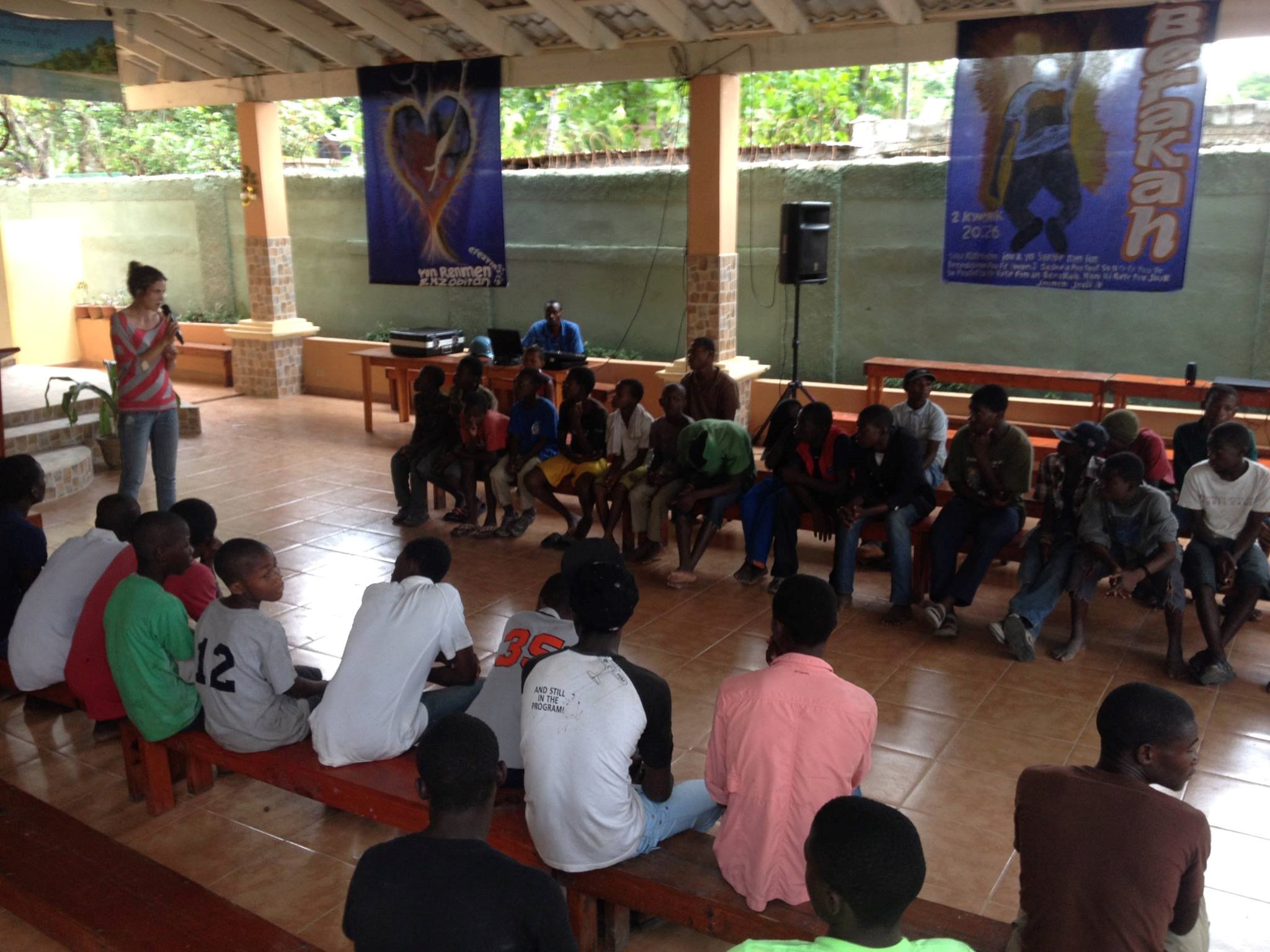

Appendix II: Footnotes
[1] Co-Founder, Coordinator, and Head of Haiti Operations, Little Footprints Big Steps International Development Organization.
[2] Individual Publication Date: October 1, 2017 at www.in-sightjournal.com/an-interview-with-morgan-wienberg-m-s-c-part-five; Full Issue Publication Date: January 1, 2018 at www.in-sightjournal.com/insight-issues/.
[3] Meritorious Service Cross (M.S.C.), Government of Canada; Queen’s Diamond Jubilee Medal; Governor General of Canada Academic Awards; Yukon Commissioner Award; Finalist, Young Women Impacting Social Justice, The Berger-Marks Foundation; Rotary International Paul Harris Fellowship Award for Humanitarian Impact, Rotary International; Keynote Speaker (2013), United Nations Youth Assembly.
[4] Photograph courtesy of Morgan Wienberg.
License
In-Sight Publishing by Scott Douglas Jacobsen is licensed under a Creative Commons Attribution-NonCommercial-NoDerivatives 4.0 International License. Based on a work at www.in-sightpublishing.com.
Copyright
© Scott Douglas Jacobsen and In-Sight Publishing 2012-Present. Unauthorized use and/or duplication of this material without express and written permission from this site’s author and/or owner is strictly prohibited. Excerpts and links may be used, provided that full and clear credit is given to Scott Douglas Jacobsen and In-Sight Publishing with appropriate and specific direction to the original content. All interviewees and authors co-copyright their material and may disseminate for their independent purposes.
Share this:

Author(s): Scott Douglas Jacobsen
Publication (Outlet/Website): In-Sight: Independent Interview-Based Journal
Publication Date (yyyy/mm/dd): 2017/09/22
Abstract
An interview with Morgan Wienberg, M.S.C. She discusses: modern examples 5 years into the development of Little Footprints Big Steps International Development Organization’s three components; number of corrupt orphanages; number of orphanages completely shut down with assistance of Morgan; the general process of shutting down corrupt orphanages; nuanced on-the-ground aspects of the problems in family reintegration and aftercare programs; best ways to empower women and girls to flourish; and the involvement of fathers and birth control.
Keywords: Humanitarianism, Little Footprints Big Steps International Development Organization, Morgan Wienberg.
An Interview with Morgan Wienberg, M.S.C.: Co-Founder, Coordinator, and Head of Haiti Operations, Little Footprints Big Steps International Development Organization (Part Four)[1],[2],[3],[4]
*Footnotes in & after the interview, & citation style listing after the interview.*
*This interview has been edited for clarity and readability.*
*Images in Appendix I: Photographs.*
1. Scott Douglas Jacobsen: Little Footprints Big Steps International Development Organization works from three components: child well-being and development, family and community involvement, and advocacy of child rights.[5] What are some modern examples of this – 5 years into its development?
Morgan Wienberg: Some children have been reunited for several years. We are focusing on education and medical care for the kids. That’s one clear example with child well-being and development. When speaking about family and community development, the community trainings as part of the working group for child protection. Community education regarding child abuse and sexual assault.
Also, education regarding abandonment once people give their children to orphanages. Some children have been reunited longer. We will invest in helping a parent start a small business or raise livestock. That does overlap into child wellbeing and development because the objective is to help that parent be able to care for the child.
In addition to it, that family can invest in their local economy, which can affect the whole community. When we talk abut advocacy, some examples include parents who try to reclaim their child from a corrupt orphanage. They find out that the child has been sold. We met one parent whose child died in the orphanage. We accompany those parents to take legal action and get an arrest warrant for the orphanage owner.
I have been involved in shutting several orphanages down. We have some of the kids involved in advocacy. When we have meetings with certain partners to educate international community about corrupt orphanages and the importance of family reunification, we have some of the youth that went through the phase of living in an abusive orphanage.
Now, they are with their families or in a state house. We have those children speak at the meetings or speak with partners, or on radios. We try to get them involved in that as well. In addition, other advocacy cases include kids who are sexually assaulted. We accompany them to the hospital for medical care. We try to arrange mental health care as well.
We have the child see a psychologist. We have them removed from the dangerous situation. We accompany them to the police system and to court if necessary.
2. Jacobsen: In a prior interview, you mentioned 600 orphanages were corrupt in Haiti. However, it is hard to track them. You posited more.
Wienberg: There are more.
(Laughs)
There are thousands of orphanages in Haiti. Social Services has tried to monitor them. However, when you talk about the entire Southern department, which is equivalent to a province or a state, there are only 7 social workers for the entire region who are with social services. Those 7 social workers don’t have contracts. They haven’t had contracts for the last 3 months.
They haven’t been paid. They go to work because of commitment to the kids. There are only 2 paid social workers at present for the entire region. They have one vehicle. How can they monitor those orphanages? They did try to do some statistics about it. Definitely, I believe there are more than 600.
3. Jacobsen: How many have you been involved in shutting down?
Wienberg: I have been involved in shutting down three orphanages, completely.
4. Jacobsen: What is the process to shutting them down? If people are reading this 1, 5, or 10 years from now, what is the general process to shut them down directly or indirectly through support/advocacy to shut them down?
Wienberg: It is important to be in contact with IBESR. If you see orphanages that do not treat children well or up to standards, you should report it. If it is not too severe, they will not shut it down, but will pressure the orphanage to improve its standards. It is important to notify them about it. That is the first step. Also, you can go to the police, UNICEF, or Save the Children.
In terms of prevention, if you want to support abused children, you should know orphanages are more likely to cause more problems. You can consider supporting families or community development projects, foster homes, or support IBESR if you’re going to support an orphanage. IBESR can list the official ones. If it is an orphanage that you are part of now, you can contact IBESR to see if it is registered.
First of all, international sponsors for these orphanages are not aware of the exploitation happening. Also, they might not be aware of the alternatives. Haiti is on another level. Even if an orphanage is well run, the children are healthy. It has sufficient funding. A child raised in an institution is not going to develop the same as a child in a family setting. S.O.S. Village is a good example.
This is a good orphanage that we’ve placed children when they can’t be with their families because it is set up as a family setting. It is broken into different households with a mother and a limited number of kids. I appreciate that some kids need orphanages, but the setup should be in a family dynamic. There is research to prove this. Kids raised in institutions are more likely to be involved in prostitution, crime, and so on.
They feel like they are lacking something. If you look at Haiti as a whole and want to help Haiti advance, I do not see how taking children away from their communities and leaving them in that one spot, and leave them there until they are 18, will help the country advance.
You have teenagers completely disconnected from the community. They do not know how to survive in their own country. They do not have the connections to community for reintegration into the community. I have seen those kids at 18. They grow up well in an orphanage, but are put out on the street at 18. Literally, there have been kids that die because of malnutrition. They do not know how to survive.
Once they turn 18, they can not keep them in the orphanage. They put him on the street. They did not reunite him with the family at that point. If the child has been at the orphanage for several years, who knows if the family will accept them? If they do live with the family, they do not have the connection. They are not used to surviving. A lot of the time, they do not have the skills to look after themselves and the community.
Haiti is lacking in aftercare programs for transitioning youth into more self-sufficient adults. Many people are eager to support little kids. Sometimes, it is difficult to acquire funding for teenagers or young adults. It is important because those are some of the most at-risk people in Haiti. Those young adults. They have the potential to turn the country around and contribute to the economy, and to create industry.
They can look after themselves and other people. Few people are investing in that age group. Those are the people turning to crime or remaining dependent on adults or orphanages, and so on. So, definitely, the investment in families and communities is the way to go; if you have to support and institution, you should have it based in family units with aftercare programs to help youths transition out.
5. Jacobsen: Statistically, those that will become involved in crime, drugs, inability to support themselves, and have a negative impact on society are young men more than young women. The reintegration of young men into families is important for the reduction of those negative impacts. I love your comprehensive perspective. Aside from family reintegration and after care programs, what are the nuanced on-the-ground aspects of the problem?
Wienberg: With the aid coming to Haiti, I notice this does not focus on empowerment and sustainability of the locals. Those giving the aid need to ask the locals what they are not good at and then work on improving that for them. That can help them become more sustainable. Also, it creates a culture of dependents. The Haitian people are receiving handouts or people are coming to them and asking, “What do you need?”
Rather than, “What qualities do you have that we can help you build?” That mentality, even once healthier, they will not realize that they can impact or improve those in their community. They see themselves as receivers rather than contributors. It is about coming with an open mind and being culturally sensitive asking, “How can we help you become more sustainable?” Then, you can invest in that.
When you look at the US aid approach of sending subsidized rice into Haiti, local farmers can not sell rice. The street rice in more expensive than bleached white American rice. Even a portion of the money invested in shipping the rice over here, if those funds were invested in helping local farmer grow crops and training them in effective methods of doing it, it would have an exponentially greater impact here than the standard method.
6. Jacobsen: You are touching on something deep there. I note young men being more likely to head into crime, and so on, if disenfranchised, alienated, and so on. The sociological term is anomie. If you take the suggestion of having some of the money used to ship the subsidized white American rice and give this to women – daughters, mothers, aunts, and grandmothers, that can be taken as a form of empowerment of women at one level.
Furthermore, empowerment of women is the strongest force for raising the ‘floor’ of the entire society – any society. This has been shown by the UN repeatedly on international metrics. You mentioned a women’s rights governmental organization that you are working with as well. What are the best ways to empower girls and young women to flourish?
Wienberg: Women’s independence is a huge aspect of it because a lot of women and girls depend on men for finance. Sometimes, even if they are able to go to school or have other opportunities, because their opportunities are being paid for by men, they become pregnant or influenced by those men and not making their own decisions. Mothers need to be able to look after their children would address the issue.
Women being economically independent would help them take their futures into their own hands. I work with kids in the streets. Primarily, they are boys. I think that’s because the girls, even suffering domestic abuse, will stay at home because they depend on it. Even with women, with wives, their husband can be abusing their children. They will stay at home because the men rent the house for them.
Even if we look at what is going into the streets, they are being introduced to crime. There is a gang environment, where older people and young men will pressure children into doing certain crimes. I have 13-year-old boys tell me about how a man has put a gun in their hands and pressured them to rob a store. If they are accused, they will be beat up or have to leave the area.
If mothers are able to look after their kids, those kids will be able to look after them. Primarily, kids will enter the streets because there is nothing going on at home. There is no food. They are not in school. They might as well go out and find a way to feed themselves. If parents are able to provide for their kids, that is ultimately the biggest way to address these issues.
In particular, we need to invest in women. Many men do not take responsibility for their families or their children. We had a father of a girl, who we reunited, sell the family’s home. He had five kids – four boys and one daughter. This was a girl in the corrupt orphanage. The mother is an incredibly strong woman. She stays with the man.
This man sold the home. Now, they live in a mix of tarp and metal sheets put together. They do not know what he did with the money. He has other girlfriends. Many men do not take responsibility for their families. We had the mother start a small business. We saw a difference in the children’s health at that point. So, the empowerment of women is a powerful thing to do now.
There are fathers who care about their kids and family. However, primarily, we see mothers being more sensitive for their children.
7. Jacobsen: The main message was economic empowerment of women and the involvement of fathers. Another aspect of United Nations empowerment of women has to do with reproductive rights. We have Margaret Sanger in North America for the pill. It provides more women the control over when and how many children.
Wienberg: [Laughing] I have a few stories. I can share them. It is an issue, which is a challenge. We are attempting to approach it. Another major issue in Haiti is people have too many children. Birth control is free. If a woman goes to take birth control and can not afford it, they will give it to her. They have injections available, pills, something placed under the skin renewed every 5 fives, and hysterectomies.
Women can do this without anyone knowing about it. It is discreet and free of charge. The majority of people are not doing it. It is a huge challenge for us because you can help the family without the ability to support their children. Families with five kids. Four of them in school. We are the one sponsoring the education. All of the sudden, the family has another child.
[Laughing]
It is frustrating because they can not support their current children. It is something we have been working towards for the current families through LFBS. I am working on training staff to work on family planning and its importance. Hopefully, we will be able to do the new training in the new year with the families that LFBS works with in Haiti.
There is another woman. She approached the working group for child protection. She has 14 children. This woman is in her 40s. She does not have a husband or man living with her. She is a single mother with 14 kids, in a 1-bedroom home, and no job – no source of funding. She depends on handouts from people in the community.
The kids are malnourished and hospitalized, and the woman has no quality of life. She was not on birth control at the time of approaching us. She started birth control. However, that is not a unique case. My friend, who works in the public health department, explained a conversation with a young woman. A young woman had five children, she was 25-years-old. She had a kid each year of the marriage. He was asking her about birth control.
She did not want it. We asked, “Why not use a natural method? Why not have the husband pull out?” According to her, the young woman, half of the time, she was sound asleep and wakes up. Her husband is having sex with her. The young woman, 25, is becoming pregnant while asleep. Part of the issue is women do not feel in control of their own bodies.
I thought about the woman working with me. I work with them. How can people feel out of control of their bodies to such a degree? It terrifies me. We have been working on this with the community training on sexual assault. Often, there is a belief that when a couple marries the man owns the woman’s body. They truly believe this.
We have been doing community trainings, where a pastor will stand and say, “No, according to the Bible, when I marry my wife, I can do what I want with her body.” They do this in front of the whole community training. It is a mentality women accept too. They do not understand that it is rape if you say, “No,” to your husband. There are radio emissions about it. However, when woman marry, they do not feel control over their bodies.
If a woman is not able to have a child, it makes her have less worth to a man. Or, he will not want to marry her. There is a mentality of men. Men want to leave their legacy.
[Laughing]
They want to have a lot of kids. If they have a lot of kids, those kids will look after you in old age. They forget about raising the kids first. It is a major part of the issue.
References
[David Truman]. (2016, March 9). Morgan. Retrieved from https://www.youtube.com/watch?v=RWbgIF1NO5E.
[DevelopingPictures]. (2012, March 25). Sponsor a Child: Little Footprints Big Steps. Retrieved from https://www.youtube.com/watch?v=PjzncB3HsmA.
[James Pierre]. (2016, April 5). Morgan Wienberg goes one-on-one with James Pierre. Retrieved from https://www.youtube.com/watch?v=C1VMeKKTxkM.
[Morgan Wienberg]. (2014, June 3). Congratulations, FH Grad 2014!. Retrieved from https://www.youtube.com/watch?v=LNQ7PB95aYA.
[Ryan Sheetz]. (2015, February 20). Little Footprints Big Steps. Retrieved fromhttps://www.youtube.com/watch?v=c9fdPx1srGI.
Bailey, G. (2013, December 31). Catch Yukoner Morgan Wienberg tomorrow on CBC’s Gracious Gifts. Retrieved from http://www.cbc.ca/airplay/features/2013/12/31/catch-yukoner-morgan-wienberg-tomorrow-on-cbcs-gracious-gifts/.
Baker, R. (2016, March 4). PHOTOS Governor General recognizes exceptional Canadians in Vancouver. Retrieved from http://www.cbc.ca/news/canada/british-columbia/governor-general-recognizes-exceptional-canadians-in-vancouver-1.3476960.
Broadley, L. (2014, August 1). Meet the Yukoner reuniting Haitian ‘orphans’ with their families. Retrieved from http://globalnews.ca/news/1482839/one-yukoners-work-reuniting-haitian-orphans-with-their-families/.
Bruemmer, R. (2011, April 8). Haiti: Little Paul gets it done. Retrieved from http://www.montrealgazette.com/business/haiti+little+paul+gets+done/5214066/story.html.
CBC News. (2015, November 29). Morgan Wienberg awarded Meritorious Service Cross for work in Haiti. Retrieved from http://www.cbc.ca/news/canada/north/morgan-wienberg-awarded-meritorious-service-cross-for-work-in-haiti-1.3340295.
ca. (n.d.). 23-year-old receives Meritorious Service Cross Medal. Retrieved from http://canadaam.ctvnews.ca/video?clipId=804018&playlistId=1.2769055&binId=1.815911&playlistPageNum=1&binPageNum=1.
ca Staff. (2016, February 8). 23-year-old awarded Meritorious Service Cross for work in Haiti. Retrieved from http://www.ctvnews.ca/canada/23-year-old-awarded-meritorious-service-cross-for-work-in-haiti-1.2769013.
Dolphin, M. (2015, December 4). Yukoner’s work in Haiti draws governor general’s attention. Retrieved from http://www.yukon-news.com/life/yukoners-work-in-haiti-draws-governor-generals-attention/.
Gillmore, M. (2012, July 18). Helping to reunite families in Haiti. Retrieved from http://yukon-news.com/life/helping-to-reunite-families-in-haiti.
Gillmore, W. (2013, August 16). Wienberg gives New York a glimpse of Haiti. Retrieved from http://www.yukon-news.com/news/wienberg-gives-new-york-a-glimpse-of-haiti/.
Gjerstad, S. (2014, April 8). Morgan (22) vier livet sitt til å gjenforene barn med foreldrene sine på Haiti. Retrieved from http://www.tv2.no/a/5852686/.
Joannou, A. (2016, March 7). Governor general gives nod to Yukon’s champion of Haitian children. Retrieved from http://www.yukon-news.com/news/governor-general-gives-nod-to-yukons-champion-of-haitian-children/.
Langham, M. (2012, October 10). Just Like Us: An Interview with Morgan Wienberg of Little Footprints, Big Steps. Retrieved from http://aconspiracyofhope.blogspot.ca/2012/10/just-like-us-interview-with-morgan.html.
Little Footprints, Big Steps. (2016). Little Footprints, Big Steps. Retrieved from https://www.littlefootprintsbigsteps.com.
Neel, T. (2013, May 16). Reaching the Hearts of Children in Need. Retrieved from http://whatsupyukon.com/Lifestyle/making-a-difference/reaching-the-hearts-of-children-in-need/#sthash.YCSvg1aM.oVLAQE3j.dpbs.
Peacock, A. (2016, February 27). Haiti has her heart. http://www.kelownadailycourier.ca/news/local_news/article_beb828d0-ddcf-11e5-851b-8b09487f61ce.html?mode=story.
(2014, July 8). Joven canadiense decide gastar sus ahorros en rescatar niños de Haití. Retrieved from http://www.elpais.com.uy/vida-actual/joven-canadiense-reune-huerfanos-haitianos.html.
Rodgers, E. (2015, January 12). Meet the 22-Year-Old Who Skipped Out on College—to Offer a Helping Hand in Haiti. Retrieved from http://www.takepart.com/article/2015/01/12/meet-morgan-wienberg-little-foot-big-step.
Schott, B.Y. (2012, September 13). Making a Difference One Child at a Time. Retrieved from http://whatsupyukon.com/Lifestyle/making-a-difference/making-a-difference-one-child-at-a-time/#sthash.CeS656Xm.2r1eJsAW.dpbs.
Shiel, A. (2011, November 17). McGill students host third annual TEDxMcGill even. Retrieved from http://www.mcgilldaily.com/2011/11/mcgill-students-host-third-annual-tedxmcgill-event/.
Thompson, J. (2011, December 23). Helping Haiti for the holidays. Retrieved from http://yukon-news.com/life/helping-haiti-for-the-holidays.
Thompson, J. (August 12). Hope and hard lessons in Haiti. Retrieved from http://yukon-news.com/life/hope-and-hard-lessons-in-haiti.
Thomson Reuters. (2014, July 27). 22-year-old Yukoner reunites Haitian ‘orphans’ with parents. Retrieved from http://www.cbc.ca/news/canada/north/22-year-old-yukoner-reunites-haitian-orphans-with-parents-1.2719559.
Waddell, S. (2015, November 27). For decorated Yukoner, home is now Haiti. Retrieved from http://www.whitehorsestar.com/News/for-decorated-yukoner-home-is-now-haiti.
Whitehorse Star. (2016, March 2). Yukoners to receive honours from Governor General. Retrieved from http://www.whitehorsestar.com/News/yukoners-to-receive-honours-from-governor-general.
Wienberg, M. (2013, November 22). Age Is Not an Obstacle in Changing the World. Retrieved from http://www.huffingtonpost.com/morgan-wienberg/age-is-not-an-obstacle_b_4324563.html.
Wienberg, M. (2014, January 23). Courage of a Mother. Retrieved from http://whatsupyukon.com/Lifestyle/making-a-difference/courage-of-a-mother/#sthash.hy1QzF0S.ZA1StSZz.dpbs.
Woodcock, R. (2013, September 26). Back to School in Haiti. Retrieved from http://whatsupyukon.com/Lifestyle/making-a-difference/back-to-school-in-haiti/#sthash.TMqQNkLX.dpbs.
Yukon News. (2013, February 6). Incredible acts of kindness in Haiti. Retrieved from http://yukon-news.com/letters-opinions/incredible-acts-of-kindness-in-haiti.
Appendix I: Photographs


















Appendix II: Footnotes
[1] Co-Founder, Coordinator, and Head of Haiti Operations, Little Footprints Big Steps International Development Organization.
[2] Individual Publication Date: September 22, 2017 at www.in-sightjournal.com/an-interview-with-morgan-wienberg-m-s-c-part-four; Full Issue Publication Date: January 1, 2018 at www.in-sightjournal.com/insight-issues/.
[3] Meritorious Service Cross (M.S.C.), Government of Canada; Queen’s Diamond Jubilee Medal; Governor General of Canada Academic Awards; Yukon Commissioner Award; Finalist, Young Women Impacting Social Justice, The Berger-Marks Foundation; Rotary International Paul Harris Fellowship Award for Humanitarian Impact, Rotary International; Keynote Speaker (2013), United Nations Youth Assembly.
[4] Photograph courtesy of Morgan Wienberg.
[5] About Us (2016) states:
1. Child Well-being and Development
Our child well-being and development program focuses on literacy, numeracy and vocational learning. LFBS runs a Transitional Safehouse for those children who temporarily cannot live at home, or do not have a home. We offer protection and healing of children victimized by abuse, neglect, exploitation and homelessness.
2. Family and Community Development
Our outreach program helps families receive the training and resources they need to begin a sustainable source of income through micro-business start-up, farming or a trade. Earning money means that families can stay together or reunite. Education and opportunity for self-sufficiency and sound housing helps break the cycle of poverty, poor health, abandonment in Haiti by helping build strong families and communities and keeping families together.
3. Advocacy of Child Rights
LFBS works in collaboration with local authorities and media to take a stand for the rights of children and parents. We raise awareness against child abandonment in vulnerable communities and help victims of abuse to find their voice to speak out.
WE restore vulnerable Haitian children and youth to health, family and community. OUR programs emphasize direct relationship with Haitian people. WE act to empower rather than replace families and local social structures. OUR focus is on sustained change in the lives of the people we work with. ENHANCING the capacity of locals to create change means that we embrace partnerships and cooperative relationships with local authorities and other agencies.
Little Footprints, Big Steps. (2016). About Us. Retrieved from https://www.littlefootprintsbigsteps.com/about-us/.
License
In-Sight Publishing by Scott Douglas Jacobsen is licensed under a Creative Commons Attribution-NonCommercial-NoDerivatives 4.0 International License. Based on a work at www.in-sightpublishing.com.
Copyright
© Scott Douglas Jacobsen and In-Sight Publishing 2012-Present. Unauthorized use and/or duplication of this material without express and written permission from this site’s author and/or owner is strictly prohibited. Excerpts and links may be used, provided that full and clear credit is given to Scott Douglas Jacobsen and In-Sight Publishing with appropriate and specific direction to the original content. All interviewees and authors co-copyright their material and may disseminate for their independent purposes.
Share this:

Author(s): Scott Douglas Jacobsen
Publication (Outlet/Website): In-Sight: Independent Interview-Based Journal
Publication Date (yyyy/mm/dd): 2017/09/15
Abstract
An interview with Morgan Wienberg, M.S.C. She discusses: ethic that drives the work; benefits in interpersonal interactions with Haitians through speaking English and Creole; partnerships with organizations; tasks and responsibilities as the Co-Founder, Coordinator, and Head of Haiti Operations for Little Footprints Big Steps International Development Organization; best personal aspects of the position; most emotionally ‘taxing’ part of the work for her; relevant preparation from high school for the humanitarian pursuit; easiest and hardest aspects of coordination of a diverse, multi-disciplinary team; strengths in a diverse team; main differences between Haiti and Canada and being culturally sensitive; and benefits and downsides of each culture.
Keywords: Humanitarianism, Little Footprints Big Steps International Development Organization, Morgan Wienberg.
An Interview with Morgan Wienberg, M.S.C.: Co-Founder, Coordinator, and Head of Haiti Operations, Little Footprints Big Steps International Development Organization (Part Three)[1],[2],[3],[4],
*Footnotes in & after the interview, & citation style listing after the interview.*
*This interview has been edited for clarity and readability.*
*Images in Appendix I: Photographs.*
1. Scott Douglas Jacobsen: What is the ethic that drives this for you?
Morgan Wienberg: [Laughing] I see all people as having the same rights. The fact that these children can be so stripped of their rights. I do not feel I can accept it. I need to do something about it. I am reminded of the conditions of the kids in the beginning. It is upsetting that children who are supposed to be protected by society can be badly hurt and abused by the adults.
Adults who are supposed to be protecting them. That many people can see it and accept it. Part of the issue is people go to Haiti and, because it is Haiti, will accept that this child is emaciated or too weak to stand up. Or that the adult is whipping the child with a metal cord. Child rights are universal. There’s the Convention on the Rights of the Child.
If a country is not developed or has some cultural undertones, that does not change the Convention on the Rights of the Child. We should not accept the ill-treatment of the young. They need more support to be implementing the Convention on the Rights of the Child. Some people when they go to Haiti accept and forget it because “it’s Haiti.”
2. Jacobsen: You speak English and Creole. How does this benefit interpersonal interactions with Haitians?
My speaking English and Creole influenced my abilities to better understand Haitian culture and the things happening at the moment, especially with street children in particular. I learned about street children by sitting with them in the afternoon and talking with them. I had a communication barrier, which made building relationships and trust difficult.
I dealt with a fair share of deception and corruption. My speaking the language helps me learn my lesson or be aware of risks, especially of repeats of deception and corruption. In terms of managing staff and being fully communicating expectations with them, and to understand their perspective, it plays a huge role. I cannot express it.
Even in the integration into the community, I needed to understand the culture and family dynamics. I would not know without knowing Creole. When I went to Haiti in 2010, I knew French and got by with it. When I went to the orphanage in 2011, the children didn’t speak French. I began to speak Creole by communicating with them.
My understanding of the real situation came from speaking the language and with the children. They spoke of the families back home. The kids could be coming to orphanages for years and the parents would not know the truth. I found out about the situation for the kids and their families, and the details of the abuse, is from the children talking to me.
3. Jacobsen: Did learning Creole/Kreyol improve trust and camaraderie with Haitians?
It makes me stand out. Haitians are surprised when I speak to them. I have been able to present in a court house, in the legal system, to participate in meetings with other local authorities, and so on. I am able to fully express myself. It helps them understand my objectives and way of thinking. In the beginning, when they don’t fully understand my objectives, I met hostility from the authorities.
They were better able to understand what I am doing. We are partners now. When people in the community see me speaking Creole, they like it.
4. Jacobsen: You mentioned partnerships. What organizations?
We partner with the local child protection authorities. In particular, IBESR (Institut du Bien-Etre Social et de Recherches), which is the equivalent of Haitian social services. So, they are the child protection authority. Other government departments include the Ministry for Women’s Rights, Ministry for Handicapped People’s Rights, and Social Affairs.
All of those institutions are part of a network, which is the Groupe du Travail pour la Protection des Enfants (GTPE-Sud) in Haiti. It is a regional network that covers the entire Southern department of Haiti, but it’s based on Les Cayes. This group was originally formed in 2010 following the earthquake as the cluster group for child protection. Now, it has a different name. LFBS is part of the group. Same with the governmental departments.[5]
We have meetings with IBESR once a month, even every two weeks. We work with IBESR about once-a-week. Also, with the Child Protection Brigade of the Police, we help each other out. In particular, where a child has been sexually assaulted, we will be working with the police and the Ministry for Women’s Rights. Other organizations focus on children in conflict with the law.
We work with them, for years now. We help them work with specific case studies. They offered us psychologists to see some children, which we have in the program. They have a social worker doing weekly training with my staff. They let us use their space for different activities. Similar to Haitian social services. Before we had a truck, they let us use their vehicle.
Now, we let them use our vehicle. They help us with children. They place children in the state houses. For example, last week, IBESR had a lost girl. We took her into our girls’ home until they could reunite her with her family. We have good, close working partnerships with the organizations. We have collaborative initiatives too. One main initiative is community training for prevention of sexual assault.
We will go into rural communities and train people about sexual abuse, how they can protect children, and how to react if you’re a victim or someone that you know is a victim. We create committees in those communities. So, community members can keep with the initiative and in contact with us. We are doing this as a group.
5. Jacobsen: You remain the Co-Founder, Coordinator, and Head of Haiti Operations for Little Footprints Big Steps International Development Organization. What tasks and responsibilities come with this station?
When I started the organization, it was one outreach worker and me. Literally, I would walk with the child to their family, sitting down, having meetings with the family, doing mediation, and helping the child purchase school supplies and go to the hospital. Now, we work to make the support more sustainable, able to expand, and less dependent on me.
Now, I coordinate staff schedules. My staff does those things. They work on their tasks. I do the follow-up afterward. Also, I coordinate with partners. If there is a particularly vulnerable family, I will ask a social worker from social services to accompany my staff to work with that child. Now, I focus on coordinating staff activities in following up with the kid and working on longer-term development or expansion of the programs.
However, I see first-hand things with the kids. My personal connection with the children motivates me. If I was the only one rather than my staff doing the work, I would be limiting the number of people potentially impacted.
6. Jacobsen: What seem the best aspects of this position on a personal level?
I am able to see the growth and empowerment of people. When working intimately with them, you see them every day. I see growth and empowerment with the kids. I look at staff at times. It motivates me. I see them grow. I see them passionate about child protection issues, too. Also, it is exciting to get involved in the big picture in everything we can accomplish.
We gain momentum in working with others. The biggest thing that I love most about this position is dreaming big and making those dreams a reality.
7. Jacobsen: Big dreams are big risks. What seems like the most emotionally ‘taxing’ part for you?
It is extremely, extremely stressful. I struggle with choosing. You have to choose. It is a huge privilege to be able to choose to help someone. However, there are many, many people asking and needing help. You have to choose the person. It is a constant battle within me. You can not anticipate who will advance the most with the support given to them by you. It is difficult.
Sometimes, there are kids who abuse the support in the beginning. Believing in the child, when they do not believe in themselves, it is part of what will result in change. At the same time, in choosing to help the child, you are telling others “no.” Constantly, I wonder if these are the right decisions among competing ones. Also, who am I to choose over people’s lives?
The task is immense. I have to make the decision. It is hard. Also, the trauma for the kids. It might be over. However, it’s hard, emotionally. It is a slow process for the kids to heal from trauma.
8. Jacobsen: You mentioned some board member work before. What other preparation from high school was relevant from this humanitarian pursuit?
Everything from childhood prepared me. Also, it is not something that you could have looked at and prepared yourself for, or have expectations. I had the extreme motivation and inner strength (the biggest thing) to be able to do this. In knowing the activities of the board, my work seeing the meetings help me. I can know what to present.
9. Through the coordination of Little Footprints Big Steps International Development Organization, you work with numerous personalities.[6] What seems like the easiest and hardest aspects of coordination of a diverse, multi-disciplinary team?
My staff on the ground and the board of directors are different groups. They deal with different aspects of the organization. I am the on tying them together. I feed information to both of them. It’s interesting to me. It is unique to be able to connect the two different worlds. It is powerful, especially for the staff on-the-ground to be heard and considered on a team with people like Pamela Hine.
It can be difficult to communicate the reality on-the-ground to the Board of Directors at times. It is hard to give a full picture.
[Laughing]
At the same time, they are understanding and encouraging. With the local staff, there are some cultural challenges at times. I have been attempting to focus on their wellbeing. I went to a conference in India earlier this year.
One theme was about caring for the caretakers. When you think about it, they have been through trauma, work through stressful days, and the kids are not always respectful. I want to focus on the wellbeing and training of the local staff. I have seen them be more independent, motivated, and engaged because they feel value and potential for themselves.
I have worked closely with the local staff compared to the board of directors. I communicate with them more because I am in primarily Haiti. However, the staff needs the constant presence and communication more than the board of directors.
10. Jacobsen: You noted the difficulties run one way. Not from local workers in Haiti to the board members, but from the board members understanding the situation on the ground for the LFBS staff. That’s an interesting note. If you have a diverse team split in team streams, what strengths does this diverse team bring to the organization?
Definitely, there is a strength. My local staff completely understand the culture and the reality of what we are dealing with in Haiti. I have the international board. They have a level of education and contacts, and perception. That can be applied to Haiti. When you combine the two, it works really well. When you bring people on board, you are developing contacts Haitians would not think about for LFBS.
I am being fed contacts from the international side and am able to bring that to LFBS staff. I can then apply this in a culturally sensitive way. It is subtle. We can bring unique methods and contacts, but make them work for the community.
11. With respect to cultural sensitivity and differences, or a careful ‘trotting’ around or between the two, what are the main differences between Haiti and Canada? How would you be culturally sensitive?
Those are some difficult questions. To be culturally sensitive, it is about being open-minded and recognizing when going to Haiti s a different culture and system. You should not have expectations in Haiti as if it’s North America. You should be willing to learn, pick up on the culture, and see how people interact here. That can be ‘easier said than done’. People take many expectations from North America.
It is about bringing something to Haiti rather than learning and taking in Haiti. The biggest difference is communication. I find communication different. Communication has been something work with the local staff a bit. Another major difference is people in Haiti value relationships over time. For instance, if you are in a meeting, and come across someone with an issue, a Haitian would not even think twice about stopping and talking to that person to help them with the issue, and then arrive late to the meeting.
They would not think twice about it. A North American might feel stressed about being 15 minutes late. It depends on the person. (Laughs)
[Laughing]
In North America, we are time focused. In Haiti, they are relationship focused. It has its strengths. (Laughs) It has its difficult moments as well.
12. Jacobsen: With time, it makes the society more productive. With relationships, it benefits mental well-being. Downsides are the reduction of well-being and lost time, respectively.
It is something that I notice coming back to North America. It is part of the enjoyment and connectedness with Haitian society (more than North America at times). Human interactions are lacking at times in North America. We have materialistic values. That has taken the place of human contact and interaction. In Haiti, if something happens to me in the middle of the street, even if I did not know the area, I know 20 people will work to help me.
In North America, you can be part of a community in North America and not be a part of their life, and so be ignored by them – or they are stressed about meeting timelines. I can be affected by it. It works well with LFBS work. When you’re working with families attempting to build trust with these traumatized children, it is about the relationships and the interactions.
Often much more than timelines.
References
[David Truman]. (2016, March 9). Morgan. Retrieved from https://www.youtube.com/watch?v=RWbgIF1NO5E.
[DevelopingPictures]. (2012, March 25). Sponsor a Child: Little Footprints Big Steps. Retrieved from https://www.youtube.com/watch?v=PjzncB3HsmA.
[James Pierre]. (2016, April 5). Morgan Wienberg goes one-on-one with James Pierre. Retrieved from https://www.youtube.com/watch?v=C1VMeKKTxkM.
[Morgan Wienberg]. (2014, June 3). Congratulations, FH Grad 2014!. Retrieved from https://www.youtube.com/watch?v=LNQ7PB95aYA.
[Ryan Sheetz]. (2015, February 20). Little Footprints Big Steps. Retrieved fromhttps://www.youtube.com/watch?v=c9fdPx1srGI.
Bailey, G. (2013, December 31). Catch Yukoner Morgan Wienberg tomorrow on CBC’s Gracious Gifts. Retrieved from http://www.cbc.ca/airplay/features/2013/12/31/catch-yukoner-morgan-wienberg-tomorrow-on-cbcs-gracious-gifts/.
Baker, R. (2016, March 4). PHOTOS Governor General recognizes exceptional Canadians in Vancouver. Retrieved from http://www.cbc.ca/news/canada/british-columbia/governor-general-recognizes-exceptional-canadians-in-vancouver-1.3476960.
Broadley, L. (2014, August 1). Meet the Yukoner reuniting Haitian ‘orphans’ with their families. Retrieved from http://globalnews.ca/news/1482839/one-yukoners-work-reuniting-haitian-orphans-with-their-families/.
Bruemmer, R. (2011, April 8). Haiti: Little Paul gets it done. Retrieved from http://www.montrealgazette.com/business/haiti+little+paul+gets+done/5214066/story.html.
CBC News. (2015, November 29). Morgan Wienberg awarded Meritorious Service Cross for work in Haiti. Retrieved from http://www.cbc.ca/news/canada/north/morgan-wienberg-awarded-meritorious-service-cross-for-work-in-haiti-1.3340295.
ca. (n.d.). 23-year-old receives Meritorious Service Cross Medal. Retrieved from http://canadaam.ctvnews.ca/video?clipId=804018&playlistId=1.2769055&binId=1.815911&playlistPageNum=1&binPageNum=1.
ca Staff. (2016, February 8). 23-year-old awarded Meritorious Service Cross for work in Haiti. Retrieved from http://www.ctvnews.ca/canada/23-year-old-awarded-meritorious-service-cross-for-work-in-haiti-1.2769013.
Dolphin, M. (2015, December 4). Yukoner’s work in Haiti draws governor general’s attention. Retrieved from http://www.yukon-news.com/life/yukoners-work-in-haiti-draws-governor-generals-attention/.
Gillmore, M. (2012, July 18). Helping to reunite families in Haiti. Retrieved from http://yukon-news.com/life/helping-to-reunite-families-in-haiti.
Gillmore, W. (2013, August 16). Wienberg gives New York a glimpse of Haiti. Retrieved from http://www.yukon-news.com/news/wienberg-gives-new-york-a-glimpse-of-haiti/.
Gjerstad, S. (2014, April 8). Morgan (22) vier livet sitt til å gjenforene barn med foreldrene sine på Haiti. Retrieved from http://www.tv2.no/a/5852686/.
Joannou, A. (2016, March 7). Governor general gives nod to Yukon’s champion of Haitian children. Retrieved from http://www.yukon-news.com/news/governor-general-gives-nod-to-yukons-champion-of-haitian-children/.
Langham, M. (2012, October 10). Just Like Us: An Interview with Morgan Wienberg of Little Footprints, Big Steps. Retrieved from http://aconspiracyofhope.blogspot.ca/2012/10/just-like-us-interview-with-morgan.html.
Little Footprints, Big Steps. (2016). Little Footprints, Big Steps. Retrieved from https://www.littlefootprintsbigsteps.com.
Neel, T. (2013, May 16). Reaching the Hearts of Children in Need. Retrieved from http://whatsupyukon.com/Lifestyle/making-a-difference/reaching-the-hearts-of-children-in-need/#sthash.YCSvg1aM.oVLAQE3j.dpbs.
Peacock, A. (2016, February 27). Haiti has her heart. http://www.kelownadailycourier.ca/news/local_news/article_beb828d0-ddcf-11e5-851b-8b09487f61ce.html?mode=story.
(2014, July 8). Joven canadiense decide gastar sus ahorros en rescatar niños de Haití. Retrieved from http://www.elpais.com.uy/vida-actual/joven-canadiense-reune-huerfanos-haitianos.html.
Rodgers, E. (2015, January 12). Meet the 22-Year-Old Who Skipped Out on College—to Offer a Helping Hand in Haiti. Retrieved from http://www.takepart.com/article/2015/01/12/meet-morgan-wienberg-little-foot-big-step.
Schott, B.Y. (2012, September 13). Making a Difference One Child at a Time. Retrieved from http://whatsupyukon.com/Lifestyle/making-a-difference/making-a-difference-one-child-at-a-time/#sthash.CeS656Xm.2r1eJsAW.dpbs.
Shiel, A. (2011, November 17). McGill students host third annual TEDxMcGill even. Retrieved from http://www.mcgilldaily.com/2011/11/mcgill-students-host-third-annual-tedxmcgill-event/.
Thompson, J. (2011, December 23). Helping Haiti for the holidays. Retrieved from http://yukon-news.com/life/helping-haiti-for-the-holidays.
Thompson, J. (August 12). Hope and hard lessons in Haiti. Retrieved from http://yukon-news.com/life/hope-and-hard-lessons-in-haiti.
Thomson Reuters. (2014, July 27). 22-year-old Yukoner reunites Haitian ‘orphans’ with parents. Retrieved from http://www.cbc.ca/news/canada/north/22-year-old-yukoner-reunites-haitian-orphans-with-parents-1.2719559.
Waddell, S. (2015, November 27). For decorated Yukoner, home is now Haiti. Retrieved from http://www.whitehorsestar.com/News/for-decorated-yukoner-home-is-now-haiti.
Whitehorse Star. (2016, March 2). Yukoners to receive honours from Governor General. Retrieved from http://www.whitehorsestar.com/News/yukoners-to-receive-honours-from-governor-general.
Wienberg, M. (2013, November 22). Age Is Not an Obstacle in Changing the World. Retrieved from http://www.huffingtonpost.com/morgan-wienberg/age-is-not-an-obstacle_b_4324563.html.
Wienberg, M. (2014, January 23). Courage of a Mother. Retrieved from http://whatsupyukon.com/Lifestyle/making-a-difference/courage-of-a-mother/#sthash.hy1QzF0S.ZA1StSZz.dpbs.
Woodcock, R. (2013, September 26). Back to School in Haiti. Retrieved from http://whatsupyukon.com/Lifestyle/making-a-difference/back-to-school-in-haiti/#sthash.TMqQNkLX.dpbs.
Yukon News. (2013, February 6). Incredible acts of kindness in Haiti. Retrieved from http://yukon-news.com/letters-opinions/incredible-acts-of-kindness-in-haiti.
Appendix I: Photographs













Appendix II: Footnotes
[1] Co-Founder, Coordinator, and Head of Haiti Operations, Little Footprints Big Steps International Development Organization.
[2] Individual Publication Date: September 15, 2017 at www.in-sightjournal.com/morgan-wienberg-part-three; Full Issue Publication Date: January 1, 2018 at www.in-sightjournal.com/insight-issues.
[3] Meritorious Service Cross (M.S.C.), Government of Canada; Queen’s Diamond Jubilee Medal; Governor General of Canada Academic Awards; Yukon Commissioner Award; Finalist, Young Women Impacting Social Justice, The Berger-Marks Foundation; Rotary International Paul Harris Fellowship Award for Humanitarian Impact, Rotary International; Keynote Speaker (2013), United Nations Youth Assembly; Finalist (2012), Edna Award, International Women’s Rights.
[4] Photograph courtesy of Morgan Wienberg.
[5] Co-Founder/Head of Haiti Operations: MORGAN WIENBERG, M.S.C. (2016) states:
Raised in Canada’s far northern city of Whitehorse, Yukon, throughout her youth, Morgan volunteered with non-profit organizations and developed an all-consuming interest in human rights. In 2010, six months after a 7.0-magnitude earthquake struck Haiti, this high school valedictorian traded her snow boots for sandals and set off for the devastated country. What was meant to be a short trip changed her life – and countless others – forever.
Morgan volunteered in an orphanage and found the conditions to be appalling. She witnessed children that were neglected, beaten, and starved. In some cases, children were used as slaves or sold, as if they were property. Although it was sorely needed, the children were denied medical attention. Morgan discovered that children had been sent to the orphanage by their parents in the mistaken belief that their children would be offered food, education, and loving care. Morgan began to work towards reuniting children with their families.
In 2011, Morgan co-founded Little Footprints, Big Steps (LFBS). Morgan continues to live in Haiti, leading the organization with integrity, creativity and perseverance. Forging partnerships and collaborations with other non-profits and with Haitian government; spearheading initiatives and piloting programs; hiring and guiding Haitian staff; managing the program administration; tirelessly pouring love and encouragement into all of the children and families that come her way.
Little Footprints, Big Steps. (2016). Co-Founder/Head of Haiti Operations: MORGAN WIENBERG, M.S.C.. Retrieved from http://www.littlefootprintsbigsteps.com/about-us/meet-mogan/.
[6] CTVNews.ca. (n.d.). 23-year-old receives Meritorious Service Cross Medal. Retrieved from http://canadaam.ctvnews.ca/video?clipId=804018&playlistId=1.2769055&binId=1.815911&playlistPageNum=1&binPageNum=1.
[7] Ibid.
License
In-Sight Publishing by Scott Douglas Jacobsen is licensed under a Creative Commons Attribution-NonCommercial-NoDerivatives 4.0 International License. Based on a work at www.in-sightpublishing.com.
Copyright
© Scott Douglas Jacobsen and In-Sight Publishing 2012-Present. Unauthorized use and/or duplication of this material without express and written permission from this site’s author and/or owner is strictly prohibited. Excerpts and links may be used, provided that full and clear credit is given to Scott Douglas Jacobsen and In-Sight Publishing with appropriate and specific direction to the original content. All interviewees and authors co-copyright their material and may disseminate for their independent purposes.
Share this:

Author(s): Scott Douglas Jacobsen
Publication (Outlet/Website): In-Sight: Independent Interview-Based Journal
Publication Date (yyyy/mm/dd): 2017/09/08
Abstract
An interview with Morgan Wienberg, M.S.C. She discusses: jobs to save money for Little Footprints Big Steps International Development Organization; origination and development of the relationship with the nurse; meaning of parental support and encouragement; parental support in spite of parent hesitancy about travels of their child; responsibilities with public recognition; content and purpose of the film Morgan’s Kids; meaning of the exposure; and well-meaning, but misguided, foreigners giving aid, volunteer time, support, and exposure in the media to corrupt organizations.
Keywords: Humanitarianism, Little Footprints Big Steps International Development Organization, Morgan Wienberg.
An Interview with Morgan Wienberg, M.S.C.: Co-Founder, Coordinator, and Head of Haiti Operations, Little Footprints Big Steps International Development Organization (Part Two)[1],[2],[3],[4]
*Footnotes in & after the interview, & citation style listing after the interview.*
*This interview has been edited for clarity and readability.*
*Images in Appendix I: Photographs.*
1. Scott Douglas Jacobsen: Little Footprints Big Steps International Development Organization (LFBS) is a registered charity, which emerged out of this endeavour based on collaboration with a nurse, Sarah Wilson. However, you needed finance. You mentioned one job. You worked three jobs to save enough money. What two other jobs?
Morgan Wienberg: I had about $25,000 saved for university at the time. I started with personal savings. I went in 2010 for 2 ½ months. Before I left to return to Canada, I decided to come back. I deferred university. I went back to Canada, but worked 3 jobs for 6 months before going back to Haiti. I intended to go to Haiti. I went to work to save additional funds.
I worked at a bakery. It was a bakery, restaurant, and yoga studio in one. I worked there for a few years. The community gave generous tips. I worked at the local animal shelter looking after the dogs, e.g. cleaning the cages. If I worked at the bakery starting at 5 in the morning, I would work at the animal shelter in the afternoon. Also, I did a lot of babysitting. I worked in a women’s gym through exercise classes and so on. I cleaned houses for neighbours too.
2. Jacobsen: How did this relationship with the nurse originate and develop for you?
Wienberg: My first time in Haiti, in 2010, staying in a compound with Mission of Hope. There many other volunteers there. I was there for 2 ½ months. During those 2 ½ months, Sarah Wilson came for a few weeks. She was working in the medical clinic. I was going off to the orphanage. We were sleeping in the same living quarters. We met that way.
She visited the orphanage a couple of times. I tried to get medical teams to see the sick kids. She saw the orphanage at that point. Further down the road, when I returned to Haiti and was working with the orphanage, we kept in touch on social media. She followed me. When I was back in Haiti living in the orphanage with the kids, she sent an email.
She said, “I’ve been following what you’ve been doing. You need support. I did this course. Do you want create an organization to support what you’ve been doing?” Of course, I said, “Yes!” We completed the forms to become a formal charity.
3. Jacobsen: Your mother remains part of Little Footprints Big Steps International Development Organization as the Director/Chair of the Board. She supports this endeavour. Many mothers, and fathers, might feel hesitant to permit their gifted child to pursue this endeavour. For instance, the possible risk of sexual assault or abuse in a foreign country. What does parental support and encouragement mean to you?
Wienberg: She is a huge part of the organization. In the beginning, I had to do fundraising with donors. She took that on for us. It allows me to be in Haiti for the long-term. I can work with the local staff and develop programs while here. In the beginning, I wasn’t able to do it. I had to focus on fundraising and communicating with sponsors.
4. Jacobsen: She has graduate level training relevant to this, too.
Wienberg: Yes.
5. Jacobsen: Many parents with gifted children or a gifted child, even a child for that matter, might feel hesitant to permit their child to pursue this endeavour.
Wienberg: [Laughing].
6. What does that parental support mean to you?
Wienberg: It has allowed me to succeed because she is there for me if I need her. There are instances where talking to mom is a comfort. At the same time, she does not restrict me. I never knew that I would have thought that I could have accomplished what I have or influence this number of people. I never would have been able to push myself or explore capabilities if she had limited me.
It is something extremely hard as a parent. You want to protect your child. At the same time, there are physical risks, a new country, being on your own, emotional pain and struggles, and so on. Knowing that, it can be hard sometimes. At the same time, going through it, I grew a lot and achieved more than I realized is possible. As a parent, it is allowing the child to grow and learn, and become an individual and explore their capabilities.
Also, it is being there to support them. If they do need to call on you, they can call on you and are there for them. It has been hard for her. In the beginning, I didn’t communicate much with her. I didn’t have internet access. The living conditions, I didn’t let her know about it. It might or might not have changed things. After the first couple of times, I was sick coming back to Canada.
Her allowing me to pursue these things was self-less and truly supporting me rather than reacting based on her own feelings, which would have limited me.
7. Jacobsen: You have profiles and representation in numerous outlets including text publications and video interviews.[5],[6],[7],[8],[9],[10],[11],[12],[13],[14],[15],[16],[17],[18],[19],[20],[21],[22],[23],[24],[25],[26],[27],[28],[29],[30],[31],[32],[33],[34],[35],[36],[37] What responsibilities come with this public recognition?
Wienberg: It’s not only being in the media, internationally. For example, in the community in Haiti (Les Cayes), I am well-known to them. I represent an organization. It is a situation where every single thing I do is being watched as a representation of an organization. I have to make decisions, conscientiously. On an international level, when I go back to Whitehorse, it can be hard to relax or have ‘down time’.
It is about responding, community events, and so on. Everyone recognizes you. It is wonderful to have the recognition. It is encouraging with the support, but it can be hard to have personal time. With decisions made by me, I have to think about the influence on the people supported by me and the organization. Oftentimes, I am making decisions on a representative-of-the-organization level. People are counting on me.
8. Jacobsen: Jimmy Arrant and Ryan Sheetz work on Morgan’s Kids.[38] A documentary film about the work by you. What’s the content and purpose of the film?
Wienberg: The purpose of the film is to raise awareness about Little Footprints Big Steps and the kids in the program, who I work with in Haiti. Also, the larger theme of the orphanage system and family reunification. Family care is much better for vulnerable children. That is the huge issue in Haiti. Also, it is an issue in other developing countries. International aid will support orphanages and institutions.
That is in opposition to family care. It is to raise awareness about the general concept. Multiple international entities do not know. The international community is unaware. The content of the film is based in Haiti with focus on the families, children, and my staff. Jimmy and Ryan came to Haiti 3 or 4 times. They visited and spent time in the safe houses.
They visited families with the staff. Also, they came to Miami, when I travelled with one of the former children. The child was having surgery, Ysaac. I brought him to Miami twice for surgery. It was Ysaac’s first time travelling to the States. Ryan and Jimmy were there at the airport for the arrival. They captured the child’s first experiences travelling.
They were there for the first surgery. They captured that part of the story. It is a powerful example of the possible change when a child’s environment changes. He’s a great example for everything we work for here. Ryan and Jimmy came to Whitehorse, Yukon to film the community. It was to look into the influences on me, which lead to personal accomplishments. They have thorough coverage of the whole story.
For example, with some of the parents with children that were in the corrupt orphanage, the parents went to reclaim them from the orphanage because of the mistreatment. We have stories with the parents explaining the reason for giving their children to the orphanage. They talk about how things changed when the children came back.
It includes messages coming from the parents and children themselves.
9. Jacobsen: What does this exposure mean to you?
Wienberg: I am excited to have their stories heard by others because many children have been taught that they need to be silent to protect themselves. I have been trying to teach them their power to influence others and to help others, especially with them in a better situation now. It is an example of the negative things happening to them that hurt them can be used to tell the stories, raise awareness, and help other people.
These children and families telling the stories have the opportunity for exposure and influence others. It makes me incredibly proud and excited about them. Also, I am hoping this will continue the shift. There is a shift in Haiti on the institutionalization at the moment. It is moving away from orphanages and back to family-based care, e.g., foster homes. I want the rest of the global community to be aware and support of it.
There is a lot of work to be done on raising awareness that the children face exploitation and abuse in orphanages, which is supported by foreigners. I hope this will accomplish raising awareness.
10. Jacobsen: What about well-meaning, but misguided, foreigners giving aid, volunteer time, support, and exposure in the media to these corrupt organizations?
Wienberg: That allows them to thrive. It is common – so incredibly common. This orphanage was identified by the local authorities as ‘Code Red’ and needing to be shut down. Children died inside. Children were being trafficked. The owner offered five kids to me for $800 each. There are children whose parents refuse to give them up. The orphanages took them, kidnapped them.
There were at least 6 different foreign Non-Governmental Organizations (NGOs) supporting the orphanage with money, donations, and time. It was perpetuating the problem. This woman was able to run her ‘business’, the orphanage, for over 20 years. I advocated to shut it down. Hundreds of thousands of people, foreigners, visited the orphanage before me.
They cried over kids’ conditions, but did not do anything to change or question it. It is like you said before. They are “well-intentioned.” It is a vicious cycle. If the kids are more sick, then the more urgently foreigners will want to help them. This has the orphanage owner neglecting the kids, keeping them as sick as possible, keeping them barefoot and with as little clothing as possible, and so on.
That will get more support. If you are at an orphanage with well-fed, well-dressed kids, and not emotionally damaged and lacking attachment, if you walk into an orphanage and the kids seem healthy and are not crying, you will not feel as pushed, urgently, to give support or aid to the orphanage. However, that orphanage is taking better care of the children.
It is counterintuitive. Those orphanages that treat children worse will get more aid. That makes orphanages good business to have there. Also, it is undermining the efforts of local authorities, which is another issue. Foreign aid coming into Haiti does not approach the government or the local authorities because there is a level of mistrust and the perception of the Haitian government as corrupt.
I have dealt with corruption. I have developed a strong relationship with local government institutions and have worked together with the police. There is corruption, but it is not all of them. The social services have social workers who have not been paid for 3 months or do not have a contract. They go to work, even on Saturdays.
You would not find that in North America. So, the government workers are genuinely committed. They are committed to the children. If the local government is looking to shut down the orphanage and international NGOs come in without approaching the authorities and support the orphanage, then they are undermining the efforts of the local authorities.
There is a huge need for increased communication between NGOs coming into the country and the local authorities, which requires a level of open-mindedness and trust for international entities to work with the local authorities. The only way to address the issues is on a long-term scale. If it is all NGOs coming in here, and if we do not work to increase the capacity of the local authorities, then we’re working on a short-term solution.
We need to work on a long-term solution.
References
[David Truman]. (2016, March 9). Morgan. Retrieved from https://www.youtube.com/watch?v=RWbgIF1NO5E.
[DevelopingPictures]. (2012, March 25). Sponsor a Child: Little Footprints Big Steps. Retrieved from https://www.youtube.com/watch?v=PjzncB3HsmA.
[James Pierre]. (2016, April 5). Morgan Wienberg goes one-on-one with James Pierre. Retrieved from https://www.youtube.com/watch?v=C1VMeKKTxkM.
[Morgan Wienberg]. (2014, June 3). Congratulations, FH Grad 2014!. Retrieved from https://www.youtube.com/watch?v=LNQ7PB95aYA.
[Ryan Sheetz]. (2015, February 20). Little Footprints Big Steps. Retrieved fromhttps://www.youtube.com/watch?v=c9fdPx1srGI.
Bailey, G. (2013, December 31). Catch Yukoner Morgan Wienberg tomorrow on CBC’s Gracious Gifts. Retrieved from http://www.cbc.ca/airplay/features/2013/12/31/catch-yukoner-morgan-wienberg-tomorrow-on-cbcs-gracious-gifts/.
Baker, R. (2016, March 4). PHOTOS Governor General recognizes exceptional Canadians in Vancouver. Retrieved from http://www.cbc.ca/news/canada/british-columbia/governor-general-recognizes-exceptional-canadians-in-vancouver-1.3476960.
Broadley, L. (2014, August 1). Meet the Yukoner reuniting Haitian ‘orphans’ with their families. Retrieved from http://globalnews.ca/news/1482839/one-yukoners-work-reuniting-haitian-orphans-with-their-families/.
Bruemmer, R. (2011, April 8). Haiti: Little Paul gets it done. Retrieved from http://www.montrealgazette.com/business/haiti+little+paul+gets+done/5214066/story.html.
CBC News. (2015, November 29). Morgan Wienberg awarded Meritorious Service Cross for work in Haiti. Retrieved from http://www.cbc.ca/news/canada/north/morgan-wienberg-awarded-meritorious-service-cross-for-work-in-haiti-1.3340295.
ca. (n.d.). 23-year-old receives Meritorious Service Cross Medal. Retrieved from http://canadaam.ctvnews.ca/video?clipId=804018&playlistId=1.2769055&binId=1.815911&playlistPageNum=1&binPageNum=1.
ca Staff. (2016, February 8). 23-year-old awarded Meritorious Service Cross for work in Haiti. Retrieved from http://www.ctvnews.ca/canada/23-year-old-awarded-meritorious-service-cross-for-work-in-haiti-1.2769013.
Dolphin, M. (2015, December 4). Yukoner’s work in Haiti draws governor general’s attention. Retrieved from http://www.yukon-news.com/life/yukoners-work-in-haiti-draws-governor-generals-attention/.
Gillmore, M. (2012, July 18). Helping to reunite families in Haiti. Retrieved from http://yukon-news.com/life/helping-to-reunite-families-in-haiti.
Gillmore, W. (2013, August 16). Wienberg gives New York a glimpse of Haiti. Retrieved from http://www.yukon-news.com/news/wienberg-gives-new-york-a-glimpse-of-haiti/.
Gjerstad, S. (2014, April 8). Morgan (22) vier livet sitt til å gjenforene barn med foreldrene sine på Haiti. Retrieved from http://www.tv2.no/a/5852686/.
Joannou, A. (2016, March 7). Governor general gives nod to Yukon’s champion of Haitian children. Retrieved from http://www.yukon-news.com/news/governor-general-gives-nod-to-yukons-champion-of-haitian-children/.
Langham, M. (2012, October 10). Just Like Us: An Interview with Morgan Wienberg of Little Footprints, Big Steps. Retrieved from http://aconspiracyofhope.blogspot.ca/2012/10/just-like-us-interview-with-morgan.html.
Little Footprints, Big Steps. (2016). Little Footprints, Big Steps. Retrieved from https://www.littlefootprintsbigsteps.com.
Neel, T. (2013, May 16). Reaching the Hearts of Children in Need. Retrieved from http://whatsupyukon.com/Lifestyle/making-a-difference/reaching-the-hearts-of-children-in-need/#sthash.YCSvg1aM.oVLAQE3j.dpbs.
Peacock, A. (2016, February 27). Haiti has her heart. http://www.kelownadailycourier.ca/news/local_news/article_beb828d0-ddcf-11e5-851b-8b09487f61ce.html?mode=story.
(2014, July 8). Joven canadiense decide gastar sus ahorros en rescatar niños de Haití. Retrieved from http://www.elpais.com.uy/vida-actual/joven-canadiense-reune-huerfanos-haitianos.html.
Rodgers, E. (2015, January 12). Meet the 22-Year-Old Who Skipped Out on College—to Offer a Helping Hand in Haiti. Retrieved from http://www.takepart.com/article/2015/01/12/meet-morgan-wienberg-little-foot-big-step.
Schott, B.Y. (2012, September 13). Making a Difference One Child at a Time. Retrieved from http://whatsupyukon.com/Lifestyle/making-a-difference/making-a-difference-one-child-at-a-time/#sthash.CeS656Xm.2r1eJsAW.dpbs.
Shiel, A. (2011, November 17). McGill students host third annual TEDxMcGill even. Retrieved from http://www.mcgilldaily.com/2011/11/mcgill-students-host-third-annual-tedxmcgill-event/.
Thompson, J. (2011, December 23). Helping Haiti for the holidays. Retrieved from http://yukon-news.com/life/helping-haiti-for-the-holidays.
Thompson, J. (August 12). Hope and hard lessons in Haiti. Retrieved from http://yukon-news.com/life/hope-and-hard-lessons-in-haiti.
Thomson Reuters. (2014, July 27). 22-year-old Yukoner reunites Haitian ‘orphans’ with parents. Retrieved from http://www.cbc.ca/news/canada/north/22-year-old-yukoner-reunites-haitian-orphans-with-parents-1.2719559.
Waddell, S. (2015, November 27). For decorated Yukoner, home is now Haiti. Retrieved from http://www.whitehorsestar.com/News/for-decorated-yukoner-home-is-now-haiti.
Whitehorse Star. (2016, March 2). Yukoners to receive honours from Governor General. Retrieved from http://www.whitehorsestar.com/News/yukoners-to-receive-honours-from-governor-general.
Wienberg, M. (2013, November 22). Age Is Not an Obstacle in Changing the World. Retrieved from http://www.huffingtonpost.com/morgan-wienberg/age-is-not-an-obstacle_b_4324563.html.
Wienberg, M. (2014, January 23). Courage of a Mother. Retrieved from http://whatsupyukon.com/Lifestyle/making-a-difference/courage-of-a-mother/#sthash.hy1QzF0S.ZA1StSZz.dpbs.
Woodcock, R. (2013, September 26). Back to School in Haiti. Retrieved from http://whatsupyukon.com/Lifestyle/making-a-difference/back-to-school-in-haiti/#sthash.TMqQNkLX.dpbs.
Yukon News. (2013, February 6). Incredible acts of kindness in Haiti. Retrieved from http://yukon-news.com/letters-opinions/incredible-acts-of-kindness-in-haiti.
Appendix I: Photographs













Appendix II: Footnotes
[1] Co-Founder, Coordinator, and Head of Haiti Operations, Little Footprints Big Steps International Development Organization.
[2] Individual Publication Date: September 8, 2011 at www.in-sightjournal.com; Full Issue Publication Date: January 1, 2018 at www.in-sightjournal.com/insight-issues/morgan-wienberg-part-two.
[3] Meritorious Service Cross (M.S.C.), Government of Canada; Queen’s Diamond Jubilee Medal; Governor General of Canada Academic Awards; Yukon Commissioner Award; Finalist, Young Women Impacting Social Justice, The Berger-Marks Foundation; Rotary International Paul Harris Fellowship Award for Humanitarian Impact, Rotary International; Keynote Speaker (2013), United Nations Youth Assembly.
[4] Photograph courtesy of Morgan Wienberg.
[5] CBC News. (2015, November 29). Morgan Wienberg awarded Meritorious Service Cross for work in Haiti. Retrieved from http://www.cbc.ca/news/canada/north/morgan-wienberg-awarded-meritorious-service-cross-for-work-in-haiti-1.3340295.
[6] Waddell, S. (2015, November 27). For decorated Yukoner, home is now Haiti. Retrieved from http://www.whitehorsestar.com/News/for-decorated-yukoner-home-is-now-haiti.
[7] Rodgers, E. (2015, January 12). Meet the 22-Year-Old Who Skipped Out on College—to Offer a Helping Hand in Haiti. Retrieved from http://www.takepart.com/article/2015/01/12/meet-morgan-wienberg-little-foot-big-step.
[8] Thomson Reuters. (2014, July 27). 22-year-old Yukoner reunites Haitian ‘orphans’ with parents. Retrieved from http://www.cbc.ca/news/canada/north/22-year-old-yukoner-reunites-haitian-orphans-with-parents-1.2719559.
[9] CTVNew.ca Staff. (2016, February 8). 23-year-old awarded Meritorious Service Cross for work in Haiti. Retrieved from http://www.ctvnews.ca/canada/23-year-old-awarded-meritorious-service-cross-for-work-in-haiti-1.2769013.
[10] Joannou, A. (2016, March 7). Governor general gives nod to Yukon’s champion of Haitian children. Retrieved from http://www.yukon-news.com/news/governor-general-gives-nod-to-yukons-champion-of-haitian-children/.
[11] Baker, R. (2016, March 4). PHOTOS Governor General recognizes exceptional Canadians in Vancouver. Retrieved from http://www.cbc.ca/news/canada/british-columbia/governor-general-recognizes-exceptional-canadians-in-vancouver-1.3476960.
[12] Thomson, S. (2015, January 11). IN DEPTH Haiti quake’s effects still felt by Canadians on anniversary of disaster. Retrieved from http://www.cbc.ca/news/world/haiti-quake-s-effects-still-felt-by-canadians-on-anniversary-of-disaster-1.2893435.
[13] Wienberg, M. (2013, November 22). Age Is Not an Obstacle in Changing the World. Retrieved from http://www.huffingtonpost.com/morgan-wienberg/age-is-not-an-obstacle_b_4324563.html.
[14] Shiel, A. (2011, November 17). McGill students host third annual TEDxMcGill even. Retrieved from http://www.mcgilldaily.com/2011/11/mcgill-students-host-third-annual-tedxmcgill-event/.
[15] Bruemmer, R. (2011, April 8). Haiti: Little Paul gets it done. Retrieved from http://www.montrealgazette.com/business/haiti+little+paul+gets+done/5214066/story.html.
[16] Gjerstad, S. (2014, April 8). Morgan (22) vier livet sitt til å gjenforene barn med foreldrene sine på Haiti. Retrieved from http://www.tv2.no/a/5852686/.
[17] Reuters. (2014, July 8). Joven canadiense decide gastar sus ahorros en rescatar niños de Haití. Retrieved from http://www.elpais.com.uy/vida-actual/joven-canadiense-reune-huerfanos-haitianos.html.
[18] Gillmore, M. (2012, July 18). Helping to reunite families in Haiti. Retrieved from http://yukon-news.com/life/helping-to-reunite-families-in-haiti.
[19] Thompson, J. (2011, August 12). Hope and hard lessons in Haiti. Retrieved from http://yukon-news.com/life/hope-and-hard-lessons-in-haiti.
[20] Thompson, J. (2011, December 23). Helping Haiti for the holidays. Retrieved from http://yukon-news.com/life/helping-haiti-for-the-holidays.
[21] Langham, M. (2012, October 10). Just Like Us: An Interview with Morgan Wienberg of Little Footprints, Big Steps. Retrieved from http://aconspiracyofhope.blogspot.ca/2012/10/just-like-us-interview-with-morgan.html.
[22] Schott, B.Y. (2012, September 13). Making a Difference One Child at a Time. Retrieved from http://whatsupyukon.com/Lifestyle/making-a-difference/making-a-difference-one-child-at-a-time/#sthash.CeS656Xm.2r1eJsAW.dpbs.
[23] Yukon News. (2013, February 6). Incredible acts of kindness in Haiti. Retrieved from http://yukon-news.com/letters-opinions/incredible-acts-of-kindness-in-haiti.
[24] Neel, T. (2013, May 16). Reaching the Hearts of Children in Need. Retrieved from http://whatsupyukon.com/Lifestyle/making-a-difference/reaching-the-hearts-of-children-in-need/#sthash.YCSvg1aM.oVLAQE3j.dpbs.
[25] Gillmore, W. (2013, August 16). Wienberg gives New York a glimpse of Haiti. Retrieved from http://www.yukon-news.com/news/wienberg-gives-new-york-a-glimpse-of-haiti/.
[26] Woodcock, R. (2013, September 26). Back to School in Haiti. Retrieved from http://whatsupyukon.com/Lifestyle/making-a-difference/back-to-school-in-haiti/#sthash.TMqQNkLX.dpbs.
[27] Bailey, G. (2013, December 31). Catch Yukoner Morgan Wienberg tomorrow on CBC’s Gracious Gifts. Retrieved from http://www.cbc.ca/airplay/features/2013/12/31/catch-yukoner-morgan-wienberg-tomorrow-on-cbcs-gracious-gifts/.
[28] Wienberg, M. (2014, January 23). Courage of a Mother. Retrieved from http://whatsupyukon.com/Lifestyle/making-a-difference/courage-of-a-mother/#sthash.hy1QzF0S.ZA1StSZz.dpbs.
[29] Dolphin, M. (2015, December 4). Yukoner’s work in Haiti draws governor general’s attention. Retrieved from http://www.yukon-news.com/life/yukoners-work-in-haiti-draws-governor-generals-attention/.
[30] Peacock, A. (2016, February 27). Haiti has her heart. http://www.kelownadailycourier.ca/news/local_news/article_beb828d0-ddcf-11e5-851b-8b09487f61ce.html?mode=story.
[31] Whitehorse Star. (2016, March 2). Yukoners to receive honours from Governor General. Retrieved from http://www.whitehorsestar.com/News/yukoners-to-receive-honours-from-governor-general.
[32] [Ryan Sheetz]. (2015, February 20). Little Footprints Big Steps. Retrieved from https://www.youtube.com/watch?v=c9fdPx1srGI.
[33] [James Pierre]. (2016, April 5). Morgan Wienberg goes one-on-one with James Pierre. Retrieved from https://www.youtube.com/watch?v=C1VMeKKTxkM.
[34] [DevelopingPictures]. (2012, March 25). Sponsor a Child: Little Footprints Big Steps. Retrieved from https://www.youtube.com/watch?v=PjzncB3HsmA.
[35] [Morgan Wienberg]. (2014, June 3). Congratulations, FH Grad 2014!. Retrieved from https://www.youtube.com/watch?v=LNQ7PB95aYA.
[36] [David Truman]. (2016, March 9). Morgan. Retrieved from https://www.youtube.com/watch?v=RWbgIF1NO5E.
[37] [TEDxTalks]. (2011, December 12). TEDxMcGill – Morgan Wienberg – Will You Choose to Destroy the Web?. Retrieved from https://www.youtube.com/watch?v=3NRq7lLjw_k.
[38] [Ryan Sheetz]. (2015, February 20). Little Footprints Big Steps. Retrieved from https://www.youtube.com/watch?v=c9fdPx1srGI.
[1] Co-Founder, Coordinator, and Head of Haiti Operations, Little Footprints Big Steps International Development Organization.
[2] Individual Publication Date: September 1, 2017, at www.in-sightjournal.com/morgan-wienberg-part-one; Full Issue Publication Date: January 1, 2018, at www.in-sightjournal.com/insight-issues/.
[3] Meritorious Service Cross (M.S.C.), Government of Canada; Queen’s Diamond Jubilee Medal; Governor General of Canada Academic Awards; Yukon Commissioner Award; Finalist, Young Women Impacting Social Justice, The Berger-Marks Foundation; Rotary International Paul Harris Fellowship Award for Humanitarian Impact, Rotary International; Keynote Speaker (2013), United Nations Youth Assembly; Finalist (2012), Edna Award, International Women’s Rights.
[4] Photograph courtesy of Morgan Wienberg.
[5] Co-Founder/Head of Haiti Operations: MORGAN WIENBERG, M.S.C. (2016) states:
Raised in Canada’s far northern city of Whitehorse, Yukon, throughout her youth, Morgan volunteered with non-profit organizations and developed an all-consuming interest in human rights. In 2010, six months after a 7.0-magnitude earthquake struck Haiti, this high school valedictorian traded her snow boots for sandals and set off for the devastated country. What was meant to be a short trip changed her life – and countless others – forever.
Morgan volunteered in an orphanage and found the conditions to be appalling. She witnessed children that were neglected, beaten, and starved. In some cases, children were used as slaves or sold, as if they were property. Although it was sorely needed, the children were denied medical attention. Morgan discovered that children had been sent to the orphanage by their parents in the mistaken belief that their children would be offered food, education, and loving care. Morgan began to work towards reuniting children with their families.
In 2011, Morgan co-founded Little Footprints, Big Steps (LFBS). Morgan continues to live in Haiti, leading the organization with integrity, creativity and perseverance. Forging partnerships and collaborations with other non-profits and with Haitian government; spearheading initiatives and piloting programs; hiring and guiding Haitian staff; managing the program administration; tirelessly pouring love and encouragement into all of the children and families that come her way.
Little Footprints, Big Steps. (2016). Co-Founder/Head of Haiti Operations: MORGAN WIENBERG, M.S.C.. Retrieved from http://www.littlefootprintsbigsteps.com/about-us/meet-mogan/.
[6] CTVNews.ca. (n.d.). 23-year-old receives Meritorious Service Cross Medal. Retrieved from http://canadaam.ctvnews.ca/video?clipId=804018&playlistId=1.2769055&binId=1.815911&playlistPageNum=1&binPageNum=1.
[7] Ibid.
License
In-Sight Publishing by Scott Douglas Jacobsen is licensed under a Creative Commons Attribution-NonCommercial-NoDerivatives 4.0 International License. Based on a work at www.in-sightpublishing.com.
Copyright
© Scott Douglas Jacobsen and In-Sight Publishing 2012-Present. Unauthorized use and/or duplication of this material without express and written permission from this site’s author and/or owner is strictly prohibited. Excerpts and links may be used, provided that full and clear credit is given to Scott Douglas Jacobsen and In-Sight Publishing with appropriate and specific direction to the original content. All interviewees and authors co-copyright their material and may disseminate for their independent purposes.
Share this:

Author(s): Scott Douglas Jacobsen
Publication (Outlet/Website): In-Sight: Independent Interview-Based Journal
Publication Date (yyyy/mm/dd): 2017/09/01
Abstract
An interview with Morgan Wienberg, M.S.C. She discusses: geographic, cultural, and linguistic background, source of giftedness; early indications of general ability and motivation; support from Karen Wienberg; advice for gifted kids in pursuit of their dreams; recommendations on parenting; influence of an Anglophone home; support from the school for giftedness; executive function research and implications for school performance on average; community support for giftedness; the appeal of Haiti in 2010 after the earthquake; and emotional connections with the children.
Keywords: Humanitarianism, Little Footprints Big Steps International Development Organization, Morgan Wienberg.
An Interview with Morgan Wienberg, M.S.C.: Co-Founder, Coordinator, and Head of Haiti Operations, Little Footprints Big Steps International Development Organization (Part One)[1],[2],[3],[4]
*Footnotes in & after the interview, & citation style listing after the interview.*
*This interview has been edited for clarity and readability.*
*Images in Appendix I: Photographs.*
1. Scott Douglas Jacobsen: In terms of geography, culture, and language, where does your personal and familial background reside?[5]
Morgan Wienberg: I was born in Terrace, British Columbia. Since I was 9, I developed in Whitehorse, Yukon. My primary language Is English. During school for me, French is a second language. At home, I was speaking the English language. (Laughs) My family lineage is German. My grandparents are from Yugoslavia and Germany. They emigrated to Canada after the war and met in Vancouver.
2. Jacobsen: You were a gifted child and adolescent. Now, you are a gifted adult. Your accomplishments and personality show this, and I interviews, correspondence, and interaction here. For instances, the personal high independent moral standard of conduct and being valedictorian for high school. What seems like the source of this to you?
Wienberg: I was always very, very highly motivated, very ambitious, and a perfectionist. It was to an unhealthy point. I was hard on myself. I had the desire to surpass expectations. If there was something for me, then I wanted to do it. That came from me. There was not an outside pressure.
My mother and teachers wanted relaxation from me, to be a kid. In fifth grade, my mom put a timer on me. So, I could not do more than an hour of homework. It upset me. I was bothered by it. It was an inner desire to overachieve. I am an overachiever.
3. Jacobsen: Were there early indications of this general ability and motivation?
Wienberg: On an academic level, since primary school, I remember in 4th and 5th grade. If I was writing and did not like the look of the handwriting, I would rewrite it. In high school, it was extreme. I wanted to get 100%. Once, in biology, I earned more than 100% for doing bonus work. Also, I was particular about food. I was a purist.
As a child, which is bizarre, I was particular about consumption, the environment around me, and treatment of people. I wanted to be a perfect daughter from mom. In school, I wanted to be the model student. I was obedient. I had personal growth through work in Haiti. I have placed personal history in perspective. I am ambitious. However, I am healthier with the perfectionism.
I had a sensitivity to animals and the environment. In 4th grade, I formed a group with best friends. We were advocates for the environment. We advocated against pollution and for animal rights. I was in 4th grade! (Laughs) I would write a logo at the top of each assignment. It was about being nice to animals.
I did a lot of volunteering in high school for the community. I was the youngest in multiple volunteering activities. I was a Board Member of the Anti-Poverty Coalition. I was a Board Member of the Human Society of Yukon. I was the youngest board member for each of them. There was a campaign to raise awareness about homelessness. Participants would spend one week homeless.
They were not allowed home for the week, or to have a backpack with them. It was in October. That is a dangerous time in the Yukon. (Laughs) I participated in it. I was sleeping on the street in Yukon. I was in 10th or 11th grade. I went to school. I attempted to find a place to sleep. I developed empathy for the homeless.
Same thing with the street kids in Haiti. I spent the night with them. At that point, I spent the time with the homeless in the Yukon and the street kids in Haiti. People in the Whitehorse community were candidates for local government positions. Age was never an obstacle for me. I had mature interests than individuals around the same age as me.
I thought about animals. I thought about the environment. I thought about people around me. I was extremely focused on academics.
4. Jacobsen: Your giftedness, focus on academics, and sensitivity and compassion for “beings” around you were nurtured by Karen Wienberg. Your mother nurtured these gifts and talents. Although, based on the story about the timer to reduce hours spent on homework, your mother might ‘nurture’ via disincentivizing extremes. We have narratives about gifted individuals going to extremes. For other examples, what support came from her?
Wienberg: Absolutely, she nurtured me. my mom is a very strong and independent woman. She is intelligent and hardworking. She is open-minded. She is a role model for me. Later, this arose in me. It helped me. I overcame obstacles starting in Haiti. She always believed in me. It was not about her. That was one of the biggest supports from her.
If I changed my mind, she would not be persistent on the first thing. She encouraged trying new things. Even with my younger brother, she wanted him to know about other religions. She wanted him to volunteer in different things. Whether volunteering or other things, she encouraged me. She joined the Humane Society of Yukon and involved with the volunteering, too.
I would cook food for the homeless shelter. I was excited. She said, “We need food in our house as well!” (Laughs)
(Laughs)
Take, for example, age 5 or 6, she asked about what I wanted to be when I grew up. I would list a bunch of occupations. She would think, “Okay…” (Laughs) She supported any endeavor for me. She would back me up. That helped me. I didn’t see obstacles, at least easily. (Laughs)
5. Jacobsen: I want to parse two perspectives: gifted kid and parent. Any advice for gifted kids in pursuit of their dreams?
Wienberg: Do not allow other people’s perceptions to limit you. Do not allow your thoughts about what others think about you limit you. Age, gender, and happenstance of geography should not be a factor in personal success. I strongly believe this: mentality and ambition have the greatest influence on your ability to accomplish personal dreams.
However, if you question your ability to do it, or let outside influence the doubt of your ability, then that will be an obstacle for you.
6. Jacobsen: Any recommendations on parenting?
Wienberg: I am in a position of parenting. I work with many different types of parents. I am working with kids now. Some of them have developed without parental influence. I see their different development. I work with kids with irresponsible parents. They influence the children in a negative way. Things are taken for granted by me. These children lack proper parenting.
I see them develop in a different way with different support. It gives insight into my childhood and how my mother influenced me. When I say “mother,” I mean mother alone, single mother I never met my biological father in person. I have been in touch through e-mail. I knew about him. I never thought of being raised by a single mother because I never felt in need of anything. An independent woman raised me.
I never saw being an independent woman as any type of weakness. My mom was a strong role model for it. One important thing with parenting. You need to accept the mentality of supporting the child. You’re there for them, not you. You should want them to develop into an individual. You are there to offer guidance. However, the ambitions and the dreams of the child need to come from within the child.
You need to remove yourself. Whatever that child develops a liking to or an interest in, or sees as something to strive to achieve, your role is to support them in being a strong enough individual to have those dreams and attempt to approach them. Oftentimes, parents focus more on influencing their own aspirations for the child as opposed to building the child’s personal strengths. The child can take on their own ambition.
7. Jacobsen: You developed in a majority Anglophone home. How did this influence perspective? For those without the cultural heritage of Canadian provinces and territories, in Canada, we have the Anglophone and Francophone split.
Wienberg: Although, my family was Anglophone. My community was a heavy Francophone influence around me. Some friends were French speaking. I enjoyed learning French in school. I enjoyed using French on a personal level. I do not know if this affected me, at least not too much. In Haiti, it helped me, but I did not know Creole.
8. Jacobsen: Back to the main line of thought from the personal and parental perspective, what about the school for support?
Wienberg: I always felt the school was supportive. My teachers allowed me to advance as well. There could be an improvement with schools networking more. If students are gifted or ambitious, then they could make suggestions to connect those students with real-life situations, where the students could influence accomplishing something with the gifts as opposed to funneling things into academics.
9. Jacobsen: Tier 1 Canada Research Chair at The University of British Columbia Professor Adele Diamond researches executive function (EF). She finds the counter-intuitive educational focus is the correct thing. Her research shows the need to focus on things around education to improve educational performance and completion rates on average: play, dance, extra curricular, social life, and so on. EF is twice as predictive as IQ in educational outcomes based on the research.
Wienberg: When I was in school, I was less involved in extra curricular activities because I was pouring time into academics. Experiential knowledge helps a lot. Also, certain skills acquired through socialization and taking on responsibilities/positions like confidence, public speaking, networking, and so on. Those can allow for greater impact with the gifts that you have in life. It allows them to go further.
10. Jacobsen: What about the community?
Wienberg: I grew up in a unique community. It was a small town in Yukon. It is full of creative people. It was good for me. I had a lot of opportunities for involvement. There are many groups of people doing many things. The majority of people are open-minded. I showed up at 16 or 17 to be on the Board of Directors for the Yukon Anti-Poverty Coalition
All of the older people in the group were excited about and supportive of it. I did not receive criticism. I was not told that I was too young, that it was silly, and so on. Everyone was excited about involvement from me. From the first job, it was the same thing. I was young. However, I was respected and encouraged. It was in this socially responsible bakery.
I was embraced as part of the family there. I worked there for 5 years. The same for the community. They supported me. Support from the community permitted the foundation of an organization. They knew me. They trusted me. I started the organization with tips from the community while working at the bakery.
11. Jacobsen: When the 2010 earthquake hit Haiti, you noted the prominence in the media of the event as a salient thing for you.[6] You said, “I wanted to help. I wanted to help in a bigger way than just sending money. I wanted to connect with the people.”[7] From 2010, after graduation from high school, you traveled to Haiti for a trip. You interned with Mission of Hope Haiti. What seemed like the appeal of Haiti at the time?
Wienberg: At the time of the earthquake in January of 2010, I was about to graduate from high school. I planned to attend university in the Fall. I had this freedom during the Summer to travel. I always wanted to travel to Africa and work with kids. When the earthquake hit, my attention turned to Haiti. It was closer. It seemed in desperate need at the time. The timing coincided with the freedom to travel.
12. Jacobsen: The children seemed like the core connection for you. What emotional connections came out of this first trip for you?
Wienberg: I always, always, always, loved children. Since I was 12 years old, I would babysit a lot. I always loved looking after animals or children. Actually, from grade 5, my name was “mom” because I loved being maternalistic and looking after other people, even as a child. When I went to Haiti the first time in 2010, I had three roles as an intern.
I was working with patients in a prosthetic lab. When they received new prosthetic legs, they would stay for about a week in the compound. I stayed there too. I would look after them. I made sure food and hygiene items were there. I helped them with practicing their walking. Also, I was involved in teaching an English class to a group of young adults in the community.
I did not speak Creole at the time. I used French to teach the class. I was afraid at the thought of teaching a class. I did not feel qualified to do it. I graduated from high school two weeks prior to the experience. I thought, “They do not know English. I have English to offer them. They are eager to learn from me.” It helped build the confidence in the beginning.
The third role was starting interacting with this Haitian-run orphanage. I found out about the orphanage through an organization. I worked with the organization. When I visited the orphanage for the first time during the first visit, it was the worst conditions for human beings. I had never seen anything like it. I’d visited ten villages. All inhabitants were amputees. I visited other orphanages, where things were horrific. It needed more sustainable support.
Candy and holding the kids are not enough. People would cry about the horrific conditions and then leave. They did not do anything about it. I could not observe the children’s livelihood and then leave them. This specific group of children living in the orphanage became the motivation to return to Haiti. They changed my whole life. The thought, I could not forget about them and continue with life without changing the situation for them.
That’s changed my future forever.
References
[David Truman]. (2016, March 9). Morgan. Retrieved from https://www.youtube.com/watch?v=RWbgIF1NO5E.
[DevelopingPictures]. (2012, March 25). Sponsor a Child: Little Footprints Big Steps. Retrieved from https://www.youtube.com/watch?v=PjzncB3HsmA.
[James Pierre]. (2016, April 5). Morgan Wienberg goes one-on-one with James Pierre. Retrieved from https://www.youtube.com/watch?v=C1VMeKKTxkM.
[Morgan Wienberg]. (2014, June 3). Congratulations, FH Grad 2014!. Retrieved from https://www.youtube.com/watch?v=LNQ7PB95aYA.
[Ryan Sheetz]. (2015, February 20). Little Footprints Big Steps. Retrieved fromhttps://www.youtube.com/watch?v=c9fdPx1srGI.
Bailey, G. (2013, December 31). Catch Yukoner Morgan Wienberg tomorrow on CBC’s Gracious Gifts. Retrieved from http://www.cbc.ca/airplay/features/2013/12/31/catch-yukoner-morgan-wienberg-tomorrow-on-cbcs-gracious-gifts/.
Baker, R. (2016, March 4). PHOTOS Governor General recognizes exceptional Canadians in Vancouver. Retrieved from http://www.cbc.ca/news/canada/british-columbia/governor-general-recognizes-exceptional-canadians-in-vancouver-1.3476960.
Broadley, L. (2014, August 1). Meet the Yukoner reuniting Haitian ‘orphans’ with their families. Retrieved from http://globalnews.ca/news/1482839/one-yukoners-work-reuniting-haitian-orphans-with-their-families/.
Bruemmer, R. (2011, April 8). Haiti: Little Paul gets it done. Retrieved from http://www.montrealgazette.com/business/haiti+little+paul+gets+done/5214066/story.html.
CBC News. (2015, November 29). Morgan Wienberg awarded Meritorious Service Cross for work in Haiti. Retrieved from http://www.cbc.ca/news/canada/north/morgan-wienberg-awarded-meritorious-service-cross-for-work-in-haiti-1.3340295.
ca. (n.d.). 23-year-old receives Meritorious Service Cross Medal. Retrieved from http://canadaam.ctvnews.ca/video?clipId=804018&playlistId=1.2769055&binId=1.815911&playlistPageNum=1&binPageNum=1.
ca Staff. (2016, February 8). 23-year-old awarded Meritorious Service Cross for work in Haiti. Retrieved from http://www.ctvnews.ca/canada/23-year-old-awarded-meritorious-service-cross-for-work-in-haiti-1.2769013.
Dolphin, M. (2015, December 4). Yukoner’s work in Haiti draws governor general’s attention. Retrieved from http://www.yukon-news.com/life/yukoners-work-in-haiti-draws-governor-generals-attention/.
Gillmore, M. (2012, July 18). Helping to reunite families in Haiti. Retrieved from http://yukon-news.com/life/helping-to-reunite-families-in-haiti.
Gillmore, W. (2013, August 16). Wienberg gives New York a glimpse of Haiti. Retrieved from http://www.yukon-news.com/news/wienberg-gives-new-york-a-glimpse-of-haiti/.
Gjerstad, S. (2014, April 8). Morgan (22) vier livet sitt til å gjenforene barn med foreldrene sine på Haiti. Retrieved from http://www.tv2.no/a/5852686/.
Joannou, A. (2016, March 7). Governor general gives nod to Yukon’s champion of Haitian children. Retrieved from http://www.yukon-news.com/news/governor-general-gives-nod-to-yukons-champion-of-haitian-children/.
Langham, M. (2012, October 10). Just Like Us: An Interview with Morgan Wienberg of Little Footprints, Big Steps. Retrieved from http://aconspiracyofhope.blogspot.ca/2012/10/just-like-us-interview-with-morgan.html.
Little Footprints, Big Steps. (2016). Little Footprints, Big Steps. Retrieved from https://www.littlefootprintsbigsteps.com.
Neel, T. (2013, May 16). Reaching the Hearts of Children in Need. Retrieved from http://whatsupyukon.com/Lifestyle/making-a-difference/reaching-the-hearts-of-children-in-need/#sthash.YCSvg1aM.oVLAQE3j.dpbs.
Peacock, A. (2016, February 27). Haiti has her heart. http://www.kelownadailycourier.ca/news/local_news/article_beb828d0-ddcf-11e5-851b-8b09487f61ce.html?mode=story.
(2014, July 8). Joven canadiense decide gastar sus ahorros en rescatar niños de Haití. Retrieved from http://www.elpais.com.uy/vida-actual/joven-canadiense-reune-huerfanos-haitianos.html.
Rodgers, E. (2015, January 12). Meet the 22-Year-Old Who Skipped Out on College—to Offer a Helping Hand in Haiti. Retrieved from http://www.takepart.com/article/2015/01/12/meet-morgan-wienberg-little-foot-big-step.
Schott, B.Y. (2012, September 13). Making a Difference One Child at a Time. Retrieved from http://whatsupyukon.com/Lifestyle/making-a-difference/making-a-difference-one-child-at-a-time/#sthash.CeS656Xm.2r1eJsAW.dpbs.
Shiel, A. (2011, November 17). McGill students host third annual TEDxMcGill even. Retrieved from http://www.mcgilldaily.com/2011/11/mcgill-students-host-third-annual-tedxmcgill-event/.
Thompson, J. (2011, December 23). Helping Haiti for the holidays. Retrieved from http://yukon-news.com/life/helping-haiti-for-the-holidays.
Thompson, J. (August 12). Hope and hard lessons in Haiti. Retrieved from http://yukon-news.com/life/hope-and-hard-lessons-in-haiti.
Thomson Reuters. (2014, July 27). 22-year-old Yukoner reunites Haitian ‘orphans’ with parents. Retrieved from http://www.cbc.ca/news/canada/north/22-year-old-yukoner-reunites-haitian-orphans-with-parents-1.2719559.
Waddell, S. (2015, November 27). For decorated Yukoner, home is now Haiti. Retrieved from http://www.whitehorsestar.com/News/for-decorated-yukoner-home-is-now-haiti.
Whitehorse Star. (2016, March 2). Yukoners to receive honours from Governor General. Retrieved from http://www.whitehorsestar.com/News/yukoners-to-receive-honours-from-governor-general.
Wienberg, M. (2013, November 22). Age Is Not an Obstacle in Changing the World. Retrieved from http://www.huffingtonpost.com/morgan-wienberg/age-is-not-an-obstacle_b_4324563.html.
Wienberg, M. (2014, January 23). Courage of a Mother. Retrieved from http://whatsupyukon.com/Lifestyle/making-a-difference/courage-of-a-mother/#sthash.hy1QzF0S.ZA1StSZz.dpbs.
Woodcock, R. (2013, September 26). Back to School in Haiti. Retrieved from http://whatsupyukon.com/Lifestyle/making-a-difference/back-to-school-in-haiti/#sthash.TMqQNkLX.dpbs.
Yukon News. (2013, February 6). Incredible acts of kindness in Haiti. Retrieved from http://yukon-news.com/letters-opinions/incredible-acts-of-kindness-in-haiti.
Appendix I: Photographs


















Appendix II: Footnotes
[1] Co-Founder, Coordinator, and Head of Haiti Operations, Little Footprints Big Steps International Development Organization.
[2] Individual Publication Date: September 1, 2017, at www.in-sightjournal.com/morgan-wienberg-part-one; Full Issue Publication Date: January 1, 2018, at www.in-sightjournal.com/insight-issues/.
[3] Meritorious Service Cross (M.S.C.), Government of Canada; Queen’s Diamond Jubilee Medal; Governor General of Canada Academic Awards; Yukon Commissioner Award; Finalist, Young Women Impacting Social Justice, The Berger-Marks Foundation; Rotary International Paul Harris Fellowship Award for Humanitarian Impact, Rotary International; Keynote Speaker (2013), United Nations Youth Assembly; Finalist (2012), Edna Award, International Women’s Rights.
[4] Photograph courtesy of Morgan Wienberg.
[5] Co-Founder/Head of Haiti Operations: MORGAN WIENBERG, M.S.C. (2016) states:
Raised in Canada’s far northern city of Whitehorse, Yukon, throughout her youth, Morgan volunteered with non-profit organizations and developed an all-consuming interest in human rights. In 2010, six months after a 7.0-magnitude earthquake struck Haiti, this high school valedictorian traded her snow boots for sandals and set off for the devastated country. What was meant to be a short trip changed her life – and countless others – forever.
Morgan volunteered in an orphanage and found the conditions to be appalling. She witnessed children that were neglected, beaten, and starved. In some cases, children were used as slaves or sold, as if they were property. Although it was sorely needed, the children were denied medical attention. Morgan discovered that children had been sent to the orphanage by their parents in the mistaken belief that their children would be offered food, education, and loving care. Morgan began to work towards reuniting children with their families.
In 2011, Morgan co-founded Little Footprints, Big Steps (LFBS). Morgan continues to live in Haiti, leading the organization with integrity, creativity and perseverance. Forging partnerships and collaborations with other non-profits and with Haitian government; spearheading initiatives and piloting programs; hiring and guiding Haitian staff; managing the program administration; tirelessly pouring love and encouragement into all of the children and families that come her way.
Little Footprints, Big Steps. (2016). Co-Founder/Head of Haiti Operations: MORGAN WIENBERG, M.S.C.. Retrieved from http://www.littlefootprintsbigsteps.com/about-us/meet-mogan/.
[6] CTVNews.ca. (n.d.). 23-year-old receives Meritorious Service Cross Medal. Retrieved from http://canadaam.ctvnews.ca/video?clipId=804018&playlistId=1.2769055&binId=1.815911&playlistPageNum=1&binPageNum=1.
[7] Ibid.
License
In-Sight Publishing by Scott Douglas Jacobsen is licensed under a Creative Commons Attribution-NonCommercial-NoDerivatives 4.0 International License. Based on a work at www.in-sightpublishing.com.
Copyright
© Scott Douglas Jacobsen and In-Sight Publishing 2012-Present. Unauthorized use and/or duplication of this material without express and written permission from this site’s author and/or owner is strictly prohibited. Excerpts and links may be used, provided that full and clear credit is given to Scott Douglas Jacobsen and In-Sight Publishing with appropriate and specific direction to the original content. All interviewees and authors co-copyright their material and may disseminate for their independent purposes.
Share this:

Author(s): Scott Douglas Jacobsen
Publication (Outlet/Website): In-Sight: Independent Interview-Based Journal
Publication Date (yyyy/mm/dd): 2017/08/22
Abstract
An interview with Professor Jonathan Schooler. He discusses: the META lab; the big picture focus of the lab; conclusions from the research; counterintuitive emergent research; the research in free will; Elizabeth Loftus and collaboration; attitude towards research; the makings of a great psychologist; the possibility of the laws of psychology; verbal overshadowing and replication; and Weber’s law and unifying principles in psychology.
Keywords: decline effect, Jonathan Schooler, meta-awareness, meta-consciousness, psychology.
An Interview with Professor Jonathan Schooler: Professor, Psychological and Brain Sciences, University of California, Santa Barbara; Director, The Center for Mindfulness and Human Potential (Part Three)[1],[2]
*Footnotes in & after the interview, & citation style listing after the interview.*
*This interview has been edited for clarity and readability.*
1. Scott Douglas Jacobsen: Next question set is to do with the META lab. So, you remain a principle investigator of the memory, emotion, thought, awareness lab, META? Its acronym explains its basic template and subject matter. How did the META lab begin and develop into the present?
Professor Jonathan Schooler: The META lab began when I was a, what was my title? I was a tier one Canada research chair in social cognitive science at the University of British Columbia, Vancouver.
It rose there. Jonathan Smallwood was involved at that time and I believed that he may be credited with it that. No, I came up with META. He came up with memory emotion, thought, awareness, that’s what it was. It reflects the branch of the topics that we tackle but also the perspective that we aim for in that it captures our big picture vantage.
2. Jacobsen: You focus a lot of your research on the “big picture.” So does this lab still pertain to that big picture focus?
Schooler: Yes, absolutely. Meta-awareness and meta-consciousness are two constructs that are essential to my perspective of things.
3. Jacobsen: What conclusions came from that research? Even the decline effect as well?
Schooler: My interest in the decline effect comes from the big picture perspective quite directly. It requires you to look at science from a larger perspective. Metascience is a core interest now in the lab and understanding how science itself operates and it is notable.
The decline effect, the nature piece and the discussion in the New Yorker came out and it is coincidental but striking that following that all of the evidence for this challenge of reproducibility has accumulated.
That comes from a big picture perspective. Recognizing that comes from a big picture perspective. Also, I originally became introduced to the idea of the decline effect in the context of parapsychological research and that’s where the term was first articulated by Ryan.
It may not come as a surprise to many that parapsychological findings have shown particularly substantial decline effects although you do see decline effects in other areas as well. However, my willingness to entertain parapsychology is also how I became introduced to the concept.
4. Jacobsen: What counterintuitive research emerged from this lab outside of the research you mentioned, the decline effect?
Schooler: The most counterintuitive results that have come from my lab is verbal overshot. That is the finding that when people verbally describe a nonverbal experience after the fact, describing a previously seen face, can interfere with the later ability, such as recognizing the face and that is counterintuitive.
You would think that talking about something would be helpful but in fact that in turns out to be disruptive. that finding was recently replicated in a major international replication effort. Another counterintuitive result was this basic idea that verbalization is disruptive generalizes to many different domains.
Such as analyzing why the way you feel you do interferes with your ability to make judgments. If people analyze why they feel the way they do, they make decisions that they are less satisfied within some circumstances and others are.
Analyzing why you feel the way you do about a nonverbal experience such as the taste of the jam, the appearance of a poster, can disrupt your ability to make a decision about that object. Another thing is telling people there is no such thing as free can influence their behaviour in marked ways.
We find that people are more likely to cheat when they’ve had the concept of free will undermined. We also find that they are less punitive when awarding damages to others.
5. Jacobsen: What is the explanation for that research with respect to free will in terms of people being less punitive in addition to being more likely to cheat?
Schooler: We are still trying to understand the full mechanism but it seems that it is changing the way people view themselves and others. With respect to themselves, they seem to hold themselves to a less high standard and with respect to others, they seem to the same for others, so they are less punitive towards them.
It seems to be a lowering of standards. Interestingly we find this effect seems to be going on below the surface. We get a larger effect if we tell them about the message in one study and then measure it in a totally separate study so it is a little bit more under the radar.
Also, we find if they make quick judgments, we see exaggerated effects. So, it seems to be that it somehow lowers people’s expectations of themselves and others and does so at a tactic level.
6. Jacobsen: So in the midst of your productive career you have collaborated with, as far as I can tell from citation listing, the single greatest living or dead woman psychologist, professor Elizabeth Loftus. What research methodologies emerged from this collaboration for you?
Schooler: I am humbled by that question because I would only hope that I could emulate the elegance of her approach. I would say that it was identifying meaningful questions. The questions that somebody on the bus would be interested in.
She had a knack for thinking about what is related to the kinds of things people care about and asking questions about that and figuring out ways to reduce that question to a paradigm that was empirically tractable and ideally simple.
So the verbal overshadowing, she has a misinformation effect where she told people after the fact that she asked a question that included misleading questions and we are too conditioned when necessary for the basic result and I came up with the verbal overshadowing effect where I asked them to describe the appearance of a previously seen face led to interference.
Then she, throughout her career, has been dedicated to significant questions and the questions that matter in the real world and I certainly do not presuppose that I have come anywhere near her pedigree or near her success in achieving that goal.
It certainly influenced me and my choice of issues such as mind wandering, which is something that everybody does but there is little research on. Or verbal overshadowing that potentially could have significant ramifications for people’s memory and even possibly for the legal system.
I was interested in recovered memories. There is so much different perspective on it but I share her appreciation for the significance of that topic. I would to think a willingness to be courageous in tackling questions that people may feel are not appropriate to ask or that are not suitable for science.
7. Jacobsen: What attitude towards research came out of this as well?
Schooler: I would say two things. Beth showed me how exciting research could be. finding passion in topics that matter. Secondly, trying to make that passion available to the general public to make use of and value from and to choose topics that have significant social importance.
8. Jacobsen: What seems her greatest strength in style of research?
Schooler: I would say it is her ability to identify important, tractable questions that are important to society that others have missed.
9. Jacobsen: You answered another question from a previous response, looking back at this. I’ll go to the next one. What makes a great psychologist such as Freud, Piaget, Kohlberg, Kahneman, Loftus, and others?
Schooler: [Laughing] So, I would have to say that the capacity to promote provocative ideas that are some way or another somewhat extreme. However, to promote those ideas with complete conviction in a way that others may not even possess is critical.
If you look at all those people who you mentioned, a real case could be made that they all overstated their case. They all made claims that go beyond what many of us would feel entirely comfortable with. However, that’s their style.
They see things in that caricature, or caricature is not quite right, but somewhat extreme perspective. Interestingly, by taking the intricate idea and pushing it to it is extreme, that gives the idea greater and makes it more likely to stick and be remembered.
10. Jacobsen: Now to some exploratory subject matter. There is a series of questions I’ll ask but there are some things that came to mind in the midst of some other previous questions.
You made a particular note about the title science and many will critique social science in general, psychology and brain science in particular, as non-science in the sense that yes they do follow the procedures of science but they do not find fundamental laws.
In geology, you get plate tectonics and continental drift. In biology, you get the evolutionary theory. In physics, you get the universal law of gravitation and space and time are unified for instance. What does psychology offer in terms of laws if any, that might provide a response to this form of critique of the discipline as a whole?
Schooler: If you go back even a hundred years to psychophysics you find there is Weber’s law and there is Fechner’s law, there is a whole bunch of laws having to do with the relationship between people’s subjective experience and their judgment of physical measurements that are lawful.
There are rather lawful principles with respect to forgetting curves and there is quite a bit of qualities that has that lawful. However, that what happens is that as you move up the scale of observation, as we move from lower level to a higher level, even if you look at the difference between chemistry and biology, what you see is a gradual reduction in the lawful predictiveness of things being explicable from relatively simple variables.
You get essentially multiple converging factors and when you have multiple converging factors, it is going to be fuzzier. So, by it is nature, you see a greater fuzziness in empirical observations in psychology relative to more lower level types of processes.
Even there, it works its way up with sociology in some ways, although Durkheim, you definitely see some lawful relationships in sociology as but becomes difficult to predict with respect to any individual human being and there is likely that factors such as chaos theory and the way in which random variables interact make it challenging to make specific predictions for any given individual.
But basic phenomena, we can definitely characterize psychology as science with replicable phenomenon that when you reproduce the basic conditions, produce robust effects. So, verbal overshadowing has now been replicated by 20 labs, a single replication thing. It is unquestionably there. So, we do have observations that are meaningful but it is harder to find the simple laws to explain them.
11. Jacobsen: Two things come to mind from that. That verbal overshadowing remains one case and we do have a “crisis” in regards to replication as you noted earlier in the interview. Anything in response to that?
Schooler: We do but I do not think that’s limited to psychology at all. That includes medicine and genetics, ecology, biology and many areas seem to have issues with replication. I believe that psychology is leading the way in meta-science in demonstrating ways to understand the issues that some hard physical sciences do not, but many sciences are facing.
And in so doing we can better assess the situation. I used the word crisis myself and regret that in retrospect. I do not think we are in a crisis. we are in a growth phase of understanding our field in a way that we never had before. However, much of what we are finding is robust and it may be that the effects are not as big as expected.
We seem to be finding evidence for this. Some of them may not be done at all. The actual degree of that remains to be determined. My own intuition is that many effects that now claim to be not replicated were there, they were smaller then they were originally appreciated to be and so the dimensions are more specified.
And once we begin to be more precise and understanding the conditions and are more generous in the number of participants that we use, a lot this will resolve itself.
12. Jacobsen: You mentioned Weber’s law as and I mentioned continental dirt, plate tectonics, evolutionary theory, the universal law of gravitation among others and the latter 4 examples, continental drift, and so on, those do not seem to mirror Weber’s law in one sense.
For instance, in biology with evolutionary theory, it seems to provide a robust, unifying concept and process. Does Weber’s law perform the same for psychology? It seems less so to me. does psychology have any unifying principles from which it can derive most or all of it is conclusions or tentative conclusions at this point in time?
Schooler: That may be a good place to finish. I’ll tell you what, it is 4 now so let’s leave it at that. I’ll incubate. That’s an excellent question to incubate on and let’s set up a time to continue our conversation.
13. Jacobsen: Thank you much.
Schooler: Okay, bye-bye.
Appendix I: Footnotes
[1] Professor, Psychological and Brain Sciences, University of California, Santa Barbara; Director, The Center for Mindfulness and Human Potential.
[2] Individual Publication Date: August 22, 2017 at http://www.in-sightjournal.com/schooler-three; Full Issue Publication Date: September 1, 2017 at https://in-sightjournal.com/insight-issues/.
License
In-Sight Publishing by Scott Douglas Jacobsen is licensed under a Creative Commons Attribution-NonCommercial-NoDerivatives 4.0 International License. Based on a work at www.in-sightpublishing.com.
Copyright
© Scott Douglas Jacobsen and In-Sight Publishing 2012-Present. Unauthorized use and/or duplication of this material without express and written permission from this site’s author and/or owner is strictly prohibited. Excerpts and links may be used, provided that full and clear credit is given to Scott Douglas Jacobsen and In-Sight Publishing with appropriate and specific direction to the original content. All interviewees and authors co-copyright their material and may disseminate for their independent purposes.
Share this:
Author(s): Scott Douglas Jacobsen
Publication (Outlet/Website): In-Sight: Independent Interview-Based Journal
Publication Date (yyyy/mm/dd): 2017/08/15
Abstract
An interview with Professor Jonathan Schooler. He discusses: advice for students wanting to engage in psychology; gaining research experience; being the director of The Center for Mindfulness and Human Potential; counterintuitive data; practical life skills; self–actualization and Maslow; and the remaining importance of the research.
Keywords: brain science, Jonathan Schooler, mindfulness, psychology.
An Interview with Professor Jonathan Schooler: Professor, Psychological and Brain Sciences, University of California, Santa Barbara; Director, The Center for Mindfulness and Human Potential (Part Two)[1],[2]
*Footnotes in & after the interview, & citation style listing after the interview.*
*This interview has been edited for clarity and readability.*
1. Scott Douglas Jacobsen: Any advice for students with the intent to target and pursue undergraduate and graduate education in psychology?
Professor Jonathan Schooler: First off, I would say there are a lot of related fields in psychology. Routinely, students misunderstand what psychology is when they think about it first. Much of psychology is scientific in nature, it can be thought of as astronomy or biology, or chemistry, where it involves understanding empirical questions. When people hear psychology, they usually manage that you’re clinically trained and a big portion of what you do is therapy. That is certainly true for many people that call themselves psychologists, but there are many disciplines that do not involved clinical practice. I have absolutely no experience; I am not qualified to assist anybody than anyone else, except as a human being. However, students need to understand what the field of psychology entails, and scientific psychology, and the area, to understand the difference between the science of psychology and the practice of psychology.
If they are interested in the practice of psychology, they should understand there are a lot of other areas besides explicitly psychology, which involves the kinds of things they are really thinking about when they’re thinking about counselling. A lot of school’s of education have a counselling social work. Also, of course, there’s medical school and psychiatry. That is something to consider. In fact, if people want to treat people and are sufficiently talented, I would encourage either to go into psychiatry because it allows people to diagnose and provide drugs, and therapy. it is very helpful and something to consider, going to medical school as well.
If they want to follow along the lines of what I’ve pursued, then they nee to find a mentor, they need to really work tog et to know somebody in the field. They start by graduate students, who they can work with and getting to know a professor. But it is critical to find a mentor, keep your grades up, study hard, and really try to master, as best as you can, the GREs. Another thing is to make sure you are in contact with professors beforehand – make the letter thoughtfully related to their topic area.
It is another possibility. Several students have done this with me: volunteer to work with somebody whose work you find interesting such as moving there, working part-time. If you’re good, they will hire you. I have done this several times.
Jacobsen: What about acquisition of research experience at graduate and undergraduate levels? Much of the research that people will become involved in will tend to start at graduate level, but there are more and more opportunities at the undergraduate level, at more and more institutions. Do you have any advice there?
Schooler: So, people need to take advantage, as undergraduates, of office hours. It amazes me how rarely a student simply comes into the office hours and wants to talk about research, especially research I am doing in an informed and enthusiastic way.
Professors keep office hours. They keep them for those kinds of interactions. I would advise students to read up. I would find a professor who has research that you’re interested in, ask them questions, go in there, and then get excited. Then through that, you can generate ideas and become excited about their ideas.
Through that interaction, you can leverage that into opportunities for research. With respect to graduate students, one big analogy that I think is useful is having a diversified portfolio. I have two somewhat contradictory pieces of advice. I will try to resolve them.
One, you need to end up being the authority on something. You need to find your slice; your end goal; the thing you know the best in a field. That you can make a case of, wherever you’re going. Ideally, you’re going to diversify around that.
It is nice to not just be a one trick pony. You got to have that thing. How do you find that thing? This is where my other piece of advice comes in, which does seem opposite. You need to have a diversified set of interests in projects. Some are not necessarily the ones that will knock it out of the park.
But they are solid and programmatic, reliable, and so you know you’re accumulating progress. You are going to need to have solid experience and then accumulate publications, but then you also need to have the higher risk investments, which may not work.
Most of them won’t. But if one does, it will hit it out of park. Unless, you’re a genius. You can simply figure it out. My hat goes off to you. But my advice and my strategy has been this diversification approach.
Jacobsen: You are the Director for The Center for Mindfulness and Human Potential. What tasks and responsibilities come with this?
Schooler: My responsibilities will be evolving as it develops, as it is still developing. Historically, it is based on a series of projects that we have underway involving understanding the nature of mindfulness, exploring the benefits of programs that enhance mindfulness and other aspects of human potential and understanding the factors that underpin those benefits.
My responsibility involves overseeing the research and speaking with potential benefactors about contributing to it. Another very important aspect of our research is being supported by the Institute of Educational Science. It involves examining the benefits of introducing mindfulness practices into school settings and exploring the way they assist teachers and students in maximizing mindfulness.
Schooler: The major counterintuitive thing has been the ease with which we have been able to produce sustained and dramatic improvements in people’s combined wellbeing, cognitive performance, and changes in brain activity.
Jacobsen: What practical life skills can come from this line of research?
Schooler: We think this can be transformational. In that, it helps people to help themselves by appreciating their capacities for mental control and self-actualization. People can direct those skills towards whatever it is that they most want to manifest.
Jacobsen: You mentioned self-actualization. Does this research line to Abraham Maslow and his hierarchy?
Schooler: It does in spirit. We believe that the priorities that were expressed by Maslow and the Human Potential Movement were right on. The approach that we’re taking, however, is more modern and draws on research in mindfulness, mental sets, and the refinement of potential capacities.
Jacobsen: Why does this research center remain important to you?
Schooler: I believe the center is a way to integrate the insights of science and to merge those with the driving goals of a society.
Appendix I: Footnotes
[1] Professor, Psychological and Brain Sciences, University of California, Santa Barbara; Director, The Center for Mindfulness and Human Potential.
[2] Individual Publication Date: August 15, 2017 at http://www.in-sightjournal.com/an-interview-with-professor-jonathan-schooler-part-two; Full Issue Publication Date: September 1, 2017 at https://in-sightjournal.com/insight-issues/.
License
In-Sight Publishing by Scott Douglas Jacobsen is licensed under a Creative Commons Attribution-NonCommercial-NoDerivatives 4.0 International License. Based on a work at www.in-sightpublishing.com.
Copyright
© Scott Douglas Jacobsen and In-Sight Publishing 2012-Present. Unauthorized use and/or duplication of this material without express and written permission from this site’s author and/or owner is strictly prohibited. Excerpts and links may be used, provided that full and clear credit is given to Scott Douglas Jacobsen and In-Sight Publishing with appropriate and specific direction to the original content. All interviewees and authors co-copyright their material and may disseminate for their independent purposes.
Share this:
Author(s): Scott Douglas Jacobsen
Publication (Outlet/Website): In-Sight: Independent Interview-Based Journal
Publication Date (yyyy/mm/dd): 2017/08/08
Abstract
An Interview with Distinguished University Professor Gordon Guyatt, OC, FRSC. He discusses: practical health tips; most recent research; journalists and medical reporting; medical doctors and researchers making the research more accessible for journalists; being bothered when reading the news; wife as a researcher; collaborations with wife; organ replacement with machines; Metformin and use of substances without a prior condition; David Sackett and evidence-based medicine; genetic therapy for diseases; keeping Canada “competitive”; costs of medicine going up over time; and final feelings and thoughts.
Keywords: Canada, Gordon Guyatt, medicine.
An Interview with Distinguished University Professor Gordon Guyatt, OC, FRSC (Part Six)[1],[2],[3],[4]
*Footnotes in & after the interview, & citation style listing after the interview.*
*This interview has been edited for clarity and readability.*
1. Scott Douglas Jacobsen: Aside from keeping aware of bad medicine, or knowing the research at large, what are the most practical tips Canadians can take into account for their own health, outside of quitting smoking?
Professor Gordon Guyatt: First, they don’t need to keep track of too many things. What they need to do is when they suffer from health problems, find out something about them and then they go to clinicians to help, asking clinicians about what the evidence is what is being suggested.
They should stop smoke. It would be one major thing people could unequivocally do for their health. Beyond that, there is strikingly little that you can be confident of. So we don’t know the best diets for improving health. We don’t know if particular diets are better than one another. We have a sense that it’s probably a good thing to exercise.
The evidence of the merits of the degree of impact that prevention might have on your health is limited. We have to screen for breast cancers, screening for colon cancer, and it turns out, the gains in terms of improving life span by those inventions are very minimal. You have to be screening hundreds if not thousands of individuals to have a single individual whose life span is prolonged.
So there is a lot of talk about prevention and trying to eat whatever you perceive as a healthy diet, or exercising, can’t be bad, but whether it’s really only going to have major positive health effects is much less certain.
2. Jacobsen: We last talked several months ago. I want to ask an update. What is your most recent research or research that’s ongoing?
Guyatt: I work with a number of people. It’s been a long time since I initiated my own research endeavors. I have much more fun helping other folks to lead theirs. I already mentioned PJ Devereaux who is working on investigation and management to prevent adverse cardiovascular events after noncardiac surgery.
Mohit Bhandari is leading the world in terms of interventions for orthopedic injuries. He’s the one who also is investigating low and middle-income country trauma, epidemiology, and eventually interventions to deal with that. I also have colleagues who work in the intensive care unit conducting clinical trials.
One of those trials in intensive care units is looking at whether treatments that have been around for a while in patients to prevent gastrointestinal bleeding may be doing more harm than good. Another colleague, who happens to be my wife, who is also an intensive care specialist, is looking at how we can improve the outcome of organ transplants by improving the care of organ donors who are in critical care units. So those are ones that come to mind in which I am involved.
3. Jacobsen: I’m going to make a transition to public information. So this is more self-reflective about journalists. We apparently live in an area of “fake news.” There’s a large amount of responsibility in being a journalist and delivering accurate information to the public.
I do not necessarily mean more tabloid magazines but in serious outlets. What are some mistakes that are common among journalists in general, when they report on medicine or new medical discoveries?
Guyatt: I am extremely sympathetic to the problems of journalists reporting health claims; we actually did some work in this area. I worked with journalists and published a paper suggesting guidance with the journalists. It was 15 or 20 years ago. My sympathies are because journalists, from my limited understanding of the journalistic world, are competing for space.
In the competition for space, it will be much more challenging if you report what might be an active, possible new treatment with possible modest effects, versus a new treatment that has bigger effects. Most of the time our advances are limited and require cautious interpretation and that would possibly be less interesting to the general public and less likely to get an editor’s approval or a publication.
Health journalists have a big challenge that way. They can be involved with treatments that have been shown to be useless, or next to useless, that can legitimately grab their attention, especially when a lot of people use the ‘treatment.’ There are areas where the public has major concerns, so, for instance, we recently produced guidelines about the best way of using opioids for chronic noncancer pain. This would be an area of major journalistic attention because of the opioid epidemic and its consequences.
But in many cases, it’s a challenge for journalists if they are going to operate at high integrity, follow various rules that we have suggested, knowing some of the basic principles of trustworthy versus less trustworthy evidence. It’s also a good idea to be extremely attentive to issues of conflict of interest. A researcher comes up with a new finding of whatever sort, and the researchers, even if they do not have a financial conflict of interest, they typically have an intellectual conflict of interest. Everybody thinks their own research is the best and everybody should pay attention to what they have found and what they have found must be closer to the truth.
As a result, the best people to go to about a research finding would not necessarily be the people who made the finding but other people working in the area who are in the position to take a much more dispassionate approach to what is found with that problem. They shouldn’t be direct competitors who might want to underplay in general, but rather somebody who does not have either financial or intellectual conflict of interest would be a better way of getting closer to the truth.
4. Jacobsen: How can medical doctors or researchers make the information more accessible for journalists who don’t have, frankly, the expertise?
Guyatt: Gosh. I would say by explaining things, giving explanations that are understandable to the health journalists and teach them about the principles underlying the research. I try to do that all the time. So, for instance, in this conversation, when big data came up, I tried to explain why big data is not particularly trustworthy in terms of telling us about the magnitude of treatment effects.
That’s when talking about world research and other people’s research, an attempt to explain the underlying principles of what makes some evidence more trustworthy than others is what some researchers could do to help journalists.
5. Jacobsen: What is bothering you when you read the news and it’s reporting on medical science?
Guyatt: It is the failure to recognize the limitations. Indeed, it is unfortunate and I’m sympathetic to journalists who feel compelled to present things as more exciting or better than they actually are. There is a failure to attend to the conflict of interest of the sources that are being cited. Sometimes, journalists get missions about what they think is a good idea and what problems are, which is a natural human tendency; we believe in something, and so that is what we see.
People with particular missions can in every way run into trouble with difficulty seeing things.
6. Jacobsen: Your wife is also a researcher.
Guyatt: That’s right. She is a specialist who deals with critical illness in intensive care units and does research work in that area.
7. Jacobsen: Have you done any collaborations with her?
Guyatt: Yes, lots. She’s switched directions in her research career. She, for the first 15 years or so, did academic research looking at people who are critically ill who have breathing tubes in to breathe for them. Her first research was a number of important studies dealing with ventilation of people when you put in a breathing tube and then we breathe for them.
8. Jacobsen: Not only with organ donation, what about the future of, reasonable near future, organ replacement with machines? So as with artificial heart, a pacemaker for people that have Parkinson’s disease for and replacement of function for the damaged portions of their brain.
Guyatt: You are talking about areas beyond my expertise, but I think there is some evidence that warrants optimism in Parkinson’s disease. But probably for a very limited proportion of that population.
Mechanical heart transplants are not and never will be successful soon over the long term. They may help people through a short period of time while they’re waiting for a human heart, but the mechanical hearts for not for the long term – that requires human hearts. It is, of course, a great priority in making sure that they try to optimize the availability of heart transplants and have the donors managed in such a way that the best outcomes can be possible for people who receive those transplants.
9. Jacobsen: There’s, maybe, 70 million Americans prescribed Metformin, the diabetes drug.
Guyatt: Yes.
10. Jacobsen: Some use this when they don’t even have diabetes. That is when I extrapolate that to people also using substances for “health” reasons when they don’t have a condition for which the substance is meant for, what is a concern for you as someone entrenched in the field?
Guyatt: I have no idea how much this happens. The question, why are people doing this? My concern in that area is what is called too much medicine. So why might people without diabetes take metformin?
One reason they might be doing so is the industry is now doing trials to prevent diabetes, which is extending the definition to lower and lower levels of blood sugar. So, you have people at lower and lower risks taking treatments, so you have people treating pre-diabetes and pre-hypertension.
The problem with those situations is you’re treating lower and lower risk individuals. You are expanding the proportion of the population taking the medication. You may well be doing more harm than good. So I don’t know why people, the people that you were thinking of, are taking medications, but one reason may be that the medical community has hugely expanded its range in intrusion into people’s lives – sometimes, unequivocally doing more good than harm. But as these expand the somewhat questionable range of sick people, almost nobody over 50 is actually healthy anymore.
11. Jacobsen: In our first interview, we talked about evidence-based medicine. Who was David Sackett? What was the importance of him to evidence-based medicine?
Guyatt: David Sackett was a guy who laid the groundwork for evidence-based medicine. Dave was my personal mentor and established the basis of my career. I, of course, learned enormous amounts. He was one of the pioneers with a clear vision about how physicians were not using evidence often to inform their patient care and made major contributions to advancing the science of how to do the best experiments and interpret their results in such a way that would optimize patient care.
He had a major initiative in starting to teach how to understand and interpret the evidence which was not part of medical training at the time. He talked about critical appraisal of the medical literature and then moved towards evidence-based medicine. He articulated many of the fundamental principles that subsequently became evidence-based medicine. Basically, he set the direction for all that we have done in disseminating evidence-based approaches worldwide.
12. Jacobsen: What diseases are given genetic therapy?
Guyatt: If you mean manipulating genes in one way or another for cancer therapy, there’s nothing I do in my clinical practice I would classify as gene therapy. So that it would be very sub-specialized at the moment.
13. Jacobsen: If you take Canada’s medical innovations and its medical research community, what can keep Canada “competitive” in that international market where those that lead in advances will lead in the technology?
Guyatt: This has to do with where you decide to specialize and building up, finding people with talents and leadership skills, and then you can become competitive and a world leader. So, 20 years or 25 years after evidence-based medicine got started, McMaster is one institution in Canada, not a big institution, considered the worldwide leader in continued advances in evidence-based medicine.
Another area in Hamilton and across Canada where a guy named Jack Hersh came, probably 40-50 years ago now, and trained a whole host of people who are still leading the world in a management of thrombosis. He is a world leader and in Canada. I have no doubt PJ Devereaux is leading the world in addressing cardiovascular complications of noncardiac surgery. He is training a whole host of people who is going continue to lead the world in the next generation.
Same with another colleague who is leading the world in orthopedic trauma clinical trials and training folks who will continue to play international leadership roles. So I, of course, am familiar with what goes on in my institution. I’m sure there are many people across Canada, saying, “Here’s an area that our institution is providing international leadership.”
If you find the right people and have the institutional commitment and focus, it’s quite possible for Canadians to take international leadership in a whole host of medical areas.
14. Jacobsen: Do you foresee the costs of medicine going up further over time for Canadians?
Guyatt: Yes, the main drivers of the cost of medicine are technological advances that have improved people’s health. Now, I think there’s a way of controlling things considerably if for example, we extend single payer to drugs, and if we get tough with not letting drug companies charge exorbitantly.
However, it’s a good thing that there’s always going to be a continual upward pressure in terms of cost because we keep discovering new ways to keep people healthy and these technological advances require some resources.
So I think by good management of the system we can limit costs, but the cost pressures are going to continue to the extent that we continue to find important new advances, technological advances, that contribute positively to health. In that sense, the cost pressures are a very good thing.
15. Jacobsen: Any final thoughts? Any thoughts or feelings based on the conversation today?
Guyatt: No, we covered a wide range of areas. One thought I had is you found out about some of my limitations in terms of breadth of knowledge about what’s going on outside of the areas I’m familiar with; I hopefully have offered something within the areas I am familiar with.
16. Jacobsen: Thank you very much for your time, and I hope you have a good day.
Guyatt: Okay, take care, bye-bye.
References
- Bennett, K. (2014, October 31). New hospital funding model ‘a shot in the dark,’ McMaster study says. Retrieved from http://www.cbc.ca/news/canada/hamilton/news/new-hospital-funding-model-a-shot-in-the-dark-mcmaster-study-says-1.2817321.
- Blackwell, T. (2015, February 1). World Health Organization’s advice based on weak evidence, Canadian-led study says. Retrieved from http://news.nationalpost.com/health/world-health-organizations-advice-extremely-untrustworthy-and-not-evidence-based-study.
- Branswell, H. (2014, January 30). You should be avoiding these products on drugstore shelves. Retrieved from http://www.theglobeandmail.com/life/health-and-fitness/health/you-should-be-avoiding-these-products-on-drug-store-shelves/article16606013/?page=all.
- Canadian News Wire. (2015, October 8). The Canadian Medical Hall of Fame announces 2016 inductees. Retrieved from http://www.newswire.ca/news-releases/the-canadian-medical-hall-of-fame-announces-2016-inductees-531287111.html.
- Cassar, V. & Bezzina, F. (2015, March 25). The evidence is clear. Retrieved from http://www.timesofmalta.com/articles/view/20150325/life-features/The-evidence-is-clear.561338.
- Clarity Research. (2016). Clinical Advances Through Research and Information Translation. Retrieved from http://www.clarityresearch.ca/gordon-guyatt/.
- Craggs, S. (2015, July 21). We can actually win this one, Tom Mulcair tells Hamilton, crowd. Retrieved from http://www.cbc.ca/news/canada/hamilton/news/we-can-actually-win-this-one-tom-mulcair-tells-hamilton-crowd-1.3162688.
- Escott, S. (2013, December 2). Mac professor named top health researcher. Retrieved from http://www.thespec.com/news-story/4249292-mac-professor-named-top-health-researcher/.
- Feise, R. & Cooperstein, R. (2014, February 1). Putting the Patient First. Retrieved from http://www.dynamicchiropractic.com/mpacms/dc/article.php?id=56855.
- Frketich, J. (2016, July 8). 63 McMaster University investigators say health research funding is flawed. Retrieved from http://www.thespec.com/news-story/6759872-63-mcmaster-university-investigators-say-health-research-funding-is-flawed/.
- Helsingin yliopisto. (2017, March 23). Clot or bleeding? Anticoagulants walk the line between two risks. Retrieved from https://www.sciencedaily.com/releases/2017/03/170323083909.htm.
- Hopper, T. (2012, August 24). You’re pregnant, now sign this petition: Group slams Ontario doctors’ ‘coercive’ tactics to fight cutbacks. Retrieved from http://news.nationalpost.com/news/canada/youre-pregnant-now-sign-this-petition-group-criticizes-doctors-who-encourage-patients-to-sign-anti-cutbacks-letter.
- Kerr, T. (2011, May 30). Thomas Kerr: Insite has science on its side. Retrieved from http://news.nationalpost.com/full-comment/thomas-kerr-vancouvers-insite-clinic-has-been-a-resounding-success.
- Kirkey, S. (2015, October 29). WHO gets it wrong again: As with SARS and H1N1, its processed-meat edict went too far. Retrieved from http://news.nationalpost.com/health/is-whos-smackdown-of-processed-meat-a-considerable-overcall-or-just-informing-the-public-of-health-risks.
- Kolata, G. (2016, August 3). Why ‘Useless’ Surgery Is Still Popular. Retrieved from https://www.nytimes.com/2016/08/04/upshot/the-right-to-know-that-an-operation-is-next-to-useless.html?_r=0.
- Maxmen, A. (2011, July 6). Nutrition advice: The vitamin D-lemma. Retrieved from http://www.nature.com/news/2011/110706/full/475023a.html.
- McKee, M. (2014, October 2). The Power of Single-Person Medical Experiments. Retrieved from http://discovermagazine.com/2014/nov/17-singled-out.
- McMaster University. (2016). Gordon Guyatt. Retrieved from http://fhs.mcmaster.ca/ceb/faculty_member_guyatt.htm.
- Neale, T. (2009, December 12). Doctor’s Orders: Practicing Evidence-Based Medicine Is a Challenge. Retrieved from http://www.medpagetoday.com/practicemanagement/practicemanagement/17486.
- Nolan, D. (2011, December 31). Mac’s Dr. Guyatt to enter Order of Canada. Retrieved from http://www.thespec.com/news-story/2227923-mac-s-dr-guyatt-to-enter-order-of-canada/.
- O’Dowd, A. (2016, July 21). Exercise could be as effective as surgery for knee damage. Retrieved from https://www.onmedica.com/newsArticle.aspx?id=e13a0a94-5e96-43b9-86b7-7de237630beb.
- Palmer, K. & Guyatt, G. (2014, December 16). New funding model a leap of faith for Canadian hospitals. Retrieved from http://www.theglobeandmail.com/opinion/why-new-funding-model-a-leap-of-faith-for-canadian-hospitals/article22100796/.
- Park, A. (2012, February 7). No Clots in Coach? Debunking ‘Economy Class Syndrome’. Retrieved from http://healthland.time.com/2012/02/07/no-clots-in-coach-debunking-economy-class-syndrome/.
- Picard, A. (2015, May 25). David Sackett: The father of evidence-based medicine. Retrieved from http://www.theglobeandmail.com/life/health-and-fitness/health/david-sackett-the-father-of-evidence-based-medicine/article24607930/.
- Priest, L. (2012, June 17). What you should know about doctors and self-referral fees. Retrieved from http://www.theglobeandmail.com/life/health-and-fitness/ask-a-health-expert/what-you-should-know-about-doctors-and-self-referral-fees/article4267688/.
- Rege, A. (2015, August 5). Why medically unnecessary surgeries still happen. Retrieved from http://www.beckershospitalreview.com/population-health/why-medically-unnecessary-surgeries-still-happen.html.
- Science Daily. (2016, October 26). Ultrasound after tibial fracture surgery does not speed up healing or improve function. Retrieved from https://www.sciencedaily.com/releases/2016/10/161026141643.htm.
- Spears, T. (2016, July 7). Agriculture Canada challenged WHO’s cancer warnings on meat: newly-released documents. Retrieved from http://news.nationalpost.com/news/canada/agriculture-canada-challenged-whos-cancer-warnings-on-meat-according-to-newly-released-documents.
- Tomsic, M. (2015, February 10). Dying. It’s Tough To Discuss, But Doesn’t Have To Be. Retrieved from http://wfae.org/post/dying-its-tough-discuss-doesnt-have-be.
- Webometrics. (2010). 1040 Highly Cited Researchers (h>100) according to their Google Scholar Citations public profiles. Retrieved from http://www.webometrics.info/en/node/58.
Appendix I: Footnotes
[1] Distinguished University Professor, Health Research Methods, Evidence and Impact, McMaster University.
[2] Individual Publication Date: August 8, 2017, at http://www.in-sightjournal.com/an-interview-with-distinguished-university-professor-gordon-guyatt-oc-frsc-part-five; Full Issue Publication Date: September 1, 2017, at https://in-sightjournal.com/insight-issues/.
[3] B.Sc., University of Toronto; M.D., General Internist, McMaster University Medical School; M.Sc., Design, Management, and Evaluation, McMaster University.
[4] Credit: McMaster University.
License
In-Sight Publishing by Scott Douglas Jacobsen is licensed under a Creative Commons Attribution-NonCommercial-NoDerivatives 4.0 International License. Based on a work at www.in-sightpublishing.com.
Copyright
© Scott Douglas Jacobsen and In-Sight Publishing 2012-Present. Unauthorized use and/or duplication of this material without express and written permission from this site’s author and/or owner is strictly prohibited. Excerpts and links may be used, provided that full and clear credit is given to Scott Douglas Jacobsen and In-Sight Publishing with appropriate and specific direction to the original content. All interviewees and authors co-copyright their material and may disseminate for their independent purposes.
Share this:
Author(s): Scott Douglas Jacobsen
Publication (Outlet/Website): In-Sight: Independent Interview-Based Journal
Publication Date (yyyy/mm/dd): 2017/08/01
Abstract
An Interview with Distinguished University Professor Gordon Guyatt, OC, FRSC. He discusses: concerns about bogus medicine; big data and upper limits in health outcomes; coffee and randomized control trials; exciting research and health outcomes; ways the general public can avoid snake oil; possible examples of snake oil; antibiotic resistance; impressive research; vitamin fads; unsolved medical diseases; and cancer in Canada.
Keywords: Canada, coffee, Gordon Guyatt, medicine.
An Interview with Distinguished University Professor Gordon Guyatt, OC, FRSC (Part Five)[1],[2]
*Footnotes in & after the interview, & citation style listing after the interview.*
*This interview has been edited for clarity and readability.*
1. Scott Douglas Jacobsen: So, there are pervasive ideas in Canada, people with a functional healthcare system, a series of just bogus medical science and treatments. What is one of the main concerns with regards to them as a professional, a clinician?
It could be the whole gambit. It could be homeopathy; it could be crystals; it could be fake cancer therapies or private clinics giving stem cell therapies. You name it.
Dr. Gordon Guyatt: My familiarity with the magnitude of all of the things that you mentioned is limited. Some of the interventions are benign and not particularly costly, and of not much concern as a result. The interventions that might have harm associated with them, and would be more costly, would be a greater concern.
It has been speculated that homeopathy and alternative medicine and other interventions of that sort have a benefit because of the way medicine has evolved in terms of much more emphasis on technological aspects, and much less emphasis on caring and listening. I did not know the evidence if anyone has followed seriously over time, the use of alternative medicine.
I suspect the data may not be accurate, and so it is speculative whether their use has increased. Speculative on my part, but in the course of my 40 years in clinical practice, the emphasis on technological aspects has increased, and caring and listening to patients has decreased, and this might contribute to increased use of alternative interventions.
2. Jacobsen: We keep pushing into areas of bigger and bigger data, so we have more information about what the outcomes of certain treatments might be. Is there going to be an upper limit to how far we can take the health span of citizens for instance in Canada based on these advancements?
Guyatt: You’ve linked two things, but I would immediately be inclined to unlink. There is a great deal of excess optimism about what we can learn about treatments from large databases; large databases are essentially big observational studies that are terribly limited in making inferences about treatments because people who get treatment A are typically different than people who get treatment B.
As a result, one can make very easily spurious inferences about the effect of therapy. For an example, people who take antioxidant vitamins have less cancer and less cardiovascular disease than people who do not use antioxidant vitamins. Unfortunately, it has nothing to do with antioxidant vitamins.
In randomized trials, there is no difference in cancer or cardiovascular disease in those who do and do not use antioxidant vitamins. The reason people who take antioxidant vitamins do better is that different people take antioxidant vitamins than those who don’t, and those people are destined to do better in terms of cardiovascular disease and cancer.
This is the fundamental problem faced by large databases. It can record if people receive treatment or not. What they cannot do is ensure that the people who did and did not use the treatment were similar with respect to their prognosis, and likely outcomes had they not used treatment.
Indeed, the likelihood is that they were different, and that leads to a biased testament effect. So the large databases are going to provide some information, but we are still going to need randomized trials to sort out other treatments. So that’s one thing.
A completely separate issue is life span. Medical treatments have certainly contributed to that, but advances in nutrition and housing and poverty reduction had more influence on extending the life span than having medical treatments.
Once again, speculative as to what the limits of biology are, the life span in advanced industrial society, most advanced industrial societies, particularly those with low-income gradients keep going up, up, and up. I think it’s speculative as to what the limit of that would be.
3. Jacobsen: You have given another common example, which is one that shows up in the news quite often. It’s coffee, and statements about its health effects. Is it possible or has it been extended, the research about antioxidants, for instance, in improving health, in randomized control trial? It doesn’t necessarily show up. Is it the same for coffee?
Guyatt: It would be challenging to do randomized trials of coffee. I don’t know that they’ve been done, but again, any influences about the health effects of coffee are confounded by the fact that there are all sorts of differences between coffee drinkers and non-coffee drinkers. So until we have randomized trials, we’re going to have low quality evidence about the impact of coffee on various health outcomes.
4. Jacobsen: If we’re looking at the developments in medical research now, from a personal perspective, what is some of the more exciting research in development? From a professional perspective, what research has the most potential for improving health outcomes, especially for the aforementioned population such as the low income?
Guyatt: The best way to improve the health of low income folks is to decrease income gradients and that would have far more impact than any particular health interventions. If we could get everyone in society to stop smoking that would have a big impact: lifetime smokers have seven years shorter lifetimes than the lifespans of non-smokers, a far bigger gradient that can come from any particular health interventions.
So if we can persuade everyone to stop smoking, that would have an enormous impact on health. While medical innovations have made a big impact on both quality and quantity, there are other things like income gradients, like health habits – in particular, smoking – that have a bigger impact
Medical treatment has made a big impact on various areas, including cardiovascular disease and treatments and cancer. Those were made because those were the biggest sources of morbidity and mortality in society. That is where I see the biggest continuing potential: certainly, within the area of cancer, our understanding biology has advanced enormously.
We will keep seeing new therapies and prevention. Many cancers which were uniformly fatal have now been turned into chronic diseases. I expect that to continue.
5. Jacobsen: As a practical tip, how can the general public avoid snake oil, bogus remedies? Something simple.
Guyatt: What they can do is learn the basic principles of deciding what evidence is trustworthy and what is not. That should be possible. A colleague of mine by the name of Andy Oxlan has completed a large randomized trial in Africa of teaching school age kids about recognizing, as you put it, snake oil from legitimate health claims.
His randomized trial showed that teaching the kids substantially improved their ability to make those distinctions. As a side effect, their parents’ ability to make those decisions improved. These are very low resource African settings. So there’s plenty of information that is potentially available to consumers about health claims.
Should people decide to educate themselves, they all would be in a position to make judgments themselves. They should certainly be in the position, even with quite limited knowledge, of asking their clinicians to justify what evidence there is to base what is being suggested and to challenge the physician or the clinician in explaining – to be made knowledgeable of the evidence that supports what they’re doing.
6. Jacobsen: Some of these fakes or snake oil sellers are predatory rather than true believers in it. Do any prominent examples come into mind?
Guyatt: I am maybe fortunately or unfortunately quite insulated from exposure to that. If I heard of anything, it would be through newspapers, and your knowledge would be as good as mine.
7. Jacobsen: There have been some international concerns about the effectiveness of antibiotics in the long term.
Guyatt: The concerns are multiple. There are many, many examples of antibiotics becoming ineffective as a result of bacteria developing resistance to the antibiotics. So that is a very real issue. It raises legitimate concern and suggestions that we should make sure that we’re only using the antibiotics when they are really warranted.
Efforts are ongoing to try and limit the use of unnecessary or inappropriate antibiotics; to the extent that we can limit their inappropriate use we can limit the emergence of resistance.
8. Jacobsen: Who is someone that’s combating or doing research to combat upcoming diseases that seem to be growing issues that really impresses you?
Guyatt: Oh gosh. I’m influenced by what I see immediately around me. So, efforts at, in terms of prevention, in low and middle-income countries reducing the increasing rates of motor vehicle accidents. As low and middle-income countries become higher income, it becomes a big problem in terms of motor vehicle accidents.
The efforts that can be made in terms of travel safety. We have an emerging epidemic of motor vehicle accidents and the efforts to deal with that so far have not been made. There has been better medical management that the people have undergone, but the much bigger impact could be made in improving the safety of vehicular traffic.
That’s one major emerging threat where efforts to prevent it from growing would be public health, and regulatory efforts rather than simply medical interventions.
9. Jacobsen: In the past, vitamin E was a health fad. A more modern one, an ongoing one, is vitamin D. What is the research? What does it say?
Guyatt: The research does not support major health benefits for vitamin D for most people. Maybe for at least some sub-populations, there is a modest reduction in fractures. And perhaps in the elderly, a reduction in falls. Very rarely, you have people who actually have serious vitamin d deficiency and they obviously need treatment, but those are few and far between. So that cancer prevention, for instance, evidence suggests that they do not have cancer preventing benefits and most of the other putative benefits that I have countered have not be substantiated. So maybe in subpopulations, at least a reduction in fractures and falls and that is really about all that’s been established.
10. Jacobsen: If you take into account instead of medical diseases around, and if you were to take into account your own personal fascination with one that’s unsolved, what is it and what are its characteristics?
Guyatt: So, one that occurs to me is an area investigation that one of the folks I work with by the name of PJ Devereaux is investigating is cardiovascular events after noncardiac surgery. Over the last 50 years, there’s been a huge increase in people undergoing noncardiac surgery – for conditions that we didn’t use to be able to treat surgically, e.g. joint replacements.
Associated with the increased number of people undergoing surgery, we’re operating on older and older people, and as the technology improves, we get to do that. The benefits are great, but it means that millions and millions of more people are undergoing noncardiac surgery. We have a substantial public health problem in terms of heart attacks and deaths from cardiovascular events following noncardiac surgery.
This has been a hugely under investigated area. Dr. Devereaux has been, as I said, leading the world in terms of starting to look at the magnitude of the problem, find out who is at risk, and start working towards developing strategies that would limit the heart attacks and deaths after noncardiac surgery.
11. Jacobsen: What is the general rate of cancer in the Canadian population?
Guyatt: I am a clinical epidemiologist in terms of investigating treatments and diagnosis and not somebody who follows the major Epidemiology trends.
The limited amount that I do know focuses on something I mentioned earlier in this conversation, which is lung cancer deaths decreasing as smoking has decreased but there could still be a greater reduction because many more Canadians continue to smoke than should. As long as that happens, lung cancer and some other cancers will continue to be a big problem.
References
- Bennett, K. (2014, October 31). New hospital funding model ‘a shot in the dark,’ McMaster study says. Retrieved from http://www.cbc.ca/news/canada/hamilton/news/new-hospital-funding-model-a-shot-in-the-dark-mcmaster-study-says-1.2817321.
- Blackwell, T. (2015, February 1). World Health Organization’s advice based on weak evidence, Canadian-led study says. Retrieved from http://news.nationalpost.com/health/world-health-organizations-advice-extremely-untrustworthy-and-not-evidence-based-study.
- Branswell, H. (2014, January 30). You should be avoiding these products on drug-store shelves. Retrieved from http://www.theglobeandmail.com/life/health-and-fitness/health/you-should-be-avoiding-these-products-on-drug-store-shelves/article16606013/?page=all.
- Canadian News Wire. (2015, October 8). The Canadian Medical Hall of Fame announces 2016 inductees. Retrieved from http://www.newswire.ca/news-releases/the-canadian-medical-hall-of-fame-announces-2016-inductees-531287111.html.
- Cassar, V. & Bezzina, F. (2015, March 25). The evidence is clear. Retrieved from http://www.timesofmalta.com/articles/view/20150325/life-features/The-evidence-is-clear.561338.
- Clarity Research. (2016). Clinical Advances Through Research and Information Translation. Retrieved from http://www.clarityresearch.ca/gordon-guyatt/.
- Craggs, S. (2015, July 21). We can actually win this one, Tom Mulcair tells Hamilton crowd. Retrieved from http://www.cbc.ca/news/canada/hamilton/news/we-can-actually-win-this-one-tom-mulcair-tells-hamilton-crowd-1.3162688.
- Escott, S. (2013, December 2). Mac professor named top health researcher. Retrieved from http://www.thespec.com/news-story/4249292-mac-professor-named-top-health-researcher/.
- Feise, R. & Cooperstein, R. (2014, February 1). Putting the Patient First. Retrieved from http://www.dynamicchiropractic.com/mpacms/dc/article.php?id=56855.
- Frketich, J. (2016, July 8). 63 McMaster University investigators say health research funding is flawed. Retrieved from http://www.thespec.com/news-story/6759872-63-mcmaster-university-investigators-say-health-research-funding-is-flawed/.
- Helsingin yliopisto. (2017, March 23). Clot or bleeding? Anticoagulants walk the line between two risks. Retrieved from https://www.sciencedaily.com/releases/2017/03/170323083909.htm.
- Hopper, T. (2012, August 24). You’re pregnant, now sign this petition: Group slams Ontario doctors’ ‘coercive’ tactics to fight cutbacks. Retrieved from http://news.nationalpost.com/news/canada/youre-pregnant-now-sign-this-petition-group-criticizes-doctors-who-encourage-patients-to-sign-anti-cutbacks-letter.
- Kerr, T. (2011, May 30). Thomas Kerr: Insite has science on its side. Retrieved from http://news.nationalpost.com/full-comment/thomas-kerr-vancouvers-insite-clinic-has-been-a-resounding-success.
- Kirkey, S. (2015, October 29). WHO gets it wrong again: As with SARS and H1N1, its processed-meat edict went too far. Retrieved from http://news.nationalpost.com/health/is-whos-smackdown-of-processed-meat-a-considerable-overcall-or-just-informing-the-public-of-health-risks.
- Kolata, G. (2016, August 3). Why ‘Useless’ Surgery Is Still Popular. Retrieved from https://www.nytimes.com/2016/08/04/upshot/the-right-to-know-that-an-operation-is-next-to-useless.html?_r=0.
- Maxmen, A. (2011, July 6). Nutrition advice: The vitamin D-lemma. Retrieved from http://www.nature.com/news/2011/110706/full/475023a.html.
- McKee, M. (2014, October 2). The Power of Single-Person Medical Experiments. Retrieved from http://discovermagazine.com/2014/nov/17-singled-out.
- McMaster University. (2016). Gordon Guyatt. Retrieved from http://fhs.mcmaster.ca/ceb/faculty_member_guyatt.htm.
- Neale, T. (2009, December 12). Doctor’s Orders: Practicing Evidence-Based Medicine Is a Challenge. Retrieved from http://www.medpagetoday.com/practicemanagement/practicemanagement/17486.
- Nolan, D. (2011, December 31). Mac’s Dr. Guyatt to enter Order of Canada. Retrieved from http://www.thespec.com/news-story/2227923-mac-s-dr-guyatt-to-enter-order-of-canada/.
- O’Dowd, A. (2016, July 21). Exercise could be as effective as surgery for knee damage. Retrieved from https://www.onmedica.com/newsArticle.aspx?id=e13a0a94-5e96-43b9-86b7-7de237630beb.
- Palmer, K. & Guyatt, G. (2014, December 16). New funding model a leap of faith for Canadian hospitals. Retrieved from http://www.theglobeandmail.com/opinion/why-new-funding-model-a-leap-of-faith-for-canadian-hospitals/article22100796/.
- Park, A. (2012, February 7). No Clots in Coach? Debunking ‘Economy Class Syndrome’. Retrieved from http://healthland.time.com/2012/02/07/no-clots-in-coach-debunking-economy-class-syndrome/.
- Picard, A. (2015, May 25). David Sackett: The father of evidence-based medicine. Retrieved from http://www.theglobeandmail.com/life/health-and-fitness/health/david-sackett-the-father-of-evidence-based-medicine/article24607930/.
- Priest, L. (2012, June 17). What you should know about doctors and self-referral fees. Retrieved from http://www.theglobeandmail.com/life/health-and-fitness/ask-a-health-expert/what-you-should-know-about-doctors-and-self-referral-fees/article4267688/.
- Rege, A. (2015, August 5). Why medically unnecessary surgeries still happen. Retrieved from http://www.beckershospitalreview.com/population-health/why-medically-unnecessary-surgeries-still-happen.html.
- Science Daily. (2016, October 26). Ultrasound after tibial fracture surgery does not speed up healing or improve function. Retrieved from https://www.sciencedaily.com/releases/2016/10/161026141643.htm.
- Spears, T. (2016, July 7). Agriculture Canada challenged WHO’s cancer warnings on meat: newly-released documents. Retrieved from http://news.nationalpost.com/news/canada/agriculture-canada-challenged-whos-cancer-warnings-on-meat-according-to-newly-released-documents.
- Tomsic, M. (2015, February 10). Dying. It’s Tough To Discuss, But Doesn’t Have To Be. Retrieved from http://wfae.org/post/dying-its-tough-discuss-doesnt-have-be.
- Webometrics. (2010). 1040 Highly Cited Researchers (h>100) according to their Google Scholar Citations public profiles. Retrieved from http://www.webometrics.info/en/node/58.
Appendix I: Footnotes
[1] Distinguished University Professor, Health Research Methods, Evidence and Impact, McMaster University.
[2] Individual Publication Date: August 1, 2017 at http://www.in-sightjournal.com/an-interview-with-distinguished-university-professor-gordon-guyatt-oc-frsc-part-five; Full Issue Publication Date: September 1, 2017 at https://in-sightjournal.com/insight-issues/.
[3] B.Sc., University of Toronto; M.D., General Internist, McMaster University Medical School; M.Sc., Design, Management, and Evaluation, McMaster University.
[4] Credit: McMaster University.
License
In-Sight Publishing by Scott Douglas Jacobsen is licensed under a Creative Commons Attribution-NonCommercial-NoDerivatives 4.0 International License. Based on a work at www.in-sightpublishing.com.
Copyright
© Scott Douglas Jacobsen and In-Sight Publishing 2012-Present. Unauthorized use and/or duplication of this material without express and written permission from this site’s author and/or owner is strictly prohibited. Excerpts and links may be used, provided that full and clear credit is given to Scott Douglas Jacobsen and In-Sight Publishing with appropriate and specific direction to the original content. All interviewees and authors co-copyright their material and may disseminate for their independent purposes.
Share this:
Author(s): Scott Douglas Jacobsen
Publication (Outlet/Website): In-Sight: Independent Interview-Based Journal
Publication Date (yyyy/mm/dd): 2017/07/08
Abstract
An interview with Grand Master Scott Robb. He discusses: foundational categories of Satanic worship; these rituals within the Darkside International Ministry; the significance of ritual tools; the highest date in the Satanic religion, as well as other important dates; Timothy Leary and Aleister Crowley; core principle under Satanic ethics; Charles Darwin, Mark Twain, the Marquis de Sade, George Bernard Shaw, Friedrich Nietzsche, Dr. John Dee, Aleister Crowley, Ragnar Redbeard as inspirations for Satanic thought, others, and why; hysterical reactions to Satanism; political leanings of the Darkside International Ministry; Gnostic Order of the Cathars and the Darkside International Ministry; evidence for the traditions going back to the Neolithic period (10,000 B.C.E.); the lowest and highest form of magic with examples; and the reactions of the dominant religions to Satanism.
Keywords: Darkside International Ministry, grand master, religion, Scott Robb.
An Interview with Grand Master Scott Robb: Founder, Darkside International Ministry (Part Two)[1],[2]
*Footnotes in & after the interview, & citation style listing after the interview.*
*This interview has been edited for clarity and readability.*
*I had more questions.*
15. Scott Douglas Jacobsen: Satanic worship comprises three foundational kinds: “sexual, to fulfill a desire; compassionate, to help either another or oneself; and destructive, used to productively vent anger or hate.” What may be involved in each type of basic ritual?
Grand Master Scott Robb: In general terms, these three rituals require one thing, an emotional release. It is also for this reason that Satanic Rituals are extremely private to each individual practitioner (or Satanist). The particular emotion released would be different depending on which ritual is being performed, for example, in a Lust Rite (sexual) the practitioner must orgasm (which obviously mean some form of autoerotica involving fantasizing about whomever the individual lusts for). The Compassion Rite involves sadness, the more real the tears for the person’s condition/situation the more likely the desired effect will occur). In a Curse Rite (destructive) the practitioner expresses anger in a constructive, yet safe, manner (usually in a dramatic form of destruction).
16. Jacobsen: How would these rituals through Darkside International Ministry differ, in some basic ways, from other organizations engaged in alternate ritualism from the dominant religions/ways of life?
Robb: Satanic Rituals are very individualistic, there are specific components that will vary by the practitioner, regardless of organizational ties they may have. As long as they follow the basic rules of Satanism, like never harming children, not harming animals unless for food or in defense, not to make sexual advances unless the other individual(s) consent, and not harming others unless in defense.
17. Jacobsen: What is the significance of “black robe, an altar, the Scapegoat (symbol displayed above the altar), candles, a chalice, elixir (any drink most pleasing to the palate), a sword, and parchment (can be regular paper or animal hid)” for the ritual – piece-by-piece, please?
Robb: First off, none of these listed items are required in EVERY ritual. Many practitioners don’t have everything listed and can still perform rituals with success. For the most part, the items are used to set the mood, as I alluded to in the question about the three basic rituals, Satanic Rituals are all about expressing/venting emotions. Specifically, the Altar is used as a focal point on which the practitioner(s) focus their emotions. The black robes, chalice, Scapegoat, elixir, and candles simply add to the emotional ambiance. The candles also serve another purpose as well, in rituals that most often use all of these listed items will usually have one black candle (for Lust and Compassion desires, which are previously written on the parchment to be burned in) and one white candle (to burn the curse desires, which are also previously written on the parchment) placed on the altar, this is meant to symbolically elevate the desires into the ether (what is used as parchment is up to the practitioner and what they are able to acquire easily). The Sword is used for only two things, 1) to use as a pointer to point to the 4 cardinal compass points (North, East, South, and West), and 2) to hold the parchment in the flame of the appropriate candle on the altar.
18. Jacobsen: Even though the highest date in a Satanic religion is one’s own birth date, what years and dates, on the mainstream Gregorian calendar, have significance over others – outside of Halloween, and solstices and equinoxes?
Robb: As you said, the date of one’s own birth is the highest holiday for Satanists, the highest mass holiday celebrated by Satanists is Walpurgistnach Day, which falls on May 1st every year. Halloween (October 31st) is the next in line of importance for Satanic Holidays. After that, the Vernal Equinox in March (around the 20th or 21st) is the Satanic/Pagan New Year, the Hibernal Solstice in December (around the 20th or 21st) and Estival Solstice in June (around the 20th or 21st) and the Autumnal Equinox in September (around the 20th or 21st) mark the changes in seasons that are also of great importance to all pagan religions.
19. Jacobsen: Timothy Leary stated that he considered himself carrying on the work of Aleister Crowley. Who else seems to be carrying on the work of either Leary or Crowley – those more known and less known?
Robb: No doubt it is Timothy Leary’s view that drugs play a role in opening up the mind to altered states of perception. There are not many Satanists, save for young dabblers, who see any link to drugs and rituals. Crowley’s reputation with various drugs (Cocaine and Heroin specifically from my own research, though I have suspected Crowley likely also used LSD) is well known, and likely the reason that many outside of Satanism believe there is a required component of drug use. There really is not. Leary obviously is not much of a Satanist, even if he claims he is.
20. Jacobsen: What is the core principle undergirding Satanic ethics?
Robb: The ethics of Satanism (Stupidity, Pretentiousness, Egotism, Self-Deceit, Herd-Conformity, Lack Perspective, Forgetting Past Orthodoxies Counterproductive Pride, and Lack Of Perspective), coupled with the Satanic Laws, simply are meant to keep the individual in line, like any ethical code. I’ve always found them to speak for themselves.
21. Jacobsen: Why are “Charles Darwin, Mark Twain, the Marquis de Sade, George Bernard Shaw, Friedrich Nietzsche, Dr. John Dee, Aleister Crowley, Ragnar Redbeard” and others the inspiration for Satanic thought? Anyone living?
Robb: Each of these men contributed certain perspectives of Satanic Philosophies in their lifetimes. I cannot specifically name any living persons, those who are Satanists are due to their rights to privacy until such time as they decide to make it known publically (and most never do). Really most philosophers, realists, rationalists, even many scientists, have contributed perspectives to Satanic Philosophies, most of them are Satanists, and often non-Satanists still agree with the Satanic Philosophies without actually realizing it. It is part of the reason why it is our view that Satanists are similar to Jews in the sense that we are almost a race, we are all born with certain views that either develop into our personal beliefs later in life or are suppressed. This is why there are so many in the world who do not admit to being Satanists but still follow, or display characteristics of, Satanic philosophies or views.
22. Jacobsen: What are some of the more hysterical reactions you have witnessed, or learned about, regarding Satanism from the wider Canadian, and global, culture?
Robb: The most hysterical reactions are the insistence of many in the general public who think that Satanists worship a devil or are possessed by demons. The whole idea of such things is absurd Christianisations of things far older than Christianity. Satanism is at least 12000 years old, which makes it at least 10000 years older than Christianity, so the view that Satanism must believe in the Christian Devil is outright ridiculous
Possessions, if you look at those who actually believe in them, are always either Christian or some link to Christianity (for example Voodoo which is African folk magic merged with Catholicism, Santarianism which is Mexican folk magic merged with Catholicism, and so on). But, to my knowledge, there are not any Pagan religions that believe in possessions. The Wiccans I have talked to have no stories at all of the possessions.
The basic fact that the word “Satan” comes from the HEBREW word for Accuser or Opposer, and was used as a Jewish title for what is now known as Prosecuting Attorney. The Philosophies of Satanism and all its beliefs are very distinctly Pagan and have a lot in common with Wicca (as I have mentioned before, Wicca and Satanism share a common ancestry, much like Judaism, Christianity, and Islam also share a common ancestry).
And lastly, I think the hysteria that the very Christian extreme right-wing NAZI movement of Germany between the late 1920s through to the 1940s (and their white supremacist contemporaries) having any claim of interest in the Occult is also just as ridiculous as the claims of possessions and devils/demons actually existing.
23. Jacobsen: Satanism, in its principles and values, and so implied politics, how does this influence the political positions of the Darkside International Ministry, e.g. not being Right-wing and even being against Right-wing politics?
Robb: If we were to apply the political spectrum to politics, Satanism would be a left-leaning centrist, with the three Abrahamic Religions (Judaism, Christianity, and Islam) to the far right, with Buddhism/Hinduism, and other Pagan religions are the right-leaning centrists. On the farther left would be Atheists, who are a little too far on the extreme end, but do have some overlap with Satanism.
I would place them on this spectrum this way because of the fact that Satanism is a very individualistic religion that believes in rights, especially of women, children, abortion, minorities, and the LGBTQ community, while the far right views are against all of these views.
24. Jacobsen: What is the Gnostic Order of the Cathars? How are they similar to the Darkside International Ministry? How are they different?
Robb: Based on what I know of the Cathars, I would have to say the similarities end with the Christian persecutions. Satanism has always been persecuted by Christians, the Cathars, as I understand it, were also persecuted throughout their existence
Satanists are not generally baptized, as the Cathars were, the Satanic Baptism ritual is more of a cleansing of previous baptisms that are performed on request by individuals who chose to leave Christianity (or other religions) that baptize children against their will. As I understand it Cathars believed they were elevated to the level of “perfect” after baptism, whereas Satanists know we are flawed but know those flaws are part of what makes us the human animal.
Satanists are also not dualistic, we view good and evil as opinions, some that are shared by others, other opinions that may not be. For example, Christians believe that one should never kill, but they still send people off to war to essentially kill others, and they constantly attempt to justify killing in certain cases, but never to the satisfaction of their own 10 Commandments that pretty clearly say DO NOT KILL. Satanists, on the other hand, know that it may be required to accept things like killing. There are situations in which someone attacks us, and in the course of defending ourselves will result in the death of our attacker, there is also the concept of war in which society has to defend itself and most definitely results in death, or even the necessary death of animals for our food so that we can survive. Therefore, things like killing can be both good and bad, depending on the context.
25. Jacobsen: What is the evidence in support of the claim that traditions run back to the Neolithic period at 10,000 B.C.E.? How are the rituals and symbolisms similar between 10,000 B.C.E. and in Satanic ritual practitioner methodologies now?
Robb: In the late 1990s, in Southern France, an Anthropologist was vacationing with his family and, while exploring a cave, found what he confirmed to be cave paintings from the Neolithic Era that depicted scenes of human bodies with the heads of dual-horned animals (bison, cows, antelope, goats, etc) that, he admitted, were not consistent with tribal hunts. I heard him in an interview on CBC radio explaining that it looked like humans involved in an animalistic ritual scene. This description is identical to what Satanic Rituals have looked like from today, from the Crowleyan period in the late 19th and early 20th century, and going back to depictions recorded of the Templar in the 12th to 14th centuries. It also is strikingly similar to older renditions of Baphomet, like the image of Pazuzu (see the inserted image below). There are also depictions and other records that seem to definitively describe Satanic imagery and practices, not to mention Satanic Philosophies going back to classical pagan societies like the Ancient Egyptians, Ancient Romans, and Ancient Greeks. When all the evidence is looked at individually the connection may not be quite as obvious as when you look at all the evidence in the bigger picture.
The image of the dual-horned animal in Satanism is still very much as prominent in Satanism today as it was going back 12000 years. From Pan to Faunus to Ammon, Hathoor, Osiris to Pazuzu to Cernunnos to Baphomet, etc. It has been one of the remaining constants, despite the name of Satanism changing several times over its 12000-year long history.
26. Jacobsen: From your view, what is the lowest form of magic and ritual? What is the highest form? What are examples of this? Why is this distinction important?
Robb: In short, Greater Magic is more ritualistic, as LaVey described it: Greater Magic is a form of ritual practice that is meant as a psychodrama to focus one’s emotional energy for the desired purpose (see the three basic types of rituals in your above question). While Lesser Magic is more of a manipulation of others using applied psychology.
Aleister Crowley used to mention an anecdote of his own use of Lesser Magic on one of his trips in New York. According to Crowley’s anecdote, he saw a well-dressed, wealthy man with a quite distinctive stride. According to Crowley, he went up behind the man and imitated the man’s stride, then pretended to stumble. The wealthy well-dressed man then fell without coming into contact with anyone or anything. This anecdote is probably the best example of the successful use of Lesser Magic.
27. Jacobsen: With a basic reading of the dominant world religions – Roman Catholic Christianity, Sunni Islam, Hinduism, Chinese traditional religion, Buddhism, and Eastern Orthodox Christianity – and from personal observations, how may practitioners of those religions react to Satanism, respectively?
Robb: I don’t believe any of your listed dominate world religions react to Satanism respectively. As I have said earlier, Christians (in all their denominations, including the Eastern Orthodoxies) have always persecuted Satanists and other Pagans for at least the last 700 years. Islam and Chinese Traditional religion have also looked down on more Pagan views. However, I think Buddhism, with its philosophical view of the world and everything in it, I think Buddhists are much more likely to engage in respectful discussions with Satanists. Hinduism is a bit difficult to judge, as Buddha was a Hindu Prince, and I have a very basic knowledge of their beliefs, they could be similar to Buddhism to the willingness to engage in respectful discussions, as a prominent Occultist, HP Blavatsky, did play a role in returning India’s indigenous religion (Hinduism) after the British ended their occupation.
Just a personal side note, my paternal side (father and his family) were all raised Catholic, but most of them left the Catholic Church. My maternal side (mother and her family) were raised Buddhist and for the most part still are Buddhist. Whereas I was raised an atheist and studied Satanism for about 2 years before coming out as a Satanist at the age of 17 (21 years ago as of a few months ago).
Appendix I: Footnotes
[1] Grand Master, High Priest, Founder, and President, Reverend Scott Robb, Darkside International Ministry.
[2] Individual Publication Date: July 8, 2017, at http://www.in-sightjournal.com/an-interview-with-grand-master-scott-robb-founder-darkside-international-ministry-part-two; Full Issue Publication Date: September 1, 2017, at https://in-sightjournal.com/insight-issues/.
License
In-Sight Publishing by Scott Douglas Jacobsen is licensed under a Creative Commons Attribution-NonCommercial-NoDerivatives 4.0 International License. Based on a work at www.in-sightpublishing.com.
Copyright
© Scott Douglas Jacobsen and In-Sight Publishing 2012-Present. Unauthorized use and/or duplication of this material without express and written permission from this site’s author and/or owner is strictly prohibited. Excerpts and links may be used, provided that full and clear credit is given to Scott Douglas Jacobsen and In-Sight Publishing with appropriate and specific direction to the original content. All interviewees and authors co-copyright their material and may disseminate for their independent purposes.
Share this:
Author(s): Scott Douglas Jacobsen
Publication (Outlet/Website): In-Sight: Independent Interview-Based Journal
Publication Date (yyyy/mm/dd): 2017/07/22
Abstract
An interview with Grand Master Scott Robb. He discusses: clarification on the Satanic Laws; the most crucial Satanic Laws and ethics; ideals; worship and ritualism; Satanic demographics; covert and overt theocracies; striving, to a degree, to be like Satan; geography of the Darkside International Ministry; Electronic Frontier Canada’s Blue Ribbon Campaign; violation of rights; and the Black Ribbon Campaign.
Keywords: Darkside International Ministry, grand master, religion, Scott Robb.
An Interview with Grand Master Scott Robb: Founder, Darkside International Ministry (Part Three)[1],[2]
*Footnotes in & after the interview, & citation style listing after the interview.*
*This interview has been edited for clarity and readability.*
*I had more questions.*
1. Scott Douglas Jacobsen: We discussed Satanic ethics with the implications of the “sins.” Also, there are Satanic Laws or Lex Satanicus, namely:
- Do not share your troubles, or give opinions or advice, unless you are sure that others want to hear them. Complaining is the refuge of those who have no self-reliance.
- When in another’s dwelling, show them respect or else do not go there. Or, if a guest in your dwelling annoys you, treat them cruelly.
- Do not steal that which does not belong to you.
- Do not make sexual advances unless the other individual is willing and of, or over, the age of consent.
- Do not harm young children under any circumstances.
- Do not kill non-human animals unless in defense or for food.
- Do not deceive yourself with absurd exaggerations of who, or what, you are.
- Fear not men, nor fates, nor gods, nor laughter of folk folly, nor any other power.
- When in neutral territory, bother no one. If someone bothers you, ask them to stop. If they do not, use whatever force is necessary to defend yourself.
- If you have used magic successfully to obtain your desires, acknowledge its power.
- Otherwise, do what you will.
My hope and trust remains most people adhere to these in some form or other, even if not cognizant of it. However, I realize the reality. Many imply the Harm Principle and Utilitarian ethics, with something interesting.
An active form of the Utilitarian ethic through practical recommendations: if something is harmful, even mildly, then this or that can help solve the problem. It is like anesthesia for the purpose of surgery – minor pain for eventual good.
These recommendations range from personal complaints to sex, and to realistic self-perceptions and to stop feeling fear. Does this seem correct to you? Also, for number 11, what is the standard misinterpretation of it – as often happens with the variation from Crowley?
Grand Master Scott Robb: Ya, I would say you are correct in seeing our Laws as ranging from personal complaints to sex and to realistic self-perceptions and prevent fear. I think the standard misinterpretation of “do what you will” is that it must mean do whatever you want. Like most laws of the land, there are always some who perceive written laws contrary to how they were intended. Similar to Americans who misunderstand the second amendment, as a guarantee for anyone to carry a gun, without acknowledging the first part of the amendment requiring a “well-regulated militia”. In reality, it means that one can exercise what has become known as “human rights”, what one puts their mind to and does not bother or harm others.
2. Jacobsen: Of these Lex Satanicus and the Satanic ethics, what ones seem most crucial to you, especially in functional utility in daily life – as in the most often used in day-to-day activities and interactions?
Robb: I think an essence of the whole is used in day-to-day activities, that being to live one’s own life without interfering with anyone else’s. I think that is a common theme with our Laws and Sins to be as self-reliant and independent as possible.
3. Jacobsen: Christians aim to become in the likeness and image of God through Jesus Christ. They want to become Christ-like. Muslims want to become more Mohammed-like. These represent ideals for about half of the world’s population in Christianity and Islam, respectively, as you know. Any words on these purported ideal figures or the attempts to become like them?
Robb: Similar to Buddhists who believe that when one dies they become part of the transcendental spirit, or enlightened being, they call “the Buddha”. It is definitely a common theme among most of the world’s religions to become more like their perfected-spirit, or God. As Satanists we look at this in a slightly different way. We accept that we are not perfect beings, and that we never will be, but we exist to be the best we can. Through constant research and acquiring as much knowledge as we can, and passing that knowledge on to future generations. That is how we create our legacy, to make sure that we are remembered after we die. As Anton LaVey has even said, as long as we are remembered, even if remembered by only one person in each future generation, we will never die. The important part is controlling what we are remembered for.
4. Jacobsen: Does the worship and ritualism in the mainstream, dominant religions in the world seem primarily passive rather than active? What benefits come from the mainline religions if any?
Robb: Most mainstream religions are largely passive, until they want converts or anyone stands up to oppose them (see the reaction of Christians in America towards Atheists or to the Satanic Temple) at which time Christians, like the various Muslim denominations, become either almost or literally militant. I think that all of the world’s religions have some benefits for those who subscribe to the respective beliefs, but I don’t think that every individual can benefit from the same point of view all the time. In fact, there are millions of people raised in, and other times forced in, to religions they do not actually subscribe to. At some point they will revolt and leave whatever religion it may be. The result is increasingly militant, and often religiously misinformed, atheists who try to force all religions into the same box as Christianity (which is ridiculous because some religions have one God, some have two or more Gods, and others have no Gods), which benefits no one.
But, those who do subscribe to their religion of their own free will benefit from the level guidance, either directly from the text of their religion or from the clergy/scholars who lead in their churches or in some cases even the other members of their congregation/community, which they need at that point in their life.
5. Jacobsen: Who tends to be drawn to the Satanic message – demographics?
Robb: In my personal experience over the last 22 years, going back to when I started studying the Occult and Satanism back in 1995 (at the age of 16), I have observed that the demographic of people interested in Satanism is relatively equal among males and females and range in age from 13 years of age up to about 80-ish (I have heard from elderly people who seemed genuinely interested in learning more about Satanism and its beliefs/activities).
6. Jacobsen: As seems like the case to me, and likely to you, too, governments tend to promote religion, especially forms that keep the population at a low cultural and intellectual level. One recent example, the stoppage of the educational curricula devoted to evolution in the nation of Turkey. One, does this seem true to you? Two, if so, how is this done? Three, why is this done? Four, what can combat it? Five, is it worth it?
Robb: Some nations are run as covert, or in some cases overt, theocracies. Turkey, like all Middle Eastern nations, is very much overt theocracies that promote Islam as their state religions. Other nations, like America and Russia, for the most part at least, are run as covert theocracies. My own observation has been that it’s predominately rightwing and far-right governments, and sometimes far-left governments, that push religion more then more centre/centre-left governments. Take Canada, as an example, which was influenced by Protestant England, and was created to be a very Christian nation is now credited as one of the most (if not thee most) secular nations in the world, thanks to the 150 year history of mostly Liberal influence that has made Canada the all-inclusive nation it is today.
I think Karl Marx had it right when he wrote, “Religion is the opium of the people”. Whatever the dominant religion is in any given country, the government uses it to manipulate the people to view things in a specific way. Trump, for example, is a very chauvinist, xenophobic, homophobic, far-right Christian. He has used such views to manipulate the American citizenry who share those views and cause them to rise up and attack minorities, while at the same time colluding with an enemy state in violation of the US Constitution (which clearly states that the US cannot be influenced by foreign powers). Like Trump, Hitler, and many other leaders who use this technique, they simply take the religious views of the populous and manipulate it to fit whatever agenda they happen to have. In Hitler’s case he took a very Catholic populous in Germany and manipulated the people into believing that Jews were the murderers of Christ and, to use the actual words from some of Hitler’s own speeches, likened Jews to the “serpents” and “vipers” who needed to be exterminated, this gained Hitler the support needed to start rounding up Jews, first for deportation, but when all other nations rejected the Jews Hitler resorted to his “final solution” of extermination. Trump, today, is doing the exact same thing with Muslims. Making unsubstantiated and unwarranted claims against Muslims in his speeches. If not for other nations accepting Muslims, and other minorities, from America, it is a distinct possibility that Trump would have lined up a similar solution as Hitler. Perhaps not executions, but very likely internments of some sort.
7. Jacobsen: Satan is the bringer of light and enlightenment in Satanism. This image becomes the ideal for Satanists. Does becoming more like the image of the Devil equate to the ultimate purpose of Satanism?
Robb: First of all, “Lucifer” that is the Light Bearer (in fact, the word “Lucifer” is Latin for “light bearer”). “Satan” is Hebrew for “Accuser, Opposer, & Adversary”.
To an extent, yes, the symbol of Lucifer was chosen specifically as a symbol of Enlightenment, a pinnacle aspect of what Satanists strive for in life.
8. Jacobsen: You divide the areas for Darkside International Ministry into the Organization of the American States, European Union, African Union, Asia, and Australia. Why these divisions?
For example, the Organization of the American States includes Canada, and the Latin American and South American countries – with America – as one bloc. What efficiency, or benefit, comes from this organizational map for operations?
Robb: To make an International Religious Organization I know early on that I, as the international leader, could not possibly over see everything in every region. I knew that I would have to divide regions and create reasonable regional zones that could more easily organize our Ministry. I first researched different regions and found that internationally there are such regional organizations. The Organization of American States, European Union, and African Union actually exist (in fact, below the map of the regions the flags are actually the flags of those regional organizations). It just made logical sense, to me, to have Asia and Australia as additional regions.
As for efficiency, it means having 5 “Lord Templars” (senior council members) to meet with for our meetings, and they have their “High Templars” (council members) to assist them in their region and can take their place in meetings if necessary. They each meet within their own regions as is required for the jurisdiction in the countries of their region (should be at least once per year, some jurisdictions require meetings at least once a month).
9. Jacobsen: You support Electronic Frontier Canada’s Blue Ribbon Campaign. It is for freedom of expression. As the site notes, “This right is protected by law, including the Canadian Charter of Rights and Freedoms (section 2), the Universal Declaration of Human Rights (article 19), and the International Covenant on Civil and Political Rights (article 19).”
Why is freedom of expression for clear and open communication – also for the polity? How can people become involved and support it, even without explicit inclusion of the Blue Ribbon Campaign?
Robb: We only support the Blue Ribbon Campaign’s anti-censorship and freedom of speech/expression views. We simply followed the instructions on their website to get involved and support them. By contacting them to register as a supporter and to add the HTML code they supply to our website to show that we support their cause.
10. Jacobsen: Who tends to violate these rights? What can prevent them from the violation of the rights? What seems like their motivation?
Robb: Some governments, as I mentioned earlier the far-right, rightwing, and far left try to push their views while trying to crush all opposition, this is what the Satanic Temple contends with in their campaigns and political actions (of which we also support, but at present are not officially associated with). But, more often it is the rest of society. Specifically, other religious groups (most specifically Christian denominations) and, to some extent, atheists.
I am inclined to believe that the motivation of denying our rights is because we effectively represent their opposition, responsibility and enlightenment.
11. Jacobsen: Also, Darkside International Ministry is part of the Black Ribbon Campaign (for Occult Education). I note this powerful quote, from you, where you said or typed:
FBI Special Agent Kenneth V. Lanning felt this first-hand when he pointed out that Satanists are not criminals and, as a result, was accused of being a Satanist. The Black Ribbon is an important way to raise awareness of the occult, and the true practices of occultists, in order to allow the Occultists to practice there beliefs and practices in peace and not have to defend themselves from others who accuse and attack Occultists on one side and have racists, killers, child molesters, and other criminals attempting to get out of prison time by claiming a connection to Occult organizations.
I understand the situation more from reading this. At root, it’s unfair scapegoating, of the occult and occultists, with the extreme cases listed in the quotation.
As a further introduction to the Black Ribbon Campaign, through information not necessarily in the webpage, what is it? How can people help out in its dissemination? What are the barriers to its dissemination? What have been some of its honest failures and successes, if any?
Robb: The Black Ribbon Campaign is a campaign I started, as a side project, to educate the general public and to raise awareness of the Occult and what it actually is. Mainly what is known as the metaphysical realm (also known as “the hidden sciences”). Which, aside from Satanism, also includes many other aspects that fall into the category of Parapsychology (for example, use of correct use of Witchboards which is sold to the public under the name Ouija boards which everyone seems to mispronounce, theory and practice of magic, meditation, astral-projection, lucid dreaming, psychic ability, paranormal activity, and ufology). After I completed seminary and received my “Reverend” title from the Universal Life Church Seminary in 2000/01, I received an honorary degree in Metaphysics for my work as a scholar and educator of the Occult.
People can help be showing support with the display of our Black Ribbon Campaign logo on their websites, to wear Black Ribbons and inform others of the campaign, and to donate what they can using the PayPal donation link at the bottom of the Black Ribbon Campaign page.
The barrier thus far is the fact we only had a small show of support for the Black Ribbon Campaign. The success of the Black Ribbon Campaign has been that we have reached a few interested people over the years. The most obvious failure, as I said, is we have not had enough exposure to be more successful in the Campaign.
Appendix I: Footnotes
[1] Grand Master, High Priest, Founder, and President, Reverend Scott Robb, Darkside International Ministry.
[2] Individual Publication Date: July 22, 2017, at http://www.in-sightjournal.com/an-interview-with-grand-master-scott-robb-founder-darkside-international-ministry-part-three; Full Issue Publication Date: September 1, 2017, at https://in-sightjournal.com/insight-issues/.
License
In-Sight Publishing by Scott Douglas Jacobsen is licensed under a Creative Commons Attribution-NonCommercial-NoDerivatives 4.0 International License. Based on a work at www.in-sightpublishing.com.
Copyright
© Scott Douglas Jacobsen and In-Sight Publishing 2012-Present. Unauthorized use and/or duplication of this material without express and written permission from this site’s author and/or owner is strictly prohibited. Excerpts and links may be used, provided that full and clear credit is given to Scott Douglas Jacobsen and In-Sight Publishing with appropriate and specific direction to the original content. All interviewees and authors co-copyright their material and may disseminate for their independent purposes.
 In-Sight Publishing