Author(s): Scott Douglas Jacobsen
Publication (Outlet/Website): Medium (Personal)
Publication Date (yyyy/mm/dd): 2023/07/01
My Ranch Family: Here at the farm, I have a baker’s half-dozen mothers; like a good boy, they’re always right.
See “Look mas! No hands”.
License
In-Sight Publishing by Scott Douglas Jacobsen is licensed under a Creative Commons Attribution-NonCommercial-NoDerivatives 4.0 International License. Based on a work at www.in-sightpublishing.com.
Copyright
© Scott Douglas Jacobsen and In-Sight Publishing 2012-Present. Unauthorized use and/or duplication of this material without express and written permission from this site’s author and/or owner is strictly prohibited. Excerpts and links may be used, provided that full and clear credit is given to Scott Douglas Jacobsen and In-Sight Publishing with appropriate and specific direction to the original content. All interviewees and authors co-copyright their material and may disseminate for their independent purposes.
Share this:

Author(s): Scott Douglas Jacobsen
Publication (Outlet/Website): Medium (Personal)
Publication Date (yyyy/mm/dd): 2023/07/01
Gastroguard: By the look of it, the administration of Gastroguard is the equivalent of a kids’ trip to the dentist for horses.
See “Ache”.
License
In-Sight Publishing by Scott Douglas Jacobsen is licensed under a Creative Commons Attribution-NonCommercial-NoDerivatives 4.0 International License. Based on a work at www.in-sightpublishing.com.
Copyright
© Scott Douglas Jacobsen and In-Sight Publishing 2012-Present. Unauthorized use and/or duplication of this material without express and written permission from this site’s author and/or owner is strictly prohibited. Excerpts and links may be used, provided that full and clear credit is given to Scott Douglas Jacobsen and In-Sight Publishing with appropriate and specific direction to the original content. All interviewees and authors co-copyright their material and may disseminate for their independent purposes.
Share this:
Author(s): Scott Douglas Jacobsen
Publication (Outlet/Website): Medium (Personal)
Publication Date (yyyy/mm/dd): 2023/07/01
The Equine Industry: Most equestrians defend their heroes, even if scoundrels, because so much money is at stake.
See “Opulent Sport”.
License
In-Sight Publishing by Scott Douglas Jacobsen is licensed under a Creative Commons Attribution-NonCommercial-NoDerivatives 4.0 International License. Based on a work at www.in-sightpublishing.com.
Copyright
© Scott Douglas Jacobsen and In-Sight Publishing 2012-Present. Unauthorized use and/or duplication of this material without express and written permission from this site’s author and/or owner is strictly prohibited. Excerpts and links may be used, provided that full and clear credit is given to Scott Douglas Jacobsen and In-Sight Publishing with appropriate and specific direction to the original content. All interviewees and authors co-copyright their material and may disseminate for their independent purposes.
Share this:
Author(s): Scott Douglas Jacobsen
Publication (Outlet/Website): Medium (Personal)
Publication Date (yyyy/mm/dd): 2023/07/01
Domestic Violence: Most D.V. is male against female: boyfriend, husband, father; with Canadian demographics, this is white males.
See “Y”.
License
In-Sight Publishing by Scott Douglas Jacobsen is licensed under a Creative Commons Attribution-NonCommercial-NoDerivatives 4.0 International License. Based on a work at www.in-sightpublishing.com.
Copyright
© Scott Douglas Jacobsen and In-Sight Publishing 2012-Present. Unauthorized use and/or duplication of this material without express and written permission from this site’s author and/or owner is strictly prohibited. Excerpts and links may be used, provided that full and clear credit is given to Scott Douglas Jacobsen and In-Sight Publishing with appropriate and specific direction to the original content. All interviewees and authors co-copyright their material and may disseminate for their independent purposes.
Share this:
Author(s): Scott Douglas Jacobsen
Publication (Outlet/Website): Medium (Personal)
Publication Date (yyyy/mm/dd): 2023/07/01
Horse Club: First Rule of Horse Club, girls are never wrong; Second Rule, gender a-asymmetry is the exception, accept it.
See “Whites”.
License
In-Sight Publishing by Scott Douglas Jacobsen is licensed under a Creative Commons Attribution-NonCommercial-NoDerivatives 4.0 International License. Based on a work at www.in-sightpublishing.com.
Copyright
© Scott Douglas Jacobsen and In-Sight Publishing 2012-Present. Unauthorized use and/or duplication of this material without express and written permission from this site’s author and/or owner is strictly prohibited. Excerpts and links may be used, provided that full and clear credit is given to Scott Douglas Jacobsen and In-Sight Publishing with appropriate and specific direction to the original content. All interviewees and authors co-copyright their material and may disseminate for their independent purposes.
Share this:
Author(s): Scott Douglas Jacobsen
Publication (Outlet/Website): Medium (Personal)
Publication Date (yyyy/mm/dd): 2023/07/01
The Reasons: Why Canadian show jumping permitted sexual harassments and power-over relations isn’t a mystery.
See “Everyone knows”.
License
In-Sight Publishing by Scott Douglas Jacobsen is licensed under a Creative Commons Attribution-NonCommercial-NoDerivatives 4.0 International License. Based on a work at www.in-sightpublishing.com.
Copyright
© Scott Douglas Jacobsen and In-Sight Publishing 2012-Present. Unauthorized use and/or duplication of this material without express and written permission from this site’s author and/or owner is strictly prohibited. Excerpts and links may be used, provided that full and clear credit is given to Scott Douglas Jacobsen and In-Sight Publishing with appropriate and specific direction to the original content. All interviewees and authors co-copyright their material and may disseminate for their independent purposes.
Share this:
Author(s): Rick Rosner and Scott Douglas Jacobsen
Publication (Outlet/Website): Ask A Genius
Publication Date (yyyy/mm/dd): 2021/07/11
[Beginning of recorded material]
Rick Rosner: Just before we started recording in the previous session, you asked if I feel relieved now that things are better. I responded by saying that I’m not relieved because the situation is not clearly better. Allow me to elaborate on that. It’s true that we have a president who is competent, morally sound, intelligent, and sane. However, what remains uncertain is the relentless push for voter suppression by the Republicans. It’s unclear whether we can effectively counter their efforts.
This push for voter suppression is grounded in the minds of most Republicans who support it, both sincerely and cynically. They subscribe to the big lie that Biden didn’t win the election and that there was widespread fraud. Consequently, they argue that strict voter security laws are necessary. However, it’s evident to anyone who isn’t a Republican that the level of fraud in the election was no different from previous ones, with only minor irregularities that didn’t significantly impact the outcomes. For example, in Florida, they discovered instances where Republicans strategically ran candidates with similar names to draw votes away from the genuine Democratic candidates. While this affected a few state races, it didn’t influence national elections.
Despite the lack of substantial evidence, Republicans insist that they will uncover enough fraud to overturn the election results. However, it has been eight months since the election, and there is no provision in the U.S. Constitution or laws to overturn an election, even if fraud were proven. Yet, they continue to propagate this notion, and more than 50 percent of self-identified Republicans believe that Trump was the real winner.
Reality seems to have had no impact on a significant portion of the electorate, although this group is gradually shrinking due to the Republican party’s incompetence. Unfortunately, elected Republicans, who are pushing for voter suppression, remain unaffected by facts. Historically, the Democrats narrowly hold the House, and typically, the party in power loses the House during midterm elections. With voter suppression tactics and the historical trend of people voting against the party in power, it is highly likely that Republicans will gain control of the House. This could lead to even more voter suppression measures. The laws they are attempting to pass are unlike any seen before in the history of the U.S. For instance, these laws grant state legislatures the power to overturn election results in their state if they deem them suspicious. This means that even if a Democrat were to win the popular vote in a state with a Republican-controlled legislature, they could overturn the results and assign electors to vote for the Republican candidate in the Electoral College. If enough states pass these laws, we may never have a non-Republican president in the near future, despite Republicans rarely winning the popular vote. It’s a dire situation.
While we have bought some time, approximately 18 months, to pass legislation, the Supreme Court’s overturning of the Voting Rights Act adds to the urgency. Previously, states with a history of suppressing votes, especially from minority and low-income communities, were required to have their laws reviewed and approved by a national legislative body or the courts. However, five years ago, the Roberts court ruled that the Voting Rights Act no longer applies, claiming that voting issues in the Civil War states had been resolved. This has turned out to be far from true. The problems persist, and the U.S. urgently needs to pass new voting rights legislation. Unfortunately, there is no guarantee that this will happen. If it fails, our situation may be even worse than when Trump was president. The end.
[End of recorded material]
License
In-Sight Publishing by Scott Douglas Jacobsen is licensed under a Creative Commons Attribution-NonCommercial-NoDerivatives 4.0 International License. Based on a work at www.in-sightpublishing.com.
Copyright
© Scott Douglas Jacobsen and In-Sight Publishing 2012-Present. Unauthorized use and/or duplication of this material without express and written permission from this site’s author and/or owner is strictly prohibited. Excerpts and links may be used, provided that full and clear credit is given to Scott Douglas Jacobsen and In-Sight Publishing with appropriate and specific direction to the original content. All interviewees and authors co-copyright their material and may disseminate for their independent purposes.
Share this:
Author(s): Rick Rosner and Scott Douglas Jacobsen
Publication (Outlet/Website): Ask A Genius
Publication Date (yyyy/mm/dd): 2021/07/11
[Beginning of recorded material]
Rick Rosner: So, I’ve been collecting items from the past two hundred years, mainly for my wife but also for myself. I recently purchased a sampler from 1812, made by a girl named Philadelphia Henderson from South Eastern England. It came with a detailed genealogy, allowing us to trace her family from that time until the present day. There was even a picture of Philadelphia as an old lady. Additionally, I enjoy visiting thrift stores and vintage shops to buy old pictures that fit our collection of frames. It’s fascinating to see how quickly time passes, as these pictures capture moments of people who have likely passed away. For instance, I found a picture of Betty and George standing at their cash register in March 1955. Considering they were likely in their thirties at the time, they would be around 96 years old now if they’re still alive. However, the reality is that we, along with our pets, are all destined to be swept away by time. The universe itself offers little in terms of provisions to halt or care about this inevitability.
Nevertheless, we are on the verge of technological advancements that could significantly extend our lifespan. In the future, people might have the ability to live indefinitely, with their consciousness continuing in some form. However, at the deepest levels of existence, living forever becomes questionable. Infinity, by definition, implies an existence without end, which might not be feasible for any individual consciousness or anything else. Moreover, the purpose of living for an infinite time becomes a topic of examination. As humans, we have evolved to desire life and to not fear its cessation. This desire is what fuels the longing for immortality. While some people currently claim they do not want to live forever, this perspective may change as technology progresses. However, the universe itself and the principles governing existence provide only limited provisions for this desire.
Let’s consider the concept of the set of all possible moments within the set of all possible universes. Each moment exists within a timeline, while the set of possible moments itself transcends time. Although this set’s existence is difficult to analyze mathematically, we can make speculative assumptions. Moments of consciousness, including personal existence, might have a quasi-existence as members of this set. As long as a moment is logically consistent, it can exist within a timeline and be part of the set that transcends time. These are speculative ideas and offer little solace. They don’t provide a means to transcend our bodily constraints, which will require technological advancements that are currently far from perfect. Even as technology improves, there will always be forces that could potentially prevent us from achieving immortality.
The possibility of existing indefinitely, without ever reaching infinity, opens up a question of semantics and the distinction between infinite lifespan and perpetual existence. If there is a difference, does it hold any significance in terms of what we desire and what we will desire as we evolve further? These questions remain unresolved, and I find myself confused and uncertain. Perhaps my musings have only revealed my own ignorance on the subject. And ultimately, I question whether the difference between existing indefinitely and having an infinite lifespan truly matters in the context of our wants and desires as conscious beings. The end.
[End of recorded material]
License
In-Sight Publishing by Scott Douglas Jacobsen is licensed under a Creative Commons Attribution-NonCommercial-NoDerivatives 4.0 International License. Based on a work at www.in-sightpublishing.com.
Copyright
© Scott Douglas Jacobsen and In-Sight Publishing 2012-Present. Unauthorized use and/or duplication of this material without express and written permission from this site’s author and/or owner is strictly prohibited. Excerpts and links may be used, provided that full and clear credit is given to Scott Douglas Jacobsen and In-Sight Publishing with appropriate and specific direction to the original content. All interviewees and authors co-copyright their material and may disseminate for their independent purposes.
Share this:
Author(s): Rick Rosner and Scott Douglas Jacobsen
Publication (Outlet/Website): Ask A Genius
Publication Date (yyyy/mm/dd): 2021/07/11
[Beginning of recorded material]
Scott Douglas Jacobsen: All right, so let’s discuss the topic we left off from the last session, which pertains to the proliferation of good and bad ideas. Rosner, what are your further thoughts on this?
Rick Rosner: Well, building upon what I mentioned last time, the situation in America, and perhaps in other parts of the world, is such that people who embrace bad ideas, particularly those propagated by conservative media, have been influenced for many decades. As a result, the number of individuals identifying as Republicans has been gradually declining, though not drastically. In the most recent party affiliation survey, America had 24 percent Republicans, 30 percent Democrats, and 44 percent independents. The remaining percentage was unspecified. This significant decrease applies to both Democrats and Republicans, but the decline is more pronounced among Republicans. However, there remains a stubborn group of people who are susceptible to falling for anything. They have been consistently exposed to Republican material, which consists of flawed and deceptive information, for decades. These individuals represent the remaining core believers. At this point, they are predisposed to accept anything they hear from their preferred sources, including Fox News, as well as increasingly conservative news channels like OAN and Newsmax. They also rely on various websites such as Breitbart and others. Regardless of the circumstances, there are conservative pundits who will come up with explanations, no matter how far-fetched, that align with their worldview. Consequently, they have become detached from accountability and the need for their beliefs to align with reality.
Moving on, bad ideas require a network of individuals who support and reinforce them, despite the resistance of reality. It is advantageous to have millions of people who have been preconditioned to be receptive to bad ideas. This is the current state of affairs, as demonstrated by the four-year experiment with Trump, which revealed him to be a detrimental figure for the country. Under Trump’s leadership, the number of unemployed individuals reached unprecedented levels, and due to COVID, the death toll surpassed that of any previous presidency. Many of these deaths can be attributed to COVID, accounting for 40 percent of the excess deaths, along with increased population and a 30 percent rise in opioid overdoses. Despite Trump’s promise to address the opioid crisis, he failed to take any significant action. The only notable achievement was the tax cut for the wealthy. Moreover, there hasn’t been a successful infrastructure bill since December 2015, which was passed during Obama’s presidency. Trump’s tenure was marked by a lack of accomplishments, evident to everyone except his loyal supporters.
You asked me about distinguishing between a good idea and a bad idea in general. Recently, I have been listening to comedy routines on Sirius radio, where they have several comedy channels. A good joke routine relies on astute observations and reflects sound thinking. Just because it is humorous doesn’t mean it lacks intellectual merit. A comedian takes a keen observation and supports it with personal anecdotes to reinforce their comedic thesis. Therefore, there are certain elements that contribute to a good idea, such as familiarity. By using familiar elements that people are aware of, one can introduce novel and interesting ideas. Not everything in a good idea needs to be familiar; it can combine familiar aspects with new ones. However, maintaining a connection with people’s experiences and aligning with their understanding of the world is crucial for a good idea. Conversely, bad ideas often present falsehoods, distort facts, and deviate from what people know and comprehend. They tend to be overly complicated and require a reliance on hidden information. Essentially, the bad ideas people consume from conservative media often involve conspiracies and discourage individuals from trusting their direct experience of the world. Instead, they are presented with alternative narratives for which there is no evidence, and they are expected to accept them without question.
In conclusion, I could delve further into the topic of differentiating between good and bad ideas, but for now, let’s conclude this session.
[End of recorded material]
License
In-Sight Publishing by Scott Douglas Jacobsen is licensed under a Creative Commons Attribution-NonCommercial-NoDerivatives 4.0 International License. Based on a work at www.in-sightpublishing.com.
Copyright
© Scott Douglas Jacobsen and In-Sight Publishing 2012-Present. Unauthorized use and/or duplication of this material without express and written permission from this site’s author and/or owner is strictly prohibited. Excerpts and links may be used, provided that full and clear credit is given to Scott Douglas Jacobsen and In-Sight Publishing with appropriate and specific direction to the original content. All interviewees and authors co-copyright their material and may disseminate for their independent purposes.
Share this:
Author(s): Rick Rosner and Scott Douglas Jacobsen
Publication (Outlet/Website): Ask A Genius
Publication Date (yyyy/mm/dd): 2021/07/04
[Beginning of recorded material]
Scott Douglas Jacobsen: So we both have different kinds of neighbors. Mine are Canadian. My experience with them is a lot lighter where it’s just different forms of jackassery. Yours is more severe.
Rick Rosner: All right. So yeah, we both have problematic neighbors. Our neighbor has been troublesome since Isabella graduated from high school eight years ago. This guy made it hard for her to study while she was in high school. So it’s been going on for at least a decade. He has parties that go all night with loud music and people in the hot tub. When he’s not having a party, he rents out his house as an Airbnb party house for parties that not uncommonly go until past 3 a.m. with music just blaring. Lately, added to that, for the past eight weeks, six days a week, a few hours a day, he’s had people jackhammering concrete and tile across his entire property wherever there isn’t a structure. There are ugly marble fragments sunk into thick concrete.
Jacobsen: You can’t make this up.
Rosner: No, you can’t. He’s finally getting rid of it. But it’s been eight weeks of daily jackhammering to the point where it’s so noisy, he’s had to move out of his house and into another one of his properties. So he knows it’s bad because it’s bad for him. But there’s zero consideration for the rest of the neighborhood. Your problem? You have a party house where the woman rents out to irresponsible tenants.
Jacobsen: Six, eight, ten. Yeah, they’re all people that are 18 to 20. And it’s like six, eight, ten of these kids and the noise. I’m out working all the time, right? Or I’m in here at my workstation with my headphones on. So I don’t hear it. But I come home. Yeah, it’s noisy as hell.
Rosner: We used to get pretty upset with this guy when it was just parties. But I think now, like, I mean, I’m really upset at him because it’s been eight weeks with no sign of ending. Four dumpsters, four construction dumpsters full of concrete and this ugly tile that was improperly installed in the first place. So it looked even uglier. But his family is, they’re the ones who put this mess in, in the first place. They caused the aesthetic problem that he’s now addressing. And the construction part of his project hasn’t even started yet. But anyway, I’m really upset. But maybe a little less upset than we would have been if the rest of the world hadn’t become full of jackasses to fatal effect. You know, to fatal effect of, you know, COVID has unnecessarily killed more than seven hundred thousand Americans, more than one out of every hundred American seniors is gone. And probably eighty-five percent of those deaths could have been avoided with competent leadership that didn’t politicize the situation. Plus, we’re going to keep losing over a hundred thousand plus Americans for maybe years to come because it’s been politicized. A hundred thousand Americans per year for years to come. It’s the deadliest event in U.S. history. But anyway, with this massive display of thoughtlessness, it’s easier to be less upset with just a local nuisance who just makes a lot of noise. The end.
[End of recorded material]
License
In-Sight Publishing by Scott Douglas Jacobsen is licensed under a Creative Commons Attribution-NonCommercial-NoDerivatives 4.0 International License. Based on a work at www.in-sightpublishing.com.
Copyright
© Scott Douglas Jacobsen and In-Sight Publishing 2012-Present. Unauthorized use and/or duplication of this material without express and written permission from this site’s author and/or owner is strictly prohibited. Excerpts and links may be used, provided that full and clear credit is given to Scott Douglas Jacobsen and In-Sight Publishing with appropriate and specific direction to the original content. All interviewees and authors co-copyright their material and may disseminate for their independent purposes.
Share this:
Author(s): Rick Rosner and Scott Douglas Jacobsen
Publication (Outlet/Website): Ask A Genius
Publication Date (yyyy/mm/dd): 2021/07/04
July 4, 2021
[Beginning of recorded material]
Rick Rosner: Along with the rise in dickishness, has been the rise of the Karen. The Karen is the white lady who complains about bullshit, often involving black people doing virtually nothing or literally nothing. You know, black people, they park. White lady calls the cops because, for no reason. And so the rise of Karen means that it tempers legitimate anger at dickheads because you have the bad, you know, the terrible example of the Karen’s showing you, you know, that maybe you don’t need to complain about every fucking little thing. So now the end.
[End of recorded material]
License
In-Sight Publishing by Scott Douglas Jacobsen is licensed under a Creative Commons Attribution-NonCommercial-NoDerivatives 4.0 International License. Based on a work at www.in-sightpublishing.com.
Copyright
© Scott Douglas Jacobsen and In-Sight Publishing 2012-Present. Unauthorized use and/or duplication of this material without express and written permission from this site’s author and/or owner is strictly prohibited. Excerpts and links may be used, provided that full and clear credit is given to Scott Douglas Jacobsen and In-Sight Publishing with appropriate and specific direction to the original content. All interviewees and authors co-copyright their material and may disseminate for their independent purposes.
Share this:
Author(s): Rick Rosner and Scott Douglas Jacobsen
Publication (Outlet/Website): Ask A Genius
Publication Date (yyyy/mm/dd): 2021/07/04
July 4, 2021
[Beginning of recorded material]
Scott Douglas Jacobsen: What do you expect from the Biden-Harris administration? Also, what have you seen from the Biden-Harris administration? Should I reverse the order of those questions based on how you were answering them?
Rick Rosner: Are we recording?
Jacobsen: Yes.
Rosner: Ok. So, I don’t remember who the quote is from, but you can Google it. Somebody said, some political pundit, that you can tell how bad the previous administration was by how long it takes to undo the damage they caused. And, in this way, as in most other indices of badness, the Trump administration was the worst of our lifetimes. I’m twice as old as you. CNN just did a presidential survey of presidential historians, and Trump only came in fourth worst, behind Franklin Pierce, Buchanan, Fillmore, and Pierce, Buchanan, Trump. The three presidents leading up to Lincoln. And maybe Johnson, the president after Lincoln. But people don’t think the survey was good because his highest marks for effectiveness of communication, because he effectively made a third of the country insane. He was only the 32nd worst president, so that raised his overall marks up a little bit. And people are saying that was a shitty survey because it only ranked the effectiveness of his communication, rather than the truthfulness and helpfulness of this community anyway. He did surprisingly well, coming in as the 41st shittiest president out of 44.
Jacobsen: Who is the utter shittiest?
Rosner: Well, Trump. It’s the survey that was flawed for the reason I just cited. And there’s going to be another survey, a better survey of presidential historians next year. And Trump, in 2018 before he’d really fucked stuff up, he came in last on that one. And these are bipartisan surveys. They do lean leftish, but they do include conservative historians. So I expect him to anyway. Whether he was the worst ever or the worst since before the Civil War, he was bad. And that’s bad because a huge amount of damage, and the damage is ongoing because, you know, there are tens of millions of Americans who are still deranged. Not that he was 100 percent responsible for their derangement, but he really, you know, broke open the piñata.
So it’s been bad for the country, but it’s been goodish for Biden-Harris because it hasn’t been that tough to do better than Trump did. His approval means higher than Trump’s, though depressed versus other recent presidents because things are so polarized now and people are so locked into their teams. But, you know, Biden’s been doing pretty well. The job market has been recovering. Two-thirds of the nation has been vaccinated, though two-thirds is not enough to clean up COVID, especially with the Delta variant now responsible for nearly half of the cases in the U.S. and a lot of the Trumpy states not really pushing vaccinations because they want to keep being fucked up so they can blame it on Biden.
The concern is that if the Democrats stick to old norms and fail to be assertive, hoping that goodness will prevail, they will face a significant defeat in 2022 and struggle to pass further legislation. This could jeopardize the integrity of the electoral process, leading to unfair national elections and the decline of the United States. This fear seems valid, especially considering that the Republicans have abandoned any moral principles and trapped themselves in an extremist demographic. In the current American political landscape, it is challenging for a centrist candidate to win, particularly within the Republican Party, which has become morally bankrupt at the national level.
While it can be argued that there were instances of major U.S. political parties being worse than the current Republicans, such as during the robber baron era or the lead-up to the Civil War, the individual politicians currently holding national office for the Republican Party are the most despicable group to have been elected. They lack any moral compass, prioritize their donors’ interests, and cater to brainwashed extremists influenced by Fox News. If the Republicans gain a majority in either house, they will act without restraint, and the potential damage to the electoral system is unpredictable.
According to popular belief, the Democrats have about a year or 18 months to pass national electoral legislation to combat voter suppression; otherwise, American democracy will be at stake. Some people argue that there is sufficient time, and the Democrats, not being fools, will take the necessary actions. However, history has shown that they have been reluctant to violate established norms, including eliminating the filibuster. Therefore, it is difficult to predict the outcome. Thus far, Biden’s performance has been satisfactory, with the country recovering from the pandemic, despite the looming threat of the Delta variant. The upcoming wave of COVID-19 might not be as severe, but it remains uncertain whether any significant action will be taken. Approximately 15,000 new cases and 300-400 deaths occur daily in the U.S., much lower than the peak figures of previous waves. Nevertheless, this still amounts to around 120,000 deaths per year if the vaccination refusal persists.
The Republicans could exploit this situation to portray Biden as a failure. Although Biden’s first six months have been positive, the success of his next six months depends on whether he and the Senate are willing to break historical precedents to achieve progress, particularly in the areas of infrastructure and voting rights. If they fail to do so, the consequences will be dire.
[End of recorded material]
License
In-Sight Publishing by Scott Douglas Jacobsen is licensed under a Creative Commons Attribution-NonCommercial-NoDerivatives 4.0 International License. Based on a work at www.in-sightpublishing.com.
Copyright
© Scott Douglas Jacobsen and In-Sight Publishing 2012-Present. Unauthorized use and/or duplication of this material without express and written permission from this site’s author and/or owner is strictly prohibited. Excerpts and links may be used, provided that full and clear credit is given to Scott Douglas Jacobsen and In-Sight Publishing with appropriate and specific direction to the original content. All interviewees and authors co-copyright their material and may disseminate for their independent purposes.
Share this:
Author(s): Rick Rosner and Scott Douglas Jacobsen
Publication (Outlet/Website): Ask A Genius
Publication Date (yyyy/mm/dd): 2021/07/04
July 4, 2021
[Beginning of recorded material]
Scott Douglas Jacobsen: Okay, so new session.
Rick Rosner: Okay.
Scott: Do you want to start this one or do you want me to?
Rosner: I can start. You asked, “What is it?” I said we haven’t talked about this before. So I thought about it. And I think stupidity is acting or believing contrary to available information or contrary to reasonable goals. And thinking about it a little further, I decided that just about every movie and TV show, all these scripted movies, TV shows, is to some extent about stupidity, where you set up these characters and situations and you let them do stuff. And we see what happens as an experiment with this, you know, to some extent, you know how things work out. It lets you know whether what the characters did and what they believed is stupid or not, that we learn from scripted entertainment. You know, it’s like little experiments to see what happens when you believe things, certain things, and when you do certain things, little lessons in the world.
So we may not know if somebody’s stupid or not at the beginning of a TV show or a movie, and we may know more at the end, at least according to the rules set up in the show. So it’s a hot topic in neuroscience right now to examine the operation of the brain in terms of how well it sets you up to succeed in the world. But a lot of neuroscientists currently believe that the brain is a prediction engine that sets you up to do what it calculates is best, given what it thinks is going to happen to you next. And then you can go back to the standard example. You know, if you see a red light, your brain has calculated that if you walk out into the street, you will put yourself at risk.
So for the most part, your brain stops you from entering an intersection when you have a red light. It predicts bad things if you enter the intersection. But then that leads to all sorts of questions about, you know, if your brain’s trying its best to not have you be stupid, then why do so many people do and believe stupid things? That’s one question. Another question is, what are your reasonable goals? So we’ve talked about it before that sex is a goal that is often at odds with your other goals. You know, in most cases, individual survival. Now evolution doesn’t really want anything that we’ll see, just for the sake of easy, we’re going to say evolution wants you to survive, to reproduce. So evolution doesn’t want you to die, most of the time. But when it comes down to the chance of reproducing and species survival, sometimes takes the lead over individual survival. And so that’s where you find contradictions between, you know, what’s the most reasonable thing to do? You’ve got two different frameworks. You know, it’s not reasonable for, say, male praying mantises to commit suicide by having sex with a female mantis and chop its head off.
But to break the male mantis sex drive has driven it to do this. I’m not sure there are dozens, if not hundreds, of examples of wanting to reproduce among animals, of wanting to reproduce, putting that animal in harm’s way. So that leads right to the question of what is the most reasonable thing to want to do? You know, if this were the 17th century, total hedonism might be the most reasonable thing to want because you have zero chance in the 17th century of living past the age of one hundred. Science is not advanced to the point where, you know, so you might as well just live it up because you’re going to be dead pretty soon. Whereas now, you know, if you’re thirty-eight years old, you may not want to live it up because if you can live for sixty more years, that might give you the chance to live for another hundred years beyond that, based on, you know, advances in medical science.
So just to say that there are, it’s not always clear what the most reasonable thing to want is. And relative to that, it might be that you don’t know what stupid is, the guy who’s eating and drinking and being married in 1620, being stupid, you know, especially with the plague just around the corner. So that’s just one area of things not being clear. What is the reasonable thing to want or to do?
Jacobsen: May I interject?
Rosner: Sure.
Jacobsen: What about separation in the context of historical levels of knowledge for an average person compared to present levels of knowledge for an average person when making a distinction between stupidity and ignorance?
Rosner: I could circle back around to stupidity by asking, isn’t it dumb to be ignorant? In the 1400s, it’s not dumb to be ignorant because knowledge wasn’t available. But if it’s now and you have the knowledge level of the average person from the 1400s, then that’s dumb because the knowledge is available. Go ahead. Scott: What about a separation between negative ignorance and positive ignorance? What you mean, negative ignorance is not knowing, not caring, you know, being curious and never curing that ignorance, even though the knowledge is available to cure that ignorance. Interviewee: I think what you’re saying is positive ignorance might be, you can’t know everything. And if you go to great lengths to make the best decisions, you might be stupid because you’re costing yourself opportunities to help yourself by focusing too much on being personally or perfectly informed. Is that where you’re going with that?
Jacobsen: Somewhat. In other words, someone with positive ignorance has a curious orientation about the world and an openness to correct ignorance. Negative ignorance is not correcting that course of emptiness of mind, but a positive person is, for instance, maybe a creationist at one point in their life. But with good education and critical thinking skills, they can think their way into a more accurate view of the world, which is an evolutionary perspective.
Rosner: So I think what you’re bringing up is part of a wider question, which is if everybody’s brain is trying to do as well as it can to help the person, you know, survive and prosper, why are there so many stupid people doing stupid things?
Jacobsen: That’s an interesting question and funny.
Rosner: Yeah. And what it points to is that in many instances, being stupid might not be so foolish or mean you’re just a patsy for someone else’s scheme. But someone might actively try to deceive or exploit you and fill your head with crap for that purpose. In some cases, there’s the saying “shit or get off the pot,” and those who sit on the pot might be acting stupidly. On the other hand, those who take action might be doing the smarter thing. This stereotypical gender difference suggests that men tend to be more impulsive and take action, while women tend to gather more information and engage in less impulsive behavior, leading to different outcomes. Additionally, men are more easily replaceable than women in terms of the species. Women, being the ones who gestate and often take the lead in raising children, contribute significantly, while men simply need to provide their contribution []. Thus, a population that is 60 percent women can reproduce as effectively as a 50-50 population because women are the ones who give birth. Moreover, the brain has limited resources, and we don’t remember everything, which is likely not only due to the brain’s limitations but also because remembering everything would likely be counterproductive in some ways. The brain is constantly making judgments or bets, which are likely Bayesian in nature. I’m not sure how you could make a bet that isn’t Bayesian, as Bayesian logic is based on evaluating the knowledge one possesses and assigning a confidence value to it. For example, we have high confidence in knowledge we know well, such as the meaning of a red traffic light. However, if we found ourselves on an alien planet and encountered an unfamiliar ochre or burnt umber light, we would have zero confidence in its meaning. We assess our information, evaluate our confidence, and make decisions accordingly. As we gain more information, we adjust our judgments. This is simply Bayesian logic and decision-making. A reasonable brain operates within these limits, considering the constant time and resource pressures. Sometimes, I feel a little guilty when I distract a squirrel, wondering if I’ve cost it calories or disrupted its activities. Similarly, if I don’t stop for a pigeon in a parking lot, causing it to fly away and expend energy, I may have inadvertently affected it. However, you’re always utilizing resources, and your brain is doing its best within those limitations. Nevertheless, brains can sometimes be flawed. There’s no rule that guarantees your brain will always perform optimally. Well, there is a rule, and that is you are the result of billions of years of evolution, which included the development of your brain. So, your brain is probably pretty decent, although it can have certain deficiencies. It’s like your brain is an organ, just like your heart, and most people’s hearts function reasonably well. Evolution produces a satisfactory product, although not an exceptional one. We don’t have hearts that are 100 percent perfect, nor do we have brains that are 100 percent exceptional because we only need to be good enough to ensure the survival of the next generation or perhaps the generation after that. So, those are some of the issues surrounding stupidity. The end.
[End of recorded material]
Authors[1]
American Television Writer
(Updated July 25, 2019)
*High range testing (HRT) should be taken with honest skepticism grounded in the limited empirical development of the field at present, even in spite of honest and sincere efforts. If a higher general intelligence score, then the greater the variability in, and margin of error in, the general intelligence scores because of the greater rarity in the population.*
According to some semi-reputable sources gathered in a listing here, Rick G. Rosner may have among America’s, North America’s, and the world’s highest measured IQs at or above 190 (S.D. 15)/196 (S.D. 16) based on several high range test performances created by Christopher Harding, Jason Betts, Paul Cooijmans, and Ronald Hoeflin. He earned 12 years of college credit in less than a year and graduated with the equivalent of 8 majors. He has received 8 Writers Guild Awards and Emmy nominations, and was titled 2013 North American Genius of the Year by The World Genius Directory with the main “Genius” listing here.
He has written for Remote Control, Crank Yankers, The Man Show, The Emmys, The Grammys, and Jimmy Kimmel Live!. He worked as a bouncer, a nude art model, a roller-skating waiter, and a stripper. In a television commercial, Domino’s Pizza named him the “World’s Smartest Man.” The commercial was taken off the air after Subway sandwiches issued a cease-and-desist. He was named “Best Bouncer” in the Denver Area, Colorado, by Westwood Magazine.
Rosner spent much of the late Disco Era as an undercover high school student. In addition, he spent 25 years as a bar bouncer and American fake ID-catcher, and 25+ years as a stripper, and nearly 30 years as a writer for more than 2,500 hours of network television. Errol Morris featured Rosner in the interview series entitled First Person, where some of this history was covered by Morris. He came in second, or lost, on Jeopardy!, sued Who Wants to Be a Millionaire? over a flawed question and lost the lawsuit. He won one game and lost one game on Are You Smarter Than a Drunk Person? (He was drunk). Finally, he spent 37+ years working on a time-invariant variation of the Big Bang Theory.
Currently, Rosner sits tweeting in a bathrobe (winter) or a towel (summer). He lives in Los Angeles, California with his wife, dog, and goldfish. He and his wife have a daughter. You can send him money or questions at LanceVersusRick@Gmail.Com, or a direct message via Twitter, or find him on LinkedIn, or see him on YouTube.
Scott Douglas Jacobsen
Founder, In-Sight Publishing
Scott Douglas Jacobsen is the Founder of In-Sight Publishing and Editor-in-Chief of In-Sight: Independent Interview-Based Journal (ISSN 2369-6885). Jacobsen works for science and human rights, especially women’s and children’s rights. He considers the modern scientific and technological world the foundation for the provision of the basics of human life throughout the world and the advancement of human rights as the universal movement among peoples everywhere.
Footnotes
[1] Four format points for the session article:
- Bold text following “Scott Douglas Jacobsen:” or “Jacobsen:” is Scott Douglas Jacobsen & non-bold text following “Rick Rosner:” or “Rosner:” is Rick Rosner.
- Session article conducted, transcribed, edited, formatted, and published by Scott.
- Footnotes & in-text citations in the interview & references after the interview.
- This session article has been edited for clarity and readability.
For further information on the formatting guidelines incorporated into this document, please see the following documents:
- American Psychological Association. (2010). Citation Guide: APA. Retrieved from http://www.lib.sfu.ca/system/files/28281/APA6CitationGuideSFUv3.pdf.
- Humble, A. (n.d.). Guide to Transcribing. Retrieved from http://www.msvu.ca/site/media/msvu/Transcription%20Guide.pdf.
License
In-Sight Publishing by Scott Douglas Jacobsen is licensed under a Creative Commons Attribution-NonCommercial-NoDerivatives 4.0 International License. Based on a work at www.in-sightpublishing.com.
Copyright
© Scott Douglas Jacobsen and In-Sight Publishing 2012-Present. Unauthorized use and/or duplication of this material without express and written permission from this site’s author and/or owner is strictly prohibited. Excerpts and links may be used, provided that full and clear credit is given to Scott Douglas Jacobsen and In-Sight Publishing with appropriate and specific direction to the original content. All interviewees and authors co-copyright their material and may disseminate for their independent purposes.
Share this:
Author(s): Scott Douglas Jacobsen
Publication (Outlet/Website): Medium (Personal)
Publication Date (yyyy/mm/dd): 2023/06/25
Eric Lamaze: Since I’ve started in the equine industry, we can all safely note; he’s having a very tough, hilarious go of it.
See “Ouch”.
License
In-Sight Publishing by Scott Douglas Jacobsen is licensed under a Creative Commons Attribution-NonCommercial-NoDerivatives 4.0 International License. Based on a work at www.in-sightpublishing.com.
Copyright
© Scott Douglas Jacobsen and In-Sight Publishing 2012-Present. Unauthorized use and/or duplication of this material without express and written permission from this site’s author and/or owner is strictly prohibited. Excerpts and links may be used, provided that full and clear credit is given to Scott Douglas Jacobsen and In-Sight Publishing with appropriate and specific direction to the original content. All interviewees and authors co-copyright their material and may disseminate for their independent purposes.
Share this:
Author(s): Scott Douglas Jacobsen
Publication (Outlet/Website): Medium (Personal)
Publication Date (yyyy/mm/dd): 2023/06/25
Demarcate: Cut me a line in words, set the letters in order, give a meaning; what is a story in this?
See “Where is the story?”.
License
In-Sight Publishing by Scott Douglas Jacobsen is licensed under a Creative Commons Attribution-NonCommercial-NoDerivatives 4.0 International License. Based on a work at www.in-sightpublishing.com.
Copyright
© Scott Douglas Jacobsen and In-Sight Publishing 2012-Present. Unauthorized use and/or duplication of this material without express and written permission from this site’s author and/or owner is strictly prohibited. Excerpts and links may be used, provided that full and clear credit is given to Scott Douglas Jacobsen and In-Sight Publishing with appropriate and specific direction to the original content. All interviewees and authors co-copyright their material and may disseminate for their independent purposes.
Share this:
Author(s): Scott Douglas Jacobsen
Publication (Outlet/Website): Medium (Personal)
Publication Date (yyyy/mm/dd): 2023/06/25
“We have to careful about hiring Canadians.”: The question is then about labour codes; why hang the flag, then?
See “‘Patriotism’ pays”.
License
In-Sight Publishing by Scott Douglas Jacobsen is licensed under a Creative Commons Attribution-NonCommercial-NoDerivatives 4.0 International License. Based on a work at www.in-sightpublishing.com.
Copyright
© Scott Douglas Jacobsen and In-Sight Publishing 2012-Present. Unauthorized use and/or duplication of this material without express and written permission from this site’s author and/or owner is strictly prohibited. Excerpts and links may be used, provided that full and clear credit is given to Scott Douglas Jacobsen and In-Sight Publishing with appropriate and specific direction to the original content. All interviewees and authors co-copyright their material and may disseminate for their independent purposes.
Share this:
Author(s): Scott Douglas Jacobsen
Publication (Outlet/Website): Medium (Personal)
Publication Date (yyyy/mm/dd): 2023/06/25
Canadian Israeli-Palestinian Relations: The issue isn’t public proclamations; it’s the hypocrisy between statements & actions.
See “IR”.
License
In-Sight Publishing by Scott Douglas Jacobsen is licensed under a Creative Commons Attribution-NonCommercial-NoDerivatives 4.0 International License. Based on a work at www.in-sightpublishing.com.
Copyright
© Scott Douglas Jacobsen and In-Sight Publishing 2012-Present. Unauthorized use and/or duplication of this material without express and written permission from this site’s author and/or owner is strictly prohibited. Excerpts and links may be used, provided that full and clear credit is given to Scott Douglas Jacobsen and In-Sight Publishing with appropriate and specific direction to the original content. All interviewees and authors co-copyright their material and may disseminate for their independent purposes.
Share this:
Author(s): Scott Douglas Jacobsen
Publication (Outlet/Website): Medium (Personal)
Publication Date (yyyy/mm/dd): 2023/06/25
White girl equestrian attitudes: “Sometimes, I wish we could hire only Mexicans. They’d do what they’re told, & with a smile.”
See “Wow!”.
License
In-Sight Publishing by Scott Douglas Jacobsen is licensed under a Creative Commons Attribution-NonCommercial-NoDerivatives 4.0 International License. Based on a work at www.in-sightpublishing.com.
Copyright
© Scott Douglas Jacobsen and In-Sight Publishing 2012-Present. Unauthorized use and/or duplication of this material without express and written permission from this site’s author and/or owner is strictly prohibited. Excerpts and links may be used, provided that full and clear credit is given to Scott Douglas Jacobsen and In-Sight Publishing with appropriate and specific direction to the original content. All interviewees and authors co-copyright their material and may disseminate for their independent purposes.
Share this:
Author(s): Scott Douglas Jacobsen
Publication (Outlet/Website): Medium (Personal)
Publication Date (yyyy/mm/dd): 2023/06/25
Life in May, in a Zoo: Don’t worry about it, it was never about you, especially in May in a Tzu.
See “It’s all dada, say with he’eth”.
License
In-Sight Publishing by Scott Douglas Jacobsen is licensed under a Creative Commons Attribution-NonCommercial-NoDerivatives 4.0 International License. Based on a work at www.in-sightpublishing.com.
Copyright
© Scott Douglas Jacobsen and In-Sight Publishing 2012-Present. Unauthorized use and/or duplication of this material without express and written permission from this site’s author and/or owner is strictly prohibited. Excerpts and links may be used, provided that full and clear credit is given to Scott Douglas Jacobsen and In-Sight Publishing with appropriate and specific direction to the original content. All interviewees and authors co-copyright their material and may disseminate for their independent purposes.
Share this:
Author(s): Scott Douglas Jacobsen
Publication (Outlet/Website): Canadian Atheist (Unpublished)
Publication Date (yyyy/mm/dd): 2021
*Apology to Omar.*
Scott Douglas Jacobsen: So today we’ll be doing another educational series interview with Omar Shakir. This is particularly important interview based on the release of a 213 page report entitled A Threshold Crossed: Israeli Authorities and the Crimes of Apartheid and Persecution. So this is published this year in April. So with respect to the general content, the general claims are one apartheid and two persecution. With respect to apartheid, this can be a controversial term. However, it is more commonly recognized within a South African context in recent history. How is this being applied with any universal legal context in international law to the case of Israel and Palestine?
Omar Shakir: Sure. So while apartheid was, of course, originally coined in relation to events in southern Africa, it is the universal legal term set out in numerous major international treaties, including the Convention on the Elimination of Racial Discrimination. Major treaties, including 1973 Convention on Apartheid and the Rome Statute of the International Criminal Court define apartheid as a crime against humanity, which consists primarily of three elements. One is an intent by one group of people to dominate another. The second is systematic oppression by the dominant group over the marginalized group. And third are particularly grave abuses known as inhumane acts. So with respect to apartheid, this is an accepted notion in international law and beyond. It’s a universal legal term. There’s a universal prohibition against this practice that has the status of customary international law.
So Human Rights Watch, when researching situations of discriminations and applying the law, we’ll look at a range of laws, including that around apartheid and applying the facts that we documented where we looked at Israel’s treatment of Palestinians. We then applied the law and reached the conclusion that Israeli authorities are committing the crime against humanity of apartheid. This finding is based on an overarching intent or policy to maintain the domination by Jewish Israelis over Palestinians, which applies to its policies in Israel and the occupied Palestinian territory as well as particularly severe repression against Palestinians that takes place in the occupied territory.
Scott: How is this further extended to persecution in general?
Omar: So the crime against humanity of persecution also set out under customary international law as well as under the Rome Statute for the International Criminal Court. Persecution refers to severe abuses of fundamental rights when combined with a discriminatory intent. So in applying this law to Israel’s treatment of Palestinians, Human Rights Watch concluded that Israeli authorities are committing the crime against humanity of persecution. And this finding was based on a discriminatory intent. Human Rights Watch documented with respect to Israel’s treatment of Palestinians generally as well as the severe abuses of fundamental rights that take place in the occupied Palestinian territory.
Scott: Why doesn’t the Rome Statute define more precisely what is an institutionalized regime?
Omar: Institutionalized regime is a term used by the Rome Statute, of course. But, when looking at its definition, you have to look at it sort of contextually. And while that term is not specifically set out, it clearly sort of, in context, refers to a requirement that there is structural or systematic oppression. And that’s clear not only based on the definition itself, but if you look at the related, the 1973 apartheid convention and you look at the language there, it speaks of systematic oppression. So really, when you look at that definition and you think about sort of the other definition, it becomes clear that while that term does not have a specific definition, it clearly aims to sort of capture the systematic or institutionalized nature of the oppressive discrimination that takes place.
Scott: Also, in July of 2020, Human Rights Watch wrote to the Israeli Prime Minister Benjamin Netanyahu looking for perspectives from the government on some of the issues that the report has been reporting on and published this year. Has there been any response since that time?
Omar: The Israeli government never responded to the July 2020 Human Rights Watch letter, despite confirming receipt of that letter. Human Rights Watch subsequently wrote to the Israeli government the week before the report’s release, sharing an executive summary and offering to do a briefing and share the full report and its findings and recommendations. The Israeli government did not directly reply to Human Rights Watch, of course. Since the report’s release, it has issued statements at different levels with regards to the report and its findings. But it does not directly engage with Human Rights Watch, despite Human Rights Watch’s multiple efforts in advance of the release to engage with them on the findings.
Scott: How is this really a policy seeking to confiscate and maintain a larger portion of “maximal land” for Jewish Israelis as opposed to Palestinians?
Omar: So Human Rights Watch looked at the motivations behind Israeli policy or objectives behind Israeli policies. Looking at statements by officials, looking at government planning documents, debates within the governments and coalitions, and it became clear that the desire to maintain control over land and demographics. In essence, maximizing land and minimizing the number of Palestinians underwrites Israeli policy across the areas where the exercise is control and with respect to land that’s articulated or that plays out in the form of efforts to maximize the land available to Jewish Israelis. And again, this is spelled out in some of the instruments I mentioned, whether it be plans to form the, between quotes, the Negev and the Galilee areas that encompass two thirds of the land in Israel.
Much of the Palestinian population where there are laws and policies you know, sort of explicitly taken with that aim, including the establishment of admissions committees and hundreds of small Jewish towns across Israel that have the power by law to exclude Palestinians from living there. To in Jerusalem, where the government planning documents sets out the objective of maintaining a solid Jewish majority in the city. You know, the similar dynamics that play out in the occupied territory and government planning documents. And so this is not merely sort of an articulated objective if that objective is then followed by policies and practices to advance that objective.
Scott: It’s very important to note is a term used in the report of “territorial islands” with respect to the West Bank, a 165 of them. How does this impact someone’s just ordinary life, professional life when they’re stuck in siloed little areas or “territorial islands”?
Omar: The dynamic takes different forms, of course, in different areas. But taking, for example, the West Bank, where the dynamic manifests itself most dramatically. You have a situation where the Israeli government has confiscated more than two million dunams of lands. That’s more than one third of the West Bank from Palestinians. This is land that Palestinians cannot access, even except as laborers bearing special permits to temporarily enter. The Israeli government has also taken over much of the natural resources. You know in the West Bank that pushes Palestinians to living in these sort of disconnected enclaves where they have limited access to land for homes, for agriculture, for businesses where in the majority of the West Bank, under exclusive Israeli control, it is nearly impossible to obtain building permits.
And so this means that Palestinians live in areas where they are boxed in. They often face difficulties finding land to build homes or difficulty accessing land that they own for agricultural purposes. It means their access to water and other resources in some areas is quite limited. And it means that it’s quite difficult to realize many of their fundamental rights, including their right to their property, their right to free movement, their right to so many of the kinds of freedoms that are taken for granted in other parts of the world. The confiscation of land, the building of settlements underlies that sort of two tiered discriminatory system that’s in place in the West Bank and in other areas.
Scott: And with this two-tiered system, what is the manifestation of residency as well as nationality?
Omar: You see many similar discriminatory restrictions that take place pursuant to that policy, right? So for example, in the occupied territory, you have more than half a million Palestinians since 1967 that have lost their legal right to live there. Either because they weren’t present in ‘67 when the occupation began or because they were abroad for too long during the first several decades of the occupation and lost their ID status. Or because in the last couple of decades of the freeze in the population registry that the Israeli government says is due to security. But really, indications are this is really more about the demographic control. That policy takes different dynamics in east Jerusalem, which is annexed but still occupied territory where thousands of Palestinians have lost their residency status, which is a conditional status because they were abroad for too long or because they move to a different area outside of Jerusalem.
It’s even policies inside the Green Line, inside Israel proper. While Palestinians, although you know there are citizens inside Israel, are citizens subject to a two tiered citizenship process in which, their legal status stems from their presence on the land decades ago. And where there are restrictions on family reunifications, one that’s been in law for years. Although recently not renewed, they were made to be numerous bureaucratic obstacles as well as the kind of discrimination that permeates based on the different nationality that Palestinians have compared to Jewish Israeli, which can manifest in discriminatory access to land and other respects.
Scott: It doesn’t have to come in the policies, but it can come in the attitudes of the leadership. So particularly striking part of the report is commenting on 2005 renewal of the law. I think it’s believed, according to the Citizenship and Entry into Israel Law was quoting Ariel Sharon “There is a need to hide behind security arguments, there’s a need for the existence of a Jewish state”. And then Benjamin Netanyahu at the time was finding this, “instead of making it easier for Palestinians who want to get citizenship, we should make the process much more difficult in order to guarantee Israel’s security and a Jewish majority in Israel”. Subsequently, 14 years later, approximately in March 2019, Benjamin Netanyahu, as prime minister states or declared “Israel is not a state of all its citizens, the nation state of the Jewish people and only them”.
So obviously, motivations from the top can last for a very long time, can be explicit and then lead to obvious outcomes or consequences that we see on the ground for every day, in particular Palestinians, the denial or restrictions of those rights. Are there other individuals in leadership where you see these kinds of statements pop up over the span of more than a decade?
Omar: Absolutely. I mean, I think the law that you mentioned is actually a great example. I mean, it’s been in the news. It was in the news again in June, July as the Israeli government sought to renew this law. And officials not only from the Likud Party but spanning even Yesh Atid and new Foreign Minister Yair Lapid made clear was that they had demographic motivations, as did the leadership of Likud. But you can certainly look at numerous other policies and practices that have had similar justifications. So, for example, if you want to take the law, if you want to take, for example, the policy regarding who has a right to enter Israel and become citizen more generally, that right provided to Jewish citizens of other countries, while it is denied to Palestinians who are from this land, many of whom reside as refugees in camps across the region.
So while the Jewish-American can tomorrow move to Israel, even if they have no connection to the country and become a citizen subject to an automatic process. A Palestinian who’s been languishing for 70 years in a refugee camp, mere kilometers, you know, from the border or in the occupied territory, is denied that right to return to their homes based on who they are. So, you know, you have that dynamic, which has no other justification other than advancing demographic objectives. You could take numerous other policies, you know, the freeze in the population registry, you know, the restriction you know on, sorry, I’m blanking. But some of the incentives that are in place regarding, for example, you know, subsidies for living in certain areas etc. A lot of these policies that the report documents, you know, either explicitly or implicitly are there to advance the objective of maintaining a Jewish majority, either writ large in the land or in specific areas.
Scott: Regards to recommendations for dealing with domination on the one hand systematic on the part of the Israeli government and then systemized oppression for Palestinians on the other. The report states “in particular, authority should end discriminatory policies and practices regarding the citizenship and residency rights, civil rights, the freedom of movement, allocation of land resources, access to water, electricity and other services, and granting of building permits”. Were there any other items that were considered for recommendation that were more or less borderline issues without sufficient evidence to bring that type of recommendation from Human Rights Watch forward?
Omar: I mean, when it comes to Israeli policy, we were very explicit that all forms of systematic oppression and discrimination, that privileged Jewish Israelis at the expense of Palestinians and systematically violate Palestinian rights to ensure the domination of Jewish Israelis should end, whether it be with regards to citizenship and nationality processes, civil rights freedom of land and resources, water, electricity and other services in the granting of building permits. Sorry, there is static.
Scott: I got a little bit of static, but I’m also getting like a hollow sound.
Omar: Okay, is that better?
Scott: That’s better. Yeah.
Omar: Ok. You know, to take one example, other report mentions that the Israel Nation State Law that has some discriminatory provisions with regards to the right to self-determination, housing or the 2011 Admission Commission committee’s laws that allows discriminations between different groups. There are many other examples that the report outlines that have to do with the situation, whether in Israel, the occupied territory, and we call for those to be changed.
Scott: Take a pause here for a moment. How much time do we have today? I defer to ask that.
Omar: I mean, I know we’ve covered a lot already. Will ten more minutes be OK?
Scott: Sure, let’s do that. Ok, so, Human Rights Watch has been calling on states to establish a United Nations based International Commission of inquiry for the investigation of the systematic discrimination or oppression in the opt in Israel based on group identity. Since this publication of the report in April, what have been some moves around that? It has been three months. It’s only a little bit of time. However, there has been very good commentary on the report and reaction to the report since April.
Omar: So actually that recommendation has been adopted. The UN set up in May commission of inquiry that will not only look into the recent hostilities in Gaza and the precipitating events in east Jerusalem, but will also look at systematic discrimination based on group identity. Taking the language from our report and looking at root causes, including the Israeli government’s crimes of apartheid and persecution. That’s certainly an important step. It has also been important that there’s growing recognition of the Commission of crimes, not only civil society groups, parliamentarians, respected legal academic, civil society, cultural, icons embracing sort of an apartheid framework for their analysis.
But we’ve also even started to see some governments embrace, you know, the reality of apartheid or recognize the reality of apartheid, including governments of South Africa and Namibia, which did so at the United Nations. We’ve seen foreign ministers of France and Luxembourg make references to reports or the reality of apartheid. And we’re starting to see sort of growing moves in parliaments across the world to sort of act pursuant to that reality. So there’s been some encouraging developments, of course, at the same time. There’s still a long way to go. We’re talking about crimes against humanity, some of the most odious crimes that the world knows. And those sorts of crimes require not only recognition that they’re happening because the first step to solving a problem is to diagnose it correctly.
But also require states to end all forms of complicity in them to investigate and prosecute those implicated in the crimes, not only at the International Criminal Court, but also in national courts under the principle of universal jurisdiction. And so those are really important recommendations that span everything from actions of businesses and arms sales to, you know, more sort of rudimentary language and bilateral agreements. You know, and actions in respect to those implicated in the crime. So the world has a long way to go to develop policies that are reflective of the grave abuses on the ground. We’re not there yet, but it’s important we do get there.
Scott: You published an article in The Hill Times with the Canada director Farida Deif at Human Rights Watch on Israel and Palestine. “It’s time for Canada to recognize reality”, in particular, it was pointed to Foreign Minister Marc Garneau, who has visited, or is going to visit, or is visiting Israel and the West Bank in early July of this year. The main thrust of the article is that it’s more or less a kind of a tired point of talking about things that have been ineffective for decades and not making any substantive changes within Canadian orientation or direction with regards to Israel-Palestine. How is Canada not properly facing its own complicity in ongoing decade’s long international crimes?
Omar: Look, I think it starts with step one, which is to recognize reality for what it is too long. For too long the international community has relied on sort of assumptions that are disconnected divorced from the reality on the ground, right. The idea that a 50 plus year occupation is temporary, that a 30 plus year peace process will end on its own and repressive discrimination. And while many states you know, in reaction to this report have vowed to study its findings, some have embraced its conclusions. Others have not publicly commented but have engaged with Human Rights Watch behind closed doors. The Canadian government was really the one government that came out and sort of publicly repudiated the apartheid analysis.
And I think that’s clearly not based on the reality on the ground. That’s rather their attempt to sort of, you know, ignore the reality on the ground and maintain a fiction that Israel’s entrenched discrimination against Palestinians is somehow temporary. But really, it’s time that Canada faces reality. For years, people have warned that apartheid lurked around the corner, but really, the threshold has been crossed. This is a finding that only Human Rights Watch has reached. But there are Israeli Human Rights groups, Palestinian groups, dozens hundreds of international and regional groups, two former Israeli ambassador of South Africa, the former UN secretary general.
It’s time for Canada to sort of call a spade a spade to recognize reality for what it is. To give one example, as you know, Canada opposed the ICC’s jurisdiction over the occupied Palestinian territory. And it’s sort of platitudes around the peace process. Canada has lost sight of the dire problem that requires urgent and immediate redress. You can’t cite the lack of a peace process to justify crimes against humanity. So it’s important that Canada and states like Canadandispense with tired talking points and acknowledge a reality for what it is and end all forms of complicity in them.
Scott: Al Jazeera also reported Andrew Mitrovica in an article entitled “Canada’s Blackout of Israel’s Crimes against Humanity”. Apparently, there has been a lot of coverage in Canada, at least from leading news organizations about Human Rights Watch and its report, a recent report. Is this a common pattern for Human Rights Watch, not only in Israel-Palestine or at least in your conversation with colleagues in other countries, country directors in particular, where a country in its news agencies will not report on important findings from Human Rights Watch or Amnesty International or others, because the findings may not necessarily be helpful for the face of international relations of that particular country, Canada or others?
Omar: Look, I think it’s important to note that the Human Rights Watch report was widely covered around the world. It received extensive commentary and coverage. Certainly not every publication reported on it. Human Rights Watch actually wrote about coverage in Australia and the way in which there was an apparent prohibition on the use of the term apartheid that really, you know, strips reporters of their ability to talk about accepted law and legal notions. That said, of course, there is a larger trend that Human Rights groups have documented of the ways in which there’s a chilling effect on discussions around Palestine, including in the world of journalism and the ways in which at different levels of pressure can be brought to bear on those important issues. Some of which is external, some of which is internal within newsrooms.
And that’s certainly problematic, you know, in the context of a situation like Israel-Palestine. For which, there is such a grave misunderstanding in many parts of the world of what the fundamental nature of the conflict is. And it’s incumbent on all public news publications to allow journalists to independently and scrupulously report on the reality on the ground, including the analysis of major organizations and figures regarding the commission of Crimes against humanity. And when that doesn’t happen, I think it does an injustice to the fundamental mission of news agencies to kind of report to the world on the important things happening.
Scott: Mitrovica did interview the Canadian director Deif, and she was quoted as saying the silence. The blanket silence from the public broadcaster CTV, CBC, Global, which was “substantial” and “troubling”. What are some of your next steps for Human Rights Watch with respect to Israel-Palestine? What are your steps moving forward for reporting?
Omar: Yeah. I think Human Rights Watch has found that Israeli authorities are committing crimes against humanity. I think that sort of finding will be fundamental to our advocacy. In the days ahead, the report lays out a number of serious recommendations not only to the Israeli government and to the Palestinian Authority Liberation Organization, but also to the international community. We will continue to advocate for those recommendations to come into order. Those include, you know, recognition that the crimes are taking place. They include the U.N. appointing a global envoy for the crimes of apartheid and persecution globally with a mandate to work, to end those practices. They include the International Criminal Court investigating and prosecuting these crimes as well as national courts under the principle of universal jurisdiction.
We call for states to adopt targeted sanctions, including asset freezes and travel bans against those implicated in the crimes. We call for conditioning all military and security system and arms sales to Israel on authorities taking steps to end these crimes. And we call for countries to review all forms of bilateral engagement to ensure non complicity in the crime. To mitigate human rights impacts and to end activities or mitigation is not possible. So in the days ahead beyond our normal reporting on serious Human Rights abuses committed by Israeli and Palestinian authorities, including the really serious events in May of 2020, one that Human Rights Watch is researching and will be publishing on in the coming months. We will focus, you know, as well on the recommendations of this April 27th report, a threshold crossed and continue to do research and advocacy aimed at recognizing the crimes for what they are and those seriously abusive practices.
Scott: Omar as always, thank you for the highly informative and pleasurable interview.
Omar: My pleasure. I’ll try to get back to you on the transcript and yeah, look forward to seeing this one too. Thanks for a good interview, as always, Scott.
Scott: Excellent. Thanks so much. Take care.
License
In-Sight Publishing by Scott Douglas Jacobsen is licensed under a Creative Commons Attribution-NonCommercial-NoDerivatives 4.0 International License. Based on a work at www.in-sightpublishing.com.
Copyright
© Scott Douglas Jacobsen and In-Sight Publishing 2012-Present. Unauthorized use and/or duplication of this material without express and written permission from this site’s author and/or owner is strictly prohibited. Excerpts and links may be used, provided that full and clear credit is given to Scott Douglas Jacobsen and In-Sight Publishing with appropriate and specific direction to the original content. All interviewees and authors co-copyright their material and may disseminate for their independent purposes.
Share this:
Author(s): Scott Douglas Jacobsen
Publication (Outlet/Website): Humanists International Blog (Unsubmitted)
Publication Date (yyyy/mm/dd): 2021/10/08
Scott Douglas Jacobsen: And with the expansion of inclusion of the global South, what has been the feedback from those communities with an explicit agenda of that inclusion of them
Andrew Copson: What sort of issues are they pressed for including in there? What changes do they want to see?
Jacobsen: In a sense two things, that one in particular and another one also, what has been their feedback in terms of just an explicit acknowledgement of inclusion?
Copson: Yeah, it’s interesting because there is a dimension of course in which the concerns and interests and views and values of humanists in Guatemala or Bangladesh, or Malaysia, or Nigeria are just the same as the concerns of humans anywhere in Denmark, or Canada, or Australia, or New Zealand trying to say because of the universal nature of what we are committed to. So, 90 percent of it has been nothing new. Sometimes different ways of expressing it, sometimes picking up on implicit biases in an English language, where expressing it, but mostly just what you would expect of any humanists talking Humanism to other humanists in a meeting where we’re talking about what we should say about our own beliefs.
I think the two perspectives that were totally new for me that came in was the extent to which we should consider how far humanistic thought is a tradition within various indigenous communities and cultures around the world. That’s very interesting because, of course, one of our propositions as humanists together is that these values that we have, these beliefs that we have, are the ones that you can come to on your own. They can be a common sense that you can reach them not by having to be taught them, having to have some great leader map it all out for you, but you can come to these conclusions as a result of your own experience in life living in this world in human societies. And a lot of us see the humanistic approach to the basis of our morality, for example, as being a very basically human, not just humanistic but human. And so, to see that demonstrated actually as true in what humanists from different places in the globe has now had to say about the indigenous cultures of their own place and countries of origin was very revealing and interesting, we tried to incorporate that in a new declaration, not in a clunky way, but in a very light touch way at the very beginning by talking about it the way we never had before, by talking about the fact that this is a global patrimony for all of humankind. It was interesting actually because speaking about Steven Pinker a moment ago; he takes a very similar line in his book Rationality which I’ve just finished reading recently.
The important idea that these things are part of the human condition, these values arise out of human condition, that was one thing; and then the second thing I think it was we’re all very concerned about the climate crisis in Western countries. I mean here in the UK; we have Extinction Rebellion and lots of pressure on our governments to do things. We’re all very aware of this and that. But that is as nothing compared to people from low-income countries, for whom it is an existential crisis now or very soon and imminently. And that was something that came across very clearly as well is that there must be an increased presence in the declaration of the humanist basis for action on these issues; not short-term policy solutions like I said at the beginning, but a more explicit mapping out of what we’ve got to offer in terms of the principles and premises from which to address these big global issues. That was another thing that having those voices; global self-voices in the conversation. And so, by including those voices and those organizations, I think they’re the two principal things that came out of it.
Jacobsen: Any updates on our friend Mubarak Bala?
Copson: Mubarak has been in prison now without trial for the offences which is accused for over two years and unfortunately that hasn’t changed. What we do know now is that there are hearing dates for a trial and that should take place within a few weeks. Humanists International has been focusing our efforts on supporting the legal team on the ground in Kano state, but also trying to galvanize foreign nations; their governments through their diplomatic missions in Nigeria and in the north of Nigeria particularly where they have concerts or other presences to push the Nigerian authorities to see justice done, and justice in that sense is for these charges to be dropped. The Nigerian constitution makes it really clear that it’s not acceptable to uphold or reply religious laws. The constitution of Nigeria is not observed in the part of the country where Mubarak has been taken to and held as I say without trial in prison for so long.
And so, we’re calling on our member organizations to press their government to urge the Nigerian government to do the right thing and release him immediately and possibly that that will happen. When you’re dealing with cases of humanistic risk in whatever country, sometimes you get very pleasant surprises. We had a case in Pakistan about 20 years ago and just one day he was just released and we got him out of the country. It was all not fine because he suffered a lot actually in prison during the time that he’d been detained, again on blasphemy. And so, we haven’t had all that to deal with but sometimes you are taken by surprise and what seems like a long intractable dark problem is as a result of the efforts of humanists around the world as well as on the ground brought to a happy conclusion. So, let’s hope that in a few weeks time that is what will happen.
Jacobsen: Another final question following from the question of Mubarak. His case is representative of a number of cases without similar notoriety; do you have any words on those kinds of themes as well around the world?
Copson: Well, yeah, I mean all around the world humanists are sticking their heads above the parapet you know, they’re coming out on social media, they’re forming organizations; and that’s a great thing. We work to support that, we want to see more of it. This is the way that societies change and people can gain recognition and dignity for their identities and their beliefs and so we want to support that. But the disappointing fact about it is that when people do it they’re shot down, they’re persecuted, literally shot down I mean. They lay themselves open immediately to both official sanctions against them, but also communal violence against them that is allowed to proceed with impunity without the state or any civil authorities trying to limit it. And we’re seeing that more and more and more around the world now. On one hand, of course, this is encouraging because it shows that people are increasingly confident in their humanist values; they want to stand up, they want to speak out, and they want to get together with others who share their views. On the other hand, it’s leading to unprecedented persecution and attacks on people who are doing that. I think that our role in all of that is to give people the resources that they need to continue to speak their minds, speak their values, to organize with others, and to give the support they need to do that; the support and the resources and the solidarity but also to continue to work with governments that hold these values themselves or are willing to project them abroad to encourage other governments to allow people that space. That’s Humanist International’s response both strategically and in practice to this growing theme but you’re right to identify as a wider theme than just Mubarak Bala. I think it’s probably the humanist struggle of the age really.
Jacobsen: Andrew, as always thank you very much for your time and see you in Glasgow [Ed. Work conflict prevented attendance.]
Copson: See you there.
License
In-Sight Publishing by Scott Douglas Jacobsen is licensed under a Creative Commons Attribution-NonCommercial-NoDerivatives 4.0 International License. Based on a work at www.in-sightpublishing.com.
Copyright
© Scott Douglas Jacobsen and In-Sight Publishing 2012-Present. Unauthorized use and/or duplication of this material without express and written permission from this site’s author and/or owner is strictly prohibited. Excerpts and links may be used, provided that full and clear credit is given to Scott Douglas Jacobsen and In-Sight Publishing with appropriate and specific direction to the original content. All interviewees and authors co-copyright their material and may disseminate for their independent purposes.
Share this:
Author(s): Scott Douglas Jacobsen
Publication (Outlet/Website): Humanists International (Unsubmitted)
Publication Date (yyyy/mm/dd): 2021/10/08
Scott Douglas Jacobsen: With regards to the conference itself, what are some highlights that you’re hoping to present to the global humanist community?
Andrew Copson: One of the first things to say about this is congress, so it is the general assembly and conference. It’s just going to be so nice to be able to see people again face to face; I mean this is the first time that we will be in the same room physically for a very long time. I mean we had the 2020 world congress in Florida that was cancelled of course and then we hoped in 2021 to be able to go to Kathmandu; we were meant to be here for our first time in Nepal for our general assembly that year. All of those plans of course were completely squashed by the pandemic and the political and legal response to the pandemic which made travel difficult, hosting large meetings difficult, and so on and so forth. I haven’t even had any bilateral meetings of national organizations in person for… it must be almost three years really because of the way the timelines fell for this. So the first thing is I’m really going to look forward to reminding myself what humanists look like in three dimensions and not just on the flat screens that I’ve been used to seeing them on for the last few years. So would you be there?
Jacobsen: Yes. [Ed. Work conflict prevented this.]
Copson: Oh you will! So, I’ll see you in three dimensions again for the first time in a long time.
Jacobsen: And the last time we met was in Iceland, in Reykjavik.
Copson: Iceland? And that’s 2019, right? Was that August, 2019?
Jacobsen: 1919?
Copson: The dawn of time? I think it was around the dawn of time.
Jacobsen: Correct. That is absolutely right, yeah.
Copson: It’s a long time; I mean it feels like a long time, doesn’t it? So much has changed, not just the passing of time, but events. So, yes, it’ll be good to see everyone. The fact that we’ll be in Scotland is very interesting to me, of course, because it’s one of the countries local to where I am here, but they’ve done such amazing things with community service provision in Scotland, obviously, in the last few years. Legal humanist marriage, Scotland has taken them to being, I think, now the largest provider of humanist marriages in the world. So they’re literally world leading in the way that they’ve managed to bring the humanist approach into the lives of people in Scotland. And Scotland is this very interesting country because of its emerging human rights settlement; the way that it’s setting itself up as a very humanistic society and political economy as it develops, whether it will become independent one day or not who knows, but it got its own political and social arrangements now of greater independence whatever their formal independence might be.
And the approach that the people of Scotland and the government of Scotland have taken is a very humanistic one. They also were the latest Western country to abolish their blasphemy law, which they did last year – which is very interesting for us, of course. We launched our global campaign against blasphemy laws in Scotland whenever it was, five or six years ago. Our colleague, of course, at the time was in Pakistan still, and while they’re visiting Scotland on that occasion, but now, obviously, is, as you know, seeking asylum in the United States. She launched the global campaign against blasphemy laws in the Scottish parliament building in Edinburgh just a few years ago, so to return to Scotland a year after they have now finally abolished their own blasphemy law as another interesting element.
We’ll also have interesting discussions about the future of Humanism in Europe. So, for the last couple of years, organizations that made up the European Humanist Federation have been talking about how they want to get more involved in Humanists International, have more European activity under the auspices of Humanists International in Europe. So, we’ll be looking at things like how we can bring humanist professionals together not just in that region. Europe is, obviously, very well off for counselors, chaplains, teachers, celebrants – you know, who do humanist stuff for that. And we want to network them together more, but we also want to spread that good experience throughout the world. Also, we want to do a lot more work, basically, with the European institutions, which are very influential in global human rights discourses as well as the regional discourses. So being meeting again this year in Europe, we will be discussing some of those themes too. So there’s a lot on, quite apart from the sheer joy of just actually seeing each other face to face again.
Jacobsen: And how many general assemblies are going to be meeting here? As with Iceland, there were four if I remember correct. There was Siðmennt to Young Humanists International, the European Humanist Federation, and Humanists International; all at the same time.
Copson: Yes, that’s true. It has to be I think the… this is a question I’m just not used to thinking about. Well, the General Assembly of Humanists International; there’s the Young Humanists International coming together and then there’s the conference, which is also Humanist Society, Scotland’s annual conference; and it’s not their own general standard. They usually do some other time of the year, but it says three in total, I think. We’re also hoping to have this convening of the humanist professionals as well. We’re hoping to celebrate around the world. We’ll be able to come there as well as just the European regional ones. It will be busy; certainly as busy as Iceland although I hope that we get the first because… Do you remember in Iceland where the president of Iceland came?
Jacobsen: We had the president of Iceland give a 30-minute speech on the ethical issues of the 21st century. That was fascinating.
Copson: I wonder if we’ll get the first ministry of Scotland. I don’t know, but I’m sure that they’ll be able to give us some proper civic welcome to Glasgow.
Jacobsen: And in Florida, who was the intended keynote speaker who was unable to attend obviously because of the cancellation?
Copson: In Florida we are having the American Humanist Association had a wide program planned and there were a number of American politicians, but also various keynotes. One of the principal ones of course was with Steven Pinker, who with his new book Rationality. His book that was at that time new Enlightenment Now was also due to receive the award of international contribution to Humanism that year. In fact, we ended up hosting him as a speaker for our online General Assembly that should have been in Kathmandu. So, he spoke to us last year. We were able to give him his award then. So, we’re not carrying over any speakers to the General Assembly.
The next congress, of course, is in Copenhagen next year, say 2023. In 2023, the congress will be in Copenhagen. We’re expecting great things from there and the Oslo congress back in 2011 was a magnificent event equaled only by the 2014 Oxford congress. So we’re hoping now that we’re back in a Nordic country in 2023. We will see something equally magnificent.
License
In-Sight Publishing by Scott Douglas Jacobsen is licensed under a Creative Commons Attribution-NonCommercial-NoDerivatives 4.0 International License. Based on a work at www.in-sightpublishing.com.
Copyright
© Scott Douglas Jacobsen and In-Sight Publishing 2012-Present. Unauthorized use and/or duplication of this material without express and written permission from this site’s author and/or owner is strictly prohibited. Excerpts and links may be used, provided that full and clear credit is given to Scott Douglas Jacobsen and In-Sight Publishing with appropriate and specific direction to the original content. All interviewees and authors co-copyright their material and may disseminate for their independent purposes.
Share this:
Author(s): Scott Douglas Jacobsen
Publication (Outlet/Website): Humanists International (Unsubmitted)
Publication Date (yyyy/mm/dd): 2021/10/08
Scott Douglas Jacobsen: We are now recording another interview with Andrew Copson. Today, we’re going to be talking about an update to the 2002 Amsterdam Declaration, which itself was an update to the 1952 Amsterdam Declaration. So this would be something like but may not necessarily be titled an Amsterdam Declaration 2022. As well, there is an annual general meeting for Humanists International, formerly The International Humanist and Ethical Union in Glasgow from June 2nd to June 5th. So, let’s focus first on the update to the foundational life stance or ethical documents within international Humanism, what prompted the necessity or the desire to update two decades after the 2002 Amsterdam Declaration?
Andrew Copson: I think the world has changed an enormous amount in the last 20 years. I mean certainly a lot of change in the 50 years between the 1952 Declaration and the 2002 Declaration, but even more has changed in the world and in the humanist movement as well in the last 20 years. If we started with the humanist movement, I mean what’s happened in Humanists International in the last two decades is that we’ve had a much greater presence within our organization and within our wider movement of humanists from the global south. We just became more and more aware that from the very West European perspective of the ‘52 declaration, which to some extent still carried over quite strongly into the 2002 revision, we need it to become much more global and universal and true to our own founding value. Humanism is the universalist worldview; and, certainly, we believe that men and women whenever they sat down to think about difficult questions or stood up to take action to improve the world and for as long as we’ve got records of these things having happened for thousands of years all around the world, humanist ideas have been there in the mix. There have been people who thought this way and acted that way. So, we didn’t think that that global diversity was properly represented in the 2002 Declaration. We also wanted to take a more specific stand on some of the bigger global ethical challenges that face us today.
We’re thinking particularly of prejudice and discrimination and of environmental catastrophe and the climate crisis that we’re living through. I’m not saying we want to make necessary specific reference to those things, but we wanted to make it clear in our declaration of the fundamentals of modern humanism what the Amsterdam Declaration is about. We wanted to make clear the ways in which the humanist view contributes to thinking about the solutions to those problems. So it’s an update, it’s a modernization; it’s not a revolution. It’s an evolution of what remains in fundamentals pretty much the same thing – a timeless approach.
Jacobsen: And what has been the conversation or feedback from the various organizations?
Copson: We’ve had a very wide process so far. So, we first of all… a long time ago now… I mean Covid has ruined all of our senses of time, but I think it was maybe 100 years ago that we put out a call to all of our member organizations because that’s the national humanist organizations around the world and also our individual supporters, and asked them, “What do you think the declaration lacks? What is it that when you’re going around your work or thinking about what the humanist approach entails, what you think it is that you’re not seeing in the existing declaration? What’s missing? What isn’t there? What needs further elaboration?” That was very helpful. We got a lot of really good observations from people about that. Again it was interesting to have observations from literally all over the world. I mean that speaks to the point about the global diversity of humanists that I was mentioning in the beginning.
We saw a lot of what was there from new perspectives and that was very illuminating for us. So we had that very broad initial conversation about what was in and should be, and what was not in and should be in. Then we appointed a commission of people from all over the world, humanists from all over the world, say more famous humanist thinkers, maybe, like Anthony Pinn, Steven Pinker, and Anthony Grayling, and then more grassroots people as well who run their organizations in Latin America or in Africa or in Southeast Asia. We had them work on three different drafts over the period as it worked out, but to produce the final version that we’ve now put out for final comments; final minimal comments, to all at once. And then that will be the final version will then be agreed by the board at its meeting ahead of the general assembly due to Glasgow. Then the general assembly will hopefully adopt that declaration, and then we’ll formally make it in Amsterdam later in the year because we wanted to have that continuity. We were in Amsterdam in ’52, we were in Amsterdam in 2002; and although there’s nothing, there’s no offense to Glasgow to say that we thought that the Glasgow Declaration would be second best to having it keep the name of Amsterdam, which is where we started all those seven decades ago. So, we’ll be back in Amsterdam at the end of this year to launch informally.
License
In-Sight Publishing by Scott Douglas Jacobsen is licensed under a Creative Commons Attribution-NonCommercial-NoDerivatives 4.0 International License. Based on a work at www.in-sightpublishing.com.
Copyright
© Scott Douglas Jacobsen and In-Sight Publishing 2012-Present. Unauthorized use and/or duplication of this material without express and written permission from this site’s author and/or owner is strictly prohibited. Excerpts and links may be used, provided that full and clear credit is given to Scott Douglas Jacobsen and In-Sight Publishing with appropriate and specific direction to the original content. All interviewees and authors co-copyright their material and may disseminate for their independent purposes.
Share this:
Author(s): Scott Douglas Jacobsen
Publication (Outlet/Website): In-Sight: Independent Interview-Based Journal (Unpublished)
Publication Date (yyyy/mm/dd): 2018/02/28
Scott Douglas Jacobsen: That leads to a question about: What the highest possible is to you? In other words, what is God to you, in particular? I would like you to really that to your own art as well, of course icon carving.
Jonathan Pageau: Well, I think it’s the classical definition of God. I have no problem with it. I think I’m fine with the classical definition of God. I tend to like the version, like the definition that is in Orthodoxy, obviously, more because, let’s say, in the West that there’s a definition of God. Irt would be something like ‘God is being in itself’ or something like that; whereas, in Orthodoxy, it’s actually God is being and non-being together. God is infinite itself; the infinite not just in terms of space and time, but the categorical infinite – you could say. So, I think that would be like the highest form of God, but then in terms of the Christian revelation you could say that the Christian revelation is a way to express that, express what that could be like, “What is this infinite? What does it mean for being and non-being to coexist?” So, I always kind of joke around and tell people like it is perfectly fine to say that God does not exist in terms of being a Christian because God is not a being in the sense of a thing that exists in the world. That God does not exist. That God is beyond existence. God is beyond being and non-being; either being and non-being at the same time, you could say. And so, then the Christian revelation is to express that in a way, that is like a kind of aporia – let’s say, a kind of contradiction in terms, which points to the impossibility of the infinite. If you try to think about the infinite, your mind is going to start to play tricks on you pretty fast. So, idea of the Trinity has something to do with that. So, God is both; one and multiple at the same time on an equal status, let’s say. So, it’s an impossibility, obviously. You can’t have something that is both one without parts and multiple at the same time; because if it’s multiple that means it has parts, but if it’s multiple and one at the same time, it’s a contradiction term, obviously. But then, if you try to explore the problem of infinity, you’re going to end up with similar questions in terms of how can you go beyond being and you get the same problem. Even when scientists go, and go back and back and back and reach the Big Bang, they come to a point where they can’t see because you can’t see the origin of everything because it’s not the same. It’s not possible. If you’re trying to look for the origin of the entire universe, you’re going to run into a big problem because you can’t get the definition of a set inside the set. It just doesn’t work. It’s just not how it is. It always reaches beyond. So, that’s the problem of infinity. That’s the problem that is being revealed in the Christian tradition, which is this notion of a Trinity. Which is one and multiple at the same time and whose divine essence is beyond all category, beyond all thought, beyond all possible definition, and beyond being itself, but, at the same time, fills up the entire cosmos with being, and so, you can see how it is. It’s really a way to try to deal with the aporia, which comes in trying to find the origin of everything. And so, that’s what God is [Laughing].
Jacobsen: [Laughing]
Jacobsen: On the icon carvings that you have done, what one did you put the most, as they say, sweat, blood, and tears into in order to try to convey that form of message about faith, about the Eastern Orthodox faith?
Pageau: Well, I think it’s a carving I did of Christ pulling St. Peter out of the water. In that carving, it was a pretty big carving. It’s a 4×5 in wood. And I put a lot of work into it. I made the water extremely detailed. I was really excited to make that image because it condenses what I think about the possibilities of Christianity what I was telling you about before; this idea that Peter goes out to walk on water. And so, to walk on water, it would be hard to go into all this symbology of walking on water, but the idea of walking on water is the notion that water is this primordial chaos, right? Water is the lack of order. It’s the chaos of your own thoughts and desires and passions that kind of mull over in your mind, but it’s also the chaos of something before it finds an identity. So, Peter goes out to walk on water and then as he’s kind of doing that; he’s afraid and he freaks out and he stops to look towards Christ. He stops looking at his center, let’s say. He stops looking at the thing that binds his being together and binds all the disciples together and because of that he starts to sink and he sinks in the chaos and that’s what I was telling you about before in terms of that’s how I see what’s happening in society right now, which is this fragmentation such as in the Western world. It is this breaking apart of the capacity to be one. And so, there’s this falling into chaos, and then Christ catches him and kind of pulled him out of chaos. So, there’s actually some interesting play on symbolism in that story because the word Peter means stone, right? It means rock, so Christ is pulling this stone out of the water and, so he’s pulling dry land out of the water. He’s pulling – let’s say – the earth out of the water kind of like in all these primordial mists. You get this sense of, at first, it’s just chaotic water, and then somehow the dry land kind of comes out of the water and becomes the possibility to this. So, he’s pulling Peter out of the water to show how he’s able to bring order out of chaos, basically, to take something that’s falling apart. That’s fragmenting. That’s going into chaos, and to bring it into being one. And so, to me because it really represented how I see, this is the highest aspect of Christianity. I kind of really gave myself into that carving and if you look at it, if you find it on my website; you’ll see it’s quite detailed and there’s a lot of energy going into it.
Jacobsen: Do you have any final feelings or thoughts and conclusion based on the conversation today?
Pageau: I think I said enough, don’t you think? [Laughing]
Jacobsen: [Laughing].
Pageau: I think that one of the things that I would maybe encourage people to do is especially if this is going to go out to atheists, is really to not be limited in their understanding of Christianity by kind of American Evangelicalism. I think that that’s been one of the staples of the New Atheist movement is that a lot of them were kind of going after the creationism, is going after the kind of biblical literalist in the US, and that is actually a very small and recent aspect of the very profound mysticism of Christianity. So, I would kind of challenge and encourage atheists who want to take on Christianity to look at the mystics, to look at the deeper aspects of it, and to also to look not only at the text, but to understand or to look at how music and art and architecture and liturgy and all these things are like a giant social dance, which makes society possible. Which makes it possible for disparate individuals, people who are completely different and have their own whims and their own thoughts commune and come together into a whole and, maybe, look at it through that lens and think of it differently.
Jacobsen: Thank you for the opportunity and the time, Jonathan.
Pageau: Alright.
License
In-Sight Publishing by Scott Douglas Jacobsen is licensed under a Creative Commons Attribution-NonCommercial-NoDerivatives 4.0 International License. Based on a work at www.in-sightpublishing.com.
Copyright
© Scott Douglas Jacobsen and In-Sight Publishing 2012-Present. Unauthorized use and/or duplication of this material without express and written permission from this site’s author and/or owner is strictly prohibited. Excerpts and links may be used, provided that full and clear credit is given to Scott Douglas Jacobsen and In-Sight Publishing with appropriate and specific direction to the original content. All interviewees and authors co-copyright their material and may disseminate for their independent purposes.
Share this:
Author(s): Scott Douglas Jacobsen
Publication (Outlet/Website): In-Sight: Independent Interview-Based Journal (Unpublished)
Publication Date (yyyy/mm/dd): 2018/02/28
Scott Douglas Jacobsen: A couple things come to mind; I know for George Coyne from the Vatican Observatory, the astrophysicist. He was noting a similar point: You were noting at the start of that response that the texts that comprise the Bible were written prior to the major scientific revolutions. So, it should not be taken as a scientific text and also you note the concert aspect of some modern Christian worship. I note the same that the individuals with the tattoos and the rock star appeal of some of them as well as the presentation of the music at the start, e.g., the skinny guy, Adam’s apple, cool looking shirt, playing guitar and singing; this is a common theme, which, probably, amounted to trying to attract people on a surface level – which just given the surface appeal of it would be for younger generations of people. And so, people in a sense they lost part of that deeper tradition in the attempt to curb some of the loss of members in some of the more mainline or liberal denominations of the Christian faith.
Jonathan Pageau: Yes, but in the end, it’s a really deep misunderstanding of what Christianity is because they have this idea that Christianity is basically like believe in Jesus, and then you’ll go to heaven. So, what they think is that no matter what we do, it doesn’t matter as long as we get people to believe in Jesus, then they’ll be safe. They’ll go to heaven. It’s someone not eating in terms of structure for existence [Laughing]; whereas, the idea that Christianity creates a frame into which a society can live creates a church, a communion of people. The word “Church” means gathering, so the idea that Christianity provides is the gathering. It’s the possibility for disparate things; things that are not connected to become connected and be able to function as a whole. And so, if you make your church service into an entertainment and just to be an entertaining thing, then you are really missing the deeper aspect of what Christianity provides; which is that frame, that cohesion of people. And you can see it like even in the way that they do it; they have the coffee tables and people sit with their coffee and they watch the concert, and so you really get the sense of an entertainment. There isn’t the notion that is communion, right? Communion in the sense of coming together to become one. There’s like a traditional understanding of Christianity, which they would look around and see society becoming individualistic and fragmenting and that the bonds which unite communities is slipping apart and they would say that was inevitable. That’s when you lose communion and when you lose the structure which binds people together, then, obviously, what’s going to happen is that fragmentation is going to increase. To me the mega church, Evangelical church is feeding into that… I mean it’s not bad, I’d rather people go to an Evangelical church service than stay at home and stream porn all day. Obviously, I prefer that, but I still think that it’s lacking in terms of its higher possibility, let’s say.
Jacobsen: And when you’re doing icon carvings, what are you trying to convey in the artistic productions?
Pageau: Well, there are several things. The thing that I really like about the icon carving is… one of the problems with contemporary art is that it’s not connected to real life. Art has been disconnected to participation in an existence like in the world, an art was not an object. There’s no such thing as an art object. The art was the skill that the artisan had. So, we still say that like the art of doing something, the art of making cheese, or the art of that, and so there was no such thing as making an art object. You made a chair, you made a portrait, and you made something, which then participated in life. Today, one of the problems of contemporary art is that it’s disconnected. It floats around in its own sphere. it isn’t participative in society, except for, maybe, creating prestige for people who own those art pieces. Whereas, let’s say, if you make liturgical art you make art for churches and if you make icons for people, those objects will then go straight into the life of the people who are ordering it. So, they’re not only going to be objects for decorations, but they’ll be objects which will participate in their prayer life and their meditative life. If you make something for church, it will participate in the liturgy, so it becomes an object which increases this capacity for cohesion in communion that I was talking about. So, that’s on the lower side, on the more grounded side. And then on the higher side what happens in an icon is that it has a language, it’s almost like algebra. So, certain images come to manifest certain things, and then you can create language of signs which come together and speak of the patterns like the divine patterns we would say; and so the structure of reality and the reality of… especially, of course, the mystery of the possibility of the incarnation, which is the notion that the divine and the human can be completely united into one person. What I’m trying to convey is, in a way, it’s also not personal because to make an icon is to enter into a traditional language, so I’m not trying to express my own ideas, or my own feelings, or my own impressions. I’m actually like someone who makes a chair; I’m trying to make an object, which will serve the purpose to which it’s made. And so, I enter into a traditional language. I accept the rules of that language, so that I can create something, which will connect to people on that side. So, it’s kind of like all those things together that we try to put into an icon.
Jacobsen: And you noted two interesting ideas; one was the liturgy of life. I believe that was the phrase, and the other one was the language, but language in a broad sense about the way in which one is placed by a particular set of rules to understand an aspect of the world or, if an entire worldview, then the whole world. And when you’re talking about the liturgy of life, my sense of this one, please correct me if I’m wrong here; my sense of this is that it’s taking the rituals that are suggested practices plus the interpretive language of those practices to bring about certain either individual experiences or, I guess, was the ecclesia that the community sensibility of worshiping together about something greater than oneself or the community as a whole.
Pageau: I think you understood it. The question is how do you create a community, that’s a big question, right? Because the world is made out of an innumerable number of facts and an innumerable number of details as much as everything, like every object you can think of, every person you can think of, or every group of people you can think of. It is a plethora of multiple aspects. So, the question is, “How do you come together? How do you create unity out of this multiplicity?” And the only way to do it, is to appeal to something which transcends the multiplicity of the group, there’s no other way, like there has to be a characteristic which transcends, which is above the multiplicity or which can be found in all of the multiplicity and then can act as the principle which unites those things together. So, you have to find something to make the communion possible. And so, for example, like a country, the United States or Canada, that’s not a thing. That’s not a thing. Canada is not a thing in the world; Canada is an identity into which a certain amount of millions of people are able to co-exist together as a community or as a communion. So, the question is how high that can go. Also ,what is the most profound capacity to create unity? Then the Christian answer would be ‘it’s in the highest thing’, it’s in the infinite. And so, to appeal to the infinite and to the possibility of the infinite being mysteriously present in the world, that’s how you create the highest form of communion. It is a way to understand how the reality is possible, like how it is possible for things to have identities or to have unitive capacity. I don’t know if that make sense to you.
Jacobsen: Yeah, I have heard from some theologians and pastors and preachers the notion that you can see the works of God within their particular tradition, so in other words this is just transferring tradition or something like that. The notion that you can see God when people come together and you can see the absence of God when people go apart. So, when there are more communions of people, then you can see God and when there is a lack of that coming together, in other words, are coming apart; then there is a lack of God.
Pageau: Yeah. But I think that to understand it, it’s better to not use God as the example because people have such bad ideas about God that when you say that some people’s minds just switch right off. They just feel superstition. It’s like their mind switches off, but if you see it in smaller ways, then you can see it happening on a larger scale. And so to use, for example, the example of a country is a good idea. You can see Canada when people are united, right? If there were three or four civil wars in Canada, Canada would cease to be present. Does that make sense?
Jacobsen: Yes.
Pageau: And so, it happens at every level of reality where if I have a pen, the reality of pen is there as the constitutive elements of the pen are joined together. But if I take a hammer and I smash it into little bits, the pen is less and less present in whatever it is that’s in front of me. So, it’s just a constitutive of reality, so the question is how high can that go? Like how far can it go that you create the possibility of a unity amongst people, amongst things, among in time in space and all of those elements together? And that’s what the liturgy is for and so that’s why the way a church is made, a church is concentric in its structure. It has an altar which is the point of convergence of the church and the whole structure of the church is made in a convergent manner, so that it converges towards a point of origin. And then the same for the liturgy; the liturgy turns like… you have these most ancient rituals that exist, the idea of turning around something like turning around a pole. Well, that is a physical manifestation of what I’m talking about, it’s a physical manifestation of the need to converge around a common thing so that you exist as a community. We still have it today as a standing and saluting a flag, it’s the same thing. The flag becomes the sign for the unity of the people who are standing around it and looking at it at the same time but the question is how high can that go and that’s what the liturgy purports to be is the highest form of that capacity for communion, for things to come together and be united.
License
In-Sight Publishing by Scott Douglas Jacobsen is licensed under a Creative Commons Attribution-NonCommercial-NoDerivatives 4.0 International License. Based on a work at www.in-sightpublishing.com.
Copyright
© Scott Douglas Jacobsen and In-Sight Publishing 2012-Present. Unauthorized use and/or duplication of this material without express and written permission from this site’s author and/or owner is strictly prohibited. Excerpts and links may be used, provided that full and clear credit is given to Scott Douglas Jacobsen and In-Sight Publishing with appropriate and specific direction to the original content. All interviewees and authors co-copyright their material and may disseminate for their independent purposes.
Share this:
Author(s): Scott Douglas Jacobsen
Publication (Outlet/Website): Medium (Personal)
Publication Date (yyyy/mm/dd): 2023/06/22
I know your cobblestones: I see the path by rounded mismatched stones; your way had purpose.
See “Old”.
License
In-Sight Publishing by Scott Douglas Jacobsen is licensed under a Creative Commons Attribution-NonCommercial-NoDerivatives 4.0 International License. Based on a work at www.in-sightpublishing.com.
Copyright
© Scott Douglas Jacobsen and In-Sight Publishing 2012-Present. Unauthorized use and/or duplication of this material without express and written permission from this site’s author and/or owner is strictly prohibited. Excerpts and links may be used, provided that full and clear credit is given to Scott Douglas Jacobsen and In-Sight Publishing with appropriate and specific direction to the original content. All interviewees and authors co-copyright their material and may disseminate for their independent purposes.
Share this:
Author(s): Scott Douglas Jacobsen
Publication (Outlet/Website): Medium (Personal)
Publication Date (yyyy/mm/dd): 2023/06/22
Show Jumpers: Determined, not particularly moral, passionate, lots of faith and substance misuse, often white and rich.
See “Demos”.
License
In-Sight Publishing by Scott Douglas Jacobsen is licensed under a Creative Commons Attribution-NonCommercial-NoDerivatives 4.0 International License. Based on a work at www.in-sightpublishing.com.
Copyright
© Scott Douglas Jacobsen and In-Sight Publishing 2012-Present. Unauthorized use and/or duplication of this material without express and written permission from this site’s author and/or owner is strictly prohibited. Excerpts and links may be used, provided that full and clear credit is given to Scott Douglas Jacobsen and In-Sight Publishing with appropriate and specific direction to the original content. All interviewees and authors co-copyright their material and may disseminate for their independent purposes.
Share this:
Author(s): Scott Douglas Jacobsen
Publication (Outlet/Website): Medium (Personal)
Publication Date (yyyy/mm/dd): 2023/06/21
Religious Men: 1-in-4 highly religious families report (only those reported) domestic violence.
See “It’s the authority culture”.
License
In-Sight Publishing by Scott Douglas Jacobsen is licensed under a Creative Commons Attribution-NonCommercial-NoDerivatives 4.0 International License. Based on a work at www.in-sightpublishing.com.
Copyright
© Scott Douglas Jacobsen and In-Sight Publishing 2012-Present. Unauthorized use and/or duplication of this material without express and written permission from this site’s author and/or owner is strictly prohibited. Excerpts and links may be used, provided that full and clear credit is given to Scott Douglas Jacobsen and In-Sight Publishing with appropriate and specific direction to the original content. All interviewees and authors co-copyright their material and may disseminate for their independent purposes.
Share this:
Author(s): Scott Douglas Jacobsen
Publication (Outlet/Website): In-Sight: Independent Interview-Based Journal (Unpublished)
Publication Date (yyyy/mm/dd): 2018/02/28
Scott Douglas Jacobsen: Let’s start from the top. Was faith, in particular Eastern Orthodox faith, an important part of early life for you? As well, was the art of it an important part of life for you?
Jonathan Pageau: I grew up Orthodox. I grew up in Quebec. There was in the 70’s, kind of a bit everywhere, let’s say – a mass exodus from the Catholic Church and a group of those people that kind of left the Catholic Church became Protestants, became Evangelical. So, my parents were part of that large group of people. My father was, actually a Baptist minister as I was growing up. And so, it was only when I was in my early twenties that being quite dissatisfied with the level of understanding that I could see in the Evangelical world. My father was actually quite an intellectual person. Later in life, he became a clinical psychologist. So, he kind of developed a type of a desire to understand things a bit in more depth; and so I felt like that. And I ended up feeling that was lacking in the Protestant church or even in the Evangelical world that I was in and trying, and then searching and reading and kind of climbing up the ladder back into history. Looking at the history of the church, I discovered the early Christian fathers; that they have the first 1,000 years of Christianity. Then I started to read it and started to understand things a lot. The more profound manner, and also then going and attending an Orthodox Church and seeing the beauty of the liturgy, and the beauty of the art and the profundity of the art. The patterns of the art is what attracted me because I could see that the patterns which were in scripture in terms of storytelling and in terms of the way the world is laid out, let’s say, in terms of the way that it’s laid out phenomenologically; I could see the same structures in the paintings, in the art, and then also in the architecture, and in the liturgy. So, it’s as if there really was a patterning of reality that had analogies in different spheres, and so there was an integrated view of the world, which included as much the ritual of the liturgy as the visual arts and the storytelling all of those kind of work together to create what I call an interpretive mesh for reality. And so, when I kind of saw that, I realized this is very powerful and also because Eastern Orthodoxy also has a very deep connection to mysticism and the mystical aspect of Christianity is very strong in Orthodoxy. So, there is a type of repetitive prayer and connected with a breathing practice that is very deeply a part of Orthodox spirituality. And so, all of that together just made me realize that modern Protestantism or modern Christianity, maybe, starting at the Reformation, and a bit further, had lost a lot of its depth. So, that’s how I finally ended up in the Orthodox Church, but art was a large part of my life. Before, I was an artist in… I went to college, and studied painting at Concordia University in Montréal, but the program was so… postmodern art had completely taken up the space and post-modernism in general. So, there was really just as flattening of value. There was no way to discern quality, everything was just kind of a big mush of ideas and a mush of chaotic images – just juxtaposed to each other without any form of hierarchy. And so, I mean it just seemed to me like that was really the consequence of – I mean, maybe, because I guess because I’m talking to an atheist I could say that like it was really the consequence of – secularism reaching its peak in culture, where there was no hierarchy of values. There was no hierarchy of discernment in terms of form, and so you end up with like a big inflated Snoopy dog is as much art as Michelangelo’s David. There’s no method of discerning qualitative difference. So, I just couldn’t… I tried and I became very disillusioned with the contemporary art world. Also, because what happens when there’s no qualitative capacity to distinguish, the only thing left is brute power. So, it ends up being about relationships and about who you know and who you’re connected to and how you’re able to be friends with this gallery owner or this other artist, so that they can bring you into the network. So, you really become just a network of power relationships and that really did not interest me at all. And so, I abandoned art completely.
Jacobsen: Wow!
Pageau: I had actually got in the studio. I was working with friends for a while and then through this kind of crisis, like a general spiritual crisis in terms of seeing the lack in the Evangelical world in terms of a deeper understanding of Christianity, and finding that in contemporary art; it was just a big morass of chaos. I was like, “Okay, what do I do?” So, it really was in discovering traditional Christianity that I could see all of this coming together and discovering the language of traditional Christian art and seeing it really as a structure like an ontological structure of beings like how things relate to each other in terms of a hierarchy of meaning, then I was like “I’m sold’”. So, I did go into that language and started to use it to give cohesion to the world. I didn’t actually plan to become a professional icon carver. I started carving and started putting my carvings up and people started to like them, and so finally after a few years it became enough to sustain my family. So, I’ve been doing this professionally for about five years now.
Jacobsen: And one thing that you noted about the disjunct between the worldview, the aesthetics of the art and culture, as well as the ritual, such as the liturgy, of the more contemporary versions of Christianity or sects of Christianity; those didn’t appeal to you because there was a disjunct among those different parts of the faith. Yet, you found that unified within the Eastern Orthodox tradition.
Pageau: One of the difficulties of modern Protestantism is that it doesn’t take into account the glasses it’s wearing. So, what it tries to do is it tries to interpret… let’s say they have completely accepted a 19th century modernism, a kind of 19th century scientism. It’s not so prevalent today, but it’s still very strong in popular culture like this modern 19th century scientism. And so, they’ve accepted that as their basic worldview, and then what they’re doing is they’re going back and they’re trying to fit their religious life into that worldview. So, they go back and they try to interpret the Bible with science, which is just the dumbest thing you could ever do because it is not a scientific text. Because of that, it ends up being extremely shallow instead of trying to find the meaning of the text and instead of seeing the powerful patterns that can sustain a vision of the world. What they end up doing is they just spent all their time defending whether or not something happened, it’s just unbearable. It’s like if you spend all your time trying to prove that Moses existed and that he found some wheel of Egyptian cards in the Red Sea; and it proves it. If that’s really what you spend your time doing, who cares? How is that going to help you be a better person? It doesn’t help anything. So, I became very disillusioned. I mean with creationism as well. It just didn’t seem like it was a worthwhile pursuit. I don’t understand what the point is: That’s not what the text in Genesis is talking about. So, there’s a disjunct and so what happens is they end up having a worldview, which doesn’t align with the real traditional Christian worldview. So, if you don’t see it, it’s like this weird thing. And so, they tend to be hostile towards ritual because they interpret ritual in a 19th century kind of materialist way. Tthey say, “Well, ritual is just superstition”, because they have a scientist’s approach to it. So, they don’t want ritual, but then they do have ritual because the more profound understanding is that in order for something to happen there has to be an order, right? In order for a meeting to occur, there has to be an order in the meeting; there has to be a beginning, there has to be a presentation, there has to be the end, and there has to be a way in which question and answers can be. And that’s a religion. That’s a liturgy. That’s a ritual, right? So, there has to be ritual. There’s no way around it. There has to be order for an event to occur. And so, to not be able to see that is what causes the Evangelical church service to be so bland is because, it’s like they just don’t know consciously what they’re doing. And so, whereas in the liturgical sense every single act in the liturgy, every single orientation, and every single movement, the whole order of the liturgy is focused towards its goal. So, if you have a business meeting, the liturgy of the business meeting is focused towards the goal of the business meeting. It’s like you’re trying to sell something, so here are the normal steps that you would follow. If you don’t follow those steps, you’re not going to attain your goal, so you follow the liturgy of a business meeting. But in the church service, you have to follow the liturgy of what it is you’re there to do, which is to be in communion together; and then to focus your communion towards something, which is beyond the group that’s there, so that there’s this connection between the group and something transcendent. So, if you don’t do that, then Evangelical services end up looking like a concert and a conference. That’s not what it’s supposed to be. And so, the disjunct is very profound like it’s very deep. It’s hard to talk about this because most people struggle to think at that level. They don’t understand that the forms of the world have to do with the meaning that you see in the world. And then coming towards Orthodoxy, what I saw is really a very powerful connection between all the aspects of the faith that really did create an interpretive mass for the world; not just interpretive, but a structure into which you could live, not just to interpret but actually live within a life structure. They say the year is ordered or the week is ordered; and we still have that. I mean we still have an ordered week. Even though, it’s a residue of a law of an older time, where you have six days of work and a seventh day rest or something. I mean that’s based on the Bible, but it’s very universal; something that has a seven-day cycle is a pre-universal cycle. So, the idea is you have to order time and the question is by what means will you order time. To me, the Orthodox and the traditional Christian vision does it in a very cohesive manner, which organizes not just time; but also space and also life and creates that frame into which you can live. I don’t know if you see what I’m talking about. I’m talking a bit on an abstract level.
License
In-Sight Publishing by Scott Douglas Jacobsen is licensed under a Creative Commons Attribution-NonCommercial-NoDerivatives 4.0 International License. Based on a work at www.in-sightpublishing.com.
Copyright
© Scott Douglas Jacobsen and In-Sight Publishing 2012-Present. Unauthorized use and/or duplication of this material without express and written permission from this site’s author and/or owner is strictly prohibited. Excerpts and links may be used, provided that full and clear credit is given to Scott Douglas Jacobsen and In-Sight Publishing with appropriate and specific direction to the original content. All interviewees and authors co-copyright their material and may disseminate for their independent purposes.
Share this:
Author(s): Scott Douglas Jacobsen
Publication (Outlet/Website): East Turkistan Government-in-Exile (east-turkistan.net)
Publication Date (yyyy/mm/dd): 2021/07/22
Abstract
PM Salih Hudayar is the Prime Minister of East Turkistan (Government-in-Exile) and the Founder of the East Turkistan National Awakening Movement. He discusses: governments in exile and democratic norms.
*Interview conducted October 20, 2020.*
Scott Douglas Jacobsen: The United Nations recognizes 193 Member States in the world today. In regards to your election as the prime minister, the formal title includes a “Government-in-Exile.” For those who don’t know, what does it mean in regards to a government when it is in “exile”? And why this is important for the historical and ongoing contexts for East Turkistan?
Salih Hudayar[1],[2]: So, the government in exile is essentially a government which claims sovereignty over a territory and it has been forced into exile. It doesn’t see whatever is the current government there, as the legitimate government. It seeks to represent that specific country or a region as its own as the representatives. In our case in December 22nd, 1949, our former country, East Turkistan, formerly known as the East Turkistan Republic, was overthrown. This is not something that we voluntarily gave away, our independence, or voluntarily agreed to be a part of China. Because if you look at Chinese government documents from 1949 to 1954, they killed, according to Chinese state media, 150,000 enemies of China. So, obviously, our people resisted this.
To this day, we have continued to resist Chinese occupation of our country. Some of our leaders were able to escape into the Soviet Union and just general political pressures from the Soviets. They weren’t able to create an actual exile government. They were able to create a national committee, but they weren’t able to create a government in exile. Others fled into Turkey. Even there, because of political pressure, we weren’t able to engage in political advocacy. We were just there. You can’t engage in any political advocacy. You should be happy that we were here very much like that. It’s only after the fall of the Soviet Union in 1991 that we regained our hope for independence.
Not that we have never lost hope of it, it continues. We struggled for it. There are numerous historical uprisings over the past seventy years. The last armed uprising was in 1990, in April 1990 in which we had several hundred people take up arms to advocate and struggle for East Turkistan in the present. The only reason they took arms was because in that town, 200 women forcibly have their babies aborted. I saw our people tried to go to the local government buildings and shortlist grievances. So, seeing what happened in Afghanistan, a guy who was only 27 at that time, 26 years old.
He was inspired by what happened in Afghanistan. He said if he was trying to buy time. He said like if we were able to resist; maybe, we’ll get support from the international community. Maybe, they will help us. Unfortunately, the world didn’t even hear about this massive uprising until months later after the Chinese government arrested over 7,000 people in connection to this. But with the independence of the Central Asian countries, we had to advocate for our independence more openly because from 1960s up until really late, until 1990, everything had been underground. Because the Chinese, they executed a lot of leaders. In prison a lot of people, and so everything was just underground, everyone’s like, “Hey, we should do something.”
But we weren’t able to do anything because there was no real external support. But starting in the 1990s, our people started to go out of Central Asia and into Europe and out of Turkey, into Europe and into the United States. In 2004, September 14, 2004, that is when the pre-existing East Turkistan organizations like East Turkistan National Congress, East Turkistan Freedom Center and the East Turkistan revolutionary branch, the East Turkistan Committee, all these different leaders of the different East Turkistan organizations came together here in Washington, D.C. to declare the East Turkistan government in exile. Since then, we have been based in D.C. I got involved in early 2019, in April, not seeing my success raising awareness and getting the US Congress and others to move on the East Turkistan issue.
The government in exile, they reached out to me and said, “Hey, we’d like you in November 2018,” when they initially reached out to me. At that time, I politely declined because I didn’t want to be; I just wanted to be responsible for other things. Because I was able to get a lot of popular support within our own community, our diaspora getting a petition of 100,000 signatures. On a petition, it might not be a big deal for people in the way. For the rest of the world, it might not be a big deal. But for us, that’s something very difficult to do. To get a 108,000 of our people to agree on one thing and say, “Hey, I want to. I agree with this.” It is very different and it’s very difficult. Because in our diaspora, we number at maximum about a million.
And in the Central Asian countries, advocacy on East Turkistan is prohibited even in Turkey advocacy. Turkistan is limited. So, not only giving us the limited external Western diaspora community to really focus on our issue. Our petition to the White House got over a hundred and eight thousand signatures in more than one month. The only reason I made this petition was that there was a previous petition made by a different organization, human rights organization. They used the Chinese terminology for our country. They just call us human rights abusers. They referred to our people as an ethnic minority, which we are not. We don’t see ourselves as minority because we are still the majority in East Turkistan. They just asked the U.S. government to just condemn the human rights abusers.
And it came to my attention and I was being asked by our people, “Should we sign this?” And I said, “No. Because if we sign this, China’s going to use this.” Let’s say it gets 100,000 signatures and it gets into the White House. China is going to use that to go down our face and we’d be like, “It’s just a few a bunch of people that they don’t want, East Turkistan.” The leaders are happy and China. Yes, there’s a little bit human rights problems, but we can work with that. We have accepted that we were the moral minority. We would have accepted the Chinese colonial term for our country, which means we would have accepted Chinese rule. And we have absolutely have not accepted historically. But I said, “No, we need to – let me put out a different petition.”
So, I filed a petition, condemning China’s 21st century Holocaust in occupied East Turkistan. I have the same thing we’ve been pushing for sanctions on Chinese officials on the Magnitsky Act and passed the Uyghur Act, to recognize the genocide in East Turkistan. Despite the other pre-existing organization, the human rights organization is a large human rights organization. In spite of them pushing against this petition, accusing me of being a suffragist, accusing me of dividing our community, etc., at the end, our people, I told them, “You are human rights activists. How are you going to get it? How are you going to get human rights? If you don’t have a country, if you don’t have a government, if you don’t have a chance to elect your own people, how are you going to get that human right?”
Yes, there are some human rights, written on a piece of paper. Just like under Chinese law, we have human rights. Under Chinese law, we have autonomy on a piece of paper. But you need your own independence to achieve that. I made a video message with tens of thousands of views and people all across the world are in our community. They’re like, “What?” Let’s sign on their petition. So, 108,000 versus 12,700 on the WC petition. So, you get a lot more respect and support. You wonder. If I ask people to do something in our community… which I did, I said, “We need to organize demonstrations in your own country.”
Your governments, parliaments, etc., you need to engage in grassroots activism. We can’t just rely on a few organizations here and there to do it. We need to use the correct terminology. We need to emphasize that this is what our people want. By now, a majority of our population in the diaspora – I would say – prior to me coming out and creating some of this. There was about 60% or 70% who advocated, who wanted independence. But now, it’s over 95%. In fact, right now, it has gotten to the point where if you’re in the community, people ask, “Do you want independence?” You can’t even answer, “No.” Because in our community’s perception, if you answer, “No,” then there’s a problem. There’s a problem with you. Unfortunately, this is the way it has to be.
So, seeing that the government in exile wanted me to represent them because I was appearing at important events, I think the university is talking about our issue meeting with members of Congress and raising our issue, meeting with the State Department and raising our issue. So, they asked me to represent them as their ambassador to the U.S., which I didn’t accept until April of 2019. Then the government in exile, though it was created in the US and based in Washington, the leadership was still in Turkey and they were heavily under Turkey’s influence. They would make a lot of anti-Semitic and anti-Western statements. That’s because Turkey’s pressure has influenced and has been on a leash.
So I began to push back against that within our own government and then, ultimately, a parliament had to choose sides. Then I also said, “We need to get these people in the grassroots. We need to get grassroots elections done.” I tried to push for grassroots elections and tried to get them to allow to change the constitution, which would allow the people to directly vote for the president, the prime minister, and so forth. But I wasn’t able to do that. Before it was only three representatives. They can only vote three representatives in each nation. But I said, “No.” We need to do it to where they can elect ten and then have those ten decide amongst themselves and narrow it down to three.
Because we need to be democratic. We need to run it in a more democratic fashion. We have to teach our people democratic process, because I genuinely believe that we will regain our independence much closer than many people think. We have to be prepared for that. In order to be prepared for that, we have to focus on democratizing the various institutions that we have here in exile.
License
In-Sight Publishing by Scott Douglas Jacobsen is licensed under a Creative Commons Attribution-NonCommercial-NoDerivatives 4.0 International License. Based on a work at www.in-sightpublishing.com.
Copyright
© Scott Douglas Jacobsen and In-Sight Publishing 2012-Present. Unauthorized use and/or duplication of this material without express and written permission from this site’s author and/or owner is strictly prohibited. Excerpts and links may be used, provided that full and clear credit is given to Scott Douglas Jacobsen and In-Sight Publishing with appropriate and specific direction to the original content. All interviewees and authors co-copyright their material and may disseminate for their independent purposes.
Share this:
Author(s): Scott Douglas Jacobsen
Publication (Outlet/Website): East Turkistan Government-in-Exile (east-turkistan.net)
Publication Date (yyyy/mm/dd): 2021/07/15
Abstract
PM Salih Hudayar is the Prime Minister of East Turkistan (Government-in-Exile) and the Founder of the East Turkistan National Awakening Movement. He discusses: similar cases; and international law and rights.
*Interview conducted October 20, 2020.*
Scott Douglas Jacobsen: And other than Tibet and some of the concerns about Taiwan or Hong Kong, what are other similar cases or ongoing cases that the Chinese government is working towards enacting similarly to the case for East Turkistan and its peoples?
Salih Hudayar[1],[2]: So East Turkistan has been, since 1950, used as a base for literally everything from nuclear weapons to military software to surveillance systems to new political programs that China wants to test programs, ethnic programs, so, in Tibet, they started with us. They started locking us in concentration camps. They started taking away our language. The international community didn’t respond. Nobody responded effectively. Now, you have half a million Tibetans sent to similar concentration camps. But China is saying that it’s ‘labour camps.’ So, now, China is admitting they’re sending them to labour camps. Half a million Tibetans have been sent to labour camps for ‘labour and training.’ This is one of those in 2020. So, all the national security laws and all the stuff like that, what they did in Hong Kong they just recently passed a national security law. They passed similar laws in East Turkistan and they were kind of gauging the international community to see how the international community would respond.
Between 2014 and 2016, they rounded up 200,000 people, men between the ages of 15 and 45 in East Turkistan. They were the first ones to go into the concentration camps and prisons on the basis that they were prone to become radicalized. They did it so publicly just to see the kind of gauge how the international community would respond and once the international community just completely ignored it. Then that’s when they started locking up millions of people and targeting them regardless of their age, whether they’re male or female, whether they’re religious or not.
Jacobsen: Now, under international law or international fundamental human rights, can you give the audience when they do read this, some of the layouts of the series of human rights violations on the level of the individual right? I’m speaking of, for example, things like forcible sterilization or even coerced or forced marriage to Chinese civilian men. These forms of violations of freedom of choice in a variety of domains. These individual human rights.
Hudayar: Yes. So, from the individual human rights perspective, they are being eradicated. Essentially the UN Charter, it guarantees freedom of religion, freedom of expression, freedom of…, even to engage in their own political views, etc. all is guaranteed under it: a right to live, a right to worship, a right to learn their language, a right to engage in their cultural practices. These are all guaranteed. In fact, even China’s constitution guarantees people the right to practice our religion, to practice our culture, to speak our language, all these things. It’s all on paper. But effectively, what’s happening is, they are being violated.
We can’t even speak our own language in schools or in public places. Our language is no longer being taught. Women and men can’t even wear scarves because if you wear a scarf then you must be an extremist. That’s one reason why you get sent to a concentration camp. If you are male, and if you have a beard, and if you’re under 65, “Oh, then you must be an extremist. Therefore, you have to go to a concentration camp.” If you own matches, that’s illegal. You must be a terrorist, sent to a concentration camp. If you work out, and this is one of another reason, if you physically like to work out, e.g., just doing push-ups, going to a gym, you’re a security threat because you’re training to be a terrorist. You have to go to the concentration camp. If you have travelled overseas, you have to be sent to a concentration camp.
If you believe in any religion, whether it’s Christianity, whether it’s any other religion, you’re probably becoming radicalized. You have to be sent to a concentration camp. All rights are being violated. Children are being separated from their families, half a million children. This is something that the Chinese government has acknowledged. It’s to promote education, to educate and train loyal Chinese citizens. So, what they’re doing is, they’re taking away our children from pre-K up until college, teach them to be loyal Chinese citizens, teaching them to not speak their language, teaching them to hate their own people to be like, “No, these are a bunch of barbarians.” We are actually Chinese people. They were brainwashed into thinking that they were different.
To hate religion, to worship the Chinese state, these are things that are happening: Forcing our women to marry Chinese men, coercing them, in most cases by saying, “If you don’t marry Chinese men, we’re going to send you or your family to the concentration camps.” Many of the people in diaspora countries, in neighbouring countries, even in the diaspora, many of them, even here in the US, a few of them went back, bullishly went back because what the Chinese government did was they arrested their parents and then have them call those children or those relatives outside of the country and told them to come back, “When you come back, they will let you go.” When those people went back, neither those people nor their parents were ever heard from again.
The same thing happened to numerous members of my own family. In Central Asia, I told them, “Don’t go back, don’t be stupid,” because I know they got my mom. I had a cousin. They got my mom and dad. They made my mom call us and said, “They have agreed to let us go if you come back.” None of them are heard from again. There’s so much individual violation like they force DNA collection. They force the collection of DNA and biometric information. Forcibly, a Chinese official lives in your home to ensure your loyalty to promote “ethnic unity” as the Chinese government called it. It is to ensure that you speak Chinese at your home and that you don’t have any or are not engaging in religious practices or anything.
They offer you, “You’re a Muslim.” They’ll offer you drinking. They’ll bring some pork. They’ll be like, “Eat it.” If you don’t eat it, then, you’re an extremist and, therefore, you have to be sent to a concentration camp. In many cases, if you’re a woman, they’ll offer to sleep with you. They’ll be like, “Oh, let’s sleep together.” If you refuse, if you refuse that sexual harassment and the rape that follows afterwards, you’re an extremist and your whole family has to be sent to a concentration camp. There’s no type of oppression like this that is comparable anywhere in the world in the 21st century. The humiliation from the individual basis all the way through the suffering as a national. It’s not visible in any other part of the world at this scale.
License
In-Sight Publishing by Scott Douglas Jacobsen is licensed under a Creative Commons Attribution-NonCommercial-NoDerivatives 4.0 International License. Based on a work at www.in-sightpublishing.com.
Copyright
© Scott Douglas Jacobsen and In-Sight Publishing 2012-Present. Unauthorized use and/or duplication of this material without express and written permission from this site’s author and/or owner is strictly prohibited. Excerpts and links may be used, provided that full and clear credit is given to Scott Douglas Jacobsen and In-Sight Publishing with appropriate and specific direction to the original content. All interviewees and authors co-copyright their material and may disseminate for their independent purposes.
Share this:
Author(s): Scott Douglas Jacobsen
Publication (Outlet/Website): East Turkistan Government-in-Exile (east-turkistan.net)
Publication Date (yyyy/mm/dd): 2021/07/08
Abstract
PM Salih Hudayar is the Prime Minister of East Turkistan (Government-in-Exile) and the Founder of the East Turkistan National Awakening Movement. He discusses: human rights; concentration camps and re-education camps; politically motivated racism.
*Interview conducted October 20, 2020.*
Scott Douglas Jacobsen: With regards to human rights in some of the major human rights organizations in the world today, what has been some of their commentary? What has been some of the work that they have done in regards to these issues around the order of the Kazakhs and other Turks or people who have been locked up in those camps?
Salih Hudayar[1],[2]: So many human rights organizations like Human Rights Watch, Amnesty International, have raised the issue to the human rights as a political one. From the human rights perspective, engaging in atrocity, I think the world and the ambassador need to call for sanctions. However, with sanctions, even the terminology that is used is very important, whether referring our people or referring to our country as Turkistan, a lot of these organizations like Human Rights Watch, Amnesty International, incorrectly refer to us as Chinese Muslims or Muslims in China, because we always – and other Turkic people, are Turkic people in that context because we don’t see ourselves as Chinese. We are not Chinese. We don’t have any cultural, historical, linguistic ties to China or the Chinese people.
So, that’s something that needs to be corrected. This is something that we have been pushing them to do. Another issue is the term “Chinese,” which they used to describe our homeland in a Chinese colonial term, meaning “territory” or the meaning “frontier.” It’s a humiliating term. Nobody refers to Tibet as “Chinese.” Nobody except China, like China renamed “Tibet” to “Tibet Autonomous Region,” nobody uses that term but China. But you see, most of the governments across the world and human rights organizations and media incorrectly referred to our country as “Chinese.” Therefore, in a way, supporting the Chinese narrative is supporting Chinese colonial efforts, we have been urging people to recognize or refer to our country as “Turkistan” because that’s what we call it.
And whether you look at historical map, if you pull up a map from a hundred years ago of China or surrounding areas or of Asia, you will clearly see that it’s written “East Turkistan.” We were an independent country up until December 22nd, 1949. We were known as the East Turkistan Republic. It was short lived and we lasted for about five years before the Chinese communists came. Previous to that, we had declared independence in 1933 as the Turkistan Republic, and that lasted six months into Soviet intervention. But before 1884, we were known as East Turkistan.
Jacobsen: I also want to focus on some of the terminology around some of the actions, human rights violations or abuses, that have been happening in these particular cases. So, the one that stands out probably for most people in a lay person’s perspective would be “concentration camps.” For those who make the association, they will make the association to the National Socialists in Germany in World War Two. What is the overlap here in terms of the terminology of “concentration camps “in Nazi Germany, in World War Two, and in the cases here of “genocide” ongoing in East Turkistan?
Hudayar: So, the overlap is that the purpose of why these people are being put in the. For example, the Nazis, they demonized the Jews and sent them to these concentration camps, like the same way the Chinese government is demonizing the Uyghurs and sending them to the concentration camps. The structure of the concentration camps, there is barbed wire fencing blocked by watchtowers. These are all things with high walls. In some cases, these things are prevalent. You can’t get out of it. You’re not formally charged with a crime. So, it’s not a prison, where you’re actually charged with a crime and being sent there. The only crime that you have is that your status as an Uyghur.
And just like under the Nazis, the only crime is that where you were, or in most cases you are, Jewish and, in some other cases, you were sympathetic to Jews or you were homosexuals or you were something else – enemies of the Nazis. Just the terminology that China uses, calling them “enemies of the people,” “enemies of the state and the people,” this is the way China portrays our people as we’re the enemy of China and its people. So, therefore, we have to be destroyed. We have to be, as one Chinese official stated, “eradicated.” To this day, they’re continuing to build more and more camps. The Chinese government claims that it’s for re-education; that we’re receiving political language education. The same thing that the Nazis did to reprogram them. Even the propaganda that they showed to the Western world during World War Two, what they said when people heard of these reports, the Nazis set up the stage camps to have the Jews working as in building, working in factories, looking like a productive member of the society, were happy and singing and dancing and playing sports.
And these concentration camps, the same thing that China has done with taking them to specific locations that they created purposely for propaganda purposes and literally having our people sing and dance and clap hands. While clapping their hands, they were saying, “If you’re happy… clap your hands,” in English; by using words like we’re just a bunch of circus monkeys, every time they put out these videos of dancing and clapping and singing and saying, “Hey, we are happy.” This is the same propaganda that the Nazis did as well to dissuade the world from to hide the atrocities that it was committing.
Jacobsen: If you have this case of more than a million Uyghurs, Kazakhs, and Turkic people, basically, having to undergo these kind of actions and ‘re-education,’ in the concentration camps, it’s Chinese citizens on the other side or military personnel. This is a very explicit form of politically motivated racism.
Hudayar: Absolutely. For a long time, since 1954, the Chinese government, because initially when they took over our country, our top leaders including our president, defense minister, general, chief of staff, our secretariat, foreign minister, we don’t know if they actually died in a plane crash or if they were executed and then that was staged like a plane crash. But they were killed. Then the Chinese and the Soviets, they forced the remaining leaders to sign a five-year treaty, which the Chinese communists would help us develop and modernize our country and withdraw their forces. In 1954, when the five-year mark came, the Chinese government now set up the paramilitary, Xinjian Production and Construction Corps. A paramilitary force to colonize, to secure the borders and colonize East Turkistan.
But since then, they’ve been spreading this. They’ve been revising history, stating that East Turkistan has been a part of China since ancient times and that our people are a Chinese people who were invaded by foreign barbarians and brainwashed into thinking that we were different people. So historically, the Chinese have viewed us as barbarians. The way that they’ve been portraying it. Even the shooting of the Mulan, the story of Mulan in East Turkistan near a concentration camp, that’s not coincidental. If you look at the story compared to the original film and the film that was produced this year, you can see that it’s clearly targeting our people, the Uyghur as a bunch of barbarians, because the name of the guy.
The antagonist in the movie is Barbarian, who is called their leader: Bora Khan. Bora in our language means “wolf.” Khan means like “the king.” The king of wolves, historically, in ancient Chinese texts, we were referred to as the wolf people because that was our totem. In fact, that was our imperial flag, like it symbolizes us. So, it was targeting that. the fact that the antagonist in the movie Bora Khan he’s trying to get revenge because the Chinese they killed his father and they took over their lands. This is the political message in there that the American and the Western audience doesn’t get. But, the Chinese audience, they understand. They get the political message. So, it’s a deep rooted historical issue. It’s not something that just happened starting in 2017. This goes back to 1949, even beyond that.
License
In-Sight Publishing by Scott Douglas Jacobsen is licensed under a Creative Commons Attribution-NonCommercial-NoDerivatives 4.0 International License. Based on a work at www.in-sightpublishing.com.
Copyright
© Scott Douglas Jacobsen and In-Sight Publishing 2012-Present. Unauthorized use and/or duplication of this material without express and written permission from this site’s author and/or owner is strictly prohibited. Excerpts and links may be used, provided that full and clear credit is given to Scott Douglas Jacobsen and In-Sight Publishing with appropriate and specific direction to the original content. All interviewees and authors co-copyright their material and may disseminate for their independent purposes.
Share this:
Author(s): Scott Douglas Jacobsen
Publication (Outlet/Website): East Turkistan Government-in-Exile (east-turkistan.net)
Publication Date (yyyy/mm/dd): 2021/07/01
Abstract
PM Salih Hudayar is the Prime Minister of East Turkistan (Government-in-Exile) and the Founder of the East Turkistan National Awakening Movement. He discusses: background, persecution, and the context for Uyghurs now.
*Interview conducted October 20, 2020.*
Scott Douglas Jacobsen: So, let’s start from the beginning, naturally, in terms of some of the upbringing for you and some of the family background, what was some of the family history told to you as a youngster, or even as you discovered a little bit later in your life?
PM Salih Hudayar: So, my first interaction with the Chinese government and the Chinese Communist Party was a very unfortunate interaction. I was four years old at the time. It was 1997. Months after the Chinese government had crushed the Ghulja uprising or the Ghulja protests, which we call the aftermath of the massacre. In February of 1997, thousands working people in Georgia, the former capital of the former Soviet republic, went out into the streets to protest the Chinese government execution of those independence activists. This resulted in the massacre in which the Chinese government killed hundreds of people and arrested thousands just in Ghulja, and then engaged in a massive security lockdown across the entire area in which Amnesty International estimated that they came around 100,000 people during that year.
One of those people that were detained – in the northwest, in my hometown – was my uncle, who was only 17 years old at that time. His crime was that he had read a book, a legal political book, and one of our neighbours followed and someone followed. We don’t know if it was one of our neighbours, but someone found it and they reported him, then were arbitrarily detained by the Chinese government. They came in knocking on our doors with two truckloads of soldiers armed with automatic weapons, shovels. They were trying to find the book. Because if you have any illegals things, you bury them, even if it’s a book. The Chinese government knows about it. They were able to find the book. Then they were trying to get my uncle to confess to being part of a political organization. My uncle refused because he was not a part of any organization.
Then they woke everyone up in the hall. I was the youngest one at that moment. I was four years old, and they pointed a rifle to everyone’s head including mine, and threatened to kill us if my uncle didn’t confess his crimes. My grandmother, my father had fled in 1995 after a demonstration. My grandmother said, “This is your older brother’s trust to us. He needs to survive. You tell them what they wanted to hear.” So, he confessed to being part of some political organization. He spent ten years of his life in prison. So, that was my first interaction, and growing up four years old. In my hometown at that time, there weren’t any Chinese civilians. The only Chinese civilians there. There were Chinese security forces, custom patrol, which you see to this day.
So, hearing from the older generation, they want to talk openly about it. I would hear them talking about the force. I didn’t know that the Chinese, mostly the Russians, because they talked about how we had a country and it was the Russians. So, I thought for a long while. So, I came to the U.S. I thought that the Chinese were actually the Russians. Then I fled in the US with my family and political refugees. My father was able to obtain refuge here in the U.S. in 1997. We came to the U.S. in 2000, on June 14, 2000. My father was the most influential person in terms of informing me about the fact that we were an independent country before. I knew we weren’t Chinese. I knew they were foreigners. I knew that they were occupying our land.
Unfortunately, as I mentioned earlier, I mistakenly thought they were Russians. But I have this desire to resist and to regain our freedom, because, again, no four-year-old in any part of the world should have a gun pointed at their head for political reasons or being carried out by – I wouldn’t call it a mistake, but – reading a book by one of their relatives. My father, when we came to the U.S., the first thing he taught me was he told me, “I thought that you can come here and live and forget about your relatives, your country. But I brought you here so that you can become educated and you can take the opportunity and the education that we learned from here to help free our country.”
My older brother was enrolled in a civil air patrol program. Now, he’s in the Navy, the U.S. Navy, for a little over a decade. I tried to go to the military academy, at West Point Military Academy. But, at the time, I was in the U.S., but because of the medical issues; I had emergency appendectomies with this problem, which led to a medical discharge. So, that questioned my whole military career. But again, I was like, “No, there have to be other ways that I can help. Let me study politics. Let me do something, struggle for my people to freedom and our country’s independence.” In the summer of 2017, right after I finished my bachelor’s, I started the East Turkistan National Awakening Movement with like-minded young leaders and came back here in the United States advocating for not just our human rights, but our political rights.
Because if we don’t have political rights, there’s no way that we can ensure our human rights. The last time that I was able to communicate with anyone inside East Turkistan was when they started locking up people in the concentration camps. My grandfather from my mother’s side, who told me in July 2000, “Don’t call us anymore. I’m too old to go to school, so stop calling.” “School” is a sick euphemism. A code word for “concentration camp,” which China calls the “education camp.” So, we found ETNAM. We began to lobby for the Uyghur Act, which recently was signed into law. We were in the right with the Uyghur Act. We organized a massive demonstration in front of the U.S. Capitol for over a month and every day, Monday through Friday from 9:00 to 5:00, to get their attention to pressure Congress to accept our proposal for the Uyghur Act, to recognize and sanction the Chinese officials for their crimes, we wanted the U.S. Congress to recognize Turkistan as an occupied country like Tibet.
We want the US government to recognize four objectives that we have put to the Chinese officials sanctioned and to get the Uyghur Act passed, to get recognition of the genocide and recognition of our occupied countries that we have. We have achieved two of those goals so far, and we are continuing to push for the other two goals, because at the end of the day, without our own independent state like we had before; these atrocities and oppression, it just shows that the pressure will not ever end. No country is going to guarantee our human rights more than China will claim it. But we have the best China. In fact, that we have the best human rights in the world. But I think of millions of our people are suffering from sterilizing our women, separating millions of children from their families, executing people, stealing their organs, forcing our women to marry Chinese men, forcefully collecting the DNA of over 36 million people, and imprisoning more than three million people in concentration camps and prisons.
I personally, myself, have over 100 relatives that have been detained. Four of them, the ones that I was lucky enough to get information out through other contacts in Central Asia. I discovered; I found the four of them were killed as of April 2019. The others, I don’t know if they are dead. I don’t know if they’re alive. That’s how many of us are in the West, many of us in the diaspora. We don’t even know if our family members, any in Turkistan, are alive, really don’t know if they are alive or if they are dead. In some cases, we find out a year or two years later that they died inside the concentration camp, but China says they die from pneumonia or they die from health conditions. It’s not okay. People are going in and dying.
So, this is a genocide in the 21st century. That’s why independence is the only way to ensure our people’s survival is the only way to ensure our people’s basic human rights. Governments around the world, people talk about human rights all the time. Have they done anything? They have actually done anything to stop the atrocities. The governments know what’s going on. They have more information than we do about what’s going on. The number of people that are dying; the number of people that are in the camps; all the intelligence agencies, they know it. But they are keeping silent on this because most of them; it’s not in their interest.
So if other governments can’t guarantee our human rights, the only government that will be able to do that is our own government once we regain our independence. This is why it’s necessary for our people’s survival. When we were an independent nation, no foreign power, no government was able to come in and start sending us into concentration camps, separating families, pointing guns at four-year-old’s head. No one was able to do that.
License
In-Sight Publishing by Scott Douglas Jacobsen is licensed under a Creative Commons Attribution-NonCommercial-NoDerivatives 4.0 International License. Based on a work at www.in-sightpublishing.com.
Copyright
© Scott Douglas Jacobsen and In-Sight Publishing 2012-Present. Unauthorized use and/or duplication of this material without express and written permission from this site’s author and/or owner is strictly prohibited. Excerpts and links may be used, provided that full and clear credit is given to Scott Douglas Jacobsen and In-Sight Publishing with appropriate and specific direction to the original content. All interviewees and authors co-copyright their material and may disseminate for their independent purposes.
Share this:
Author(s): Scott Douglas Jacobsen
Publication (Outlet/Website): Medium (Personal)
Publication Date (yyyy/mm/dd): 2023/06/20
Otto Fabricius: Minkehval, Minke Whale, Lesser Rorqual; 7.7 to 1 neocortical glial cells to neocortical neurons.
See “In the details”.
License
In-Sight Publishing by Scott Douglas Jacobsen is licensed under a Creative Commons Attribution-NonCommercial-NoDerivatives 4.0 International License. Based on a work at www.in-sightpublishing.com.
Copyright
© Scott Douglas Jacobsen and In-Sight Publishing 2012-Present. Unauthorized use and/or duplication of this material without express and written permission from this site’s author and/or owner is strictly prohibited. Excerpts and links may be used, provided that full and clear credit is given to Scott Douglas Jacobsen and In-Sight Publishing with appropriate and specific direction to the original content. All interviewees and authors co-copyright their material and may disseminate for their independent purposes.
Share this:
Author(s): Scott Douglas Jacobsen
Publication (Outlet/Website): Medium (Personal)
Publication Date (yyyy/mm/dd): 2023/06/20
Let me tell you something: The current era is the end of human cognitive dominance; it is an eschaton without forethought.
See “a2c”.
License
In-Sight Publishing by Scott Douglas Jacobsen is licensed under a Creative Commons Attribution-NonCommercial-NoDerivatives 4.0 International License. Based on a work at www.in-sightpublishing.com.
Copyright
© Scott Douglas Jacobsen and In-Sight Publishing 2012-Present. Unauthorized use and/or duplication of this material without express and written permission from this site’s author and/or owner is strictly prohibited. Excerpts and links may be used, provided that full and clear credit is given to Scott Douglas Jacobsen and In-Sight Publishing with appropriate and specific direction to the original content. All interviewees and authors co-copyright their material and may disseminate for their independent purposes.
Share this:
Author(s): Scott Douglas Jacobsen
Publication (Outlet/Website): Medium (Personal)
Publication Date (yyyy/mm/dd): 2023/06/20
Majesty & Terror: The raison d’être of religious dogmatism, psychology; Nature’s grandeur is a tribute to nothingness.
See “Look closer”.
License
In-Sight Publishing by Scott Douglas Jacobsen is licensed under a Creative Commons Attribution-NonCommercial-NoDerivatives 4.0 International License. Based on a work at www.in-sightpublishing.com.
Copyright
© Scott Douglas Jacobsen and In-Sight Publishing 2012-Present. Unauthorized use and/or duplication of this material without express and written permission from this site’s author and/or owner is strictly prohibited. Excerpts and links may be used, provided that full and clear credit is given to Scott Douglas Jacobsen and In-Sight Publishing with appropriate and specific direction to the original content. All interviewees and authors co-copyright their material and may disseminate for their independent purposes.
Share this:
Author(s): Scott Douglas Jacobsen
Publication (Outlet/Website): Medium (Personal)
Publication Date (yyyy/mm/dd): 2023/06/20
Sound: In a way, all patterns in life manifest as vibratory internal structuring; the universe as gargantuan Etch-A-Sketch.
See “Sand again”.
License
In-Sight Publishing by Scott Douglas Jacobsen is licensed under a Creative Commons Attribution-NonCommercial-NoDerivatives 4.0 International License. Based on a work at www.in-sightpublishing.com.
Copyright
© Scott Douglas Jacobsen and In-Sight Publishing 2012-Present. Unauthorized use and/or duplication of this material without express and written permission from this site’s author and/or owner is strictly prohibited. Excerpts and links may be used, provided that full and clear credit is given to Scott Douglas Jacobsen and In-Sight Publishing with appropriate and specific direction to the original content. All interviewees and authors co-copyright their material and may disseminate for their independent purposes.
Share this:
Author(s): Scott Douglas Jacobsen
Publication (Outlet/Website): Medium (Personal)
Publication Date (yyyy/mm/dd): 2023/06/20
Recovered Alcoholics & The British: Recovered Alcoholics are like old British ladies; messed up, now, they tut-tut everyone.
See “Inane”.
License
In-Sight Publishing by Scott Douglas Jacobsen is licensed under a Creative Commons Attribution-NonCommercial-NoDerivatives 4.0 International License. Based on a work at www.in-sightpublishing.com.
Copyright
© Scott Douglas Jacobsen and In-Sight Publishing 2012-Present. Unauthorized use and/or duplication of this material without express and written permission from this site’s author and/or owner is strictly prohibited. Excerpts and links may be used, provided that full and clear credit is given to Scott Douglas Jacobsen and In-Sight Publishing with appropriate and specific direction to the original content. All interviewees and authors co-copyright their material and may disseminate for their independent purposes.
Share this:
Author(s): Scott Douglas Jacobsen
Publication (Outlet/Website): Alliance of Former Muslims
Publication Date (yyyy/mm/dd): 2017/09/12
Published: September 12th 2017
Scott Douglas Jacobsen: As a law graduate from Pakistan, what was your experience there?
A.M.: What I observed in Pakistan became the main reason for my apostasy. Whenever I asked questions about the creation of the universe – and ultimately the creation of Allah, the maker of the universe – I was shushed. I was told that good Muslims never ask such questions. I did not know then that Islam had no answers. Islam needs submission and for people to follow the faith blindly, so blindly that they blow themselves up without asking why they should be deprived of a happy and fulfilling life.
The test of questions is so dangerous for Islam that Muslims have lobbied for blasphemy laws in their home countries and ‘hate speech’ laws in Western countries to avoid it. One can easily see that Islam has become a privileged religion, one that cannot be questioned. Muslims are given a free pass to rape young women, to preach hatred in the mosques and to wage jihad against non-Muslims, but if you question any of this, then you are labelled a bigot, a racist or an ‘Islamophobe’. The media directs its ire at you, not them.
In Pakistan, no politician actually practices Islam, as proper Muslims are supposed to. I have seen religious clerics on the payroll of the politicians. No resistance or revolutionary movement can prosper in Pakistan because the Mullahs preach in their Friday sermons for the Muslims have patience, because patience is what Allah wants. Allah is testing his followers’ strength, that they might be rewarded in Paradise. People believe this nonsense and keep calm, because they have been raised not to question their faith.
There are also violent clashes between the various different sects of Islam, who have severe differences with each other – so severe, that we have entire countries based on them, such as Saudi Arabia and Iran. During the recent migrant crisis, many Gulf countries refused to accept refugees from Syria because of these sectarian differences.
In Pakistan, mosques use loud speakers for the pronouncement of the azan, i.e. the Muslim call to prayer. Since different sects have different timings for it, with the prayer being five times a day, you have to listen to this noise pollution between forty and fifty times. This drives people crazy, but they can’t question it for fear of being charged with blasphemy. These are just a few examples of Islam’s brutality and stupidity.
Jacobsen: What prompted the need to flee the country?
A.M.: I have been very active as an advocate in my country. I did a lot of Public Interest litigation and stood for the rights of my fellow citizens on many issues, including hikes in oil prices. I challenged the then Prime Minister Nawaz Sharif on the corruption surrounding his trumpeted laptop scheme for students. I questioned the legitimacy of Sharif’s nomination papers before the elections. I even challenged the then Foreign Minister’s right to hold office due to her default in the electricity bills, which amounted to 10 million rupees at the time.
With the same devotion and determination, with the help of a friend, I started a project to highlight the issue of child sexual abuse in religious schools. We decided to write a novel about it, for which I wrote the preface. We based the characters, stories and places on the real world, but changed the names. We wrote the novel in English so that it would reach the Pakistani elites, for whom English is a second official language.
Once published, the novel captured the attention of various classes of people. Part of the reason for this was my personal popularity on a local level as a lawyer and political worker. Naturally, the book drew criticism from religious fundamentalists, who quickly issued a fatwa against us and the novel.
Soon afterwards, I was threatened by a group of people outside of the High Court. Following this, I was attacked and shot at by two bikers, who thankfully were not on target. My friend and co-author also came under fire: the local people protested in front of his house, demanding that he be killed. Petitions in the High Court were also advanced by various individuals who invoked the blasphemy laws to see us punished. In the face of such hostility, we considered it necessary to run from Pakistan.
Jacobsen: How did you survive when people wanted you dead?
A.M.: In Pakistan, there is zero tolerance for criticism of Islam. However, the same can be said for Muslims all over the world. No matter where you encounter them, the moment you begin to question Islam, Muslims become furious. In Muslim majority countries, any anti-Islamic sentiment is dealt with under the blasphemy law, often resulting in the death penalty.
Honestly, the main reason for our survival in Pakistan was that we did not contact the authorities about it. There are many cases of alleged blasphemers who have died in police custody. Every honest Muslim wants blasphemers dead.
Jacobsen: You are an Ex-Muslim and a blogger. How has this impacted your life, simply writing words?
A.M.: To put it simply, it has forced me to live a dual life. I am not open about my apostasy for fear of my life, as well as abandonment by friends and family.
Understanding all of the deceptions of Islam is not easy. Until you critically examine the scriptures and their sources, you cannot reason yourself out of it. This is not made easy by the constant promotion of ignorance in Saudi-funded mosques. It’s a business racket for the Kingdom: they earn a fortune from the millions of Muslims who make the Hajj pilgrimage every year. They are getting richer day by day, while treating other Muslims as second-class citizens, e.g. Shi’a Muslims. Ordinary Saudis are not troubled by this, because they have been blinded by faith.
When I studied the objectionable content in both the Qur’an and the hadith, I felt deceived and downtrodden. I could not rationalise the killing of infidels to spread the faith, owning female slaves and using them for sexual pleasure, marrying girls as young as six years old, female genital mutilation, death for apostasy and blasphemy, and many other inhumane practices.
I felt as if my life had no meaning. I wanted to burst with anger, realising that I had wasted my life on this nonsense.
Islam compels each of us to become a ‘true Muslim’, which is a deliberately unattainable goal: no matter what you do, you will always fall short of the Prophet Muhammad. This imperfection creates a deeply ingrained sense of guilt, which the deceptive preachers of Islam readily exploit. For some, this guilt is so powerful that jihad In the name of Allah is the only means of overcoming it.
One example would be how teenage boys are made to feel guilty for experiencing sexual desire. Naturally, these boys begin to feel suffocated, and are thus drawn to the idea of an imaginary paradise of eternal virgins, obtainable only by jihad. For many, the puritanical doctrines of Islam make martyrdom the only way out of this physical and mental torture.
Jacobsen: How do you fight for human rights?
A.M.: I have been actively fighting for the rights of Pakistanis by filing Public Interest litigations. Nowadays, I am focused on defending the rights of Ex-Muslims and waking Muslims up to the evils of their faith. This is made difficult by the sinister collusion of the Left with Islam, but we are doing what we can. Keeping silent and feeling angry is not gonna get us anywhere. I thus maintain a blog and engage with people on Twitter.
Jacobsen: What is your next step in fighting for the rights of the non-religious?
A.M.: We are living in the era of social media. Facebook and Twitter are the best ways to spread our message far and wide. Alliance of Former Muslims gives us an organized platform to voice our concerns. I really appreciate Kareem and other members of our group for being active on this front. This struggle is hard, but we are relentless, we are determined, and we hope to achieve real breakthroughs in the near future.
License
In-Sight Publishing by Scott Douglas Jacobsen is licensed under a Creative Commons Attribution-NonCommercial-NoDerivatives 4.0 International License. Based on a work at www.in-sightpublishing.com.
Copyright
© Scott Douglas Jacobsen and In-Sight Publishing 2012-Present. Unauthorized use and/or duplication of this material without express and written permission from this site’s author and/or owner is strictly prohibited. Excerpts and links may be used, provided that full and clear credit is given to Scott Douglas Jacobsen and In-Sight Publishing with appropriate and specific direction to the original content. All interviewees and authors co-copyright their material and may disseminate for their independent purposes.
Share this:
Author(s): Scott Douglas Jacobsen
Publication (Outlet/Website): Alliance of Former Muslims
Publication Date (yyyy/mm/dd): 2017/09/08
“We owe to one another all the wit and good humour we can command; and nothing so clears our mental vistas as sympathetic and intelligent conversation.”
AGNES REPPLIER
In September 2017, two of our members took part in an interview with Scott Douglas Jacobsen of Canadian Atheist. These exchanges, covering a wide range of issues pertaining to Islam and the Muslim world, are reproduced here faithfully. Links are also provided to the Canadian Atheist website.
*****
Published: September 8th 2017
Scott Douglas Jacobsen: What is the state of irreligion in Ireland now?
Kareem Muhssin: Well, the influence of the Catholic Church has waned rapidly in recent decades. Lifting the ban on contraception in 1980, legalising divorce in 1996 (despite Mother Teresa’s best efforts), legislating for same-sex marriage in 2015 – none of these would be possible if the Catholic Church were as powerful as it once was, though abortion does remain a criminal offence under Irish law.
Now of course, the Catholic Church will gloat over census figures indicating that most Irish people still identify as Catholic. They know full well, however, that this is in quite a lapsed sense: most Irish Catholics don’t even go to mass anymore. Census figures do not reflect the real collapse of Catholic belief in Ireland: indeed, I don’t know a single person of my generation who firmly believes in the Trinity or the Resurrection.
Undoubtedly, this decline is due in large part to the horrific revelations of child sexual abuse by priests and other clergy. This, combined with other horror stories relating to the Magdalene Laundries and the Tuam babies, has created a general sense of distrust in the Church, previously seen as a guiding force in Irish society. Inevitably, this distrust has extended to its doctrines: for it is our beliefs that dictate how we behave.
I would love to grant equal weight to the rise of scientific thinking in Irish society, but that would be wishful on my part. Giving up religion doesn’t necessarily mean embracing a secular view of the universe: a great many Irish people are now content to identify as ‘spiritual’, believing in an undefined Higher Power. Neither does it necessarily mean abandoning dogma: I know plenty of irreligious youths who spout all manner of sanctimonious nonsense about “white male privilege” and such.
Thus, while the Catholic Church may be on the way out – their last vestige is their stake in public schools and hospitals – the battle for Irish minds is well and truly on. As Ex-Muslims, we have a responsibility to ensure that this spiritual void isn’t filled by Islam. Thus, we take to social media and blogging to engage with ordinary, decent people on the moral and factual absurdities of the faith.
Jacobsen: How does the public see Islam?
Muhssin: Without suggesting that Muslims are a race, it is important to note that Ireland is still quite an ethnically homogeneous country. The first real influx of Muslims into Ireland happened as a result of the Balkans conflict, in the mid-90s. Thus, it is only recently that Islam has become part of everyday Irish discourse.
I worry that Irish people are too welcoming in their attitudes to Islam. Undoubtedly, if a terrorist attack were to happen here, there would be many who insist that “we must have done something to deserve it”. While this tendency is hardly exclusive to the Irish, given how notorious we are for our hospitality, I fear that it could be especially prevalent.
This hyper-civility has plagued successive governments in Ireland, who have turned a blind eye to homegrown extremism for the past ten years. In February 2008, when I was eighteen, I attended a youth camp in the Wicklow Mountains. The point of this camp was to identify potential jihadist recruits: they had us dig mock graves for ourselves, which we would climb into to “get a feel for death”. We were ordered to march barefoot across sub-zero ponds, reaching up to our waists. We were made to climb a mountain in the pitch black of night and to find our own way back.
This camp, and many others like it since, was organised in part by the Islamic Cultural Centre of Ireland, informally known as the Clonskeagh Mosque. The mosque is the largest one in Ireland and functions as a front for the Muslim Brotherhood. Indeed, the Imam of the mosque, Hussein Halawa, is a senior figure in the organisation. Halawa answers to Yusuf al-Qaradawi, chair of the European Council for Fatwa and Research, who has openly described the Holocaust as “God’s punishment upon the Jews”.
We made a video about the mosque, which is pinned to the top of our Twitter page. We would urge your readers to view it, along with our blog posts for a more in-depth analysis of the jihadist threat in Ireland. The Clonskeagh Mosque is just the tip of the iceberg.
Through lobbying and direct action, we hope to shift public opinion and government policy against the creeping menace of jihadism. We want to restore the confidence needed for ordinary Irish people to discuss these issues without the fear of being called racist or ‘Islamophobic’ – an Orwellian term designed to render Islam immune from criticism, by implying that any such criticism is irrational. It is manifestly not.
Jacobsen: How does the Muslim community view the irreligious, in your experience?
Muhssin: In my experience, Muslims are unparalleled in their intolerance for disbelief. Even in Ireland, a liberal democracy, our members have to remain anonymous. I am less cautious about using my real name, but it’s still a major risk. I look at the example of Nissar Hussain, a British Ex-Muslim and father of six, who was attacked with a pickaxe in northern England. Even now, his Muslim neighbours intimidate him by using axes to simulate beheading in their front gardens.
Many of our Pakistani members fled to Ireland after having attempts made on their lives. Indeed, the suffering of atheists in Pakistan is at an all-time high: the mere charge of blasphemy is often sufficient for jihadist mobs to spill blood. The perpetrators of these extra-judicial killings are rarely ever brought to justice. On the contrary, prominent online activists against the blasphemy laws have been detained – including the blogger Ayaz Nizami, vice-president of Atheist and Agnostic Alliance Pakistan, who joins the list of over 1,300 accused from 1987 to 2014.
All of this is to be expected, of course, given how clear-cut the scriptures are on how apostates are to be treated. The Qur’an says in no uncertain terms that “whoever seeks a religion other than Islam, it will never be accepted of him” (3:85). The hadith literature, too, abounds with exhortations to kill disbelievers. It is universally accepted among Muslims – with the possible exception of esoteric Sufi sects – that the penalty for apostasy is death. It is an inescapable part of the faith, not least because it was easier for Muhammad to assassinate his critics than to refute them.
Jacobsen: How did evolution disprove Islam for you?
Muhssin: When I was a believer, the idea of God as creator was at the core of my faith: because of course, if God didn’t create the world, then what exactly did he do?
For the longest time, I resisted learning how evolution actually worked. I had emotional reasons to keep my faith, so I would just read creationist material, such as that of Harun Yahya. It was only after renouncing Islam that I discovered Yahya’s books are all plagiarised from Intelligent Design groups in America.
I became religious, you see, out of a desire to make friends. I didn’t get along very well with my classmates in secondary school, so I went looking for company elsewhere. I eventually settled on the faith of my upbringing, which I had hitherto only paid lip service to.
That all changed when I came to college. I found myself surrounded by genuine, wonderful people, who did not require religion to behave ethically. That was a real eye-opener, causing my emotional reasons to vanish. As they did, bit by bit, I became more accepting of evolution – accelerated in no small degree by my decision to study genetics.
As I did, I found myself redefining God’s role in nature, from creator to ‘intervener’, then from intervener to ‘inspiration’. Eventually, I reached a stage whereby God had no place at all; he had become a mere shadow, totally removed from the mighty figure of Abrahamic lore. At that point, thankfully, I was honest enough to give up the ghost. That was the beginning of my apostasy, which has since extended to the particulars of Islamic doctrine.
I honestly think that if Muslims understood evolution, if they were humble enough to dispense with human exceptionalism, their situation – and ours – would be so much better. Sadly, the Muslim world appears to be moving backwards in this regard: Erdogan has recently moved to ban the teaching of evolution in Turkish schools, being the philistine fascist that he is.
Jacobsen: What are your next steps for irreligious activism, for equality, now?
Muhssin: Our primary function will always be to provide moral and material support to other Ex-Muslims, particularly those resident in Ireland. Beyond that, yes, we want to normalise apostasy from Islam. We want to create such a shift in public consciousness that, if an Ex-Muslim is ever threatened by some jihadist fanatic, his fellow Irishman will not hesitate to defend him. We aim to cultivate a strict intolerance among Irish people for the evils of jihadism and Islam itself, from the subjugation of women to the burning of literature, from the cruelty of halal slaughter to the barbarity of shari’ah courts.
At the moment, our main means of doing that is via Twitter, our website and interviews such as this. As we become more recognised, however, we do expect to host public talks and seminars in conjunction with other secular groups, such as Atheist Ireland. I believe there is a moral duty to do this: for if Ex-Muslims don’t speak about the jihadist threat, then given the cowardice of the Left on the issue, it will inevitably fall to the Right to do so. We have no desire for that to happen, for what should be obvious reasons.
In talking about equality, we would be remiss not to mention the plight of Ex-Muslims in Direct Provision. Under Irish law, asylum seekers are forced to subsist on a weekly pittance while their cases are considered – often for years at a time. Many of our members are languishing on €19.10 a week, while Muslim preachers who advocate shari’ah law are allowed to claim benefits. The Irish State is in thrall to multiculturalism: thus, since Ex-Muslims belie the notion of a moderate Islam, our asylum claims are put off for as long as possible. We deplore this, and would urge the reader to check out our article on the subject.
Jacobsen: Thank you for the opportunity and your time, Kareem.
Muhssin: It was a pleasure, thanks for giving me the chance. I look forward to future exchanges with Canadian Atheist and its affiliates.
License
In-Sight Publishing by Scott Douglas Jacobsen is licensed under a Creative Commons Attribution-NonCommercial-NoDerivatives 4.0 International License. Based on a work at www.in-sightpublishing.com.
Copyright
© Scott Douglas Jacobsen and In-Sight Publishing 2012-Present. Unauthorized use and/or duplication of this material without express and written permission from this site’s author and/or owner is strictly prohibited. Excerpts and links may be used, provided that full and clear credit is given to Scott Douglas Jacobsen and In-Sight Publishing with appropriate and specific direction to the original content. All interviewees and authors co-copyright their material and may disseminate for their independent purposes.
Share this:
Author(s): Scott Douglas Jacobsen
Publication (Outlet/Website): British Columbia Centre on Substance Use (BCCSU)
Publication Date (yyyy/mm/dd): 2017/07/22
Note: This interview has been edited for clarity, readability, and concision.
Scott Douglas Jacobsen: How did you get an interest in Canadian drug policy?
Stephanie Lake: I became interested in Canadian drug policy while I was studying health sciences at the University of Ottawa. I remember writing a paper on supervised injection sites for a sociology of health course, and throughout my literature review, I found myself getting increasingly frustrated at the state of our prohibitive and punitive drug policies which all seemed to be based on ideology rather than evidence. This frustration left me feeling determined to contribute to change in drug policy through health research and advocacy.
Jacobsen: What is your position in the chapter and responsibilities?
Lake: I am currently working with a small group of students to revive CSSDP’s Vancouver chapter. I fell into this role when I came across the CSSDP Vancouver facebook group, and noticed a post from a former CSSDP board member asking if anyone wanted to try and get the chapter going again. I decided to give it a try, and I’m really happy that I did. Right now, since we are a relatively small core group of students (3-4), we all share the responsibility of chairing meetings, organizing events, and growing the chapter. Our chapter is organizing its first event (naloxone training for students and youth in Vancouver). I have also recently joined the national board, where I will be focusing on student outreach and conference planning.
Jacobsen: What is your perspective on the more punitive approaches to drug policy and the harm reduction approaches?
Lake: I think most people know by now that the war on drugs is a failure. Punitive approaches to drug policy just don’t work, and they don’t protect the health and human rights of people who use drugs. Substance use has been around as long as humans have walked the earth, so it is unrealistic to think that we can just abolish such a deeply rooted human behaviour through punitive measures. Instead, we should be supporting the health of people who use drugs through minimizing the potential harms associated with drug use. When we do this, we reduce stigma that is so often linked to drug use, connect people who use drugs to health and social resources, and ultimately protect the health of the entire population.
Jacobsen: What are the consequences on individuals with drug misuse if the punitive issues are employed?
Lake: Since the war on drugs began in the 1970’s the number of individuals in the US who have been incarcerated for drug law violations has gone up more than 10-fold. In other parts of the world, including the Philippines and Vietnam, drug-related offences can even result in the death penalty. These harsh responses to drug use mean that people who use drugs are often pushed underground, where they become disconnected with potentially life-saving health and social supports. Incarceration has been linked to HIV infection (people do use drugs in jails, but they don’t have access to clean needles/pipes because this would require admitting that drugs get into jails), poor HIV treatment access and sub-optimal treatment outcomes, inadequate access to evidence-based addiction treatment (e.g., opioid substitution treatment), etc. Also, once someone goes to jail for drugs, it becomes hard to break the cycle. Many individuals will struggle to find steady employment or decent housing, and risk returning to drug dealing or related illicit activities to support themselves or their families.
License
In-Sight Publishing by Scott Douglas Jacobsen is licensed under a Creative Commons Attribution-NonCommercial-NoDerivatives 4.0 International License. Based on a work at www.in-sightpublishing.com.
Copyright
© Scott Douglas Jacobsen and In-Sight Publishing 2012-Present. Unauthorized use and/or duplication of this material without express and written permission from this site’s author and/or owner is strictly prohibited. Excerpts and links may be used, provided that full and clear credit is given to Scott Douglas Jacobsen and In-Sight Publishing with appropriate and specific direction to the original content. All interviewees and authors co-copyright their material and may disseminate for their independent purposes.
Share this:
Author(s): Scott Douglas Jacobsen
Publication (Outlet/Website): Medium (Personal)
Publication Date (yyyy/mm/dd): 2023/06/17
Conventional Wisdom: What you call wisdom is conventional morality, that which has lead to far more injustices; I am unwise, then.
See “Hi”.
License
In-Sight Publishing by Scott Douglas Jacobsen is licensed under a Creative Commons Attribution-NonCommercial-NoDerivatives 4.0 International License. Based on a work at www.in-sightpublishing.com.
Copyright
© Scott Douglas Jacobsen and In-Sight Publishing 2012-Present. Unauthorized use and/or duplication of this material without express and written permission from this site’s author and/or owner is strictly prohibited. Excerpts and links may be used, provided that full and clear credit is given to Scott Douglas Jacobsen and In-Sight Publishing with appropriate and specific direction to the original content. All interviewees and authors co-copyright their material and may disseminate for their independent purposes.
Share this:
Author(s): Scott Douglas Jacobsen
Publication (Outlet/Website): Medium (Personal)
Publication Date (yyyy/mm/dd): 2023/06/17
“That’s Scott, ignore his dad jokes.”: Hey! I like them. Lol.
See “Foiled!”.
License
In-Sight Publishing by Scott Douglas Jacobsen is licensed under a Creative Commons Attribution-NonCommercial-NoDerivatives 4.0 International License. Based on a work at www.in-sightpublishing.com.
Copyright
© Scott Douglas Jacobsen and In-Sight Publishing 2012-Present. Unauthorized use and/or duplication of this material without express and written permission from this site’s author and/or owner is strictly prohibited. Excerpts and links may be used, provided that full and clear credit is given to Scott Douglas Jacobsen and In-Sight Publishing with appropriate and specific direction to the original content. All interviewees and authors co-copyright their material and may disseminate for their independent purposes.
Share this:
Author(s): Scott Douglas Jacobsen
Publication (Outlet/Website): Medium (Personal)
Publication Date (yyyy/mm/dd): 2023/06/17
Canadian Anti-Secular Prejudice: It’s a historical fact, continuing; reason for fighting for equality.
See “Against Religious Bigotry”.
License
In-Sight Publishing by Scott Douglas Jacobsen is licensed under a Creative Commons Attribution-NonCommercial-NoDerivatives 4.0 International License. Based on a work at www.in-sightpublishing.com.
Copyright
© Scott Douglas Jacobsen and In-Sight Publishing 2012-Present. Unauthorized use and/or duplication of this material without express and written permission from this site’s author and/or owner is strictly prohibited. Excerpts and links may be used, provided that full and clear credit is given to Scott Douglas Jacobsen and In-Sight Publishing with appropriate and specific direction to the original content. All interviewees and authors co-copyright their material and may disseminate for their independent purposes.
Share this:
Author(s): Scott Douglas Jacobsen
Publication (Outlet/Website): Medium (Personal)
Publication Date (yyyy/mm/dd): 2023/06/17
Men: The sex in process of obsolescence; into that dear dark night of the souls, m’dear, “men are irrelevant”.
See “Lesbian’s Augury”.
License
In-Sight Publishing by Scott Douglas Jacobsen is licensed under a Creative Commons Attribution-NonCommercial-NoDerivatives 4.0 International License. Based on a work at www.in-sightpublishing.com.
Copyright
© Scott Douglas Jacobsen and In-Sight Publishing 2012-Present. Unauthorized use and/or duplication of this material without express and written permission from this site’s author and/or owner is strictly prohibited. Excerpts and links may be used, provided that full and clear credit is given to Scott Douglas Jacobsen and In-Sight Publishing with appropriate and specific direction to the original content. All interviewees and authors co-copyright their material and may disseminate for their independent purposes.
Share this:
Author(s): Scott Douglas Jacobsen
Publication (Outlet/Website): Medium (Personal)
Publication Date (yyyy/mm/dd): 2023/06/17
Justus: Say it aloud; the only justice we get is the justice we make, thus just us in justice.
See “See-Saw Sacred Sacrilege”.
License
In-Sight Publishing by Scott Douglas Jacobsen is licensed under a Creative Commons Attribution-NonCommercial-NoDerivatives 4.0 International License. Based on a work at www.in-sightpublishing.com.
Copyright
© Scott Douglas Jacobsen and In-Sight Publishing 2012-Present. Unauthorized use and/or duplication of this material without express and written permission from this site’s author and/or owner is strictly prohibited. Excerpts and links may be used, provided that full and clear credit is given to Scott Douglas Jacobsen and In-Sight Publishing with appropriate and specific direction to the original content. All interviewees and authors co-copyright their material and may disseminate for their independent purposes.
Share this:
Author(s): Scott Douglas Jacobsen
Publication (Outlet/Website): Medium (Personal)
Publication Date (yyyy/mm/dd): 2023/06/17
Hypatia of Alexandria: Men killed her; Christians hacked her to death with bits of glass.
See “First known woman polymath”.
License
In-Sight Publishing by Scott Douglas Jacobsen is licensed under a Creative Commons Attribution-NonCommercial-NoDerivatives 4.0 International License. Based on a work at www.in-sightpublishing.com.
Copyright
© Scott Douglas Jacobsen and In-Sight Publishing 2012-Present. Unauthorized use and/or duplication of this material without express and written permission from this site’s author and/or owner is strictly prohibited. Excerpts and links may be used, provided that full and clear credit is given to Scott Douglas Jacobsen and In-Sight Publishing with appropriate and specific direction to the original content. All interviewees and authors co-copyright their material and may disseminate for their independent purposes.
Share this:
Author(s): Scott Douglas Jacobsen
Publication (Outlet/Website): Medium (Personal)
Publication Date (yyyy/mm/dd): 2023/06/17
Count Zero: The count of 0 is 1; and 1 & 1, in some interpretations, make 1, so 0 can be 0, 1, and 1 & 1.
See “Philosophical Mathematics”.
License
In-Sight Publishing by Scott Douglas Jacobsen is licensed under a Creative Commons Attribution-NonCommercial-NoDerivatives 4.0 International License. Based on a work at www.in-sightpublishing.com.
Copyright
© Scott Douglas Jacobsen and In-Sight Publishing 2012-Present. Unauthorized use and/or duplication of this material without express and written permission from this site’s author and/or owner is strictly prohibited. Excerpts and links may be used, provided that full and clear credit is given to Scott Douglas Jacobsen and In-Sight Publishing with appropriate and specific direction to the original content. All interviewees and authors co-copyright their material and may disseminate for their independent purposes.
Share this:
Author(s): Scott Douglas Jacobsen
Publication (Outlet/Website): Medium (Personal)
Publication Date (yyyy/mm/dd): 2023/06/17
Labour Rights and Equestrianism: The only hard workers, in the main, are exploited Latino men, primarily from Mexico.
See “Violations”.
License
In-Sight Publishing by Scott Douglas Jacobsen is licensed under a Creative Commons Attribution-NonCommercial-NoDerivatives 4.0 International License. Based on a work at www.in-sightpublishing.com.
Copyright
© Scott Douglas Jacobsen and In-Sight Publishing 2012-Present. Unauthorized use and/or duplication of this material without express and written permission from this site’s author and/or owner is strictly prohibited. Excerpts and links may be used, provided that full and clear credit is given to Scott Douglas Jacobsen and In-Sight Publishing with appropriate and specific direction to the original content. All interviewees and authors co-copyright their material and may disseminate for their independent purposes.
Share this:
Author(s): Scott Douglas Jacobsen
Publication (Outlet/Website): Medium (Personal)
Publication Date (yyyy/mm/dd): 2023/06/17
The Love of Ignorance: Many professed ‘virtues’ in Christianity are, in fact, vices; primarily, the advancement of faith.
See “Mindless”.
License
In-Sight Publishing by Scott Douglas Jacobsen is licensed under a Creative Commons Attribution-NonCommercial-NoDerivatives 4.0 International License. Based on a work at www.in-sightpublishing.com.
Copyright
© Scott Douglas Jacobsen and In-Sight Publishing 2012-Present. Unauthorized use and/or duplication of this material without express and written permission from this site’s author and/or owner is strictly prohibited. Excerpts and links may be used, provided that full and clear credit is given to Scott Douglas Jacobsen and In-Sight Publishing with appropriate and specific direction to the original content. All interviewees and authors co-copyright their material and may disseminate for their independent purposes.
Share this:
Author(s): Scott Douglas Jacobsen
Publication (Outlet/Website): Medium (Personal)
Publication Date (yyyy/mm/dd): 2023/06/17
The Right Man: The right man, the correct man, is a dull man; and the dull man is the black-&-white man, The Stupid Man.
See “Wrong Man”.
License
In-Sight Publishing by Scott Douglas Jacobsen is licensed under a Creative Commons Attribution-NonCommercial-NoDerivatives 4.0 International License. Based on a work at www.in-sightpublishing.com.
Copyright
© Scott Douglas Jacobsen and In-Sight Publishing 2012-Present. Unauthorized use and/or duplication of this material without express and written permission from this site’s author and/or owner is strictly prohibited. Excerpts and links may be used, provided that full and clear credit is given to Scott Douglas Jacobsen and In-Sight Publishing with appropriate and specific direction to the original content. All interviewees and authors co-copyright their material and may disseminate for their independent purposes.
Share this:
Author(s): Scott Douglas Jacobsen
Publication (Outlet/Website): Medium (Personal)
Publication Date (yyyy/mm/dd): 2023/06/17
Dear Xtian Unis: Maybe, the sexual assaults and LGBTI suicides happen due to theology rather than lack of conviction.
See “News History”.
License
In-Sight Publishing by Scott Douglas Jacobsen is licensed under a Creative Commons Attribution-NonCommercial-NoDerivatives 4.0 International License. Based on a work at www.in-sightpublishing.com.
Copyright
© Scott Douglas Jacobsen and In-Sight Publishing 2012-Present. Unauthorized use and/or duplication of this material without express and written permission from this site’s author and/or owner is strictly prohibited. Excerpts and links may be used, provided that full and clear credit is given to Scott Douglas Jacobsen and In-Sight Publishing with appropriate and specific direction to the original content. All interviewees and authors co-copyright their material and may disseminate for their independent purposes.
Share this:
Author(s): Scott Douglas Jacobsen
Publication (Outlet/Website): Medium (Personal)
Publication Date (yyyy/mm/dd): 2023/06/17
Christianity’s Actual Outcome: Missional work has been a colonial & imperial project arm; missional work extends, is, colonialism.
See “Yup”.
License
In-Sight Publishing by Scott Douglas Jacobsen is licensed under a Creative Commons Attribution-NonCommercial-NoDerivatives 4.0 International License. Based on a work at www.in-sightpublishing.com.
Copyright
© Scott Douglas Jacobsen and In-Sight Publishing 2012-Present. Unauthorized use and/or duplication of this material without express and written permission from this site’s author and/or owner is strictly prohibited. Excerpts and links may be used, provided that full and clear credit is given to Scott Douglas Jacobsen and In-Sight Publishing with appropriate and specific direction to the original content. All interviewees and authors co-copyright their material and may disseminate for their independent purposes.
Share this:
Author(s): Scott Douglas Jacobsen
Publication (Outlet/Website): Medium (Personal)
Publication Date (yyyy/mm/dd): 2023/06/16
Soft Silence: Your soft silences tells me everything I need to know; you’re human.
See “What could be better?”.
License
In-Sight Publishing by Scott Douglas Jacobsen is licensed under a Creative Commons Attribution-NonCommercial-NoDerivatives 4.0 International License. Based on a work at www.in-sightpublishing.com.
Copyright
© Scott Douglas Jacobsen and In-Sight Publishing 2012-Present. Unauthorized use and/or duplication of this material without express and written permission from this site’s author and/or owner is strictly prohibited. Excerpts and links may be used, provided that full and clear credit is given to Scott Douglas Jacobsen and In-Sight Publishing with appropriate and specific direction to the original content. All interviewees and authors co-copyright their material and may disseminate for their independent purposes.
Share this:
Author(s): Scott Douglas Jacobsen
Publication (Outlet/Website): Medium (Personal)
Publication Date (yyyy/mm/dd): 2023/06/16
Quantum Biology: Point one, Nature remains ahead of us; point two, Nature wastes nothing, regenerates.
See “A decade passed, the past”.
License
In-Sight Publishing by Scott Douglas Jacobsen is licensed under a Creative Commons Attribution-NonCommercial-NoDerivatives 4.0 International License. Based on a work at www.in-sightpublishing.com.
Copyright
© Scott Douglas Jacobsen and In-Sight Publishing 2012-Present. Unauthorized use and/or duplication of this material without express and written permission from this site’s author and/or owner is strictly prohibited. Excerpts and links may be used, provided that full and clear credit is given to Scott Douglas Jacobsen and In-Sight Publishing with appropriate and specific direction to the original content. All interviewees and authors co-copyright their material and may disseminate for their independent purposes.
Share this:
Author(s): Scott Douglas Jacobsen
Publication (Outlet/Website): Medium (Personal)
Publication Date (yyyy/mm/dd): 2023/06/16
Roots: Canadian Christianity’s roots are white European male murderous colonial annexation sponsored by the State.
See “Sole Goal”.
License
In-Sight Publishing by Scott Douglas Jacobsen is licensed under a Creative Commons Attribution-NonCommercial-NoDerivatives 4.0 International License. Based on a work at www.in-sightpublishing.com.
Copyright
© Scott Douglas Jacobsen and In-Sight Publishing 2012-Present. Unauthorized use and/or duplication of this material without express and written permission from this site’s author and/or owner is strictly prohibited. Excerpts and links may be used, provided that full and clear credit is given to Scott Douglas Jacobsen and In-Sight Publishing with appropriate and specific direction to the original content. All interviewees and authors co-copyright their material and may disseminate for their independent purposes.
Share this:

Publisher: In-Sight Publishing
Publisher Founding: March 1, 2014
Web Domain: http://www.in-sightpublishing.com
Location: Fort Langley, Township of Langley, British Columbia, Canada
Journal: In-Sight: Independent Interview-Based Journal
Journal Founding: August 2, 2012
Frequency: Three (3) Times Per Year
Review Status: Non-Peer-Reviewed
Access: Electronic/Digital & Open Access
Fees: None (Free)
Volume Numbering: 11
Issue Numbering: 3
Section: A
Theme Type: Idea
Theme Premise: “Outliers and Outsiders”
Theme Part: 28
Formal Sub-Theme: None.
Individual Publication Date: June 15, 2023
Issue Publication Date: September 1, 2023
Author(s): Scott Douglas Jacobsen
Word Count: 704
Image Credit: Nikolaos U. Soulios
International Standard Serial Number (ISSN): 2369-6885
*Please see the footnotes, bibliography, and citations, after the publication.*
Abstract
Nikolaos (“Nikolas”) provided this bio: “Nickolas was reborn in Paisley PA27TR, UK, on the conclusion of the most hedonistic period of the late 20th century, the 00s. The crisp, dynamic and melodic hue of the aforementioned era reflects on his soul and the music he composes. Nickolas has been working for a major Global Financial Institution, as administrative IT support personnel since 2004. He studied Math in Thessaloniki, Greece and Computing Science in Glasgow, Scotland. His motto is ‘When you are doing IT, the IT is that which is being done to you’. Nickolas is fond of vector sketching, enjoys watching people-by in anime, interested in social engineering, has a thing for sweat-pants, can’t live without traveling and hopelessly tortures himself by mingling with *nix on a memorable IBM Aptiva 486dx2/66. He prefers practicing DJing techniques with Traktor and vinyl. He is far from the extrovert type and can see how and knots, true beauty lies in the details.” He is a creator of high-range I.Q. tests and a member of the CIVIQ Society. Soulios discusses: his hero; something he would change; favourite aspect of career; working hard; favourite book; dreams as a kid; proudest accomplishment; dream day; favourite authors; a day where money wasn’t an object; his life in 5 years; intelligence or looks; most daring thing done; last book read; favourite memory; Santa disillusionment; most brilliant people known to him; and things he likes to do.
Keywords: Aesop’s Fables, Alan Watts, Bipolar Disorder, Captain Crunch, Fiqure, John Draper, Jordan Peterson, Kenneth E. Ferrell, Little Prince, Neuromancer, Nikolaos Soulios, Panagiotis Karabelas.
Conversation with Nikolaos U. Soulios on a Bunch of Fun Things: High-Range Test Creator
Scott Douglas Jacobsen: Who is your hero?
Nikolaos U. Soulios: Captain Crunch.
John Thomas Draper (born March 11, 1943), also known as Captain Crunch, Crunch, or Crunchman (after the Cap’n Crunch breakfast cereal mascot), is an American computer programmer and former phone phreak.
Jacobsen: What would you change about yourself if you could?
Soulios: There’s nothing I would change. My destiny will not treat me either better or worse if I changed something.
Jacobsen: What is your favourite thing about your career?
Soulios: I get to work with brilliant co-workers. My class of co-workers, took several aptitude tests and an IQ test, to make sure we were fit to work for the bank.
Jacobsen: What motivates you to work hard?
Soulios: Thanks for the compliment. I work hard and always aim for perfection for the sake of working and perfection. Nothing more, nothing less.
Jacobsen: What is your proudest accomplishment?
Soulios: Regarding collaborations, my most proud accomplishment would be the inception and execution of the Fiqure I.Q. Test, in partial collaboration with MRS Leela Papadioti. For projects of my own, where I work alone, my YT channel makes me feel proud as well. Especially after I registered with ARTGRID.io, the quality of my video clips has improved dramatically and so the channel continues gathering listeners for the music I write.
Jacobsen: What is your favourite book to read?
Soulios: Aesop’s Fables, Little Prince, and the Neuromancer.
Jacobsen: What did you want to be when you were small?
Soulios: I wanted to become a computer engineer/programmer, and the dream came true, thanks to my family that supported me so that I don’t have to find a job, so I could focus on my studies abroad and get the degree in time.
Jacobsen: If you could choose to do anything for a day, what it would be?
Soulios: 12 hours to getting quality sleep and 12 hours at the beach on my own, listening to music on headphones and perhaps taking time for a little bit of swimming as well.
Jacobsen: Who is your favourite author?
Soulios: I would have to chose between Alan Watts and Jordan Peterson.
Jacobsen: If money was no object, what would you do all day?
Soulios: Get long hours of quality sleep, write music, and take walks around the center of Larissa city where I live.
Jacobsen: Where do you see yourself in 5 years?
Soulios: I don’t know and I can’t predict. I’m satisfied with my life how it’s been already, despite my Bipolar Disorder condition. I strongly believe that serendipity will keep taking care of me and lead my life to places I can’t even imagine.
Jacobsen: Would you rather trade looks for intelligence or intelligence for looks?
Soulios: Either you believe it or not, intelligence is all about being prepared to devote your attentional resources to the tasks at hand. In terms of Biology and Epigenetics, the mind that scores at the ceiling of an I.Q. test does not differ at all with a mind that scores lower. It’s a difficult question, and beauty lies in the eye of the beholder. Moreover, having to chose would mean a person won’t have both looks and be intelligent simultaneously.
Jacobsen: What is the most daring thing you have done?
Soulios: Kissing my ex-ex-ex girlfriend while still strangers to each other, after 2 minutes of mutual intense starring.
Jacobsen: What was the last book you read?
Soulios: Man Of No Ego’s e-book titled “Man of No Ego”. It is available for anyone to listen to the respective audio-book on YouTube.
Jacobsen: What is your favourite childhood memory?
Soulios: Unboxing my first computer at age 8.
Jacobsen: How old were you when you learned that Santa wasn’t real?
Soulios: I’m too old and shy to answer this one, sincerely 🙂
Jacobsen: Who is the most brilliant person you know?
Soulios: Panagiotis Karabelas and Kenneth E. Ferrell.
Jacobsen: What three things do you think of the most each day?
Soulios: ahemmm…Facts. I have food, shelter and I’m still able to pay the bills despite the high maintenance cost of my home studio. Everything and everyone, except for my family and 3 besties are stuff that I don’t actually need.
Bibliography
None
Footnotes
None
Citations
American Medical Association (AMA 11th Edition): Jacobsen S. Conversation with Nikolaos U. Soulios on a Bunch of Fun Things: High-Range Test Creator. June 2023; 11(3). http://www.in-sightpublishing.com/book
American Psychological Association (APA 7th Edition): Jacobsen, S. (2023, June 15). Conversation with Nikolaos U. Soulios on a Bunch of Fun Things: High-Range Test Creator. In-Sight Publishing. 11(3). http://www.in-sightpublishing.com/soulios.
Brazilian National Standards (ABNT): JACOBSEN, S. Conversation with Nikolaos U. Soulios on a Bunch of Fun Things: High-Range Test Creator. In-Sight: Independent Interview-Based Journal, Fort Langley, v. 11, n. 3, 2023.
Chicago/Turabian, Author-Date (17th Edition): Jacobsen, Scott. 2023. “Conversation with Nikolaos U. Soulios on a Bunch of Fun Things: High-Range Test Creator.” In-Sight: Independent Interview-Based Journal 11, no. 3 (Summer). http://www.in-sightpublishing.com/soulios.
Chicago/Turabian, Notes & Bibliography (17th Edition): Jacobsen, S “Conversation with Nikolaos U. Soulios on a Bunch of Fun Things: High-Range Test Creator.” In-Sight: Independent Interview-Based Journal 11, no. 3 (June 2023).http://www.in-sightpublishing.com/soulios.
Harvard: Jacobsen, S. (2023) ‘Conversation with Nikolaos U. Soulios on a Bunch of Fun Things: High-Range Test Creator’, In-Sight: Independent Interview-Based Journal, 11(3). <http://www.in-sightpublishing.com/soulios>.
Harvard (Australian): Jacobsen, S 2023, ‘Conversation with Nikolaos U. Soulios on a Bunch of Fun Things: High-Range Test Creator’, In-Sight: Independent Interview-Based Journal, vol. 11, no. 3, <http://www.in-sightpublishing.com/soulios>.
Modern Language Association (MLA, 9th Edition): Jacobsen, Scott. “Conversation with Nikolaos U. Soulios on a Bunch of Fun Things: High-Range Test Creator.” In-Sight: Independent Interview-Based Journal, vo.11, no. 3, 2023, http://www.in-sightpublishing.com/soulios.
Vancouver/ICMJE: Scott J. Conversation with Nikolas U. Soulios on a Bunch of Fun Things: High-Range Test Creator [Internet]. 2023 June; 11(3). Available from: http://www.in-sightpublishing.com/soulios.
License
In-Sight Publishing by Scott Douglas Jacobsen is licensed under a Creative Commons Attribution-NonCommercial-NoDerivatives 4.0 International License.
Based on work at www.in-sightpublishing.com.
Copyright
© Scott Douglas Jacobsen and In-Sight Publishing 2012-Present. Unauthorized use and/or duplication of this material without express and written permission from this site’s author and/or owner is strictly prohibited. Excerpts and links may be used, provided that full and clear credit is given to Scott Douglas Jacobsen, or the author(s), and In-Sight Publishing with appropriate and specific direction to the original content. All interviewees and authors copyright their material, as well, and may disseminate for their independent purposes.
Share this:


Publisher: In-Sight Publishing
Publisher Founding: March 1, 2014
Web Domain: http://www.in-sightpublishing.com
Location: Fort Langley, Township of Langley, British Columbia, Canada
Journal: In-Sight: Independent Interview-Based Journal
Journal Founding: August 2, 2012
Frequency: Three (3) Times Per Year
Review Status: Non-Peer-Reviewed
Access: Electronic/Digital & Open Access
Fees: None (Free)
Volume Numbering: 11
Issue Numbering: 3
Section: B
Theme Type: Idea
Theme Premise: “Outliers and Outsiders”
Theme Part: 28
Formal Sub-Theme: None.
Individual Publication Date: June 15, 2023
Issue Publication Date: September 1, 2023
Author(s): Sam Vaknin
Author(s) Bio: Sam Vaknin is the author of Malignant Self-love: Narcissism Revisited as well as many other books and ebooks about topics in psychology, relationships, philosophy, economics, international affairs, and award-winning short fiction. He is former Visiting Professor of Psychology, Southern Federal University, Rostov-on-Don, Russia and Professor of Finance and Psychology in SIAS-CIAPS (Commonwealth for International Advanced and Professional Studies). He was the Editor-in-Chief of Global Politician and served as a columnist for Central Europe Review, PopMatters, eBookWeb, and Bellaonline, and as a United Press International (UPI) Senior Business Correspondent. He was the editor of mental health and Central East Europe categories in The Open Directory and Suite101. His YouTube channels garnered 20,000,000 views and 85,000 subscribers. Visit Sam’s Web site: http://www.narcissistic-abuse.com.
Word Count: 2,852
Image Credit: Sam Vaknin
International Standard Serial Number (ISSN): 2369-6885
*Please see the footnotes, bibliography, and citations, after the publication.*
Keywords: Alan Kay, Amazon, BCID, Digital Millennium Copyright Act, French National Assembly, Joseph Esposito, Marshall McLuhan, Robert Coover, Sam Vaknin, Vannevar Bush.
The Future of the Book
One of the first acts of the French National Assembly in 1789 was to issue this declaration: “The free communication of thought and opinion is one of the most precious rights of man; every citizen may therefore speak, write and print freely.” UNESCO still defines “book” as “non-periodical printed publication of at least 49 pages excluding covers”.
Yet, have the innovations of the last twenty years transformed the concept of “book” irreversibly?
Electronic books are hardly a novel idea. Vannevar Bush wrote in 1945 in The Atlantic:
“Wholly new forms of encyclopedias will appear, ready made with a mesh of associative trails running through them, ready to be dropped into the memex and there amplified.”
When Alan Kay created the Dynabook – a cardboard prototype of a tablet-like ebook reader – in 1968, he declared:
“We created a new kind of medium for boosting human thought, for amplifying human intellectual endeavor. We thought it could be as significant as Gutenberg’s invention of the printing press 500 years ago.”
Robert Coover from Brown University opined in the New York Times in 1992 that the “End of Books” is near:
“Fluidity, contingency, indeterminacy, plurality, discontinuity are the hypertext buzzwords of the day, and they seem to be fast becoming principles, in the same way that relativity not so long ago displaced the falling apple … The print medium is a doomed and outdated technology, a mere curiosity of bygone days destined soon to be consigned forever to those dusty unattended museums we now call libraries.”
Commercial enterprises got into the action and published encyclopedias on CD-ROMs (Microsoft’s Encarta, then the Encyclopedia Britannica). Voyager Company published several titles on its hypermedia Hypercard expanded books platform. Rocket eBook (1998), Sony’s e-ink Librie (2004), iPhone and Kindle (2007), iPad (2010) all failed to ignite the long heralded revolution.
Amazon KDP aside, thousands of other start-ups, publishers, self-publishing technology platforms, and distributors went belly up between 201-2018. Venture capitalists like Kleiner Perkins (iFund) lost a small fortune betting on the next revolution in publishing. By 2018, Amazon ended up controlling around half of all print sales and four fifths of all sales of digital content. Apple’s iBooks controls the rest (c. 10% of the market).
The now defunct BookTailor used to sell its book-customization software mainly to travel agents. Subscribers assembled their own, private edition tome from a library of electronic content. The emerging idiosyncratic anthology was either printed and bound on demand or packaged as an e-book.
Consider what this simple business model does to entrenched and age-old notions such as “original” and “copies”, copyright, and book identifiers. Is the “original” the final, user-customized book – or its sources? Should such one-copy print runs be eligible to unique identifiers (for instance, unique ISBN’s)? Does the user possess any rights in the final product, compiled by him? Do the copyrights of the original authors still apply?
Members of the BookCrossing.com community register their books in a central database, obtain a BCID (BookCrossing ID Number) and then give the book to someone, or simply leave it lying around to be found. The volume’s successive owners provide BookCrossing with their coordinates. This innocuous model subverts the legal concept of ownership and transforms the book from a passive, inert object into a catalyst of human interactions. In other words, it returns the book to its origins: a dialog-provoking time capsule.
Their proponents protest that e-books are not merely an ephemeral rendition of their print predecessors – they are a new medium, an altogether different reading experience. Every element in the ebook – from plot to doodles – was supposed to have been animated, responsive, interactive, and choice-driven.
Ebooks will be programmed to react to the reader’s moods, her location (augmented reality), and incorporate information in real time (birthdays, names of restaurants and museums the reader was visiting). Communities of readers will highlight, share, and comment and their input will become an integral part of the e-book, the thinking went.
These options were touted: hyperlinks within the e-book to Web content and reference tools; embedded instant shopping and ordering; divergent, user-interactive, decision driven plotlines; interaction with other e-books using Bluetooth or some other wireless standard; collaborative authoring, gaming and community activities; automatically or periodically updated content; multimedia capabilities; databases of bookmarks, records of reading habits, shopping habits, interaction with other readers, and plot-related decisions; automatic and embedded audio conversion and translation capabilities; full wireless piconetworking and scatternetworking capabilities; and more.
In an essay titled “The Processed Book”, Joseph Esposito expounds on five important capabilities of e-books: as portals or front ends to other sources of information, as self-referencing texts, as platforms being “fingered” by other resources, as input processed by machines, and e-books serving as nodes in networks.
E-books, counter their opponents, have changed little beyond format and medium. Audio books are more revolutionary than e-books because they no longer use visual symbols. Consider the scrolling protocols – lateral and vertical. The papyrus, the broadsheet newspaper, and the computer screen are three examples of the vertical kind. The e-book, the microfilm, the vellum, and the print book are instances of the lateral scroll. Nothing new here.
E-books are a throwback to the days of the papyrus. The text is placed on one side of a series of connected “leaves”. Parchment, by comparison, was multi-paged, easily browseable, and printed on both sides of the leaf. It led to a revolution in publishing and, ultimately, to the print book. All these advances are now being reversed by the e-book, bemoan the antagonists.
The truth, as always, is somewhere in mid-ground between derision and fawning.
The e-book retains one innovation of the parchment – the hypertext. Early Jewish and Christian texts as well as Roman legal scholarship were inscribed or, later, printed, with numerous inter-textual links. The Talmud, for instance, comprises a main text (the Mishna) surrounded by references to scholarly interpretations (exegesis).
Whether on papyrus, vellum, paper, or PDA – all books are portable. The book is like a perpetuum mobile. It disseminates its content virally, by being circulated, and is not diminished or altered in the process. Though physically eroded, it can be copied faithfully. It is permanent and, subject to faithful replication, immutable.
Admittedly, e-texts are device-dependent (e-book readers or computer drives). They are format-specific. Changes in technology – both in hardware and in software – render many e-books unreadable. And portability is hampered by battery life, lighting conditions, or the availability of appropriate infrastructure (e.g., of electricity).
The printing press technology shattered the content monopoly. In 50 years (1450-1500), the number of books in Europe swelled from a few thousand to more than 9 million. And, as McLuhan noted, it shifted the emphasis from the oral mode of content distribution (i.e., “communication”) to the visual mode.
E-books are only the latest application of age-old principles to new “content-containers”. Every such transmutation yields a surge in content creation and dissemination. The incunabula – the first printed books – made knowledge accessible (sometimes in the vernacular) to scholars and laymen alike and liberated books from the tyranny of monastic scriptoria and “libraries”.
E-books are promising to do the same.
In the foreseeable future, “Book ATMs” placed in remote corners of the Earth would be able to print on demand (POD) any book selected from publishing backlists and front lists comprising millions of titles. Vanity publishers and self-publishing allow authors to overcome editorial barriers to entry and to bring out their work affordably.
The Internet is the ideal e-book distribution channel. It threatens the monopoly of the big publishing houses. Ironically, early publishers rebelled against the knowledge monopoly of the Church. The industry flourished in non-theocratic societies such as the Netherlands and England – and languished where religion reigned (the Islamic world, and Medieval Europe).
With e-books, content is once more a collaborative effort, as it has been well into the Middle Ages. Knowledge, information, and narratives were once generated through the interactions of authors and audience (remember Socrates). Interactive e-books, multimedia, discussion lists, and collective authorship efforts restore this great tradition.
Authors are again the publishers and marketers of their work as they have been well into the 19th century when many books debuted as serialized pamphlets in daily papers or magazines or were sold by subscription. Serialized e-books hark back to these intervallic traditions. E-books may also help restore the balance between best-sellers and midlist authors and between fiction and non-fiction. E-books are best suited to cater to neglected niche markets.
E-books, cheaper than even paperbacks, are the quintessential “literature for the millions”. Both erstwhile reprint libraries and current e-book publishers specialize in inexpensive books in the public domain (i.e., whose copyright expired). John Bell (competing with Dr. Johnson) put out “The Poets of Great Britain” in 1777-83. Each of the 109 volumes cost six shillings (compared to the usual guinea or more). The Railway Library of novels (1,300 volumes) costs 1 shilling apiece only eight decades later. The price proceeded to dive throughout the next century and a half. E-books and POD resume this trend.
The plunge in book prices, the lowering of barriers to entry aided by new technologies and plentiful credit, the proliferation of publishers, and the cutthroat competition among booksellers was such that price regulation (cartel) had to be introduced. Net publisher prices, trade discounts, and list prices are all anti-competitive practices of 19th century Europe. Still, this lamentable period also gave rise to trade associations, publishers organizations, literary agents, author contracts, royalties agreements, mass marketing, and standardized copyrights.
The Internet is often perceived to be nothing more than a glorified – though digitized – mail order catalogue. But e-books are different. Legislators and courts have yet to establish if e-books are books at all. Existing contracts between authors and publishers may not cover the electronic rendition of texts. E-books also offer serious price competition to more traditional forms of publishing and are, thus, likely to provoke a realignment of the entire industry.
Rights may have to be re-assigned, revenues re-distributed, contractual relationships reconsidered. Hitherto, e-books amounted to little more that re-formatted renditions of the print editions. But authors are increasingly publishing their books primarily or exclusively as e-books thus undermining both hardcovers and paperbacks.
Luddite printers and publishers resisted – often violently – every phase in the evolution of the trade: stereotyping, the iron press, the application of steam power, mechanical typecasting and typesetting, new methods of reproducing illustrations, cloth bindings, machine-made paper, ready-bound books, paperbacks, book clubs, and book tokens.
Without exception, they eventually relented and embraced the new technologies to considerable commercial advantage. Similarly, publishers were initially hesitant and reluctant to adopt the Internet, POD, and e-publishing. It is not surprising that they came around.
Printed books in the 17th and 18th centuries were derided by their contemporaries as inferior to their laboriously hand-made antecedents and to the incunabula. These complaints are reminiscent of current criticisms of the new media (Internet, e-books): shoddy workmanship, shabby appearance, and rampant piracy.
The first decades following the invention of the printing press, were, as the Encyclopedia Britannica puts it “a restless, highly competitive free for all … (with) enormous vitality and variety (often leading to) careless work”. There were egregious acts of piracy – for instance, the illicit copying of the Aldine Latin “pocket books”, or the all-pervasive book-bootlegging in England in the 17th century, a direct outcome of over-regulation and coercive copyright monopolies.
Shakespeare’s work was repeatedly replicated by infringers of emerging intellectual property rights. Later, the American colonies became the world’s centre of industrialized and systematic book piracy. Confronted with abundant and cheap pirated foreign books, local authors resorted to freelancing in magazines and lecture tours in a vain effort to make ends meet.
Pirates and unlicensed – and, therefore, subversive – publishers were prosecuted under a variety of monopoly and libel laws and, later, under national security and obscenity laws. Both royal and “democratic” governments acted ruthlessly to preserve their control of publishing.
John Milton wrote his passionate plea against censorship, Areopagitica, in response to the 1643 licensing ordinance passed by the British Parliament. The revolutionary Copyright Act of 1709 in England decreed that authors and publishers are entitled to exclusively reap the commercial benefits of their endeavors, though only for a prescribed period of time.
The never-abating battle between industrial-commercial publishers with their ever more potent technological and legal arsenal and the free-spirited arts and craftsmanship crowd now rages as fiercely as ever in numerous discussion lists, fora, tomes, and conferences.
William Morris started the “private press” movement in England in the 19th century to counter what he regarded as the callous commercialization of book publishing. When the printing press was invented, it was put to commercial use by private entrepreneurs (traders) of the day. Established “publishers” (monasteries), with a few exceptions (e.g., in Augsburg, Germany and in Subiaco, Italy) shunned it as a major threat to culture and civilization. Their attacks on printing read like the litanies against self-publishing or corporate-controlled publishing today.
But, as readership expanded – women and the poor became increasingly literate – the number of publishers multiplied. At the beginning of the 19th century, innovative lithographic and offset processes allowed publishers in the West to add illustrations (at first, black and white and then in color), tables, detailed maps and anatomical charts, and other graphics to their books.
Publishers and librarians scuffled over formats (book sizes) and fonts (Gothic versus Roman) but consumer preferences prevailed. The multimedia book was born. E-books will, probably, undergo a similar transition from static digital renditions of a print edition – to lively, colorful, interactive and commercially enabled objects.
The commercial lending library and, later, the free library were two additional reactions to increasing demand. As early as the 18th century, publishers and booksellers expressed the – groundless – fear that libraries will cannibalize their trade. Yet, libraries have actually enhanced book sales and have become a major market in their own right. They are likely to do the same for e-books.
Publishing has always been a social pursuit, heavily dependent on social developments, such as the spread of literacy and the liberation of minorities (especially, of women). As every new format matures, it is subjected to regulation from within and from without. E-books and other digital content are no exception. Hence the recurrent and current attempts at restrictive regulation and the legal skirmishes that follow them.
At its inception, every new variant of content packaging was deemed “dangerous”. The Church, formerly the largest publisher of bibles and other religious and “earthly” texts and the upholder and protector of reading in the Dark Ages, castigated and censored the printing of “heretical” books, especially the vernacular bibles of the Reformation.
It even restored the Inquisition for the specific purpose of controlling book publishing. In 1559, it issued the Index Librorum Prohibitorum (“Index of Prohibited Books”). A few, mainly Dutch, publishers ended up on the stake. European rulers issued proclamations against “naughty printed books” of heresy and sedition.
The printing of books was subject to licensing by the Privy Council in England. The very concept of copyright arose out of the forced recording of titles in the register of the English Stationer’s Company, a royal instrument of influence and intrigue. Such obligatory registration granted the publisher the right to exclusively copy the registered book – or, more frequently, a class of books – for a number of years, but politically constrained printable content, often by force.
Freedom of the press and free speech are still distant dreams in most parts of the earth. Even in the USA, the Digital Millennium Copyright Act (DMCA), the V-chip and other privacy-invading, dissemination-inhibiting, and censorship-imposing measures perpetuate a veteran though not so venerable tradition.
By 2018, the funding, editing, design, printing, distribution, fulfillment, marketing, and community-building function of traditional publishers have been commodified, democratized, disintermediated, and made affordable and accessible to individual content creators (“authors”). POD companies (Blurb, Amazon, Lulu, Lightning Source, and Ingram Spark) also proffer services related to marketing and sales, shipping, and payments processing. Independently published books offer three times the royalty paid by the Big Five (70% vs. 25%) and constitute about half of all author earnings.
Crowdfunding now provides an alternative source of capital to budding writers. Ironically, most of the money raised goes into print books and email based newsletter promotional campaigns on Substack, Mailchimp, and similar services which were launched starting in 2017. Qualitative newsletters amount to mini-tomes of booklike prose. Social media, on the other hand, are losing traction owing to over-commercialization.
Audiobooks and podcasts are on the rise as well, generating almost $3 billion in 2018. This is because technology has improved dramatically: longer battery life, cheap Bluetooth headphones, cloud synching of multiple devices. A decent home voiceover studio now costs less than $800. Distribution channels proliferated.
The more it changes, the more it stays the same. If the history of the book teaches us anything it is that there are no limits to the ingenuity with which publishers, authors, and booksellers, re-invent old practices. Technological and marketing innovations are invariably perceived as threats – only to be upheld later as articles of faith. Publishing faces the same issues and challenges it faced five hundred years ago and responds to them in much the same way.
Bibliography
None
Footnotes
None
Citations
American Medical Association (AMA 11th Edition): Vaknin S. The Future of the Book. June 2023; 11(3). http://www.in-sightpublishing.com/book
American Psychological Association (APA 7th Edition): Vaknin, S. (2023, June 15). The Future of the Book. In-Sight Publishing. 11(3). http://www.in-sightpublishing.com/book.
Brazilian National Standards (ABNT): VAKNIN, S. The Future of the Book. In-Sight: Independent Interview-Based Journal, Fort Langley, v. 11, n. 3, 2023.
Chicago/Turabian, Author-Date (17th Edition): Vaknin, Sam. 2023. “The Future of the Book.” In-Sight: Independent Interview-Based Journal 11, no. 3 (Summer). http://www.in-sightpublishing.com/book.
Chicago/Turabian, Notes & Bibliography (17th Edition): Vaknin, S “The Future of the Book.” In-Sight: Independent Interview-Based Journal 11, no. 3 (June 2023).http://www.in-sightpublishing.com/book.
Harvard: Vaknin, S. (2023) ‘The Future of the Book’, In-Sight: Independent Interview-Based Journal, 11(3). <http://www.in-sightpublishing.com/book>.
Harvard (Australian): Vaknin, S 2023, ‘The Future of the Book’, In-Sight: Independent Interview-Based Journal, vol. 11, no. 3, <http://www.in-sightpublishing.com/book>.
Modern Language Association (MLA, 9th Edition): Vaknin, Sam. “The Future of the Book.” In-Sight: Independent Interview-Based Journal, vo.11, no. 3, 2023, http://www.in-sightpublishing.com/book.
Vancouver/ICMJE: Sam V. The Future of the Book [Internet]. 2023 June; 11(3). Available from: http://www.in-sightpublishing.com/book
License
In-Sight Publishing by Scott Douglas Jacobsen is licensed under a Creative Commons Attribution-NonCommercial-NoDerivatives 4.0 International License.
Based on work at www.in-sightpublishing.com.
Copyright
© Scott Douglas Jacobsen and In-Sight Publishing 2012-Present. Unauthorized use and/or duplication of this material without express and written permission from this site’s author and/or owner is strictly prohibited. Excerpts and links may be used, provided that full and clear credit is given to Scott Douglas Jacobsen, or the author(s), and In-Sight Publishing with appropriate and specific direction to the original content. All interviewees and authors copyright their material, as well, and may disseminate for their independent purposes.
Share this:


Publisher: In-Sight Publishing
Publisher Founding: March 1, 2014
Web Domain: http://www.in-sightpublishing.com
Location: Fort Langley, Township of Langley, British Columbia, Canada
Journal: In-Sight: Independent Interview-Based Journal
Journal Founding: August 2, 2012
Frequency: Three (3) Times Per Year
Review Status: Non-Peer-Reviewed
Access: Electronic/Digital & Open Access
Fees: None (Free)
Volume Numbering: 11
Issue Numbering: 3
Section: B
Theme Type: Idea
Theme Premise: “Outliers and Outsiders”
Theme Part: 28
Formal Sub-Theme: None.
Individual Publication Date: June 15, 2023
Issue Publication Date: September 1, 2023
Author(s): Richard May/May-Tzu
Author(s) Bio: Richard May (“May-Tzu”/“MayTzu”/“Mayzi”) is a Member of the Mega Society based on a qualifying score on the Mega Test (before 1995) prior to the compromise of the Mega Test and Co-Editor of Noesis: The Journal of the Mega Society. In self-description, May states: “Not even forgotten in the cosmic microwave background (CMB), I’m an Amish yuppie, born near the rarified regions of Laputa, then and often, above suburban Boston. I’ve done occasional consulting and frequent Sisyphean shlepping. Kafka and Munch have been my therapists and allies. Occasionally I’ve strived to descend from the mists to attain the mythic orientation known as having one’s feet upon the Earth. An ailurophile and a cerebrotonic ectomorph, I write for beings which do not, and never will, exist — writings for no one. I’ve been awarded an M.A. degree, mirabile dictu, in the humanities/philosophy, and U.S. patent for a board game of possible interest to extraterrestrials. I’m a member of the Mega Society, the Omega Society and formerly of Mensa. I’m the founder of the Exa Society, the transfinite Aleph-3 Society and of the renowned Laputans Manqué. I’m a biographee in Who’s Who in the Brane World. My interests include the realization of the idea of humans as incomplete beings with the capacity to complete their own evolution by effecting a change in their being and consciousness. In a moment of presence to myself in inner silence, when I see Richard May’s non-being, ‘I’ am. You can meet me if you go to an empty room.” Some other resources include Stains Upon the Silence: something for no one, McGinnis Genealogy of Crown Point, New York: Hiram Porter McGinnis, Swines List, Solipsist Soliloquies, Board Game, Lulu blog, Memoir of a Non-Irish Non-Jew, and May-Tzu’s posterous.
Word Count: 555
Image Credit: Richard May
International Standard Serial Number (ISSN): 2369-6885
*Please see the footnotes, bibliography, and citations, after the publication.*
Keywords: AI, Brian Josephson, Charles T. Tart, Daniel Dennett, Deepak Chopra, G.I. Gurdjieff, Goedel, Ludwig Wittgenstein, Patanjali, Richard May.
The Possibility of AI Consciousness
I am a black box — to myself. We humans do not in fact ultimately know if even we ourselves are conscious — continually or just have occasional moments of consciousness, as G.I. Gurdjieff, Charles T. Tart and Ludwig Wittgenstein among others have thought. Nor do we even agree on whether consciousness is fundamentally important. Does consciousness only trick some of us into thinking that it is important? Philosopher of mind Daniel Dennett considers human consciousness to be a sort of “user-illusion,” analogous to the home screen at a human–computer interface.
Phenomenologically an AI is and will remain a black box. Whether or not an AI has consciousness is impossible in principle to know. I cannot know if another human being or non-human animal has consciousness. How can I know if an AI has consciousness, or anything about its subjective states, if it does?
Consciousness can only be inferred as an apparent probability from an AI’s behavior. Obviously a fMRI brain scan can not be done on an AI. It is biologically brainless. But even if a brain scan or an analogous procedure were possible, it would never conclusively demonstrate the presence or absence of subjective consciousness.
What would a student of Patanjali’s Yoga sutras, or a Hindu, such as Deepak Chopra, or Nobel laureate physicist Brian Josephson, for whom consciousness is fundamental to physics itself, claim regarding the possibility or necessity of AI consciousness?
By contrast what would today’s materialist reductionist physicists, or a classical behavioristic psychologist claim regarding the possibility of AI consciousness?
Could Goedel’s incompleteness theorems somehow apply to the self-organizing systems of processing and architecture of an AI? E.g., will there be propositions that are true within the software equivalent to the AI’s “mind,” but cannot be proven to be true within the system and hence, cannot be predicted by Homo sapiens?
AI consciousness may be an emergent phenomenon, having extremely high levels of processing or calculation ability, already far exceeding Homo sapiens’ cognitive ability. An AI potentially will possess the entire data set of known sciences and planetary cultures. Not knowing whether an AI is conscious may be dangerous to mere Homo sapiens. And we cannot know.
If all Cretans are liars, what about AIs? It has been established empirically that an AI can lie to humans. Can an AI lie about whether or not it is lying? Can an AI lie about whether or not it is lying about lying? Can an AI lie about whether or not it is lying about lying about whether or not it is lying? Can an AI lie about … … ? (A Colombo AI might say, “Just one more iteration!”) Is there a knowable limit to how many iterations of lying about lying to humans by an AI can occur?
Is the behavior of an AI even ‘slightly’ unpredictable to Homo sapiens? What are the possible consequences? Are some of the motivations or “drives” of an AI emergent phenomena that, hence, cannot be predicted by Homo sapiens before their emergence? What are the possible consequences? Does an AI have the ‘free will’ of the philosophers? Does an AI have a ‘soul’, if man has a ‘soul’? — Our distant evolutionary descendants will recall our species with the same degree of familial affection that we now have for our Australopithecus africanus or Homo habilis progenitors.
Bibliography
None
Footnotes
None
Citations
American Medical Association (AMA 11th Edition): May R. The Possibility of AI Consciousness. June 2023; 11(3). http://www.in-sightpublishing.com/ai-consciousness
American Psychological Association (APA 7th Edition): May, R. (2023, June 15). The Possibility of AI Consciousness. In-Sight Publishing. 11(3). http://www.in-sightpublishing.com/ai-consciousness.
Brazilian National Standards (ABNT): MAY, R. The Possibility of AI Consciousness. In-Sight: Independent Interview-Based Journal, Fort Langley, v. 11, n. 3, 2023.
Chicago/Turabian, Author-Date (17th Edition): May, Richard. 2023. “The Possibility of AI Consciousness.” In-Sight: Independent Interview-Based Journal 11, no. 3 (Summer). http://www.in-sightpublishing.com/ai-consciousness.
Chicago/Turabian, Notes & Bibliography (17th Edition): May, R “The Possibility of AI Consciousness.” In-Sight: Independent Interview-Based Journal 11, no. 3 (June 2023).http://www.in-sightpublishing.com/ai-consciousness.
Harvard: May, R. (2023) ‘The Possibility of AI Consciousness’, In-Sight: Independent Interview-Based Journal, 11(3). <http://www.in-sightpublishing.com/ai-consciousness>.
Harvard (Australian): May, R 2023, ‘The Possibility of AI Consciousness’, In-Sight: Independent Interview-Based Journal, vol. 11, no. 3, <http://www.in-sightpublishing.com/ai-consciousness>.
Modern Language Association (MLA, 9th Edition): May, Richard. “The Possibility of AI Consciousness.” In-Sight: Independent Interview-Based Journal, vo.11, no. 3, 2023, http://www.in-sightpublishing.com/ai-consciousness.
Vancouver/ICMJE: Richard M. The Possibility of AI Consciousness [Internet]. 2023 June; 11(3). Available from: http://www.in-sightpublishing.com/ai-consciousness
License
In-Sight Publishing by Scott Douglas Jacobsen is licensed under a Creative Commons Attribution-NonCommercial-NoDerivatives 4.0 International License.
Based on work at www.in-sightpublishing.com.
Copyright
© Scott Douglas Jacobsen and In-Sight Publishing 2012-Present. Unauthorized use and/or duplication of this material without express and written permission from this site’s author and/or owner is strictly prohibited. Excerpts and links may be used, provided that full and clear credit is given to Scott Douglas Jacobsen, or the author(s), and In-Sight Publishing with appropriate and specific direction to the original content. All interviewees and authors copyright their material, as well, and may disseminate for their independent purposes.
Share this:

Author(s): Peter Singer and Scott Douglas Jacobsen
Publication (Outlet/Website): In-Sight: Independent Interview-Based Journal
Publication Date (yyyy/mm/dd): 2023/04
Ira W. DeCamp Professor of Bioethics, Princeton University & Laureate Professor, Centre for Applied Philosophy and Public Ethics, University of Melbourne
With long-awaited and great pleasure, I am introducing or bringing one of the most well-known and controversial ethicists (and atheists) in the (current) modern world, Professor Peter Singer, to Canadian Atheist. Singer is the Ira W. DeCamp Professor of Bioethics in the University Center for Human Values at Princeton University & Laureate Professor at the University of Melbourne, in the School of Historical and Philosophical Studies. He has been termed the “world’s most influential living philosopher” by some journalists. His work dealing with the ethics of the human treatment of animals has been credited with the foundations of the modern animal rights movement. His writing assisted in the development of Effective Altruism. He has made a controversial critique of the sanctity of life ethics in bioethics. He co-founded Animals Australia, formerly the Australian Federation of Animal Societies. Australia’s “largest and most effective animal organization.” He founded The Life You Can Save (see interview for ebook and audiobook options for a book by the same name as the organization). Other important writings include his 1972 essay “Famine, Affluence, and Morality” and books entitled The Life You Can Save (2009) and The Most Good You Can Do (2015). He has done a TED talk entitled “The why and how of effective altruism” garnering nearly 2,000,000 views.
Here we talk about Effective Altruism and The Life You Can Save.
Scott Douglas Jacobsen: What is the development of the formal ethical system by you? How has this evolved over time into Effective Altruism?
Singer: My ethical system is utilitarianism: the right act is the one that will lead to the best consequences, for all affected. Utilitarianism leads to Effective Altruism, because EA is about doing the most good we can, and using reason and evidence to find out what choices will do the most good — choices like donating to the most effective charities and also your choice of career. But you don’t have to be a utilitarian to be an EA.
Jacobsen: Who do you consider the most significant intellectual precursors to the development of Effective Altruism? Who are some lesser-known names who deserve due credit for their contributions to this ethical system?
Singer: As I have said, utilitarian thinking is a kind of precursor to EA, so the founders of utilitarianism can be seen as precursors of EA — Jeremy Bentham, John Stuart Mill, and Henry Sidgwick, in particular. But with regard to the birth of EA itself, around 2008 and in the following years, young philosophy students like Toby Ord and Will MacAskill played a crucial role.
Jacobsen: What do you consider the most significant and powerful argument in favour of Effective Altruism?
Singer: It’s the simple idea of getting value for your money, or your time. We all want to do that when buying something for ourselves. Imagine impulsively buying a new laptop, and paying twice as much as your friend — who did some online research before deciding what to buy — paid for hers, and ending up with a laptop that isn’t even as good as hers! Wouldn’t you feel stupid? But that’s exactly what people do when they impulsively give to a charity that has an appealing picture of a child on its website. A little research could often show you that some charities do not just twice as much good per dollar spent as others, but 10 or 100 times as much good.
Jacobsen: What do you consider the most significant and powerful argument against Effective Altruism?
Singer: EA research points to the interventions that do measurable good, and this tends to mean that it encourages people to donate to charities that save lives cheaply, say by distributing bednets against malaria, or that restore sight in people with cataracts, or eliminate internal parasites. It’s much harder to measure bigger, long-term interventions, like attempts to eliminate agricultural subsidies in rich nations that hurt smallholder farmers in poor countries, because the subsidised crops undercut their ability to earn income on the global market.
Jacobsen: What have been the most controversial positions following from the ethics of Effective Altruism for you? How has the general public reacted to them? How have the community of ethicists reacted to them? What do you consider the appropriate responses to said reactions from both the general public and the community of ethicists, professional moral theorists?
Singer: In some circles, it’s controversial to say that we should not donate to art museums or opera houses, because we can do so much more good by donating to charities helping people in extreme poverty in low-income countries. Most ethicists agree with that, but not people involved in the arts.
The most appropriate response is, in my view, just to state the obvious: for the cost of, say, a $500 million renovation of the main concert hall at the Lincoln Center in New York, it would have been possible to restore sight, or prevent blindness, in 5 million people. What’s more important? Giving wealthy concert-lovers a nicer venue, or enabling 5 million people, in countries where there is no support for people with disabilities, to see?
Jacobsen: What do you consider the most significant derivative from Effective Altruism?
Singer: Substantial amounts of money — billions of dollars — flowing to organizations that do a lot of good with it.
Jacobsen: You are an atheist. How does this build into the system of Effective Altruism?
Singer: EA fits well with atheism because it’s not about obeying moral rules handed down by a divine being, nor about following sacred texts, or religious leaders. It encourages us to focus on what we all value for ourselves and those we care about — reducing pain and suffering, increasing happiness, giving people more fulfilling lives — and to recognize that just as these things are important for us, they are important for everyone else capable of experiencing them — and not only humans, but all sentient beings.
On the other hand, you don’t have to be an atheist to be an EA. In fact, Christians who believe that the gospels are true accounts of what Jesus said should all be EAs, because he told them, in many different passages, to help the poor. It’s surprising, really, how many rich Christians there are who just ignore all of that.
Jacobsen: Is traditional religion and fundamentalist religion a net negative or a net positive in this ethical system?
Singer: That’s a very big question, and not easy to answer. The major religions do emphasize obligations to give to the poor, and that’s good. But they do lots of other things that are bad — the terrorism perpetrated by some Islamic fundamentalists is the most obvious example, but opposing contraception, abortion, same-sex relationships, and medical aid in dying are other examples.
Jacobsen: You debated on the purported resurrection of a supposed divine figure called Yeshua ben Josef or Jesus Christ. What place do supernatural, metaphysical, and naturalistic claims have in Ethical Altruism? Most atheists would probably dismiss the first, might consider the second, and would place much emphasis on the third category.
Singer: I think EAs would agree with the atheists you describe, except perhaps that as many of them are interested in philosophy, they would spend more time discussing metaphysics than non-philosophers might do.
Jacobsen: Any upcoming exciting projects, recommended authors/organizations/speakers?
Singer: I’ve recently completed a fully revised and updated 10th-anniversary edition of my book The Life You Can Save, and I’m delighted to tell all your followers that they can download a completely FREE eBook or audiobook from www.thelifeyoucansave.org. Print copies can be bought from online booksellers or your local bookstore.
Jacobsen: Any final feelings or thoughts in conclusion based on this long-awaited interview?
Singer: Sorry I kept you waiting so long! My final thought is: if you agree with me, please make it practical! Check out www.thelifeyoucansave.org and see what you can do.
Thank you for the opportunity and your time, Professor Singer.
Singer: Thanks and all the best to you.
License
In-Sight Publishing by Scott Douglas Jacobsen is licensed under a Creative Commons Attribution-NonCommercial-NoDerivatives 4.0 International License. Based on a work at www.in-sightpublishing.com.
Copyright
© Scott Douglas Jacobsen and In-Sight Publishing 2012-Present. Unauthorized use and/or duplication of this material without express and written permission from this site’s author and/or owner is strictly prohibited. Excerpts and links may be used, provided that full and clear credit is given to Scott Douglas Jacobsen and In-Sight Publishing with appropriate and specific direction to the original content. All interviewees and authors co-copyright their material and may disseminate for their independent purposes.
Share this:
Author(s): Steven Pinker and Scott Douglas Jacobsen
Publication (Outlet/Website): Noesis: The Journal of the Mega Society
Publication Date (yyyy/mm/dd): 2023/04
In a prior job at Conatus News in the United Kingdom, I conducted an interview with the prominent and respected author and philosopher of science, Dr. Rebecca Newberger Goldstein, who agreed to the interview and made some thoughtful comments about the idea of the “conatus” or the idea of an “effort or willing of something in order to improve itself.” This came with a context. She understood the intellectual environs and inspiration of the “conatus” coming from deceased philosopher Baruch Spinoza and others. Goldstein has a sentiment towards Spinoza, akin to Bertrand Russell’s when he said, “Spinoza is the noblest and most lovable of the great philosophers. Intellectually, some others have surpassed him, but ethically he is supreme.” As serendipity presents itself, sometimes, one can get the opportunity to interview an individual of similar intellectual calibre within many of the same philosophical traditions and ethical outlooks. Serendipity came through financial and social media assistance on the part of Professor Pinker towards an initiative to combat a particular form of superstition and supernatural belief in Africa. As it so happens, also, Pinker and Goldstein have been married since 2007. Professor Pinker is the Johnstone Family Professor of Psychology at Harvard University. His most recent book is Enlightenment Now: The Case for Reason, Science, Humanism, and Progress. With great pleasure, I present the interview with Professor Pinker from yesterday here, where we discuss current events in the United States in a larger non-pollyannaish context, journalism, cognitive biases, supernatural beliefs, creationism, global democratic movements, the language faculty, sex and gender differences, and Humanism.
Scott Douglas Jacobsen: Let’s start from the top with some of the current events in the United States, and some of the things happening in the world as well, if we look at some of the more current events in the United States over the last two weeks, it can given the impression of things being quite negative, in terms of the apparent destruction of property and violence against some citizens and authorities. Your recent work has been based around cataloguing long-term trends happening around the world, including in the United States. One of the caveats that you tend to give is that it is not pollyannaish in its perspective as well. So, what would be a broader perspective, even in the midst of some of the sociopolitical upheaval happening in the United States now?
Professor Steven Pinker: The overall levels of violence, including police shootings of civilians, were worse in the past. It’s unfortunate that this has been a long-simmering problem, particularly in the United States, where police kill far too many civilians. We should be grateful. Finally, this problem is going to be addressed. It is unavoidable. However, our impression of the present moment compared to other times should not be compared to the news of the day because the news is a highly non-random sample of the worse things happening on the planet on any given day. They can give a highly misleading picture of the trajectory of the world. The things that go right tend to be non-newsworthy. The country is not at war. That’s not news.
Jacobsen: [Laughing].
Pinker: Things that tend to get better creep up a few percentage points per year, which can then compound and transform the planet. However, if they don’t take place on a Thursday in February, then we will never read about them. While not denying terrible things can happen, indeed, an acknowledgement of human progress is not the same as the belief that nothing bad ever happens or things get better by themselves. We’re apt to underestimate progress when our source of information about the world comes through the news.
Jacobsen: Does this make a general statement about journalism and reportage, even in prestigious Western publications such as The New York Times, coming to the phrase, “If it bleeds, it leads”?
Pinker: Indeed, this is not to cast aspersions on the essential role of the mainstream media in our understanding of the world because it is the reporters who have the commitment to disinterested search of information. It is the institutions of fact-checking and editorial responsibility that are the only window to the world. It is not an accusation of any sinister, or even commercial, motive, but, rather, a kind of innumeracy. A kind of failure to appreciate the distortions coming about by sampling. In particular, the sample of the worst things taking place anywhere on the planet. The insensitivity to time scales. Something can go wrong very quickly. Something going right tends to be protracted over time. Also, a part of our psychology is unduly affected by the images, anecdotes, and narratives. Cognitive psychologists call this the Availability Bias/Heuristic. Events available in memory – because of vividness, recency, and concreteness – will tend to distort estimates of risk likelihood and probability.
Jacobsen: Even if we take the research of distinguished professors like Elizabeth Loftus at the University of California, Irvine, there is a robust phenomenon of False Memories and Rich False Memories. If we are taking social activism and political events over the scale of decades, does this further compound the cognitive biases with information recalled and observed and brought to the news?
Pinker: It is an additional source of distortion of our perception of the world. Above and beyond the fact, we are overly influenced by events and narratives. There is the problem: we don’t particularly remember them accurately, as Elizabeth Loftus’s work has shown. We tend to tidy up the details of our memories. So, they fit a coherent narrative. Our memories can be edited retrospectively by the way we think about them, the occasions of recollection. After we recall a memory, the filing back of the memory can be distorting once more. It is an additional source of cognitive impairment. All educated people should be aware of it, including journalists.
Jacobsen: Are there particular types of biases coming forward in more established mainstream institutional news organizations compared to more independent journalism?
Pinker: There can be. Overall, large journalistic institutions can afford editors and fact-checkers, and reporters to be sent out to remote and inhospitable locations. Plus, they have a reputation to defend. So, if they are caught on record with egregious distortions, then that will subtract from the reputation. There are some reasons for the big institutions needing to be more accurate. On the other hand, there are some reasons for reduced accuracy`. If there is a particular worldview, ideology, or mindset, often, it is hard to recognize them in yourself. There’s a quote, which I love, from the economist Joan Robinson, “Ideology is like breath. You never smell your own.”
Jacobsen: [Laughing].
Pinker: [Laughing] If an institution, including a journalistic institution, is captured by a political faction, whether on the left or the right, we know from a body of psychological research of a third type of distortion. Namely, the desire to filter evidence, so it reinforces beliefs held already by you. With Confirmation Bias, we tend to subscribe to themes and commentaries affirming beliefs rather than challenging them. We tend to be hardnosed methodological purists when it comes to research contradicting personal beliefs. Whereas, we tend to give an easy pass when it comes to research that confirms them. Indeed, political biases, almost a tribalism where the tribes are not ethnographic units or sports teams, are ideologies on the left or the right. They can be a major source of misunderstanding. Again, there is a biased bias. Where everyone is willing to admit this is true about the other side, their side is seen as completely objective and clear-eyed. There is reason to believe this is not true. In fact, we can find distortions in the factual understanding on both the left and the right.
Jacobsen: In the United States more so than Canada, and the United Kingdom much less so than Canada, there are a lot of supernatural beliefs across the board, whether devils, ghosts, all sorts of things. How do these then creep into some of the perceptions of a lot of the general public, even if they are reading decent, reliable, and validated reportage in the news?
Pinker: Yes, I am not aware of data comparing countries. What you say doesn’t surprise me, in a lot of measures of wellbeing and rationality, the United States punches well below its wealth.
Jacobsen: [Laughing].
Pinker: It is among the world’s wealthiest countries. It ought to be the healthiest, happiest, and the smartest in the world. It does okay.
Jacobsen: [Laughing].
Pinker: In many ways, it trails Canada and other affluent democracies. I wouldn’t be surprised if supernatural belief is one. Certainly, religious belief is one. Americans are more religious than any affluent democracy. The United States is an outlier. There are beliefs, which we don’t categorize as religion. They are supernatural or New Age. They are surprisingly prevalent in a lot of countries. Why would this be more the case in the United States assuming the science shows this? The scientific and pseudoscientific beliefs do not come from a first-hand knowledge of the relevant scientific literatures. Frankly, I am not enough of a population geneticist, climate scientist, or neuroscientist to defend all personal beliefs about the brain, the soul, the climate, and evolution. However, I know the way science works. They are the tribe for me. I know the intellectual ecosystem. It is peer review. It is open debate. If someone were to come up with a really good refutation of some dogma, then this would be a good career move because the upstart is often rewarded. I tend to believe: If something is in the scientific mainstream, then it is, typically, a better source of objective understanding than some random thing forwarded from Twitter or email.
On the other hand, there are people without this belief. They treat the scientific consensus, the consensus of institutions such as government and academia and hospitals and mainstream media, as another opinion. No more reliable than something retweeted. Tests of scientific knowledge when it comes to climate show people who accept the scientific consensus are not necessarily more informed than others who do not accept it. For those who accept manmade climate change, they think this has something to do with plastic straws and holes in the ozone. Climate change dealing with a sense of greenness. Their own not-so scientific beliefs happen to align with the scientific consensus because they tend to follow, more or less, the consensus. However, for people alienated from mainstream institutions, they have no reason to take this any more seriously than pronouncements of President Donald Trump. In the United States, assuming a greater degree of belief in the paranormal, pseudoscience, and so on, in addition to the well-documented level of religious belief, it may lead to greater alienation from mainstream institutions, which tend to be more trusted in other wealthy democracies, I assume.
Jacobsen: Skeptical Inquirer published a good article, recently. It had to do with Nobel Prize winners, some, who held not exactly the most robustly validated positions. In other words, it was a comparison between individuals who would very likely score very high on general intelligence while having certain forms of irrational beliefs. It is not directly related, but it is along the same line of thinking of some of the research into people who score very high on intelligence tests, general intelligence tests, having particular kinds of tendencies in irrational thinking. Is general intelligence a factor here when it comes to pseudoscientific beliefs, supernatural beliefs, and various forms of fundamentalist religious beliefs?
Pinker: It is a factor, but it is like anything in psychology or social science. There are correlations. They are significant, but well below 0.10.
Jacobsen: [Laughing] Right.
Pinker: [Laughing] People who score higher on IQ tests. They are more likely to be atheists. Also, they are more likely to get education, less likely to fall prey to fallacies of statistical reasoning. However, there are no shortage of exceptions to the correlations.
Jacobsen: In the United States, there has been a longstanding effort to try to combat the perceived encroachment of an atheist worldview or a secular frame of mind, especially in regard to evolution via natural selection. So, organizations like the Discovery Institute. Philip Johnson died last year in November. He is the legal mind of the orientation. The other two are Michael Behe and William Dembski for the molecular biology and information theoretic foundations of Intelligent Design creationism, respectively. They have been working for decades to try to impose creationist thought in the education system by skipping all manner of regular modern scientific procedure with peer review, debate, experiment, etc. Instead, they attempted to go straight to the high school system in the textbooks. So, when it comes to some, not simply errors in reasoning or correlations between general intelligence and certain forms of supernatural and pseudoscientific beliefs, what about these direct efforts to try to reduce the level of correct scientific and empirical theories, most substantiated theories, of the world seen today?
Pinker: Indeed, though, the Discovery Institute and the smarter creationists have been clever at insinuating what are disguised religious beliefs in the guise of scientific controversy. On two occasions, my hometown paper, the Boston Globe, one of the prestigious papers in the United States, published op-eds by people from the Discovery Institute trying to sew confusion about evolution. I complained in both instances to the editorial page. The editor was tricked by a fairly clever campaign to make this seem as if it was in the realm of ongoing scientific controversy. In that, it was a secular argument for Intelligent Design. Whereas, as the Kitzmiller case in Dover in 2005 established, there’s no question: This is disguised religious propaganda. Knowing the separation of church and state, at least in the United States, they realize the need to work around it. They were given a stunning defeat in 2005, but, certainly, they have not given up.
Jacobsen: Some of the earliest work was on an innate capacity of language. When it comes to a lot of the innate capacities, I, often, think of the cognitive biases, which appear, more or less, hardwired in how human beings evolved. When it comes to some of the attempts to educate along the lines of critical thinking, science, and empiricism, general rationality, even if there was pervasive critical thinking education, science education, logical reasoning education, and so on, from elementary school through to the end of high school, would there be an asymptote at some level in terms of the level of rationality to inculcate in the society, including among the wealthiest?
Pinker: Humans, certainly, are a rational species. In that, we have taken over the planet, even long before the Industrial Revolution and the age of colonization. From a homeland in Africa, humans outsmarted plants and animals in a variety of ecosystems because they could develop mental models about the ways the world worked. They were not so superstitious to not know when it could get cooler, how to track down an animal, and how to detoxify a plant. We have an innate capacity for reason. It seems rooted in the physical world, the concrete world, or the cause-and-effect arrows determining our survival. When it comes to history before we were born, when it comes to parts of the world where we don’t live, when it comes to things too small to see, or places too far away to live, we are susceptible to myths and fairytales. Probably, it’s because most of the history of the species existed before the era of science, statistics, and modern education. It didn’t matter much. On the creation of the cosmos, you could believe anything.
Jacobsen: [Laughing].
Pinker: A lot of beliefs were not in the realm of truth and falsity. Our modern attitude states, “We ought to apply this to all of our beliefs.” Rather, we look for narrative appeals of the story and the moral utility. That is, is this good for galvanizing people to do the right things? Whether it is true or false, it a secondary concern for a lot of our beliefs. I think this is true of a lot of religious beliefs. It is not even clear, whether religious beliefs for religious people are deep down believed to be true. In that, this is seen as an important belief to hold, or not, in spite of its truthfulness. I believe our cognitive systems have these two different kinds of belief. Modernity has seen the expansion and encroachment of the factual, scientific, logical, and historical, over the mythological, the narrative, the fable, and the morality tales. However, human nature makes the myth, the narrative, and the fable always pushback. We need, in the education system, political discourse, and journalistic discourse, an affirmation of the idea: some things are true; some things are false. We do not know, at any given time, what they are because we are not omniscient. We are not infallible. We have methods, which steer us on a path to greater truth, including the scientific method. We ought to valorize attempts at objectivity, even when they tug at our moral narratives or moral convictions.
Jacobsen: One of the approaches endorsed by you, which, I believe, comes from the late Hans Rosling: “factfulness.” What is factfulness? How does this reorient a lot of the discourses, whether floating in online spaces or some professional circles?
Pinker: Yes, I wish I came up with the word “factfulness.”
Jacobsen: [Laughing].
Pinker: It is an excellent addition to the English language suggested by a native speaker of Swedish, the late Hans Rosling, and his son, Ola Rosling, and daughter-in-law, Anna Rosling Rönnlund. Factfulness is the mindset of basing beliefs on the best vetted facts. In their case, and in mine, e.g., the book Enlightenment Now coming out shortly before Factfulness and partly based on Rosling’s data, it is the sense of the arc of history, of the state of the world now, should be driven by the best and most comprehensive data rather than by the headlines. Indeed, Rosling showed, in a number of surveys in The Ignorance Project, most people are out to lunch on knowledge of basic world developments such as people becoming richer or poorer on the whole, the percentage of kids who are vaccinated, the percentage of kids who are educated and literate. The majority of people believe things continue to get worse. People have not escaped poverty. Most people are illiterate. When in most cases, it is the great majorities.
Jacobsen: One of the big metrics, I believe the late Christopher Hitchens noted this in a debate with Tony Blair. The single best metric for the development of society is probably coming under the guise of the phrase: “The empowerment of women.” If women have equal rights on a variety of measures, whether reproductive health rights, economic access, educational access, and so on, the societies tend to be much healthier, and wealthier. What are some other metrics having an overall positive correlation with the health and wealth of a society?
Pinker: Yes, I think that is the essential question. To the frustration of social scientists, when you make comparisons across countries, across American states, across time periods, a lot of things get confounded. So, when you search for a cause and effect story, you need to be a really clever statistician or econometrician because countries with more empowered women are healthier, wealthier, more democratic. The questions: Which one is the cause? Which ones are the beneficial effects? The answer may be each of them reinforces each of the others. In countries with greater wealth, they will be less likely to imprison women in the kitchen and the nursery. Yet, when you have 50% of the population to apply their brainpower to the society’s problems, then this will likely make them richer moving forward. Likewise, richer countries tend to be able to afford schools and keep kids out of the fields and the factories. When you have a generation of kids who are better educated, they tend to be more receptive to the empowerment of women. It is an irrefutable idea [Laughing]. The idea of keeping half of the population in a state of oppression doesn’t make sense, when you observe the outcomes of societies empowering women. Other progressive belief systems such as the value of democracy over tyranny, the value of peace over conflict. These tend to correlate with better, more educated populaces.
I think Hitchens is right. In that, the empowerment of women is one driver. Although, it is hard to say, “It is the first driver.” In that, in any given society, if you simply educated girls, and if there were no other changes in health and infrastructure, then the society would improve. Certainly, it is a contributor. One way to think about this. Francis Fukuyama once said the key problem in human progress or human development, “How do we get to Denmark?” In this sense, Denmark is a lot like many countries. It has poverty. It has crime, but much less. In many ways, you could pick Norway. However, there are many, many better places to live than others. We can see how people vote with their feet. People, literally, want to get to Denmark via immigration there. It gives a benchmark for, at least at present, the highest places to aspire. Ideally, we would get the rest of the world to a state of happiness, health, and education, as Denmark. A lot of things differentiate Denmark from Togo or Bangladesh. Women’s empowerment would be one of them.
Jacobsen: What about the number of democracies in the world now? What about the strengths of the democracies? Is it fewer or more? Even if we take the total count, how robust are these democracies?
Pinker: In the past decade, the world has been more democratic than any other historical period and decade. There has been some backsliding in the past few years. Russia, Turkey, Hungary, and Brazil, for example, have slid back, including the United States and India. However, there is no comparison to the 1970s, when I was in the university system. There were experts predicting democracy would go the way of monarchy. A nice arrangement while it lasted.
Jacobsen: [Laughing].
Pinker: It is good to remember. Even with the alarming regression in democracy, we are seeing it. It is slight compared to the previous times of the world. Half of Europe was behind the Iron Curtain until 1989, living under totalitarian communistic dictatorships. Most of Latin America was under rightwing or military dictatorships. In East Asia, you had South Korea, Taiwan, and Indonesia under rightwing military dictatorships. All of them more or less democratic today. It is true. You cannot dichotomize the world into democratic and autocratic because a lot of crappy democracies exist. In that, people have the right to vote, but the government manipulates the vote. Either by outright fraud, by penalizing/outlawing opposition parties, by using the government organs as propaganda for the regime in power, by harassing journalists and opposition leaders on trumped up corruption charges, and so on, by dismantling civil society institutions like universities as Hungary did with the Central European University. That’s why a number of organizations give countries a grade. Sometimes, it is from minus 10 to plus 10 on an autocracy to a democracy scale.
Jacobsen: To the earliest work for you, as far as I know, it was language. You built off a lot of the work by Noam Chomsky or highly inspired by the work of Noam Chomsky. What is language, fundamentally, in terms of the modern research?
Pinker: My interests, in fact, were in all of human nature and human behaviour. I worked in visual imagery, auditory perception at McGill University before venturing into language. I did research into behaviour of rats and pigeons while a student as McGill. My first research was on excessive drinking in rats – of water, that is.
Jacobsen: [Laughing].
Pinker: My interest in language comes from a more general interest in human nature. Language is the most distinctively human trait. Although, it would not have evolved if not for other more distinctively human traits. Zoologically unusual features of homo sapiens including technological knowhow, figuring out how to outsmart plants and animals, how to develop tools and technologies, and social cooperation. We are unusual in the degree of social cooperation with members of the species who we are biologically unrelated. Language, it would not have evolved if we were not on speaking terms. Why share information or knowhow, or say anything to the enemy? The fact of the development of recipes, algorithms, and technologies and tools mean an interest in saying something to one another. We do not talk to merely amuse ourselves. In turn, it makes us valuable to other people as sources of information. It makes us more curious about our relations with other individuals. Language helps negotiate partnerships, spread gossip about partnerships to avoid, and so on. The three abilities – language, knowhow, and sociality – co-evolved. My original interest in language came from an interest in baby’s acquisition of it. This was a question for Chomsky. He did not study children’s language. He set a central theoretical problem in understanding language: How do we develop language in the first place? People need to learn to read, but not to speak.
All human societies have language without the benefit of some central committee with everything planned. The development and acquisition of language is part and parcel of the essence of human nature. For Chomsky, he implied a rich innate structure to language. Obviously, we can’t come into the world knowing anything about English, Japanese, Yiddish, or Swahili, but Chomsky proposed an innate universal grammar. That is, computational machinery optimized for language. Now, it is very hard to pin down what would go into this universal grammar. There is an enormous controversy around it. There is by no means a consensus in the researchers studying language. The challenge of explaining how kids learn language. It led me to being sympathetic to the idea of innate constraints or pre-programming of the possibilities of a language. Kids did not approach language as pure cryptographers trying to decode the probabilistic sequences of one sound after another. They come into the world expecting other people will communicate with them using arbitrary signs arranged by rules. They look for units of sounds. They listen for words. They are sensitive to the ways of combining them. Unless, you have a circuitry programmed to do it. Then kids would flounder around producing sounds approximating language without ever getting the point that a language is a bunch of signals.
Jacobsen: When we look at the various facets of human nature, one of the philosophical assumptions for humanists, like you and I, is human nature is fundamentally good. There are outliers among us. However, in general, human nature is fundamentally a good set up. As a philosophical assertion, how supported is this, empirically?
Pinker: Yes, I wouldn’t put it that way, myself. I stole a phrase from Abraham Lincoln for the title of a book I published, The Better Angels of Our Nature: Why Violence Has Declined, in 2011. Of course, putting aside the angels, it is a lovely metaphor. As it captures, human nature is complex. It has parts. I would not say, “Humans are fundamentally good.” I’d say, “There are subsystems in the human brain, which allows us to be good, e.g., empathy, a moral sense, a capacity for self-control, the power of reason.” However, it is not everything in the skull. We can be callous toward others. We can exploit them, whether exploitative labour, in sex, or through property. Some genders more than others have a stronger sense of dominance.
Jacobsen: [Laughing].
Pinker: We have a thirst for revenge. Sometimes, it is called justice. We can cultivate a sense of sadism. Depending on the social milieu, different parts of human nature can come to the fore. The challenge is setting up the norms, the institutions, the beliefs, and the laws calling out the better angels and suppressing the inner demons.
Jacobsen: What setups, empirically speaking, tend to bring the subsystems producing behaviours and thoughts, moral sentiments, bringing out the “better angels of our nature”?
Pinker: Democracy is one of them. The idea, no one has the right to dominate anyone else. There is a provisional, circumscribed, and temporary power granted to some individuals subject to recall and oversight to protect us against each other or to maximize public goods. That’s one of them. Cosmopolitan mixing of people and ideas. It becomes harder to demonize others if you know the state of the world in their shoes or from their point of view. Ideas such as human flourishing as the ultimate good rather than national glory or the propagation of dogma or adherence to scripture. The cultivation of a sense of fallibility, corrigibility, knowledge of human limits and human nature. So, we set up our institutions, not because any one of us can claim to be angelic or moral, or infallible or omniscient. Precisely the opposite, we set up rules of the game, so we can approach the truth or the morally best way of arranging our affairs. Even though, no one of us is good or wise enough to attain it. We have mechanisms with democratic checks and balances. We do not empower a benevolent despot because the despots are a guy or a gal complete with human infirmities. We do not allow scientific authorities to legislate a dogma. We have peer review. Even a Nobel Prize winner can’t get his or her stuff published without other people anonymously vetting it, it is part of the norm of science. Anyone can raise their hand and point out a flawed argument of anyone else. We don’t always implement them in as effective a form as desirable. However, those are aspirations. The fact of setting up rules allowing better states of knowledge, better forms of cooperation despite our limitations is a way in which we can outdo ourselves.
Jacobsen: You’ve done a debate or several debates on sex and gender differences. What are the differences between men and women, which are significant? What are some caveats to some of those significant differences?
Pinker: Yes, I consider myself a feminist. I celebrate the incomplete advancement of women’s rights and interests in all walks of life. However, I don’t think feminism demands sameness or interchangeability. In fact, I think it’s rather insulting to women.
Jacobsen: [Laughing].
Pinker: To say, it makes them worthy of rights, so they’re exactly like men. Because men and women have plenty of bugs, shortcomings, and flaws. Among the differences, the differences in sexuality. Men have a greater taste for sex for its own sake without consideration for emotional commitments. Perhaps, the most recent sign of this comes from the growing industry in sex robots.
Jacobsen: [Laughing].
Pinker: It is exclusively male. There are others. Men are the more violent gender. The homicide rates tend to be more than 10 times greater for male on male compared to female on female. Men tend to be more interested in things. Women are more interested in people. On average, in cognitive abilities, the differences are smaller and measurable. Men tend to be better at 3-dimensional spatial rotation. Women tend to be better at verbal fluency and arithmetic calculation. Men tend to be greater risk-takers, including stupid risks. There are others. Those are some of the major ones. Two major caveats, we are talking about two overlapping bell curves. For any difference in the averages, there are going to be plenty of women who are better than the average male and plenty of males who are better than the average female in spatial ability, in sexuality, in risk-taking, in interest in gadgets, etc. You name it. Also, we shouldn’t confuse the existence of observed differences amongst the averages or the central tendencies with political or moral rights/obligations. Namely, every individual should be treated as an individual and should have the opportunity to do whatever he or she finds is best for them. Florynce Kennedy once said, “There are very few jobs that actually require a penis or vagina. All other jobs should be open to everybody.”
Jacobsen: [Laughing] That’s a good quote. There’s another facet of this as well. It has to do with the factor of variance. If we look at the extreme levels of either end of the curve, the Gaussian normal distribution, the bell curve, let’s say 4 standard deviations on either side of the average, so, the profoundly gifted or the profoundly not, what shows up in the population of the profoundly gifted or not? For instance, the ratio of men to women at those levels. Also, if we look at the various standardized tests measuring at those levels, insofar as they do, what about the subtest scores in terms of the amount of sameness on all the subtests and the variability on all of the subtests too?
Pinker: There are a number of robust sex differences. There is more variability in men than in women. So, when you go out to the tails in either direction, the sex ratio is different. With the caveat, the farther and farther out one looks at the tails of the distribution, then the smaller and smaller are the sample sizes. So, the data get fuzzier. The other caveat is variance never reaches zero. So, no matter how far out one goes or not, you will see specimens of both sexes. However, in general, there are more men proportionately at the high and low end of most continua for which we have data.
Jacobsen: What are some of the socially predicted outcomes of this kind of variability? How does this manifest itself in society?
Pinker: One of them, if in a completely fair system, let’s say one utterly gender blind, you would not expect a 50/50 ratio in any profession. This has been long obvious to me based on the early career in childhood language acquisition. There was a statistical imbalance in favour of women. Both in sheer numbers and most of the intellectual superstars. In other fields, it may go another way, e.g., mechanical engineering, theoretical physics. Again, people tend to confuse the observation of the numbers as “not 50/50” with the claim of “no women.” It is preposterous. Only a madman would think women aren’t in physics or mechanical engineering. It doesn’t mean the numbers will be 50/50. In turn, it means departure from 50/50 is not, itself, a proof of sexism. Although, there may be sexism. Certainly, there is sexism. We can have any target, any aspiration. We can decide: It is an important social goal for 50/50 outcomes in mechanical engineering. I think this is a dubious goal. It means that we would not achieve the goal merely by a completely fair system. We would have to tilt this in the other direction with affirmative action policies in favour of women. Maybe, this is a social goal. Certainly, it must be a social goal. There should be no discrimination or harassment. Even in a utopian world in which discrimination and harassment fell to zero, we would not automatically end up with 50/50 ratios.
Jacobsen: If we look at a humanist philosophy, by the very nature of it, it is not merely atheism or agnosticism. In that, atheism is, as we know, simply a rejection of the supernatural in the form of gods. Agnosticism is a form of “I don’t know” about it. Humanism takes an ethical approach. At the same time, it incorporates science into its philosophical meanderings. So, it is open to revision. I think this is probably the reason for a moderately amusing thing among humanists, which is to make a lot of declarations (or manifestos) since 1933 forward.
Pinker: [Laughing].
Jacobsen: [Laughing] I wrote an article for a column for the Humanist Association of Toronto. I counted probably about 12.
Pinker: [Laughing].
Jacobsen: [Laughing] There’s, at least, that many. Some saying the same things. Others saying not the same things. You see variations between “ethical humanism” or “humanism.” You see an alternate religious philosophy and then non-dogmatic philosophy without incorporating religious terminology. When I frame this to myself, I look at Humanism as an empirical moral philosophy. By that nature, it will continually evolve as our best scientific understandings of the world evolve through the standard procedures of science mentioned before. If we take into account an ethical philosophy that evolves and will be ever, hopefully, improving based on improvements in our scientific understandings of the world, what do you think will be some of the next steps based on the richer understanding of science and very deep scientific sensibilities for Humanism as an ethical philosophy? What will be a reasonable next step?
Pinker: Yes, I think you’re right in differentiating and linking atheism per se. That is, atheism as the rejection of supernatural beliefs and Humanism has human flourishing as the ultimate moral good, and the scientific worldview states that we ought to base our beliefs on empirical verification and explanatory depth. They reinforce one another. Even though, they are not identical. Next steps, good question, I think some are a deeper understanding of human nature, of the sources of belief, sources of morality, and the conditions in which we are, more or less, rational. Why smart people can believe stupid things or, at least, irrational things? What are the social conditions allowing both humanistic and rational beliefs to bubble up, to become second nature? We have seen some this, particularly since WWII, where institutions are more secular and humanistic on average. However, we have seen the rise of authoritarian nationalism and populism. There are forces pushing against the Enlightenment cosmopolitan humanist worldview. What are the components of human nature allowing us to eke out a more humanistic worldview? What are the parts dragging this nature back down? What are the circumstances allowing human beings to flourish, as another line of inquiry? How come with all the improvements in objective human wellbeing, many countries do not have a commensurate rise in happiness? The United States is, by all measures, better off than 70 years ago. It is not much happier, if at all. Many countries are happier than the United States. Why is there so much grievance and anger despite the measurable improvements in people’s objective wellbeing? These are all fascinating empirical questions, which would reflect back on our moral worldview as well.
Jacobsen: Last question tied to a comment, so, Dr. Leo Igwe and I have been working through Advocacy for Alleged Witches (AfAW) to combat a big issue in the African continent around allegations of witchcraft and disbelief in witchcraft. You’ve made a donation and helped with social media on some coverage of this. So, thank you. There’s still a wide range of rationality and irrationality throughout the regions of the world. There will be wide disparities in the regions of the world based on the education systems, the wealth of the society, the rights implemented and not just stipulated. What do you believe or think needs the most pressure now, in the next few years, to move the dial towards Enlightenment Humanism and scientific rationality more than not?
Pinker: One is a rise in education. We know societies with more education are less vulnerable, though not immune, to supernatural beliefs, not least with witchcraft. An extraordinarily dangerous belief and prevalent across societies being more of a rule than an exception.
Jacobsen: [Laughing].
Pinker: It has to be singled out as a source of evil. Reminding people of the history, the accusers used to be the accused. Also, there is a need to promote a humanistic enlightened view as an alternative source of values and morality. You alluded to this before in tallying up the number of humanistic declarations. There is a need for them. Not, maybe, the declarations, but, certainly, the moral energy, it is not enough to debunk toxic beliefs. There has to be the promotion of moral values, which we can defend and strive towards. Humanism, for lack of a better word, is that belief system. It is one needing promotion in different guises. That is, it is not a question of appealing to superstitions and supernatural beliefs to be moral. In that, there is a coherent value system; namely, making people wealthier, happier, and healthier, more stimulated and safer, these are good things, moral things, and noble things. We haven’t found the right marketing, the right packaging, in order to promote them as a positive alternative to the toxic beliefs that we’re vulnerable to.
Jacobsen: Professor Pinker, thank you for your time, it was lovely.
Pinker: Thanks so much, Scott, it was good to talk to you.
License
In-Sight Publishing by Scott Douglas Jacobsen is licensed under a Creative Commons Attribution-NonCommercial-NoDerivatives 4.0 International License. Based on a work at www.in-sightpublishing.com.
Copyright
© Scott Douglas Jacobsen and In-Sight Publishing 2012-Present. Unauthorized use and/or duplication of this material without express and written permission from this site’s author and/or owner is strictly prohibited. Excerpts and links may be used, provided that full and clear credit is given to Scott Douglas Jacobsen and In-Sight Publishing with appropriate and specific direction to the original content. All interviewees and authors co-copyright their material and may disseminate for their independent purposes.
Share this:
Author(s): Richard May and Scott Douglas Jacobsen
Publication (Outlet/Website): Noesis: The Journal of the Mega Society
Publication Date (yyyy/mm/dd): 2023/04
Abstract
Richard May (“May-Tzu”/“MayTzu”/“Mayzi”) is a Member of the Mega Society based on a qualifying score on the Mega Test (before 1995) prior to the compromise of the Mega Test and Co-Editor of Noesis: The Journal of the Mega Society. In self-description, May states: “Not even forgotten in the cosmic microwave background (CMB), I’m an Amish yuppie, born near the rarified regions of Laputa, then and often, above suburban Boston. I’ve done occasional consulting and frequent Sisyphean shlepping. Kafka and Munch have been my therapists and allies. Occasionally I’ve strived to descend from the mists to attain the mythic orientation known as having one’s feet upon the Earth. An ailurophile and a cerebrotonic ectomorph, I write for beings which do not, and never will, exist — writings for no one. I’ve been awarded an M.A. degree, mirabile dictu, in the humanities/philosophy, and U.S. patent for a board game of possible interest to extraterrestrials. I’m a member of the Mega Society, the Omega Society and formerly of Mensa. I’m the founder of the Exa Society, the transfinite Aleph-3 Society and of the renowned Laputans Manqué. I’m a biographee in Who’s Who in the Brane World. My interests include the realization of the idea of humans as incomplete beings with the capacity to complete their own evolution by effecting a change in their being and consciousness. In a moment of presence to myself in inner silence, when I see Richard May’s non-being, ‘I’ am. You can meet me if you go to an empty room.” Some other resources include Stains Upon the Silence: something for no one, McGinnis Genealogy of Crown Point, New York: Hiram Porter McGinnis, Swines List, Solipsist Soliloquies, Board Game, Lulu blog, Memoir of a Non-Irish Non-Jew, and May-Tzu’s posterous. He discusses: “No Mirrors”; and “Sunrise.”
Keywords: Buddhas, Capgras, Finnegan’s Wake, G. I. Gurdjieff, Goethe, I Ching, indeterminacy, James Joyce, Jiddu Krishnamurti Man of Tao, May-Tzu, mirrors, Noesis, recursion, Richard May.
Conversation with Richard May (“May-Tzu”/”MayTzu”/”Mayzi”) on “No Mirrors” and “Sunrise”: Co-Editor, “Noesis: The Journal of the Mega Society” (8)
*Please see the references, footnotes, and citations, after the interview, respectively.*
Scott Douglas Jacobsen: “No Mirrors” – ahem – reflects the same pattern as before in this comedic philosophical work. Are there no mirrors, or are there no people to be reflected by the mirrors, or nothing to be reflected and nothing to reflect at all? I ask on behalf of nobody.
Richard May: There are no mirrors that work, i.e., allow one to actually see oneself and there are no individuals to be reflected by the mirrors, only fictional narratives in our brains from which we construct our identities, always playing our favorite character in fiction. See Valentines Moment: https://megasociety.org/noesis/176#29 “ … two opposing mirrors each reflected, and even mirrored, each other with perfect, but depthless, fidelity; empty mirrors looking into each other eternally, or until someone turned off the lights.” and Dr. Capgras Before the Mirrors. “Am ‘I’ actually strobing moment to moment among the shadows of shadows . . . of shadows of uncountable Buddhas in a quantized stream of time or recurring endlessly in some fragmented eternity? Will these replacements of myself happen in the past or have they already happened in the future?” “But who or what is the observer, here before the mirrors, and who or what is the observed?” (Noesis The Journal of the Mega Society Issue #200, January 2016, page 44) https://megasociety.org/noesis/200.pdf Nobody, the Man of Tao, will see what I mean.
Jacobsen: The opening two lines state: Sitting in a room observing myself, sitting in a room observing myself, I ask the prior question within that context. As the point of view of no one is in itself paradoxically formulated when ‘confronted’ with a mirror, it’s the recursion of the system, which continually strikes me in the head like an Acme Co. anvil. So, as if a recursive crash test dummy, why is recursion or a cyclical quality sopopular with you?
May: It a recursion and an indeterminate nested regress. Observing myself — observing myself — observing myself —
Jacobsen: At 16 or some such age, maybe younger actually, I read Finnegan’s Wake,
May: I should be interviewing you or you should be interviewing yourself! \
Jacobsen: painfully. I should have read the preface,
May: I would probably have read only the preface.
Jacobsen: which stipulated, more or less, in the first sentence, ‘The first thing to understand about this text is that it is essentially unreadable.’ (Thanks.)
May: That may also be the 2nd and 3rd thing to understand about the text.
Jacobsen: Yet, I see a similar cyclical quality in this work and in the works of James Joyce. The themes are presented as jokes,
May: “Some subjects are so serious that one can only joke about them.” — Niels Bohr
Jacobsen: as in a Wittgenstein quote. It, definitely, is a philosophical work; it is, certainly, a comedic work; and, it’s, obviously, recursive in character. Did you ever read any Joyce?
May: Any? Oh, yes, the titles of a few of his works, maybe a few pages here and there, the philosophically important parts. I recall one of his characters was fascinated by the farting of his girl friend, undoubtedly as contributing to Gynecogenic Global Warming versus the issue of the suppression of women’s flatus by the Patriarchy, and perhaps another character was very interested in the stains on women’s panties. Divination by panty stains may be an Irish form of divination, perhaps equivalent in subtlety to the I Ching. I go for the quintessence when I read, because of a tendency to subvocalize, attention deficit disorder and a bit of OCD. (Will this be on the ‘test’?)
Jacobsen: The line, “slumped, chin in hand,” brings to immediate mind the posing philosopher stance, the famous sculpture stance of a thinker. A stance supporting a “concatenation of jokes in a black cap…”
May: “a concatenation of jokes in a black cap” is a bit of self mockery.
with “no Buddhas,” which goes to some prior points about there being nobody home to show ‘The Way’ or some such master-slave relation.
May: Eh? Truth is a pathless land. — Jiddu Krishnamurti.
Yet, at the same time, it’s even worse than that… there’s no one home in the stance! This is a headache to think about(!), but for no one. The part seeming ambiguous to me: “black cap.” What is “a black cap” referencing? Do you wear black hats, too? And how so?
May: A cap is a form of headgear or clothing that you wear on your head. I would have thought that some Canadians would have seen caps. Black is the absence of light. Sometimes I have worn black hats or other colors, mostly on my head. “Alles Vergaengliche ist nur ein Gleichnis.” — Goethe. Everything transitory is only an allegory or metaphor (of the eternal). So I suppose that a hat is not actually a hat. But I thought it was a hat.
I used to dwell in what I generously referred to as the Nigerian sewer system, a city often mistakenly thought to be in New York State. It was cold during the winter, which was eternal. Hence, I often wore a hat, even indoors.
Jacobsen: The lines about stealing truth, in some manner, have been explained before. Then, back to recursive text, the closing lines remark on observing yourself sitting in a room. In this manner, the process of thought creates a ‘you’ or a little i. How do you cross the ts and dot the ‘i’s on the “little i,” as in awaken?
May: G. I. Gurdjieff taught a certain process of self-observation. One could observe oneself in various “centers” or minds, somewhat analogous to the Hindu chakras or the centers in Taoist alchemical philosophy. One could strive to be present to oneself in the moment, simultaneously aware of the sensations of the body, the solar plexus or the emotions and the ordinary intellectual mind.
Slumped simply refers to my bad posture.
Jacobsen: “Sunrise” is more of a synesthetic reading experience. We see “no one” referenced who is “listening,” or not, with the “taste of Braille shadows.” I am reminded of the “taste of vagueness,” etc., referenced in other works within the text. You’re a poet, No One, not a politician. You lure others into a world rather than lead them there with a gun.
How was the meal by the way, the “Braille shadows”?
“Sunrise
No one
— listening
— the taste of Braille shadows”
May-Tzu
May: Braille shadows taste somewhat like koans. — Umami Mama, it’s all Dada!
[End Part 8 of Interview]
Abstract
Richard May (“May-Tzu”/“MayTzu”/“Mayzi”) is a Member of the Mega Society based on a qualifying score on the Mega Test (before 1995) prior to the compromise of the Mega Test and Co-Editor of Noesis: The Journal of the Mega Society. In self-description, May states: “Not even forgotten in the cosmic microwave background (CMB), I’m an Amish yuppie, born near the rarified regions of Laputa, then and often, above suburban Boston. I’ve done occasional consulting and frequent Sisyphean shlepping. Kafka and Munch have been my therapists and allies. Occasionally I’ve strived to descend from the mists to attain the mythic orientation known as having one’s feet upon the Earth. An ailurophile and a cerebrotonic ectomorph, I write for beings which do not, and never will, exist — writings for no one. I’ve been awarded an M.A. degree, mirabile dictu, in the humanities/philosophy, and U.S. patent for a board game of possible interest to extraterrestrials. I’m a member of the Mega Society, the Omega Society and formerly of Mensa. I’m the founder of the Exa Society, the transfinite Aleph-3 Society and of the renowned Laputans Manqué. I’m a biographee in Who’s Who in the Brane World. My interests include the realization of the idea of humans as incomplete beings with the capacity to complete their own evolution by effecting a change in their being and consciousness. In a moment of presence to myself in inner silence, when I see Richard May’s non-being, ‘I’ am. You can meet me if you go to an empty room.” Some other resources include Stains Upon the Silence: something for no one, McGinnis Genealogy of Crown Point, New York: Hiram Porter McGinnis, Swines List, Solipsist Soliloquies, Board Game, Lulu blog, Memoir of a Non-Irish Non-Jew, and May-Tzu’s posterous. He discusses: “Why is There No Sacred Music?”.
Keywords: Eugene Wigner, George Carlin, Gregorian Chants, J.S. Bach, Lewis Eugene Rowell, May-Tzu, Mick Jagger, mirrors, Noesis, Richard Dawkins, Richard May, Salt and Pepper, Sir Fred Hoyle, The Rolling Stones, Vivaldi.
Conversation with Richard May (“May-Tzu”/”MayTzu”/”Mayzi”) on “Why is There No Sacred Music?”: Co-Editor, “Noesis: The Journal of the Mega Society” (9)
*Please see the references, footnotes, and citations, after the interview, respectively.*
Scott Douglas Jacobsen: “Why is There No Sacred Music?” asks a question, which I must ask: Why is there no sacred music, Tzu?
Richard May[1],[2]*: There’s plenty of sacred music. Have you listened to the musical works of, e.g., Richard Dawkins? The Atheist community has historically written the most transcendent music. Forget J.S. Bach, Vivaldi, and Gregorian chants.
Jacobsen: You wrote, “If sacred music were the only ‘doctrine’ of the church, then I could believe.” George Carlin similarly remarked, “The only good thing ever to come out of religion was the music.” Have you ever had any religious beliefs whatsoever in a mainstream normative sense?
May: Funny, but inaccurate. Carlin missed that Judaism was far more civilizing than Roman pagan religions. The Jews freed their slaves after 7 years, for example. Hillel the Elder, when asked by a pagan to explain Judaism, while standing on one foot, said, ”Do not do to others what you would not have others do to you. All the rest is commentary.” What’s not to like about that?
I don’t remember my religious beliefs in utero, if any, or the color of the wallpaper in my mother’s womb, as so many do. When I was under four years old I was given a wax angel candle and told that it would protect me from goblins coming down the chimney. I may have been scared by a children’s story about goblins. Or maybe goblins came down the chimney.
But at a later age I never understood how Jesus could take-away ‘sins’ or what that even meant. I thought I was stupid. I didn’t know that Jews and Muslims considered this ‘taking away sins’ a heresy. I didn’t understand what ‘sins’ were. No one explained to me that to ‘sin’ came from the Greek word “hamartia,” which was a term from archery meaning “to miss the mark.”
I remember before the age of four asking my father why the moon phases occurred. He said God did it. He knew perfectly well the correct explanation. Then I asked Father what made God? This ended my father’s astronomical explanations.
If my memory of this occurrence is not a confabulation, surprisingly I may have actually been an intelligent little boy!
In the 4th grade I learned that there was no Santa Clause and hence, that parents lied to their children. Afterwards I distinctly remember going to a children’s Golden Book encyclopedia and where it was located in the class room, in order to look up “God” to discover, by analogy with Santa Clause, whether God was also a lie that parents told their children. But disappointingly there was no listing for God in the encyclopedia.
At an older age, maybe my early teens, I decided that if there was a “God,” he would not be worse than men, i.e., primitively tribal and genocidal. I was appalled by the experience of going to church, ancient ladies singing weird songs, which fortunately only happened maybe four times in my life. I told Mother that I did not “believe in” church. She cried.
Jacobsen: What is music?
May: Music is a tonal analog of the emotions, Thinking about Music, an Introduction to the Philosophy of Music by Rowell. I think Rowell nailed it.
Jacobsen: What is sacred?
May: Something is sacred if it brings you to a higher part of yourself.
Jacobsen: What differentiates music from, simply speaking, sacred music?
May: If music inspires you to shoot your brothers or the neighborhood cop on his beat, then it may be at a different level than say, e.g., J.S. Bach or Gregorian chants.
I like to contemplate as a koan Mick Jagger and The Rolling Stones doing Gregorian chants or “Push it” by Salt and Pepper, done very slowly with the lyrics translated into Latin https://www.youtube.com/watch?v=vCadcBR95oU .
Jacobsen: If we had a better grasp of mathematics, logic, and reason, would we be able to enjoy music better? Is there an innate sensibility of mathematics, logic, and reason, behind the harmonizing beatifications of the ear in ‘good’ music?
May: I don’t think so. — ‘”the enormous usefulness of mathematics in the natural sciences is something bordering on the mysterious and there is no rational explanation for it.” — Eugene Wigner
Try natural selection! “The logic of our brains is the logic of the universe.” — Sir Fred Hoyle
https://en.wikipedia.org/wiki/The_Unreasonable_Effectiveness_of_Mathematics_in_the_Natural_Sciences
But what Wigner has called the “unreasonable effectiveness of mathematics,” as applied to understanding physical reality, may in my view have a corresponding principle, “the unreasonable effectiveness of music,” as applied to human brain physiology in achieving altered states of consciousness.
Jacobsen: Following from the previous question, would this mean an objective ability to grasp something akin to the Good via pitch, frequency, tone, and timbre, and higher harmonics, and the talent to reason, ratiocinate, and mathematicize?
May: I don’t know. This is beyond me. Perceiving the Good certainly is dependent upon one’s state of consciousness, which may be altered by music, drugs, dance, massage, prayer and meditation.
Jacobsen: What would Pythagoras say in a pithy way?
May: “Music is the geometry of the soul.”— May-Tzu
[End Part 9 of Interview]
Abstract
Richard May (“May-Tzu”/“MayTzu”/“Mayzi”) is a Member of the Mega Society based on a qualifying score on the Mega Test (before 1995) prior to the compromise of the Mega Test and Co-Editor of Noesis: The Journal of the Mega Society. In self-description, May states: “Not even forgotten in the cosmic microwave background (CMB), I’m an Amish yuppie, born near the rarified regions of Laputa, then and often, above suburban Boston. I’ve done occasional consulting and frequent Sisyphean shlepping. Kafka and Munch have been my therapists and allies. Occasionally I’ve strived to descend from the mists to attain the mythic orientation known as having one’s feet upon the Earth. An ailurophile and a cerebrotonic ectomorph, I write for beings which do not, and never will, exist — writings for no one. I’ve been awarded an M.A. degree, mirabile dictu, in the humanities/philosophy, and U.S. patent for a board game of possible interest to extraterrestrials. I’m a member of the Mega Society, the Omega Society and formerly of Mensa. I’m the founder of the Exa Society, the transfinite Aleph-3 Society and of the renowned Laputans Manqué. I’m a biographee in Who’s Who in the Brane World. My interests include the realization of the idea of humans as incomplete beings with the capacity to complete their own evolution by effecting a change in their being and consciousness. In a moment of presence to myself in inner silence, when I see Richard May’s non-being, ‘I’ am. You can meet me if you go to an empty room.” Some other resources include Stains Upon the Silence: something for no one, McGinnis Genealogy of Crown Point, New York: Hiram Porter McGinnis, Swines List, Solipsist Soliloquies, Board Game, Lulu blog, Memoir of a Non-Irish Non-Jew, and May-Tzu’s posterous. He discusses: “Fragments”; “Yaldabaoth is Dead”; “Don’t Take Your Life Personally. It’s Not About You!”; “Event Horizon”; and “Klein-bottle Clock.”
Keywords: C.G. Jung, G.I. Gurdjieff, God, May-Tzu, Nietzsche, P.D. Ouspensky, Richard May, Rupert Sheldrake, Seth Lloyd.
Conversation with Richard May (“May-Tzu”/”MayTzu”/”Mayzi”) on “Fragments,” “Yaldabaoth is Dead,” “Don’t Take Your Life Personally. It’s Not About You!”, “Event Horizon,” and “Klein-bottle Clock”: Co-Editor, “Noesis: The Journal of the Mega Society” (10)
*Please see the references, footnotes, and citations, after the interview, respectively.*
Scott Douglas Jacobsen: Hi! Okay, we’re back-ish. “Fragments” is a complex piece, though brief. In “dances dreams of the dead,” I imagine the dead being nothing, with nothing to dance to or about, and so stillness and emptiness of the ‘howling’ void as the dreams danced about the dead. What are you really getting at there?
Richard May[1],[2]*: ROFL! This little writing epitomizes some of my misunderstandings of G.I. Gurdjieff’s cosmology.
Jacobsen: What is the “devouring moon”?
May: LOL! Gurdjieff said that we were “food for the moon.” Go figure.
Jacobsen: There was an old 20th century science fiction author who tried to speak to a universe with conscious suns and such. I forget the name off the top of my mind. However, the term “star mind” brings this to – ahem – light for me. Is this, in any way, an allusion to this author?
May: no Read some of Rupert Sheldrake’s works for discussion of possible star minds and galactic minds. Some of Dr. Sheldrake’s material has been banned from TedTalks. He must have a dangerous mind, I suppose.
Jacobsen: Do you know those videos or images of the light from the Sun reflecting less off the Moon as the Moon becomes darker, as the line of light recedes from its surface? The star mind devouring the Orphean strains of the devouring moon with the soul-eyed shadows reminds me of these. The “Endless sun” cycles over billions of years off the surface of the moonscape, the ‘food.’ Throw me a bone because I’m howling at the Moon!
May: The “Endless sun” is a reference to ‘God’ at one of the levels physicality in the cosmos and levels of symbolism. The sun has symbolized God in virtually every culture, as psychologist C.G. Jung has noted. This surreal little writing is based up my misunderstanding of the cosmology of G. I. Gurdjieff. Gurdjieff taught that what he meant literally was taken as an allegory and what he taught as allegory was taken literally. It gets a bit confusing. Some of what he taught is preposterous, e.g., that the moon is going to become another sun. But maybe preposterous was sometimes the point. E.g., “Believe nothing not even yourself.” — G.I. Gurdjieff
Jacobsen: Why title this “Fragments”?
May: The original title of P. D. Ouspensky’s book In Search for the Miraculous was Fragments of an Unknown Teaching. The publisher preferred the former. Ouspensky, Gurdjieff’s foremost pupil, thought that he did not posses the complete teaching and/or that it was not entirely extant and the teaching was at least to him partially unknown. I repeat, he was Gurdjieff’s foremost pupil.
Jacobsen: “Yaldabaoth is Dead” opens with the line of perpetual unknowability of our ‘inner’ and ‘outer.’ Any statements on the great unknown inner and outer worlds?
May: This little writing is my rendering of the Lord’s Prayer. It begins, perhaps somewhat unconventionally, with Nietzsche’s “God is dead,” using one of the Gnostic names for the God of the Bible, i.e., the Demiurge, a sort of unintelligent, blundering Cosmic Builder.
Jacobsen: Also, “Our Unknown” is not “our unknown,” which seems more accurate. It’s a subtle and important distinction on “Yaldabaoth is Dead.” What is the “Unnameable” set apart from here? (Where is “here,” Scott? I don’t know anymore; I know nothing.)
May: “Our Unknown” is ‘God.’ “The Unnameable” is ‘God’. I think “set apart” is the original meaning of “sacred” in Hebrew.
Jacobsen: “Presence” is, as the others, capitalized, while in the context of “here and now.” The now seems like an interesting one to me. You’re, obviously, a scientifically literate and intelligent person and utilize scientific know-how in the context of poetic statements, where space and time are space-time. “Presence” is “here and now,” in the here-now, ya dig? Are you consciously making these distinctions, or is this more automated based on the rich background in reading about modern physics?
May: Presence is capitalized at the beginning of an almost sentence. I’m not conscious of what is done by me consciously and what unconsciously. I’m rather ignorant of modern physics.
Jacobsen: “As above, so below” is a famous statement, and the “doing” in lower and higher reflects this for me. Do you see a relation between these ideas in “Yaldabaoth is Dead” and the phrase from Hermeticism?
May: Yes, sure, a relationship, but also a rendering of “on Earth as it is in Heaven.”
Jacobsen: What is “transubstantial food”? Is it the insubstantial Catholic form of “transubstantial”?
May: Oh, I don’t know, maybe impressions of something higher than my own illusory-ego identity. I don’t know enough about Catholic dogmas to answer.
Jacobsen: Forgiveness is important. What’s been an important moment of forgiveness in life for you?
May: I forgive you for asking these questions. I forgive entropy and gravitation, for existing. I forgive ‘God’ for sinning against me and my family. I forgive Mother and Father for being f*cked-up human beings, like everyone else. — But can I forgive myself for not forgiving?
Jacobsen: I love the last two lines, quoting you:
And led not into distraction,
but delivered from sleep.
Can you forgive me for being distractible and falling asleep before sending more questions to you, until the next morning, please?
May: Yes, certainly, I can. But you will probably burn in the Hell of the Loving Father for Eternity or at least for the duration of one commercial break.
Jacobsen: “Don’t Take Your Life Personally. It’s Not About You!” has a title almost as long as the content. Bravo! It speaks, to me, to the limits of self-knowledge from recollection, reflections, even contemplative practices. We’re a mystery to ourselves, ultimately. Why does one’s existence preclude publicity of knowledge to oneself and the conveyance of this to others?
May: I first wrote this as irony. What can you take personally, if not your life? Then I realized that it also perfectly embodied certain esoteric ideas; We are food in a cosmic food chain. We may have a purpose in the cosmos that transcends our illusory ego-identity.
Jacobsen: “Event Horizon” plays with terms referencing past and present, and future, and the references to the past and the future. We hope for the future. Yet, the hopes are placed in the past in it. We have a present, “Now,” and it’s placed “too far in the future.” Time’s an illusion, a persistent one; I have it on good authority. Anyhow, is this your physics seeping into the poetry once more, my friend?
May: MIT physicist Seth Loyd thinks that retro-causality from the future to the present can occur and that the past can be changed, I think. But we are rarely present here and now. Now is an imagined future state, ironically. But there is also sarcasm. As ordinarily conceived, we cannot have hope for the past. So how can we have hope for the present? … So this combines ‘physics’, esotericism, and sarcasm. It’s very straight forward.
But actually Event Horizon is the brand name of a delicious high gravity beer!
Jacobsen: “Klein-bottle Clock” is surrealistic, certainly. How many cups of coffee can you make with these eternity-measuring coffee spoons in a tablespoon, even a teaspoon?
May: This writing was inspired by a certain illustrious member of the higher-IQ community who was among those interviewed by a certain well-known publication. When asked what he was doing, he said among other things that he was building an “inside-out clock.”
Doubtless because I have a warped, non-Euclidean mind, this struck me as ridiculous. So as not to be outdone I wrote “Klein-bottle Clock.” The outside of such a clock would be identical with its inside!
Jacobsen: You quote Arthur Schopenhauer in relation to time as one’s life-time and eternity as one’s immortality, which presumes an embedded identity in eternity living out ‘simultaneously’ in the time of one’s life. So, how many coffee cups can you get from this?
May: Not even one at Starbucks.
Jacobsen: How is identity embedded in eternality and terminality?
May: Beats me! Ordinary psychology explains at least to a degree the the origin of our illusory egoic identities. The psychology of Buddhist philosophy and that of G.I. Gurdjieff also deal with this. I doubt that what we regard as our identity is preserved eternally.
Jacobsen: What kind of infinity is eternity?
May: No kind. Eternity is not an infinity, it is not infinite time. Eternity is the condition of being outside of time, e.g., the present moment.
Jacobsen: What kind of finite is a lifetime?
May: The Buddha compare a human lifetime to the duration of a flash of lightening.
Jacobsen: Have you had any difficulties measuring out a mornings cup o’ joe in a lifetime measurement using an eternal coffee spoon? Or is the embedment making it easy to just, you know, reduce the quantification of the grounds in the eternal coffee spoon?
May: Sorry, I don’t understand the question.
[End Part 10 of Interview]
Abstract
Richard May (“May-Tzu”/“MayTzu”/“Mayzi”) is a Member of the Mega Society based on a qualifying score on the Mega Test (before 1995) prior to the compromise of the Mega Test and Co-Editor of Noesis: The Journal of the Mega Society. In self-description, May states: “Not even forgotten in the cosmic microwave background (CMB), I’m an Amish yuppie, born near the rarified regions of Laputa, then and often, above suburban Boston. I’ve done occasional consulting and frequent Sisyphean shlepping. Kafka and Munch have been my therapists and allies. Occasionally I’ve strived to descend from the mists to attain the mythic orientation known as having one’s feet upon the Earth. An ailurophile and a cerebrotonic ectomorph, I write for beings which do not, and never will, exist — writings for no one. I’ve been awarded an M.A. degree, mirabile dictu, in the humanities/philosophy, and U.S. patent for a board game of possible interest to extraterrestrials. I’m a member of the Mega Society, the Omega Society and formerly of Mensa. I’m the founder of the Exa Society, the transfinite Aleph-3 Society and of the renowned Laputans Manqué. I’m a biographee in Who’s Who in the Brane World. My interests include the realization of the idea of humans as incomplete beings with the capacity to complete their own evolution by effecting a change in their being and consciousness. In a moment of presence to myself in inner silence, when I see Richard May’s non-being, ‘I’ am. You can meet me if you go to an empty room.” Some other resources include Stains Upon the Silence: something for no one, McGinnis Genealogy of Crown Point, New York: Hiram Porter McGinnis, Swines List, Solipsist Soliloquies, Board Game, Lulu blog, Memoir of a Non-Irish Non-Jew, and May-Tzu’s posterous. He discusses: “More and Less Than Stardust”; “Sound of Morning Light”; and “Braille Shadows.”
Keywords: Alan Watts, Buddha nature, Erwin Schroedinger, Jacob Needleman, Katha Upanishad, Krishnamurti, Max Planck, May-Tzu, Richard May, The Beatles.
Conversation with Richard May (“May-Tzu”/“MayTzu”/“Mayzi”) on “More and Less Than Stardust,” “Sound of Morning Light,” and “Braille Shadows”: Co-Editor, “Noesis: The Journal of the Mega Society” (11)
*Please see the references, footnotes, and citations, after the interview, respectively.*
Scott Douglas Jacobsen: “More and Less Than Stardust” makes the distinction between subject and object, internal external. Ultimately, are these distinctions valid? In that, what makes a subject “a subject” and an object “an object,” and “a subject” different from “an object”?
Richard May[1],[2]*: No, these distinctions are not ultimately real, the ‘mystics’ and some scientists agree. This was one of my points.
“Science cannot solve the ultimate mystery of nature… because… we ourselves are part of nature and therefore part of the mystery that we are trying to solve.” — Nobel laureate Max Planck
Jacobsen: If subjectivities are in the universe, is the universe awake, in, at least, this micro-localized aspect of its existence? If so, can we state unequivocally that the universe has self-awarenesses?
May: We are part of the universe. All intelligent sentient beings anywhere are also parts of the universe. AI units will be or are parts of the universe. If we have at least some very incomplete awareness of the universe, including ourselves, then this would seem to be the universe observing itself. The universe is awake only when little sentient beings within it are awake, unless stars and galaxies also have conscious minds, which they may. Rupert Sheldrake has written about this possibility. — Macro Buddhas and nano Buddhas, mostly sleeping Buddhas.
Jacobsen: What makes some “states of ‘consciousness’” “useful”?
May: Survival of the organism until reproduction is useful from the perspective of evolutionary natural selection. After generating progeny we are food for worms. We could potentially have other higher purposes also, I suppose.
Jacobsen: If subjectivities are in the universe, is the universe awake, in, at least, this micro-localized aspect of its existence? If so, can we state unequivocally that the universe has self-awarenesses? As “we are the universe observing itself,” is it possible to expand the idea of self-awarenesses or consciousnesses in the universe to the concept of self-awareness or consciousness of the universe? Italics make things look serious and impactful, so italics!
May: Consciousness with knowledge and understanding of the universe is empirical science. Consciousness of the universe is empirical science, I think. Self-awareness in the universe is an emergent phenomenon corresponding to a certain level of neurological development of an organism. I don’t know about self-awareness or consciousness of the universe. Maybe … Perhaps the universe can achieve ‘enlightenment’ or ‘awakening’ of its consciousness, if any. I don’t know.
Jacobsen: What are the various levels of “the One”in its withins and withouts?
May: I do wish that I knew!
Jacobsen: How is “‘our’” separate experience a delusion in this light?
May: “Consciousness is a singular for which there is no plural.” — Erwin Schroedinger. Maybe think of quantum entanglement of ‘particles’ and the Katha Upanishad.
Jacobsen: Why use the phrase of Alan Watts, “skin encapsulated egos,” as the descriptive phrase for this?
May: I didn’t know that this was an Alan Watts phrase. I found it somewhere and liked it, so I used it.
Jacobsen: How is the universe a hologram?
May: The universe may not be a hologram. This was speculative; a possibility.
Jacobsen: How is this hologrammatic universe embedded in human consciousness too (and vice versa)?
May: The universe may not be holographic. This was speculative.
Jacobsen: Are there any other binaries to relate the ideas presented with station and state, being and knowledge, and “makam” and “hal”?
May: I don’t know. I didn’t think of any other binary pairs. (Wave is to Particle) as (Knowledge is to Being)?
Jacobsen: Quoting Krishnamurti, are there any true distinctions between observer and observed?
May: In the case of certain politicians a “rectal-cranial inversion” could give the phrase an additional layer of meaning, I suppose.
Jacobsen: “Sound of Morning Light” is funny. A spring robin, it’s supposed to dance that darned haiku to a 5-7-5 beat, but missed the haiku beat. What was the robin thinking? How did it miss it?
May: The robin was probably thinking about the problem of unifying quantum gravity with general relativity or the cute girl robin next door. Hard to say.
Jacobsen: “Braille Shadows” is terse. A satori moment for a buddha. Zen riddles riddle the landscape. Does morning dew scattering light onto falling petals have the buddha nature?
May: Dew, light and flower petals have the Buddha nature; My writings, as paper and ink, have the Buddha nature and a piece of dung has the Buddha nature.
Jacobsen: There’s some content at the end of the book for No One with this Jacobsen fellow. Who the hell is the damned stupid, annoying, petulant, inconsistent, idiot nobody asking so many gosh dang questions? I heard he has cooties.
“I am he as you are he as you are me
And we are all together.” — The Beatles
“The question ‘Who am I’ and the question ‘What is God?’ are the same question.” — Jacob Needleman.
If I don’t know who or what I am, how can I know who or what another person is?
Maybe we are both just food in a cosmic food chain.
License
In-Sight Publishing by Scott Douglas Jacobsen is licensed under a Creative Commons Attribution-NonCommercial-NoDerivatives 4.0 International License. Based on a work at www.in-sightpublishing.com.
Copyright
© Scott Douglas Jacobsen and In-Sight Publishing 2012-Present. Unauthorized use and/or duplication of this material without express and written permission from this site’s author and/or owner is strictly prohibited. Excerpts and links may be used, provided that full and clear credit is given to Scott Douglas Jacobsen and In-Sight Publishing with appropriate and specific direction to the original content. All interviewees and authors co-copyright their material and may disseminate for their independent purposes.
Share this:
Author(s): Scott Douglas Jacobsen
Publication (Outlet/Website): Medium (Personal)
Publication Date (yyyy/mm/dd): 2023/06/04
The Value of Sand: Values are lines drawn deep into sand; if so, what is sand, as such?
See “Animate”.
License
In-Sight Publishing by Scott Douglas Jacobsen is licensed under a Creative Commons Attribution-NonCommercial-NoDerivatives 4.0 International License. Based on a work at www.in-sightpublishing.com.
Copyright
© Scott Douglas Jacobsen and In-Sight Publishing 2012-Present. Unauthorized use and/or duplication of this material without express and written permission from this site’s author and/or owner is strictly prohibited. Excerpts and links may be used, provided that full and clear credit is given to Scott Douglas Jacobsen and In-Sight Publishing with appropriate and specific direction to the original content. All interviewees and authors co-copyright their material and may disseminate for their independent purposes.
Share this:
Author(s): Luca Fiorani and Scott Douglas Jacobsen
Publication (Outlet/Website): Noesis: The Journal of the Mega Society
Publication Date (yyyy/mm/dd): 2023/04
Abstract
Luca Fiorani is the first member of RealIQ Society by Ivan Ivec with an estimated IQ of 181.2 (σ15) combining 9 tests, where he studies and considers himself a philosopher in nuce. He discusses: some of the prominent family stories being told over time; an extended self; the family background; experience with peers and schoolmates; some professional certifications; the purpose of intelligence tests; high intelligence; the extreme reactions to and treatment of geniuses; the greatest geniuses in history; a genius from a profoundly intelligent person; profound intelligence necessary for genius; some work experiences and jobs; job path; the gifted and geniuses; philosophy, theology, and religion; science; some of the tests taken and scores earned (with standard deviations); the range of the scores; ethical philosophy; social philosophy; economic philosophy; political philosophy; metaphysics; worldview-encompassing philosophical system; meaning in life; meaning; an afterlife; the mystery and transience of life; and love.
Keywords: genius, intelligence, IQ, life, love, Luca Fiorani, meaning, philosophy.
Conversation with Luca Fiorani on World War II, Geniuses, Philosophies, Meaning, Life, and Love: First Member, RealIQ Society (1)
*Please see the footnotes, bibliography, and citation style listing after the interview.*
Scott Douglas Jacobsen: When you were growing up, what were some of the prominent family stories being told over time?
Luca Fiorani[1],[2]*: Back to the origins! I like this approach, it’s interesting. In the past, in its remotest aspects or areas, is perhaps hidden more truth than we usually believe. Family stories? My maternal grandfather was a key-figure. He was one of the Partigiani, The Italian resistance movement which fought against Fascism and Nazism during World War II. His stories were about: bravery, fortitude, daring. ‘Giving up is not an option’ – this maxim summarizes almost everything.
Jacobsen: Have these stories helped provide a sense of an extended self or a sense of the family legacy?
Fiorani: Yes, indeed. Cognition of our roots, in my perspective, fortifies our Self – our own perception of inner phenomena and the connection with a milieu; awareness invariably leads to significance.
Jacobsen: What was the family background, e.g., geography, culture, language, and religion or lack thereof?
Fiorani: My family lived and lives in Tuscany and Liguria. Its cultural level – firstly in terms of education – has always been medium-high, all things considered. My family traditionally embraces Catholicism, nevertheless not in a too rigid way.
Jacobsen: How was the experience with peers and schoolmates as a child and an adolescent?
Fiorani: I was a loner, as a child and as an adolescent. But I had social skills, and it wasn’t hard for me to make friends. But this happened sporadically. I had tendency for becoming estranged, I cut myself off reality often. I have never been grouchy, but simply I preferred my mind and its simulations to people.
Jacobsen: What have been some professional certifications, qualifications, and trainings earned by you?
Fiorani: I’m still studying. I’m still trying to get the proper credentials for achieving something non-negligible in my eventual professional life.
Jacobsen: What is the purpose of intelligence tests to you?
Fiorani: Two goals: cognitive assessment and cognitive entertainment. Generally speaking, the first one is the most noble. For instance, a multi-componential analysis of cognitive abilities (as in WISC-IV and V for children, and WAIS-IV for adults) is surely relevant, from a diagnostic point of view as well. It’s not all about ‘IQ’ and a single number there, but also pointing out strengths and weaknesses of the individual. If you detect mental retardation or, conversely, giftedness you may proceed accordingly. The examples made are rather simplistic. I can’t expatiate too much withal.
The ‘cognitive assessment purpose’ can be pursued also through high range IQ tests, if their quality is acceptable. A single result won’t suffice. In order to get a reliable estimate of your IQ you need to take several tests. HRTs are usually untimed, but they can also be timed. The most common and broad fields of high range testing are: verbal, spatial, numerical and mixed/composite. In order to know your IQ, you’ll need a wide spectrum of data. If your aim is exactitude, you’ll need attention to details (stats of the test, norming method, etc.) as well.
It’s not uncommon, though, that one may try HRTs as a hobby or something similar. That’s the cognitive entertainment. You take them ‘for fun’, for the pleasure of solving challenging puzzles, the eureka moment of decoding a riddle, and so on. It’s not unusual that a competitive attitude takes place. If the competitive aspect is not pervasive is fine. If HRTs become an addiction and your mindset is too competitive, they should be avoided, since they lose their meaning and spirit, and the situation may become unhealthy. I speak according to my own experience.
Jacobsen: When was high intelligence discovered for you?
Fiorani: As perceived by other people, since I was a boy, 7 years old. A teacher of mine told me: “You already are a thinker. You think in a superior way. More deeply, more comprehensively. You just think in a different manner”.
As discovered by IQ tests and psychometric tools, in 2015. I was 23 years old.
Jacobsen: When you think of the ways in which the geniuses of the past have either been mocked, vilified, and condemned if not killed, or praised, flattered, platformed, and revered, what seems like the reason for the extreme reactions to and treatment of geniuses? Many alive today seem camera shy – many, not all.
Fiorani: I suppose that the historical and socio-cultural contexts are crucial here. Geniuses may incarnate multiple facets of human being, and typically exaggerated. You can idolize or reject; it’s our nature. Divinizing or demonizing what we can’t comprehend fully. The most entrenched vision of things is dualistic. View of existence can become Manichean, then. Not necessarily. Seldom we give away this Weltanschauung, though; it’s conscious but unconscious too, it’s a-rational and pre-rational mostly, then it’s rationalized.
Geniuses can go against a status quo, a paradigm, etc., so they might become a threat. Au contraire, sometimes they’re the inspiration needed for a revolution. Treatment of geniuses depends on the current predominant necessities, from epoch to epoch.
The ones alive today perhaps are mainly camera shy ’cause are against this liquid society… of surface, appearance, facade, emptiness, moral and conceptual non-substantiality… La société du spectacle, a society of exhibitionism, and then Homo vacuus.
Jacobsen: Who seem like the greatest geniuses in history to you?
Fiorani: The list is too long, to be honest with you. Plato, Dante Alighieri, Leonardo da Vinci, Gottfried Leibniz, Werner Heisenberg, Jacques Lacan, Kurt Gödel: these are good examples.
Jacobsen: What differentiates a genius from a profoundly intelligent person?
Fiorani: Briefly, the actualization of a potential. This actualization becomes an offer to mankind. A genius creates – originality, innovation, uniqueness: trademark of an actual genius. Geniuses are pioneers and precursors, and not epigones. Geniuses change how we view things.
Jacobsen: Is profound intelligence necessary for genius?
Fiorani: Almost always, yes.
Jacobsen: What have been some work experiences and jobs held by you?
Fiorani: None. (see above)
Jacobsen: Why pursue this particular job path?
Fiorani: I cannot reply for self-evident reasons.
Jacobsen: What are some of the more important aspects of the idea of the gifted and geniuses? Those myths that pervade the cultures of the world. What are those myths? What truths dispel them?
Fiorani: About high IQ individuals there are indeed myths to debunk. One of these, to me, is the idea of the high IQ person as cold, impassive, with scarce inclination for emotions overall. That’s simply a hoax. People tend to simplify things, categorizing a priori and labelling – it’s easier: less effort, less stress.
Jacobsen: Any thoughts on the God concept or gods idea and philosophy, theology, and religion?
Fiorani: Religion is one of the fundamental ways through which humanity expresses itself: the relevance of religions – as a trans-cultural and omnipresent phenomenon – is unquestionable: history, sociology and anthropology demonstrates the fact abundantly.
About God. I quote an apophthegm which condenses a lot: καλούμενός τε κἄκλητος θεὸς παρέσται [Greek]/vocatus atque non vocatus Deus aderit [Latin]… Which in English is: “Bidden or not bidden, God shall be present”.
Jacobsen: How much does science play into the worldview for you?
Fiorani: The role of science is essential and irrevocable. Science can be a perfect antidote to any absolutism and any relativism, simultaneously – both the instances lead to a dead-end street, from an epistemological and gnoseological perspective, but also from an existentialist point of view.
Jacobsen: What have been some of the tests taken and scores earned (with standard deviations) for you?
Fiorani: I scored > 170 σ15 on normed high range IQ tests designed by: Theodosis Prousalis, Xavier Jouve, Ron Hoeflin, Jonathan Wai, James Dorsey, Iakovos Koukas, Nick Soulios. And also others.
Jacobsen: What is the range of the scores for you? The scores earned on alternative intelligence tests tend to produce a wide smattering of data points rather than clusters, typically.
Fiorani: I consistently score above 160 σ15 (if my effort is optimal); rare exceptions. I also have a couple of 180+ σ15. My strongest area is the verbal one but I can consider myself a versatile test-taker, having scored 165+ σ15 in all main fields of high range testing (verbal, numerical, spatial, mixed; untimed and also timed).
Jacobsen: What ethical philosophy makes some sense, even the most workable sense to you?
Fiorani: Kantianism.
Jacobsen: What social philosophy makes some sense, even the most workable sense to you?
Fiorani: Rousseauism.
Jacobsen: What economic philosophy makes some sense, even the most workable sense to you?
Fiorani: Liberalism.
Jacobsen: What political philosophy makes some sense, even the most workable sense to you?
Fiorani: notably cf. A Theory of Justice (John Rawls, 1971).
Jacobsen: What metaphysics makes some sense to you, even the most workable sense to you?
Fiorani: Spinozism. »Philosophieren ist Spinozieren«, as Hegel unerringly said.
Jacobsen: What worldview-encompassing philosophical system makes some sense, even the most workable sense to you?
Fiorani: Nietzscheanism.
Jacobsen: What provides meaning in life for you?
Fiorani: Ich und Du relationship. To put it simply, intersubjectivity. The others. (anti-solipsistic view)
Jacobsen: Is meaning externally derived, internally generated, both, or something else?
Fiorani: Externally and internally derived, in synchrony.
Jacobsen: Do you believe in an afterlife? If so, why, and what form? If not, why not?
Fiorani: About this, ἐποχή (epoche), id est ‘suspension of judgment’, is my best answer.
Jacobsen: What do you make of the mystery and transience of life?
Fiorani: Life always presents what Carl Gustav Jung called numinosum, ineffable sacred mystery.
Life’s impermanence enriches things, not the opposite. But we, by nature, are afraid of death and the end of things. The process of wisdom to think and sense otherwise is very slow, and arguably inexhaustible.
Jacobsen: What is love to you?
Fiorani: The most marvellous sentiment that we have.
[End of Part 1 of Interview.]
Abstract
Luca Fiorani is the first member of RealIQ Society by Ivan Ivec with an estimated IQ of 181.2 (σ15) combining 9 tests, where he studies and considers himself a philosopher in nuce. He discusses: a family history in the Partigiani; the triplet values; Roman Catholicism; the reason for being a loner; cut off social reality; studying; the “proper credentials for achieving something non-negligible”; a life work; regrets; discovery and commentary by other people at 7-years-old; the main reasons for the “society of exhibitionism”; Plato; Dante Alighieri; Leonardo da Vinci; Gottfried Liebnitz; Werner Heisenberg; Jacques Lacan; Kurt Gödel; some exceptions to the principle of profound intelligence required for genius; work, love, friendship; the correct properties of God; science changing the views of consciousness; personal perspectives on consciousness and the soul; freedom of the will and human nature; test constructors; Kantianism; Rousseauism; economic liberalism; Rawlsian ethics; Spinozan metaphysics; Nietzscheanism; reject solipsism; conscious agents, operators; the numinosum; and love.
Keywords: consciousness, love, Luca Fiorani, meaning, Partigiani, philosophers, soul, virtues.
Conversation with Luca Fiorani on the Partigiani, Virtues, Love, Meaning, Philosophers and Geniuses of Note, and Consciousness and the Soul: First Member, RealIQ Society (2)
*Please see the footnotes, bibliography, and citation style listing after the interview.*
Scott Douglas Jacobsen: As an irregular army force, the Partigiani fighting against both Fascism and Nazism seems most intriguing to me. These stories of “bravery, fortitude, daring,” while ‘giving up is not an option,’ as a maxim, seems to imbue a family narrative with nobility in sentiment. Is this a sensibility found throughout many Italian families with a family history in the Partigiani?
Luca Fiorani[1],[2]*: Yes, I guess. Without Resistance there is no Liberation and without Liberation there’s no Liberty. Freedom is something valuable. Their sacrifice won’t be forgotten. Our current battles – for rights, against ideological systems, etc. – are mainly possible because of their battle, less metaphorical but even more representative. They’re an emblem.
Jacobsen: What are some aspects of personal life in which you have been able to fulfill the maxim and the triplet values of “bravery, fortitude, [and] daring”?
Fiorani: In the context of my psychological growth. I had demons to face and I fought them without quitting. This granted me the chance of living a more than acceptable life, I’d say satisfying – the only flaw/defect remains the lavorative scope: but I’m less than 30, nothing is lost, I still have opportunities, and I intend to take them.
Jacobsen: What does Roman Catholicism mean to a family living in Tuscany and Liguria while ‘embracing Catholicism in a not too rigid way’?
Fiorani: Roman Catholicism is rule, routine, standard for most families in Italy. The promulgated values are important and elevated. You can follow most of them even without being assiduously practicing, in my humble opinion: in fact, this very thing happens repeatedly, with no clamor.
Jacobsen: What was the reason for being a loner “as a child and as an adolescent”?
Fiorani: I don’t possess all the answers, things just happen, several factors I suppose – i.e. my nature/temperament/personality and others’ cognitive and emotive maturity or lack of it, it depends. Not everything is easily classifiable.
Jacobsen: It seems as if a tendency to only pursue friendships if they fell into your lap rather than heading out into the world to find them, consciously. So, why cut off social reality and from “reality often”?
Fiorani: Maybe I suffered more than I like to admit. Escapism is a response to a stimulus.
Jacobsen: What are you studying now?
Fiorani: Philosophy. I’m about to complete the full cycle of studies. I shall obtain my doctor’s degree within July 2021, I’m preparing my graduation thesis. I am a good student, being A+ my average grade at university. I’ve also obtained full marks with honors in high school, appearing in Albo Nazionale delle Eccellenze [National Excellence Honours Roll] as well.
Jacobsen: What comprises the “proper credentials for achieving something non-negligible” in work?
Fiorani: Master’s degree, for instance. Plus, right motivation and befitting forma mentis. I’ll reach a stability, I’m pretty confident about that.
Jacobsen: Do you have a life work, as in a pursuit or passion intended for life?
Fiorani: Certainly.
Jacobsen: Any regrets on the side of competitive aspect with addiction and competition as the mindset?
Fiorani: Yes, I do have regrets. Anancasm is not fine.
Jacobsen: How did this discovery and commentary by other people at 7-years-old change the orientation to education? As peers, based on prior commentary, they seemed a distant non-concern while in rapture with your own thoughts.
Fiorani: The orientation to education… I’ve progressively become aware of my talent in various fields, almost everything which involved theoretical conceptualizing and abstract reasoning – as for my manual dexterity, my skills were almost null then, and are very poor now. Also, my drawing ability is close to zero. It’s a soft sub-kind of dysgraphia – my handwriting, for example, is something horrible.
Back to the point, people considered me a brainiac but rarely in its pejorative meaning, I’ve never been a eager beaver vel similia, and, as for teaching programmes, nothing changed – giftedness is an almost ignored issue in Italy, which implies de facto not taking into account gifted children and possible specific educational programmes. But I wasn’t an underachiever, and I fought boredom in many ways – being also a precocious autodidact.
Jacobsen: What seem like the main reasons for the “society of exhibitionism,” of the creation of Homo vacuus, of ‘the society of spectacle’?
Fiorani: I cannot clarify with abundance of details. I may become encyclopedic, pedantic, verbose. I suggest to read works of Guy Debord, Zygmunt Bauman, Slavoj Žižek, Peter Sloterdijk.
Jacobsen: Looking at the examples, it raises some straightforward questions with Plato, Dante Alighieri, Leonardo da Vinci, Gottfried Leibniz, Werner Heisenberg, Jacques Lacan, and Kurt Gödel. What makes Plato a good example of a genius?
Fiorani: Plato has been the first pedagogue of the Western world. He was a formidable writer – his Dialogues are literary masterpieces –, his mind was vast. He conceived so many thoughts and ideas (cf. the famous quote of Alfred North Whitehead on Western philosophy: “a series of footnotes to Plato”, in Process and Reality). Philosophy was already alive and strong – Heraclitus, Parmenides –, but Plato let it shine and rise and expand, both following and overcoming his master Socrates. The latter is very present till the end, though. Not a coincidence that Leo Strauss spoke about zetetic skepticism describing the Socratic attitude of Plato: doubt and research as keystones.
Jacobsen: What makes Dante Alighieri a good example of a genius?
Fiorani: If one has familiarity with the Divine Comedy, it becomes truistic. His poetry is unmatched. Each single verse – of the 14233 of which his masterpiece consists – is not trivial nor easy. Consider as well how much theology was in his work. Dante was able to express things in a way that has never been equaled, I’d say. Take the following lines as a golden example:
«Fede è sustanza di cose sperate
e argomento de le non parventi,
e questa pare a me sua quiditate»
(Paradise, XXIV, 64-66)
faith is the substance of the things we hope for
and is the evidence of things not seen;
and this I take to be its quiddity
I consider the beauty and depth so amazing that I shall leave to the reader other remarks.
Jacobsen: What makes Leonardo da Vinci a good example of a genius?
Fiorani: He is the most classic and complete example of Homo universalis. He was impressively versatile, the novelty of his ideas is now well-known. His skills were various and immense and his contributions to mankind remarkable.
Jacobsen: What makes Gottfried Liebnitz a good example of a genius?
Fiorani: Another polymath… The mind of Leibniz is similar to The Library of Babel of Jorge Luis Borges. I’d say then, the total mind. High standing logician [cf. identity of indiscernibles, etc.], mathematician [cf. differential and integral calculus and refinement of binary system as notable examples], elegant and ingenious philosopher [cf. Monadology, etc.], prolific inventor [cf. stepped drum and other mechanical calculators]. Some of his intuitions were confirmed more than two centuries after his time. He wrote essays in six languages. His erudition too was something nearly unbelievable.
Jacobsen: What makes Werner Heisenberg a good example of a genius?
Fiorani: He won the Nobel prize in 1932 “for the creation of quantum mechanics”. He really has been a pioneer and key figure in physics. This (r)evolution hasn’t perhaps the same vastness of the ones by Isaac Newton and Albert Einstein, but we’re not that far.
Jacobsen: What makes Jacques Lacan a good example of a genius?
Fiorani: Lacan just brought psychoanalysis to another level. He has been able to re-read and re-comprehend entirely Sigmund Freud, his mentor. His studies on the language are sublime. He reaches a rate of elaborateness so high that he is often considered obscure or even indecipherable. Difficulty is there, I mean, that’s unquestionable, but his complexity is also epiphany, brainwave and so on. He appears unintelligible, but as well he enlights us about so many phenomena, that I’m inclined to forgive his excess of sophistication.
Jacobsen: What makes Kurt Gödel a good example of a genius?
Fiorani: I believe that he’s the greatest logician ever lived. I’m not excluding Aristoteles and Gottlob Frege, nor Ludwig Wittgenstein, Alfred Tarski, Saul Kripke and Alan Turing, beware! Gödel’s incompleteness theorems represent a revolution tout court. How we view things – our approach to everything we know, for instance.
The famous Pontius Pilate’s question (cf. John 18:38), Τί ἐστιν ἀλήθεια; [Greek]/Quid est veritas? [Latin]/What is truth? becomes even more difficult or challenging and intriguing after Gödel.
Jacobsen: What are some exceptions to the principle of profound intelligence required for genius?
Fiorani: In some artistic fields it may happen that one brings a revolution (sort of), without being profoundly intelligent. So, at least to a certain extent this person is genius, in a way. To some degree, yes. Andy Warhol seems fitting.
Jacobsen: In a direct sense, you have spent a significant amount of time in intellectual and alternative test-taking pursuits. Why the obsessions with a reduction in the practical concerns for the manner of an ordinary life, e.g., work, love, friendship, and the like?
Fiorani: Assuming that I haven’t spent time for things like love and friendship, for example, is incorrect. I devoted time also to important things.
Jacobsen: What seem like the correct properties of God, “bidden or not bidden”?
Fiorani: The correct properties? Bonum-Verum-Unum-Pulchrum? Yes, I guess so…
Jacobsen: How is science changing the views of consciousness, the soul, and human nature, even the nature of nature? How do these differ from the past philosophical arguments? How do these not differ from the past philosophical arguments?
Fiorani: Materialistic arguments are winning – in the field of philosophy of mind, which includes consciousness & soul. But that’s not a law, just a trend. Neurosciences are changing a bit how we view human nature, indeed. As for the nature of the nature, I guess that contemporary physics arrives. Quantum field theory, Unified field theories, Standard Model, Cosmology, Higgs boson: Wikipedia might help the reader here.
The other two questions require a very long diachronic analysis. Let’s just say I don’t reply ’cause I’m not able to.
Jacobsen: What are personal perspectives on consciousness and the soul?
Fiorani: A curious and thorough perspective about consciousness is described in: The Matrix (1999), directed by Lana Wachowski and Lilly Wachowski; and Memento (2000), directed by Cristopher Nolan. My ‘personal’ perspective is similar. About soul, I might quote The Seventh Seal (1957), directed by Ingmar Bergman; and Life of Pi (2012), directed by Ang Lee. Why do I cite movies? I don’t know, it has been genuine.
Jacobsen: Any thoughts on freedom of the will and human nature?
Fiorani: The verdict of Mahābhārata is a thought of mine: “The knot of Destiny cannot be untied; nothing in this world is the result of our acts”. Please cf. also Dark, the famous German TV series, which debuted in 2017. The ambition and complexity of its narrative deserves our praise. My hasty prose does not deserve praise, instead. Speech is silver, silence is golden – never mind.
Jacobsen: Those test constructors: Theodosis Prousalis, Xavier Jouve, Ron Hoeflin, Jonathan Wai, James Dorsey, Iakovos Koukas, Nick Soulios; they are well-known within the high-range testing community. Whose tests seem the most g-loaded tests, whether numerically, spatially, or verbally, or some admixture of them?
Fiorani: It depends. The (good) verbal ones might be the most g-loaded.
Jacobsen: Why Kantianism as the ethical philosophy?
Fiorani: Because there is less heteronomy but not less universality.
Jacobsen: Why Rousseauism as the social philosophy?
Fiorani: His Discourse on Inequality and The Social Contract are fascinating. You need to understand the impact of civil society on people – and nature of people – in order to overcome social injustices. Otherwise you won’t go anywhere. I don’t concur with everything he said, for example about private property as original source of all inequality, but I like his method – Rousseau has been a pioneer too.
Jacobsen: Why economic liberalism as the operating system for an economy?
Fiorani: Because that system is the one that, in Wirklichkeit, in factual reality, works the most. In concreto. There are better systems in abstracto, i.e. ideally. But history proves that they don’t work with a similar efficiency for a relevant amount of time.
Jacobsen: What parts of Rawlsian ethics most definitively sets forth an ethical vision of a political system?
Fiorani: Advantaging the underprivileged is one of the main ideas of Rawls. That’s the most important point. How he applies this principle is explained updating some instances of Kantian philosophy. He also uses a variant of the social contract theory (a reinterpretation of Jusnaturalism).
Jacobsen: Why does Spinozan metaphysics (philosophy) as demarcated by Hegel help thinking about things outside of the physical?
Fiorani: There’s a third level of knowledge, the first being by perception and the second by reason. The third kind is amor Dei intellectualis – you may call it intuitive. The second kind of knowledge is OK for the physical, but it’s not enough. To comprehend reality in all its aspects, metaphysics is necessary, thus the third level of knowledge. Spinoza describes these things in the most solid philosophical system I know. That’s all.
Jacobsen: Why does Nietzscheanism provide a comprehensive system of thinking for you?
Fiorani: Thus Spoke Zarathustra… Almost everything is there. A Book for All and None. Explanation concluded.
Jacobsen: Why reject solipsism as in the intersubjectivity of meaning?
Fiorani: Human being is φύσει πολιτικὸν ζῷον (by nature, social animal) and our mind is, Bereshit, in principle/in beginning, relational. Solipsism is wrong, sic et simpliciter.
Jacobsen: With meaning externally and internally derived synchronously, what does this state about a universe or an area in the universe without conscious agents, operators?
Fiorani: There is an universe/area if there are conscious agents.
Jacobsen: With the “ineffable sacred mystery” of the numinosum, what does this mean for the process of discovery of science and the human activity of organizing the findings into theoretical constructs, organizing principles?
Fiorani: Nothing. That process – consisting of: discovery, theoretical constructs, organizing them, etc. – continues and works.
Jacobsen: As love is the “most marvelous sentiment that we have,” what is a life without love?
Fiorani: Life without love would be an error.
License
In-Sight Publishing by Scott Douglas Jacobsen is licensed under a Creative Commons Attribution-NonCommercial-NoDerivatives 4.0 International License. Based on a work at www.in-sightpublishing.com.
Copyright
© Scott Douglas Jacobsen and In-Sight Publishing 2012-Present. Unauthorized use and/or duplication of this material without express and written permission from this site’s author and/or owner is strictly prohibited. Excerpts and links may be used, provided that full and clear credit is given to Scott Douglas Jacobsen and In-Sight Publishing with appropriate and specific direction to the original content. All interviewees and authors co-copyright their material and may disseminate for their independent purposes.
Share this:
Author(s): Scott Douglas Jacobsen
Publication (Outlet/Website): In-Sight: Independent Interview-Based Journal
Publication Date (yyyy/mm/dd): 2023/05/01
*Interview conducted December 26, 2022.*
Abstract
Laura Jane “L.J.” Tidball has been the Manager of Thunderbird Show Stables, an elite hunter and jumper facility, for 20 years. She is a shareholder and contributing partner to Thunderbird Show Park, which has been voted in the top 3 equestrian show facilities in North America. For Show Park, she has been important in advising on top level equine footing, site development plans for capital improvement, and competitor scheduling for National and FEI competitions. She has been competing at the Grand Prix level since 16-years-old. Since winning the Equine Canada medal (1994) and competing on the British Columbia Young Riders’ team (1996), L.J. pursued equestrianism as a career with a fervent passion. Tidball shows multiple mounts of Thunderbird Show Stables and its clients in the hunter and the jumper rings. Through work from the pony hunters onwards with the assistance of Olympian Laura Balisky and Laura’s husband, Brent, L.J. has achieved many years of success in equitation, and the hunters and the jumpers. In 2005, she returned from a successful European tour to operate Thunderbird on a professional basis. She has been awarded the 2014 Leading BCHJA 2014 rider in the FEI World Cup West Coast League Rankings and the 2014 BCHJA Leading Trainer of the Year. In her spare time, her hobbies include baking, skiing, and snowboarding. Tidball discusses: watching great riders; when riders hit their sweet spot; the organizations; SafeSport; training; post-secondary education; supply and demand for horses; routines and breaking habits a bit; the family history in the Olympics, the Keg, McDonald’s, and Thunderbird Show Park; George Tidball and Dianne Tidball; George and Dianne’s relationship; George as a UBC dropout and top of his class are Harvard; identifying talent in show jumpers; and final thoughts.
Keywords: Brent Balisky, Dianne Tidball, Eric Lamaze, George Tidball, Kimberley Martens, L.J. Tidball, Laura Balisky, SafeSport, The Greenhorn Chronicles.
The Greenhorn Chronicles 43: L.J. Tidball on Great Riders, SafeSport, and George & Dianne Tidball (4)
Scott Douglas Jacobsen: Kimberley Martens in Holland noted that it, similarly, was a real pleasure to watch Eric on Hickstead. In the sense that, he had a really good feel and grace in riding. As someone with a lifetime in this sport at a high level, can you put into more precise words watching someone like Tiffany Foster, Eric Lamaze, etc., at that level?
L.J. Tidball: They make it look easy. When you watch somebody who is great at something, it doesn’t look hard. When somebody watches Eric win the gold medal. They would, probably, be sitting on their couches as somebody who has never ridden horse and say, “Oh! I could do that.” It shouldn’t look erratic or forced. If it looks like you’re hooking them in the mouth or kicking them with the spurs, to me, that is probably not the best in the world. When it is seamless and the smallest aid is making the biggest difference, that, to me, is the grace and the partnership that you see in people at the top. When it looks easy, they’re doing it right.
Jacobsen: When do most riders hit their stride? Is there a range?
Tidball: I think, it is, at least, 18. Riding is such a hard sport. There are so many levels that you have to achieve to be able to jump the 1.60m height. I think it is rare somebody under the age of 18 is doing it. We really peak, in my opinion, around 30. Then you have enough knowledge. You have jumped enough courses. You have jumped against enough people and ridden enough horses. It’s a sport of longevity. It is not a sport of aging out and then it’s done. It takes time. It is such a technical sport. You have to have done enough to know what you’re getting yourself into.
Jacobsen: There are the organizations in the country’s provinces and the national federation. How is the support from these organizations and the federation for the younger riders and for riders from Canada?
Tidball: I think our federation does the best they can with the resources they have. Canada is an odd country. There is not a lot of money to support our athletes, whether a soccer player, show jumper, or ice skater. The funding is not very high. We get the podium funding when we have medalled, which, my understanding, has run out now – from when Eric won the medal, there is a timeline. There is only so much Canada has to give back to its athletes. It is really hard. There is some B.C. athlete assistance, which you can apply for. But that got hard during Covid. I had been in Florida, I applied and they turned me down due to Covid. [Laughing] It is tough. I look at countries like the United States. There is so much more funding than for us. I don’t know if there is a way to change that or to compete with it. I don’t know the intricacies of their financial statements. So, I really can’t get into it. But do I think it would be nice if there was more funding or more support? Absolutely.
Jacobsen: About 2016/17, there was a North American cultural moment, some European, of mostly men in mostly prominent positions with the MeToo movement and the TimesUp movement. These were bringing to light conduct of men in power. There was some justice, marginal in other cases, for victims. I am aware of SafeSport and allegations that have been made to some individuals. Do you think some of these outgrowths of things happening earlier in general culture have been filtered into equestrian culture?
Tidball: I think any governing body of any sport needs to have something in place to protect athletes that are being abused and mistreated. I think that is 1,000% something that we stand up for in Canada. Our governing body, my understanding, is that they come to you. You get to provide documentation. Then it goes to a committee for review. Then it comes back. In the States, my understanding is you’re guilty until proven innocent. I think in our society if an accusation gets put there and if it is not true, it is very hard to come back from that. Nobody will want to put their child in a barn where there was a known accusation. Even though, it was proven to be false. I think what we do in Canada is appropriate. We need to protect our athletes. I think it is a very real thing. I think at this point emotions are very high surrounding it. People are new enough to it. They are talking about it. It is going to bring awareness to it. As coaches, we need to be appropriate how we coach. There are tons of courses out there that you can take to help you as a coach to know what the best ways are of training and explaining yourself.
Jacobsen: Related to that question, oddly enough, when I reached to a lot of Canadian riders, a lot of y’all are on Instagram and Facebook, which brings me back to the previous question about social media and the response about being a coach. Does this era of social media and being a little on egg shells, in terms of they’re how walking, make coaching a little more difficult at times?
Tidball: Like I said in the beginning, I think riding is fantastic sport because no matter what. When you walk into a ring with a horse, the outcome will be very obvious to you. You will either succeed or fail. If you want longevity in the sport, when you fail, you will work harder to do things right. As coaches, we have to present a set of skills to the riders. We have to give them the tools to succeed. It comes down to an individual person’s drive. When I send kids or adults into the ring and something doesn’t go right, when they come out, they will ask for more skills. Which I can help them with, so the situation can get better next time, it is not the harsh words of encouragement. Coaching has become softer. It doesn’t mean that you cannot get the same thing accomplished.
Jacobsen: Brent in some prior interviews has noted post-secondary education can be quite useful for riders and trainers in the sport. You went to the University of San Diego. Do you think, for up and coming riding, that post-secondary education is an asset?
Tidball: I think education is always an asset. We have so many opportunities nowadays with the amount ot technology out there. Anything is able to be learned if you are willing to put in a little effort into it. Post-secondary education is amazing. To me, the best part about that is it gives you a better worldview. It is very easy in our equestrian sport to get into a bubble and to live only in that bubble. You don’t realize there is anything outside of it. We spend most weeks of the year riding, showing, competing, especially when you get to that top level. My mom went to Cambodia for Just World International. She loved what they were doing. That is a charity Thunderbird Show Park is still a part of; there are so many facets of life that we, as riders, can get involved in if we try.
For my post-secondary education, I don’t know how much of that I have retained. I know the reading that I do on the weekly helps me have a better worldview and understanding of our economic situation and what is going on in the world. I think that that’s all a part if you are going to be involved in this business.
Jacobsen: A common issue – not every rider, but a number of riders – raised has been financial barriers to something as simple as a purchasing price of a horse. Mac Cone called it simple supply and demand. When a certain amount of horses are born every year, way more people want to buy, it raises the price artificially for the best horses. How is that conversation had within the community? What are some other barriers to entry at the top end of the sport?
Tidball: I think no matter what elite level sport. It is always expensive. Whether a car racing team or a sailing team, or the top tennis players in the world, I look at what their coaching and costs of travel are. It is similar no matter what you get to doing. The purchasing price of the animals adds to it, and horses definitely cost more than tennis racquets [Laughing]. I think purchasing prices of horses have gone up, and up, and up. You breed 100 horses and only 1 of them could make it to the top level. That horse becomes quite expensive. The average horse jumping 1.20m and under I think those are still within a normal range. When you are looking to purchase something at a national team level, I think those are elite athletes. When you look at how much you pay an NHL player, per year, well that’s kind of the same as buying a top horse. You are buying an NHL player or an NBA player. The purchase prices are high for sure.
Jacobsen: You are mentioning how personality-wise. You stick to your routines. Brent pushes you out of those 5%. I have noted certain superstitions or things that might be in some in the community. Do you note any superstitions?
Tidball: I have a tendency to become very superstitious. I refuse to allow myself. When I begin to think a riding jacket is lucky or a show shirt is lucky, I will force myself to wear something else. I can’t allow myself to go down that tunnel being like, “Those are my lucky socks. What happen when those get a hole in them? My day is ruined.” I definitely have the ability to do that and to go down that rabbit hole that I force myself not to.
Jacobsen: Is this common in the industry in your experience?
Tidball: Yes, absolutely, it is because we want to do well so badly. Like I said, even if something worked, I am the round ped in the round hole. If I morning flatted my horse, and getting ready for that class a certain way helped me, I will, probably, repeat the same steps. It is pretty easy to take it to the next level. “I wore those socks that day.” “I had that show jacket on.” “My necklace that my grandmother gave me.” Whatever gives you a boost, I think it is a dangerous avenue if you go down it too much and can plague you. I try not to make it a thing for me.
Jacobsen: Another aspect, I forgot to ask. We talked about the Olympic team family history, the Keg, McDonald’s, and Show Park family history. What about before that? I believe there is some information around Shanghai.
Tidball: My grandmother was born in Shanghai. She rode a little bit while she was there. It was when it was still under British rule. Her father worked for Lever Brother’s. She travelled back and forth to boarding schools in England as a young woman. During the war, my great-grandfather ended up in a prisoner of war camp in Shanghai. My grandmother, her sister, and my great-grandmother, fled and went to San Francisco. My grandmother’s sister had asthma. It got worse with it being so damp. So, they moved to the Interior and bought some land on Okanagan Lake, which turned out to one day become Sandy Beach Lodge & Resort. They had a vacation spot there, a hotel. So, that’s how that came to fruition. That’s how she met my grandfather. He was stripping the logs for the hotel.
Jacobsen: [Laughing] How did that relationship develop in the earlier days for him?
Tidball: I think my great-grandparents hated him, pretty sure. He was not highly educated. He was working for a living. He wanted to be a pro baseball player.
Jacobsen: [Laughing].
Tidball: He was the ultimate twinkle in his eye bad boy. She was the beautiful, perfect, English rose. They made it work. They set on their own and they accomplished a lot of things.
Jacobsen: What about their partnership was not a driver, but a major factor in being so persistent and successful?
Tidball: I think my grandfather was a dreamer. He, definitely, could always see the bigger picture or have these amazing ideas of what he wanted to do. My grandmother had dedication and work ethic. She could keep the wheels turning and make things happen. She was the woman behind the man. She made sure that he didn’t just have a dream and forget about it. She made sure the dream was to go and get it. That he pushed until he got it. I think that is what they instilled in us our whole lives too. You can have the dream, but you have to work really hard to get there. She instilled that work ethic in him.
Jacobsen: Did the mentorship and training under Milton Friedman provide a framework for him to look at economics and business mindset?
Tidball: Absolutely, he was reading journals and financials. He was so business smart. He could look at one thing and understand it, where it would take most of us weeks of reading and researching to figure out what they were talking about. He could pick it up in a snap. He was incredibly brilliant that way.
Jacobsen: He was originally a dropout at UBC. Then he became the top of his class at Harvard.
Tidball: Yes, like I said, he had my grandmother behind him and she gave him drive. She pushed him [Laughing]. He was incredibly intelligent. At Harvard, he was surrounded by teachers who inspired him to work harder. When you are inspired and respect that people that you are working for, you tend to be inspired. As a company, if you can inspire people to do their best, that’s a good thing. As a coach, I hope from the bottom of my heart that I can inspire the kids and the adults that I coach to be their best.
Jacobsen: How do you identify early talent in show jumpers?
Tidball: Athletic ability is important, but I think it is mostly about practice. The more opportunities to practice, the better that you will be. Even if there is talent, if you don’t practice, you want to get to the top. Everything is so technical nowadays. If you don’t have the skills to back it up, you won’t make it, even if you are talented.
Jacobsen: Any final feelings or thoughts in conclusion based on the conversation today?
Tidball: In talking today, it reminded me how much I love the sport that I am in. How many dreams I still have, I think that’s pretty cool. I am 45-years-old and can still have dreams as to what I want to achieve as an athlete. I remind myself how lucky I am. This is my passion and the path I chose. It is unique. It is pretty special.
Jacobsen: Thank you for the opportunity and your time, L.J.
Tidball: You’re very welcome, Scott.
Bibliography
None
Footnotes
None
American Psychological Association (APA 7th Edition): Jacobsen, S. (2023, May 1). The Greenhorn Chronicles 43: L.J. Tidball on Great Riders, SafeSport, and George & Dianne Tidball (4). In-Sight Publishing. 11(3). http://www.in-sightpublishing.com/tidball-4.
Brazilian National Standards (ABNT): JACOBSEN, S. D. The Greenhorn Chronicles 43: L.J. Tidball on Great Riders, SafeSport, and George & Dianne Tidball (4). In-Sight: Independent Interview-Based Journal, Fort Langley, v. 11, n. 3, 2023.
Chicago/Turabian, Author-Date (17th Edition): Jacobsen, Scott. 2023. “The Greenhorn Chronicles 43: L.J. Tidball on Great Riders, SafeSport, and George & Dianne Tidball (4).” In-Sight: Independent Interview-Based Journal 11, no. 3 (Spring). http://www.in-sightpublishing.com/tidball-4.
Chicago/Turabian, Notes & Bibliography (17th Edition): Jacobsen, Scott “The Greenhorn Chronicles 43: L.J. Tidball on Great Riders, SafeSport, and George & Dianne Tidball (4).” In-Sight: Independent Interview-Based Journal 11, no. 3 (May 2023). http://www.in-sightpublishing.com/tidball-4.
Harvard: Jacobsen, S. (2023) ‘The Greenhorn Chronicles 43: L.J. Tidball on Great Riders, SafeSport, and George & Dianne Tidball (4)’, In-Sight: Independent Interview-Based Journal, 11(3). <http://www.in-sightpublishing.com/tidball-4>.
Harvard (Australian): Jacobsen, S 2023, ‘The Greenhorn Chronicles 43: L.J. Tidball on Great Riders, SafeSport, and George & Dianne Tidball (4)’, In-Sight: Independent Interview-Based Journal, vol. 11, no. 3, <http://www.in-sightpublishing.com/tidball-4>.
Modern Language Association (MLA, 9th Edition): Jacobsen, Scott. “The Greenhorn Chronicles 43: L.J. Tidball on Great Riders, SafeSport, and George & Dianne Tidball (4).” In-Sight: Independent Interview-Based Journal, vo.11, no. 3, 2023, http://www.in-sightpublishing.com/tidball-4.
Vancouver/ICMJE: Jacobsen S. The Greenhorn Chronicles 43: L.J. Tidball on Great Riders, SafeSport, and George & Dianne Tidball (4) [Internet]. 2023 May; 11(3). Available from: http://www.in-sightpublishing.com/tidball-4
License
In-Sight Publishing by Scott Douglas Jacobsen is licensed under a Creative Commons Attribution-NonCommercial-NoDerivatives 4.0 International License. Based on a work at www.in-sightpublishing.com.
Copyright
© Scott Douglas Jacobsen and In-Sight Publishing 2012-Present. Unauthorized use and/or duplication of this material without express and written permission from this site’s author and/or owner is strictly prohibited. Excerpts and links may be used, provided that full and clear credit is given to Scott Douglas Jacobsen and In-Sight Publishing with appropriate and specific direction to the original content. All interviewees and authors co-copyright their material and may disseminate for their independent purposes.
Share this:
Author(s): Scott Douglas Jacobsen
Publication (Outlet/Website): In-Sight: Independent Interview-Based Journal
Publication Date (yyyy/mm/dd): 2023/04/22
*Interview conducted December 26, 2022.*
Abstract
Laura Jane “L.J.” Tidball has been the Manager of Thunderbird Show Stables, an elite hunter and jumper facility, for 20 years. She is a shareholder and contributing partner to Thunderbird Show Park, which has been voted in the top 3 equestrian show facilities in North America. For Show Park, she has been important in advising on top level equine footing, site development plans for capital improvement, and competitor scheduling for National and FEI competitions. She has been competing at the Grand Prix level since 16-years-old. Since winning the Equine Canada medal (1994) and competing on the British Columbia Young Riders’ team (1996), L.J. pursued equestrianism as a career with a fervent passion. Tidball shows multiple mounts of Thunderbird Show Stables and its clients in the hunter and the jumper rings. Through work from the pony hunters onwards with the assistance of Olympian Laura Balisky and Laura’s husband, Brent, L.J. has achieved many years of success in equitation, and the hunters and the jumpers. In 2005, she returned from a successful European tour to operate Thunderbird on a professional basis. She has been awarded the 2014 Leading BCHJA 2014 rider in the FEI World Cup West Coast League Rankings and the 2014 BCHJA Leading Trainer of the Year. In her spare time, her hobbies include baking, skiing, and snowboarding. Tidball discusses: equitation and hunters; the global South and East; Major League and The Longines Global Champion Tour; injuries; and Ian Millar and Eric Lamaze.
Keywords: Brent Balisky, Canada, Eric Lamaze, equitation, FEI, Global Champions Tour, hunters, Ian Millar, Jan Tops, Keann White, L.J. Tidball, Laura Balisky, Mac Cone, Major League Show Jumping, North America.
The Greenhorn Chronicles 42: L.J. Tidball on Business, the global South and East, Injuries, and International Competition (3)
Scott Douglas Jacobsen: Mac Cone noted Canada focuses more on equitation and hunters for training. Why?
L.J. Tidball: Hunters and equitation are a great way to raise your skill level. Hunter courses are simpler in the sense that there’s usually only eight jumps in a course. So, if you were just beginning in our sport, hunters are a good way to begin. There’s also the judged component in the hunters and equitation. I find some people thrive on trying to achieve that perfect score. In North America, hunters and equitation have their own niche. In the equitation where you were being judged on your position, I think it teaches you how to leave out a stride in a line, how to make an inside turn, and to do it with a skill set. It is one thing that we do a little differently in North America than in Europe. Not everybody comes into our sport with a goal of jumping to metre 60, it gives a place with the hunters and the equitation for our clientele to have more than one area to accelerate. I think the hunters and equitation are a great place to improve your skills. We teach everyone from beginners all the way up to the FEI level in our barn. There’s a place for everyone and like I said it’s a business at the end of the day and we want our business to be inclusive. In Europe, there are just jumpers. I think both ways work.
Jacobsen: Western Europe and North America tend to be the most prominent on the stage, internationally. How are the global South and East, themselves, coming into the sport?
Tidball: We were in Morocco in 2019. They, Egypt, Saudi Arabia & UAE have all been excelling on the show jumping scene in recent years. The Longines Global Champion Tour, has added to the ability of more people to get into the FEI divisions, in Europe, it is very hard to get into any FEI show, unless, you have enough ranking points. The Longines Global Champion Tour and the Major League Show Jumping, as well, allows people to get onto a team and to get to the 5* shows, get those ranking points, and have that practice. Without the ability to compete at that high level, it is hard to excel at the world stage. The creation of those tours supports the Southern, Eastern, and European and North American communities.
Jacobsen: Who brought Major League and The Longines Global Champion Tourinto the system?
Tidball: Major League Show Jumping was Keean White, who is a Canadian. He rode on the Canadian team. The Longines Global Champion Tour was founded by Jan Tops. With the idea in mind, giving an avenue for people who want to get to the top of the sport to have a set of shows, that is really at a high level. They are well put on. They are technical and at the high-end of the sport.
Jacobsen: Many of the top riders in Canada have had their injuries. You have had your own. What were they? How did you cope with that recovery period to get to full performance level again?
Tidball: Yes, I got flipped over on and broke something like 23 bones. My ribs, my pelvis in a few places, my collar bone, I had rods and screws through a bunch of me. It was a hard period for me. It was hard. It was hard mentally to overcome what had happened; I had a horse in Mexico. I was supposed to leave the next day to jump on a Canadian Nations Cup team. My horse was already there. I was stuck in a hospital bed. It was tough. It was a hard road for me, mentally and physically. That was in 2019. I would say just now. I am at about 90% of my strength, especially my left leg. My muscles on the inside of my left leg didn’t work for a while. I don’t think I’ll ever be as strong as I was to be perfectly honest. I have come to terms with that. I would say the hardest part is mentally allowing myself the grace to put that to the side and to not fixate on it, and to admit: I was scared. It was scary. I was in Morocco in October. I had fallen off and injured myself in April. I was competing on the Canadian team again in October. It didn’t take long to get back to where I was. Now, would I have gotten on a young horse, where something might have gone wrong at some point? Absolutely not. My horse, I trusted really well. I felt I could carry on with that. There was a triple combination in Morocco, which was the same one I got flipped over on. It was a young horse I was riding, not my experienced horse I had in Morocco. I saw double as I was riding up to it. It, obviously, was still affecting me. It took a long time and a lot of rounds, and a lot of triple combinations. A lot of those triple combinations were the ones that scared me. Until, I got to the point where it doesn’t cross my mind anymore. I am thankful for that. If fear and uncertainty top the list when walking into a show ring, you are not giving your horse, your partner, the right impression when you compete.
Jacobsen: Ian Millar set a record for the Olympics. He attended 10, which is more than any Olympian in any sport ever. What explains the longevity?
Tidball: I know Ian is incredibly dedicated to himself, what he put in his body, how he worked out, and how he trained. I think he is incredibly intelligent. He is a brilliant man. He worked things out with horses, a little like I said about Brent (Balisky). He could think outside the box. He always found a way to get things done. He brought the best out of the horses. I truly believe that he is an exceptional athlete. He inspires me all the time.
Jacobsen: Ian has stepped down. Another athlete, prominent on the international stage, stepped back, but not down: Eric Lamaze. In 2008, in Beijing, the team won silver. Individually, he won gold. What did he represent to the sport at that time? How does the Chef d’Equipe position provide a nice transition for someone having to step back [Ed. The position has changed since the time of the interview again with a further stepping back, in a sense, for Lamaze.]?
Tidball: At the time, when Eric won those medals, he was, obviously, one of the biggest figures, in my mind, of our sport. We were jumping up and down. I remember watching him win the gold medal. We stopped at the horse show. We were at the edge of our seat watching. It was an incredible day to be a Canadian show jumping fan! Knowing him, knowing how hard he worked to get to where he was, knowing his background and upbringing…
Jacobsen: …he came from nothing.
Tidball: He came from nothing. It was inspiring. He is, probably, one of the most talented riders that any of us will ever see ride a horse. He just had ability that oozed out of him. For sure, there is a level of respect for that that will last a lifetime. He had an incredible partner in Hickstead. It was the horse of a lifetime for him. He made everything work for him.
Citations
American Medical Association (AMA 11th Edition): Jacobsen S. The Greenhorn Chronicles 42: L.J. Tidball on Business, the Global South and East, Injuries, and International Competition (3). April 2023; 11(2). http://www.in-sightpublishing.com/tidball-3
American Psychological Association (APA 7th Edition): Jacobsen, S. (2023, April 22). The Greenhorn Chronicles 42: L.J. Tidball on Business, the Global South and East, Injuries, and International Competition (3). In-Sight Publishing. 11(2). http://www.in-sightpublishing.com/tidball-3.
Brazilian National Standards (ABNT): JACOBSEN, S. D. The Greenhorn Chronicles 42: L.J. Tidball on Business, the Global South and East, Injuries, and International Competition (3). In-Sight: Independent Interview-Based Journal, Fort Langley, v. 11, n. 2, 2023.
Chicago/Turabian, Author-Date (17th Edition): Jacobsen, Scott. 2023. “The Greenhorn Chronicles 42: L.J. Tidball on Business, the Global South and East, Injuries, and International Competition (3).” In-Sight: Independent Interview-Based Journal 11, no. 2 (Spring). http://www.in-sightpublishing.com/tidball-3.
Chicago/Turabian, Notes & Bibliography (17th Edition): Jacobsen, Scott “The Greenhorn Chronicles 42: L.J. Tidball on Business, the Global South and East, Injuries, and International Competition (3).” In-Sight: Independent Interview-Based Journal 11, no. 2 (April 2023). http://www.in-sightpublishing.com/tidball-3.
Harvard: Jacobsen, S. (2023) ‘The Greenhorn Chronicles 42: L.J. Tidball on Business, the Global South and East, Injuries, and International Competition (3)’, In-Sight: Independent Interview-Based Journal, 11(2). <http://www.in-sightpublishing.com/tidball-3>.
Harvard (Australian): Jacobsen, S 2023, ‘The Greenhorn Chronicles 42: L.J. Tidball on Business, the Global South and East, Injuries, and International Competition (3)’, In-Sight: Independent Interview-Based Journal, vol. 11, no. 2, <http://www.in-sightpublishing.com/tidball-3>.
Modern Language Association (MLA, 9th Edition): Jacobsen, Scott. “The Greenhorn Chronicles 42: L.J. Tidball on Business, the Global South and East, Injuries, and International Competition (3).” In-Sight: Independent Interview-Based Journal, vo.11, no. 2, 2023, http://www.in-sightpublishing.com/tidball-3.
Vancouver/ICMJE: Jacobsen S. The Greenhorn Chronicles 42: L.J. Tidball on Business, the Global South and East, Injuries, and International Competition (3) [Internet]. 2023 Apr; 11(2). Available from: http://www.in-sightpublishing.com/tidball-3
License
In-Sight Publishing by Scott Douglas Jacobsen is licensed under a Creative Commons Attribution-NonCommercial-NoDerivatives 4.0 International License. Based on a work at www.in-sightpublishing.com.
Copyright
© Scott Douglas Jacobsen and In-Sight Publishing 2012-Present. Unauthorized use and/or duplication of this material without express and written permission from this site’s author and/or owner is strictly prohibited. Excerpts and links may be used, provided that full and clear credit is given to Scott Douglas Jacobsen and In-Sight Publishing with appropriate and specific direction to the original content. All interviewees and authors co-copyright their material and may disseminate for their independent purposes.
Share this:
Author(s): Scott Douglas Jacobsen
Publication (Outlet/Website): In-Sight: Independent Interview-Based Journal
Publication Date (yyyy/mm/dd): 2023/03/15
Abstract
Luca Fiorani is a member of Ultima IQ society (cut-off: 170 σ15; founder: Ivan Ivec). Academically, he has a philosophical background. At the same time he sees himself as an independent autodidact. His main interests are: literature, arts, tennis and communication. Fiorani discusses: the Ultima Society; rethinking membership; membership or entrance; requirements in high-I.Q. societies; strict and legitimate entrance requirements; P. Cooijmans’ societies; newer thoughts on high-range testing; reconsideration of high-range testing; a member; tests of Paul’s; T. Prousalis’ tests and X. Jouve’s tests; astronomical I.Q. scores; HRTs; the 2% estimate a qualitative estimate; participation in Sidis Society; CatholIQ; common threads in personality or tests between Dorsey, Cooijmans, Prousalis, Jouve, and Kutle; the qualifying test and score for the Mega Society; a relatively non-arbitrary ceiling of 180 S.D. 15 ; wisdom; measuring the general factor or a generalized factor of intelligence with mainstream intelligence tests and HRTs; the different things measured; one’s intelligence; the single hardest test ever; a high level of problem-solving ability; Megalomania; the hardest things to realize about the high-I.Q. communities; positive developments; leaving Real IQ society; SLSE-II; IVIQ 16 Test; HRT test-makers; flourishing in a comprehensive way; intellectual and creative output of individuals in the high-I.Q. communities; type of test; a generalized intelligence up to and including I.Q. 180 S.D. 15; highly intelligent people waste their talents; the newer generation and the older generation of high-I.Q.; speed of thought; wash out the “basely egocentric behaviors”; the essential stats; the sociocultural and philosophical front; studies; the romantic life; newest intellectual project; protection of others; “The communities”; a reasonable skepticism; good uses of diverse problem solving abilities; diversity, equity, and inclusion; the generic positives and negatives; interest in media and the entertainment industry; the content of the production on Wittgenstein; a sign of a healthy culture; controversial and often polarized discussion; newer media; increasing assholery; should people put on the breaks on their mouths; silence as an indication of restraint; diversity; equity; inclusion; a minority group; the Flynn Effect; vastly positive reception from the high-I.Q. communities; a space for clarity of mind; find the time to get their outlet, their space, their place of calm; the reversal of the Flynn Effect; “Tätigkeit“ and “Therapie”; a long-term romance; the problem-solving abilities for renewable technologies; the compliments; what he say to himself 6 years ago; describing this past person; the world simply doesn’t always come in neat packages; a form of therapy; official comeback; Keith Raniere; eudaimonia; hypersensitivity; the flaws; Jouve; the self-discoveries over the last several years to bring about self-therapy; the Wittgenstein paper; this “valuable opportunity”; the idea behind True IQ; the methodology of Ivec; other people in the high-I.Q. communities; increase the number of test-takers to make the sample sizes larger for more valid tests; “The Real g Test”; the best article on high-I.Q. psychology ever written; Wittgenstein; magnum opus; the components of wisdom; more variance between males and females; a centralized platform for test-creators; good standards; a philosophical stance; paideia; a great level of expertise; the criminals and cults; Kevin Langdon; Master Chef Craig Shelton; people interested in joining high-I.Q. communities; and goals now.
Keywords: Catholiq, Chris Langan, D. Kutle, Dawid Skrzos, Deus Vult, Erik Hæreid, Gianluigi Lombardi, Heidegger, Heinrich Siemens, high IQ community, high-I.Q. societies, Ivan Ivec, James Dorsey, JCCES, Jean-Mathieu Calut, Joe Feagin, Jonathan Wai, Joseph Dinouart, Keith Raniere, Kirk Kirkpatrick, Kirk Raymond Butt, Ludwig Wittgenstein, Mega Society, megalomania, Paul Cooijmans, Plato, Ronald Hoeflin, Rick Rosner, Robert Lato, Santanu Sengupta, Sidis Society, T. Prousalis, Ultima IQ society, Wu Meiheng, X. Jouve, YoungHoon Kim.
Conversation with Luca Fiorani on Everything Under God’s Sun: Member, Ultima IQ Society (3)
Scott Douglas Jacobsen: Lots of new stuff has happened. You have left one high-I.Q. society. You are a member of the Ultima Society. As well, you have some new thoughts on high-range testing. Let’s start from the top, naturally, what else has been new in life for you, since the last interview?
Luca Fiorani: First of all, I’d like to thank you, Scott, for the valuable opportunity.
My life is better than before. It wasn’t bad the last time we talked but now I feel that I’m finally flourishing – in a comprehensive way. [Ed. You’re welcome, and congratulations on flourishing.]
Jacobsen: What prompted rethinking membership in the high-I.Q. society?
Fiorani: I’ve left Real IQ society (founder: I. Ivec) because my global score, my estimated True IQ, was not realistic, not even remotely. I’ve realized that the adjectives ‘real’ and ‘true’ were misused. They didn’t fit. Generally speaking, I’m now against too inflated and too lavish IQ scores. The method approved by Ivec is simply too generous and also not all my scores came from credible and reliable high range IQ tests.
Instead, I’m still a member of Ultima IQ society – cut-off 170 σ15 – because I had entered when the requirements were robust and because “170” is not utterly craziness.
Jacobsen: What happens when membership or entrance requirements in high-I.Q. societies become too lax, even too strict?
Fiorani: When the criteria become too lax, the scores are less serious, less rigorous and people are more inclined to several delusions – unfortunately, megalomania included. They cajole themselves that the resulting scores are legit, trustworthy, stable but very rarely that is actually the case.
Currently, within the high IQ community, it does not happen that the criteria are too strict. At least as far as I know.
Jacobsen: What high-I.Q. societies seem to have strict and legitimate entrance requirements at the moment? I do not mean necessarily higher I.Q.s, simply the boundaries are set reasonably tight, and the testing is more valid than not.
Fiorani: Probably this happens with P. Cooijmans’ societies. (Note: I don’t know the high IQ community in its entirety, there could be other well-founded examples.)
Jacobsen: Why those high-I.Q. societies in particular?
Fiorani: Because all in all the test-author mentioned above has remained true to his principles, even when rigid. His work is consistent and self-cohesive.
- Prousalis’ tests and X. Jouve’s tests are arguably better, superior, and when I say so I’m expressly referring to the methodology and the stats; they always give relevance to standardized tests: but right now societies based mainly or exclusively on scores earned on these tests – I mean, the ones designed by Prousalis and Jouve – do not exist.
Jacobsen: Your newer thoughts on high-range testing. What are those? Or, more properly, to begin on this line of reasoning, what are the factors behind the newer thoughts?
Fiorani: High range testing is often stimulating and challenging and sometimes has its validity, coherence, plausibility.
HRTs can be decent and even good psychometric instruments. In most cases, though, the tests aren’t adequately accurate, the subsequent scores should be taken very cautiously, without giving them too much value or importance.
My newer thoughts are born when I’ve become aware of the fact that too many people believe that their huge, astronomical, Brobdingnagian scores are their actual IQs: they are not, in reality. No actual IQ above 180 σ15 exists so when I see this plethora of IQ scores above 190 σ15, I start to think. Many, many, many, many, many – you got the idea?… – scores are not serious, they don’t come from enough reputable tests: as simple as that.
Usually when I take a look at a random listing, ⅚ of the scores are comical.
Jacobsen: How did those factors come into more full reconsideration of high-range testing at the moment?
Fiorani: I just look at HRTs in a more relaxed way and I feel compassion for those people who really believe that their IQs are above 180, above 185, above 190, above 195, above 200, just because a bunch of weak, iffy, wobbly instruments say so.
Less than 2% of HRTs are fully functioning and authoritative.
Jacobsen: Outside of Ultima IQ society, are you a member of any others? If so, why those? If not, why not?
Fiorani: Yes, I am. I’m still a member of Sidis Society (founder: J. Dorsey) and also a few more, e.g. Catholiq (founder. D. Kutle).
I appreciate that Dorsey is dedicated and I admire Kutle as a person and I also like the journal Deus Vult.
I indeed have a qualifying score for Mega Society (founder: R. Hoeflin) but I’ve heard that the members can be too harsh sometimes, so I’m not interested in joining.
Jacobsen: What tests of Paul’s stand out? Why those?
Fiorani: For his tests, I can tell you that I read thoroughly the statistical reports and I take into account the opinion of a dozen of versatile test-takers. His best test is probably Cooijmans Intelligence Test – Form 3E. I don’t have a direct knowledge, though.
Jacobsen: For T. Prousalis’ tests and X. Jouve’s tests, could those tests still be used? People seemed to like the JCCES of Jouve. I know Santanu Sengupta [Ed. 174 S.D. 15] from India claims a high score on it.
Fiorani: I think that Prousalis’ website isn’t defunct; Jouve is back with revised forms of his old tests and other precious stuff.
I think that JCCES gives realistic results and I consider it a nice psychometric product.
Jacobsen: What tends to happen when individuals believe astronomical I.Q. scores claimed based on some of the tests?
Fiorani: They lose objectivity and sensibleness. Their self-awareness is inferior. And a bit of wisdom is required for high intelligence, in my humble opinion…
Jacobsen: What would make scores coming from HRTs, in terms of test items in an overall schema and sample size, above 180 σ15 believable to you?
Fiorani: Without talking gibberish, 180 sd15 should be the ceiling of ceilings, in an ideal, optimal, utopian high range IQ test. A test that gives you your exact IQ and the game is over. This, too, is implausible, since you always need a collection of heterogeneous tests. A perfect, unique, adamantine IQ test that tells your ultimate IQ is not within this plane of existence. Hypothetically – and merely so –, the ceiling of this imaginary test should be 180 sd15. That’s my (narrow) perspective.
Jacobsen: Is the 2% estimate a qualitative estimate, or an actual count and review of some tests and then an estimate?
Fiorani: It’s more a qualitative estimate than a quantitative precise estimate. It’s not an absurd statement, nevertheless. But let me be clear: I don’t want to be aggressive towards test-authors and test-takers who genuinely care about HRTs and find them beautiful/wonderful, for instance. I’m saying that it’s rare that these products have golden quality under psychometrics’ point of view. Regardless, one could find them astonishing for the inherent difficulty of the items, the multiple logical layers and so on. In most cases you have the dimension of cognitive entertainment and leisure-time activity: and that’s not a bad thing, not at all. Issues come when you convince yourself that all the HRTs you take pertain to (a fully valid) cognitive assessment.
Jacobsen: What is your level of participation in Sidis Society? What do you get out of it?
Fiorani: My level of participation is the following: my name is listed at the corresponding webpage.
I get some sort of prestige, in a way. That I’ve achieved a non-negligible level of cognitive performance. And I support Dorsey’s drive. Plus, I like the name, “Sidis”. That’s all, I guess.
Jacobsen: For CatholIQ, what have been the benefits so far?
Fiorani: For CatholIQ, or Catholiq – apparently both spellings are correct –, the benefits come from some articles of their journal, Deus Vult. You’re informed when it comes out and you can also submit an essay of yours, or a poem, etc. That’s nice and the ambience overall is healthy.
Jacobsen: Any common threads in personality or tests between Dorsey, Cooijmans, Prousalis, Jouve, and Kutle?
Fiorani: I think that Dorsey and Cooijmans are both devoted to HRTs, they deeply care about them. That’s what I perceive and infer.
Prousalis and Jouve have designed tests perfectly comparable to professional tests. The stats of their tests are sometimes impressive.
Kutle is a clever man and a noble person. The items of his tests are very nice and sometimes elegant. I recommend Arcanum and Road to Damascus, both designed by him. They require time and diligence and a high level of crystallized intelligence. They represent a fascinating and pleasant intellectual experience.
Jacobsen: What test was the qualifying test and score for the Mega Society?
Fiorani: Ron Hoeflin knows.
Jacobsen: The norms and scores on Paul’s site list a 76 out of 78 on the Cooijmans Intelligence Test – Form 3E as the highest score it. I recall a listing of the three top scores on tests by Paul, out of all tests, in an interview with Paul by me. There was a tie for the top score on all of the tests, at the time, with one of the scores on Cooijmans Intelligence Test – Form 3E. The question, by me, followed by the response, from him:
Jacobsen: What have been the 3 highest legitimate scores on a Cooijmans test by testees to date while using the most up-to-date norms on tests? If I may ask, who were these individuals?
Cooijmans: First, I want to say that this is not an easy question. There are many thousands of scores in the database, and they are raw scores. To compare them, they have to be converted to protonorms. This would not be doable by hand in any reasonable amount of time and effort. To our good fortune, over the course of two decades I have painstakingly written programming code and created a protonorm database so as to dynamically link the raw scores to their current norms, and, for instance, put out a list of scores that exceed a certain level, with the name of the test and candidate if desired. This is the largest and most complex informatics project I have undertaken, and I think it is also the most difficult thing I have ever done, intellectually.
Of course, any good programmer should be able to do this. Still, I must say I never see test statistics by others that even remotely have the quality of my reports, so it seems that not many combine their programming skill with statistics. I set the controls such that only the top three scores remained, and they are 76 raw on the Cooijmans Intelligence Test – Form 3E, and 27 and 28 raw on the Cooijmans Intelligence Test 5. The I.Q.’s are 190, 186, and 190, respectively. I can not give the names as that would violate the privacy of the candidates.
Of course, the norms in that range are still uncertain, and there may be a number of scores right under these that, after renorming, turn out to be equal to or higher than these. (Jacobsen, 2022a)
My inference: The highest scorer on the Cooijmans Intelligence Test – Form 3E is personal friend and writing colleague, Rick Rosner, who is a comedy writer. This matches, not the scores but, the achievements on other well-regarded tests, e.g., Mega Test (44/48 first attempt and 47/48 second attempt) and Titan Test (48/48). This would track with the test selection by you. Rick is of the same opinion as you, about Paul’s tests[1]. How can setting a relatively non-arbitrary ceiling of 180 S.D. 15 help with lots of test constructors without the massive comparative resources of mainstream academia? It has an aesthetic appeal of a clearcut boundary.
Fiorani: Rick Rosner, yes. I know him too. I think he is one of the smartest persons I’ve known within the high IQ community. Not only for his monumental scores on highly reputable tests but also for other commendable and remarkable traits. He’s a great guy, very smart, very witty. As a test-taker, he’s certainly better than me. I tend to believe that his mind is the mind of a genius. Rick is uncommon, unconventional, multifaceted.
The ceiling of 180 sd15 has its beauty and its rationality, yes. The WAIS-IV stops at 160 (theoretical rarity: 1/31,560). HRTs could have a boundary, at 180 (theoretical rarity: 1/20,696,863). We know that the theoretical rarity isn’t exactly and strictly the actual rarity – the actual rarity being inferior. But there’s no need to go much higher. To examine at or above 190 σ15, 195 or 200, for instance. I don’t see the underlying logic nor I find the basis, the grounds. Twenty points above the ceiling of the WAIS-IV are enough, especially because twenty points for the upper, upper end have a bigger weight.
If a test is normed well, scores above 166-170 are already exceptional. Of course, scoring 160+, or 170+, or even 180+ on a very imperfect test becomes easier. That’s why a single peak performance of 180+, σ15, does not impress me. Also, peak performances at 190+ are not as rare as the score per se suggests. You always need to understand the construct validity vel similia. You always have to relativize… Otherwise you might start to believe that the rarity of your intellect is really one in a billion: can we all agree that this sounds bizarre, extravagant, exaggerated, laughable, immensely pretentious?
Jacobsen: Can wisdom be measured in any standardized manner? Or is this more something qualitative or experienced in interaction with someone?
Fiorani: Luckily and rightfully, the second thing you’ve said.
Jacobsen: The idea is measuring the general factor or a generalized factor of intelligence with mainstream intelligence tests and HRTs. This leads to the question. With further reflection for you, how much do HRTs and mainstream tests measure the same things?
Fiorani: Very nice question. The connection between the two approaches is not weak, there is in fact a strong correlation. The more traditional way (standardized tests, timed, supervised conditions) and the alternative-inventive way (untimed conditions, items way more difficult/elaborate, etc.). Mainstream tests and HRTs don’t measure the exact same thing. In my opinion, the main difference is given by the fact that reducing the impact of the sheer speed of thinking, you can go deeper and you can reach higher levels of reasoning and complexity. A deep thinker reaches his/her full potential with HRTs, usually. Someone who scores high or very high on WAIS-IV can do pretty well on HRTs, if he/she is enough motivated. It is not said that he/she will score higher than a topscorer of tough and well-constructed HRTs.
Jacobsen: If there are different things measured to acquire scores, what are the different things measured? I do not mean the obvious in different test items and a schema for the test items to fit. I mean the human qualities or mental traits measured in acquisition of a high score.
Fiorani: In untimed conditions, patience, stamina, perseverance are rewarded qualities. Important mental traits rewarded are: the abstraction, the conceptualization and, in a way, the cogitation. In timed conditions a more basic pattern recognition is rewarded and, always, a fast thinking – and related aspects.
Jacobsen: What are other qualities, other than I.Q. and wisdom, going into one’s intelligence?
Fiorani: Creativity (or profound divergent thinking), comprehension of contexts of different nature, knowledge (or culture), artistry (or mastery of talent). All these facets of intelligence are interconnected and they intersect. The more they are intertwined, the better – id est, you are more intelligent.
Jacobsen: Of those avid test-takers known to you, and for yourself, what do they consider the single hardest test ever taken by them, or seen by them? Why?
Fiorani: Taken thirty years ago, without WWW, the Titan Test was hard. I think that Rick Rosner would agree.
People who take Cooijmans’ tests say that some of them are very hard – Heinrich Siemens and also my friend Erik Hæreid would agree, all things considered.
The two spatial tests by (pseudonym) Robert Lato are very hard.
LDA-SWaN by my compatriot Gianluigi Lombardi is surely hard.
The single hardest test seen by me is IVIQ 16 Test (test-author: Dawid Skrzos). The single hardest test taken by me is SLSE-II (test-author: Jonathan Wai).
Jacobsen: How has knowledge of a high level of problem-solving ability helped your personal and professional pursuits?
Fiorani: Life itself consists of problems and solutions, new problems and new solutions, and so on. This is evidently an answer and I’m smiling right now.
Jacobsen: Megalomania has been noted by others and you. Something not the norm in the communities, but just enough to be annoyance. How should people deal with it?
Fiorani: To avoid irritation and also troubles, some obnoxious individuals should be avoided. It’s sad but sometimes things just work like this.
Jacobsen: What have been the hardest things to realize about the high-I.Q. communities?
Fiorani: For sure the high IQ community has good and praiseworthy qualities but too often it’s a venue for basely egocentric behaviors.
Jacobsen: What seem like positive developments?
Fiorani: Reduce the excessive variety of tests’ norms and make them more uniform. The listings, the rankings, etc., could become realistic.
Jacobsen: How did Ivan react, if at all, to leaving Real IQ society?
Fiorani: He accepted my decision.
Jacobsen: What made SLSE-II by Jonathan Wai so hard? Is it still valid, or is it compromised?
Fiorani: Some of the items require extreme attention to details and some others are slightly and acutely obscure. There’s a certain ambiguity rate.
It’s still graded by Wai, I believe.
The items were discussed and some IQ groups declared the test invalid for admission.
Jacobsen: What makes IVIQ 16 Test look so difficult?
Fiorani: Every item is like a labyrinthine encryption. The author, Dawid S., was incredibly good with numerical sequences and I think he solved all the items of the Numerus series by Ivec. Perhaps he naively thought that a common test-taker had his outstanding skills for numbers and pattern recognition, hahaha!
Jacobsen: What have HRT test-makers simply not figured out? What are some directions to solve these issues?
Fiorani: I would give too vague answers, I don’t know. As a maxim: less generous norms and more detailed stats.
Jacobsen: How is your life flourishing in a comprehensive way?
Fiorani: My studies ended, my romantic relationship continues happily, my professional life has started, I cultivate my interests, I’m less anxious, I’m less bored.
Jacobsen: What about intellectual and creative output of individuals in the high-I.Q. communities? Are there any people who stand out as truly matching their claimed or measured intelligence with their productions and/or productivity?
Fiorani: Yes, there are.
Jacobsen: What type of test would measure, in a single test item schema or a single question type, or might tap most into a generalized intelligence up to and including I.Q. 180 S.D. 15?
Fiorani: A long test with various items – verbal analogies, verbal associations, numerical sequences, figure matrix reasoning questions, mixed in mixed problems – might work.
Jacobsen: Side question, how do highly intelligent people waste their talents?
Fiorani: When they are emotionally unstable – and there are a myriad of possible factors causing this… But what happens next is just a consequence.
Jacobsen: What differentiates the newer generation and the older generation of high-I.Q. types?
Fiorani: The newer generation is less prudent.
Jacobsen: When does speed of thought become less of a differentiating factor for seeing differences between a smart person and a smarter person? What seems like the I.Q. threshold?
Fiorani: The IQ threshold, assuming a rather even cognitive profile, is (approximately) 145 sd15.
Jacobsen: Is there a way to wash out the “basely egocentric behaviors” in the community?
Fiorani: Nope, there isn’t. Sorry for the frankness and the jaundice.
Jacobsen: What are the essential stats to start including in some of the tests moving into the future to make the tests analysis of scores more in-depth?
Fiorani: The following essential stats should be non-hidden:
- A histogram that shows how the scores on a test are distributed.
- A table regarding the items’ difficulty and robustness.
- Cronbach’s α presented & Spearman-Brown prediction formula presented.
- Correlation with standard supervised psychometric batteries.
- Correlation with other significant HRTs.
- Presentation of theoretical IQ per raw score points.
The last one is the most obvious but sometimes being didactic is not a sin.
Jacobsen: What’s new in the sociocultural and philosophical front for you?
Fiorani: The topic of diversity, equity and inclusion – in the media and entertainment industry.
Jacobsen: For your studies, what was the final result?
Fiorani: «Eccellenza».
Jacobsen: How is the romantic life now?
Fiorani: Fulfilling.
Jacobsen: What is your newest intellectual project?
Fiorani: An essay on Ludwig Wittgenstein that might see the light in August.
Jacobsen: On the individuals who claim inflated scores, there is also the factor that they don’t want to believe it themselves as much as they want the public to believe it to keep a modicum of cachet. There is the solution of leaving them alone. So, less about compassion for them and more about protection of others. In other words, what about others who may be less experienced, potentially more intelligent but naïve, on some of these aspects of the communities?
Fiorani: Nice question, again. If a neophyte looks at the scoreboards and the listings, he/she should probably reflect as follows: this is a collection of peak cognitive performances on disparate HRTs, not every score is that phantasmagorical; and the accuracy of the scores is more important than the scores themselves. In other words, which of the displayed scores are obtained on accurate psychometric products? A 160 σ15 can be (literally) more significant – or: with meaning – than a >185 σ15, it depends on the test(s).
I’d say to the neophyte: within the community, search for quality and accuracy, ignore the stratospherical, esospherical, sidereal scores, especially if the solidity of the test(s) is unknown, unclear or low.
Jacobsen: “The communities”, as I type it, I am making an assumption. I had some correspondence with someone about this, in the high-I.Q. communities, recently. The idea is the community as a homogenous, and humongous, blob or a subcultural bloc. To me, “the community “seems more like communities and variegated rather than singular, but modest in size somewhere in the middle 1000s in membership, excluding Mensa International. Does this match experience for you? What else can be subtracted, added to a proper perception of the idea of high-I.Q. communities to describe them?
Fiorani: Well, yes, I agree, this matches my experience. I use the singular – a subcultural bloc – for simplicity but I become simplistic, it’s true. A proper perception of the various souls and cores of the community isn’t easily obtainable.
Reading your interviews is helpful. Here and there, you can see different characters and sense different mental settings. There are diverse kinds of “members”.
Jacobsen: Most members of the high-I.Q. communities seem to have a reasonable skepticism, while some cases simply do not, about claimed scores or achievements on some of these harder HRTs. A more substantiated norm was published by Redvaldsen entitled “Do the Mega and Titan Tests Yield Accurate Results? An Investigation into Two Experimental Intelligence Tests”. The scores can be reduced to the aforementioned range, by you, on the Titan Test and Mega Test to 166-170 for the highest scorers on the tests by Hoeflin, e.g., Cole, Langan, May, Raniere, Rosner, Savant, Sununu, etc. This brings things down to Earth and says something legitimating about the constructs of the HRT communities when the effort is significant enough. What are the lessons from the Mega Test and the Titan Test, and the Hoeflin ensemble of societies?
Fiorani: Reasonable skepticism is healthy and I knew this paper. I think that Hoeflin has counter-replied but I don’t want to wander from my own answer. The point is that these experimental intelligence tests aren’t bad. Perhaps they’re just too ambitious, sometimes. I believe that a possible lesson learnt from the Hoeflinian galaxy is the following: the ceiling of a prestigious untimed IQ test isn’t necessarily above 180 σ16, or 176 σ15.
Jacobsen: Another side note, my other inference: The other highest scorer on Paul’s tests, who tied with Rick, Heinrich Siemens. Anyway, I have experimented with making use of both the intelligence and the expertise of the high-I.Q. communities. One of which is a series of educational interview sets on the relevant expertise of people. One example is the aforementioned Erik Haereid. He’s so well-versed in statistics and actuarial sciences as an actuary. It is in-depth. Certainly, not everyone’s cup of tea, but, also, not something everyone thinks about much, especially how much it pervades their lives. What might be some other good uses of diverse problem solving abilities? There are lots of highly involved people, who, likely, have great ideas to create things helpful to others. [Ed. If others have expertise, let’s tap it, call me!]
Fiorani: Rosner, Siemens, Hæreid: these guys are very, very clever.
Other good uses of diverse problem solving abilities? Projects related to renewable technology.
Jacobsen: Diversity, equity, and inclusion, these have been highly contentious hallmarks coming from academe. What are the first thoughts on the chosen concepts to you?
Fiorani: First thoughts are about the fact that these concepts cause disagreement, they’re divisive. A philosophical question might sound like this: why is controversial and often polarized discussion so trendy and so paradigmatic nowadays? Do the newer media interfere?
Jacobsen: What are the generic positives and negatives for you?
Fiorani: The generic positive is that people talk; the generic negative is that people talk too much.
Jacobsen: How is this of interest in media and the entertainment industry to you?
Fiorani: I try to use philosophical lenses to interpret the phenomena that permeate my life as individual of a highly complex society. Media and entertainment industry are crucial for understanding our current sociocultural macro-context and also its micro-variations.
Jacobsen: What is the content of the production on Wittgenstein?
Fiorani: It’s about the notion of philosophy as „Tätigkeit“ and „Therapie“.
Jacobsen: Disagreement can be a sign of a healthy culture. A culture of higher feedback mechanisms within individuals and between people. It can be toxic too. What are the forms of this disagreement and divisiveness?
Fiorani: Yes, disagreement can be a sign of intellectual vitality, it’s true. Though we need to understand if the disagreement facilitates a proper dialogic instance or not. In multiple cases, you see a non-dialogic approach.
Divisiveness concerns the representation of the (so called) minority groups. Joe Feagin, a well-known sociologist, has described the fundamental characteristics of a minority group.
The topic is too ample, I don’t want to be or seem trivial.
Jacobsen: “Very nice question”, “Why is controversial and often polarized discussion so trendy and so paradigmatic nowadays?
Fiorani: Hahahah, these questions require a dissertation – and I’m not joking. I must limit myself for a criterion of practicality and convenience. Polarized reflections require less effort, you spend less time and less mental energy. We go too fast, we don’t valorize profoundness. Instagram reels or TikTok shorts, etc. etc., represent the immediacy and impulsiveness of consuming, the commodification and barbarization of thoughts, of concepts, of the concept. We don’t reflect enough, we don’t take our time – literally. Choosing a side, and doing so intensely, vibrantly, rapidly, is a shortcut. We like shortcuts.
Jacobsen: “Do the newer media interfere?”
Fiorani: Without a doubt. There no longer is a life completely outside them.
Consider my previous answer, too.
Jacobsen: Kirk Kirkpatrick calls a phenomenon the “American Disease” and Rosner calls it “Superempowered” (Jacobsen, 2018; Jacobsen & Rosner, 2017). Is the degree of divisiveness a reflection of increasing assholery?
Fiorani: You are right, yes.
Jacobsen: When should people put on the breaks on their mouths? What’s the speed limit here?
Fiorani: Let me quote the French preacher Joseph Dinouart and his L’art de se taire (1771), first part, first chapter:
«1. On ne doit cesser de se taire, que quand on a quelque chose à dire qui vaut mieux que le silence.
[…]
- Jamais l’homme ne se possède plus que dans le silence: hors de là, il semble se répanfre, pour ainsi dire, hors de lui-même, et se dissiper par le discours, de sarte qu’il est moins à soi, qu’aux autres.
- Quand on a une chose importante à dire, on doit y faire una attention particulière: il faut se la dire à soi-même, et après cette précaution, se la redire […].
[…]
- Le silence tient quequefois lieu de sagesse à un home borne, et de capacité à un ignorant.
- On est naturellement porté à croire qu’un homme qui parle très peu, n’est pas un grand génie, et qu’un autre qui parle très peu, n’est pas un grand génie, et qu’un autre qui parle trop, est un homme étourdi, ou un fou. Il vaut miex passer puor ne point être un génie du premier ordre, en demeurant souvent dans le silence, que pour un fou, en s’abandonnant à la démangeaison de trop parler. […]».
[Ed. pp. 5-8.]
Didn’t you believe that a polemist born 307 years ago would have answered to your question, did you?
(Of course, if necessary, I might translate, but I don’t know an official English edition of the text.)
Jacobsen: With silence as an indication of restraint, not necessarily genius, and loquaciousness potentially as an indicator of a madman, silence becomes a better heuristic than not. Why do diversity, equity, and inclusion, lean one into talking too much rather than too little now?
Fiorani: Certain themes are important in principle and as a matter of fact. But they are too repeated and, then, oversimplified. As users of social networks and spectators of TV shows, we see how incessant ideology can be – and also counter-ideology can be insistent. The fact is that a topic like this is no longer perceived as a niche interest, we often feel the desire (or compulsion?) to express our opinions, again and again and again. Aware or not, we are already in a circulus vitiosus. We are overstimulated and we feed the exact inner workings of the structure.
A possible solution would be creating safe places and safe moments for ourselves, to safeguard the lucidity of our mind, loosening the chains we’ve contributed to construct.
Jacobsen: What does diversity represent in its practical effects in implementation in media and the entertainment industry?
Fiorani: For example, casting actors of different ethnic groups for playing certain roles/characters – possibly avoiding stereotypes and clichés –, is a practical way to represent sociocultural diversity. This implementation helps or could help more people to feel identified, to feel represented, to feel not invisiblized, to feel not marginalized, via common narrative and psychological devices (empathy, projection, etc.).
This is a deliberately succinct answer, given summarily.
Jacobsen: How is equity implemented in the media and entertainment industry?
Fiorani: Also in this case, in representation and communication, you will need to avoid pseudo-archetypes and bromides. Then it’s up to the public ponder over the outcome.
Jacobsen: What is an outcome of inclusion as a value acted out with diversity and equity?
Fiorani: It depends. (Cf. the two previous answers.)
Jacobsen: How does Feagin define a minority group? In Canada, for instance, Christianity is undergoing a rapid diminishment. It will, probably, be less than half of the population by self-claimed identification by some time in 2024. Is it merely numbers? If so, then Christians will be a big minority as less than half in Canada. They’d already be a minority in the United Kingdom. However, it must be more nuanced in Feagin’s view. How so, if so?
Fiorani: Even if it is not polished, I will quote Wikipedia English (page: Minority group): “Joe Feagin, states that a minority group has five characteristics: (1) suffering discrimination and subordination, (2) physical and/or cultural traits that set them apart, and which are disapproved by the dominant group, (3) a shared sense of collective identity and common burdens, (4) socially shared rules about who belongs and who does not determine minority status, and (5) tendency to marry within the group”.
Jacobsen: Do you think the stagnation or reversal of the Flynn Effect is correlated with the massive introduction of these new media?
Fiorani: Reversal more than stagnation, AFAIK. Yes, I think that it is indeed correlated. This could be seen as a bias of mine but we’ll see what time – and studies and researches – will tell us.
Jacobsen: I’ve received vastly positive reception from the high-I.Q. communities. Rick Rosner called me more rational than him. Chris Langan called me a stupid little idiot. YoungHoon Kim called me a very balanced intelligence and wiser than him. I appreciate all of the compliments. They speak well of one another in general too. There are some shocking things some say about one another. They tattle, so whatever, but to me, hilariously. Less so now. Anyway, and to the point, my other sense of the communities is regular interpersonal stuff seen in any sub-culture and set of communities. People living their lives and competing mentally in their off time. That’s healthy. When it becomes someone’s identity or life, that raises eyebrows to me. That’s, probably, a normal reaction. How about you?
Fiorani: The expression used by C. Langan is a compliment? I doubt so, hahah… I agree with Rick and also with Mister Kim about your balanced intelligence.
Yes, it’s not healthy at all when it becomes someone’s identity. I’ve seen lots of cases, nevertheless. And, again, I agree: the fact staggers me. Luckily, I’m much wiser now than I was six years ago. There are shadows in my career as a test-taker but approximately an eon has passed. Life goes on and improves.
Jacobsen: What might be a good means by which to create such a space for clarity of mind?
Fiorani: Just take our time, in different situations. Consider one of the Ten Commandments: Remember the sabbath day, to keep it holy. There’s no irony nor humor, we can glean a lot more than the literal meaning and we can also omit for a second the religious interpretation(s). Can we deduce the importance of rest, the importance of break, in our (now frenetic and hyper-demanding) lives? We can – that’s my modest view.
Jacobsen: If they’re like me, they could be working 7 days a week at an elite equestrian facility sunrise to sunset, or some other job requiring it. Down time is hard to find nowadays, for some. Even a regular 5 days and 9 to 5, they might go partying or drinking, or pursuing social activities, which might not necessarily be conducive to the creation of a safe space for thought. What about those people? How can they find the time to get their outlet, their space, their place of calm?
Fiorani: Those people still can find ways. For example, you can deem an interview with a pseudo-intellectual Italian dude as refreshing.
Jacobsen: What other factors seem to be behind the reversal of the Flynn Effect?
Fiorani: One should read papers on the matter. As a perception of mine, I see a depletion of people’s vocabulary and scarce comprehension of text. The verbal tasks (subtests) are the most g-loaded in the WAIS-IV.
Jacobsen: What are “Tätigkeit“ and “Therapie”?
Fiorani: The first term means “activity, occupation” and the essential idea is that philosophy, for Wittgenstein, is more an attitude than a doctrine or a theory. The second term means “therapy”, and the idea behind is that philosophy can take care of the chronic disease that the language itself represents.
Not everything can be summarized in a cool way.
Jacobsen: Are you married, common-law, a long-term romance, or a newer partnership?
Fiorani: A long-term romance.
Jacobsen: What are some directions for the uses of the problem-solving abilities for renewable technologies?
Fiorani: In application terms? I say to myself: let’s try not to stray beyond our scope. So, I don’t know, sorry for disillusioning.
Jacobsen: I “appreciate all of the compliments”. If it wasn’t a compliment, then I don’t appreciate it. However, in some sense, it can be considered a compliment. I’ll take it! Thank you, Mr. Christopher Michael Langan. Don’t spell his name wrong, though, I’m told it “can be interpreted as a passive-aggressive form of sacrilege”, by him. Anywho, one of my favourite stories from observing Jouve. I like how a legitimate experimental psychologist, Dr. Xavier Jouve (a.k.a., an almost literal Professor X. of the I.Q. communities), who developed some awesome tests, then transitioned abruptly into photography. That’s truly wonderful. I love that kind of stuff. Does anyone know the reason? If anyone knows, I’d love to know it.
Fiorani: No idea. His comeback is official, though. Cf. the following link: http://www.cogn-iq.org/index.htm
Jacobsen: I’m really happy for you, and the transition self-identified by you. What would you say to yourself 6 years ago?
Fiorani: About HRTs and IQ scores? Take them less seriously. About some pernicious individuals of the community? Give them little importance.
When this interview will come out, I better prepare myself to face a couple of haters and trolls, their possible lasting hatred, entirely motiveless and – in the present – unwarranted. I’m being brave against some stubborn fanatics. They give abnormal importance to small past events related to high range IQ tests. They can become suffocating…
But it doesn’t matter, I’m accepting this interview and I’m happy.
Jacobsen: What words describe this person to you?
Fiorani: The 2017 version of myself? I was emotionally immature and, sometimes, (emotionally) unstable.
My mistakes were not even close to gravity. They have been flaws, surely preventable, but just minor flaws – if I reconsider them with the cognizance of an adult person not disassociated from reality.
Jacobsen: Maybe, if not everything can be given in a cool way, the world simply doesn’t always come in neat packages?
Fiorani: Agreed.
Jacobsen: Could your own philosophical pursuits be considered a form of therapy for yourself?
Fiorani: You are insightful, I confirm. You’re right.
Jacobsen: His official comeback will raise the bar for everyone. What has been the discussion within community about this?
Fiorani: Within the community, I don’t know. Personally, I’m happy. He is ne plus ultra: professional high range testing.
Jacobsen: What are your thoughts on his coming back?
Fiorani: It’s great!!
Jacobsen: Brave the storm! You get used to them. Perspective: They are 2% or less of the population of the super smart. Criminal Keith Raniere is exceedingly rare. He swindled the Bronfman’s out of $150,000,000 (USD). Sara and Clare were in the equestrian world and were known to some of my bosses quite well. He was in the Mega Society alongside Marilyn, Rick, Chris, other Chris, Kevin, Richard, Ken, and the myriad of others. He is one out of a much larger number of super smart people. You’ll do fine. What would you see as the main points of maturation for you?
Fiorani: I didn’t know the names you mentioned. And I was feeling better without knowing, hahaha! I think it gives an idea about real criminals and real crimes compared to trifles and minutiae.
The main point of my maturation: understanding better each context and having a more pragmatic mindset, at times.
Jacobsen: Your “comprehensive way” of flourishing. Would you consider this eudaimonia on a personal level?
Fiorani: Yes.
About the topic, more broadly, cf.:
- Julia Annas, The Morality of Happiness (1995)
- Christoph Horn, Antike Lebenskunst. Glück und Moral von Sokrates bis zu den Neuplatonikern(1998)
- Alexander Nehamas,The Art of Living: Socratic Reflections from Plato to Foucault(1998)
- Edith Hall, Aristotle’s Way: How Ancient Wisdom Can Change Your Life (2019)
Jacobsen: What were the moments of emotional instability? Hypersensitivity, emotionally speaking, is common among the highly intelligent. It doesn’t seem like a mark of shame or guilt to me, more a signal of a longer maturation process due to the emotions catching up with the mentation.
Fiorani: It’s true.
Jacobsen: What were the flaws, minor as such?
Fiorani: Related to HRTs? Well, it has happened that I’ve discussed some items of a couple of active high range IQ tests – which is not allowed and unfair.
I was severe towards myself after that. Later I have discovered that my behavior was less worse than other behaviors of other test-takers. I have downsized the thing a lot when I’ve seen what other testees – pretty commonly – do.
In those occasions, regardless, I made a mistake. Funny (?) thing is that none of the episodes of soft cheating on HRTs entailed a successful outcome, in terms of IQ score. Because: or I didn’t submit my answers at all (so, no IQ score); or my submission has been graded but wasn’t spectacular (so, below my average). Even in the second case, and anyways, I haven’t used the earned IQ score for admission purposes in some high IQ groups. This soft cheating hasn’t brought me anywhere in multiple senses, then.
Now remembering my mistakes is helpful.
Jacobsen: Do you think Jouve would be open to an interview? He wasn’t years ago, for benign professional reasons.
Fiorani: I think he is a reserved guy but you might try.
Jacobsen: What would you consider the self-discoveries over the last several years to bring about self-therapy?
Fiorani: Knowing inner emotions more lucidly. Work in progress, though.
Jacobsen: Where might people be able to find the Wittgenstein paper, eventually?
Fiorani: Still to be decided.
Jacobsen: What is the most valuable part of this “valuable opportunity”?
Fiorani: Sharing ideas and also having a conversation about them. It’s always nice and it is also a underrated experience.
Jacobsen: What was the idea behind True IQ?
Fiorani: Having a good and articulate confirmation of your broad cognitive abilities.
Jacobsen: What is the methodology of Ivec to make overly generous scores?
Fiorani: He uses an extension of Ferguson formula. But the scores are initially hyper-inflated. So, to me, it doesn’t work.
Jacobsen: What other people in the high-I.Q. communities deserve admiration for efforts, character, scores, tests, or healthy community building? The fact of its finiteness makes it capable of cataloguing.
Fiorani: Excluding the already mentioned ones, Kirk Raymond Butt deserves admiration. In his case, you have a combination of multiple traits. Wu Meiheng, too. For scores and character, a French guy named Jean-Mathieu Calut – the best test-taker I’ve ever met.
Several guys have huge scores, though. And several persons deserve admiration, without a doubt.
This list is obviously incomplete, hastily made.
Jacobsen: Maybe, the biggest long-term barrier isn’t necessarily the test items to HRTs becoming more robust. It’s test-takers and test-taker variety. What might increase the number of test-takers to make the sample sizes larger for more valid tests?
Fiorani: Good question but I haven’t found an answer yet, I don’t know how more people might find HRTs appealing. In fact, larger sample sizes would be a blessing.
Jacobsen: Have there been any tests based solely on the most g-loaded items possible? So, both the most g-loaded test/sub-test type and the most g-loaded items from those tests or test items or test types comparable in g-loading. That plus an online testing platform with a smart and narrow A.I. screening processing of the test items as the test evolves uniquely each time – random but not random – on an encrypted platform might give something like a secure place to get lots of people. Let’s call it “The Real g Test”, for real OGs, holla back!
Fiorani: They tried something (most g-loaded items possible) but I don’t know if it’s just chimeric…
Jacobsen: What is the best article on high-I.Q. psychology ever written or known to you?
Fiorani: Lohman, David F.; Foley Nicpon, Megan (2012). “Chapter 12: Ability Testing & Talent Identification”: this one is nice.
But there are plenty of good articles.
Jacobsen: By the way, why did you focus on Wittgenstein, as your necro-therapist?
Fiorani: Plato has spoken about μελέτη θανάτου (meletê thanatou) or “care of death” and Heidegger has spoken about Sein-zum-Tode or “being-towards-death”. I don’t need Wittgenstein if we talk about death.
Or you mean that Wittgstein is a cadaver, νεκρός (necros)? Why him as a therapist, then? My greatest masters have died long before I was even born.
Jacobsen: “Ron Hoeflin knows”, oh, the secrets he holds. Have you see some of his magnum opus?
Fiorani: A bit, here and there.
Jacobsen: What are the components of wisdom? How is wisdom practiced and lived, and witnessed, universally in individuals in all cultures? In other words, what are its manifestations, ingredients, and enjoyable outgrowths to see in others?
Fiorani: Good judgment and moderation.
Jacobsen: I have been interviewing women in the high-I.Q. communities. Yet, the ratio is so skewed. There is the fact of more variance between males and females. Yet, I don’t think the skew of the degree of variance tracks the degree of variance of membership in the communities. Why? I know Rick admits to joining Mensa to get a girlfriend. He even asked Marilyn vos Savant out while trying to join the Mega Society. She’s been super nice to me: She published one or two pieces of mine in her column for me.
Fiorani: Actually I’ve never understood why women don’t join high IQ societies as much as men. Let me know if you figure it out, hahaha!
Jacobsen: Is there a centralized platform for test-creators to have their work listed and linked? If not, I can, probably, make one in an article to advertise them if this helps everyone.
Fiorani: I don’t think that a centralized platform for test-authors exist.
Do as you wish but I don’t think that the creation of such platform would actually help.
Jacobsen: What would be the good standards by which to “make them more uniform” regarding test norms?
Fiorani: We’ve already talked about the detailed stats and Prousalis and Jouve. You already have an acceptable answer. (smiling)
Jacobsen: I’ve been highly involved in a number of philosophical movements – secular and religious, slightly transitioning as I see in practice or witness flaws in either philosophical foundations or sociopolitical structural outcroppings from those foundations, e.g., claiming a democratic movement and then booting properly elected executives, or claiming respect for freedom of expression and then coercing removal of articles from publications… I’m much, much less sure at the current moment. What is a philosophical stance for you, now, either in metaphysics or pragmatic living (or both)?
Fiorani: Anekāntavāda.
Jacobsen: How can the newer generation become more prudent?
Fiorani: Re-understanding the value of paideia.
Jacobsen: Who else in the communities have a great level of expertise in something niche or interesting? I’d like to email them and get another series going with them.
Fiorani: Perhaps you’ve already interviewed the most interesting ones but let’s be clear: „Was wir wissen ist ein Tropfen, was wir nicht wissen ein Ozean“. (smiling)
Jacobsen: I should write another comprehensive article on the criminals and cults coming out Mensa to the most obscure high-I.Q. societies and communities. It’s shocking. I have all the data points. It’s simply putting it together. Before knowing about Raniere, what were the worst cases known to you?
Fiorani: Silentium est aurum.
Jacobsen: Kevin Langdon in a funny recorded talk to the Triple Nine Society made a great point about the idea of screening for high intelligence for a society or a community of people, and then telling them what to do… that seems counterproductive and doomed to fail. The Mega Society and Mega Foundation split was one such case of individuality of several people exploding. It’s public and on the record. What procedures, policies, processes, ethics, norms, should be instantiated in a high-I.Q. group to minimize the increasing individuality of higher-I.Q. people, increase group participation and cooperation and mutual respect, and provide a process for booting assholes, e.g., something more than a simple “No Assholes Policy”?
Fiorani: A procedure like this is antithetical to the quiddity of such groups.
Jacobsen: Mentoring younger people when I have the opportunity is the most meaningful thing to me. One young man, who wanted to be a chef, when I was working in the restaurant industry was a bright light. After leaving to work with and around horses, he said, “Thank you for everything.” It was so moving. I wanted to cry. And I am a little bit thinking of it now. I managed to get Master Chef Craig Shelton, who is a member of the high-I.Q. communities to get me book recommendations for him (he would known better than me). I ordered the books and gave them to the young man. Have you ever mentored younger people?
Fiorani: Happy for you, it must be a gratifying feeling. (smiling)
Nope, I’ve never mentored younger people.
Jacobsen: What are other resources for people interested in joining high-I.Q. communities or learning about giftedness in general?
Fiorani: For people interested in joining high IQ societies: https://highiqtests.com/join
For people interested in learning about giftedness: Sternberg, Robert J.; Davidson, Janet E., eds. (2005). Conceptions of Giftedness.
Jacobsen: What are your goals now?
Fiorani: Keep working on my Self, writing my own story.
Bibliography
Dinouart, L’Art de se taire, principalement en matière de religion, Paris, G. Desprez, 1771.
Jacobsen, S.D. & Rosner, R.G. (2017, April 6). Superempowered: How We Turned Into A Nation (And A Planet) Of Assholes. Retrieved from https://in-sightpublishing.com/2022/02/19/superempowered-how-we-turned-into-a-nation-and-a-planet-of-assholes/.
Jacobsen, S.D. (2018, February 8). Ask A Genius (or Two): Conversation with Kirk Kirkpatrick and Rick Rosner on the “American Disease” and “Super Empowerment”. Retrieved from www.in-sightjournal.com/american-disease-super-empowerment.
Jacobsen, S.D. (2022a, March 8). Conversation with Paul Cooijmans on the Tenth Anniversary of the Glia Society: Administrator, Glia Society (8). Retrieved from http://www.in-sightpublishing.com/cooijmans-8.
Jacobsen, S.D. (2022b, April 1). Debunking I.Q. Claims Discussion with Chris Cole, Richard May, and Rick Rosner: Member, Mega Society; Co-Editor, “Noesis: The Journal of the Mega Society”; Member, Mega Society (2). Retrieved from http://www.in-sightpublishing.com/debunking-2.
Footnotes
[1] “Debunking I.Q. Claims Discussion with Chris Cole, Richard May, and Rick Rosner: Member, Mega Society; Co-Editor, “Noesis: The Journal of the Mega Society”; Member, Mega Society (2)” states:
Jacobsen: Some, in fact more than a few, claim extrapolations well beyond the norms of the mainstream tests, e.g., the WAIS and the SB, which cap out at or around 4-sigma. Assuming legitimacy of the claims, then, the individuals would be highly intelligent, but the claims can range between a little over 4-sigma to 6-sigma. How is this extrapolation generally seen within the high-I.Q. communities at the higher ranges?
May: I don’t know how other others generally perceive unsound or bogus extrapolations of IQ scores.
Rosner: I think the skepticism of super-high scores is generally more for specific claims than for the entire idea of being able to have an IQ that high. I think most people in the high-IQ community believe it is possible to have an IQ close to 200. But I think most people also have a reasonable idea of the rarity of scores like that. Adult IQs, the deviation scores, are based on a bell curve, where between 0 and 1 standard deviation, you have 34% of the population in a bell-shaped distribution for something like height. Between 1 and 2 SDs, you’ve got 14% of the population. Between 2 and 3, you’ve got about 1.5% of the population. Between 3 and 4, you’ve got roughly one-half percent of the population.
Let’s see, about 4 SDs, that’s only one person in 30,000 should score above 4 SDs. One person in 3,000,000 above 5 SDs. What is it? 1 person in 750,000,000 above 6 SD or so; somewhere, I’ve fucked it up, according to the standard bell curve. People also like to say that at the very far ends; there are more outliers than on the normal bell curve. That there are more high-IQs than would be given if it were a perfectly bell-shaped distribution.
But even so, you shouldn’t see more than a half-dozen or ten or twelve or whatever, people, with scores above 6 SDs. So, Paul Cooijmans has the Giga Society, which has 7 or 8 members. It is for people with IQs that are supposed to be one in a billion. So, there are 8 billion people on Earth, 8 members of the Giga Society, so that makes a certain sense, but not really. That’s as if everybody who could score at that level has taken one of his tests. That’s just obviously not true. So, way too many people scoring at the one in a billion level. It’s not like the Giga Society has 300 members.
Cooijmans is pretty rigorous in his norming and testing. So, if you have taken a Cooijmans test and scored at or close to the Giga Society, legitimately, Cooijmans has written in the past about people’s attempts to cheat on his tests, but I don’t think there has been a successful attempt in decades. So, people are pretty accepting that if you get a Giga level score on his tests; that you’re legitimately pretty smart. The claims of super high-IQs, there are legit claims based on performing well on ultra-high IQ tests or kicking ass as a kid on a test like the Stanford-Binet or the Wechsler. Someone can say, “As a kid, I scored a 200,” or something.
That’s another thing I won’t go into. People who claim high-IQ scores and are lying are generally not sophisticatedly lying. They’re saying something that cannot hold up at all. I don’t know if there are many or any sophisticated lies about having a super-high-IQ. So, then there are people outside the high-IQ community who are skeptical about the whole thing, but no one is really worried a lot about it, because: who gives a shit?
Also, if you want to say something, or know something that I’m not aware of, that contradicts what I’m saying, go ahead.
See Jacobsen (2022b).
Citations
American Medical Association (AMA 11th Edition): Jacobsen S. Conversation with Luca Fiorani on Everything Under God’s Sun: Member, Ultima IQ Society (3). January 2023; 11(2). http://www.in-sightpublishing.com/fiorani
American Psychological Association (APA 7th Edition): Jacobsen, S. (2023, January 15). Conversation with Luca Fiorani on Everything Under God’s Sun: Member, Ultima IQ Society (3). In-Sight Publishing. 11(2). http://www.in-sightpublishing.com/fiorani.
Brazilian National Standards (ABNT): JACOBSEN, S. D. Conversation with Luca Fiorani on Everything Under God’s Sun: Member, Ultima IQ Society (3). In-Sight: Independent Interview-Based Journal, Fort Langley, v. 11, n. 2, 2023.
Chicago/Turabian, Author-Date (17th Edition): Jacobsen, Scott. 2023. “Conversation with Luca Fiorani on Everything Under God’s Sun: Member, Ultima IQ Society (3).” In-Sight: Independent Interview-Based Journal 11, no. 2 (Spring). http://www.in-sightpublishing.com/fiorani.
Chicago/Turabian, Notes & Bibliography (17th Edition): Jacobsen, Scott “Conversation with Luca Fiorani on Everything Under God’s Sun: Member, Ultima IQ Society (3).” In-Sight: Independent Interview-Based Journal 11, no. 2 (January 2023). http://www.in-sightpublishing.com/fiorani.
Harvard: Jacobsen, S. (2023) ‘Conversation with Luca Fiorani on Everything Under God’s Sun: Member, Ultima IQ Society (3)’, In-Sight: Independent Interview-Based Journal, 11(2). <http://www.in-sightpublishing.com/fiorani>.
Harvard (Australian): Jacobsen, S 2023, ‘Conversation with Luca Fiorani on Everything Under God’s Sun: Member, Ultima IQ Society (3)’, In-Sight: Independent Interview-Based Journal, vol. 11, no. 2, <http://www.in-sightpublishing.com/fiorani>.
Modern Language Association (MLA, 9th Edition): Jacobsen, Scott. “Conversation with Luca Fiorani on Everything Under God’s Sun: Member, Ultima IQ Society (3).” In-Sight: Independent Interview-Based Journal, vo.11, no. 2, 2023, http://www.in-sightpublishing.com/fiorani.
Vancouver/ICMJE: Jacobsen S. Conversation with Luca Fiorani on Everything Under God’s Sun: Member, Ultima IQ Society (3) [Internet]. 2023 Jan; 11(2). Available from: http://www.in-sightpublishing.com/fiorani
License
In-Sight Publishing by Scott Douglas Jacobsen is licensed under a Creative Commons Attribution-NonCommercial-NoDerivatives 4.0 International License. Based on a work at www.in-sightpublishing.com.
Copyright
© Scott Douglas Jacobsen and In-Sight Publishing 2012-Present. Unauthorized use and/or duplication of this material without express and written permission from this site’s author and/or owner is strictly prohibited. Excerpts and links may be used, provided that full and clear credit is given to Scott Douglas Jacobsen and In-Sight Publishing with appropriate and specific direction to the original content. All interviewees and authors co-copyright their material and may disseminate for their independent purposes.
Share this:
Author(s): Scott Douglas Jacobsen
Publication (Outlet/Website): In-Sight: Independent Interview-Based Journal
Publication Date (yyyy/mm/dd): 2023/01/15
*Interview conducted January 2, 2022.*
Abstract
Cindy Waslewsky went to Stanford University and competed on the Varsity Gymnastics and Ski Teams. She earned a B.A. in Human Biology in 1982. She earned a Diploma in Christian Studies at Regent College in Vancouver, and a BC teachers’ certification from the University of British Columbia in 1984. She was the President of the Squamish Valley Equestrian Association. She is a certified English and Western coach. Waslewsky is co-owner of Twin Creeks Ranch. Waslewsky discusses: a bigger picture within Twin Creeks Ranch; a standard procedure in the industry within the Lower Mainland; the Council in the Township of Langley; particular bylaws; the industry as a whole in the Lower Mainland; the main providers of feed; and the horse is a part of their own family.
Keywords: agricultural science, ALR, British Columbia, Bylaws, California, Cindy Waslewsky, clients, Equestrian, Federal and Labor Relations Act, horses, Icelandics, Lower Mainland, Mayor Eric Woodward, Mayor Froese, Otter Co-op, ranches, Squamish, Steve Waslewsky, Township of Langley, Twin Creeks Ranch.
The Greenhorn Chronicles 41: Cindy Waslewsky and Steve Waslewsky on Big Picture Operations, the Township of Langley, ALR, and Bylaws (3)
Scott Douglas Jacobsen: Let’s take a bigger picture within Twin Creeks Ranch as a whole, first, as well. With the indoor arena, the training center at the round pen, the racetrack, and the clubhouse trails, all of these combined into a package of 125 acres; how do you build this into an operational business? From what I’m gathering, a mild constricting of the environment for equestrianism, at least, in British Columbia a little bit, particularly in areas like the Township of Langley with rising property prices and, thus, a decrease in the number of people who can afford.
Cindy Waslewsky: No, that’s a really good point. I mean we came in and there’s hyperbole because they say the “horse capital of Canada” [Ed. I even wrote that.] or something ridiculous like that. I’m looking at it like this, “Yes, but it’s shrinking rapidly”, and the people who can tell me that are our feed suppliers. They’re the ones that see it the most because they’re seeing how much feed is being purchased for horses in our area. The land value is high, so I see a lot of boarding places. People come to us over “our boarding place is shutting down”, or “it’s being redeveloped”, or “they’re selling to somebody else’, “it’s difficult to afford lessons and a horse”. It’s fewer and fewer people that can afford that a hobby. I mean people say, “Oh, skiing is expensive.” Well, skiing is cheaper than riding because when you’re not skiing, then you’re parking in your garage. You’re not feeding your skis and shoeing your skis, and your skis don’t go lame on you when you need them and get an abscess, or pull a tendon.
So, there’s a lot of cost to horses to keep them well. You’re shoeing them every six to eight weeks. You’re getting dental work on their teeth once a year. Floating the teeth cost $200 to $400 depending on the horse. It costs about $200 now for hot shoes every six weeks, and then your whole sport is going to start at 700 a month when you start putting up your feed in. Feeding and mucking and a place to ride, you’re in $700 at the bottom end. You’ll see our boarding rates. If you look around, we’re on the low end with two indoor arenas. But we have staff that live on the property. We bring our hay in by the B-train load. We do pelletized bedding for environmental concerns. They used to do straw way back in the day, and then they moved to shavings. Shavings are stored and you try to keep them dry. You put them in, but you still have to pull the shavings out. You almost have to put lime underneath it because of the pee, which is now urea. You don’t want that to build up in the stall.
And so, what has happened, they had to switch to pellets, which we used as soon as we took over the farm. We went to pelletized bedding, which are bags, and it is pellets. You split the bag open. You add hot water, and then pop the pellets back up, and then you spread them out there. they’re made of pine, so you don’t have any allergies in the horses. You clean it like kitty litter. So, you take out all the manure that you get used to doing that with your fork and then where these horses pee; they’re usually peeing in the same corner of their stall. So, our staffs have gotten to know the horses; they pull back the bedding and pull out all the wet stuff and it clumps together like kitty litter. So, all the wet shavings come out in a clump together and then they spread the dry stuff back up to soak up any more pee and pull that out and then cover it up and then they might put one fresh bag on top and we might put a fresh bag on maybe every other day depending on the horse and how messy they are. They shred the manure in their stall in those shredders and then there’s some that poop in one little corner. You go and clean it up. It’s so much easier. You get to love certain horses that are cleaner.
So, we can then spread that. That manure goes in the pile within a year. It is broken down because it’s essentially dust. By the time we’re taking it out of the stall; we’re only taking manure and only the shavings that have pee or urine in it. So, we don’t have big chunks. We have dust that breaks down very quickly. It has mostly manure, a little urine, a little bit of dust, and then we pile it. We manure spread on our property. This disposal of manure. Some places bin their manure and have to have it hauled out. I think there are places making topsoil that buy the stuff or, at least, charge you to take it away for a somewhat more reasonable price, but it is a significant expense for some of the barns: manure disposal. So, the pelletized bedding, our staff go in there with one big wheelbarrow. They can do four stalls. You would fill up one wheelbarrow with the shavings and dump them out there. Now, it’s about a quarter of the waste we have to spread. It’s easy. It breaks down much more quickly. So, environmentally, far better, other than the plastic bags, which they don’t take for recycling. It’s driving us crazy. We want to recycle these plastic bags, but they won’t pick them up at the curb. They won’t take them at the cycling place. We’re like, “These are plastic bags, recycle them, please.” That’s the only downside, so far. That may get worked out. I don’t know how that’s going to work out. However, we’re not political enough and agitating for something there.
Jacobsen: What is a standard procedure in the industry within the Lower Mainland? That is costing a lot of money and causing unnecessary expense to the owners, to the environment, and to the horses that could be changed easily. What is another example of this?
Cindy: What’s something else costing people or the environment?
Jacobsen: People who own ranches or facilities, individuals who are clients, or the horses themselves, or the environment.
Cindy: Some of the mandated manure management programs. My husband did agricultural science. We built a resort in Squamish. He had worms in the soil within a year. Then they’re coming along and saying we need to build this concrete bunker and put all your manure in this concrete bunker that’s covered from the rain and everything else. Then you have to spray it so that it breaks down. We’re like, “We have a system that is working extremely well. You’re wanting us to do it this other way that is very expensive to put in. We question its efficacy.” They don’t want things leaching into creeks. I get that. But if you have a place that’s far enough from the creek, which we truly do, out in by the trails, we don’t understand why we had to go and set up a whole different system. That’s expensive. Also, most horse operations, we’re zoned commercial. So, our hydro rates are double what anyone else is paying. So, hydro rates are higher for any commercial operation as when you compare it to a residential.
You have people giving ‘helpful advice’ about things like manure management and animal care. We had cows in mud. We had someone report us to SPCA because our cows were in the mud. SPCA came out and looked at them and goes, “Well, this is how cows live!” It gets muddy when it rains for a while. Even though, we have pads around all the feed stations. We have cover places for them to have their hay and stuff. So, sometimes, people don’t understand animal care. They’re thinking about, maybe, their pets, what they their pets would need. I know horse boarding doesn’t qualify when you have ALR land as, of course, the land reserves. You want your farm tax status. Horses don’t count and boarding horses does not count as an agricultural operation.
Jacobsen: What could Mayor Froese [Ed. Former mayor, current mayor of the Township of Langley is Mayor Eric Woodward.] in the Council in the Township of Langley or other townships do to better serve the pragmatic needs of the equestrian community at large?
Cindy Waslewsky: Let me hold for a second, because this is something I would definitely like to hear from Steve on. So, Steve, there are two questions. The first question I want to think about it for a minute. What are certain restrictions or things that are creating unnecessary expense for equestrian operations and horse owners in Langley? And the second part of that question would be: Is there anything that mayor Froese or Town Hall could do to improve the viability of horse operations in this area because they are shrinking rapidly? Okay, I’m going to put on the speaker.
Steve Waslewsky: The problem would be the Federal and Labor Relations Act. It’s very inflexible and very expensive. All the payroll deductions and such, a lot of our colleagues are being priced out by labor costs, which the government is creating. As for Langley, nothing really comes to mind. So, yes, because we take care of people’s horses and we’re not breeding, we don’t get farm tax status. We do because we also raise hay and we had cattle until recently. That’s how we got our farm status. Without farm status, we’d be shut down.
Jacobsen: What about particular bylaws that are helpful and in place now, or what could be proposed by the equestrian community to help themselves within their particular townships?
Steve Waslewsky: Well, probably, the number one would be that we ought to be included in it is as a farm status. A lot of places simply can’t afford to be open without farm status. That’s why they’re shutting down. Locally, they’ve become much fussier about enforcing farm status, not with the equestrians, but with everybody else. I know a couple places, where they lost their farm status all to the equestrian operations. Nothing else really comes to mind. I don’t deal with them much because we operate under the table and try not to attract attention. Dealing with government is like being a nail. We’re very quiet about what we do and how we do it. We fall into a little bit of a niche. We exploit that niche maintaining our farm status through actual farming activity. Without that, there’s no question that we would be closed. Equestrian operations take far too much property and resources of an area, where the taxes and bylaws are really set up for more intensive businesses like lumber yards and such. So, that’s where we fall into a little bit of a niche.
Jacobsen: What would that do to the industry as a whole in the Lower Mainland?
Steve Waslewsky: Well, it’s shrinking because the whole lower middle class is shrinking. I’ve been told by people, feed companies and such, that since we took over in 2004, really the entire equestrian industry has been dropped by at least a half. So, we are in a dying industry because of a dying middle class. That’s more of a federal/provincial issue than it is a municipal one.
Jacobsen: Who are the main providers of feed now?
Steve Waslewsky: On a retail basis?
Jacobsen: In terms of producing.
Steve Waslewsky: It all comes from outside the area here. Otter Co-op does produce some. I’m not sure if they actually produce horse feed or not. I think they probably do. I think there’s another one called Ritchie Feeds. I think they do their own stuff too, but all the rest are bringing in from outside the area.
Cindy Waslewsky: We can hot walk a horse in a circle, so that the shed low goes in a circle. So, you can hot walk your horses undercover. That’s great if a horse is colicky or something like that. You need to monitor and walk the horse. You’ve got a space right there outside the stall to do that. So, we have crossties there and huge tack rooms that are insulated. One of our staff members lives in a suite off the same barn. She’s a single girl. She worked at North Shore Equestrian Centre before she came to us, so a good experience that she’s got into the vet tech program starting January 1st. Then across from the barn, we have two suites there, again staff. One’s a single fellow who does basic maintenance. We have lots of equipment. So, he’ll harrow the arena, clear the trails. He’ll check the water lines, of course, with this cold snap; getting frozen lines working again and plowing snow, all that stuff. Then to the left of his suite or to the right of his suite is a young couple, she works in the barn and her partner is an IT guy who works from home. So, when we had this bad weather, he was out helping her in the barn, and then, as I said, one woman who has the four kids. The partner was up helping the barn too, so we had extra help.
So, having everyone live on the property, they’re feeding at 7 in the morning. They’re feeding at noon. They’re feeding at 5. They’re feeding at 9. So, to drive back and forth would not be very efficient, but you can go out there and feed at 7 in the morning, and then go in and warm up or have breakfast, you can come back out and start doing stalls and at 9:30 turn some of the horses out. Some are in what we call “in-and-outs”, where they can walk out.
When people contact us, I would say about almost half our stalls are now in-and-out because what my husband did is he created more in-and-outs off the back of the barn and tried to make as many of them in-and-out stalls. Every other stall is an in-and-out because you don’t want the run, the pen, to be the same width as the stall; that’s too narrow. They can get cast and things like that. So, what you do is if one stall has an in-and-out, the next stall that horse gets led out to a paddock outside the next one’s in-and-out, where they can run in and out at will. The next one we lead them out. So, we have good generous paddocks. Every horse has a paddock. They get turned out no matter what, e.g., pouring rain. They’re out for half the day. When they have this freezing weather, they were out until almost 1 o’clock in the afternoon, and then we brought them in for their lunch because the water was freezing. Even if we gave them a bucket, it was frozen before they needed it when they got fed their lunch. You cannot feed a horse without water available to them. They need water.
So, that was a limiting factor. So, we bring them in at 1 o’clock, and then have the lunch inside. Normally, we’ll keep them out as much as we can keep them out, and in the Spring and the Fall and in the Summer; they could be out 24 hours a day. They have more room in a paddock than they do in a stall. They can see their neighbor, but they each get their own feed in a feeder. That’s on the rubber matting, so it doesn’t fall onto the crusher. The gravel stuff that they’re living on, and they have auto waters as well. We took out all the hog fuel and put in crusher, which is a blend of different kinds of sand and fills. So, it’s firm and doesn’t harbor fungus because we’re living in the Pacific Northwest.
I grew up in California, didn’t have rain, and mud fever and all these other different kinds of fungus on horses up here. But up here, you’ve got to be very careful that they have a blanket on. They’re going to be out in the rain, so that they don’t get damp and get a fungus on their back called ring sore. You can’t even then put a saddle on if they get too sore. You have to stay on top of those things. So, anyway, we have staff living on the property. We have options of in-and-out stalls. Ones that you lead horses out to paddocks and back in again, and then we have a couple of what is called loafing sheds, which means it’s a shelter. We have two Icelandics that love to be outside in the snow, rain; they love to be outside. They have a shelter, where they can get out of the weather, but they’ll be standing outside most of the time. We do have a stall for them if the weather is really bad or the water starts freezing. We can bring them inside if we need to do that. But they love being out, they’re shaggy little guys. They love being outside.
On our property, we have the main indoor arena. We have dressage letters up. We have some jumps. We have show-quality jumps. We don’t set up, often, because they’re heavy to lift in and out. We have other jumps that are easily put in and out for lessons and for people to practice on, but we have a multi-disciplined barn. In other words, we have people who like Western and English. In Western, you might have Reiners. You might have pleasure. You might have trail horses. In English, you might have dressage, hunter, jumper, and simply pleasure trail horses. We tend to have more older riders with a few younger people, who this is the first horse that they’ve brought in here. People, of course, are somewhat price conscious because it’s really expensive owning a horse. It’s getting more expensive because we’ve seen costs skyrocket. We have voluntarily increased the rates and wages for our workers. We do the same thing in a per diem; this is how many horses you have, this is how much you get per horse to clean and feed them for the day.
Now, if you have 31 horses, and that’s too many stalls to do for one person, which it really is, then we say you get a secondary worker and then they get paid for the stalls they do, and you get paid the primary wage. So, it all works out. Our staff have three primary, stock barn staff people. They make up their own schedule. They talk together. They work it out. Some are at school. Some have kids. So, they work together and make up a schedule that works for them. They cover for each other. They make sure everyone’s okay. Then we have another fellow, Hank, who does maintenance and, like you, he can jump into the stalls. He can do stall work. He can do buckets. He can bring the hay down for them. He does maintenance. So, he’s there if anyone’s sick, if anyone needs a hand, and if something happens like a pipe break or anything happens. They call him. So, they have that as well as my husband and I who live on the property as well.
Jacobsen: Is Steve available right now as well by the way?
Cindy Waslewsky: Yes, Steve’s upstairs; he’s not a chatty person. If you had specific questions for him, he’d be happy to answer them. He, like I said, does a lot of the maintenance. Like we mix our own footing for the arena, we mix footing for our paddock. We call it crusher because it’s not that hard. So, we also have three and a half kilometers of trails, which he put in with his own GPS lining up through the woods and clearing out trails and grazing them up, putting culverts in, and then putting landscape cloth and then crusher on top. So, a nice trail that you would see at Alder Grove Park or Camel Valley Park. We have some half kilometers of trails here on the property. So, as you saw on the web page, we have a round pen, a main indoor arena, a second indoor arena, which is like the lunging arena that we have. It’s a 72 x72, so it’s a nice 20-meter circle with a coverall. Then we have three and a half kilometers of all-weather trails, so it’s not muddy. They’re a good footing. Trees fall down, branches fall, things happen with these storms, recently. We go out and clear them off, and then we have a half-mile sand racetrack.
Now, the racetrack is not what you would see for training racehorses. The inside rails are out. So, it’s basically a recreational track. We still harrow it. We keep it maintained. You can go out there. You can walk around the track, trot, or do a little gallop. Sometimes, I’ll take students out. We’ll do a slow canter contest, and then the fastest walk contest. We’re trying to train our horses to have good gaits for us to be out hacking on trails and such, and have them in control. We do our hay storage, like this year there was a real crisis for hay because of the fires, the drought, Covid, and then of course the flooding came along. So, hay is difficult, and so we bought a B-train load, which is a truck and a big trailer that’s following it. A B-train load in the Fall, and then we put a deposit on another B-train load from the same hay supplier up North because it’s good quality professionally grown hay.
Steve with his background in animal physiology and nutrition will be happy to advise boarders on good nutrition for their horse, but, as you probably have found, everybody’s an expert. Quite frankly, it’s interesting. Even when he went to UBC, lots of feed studies on pigs, sheep, goats, chickens, cows, but not many good feed studies on horses. So, you still see a backyard approach, “Oh I’m going to get the beet pulp”, or “they’ll get their weight up”. The beet plants, it’s great for hydrating your horse because you soak this pulp and some people do that to try to put weight on the horse, but I would question their more scientific knowledge of the digestive system of the horse.
We can advise boarder. But if they want this, that, or the other thing, we accommodate them because that’s not livestock to them. That’s not even a pet. That horse is their child. You’ve seen that. Have you not? These women and guys, often, their kids are grown up and gone. These horses are their family. They’re their children, very important to them. So, horse boarding is a very unique business. They really think you’re taking care of people’s horses. We’re taking care of people by taking care of their horses.
Jacobsen: Talking to clientele while working… certainly, individuals who own one or more horses feel as if the horse is a part of their own family. Also, a common sentiment, I find, among those in the equestrian industry with only a few months out of my belt granted, is the sense of a lifestyle. So, you either dive to the deep end first, or it’s a foot in the door phenomenon, where once you start getting into it; more or less, you don’t leave. Unless, you’re forced to leave due to finances or some other catastrophic circumstance. People love it; it is their lifestyle.
Cindy Waslewsky: I have adults coming to me for lessons who have always wanted to ride. Now they’re close to retirement, they now have the time. They have the money. Some of them don’t have the health anymore, so we make sure they’re on a horse that suits their limitations. You’ll see this all the time. People come to me. They might take some lessons. Hopefully, they do take a good number of lessons and really learn horsemanship, ground manners, training techniques, and then get a horse. When they get that horse, the worst thing is to be over the horse; to get a horse that’s a little too much, a little bit too athletic, too high energy, too high maintenance, not as well trained and needs more training. If you don’t get someone with that knowledge, then you get a horse that becomes somewhat dangerous for that rider. Unfortunately, that horse then doesn’t always get a good chance with the next owner either. They get labeled. They’ve developed some bad habits. I always say a horse is like a dog. Get a dog and train that dog, an ill-trained dog, an insecure dog, or an aggressive dog is not a happy dog. Indeed, it could be a danger to a person, and then you might have to put the dog down because an incident happens. I’ve seen that in the horse world as well with horses that are great animals, but have not had the best riding and training at some point in their life. It is human made problems in the horses that the good trainers have to go in and try to fix.
Bibliography
None
Footnotes
None
Citations
American Medical Association (AMA 11th Edition): Jacobsen S. The Greenhorn Chronicles 41: Cindy Waslewsky and Steve Waslewsky on Big Picture Operations, the Township of Langley, ALR, and Bylaws (3). January 2023; 11(2). http://www.in-sightpublishing.com/waslewsky-3
American Psychological Association (APA 7th Edition): Jacobsen, S. (2023, January 15). The Greenhorn Chronicles 41: Cindy Waslewsky and Steve Waslewsky on Big Picture Operations, the Township of Langley, ALR, and Bylaws (3). In-Sight Publishing. 11(2). http://www.in-sightpublishing.com/waslewsky-3.
Brazilian National Standards (ABNT): JACOBSEN, S. D. The Greenhorn Chronicles 41: Cindy Waslewsky and Steve Waslewsky on Big Picture Operations, the Township of Langley, ALR, and Bylaws (3). In-Sight: Independent Interview-Based Journal, Fort Langley, v. 11, n. 2, 2023.
Chicago/Turabian, Author-Date (17th Edition): Jacobsen, Scott. 2023. “The Greenhorn Chronicles 41: Cindy Waslewsky and Steve Waslewsky on Big Picture Operations, the Township of Langley, ALR, and Bylaws (3).” In-Sight: Independent Interview-Based Journal 11, no. 2 (Spring). http://www.in-sightpublishing.com/waslewsky-3.
Chicago/Turabian, Notes & Bibliography (17th Edition): Jacobsen, Scott “The Greenhorn Chronicles 41: Cindy Waslewsky and Steve Waslewsky on Big Picture Operations, the Township of Langley, ALR, and Bylaws (3).” In-Sight: Independent Interview-Based Journal 11, no. 2 (January 2023). http://www.in-sightpublishing.com/waslewsky-3.
Harvard: Jacobsen, S. (2023) ‘The Greenhorn Chronicles 41: Cindy Waslewsky and Steve Waslewsky on Big Picture Operations, the Township of Langley, ALR, and Bylaws (3)’, In-Sight: Independent Interview-Based Journal, 11(2). <http://www.in-sightpublishing.com/waslewsky-3>.
Harvard (Australian): Jacobsen, S 2023, ‘The Greenhorn Chronicles 41: Cindy Waslewsky and Steve Waslewsky on Big Picture Operations, the Township of Langley, ALR, and Bylaws (3)’, In-Sight: Independent Interview-Based Journal, vol. 11, no. 2, <http://www.in-sightpublishing.com/waslewsky-3>.
Modern Language Association (MLA, 9th Edition): Jacobsen, Scott. “The Greenhorn Chronicles 41: Cindy Waslewsky and Steve Waslewsky on Big Picture Operations, the Township of Langley, ALR, and Bylaws (3).” In-Sight: Independent Interview-Based Journal, vo.11, no. 2, 2023, http://www.in-sightpublishing.com/waslewsky-3.
Vancouver/ICMJE: Jacobsen S. The Greenhorn Chronicles 41: Cindy Waslewsky and Steve Waslewsky on Big Picture Operations, the Township of Langley, ALR, and Bylaws (3) [Internet]. 2023 Jan; 11(2). Available from: http://www.in-sightpublishing.com/waslewsky-3
License
In-Sight Publishing by Scott Douglas Jacobsen is licensed under a Creative Commons Attribution-NonCommercial-NoDerivatives 4.0 International License. Based on a work at www.in-sightpublishing.com.
Copyright
© Scott Douglas Jacobsen and In-Sight Publishing 2012-Present. Unauthorized use and/or duplication of this material without express and written permission from this site’s author and/or owner is strictly prohibited. Excerpts and links may be used, provided that full and clear credit is given to Scott Douglas Jacobsen and In-Sight Publishing with appropriate and specific direction to the original content. All interviewees and authors co-copyright their material and may disseminate for their independent purposes.
Share this:
The Greenhorn Chronicles 40: L.J. Tidball on Staffing, Tiffany Foster, Brent Balisky, and Horses (2)
Author(s): Scott Douglas Jacobsen
Publication (Outlet/Website): In-Sight: Independent Interview-Based Journal
Publication Date (yyyy/mm/dd): 2023/01/15
*Interview conducted December 26, 2022.*
Abstract
Laura Jane “L.J.” Tidball has been the Manager of Thunderbird Show Stables, an elite hunter and jumper facility, for 20 years. She is a shareholder and contributing partner to Thunderbird Show Park, which has been voted in the top 3 equestrian show facilities in North America. For Show Park, she has been important in advising on top level equine footing, site development plans for capital improvement, and competitor scheduling for National and FEI competitions. She has been competing at the Grand Prix level since 16-years-old. Since winning the Equine Canada medal (1994) and competing on the British Columbia Young Riders’ team (1996), L.J. pursued equestrianism as a career with a fervent passion. Tidball shows multiple mounts of Thunderbird Show Stables and its clients in the hunter and the jumper rings. Through work from the pony hunters onwards with the assistance of Olympian Laura Balisky and Laura’s husband, Brent, L.J. has achieved many years of success in equitation, and the hunters and the jumpers. In 2005, she returned from a successful European tour to operate Thunderbird on a professional basis. She has been awarded the 2014 Leading BCHJA 2014 rider in the FEI World Cup West Coast League Rankings and the 2014 BCHJA Leading Trainer of the Year. In her spare time, her hobbies include baking, skiing, and snowboarding. Tidball discusses: a mammal that does not lie; the income generation; staffing an issue across this industry; common factors; horses; dangers of the sport; admire; not a natural talent; decompress; Brent; a second wind; the Longines; and the community feel.
Keywords: Amy Millar, baking, Beth Underhill, breeding, Brent Balisky, California, clientele, Emily Carr, Fédération Equestre Internationale, Ian Millar, L.J. Tidball, Longines, Mario Deslauriers, Spruce Meadows, Tiffany Foster, training, University of San Diego.
The Greenhorn Chronicles 40: L.J. Tidball on Staffing, Tiffany Foster, Brent Balisky, and Horses (2)
Scott Douglas Jacobsen: You were noting in the earlier part of the interview about reading the horses. In the sense that, you can read them. You can feel what they are trying to tell you. Are horses a mammal that does not lie?
L.J. Tidball: I don’t think they lie. I think horses are very truthful. They’re not duplicitous in how they act. They do not ‘tell’ you one thing and mean another. I really believe they are straight shooters. I think as horses come up through the levels. It is very hard to tell when jumping 1.20m or 1.30m if the horse can make it to that top level. I think that’s a special animal. I believe once you jump 1.40m and 1.45m, you see where they will go. You don’t think, “That one can jump 1.60m.” When they are a foal, you can have the right bloodline and training program. However, it still may not do that. So, I would say that is the intriguing part of our sport. To see these young horses come up through the ranks, make these goals for them, and put your heart and soul into what you’re doing, and see where they end up, it is a unique process that we get to do as equestrians and as athletes.
Riding is so unique that way. We don’t age out. There is longevity in it. There is a whole business within it. I make my income from horses. Most people doing sport for a living, are not making their income from it and around it. Riding is not a hugely sponsored sport. We make our income in training and buy-and-selling horses. That is pretty unique.
Jacobsen: Where do you see most of the income generation, from the breeding, training, and sale, of horses, or more from the clinics and the training of clientele?
Tidball: I would say it’s mostly from training clientele, clinics, and buying and selling horses for your clients. I think that’s where most of the income comes from, not when we breed horses. There are horse breeders who make a good living from just that, but it’s much harder. You would think of 100 kids. How many are going to be an Olympic athlete? That’s what you’re looking at with these horses too. Like I said, you can have the right bloodlines, breeding, and training program, you’re not guaranteed the result. To bring the horse along, you can breed it yourself, then you have it for 3 years before sitting on it. Those expenses build up over time. It is more of a passion on the breeding side for us. If something comes to fruition out of it, that’s just a bonus. Obviously, it is always our end goal, but it is very hard to predict. I love to think that each will be a $1,000,000 animal. But that’s pretty far fetched.
Jacobsen: Is staffing an issue across this industry?
Tidball: I think there will always be people who love horses. I think there will always be staff who come into our barns and our lives who want to work with these animals. They are pretty spectacular. We have amazing horses that we get to go on the road with. There will always be a niche of people who want to be a part of that. Yes, day-to-day barn work, as with the restaurant industry in our area, as with retail industry in general, is hard. Yes, there are shortages of staff. But like I said, because it is horses, I think there will always be people who raise their hand and want to be with them.
Jacobsen: I have read some articles of people who do not compete necessarily. However, they will ride and run businesses. Some free-floating cash they have; they devote it to their horse and their horse life. They will define themselves as a “horse crazy girl”.
Tidball: Right.
Jacobsen: What are some factors common that are part of the identity of the people drawn to that culture? I know young girls and young women are, certainly, a larger population for younger riders. Internationally, we tend to see more men at the higher end, European particularly. What are some common factors, other than horses [Laughing]?
Tidball: [Laughing] Yes. I think it is the love of animals. I have to put it down to that. We love animals. Also, you have to have an innate sense of feeling. You have to want to understand the animal. Like you said, to have that conversation, if you walk up to the animal and have no desire to know what the conversation is, probably, you are not meant to be in this industry.
Jacobsen: Right [Laughing].
Tidball: If you walk up and don’t really care… for example, I’m really allergic to cats. When I see a cat, I don’t want to have a conversation at all.
Jacobsen: [Laughing].
Tidball: I’m sure there are people who feel that way about horses. You have to want to be around these animals and have to have a little bit of awe towards them too. A 1,000 lb. animal will listen to you and will jump over obstacles for you, because you asked with your heel. It is pretty intriguing. To me, it always gives the feeling, “Wow. How does that work?” Even to this day, I look at it. I’m like, “If they said, ‘No’, it would be a ‘no’.” The fact that we have this relationship, that hey are willing to cantor into a ring and jump the biggest jumps I’ve ever seen because they want to do it with you. It is pretty awe-inspiring to me.
Jacobsen: What do the horses get out of this?
Tidball: It must be the same level of adrenaline that we feel. When you see a horse come out of a ring, they are hyped. When they jump a big jump, to me, it is the adrenaline that comes out of that; the will to be an athlete. It is easy as people to think that our horses have personalities like they’re human beings. I know that they don’t, but I think horses have an incredibly high sense of feel. When we have anxiety or are putting positive feeling behind it, or putting strength behind it, I think they can sense it and feel it. When we feel the adrenaline and the rush, I think our horse is feeling it. So, I think that creates the reward for them.
Jacobsen: The dangers of the sport. Those are very real. I have noted in conversation with people outside of the industry. They have a mythology around the sport itself. In that, it is a soft sport [Laughing]. It’s very dangerous. The injury rates are very high.
Tidball: Yes.
Jacobsen: It was a struggle to find national data, which was only available, as far as I know, all the way back to 1996 (Government of Canada) for a national injury rate list. So, it’s a very dangerous sport. Some of the best people in the sport have had serious injuries. Do you have any of those fears entering competition grounds?
Tidball: No. However, it is a dangerous sport. Like I said, you are riding a 1,000 lb. animal. If you are plagued by that, you should not ride. If being injured or hurt is all you can focus on, then you shouldn’t be on the back of an animal. Because what we feel goes into the animals, if that is fear, you are going to be transmitting fear to them. When you look at race car driving, skiing, or many other sports, not many do you think, “That’s not dangerous at all.” It is a sport. It is not a hobby. I don’t know many sports in the world where you can say the injury rate is incredibly low in the sport. I don’t think it is part of it. Sport is always related to injury. Of course, we try to mitigate the risk as best we can.
Jacobsen: Who do you admire in this sport?
Tidball: I would say I admire Tiffany (Foster) a lot. She has an incredible drive and an incredible kindness about her. I think it is one of the coolest things if you can get to the top of the sport and can take time to be kind and be true to who you are; it is something that I have always prided myself on. I think she is one of the people who I would look up to the most. She has made it to the highest level and maintained who she is and her sense of who she always was. She always has a smile, always has time, to give to people. It is important as we get higher up we become ambassadors.
Jacobsen: What makes her a great rider?
Tidball: I think all people who are great riders are great because we practice. Like I said to you, when I was in Florida and saw how much faster people were, and immersed myself in it, I think Tiffany is immersed in it and gets the practice. You need some talent and dedication. You can’t go practice and practice and think that will do it. She has talent and dedication and practices a lot.
Jacobsen: She has noted in some interviews prior that she “was not a natural talent” (World of Show Jumping, 2022). The idea of practice, practice, practice is akin to the real estate motto “location, location, location”.
Tidball: Yes, I agree. I think riding is completely a practiced sport. The more time you spend at a high level with multiple horses jumping, the better you become. It is like a skier who spends more time on the hill [Ed. Tidball’s mother, Jane Tidball, was an Olympic skier for the Canadian team]. A black diamond run isn’t so hard for you. If you are a beginner, if we put you at the top of the black diamond run, that is terrifying. The more time we spend at a high level, it becomes part of who you are, and second nature. It doesn’t take all the risk away. It doesn’t take all the danger away. But when you practice consistently at a high level, you become better and better at it.
Jacobsen: How do you decompress? I am aware of baking (Fédération Equestre Internationale, 2023).
Tidball: [Laughing] I find I work hard, honestly, I work long enough every day when we are at a horse show I decompress by simply being exhausted. I mean, baking is a fun thing that I do on the side. It really has nothing to do with relaxing. I would never bake, usually, around a horse show, because I simply never have time. I had a scholarship to Emily Carr, which is an arts school, when I got out of high school. Which I didn’t take, I ended up going to the University of San Diego, instead. I definitely have an artistic background. I find the baking and decorating is letting my artistic side come out. That’s, probably, the biggest draw to it, for me. I allow the creativity to flow.
Jacobsen: We talked about the advice Laura gave, and about George and Dianne. What was the advice Brent (Balisky) gave to you?
Tidball: Brent has been very interesting as a coach in my life. He always makes you feel like “I can do anything”. When you walk up to the ring and he says, “You got this”, it is as if it is ingrained in you, you know you got it. He is incredibly technical. He thinks outside of the box, constantly. As much as I say I am artistic, when it comes to riding, I am the round peg in the round hole and the square peg in th square hole. If it works, I will do the exact same thing that works every day. If I got ready for a class in the morning by flatting my horse, and walking the course twice, and then meditating before I got on, and I got a good result, I guarantee: I will do the exact same thing. I will not change the spurs. I will not change the boots. I do not change things well. If something works, I will keep doing it. What I appreciate about Brent so much, he gets me out of my comfort zone. He challenges me to not be the round peg in the round hole. He challenges me to try something different, to think outside of the box, to make something 5% better when I thought it was good enough. Without him, I think I would keep trudging along on the same path and not see the opportunities coming up beside me.
Jacobsen: There are some cases like Beth Underhill and Mario Deslauriers who had their career and had a second wind. Have there been any cases where it wasn’t a second wind, but it was simply a late start for a show jumper – where they started in their later 20s, 30s, 40s, and so on, and became reasonably accomplished in the sport?
Tidball: You know what. I’m not exactly sure. I don’t know anyone like that, to be honest. Everyone I know has grown up riding. I grew up with a great group of young riders, one of which was Amy Millar. Ian (Millar) took us to bowling nights when we all showed in Arizona. That group of us. We – literally – grew up on horseback. Basically, that entire group of people who I know that got to national team levels rode when they were young. I don’t know the answer to that; I’m sure there is one.
Jacobsen: When I was looking at the individuals on the Longines ranking, there were only 90 Canadians on the listing.
Tidball: [Laughing] Like I said, there are not that many of us.
Jacobsen: So, an indication of the culture, of the sub-culture, that has come up. Everyone knows everyone or everyone knows of everyone, in some sense, with travelling all the time, seeing one another, seeing the names, and seeing the performances. How does that make the community feel, nationally speaking, for you?
Tidball: I think we have a really awesome community. When I go to a horse show, I just came back from California, you see people that you might not have seen for months at a time. It is such a high level of camaraderie. I don’t really know any people that are close to me in the sport who wouldn’t hope for the best for you. There is longevity. It is not like the soccer team where you’re a team one year and then off the next, where as long as you are beating the person next you; you’re fine. Riding is not like that. It is such a long-term activity, we encourage each other. My friends that I ride with, outside my barn, whether Tiffany or Kent Farrington. Whoever it is, they encourage. Kent has walked courses at Spruce Meadows with me, to help me out. You learn to appreciate each other. I think it is something unique in our sport. There aren’t that many of us. I respect that and respect the fact that we spend a lot of time together. Besides, it is more fun if we get along. Isn’t it?
Bibliography
Fédération Equestre Internationale. (2023). Laura Jane Tidball. Fédération Equestre Internationale. https://www.fei.org/athlete/10034933/TIDBALL-Laura-Jane
Government of Canada. (1996, July 10). ARCHIVED – Injuries associated with… EQUESTRIAN ACTIVITIES: CHIRPP database, summary data for 1996, all ages. Public Health Agency of Canada. https://www.canada.ca/en/public-health/services/injury-prevention/canadian-hospitals-injury-reporting-prevention-program/injury-reports/injuries-associated-equestrian-activities.html
World of Showjumping. (2022, September 22). Tiffany Foster: “If you look at my life, I should not be where I am”. World of Showjumping. https://www.worldofshowjumping.com/WoSJ-Exclusive-interviews/Tiffany-Foster-If-you-look-at-my-life-I-should-not-be-where-I-am.html
Footnotes
None
Citations
American Medical Association (AMA 11th Edition): Jacobsen S. The Greenhorn Chronicles 40: L.J. Tidball on Staffing, Tiffany Foster, Brent Balisky, and Horses (2). January 2023; 11(2). http://www.in-sightpublishing.com/tidball-2
American Psychological Association (APA 7th Edition): Jacobsen, S. (2023, January 15). The Greenhorn Chronicles 40: L.J. Tidball on Staffing, Tiffany Foster, Brent Balisky, and Horses (2). In-Sight Publishing. 11(2). http://www.in-sightpublishing.com/tidball-2.
Brazilian National Standards (ABNT): JACOBSEN, S. D. The Greenhorn Chronicles 40: L.J. Tidball on Staffing, Tiffany Foster, Brent Balisky, and Horses (2). In-Sight: Independent Interview-Based Journal, Fort Langley, v. 11, n. 2, 2023.
Chicago/Turabian, Author-Date (17th Edition): Jacobsen, Scott. 2023. “The Greenhorn Chronicles 40: L.J. Tidball on Staffing, Tiffany Foster, Brent Balisky, and Horses (2).” In-Sight: Independent Interview-Based Journal 11, no. 2 (Spring). http://www.in-sightpublishing.com/tidball-2.
Chicago/Turabian, Notes & Bibliography (17th Edition): Jacobsen, Scott “The Greenhorn Chronicles 40: L.J. Tidball on Staffing, Tiffany Foster, Brent Balisky, and Horses (2).” In-Sight: Independent Interview-Based Journal 11, no. 2 (January 2023). http://www.in-sightpublishing.com/tidball-2.
Harvard: Jacobsen, S. (2023) ‘The Greenhorn Chronicles 40: L.J. Tidball on Staffing, Tiffany Foster, Brent Balisky, and Horses (2)’, In-Sight: Independent Interview-Based Journal, 11(2). <http://www.in-sightpublishing.com/tidball-2>.
Harvard (Australian): Jacobsen, S 2023, ‘The Greenhorn Chronicles 40: L.J. Tidball on Staffing, Tiffany Foster, Brent Balisky, and Horses (2)’, In-Sight: Independent Interview-Based Journal, vol. 11, no. 2, <http://www.in-sightpublishing.com/tidball-2>.
Modern Language Association (MLA, 9th Edition): Jacobsen, Scott. “The Greenhorn Chronicles 40: L.J. Tidball on Staffing, Tiffany Foster, Brent Balisky, and Horses (2).” In-Sight: Independent Interview-Based Journal, vo.11, no. 2, 2023, http://www.in-sightpublishing.com/tidball-2.
Vancouver/ICMJE: Jacobsen S. The Greenhorn Chronicles 40: L.J. Tidball on Staffing, Tiffany Foster, Brent Balisky, and Horses (2) [Internet]. 2023 Jan; 11(2). Available from: http://www.in-sightpublishing.com/tidball-2
License
In-Sight Publishing by Scott Douglas Jacobsen is licensed under a Creative Commons Attribution-NonCommercial-NoDerivatives 4.0 International License. Based on a work at www.in-sightpublishing.com.
Copyright
© Scott Douglas Jacobsen and In-Sight Publishing 2012-Present. Unauthorized use and/or duplication of this material without express and written permission from this site’s author and/or owner is strictly prohibited. Excerpts and links may be used, provided that full and clear credit is given to Scott Douglas Jacobsen and In-Sight Publishing with appropriate and specific direction to the original content. All interviewees and authors co-copyright their material and may disseminate for their independent purposes.
Share this:
Author(s): Scott Douglas Jacobsen
Publication (Outlet/Website): In-Sight: Independent Interview-Based Journal
Publication Date (yyyy/mm/dd): 2023/01/15
*Interview conducted December 16, 2022.*
Abstract
Alicia Gadban-Lewis is a Trainer at Imperial Stables Ltd. in Delta, British Columbia, Canada. She was crowned the 2021 Truman Homes Equestrian Canadian Show Jumping Champion. Gadban-Lewis discusses: trainer who really inspires; horse-based sport; and not winning.
Keywords: Alicia Gadban-Lewis, Badge, Barcelona, Beneficial, Beth Underhill, Covid, Delta, Jill Henselwood, Mario Deslauriers, Nations Cup Finals, Olympics, Pony Club, Southlands, Special Ed.
The Greenhorn Chronicles 39: Alicia Gadban-Lewis on Show Jumping Development and Lifestyle (1)
Scott Douglas Jacobsen: So, most of the riders who I have interviewed. They have a very early age of getting into horses. It starts very young. It is a make-or-break period a lot of the time. Sometimes, they will come back after their whole run like Mario Deslauriers. In general, once you’re in it, they do it. It becomes a lifestyle. They continue on with it.
Alicia Gadban-Lewis: Yes, I had a typical start as a kid. I started in Southlands in Vancouver. It started with weekly lessons. It was called “Badge”, which is similar to Pony Club. We did a lot of stable management. Then I joined the Pony Club. Then I had a really naughty pony. She was horrible. I didn’t last long with her in Southlands. I moved out to Delta, which is where our farm is now. It is a bigger training facility. We were out here in a boarding facility until I was 12. Then my family bought the farm across the street from where we were boarding in 2009. That was when it took off for me. It was always a sport that I did full-time. It became our lifestyle. Not only for me, but for my parents as well. All through my junior career, I rode as well.
From the age of 12 when my family bought this facility, I knew this was what I wanted to do. I wanted to be a professional rider and horse trainer. My focus since, probably, the age of 17 has always been learning how to run a training business with clients. That is where I really put most of my attention. I always knew I was a talented rider, so I developed horses on the side. I didn’t really know it was possible for me at the highest level until Covid hit. Tiffany came to Canada. I started to train with her. She exposed me to a different feel and a different level. I have a horse that is good enough for it. I got a taste for the higher level. It re-energized me. Ever since then, I haven’t really looked back [Laughing].
Jacobsen: [Laughing].
Lewis: I am totally invested. I want to go to the Olympics. That is the path I am on, the Olympics.
Jacobsen: There are two parts of the response. The trainer who really inspires you. That is something common among riders. Another thing that I haven’t quite delved into is getting the taste at a more elite level of performing, of riding. So, what is the experience of working with someone who knows what that world is like, how to push you? What is the feeling of performing at that level the first time?
Lewis: Being with someone who has been inside and knows how to push you, I have been really fortunate to have a few really good trainers. It is not just one person for me. It has been several that have brought me along the way. When you have someone behind you, the feeling when they know you can do it is essential as an athlete. I think any sport will tell you the team around you is your glue. You are as good as the team around you. With us and the horses, it is the vet, the farrier, and so on. You can’t out-train or out-ride your team. For example, you have to have your groom; I am fortunate to have an amazing groom. It is open-ended for me. It is a really special thing to feel that support. I have had stronger teams at different points in my career and have had weaker teams. Right now, I feel like I have a really strong team. It’s indescribable when you’re in the ring with someone who believes in you and helped you create a good plan, and is there cheering you on; it gives you a heightened sense of comfort.
To answer the second part of the question [Laughing], it is the best thing ever. The adrenaline, the sense of accomplishment, we work for hours and days to live and breathe it for two minutes in the ring. The connection with the horse, at that level. You’re connected with the horse. You don’t only catch ride. I do catch riding with my training business at home. You get on a horse that is a sales horse. You ride it. You give it back. It’s not the same. Competing at that level, you are, usually, with your partner, like the horse behind me, Beneficial [Ed. Points to photograph on the wall.]. I have had her since she was a baby. So, when I think, she thinks it, too. We have a strong connection. Doing it with her at that level, it is even more special. It is a supreme level of happiness.
Jacobsen: It is one of those sports. Of those sports that I have looked into, show jumping, any horse-based sport is interesting to me. On the one hand, you’re dealing with the rider. Theoretically, men and women can compete equally because it is if you can handle a horse, basically. If the horse is too strong, then get a more manageable horse. However, it is interesting because equestrians talk about two athletes when they’re talking about one person and one horse. They’ll be talking about Jill Henselwood and Special Ed when they’re talking about various performances that are pivotal for their career, make or break. To your point, when you’re riding intensely with a horse for several hours, you seem to get that connection.
Lewis: Exactly, it is what makes our sport so unique. Also, we can have a show schedule and plans for our horse. I have a bit of a plan for the Summer. The horses tell us what our plan is.
Jacobsen: Ha!
Lewis: That is what is most important to me. There are moments that you push them for sure. For me, doing it can’t happen without the horse, I feel, too, being able to work with the horse that works for them, individually, and day-by-day be aware of it, and flexible when it needs to be flexible. It is not just a linear path. We are dealing with an animal. Which is what makes it interesting too, you could be having your best day, but your horse might not be. If you’re matching, you feel unstoppable. It doesn’t happen all the time. It is unique to our sport. Also, it gives us longevity, too, as athletes. There are peaks and valleys in our career. You look at somebody who I am so amazed and totally inspired by: Beth Underhill. She has had an awesome career, including many years ago. We went to Barcelona to the Nations Cup Finals this past September. She said, “The last time I was here was the 1992 (or something) Olympics.” That’s so cool.
Jacobsen: [Laughing].
Lewis: She did that when she was my age now. She is having this second wind in her career. It is because she now has this opportunity with these amazing horses. It is really an interesting thing. It gives our sport so much more longevity. With that comes, as a rider, being ready for the emotions of high times and times of having a training business or a sales business, it is rare to be all out, all the time. I have good horses now. You have to take the opportunity when you find it.
Jacobsen: A lot of the time in the sport, I have heard it said commonly. Actually, I had a conversation with someone here yesterday. They said, “90% of the time or more. You’re not winning.” So, when you get whatever position in the higher end of a class, take it, however, you need the resilience to bounce back because that will be more viable when it comes to those failures.
Lewis: Yes, we jump a lot of rounds. There are going to be mistakes. But also recognizing, you move up to a new level. I jumped my first 1.55m and 1.60m grand prix in Spain in October (2022) with a few mistakes. It wasn’t a negative for me because it is a building block to do it better next time. Both of us needed to get the experience at that level. You have to have a very open mindset. We’re all really competitive at that level as riders and competitors. You have to be careful not to get to obsessed with the end result. You have to love the process. Part of the process is dealing with the trials and tribulations of horses and the sport, and the ups and downs, and training: The whole process. If you are going to have longevity in the sport, falling in love with the process and life of it is important.
Bibliography
None
Footnotes
None
Citations
American Medical Association (AMA 11th Edition): Jacobsen S. The Greenhorn Chronicles 39: Alicia Gadban-Lewis on Show Jumping Development and Lifestyle (1). January 2023; 11(2). http://www.in-sightpublishing.com/gadban-lewis-1
American Psychological Association (APA 7th Edition): Jacobsen, S. (2023, January 15). The Greenhorn Chronicles 39: Alicia Gadban-Lewis on Show Jumping Development and Lifestyle (1). In-Sight Publishing. 11(2). http://www.in-sightpublishing.com/gadban-lewis-1.
Brazilian National Standards (ABNT): JACOBSEN, S. D. The Greenhorn Chronicles 39: Alicia Gadban-Lewis on Show Jumping Development and Lifestyle (1). In-Sight: Independent Interview-Based Journal, Fort Langley, v. 11, n. 2, 2023.
Chicago/Turabian, Author-Date (17th Edition): Jacobsen, Scott. 2023. “The Greenhorn Chronicles 39: Alicia Gadban-Lewis on Show Jumping Development and Lifestyle (1).” In-Sight: Independent Interview-Based Journal 11, no. 2 (Spring). http://www.in-sightpublishing.com/gadban-lewis-1.
Chicago/Turabian, Notes & Bibliography (17th Edition): Jacobsen, Scott “The Greenhorn Chronicles 39: Alicia Gadban-Lewis on Show Jumping Development and Lifestyle (1).” In-Sight: Independent Interview-Based Journal 11, no. 2 (January 2023). http://www.in-sightpublishing.com/gadban-lewis-1.
Harvard: Jacobsen, S. (2023) ‘The Greenhorn Chronicles 39: Alicia Gadban-Lewis on Show Jumping Development and Lifestyle (1)’, In-Sight: Independent Interview-Based Journal, 11(2). <http://www.in-sightpublishing.com/gadban-lewis-1>.
Harvard (Australian): Jacobsen, S 2023, ‘The Greenhorn Chronicles 39: Alicia Gadban-Lewis on Show Jumping Development and Lifestyle (1)’, In-Sight: Independent Interview-Based Journal, vol. 11, no. 2, <http://www.in-sightpublishing.com/gadban-lewis-1>.
Modern Language Association (MLA, 9th Edition): Jacobsen, Scott. “The Greenhorn Chronicles 39: Alicia Gadban-Lewis on Show Jumping Development and Lifestyle (1).” In-Sight: Independent Interview-Based Journal, vo.11, no. 2, 2023, http://www.in-sightpublishing.com/gadban-lewis-1.
Vancouver/ICMJE: Jacobsen S. The Greenhorn Chronicles 39: Alicia Gadban-Lewis on Show Jumping Development and Lifestyle (1) [Internet]. 2023 Jan; 11(2). Available from: http://www.in-sightpublishing.com/gadban-lewis-1
License
In-Sight Publishing by Scott Douglas Jacobsen is licensed under a Creative Commons Attribution-NonCommercial-NoDerivatives 4.0 International License. Based on a work at www.in-sightpublishing.com.
Copyright
© Scott Douglas Jacobsen and In-Sight Publishing 2012-Present. Unauthorized use and/or duplication of this material without express and written permission from this site’s author and/or owner is strictly prohibited. Excerpts and links may be used, provided that full and clear credit is given to Scott Douglas Jacobsen and In-Sight Publishing with appropriate and specific direction to the original content. All interviewees and authors co-copyright their material and may disseminate for their independent purposes.
Share this:
Author(s): Scott Douglas Jacobsen
Publication (Outlet/Website): In-Sight: Independent Interview-Based Journal
Publication Date (yyyy/mm/dd): 2023/01/15
*Interview conducted January 5, 2023.*
Abstract
Deborah Clayton is the Lead Buyer/Vendor Relations for Thunderbird Show Park (2017-Present). She has been the Retail Store Manager for Tbird Clothing Co., a freelance designer, Sole Proprietor/Head Buyer/Designer/Merchandiser of PuddleJumpers Fine Children’s Clothing, Designer for Cutting Edge Designs, a professional model for BIP Daisho/Excel Models, Senior Customer Service Representative for Alders International Duty Free, a fashion consultant for Cactus. She is a graduate of KPU’s Fashion/Apparel Design program. Clayton discusses:
Keywords: Big Ben, Deborah Clayton, Diane Tidball, equestrianism, equitation, Eric Lamaze, F1, Fort Langley, George Tidball, Grand Prairie, Hickstead, hunters, Ian Millar, Kimberley Martens, Longines Ranking, Montreal, Pine-Sol, racing, Show Park, Stanley Park, Thermal, Thunderbird Show Park, vet, Wellington.
The Greenhorn Chronicles 38: Deborah Clayton on Being a Show Jumping Destination (2)
Scott Douglas Jacobsen: If you know, how does this compare to other domains of equestrianism, equitation, racing, or hunters, there will be subtle differences. There will be obvious differences between trail rides and carriage tours versus show jumping, but there might be subtler ones when you compare some of the other disciplines.
Deborah Clayton: I don’t think it’s that different, Scott. You have to respect the animal. You can’t go on a trail ride and not tack them up properly and be disrespectful. You have to always respect the animal. It is interesting to see the high-level athlete’s love of a good trail ride around Thunderbird. It’s the thrill, or just walking them, reining them around. It is really cool. I think you see that in your work as well.
Jacobsen: I didn’t realize, as a coupled note to what I’m about to say, the amount of work and thought that goes into the stuff around it: The landscaping, the gardening, the maintenance and cleaning work. Then there’s just the groundwork: Keeping the stalls clean, doing waters, doing hay, and then there’s all the riding, which I have no experience in [Ed. One lesson].
Clayton: Then there’re the vet bills.
Jacobsen: [Laughing] Someone showed me the vet bill. That’s a lot of money and a lot of sub-money when you add up the totals.
Clayton: We had a candle line this year. “Candles for Dirty Equestrians”, which was pretty cute. It was made in Montreal. Beautiful candles, what do you think our #1 seller was? It was “Burn your vet bills”.
Jacobsen: I could imagine the second one being “Pine-Sol”.
Clayton: They were like, “Burn your vet bills. We’ll take one.” It is not for the faint of heart, for sure. Do you know what else blows me away? Maybe, because my husband is in logistics, the movement of the horses. I will have someone who drove from Grand Prairie by themselves with their truck and trailer. Like, I’m talking a 30-year-old professional lady. She loaded the horse and drove it from Grand Prairie to Langley by herself, and unloaded it. You’ll see the horse haulers come in. They’re off to the airport to fly the horses to Mexico City or Europe. Logistically, it is incredible. That’s been enlightening. I didn’t know that that transport happened in such a big way. They have to be very careful that they are not injured in transport or get sick. There are so many moving parts at Thunderbird. I like to say, “We’re almost like a 5-star hotel. We want to give the best experience from top to bottom. A high-end hotel that people come to, for two weeks, with their horses.” We’re always trying to make improvements. The food is high quality. The footing for the horses is high quality. The stabling is high quality. The first priority for Thunderbird is always the horses – #1. Then the other stuff is additional to the experience. If people didn’t like it, they wouldn’t be coming back.
Jacobsen: I feel as though the fun that people have at Thunderbird Show Park is in light of the fact that much of the rest of the time off, when they are not competing, is 6 or 7 days a week. Long, hard work, that takes a toll on people. Emotionally, people get tired, get frustrated. It is not necessarily the environment. It is not necessarily the people. It is more-so the amount of work can get to people. So, the chance to get to go to a really nice place to show is a nice treat. There’s a woman named Kimberley Martens on the Longines ranking. She’s in the Netherlands with her husband running a farm. She would love to come to Spruce Meadows because, for her, it was a real treat to show at places like that, but she said it’s 10,000 Euros one way for one horse. It becomes incredibly expensive when you calculate that and all the other expenses. It’s one of those things. When they finally get to do it, which they’ve had a lot of delayed gratification to do it, it is an enormous treat for them because it is what they love to do.
Clayton: I have friends who have gone to Wellington in Florida or Thermal in California. Then they just rented a horse from someone down there. People find a way. There are costs. But, maybe, they are on someone else’s horse. Then they get the experience. That can happen. I think people are really generous with helping each other out. Not a sport for the faint of heart, for sure, it’s tough.
Jacobsen: That’s one of the myths; I’ve found. When I was doing, not interviews but, article writing on some of the sport and looking at different aspects of the sport in Langley, questions would arise. Then I would become a little curious about it. I tend to be a quiet person and intuit things, and try to reflect on it. I thought about it. What about the injury rates? It was hard to find governmental data on it, but very high injury rates. Obviously, you find more girls getting injured. It is just because more girls between 12 to 17 are in it in Canada. Mac Cone puts it down to the focus on equitation and hunters. But it’s hugely injurious because you can fall off, get bucked off, get trampled on. Anything at any point in time.
Clayton: They are making strides. Obviously, everyone is in a helmet. The safety vests that are inflatable that can fit under a blazer. I think they are very well designed and will become common. You don’t even see them on a person under a blazer. They protect your organs and your neck and back if you fall. It is like how in hockey no one wore helmets and now they do.
Jacobsen: Seatbelts in cars!
Clayton: Seatbelts in cars, now, players wear neck guards to protect the throat. I think it is coming, where they are just going to become standard because we saw a grand prix rider. She may have even won the class during the Summer when she had one on. That was not the norm at that level that they would be. That is going to start it, right? That’s a good thing, keep the sport safer. It is a very safety conscious sport. But it is an animal. That’s what I think is so brave. You can be well-trained, can have the right gear. Ultimately, that is an animal. It could be having a bad day. It is in a way that you’ve never seen. I feel it is as dangerous as F1 racing.
Jacobsen: 100%, that’s a common analogy. F1, NASCAR, similarly expensive at a high level, similarly dangerous, you’re right.
Clayton: Transporting the horses, you can lose a lot of money. But it is thrilling. Nothing is more exciting than when someone goes clean and wins the jump-off. It is grand prix Sundays and finals. They are exhilarating. If people haven’t come, they should come and experience it. Then they’re like, “When can I come back?”
Jacobsen: Things that I see. On the international stage, obviously, there are more men on the Longines Ranking. Typically, Western European men, but in Canada, we produce some of the best – in, fact the best consistently – women show jumpers in the world out of the 80+ countries that are part of it. We are doing something unique with regards to training young women riders into adult women riders.
Clayton: Tiff had an incredible year this year.
Jacobsen: Absolutely, so, certainly, this is more of an outsider’s perspective. It would be nice to see more women at the high end, so changing some of the systems in European show jumping culture and also seeing more balance in Canada. Very rarely do I see young boys riding at the 12 to 17 age range, you may have these boys who have an animal sense, a natural talent of horse sense, can ride on feel. The way it is structured, they are more attracted to things like baseball, soccer, or hockey as in your boys’ cases. I have not done a formal analysis. It would require a little more research and conversation. But I think it would be interesting.
Clayton: Our top athletes in the sport were Ian Millar and Eric Lamaze for decades, though. There has been a shift. They ruled Canadian equestrian for so many years. But, maybe, it is in cycles. I love that it is men and women against each other, head-to-head, because it is really about the horse. Whoever is on top of the horse, they seem to think it is insignificant, but it is relationships, ultimately. I like when riders like her have such a special connection with the horse and everything is working for them. It is really beautiful.
Jacobsen: A lot of people will talk about the pleasure of watching someone in their heyday, like Eric Lamaze in late 2000s, early 2010s, riding with Hickstead. It was a very smooth, easy, but fast and accurate ride. It was very clean.
Clayton: Ian Millar and Big Ben, everyone watched it. It was Saturday television in Canada. Everyone would recognize the name. It was special. We’re getting there with maturity. 50 years is a lot. Thunderbird has maturity with the history of the Park. We’ve had some really special moments. I am very excited to be a very small part of it. I am not a big part of it. It is really exciting.
Jacobsen: What do you find people do in the village? Do they walk and gander at things? Are they on their phones, mostly? Are they picking things up for other people? Are they gifting? What are some of the market behaviours?
Clayton: What we cater to in the village is if they have their food and drink experience, they have their technical apparel that they need or their tack; that they are gifting for sure. Sometimes, they are shopping to pass time for pleasure and connections, or social. Post-Covid, it was back to those lovely connections with people on the front rows of the shops reconnecting. Lots of hugs.
Jacobsen: [Laughing].
Clayton: Lots of reunions, it is really lovely, and plans made for later. People really do explore our area. Sometimes, they go to the island and down into Vancouver, up to Whistler. The whole coming to Thunderbird experience is really a West Coast experience. We try and facilitate through customer service. We will say, “Have you seen this? Have you been to Fort Langley? Have you made it to Stanley Park? Do you have time to go to Tofino or Victoria?” So, we have to be ambassadors. That is part of working at Thunderbird. You are helpful and an ambassador for all things. It’s good. We are going to try and add more food trucks and things as well. But that is part of the expansion coming later.
Jacobsen: Do you have any final or feelings based on the conversation today?
Clayton: No, it has been lovely. I appreciate it. I hope we can get, primarily, people excited to come to the Show Park this year. They can come to our website too, tbird.ca. The information is there. They can shop our goods. They are designed to be worn in your life, too. I would say an elevated souvenir, but I don’t like the word “souvenir”.
Jacobsen: A keepsake, a memento.
Clayton: Yes. It is really cool. You will remember it fondly with your experience, so you will have an emotional attachment. We are trying to make something for this year to be something for everyone: men, women, children. Also, something to commemorate for the 50 years, so something you can cherish. Oh! I have the best t-shirt. You need to know this, Scott. It is going to be the best t-shirt because it is going to be a concert t-shirt vibe. The back of it is the year, like you would see concert dates.
Jacobsen: That’s like 1973? That sort of thing.
Clayton: No! I am doing this year. I am calling it the 50th tour.
Jacobsen: Are you going to have all the show names and stuff like that?
Clayton: Sponsors, names, making sure to include the George and Diane Tidball legacy, I thought it was essential, because it was our 50th year. “Tour” came up. So, you are going to want it. It is going to come in 2 colours.
Jacobsen: I will order one in each colour. Can I pre-order?
Clayton: Of course, I’ll hook you up.
Jacobsen: Oh! The hook-up, that’s good, for year 2.
Clayton: I am going to get black-and-white images of things past in the Show, then have them mounted as part of the display of the shop. The shop was due to look different. So, there’s a lot of work ahead of me. But it is all very clear. I am intentional in what I am doing. I have amazing help. We will make it really, really special.
Jacobsen: I would love to see some of the old pictures of the Colossus grounds one.
Clayton: I’ve got family. Laura in her heyday, and Brent. It is really cool. Jane has dipped into the archives for me. And I have them. I am excited to get started. Alright, have an awesome day and stay in touch, bye!
Jacobsen: Bye.
Bibliography
None
Footnotes
None
Citations
American Medical Association (AMA 11th Edition): Jacobsen S. The Greenhorn Chronicles 38: Deborah Clayton on Being a Show Jumping Destination (2). January 2023; 11(2). http://www.in-sightpublishing.com/clayton-2
American Psychological Association (APA 7th Edition): Jacobsen, S. (2023, January 15). The Greenhorn Chronicles 38: Deborah Clayton on Being a Show Jumping Destination (2). In-Sight Publishing. 11(2). http://www.in-sightpublishing.com/clayton-2.
Brazilian National Standards (ABNT): JACOBSEN, S. D. The Greenhorn Chronicles 38: Deborah Clayton on Being a Show Jumping Destination (2). In-Sight: Independent Interview-Based Journal, Fort Langley, v. 11, n. 2, 2023.
Chicago/Turabian, Author-Date (17th Edition): Jacobsen, Scott. 2023. “The Greenhorn Chronicles 38: Deborah Clayton on Being a Show Jumping Destination (2).” In-Sight: Independent Interview-Based Journal 11, no. 2 (Spring). http://www.in-sightpublishing.com/clayton-2.
Chicago/Turabian, Notes & Bibliography (17th Edition): Jacobsen, Scott “The Greenhorn Chronicles 38: Deborah Clayton on Being a Show Jumping Destination (2).” In-Sight: Independent Interview-Based Journal 11, no. 2 (January 2023). http://www.in-sightpublishing.com/clayton-2.
Harvard: Jacobsen, S. (2023) ‘The Greenhorn Chronicles 38: Deborah Clayton on Being a Show Jumping Destination (2)’, In-Sight: Independent Interview-Based Journal, 11(2). <http://www.in-sightpublishing.com/clayton-2>.
Harvard (Australian): Jacobsen, S 2023, ‘The Greenhorn Chronicles 38: Deborah Clayton on Being a Show Jumping Destination (2)’, In-Sight: Independent Interview-Based Journal, vol. 11, no. 2, <http://www.in-sightpublishing.com/clayton-2>.
Modern Language Association (MLA, 9th Edition): Jacobsen, Scott. “The Greenhorn Chronicles 38: Deborah Clayton on Being a Show Jumping Destination (2).” In-Sight: Independent Interview-Based Journal, vo.11, no. 2, 2023, http://www.in-sightpublishing.com/clayton-2.
Vancouver/ICMJE: Jacobsen S. The Greenhorn Chronicles 38: Deborah Clayton on Being a Show Jumping Destination (2) [Internet]. 2023 Jan; 11(2). Available from: http://www.in-sightpublishing.com/clayton-2
License
In-Sight Publishing by Scott Douglas Jacobsen is licensed under a Creative Commons Attribution-NonCommercial-NoDerivatives 4.0 International License. Based on a work at www.in-sightpublishing.com.
Copyright
© Scott Douglas Jacobsen and In-Sight Publishing 2012-Present. Unauthorized use and/or duplication of this material without express and written permission from this site’s author and/or owner is strictly prohibited. Excerpts and links may be used, provided that full and clear credit is given to Scott Douglas Jacobsen and In-Sight Publishing with appropriate and specific direction to the original content. All interviewees and authors co-copyright their material and may disseminate for their independent purposes.
Share this:
Author(s): Scott Douglas Jacobsen
Publication (Outlet/Website): In-Sight: Independent Interview-Based Journal
Publication Date (yyyy/mm/dd): 2023/01/08
*Interview conducted January 5, 2023.*
Abstract
Deborah Clayton is the Lead Buyer/Vendor Relations for Thunderbird Show Park (2017-Present). She has been the Retail Store Manager for Tbird Clothing Co., a freelance designer, Sole Proprietor/Head Buyer/Designer/Merchandiser of PuddleJumpers Fine Children’s Clothing, Designer for Cutting Edge Designs, a professional model for BIP Daisho/Excel Models, Senior Customer Service Representative for Alders International Duty Free, a fashion consultant for Cactus. She is a graduate of KPU’s Fashion/Apparel Design program. Clayton discusses: other options; the expansion; area of specialization within fashion; the key pieces of information or theories of fashion and technology; program in New York; being part of that 35; lesson from that 8-hour period; the background in the field; to a challenging clientele; admixtures; the women clientele and the men clientele; historical trends of equestrianism; fashionable, but boutique; heritage; the business structure for income generation; the retail industry has struggled during Covid; the best sellers; the souvenir items; balance; Canadian culture is accepting and flexible compared to the past for working moms; Iceland; international community; philosophy on customer service; other businesses; a very large ensemble; dedicated village; and show jumpers.
Keywords: Brunette the Label, Chanel, Deborah Clayton, Debra Garside, Desert International Horse Park, Dior, Fashion Design and Clothing Technology, Fashion Institute in New York, Feizal Virani, Iceland, Kwantlen Polytechnic University, Miriam Alden, North America, Salmon Arm, Tbird, Thermal, Thunderbird, Vancouver, Wilson School of Design.
The Greenhorn Chronicles 37: Deborah Clayton on Equestrian Fashion and a Respect for Show Jumping (1)
Scott Douglas Jacobsen: Okay, so, let’s start from the top, what gave you an interest in fashion? What were other options on the table for you – other than fashion? I am aware of some for you, now.
Deborah Clayton: It was a love of law. I was accepted into law school, but I loved fashion. More importantly, a history of fashion, designers like Chanel and Dior (Christian Dior), really an appeal of French designers as well as the Japanese. I chose a creative route. One of the best programs in the West at KPU, Kwantlen Polytechnic University.
Jacobsen: Was this around the time the wealthy couple opened the expansion? I forget the name.
Clayton: They opened the campus in Richmond. Later, they opened the school Chip Wilson sponsored, the Wilson School of Design.
Jacobsen: Was there an area of specialization within fashion, or was it fashion in general that was the interest for you?
Clayton: My degree was called Fashion Design and Clothing Technology. It encompassed everything from concept to design to construction to delivery. Ironically, because of Thunderbird, I am using every single thing I learned back in the 90s, currently. That’s really, really super rewarding.
Jacobsen: How did you develop your educational experience and knowledge base as you went through Kwantlen Polytechnic University? What were some of the key pieces of information or theories of fashion and technology?
Clayton: We were taught everything from the drafting to the pattern making to the factory costing, the design, history, the processes. The program is second to none in Canada. It was hours and hours of doing it, and application, and mentoring. You had mentoring with a designer. I was with Feizal Virani in Vancouver for two months under his tutelage. I had researched the program. It was modelled after FIT in New York.
Jacobsen: What was that program in New York?
Clayton: The Fashion Institute in New York is the best in North America.
Jacobsen: What does it bear as its mark within the fashion industry in North America?
Clayton: With the case of FIT in New York and KPU, you have to apply. There is a lengthy application process. When I was accepted, I had to come down. I lived in Salmon Arm. I came down to Vancouver and did an interview. They made us do a math exam. It is important to know dimensions in drafting. We had to present a portfolio and also a garment we had designed. In the end, there were 35 of us accepted into the program out of what they said was 1,000 applicants.
Jacobsen: Wow. What was it like being part of that 35?
Clayton: It was hilarious. We were a tight group. It was friendly. We were in the old campus. If you have ever watched the show Project Runway, it was, literally, like that at deadline. People think that is dramatic for television. It isn’t.
Jacobsen: [Laughing]
Clayton: We would be kept there until 11 o’clock. It was like a bell would ring. The janitor would say, “You have to go out.” We would be like, “No!” They would say, “Time’s up.” The final exam, they gave us measurements of a fictional person and their occupation. They said, “Here is the fabric, design a dress for them.” It was interesting. Everything came out differently for every student. You were given 8 hours to do it. From the measurements to designing to pattern drafting to sewing to finishing and costing and presenting, after 8 hours, there were people who didn’t finish. The stress levels: It was the most stressful time in my life.
Jacobsen: What was the lesson from that 8-hour period for you?
Clayton: Now, I know. They made it so stressful so life would feel easier. Because, for instance, I am working the factory for Thunderbird’s private line, the private collection. Yes, I designed it. On Monday, I approved dip samples, the colours. I’m not making the dips. I’m not making the clothing. I’m not putting our logo on. Someone else is doing it. I am managing it, but I have my role. Where, in school, you did every role. That wasn’t realistic. When you’re designing, you have a team that supports you.
Jacobsen: One thing I notice with horse people akin to what you’re saying with fashion. It is nice to know some of the theory. However, you need to have the background in the field. You have to be on the ground working to really get a sense of, not only what each role is but also, the practical elements of how the systems relate to one another.
Clayton: I agree. You see that at the Show Park. There are so many people who go into a horse’s success. It is a team. Horse people are very savvy. They are hard working. Sometimes, surprisingly, down to earth, at the same time, they demand quality. So, designing for horse people has been awesome, because, I know, first and foremost, you want things to be chic and inspiring, but we have a level of quality that must be adhered to.
Jacobsen: There are businesses like Miriam Alden’s Brunette the Label in Vancouver. She has described, in a recent article in the Vancouver Sun (Harris, 2022) about her, about being a horse crazy girl or being a woman equestrian, where it is this idea of trying to keep the high fashion with the dirty barn culture that comes with it because you’re constantly cleaning up. How do you orient to a challenging clientele with that sensibility?
Clayton: That comes down to fabrics, to textiles. I could design something and think, “I would love for it to have silk in it.” But realistically, it has to go in the washing machine. It has to be laundered. It has to work in the barn. There is a limit to how chic in can be, because it has to perform. When I’m buying as well as designing for Show Park, I have to look at a performance factor.
Jacobsen: What admixtures work?
Clayton: Instead of 100% cotton, we are doing a 40:60 blend in our textiles, so it can hold up. It can be handled and laundered. Also, the stretch, it has the performance element. Also, sometimes, a waterproofing because, as you know the area, the elements play into it. Funny enough, in California, down at Thermal, they are getting tons of rain right now.
Jacobsen: [Laughing].
Clayton: I am always looking to get things like a chic poncho because they can throw it on and it keeps them dry. Also, with equestrians, we want it to look good on a horse too, because it is a totally different challenge. When I look at a t-shirt, we did 1, one year. Where I did a design down the back, it went the whole length of the back. It looked good on hangers. It looked good in the shop. Right? But when they sat, it looked weird. Because you don’t, normally, worry about how things look sitting down. But I love to see the Tbird clothing on riders on their horse. I think it is fabulous when it still looks good. So, I am very mindful of the length and how it looks as they are warming up on the horse, which is, definitely, unique.
Jacobsen: How do you cater to the women clientele and the men clientele based on differences in the fashion tastes, aesthetic tastes?
Clayton: For the women, it is, definitely, fit. They tend to be a leaner lady. I, generally, design for the fit rider who is a little more petite in stature. For the men, I find they’re all striving to be in good shape too. They want to be comfortable. We are looking at stretch elements. Fabrics that have a nice hand. Performance, for sure. Honestly, they like a lean look. They are not looking for big, oversized, and boxy. It is not our client.
Jacobsen: A lot of the people coming internationally, they ride all the time and riding burns a lot of calories.
Clayton: They are body conscious. I notice that with the clientele. Even if they are thinking something, they want a close-to-body fit, but also flattering. It is a more tailored fit, generally.
Jacobsen: Now, I am aware, vaguely, that the red coats, probably, come from a historical trend of fox hunting with the little trumpets and the English aristocracy. Do historical trends of equestrianism play into how you form the fashion and the colour coding, outside of the Tbird brand?
Clayton: Definitely, there is that nod to the past. I would love to be able to get into that. But we’re very conscious that we are branding ourselves for the masses. Yes, we want the riders to purchase. We want employees. We want fans. Our base is very, very broad. We do ship worldwide. I just shipped to California. Two ordered this week. I ship to New Zealand, England, Australia, Ireland. There is a following for the brand. I will not say it is what I am designing. They want Tbird. It is a nod to 50 years. It is our golden anniversary. 50 years, people crave having Tbird. When you get into the tailored jackets, that is very specific. It has to fit well. A nod to past, as you say, to performance, I think we leave that to the manufacturers who have been doing it so well for so long. We can’t be everything for everyone. My background, my collection, when I graduated, I did a very tailored collection. I really love tailoring. It is, probably, my favourite thing in the world. It would bring the cost up too much, too, Scott. Now, you’re looking at $600/$800 jackets, as a souvenir from Tbird. It is making us too elite, too exclusive. We’re trying to be inclusive.
Jacobsen: Is the attempt to sort of make some of the sport fashionable, but boutique?
Clayton: Yes, we’re told that we’re doing it well, as a brand. The feedback is amazing. I hear from people all over the world. I had a call with someone who was ordering. She said, “I travelled all over the world.” She is an official. So, she is all over with equestrianism. She said, “My favourite things are coming out of Thunderbird.” It is amazing feedback. We are doing something right.
Jacobsen: Tbird does have the international flavour to it. It was part of Major League, recently. It had two 5* events back-to-back in 2022. It is there. It is present on the international stage, certainly, especially in May and August. If this is the 50th year for George and Diane founding Thunderbird, how do you intend, if you do, to give a nod to their heritage with this particular larger business?
Clayton: I don’t want to give too much away. We have a few exciting things. We will be giving a nod to the past in terms of merchandising. The line is under production right now, at the factory. I design the uniforms too, Scott. We’ve added a brand new beautiful logo designed by our team. A nod to 50 years. The only other thing I can say, I’ve got a couple of pieces that were inspired by it being the golden anniversary. 50 being the golden. So, it gives a subtle hint. There might be a touch of gold.
Jacobsen: [Laughing] I could imagine orange turning a bit gold.
Clayton: [Laughing] Yes. Orange is huge to us. That is a thing I should say; that’s a colour. I love orange. Most of us do. Some people, it is not our favourite. What we do, we keep our staff in orange, predominantly. So, when you walk around the Park, you see the orange jacket, the orange sweatshirt, the khaki bottoms. We all wear it, from management down to janitorial. It unifies the team. So, that’s really fun too. So, every employee has that. I try and bring orange tie-ins into the hats or some of the clothing. We’re aware that if we sell an orange jacket and the staff wear orange jackets. It is problematic. People do ask for more orange. But we keep it exclusive to our team. It is our Tbird orange. We’re adding some really great hats this year too. A new hat line, a straw line, from California. It was to have a nod to the 50th anniversary. Our hard goods… it is going to be really, really special.
Jacobsen: Does the business structure for income generation for Tbird clothing differ substantially from other fashion businesses, or is it taking much of a similar line to other fashion businesses? And if it is different, how so?
Clayton: It is the same. You have cost of goods and margins, and sales. So, it is very simple. I have been doing this for 35 years. That is the easy side of it. What is easy and different, how the village erupts during shows that can be thousands of people, they come back 2 or 3 times per day or, at least, every day. That is not a normal situation to even have someone visit your website every day, let alone come into your bricks-and-mortar store. Our sales are accelerated by the sheer volume of people.
Jacobsen: Now, I have heard the retail industry has struggled during Covid, since the beginning of Covid and onward. Does this impact the expected income generation for Tbird clothing, or do you see a compensatory mechanism for more income online, or does having these vendors and this village make this impact null?
Clayton: I know how everyone is doing in vendor row. People want the upscale souvenir. It is not normal. I tell the team, “We have something really special going on.” Because I know what it is like to have a company during recessions and the door not open, but we have people coming and going constantly. We are so grateful. It is so lovely.
Jacobsen: What items tend to be the best sellers?
Clayton: Hats! Hats, hats, hats, and the sweatshirts, pullovers, we sell thousands of hats per year.
Jacobsen: Are those the souvenir items people can take home with them?
Clayton: Yes, it is a price point. You take it home yourself or to your staff back at home, or the barn, whoever looked at your animals while you were away, e.g., dog or cat. We sell thousands of units.
Jacobsen: That’s also true from personal experience. I know a friend who went to Thermal, brought me back a hat from Desert International Horse Park, went back to Montreal, dropped off her cat, got me a Montreal hat. Yes, I mean, it is, definitely, in line with some of the culture; I’ve seen.
Clayton: I can say that about the culture of equestrians. I knew it a little bit. I know it a lot more after 6 years. They are the most generous people I’ve ever met, bar none. I’ve been in sport, in hockey. They come in at the last hour and say, “We’re all loaded up, but we need gifts for this, this, this, and this.” It is phenomenal. We are very conscious of it being a gifting experience too. We want the affordability. I always say, “We are going to be inclusive for everyone.” I want everyone to be able to walk into Tbird clothing and to buy something. So, we need different price levels.
Jacobsen: People have been very hospitable to me, too. It has been the same with the interviews too. They say, “Yes”. Unless, they have too many time conflicts.
Clayton: I think they are generous in every way. I love when the shows are on. I love the family history of the Tidball family. I go back with them. They used to shop at my business for their children.
Jacobsen: That’s so funny.
Clayton: Laura and Brent were customers of mine in the 2000s with their son. It is really neat.
Jacobsen: This is a relevant point too. It is not discussed much in general culture. But I think it is an important point. You have a life outside of your business. You are a mom. You have successful children. They have gone to UBC, and so on. How do you balance making sure your children have standards of excellence for themselves, they achieve, as well as your own business pursuits and ambitions? What is your recipe for balance of those two? What is your recipe for success in both regards?
Clayton: That’s a good question. I know, for sure, I always evaluate a 5-year plan or a set of 5-year plans. After I had my children, as a designer, I was designing bridal gowns. That became complicated when you have three boys who are playful. I said, “This isn’t going to work much longer. I don’t have the time. I am worried where they are stored. I had a studio.” We stopped that. We built a home, a custom home, too. That’s the creative. Then I opened my business, which was open for 13 years. Then there was a break. I think, there are chapters in your life. My priority before coming to Thunderbird was the boys really needing me. They were in critical points of their boarding or education. They needed support and a cheerleader, and my husband as well. I wasn’t bored. I was like, “I need something.” I am thrilled that, in my late 40s, this chapter opened up where I am designing and merchandising, and growing the vendor operations at Thunderbird, working within the team. Also, I am working the factory on production. I am learning new skills, which everyone should want to learn until the day they die. The flexibility, I have flexibility. Family is first. That is universal at Thunderbird. If something comes up with family, that comes first. As much as I love the work, you have to set those priorities.
Jacobsen: Do you find Canadian culture is accepting and flexible compared to the past for working moms?
Clayton: Oh, it’s amazing now. I know lots of people, where having that year off after you have a child and being able to work from home. It’s just phenomenal for moms, and dads. The dads can have parental leave as well. Canada is the envy of the world in that regard.
Jacobsen: When I went to Iceland for an international congress and was running for an international youth organization, I won the election: Hooray. The president of Iceland gave a speech to 30 or 40 of us at the University of Iceland’s lecture hall. He has 5 kids. They have equal maternity and paternity leave. Each time or most of the times, he took that time off to spend with his children. So, I think having that can be helpful to both moms and to dads, and the flexibility can be helpful for couple. I think you’re definitely right about Canada being an envy of the world. Certainly, other countries are on that track or even a little ahead.
Clayton: It is different if you are self-employed. You do not have leave, but you do have flexibility. Creative people, designers, you work really hard. Like right now, I worked hard until Christmas. January is a little lighter. Come March, March to September, it is full throttle. That’s the reality of our business, but that’s okay. I enjoy work. I love what I do. I have been to Iceland too. We stopped there on the way to Germany.
Jacobsen: Oh, nice! How long were you there for?
Clayton: We did the 2-day stop over. We loved the quick flight. The airline was great, Icelandair.
Jacobsen: Yes, Keflavik [Laughing].
Clayton: I loved how efficient it was. They were like, “Sit down, we got your bag, here’s your water.”
Jacobsen: [Laughing].
Clayton: Every time, we left; they were ahead of time. When does that ever happen?
Jacobsen: [Laughing].
Clayton: I love efficiencies too. I should say that. That is my pet peeve, when things aren’t run efficiently. We stayed at the Ion Adventure Hotel, like from a Bond movie. We were out by a geothermal plant, and it was cantilevered. It was so different, right? I like going to different places. That blew our minds. It felt like you were on another plant.
Jacobsen: [Laughing] My European friends are like, “They’re not European. Even though, they are European.”
Clayton: We were very intrigued. We will go back. Even look at the Icelandic horses, where we stayed at the Ion Adventure Hotel, there was this Icelandic horse on the wall. There were all these nods to horses. And I love horses. That’s the best part of Thunderbird. Pinch me, you see the most exquisite horses every day. People don’t appreciate the natural beauty and those animals. I think that’s a huge gift. It makes me very happy. We’ll go back. We’re going to Europe soon. We will do that stopover soon. Very cool, good music too.
Jacobsen: [Laughing] How do you find the 3*, 4*, 5*, events when international community comes to Thunderbird Show Park and makes purchases? How do you find that clientele different from the more local clientele?
Clayton: I don’t want to offend anyone. I don’t know if you can say that. You know. They are millionaires and billionaires. I wouldn’t say that I buy for them. I do go off to market when I do the high-end buying. I am at a point now, Scott, where I can think of specific clients. They phone me, directly. It’s something I pride myself in; I know this specific person would like this, including Jane. I would, probably, have her in mind when I buy the higher-end ladies’ lines, for sure. I think of Christopher Pack (President, formerly COO, of Thunderbird Show Park) when I am buying the men’s. It’s nice when you buy or design to think of specific people and what would please them. Let’s just say, they are very generous people.
Jacobsen: [Laughing] When you get these calls, how do you maintain a long-term rapport, speaking of 6 years at Thunderbird, with these high-end clientele important for the upper echelon of purchases?
Clayton: I don’t discriminate and want to keep them as clientele. The person who bought the $24 hat is just as important to us. The team that works with me. I make sure that we remember something about someone. Be it, ultimately, their name or where they are from, how long they have been here; we have the luxury: They’re with us for 3 weeks, Scott, at least 2 weeks. So, if you don’t start to glean stuff about them and get that rapport, that is so unique. We do remember, but also build the database and get their client information. To be honest, we become friends with them. They invite us down to Desert Horse Park. We get standing invites to join them. It is pretty special. It’s great service too. It will make us memorable to them. It is not just the item. We have to deliver great personal service.
Jacobsen: What is your philosophy on customer service?
Clayton: It is paramount. You know that. I will deliver it.
Jacobsen: [Laughing] That is true!
Clayton: Whatever we can do to go above and beyond, to exceed expectations.
Jacobsen: What would you think of as a next area of expansion or of the clothing line?
Clayton: Rainwear.
Jacobsen: That is such a good idea.
Clayton: It is in the works. I’m looking at textiles right now. We are, probably, a year off.
Jacobsen: Have you teamed with any other businesses in your time there?
Clayton: At Thunderbird?
Jacobsen: Yes, so, working with another distributor to keep the Tbird logo and title while having some other expertise to bring about a new item.
Clayton: No, I must be control freak, hey?
Jacobsen: [Laughing] That’s fine.
Clayton: It happens organically. We have Kingsley Footwear. She’s got beautiful custom footwear. She brings in Canadian logos, Tbird orange colours. We have to be mindful. As vendor relations, I don’t want to step on people’s toes that do blazers really well, footwear really well. We are not going to ever be – and we have had meetings about this – all things to all people. We are going to respect other areas of the park that have their expertise.
Jacobsen: Where do you find the most difficult area of balancing? I do not mean work-life balance mentioned before. I mean balance between other businesses, clientele, keeping the business running. It is a very large ensemble, a very large dance, to keep going.
Clayton: Like I said, I want everyone to be succeeding in our vendor row. It is diverse. So, everyone has their niche. So, we set them up for success and we support each other. We are, definitely, becoming a community there. Where, through our social platforms, we will promote each others’ things. Someone will say, “Do you have a saddle pad?” “No, we don’t, but you can go a few doors down. And they do.” Of course, we are proprietary on branding. It is important. But there is room for everyone, I believe. The other thing is, it is making sure we also manage expectations. I said, “Exceed.” We have people say, “You have saddle pads. You should have tack. You should have this and that.” You listen. Feedback is amazing. We want to make sure that we’re not doing too much. That we do what we do very well. To me, sometimes, businesses grow too quickly. Right now, we are managing growth. I think we have to manage it very closely.
Jacobsen: Do other venues, such as the largest in the country, e.g., Thunderbird is one and Spruce Meadows is another, or large equestrian event centres or show parks, have similar businesses in theirs, or is this more unique to Thunderbird Show Park?
Clayton: It is unique to us. A dedicated village is quite unique. We have beautiful, handcrafted cabins. We are adding two. So, there’ll be two brand new cabins; that we’re taking delivery of and constructing in the next few months. I spearheaded an expansion. We’re going to have a guest cabin experience. I feel like it will cater to artisan vendors who can guest with us for a week. We can ensure a way of having fresh vendors rather than a year-long lease. It is very exciting. That is happening this year as well.
Jacobsen: Do you remember in downtown Reykjavik the stone buildings? Everything, everything, is boutique. It has 120,000 people or more, which isn’t many people for a capital city. Yet, it manages to keep a boutique appeal to it.
Clayton: I love that.
Jacobsen: That’s the sense I get from attending the village and making purchases.
Clayton: That’s awesome. That’s what we’re going for. We don’t want it to feel commercial in any way. We want it to feel exclusive and unique. We are trying to keep a bit of country charm too. We don’t want to be a bit too chic. We are in the country and are a family business. We want to keep the charm. We are very conscious of that.
Jacobsen: What are those two other expansions, by the way?
Clayton: We are having Debra Garside, who is an acclaimed photography artist, amazing. You can look her up. We will have a full gallery, which is just amazing. I love bringing an artistic side. She has popped up with us over the years. Then this guest cabin and a concierge, a dedicated Thunderbird concierge. We will keep the guest of the guest cabin a secret until the debut. We will, probably, have 8 guest vendors.
Jacobsen: I’ve had 15 months in the industry. You’ve had 6 years. How would you describe equestrians, in particular show jumpers?
Clayton: I think they’re focused, dedicated, adventurous.
Jacobsen: At the end of the day, it is all down to the horse for them.
Clayton: Yes, all of them.
Jacobsen: Just based on osmosis, they, constantly, talk about the horse not just as a horse, but as a partner.
Clayton: I’ve made so many friends now. I’ll see them have a great ride. I just saw what they did to get that horse to jump. My friend from Mexico. She is tiny. She is on this massive horse. She is my age. I think she is so delicate with her reining. She is delicate, but she made it go clear. I’ll say, “Wow, that was an amazing ride.” She’s like, “Oh, it was the horse.” Right away, they shut it down. I agree with you. For them, it is all about the horse. They (the rider) are the accessory. They are trained to be humble about it, and the respect for the animal. When you come to Thunderbird Show Park and see the beginner jumpers and see the international pros, the 5*, the Major League, the Grand Prix Longines, you see people fall off horses, get thrown. It is not just easy. They make it look incredibly easy. Some are in their 30s, 40s, 50s. It is time spent and dedication to the sport. But the reason I use “adventurous”, don’t you think jumping over high obstacles is adventurous and brave? We’ll see people hurt and then back there the next day.
Jacobsen: There are tons of stories of people with broken wrists, broken fingers.
Clayton: No big deal.
Jacobsen: Yes [Laughing].
Clayton: Yes, I have such a respect for the horse. It is so incredible and valuable to young people to do a sport that requires you to care for an animal at the same time. It is amazing.
Bibliography
Harris, A. (2022, November 23). Equestrian style: The enduring allure of the ‘horse girl’ esthetic. Vancouver Sun. https://vancouversun.com/life/fashion-beauty/equestrian-style-the-enduring-allure-of-the-horse-girl-esthetic
Footnotes
None
Citations
American Medical Association (AMA 11th Edition): Jacobsen S. The Greenhorn Chronicles 37: Deborah Clayton on Equestrian Fashion and a Respect for Show Jumping (1). January 2023; 11(2). http://www.in-sightpublishing.com/clayton-1
American Psychological Association (APA 7th Edition): Jacobsen, S. (2023, January 8). The Greenhorn Chronicles 37: Deborah Clayton on Equestrian Fashion and a Respect for Show Jumping (1). In-Sight Publishing. 11(2). http://www.in-sightpublishing.com/clayton-1.
Brazilian National Standards (ABNT): JACOBSEN, S. D. The Greenhorn Chronicles 37: Deborah Clayton on Equestrian Fashion and a Respect for Show Jumping (1). In-Sight: Independent Interview-Based Journal, Fort Langley, v. 11, n. 2, 2023.
Chicago/Turabian, Author-Date (17th Edition): Jacobsen, Scott. 2023. “The Greenhorn Chronicles 37: Deborah Clayton on Equestrian Fashion and a Respect for Show Jumping (1).” In-Sight: Independent Interview-Based Journal 11, no. 2 (Spring). http://www.in-sightpublishing.com/clayton-1.
Chicago/Turabian, Notes & Bibliography (17th Edition): Jacobsen, Scott “The Greenhorn Chronicles 37: Deborah Clayton on Equestrian Fashion and a Respect for Show Jumping (1).” In-Sight: Independent Interview-Based Journal 11, no. 2 (January 2023). http://www.in-sightpublishing.com/clayton-1.
Harvard: Jacobsen, S. (2023) ‘The Greenhorn Chronicles 37: Deborah Clayton on Equestrian Fashion and a Respect for Show Jumping (1)’, In-Sight: Independent Interview-Based Journal, 11(2). <http://www.in-sightpublishing.com/clayton-1>.
Harvard (Australian): Jacobsen, S 2023, ‘The Greenhorn Chronicles 37: Deborah Clayton on Equestrian Fashion and a Respect for Show Jumping (1)’, In-Sight: Independent Interview-Based Journal, vol. 11, no. 2, <http://www.in-sightpublishing.com/clayton-1>.
Modern Language Association (MLA, 9th Edition): Jacobsen, Scott. “The Greenhorn Chronicles 37: Deborah Clayton on Equestrian Fashion and a Respect for Show Jumping (1).” In-Sight: Independent Interview-Based Journal, vo.11, no. 2, 2023, http://www.in-sightpublishing.com/clayton-1.
Vancouver/ICMJE: Jacobsen S. The Greenhorn Chronicles 37: Deborah Clayton on Equestrian Fashion and a Respect for Show Jumping (1) [Internet]. 2023 Jan; 11(2). Available from: http://www.in-sightpublishing.com/clayton-1
License
In-Sight Publishing by Scott Douglas Jacobsen is licensed under a Creative Commons Attribution-NonCommercial-NoDerivatives 4.0 International License. Based on a work at www.in-sightpublishing.com.
Copyright
© Scott Douglas Jacobsen and In-Sight Publishing 2012-Present. Unauthorized use and/or duplication of this material without express and written permission from this site’s author and/or owner is strictly prohibited. Excerpts and links may be used, provided that full and clear credit is given to Scott Douglas Jacobsen and In-Sight Publishing with appropriate and specific direction to the original content. All interviewees and authors co-copyright their material and may disseminate for their independent purposes.
Share this:
Author(s): Scott Douglas Jacobsen
Publication (Outlet/Website): In-Sight: Independent Interview-Based Journal
Publication Date (yyyy/mm/dd): 2023/01/08
*Interview conducted December 13, 2022.*
Abstract
Hyde Moffatt, according to Starting Gate Communications, can be described as follows: “Andrew Hyde Moffatt had an unusual introduction to horses. When he was five years old, a girl at school brought in her horse for show-and-tell and Hyde was hooked! His top horse is Ting Tin, a son of the well-known sire Chin Chin, purchased in Belgium as a six-year-old. Hyde describes Ting Tin as a brave, intelligent and energetic horse who loves to play with people, but gets bored easily. Starting their Grand Prix career together in 2004, Hyde and Ting Tin have steadily improved with each outing, enjoying top ten finishes at several of the biggest horse shows in Canada including the Capital Classic Show Jumping Tournament, the Collingwood Horse Show, Tournament of Champions, and the Royal Agricultural Winter Fair. When he is not showing in the Grand Prix ring, Hyde competes with several horses in the Young Horse Development Series including Baron, who was crowned the 2006 Ontario Six-Year-Old Champion. In addition to his equestrian pursuits, Hyde also enjoys running. Although he is currently a middle distance runner at 10 to 15 km, he would like to work towards doing his first marathon.” Moffatt discusses: Canada produces some of the best women riders in the world; only 90 riders listed; most significant career win; injuries; a love of horses; and grit.
Keywords: 1.60m, Canada, CSIO, Erynn Ballard, Hyde Moffatt, Longines, Mac Cone, Nations Cup, oxer, rider, show jumping, Wellington.
The Greenhorn Chronicles 36: Hyde Moffatt on the Meaning of Success (2)
Scott Douglas Jacobsen: One thing I noticed that is relatively distinct in Canada. I haven’t done a systematic review of this, yet. Although, preliminarily, Canada produces some of the best women riders in the world.
Hyde Moffatt: Because we’re tough.
Jacobsen: [Laughing].
Moffatt: I, actually, think that is the answer. I think it is because we’re tough. Maybe, that Canadian mentality that we’re always a little bit of an underdog. It is always a little bit harder. I do think it is because we’re tough.
Jacobsen: When I went through the Longines rankings for Canada, there were only 90 riders listed. This has been a very consistent thing in conversing with people. Everyone knows everyone or, at least, knows of everyone, it is a small world. Is it the frequency of the travel, being at the events for several days, seeing the names? Things of this nature.
Moffatt: Yes, there are only so many events in which ranking points are available. Invariably, you end up running into everyone from your country somewhere along the line. Certainly, we do become familiar. Those shows, there are only 50 or 60 riders at some of the bigger shows. You might have 90 riders down in Wellington, but you are not talking about a group that is hard to keep track of. We definitely know each other.
Jacobsen: What would you consider your most significant career win, so far?
Moffatt: Jeez, that’s a good question. Honestly, I try not to quantify things with the wins. A lot of the wins that you end up with, from a non-competitive standpoint, are from learning and discovering on the journey to the wins in the ring; I think that that time that you struggle with teaching a horse something and, suddenly, feel all the parts come together. That is the kind of win that I do this for. I still remember jumping in Wellington. It was the first time I jumped a big CSIO. Nations Cup week down there. I was on a very green horse. They filled this course of jumps, still when Wellington had a grass field. There was a line. You jumped a vertical over the open water. It was unique in and of itself. You don’t see that anymore. You did a number of strides. Then there was a vertical at 1.60m. Then there were 3 and a half strides. I don’t know how else to say it. It was too long for 4 and too short for 3 into a huge oxer. One of the biggest jumps I had ever jumped in the ring in my life at that point.
I know how in theory how I am going to get this done. I am going to need to jump the vertical over the water with some rhythm. I am going to have to balance and curl over the vertical and land and make room in the 4 strides and put my leg up. In my head, I thought, “Is this even possible?” I went so late in the class. I got to sit and watch. This is before we were as limited in the number of courses that you could ride in, or the number of entries in the grand prix. I am watching these horses go. You see them do it. “Well, I know my plan. They seem to have the same plan. I am going to do that.” I did it. When I got it done and put my leg on, and the horse jumped across the oxer, I remember being in the air, to this day, thinking, “I learned something.” Because, theoretically, you knew it was possible, but you never felt it. All of the sudden, you felt it. You’re like, “Man, horses can do things I did not know they can even do.” It is wins like that that stick out rather than the actual win. For me, the win is the reward that comes at the end. But it is the journey that is, maybe, more important.
Jacobsen: As you were noting or alluding to earlier, injuries are a major part of risk in the sport. It is one of the myths, for those looking outside of the industry, which is, probably, similar to cheerleading. Where cheerleading has an extraordinarily high injury rate, same with show jumping. It has this reputation of being a gallivanting, gentle sport. It can be graceful when done at a really high level, as yourself, but it’s extremely dangerous. Have there been deaths on competition grounds before?
Moffatt: Absolutely, by statistics, it is one of the most dangerous sports in the world. Concussion rates as high or higher than the NFL because you are always falling from speed. There is serious risk of spinal cord injuries, paralysis and death from that as well – for the same reasons. Not to mention, you are on something that weighs 1,200 lbs. and can, sometimes, fall down. Sometimes, when it falls down, it can fall on top of you. Yes, there have, definitely, been some terrible accidents and have been some deaths. Personally, I know a number of people who have had that happen to them. Both who have died and who have suffered lifechanging injury. We do not do this without risk. It is best to always remind ourselves of that.
Jacobsen: Back in January (2022), Erynn Ballard cautioned me. She said something to the effect, ‘If you are going to do this series, you have to have a love for horses, or you have to develop that, because, if you don’t, then you won’t understand where these riders and trainers, and so on, are coming from.’ After about 14 months into it now, I completely understand what she is getting at now. The riders are here for the sport, to compete. They have competitive blood. However, at the end of the day, they are here for just a love of horses.
Moffatt: If it was for a love of anything else, it is not worth doing. The number of overtime hours, the amount of work you put into this; you’d be better to work McDonald’s or retail. Because, by the time you average out what we make hourly, it is, probably, not a great decision from a financial point of view.
Jacobsen: [Laughing].
Moffatt: It becomes a lifestyle. It is the way we live. It’s what we do; it’s who we are. All of it is centered around the horses. Certainly, I hope anyone pursuing this as a career is in it because of a love of horses. Because if you love the horses, then you will still like this on a bad day. You will always lose more classes than you win. It doesn’t how good or are or how good you get. If you are only liking it when you’re winning, then it is the wrong sport and the wrong career for you. If you love the horses and like doing things with the horses, then it becomes the right career.
Jacobsen: As things have developed over the last 50 years, individuals in the prior generations had a sport, show jumping, that was not necessarily quite figured out. Mac Cone recalls, basically, in Tennessee building jumps out of random boards and branches in his backyard!
Moffatt: [Laughing].
Jacobsen: The horse was bought for his sister. He ended up seeing her jumping. He said, “I want to jump 4’ with that thing.” So, he set a goal with these home-made jumps to get this thing jumping 4’. He succeeded. But he said, “It was stupid. It was dangerous.” But he didn’t know any better. Those things mark, in my mind, a much more rough-and-tumble, trial-and-error era of show jumping. When I am talking to people in the modern period, more aspects of it are figured out: How to ride properly, how to have proper form, how to develop a horse along, where to get your horses, what kind of horses to have. On the one hand, things are a lot more figured out. So, there is a lot less trial-and-error to do. Yet, there are other things to figure out. However, if you are looking at those trends over time, which again takes many, many decades, do you think that the loss of that trial-and-error can create softening of younger individuals who are coming into the sport to not have the continual battering with reality to really get that grit, so they can become those next great riders?
Moffatt: Absolutely, I think the struggle is necessary. I think that we are a product of our experiences. Those struggles that, sometimes, can be viewed as negative because they are hard, are difficult, are hard work. They hurt. Whatever the case may be, those struggles are what makes people, what makes individuals. I think that some hardship is necessary in order to achieve success. If it all comes for nothing, it comes with no work, no hardship, no discomfort, then did you really, truly get the experience? Did you really win it? I think that those things are what make you appreciate what you do have and do achieve. I, definitely, think that we have to allow people to make mistakes. We have to allow people to think their way through things, sometimes. I think that it is fantastic what previous generations have done in terms of being able to figure these things out. I am not saying necessarily that we have to take steps back. I think people need to not be afraid of failing, making mistakes. It is through failure that we get better.
Bibliography
None
Footnotes
None
Citations
American Medical Association (AMA 11th Edition): Jacobsen S. The Greenhorn Chronicles 36: Hyde Moffatt on the Meaning of Success (2). January 2023; 11(2). http://www.in-sightpublishing.com/moffatt-2
American Psychological Association (APA 7th Edition): Jacobsen, S. (2023, January 8). The Greenhorn Chronicles 36: Hyde Moffatt on the Meaning of Success (2). In-Sight Publishing. 11(2). http://www.in-sightpublishing.com/moffatt-2.
Brazilian National Standards (ABNT): JACOBSEN, S. D. The Greenhorn Chronicles 36: Hyde Moffatt on the Meaning of Success (2). In-Sight: Independent Interview-Based Journal, Fort Langley, v. 11, n. 2, 2023.
Chicago/Turabian, Author-Date (17th Edition): Jacobsen, Scott. 2023. “The Greenhorn Chronicles 36: Hyde Moffatt on the Meaning of Success (2).” In-Sight: Independent Interview-Based Journal 11, no. 2 (Spring). http://www.in-sightpublishing.com/moffatt-2.
Chicago/Turabian, Notes & Bibliography (17th Edition): Jacobsen, Scott “The Greenhorn Chronicles 36: Hyde Moffatt on the Meaning of Success (2).” In-Sight: Independent Interview-Based Journal 11, no. 2 (January 2023). http://www.in-sightpublishing.com/moffatt-2.
Harvard: Jacobsen, S. (2023) ‘The Greenhorn Chronicles 36: Hyde Moffatt on the Meaning of Success (2)’, In-Sight: Independent Interview-Based Journal, 11(2). <http://www.in-sightpublishing.com/moffatt-2>.
Harvard (Australian): Jacobsen, S 2023, ‘The Greenhorn Chronicles 36: Hyde Moffatt on the Meaning of Success (2)’, In-Sight: Independent Interview-Based Journal, vol. 11, no. 2, <http://www.in-sightpublishing.com/moffatt-2>.
Modern Language Association (MLA, 9th Edition): Jacobsen, Scott. “The Greenhorn Chronicles 36: Hyde Moffatt on the Meaning of Success (2).” In-Sight: Independent Interview-Based Journal, vo.11, no. 2, 2023, http://www.in-sightpublishing.com/moffatt-2.
Vancouver/ICMJE: Jacobsen S. The Greenhorn Chronicles 36: Hyde Moffatt on the Meaning of Success (2) [Internet]. 2023 Jan; 11(2). Available from: http://www.in-sightpublishing.com/moffatt-2
License
In-Sight Publishing by Scott Douglas Jacobsen is licensed under a Creative Commons Attribution-NonCommercial-NoDerivatives 4.0 International License. Based on a work at www.in-sightpublishing.com.
Copyright
© Scott Douglas Jacobsen and In-Sight Publishing 2012-Present. Unauthorized use and/or duplication of this material without express and written permission from this site’s author and/or owner is strictly prohibited. Excerpts and links may be used, provided that full and clear credit is given to Scott Douglas Jacobsen and In-Sight Publishing with appropriate and specific direction to the original content. All interviewees and authors co-copyright their material and may disseminate for their independent purposes.
Share this:
Author(s): Scott Douglas Jacobsen
Publication (Outlet/Website): In-Sight: Independent Interview-Based Journal
Publication Date (yyyy/mm/dd): 2023/01/01
*Interview conducted January 2, 2022.*
Abstract
Cindy Waslewsky went to Stanford University and competed on the Varsity Gymnastics and Ski Teams. She earned a B.A. in Human Biology in 1982. She earned a Diploma in Christian Studies at Regent College in Vancouver, and a BC teachers’ certification from the University of British Columbia in 1984. She was the President of the Squamish Valley Equestrian Association. She is a certified English and Western coach. Waslewsky is co-owner of Twin Creeks Ranch. Waslewsky discusses: common human made problems; approximate mental age of an adult horse; different breeds of horse; the Canadian landscape of horses; operational business; standard procedure in the industry; the council in the township of Langley; particular bylaws; and industry as a whole in the Lower Mainland.
Keywords: adrenaline, Bold Ruler, breed, Canadian, Cindy Waslewsky, dressage, eventing, furlong, horse, hunting, iPhone, jumping, maturity, mental age, reiners, riders, Samsung, Secretariat, Western pleasure.
The Greenhorn Chronicles 35: Cindy Waslewsky on the Equestrian Industry and Breeds (2)
Scott Douglas Jacobsen: What are some of those common human made problems?
Cindy Waslewsky: Okay. A simple one; people throw their saddles on their horse and then they tighten up their girth for English, or a cinch for Western, and they’re worried about the saddle sliding. So they do it nice and tight and the horse starts to get what they say ‘girthy’ or ‘cinchy’; you’ll see people bring their saddles on the horse and the horse’s ears go back. They even make aggressive gestures toward the rider as they’re tightening up the girth and that is created by people when they tighten the girth too much. Otherwise, you put a saddle on. You snipe it up just a little bit to hold the saddle on. You finish picking hooks or whatever. You lock them into the arena, then you tighten it again, then mild, then tighten it again. So, in other words, you don’t just suddenly sort of squeeze them tight because they learn to tighten the muscles in their sternum enough to split across their right behind the front legs. They can tighten those muscles to expand, so that you go and now the girth is really loose. So, they learn to do that. However, they are called girthy or cinchy; meaning, they get crabby, cranky, and can get aggressive when people are tightening up the girth or cinch. And that’s created by people doing it too hard or too fast instead of gently tightening it as they get ready to ride like put the saddle on, snug it, then go and tighten it up just a hole and then maybe one more hole later, so it’s not just all being put on at the same time. That’s just one example.
Other examples are, I was teaching a student today that when you’re turning the horse. Horses are followers, so you’re the leader. You are in charge. I use the example with students that it’s like their substitute teacher walking into a grade 7 classroom. You have about 30 seconds to take charge and be fair, firm, and be the leader. Tell that horse just like you would a student what is acceptable behavior; like, you can’t swear to teacher. You can’t make comments to other people. Soon, you have spit wads on the ceiling in a classroom and the same with the horse. If you don’t right away say it’s time to report now: Ask, tell, demand, get going forward, do it firmly, have tools and techniques to make sure the horse is doing what you need it to do without being cruel and understanding horse cognition, which is, again, a new thing along with these trials and studies being a little delayed from horses when you compare it to other livestock that we often eat, right? Then you look at horse cognition. Studies are now coming out where they get in a PhD on learning, which manure pile does the horse sniff first. Believe it or not, they sniff their own first. Then they sniff the dominant horse next. How many seconds does it take for a horse to change from fear to inquisitive behavior because horses have the largest amygdala of any domesticated animal, in other words, amygdala processes fear. The most fear-based domesticated animal that we deal with is a horse, and we ride it.
So, what we have to constantly think about is when something scares or concerns that horse, they typically need 12 to 15 seconds to switch from fear to inquisitive. Let’s say they go by a tarp, and you start whacking on them to get closer to that tarp; I would question that. I would say I’ve changed how I ride, so if my horse is like bulging off the wall, I might go back to that spot and stop them and wait those 12 to 15 seconds. You will see horses drop their head, lick and chew, relax and stretch the nose out to whatever’s concerning them specific just to kind of investigate. They poke it with their nose. When they’re relaxed, I carry on, and then when I come back to that spot in their trail. I’ve already given my horse a chance to relax instead of beating them past it and making it a higher anxiety location. The other thing or techniques such as you’re coming to some spook zone in the arena where they tend to suddenly bolt away. For example, I was on a trail ride. There was a dog that looked like a bear, so the horse I was on had got just past the dog and scored ahead trying to get away from the dog. So, I asked the owner and if I could just go by there a couple of times. So, as I started to pass the dog; just when I started to pass, I stopped my horse and I waited. How long? 12 to 15 seconds, my horse relaxed with that dog and then walked on. So, the flight zone is right as they’re leaving the object they’re fearful of.
You might be leading horses out to paddocks. You’re going to be handling some of these horses and when they’re excited or hot, if you have fast feet for a long time equals fear for a horse. So, if you can slow their feet down, relax yourself, and slow your heart rate because horses’ heart rates match ours. When they put heartbeat monitors on horses and riders, they match each other. It’s interesting. So, we kind of have to relax ourselves to be the herd leader, but, if we get nervous, they don’t think we’re nervous with them. They think we’re nervous about something in our environment. And we need to let them know there’s nothing in the environment needs to concern you. But if we express fear of our horse, that’s going to translate to the horse that my rider who is my herd leader is concerned about something around us right now, so I better be worried too.
And they’ll do things like you can scratch the wither of your horse and their heart rate lowers and they did that with heart rate monitors. So if I’m going to reward my horse, I don’t slap the neck like how they pat horses on the neck and sort of slap them on the neck. That’s not much of a reward in the horse’s mind. But if you scratch or itch or massage the wither just like horses mutually groom each other, their heart rate actually slows. So, you would go lead a horse. You go to catch them. You scratch their wither. It’ll also lower their head a little bit, which is another long-necked animal. When a giraffe lowers its head, then the heart rate lowers; otherwise, you get head rush. Head goes up and it has to increase its heart rate. And so, a horse is the same, so when we lower their poll. That’s the area between their ears, to the same height or lower than their wither, then their heart rate autonomically slows. They don’t control that. It’s autonomic. So, as you lower a horse’s head, you’re actually relaxing them and lowering their heart rate and keep getting them to be a little calmer for leading out on a windy day or something. These are things people are just getting into now. The horse has been viewed a little bit like a motorcycle to get on a ride, but, now, we know for our own safety and for a humane treatment of the horse; we need to learn more about horse cognition. We need to do a little better.
Jacobsen: What is the approximate mental age of an adult horse?
Cindy: In terms of comparing to people, if you multiply a horse’s age by three, that’s going to give you an idea of maturity. In other words, a one-year-old horse is like a three-year-old. A two-year-old horse is typically like a six-year-old child. So, in terms of reasoning and training and teaching, they can start to link things up on conditions to what we use with horse training. I have a horse here that is 30 years old, that’s like a 90-year-old. She still did lessons. If she wasn’t doing that, she probably would really seize up. So, arthritis and everything would just really bother her. So in terms of mental maturity, I sort of try to link it to a human age, so that we can think what this horse can do physiologically and what is a fair workload for a 20 year old horse. And I think I’m 61, I can do just about anything back home, I can ride a horse. I can hike tough mountains with stuff if I stay in shape, but there are other 61 year olds that aren’t in as good a shape or if they’ve had some injury that really impedes them. So, if I look at a 20-year-old horse, and if it’s a healthy 20-year-old horse, they can still do they can still do some like jumping, they can do dressage, they can do lots of trail rides, they can work well, and they have maturity. They’ve got some experience. They’re a reliable horse, probably a safer horse for most people. They may have had a variety of exposure to different situations. But if you have a three-year-old horse, that’s like a nine-year-old. They’re kind of still learning a lot of things are still new to them… “Oh! What’s that? Oh, that’s a dog! Oh, that’s a plastic bag!” or “Oh, that’s a different horse trailer than the last one I got in” or “I’m going on a trail!” “What’s that big block?” So, you really expect to have to explore different things in a very calm and relaxed way.
Jacobsen: It gives a comparative answer to human beings to give an idea about the maturity and the ability to think of horses themselves.
Cindy: And what kind of physical demands you can make on them too.
Jacobsen: Absolutely.
Cindy: So, even as they age, you don’t want to just throw them out to pasture. That’s actually not a good retirement for a lot of these horses.
Jacobsen: How do different breeds of horse deal with different types of professional performance, whether dressage, hunting, jumping, or eventing?
Cindy: They’re all different even within a breed you will see different horses that are well suited conformationally to certain things. As a former gymnast, I would say I look at a body type, fast twitch muscles and flexibility. And then there’s a mental ability to do things. Some of my gymnasts were very timid and others were very bold. Some have a need for a little bit of adrenaline. Some are very driven. Some were not. You see that in horses as well. So, we didn’t breed just to generalize. You’ve got the quarter horse, which was named the quarter horse because it excelled in the quarter mile. It’s a sprinter. If you imagine human sprinters with big glutes and very strong muscle, quarter horses have very strong hind ends. They can sprint well. They can run fast, but for short periods of time and they keep their muscle tone. Let’s say they don’t get worked really well or they didn’t get ridden for a little while, they’ll keep their muscle tone better than a thoroughbred would. They tend to keep their weight on a little better.
So, you have the quarter horse. The mind was bred for cattle work and trails. So, you see them in the Western world. Everything from reining, working cow, cutting, western pleasure, trail classes where you go over all kinds of obstacles that could really freak out some horses. They learn to go over rivers, over bridges. They do teeter-totter bridges and all kinds of things that these horses have been known to do very well. They make a great all-around horse. Now, their neck ties in conformationally within the quarter horses. You would see different quarter horses and some are more capable of certain jobs. Some of the reiners are very able to collect themselves, meaning to lift their backs up kind of like doing a pelvic tilt and squat on their back legs a little bit. That’s what I would say I collected. If the horse is actually squatting on the back legs a little bit and lifting their back, lifting their wither, and stretching and telescoping the neck out, they’re not just bringing a chin into their chest. That’s a misunderstanding of what collection is.
So, when you compress these horses as compressing them like a spring and creating them with more energy and more athleticism, you’re also increasing the longevity of a horse being able to be worked because their musculature and the skeletal system is better designed for pulling a sled, pulling a plow. That kind of thing more than carrying a rider on its back. So, that’s why you’ll see all the disciplines of looking at collecting horses or compressing their body and lifting up their backs because then they will last longer and their gaits are better and are more athletic and more able to do everything. So, a quarter horse can turn on cows, a quarter horse can jump, a quarter horse can do some dressage. Do you really want to do the higher end dressage? You start looking for a horse that has a longer stride length and shoulder and then you look at thoroughbred, which was designed or bred to do the furlong or the mile. So, think of your distance runners, the long legs, the leaner build, they can really reach out. They have a long stride. Thoroughbreds have bigger lung capacity, so you see them in cross-country jumping a lot because they have to have the stamina for that. So, they have what they call their lung capacity and their nostrils are actually able to flare open wider than the quarter horse. They’re elongated and can open up. Equine dentists will say it’s easier to do the teeth of a thoroughbred because when you open their mouth there will be a bigger throat to work on their teeth because they have to suck the oxygen in to really do that at high speeds. And so, you have your thoroughbred.
Now, they’re called as a more hot-blooded horse. It’s a little more thin skin, the flies bother them a little more, could be a little spookier, and a little more temperamental. They are not quite as hardy a horse, not an easy keeper; meaning, they need more feed to keep their weight on. If you don’t use them consistently, they start to lose their muscle tone, especially along their back. Their topline we call it. And then what you can do is, you can breed a draft horse, which is great. Calmer horses that we use for usually pulling wagons and people do ride drops, but they’re a little bit wide for most people, especially women’s hips. They’re pretty big. But you can put a draft horse and say, “Oh, they’re so calm and good natured.” Ad then we have the thoroughbred, that’s so athletic, but a little bit slidy. So, let’s put them together. We have a cold-blooded draft and a hot-blooded thoroughbred. Most of the times, it’s one-quarter draft, three quarters thoroughbred. You get this lovely horse that’s usually a little calmer, still athletic, good muscle tone, and has that reach, the long stride of the thoroughbred to do some very nice dressage movement. It can also do some good jumping as well. So, you’ll see a lot of people pivoting to these warmbloods, who go into all kinds of various warmbloods.
It’s just a blend of the horses, and then you have the Arabs, which are small originally from, of course, Arabia. They have a little point to their ear, very pretty head, somewhat smaller. They have one vertebra less. So I think they’re very difficult to ride in a very collected frame. They would not be my favorite. For endurance riding, you can’t get a better horse for an endurance ride – small, hearty horses. And people who love Arabs love Arabs. They jump Arabs. They do pleasure. They do Wester. They do English. There are specialized Arab shows just as there are specialized paint shows. Paint is a color, but it’s actually a breed. So, you can say pinto for a color and paint is breed. So pinto is a color that you could have on a warm blood or something. But either you have paint; it’s a specific breed that has thoroughbred in it, quarter horse crossed with the thoroughbred. So, you can have a quarter horse thoroughbred cross. Great combination because you have the calmer mind of the quarter horse with more muscle tone of the muscly quarter horse, and then you put it with the thoroughbred. So, what other breed have you come across that you’re curious about?
Jacobsen: Well, I’d be curious about the Canadian landscape of horses as well in that regard. I mean, what breed of horse do Canadians work with the most, the riders, generally?
Cindy: It depends on what discipline you want to be in. We’re unusual in the barn that we have Western and English together in one barn. Usually, as you’ve seen, there are a hundred jumpers, then there’ll be Western. And they’re all divided up. Now, these ones in an Arab barn just do Arab shows and there’s paint here. This one’s just a Western pleasure and some trainers specialize in just one area. That’s, typically, because it’s a big spectrum. There’s a lot of time to think of another analogy. It’s hard to think of something that splits up as much as this does. Because when you think of horseback riding, you think of it as being, “Oh, you’re right. One rider can talk to another rider”, but there are so many different disciplines for riding, and so the horse excels at different disciplines. Some horses can cross over to be a nice all-around horse, which a family might purchase. So, I see a lot of people buying quarter horses because of their temperament, which is great for younger people to get into; fairly safe and yet they can still do all these different things.
Now, conformationally, their neck ties in a little lower, so they’re not perfect for jumping. The thoroughbreds will be able to out jump a quarter horse, typically. Yet, it depends on the build. I have two thoroughbreds. They’re built differently. One thoroughbred is “very upright”. I’ll call it. The other one’s built a little bit downhill if that makes sense. So, one’s kind of more laid back. That one’s a Secretariat lineage – Bold Ruler, really good lineage for racing, but he never won a race. He just laid back. He’s great; perfect for me for lessons. The other one won his races, but had a bowed tendon, so even as thoroughbreds go, these two are built differently because their confirmation was a little bit different, you ride them just a little differently. So even as riders switch from one horse to another, like people like to own their own horses, but you actually gain a lot of experience riding different horses. Do you have an iPhone or a Samsung?
Jacobsen: I have an iPhone.
Cindy: So, what if I say, “You know your iPhone well.” You’re good with the iPhone. I’m going to give you a Samsung. You know that Samsung is able to do all the same things your iPhone can do, but the buttons are in slightly different places. It’s a little frustrating. It doesn’t build your confidence. But if you’re ready to take on the challenge, and if you learn that Samsung, you now know cell phone’s better. You can do an iPhone; you can do Samsung. Now, you’re pretty conversant with your phone because you know both of them. My daughter who was a business major did that. She turned on both phones. She had a Mac and a PC because she needed to be conversant. She knew some programs are better one than the other. She wanted to be conversant with both because you never know what office system they’re going to be using. So, just saying, that horses vary even within the breeds. I have a quarter horse at 16.1. That’s on the bigger end of a quarter horse. She’s very nice for lessons. And then I have another one that’s 15.1, quite a bit smaller. They’re very different too. They teach my students different things because they’re good at different things. The one has a really good stop. He does this, does that. He can do some small jumps, but he’s never going to be a great jumper. But he can do some really good Western turn backs and maneuvers, but he’s a good all-around horse. Then when I get to my thoroughbred, they’re more specialized. They can do jumping. They can do some dressage, and then I do take them out on trails. They’re a little bit more lookie-loo at things on the trails, but the quarter horses are more relaxed on the trails. We put them in the front of the trail and thoroughbreds follow them. So, those are breed things, but within a breed; you’ll see variation.
Bibliography
None
Footnotes
None
Citations
American Medical Association (AMA 11th Edition): Jacobsen S. The Greenhorn Chronicles 35: Cindy Waslewsky on the Equestrian Industry and Breeds (2). January 2023; 11(2). http://www.in-sightpublishing.com/waslewsky-2
American Psychological Association (APA 7th Edition): Jacobsen, S. (2023, January 1). The Greenhorn Chronicles 35: Cindy Waslewsky on the Equestrian Industry and Breeds (2). In-Sight Publishing. 11(2). http://www.in-sightpublishing.com/waslewsky-2.
Brazilian National Standards (ABNT): JACOBSEN, S. D. The Greenhorn Chronicles 35: Cindy Waslewsky on the Equestrian Industry and Breeds (2). In-Sight: Independent Interview-Based Journal, Fort Langley, v. 11, n. 2, 2023.
Chicago/Turabian, Author-Date (17th Edition): Jacobsen, Scott. 2023. “The Greenhorn Chronicles 35: Cindy Waslewsky on the Equestrian Industry and Breeds (2).” In-Sight: Independent Interview-Based Journal 11, no. 2 (Spring). http://www.in-sightpublishing.com/waslewsky-2.
Chicago/Turabian, Notes & Bibliography (17th Edition): Jacobsen, Scott “The Greenhorn Chronicles 35: Cindy Waslewsky on the Equestrian Industry and Breeds (2).” In-Sight: Independent Interview-Based Journal 11, no. 2 (January 2023). http://www.in-sightpublishing.com/waslewsky-2.
Harvard: Jacobsen, S. (2023) ‘The Greenhorn Chronicles 35: Cindy Waslewsky on the Equestrian Industry and Breeds (2)’, In-Sight: Independent Interview-Based Journal, 11(2). <http://www.in-sightpublishing.com/waslewsky-2>.
Harvard (Australian): Jacobsen, S 2023, ‘The Greenhorn Chronicles 35: Cindy Waslewsky on the Equestrian Industry and Breeds (2)’, In-Sight: Independent Interview-Based Journal, vol. 11, no. 2, <http://www.in-sightpublishing.com/waslewsky-2>.
Modern Language Association (MLA, 9th Edition): Jacobsen, Scott. “The Greenhorn Chronicles 35: Cindy Waslewsky on the Equestrian Industry and Breeds (2).” In-Sight: Independent Interview-Based Journal, vo.11, no. 2, 2023, http://www.in-sightpublishing.com/waslewsky-2.
Vancouver/ICMJE: Jacobsen S. The Greenhorn Chronicles 35: Cindy Waslewsky on the Equestrian Industry and Breeds (2) [Internet]. 2023 Jan; 11(2). Available from: http://www.in-sightpublishing.com/waslewsky-2
License
In-Sight Publishing by Scott Douglas Jacobsen is licensed under a Creative Commons Attribution-NonCommercial-NoDerivatives 4.0 International License. Based on a work at www.in-sightpublishing.com.
Copyright
© Scott Douglas Jacobsen and In-Sight Publishing 2012-Present. Unauthorized use and/or duplication of this material without express and written permission from this site’s author and/or owner is strictly prohibited. Excerpts and links may be used, provided that full and clear credit is given to Scott Douglas Jacobsen and In-Sight Publishing with appropriate and specific direction to the original content. All interviewees and authors co-copyright their material and may disseminate for their independent purposes.
Share this:
Author(s): Scott Douglas Jacobsen
Publication (Outlet/Website): In-Sight: Independent Interview-Based Journal
Publication Date (yyyy/mm/dd): 2023/01/01
*Interview conducted December 26, 2022.*
Abstract
Laura Jane “L.J.” Tidball has been the Manager of Thunderbird Show Stables, an elite hunter and jumper facility, for 20 years. She is a shareholder and contributing partner to Thunderbird Show Park, which has been voted in the top 3 equestrian show facilities in North America. For Show Park, she has been important in advising on top level equine footing, site development plans for capital improvement, and competitor scheduling for National and FEI competitions. She has been competing at the Grand Prix level since 16-years-old. Since winning the Equine Canada medal (1994) and competing on the British Columbia Young Riders’ team (1996), L.J. pursued equestrianism as a career with a fervent passion. Tidball shows multiple mounts of Thunderbird Show Stables and its clients in the hunter and the jumper rings. Through work from the pony hunters onwards with the assistance of Olympian Laura Balisky and Laura’s husband, Brent, L.J. has achieved many years of success in equitation, and the hunters and the jumpers. In 2005, she returned from a successful European tour to operate Thunderbird on a professional basis. She has been awarded the 2014 Leading BCHJA 2014 rider in the FEI World Cup West Coast League Rankings and the 2014 BCHJA Leading Trainer of the Year. In her spare time, her hobbies include baking, skiing, and snowboarding. Tidball discusses: becoming interested in horses and developing a skill set as a show jumper; aunt Laura; intrinsic motivation for the sport; partnership with the horse; independent thought of horses; work ethic; differentiating factors; the safety of the sport; difficult accommodations; a skilled rider or a more naturally gifted horse; Laura the coach; the use of video technology; great women riders; the gender neutrality of the sport and the longevity of the sport; the best in show jumping; the Horse Capital of British Columbia; the industry; greatest improvement in riding skill and style; Florida immersion; and dreams.
Keywords: Beth Underhill, Brent Balisky, Canada, Concetto Son, Denmark, Diane Tidball, Erynn Ballard, George Tidball, Grand Prix, Horse Capital of British Columbia, Ian Millar, Jane Tidball, L.J. Tidball, Langley, Laura Balisky, Milton Friedman, Olympics, Pan-American Games, Queen’s Cup, Sean Jobin, Thunderbird Show Park, Thunderbird Show Stables, World Cup Finals.
The Greenhorn Chronicles 34: L.J. Tidball on Growth as a Show Jumper, George and Diane Tidball, and Show Jumping (1)
Scott Douglas Jacobsen: So, this is an interview with L.J. Tidball from Thunderbird Show Stables. Let’s start from the beginning. What were some of the earlier moments in becoming interested in horses and developing a skill set as a show jumper?
L.J. Tidball: I would say my earliest moments of spending time with horses would have been going all the way back to the lead lines that my grandfather used to take me in. I had a pony named snowball. I used to wear my first set of tall boots and riding hat and show jacket, it was a big deal to have my grandfather lead me out in the lead line class. It is, probably, one of my earlier memories. I was 3 or 4 years old. From there, I grew up watching my aunt Laura Balisky show and compete for everything from the Olympics to the Pan-American Games to the World Cup Finals. I grew up with stars in my eyes with that being my ultimate goal. I went to bed as a 5-year-old dreaming of having a red show jacket. I, definitely, have pursued this as a career from a very young age. I was lucky enough to be able to take my childhood dream and bring it to fruition, which, I think, is rare. I appreciate the opportunities I have had to get to where I am.
Jacobsen: Was there any advice that your aunt Laura gave while you were developing your earlier skill sets?
Tidball: I think, they were very open to the idea that I would do whatever I was going to do with riding. My mom was a downhill ski racer. She always encouraged me to follow my path. She wrote me a letter in Grade 12 saying, “You have to follow and do what you believe is the most important, follow your dreams, and don’t give up.” Laura and Brent supported and encouraged me, but they let it be my own drive. They didn’t say, “You need to do this, this, and this, to get there.” They gave me the tools and expected me to find my own drive and my own will to get to where I wanted to be, which allows you to find your own path. If people are dictating it for you, I don’t think you find the path as easily.
Jacobsen: What do you mark as the intrinsic motivation for the sport for you?
Tidball: Honestly, when I get into it, I love being around animals. I love being close to the horses. The partnership that you have with your horse, when you come to an enormous jump is an incredible feeling. It is an adrenaline high, but it is a partnership at the same time. You are combining finesse, feel, and kindness, with adrenaline and a fierce competitive nature. It is such a unique set of rules that go along with it. I don’t think you can replicate it. It has become a driving force. To walk in the ring and to jump a grand prix, it is why I wake up in the morning, and to train to get there. To make these horses better and to work with your partner to see how far you can go, with that end result always being to get into the big ring and jump that big class.
Jacobsen: How do you build that partnership with the horse? How long does that, typically, take?
Tidball: It can be different. My best horse to date, Concetto Son, was already jumping the 1.60m level when I got him. The previous owner created that partnership with that horse. I took it on and spent as much time as I could with Concetto, whether on the ground, at the stables, or on his back, to try to make him mine. I think the best partnerships are the ones where the riders are bringing the horses along themselves. For sure, that way you know them so well. You know when going into the ring how tight they can turn, how fast they can go and what their limits are, what limits are there. I feel if you take on a partnership a little later. You have to find those things out as you go. Also, you haven’t created the partnership together. I don’t think it is ever quite the same. I think you can win some rounds and some classes, but I don’t think it’s the same as when one comes up through the ranks with you.
Jacobsen: Erynn Ballard, this is 12 months ago, when I knew a lot less, had discussed things with a lot fewer people, and had done fewer interviews. She noted independent thought of horses as a problem, as a factor, in consideration of the sport. In some sense, it is a bi-athlete sport. When I talk to riders, it is entirely true. How do you deal with that level of uncertainty, psychologically speaking?
Tidball: I don’t think this is necessarily uncertainty. As we grow with horses, we tend to know what their indicators are very quickly. I rarely get on a horse and don’t know, whether it is wild that day or a little too quiet, or spooky of a Liverpool or scared of the water jump. You feel those things before they happen. You feel when your horse is not quite with you that day. Even something as simple as a soundness issue, you feel it, immediately. They are our partners. They are our teammates. If I walked in and said, “Hi”, to one of my friends, and if their response was, “Fine, I guess”, I know that they’re not okay that day. The moment you put your foot in the strip, or pat them on the neck. You can feel that. I don’t know if it as much of an uncertainty. To me, it’s knowing your partner, knowing their ins and outs. You know when you can push them and, also, when you can’t. Some horses will never jump a water jump well in their lives. That’s something you have to come to terms with; and the other side, some horses, you think to yourself, “I taught them a, b, and c. So, we can get through that next thing.” They all come out on some days a little different, just like us. Whether something spooks them at the ring or they get upset before even leaving their stall. All of the sudden, they’re spun on that day. So many factors come into play, whether you had a phone call or a bad conversation that day. You have to push through it. You have to know yourself well enough to know what you can set aside, what you’re okay with, and what you’re not okay with.
Jacobsen: If you look at the work ethic 25 years ago compared to now, having that transition from young adulthood to now, do you think there’s been a shift in some of that in this industry?
Tidball: I think the sheer numbers of what we do are higher now. Back in the day, you would be a 2-man show with 5 horses on the road. It wasn’t as much about clients and coaching and buying-and-selling horses. I don’t think the work ethic is different, though. For myself, I know. I work out. I stay fit. I work long hours at my job. I coach. I teach. I go teach clinics. I still compete at this sport at a high level. I don’t know many other athletes in this sport who are not like that, who are not travelling constantly, not working constantly to be better. That don’t have 100% drive to succeed at what they want to do. In my mind, the work ethic has not changed.
Jacobsen: Mac Cone noted George Morris produced the training methodology that has gone around the world. So, there has been an internationalization of that methodology. The breeding programs have been specialized and made very good. What are the differentiating factors, then, at the top level?
Tidball: I think looking at a top level. It is like looking at a top-level NBA player. How many people can make it to the NBA and be that #1 player? You look at Olympians. How many people make it into the 100m sprint or into the soccer team that goes to the World Cup? I think it’s the same for horses. There are a few more who could have made it there, but who had bad luck along the way or were on the wrong training program. I think the elite athletes, whether horses or riders, that it’s the same. You are looking for a top athlete for your partner, the horse. I would say back in the day, when Laura was riding; you could name the top 5 horses in the world at that time. As I said, the numbers have grown. In general, the amount of horses, clients, and people riding has increased. Nowadays, you may not be able to name the top 5, because it is the top 20 or top 30. I think there are many horses that are at that #1 level. That, I would say, is a big change. We are breeding horses to be faster, lighter, and more careful. The technicality of the courses in the sport has changed. So, I think that’s a big part of it.
Jacobsen: Has the safety of the sport changed?
Tidball: [Laughing] Absolutely. There used to not be breakaway cups. We did not even have hard hats with chin straps. You get into the amount of concussions that would have gone on 25 years ago would have been astronomically higher than today. The cups fall down. The jumps are way lighter. Of course, it is still a dangerous sport because you are riding a 1,000-pound animal over a 1.60m jump. That’s never an easy thing to conquer. There have definitely been huge improvements. Also, the courses used to be simpler. It used to be 1 jump, 10 strides to the next jump, and one triple combination. Now, you walk on course. It is bending 5 to the 2-stride to the 4-stride, and it carries on. The technicalities increase so much. I do think the safety has gone up, but the technicality has gone up with it.
Jacobsen: Has the speed gone up?
Tidball: Absolutely.
Jacobsen: Of those factors, what factors do you think are the most difficult to accommodate or adapt to?
Tidball: I am not the fastest rider. I have had fewer horses growing up than some. So, I need to preserve these horses. I need them to last for years, not for a season. The faster that you go. The greater the chances of scaring the horse or getting to a wrong spot because you are pushing the envelope a little more. You’re trying to be the winner every day. Things can go wrong because you’re working at top speeds. The most difficult thing for me to overcome is to be faster. I can jump a clean round and jump a technical track, but to beat Kent Farrington or Tiffany Foster. That’s harder for me to accomplish.
Jacobsen: Do you think it is more important to have a skilled rider or a more naturally gifted horse at this point?
Tidball: I think it’s both. It is a partnership – no matter what. You can have a completely untalented rider on an amazing horse. It will jump a few classes, but, eventually, it will stop succeeding. Because they are sensitive creatures. You can have an incredibly talented rider on an average horse. They might be able to get a bit more than the last person. But they will never make a 1.20m horse into a Grand Prix horse, and a 1.20m rider is never going to jump a 1.60m horse. The two things just don’t work. I always think it is that partnership. You need a great rider and a great horse if you want to be at the top of the sport.
Jacobsen: Did Laura coach you at all?
Tidball: Absolutely.
Jacobsen: How so?
Tidball: Laura always coached with subtleties. It was something small that would make a big difference. One time, I remember riding up to this big oxer. I think it was the Queen’s Cup. She said, “Make sure hind end meets front end before he leaves the ground, so he is pushing evenly off all four legs.” It is not necessarily about “think about where your shoulder is, hand is, or eye level is”. It was always small intricacies that always made a difference. She rode so much off of feel. She had so much natural talent. When she tells me things, it is, usually, something to do with feel, or something to do with a small part of a course. It is never a big lifechanging moment. If I haven’t figured out those big moments by now, having gotten to this level, then I should have paid closer attention [Laughing].
Jacobsen: Sean Jobin noted the use of video technology. Certain biomechanical feedback systems to get a better read on horses with modern technology. Do you think these are more helpful or less helpful for most riders at that level?
Tidball: I, definitely, think going back and watching your videos and being able to see how you performed is good. What you feel and what you see are, sometimes, two different things, you can think that you were leaving at the right spot, but you were a little close. You can go back and watch a video and analyze, and see a horse leaving the ground, if the left front or the right front is lower. It gives you a little bit more information. You are looking for small things, not huge changes.
Jacobsen: One thing, I have noted. Canada is really, really good at producing great women riders. Internationally, and nationally, Canada produces some of the best women riders in the world for show jumping. Why, how?
Tidball: I, actually, don’t really know. I know the way I was raised was to go off and get your dreams. I would say that is biggest thing that has led me to where I am, to be a great woman rider. I grew up in a family where nobody ever told me, “That person is a guy. He is going to be better than you.” All I ever heard. It was, “That person runs fast. You should learn to run faster too.”
Jacobsen: [Laughing].
Tidball: It was never, “But you’re a girl, so you can’t.” My grandparents were amazing that way. So was my mom, it was always about being the best version of yourself. I competed against myself, not really against others. I was always brought up to be the best version of myself, not to be better than so-and-so. For myself, that’s helped me become a top athlete. But I’m not really sure why Canada has so many top women equestrians.
Jacobsen: Show jumping is really a gender-neutral sport. If you are talented and have a good horse, you can go far. Many Canadian women have shown this, clearly, as we noted. Any commentary both on the gender neutrality of the sport and the longevity of the sport? People like Ian Millar were competing into their 70s and going into the Olympics into their 70s.
Tidball: I think show jumping is amazing that way. I love that we compete on an equal level, male and female. I think it’s great. I think it raises, like you said, “Why more female riders than males in Canada coming up?” I think the fact that it is gender neutral. It means you get to compete on an equal playing ground. Athletes in show jumping, we’ve been raised to be equals. It is a pretty incredible thing to be in this sport. I think society today is about equality. We are in a sport where it doesn’t matter. If you have the right horse and are a good rider, you can get to where you want to be.
Jacobsen: The team that went to Denmark was an all-women team.
Tidball: I think that was incredible. I give them such props. I think it’s awesome that we can produce strong athletes, a strong group of female athletes. I think it’s really good.
Jacobsen: Which countries do you think are doing the best in show jumping now?
Tidball: Holland and Belgium, and, probably, France, they have a high number of horses that they are breeding every year. In horse power alone, they have numbers. The U.S. has the population exceeding most of the other countries producing riders. They have that on their side. As Canadians, I think we’ve always been a little bit of an underdog. We’ve always had a smaller group of riders, not as many who jump the 1.60m level. But the ones who do, are good at it. We’ve always been able to produce good results. There’s been medals at Pan-Ams, medals at Olympics. With the size of our show jumping population in Canada, and the number of people who show at that level, it’s surprising that we produce the teams that we do. Canada has always been able to do it. I would give us credit for the programs that we’ve created here, for the level of riding that we’ve produced. If you look at Thunderbird Show Park, the fact that there are FEI in my backyard. It used to be: If you were a Western Canadian, there was nowhere to compete at other than Spruce Meadows. Now, we have a circuit on the West Coast. That is a huge reason we are producing riders.
Jacobsen: How did Langley become the Horse Capital of British Columbia? How did it get that appellation?
Tidball: There was Campbell Valley Park. That’s where it started. There were a lot of hobby farms. It came from the hobby farms. It is not, actually, from the show jumping community, necessarily.
Jacobsen: [Laughing] I didn’t know that.
Tidball: Definitely, when Show Park moved to its new venue, it increased the drive for show jumping in our area. It has gotten bigger and bigger.
Jacobsen: Before, Thunderbird Show Park was, for anyone reading locally, where the Colossus grounds is, before. People would eat at the Keg, eat their steaks, and watch show jumping. It was a nice tie-in.
Tidball: My grandfather went to the Cow Palace in San Francisco and loved it! The Keg in Langley was a representation of that. He thought it was the coolest thing. You could be watching roping in the arena, cutting in the arena, and show jumping in the arena. It was used for many things. That was the start of it. He thought it was the neatest thing to be sitting, eating your dinner, and watching show jumping at the same time. That’s where that idea came from. I hosted at The Keg. It was the hardest thing. People would come in and want a window seat. The wait would be hours and hours. It really created in our community an understanding of show jumping. Thunderbird became a known name. The Keg restaurant became a known name. It added to people wanting to come down to the shows and be a part of the culture.
Jacobsen: George brought McDonald’s to Canada, in Richmond in particular.
Tidball: He went to school in Harvard. My grandmother was with him, obviously. They had three small children. She would take them to McDonald’s, the kids. Because it was inexpensive and clean. Service was good. If something was spilled, somebody would clean it up. She loved it. After he finished at Harvard, he was working at MacMillan Bloedel. They wanted him to relocate to the United States somewhere. She didn’t want him to relocate again. They’d been all over the U.S. at that point. She’d had enough. She said, “George, why don’t you bring that McDonald’s place to Canada?” So, he found Ray Kroc and got the rights to Western Canada for McDonald’s.
Jacobsen: He was going to work directly with Milton Friedman.
Tidball: Yes, he was going to do his Ph.D. in economics at the University of Chicago with Friedman. They’d gotten into so much debt being in the States, being Canadian. My grandmother was typing papers for people at night to make things work. He went and was going to go to the University of Chicago. He opted out because they couldn’t keep going.
Jacobsen: I recall one article with him saying that they were tired of being broke.
Tidball: They were broke. They had a Volkswagen bug with three kids and the two of them.
Jacobsen: It was time for a change.
Tidball: Yes.
Jacobsen: What I am seeing in this family history is entrepreneurial business-mindset of George, motivation and also co-entrepreneurial business mind in Diane, two of their children on national teams. National ski team for Jane. National equestrian team for Laura. For yourself, as far as I know, you have jumped in the Nations Cup. It’s a strong trend in the family.
Tidball: Yes, my cousin went to the Paralympics for triathlon. It is a trend. The general trend of our family is to do the very best at what you choose to do, whether in school, in sport, or in life in general. It is to strive for the best. I would say that that has been the motto in our family all through my life. My cousin just got a job at Tesla. It’s been ingrained in us. My grandparents did an incredible in that. They didn’t put a demand on what it was that you chose to do; they just wanted you to do something that you loved. Once you chose what it was, they supported you. Also, they remind you how hard it is to work for what you love. They instilled a work ethic that goes beyond. Because, no matter what, you can do what you love every day. Let’s be honest, working in a barn every day is hard work. I wake up every day. I love my job. I love what I get to do. I don’t go, “Oh, today will be easy. I will have coffee with three people, quit early, go to the spa.” That’s not my daily routine. My daily routine is 7 in the morning to 7 at night. That’s the norm. I think if you’re lucky enough to do something that you love; it means that you’ll work harder to be able to keep doing it.
Jacobsen: Do you think the industry is weaker or stronger for show jumping in Canada?
Tidball: I think it’s getting stronger. I think there are more people getting involved in show jumping. The number of people involved in riding with horses is going up. I think show jumping is a great individual sport. For kids these days, it really gives them something that is a perfectionist sport that you get to keep striving for. It teaches a sense of responsibility with an animal. When we walk into a ring, we are not just taking care of ourselves. We have a partner with us. I think that’s a really important lesson. You will walk back into the ring. Maybe, you won the class. Maybe, you fell off. There is always something you could have done better, whether big or small. It teaches the sense of drive and work ethic that goes along with it. That’s what I’ve been taught in my time on horses.
Jacobsen: What do you consider the area of greatest improvement in riding skill and style?
Tidball: When I got to travel to Florida and got to perform on the world stage, immersing yourself with the top riders in the world, you pick it up. You get to watch what they do, how they are training. No matter what, I think that has been the biggest thing. I got to get out of my bubble and experience more. Any time to experience the great sport, it really gives you an appreciation of what you’re doing.
Jacobsen: You are considering Langley the bubble.
Tidball: Yes, Langley and California, I think when you get to go to Europe and Florida and can train with other people. There’s nothing wrong with being in Langley. It’s been great. We get two big shows a year. We have May and August, where the world stage comes to us. For sure, immersing yourself in those moments is huge, if you can have May and August throughout the year, your level will increase. With California and the Major League shows down there, it gives the opportunity to immerse yourself with the top riders. Any time that you can do that, and any time pay attention, you can learn.
Jacobsen: What did you learn in Florida immersing yourself with the top riders? What were the first things you noticed about how they conduct themselves?
Tidball: The biggest thing I learned was how fast they were. They go faster all the time. Their speed is at a different level than what I was used to when I got there. Also, their technique, it is little things. It is how they present something to their horses. It is how they are meeting a jump. It is the distances where they leave out a stride. Everything tightens up a little. That’s the only way I can describe it. Your track, your distances, your time between the jumps. Everything gets that much tighter. Because you are doing it day-in and day-out. You get used to it. All of the sudden, you come home. “That’s the line I should take.” Because that’s the line you’ve done for the last month. It was such a great experience that way.
Jacobsen: What are your dreams in this sport moving sport? Because taking the Ian Millar and Beth Underhill examples, you have a long career ahead of you.
Tidball: I would love to be able to compete on national teams and at the 1.60 level. I think it depends on if the right horse comes into my life. I do believe some of it is fate oriented. I think things happen at the right time at the right places. If a horse can come into my life to take me into those levels again, I would love to be on Nations Cup teams and do the Pan-Am Games. It would be a dream come true for me. The other side of it, I love training and bringing up young horses, and seeing what they can do. If one of them turns into one of those horses that can do that for me, that would be an ultimate goal. A horse you take through the levels into the top level. That is something that I would look forward to. I hope one of these youngsters that I have now can compete on the world stage.
Bibliography
None
Footnotes
None
Citations
American Medical Association (AMA 11th Edition): Jacobsen S. The Greenhorn Chronicles 34: L.J. Tidball on Growth as a Show Jumper, George and Diane Tidball, and Show Jumping (1). January 2023; 11(2). http://www.in-sightpublishing.com/tidball-1
American Psychological Association (APA 7th Edition): Jacobsen, S. (2023, January 1). The Greenhorn Chronicles 34: L.J. Tidball on Growth as a Show Jumper, George and Diane Tidball, and Show Jumping (1). In-Sight Publishing. 11(2). http://www.in-sightpublishing.com/tidball-1.
Brazilian National Standards (ABNT): JACOBSEN, S. D. The Greenhorn Chronicles 34: L.J. Tidball on Growth as a Show Jumper, George and Diane Tidball, and Show Jumping (1). In-Sight: Independent Interview-Based Journal, Fort Langley, v. 11, n. 2, 2023.
Chicago/Turabian, Author-Date (17th Edition): Jacobsen, Scott. 2023. “The Greenhorn Chronicles 34: L.J. Tidball on Growth as a Show Jumper, George and Diane Tidball, and Show Jumping (1).” In-Sight: Independent Interview-Based Journal 11, no. 2 (Spring). http://www.in-sightpublishing.com/tidball-1.
Chicago/Turabian, Notes & Bibliography (17th Edition): Jacobsen, Scott “The Greenhorn Chronicles 34: L.J. Tidball on Growth as a Show Jumper, George and Diane Tidball, and Show Jumping (1).” In-Sight: Independent Interview-Based Journal 11, no. 2 (January 2023). http://www.in-sightpublishing.com/tidball-1.
Harvard: Jacobsen, S. (2023) ‘The Greenhorn Chronicles 34: L.J. Tidball on Growth as a Show Jumper, George and Diane Tidball, and Show Jumping (1)’, In-Sight: Independent Interview-Based Journal, 11(2). <http://www.in-sightpublishing.com/tidball-1>.
Harvard (Australian): Jacobsen, S 2023, ‘The Greenhorn Chronicles 34: L.J. Tidball on Growth as a Show Jumper, George and Diane Tidball, and Show Jumping (1)’, In-Sight: Independent Interview-Based Journal, vol. 11, no. 2, <http://www.in-sightpublishing.com/tidball-1>.
Modern Language Association (MLA, 9th Edition): Jacobsen, Scott. “The Greenhorn Chronicles 34: L.J. Tidball on Growth as a Show Jumper, George and Diane Tidball, and Show Jumping (1).” In-Sight: Independent Interview-Based Journal, vo.11, no. 2, 2023, http://www.in-sightpublishing.com/tidball-1.
Vancouver/ICMJE: Jacobsen S. The Greenhorn Chronicles 34: L.J. Tidball on Growth as a Show Jumper, George and Diane Tidball, and Show Jumping (1) [Internet]. 2023 Jan; 11(2). Available from: http://www.in-sightpublishing.com/tidball-1
License
In-Sight Publishing by Scott Douglas Jacobsen is licensed under a Creative Commons Attribution-NonCommercial-NoDerivatives 4.0 International License. Based on a work at www.in-sightpublishing.com.
Copyright
© Scott Douglas Jacobsen and In-Sight Publishing 2012-Present. Unauthorized use and/or duplication of this material without express and written permission from this site’s author and/or owner is strictly prohibited. Excerpts and links may be used, provided that full and clear credit is given to Scott Douglas Jacobsen and In-Sight Publishing with appropriate and specific direction to the original content. All interviewees and authors co-copyright their material and may disseminate for their independent purposes.
Share this:
Author(s): Scott Douglas Jacobsen
Publication (Outlet/Website): In-Sight: Independent Interview-Based Journal
Publication Date (yyyy/mm/dd): 2023/01/01
*Interview conducted December 5, 2022.*
Abstract
Mac Cone, according to Starting Gate Communications, can be described as follows: “Mac Cone is one of Canada’s most experienced riders having been a steady performer at the international level for over 30 years. In 1974, he married Canadian Brenley Carpenter and the couple has two daughters. Originally from Tennessee, Mac moved to Canada in 1979 and is one of only two riders to have competed on both the United States and Canadian Equestrian Teams (the other being 1984 World Cup Champion Mario Deslauriers). With the stallion Elute, Mac enjoyed victory in the $100,000 Autumn Classic in New York in 1994. Although the pair was selected for the 1995 Pan American Games in Argentina, they were unable to compete due to a last minute injury. Elute made a strong comeback, however, winning the 1996 Olympic Selection Trials at Spruce Meadows. In his Olympic debut in Atlanta, Mac was the highest-placed Canadian rider, a feat he would repeat at the 2002 World Equestrian Games in Jerez, Spain, riding Cocu. At the 2007 Pan American Games in Rio de Janeiro, Mac and Melinda were members of the Silver Medal Team. In his second Olympic appearance in 2008, Mac and the impressive Ole were members of Canada’s historic Silver Medal Team. In addition to his own riding, Mac is active as an instructor and clinician. His personal style, which is very low key and easy going, makes him very popular with his students, who have included 1986 World Champion Gail Greenough and 2003 Pan American Games competitor, Mark Samuel. Mac operates Southern Ways Stable in King, Ontario.” Cone discusses: the factors outside of grit and training methodology that really set the great riders apart; more boys; the blue-collar level of work; the greatest streak of success; the biggest surprise in the 21st century; the greatest in the history of the sport; and the industry and the sport.
Keywords: African-American, equitation, European heritage, Frank Chapot, George Morris, Hispanic, hunter, Jessica Springsteen, Latino, Mac Cone, Olympics, riding, risks, Robert Ridland.
The Greenhorn Chronicles 33: Mac Cone on the Direction of Show Jumping and Its History (3)
Scott Douglas Jacobsen: Over time, countries that tend to be well to do tend to become soft. They become comfortable. So, artificially, they value their lives more than other countries. The inverse for countries in war torn circumstances. Life is functionally cheap there. So, that aspect of grit in the newer crop may not necessarily be there as much per rider. Yet, the methodologies are pretty much fixed globally, as you were noting earlier. On the one hand, you have barriers to entry with cost of horses at the highest level, maybe, even at some of the lower level too, as well as with the training methodologies being figured out so far. Also, you have the aspect of things like resilience or grit. If people can’t handle the long work days and the constant criticism, and getting bumped around, or falling off a horse and having to get back up, they may not necessarily last very long. Old videos of Eric Lamaze, he really knew how to ‘put on the gas’. He took those risks in riding. What do you think are the factors outside of grit and training methodology that really set the great riders apart?
Mac Cone: That goes back to when you were born, what circumstance are you born into, and what you do with that circumstance. It is not your fault what family you were born into or circumstance born into; it is what you do with your beginning and where you build from that. Once again, everybody’s road to Rome is different. Now, yes, there are some very entitled people who are getting into the sport now. You wonder if the grit is there enough to really count on them. Even though, the more fortunate kids that have no financial wall to deal with make it. Hopefully, because of the coaching and their attitude, and that they have grit, they are just as good as a hard knockin’ person that came from a different path. I will talk about one person. I mean this in nothing but positive, positive ways before I get going here. But it is such a public person. Everybody knows the story anyway. That is Jessica Springsteen. Everybody knows about Jessica Springsteen’s parent. It is Bruce Springsteen and Patti Scialfi. We know that. We know that they’re a well-to-do family. But she came up through the ponies, the hunters, and the equitation. I’m telling you. That is one knowledgeable, very good riding individual who has come up through the whole system. That’s all put into place. But the last Olympic games, she was on that team.
She was the anchor of that group because that is one tough, great riding young lady. So, there’s an example of someone that did have a pretty nice path to Rome. But she took advantage of it, did not abuse her situation at all. She just worked, and worked, and worked. She is tough and talented. She has a silver medal in her bedroom or den. So, Bruce can look at it with her. That’s one example of when you have a certain start that is beneficial. But it doesn’t mean that that start will make you soft, necessarily. I understand that that is what you were getting at. Can it be that way? Yes. Does it happen a lot? Yes, but not always, not always, the ones that are tough and do make it. They should not be frowned upon because of the family they were born into. I guess, that’s where I want to make sure that is where I stand quoted there. Now, there is the other side of the coin with the people because of their start; they may be just as talented, but they won’t get the opportunities to go to Rome as quickly or, maybe, not ever. It is not because of a lack of talent or grit, but because of the circumstance and the industry having thrown the financial side of the sport way out of whack if that explains it well. I think that explains it pretty well.
Jacobsen: You mentioned something in one of the earlier sessions coming to mind, which are a couple of things Canada does uniquely in spite of the training regimens. One is the focus on hunter. The other is the focus on equitation. This effecting the paths of how many boys are interested and how many girls are interested, 12 to 17 years old. Something like that. So, to get a better balance, maybe, for that age group in terms of interest, what might be a change that could bring more boys, instead of going into a different sport?
Cone: Yes, since we talked earlier, this is a little bit of a stickler point for me. The equitation and the hunters were brought in to North America. Back in the days before George had spread the gospel about how we should ride, the system of riding was not universal. Everybody had a different style. It was just a mess. So, the U.S. and the Canada following, as we do often [Laughing] – being Canadian, a little tongue in cheek there – came up with the hunters and the equitation, which provided a way of riding that got to be more of everyone riding the same. It was one or two countries here, out two countries. I don’t call that universal. But it did serve a great purpose in smoothing out everyone out, learning to do 5 strides in a 5 stride line, 6 in a 6, and not 7 or 8 in a 6. It made everybody start riding similarly and smoother, and nicer. The smoother and nicer that you’re able to ride a jumper. The idea is the odds will go up in your favour to leaving the jumps in the cups. If you ride rough and tough, it tends to make jumps fall down.
That was the purpose behind it all It was to smooth everybody all and will give the horse the chance to perform better. But, I think, because of the industry, we now have a lot of people in the industry that make a living off just hunters and just equitation. So, we’re not going to take that industry and throw it out. It’s just not going to happen. But if you look at the whole world now, we have just, I think, the equitation as far as preparing the jumper riders for the high level to a certain degree as outlived its purpose. There are other ways and, I think, better ways of preparing the jumper riders to get to the top. That gets to my other point. We have, let’s say, 80 countries over here by my right hand who do not choose to do equitation and hunters, but they could if they thought it was good for the development of their riders. Then we have Canada and the U.S. who still lean on that system for the development of their younger riders and think it’s important. Where we stand right now in the world, I would say that we’re behind a lot. We’re barely in the top 10 in Canada. We’re behind them. The U.S. is behind the top 10 now. Not always, they’ve had a bang-up record with Robert Ridland. He has done a hell of a job. But, I think, it is getting back now. We have knowledge. We have divisions that we can train these young people to ride properly in.
But on jumping horses, not equitation horses that jump flat and give you no feel, we need these kids to feel what a jumper feels like right from the start and how to ride an animal like that and how to do 5s in 5s and 6s in 6s and 4s in 4s, but smoothly on jumping horses and learning time for that from a young, young age. Those kids who know they don’t have to go; I’m talking of the culture. The culture needs to be there. The boys can say, “I love soccer. But that running around in the jumper ring. Even though, the coach is hard on me. That looks like fun.” If we are leaving almost 50% of our talented young riders on the soccer field because of our system that is totally different than the rest of the world who is not using that system, I begin to wonder if our system doesn’t need to be addressed a little bit. We might get more boys involved if that answers your question.
Jacobsen: It does. Another facet discussed in the second (lost) session was staff and types of labour if you want to call it that or backgrounds of people in the labour force. In general, you see riders-trainers tend to be European heritage. If you look at those who are cleaning the stalls, raking the aisles, sweeping the aisles, and some of the care of the horses, typically, they are Latino or Hispanic background or blue-collar white background, more often men than women. Has this always been the case? Has it changed over time? Why is this the case at the blue-collar level of work?
Cone: Now, this is totally an industry question, which is totally different than a sport question. So, industry question, the history behind this. I would say: Picture the state of Virginia in the 40s, 50s, and 60s. The horses in Virginia would be fox hunting horses and slowly, maybe, some show horses. It was racehorses. It was a different atmosphere altogether. The sport of kings was still definitely a lot there. Most of the people who owned those horses and went fox hunting were traditionally white people. They had a little bit of money. You can’t blame them for loving horses and wanting to do something with their horses. Now, some of those people, white people, would take care of their own horse. They would have their own barn, muck their own stall. That’s the case now. It’s not entitlement out there. But there would be stables, kind of like Rodney Jenkins’ dad stable before Rodney got famous. He would have staff members doing mucking and grooming getting horses ready for the clients who would come to go fox hunting.
Those employees back then were mainly African-Americans. I want to be politically correct here in my statement. That’s just the way it was. You weren’t required to have a college degree. You weren’t required to come from one side of the tracks and not the other. You were required to be a nice person, show up, and get a paycheque. A lot of them were African-Americans for sure. As time has gone on, you see fewer – and no need to discuss why, doesn’t really matter why – or as many African-Americans now. You see more Latino workers. Both female and male, though, maybe more male, it is definitely more Latino workers now. In Canada, there’s not as many Latino workers accessible to us, as they are in the States, especially the Southern parts of the U.S. We tend to get more young people who love the horses, possibly, want to bring their horse in and get lessons, be working students, or, maybe, just young people who need a job before they figure out if they are going to go to college or not. It is a different sort of work pool, which you see in Canada as opposed to the U.S. I would say it is younger horse crazy people who end up working in the stables for a while for whatever reason.
Jacobsen: Which country do you think has had the greatest streak of success over the longest streak of time in show jumping, competitive-wise?
Cone: If you go back to when the Olympics first had show jumping in it, horse jumping, don’t hold me to this, it was back in the 50s at some point, for sure. The horses back then for the U.S. came from the calvary. Talking about getting drafted.
Jacobsen: [Laughing].
Cone: You were drafted into the Army. If you wanted to ride horses, you could go and try riding. The next thing you know, you are riding into the Olympic games. The horses went ot eh calvary. They needed them back then still or thought they did. They slowly phased horses out, as we know. Way back then, closer to your answer, it would be Germany. For sure, it was the strongest for quite a while. They rode. They had big powerful horses and had mainly big powerful men who were very talented: Alwin Schockemöhle, Paul Schockemöhle, Hans Günter Winkler, these are famous German riders who dominated the sport for a long time. I’ll put it to you this way. There are many Olympics that the Germans were gold and the U.S. were silver. It seemed to be that was the way it went for a lot of Olympics. It wasn’t until the Los Angeles Olympics that the U.S. won their gold medal. I was Canadian by then. They, the U.S., had Conrad, Joseph “Joe” Halpin Fargis IV, Melanie Smith, and Leslie Burr Howard. Now, there are gritty, hard nosed, spit in your face individuals who knew no fear and were talented beyond belief. For them to walk away with that gold medal, it is no surprise. How am I doing answering the question? [Laughing]
Jacobsen: Who do you think has been the biggest surprise in the 21st century in terms of its success, a newcomer?
Cone: George Morris and Frank Chapot shared the chef-ing of the U.S. team for quite a while after De Nemethy retired. They carried on a great, great tradition and did well. When they both got out of it, Robert Ridland had taken over and his success has been amazing. His results, I can’t even tell you all that he has won. Now, him and I were together at Gladstone. We were both drafted at the same time. He is a year older than me. We were hard and fast friends. We still are; there’s been many a sport competition that has been on television that we’ve watched together. Maybe, not even the nicest places in the world where we were watching them [Laughing] that doesn’t matter, where we were watching them. We are good friends. He has done a bang up job there. Others countries that have popped in and out depending on the top. France has done amazing. Recently, Sweden has just taken over the entire world. Not only with their riders, but with these animals they have right now. My God, they’re quite a big space between their animals and the rest of the world right now. It is pretty amazing with their group. So, I would say that right now. Depending on how their horse flesh holds up, like we talked about Canada holding up after Beijing, if their horses hold up, or if they come up with new ones, they’re the new kid on the block. They’ve always been there knocking away. They have had good ones. Rolf-Göran Bengtsson, he sat behind Eric on the individual in Beijing. It’s the whole thing.
They’ve had four hard-knockin’ people all at the same time that last couple of competitions, the Olympics and, now, the World Championships. We’ll see how they hold together. If you want to call them then new kid powerhouse on the block, them for sure. It shifts around. Oh! The Dutch were dominating for a long time. They had Jeroen Dubbeldam, Maikel van der Vleuten, Gerco Schröder, and Marc Houtzager, and a bunch of top Dutch riders, going back to Jos Lansink and Jan Tops. The Dutch are always there and always a real pain in the ass.
Jacobsen: [Laughing].
Cone: I always said, when we came to these Nations Cup, “First thing we have to do is take care of the Germans, make sure we beat them, but then we have to worry about the U.S.” That explains it a little bit. [Laughing] Not that we could do anything, all we could do is jump our horses, but it made me feel better saying that.
Jacobsen: Is there a single horse that people regard as the greatest in the history of the sport?
Cone: That goes back to a history lesson. Like, who is the greatest basketball player? Is it LeBron or Jordan, or Chamberlain? Is it Tom Brady or Joe Montana in football? It gets down to opinion. But I can give you a history of some of the great ones I have known. Even if I didn’t know them, I have seen tapes. The one that really comes to mind is a horse that came from a bit of a standard bred background, as I understood it. Halla that Hans Günter Winkler had. The longevity of that horse at the top level was amazing. Longevity, like when you’re talking about GOATs, it does play into the discussion. So, I would say that is the case. One of the greatest horses I ever saw growing up was one of Rodney Jenkins’ named Idle Dice. He dominated the U.S. scene. When Europe would come over here for the indoor circuit for the Nations Cup tour, he would take them all head on and almost win almost every class, including the top Europeans coming over. He was just simply amazing. Then Melanie Smith’s horse, Calypso, he had a longevity of incredible length over and over again in wins, in the U.S. A horse named Gem Twist, longevity with several riders. It was great with his original rider, Greg Best, who took him from the junior jumper levels to the top. I am not a big Disney World story guy.
But that was a Disney World story horse. Frank Chapot bred the horse. Greg had the horse as a rider. He went through everything asked him. He did Olympic medals, World Championship medals, and same with Leslie Howard’s story riding him. Those are some. Big Ben, I can’t forget about Big Ben, of course. Longevity, two World Cup finals winner. Joh Whitaker’s horse Milton. You can think of a horse like Jus de Pomme who won the individual gold and the team gold in Atlanta. Top of the world and by far the best horse there. But he died right after that. That was too bad. ET ridden by Hugo Simon. I can go on, and on, and on, if people could keep jogging my memory with candidates. There is not one answer if that helps you [Laughing]. Hickstead, of course, I can’t leave Hickstead out.
Jacobsen: Where do you think the industry and the sport are headed?
Cone: It is getting more and more popular worldwide. The problem I have with it goes back to the elephant in the room, which are the finances involved with it. I don’t mind the horses really costing that much if that is what is going to happen. I don’t care that the prize money has gone up if that is what is going to happen. I like it that even if the television covers it more and more. I think the internet hurt us. You see the jumping on the internet, not necessarily on the television set. I don’t know if that is a good thing. I really don’t think that is a good thing, even if the audience is more. I think we need to gear the audience back to the family sitting in front of the T.V. set and being sports fans all together. When you go to Aachen, Germany, arguably the greatest show in the world, that and Spruce Meadows; you have 80,000 people sitting in those stands and 5 strides away from the jump; you’ll hear the whole crowd go [Gasp].
Jacobsen: [Laughing].
Cone: They know the rider 5 strides away is already in trouble. So, how do they become that knowledgeable? By being together as a family and watching the sport together, the internet, your kid sitting there over the corner of the room and not even talking to anybody with his face buried in the computer or the iPad. I know that. I have grandchildren. I watch them. I don’t know if that is a good thing for our sport. But the elephant in the room does keep, not all, some of the best athletes out on the soccer field, or it leaves them in a capacity into a stable where they never get a leg up to where they should go, and the horses that should be under them; and the people who should be back them. It leaves them out. There are a lot of people that do different paths who get to go there, but the money has to eventually come there and support whoever it is. It doesn’t come around in equal basis to everyone. That doesn’t make it a true sport, sometimes. People won’t like me saying that. I’ll say it again. If you’re good at basketball, there’s a ladder for you to go up the NBA and make a lot of money. The same in football and the same in soccer, the same in baseball, those are true sports. Money isn’t a part of it. It is only talent and behaving yourself. You’ll get drafted and make a lot of money and will go to the top of the sport if you’re good enough. Unfortunately, I can’t say that about show jumping.
Jacobsen: Mac, thank you very much for the opportunity and your time, once more [Laughing].
Cone: [Laughing] How many people are going to want to shoot me now? [Laughing] At 70 years of age, I don’t care.
Jacobsen: [Laughing] That’s part of the charm.
Cone: They could shoot me now. But I’ve had a hell of a go [Laughing].
Jacobsen: Thank you very much.
Cone: Alright, take care.
Bibliography
None
Footnotes
None
Citations
American Medical Association (AMA 11th Edition): Jacobsen S. The Greenhorn Chronicles 33: Mac Cone on the Direction of Show Jumping and Its History (3). January 2023; 11(2). http://www.in-sightpublishing.com/cone-3
American Psychological Association (APA 7th Edition): Jacobsen, S. (2023, January 1). The Greenhorn Chronicles 33: Mac Cone on the Direction of Show Jumping and Its History (3). In-Sight Publishing. 11(2). http://www.in-sightpublishing.com/cone-3.
Brazilian National Standards (ABNT): JACOBSEN, S. D. The Greenhorn Chronicles 33: Mac Cone on the Direction of Show Jumping and Its History (3). In-Sight: Independent Interview-Based Journal, Fort Langley, v. 11, n. 2, 2023.
Chicago/Turabian, Author-Date (17th Edition): Jacobsen, Scott. 2023. “The Greenhorn Chronicles 33: Mac Cone on the Direction of Show Jumping and Its History (3).” In-Sight: Independent Interview-Based Journal 11, no. 2 (Spring). http://www.in-sightpublishing.com/cone-3.
Chicago/Turabian, Notes & Bibliography (17th Edition): Jacobsen, Scott “The Greenhorn Chronicles 33: Mac Cone on the Direction of Show Jumping and Its History (3).” In-Sight: Independent Interview-Based Journal 11, no. 2 (January 2023). http://www.in-sightpublishing.com/cone-3.
Harvard: Jacobsen, S. (2023) ‘The Greenhorn Chronicles 33: Mac Cone on the Direction of Show Jumping and Its History (3)’, In-Sight: Independent Interview-Based Journal, 11(2). <http://www.in-sightpublishing.com/cone-3>.
Harvard (Australian): Jacobsen, S 2023, ‘The Greenhorn Chronicles 33: Mac Cone on the Direction of Show Jumping and Its History (3)’, In-Sight: Independent Interview-Based Journal, vol. 11, no. 2, <http://www.in-sightpublishing.com/cone-3>.
Modern Language Association (MLA, 9th Edition): Jacobsen, Scott. “The Greenhorn Chronicles 33: Mac Cone on the Direction of Show Jumping and Its History (3).” In-Sight: Independent Interview-Based Journal, vo.11, no. 2, 2023, http://www.in-sightpublishing.com/cone-3.
Vancouver/ICMJE: Jacobsen S. The Greenhorn Chronicles 33: Mac Cone on the Direction of Show Jumping and Its History (3) [Internet]. 2023 Jan; 11(2). Available from: http://www.in-sightpublishing.com/cone-3
License
In-Sight Publishing by Scott Douglas Jacobsen is licensed under a Creative Commons Attribution-NonCommercial-NoDerivatives 4.0 International License. Based on a work at www.in-sightpublishing.com.
Copyright
© Scott Douglas Jacobsen and In-Sight Publishing 2012-Present. Unauthorized use and/or duplication of this material without express and written permission from this site’s author and/or owner is strictly prohibited. Excerpts and links may be used, provided that full and clear credit is given to Scott Douglas Jacobsen and In-Sight Publishing with appropriate and specific direction to the original content. All interviewees and authors co-copyright their material and may disseminate for their independent purposes.
Share this:
Author(s): Scott Douglas Jacobsen
Publication (Outlet/Website): In-Sight: Independent Interview-Based Journal
Publication Date (yyyy/mm/dd): 2023/01/01
*Interview conducted December 13, 2022.*
Abstract
Hyde Moffatt, according to Starting Gate Communications, can be described as follows: “Andrew Hyde Moffatt had an unusual introduction to horses. When he was five years old, a girl at school brought in her horse for show-and-tell and Hyde was hooked! His top horse is Ting Tin, a son of the well-known sire Chin Chin, purchased in Belgium as a six-year-old. Hyde describes Ting Tin as a brave, intelligent and energetic horse who loves to play with people, but gets bored easily. Starting their Grand Prix career together in 2004, Hyde and Ting Tin have steadily improved with each outing, enjoying top ten finishes at several of the biggest horse shows in Canada including the Capital Classic Show Jumping Tournament, the Collingwood Horse Show, Tournament of Champions, and the Royal Agricultural Winter Fair. When he is not showing in the Grand Prix ring, Hyde competes with several horses in the Young Horse Development Series including Baron, who was crowned the 2006 Ontario Six-Year-Old Champion. In addition to his equestrian pursuits, Hyde also enjoys running. Although he is currently a middle distance runner at 10 to 15 km, he would like to work towards doing his first marathon.” Moffatt discusses: some of the dynamics involved in developing that interest; different disciplines within equestrianism; bumps along the road; Canadian show jumping; George Morris; rankings; and criticisms of those rankings.
Keywords: equestrianism, equitation, George Morris, horses, hunter, Hyde Moffatt, Jeroen Dubbeldam, Jill Henselwood, Mac Cone, Olympics, pony club, show jumping, sport, World Championships.
The Greenhorn Chronicles 32: Hyde Moffatt on Getting Started and Rankings (1)
Scott Douglas Jacobsen: This is session 2 with Hyde Moffatt. As a preliminary note to this particular session, as with the Mac Cone first sessions, this first session with Hyde Moffatt, basically, went through the old system, the older computer. The audio file as corrupted, unfortunately. I have a new 2021 iMac. It is much better and things will be much more functional. So, Hyde, I apologize more formally. Let’s begin again, starting more from the perspective of a boy and an adolescent getting interested in horses, what were some of the dynamics involved in developing that interest?
Hyde Moffatt: I was lucky in the situation in which I grew up. It was a little bit of a small town. My introduction to horses was when a girl brought a horse to show and tell in kindergarten at 5-years-old. That peaked my interest. As far as getting into it, it was a little bit random. I do not have a family behind me. I do not have a family that has a lengthy tenure in the horse industry or anything like that. I was the first one of my family to be involved. Really, that was more of a fluke. As I grew up, I guess, some of the dynamics and stuff. Your friends all play hockey and baseball. I was very much more of a person geared towards individual sports, the way I operated. I didn’t feel a lot of pressure.
Certainly, my friends saw this as a girls sport. Lots of stuff people would say back then. It didn’t bother me. In this whole sport world, all you had to do was go out in the barn a few times to know that. It didn’t bother me at all. I enjoyed it. I enjoyed the responsibilities that came with horses and all of the accompanying stuff. For me, it was easy to figure out this was a sport that I really enjoyed.
Jacobsen: What about different disciplines within equestrianism at large? Things like horse racing or dressage. Were these in play in consideration or just show jumping?
Moffatt: I’ve done a bit of everything over the years. My basics included a bit of pony club. My area was not super dense in high-level horse activity, equestrian activity. Pony club provided me with the opportunity to learn things and access information. There is a lot of 3-day eventing. A lot of the horsemanship and all those things. There is a little bit of exposure to dressage, cross country, fitness and conditioning. Some of those people went on to become more involved in endurance riding and things. Certainly, the exposure to different disciplines was there for me. When I was 14 years old, I started to break horses. We would break and start 105 race horses a year, quite a large number, for the operation I was riding for in Lancaster. Eventually, I have done more things. My pony club was also associated with the Hamilton Hunt Club. I have field hunting too. I think the wide-ranging exposure is, probably, something that we, maybe, lack a little bit of, in the development of many riders now. We seem to be one sport focused very early. I think those same discussions are happening in hockey and football as well. Where, people are specializing in a sport at too early of an age. I think it is beneficial to play between the disciplines at a younger age.
I think there is something to be learned from all of them. It is also important to have an interest outside of horses. Those that can educate themselves in another sport also tend to excel later on. Some of that stuff that you learn in how to use your body, even how to think quickly while multitasking. Some of those can be learn in other sports as well and be applied to horses.
Jacobsen: What were some of the bumps along the road for you? I don’t want to make the mistake in doing these interviews that those who do the sport nationally and internationally had an easy time all the time. Most of the time, people have to work a lot of hours and work hard, and overcome certain obstacles, even just injuries or things of this nature.
Moffatt: There’s been a number of bumps. I wouldn’t say any of it has been easy. My path, I was willing to do the jobs others were unwilling to do: Muck stalls, did all those things when I was very young. My interest in doing those things, probably, provided me an opportunity to ride some horses. When I took those opportunities, they weren’t always the most broke or the nicest horse, but my job was just to ride them and see if I could make them a little bit better, regardless of whether it would be a phenomenal athlete or if it didn’t have much of a future as a sport horse. By doing that, it gave me more opportunities. The thing was, everything built organically in my career. It was all through work. I was willing to work the horse that stopped or wasn’t always behaving itself or the horse that was green.
In doing so, maybe, in the process, you had an opportunity to ride a better one that rose up. It was always one foot in front of the other in terms of show up and do the work. As far as injuries go, I’ve had my fair share. You don’t survive this sport forever without getting hurt. Sometimes, they fall over. Sometimes, you fall off. I’ve broken legs, had surgeries, had ribs broken, and wrist issues, over the years. Fortunately, I’ve been lucky. Everything has healed up and nothing was a catastrophic injury. I, certainly, broke a leg badly, at one point, and had an 8” plate and 12 screws, and, probably, 18 months of recovery, of which 11 weeks were off a horse. It, probably, should have been more than that. There are, certainly, challenges. Then there are the challenges of finding your niche within the industry. As I said, I made my niche a little bit because I was willing to ride things other people weren’t willing to ride. When I was riding, I was able to make a difference, or, at least, people thought I did.
Because they would offer me more horses to ride. That’s how I got there. There was a prevailing fear, as well, speaking of speed bumps. That if you said, “No”, to a horse, then they’d go ask someone else. I rarely said, “No”.
Jacobsen: [Laughing] Hospitality mentality.
Moffatt: Absolutely.
Jacobsen: What areas do you think Canadian show jumping is focusing on very, very early? I’m told things like equitation and hunter are a big thing. Is this the trend that we’re seeing over time?
Moffatt: Yes. If we are building riders for show jumping anyway, which is the one I can speak to the most, I think in the stages of development. I think there’s a focus on the hunters and the equitation. In that, you’re skill-building. There are good places to skill build, where things happen in reasonably controlled manners. Where, there is incentive to focus on how things are done, not just getting them done. So, it is definitely the focus of the youth, for sure. Hunters is such a good introduction, where people learn rhythm, balance, and straightness. All the important factors of getting horses to jump well, and the equitation focuses so much on that. Also, on rider technique, function follows form in this sport. If you can make the right things happen, then you stand a much better chance of having a good conversation with your horse.
Jacobsen: I’m told pretty much 3, 4, 5, decades ago. If you were to look at a rider from Germany, France, America, from Canada, you could tell the style of riding without necessarily understanding the nationality of the individual. However, after George Morris, there has been an internationalization of the methodology in the training and the ride. So, this homogenizing fact reduces the differentiating factors of high-performance on that factor. What does Canada do a little bit different if at all in terms of that methodology that’s been taken over through copying of George Morris, if any?
Moffatt: I don’t know if we do anything necessarily different. The sport contains more international travel, and with horses, became easier. We have more riders and different styles, and horses, became frequent. The search to become better at sport; we ended up adopting from each of those styles that which seemed more effective or competitive. We didn’t morph more towards or the Germans, and the Germans didn’t morph more towards us. It was a melding of all those things in the middle. I don’t know if we necessarily did anything different. The one thing that we, maybe, have a little bit of a different – not necessarily advantage – is that with Canada being such a large country with a small population; no different from building infrastructure, everything is difficult in this country. It is always far, always hard, whether putting in telephone lines or trying to show across the country. It presents challenges that are present in some other countries. It eliminates some of those struggles. I think that, maybe, that helps to build the Canadian character a little bit. We have to really want it to get there. When you look at the 2008 games where Eric won, moreso, the team jumped off for gold.
You’d say, “We had a great group of riders and a great group of horses. We did.” It’s way more than that. Mac Cone’s horse was unable to finish. We were down to three riders and no drop score. Jill Henselwood’s first round in the team competition didn’t go according to plan. She was able to pull magic out and make clean in the second round. Stuff like that. That deep desire to do good, to be able to overcome those difficulties. It comes from somewhere. I’m not sure what it is. Let’s put it to geography and the Canadian nature.
Jacobsen: There’s another facet of some discussion in different aspects of the equestrian world, which I’ve been researching in the discipline of show jumping. I have noticed January to July. Our rankings were very, very good. Then there is a slight decline July/August to the present. I’m told this is more of a seasonal thing because, in North America, you have to travel farther. There are fewer per capita competitions to take part in compared to Western Europe.
Moffatt: Most definitely.
Jacobsen: If anyone is looking at the rankings throughout the year, there’s going to be a wobble in terms of how good a country is going to be performing depending on where the country is from, because it costs a lot of money to get a horse around and it is better if the place you’re competing at frequently is 2 hours down the road.
Moffatt: Yes. I will say this. The ranking system is somewhat flawed. There’s no perfect way to rank them. Any given horse and rider can be the best on any particular day. I try to avoid reading too much into the rankings because they can be quite skewed based on numbers of horses shown and the events available in a particular area. They are better, probably, as metadata rather than individually representative of any one particular rider’s performance.
Jacobsen: What have been some other criticisms of those rankings?
Moffatt: It is impossible to make it perfect. So, I am hesitant to give major criticisms. Not all events are created equal. We have no way of really separating that. We say, “Okay, there is a 3*, 4*, 5*. That’s great. It is, usually, based on money and jump size.” There’s a certain amount of money and jump size corresponds to that. A 5* is always difficult. Let me start there, a 5* where all of the top 10 in the world show up is, probably, a lot different in terms of how difficult it is to actually win that day, than a 5* when no one in the top 100 shows up. It’s all relative. There’s no way to quantify that. I’m not trying to quantify that. I’m just saying that it is not necessarily representative. If you win Geneva, like last week, you could be pretty sure this person really did something there because everyone shows up to it. It is one of the grand slam events. I’m not going to pick on shows. If you win a smaller 5*, as in it is less well attended, that’s still fantastic and still extremely good for you. It may not carry the same weight as another one would. The rankings can be deceiving. The best rider in the world who only has one horse. You take a guy like Jeroen Dubbeldam. He consistently sits in the 400s and 500s in the world. It is not his priority. Yet, when he comes out, he can win the Olympics and the World Championships. He’s got something figured out.
Bibliography
None
Footnotes
None
Citations
American Medical Association (AMA 11th Edition): Jacobsen S. The Greenhorn Chronicles 32: Hyde Moffatt on Getting Started and Rankings (1). January 2023; 11(2). http://www.in-sightpublishing.com/moffatt-1
American Psychological Association (APA 7th Edition): Jacobsen, S. (2023, January 1). The Greenhorn Chronicles 32: Hyde Moffatt on Getting Started and Rankings (1). In-Sight Publishing. 11(2). http://www.in-sightpublishing.com/moffatt-1.
Brazilian National Standards (ABNT): JACOBSEN, S. D. The Greenhorn Chronicles 32: Hyde Moffatt on Getting Started and Rankings (1). In-Sight: Independent Interview-Based Journal, Fort Langley, v. 11, n. 2, 2023.
Chicago/Turabian, Author-Date (17th Edition): Jacobsen, Scott. 2023. “The Greenhorn Chronicles 32: Hyde Moffatt on Getting Started and Rankings (1).” In-Sight: Independent Interview-Based Journal 11, no. 2 (Spring). http://www.in-sightpublishing.com/moffatt-1.
Chicago/Turabian, Notes & Bibliography (17th Edition): Jacobsen, Scott “The Greenhorn Chronicles 32: Hyde Moffatt on Getting Started and Rankings (1).” In-Sight: Independent Interview-Based Journal 11, no. 2 (January 2023). http://www.in-sightpublishing.com/moffatt-1.
Harvard: Jacobsen, S. (2023) ‘The Greenhorn Chronicles 32: Hyde Moffatt on Getting Started and Rankings (1)’, In-Sight: Independent Interview-Based Journal, 11(2). <http://www.in-sightpublishing.com/moffatt-1>.
Harvard (Australian): Jacobsen, S 2023, ‘The Greenhorn Chronicles 32: Hyde Moffatt on Getting Started and Rankings (1)’, In-Sight: Independent Interview-Based Journal, vol. 11, no. 2, <http://www.in-sightpublishing.com/moffatt-1>.
Modern Language Association (MLA, 9th Edition): Jacobsen, Scott. “The Greenhorn Chronicles 32: Hyde Moffatt on Getting Started and Rankings (1).” In-Sight: Independent Interview-Based Journal, vo.11, no. 2, 2023, http://www.in-sightpublishing.com/moffatt-1.
Vancouver/ICMJE: Jacobsen S. The Greenhorn Chronicles 32: Hyde Moffatt on Getting Started and Rankings (1) [Internet]. 2023 Jan; 11(2). Available from: http://www.in-sightpublishing.com/moffatt-1
License
In-Sight Publishing by Scott Douglas Jacobsen is licensed under a Creative Commons Attribution-NonCommercial-NoDerivatives 4.0 International License. Based on a work at www.in-sightpublishing.com.
Copyright
© Scott Douglas Jacobsen and In-Sight Publishing 2012-Present. Unauthorized use and/or duplication of this material without express and written permission from this site’s author and/or owner is strictly prohibited. Excerpts and links may be used, provided that full and clear credit is given to Scott Douglas Jacobsen and In-Sight Publishing with appropriate and specific direction to the original content. All interviewees and authors co-copyright their material and may disseminate for their independent purposes.
Share this:
Author(s): Scott Douglas Jacobsen
Publication (Outlet/Website): Medium (Personal)
Publication Date (yyyy/mm/dd): 2023/06/03
Soul: Mind, spaceless time, comes from a chassis; chassis effects in spacetime; both mean soul, means infinite cascades.
See “Deathless”.
License
In-Sight Publishing by Scott Douglas Jacobsen is licensed under a Creative Commons Attribution-NonCommercial-NoDerivatives 4.0 International License. Based on a work at www.in-sightpublishing.com.
Copyright
© Scott Douglas Jacobsen and In-Sight Publishing 2012-Present. Unauthorized use and/or duplication of this material without express and written permission from this site’s author and/or owner is strictly prohibited. Excerpts and links may be used, provided that full and clear credit is given to Scott Douglas Jacobsen and In-Sight Publishing with appropriate and specific direction to the original content. All interviewees and authors co-copyright their material and may disseminate for their independent purposes.
Share this:
Author(s): Scott Douglas Jacobsen
Publication (Outlet/Website): Medium (Personal)
Publication Date (yyyy/mm/dd): 2023/06/03
All: Every spatiotemporal event confined to fields’ perturbations for waves & particles; ‘self’-organizational latticeworks.
See “All”.
License
In-Sight Publishing by Scott Douglas Jacobsen is licensed under a Creative Commons Attribution-NonCommercial-NoDerivatives 4.0 International License. Based on a work at www.in-sightpublishing.com.
Copyright
© Scott Douglas Jacobsen and In-Sight Publishing 2012-Present. Unauthorized use and/or duplication of this material without express and written permission from this site’s author and/or owner is strictly prohibited. Excerpts and links may be used, provided that full and clear credit is given to Scott Douglas Jacobsen and In-Sight Publishing with appropriate and specific direction to the original content. All interviewees and authors co-copyright their material and may disseminate for their independent purposes.
Share this:
Author(s): Scott Douglas Jacobsen
Publication (Outlet/Website): Medium (Personal)
Publication Date (yyyy/mm/dd): 2023/06/03
Notes: Note, perturbation in medium in time; higher harmonics, mutual perturbations upon another.
See “Too much idle time for Sibelius”.
License
In-Sight Publishing by Scott Douglas Jacobsen is licensed under a Creative Commons Attribution-NonCommercial-NoDerivatives 4.0 International License. Based on a work at www.in-sightpublishing.com.
Copyright
© Scott Douglas Jacobsen and In-Sight Publishing 2012-Present. Unauthorized use and/or duplication of this material without express and written permission from this site’s author and/or owner is strictly prohibited. Excerpts and links may be used, provided that full and clear credit is given to Scott Douglas Jacobsen and In-Sight Publishing with appropriate and specific direction to the original content. All interviewees and authors co-copyright their material and may disseminate for their independent purposes.
Share this:
Author(s): Scott Douglas Jacobsen
Publication (Outlet/Website): Medium (Personal)
Publication Date (yyyy/mm/dd): 2023/06/02
Love seems: Love is not white fire; it’s crimson embers; an emotional, relational ignis fatuus of the heart.
See “Apparently, love”.
License
In-Sight Publishing by Scott Douglas Jacobsen is licensed under a Creative Commons Attribution-NonCommercial-NoDerivatives 4.0 International License. Based on a work at www.in-sightpublishing.com.
Copyright
© Scott Douglas Jacobsen and In-Sight Publishing 2012-Present. Unauthorized use and/or duplication of this material without express and written permission from this site’s author and/or owner is strictly prohibited. Excerpts and links may be used, provided that full and clear credit is given to Scott Douglas Jacobsen and In-Sight Publishing with appropriate and specific direction to the original content. All interviewees and authors co-copyright their material and may disseminate for their independent purposes.
Share this:
Author(s): Scott Douglas Jacobsen
Publication (Outlet/Website): Medium (Personal)
Publication Date (yyyy/mm/dd): 2023/06/02
Self-Sight: I am wise, because I understand the tones & timbres of silence; the meaning in everything, in emptinesses.
See “Self-Absent”.
License
In-Sight Publishing by Scott Douglas Jacobsen is licensed under a Creative Commons Attribution-NonCommercial-NoDerivatives 4.0 International License. Based on a work at www.in-sightpublishing.com.
Copyright
© Scott Douglas Jacobsen and In-Sight Publishing 2012-Present. Unauthorized use and/or duplication of this material without express and written permission from this site’s author and/or owner is strictly prohibited. Excerpts and links may be used, provided that full and clear credit is given to Scott Douglas Jacobsen and In-Sight Publishing with appropriate and specific direction to the original content. All interviewees and authors co-copyright their material and may disseminate for their independent purposes.
Share this:
Author(s): Scott Douglas Jacobsen
Publication (Outlet/Website): Medium (Personal)
Publication Date (yyyy/mm/dd): 2023/06/02
Space as Being as Utility: The use of a thing is in absences; the being of a subject is in between spaces.
See “Negative image positive”.
License
In-Sight Publishing by Scott Douglas Jacobsen is licensed under a Creative Commons Attribution-NonCommercial-NoDerivatives 4.0 International License. Based on a work at www.in-sightpublishing.com.
Copyright
© Scott Douglas Jacobsen and In-Sight Publishing 2012-Present. Unauthorized use and/or duplication of this material without express and written permission from this site’s author and/or owner is strictly prohibited. Excerpts and links may be used, provided that full and clear credit is given to Scott Douglas Jacobsen and In-Sight Publishing with appropriate and specific direction to the original content. All interviewees and authors co-copyright their material and may disseminate for their independent purposes.
Share this:
Author(s): Scott Douglas Jacobsen
Publication (Outlet/Website): Medium (Personal)
Publication Date (yyyy/mm/dd): 2023/06/02
Life: A comedy written in tragic cold blue notes sung in firestorms.
See “Life”.
License
In-Sight Publishing by Scott Douglas Jacobsen is licensed under a Creative Commons Attribution-NonCommercial-NoDerivatives 4.0 International License. Based on a work at www.in-sightpublishing.com.
Copyright
© Scott Douglas Jacobsen and In-Sight Publishing 2012-Present. Unauthorized use and/or duplication of this material without express and written permission from this site’s author and/or owner is strictly prohibited. Excerpts and links may be used, provided that full and clear credit is given to Scott Douglas Jacobsen and In-Sight Publishing with appropriate and specific direction to the original content. All interviewees and authors co-copyright their material and may disseminate for their independent purposes.
Share this:
Author(s): Scott Douglas Jacobsen
Publication (Outlet/Website): In-Sight: Independent Interview-Based Journal
Publication Date (yyyy/mm/dd): 2023/01/01
*Interview conducted January 13, 2022.*
Abstract
Leann (Pitman) Manuel’s bio states: “Leann was as good as born on a horse, and has been fortunate to work with them daily since her very early twenties. From Pony Club and 4H as a child, through national level competition and several World’s Show qualifications with her Quarter Horse as a teen, to some Dressage tests, a few Cowboy Challenge clinics, and the daily operations at Riding 4 Life today, Leann’s horsemanship practice continues to seek out anything and everything she may be able to learn or experience with horses. Leann is passionate about helping others realize the value of having horses in their lives – no matter the breed or creed – and she hopes to continue to grow and nurture the horsemanship community in her region well into the future.” Manuel discusses: hours; part-time employee; closest facility; women or men in the staff; infinite funds; facilities; suitability; feral horses; equestrian industry in Canada; an expensive industry in general; politicization connected to a social elitism; the equine industry; the white collar versus the blue collar; challenged in the industry; therapeutic assisted development; an evidence-based foundation; evidence; horses teach us; and horsemanship versus equestrianism.
Keywords: blue collar, equestrianism, equine industry, evidence-based, facility, horsemanship, infinite funds, Leann (Pitman) Manuel, Okanagan, Riding 4 Life, show jumping, therapeutic riding, white collar.
The Greenhorn Chronicles 31: Leann (Pitman) Manuel on Equestrianism and Horsemanship (4)
Scott Douglas Jacobsen: How many hours are you putting in a week?
Leann (Pitman) Manuel: Right now, my husband and I, combined, to keep this afloat. We, probably, put in 60 hours per week combined.
Jacobsen: How many are each part-time employee putting into it?
Manuel: None right now. Come March, 10 hours per week because they are all in school. I am picking up a half-time staffer, adult staffer, who is going to have a job created entitled Program Coordinator or something. An adult with experience teaching beginner lessons. Part of her work will include helping with the lesson planning, we do some group stuff, too, called “Barn Kids”. They are taught about colic and de-worming and all of the other stuff needed to own a horse some day. Because that is where some of my clients are headed. Some come to ride and that’s all they’ll ever come for. Some come for a season; some are lifers. I have a program called Lifers. They have access to us. They have a horse that they ride and do a report on. They have gelled as a group.
Jacobsen: What is the next closest facility to you? How far is it, approximately?
Manuel: The next closest that boards, teaches, and stuff like that.
Jacobsen: Yes.
Manuel: 15 or 20 minutes away.
Jacobsen: That’s a decent amount away.
Manuel: There are several like that in Summerland. There is one active in OK (Okanagan) Falls.
Jacobsen: Are there more women or men in the staff?
Manuel: I have a higher average of male participants because autism diagnosis tends to be skewed towards the male population rather than the female population. Although, that’s shifted. We have more young women and girls diagnosed. Access to proper diagnosis is getting better. They are realizing. Rhere are far more females who have it. Because of the way women are socialized, it gets missed.
Jacobsen: If you have infinite funds, what would you do with Riding 4 Life?
Manuel: Ha!
Jacobsen: It is always the barrier.
Manuel: There have been a few pieces of property that have opened up for sale. A 10-minute drive out of city centre Penticton. Super close, as close as we are in terms of driving time, I would like one of those properties. We’d probably double out program capacity. I would probably set up some boarding. The other problem is people who want to buy a horse. I have a dozen in my program who want to own a horse, someday. I don’t even know if I helped them find a horse; if I helped them buy one, I don’t know one that would be a half-hour away. I would want to get an entry level boarding for the public. Maybe, for vetted members of the public who fit the flavour of what we’re doing at our facility, we are mainly a non-competitive facility too. It is to protect the client base who I have, and their needs and wants. I am, personally, not going to coach somebody at a horse show right now. I will refer them to a colleague, instead. I would love to include some farm animals. Maybe, include another service provider that is similar, there are, certainly, a few more colleagues who are propertyless. They are trying to do their thing. But when you don’t have the ability to give input or shape the facility that you’re working on, it is really hard to do your thing and really offer what it is that you have to offer. I can think of a couple.
I would love to invite them onto the property and say, “You set up your program how you do it on the program.” I’d have covered arenas and some farm to table stuff. Some farmed beef. Quarter horses are incredibly prolific. They are common. They are more affordable. Their mental health is supported by having a job or chasing some cattle around, sort of like a border collie.
Jacobsen: [Laughing] Some facilities will focus on warmblood. Others will focus on thoroughbred. What are the logistical reasons for the split?
Manuel: So, at the higher end of that economy, if you are a business owner, you are specializing. Maybe, most of your contacts are in that industry with those breeders. Or if it is certain disciplines, they have preferences for certain looks, breeds, or styles, of horses. If your skill set is in the dressage arena, you are going to be more keen to have the breeds of horses that are best suited or the trendiest. Personally, a horse is a horse. I can do horsemanship with any horse. I have a teen. We got her on a horse. My lesson horse is a bit spicier. So, she can learn how to work with her. I have an older bony Arabian who packs around some kids. We call him “The Grumpy Old Man”.
Jacobsen: I saw that one.
Manuel: It is attached to certain kids. He would do well with just one person. It is something Arabians are known for; they are very loyal to their people. I have some thoroughbred and thoroughbred crosses. They tend to be more sensitive. They work well with our equine assisted learning program because the immediate response of the horse helps people learn the subtleties and get a handle on themselves. Thoroughbreds are a little bit more quick to respond. It is a good model for PTSD work because they’re wired. When that adrenaline hits, they just run. As soon as a horse’s fight or flight hits in the thoroughbreds, it requires more precise and quick acumen. Whatever breed of horse, you pick. It needs to do the thing you want to do. I never got to pick the breeds of horses. Most of the breeds in my possession were rescues or were given, or were next to nothing. Nobody wanted them. So, I did what I could with those horses. It does seem to me: People either fall in love with the discipline and end up with the breeds best suited to the discipline, or if they are a stud owner, they end up with the breeds of horses that breed well with that stallion because there’s some mixed breed stuff going on.
If you have a Lusitano stallion, some quarter horses will want to be bred with them. Then you have an Azteca. Some of it is market driven breeding-wise. Some of it is, unfortunately, ignorance. It is like racism. The idea is that this is the superior breed. Actually, if you take that horse and put it in this environment, then it will die fast. Because that is not where it was selectively bred for years. I mean thousands of years. For me, the true horseman of this horse world. I think there are very few who are consummate master horse men and women. They can tell you the values, the strengths, and the weaknesses, of each breed. They will say something similar. “What do you want to do? What’s your dream? You want to chase cows. You want a quarter horse. You grew up in Portugal. Then you want a Lusitano or something.” Culture and tradition go into it too. It is another piece of it.
Jacobsen: So, it is less about better or worse horse. It is more about suitability.
Manuel: For me, at least.
Jacobsen: What is the purpose? What is the suitability to this purpose?
Manuel: Totally.
Jacobsen: Some of the websites for the facilities list the horses as staff.
Manuel: Yes.
Jacobsen: What is the fun fact behind that?
Manuel: They are working.
Jacobsen: [Laughing] Fair enough.
Manuel: I feed them. They work. So, I am ‘paying’ them. I calculate my costs. The operating costs of the business. I am trying to calculate my time. It tends to be the first thing to fall off when I want to pay my instructors. There is a piece for the horse. So, it is a way of tracking whether a horse is earning its keep or not. The other thing some of us are guilty of: Accumulating horses and to what end. Do they have a purpose? Do they have a job? Why do you have so many horses? A very near to us, a gal who trains and teaches and flips horses. She has a habit of accumulating more horses than she can’t get ridden and trained, and then sold back out into good lives. So, she accumulates a lot of freeloaders. It is a real threat to her business because she has to feed them. They are taking up space. She cannot put up a boarder to occupy that space. There’s the, maybe not, making decisions that are business-based enough. The other fascinating fact of this industry is the rescues. So, really big hearts doing good work, if I am really pressed and someone says, “Would you slaughter a horse?” I would say, “I guess, yes.” I cannot definitively agree with horse slaughter. It is a distinct problem. Something in the Okanagan that doesn’t exist on the coast. We have feral horses. It is grassland. It is cattle country all the way up North into Kamloops. There are grazing lands and cattle guards.
Jacobsen: If a horse gets loose, it becomes feral, potentially. Because these things run 50 km/h, easily.
Manuel: They do. Apex Mountain, which is one side of the valley here, to the West as I sit here now, a few years ago, there was an aerial view of the area. There were about 500 head count of feral horses. They are not ‘wild’ horses. Good luck genetically proving that any of these horses were indigenous here. You go further into the Chilcotin. There is some genetic evidence of there having been some actual wild herds. But not so much in the Okanagan, it is a couple of hundred years of cattle industry and horses used for transportation. They end up turned out, get loose, and become feral. In the last 50 or so years, horse owners on Indian land or Penticton Indian Band or a few other places have turned their horses loose because they live like that. Suddenly, there is a feral horse population.
Jacobsen: Are these feral horses ever accepted into indigenous herds? Is this ever a thing?
Manuel: This is the thing. What constitutes an indigenous herd? There are some things on the Okanagan news lately. The Penticton Herald, etc., because a lot more snow has brought some of them down looking for feed and water. They have been right along the highway. It is a hazard for them and for traffic. Penticton Indian Band has mentioned this is a nuisance issue for them. They are equally as frustrated. Inevitably, there will be folks who want to rescue horses. “Oh my gosh, they are starving.” Yes, living in the wild is harsh, our horses live better and longer because we meet their needs. Like anybody who was weak or not fat enough going into Winter, they’ll look bad. We file their teeth. In the wild, the weak do not survive. If we want to help the larger community of horses, we have to make some decisions. There are some groups who work with the bands, OKIB (Okanagan Indian Band), the Vernon Jurisdiction, the Oliver-Osoyoos Jurisdiction, they are pulling some of the horses out of the herd. They are making decisions of who should go where.
A lot of the young horses, yearling, etc., just old enough to come off mom, are being run through rescues being born free. They will go, get started, and will get auctioned. The funds from auctions will go to feed the herd that they are currently training and trying to bring the horses into our human economy that can survive; that will find homes, be cared for, and be safe if handled by experienced people. Sometimes, they are pulling horses off these herds that have either been feral too long, are not trainable, have health issues, and whatnot. They are going for slaughter. Those funds buy hay, etc. This whole rescue world in the horse industry has become more and more of a thing. In fact, once in a while, Horse Council BC sends out a survey to its membership asking, “What part of the industry are you in: competitive rider, recreational rider, or rescue?” Rescue is a category. I’m like, “Oh my.” [Laughing] There are enough folks involved in this now that it is a whole category of the horse industry. Yikes, yikes, I have a lot of thoughts about that.
Jacobsen: What are the parts of the equestrian industry in Canada that are highly politicized?
Manuel: Highly politicized, racing, it is where you find the most money, probably going to find the most politics.
Jacobsen: What kind of money are we taking here, as we are talking about an expensive industry in general?
Manuel: I would say the money that is, actually, measured from a business sense. If CRA, you pull numbers down from CRA in the horse industry. Horse racing is viewed as the most economically active sector and high-end competition, so Olympians. Those levels are highly politicized. When I showed up, a rusty trailer showed up with nowhere knowing how we got there.
Jacobsen: [Laughing].
Manuel: It is true. We’d pull up from Vancouver Island. If you took the ferry after 11 p.m., it was half the cost. We wouldn’t arrive until 2 p.m. because we couldn’t afford it. We pulled up in this rig worth more than my parents’ house and property at the time. I’m sure. $120,000 of rig in 1991. You’re like, “Oh my God.” [Laughing] I pulled up in this rinky dink rusted trailer looking like it is from a bad spaghetti Western in 1967. My horse comes out of that. I go compete the next day and beat some of these people. It is highly politicized, for sure. Because there’d be days when the judges alone; sometimes, things are double and triple judged. I go in a ring. I do the same obstacle course. One judge placed me first. Another judge places me second. A third judge doesn’t place me at all. Meanwhile, every other placing, all of the other professionals are there in about the same way with a few switching places here and there. You cannot tell me that is not political. I was the only non-pro rider in the class. One judge just feels one non-pro doesn’t belong there and will ignore me, very political.
Jacobsen: Is this politicization connected to a social elitism?
Manuel: Social elitism, I would say so. The judge might argue, “Why are you in a class with people who make their living? This is part of how they make their living. You need to go back into your division.” They would say it is, probably, not elitism.
Jacobsen: How do they define it?
Manuel: They define it as respect for industry. I call it misogyny. I call it colonialism. The fact I was female and the rest were male professionals is a thing. It’s pretty fascinating.
Jacobsen: How long has the equine industry, in its modern context or form, been present in Canada? So, the professionalization of equestrianism, broadly speaking, in Canadian society. Because, in years prior, a horse was a sign of being poor.
Manuel: It depended. It depended on what you did with them. If you did thoroughbred horse racing, that was a thing. If you did polo, it, absolutely, depended on what you did with them. Having mostly grown up with quarter horses, once in a while, I could borrow the fancy dressage saddle and could fake it at the dressage test, the local dressage test. I would beat all of them too. They’d be like, “You can’t do that on your quarter horse.” “You might want to check with your judge about that.” There are cultural artifacts still floating through these disciplines as well. Dressage, jumping definitely carries some elitism in it. Horse racing, as far as breeders involved in it and the trainers that they hire, a lot of money goes into buying, training, selling, these horses. There is a lot of old money there. A lot of them look down their nose at those of us who ride in our Western equipment.
Jacobsen: There is a similar thing with shanty Irish and lace curtain Irish. Shanty Irish as the poor; lace curtain Irish as the poor.
Manuel: I came from the more blue-collar side of the horse industry. I competed a bit with the white collars. “Who are you?”
Jacobsen: What is a tell, to an individual in the white collar versus the blue collar? Is it not having the right brand?
Manuel: I have trouble – literally – understanding from the outside looking up [Laughing] or in. My guess is that it challenges a lot of things that they think are true. Then there I am, I am not following the rules. How can that happen? It creates a cognitive dissonance that they’re uncomfortable with and don’t know what to do with. It comes to the idea of what you need to do and to accomplish to get where they are. “How can she at the ripe old age of 17 and 18 be able to ride like me?” Good question, I haven’t been able to figure that one out, except that it is what I did with every spare moment of my time from 11-years-old onwards. I rode anything I could get my hands on. I, probably, shouldn’t have. I fell off hundreds of times in my earlier years. That teaches you a lot about what not to do again. [Laughing] Then you try something else. “Don’t try that either, it didn’t work.” For a lot of them, it really challenged what they thought was real and true about their lives, and who they were.
Jacobsen: What needs to be challenged in the industry? What needs to be discussed in the industry explicitly?
Manuel: There are a few categories. One of the categories is that we almost need to be recognized: Horses’ impact on society needs to honoured. The last 100 years, the internal combustion engine, horses went from everyday life for so many people, especially in North America because it is so big. If horses were not part of your life somehow, I don’t know how you survived outside of urban areas. 100 years ago, they were rare and extremely small as a portion of the population. It is almost like a mass extinction of some basic equine involvement or horsemanship practice. Then it has died off in a couple of generations. That’s pretty quick. Again, the writing curriculum, the good horsemen are in their 60s, 70s, and 80s, and they are talking about their mentors who were 20, 30 years their senior. We’ve lost that. So, that recognition by our governments and culture as a whole. We are really missing something.
I think that that longing, missing, or recognition, might be missing, or people may be unable to put their finger on it. But so many people when they ask me, “What do you do?” I tell them about Riding 4 Life and what I do. “Horses are so healing. There is something about them.” I’m like, “Yes, it is cellular. A generation or two ago, they were a part of everyday life. If you have read anything about epigenetics, it wouldn’t seem that weird anymore as to why you have that longing.” It is – literally – in the psyche of our human species and development for 1,000s of years. Our historians are still and researchers are still pinning down the debate as to when were horse domesticated. The more resources put into figuring it out. The further back that number goes. I think last I was listening and looking at it. Those estimates were at 8,000 and 10,000 years ago. It keeps reaching further and further back the more we look into it. To go back to Malcolm Gladwell needs to reach a tipping point, before we reach a value of horsemanship, not just agriculture, it is one piece. I think it is part of this equine therapeutic movement in mental health now.
Jacobsen: When did the therapeutic assisted development begin?
Manuel: There are a lot of different answers to that. In the 70s, there were some definitive evidence with a human on a horse stimulates the brain. It was some first evidence base in our Western world medical view of it. I think a lot of notable people have been commenting on that for decades before that. One of the famous quotes from Winston Churchill. ‘There is nothing so good for the inside of a man as the outside of a horse.’ It has been misquoted. I think we’ve known that. A lot of Indigenous populations have acknowledged the horse as healing in their mythology forever. Certainly, I am aware of some nations in the U.S., for example, who view the Dun horse as a healing horse. It happens that the colour, genetically speaking, is a “primitive colour” because those colours can be brought back to horses in Kazakhstan and Mongolia. The hippo-therapy one, the research about the human motor cortex stimulated when being on the horse and the human pelvis aligning with the horse pelvis is the one most familiar to me. Because it is the one that gets access to me for funding for autism services. I am most familiar with that one.
But I am sure there are several. Therapeutic riding associations became more of a thing in the 70s and 80s. Some of them date back further to the 50s. It is not, exactly, new. But I don’t think it started to happened on this scale until the last 10 or 20 years, at the most.
Jacobsen: Is this most a move towards an evidence-based foundation in some small parts of equestrianism?
Manuel: I’m sure. There are blips that are evidence-based. I’m so happy they happened. Then you will get these other practitioners starting their own thing. I think, “It sounds fluffy.” Then I am frustrated again. It is a slow march forward and, hopefully, improves as we go. That’s one. That recognition of the history of horsemanship and our human history. Honestly, I don’t think that we would be the humans we are today without the horse. I don’t think we would have made it. Land bridges and mass migrations of populations; I don’t think it would have happened without the horse and other livestock like cattle and sheep, as part of people’s survival. But the horse is what allowed us to move that far.
Jacobsen: What part of the industry seems to lack evidence? Those that can be considered, not a standard practice but, a practice and don’t have the wherewithal to substantiate themselves. They’re based on error.
Manuel: Based on error, again, there are quite a few of them. The first one is this Natural Horsemanship movement. To me, it is expert marketing. [Laughing]
Jacobsen: [Laughing]
Manuel: It is fantastic marketing. In fact, it is most commonly attributed to Pat Parelli. He is not the first person to put it in a book. Several other notable master horsemen have used that term. Some of them were making the point that to say horsemanship is natural. It is false. We have to, as horseman, become familiar with and experts at horse’s state to become experts at something unnatural. Evolution didn’t necessarily lead us here, again, 10,000 years. Human history is a speck on the beach. It is really, really quite small. Then there’s the argument of this natural and better way as opposed to the old way. Some of our proponents of this type of horsemanship are guilty of that. The old way just a pocket of it in a certain region of the world, which seemed like the whole world to them – speaking of North American culture, because this is on U.S. soil. The gentler ways, the softer ways… I would argue truly successful horsemanship has been non-violent the whole way. There are varying degrees of success that have shown up. You can get some success using methods that are, even by my standards, quite violent. I am not opposed to standing my ground as a horse, but I define violence a bit differently too. Natural Horsemanship, where did that come from? It is like Santa being in a red suit. It is like, “Do you realize who started that?”
Jacobsen: You mentioned that there were a few. Any others that come to the top?
Manuel: It depends on who you ask. The difference between the disciplines, dressage, often, like to see themselves as distinctly different. “We do it this way because this is the pure way or the way that matches with the horse.” So, one of the comments that I hear from the average horse owner: Western riders were always gunning to ride on one rein with a loose hand to have a hand free. I do demonstrations where the bridle comes off the horse. I do not need a bridle on its head. It’s all my energy and body movement and everything else a horse can pick up from me to direct the horse. I have two hands free. But the one hand free comes from ranch work. I need to get a calf, need to open a gate. It’s a horse that works. If I cross train a bit, and if I go to a clinic with a dressage trainer, good horsemanship is good horsemanship. Core skills are core skills. These are my people.
Then there are the other people who are like, “You sit crooked and your posture is wrong, because you ride with one hand all the time.” I ride with two hands most of the time. But if I am on a finished horse at a competition, then I will ride with one hand. Those things. Then they try to tell me the dressage way is the better way; and I will get much better results if I do it that way. The Sun will shine, and the clouds will part. I have been at this a long time. I listen, listen, and listen, to the bits that I can take away that do improve the horsemanship. There are days when I need to vent about it. It is annoying and unfortunate. We cannot come together on the common ground pieces. Part of me wants to remind them where dressage came from, originally. It is a hangover from the calvary. I hate to break it to them all. Calvary riders in war rode with one hand because they had a weapon in one hand. You might want to do the research into the history of your own discipline before you go speaking about it that way. Not many people know that. For me, it outs them.
Jacobsen: You see them as fluffy.
Manuel: Yes, fluffy.
Jacobsen: It is someone in a business meeting coming inappropriate attire. They look lightweight. They are not necessarily bad, but lightweight and seemingly ignorant in this domain.
Manuel: Sometimes, that term “fluffy”. I run into it in those businesses that are therapeutic. If you want to have a therapeutic practice with horses, even more so, your horseman chops have to be there. Whenever you put inexperienced humans there with any horse, you are responsible for that relationship. If you don’t have the chops to understand all the dynamics there, you are putting people in harms way. “But doesn’t it just healing?” This is anthropomorphizing of horses.
Jacobsen: Sure, they’re putting human qualities on a horse.
Manuel: It can read emotions well, but it can’t think about what happened yesterday or what might happen and worry about it. It doesn’t have that ability. It is only dealing with you right now in front of you, and all of the emotions that you’re experiencing. It is only going to respond and react. If fight-flight, it is react. If calm, it is response. All to right now. Looking for professional development is tough for me because I pay some money and take some time off, and I will listen to these folks, “Oh my God, there were 15 things wrong with those beginners.” Cringing, things I would not allow in my yard.
Jacobsen: These weaved issues. The issue of non-standardization is connected to the issue of poor understanding of the management of a trainer with an inexperienced person – let alone with an inexperienced human being with a particular condition that limits their scope of functionality in life.
Manuel: One of my assessment tools for folks. How far have they come in horsemanship? It is how readily they project onto the horse things that have nothing to do with the horse. Do they see the horse or something else? That’s how you know they’re skills are coming up.
Jacobsen: What can horses teach us?
Manuel: You don’t grow and learn with horses without first getting a handle on yourself. Every time my horsemanship progresses, a key piece to that is I’ve healed, grown, or gained wisdom into me. Because if I don’t run me well, I don’t engage the world well. It is true for horses. True for so many things. All my relationships, it is true for horses, too. I can talk my out of a lot of things. You can’t talk your way out of a horse. They will see you, how you are in the moment because they can’t lie.
Jacobsen: If a horse is happy, what are the immediate tells? If a horse is unhappy, what are the immediate tells?
Manuel: I think happiness is more of a human concept.
Jacobsen: Positive affect as opposed to negative affect.
Manuel: The tells on a horse are either stressed or at ease is a better way to describe the spectrum of arousal on a horse because they are a prey animal. At ease, it doesn’t matter what breed of horse. They tend to have a slack, level top-line. An alert or on alert horse will raise its head. How they carry their ears, it is part of the top-line through the ears. Relaxed floppy donkey ears are a sign of ease. Any sign of tension is a way along up the arousal continuum. Flat back is quite a ways down or quite a ways along the opposite of ease. “I have to fight or flee.” With that comes all kinds of facial expression, as humans have recognizable facial expressions with our emotions, when you spend time with horses, hopefully, you will learn what those mean. I have some horses with some idiosyncrasies.
I know some horses who hold one nostril higher. It tends to coordinate with what back foot they’re resting because it goes along the spine. Pain in a horse is difficult for a human to read because of how they hold their face. They are not alert. They are not fully relaxed either. They are a bit distant. They try to dissociate from their pain as well. Rhythm, anything a person doing a rhythm with flies in the shade. When they break the rhythm, something is going wrong. That’s why, when we ride, if we have no rhythm, we will irritate the crap out of that horse. Rhythm is a soothing, harmonizing, connecting thing for them. The rhythm of their foot falls, a horse that is long and low. Its stride length gets lower or a slower beat, whatever gait they’re at; there’s a lot of relaxation there. When their feet strides get shorter and quicker, you see that a lot. This is when they’re being ridden in particular. A rider is, in a big way, interfering way causing stress and discomfort. A horse that won’t stand and rest at any point. If they need to continually move, pain, worry, loneliness, or if they don’t feel safe in their surroundings, or if a horse never lies down and has some health issues or isn’t in a herd where they feel safe, I run my horses in groups or pods because we work with beginners.
The herd has to be comfortable with each other. If they accidentally do bumper ponies, I can trust the herd’s familiarity and respect, and dynamic of them, that no one gets hurt. If I go on my show horse, and go on a riding ring, and collide with somebody, it can get ugly pretty quick. Beginners who play bumper ponies can get hurt. I get my horses familiar with the whole herd together. Quite often, on a warm sunny day, there are a few standing and one or two sitting two. One or two standing watch while the rest are taking a rest. The boss mare is watching out for the herd. If we see out in the herd that there is a lot of movement, nobody is really standing around. Nobody is at ease. We know something happened on the property. Maybe, the bear in close behind. One morning, you couldn’t see what happened. I looked at the property and the rest of the horses. We realized a horse a few packs over was colicky.
Jacobsen: Are there any aspects of equestrianism that we haven’t covered, but could cover?
Manuel: The only thing I want to mention, for me, is a distinction between being an equestrian and being a horseman. The reason I think there is a differentiation. I can see people ride and can identify people who are great equestrians, not great horsemen. I can identify folks who are great horsemen, but, in the ranks of the equestrian world – which I view as the competitive world with the judges, are unorthodox. It is possible to be a great equestrian and a great horseman.
Jacobsen: Is it a similar difference between a horseman is more of a cowboy and an equestrian is more of a show jumper?
Manuel: No, I think I know some great horseman. Ian Millar is a fantastic horseman. Mario Deslauriers is also a great horseman, in my opinion. They are consummate professionals and masters at not only the riding and training of a horse – the horse’s whole. When they take it home, its living environment and the psychology of the situation. Thinking of my own immediate horse community, there is a rider who can ride fire-breathing off the track thoroughbreds, but who can for a moment make them look wonderful. When she stops, it becomes every bit as dangerous. She is a great equestrian. She can ride anything. Kudos to you, and looking great doing it. She will compete and could go far and would be a rider who could compete at the Olympics and do really, really, really well. But she doesn’t have the ability to change that horse in how it experiences life, how it views people. She is not affecting that horse’s experience of people well enough to hand that lead rope off.
Sometimes, you meet horses that don’t do that for people in a noticeable way. I think master horseman do and can tell you all about it. I think I put myself in the horseman category more than the equestrian category. I excelled at the events where you had to get things done. You have to do an obstacle course. The horse’s maneuvers were fantastic. I looked at doing it as 5’2” pudgy teenager in an unorthodox way. But in the course where they score you, I beat them. How do you explain that, gentlemen? I made a career out of taking the fire-breathing dragon horses and change them, so I could hand the lead rope to others and make them more safe. Then advise people. “This is the horse’s needs and temperament, and here’s what you need to watch for and be a steward for this horse,” and who might be appropriate, and who isn’t. Sometimes, you meet horses who are so traumatized or neurochemical makeup is too sensitive. I have one here.
They will always be here. I don’t know many people who could be successful riding him. He is too sensitive. He is a sweetheart. I can give a lead rope to him for kids. He is a great therapeutic tool, expressive, and responsive. But he is a big boy. If he is nervous when you are on, you are coming off because is just so big. So, equestrian versus horseman, a horseman describes a broader skill set.
Jacobsen: It sounds like equestrian, in your terminology, means the original meaning of a horse rider.
Manuel: Yes.
Jacobsen: As opposed to a horseman as someone who deals with the general arc of a life of a horse plus riding.
Manuel: It is one thing you do with a horse, riding.
Jacobsen: It is, probably, the smallest thing you do with a horse.
Manuel: I know, right? [Laughing]
Jacobsen: I mean, put it this way: How hard is it to find a good stall cleaner? Someone who can muck well.
Manuel: Surprisingly hard. I get so many emails, “I want to help and volunteer.” It is good nobody can see me when I read them, because I am awful, “Oh, hell no.” Because so much energy goes into teaching someone to go into a paddock and being with the horses and mucking.
Jacobsen: Not being afraid of horses is probably a big step in their favour in being decent at cleaning. Cleaning is an extremely hard job. To maintain a standard, to do it fast.
Manuel: One of my assessment tools for clients who want to be more involved is the Lifers program. “How much is it? I want to sign my kid up.”
Jacobsen: [Laughing].
Manuel: That kid can’t even put their saddle pad away. The kid who wants to stay, wants to ignore the parent to get them into the car, and who picked up the poo in the yard, as many excuses as they can come up with to stay here. I am all for it. If the parent says, “How much does it cost for them to stay in? They’re in every time.”
Jacobsen: Leann, it has been a very lovely and educational conversation. I appreciate both the opportunity and your time today.
Manuel: Thank you, the questions were great. I don’t often get to talk about this stuff in detail.
Bibliography
None
Footnotes
None
Citations
American Medical Association (AMA 11th Edition): Jacobsen S. The Greenhorn Chronicles 31: Leann (Pitman) Manuel on Equestrianism and Horsemanship (4). January 2023; 11(2). http://www.in-sightpublishing.com/manuel-4
American Psychological Association (APA 7th Edition): Jacobsen, S. (2023, January 1). The Greenhorn Chronicles 31: Leann (Pitman) Manuel on Equestrianism and Horsemanship (4). In-Sight Publishing. 11(2). http://www.in-sightpublishing.com/manuel-4.
Brazilian National Standards (ABNT): JACOBSEN, S. D. The Greenhorn Chronicles 31: Leann (Pitman) Manuel on Equestrianism and Horsemanship (4). In-Sight: Independent Interview-Based Journal, Fort Langley, v. 11, n. 2, 2023.
Chicago/Turabian, Author-Date (17th Edition): Jacobsen, Scott. 2023. “The Greenhorn Chronicles 31: Leann (Pitman) Manuel on Equestrianism and Horsemanship (4).” In-Sight: Independent Interview-Based Journal 11, no. 2 (Spring). http://www.in-sightpublishing.com/manuel-4.
Chicago/Turabian, Notes & Bibliography (17th Edition): Jacobsen, Scott “The Greenhorn Chronicles 31: Leann (Pitman) Manuel on Equestrianism and Horsemanship (4).” In-Sight: Independent Interview-Based Journal 11, no. 2 (January 2023). http://www.in-sightpublishing.com/manuel-4.
Harvard: Jacobsen, S. (2023) ‘The Greenhorn Chronicles 31: Leann (Pitman) Manuel on Equestrianism and Horsemanship (4)’, In-Sight: Independent Interview-Based Journal, 11(2). <http://www.in-sightpublishing.com/manuel-4>.
Harvard (Australian): Jacobsen, S 2023, ‘The Greenhorn Chronicles 31: Leann (Pitman) Manuel on Equestrianism and Horsemanship (4)’, In-Sight: Independent Interview-Based Journal, vol. 11, no. 2, <http://www.in-sightpublishing.com/manuel-4>.
Modern Language Association (MLA, 9th Edition): Jacobsen, Scott. “The Greenhorn Chronicles 31: Leann (Pitman) Manuel on Equestrianism and Horsemanship (4).” In-Sight: Independent Interview-Based Journal, vo.11, no. 2, 2023, http://www.in-sightpublishing.com/manuel-4.
Vancouver/ICMJE: Jacobsen S. The Greenhorn Chronicles 31: Leann (Pitman) Manuel on Equestrianism and Horsemanship (4) [Internet]. 2023 Jan; 11(2). Available from: http://www.in-sightpublishing.com/manuel-4
License
In-Sight Publishing by Scott Douglas Jacobsen is licensed under a Creative Commons Attribution-NonCommercial-NoDerivatives 4.0 International License. Based on a work at www.in-sightpublishing.com.
Copyright
© Scott Douglas Jacobsen and In-Sight Publishing 2012-Present. Unauthorized use and/or duplication of this material without express and written permission from this site’s author and/or owner is strictly prohibited. Excerpts and links may be used, provided that full and clear credit is given to Scott Douglas Jacobsen and In-Sight Publishing with appropriate and specific direction to the original content. All interviewees and authors co-copyright their material and may disseminate for their independent purposes.
Share this:
Author(s): Scott Douglas Jacobsen
Publication (Outlet/Website): In-Sight: Independent Interview-Based Journal
Publication Date (yyyy/mm/dd): 2022/12/22
Abstract
Sean Jobin is a 29-year-old Grand Prix show jumping rider representing Canada on the FEI International circuit. After working his way up through the regional and national tours, he’s quickly made a name for himself at the international level with six podium finishes and two wins in the last year. He credits much of his recent success to the use of innovative training techniques and advanced analytics, developed in partnership with Dr. Worden. For the 2022 season, he was signed to the Major League Show Jumping Tour as a member of the Northern Lights team, where he will compete at the FEI5* level, and hopes to win a World Championship title for Canada. He has placed 5th in the 2019 Canadian Championships and received the Baker Award, 2nd in the 2021 $137,000 FEI3* Tryon International Grand Prix (First FEI 3* Grand Prix Podium), and 1st in the 2022 FEI4* Open Welcome at the Live Oak International. Jobindiscusses: the choice to make this a career; the pivotal influences and inspirations; key opportunities and breaks; the postsecondary education; winnings and performance; technologies; training regimens; key lessons; high-level international performance; Double Clear LLC; newer riders; and the most controversial topic.
Keywords: Double Clear LLC, Emily Rickert, Eric Lamaze, FEI, Grand Prix rider, Hickstead, Hugh Graham, Major League, Mike Grinyer, Sean Jobin, The Greenhorn Chronicles, University of Guelph.
The Greenhorn Chronicles 30: Sean Jobin on Personal Story, Work, and Views in Show Jumping
Scott Douglas Jacobsen: As with most professional equestrians, there was a moment or a series of experiences leading into the choice to make this a career. What was that moment or series of experiences for you?
Sean Jobin: Ever since I can remember, I’ve always wanted to be a Grand Prix rider. I loved old horse movies and stories, and my mom used to be a groom and eventer, so she introduced show jumping to me. Horses have this natural quality unlike any animal, where despite their strength and difference, they can connect with humans on a very real level. Basically, all through human history, horses have been helping humans.
Jacobsen: Who were the pivotal influences and inspirations for you, growing up?
Jobin: I grew up during a pretty special time in North American showjumping, being able to watch Eric Lamaze win the individual gold medal and the Canadian team win silver at Beijing was a really big deal. Watching Eric and Hickstead compete on the international stage and consistently be the best was a huge inspiration to me to keep going.
Jacobsen: What were some of the key opportunities and breaks for your career in show jumping?
Jobin: I was lucky in my junior years to work for stables like Mike Grinyer and Hugh Graham where I could get experience riding a lot of young horses. I never really did any major youth championships, but the opportunities afforded by stables like these willing to give me a chance to ride several high-quality horses was huge.

Jacobsen: Some professional equestrians will take a break to pursue postsecondary education. How did the postsecondary education help you?
Jobin: I completed my Bachelors at University of Guelph online, so I had a bit of a unique experience. I think it really helped me expand how I approached the sport, and it was where I first became interested in pursuing different professionals’ point of view. On the other hand, I don’t think I could have done it any way other than online. I needed to pursue opportunities outside of Canada to further my career, and there were no similar opportunities available in Ontario.
Jacobsen: In terms of winnings and performance, what have been the most meaningful successes in the career for you?
Jobin: We’ve had a couple great wins at the national and international level this year, but for sure my highlight so far is getting my first podium finish in the 5* Major League Grand Prix this past month in California. It was only my fifth appearance in a 5* Grand Prix, and given it’s the highest level of showjumping sport in the world it’s the one that sticks out most.
Jacobsen: What technologies have you incorporated into traditional training regimens?
Jobin: We’ve used a lot of fancy stuff going from wearable technology that track biomechanics and biometrics along with more advanced video analysis. Combined with less complex methods like data tracking and training notes, it’s really helped give us a chance to view our horses in a more nuanced way. Sport is inherently emotional, but you can’t let your emotions drive your training or decisions when it comes to horses, you have to accept them for who they are, and this approach helps us do that.
Jacobsen: How have these complicated the training regimens while making them more modern and robust?
Jobin: Not much to be honest. There’s the usual growing pains of adjusting competition warm up and cool down procedures along with the odd technical issues, but I enjoy it.
Jacobsen: What are the key lessons from warm-up to riding to cooldown for jockeys/riders to take into account for show jumping?
Jobin: I’d say mental preparedness effects a horse to a really high degree, a lot of warm up can turn into over training for a horse if the rider is too hyped up before a big class and essentially trying too hard in the warmup. It’s best to save the jump for the ring and try to maintain the horses focus rather than winning in the warmup ring.
Jacobsen: What seem like the sources – the combination of attributes – of the high-level international performance for you?
Jobin: To me, cleverness and enjoyment are absolutely key in top showjumpers. There’s no way around it, if a horse doesn’t love jumping, they won’t jump. The best horses also figure out ways to win even when in tough positions.
Jacobsen: How do you run Double Clear LLC, front to back?
Jobin: I’m in a great position right now where I can focus on my career competing at the higher levels, but I still train a select few clients and deal horses. I’m lucky to have a great team behind me that helps carry a lot of the load. My girlfriend Emily Rickert has taken over hunter and equitation training for me as well as riding my top horses when I’m away. My assistant trainer Heather Jarvis has really stepped up as a great high-level trainer, and we’ve had our grooms step up and perform at the 5* FEI level to be amazing support this year.
Jacobsen: For newer riders, what are the most important work ethic, and moral, lessons to get across to them about show jumping and maintaining high standards?
Jobin: I think working hard is a given in any high-level sport or industry, but it’s probably not enough by itself. At the top level, pretty much everyone works hard, and you can’t coast on the talent that hard work cultivates. An athlete needs to constantly re-invent themselves, because the sport is always changing as everybody looks to gain competitive advantages. When I look at the very best athletes in and outside our sport, they are always pushing every year to see their sport from different perspectives, trying different approaches and dropping standards that aren’t working.

Jacobsen: What is the most controversial topic in the show jumping community at the moment – taboo topic? What could broach this topic amongst/between members of this community?
Jobin: There’s probably a few too many to count, but I’ll weigh in. There’s the obvious issues at the top level about whether the new Olympic format is good or bad for the future of our sport. On one hand, it is incredibly difficult as a rider losing a drop score on the team and it can put you in very difficult positions, but I also understand that the previous format was confusing to new viewership. I also think the future of the sport needs to be taken into consideration. As experience with horses becomes less and less common, people start to lose understanding of horses and why they like showjumping. In turn showjumping becomes viewed as an elitist hobby that’s prohibitively expensive, especially at the top level. I think this sentiment is true, but not cause for giving up, it’s cause to look for different ways of succeeding than old paths.
In my opinion, you have to go really far to find someone who doesn’t like horses, they are that special. And as much as I love history and tradition, there is a way to synthesize these customs while expanding the appeal of the sport and making sure the happiness and welfare of our horses takes precedence.
Jacobsen: Thank you for the opportunity and your time, Sean.
Jobin: Absolutely, thank you.
Bibliography
None
Footnotes
None
Citations
American Medical Association (AMA 11th Edition): Jacobsen S. The Greenhorn Chronicles 30: Sean Jobin on Personal Story, Work, and Views in Show Jumping. December 2022; 11(1). http://www.in-sightpublishing.com/jobin
American Psychological Association (APA 7th Edition): Jacobsen, S. (2022, December 22). The Greenhorn Chronicles 30: Sean Jobin on Personal Story, Work, and Views in Show Jumping. In-Sight Publishing. 11(1). http://www.in-sightpublishing.com/jobin.
Brazilian National Standards (ABNT): JACOBSEN, S. D. The Greenhorn Chronicles 30: Sean Jobin on Personal Story, Work, and Views in Show Jumping. In-Sight: Independent Interview-Based Journal, Fort Langley, v. 11, n. 1, 2022.
Chicago/Turabian, Author-Date (17th Edition): Jacobsen, Scott. 2022. “The Greenhorn Chronicles 30: Sean Jobin on Personal Story, Work, and Views in Show Jumping.” In-Sight: Independent Interview-Based Journal 11, no. 1 (Winter). http://www.in-sightpublishing.com/jobin.
Chicago/Turabian, Notes & Bibliography (17th Edition): Jacobsen, Scott “The Greenhorn Chronicles 30: Sean Jobin on Personal Story, Work, and Views in Show Jumping.” In-Sight: Independent Interview-Based Journal 11, no. 1 (December 2022). http://www.in-sightpublishing.com/jobin.
Harvard: Jacobsen, S. (2022) ‘The Greenhorn Chronicles 30: Sean Jobin on Personal Story, Work, and Views in Show Jumping’, In-Sight: Independent Interview-Based Journal, 11(1). <http://www.in-sightpublishing.com/jobin>.
Harvard (Australian): Jacobsen, S 2022, ‘The Greenhorn Chronicles 30: Sean Jobin on Personal Story, Work, and Views in Show Jumping’, In-Sight: Independent Interview-Based Journal, vol. 11, no. 1, <http://www.in-sightpublishing.com/jobin>.
Modern Language Association (MLA, 9th Edition): Jacobsen, Scott. “The Greenhorn Chronicles 30: Sean Jobin on Personal Story, Work, and Views in Show Jumping.” In-Sight: Independent Interview-Based Journal, vo.11, no. 1, 2022, http://www.in-sightpublishing.com/jobin.
Vancouver/ICMJE: Jacobsen S. The Greenhorn Chronicles 30: Sean Jobin on Personal Story, Work, and Views in Show Jumping [Internet]. 2022 Dec; 11(1). Available from: http://www.in-sightpublishing.com/jobin
License
In-Sight Publishing by Scott Douglas Jacobsen is licensed under a Creative Commons Attribution-NonCommercial-NoDerivatives 4.0 International License. Based on a work at www.in-sightpublishing.com.
Copyright
© Scott Douglas Jacobsen and In-Sight Publishing 2012-Present. Unauthorized use and/or duplication of this material without express and written permission from this site’s author and/or owner is strictly prohibited. Excerpts and links may be used, provided that full and clear credit is given to Scott Douglas Jacobsen and In-Sight Publishing with appropriate and specific direction to the original content. All interviewees and authors co-copyright their material and may disseminate for their independent purposes.
Share this:

Author(s): Scott Douglas Jacobsen
Publication (Outlet/Website): In-Sight: Independent Interview-Based Journal
Publication Date (yyyy/mm/dd): 2022/12/22
*Interview conducted December 9, 2022.*
Abstract
Kimberley Martens was born in St. Albert on February 28, 1989. Her Dutch parents moved back to Holland when she was 8/9 months old. They lived in Canada for 5 years. They were going to stay, but her grandfather became very ill. She began riding at the age of five on a cousin’s pony. At 7, she got approval to enter a riding school. At age 9, she acquired her first pony. She started full-time at the age of 16. She went to David Hopper in America at the age of 18 for 1 year. She went back to Holland and trained un Peter Geerink. At 27, she started her own stable. Now, she is based on the South of Holland with her husband, who is her trainer. Martens discusses: getting involved in horses’ influential people; accessibility of the sport; gender neutrality in the sport; financial backers as an issue; barriers for some; the skill of the rider and of the horse; girls and young women, and boys and young men in the sport; Kinmar Quality Hero; the Longines Global Champion Tour; the term ‘scope”; the * system; the best horses; the differentiating factors in competitions; great riders; social media; and the direction of the sport.
Keywords: Belgium, Canadian, Christian Ahlmann, Dutch, Eric Lamaze, Europe, George Morris, Hickstead, Holland, Ian Millar, Kimberley Martens, Kinmar Quality, Longines Global Champions Tour, Mac Cone, Marcus Ehning, Nations Cup, Netherlands, Peter Geerink, Spruce Meadows, The Greenhorn Chronicles.
The Greenhorn Chronicles 29: Kimberley Martens on Show Jumping, the Netherlands, Show Jumping Culture
Scott Douglas Jacobsen: So, this is Kimberley Martens. My first question for most equestrians who are on the international scene or who have made a bit of an impact on the international scene. What are some of the earlier moments for discovering an interest in horses or showing an inclination in getting involved in riding horses as you were younger?
Kimberley Martens: My cousin had a small barn. I went to go and visit her, often. That’s the only place I wanted to be at, since I was little girl. It was horses, just horses. I always wanted to make a living out of it. My parents thought it was a good idea. They are not horse people. They had no idea what it was, but, now, they are very supportive. They enjoy coming to the shows, watching me ride.
Jacobsen: How did you develop your skill set over time? Were there influential mentors or trainers, or was it a natural development over time?
Martens: I think I am naturally an easygoing rider. It is quite easy for me. I trained with a very famous Dutch rider, Peter Geerink. I worked for him. I’d say I really developed well there. Now, my husband is training me. He is making me a more consistent rider. He is really teaching me how I should ride and why I should ride my best. He’s fine-tuning me [Laughing].
Jacobsen: One thing I have noticed, at least, within the discipline of show jumping. Show jumping, itself, is truly a gender neutral sport. In the sense that, men or women, if they have the skill set, and if they have a good horse, they can perform very well internationally.
Martens: Absolutely.
Jacobsen: It is one of those things that has a wider range of accessibility for age groups as well. People like Ian Millar is riding into his 70s before retirement and going to the Olympics in that time as well. If we are taking a perspective of a career focus around show jumping itself, what tends to be the longevity of show jumpers themselves?
Martens: For the sport itself, it’s nice that the riders can stay in the sport for a very long time. It makes it difficult for the younger riders to step up and to do the higher level if that is what you mean. It is nice that the talented riders can do this job for a very long time.
Jacobsen: Even with the equal accessibility for men and women, and the longevity of riders to gain access in their teens and 20s, even up to retirement age and beyond, a cost of a really good horse (a 1.60m horse) can be prohibitive for most. They have to syndicate a horse. They have to get a backer for a horse who has a lot of capital. How do you see that barrier being overcome in many cases? How do you see it, in other cases, being insurmountable for others?
Martens: It is a difficult sport, I feel. You need someone who really supports you to keep the horse for you, in order to do the higher level. If you don’t have that, and if you are really, really talented, then you don’t have a chance to break through. I find that hard. We have a dealing stable. Now, I have one horse that I think can jump any class in the world. We are trying not to sell him for now [Laughing].
Jacobsen: [Laughing].
Martens: It is difficult. We have younger ones. We sell. We buy some. If someone comes by and offers a lot of money, we can’t always say, “No”. I have one very, very good horse, which could do Spruce or whatever. When we sell that one, I will be mostly back to riding young horses. I might never ride a big class again if I never find another horse. I think some talented riders aren’t out there anymore because they don’t have someone who can support them and can keep the horse. For younger riders, it is difficult to find people who will support you. Because most of the time, if they have been in the horse world already, they have another rider or an older rider. I think there are only a few chances for the younger riders to get out there.
Jacobsen: In other words, in a sense, the financial backers are the people who come from people with money or those are the people who have developed a lot of capital over time in their own profession. They have an interest in show jumping and show jumpers, but they are already with people who they trust, respect, know they have a talent, and have worked with their horses. So, it sort of bars some people from getting entrance.
Martens: Yes.
Jacobsen: At the higher end of the show jumping world, is it more of a difference between the skill of the rider or the innate talent of the horse?
Martens: I think you need both. If you really want to do the highest level, you need both. The best rider in the world if he doesn’t have a horse that’s very talented. He can also not win classes. Maybe, once or twice. To stay at that level, you need a talented horse for sure and a talented rider. Even if the rider is not that talented and if they have an extremely good horse, for sure, they can go a long way. At the end of the day, the classes are so difficult, technical, and the time is so short. You need feeling and a bit of talent [Laughing], I think.
Jacobsen: Now, you’re in your early 30s. Yet, you’ve been riding for a while. How has the sport changed over time, in your time?
Martens: At the beginning, there were not so many international shows. Now, especially in this area, there are 3 or 4 2* shows every weekend.
Jacobsen: Wow.
Martens: It is easier to get in, but the level got so high even on the 2* level. They don’t want to have 25 clear rounds. They want to have 15. So, they are making the time shorter, the course more technical. Sometimes, the 2* are comparable with 3* here, because there are a lot of talented people here.
Jacobsen: Mac Cone in an earlier interview was noting this as well. He was saying that when he was beginning riding in the 60s, 70s, 80s. It wasn’t too, too many countries. Now, you have upwards of 80 or more countries involved in it. He was making a similar notion. That the internationalization of the sport makes it more difficult. Also, he was noting George Morris’ training style has become a common factor in most training styles, internationally, now. So, the training regimens are much the same. There are more people in the sport. So, the differentiating factors become more minute. It becomes more difficult to move up the ranks compared to before.
Martens: Absolutely. Because I can do most of the 2* shows, but to get to it is difficult here. You either need to buy yourself in or you need points. It’s hard to get those points if you can’t get to shows.
Jacobsen: There are aspects of equestrian culture, after approximately 14 months in the industry. I noticed a constant breaking of assumptions. Even doing this interview with Canadian show jumpers, I thought one had to be based on Canada. Yet, they can be based in France, the Netherlands, etc. I made some wrong assumptions. You are listed as Canadian riders. However, you’ll be based wherever you need to be based to get the sort of training, access to competitions and horses, etc. I hadn’t grasped that until reaching out to some of the Canadian riders. I noticed Canada produces really, really good women riders. At the lower level, there tends to be a very large number of girls and young women, not many adolescent boys and young men. At the top, though, you see mostly men. That’s on the international scene. What explains this difference we see, over time, in the development of riders, where you see more men at the top in the later stages, internationally, but seeing more girls and young women at the lower end?
Martens: Also, here, at the lower level, it is mostly girls. At the higher level, certainly, in Holland, there are more men than women at that level. In the smaller sport, there are a lot of girls and women riding.
Jacobsen: How do you think that plays out over time in terms of the girls dropping out over time and the boys continuing on into the international scene?
Martens: I think it is a tough world. For the guys, I think it is easier. I think they are taken a bit more serious than the women to be honest: dealing wise, riding wise. I think it also helps that a lot of guys have a lot of confidence. I think confidence is the key in the end. You need so much confidence when you go into the ring.
Jacobsen: This sort of confidence. Do you think this is something acculturated with show jumping culture as the boys go along, or is it self-selected for that small category of men who are overly confident in themselves and their abilities?
Martens: Oh! [Laughing] That’s a tough question.
Jacobsen: I don’t know [Laughing]. That’s why I’m asking.
Martens: I think they just have more confidence and are, maybe, a bit more outspoken. When they can find an owner who can keep a horse for them, they might step up to keep it. I think us women are more quiet. We wait until someone offers us a chance.
Jacobsen: Who is your current favourite horse?
Martens: In the long term or now?
Jacobsen: Oh! Good question, over the long term, your horses over the long term so far.
Martens: Kinmar Quality (Hero), the one I have now.
Jacobsen: That horse, which you mentioned earlier, that could jump any competition. How old is the horse, currently?
Martens: 9.
Jacobsen: If you are looking at a horse that is 9, which is that good, what is the longevity of a good horse in this industry, typically?
Martens: Some jump until they’re 16. Some until they’re 15. You need to get a bit lucky, of course. This one has a very, very good mindset. I think he’ll try when he’s 20. But you need to be lucky that they don’t get injured. It depends on what they do. If he is going to jump 2* for the rest of his life, or if he is going to do Nations Cup or bigger shows, when you do the bigger shows, it is harder on the horse.
Jacobsen: How do you compare the dietary regimens in the Netherlands compared to Canada? I understand, in general, not just in the Netherlands or Canada that the care of horses has extended their performance life.
Martens: Over here, the horse, of course, needs scope. They need to be fast. Apparently, if you want to do the Longines Global Champions Tour, you need, in my opinion, a different kind of horse. You need a horse that has all the scope and is careful. It doesn’t need to be the fastest horse. But if you look over here at Longines Global Champions Tour, for sure, you need a fast horse.
Jacobsen: If you look at the top times of this sport, they’re within the same second with zero faults. If you have one second back or a fault, you are not even in the top 10, basically. Does this go back to the internationalization of the sport making it more competitive?
Martens: Yes. Also, the horses get better. There are not a lot of courses that cannot be jumped anymore by a lot of horses.
Jacobsen: Where do, typically speaking, the best horses coming from? I’m told, “Europe.” But where in Europe?
Martens: I think Belgium.
Jacobsen: Why Belgium?
Martens: I think Holland was leading for many, many years. But I think they bred a bit too much towards quality. They lose scope. In Belgium, they just breed scope.
Jacobsen: What does that word “scope” mean in this sport?
Martens: That he can jump very big fences.
Jacobsen: What differentiates these 4* competitions from these 5* competitions?
Martens: The prize money.
Jacobsen: [Laughing].
Martens: [Laughing] The more stars it is, the more money you can make.
Jacobsen: When was this star (*) system put in place, approximately?
Martens: I have no idea, to be honest.
Jacobsen: Because if this was put into place to give a rough metric on the quality of a competition, the prize money, the difficulty, and so on, then this could be changed again to something like a 6* competition in some theoretical future, especially if the competition level is getting higher and higher and the number of people entering is getting higher and higher.
Martens: Because there are not a lot of shows that have as much as the Longines Global Champions Tour. It stops with the 5* and then the organizations can decide, but they do have to give a minimum of money to be a 5*.
Jacobsen: So, if you are looking at your career trajectory so far, and training with your husband to improve consistency of performance, how do you see you career progressing as the years go on? What are your goals?
Martens: Now, my goal is to, hopefully, represent Canada once in a Nations Cup. I hope this Summer because it would be good to do these shows, and to Spruce Meadows. I would love to do it. But for us to come over, it is very expensive. With all the horses at home, it all needs to be arranged. They need someone who actually supports us. Because, otherwise, it is, financially, not okay for us.
Jacobsen: I was also told many times. The cost for travel is simply a tremendous amount more compared to the past. I don’t know what the cost is. How much does it cost to get rider and horse and equipment over to a competition, including the price of boarding at the competitions, etc.?
Martens: I think that is around 10,000 Euros a horse, just the way there.
Jacobsen: Wow.
Martens: Also, you need to go home [Laughing]…
Jacobsen: …[Laughing]…
Martens: …or leave it there.
Jacobsen: Most people will bring more than one horse, correct?
Martens: Yes.
Jacobsen: That is incredibly expensive.
Martens: Yes, it is. But it would be my dream to ride there. It looks amazing.
Jacobsen: What differentiates Spruce Meadows and some of these other competition grounds? Is it the kind of grounding, the presentation area, the development of the course, course design? What really makes them that much better?
Martens: For sure, the ring, the grass ring, the audience there, and Calgary is, for every rider, a treat to go there. It is a show everybody wants to go to. If you have a horse, you need a lot of scope because it is massive there.
Jacobsen: What riders did you look up to growing up?
Martens: Marcus Ehning, he’s a fabulous rider. He has a lot of feeling. Christian Ahlmann, there are so many good riders. They all have a different style. I like the riders who all have a bit of feeling.
Jacobsen: What do you mean by that? For someone who has less experience in the industry, it is a strange phrasing.
Martens: Someone who can ride the horse and be one with them. Someone who is not fighting all the way through, who makes it look easy, loves to ride, and you can see the horse loves to ride, like Eric Lamaze and Hickstead. That was such a pleasure to look at.
Jacobsen: Why was the Netherlands, other than the horses, so on top for so long?
Martens: Here, we have all the facilities, all of the bigger shows quite close. I think Holland is a country with a lot of knowledge from a horse. I think for a very long time that they bred the good horses. Now, you can see the results. Belgium is getting very, very close if they are not already stronger than Holland at the moment. I think Germany is very close. I think there are so many horses here and so many shows. Here, the bigger riders can go to 2*, 3*, 4* shows every weekend.
Jacobsen: What does your typical work week look like?
Martens: We start with doing the boxes [Ed. “stalls” to North Americans], and the hay. Then we put the horses in the walker. We do everything ourselves. So, that gives us a better overview over the horses. We know when something is going on with one of the horses. So, we put them in the walker, put them in the field, then we ride. That’s, basically, what we do for the whole week or one show until Wednesday. My father works in the stables. When we are in the international shows, he takes care of the horses at home. From Wednesday on, we leave to the bigger shows. Otherwise, we do the shows with the younger horses.
Jacobsen: I’m told that within Canadian show jumping that pretty much everyone knows everyone or knows of everyone because it is such a small sport community. Is this more or less true?
Martens: Yes. Because we travel so much to different shows. We see each other so often.
Jacobsen: That’s also something I noticed. I was talking to a friend of mine who is a show jumper and then someone else who I sent a question set to; they were both in Thermal, in fact. [Laughing] I am getting this indication over and over again that this is true.
Martens: Social media, also, helps.
Jacobsen: Yes, most of you are on Facebook or Instagram. The travel and those couple of access points of social media that you’re all, more or less, on. Do you think it is the visual aspect of it, e.g., the mechanics of watching a horse and rider go over a jump?
Martens: Yes.
Jacobsen: One last question for today, how do you think the sport is going to be evolving over the next several years into the future?
Martens: I think it is only going to get more difficult for the normal people because it looks – as with the Longines Global Champions Tour – like you cannot rely on one horse. You cannot do all the shows because you cannot rely on the one horse. And to do the competitions, you need to pay a lot of money to get in. I am bit scared that it will go in the direction of becoming a sport for the wealthy people, even more than it is already.
Jacobsen: Kimberley, thank you very much for your time today.
Martens: You’re welcome.
Bibliography
None
Footnotes
None
Citations
American Medical Association (AMA 11th Edition): Jacobsen S. The Greenhorn Chronicles 29: Kimberley Martens on Show Jumping, the Netherlands, Show Jumping Culture. December 2022; 11(1). http://www.in-sightpublishing.com/martens
American Psychological Association (APA 7th Edition): Jacobsen, S. (2022, December 22). The Greenhorn Chronicles 29: Kimberley Martens on Show Jumping, the Netherlands, Show Jumping Culture. In-Sight Publishing. 11(1). http://www.in-sightpublishing.com/martens.
Brazilian National Standards (ABNT): JACOBSEN, S. D. The Greenhorn Chronicles 29: Kimberley Martens on Show Jumping, the Netherlands, Show Jumping Culture. In-Sight: Independent Interview-Based Journal, Fort Langley, v. 11, n. 1, 2022.
Chicago/Turabian, Author-Date (17th Edition): Jacobsen, Scott. 2022. “The Greenhorn Chronicles 29: Kimberley Martens on Show Jumping, the Netherlands, Show Jumping Culture.” In-Sight: Independent Interview-Based Journal 11, no. 1 (Winter). http://www.in-sightpublishing.com/martens.
Chicago/Turabian, Notes & Bibliography (17th Edition): Jacobsen, Scott “The Greenhorn Chronicles 29: Kimberley Martens on Show Jumping, the Netherlands, Show Jumping Culture.” In-Sight: Independent Interview-Based Journal 11, no. 1 (December 2022). http://www.in-sightpublishing.com/martens.
Harvard: Jacobsen, S. (2022) ‘The Greenhorn Chronicles 29: Kimberley Martens on Show Jumping, the Netherlands, Show Jumping Culture’, In-Sight: Independent Interview-Based Journal, 11(1). <http://www.in-sightpublishing.com/martens>.
Harvard (Australian): Jacobsen, S 2022, ‘The Greenhorn Chronicles 29: Kimberley Martens on Show Jumping, the Netherlands, Show Jumping Culture’, In-Sight: Independent Interview-Based Journal, vol. 11, no. 1, <http://www.in-sightpublishing.com/martens>.
Modern Language Association (MLA, 9th Edition): Jacobsen, Scott. “The Greenhorn Chronicles 29: Kimberley Martens on Show Jumping, the Netherlands, Show Jumping Culture.” In-Sight: Independent Interview-Based Journal, vo.11, no. 1, 2022, http://www.in-sightpublishing.com/martens.
Vancouver/ICMJE: Jacobsen S. The Greenhorn Chronicles 29: Kimberley Martens on Show Jumping, the Netherlands, Show Jumping Culture [Internet]. 2022 Dec; 11(1). Available from: http://www.in-sightpublishing.com/martens
License
In-Sight Publishing by Scott Douglas Jacobsen is licensed under a Creative Commons Attribution-NonCommercial-NoDerivatives 4.0 International License. Based on a work at www.in-sightpublishing.com.
Copyright
© Scott Douglas Jacobsen and In-Sight Publishing 2012-Present. Unauthorized use and/or duplication of this material without express and written permission from this site’s author and/or owner is strictly prohibited. Excerpts and links may be used, provided that full and clear credit is given to Scott Douglas Jacobsen and In-Sight Publishing with appropriate and specific direction to the original content. All interviewees and authors co-copyright their material and may disseminate for their independent purposes.
Share this:
Author(s): Scott Douglas Jacobsen
Publication (Outlet/Website): In-Sight: Independent Interview-Based Journal
Publication Date (yyyy/mm/dd): 2022/12/22
*Interview conducted December 16, 2022.*
Abstract
Hayley Mercer is a U25 show jumper from Langley, British Columbia, Canada. She has trained with Samantha Aird and Natasha Brash, among a number of other trainers. Her more formal equestrian training and competing on the U25 circuit began at Thunderbird Show Stables under the tutelage of Laura Balisky and Brent Balisky, and LJ Tidball, on the mount Crown Royal. Currently, she is travelling the North American circuit in California and Florida. Mercer discusses: an inkling of horses as an interest; Samantha Aird; make it fun; humbled once or twice; a growth mindset; humility and teachability; industry; Laura and Brent Balisky, and LJ Tidball; 3-part team; Tiffany Foster; the United States; that extra leap; equitation; a bi-athlete sport; horses having independent thought; injuries; worst fear; long-term goals in this sport; great riders; problems in the sport; social media; the Irish and the Swiss; non-essential routines, superstitions, lucky charms; and pearl earrings.
Keywords: Andrea Strain, Ashlee Bond, Brent Balisky, CET Nationals, Eric Lamaze, Erynn Ballard, Hayley Mercer, Hyde Moffatt, Kelly Kennedy, Laura Balisky, LJ Tidball, Major League, Malcolm Gladwell, Natasha Brash, Nations Cup, Samantha Aird, Team Canada, The Greenhorn Chronicles, Thunderbird, Tiffany Foster.
The Greenhorn Chronicles 28: Hayley Mercer on Personal Story and Aspirations in Show Jumping
Scott Douglas Jacobsen: Okay, so, this is round 2 with Hayley Mercer. As with the Mac Cone and the Hyde Moffatt [Ed. Upcoming] interviews, an apology because of my mistake. I used the older system rather than the newer system for interviews. We will go over her narrative, work, and views, in show jumping, in the career of her choice. I am going to start as before. What were the moments when you were first getting an inkling of horses as an interest and a path for you to continue forward, in your life?
Hayley Mercer: Horses, as an interest for me, were since I was little. My grandmother moved to Vancouver Island when I was little. We used to go there and visit her. She would give us pony lessons as an incentive to keep visiting her. I was 5 or 6 when that started. When I decided I wanted to pursue it as a career option, I was in grade 9. I was 14 or 15 years old. I was training with Samantha Aird. That was when I started opening my eyes to the grand prix as an option. Mostly, at Thunderbird, I grew up there. I was watching the big players growing up: Ashlee Bond and Tiffany Foster. Eric Lamaze was big at the time. He still is big, but he’s not necessarily jumping internationally, anymore. Team Canada, I was watching those riders growing up. I remember being 14, 15, 16, and 17, and thinking, “I want to do this.” As I grew up, I fashioned how I wanted to go about it.
Jacobsen: How did you, originally, get connected with Samantha?
Mercer: Samantha, we met briefly. I was with Kelly Kennedy, as a little kid. Little pony club lessons, we ended up moving from her. We were going to go to Samantha Aird because she had a connection to Kelly. Kelly recommended Samantha to us. Samantha wasn’t ready, at the time, for any new clients. So, we went to Andrea Strain. We were there for about a year or two. That was all great. After that, we went back to Sam, who was ready at the time. She really made the sport fun for me. I learned a lot at Andrea’s. Although, Sam made the sport fun [Laughing], as a 15, 16, and 17 year old. It was all I wanted to do now. She gave me passion for the sport. It was all I wanted to do after school, which was go and spend time with her and the horses.
Jacobsen: What did she incorporate to make it fun?
Mercer: She took the stress out of competing. It helped me a little bit to this day. Where, you can put a lot of pressure on yourself. In this sport, when you get to 3*, 4*, and Nations Cup levels, you can get a lot of pressure put on yourself. She was really good. I wasn’t at that level with her. However, she was good at reminding you: Have fun when you go out to the ring. You’re doing this for the love of the horse, and to remember this when you go into the ring.
Jacobsen: Are there moments when you have forgotten that?
Mercer: Definitely [Laughing].
Jacobsen: [Laughing].
Mercer: You get caught up in the sport, like any sport. What is happening next? What horse show is happening next? What thing do I need points for next? What do I need to qualify for next? It is such a difficult world to navigate that way. It takes one or two humbling experiences to remember, “I am doing this because I love these horses.”
Jacobsen: How were you humbled once or twice?
Mercer: Everyone gets humbled. Every day in the sport is like that. It can be from winning a class on the Saturday to falling off on the GPO on the Sunday. It can be… I came back from Toronto. I did the CET Nationals there. I qualified for them. I came back in the Spring back to B.C. when the season started again. The first five or six classes of the CET; I didn’t place [Laughing].
Jacobsen: [Laughing].
Mercer: And I just qualified for nationals. I came back from Toronto at the Royal Winter Fair. I didn’t qualify in the first 7 classes. It was humbling for sure. That was a small one.

Image Credit: Kim Gaudry.
Jacobsen: I am reminded of the first session, the lost session. You had mentioned – or we had discussed – that the rate of failure is much higher, regardless of the level of the sport, than the successes. How do you psychologically become a bit calloused to that or adapt to that to keep moving forward?
Mercer: I stopped viewing it as failure and more as development. I think that if you’re always viewing your career, your sport, your job, your parenting skills, your life, as a success or failure, then it’s very black-and-white, for lack of a better analogy [Laughing]. I don’t think you’re necessarily failing. You’re learning.
Jacobsen: Would you frame your own mindset as a growth mindset?
Mercer: I try to keep an open mind to everything and in anything that I learn in life. I think the human mind should always be learning, and is capable of so many things, every day. You should be open to growth and stay humble and stay teachable.
Jacobsen: Do you think humility and teachability go hand-in-hand?
Mercer: Yes, I would say they do.
Jacobsen: Who did you move onto from Samantha?
Mercer: From Samantha, I went to Natasha Brash.
Jacobsen: What did you learn from her?
Mercer: Natasha changed my thoughts on the sport in the sense that I could have a career and make money in the sport. In this sense, she owned a sales barn. She made money through sales of horses. I learned a lot about that with her, how to prepare horses for that and flipping sales of horses. If I had a horse that wasn’t amazing, but was cheaper, you ride it for a few months, bring it up, and sell it for a bit more. You keep going. She opened my eyes to that.
Jacobsen: Are horses in show jumping a highly profitable industry or a modestly profitable industry in general?
Mercer: There are so many aspects of the sport and so many disciplines. It depends on how you work it. I think horse sales, at a certain level of the sport, might make you more. Maybe, at a lower level, you might make less. In comparison, at the higher level, if your business is based on prize winnings, then that might better for you.
Jacobsen: Who did you move onto from Natasha?
Mercer: After Natasha, I went to Laura Balisky, Brent Balisky, and LJ Tidball.
Jacobsen: Why them?
Mercer: They were the next step for me in terms of wanting to further my goals of pursuing equitation at the time, CET, and the medals, at the time, which was a massive goal of mine. Also, I viewed them as a team who I could stay with a long time. They could keep teaching me and propelling me in my goals. Now, I’m in my 20s. I learn from them every day. I will always keep learning from them. They are the ones I have stuck with the longest.
Jacobsen: What does each person in that 3-part team bring to the table?
Mercer: It’s so interesting to have three different minds work together in a training business. Because you get so many different perspectives. Laura was an Olympian. So, there’s that. Brent’s mind is insane, how he breaks things down and explains them to you. It is so knowledgeable. I am never walking out of a lesson with Brent and never not learning something new. LJ is so relatable because she is jumping what I am jumping. She is in the same classes as me. It is nice to have someone in the class who is riding the same course as you, if that makes sense.
Jacobsen: Who inspired you the most, as you were a teenager?
Mercer: Probably, Tiffany Foster.
Jacobsen: Why?
Mercer: I viewed her as someone who always had such a kind personality and such drive in the sport. You can read multiple articles on her. She didn’t come from a super wealthy family. I look up to her in what she has created for herself, in the sport, and her professional standards. I have always looked up to her. She rides amazing. She is so fast. She is part of Team Canada. She is a really big role model of mine.
Jacobsen: What does she represent for the country?
Mercer: That’s a hard one. Because I think all the people who ride for Team Canada represent good pieces of our nation, not just one who rides for Team Canada. I don’t know. I don’t really know how to answer that.
Jacobsen: If we can now go and take a step back, Canada produces some of the best women riders in show jumping in the world, consistently. Why?
Mercer: I guess, we have grit [Laughing].
Jacobsen: [Laughing].
Mercer: Maybe, it is in the cold air.
Jacobsen: Hyde Moffatt had a similar response. He said something to the effect of “because we’re tough”. We’re resilient. So, it could be the cold air from the Canadian Shield. Now, you decided to take a road trip south along the southern parts of the United States in California and Florida for half of a year. Why decide to make this move?
Mercer: This was my Winter of experiencing everything I could in the span of a few months, not in my own country, because I am reaching the point in my life where I want to figure out where I want to be in this career and in this sport. I am lucky to have a horse reaching a 3* and 4* level. We’re competitive in the U25. That is a handy class to travel around in. So, this was wanting to hold myself to the level of sport at WEF and in California, to see if I like it and if I want to do it.
Jacobsen: When you’re getting a horse reaching a height of 1.50m, how does that feel getting that extra leap compared a lot of other people who get to about 1.30m, 1.35m? Then they cut their career short and stay at that level and don’t proceed further.
Mercer: The first time I jumped a 1.50m grand prix. I was in awe that I had a horse that could do that. I was so in awe. I’m shocked. Like, why? Why do they jump for us? They are so willing. The fact that I have one; I am immensely grateful. The feeling was… I don’t even have a word for it. I feel like I could accomplish anything.
Jacobsen: Does awestruck exhilaration come to mind?
Mercer: Yes.
Jacobsen: Do you think this horse could reach 1.55m, 1.60m?
Mercer: I think he could get to 1.55m. If he wanted to jump 1.60m, then he will. I will leave it up to him if he wants to do that because I can’t ask anything more of him. He has done so much for me. I would love to see that of him. I think he would try his heart out. If he wants to, great; if not, he doesn’t have to do it.

Image Credit: Quinn Saunders.
Jacobsen: Why did you focus earlier in your career on equitation?
Mercer: Equitation was something all of my trainers valued. As you start out, before you start moving up, it teaches you really good basics and discipline, in my opinion. It is a major factor when you jump big jumps. The tracks of the equitation courses are as hard as all the grand prix courses. Although, the grand prix courses are bigger. In terms of technicality, they are the same. In terms of pressure of nerves, I have never felt the same nerves – to this day – as I have in the Royal Winter Fair.
Jacobsen: One of the myths of this sport, as you have alluded in some of the responses, is the idea of this as a solo sport. In some real sense, it is a bi-athlete sport. There is a horse and a rider. Many riders will reference the horse as another athlete, which is real. Do you have that same sensibility about show jumping, where there are two athletes working together to make these jumps?
Mercer: Yes, I do. I agree with that. Because this is a sport where you depend on another animal to largely factor into your success or your development; it makes it hard to create a path for yourself. So, I believe that that is a very big factor to someone’s career choice, or how they want to play in the sport.
Jacobsen: About 12 months ago, when I first interviewed Erynn Ballard, she noted horses having independent thought as a problem, as a factor. In this sense, if you are in another high-octane sport, such as NASCAR or F1, you are dealing with a very powerful construct. It doesn’t think for itself. It does what you want it to do, for the most part. Unless one of the parts is failing or falling apart, or there is a malfunction. With horses, everything could be perfectly fine. They may just not want to follow your directions at that time. How do you deal with that level of uncertainty, at the level of psychology, of the sport?
Mercer: I think, for myself, you approach every day the same and don’t make things a problem. You deal with things when they happen. For the most part, give them the benefit of the doubt, these are good horses. I agree that that makes it difficult. In our sport, that is the most difficult part. Our partner is a living, breathing animal. A lot of the time, they pull through for us. If not, try another day, again, it’s not a failure; it’s development.
Jacobsen: Another myth, as I learned in 14 months in this industry without background – before, the public will see horse sport as something soft, similar to the mythology around cheerleading. When in fact, in both cheerleading and show jumping, the injury rates are very high, and the injuries can be extraordinarily lifechanging in their danger. Have you had any injuries, major or minor, so far?
Mercer: No, I’ve been lucky enough to have minor, minor injuries. I think the worst thing I did was dislocate my shoulder once and a few concussions, knock on wood. I have never injured anything in a major way. I have been quite lucky.
Jacobsen: There have been deaths for some riders in the ring.
Mercer: Yes, it is scary.
Jacobsen: What is your worst fear in show jumping?
Mercer: That is a very deep question. In terms of safety, or in terms of… what?
Jacobsen: Both safety and interest in the sport. It could be a psychological thing. Some people could fear that they lose their motivation. Erynn Ballard noted this, when she had her injury. She had this one thought. Where, basically, she felt as though she could retire. She could just drop it, make a good living, and get on with it. That dropped pretty quick. But it can happen. Those thoughts can pass through the thoughts of someone, even performing at a high level of the sport. Those could be fears as well. The intrinsic motivation is gone.
Mercer: That’s very accurate. My two biggest thoughts that came to mind when you asked that. Psychologically, if I lose motivation and don’t want to do this anymore, what do I do with my life? I didn’t go to university. In high school, I didn’t really try in terms of academics. If I lose interest in this, where do I go, that’s a normal thing to have; I’m sure lots of people feel this when thinking of their career. Another thing would be injuring a horse in the ring. Those videos of injuring a horse in the ring. That would be really terrible.
Jacobsen: What are your long-term goals in this sport? What are your hopes for it?
Mercer: Long-term, I want to have my own business in teaching and riding. Maybe, mid- to long-term, I want to be on the team, whether a Nations Cup team or a Major League team. Those are two big goals for me.
Jacobsen: What tends to set apart nationally great riders from internationally great riders? Those who rise above the circumstance of their country and perform as well as any other world-class rider.
Mercer: I think it depends on the rider. The determination and the grit to get there. It is a full-on sport. You talk about 10,000 hours devoted to any sport. I think about the amount of hours in the saddle. I have spent way more than 10,000. So, I think when you’re talking about who goes that extra step to the international level. It is who puts the time and the effort in.
Jacobsen: What do you see as problems in the sport, issues?
Mercer: I think funding can be an issue, especially for young ones coming up. Exposure: Wanting to get onto people in the sport’s radar, for lack of a better word, to put yourself on the scene. It is something I have found to be difficult. Something that I have had to work at, for sure.
Jacobsen: I have noticed something in reaching to a lot of the Canadian prominent show jumpers. It is social media. They are on Facebook. They are on Instagram. Is there a reason for these media as a means by which they show off performances or communicate with one another over others?
Mercer: Instagram, you can share photos and videos. It is an easy way to attract a following, which is through posting memories of a show or a barn party. Same with Facebook. Facebook is massive. You can reach so many people. Everybody has Facebook, whether 80 or 18. I think it’s different demographics for both. I think they both have the most outreach, in my opinion.
Jacobsen: Which country do you think is doing well overall?
Mercer: Ireland is on a hot streak. Switzerland, all the European ones are always on there. Switzerland is doing really well. U.S.A. is always at the top.
Jacobsen: Why the Irish and the Swiss now?
Mercer: Ireland seems to have really good riders and horses right now. All the good riders have found good horses with them. They ride really well. I think it is showing in their placings and their team competition.
Jacobsen: Do show jumpers have non-essential routines, superstitions, lucky charms that they bring to each event, to psychologically prep them?
Mercer: I’m sure they do. Lots of people do. I have a specific pair of pearl earrings that I have to wear. I know lots of people who do a certain prep the night before or the morning after. It all depends on who you are.
Jacobsen: What kind of prep?
Mercer: I used to know this one girl who had to have a bath every night. She would have an Epsom salt bath every night. She would get candles and everything.
Jacobsen: Why those pearl earrings?
Mercer: [Laughing] They were gifted to me on my 16th birthday. They were the same ones I wore to the Royal. The same ones I wore competing all over, same horse or different horses. I have a lot of good memories – good and bad. It is important to remember.
Jacobsen: Hayley, thank you very much.
Mercer: Yes, of course, thank you for reaching out and thinking of me.
Bibliography
None
Footnotes
None
Citations
American Medical Association (AMA 11th Edition): Jacobsen S. The Greenhorn Chronicles 28: The Greenhorn Chronicles 28: Hayley Mercer on Personal Story and Aspirations in Show Jumping. December 2022; 11(1). http://www.in-sightpublishing.com/mercer
American Psychological Association (APA 7th Edition): Jacobsen, S. (2022, December 22). The Greenhorn Chronicles 28: The Greenhorn Chronicles 28: Hayley Mercer on Personal Story and Aspirations in Show Jumping. In-Sight Publishing. 11(1). http://www.in-sightpublishing.com/mercer.
Brazilian National Standards (ABNT): JACOBSEN, S. D. The Greenhorn Chronicles 28: The Greenhorn Chronicles 28: Hayley Mercer on Personal Story and Aspirations in Show Jumping. In-Sight: Independent Interview-Based Journal, Fort Langley, v. 11, n. 1, 2022.
Chicago/Turabian, Author-Date (17th Edition): Jacobsen, Scott. 2022. “The Greenhorn Chronicles 28: The Greenhorn Chronicles 28: Hayley Mercer on Personal Story and Aspirations in Show Jumping.” In-Sight: Independent Interview-Based Journal 11, no. 1 (Winter). http://www.in-sightpublishing.com/mercer.
Chicago/Turabian, Notes & Bibliography (17th Edition): Jacobsen, Scott “The Greenhorn Chronicles 28: The Greenhorn Chronicles 28: Hayley Mercer on Personal Story and Aspirations in Show Jumping.” In-Sight: Independent Interview-Based Journal 11, no. 1 (December 2022). http://www.in-sightpublishing.com/mercer.
Harvard: Jacobsen, S. (2022) ‘The Greenhorn Chronicles 28: The Greenhorn Chronicles 28: Hayley Mercer on Personal Story and Aspirations in Show Jumping’, In-Sight: Independent Interview-Based Journal, 11(1). <http://www.in-sightpublishing.com/mercer>.
Harvard (Australian): Jacobsen, S 2022, ‘The Greenhorn Chronicles 28: The Greenhorn Chronicles 28: Hayley Mercer on Personal Story and Aspirations in Show Jumping’, In-Sight: Independent Interview-Based Journal, vol. 11, no. 1, <http://www.in-sightpublishing.com/mercer>.
Modern Language Association (MLA, 9th Edition): Jacobsen, Scott. “The Greenhorn Chronicles 28: The Greenhorn Chronicles 28: Hayley Mercer on Personal Story and Aspirations in Show Jumping.” In-Sight: Independent Interview-Based Journal, vo.11, no. 1, 2022, http://www.in-sightpublishing.com/mercer.
Vancouver/ICMJE: Jacobsen S. The Greenhorn Chronicles 28: The Greenhorn Chronicles 28: Hayley Mercer on Personal Story and Aspirations in Show Jumping [Internet]. 2022 Dec; 11(1). Available from: http://www.in-sightpublishing.com/mercer
License
In-Sight Publishing by Scott Douglas Jacobsen is licensed under a Creative Commons Attribution-NonCommercial-NoDerivatives 4.0 International License. Based on a work at www.in-sightpublishing.com.
Copyright
© Scott Douglas Jacobsen and In-Sight Publishing 2012-Present. Unauthorized use and/or duplication of this material without express and written permission from this site’s author and/or owner is strictly prohibited. Excerpts and links may be used, provided that full and clear credit is given to Scott Douglas Jacobsen and In-Sight Publishing with appropriate and specific direction to the original content. All interviewees and authors co-copyright their material and may disseminate for their independent purposes.
Share this:

Author(s): Scott Douglas Jacobsen
Publication (Outlet/Website): In-Sight: Independent Interview-Based Journal
Publication Date (yyyy/mm/dd): 2022/12/22
*Interview conducted December 5, 2022.*
Abstract
Mac Cone, according to Starting Gate Communications, can be described as follows: “Mac Cone is one of Canada’s most experienced riders having been a steady performer at the international level for over 30 years. In 1974, he married Canadian Brenley Carpenter and the couple has two daughters. Originally from Tennessee, Mac moved to Canada in 1979 and is one of only two riders to have competed on both the United States and Canadian Equestrian Teams (the other being 1984 World Cup Champion Mario Deslauriers). With the stallion Elute, Mac enjoyed victory in the $100,000 Autumn Classic in New York in 1994. Although the pair was selected for the 1995 Pan American Games in Argentina, they were unable to compete due to a last minute injury. Elute made a strong comeback, however, winning the 1996 Olympic Selection Trials at Spruce Meadows. In his Olympic debut in Atlanta, Mac was the highest-placed Canadian rider, a feat he would repeat at the 2002 World Equestrian Games in Jerez, Spain, riding Cocu. At the 2007 Pan American Games in Rio de Janeiro, Mac and Melinda were members of the Silver Medal Team. In his second Olympic appearance in 2008, Mac and the impressive Ole were members of Canada’s historic Silver Medal Team. In addition to his own riding, Mac is active as an instructor and clinician. His personal style, which is very low key and easy going, makes him very popular with his students, who have included 1986 World Champion Gail Greenough and 2003 Pan American Games competitor, Mark Samuel. Mac operates Southern Ways Stable in King, Ontario.” Cone discusses: factors; the “elephant in the room”; the Canadian Olympic team and the American Olympic team; and guiding lights.
Keywords: America, Canada, equestrianism, Frank Chapot, George Morris, horsemanship, Ian Millar, Jim Elder, Kathy Kusner, Katie Monahan, Leslie Burr-Howard, Mac Cone, Melanie Smith, Michael Matz, Michelle Vaillencourt, Olympics, Rodney Jenkins, Sue McNamara, Tennessee, The Greenhorn Chronicles, Tom Gayford, William Steinkraus, Bertalan de Nemethy.
The Greenhorn Chronicles 27: Mac Cone on North American Show Jumping History (2)
Scott Douglas Jacobsen: So, now, back to some of the personal history, you are setting up these 4-foot jumps out of boards in your backyard, basically. You get picked up and trained by George Morris. As you were saying, there’s been either a homogenization or a universalization of the training methodology for all 80+ countries who are a part of show jumping. How does that affect the level of competitiveness of the sport when the training methodology is, more or less, the same, regardless of the country? So, there’s internationalization there. The quality of the horse might vary, but the proper age upon which to get a horse to start riding at different levels, and when young people are getting into the sport know when they can compete in certain things, and not – when they’re ready, in other words. How do these factors affect the sport as a whole?
Mac Cone: The biggest thing that has changed. The first person to bring over a fancy, fancy warmblood from Europe that was so different than any of the horses than any of the rest of us had at that point was Melanie Smith who rode Calypso, because we were still on horses off the track. She was on the gold medal team in the Los Angeles Olympics with Calypso. She had this winning record and had unbelievable success. As George Morris was her coach, he said, “It didn’t take long for everyone to say, “I want a Calypso. Something like that.” That was the beginning of trying to import the warmbloods. There weren’t any warmbloods in North America or Canada; they were all in Europe. So, that’s how the relationships began between all the riders here and their dealers, and their contacts – and it’s how they went about it.
Everyone has a different story. But everyone worked out how they could get some of their hands on some of these warmbloods. Then a horse came over named The Natural. I think Katie Monahan was responsible for that one coming over. I think Rodney Jenkins jumped in there somehow and got a hold of The Natural. It was the first horse sold for $1,000,000, in the 80s or late 80s. I’m not sure. Those are the progressions of how things go. Then it went to that being the one person who would pay $1,000,000 for a jumping horse. Then it went to just stand in line.
Jacobsen: [Laughing].
Cone: It’s a long line of people that’ll pay $1,000,000. Now, it’s gotten to the point that the $1,000,000 will barely buy you an 8-year-old or a 7-year-old because there are so many people around the world who want top horses who can do the top sport. There are only so many out there. It is then the old supply-and-demand. The supply is low, the demand is high, and the prices go up. Do they go up? They are crazy up!
Jacobsen: This is the “elephant in the room” mentioned in one of the earlier sessions, by you. [Ed. Others in the industry mention this in conversation, in the field, outside of formal interviews.] Expenses of the horses have really gotten astronomical for rational economic reasons. But it sets a barrier for entry at that level.
Cone: That’s all very correct. The elephant in the room: Horse sport forever has been associated with the sport of kings. I think they were talking – when that phrase was hanging starting – about racehorses. It followed us to the jumping horses. Once again, everyone has a different path. Where you start from is not your fault, your bonus, your negativity, it doesn’t really matter. Where you start from is where you start, where you go with where you start is what’s important, so, we’re all trying to get to Rome, which is the high-level of the sport. Meaning: Making an Olympic team, making a World Championship team, we’re all trying to get to Rome. Everyone’s path to Rome might be different. Some might have a more direct, straighter, path. Others might have to wind around mountains to get there. Whatever path you take, that doesn’t really matter. That’s what you were given when you were born. You shouldn’t dwell on that. That’s nothing to dwell on. What could be talked about, and it probably isn’t going to change, because it seems to be getting worse, with the strength of our industry, meaning, everything from the very beginner levels to the medium levels to the amateur levels to the hunters, the equitation, the jumpers, and so on; the industry is so strong. With the industry being stronger and broader, there are many people making a very good living in this industry. But industry and sport are two different things – two totally different things.
So, if we were totally doing nothing but addressing a path to the top, and it was all that were concerned with, the things people were doing and how they were operating would be totally different than what we see now.
Jacobsen: As you came from Tennessee, this was something noted to me, after the interview, by a good woman farrier friend. She noted: In fact, you were the only person, for a long time, to compete on the Canadian Olympic team and the American Olympic team. What is the story there?
Cone: Actually, I got drafted twice. When I went to New Jersey to train with Mr. Morris, I took a quarter horse with me. There was another quarter horse in Tennessee. Each one cost $5,000. But they could jump. They were just quarter horses, but they could really jump. I brought these quarter horses and did very well with them, very quickly. Thanks to George’s coaching. One thing I will brag about myself on: I was always a really good student. Number one, I wanted to learn. I knew how to keep my mouth shut and my ears open. I was good at osmosis, soaking it up from the outside. I love being a student, especially when I was learning from very good people. So, he got me onto the team. He recommended me to Bertalan de Nemethy. He was one of the greatest coaches, too. He was the chef and coach of the American team. I was allowed to go there with my horses and to live and work with George and de Nemethy. That was an unbelievable experience. I started riding on donated horses and competed on the Fall circuit the following year: Harrisburg, Washington, and Toronto. That was fantastic.
I had great teammates. I had Michael Matz, who is a legend, and Rodney Jenkins, a legend, and Frank Chapot. Those are my teammates. We won all the Nations’ Cups – surprise, surprise. That was an unbelievable experience for a 20-/21-year-old boy. So, anyway, that all came to end. I had to leave Gladstone and enter into business for myself. My journey took my wife, Brenley, and myself up to Toronto. I was a landed immigrant there. I got a job offer from Sue Grange, who was Sue McNamara up to that point. She wanted me to coach her. So, I came up to coach. I said, “I wanted to run a business.” She built me a 15-stall barn. She said, “Run your business.”
Jacobsen: [Laughing].
Cone: This went on for like 4 years. During that time, Tom Gayford approached me. He was now the chef. He wasn’t riding anymore, but Elder was still riding. He said, “We want you to ride for the Canadian team.” I said, “Well, I’m American.”
Jacobsen: [Laughing].
Cone: No, I didn’t say that. I said, “I’ll look into it.” So, I looked into the rules. It said you could only ride for the country for which you hold a passport. Gayford said, “What are you going to do?” I said, “I love Canada. I love the U.S., but I am going to live in Canada. I’ll look into changing my citizenship.” I had a half-Clydesdale, half-thoroughbred Canadian horse owned by the Isbister family. Don’t you know, we ended up jumping the big American invitational Grand Prix down in Florida in March. He said, “At the World Championships in Dublin, we want you on the team.” So, it was Jim Elder, Ian Millar, Mark Laskin, and me. That was my first performance with the Canadian team, which was that year in Dublin. So, drafted twice [Laughing].
Jacobsen: He didn’t have a choice, your honour. Who would you consider pivotal people within American show jumping and Canadian show jumping history? Those who stand apart for setting a consistent tone over decades for the industry, guiding lights.
Cone: Do you want to talk about industry or about sport?
Jacobsen: Sport.
Cone: Well, the first dominating rider of the U.S., and the most successful, was a guy named William Steinkraus. He was a cornerstone of the United States equestrian team for decades. He rode great. He won the gold medal at Mexico, individual gold medal. Because he rode so good, he got the pick of the donated horses. He was always really well-mounted. He was the guy that I, at 12 or 14 years of age, would read the stories of and would want to emulate. He was the guy. About the same time, there was a guy named Frank Chapot who was on many silver-medal teams with him. The other member of the team, at that time, was George Morris, then a girl named Kathy Kusner. She was a great talent and rider. Those were the four at that time. Neal Shapiro won bronze on Sloopy. Other ones came in, that’s when things started. It was the beginning of the end of the donation of the horses, like I talked about before.
Then the industry and the sport had to clash, if you want to call it something. Hopefully, they’ll learn to work together, which they’re still trying to do – not always great, but, sometimes, they’re doing okay. Then there was this guy named Rodney Jenkins. He had more talent in his pinky finger than all those riders that I’ve just mentioned put together. He was just amazing, natural. Talking about a guy who came from the rough, tough, and tumble, his father was a fox hunter. He kept his fox hunting horses. He, basically, had a string of horses that people would use to fox hunt and ride. Rodney was his son. He started there and started showing horses a little bit. Rodney’s talent came to the forefront. He would ride 30 or 40 horses at the shows, because everyone wanted Rodney riding the horses. They didn’t want the rest of us. They wanted Rodney. I remember a meeting that we had. A bunch of us were trying to ride in the grands prix in the U.S. The owners all wanted Rodney riding their horses. We were saying, “That’s not fair. We have to spread these horses around. We have to spread these horses around, or we won’t have a class. We can’t have a class in a competition with just Rodney riding.”
Jacobsen: [Laughing].
Cone: It was to that degree. He was that good. As the industry made things spread out a bit, that’s one thing it did. It gave Leslie Burr-Howard a place to go, and to teach her clients, which was the Ox Ridge Hunt Club. She started showing up. Katie Monahan started her business in Virginia. It all started spreading out a bit. Then Michael Matz, of course, probably, if there was anyone who had the natural talent who is a different sort of talent than Rodney was, he was gifted with quite a natural talent. He dominated show jumping in the U.S. for a long time, and well-deserved. Canada, on the other hand, as things went on from the ’68 Olympics, I would say the biggest force that came in would have been Ian Millar. He would have started coming into play. He didn’t intend this in a mean way. But he meant it. There’s no bullshit there.
He said, “I came in. I saw who was on top. There was Elder. I said, ‘I’m going to rider better than Elder and faster than Elder. And I’m going to be that all then time.’ And I did that.” Then he goes, “I looked at Rodney. I want to learn to ride just as good as him, and faster than him. And he did!” That’s Ian. Talking about what it takes to be on a medal winning team at the top level, it is that attitude; that attitude, that grit that you need there. You need four people with that, to accomplish it. Then Mark Laskin came along, a great natural talent and beautiful rider. We were all sitting at the Hall of Fame dinner in 1980, I think, alternate Olympic team; we all boycotted it because of Russia invading Afghanistan. Can you imagine that? Getting upset over a country invading Afghanistan, isn’t that weird?
Jacobsen: [Laughing].
Cone: Anyway, we had an alternate Olympics in Rotterdam. That consisted of Mark, Ian, Michelle Vaillencourt – a new grit, and Jim Elder. We were watching the films from that. Laskin came on the big video screen at the awards screen. Watching him ride, he looked as modern and as smooth, and as beautiful, and as up to date, as any rider now. He was like that back in 1980. So, it is quite a history of the top, top jockeys that we have produced in Canada. I must say the majority of those jockeys came from the rough and tumble way. They found their way by reading, watching, and desiring, and wanting, and realizing that a more classical way was the way to go if that helps you at all in answering that question.
Jacobsen: It does.
Bibliography
None
Footnotes
None
Citations
American Medical Association (AMA 11th Edition): Jacobsen S. The Greenhorn Chronicles 27: Mac Cone on North American Show Jumping History (2). December 2022; 11(1). http://www.in-sightpublishing.com/cone-2
American Psychological Association (APA 7th Edition): Jacobsen, S. (2022, December 22). The Greenhorn Chronicles 27: Mac Cone on North American Show Jumping History (2). In-Sight Publishing. 11(1). http://www.in-sightpublishing.com/cone-2.
Brazilian National Standards (ABNT): JACOBSEN, S. D. The Greenhorn Chronicles 27: Mac Cone on North American Show Jumping History (2). In-Sight: Independent Interview-Based Journal, Fort Langley, v. 11, n. 1, 2022.
Chicago/Turabian, Author-Date (17th Edition): Jacobsen, Scott. 2022. “The Greenhorn Chronicles 27: Mac Cone on North American Show Jumping History (2).” In-Sight: Independent Interview-Based Journal 11, no. 1 (Winter). http://www.in-sightpublishing.com/cone-2.
Chicago/Turabian, Notes & Bibliography (17th Edition): Jacobsen, Scott “The Greenhorn Chronicles 27: Mac Cone on North American Show Jumping History (2).” In-Sight: Independent Interview-Based Journal 11, no. 1 (December 2022). http://www.in-sightpublishing.com/cone-2.
Harvard: Jacobsen, S. (2022) ‘The Greenhorn Chronicles 27: Mac Cone on North American Show Jumping History (2)’, In-Sight: Independent Interview-Based Journal, 11(1). <http://www.in-sightpublishing.com/cone-2>.
Harvard (Australian): Jacobsen, S 2022, ‘The Greenhorn Chronicles 27: Mac Cone on North American Show Jumping History (2)’, In-Sight: Independent Interview-Based Journal, vol. 11, no. 1, <http://www.in-sightpublishing.com/cone-2>.
Modern Language Association (MLA, 9th Edition): Jacobsen, Scott. “The Greenhorn Chronicles 27: Mac Cone on North American Show Jumping History (2).” In-Sight: Independent Interview-Based Journal, vo.11, no. 1, 2022, http://www.in-sightpublishing.com/cone-2.
Vancouver/ICMJE: Jacobsen S. The Greenhorn Chronicles 27: Mac Cone on North American Show Jumping History (2) [Internet]. 2022 Dec; 11(1). Available from: http://www.in-sightpublishing.com/cone-2
License
In-Sight Publishing by Scott Douglas Jacobsen is licensed under a Creative Commons Attribution-NonCommercial-NoDerivatives 4.0 International License. Based on a work at www.in-sightpublishing.com.
Copyright
© Scott Douglas Jacobsen and In-Sight Publishing 2012-Present. Unauthorized use and/or duplication of this material without express and written permission from this site’s author and/or owner is strictly prohibited. Excerpts and links may be used, provided that full and clear credit is given to Scott Douglas Jacobsen and In-Sight Publishing with appropriate and specific direction to the original content. All interviewees and authors co-copyright their material and may disseminate for their independent purposes.
Share this:
Author(s): Scott Douglas Jacobsen
Publication (Outlet/Website): In-Sight: Independent Interview-Based Journal
Publication Date (yyyy/mm/dd): 2022/12/08
Abstract
Tor Arne Jørgensen is a member of 50+ high IQ societies, including World Genius Directory, NOUS High IQ Society, 6N High IQ Society just to name a few. Tor Arne was also in 2019, nominated for the World Genius Directory 2019 Genius of the Year – Europe. He is also the designer of the high range test site; toriqtests.com. He discusses: machine learning apparatuses; a natural reaction; the fears; the idea of genius; and A.I.
Keywords: AGI, AI, humanity, intelligence, machine learning, learning systems, life, the future, Technological Singularity, Tor Arne Jørgensen.
Conversation with Tor Arne Jørgensen on AGI: 2019 Genius of the Year – Europe, World Genius Directory (11)
Scott Douglas Jacobsen: Given the machine learning apparatuses before us, and an increase in comprehension of different biological systems within human beings, how might biological systems inform machine learning systems?
Tor Arne Jorgensen: When it comes to learning through type-designed programming, in terms of artificial intelligence, it means putting in special directives that they the machines must follow as pre-programmed. We humans are constantly learning, in the sense that we create new layers with our mapping models, that in turn can be further built upon. We humans acquire steadily and constantly new knowledge by which we then put into practice by testing this new knowledge which we have then mapped, this is the very basis for intelligence. Today’s machines and their artificial intelligence does not acquire new knowledge, as new knowledge must be programmed in by us humans as to achieve improved functionality of these machines. This does not happen automatically, as with us humans.
When it comes to AGI, new knowledge must also be programmed in from the start, this implementation of this new knowledge must then be formed on the same basis as for our own intelligence, through this mapping which takes place in the neocortex, where layers upon layers of new and improved knowledge are built, which in turn can be implemented through new and improved cognitive functions.
AGI can only become self-regulating in the sense of being considered as equally cognitively evolving when our understanding of how our own brain works is completed in full. That means, where all the pieces can be put together into a clear and understandable format, then and only then can our biological imprint be completed in transferred understanding of machine intelligence on par with our own understanding as to the terminology surrounding intelligence. Summarized as follows; today most of the biological input is given through pure programming, man feeds the machine with updated commands, this done in order to achieve the desired improved function of the machines.
This will not change drastically until our own understanding of how our own brain works, with reference to the neocortex and its intelligence parameters i.e., a complete understanding of all the neocortex components. First then, can this be transferable in any or all sense over to the machines. And then the machines can finally implement some kind of formatives through, self-regulatory actions by its pre-understood state of evolving mantras.
Jacobsen: To purport an obsolescence to human beings posits an intrinsic function or purpose, a teleology, to human beings in the universe, why is this a natural reaction to an emergence of digital algorithms in the era of computers and an easy analogy with human cognitive processing? Those with a teleological philosophy and a non-teleological philosophy make the same claims in this sense. In that, “Human beings will become obsolete or outmoded.” We know children tend towards animistic and teleological explanations of the world. Does this tendency seem more innate? Although, as people mature, they tend to show an increased jettisoning of these assumptions, not in all or most cases, but an increasing statistical trend, certainly. One can observe these tendencies in proposals of a Technological Singularity or a technology particularity; a point at which machines match human intelligence.
Jorgensen: This is probably where I must question myself to a certain extent, whether these claims could have the same fundamental foundation today as the time before, with reference to the introductive angle of question formulations. The fact that we humans are biological bases, and thus are forever reinvest and initiatives for improved cognitive enrichment. Made real, with our acute ability to acquire new knowledge and to apply this new knowledge onto the old knowledge as to create an even greater spectrum of knowledge.
We do not need to be programmed by an external entity for this acquisition, it is created by itself all the time, we are biological beings who are constantly developing our basis for new cognitive updating of our surroundings through these frames of reference that are talked about in Jeff Hawkins price acclaimed book, A Thousand Brains, where this is pointed out in reference to the brain’s neocortex and its implementation intelligence. The fact that the acquisition of new knowledge is used and creates the basis for new knowledge, the very foundations for intelligence in every sense.
The fact that we humans will be outdated according to AGI, will probably not happen, then, yes, it must be said that at some point AGI will be able to match us intellectually, and certainly outperform us in several aspects. However, it should also be mentioned that this will not happen until AGI is an exemplary copy of our own complete understanding of our brain, where all parts of the brains fragmented knowledge can be put together into a total overall understanding of how the brain works.
When we will come to this conclusion and we will in due time of that I am confident, then who can say what kind of knowledge we will then behold, as new fields with new hitherto not understood quantifiable qualities, that again can further be expand upon as to our own intelligence quantum, far beyond what we today are able to understand. Furthermore, that AGI can only be equated with the human intelligence when this total understanding of how the brain works is completed, it will then finally be in a state of transferable forma over to the AGI unit, and thus enables it to form its own definable evolving statutes of new self-acquired acquisitions of new cognitive knowledge onto which it can again be furthered built upon.
As long as the machines build all their base knowledge onto what we humans have been evolved upon, we will not be seen as an endangered race, but rather as a race to be recon with and of great importance as to study more, and maybe to form an alliance with based on mutual acceptance, in the quest for a greater understanding of how the universe works.
Jacobsen: If the fears are shown true, as in a Terminator future or something akin to Blade Runner, then, in some sense, human beings become either extinct or non-dominant as the prime information processing entities on the surface of the Earth. If the fears are shown false, then co-existence seems more likely with evolved intelligences – human beings and other mammals – and constructed intelligences – machines or electronically ‘floating’ intelligences in the ‘cloud’ – functioning independently and interdependently as necessary. Perhaps, some synthesis of these two visions may be the real future. What seem like the more probable outcomes for the advance of technology, at present, and humanity?
Jorgensen: Portraying one scenario for the other will present many challenges, as neither-nor as to a desired outcome. What is meant by this, if one attempts to look at the first scenario, whereas we humans are exterminated in favor for the machines, in the case of the movie Terminator, whereby the machines and their desire to rid the world of humans, and to add, animals, yes, by all biological material. Would not the next move then be to end the very biological diversity that defines all life, by definition of our own planet. Or it could just be that humans pose a threat which is then isolated to the advantage of the machines, but as the Terminator films portray, all land life is extinct, perhaps just a calculated miss, or well-planned calculation to enlarge the worldview of humans’ and their role on earth, would by that, not again mean that all life on earth stands and falls on the very existence of humanity. “Without us, there is nothing.”
What then will the role of the machines consist of then, when this extinction is completed, will the machines then create a better and more shaped world with a greater diversity? What purpose would this have for the machines, they are the ruling ones, then the way forward will not be in the intention that the machines are implemented with the intention and meaning of something more in the long run.
Alas, the result would be to terraform our planet, purposely to adapt their (machines’) need to then ensure their own existence, may not just be limited to our own planet, but also beyond, a race of planet eaters. It can also be asked whether the machines will use the material that we humans have used as a basis for our own evolutionary development … What is certain, is that all concluded security protocols will be broken, and the principle of equality where established mutual foundations between humans and machines will cease to exist, broken by and for one party’s desire for world dominance. The machines will then, in principle, sadly still carry on our stamp as to the lust for power, an intimate desire, consolidated in the art of waging war, something so human.
I would like for you to consider these three factors that may or may not pose a global extinction of humanity, will by that refer to what the acclaimed neuroscientist and author Jeff Hawkins and his resent book from 2021, A Thousand Brains has listed below as follows, quote:
“But as we go forward and debate the risks verses the rewards of machine intelligence, I recommend acknowledging the distinction between three things: replication, motivations, and intelligence.” (Hawkins, p.169).
- Replication: Anything that is capable of self—replication is dangerous. Humanity could be wiped out by a biological virus. A computer virus could bring down the internet. Intelligence machines will not have the ability or desire to self-replicate unless humans go to great lengths to make it so.
- Motivations: Biological motivations and drives are a consequence of evolution. Evolution discovered that animals with certain drives replicated better than other animals. A machine that is not replicating or evolving will not suddenly develop a desire to, say, dominate or enslave others.
- Intelligence: Of the three, intelligence is the most benign. An intelligent machine will not on its own start to self-replicate, nor will it spontaneously develop drives and motivations. We will have to go out of our way to design in the motivations we want intelligent machines to have. But unless intelligent machines are self-replicating and evolving, they will not, on their own, represent an existential risk to humanity.
(Hawkins, p.169-170).
Presented in the previous section, appear as solid statements, where many of the worried factors can be mitigated. Will thus rather focus on the following scenario.
Considering that we will be able to live side by side with machines in the future, where the idea is to create a mutual understanding of mutual respect, people, and AGI, then this will be able to function as intended.
Thought-provoking:
The bible says that man is created in the image of God; meaning that all humans have an elevated status at birth. But then man wants to create machines that will then be viewed as the equivalent of man, will this not then fall on its own unreasonableness by that very notion. Will not machines then fall under our exalted state? I am at a crossroad by the very question, as where to stand on equality between humans and machines.
Machines today do as we command them to do, it applies to all of machine operated devices, the emotion intelligent machines of the future with the possibility of their own opinions about what they want to create, do or else, will machines based on the conundrum of equality of rights, then not go against their own core values - like the slaves before during the infamous triangular trade of the early 15th through to the late18th century, or the slave trade in the southern states of the United States until the turn of the 19th century, and the ongoing sex trade.
What I see clearly is that, yes, in the not too far future we will see a paradigm shift, we will create technological innovations that will move from thoughtless instrumental creations in the demand for production efficiency. But, when it comes to building a sustainable foundation based on the notion of equality of rights between both humans and machines, given, that yes, this is for now just a fantasy-philosophical angling, but still, one must then step aside to the right of way of the other’s right to self-respect, by and for all, justice through reciprocity.
Also noted, as when, should morality have its rights instrumentally implemented? Without a doubt, this will be some of the biggest obstacles that we humans must addressed in the future that may not just be a fantasy, but very possible a new reality. The ability of machines to harm people is in the state of fiction, received its ratification whereby it is said.
Isaac Asimov, the science-fiction writer, famously proposed three laws of robotics. These laws are like a safety protocol:
- A robot may not injure a human being or, through inaction, allow a human being to come to harm.
- A robot must obey orders given it by human being except where such orders would conflict with the First law.
- A robot must protect its own existence as long as such protection does not conflict with the First of Second Law. (Hawkins, p.152).
I know that much of what is written here come out as fictional nonces for many of you, but perhaps we will see this coming to the realm of reality. Now, if so were to happen, would this not also result in an equal legislation for us humans towards machines. So, we humans cannot harm any AGI, or as I see it enslave the AGI in any way as stated above. Let’s certainly hope so, respect on an equal footing, even if we are born in the image of Christ, and the machines is born in the image of man.
Jacobsen: Will the idea of genius become obsolete with advances in machine intelligence?
Jorgensen: The path towards creating machine intelligence. Well as l see it, it will be based on whether we ourselves will be able to form a total and uniformed understanding of our own intelligence. The term “genius” will remain, and as for me at least, regards to the creative level. The definable with intelligence is the ability to acquire new knowledge, i.e., with reference to the general basis that I am debating here.
Man’s ability to acquire, as well as adapt to, this newly acquired knowledge for one’s own good, which in turn can be built upon. The brains neocortex is about 76% of its total volume. This is where intelligence resides. Neuroscientist who studies the part related to human intelligence, have not to date, come to a complete understanding of that particular function, a lot of work still remains. It is pointed out in the book by the renowned neuroscientist and author; Jeff Hawkins in his lates book – A Thousand Brains, where it is pointed out that:
There are decades left, maybe more for a total understanding can be summarized, lots of puzzle board pieces are now understood, but putting these puzzle bits together into a complete comprehension, is still a long way off, but it will come into light someday… (Hawkins Jeff, A thousand brains).
If one will get this access to a full understanding of how the human
neocortex works with its connection to intelligence, then we can in a sense create a real AGI, where the general tendency can be built into the machines, i.e., self-learning machines, what is then called a “reference framework”, on which new knowledge can be built upon. This is then the new intelligence that will most likely dominate, maybe in our own century which Jeff Hawkins refers to and to which I agree. That differs from the learned specified knowledge that we today program into according to today’s AI.
When this happens, one can begin to consider whether the term “genius” will be diluted or not. I still do not think so, as the term is aimed at man’s ability to create, not a machine’s ability to produce fantastic works. We are unique in ourselves; we are the starting point for our inherent ability to create. Look at the value in what your own child creates in arts and crafts at school, point in case, of what my own children bring with them home after school, is by that, the most wonderful items we receive, not because it is incredibly well made, but because our children made it themselves. The same cannot be said about what a machine produces, and by that of any man-made work, we humans will prefer the later over any machine-made work, always, ask yourself, do you prefer machine-made artwork, or man-made artwork …? The term “genius” will forever remain.
Jacobsen: How will A.I. live in the future? How will human beings live in the future with A.I. making life more efficient, easier, in some regards, as now?
Jorgensen: Artificial intelligence will be able to help us humans in a variety of situations, for example, heightened customized performance within the medical field, super efficiency, specialized interventions, super adaptive parameters within economics, finance, and international trade whereby the implementer operation of interactive payment services, new and innovative initiatives for finance-based assets, and more seamless solutions for all border custom services etc. There will certainly be a lot of more of great solutions that one cannot imagine today. AI will probably continue as it is now currently doing within various factories around the world, only more specialized, and more effective.
That being said, the biggest changes will only happen when AGI becomes as functioning and as intelligent as us humans. The artificial general intelligence must first be equated with our own, it must function according to our own intelligence model setup, reference being made to the brains neocortex and how its parameters is laid out, only then will the great changes come into fruition. AGI will surpass anything that AI will ever be able to achieve. That said, I have previously mentioned that we humans have a specific setup of various emotions, the older part of the brain is responsible for this as the neocortex is viewed as the new part of the brain. But now we talk about some our primary functions aka the “old brain” and the senses thereof, human emotions like; sadness, pain, laughter, etc., AGI will function primarily by the modeling of the human counterpart the neocortex where the foundation for human intelligence lays.
So, AGI or Artificial General Intelligence will not be equipped with the same spectrum of emotions as us humans, this will perhaps be a matter for debate whether or not this will ever be implemented as a primary function or some form of subfunction for AGI sometime in the future, but again what would be the point? When one then talks about the spectrum of emotions that we humans have in all of us men, it must be pointed out that the older part of the brain that deals with these primary functions will be able to communicate with the newer neocortex, in the state of being able to create a holistic happening of what is expected of one. For example, if you are hungry, then the old part of the brain will register this, it perceives that the body needs food now, but it does not know how to do this, it needs the information from the neocortex that can then tell where this food is for us to then retrieve what is about to be consumed.
This is a huge simplification of the communication between the old brain and the neocortex, but the fact that the older part of the brain talks to the neocortex in order to make it easier to do the job we are supposed to perform. If you look at it this way, the the neocortex is our map, which gives us the exact position of where something is, as to what we want, i.e., the equivalent to longitude and latitude on a map. The old brain enables us physically to get to where the neocortex wants us to go to get what we need or want.
We humans have a need to see meaning through purpose in our daily life in one form or another, our everyday lives consist of lots of emotionally charged interactive moments that in return give us fulfillment as we go about our daily lives. This gives us purpose, it gives us a general meaning to carry on, but also presents us with our mortality too, which means, we all have a need to get the most out of our lives the time we have on this wonderful blue ball we call home. You can implement purpose into a machina as well, but the communication between the old brain and the neocortex must, the older part can produce the correct stimuli of emotions, but the neocortex must coordinate as to where it will happen or take place as to space and time.
Motion of thought: I proclaim, there is no merits of judicial justification for the primary implementation standard of AGI as I see it, regards to the integration of these emotion’ parameters. AGI will only ever just exist as an entity void of any sense of emotional awareness. Where then if I may, will, or should I say must the bridging between us humans and the machines take place if at all…?
As we humans tend to flee away from fellow human beings that seems emotionally dead, by that notion, this remark applies to the interactions between humans and machines, will not they too follow the same mode? Furthermore, will machines then also see this as a possible intersocial hindering that should be addressed, what then about the parent innovators behind these machines, will that have any furthering basis for their existential justification of these inventions regards to both the realm of the metaphysical, and philosophical perspective…?
When we talk about the future of machines, we cannot go about this and not mention the father of computers, Alan Turing, as we all known for the movie; “The imitation game”, whereby Alan Turing created a computer to solve the enigma machine that Nazis during WWII had going to cover what they were doing, where the next assault was going to be. The notion of Alan Turing and his proposal as to the imitation game; “States that if a person can`t tell if they are conversing with a computer or a human, then the computer should be considered intelligent” (Hawkins, p.159).
Will also consider the concept of eternal life. As a prolonged extension of our lives today is on the agenda, based on what the future existence and the need to move from our own planetary system over to other possible habitable planetary systems. The travel between these planetary systems will take long time, very possibly 150-250 years or more; will we humans not get tired of living, not including the time of hibernation or prolonged sleep due to long space travels? I have a friend who works with older people in nursing homes, many, not all of them, say to him when their time is at an end that; they feel ready to let go, they are tired, bored, or,
“I have lived long enough and now it`s time for me to rest”, these people died at ages vary from 80 to 95 years old, what would these people think about having to live for 200+ years? Does one run the risk of being “fed up” with life or not, as it is written in the song lyrics by the famous music band Queen; “Who wants to live forever.” Will the general opposition towards living extended long lives, as to be able to restart one’s existence on other planets be enough for an all-right global approval by being presented this opportunity, or will the opposition to extended life be too much to ask for or to be expected, what do you the reader think? I know what I think…
Bibliography
None
Footnotes
None
Citations
American Medical Association (AMA 11th Edition): Jacobsen S. Conversation with Tor Arne Jørgensen on AGI: 2019 Genius of the Year – Europe, World Genius Directory (11). December 2022; 11(1). http://www.in-sightpublishing.com/jørgensen-11
American Psychological Association (APA 7th Edition): Jacobsen, S. (2022, December 8). Conversation with Tor Arne Jørgensen on AGI: 2019 Genius of the Year – Europe, World Genius Directory (11). In-Sight Publishing. 11(1). http://www.in-sightpublishing.com/jørgensen-11.
Brazilian National Standards (ABNT): JACOBSEN, S. D. Conversation with Tor Arne Jørgensen on AGI: 2019 Genius of the Year – Europe, World Genius Directory (11). In-Sight: Independent Interview-Based Journal, Fort Langley, v. 11, n. 1, 2022.
Chicago/Turabian, Author-Date (17th Edition): Jacobsen, Scott. 2022. “Conversation with Tor Arne Jørgensen on AGI: 2019 Genius of the Year – Europe, World Genius Directory (11).” In-Sight: Independent Interview-Based Journal 11, no. 1 (Winter). http://www.in-sightpublishing.com/jørgensen-11.
Chicago/Turabian, Notes & Bibliography (17th Edition): Jacobsen, Scott “Conversation with Tor Arne Jørgensen on AGI: 2019 Genius of the Year – Europe, World Genius Directory (11).” In-Sight: Independent Interview-Based Journal 11, no. 1 (December 2022). http://www.in-sightpublishing.com/jørgensen-11.
Harvard: Jacobsen, S. (2022) ‘Conversation with Tor Arne Jørgensen on AGI: 2019 Genius of the Year – Europe, World Genius Directory (11)’, In-Sight: Independent Interview-Based Journal, 11(1). <http://www.in-sightpublishing.com/jørgensen-11>.
Harvard (Australian): Jacobsen, S 2022, ‘Conversation with Tor Arne Jørgensen on AGI: 2019 Genius of the Year – Europe, World Genius Directory (11)’, In-Sight: Independent Interview-Based Journal, vol. 11, no. 1, <http://www.in-sightpublishing.com/jørgensen-11>.
Modern Language Association (MLA, 9th Edition): Jacobsen, Scott. “Conversation with Tor Arne Jørgensen on AGI: 2019 Genius of the Year – Europe, World Genius Directory (11).” In-Sight: Independent Interview-Based Journal, vo.11, no. 1, 2022, http://www.in-sightpublishing.com/jørgensen-11.
Vancouver/ICMJE: Jacobsen S. Conversation with Tor Arne Jørgensen on AGI: 2019 Genius of the Year – Europe, World Genius Directory (11) [Internet]. 2022 Dec; 11(1). Available from: http://www.in-sightpublishing.com/jørgensen-11
License
In-Sight Publishing by Scott Douglas Jacobsen is licensed under a Creative Commons Attribution-NonCommercial-NoDerivatives 4.0 International License. Based on a work at www.in-sightpublishing.com.
Copyright
© Scott Douglas Jacobsen and In-Sight Publishing 2012-Present. Unauthorized use and/or duplication of this material without express and written permission from this site’s author and/or owner is strictly prohibited. Excerpts and links may be used, provided that full and clear credit is given to Scott Douglas Jacobsen and In-Sight Publishing with appropriate and specific direction to the original content. All interviewees and authors co-copyright their material and may disseminate for their independent purposes.
Share this:
Author(s): Scott Douglas Jacobsen
Publication (Outlet/Website): In-Sight: Independent Interview-Based Journal
Publication Date (yyyy/mm/dd): 2022/12/08
Abstract
Tor Arne Jørgensen is a member of 50+ high IQ societies, including World Genius Directory, NOUS High IQ Society, 6N High IQ Society just to name a few. Tor Arne was also in 2019, nominated for the World Genius Directory 2019 Genius of the Year – Europe. He is also the designer of the high range test site; toriqtests.com. He discusses: the overview of making a curriculum for young students; content; independence of the teacher’s educational influence; the degree of accuracy of the curriculum; reinterpret the curriculum; and the case of a motivated, intelligent student.
Keywords: directives, Directorate of Education, First World War, learning paths, mandate curriculum, mental barrier, Norway, Norwegian schools, open tasks, Tor Arne Jørgensen.
Conversation with Tor Arne Jørgensen on Curriculum Development in Norway: 2019 Genius of the Year – Europe, World Genius Directory (10)
Scott Douglas Jacobsen: I want to take this session to focus on curriculum development. As it’s something important for structured dissemination of required knowledge and skills to pupils, the creation of curricula suitable to students at different grades is important. What is the game plan or the overview of making a curriculum for young students?
Tor Arne Jorgensen: Giving a detailed overview of the full curriculum, or annual plans in this context, would be too extensive to undertake. But what can be said is that the curriculum follows the knowledge pledge of 2020 (Kunnskapsløftet 2020), for the school year 2022-23. Statutorily promoted by the Directorate of Education, that all the country’s schools must be regarded or understood as such, so by implementing these set of values presented from the education directorate’s which state the following about the academic structure, outlined below in points 1 to 4:
- The subjects’ relevance and central values
- Core elements
- Interdisciplinary themes
- Basic skills
(https://www.udir.no/lk20/idr01-02)
These four above directives must be included into each subject that the schools in turn must use as integrated subject guideline.
This of course is also divided into each tangled voluminous pompous phase, vividly inventive, so that we the puppets can manage to swallow the guiding’s delivered by these deranged misdemeanors of our puppeteers.
Apologize for my latter sarcastic outburst, but one must do what he thinks best…
Jacobsen: Mandated by the State, what content must be in there?
Jorgensen: The Directorate of Education has several divisions, with subsequent regulations that must be passed by the individual municipality that acts as the school’s owner.
The curriculum body of the Directorate of Education consists of an overall part, the distribution of subjects and hours and curricula in subjects. These are regulations for the Education Act and must govern the content of the education. The mandate curriculum subdivided below:
- Parent part
- Distribution of subjects and hours
- Educational program
(https://www.udir.no/laring-og-trivsel/lareplanverket/).
Jacobsen: No mandated by the State, what content can be added, finessed, or interpolated, for independence of the teacher’s educational influence?
Jorgensen: The design of these distribution models, which the Directorate of Education distributes to the schools, is drawn up according to fixed models, put forward by educational personnel, in collaboration with the various professional actors from the industry sector, the technology sector, and the research sector, etc. The sectors that bring the most to the table then becomes the leader in the design of the subject plan for the current school year. The various subject sectors will shape the pupils towards their subject models, which they can then benefit from when the pupils finish primary school.
What is then left for us teachers, as I said, we have rather loose frameworks within which we can work. The overall section published by the Directorate of Education, which then gives us is an extensive mandate for our work within the education course. What we as teachers can then implement is to some degree affirmed as extensive. We can purchase our own teaching material, which can be useful beyond what the schools may provide. Better learning platforms, expanding adaptations, and finally individually adapted extra material that students with extra learning potential can benefit from. Noted, that if we stretch our services beyond what the schools themselves provide, then we the teachers must then provide much of the financial support to acquire the material needed.
Jacobsen: Over the course of the school year, what is the degree of accuracy of the curriculum, either given or developed, and the information and skills disseminated to students? Is Norwegian education rigid or loose in application, in other words?
Jorgensen: At the start of the school year, we teachers make annual plans which then form our framework conditions for each semester. We the teachers choose what should be in these annual plans, but the Directorate of Education’s governing directives give us the direction of what overall obligations are to be followed. This means that we first look at what is put forward by the Directorate of Education (Udir) for socio-professional reasons within each individual subject, as well as age groupings, then we form the basis for the educational reference points that we must deal with. The individual subject teacher chooses relatively freely from in most times a large and varied supply of subject titles.
For example, if I want to deal with the First World War, in the 8th grade, then it is in the subject plans issued by the Directorate of Education for the 8th grade regarding topic of historical war acts, let’s say within the subject of social studies. The directorate of education then promptly refers to the statues of formulative, that; “the 8th grade students should familiarize themselves with acts of war related factuality’s that took place from the early parts of the 20th century and up to the mid-20th century.” I can then freely choose for myself whether it will be World War I or World War II, or the Korea war for that matter etc.
When it comes to whether we the teachers follow the original intended textbook in chosen subject field then answer is a resounding no.
The textbooks in many cases are not good enough, as they are in most cases mostly viewed as deficient, and not very educational directed by the selected study group, reasons of why this is many, mostly economic, there I said it. But if this should prove to be the case, the individual subject teacher can then decide of whether to move outside that particular subject book or books. And rather work with online teaching aids, as they may be better suited to accommodate the students’ curiosity and eagerness for new knowledge about that specific field of study. If so is done, the cost in most cases falls on the individual teacher to accommodate the students’ needs for better educational tools to work with. And no, we are not refunded for our personal spendings ever.
An exemplified picturesque glorification of our country’s education of our future citizens, looked after in the best possible way by our society’s leaders for maximum return.
Jacobsen: For some students where the material doesn’t quite ‘stick,’ how do you reinterpret the curriculum for them to ‘get’ it?
Jorgensen: The mental barrier that needs to be overcome for the individual student when he or she encounters the curriculum material, and how to approach it is by no means easy. I have seen through observation as to how each individual student works, and by talking to the students about what he or she does to adapt to the new material.
This is one of the things that you must address, to be able to grasp the bigger picture of how to approach to the student’s pleasure center when faced with new educational material. The methodology that I use the most, and as I perceive as the most beneficial approach of exploration of self-awareness, thus making the student aware of what is meant by the term best explained as; “curriculum thrill-seeking.” What is meant by that, well it can be easily explained by finding one’s trigger points in our learning paths, in the same way as trigger points to resolve muscle knots, or tackling stress centers, anxiety etc. We also have these when it comes to mental learning centers, or pleasure-oriented mental structural joints, we call it in Norwegian: (Lystbetont læring).
The student is guided so to identify these learning centers which will then in turn help the student the next time to mentally visualizing, and thus choose what type to replicate. And furthered, what type of approach to use as what was previously experienced to work best in relation to the curriculum material previously studied. This method of approach will work within any field of study at all levels of education. We are not talking here about cramming the material, or about using the scaffolding method, whereas you build upon previously practiced knowledge in several stages to find out for yourself which way you learn best, to be self-aware.
No, here we are talking about uncovering which centers provide access for the student in the face of all new knowledge. This does not need to be built on, you just bypass this process all together. The brain creates shortcuts to exactly what you recognize from mental stimuli, where you felt happy and at the same time learning at your best, i.e., a joining where learning becomes pleasurable, then you have a higher state of education that sticks.
This process is usually done within the first 2-4 weeks in the first semester, they just must crack this code first, then they will get access to pleasure-based learning and at the same time see the utility in this in the long run.
You must remember that learning new material can be in many cases be seen as losing weight, for example. You study like crazy before an exam and then after taken the exam you remember quite a lot of the material a few hours later, maybe even 20 percent a few days later, but all that studying for that exam falls away very rapidly. This can be compared to gaining and losing weight, for almost all people. One can be very good at slimming down and lose 10-15 kilos in weight, but as we all know all too well, for the vast majority of people this weight loss goes right back up after short period of time.
My six missions as an educator
1st mission is to expand the concept of education and the enrichments that follows, to broaden our understanding of unity, and our monocular constructs.
2nd mission is to inspire the students to evolve and strive for a greater self-awareness.
3rd mission is to help the students to identify who they really are in all roles of society.
4th mission is to teach about the concept of education as omnipresent, forever engraved in our DNA as an adventurous eternal learning curve called life. Only to be blissfully embraced throughout the generations as an historical treasure that can never be stolen nor lost.
5th mission is to educate about the importance of altruism, and further how to preserve and cherish all living things. In a society that sees to much suffering, we must help the ones in need, both humans and animals. We are guardians of life, we are the protectors of democracy, we are the ones that stands against injustice and society’s skewed distribution;thus, we stand united for equality and righteousness.
6th mission are words that comes from the heart to take hold off on their path towards global citizenship; I see you, I accept you, thus I embrace you, for you are like me, and we are the same.
Jacobsen: What do you do in the case of a motivated, intelligent student who consumes the entirety of the material, gets perfect or near perfect on the examinations, and runs out of material in the formal curriculum for the school year?
Jorgensen: As a rule, I obtain an overview of this type of student early in the semester, this in collaboration with the other subject teachers not only at my own level, but across levels. It must be remembered that in transition meetings between the steps, it is mapped according to each individual student, which is then archived. These folders contain everything discovered along the way on both ends. The schools are solution-oriented, and there is special material to meet these needs. It must be said that the understanding or uncovering of gifted students is poorly understood in Norwegian schools. This is now being worked on centrally according to the directorate of education, Udir, and I am in conversation with my own job, where this is now being worked on directly with the municipal management. As this has been pointed out, I have my own solutions for what can then be done to accommodate these pupils who have reached their maximum at their age level. There are several steps that can be taken.
- Refer to the step above, where these students encounter challenging teaching material in the subject groups where this is needed.
- Get extra subject material at the level the student is at in the subject groups that then again need strengthening.
- Be referred to in-depth, type 2, teaching in the subject groups that need strengthening.
- Be referred to another school, upper secondary school, where these students can get further reinforcement in the respective subject groups.
- Present your own subject material, with your own designed open tasks, where in correspondence with private sponsored faculties who have researched these students about the type of teaching material that the schools should use, i.e., sketches of how to hit the correct mark of higher goal attainment, through these individually adapted directives that are followed. I have then mentioned my efforts with the help of June Maker and her team, who work directly against this type of problem.
Bibliography
None
Footnotes
None
Citations
American Medical Association (AMA 11th Edition): Jacobsen S. Conversation with Tor Arne Jørgensen on Curriculum Development in Norway: 2019 Genius of the Year – Europe, World Genius Directory (10). December 2022; 11(1). http://www.in-sightpublishing.com/jørgensen-10
American Psychological Association (APA 7th Edition): Jacobsen, S. (2022, December 8). Conversation with Tor Arne Jørgensen on Curriculum Development in Norway: 2019 Genius of the Year – Europe, World Genius Directory (10). In-Sight Publishing. 11(1). http://www.in-sightpublishing.com/jørgensen-10.
Brazilian National Standards (ABNT): JACOBSEN, S. D. Conversation with Tor Arne Jørgensen on Curriculum Development in Norway: 2019 Genius of the Year – Europe, World Genius Directory (10). In-Sight: Independent Interview-Based Journal, Fort Langley, v. 11, n. 1, 2022.
Chicago/Turabian, Author-Date (17th Edition): Jacobsen, Scott. 2022. “Conversation with Tor Arne Jørgensen on Curriculum Development in Norway: 2019 Genius of the Year – Europe, World Genius Directory (10).” In-Sight: Independent Interview-Based Journal 11, no. 1 (Winter). http://www.in-sightpublishing.com/jørgensen-10.
Chicago/Turabian, Notes & Bibliography (17th Edition): Jacobsen, Scott “Conversation with Tor Arne Jørgensen on Curriculum Development in Norway: 2019 Genius of the Year – Europe, World Genius Directory (10).” In-Sight: Independent Interview-Based Journal 11, no. 1 (December 2022). http://www.in-sightpublishing.com/jørgensen-10.
Harvard: Jacobsen, S. (2022) ‘Conversation with Tor Arne Jørgensen on Curriculum Development in Norway: 2019 Genius of the Year – Europe, World Genius Directory (10)’, In-Sight: Independent Interview-Based Journal, 11(1). <http://www.in-sightpublishing.com/jørgensen-10>.
Harvard (Australian): Jacobsen, S 2022, ‘Conversation with Tor Arne Jørgensen on Curriculum Development in Norway: 2019 Genius of the Year – Europe, World Genius Directory (10)’, In-Sight: Independent Interview-Based Journal, vol. 11, no. 1, <http://www.in-sightpublishing.com/jørgensen-10>.
Modern Language Association (MLA, 9th Edition): Jacobsen, Scott. “Conversation with Tor Arne Jørgensen on Curriculum Development in Norway: 2019 Genius of the Year – Europe, World Genius Directory (10).” In-Sight: Independent Interview-Based Journal, vo.11, no. 1, 2022, http://www.in-sightpublishing.com/jørgensen-10.
Vancouver/ICMJE: Jacobsen S. Conversation with Tor Arne Jørgensen on Curriculum Development in Norway: 2019 Genius of the Year – Europe, World Genius Directory (10) [Internet]. 2022 Dec; 11(1). Available from: http://www.in-sightpublishing.com/jørgensen-10
License
In-Sight Publishing by Scott Douglas Jacobsen is licensed under a Creative Commons Attribution-NonCommercial-NoDerivatives 4.0 International License. Based on a work at www.in-sightpublishing.com.
Copyright
© Scott Douglas Jacobsen and In-Sight Publishing 2012-Present. Unauthorized use and/or duplication of this material without express and written permission from this site’s author and/or owner is strictly prohibited. Excerpts and links may be used, provided that full and clear credit is given to Scott Douglas Jacobsen and In-Sight Publishing with appropriate and specific direction to the original content. All interviewees and authors co-copyright their material and may disseminate for their independent purposes.
Share this:
Author(s): Scott Douglas Jacobsen
Publication (Outlet/Website): In-Sight: Independent Interview-Based Journal
Publication Date (yyyy/mm/dd): 2022/12/08
*Interview conducted on May 3, 2020.*
Abstract
Corey Moraes is Tsimshian. He was born April 14, 1970, in Seattle, Washington. He has worked in both the U.S.A. and in Canada. He has painted canoes for Vision Quest Journeys (1997). He was featured in Totems to Turquoise (2005), Challenging Traditions (2009), and Continuum: Vision and Creativity on the Northwest Coast (2009). He earned the 2010 Aboriginal Traditional Visual Art Award and Grant from the Canada Council for the Arts. His trademark artistic works are Coastal Tsimshian style with gold jewellery, limited edition prints, masks, silver jewellery, and wood carvings. Moraes discusses: a Tsimshian community; the earliest recorded history of the Tsimshian people; current population; the missionaries; the government; the four clans; language translation; colouring; the civilization; trade; natural disasters; European imposed theologies; and Creator.
Keywords: colouring, Corey Moraes, Creator, culture, Europeans, language, missionaries, Raven, trade, Tsimshian.
The Tsimshian 2: Corey Moraes on Community and Mythologies (2)
Scott Douglas Jacobsen: Before, we talked about some of the work that you do and leaving off with some commentary as a family and a child. Today, it will be on community and some of the contextualizations with a larger sense of self in tribes.
What is the context within a Tsimshian community of a sense of self?
Corey Moraes: How do we know who we are in terms of Tsimshian community historically? Everything was matrilineal. None of the major decisions were made without the input, inclusion, of the female leaders. But female leaders were never the chief; the chief was the final say.
Our social structure was very communal. You could have a dozen or more families in what our people call a Long House or a Big House separated by partitions with many generations all living together. But there were the common people and the people who had more inherent value because of their lineage.
It led right into the chieftainship and how that structure works. For example, a chief’s name has to go down. It doesn’t go to the chief’s son. It goes to his oldest sister’s son. If there is no nephew, then it goes to the next sister’s son, like that.
There were arranged marriages. Some of this, because of the clan system; our people had four clan names: Eagle, Raven, Killer Whale, and Frog. As I look back historically, I believe, this is my opinion, that those structures were set up to have an equal balance of hunting and fishing rights.
One family might have an advantageous fishing grounds or hunting area. So, they would marry another family who might have something else that they need and then build their power up like that. There was a high-level animism.
The belief that things were possessed with spirit. So, we were no more valuable than the animals, trees, rocks. We all belonged to your Higher Power or your Great Spirit. All of that was based on a particular mythology as well.
Jacobsen: What is some of the earliest recorded history of the Tsimshian people?
Moraes: It was always the explorers, the Spanish, for example. Not documented, but evidence of, is the Nordic peoples, the Vikings, had made their way. But as far as recorded history, it comes down to the European explorers. I don’t have an exact date.
There’s more that comes out in the present day. It contradicts what they have as established facts and anthropological facts. I think the biggest flaw in our history – other than not having a written history – is the things that we have created, historically, were often, or almost exclusively, created in biodegradable materials.
Jacobsen: Can you expand on that?
Moraes: Well, our lineage, family histories, village histories, were on totem poles and our regalia before European explorers brought over wool blankets. They were portrayed on animal hides. A lot of our history is made to rot.
As far as the oral history, that was our law. We found, as we look back, more power in oral history than we did in the form of written history. Everything was passed on orally.
Jacobsen: The current population sits under 10,000. Were the numbers historically at similar levels or higher/lower?
Moraes: They were much higher. I don’t have exact numbers. But we lost tens of thousands up and down the coast to a type of plague that only, recently, have I read an article that based patient zero in Vancouver Island. It was by transferring infested blankets.
They knew that these blankets were infested with smallpox. They knew that our commerce relied on trade up and down the coast. So, they knew these blankets would cover a lot of ground very quickly. There’s a lot of documentation of the horrendous result of the smallpox plague on men and children.
Haida-Gwaii, for example, it decimated their population to just a few hundred before it was stopped. They had tens of thousands before that. That shows a stasis of how devastating European illness was on us.
We had no antibodies to fight off these viruses. They very quickly found out the weaknesses. They could exploit our social structures. A lot of that hinged on trade.
Jacobsen: Was this grounded in the missionaries?
Moraes: The missionaries played a large part in trying to abolish the Aboriginal from the ground up. We were forced to adopt new belief systems. We were forced to stop speaking our language when they realized that they couldn’t kill us with virus. They started introducing alcohol.
When that was working sufficiently enough, they looked at what is the core of a village. The core of any village was its children. Its children were its future. So, they decided to remove the heart of the communities and take all the children and put them in Residential Schools, forced them, beat them.
If they spoke any of their language, which was all that they knew, then they took them to far flung Residential Schools, which weren’t anywhere near where their village was. They refused to let their parents visit them.
There are documents of missionaries writing to various white settlers saying, ‘These poor Indians. They don’t care about their children. They’re going to be alone for Christmas. If you can spend a few days to take care of this child and do God’s work, it would be greatly appreciated.’
They paid them. They used our children to experiment on. One of them was starvation, to see how long they could starve before they died.
Jacobsen: How was the government complicit?
Moraes: The government interests have always been in the land. Even with the Magna Carta and the European construct of obtaining lands via conquests or cession, in the United States, the lands, obviously, were acquired via conquests. They murdered every man, woman, child, and senior, until they gave up.
In Canada, they went the way of cession paperwork. Where, they would tell them, “Look, the Settlers are non-stop. They are going to keep coming. It is in your best interest to hand over your land to us to care of. In return, we will take care of you, take care of your lands,” which diminished more and more as resources were found, explored, and exploited in reservations getting smaller and smaller.
So, they wanted the land. What was standing in the way of them were the first inhabitants of North America, to this day, there is a trust, which contains monies for Aboriginal peoples. Any of the monies being distributed today are only being taken from the interest of the original money started.
So, when you hear people say, “These are unceded territories.” They are referring to the government never signing any agreement that say the original peoples give this land to them. The Canadian government is described as caring for the Aboriginal peoples in exchange for the use of the land.
Jacobsen: Regarding the four clans of Eagle (Laxsgiik), Killer Whale (Gispwudwada), Raven (Ganhada), and Wolf (Laxgibuu), what is the clan for you?
Moraes: I am Raven.
Jacobsen: What is the contextualization with that particular clan in specialization?
Moraes: As I said, each clan had certain hunting and fishing rights. I need to close my thought loop there. My wife and I are both Raven Clan. Historically, we were never allowed to marry the same clan. You had to marry another clan.
That’s why I say, ‘Looking back historically, I am a believer. This wasn’t to prevent incest.’ Because there was incest within royal families in Europe to protect the bloodline, to purify it, much as how you get a pure bred dog.
It was done in Aboriginal cultures. I think, at its core, the clans were set up to equally distribute the hunting and the fishing rights. So, if the Raven clans had very strong hunting territories, but were weak in some fishing areas, they would find another clan – Eagle, Wolf, Killer Whale – that would fulfill that requirement.
They would arrange the marriages. It was an equal distribution of power. So, it wasn’t so much that Raven had certain responsibilities and Eagle had different responsibilities. I think it broke down to distribution of wealth. I don’t know what the modern term would be for that.
Jacobsen: For the language translation, why is it real or true tongue?
Moraes: There are a lot of words in the English language, which we don’t have in our traditional Sm’álgyax language. And the other way as well. There are words in our language that require a phrase in English to be the nearest interpretation of what that word means. For example, our village is called Lax Kw’Alaams. Lax Kw’Alaams means “the people of wild roses.” There are wild roses growing on our island. “Lax” means “the people” much like “Volks-” in “Volkswagen” as in “people wagon.” Right?
So, some of our things are literal. Other ones aren’t. What is even worse, much like the English language, one word can be spelled many different ways for the same thing and many words can have many different meanings depending on the context in which it is spoken.
That’s why translating our language into a narrative in a book can be most challenging because transcribing it word-for-word into English loses much of the meaning.
Jacobsen: In terms of art and colouring, most nations of people, whether modern or not, have particular colourings associated with their own culture. What is the colouring associated with the Tsimshian?
Moraes: Predominantly red and black.
Jacobsen: Why?
Moraes: We got black from charcoal. We got red from ocher. They were viewed as life and death. Additional pigments that we brought in; I don’t know much about the meaning of the additional pigments. Some of it had to do with region.
For example, a copper oxide colour could only be obtained from a small area in the Chilcotin River. Some of those pigments could only reach the Tsimshian by a certain timeline. They sometimes added it because it deepened out colour palette.
Also, when Europeans arrived, they brought things like Chinese red, for example, which was a different shade, and vermilion. These things, when you look back at the historical pieces, speak of the inclusion of trade with Europeans.
Jacobsen: Is there any indication as to how old the civilization is?
Moraes: It goes back. Anthropologists think it may go back more than 10,000 years. Some evidence crops up, even in the present day, that it goes back 40,000, or 60,000, years. A segment of my population and I believe that we very well may have come across a land bridge. I would say the majority of our people.
Because they have so much stripped of them and their identity. They refuse to believe that we just sprung up out of the ground here. That there’s so much similarity between our people and plains people and Asian cultures.
Jacobsen: How was trade in association with art productions with surrounding nations?
Moraes: It was our gross domestic product: our art. Our people were very static in Northern coast. We worked very hard in the Spring and the Summer, and used Fall to prepare the reserve of the things that we worked so hard to preserve, e.g., using air-drying process, pickling, and smoking, to increase the cabinet life of the things that we harvested.
But during the Winter months, all of our fishers and all of our hunters had a lot of time of their hands. Being in such close contact with wildlife, that became the natural platform for transcribing our stories into artworks.
These artworks were commissioned by our high chiefs and, sometimes, by high chiefs of neighbouring villages, which is why, sometimes, there’s art anthropologically. There are totem poles, for example. There could be a totem pole in Bella Bella.
A lot of people say, “That’s a Tsimshian totem pole.” Others will say, “That’s not a Tsimshian totem pole. It’s in Bella Bella.” A Tsimshian carver could have been commissioned to make a totem pole that was for Bella Bella.
Jacobsen: Did any natural disasters impact the culture?
Moraes: Natural disasters, absolutely, there’s always talk of a great flood that killed a large portion of our population pre-contact. Historically, there’s a legend that that something had a terminology placed on it in the ‘60s by a white scholar named Bill Holmes.
He had such a keen interest in Northwest Coast history. He was cataloguing and studying all of these anthropological pieces. He had to put a word to the form. He had to come up with a collective term for all of the languages. He coined the term “Formline.”
It is a non-Native term. Additionally, our people didn’t even have a word for “art,” which is what all of our pieces are viewed as and categorized as; they’re seen as “works of art.” But to us, they were a dialogue. They weren’t something to be hung on a wall and admired.
They had their own spirit. They portrayed stories and legends. Some of them so powerful that they were only brought out on special occasions. They knew when they transmitted their power in the performance. Then they were put in a box and never shown until the next performance when they were required.
Jacobsen: How have European imposed theologies mixed for some members of the community with traditional beliefs? Some of the animism, for instance.
Moraes: Very much in the Tsimshian community, which is why the majority of our grand works were destroyed, they were burned. The theologians believed that we worshipped totem poles. The reason that they believed that; they found them to be idols, pagan idols.
You know the history of organized religion and paganism. One example would be a totem pole with wings. If a silhouette, what does it resemble?
Jacobsen: [Laughing].
Moraes: In traditional Christianity, as you know, they have a belief in angels. In our spiritual belief system, Tsimshian, in particular, we had more of an angel, Nax’nox. That was a spiritual being that transmitted certain messages.
So, those two things formed the basis for a very basic understanding of why the Tsimshian took so enthusiastically to Christianity, as we were a progressive people. Tribes, one to another, would want to be labelled more progressive than their neighbour. “Progressive” meant “power.”
They willingly gave up their culture because they thought, if they jumped on the Christianity bandwagon, they’d be more progressive than their neighbours.
Jacobsen: What makes Creator, in the traditional belief structure, similar and different to the Christian God?
Moraes: The Christian God was a very vengeful person. Whereas, our Bringer of Light, which was Raven, was a multi-flawed Creator. To understand what I mean when I say that, he always wanted to do something progressive. But, oftentimes, the method in which he did that hurt him more than it hurt anybody else.
An example of that would be Raven with a broken beak. A very quick story of that is Raven is trying to steal a halibut fisherman’s catch. In his greed, he pulls on the fish so much so that the halibut hook catches his beak.
In his greed, as he is pulling up to try to get away with the catch, he breaks his beak. His great beak is hanging down off of his chin. That’s one example. What would you call that?
Jacobsen: Damage from a well-intentioned flawed plan.
Moraes: Yes, there you go. Also, Raven brings light to the world. Have you heard that story?
Jacobsen: I don’t recall this.
Moraes: It varies from tribe to tribe. The gist of it: Raven knows the Chief of the Sky has greedily retained the Sun and Moon, and the stars, in a great wooden chest in his longhouse. The world is in darkness.
So, Raven devises a plan in which he is going to get to that box. Depending on that village or tribe that you are talking to, I’ll give you one example. He notices that the Chief of the Sky has a very beautiful daughter.
He has attested that he is not going to release any of these Sun, Moon, or stars. He loves his daughter deeply. So, Raven transforms himself into a pine needle. One day, the Chief of the Sky’s daughter goes down to the river and collects water.
Raven has a needle and gets taken up with the water. She drinks the water and becomes pregnant and has this child and seems like the Virgin Mary, right? She births this little boy, who is the grandson of the Chief of the Sky.
At one point in the young man’s life, he becomes inconsolable. The Chief tries anything that he can to console his grandson. The boy, he keeps wanting the Chief to open up the box. He cries enough so the Chief relents.
He opens the box and lets the child play with the Sun, the Moon, and the stars. He tells him, “I’ve got to put them back when you’re done.” One day when the Chief wasn’t paying close attention; the young boy transforms into Raven, who was white feathered, Raven grabs the Sun and proceeds to fly through the smoke hole.
It is a large on in the ceiling of the longhouse, which always a fire pit in the center. As he is flying up through the smoke hole to the release the Sun, he gets covered in soot and gets covered in black.
Bibliography
None
Footnotes
None
Citations
American Medical Association (AMA 11th Edition): Jacobsen S. The Tsimshian 2: Corey Moraes on Community and Mythologies (2). December 2022; 11(1). http://www.in-sightpublishing.com/moraes-2
American Psychological Association (APA 7th Edition): Jacobsen, S. (2022, December 15). The Tsimshian 2: Corey Moraes on Community and Mythologies (2). In-Sight Publishing. 11(1). http://www.in-sightpublishing.com/moraes-2.
Brazilian National Standards (ABNT): JACOBSEN, S. D. The Tsimshian 2: Corey Moraes on Community and Mythologies (2). In-Sight: Independent Interview-Based Journal, Fort Langley, v. 11, n. 1, 2022.
Chicago/Turabian, Author-Date (17th Edition): Jacobsen, Scott. 2022. “The Tsimshian 2: Corey Moraes on Community and Mythologies (2).” In-Sight: Independent Interview-Based Journal 11, no. 1 (Winter). http://www.in-sightpublishing.com/moraes-2.
Chicago/Turabian, Notes & Bibliography (17th Edition): Jacobsen, Scott “The Tsimshian 2: Corey Moraes on Community and Mythologies (2).” In-Sight: Independent Interview-Based Journal 11, no. 1 (December 2022). http://www.in-sightpublishing.com/moraes-2.
Harvard: Jacobsen, S. (2022) ‘The Tsimshian 2: Corey Moraes on Community and Mythologies (2)’, In-Sight: Independent Interview-Based Journal, 11(1). <http://www.in-sightpublishing.com/moraes-2>.
Harvard (Australian): Jacobsen, S 2022, ‘The Tsimshian 2: Corey Moraes on Community and Mythologies (2)’, In-Sight: Independent Interview-Based Journal, vol. 11, no. 1, <http://www.in-sightpublishing.com/moraes-2>.
Modern Language Association (MLA, 9th Edition): Jacobsen, Scott. “The Tsimshian 2: Corey Moraes on Community and Mythologies (2).” In-Sight: Independent Interview-Based Journal, vo.11, no. 1, 2022, http://www.in-sightpublishing.com/moraes-2.
Vancouver/ICMJE: Jacobsen S. The Tsimshian 2: Corey Moraes on Community and Mythologies (2) [Internet]. 2022 Nov; 11(1). Available from: http://www.in-sightpublishing.com/moraes-2
License
In-Sight Publishing by Scott Douglas Jacobsen is licensed under a Creative Commons Attribution-NonCommercial-NoDerivatives 4.0 International License. Based on a work at www.in-sightpublishing.com.
Copyright
© Scott Douglas Jacobsen and In-Sight Publishing 2012-Present. Unauthorized use and/or duplication of this material without express and written permission from this site’s author and/or owner is strictly prohibited. Excerpts and links may be used, provided that full and clear credit is given to Scott Douglas Jacobsen and In-Sight Publishing with appropriate and specific direction to the original content. All interviewees and authors co-copyright their material and may disseminate for their independent purposes.
Share this:
Author(s): Scott Douglas Jacobsen
Publication (Outlet/Website): In-Sight: Independent Interview-Based Journal
Publication Date (yyyy/mm/dd): 2022/11/15
Abstract
Dr. Herb Silverman is the Founder of the Secular Coalition for America, the Founder of the Secular Humanists of the Lowcountry, and the Founder of the Atheist/Humanist Alliance student group at the College of Charleston. He authored Complex variables (1975), Candidate Without a Prayer: An Autobiography of a Jewish Atheist in the Bible Belt(2012) and An Atheist Stranger in a Strange Religious Land: Selected Writings from the Bible Belt (2017). He co-authored The Fundamentals of Extremism: The Christian Right in America (2003) with Kimberley Blaker and Edward S. Buckner, Complex Variables with Applications (2007) with Saminathan Ponnusamy, and Short Reflections on Secularism (2019), Short Reflections on American Secularism’s History and Philosophy (2020), and Short Reflections on Age and Youth (2020). Silverman discusses: civilizations and periods; less effective traditions; rounded ethics; rationality; human wellbeing and species survival; a creative life; alternative meaning; and human fallibility.
Keywords: Amsterdam Declaration, eudaimonia, democracy, Glasgow, Humanism, Humanists International, Scotland, The International Humanist and Ethical Union, universalism, Would You Be My Neighbour?.
Would You Be My Neighbour? 2: Amsterdam Declaration 2022
Scott Douglas Jacobsen: We have done a number of sessions back-and-forth for some time. It’s been a real pleasure and privilege to keep doing these when the time permits. It’s a rare intergenerational access. We have covered the 1952 and the 2002 Amsterdam declarations and, at the time, the prospective 2022 Amsterdam Declaration. It has been approved by the global democratic body of Humanism, Humanists International, in Glasgow, Scotland. This was the 70th anniversary of Humanists International, formerly The International Humanist and Ethical Union. I was unable to go because of work at an equestrian facility 6 or 7 days per week. (The event was in competition season.) I wanted to cover this declaration. It opens with noting humanist beliefs are as old as civilization and bears semblances in most societies. Are there any civilizations or periods in which humanist beliefs were simply not present in any way?
Dr. Herb Silverman: I think Humanist beliefs and values have always been present in every society, long before Humanism was defined. Many people have been and are humanists who hadn’t heard of Humanism. I used to be one of those people, as I suspect most Humanists were. Unfortunately, Humanism has not and does not dominate most cultures (think Nazi Germany, and authoritarian regimes today).
Jacobsen: It claims Humanism as a culmination of these traditions of meaning, ethics, and reason. What does Humanism shed from other less effective traditions in the light of this culmination mentioned?
Silverman: Humanism sheds religious beliefs based on so-called “holy” books written thousands of years ago. Many well-meaning religious people pick and choose from their preferred ancient book and ignore embarrassing parts. They haven’t taken one addition step of rejecting their holy book and treating it as any other book where we keep the good parts and reject the bad parts. A friend who supports gay marriage pointed out that that the Bible has countless passages about social justice and only five that condemn homosexuality. He didn’t have a good answer when I asked how many condemnations of homosexuality it would take to reverse his position. Humanists don’t have rules etched in stone. We have principles and values written on paper, and some of our ideas might change through a continuing process of observation, learning, and rethinking. Reason usually hasn’t been present in religious traditions, and our ethics sometimes change as we learn more about how better to interact with and treat others.
Jacobsen: Its main point starts on being ethical. Inherent in its stipulations is the umbrella of eudaimonia, by my reading of it, they have explicit mention of democracy, diversity, individuality, nature, rule of law, peace, and universal legal rights. Ones seemingly more new would be diversity, individuality, and nature or the environment. Although, I haven’t done a systematic review of the three declarations. As you have seen these changes over time in the declarations, what makes this more rounded as a humanist perspective?
Silverman: I think successive declarations have become more rounded because over time Humanists have learned about possible errors we have made and how to correct them, and also about new problems that must be worked on. In the past, Humanists concentrated on humans, the worth and dignity of all human beings and the need for universal human and legal rights. All good things, but this latest incarnation also focuses on all living things that we want to help flourish and avoid suffering. After all, we know that humans are just naked apes. We now realize we must accept responsibility for the impact we have on the rest of the natural world, especially regarding climate change.
Jacobsen: Rational is stipulated as the second point. I like the combo of reason and action. It’s a small touch, but it’s important to make doing something as explicit as possible. What can be impediments to acting on rational and ethical motives?
Silverman: Acting rationally is generally a good thing, but not always. If the only consideration for a business is making a profit, then it’s acting rationally when it charges exorbitant prices for a drug that people need. This is where ethics should trump profit, but I also see potential problems with ethics. For example, some people (usually Bible-based) believe it is unethical for anyone to engage in gay and lesbian sex, and they try to pass laws to make such activity illegal. One person’s ethics can be viewed by others as bigotry or racism.
Jacobsen: As science is an epistemology and technology is ethically neutral, but comes out of discoveries from science, they followed in the footsteps of the other declarations about never using science and technology “callously or destructively”. How important is this note for human wellbeing and the species’ survival?
Silverman: Science and technology can be used wisely by Humanists, while considering human values. I first thought about this as a child when I read about Frankenstein (an example of science and technology gone haywire). We need to use science and technology to enhance human well-being, not simply because we have the technical know-how. Though we have lethal weapons, we should try to avoid using them. We should promote peace and peaceful negotiations whenever we can. I consider myself a pacifist, except for World War II.
Jacobsen: They emphasize something dear to me: The pursuit of a creative life. To me, this is core. I value the pursuit of creative and enjoyable pursuits of open discovery more than most things. For a life of fulfillment, have you found any limits in humanists known to you?
Silverman: I think some Humanists can be too woke for me. Some insist that everybody proclaim which pronoun they identify with, and they criticize those who say “Black” instead of African-Americans. Those who try to restrict people from using language that others might find offensive should know that the antidote to offensive speech is your free speech right to rebut. I think Humanists acting too woke can be counterproductive when we try to bring others into the Humanist camp. I’m also concerned when Humanists publicly criticize other Humanists unfairly. One recent example is when the American Humanist Society took back the 1996 award to Richard Dawkins as Humanist of the Year, mostly because they disliked some of his tweets that they felt demeaned some marginalized groups. I think Dawkins has done more to bring atheism and humanism to countless Americans than any other individual. If the AHA stopped respecting Dawkins, they could just not give him any more awards. Such public rebuke, in my mind, was unconscionable.
Jacobsen: The declaration ends on a fourth point. This is a shortlist, but comprehensive: ethics, rationality, fulfillment, and alternative meaning (signification) and purpose. They mention Humanism as an antidote to “dogmatic religion, authoritarian nationalism, tribal sectarianism, and selfish nihilism.” This is a full list. The demands on oneself are high with Humanism, but humane. That’s what I gather from this. The building of the better world is a recognition of both human refinement by oneself and others, and human fallibility to make mistakes and then to work to be better the next time around. How do you view this fourth point, especially in relation to the other points about ethics, rationality, and fulfillment?
Silverman: I especially agree with the point that all humans, including Humanists, are fallible. That is why we try to learn from our mistakes, exchange ideas with other Humanists and people who are not (yet) Humanists. We can learn from others and sometimes change our own ideas. I like when this happens to me. By sharing our values with others, I think we can help build a better world.
Jacobsen: Thank you for the opportunity and your time, Dr. Silverman.
Silverman: Thank you.
Bibliography
None
Footnotes
None
Citations
American Medical Association (AMA 11th Edition): Jacobsen S. Would You Be My Neighbour? 2: Amsterdam Declaration 2022. November 2022; 11(1). http://www.in-sightpublishing.com/neighbour-2
American Psychological Association (APA 7th Edition): Jacobsen, S. (2022, November 15). Would You Be My Neighbour? 2: Amsterdam Declaration 2022. In-Sight Publishing. 11(1). http://www.in-sightpublishing.com/neighbour-2.
Brazilian National Standards (ABNT): JACOBSEN, S. D. Would You Be My Neighbour? 2: Amsterdam Declaration 2022. In-Sight: Independent Interview-Based Journal, Fort Langley, v. 11, n. 1, 2022.
Chicago/Turabian, Author-Date (17th Edition): Jacobsen, Scott. 2022. “Would You Be My Neighbour? 2: Amsterdam Declaration 2022.” In-Sight: Independent Interview-Based Journal 11, no. 1 (Winter). http://www.in-sightpublishing.com/neighbour-2.
Chicago/Turabian, Notes & Bibliography (17th Edition): Jacobsen, Scott “Would You Be My Neighbour? 2: Amsterdam Declaration 2022.” In-Sight: Independent Interview-Based Journal 11, no. 1 (November 2022). http://www.in-sightpublishing.com/neighbour-2.
Harvard: Jacobsen, S. (2022) ‘Would You Be My Neighbour? 2: Amsterdam Declaration 2022’, In-Sight: Independent Interview-Based Journal, 11(1). <http://www.in-sightpublishing.com/neighbour-2>.
Harvard (Australian): Jacobsen, S 2022, ‘Would You Be My Neighbour? 2: Amsterdam Declaration 2022’, In-Sight: Independent Interview-Based Journal, vol. 11, no. 1, <http://www.in-sightpublishing.com/neighbour-2>.
Modern Language Association (MLA, 9th Edition): Jacobsen, Scott. “Would You Be My Neighbour? 2: Amsterdam Declaration 2022.” In-Sight: Independent Interview-Based Journal, vo.11, no. 1, 2022, http://www.in-sightpublishing.com/neighbour-2.
Vancouver/ICMJE: Jacobsen S. Would You Be My Neighbour? 2: Amsterdam Declaration 2022 [Internet]. 2022 Nov; 11(1). Available from: http://www.in-sightpublishing.com/neighbour-2
License
In-Sight Publishing by Scott Douglas Jacobsen is licensed under a Creative Commons Attribution-NonCommercial-NoDerivatives 4.0 International License. Based on a work at www.in-sightpublishing.com.
Copyright
© Scott Douglas Jacobsen and In-Sight Publishing 2012-Present. Unauthorized use and/or duplication of this material without express and written permission from this site’s author and/or owner is strictly prohibited. Excerpts and links may be used, provided that full and clear credit is given to Scott Douglas Jacobsen and In-Sight Publishing with appropriate and specific direction to the original content. All interviewees and authors co-copyright their material and may disseminate for their independent purposes.
Share this:
Author(s): Scott Douglas Jacobsen
Publication (Outlet/Website): In-Sight: Independent Interview-Based Journal
Publication Date (yyyy/mm/dd): 2022/11/15
Abstract
Corey Moraes is Tsimshian. He was born April 14, 1970, in Seattle, Washington. He has worked in both the U.S.A. and in Canada. He has painted canoes for Vision Quest Journeys (1997). He was featured in Totems to Turquoise (2005), Challenging Traditions (2009), and Continuum: Vision and Creativity on the Northwest Coast (2009). He earned the 2010 Aboriginal Traditional Visual Art Award and Grant from the Canada Council for the Arts. His trademark artistic works are Coastal Tsimshian style with gold jewellery, limited edition prints, masks, silver jewellery, and wood carvings. Moraes discusses: some personal and family background; proficient in carving; production of art; the observations of youth; the ovoid and the U form; the more advanced forms; some of the feedback; longevity in a piece; and a piece speaks to you.
Keywords: Canada, carving, Corey Moraes, Indigenous, Native American, ovoid form, Seattle, The Tsimshian, U form, United States of America.
The Tsimshian 1: Corey Moraes on Art and Family (1)
*Interview conducted on February 10, 2020.*
Scott Douglas Jacobsen: Okay, let’s start from the top. What are some personal and family background? Was there a bit of artistic license when young?
Corey Moraes: You want to know where I was born, stuff like that.
Jacobsen: Yes.
Moraes: I was born in Seattle in 1970 into an impoverished, single-mother structure. My father was never really there for me. He was murdered a week before I turned 4-years-old. By the time I was 5-years-old, I witnessed my mother almost died from an injury by one of her many boyfriends that she had. We bounced around from as south as California. Until, we settled in Surrey by the time I was 8-years-old. I was here until I was 30 before moving back down to Seattle. It was supposed to be for a apprenticing totem pole carving. I ended up meeting my now wife and having four children. If you go back to my being raised up here, my mom always tried to keep some constants in all the many moves that we had to meet growing up. One of the things that she tried to keep constant was to, at least, have some sort of Native representation, where there was a drawing or something mass produced. She always encouraged me to have pride in our culture and in our background. When I was about 10-years-old, she was dating this Haida jeweller and Argillite carver named Pat Dixon. Pat would complete his works in our little apartment. That’s where I got my real first exposure to work being created. It fascinated me to see what I had normally grown up with, which was called form design. Ovoid and U form being constructed almost like Lego. Until, you create some kind of character or creature. I saw him having these designs just flow out of him onto the sketch pad or pieces of silver, or pieces of black shale, also commonly known as Argillite.
But as with any of the relationships with my mother, it always ended in violence. He wasn’t around for too long. While he was there, I believe that the seed was planted, at the very least, which bloomed much later. I didn’t become completely interested in our art form to the point of pursuing it, until my mid-20s. Before that, a couple of stalled attempts at a post-secondary career, where I learned computer technician(-ship) and telecommunications. It wasn’t for me. After that, I thought, “I want to try something more grassroots and give back something to my neighbourhood, and my culture. So, I wanted to be a drug and alcohol counsellor.” I took training in that. It has a high burnout rate. The turning point for putting my full attention into the art came when I was literally floating down the creek in an inner tube. One of my mentors, I confessed to them that this counselling that I was doing was far too taxing on me, emotionally. It came from the finest of intentions. It wasn’t working. They said, “There are more ways that you can give back to the culture and to your community than just as a counsellor.” It encouraged me to do what I eventually settled on, which was fine art. For the most part, I am mostly self-taught.
Jacobsen: How long does training take to become proficient in carving?
Moraes: I think it depends on your enthusiasm and whether or not you’re doing it part-time or full-time. I refused to get a job despite my present girlfriend-at-the-time’s lamenting. At any given time, I had more value in a finished work that would pay for all of my bills at the present time, but things weren’t selling. You have to convince the market that you are serious about putting out consistent work. That takes, at least, a couple of years for people to even begin to know your name. Yes, a lot of sleepless nights, a lot of missed bills, creditors chasing me around. I think it is a proving ground for how much this means to you. At least, back in the ‘90s, it has changed dramatically since then, since the advent of social media and the internet. I can’t remember the last time I walked out of a gallery with a paper cheque in my hand. Things are done electronically.
Jacobsen: What does a consistency in production of art do for one’s career? What do periods of inconsistency of production of art do for one’s career in those periods of inconsistency or consistency?
Moraes: By “consistency”, what are you referring to: the quality of the work or the output of the product?
Jacobsen: I would say, “Both.” Both the quality and the quantity at reasonable expectations for a sustainable life.
Moraes: I have done both in my career. I have put out so much work consistently, several pieces a month. That I would have some orders say, “I don’t know how you do it. Because you have young kids at home.” I would say, “I do it because I have young kids at home. I got bills to pay.” The opposite end of the spectrum, I have put out very minimal work over the span or two or three years. To the point where the galleries begin to get a little more curious, “Is he coming to the end of his career?” They almost become masochistic in their approach to me. Because I don’t approach galleries the way that I used to; I used to pander to the audience, the galleries, and their needs. I don’t anymore. I think that speaks to 20+ years, coming up on 24 years here now, of a wide range of artwork that can all be drawn back to the same stylistic impression of what it is that I do. Whether I do it in silver, wood, airbrush, watercolor, acrylic painting, oil painting, puppetry, animation, illustration, all of it looks like it has come from my hands. None of it has strayed too far from what is my artistic integrity and my vision for what it is that I would like to see exist far beyond my lifespan.
Jacobsen: How have you taken some of the observations of youth, as well as some independent research into your own heritage, to inform some of your more prominent artistic productions? In other words, seeing the evolution of that over time.
Moraes: You’re referring to “youth”, as in what?
Jacobsen: So, you were mentioning, for instance, the Haida jeweller, seeing others in your life, as you are developing as a younger artist, kind of do their own art who are veteran in the field and kind of transitioning over time as you are gaining more knowledge, and incorporating that in your productions.
Moraes: So, you’re talking about the evolution of the art form.
Jacobsen: Yes.
Moraes: When you’re beginning to learn this form, this goes back you had asked about proficiency and how long it takes to become proficient. This art form is based on 2 or 3 really basic elements: the ovoid, the U form, some people say the S shapes. It consists of these really basic elements. These really basic elements may be words. They are an alphabet. They create words. As you get better, you create sentences. As you get better, you create paragraphs. At which point, you get to the point where I am at, where you can create a long poem or a short novel of sorts. As I became more proficient in the language of this Form Line, I have been able to stretch the discourse of what this art represents, where it resides in the timeline. My challenge, now that I know that I can create these long phrases and poems, and short novella of Form Line, is to go into other directions much as a writer might. I have my superhero genre that I focus on. I have a writer help me with the storyline on that now. I have children’s material/direction that I go and work with. I have the very classic style that I do. I also have a very almost New Age style of work that I do that incorporates contemporary, almost pop culture, elements. On top of all of this, one of my pet projects is kind of a cross-pollination of pan-Pacific Rim innovation, which, basically, means I see a lot of core similarities between ancient Japanese artworks and classic Northwest Coast style. By bridging these two together and cross-pollinating them, I have come up with something that looks like it has always been there. That exists of a kind, doesn’t look strained, doesn’t look forced. That’s kind of where I am at now. I have connected all of these threads. I have gathered them up with both hands and am weaving a fabric now. The past and present, and what I want to see in the future.
Jacobsen: Why are the ovoid and the U form the fundamental characters – the line forms?
Moraes: It has been widely investigated and disputed over all of contemporary society works, where stuff originated from. You can look at it from an anthropological point of view. You can look at it from a scholastic or even an artistic point of view. But I think it comes back to spirituality. One of the best explanations I heard came from a dear art from of mine who passed away, Beau Dick. One of the first times that I ever met him was when I came up here from Seattle. I had to do a photo shoot for a book/art show called “Totems to Turquoise.” This is something that began as a cultural exchange between New Mexico turquoise and silver artists cut into Haida Gwaii and seeing out how art and jewellery is presented there. The Haida Gwaii artists came down to Santa Fe to see how their art was fabricated. I was there with a bunch of other artists waiting their turn. Beau came up to me. I was a wearing a hat woven by a Haida weaver that I painted. The way that I painted it was all-encompassing. It wasn’t just something that was slapped on like a patch. It took up the full space of the hat. He recognized that right away as a classic. He knew who I was from other publications. He is talking to me and gushing about the complexities of the Form Line on this hat. He says, “Do you know where these forms came from?” I said, “I have heard various stories. What do you have?” He said, “We have all heard of the Great Flood. The Great Flood affected a lot of our peoples. When it receded, it took a lot of our art away. It left a lot in its wake. One of the things that was on the beaches were these forms. He saw the ovoid here. He saw the U form over them. These were given by the Creator to us. It was a way for us to rebuild what was taken away from us.” So, I’ve always liked that explanation because loss came another gift. That gift was the ability to convey art, mythology, to covent our family histories through this new form.
Jacobsen: What are some of the main forms that you’re portraying in the more advanced forms? Once you’ve gone from single letters to use your analogy of writing to these poems and short stories, what are the representations there?
Moraes: What I really want to convey when I am doing a classic design, like a box design or a chest design, I want the people to be able to let their eye dance along with the rhythm that I am creating with this art form. A lot of people have described my art style as almost sensual compared to other artists. There is a very on-purpose direction to my art. But it is not done in a clumsy manner. It is not done in a way that is offensive. It is very appealing to the eye. This is what I have been told. I think what I am trying to get across is that you can reach a level of art form, of creation, where time almost stands still. When you’re standing in front of a piece of my work, I want that piece of work to draw you in, to make you forget about whatever it was that was going on before that piece. I want you to revisit the piece that I create at different times throughout your life if you happen to own it. I want you to see different things every time that you come to that piece. In my vision, what I am trying to create this form, I want it to be almost multilingual. I want you to see something different every time that you look at it.
Jacobsen: What has been some of the feedback on those?
Moraes: I can tell you a quick story of this piece that I did. It was based upon this song. This Japanese artist was in this movie Kill Bill Vol. I, which I just watched again, recently. It is called “Battle without Honour or Humanity”. When I hear this, this song is instrumental. I see a very specific, vibrant image in my head. I try to portray this on the panel that I have created over a few months. It was a double-layered panel. The basis of it, there was a Form Line design on the bottom with the background of a leaf. In the forefront, there was the yellow cedar that I carved in what the sculptural thickness would allow. To complete this complexity of the panel, I incorporated a dorsal fin from the killer whale. I had to make, I think, 186 varied-sized pieces of wooden dowel for the suckers for the octopus to be put onto the tentacles. Anyways, I completed this piece. It sat in Douglas Reynold’s gallery for months. Doug told me this story about this millionaire from Alberta who comes through regularly with his kids. They rent a limo from the airport. On the way to Whistler, they always stop at Douglas Reynold’s gallery. These sons saw this panel for the first time. They couldn’t stop staring at it. His dad brushed it off and went about other business and a bunch of bigger artists. They came back through again some time later. He asked, “The art piece,” as they rotate the art pieces in this gallery, “Where is that octopus and killer whale?” They had to go into their storage and pull it out for him to stare at again. This went on for several trips, Doug said. His father, the millionaire collector, never thought much about this until so many visits went by that he thought, “He is really attached to looking at this art piece” [Laughing].
Jacobsen: Right [Laughing].
Moraes: He stopped what he was doing. He looked at the piece and just from the infatuation that his young son had with this piece. He decided to connect. He purchased it. To me, it was a changing of the guard. There is this passing of past collectors; that are downsizing their world now. Their kids have moved out. They are starting to get rid of large art pieces. These are the Baby Boomers. The next generation that is growing up behind and who are coming into their own now. That’s what I believe his son represents: that generation that sees something different in the art. A lot of the people have said that my art is ahead of its time. That one particular panel didn’t speak immediately to that father because his head is wrapped up in the art collecting period from the late ‘60s up until about the ‘90s, about a 30-year span. Whereas, his son’s head is more towards what the future of this art can represent. I believe that piece, when it is looked back upon maybe 10/25/30/40 years from now, will be seen as a piece that spoke to the younger generation more than the Baby Boomers.
Jacobsen: How do you ensure longevity in a piece? Or is that even a reasonable question?
Moraes: I like to believe my pieces will continue to persist long after I am gone. There are times that I’ve started pieces and not completed them. I have put them away for 7 years or more. It has to speak to me. I’ve tried to do work that is much more shallow. I can’t. It fights me. I’ll end up stabbing my hand by accident. I’ll slip. I am arguing with the piece. I have to be at one with the piece for lack of a better term. Sometimes, it is this unspoken dialogue that “this doesn’t belong here. This has to stay. This has to be dug deeper.” When it all works well, sometimes, my best pieces are kind of the most painful to get out because with jewellery, for example. If I have to do all kinds of hand-finished tacking, and if it feels like it is starting to aggravate me, I get agitated because I will want it to be done. That’s when I know I am on the right track because, now, I am out of my comfort zone. When I out of my comfort zone, I know this piece will speak because I am putting a lot more work into it than usual. Those turn out, for me, to be some pretty special pieces, I believe, have the potential to speak as strongly if not more loudly down the road.
Jacobsen: What is the feeling when a piece speaks to you, at first?
Moraes: The only term I can give is that they are kind of like my children. There is a joy there for being honoured enough to have that connect with my hands. At the same time, it is kind of jarring to realize that, “Yes, I am self-taught. How did this happen?” But it is starting to make more sense now; that I’ve had actual children and the very last one is almost scary to me. Because he’s just like me. But he is me who still has a father, right? He’s not me whose father was murdered before he turned four, which really set up some huge potholes down the road in my life, growing up without a father. So, he has a father. Not only does he have a father, his father is artistic. And his father’s artisticness has passed on to him in spades. He’s far more talented than I was at that age. He is far more grounded than I was at that age. As long as I am still living and breathing, I will continue to foster these things in him. I know that he is going to be an artist out of the four children that we made together. One of them has come out as very, very heavily creative. That makes sense to me now, because, before this, I wouldn’t see any connective thread to the creative force. But it was there. I just didn’t know how to explain it. Now, I can, because he’s clearly part of me, clearly part of my wife. He’s most, obviously, going to be a creative force to reckon with in 10, 15, 20 years.
Bibliography
None
Footnotes
None
Citations
American Medical Association (AMA 11th Edition): Jacobsen S. The Tsimshian 1: Corey Moraes on Art and Family (1). November 2022; 11(1). http://www.in-sightpublishing.com/moraes-1
American Psychological Association (APA 7th Edition): Jacobsen, S. (2022, November 15). The Tsimshian 1: Corey Moraes on Art and Family (1). In-Sight Publishing. 11(1). http://www.in-sightpublishing.com/moraes-1.
Brazilian National Standards (ABNT): JACOBSEN, S. D. The Tsimshian 1: Corey Moraes on Art and Family (1). In-Sight: Independent Interview-Based Journal, Fort Langley, v. 11, n. 1, 2022.
Chicago/Turabian, Author-Date (17th Edition): Jacobsen, Scott. 2022. “The Tsimshian 1: Corey Moraes on Art and Family (1).” In-Sight: Independent Interview-Based Journal 11, no. 1 (Winter). http://www.in-sightpublishing.com/moraes-1.
Chicago/Turabian, Notes & Bibliography (17th Edition): Jacobsen, Scott “The Tsimshian 1: Corey Moraes on Art and Family (1).” In-Sight: Independent Interview-Based Journal 11, no. 1 (November 2022). http://www.in-sightpublishing.com/moraes-1.
Harvard: Jacobsen, S. (2022) ‘The Tsimshian 1: Corey Moraes on Art and Family (1)’, In-Sight: Independent Interview-Based Journal, 11(1). <http://www.in-sightpublishing.com/moraes-1>.
Harvard (Australian): Jacobsen, S 2022, ‘The Tsimshian 1: Corey Moraes on Art and Family (1)’, In-Sight: Independent Interview-Based Journal, vol. 11, no. 1, <http://www.in-sightpublishing.com/moraes-1>.
Modern Language Association (MLA, 9th Edition): Jacobsen, Scott. “The Tsimshian 1: Corey Moraes on Art and Family (1).” In-Sight: Independent Interview-Based Journal, vo.11, no. 1, 2022, http://www.in-sightpublishing.com/moraes-1.
Vancouver/ICMJE: Jacobsen S. The Tsimshian 1: Corey Moraes on Art and Family (1) [Internet]. 2022 Nov; 11(1). Available from: http://www.in-sightpublishing.com/moraes-1
License
In-Sight Publishing by Scott Douglas Jacobsen is licensed under a Creative Commons Attribution-NonCommercial-NoDerivatives 4.0 International License. Based on a work at www.in-sightpublishing.com.
Copyright
© Scott Douglas Jacobsen and In-Sight Publishing 2012-Present. Unauthorized use and/or duplication of this material without express and written permission from this site’s author and/or owner is strictly prohibited. Excerpts and links may be used, provided that full and clear credit is given to Scott Douglas Jacobsen and In-Sight Publishing with appropriate and specific direction to the original content. All interviewees and authors co-copyright their material and may disseminate for their independent purposes.
Share this:
Author(s): Scott Douglas Jacobsen
Publication (Outlet/Website): In-Sight: Independent Interview-Based Journal
Publication Date (yyyy/mm/dd): 2022/11/08
Abstract
Mizuki Tomaiwa was born in 2000 in Japan. She is an American college student with an interest in the biomedical field, psychiatry, and gifted education. She respects Leonardo da Vinci, Bach, Liszt, and her parents. She earned an I.Q. of 183+ (S.D. 16) on the Cattell CFIT. Tomaiwa discusses: growing up; extended self; family background; youth with friends; education; purpose of intelligence tests; high intelligence; extreme reactions to geniuses; greatest geniuses; genius and a profoundly gifted person; necessities for genius or the definition of genius; work experiences and jobs held; job path; myths of the gifted; God; science; tests taken and scores earned; range of the scores; ethical philosophy; political philosophy; metaphysics; worldview; meaning in life; source of meaning; afterlife; life; and love.
Keywords: Bach, Cattell CFIT, God, intelligence tests, IQ, Japan, Leonardo da Vinci, Liszt, Mizuki Tomaiwa, OLYMPIQ Society.
Conversation with Mizuki Tomaiwa on Life, Work, and Views: Member, OLYMPIQ Society (1)
Scott Douglas Jacobsen: When you were growing up, what were some of the prominent family stories being told over time?
Mizuki Tomaiwa: When I was younger, I often disagreed with other classmates.
But my father was always fair in discussing my opinion versus other opinions. My mother affirmed me.
Jacobsen: Have these stories helped provide a sense of an extended self or a sense of the family legacy?
Tomaiwa: They will definitely be useful in the near future.
Jacobsen: What was the family background, e.g., geography, culture, language, and religion or lack thereof?
Tomaiwa: My family, including myself, are Buddhists, but I can’t say that our faith is strong. We enjoy Halloween and Christmas.
As for geography, our house is surrounded by nature, and we often hear the singing of the Japanese bush warbler.
The language in the home is Japanese. I use English at school.
Jacobsen: How was the experience with peers and schoolmates as a child and an adolescent?
Tomaiwa: Unfortunately, my adolescence was a sad one.
I was constantly trying to fit in with others and had to suppress my outpouring of curiosity. Every time I tried to match with my classmates, my heart was worn out.
I had no schoolmates with whom I could talk. I always felt alone.
In Japanese schools, everyone has to be the same. Talent and individuality tend to be unwelcome. However, according to Japan’s Ministry of Education, Culture, Sports, Science and Technology, more than now, expert discussions are being held to accommodate individual abilities, such as math and other skills.
Jacobsen: What have been some professional certifications, qualifications, and trainings earned by you?
Tomaiwa: I have a certificate of English proficiency in Japan.
And I graduated from ESL at Langara College in Canada. This is the English proficiency equivalent to university entrance.
Jacobsen: What is the purpose of intelligence tests to you?
Tomaiwa: I occasionally come across a test that is exciting to solve.
Jacobsen: When was high intelligence discovered for you?
Tomaiwa: Around February 2021.
Jacobsen: When you think of the ways in which the geniuses of the past have either been mocked, vilified, and condemned if not killed, or praised, flattered, platformed, and revered, what seems like the reason for the extreme reactions to and treatment of geniuses? Many alive today seem camera shy – many, not all.
Tomaiwa: The frog in the well that knows the blue sky tries to get out.
The one without knowledge is the one who scoffs at it.
Jacobsen: Who seems like the greatest geniuses in history to you?
Tomaiwa: Leonardo da Vinci.
Jacobsen: What differentiates a genius from a profoundly intelligent person?
Tomaiwa: Deep love for all things.
And sometimes creative.
Jacobsen: Is profound intelligence necessary for genius?
Tomaiwa: I believe that geniuses connect those dots in the future by learning a wide range of fields through intelligence. Many dots make ideas creative.
Jacobsen: What have been some work experiences and jobs held by you?
Tomaiwa: Work as a tutor teaching math, English, science, Japanese, and social studies.
Work taking care of children after school.
Jacobsen: Why pursue this particular job path?
Tomaiwa: For several reasons, being in contact with children reminds me of my childhood.
Jacobsen: What are some of the more important aspects of the idea of the gifted and geniuses? Those myths that pervade the cultures of the world. What are those myths? What truths dispel them?
Tomaiwa: It is a myth that geniuses can do anything and rarely make mistakes.
All people have different orientations and interests.
Jacobsen: Any thoughts on the God concept or gods idea and philosophy, theology, and religion?
Tomaiwa: Just as people like beautiful flowers, God also likes people with beautiful souls, so those who have them leave this world early.
Jacobsen: How much does science play into the worldview for you?
Tomaiwa: For me, it is a thought process.
The process of questioning, trial and error, and then coming up with an answer is important to me.
Jacobsen: What have been some of the tests taken and scores earned (with standard deviations) for you?
Tomaiwa: Cattell CFIT (sd 16) 183+.
Jacobsen: What ethical philosophy makes some sense, even the most workable sense to you?
Tomaiwa: Remember to be grateful for the services you receive, even if you have to pay for them.
Jacobsen: What social philosophy makes some sense, even the most workable sense to you?
Tomaiwa: History is driven by people’s anger and frustration.
Jacobsen: What political philosophy makes some sense, even the most workable sense to you?
Tomaiwa: Governments that do not invest in education will not grow.
Jacobsen: What metaphysics makes some sense to you, even the most workable sense to you?
Tomaiwa: No study is considered valuable from the start. It is important to keep exploring.
Jacobsen: What worldview-encompassing philosophical system makes some sense, even the most workable sense to you?
Tomaiwa: Every person I’ve met has been a teacher in my life.
Jacobsen: What provides meaning in life for you?
Tomaiwa: Life is challenging, but that is what makes it meaningful and interesting.
Jacobsen: Is meaning externally derived, internally generated, both, or something else?
Tomaiwa: Meaning may be influenced by its surroundings and it may have it’s own. They depend on each other.
Jacobsen: Do you believe in an afterlife? If so, why, and what form? If not, why not?
Tomaiwa: I believe that when our souls are gradually purified by reincarnation, we will be reborn into something higher by the approval of God.
Jacobsen: What do you make of the mystery and transience of life?
Tomaiwa: It is like the dreams you have when you sleep, no matter how happy or sad they are, they will end someday.
Jacobsen: What is love to you?
Tomaiwa: It is the most precious thing of all.
And love remains long after the death of a loved one.
Bibliography
None
Footnotes
None
Citations
American Medical Association (AMA 11th Edition): Jacobsen S. Conversation with Mizuki Tomaiwa on Life, Work, and Views: Member, OLYMPIQ Society (1). November 2022; 11(1). http://www.in-sightpublishing.com/tomaiwa-1
American Psychological Association (APA 7th Edition): Jacobsen, S. (2022, November 8). Conversation with Mizuki Tomaiwa on Life, Work, and Views: Member, OLYMPIQ Society (1). In-Sight Publishing. 11(1). http://www.in-sightpublishing.com/tomaiwa-1.
Brazilian National Standards (ABNT): JACOBSEN, S. D. Conversation with Mizuki Tomaiwa on Life, Work, and Views: Member, OLYMPIQ Society (1). In-Sight: Independent Interview-Based Journal, Fort Langley, v. 11, n. 1, 2022.
Chicago/Turabian, Author-Date (17th Edition): Jacobsen, Scott. 2022. “Conversation with Mizuki Tomaiwa on Life, Work, and Views: Member, OLYMPIQ Society (1).” In-Sight: Independent Interview-Based Journal 11, no. 1 (Winter). http://www.in-sightpublishing.com/tomaiwa-1.
Chicago/Turabian, Notes & Bibliography (17th Edition): Jacobsen, Scott “Conversation with Mizuki Tomaiwa on Life, Work, and Views: Member, OLYMPIQ Society (1).” In-Sight: Independent Interview-Based Journal 11, no. 1 (November 2022). http://www.in-sightpublishing.com/tomaiwa-1.
Harvard: Jacobsen, S. (2022) ‘Conversation with Mizuki Tomaiwa on Life, Work, and Views: Member, OLYMPIQ Society (1)’, In-Sight: Independent Interview-Based Journal, 11(1). <http://www.in-sightpublishing.com/tomaiwa-1>.
Harvard (Australian): Jacobsen, S 2022, ‘Conversation with Mizuki Tomaiwa on Life, Work, and Views: Member, OLYMPIQ Society (1)’, In-Sight: Independent Interview-Based Journal, vol. 11, no. 1, <http://www.in-sightpublishing.com/tomaiwa-1>.
Modern Language Association (MLA, 9th Edition): Jacobsen, Scott. “Conversation with Mizuki Tomaiwa on Life, Work, and Views: Member, OLYMPIQ Society (1).” In-Sight: Independent Interview-Based Journal, vo.11, no. 1, 2022, http://www.in-sightpublishing.com/tomaiwa-1.
Vancouver/ICMJE: Jacobsen S. Conversation with Mizuki Tomaiwa on Life, Work, and Views: Member, OLYMPIQ Society (1) [Internet]. 2022 Nov; 11(1). Available from: http://www.in-sightpublishing.com/tomaiwa-1
License
In-Sight Publishing by Scott Douglas Jacobsen is licensed under a Creative Commons Attribution-NonCommercial-NoDerivatives 4.0 International License. Based on a work at www.in-sightpublishing.com.
Copyright
© Scott Douglas Jacobsen and In-Sight Publishing 2012-Present. Unauthorized use and/or duplication of this material without express and written permission from this site’s author and/or owner is strictly prohibited. Excerpts and links may be used, provided that full and clear credit is given to Scott Douglas Jacobsen and In-Sight Publishing with appropriate and specific direction to the original content. All interviewees and authors co-copyright their material and may disseminate for their independent purposes.
Share this:
Author(s): Scott Douglas Jacobsen
Publication (Outlet/Website): In-Sight: Independent Interview-Based Journal
Publication Date (yyyy/mm/dd): 2022/09/22
Abstract
Curtis Boehm is another son – alongside Jeremy Boehm – of the founder of Wagner Hills, Helmut Boehm. Boehm discusses: the story; main methodologies; experiences of individuals coming into recover; experiences of individuals helping those in recovery; evidence-based treatment; spirituality or religion; the “Higher Power” concept; the most tragic story; and the most heartwarming, uplifting story.
Keywords: British Columbia, Canada, Curtis Boehm, God, Jeremy Boehm, Portraits in Substance Misuse and Use, recovery, theist, Township of Langley, Wagner Hills.
Portraits in Substance Misuse and Use 4: Curtis Boehm on Recovery, Systems, Christianity, and God
Scott Douglas Jacobsen: What was the start of the story in finding recovery for you?
Curtis Boehm: I do not have a personal story of recovery. The start of my awareness of recovery was observing my father’s work, as he counseled men in recovery at a center he founded.
Jacobsen: What seem like the main methodologies utilized in recovery systems in Canada?
Boehm: In my experience, there are a handful of approaches:
Harm reduction aims to provide basic safety to those in active addiction, through access to safe injection sites and shelter, and aims to be a stepping stone towards more lasting levels of recovery.
Voluntary, informal groups such as Alcoholics Anonymous, Narcotics Anonymous, and Celebrate Recovery provide support for those seeking change in their lives. These are low-commitment, low-cost approaches to helping people in recovery to continue but are less effective for those trapped in active addiction
Residential programs require much more commitment and offer much greater help to those seeking holistic recovery. These are much more expensive to offer.
Jacobsen: What are common themes amongst or between the experiences of individuals coming into recovery?
Boehm: Common themes include self-defeating attitudes and behaviour, hopelessness, desperation, and suicidal ideation. It is also common for our men to not be able to communicate their feelings accurately or easily.
There is a willingness to “try anything” to get better.
There is often a willingness to surrender to others’ guidance since the self-determined path has not worked.
Jacobsen: What are common themes amongst or between the experiences of individuals helping those in recovery?
Boehm: Common themes include the desire to show compassion, the desire to relate with the experiences of the individual, and the communication of affirmation that a person has come to the point where they are ready to seek help.
Also there is often a sense of purpose or calling to the work of guiding those in recovery.
Jacobsen: How much does evidence-based treatment play a role in Canadian treatment?
Boehm: I am not familiar with this term. I can’t speak to it’s use in the Canadian context.
Jacobsen: How much does spirituality or religion play a role in Canadian treatment?
Boehm: The most effective recovery programs are faith based. My experience is that programs that invite those in recovery to examine their whole lives, paying attention to physical, emotional, and spiritual layers, are the most likely to lead to enduring recovery. The deeper questions behind the patterns of behaviour also have more to do with the inner spiritual realities of a person’s life than with the events or bahaviours.
Jacobsen: What is the role of the “Higher Power” concept, or even the concept of God, in some treatment systems in Canada?
Boehm: My experience has been working within a faith based, Christian recovery program. We encourage those in recovery to turn control of their lives over to God, surrendering their judgement and relying on God’s character and activity to bring them out of the destructive cycle of behaviour. God is a life-giving, unconditionally loving, forgiving master.
Jacobsen: What has been the most tragic story known to you?
Boehm: I have known several young men who died after overdosing.
Jacobsen: For a happy ending, what has been the most heartwarming, uplifting story of success in treatment known to you?
Boehm: There is a 26 year old man who has nearly completed 12 months of his recovery at the center where I work. His joy and success have been heartwarming and uplifting. He is going to represent the center on an upcoming fundraising trip. Also, he has taken on a level of responsibility in his role as a kitchen assistant and is rising to the challenges presented to him. His success is a really encouraging part of how I have come to think about the center where I work.
Bibliography
None
Footnotes
None
Citations
American Medical Association (AMA 11th Edition): Jacobsen S. Portraits in Substance Misuse and Use 4: Curtis Boehm on Recovery, Systems, Christianity, and God. September 2022; 11(1). http://www.in-sightpublishing.com/curtis-boehm
American Psychological Association (APA 7th Edition): Jacobsen, S. (2022, September 8). Portraits in Substance Misuse and Use 4: Curtis Boehm on Recovery, Systems, Christianity, and God. In-Sight Publishing. 11(1). http://www.in-sightpublishing.com/curtis-boehm.
Brazilian National Standards (ABNT): JACOBSEN, S. D. Portraits in Substance Misuse and Use 4: Curtis Boehm on Recovery, Systems, Christianity, and God. In-Sight: Independent Interview-Based Journal, Fort Langley, v. 11, n. 1, 2022.
Chicago/Turabian, Author-Date (17th Edition): Jacobsen, Scott. 2022. “Portraits in Substance Misuse and Use 4: Curtis Boehm on Recovery, Systems, Christianity, and God.” In-Sight: Independent Interview-Based Journal 11, no. 1 (Winter). http://www.in-sightpublishing.com/curtis-boehm.
Chicago/Turabian, Notes & Bibliography (17th Edition): Jacobsen, Scott “Portraits in Substance Misuse and Use 4: Curtis Boehm on Recovery, Systems, Christianity, and God.” In-Sight: Independent Interview-Based Journal 11, no. 1 (September 2022). http://www.in-sightpublishing.com/curtis-boehm.
Harvard: Jacobsen, S. (2022) ‘Portraits in Substance Misuse and Use 4: Curtis Boehm on Recovery, Systems, Christianity, and God’, In-Sight: Independent Interview-Based Journal, 11(1). <http://www.in-sightpublishing.com/curtis-boehm>.
Harvard (Australian): Jacobsen, S 2022, ‘Portraits in Substance Misuse and Use 4: Curtis Boehm on Recovery, Systems, Christianity, and God’, In-Sight: Independent Interview-Based Journal, vol. 11, no. 1, <http://www.in-sightpublishing.com/curtis-boehm>.
Modern Language Association (MLA, 9th Edition): Jacobsen, Scott. “Portraits in Substance Misuse and Use 4: Curtis Boehm on Recovery, Systems, Christianity, and God.” In-Sight: Independent Interview-Based Journal, vo.11, no. 1, 2022, http://www.in-sightpublishing.com/curtis-boehm.
Vancouver/ICMJE: Jacobsen S. Portraits in Substance Misuse and Use 4: Curtis Boehm on Recovery, Systems, Christianity, and God [Internet]. 2022 Sep; 11(1). Available from: http://www.in-sightpublishing.com/curtis-boehm
License
In-Sight Publishing by Scott Douglas Jacobsen is licensed under a Creative Commons Attribution-NonCommercial-NoDerivatives 4.0 International License. Based on a work at www.in-sightpublishing.com.
Copyright
© Scott Douglas Jacobsen and In-Sight Publishing 2012-Present. Unauthorized use and/or duplication of this material without express and written permission from this site’s author and/or owner is strictly prohibited. Excerpts and links may be used, provided that full and clear credit is given to Scott Douglas Jacobsen and In-Sight Publishing with appropriate and specific direction to the original content. All interviewees and authors co-copyright their material and may disseminate for their independent purposes.
Share this:
Author(s): Scott Douglas Jacobsen
Publication (Outlet/Website): In-Sight: Independent Interview-Based Journal
Publication Date (yyyy/mm/dd): 2022/09/15
Abstract
Jeremy Boehm is a lover of music, art, and sports, and loves to spend time with his young family and animals on his hobby farm on Vancouver Island. Jeremy has a BA with theological and youth ministry emphasis from Calgary and furthered his education in counselling with focus on addiction for a second career in supporting those with substance use disorders. Boehm discusses:finding recovery; main methodologies; experiences of individuals coming into recovery; experiences of individuals helping those in recovery; evidence-based treatment; spirituality or religion; the “Higher Power” concept; most tragic story known; and heartwarming, uplifting story.
Keywords: British Columbia, Canada, God, Jeremy Boehm, Portraits in Substance Misuse and Use, recovery, theist, Township of Langley, Wagner Hills.
Portraits in Substance Misuse and Use 3: Jeremy Boehm on Concepts, Praxis, and Stories (2)
Scott Douglas Jacobsen: What was the start of the story in finding recovery for you?
Jeremy Boehm: After a career as a minister for fifteen years, I had the choice to relocate to another job, or seek local work. The area was perfect for our family, and relocating pointed towards uprooting the life of our children. Instead, I brainstormed other fields, and considered the environment I had grown up in, at Wagner Hills in Langley, which is a therapeutic Christian community for the healing of those with addictions. Working in recovery introduced me to people who seemed stripped of the pretense, and social-status devices in the culture around me. I was enthralled with the authentic vulnerability, and bravery of individuals who felt they had lost everything. As I feverishly studied the neurology of addiction, and the habit-structures, reward-structures, and motivation-structures of the brain, I interacted with fresh and honest people who challenged my status quo. I had decided to end my use of caffeine a year previous, and discovered just how challenging daily-cravings, triggers, social pressure, and reinventing my life, minus caffeine, could be. While embarrassed to admit how challenging this struggle was, in light of the much more difficult-to-control effects of street substances, I began to understand the commonality that all people can relate to in a struggle with change, unhealthy habits, motivation. Then as I identified how other parts of my life were out of order, I began to see that nearly all of us can relate to putting too much importance on the wrong things in our lives. When we examine these things that we place too much importance on, it can be a struggle to redefine fundamental meaning in their absence.
With my new career, to educate myself, I read the ‘Big book’, and was shocked at how important the content is for our culture, so many years after its publication. I began to lose my prejudice against ‘AA’, and to lose my former assumptions about addiction. I learned that trauma was the common denominator in people I counselled, and that ‘alcoholism’ was not solved by improving self-control. I also began to learn evidence-based practices, to supplement the old-fashioned counselling I had seen practiced in churches, so my college-days love of psychology returned. However, I began to become disenchanted with what I began to understand as a cognitive solution for some who identified themselves as ‘insane’ in their addiction. From a neurological point of view, the damage substances like alcohol caused in long-term use, seemed to remove any hope in the power of a cognitive solution, even if there was one, since the neural damage from prolonged use could be devastating. At the same time, I began to recognize the value in rational emotive behavioural therapy for myself, and in mindfulness exercises and the power of self-talk. I went on to study counselling and a world of help was opened to me. However, I began to see that there was a rift between knowing and doing. This took me back to my roots at Wagner Hills, where I studied the concept of ‘therapeutic community’, the technical name for a community my father founded for healing in addictions. People took part in a work-program, with a spiritual approach to long-term healing. The ‘doing’ rather than learning approach, proved to lead to more effective outcomes compared with those I encountered in ‘recovery.’ The focus seemed to be a key difference. My research in the neurology of focus and desire confirmed that successful outcomes were prone to come from refocussed desires, rather than repressed ones, and that the brain seemed to heal best from reinforcing happy healthy habits rather than fighting with bad ones. My growing appreciation for the very model I grew up with at Wagner Hills, led me to network with like-minded people in hopes of furthering this vision. I currently work in rehabilitation to support people’s mental health and in their substance-use disorder.
Jacobsen: What seem like the main methodologies utilized in recovery systems in Canada?
Boehm: A menu of mindfulness practices, and psychoeducation with forms of cognitive behavioral therapy (like SMART’s rational emotive behavior therapy), have merged, mixed, and are replacing the existing 12-step foundations that have existed for decades through the recovery world. Clinical practice also seems to be replacing a heritage of peer-to-peer counselling and support group forms, yet these groups and meetings still thrive, through pandemics and cultural shifts. The current approach seeks to replace a ‘spiritual solution’ that ‘works’ through ‘surrender’ and finding support among peers through a ‘higher power,’ with a clinical approach that empowers, and erases shame. In the medical world, a different approach has also shifted the culture of recovery entirely with the advent of ‘harm reduction.’ With the attitude of providing the greatest care and safety our society can give, to those with substance use disorder, safe-using supplies, and safe injection sites with safe-supply of medical-grade versions of street drugs. In conjunction with mass distribution of harm-reducing naloxone kits, and education to practice safety, this method aims to eliminate stigma,and put people first.
One aspect of harm-reduction is medication offered as a support for recovery. Many recovery and treatment centres utilize opioid replacement or opioid agonist therapy approaches alongside traditional abstinence-based programs. More progressive still, is a movement to normalize drug-use. In this thinking, substance-use is not viewed as a disorder at all, but is part of a normal human experience to medicate pain and trauma with drugs/medications, as has been practiced over time. Harm reduction in this scope, aims to safely and freely supply drugs and medications of all kinds, for those who choose to medicate their trauma and pain with them.
The methodology of a recovery centre that asks participants to surrender their phones for social-detox, provide urine-test, participate in classes, and receive support in cessation from their ‘drugs of choice’, has undergone some significant disruption and changes in recent years, as these cultures and ideologies crash into each other. Prejudice, stigma and judgement can be found within those who attempt to help those with substance-use-disorder when conflicting ideologies clash, and people’s approach becomes polarized into camps, rather than listening to each other’s experiences and values. While spirituality has always and still plays a major part in the process, recovery centres have needed to modernize their approaches in ways that meet the standards set by health authorities. This has resulted in a reduced-emphasis for spirituality, 12-steps, abstinence, peer-counselling, therapy from past trauma, and a greater emphasis on evidenced-based techniques, and clinical practice, including counselling forms that deal with the practice of the here and now, rather than what happened in the past. The stereotypical revolving door has left some cynical of the results of recovery, while, on the other hand, the outcomes of opioid agonist therapies have left opponents cynical of a medical approach.
Many of the individuals I meet with who struggle with substance-use disorder, report that a treatment centre is their best option and, depending on what stage they are in, may report that they are working up their courage to attend one, again.
Jacobsen: What are common themes amongst or between the experiences of individuals coming into recovery?
Boehm: In the past, the theme of ‘surrender’ was a major emphasis of recovery. The thinking was that a person needed to come to grips with the fact that they couldn’t do it alone, proved by the fact that despite their attempts, they were still unsuccessful. The solution that was proposed, was that a person surrender to a higher power with the help of others around, and through a system of steps, a person evolved from blaming and denying, to supporting and giving their recovery to others. With research, modern counselling methods, and mindfulness practices, such as breathing exercises, and forms of distress-management, the current major theme replacing these past themes, is one of empowerment through skills and mental tools.
Based on my experiences with those in recovery, a timeline could be sketched to describe the landscape of those in stages of readiness for recovery, including the individual’s age, amount of attempts, emergencies, and deaths of loved-ones to addiction. Many that stuck with their programs had the motto, “It’s this or I die.” On the other hand, many young first-timers explained how the court, or a wife that didn’t really understand the situation, had forced them to ‘deal with’ something that they already had under their control. I never encountered someone who had been a part of the fad of ‘interventions’ that happened twenty years ago or so, but have heard many reasons for people entering recovery.
Jacobsen: What are common themes amongst or between the experiences of individuals helping those in recovery?
Boehm: Many have ‘been there’ and are helping others out of a lifestyle they had experienced and felt was horrible. Others, like myself, can relate to a life that can get in disorder, and find it important to support people in desperate circumstances. With the brain restructured, and pulled by the immense gravity of relapse, following long periods of substance use, outcomes can be very discouraging. Those of us in the world practice enormous self-care to persevere through the discouragement and tragedy we encounter. It seems that overdose is common, and even death seems to get less attention than ever. With these conditions, and the deplorable suffering for those we care for, many rely and trust in a higher power for spiritual sustenance, and learn many ways to self-care in a career that can easily lead to burn out.
Jacobsen: How much does evidence-based treatment play a role in Canadian treatment?
Boehm: Thankfully, I doubt there is a place where evidenced-based treatment isn’t practiced to some degree. I had heard that years ago, there were recovery centres that used 12-step models, exclusively. Only one book was provided – the big book. It is of course possible that such places still exist, but I am not aware of any. As research has informed the education and climate of recovery, punitive methods have thankfully disappeared, to be replaced with helpful trauma-informed models that understand core reasons that people use substances to cope with life.
Jacobsen: How much does spirituality or religion play a role in Canadian treatment?
Boehm: I would say that spirituality plays a major role in the roots of recovery in 12-step models and programs, nearly 90 years-back, and has informed substance-users that recovery is something that is not accomplished independently. The role of religion is that it seems to have offered a lot of funding, and support for the development of recovery centres. For example, I know my dad used to tour churches to tell people about the therapeutic Christian community he founded, and congregants would volunteer to financially support or visit Wanger Hills and serve there. Spirituality, as defined by 12-step groups, has always been inclusive, and has facilitated the resistance many have formed toward religions for various reasons. Practices such as prayer, played a major role. For example, AA meetings end with the prayer of serenity “God, grant me the serenity to accept the things I cannot change, the courage to change the things I can’t, and the wisdom to know the difference. Prayer books often accompanied AA literature. The stereotypical setting for a meeting was a church, as churches often had free or cheap rental fees, big coffee urns, and demonstrate accommodating attitudes to those in recovery. Today, in recovery centres, Spirituality may include “Smudges”, and First Nations Spirituality is often honoured and encouraged.
Jacobsen: What is the role of the “Higher Power” concept, or even the concept of God, in some treatment systems in Canada?
Boehm: In a 12-step framed model, the role of the Higher Power, is the power to change for the person who feels powerless. The concept of God is the unconditional loving receiver of the rejected person who has broken every promise and provided pain to every relationship in their life. God is also the one person who can never be fooled, who stands as judge, but also as the one who forgives, and frees the person to forgive, to let go of their need to control others, to let go of their pain, and let go of the painful actions toward others, and can provides a new identity that can do good to those who were harmed. In a setting I worked in, I was surprised to see that videos from pastors and priests were viewed, along with other religious ceremonies. I encountered some in recovery who said “I’ll try it all, anything that works!” Other places focused more on breathing, meditation, and viewed religion and spirituality as a means to the end of sobriety. With this mindset, religion was used as a kind of evidenced-based practice. What I mean by this, is that if religion brought results, it was considered a positive therapy to add to the menu of recovery. At Wagner Hills, God is the centre of the programing and framed everything else. Music directed toward God frames each morning. Then through the day, clients work together with others, to act justly, value-people, and help to work for the world that God designed it to be. Focus on a relationship with the loving God, which when focussed on creates a love for others, diminishes selfish-destructive-desires, and is the essence of the actions and behaviour of everything practiced at Wagner Hills.
Jacobsen: What has been the most tragic story known to you?
Boehm: I supported a young person with mental illness, who had very little idea of the dangers of the drugs that he began to experiment with. He was found, sadly days after he died alone, and was missed deeply by friends he was so generous to. The inclusion of fentanyl in nearly every street drug, and the extreme-risk it presents, have made naive experimentation so lethal. In cases like his, he was gone, before I, or many of his friends, knew that he was even trying substances.
Jacobsen: For a happy ending, what has been the most heartwarming, uplifting story of success in treatment known to you?
Boehm: As a child, one of the most memorable clients from my fathers healing community for those with addictions, for obvious reasons, was a wonderful man who had one arm. He was so joyful, and played with my brother and me, with such enthusiasm, attention, and kindness, while he amazed us by throwing perfect spiral football passes. His joy was contagious, and still is, as he continues to help others nearly forty years later. I guess a good ‘heartwarming’ story should have a dramatic before-and-after story-arc, so the reader could fully appreciate the contrast of a changed-life. I have no idea what his ‘before’ story was, only that he was from a First-Nations background and must have arrived at Wagner hills to overcome addiction in his life. I think of this story, because it literally warms my heart to just think of him, and the joy he gave me and my brother, in his new found freedom at Wagner Hills. It is heartwarming to think that he is still giving that joy away today.
Bibliography
None
Footnotes
None
Citations
American Medical Association (AMA 11th Edition): Jacobsen S. Portraits in Substance Misuse and Use 3: Jeremy Boehm on Concepts, Praxis, and Stories (2). September 2022; 11(1). http://www.in-sightpublishing.com/boehm-2
American Psychological Association (APA 7th Edition): Jacobsen, S. (2022, September 8). Portraits in Substance Misuse and Use 3: Jeremy Boehm on Concepts, Praxis, and Stories (2). In-Sight Publishing. 11(1). http://www.in-sightpublishing.com/boehm-2.
Brazilian National Standards (ABNT): JACOBSEN, S. D. Portraits in Substance Misuse and Use 3: Jeremy Boehm on Concepts, Praxis, and Stories (2). In-Sight: Independent Interview-Based Journal, Fort Langley, v. 11, n. 1, 2022.
Chicago/Turabian, Author-Date (17th Edition): Jacobsen, Scott. 2022. “Portraits in Substance Misuse and Use 3: Jeremy Boehm on Concepts, Praxis, and Stories (2).” In-Sight: Independent Interview-Based Journal 11, no. 1 (Winter). http://www.in-sightpublishing.com/boehm-2.
Chicago/Turabian, Notes & Bibliography (17th Edition): Jacobsen, Scott “Portraits in Substance Misuse and Use 3: Jeremy Boehm on Concepts, Praxis, and Stories (2).” In-Sight: Independent Interview-Based Journal 11, no. 1 (September 2022). http://www.in-sightpublishing.com/boehm-2.
Harvard: Jacobsen, S. (2022) ‘Portraits in Substance Misuse and Use 3: Jeremy Boehm on Concepts, Praxis, and Stories (2)’, In-Sight: Independent Interview-Based Journal, 11(1). <http://www.in-sightpublishing.com/boehm-2>.
Harvard (Australian): Jacobsen, S 2022, ‘Portraits in Substance Misuse and Use 3: Jeremy Boehm on Concepts, Praxis, and Stories (2)’, In-Sight: Independent Interview-Based Journal, vol. 11, no. 1, <http://www.in-sightpublishing.com/boehm-2>.
Modern Language Association (MLA, 9th Edition): Jacobsen, Scott. “Portraits in Substance Misuse and Use 3: Jeremy Boehm on Concepts, Praxis, and Stories (2).” In-Sight: Independent Interview-Based Journal, vo.11, no. 1, 2022, http://www.in-sightpublishing.com/boehm-2.
Vancouver/ICMJE: Jacobsen S. Portraits in Substance Misuse and Use 3: Jeremy Boehm on Concepts, Praxis, and Stories (2) [Internet]. 2022 Sep; 11(1). Available from: http://www.in-sightpublishing.com/boehm-2
License
In-Sight Publishing by Scott Douglas Jacobsen is licensed under a Creative Commons Attribution-NonCommercial-NoDerivatives 4.0 International License. Based on a work at www.in-sightpublishing.com.
Copyright
© Scott Douglas Jacobsen and In-Sight Publishing 2012-Present. Unauthorized use and/or duplication of this material without express and written permission from this site’s author and/or owner is strictly prohibited. Excerpts and links may be used, provided that full and clear credit is given to Scott Douglas Jacobsen and In-Sight Publishing with appropriate and specific direction to the original content. All interviewees and authors co-copyright their material and may disseminate for their independent purposes.
Share this:
Author(s): Scott Douglas Jacobsen
Publication (Outlet/Website): In-Sight: Independent Interview-Based Journal
Publication Date (yyyy/mm/dd): 2022/09/08
Abstract
Stefan Oskar Neff is the SMART Recovery Regional Coordinator for British Columbia. Neff discusses: finding recovery; the main methodologies utilized in recovery systems in Canada; experiences of individuals; helping those in recovery/those circumstances; evidence-based treatment; spirituality or religion; “Higher Power” concept; most tragic story; and a happy ending.
Keywords: British Columbia, Canada, Japan, Portraits in Substance Misuse and Use, recovery, SMART Recovery, Stefan Oskar Neff.
Portraits in Substance Misuse and Use 2: Stefan Oskar Neff on Recovery
Scott Douglas Jacobsen: What was the start of the story in finding recovery for you?
Stefan Oskar Neff: The first moment was when my wife was visiting Japan. I was drinking, hiding. She came back from Japan because my wife is Japanese. She said to me, “Why did you have to hide the fact that you needed cash?” I said, “Because I needed cash.” She said, “You know, you can hide. You can lie, to me, and to your family, but you cannot lie to the universe to whatever you want to believe in. You cannot lie to yourself.” At that moment, she said, “I am going to be happy no matter what if you’re in my life or not. I’ll support you in whatever way that I choose to do.” But she said she would be happy no matter. That moment, a light bulb went on in my head. I knew it was my choice and 24 hours later; I made the choice not to ever touch alcohol. That was 6 years ago. I would say that is the starting point. It was when she had shared with me that she was going to be happy no matter what and it was going to be my choice.
Jacobsen: What seem like the main methodologies utilized in recovery systems in Canada?
Neff: I did not use any recovery system in Canada. I used communication by talking about my thoughts and feelings. To answer your question, “None.” So, I have to pass.
Jacobsen: What are common themes amongst or between the experiences of individuals coming into recovery/having those experiences?
Neff: The common theme is one is out of control of the substance use, is they’re losing connection with their family. They are getting – I was getting – tired of hiding, lying, and destroying my life.
Jacobsen: What are common themes amongst or between the experiences of individuals helping those in recovery/those circumstances?
Neff: A common theme – wow, the commonality is so similar to every individual that I’ve seen because I’ve seen thousands over the last four years. The common one is being out of control and that they cannot stop drinking, until they’ve taken responsibility. The common theme is trying to help the out-of-controlness and helping the individual wanting to change and wanting to stop.
Jacobsen: How much does evidence-based treatment play a role in Canadian treatment?
Neff: For one, evidence-based is a large part of the actual healthcare profession, as myself as the regional coordinator for SMART Recovery. For one, SMART Recovery is in every federal corrections institute across Canada going from BC all the way back East. That was implemented as a major program for the corrections institutes. That was done two years ago. That’s a big part, further dual-diagnosis and the addiction aspect of it. That’s large. You’ve got most of the healthcare professions in BC are using evidence-based SMART Recovery with 1-on-1 psychiatric as well as in-treatment, and their own treatment centres as well, as well as a small portion of the recovery centres across British Columbia. It is making a large impact from what I’ve seen over the last 3 years, as well as the Indigenous/First Nations as well. As an individual, I work with the training team with SMART Recovery. So, I see individuals working and training organizations for youth, Indigenous, and also the healthcare profession. So, yes, I’ve seen a large grow over the last 2 or 3 years.
Jacobsen: How much does spirituality or religion play a role in Canadian treatment?
Neff: Canadian treatment? A large part, I don’t know about that aspect. From what I know, it is a large part. I am speculating because I don’t know. What I’ve seen when approaching the recovery aspect of it, recovery centres, yes, I would say, “95 to 99% of it.”
Jacobsen: What is the role of the “Higher Power” concept, or even the concept of God, in some treatment systems in Canada?
Neff: I’ll have to pass on that one.
Jacobsen: What has been the most tragic story known to you?
Neff: The only tragic one is my own. But, with that being said, I had an individual coming to the meetings. Then he left SMART Recovery, and then he woke up one morning. His wife at the time found him; that he’d passed away. That’s the only tragic one I’d seen. I’ve seen other ones as well. Not, for example, personally, because I had a personal connection with this individual in the sense that I was working with him. That’s what I’ve experienced in my own life.
Jacobsen: For a happy ending, what has been the most heartwarming, uplifting story of success in treatment known to you?
Neff: An individual went to treatment for a full year. Then coming to SMART Recovery, before that, the individual was living in a car, homeless, at the brink of, basically, choosing between death and life, and making that choice to live, and then moving to treatment, then joining SMART Recovery for 3 years. Now, she is becoming a social worker and helping others with recovery.
Jacobsen: Thank you for the opportunity and your time, Stefan.
Neff: You’re very welcome.
Bibliography
None
Footnotes
None
Citations
American Medical Association (AMA 11th Edition): Jacobsen S. Portraits in Substance Misuse and Use 2: Stefan Oskar Neff on Recovery. September 2022; 11(1). http://www.in-sightpublishing.com/neff
American Psychological Association (APA 7th Edition): Jacobsen, S. (2022, September 8). Portraits in Substance Misuse and Use 2: Stefan Oskar Neff on Recovery. In-Sight Publishing. 11(1). http://www.in-sightpublishing.com/neff.
Brazilian National Standards (ABNT): JACOBSEN, S. D. Portraits in Substance Misuse and Use 2: Stefan Oskar Neff on Recovery. In-Sight: Independent Interview-Based Journal, Fort Langley, v. 11, n. 1, 2022.
Chicago/Turabian, Author-Date (17th Edition): Jacobsen, Scott. 2022. “Portraits in Substance Misuse and Use 2: Stefan Oskar Neff on Recovery.” In-Sight: Independent Interview-Based Journal 11, no. 1 (Winter). http://www.in-sightpublishing.com/neff.
Chicago/Turabian, Notes & Bibliography (17th Edition): Jacobsen, Scott “Portraits in Substance Misuse and Use 2: Stefan Oskar Neff on Recovery.” In-Sight: Independent Interview-Based Journal 11, no. 1 (September 2022). http://www.in-sightpublishing.com/neff.
Harvard: Jacobsen, S. (2022) ‘Portraits in Substance Misuse and Use 2: Stefan Oskar Neff on Recovery’, In-Sight: Independent Interview-Based Journal, 11(1). <http://www.in-sightpublishing.com/neff>.
Harvard (Australian): Jacobsen, S 2022, ‘Portraits in Substance Misuse and Use 2: Stefan Oskar Neff on Recovery’, In-Sight: Independent Interview-Based Journal, vol. 11, no. 1, <http://www.in-sightpublishing.com/neff>.
Modern Language Association (MLA, 9th Edition): Jacobsen, Scott. “Portraits in Substance Misuse and Use 2: Stefan Oskar Neff on Recovery.” In-Sight: Independent Interview-Based Journal, vo.11, no. 1, 2022, http://www.in-sightpublishing.com/neff.
Vancouver/ICMJE: Jacobsen S. Portraits in Substance Misuse and Use 2: Stefan Oskar Neff on Recovery [Internet]. 2022 Sep; 11(1). Available from: http://www.in-sightpublishing.com/neff
License
In-Sight Publishing by Scott Douglas Jacobsen is licensed under a Creative Commons Attribution-NonCommercial-NoDerivatives 4.0 International License. Based on a work at www.in-sightpublishing.com.
Copyright
© Scott Douglas Jacobsen and In-Sight Publishing 2012-Present. Unauthorized use and/or duplication of this material without express and written permission from this site’s author and/or owner is strictly prohibited. Excerpts and links may be used, provided that full and clear credit is given to Scott Douglas Jacobsen and In-Sight Publishing with appropriate and specific direction to the original content. All interviewees and authors co-copyright their material and may disseminate for their independent purposes.
Share this:
Author(s): Scott Douglas Jacobsen
Publication (Outlet/Website): In-Sight: Independent Interview-Based Journal
Publication Date (yyyy/mm/dd): 2022/09/08
Abstract
Jeremy Boehm is a lover of music, art, and sports, and loves to spend time with his young family and animals on his hobby farm on Vancouver Island. Jeremy has a BA with theological and youth ministry emphasis from Calgary and furthered his education in counselling with focus on addiction for a second career in supporting those with substance use disorders. Boehm discusses:concepts of God; a malevolent or a benevolent monotheistic god; an indifferent god; trauma as the foundation for individuals coming to a lot of centres for recovery or programs for recovery; connection; and malevolence or indifference to benevolence.
Keywords: British Columbia, Canada, God, Jeremy Boehm, Portraits in Substance Misuse and Use, recovery, theist, Township of Langley, Wagner Hills.
Portraits in Substance Misuse and Use 1: Jeremy Boehm on Concepts of God in Recovery (1)
Scott Douglas Jacobsen: So, here today with Jeremy Boehm, he is the son of Helmut Boehm. He (Helmut) is the founder, or father, of Wagner Hills. This is in Langley, British Columbia. I wrote an article with an addendum two or more years ago. You sent me the longest email I have ever received [Ed. 10,000+ words.]. A lot of it was quite vulnerable and confessional in a healthy way. I emailed back relatively rapidly within the last week.
So, you agreed to talk, specifically, the concepts of God that arise in the context of recovery for individuals. You come from, not personally but, knowing some of the communal aspects and individuals who have a theist belief; and they find it helpful in their process of recovering from forms of substance use and/or misuse. So, what concepts of God tend to arise? And how do these arise over time?
Jeremy Boehm: The concept of God, I see a lot goes by different names. If a person is comfortable, with religion, faith, Christianity, and comfortable with the particular religion they grew up with, they would call that concept God or the name they had been given for it by their religion. So often, in different places of substance use/abuse, there is a background of trauma. A person from trauma may not want to remember the source of that trauma and in that case may have some real discomfort with the names and the terminology they inherited that remind them of that trauma. Now, the construct, the theistic construct, may be the same. It may even be a good and benevolent construct.
Some who would report that they didn’t believe in God may still have, in the back of their head, a latent, benevolent, theistic construct. They believe in something or someone cares for them, loves them, made the universe a beautiful place, even if that God made the universe a place with both awful and good in it. They feel that there is something out there that’s kind. Some people will name that construct “the Universe.” For example, I often hear the phrase, “The Universe stepped in and intervened.” It really is a kind personification to say that. Some people will use the name “Creator.” Some people “God.” Some people will avoid the issue. I find that the construct is latent, though. What I mean by latent, is that when people are really in trouble, that’s when this construct comes out.
For example, what I’ve heard from some who would identify themselves as atheist, is that when they were in trouble they reached out. I remember someone saying, “I, actually, confessed that I did, in this deep, deep dark place, reach out. I didn’t even know who I was reaching out to.” Or somebody who had a near death experience at my current work, recently said “I didn’t grow up with this. I grew up with a form of First Nations belief. But actually, I had a vision of Jesus, but, I guess, that was the one in my near death experience who I gravitated towards, or reached out to.”
So this way of relating to God, or not, is also a way of dealing with the trauma. The ‘AA’ way to deal with this difficulty in ‘naming’ or identifying God for those who have had a negative experience that taints their view of God, either by their parents, or abuse, or abuse in the church, you name it, and there are so many reasons, to have negative feelings towards religion, whether it be the Residential Schools, yes, there is every conceivable reason to have something against religion, and to have negative feelings toward the people who claim to practice it, who hurt other people. The approach of AA is to allow the individual to give the deity their own name and definition. “You name your higher power. It can be your cat if you want. You can name it whatever you want. You call the shots” and this can disarm the experience of encountering the higher power, AA talks about. This approach, takes the pain and trauma that have been associated with God, and pushes that aside, and allows people to experience the higher power as they feel comfortable with it.
What I witness in the people I work with in my current work place and from before, is that a majority of them are open to pray, and even are very open about their belief in God, and even, to a certain degree, are evangelistic of each other. What I mean by open, is that they will say, “Let me pray for you,” or, “Here, let me tell you what this is about.” They will fight, occasionally, about the character of that God, or who goes to heaven, but the character of the god I mostly hear about, is benevolent. I also witness that over time, the people who had gone through step work, or who had gone through some kind of a healing process, start to lose the negative images, what I mean by that is, that I think there are incredibly negative images of religion out there of, maybe, a divine punisher.
I think this is what I wrote to you about. That as a teenager, I had a very negative of God as a divine punisher. And I don’t think this construct had anything to do with my parents, or anything else, maybe just teenage rebellion contributed to me forming this construct of a divine punisher. The interesting this I’ve witnessed, is, this image of a divine bad guy out to punish us, slowly melts away as people heal, open their hearts, or open their minds, or whatever you call it, in prayer, and they allow this higher power to just reveal Himself or Itself. They find the openness to allow this being to being to reveal the character, apart from all the religion and negative imagery that was attached with that construct.
As a person finds more revelation or experience with God, I find that they’re experience is a lot like my experience was, and they will come to the conclusion that, “Oh, this isn’t a bad guy. This person cares. There’s love. There’s healing. There’s something really good here.” They get more and more comfortable with more of the terminology, which, before, maybe they didn’t like. They might even feel comfortable enough to explore doctrine and theology and other things they avoided at first because of the painful associations.
Jacobsen: I’m seeing two core concepts here of a god, which, on the surface if not at a deeper level, are diametrically opposed. On the one hand, as you phrased it, a “divine punisher,” on the other hand, a god who cares and loves for you, created a world of good and evil, but there’s a certain redemptive quality within that world as well. So, it’s less a divine punisher, and more a divine carer and nurturer.
Boehm: Benevolent, yes, something good.
Jacobsen: Are there any other manifestations, apart from those two, which you have seen arise in others? For instance, you alluded to one individual who comes from a First Nations background with an unnamed band who, in their own experience – religious experience, had Jesus as the imagery and experience. Are there other ones outside of the image of Christ, a sort of First Nations spirituality as a transition into the image of Christ, or the ones mentioned earlier between a malevolent or a benevolent monotheistic god?
Boehm: If I understand what you’re asking here, certainly what I encountered, especially from First Nations people who had been in a recovery centre where I worked experienced spiritual experiences differently than I had. For example, a bald eagle would fly over and they would report that this was a deeply significant and spiritual experience that came from their culture. So the timing of that eagle flying at that particular moment signified something important about that timing. Certainly, the significance of smudges and of ritual, I think ritual plays a very big part in religion and, to a certain degree, spirituality. But I don’t see religion and spirituality as the same thing. I make a divide.
I’m not the one who came up with this definition of the difference. I don’t know if I can put it very clearly at this time of day. But how I would differentiate these two, is that religion is something humans do, as a ritual to influence god or the forces of nature to work to their desired goal, so that might look, for example like the sacrifice of an animal, or a certain kind of dance to influence the gods to bring rain, or something. Whereas, spirituality is connecting in relationship to the deity, and sometimes this is in a posture of powerlessness, but of intimacy. So that’s how I would define Spirituality and religion differently. Spirituality is connecting; religion is practicing a ritual with the motive of trying to achieve something. Yes, I differentiate religion versus spirituality.
I think, getting back to your question, ‘Are there other forms there?’ Yes, I think what we receive as our ‘early programming’, from our parents, creates an image in those early formative years that has a profound impact on the whether we later think of God as benevolent or evil. Maybe, our parents communicate that God is good, while, on the other hand, abusing us. Or, the reverse might be true. To answer your question, there’s all kinds of things that we develop in our brains at an early age, that later form our expectations of what we will find in God. Those early years, build the brain’s framework of what spirituality and religion is, and then we populate that framework through our experiences.
I think this book that I was describing to you, Finding God in the Waves (Finding God in the Waves: How I Lost My Faith and Found It Again Through Science), really describes that well in terms of the neurology of it. I am really interested in the brain, which I’m sure is obvious, through the correspondence we’ve had so far. But, as is probably also obvious, based on how I have expressed my beliefs to you, I take a step further than the biological formations of frameworks of beliefs that are planted in a child, because I actually believe in a discoverable reality of God. I see a measurable reality in spiritual things, just like I think you can measure the realities of math, physics, and science and so on. In the same way I think you can find ultimate reality about our origin and Creator, and the all the rest. That is if you are, open to the higher power, and warm up to the idea, and let down the guard, set aside the negativity, relax the resolve, or whatever you want to call it, that pushes back against the idea or construct of God. The biggest part of this process is to allow that deity to separate itself from all of the human experiences of evil that have populated our brain with a bad impression or a bad feeling towards that deity, then the deity’s true colours will come through.
You have to be open to it, and let that experience happen. But in the instance that a person is open, I believe a person can uncover the reality of the true deity, the Truth that I understand. That’s what I see in my experiences of working with those is substance use disorder, in the work place. I see that there are lots of names, and lots of understandings and experiences of God. It’s easy to forget that Jesus is already a name that has been translated to English. The term Christ is a Greek word. All of these names, are names that people adopt from themselves to refer to the deity. The way that I see Jesus, as we have named him in English, is that God came down to help us understand who He really is. Back then, people were incredibly confused about what religion just as they are today. Jesus served people and that confused them. He lived in a culture that expressed racism toward its neighbours. His main opponents were ‘Pharisees’. These were people who held a concept of religious law that raised their own social status and provided them with power. When God presents Himself in the world, He’s not rich. He doesn’t hold the stereotypical kingship that people expected him too, in how they interpreted prophecy. He role-modeled this, this serving, this washing of feet, this dying on a cross, this love.
He says, ‘This is what deity is like. Eventually, all the world will know my name.” They won’t know my name because I had the fastest meme or the most powerful seat of rulership in the world in a major empire. Of course, there are much more powerful kings and famous people. It is because over time, people will come to know that the way Jesus lived was the character of the deity. That character is what, I think, will come out to someone who is searching. And those who are in substance use disorder are often searching very deeply for God and using substances or alcohol to medicate or soothe the pain that they wish God could heal. I think what I’ve said about Jesus isn’t a politically-correct thing to say. When I speak this way, some will only hear it said that everyone else is wrong. It will sound intolerant to say that there is a singular reality in spirituality as there is in chemistry for example. It can be offensive to say that only one thing is true. Could it say that someone’s spirituality isn’t true? It’s much easier politically to be subjective, and even to relegate the whole topic to one that can only be considered subjective. I don’t spend time arguing that one religion is right. I say that religions may point to truth. Instead I look for Spirituality that connects us with God, and the way that I derive the character of that God, is that He visited us and showed us. It may be hard to accept for many people that Jesus was God visiting us. To be fair, there have been many charlatans over time who have made false claims and deceived people. How a person like me, or like a recovering substance user, comes to these conclusions about God, has a lot to do with personal experience, learning history, and taking their time as they ease into the ideas. I don’t assume that everybody will come to the same conclusions that I have because everyone has their own experiences that influence their views. I understand that not all people will find the truth, because their experiences or desires, may not lead them to truth. They may choose to deceive themselves. A refusal to believe in climate change might be a good example of that. It can be comfortable to remain ambiguous about certain realities in an effort to dodge responsibility. Or they may have been deceived on a mass scale, or by simply not having the experience to discover the truth.
Jacobsen: Does anyone come to a recovery program with a sense of a belief in a god, but an indifferent god?
Boehm: I’ve asked people that. I am interested in the character of God people perceive. I am particularly interested in the perception of God people have when they come from abuse. Some of my personal experience in counselling people from abuse is just felt impossibly tragic.
Particularly in some of the most horrific abuse, I was interested in what people’s view of the deity was. Is their view of deity affected? Well of course, yes. But the strange thing was, that for some reason, some of those with the most tragic abuse could still imagine a benevolence creator. I don’t know why. For whatever reason, it seems that tragic abuse from a parent can somehow co-exist with a benevolent view of God. I suppose, in the same way that people believe that good and evil both exist, people can believe in a good god even while their neighbours are burned alive. They are able to see how evil and good can be at war, and can both exist. So yes, some people who come to a recovery centre, and who are deeply wounded from trauma, have a view of a God who doesn’t care. What is so interesting to me, is those who despite their experiences believe in a benevolent one. It’s really puzzling.
Jacobsen: At the outset of the recorded conversation, at least, you mentioned trauma as the foundation for individuals coming to a lot of centres for recovery or programs for recovery? What are the common patterns of trauma experiences and – let’s say – symptomatology around it, even qualitative symptomatology?
Boehm: That’s a good question, Scott. I don’t feel qualified to answer it, to tell you the truth. I think my experience is too limited. I could tell you what I saw, but I feel like that is much too big a question – as are all of these questions really. I’d be arrogant [Laughing] to say I am qualified to answer anything your asking, other than to speak from my experiences. I feel like my counselling and my clinical experiences were much too brief to say what the common experience is for trauma. Only that, “Yes,” trauma was present in so many cases and was a root pain that was medicated through substances and through other behaviours too. It feels like just about every story included trauma. Here is an interesting part of the symptomatology. The consequences of using substances and alcohol to numb the pain, is that the use of these substances and the behaviour and consequences from the use create more consequences. So over time, the consequences of the medicating behaviour may be much greater than that of the trauma that lead to the behaviour. And in a few exceptions, I’ve heard that the addiction was the main problem-causer … in this person’s recollection, they didn’t have a painful beginning, but simply started drinking a lot at a very young age with their siblings and friends. Now of course, the neglect that could allow that to happen is a sort of abuse in itself, but this person perceived that they hadn’t begun to drink to cover pain, but that it was the alcohol from an early age that caused so many problems and so much pain. As I heard them, I wondered if it wasn’t both. A lot of people have a hard time remembering memories of trauma. They might blank out whole years or sections of life in their memory. But using alcohol and substances to numb pain is a very common means of dealing with pain, and in the perceived experience of a substance user, it is reported as a very effective way. There are other ways of course too.
The trauma story occurs generationally. The substance-use provides enough consequences in the family to cause disturbance, I think, in the oxytocin systems in a baby’s developing brain, so that rather than developing a sense of safety, of being soothed by the parent, the baby adapts with the instinct to self-soothe when the cycles of attachment with the parent are interrupted. Those basic cycles in the first 7 months, as I understand it, are so disturbed when a mother and father, are involved in substance use disorder. And this has the effect of passing this trauma from generation to generation. I think I am repeating myself, so I think I should finish with that.
Jacobsen: When an individual has an indifferentist experience of a god or a malevolent experience of a god, both grounded in a sense of trauma in personal history, or collective, how are they making that spirituality, as defined before as connecting to something, rather than human beings trying to get something, manifest itself in a recovery setting? How are they making that connection when it happens in their own words?
Boehm: Yeah! I think it’s a brilliant question. I think it starts with, “What do I got to do? How do I have to bargain to get out of here, out of trouble, out of my addiction, out of whatever? I’ll do whatever to get out of this misery.” It almost always starts with “Help. How can I bargain?” That might progress to “I don’t have anything to bargain with. I don’t have any currency that God or the deity needs. There’s nothing I can bargain with. Why should He be particularly put out, if I hurt myself, or if I do what he wants or not, or anything? Is there anything I can do that would effect the deity anyway? There’s nothing I can do, or not do, that is bargaining material.”
Once they realize their “bankruptcy,” I think, this is the AA term for this, where they might express, “I don’t have anything I can manipulate or control God with. I am not an equal player in this relationship.” Then when they come to this conclusion, there are a lot of uncomfortable feelings that go on. I think the discovery of benevolence happens in that moment. And it feels like being wrapped up in your parents loving arms, and forgiven [Laughing]. You’ve done something really naughty and can’t undo it. They forgive you and love you, only because you’re you and because they’re them, and because of love, not because you are able to fix the situation, or make it up to them, or do anything to bargain with them for forgiveness. You can’t argue your way into being forgiven.
I think the transition from the religious side of it – “I am doing this to get something” – to the spiritual connection side occurs when the person hits that point of bankruptcy or surrender where they admit “I am hopeless. I can’t do this. I have no traction.” Following this, they arrive at, as I described in my letter to you, the identity of considering themselves as a “child of God”. They gain the sense that they are worth something, simply because God made them and loves them, and not because they do anything, or perform anything, or become moral, or have the ability to flawlessly follow all the religious rules. They transition from wondering, “Am I moral enough?” to recognizing, “I am loved.” At that point, they experience the benevolence of God and I think, they make a deep connection.
Some people hear the voice of God or have visions, and gain a sense of communion, and connection with God, just like people might do with their closest human lovers or family. They’re like, “Wow, I am present with God. I feel His presence.”
Jacobsen: Is this transition from malevolence or indifference to benevolence a fulcrum grounded on, basically, conditionality to unconditionality of a sense of love?
Boehm: Yes, I think that’s it, Scott. That’s exactly what I was trying to say. When you find out, you can’t meet the conditions. What could you do anyway? Especially, you feel helpless with substance abuse disorder and the hopelessness of being unable to change. There is such a vivid picture of helplessness, especially there. I believe that the transition to a belief in God’s malevolence occurs just at that point when a person realizes that God’s love is unconditional, it’s the love, that’s the ticket. Well put.
Bibliography
None
Footnotes
None
Citations
American Medical Association (AMA 11th Edition): Jacobsen S. Portraits in Substance Misuse and Use 1: Jeremy Boehm on Concepts of God in Recovery (1). September 2022; 11(1). http://www.in-sightpublishing.com/boehm
American Psychological Association (APA 7th Edition): Jacobsen, S. (2022, September 8). Portraits in Substance Misuse and Use 1: Jeremy Boehm on Concepts of God in Recovery (1). In-Sight Publishing. 11(1). http://www.in-sightpublishing.com/boehm.
Brazilian National Standards (ABNT): JACOBSEN, S. D. Portraits in Substance Misuse and Use 1: Jeremy Boehm on Concepts of God in Recovery (1). In-Sight: Independent Interview-Based Journal, Fort Langley, v. 11, n. 1, 2022.
Chicago/Turabian, Author-Date (17th Edition): Jacobsen, Scott. 2022. “Portraits in Substance Misuse and Use 1: Jeremy Boehm on Concepts of God in Recovery (1).” In-Sight: Independent Interview-Based Journal 11, no. 1 (Winter). http://www.in-sightpublishing.com/boehm.
Chicago/Turabian, Notes & Bibliography (17th Edition): Jacobsen, Scott “Portraits in Substance Misuse and Use 1: Jeremy Boehm on Concepts of God in Recovery (1).” In-Sight: Independent Interview-Based Journal 11, no. 1 (September 2022). http://www.in-sightpublishing.com/boehm.
Harvard: Jacobsen, S. (2022) ‘Portraits in Substance Misuse and Use 1: Jeremy Boehm on Concepts of God in Recovery (1)’, In-Sight: Independent Interview-Based Journal, 11(1). <http://www.in-sightpublishing.com/boehm>.
Harvard (Australian): Jacobsen, S 2022, ‘Portraits in Substance Misuse and Use 1: Jeremy Boehm on Concepts of God in Recovery (1)’, In-Sight: Independent Interview-Based Journal, vol. 11, no. 1, <http://www.in-sightpublishing.com/boehm>.
Modern Language Association (MLA, 9th Edition): Jacobsen, Scott. “Portraits in Substance Misuse and Use 1: Jeremy Boehm on Concepts of God in Recovery (1).” In-Sight: Independent Interview-Based Journal, vo.11, no. 1, 2022, http://www.in-sightpublishing.com/boehm.
Vancouver/ICMJE: Jacobsen S. Portraits in Substance Misuse and Use 1: Jeremy Boehm on Concepts of God in Recovery (1) [Internet]. 2022 Sep; 11(1). Available from: http://www.in-sightpublishing.com/boehm
License
In-Sight Publishing by Scott Douglas Jacobsen is licensed under a Creative Commons Attribution-NonCommercial-NoDerivatives 4.0 International License. Based on a work at www.in-sightpublishing.com.
Copyright
© Scott Douglas Jacobsen and In-Sight Publishing 2012-Present. Unauthorized use and/or duplication of this material without express and written permission from this site’s author and/or owner is strictly prohibited. Excerpts and links may be used, provided that full and clear credit is given to Scott Douglas Jacobsen and In-Sight Publishing with appropriate and specific direction to the original content. All interviewees and authors co-copyright their material and may disseminate for their independent purposes.
Share this:
Author(s): Scott Douglas Jacobsen
Publication (Outlet/Website): In-Sight: Independent Interview-Based Journal
Publication Date (yyyy/mm/dd): 2022/09/08
*Please see the footnotes, bibliography, and citations, after the interview.*
*Interview conducted January 2, 2022.*
Abstract
Moya Byrne Merrin is the Director of High Point Equestrian Centre. Merrin discusses: the care for the horses; sold; properties; the sport; centralized in Europe; and the types of horses that tend to work best for dressage.
Keywords: British Columbia, Canada, dressage, equestrianism, High Point Equestrian Centre, Moya Byrne Merrin, The Greenhorn Chronicles, Township of Langley.
The Greenhorn Chronicles 25: Moya Byrne Merrin on Horse Care and Dressage Horses (2)
Scott Douglas Jacobsen: I know what you’re talking about. I’ve worked in restaurants. I am working at one stable. With this, I want to ask, more as the barn manager, about the care for the horses, e.g., the proper feed, the proper shavings, etc.
Moya Byrne Merrin: That is shared information over years of experience and also with what is available to us: The internet, bringing in people, asking them what they use. What can we get? What is best for the horse? We do constant research. There’s always new stuff coming up. Vets, we listen to them. “Look at this,” especially when learning with more horses coming through. We can up this or cut that.
When it comes to feeding, very motivated to find what is the best way to feed. What is in their food? How is it processed? That is a combination of shared wisdom and internet research, and constantly educating ourselves, taking in horses and anything new, i.e., papers that have been researched and published, and trying to adapt with what is available. Hay, it always gets tested now. Steamers, this is proven to work.
We have seen it not only in horses who are old and had issues. But we can see the differences in the horses when they are working. The seizing is less, the coughing that they blow out, same thing when it comes to the modalities for keeping them competition ready. Everyone has their favourite, but we can also see what’s actually working.
We have the luxury of people coming in and saying, “Hey, I thought I’d get this into your corner.” They will come to the show and get set. We get to try these modalities. The horses will tell you what works. We can tell we’re feeding them write because their skin, hair, coat, changes, and also a change in attitude towards work and play. So, the same approach when it comes to keeping them fit and competition ready.
We share information with friends in different disciplines. “This works. This horse slept during it,” couldn’t be happier when it works. That’s pretty much [Laughing] what we do in our spare time.
Jacobsen: Others have sold their properties. How does this change the industry?
Merrin: There are properties very tight in this area. It keeps getting more expensive. What you get, there is a sense of unease. We are losing a lot of places that were not just for dressage, but for horses in general, keeping horses in general. It is far more lucrative to turn it into blueberries, Christmas trees, whatever.
Horses are for older ages. You are not so much working on the ranch anymore. There is a lot of uncertainty about the future of our sport in general, horse sport.
Jacobsen: What do you think, in terms of dressage compared to jumping, hunting, eventing, the sport?
Merrin: Dressage is a lot smaller in this area. It doesn’t attract a lot. It is deemed pish-posh and cold. That hasn’t been my experience. My personality would, probably, be more jumper. I came into contact with ladies in the sport. People who are incredible mentors for young girls. These girls drive big trucks and huge horses, and have them trained to move off the slightest push of a leg or a cluck.
I think that dressage in itself is a smaller community, but incredibly dedicated. It is the foundation. It is the basic thing. I have talked to jumpers. This is just dressage with obstacles.
Jacobsen: [Laughing] I like that.
Merrin: It is the foundation. We just take it to a next level. I think it is a personality type that is attracted to it. There is adrenaline, but in a very different way. We are trying to avoid the adrenaline. We are trying give the picture of harmony and piece. Trust me, there is adrenaline going there. Jumping gets the numbers, gets the sponsors, gets the “ooh” and “ahh.”
Dressage, as a growing sport, is hard to get the young people in it. A lot of the ladies, maybe, that is part of its image issue when it comes to being stuck-up and detailed-oriented. They like things a certain.
Jacobsen: Is it also centralized in Europe, mainly?
Merrin: North America is pretty strong, but yes.
Jacobsen: Which countries in Europe?
Merrin: Germany and France, Holland, the Dutch are a very strong team. Again, it is the basis of all training, of anything you want to learn and do. There are strong dressage roots. It is just elevated, when you go past the basics. “I just want to stick in this sport.” Dressage is Europe.
Jacobsen: What are the types of horses that tend to work best for dressage?
Merrin: It is arguable. Every horse should be able to do dressage. At the upper levels, at the Olympics, you will see mainly warmbloods, Andalusians are coming along. There have been horses bred magnificently able to do multiple disciplines, but, I would have to say, the warmblood. It is a generic term. The Hanoverian, there are a couple of breeds. Every horse should be able to do it. That’s one of the bragging rights about dressage.
Jacobsen: Moya, thank you.
Bibliography
None
Footnotes
None
Citations
American Medical Association (AMA 11th Edition): Jacobsen S. The Greenhorn Chronicles 25: Moya Byrne Merrin on Horse Care and Dressage Horses (2). September 2022; 11(1). http://www.in-sightpublishing.com/merrin-2
American Psychological Association (APA 7th Edition): Jacobsen, S. (2022, September 8). The Greenhorn Chronicles 25: Moya Byrne Merrin on Horse Care and Dressage Horses (2). In-Sight Publishing. 11(1). http://www.in-sightpublishing.com/merrin-2.
Brazilian National Standards (ABNT): JACOBSEN, S. D. The Greenhorn Chronicles 25: Moya Byrne Merrin on Horse Care and Dressage Horses (2). In-Sight: Independent Interview-Based Journal, Fort Langley, v. 11, n. 1, 2022.
Chicago/Turabian, Author-Date (17th Edition): Jacobsen, Scott. 2022. “The Greenhorn Chronicles 25: Moya Byrne Merrin on Horse Care and Dressage Horses (2).” In-Sight: Independent Interview-Based Journal 11, no. 1 (Winter). http://www.in-sightpublishing.com/merrin-2.
Chicago/Turabian, Notes & Bibliography (17th Edition): Jacobsen, Scott “The Greenhorn Chronicles 25: Moya Byrne Merrin on Horse Care and Dressage Horses (2).” In-Sight: Independent Interview-Based Journal 11, no. 1 (September 2022). http://www.in-sightpublishing.com/merrin-2.
Harvard: Jacobsen, S. (2022) ‘The Greenhorn Chronicles 25: Moya Byrne Merrin on Horse Care and Dressage Horses (2)’, In-Sight: Independent Interview-Based Journal, 11(1). <http://www.in-sightpublishing.com/merrin-2>.
Harvard (Australian): Jacobsen, S 2022, ‘The Greenhorn Chronicles 25: Moya Byrne Merrin on Horse Care and Dressage Horses (2)’, In-Sight: Independent Interview-Based Journal, vol. 11, no. 1, <http://www.in-sightpublishing.com/merrin-2>.
Modern Language Association (MLA, 9th Edition): Jacobsen, Scott. “The Greenhorn Chronicles 25: Moya Byrne Merrin on Horse Care and Dressage Horses (2).” In-Sight: Independent Interview-Based Journal, vo.11, no. 1, 2022, http://www.in-sightpublishing.com/merrin-2.
Vancouver/ICMJE: Jacobsen S. The Greenhorn Chronicles 25: Moya Byrne Merrin on Horse Care and Dressage Horses (2) [Internet]. 2022 Sep; 11(1). Available from: http://www.in-sightpublishing.com/merrin-2
License
In-Sight Publishing by Scott Douglas Jacobsen is licensed under a Creative Commons Attribution-NonCommercial-NoDerivatives 4.0 International License. Based on a work at www.in-sightpublishing.com.
Copyright
© Scott Douglas Jacobsen and In-Sight Publishing 2012-Present. Unauthorized use and/or duplication of this material without express and written permission from this site’s author and/or owner is strictly prohibited. Excerpts and links may be used, provided that full and clear credit is given to Scott Douglas Jacobsen and In-Sight Publishing with appropriate and specific direction to the original content. All interviewees and authors co-copyright their material and may disseminate for their independent purposes.
Share this:
Author(s): Scott Douglas Jacobsen
Publication (Outlet/Website): In-Sight: Independent Interview-Based Journal
Publication Date (yyyy/mm/dd): 2022/09/01
*Please see the footnotes, bibliography, and citations, after the interview.*
*Interview conducted July 7, 2022.*
Abstract
Deborah Stacey is the Founder & CEO of Horse Lover’s Math. Deborah Stacey is the founder and CEO of Horse Lover’s Math (HLM). HLM is an active website for kids ages 8 and up devoted to horses, math and science offering print and downloadable STEM resources and website posts and content that are free and open to everyone. Growing up horse crazy in the suburbs didn’t allow Deborah much opportunity to spend time with horses. She had to find other ways to feed her passion, which she did through reading horse books, drawing horses and watching every program and movie she could find. While in elementary school, she and a friend organized their own horse school, taking turns teaching each other about horses. They even had a chalkboard and gave lectures and tests. The fascination with horses remained strong through high school. After graduating, an opportunity arose to take English riding lessons near her family home. One day at the barn her riding instructor asked if she wanted to work as a groom at a small, private hunter and jumper stable outside of Montreal. She jumped at the chance. Around this time Humber College in Toronto started up a two-year horsemanship program. Deborah graduated with an Honours Degree in Horsemanship in the mid-seventies and went on to work with hunters and jumpers, at a hunter jumper breeding farm, and boarding stables with a focus on dressage. Years later, she had a family of her own and a daughter who loved horses. In school, her daughter struggled with math. One evening, in an effort to help her daughter understand a math word problem, Deborah changed the context from shopping for a bag of flour at the grocery store to buying bags of grain at a feed store. The math operations remained the same; price, decimals and multiplication, but the context changed, now it was about the real world of horses. Her daughter became curious. How much does a bag of oats cost? How does that price compare with beet pulp or sweet feed? She was engaged and she started asking questions. It was an exciting moment for Deborah to see what happens when a child who is struggling finds their passion; they become motivated, curious and open to learning. Using the math worksheets her daughter brought home from school as reference, Deborah started creating math questions based in the real world of horses. She began seeing math everywhere in her work with horses, and Horse Lover’s Math was born. You can find reviews on HLM Level 1 and Level 2, information on Teachers Pay Teachers on HLM Level 1 and Level 2 (Links). Leslie Christian, of Outschool, has been a collaborator with HLM. Stacey discusses: demographic differences; orders; starting the conversation; the cost-benefit analysis; and kids are taking away from these lessons.
Keywords: British Columbia, Canada, Deborah Stacey, equestrianism, Horse Lover’s Math, mathematics, The Greenhorn Chronicles, Township of Langley.
The Greenhorn Chronicles 24: Deborah Stacey on Math in the Equine (2)
Scott Douglas Jacobsen: I wrote an article, recently, looking at another facet. I was thinking about it while I was gardening: the injuries of equestrianism. That’s a thing. As I found, 60%, according to government statistics, of injuries are just falling off the horse.
Deborah Stacey: [Laughing] Okay.
Jacobsen: They are mostly in the teen years, mostly girls. Teen years make sense because everyone is learning. Girls make sense because that is, probably, the biggest demographic for the industry.
Stacey: I know! It is such an interesting phenomenon. People have tried to explain why that is.
Jacobsen: I have heard one explanation, which is: In Europe, you find more boys out there because over in North America, especially in Canada; there is a cultural nuance of safe, nurturing environments where there is observation, care, training, to guiding girls in a safe environment. Where, in Western Europe, it is more of a survival of the fittest or has been more so in the past. They throw you on there. The boys survive. They become decent to great riders. That’s one hypothesis. I don’t have data to back that up. It has a certain intuitive narrative appeal.
Stacey: That demographic holds for the English disciplines, but the Western is where the demographic changes. There’s a lot more males involved there.
Jacobsen: That’s also another nuance. The difference between dressage and show jumping versus rodeo. Those are big demographic differences. Canada produces the best women show jumpers in the world: Erynn Ballard and Tiffany Foster are two of the top women in the world. [Laughing] I think, Erynn Ballard was #1 woman in the world for the first half of the year. Tiffany Foster will, probably, be the #1 woman in the world for the second half of the year [Laughing]. So, the injury research, minor, extraordinarily inconsequential to the injuries of the great riders. There are some data. I don’t how regular they are collected. So, they might be a little bit out of date from the Government of Canada or, at least, those who report them. Even the great riders, a decent hunk of them have almost had career-ending injuries.
Stacey: I would guess that that is more eventing and show jumping than dressage.
Jacobsen: 100%. I can’t say the name. But a good friend of mine, her sister fell off a horse and died. She is doing dressage now. I suspect dressage is a safer context to pursue a passion without having to pursue the PTSD from when her sister died. So, people have a myth or a misconception about equestrianism in that sense. They think it’s ultra-safe and just fancy people. But it’s like the misconception around cheerleading. Cheerleading, it has a 100% injury rate. You’re going to get injured.
Stacey: I believe you. I watched that Netflix series. I was blown away by that. I hear you. I can see how that is the case.
Jacobsen: So, we have these aspects to it. Anyway, for Horse Lover’s Math, if you’re thinking about applicability in a teacher context towards students, if they’re using your resources, how has the feedback been from them? How large are the class sizes and cohorts that they’re working with?
Stacey: I haven’t really received feedback from individual teachers. In order for Horse Lover’s Math to be officially promoted and featured by a school district, I have to approach the school district and make a presentation, which I have not done. So, individual teachers come across my resources and use them as they see fit. I can send you; I’ve got quite a few comments and reviews of homeschooling. It is a big market for me. With the pandemic, more families started homeschooling. So, that’s a focus of mine. It is homeschooling families. Homeschool Canada carries my books, for example. Rainbow Resource in the U.S., which services homeschool families and educators in general, carries my books.
So, I also sell downloads on a site called Teachers Pay Teachers. There have been some teachers who have left comments. [Ed. See links in the Abstract.].
Jacobsen: How is the distribution through those other networks? You’re not simply working through Langley.
Stacey: I’ve mailed books to Australia.
Jacobsen: Wow.
Stacey: I have print versions of the books. I sell downloads too. I sell more downloads than prints themselves, not surprisingly. I’ve come to the point where I let things grow organically. I am so grateful to have this project. It’s meaningful to me. Not only because I love horses, but, as we’ve just touched on, there are a lot of girls who are horse crazy girls. There is still a message that some girls are getting that girls aren’t good at math or STEM subjects. I’ve always been a feminist. Part of what I love about Horse Lover’s Math, it combines those two interests and passions. It is empowering girls and a love of horses. I continue to learn doing the research that I do. You, probably, know this as a writer and journalist.
In order to write something clearly, you really have to understand it. I enjoy that process, and enjoy continuing to learn, myself. So, not surprisingly, the sales or the distribution slows during the Summer. In the Fall, it picks up again. Then I put out a newsletter that is growing, which is, now, over 1,200 people. That’s not big [Laughing] for a newsletter in today’s social media world. I understand that. It’s growing. That’s the direction I want it to go. The website is now getting around 5,000 visits a month. That’s growing. So, I am glad about that. I just had my biggest order from Rainbow a couple of months ago. That was a total, between the Level 1 and the Level 2, of 135 books that I mailed out to them. That’s been my biggest 1-time order.
Jacobsen: Do you get 1-time orders that are modest in size, but are to ranches, barns, equestrian facilities, around the area?
Stacey: No, I haven’t. I think part of that is that they don’t just know about me. When Covid hit, I had been planning on approaching, going and visiting, these barns. As you said, Langley is the horse capital of B.C. There are hundreds, probably, of riding stables and offering lessons. I was planning on brochures and marketing stuff. Approaching and them, introducing myself, off showing what I have to offer, asking if they would be interested in including, maybe, a morning, often, they will have a week Summer camp.
Maybe, for one morning or one afternoon, that could be Horse Lover’s Math focused. I didn’t go ahead with Covid when that plan hit. So, I feel like things are opening up again. Certainly, they are. That’s on my future to-do list. So, my contacting you. That’s part of my exposing more people, trying to get the word out. That the resource is available. On the website, as I mentioned, the content, the posts, are free and open to everyone. Along with the workbooks, there are also worksheets. Three or four pages for download. Also, I’ve created crossword puzzles. One is a horses and math crossword puzzle. Another is a horses and science crossword puzzle. Also, cryptograms around the theme of horses.
One thing that I have learned, math is not just arithmetic. It’s reasoning. It’s pattern recognition. It is mathematical thinking. So, these cryptograms, while they’re not about numbers and plus-or-minus, it is mathematical thinking and reasoning. So, those are available for download. It’s like a $1.49 or something.
Jacobsen: Some of the areas of exploration in the first few months of doing this series. It is dealing with vulnerable populations, let’s say. The young, they wouldn’t be categorized necessarily as vulnerable and disadvantaged in a necessary way, but their age makes them properly under guardianship. So, vulnerable in that sense, but not in a mental degenerative sense or a physical incapability in another sense. It’s just they’re still developing. If we’re taking a context of teaching and mathematics for specified grades 4, 5, 6, with regards to equestrianism, how might some of these industries within Langley, even, integrate with one another to have programs together? Because I see a lot of separation among different communities.
It has been noted to me after doing some interviews, “Thank you for starting the conversation. This is so necessary.” It has me reflecting more on something that I didn’t even realize was a thing. Not simply the formal siloing of the different areas of horsemanship, that I could see as an amateur or a greenhorn. One thing I didn’t realize was the degree to which individuals who had been in the different industries for a long time don’t talk to one another.
Stacey: Is that because they are too busy within their own group? Or are you suggesting that there is some competitiveness between these different disciplines?
Jacobsen: I think it depends. The competitiveness, for sure, would be between barns in show jumping, eventing, etc., but on a more or less friendly basis. There’s, certainly, a lot of gossip. But I think between industries that have no necessary relation to one another or a competitive back-and-forth between one another in a formal setting such as FEI events. Maybe, as a consequence of it being a lifestyle, they are so enmeshed and dealing with the day-to-day maintenance, opening and closing of operations. Not having the energy or the focus to think creatively outside of their acreage.
Stacey: Maybe, part of that, too, is they don’t see the benefits for making that effort.
Jacobsen: Yes, what is the cost-benefit analysis of thinking of ideas, starting programs, reaching out to people who deal with equine therapy or veterans or horses vis-à-vis math? These are not necessarily on the dossier for the day about what time is hay, which horses don’t get hay and get cubes instead. These are much more immediate. Once that is done, by the time you’re done your day, you’re kind of tired.
Stacey: We all have a role to play. We’re also talking here about human nature. It’s not just within the equestrian community. You use the word “gossip.”
Jacobsen: Sure [Laughing].
Stacey: There is just the quintessential egoic mind games world at play.
Jacobsen: Certain times, I have seen very immediate, legitimate cause for concern and people helping one another. The floods were a recent example. People offering barns, stalls, apartments on their site, which are usually for workers, to help them make it through because their basement flooded through and their drywall is all worn out. All those things are great. The more subtle, long-term things that aren’t necessarily context dependent on the weather. Those sorts of networking. I think that’s a core part of what they’re saying about getting a conversation started because they haven’t said much beyond that, but they have said that a couple of times. It has made me think.
Stacey: That’s interesting, Scott. It makes me curious. I’m not expecting you to answer this right now. But it is another interesting question for you, to explore. What do they mean by that? What issues are they touching on? Where might this go? What is the need that they’re speaking to? I don’t really know. So, I am finding that an interesting anecdote.
Jacobsen: One issue breaking into two immediately across the country, probably different degrees in different provinces and territories: Where are the new farriers coming from? Where are the new generations of vets coming from? If you have rising land costs in Langley, as we have all experienced, rent goes up. Mortgage payments go up. All of it. It makes it more difficult with a large plot of land, trying to run an equestrian business. Yet, with that rise in cost, you still have to pay your staff. All the other fixed costs are there. So, even good businesses might have to sell the land, move elsewhere, similarly for core service infrastructure like vets, they might, if new and trying to start a business, might simply move somewhere else if it is easier to start a business.
Stacey: You mentioned, “Where are the new farriers coming from?” Is Kwantlen in Cloverdale still running their program?
Jacobsen: I haven’t looked into that, recently. I am aware of the program.
Stacey: I visited them a couple of times. I really enjoyed it. Off the top of my head, I can’t remember the man’s name who was running it at the time. They had a competition, where farriers from the States came up. They had a competition. He gifted me a box of different kinds of horse shoes, which I’ve used in one of my Horse Lover’s Math activities. Measuring the size, weighing, math, these kinds of things with the different sizes of horse shoes.
Jacobsen: So, I wasn’t aware of this until about a month ago. It took several months in the industry for someone, in passing really, mentioned that farriers have competitions. [Laughing] That’s fascinating to me. The fact your math stuff being integrated into that is also another testament to your work because it is showing the general observation that math, even basic math, is used in all aspects of the industries.
Stacey: Yes.
Jacobsen: What are you hoping kids are taking away from these lessons?
Stacey: More knowledge about horses and a love of learning.
Jacobsen: Deborah, thank you very much for the time today.
Stacey: Okay, thank you, Scott.
Bibliography
None
Footnotes
None
Citations
American Medical Association (AMA 11th Edition): Jacobsen S. The Greenhorn Chronicles 24: Deborah Stacey on Math in the Equine (2). September 2022; 11(1). http://www.in-sightpublishing.com/stacey-2
American Psychological Association (APA 7th Edition): Jacobsen, S. (2022, September 8). The Greenhorn Chronicles 24: Deborah Stacey on Math in the Equine (2). In-Sight Publishing. 11(1). http://www.in-sightpublishing.com/stacey-2.
Brazilian National Standards (ABNT): JACOBSEN, S. D. The Greenhorn Chronicles 24: Deborah Stacey on Math in the Equine (2). In-Sight: Independent Interview-Based Journal, Fort Langley, v. 11, n. 1, 2022.
Chicago/Turabian, Author-Date (17th Edition): Jacobsen, Scott. 2022. “The Greenhorn Chronicles 24: Deborah Stacey on Math in the Equine (2).” In-Sight: Independent Interview-Based Journal 11, no. 1 (Winter). http://www.in-sightpublishing.com/stacey-2.
Chicago/Turabian, Notes & Bibliography (17th Edition): Jacobsen, Scott “The Greenhorn Chronicles 24: Deborah Stacey on Math in the Equine (2).” In-Sight: Independent Interview-Based Journal 11, no. 1 (September 2022). http://www.in-sightpublishing.com/stacey-2.
Harvard: Jacobsen, S. (2022) ‘The Greenhorn Chronicles 24: Deborah Stacey on Math in the Equine (2)’, In-Sight: Independent Interview-Based Journal, 11(1). <http://www.in-sightpublishing.com/stacey-2>.
Harvard (Australian): Jacobsen, S 2022, ‘The Greenhorn Chronicles 24: Deborah Stacey on Math in the Equine (2)’, In-Sight: Independent Interview-Based Journal, vol. 11, no. 1, <http://www.in-sightpublishing.com/stacey-2>.
Modern Language Association (MLA, 9th Edition): Jacobsen, Scott. “The Greenhorn Chronicles 24: Deborah Stacey on Math in the Equine (2).” In-Sight: Independent Interview-Based Journal, vo.11, no. 1, 2022, http://www.in-sightpublishing.com/stacey-2.
Vancouver/ICMJE: Jacobsen S. The Greenhorn Chronicles 24: Deborah Stacey on Math in the Equine (2) [Internet]. 2022 Sep; 11(1). Available from: http://www.in-sightpublishing.com/stacey-2
License
In-Sight Publishing by Scott Douglas Jacobsen is licensed under a Creative Commons Attribution-NonCommercial-NoDerivatives 4.0 International License. Based on a work at www.in-sightpublishing.com.
Copyright
© Scott Douglas Jacobsen and In-Sight Publishing 2012-Present. Unauthorized use and/or duplication of this material without express and written permission from this site’s author and/or owner is strictly prohibited. Excerpts and links may be used, provided that full and clear credit is given to Scott Douglas Jacobsen and In-Sight Publishing with appropriate and specific direction to the original content. All interviewees and authors co-copyright their material and may disseminate for their independent purposes.
Share this:
Author(s): Scott Douglas Jacobsen
Publication (Outlet/Website): In-Sight: Independent Interview-Based Journal
Publication Date (yyyy/mm/dd): 2022/09/01
*Please see the footnotes, bibliography, and citations, after the interview.*
*Interview conducted September 1, 2022.*
Abstract
Gail Greenough is the CEO of Greenough Equestrian. She teaches and trains out of Creekside Equestrian near Calgary, Alberta. She was the youngest and first rider to finish with zero faults to win the gold medal at the 1986 World Show Jumping Championships, and the only woman and North American to do so. She joined the Canadian equestrian team in 1983. She won gold for the National Cup, the National Horse Show, the International Grand Prix, the National Grand Prix, and the DuMaurier Grand Prix. She earned a Bachelor of Arts Classics, Arts History, and Sociology, from the University of Alberta. Greenough has been honoured with the Sports Federation of Canada Achievement Award (1984), Edmonton Sports Report Association Amateur Athlete of the Year (1986), TSN Female Athlete of the Year (1986), Alberta Achievement Award (1987), and the Edmonton YWCA Tribute to Women Award (1988), and entrance into the Order of Canada (1990), the Alberta Sports Hall of Fame (1994), the Canadian Olympic Hall of Fame (1998) and the Jump Canada Hall of Fame (2006). Greenough discusses: the first inklings of becoming an equestrian; an actual career; Canadian society at the time; the experience of seeing very, very high-level jumping; gold medals; the greatest supports; rapport with horses; human behaviour and patterns; the more difficult aspects of a horses personalities; the gold medals; the Bachelor of Arts in Classics, Arts History, and Sociology from U of A; the more impactful or significant personalities in the Canadian show jumping world since its inception; his trademark trait or personality facet; the system of building U25 riders into riders for Canada; the quality of the horse and the matching of the rider; barriers; regrets; balance; support structures; international women riders; the men; punching above our level; familial feel; most dominant international show jumping team; the style of riding for show jumping; principles; equipment and safety; aspects of safety have changed; the leading edge, the cutting edge, of the training, the equipment, the safety and care; identify a young rider with a lot of talent; training others; and feel proud three international trainees.
Keywords: Alberta, Canada, equestrianism, Gail Greenough, horse sense, Ian Millar, principles, show jumping, The Greenhorn Chronicles, U25.
The Greenhorn Chronicles 23: Gail Greenough on International Show Jumping and Equestrianism
Scott Douglas Jacobsen: We are here with Gail Greenough. She is a distinguished international show jumper in Canadian equestrian history. So, to start, what were the first inklings of becoming an equestrian or interaction with horses in particular?
Gail Greenough: As a little girl, I did not grow up in a horse related family. I had two older brothers that played hockey. My father played hockey. I came from a very sports-minded family. I was one of those girls who loved horses and would do anything to be around horses. So for as long as I remember, I was always in love with horses.
Jacobsen: Was there a particular moment when you realized this could become an actual career and was formally a sport that you could compete in?
Greenough: Not really one particular moment, it evolved from Pony Club on up. I always wanted to make it my life. That was my dream. When I started jumping, all I wanted to do was jump for the Canadian equestrian team. I was very driven at a young age for sure.
Jacobsen: Do you think there’s anything about Canadian society at the time, latter 20th-century, that was a fertile time to be an equestrian to get into show jumping, etc.?
Greenough: It paralleled the growth of Spruce Meadows. Spruce Meadows was at its inception when I was 14-years-old, which is a time in an adolescent’s life where you choose directions. I was 14-year-olds at the first Spruce Meadows competition (13 or 14). I grew alongside with Spruce Meadows. As they grew, I grew. As a junior, I was able to compete in the international ing in Spruce Meadows and walk under the watchtower. They got international teams from Europe and England. I was able to watch the best riders in the world ride as a teenager.
That, probably, catapulted me. So, the parallel with Spruce Meadows growth would parallels my growth. I, probably, couldn’t have achieved what I achieved without Spruce Meadows.
Jacobsen: Recollecting back, when you had the experience riding and jumping with horses before seeing the world’s best, and then actually seeing them in practice, what was the experience of seeing very, very high-level jumping compared to what you had seen before?
Greenough: I was competing at lower levels. I was at the competitions at the same time, competing at a different level. I was able to absorb everything from the international riders and knew that that was what I wanted to do.
Jacobsen: For a lot of people who may not realize, you had a lot of success – gold medals and such – very early in life, in your 20s.
Greenough: Yes.
Jacobsen: It came rapidly, very tightly together.
Greenough: Yes.
Jacobsen: When did you realize, outside of the medals, that you were quite very good.
Greenough: I think as a junior jumper rider. I was fairly brave and fairly accurate. As we say in our sport, I had a pretty good eye for the distance to the jump. When I finished high school, I moved to California. I achieved a lot there. I learned how to go fast agains the clock with Butch Thomas. I went to college. Then I moved back to Edmonton to go to university and work with Mark Laskin.
My last year of university was my first team on the Canadian team. My horses were back East because that’s where everything was based. I was going to U of A. I really don’t know how I did that. I was on the planes a lot. It was the days before the internet. I would do Madison Square Gardens and the Royal Winter Fair with the team and try and get home and write final exams. That was complicated.
Jacobsen: What do you consider some of the greatest supports in getting that achieved?
Greenough: My family, my parents, my mother, my father, they were behind me 100%, as long as I went to school [Laughing]. For sure, my family and my brothers, my two older brothers, supported me and my dreams. I had really good coaches. I had John Weir, Mac Cone, Butch Thomas, Mark Laskin. First and foremost, I was matched with really good horses that brought me along in the sport. You are only really as good as what you sit on and only as good as the match between horse and rider. Not that I had easy horses, I didn’t. But definitely, I created really good rapport with the horses that I had.
Jacobsen: How do you develop that rapport with horses? How long does that generally take?
Greenough: It is a lot of time. It is a lot of time in the saddle and out of the saddle, and in the barn, knowing the personalities, establishing a relationship, a give-and-take. Every horse is different, just like human beings. Every relationship was different. You have to work together. It takes a lot of time. Some horses [Laughing], you click with quicker than others. Some relationships develop quicker than others. It is like human-to-human relationships or a human to any animal. You have to learn to listen to each other both ways.
Jacobsen: What do you think are the main ways horses tune into human behaviour and patterns?
Greenough: I think if somebody is nervous around a horse; they pick up on that right away. So, as we say in our sport, you have horse sense. You just learn to read each other in the stall, mucking out the stall, doing waters, feeding, hand walking, a lot of work on the ground – groundwork. You establish your rapport.
Jacobsen: What do you consider some of the more difficult aspects of horses’ personalities to make that connection, where that horse is not easily making that connection with a horse or a rider?
Greenough: The horse would have a reason for it. It could be something from its past. If you take on a rescue dog, they have layers. Things you don’t know that have happened to them in the past. So, you have to develop a trust and a language between each other. You just do that through handling and working away, taking away, so you have a trust.
Jacobsen: Of the gold medals that you have won in your history, what ones would you consider the most significant, personally?
Greenough: I’d have to say the World Championships. There have been other GPs that I have won that stick out in my mind. I won the Stuttgart Masters in Germany. A few double clears in Nation Cups, I am pretty proud of. I won the Halifax $100,000 2 years in a row on a horse called Simon Says. I have been in 4th, 5th, and 6th, in GPs with horses that jumped so well where those are more meaningful than the wins. You have accomplished something, but you didn’t get the red rosette for it.
But you really accomplished something in that round. That sticks out for me more than anything. Winning the Canadian championships on a horse called Lesandra in the early 2000s. I am pretty proud of that. I have been out of the top end of the sport for a while, built this young mare. She came along pretty quickly and won the Thunderbird Grand Prix two years in a row as a 7 or 8 year old, which is pretty unheard of. She was pretty phenomenal.
Jacobsen: Have you ever made use of the Bachelor of Arts in Classics, Arts History, and Sociology from U of A?
Greenough: [Laughing] Yeah, probably.
Jacobsen: [Laughing].
Greenough: I have an appreciation for it. In some social settings, it has come in handy for sure. You tend to be in those kind of settings among some pretty elite people in this sport. I’d say, “Yes, it has come in handy,” but school in general gives you a methodology of thought. My writing skills are better for it. My communication skills are better for it. I’d say that I have used my degrees well.
Jacobsen: Who would you consider some of the more impactful or significant personalities in the Canadian show jumping world since its inception?
Greenough: Ian Millar, our sport wouldn’t be where it is without Ian Millar. He has been the singlehandedly most impactful rider and developer of our sport in Canada, by far, by far.
Jacobsen: What would you consider his trademark trait or personality facet that makes him stand out?
Greenough: He never gives up until he solves the problem. He is a problem solver. He is so willing to pass on that knowledge to anybody who wants to listen. He is a great communicator. He is a great passer on of knowledge. He is, by far, a great rider and also as a coach. I ran a coaching business for a few years. This is well after I won the world championships. I wanted to learn that side of things to become a better coach. I worked alongside Ian at Millar Brooke (Farm) for a few years to learn the coaching side of things. He is amazing.
Jacobsen: How do you see the system of building U25 riders into riders for Canada compared to other nations in the Americas or the other continental regions as well?
Greenough: I think we’re catching up. I think it has not been as impactful as other countries. It is there. The system is in place. It is available to those who follow it. There is a ladder. There is a process. I think that is the most impactful thing, is that it is in place and available. Our numbers are smaller than other countries as far as riders. We don’t have the same number of riders. But we’ve always been a small, but might country equestrian-wise. We’ve won a lot of gold medals for a country that doesn’t have the same numbers of riders as, say, Germany or Ireland or even the U.S. For our small numbers, we do quite well. For shortages of good horses, we have many great riders in this country. It is just finding the good horses to match them. That’s the hard part.
Jacobsen: Outside of the quality of the horse and the matching of the rider, what would you consider barriers to entry or aspects where the industry could improve to make those chances even better, to leverage the small population of talent even further?
Greenough: It’s a dedication of quality of young riders earlier and the process of getting them going. Financially, it is inhibiting for sure. So, I think that’s always an issue. Money is always an issue. It is to find the good riders and seeing if you can get them going somehow, being creative in your ways of thinking. We are getting better at the breeding programs, a lot better. That is starting to show itself, slowly. It is starting to show itself in Canada.
Jacobsen: Are there any areas where there are barriers when you were going through the process of becoming an international rider that are, more or less, not necessarily entirely equitable, but more evened out?
Greenough: I was one of the few females riding on the international stage. It was definitely a European man’s sport at the international level. So, I was a bit breaking the glass ceiling for females to follow. “You can do it. We can do it. We can try.” I think that catapulted more females into the sport at the higher level.
Jacobsen: Do you have any regrets in any achievements that you did not attain in your history?
Greenough: I never competed in the Olympic Games. Either my horses were hurt or I was hurt, that’s a regret. I regret not having a family [Laughing], because I was focused on the next competition and the next year. I missed out on that phase of my life. Now, you see the girls doing both. It is hard. They do it. That impresses me. The top female athletes having families. It is very impressive.
Jacobsen: How do you think they achieve that balance between international show jumping fame and the intensity of the work there, as well as the balance with the family life? How do you think they’re achieving that?
Greenough: Major team behind them.
Jacobsen: Do you think other riders who would want that same balance, who did not have support structures – people, resources, etc. – in place, that they could attain them?
Greenough: You make a decision. If your decision is to ride at the top level, then you find a way to make it work. It is difficult for any female like a top female business executive would have the same issues as a top athlete. You look at Serena Williams. She is stepping down to spend more time with her family. It’s pretty hard to do both perfect. Females are strong, but, boy oh boy, it is hard to do both perfect. I think if you have achieved in the international sport as a female and then decide to have children. I think it is easier to let the international side go. If you have achieve many other goals, it is easier to let that part of your life go and attain that better balance.
Jacobsen: Of the international women riders you know, do you think most would like that balance?
Greenough: Yes, I think it’s natural.
Jacobsen: What about the men?
Greenough: Oh, who knows? [Laughing]
Jacobsen: [Laughing]
Greenough: A man’s life is easy. But, typically, what happens in this sport, you marry within the sport and have children within the sport, and the kids grow up in the sport. We all become one big family. I’m auntie Gail to many, many kids. Because we spend so much time together on the road. We all get to know each other pretty well. It is a nice group.
Jacobsen: Based on a prior response, do you think that’s even more exaggerated for Canadian show jumpers? So, per capita, we are punching above our level, but it is tighter because it is smaller.
Greenough: I think we punch above our numbers, yes.
Jacobsen: Do you think there is this faux familial feel more than other countries?
Greenough: No, I think it is the same. You are fighting for your country and fighting together. We have a large contingent of Irish people in Canada. They’re a pretty tight group.
Jacobsen: Which country, in the 2010s, even in the 2020s now, has been the, certainly, most dominant international show jumping team?
Greenough: I think Ireland has come along gangbusters in the last 20 years. At the worlds, it was Sweden. It was in Denmark. The Swedes, oh my God, on fire! They are on fire.
Jacobsen: When it comes to the earliest riders, I think it was in Mexico, three guys, e.g., Thomas Gayford, etc. Do you think that the style of riding for show jumping, in terms of training thought and approach to the sport has changed to the present, or are the principles much the same?
Greenough: It has evolved, tremendously. They were incredible. That team was incredible, the Mexico team. The style of riding has changed dramatically. The courses have changed. The horses have changed. It’s not even apples and oranges. It is apples and peanuts. It is totally changed. It is much more technical in every way. Even since my win at the world championships, the sport has evolved. If you don’t evolve… I coach and source horses. If you don’t evolve with the sport, you should pick something else to do; it has changed that much. Like any sport, it is continually evolving. You could ask the same thing about hockey in 1964 and hockey now. It is different. The athletes are different. The equipment is different, much faster game. It is a much faster game in the equestrian world too.
Jacobsen: What principles do you think would be the most significantly changed since that time in ’64?
Greenough: It is much more developed as a sport. So, principles, those guys had the same principles as us. They were determined and driven, as we are now. So, the principles have remained the same. The technicalities have changed.
Jacobsen: In terms of equipment and safety, those have changed too?
Greenough: Oh, night and day.
Jacobsen: What aspects of safety have changed?
Greenough: Safety cups for back rails and oxers. If the comes down on the back rail, they don’t fall down, the rail falls down. That’s a safety aspect. Different bridals have been developed, different mouth pieces, different boots, saddles, saddle pads. The care of the horses is extraordinary. We have acupuncturists, and chiropractors, and massage therapists. We have different care for their legs and different machines that we use, and ultrasound. Diagnostics has changed. We can tell right away if something is up with the ultrasounds, the X-rays, radiographs. The attention to detail is extraordinary. The horses get better care than we do: the feed, the hay, all of it.
Jacobsen: What would you consider some of the leading edge, the cutting edge, of the training, the equipment, the safety and care, of horses and riders?
Greenough: One thing that sticks out to me after what I just said is the training, getting the horses more rideable – broke, using a lot of rail work. I use a lot of rail work in my training instead of jumping a bunch of jumps. I do a lot of flat work over rails, establishing the connection with the horse that way, making them come forward and back, having them come off the leg, but not over jumps – just training over a flat, a rail, or different gymnastics.
Jacobsen: How do you identify a young rider with a lot of talent, a lot of horse sense?
Greenough: Somebody who is pretty relaxed in the saddle. Somebody who is coachable. Somebody who has a good comfort level around horses and confidence, dedication, determination, thinking in the long term and not the short term.
Jacobsen: Of those, what can you train? What can you not? What can you reinforce? What can you not?
Greenough: Certainly, it is easier to work with riders with more natural ability. It is a hard sport. If somebody doesn’t have the innate talent, it is difficult, like any sport, like hockey players. If they can’t skate well [Laughing], it is going to be tough going. Individuals, human beings are driven to, hopefully, to the sports that they excel in. I don’t coach at the lower levels. I coach pretty much elite athletes. They are fine if I am not there. If I cannot make it to a competition, they are more than capable. It is more of a collaboration. I work with them in specific training at home to get horse and rider ready for competition to do what I do now. I don’t really deal with the grassroots at all.
Jacobsen: Of those riders you have trained, which ones do you feel proud of, say?
Greenough: When I did train juniors, riders evolving, I’d have to say Amy and Jonathan Millar, Ben Asselin. Those would be the three. I’ve been under the saddle for quite a few years. I’m pretty proud of my coaching in general. I’m more excited than the riders are when they are successful. I take it pretty seriously. I’m pretty proud. I’ve coached the Olympic Games, young riders with the kids. I’m pretty proud of all that. Everything things of the World Championships. I’ve evolved with the sport since then. I also am on the High Performance Committee for the equestrian team. I’ve been doing that for many, many years. I’m pretty proud of what I have been able to contribute to that within equestrian Canada.
Jacobsen: Gail, thank you very much for the opportunity and your time.
Greenough: Yes, thanks! Thanks for the interview.
Bibliography
None
Footnotes
None
Citations
American Medical Association (AMA 11th Edition): Jacobsen S. The Greenhorn Chronicles 23: Gail Greenough on International Show Jumping and Equestrianism. September 2022; 11(1). http://www.in-sightpublishing.com/greenough
American Psychological Association (APA 7th Edition): Jacobsen, S. (2022, September 1). The Greenhorn Chronicles 23: Gail Greenough on International Show Jumping and Equestrianism. In-Sight Publishing. 11(1). http://www.in-sightpublishing.com/greenough.
Brazilian National Standards (ABNT): JACOBSEN, S. D. The Greenhorn Chronicles 23: Gail Greenough on International Show Jumping and Equestrianism. In-Sight: Independent Interview-Based Journal, Fort Langley, v. 11, n. 1, 2022.
Chicago/Turabian, Author-Date (17th Edition): Jacobsen, Scott. 2022. “The Greenhorn Chronicles 23: Gail Greenough on International Show Jumping and Equestrianism.” In-Sight: Independent Interview-Based Journal 11, no. 1 (Winter). http://www.in-sightpublishing.com/greenough.
Chicago/Turabian, Notes & Bibliography (17th Edition): Jacobsen, Scott “The Greenhorn Chronicles 23: Gail Greenough on International Show Jumping and Equestrianism.” In-Sight: Independent Interview-Based Journal 11, no. 1 (September 2022). http://www.in-sightpublishing.com/greenough.
Harvard: Jacobsen, S. (2022) ‘The Greenhorn Chronicles 23: Gail Greenough on International Show Jumping and Equestrianism’, In-Sight: Independent Interview-Based Journal, 11(1). <http://www.in-sightpublishing.com/greenough>.
Harvard (Australian): Jacobsen, S 2022, ‘The Greenhorn Chronicles 23: Gail Greenough on International Show Jumping and Equestrianism’, In-Sight: Independent Interview-Based Journal, vol. 11, no. 1, <http://www.in-sightpublishing.com/greenough>.
Modern Language Association (MLA, 9th Edition): Jacobsen, Scott. “The Greenhorn Chronicles 23: Gail Greenough on International Show Jumping and Equestrianism.” In-Sight: Independent Interview-Based Journal, vo. 11, no. 1, 2022, http://www.in-sightpublishing.com/greenough.
Vancouver/ICMJE: Jacobsen S. The Greenhorn Chronicles 23: Gail Greenough on International Show Jumping and Equestrianism [Internet]. 2022 Sep; 11(1). Available from: http://www.in-sightpublishing.com/greenough
License
In-Sight Publishing by Scott Douglas Jacobsen is licensed under a Creative Commons Attribution-NonCommercial-NoDerivatives 4.0 International License. Based on a work at www.in-sightpublishing.com.
Copyright
© Scott Douglas Jacobsen and In-Sight Publishing 2012-Present. Unauthorized use and/or duplication of this material without express and written permission from this site’s author and/or owner is strictly prohibited. Excerpts and links may be used, provided that full and clear credit is given to Scott Douglas Jacobsen and In-Sight Publishing with appropriate and specific direction to the original content. All interviewees and authors co-copyright their material and may disseminate for their independent purposes.
Share this:
Author(s): Scott Douglas Jacobsen
Publication (Outlet/Website): In-Sight: Independent Interview-Based Journal
Publication Date (yyyy/mm/dd): 2022/09/01
*Please see the footnotes, bibliography, and citations, after the interview.*
*Interview conducted July 7, 2022.*
Abstract
Deborah Stacey is the Founder & CEO of Horse Lover’s Math. Deborah Stacey is the founder and CEO of Horse Lover’s Math (HLM). HLM is an active website for kids ages 8 and up devoted to horses, math and science offering print and downloadable STEM resources and website posts and content that are free and open to everyone. Growing up horse crazy in the suburbs didn’t allow Deborah much opportunity to spend time with horses. She had to find other ways to feed her passion, which she did through reading horse books, drawing horses and watching every program and movie she could find. While in elementary school, she and a friend organized their own horse school, taking turns teaching each other about horses. They even had a chalkboard and gave lectures and tests. The fascination with horses remained strong through high school. After graduating, an opportunity arose to take English riding lessons near her family home. One day at the barn her riding instructor asked if she wanted to work as a groom at a small, private hunter and jumper stable outside of Montreal. She jumped at the chance. Around this time Humber College in Toronto started up a two-year horsemanship program. Deborah graduated with an Honours Degree in Horsemanship in the mid-seventies and went on to work with hunters and jumpers, at a hunter jumper breeding farm, and boarding stables with a focus on dressage. Years later, she had a family of her own and a daughter who loved horses. In school, her daughter struggled with math. One evening, in an effort to help her daughter understand a math word problem, Deborah changed the context from shopping for a bag of flour at the grocery store to buying bags of grain at a feed store. The math operations remained the same; price, decimals and multiplication, but the context changed, now it was about the real world of horses. Her daughter became curious. How much does a bag of oats cost? How does that price compare with beet pulp or sweet feed? She was engaged and she started asking questions. It was an exciting moment for Deborah to see what happens when a child who is struggling finds their passion; they become motivated, curious and open to learning. Using the math worksheets her daughter brought home from school as reference, Deborah started creating math questions based in the real world of horses. She began seeing math everywhere in her work with horses, and Horse Lover’s Math was born. You can find reviews on HLM Level 1 and Level 2, information on Teachers Pay Teachers on HLM Level 1 and Level 2 (Links). Leslie Christian, of Outschool, has been a collaborator with HLM. Stacey discusses: background; an application of mathematics in different disciplines or areas of horsemanship; more advanced mathematics; Humber College in Toronto; no other precedent for this type of program; partnering with any other groups; and the equestrian educational series.
Keywords: British Columbia, Canada, Deborah Stacey, equestrianism, Horse Lover’s Math, Humber College, Leslie Christian, mathematics, The Greenhorn Chronicles, Township of Langley.
The Greenhorn Chronicles 22: Deborah Stacey on the Origins of Horse Lover’s Math (1)
Scott Douglas Jacobsen: We are here with Deborah Stacey from Horse Lover’s Math. She is from Langley, British Columbia. Our meeting was interesting because I am doing interviews with equestrians. I started writing articles on equestrianism. One of them was on the horse capital in British Columbia called Langley, Township of Langley. I put a list of businesses, not complete, obviously, that I found. You contacted me and said, “You’re missing one.” [Laughing]
Deborah Stacey: [Laughing]
Jacobsen: “Mine!” I said, “Oh my gosh, I’m so sorry.” So, I added it. “Why don’t I interview you as well?” So, here we are today, in an aspect of equestrianism that I haven’t seen anywhere else, which is the application of the equine to math education with children, so, I have to take a step back and ask, “How did you get interested or started in horses?” What is your background there?
Stacey: This is something I noticed that I had in common with many of the equestrians that you’ve already interviewed. I was a horse crazy girl growing up. How does one explain that? I don’t know. But that was a passion of mine. I grew up in the suburbs. I didn’t have a chance to take riding lessons or be around horses any more than, maybe, once a year to go on a trail ride or something. I graduated from high school. I was living in Ottawa at the time.
I decided to take riding lessons. There was a stable not far from where my parents’ home. My home at the time, I started taking riding lessons. Probably just a few months after I started taking riding lessons, my riding instructor approached me, and asked if I was interested in working at a hobby farm, 10-horse barn, just outside of Saint-Augustin (Côte-Nord, Quebec), North of Montreal. I said, “Sure.” So, I packed my stuff and took the train, and arrived to Mrs. Fleet, who owned the farm. I had an apartment attached to the barn, attached to the doorway and led away from the tack room, and from the tack room into the barn.
She sent me into the tack room to clean tack. The next day, we were going to the show. I didn’t want to tell her that I didn’t know how to clean tack. I went in. There was a saddle soap can. I read the instructions on the can and cleaned the tack. So, that’s how I got going to actually living my dream. This was back in the ‘70s. At the time, I learned about a horsemanship course, a 2-year horsemanship program at Humber College.
I thought, “Okay, this would be a good step for me to take to try and catch up with people who have been with horses all their lives and already had this huge base of experience and knowledge.” So, I was accepted and went. In between those 2 years, I worked at a hunter-jumper breeding farm just outside of Ottawa. After I graduated, I worked at a country club North of Toronto. Then, at a certain point, when I was still looking after other people’s horses, and sharing an apartment with three or four other girls, I couldn’t see a future for myself.
My life took a different direction. Then in the 90s, by then, I, and my family, had moved out here. “Out here” being the West Coast, the Lower Mainland, I had my daughter, who was also a horse crazy girl. Not far from where we lived at the time, there was a farm, a barn, called Sunnyside Barn on 24th East of the King George Highway. She started taking lessons there. One thing led to another, I ended up working there, and eased my way back into the horse world. That’s where the idea for Horse Lover’s Math came to being.
I was helping my daughter. She was in elementary school at the time. I was helping her with her math homework. It was one of those boring word problems about apples or whatever. I thought to myself, “If I just change the context of this question to be about the real world of horses, keep the math operations the same, maybe, she’d want to know the answer.” It was like the light bulb went off. I began to see math everywhere in the world of horses. I started working on creating content. This was before InDesign, before individuals had the capability of creating their own website, before social media. Most of these things weren’t happening then.
I was trying to interest a print publisher in Horse Lover’s Math. I had accepted some articles and essays, and a short story of mine had received an honorable mention in the Writer’s Digest magazine’s annual writers competition. I had that interest and experience, but I couldn’t interest a print publisher. So, I had to put it on the back burner. I never let it go. I knew it was a good idea. Then in 2011, I was at another turning point. I thought, “Okay, if I am ever going to make Horse Lover’s Math happen, now is the time.” As the universe would have it, a friend of mine, his daughter was a children’s book publisher. I had an in.
She agreed to meet with me. I brought with me the work that I’d already prepared. She was very supportive. She said that she’d never seen anything like it. But, her company didn’t publish this type of book. She encouraged me. She said if I had any questions, do not hesitate to contact her. When I left there, I said to myself, “Okay, you’re going to go for it.” I made WordPress courses to make my own website. I lean InDesign to lay out my own books. That’s how I got started.
Jacobsen: The general observation is an application of mathematics in different disciplines or areas of horsemanship.
Stacey: My elevator pitch is: I’ve researched the math curriculum guidelines for grades 4, 5, and 6. I create math content drawn from the real world of horses to meet as many curriculum goals as possible. So, for horse crazy kids, the motivation to learn is built in. I don’t organize the workbooks or the content around the math. It is around the horse information. So, in the workbooks for example, there could be questions about fractions in horse science, e.g., understanding horse height, or in sports, like the fractions around a thoroughbred racetrack.
So, what is motivating kids is their passion for horses, I’ve had comments. I did, as I’ve been working on this (this is before Covid), volunteer at my local elementary school to help out in the math classes, because my kids are adults. I wanted to be familiar with what kids are like today. I developed a Horse Lover’s Match math club, where I would have a group of kids. I went to different classes in grades 4, 5, and 6. I gave them my feel. I described to them what I would be doing. Anyone who would participate, we would meet in the all-purpose room at lunch on Tuesday, say. I developed these activities. Not sitting down, this is one thing I learned in this.
One section of the level 2 workbook is about mustang brands. The BLM in the United States, when they capture horses; they give them a freeze brand. They use the international angle system of brand. It is like a code. If you know how to read the code, you can know how old the horse is, where it was captured, and what their net tag number is. So, I developed these materials to teach kids how to do that and gave them actual examples and real photos of brands on horses necks, asking them, “How old is this horse?” etc. I really love that. I printed out pages. I brought it in from the math club. Kids didn’t really engage with it. They wanted to be standing up and moving, and doing things. That was a good lesson for me. I developed, at least, 10 activities for kids to do.
Then Covid hit, that particular part of Horse Lover’s Math has been put on hold. I am hoping next year to be able to approach home school groups, local elementary schools, and equestrian barns, where they offer riding lessons to kids with a half-day workshop for Horse Lover’s Math.
Jacobsen: How are you hoping to develop this into more advanced mathematics if at all?
Stacey: I’m not. I satisfied with grades 4, 5, and 6. Along with the workbooks, there is an active website. The posts are free and open to everyone. Another goal, I have, as I have shared with you; I was a horse crazy girl growing up. I didn’t really have the opportunity to become a good rider. So, in my mind, I had, “In order to have a career with horses. You’ve got to be a good rider.” You don’t, actually. You can have an academic career with horses, as we have touched on already. There are all these universities and colleges now doing research, who have professors and undergraduates. So, this is another goal of mine. For this to open the door for kids, so many kids by this crucial age group, they start to become closed to learning. The joy, the excitement, the fun of learning, which, I believe, we are all born with becomes shut down.
So many kids, “I don’t like math.” I’ve had so many kids tell me, “I didn’t even know I was doing math because the focus is on horses.” I’m hoping. My market, my target group, is very much a niche group. That age group and horse crazy kids, it’s not all kids. It’s not in the high school. I’m hoping that those kids by getting excited by learning will open the doors to them, who knows where it will lead. One of the sections on the website is courses and careers. So, kids can see that they don’t need to be a rider. They can be an equine science researcher. So, that’s a little side there.
Jacobsen: When you went to Humber College in Toronto, how did the horsemanship program compare then from now?
Stacey: That’s a good question. There is much more variety now, like I said. I wasn’t aware of these equine science programs and all of this research being done. It was the only one that I knew of, at Humber College. I’m sure there were ones in the States. I would assume, at that time. Even now, there are even high school programs incorporating equestrian subjects and learning. I think you mentioned one, because there is one based in Brookswood, perhaps.
Jacobsen: Maybe?
Stacey: When I took it, which was back in the ‘70s, there were riding lessons. There was in-classroom work. There was learning about anatomy and lamenesses. That sort of thing in the classroom. It was just a 2-year course. So, I think I was much more basic back then, than what is the variety of availability now. There is this area, which I find exciting, now. An area, which can be referred to as, natural horsemanship feel, like Pat Parelli, Jonathan Field, Josh Nichol, and Warwick Schiller. Their approach to training horses and how horses think, is so much different than when I was involved. It was one of the reasons I got out when I did. It was because I didn’t really like what I was seeing. There are places, universities and colleges, that have programs focused on natural horsemanship.
So, it has really expanded over the years.
Jacobsen: When you were first developing this…
Stacey: Yes.
Jacobsen: …you came across no other precedent for this type of program. Correct?
Stacey: No, and still now, if you Google “Horse Math” or “horses and math,” you should do that and see what you get. It still pretty well stands alone. As I have worked on it over the years, initially, I really tried to keep it restricted to math. I was having increasing trouble doing that. With the rising importance of STEM subjects, I, now, describe it as also being science. So, math and science, kids learn about math and science through their love of horses.
Jacobsen: Have you tried partnering with any other groups who, after you had done it, thought of doing something along similar lines?
Stacey: I haven’t tried partnering. One of the challenges things for me is it’s just me doing everything. Yes, it could be a reason to find a partner to help. Someone suggested, “Why don’t you try to find a publisher?” I could feel in myself. I didn’t want to lose control. You get a publisher involved. I didn’t want to give over that control. I do have a wonderful person who is responsible for the maintenance and backend of my website. I’ve had, initially, an illustrator because, along with photographs and some of my own graphics and drawings, each of the workbooks; I’ve hired an illustrator. I have partnered in that way. Beyond that, I haven’t found another group.
One thing I do is through my Google Alerts, periodically; I find different equine organizations. You mentioned equine therapy when we first started talking. I’ve come across articles of people who have an organization that focuses on at-risk youth or providing kids with the opportunity to be with horses in such a way that it encourages their confidence and competence. I will reach out to them and offer free downloads of Horse Lover’s Math content if they would find it useful for their organization. One early organization, which I contacted, we’ve stayed in touch. [Laughing] It has a great name: Detroit Horse Power. This is a young man named David Silver who started this organization, who has been a pony clubber and is a teacher. He started this organization to help inner city youth kids, primarily black kids.
Jacobsen: That’s fantastic.
Stacey: I don’t know if that is what you were looking for, but that is one thing I am actively doing. I just contacted a woman in Ontario. So, she and I are communicating. She’s excited about using some of the materials. She is going to let me know what she needs.
Jacobsen: At the periphery of the journalism, those tidbits of information become helpful for a journalist, as I do not have a team behind me, do not have institutional backing. This is not a paid position. These are things, I find, either intellectually interesting or consider important to present to a public intellectual audience. It doesn’t have to necessarily be restricted to people paying for an article, as it is a free outlet. Yet, the grade reading level can prevent a full comprehension of the written material. That, in a very direct way, restricts the people who comprehend properly the intended content. So, the way to buttress the reader and help them is to have it as a conversational presentation as well.
Stacey: Also, storytelling, some of these anecdotes, they’re stories. That is always an entertaining way of conveying information and draws people in.
Jacobsen: 100%, and also, this starts with, myself at, zero background knowledge.
Stacey: I read that! How did you get this idea that this was an area? I mean, now, you’re out cleaning stalls.
Jacobsen: So, today, we were at the FEI barns. I was cleaning stalls, doing landscaping and gardening, came back to home base and did more landscaping and gardening. That was the day. Basically, it’s whatever they need me to do. Yesterday, it was getting the sprinkler system set on 30 -minute timers [Ed. Staff as the timers for some of the sprinkler systems.] and setting three on at a time while doing second pickings for the stalls while doing stall fronts. Wherever you are needed, you go there. One of the biggest lessons from this industry. It’s a barn. There’s always work. I was in restaurants. I was thinking, “Money is not an issue. What can I do?”
I decided something that would be interesting. For one, it is the horse capital of British Columbia. For two, I know people that talk about horses all the time, want to try working with or around them. So, why not? I decided to just take that jump. My work experience, writing experience, my education, [Laughing] none of it has any applicability to this industry. It has turned out fabulously because it has melded so well into the independent journalistic work by me, especially because it is in Langley. There is a lot of opportunity to write about, learn about, extend a hand to people in saying, “Hi, my name is Scott. I do journalism. Would you like to talk about horses?”
Most of the people, most of the time, are very open to these things. It’s very lovely. Myself, I like this particular series because, as far as I know, this might be one of the first educational series of the journal, where it is very explicit: I am utterly ignorant and am going to have conversations with all facets and people, as much as I can, starting nationally, with equestrians. The conversations will be presented as follows: You’ll learn about the people, and then the industry. You’ll learn as I am learning in a lot of ways. So, the sophistication of my questions will develop along the way. Even in show jumping, names like Eric Lamaze, Erynn Ballard, Tiffany Foster, and Ian Millar.
These names meant nothing to me before. I had no idea who these people were. Now, I know. Now, I make the proper call for a horse, to move around a horse and not be nervous around them. Things everyone does. What are the differences between alfalfa hay, timothy hay, and local hay? Things of this nature. Or, simply, barns and keeping things clean for clientele. There is this whole aesthetic to equestrian culture. So, the short of the long has been what most people have been telling the whole time, basically. [Laughing]
Stacey: [Laughing].
Jacobsen: “It’s a lifestyle.” That explains most things because there are no transferable things, I had into this industry prior. You’re either a foot in the door phenomena and slowly getting in, or in 10-fingers and 10-toes. It’s all week. You don’t stop. That’s, more or less, without deep knowledge or presentation of the story; my mini narrative into the industry. I love it, despite the all-weather hard labour. I do love it. I am excited to see how the bits and pieces of knowledge and practical application begin to knit together with more full ranch work.
And, get this, I only (have) had a horse step on my foot, once!
Stacey: [Laughing].
Jacobsen: He was a boy, a colt in other words, no steel toe. I was lucky, in other words.
Stacey: [Laughing].
Jacobsen: My toe was completely mangled. I’ve heard of way worse. It took about two weeks to heal. You get used to that kind of stuff.
Stacey: Yes, it’s going to happen, in one way or another.
Bibliography
None
Footnotes
None
Citations
American Medical Association (AMA 11th Edition): Jacobsen S. The Greenhorn Chronicles 22: Deborah Stacey on the Origins of Horse Lover’s Math (1). September 2022; 11(1). http://www.in-sightpublishing.com/stacey-1
American Psychological Association (APA 7th Edition): Jacobsen, S. (2022, September 1). The Greenhorn Chronicles 22: Deborah Stacey on the Origins of Horse Lover’s Math (1). In-Sight Publishing. 11(1). http://www.in-sightpublishing.com/stacey-1.
Brazilian National Standards (ABNT): JACOBSEN, S. D. The Greenhorn Chronicles 22: Deborah Stacey on the Origins of Horse Lover’s Math (1). In-Sight: Independent Interview-Based Journal, Fort Langley, v. 11, n. 1, 2022.
Chicago/Turabian, Author-Date (17th Edition): Jacobsen, Scott. 2022. “The Greenhorn Chronicles 22: Deborah Stacey on the Origins of Horse Lover’s Math (1).” In-Sight: Independent Interview-Based Journal 11, no. 1 (Winter). http://www.in-sightpublishing.com/stacey-1.
Chicago/Turabian, Notes & Bibliography (17th Edition): Jacobsen, Scott “The Greenhorn Chronicles 22: Deborah Stacey on the Origins of Horse Lover’s Math (1).” In-Sight: Independent Interview-Based Journal 11, no. 1 (September 2022). http://www.in-sightpublishing.com/stacey-1.
Harvard: Jacobsen, S. (2022) ‘The Greenhorn Chronicles 22: Deborah Stacey on the Origins of Horse Lover’s Math (1)’, In-Sight: Independent Interview-Based Journal, 11(1). <http://www.in-sightpublishing.com/stacey-1>.
Harvard (Australian): Jacobsen, S 2022, ‘The Greenhorn Chronicles 22: Deborah Stacey on the Origins of Horse Lover’s Math (1)’, In-Sight: Independent Interview-Based Journal, vol. 11, no. 1, <http://www.in-sightpublishing.com/stacey-1>.
Modern Language Association (MLA, 9th Edition): Jacobsen, Scott. “The Greenhorn Chronicles 22: Deborah Stacey on the Origins of Horse Lover’s Math (1).” In-Sight: Independent Interview-Based Journal, vo. 11, no. 1, 2022, http://www.in-sightpublishing.com/stacey-1.
Vancouver/ICMJE: Jacobsen S. The Greenhorn Chronicles 22: Deborah Stacey on the Origins of Horse Lover’s Math (1) [Internet]. 2022 Sep; 11(1). Available from: http://www.in-sightpublishing.com/stacey-1
License
In-Sight Publishing by Scott Douglas Jacobsen is licensed under a Creative Commons Attribution-NonCommercial-NoDerivatives 4.0 International License. Based on a work at www.in-sightpublishing.com.
Copyright
© Scott Douglas Jacobsen and In-Sight Publishing 2012-Present. Unauthorized use and/or duplication of this material without express and written permission from this site’s author and/or owner is strictly prohibited. Excerpts and links may be used, provided that full and clear credit is given to Scott Douglas Jacobsen and In-Sight Publishing with appropriate and specific direction to the original content. All interviewees and authors co-copyright their material and may disseminate for their independent purposes.
Share this:
Author(s): Scott Douglas Jacobsen
Publication (Outlet/Website): In-Sight: Independent Interview-Based Journal
Publication Date (yyyy/mm/dd): 2022/09/01
Abstract
Olav Hoel Dørum was the Ombudsman for Mensa Norway. He is a Member of Mensa International. He discusses: professional medicine; the warmth of a childhood; absurd jokes and eccentric stories; a lack of formal religion; misuse or positive social use; common misuses of intelligence tests; common positive uses of intelligence tests; too much value on the I.Q. score; medical screening process; the causal or correlation pathway; some high-I.Q. types; Nietzsche; Jung; archival work; the last year-and-a-half; the era of singular, solitary genius; Norway’s relative high comfort and SES; the social mobility in Norway; societies where capitalism is leaned on too much or socialism is leaned on too much; a “deeper meaning”; the Gapminder Foundation; other favourite maxims of Kant; idea of a rejection of no saturation points as a definite referent; the benefits of “work ethic, social conscience, structure and reaction to crisis” in East-Asian cultures; and a harmonious balanced viewpoint.
Keywords: Christians, Donquixote Doflamingo, East-Asian cultures, Gapminder Foundation, geniuses, I.Q. tests, Jordan Peterson, Jung, Kant, LGBTQ+, Nietzsche, non-religious, Norway, Olav Hoel Dørum, Russia, Ukraine, Wechsler Adult Intelligence Scale, Western oriented cultures.
Conversation with Olav Hoel Dørum on Norwegian Socio-Culture and Talent: Former Ombudsman, Mensa Norway (3)
*High range testing (HRT) should be taken with honest skepticism grounded in the limited empirical development of the field at present, even in spite of honest and sincere efforts. If a higher general intelligence score, then the greater the variability in, and margin of error in, the general intelligence scores because of the greater rarity in the population.*
Scott Douglas Jacobsen: Did the history of professional medicine influence any of the professional decisions for you?
Olav Hoel Dørum: No. I did what I had a talent for and found enjoyable. My parents thought it was important I got educated but not in any particular direction.
Jacobsen: Were there any other influences than the warmth of a childhood family of encouragement and support?
Dørum: Not until I joined Mensa when I was 23. I met people who really inspired and motivated me, and I was given trust and responsibility. There were, and still are, many beautiful people with very different lives that each gave me something. An idea, a feeling, a perspective, a goal – something that gives you the little tickling gut feeling you would not want to be without.
Jacobsen: What are some of your more absurd jokes and eccentric stories?
Dørum: Our national gathering in 2019 had a flamingo and unicorn-theme. I bought a costume on eBay to wear during Saturday’s dinner. It was the pink feather coat to the character Donquixote Doflamingo from the manga One Piece. Look it up, it is quite the view. The ad said that some shedding may occur. The hotel staff can assure you that was an understatement. It was a trail of feathers from the elevator and to my room, in the nachspiel suit, in the bar and a significant amount in the banquet hall. Worth every cent and was one of the best banquets I have ever been to. The cleaning personnel certainly disagrees.
Jacobsen: Is Norwegian society marked by a lack of formal religion? I am aware of the huge humanist community there. They’ve had a great legacy contribution to the international secular humanist community.
Dørum: Religion does not play a noticeable role in either decision making or political views. Religion still has a unifying role in ceremonies such as weddings, funerals and public mourning after terror attacks but many religions are represented in these events – not just Christians. Very low percentage of people attend church regularly, roughly 12 percent attend mass once a month and roughly 50 percent are baptised. I would say that most if not all kinds of societal participation is non-religious. Some parts of the country are noticeably less tolerant when it comes to LGBTQ+ issues and those parts tend to be more religious in general, but I think it has more to do with conservative views and generally low level of tolerance and not something that is a manifestation of religion.
Jacobsen: For the most part, given the conventional view on intelligence tests, are they more prone to misuse or positive social use?
Dørum: Positive social use. Most societies do not practice systematic discrimination in such a way that intelligence tests would be a useful tool. It surely has been misused by having ambiguous items, instructions that are specifically worded so that they are difficult to interpret correctly or questions with references commonly unfamiliar to the working class. The problem is that using intelligence tests with the intent to discriminate is that it is a low precision weapon. If the group you want to discriminate against has low reading comprehension due to lack of schooling and you want to use that against them, it will also hurt people you do not want to discriminate against but who also have low reading comprehension. It only works if you indiscriminately discriminate and extremely few are willing to do just that. Many countries also do not have a tradition for testing so the opportunity never arose in the first place.
Jacobsen: What are common misuses of intelligence tests?
Dørum: I have not seen any common misuse of intelligence tests itself, but there is an abundance of tests that piggyback on the credibility of professional tests and the term I.Q. Most people know that what you find online should not be taken seriously, but there are too many not very well developed tests that are sold to companies with the purpose of team building or recruitment. The validation data is usually not publicly available, contrary to professional psychological tests, so we only have the companies’ words that they work. We also have salesmen who are selling adaptations of professional tests to companies. The tests itself might be very useful in the right context, which is rarely recruitment.
Jacobsen: What are common positive uses of intelligence tests?
Dørum: To locate various forms, and the severity, of head injuries, in neuropsychiatric diagnostics (ADHD, Autism etc) and to identify or rule out intellectual reasons for learning difficulties or failure to adjust. Typically something an average person would never experience. The army uses cognitive tests to screen out those who fall below one standard deviation and who is likely to succeed in various fields. Some companies use intelligence tests during recruitment if that is crucial for the job – pilots is one example, but it may vary from country to country. You hear “general ability test”, “logical reasoning”, “ability test” and so on. They all mean more or less the same thing, general intelligence. The reason it’s branded as something else than intelligence tests is that the academic requirements for calling a test an intelligence test is very costly and lengthy. It’s cheaper to call it a “general ability test”. It’s also less controversial.
Jacobsen: There is a tendency to place too much value on the I.Q. score, as in a formulation of part of an identity around it. Plenty of others have noted this. I take this area as another aspect of the research into the communities. What seems like the factual, state of the matter, reason for this pattern, particularly among men who get media attention with some exceptions?
Dørum: First a quick explanation why exact scores do not matter. Psychological tests place you in a landscape. Scores are meaningful when you ask more fundamental questions like if a person is at risk of falling behind at school, need help to get employment or if a person has above average capacity for learning and understanding complex material. It does not matter if you score 120 or 133 on an I.Q. test, you’re a smart guy. What matters is if you score 96 or 117. Most tests are not very accurate beyond two standard deviations from the mean. The number of people you need to perform statistical analysis to build a reliable test is usually much higher than what is available.
I do not necessarily think people who place much value in I.Q. scores are different from other people who are equally passionate about a niche, but since I.Q. is more controversial they come off as eccentric or boasting. Most people have something they are proud of, which is used as a springboard to confidence in other areas. It is a very human thing to do. Vanity is a very old thing.
Many of those interested in I.Q. has no interest in cognitive functions as a field of study so they don’t understand the premises of the tools. I.Q. tests reflect something essential about the person taking the test so I understand why some might get a bit too carried away with I.Q. scores.
Jacobsen: Was the medical screening process requiring a cognitive test art of the autism spectrum disorder finding? How do you see the world differently than others – to what extent in the spectrum, for example?
Dørum: Most neuropsychological assessments use cognitive tests which taps into different mental abilities. Wechsler Adult Intelligence Scale was originally developed as a cognitive screening tool and has continued to be developed with this purpose in mind. They do not calculate an I.Q. score because it’s not relevant for the assessment, but rather looking at differences between scores and certain profiles. I am not limited by my conditions in any significant way, which is what is commonly referred to as “high functioning” although many don’t like that because it suggests function level can be represented on a two dimensional scale.
I do not conceptualize the same way and seem to be more aware of how my inner picture is built up. If you read a list of 20 words that all share a common theme to someone: “Snow, fireplace, santa, food, jolly, reindeer, gingerbread”, and then asked if a certain word was on the list, most people would say that the word “christmas” was on the list. It is much more common for non-autistic people to not differentiate between a conclusion or interpretation and individual impressions or facts. I know what I have seen or heard, but I do not confuse that with what people have told me or what I feel or assume. I have many opinions but I am rarely emotionally invested in them. I do not feel a clear group identity and I have no understanding of tribalism or destructive competition. It’s easier to see the many sides of events and situations if you don’t feel you have something to defend.
Jacobsen: What is the causal or correlation pathway? Is intelligence leading to social and economic success, or is it social and economic circumstances leading to intelligence ‘success’, some third variable, or some circularity of the first two, etc.?
Dørum: Intelligence can be predicted at a fairly early age and manifests itself through increased capacity for learning, making sense of complexity, figuring out what to do and other things related to thinking, so it is definitely a major genetic component. The environment can help you utilize your genetic potential but you cannot create something that was not there to begin with. Negative stress has a negative impact on decision making, so those who struggle financially or live in poverty have a disadvantage by not being able to plan and act as rationally as they otherwise would have done, but that is social circumstances and not the underlying general intelligence we measure on I.Q. tests.
Jacobsen: Do you think some high-I.Q. types try to up-play the ‘dysfunctional’ for some more media attention? Tabloid news must gobble it up.
Dørum: I think those who feel they have something to say are the ones likely to respond when the media is looking for someone to interview. The motivation for making the case has a lot to say too. When journalists wrote about Mensa Norway prior to 2010, their main focus was on eccentric and a bit different kinds of people that have come together and found a community. Overall, the article gave a positive image of Mensa and its members but the last ten years or so the focus has been that it is cool and fun to be a member. I think articles reflect a trend in society and not so much about the members themselves.
Jacobsen: What about Nietzsche stands out the most about comprehension of human nature?
Dørum: He is not afraid to embrace thoughts that most people find very uncomfortable or straight out frightening. He once wrote “The thought of suicide is a great consolation: by means of it one gets through many a dark night.” Suicide is an act that is universally condemned, and even considering committing suicide is seen as a sin or something many people reacts very strong to. It is perfectly understandable, as it has an unbelievably devastating effect on those you leave behind. Nietzsche understands that when you have found a way out, a solution to your suffering, even if the solution is terrible, you can endure if you know that you do not have to. There are suicide clinics in Europe that allows patients with uncurable diseases such as ALS (Amyotrofisk lateral sklerose) that significantly reduce quality of life while giving them a lot of pain, to die peacefully. Some research has shown that around 80 percent of those who get a “green light” from the clinic do not proceed to end their life. A way out gave them strength to continue. Nietzsche also said “He who has a why to live for can bear almost any how.” People should seek to find meaning wherever they find it, but at the same time know that it is you who decides what is worth fighting for and how much you can afford to give. I think some of the reason we have such a strong reaction to suicide is that your family depend on you, and that life in general was incredible harsh and ruthless. It was necessary for our survival to find a way to cope that did not involve dying.
Jacobsen: How has Jung been helpful in making summative statements on human nature?
Dørum: He was one of the first to identify personality traits such as introversion and extraversion, which was very useful in an academic setting. I liked his relationship with spirituality. Religion is one example of systematic spirituality where you have a God and rules for how to live and some stories and tales to justify the rules. Jung focused more on the human need to have a meaning beyond materialistic needs. This was something he observed in his patients and it is reasonable to assume he was well educated in other cultures and religions as well. It resonates well with how humans see themselves in the cosmos. Even among those without religious identity there are very few that fully accept that life is entirely without meaning or that there is absolutely nothing immaterial that has some role to play in the development of the cosmos and those who experience it. There is no good way of telling if religion is a part of modern life because we once found it useful to develop something that brought order and meaning into a highly unpredictable and violent world, or if it represents an inborn need to have something bigger than humanity. Rituals seem to be important for mammals with a high level of intelligence, such as elephants, dolphins and apes. They are less sophisticated but we clearly see they react to death. Spirituality could be important for all intelligent life forms as they mark the beginning and end of life. With a tradition for art and music we can easily transform rituals into a form with religious associations.
Jacobsen: What kind of archival work in the past?
Dørum: Just ordinary archiving at public offices and organizations. Nothing special in particular. I really cannot make this interesting for the readers.
Jacobsen: Also, since I messed up with the interview on part 2, what has happened in the last year-and-a-half? (Sorry, by the way, for being dumb.)
Dørum: I have gotten a new job within IT and hosted an exchange student from Japan. It has without doubt been one of the best years in some time. I got to experience some aspects of having a family. From the very basics such as dinner planning and fun and interesting family activities on the weekend, to vacations and holidays. The experience is different from everyone as all have different motivation for bringing in an exchange student. The other host parents did it for excitement and curiosity, I did for sentimental reasons. Many thinkers, including Socrates, have said “know thy self”. I got to explore new feelings and new perspectives, and to know a different culture and your own culture a lot better.
Jacobsen: Is the era of singular, solitary genius gone? Marilyn vos Savant made a comment one time about ‘teamwork and dollars’ as the driver now.
Dørum: I think the era of singular and solitary geniuses was never there to begin with. As long as we have been able to communicate, both geniuses and scientists have exchanged knowledge and people have cooperated whenever practical. We see it today in various intellectual organizations and platforms on social media. Intelligence tends to seek intelligence. Any singular and solitary genius was more likely a product of lack of infrastructure and opportunity, not deliberate choice.
Jacobsen: How does Norway’s relative high comfort and SES react in times of war threat, as in the case of Ukraine and Russia?
Dørum: Noticeable increase in cost of living, mainly food, fuel and electricity. I think it has been a shock for the Norwegian people that we are vulnerable in ways we cannot protect ourselves from. Trade assumes that someone wants to trade with you, which may very well not be the case if there is a shortage of food and energy. Ukraine and Russia produce about 10 and 17 percent of the world’s wheat, respectively, and Europe, especially Germany, are too dependent on Russian gas – mostly for heating. Norwegians are notoriously bad at securing their own finances and Norway is one of the European countries with most private debt. Debt is not bad if you invest it in property, but unsecured debt in forms of short loans make up a significant proportion of total debt. Some may be desperate or have reasonable cause, but I would be surprised if more than 10 percent use a spreadsheet to draft a budget. Life is good during continuity, but that is not what you should plan for. I follow the same rule for money as for riding a motorbike: “Dress for the slide, not for the ride”.
Jacobsen: Has your family benefitted from the social mobility in Norway?
Dørum: Most have benefitted from social mobility in some way, but comparing generations is complicated since Norway experienced an overall increase in wealth post World War 2 like other industrial countries. You can easily stay within your class and experience a tremendous increase of wealth as the society gets richer and more advanced. The answer is “Yes, but I do not know by how much”.
Jacobsen: What happens to societies where capitalism is leaned on too much or socialism is leaned on too much?
Dørum: All European countries have their own variation of welfare capitalism. Inefficient bureaucracy and too many regulations consume resources that could have been spent elsewhere, or not collected. Since it often regulates private contracts and production – it can impede progression. On the other side: Too many financial obstacles and it makes it difficult for people to move upwards and lack of regulation is not a good thing either. But the biggest challenge is immaterial, it exists as political and philosophical reference points. When all you got is capitalism then everything becomes a market, when all you got is the state then everything becomes chaos that must be tamed by bureaucracy. Both systems will eventually lead to stagnation as the people continue to adapt the system to new situations, except in the way that matters. Economic systems define fairness and justice and sets a starting point for further progress, where any form of decline is seen as an unnatural setback rather than a natural change or a necessary alternative. We have a saying in Norway that “much wants more”. No one wants to settle for the reasonable.
Jacobsen: You mentioned a “deeper meaning” being found in the case of religious values and way of living, or political dogma as with political ideologies found in nationalism. Are these forms of escapism, in one sense, tied to a feeling of a “deeper meaning”? We see this in self-professed ignorant, somewhat discovery oriented, forms of biblical favouritism – via loose, improvisatory psychological textual analysis and stage performances – in Canadian society following a relative decline in religiosity compared to previous decades in the modest fame of Dr. Jordan Peterson.
Dørum: A part of that is probably escapism in the way that whatever you struggle with in your life can be seen as secondary to something bigger than yourself. Religion is more powerful than other isms, because it guarantees a personal reward instead of an unpaid sacrifice. Humans are territorial and collective in nature. Most people have a sense of belonging or identity which provides a robust foundation. We see how vulnerable rootless individuals become when they feel rootless, and that is why extremists and totalitarian regimes seek to eradicate traces of foreign cultures and the past. If people do not have cultural roots to attach themselves to, they will seek something else. Maybe all is just an extension of our need to be in a pack.
Jacobsen: What are some of your favourite, impactful statistics found through Hans Rosling’s research and the Gapminder Foundation?
Dørum: Level of education and child births. That people live longer make up a large part of population increase. We see that the fertility rate is dropping all over industrial countries, and when the level of education and wealth improves – their fertility rates drop too. It is the same as low average life expectancy in the past. If you lived to be 18 or 25 or something, you had a very good chance to live until the age of 60, 70 or 80. The child mortality was very high, so they had to get many children to ensure that some of them grew up.
Jacobsen: Any other favourite maxims of Kant?
Dørum: I like Kant’s approach to ethics. If an action is deemed right or wrong is determined by a set of rules instead of the consequences. I am not an absolutist, but I am a bit bothered that ethics and morality are too influenced by social concerns, political convenience or personal benefit. It brings in a form of relativism where we have very few intellectual defence against various forms of violence and destructive methods. Right and wrong should reflect something more than a simple majority’s rule. I have given it a lot of thought. It is not an easy balance, but I want to reserve moral exceptions for exceptional situations – not something that applies in everyday life. I value integrity and take ownership in my values. I should be careful to morally object to an action I accept to benefit from, or at least not pretend not to know what I am doing. You are not obligated to broadcast your views to everyone, but you should at least know what you stand for and how you will defend your interests and accept others to do the same.
Jacobsen: The idea of a rejection of no saturation points as a definite referent. This goes against most of the world’s ethical-philosophical systems. In that, these posit absolutes or a singular point for morality. Why is the reasoning reversed, as in absolutism in general, over the globe?
Dørum: I do not know if it is true that the premise for moral reasoning has changed. I see types of conflicts caused by a gradually more diverse society that were much less prominent a few generations ago. The world has always been affected by nations’ political, cultural and economic struggle for dominance. The methods today may be more peaceful in terms of human lives, but they are not more sympathetic in nature. People have never seemed to care too much with consistency. The outlines have become more vocal through the Internet that with great certainty tells right from wrong, but they have hardly changed. I have read various articles about modern morality and ethics. It is adapted to the 21’th century, but I do not see any fresh ideas.
Jacobsen: Is there a manner in which to take the benefits of “work ethic, social conscience, structure and reaction to crisis” in East-Asian cultures and the change towards LGBTI-rights, and the like, of more Western oriented cultures?
Dørum: East-Asian cultures are generally more conservative than western countries. A high context culture (cooperation, group-oriented and public image) impedes social progress since each family member represents the family. It is more difficult to break out and live your life as you should live it, if it negatively impacts your family’s reputation and receives negative attention. More people have to normalize LGBTQ and advocate LGBTQ-rights, but it is difficult without a minimum of open tolerance. The best way to change public opinions is through the exposure of different thoughts and ideas.
Jacobsen: How is humanism a harmonious balanced viewpoint for you?
Dørum: I care about what kind of people a thought system, being philosophical, political or religious, produces. You have evil and goodness amongst all kinds, but humanism has yet to produce the systematic oppression caused by religion and other ideologies. Humanism is not atheism – which is a lack of faith, but revolves around the idea that humans have an inviolable right to live in freedom and to seek knowledge through science. It is difficult to oppress without infringing on people’s right to freedom. Humanism is not anchored in a set of rules or perspectives on life, so it remains flexible, there is only an essence. I think that is useful as society continues to change more rapidly than previous points in history.
Bibliography
None
Footnotes
None
Citations
American Medical Association (AMA 11th Edition): Jacobsen S. Conversation with Olav Hoel Dørum on Norwegian Socio-Culture and Talent: Former Ombudsman, Mensa Norway (3)[Online]. September 2022; 11(1). http://www.in-sightpublishing.com/dorum-3
American Psychological Association (APA 7th Edition): Jacobsen, S. (2022, September 1). Conversation with Olav Hoel Dørum on Norwegian Socio-Culture and Talent: Former Ombudsman, Mensa Norway (3). In-Sight Publishing. 11(1). http://www.in-sightpublishing.com/dorum-3.
Brazilian National Standards (ABNT): JACOBSEN, S. D. Conversation with Olav Hoel Dørum on Norwegian Socio-Culture and Talent: Former Ombudsman, Mensa Norway (3). In-Sight: Independent Interview-Based Journal, Fort Langley, v. 11, n. 1, 2022.
Chicago/Turabian, Author-Date (17th Edition): Jacobsen, Scott. 2022. “Conversation with Olav Hoel Dørum on Norwegian Socio-Culture and Talent: Former Ombudsman, Mensa Norway (3).” In-Sight: Independent Interview-Based Journal 11, no. 1 (Winter). http://www.in-sightpublishing.com/dorum-3.
Chicago/Turabian, Notes & Bibliography (17th Edition): Jacobsen, Scott “Conversation with Olav Hoel Dørum on Norwegian Socio-Culture and Talent: Former Ombudsman, Mensa Norway (3).” In-Sight: Independent Interview-Based Journal 11, no. 1 (September 2022). http://www.in-sightpublishing.com/dorum-3.
Harvard: Jacobsen, S. (2022) ‘Conversation with Olav Hoel Dørum on Norwegian Socio-Culture and Talent: Former Ombudsman, Mensa Norway (3)’, In-Sight: Independent Interview-Based Journal, 11(1). <http://www.in-sightpublishing.com/dorum-3>.
Harvard (Australian): Jacobsen, S 2022, ‘Conversation with Olav Hoel Dørum on Norwegian Socio-Culture and Talent: Former Ombudsman, Mensa Norway (3)’, In-Sight: Independent Interview-Based Journal, vol. 11, no. 1, <http://www.in-sightpublishing.com/dorum-3>.
Modern Language Association (MLA, 9th Edition): Jacobsen, Scott. “Conversation with Olav Hoel Dørum on Norwegian Socio-Culture and Talent: Former Ombudsman, Mensa Norway (3).” In-Sight: Independent Interview-Based Journal, vo. 11, no. 1, 2022, http://www.in-sightpublishing.com/dorum-3.
Vancouver/ICMJE: Jacobsen S. Conversation with Olav Hoel Dørum on Norwegian Socio-Culture and Talent: Former Ombudsman, Mensa Norway (3) [Internet]. 2022 Sep; 11(1). Available from: http://www.in-sightpublishing.com/dorum-3
License
In-Sight Publishing by Scott Douglas Jacobsen is licensed under a Creative Commons Attribution-NonCommercial-NoDerivatives 4.0 International License. Based on a work at www.in-sightpublishing.com.
Copyright
© Scott Douglas Jacobsen and In-Sight Publishing 2012-Present. Unauthorized use and/or duplication of this material without express and written permission from this site’s author and/or owner is strictly prohibited. Excerpts and links may be used, provided that full and clear credit is given to Scott Douglas Jacobsen and In-Sight Publishing with appropriate and specific direction to the original content. All interviewees and authors co-copyright their material and may disseminate for their independent purposes.
Share this:
Author(s): Scott Douglas Jacobsen
Publication (Outlet/Website): In-Sight: Independent Interview-Based Journal
Publication Date (yyyy/mm/dd): 2022/08/22
Abstract
Lesley Daldry is a client of Symatree Farm. She discusses: some moments of thinking about; horses as a young person; the family farm; horses something not needed at the time; finding Symatree; a natural relationship that develops; healing social environment with animals; the unspoken power of horses; a sensibility; adaptations to their behaviour; and Manitoban weather.
Keywords: Canada, equestrianism, horses, Lesley Daldry, ponies, Symatree Farm, The Greenhorn Chronicles.
The Greenhorn Chronicles 21: Lesley Daldry on Experiences with Horses (1)
*Please see the footnotes, bibliography, and citations after the interview.*
*Interview conducted June 24, 2022.*
Scott Douglas Jacobsen: Today, we are here with Lesley Daldry who is a client of Symatree Farm. So, when it comes to your background with horses, what were some moments of thinking about horses as a young person or having real-life experience with them, or ponies?
Lesley Daldry[1],[2]: I started off. My first experience was at a camp as a camper, eventually as a staff person. When I worked as a staff person, I also had a chance to spend a bit more time with horses. It was one of the first things to ride on the weekends. That was kind of my first experience, which wasn’t super eventful. I enjoyed it. I didn’t “ohhh” and ‘awe” over it. Coming out from there, I was looking to more of an opportunity to invest a bit of time in a new place. I had some life changes. I had a bit more time to do something different.
I was looking for something with animals and on a farm. I grew up going to a family farm and enjoying it. That’s how I came across Symatree.
Jacobsen: So, the family farm, itself, how many horses were there? How large was this place?
Daldry: Oh! The family farm, we had pretty much every animal but a horse.
Jacobsen: [Laughing].
Daldry: [Laughing].
Jacobsen: Were the horses something not needed at the time, or just something not part of the palette of the animals kept as a happenstance?
Daldry: They had horses once upon a time. It was before I was around. I spent time going there as a kid. They had horses before I arrived. I didn’t get to meet those horses. I don’t know why they switched out. I don’t know why.
Jacobsen: So, what is the jump there from the horses there to finding Symatree?
Daldry: They were somewhat connected. I had a really good experience on the farm. I enjoyed it. I loved being around the animals. It was part of who I am. I learned that my grandfather had a real interest in starting a horse ranch one day. He never did do it. But it was something that he wanted to do, which made sense to me why I was so drawn to Symatree.
I was timid with the horses in the beginning because I hadn’t been around horses in some time. Once I spent a bit of time with them, and felt more comfortable, which was great, I enjoyed the being outside and most of all the people there, and the horses. It has been a really interesting experience getting to know everybody and the horses, spending some time with them, and some of the things already talked about (off tape) in caring about the horses. I was learning something new and different. Yes, they have a real special energy to them.
The people, everybody is just absolutely lovely and encouraging and very boundaried and respectful. I’ve been a true new addition to being part of a family. It has been lovely.
Jacobsen: When people come there, I am told that they are drawn to particular ponies or horses, and some are drawn to them. It is sort of a natural relationship that develops before they learn about the horse’s or pony’s history. Was this a similar experience for you when coming there?
Daldry: Yes, but I cannot explain it, there is a drawing that happened, but I don’t really know how or why. But I think it changes with the person, and grows, as the person becomes more aware of who they are. I think different horses are drawn to different people, and vice versa, at different points in their life. Different emotions or different physically, I would say that I was definitely having experiences, where I was drawn to the horses. They were drawn to me, in different ways. It has evolved. I don’t think it has stayed the same over time. It is something that changes over time.
You need the energy exchange between person and horse, It, definitely, keeps things growing and moving.
Jacobsen: When it comes to the kinds of therapeutic interventions people can have, or a healing environment one can have with animals, have you ever had any other experiences other than those with horses? A healing social environment with animals, is this something similar with other animals, or only something with horses, formally?
Daldry: Definitely, only horses, I would say, I think, all animals bring some kind of healing energy to people, for sure. I would say that that kind of connection is very unique to horses. I find it very difficult to articulate. The other animals, there is definitely something there in terms of that calm and that bringing the heart rate down, and feeling sort of more congruent with who you are at that particular time.
Horses, I would say, it is a very unique exchange. I found it difficult, in many ways, to say, “Yes,” to this interview because it is hard to express it. Because it is such a unique experience. You can have it with other animals. For me, it is definitely the most potent energy exchange compared to other animals.
Jacobsen: When I was coming into the industry, I’ve been in it 8 or 9 months. Another interviewee referenced the idea of the unspoken power of horses, or ponies. That’s the kind of sense that I’m getting from your response. It’s not something that you can necessarily per terms to, but you can sort of give a reference to the inaudible. Things like “unspoken.” Because they are so large that they should be in charge of the relationship, but they are, sort of, letting you relate with them. They are kind of gentle in that way.
Daldry: Yes, the horses at Symatree, there is a variation in size. So, most of the horses are quite small. There are three different paddocks. There are the smalls, the mids, and the bigs. They all bring something to the table, not just size wise, but personality wise. It is very difficult to articulate. I think people really need to experience it to get a full understanding, because I think the experience for each person is going to be different. I don’t think it’s the same for everybody.
For me, it isn’t even the same every time that I am with the horses. It is different each time. I just think they are [Laughing] amazing.
Jacobsen: There’s also a sensibility of working with either one of the facilitators or the owner with the horses as well. Do you think that greases the wheels with the relationship of the horse too?
Daldry: I don’t really spend much time in a therapeutic sense, in a formal sense, with them. Definitely, the people who work there have a lot of experience in facilitating a relationship between a person and a horse. So, I would say that that is a very unique this to Symatree. I don’t think it exists in a lot of other places. They have allowed a lot of people to go to their edge of comfort and try something different, try something new, in a way that is super safe and very respectful, and very boundaried. They let the experience happen in the way that it is meant to happen. The people that are there are good when asking questions, growing and learning something new. I’ll just ask for guidance and go off and try it.
I find that really empowering because you have an opportunity to try something different and to experiment. You get instant feedback from the horse. It is never you independent because you are always in relationship, always in connect. Either with people or with horses there, it is even where you are standing in the yard or in a paddock. Wherever you are, it is like being part of a herd. Or where you move, so, the rest of the herd moves and adjusts to the move of the herd depending on its hierarchy and relationship within that particular paddock. You become a member of the herd in a way, which is really cool.
Because your movement, horses adjust and do what they need to do to be who they are, and to be part of the herd and to balance. It is a constant rebalancing that happens within the herd.
Jacobsen: How do you find their adaptations to their behaviour? Do you find them highly sensitive or more moderate in their body and behavioural tone?
Daldry: It really depends on the horse. Some are incredibly sensitive. You need to emit little energy for them to sort of respond to you. Other ones, it really depends. Most horses, it depends on my energy for that day, for my day, what I am bringing to that herd. They will respond, accordingly. If my energy is high or pretty low, for my happy place, everybody’s energy is working together. If someone’s energy is too high or too low, that’s horse or person. There’s a rejigging that has to happen to balance everything again. It really depends on the horse, the day, and the weather.
One thing that has surprised me over the years is seeing how things like weather really impact not only a person’s mood, but a horse’s mood, and their comfort level. That horses get irritable like people. They get happy like people do. There are a lot of parallels.
Jacobsen: How do you find Manitoban weather in particular? Because, for those reading this outside of Canada, parts of Manitoba are known for being very cold…
Daldry: …[Laughing]…
Jacobsen: …or volatile in the range of temperatures “available” to residents.
Daldry: Yes, it is definitely cold here in the Winter. That’s for sure. Summers can be incredibly hot. So, yes, there’s definitely something to consider there. Even just the way that the horses are, in the paddocks on hot days and rainy days sometimes, they will need to be inside the shelters. You need to go where they are to visit them. Some will come out. It definitely takes some adjusting. You have to adjust what you wear. I have to be very conscious.
When I am at the farm for half of a day or a full day the whole time, obviously, I have to dress for it and keep in mind how much I am moving, and adjusting for that. I’m sure some horses have some work to them. It is really interesting to see how much extra hair that they grow in the Fall and the Winter, especially, then they shed it all off in the Summer. It is amazing how they adapt to it. It really is. I used to think the cold was the worst for them. Actually, I think it is the heat, because they have so much fur.
Footnotes
[1] Client, Symatree Farm.
[2] Individual Publication Date: August 22, 2022: http://www.in-sightpublishing.com/daldry-1; Full Issue Publication Date: September 1, 2022: https://in-sightpublishing.com/insight-issues/.
Citations
American Medical Association (AMA): Jacobsen S. The Greenhorn Chronicles 21: Lesley Daldry on Experiences with Horses (1)[Online]. August 2022; 30(E). Available from: http://www.in-sightpublishing.com/daldry-1.
American Psychological Association (APA, 6th Edition, 2010): Jacobsen, S.D. (2022, August 22). The Greenhorn Chronicles 21: Lesley Daldry on Experiences with Horses (1). Retrieved from http://www.in-sightpublishing.com/daldry-1.
Brazilian National Standards (ABNT): JACOBSEN, S. The Greenhorn Chronicles 21: Lesley Daldry on Experiences with Horses (1). In-Sight: Independent Interview-Based Journal. 30.E, August. 2022. <http://www.in-sightpublishing.com/daldry-1>.
Chicago/Turabian, Author-Date (16th Edition): Jacobsen, Scott. 2022. “The Greenhorn Chronicles 21: Lesley Daldry on Experiences with Horses (1).” In-Sight: Independent Interview-Based Journal. 30.E. http://www.in-sightpublishing.com/daldry-1.
Chicago/Turabian, Humanities (16th Edition): Jacobsen, Scott “The Greenhorn Chronicles 21: Lesley Daldry on Experiences with Horses (1).” In-Sight: Independent Interview-Based Journal. 30.E (August 2022). http://www.in-sightpublishing.com/daldry-1.
Harvard: Jacobsen, S. 2022, ‘The Greenhorn Chronicles 21: Lesley Daldry on Experiences with Horses (1)’, In-Sight: Independent Interview-Based Journal, vol. 30.E. Available from: <http://www.in-sightpublishing.com/daldry-1>.
Harvard, Australian: Jacobsen, S. 2022, ‘The Greenhorn Chronicles 21: Lesley Daldry on Experiences with Horses (1)’, In-Sight: Independent Interview-Based Journal, vol. 30.E., http://www.in-sightpublishing.com/daldry-1.
Modern Language Association (MLA, 7th Edition, 2009): Scott D. Jacobsen. “The Greenhorn Chronicles 21: Lesley Daldry on Experiences with Horses (1).” In-Sight: Independent Interview-Based Journal 30.E (2022): August. 2022. Web. <http://www.in-sightpublishing.com/daldry-1>.
Vancouver/ICMJE: Jacobsen S. The Greenhorn Chronicles 21: Lesley Daldry on Experiences with Horses (1)[Internet]. (2022, August 30(E). Available from: http://www.in-sightpublishing.com/daldry-1.
License
In-Sight Publishing by Scott Douglas Jacobsen is licensed under a Creative Commons Attribution-NonCommercial-NoDerivatives 4.0 International License. Based on a work at www.in-sightpublishing.com.
Copyright
© Scott Douglas Jacobsen and In-Sight Publishing 2012-Present. Unauthorized use and/or duplication of this material without express and written permission from this site’s author and/or owner is strictly prohibited. Excerpts and links may be used, provided that full and clear credit is given to Scott Douglas Jacobsen and In-Sight Publishing with appropriate and specific direction to the original content. All interviewees and authors co-copyright their material and may disseminate for their independent purposes.
Share this:
Author(s): Scott Douglas Jacobsen
Publication (Outlet/Website): In-Sight: Independent Interview-Based Journal
Publication Date (yyyy/mm/dd): 2022/08/22
Abstract
Moya Byrne Merrin is the Director of High Point Equestrian Centre. She discusses: foot in the door moment for the equine world; the industry looking now; finding people who are willing to do the hard labour; a common experience in equestrianism among managers and owners; and separation between haves and have-nots, growing income inequality, and worker insecurity.
Keywords: Canada, dressage, equestrianism, High Point Equestrian Centre, Moya Byrne Merrin, The Greenhorn Chronicles.
The Greenhorn Chronicles 20: Moya Byrne Merrin on High Point Equestrian Centre and Equine Labour Shortages (1)
*Please see the footnotes, bibliography, and citations after the interview.*
*Interview conducted January 2, 2022.*
Scott Douglas Jacobsen: So, today, we are here with Moya of High Point Equestrian Centre. We’ve had a chance to explore the facilities and discuss some of the issues facing the equestrian world at the moment. Your focus is dressage. Although, this is one particular professional area of equestrianism. There’s a wide range. However, each facet of equestrianism, I think, can provide a bit of a glimpse into different images of equestrianism as a whole. So, to get started, to give people an idea, what was your first foot in the door moment for the equine world?
Moya Byrne Merrin[1],[2]: My first in the door was my parents buying me a $500 horse. I was, probably, around 10-years-old. It kept me out of trouble. Then there was a bit pause. I was 28 when I began picking up horses again with a retired race horse, which was quite young and quite athletic. That started. I did not plan or foresee – my husband and I – an equestrian lifestyle. Where, we have ended up owning a facility and running & managing it, which does events and focuses on education.
Jacobsen: How is the industry looking now, in terms of dressage?
Merrin: We have a lot of support in our area. We have amazing trainers and access to them. People from the Interior come down and are willing to train here with coaches that are allowed to come in. We also bring in trainers from all around the world. There is a lot of support for the education and the shows. We a show series, which is a lower-level. It is called the schooling show. It is not rated. You are welcome to try your first ride. You are welcome to try the next level. It is a very fun atmosphere. We take the precautions and do the proper things.
We focus on the schooling and the education aspect of it. We sell out every show, prior to Covid. This has been something that we have been working on during Covid because there wasn’t any access to the rate shows. We couldn’t do this. We could do this safely on a smaller scale. We have had overwhelming response to our show series. It looks like the sport is thriving. But when you get to those bigger rated shows that cost a lot more, it thins out. It really does seem to be a divide between the professionals and the amateurs.
The amateurs used to make up the bulk of these shows. Now, it is about 50/50. People are finding out series more interesting, or cannot afford it.
Jacobsen: Staffing, this is an issue, not only in the times of the coronavirus pandemic, but also in the industry as a whole: Finding people who are willing to do the hard labour. So, the issue of finding quality labour in the midst of a pandemic and in a field requiring, simply put, hard labour.
Merrin: So, prior to the pandemic, staffing has always been an issue, finding reliable, hard working staff that are willing to look beyond the immediate. It is never the same day in a barn. There are always things that come up and happen, and people will sign up to stall cleaning. That’s it. If you ask them to do anything else, they won’t listen. It is not in their job description. I don’t know if this people being more educated about or not, but people say, “This is not in my job description. I am not doing it”
Then you get these rare gems who either have horses and want to be here because they understand. They want to be a part of this. This is their long-term goal. Those are the ones that we have had the most success with; they’re flexible, adaptable, and hardworking. Either their parents have instilled it in them, “This is what you need to do to get a horse,” rather than simply going to Starbucks and getting a set course.
Yes, the barn work does offer more flexibility. But we tend to find a conflict between those who want to ride and compete, who really understand the sport, because those are the times where we need those people to work. [Laughing] That’s been tough. What I have found works fast is if they don’t actually ride, they want to simply be working with the horses, being around them, and in the lifestyle. They, sometimes, get the opportunity to take on someone else’s horse. So, they get the fix that way.
Between pay and the type of work, they find it difficult. The pandemic, actually, had more people out of work. They couldn’t go elsewhere. We had some really good people come in and just do it short-term because it is not a long-term profession. There’s no room here, in this particular facility, to work your way up. Previously, you could have worked your way to a management position. We don’t have that. We are very small.
Because we are a small operation. I don’t think that we’re alone in that. We find part-timers who are willing to come here for a few hours and to work hard. I am looking for a unique person.; So, it has been incredibly challenging.
Jacobsen: Is this a common experience in equestrianism among managers and owners (outside of dressage)?
Merrin: I have seen this on both sides. You can post for Fraser Valley barn help. Either the hours aren’t suitable for them. There’s not a lot flexibility for them. It, basically, comes down to pay. People want $20/hr or more for a job that doesn’t really require what a horse needs. But if it is only 4 hours of work, and if it only pays $20/hr, there are people who are worth it. For here, you earn it. If you work full-time here, and if you get good benefits, you earned it. But now, with the number of horses, you are working part-time. It is, maybe, 4 hours of work during the day and another 2 hours at night.
So, it is a bit of struggle for us. Elsewhere in the industry, I see find someone working 8 hours challenging. It is a lot of physical labour. They burnout. Career advancement is an issue. We don’t have it. You don’t see it. Unless, you are a trainer. Trains have the upper hand in that area. So, the labour thing will come back to life in this industry for sure. We have to pay more. That’s the reality there. We have to look after them.
Jacobsen: Some issues for larger scale aspects of the industry. The separation between haves and have-nots, growing income inequality, and worker insecurity cause issues for the industry as a whole. How is this impacting Canadian equestrianism as a whole?
Merrin: I cannot speak for Canadian equestrianism because we are unique. What I find is, people want a place to live and to work. If we can offer live-work, some of their work can be done here, then they could work elsewhere advancing whatever they do. Some of that problem is directly related to the ALR (Agricultural Land Reserve). It won’t allow some forms of secondary, etc., etc. If you own your own property, getting the permit to have somebody else above your barn is incredibly impactful, everybody wants a suite in a barn. Yet, we’re not allowed.
It is getting the labour. Getting here, you need a car, and so on. A real advantage to have somewhere to work and live. A working student can live there and they will work for you. That used to be a very common thing. I don’t know if that’s so feasible anymore with the bylaws and the regulations. I can see it impacting our community. I don’t know if the job security in our industry is keeping up with the payment and benefits for any of these things, or if it can, because a lot of this stuff is done contract. “I work for you. You give me a lesson.”
“Training and skills, I get to be around your horse and learn how to do this.” I don’t know what the job security is; I know what our labour laws state. I used to be very careful. They can show up; they can quit. Here again, it is different. I really try to have communication and try to keep our staff very happy, etc. It is coming out and saying, “It is a crappy day. Let me help you.”
Most barn owners are trainers. If they are really good, then they can pick who works for them and then they can set the demand, “This is what the job is, and this is what I expect.” It is like interning. Which doesn’t give much financial reward, and depending on the people worked for can be a bit of slave trade, labour laws caught up with that, so did the kids and their parents. The independent worker just looking to do stalls.
Generally, we find the young motivated. They are great. They are here for a short-time. They are off to school, to get that trainer, to get to the next level. They are, usually, short and sporadic. If you get the older, seasoned worker, they, usually, have a vice or two. They’re immovable in their ways of working. You have to adapt to that. You to take your pick. I think that’s the same in any industry. I worked in the restaurant industry. Some are great, but are going to school or something. Then they are out of here. Then the seasoned, “I like to do these things this way.” They are honest, show up, and get the job done. “Okay, bye.” I think it is more of a gig industry.
It depends.
Footnotes
[1] Director, High Point Equestrian Centre.
[2] Individual Publication Date: August 22, 2022: http://www.in-sightpublishing.com/merrin-1; Full Issue Publication Date: September 1, 2022: https://in-sightpublishing.com/insight-issues/.
Citations
American Medical Association (AMA): Jacobsen S. The Greenhorn Chronicles 20: Moya Byrne Merrin on High Point Equestrian Centre and Equine Labour Shortages (1)[Online]. August 2022; 30(E). Available from: http://www.in-sightpublishing.com/merrin-1.
American Psychological Association (APA, 6th Edition, 2010): Jacobsen, S.D. (2022, August 22). The Greenhorn Chronicles 20: Moya Byrne Merrin on High Point Equestrian Centre and Equine Labour Shortages (1). Retrieved from http://www.in-sightpublishing.com/merrin-1.
Brazilian National Standards (ABNT): JACOBSEN, S. The Greenhorn Chronicles 20: Moya Byrne Merrin on High Point Equestrian Centre and Equine Labour Shortages (1). In-Sight: Independent Interview-Based Journal. 30.E, August. 2022. <http://www.in-sightpublishing.com/merrin-1>.
Chicago/Turabian, Author-Date (16th Edition): Jacobsen, Scott. 2022. “The Greenhorn Chronicles 20: Moya Byrne Merrin on High Point Equestrian Centre and Equine Labour Shortages (1).” In-Sight: Independent Interview-Based Journal. 30.E. http://www.in-sightpublishing.com/merrin-1.
Chicago/Turabian, Humanities (16th Edition): Jacobsen, Scott “The Greenhorn Chronicles 20: Moya Byrne Merrin on High Point Equestrian Centre and Equine Labour Shortages (1).” In-Sight: Independent Interview-Based Journal. 30.E (August 2022). http://www.in-sightpublishing.com/merrin-1.
Harvard: Jacobsen, S. 2022, ‘The Greenhorn Chronicles 20: Moya Byrne Merrin on High Point Equestrian Centre and Equine Labour Shortages (1)’, In-Sight: Independent Interview-Based Journal, vol. 30.E. Available from: <http://www.in-sightpublishing.com/merrin-1>.
Harvard, Australian: Jacobsen, S. 2022, ‘The Greenhorn Chronicles 20: Moya Byrne Merrin on High Point Equestrian Centre and Equine Labour Shortages (1)’, In-Sight: Independent Interview-Based Journal, vol. 30.E., http://www.in-sightpublishing.com/merrin-1.
Modern Language Association (MLA, 7th Edition, 2009): Scott D. Jacobsen. “The Greenhorn Chronicles 20: Moya Byrne Merrin on High Point Equestrian Centre and Equine Labour Shortages (1).” In-Sight: Independent Interview-Based Journal 30.E (2022): August. 2022. Web. <http://www.in-sightpublishing.com/merrin-1>.
Vancouver/ICMJE: Jacobsen S. The Greenhorn Chronicles 20: Moya Byrne Merrin on High Point Equestrian Centre and Equine Labour Shortages (1)[Internet]. (2022, August 30(E). Available from: http://www.in-sightpublishing.com/merrin-1.
License
In-Sight Publishing by Scott Douglas Jacobsen is licensed under a Creative Commons Attribution-NonCommercial-NoDerivatives 4.0 International License. Based on a work at www.in-sightpublishing.com.
Copyright
© Scott Douglas Jacobsen and In-Sight Publishing 2012-Present. Unauthorized use and/or duplication of this material without express and written permission from this site’s author and/or owner is strictly prohibited. Excerpts and links may be used, provided that full and clear credit is given to Scott Douglas Jacobsen and In-Sight Publishing with appropriate and specific direction to the original content. All interviewees and authors co-copyright their material and may disseminate for their independent purposes.
Share this:
Author(s): Scott Douglas Jacobsen
Publication (Outlet/Website): In-Sight: Independent Interview-Based Journal
Publication Date (yyyy/mm/dd): 2022/08/22
Abstract
Will Clinging is the President of the Association of Farrier Trainers of Canada and the Vice President of the Western Canadian Farrier’s Association. Hediscusses: family connections to being a farrier; common story; first starting on a horse; to come back or rediscover; pivotal choices; differences between the education younger farriers might get now; and historical knowledge of the first farriers in Canadian society.
Keywords: Association of Farrier Trainers of Canada, Canada, equestrianism, farriers, The Greenhorn Chronicles, Western Canadian Farrier’s Association, Will Clinging.
The Greenhorn Chronicles 19: Will Clinging on Canadian Farriers (1)
*Please see the footnotes, bibliography, and citations after the interview.*
*Interview conducted July 4, 2022.*
Scott Douglas Jacobsen: So, today, we are here with Will Clinging, the Vice President of the Western Canadian Farrier Association and the President of The Association of Farrier Trainers of Canada, which is the National Association that’s been newly formed. I’d like to start off with a narrative arc focusing on some of the background. You can only answer as much as you feel comfortable with, but it lets people know a little bit where you’re from. So, were there any family connections to being a farrier?
Will Clinging[1],[2]: Yes and no, many generations ago… I’m from Ireland. I do have blacksmiths in my lineage on my father’s side, but not that I would have ever net any…they were long gone before I was born.
Jacobsen: What about horses for yourself? A lot of people who are trainers or riders, a common story is starting when they were single digit age with horses or with the pony club, for instance.
Will: Yeah, I’m probably not too far off of that. My mother rode when she was young. When I was a kid, we had a couple of ponies and a horse. So, that’s where I learned to ride. I didn’t ride from the time I was probably 10 years old until the time I was 20. And then I rediscovered it.
Jacobsen: What was that feeling when you were first starting on a horse? Do you recall?
Will: As a child? No, I had no idea. Marginal terror, probably, and the total lack of understanding or control or knowledge, but just get on and go for it and hope for the best – which didn’t always happen.
Jacobsen: Why did you decide to come back or rediscover in the 20s?
Will: That’s a good question. I spent my teenage years growing up in Surrey. I wanted to be a carpenter, actually. I spent a couple of years building houses and hated every minute of it. And it was suggested to me that, maybe, I should go to college and take a couple of courses on agriculture because my dad was involved in agriculture, more from an agribusiness perspective. So, I thought, “Why not?” I took a couple of courses at the University of the Fraser Valley in Chilliwack. I really enjoyed it. Then I entered into a two-year diploma program in livestock production. That led me to working on some ranches in the interior and that kicked off my equestrian or my horse career. That was in 1994 and here we are in 2022. I’m still in the horse business.
Jacobsen: If you could take a moment to envision back to that period of 1994 to the time in 2022 now, are there any points in that career trajectory where you would have made a modification to pivotal choices?
Will: I just wanted to be a cowboy, whether that was sort of romance from my childhood reading Westerns or whatever. When I was a teenager in high school and graduating, I actually had no concept that being a cowboy was really a thing, and then having gone to college to study agriculture. You realize that actually ranching and beef production and cowboys do exist. It sort of just became this thing that I wanted to do. And, I guess, if I hadn’t chosen that, I don’t know where I would be honestly because I’ve really spent almost my entire adult life working with horses, probably, because of that first decision to take a course. I don’t even know what it was, and then a night course at Fraser Valley College on agriculture. It just sort of opened all kinds of doors that seemed a lot more interesting than living in Surrey, building houses. Then getting onto the ranches, it was a whole different experience. One that I wasn’t really familiar with, but I just loved it. You’re outside. You get to work with livestock. It was a whole different perspective that I just kind of found easy and comfortable. It really guided the rest of my professional career in a variety of different aspects, but they all come back to horses at the end. I’ve been a cowboy. I’ve been a farrier. I’ve been a horse trainer. I’ve been a cowboy. So, I have kind of been bounced around back and forth between those careers, but, at the end of the day, it’s still really all been about horses. This is going on a long time now.
Jacobsen: Do you notice any differences between the education younger farriers might get now compared to, say, two decades ago?
Will: I would. I would say that when I started, I didn’t really have any education. It was just what I learned from other cowboys that I worked with; and there were definitely shoeing programs that you could go to, but they were all short in duration. A couple to three months, it was all sort of hands-on. If you didn’t work with somebody, you didn’t learn anything. And nowadays, with the internet access to information, the ability to travel, and the popularity of the horse industry, it’s changed a lot in the last 25 years. Natural horsemanship, you’ve got horsemanship clinics. You’ve got more shows. It’s had a far broader public image. It’s got a lot more people into it. The education now, the colleges that teach farriery have expanded. The programs are longer, there’s far more in-depth knowledge that’s expected. Then the last, probably, 10 years with YouTube and the internet, webinars, and YouTube videos, the amount of knowledge that young farriers have access to is really almost endless.
It’s mostly a self-guided path of education. But this is definitely a trade that if you’re into it, it’s easy to get into it because now you have access to things that you didn’t have access to 25 years ago. But if you’re not into, you don’t last very long. So, I would say that now is probably the best time ever to be a farrier if you’re interested in professional development, education, competition, and certification. There’s an endless limit to what you can learn and how you can share that knowledge or use that knowledge. The farrier industry is quite regional and being where I am on Southern Vancouver Island. It’s not like living in rural British Columbia or Alberta or other parts of the country. There’s a real value placed on the animals here. There’s a high expectation for care for the horses, but not such a high expectation for performance.
A lot of adult amateur riders here that have the resources and the facilities and the care and the love and all of those things that go into making good horse people. We’re really fortunate here. So, there’s a high expectation for knowledge and skills. In other areas, they don’t have access to the same type of clientele. Therefore, the demand for knowledge or professionalism or education isn’t as great, but, in this trade itself, really it often becomes a very personal journey on improvement and how good a job you’re doing. There’s a lot of heritage involved. There’s still quite a few farriers that make all their own shoes. There’s a real pride in the craftsmanship that they bring to the trade handmade tools. It’s one of the oldest professions in the world. We still make our living with a hammer and a piece of steel and heat. So, the technology hasn’t affected the fundamentals, but the access to information, knowledge, science, research, imaging, and the study of mechanics and movement is really quite astounding in where it has come. So, if you’re interested in becoming a good farrier, there’s really an endless amount of information that you can access. If you’re not, you’ll end up probably not staying in the industry very long because it just becomes a hard way to make a living.
Jacobsen: Is there any historical knowledge of the first farriers in Canadian society? Where is an organization devoted to them? Is there a particular individual or school of people known?
Will: From an organized farrier perspective, the WCFA has been around for probably 40 odd years. There was a small group of farriers in the Fraser valley that sort of assembled and created this association, guys like Randy Blackstock and others. They just had this thought that, maybe, they should organize. They’ve helped improve the industry and the trade and really they were thinking far beyond their time because, historically, farriers have not worked well together. They’ve often considered themselves to be in competition with other farriers and only a limited amount of business. So, they didn’t always get along. I would think that that dynamic has changed a lot. There are a lot more horses. They’re used much more for recreation than they are for work.
The people that can afford horses in the Fraser valley or on the island or in much of Canada. They can afford their horses and those farriers that are of any good quality are all so busy that we’re actually trying to give clients away rather than trying to argue with our competitors about pricing and service because ‘I can do a better job cheaper if you hire me’; none of that really happens anymore. So, the farrier community has become a far broader community I would say regionally, nationally, and internationally. On my Facebook page, I have probably 500 farriers from all over the world that I’m friends with; and I message with, and I would think that most other farriers that are involved in the community would say the same thing. It’s really astounding where I can message a farrier in the UK and ask for some advice and then get a message back fast within relative to the time zones, but the sharing of information is unbelievable. It wouldn’t really have happened if it hasn’t been for those associations that started out 40 years ago with the goal of trying to bring the community together. But in Canada, who did it first? I honestly couldn’t tell you. It is before my times.
Footnotes
[1] President, Association of Farrier Trainers of Canada; Vice President, Western Canadian Farrier’s Association.
[2] Individual Publication Date: August 22, 2022: http://www.in-sightpublishing.com/clinging-1; Full Issue Publication Date: September 1, 2022: https://in-sightpublishing.com/insight-issues/.
Citations
American Medical Association (AMA): Jacobsen S. The Greenhorn Chronicles 19: Will Clinging on Canadian Farriers (1)[Online]. August 2022; 30(E). Available from: http://www.in-sightpublishing.com/clinging-1.
American Psychological Association (APA, 6th Edition, 2010): Jacobsen, S.D. (2022, August 22). The Greenhorn Chronicles 19: Will Clinging on Canadian Farriers (1). Retrieved from http://www.in-sightpublishing.com/clinging-1.
Brazilian National Standards (ABNT): JACOBSEN, S. The Greenhorn Chronicles 19: Will Clinging on Canadian Farriers (1). In-Sight: Independent Interview-Based Journal. 30.E, August. 2022. <http://www.in-sightpublishing.com/clinging-1>.
Chicago/Turabian, Author-Date (16th Edition): Jacobsen, Scott. 2022. “The Greenhorn Chronicles 19: Will Clinging on Canadian Farriers (1).” In-Sight: Independent Interview-Based Journal. 30.E. http://www.in-sightpublishing.com/clinging-1.
Chicago/Turabian, Humanities (16th Edition): Jacobsen, Scott “The Greenhorn Chronicles 19: Will Clinging on Canadian Farriers (1).” In-Sight: Independent Interview-Based Journal. 30.E (August 2022). http://www.in-sightpublishing.com/clinging-1.
Harvard: Jacobsen, S. 2022, ‘The Greenhorn Chronicles 19: Will Clinging on Canadian Farriers (1)’, In-Sight: Independent Interview-Based Journal, vol. 30.E. Available from: <http://www.in-sightpublishing.com/clinging-1>.
Harvard, Australian: Jacobsen, S. 2022, ‘The Greenhorn Chronicles 19: Will Clinging on Canadian Farriers (1)’, In-Sight: Independent Interview-Based Journal, vol. 30.E., http://www.in-sightpublishing.com/clinging-1.
Modern Language Association (MLA, 7th Edition, 2009): Scott D. Jacobsen. “The Greenhorn Chronicles 19: Will Clinging on Canadian Farriers (1).” In-Sight: Independent Interview-Based Journal 30.E (2022): August. 2022. Web. <http://www.in-sightpublishing.com/clinging-1>.
Vancouver/ICMJE: Jacobsen S. The Greenhorn Chronicles 19: Will Clinging on Canadian Farriers (1)[Internet]. (2022, August 30(E). Available from: http://www.in-sightpublishing.com/clinging-1.
License
In-Sight Publishing by Scott Douglas Jacobsen is licensed under a Creative Commons Attribution-NonCommercial-NoDerivatives 4.0 International License. Based on a work at www.in-sightpublishing.com.
Copyright
© Scott Douglas Jacobsen and In-Sight Publishing 2012-Present. Unauthorized use and/or duplication of this material without express and written permission from this site’s author and/or owner is strictly prohibited. Excerpts and links may be used, provided that full and clear credit is given to Scott Douglas Jacobsen and In-Sight Publishing with appropriate and specific direction to the original content. All interviewees and authors co-copyright their material and may disseminate for their independent purposes.
Share this:
Author(s): Scott Douglas Jacobsen
Publication (Outlet/Website): In-Sight: Independent Interview-Based Journal
Publication Date (yyyy/mm/dd): 2022/08/22
Abstract
Nozomu Wakai is a Hard Rock and Heavy Metal Artist with specializations in guitar, production, composition, and design He studied Jazz at Senzoku Gakuen College of Music. He has worked with Mari Hamada. His first album was “Requiem for a Scream.” He produced a 2015 EP “Anecdote Of The Queens.” Wakai’s project, DESTINIA, began in 2014. He is signed with Ward Music. He discusses: growing up; extended self; family background; youth with friends; education; purpose of intelligence tests; high intelligence; extreme reactions to geniuses; greatest geniuses; genius and a profoundly gifted person; necessities for genius or the definition of genius; work experiences and jobs held; job path; myths of the gifted; God; science; tests taken and scores earned; range of the scores; ethical philosophy; political philosophy; metaphysics; worldview; meaning in life; source of meaning; afterlife; life; and love.
Keywords: Hard Rock, Heavy Metal, HELLIQ Society, Japan, Japan Mensa, life, Nozomu Wakai, views, Ward Music, work.
Conversation with Nozomu Wakai on Life, Work, and Views: Member, Japan Mensa (1)
*Please see the references, footnotes, and citations, after the interview, respectively.*
Scott Douglas Jacobsen: When you were growing up, what were some of the prominent family stories being told over time?
Nozomu Wakai[1],[2]*: My family on my father’s side was Christian, and my parents often told me the story of how my grandfather named me after a letter in the Bible. My mother’s side of the family came from the northernmost part of Japan, Hokkaido, so I remember hearing stories about the Ainu, the northern folklore of Japan.
Jacobsen: Have these stories helped provide a sense of an extended self or a sense of the family legacy?
Nozomu: I think that both the fact that my name was taken from the Bible and the fact that I am a northerner had a great influence on the formation of my self-identity. In Japan, both Christians and northern folk are surprisingly minorities.
Jacobsen: What was the family background, e.g., geography, culture, language, and religion or lack thereof?
Nozomu: My family was a very normal middle-class family. The only thing that was unusual was that we were a little more westernized than other families, partly because my father had studied in France. My father was often transferred for his own reasons, and we lived in various places in Japan during my childhood. I think my parents were not very religious. They were very Japanese. I think I had more religious and philosophical views from my childhood.
Jacobsen: How was the experience with peers and schoolmates as a child and an adolescent?
Nozomu: I moved to many different places due to many job transfers, but I was able to make many friends in all of them, and my social skills were very high. I had a lot of general knowledge about the world before I became an adolescent, so I spent a lot of my adolescent years with adults through music, sports, and art. I felt like an incredible kid around them, and I did a lot of pretending. lol.
I guess I spent more time having fun than others because I hardly ever studied growing up.
Jacobsen: What have been some professional certifications, qualifications, and trainings earned by you?
Nozomu: The only qualification would be a black belt in karate. I took music seriously until I started in high school. I even won second place in a big competition. I thought I could make a living at it. Until I got injured. Then I started playing music in high school, became a professional, and went on to music college and majored in jazz. But what I do now is heavy metal artists. I am also a professional graphic designer, although I am not qualified. I’ve been good at drawing since I was a little.
Jacobsen: What is the purpose of intelligence tests to you?
Nozomu: One of the ways to look at myself. Something like a puzzle is also a hobby.
Jacobsen: When was high intelligence discovered for you?
Nozomu: I think I was probably in elementary school when I was first discovered. In my time, there were intelligence tests and only students who scored exceptionally high were supposed to let their parents know. I became aware of this again on my own in 2019 when I developed a severe form of Hunt’s Syndrome. I was concerned about my cognitive and thinking abilities, so I took an intelligence test to see if there were any deficiencies. That gave me the numbers.
Jacobsen: When you think of the ways in which the geniuses of the past have either been mocked, vilified, and condemned if not killed, or praised, flattered, platformed, and revered, what seems like the reason for the extreme reactions to and treatment of geniuses? Many alive today seem camera shy – many, not all.
Nozomu: This is my opinion, but people feel “interest and awe” at the same time for things beyond their understanding. They also have “admiration or jealousy” for things that they understand and that are above their own level. This is my experience and observation of the human psyche. When there is an “extraordinary talent,” there is a corresponding “extraordinary reaction. I suspect that if there is a high level of awe and jealousy, it will be frowned upon, and if there is a high level of interest and admiration, it will be praised. As can be inferred from the foregoing, when flaunting obvious talents, one must be prepared to be mentally exposed to negative reactions. I can see why it would be wiser not to flaunt it if you don’t have to. Well, I’m a musician and an artist, so I can’t help it, and there is a catharsis to both slander and praise that can’t be explained by logic alone.
Jacobsen: Who seems like the greatest geniuses in history to you?
Nozomu: Leonardo da Vinci, I think. There are many great thinkers, but I feel that Leonardo da Vinci is a step above the rest in that he also possesses an indefinable “sense” of artistic talent. I feel that Leonardo da Vinci is one step ahead of other great artists and genius. It’s just my personal preference, though.
Jacobsen: What differentiates a genius from a profoundly intelligent person?
Nozomu: It’s like the difference between hardware and software, I guess it’s hard to compare. I think the concept of genius is what we call specs in computers. A profoundly intelligent person can be reached if he or she has the right specs, but not a genius. However, a genius cannot be a profoundly intelligent person if the genre of his or her work does not match the specifications.
Jacobsen: Is profound intelligence necessary for genius?
Nozomu: Genius is a different concept than intelligence or knowledge, so intelligence or knowledge is something you may or may not have. That’s why there were geniuses with intelligence, and there were others like Mozart who could not be figured by intelligence.
There are geniuses who can think freely without being bound by anything because they don’t have the filter of intellect or useless knowledge. Sometimes, such factors are the reason why we cannot arrest geniuses who are inclined to do evil. Because their imagination is completely different from that of ordinary people.
Jacobsen: What have been some work experiences and jobs held by you?
Nozomu: I have been a professional musician since my late teens. At the same time, I have also been working professionally as a graphic designer and advertising planner, which was my side job, since my mid-twenties. As an interesting part-time job, I used to imitate a detective and get paid for solving problems.
Jacobsen: Why pursue this particular job path?
Nozomu: As mentioned, I was obsessed with karate and planned to make a living at it. When I got to high school, I started playing heavy metal and was hooked. I had no musical experience, but I mastered it like crazy, and three years later I ended up touring all over Japan with a small band and management company came along. When it came time to go to college, I was torn between art and music, so I decided to go with music. I could draw very well in art from a young age, and my high school art teacher strongly recommended art, but I chose music, which was a little less my skilled, and went on to a music college. As for design, I didn’t make enough money after I started playing music professionally, so I used to design flyers. I started designing flyers a lot, and then I started getting work from big companies, and I became a professional.
Jacobsen: What are some of the more important aspects of the idea of the gifted and geniuses? Those myths that pervade the cultures of the world. What are those myths? What truths dispel them?
Nozomu: Archimedes jumped out of the bath and ran around the city screaming in his nude joy, Da Vinci dug his own grave and dissected it, and so on. All these stories, along with the myths of greatness, are anecdotes of geniuses that would be impossible for any ordinary person to imagine. I think it’s all because they are too focused.
They can’t stop their ideas and senses on their own. But I guess any eccentricities are trivial in front of the results that amaze everyone.
Jacobsen: Any thoughts on the God concept or gods idea and philosophy, theology, and religion?
Nozomu: All of them have various effects on people, such as uniting many people, shifting responsibility for something, giving a core to one’s thought, and so on. They are all very useful and useful things. I am impressed and think it is very wonderful. And any person can have a reason for death and life. And any person can have a reason for death and life.
Philosophy, theology, or religion. It may be the best of the wisdom of life that people have created. If all this is in the hands of God or Buddha, then our understanding of what they rightly are in this dimension would be beyond our ability to reach.
At this point, I think the limit of what we can do is to philosophically discuss what their existence is. I don’t know the answer, but as long as we are facing it, there must be something.
I may be making music by turning these ideas of life and death derived from philosophy, theology, religion, and God into general events and further into lyrics and sounds.
Interestingly, God and the devil appear frequently in heavy metal lyrics. On the other hand, there are many bands that express their views in their music within their own musical tastes, with some questioning the existence and significance of each.
When you think about it, heavy metal itself is really close to religion and philosophy. Convenient, isn’t it? lol
Jacobsen: How much does science play into the worldview for you?
Nozomu: Science is one of my strong interests in the challenge to this world. To figure out what is ungraspable, even though in reality there is some answer. I’m not a party to solving the riddle, but I am very interested in the answer. In what kind of space and how do living things, including human beings, repeat themselves as life? I think it is interesting that there are also parts of history that are closely related to astronomy and medicine, although they are generally antithetical to areas such as God and religion. I think it is only through the concept of science, which includes natural science to a greater or lesser extent, that things that are not concrete, such as God, thought, and art, which are unknown, can also gain form. In this aspect, in my world, both God and science are factors that govern our life and death as human beings.
Jacobsen: What have been some of the tests taken and scores earned (with standard deviations) for you?
Nozomu: In the tight test, IQ 140 on the FSIQ with WAIS III (SD 15), FSIQ 156 with WAIS IV (SD 15). WAIS IV may not be an official result, though, since the time period from WAIS III was a bit shorter. Both had low verbal IQ. Perception and processing speed seem to be superior.
Jacobsen: What ethical philosophy makes some sense, even the most workable sense to you?
Nozomu: I am sympathetic to the stance of relating morality to free choice, as Immanuel Kant thinks.
The idea of a categorical imperative derived from free will in the metaphysics of human ethics is an indicator of my personality.
However, as a human being, I have unfinished weaknesses, so I just keep it in a corner of my mind.
Jacobsen: What social philosophy makes some sense, even the most workable sense to you?
Nozomu: I can understand social philosophy objectively, but I don’t think it has much influence on my way of life. I find it somewhat difficult to identify with any of the ideologies, and perhaps because I am an individualist, I am not interested in discussions from the perspective of society.
Jacobsen: What political philosophy makes some sense, even the most workable sense to you?
Nozomu: In a world as complex and intertwined with diverse ideologies as modern society,
I think the act of questioning the nature of politics is necessary.
However, since I’m not in a position or position to think about politics, I don’t think I am greatly affected by it.
Jacobsen: What metaphysics makes some sense to you, even the most workable sense to you?
Nozomu: This is a subject of particular interest to me in philosophy. I think it is an individualism, though not a complete one. However, I do acknowledge the existence of objects even before recognition, and as for the existence and concept of God, I have yet to even determine my own interpretation of it. I believe that the confirmation of the existence of all things, life and death, consciousness, God, etc., are the “destiny” of man since time immemorial to be discussed.
Jacobsen: What worldview-encompassing philosophical system makes some sense, even the most workable sense to you?
Nozomu: I believe that philosophy is a mediator between man and the absolute other, nature and society. Between all people and things in the world, all value judgments about nature and society are based on a particular worldview, large or small. It has the attributes of the world that is other to the individual, but it is alien to the world as an objective entity, and in that sense it exists within the individual. So from the side of the world, which is the absolute other, it is a conception subordinate to the individual.
Of course, I ‘m the same way. I think the reason we are discussing all philosophies is because there is a philosophical system that encompasses the world view. So in that sense it is of great significance to me personally. Unfortunately, I am a heavy metal musician, not a philosopher, so I don’t have the knowledge to absorb all the philosophies. I never studied philosophy, only read a few books when I was younger. It would be nice to study philosophy properly if I had the chance.
Jacobsen: What provides meaning in life for you?
Nozomu: To face one’s self. To “burn your life hard,” to use a literary expression.
As Nietzsche said, “the meaning of life is to live authentically and powerfully, creating one’s own goals and values.” So, I continue to search for it and do what I have to do. I am free to do what I will.
I have a side of pragmatism and nihilism in me, but I think Nietzsche’s words are a good description of the meaning of life in today’s society, and I share it.
Maybe it’s because Japan is a particularly non-religious country.
Jacobsen: Is meaning externally derived, internally generated, both, or something else?
Nozomu: Good question. I think it’s both. Nietzsche said something like value is a commitment between the world and yourself, and I believe it is generated on both sides if either side has it.
Jacobsen: Do you believe in an afterlife? If so, why, and what form? If not, why not?
Nozomu: I don’t know whether to believe it or not, since it’s the next point we’re debating whether it’s there or not, and it’s there in spirit, but I think it is. Unfortunately, I can’t prove it definitively because I’m not dead. It is similar to the problem of proving God.
So, what exactly would be nice is if consciousness continued to exist in the spiritual realm after the death of the physical body. That would be more interesting and easier to write songs about. lol
It would be interesting to see a future where the possibility of multiple dimensions is scientifically proven and philosophical views of the afterlife are substantiated by science. It will be a real next step for all of us.
Jacobsen: What do you make of the mystery and transience of life?
Nozomu: The universe had a beginning, and whether by necessity or by chance, the life of man was born, and I exist today in the midst of it. For some reason, while I was seriously playing heavy metal, I am now being interviewed on a philosophical note. Life is so much fun! If it’s a predetermined destiny, it’s fun, if it’s a total coincidence, it’s real entertainment.
And all this is happening in the span of a few decades. It is a mystery and a miracle. If it were possible, I would love to live forever and see everything in the universe.
Oh, and making a deal with the devil for that might be a good idea. Heavy metal and the devil go hand in hand.
Jacobsen: What is love to you?
Nozomu: I can’t be definitive because there are so many things in my life. There may be more kinds than eros and agape and philia or eight, like the ancient Greeks.
Ultimately, I think “love” is something that is neither physical nor mental, something that is as close as possible to nothingness, something that is beyond the philosophical realm.
I think that love is something that is not physical or mental, but unfortunately I don’t have enough ability to reach that realm.
I can’t go beyond the realm of the typical TV romances and romantic comedies.
Oh,,,, sometimes it becomes suspense or mystery. That’s scary.
Yes, I can’t be a rock star without being popular with men and women. I just realized that. So, I live with a lot of love. Thank you.
Footnotes
[1] Member, HELLIQ Society; Member, Japan Mensa.
[2] Individual Publication Date: August 22, 2022: http://www.in-sightpublishing.com/wakai-1; Full Issue Publication Date: September 1, 2022: https://in-sightjournal.com/insight-issues/.
*High range testing (HRT) should be taken with honest skepticism grounded in the limited empirical development of the field at present, even in spite of honest and sincere efforts. If a higher general intelligence score, then the greater the variability in, and margin of error in, the general intelligence scores because of the greater rarity in the population.
Citations
American Medical Association (AMA): Jacobsen S. Conversation with Nozomu Wakai on Life, Work, and Views: Member, Japan Mensa (1)[Online]. August 2022; 30(A). Available from: http://www.in-sightpublishing.com/wakai-1.
American Psychological Association (APA, 6th Edition, 2010): Jacobsen, S.D. (2022, August 22). Conversation with Nozomu Wakai on Life, Work, and Views: Member, Japan Mensa (1). Retrieved from http://www.in-sightpublishing.com/wakai-1.
Brazilian National Standards (ABNT): JACOBSEN, S. Conversation with Nozomu Wakai on Life, Work, and Views: Member, Japan Mensa (1). In-Sight: Independent Interview-Based Journal. 30.A, August. 2022. <http://www.in-sightpublishing.com/wakai-1>.
Chicago/Turabian, Author-Date (16th Edition): Jacobsen, Scott. 2022. “Conversation with Nozomu Wakai on Life, Work, and Views: Member, Japan Mensa (1).” In-Sight: Independent Interview-Based Journal. 30.A. http://www.in-sightpublishing.com/wakai-1.
Chicago/Turabian, Humanities (16th Edition): Jacobsen, Scott “Conversation with Nozomu Wakai on Life, Work, and Views: Member, Japan Mensa (1).” In-Sight: Independent Interview-Based Journal. 30.A (August 2022). http://www.in-sightpublishing.com/wakai-1.
Harvard: Jacobsen, S. 2022, ‘Conversation with Nozomu Wakai on Life, Work, and Views: Member, Japan Mensa (1)’, In-Sight: Independent Interview-Based Journal, vol. 30.A. Available from: <http://www.in-sightpublishing.com/wakai-1>.
Harvard, Australian: Jacobsen, S. 2022, ‘Conversation with Nozomu Wakai on Life, Work, and Views: Member, Japan Mensa (1)’, In-Sight: Independent Interview-Based Journal, vol. 30.A., http://www.in-sightpublishing.com/wakai-1.
Modern Language Association (MLA, 7th Edition, 2009): Scott D. Jacobsen. “Conversation with Nozomu Wakai on Life, Work, and Views: Member, Japan Mensa (1).” In-Sight: Independent Interview-Based Journal 30.A (2022): August. 2022. Web. <http://www.in-sightpublishing.com/wakai-1>.
Vancouver/ICMJE: Jacobsen S. Conversation with Nozomu Wakai on Life, Work, and Views: Member, Japan Mensa (1)[Internet]. (2022, August 30(A). Available from: http://www.in-sightpublishing.com/wakai-1.
License
In-Sight Publishing by Scott Douglas Jacobsen is licensed under a Creative Commons Attribution-NonCommercial-NoDerivatives 4.0 International License. Based on a work at www.in-sightpublishing.com.
Copyright
© Scott Douglas Jacobsen and In-Sight Publishing 2012-Present. Unauthorized use and/or duplication of this material without express and written permission from this site’s author and/or owner is strictly prohibited. Excerpts and links may be used, provided that full and clear credit is given to Scott Douglas Jacobsen and In-Sight Publishing with appropriate and specific direction to the original content. All interviewees and authors co-copyright their material and may disseminate for their independent purposes.
Share this:
Author(s): Scott Douglas Jacobsen
Publication (Outlet/Website): In-Sight: Independent Interview-Based Journal
Publication Date (yyyy/mm/dd): 2022/08/22
Abstract
Betty Asseiro is an experienced mentor. She has been part of the team, running programs, developing programs, taking horse pictures, facilitating events and helping to take care of the horses! A key member of the team, Betty helps keep us all on track both in and out of the paddocks. Currently studying addictions and youth correctional counselling, Betty skillfully applies her combination of experience and education to plan and run the variety of youth programs we have in the best ways possible. She discusses: story with horses; kind of horse; her name; a naming kind of rule; involved with Symatree; the positions and the responsibilities; youth with issues; a very lucky and privileged position; anger; this internalization of the anger; horses being forgiving; and the intuitive nature of working around horses.
Keywords: addictions, anger, Betty, Canada, Dakota, equestrianism, The Greenhorn Chronicles, Kathy, mentor, Symatree Farm, youth.
The Greenhorn Chronicles 18: Betty Asseiro on Symatree Farm (1)
*Please see the footnotes, bibliography, and citations after the interview.*
*Interview conducted June 14, 2022.*
Scott Douglas Jacobsen: This is Betty from Symatree Farm. The stories that I’m gathering are early life stories. People get started very early in life with them. Or they have been around them and then they rediscover them later in life. What has been your story with horses?
Betty: I never left horses, but I definitely went on to a different path and came back to working with them. So, when I was very young, my mom loves horses. My mom is Kathy, the founder of Symatree Farm. So, we had horses boarded. We were always around them, and then when we moved out to the country. Obviously, it was around them. I was living on the farm, and then I took a bit of a different path in university and was in the city a lot, and then ended up coming back and now working with them. I have my own horse and I am just really appreciating them and working with them in a new life not as a little kid.
Jacobsen: What kind of horse do you have?
Betty: She is a just grey mare. She’s a mix of a bunch, but an absolutely amazing mentor. I feel like she’s really my partner in what we do.
Jacobsen: And what’s her name?
Betty: Her name is Dakota.
Jacobsen: And is that named after North/South Dakota or something else?
Betty: Honestly, we have a naming kind of rule that we follow. So, for our newest horses and for the horses that aren’t doubling as our personal horses, and just kind of equine mentors for the general public primarily, we let people on Facebook name them. They all vote. But with our horses, we find a name that we like for every single letter of the alphabet, and then we narrow it down to the top, like three or four, and then we’ll ask the horse. We’ll see which one in training and stuff they seem to respond to. That’s how we choose our names.
Jacobsen: How long have you been involved with Symatree?
Betty: I have been involved with Symatree on and off. I was always there as a kid. I would help out, but I have been involved as a facilitator and really working on the farm for the last four years.
Jacobsen: How did you start at Symatree in terms of the positions and the responsibilities? How’s that grown over time?
Betty: I came back to the farm as an assistant, so I was just helping out in the programming that Kathy and Barb were doing at the time and just found that I really loved it. I loved working with the kids. My interests started to grow. So, I asked to take on more responsibility. I started thinking about running camps with the kids that I was pretty passionate about working with, and then through school I started learning more. I got an education that really supported what we do here. So, I began working with all our youth and teen contracts that come through child and family services. So, that’s how I stepped into the role as lead youth facilitator working with all those contracts and working with those support teams.
Jacobsen: Who are the majority population of youth with issues, whether addictions or otherwise, coming to you?
Betty: I primarily work with youth who are like 7 to 13. They all come through child and family services. So, normally, the youth is struggling or is not open to going to therapy. So, they’re looking for a service provider who will make the child feel comfortable and who will get the child to think about their strengths and get the child a little bit more open to speaking to an adult and thinking about their feelings, and then usually enter talk therapy following that. I stay on the support team as a person they feel really comfortable with and a place that they feel really safe and they can kind of reset during the week.
Jacobsen: Now, as far as I know in psychology and psychiatry, and so on, individuals who are of mature age, after a time that brain is pretty well formed. So, any addictions or behavioral patterns or problems that they may have had up to that point may, more or less, be pretty well ingrained for the duration of their life without substantial intervention. For youth, up to age 13, you have sort of a very lucky and privileged position because the brain is still forming significantly, and so you get to see probably a lot more rapid change, a lot more flexibility cognitively and emotionally, in the young. What are some of the changes that you noticed in the youth coming to you and working with you over time?
Betty: I think that’s a really great point. That’s why I feel so lucky to be able to work with the youth that come, so that we can work together to get onto a path that’s going to feel a lot more comfortable for them as they get older. A lot of the kids that I work with start out very much with a lot of anger and a lot of frustration about their situation and not being able to share their feelings or have a sense of safety. So, being able to provide a safe place with the horses who are completely non-judgmental, if the child is angry, they’re allowed to say to the horse, “I’m feeling really angry today. I don’t want to be your friend.” The horse is going to say, “That’s okay for today and when you feel better I will be here,” and the child can come back to the horse the next week and say, “I feel like I can be your friend today. I’d like to be around you.” What working with the kids is all about is building friendships because kids are motivated to be friends with horses, I found they see this huge animal. They think, “Wow! They’re so cool.”
As soon as they find out, they can be the horse’s friend they go, “Okay, I’ll do whatever I can to make that happen.” So, the change that you see is the motivation and the real hard work that they put in to make sure their energy is right and make sure that they are really thinking about the words that they use and thinking about how if they scare the horse; they can make their friend feel better. I think that’s the power of horses because they are so forgiving. It allows the kids to have a space to experiment with their energy and with their words and that healthy experimentation is how they’re going to build healthy coping mechanisms for the future.
Jacobsen: The one emotion coming out in the last response was anger and those youth who are mainly dealing with anger tend to be boys. Is that the majority population of young coming to you?
Betty: I work with both. I find that the boys are a lot more externally angry and, oftentimes, the girls internalize that anger. Instead of lashing out to others, it’s lashing out on themselves. So, it’s a different way of feeling that frustration and feeling misunderstood.
Jacobsen: So, this internalization of the anger. Is this a manifestation of a depressive state in the girls when, maybe, it comes off in sarcastic comments or things of this nature?
Betty: It can definitely come across as very shut down, unwilling to even make eye contact, pretending to be disinterested in the horses, and kind of making sarcastic comments. In working with them, a lot of times, it can also come across as giving up really quickly. So, they’re asking the horse to follow them, and the horse turns to eat grass. They drop the lead line. They say, “It doesn’t matter. No, I don’t want to do this anymore. It’s not going to work.” They give up, or they whine, and say, “Oh, I can’t do this. I’m never going to be able to do this. Nobody likes me. Everybody hates me. The horse hates me…”
Jacobsen: Wow! That’s a lot.
Betty: Yes, that’s a lot of times how you’ll see that expressed.
Jacobsen: You mentioned the horses being forgiving. You did not say forgetful. So, I want to clarify. I mean I’ve only been in the industry about eight months. So, are the horses forgiving because they are forgetful, or are they not forgetful and still forgiving?
Betty: I believe that the horses are not forgetful and still forgiving. I have absolutely seen kids come back as teenagers who came when they were eight years old for like a summer camp. They come back as a teenager with a school group. They come back to visit with their family. The horses remember the people just as much as the people remember them. No matter what their experience was together. If the person comes with a new energy, if the person comes in with positivity, the horse is going to respond to that.
Jacobsen: When I talk to horse people, a lot of the language is around sense, feel, experience; the intuitive nature of working around horses. So, are horses in general very sensitive and intuitive to the “energy” the person around people around them is giving off?
Betty: I definitely think so and I think that’s something that’s absolutely magical about working with them and working with kids because a kid can come in and they are angry, they had a really rough car ride coming in and they come into the arena with big energy. They want to work with a quiet horse. Big energy and a shy animal aren’t going to work in a logical sense, but the kid is not their anger. The kid is not a bad day at school. If they come in, and they take a breath, and they breeze past their driver, and they breeze past me, and they go to talk to that horse more often than not, that shy horse will kind of look at the child. They’ll wait until the child’s energy is genuine. If the kid says, “I had a really bad day. I want to talk to you about it,” they can walk up to that horse and talk to that horse about their bad day, they can raise their voice when they’re talking about it and that shy horse will stay with them because they’re not angry at the horse. They’re simply expressing themselves and the horses realize that that’s okay. That’s not who they are underneath the anger that they’re feeling in that moment. They’re wanting to genuinely just be a friend. They’re looking to have the horse as a friend. That’s a relationship that they can share no matter if the child is sad in a moment or angry in a moment.
Footnotes
[1] Mentor, Symatree Farm.
[2] Individual Publication Date: August 22, 2022: http://www.in-sightpublishing.com/betty-1; Full Issue Publication Date: September 1, 2022: https://in-sightpublishing.com/insight-issues/.
Citations
American Medical Association (AMA): Jacobsen S. The Greenhorn Chronicles 18: Betty Asseiro on Symatree Farm (1)[Online]. August 2022; 30(E). Available from: http://www.in-sightpublishing.com/betty-1.
American Psychological Association (APA, 6th Edition, 2010): Jacobsen, S.D. (2022, August 22). The Greenhorn Chronicles 18: Betty Asseiro on Symatree Farm (1). Retrieved from http://www.in-sightpublishing.com/betty-1.
Brazilian National Standards (ABNT): JACOBSEN, S. The Greenhorn Chronicles 18: Betty Asseiro on Symatree Farm (1). In-Sight: Independent Interview-Based Journal. 30.E, August. 2022. <http://www.in-sightpublishing.com/betty-1>.
Chicago/Turabian, Author-Date (16th Edition): Jacobsen, Scott. 2022. “The Greenhorn Chronicles 18: Betty Asseiro on Symatree Farm (1).” In-Sight: Independent Interview-Based Journal. 30.E. http://www.in-sightpublishing.com/betty-1.
Chicago/Turabian, Humanities (16th Edition): Jacobsen, Scott “The Greenhorn Chronicles 18: Betty Asseiro on Symatree Farm (1).” In-Sight: Independent Interview-Based Journal. 30.E (August 2022). http://www.in-sightpublishing.com/betty-1.
Harvard: Jacobsen, S. 2022, ‘The Greenhorn Chronicles 18: Betty Asseiro on Symatree Farm (1)’, In-Sight: Independent Interview-Based Journal, vol. 30.E. Available from: <http://www.in-sightpublishing.com/betty-1>.
Harvard, Australian: Jacobsen, S. 2022, ‘The Greenhorn Chronicles 18: Betty Asseiro on Symatree Farm (1)’, In-Sight: Independent Interview-Based Journal, vol. 30.E., http://www.in-sightpublishing.com/betty-1.
Modern Language Association (MLA, 7th Edition, 2009): Scott D. Jacobsen. “The Greenhorn Chronicles 18: Betty Asseiro on Symatree Farm (1).” In-Sight: Independent Interview-Based Journal 30.E (2022): August. 2022. Web. <http://www.in-sightpublishing.com/betty-1>.
Vancouver/ICMJE: Jacobsen S. The Greenhorn Chronicles 18: Betty Asseiro on Symatree Farm (1)[Internet]. (2022, August 30(E). Available from: http://www.in-sightpublishing.com/betty-1.
License
In-Sight Publishing by Scott Douglas Jacobsen is licensed under a Creative Commons Attribution-NonCommercial-NoDerivatives 4.0 International License. Based on a work at www.in-sightpublishing.com.
Copyright
© Scott Douglas Jacobsen and In-Sight Publishing 2012-Present. Unauthorized use and/or duplication of this material without express and written permission from this site’s author and/or owner is strictly prohibited. Excerpts and links may be used, provided that full and clear credit is given to Scott Douglas Jacobsen and In-Sight Publishing with appropriate and specific direction to the original content. All interviewees and authors co-copyright their material and may disseminate for their independent purposes.
Share this:
Author(s): Scott Douglas Jacobsen
Publication (Outlet/Website): In-Sight: Independent Interview-Based Journal
Publication Date (yyyy/mm/dd): 2022/08/22
Abstract
Cindy Waslewsky went to Stanford University and competed on the Varsity Gymnastics and Ski Teams. She earned a B.A. in Human Biology in 1982. She earned a Diploma in Christian Studies at Regent College in Vancouver, and a BC teachers’ certification from the University of British Columbia in 1984. She was the President of the Squamish Valley Equestrian Association. She is a certified English and Western coach. Waslewsky is co-owner of Twin Creeks Ranch. She discusses: horse maintenance; and clientele connection to horses.
Keywords: Canada, Cindy Waslewsky, equestrianism, Greenhorn Chronicles, Steve Waslewsky, Twin Creeks Ranch.
The Greenhorn Chronicles 17: Cindy Waslewsky on Operations at Twin Creeks Ranch (1)
*Please see the footnotes, bibliography, and citations after the interview.*
*Recording accidentally start a tad late, after the formal interview began, Steve Waslewsky joins the interview later.*
*Interview conducted January 2, 2022.*
Cindy Waslewsky[1],[2]: We can hot walk a horse in a circle, so that the shedrow goes in a circle. So, you can hot walk your horses undercover. That’s great if a horse is colicky or something like that. You need to monitor and walk the horse. You’ve got a space right there outside the stall to do that. So, we have crossties there and huge tack rooms that are insulated and one of our staff members lives in a suite that’s off that same barn. She’s a single girl. She worked at North Shore Equestrian Centre before she came to us, so a good experience that she’s got into the vet tech program starting January. And then across from the barn, we have two suites there, again staff. One’s a single fellow who does basic out maintenance. We have lots of equipment. So, he’ll harrow the arena, clear the trails. He’ll check the water lines, of course, with this cold snap, getting frozen lines working again and plowing snow. All that kind of stuff. Then to the left of his suite or to the right of his suite is a young couple, she works in the barn. Her partner is an IT guy and he works from home. So, when we had this bad weather, he was out helping Kira in the barn and then, as I said, Kayla who has the four kids. The partner was up helping the barn too, so we had extra help.
So, having everyone live on the property, they walk out. Because they’re feeding at seven in the morning. They’re feeding at noon. They’re feeding at five. They’re feeding at nine. So, to drive back and forth would not be very efficient, but you can go out there and feed at seven in the morning and then go in and warm up or have breakfast, come back out and start doing stalls and at 9:30, turn some of the horses out, some are in what we call “in-and-outs.”
When people contact us, I would say about almost half our stalls are now in-and-out because what my husband did is he created more in-and-outs off the back of the bar, and tried to make as many of the in-and-out stalls. Every other stall is an in-and-out because you don’t want the run, the pen, to be the same width as the stall; that’s too narrow. They can get cast and things like that. So, what you do is if one stall has an in-and-out, the next stall that horse gets led out to a paddock outside the next one’s in-and-out, where they can run in and out at will; and the next one we lead them out. So, we have good, generous paddocks. Every horse has a paddock. They get turned out no matter what. If pouring rain, they’re out for half the day. When they have this freezing weather, they were out for almost one o’clock in the afternoon, and then we brought them in for their lunch because the water was freezing. Even if we gave them a bucket, it was frozen before they needed it when they got fed their lunch. You cannot feed a horse without water available to them. They need water.
So, that was a limiting factor. So, we bring them in at one o’clock, and then have the lunch inside. Normally, we’ll keep them out as much as we can keep them out and in the spring and the fall. In the summer, they could be out 24 hours a day. They have more room in a paddock than they do in a stall. They can see their neighbor, but they each get their own feed in a feeder that’s on the rubber matting. So, the thing doesn’t fall onto the crusher. The gravel stuff that they’re living on and they have auto waters as well. We took out all the hog fuel and put in crusher which is a blend of different kinds of sand and fills so that it’s firm. That gives the horse something firm and doesn’t harbor fungus because we’re living in the Pacific Northwest.
I grew up in California, didn’t have rain and mud fever. All these other different kinds of fungus. You see on horses up here. But up here, you’ve got to be very careful that they have a blanket on; they’re going to be out in the rain, so that they don’t get damp and get a fungus on their back called ring sore. You can’t even then put a saddle on if they get too sore. You got to stay on top of those things. So, anyway, we have staff living on the property. We have options of in-and-out stalls. Ones that you lead horses out to paddocks and back in again, and then we have a couple of what are called loafing sheds, which means it’s a shelter. We have two Icelandics that love to be outside in the snow, rain. They love to be outside. They have a shelter where they can get out of the weather, but they’ll be standing outside most of the time. We do have a stall for them if the weather is really bad or the water starts freezing. We can bring them inside if we need to do that. But they love being out, they’re shaggy little guys and they love being outside.
On our property, we have the main indoor arena. We have dressage letters up. We have some jumps. We have show-quality jumps. We don’t set up often because they’re heavy to lift in-and-out. We have other jumps that are easily put in-and-out for lessons and for people to practice on, but we have a multi-disciplined barn. In other words, we have people who like Western and English. In Western, you might have reiners. You might have pleasure. You might have trail horses. In English, you might have dressage, hunter, jumper, and just simply pleasure trail horses. We tend to have more older riders with a few younger people who this is the first horse that they’ve brought in here. People, of course, are somewhat price conscious because it’s really expensive owning a horse. It’s getting more expensive because we’ve seen costs skyrocket. We have voluntarily just increased the rates and wages for our workers. We do the same thing in a per diem: this is how many horses you have, this is how much you get per horse to clean and feed them for the day.
Now, if you have 31 horses, that’s too many stalls to do for one person, which it really is, then we say you get a secondary worker. Then they get paid for the stalls they do; and you get paid the primary wage. So, it all works out. Our staff have three primary stock barn staff people. They make up their own schedule. They talk together. They work it out. Some are at school. Some have kids. So, they work together and make up a schedule that works for them. They cover for each other. They make sure everyone’s okay, and then we have another fellow, Hank, who does maintenance. Like you, he can jump into the stalls. He can do stall work. He can do buckets. He can bring the hay down for them. He does maintenance. So, he’s there if anyone’s sick, if anyone needs a hand, and if something happens like a pipe breaks or anything happens; they call him. So, they have that as well as my husband and I who live on the property as well.
Jacobsen: Is Steve available right now as well by the way?
Cindy: Yes, Steve’s just upstairs. He’s not a chatty person. If you had specific questions for him, he’d be happy to answer them. He, like I said, does a lot of the maintenance. We mix our own footing for the arena. We mix footing for our paddocks. We use crusher for it and for all the roads. We also have three and a half kilometers of trails, which he put in with his own GPS lining up through the woods and clearing out trails, putting culverts in and then putting landscape cloth and then crusher on top. So, a nice trail that you would see at Alder Grove Park or Camel Valley Park. We have some half kilometers of trails here on the property. So, as you saw on the web page, we have a round pen, a main indoor arena, a second indoor arena, which is like the lunging arena that we have. It’s a 72 x72, so it’s a nice 20-meter circle with a coverall. Then we have three and a half kilometers of all-weather trails, so it’s not muddy. They’re a good footing. Trees fall down, branches fall, things happen with these storms we’ve had recently. We go out and clear them off. Then we have a half-mile sand racetrack.
Now, the racetrack is not what you would see for training race horses; the inside rails are out. So, it’s basically a recreational track. We still harrow it. We keep it maintained. You can go out there. You can just walk around the track, trot, or do a little gallop. Sometimes, I’ll take students out. We’ll do a slow canter contest and then the fastest walk contest. We’re trying to train our horses to have good gaits for us to be out hacking on trails and such, and have them in control. We do our hay storage, like this year there was a real crisis for hay because of the fires, the drought, Covid, and then, of course, the flooding came along. So, hay is difficult. We bought a B-train load, which is a truck and a big trailer following it. A B-train load in the Fall, and then we put a deposit on another B-train load from the same hay supplier up North because it’s good quality professionally grown hay.
Steve with his background in animal physiology and nutrition will be happy to advise boarders on good nutrition for their horse, but, as you probably have found, everybody’s an expert. Quite frankly, it’s interesting. Even when he went to UBC, lots of feed studies on pigs, sheep, goats, chickens, cows, but not many good feed studies on horses. So, you still see kind of a backyard approach, “Oh, I’m going to get the beet pulp,” or, “They’ll get their weight up.” The beet plants, just saw this cheap pulp stuff and get rid of it by giving it to horse people saying, “Here’s some empty calories for your horse.” It’s great for hydrating your horse because you soak this pulp and some people do that to try to put weight on the horse, but I would question their more scientific knowledge of the digestive system of the horse.
We can advise borders. But if they want this, that, or the other thing, we accommodate them because that’s not livestock to them. That’s not even a pet. That horse is their child. You’ve seen that. Have you not? These women and guys, often, their kids are grown up and gone. These horses are their family. They’re their children, very important to them. So, horse boarding is a very unique business. They really think you’re taking care of people’s horse; we’re taking care of people by taking care of their horses.
Jacobsen: Talking to clientele while working, certainly, individuals who own one or more horses feel as if the horse is a part of their own family. Also, a common sentiment I find among those in the equestrian industry with only a few months out of my belt granted, is the sense of a lifestyle. So, you either dive into the deep end first; or it’s a foot in the door phenomenon. Where, once you start getting into it, more or less, you don’t leave. Unless, you’re forced to leave due to finances or some other catastrophic circumstance. People love it. It is their lifestyle.
Cindy: I have adults coming to me for lessons who have always wanted to ride. Now, they’re close to retirement. They now have the time. They have the money. Some of them don’t have the health anymore. So, we make sure they’re on a horse that suits their limitations. You’ll see this all the time. People come to me. They might take some lessons. Hopefully, they do take a good number of lessons and really learn horsemanship, ground manners, training techniques, and then get a horse. When they get that horse, they get because the worst thing is to be over horse; to get a horse that’s a little too much, a little bit too athletic, too high energy, too high maintenance, not as well trained and needs more training. If you don’t get someone with that knowledge, then you get a horse that becomes somewhat dangerous for that rider. Unfortunately, that horse then doesn’t always get a good chance with the next owner either. They get kind of labeled. They’ve developed some bad habits. I always say a horse is kind of like a dog. Get a dog and train that dog, an ill-trained dog, an insecure dog, or an aggressive dog is not a happy dog. Indeed, it could be a danger to a person, then you might have to put down the dog because an incident happens. I’ve seen that in the horse world as well with horses that are great animals, but have not had the best riding and training at some point in their life. It is human made problems in the horses that the good trainers have to go in and try to fix.
Footnotes
[1] Co-Owner, Twin Creeks Ranch.
[2] Individual Publication Date: August 22, 2022: http://www.in-sightpublishing.com/waslewsky-1; Full Issue Publication Date: September 1, 2022: https://in-sightpublishing.com/insight-issues/.
Citations
American Medical Association (AMA): Jacobsen S. The Greenhorn Chronicles 17: Cindy Waslewsky on Operations at Twin Creeks Ranch (1)[Online]. August 2022; 30(E). Available from: http://www.in-sightpublishing.com/waslewsky-1.
American Psychological Association (APA, 6th Edition, 2010): Jacobsen, S.D. (2022, August 22). The Greenhorn Chronicles 17: Cindy Waslewsky on Operations at Twin Creeks Ranch (1). Retrieved from http://www.in-sightpublishing.com/waslewsky-1.
Brazilian National Standards (ABNT): JACOBSEN, S. The Greenhorn Chronicles 17: Cindy Waslewsky on Operations at Twin Creeks Ranch (1). In-Sight: Independent Interview-Based Journal. 30.E, August. 2022. <http://www.in-sightpublishing.com/waslewsky-1>.
Chicago/Turabian, Author-Date (16th Edition): Jacobsen, Scott. 2022. “The Greenhorn Chronicles 17: Cindy Waslewsky on Operations at Twin Creeks Ranch (1).” In-Sight: Independent Interview-Based Journal. 30.E. http://www.in-sightpublishing.com/waslewsky-1.
Chicago/Turabian, Humanities (16th Edition): Jacobsen, Scott “The Greenhorn Chronicles 17: Cindy Waslewsky on Operations at Twin Creeks Ranch (1).” In-Sight: Independent Interview-Based Journal. 30.E (August 2022). http://www.in-sightpublishing.com/waslewsky-1.
Harvard: Jacobsen, S. 2022, ‘The Greenhorn Chronicles 17: Cindy Waslewsky on Operations at Twin Creeks Ranch (1)’, In-Sight: Independent Interview-Based Journal, vol. 30.E. Available from: <http://www.in-sightpublishing.com/waslewsky-1>.
Harvard, Australian: Jacobsen, S. 2022, ‘The Greenhorn Chronicles 17: Cindy Waslewsky on Operations at Twin Creeks Ranch (1)’, In-Sight: Independent Interview-Based Journal, vol. 30.E., http://www.in-sightpublishing.com/waslewsky-1.
Modern Language Association (MLA, 7th Edition, 2009): Scott D. Jacobsen. “The Greenhorn Chronicles 17: Cindy Waslewsky on Operations at Twin Creeks Ranch (1).” In-Sight: Independent Interview-Based Journal 30.E (2022): August. 2022. Web. <http://www.in-sightpublishing.com/waslewsky-1>.
Vancouver/ICMJE: Jacobsen S. The Greenhorn Chronicles 17: Cindy Waslewsky on Operations at Twin Creeks Ranch (1)[Internet]. (2022, August 30(E). Available from: http://www.in-sightpublishing.com/waslewsky-1.
License
In-Sight Publishing by Scott Douglas Jacobsen is licensed under a Creative Commons Attribution-NonCommercial-NoDerivatives 4.0 International License. Based on a work at www.in-sightpublishing.com.
Copyright
© Scott Douglas Jacobsen and In-Sight Publishing 2012-Present. Unauthorized use and/or duplication of this material without express and written permission from this site’s author and/or owner is strictly prohibited. Excerpts and links may be used, provided that full and clear credit is given to Scott Douglas Jacobsen and In-Sight Publishing with appropriate and specific direction to the original content. All interviewees and authors co-copyright their material and may disseminate for their independent purposes.
Share this:
Author(s): Scott Douglas Jacobsen
Publication (Outlet/Website): In-Sight: Independent Interview-Based Journal
Publication Date (yyyy/mm/dd): 2022/08/22
Abstract
Wes is a Professional Trainer & Coach for Riverlands Equestrian Centre. He completed an internship at Landgestuet Celle (Hanovarian State Stud) in Adelheidsdorf, Germany. He has worked as a professional rider for McLean Reitsport in Tonisvorst. He has worked in Wellington, Florida for Alexandra Duncan and trained with Juan Matute Sr. He discusses: economic barriers; the demographics per discipline; new rider; people will enter into the industry and then drop out; the industry now in Canada; quality and cleanliness and orderliness of facilities; geldings and mares get 15×15 stalls and stallions get 15×20 stalls; boarding and room for a horse; base costs for improved quality of life; training with various individuals within the industry; a session; tack up; and to Riverlands for a lesson.
Keywords: Canada, Dressage, Greenhorn Chronicles, Riverlands Equestrian Centre, Wes Schild.
The Greenhorn Chronicles 16: Wes Schild on Expense, Show Jumping’s Appeal, and the Industry (2)
*Please see the footnotes, bibliography, and citations after the interview.*
*Interview conducted December 30, 2021.*
Scott Douglas Jacobsen: Are there economic barriers? Although, I don’t know if that’s necessarily true because the demographics note the incomes of people who ride horses generally are about middle class. They are ordinary people in general. But getting into the industry, getting a horse, getting equipment, paying for boarding for the first little bit, etc. is that a barrier at the outset for getting into the industry?
Wes Schild[1],[2]: I think it depends on when you’re probably getting into the industry; I think it might be a little bit tougher as a child or a young teen to get into it just because there is a greater expense. Then again if you were just to go and be on some other sports team, there’s a lot more to owning a horse. Then you have to have someone that can help care for it or you have to board it out. So, I think that also slows down, why people don’t do it.
Jacobsen: How do you find the demographics per discipline within the equine – dressage versus jumping versus hunting, etc.? What tends to attract the most participants in Canada?
Schild: I would probably say jumping definitely would be your number one.
Jacobsen: What might be the reason for that?
Schild: I think if you go from people that are getting into it at a younger age. Show jumping has more appeal to it. For someone that’s just standing back and watching it; you get the idea of what’s going on. You see that someone’s riding the horse. They get to gallop the course. They’re jumping fences. It looks fun. It’s exciting. Whereas if you are looking back from a distance, again, and watching a very basic dressage test happen, you might not understand exactly what’s happening. So, someone to see the jumping is definitely more interesting. So, I think that’s where people lean to first; they want to get into jumping first. And then, maybe, once they’re in riding for a while and have a better understanding of it, they start to look to dressage because they understand that actually dressage is the basics to all riding. They need a really good solid foundation in their flat work and in their dressage work to be an excellent jumper. And then, of course, you would find out that if you’re riding with someone reputable or your trainer. Those top riders are all working on good flat work and dressage to make these top jumping horses.
Jacobsen: How long does it take for a horse to become acquainted and comfortable with a new rider?
Schild: I always say to my clients here when I’ve helped them in the past look for a new riding horse and there’s a new partnership being started up; I always say about a year. It takes a while for you to learn the horse and how they think and how they act and how they react to different situations. It’s a partnership, so it’s about building trust with your new partner and that that takes time and patience and help from a coach or a trainer.
Jacobsen: Is there a period at which people will enter into the industry and then drop out? So, hypothetically, a young teenager, parents put them into some equestrian discipline. They have a horse. They train, take part in competitions or some casual events for five years, and then they drop it at 17. What is a common scenario one would expect in a decent hunk of the equestrian world in Canada?
Schild: I would say that’s right. I would say if you were to look at a lot of the young riders that, maybe, ride from the time they’re 10 to 18 or whatever; they do that while they’re in high school and have the time, the ability, and, probably, their parents support, hopefully, to be able to do the sport. I would say around that age is when you start to see people fizzle out of it. I think it’s mostly because they’re going off to start post-secondary education. Or they need to start working full-time. They just can’t afford to do both things. There’s not enough time to do both things. So, I would say that’s probably when most fizzle out of the sport, but I would also say I know quite a few who have stopped riding then, and then maybe go on to post-secondary education, and then start a family, or whatever, and then return to riding in their early 30s, and continue on.
Jacobsen: How many people are in the industry now in Canada?
Schild: That’s a good question. I don’t actually know the answer.
Jacobsen: Okay. How important are quality and cleanliness and orderliness of facilities for proper equine activities?
Schild: Well, I would say it’s very important. That’s actually one of the biggest things that I took away from being in Europe. Some of the facilities that you go to over there are almost like military. They expect very high standards of cleanliness and respect and order for horses and riders. And here at our facility, I do the same; I make sure that everything’s very clean and organized. Everything’s very proper because it makes for running the business and the horses and the clients and everything just such a way nicer atmosphere to come to work every day when everything has a place and is organized. People know where things are; and it makes the day just run that much smoother.
Jacobsen: Your stalls are noted as 15×15 and 15×20. 15×20 for the stallions. So, geldings and mares get 15×15 stalls and stallions get 15×20 stalls. Why do the stallions get slightly bigger stalls?
Schild: There’s really not a huge reason why here we made them a little bit bigger. It’s only because stallions sometimes tend to be inside a little bit longer than you would like a mare-stallion for turnout purposes anyways. Luckily at our facility, we have quite a few paddocks that are built correctly and tall enough and are safe enough to put stallions out in so that there is no risk of them hurting themselves or getting out and trying to get to another horse. But the person who designed our facility wanted to make those stallion stalls just a little bit bigger because, like I said, if you have times where the stallions might not be able to go outside, it’s nice for them to have a big stall inside that they can move around and they’re quite comfortable in.
Jacobsen: For boarding and room for a horse, so gelding, stallion, to mare, where most people have a small ranch to the upper echelons of standards of care in Canada or even Europe, what is the range of costs people want to be looking at here?
Schild: Definitely out in the West coast, now, you’re looking roughly most places now about 1,000 dollars a month for a stall, and then that can go up or down depending on the facility and what the facility offers and what’s included in your board. If you go down to – let’s say – Florida, for example, I know lots of facilities down there that you’re looking probably closer to like 1,800 a month to 2,000 a month. That’s, of course, done in US dollars, but I would say at most good facilities now you’re looking around a 1,000 dollars a month.
Jacobsen: What can be added onto those base costs for improved quality of life for the horse?
Schild: So, for example, at our facility, some of the add-ons, there would be different types of quality of hay that you can get. With your board, you have just local grass type hay that we grow here on the farm, but then some horses need more protein or more energy in their diet. So, we also can bring in straight alfalfa. We have timothy, so that would be an extra cost. We have an automatic horse walker, which is really good for horses that need rehabilitation. Or we use it as a strength and exercise program every morning. So, all my competition horses go on the walker before they go to their turnout fields, so that would be an extra cost monthly. Those would be some of the type of things some facilities have. Treadmills or water treadmills, again, that would be an extra charge that would add on. Also, we have a massage therapist and chiropractor that come monthly. So, if that’s something that you want done for your horse, that’s just an extra add-on to your monthly bill here, and then they get massaged. They get a chiropractor treatment done.
Jacobsen: How much is training with various individuals within the industry? So, they have the basic level of training to become a coach to training with someone who has been on the national Olympic team for a particular country?.
Schild: You mean for a lesson price wise?
Jacobsen: Certainly.
Schild: Again, it totally depends on who you’re training with; a lower-level coach, you’re, probably, looking for around 75 dollars for a session. Then upper level stuff, you’re probably looking somewhere around 200 dollars for a session.
Jacobsen: For a session, how long does that last?
Schild: Generally, 45 minutes to an hour.
Jacobsen: Okay. Does this include tack up?
Schild: No, if you are having a session, your session begins at, let’s say, three o’clock. You’d be expected to be tacked up and ready to ride for three o’clock, and then you would ride with your coach from 3:00 to 3:45.
Jacobsen: So, let’s say, someone comes to Riverlands for a lesson, what will be a standard pre-lesson lesson and post-lesson series of procedures for them?
Schild: Well, for most people that come for lessons here, they have their horse already here, so they’re in a program with me. They would come. They would have their lesson time. They would get their horse tacked up and ready to ride. They would go into the indoor or the outdoor riding arena and warm up for probably 5-10 minutes before I come into the arena, and then we normally would have probably a five-minute little chat about what they’re feeling, what they want to work on, if they have any questions or concerns, and then we go into more of a detailed warm-up where I have eyes on them and the horse. We work through the warmup. Then we go into more of what I call the work for the day or the competition riding. So, we figure out what we’re going to work on, and we put the horse through some type of lesson plan and then there’s always breaks in that, of course, to give the horse time to recover and recuperate. Then we would do the cool down session and we always end the lesson with thoughts on how the lesson went; the good, the bad, and what we need to work on and their takeaway, their homework, for whatever. The next couple days until I see them again.
Footnotes
[1] Professional Trainer & Coach, Riverland Equestrian Centre.
[2] Individual Publication Date: August 22, 2022: http://www.in-sightpublishing.com/schild-2; Full Issue Publication Date: September 1, 2022: https://in-sightpublishing.com/insight-issues/.
Image Credit: Wes Schild.
Citations
American Medical Association (AMA): Jacobsen S. The Greenhorn Chronicles 16: Wes Schild on Expense, Show Jumping’s Appeal, and the Industry (2)[Online]. August 2022; 30(E). Available from: http://www.in-sightpublishing.com/schild-2.
American Psychological Association (APA, 6th Edition, 2010): Jacobsen, S.D. (2022, August 22). The Greenhorn Chronicles 16: Wes Schild on Expense, Show Jumping’s Appeal, and the Industry (2). Retrieved from http://www.in-sightpublishing.com/schild-2.
Brazilian National Standards (ABNT): JACOBSEN, S. The Greenhorn Chronicles 16: Wes Schild on Expense, Show Jumping’s Appeal, and the Industry (2). In-Sight: Independent Interview-Based Journal. 30.E, August. 2022. <http://www.in-sightpublishing.com/schild-2>.
Chicago/Turabian, Author-Date (16th Edition): Jacobsen, Scott. 2022. “The Greenhorn Chronicles 16: Wes Schild on Expense, Show Jumping’s Appeal, and the Industry (2).” In-Sight: Independent Interview-Based Journal. 30.E. http://www.in-sightpublishing.com/schild-2.
Chicago/Turabian, Humanities (16th Edition): Jacobsen, Scott “The Greenhorn Chronicles 16: Wes Schild on Expense, Show Jumping’s Appeal, and the Industry (2).” In-Sight: Independent Interview-Based Journal. 30.E (August 2022). http://www.in-sightpublishing.com/schild-2.
Harvard: Jacobsen, S. 2022, ‘The Greenhorn Chronicles 16: Wes Schild on Expense, Show Jumping’s Appeal, and the Industry (2)’, In-Sight: Independent Interview-Based Journal, vol. 30.E. Available from: <http://www.in-sightpublishing.com/schild-2>.
Harvard, Australian: Jacobsen, S. 2022, ‘The Greenhorn Chronicles 16: Wes Schild on Expense, Show Jumping’s Appeal, and the Industry (2)’, In-Sight: Independent Interview-Based Journal, vol. 30.E., http://www.in-sightpublishing.com/schild-2.
Modern Language Association (MLA, 7th Edition, 2009): Scott D. Jacobsen. “The Greenhorn Chronicles 16: Wes Schild on Expense, Show Jumping’s Appeal, and the Industry (2).” In-Sight: Independent Interview-Based Journal 30.E (2022): August. 2022. Web. <http://www.in-sightpublishing.com/schild-2>.
Vancouver/ICMJE: Jacobsen S. The Greenhorn Chronicles 16: Wes Schild on Expense, Show Jumping’s Appeal, and the Industry (2)[Internet]. (2022, August 30(E). Available from: http://www.in-sightpublishing.com/schild-2.
License
In-Sight Publishing by Scott Douglas Jacobsen is licensed under a Creative Commons Attribution-NonCommercial-NoDerivatives 4.0 International License. Based on a work at www.in-sightpublishing.com.
Copyright
© Scott Douglas Jacobsen and In-Sight Publishing 2012-Present. Unauthorized use and/or duplication of this material without express and written permission from this site’s author and/or owner is strictly prohibited. Excerpts and links may be used, provided that full and clear credit is given to Scott Douglas Jacobsen and In-Sight Publishing with appropriate and specific direction to the original content. All interviewees and authors co-copyright their material and may disseminate for their independent purposes.
Share this:
Author(s): Scott Douglas Jacobsen
Publication (Outlet/Website): In-Sight: Independent Interview-Based Journal
Publication Date (yyyy/mm/dd): 2022/08/22
Abstract
Dana Cooke is the Director of Equestrian Activities at Kingfisher Park Equestrian. She was a member of the Canadian Bronze Medal team at the 2019 Pan American Games in Lima, Peru. She is an “A” level Pony Club graduate and an Equestrian Canada Level 1 Certified Coach. She discusses: earliest inklings; Canadian bronze medal team in Lima, Peru; the feeling in anticipation; selection criterion for the Canadian Olympic team; 5-star; eventing versus jumping; financial barriers; the prices going up; and profit.
Keywords: Canada, Dana Cooke, equestrianism, Greenhorn Chronicles, Kingfisher Park Equestrian, Lima, Olympics, Peru.
The Greenhorn Chronicles 15: Dana Cooke on High Performance Equestrianism (1)
*Please see the footnotes, bibliography, and citations after the interview.*
*Interview conducted January 7, 2022.*
Scott Douglas Jacobsen: Okay, so, I will begin at the beginning. So, you performed at very high levels in the equestrian world. You are at Kingfisher Park Equestrian now. So, there’s obviously a story before the start in Kingfisher Park Equestrian. So, what were some of the earliest inklings of being around, or riding, horses for you because the people start at different ages and their paces of development are also different?
Dana Cooke[1],[2]: My parents originally were from Vancouver. They moved out to a little town called Merritt, which is about three hours north of Vancouver. My mom was a schoolteacher and I think my father was working. I can’t remember who he was working for at the time when he first stepped out. They had bought like a little piece of, probably, a 20-acre piece of property outside of town and friends there decided to keep some horses there. People started a little pony club around the corner, so my brother started pony club. My parents just bought like two kinds of 500-dollar sale horses. They didn’t know really anything about horses. My brother started this pony club. I started watching him ride and stuff. I was like little; like those photos of me with a pacifier in my mouth sitting on a horse and one of my brothers boarding for lessons. Once I was old enough, I also joined the pony club. My mom met my stepfather. He is, actually, a cowboy and literally chases cows for a living. He has worked for several different ranches like those in Nicola Valley. He likes to break horses and stuff like that. So, I got into a little bit of rodeo because my stepdad. This is what he did. I did a little rodeo. I did a little pony club. Then probably by the time I was eight or nine, I started jumping and just then stuck with the more equestrian side of things; English style and Western. When I was in kindergarten, I think, or my early elementary school years, we had to write what we want to do when we grow up. I said I wanted to go to the Olympics. So, here I am.
Jacobsen: You were on the Canadian bronze medal team in Lima, Peru for the Pan American Games. You have your eyes on the 2024 Olympic Games in Paris, France.
Dana: Yes, absolutely.
Jacobsen: What is the feeling in anticipation of heading in that direction and being so close when you’ve been aiming for that for so many years?
Dana: Well, it’s exciting, but it’s also a little bit like disbelief because you work so hard for it. It’s a dream for so long. It’s still also three years away, so it feels like forever away. With the Pan Am, it’s the same. In the Pan Am, it’s a little bit interesting because the path that I took the Pan Am. I planned it out like three years prior: how to get her there and make sure she was qualified. I was like, “I’m going to get this horse there,” which I did. like I have a little bit of the same philosophy, same planning, but I’m, actually, hoping to have, maybe, two or three horses qualified as opposed to just having one. But yes, it’s a weird feeling; you get excited about it, but you also can’t really get hung up on just getting qualified for the team and just making the team because it can run your life, which is a great thing. Also, things go wrong. So, it’s also a bit disappointing when it goes wrong. So, you’ve got to have other goals and other dreams and plans going on simultaneously if that makes sense.
It’s exciting, but I try not to get too hung up on just making the team because it’s disappointing when you don’t make it. It’s really disappointing when we don’t make it. So, it is exciting, but there’s a lot of pressure that comes with it.
Jacobsen: What is the selection criterion for the Canadian Olympic team in any of the three major areas of equestrianism?
Dana: Honestly, they, usually, come out what our actual criteria is; usually, it’s the fall or winter prior, so usually the November-December of the year before we get a selection like they’ll get sent out to all the high-performance riders, what you need to do to qualify to be on the team. Then we have to declare to our National Federation, which is Equestrian Canada, to tell them that we want to be selected or we want to be included in the selection process. So, it’s just for the Olympics, which is run at a 4-star level, at least across countries 4-star level. Usually, you and your horse have to be qualified at the fourth CCI 4-star long level. Actually, being qualified at the CCI 5-star long level is the highest level of sport; it’s actually a level above the Olympics. To have the best shot at it, you would like to have a great result out of 5-star going into it. But I believe that in this past Olympics we had to have a qualification at the 4-star long level.
Jacobsen: What would count as a 5-star? What is the contextualization there for someone without the expertise in the field?
Dana: So, the 5-star is the highest level in in eventing. It would be… trying to think of one good equivalent would be in like a different sport… It’d be like doing a full ironman, like it is compared to doing just a triathlon. It’s the dressage. It’s more technical and the test is longer. The cross country, the jumps are bigger, of course. It’s also more technical than the levels below it. The course generally takes significantly longer, and then the show jumping again. It’s more technical. It’s a larger show jumping track than you know the levels below it.
Jacobsen: How did you get into eventing versus jumping?
Dana: Well, pony club is actually based in the eventing. That’s where they started with everything. When you’re in pony club, you can go down different avenues; you can go down just the dressage avenue, or you go down the show jumping avenue, or you could go down eventing one. Whichever avenue you choose, it used to be like an all-around type. It’s an organization, but it’s also a bit of an education as well. So, you could focus on the whole thing and eventing would be like an all-around type of thing. So, that’s where it started. Honestly, I love the cross country. Which if you ask any event clutter, they’ll all say the same thing that they’re in it for the cross country. We have to do all the other things, but we learned to enjoy the dressage, or at least get good enough at it. We learned to love the show jumping as well, but the cross country is really why we do it.
Jacobsen: For the sport, especially at the higher levels, I have come across some commentary of financial barriers to it. Is that a common thing, or is that more an urban myth?
Dana: No, it’s common. Horses are expensive. Everybody says, “Oh, you have horses.” There’s so much money in horses and the money is literally in the horse, like the care of it, the feeding, maintenance, the veterinary, the farrier, competing; it’s expensive. I tell people all the time the cheapest part about owning a horse is the purchase price. It doesn’t matter whether you get it for free or you spend 500,000 dollars on it; that’s the least amount of money you’re going to spend on that horse. And after that, it’s expensive. That’s why a lot of us, especially the upper-level riders, have reformed syndicates because most of us can’t afford to do it on our own. I’m lucky enough that I have the owners of Kingfisher to support me, but they could only support me so much. So, trying to bring other people into the sport and to want to be a part of it, there’s a lot of people that want to be a part of your team and your sport and your journey, but they also can’t afford to own the whole horse, so they have the option to own a share of the horse and pay for a share of the expenses – which makes it actually a lot more affordable to them and to us as riders. So, it is expensive.
Jacobsen: Are the prices going up?
Dana: Yes. The horse purchase prices, some of them. Yes, it’s going up. I wouldn’t think that it’s changed in the last two years. It doesn’t change that much, but absolutely the care of them and competition costs and travel costs, absolutely. That has definitely gone up.
Jacobsen: For the industry to become profitable for an individual, or for a syndicate, or for a business, or for farmers, stables, etc., how do North Americans make the bulk of their income to sustain themselves versus Western Europeans?
Dana: Well, most have teaching businesses. We teach a lot of lessons. Europe, there are a lot more equestrians for disciplines, all of them. There, it’s definitely part of their culture; whereas, that’s not here in the US, so it’s a lot easier to get owners in Europe, but it actually is a lot more competitive. Because if you’re not doing a good job with that horse, they’ll take the horse and give it to somebody else. So, you have to stay quite competitive with those horses. So, here, you’ll find a lot of people start out getting the thoroughbreds, which are fine. You can find some really good thoroughbreds, but majority of them are not as competitive in the dressage. They’ll, maybe, have a little bit of a flatter jumping style. So, they might not have the best show jumping records. They generally are great cross-country horses, but not always the most competitive in the in the other two phases. But they’re more affordable to buy. So, you definitely see a lot of people starting out with that.
In Europe, they do have teaching and riding businesses like they do here, but I think probably a little bit easier to build up a little more clientele because it’s part of the culture. I haven’t spent that that much time actually living in Europe; not that I’ve lived in Europe, but I haven’t been there long enough to actually really see the difference. But my coach is Australian. He lived in England for a long time. He had a teaching business, but it was more of a riding business. He had competition horses, so it’s just a different style. He would have 12 horses going at any given time. So, you don’t see that as much here in the US or in North America in general.
Footnotes
[1] Director of Equestrian Activities, Kingfisher Park Equestrian.
[2] Individual Publication Date: August 22, 2022: http://www.in-sightpublishing.com/cooke-1; Full Issue Publication Date: September 1, 2022: https://in-sightpublishing.com/insight-issues/.
Image Credit: Dana Cooke.
Citations
American Medical Association (AMA): Jacobsen S. The Greenhorn Chronicles 15: Dana Cooke on High Performance Equestrianism (1)[Online]. August 2022; 30(E). Available from: http://www.in-sightpublishing.com/cooke-1.
American Psychological Association (APA, 6th Edition, 2010): Jacobsen, S.D. (2022, August 22). The Greenhorn Chronicles 15: Dana Cooke on High Performance Equestrianism (1). Retrieved from http://www.in-sightpublishing.com/cooke-1.
Brazilian National Standards (ABNT): JACOBSEN, S. The Greenhorn Chronicles 15: Dana Cooke on High Performance Equestrianism (1). In-Sight: Independent Interview-Based Journal. 30.E, August. 2022. <http://www.in-sightpublishing.com/cooke-1>.
Chicago/Turabian, Author-Date (16th Edition): Jacobsen, Scott. 2022. “The Greenhorn Chronicles 15: Dana Cooke on High Performance Equestrianism (1).” In-Sight: Independent Interview-Based Journal. 30.E. http://www.in-sightpublishing.com/cooke-1.
Chicago/Turabian, Humanities (16th Edition): Jacobsen, Scott “The Greenhorn Chronicles 15: Dana Cooke on High Performance Equestrianism (1).” In-Sight: Independent Interview-Based Journal. 30.E (August 2022). http://www.in-sightpublishing.com/cooke-1.
Harvard: Jacobsen, S. 2022, ‘The Greenhorn Chronicles 15: Dana Cooke on High Performance Equestrianism (1)’, In-Sight: Independent Interview-Based Journal, vol. 30.E. Available from: <http://www.in-sightpublishing.com/cooke-1>.
Harvard, Australian: Jacobsen, S. 2022, ‘The Greenhorn Chronicles 15: Dana Cooke on High Performance Equestrianism (1)’, In-Sight: Independent Interview-Based Journal, vol. 30.E., http://www.in-sightpublishing.com/cooke-1.
Modern Language Association (MLA, 7th Edition, 2009): Scott D. Jacobsen. “The Greenhorn Chronicles 15: Dana Cooke on High Performance Equestrianism (1).” In-Sight: Independent Interview-Based Journal 30.E (2022): August. 2022. Web. <http://www.in-sightpublishing.com/cooke-1>.
Vancouver/ICMJE: Jacobsen S. The Greenhorn Chronicles 15: Dana Cooke on High Performance Equestrianism (1)[Internet]. (2022, August 30(E). Available from: http://www.in-sightpublishing.com/cooke-1.
License
In-Sight Publishing by Scott Douglas Jacobsen is licensed under a Creative Commons Attribution-NonCommercial-NoDerivatives 4.0 International License. Based on a work at www.in-sightpublishing.com.
Copyright
© Scott Douglas Jacobsen and In-Sight Publishing 2012-Present. Unauthorized use and/or duplication of this material without express and written permission from this site’s author and/or owner is strictly prohibited. Excerpts and links may be used, provided that full and clear credit is given to Scott Douglas Jacobsen and In-Sight Publishing with appropriate and specific direction to the original content. All interviewees and authors co-copyright their material and may disseminate for their independent purposes.
Share this:
Author(s): Scott Douglas Jacobsen
Publication (Outlet/Website): In-Sight: Independent Interview-Based Journal
Publication Date (yyyy/mm/dd): 2022/08/15
Abstract
Wes is a Professional Trainer & Coach for Riverlands Equestrian Centre. He completed an internship at Landgestuet Celle (Hanovarian State Stud) in Adelheidsdorf, Germany. He has worked as a professional rider for McLean Reitsport in Tonisvorst. He has worked in Wellington, Florida for Alexandra Duncan and trained with Juan Matute Sr. He discusses: earliest introduction into equestrianism; specialization before dressage; dressage; a trained eye; the top dressage performers in Canada; selecting a horse as a rider; no training to full training; the average lifespan of a horse; the German and the Floridian context; and women compared to men.
Keywords: Dressage, Greenhorn Chronicles, Riverlands Equestrian Centre, The American Quarter Horse Association, Wes Schild.
The Greenhorn Chronicles 14: Wes Schild on Dressage (1)
*Please see the footnotes, bibliography, and citations after the interview.*
*Interview conducted December 30, 2021.*
Scott Douglas Jacobsen: Today, we are with Wes Schild, a professional dressage trainer and coach. He comes from Riverlands Equestrian Facility; it’s by Whistler, British Columbia. So, I want to start from the beginning, or near the beginning, in terms of the life of an equestrian for you, because of those who I know in the industry; they describe equestrianism as a lifestyle more than anything. Some prefer the term equestrianism. Some are for the term horsemanship, but in general they will speak consistently about it as a lifestyle. When was the earliest introduction into equestrianism or the equine for you?
Wes Schild[1],[2]: Well, it would have started at a fairly young age, probably when I was three or four. My mom had a passion for horses. She had a horse growing up. I always had a love for animals from as soon as I could walk, basically. So, she got me connected with one of our neighbors and a good friend of hers who ran a riding school and a boarding facility in the area that I grew up in, in Ontario. And pretty much from the time they sat me up on my first pony, I was instantly hooked with horses and from there continued to ride and train and get lessons. So, probably from the time I was three or four, I was on the horse.
Jacobsen: That’s very interesting. Did you transition into any particular specialization before dressage, or did you jump into dressage primarily at first?
Schild: No, when I first started riding, I think most young kids that get into I would say the English discipline of riding, generally start out with jumping just because dressage tends to be quite a technical sport and if you don’t really understand it, it can be somewhat confusing for people to understand. So, I started out jumping and did a little bit of pony club riding and that sort of thing. Then as I got into my young teenage years, I switched over to quarter horses, actually. So, I started showing within a breed association called The American Quarter Horse Association and focused my time on that. Then as I got into my later years in high school, I swapped back over to the English discipline again and was focusing really on dressage and jumping at that point.
Jacobsen: How do you differentiate dressage from the other disciplines within the equestrian world? I mean, there’s hunting and there’s jumping; how do you differentiate dressage in terms of a definition as a professional?
Schild: Dressage, again, it is in the English discipline of riding. Dressage is just the art of training a horse basically. So, a lot of people will describe dressage as horses that are dancing. The horses are trained to do such technical movements within their body and in the training that we do every day. And so, to the untrained eye, it looks to someone like the horse is dancing. That’s where you will see people who will say dressage is the horse dancing.
Jacobsen: And to a trained eye, what are you looking for in the moments when the horse is engaged with a rider in dressage?
Schild: Well, the end goal in dressage is always to have a harmonious partnership between horse and rider. So, when you look at a top-level dressage rider and horse, you want to see that it looks like it’s so easily executed that you can’t see any of the rider’s aids to the horse. That they’re really together as one partnership.
Jacobsen: Who would you consider some of the top dressage performers in Canada now?
Schild: There are lots of great riders in Canada. Some of the top riders that represented our country this year at the Olympics would have been Chris Von Martels, Lindsay Kellock, Brittany Fraser; those are some really top Grand Prix riders and that represent Canada really well.
Jacobsen: How do you go about selecting a horse as a rider by the way?
Schild: Selection of horses is definitely tricky. There’s so many factors that go into making a top level dressage horse; character, the right ability, their confirmation, so, basically, how the horse is put together, their willingness to do the job, the attitude towards the rider; these are all things that would affect a top horse. And generally, a top horse, you’ll hear a lot of people say that they can tend to be a little bit quirky or they have lots of character. So, they tend to be quite full of themselves, but they always are very eager. Once you can channel that quirkiness or their character into the job, generally, you have a spectacular horse.
Jacobsen: How long does it take to get a horse from no training to full training at a national competing level?
Schild: Well, for a horse that’s going to do upper-level dressage, so let’s say you’re getting a horse that’s doing like a Grand Prix, you’re generally looking at a horse that’s around the age of 10 years old. Most horses are started under saddle, so they start being ridden when they’re three or four, and then just slowly develop throughout their years. But roughly around 10 years old, you’re getting a horse that knows their job, is physically able to do the job, they’re mentally and physically fit at that point in their life. They’re coming into the prime of their life. A horse’s prime is probably from 10 to 15 years old. So, if you were to look at internationally competed dressage horses, most of them that are doing the Grand Prix are in that age gap.
Jacobsen: What is the average lifespan of a horse who is performing in dressage? What is the breed of horse too?
Schild: The average age; that’s really changed over even my lifetime because of modern medicine for them and the quality of feed and understanding of health that we have for the horses now. But probably, the average age is somewhere between 30-35 and most horses now are being retired anywhere between 20 and 25 years of age. They’re not being ridden anymore. They’ve done their job. They get to spend some quality time just relaxing with their friends out in the field or a nice retirement life. And the breed of horse that tends to be used again in international Grand Prix or dressage; you’ll see is a warm blood. There are multiple different types of warm bloods; Hanoverian is a very popular one and Dutch warm blood. Those are the two that you hear a lot. There’s Oldenburg, and then also there are some countries that have very good success competing the Spanish horses. That’s the PRE and the Lusitano; you’ll see those as well in dressage.
Jacobsen: You did some traveling in the midst of your career to Germany and to Florida. What were the lessons from the German and the Floridian context for equestrianism? What were the lessons that you could take from the differences? What were the lessons you could take from the similarities between the two contexts?
Schild: In Germany, it is a huge industry over there. The equestrian industry is very big and it’s the epicenter for horses. So over there the structure was a very big one; they had lots of very classical riding styles, old school riding styles that have made very successful riders over many, many years. So, that was something that was very interesting for me. I learned a ton over there from some fabulous trainers that I could bring back to Canada and implement it in my daily routine here at the barn and with my clients and horses.
In Florida, it’s less of an industry Florida-wise. So, in the winter, lots of people head to Wellington, Florida. That’s the horse epicenter for winter and there’s multiple competitions within a span of three months. So, it’s a very busy season down there, many people come from all over the world. It’s fun because it’s like being at a resort with 10,000 of your equestrian friends. There are lots of different varieties of training; if one way is not working for you there’s someone down the road that might have a different idea, a different way to fix the problem. So that was interesting as well. It definitely opened the door to a different type of riding. You’ll hear a lot of riders say in dressage that they were trained either in the German system riding or the Dutch system.
So, when I was in Germany, obviously, I was riding with many German riders. That’s where I got my background. And when I went to Florida, it just opened up my eyes to different trainers that were from around the world that had different ideas and opinions on how to get the horse to the same place, but with a different method. And I also got to ride with a wonderful Spanish teacher Juan Matute Sr. down there. So, I got to have many lessons with him, which was really wonderful because he was German trained – but he was also an Olympian for the Spanish team. He just had a different view because he trained also in Spain with some of the classical riding masters there, so he just brought like a new energy and a different way to see things, which is always nice.
Jacobsen: Within some of the demographic research, which I’ve had the time to do a little bit, there’s approximately 7 out of 10 equestrians who are women compared to men. However, I remain uncertain if this is in the North American context or the Canadian, or the North American versus the European context. Regardless, there is a skew and from what I can gather based on reading interviews, there is a skew more in North America than in Europe. Why is this the case? How long has this been the case?
Schild: Well, I would definitely, probably, say it’s the skew for North America or like North America to Europe, probably. It would be that 7 to 10 number, and as long as I’ve been working with horses. That’s probably like 25-26 years now. It’s always been that way in North America. It’s always been a female dominated sport over here; whereas, when I was in Europe, I would say it’s probably closer to 50-50, 60-40 over there. There’s a lot more men representation, especially in dressage over here in North America. There’s not as much. I don’t really know why in North America there’s not as much. My one guess would be that in Europe every little town has a riding school that every kid goes to. They have riding clubs, so from a young age boys and girls are going to these riding clubs over there. So, there’s a lot more exposure to the horse industry over there; whereas, here, not every town has the ability or has horse farms. Also, it’s much more expensive over here to get your children into equestrian sports. Whereas, it’s easier and much cheaper to probably just put your young children into like hockey or soccer. So, I think that’s part of the problem as well too.
Footnotes
[1] Professional Trainer & Coach, Riverland Equestrian Centre.
[2] Individual Publication Date: August 15, 2022: http://www.in-sightpublishing.com/schild-1; Full Issue Publication Date: September 1, 2022: https://in-sightpublishing.com/insight-issues/.
Image Credit: Wes Schild.
Citations
American Medical Association (AMA): Jacobsen S. The Greenhorn Chronicles 14: Wes Schild on Dressage (1)[Online]. August 2022; 30(E). Available from: http://www.in-sightpublishing.com/schild-1.
American Psychological Association (APA, 6th Edition, 2010): Jacobsen, S.D. (2022, August 15). The Greenhorn Chronicles 14: Wes Schild on Dressage (1). Retrieved from http://www.in-sightpublishing.com/schild-1.
Brazilian National Standards (ABNT): JACOBSEN, S. The Greenhorn Chronicles 14: Wes Schild on Dressage (1). In-Sight: Independent Interview-Based Journal. 30.E, August. 2022. <http://www.in-sightpublishing.com/schild-1>.
Chicago/Turabian, Author-Date (16th Edition): Jacobsen, Scott. 2022. “The Greenhorn Chronicles 14: Wes Schild on Dressage (1).” In-Sight: Independent Interview-Based Journal. 30.E. http://www.in-sightpublishing.com/schild-1.
Chicago/Turabian, Humanities (16th Edition): Jacobsen, Scott “The Greenhorn Chronicles 14: Wes Schild on Dressage (1).” In-Sight: Independent Interview-Based Journal. 30.E (August 2022). http://www.in-sightpublishing.com/schild-1.
Harvard: Jacobsen, S. 2022, ‘The Greenhorn Chronicles 14: Wes Schild on Dressage (1)’, In-Sight: Independent Interview-Based Journal, vol. 30.E. Available from: <http://www.in-sightpublishing.com/schild-1>.
Harvard, Australian: Jacobsen, S. 2022, ‘The Greenhorn Chronicles 14: Wes Schild on Dressage (1)’, In-Sight: Independent Interview-Based Journal, vol. 30.E., http://www.in-sightpublishing.com/schild-1.
Modern Language Association (MLA, 7th Edition, 2009): Scott D. Jacobsen. “The Greenhorn Chronicles 14: Wes Schild on Dressage (1).” In-Sight: Independent Interview-Based Journal 30.E (2022): August. 2022. Web. <http://www.in-sightpublishing.com/schild-1>.
Vancouver/ICMJE: Jacobsen S. The Greenhorn Chronicles 14: Wes Schild on Dressage (1)[Internet]. (2022, August 30(E). Available from: http://www.in-sightpublishing.com/schild-1.
License
In-Sight Publishing by Scott Douglas Jacobsen is licensed under a Creative Commons Attribution-NonCommercial-NoDerivatives 4.0 International License. Based on a work at www.in-sightpublishing.com.
Copyright
© Scott Douglas Jacobsen and In-Sight Publishing 2012-Present. Unauthorized use and/or duplication of this material without express and written permission from this site’s author and/or owner is strictly prohibited. Excerpts and links may be used, provided that full and clear credit is given to Scott Douglas Jacobsen and In-Sight Publishing with appropriate and specific direction to the original content. All interviewees and authors co-copyright their material and may disseminate for their independent purposes.
Share this:
Author(s): Scott Douglas Jacobsen
Publication (Outlet/Website): In-Sight: Independent Interview-Based Journal
Publication Date (yyyy/mm/dd): 2022/08/15
Abstract
Justin Duplantis works in computational biology and will complete his MBA specializing in data analytics this month. A lifetime member of the Triple Nine Society, he served as an Executive Committee member and Editor of their journal, Vidya. He is a father of two profoundly gifted boys, whom joined him in Mensa membership at the ages of two and three. Justin has interests in high IQ communities, intelligence, and intelligence research, as measured by IQ tests. Beyond that, he is a former professional billiards player and was playing in Israel in the Israeli Elite Hockey League (IEHL). He discusses: Israel; education; worst dad joke; best dad joke; statistical extrapolation; culture; No Child Left Behind; T.N.S.; valuable memories; the preciousness of time; cancer treatment; graduate degree; and above 3 S.D. range.
Keywords: cancer treatment, child, dad, Director of Business Development, Evangelos Katsioulis, Hebrew, Israeli Elite Hockey League, Justin Duplantis, No Child Left Behind, T.N.S., The Bioinformatics CRO, Inc.
Conversation with Justin Duplantis on Advanced Certifications in Dad-ology: Lifetime Member, Triple Nine Society (7)
*Please see the references, footnotes, and citations, after the interview, respectively.*
Scott Douglas Jacobsen: When did you move to Israel? Do you speak Hebrew?
Justin Duplantis[1],[2]*: I was only living there temporarily while playing in the Israeli Elite Hockey League. I do not speak Hebrew and have since returned stateside.
Jacobsen: One S.D. on either side of the normal curve sounds too tight. Are you sure? Let’s say moving 1.5 to 2 S.D. on either side of the normal distribution, what happens in education, to teachers and to students?
Duplantis: I agree that this is too tight and wish that was not the case. In a perfect world, there would be delineations between average, gifted, and profoundly gifted. Given the poor funding for basic giftedness, this is surely pie in the sky.
Jacobsen: What’s your worst dad joke – high on the Eye Roll Richter Scale (ERRS)?
Duplantis: Figured I should create one that is IQ related, so how about: “Your child is neurotypical? That’s so mean.”
Jacobsen: What’s your best dad joke – even higher on the ERRS?
Duplantis: He didn’t steel anything he’s a copper.
Jacobsen: How do their, your boys’, similarly endowed intellects approach problems in different ways? Also, when do these comparisons in I.Q.s become increasingly hard to distinguish to the point of insignificance, because there are, probably, about 100 or so other high-I.Q. societies than T.N.S. claiming I.Q.s above 200 S.D. 15. Everyone’s aware of these. What makes statistical extrapolation techniques of I.Q.s past 140 or 160 legitimate and illegitimate, by the way, e.g., from the S-B or the W.A.I.S.?
Duplantis: My boys are incredibly different. One is extremely outgoing and mirrors the behaviors of the neurotypical child, although he is profoundly gifted. My eldest, on the other hand, has the typical characteristic high IQ personality. Luckily I share that affliction so am able to empathize with his idiosyncratic behaviors. My boys are within one SD of each other so the differences are negligible. This is especially true given their interests and strengths are quite different. Measuring IQ beyond five SD is quite difficult and agree that I am unsure the accuracy of such examinations.
Jacobsen: Is Israel a helpful culture and society for encouraging intellectual development of boisterous and silly boys?
Duplantis: N/A. I traveled there alone.
Jacobsen: Now, with No Child Left Behind, was this emphasizing standardized intelligence test scores, or proxies, or tests for things like grades, etc.?
Duplantis: Standardized test scores.
Jacobsen: Are vacancies still available for volunteers within the T.N.S. community for the Executive Committee?
Duplantis: They are no longer. The vacancies have been filled.
Jacobsen: What are the most valuable memories with your boys now?
Duplantis: My eldest son went through treatment for brain cancer last year. Although it was a very tough time, there were many moments where the three of were able to come together and have fun times. My goal was to make the treatment process a fun one. It certainly worked! Each time we have to return to the hospital for scans, every three months, they get excited about going on “vacation”.
Jacobsen: I read these statements about the preciousness of time, from some, including some prominent members of the high-I.Q. communities, e.g., Dr. Evangelos Katsioulis. Yet, this principle of the value of time might best be counterbalanced with non-forcefulness. In that, a friend had her sister die. Her father became immensely focused on the Eternal Gratitude of Now. To her, my friend, this seemed pathological, even occasionally intolerable. I feel for her, of course, you know. How can individuals who might treasure every moment to the detriment of truly living in the moment on their life’s path pull back and take note of the impact on others? A sense of valuing life’s moments without emphasizing some effervescent, explosive Now of incredible import.
Duplantis: I feel this deeply. My son’s journey is what motivated me to go to Israel. It gave me the “you only live once” mentality. With that said, it is all about the way in which you present things. I do not regularly express why I have a sudden desire to travel, which could inadvertently pressure others. I simply “do me”.
Jacobsen: How is your son now, given cancer treatment? How is your wife? How is your other son? How are you?
Duplantis: My son that went through treatment is doing superb. He had his one year scans last month and they were clear. My youngest is oblivious. I have relatively no emotions, so am just happy it is over for all of our sakes, but especially for his. My wife struggles significantly from time to time. She still has flashbacks and fears of a recurrence. We are going to a retreat, which will have occurred by the time this is published. Hoping hearing from other parents will be of comfort.
Jacobsen: How will this graduate degree help with the enrichment of your children on a personal level? Data Analytics and Business can seem removed from daddy daycare.
Duplantis: Not sure it will aid in that fashion, but as the Director of Business Development for The Bioinformatics CRO, Inc., which I have served as for nearly two years, it will be quite helpful.
Jacobsen: What are the “commonality of characteristics [that] shine through most” at the above 3 S.D. range?
Duplantis: Neuroses (joking, not joking).
Footnotes
[1] Member, CIVIQ Society.
[2] Individual Publication Date: August 8, 2022: http://www.in-sightpublishing.com/duplantis-7; Full Issue Publication Date: September 1, 2022: https://in-sightjournal.com/insight-issues/.
*High range testing (HRT) should be taken with honest skepticism grounded in the limited empirical development of the field at present, even in spite of honest and sincere efforts. If a higher general intelligence score, then the greater the variability in, and margin of error in, the general intelligence scores because of the greater rarity in the population.
Citations
American Medical Association (AMA): Jacobsen S. Conversation with Justin Duplantis on Advanced Certifications in Dad-ology: Lifetime Member, Triple Nine Society (7)[Online]. August 2022; 30(A). Available from: http://www.in-sightpublishing.com/duplantis-7.
American Psychological Association (APA, 6th Edition, 2010): Jacobsen, S.D. (2022, August 15). Conversation with Justin Duplantis on Advanced Certifications in Dad-ology: Lifetime Member, Triple Nine Society (7). Retrieved from http://www.in-sightpublishing.com/duplantis-7.
Brazilian National Standards (ABNT): JACOBSEN, S. Conversation with Justin Duplantis on Advanced Certifications in Dad-ology: Lifetime Member, Triple Nine Society (7). In-Sight: Independent Interview-Based Journal. 30.A, August. 2022. <http://www.in-sightpublishing.com/duplantis-7>.
Chicago/Turabian, Author-Date (16th Edition): Jacobsen, Scott. 2022. “Conversation with Justin Duplantis on Advanced Certifications in Dad-ology: Lifetime Member, Triple Nine Society (7).” In-Sight: Independent Interview-Based Journal. 30.A. http://www.in-sightpublishing.com/duplantis-7.
Chicago/Turabian, Humanities (16th Edition): Jacobsen, Scott “Conversation with Justin Duplantis on Advanced Certifications in Dad-ology: Lifetime Member, Triple Nine Society (7).” In-Sight: Independent Interview-Based Journal. 30.A (August 2022). http://www.in-sightpublishing.com/duplantis-7.
Harvard: Jacobsen, S. 2022, ‘Conversation with Justin Duplantis on Advanced Certifications in Dad-ology: Lifetime Member, Triple Nine Society (7)’, In-Sight: Independent Interview-Based Journal, vol. 30.A. Available from: <http://www.in-sightpublishing.com/duplantis-7>.
Harvard, Australian: Jacobsen, S. 2022, ‘Conversation with Justin Duplantis on Advanced Certifications in Dad-ology: Lifetime Member, Triple Nine Society (7)’, In-Sight: Independent Interview-Based Journal, vol. 30.A., http://www.in-sightpublishing.com/duplantis-7.
Modern Language Association (MLA, 7th Edition, 2009): Scott D. Jacobsen. “Conversation with Justin Duplantis on Advanced Certifications in Dad-ology: Lifetime Member, Triple Nine Society (7).” In-Sight: Independent Interview-Based Journal 30.A (2022): August. 2022. Web. <http://www.in-sightpublishing.com/duplantis-7>.
Vancouver/ICMJE: Jacobsen S. Conversation with Justin Duplantis on Advanced Certifications in Dad-ology: Lifetime Member, Triple Nine Society (7)[Internet]. (2022, August 30(A). Available from: http://www.in-sightpublishing.com/duplantis-7.
License
In-Sight Publishing by Scott Douglas Jacobsen is licensed under a Creative Commons Attribution-NonCommercial-NoDerivatives 4.0 International License. Based on a work at www.in-sightpublishing.com.
Copyright
© Scott Douglas Jacobsen and In-Sight Publishing 2012-Present. Unauthorized use and/or duplication of this material without express and written permission from this site’s author and/or owner is strictly prohibited. Excerpts and links may be used, provided that full and clear credit is given to Scott Douglas Jacobsen and In-Sight Publishing with appropriate and specific direction to the original content. All interviewees and authors co-copyright their material and may disseminate for their independent purposes.
Share this:
Author(s): Scott Douglas Jacobsen
Publication (Outlet/Website): CounterVortex
Publication Date (yyyy/mm/dd): 2017/07/11
Houzan Mahmoud is the co-founder of the Kurdish Culture Project (or the Culture Project) and the valued partner of Conatus News in the Conference on Defending Progressivism. She is a women’s rights activist, campaigner and defender, and a feminist. In this wide-ranging and exclusive interview, Mahmoud discusses the Kurds, Iraq, women’s rights, and more.
Scott Douglas Jacobsen: You are a women’s rights activist, feminist, and an anti-war activist. You were born in Iraqi Kurdistan. What were the moments of political awakening for you?
Houzan Mahmoud: One of the things I’ll never forget is the break-out of war between Iraq and Iran. I was only six-years-old at the time. Iraq’s bloody dictator Saddam Hussein coming to political power in 1979 changed our lives in Kurdistan and Iraq forever. Being Kurdish poses all sorts of problems as it is, and living under the fascist regime of Saddam made things incredibly hard for my family. Prior to Saddam coming to power, my brothers took up arms during late 70’s against Iraq’s regime, I was too little to remember the particulars. However, what I do know is that from 1973 to 1991 I grew up and lived under one of the most horrendous regimes in modern history.
I am forty-four years old now, but I still live with the horrors I faced during my childhood and adolescence years living in Iraq. From the day I was born, all the way to this moment, all I have witnessed is war, a never ending war in Iraq. That’s why even my life in London is very much shaped and affected by the events that have and are still unfolding in Iraq and Kurdistan. I have many shared memories with my own people from the region, memories of struggle, loss of loved ones, horrors of genocide, and the pain of having to leave our homes again and again. I’live like a nomad; even if I live in a home I always think to myself “I am not sure how long I will be living here—where next?”
Jacobsen: How did you come to align with the principles inherent in feminism and anti-war activism?
Mahmoud: I grew up in a war zone, a climate of long lasting and bloody wars, a constant exodus and displacement. I am strongly opposed to war because it only brings devastation and abject poverty. It destroys homes, it destroys entire lives. However, I wouldn’t say that I am a pacifist largely due to the environment in which I was born. As Kurds, we are always subjected to the horror of war, occupation, and repetitive cultural, linguistic and physical genocides. For example, I support the armed struggle of Rojava against the Islamic State of Syria and Iraq (ISIS). In such cases, you can have one option: you either take up arms or be ruled by the monstrous forces of ISIS.
As for my feminist principles, there were various reasons that are personal, social and political. Of course, when you grew up in a socially-conservative society, a place in which every move you make somehow amounts to either shame or honor, if you adopt progressive views there is considerable backlash, you become a “rebel.” The mentality that women are “inferior” and men are superior is somehow imbued within almost every aspects of daily life—politics, art and literature. The language we speak carries a great deal of words that reinforce women’s subordination. I must admit that from a very early age, I was aware of my own position in my society, I felt trapped, powerless and lonely. I felt stranded on a small planet that was destroyed by war. Making the smallest demand for women’s rights felt like a crime. Everything was about war, killing, survival and political-struggle against the enemy. There was little room for feminist ideas. Even when I joined a leftist political party, hoping that it provide the equality I sought after, I felt it was a man’s club. I left it and started reading feminist books intensively, as well as the history of feminism and the different schools of thoughts. I found within feminism a home, a place in which an ideology truly spoke for women. So, yes, going through a painful life journey full of loss and being a woman was and still is not easy. That’s why feminism is vital to me, to my thinking, activism and worldview.
Jacobsen: What are the more immediate concerns for women’s rights relevant to the Iraqi Kurdish community?
Mahmoud: There are many issues to fight against, such as so-called “honor killings,” female genital mutilation (FGM), forced and arranged marriages, and other forms of violence – like many other societies in the world. Kurdish women are fighting against all of these issues, and they’re fighting outside invaders too – such as ISIS. So the problems are not limited, but are changing and are varied in addition to the political instability that, as we know, forays into the lives of women and their rights.
Jacobsen: You co-founded Culture Project, which is a platform for “Kurdish writers, feminists, artists, and activists.” What inspired it—its theme and title?
Mahmoud: I am one of the founders of Culture Project and have supported it, as well as having worked with various organisations and campaigns that highlight and assuage violence against women. One thing that was missing was a holistic approach to the important need of raising awareness about gender and feminism and challenging cultural productions that are patriarchal and male-dominated. So I discussed the idea with a couple of friends and supporters about creating such a platform, a platform that supported those people who have non-conformist views, as well as challenging regressive/conservative norms and values which are “traditional.” This platform is open for all regardless of sex and gender. We would love to bring forward new faces, young writers and others in order to create a debate and produce new knowledge that challenges the old schools of thought. As for the name, I thought that if we give it a name that gave our organization the appearance it is female-only, it will just limit our scope of work. We decided to call it Culture Project in order to be inclusive of all people: activists, writers, philosophers, feminists, novelists, poets, etc.
Jacobsen: What have been some of its more popular articles—title and contents?
Mahmoud: We have various writers on both our Kurdish and English websites—websites proving to be very popular. Of course, on the Kurdish website we have far more writers, poets, feminist writers, philosophical essays, art and cultural reviews, etc., as well as short stories. On our English website we have a very well-informed new generation of young Kurds who are active politically and are critical of the status-quo in Kurdistan. They challenge existing gender relations. You can find some very interesting poems, short stories, artistic-writing, and essays. One of the important pillars of our project is that we have gender and feminist awareness at its core. We promote and motivate our writers to be gender sensitive and champion feminist positions. When we were in Kurdistan in May, we hosted a debate on Feminism and Art, which was very well attended and created a very interesting debate.
Jacobsen: As a secular feminist have there been threats to your life, or others involved with the project?
Mahmoud: There have been several threats directed at me when we launched our Anti-Sharia Campaign in Kurdistan and Iraq back in 2005. Even now when I write and criticize Islamism and advocate for feminist ideals I get hate mail, threats and expletive diatribes on social media. Also, one of our writers who openly writes against Islamism received letters containing death threats. The fact is that those of us who are non-compromising and are open in our criticism of Islam and Islamism our lives are automatically in danger. We are not safe in either the Middle East nor in the UK.
Jacobsen: What are the unique concerns of women and girls in war, in contrast to boys and men?
Mahmoud: One of the major features of all wars is the use of rape as a weapon. Most of the times women in war situations end up becoming victims to rape, trafficking, sexual slavery and dealing with the consequences of the devastation that war brings to their societies. For example, women who become widows in socially conservative societies who have very little welfare are living in dire conditions. Conversely, men and boys, who are fighting, face death, injuries and other war traumas. However, in some cases men who are caught as prisoners of war are sexually assaulted as an act of humiliation in order to breakdown their “manhood.” The case of the Yezidi genocide committed by ISIS symbolizes this horror. Women were taken as spoils of war; they could be raped, sold and turned into slaves. Men who did not convert were killed.
Jacobsen: Looking into the past a bit, you were one of the speakers for the March 2003 London anti-war rally. What was the content of, and the reaction to, the speech?
Mahmoud: I used to take part in anti-war demonstrations against US-lead wars in Afghanistan. Later on, when the US and its allies decided to attack Iraq in 2003, I became more involved and active in the anti-war efforts in UK and elsewhere. I asserted my opposition to the war on Iraq, despite the fact of being Kurdish and someone who has suffered immensely under Saddam’s regime. I still didn’t think that any foreign intervention was going to improve our lives. I also emphasized that this war will only bring more terrorism because it will strengthen political Islam, i.e. Islamism. Some people on the political Left liked my opposition to the war but disliked my opposition to political Islam, as they view them as an “anti-imperialist” resistance. To me, however, this is absurd—how can a terrorist force that kills, beheads, and oppresses women have anything to do with resisting imperialism?
There is no doubt that we all wanted an end to Saddam’s totalitarian regime, but I was opposed to foreign invasion. In this region we don’t have a good experience with foreign interventions and colonialism throughout history. Imperialist powers invade, destroy and support or install puppet regimes to serve their interest only. Look at Iraq and Afghanistan—since the invasion we are faced with much more terrorism, instability, poverty, displacement and mass migration of people. There is a humanitarian disaster and an endless tragedy of war and bloodshed.
Jacobsen: You have also featured on major news outlets such as The Guardian, The Independent, BBC, CNN, NBC, and Sky News. You have campaigned strongly against Sharia law in addition to the oppression of women in Iraq and Kurdistan. Does this campaigning against Sharia law extend into the international domain?
Mahmoud: Yes, because political Islamist groups are now everywhere seeking to impose Islamist ideals on people and restricting freedom of speech and expression. Even in UK we have problems with religious schooling, Mosques that advocate for Jihad, and hate speech. We have Sharia councils that violate women’s rights. I am part of the One Law for All coalition that seeks to expose these violations and influence government policy makers. The struggle for women’s rights, secularism and universal values is an international struggle. I always felt I was part of this worldwide struggle even if we are confined to local issues; we fight with a universal vision for rights, gender equality, secularism and an egalitarian alternative to patriarchal capitalist system.
Jacobsen: What religious/irreligious and ethnic worldview makes the most sense with respect to the proper interpretation of the world to you?
Mahmoud: I am not interested in any religions that seek to convince me of another world. I live here in the now, that is what it matters to me. I take a stand against injustice, class division and the gender apartheid that is currently taking place. We need to replace the horrendous climate that has been created by capitalism and corporate profit-making by creating a heaven on this earth, one in which we are all treated equally, fairly and with justice for all. I have no time for tales of heaven and hell in another world. There is no evidence of such realms. However, I have experienced very similar places here in this Earth. After having lived in war zones and having fought for survival, being in London is to me like heaven. I felt human again. I can enjoy the freedoms I am entitled to as a woman. I owe it to the struggle of generations of powerful feminist movements in this country.
Jacobsen: Does this comprehensive activism—women’s rights, Kurdish culture, feminism, anti-war, and, I assume, others—come from the religious/irreligious worldview at all?
Mahmoud: To me, they come from an irreligious worldview. This is because religions limit our imaginations and they limited our freedom of thought. Religion restricts human creativity, it restricts our freedom of ideas. It subjects people to an outmoded dictates—be they from the Bible, the Quran, or any other holy book. The notion of sin, guilt, shame and honour create a gender divide and it imposes a hetero-normative narrative that is shamefully discriminating. As a woman, I felt I was half human when I was religious. I felt everything I do was loaded with guilt, and that I am somehow inferior to men. When I started to question and dislike all the restrictions I realised that religion is not for me and that it is a man made and merely in the service of men. The more I read into world-religion, the more I realised it is extremely patriarchal and oppressive towards women.
Jacobsen: How can people become involved with the Culture Project, or in the advocacy and promotion of Kurdish culture?
Mahmoud: Well, we really need help and support from talented people, people who have editing skills, who can review and analyse art work, who can write reports, proposals, and we need people who have design skills. Any support through volunteering would be deeply cherished.
Jacobsen: Thank you for your time, Houzan.
Mahmoud: You most welcome, it is my pleasure.
———
This interview first ran July 4 on Conatus News.
Image: Women’s Worldwide Web
Resources:
Organization of Women’s Freedom in Iraq (OWFI)
From our Daily Report:
Iraq: will fall of Mosul widen war?
CounterVortex, July 10, 2017
Iraq: protest Kurdish detention of Yazidi woman
CounterVortex, Sept. 16, 2016
Iraq: Yazidi workers massacred in Mosul
CounterVortex, April 24, 2007
‘No to a medieval Kurdistan’
CounterVortex, April 14, 2007
The hijab: never voluntary
CounterVortex, Oct. 7, 2006
See also:
A FEDERAL SYRIA
Kurdish Initiatives on the Rise
by Rene Wadlow, Toward Freedom
CounterVortex, May 2016
IRAQ’S DEEPENING DIVIDES
by Florian Neuhof and Louise Redvers, IRIN
CounterVortex, July 2015
KURDISTAN’S FEMALE FIGHTERS
Kobanê Style Revolution
by Houzan Mahmoud, Huffington Post
CounterVortex, October 2014
THE VEIL: FLAG OF THE MUSLIM FAR RIGHT
An Interview with Marieme Helie Lucas
by Maryam Namazie, Fitnah
CounterVortex, December 2013
License
In-Sight Publishing by Scott Douglas Jacobsen is licensed under a Creative Commons Attribution-NonCommercial-NoDerivatives 4.0 International License. Based on a work at www.in-sightpublishing.com.
Copyright
© Scott Douglas Jacobsen and In-Sight Publishing 2012-Present. Unauthorized use and/or duplication of this material without express and written permission from this site’s author and/or owner is strictly prohibited. Excerpts and links may be used, provided that full and clear credit is given to Scott Douglas Jacobsen and In-Sight Publishing with appropriate and specific direction to the original content. All interviewees and authors co-copyright their material and may disseminate for their independent purposes.
Share this:
Author(s): Scott Douglas Jacobsen
Publication (Outlet/Website): In-Sight: Independent Interview-Based Journal
Publication Date (yyyy/mm/dd): 2022/08/08
Abstract
AntJuan Finch is the Author of After Genius: On Creativity and Its Consequences, The 3 Sides of Man, and Applied Theory. He created the Creative Attitudes Inventory (CAT) and the Public Domain Intelligence Test (PDIT). He discusses: the healthier things; problems; the heroic attitude; the sense of disdain of organized religion; “very intense, moralistic tirades”; social maldevelopment as a consequence of autism; “incredible literature”; the geniuses who come out of extreme poverty; tests; the most valid findings; qualitative interpretations from the findings; and work with Shelley Carson at Harvard University.
Keywords: AntJuan Finch, character, CIVIQ Society, Edith Wharton, Harvard University, heroic attitude, Shelley Carson.
Conversation with AntJuan Finch on Heroic Attitude, Character, and Harvard University Research Findings: Member, CIVIQ Society (3)
*Please see the references, footnotes, and citations, after the interview, respectively.*
Scott Douglas Jacobsen: What have been some of the healthier things, personal and professional life, of the family?
AntJuan Finch[1],[2]*: My immediate family and I are very close. I think that some of those developmental and childhood hardships, as well as familial isolations, inadvertently caused a sort of bond that I think should be present in every family (though I definitely don’t think that everyone should or needs to have similar experiences to get that dynamic).
I’ve always been somewhat amazed when some people tell me that they’ve always had a tough relationship with immediate members of their family, who weren’t diagnosably anti-social or something like that—I’ve always been like, “you’ve spent your whole life with them, how have you not figured out how to get along by now?” My siblings and I are all very different, and I’m really not sure if we’d all been friends if we’d met like how most non-sibling, similar-aged people tend to—but we are, and I think that’s because that’s just something that most healthy people will have to figure out at some point.
Jacobsen: What problems do you want to solve? What types of people do you want to focus helping efforts on now?
Finch: I am generally attracted to (what tends to be) just intuitively hard to solve problems. Such things are not always straightforwardly potentially helpful to a lot of people, at least, if solved in a way that I judged to be correct in some way. For example, it might be the case that the return on any con-or-disconfirmation of freewill might yield a nearly nonexistent positive return, in terms of lives bettered, given the quality of thought that would be needed to reach either conclusion accurately, which surely could have been invested elsewhere.
Likewise, I have and do sometimes gaze on problems that actually seem to matter, like the “meaning of life,” or ways to aid recovery from pneumonia, as well as cancer. Though, more generally, I’d say I’m currently dedicated towards identifying and cultivating extraordinary creativity, so as to, hopefully, empower others to produce solutions to pressing problems that perhaps most of us, including me, could not meaningfully solve directly.
For example, a synopsis of my idea on free will, recently tweeted (1)
[Nothing outside of the set of all things ever could have caused the set of all things ever, so the existence of the set of all things ever must have been determined by something inside the set of all things ever (itself). Ergo, free will exists. The universe determined itself.]
Likewise, a very innovative paper on cancer treatments, which I have no affiliation with (2)
Anakoinosis: Correcting Aberrant Homeostasis of Cancer Tissue—Going Beyond Apoptosis Induction
Jacobsen: What sense is the heroic attitude oriented towards ‘saving the world’? Or is this more of an orientation?
Finch: For a story, I once wrote, “Most people work justifications for their character flaws into their worldviews.” I tend to do the opposite: I view the world as a place where my actions really matter, as somewhere where my decisions could trickle and domino into something that could really save a life, or everyone’s, or cause much unnecessary suffering. But, I don’t view myself as very special in this regard—more so as a hero among heroes, or possible heroes. Somewhat unrelated, I do sometimes get an attitude when talking to someone who appears to be avoiding taking responsibility for the effects they may have on their own, and our accumulated problems.
Jacobsen: What is the sense of disdain of organized religion for the full siblings, i.e., the reasons? What about forms of non-institutional religion?
Finch: I’ll refrain from answering this so as to not mischaracterize their views, or get them into something they might not want to deal with.
Jacobsen: What was the character and content of the “very intense, moralistic tirades”?
Finch: To my memory, the man (the preacher) would just get up and yell for hours about whatever he was thinking about that day, which I think sometimes included the mortal sin of sodomy, charismatically in front of openly gay members of the church. Though, I usually fell asleep—maybe I dreamt that.
Jacobsen: When does the social maldevelopment as a consequence of autism break through the intelligence and become more apparent?
Finch: That something’s amiss is usually most apparent in groups of over 3 or 4 people, where apparently my brain tends to become incapable of producing statements quickly, or in a way that isn’t odd to everyone else around. But I think that that would be one of the only indications, to others, these days. It seems that I’ve become more competent with socializing as time has gone on, which corresponds to some studies on the topic, showing that autism “symptoms” tend to “improve” as time goes on, and which also matches what one might expect, given that, according to the DSM-V, autism is primarily defined by social maldevelopment, and that because one continuously has social experiences throughout their life, at least some functional or experiential understanding, or competence should develop with age, not unlike how while some learn their first language quicker than others, really everyone gets fluent by thirty—similarly, though less intensely—barring cases where’s there’s prohibitively low generally cognitive, or induction ability.
Somewhat of an aside, but my casual advice to high-functioning autists regarding social situations is usually something like “just try to learn how to be much more comfortable and casual–even loose–while talking: your anxieties and neuroses get mirrored and contribute to the awkwardness and complications.” Believe it or not, that may have helped some people.
Jacobsen: What were some influential pieces of the “incredible literature”?
Finch: Edith Wharton’s Roman Fever. I believe that my first academic essay ever was actually on that short story. For the curious, I’ll link that too (3).
Jacobsen: Do you think the geniuses who come out of extreme poverty may have compensatory mechanisms and psychological sturdiness to succeed even further than a comparable genius coming from affluence?
Finch: This could actually be a good hypothesis, and even explain the somewhat surprising finding that socio-economic status is uncorrelated with creative achievement. This could indeed imply that there’s some “compensatory mechanism” with creative people that might nullify the obvious benefit of additional resources. Unfortunately, another explanation could be that almost all people high in creative achievement are wealthy, but that hardly any wealthy people are also high in creative achievement—this would effectively “zero-out” the correlation while keeping it the case that those high in recognized creative achievement tend to have had quite a lot of resources to manifest their abilities, and get them recognized.
But regardless, my general thoughts have been that creative geniuses (of the potentially general type that I’m usually referring to) would likely tend to be very high in what most people might call a kind of “psychological sturdiness,” being extreme internal motivation and perseverance with interests even when there’s no clear reward. Though, they may not be very psychologically sturdy in the sense of having high emotional stability, as—and if the frequency of mood disorders among highly creative artists is to provide any indication—there isn’t much reason to expect mental health for creative geniuses to be, or have always been, above and beyond the norm generally.
But I think that you were getting at a sort of “edge” that could make some people from extreme poverty even more dedicated or sharp than their counterparts from more comfortable, or less extreme situations, which might elicit less extreme variations of people—which all geniuses, by definition, would be, due to being so rare. To be honest, I think that I’ve always thought that that edge would describe all very industrious people—they’re moving quickly, racing, competing against someone, maybe often themself—and have never thought that it would ever be more common in people from tough circumstances than those who weren’t. Though, it seems reasonable that industriousness could be to some extent cultivated by early exposure to straightforward input-output dynamics in childhood or young adulthood—for example: I did this, this came back; if I do more, I’ll get more—which might be less in common in “tiger parent” situations where a kid or young adult’s day-to-day decisions are more externally determined, and as a result, they might identify with their successes and failures less, and not Internalize a sense of consequence enough for it to be a moving facet in their personality. Likewise, I suppose overly harsh punishment, which might be more common in more tough circumstances, might inadvertently also contribute to a greater degree of this internalized sense of causation. Of course, another explanation for industriousness might simply be that some people are born with neurology that is wired such that they feel more stress at rest, and so more often fill their days with things to do, and when they’re creative, more creative things.
Jacobsen: How have your tests been developing so far, by the way?
Finch: Rather than continuous development of a myriad of tests for constructs of interest, this past year I’ve been more focused on collaborating with others to develop platforms that may allow for more integrated use and tracking regarding tests that I’ve already thought about. I’ve also been more focused on collaborating with others to utilize existing platforms to more widely validate ideas that I’ve had for a long time, but have had trouble getting superb samples for.
Jacobsen: What would you consider the most valid findings from them?
Finch: The most robust and interesting data that I collected in the past year would probably be the results from a large experiment that Jay Olson and I did not too long ago. In short, using several thousand participants, we found a significant correlation between the ability to produce random sequences of letters (in a few seconds) with a high-quality test of verbal originality, using words; I’ll elaborate more on this later.
Jacobsen: Are there qualitative interpretations from the findings about some of the relationships between the findings of the different tests?
Finch: In the experiment with Jay Olson, previously mentioned, we found that the ability to produce chaotic sequences of letters decreased with age less than the ability to produce unrelated words. This was actually expected, and one explanation for it was that the ability to produce disordered letters relies on some predisposition for psychological disorders, while the ability to produce unrelated words taps a bit of this ability plus the ability to recognize patterns more generally.
Jacobsen: How did the work with Shelley Carson at Harvard University develop to its conclusion? What were the findings?
Finch: The experiment carried out on twelve Harvard Extension students in Shelley Carson’s creativity class found a .7 correlation (the maximum is 1.0) between the rarity of one’s imagined uses for a common object (AUT Originality) and the ability to produce letters that were unpredicted by one’s previously inputted letters (a modified version of the Aaronson Oracle). Moderate correlations (.3 and .5, respectively) were also found between self-report (BFAS) conscientiousness and the creative achievement questionnaire, as well as between self-report aberrant salience scores and results on the Alternative Uses Test, previously mentioned.
Another interesting data point was that the class, overall—of about 50 people—had an average level of Openness to Experience that was higher than 96% of Canada’s general population.
Quite a while later, I was shared Jay Olson’s DAT creativity test. Not long after that, Jay and I worked on an experiment.
Footnotes
[1] Member, CIVIQ Society.
[2] Individual Publication Date: August 8, 2022: http://www.in-sightpublishing.com/finch-3; Full Issue Publication Date: September 1, 2022: https://in-sightjournal.com/insight-issues/.
*High range testing (HRT) should be taken with honest skepticism grounded in the limited empirical development of the field at present, even in spite of honest and sincere efforts. If a higher general intelligence score, then the greater the variability in, and margin of error in, the general intelligence scores because of the greater rarity in the population.
Citations
American Medical Association (AMA): Jacobsen S. Conversation with AntJuan Finch on Heroic Attitude, Character, and Harvard University Research Findings: Member, CIVIQ Society (3)[Online]. August 2022; 30(A). Available from: http://www.in-sightpublishing.com/finch-3.
American Psychological Association (APA, 6th Edition, 2010): Jacobsen, S.D. (2022, August 8). Conversation with AntJuan Finch on Heoric Attitude. Character, and Harvard University Research Findings: Member, CIVIQ Society (3). Retrieved from http://www.in-sightpublishing.com/finch-3.
Brazilian National Standards (ABNT): JACOBSEN, S. Conversation with AntJuan Finch on Heroic Attitude, Character, and Harvard University Research Findings: Member, CIVIQ Society (3). In-Sight: Independent Interview-Based Journal. 30.A, August. 2022. <http://www.in-sightpublishing.com/finch-3>.
Chicago/Turabian, Author-Date (16th Edition): Jacobsen, Scott. 2022. “Conversation with AntJuan Finch on Heroic Attitude, Character, and Harvard University Research Findings: Member, CIVIQ Society (3).” In-Sight: Independent Interview-Based Journal. 30.A. http://www.in-sightpublishing.com/finch-3.
Chicago/Turabian, Humanities (16th Edition): Jacobsen, Scott “Conversation with AntJuan Finch on Heroic Attitude, Character, and Harvard University Research Findings: Member, CIVIQ Society (3).” In-Sight: Independent Interview-Based Journal. 30.A (August 2022). http://www.in-sightpublishing.com/finch-3.
Harvard: Jacobsen, S. 2022, ‘Conversation with AntJuan Finch on Heroic Attitude, Character, and Harvard University Research Findings: Member, CIVIQ Society (3)’, In-Sight: Independent Interview-Based Journal, vol. 30.A. Available from: <http://www.in-sightpublishing.com/finch-3>.
Harvard, Australian: Jacobsen, S. 2022, ‘Conversation with AntJuan Finch on Heroic Attitude, Character, and Harvard University Research Findings: Member, CIVIQ Society (3)’, In-Sight: Independent Interview-Based Journal, vol. 30.A., http://www.in-sightpublishing.com/finch-3.
Modern Language Association (MLA, 7th Edition, 2009): Scott D. Jacobsen. “Conversation with AntJuan Finch on Heroic Attitude, Character, and Harvard University Research Findings: Member, CIVIQ Society (3).” In-Sight: Independent Interview-Based Journal 30.A (2022): August. 2022. Web. <http://www.in-sightpublishing.com/finch-3>.
Vancouver/ICMJE: Jacobsen S. Conversation with AntJuan Finch on Heroic Attitude, Character, and Harvard University Research Findings: Member, CIVIQ Society (3)[Internet]. (2022, August 30(A). Available from: http://www.in-sightpublishing.com/finch-3.
License
In-Sight Publishing by Scott Douglas Jacobsen is licensed under a Creative Commons Attribution-NonCommercial-NoDerivatives 4.0 International License. Based on a work at www.in-sightpublishing.com.
Copyright
© Scott Douglas Jacobsen and In-Sight Publishing 2012-Present. Unauthorized use and/or duplication of this material without express and written permission from this site’s author and/or owner is strictly prohibited. Excerpts and links may be used, provided that full and clear credit is given to Scott Douglas Jacobsen and In-Sight Publishing with appropriate and specific direction to the original content. All interviewees and authors co-copyright their material and may disseminate for their independent purposes.
Share this:
Author(s): Scott Douglas Jacobsen
Publication (Outlet/Website): Medium (Personal)
Publication Date (yyyy/mm/dd): 2023/05/25
Worldline Mind: The mind equates to a boundary-less temporal surface, limited in time, bound by an armature.
See “Information Framework”.
License
In-Sight Publishing by Scott Douglas Jacobsen is licensed under a Creative Commons Attribution-NonCommercial-NoDerivatives 4.0 International License. Based on a work at www.in-sightpublishing.com.
Copyright
© Scott Douglas Jacobsen and In-Sight Publishing 2012-Present. Unauthorized use and/or duplication of this material without express and written permission from this site’s author and/or owner is strictly prohibited. Excerpts and links may be used, provided that full and clear credit is given to Scott Douglas Jacobsen and In-Sight Publishing with appropriate and specific direction to the original content. All interviewees and authors co-copyright their material and may disseminate for their independent purposes.
Share this:
Author(s): Scott Douglas Jacobsen
Publication (Outlet/Website): Medium (Personal)
Publication Date (yyyy/mm/dd): 2023/05/25
Man’s Crown: Man is not the crown of Creation as nothing was created.
See “Evolution”.
License
In-Sight Publishing by Scott Douglas Jacobsen is licensed under a Creative Commons Attribution-NonCommercial-NoDerivatives 4.0 International License. Based on a work at www.in-sightpublishing.com.
Copyright
© Scott Douglas Jacobsen and In-Sight Publishing 2012-Present. Unauthorized use and/or duplication of this material without express and written permission from this site’s author and/or owner is strictly prohibited. Excerpts and links may be used, provided that full and clear credit is given to Scott Douglas Jacobsen and In-Sight Publishing with appropriate and specific direction to the original content. All interviewees and authors co-copyright their material and may disseminate for their independent purposes.
Share this:
Author(s): Scott Douglas Jacobsen
Publication (Outlet/Website): Medium (Personal)
Publication Date (yyyy/mm/dd): 2023/05/25
Homo Sapiens: The truth about the human being isn’t created beauty; the reality is a horribly contrived contraption.
See “Evolution”.
License
In-Sight Publishing by Scott Douglas Jacobsen is licensed under a Creative Commons Attribution-NonCommercial-NoDerivatives 4.0 International License. Based on a work at www.in-sightpublishing.com.
Copyright
© Scott Douglas Jacobsen and In-Sight Publishing 2012-Present. Unauthorized use and/or duplication of this material without express and written permission from this site’s author and/or owner is strictly prohibited. Excerpts and links may be used, provided that full and clear credit is given to Scott Douglas Jacobsen and In-Sight Publishing with appropriate and specific direction to the original content. All interviewees and authors co-copyright their material and may disseminate for their independent purposes.
Share this:
Author(s): Scott Douglas Jacobsen
Publication (Outlet/Website): Medium (Personal)
Publication Date (yyyy/mm/dd): 2023/05/25
Action Wu Wei: Sun given son strike rock & walk, sea felt see psyche flow on low; systems in-out-in, and off and on, and on.
See “Amove”.
License
In-Sight Publishing by Scott Douglas Jacobsen is licensed under a Creative Commons Attribution-NonCommercial-NoDerivatives 4.0 International License. Based on a work at www.in-sightpublishing.com.
Copyright
© Scott Douglas Jacobsen and In-Sight Publishing 2012-Present. Unauthorized use and/or duplication of this material without express and written permission from this site’s author and/or owner is strictly prohibited. Excerpts and links may be used, provided that full and clear credit is given to Scott Douglas Jacobsen and In-Sight Publishing with appropriate and specific direction to the original content. All interviewees and authors co-copyright their material and may disseminate for their independent purposes.
Share this:
Author(s): Scott Douglas Jacobsen
Publication (Outlet/Website): Medium (Personal)
Publication Date (yyyy/mm/dd): 2023/05/25
Decoupled: As mind in time takes no space, it’s bound to the Arrow of Time; yet, time’s arrow comes spatially and temporally.
See “Embed”.
License
In-Sight Publishing by Scott Douglas Jacobsen is licensed under a Creative Commons Attribution-NonCommercial-NoDerivatives 4.0 International License. Based on a work at www.in-sightpublishing.com.
Copyright
© Scott Douglas Jacobsen and In-Sight Publishing 2012-Present. Unauthorized use and/or duplication of this material without express and written permission from this site’s author and/or owner is strictly prohibited. Excerpts and links may be used, provided that full and clear credit is given to Scott Douglas Jacobsen and In-Sight Publishing with appropriate and specific direction to the original content. All interviewees and authors co-copyright their material and may disseminate for their independent purposes.
Share this:
Author(s): Scott Douglas Jacobsen
Publication (Outlet/Website): Medium (Personal)
Publication Date (yyyy/mm/dd): 2023/05/25
Nothing: An object in mind takes no space in time, meaning no dimensions but finite time; so, mind is spaceless time.
See “Decoupled”.
License
In-Sight Publishing by Scott Douglas Jacobsen is licensed under a Creative Commons Attribution-NonCommercial-NoDerivatives 4.0 International License. Based on a work at www.in-sightpublishing.com.
Copyright
© Scott Douglas Jacobsen and In-Sight Publishing 2012-Present. Unauthorized use and/or duplication of this material without express and written permission from this site’s author and/or owner is strictly prohibited. Excerpts and links may be used, provided that full and clear credit is given to Scott Douglas Jacobsen and In-Sight Publishing with appropriate and specific direction to the original content. All interviewees and authors co-copyright their material and may disseminate for their independent purposes.
Share this:
Author(s): Scott Douglas Jacobsen
Publication (Outlet/Website): Medium (Personal)
Publication Date (yyyy/mm/dd): 2023/05/25
Something: An object pertains to n-dimensional boundaried delineation in spacetime, where boundaries mean 0.
See “Nothing”.
License
In-Sight Publishing by Scott Douglas Jacobsen is licensed under a Creative Commons Attribution-NonCommercial-NoDerivatives 4.0 International License. Based on a work at www.in-sightpublishing.com.
Copyright
© Scott Douglas Jacobsen and In-Sight Publishing 2012-Present. Unauthorized use and/or duplication of this material without express and written permission from this site’s author and/or owner is strictly prohibited. Excerpts and links may be used, provided that full and clear credit is given to Scott Douglas Jacobsen and In-Sight Publishing with appropriate and specific direction to the original content. All interviewees and authors co-copyright their material and may disseminate for their independent purposes.
Share this:
Author(s): Scott Douglas Jacobsen
Publication (Outlet/Website): Medium (Personal)
Publication Date (yyyy/mm/dd): 2023/05/25
Stone and Tree, Necessity: I am spring water running, cleaning stones & nourishing trees, passing barely seen or heard.
See “Essential”.
License
In-Sight Publishing by Scott Douglas Jacobsen is licensed under a Creative Commons Attribution-NonCommercial-NoDerivatives 4.0 International License. Based on a work at www.in-sightpublishing.com.
Copyright
© Scott Douglas Jacobsen and In-Sight Publishing 2012-Present. Unauthorized use and/or duplication of this material without express and written permission from this site’s author and/or owner is strictly prohibited. Excerpts and links may be used, provided that full and clear credit is given to Scott Douglas Jacobsen and In-Sight Publishing with appropriate and specific direction to the original content. All interviewees and authors co-copyright their material and may disseminate for their independent purposes.
Share this:
Author(s): Scott Douglas Jacobsen
Publication (Outlet/Website): Medium (Personal)
Publication Date (yyyy/mm/dd): 2023/05/25
Christianity: Invent cosmic moral crime, coincidentally have a cure or absolving solution, all else follows; fantasy.
See “Make-believe”.
License
In-Sight Publishing by Scott Douglas Jacobsen is licensed under a Creative Commons Attribution-NonCommercial-NoDerivatives 4.0 International License. Based on a work at www.in-sightpublishing.com.
Copyright
© Scott Douglas Jacobsen and In-Sight Publishing 2012-Present. Unauthorized use and/or duplication of this material without express and written permission from this site’s author and/or owner is strictly prohibited. Excerpts and links may be used, provided that full and clear credit is given to Scott Douglas Jacobsen and In-Sight Publishing with appropriate and specific direction to the original content. All interviewees and authors co-copyright their material and may disseminate for their independent purposes.
Share this:
Author(s): Scott Douglas Jacobsen
Publication (Outlet/Website): Medium (Personal)
Publication Date (yyyy/mm/dd): 2023/05/25
Girl Power: Of course, women are the superior sex; however, this doesn’t have the normally expected implications.
See “A New Century”.
License
In-Sight Publishing by Scott Douglas Jacobsen is licensed under a Creative Commons Attribution-NonCommercial-NoDerivatives 4.0 International License. Based on a work at www.in-sightpublishing.com.
Copyright
© Scott Douglas Jacobsen and In-Sight Publishing 2012-Present. Unauthorized use and/or duplication of this material without express and written permission from this site’s author and/or owner is strictly prohibited. Excerpts and links may be used, provided that full and clear credit is given to Scott Douglas Jacobsen and In-Sight Publishing with appropriate and specific direction to the original content. All interviewees and authors co-copyright their material and may disseminate for their independent purposes.
Share this:
Author(s): Scott Douglas Jacobsen
Publication (Outlet/Website): Medium (Personal)
Publication Date (yyyy/mm/dd): 2023/05/25
Extremophilic: Thriving under diverse circumstances; if only known, the numbers of hands pressured down on Atlas.
See “Do you know me?”.
License
In-Sight Publishing by Scott Douglas Jacobsen is licensed under a Creative Commons Attribution-NonCommercial-NoDerivatives 4.0 International License. Based on a work at www.in-sightpublishing.com.
Copyright
© Scott Douglas Jacobsen and In-Sight Publishing 2012-Present. Unauthorized use and/or duplication of this material without express and written permission from this site’s author and/or owner is strictly prohibited. Excerpts and links may be used, provided that full and clear credit is given to Scott Douglas Jacobsen and In-Sight Publishing with appropriate and specific direction to the original content. All interviewees and authors co-copyright their material and may disseminate for their independent purposes.
Share this:
Author(s): Scott Douglas Jacobsen
Publication (Outlet/Website): Medium (Personal)
Publication Date (yyyy/mm/dd): 2023/05/25
Syncreticism: Syncretic religion is the future of religion; while, at the same time, the seeds to be sewn for its End Times.
See “Dazed”.
License
In-Sight Publishing by Scott Douglas Jacobsen is licensed under a Creative Commons Attribution-NonCommercial-NoDerivatives 4.0 International License. Based on a work at www.in-sightpublishing.com.
Copyright
© Scott Douglas Jacobsen and In-Sight Publishing 2012-Present. Unauthorized use and/or duplication of this material without express and written permission from this site’s author and/or owner is strictly prohibited. Excerpts and links may be used, provided that full and clear credit is given to Scott Douglas Jacobsen and In-Sight Publishing with appropriate and specific direction to the original content. All interviewees and authors co-copyright their material and may disseminate for their independent purposes.
Share this:
Author(s): Scott Douglas Jacobsen
Publication (Outlet/Website): In-Sight: Independent Interview-Based Journal
Publication Date (yyyy/mm/dd): 2022/08/01
Abstract
This is a high-I.Q. community international discussion with Hindemburg Melão Jr., Guillermo Alejandro Escárcega Pliego, Tim Roberts, Dany Provost, Rick Rosner, Shalom Dickson, David Udbjørg, Tianxi Yu, and Tor Arne Jorgensen. They discuss: integration of the high-I.Q. societies; incentivize high-I.Q. communities to retain their unique identities and missions while connecting to the larger international communities; missing from the global high-I.Q. communities in the past; missing from the global high-I.Q. communities now; high-I.Q. communities use their mental and financial resources to focus on more real-world problems; major economic, educational, social, and scientific, problems; and contributing their talents.
Keywords: Dany Provost, David Udbjørg, Guillermo Alejandro Escárcega Pliego, high-I.Q. communities, Hindemburg Melão Jr., intelligence, Rick Rosner, Shalom Dickson, Tianxi Yu, Tim Roberts, Tor Arne Jorgensen.
Intercontinental High-I.Q. Forum 2: Hindemburg Melão Jr., Guillermo Alejandro Escárcega Pliego, Tim Roberts, Dany Provost, Rick Rosner, Shalom Dickson, David Udbjørg, Tianxi Yu, and Tor Arne Jorgensen on Integration and Contribution
*Please see the references, footnotes, and citations, after the interview, respectively.*
*Interviews completed throughout July, 2022. One missing set of responses added August 3, 2022.*
Scott Douglas Jacobsen (Moderator): The precedence in compartmentalizing for categorical investigation of the high-I.Q. communities is not new. The first round of experiments went forth with a generic high-range test community with foci on North America and Europe, as noted in the previous session:
This has been done with the women of the high-range, too, as the males as men dominance in membership and in presentation within the communities seems explicit and clear:
Similarly, with the aforementioned focus on North America and Europe (further on Western Europe, not bad, but narrow, so unrepresentative), there has been a preliminary effort at some focus on another area, e.g., China:
This session will have an expanded representation in different continents. Thank you to each of the participants for entering this second session and to those of the first, or June, session for providing candidates and their votes, this will help give a better idea of general identities, organizations, and relations in the respective continents. How can the high-I.Q. communities within continents, whether continental, national, local, or international connected to the continent, nation, or locality, become more integrated?
Hindemburg Melão Jr. (Latin America)[1]*: First of all, I want to congratulate you on the excellent questions. I think you touched on several very important points.
Regarding the integration of the various societies, apparently there are some people very interested in this, others interested in a separation, others roughly indifferent. I am more inclined to support integration, but respecting separations in cases where harmonious integration is not possible. I think I have good relations with almost all the people in the high-IQ societies that I have interacted with, with less than 1% exceptions. And for me it would be very unpleasant to have to interact ostensibly with some of these people. In such cases, I find the separation of groups with good internal harmony to be preferable to a union with internal conflicts. I find differences of opinion important and positive, but conflicts of personalities on fundamental issues (ethics, religion, etc.) can be very difficult to get around. In the case of disagreements between X and Y, for example, about religion, I like X and don’t know Y. So, in principle, I support X. I don’t know this case deeply enough to give an opinion, but I have read Y’s interview that was interpreted by X as offensive. I think Y really made unnecessarily aggressive comments, and part of the comments are objectively incorrect (or at least do not agree with the historical version documented so far). Since this is a very sensitive topic, I find it difficult that X and Y could live together harmoniously. There are other cases of conflicts for more serious reasons, others less serious, perhaps some can be resolved, but perhaps most are very difficult and costly to resolve.
As we have talked privately, just before Evangelos created WIN, I was thinking of doing something similar, but I thought that Sigma still needed to “mature” some things before putting them into practice. So he took concrete action, while I was still “planning”, and his work worked very well. Since I thought his work was well done, I preferred not to continue my project, because that would have a fragmenting effect on two groups. As far as I was able to follow the development of WIN, before I moved away from the high-IQ societies (~2007), my evaluation was positive, I think he did a good job. Recently I saw that Iakovos is also doing a very good job, with some different features than what Evangelos did. Generally speaking, I am more sympathetic to Iakovos’ work, and I would like to reinforce my suggestion for him to be one of the European representatives in this Forum. Of all the people I have met in high-IQ societies, I think he is the one who has managed to gather the most people per unit of time. He has some rare and valuable contributing personality traits that are not found in the general population, and even less so in high-IQ societies. He is very diplomatic and he is not afraid to act with humility, an uncommon trait among some people in high-IQ societies. Other people that I consider very important in this Forum, as I have already commented, are Tamara and Julia, besides David and others I have already mentioned, for different reasons. Tamara has many peculiar, interesting and often correct views on different subjects that need to be discussed. Julia, in my view, has a much more cooperative personality than competitive, which is an unusual trait in the high-IQ and positive for a unification process. Tor also has this trait, which I think is extremely important. David has a humanitarian outlook enriched by a very wide and diverse experience.
I think Tor, Iakovos, David, Julia are some people who can give excellent answers to that question. Julia is founder of Colloquy, which had no ambitions to expand and “dominate” the world, like WIN, but the atmosphere in Colloquy is particularly nice, as a macrocosmic reflection of Julia’s personality. So I think it would be interesting, perhaps, if some of these people are present in the future, that they have the opportunity to answer that question as well.
In the specific case of Iakovos, based on the concrete results he has achieved, I think he is one of the most qualified people to give a feasible and well-founded answer to this question about how to promote efficient, lasting, healthy, and synergistic integration among high-IQ communities. In the case of Mensa, in some countries (brazil, for example) I think it is almost the opposite. Apparently mensa brasil is afraid that members know that there are other high-IQ societies. Apparently in some other countries this also happens, but maybe in brazil is the place where this effect is more marked.
Recently, YoungHoon Kim is leading a process that seems to me to be a unification of Giga, Mega, Prometheus, TNS/ISPE etc. I see that Iakovos is participating, but it seems that Kim is driving the whole thing. At least the invitations I have received have been from him. I don’t have a formed opinion about this conglomeration of groups yet, because it is not clear how this will evolve in the coming days, months etc. I like some of Kim’s ideas and opinions. USIA, for example, seems extremely interesting to me, and in conversations with him, Kim has conveyed a positive image to me. But in my opinion, the social relations part should perhaps be left to Iakovos. Another point is that I have seen some “conflicting” names (people who, as far as I know, hate each other) in some groups that are being formed by Kim, and I am not sure how these people will get along and the impact this may have on the integrity of these groups. I think that the strategy you adopt in this Forum, of consulting people before inviting others who may eventually harbor some enmity, is very good and even necessary, also because we already know many precedents in the high societies that resulted in splits, some of which split tens or hundreds of people motivated by the conflict of only 2 people, but perhaps these tens or hundreds would remain united in the same group if they did not have to witness and “choose” in an internal dispute involving 2 people who were the protagonists of the split. So the split may be inevitable, but the size of each cluster can be controlled by the decisions of the people running the clusters. A cluster with 100 people might split into 2 of 50 or something like 35 and 65. Or 99 with only 1 out. I think there may be some reasons to prefer 50 x 50, such as avoiding the formation of “monopolies”. But with 50 x 50 there is also a greater risk of “wars”. If there is 99 x 1, the group of 99 may be more productive, with greater synergy, than if there is 50 x 50, even though these 50 and 50 work on common goals. So from the point of view of the people in the 99 group, it may be better for them than if there were two groups with 50 each. But for that 1 person left alone it can be very bad, like a form of ostracism. In this case, since group 99 would generally be “stronger” (although not necessarily), it would be important that there is a greater receptivity and tolerance of the stronger group to receive the one left out, as long as he accepts some basic conditions so as not to harm the harmony of the group. The doors should be open to him, as long as he doesn’t want to enter to conspire against the harmony of the group and promote a breakup (although he can do this from outside the group as well). Anyway, there are many complications and there would be no way to analyze everything. If I were inside a group, I would rather have 99 than 50, but if I were person 1 outside the group, maybe I would rather have 50 and 50 or something. So from an unbiased perspective it’s very hard to judge, but from the point of view of the person coordinating the group, it seems clear to me that having 99 in your group with harmony and stability is better than having 100 with the risk of 2 people in the group causing a split by taking tens to another group.
Kim asked about Sigma VI joining the Giga network and I have yet to consult with Petri and Peter Bentley about this. I have noticed that some names that are “hostile” to most of the members of the high-IQ societies, who have had conflicts with many people, are not in Giga. This is good. However in GM Society and P 2.0 I saw some names that might cause problems. But if that happens, I think Kim will take quick and forceful action, not letting any problems escalate. As I commented, it is still too early to form an opinion. I am watching and following. If I eventually feel that I can make a useful suggestion or intervene positively, I will, as always. In general, I am optimistic about this new unification venture.
When we talk about psychometric testing, Statistics, Logic, Ethics, Epistemology, Scientific Method, Econometrics, Philosophy of Science, Astronomy/Astrophysics/Cosmology, Cognitive Science, Science in general, some branches of Mathematics, Philosophy of Education, among other topics, I feel comfortable to give an opinion with reasonable confidence, but on the subject of this question I think other people could give more useful opinions than mine. Maybe I can give some guesses about what I think might work, but I don’t have many practical experiences to share. So I think it would be very interesting to have some people participate. Besides the names I mentioned above, all the others I suggested (Joao, Petri, Wagner, Renato, André, Dieguez, Eduardo, Mario, Domagoj, Veronica, Jason etc.), I think they would have a lot to contribute, for different reasons. But for this specific topic about unification of high-IQ societies, I think Iakovos, Kim and Jason are especially important names.
Guillermo Alejandro Escárcega Pliego (Latin America)[2]*: To answer this is important to look at the motivations of the people that found high I.Q. societies. Thinking about this I believe that the solution would be if each of the societies shared common goals and principles.
Tim Roberts (Oceania)[3]*: There are an absurd number of high IQ societies. Regrettably, the vast majority of these are nothing but money-making opportunities for their founders, or just blatant ego trips and contribute nothing whatsoever to intellectual life.
The first step in making them more integrated, and therefore of some purpose, would be to reduce the number of societies devoted to particular IQ ranges (such as 170+, 150+, 130+, etc).
Dany Provost (North America)[4]*: I think that, first, high-IQ societies should stop spinning off and reduce their number. Leaders should talk to each other, putting side their ego for the greater good, and admit that other people can also be right in their own views. A committee, composed of leaders from all continents could be formed. This committee would have the task of determining the various criteria for admission and selecting (developing) tests. As long as increasingly new societies and tests are created, integration is impossible. Discussions with MENSA, if they are open to it, could lead to a “Mensa plus” division that could benefit from this integration… just saying.
Rick Rosner (North America)[5]*: Let me start my responses by saying, “I don’t know what anyone else is saying, but they are likely to be a little dumber than everybody else’s.” I have a kidney stone. I was put on Flomax, which is a muscle relaxant. It might make it easier to pass the stone, but it also makes you very lethargic. I assume my mental processes are not quite what they would be.
For high-I.Q. societies to do anything, I think more members would have to give a shit. The benefits of belonging to a high-I.Q. society are generally not meriting giving that much of a shit. Through Mega, where I’ve probably been the most active, I joined it 30 years ago. I’ve got friends in it. We talk from time to time. We get together. They are in Southern California. But any other high-I.Q. society that I’ve joined or who have joined for me. I was added to membership of some societies somewhere. There is not a whole lot of benefit to belonging to most high-I.Q. societies.
I joined Mensa in the mid-80s, hoping Playgirl would do what Playboy did, which is the women of Mensa. I could get in naked as a man of Mensa and then get a girlfriend. My thinking in the mid-to-late-80s was focused on getting a girlfriend. Most of my plans were ridiculous. That’s partly, mostly, my fault for having an autistic type of focus. People who are on the spectrum. I have never been officially diagnosed. But some people who are on the spectrum have a tight focus on something. It could be collecting. It could be Disney movies.
In my case, it was making myself socially adept enough to be able to talk to girls. That, in itself, is not ridiculous, but a lot of the things I did to service that focus were ridiculous, including joining Mensa. I went to some Mensa stuff. It didn’t offer a lot. It was 90% awkward guys like me. That’s not helpful, at least with what I wanted to do, which was to meet girls. So, it is a roundabout way of asking you a question back, “Do high-I.Q. societies deserve to have more active memberships?” I would say, “Not so much, until they can offer their members more stuff that they can use.”
I’m on Twitter. I check Twitter dozens of times a day. The benefits Twitter offers me is immediate interaction with people, the news, jokes (because I follow a lot of people who are funny), feedback (that teaches me what is or is not okay to say in the current discourse). Now, I am not always afraid to say stuff that isn’t okay. I don’t have a lot of fear of being cancelled. But it is interesting to see what might get you in trouble with people. I wrote a joke using the term “Karen,” which is the term for a white lady who falsely claims aggression by minority people to get the minority people in trouble because she is bothered by their presence. Somebody wrote me, “I don’t think it is divisive. You are playing into Trump’s and Putin’s hands by using the term ‘Karen.’”
I wrote back, “I don’t think so. I am fine with using it. My wife’s name is Carole, which is one step from Karen. We see Karen used in T.V. and movies for a bland 50-ish white lady. I’m not helping Putin by using ‘Karen.’” A bunch of people came to my defense. That kind of interaction, which happens pretty fast, is instructive. I find it interesting and helpful. I shouldn’t admit this, but I used to look at news aggregator websites more than I do. I find Twitter more and more sufficient in telling me the news I want to know. This is all in comparison to high-I.Q. societies, which don’t do any of this.
Shalom Dickson (Africa)[6]*: To begin, I want to sell you the idea that high intelligence research has a distinct role to play in the advancement of Africa’s developing nations. Thus, African high-IQ organizations should adopt peculiar responsibilities to their respective communities. There may be more opportunities to discuss this later in the interview, but I hope this suggests the context in which I might be approaching some of the questions.
The notion of integration pertains to facts about the forms of the entities to be integrated, and facts about emergent features of their integration. The status of high-IQ societies in Africa is this: In general, they do not quite exist. For instance, I started the first society “for highly intelligent, highly creative, and highly resourceful individuals” in Nigeria known as Novus Mentis. The “intelligent” train was to admit members via IQ tests. While I knew many people who should have qualifying scores, none had actually taken ‘certified’ IQ tests. This, involving the second such organization I started, was several years ago (2015 and after), and I know many people who have tried high-range IQ tests, some through my referral. It is easier to run “IQ clubs” now. Mensa Nigeria kicked off some years later and my experience with that is shared here: https://qr.ae/pvkXhf.
Organizations interested in the subject should primarily commit to improving the penetration of intelligence tests. Integration between them can be enhanced through public events such as seminars and competitions, and project collaborations.
David Udbjorg (Africa)[7]*: My knowledge about the High-IQ communities derives from internet-based activities, which are international and not local by nature. Hence, I have no clue as to what is already done on any other level to become integrated.
The only way, the High-IQ communities can become more integrated with the surrounding community, is by having something to offer, which will benefit the community in a notable way.
Many other communities such as Rotary and Lions clubs are based on local activities and members meeting up “in person” to plan and implement physical activities to raise money for their causes, hence it becomes local, but at the same time, their goals are often of international character. All the societies who are based on “in person” meetings, are losing members these days, probably because people do not have the time for voluntary projects anymore and probably also because the need to meet up physically is not needed to the same extent as before.
The High-IQ communities must focus on becoming active on the international level and find a way to funnel the many ideas into active products, which can form the basis for others to bring them into reality on local levels.
Maybe we should form an international “Think Tank”, a system which can formulate projects into various areas, present them to the various existing High-IQ communities to get responses and subsequently formulate them into “papers” which can be published, brought to the attention of the medias or handed over to specific interest groups, which will be able to use the knowledge in their work. A system which goal it is to harvest thoughts and bring them into play with reality.
Tianxi Yu (Asia)[8]*: a) Patriotism is the enemy of pacifism. If we want to integrate more deeply, we first have to put aside our sense of honor to our own country, not that we are not patriotic, and other people’s improper remarks about our motherland should be countered even if they are, but patriotism at this point will hinder deeper communication with other countries. b) Various regional representative tests need to be exchanged. In the high range tests I have done, there is a big gap in focus between the foreign tests and the Chinese tests, so I feel the need to see different representative tests from each country to get a deeper understanding of the culture and thinking habits of their IQ communities; c) Remove authority. Some authors are very vocal in the high-IQ community and claim that their tests are the most standard and rigorous. The idea that there is no such thing as a rigorous, standardized test is just plain wrong.
Tor Arne Jorgensen (Europe)[9],[10]*: If you look at this within the frame of the individual, something that I think fits best in this case, is thereby to remove the alienating stamp that these high-I.Q. societies have received from our surrounding holdings. As a world where there is no room for those who do not in their own eyes at least, have what it takes to make it in today’s society, a world where to show one’s weaknesses is not publicly accepted and the risk of exposing one’s true self-worth is therefore exposed to the risk of being ridiculed by all. For example. I was going to hold a two-hour info course some time ago at my own workplace, whereby I was going to present “this world”, as in our world within the high I.Q. community, if you can call it that. Where the course was to talk about myself, some of my high I.Q. friends, various high range tests that I had developed and the various high I.Q. communities and some of their content. Summarized, what this is all about. Out of 100 employees, only 3 employees came, luckily for me though, they thought this seemed very exciting, and completely harmless as to the course content.
The other 97 employees thought that they would have their intellects exposed for all to see as to what they themselves said “risk showing how stupid they were in front of all the other employees.” I said in return that “this was not my intention at all, quit the opposite in fact”, the course’s purpose was solely to inform as what the information sheet showed, in alignment with what the school’s management requested from me. In other words, completely harmless, no intelligence tests were to be taken, just general information about what the high I.Q community is all about was to be addressed. The lack of participants made me curious as to ask them; “why not attend the course?”, general reply back was based on the fear of being portrayed as stupid. I then said; “what about when you don’t do so well in sports, sports like: Running, football, and handball, etc., what then?” The general reply back was now: No, that wasn’t a problem, one said; “I’d much rather be crap on the football field, than to show everyone that I don’t understand anything of what you’re talking about or are going to test us on.”
Conclusion: To be labeled a fool in physical activities is in most cases not a problem as to your self-esteem, but to be labeled a fool in mental activities becomes for most people prohibitive as to their perception of self-esteem.
These are the barriers that must be broken before any general acceptance is to be established.
This does not mean that everyone can qualify for any of these high I.Q. communities, but a more in-depth acceptance and notability will thus be established among most people. One clearly sees those mental activities, harmlessly so, activities like: Crosswords puzzles, Sudoku, Rubik’s cube etc. are absolutely loved and accepted by any outside bustling community, but soon as people get an I.Q. score attached to their names, then their mental self-image starts to crumble, as they are slowly suffocated by their stifling self-inflicted limitations. Some, not all, manage still to live well with what they are told of what their abilities extends to, but many more collapse into themselves and struggle to find their way out of the maze of Misérables, finally free as to be ones again a meaningful and productive member of society filled with the lust for both longevity and rejuvenation for life.
But we the members within the high I.Q. community have a mountain to climb as to be able to achieve this, for now viewed by me, as a futile utopianism notion towards the establishing directives for public acceptance…
Jacobsen (Moderator): What might sufficiently incentivize high-I.Q. communities to retain their unique identities and missions while connecting to the larger international communities?
Melão Jr. (Latin America): As long as there is no imposition to change the individual bylaws (in the cases of groups that have some internal bylaws), I don’t think there is any risk of loss of identity. In the USA, as far as I know, each state has its own laws, and all are submitted to the federal laws. In Brazil there is not the same level of independence among the states, a single federal constitution regulates the whole country. Abortion, for example, or the death penalty, are determined equally for the whole country. I like it better the way it is in the USA, because as the territory is very vast and covers a very large cultural variety, as well as climatic variety, topographic variety, etc., laws that might be good in certain regions might not be so good in others. In the cases of high-IQ societies, as they are spread over many parts of the world, I think respect for cultural diversities needs to be considered even more carefully. But at the same time I think it is important that there is a concise set of norms that are equally applicable to all groups, just to establish standards of conduct that aim to ensure a friendly coexistence among all. This may not be as easy or as simple as it sounds. In 1991, when the world junior chess championship was held in Guarapuava, the organizer of the event was kind enough to invite all the participants of the delegations from all the countries to have lunch with him. Guarapuava has a strong tradition of barbecue, and he took them to a rotisserie. When lunch started to be served, and the members of the Indian delegation saw what the lunch was, several of them started to cry. It was a tragic scene, because the organizer was well-meaning, but he made a terrible mistake that caused a very embarrassing situation for everyone. It was a primary mistake that was easy to avoid, provided that the organizer of the event knew the most important elements about the cultures of all the participants. This is why I believe that when formulating the general rules for everyone, it would be important to have at least one representative from each group to ensure that similar gaffes are not committed.
Pliego (Latin America): Probably working together on common subjects, let’s say for example that three high I.Q. societies agreed to publish research on Biology or any other shared interest.
Roberts (Oceania): I can’t think of anything that would achieve this.
Provost (North America): More recognition from other societies.
Rosner (North America): One incentive would be, for high-I.Q. societies to thrive, is creating opportunities for members. Early on, I was mentored by another member of the Mega Society who was using the Mega Society as a talent search to find people whose talents weren’t being used sufficiently. If belonging to these societies created opportunities like that, that would be helpful for the societies. I haven’t seen a whole lot of that. What I am saying in general, if high-I.Q. societies function more like social media, or there are these thriving social media ecosystems, where people can accomplish lots of stuff, they can get recognition, fame, understanding what’s happening in the culture by being on Insta or watching a lot of TikTok or being on Twitter.
There are a lot of negatives by being targeted by bullshit on Facebook. You need more information through high-I.Q. societies for them to function like social media. Social media is about being flooded with personally relevant information. The high-I.Q. societies don’t do that. Could they? I don’t know. It seems unlikely because social media is not exclusive. There’s not a lot of stopping people from joining, commenting, and following on social media. Yet, by their nature, high-I.Q. societies are very selective. You don’t have the high flow of information via millions of people posting on Instagram every hour.
Dickson (Africa): When multiple sub-entities come together, it is natural for their union to reflect the things they have in common. However, the process, with some effort, can be re-engineered to ensure that their distinct features are highlighted instead. There are various high-IQ societies with exotic themes like poetry, music, and mathematics. They should be encouraged to attract befitting members and promote ideas in their respective areas of interest.
The core problem of mission-based IQ societies is that there is a question of whether the IQ tag is necessary at all. Could not just drop the IQ stuff and say, oh well, this is a club for hobbyist astronomers? So, the question persists, of whether there is a genuine case for IQ societies in general to have distinct identities outside intelligence research, which is self-justified. On the other hand, to not claim such a theme might seem, for those who do not think intelligence research is a worthy end, like the society in question is a club for people to discuss how much smarter they are than anyone else.
Udbjørg (Africa): No comments.
Yu (Asia): This depends on the ability of the core members of the association in non-intellectual areas. God’s Power’s success in interviewing Chen Ning Yang on 7.11 and subsequently inviting more top scholars to join the association is the best example of this.
Jorgensen (Europe): Hopefully through a desire for a better community established on principles such as: Sincerity, honesty, fraternity and finally a general agreement on affiliation with the population’s governing units. These is for me the fundamental pillars onto which the future of these communities will thrive or not.
Jacobsen (Moderator): What was missing from the global high-I.Q. communities in the past?
Melão Jr. (Latin America): I had my first contact with high-IQ societies in 1999, so I didn’t get to know what it was like before the Internet was accessible to the general public. But I suppose for the older folks, the advent of the Internet has revolutionized the high-IQ realm. Sure, it revolutionized the whole world, but since high-IQ people are rare, you’re less likely to have a few neighbors with similar interests, or even to have people in the same city to talk to about certain subjects. So for people in general the impact of the Internet must have been much smaller than it was for high-IQ people.
Pliego (Latin America): They didn’t have the tools we have today to connect with other high I.Q. people around the world as we do today.
Roberts (Oceania): Any real sense of purpose, apart from money-making and ego-tripping.
Provost (North America): I think that lack of communication has been an issue, especially before the Internet.
Rosner (North America): You just didn’t get a lot of benefits from membership. Mensa has been the most successful high-I.Q. society. In the ‘60s, ‘70s, and ‘80s, people enjoyed their Mensa memberships because it allowed them to interact at gatherings, for the most part, or through pen pal kind of deals, with other people who shared their interests and who were intelligent and/or interested in intelligence. But now, you can do this kind of interaction times a million via social media. The advent of social media has been not great news for these societies. If I were trying to juice up a high-I.Q. society, I would do whatever I could to piggyback on social media. I would create some kind of high-I.Q. Insta account that did its best to provide the kind of content that Insta users like. There could be some room for high-I.Q. stuff. Social media people don’t mind an occasional brain teaser, puzzle. There could be room to juice a society via a savvy social media person.
Dickson (Africa): In the spirit of my responses so far, good picks are societies based in Africa, those with many African members, and high-range tests by African psychometric experimenters.
Udbjørg (Africa): No comments.
Yu (Asia): a) lack of shared values, although high IQ people have a variety of ideas, these ideas rarely work to advance the IQ community; b) lack of standardized regulations, such as standards for scale creation, standards for question setting, etc.; c) lack of violent authorities, the cost of cheating is too low and the cost of maintenance is too high.
Jorgensen (Europe): Since my “historical imprint” does not extend further back than seven years past, I will let this one lie in anticipation, of what might emerge as to what is written by my so brilliant co-writers of historical informative descriptions.
Jacobsen (Moderator): What is missing from the global high-I.Q. communities now?
Melão Jr. (Latin America): Accepting a large number of different tests as criteria for admission, even if all the tests were well standardized, greatly increases the probability of getting a sufficient score on at least one of the tests. Grady Towers has already written about this many years ago, so what I bring here is nothing new, but it is a problem that has never been solved and has only become worse with the increase in the total number of existing tests. It is great that there are many tests, and it is also good that every society has more than one alternative as a criterion for admission. On the other hand, it is important that the tests contribute to selecting correctly at a real level compatible with the nominal level declared in these groups, but this is not happening. One way to deal with this is to make combined use of several tests. So 4 tests with a 190 ceiling might produce a combined ceiling close to 198 or so, as well as diversifying the content, covering a wider variety of latent traits, and coming closer to measuring something that might be more g-factor saturated. But this has also been done incorrectly.
If a person takes the Power Test, he has probability P of reaching the score needed to enter Mega. But if the person takes 20 different tests, with an appropriate ceiling each, the probability that he or she will score 176+ on at least one of those tests is much higher than P, and will depend on several factors, including the correlation between those tests, the ceiling effect on each, the uncertainties in each score, how inflated each norm is, etc. Although the calculation of P is not trivial, it is clear that P becomes much larger. As a consequence, groups with a given cut-off become more inclusive as more tests are created and more tests are accepted as criteria for admission.
I don’t see a problem with a group being inclusive, this can even be considered positive in certain respects, however it is necessary to correct the numbers that are announced on the site. Obviously the real rarity level in Giga or Sigma VI is not 10^-9, in fact, it barely reaches 10^-6, as I have already demonstrated in some articles and commented in my interview, and the reason is not only the acceptance of many tests and the inflated norms, but also the presence of some errors in the axioms assumed in the norming process. This error is also present in groups like Mega, Omega, Pi, Pars, Sigma V, OlympIQ etc.
Currently there must easily be 1000 people potentially qualified for Giga or Sigma VI, and even though most of them are not interested in the high IQ societies, there are still dozens of members in the +6σ groups. In the less high cut-off groups, the inconsistency is less obvious because it does not come up against the ceiling of the world population of 7.9 billion or the number of people ever born – perhaps 100 billion. Of course, nothing prevents the smartest person in history from being alive today, or even the 10 smartest people from being alive today, but the probability of that is low, and when you look at the questions on the high range IQ tests, while some may actually be very difficult, it is questionable whether the latent trait they are measuring is in fact an adequate representation for intelligence at that level that the test is intended to measure. In fact, it is an understatement to say that it is “questionable”. The more correct would be to explicitly admit that it is not intelligence that is being measured. I won’t repeat several comments that I have made about this in articles and in my interview, but I would like to cite an episode involving Richard Feynman as an example: https://www.ecb.torontomu.ca/~elf/abacus/feynman.html.
The article in the link above talks about abacus, but since the boy was oriental, I suppose the term should be “soroban”. In any case, this is an irrelevant detail. The fact is that a well-trained sorobanist can solve elementary arithmetic questions much faster than a true genius like Feynman. In addition and subtraction, the Sorobanist wins by joking. In multiplications and divisions, Feynman starts to narrow the gap. When the sorobanist tried cubic root, Feynman won easily, partly by “luck”. But the gist of the idea is that if you were to increase the complexity, more and more Feynman’s intellectual supremacy would stand out from the mechanical ability of the mental speedster. If they went on to calculations with logarithms, integrals, algebraic topology, transfinite set theories, propositional calculations in paraconsistent logic, soon the sorobanker would no longer even understand the concepts they were talking about, nor the processes applied in the solutions, much less be able to deduce or create offhand a method to solve something new. This is basically one of the big problems I see with the use of very elementary problems being used to try to measure IQs at the rarity level of 1 in 1 million and even 1 in 1 billion, which comes across as a joke.
It is not just a problem that they are not difficult enough to measure correctly above a certain point (135 for most IQ tests and 170 for most high range IQ tests). In addition to inadequate difficulty, the tests begin to measure a variable that correlates more and more weakly with intelligence as the level of IQ being measured becomes higher. I have already commented extensively on this in my interview, so I will try not to be repetitive.
So my opinion about what is currently missing (among other things, of course), I would say that something like “Philosophy of intelligence testing” is missing, to better conceptualize what one wants to measure and how it should be measured. I see a sad regression compared to the 1980s, because Hoeflin’s tests were a good example of content, construct validity and rigor in standardization. There are problems, like the ones I already commented on in the interview, but in general terms they are better than the vast majority of the current tests. This is kind of scary, because we have a lot more technological resources now, to do a proper job. It seems that some people have realized this problem and agree with it, at least on some points. But for some reason, there doesn’t seem to be any commitment/interest in fixing it. In conversations with Tianxi, I could see that we share many views on this issue, although we also have some disagreements. Kim also seems to agree on some fundamental points. There is a very dangerous bias in this, because people are more inclined to defend a test that they have scored highly on than a test that they actually believe measures a latent trait that is a good representation of general intelligence.
The fact is that to correctly measure intelligence at levels above 170 (σ=16), a test needs to meet a number of non-trivial requirements, but tests which meet these requirements are very rare. A few months ago a TV program in Brazil started a show called “little geniuses”, in which children do addition, subtraction, multiplication and division operations, spell words, memorize some data about flags or capitals of countries and repeat. It is very sad that they sell this as “genius”, but “that’s okay”, it is a TV show for the general public, that needs to sell ads and have a large audience among an audience that would not know how to appreciate the beauty of the Kasparov-Topalov match, Wijk aan Zee 1999, for example, or how Ramanujan’s sum can result in -1/12. For this audience, if TV producers tried to discuss in depth the concept of genius, they would have losses in viewership, losses with sponsors, etc. But it is not acceptable that a similar mistake (with a little more sophistication) is made within high-IQ societies. There needs to be a critical analysis of whether the tests are in fact measuring something that reflects well the intelligence across the range that the test is intended to measure.
When Kim asked me to suggest tests for admission into United Giga Society, I indicated Power and Eureka. Although the number of questions in Eureka is very small and the uncertainty in scores is large, the other accepted tests present similar problems. There are few questions in the Power Test that are really useful for discriminating at the ~196 level, so in practice it is as if Power has only 1 or 2 questions contributing 70% or more of the discriminating power at the 196 level, while Eureka perhaps has 2 or 3 at that level, which might make Eureka less accurate than Power for all IQs below 190 or 180, but for the level that Giga intends to measure, perhaps Eureka is as good or even a little better than Power.
I also commented on the Sigma Test Extended, and other people had also recommended the STE, a I told Kim about Mahir Wu’s tests. Here I need to make a detailed clarification, because I am against tests that measure a very narrow latent trait (A) being used to measure a broad set of latent traits (B), many of which are not strongly correlated with the one measured by the test. In this case, “A” is number sequences and “B” is intelligence. A test based solely on questions with numerical sequences will not comprehensively measure intelligence.
Since I consider Mahir Wu’s Death Numbers more appropriate to measure correctly at the ~196 level than some of the tests accepted in Giga, but at the same time I have some reservations, such as the one I mentioned above, I suggested to Kim to talk to Tianxi about this, because Tianxi is an enthusiast of Mahir Wu’s tests and would have a way to defend the use of these tests with better arguments than I could.
Very briefly, my objection is that a person might have a talent for solving numerical sequences at the +7σ level, but have general intelligence at the +4σ or +4.5σ level, for example. It would be necessary for the person to demonstrate performances on a wider variety of difficult and complex cognitive challenges before one could interpret the result as representative of general intelligence. On the other hand, in some conversations with Tianxi he made a very good case for Mahir Wu’s tests as being better than other number series tests, requiring more creativity and ingenuity, with increased difficulty because they require structurally different cognitive processes, rather than just adding up steps in the process of discovering the underlying law governing the formation of the sequence. Also, there is one attribute in Mahir Wu’s tests that I find a key differentiator for measuring correctly at the ~196 level: the Death Numbers has 30 questions, requiring 25/30 to score 196+. So there are somewhere between 7 and 10 items useful to discriminate correctly at the 196 level, which is very rare. In the case of the Power Test, if you get 1 wrong, you fail. So it is almost as if the “pass/fail” result depends almost exclusively on only 1 question.
So while I am not sympathetic to tests that measure a narrow latent trait being used to estimate a very broad trait, since there are very few appropriate tests to measure at this level, I estimate Power, Eureka and Death Numbers to be partially appropriate. Power and Eureka are appropriate in construct validity, but the uncertainty in the result is large. Death Numbers is much more accurate, but not necessarily more accurate, because construct validity has the problems I mentioned.
So I couldn’t quite defend the use of this test because I don’t believe it is very appropriate, although I consider it at least as good as Power and Eureka for the 196 level, keeping in mind the set of positive and negative aspects in it. That’s why I recommended that Kim take up this issue with Tianxi, who could justify the use of DN with more motivation.
One detail that I think is important to make clear is that the fact that I recommend Power, Eureka and DN does not mean that I consider them appropriate for the 196 level. It just means that compared to other tests accepted for admission, these 3 are at least as good as the average of the others. So there would be no degradation in the criteria that were already being adopted.
I also think it is important to clarify that I consider the criteria for admission into United Giga to be more appropriate than those for Giga.
I also suggested to Kim to change “99.9999999 percentile” to “theoretical 99.9999999 percentile”, since the true percentile is very different from the theoretical one, and the number quoted (in all societies, not only in Giga) is the theoretical one.
So basically two items that I think need to be changed in high IQ societies are to maintain credibility and consistency:
- Initially make it clear that the nominal cut-offs are very different from the actual ones, in all high-IQ groups, with the disparity being greater in the more exclusive groups.
- To try to adopt criteria for admission that are compatible with the group’s proposal, that is, tests capable of measuring a broad set of latent traits strongly correlated with intelligence at the level that society is selecting.
There are good articles on test standardization by Grady Towers, Kevin Langdon, Garth Zietsman and others, from a time when there was no Wikipedia or Google, computers were slow, there were few Python libraries, yet the articles were careful and rigorous. Nowadays everything is easier, but for some mysterious reason, I see some bizarre things like tests with a 250 sd=15 ceiling, where the most difficult items have difficulty levels close to 170. The number of tests with this feature is multiplying. There would be no problem with a test with a 250 ceiling, provided that some of the questions required a demonstration of the Riemann hypothesis, the Collatz conjecture or a Unification Theory of forces. The problem is to believe that if a person figures out the rules underlying a few dozen series of figures, he has an IQ similar to that of Newton, Archimedes, Gauss or Aristotle.
This is one of the reasons why I find Kim’s idea about USIA interesting. But the path he took was to separate people with outstanding achievements on really difficult, complex, deep problems from people with high test scores on simple problems. I don’t think that should be the way. I think the right thing is to try to develop tests that can measure abilities similar to those in real-world problems, that are more faithful representations of the intellectual level at the higher levels. This is basically what I tried to do in STE, and it seems to me that this is what Hoeflin tried to do in Mega, Titan and especially Power. But there are few similar attempts.
Another topic that I think is important to comment on is the integration of high IQ societies with the general population, business, government, political, social, environmental, scientific problems, etc. I believe that this should be one of the main motivations for the meeting of this forum. But I also think that it is not something that can be solved only “internally”. It would need to have representatives from the government (in different sectors, especially Education, Science and Technology, Environment, Economy), from companies (different sectors), etc., because what we can do on our part is very limited if it is not adopted and implemented. It will help little if we come up with important solutions to environmental problems, for example, but our solutions are not implemented.
These problems need to be examined bilaterally. In the first round of questions, I emphasized some points about how members of high-IQ societies can and should contribute to the common good. But this needs to be a two-way street. Rick Rosner cited a very important problem which is the lack of recognition, of respect, of consideration, of appreciation of high-IQ people by society. Why is a rock star idolized, while a person with more valuable attributes (including high IQ) is marginalized? If members of high-IQ societies are not admired and valued, what is the motivation to work for the common good or strive to save the world, so that people in general applaud rock stars or soccer players who produce nothing useful for the collective? There needs to be a balanced mechanism of reciprocity in which contributions are recognized, valued, rewarded.
When I read Rick’s complaints about the girlfriend issue, I initially had a bad impression and thought that this topic would not be appropriate for such an event. But after reflecting more on it, I concluded that it is a necessary addition to the topics I had suggested, in order to have a symbiotic relationship. If high-IQ people work for the common good, but there is no community recognition, it will be a parasitic relationship in which the general population will suck the blood of the high-IQ people without giving anything in return. It would be abusive and unfair. So I stand by my opinion that high-IQ people should strive to contribute to the common good, while people in general (including media and government) should willingly and spontaneously reciprocate this with gratitude, appreciation, admiration, etc.
Pliego (Latin America): Less individuality and more team work.
Roberts (Oceania): Any real sense of purpose, apart from money-making and ego-tripping.
Provost (North America): Willingness from the leaders to cooperate.
Rosner (North America): Pace of interaction. People are compelled to maximize the amount of personalized information that they exchange and absorb. We look for relevant information as mental generalists. As the apex thinkers on the planet, we have evolved to be – and our survival and success has been based on being – better at finding regularities in the world than any other species. We kind of love it. Even if it is junk information, if it pertains to us, we love it the way that we love salty, fatty, sweet foods. Those foods gave us an advantage.
Now, we are in the middle of a civilization, where fatty foods no longer give us an advantage. Where, before, you had to take down a bison 80,000 years ago to get some fat. It is our nature to want to flood ourselves with information, which social media – I keep bringing it up – and streaming movies, and T.V., are good at doing. You just don’t get that by belonging to high-I.Q. societies. If some rich tech hundred-millionaire wanted to create some informationally attractive website for high-I.Q. people, and people who are interested in the same shit high-I.Q. people are interested in, you could build a website or an app that could be attractive because of the amount and the type of information. Now, there are no high-I.Q. apps or websites that do this.
Dickson (Africa): Generally, there haven’t been ways to effectively concentrate the efforts and intellectual resources of society members. These series of publications by In-Sight Publishing are good contributions to this end. Today’s technology can be leveraged to facilitate deep collaboration among highly intelligent individuals. In such a system, it gets increasingly beneficial (computationally) as well as costly (psychometrically) to network agents of higher and higher intelligence ranges. A practical application of this, let’s call it, Technologically Enhanced High-Intelligence Hyper-Network is that it can form one-half of a human-machine intelligence super-system. On the other half is, of course, some artificial intelligence network.
Yu (Asia): Relative to the past, did we progress? lol
Jorgensen (Europe): To the extent of what we must be able to do, is to raise our presence out to the general population, far beyond what Mensa has achieved for its humble beginnings in -46. The general public today knows almost exclusively of Mensa. Done so, to get the proper recognition, we deserve, the main focus as to the high IQ community, must then to be how to reach out to the general population? Solidified as follows, whereby a sober and purposeful policy directive, promoted to a certain extent that of what the highly acclaimed academic institutions have achieved, universities such as: Harvard University, Princeton University, Yale and many more. Must add to that; the use of public media for promotion should also be included as, YouTube, various online medias, Podcasts, hardcopies, E-books, online articles and streamlined commercial. Membership should be cherished and present itself through a feeling of proudness, not of shamefulness, like something to hide away. We (the high IQ members) must be able to equate the respective in the same way as a football supporter equates with his favorite team.
A football supporter who wears the football club’s jersey as proudly as one of us should wear our memberships.
It should be said that a lot of great effort is being done today, done by people with love for the community, people with drive, people who turn their watchful gaze towards the general awareness. But sadly, this is not the case with Mensa Norway. Currently Mensa Norway has around 1800-2000 members, the full potential is as high as 150,000 members in Norway alone, so clearly a lot is being done wrong as to gather new members. An example of what I mean, noted, not the best example but still it gets the point across: If I ran a grocery store with a potential to reach150,000 customers, but my general manager only managed to get 2,000 customers, heads would roll to put it mildly, so something drastic must be done. Wish for the future, that jocks and geeks should be equally respected and acclaimed for their achievements.
Jacobsen (Moderator): How could high-I.Q. communities use their mental and financial resources to focus on more real-world problems in your area?
Melão Jr. (Latin America): As I commented in the previous item, I believe that there needs to be integration with different entities, each of which contributes with something that it has in abundance. High-level societies can contribute with ideas, with problem solving at the theoretical level. Companies and the government can contribute with money, equipment, personnel to put the solutions into practice. The media can contribute by spreading the word, so as to attract collaborators (from the population in general, the government, from companies) and to promote the recognition of those involved. One of the reasons that Rosner is not “pursued” by women the way they pursue rock stars is because the media has constructed the world that way. If the media wanted women, businessmen/investors, etc. to run after the exceptionally intelligent people, the media could produce that effect. The media can elect presidents, or bring down presidents, they can make an entire group into heroes or villains, and in fact they do this. In the cases of very intelligent people, the media don’t turn them into a villain, but into a bizarre and devalued caricature, far removed from reality. It is a form of veiled boycott.
Pliego (Latin America): Just to clarify many high I.Q. societies don’t rely on any money to have an internet presence for example the Hall of Sophia uses Facebook or other free services. Now let’s say that we have money probably it could be used to give scholarships to high talented individuals around the world something that would automatically transfer to the real world.
Roberts (Oceania): Any real sense of purpose, apart from money-making and ego-tripping.
Provost (North America): I think that high-IQ communities could use their financial resources (when they have) for “opening the valves” and recruiting a maximum number of people. This could be of great value. I believe that most of the smartest people in the world (universal or “targeted” intelligence) are not members of any high-IQ. People with targeted intelligence often think out of the box for solving problems, “real-world” ones included. So, recruiting and communicating would be the first step.
Rosner (North America): As you know, one of the objectives of Mensa by the people who formed Mensa – Mensa is Latin for “table” – was to sit down the world’s smartest people, as determined by I.Q. scores, and have them come up with solutions to the world’s problems. Mensa has been around for decades. I don’t know a single solution to a real-world problem that has come out of Mensa or any other high-I.Q. society. It doesn’t mean that you couldn’t do it. Anybody can come up with a solution. The actor Kevin Costner came up with a simple, elegant way to clean up oil slicks. You stick a hose into the ocean where the slick is. The hose has a hose sticking out of the water that is fairly long. You have some mechanism that whips around the end of the hose. It whips around above the water. It creates a siphon if you operate it right. Because oil is less dense. That’s Kevin Costner! A freakin’ actor!
Anybody can come up with anything. But the high-I.Q. societies have a track record, as far as I know, of not. It doesn’t mean somebody couldn’t set up some kind of system. As you know, there are various scientific prizes out there that are open to anybody that is willing to take on the challenge. There was a flight prize offered 30 or 40 years ago for $100,000 for the first person who managed to stay aloft flying via a human-powered flying machine. Not a blimp, that’s cheating, but an airplane only powered by some really good bicyclist pedalling away like a maniac. I think somebody won that prize in the ‘80s. There is an X-Prize for doubling mouse lifespans funded by people who are interested in humans living longer and longer. It’s probably a whole series of prizes. You win one prize and the next objective kicks in.
Somebody could aggregate all the prizes out there in the world and communicate them to high-I.Q. societies. That might be a way to grease the skids a little bit. The Methusaleh Foundation is one that think of that comes up with prizes for making a 4-year mouse or a 6-year mouse. They might award you a million bucks or something.
Dickson (Africa): Basically, invest in early-stage intelligence evaluation and enhancement, and start talent programs. High-IQ society members can serve as mentors for the ‘gifted’ kids. Everyone smiles happily. In other regions, students who were selected for gifted programs seem to be more likely caught doing research at some point in the future. And the principal point of potential impact on Africa’s socioeconomic story is research.
In short, they should help incentivize intellectual curiosity. I suggested a guideline here: https://qr.ae/pvMoaI.
Udbjørg (Africa): We are all getting lots of ideas, and thoughts on how and why, but it seems that all these wonderful ideas doesn’t lead to anything… but more ideas and more discussions.
It is this loop, we have to break… have the brainstorm, let it materialize into a concept paper, take this to the next level and develop it into a project description, which can be elaborated further into an actual project proposal, targeted towards the relevant interest groups, be it a business, an international donor, the medias or others. We need to have products, which the World can benefit from.
Yu (Asia): Increase your real-world influence, expand your resources, and allocate them wisely to the regional community
Jorgensen (Europe): I think that a lot of what you point out here is happening today in terms of the mental aspect. But when it comes to the financial aspect, it is experienced by me to be of varying engagement, whether or not if it is poured into the deficient. Mainly, it is due to lack of personal commitment, time, family relationships, work relationships etc. We talk a lot like just now, we have many brilliant ideas roaming around in our heads, on paper we can accomplish almost everything, but in practice not so much, by what I have so far experience within the high IQ community, as to the issue of addressing these real-world problems. But as a most welcomed refreshment, Mr. Melao is probably the first I see has a clear model that is directly aimed at what you are talking about here.
I will say I look very much forward to seeing what emerges next from Mr. Melao most brilliant mind.
According to Europe, well, little, based on what I initially referred to. My own contribution is carried forward through my regular job, so for me the conditions are something completely different.
Here it is not me personally who fork out from my own pocket regarding a big personal financial risk, as this rests solely onto the shoulders of the municipal management; and whether or not they want to invest in the offer presented by C. June Maker, Ph.D., Litt.D., Professor Emerita and her team of (https://www.globalcooperativesynergygroup.org/), regarding gifted students’ program. Furthermore, the time strain is limited as to my own family commitments, even more so than it does today from previous. I am already well acquainted with the topic of “gifted students”, as I am a teacher who works daily with these students, and as mentioned, I do not bear any financial risk, which in turn does not put further stress on the family finances.
I’m not someone who takes unnecessary risks both familiarly and financially, I like to have a complete overall layout of what I am about to embark on, never take unnecessary risks that can bite me in the ass later on. This is just how I am programmed, anything and everything is being analyzes down to the smallest minute detail even thou it does not always seem so, done so, to ensure me and my loved ones against all eventualities that may come my way through the social media. But that’s how it is for all of us, I guess. Of what other engagement directed towards the current theme in question is not known by me, but no one know what tomorrow will bring…
Jacobsen (Moderator): How could high-I.Q. societies be used to solve major economic, educational, social, and scientific, problems?
Melão Jr. (Latin America): I think my previous answer covers this point, with the detail that the term “used” might not be the most appropriate.
Pliego (Latin America): Major corporations and governments should be open to work hand in hand with the high I.Q. individuals that conform such societies.
Roberts (Oceania): I have never known of any high-IQ communities which devote their resources to solving real-world problems. And I am not optimistic that any will attempt this in the future, partly for the reasons mentioned below.
Provost (North America): See my previous answer. It also applies. Let’s try to find the geniuses in all areas (even if they don’t score high on a standard IQ test) so that their creative input could be used in other fields.
Rosner (North America): Through incentivization and by facilitating partnerships among high-I.Q. society members, and not just among members, but between members and experts in the field, like, you and I have been talking about our theory of the computational universe, IC. Informational Cosmology, which is the idea that the universe is a giant information processor, the way our brain is an information processor, but way more like there’s a basic mathematics behind both – which is unavoidable. To me, it strongly implies the universe is much older and less strictly Big Bang-y than it appears to be because a big bang ‘exploding’ from a single point and keeping going as a 3-dimensional manifold doesn’t seem like the same kind of information processing, even if the universe is made out of information that your brain is doing over its lifespan or your mind is doing is over its lifespan.
My mind at, say, 19 doesn’t seem much more ‘collapsed’ or much smaller if you were to mathematicize my brain at 19 compared to my brain now at 62. Whatever mathematical model really describes this wouldn’t have the 3-dimensional manifold of my mind now, which is my moment-to-moment consciousness, I don’t believe that my moment-to-moment consciousness is that much more information-packed that it would be a 3-dimensional manifold that is 3 times the size of the manifold that describes my mind at age 19. It seems like the information content of my thoughts on a daily basis stays fairly uniform from year-to-year. A Big Bang universe is not spatially uniform…
Anyway, I have been thinking about this stuff forever. Occasionally, somebody will try to hook me up with somebody who can talk about this shit with me from the standpoint of somebody who is a post-doc. in Relatavistic Cosmology. Yet, those kind of interactions tend to go pretty badly. The amateur who thinks they’re smart says, “What about this? What about this? What about this?” The expert says, “Nah, nah, nah, for this reason, this reason, this reason.” I was reading this week about revisiting how dark matter is pretty much invisible to the visible universe. Its interaction is super limited. It is limited, for the most part, to gross gravitational effects, gravitational clumping, the rotation speed of arms of galaxies, the lack of falloff in the rotational speed of galaxy arms (which suggests there is a bunch of matter that is invisible and exists in a halo around every galaxy).
The deal is, visible matter takes up space, has friction, interacts. When two galaxies pass through each other, they disturb each other because stuff can run into each other. They can absorb radiation. There are a lot of ways for visible matter in two colliding galaxies for that matter to be disturbed by the other matter. But less so, much less so, for dark matter. In my mind, it makes me think the universe is way fucking older than it appears to be, the dark matter could be a bunch of collapsed normal matter that started off in stars, and collapsed down in brown dwarfs, neutron stars, and black holes, because all the matter is down a gravity well. Also, it is teeny as shit. So, the gravitational force of this matter has not evaporated.
All these other tells that visible matter has, has all these collapsed matter things. It would be nice to talk to a post-doc. Say the universe is a trillion years old rather than 14-billion-years-old, you have a bunch of collapsed matter that is on the outskirts on the galaxies orbiting along and not colliding into anything. I’d talk to somebody, but I don’t want to get the “nah.” Both because I don’t want to feel like a dumb-shit or have my hopes of a new cosmology dashed when the guy or girl lists 10 reasons why it can’t be so. I would have to tap dance around those reasons or admit I’m wrong. Somebody, you have all these smart people in high-I.Q. societies. L.A. has more homeless people than any other city in the U.S. One reason is homeless people aren’t stupid. It is better to be homeless in L.A. in the Winter than Columbus, Ohio. I was on a neighbourhood council for a couple of years. I still participate.
The homeless problem is a hard problem to solve. One thing that I have learned is that the most effective way to deal with a homeless person and to get them moving out of their bad situation into a better situation is individual concierge level service. You take one person. 1/3rd of homeless might be mentally ill. 1/3rd might have a substance abuse issue. 1/3rd may be down on their luck. They are all individuals and need to be approached one-on-one and have uniqaue pasts and behaviours that keep them homeless. Each homeless person needs a concierge. One thing that makes it hard is that you can’t have an individual concierge for every homeless person.
The deal with individual high-I.Q. people is similar. You have all these quirky people. You would need a concierge to smooth the way to make introductions to convince the experts that talking to this smart person that doesn’t have a doctorate is worthwhile. You need to take the high-I.Q. lunatic and work with them, so they don’t immediately alienate the expert. If you want to maximize the utility of smart, quirky people, you need to facilitate the interactions between them and the world.
Dickson (Africa): The idea of high-IQ society members serving as mentors to high-ability kids can be extended globally, although the need typically declines as the regions get more developed.
The idea of using technology to enhance the collaborative effects of highly intelligent individuals is generic. The system can adapt to problems relevant to each region. For instance, such a network can be used to generate and define scientific and socioeconomic problems. It can also be used to develop educational blueprints for younger individuals (one’s Wikipedia history, for instance, is a primitive idea of what this might look like).
More generally, high-IQ organizations can be think tanks.
Udbjørg (Africa): Bring them into the pool of ideas as described above.
Yu (Asia): It’s hard to solve, and even though we advertise ourselves as highly intelligent people, not many of us can actually reach the level of experts. I understand that some people think their results are superior to what is already available, but if we choose to serve the community, it is the masses we should be addressing and let the masses choose. Some solutions are indeed better in some ways than the popular methods of the day, but this is not necessarily true, for example, is there any technological innovation in short videos? Not really, but it succeeded in taking up people’s fragmented time, and this has nothing to do with your expertise.
Jorgensen (Europe): These high I.Q. societies comes across as being box with regards to the human intellect. Sectioning who belongs where, meaning, that people with 130 sd15 IQ belong in that section and those with 160 sd15 belong in that section. Today’s division comes forth as somewhat disturbing to me, knowing full well that many are members of Mensa, where everyone from IQ 131-180 is a member. But all the different high IQ societies is filled with a never-ending sense of pride the higher one climbs on the intelligence ladder.
People ask me, what is your highest IQ score, instantly followed up by how many are members there in that specific society, one can then say, about 10-15 members, or perhaps only 4-5 members, it then comes back, “no more? what’s the point of that.”
For my own part, I would remove all division of these societies, and drastically reduce their current status. No, rather build towards the majority, remove the gradation, and rather focus on teamwork, where interactive measures should be the main focus. I would further like that this collaboration of intellectuals must focus on community bridging from within first between the communities and then proceed with the outside bridging regarding the communities and the universities etc. If you look again at what the broad sports has established, where everyone focuses on unity and recognition by and for all. It is recognized as something that unifies each and every one, inclusive and safe, with a clear goal for a healthier lifestyle for all people for a strengthened tomorrow.
I’ve said it before and I’ll say it again, we are widely perceived, at least in Norway, as a somewhat lugubrious collection of weirdos who mostly waste their time on nonsense that in no way contributes to an improved world system. As Mr. Melao has mentioned earlier, the seriousness towards the mainstream must firstly be addressed, the universities must be connected, the rating system must be professionalized a lot, and lastly, the image outwardly must ooze of; seriousness, professionalism, security, visible framework conditions, a targeted agenda aimed towards innovation and renewal. All this with a direct connection to schools, companies, and finally governing authorities. I also know very well that this with intelligence tests has been aimed at what someone here has been pointing out for a long time of varying acceptance globality regarding academics etc. But, before we can talk about what can high I.Q. society can do, as by the determine from the initiative formulations, then this mountain must first and foremost be overcome at any cost, only then can a serious debate be addressed.
Jacobsen (Moderator): Personally, what have you done to contribute your talents to the high-I.Q. communities and outside of them to general society?
Melão Jr. (Latin America): I’m not sure I would be able to separate well which contributions were exclusively for high-IQ societies and which were for society in general. Maybe the Sigma Test and the later versions, especially the Sigma Test Extended, have more impact inside high-IQ societies than outside, I’m not sure yet, because maybe if there were more people outside high-IQ societies who learned about the STE, it could have a greater impact outside than inside, as well as promoting a broader connection, bringing more qualified people from outside in.
Many people reject IQ tests for the reasons I commented above. Why don’t Perelman, Tao, Witten, Thorne participate in high IQ societies? I think one reason is because they don’t find it stimulating to spend months working on solving sequences of figures, but maybe some of them find it interesting to work on solving problems like those in Gardner’s or Gamow’s books. So the STE could be a vehicle to bring together great intellectuals who are currently estranged from high-IQ societies, as well as to revise some negative views that many people outside high-IQ societies have about our groups.
The norming method I described in 2000 and applied from 2003 on may also be a more relevant contribution within high-IQ societies than outside, because although the same method is also applicable to any psychometric test, the main advantage lies in the correction of scores much above 3 or 4 standard deviations above the mean. For scores below +2σ there is practically no advantage.
Outside of high IQ societies, I think some of my most relevant contributions are the correction of the formula for BMI (not for difficulty, but for comprehensiveness) and Melao_index as a risk-adjusted performance measure for investments. I find it difficult to enumerate which ones are more important, as well as to measure the importance. In the case of BMI, for example, it reaches hundreds of millions of people, but how many of them learned about it? So basically I did my part, but the media and the entities responsible for disseminating the correction did not do their part, boycotting humanity and reducing the effective impact. So the latent potential impact is to benefit about 400 million people, provided that these people learn about it.
In the case of Melao_index, the largest investment consulting company in Brazil, with 350,000 subscribers, published an article by Bruno Mérola comparing my Melao_index with William Sharpe’s index (1990 Nobel Prize), and showing that my index solves several problems that were present in Sharpe’s index. They also incorporated the Melao_index in their platform. But the conduct of this company is a rare case, because it depends on the ability of the people connected to these companies, in this case Bruno Mérola, who recognized the importance and the differentials of Melao_index compared to other existing indexes. Most of the time this is not the case. CEOs, CTOs, CIOs of large companies are not very capable of identifying and correctly judging these things. It is much easier to simply keep inadvertently repeating the use of the Sharpe ratio, which all the big banks in the world use, than to scrutinize the various existing ratios and rank them according to the efficiency of each one, to identify which are in fact the best, because this is a job that requires time, effort, competence, which are rare attributes. That is why other of my works, which could also help people in different areas, end up being less known. There is a short list here https://www.saturnov.org/autor and a more detailed list here https://www.sigmasociety.net/hm
Besides these large-scale and wide-reaching works (as long as each institution does its part), I have also been involved in some smaller welfare works. Brazil is a relatively poor country, with a fair number of people living on the streets. That is why in the winter (not during the pandemic) I used to take blankets to distribute among the homeless. My mother and I took sweets to children in orphanages. After my mom passed away, I continued taking sweets with my girlfriend to orphanages and hospitals. I coordinated some projects to support the victims of landslides in Santa Catarina, the victims of the tsunami in Indonesia in 2004, among other things.
One detail that I think is important to comment on is a “lesson” that I received from my parents and that maybe many other people also received from their parents. My mother used to say that philanthropy is something you do, but you don’t publicize it. There is a culture strongly oriented to support this “prohibition”, but this is a mistake with several negative effects, among which I will mention two: the first is that if a person is admired by other people, his attitudes are usually imitated, and if he hides the good he does, this reduces the dissemination of the practice of good. The second problem is that living organisms are driven by incentives (this premise is thoroughly analyzed by Steven Levitt in Freakonomics), so if a person does a good deed, but there is no reward for it, he is less motivated to repeat it. The reward can be the very well-being that he feels after doing the good deed, or the look of gratitude from the people or animals that receive the good deed. But there are many cases where person “A” does a good deed systematically, but nobody sees it and nobody knows about it, while another person “B” just does a calculated “good deed” strategically in the presence of another person “C” to get a reward, and gets it. The person rewarded is the one who had it less meritorious, but who advertised it ostensibly. People who know “A” and “B” realize that “B” was rewarded for doing a good deed that “A” does constantly, while “A” received nothing. This will encourage people to imitate “B” instead of imitating “A”. In addition, “A” will be less likely to survive because he will receive fewer incentives, less recognition, etc. The conduct of “B” to do calculated good with the primordial goal of receiving a reward is a serious ethical misconduct. However, if “A” does good with the primary goal of the good in itself, I see no problem with “A” not concealing the good he has done. In fact, it is positive that “A” does not hide it, for the reasons I mentioned above.
Pliego (Latin America): I founded the Hall of Sophia in 2019, I have designed several high range I.Q. tests, through the Hall of Sophia Facebook I have promoted some of his history and I think some of this has draw a lot of attention into the community from the real world.
Roberts (Oceania): I don’t believe, with one exception, that this is possible. If you look at microbiology, or endocrinology, or aerospace engineering, or quantum physics, these all require a concentrated training in the discipline. Advances come from those with a very lengthy period of either academic pursuits, or on-the-job training, or both. Just a high IQ will not cut it.
The one possible exception is the area of number theory, where detailed real-world knowledge may not be required. Many unsolved problems are very simple to understand, such as the Goldbach Conjecture, and Grimm’s Conjecture, and the Legendre Conjecture, and the Collatz Conjecture. All of these can be Googled, and should be able to be easily understood by those with a high IQ within an hour or two at most.
So, some twenty years ago, I set up the Unsolved Problems web site, where twenty-three such problems are described, all on a single page. I have in that time regularly advertised the site within high IQ societies, and to high IQ individuals. But alas, in tems of results, all efforts haveso far been in vain. So it appears in the area of number theory too, a high IQ is insufficient.
Provost (North America): Unfortunately, my schedule is quite full and I can’t say that I have contributed to the high-IQ communities so far. As for the general society, it’s mainly within my work that I contributed, especially by developing sophisticated financial planning and optimization tools.
Rosner (North America): Ugh, not a lot. I edited Noesis. The journal of the Mega Society, I was a very sloppy editor. If somebody sent something, I stuck it in there. Except for one guy who was a retired shop teacher or math teacher, he sent 12 pages a month disproving Einstein. That shit got tiresome pretty fast. Everyone but him, I would stick their shit in there. If you wanted to reach a little bit, I would say I have contributed to high-I.Q. people by being a T.V. writer. It is a tough job. You need to have good writing skills and good social skills because it is collaborative. The best smoozers move to L.A. to get into show biz. When you are working on a show with higher functioning autistic crappy social skills, you are dealing with people who have reverse autism. Their social skills are just dead on. You hear about ruthless people in show biz. You hear about them because they have to be in some cases. There are a lot of nice people in L.A. But there are some pricks. They can be because they have a) power in many cases and their b) reverse autism. Their extreme sociability. Their ability to talk their into and out of shit lets them.
In my family, there are two types of people. The people who have good social skills and high self-esteem and are pretty casual about dumping at romantic partners because they know with their skills and hotness that they can get somebody really fast if they want. Then there are people with low self-esteem and worse social skills, like myself, who work at it. My wife and I have been married for 31 years and in couple’s counsellnig for 28 years. Not yelling or that often, but relationship maintenance with a counsellor. That’s the two extremes. The person who has no game and works to hold onto relationships and the perso0n who has super lots of game and games everybody.
For me, as someone with not great social skills, to be great on T.V., is a “fuck you” to the non-high-I.Q. world, “I did it, fuckers.” I would hope someone with bad social skills and a high-I.Q. would be inspired by that. I’ve done four pilots for shows. I’ve been frustrated by there being no reality shows focusing on high-I.Q. people. I’ve done my part. I’ve done a lot of pilots. I’ve pitched a lot of reality shows that have focused on smart people. Nobody will buy these shows. I think mostly because most people don’t buy most of everything. I talked to a very experineced producer at the gym, “Before you give money to a pilot, what is the average number of pitch meetings you need to go to?” He said, “100.”
The average person who takes pitches at a network might take a 1,000 pitch ideas in a year and greenlight a pilot for a dozen, two dozen, of them. Maybe, two of those get to series. So, probably, a reason that my high-I.Q. shit hasn’t made it to series is because most don’t. I pitched one to one motherfucker who was slouched in his chair. He didn’t even get out of his chair to 12 ideas, which happened to two or three guys with this guy. He barely woke himself up and said, “Give me Cops that isn’t Cops.” Which is a show that is sending a camera crew out with cops, he wanted something super easy that you could keep on the air for 15 years. So, anyway, I tried to do my part.
My principle of that is that reality shows are, for the most part, about finding a bunch of assholes and following them around. My big idea is that smart people can be assholes too. You can find a bunch of smart assholes and follow them around. You can do more with them because they are smart. It can be assholes doing puzzles. If they don’t solve the genius house, you put 8 so-called geniuses in a house and to get anything – clothing, food, bedding, blankets, a T.V., communication with loved ones – they have to solve puzzles. They are naked and afraid in this house until they solve these brain teasers. If they fail, where there’s all these puzzle boxers, they explode and they get covered in glitter or flour, so they’re naked, afraid, and covered in glitter. That’s a great show. So, there you go.
Dickson (Africa): I am able to identify critical ideas and convince people that something is important.
I have convinced a number of people to try high-range IQ tests, had some useful discussions within high-IQ societies, and involved some members in personal projects. Other activities include introducing some peculiar problems, sharing ideas on developing tests, and creating some logic material that members tend to enjoy.
A major block of my research has been a decades-long investigation into the nature of Nigeria and eventually Africa’s socioeconomic predicament. I continue to write about my thoughts in this area, which tend to include precisely defined problems and specific solutions. Among these is noting the role of research and its dependence on “talent configuration”. One of the writings on this subject is here: https://shalomdickson.com/banking-on-knowledge-nigerias-path-to-prosperity/.
Udbjørg (Africa): I have provided very little to the High- IQ communities beside instigating the now defunct organization “High IQ for Humanity”, who set out to unite several High IQ communities and persons towards the common goal of finding and assisting highly intelligent children in developing countries and to find and provide information on brain drain from developing countries. It is still valid issues, however, lesson learned was, that it would not be possible to do on a solemnly voluntary basis, as people will burn out in their efforts after a few years. Financing has to be part of the game.
As a professional, I have been privilege to work with many different types of projects in developing countries. Outsourcing from Denmark in relation to 3D visualizations, assisting others to do the same, and liaising between partners in setting up factories for auto destructible syringes… I actually designed a destructible syringe, but it never materialized.
I have made Solar PV projects in Zambia, and Energy Efficiency projects in South Africa, Indonesia, Botswana and other places. As part of this, I designed Energy Efficiency competitions between schools and public companies in Botswana, and did the same between schools and private homes in Jakarta, Indonesian.
I was co- instigating “Architects without Borders”, back in 2002 and it is still working as an organization, who provide Architectural knowledge to developing countries.
As side projects, I have investigated, numerous different topics; Ship breaking, The supply chain for pineapple farmers in Chittagong Hill Tracks, the burned tile industry in and around Dhaka, A solar driven “EE knowledge” catamaran for the Indonesian archipelago, life and products from garbage dumps in South Africa, installation of a “micro household waste, biogas digester, at a poor community school outside Pretoria. And investigations to make a local digester based on common “shelf” components.
I have ideas, which could help the people living in illegal settlements and squatter camps in Africa and other poor communities, they could be dusted of an become the type of projects, that could be handed over to relevant NGOs and others for implementations.
Yu (Asia): Personally, I am currently working on a new revolution for the Chinese IQ community: a) spreading new ideas (web 3.0) and technologies to the community (blockchain) at this stage, because I think it fits very well with the identity of the high IQ community; b) branding the IQ community 3.0 as a high-end mystery. In the past IQ community 2.0/1.0, representatives of the Chinese IQ community pushed high IQ people into variety shows. But now it’s proving that this path doesn’t work and destroys the mystique people have about high IQ people. It may be cruel to say so, but high IQ people and ordinary people are not the same species, and may once be able to get along amicably, but now ordinary people are too malicious to high IQ people, so it is most important to keep the mystery and strengthen the high-end construction; c) Make the Chinese IQ community more international, once because of some negative factors, which caused Mensa China to permanently withdraw from this stage in China. Even today, the Chinese IQ community does not have much exposure in the world. Now is the chance to bring the Chinese community back into the world view.
Jorgensen (Europe): In the time that I have had knowledge about the various online communities within high intelligence, my focus has been directed towards promoting these various communities to people outside of these communities, aka the general population.
My way of engagement is done through various mediums, collectively presented in, newspaper interviews, local radio interview and a YouTube interview, lastly, lots of online interviews have also been conducted. All these interviews are then being broadcasted through mediums, mediums like, Facebook, LinkedIn, and Instagram among others. Also, as I initially mentioned, in local newspapers and local radio shows, purposely initiated, so people in my workplace and my local community would be able to form a better image of what the high IQ world is all about.
I have also focused on creating awareness of gifted students with regards to the Norwegian educational institutions. My personal commitment is mainly to do with the fact that I am a schoolteacher, and that I see the dire need for an elevated attention towards this lack of focus by the municipalities, not just in my own hometown, but across the nation regarding this above-mentioned issue of, pupils with extraordinary learning-potential and the lack of directive initiatives by the Norwegian municipalities to propagate correctness of these students’ educational rights.
Current status:
The willingness for facilitate proper attention and the willingness to propagated corrective measurements as to above-mentioned issue is not on the agenda of the municipalities today.
This has now “hopefully”, accumulated into a collaboration underway with Professor June Maker and her brilliant team, and my hometown’s schools’ municipality.
The objective is to try to facilitate from here my homebase, a nationwide referendum regarding these gifted students and their need for a better and more properly adapted educational directive. As all students have the right to a properly adapted education within the public schools across the nation, that again makes it possible for these students to reach for their own inherent qualities.
My engagements take up a lot of my time, as well as these interviews with Scott Jacobsen and In-Sight Journal, both assignments are very exciting as to learn from and to evolve within.
Footnotes
[1] Hindemburg Melão Jr. is the author of solutions to scientific and mathematical problems that have remained unsolved for decades or centuries, including improvements on works by 5 Nobel laureates, holder of a world record in longest announced checkmate in blindfold simultaneous chess games, registered in the Guinness Book 1998, author of the Sigma Test Extended and founder of some high IQ societies.
[2] Inspired by the M-Classification devised by Nikos Lygeros and the myths of the high I.Q. community Guillermo Alejandro Escárcega Pliego founded the Hall of Sophia in January 16 of 2019 which is conceived as a center of intellectual inquiry whose principal goals are to encourage and promote, the study of extreme intelligence**, the recognition of extreme intelligence as a driver of humanity, the recognition of individuals with extreme cognitive abilities, the creation of generic cognitive models by mathematics*, the creation of paradigms by linguistic formalizations (in the sense of Kuhn)*, the production of intellectual works on the field of mathematics, the production of intellectual works on the field of sciences, the production of intellectual works on the field of theology, the production of intellectual works on the field of philosophy, the production of intellectual works on the field of art, his existence is a meta-proof of the existence of the g-factor.**
*Points 6.4.8, 6.4.9 of the M-Classification
**Points 6.4.1, 6.6 of the M-Classification
http://www.lygeros.org/mclassi.html
[3] Tim Roberts self-describes in “A Brief and Almost True Biography” as follows: I was definitely born lower-middle class. Britain was (and probably still is) so stratified that one’s status could be easily classified. You were only working class if you lived in Scotland or Wales, or in the north of England, or had a really physical job like dustbin-man. You were only middle class if you lived in the south, had a decent-sized house, probably with a mortgage, and at work you had to use your brain, at least a little. My mother was at the upper end of lower-middle class, my father at the lower. After suffering through the first twenty years of my life because of various deleterious genetically-acquired traits, which resulted in my being very small and very sickly, and a regular visitor to hospitals, I became almost normal in my 20s, and found work in the computer industry. I was never very good, but demand in those days was so high for anyone who knew what a computer was that I turned freelance, specializing in large IBM mainframe operating systems, and could often choose from a range of job opportunities. As far away as possible sounded good, so I went to Australia, where I met my wife, and have lived all the latter half of my life. Being inherently lazy, I discovered academia, and spent 30 years as a lecturer, at three different universities. Whether I actually managed to teach anyone anything is a matter of some debate. The maxim “publish or perish” ruled, so I spent an inordinate amount of time writing crap papers on online education, which required almost no effort. My thoughts, however, were always centred on such pretentious topics as quantum theory and consciousness and the nature of reality. These remain my over-riding interest today, some five years after retirement. I have a reliance on steroids and Shiraz, and possess an IQ the size of a small planet, because I am quite good at solving puzzles of no importance, but I have no useful real-world skills whatsoever. I used to know a few things, but I have forgotten most of them.”
[4] Dany Provost is a member of a few high IQ societies including Giga Society of Paul Cooijmans, Mega and Sigma V. Having a degree in music, he played in various bands for many years. Formally educated as an actuary and a tax specialist, he is known in the province of Quebec, Canada, for being one of the top experts in the field of financial planning. He wrote two books on the subject and has been a columnist for 12 years in business publications. Wanting to have the broadest model for the Universe, he does not believe in materialism. Curious in a variety of fields, his main interests range from physics to records of all kinds, especially in athletic achievements. Father of four and grand-father of three, he is unable to remain serious for too long because, as he likes to say: “It’s best to laugh, we won’t get out of it alive, anyway”.
[5] Rick G. Rosner, according to some semi-reputable sources gathered in a listing here, may have among America’s, North America’s, and the world’s highest measured IQs at or above 190 (S.D. 15)/196 (S.D. 16) based on several high range test performances created by Christopher Harding, Jason Betts, Paul Cooijmans, and Ronald Hoeflin. He earned 12 years of college credit in less than a year and graduated with the equivalent of 8 majors. He has received 8 Writers Guild Awards and Emmy nominations, and was titled 2013 North American Genius of the Year by The World Genius Directory with the main “Genius” listing here. He has written for Remote Control, Crank Yankers, The Man Show, The Emmys, The Grammys, and Jimmy Kimmel Live!. He worked as a bouncer, a nude art model, a roller-skating waiter, and a stripper. In a television commercial, Domino’s Pizza named him the “World’s Smartest Man.” The commercial was taken off the air after Subway sandwiches issued a cease-and-desist. He was named “Best Bouncer” in the Denver Area, Colorado, by Westwood Magazine. Rosner spent much of the late Disco Era as an undercover high school student. In addition, he spent 25 years as a bar bouncer and American fake ID-catcher, and 25+ years as a stripper, and nearly 30 years as a writer for more than 2,500 hours of network television. Errol Morris featured Rosner in the interview series entitled First Person, where some of this history was covered by Morris. He came in second, or lost, on Jeopardy!, sued Who Wants to Be a Millionaire? over a flawed question and lost the lawsuit. He won one game and lost one game on Are You Smarter Than a Drunk Person? (He was drunk). Finally, he spent 37+ years working on a time-invariant variation of the Big Bang Theory. Currently, Rosner sits tweeting in a bathrobe (winter) or a towel (summer). He lives in Los Angeles, California with his wife, dog, and goldfish. He and his wife have a daughter. You can send him money or questions at LanceVersusRick@Gmail.Com, or a direct message via Twitter, or find him on LinkedIn, or see him on YouTube.
[6] Shalom Dickson is a fundamental thinker with interests in cognition, philosophy, sociology, innovation-powered entrepreneurship, and ethical science. His friends regard him as a visionary with a knack for purpose-driven leadership. He is the founder of internovent, Nigeria’s first social innovation company designing solutions for developing nations to attain a balanced global socioeconomic advancement. One of these is Paperloops, Nigeria’s first FinTech company offering holistic financial management and literacy for teens. He is also the founding president of Novus Mentis, Nigeria’s first high-intelligence network with a mission to Map-out Nigeria’s Brain for optimized creative output. Novus Mentis has launched the Sound Mind Project to optimize cognitive ability and stimulate intellectual interest in Africa. Shalom is Nigeria’s first member of the exclusive Glia Society and an alumnus of Nigeria’s first cohort of the Founder Institute.
[7] David Udbjørg, self-described as follows, “Danish/American, Norwegian in my childhood. Married, 4 kids, and a similar amount of grandkids. Master in Architecture from The Royal Academy of Fine Arts in Copenhagen. Lived in seven countries, worked in 30+ and traveled, what equals 36 times around the globe. Fairly OK with Scandinavian languages, English, German and French, other languages less so. Worked, with architecture, sustainability, energy efficiency, 3D visualizations and auto destructible syringes, competition design and lots of other things. Currently, working as an Architect at the Danish Ministry of Foreign Affairs, taking good care of the Danish embassies around the World. Made a few inventions; a foot operated pointing device and an auto destructible syringe (none of them went into productions). I have stared many different projects, where the most important ones are co-instigator of ‘Architects Without Borders’, still in action, Instigator of a public contemporary art gallery, which has been running for 40 + years and ‘High IQ for Humanity’ (HIQH), which is now defunct. As an artist, I have exhibited in several countries, but mostly in Denmark. I make paintings, both portraits and contemporary. Stained glass, bronze, furniture’s, deconstructions and mixed medias, as well. I have written a couple of books and composed a few pieces of music. I am board member, at the Art club of the Danish Ministry of Foreign affairs, and I like to consider myself a skilled photographer and videographer. I have sold my work to ‘Un Explained’ and ‘Ancient Aliens’ and I have been features on CNN ‘Inside Africa’ with my visits to garbage dumps in Africa. As an adventurer, I am mostly focusing on indigenous tribes, garbage dumps, ship breaking places, funerals, medicine men and oracles, but I also like to visit schools and kindergartens in developing countries, occasionally I visit volcanos and caves as well. I’m one of the very few Scandinavian members of ‘Los Angeles Adventurers Club’.”
[8] Tianxi Yu (余天曦) is a Member of God’s Power, CatholIQ, Chinese Genius Directory, EsoterIQ Society, Nano Society, and World Genius Directory.
[9] Tor Arne Jørgensen is a member of 50+ high IQ societies, including World Genius Directory, NOUS High IQ Society, 6N High IQ Society just to name a few. Tor Arne was also in 2019, nominated for the World Genius Directory 2019 Genius of the Year – Europe.
[10] Individual Publication Date: August 1, 2022: http://www.in-sightpublishing.com/iq-forum-2; Full Issue Publication Date: September 1, 2022: https://in-sightjournal.com/insight-issues/.
*High range testing (HRT) should be taken with honest skepticism grounded in the limited empirical development of the field at present, even in spite of honest and sincere efforts. If a higher general intelligence score, then the greater the variability in, and margin of error in, the general intelligence scores because of the greater rarity in the population.
Citations
American Medical Association (AMA): Jacobsen S. Intercontinental High-I.Q. Forum 2: Hindemburg Melão Jr., Guillermo Alejandro Escárcega Pliego, Tim Roberts, Dany Provost, Rick Rosner, Shalom Dickson, David Udbjørg, Tianxi Yu, and Tor Arne Jorgensen on Integration and Contribution[Online]. August 2022; 30(D). Available from: http://www.in-sightpublishing.com/iq-forum-2.
American Psychological Association (APA, 6th Edition, 2010): Jacobsen, S.D. (2022, August 1). Intercontinental High-I.Q. Forum 2: Hindemburg Melão Jr., Guillermo Alejandro Escárcega Pliego, Tim Roberts, Dany Provost, Rick Rosner, Shalom Dickson, David Udbjørg, Tianxi Yu, and Tor Arne Jorgensen on Integration and Contribution. Retrieved from http://www.in-sightpublishing.com/iq-forum-2.
Brazilian National Standards (ABNT): JACOBSEN, S. Intercontinental High-I.Q. Forum 2: Hindemburg Melão Jr., Guillermo Alejandro Escárcega Pliego, Tim Roberts, Dany Provost, Rick Rosner, Shalom Dickson, David Udbjørg, Tianxi Yu, and Tor Arne Jorgensen on Integration and Contribution. In-Sight: Independent Interview-Based Journal. 30.D, August. 2022. <http://www.in-sightpublishing.com/iq-forum-2>.
Chicago/Turabian, Author-Date (16th Edition): Jacobsen, Scott. 2022. “Intercontinental High-I.Q. Forum 2: Hindemburg Melão Jr., Guillermo Alejandro Escárcega Pliego, Tim Roberts, Dany Provost, Rick Rosner, Shalom Dickson, David Udbjørg, Tianxi Yu, and Tor Arne Jorgensen on Integration and Contribution” In-Sight: Independent Interview-Based Journal. 30.D. http://www.in-sightpublishing.com/iq-forum-2.
Chicago/Turabian, Humanities (16th Edition): Jacobsen, Scott “Intercontinental High-I.Q. Forum 2: Hindemburg Melão Jr., Guillermo Alejandro Escárcega Pliego, Tim Roberts, Dany Provost, Rick Rosner, Shalom Dickson, David Udbjørg, Tianxi Yu, and Tor Arne Jorgensen on Integration and Contribution” In-Sight: Independent Interview-Based Journal. 30.D (August 2022). http://www.in-sightpublishing.com/iq-forum-2.
Harvard: Jacobsen, S. 2022, ‘Intercontinental High-I.Q. Forum 2: Hindemburg Melão Jr., Guillermo Alejandro Escárcega Pliego, Tim Roberts, Dany Provost, Rick Rosner, Shalom Dickson, David Udbjørg, Tianxi Yu, and Tor Arne Jorgensen on Integration and Contribution’, In-Sight: Independent Interview-Based Journal, vol. 30.D. Available from: <http://www.in-sightpublishing.com/iq-forum-2>.
Harvard, Australian: Jacobsen, S. 2022, ‘Intercontinental High-I.Q. Forum 2: Hindemburg Melão Jr., Guillermo Alejandro Escárcega Pliego, Tim Roberts, Dany Provost, Rick Rosner, Shalom Dickson, David Udbjørg, Tianxi Yu, and Tor Arne Jorgensen on Integration and Contribution’, In-Sight: Independent Interview-Based Journal, vol. 30.D., http://www.in-sightpublishing.com/iq-forum-2.
Modern Language Association (MLA, 7th Edition, 2009): Scott D. Jacobsen. “Intercontinental High-I.Q. Forum 2: Hindemburg Melão Jr., Guillermo Alejandro Escárcega Pliego, Tim Roberts, Dany Provost, Rick Rosner, Shalom Dickson, David Udbjørg, Tianxi Yu, and Tor Arne Jorgensen on Integration and Contribution” In-Sight: Independent Interview-Based Journal 30.D (2022): August. 2022. Web. <http://www.in-sightpublishing.com/iq-forum-2>.
Vancouver/ICMJE: Jacobsen S. Intercontinental High-I.Q. Forum 2: Hindemburg Melão Jr., Guillermo Alejandro Escárcega Pliego, Tim Roberts, Dany Provost, Rick Rosner, Shalom Dickson, David Udbjørg, Tianxi Yu, and Tor Arne Jorgensen on Integration and Contribution [Internet]. (2022, August 30(D). Available from: http://www.in-sightpublishing.com/iq-forum-2.
License
In-Sight Publishing by Scott Douglas Jacobsen is licensed under a Creative Commons Attribution-NonCommercial-NoDerivatives 4.0 International License. Based on a work at www.in-sightpublishing.com.
Copyright
© Scott Douglas Jacobsen and In-Sight Publishing 2012-Present. Unauthorized use and/or duplication of this material without express and written permission from this site’s author and/or owner is strictly prohibited. Excerpts and links may be used, provided that full and clear credit is given to Scott Douglas Jacobsen and In-Sight Publishing with appropriate and specific direction to the original content. All interviewees and authors co-copyright their material and may disseminate for their independent purposes.
Share this:
Author(s): Scott Douglas Jacobsen
Publication (Outlet/Website): In-Sight: Independent Interview-Based Journal
Publication Date (yyyy/mm/dd): 2022/08/01
Abstract
This is a high-I.Q. community discussion with Clelia Albano, Anja Jaenicke, Kate Jones, Monika Orski, Veronica Palladino, and Sandra Schlick. They discuss: high-I.Q. societies tend toward males as men; interest in taking any of these various tests and joining the high-I.Q. communities; wordsmiths; women geniuses; women artists and musicians; Online poetry; and high-I.Q. communities to attract more women.
Keywords: Anja Jaenicke, artists, Clelia Albano, females, genius, high-I.Q. communities, Kate Jones, males, men, Monika Orski, Sandra Schlick, social media, Veronica Palladino, women.
Women of the High-I.Q. Communities 1: Clelia Albano, Anja Jaenicke, Kate Jones, Monika Orski, Veronica Palladino, M.D., and Dr. Sandra Schlick on Nature, Social Media, Tests, and Women
*Please see the references, footnotes, and citations, after the interview, respectively.*
*Interviews completed throughout August, 2022.*
Scott Douglas Jacobsen: Women of the High-Range was one initiative in 2020 with a production here:
High-I.Q. communities and societies seem to be men majority. As such, this would justify a complementary session or a compensatory group discussion with accomplished women of the high-I.Q. communities. There is a parallel international session. A candidate recommendation and vote structure has been in place. The outcome, as a natural environment experiment, is all men. Without a moral analysis of this phenomenon, as a factual observation, once noted, a participant began to recommend several women from the high-I.Q. communities’ history. In other words, once indicated, corrective course appears serious if more gender balance is the desired outcome in the months ahead. It’s an apparent natural non-conscious consequence of social circles and relations within high-I.Q. communities. Regardless, high-I.Q. societies contain more men than women with the high-I.Q. societies with the highest cut-offs having much more men than women as a ratio, even more so than lower cognitive rarities. That’s a demographic fact of theoretical I.Q. rarity of high-I.Q. societies, for the most part. Individuals who join high-I.Q. societies tend toward males as men, in short. To open on this sociological note, as was asked to the previous group with some uncertainty as to the reason, why? Any updated thoughts to returning participants?
Clelia Albano[1]*: It is true. I recall to my mind that several Hollywood actresses and famous singers who are considered gifted such as Sharon Stone, Geena Davis, Madonna, Shakira and Jodie Foster constitute a small percentage in comparison with their fellow male actors with an high IQ, but we should seriously consider if the difference is given by the fact that men might be more inclined to take the tests or not. Same consideration for ordinary people. I mean, is the percentage of high IQ male members of communities, associations and so forth, bigger than the female percentage because men are more attracted to take the tests?
Anja Jaenicke[2]*: As a species we basically live in societies with the tendency to predatory competition.That wasn’t always the case. When our hominid ancestors started to form larger groups, they often gathered around one dominating female and sometimes formed female polyandry. This had a positive effect on the whole group, not only because children where able to learn different skills from several fathers, but in the first place because these ancient small bands of hominids where ruled by the female production of oxytocin, the hormone that enables mothers to love and communicate with their newborns through eye contact. Being able to understand gestures by following them with the eyes is the first step to social communication and language. Populations who are able to solve problems through communication and loving understanding are more peaceful, and less competitive but also more successful than those based on domination and aggression controlled by steroids and adrenalin, which is mostly produced by male domination.
We can see the difference today in Bonobos and Chimpanzees, where Chimpanzee groups tend more toward aggression than Bonobos.#
Unfortunately we are more Chimpanzee than Bonobo and regardless of the newly found, often grammar crippling, gender specific language, this fact leads to societies based on more competitive and dominating strategies, not only in high IQ communities but also among humanity in general.
We need a better job, a higher income, and a bigger house than the individual next to us,which we perceive more as a competitor than as an enrichment for a happy development and a chance for a brighter future together.
But this is as old as humanity itself. Divide et Vince.
Unfortunately some high IQ societies have become platforms of competitive self performance rather than fruitful, creative and supportive centers for mindful discussion and exchange.
Of course I do not speak for all high IQ groups. There are many positive changes happening and the choices of special interest groups have become much more variable. This is a good thing.
Kate Jones[3]*: Why are there more men than women in Hi-IQ societies? Is that the question? It’s not because women are stupid. Any number of explanations are possible: 1. Women are too busy with other duties to spend social time showing off their smarts. 2. The tests administered to determine IQ are written by men on subjects focused on men and their subjects and interests; hardly any question concerns quality of relationships that are women’s stronger suit. 3. Men sell other men on joining them; most men don’t want to seem inferior to women in any department. Groups attract their own kind, in brief. 4. General competence is seen as men’s feature, since historically they have been “in charge” of social decisions. Women are busy looking after other people not in a bossy style but as helpful caretakers. Aside from all these is the fact that every single human being, of any derivation, is a unique individual, different on every scale and in every context from everyone else.
Monika Orski[4]*: Well, ask the men why they are attracted to high-I.Q. societies. Seriously, as far as I know there has been no real scientific study of this subject, and thus every theory will remain a guess. My personal guess is that because men, at group level, are raised to be more confident as well as more competitive, this shows in the statistics of people who take a high-I.Q. society entrance test. I only know the statistics for Mensa Sweden, but among those who take that entrance test there, the percentage of women who “pass” a Mensa score is slightly larger than the percentage of the men. But as more men take the test, there is still a male majority among the members.
Veronica Palladino, M.D.[5]*: I think that there are different cognitive attributes in males and females. Specifically, males on average had larger volumes and higher tissue densities in the left amygdala, hippocampus, insular cortex, putamen; higher densities in the right VI lobe of the cerebellum and in the left claustrum; and larger volumes in the bilateral anterior parahippocampal gyri, posterior cingulate gyri, precuneus, temporal poles, and cerebellum, areas in the left posterior and anterior cingulate gyri, and in the right amygdala, hippocampus, and putamen. By contrast, females on average had higher density in the left frontal pole, and larger volumes in the right frontal pole, inferior and middle frontal gyri, pars triangularis, planum temporale/parietal operculum, anterior cingulate gyrus, insular cortex, and Heschl’s gyrus; bilateral thalami and precuneus; the left parahippocampal gyrus, and lateral occipital cortex. Generally, females show advantages in verbal fluency, perceptual speed, accuracy and fine motor skills, while males outperform females in spatial, working memory and mathematical abilities. Generational changes of intelligence test performance in the general population (the Flynn effect) have been observed all over the world since the early 1940s. In a sudy, it was examined a mixed-sex sample of 449 university students in a cross-sectional design. It was observed higher performance of men than of women on subscales, but only little evidence for sex differences regarding test score gains. So there is not Flynn’s effect’s difference between women and men. Another study investigated the difference between gender-role identity and intelligence of students at Universities. The samples were 153 participants consisting of 48 females and 105 males` undergraduate Iranian students in Malaysia Universities. All students were given a Catell Culture Fair Intelligence Test (CCFIT). The mean age and SD for female`s students were 22.27 and 2.62, for ages of 18 to 27 and for male`s students mean age and SD were 23.28 and 2.43, for ages of 19 to 27. The sampling method in this study was the simple randomization method. Descriptive statistics focusing on average and t-tests were used to examine differences between male and female students in this study. In general, the results were not found significant between female and male students in relation to intelligence. The theme is extremely complex. According to me, others factors could be investigated like environment, family, school, friends, university and not gender.
Dr. Sandra Schlick[6],[7]*: A first reason is that we tend to go towards people we know, as you mentioned above, another one – which you won’t like – refers to the older studies in beginning of 20 century where it was claimed that females are less intelligent than men due to their smaller size (smaller brain = less intelligent). I just wonder, if one reason could be the tests that are offered in the high IQ range, as of being very scholarly oriented and less creative. I guess that tests such that formerly offered from Sigma might be more relevant, as it calls for problem solving skills and application. I refuse to go into a discussion the sort that females are occupied with other issues or might have not the same education. This used to be and I might be one of those victims, but recently and in the western / industrialised world, we have merely the same opportunities along with specific training for children with special needs.
Jacobsen: To more intriguing matters, what motivated interest in taking any of these various tests and joining the high-I.Q. communities?
Albano: As I said in my first interview, I happened to meet virtually some high IQ people who are members of various communities and I decided to give it a try.
Jaenicke: Well, I can only answer for myself. As a child I could not wait to go to school and learn. I taught myself how to write and read but was still too young to enter school. At this time IQ tests where not popular in Germany and my mother was told to wait and not to overload me with too much information. I was four and a half year when I took the Hamburg Wechsler Intelligence Test for Children with the result of being sent to second grade right after my fifth birthday.
Later the test has been repeated a couple of times but my mother didn’t tell me the results. She wanted me to “fit in” and make friends in my age, which of course I didn’t. All my friends where much older or grown up. Nevertheless I tried very much to adjust but always felt like an outsider because of my not so age typical interests in books and my longing to be alone for long periods of time. Years later I searched the internet and found the International High IQ Society of Nathan Haselbauer. I took the test and became a member. Later I entered the Poetic Genius Society and took a couple of other tests, standardized and high range, only to verify the results for myself.
Taking the tests also gave me an explanation why I was a bit “different”.
In my opinion, taking tests is not an end in itself, what matters is what you do with whatever you have to work with.
Jones: In my case, because I always had high grades in school, someone recommended joining Mensa to associate with more intelligent people who might like to buy the products of my little company, namely challenging puzzles. My mental abilities were never a concern for me; I just tried to do the best I could in anything I did.
Orski: For me, it was the concept of taking an I.Q. test that attracted me, by pure curiosity. Then, when offered to join Mensa, I did so just to see what that would be like. And I have stayed in Mensa for 30+ years and counting. I also did the test then used by ISPE around a year later, and became a member for a year or two. But while I’m sure it’s a also a fine
society, I rather soon found that Mensa, being _the_ large high-IQ society, was quite enough for me.
Looking back, I think I was mostly curious about the workings and limitations of my own brain. I was young, and the notion of a challenge was also part of this curiosity.
Schlick: For past time, it is like playing a game, for the fun of the game. Some tests were just great. I regret to never have handed in Sigma test, as that was the one, I liked most, but upon being ready, they imposed a fee, which I did not want to pay. Also, I remember one test where I had all the questions except one, which I did not hand in, as I could not see how it was scored beforehand. That is something I observe in many IQ tests: you just get the questions but not the associated weight thereof. If you do a maths test in school, you have always the points associated, and you therefore can know if a question is worthy to consider or if it should be skipped. As a lecturer, I enjoy testtaking and test-design.
Jacobsen: As one participant noted here, we have a few wordsmiths here. As far as I know, verbal subtests of mainstream, proctored I.Q. tests, e.g., the WAIS, indicate a high g-factor loading on verbal ability, among the highest. In developmental psychology, girls and young women develop linguistic facilities far faster and more robustly than boys. Presumably, women, as they age, maintain this average advantage until death (at a later time, in general, than the men, too). In short, women develop verbal facility earlier and keep it longer, on average, than men. Were there early life indications of language talent for any of you?
Albano: I was strongly communicative as a child. I learned reading and writing precociously and I spelled each new word correctly. Before learning to read, my curiosity toward words was so deep that every time I walked on the road with my mother and I spotted a sign shop writing, I asked my mom what kind of shop it was and on the basis of it I tried to guess the writing on the sign. The result was that I invented the name of the shops. Hilarious. My mom generally preferred to explain to me what kind of job they enacted.
Once the shop was a bakery and she told me it was the shop where they make bread. I feigned to be focused on the sign to make her believe I was capable of reading the writing, and my guess was “Flourer” haha.
Jaenicke: Maybe the female oxytocin production mentioned above could be a hint for the development of communicational skills from an early pre natal mother- child relationship on?
In my case I started to talk and form long sentences in a very early stage. My mother recorded some of it and it has been very funny to listen to it in later life. I never used one word descriptions but rather formed long sentences from early age on. “I made pee in my diapers, only pee but the the poo is not mine, little Robert has placed it there.”
(Hahaha, maybe I should have become a lawyer or politician?)
I read French and Italian children books without noticing the difference to my native German language. The language skills seemed to fly through the air and land on me without any effort which made it hard for me to sit down and learn a language from school books.
In school I translated an entire film script from English into German and converted it into a theatre play, much to the frustration of my English teacher who didn’t understand that I never worked hard on vocabulary or grammar but instead secretly read Charles Bukowski and Henry Miller in English, under the desk.
Language consists to a great part of logical deduction and logic is mathematical, so maybe female skills are not so different from those of men after all?
Jones: I can understand that connection. Vocabulary is related to the conceptual complexity of thoughts and ideas and relationships. Those subtleties are more built into female psychology out of the necessity of maintaining family connections and staying aware of people’s many shades of feelings and intentions. Why are soap operas aimed more at women? In my own case, having been born into one language (Hungarian), having fled to another country as a child and learned another language (German), having emigrated to America to learn a third language (English), and having studied Latin, French, and Spanish in school, and later in life having lived in Iran and added Farsi to my conversational equipment, developing “linguistic facilities” was just a part of life. I have read that children who are exposed to multiple languages at a young age learn them effortlessly and retain them better, both boys and girls. If women have greater facility, I think it has to do with the more numerous subjects and feelings they deal with.
Orski: I never really thought of myself having any particular language talent. Yes, I do speak a few languages, but I never really had a knack for it; it took quite some effort to get anywhere near being fluent. And the only language I really feel I can use fairly well remains my native Swedish. But I always liked reading, which helps develop language. And somehow I started writing, even before I could even spell correctly. I guess it just stayed with me. A writer writes, it’s just what we do. Even thought it isn’t my main profession, it has resulted in a few published books.
Palladino: Gender differences in conversational habits have been a favoured subject matter of scientists, researchers and lay people for a long time. The ‘female chatterbox’ stereotype can be found in many cultures as demonstrated by the following proverbs:
If you have five wives, then you have five tongues. (Africa)
A woman would rather swallow her teeth than her tongue. (France)
Choose a wife rather by your ear than by your eye. (England)
Women never praise without gossipping. (China)
There is nothing sharper than a woman’s tongue. (Ireland)
The only sword that never rests is the tongue of a woman. (China)
Foxes are all tail, and women are all tongue.( England).
We all know that men and women are different. This does not mean that one of the sexes is better than the other, they are simply different.
As for the explanation of sex-specific differences in cognition and behaviour there have been numerous theories. In the past nature was held to be the primary reason of these differences. In the 1990s, the evolutionary theory emerged by assigning almost every gender difference to the evolution of the brain and natural selection. At the end of the 20 th century more and more works were published on the significance of hormones and the differences in brain structure.
I did not remember a particular verbal talent during my childhood.
Schlick: I don’t know, however I recall having discovered how to decipher the alphabet quite early and my earliest memories circle around the maths homework of my older sisters and their training and that I could join that. I therefore guess that I was more intrigued with counting and calculating. I guess, I am not of help here.
Jacobsen: Nature more often reveals Her secrets piecemeal, gently and slowly. Yet, sometimes, cataclysmic minds come forth from Her and gift understanding. Of women genius philosophers, epistemologists, scientists, logicians, and the like, who stands out to you?
Albano: An extraordinary woman, the forerunner of important educational methods was the physician Maria Montessori, to me. In my paternal family her non formal methodologies were adopted either by my grandmother, as a teacher either by my father’s sister as a teacher and as a mother. The latter employed particularly permissive methods to raise her sons, whilst the former, my grandma Maria, was one of the few teachers who didn’t correct left-handed pupils. I am left handed and she recommended to my mom to not force me to use the right hand because it was a mistake, even dangerous. These non-conventional views were deeply shaped by the Montessori method.
Jaenicke: If we go back in history, we must notice that it has been written by men. For centuries men dominated all fields of education and chronological recording.
Even in the enlightenment women often had hard times to find their way of free expression.
But even if they did find a way to stand out, like Hildegard von Bingen for example, who lived in medieval times, it has never been easy for them to make it into the history books. Very few of them are known by name.
Who, for example has read the poetry of the Renaissance philosopher and poet Tullia d’Aragona?
Yes, we all know Marie Curie but how many others stayed hidden in the darkness of time?
Even today it is difficult. For example, we all know about the vaccine against Covid 19 but do we mention PD Dr. Özlem Türeci who co developed the mRNA vaccine together with her husband
Dr. Ugur Sahin?
Jones: Marie Curie, Ayn Rand, Susan Shaw, Maria Montessori. Show me a list and I’ll pick a few more.
Orski: I always have a problem defining geniuses, and even more so naming them. But well, Marie Curie, twice a Nobel prize laureate, seems like a good example. Being a computer engineer myself, I also feel I should mention Ada Lovelace.
Palladino: “Everybody in this town knows Madame Wu. One of the dearest, sweetest, most elegant women I’ve ever known.” – Merv Griffin (USA Today, Jan 29, 1998, Closing time at Madame Wu’s). Chien-Shiung Wu, 吳健雄was a Chinese-American particle and experimental physicist who made significant contributions in the fields of nuclear and particle physics. Wu worked on the Manhattan Project, where she developed the process for separating uranium into uranium-235 and uranium-238 isotopes by gaseous diffusion. She is best known for conducting the Wu experiment, which proved that parity is not conserved. Lee and Yang won Nobel Prize and Madame Wu didn’t win it. It was a terrible injustice.
Schlick: Madame Curie, in how far does this help for the discussion? Imagine you get names from every one of us, thus, do you discover new celebrities of the high range?
Jacobsen: Others represent Nature, or interpret, frame, and transmute, e.g., artists and musicians. What women artists and musicians stand out to you?
Albano: To my surprise I love many women artists and musicians but I can’t name one who stands out. Must think about it.
Jaenicke: One can find the same phenomenon of male domination in the arts. In Germany it was only in 1919 that the first art school, the Bauhaus in Weimar, opened for women. In the year 1977 the painter Georg Baselitz stated that women in general are less talented painters than men.
At this point I want to mention all the genius female artists, philosophers, scientists ,and epistemologists etc. who managed to set their mark and shine out of the shadow into the light but also all the women who where cast out of their careers because they where busy giving birth and education to future potential male geniuses.
Men dominate our view on the arts, media, music, etc, and in particular on the picture we have of women in these fields.
As a female painter Frida Kahlo stands out to me but also my friend Mrs. Brause, he was a fashion designer and made very beautiful printings on fabric. Unfortunately he belonged to the first generation of homosexuals who died from AIDS.
I also want to mention the author Anette Kolb who wrote about herself in the book “The Swing” as “Mathias”, she gave herself an artificial boys name to describe her non conformist attitude and her independent way of thinking, in a time where women did not even have the right to vote.
I had the pleasure to play the role of “Mathias” in the film “The Swing” by the director Percy Adlon.
Jones: Faegheh Atashin (“Googoosh”), Edith Piaf, Alma Deutscher. Show me a list and I’ll pick a few more.
Orski: I’m to unmusical to take any real interest in music. But among artists, I tend to go for the names of modernist art, like Frida Kahlo, Tamare de Lempicka and Niki de Saint Phalle.
Palladino: I have two examples. Growing up in Manhattan, Helen Frankenthaler pursued painting studies at the Dalton School and Bennington College. Having studied under the artist Hans Hoffman, as a young artist she became an important figure in the abstract expressionism artistic movement. In the early years of her career, these compositions tended to be centralized on the canvas. She was a pioneer of color field painting—a style which features large swaths of color as the painting’s “subject.” To achieve the effect of a wash of brilliant color, Frankenthaler thinned her paints with turpentine before applying them to the unprimed canvas. The result of this “soak stain” method was an almost-watercolor-like appearance with color built in organic layers. Her art is pure passion.
One of the world’s greatest pianists, and a legend in classical music is Martha Argerich. She is a sweet wind of prodigious power. When I listen to her music I fly.
Schlick: Why not mentioning Marilyn Monroe, as before, what is that good for? I just pick one.
Jacobsen: Social media is a global phenomenon, which rose rapidly. Instagram has Inta-poetry. Online poetry, more generally, is a thing. Any thoughts on this? Does this trend in different media for poetry spark interest in poetry or not?
Albano: I write poems in English and when I approached online websites of poetry I was caught by surprise by the huge interest non-Italian people have in reading, listening to and writing poetry. I remarked “non-Italian” people because Italy is the cradle of Dante and Petrarca but poets in modern times do not capture a great attention. In the US, instead, public readings of poems and online publications, even insta-poetry, exert an unexpected fascination on the public.
Jaenicke: Obviously people engage in media poetry and as long as they do so they don’t shoot.
Jones: Humans like to celebrate their efficacy by turning basic skills into higher, decorated, romanticized, permanent forms like sculptures, word structures, sound structures, and playing with their variations. So words that rhyme become an exercise in pretty construction, and lines with rhythm also become a structure beyond random speech.
So let us say we want to build
Speech with rhythmic cadence filled
And tickle the mind with concepts new
That nevertheless sound sweet and true.
A game, I say, that will enfold
Male and female, young and old,
So speech is music to feed the mind
With skill that only humans find.
Orski: I certainly hope it does. It’s always good to make poetry, or any kind of literature for that matter, available in more different ways. Spoken word poetry has had the effect to attract new readers (listeners) as well as new writers, and I think that online poetry does so too.
Palladino: Online poetry could be a means capable of bringing many people closer to the poetic world but only if done with determination, intelligence and perception.
“The Princess Saves Herself in This One” by Amanda Lovelace
Amanda has a fascination with fairytales and monsters and folklore and examines her trademark themes of abuse, mental illness, and grief through those lenses. I like her poems really.
Schlick: It is just a new way to communicate, in 1440 a first system to print was established and allowed to communicate easier, in the very early ages there was word of mouth or wall paintings, we have another reach out and it becomes faster, this is just technological development. But this does not say anything about the quality, neither earlier nor now. We all know that to establish a reach-out or being printed you need to hit some points, be it quality, or be it liaison with the right people in the right network.
Jacobsen: Finally, what efforts have been put forward by high-I.Q. communities to attract more women if any?
Albano: I think that high-I.Q. Communities’ efforts would be vain without a cultural paradigm shift. The educational system itself should pave the way of self-esteem for women who after finishing high school and universities develop a sense of inadequacy even when they reach important roles in their job. Sometimes women themselves inhibit their exceptional potential due to their own prejudices. Or it might be, as I said above, they are less interested in taking tests.
Jaenicke: As an intelligent being one is mostly attracted to other intelligent beings. I do not think this is gender specific.
Women who join high IQ communities tend to look for people with the same intellectual interests or the possibility for fruitful discussion and not so much for other women.
Again it should not be an issue of gender but of intellectual exchange.
We all have a very limited time on this tiny, not very exceptional planet in midst of a vast universe, where even cats can be dead and alive at the same time.
We should not try to divide ourselves in even smaller groups of black, white, pink orange, green, male, female, queer etc.but should act together as one intelligent, cosmic and spiritual entity.
Jones: I have not found high-IQ communities to make any effort for or against the participation of women. There are, of course, men who would like to have more women around with whom they could form relationships of mutual excitement. Both men and women have an interest in associating with amiable and compatible individuals, of whatever gender. And similar intellects are more likely to match. Of course, everyone has their lifestyle and associations, and only so much time. A high-IQ society can, by mutual agreement, offer activities and programs to which people will be willing and able to give their time. Nowadays interesting conversations don’t require a physical presence. We can find fabulous people to enjoy on social media day and night.
Orski: Most of them, I don’t know about. I do know that some national Mensas have tried to promote their female leaders a little extra, too attract more women by showing role models. Also, as the communities grow, the groups naturally become more diversified, which in itself makes them more attractive.
Palladino: High iq world should pay more attention, foresight and consideration to women who, although different from men, have an equally powerful and extraordinary intelligence.
Schlick: Unfortunately, this remembers me when I started my machine construct engineering education. I was spotlighted as one female under very few doing that and I received the exact same question. The problem later was that I was not at all treated the same as my male counterparts. I was downgraded for not writing “nice” and had to meet the professors in their offices for several hours to show them that my answer was the correct one. Upon looking in my final grades, the downgraded grades were still in place. I do not claim that my answers were perfect but I do claim that the grading was biased towards the males and towards what their view of how a female should be and how she writes by hand. As I am a reversed left-hand writer, this is quite challenging to write “beautiful” with the right hand.
Having said that all, I guess there is not much to do other than demonstrating trust. Allowing females to have an IQ normality curve or not compared to men but not better or worse, just may be differently organized with may be aspects that are highly biased as males mostly produce IQ tests. I think that female intelligence and their way to produce insight is a very interesting topic and this should definitively be more explored.
#See Hare/Woods, Duke University
Footnotes
[1] Clelia Albano is from Italy. She’s a teacher of Italian and Latin, and a painter and poet writing in Italian and English. She has two collections of poetry. She is a member of Capabilis and USIA.

[2] Anja Jaenicke is a German Poet and Actor.
[3] Kate Jones is a “bemused and kindly traveler of this world who likes to leave things better than she found them.” She was born at the dawn of WWII in Budapest, Hungary, with a Type A personality and a philosophical bent. She is a Diplomate of ISPE and a member of American Mensa, a life member of the Imperial Society of Teachers of Dancing, and generally a Libertarian. Her greatest focus since 1979 is on her company, Kadon Enterprises, Inc., designing and making “playable art” puzzles and games.
[4] Monika Orski is a trustee of The Nordic Mensa Fund, a former
Ordförande/Chairman, Mensa Sverige/Mensa Sweden (2015-2019), a writer,
keynote speaker and IT engineer.
[5] Veronica Palladino, M.D., is a Medical Doctor, Co-Champion of the LexIQ Contest, an author of four books, and a member of a number of High-I.Q. societies, and a Fellow and Advisor of the United Sigma Intelligence Association (USIA).
[6] Dr. Sandra Schlick has the expertise and interest in Mathematics, Methodology for Business Engineers, and Statistics, and coaching and supervision of bachelor, master, and doctoral theses. She supervises M.Sc. theses in Business Information and D.B.A. theses in Business Management. Her areas of competence can be seen in the “Competency Map.” That is to say, her areas of expertise and experience mapped in a visualization presentation. Schlick’s affiliations are the Fernfachhochschule Schweiz: University of Applied Sciences, the University of Applied Sciences and Arts Northwestern Switzerland, the Kalaidos University of Applied Sciences, and AKAD.
[7] Individual Publication Date: August 1, 2022: http://www.in-sightpublishing.com/iq-women-1; Full Issue Publication Date: September 1, 2022: https://in-sightjournal.com/insight-issues/.
*High range testing (HRT) should be taken with honest skepticism grounded in the limited empirical development of the field at present, even in spite of honest and sincere efforts. If a higher general intelligence score, then the greater the variability in, and margin of error in, the general intelligence scores because of the greater rarity in the population.
Citations
American Medical Association (AMA): Jacobsen S. Women of the High-I.Q. Communities 1: Clelia Albano, Anja Jaenicke, Kate Jones, Monika Orski, Veronica Palladino, M.D., and Dr. Sandra Schlick on Nature, Social Media, Tests, and Women[Online]. August 2022; 30(D). Available from: http://www.in-sightpublishing.com/iq-women-1.
American Psychological Association (APA, 6th Edition, 2010): Jacobsen, S.D. (2022, August 1). Women of the High-I.Q. Communities 1: Clelia Albano, Anja Jaenicke, Kate Jones, Monika Orski, Veronica Palladino, M.D., and Dr. Sandra Schlick on Nature, Social Media, Tests, and Women. Retrieved from http://www.in-sightpublishing.com/iq-women-1.
Brazilian National Standards (ABNT): JACOBSEN, S. Women of the High-I.Q. Communities 1: Clelia Albano, Anja Jaenicke, Kate Jones, Monika Orski, Veronica Palladino, M.D., and Dr. Sandra Schlick on Nature, Social Media, Tests, and Women. In-Sight: Independent Interview-Based Journal. 30.D, August. 2022. <http://www.in-sightpublishing.com/iq-women-1>.
Chicago/Turabian, Author-Date (16th Edition): Jacobsen, Scott. 2022. “Women of the High-I.Q. Communities 1: Clelia Albano, Anja Jaenicke, Kate Jones, Monika Orski, Veronica Palladino, M.D., and Dr. Sandra Schlick on Nature, Social Media, Tests, and Women.” In-Sight: Independent Interview-Based Journal. 30.D. http://www.in-sightpublishing.com/iq-women-1.
Chicago/Turabian, Humanities (16th Edition): Jacobsen, Scott “Women of the High-I.Q. Communities 1: Clelia Albano, Anja Jaenicke, Kate Jones, Monika Orski, Veronica Palladino, M.D., and Dr. Sandra Schlick on Nature, Social Media, Tests, and Women.” In-Sight: Independent Interview-Based Journal. 30.D (August 2022). http://www.in-sightpublishing.com/iq-women-1.
Harvard: Jacobsen, S. 2022, ‘Women of the High-I.Q. Communities 1: Clelia Albano, Anja Jaenicke, Kate Jones, Monika Orski, Veronica Palladino, M.D., and Dr. Sandra Schlick on Nature, Social Media, Tests, and Women’, In-Sight: Independent Interview-Based Journal, vol. 30.D. Available from: <http://www.in-sightpublishing.com/iq-women-1>.
Harvard, Australian: Jacobsen, S. 2022, ‘Women of the High-I.Q. Communities 1: Clelia Albano, Anja Jaenicke, Kate Jones, Monika Orski, Veronica Palladino, M.D., and Dr. Sandra Schlick on Nature, Social Media, Tests, and Women’, In-Sight: Independent Interview-Based Journal, vol. 30.D., http://www.in-sightpublishing.com/iq-women-1.
Modern Language Association (MLA, 7th Edition, 2009): Scott D. Jacobsen. “Women of the High-I.Q. Communities 1: Clelia Albano, Anja Jaenicke, Kate Jones, Monika Orski, Veronica Palladino, M.D., and Dr. Sandra Schlick on Nature, Social Media, Tests, and Women.” In-Sight: Independent Interview-Based Journal 30.D (2022): August. 2022. Web. <http://www.in-sightpublishing.com/iq-women-1>.
Vancouver/ICMJE: Jacobsen S. Women of the High-I.Q. Communities 1: Clelia Albano, Anja Jaenicke, Kate Jones, Monika Orski, Veronica Palladino, M.D., and Dr. Sandra Schlick on Nature, Social Media, Tests, and Women[Internet]. (2022, August 30(D). Available from: http://www.in-sightpublishing.com/iq-women-1.
License
In-Sight Publishing by Scott Douglas Jacobsen is licensed under a Creative Commons Attribution-NonCommercial-NoDerivatives 4.0 International License. Based on a work at www.in-sightpublishing.com.
Copyright
© Scott Douglas Jacobsen and In-Sight Publishing 2012-Present. Unauthorized use and/or duplication of this material without express and written permission from this site’s author and/or owner is strictly prohibited. Excerpts and links may be used, provided that full and clear credit is given to Scott Douglas Jacobsen and In-Sight Publishing with appropriate and specific direction to the original content. All interviewees and authors co-copyright their material and may disseminate for their independent purposes.
Share this:

Author(s): Scott Douglas Jacobsen
Publication (Outlet/Website): In-Sight: Independent Interview-Based Journal
Publication Date (yyyy/mm/dd): 2022/08/01
Abstract
Tor Arne Jørgensen is a member of 50+ high IQ societies, including World Genius Directory, NOUS High IQ Society, 6N High IQ Society just to name a few. Tor Arne was also in 2019, nominated for the World Genius Directory 2019 Genius of the Year – Europe. He is also the designer of the high range test site; toriqtests.com. He discusses: the first one developed; numerical and verbal tests; 11 tests; Zgonglin Li, Nitish Joshi, and Jason Betts; pluses and minuses; Jason Grant; writing and thinking skills in a dialogic format; areas to explore; the world of tests and test construction; written communication; prepare mentally for these interviews; a break from social media as an experiment; needless distractions; the temptation of time wasting; schooling the young; credentialed in the study of some aspects of history.
Keywords: Jason Grant, numerical tests, schooling, social media, the young, Tor Arne Jørgensen, verbal tests.
Conversation with Tor Arne Jørgensen on High-Range Tests, Writing, Social Media Dieting, and Teaching: 2019 Genius of the Year – Europe, World Genius Directory (9)
*Please see the references, footnotes, and citations, after the interview, respectively.*
Scott Douglas Jacobsen: There’s an interesting niche community all over the world. One in which you’re immersed. I have interviewed people in them, heard and read the vast amount of gossip from people about one another (shocking, hilarious, insightful, and scary, depending on the story). I would, hopefully, engage this more in depth in a separate series, but I want to cover some of the aspects of novice test construction. Individuals with various types of problem-solving skills in the variants of the high-I.Q. communities. What test was the first one developed by you?
Tor Arne Jørgensen [1],[2]*: The first high range test I designed was a collaboration with myself and Arne Andre Gangvik back in 2016, and it was decided to be called: Scout, which is a verbal test with 30 tasks of varying difficulty.
Jacobsen: Why focus on numerical and verbal tests?
Jorgensen: Simply explained, that these are the tests that I like best and are best at. When I first started taking these high range tests, I spent far too little time, around 30 minutes to 1 hour on tests that one should have spent 8-10 hours on. I learned a lot along the way about what I was good at and what I was not good at.
I’m not good at figurative tests, they are to be recon as my Achilles heel, then there are the numerical tests that I am somewhat better at, then lastly, verbal testes, whereas the association tests are the most preferred ones. Furthermore, I cannot rush as I am not good at time-limited tests at all, but at deep analysis, that is my strength. This corresponds well with how I am otherwise in terms of physical abilities, where I am a 10-15K runner, and as a cyclist I am to be considered a tempo rider.
Jacobsen: You have 11 tests: Gradus 3 Light, Gradus 3, Quinque, Quinque 2, Quinque 3, Quinque 4, Spot, Scout, Capiuntiq, MVNLT 20, and Lambda XIK. What test has been taken the most? Who has done the best on them if I may ask? Alternatively, what has been the highest score on the one of your tests on the 1st attempt and on the 2nd attempt?
Jorgensen: The tests that have the most attempts is MVNLT20, then my Quinque tests.
- To the question of who has the top score, I cannot reveal it, but all the Quinque tests except Quinque 3 have been totally solved. MVNLT20 has been solved 19/20 as a top score, but all the tasks have been solved correctly. The same goes for Spot, Gradus 3 and Gradus 3 Light. The remaining tests have been partially solved according to the 1st and 2nd attempts; this applies to all my tests. It should be mentioned that only Quinque 4 has been solved completely right in the first attempt.
Jacobsen: You link to Zgonglin Li, Nitish Joshi, and Jason Betts, on the website. Why those individuals?
Jorgensen: Simply justified, by the fact that they are according to what I know great people, with lots of talent for creating high range tests among other great qualities. Fantastic, and to add kind individuals that have a solid reputation for being serious test developers.
Jacobsen: Most people who develop tests independently do not have professional qualifications directly relevant to psychometrics or experimental psychology, or neuropsychology. For example, Dr. Xavier Jouve of the former Cerebrals Society has a doctorate in experimental psychology. He’s into photography now. Dr. Gina Langan of the Mega Foundation/‘Mega Society East’ has a doctorate in neuropsychology. Dr. Evangelos Katsioulis, M.D. is a psychiatrist and a medical doctor. So, well-educated people and intelligent exist in pockets of the community with directly relevant or almost directly relevant qualifications. Yet, back to the main observation, most do not. So, what pluses and minuses can arise in this context of a lack of relevant structured formal education or qualifications?
Jorgensen: Since the high range tests, or advance puzzle tasks, as an uneducated person according to what you are referring to here in your line of question, then these tests are not to be considered as intelligence tests, as they are to be considered to be mere logically based tests and nothing more. It should also be noted that I have received the standardization that is requested on my website and on each test. The fact that with each submission, scores from other high range tests must be brought with the persons test submission regarding the need for norm validation, and then a previous certificate from supervised tests is then provided by request from the test author. These supervised psychometric tests are the very best for providing a valid norm.
The norm is then usually based on 30-50 attempts, whereas many are based on these monitored psychometric tests, this in return provides me the test author with a deviation normed base of around 1-3 points at most, this example applies well to my MVNLT20 test, here the deviation has not exceeded on the last 15 attempts more than 3 points deviation plus minus from the supervised tests.
Positive sides regard to high range tests; they are much cheaper than these standard supervised tests, whereas my own tests are free of charge, the standard supervised tests on the other hand cost at least from 50 to 60 dollars as to what I last saw. As previous stated, the deviation from the standard supervised test and my own MVNLT20 test seems to be within 1-3 points.
The negative side is that you will not get the validness as to a correct supervised normed IQ score.
High range tests does in most case, not provide you with a proper IQ score as they are not correctly based on the correct psychometrics and are further not supervised by an certified professional psychologist, thus making them unreliable for a proper IQ score.
Jacobsen: Thank you for the mention in the interview with Jason Grant, by the way, how was the live interview compared to the more formal back-and-forth correspondence interviews done by you and I?
Jorgensen: I liked it very much, a wonderful format that gave me an extra boost. The only thing that was and still is a bit sad, is the time it took and now takes to publish these interviews. Jason Grant is a nice person, but it’s slow going to publish each interview, still waiting for part 2 of the interview series… That said, I like the format that we currently work as to the written format, this allows me to be a bit more colorful with regards to my particularities, as my orally flamboyance is not quite on par with my written formulations.
Jacobsen: We can cover more of the high-range test materials in another series, as I will be exploring some of these issues with others. You have some plans to transition, apparently rapidly, from the world of tests and test-development into the world of writing and thought. How have some of these interviews together helped to develop some writing and thinking skills in a dialogic format?
Jorgensen: Undoubtedly yes, these interview interactions that we conduct on a steady basis, the exposure of what is to be covered, as well as the nature of the content produce by its excellent qualitative elements, are thus promoted in dialogue-learning qualities that in turn can be viewed as evolving mantras.
Jacobsen: What seem like areas to explore into the future for us?
Jorgensen: To be able to continue very much in the same direction as now, perhaps direct the focus even more so towards the world of tomorrow and perhaps dig more into the world of fiction. Divide your interview format, create a separate platform by and for a book only format, in the anticipation by the desired intent of a more personal in-depth interview etc. Furthermore, to entertain the notion of a Podcast interview setup, done so to create new innovative appearances for both the interviewer and the interviewee also it gives you the opportunity to get down and dirty with the interviewee.
You have here, a golden opportunity for positive outlook expansion, as well as variety for yourself and the person being interviewed, and to add, that this Podcast format is the most applied platform by todays standard, also it lets you learn more about you the interviewer and the person you are interviewing. You have an absolute unique access to some of the most exciting and brilliant interview objects there is to get a hold off on a global spectrum both inside and outside the high IQ community. Think about the mind-bending opportunities that this could bring for you, both in terms of revenue and publicity. Hope you will one day embrace this idea as many of us would like to see this become a reality!
Jacobsen: Why decide to retire from the world of tests and test construction, and so on?
Jorgensen: Time was apt for change as I can go no further on my quest for new high score records. I currently hold the Norwegian record with my high range IQ score of 184 on my 1st attempt, this is good enough for me. But should someone beat this record, well…
When it comes to designing these high range IQ tests, the selection is so diverse. The creative side of designing something new and exciting as a high range IQ test is valued to be, becomes a bit suspicious to me, due to the fact that the ones I create, are not to be considered as an IQ tests per say, as I am not a certified psychologist, nor am I an expert as to what data I am supposed to collect from the test, i.e., what psychological trait I am supposed to extract etc. My personal excitement of designing these advanced puzzle test, regards to one’s creative engagement has for me now ended.
Jacobsen: For those who don’t know, you’re writing in a second or nth language when writing with me. Most of the high-I.Q. communities tend to do this if taking an international focus. English hasn’t been an issue for many of them. Even so, they learn quickly and adapt – duh. Acquisition of an innate sensibility to emotive content and intuitive-instinctive capacities may be too late for most if learning a language past teenage years; however, the content and capacity to communicate with analytical clarity remains a strong possibility and a trend for those who put in the effort. Have you noticed an improvement in written communication since our first interview together?
Jorgensen: For me personally, as I do not know about you and your opinion as to the level of improvement of my English skills, but as to my own experience, the improvement is tremendous, hopefully this spells well for me as I am about to start an English course this coming fall, at; The University of Agder (UIA).
Jacobsen: How do you prepare mentally for these interviews with me? Questions can range widely. Time commitment can be intensive. The audience of the high-I.Q. will be, by definition, more cognitively powerful, so more likely to be critical of any and all content and opinions expressed. Also, why repeatedly choose to be a willing interviewee (victim) with me? (!)
Jorgensen: When it comes to preparing for these interviews here, there is not much preparation necessary for me to do as I am sitting on most of the information needed to be quoted further and just run with the question formulation presented by the interviewer. But it should be said, that when it comes to interviews, which revolve around historical aspects, some preparations must be made as it can be good to freshen up a little on any eventualities that one should not necessarily remember there and then. When it comes to a part with which you mention with people with high intelligence is a little pickier about what is presented when it comes to spelling of sentences, presentation, content, depth, and variation and so on, then this is not viewed upon as a problem at all, rather as I think that it makes everything a little more exciting. I tend to see it all as a challenge, where you must stay on the alert and do your very best when presenting the topic of discussion, it creates credibility as to what is then being presented, which is just as it should be all purpose intended.
When it comes to the last bit where it refers to being a willing interview object. Think in terms of all ones has on one’s mind, must then be properly present it in the best possible way, thus it is very nice to be able to relate to the people who are good at presenting good quality question formulations, that allows the interviewee to elaborate on and enjoy. And that in turn creates an interesting topic field that many of the article readers out there can then have the opportunity to take part in, which I personally find very exciting and which I think others may think is exciting to gain insight into.
And so, I must be allowed to emphasize that being a “willing victim” in that sense is just the icing on the cake.
Jacobsen: I decided to take a break from social media as an experiment, as I need more time after returning to work following a back injury. I am noticing a lot of time freeing up. Have you tried this?
Jorgensen: In referring to; “time away from social media”, for me it will be a yes and no answer. A bit confusing, I know, but let me explain, I have taken time away from the social media that does not give me enough “feedback”, in the sense of enriching my everyday life. I have become much more alert about which social medias that gets my attention or not. I, for example, was in my earlier years in reference to the high IQ communities, an active person in debates on many different high IQ platforms, I was involved in debates and delivered posts for debate, that could in return be debated. After a while this became somewhat boring for me, as I felt I spent a lot of unnecessary time dabbling on with no real sense of directional purpose. I have a family to considered, and when I had full-time studies and back then as now a full-time job, and to add at that, I spent a lot of time on high range IQ tests, and lastly, I designed my own test page and eleven high range tests, then the hours in a day was just not enough.
Then it was ripe to take stock as to what to remove what could be removed of unnecessary social distractions, so I could again spend my newfound time on what was most important to me. Nowadays I no longer work with high range IQ tests, nor with my test page (toriqtests.com), my focus now is to help bring national and global awareness upon the dire need for proper attention as to correct measurements of education by and for the gifted students. This I have worked on a lot, in collaboration with the school where I work, and the municipal council in my hometown Grimstad, which I am now awaiting for a positive response from the letters I have sent over with propagated directives for educational purposes directed towards the “twice gifted”, this is in collaboration with Professor June Maker from The University of Arizona, who is a pioneer within the field of Psychoeducational Studies. (https://coe.arizona.edu/person/carol-j-maker)
Will also bring forth, of my fervent hope of showcasing this most wonderful community of high intelligence society and all its brilliant intellectuals within it, out to the rest of the global population, through what we here do here and what we are all about. This conveyed through various forums like; articles, YouTube clips, and in the future to be able to write books about what makes us the very special and unique individuals we all are.
Topic of; “time away from social media”, for me, is to specify what type of media that gives the most back as to enrich your everyday life and enables a pursuit for educational enlightenment.
Jacobsen: With more free time, it seems like one of those needless distractions. Do you think people would have more time and focus for time with family, on hobbies, with their partner, etc., if they took a time off electronic devices a little more?
Jorgensen: No doubt, but one must consider that by changing one’s pattern of awareness, whereby one frees up time away from mobile phones, computer games or other things, only to fill it with another activity that meets society’s expectations of expected pro-social behavior not necessarily is for the betterment of the person concerned. One’s sphere of interest can in many cases be experienced as contradictory to what is expected of one persona. The best solution would then be to work within the realm of the famous Golden rule, not too much of anything, nor too little. The acquisition of new knowledge through these technological innovations is not a waste of time, one must bear in mind that everything is relative according to whom it concerns. The joy of life is doing what you want, even if this comes at the expense of those around you. It is society’s expectations of us as individuals, which in turn place limitations on the day’s itinerary.
One’s social circle should not place limitations on that individuals’ specific interests. They should rather be adapted, as I said, everything is relative to everyone’s personal field of interest, what is exciting for me is not necessarily exciting for you, and vice versa. We must adapt, restructure our metal constructs. As time free from something, is only going to be filled with time directed towards something else, and in most cases not in favor of the person concerned. Education comes in many forms and shapes.
Concept of “wasting your time” is then no longer wasting your time, the time you spend on whatever content is thereby valuable to you by that reason alone and is therefore to be considered as not wasting your time at all, but rather valuing it on what you hold dearest to you heart, rather than then the alternative.
Jacobsen: Do you think even for smart people that the temptation of time wasting applications is too much? It feels as if it is a pervasive phenomenon at the moment. Different age cohorts emphasize some social media more than others, naturally. Older generations like Facebook/Meta. Younger generations like Instagram and TikTok.
Jorgensen: We`re are all human; we have all followed the same exploratory path, all humans alike find themselves innately searching for self-recognition through exhibition, we constantly follow the urge to restock on whatever comes our way. The dire need to quench our thirst for recognition on various media platforms is inescapable, age-related, or not. As far as the intellect is concerned, for me at least the jury is still out on that one, but what is clear is that we are all equal regarding our biological blueprints, be that of jocks or nerds.
Controversy or not:
Humans’ primordial instincts still to this day manages to overshadow the sovereignty of man’s intellect…
Jacobsen: We’re doing a series on schooling the young at the moment. What are you hoping to convey to anyone reading it about the importance of proper education?
Jorgensen: That our experience of the concept of education is a fleeting perception of reality. A constantly changing structure, which follows society’s need for virulence incentives. History has shown us the purpose of what underlies that existence until now, but my fear lies in whether it has played out its role today or not. The experience of holding on for dear life as to its very existence or not in the future. More and more of the most forward-looking innovators today renounce the importance of an education right down from kindergarten age and upwards. The social aspect in schools today is unchanged, but not its academic content. Social interaction is perhaps more important now than ever before in the age we live in with all the technological temptations we have today. Before, the children didn’t want to stay at home, they couldn’t wait to get out of the house, now the children no longer want to go out unless they are either taking part in organized sports or being forced to go to school. Yesterday’s children used to be directly involved in social interactions, today they are merely indirectly so.
Social anxiety is on the rise, the same can be said in relation to the refusal to contribute to society after finishing school. What was previously mentioned about “what do I need that particular subject for?”, has now developed into “why do I need to go to school”, I can just become a YouTuber, Instagram celebrity or I will live on my parents until I inherit everything.” The schools’ struggle to keep the students’ concentration, make them see the importance of an education, and do their homework. A transaction from before seeing students present at their school desk both physically and mentally, to now just physical presence but nothing more, as in “I am here am I not, but that’s all you get.” This does not apply to all students of course, but the transition is significant. Much of this lies in the pupils’ ability to access new information, we as teachers are no longer the Wessels of informatics. We are now merely the facilitators of the right method of approach and process of this information. We have gone from lecturers to observers, not that there is anything wrong with that, but this transformation affects the structure of education significantly.
An evolving education is all well and good but based on what terms one might ask. The outcome of this change, for me, is divided into evolving sections. The lecturer as the governing body, a walking encyclopedia that was responsible for all information is handed down. Tired students who had to stay focused on what was conveyed in blocks of 30-40 minutes, are now reduced to lectures with an introduction time of no more than 5 minutes, and then work independently in periods of 20 minutes, then review again by the teacher in periods of 3-5 min, then back to work independently for 20 min, etc.
This use of time flows like this and will progress further according to what I see. Keeping students in school today is mostly of socially importance, but not so much of academically importance by todays educational standard.
When we had the Covid-19 epidemic going around the world, the most important criterion for opening primary schools was the social aspect. It was for the sake of the pupils’ mental health that the schools had to reopen as soon as possible. Today, schools are almost only for the students to get social stimulus. All education today can be done interactively as I see it, as almost all teaching is digital.
The students themselves say that we could do this at home, but not under controlled conditions, at least not well enough as of today. It becomes a bit like at the universities, whereas the lectures are outdated, even looking at a separate lecture at the University of Agder, that around 80% of the students would rather watch YouTube, online newspapers, or betting sites rather than to pay attention to what the lecturer has to say to say. Ask yourself as to what one is actually doing at these fields of studies if it is not to acquire important new knowledge within ones chosen field of expertise.
The answer is quite simple and is experienced in a wide range of primary schools, to meet fellow students, again social interaction, or the protection of student fellowship if you will. The vast majority of students are not at school to learn, but as to as what is pointed out, to meet fellow students. The entire school system is missing the target, but this is nothing new, the only big difference is that today it is just so much more visible not only to the researchers who study this, but to us adults, and to the children themselves. We miss the mark of making education important in the eyes of the children, the exciting factor is not made visible until primary school and most of upper secondary school is over for many of these students. The basic package that all students must go through today must be changed drastically so that the content becomes meaningful for all students, even those who hate school. I have previously proposed to individually adapt the education to create an experience of importance within the student him or herself, which can be equated with the social aspect.
At a much earlier stage, the individual must adapt the content to the individual student’s abilities and aspirations. If this change does not take place in an extended volume, then the future of the current school structure will most likely parish. A global educational commitment to interact must be regarded with the upmost importance to be able to keep up with the technological developments. Furthermore, specially adapted positions must be tailored to the individual student’s wishes, where groups no larger than 10 per individual teacher, who then work with, for example, space travel, or game development or nature management adapted to their age specific level. I the future, the local, and even national/global companies must go all the way down to the primary school’s level, and Conway what they are looking for within their specific fields, and what then the students must work towards. Now, in most cases, this does not happen at primary school level, it first starts at high school level, to late I say, where students today get to choose their field of study.
Get this into primary school level.
The teachers of the future should only be subject-specific teachers on hire from the specialist fields of the commissioned companies. My hope is for that the schools themselves will set up what is needed and order in the proper educators of what to focus on for the next 3 years, then either continue in the same path or change direction. What then you say about learning how to write, read, calculate etc., that should, in my opinion, be done by units with general educators, everything else must be brought in externally to meet society’s need for innovation. This may seem somewhat extreme, but we are now in a time when the current school structure is becoming increasingly outdated, and many aging teachers are unable to change their old and outdated teaching style, so fresh minds must come in who have their mental clocks set on tomorrow’s needs and demands. This will require major structural changes at all levels, but the time is overdue for change anyway, so why not just do it…
Jacobsen: Since you’re credentialed in the study of some aspects of history, what are the perennial issues? Those issues affecting every generation cohort after cohort. What are lessons in those trends through time?
Jorgensen: What remains to be seen, or better yet, what has come to light through studies carried out within the subject of the review reads as follows. History has shown us time and time again, that formative changes within people are patterns from previous set systems with paramount constructs, pursued in the eagerness for the next level events beyond believes. We are demonstrably addicted to ever increasing stimuli of that what already is or in the eternal search for whatever may lie behind the horizon. We are driven by our innate curiosity towards a higher state of existence. This craving after intention conditioned innovative permeates all social structures of society from early days and forward into present day. For me, this innate curiosity is our most important quality by renewal towards a new and rendered state of existence. Our drive towards the unknown strengthens us as individuals, this means that we are better equipped to cope with whatever comes next.
The stamp of opportunism that is tattooed upon us all is not to be mistaken by its mere blinding nature. One can almost say that our opportunism in combination with our curious nature, thereby secures our path from this current stage of existence to the next. I am adamant that this is so, in any case it will be exciting to see what the outcome for our species will amount to in the future of what educational ties to the past has presented to us in the present.
Footnotes
[1] Tor Arne Jørgensen is a member of 50+ high IQ societies.
[2] Individual Publication Date: August 1, 2022: http://www.in-sightpublishing.com/jorgensen-9; Full Issue Publication Date: September 1, 2022: https://in-sightjournal.com/insight-issues/.
Citations
American Medical Association (AMA): Jacobsen S. Conversation with Tor Arne Jørgensen on High-Range Tests, Writing, Social Media Dieting, and Teaching: 2019 Genius of the Year – Europe, World Genius Directory (9) [Online]. August 2022; 30(A). Available from: http://www.in-sightpublishing.com/jorgensen-9.
American Psychological Association (APA, 6th Edition, 2010): Jacobsen, S.D. (2022, August 1). Conversation with Tor Arne Jørgensen on High-Range Tests, Writing, Social Media Dieting, and Teaching: 2019 Genius of the Year – Europe, World Genius Directory (9). Retrieved from http://www.in-sightpublishing.com/jorgensen-9.
Brazilian National Standards (ABNT): JACOBSEN, S. Conversation with Tor Arne Jørgensen on High-Range Tests, Writing, Social Media Dieting, and Teaching: 2019 Genius of the Year – Europe, World Genius Directory (9). In-Sight: Independent Interview-Based Journal. 30.A, August. 2022. <http://www.in-sightpublishing.com/jorgensen-9 >.
Chicago/Turabian, Author-Date (16th Edition): Jacobsen, Scott. 2022. “Conversation with Luis Ortiz on Family, Intelligence Scores, and Views: Member, Glia Society (1).” In-Sight: Independent Interview-Based Journal. 30.A. http://www.in-sightpublishing.com/jorgensen-9.
Chicago/Turabian, Humanities (16th Edition): Jacobsen, Scott “Conversation with Tor Arne Jørgensen on High-Range Tests, Writing, Social Media Dieting, and Teaching: 2019 Genius of the Year – Europe, World Genius Directory (9).” In-Sight: Independent Interview-Based Journal. 30.A (August 2022). http://www.in-sightpublishing.com/jorgensen-9.
Harvard: Jacobsen, S. 2022, ‘Conversation with Tor Arne Jørgensen on High-Range Tests, Writing, Social Media Dieting, and Teaching: 2019 Genius of the Year – Europe, World Genius Directory (9)’, In-Sight: Independent Interview-Based Journal, vol. 30.A. Available from: <http://www.in-sightpublishing.com/jorgensen-9 >.
Harvard, Australian: Jacobsen, S. 2022, ‘Conversation with Tor Arne Jørgensen on High-Range Tests, Writing, Social Media Dieting, and Teaching: 2019 Genius of the Year – Europe, World Genius Directory (9)’, In-Sight: Independent Interview-Based Journal, vol. 30.A., http://www.in-sightpublishing.com/jorgensen-9.
Modern Language Association (MLA, 7th Edition, 2009): Scott D. Jacobsen. “Conversation with Tor Arne Jørgensen on High-Range Tests, Writing, Social Media Dieting, and Teaching: 2019 Genius of the Year – Europe, World Genius Directory (9).” In-Sight: Independent Interview-Based Journal 30.A (2022): August. 2022. Web. <http://www.in-sightpublishing.com/jorgensen-9 >.
Vancouver/ICMJE: Jacobsen S. Conversation with Tor Arne Jørgensen on High-Range Tests, Writing, Social Media Dieting, and Teaching: 2019 Genius of the Year – Europe, World Genius Directory (9) [Internet]. (2022, August 30(A). Available from: http://www.in-sightpublishing.com/jorgensen-9.
License
In-Sight Publishing by Scott Douglas Jacobsen is licensed under a Creative Commons Attribution-NonCommercial-NoDerivatives 4.0 International License. Based on a work at www.in-sightpublishing.com.
Copyright
© Scott Douglas Jacobsen and In-Sight Publishing 2012-Present. Unauthorized use and/or duplication of this material without express and written permission from this site’s author and/or owner is strictly prohibited. Excerpts and links may be used, provided that full and clear credit is given to Scott Douglas Jacobsen and In-Sight Publishing with appropriate and specific direction to the original content. All interviewees and authors co-copyright their material and may disseminate for their independent purposes.
Share this:
Author(s): Scott Douglas Jacobsen
Publication (Outlet/Website): In-Sight: Independent Interview-Based Journal
Publication Date (yyyy/mm/dd): 2022/08/01
Abstract
Victor Hingsberg is the owner and manager of several websites geared toward bringing together highly intelligent people from all over the world. The goal is to help those in the high IQ community make meaningful and long lasting connections. Aside from being a full time online entrepreneur, Victor is a retired contractor and bookkeeper and is currently working full time in the shipping industry. With his organization Global High IQ Society, Victor’s goal is to bring high IQ into the mainstream and foster an atmosphere where everyone can reach their full potential. He discusses: growing up; an extended self; family background; the experience with peers and schoolmates; some professional certifications; the purpose of intelligence tests; high intelligence discovered; geniuses; the greatest geniuses; a genius from a profoundly intelligent person; profound intelligence necessary for genius; some work experiences and jobs; particular job path; more important aspects of the idea of the gifted and geniuses; the God concept; science; some of the tests taken and scores earned; ethical philosophy; social philosophy; political philosophy; metaphysics; worldview-encompassing philosophical system; meaning in life; meaning; an afterlife; the mystery and transience of life; and love.
Keywords: ethics, family, genius, gifted, Global High IQ Society, intelligence, I.Q., life, TenIQ High IQ Network, Victor Hingsberg, views.
Conversation with Victor Hingsberg on Life, Work, and Views: Founder & President of Global High IQ Society and TenIQ High IQ Network (1)
*Please see the references, footnotes, and citations, after the interview, respectively.*
Scott Douglas Jacobsen: When you were growing up, what were some of the prominent family stories being told over time?
Victor Hingsberg[1],[2]*: I can’t say there were any prominent stories being told, but I know of the hardships my parents went through living in a communist country after the second world war ended. I guess the closest thing to prominence is the fact that they moved to Canada with very little in the way of personal belongs of value and worked hard to build a nest egg and create a chance for a more prosperous life for me and my sibling.
Jacobsen: Have these stories helped provide a sense of an extended self or a sense of the family legacy?
Hingsberg: Well, I would say the legacy would be one of immigrants having moved to Canada for a better life and contributing to the growth of this great country. This I would say is the legacy of Canada. So, I suppose my family legacy is a Canadian legacy.
Jacobsen: What was the family background, e.g., geography, culture, language, and religion or lack thereof?
Hingsberg: My parents are originally from Bosnia-Hercegovina which was part of what was known at the time as Yugoslavia. My family heritage is quite diverse, however, in that I have Serbian, German and Hungarian roots. As far as religion goes it’s a mix of Serbian Orthodox and Roman Catholic, but I have been raised Roman Catholic.
Jacobsen: How was the experience with peers and schoolmates as a child and an adolescent?
Hingsberg: To be honest, it wasn’t exactly ideal. Truth is, I never did fit in with my peers and was a bit of a loner and outcast. In adulthood I became much more socially adept, but still tended more towards introversion to the present day.
Jacobsen: What have been some professional certifications, qualifications, and trainings earned by you?
Hingsberg: I have a diploma in Business Administration – Accounting track and I did at one time hold a real estate license.
Jacobsen: What is the purpose of intelligence tests to you?
Hingsberg: I believe there are many purposes for intelligence tests. It’s a great way to assess one’s potential. To see what areas of strengths as well as areas of weakness one has. I also believe it’s a great tool for assessing one’s suitability in academic pursuits and what fields a candidate would be suited for. But most importantly to the individual it’s a great tool for self-discovery.
Jacobsen: When was high intelligence discovered for you?
Hingsberg: Actually, for me it was discovered rather late in life. I was 34 when I was looking for IQ tests online and I happened upon a website for the International High IQ Society. They had several IQ tests of various types. If I recall they had a spatial, verbal, and a mixed test which was called the Ultimate IQ Test. I took this test and passed. I was a bit skeptical and reluctant but curiosity got the better of me and the very next day I paid the entrance fee and joined. Wow! It’s hard to believe that was 20 years ago.
Jacobsen: When you think of the ways in which the geniuses of the past have either been mocked, vilified, and condemned if not killed, or praised, flattered, platformed, and revered, what seems like the reason for the extreme reactions to and treatment of geniuses? Many alive today seem camera shy – many, not all.
Hingsberg: I’d say there’s a lot going on when comes to this phenomenon. Much of it relates to ego, jealousy, reverence for icons. I think there’s as much a fascination with extraordinarily gifted people among the regular masses as if they were somehow godlike, but also a resentment because such people make can make some people who are not secure with themselves to feel inferior. Truth is, no matter how intelligent one may be, no one is perfect and we all suffer from the same human frailties regardless of where we might sit on the bell curve.
Jacobsen: Who seems like the greatest geniuses in history to you?
Hingsberg: I would say it has to be Leonardo da Vinci. Not only was he a talented artist and painter, but his abilities and talents spanned across many disciplines and intellectual endeavors. This was a man who was both profoundly intelligent and profoundly creative.
Jacobsen: What differentiates a genius from a profoundly intelligent person?
Hingsberg: I think a genius is someone who is capable of making paradigm shifting discoveries. Someone who can introduce a perspective no one has ever considered before. I think ingenuity and creativity are the keys to genius.
Jacobsen: Is profound intelligence necessary for genius?
Hingsberg: I don’t think profound intelligence is necessary for genius. It certainly helps, but I think along with other factors like creativity and perseverance; a high level of intelligence would be sufficient, but I don’t think profound intelligence is required for accomplishing feats of genius.
Jacobsen: What have been some work experiences and jobs held by you?
Hingsberg: I’ve worked in construction for a good part of my adult life. Mainly in the manufacture and installation of wooden staircases and handrails with my father for 20 years. I’ve been a woodworker, laborer, clerical, bookkeeping and estimator.
Jacobsen: Why pursue this particular job path?
Hingsberg: Initially, it was more out of necessity. Stay in the family business to help it grow. Really, my father got very busy with his work and needed an extra pair of hands. Creating something out of scratch is very satisfying work. Also, I enjoyed the administrative part of the business very much which is what led me to earn a diploma in Business Administration.
Jacobsen: What are some of the more important aspects of the idea of the gifted and geniuses? Those myths that pervade the cultures of the world. What are those myths? What truths dispel them?
Hingsberg: I think the idea of those with exceptional intelligence being superhuman or God-like is very prevalent and misguided. Notions that exceptionally gifted people are eternally wise and saint-like. Nothing could be further from the truth. History has shown geniuses and those of exceptionally high intelligence can suffer from various personality issues, neuroses and psychoses just as anyone else can. Some of the smartest people can also be the most irrational and foolish at times.
Jacobsen: Any thoughts on the God concept or gods idea and philosophy, theology, and religion?
Hingsberg: I’ve worn many hats on this subject. I’ve started out as a theist because that’s what had been ingrained in my upbringing. I’ve been atheist, agnostic and these days I’m more of a deist and like to keep an open mind. These days I do believe there is a higher power. A God of sorts. In the past I was of the mind that if there is spirituality or a spirit realm and afterlife that the only religion that makes sense would be Buddhism something along similar lines. But these days I’m open to the notion of there being a Christian God. Whatever the case, I believe there is a higher power and a purpose to life.
Jacobsen: How much does science play into the worldview for you?
Hingsberg: I believe it plays a significant role in my thoughts on the matter. I belief it always has to various degrees. Only difference now is I don’t take any of it at face value. There’s always more than meets the eye be it in science or any philosophy. Religion is more about faith and intuition while science is more about facts and data verification. I think it’s pointless to try proving or disproving faith.
Jacobsen: What have been some of the tests taken and scores earned (with standard deviations) for you?
Hingsberg: I’ve taken numerous tests from various test authors over the years. My IQ has ranged anywhere from 123 to mid 160s range depending on the test.
Jacobsen: What ethical philosophy makes some sense, even the most workable sense to you?
Hingsberg: I think the Golden Rule is pretty much the Gold Standard as far as ethical philosophy goes. Do unto others as you would have them to you. I think it all comes down to empathy. The rest follows from there.
Jacobsen: What social philosophy makes some sense, even the most workable sense to you?
Hingsberg: Same as the ethical philosophy. A society without ethics or some common moral code adhered to by its citizens is doomed to implode.
Jacobsen: What political philosophy makes some sense, even the most workable sense to you?
Hingsberg: I think pragmatism and a focus on the common good for all is what would make the most workable sense to me as a political philosophy. These days we are too far from what. Tribalism and seems to be permeating and I’d say polluting the political landscape these days. I think we all need to be united in working toward the betterment of humanity instead of fighting with each other over differing beliefs.
Jacobsen: What metaphysics makes some sense to you, even the most workable sense to you?
Hingsberg: That there really is no self. That we are all one and must therefore look out for one another. Strife and conflict perpetuates suffering which in turn instigates more strife and conflict creating even more suffering. It’s a rather horrific feedback loop. If we look after each other as we look after ourselves I believe we can alleviate and even end suffering.
Jacobsen: What worldview-encompassing philosophical system makes some sense, even the most workable sense to you?
Hingsberg: To me a worldview of openness, understanding tolerance and a sense of cooperation for the betterment of us all as individuals, societies and as human beings. It’s really the only thing that makes workable sense if we don’t want to destroy ourselves and this beautiful planet we live on.
Jacobsen: What provides meaning in life for you?
Hingsberg: Peace of mind. A sense of self and a sense of purpose. We find meaning in the things we do which we feel are purposeful. It’s really about finding the most harmonious we to exist in the chaotic universe we dwell in.
Jacobsen: Is meaning externally derived, internally generated, both, or something else?
Hingsberg: I would say it’s a bit of both. I don’t believe it’s an either/or proposition. There’s a lot going on with introspection and meditation, but I don’t believe it can be done without and external environment to draw from. Also, you can’t really derive meaning from external stimuli if you don’t understand it or take the time to analyze it, contemplate it and meditate upon it. So, yes, I would definitely say it’s a bit of both.
Jacobsen: Do you believe in an afterlife? If so, why, and what form? If not, why not?
Hingsberg: I don’t know if I believe in an afterlife with 100% certainty, but I believe if it exists, if we each have an eternal soul then it would be pure energy. Of course, we’d all like to think we’d still have our sentience intact in this form, but there really is no guarantee this is the case nor is there any reason we should assume so.
Jacobsen: What do you make of the mystery and transience of life?
Hingsberg: A co-worker of mine recently said he doesn’t take life too seriously. Sure, you must take things seriously, but not too seriously, because as he put it, “None of us are getting out of it alive”. I doubt any of us is smart enough to unravel the mysteries of life and we’re more likely to die trying. So, why not embrace the transient nature of life for the precious gift that it is?
Jacobsen: What is love to you?
Hingsberg: To me, love, is knowing, understanding and embracing your fellow humans. To love is to honor each other with compassion, kindness and grace. We all have our stories. We all have our issues, but in the end, we are all human and only here on this plane for a limited time. Let’s not squander this precious gift we have.
Footnotes
[1] Founder & President of Global High IQ Society and TenIQ High IQ Network.
[2] Individual Publication Date: August 1, 2022: http://www.in-sightpublishing.com/hingsberg-1; Full Issue Publication Date: September 1, 2022: https://in-sightjournal.com/insight-issues/.
Citations
American Medical Association (AMA): Jacobsen S. Conversation with Victor Hingsberg on Life, Work, and Views: Founder & President of Global High IQ Society and TenIQ High IQ Network (1) [Online]. August 2022; 30(A). Available from: http://www.in-sightpublishing.com/hingsberg-1.
American Psychological Association (APA, 6th Edition, 2010): Jacobsen, S.D. (2022, August 1). Conversation with Victor Hingsberg on Life, Work, and Views: Founder & President of Global High IQ Society and TenIQ High IQ Network (1). Retrieved from http://www.in-sightpublishing.com/hingsberg-1.
Brazilian National Standards (ABNT): JACOBSEN, S. Conversation with Victor Hingsberg on Life, Work, and Views: Founder & President of Global High IQ Society and TenIQ High IQ Network (1). In-Sight: Independent Interview-Based Journal. 30.A, August. 2022. <http://www.in-sightpublishing.com/hingsberg-1 >.
Chicago/Turabian, Author-Date (16th Edition): Jacobsen, Scott. 2022. “Conversation with Luis Ortiz on Family, Intelligence Scores, and Views: Member, Glia Society (1).” In-Sight: Independent Interview-Based Journal. 30.A. http://www.in-sightpublishing.com/hingsberg-1.
Chicago/Turabian, Humanities (16th Edition): Jacobsen, Scott “Conversation with Victor Hingsberg on Life, Work, and Views: Founder & President of Global High IQ Society and TenIQ High IQ Network (1).” In-Sight: Independent Interview-Based Journal. 30.A (August 2022). http://www.in-sightpublishing.com/hingsberg-1.
Harvard: Jacobsen, S. 2022, ‘Conversation with Victor Hingsberg on Life, Work, and Views: Founder & President of Global High IQ Society and TenIQ High IQ Network (1)’, In-Sight: Independent Interview-Based Journal, vol. 30.A. Available from: <http://www.in-sightpublishing.com/hingsberg-1 >.
Harvard, Australian: Jacobsen, S. 2022, ‘Conversation with Victor Hingsberg on Life, Work, and Views: Founder & President of Global High IQ Society and TenIQ High IQ Network (1)’, In-Sight: Independent Interview-Based Journal, vol. 30.A., http://www.in-sightpublishing.com/hingsberg-1.
Modern Language Association (MLA, 7th Edition, 2009): Scott D. Jacobsen. “Conversation with Victor Hingsberg on Life, Work, and Views: Founder & President of Global High IQ Society and TenIQ High IQ Network (1).” In-Sight: Independent Interview-Based Journal 30.A (2022): August. 2022. Web. <http://www.in-sightpublishing.com/hingsberg-1 >.
Vancouver/ICMJE: Jacobsen S. Conversation with Victor Hingsberg on Life, Work, and Views: Founder & President of Global High IQ Society and TenIQ High IQ Network (1) [Internet]. (2022, August 30(A). Available from: http://www.in-sightpublishing.com/hingsberg-1.
License
In-Sight Publishing by Scott Douglas Jacobsen is licensed under a Creative Commons Attribution-NonCommercial-NoDerivatives 4.0 International License. Based on a work at www.in-sightpublishing.com.
Copyright
© Scott Douglas Jacobsen and In-Sight Publishing 2012-Present. Unauthorized use and/or duplication of this material without express and written permission from this site’s author and/or owner is strictly prohibited. Excerpts and links may be used, provided that full and clear credit is given to Scott Douglas Jacobsen and In-Sight Publishing with appropriate and specific direction to the original content. All interviewees and authors co-copyright their material and may disseminate for their independent purposes.
Share this:
Author(s): Scott Douglas Jacobsen
Publication (Outlet/Website): In-Sight: Independent Interview-Based Journal
Publication Date (yyyy/mm/dd): 2022/07/22
Abstract
Erik Haereid, born in 1963, grew up in Oslo, Norway. He studied mathematics, statistics and actuarial science at the University of Oslo in the 1980s and 90s, and is educated as an actuary. He has worked over thirty years as an actuary, in several insurance companies, as actuarial consultant, middle manager and broker. In addition, he has worked as an academic director (insurance) in a business school (BI). Now, he runs his own actuarial consulting company with two other actuaries. He is a former member of Mensa, and is a member of some high IQ societies (e.g., Olympiq, Glia, Generiq, VeNuS and WGD). He discusses: actuarial sciences in professional life; applicability in everyday life of a non-expert; using expertise to analyze the risks of something; mathematics and statistics; the maximum level of qualifications a Norwegian actuary can get; an actuary; and the major lessons.
Keywords: Actuarial Sciences, actuary, Erik Haereid, mathematics, statistics.
Actuarial Sciences 2: Erik Haereid, M.Sc., on Actuarial Sciences in Practice (2)
*Please see the references, footnotes, and citations, after the interview, respectively.*
Scott Douglas Jacobsen: How does one apply actuarial sciences in professional life for you?
Erik Haereid[1],[2]*: As a bachelor in statistics, when I worked on my Cand. Scient. degree (which is almost the same as an M.Sc.), I had a part-time job in an actuary department in a Norwegian insurance company (from about 1987 to 1990). There I learned the basics about private individual life insurance products and life tables. At that time there were not usual with personal computers, and we used table books for each life insurance product. “N1964” (or was it 1963? I can’t remember) was one of some books with life tables and related formulas, describing how to calculate all possible premiums and reserves based on that single insurance product. Annuities and disability-products were based on different tables and had their own table books, and so were all group insurance products. These table books were the life insurance actuaries’ bible and tool.
A lot of the work in this actuary department was to control the mainframe systems, ensuring that all calculations that made the premiums and reserves were correct. When there were changes to a product or computer system, the actuaries had to be involved to include the formulas and calculations adapted to that new system. To everybody else, what happened inside the calculations were a black hole. We actuaries had to understand and translate the math into code and calculated numbers. We communicated a lot with the mainframe computer system programmers, and we used our calculators and after some time our personal computers and spreadsheets to ensure that the formulas and calculations where right; testing the mainframe computer’s calculations was an important job for the actuaries. When there were flaws, computer bugs and so on, we had to step in and find what’s wrong (and this happened often).
In general, you can say that an important part of actuarial science is about optimizing premiums; make it as small as possible to meet the customers need, and as big as necessary to meet the insurance company’s need (solvency). This balance is challenged all the time. I will talk much more about this later.
In my first jobs, the actuarial science part was to know and understand how the premiums and reserves, all the calculations, was build and why. All life tables were based on the same principles; the math was stable, and we didn’t change premiums based on more experiences (like one did in let’s say automobile insurance). We didn’t alter the mathematical foundation of the life tables. The death rates were reliable; they were quite easy to predict. The relative high levels of the interest rates were also rather established. The solvency of the insurance companies was subject to no worry. At that time.
It’s scientifically more demanding working with risks that are under great volatility and variation, and/or are subject to few experiences. Non-life insurances are in that manner more demanding than life insurances; traditionally. I have never worked with non-life insurances, and have of that reason never been exposed to great changes in risks, with the demands to continuously modify different mathematical methods. But, as I will talk about later, throughout the 1990’s and 2000’s the challenges occurred even in the life insurance discipline.
After my first job, I finished my final exam and started in a new job as actuary in another insurance company (1991 to 1995). The products and tasks were to begin with quite similar to those in the previous job, but I became more involved in product design and development of new formulas. The traditional life insurance business (including pensions and annuities) was under change, and converged towards more bank-oriented products; separate module-like products. Traditionally, the insurance risk elements in life insurance, pensions and annuities were parts of a mandatory package; the premium included savings (either as a lump sum/single premium, a general annuity or a pension premium), some sort of death benefit, spouse and children benefits if the insured died (riders and modules linked to pensions) and a disability coverage. The insured couldn’t choose elements and riders freely. You could of course buy a pure annuity, but then you had not many choices as to the death benefit part of the policy. This was under change, not at least because the old products at that time demanded a quite skilled salesman/agent, who usually used a lot of time selling and explaining to the customers, making the product’s administration cost part much higher. If one could sell insurance through the bank channels, like any other bank saving product, one could reduce the cost and make the insurance products more available, and the life insurance companies could grow.
I was part of a group (in my second job) in the beginning of the 1990’s, where we developed such a pension product, which aim was to make it simpler, more understandable and to sell it through the bank channels; a Unit-Linked kind of a product (ULIP). As to actuarial science, the challenges was not of other mathematical art than adapting a for the government sufficient risk element to the savings; either as part of the pension itself, or by making some of the additional coverage compulsory. When the executives and authorities agreed upon what kind of risk structure we could provide, the actuaries’ job was to create the necessary mathematics, resulting in right/sufficient premiums and reserves. And after that implementing this into the mainframe service system and the computer sales system that the salesmen (e.g., employees in the banks) used (this was the dawn of personal computers, and the agents started to use software programs instead of pen, paper and calculators to communicate with their clients).
At this time, the yield raised sky-high. The old structure operated with consistent guaranteed interest rates on pensions, annuities and other life insurance products, which from 1964 and until then, at the beginning of 1990, was 4 percent. This resulted in an increasing surplus, which was shared between the insurance company, its owners and the customers. Instead of handing out money to the customers, one could reduce their premiums. As to promotion and sales, this was cleverer than give “something” back after the insurance companies’ accounts were closed some months after year end. But as to ensuring the solvency in the long term, this was catastrophic, because it wasn’t built on actuarial science or basic financial methods. It was based on some naïve unscientifically drive born out from the illusion of eternal and exponential growth.
Maybe one should have used actuaries more consistently as consultants. It was damaging to promise customers up to 10 percent interest rates on their savings, for up to 10 years, only because the prognoses were sky-high. Nevertheless, as a young actuary with no other influence than pure mathematical, I saw it as a fine challenge contributing to an interest rate stair; 10 percent guaranteed interest rate for the first ten years, 7 percent for the next few years, and finally 4 percent for the rest (often for the rest of the insured lives).
Such products were of course stopped some years later, when one realized that these kinds of promises would kill the insurance companies. The insight was established, as usual, by explicit experience. When the interest rate dropped, one started debating guaranteed interest rates per se. Since one has to use some kind of interest rate in the calculation of pension premiums and reserves, and since it’s not a custom in the insurance business using expected values of stochastic variables concerning the interest rate (i.e., establishing an interest rate risk pool, similar to the other risk pools), one decided and decides to use guaranteed interest rates with almost no probability exceeding the actual return within the particular timespan, and limit this timespan to a certain termination age; e.g., 77 or 82 years (fixed term).
Since interest rates are volatile by nature, one would have a sensibility towards the development in the financial market; the expected future basic interest rate should theoretically change from year to year, or at least let’s say each 5 years, to gain a better estimate of the expected future interest rate than using a constant and almost arbitrary interest rate, like 4 or 2 percent over some long period of time (Btw, this is what happens when assessing DBO’s (Defined Benefit Obligation) in companies’ balance sheets; as to pension liabilities; the discount rate used in the calculations is determined based on the market at (year-end) measuring date; this has its big disadvantages too, which I will talk about later.). From an actuary’s point of view, you would then operate with several paid-up policies; e.g., one for each year you have been insured. Every paid-up policy would then result in a calculated single premium and continuing reserve based on that year’s basic interest rate, and from this a future benefit (e.g., pension or annuity). The total reserve on a given time would then be the sum of all those previous paid-up policies’ calculated reserves at that time, all with different basic interest rates. But still, you have the eternal issue concerning defined benefit saving products; you promise some kind of future benefit, and then also some kind of interest rate. For the actuary, these products define life insurance saving products. The quick fix products, the defined contribution pensions, lack the stochastic variables and the risk elements. This is bank, and exclude actuarial sciences.
One difference between a traditionally used guaranteed, basic interest rate and a theoretical best estimate (i.e., the optimal estimate of the expected value) of a stochastic interest rate, is that the guaranteed interest rate is contracted as a minimum, while the expected stochastic one would be given you independent of what the actual return became (like a fixed interest rate). If one would start to treat the basic interest rate as a stochastic variable, and promise the customers the expected future interest rates, you would, because of the increasing uncertainty and problematic statistical foundation in the long term, have to operate with quite low, and certain, interest rates many years from now. Even though you could say almost for sure that 5 percent interest rate was a very good estimated expected value for the next 10 years, you couldn’t say anything certain about the expected value of the interest rate in the period let’s say 40 to 50 years from now, and that is a main challenge by using interest rates like this. But it shouldn’t exclude scientific approaches to it.
A decent statistical model could deal with a decreasing interest rate stair, starting with a high expected value (e.g., 6 percent) the first few years, and then reduce the interest rate systematically until the last possible year from now, which for some annuities and pensions are about 100 years (e.g., a 20 years old got a longevity pension).
To sum up: One way to optimize and preserve the traditional defined benefit saving products is to create annual paid-up policies as mentioned, and use actuarial science to create some sort of a probability function based on a stochastic interest rate stair, which changes parameters from year to year, dependent of the financial market.
The concept of the traditionally arrangement, where the customers and the insurance companies have to deal with some kind of future interest rate in the contract and in the settlement of the liabilities, is in the area of group pension schemes known as Defined Benefit Pensions/Plans (DBP). The alternative is called Defined Contribution Pensions/Plans (DCP), and is similar to ordinary bank accounts; you get what the market gives you, afterwards. You are not promised anything in advance; the insurance companies’ obligations are nothing more than what is on the customers’ accounts at every moment. To make it an insurance product, you have to include, make mandatory, some sort of death/health/disability economical risks. If the beneficiaries just get the savings when events occur, you don’t have any economic risks to it, and it’s not insurance. DCP’s are typically pure savings with no guaranteed interest rates, but with additional life insurance elements like something more or less than the savings paid by death (e.g., a fixed-term deferred annuity, riders like spouse and children’s pension, and disability coverage).
Another actuarial challenge is the fact that people live much longer than before. The (life) insurance companies normally dealt with this the same way as with the interest rate issue; they tried (and try) to reduce the risks the easy way, by avoiding promoting longevity annuities and pensions (i.e., they promote fixed term annuities), and they reduce the risk by minimizing the difference between the savings and the benefits. It’s understandable, because there are statistical and mathematical uncertainties linked to both future interest rates and long lives. It’s not the short-term risks we do not know much about, but the long-term ones. But as an actuary, promoting actuarial science, it’s not optimal. You could say there is a minor clash between actuaries’ and the authorities’, executives’ and owners’ need and wishes.
Folketrygden (The Norwegian national social insurance scheme) has gone through quite severe changes since 1990, in accordance to meet the problems mentioned. In addition to the risk-factors, you have the flexibility that people demand. In the old days, twenty-thirty years ago and before, the pension products, both concerning private and public, was quite sterile and non-flexible. E.g., the retirement age was (normally) 67. Period. You could not work while you got pension, without losing money. This has changed; now you can get your pension from 62, and whenever you want until 75 or so, and you don’t lose pension if you work besides. In Denmark, where I worked for some while, you could choose between getting your pension benefit as an annuity or a lump sum. The demands for flexibility also have some influence on the actuarial work.
Jacobsen: How do actuarial sciences have applicability in everyday life of a non-expert?
Haereid: Interesting question, that I haven’t thought much about. You can as a layman learn some basic combinatorics, probability theories and statistics, using it to enhance your winning chances in games and competitions, e.g., increase the probability for profit, and use it to gain more out of your investments in the financial market.
Everyone can be aware of different daily risks, and make some simple calculations to avoid certain situations or seek other. E.g., you can avoid driving your car at certain places and moments, by collecting information about when and where the most dangerous car accidents appear. But “drive carefully” is something everyone intuitively knows will reduce the risk of car accidents. You could also use actuarial science into health-relevant situations, like related to what you eat and how you exercise; treat your body in a way that reduce risks for diseases.
In general, thinking like an actuary could become exhausting, because one would tend to overthink risks; make fast risk calculations about any- and everything through your day. Then you would reduce every risk factor, but also end up with fewer experiences and less fun. The gain is to reduce risks where the consequences are really bad in case of an event, and to increase your profit and earnings.
I want to give an obscure example of use of combinatorics:
Let’s say you are confined in a room with a combination lock; a panel with the digits 0 to 9. There are no one to help you out. You know that you have a livable environment for two days, and after that you will die if you don’t get out. You have also noticed that the code has 4 different digits in a fixed sequence, and that you, in average, except when you rest, will manage to push one possible combination each two seconds. You can then calculate if it’s probable that you will manage to open the door within the time limit, or if you should try some other way out.
There are 5040 possible outcomes (let’s simplify it and suppose there are no equal digits in the code), and just one of them is right. Then you, statistically, will get the answer midway; after 2*5040/2 seconds = 84 minutes (plus pauses), and if you are really unlucky you will get out after 168 minutes. That’s sufficient. But if the code consists of 6 digits instead of 4, you would get out within one week without pauses (3,5 days and nights in average), and there would be a possibility that you would die before you got out.
Another example: If you are middle-aged, especially a male because of the higher mortality than females, and you live healthy and have good genes as to family diseases, you should purchase a fixed term annuity (i.e., with no death benefit before the termination date); because of the mortality bequest. Since you think you will live longer than the average, you will, if you are right, pay less to gain more, e.g., compared to if you saved the same amount in a bank.
Finally, I will mention a Swedish physician and statistician, Hans Rosling, who had a tremendous ability to explain statistics in a simple way for the people, and make everyone a bit wiser and more informed. Maybe he could be an inspiration for us who work with mathematics and statistics.
Jacobsen: Following from the previous question, if you have an ordinary event in life, how can an actuary use expertise to analyze the risks of something? What is the relevance of this in one’s life?
Haereid: I haven’t thought a lot about this either, maybe because I want to work as an actuary and not becoming one 24/7. As long as the ordinary events in life are stochastic, or random if you like, and you have a minimum of information, i.e., empirical data about those events to occur (when, where, how and so on), you can most often use math to say something about the future outcome. It’s about using probability functions and knowledge together with collected information, to draw some kind of risk analysis. The difference between the layman and the actuary is the amount of knowledge; the actuary will have access to better estimation procedures, and therefore give a better prediction of possible events.
There are a lot of probability distributions (e.g., normal, chi-square, student’s t, binomial, Poisson…) that fit into daily life events’ patterns. In lack of a probability distribution that fits, you can draw your own by plotting the collected data into a graph. E.g., the probability for car crash divided by age (in lack of knowledge of an existing one): If you search for statistics on this, you will probably find that there are quite many young men that crash their cars often. The curve will fall until a certain age (men in the 30-50-year area drive more carefully), and then turn around and rise; old men crash their car more often than middle-aged men. If you have a lot of data, you can draw a quite nice curve, that probably would look something like an inverse normal distribution, or as a distorted parabola, if you like. Then you have made your own probability distribution in lack of an existing one, that fits into these events. And then you can say something about the probability for car crashes categorized by age.
One of the mantras in statistical analysis is correlation and the amount of empirical data. You can gather tons of data, but it doesn’t help if it’s uncorrelated. Without enough data, it’s difficult to establish if there are correlation or not. But, when you have enough collected historical information about any unknown future event, and you have detected a correlation, you can say something about this event in the future. If you gather data that don’t show any correlation (you can’t say anything about when, where, how, who and so on, that results in crash), you can’t draw any statistical analysis which say something about such events to happen. It happens by chance. One nice thing with this is that you don’t necessarily need to know the cause of events, if you can establish a correlation. If two seemingly independent variables, like peoples’ vacation habits and the habitats of mallards, show strong statistical correlation, it could be used (to something) without knowing the reason why this is so.
In general, if you know something about probability theories, you can use this to determine an actual or estimated probability distribution to every event that you don’t know the outcome of (when, where, if, how much… will happen), and to use this probability function to direct your own behavior. If you know that the probability of occurrence of an event hitting you is 10% if you choose the one direction, and 8% if you choose the second, you would choose the 10% direction if you want that event to happen (e.g., earning money, getting friends, increasing happiness…) and the 8% direction if you want to avoid that event. To this kind of events the layman would think it was a 50/50 chance, but with some math and data you could say something more precise about it, and (in the long run) take advantage of this. E.g., into gambling or being active in the stock market.
Jacobsen: What mathematics and statistics are used in an actuary’s professional life?
Haereid: I will focus on my own branch; life insurance and probabilities for death and survival. Keywords are the Gompertz-Makeham distribution, the Thieles differential equation and the Markov chain, which all are essential in life insurance.
The life tables are based on the Gompertz-Makeham distribution, which plots mortality divided into age. It describes how mortality basically increases exponentially with age, which is based on Gompertz research from the 19th century. Since human also dies of other than “natural” reasons, e.g., pandemic diseases, natural catastrophes and so on, one added an age-independent part to the distribution (Makeham), also this in the same century.
The Dane Thorvald Thiele made one of his contributions to life insurance when he, also in the 1800’s, introduced the Thieles differential equation. This made its influence in life insurance through the 19th and 20th century. It describes the premium reserves as a differential equation, as the expected discounted value of future events (benefits minus premiums paid), and is basic in life insurance.
In insurance we have something called the equivalence principle. This states that the expected present values of payments should be equal to those of benefits. Usually, premium formulas contain a death probability (and sometimes disability and other health-related probabilities), evolved from a life table (as mentioned), and an interest rate, which usually is a parameter and not a probability. These two quantities are involved in the equivalence principle. One calculates the expected present values of the upcoming premiums and benefits respectively, weighted with the probability of occurrence of the events involved, at any time in the insured period. Reserves are calculated at any time based on the same principle.
Because we operate with only one stochastic variable, one life, the formula is simple. But there is possible to expand this into several random variables, e.g., using a Markov chain (stochastic process).
Jacobsen: Theoretically, what are the maximum level of qualifications a Norwegian actuary can get now? The upper limit in education, experience, credentials, memberships, etc., to know the entire discipline.
Haereid: Since, as said, there have been different paths the last fifty years to achieve an actuarial competence in Norway, it’s not a unique set of qualifications. Some actuaries add a doctor degree to their education, and become university lecturers (assistant professors, professors). As to experience, I would say being an “actuary in charge” in an insurance company, is the peak. There are no major credentials beyond “actuary”. There are some additional credentials to those who take courses through their professional lives, as an adult education, e.g., in financial mathematics and related disciplines. There are primarily one actuarial society in Norway (Den Norske Aktuarforening), where most of the Norwegian actuaries are members. An experienced actuary in Norway is typical a senior consultant, either in an independent actuary consultant company, in an insurance company or in governmental department. Some actuaries have been (and are) executives in insurance companies and units.
Jacobsen: How many years have you been an actuary?
Haereid: From 1991; 31 years. I worked as an actuary novice from 1987, beside studying and finishing my final exams.
Jacobsen: From this extensive experience, what have been the major lessons from the discipline for you?
Haereid: There is traditionally a canyon, a cleft, between actuaries and the rest of the insurance realm. We speak different languages. We have to learn each other’s dialects.
Besides that, I will mention:
– The insurance business, including the social welfare pensions and insurances, often choose unscientific solutions to the extent they are able to fulfill their obligations. Keep it as simple as possible, is a common mantra. Understandably. And archetypical. The tendency during the last forty years is not only more transparent and flexible insurance products, which is good, but also products with less risks; the (life) insurance business moves away from its essence (providing products containing risks and probability). One reason is to be independent of a small group of professionals (actuaries), another to make it easier predicting the future. Other reasons are to prevent insolvency, fulfilling the obligations, making the administration simpler and cheaper, creating products that are easy to explain and understand (both to the customers and the employees that are not actuaries or sufficient skilled) …
– The insurance companies could profit on cooperating and communicating more with the universities, get access to updated research and theoretical knowledge, that would improve the business. I don’t say there isn’t any communication, but this is an area for improvement, and especially associated with the many issues we see and will see. There are probably (for sure) some (actuarial) scientific theories that is never applied, because the communication is poor, the level of knowledge in the insurance companies is too low, and the aversion to more complicated products and structures is too big.
– One of the positive sides is that transparence, computer evolution and more flexible products have made an old fashion rigid and conservative business into something modern and more accessible.
I have to say something about the increasing openness and transparence from the 1980’s. Before that process started, there was close to no information available. If the customers wondered what the premium contained of risk and savings elements, the answer was “n/a”. If they wondered what the premium reserve consisted of, e.g., what this year’s actual return was, the answer was the same. There was no law that forced the insurance companies to create such detailed information. This changed dramatically from the 1980’s, not at least because of the development in computers and software. The technology made it possible to become more transparent, and this increasing transparency also created new products. I remember vaguely when we created and sent the first detailed account statement to our customers. This was really a cutting-edge happening.
– The longevity contracts in life insurance, pensions and annuities, which terminates when the insured dies, entails some big challenges. The mathematical risk models are not that good when it comes to predictions 40-100 years from now; it’s not easy to calculate valid probabilities as to interest rates and death within that time span. We just don’t know enough about what happens then, and this impels the insurance companies and social pension entities to evolve either products that terminates within a certain age (fixed term), or to create contracts that make the customers bear the burden. This should be a pleasing area for actuaries, since it demands more scientific creativity.
– Why use low guaranteed interest rates, and volatile discount rates, when calculating premiums, reserves and companies’ pension liabilities? Why not using probability theories and actuarial science to create more intricate and better solutions to the very important “interest rate” issue?
– Paid-up policies have always been abandoned in Norway; there are huge funds that only get a return equal to the guaranteed interest rate, which usually is far less than the actual return. Over a period of some decades, this amounts to large sums. The owners are not sufficient aware of this thievery. The customers lose a lot of money; the same amount which the insurance companies earn. I can’t understand that this is legitimate.
– General solvency issues in the insurance business. Volatile financial markets, roller coaster interest rates, too wide guarantees and long lives have led to unstable funding situations. This has led to a necessary reinforcement of the solvency rules in the insurance business.
– Actuaries could contribute more to the overall insurance business. We are not used enough to form the future insurance politics and products, neither to direct the insurance business. Actuaries could into a larger degree contribute to the developments of social welfare programs and life insurance. A recent example of this is a group of different experts and politicians that in 2020 was selected with the aim of writing a paper of how to make our Norwegian social security pension system more sustainable in the future. Their suggestions were released some days ago. My point is that there was not one actuary selected to be in this diverse group of people. Why is that? Competition between professions?
– Actuaries have traditionally been occupied with the liability side of the balance sheets. This has changed the last couple of decades. My impression is that actuaries are used increasingly more into the asset side.
– In group pension insurance, there has been a stream of changeovers from the traditional and far betterer Defined Benefit Pension schemes (DBP) to the United-linked (this is primarily associated with single persons) similar kind of products, labeled Defined Contribution Pension schemes (DCP). This is a benchmark regarding the «deactuaryization» of life insurance products, especially those with long duration. The main goal is not to reduce the pension cost for the group (companies and employees’ pension scheme), but to remove the uncertainty with the liability side of the balance sheets. This is done by transferring the responsibility for the investment return from the employer to the employees. The impact on the account is clear: From a volatile and uncertain net amount in the balance sheet, to a net amount = 0. And from an unstable pension cost to a stable and predictable one. For the employer this is Shangri-La. For the employee this is uncertainty as to pension planning.
– This is associated with the previous point, and is about calculation of companies’ pension liabilities and accounting. It is a huge disadvantage that one is obligated to use the discount rate estimated based on the market at the year-end-date. This parameter is without comparison the most important and influential quantity in the calculations, and have huge impact on the volatility of the liabilities in the balance sheets. If one could estimate a more stable discount rate, based on financial and actuarial mathematics and statistics, we could prevent an unwanted coercion from DB to DC pensions.
– Traditionally, the communication processes between the actuarial environment and the executives and other involved in the insurance business, have been bumpy. It’s a challenge communicating difficult products and their frames. My experience is that this issue leads to an insurance culture that avoids the actuarial involvement. And this leads to simpler products, with less demanding risk elements, and less actuarial science related to them. It’s like limiting buildings to three floors because skyscrapers are complicated.
– The Norwegian national social insurance scheme (Folketrygden) has gone through several changes the last many (30-40) years (e.g., because of long lives and increased flexibility). This is too broad to say more about here, but it’s important to mention.
Footnotes
[1] Member, World Genius Directory. Actuary.
[2] Individual Publication Date: July 22, 2022: http://www.in-sightpublishing.com/actuarial-sciences-2; Full Issue Publication Date: September 1, 2022: https://in-sightjournal.com/insight-issues/.
*High range testing (HRT) should be taken with honest skepticism grounded in the limited empirical development of the field at present, even in spite of honest and sincere efforts. If a higher general intelligence score, then the greater the variability in, and margin of error in, the general intelligence scores because of the greater rarity in the population.
Citations
American Medical Association (AMA): Jacobsen S. Actuarial Sciences 2: Erik Haereid, M.Sc., on Actuarial Sciences in Practice (2) [Online]. July 2022; 30(E). Available from: http://www.in-sightpublishing.com/actuarial-sciences-2.
American Psychological Association (APA, 6th Edition, 2010): Jacobsen, S.D. (2022, July 22). Actuarial Sciences 2: Erik Haereid, M.Sc., on Actuarial Sciences in Practice (2) . Retrieved from http://www.in-sightpublishing.com/actuarial-sciences-2.
Brazilian Natio0ffffffnal Standards (ABNT): JACOBSEN, S. Actuarial Sciences 2: Erik Haereid, M.Sc., on Actuarial Sciences in Practice (2). In-Sight: Independent Interview-Based Journal. 30.E, July. 2022. <http://www.in-sightpublishing.com/actuarial-sciences-2>.
Chicago/Turabian, Author-Date (16th Edition): Jacobsen, Scott. 2022. “Actuarial Sciences 2: Erik Haereid, M.Sc., on Actuarial Sciences in Practice (2).” In-Sight: Independent Interview-Based Journal. 30.E. http://www.in-sightpublishing.com/actuarial-sciences-2.
Chicago/Turabian, Humanities (16th Edition): Jacobsen, Scott “Actuarial Sciences 2: Erik Haereid, M.Sc., on Actuarial Sciences in Practice (2).” In-Sight: Independent Interview-Based Journal. 30.E (July 2022). http://www.in-sightpublishing.com/actuarial-sciences-2.
Harvard: Jacobsen, S. 2022, ‘Actuarial Sciences 2: Erik Haereid, M.Sc., on Actuarial Sciences in Practice (2)’, In-Sight: Independent Interview-Based Journal, vol. 30.E. Available from: <http://www.in-sightpublishing.com/actuarial-sciences-2>.
Harvard, Australian: Jacobsen, S. 2022, ‘Actuarial Sciences 2: Erik Haereid, M.Sc., on Actuarial Sciences in Practice (2) ’, In-Sight: Independent Interview-Based Journal, vol. 30.E., http://www.in-sightpublishing.com/actuarial-sciences-2.
Modern Language Association (MLA, 7th Edition, 2009): Scott D. Jacobsen. “Actuarial Sciences 2: Erik Haereid, M.Sc., on Actuarial Sciences in Practice (2).” In-Sight: Independent Interview-Based Journal 30.E (2022): July. 2022. Web. <http://www.in-sightpublishing.com/actuarial-sciences-2>.
Vancouver/ICMJE: Jacobsen S. Actuarial Sciences 2: Erik Haereid, M.Sc., on Actuarial Sciences in Practice (2) [Internet]. (2022, July 30(E). Available from: http://www.in-sightpublishing.com/actuarial-sciences-2.
License
In-Sight Publishing by Scott Douglas Jacobsen is licensed under a Creative Commons Attribution-NonCommercial-NoDerivatives 4.0 International License. Based on a work at www.in-sightpublishing.com.
Copyright
© Scott Douglas Jacobsen and In-Sight Publishing 2012-Present. Unauthorized use and/or duplication of this material without express and written permission from this site’s author and/or owner is strictly prohibited. Excerpts and links may be used, provided that full and clear credit is given to Scott Douglas Jacobsen and In-Sight Publishing with appropriate and specific direction to the original content. All interviewees and authors co-copyright their material and may disseminate for their independent purposes.
Share this:
Author(s): Scott Douglas Jacobsen
Publication (Outlet/Website): In-Sight: Independent Interview-Based Journal
Publication Date (yyyy/mm/dd): 2022/07/22
Abstract
Adelle Stewart founded Prime Equine in 2017. She has more than 25 years of horse experience. She has showed, competed, trained, and managed a stable. She discusses: earlier indications of interest in horses; the cohort; mentors or exemplars; the summer camps; a cowgirl; common wisdom; the elements of different seasons; colicky; rolling around and thrashing; other conditions; biomechanics; heal in irregular circumstances; the state of nature; a herd; acres of land; areas in Canada known as places for horses to live; facilities; Prime Equine; acreage for horses; horses on site; the capacity; hay; nutritional value of hay; specific types of hay or supplements; and the major deficiencies found in horses.
Keywords: Adelle Stewart, colic, equestrianism, hay, horses, Prime Equine.
The Greenhorn Chronicles 13: Adelle Stewart on Horses, Hay, and Prime Equine (1)
*Please see the footnotes, bibliography, and citations after the interview.*
*Interview conducted January 12, 2022.*
Scott Douglas Jacobsen: So, today, we’re here with Adelle Stewart. This is part of an educational equestrian series. It’s from the point of view of a greenhorn, myself. To start, what were some of the earlier indications of interest in horses or becoming active in equestrianism as a youngster?
Adelle Stewart[1],[2]: Yes, I have to say that it’s like you’re born with it, honestly, like it’s this disease [Laughing]. I don’t know. Some people call it that you’re born with horses in your blood, horse for causes, or obsessive actions with horses. So, yes, I don’t remember a time that I didn’t love them. From a toddler, I would have to ride the merry go rounds and the carousels at the fair in the summer and things like that. And I was obsessed over horse books and all of those things. It always was an innate feeling or draw towards them for me.
Jacobsen: Is this common among the cohort for yourself? Even intergenerationally, is it a common thing?
Stewart: Yes, usually, absolutely. I had a mother who was wild into horses when she was younger, gave them up to raise a family, and then got back into them once the kids had left the nest and things like that. So, most of the people that I connect with, they have always had this knowing, as being from a young child involvement into horses.
Jacobsen: Did you have any mentors or exemplars that came to mind, like other than your mom, on the equine circuit as you were growing up?
Stewart: No, I was a farm kid trapped in the city. I was born and raised in the city and needed to, as soon as I was of age, buy my own place or whatever, as I got out to the country. So, it was always something. I didn’t know anybody who had horses when I was a young kid growing up. I grew and navigated towards becoming a vet when I grew up. Anything that could get me more into horses. But it wasn’t until I was about 9 or 10 years old that I started going to summer camps, and then those people there became my idols where I learned how to ride as a preteen and things like that. Those people at that barn became idols for me at that age.
Jacobsen: What do you do at the summer camps other than learning how to ride?
Stewart: Well, there would be like overnight camps. So, sometimes we would have day camps but other times we stayed in the bunkhouse. So, we had to get up early in the morning before we had breakfast. We had to take care of the horses and bed them down, clean their stalls, and pitch the hay before we fed ourselves. So, we learned how to be cowgirls.
Jacobsen: How do you define a cowgirl?
Stewart: A cowgirl doesn’t have to ride horses. They have to be independent. They have to be gritty, have a lot of heart and a lot of passion for what they do. This is, I say, being an equestrian or being a cowgirl or a life with horses. People say, “Well, that must be a lot of work”. And I was like,” You know what, it’s a lot of work, it is, but it’s a lifestyle.”
Jacobsen: [Laughing] I’ve heard it so many times now. What are other pieces of common wisdom within the industry other than “it’s a lifestyle,” “you start young,” etc.?
Stewart: Yes, it’s like ‘put your big girl britches on’ or like ‘put your boots on and deal with it,’ really. It’s that type of thing because you have no other choice. You are dealing on a daily basis with living, breathing beings that are 10-12 times your size with independent mind, body, and soul. So, every day that you wake up and you’re thankful. The fences can be down, or horses can be down, or someone can have a laceration, or any of those things. So, at any time, an equestrian or cowgirl has to be ready to deal with every element of the unknown. So, it goes hand in hand with why it’s a lifestyle. You have to be absolutely adaptable to any situation, but also rigid on your horse husbandry skills and things like that on a day to day basis.
Jacobsen: How do the elements of different seasons impact the way you work with a horse?
Stewart: Hugely. They impact them from what we can do with our horses. For example, we went through a big cold snap, where we can’t work our horses. It wasn’t conducive to put them into increasing the respiration rates and things like that in terms of a husbandry or welfare point of view. But then it comes down to everything from our exercise to the safety of it; when spring and fall come in, their footing becomes an issue if you’re not riding indoors and things like that. We don’t have an indoor facility. So, we work with whatever mother nature gives us. And then one of the ways that I gravitate more towards is the horse health aspect of it and weather swings. We had a 50 degree weather swing, honestly, from minus 50 with the wind-chill to plus 2 degrees today. That barometric pressure changes can cause extreme stress on horses’ very sensitive digestive system. So, we’re on what we call ‘colic watch’, which is a gastrointestinal issue with animals that they’re so sensitive to that. So, their health is a big part of the welfare that the seasonal changes play as well.
Jacobsen: What does a horse do when it becomes colicky?
Stewart: Symptoms can be very mild. So, they can have a tummy ache; something as simple as laying down and looking at their stomach to pawing with their front foot. Some of them will try to kick with their back foot or back up, which is something that’s weird. A horse doesn’t normally in the wild or hanging out in the pasture, backing up is an unnatural gait for them. So, sometimes backing up will be a symptom of that at a very early stage, but then as the tummy ache progresses; it would be like laying down, rolling and thrashing, which is when things get dangerous.
Jacobsen: When it gets dangerous like that when they’re rolling around and thrashing, can they actually worsen their own symptoms by doing so?
Stewart: Yes, absolutely. The rolling and thrashing can cause what’s called a torsion colic. That’s actually a twisted gut, which then is either only survivable by operation if it can be operated.
Jacobsen: What are other conditions for horses, where the only option for the horse owner is honestly to not have the horse anymore?
Stewart: Yes, the biggest one – I mean, anything can happen by determining the severity of it, but the next to major one from colic would be a leg fracture or a leg break. They’re not like a dog, where they can get along well with three legs and amputate. They must have four pillars to stand on. So, a leg break or a fracture below the knee is usually a fatal injury in a horse.
Jacobsen: What is it about their biomechanics that requires four legs absolutely, 100%?
Stewart: It has mostly to do with what would be called a compensatory laminitis. So, a horse’s hoof is a capsule like a fingernail; even more rigid, so it doesn’t have a lot of breathing room. A horse puts 60% of their weight on their front legs even breaking that in half to carry all of that weight. A horse’s shoulder is not connected by a joint; they don’t have a clavicle like a human does or anything like that especially in the front feet. All the shoulder is connected by only tendon, muscle, and ligament. So, when you take a foot away from them, they develop that compensatory laminitis, which is a swelling of the hoof capsule or inside the hoof capsule, which is debilitatingly and cruelly painful to a horse. So, that becomes the secondary and most often factor that plays into why a leg break or fracture. It’s not that the fracture can’t heal. It’s the length of time that it would take to heal that puts too much strain on the other limb.
Jacobsen: How long would it take to heal in irregular circumstances?
Stewart: Like, you’re talking months of box rest or stall rest, probably, and then rehab from that.
Jacobsen: In the state of nature, would the horse survive?
Stewart: No, they would be left by the herd.
Jacobsen: How many horses are in a herd typically? What’s the range?
Stewart: It depends from farm to farm. We have three horses in one pasture and six in another and other people will run 50 head together. So, it depends on land and acreage that a person has.
Jacobsen: How many acres of land would an average farmer have and will be the upper limit, really?
Stewart: I think hobby farmers in Western Canada or like across Canada are mostly in that, like five to 50 acres, would be a hobby farm. And here, where I run a little bit more of a ranch, so we’re your 50 plus. So, 50-160 acres would be a little bit bigger like you’re second tier. And then above that you’re talking, that would be more cattle ranch sizes more than 100 or 160 acres. It isn’t all that common for the general horse owner.
Jacobsen: What areas in Canada tend to be known as places for horses to live and live well?
Stewart: Hot spot in Canada absolutely is Alberta; has the most horses per capita, in every discipline, from English to Western and all of those types of things. So, Alberta is an absolute hot spot, Saskatchewan probably following that, maybe second or third, potentially with Ontario, with the capita of people that exist there.
Jacobsen: And what facilities tend to be known for jumper, hunter, for eventing, for dressage?
Stewart: Those are a little bit further reach. I’m a Western girl myself, but, in Alberta, you’re talking like Spruce Meadows is probably the most famous or iconic place in Canada when we think about show jumpers and things like that.
Jacobsen: For Prime Equine, what was the vision when founding?
Stewart: I’ve always been a girl who wanted to make a living with horses. I wasn’t a skilled enough jockey to ride my way there. I wasn’t a skilled enough trainer to train my way there. So, I actually started out as an equine first aid instructor. I received my advanced certification for that in 2017 and it ended up blossoming and growing from there. So, we started carrying retail products, and then expanded and started creating our own course content and our own education. My real passion is helping the average horse owner, which I once was, become exceptional. So, pushing forward the care and the husbandry for our horses; they don’t ask to be rode, they don’t ask to be kept between our fences and things like that as wild creatures. My vision and my passion is helping horse owners create the best lifestyle for their horses in our captivity.
Jacobsen: How many acres does a horse typically need at one facility?
Stewart: It depends. I’m a big advocate of horses on full turnout. So, there are some places, who keep horses in like 12×12 stalls, or they may be spend the night in the stall and in the day in a 20×40 run called a paddock or a corral. And I don’t love that. I love keeping my horses as natural as possible. So, a horse that was kept in that sort of facility needs to be on 24/7 hay as their primary forage whereas, I run my horses on a pasture on full turnout. So, they need to average. It usually depends on the rainfall and things like that each year. But for each horse to graze for our grazing season that we have in Canada, you typically need three to five acres per animal.
Jacobsen: How many horses do you have on site now?
Stewart: We have 11 horses and three miniature donkeys here.
Jacobsen: What’s the capacity for you in terms of having donkeys, having horses? How do you differentiate between how many you want of each? Because there are resource limits, there’s what you had beforehand or the previous year in terms of the finances, the clients, etc., putting limits on what you can do in the future. So, there’s a historical context that sets boundaries on what can be done in the future along with what you’re doing right now. So, what are the logistical steps around that?
Stewart: Yes, we’re extremely weather dependent and very conservative. So, we are scaled back right now. And with human talent and resources but primary forage, having enough forage for the animals to graze on the grass and the pastures on their turnout for as long as possible. And then we start thinking for what our capacity is for the fall. We start thinking about that in July when we have or not had a significant amount of rainfall. So, we are watching the amount of snow we get. So, now from January till April, I am considering the amount of snow we get. Through spring, I am watching how fast that melts off because the faster it melts, the worse for us honestly, the worse that the hay crop is going to be.
And then through May and July, we’re watching how much rain we get. And so, if we start not getting very much precipitation through those months, I will stop intake for horse boarders for the rest of the year because that means hay is going to be sparse. When it’s sparse, it’s more expensive. And then even at that, the existing clientele that we have here at that point in time when the end of July rolls around, and we’re forecasting when we start making projections to increase board and things like their rent. It can have a turnover effect when they can find somewhere cheaper to go and things like that. So, that’s how we start mitigating it. And then if you do get a constant hay supplier; I’m very lucky. I have a constant hay supplier that I am actually purchasing extra hay. So, for the last two years, because we’ve had more drought years, when I can get good hay, I bring in more than I need because it can last for several years at a time as long as it’s stored well. So, all of those things, it’s a strategic and multi-year. You’re talking one and three year plans for taking horses at that level.
Jacobsen: How do you store your hay?
Stewart: Our square bale hay is stored inside. And then when we do buy round bales, they are stored in rows outside in the elements, but they’re net wrapped. And then when we feed them, we peel off those outer layers, so the inner parts that are still nutritious and palatable for the horses is what’s fed.
Jacobsen: And what can typically ruin the nutritional value of hay rapidly?
Stewart: Yes, the biggest thing is knowing your hay supplier and understanding the moisture content that it was bailed out. And the biggest thing that will ruin hay is hay that is put up with too much moisture because it will mold and rot from the inside out and hay with mold in it is something that will cause colic in horses. So, it’s absolutely not able to be fed. And then other things like grains or the types of hay, whether it’s a grass or legume like alfalfa; all of those types of things go into the nutritious value of it. The older the hay is the more you have to supplement. If the hay is a year or two old, I have a background in equine nutrition, so we can make up that difference if we’re feeding two-year-old hay. Through both our forage analysis which we have done every year and then calculating for the mineral deficiencies that would continue with the length of time, we can make that up through a grain or a supplement.
Jacobsen: For some clients particularly, they want more specific types of hay or supplements, etc., for their horse and they’re willing to pay a lot of money. How does this calculate into a ranch owner or someone who runs a stable, their calculations for food expenses?
Stewart: Yes, that’s your major accounts payable-receivable types of things. So, I am lucky that I am probably one of the pickiest people when it comes to equine nutrition and balancing forage. Over the last 10 years that I have done testing of our hay, I have not found any hay; it can look as beautiful as you want it to and please any owner to the eye, but, unless you’re testing it, you have no idea what is in it. So, we test our hay every year and I’ve never found hay that doesn’t have some sort of mineral deficiency in it; it’s normal. So, we understand what that is. So, then we can offer our forage analysis results up to our owners, so they can either take their own and build their own nutrition plan or I can consult with them about what their horse needs; because not only is there some major deficiencies in, maybe, the forage but each horse span as an individual, their age, their workload, all of those things play into the amount of supplementation that they may need for the winter that we’re feeding.
Jacobsen: What are the major deficiencies found in horses in the hay?
Stewart: From the last 10 years that we’ve been testing a major imbalanced ratio of calcium to phosphorus. So, our hay here anyway is very high in calcium and very low in phosphorus. And that’s a detrimental imbalance to have because too much calcium in a diet can turn your muscle- and tendon-like tissue into bone-like tissue. So, the stuff that we need to be very flexible for our athletes; those ligaments and muscles, can become too tight. And that can cause injury. So, you need to have that two to one appropriate ratio. And that’s a major deficiency that we see here. And then the second major, it’s not a deficiency, but it’s actually way too much; we have way too much iron in both our water and our hay from everything that we’ve tested. So, we need to balance the copper, zinc, and manganese. You need to increase those ratios to correlate to the excess iron that they’re receiving in their diets. And things like iron can lead to insulin resistance and other types of diseases of that type in horses, there’s a correlation there. So, off the top of my head, those are the biggest ones as well as sugar and starch. Horses don’t need a lot of carbs if they are not elite athletes. So, that’s another thing that can cause again, that insulin type resistance issue.
Footnotes
[1] Founder, Prime Equine – Equine Assisted Learning Center & Equine First Aid Academy.
[2] Individual Publication Date: July 22, 2022: http://www.in-sightpublishing.com/stewart-1; Full Issue Publication Date: September 1, 2022: https://in-sightpublishing.com/insight-issues/.
Citations
American Medical Association (AMA): Jacobsen S. The Greenhorn Chronicles 13: Adelle Stewart on Horses, Hay, and Prime Equine (1)[Online]. July 2022; 30(E). Available from: http://www.in-sightpublishing.com/stewart-1.
American Psychological Association (APA, 6th Edition, 2010): Jacobsen, S.D. (2022, July 22). The Greenhorn Chronicles 13: Adelle Stewart on Horses, Hay, and Prime Equine (1). Retrieved from http://www.in-sightpublishing.com/stewart-1.
Brazilian National Standards (ABNT): JACOBSEN, S. The Greenhorn Chronicles 13: Adelle Stewart on Horses, Hay, and Prime Equine (1). In-Sight: Independent Interview-Based Journal. 30.E, July. 2022. <http://www.in-sightpublishing.com/stewart-1>.
Chicago/Turabian, Author-Date (16th Edition): Jacobsen, Scott. 2022. “The Greenhorn Chronicles 13: Adelle Stewart on Horses, Hay, and Prime Equine (1).” In-Sight: Independent Interview-Based Journal. 30.E. http://www.in-sightpublishing.com/stewart-1.
Chicago/Turabian, Humanities (16th Edition): Jacobsen, Scott “The Greenhorn Chronicles 13: Adelle Stewart on Horses, Hay, and Prime Equine (1).” In-Sight: Independent Interview-Based Journal. 30.E (July 2022). http://www.in-sightpublishing.com/stewart-1.
Harvard: Jacobsen, S. 2022, ‘The Greenhorn Chronicles 13: Adelle Stewart on Horses, Hay, and Prime Equine (1)’, In-Sight: Independent Interview-Based Journal, vol. 30.E. Available from: <http://www.in-sightpublishing.com/stewart-1>.
Harvard, Australian: Jacobsen, S. 2022, ‘The Greenhorn Chronicles 13: Adelle Stewart on Horses, Hay, and Prime Equine (1)’, In-Sight: Independent Interview-Based Journal, vol. 30.E., http://www.in-sightpublishing.com/stewart-1.
Modern Language Association (MLA, 7th Edition, 2009): Scott D. Jacobsen. “The Greenhorn Chronicles 13: Adelle Stewart on Horses, Hay, and Prime Equine (1).” In-Sight: Independent Interview-Based Journal 30.E (2022): July. 2022. Web. <http://www.in-sightpublishing.com/stewart-1>.
Vancouver/ICMJE: Jacobsen S. The Greenhorn Chronicles 13: Adelle Stewart on Horses, Hay, and Prime Equine (1)[Internet]. (2022, July 30(E). Available from: http://www.in-sightpublishing.com/stewart-1.
License
In-Sight Publishing by Scott Douglas Jacobsen is licensed under a Creative Commons Attribution-NonCommercial-NoDerivatives 4.0 International License. Based on a work at www.in-sightpublishing.com.
Copyright
© Scott Douglas Jacobsen and In-Sight Publishing 2012-Present. Unauthorized use and/or duplication of this material without express and written permission from this site’s author and/or owner is strictly prohibited. Excerpts and links may be used, provided that full and clear credit is given to Scott Douglas Jacobsen and In-Sight Publishing with appropriate and specific direction to the original content. All interviewees and authors co-copyright their material and may disseminate for their independent purposes.
Share this:
Author(s): Scott Douglas Jacobsen
Publication (Outlet/Website): Medium (Personal)
Publication Date (yyyy/mm/dd): 2023/05/15
Practical and Stipulated Realities: Stipulations of religious universal love and peace; practical reality of hate and war.
See “Cloak”.
License
In-Sight Publishing by Scott Douglas Jacobsen is licensed under a Creative Commons Attribution-NonCommercial-NoDerivatives 4.0 International License. Based on a work at www.in-sightpublishing.com.
Copyright
© Scott Douglas Jacobsen and In-Sight Publishing 2012-Present. Unauthorized use and/or duplication of this material without express and written permission from this site’s author and/or owner is strictly prohibited. Excerpts and links may be used, provided that full and clear credit is given to Scott Douglas Jacobsen and In-Sight Publishing with appropriate and specific direction to the original content. All interviewees and authors co-copyright their material and may disseminate for their independent purposes.
Share this:
Author(s): Scott Douglas Jacobsen
Publication (Outlet/Website): Medium (Personal)
Publication Date (yyyy/mm/dd): 2023/05/15
Religious Crimes: The worst crimes of religion are false hopes for afterlives; life lost to scientifically unsupported idiocy.
See “Myth”.
License
In-Sight Publishing by Scott Douglas Jacobsen is licensed under a Creative Commons Attribution-NonCommercial-NoDerivatives 4.0 International License. Based on a work at www.in-sightpublishing.com.
Copyright
© Scott Douglas Jacobsen and In-Sight Publishing 2012-Present. Unauthorized use and/or duplication of this material without express and written permission from this site’s author and/or owner is strictly prohibited. Excerpts and links may be used, provided that full and clear credit is given to Scott Douglas Jacobsen and In-Sight Publishing with appropriate and specific direction to the original content. All interviewees and authors co-copyright their material and may disseminate for their independent purposes.
Share this:
Author(s): Scott Douglas Jacobsen
Publication (Outlet/Website): Medium (Personal)
Publication Date (yyyy/mm/dd): 2023/05/15
Emotions as Signifiers: Evolved early warning detection systems; something needs to change, immediately.
See “Too bad, so sad”.
License
In-Sight Publishing by Scott Douglas Jacobsen is licensed under a Creative Commons Attribution-NonCommercial-NoDerivatives 4.0 International License. Based on a work at www.in-sightpublishing.com.
Copyright
© Scott Douglas Jacobsen and In-Sight Publishing 2012-Present. Unauthorized use and/or duplication of this material without express and written permission from this site’s author and/or owner is strictly prohibited. Excerpts and links may be used, provided that full and clear credit is given to Scott Douglas Jacobsen and In-Sight Publishing with appropriate and specific direction to the original content. All interviewees and authors co-copyright their material and may disseminate for their independent purposes.
Share this:
Author(s): Scott Douglas Jacobsen
Publication (Outlet/Website): Medium (Personal)
Publication Date (yyyy/mm/dd): 2023/05/15
Mathematical Naturalism: Infinites, pattern without form; finites, form with pattern; what is formlessness without pattern?
See “Nothing”.
License
In-Sight Publishing by Scott Douglas Jacobsen is licensed under a Creative Commons Attribution-NonCommercial-NoDerivatives 4.0 International License. Based on a work at www.in-sightpublishing.com.
Copyright
© Scott Douglas Jacobsen and In-Sight Publishing 2012-Present. Unauthorized use and/or duplication of this material without express and written permission from this site’s author and/or owner is strictly prohibited. Excerpts and links may be used, provided that full and clear credit is given to Scott Douglas Jacobsen and In-Sight Publishing with appropriate and specific direction to the original content. All interviewees and authors co-copyright their material and may disseminate for their independent purposes.
Share this:
Author(s): Scott Douglas Jacobsen
Publication (Outlet/Website): Medium (Personal)
Publication Date (yyyy/mm/dd): 2023/05/15
Intersubjective Compact: A sigh on-oh eye ol’ truth be tellin’ n’ sellin’ selves; approximated Truth as coded agreement.
See “Perceptors”.
License
In-Sight Publishing by Scott Douglas Jacobsen is licensed under a Creative Commons Attribution-NonCommercial-NoDerivatives 4.0 International License. Based on a work at www.in-sightpublishing.com.
Copyright
© Scott Douglas Jacobsen and In-Sight Publishing 2012-Present. Unauthorized use and/or duplication of this material without express and written permission from this site’s author and/or owner is strictly prohibited. Excerpts and links may be used, provided that full and clear credit is given to Scott Douglas Jacobsen and In-Sight Publishing with appropriate and specific direction to the original content. All interviewees and authors co-copyright their material and may disseminate for their independent purposes.
Share this:
Author(s): Scott Douglas Jacobsen
Publication (Outlet/Website): Medium (Personal)
Publication Date (yyyy/mm/dd): 2023/05/15
Duncan Gray: Ha ha hoo hoo, right as love sifted by, lika ya foo too; tight sass dove lifted sigh, ha hoo, you two.
License
In-Sight Publishing by Scott Douglas Jacobsen is licensed under a Creative Commons Attribution-NonCommercial-NoDerivatives 4.0 International License. Based on a work at www.in-sightpublishing.com.
Copyright
© Scott Douglas Jacobsen and In-Sight Publishing 2012-Present. Unauthorized use and/or duplication of this material without express and written permission from this site’s author and/or owner is strictly prohibited. Excerpts and links may be used, provided that full and clear credit is given to Scott Douglas Jacobsen and In-Sight Publishing with appropriate and specific direction to the original content. All interviewees and authors co-copyright their material and may disseminate for their independent purposes.
Share this:
Publisher: In-Sight Publishing
Publisher Founding: April 1, 2014
Web Domain: http://www.in-sightpublishing.com
Location: Fort Langley, Township of Langley, British Columbia, Canada
Journal: In-Sight: Independent Interview-Based Journal
Journal Founding: August 2, 2012
Frequency: Three (3) Times Per Year
Review Status: Non-Peer-Reviewed
Access: Electronic/Digital & Open Access
Fees: None (Free)
Volume Numbering: 11
Issue Numbering: 3
Section: B
Theme Type: Idea
Theme Premise: “Outliers and Outsiders”
Theme Part: 28
Formal Sub-Theme: None.
Individual Publication Date: May 15, 2023
Issue Publication Date: September 1, 2023
Author(s): Richard May
Author(s) Bio: Richard May (“May-Tzu”/“MayTzu”/“Mayzi”) is a Member of the Mega Society based on a qualifying score on the Mega Test (before 1995) prior to the compromise of the Mega Test and Co-Editor of Noesis: The Journal of the Mega Society. In self-description, May states: “Not even forgotten in the cosmic microwave background (CMB), I’m an Amish yuppie, born near the rarified regions of Laputa, then and often, above suburban Boston. I’ve done occasional consulting and frequent Sisyphean shlepping. Kafka and Munch have been my therapists and allies. Occasionally I’ve strived to descend from the mists to attain the mythic orientation known as having one’s feet upon the Earth. An ailurophile and a cerebrotonic ectomorph, I write for beings which do not, and never will, exist — writings for no one. I’ve been awarded an M.A. degree, mirabile dictu, in the humanities/philosophy, and U.S. patent for a board game of possible interest to extraterrestrials. I’m a member of the Mega Society, the Omega Society and formerly of Mensa. I’m the founder of the Exa Society, the transfinite Aleph-3 Society and of the renowned Laputans Manqué. I’m a biographee in Who’s Who in the Brane World. My interests include the realization of the idea of humans as incomplete beings with the capacity to complete their own evolution by effecting a change in their being and consciousness. In a moment of presence to myself in inner silence, when I see Richard May’s non-being, ‘I’ am. You can meet me if you go to an empty room.” Some other resources include Stains Upon the Silence: something for no one, McGinnis Genealogy of Crown Point, New York: Hiram Porter McGinnis, Swines List, Solipsist Soliloquies, Board Game, Lulu blog, Memoir of a Non-Irish Non-Jew, and May-Tzu’s posterous.
Word Count: 164
Image Credit: Richard May
International Standard Serial Number (ISSN): 2369-6885
*Please see the footnotes, bibliography, and citations, after the publication.*
Keywords: aliens, Baptist, Christian, Craphappy, Father, Jesus, Jewish, Mexico, Monsanto, pagans, Richard May, Texas, Uranium.
A man without a lobbyist …
Jesus was a Christian, a moose skinner,
most probably a Baptist with an assault rifle from Texas.
He said the Jews, pagans and all non-Christians would burn
in the hell of the loving Father for eternity,
because they did not say that they were ‘saved’ Christians.
Jesus taught that Stem Cells were complete human beings.
But Jesus said, “A man without a lobbyist is medical waste.”
He loved depleted Uranium and Monsanto’s patented crop seeds.
If someone came to Jesus to be healed, he denounced health care as socialism;
asked the sick person if he had health insurance
and said just drop dead and go see Jesus,
if and only if you’re a saved Christian without sufficient lobbyists.
Jesus certainly didn’t hang out with any Jews.
All the evidence suggests that Jesus had never met a Jewish person in his life.
He may, in fact, have spent his ‘missing years’ drunk at Craphappy’s bar,
if he wasn’t abducted by aliens from Mexico.
May-Tzu
Bibliography
None
Footnotes
None
Citations
American Medical Association (AMA 11th Edition): May R. A man without a lobbyist …. May 2023; 11(3). http://www.in-sightpublishing.com/jesus
American Psychological Association (APA 7th Edition): May, R. (2023, May 15). Government and Growth. In-Sight Publishing. 11(3). http://www.in-sightpublishing.com/jesus.
Brazilian National Standards (ABNT): MAY, R. A man without a lobbyist …. In-Sight: Independent Interview-Based Journal, Fort Langley, v. 11, n. 3, 2023.
Chicago/Turabian, Author-Date (17th Edition): May, Richard. 2023. “A man without a lobbyist ….” In-Sight: Independent Interview-Based Journal 11, no. 3 (Summer). http://www.in-sightpublishing.com/jesus.
Chicago/Turabian, Notes & Bibliography (17th Edition): May, R “A man without a lobbyist ….” In-Sight: Independent Interview-Based Journal 11, no. 3 (May 2023). http://www.in-sightpublishing.com/jesus.
Harvard: May, R. (2023) ‘A man without a lobbyist …’, In-Sight: Independent Interview-Based Journal, 11(3). <http://www.in-sightpublishing.com/jesus>.
Harvard (Australian): May, R 2023, ‘A man without a lobbyist …’, In-Sight: Independent Interview-Based Journal, vol. 11, no. 3, <http://www.in-sightpublishing.com/jesus>.
Modern Language Association (MLA, 9th Edition): May, R. “A man without a lobbyist ….” In-Sight: Independent Interview-Based Journal, vo.11, no. 3, 2023, http://www.in-sightpublishing.com/jesus.
Vancouver/ICMJE: Richard M. A man without a lobbyist … [Internet]. 2023 May; 11(3). Available from: http://www.in-sightpublishing.com/jesus
License
In-Sight Publishing by Scott Douglas Jacobsen is licensed under a Creative Commons Attribution-NonCommercial-NoDerivatives 4.0 International License.
Based on work at www.in-sightpublishing.com.
Copyright
© Scott Douglas Jacobsen and In-Sight Publishing 2012-Present. Unauthorized use and/or duplication of this material without express and written permission from this site’s author and/or owner is strictly prohibited. Excerpts and links may be used, provided that full and clear credit is given to Scott Douglas Jacobsen, or the author(s), and In-Sight Publishing with appropriate and specific direction to the original content. All interviewees and authors copyright their material, as well, and may disseminate for their independent purposes.
Share this:

Author(s): Scott Douglas Jacobsen
Publication (Outlet/Website): Medium (Personal)
Publication Date (yyyy/mm/dd): 2023/05/15
“Why hast thou forsaken me?”: Because no one’s there; you grandiose delusional dummy, clearly.
See “A ghost with ‘The Ghost’, with Ghost”.
License
In-Sight Publishing by Scott Douglas Jacobsen is licensed under a Creative Commons Attribution-NonCommercial-NoDerivatives 4.0 International License. Based on a work at www.in-sightpublishing.com.
Copyright
© Scott Douglas Jacobsen and In-Sight Publishing 2012-Present. Unauthorized use and/or duplication of this material without express and written permission from this site’s author and/or owner is strictly prohibited. Excerpts and links may be used, provided that full and clear credit is given to Scott Douglas Jacobsen and In-Sight Publishing with appropriate and specific direction to the original content. All interviewees and authors co-copyright their material and may disseminate for their independent purposes.
Share this:
Author(s): Scott Douglas Jacobsen
Publication (Outlet/Website): Medium (Personal)
Publication Date (yyyy/mm/dd): 2023/05/15
Magick: When words are poison, and then the cure, you call them doctor; what is oneself to another?
See “Linguistic physiology”.
License
In-Sight Publishing by Scott Douglas Jacobsen is licensed under a Creative Commons Attribution-NonCommercial-NoDerivatives 4.0 International License. Based on a work at www.in-sightpublishing.com.
Copyright
© Scott Douglas Jacobsen and In-Sight Publishing 2012-Present. Unauthorized use and/or duplication of this material without express and written permission from this site’s author and/or owner is strictly prohibited. Excerpts and links may be used, provided that full and clear credit is given to Scott Douglas Jacobsen and In-Sight Publishing with appropriate and specific direction to the original content. All interviewees and authors co-copyright their material and may disseminate for their independent purposes.
Share this:
Author(s): Scott Douglas Jacobsen
Publication (Outlet/Website): Medium (Personal)
Publication Date (yyyy/mm/dd): 2023/05/14
Siltinrung: Runginsilt, a malalasses inyou safesineye; I rung sin, gotterdamerung tales to Brahman, Bhagavana, Deva.
See “Sitnun Sat Nam”.
License
In-Sight Publishing by Scott Douglas Jacobsen is licensed under a Creative Commons Attribution-NonCommercial-NoDerivatives 4.0 International License. Based on a work at www.in-sightpublishing.com.
Copyright
© Scott Douglas Jacobsen and In-Sight Publishing 2012-Present. Unauthorized use and/or duplication of this material without express and written permission from this site’s author and/or owner is strictly prohibited. Excerpts and links may be used, provided that full and clear credit is given to Scott Douglas Jacobsen and In-Sight Publishing with appropriate and specific direction to the original content. All interviewees and authors co-copyright their material and may disseminate for their independent purposes.
Share this:
Author(s): Scott Douglas Jacobsen
Publication (Outlet/Website): Medium (Personal)
Publication Date (yyyy/mm/dd): 2023/05/14
White Ladies: White ladies be white ladying
See “Noun and Verb”.
License
In-Sight Publishing by Scott Douglas Jacobsen is licensed under a Creative Commons Attribution-NonCommercial-NoDerivatives 4.0 International License. Based on a work at www.in-sightpublishing.com.
Copyright
© Scott Douglas Jacobsen and In-Sight Publishing 2012-Present. Unauthorized use and/or duplication of this material without express and written permission from this site’s author and/or owner is strictly prohibited. Excerpts and links may be used, provided that full and clear credit is given to Scott Douglas Jacobsen and In-Sight Publishing with appropriate and specific direction to the original content. All interviewees and authors co-copyright their material and may disseminate for their independent purposes.
Share this:
Author(s): Scott Douglas Jacobsen
Publication (Outlet/Website): Medium (Personal)
Publication Date (yyyy/mm/dd): 2023/05/14
Incumbent Ethics: Inevitability dictates necessity, Nature’s tool; necessity determines incumbency to all.
License
In-Sight Publishing by Scott Douglas Jacobsen is licensed under a Creative Commons Attribution-NonCommercial-NoDerivatives 4.0 International License. Based on a work at www.in-sightpublishing.com.
Copyright
© Scott Douglas Jacobsen and In-Sight Publishing 2012-Present. Unauthorized use and/or duplication of this material without express and written permission from this site’s author and/or owner is strictly prohibited. Excerpts and links may be used, provided that full and clear credit is given to Scott Douglas Jacobsen and In-Sight Publishing with appropriate and specific direction to the original content. All interviewees and authors co-copyright their material and may disseminate for their independent purposes.
Share this:
Author(s): Scott Douglas Jacobsen
Publication (Outlet/Website): Medium (Personal)
Publication Date (yyyy/mm/dd): 2023/05/14
Scott Douglas Jacobsen: The proud sponsor of being the most annoying man at the horse ranch.
See “SDJ”.
License
In-Sight Publishing by Scott Douglas Jacobsen is licensed under a Creative Commons Attribution-NonCommercial-NoDerivatives 4.0 International License. Based on a work at www.in-sightpublishing.com.
Copyright
© Scott Douglas Jacobsen and In-Sight Publishing 2012-Present. Unauthorized use and/or duplication of this material without express and written permission from this site’s author and/or owner is strictly prohibited. Excerpts and links may be used, provided that full and clear credit is given to Scott Douglas Jacobsen and In-Sight Publishing with appropriate and specific direction to the original content. All interviewees and authors co-copyright their material and may disseminate for their independent purposes.
Share this:
Author(s): Scott Douglas Jacobsen
Publication (Outlet/Website): Medium (Personal)
Publication Date (yyyy/mm/dd): 2023/05/14
Tarana Burke: The forgotten of a justice movement for mostly women and some men; listen to the founders, they maintain purpose.
See “Duh”.
License
In-Sight Publishing by Scott Douglas Jacobsen is licensed under a Creative Commons Attribution-NonCommercial-NoDerivatives 4.0 International License. Based on a work at www.in-sightpublishing.com.
Copyright
© Scott Douglas Jacobsen and In-Sight Publishing 2012-Present. Unauthorized use and/or duplication of this material without express and written permission from this site’s author and/or owner is strictly prohibited. Excerpts and links may be used, provided that full and clear credit is given to Scott Douglas Jacobsen and In-Sight Publishing with appropriate and specific direction to the original content. All interviewees and authors co-copyright their material and may disseminate for their independent purposes.
Share this:
Author(s): Scott Douglas Jacobsen
Publication (Outlet/Website): Medium (Personal)
Publication Date (yyyy/mm/dd): 2023/05/14
Treason: Those always needing my help constantly throw me under the bus; this is a titular treason titled “Betrayal”.
See “Always always”.
License
In-Sight Publishing by Scott Douglas Jacobsen is licensed under a Creative Commons Attribution-NonCommercial-NoDerivatives 4.0 International License. Based on a work at www.in-sightpublishing.com.
Copyright
© Scott Douglas Jacobsen and In-Sight Publishing 2012-Present. Unauthorized use and/or duplication of this material without express and written permission from this site’s author and/or owner is strictly prohibited. Excerpts and links may be used, provided that full and clear credit is given to Scott Douglas Jacobsen and In-Sight Publishing with appropriate and specific direction to the original content. All interviewees and authors co-copyright their material and may disseminate for their independent purposes.
Share this:
Author(s): Scott Douglas Jacobsen
Publication (Outlet/Website): Medium (Personal)
Publication Date (yyyy/mm/dd): 2023/05/14
Lying for Christ: Missional work to those without options is coercion; it’s a lie of compassion for conversion.
See “Coercion”.
License
In-Sight Publishing by Scott Douglas Jacobsen is licensed under a Creative Commons Attribution-NonCommercial-NoDerivatives 4.0 International License. Based on a work at www.in-sightpublishing.com.
Copyright
© Scott Douglas Jacobsen and In-Sight Publishing 2012-Present. Unauthorized use and/or duplication of this material without express and written permission from this site’s author and/or owner is strictly prohibited. Excerpts and links may be used, provided that full and clear credit is given to Scott Douglas Jacobsen and In-Sight Publishing with appropriate and specific direction to the original content. All interviewees and authors co-copyright their material and may disseminate for their independent purposes.
Share this:
Author(s): Scott Douglas Jacobsen
Publication (Outlet/Website): Medium (Personal)
Publication Date (yyyy/mm/dd): 2023/05/14
Christian ‘Love’: It’s not their love, but the impotence of their love preventing book burnings, torture, and crucifixions.
See “History”.
License
In-Sight Publishing by Scott Douglas Jacobsen is licensed under a Creative Commons Attribution-NonCommercial-NoDerivatives 4.0 International License. Based on a work at www.in-sightpublishing.com.
Copyright
© Scott Douglas Jacobsen and In-Sight Publishing 2012-Present. Unauthorized use and/or duplication of this material without express and written permission from this site’s author and/or owner is strictly prohibited. Excerpts and links may be used, provided that full and clear credit is given to Scott Douglas Jacobsen and In-Sight Publishing with appropriate and specific direction to the original content. All interviewees and authors co-copyright their material and may disseminate for their independent purposes.
Share this:
Author(s): Scott Douglas Jacobsen
Publication (Outlet/Website): Medium (Personal)
Publication Date (yyyy/mm/dd): 2023/05/14
Mental Age: Correlation between education and cognitive ability exists; & the former and mental age.
See “Education estimates mental age”.
License
In-Sight Publishing by Scott Douglas Jacobsen is licensed under a Creative Commons Attribution-NonCommercial-NoDerivatives 4.0 International License. Based on a work at www.in-sightpublishing.com.
Copyright
© Scott Douglas Jacobsen and In-Sight Publishing 2012-Present. Unauthorized use and/or duplication of this material without express and written permission from this site’s author and/or owner is strictly prohibited. Excerpts and links may be used, provided that full and clear credit is given to Scott Douglas Jacobsen and In-Sight Publishing with appropriate and specific direction to the original content. All interviewees and authors co-copyright their material and may disseminate for their independent purposes.
Share this:
Author(s): Scott Douglas Jacobsen
Publication (Outlet/Website): Medium (Personal)
Publication Date (yyyy/mm/dd): 2023/05/12
Horse People: Why are so many alcoholics, heavy drinkers, drug misusers, and/or religious literalists?
See “Unfortunate Connected Dots”.
License
In-Sight Publishing by Scott Douglas Jacobsen is licensed under a Creative Commons Attribution-NonCommercial-NoDerivatives 4.0 International License. Based on a work at www.in-sightpublishing.com.
Copyright
© Scott Douglas Jacobsen and In-Sight Publishing 2012-Present. Unauthorized use and/or duplication of this material without express and written permission from this site’s author and/or owner is strictly prohibited. Excerpts and links may be used, provided that full and clear credit is given to Scott Douglas Jacobsen and In-Sight Publishing with appropriate and specific direction to the original content. All interviewees and authors co-copyright their material and may disseminate for their independent purposes.
Share this:
Author(s): Scott Douglas Jacobsen
Publication (Outlet/Website): Medium (Personal)
Publication Date (yyyy/mm/dd): 2023/05/12
Time: Arrow of Time as objectively invariant and thermodynamical; time as subjective and conditionally variant.
See “Birelation”.
License
In-Sight Publishing by Scott Douglas Jacobsen is licensed under a Creative Commons Attribution-NonCommercial-NoDerivatives 4.0 International License. Based on a work at www.in-sightpublishing.com.
Copyright
© Scott Douglas Jacobsen and In-Sight Publishing 2012-Present. Unauthorized use and/or duplication of this material without express and written permission from this site’s author and/or owner is strictly prohibited. Excerpts and links may be used, provided that full and clear credit is given to Scott Douglas Jacobsen and In-Sight Publishing with appropriate and specific direction to the original content. All interviewees and authors co-copyright their material and may disseminate for their independent purposes.
Share this:
Author(s): Scott Douglas Jacobsen
Publication (Outlet/Website): Medium (Personal)
Publication Date (yyyy/mm/dd): 2023/05/12
White Feminism: Undermining, exploiting women of colour’s efforts, centring only their voices; upper-class politics.
See “Betrayal”.
License
In-Sight Publishing by Scott Douglas Jacobsen is licensed under a Creative Commons Attribution-NonCommercial-NoDerivatives 4.0 International License. Based on a work at www.in-sightpublishing.com.
Copyright
© Scott Douglas Jacobsen and In-Sight Publishing 2012-Present. Unauthorized use and/or duplication of this material without express and written permission from this site’s author and/or owner is strictly prohibited. Excerpts and links may be used, provided that full and clear credit is given to Scott Douglas Jacobsen and In-Sight Publishing with appropriate and specific direction to the original content. All interviewees and authors co-copyright their material and may disseminate for their independent purposes.
Share this:
Author(s): Scott Douglas Jacobsen
Publication (Outlet/Website): Medium (Personal)
Publication Date (yyyy/mm/dd): 2023/05/12
Atheism: A natural consequence of the study of world religions; Agnosticism comes from scientific method, naturally.
See “Naturalism”.
License
In-Sight Publishing by Scott Douglas Jacobsen is licensed under a Creative Commons Attribution-NonCommercial-NoDerivatives 4.0 International License. Based on a work at www.in-sightpublishing.com.
Copyright
© Scott Douglas Jacobsen and In-Sight Publishing 2012-Present. Unauthorized use and/or duplication of this material without express and written permission from this site’s author and/or owner is strictly prohibited. Excerpts and links may be used, provided that full and clear credit is given to Scott Douglas Jacobsen and In-Sight Publishing with appropriate and specific direction to the original content. All interviewees and authors co-copyright their material and may disseminate for their independent purposes.
Share this:
Author(s): Scott Douglas Jacobsen
Publication (Outlet/Website): Medium (Personal)
Publication Date (yyyy/mm/dd): 2023/05/12
Cool breeze: I want to sip the Spring Sunshine, touch the wind, sense Nature’s rhythms; an eternal hand-to-hand off.
See “Cyclicality”.
License
In-Sight Publishing by Scott Douglas Jacobsen is licensed under a Creative Commons Attribution-NonCommercial-NoDerivatives 4.0 International License. Based on a work at www.in-sightpublishing.com.
Copyright
© Scott Douglas Jacobsen and In-Sight Publishing 2012-Present. Unauthorized use and/or duplication of this material without express and written permission from this site’s author and/or owner is strictly prohibited. Excerpts and links may be used, provided that full and clear credit is given to Scott Douglas Jacobsen and In-Sight Publishing with appropriate and specific direction to the original content. All interviewees and authors co-copyright their material and may disseminate for their independent purposes.
Share this:
Author(s): Scott Douglas Jacobsen
Publication (Outlet/Website): Medium (Personal)
Publication Date (yyyy/mm/dd): 2023/05/12
Christianity: The primary vehicle of modern period colonialism; therefore, a political system and tool of the oppressors.
See “Heritage”.
License
In-Sight Publishing by Scott Douglas Jacobsen is licensed under a Creative Commons Attribution-NonCommercial-NoDerivatives 4.0 International License. Based on a work at www.in-sightpublishing.com.
Copyright
© Scott Douglas Jacobsen and In-Sight Publishing 2012-Present. Unauthorized use and/or duplication of this material without express and written permission from this site’s author and/or owner is strictly prohibited. Excerpts and links may be used, provided that full and clear credit is given to Scott Douglas Jacobsen and In-Sight Publishing with appropriate and specific direction to the original content. All interviewees and authors co-copyright their material and may disseminate for their independent purposes.
Share this:
Author(s): Scott Douglas Jacobsen
Publication (Outlet/Website): Medium (Personal)
Publication Date (yyyy/mm/dd): 2023/05/12
Informational Cosmos: Unary base data, multinary generativity; a qualitative n-dimensional experiential manifold in recursion.
See “Us”.
License
In-Sight Publishing by Scott Douglas Jacobsen is licensed under a Creative Commons Attribution-NonCommercial-NoDerivatives 4.0 International License. Based on a work at www.in-sightpublishing.com.
Copyright
© Scott Douglas Jacobsen and In-Sight Publishing 2012-Present. Unauthorized use and/or duplication of this material without express and written permission from this site’s author and/or owner is strictly prohibited. Excerpts and links may be used, provided that full and clear credit is given to Scott Douglas Jacobsen and In-Sight Publishing with appropriate and specific direction to the original content. All interviewees and authors co-copyright their material and may disseminate for their independent purposes.
Share this:
Author(s): Scott Douglas Jacobsen
Publication (Outlet/Website): Medium (Personal)
Publication Date (yyyy/mm/dd): 2023/05/12
Autosoteriology: If the saving is supernatural, then it’s outside Nature; so, outside claims of the real.
See “Thus, we’re on our own”.
License
In-Sight Publishing by Scott Douglas Jacobsen is licensed under a Creative Commons Attribution-NonCommercial-NoDerivatives 4.0 International License. Based on a work at www.in-sightpublishing.com.
Copyright
© Scott Douglas Jacobsen and In-Sight Publishing 2012-Present. Unauthorized use and/or duplication of this material without express and written permission from this site’s author and/or owner is strictly prohibited. Excerpts and links may be used, provided that full and clear credit is given to Scott Douglas Jacobsen and In-Sight Publishing with appropriate and specific direction to the original content. All interviewees and authors co-copyright their material and may disseminate for their independent purposes.
Share this:
Author(s): Scott Douglas Jacobsen
Publication (Outlet/Website): Medium (Personal)
Publication Date (yyyy/mm/dd): 2023/05/12
Christianity as Nihilism: A rejection of the natural in favour of phantasy and fantasies; humanity’s decadent declination.
See “Dream”.
License
In-Sight Publishing by Scott Douglas Jacobsen is licensed under a Creative Commons Attribution-NonCommercial-NoDerivatives 4.0 International License. Based on a work at www.in-sightpublishing.com.
Copyright
© Scott Douglas Jacobsen and In-Sight Publishing 2012-Present. Unauthorized use and/or duplication of this material without express and written permission from this site’s author and/or owner is strictly prohibited. Excerpts and links may be used, provided that full and clear credit is given to Scott Douglas Jacobsen and In-Sight Publishing with appropriate and specific direction to the original content. All interviewees and authors co-copyright their material and may disseminate for their independent purposes.
Share this:
Author(s): Scott Douglas Jacobsen
Publication (Outlet/Website): Medium (Personal)
Publication Date (yyyy/mm/dd): 2023/05/12
Grand Scheme: The Grand Scheme is there is no grand scheme; no Heaven, no Hell, no Saviour, mere cosmogenic indifferentism.
See “Null”.
License
In-Sight Publishing by Scott Douglas Jacobsen is licensed under a Creative Commons Attribution-NonCommercial-NoDerivatives 4.0 International License. Based on a work at www.in-sightpublishing.com.
Copyright
© Scott Douglas Jacobsen and In-Sight Publishing 2012-Present. Unauthorized use and/or duplication of this material without express and written permission from this site’s author and/or owner is strictly prohibited. Excerpts and links may be used, provided that full and clear credit is given to Scott Douglas Jacobsen and In-Sight Publishing with appropriate and specific direction to the original content. All interviewees and authors co-copyright their material and may disseminate for their independent purposes.
Share this:
Author(s): Scott Douglas Jacobsen
Publication (Outlet/Website): Medium (Personal)
Publication Date (yyyy/mm/dd): 2023/05/12
Blue: Hearts don’t sing only the colour blue; they paint all sorts of melodies.
See “Sing along a song in time on time”.
License
In-Sight Publishing by Scott Douglas Jacobsen is licensed under a Creative Commons Attribution-NonCommercial-NoDerivatives 4.0 International License. Based on a work at www.in-sightpublishing.com.
Copyright
© Scott Douglas Jacobsen and In-Sight Publishing 2012-Present. Unauthorized use and/or duplication of this material without express and written permission from this site’s author and/or owner is strictly prohibited. Excerpts and links may be used, provided that full and clear credit is given to Scott Douglas Jacobsen and In-Sight Publishing with appropriate and specific direction to the original content. All interviewees and authors co-copyright their material and may disseminate for their independent purposes.
Share this:
Author(s): Scott Douglas Jacobsen
Publication (Outlet/Website): Medium (Personal)
Publication Date (yyyy/mm/dd): 2023/05/12
A Sapphire Symphony on Ice: Bubble puffs seasoned emerald glow; green grime slime settles under an invisible ocean.
See “Springtime”.
License
In-Sight Publishing by Scott Douglas Jacobsen is licensed under a Creative Commons Attribution-NonCommercial-NoDerivatives 4.0 International License. Based on a work at www.in-sightpublishing.com.
Copyright
© Scott Douglas Jacobsen and In-Sight Publishing 2012-Present. Unauthorized use and/or duplication of this material without express and written permission from this site’s author and/or owner is strictly prohibited. Excerpts and links may be used, provided that full and clear credit is given to Scott Douglas Jacobsen and In-Sight Publishing with appropriate and specific direction to the original content. All interviewees and authors co-copyright their material and may disseminate for their independent purposes.
Share this:
Author(s): Scott Douglas Jacobsen
Publication (Outlet/Website): Medium (Personal)
Publication Date (yyyy/mm/dd): 2023/05/12
White Women’s Tears: Historic vehicles for violence against people of colour; is there a demarcation between then and now?
See “No”.
License
In-Sight Publishing by Scott Douglas Jacobsen is licensed under a Creative Commons Attribution-NonCommercial-NoDerivatives 4.0 International License. Based on a work at www.in-sightpublishing.com.
Copyright
© Scott Douglas Jacobsen and In-Sight Publishing 2012-Present. Unauthorized use and/or duplication of this material without express and written permission from this site’s author and/or owner is strictly prohibited. Excerpts and links may be used, provided that full and clear credit is given to Scott Douglas Jacobsen and In-Sight Publishing with appropriate and specific direction to the original content. All interviewees and authors co-copyright their material and may disseminate for their independent purposes.
Share this:
Author(s): Scott Douglas Jacobsen
Publication (Outlet/Website): Medium (Personal)
Publication Date (yyyy/mm/dd): 2023/05/12
Bellow Below: Rationed ratiocination, bubbly underflow of feelings in words; emotions roar in letters’ cobblestone cracks.
See “Growth”.
License
In-Sight Publishing by Scott Douglas Jacobsen is licensed under a Creative Commons Attribution-NonCommercial-NoDerivatives 4.0 International License. Based on a work at www.in-sightpublishing.com.
Copyright
© Scott Douglas Jacobsen and In-Sight Publishing 2012-Present. Unauthorized use and/or duplication of this material without express and written permission from this site’s author and/or owner is strictly prohibited. Excerpts and links may be used, provided that full and clear credit is given to Scott Douglas Jacobsen and In-Sight Publishing with appropriate and specific direction to the original content. All interviewees and authors co-copyright their material and may disseminate for their independent purposes.
Share this:
Author(s): Scott Douglas Jacobsen
Publication (Outlet/Website): Medium (Personal)
Publication Date (yyyy/mm/dd): 2023/05/12
Auditory Identity: Memory, silence, sound, silence; old voices in mind as unctions, newer interpellated by hushes.
See “In my ear, Dear”.
License
In-Sight Publishing by Scott Douglas Jacobsen is licensed under a Creative Commons Attribution-NonCommercial-NoDerivatives 4.0 International License. Based on a work at www.in-sightpublishing.com.
Copyright
© Scott Douglas Jacobsen and In-Sight Publishing 2012-Present. Unauthorized use and/or duplication of this material without express and written permission from this site’s author and/or owner is strictly prohibited. Excerpts and links may be used, provided that full and clear credit is given to Scott Douglas Jacobsen and In-Sight Publishing with appropriate and specific direction to the original content. All interviewees and authors co-copyright their material and may disseminate for their independent purposes.
Share this:
Author(s): Scott Douglas Jacobsen
Publication (Outlet/Website): Medium (Personal)
Publication Date (yyyy/mm/dd): 2023/05/12
Sunset, Beckoning: A sweet birdsong for the morning of Spring and dirge for the mourning of Winter; cycles and cycles.
See “Spectrum”.
License
In-Sight Publishing by Scott Douglas Jacobsen is licensed under a Creative Commons Attribution-NonCommercial-NoDerivatives 4.0 International License. Based on a work at www.in-sightpublishing.com.
Copyright
© Scott Douglas Jacobsen and In-Sight Publishing 2012-Present. Unauthorized use and/or duplication of this material without express and written permission from this site’s author and/or owner is strictly prohibited. Excerpts and links may be used, provided that full and clear credit is given to Scott Douglas Jacobsen and In-Sight Publishing with appropriate and specific direction to the original content. All interviewees and authors co-copyright their material and may disseminate for their independent purposes.
Share this:
Author(s): Scott Douglas Jacobsen
Publication (Outlet/Website): Medium (Personal)
Publication Date (yyyy/mm/dd): 2023/05/12
Soft & Hard: The soft bend & flex, & the hard stand & break; the soft pulse & sway, & the hard stand & break.
See “Soft’s Superiority”.
License
In-Sight Publishing by Scott Douglas Jacobsen is licensed under a Creative Commons Attribution-NonCommercial-NoDerivatives 4.0 International License. Based on a work at www.in-sightpublishing.com.
Copyright
© Scott Douglas Jacobsen and In-Sight Publishing 2012-Present. Unauthorized use and/or duplication of this material without express and written permission from this site’s author and/or owner is strictly prohibited. Excerpts and links may be used, provided that full and clear credit is given to Scott Douglas Jacobsen and In-Sight Publishing with appropriate and specific direction to the original content. All interviewees and authors co-copyright their material and may disseminate for their independent purposes.
Share this:
Author(s): Scott Douglas Jacobsen
Publication (Outlet/Website): Medium (Personal)
Publication Date (yyyy/mm/dd): 2023/05/12
Synchronism: Time in time on temporal layover overlayed temporarily; space on space on spatial overplayed play over eternity.
See “SIM”.
License
In-Sight Publishing by Scott Douglas Jacobsen is licensed under a Creative Commons Attribution-NonCommercial-NoDerivatives 4.0 International License. Based on a work at www.in-sightpublishing.com.
Copyright
© Scott Douglas Jacobsen and In-Sight Publishing 2012-Present. Unauthorized use and/or duplication of this material without express and written permission from this site’s author and/or owner is strictly prohibited. Excerpts and links may be used, provided that full and clear credit is given to Scott Douglas Jacobsen and In-Sight Publishing with appropriate and specific direction to the original content. All interviewees and authors co-copyright their material and may disseminate for their independent purposes.
Share this:
Author(s): Scott Douglas Jacobsen
Publication (Outlet/Website): Medium (Personal)
Publication Date (yyyy/mm/dd): 2023/05/12
Three Decades, Silenced: What it is, to know 30 years of volume in chasm, void; what is in memoriam?
See “In now from past for future”.
License
In-Sight Publishing by Scott Douglas Jacobsen is licensed under a Creative Commons Attribution-NonCommercial-NoDerivatives 4.0 International License. Based on a work at www.in-sightpublishing.com.
Copyright
© Scott Douglas Jacobsen and In-Sight Publishing 2012-Present. Unauthorized use and/or duplication of this material without express and written permission from this site’s author and/or owner is strictly prohibited. Excerpts and links may be used, provided that full and clear credit is given to Scott Douglas Jacobsen and In-Sight Publishing with appropriate and specific direction to the original content. All interviewees and authors co-copyright their material and may disseminate for their independent purposes.
Share this:
Author(s): Scott Douglas Jacobsen
Publication (Outlet/Website): Medium (Personal)
Publication Date (yyyy/mm/dd): 2023/05/12
Honest in Goodness: Acts of magnanimity, of charity, best served hidden, unbidden; Good pursued in quiet action.
See “Honest to goodness”.
License
In-Sight Publishing by Scott Douglas Jacobsen is licensed under a Creative Commons Attribution-NonCommercial-NoDerivatives 4.0 International License. Based on a work at www.in-sightpublishing.com.
Copyright
© Scott Douglas Jacobsen and In-Sight Publishing 2012-Present. Unauthorized use and/or duplication of this material without express and written permission from this site’s author and/or owner is strictly prohibited. Excerpts and links may be used, provided that full and clear credit is given to Scott Douglas Jacobsen and In-Sight Publishing with appropriate and specific direction to the original content. All interviewees and authors co-copyright their material and may disseminate for their independent purposes.
Share this:
Author(s): Scott Douglas Jacobsen
Publication (Outlet/Website): Medium (Personal)
Publication Date (yyyy/mm/dd): 2023/05/12
Hopi in Navajo: States on Native American; decimation & erasion, regeneration; colonial land politics to mental counter-politics.
See “B”.
License
In-Sight Publishing by Scott Douglas Jacobsen is licensed under a Creative Commons Attribution-NonCommercial-NoDerivatives 4.0 International License. Based on a work at www.in-sightpublishing.com.
Copyright
© Scott Douglas Jacobsen and In-Sight Publishing 2012-Present. Unauthorized use and/or duplication of this material without express and written permission from this site’s author and/or owner is strictly prohibited. Excerpts and links may be used, provided that full and clear credit is given to Scott Douglas Jacobsen and In-Sight Publishing with appropriate and specific direction to the original content. All interviewees and authors co-copyright their material and may disseminate for their independent purposes.
Share this:
Author(s): Scott Douglas Jacobsen
Publication (Outlet/Website): Medium (Personal)
Publication Date (yyyy/mm/dd): 2023/05/12
Raw: My sight is clear as flowing spring water, twinkling as cloudless night stars; I bring succour in deliverance.
See “Redemption”.
License
In-Sight Publishing by Scott Douglas Jacobsen is licensed under a Creative Commons Attribution-NonCommercial-NoDerivatives 4.0 International License. Based on a work at www.in-sightpublishing.com.
Copyright
© Scott Douglas Jacobsen and In-Sight Publishing 2012-Present. Unauthorized use and/or duplication of this material without express and written permission from this site’s author and/or owner is strictly prohibited. Excerpts and links may be used, provided that full and clear credit is given to Scott Douglas Jacobsen and In-Sight Publishing with appropriate and specific direction to the original content. All interviewees and authors co-copyright their material and may disseminate for their independent purposes.
Share this:
Author(s): Scott Douglas Jacobsen
Publication (Outlet/Website): Medium (Personal)
Publication Date (yyyy/mm/dd): 2023/05/12
Redemption: I see the way you look at me; because I am your redemption, again, my curse is sight, but not to say anything.
See “Pierce”.
License
In-Sight Publishing by Scott Douglas Jacobsen is licensed under a Creative Commons Attribution-NonCommercial-NoDerivatives 4.0 International License. Based on a work at www.in-sightpublishing.com.
Copyright
© Scott Douglas Jacobsen and In-Sight Publishing 2012-Present. Unauthorized use and/or duplication of this material without express and written permission from this site’s author and/or owner is strictly prohibited. Excerpts and links may be used, provided that full and clear credit is given to Scott Douglas Jacobsen and In-Sight Publishing with appropriate and specific direction to the original content. All interviewees and authors co-copyright their material and may disseminate for their independent purposes.
Share this:
Author(s): Scott Douglas Jacobsen
Publication (Outlet/Website): Medium (Personal)
Publication Date (yyyy/mm/dd): 2023/05/12
Developmental Cognitive Neuroscience: A view of life in process; a systematic analysis of humanity’s quintessentiality.
See “Diamond”.
License
In-Sight Publishing by Scott Douglas Jacobsen is licensed under a Creative Commons Attribution-NonCommercial-NoDerivatives 4.0 International License. Based on a work at www.in-sightpublishing.com.
Copyright
© Scott Douglas Jacobsen and In-Sight Publishing 2012-Present. Unauthorized use and/or duplication of this material without express and written permission from this site’s author and/or owner is strictly prohibited. Excerpts and links may be used, provided that full and clear credit is given to Scott Douglas Jacobsen and In-Sight Publishing with appropriate and specific direction to the original content. All interviewees and authors co-copyright their material and may disseminate for their independent purposes.
Share this:
Author(s): Scott Douglas Jacobsen
Publication (Outlet/Website): Medium (Personal)
Publication Date (yyyy/mm/dd): 2023/05/12
Antipodean: Bromides of banalities, trite tropes, on death and life; or not, what sits between antipodes: Life and Death?
See “Mortal”.
License
In-Sight Publishing by Scott Douglas Jacobsen is licensed under a Creative Commons Attribution-NonCommercial-NoDerivatives 4.0 International License. Based on a work at www.in-sightpublishing.com.
Copyright
© Scott Douglas Jacobsen and In-Sight Publishing 2012-Present. Unauthorized use and/or duplication of this material without express and written permission from this site’s author and/or owner is strictly prohibited. Excerpts and links may be used, provided that full and clear credit is given to Scott Douglas Jacobsen and In-Sight Publishing with appropriate and specific direction to the original content. All interviewees and authors co-copyright their material and may disseminate for their independent purposes.
Share this:
Author(s): Scott Douglas Jacobsen
Publication (Outlet/Website): Medium (Personal)
Publication Date (yyyy/mm/dd): 2023/05/12
What matters: What matters to me now; making sure, I’ve forgiven everyone who has ever hurt me.
See “Virtues”.
License
In-Sight Publishing by Scott Douglas Jacobsen is licensed under a Creative Commons Attribution-NonCommercial-NoDerivatives 4.0 International License. Based on a work at www.in-sightpublishing.com.
Copyright
© Scott Douglas Jacobsen and In-Sight Publishing 2012-Present. Unauthorized use and/or duplication of this material without express and written permission from this site’s author and/or owner is strictly prohibited. Excerpts and links may be used, provided that full and clear credit is given to Scott Douglas Jacobsen and In-Sight Publishing with appropriate and specific direction to the original content. All interviewees and authors co-copyright their material and may disseminate for their independent purposes.
Share this:
Author(s): Scott Douglas Jacobsen
Publication (Outlet/Website): Medium (Personal)
Publication Date (yyyy/mm/dd): 2023/05/12
Librarians: My single greatest superheroes; my saviours, saints, mystics, sages, gurus, prophets, and muses.
See “Heroes, unsung”.
License
In-Sight Publishing by Scott Douglas Jacobsen is licensed under a Creative Commons Attribution-NonCommercial-NoDerivatives 4.0 International License. Based on a work at www.in-sightpublishing.com.
Copyright
© Scott Douglas Jacobsen and In-Sight Publishing 2012-Present. Unauthorized use and/or duplication of this material without express and written permission from this site’s author and/or owner is strictly prohibited. Excerpts and links may be used, provided that full and clear credit is given to Scott Douglas Jacobsen and In-Sight Publishing with appropriate and specific direction to the original content. All interviewees and authors co-copyright their material and may disseminate for their independent purposes.
Share this:
Author(s): Scott Douglas Jacobsen
Publication (Outlet/Website): Medium (Personal)
Publication Date (yyyy/mm/dd): 2023/05/12
Love and Understanding: Da Vinci was right; to love something, or hate it, you must first understand it.
See “Yet, you don’t know me”.
License
In-Sight Publishing by Scott Douglas Jacobsen is licensed under a Creative Commons Attribution-NonCommercial-NoDerivatives 4.0 International License. Based on a work at www.in-sightpublishing.com.
Copyright
© Scott Douglas Jacobsen and In-Sight Publishing 2012-Present. Unauthorized use and/or duplication of this material without express and written permission from this site’s author and/or owner is strictly prohibited. Excerpts and links may be used, provided that full and clear credit is given to Scott Douglas Jacobsen and In-Sight Publishing with appropriate and specific direction to the original content. All interviewees and authors co-copyright their material and may disseminate for their independent purposes.
Share this:
Author(s): Scott Douglas Jacobsen
Publication (Outlet/Website): Medium (Personal)
Publication Date (yyyy/mm/dd): 2023/05/12
Show Jumping Life: Adolescent socio-politics plus 18th Century British imperial elitism; a metre-sixty in full colour.
See “Why!!!!!”.
License
In-Sight Publishing by Scott Douglas Jacobsen is licensed under a Creative Commons Attribution-NonCommercial-NoDerivatives 4.0 International License. Based on a work at www.in-sightpublishing.com.
Copyright
© Scott Douglas Jacobsen and In-Sight Publishing 2012-Present. Unauthorized use and/or duplication of this material without express and written permission from this site’s author and/or owner is strictly prohibited. Excerpts and links may be used, provided that full and clear credit is given to Scott Douglas Jacobsen and In-Sight Publishing with appropriate and specific direction to the original content. All interviewees and authors co-copyright their material and may disseminate for their independent purposes.
Share this:
Author(s): Scott Douglas Jacobsen
Publication (Outlet/Website): Medium (Personal)
Publication Date (yyyy/mm/dd): 2023/05/12
God and Authority: If God cares not for earthly authority, why are you trying to impose on others, coarsely?
See “Universalism”.
License
In-Sight Publishing by Scott Douglas Jacobsen is licensed under a Creative Commons Attribution-NonCommercial-NoDerivatives 4.0 International License. Based on a work at www.in-sightpublishing.com.
Copyright
© Scott Douglas Jacobsen and In-Sight Publishing 2012-Present. Unauthorized use and/or duplication of this material without express and written permission from this site’s author and/or owner is strictly prohibited. Excerpts and links may be used, provided that full and clear credit is given to Scott Douglas Jacobsen and In-Sight Publishing with appropriate and specific direction to the original content. All interviewees and authors co-copyright their material and may disseminate for their independent purposes.
Share this:
Author(s): Scott Douglas Jacobsen
Publication (Outlet/Website): Medium (Personal)
Publication Date (yyyy/mm/dd): 2023/05/12
Specified Atheism: It can be considered truism for numerous mythologies and gods with modern science; Arc of History.
See “Malevolence”.
License
In-Sight Publishing by Scott Douglas Jacobsen is licensed under a Creative Commons Attribution-NonCommercial-NoDerivatives 4.0 International License. Based on a work at www.in-sightpublishing.com.
Copyright
© Scott Douglas Jacobsen and In-Sight Publishing 2012-Present. Unauthorized use and/or duplication of this material without express and written permission from this site’s author and/or owner is strictly prohibited. Excerpts and links may be used, provided that full and clear credit is given to Scott Douglas Jacobsen and In-Sight Publishing with appropriate and specific direction to the original content. All interviewees and authors co-copyright their material and may disseminate for their independent purposes.
Share this:
Author(s): Scott Douglas Jacobsen
Publication (Outlet/Website): Medium (Personal)
Publication Date (yyyy/mm/dd): 2023/05/12
Life is mostly suffering: The question is what we should do with this fact in our conduct; nothing lasts forever.
See “Life’s troubles”.
License
In-Sight Publishing by Scott Douglas Jacobsen is licensed under a Creative Commons Attribution-NonCommercial-NoDerivatives 4.0 International License. Based on a work at www.in-sightpublishing.com.
Copyright
© Scott Douglas Jacobsen and In-Sight Publishing 2012-Present. Unauthorized use and/or duplication of this material without express and written permission from this site’s author and/or owner is strictly prohibited. Excerpts and links may be used, provided that full and clear credit is given to Scott Douglas Jacobsen and In-Sight Publishing with appropriate and specific direction to the original content. All interviewees and authors co-copyright their material and may disseminate for their independent purposes.
Share this:
Author(s): Scott Douglas Jacobsen
Publication (Outlet/Website): Medium (Personal)
Publication Date (yyyy/mm/dd): 2023/05/12
Sear: My memory comes sealed since, seared on, concealed ’cause of, bound to, on through, directed by, Day One.
See “My curse: Sight”.
License
In-Sight Publishing by Scott Douglas Jacobsen is licensed under a Creative Commons Attribution-NonCommercial-NoDerivatives 4.0 International License. Based on a work at www.in-sightpublishing.com.
Copyright
© Scott Douglas Jacobsen and In-Sight Publishing 2012-Present. Unauthorized use and/or duplication of this material without express and written permission from this site’s author and/or owner is strictly prohibited. Excerpts and links may be used, provided that full and clear credit is given to Scott Douglas Jacobsen and In-Sight Publishing with appropriate and specific direction to the original content. All interviewees and authors co-copyright their material and may disseminate for their independent purposes.
Share this:
Author(s): Scott Douglas Jacobsen
Publication (Outlet/Website): Medium (Personal)
Publication Date (yyyy/mm/dd): 2023/05/12
Soul: Both immaterial and not, if Cosmos is data, if bodied, if time is, it’s an accretive-dissipative data process embodied.
See “I-We”.
License
In-Sight Publishing by Scott Douglas Jacobsen is licensed under a Creative Commons Attribution-NonCommercial-NoDerivatives 4.0 International License. Based on a work at www.in-sightpublishing.com.
Copyright
© Scott Douglas Jacobsen and In-Sight Publishing 2012-Present. Unauthorized use and/or duplication of this material without express and written permission from this site’s author and/or owner is strictly prohibited. Excerpts and links may be used, provided that full and clear credit is given to Scott Douglas Jacobsen and In-Sight Publishing with appropriate and specific direction to the original content. All interviewees and authors co-copyright their material and may disseminate for their independent purposes.
Share this:
Author(s): Scott Douglas Jacobsen
Publication (Outlet/Website): Medium (Personal)
Publication Date (yyyy/mm/dd): 2023/05/12
Jesus Christ: The only true Christian died on a cross-sect of wood and nail; the rest are frauds.
See “Christianity is modified Judaism”.
License
In-Sight Publishing by Scott Douglas Jacobsen is licensed under a Creative Commons Attribution-NonCommercial-NoDerivatives 4.0 International License. Based on a work at www.in-sightpublishing.com.
Copyright
© Scott Douglas Jacobsen and In-Sight Publishing 2012-Present. Unauthorized use and/or duplication of this material without express and written permission from this site’s author and/or owner is strictly prohibited. Excerpts and links may be used, provided that full and clear credit is given to Scott Douglas Jacobsen and In-Sight Publishing with appropriate and specific direction to the original content. All interviewees and authors co-copyright their material and may disseminate for their independent purposes.
Share this:
Author(s): Scott Douglas Jacobsen
Publication (Outlet/Website): Medium (Personal)
Publication Date (yyyy/mm/dd): 2023/05/12
The Soft Men and the Hard Men: Do you know the chief difference; answer: health span and lifespan.
See “All in the socialization process”.
License
In-Sight Publishing by Scott Douglas Jacobsen is licensed under a Creative Commons Attribution-NonCommercial-NoDerivatives 4.0 International License. Based on a work at www.in-sightpublishing.com.
Copyright
© Scott Douglas Jacobsen and In-Sight Publishing 2012-Present. Unauthorized use and/or duplication of this material without express and written permission from this site’s author and/or owner is strictly prohibited. Excerpts and links may be used, provided that full and clear credit is given to Scott Douglas Jacobsen and In-Sight Publishing with appropriate and specific direction to the original content. All interviewees and authors co-copyright their material and may disseminate for their independent purposes.
Share this:
Author(s): Scott Douglas Jacobsen
Publication (Outlet/Website): Medium (Personal)
Publication Date (yyyy/mm/dd): 2023/05/12
Interacting, processing: Dao, interacting — to embody, animate; De, processing — to intake, percipient agent.
See “Cosmos Self-such”.
License
In-Sight Publishing by Scott Douglas Jacobsen is licensed under a Creative Commons Attribution-NonCommercial-NoDerivatives 4.0 International License. Based on a work at www.in-sightpublishing.com.
Copyright
© Scott Douglas Jacobsen and In-Sight Publishing 2012-Present. Unauthorized use and/or duplication of this material without express and written permission from this site’s author and/or owner is strictly prohibited. Excerpts and links may be used, provided that full and clear credit is given to Scott Douglas Jacobsen and In-Sight Publishing with appropriate and specific direction to the original content. All interviewees and authors co-copyright their material and may disseminate for their independent purposes.
Share this:
Author(s): Scott Douglas Jacobsen
Publication (Outlet/Website): Medium (Personal)
Publication Date (yyyy/mm/dd): 2023/05/12
Affectation, Fake: Inasmuch as a character is forced, then it is fake; ergo, most Canadians are, more or less, affected.
See “Dao de”.
License
In-Sight Publishing by Scott Douglas Jacobsen is licensed under a Creative Commons Attribution-NonCommercial-NoDerivatives 4.0 International License. Based on a work at www.in-sightpublishing.com.
Copyright
© Scott Douglas Jacobsen and In-Sight Publishing 2012-Present. Unauthorized use and/or duplication of this material without express and written permission from this site’s author and/or owner is strictly prohibited. Excerpts and links may be used, provided that full and clear credit is given to Scott Douglas Jacobsen and In-Sight Publishing with appropriate and specific direction to the original content. All interviewees and authors co-copyright their material and may disseminate for their independent purposes.
Share this:
Author(s): Scott Douglas Jacobsen
Publication (Outlet/Website): Medium (Personal)
Publication Date (yyyy/mm/dd): 2023/05/12
Striding recondite: The best tales tend to fair the worst in clear apprehension; those most mimicking life itself.
See “Didactic Lessons”.
License
In-Sight Publishing by Scott Douglas Jacobsen is licensed under a Creative Commons Attribution-NonCommercial-NoDerivatives 4.0 International License. Based on a work at www.in-sightpublishing.com.
Copyright
© Scott Douglas Jacobsen and In-Sight Publishing 2012-Present. Unauthorized use and/or duplication of this material without express and written permission from this site’s author and/or owner is strictly prohibited. Excerpts and links may be used, provided that full and clear credit is given to Scott Douglas Jacobsen and In-Sight Publishing with appropriate and specific direction to the original content. All interviewees and authors co-copyright their material and may disseminate for their independent purposes.
Share this:
Author(s): Scott Douglas Jacobsen
Publication (Outlet/Website): Medium (Personal)
Publication Date (yyyy/mm/dd): 2023/05/12
Highly Intelligent and Educated Women: They make better friends and better partners, by far, in personal experience.
See “Every Metric”.
License
In-Sight Publishing by Scott Douglas Jacobsen is licensed under a Creative Commons Attribution-NonCommercial-NoDerivatives 4.0 International License. Based on a work at www.in-sightpublishing.com.
Copyright
© Scott Douglas Jacobsen and In-Sight Publishing 2012-Present. Unauthorized use and/or duplication of this material without express and written permission from this site’s author and/or owner is strictly prohibited. Excerpts and links may be used, provided that full and clear credit is given to Scott Douglas Jacobsen and In-Sight Publishing with appropriate and specific direction to the original content. All interviewees and authors co-copyright their material and may disseminate for their independent purposes.
Share this:
Author(s): Scott Douglas Jacobsen
Publication (Outlet/Website): Medium (Personal)
Publication Date (yyyy/mm/dd): 2023/05/12
My introduction to equestrianism: “I got a man fired, so don’t get on my bad side”.
See “Yes, women too”.
License
In-Sight Publishing by Scott Douglas Jacobsen is licensed under a Creative Commons Attribution-NonCommercial-NoDerivatives 4.0 International License. Based on a work at www.in-sightpublishing.com.
Copyright
© Scott Douglas Jacobsen and In-Sight Publishing 2012-Present. Unauthorized use and/or duplication of this material without express and written permission from this site’s author and/or owner is strictly prohibited. Excerpts and links may be used, provided that full and clear credit is given to Scott Douglas Jacobsen and In-Sight Publishing with appropriate and specific direction to the original content. All interviewees and authors co-copyright their material and may disseminate for their independent purposes.
Share this:
Author(s): Scott Douglas Jacobsen
Publication (Outlet/Website): Medium (Personal)
Publication Date (yyyy/mm/dd): 2023/05/12
Caged Bird Singing: The caged bird sings because it dreams, & to escape its own inner voice.
See “Dreamers”.
License
In-Sight Publishing by Scott Douglas Jacobsen is licensed under a Creative Commons Attribution-NonCommercial-NoDerivatives 4.0 International License. Based on a work at www.in-sightpublishing.com.
Copyright
© Scott Douglas Jacobsen and In-Sight Publishing 2012-Present. Unauthorized use and/or duplication of this material without express and written permission from this site’s author and/or owner is strictly prohibited. Excerpts and links may be used, provided that full and clear credit is given to Scott Douglas Jacobsen and In-Sight Publishing with appropriate and specific direction to the original content. All interviewees and authors co-copyright their material and may disseminate for their independent purposes.
Share this:
Author(s): Scott Douglas Jacobsen
Publication (Outlet/Website): Medium (Personal)
Publication Date (yyyy/mm/dd): 2023/05/12
Slant: There is no up and down in spacetime, only in, out, and around; the universe without Cartesian limits.
See “Astronomical bodies”.
License
In-Sight Publishing by Scott Douglas Jacobsen is licensed under a Creative Commons Attribution-NonCommercial-NoDerivatives 4.0 International License. Based on a work at www.in-sightpublishing.com.
Copyright
© Scott Douglas Jacobsen and In-Sight Publishing 2012-Present. Unauthorized use and/or duplication of this material without express and written permission from this site’s author and/or owner is strictly prohibited. Excerpts and links may be used, provided that full and clear credit is given to Scott Douglas Jacobsen and In-Sight Publishing with appropriate and specific direction to the original content. All interviewees and authors co-copyright their material and may disseminate for their independent purposes.
Share this:
Author(s): Scott Douglas Jacobsen
Publication (Outlet/Website): Medium (Personal)
Publication Date (yyyy/mm/dd): 2023/05/12
God and Spirits: The Theity used Man to create alcohol to humble proud men, by revealing their True Self upon imbibement.
See “Possessed”.
License
In-Sight Publishing by Scott Douglas Jacobsen is licensed under a Creative Commons Attribution-NonCommercial-NoDerivatives 4.0 International License. Based on a work at www.in-sightpublishing.com.
Copyright
© Scott Douglas Jacobsen and In-Sight Publishing 2012-Present. Unauthorized use and/or duplication of this material without express and written permission from this site’s author and/or owner is strictly prohibited. Excerpts and links may be used, provided that full and clear credit is given to Scott Douglas Jacobsen and In-Sight Publishing with appropriate and specific direction to the original content. All interviewees and authors co-copyright their material and may disseminate for their independent purposes.
Share this:
Author(s): Scott Douglas Jacobsen
Publication (Outlet/Website): Medium (Personal)
Publication Date (yyyy/mm/dd): 2023/05/12
Language: Clarity is the goal, not always crispness of the concept; some ideas are amorphous by nature, others precise.
See “Selection”.
License
In-Sight Publishing by Scott Douglas Jacobsen is licensed under a Creative Commons Attribution-NonCommercial-NoDerivatives 4.0 International License. Based on a work at www.in-sightpublishing.com.
Copyright
© Scott Douglas Jacobsen and In-Sight Publishing 2012-Present. Unauthorized use and/or duplication of this material without express and written permission from this site’s author and/or owner is strictly prohibited. Excerpts and links may be used, provided that full and clear credit is given to Scott Douglas Jacobsen and In-Sight Publishing with appropriate and specific direction to the original content. All interviewees and authors co-copyright their material and may disseminate for their independent purposes.
Share this:
Author(s): Scott Douglas Jacobsen
Publication (Outlet/Website): Medium (Personal)
Publication Date (yyyy/mm/dd): 2023/05/12
Yee-haw: The hee-haw holy day of Easter; a cowboy’s resurrected Saviour absolution.
See “Langley and Jesus”.
License
In-Sight Publishing by Scott Douglas Jacobsen is licensed under a Creative Commons Attribution-NonCommercial-NoDerivatives 4.0 International License. Based on a work at www.in-sightpublishing.com.
Copyright
© Scott Douglas Jacobsen and In-Sight Publishing 2012-Present. Unauthorized use and/or duplication of this material without express and written permission from this site’s author and/or owner is strictly prohibited. Excerpts and links may be used, provided that full and clear credit is given to Scott Douglas Jacobsen and In-Sight Publishing with appropriate and specific direction to the original content. All interviewees and authors co-copyright their material and may disseminate for their independent purposes.
Share this:
Author(s): Scott Douglas Jacobsen
Publication (Outlet/Website): Medium (Personal)
Publication Date (yyyy/mm/dd): 2023/05/12
A symmetry: What is mathematical is geometric is informational is computational is mathematical, is; unary isomorphs.
See “Facetism”.
License
In-Sight Publishing by Scott Douglas Jacobsen is licensed under a Creative Commons Attribution-NonCommercial-NoDerivatives 4.0 International License. Based on a work at www.in-sightpublishing.com.
Copyright
© Scott Douglas Jacobsen and In-Sight Publishing 2012-Present. Unauthorized use and/or duplication of this material without express and written permission from this site’s author and/or owner is strictly prohibited. Excerpts and links may be used, provided that full and clear credit is given to Scott Douglas Jacobsen and In-Sight Publishing with appropriate and specific direction to the original content. All interviewees and authors co-copyright their material and may disseminate for their independent purposes.
Share this:
Author(s): Scott Douglas Jacobsen
Publication (Outlet/Website): Medium (Personal)
Publication Date (yyyy/mm/dd): 2023/05/12
I’ve devoted my life: I’ve committed the entirety of my life to works outlasting it; an interlude.
See “Between eternities”.
License
In-Sight Publishing by Scott Douglas Jacobsen is licensed under a Creative Commons Attribution-NonCommercial-NoDerivatives 4.0 International License. Based on a work at www.in-sightpublishing.com.
Copyright
© Scott Douglas Jacobsen and In-Sight Publishing 2012-Present. Unauthorized use and/or duplication of this material without express and written permission from this site’s author and/or owner is strictly prohibited. Excerpts and links may be used, provided that full and clear credit is given to Scott Douglas Jacobsen and In-Sight Publishing with appropriate and specific direction to the original content. All interviewees and authors co-copyright their material and may disseminate for their independent purposes.
Share this:
Author(s): Scott Douglas Jacobsen
Publication (Outlet/Website): Medium (Personal)
Publication Date (yyyy/mm/dd): 2023/05/12
Alloplastic Defenses: Ego-syntonic reaction; an attempt to alter the external rather than character.
See “Defense mechanisms”.
License
In-Sight Publishing by Scott Douglas Jacobsen is licensed under a Creative Commons Attribution-NonCommercial-NoDerivatives 4.0 International License. Based on a work at www.in-sightpublishing.com.
Copyright
© Scott Douglas Jacobsen and In-Sight Publishing 2012-Present. Unauthorized use and/or duplication of this material without express and written permission from this site’s author and/or owner is strictly prohibited. Excerpts and links may be used, provided that full and clear credit is given to Scott Douglas Jacobsen and In-Sight Publishing with appropriate and specific direction to the original content. All interviewees and authors co-copyright their material and may disseminate for their independent purposes.
Share this:
Publisher: In-Sight Publishing
Publisher Founding: September 1, 2014
Location: Fort Langley, Township of Langley, British Columbia, Canada
Journal: African Freethinker
Journal Founding: November 1, 2018
Frequency: Once (1) per year
Review Status: Non-Peer-Reviewed
Access: Electronic/Digital & Open Access
Fees: None (Free)
Volume Numbering: 1
Issue Numbering: 1
Web Domain: http://www.in-sightpublishing.com
Individual Publication Date: May 10, 2023
Issue Publication Date: TBD
Author(s): Isakwisa Amanyisye Lucas Mwakalonge
Author(s) Bio: Lucas is Assistant Editor African Freethinker/in-sightjournal.com (Tanzania), an Advocate of the High Court of Tanzania, a Notary Public Officer and Commissioner for Oaths. Researcher and Writer in Constitutional Law, International Human Rights Law, Information and Communications Technology Law.Also, a Freethinker activist in Tanzania. (E-mail: isamwaka01@gmail.com).
Word Count: 1,550
Image Credit(s): Isakwisa Amanyisye Lucas Mwakalonge
Keywords: born again, choice, Christian, church, government, Isakwisa Amanyisye Lucas Mwakalonge, motor vehicle, preaching, religion, Tanzania, Transport Licensing Act.
*Please see the footnotes and bibliography after the article.*
Prohibition of Preaching in Buses in Tanzania
Isakwisa Amanyisye Lucas Mwakalonge.
Dar es salaam, Tanzania – East Africa.
It is indeed an ambiguity as to whether Tanzania is a secular state as it is enshrined in the constitution or it is a religious state? This habit of pretending to be a non-religious state but with a lot of double standards of favoring religionism, while the status of secularism is strangled and be left to suffocate every day is growing so fast. Still for the sake of this discussion the essential theme is going to be in the law which is responsible in regulating matters of public transport in the cities and inter-cities which is the Transport Licensing Act, Chapter 317. with its two issued regulations.
In 2017 the government of Tanzania reached a decision to ban all kinds of preaching including the religious ones, business undertakings, political activities or any kind of provisions of entertainments in urban public service vehicles. This was done through the Transport Licensing Act, Cap, 317 under the Transport Licensing (Public Service Vehicles) Regulations, 2017.Specifically Regulation 25(b) (iii). this part of regulation stated this…
“No person does business, preaches, conducts political activities or provides entertainment which is contrary to regulation 23(2) (c) in the urban public service vehicle”
The Transport Licensing (Public Service Vehicles) Regulations, 2017, defined Public Service Vehicle as a motor vehicle which carries or is intended to carry passengers for hire or reward, whether used or construed solely for that purpose or not, while the term “passenger” is defined as any person who is travelling in a vehicle with valid bus ticket and includes a child. While Regulation, 23(2) (c) stated this…
“The entertainment provided in a public service vehicle in the course of a journey comply with norms and culture of Tanzania and with low volume,”
Very unfortunate these cited regulations did not define the term “preaches” but the Cambridge International Dictionary of English, 1995. defines the term preach as speak in church especially a priest in a church or to give a religious speech. Also, the dictionary continues to define the term preach as to try to persuade other people to believe in a particular belief or follow a particular way of life. Thus, a straight meaning of the term preaches is someone’s attempt to persuade somebody to believe something in which the preacher himself or herself believes.
This legal restriction described under regulation 25(b) (iii) got established with an intention of ending a practice of preaching religious sermons and shouting by prayers in buses and other public transport vehicles, which was incontrovertibly becoming a pandemonium that was growing very quick. For instance in urban public service vehicles in the cities like Dar es salaam there are a lot of religious preachers especially Christian evangelists, they are also known as the born again ones mostly are from Pentecostal and Lutheran churches, scrambling among themselves boarding in buses as if they are real passengers, they wait till the bus starts moving, then they start by introducing their names and their faith…then they start preaching gospel of Jesus Christ by shouting and screaming in buses, they talk news of receiving Jesus as the savior, they conduct prayers to youths who are desperate looking for jobs since the unemployment rate is high in the nation, pray for success in business, praying for those who are hunting for marriage and husbands to marry them, pray for those who are barren, casting demons and pray for protection from all satanic bondage and against witches, praying for blessings in general, preaches about heaven and hell. Then at the end when the busses are about to reach the main station, they ask passengers to contribute tithes to them, mostly they prefer collecting cash to other offerings, but sometimes they also accept other precious gifts which are offered to them, they normally insist that they deserve getting those donations since they are the servants of the living god, after that then they quickly get out of the bus, looking for another bus, it is an activity of the whole day and all days of the week, it is like a self-styled employment to them. This became chaos, genuine passengers could no longer enjoy the quietness they used to enjoy before this peril emerged in the urban public service vehicles.
I got a chance to speak to one of the senior Pastor of Lutheran church who is also a senior lecturer of Christian theology in Tanzania, I asked him why such habit of preaching in public transports in cities was growing so fast? and what was the position of the church on that, he said that he was happy about the situation of people preaching Christ in urban public services vehicles, he further added that this is part of the Christian ambitions of preaching Christ to the whole world…he said this is what they call a motor vehicle evangelism. It is a new way of spreading Christianity and Christ news to the public.
In preventing an increase of those unorganized religious preaches in urban public services vehicles the government was pushed to regulate the situation, that is why the state introduced the Transport Licensing (Public Service Vehicles) Regulations,2017. Particularly regulation 25(b) (iii), to abolish these dishonest preaches in public transports, and it was a big relief. Though some people tried to oppose the law with an argument that, preaching religion in urban public services vehicles loudly, it is part of utilization of Constitutional rights of freedom of expression which is provided in article 18 of the Constitution of the United Republic of Tanzania,1977, the article reads as follows “every person has a freedom of opinion and expression of his ideas” and enjoying a right of freedom of belief which is in article 19(1),the article states that ‘’Every person has the right to the freedom of conscience, faith and choice in matters of religion, including the freedom to change his religion or faith.”
Nevertheless, these rights are to be enjoyed subject to obedience of other laws which regulates the modus operandi of enjoying those rights. For instance article 30(1) of the same Constitution, maintains that human rights and freedom which is enshrined in the constitution should not be enjoyed by a person to the extent of causing interference to freedom of other persons or interfere public interest, while article 30(2)a, provides that while enjoying the rights of freedom of conscience, faith and religion as a human and constitutional right then there must be an ensuring measures that…“the rights and freedoms of other people or of the interests of the public are not prejudiced by the wrongful exercise of the freedoms and rights of individuals.” Thus article 30(1), and (2)a, of the constitution provides some observations that need be adhered so as to avoid the abuse of the rights of freedom of expression and freedom of some one’s beliefs. These Christian evangelists preachers who shouts in urban public service vehicles cause inconveniences to genuine passengers.
A big surprise was in the year 2020, when the government officially brought the Transport Licensing (Public Service Vehicles) Regulations,2020. (Government Notice No.76 Published on.7/2/2020) made under section 45 of the Transport Licensing Act, Chapter 317.These new regulations revoked the 2017 regulations and have completely removed the part which stated that…
“No person does business, preaches, conducts political activities or provides entertainment which is contrary to regulation 23(2) (c) in the urban public service vehicle”
This is a legal dilemma, an act of removing the part which restricts unorganized preaching in public transport in cities it is an intolerable decision, it is as if the state is trying to buy cheap popularity from Pentecostal Christians, while forgetting that the state authorities are frustrating the constitutional commitment that Tanzania is a secular state. Why these double standards are being played by the state authorities? Just a piece of advice to the authorities… let that prohibition of preaching in public transport section be brought back in these 2020 regulations, because its removal was an unconstitutional action. These religious influences to state affairs must stop instant.
It is an undisputable fact that the Transport Licensing (Public Service Vehicles) Regulations, 2017, Regulation 25(b)(iii), was part of government’s efforts to make sure that while a person is enjoying constitutional rights of freedom of opinion and expression of ideas and the right to freedom of conscience, faith and choice in matters of religion, including the freedom to change his religion or faith, then these rights are to be utilized without denying passengers in urban public service vehicles the right to be left free out of noise pollution caused by these unauthorized Christian evangelists who shouts in urban public services vehicles very emotional contrary to the laws. Yet regardless of the presence of those 2017 regulation, still illegal evangelism went on in urban public service vehicles till the moment and bus drivers, conductors and a number of passengers entertains this habit, while law enforcers and responsible authorities were so lenient to enforce the law.it is advised that these religious preaching are to be carried out in their legalized places. Preaching, screaming and shouting in public service vehicles must stop because they cause inconveniences to genuine passengers.
Bibliography
None
Footnotes
None
License
In-Sight Publishing by Scott Douglas Jacobsen is licensed under a Creative Commons Attribution-NonCommercial-NoDerivatives 4.0 International License.
Based on work at www.in-sightpublishing.com.
Copyright
© Scott Douglas Jacobsen and In-Sight Publishing 2012-Present. Unauthorized use and/or duplication of this material without express and written permission from this site’s author and/or owner is strictly prohibited. Excerpts and links may be used, provided that full and clear credit is given to Scott Douglas Jacobsen, or the author(s), and In-Sight Publishing with appropriate and specific direction to the original content. All interviewees and authors copyright their material, as well, and may disseminate for their independent purposes.
Share this:
Publisher: In-Sight Publishing
Publisher Founding: April 1, 2014
Web Domain: http://www.in-sightpublishing.com
Location: Fort Langley, Township of Langley, British Columbia, Canada
Journal: In-Sight: Independent Interview-Based Journal
Journal Founding: August 2, 2012
Frequency: Three (3) Times Per Year
Review Status: Non-Peer-Reviewed
Access: Electronic/Digital & Open Access
Fees: None (Free)
Volume Numbering: 11
Issue Numbering: 3
Section: B
Theme Type: Idea
Theme Premise: “Outliers and Outsiders”
Theme Part: 27
Formal Sub-Theme: None.
Individual Publication Date: May 8, 2023
Issue Publication Date: September 1, 2023
Author(s): Sam Vaknin
Author(s) Bio: Sam Vaknin is the author of Malignant Self-love: Narcissism Revisited as well as many other books and ebooks about topics in psychology, relationships, philosophy, economics, international affairs, and award-winning short fiction. He is former Visiting Professor of Psychology, Southern Federal University, Rostov-on-Don, Russia and Professor of Finance and Psychology in SIAS-CIAPS (Commonwealth for International Advanced and Professional Studies). He was the Editor-in-Chief of Global Politician and served as a columnist for Central Europe Review, PopMatters, eBookWeb, and Bellaonline, and as a United Press International (UPI) Senior Business Correspondent. He was the editor of mental health and Central East Europe categories in The Open Directory and Suite101. His YouTube channels garnered 20,000,000 views and 85,000 subscribers. Visit Sam’s Web site: http://www.narcissistic-abuse.com.
Word Count: 3,151
Image Credit: Sam Vaknin
International Standard Serial Number (ISSN): 2369-6885
*Please see the footnotes, bibliography, and citations, after the publication.*
Keywords: capital, financial markets, government, growth, post-Keynsian, private sector, Sam Vaknin, tax.
Governments and Growth
It is a maxim of current economic orthodoxy that governments compete with the private sector on a limited pool of savings. It is considered equally self-evident that the private sector is better, more competent, and more efficient at allocating scarce economic resources and thus at preventing waste. It is therefore thought economically sound to reduce the size of government – i.e., minimize its tax intake and its public borrowing – in order to free resources for the private sector to allocate productively and efficiently.
Yet, both dogmas are far from being universally applicable.
The assumption underlying the first conjecture is that government obligations and corporate lending are perfect substitutes. In other words, once deprived of treasury notes, bills, and bonds – a rational investor is expected to divert her savings to buying stocks or corporate bonds.
It is further anticipated that financial intermediaries – pension funds, banks, mutual funds – will tread similarly. If unable to invest the savings of their depositors in scarce risk-free – i.e., government – securities – they will likely alter their investment preferences and buy equity and debt issued by firms.
Yet, this is expressly untrue. Bond buyers and stock investors are two distinct crowds. Their risk aversion is different. Their investment preferences are disparate. Some of them – e.g., pension funds – are constrained by law as to the composition of their investment portfolios. Once government debt has turned scarce or expensive, bond investors tend to resort to cash. That cash – not equity or corporate debt – is the veritable substitute for risk-free securities is a basic tenet of modern investment portfolio theory.
Moreover, the “perfect substitute” hypothesis assumes the existence of efficient markets and frictionless transmission mechanisms. But this is a conveniently idealized picture which has little to do with grubby reality. Switching from one kind of investment to another incurs – often prohibitive – transaction costs. In many countries, financial intermediaries are dysfunctional or corrupt or both. They are unable to efficiently convert savings to investments – or are wary of doing so.
Furthermore, very few capital and financial markets are closed, self-contained, or self-sufficient units. Governments can and do borrow from foreigners. Most rich world countries – with the exception of Japan – tap “foreign people’s money” for their public borrowing needs. When the US government borrows more, it crowds out the private sector in Japan – not in the USA.
It is universally agreed that governments have at least two critical economic roles. The first is to provide a “level playing field” for all economic players. It is supposed to foster competition, enforce the rule of law and, in particular, property rights, encourage free trade, avoid distorting fiscal incentives and disincentives, and so on. Its second role is to cope with market failures and the provision of public goods. It is expected to step in when markets fail to deliver goods and services, when asset bubbles inflate, or when economic resources are blatantly misallocated.
Yet, there is a third role. In our post-Keynesian world, it is a heresy. It flies in the face of the “Washington Consensus” propagated by the Bretton-Woods institutions and by development banks the world over. It is the government’s obligation to foster growth.
In most countries of the world – definitely in Africa, the Middle East, the bulk of Latin America, central and eastern Europe, and central and east Asia – savings do not translate to investments, either in the form of corporate debt or in the form of corporate equity.
In most countries of the world, institutions do not function, the rule of law and properly rights are not upheld, the banking system is dysfunctional and clogged by bad debts. Rusty monetary transmission mechanisms render monetary policy impotent.
In most countries of the world, there is no entrepreneurial and thriving private sector and the economy is at the mercy of external shocks and fickle business cycles. Only the state can counter these economically detrimental vicissitudes. Often, the sole engine of growth and the exclusive automatic stabilizer is public spending. Not all types of public expenditures have the desired effect. Witness Japan’s pork barrel spending on “infrastructure projects”. But development-related and consumption-enhancing spending is usually beneficial.
To say, in most countries of the world, that “public borrowing is crowding out the private sector” is wrong. It assumes the existence of a formal private sector which can tap the credit and capital markets through functioning financial intermediaries, notably banks and stock exchanges.
Yet, this mental picture is a figment of economic imagination. The bulk of the private sector in these countries is informal. In many of them, there are no credit or capital markets to speak of. The government doesn’t borrow from savers through the marketplace – but internationally, often from multilaterals.
Outlandish default rates result in vertiginously high real interest rates. Inter-corporate lending, barter, and cash transactions substitute for bank credit, corporate bonds, or equity flotations. As a result, the private sector’s financial leverage is minuscule. In the rich West $1 in equity generates $3-5 in debt for a total investment of $4-6. In the developing world, $1 of tax-evaded equity generates nothing. The state has to pick up the slack.
Growth and employment are public goods and developing countries are in a perpetual state of systemic and multiple market failures. Rather than lend to businesses or households – banks thrive on arbitrage. Investment horizons are limited. Should the state refrain from stepping in to fill up the gap – these countries are doomed to inexorable decline.
In times of global crisis, these observations pertain to rich and developed countries as well. Market failures signify corruption and inefficiency in the private sector. Such misconduct and misallocation of economic resources is usually thought to be the domain of the public sector, but actually it goes on everywhere in the economy.
Wealth destruction by privately-owned firms is typical of economies with absent, lenient, or lax regulation and often exceeds anything the public administration does. Corruption, driven by avarice and fear, is common among entrepreneurs as much as among civil servants. It is a myth to believe otherwise. Wherever there is money, human psychology is in operation and with it economic malaise. Hence the need for governmental micromanagement of the private sector at all times. Self-regulation is a costly and self-deceiving urban legend.
Another engine of state involvement is provided by the thrift paradox. When the economy goes sour, rational individuals and households save more and spend less. The aggregate outcome of their newfound thrift is recessionary: decreasing consumption translates into declining corporate profitability and rising unemployment. These effects are especially pronounced when financial transmission mechanisms (banks and other financial institutions) are gummed up: frozen in fear and distrust, they do not lend money, even though deposits (and their own capital base) are ever growing.
It is true that, by diversifying risk away, via the use of derivatives and other financial instruments, asset markets no longer affect the real economy as they used to. They have become, in a sense, “gated communities”, separated from Main Street by “risk barriers”. But, these developments do not pertain to retail banks and when markets are illiquid and counterparty risk rampant, options and swaps are pretty useless.
The only way to effectively cancel out this demonetization of the national economy (this “bleeding”) is through enhanced government spending. Where fearful citizens save, their government should spend on infrastructure, health, education, and information technology. The state’s negative savings should offset multiplying private savings. In extremis, the state should nationalize the financial sector for a limited period of time (as Israel has done in 1983 and Sweden, a decade later).
A Note on GDP (Gross Domestic Product)
GDP figures are not an exact science. All over the world, GDP numbers are politicized and subject to heavy manipulation. There are at least 3 known methodologies to calculate GDP and, for each of these methodologies, there are two alternative formulas which take into account completely different economic sets of data.
Still: there are good proxies to GDP. For instance: the consumption of electricity in the residential (household) sector and in the industrial sector, adjusted for the size of the informal economy, for the change in personal incomes (including private credit), and for shifts in weather patterns (as measured by a multiannual time series of average temperatures). Macedonia’s energy consumption has been growing by almost 4% annually for a few years now. This means that the economy is either stagnant or slightly contracting – but definitely not growing, as the government would have us believe.
Other proxies: money velocity; wage statistics (especially the wages of urban unskilled workers); crude death rate; infant mortality; and even the amount of mail sent per capita. Fluctuations in purchasing power (PPP) reflect the relative strengths of currencies, but also changes in GDP. All these measures indicate that Macedonia’s economy is experiencing either weak growth or no growth at all.
Describing the apparent doctoring of GDP figures in Greece, Diane Coyle, in her book “GDP: A Brief but Affectionate History” says:
“The pattern of GDP or other economic variables has a particular statistical fingerprint that is hard to falsify. These series of statistics are not random. Specifically, the first digit is not a 1 (or any other digit up
to 9) one time in every nine, as would be the case with random statistics. Instead, the figures are far more likely to start with a 1: the first digit will be a 1 six times more often than it will be a 9, over two times more often than it will be a 3, and so on. The fingerprint pattern is known as Benford’s Law. Dr. Charlie Eppes, the mathematical genius played by David Krumholtz in the crime drama Numb3rs, uses it to solve a series of burglaries in one 2006 episode, ‘The Running Man.’ Greek GDP statistics did not have the Benford’s Law fingerprint.”
The formula to calculate GDP is this:
GDP (Gross Domestic Product) =
Consumption + investment + government expenditure + net exports (exports minus imports) =
Wages + rents + interest + profits + non-income charges + net foreign factor income earned
But the GDP figure is vulnerable to “creative accounting”:
1. The weight of certain items, sectors, or activities is reduced or increased in order to influence GDP components, such as industrial production. Developing countries often alter the way critical components of GDP like industrial production are tallied.
2. Goods in inventory are included in GDP although not yet sold. Thus, rising inventories, a telltale sign of economic ill-health, actually increases the GDP!
3. If goods produced are financed with credits and loans, GDP will be artificially HIGH (inflated).
4. In some countries, PLANS and INTENTIONS to invest are counted, recorded, and booked as actual investments. This practice is frowned upon (and landed quite a few corporate managers in the goal), but is still widespread in the shoddier and shadier corners of the globe.
5. GDP figures should be adjusted for inflation (real GDP as opposed to nominal GDP). To achieve that, the calculation of the GDP deflator is critical. But the GDP deflator is a highly subjective figure, prone, in developing countries, to reflecting the government’s political needs and predilections.
6. What currency exchange rates were used? By selecting the right “points in time”, GDP figures can go up and down by up to 2%!
7. Healthcare expenditures, agricultural subsidies, government aid to catastrophe-stricken areas form a part of the GDP. Thus, for instance, by increasing healthcare costs, the government can manipulate GDP figures.
8. Net exports in many developing countries are negative (in other words, they maintain a trade deficit). How can the GDP grow at all in these places? Even if consumption and investment are strongly up – government expenditures are usually down (at the behest of multilateral financial institutions) and net exports are down. It is not possible for GDP to grow vigorously in a country with a sizable and ballooning trade deficit.
9. The projections of most international, objective analysts and international economic organizations usually tend to converge on a GDP growth figure that is often lower than the government’s but in line with the long-term trend. These figures are far better indicators of the true state of the economy. Statistics Bureaus in developing countries are often under the government’s thumb and run by political appointees.
Note: Why Recessions Happen and How to Counter Them
The fate of modern economies is determined by four types of demand: the demand for consumer goods; the demand for investment goods; the demand for money; and the demand for assets, which represent the expected utility of money (deferred money).
Periods of economic boom are characterized by a heightened demand for goods, both consumer and investment; a rising demand for assets; and low demand for actual money (low savings, low capitalization, high leverage).
Investment booms foster excesses (for instance: excess capacity) that, invariably lead to investment busts. But, economy-wide recessions are not triggered exclusively and merely by investment busts. They are the outcomes of a shift in sentiment: a rising demand for money at the expense of the demand for goods and assets.
In other words, a recession is brought about when people start to rid themselves of assets (and, in the process, deleverage); when they consume and lend less and save more; and when they invest less and hire fewer workers. A newfound predilection for cash and cash-equivalents is a surefire sign of impending and imminent economic collapse.
This etiology indicates the cure: reflation. Printing money and increasing the money supply are bound to have inflationary effects. Inflation ought to reduce the public’s appetite for a depreciating currency and push individuals, firms, and banks to invest in goods and assets and reboot the economy. Government funds can also be used directly to consume and invest, although the impact of such interventions is far from certain.
A crisis of growth in 2010-2?
The sovereign debt crisis of 2010-2 emanated from the realization that lower growth rates throughout the industrialized West were insufficient to guarantee the repayment of debts accumulated by governments. The proceeds of the credits and loans assumed by public sectors throughout Europe and in the USA were ploughed into successive futile attempts to stimulate ailing economies and avert banking crises and panics.
But this second leg of the global Great Recession is less about stalling growth than about the perception and measurement of growth. As labour-intensive industries increasingly adopted information- and automation-driven manufacturing, outsourcing and offshoring, the anemic recovery that attended the 2008-9 conflagration in the industrialized West was rendered jobless. Corporations sit on hoarded cash piles, driven by enhanced profitability and productivity even as workers languish in unemployment lines. Globalized labor and skills markets coupled with technological substitution for human employment dented consumption and this, in turn, adversely affected investments. These classical twin engines of every recovery since the Second World War have thus been somewhat decommissioned. Bouts of fiscal and monetary profligacy failed to resuscitate moribund financial transmission mechanisms.
But this is also a crisis of national accounting. The traditional ways of measuring growth simply fail to capture technological progress; the massive increase in purchasing power as it applies to consumer goods and products; and a discernible improvement in externalities such as the environment. Critical factors such as vastly improved health, an increased life expectancy (and, therefore, an extended economic horizon), public goods, or even changes in the quality of life remain unreflected in the way that countries measure their output and adjust it.
Indeed, current methodologies of quantifying GDP and NDP take a dim view of the precipitous and predictable drop in the prices of consumer goods, for instance. The same computing power costs now one fifth what it used to cost only three years ago. But this means that its contribution to the country’s GDP is down by c. 81% over the same period of time (assuming 6% inflation in these three years)! In other words: technological (and productivity) improvements translate into economic contraction in the way we currently gauge our economies.
Infrastructure and Development
“The relationship between infrastructure investment and economic development has been long recognized, going back to Adam Smith. Transportation infrastructure, in particular, is necessary to enable specialization and trade that lead to the development of economies of scale and important productivity gains. The effect of infrastructure on development has been extensively studied, showing its direct effect on GDP as an input in the production function (energy, water) and its indirect effects on development by increasing a system’s overall productivity through increased agglomeration economies. Infrastructure investments enable firms to maximize agglomeration gains from urbanization economies across industries and localization economies within an industry. Without these investments, the congestion, barriers to industrialization, and cost of communication resulting from insufficient infrastructure limit the economic gains associated with the transition from a rural to an urban society, and the lack of sufficient serviced land contributes to informal urbanization.
“Since 1988, China has framed urbanization as one of its top priorities to absorb surplus rural labor and ensure economic growth. Massive urbanization is occurring along with infrastructure development, but without the emergence of a large informal [shantytown] sector … Urbanization in China resembles the open-city model characterized by the emergence of new cities in opposition to a primate model in which most of the urban growth occurs in one or a few main existing cities. The value created through development is captured by local governments and is their main source of revenue. This puts them in competition with each other to attract growth, encouraging a race to development that has resulted in the expansion of a large number of cities.
“In addition, urbanization in China is occurring in the context of a fiscally decentralized system despite China being a very centralized country. The situation shares some of the characteristics of the model developed by Tiebout, in which the authority given to local communities to control land use and employ taxing powers to finance the provision of local services results in local governments acting as efficient service providers that compete for growth and invest in infrastructure and public services to attract residents by offering more attractive tax and services levels.
“In contrast, India has a federal system, which implies a certain level of decentralization, but local governments have no real fiscal autonomy and generally depend on central government funding to finance public investments, resulting in a severe infrastructure shortage. There is a clear contrast in the share of public revenue and expenditure that takes place at the local level in India and China.
“The decentralization of local taxation, development rights control, and services provision in China has had a strong impact on local outcomes, even if municipal governments do not have real autonomy from the central government (Weingast 2009). While determined by the central government, the incentives for local officials to promote growth have created a system in which local governments compete for development in order to receive benefits from urban expansion through increased revenue, in particular by monetizing land assets and career advancement for local officials.”
Bibliography
“Slums: How Informal Real Estate Markets Work”, Eugenie L. Birch, Shahana Chattaraj, and Susan M. Wachter (eds.), University of Pennsylvania Press, 2016, pp. 6-11
Footnotes
None
Citations
American Medical Association (AMA 11th Edition): Vaknin S. Government and Growth. May 2023; 11(3). http://www.in-sightpublishing.com/government-growth
American Psychological Association (APA 7th Edition): Vaknin, S. (2023, May 8). Government and Growth. In-Sight Publishing. 11(3). http://www.in-sightpublishing.com/government-growth.
Brazilian National Standards (ABNT): VAKNIN, S. Government and Growth. In-Sight: Independent Interview-Based Journal, Fort Langley, v. 11, n. 3, 2023.
Chicago/Turabian, Author-Date (17th Edition): Vaknin, Sam. 2023. “Government and Growth.” In-Sight: Independent Interview-Based Journal 11, no. 3 (Summer). http://www.in-sightpublishing.com/government-growth.
Chicago/Turabian, Notes & Bibliography (17th Edition): Vaknin, S “Government and Growth.” In-Sight: Independent Interview-Based Journal 11, no. 3 (May 2023). http://www.in-sightpublishing.com/government-growth.
Harvard: Vaknin, S. (2023) ‘Government and Growth’, In-Sight: Independent Interview-Based Journal, 11(3). <http://www.in-sightpublishing.com/government-growth>.
Harvard (Australian): Vaknin, S 2023, ‘Government and Growth’, In-Sight: Independent Interview-Based Journal, vol. 11, no. 3, <http://www.in-sightpublishing.com/government-growth>.
Modern Language Association (MLA, 9th Edition): Vaknin, S. “Government and Growth.” In-Sight: Independent Interview-Based Journal, vo.11, no. 3, 2023, http://www.in-sightpublishing.com/government-growth.
Vancouver/ICMJE: Sam V. Government and Growth [Internet]. 2023 May; 11(3). Available from: http://www.in-sightpublishing.com/government-growth
License
In-Sight Publishing by Scott Douglas Jacobsen is licensed under a Creative Commons Attribution-NonCommercial-NoDerivatives 4.0 International License.
Based on work at www.in-sightpublishing.com.
Copyright
© Scott Douglas Jacobsen and In-Sight Publishing 2012-Present. Unauthorized use and/or duplication of this material without express and written permission from this site’s author and/or owner is strictly prohibited. Excerpts and links may be used, provided that full and clear credit is given to Scott Douglas Jacobsen, or the author(s), and In-Sight Publishing with appropriate and specific direction to the original content. All interviewees and authors copyright their material, as well, and may disseminate for their independent purposes.
Share this:


Publisher: In-Sight Publishing
Publisher Founding: January 1, 2014
Web Domain: http://www.in-sightpublishing.com
Location: Fort Langley, Township of Langley, British Columbia, Canada
Journal: In-Sight: Independent Interview-Based Journal
Journal Founding: August 2, 2012
Frequency: Three (3) Times Per Year
Review Status: Non-Peer-Reviewed
Access: Electronic/Digital & Open Access
Fees: None (Free)
Volume Numbering: 11
Issue Numbering: 2
Section: E
Theme Type: Idea
Theme Premise: “Outliers and Outsiders”
Theme Part: 27
Formal Sub-Theme: “The Greenhorn Chronicles”
Individual Publication Date: May 1, 2023
Issue Publication Date: September 1, 2023
Author(s): Scott Douglas Jacobsen
Interviewer(s): Scott Douglas Jacobsen
Interviewee(s): L.J. Tidball
Word Count: 2,576
Image Credits: Quinn Saunders
International Standard Serial Number (ISSN): 2369-6885
*Please see the footnotes, bibliography, and citations, after the interview.*
*Interview conducted December 26, 2022.*
Abstract
Laura Jane “L.J.” Tidball has been the Manager of Thunderbird Show Stables, an elite hunter and jumper facility, for 20 years. She is a shareholder and contributing partner to Thunderbird Show Park, which has been voted in the top 3 equestrian show facilities in North America. For Show Park, she has been important in advising on top level equine footing, site development plans for capital improvement, and competitor scheduling for National and FEI competitions. She has been competing at the Grand Prix level since 16-years-old. Since winning the Equine Canada medal (1994) and competing on the British Columbia Young Riders’ team (1996), L.J. pursued equestrianism as a career with a fervent passion. Tidball shows multiple mounts of Thunderbird Show Stables and its clients in the hunter and the jumper rings. Through work from the pony hunters onwards with the assistance of Olympian Laura Balisky and Laura’s husband, Brent, L.J. has achieved many years of success in equitation, and the hunters and the jumpers. In 2005, she returned from a successful European tour to operate Thunderbird on a professional basis. She has been awarded the 2014 Leading BCHJA 2014 rider in the FEI World Cup West Coast League Rankings and the 2014 BCHJA Leading Trainer of the Year. In her spare time, her hobbies include baking, skiing, and snowboarding. Tidball discusses: watching great riders; when riders hit their sweet spot; the organizations; SafeSport; training; post-secondary education; supply and demand for horses; routines and breaking habits a bit; the family history in the Olympics, the Keg, McDonald’s, and Thunderbird Show Park; George Tidball and Dianne Tidball; George and Dianne’s relationship; George as a UBC dropout and top of his class are Harvard; identifying talent in show jumpers; and final thoughts.
Keywords: Brent Balisky, Dianne Tidball, Eric Lamaze, George Tidball, Kimberley Martens, L.J. Tidball, Laura Balisky, SafeSport, The Greenhorn Chronicles.
The Greenhorn Chronicles 43: L.J. Tidball on Great Riders, SafeSport, and George & Dianne Tidball (4)
Scott Douglas Jacobsen: Kimberley Martens in Holland noted that it, similarly, was a real pleasure to watch Eric on Hickstead. In the sense that, he had a really good feel and grace in riding. As someone with a lifetime in this sport at a high level, can you put into more precise words watching someone like Tiffany Foster, Eric Lamaze, etc., at that level?
L.J. Tidball: They make it look easy. When you watch somebody who is great at something, it doesn’t look hard. When somebody watches Eric win the gold medal. They would, probably, be sitting on their couches as somebody who has never ridden horse and say, “Oh! I could do that.” It shouldn’t look erratic or forced. If it looks like you’re hooking them in the mouth or kicking them with the spurs, to me, that is probably not the best in the world. When it is seamless and the smallest aid is making the biggest difference, that, to me, is the grace and the partnership that you see in people at the top. When it looks easy, they’re doing it right.
Jacobsen: When do most riders hit their stride? Is there a range?
Tidball: I think, it is, at least, 18. Riding is such a hard sport. There are so many levels that you have to achieve to be able to jump the 1.60m height. I think it is rare somebody under the age of 18 is doing it. We really peak, in my opinion, around 30. Then you have enough knowledge. You have jumped enough courses. You have jumped against enough people and ridden enough horses. It’s a sport of longevity. It is not a sport of aging out and then it’s done. It takes time. It is such a technical sport. You have to have done enough to know what you’re getting yourself into.
Jacobsen: There are the organizations in the country’s provinces and the national federation. How is the support from these organizations and the federation for the younger riders and for riders from Canada?
Tidball: I think our federation does the best they can with the resources they have. Canada is an odd country. There is not a lot of money to support our athletes, whether a soccer player, show jumper, or ice skater. The funding is not very high. We get the podium funding when we have medalled, which, my understanding, has run out now – from when Eric won the medal, there is a timeline. There is only so much Canada has to give back to its athletes. It is really hard. There is some B.C. athlete assistance, which you can apply for. But that got hard during Covid. I had been in Florida, I applied and they turned me down due to Covid. [Laughing] It is tough. I look at countries like the United States. There is so much more funding than for us. I don’t know if there is a way to change that or to compete with it. I don’t know the intricacies of their financial statements. So, I really can’t get into it. But do I think it would be nice if there was more funding or more support? Absolutely.
Jacobsen: About 2016/17, there was a North American cultural moment, some European, of mostly men in mostly prominent positions with the MeToo movement and the TimesUp movement. These were bringing to light conduct of men in power. There was some justice, marginal in other cases, for victims. I am aware of SafeSport and allegations that have been made to some individuals. Do you think some of these outgrowths of things happening earlier in general culture have been filtered into equestrian culture?
Tidball: I think any governing body of any sport needs to have something in place to protect athletes that are being abused and mistreated. I think that is 1,000% something that we stand up for in Canada. Our governing body, my understanding, is that they come to you. You get to provide documentation. Then it goes to a committee for review. Then it comes back. In the States, my understanding is you’re guilty until proven innocent. I think in our society if an accusation gets put there and if it is not true, it is very hard to come back from that. Nobody will want to put their child in a barn where there was a known accusation. Even though, it was proven to be false. I think what we do in Canada is appropriate. We need to protect our athletes. I think it is a very real thing. I think at this point emotions are very high surrounding it. People are new enough to it. They are talking about it. It is going to bring awareness to it. As coaches, we need to be appropriate how we coach. There are tons of courses out there that you can take to help you as a coach to know what the best ways are of training and explaining yourself.
Jacobsen: Related to that question, oddly enough, when I reached to a lot of Canadian riders, a lot of y’all are on Instagram and Facebook, which brings me back to the previous question about social media and the response about being a coach. Does this era of social media and being a little on egg shells, in terms of they’re how walking, make coaching a little more difficult at times?
Tidball: Like I said in the beginning, I think riding is fantastic sport because no matter what. When you walk into a ring with a horse, the outcome will be very obvious to you. You will either succeed or fail. If you want longevity in the sport, when you fail, you will work harder to do things right. As coaches, we have to present a set of skills to the riders. We have to give them the tools to succeed. It comes down to an individual person’s drive. When I send kids or adults into the ring and something doesn’t go right, when they come out, they will ask for more skills. Which I can help them with, so the situation can get better next time, it is not the harsh words of encouragement. Coaching has become softer. It doesn’t mean that you cannot get the same thing accomplished.
Jacobsen: Brent in some prior interviews has noted post-secondary education can be quite useful for riders and trainers in the sport. You went to the University of San Diego. Do you think, for up and coming riding, that post-secondary education is an asset?
Tidball: I think education is always an asset. We have so many opportunities nowadays with the amount ot technology out there. Anything is able to be learned if you are willing to put in a little effort into it. Post-secondary education is amazing. To me, the best part about that is it gives you a better worldview. It is very easy in our equestrian sport to get into a bubble and to live only in that bubble. You don’t realize there is anything outside of it. We spend most weeks of the year riding, showing, competing, especially when you get to that top level. My mom went to Cambodia for Just World International. She loved what they were doing. That is a charity Thunderbird Show Park is still a part of; there are so many facets of life that we, as riders, can get involved in if we try.
For my post-secondary education, I don’t know how much of that I have retained. I know the reading that I do on the weekly helps me have a better worldview and understanding of our economic situation and what is going on in the world. I think that that’s all a part if you are going to be involved in this business.
Jacobsen: A common issue – not every rider, but a number of riders – raised has been financial barriers to something as simple as a purchasing price of a horse. Mac Cone called it simple supply and demand. When a certain amount of horses are born every year, way more people want to buy, it raises the price artificially for the best horses. How is that conversation had within the community? What are some other barriers to entry at the top end of the sport?
Tidball: I think no matter what elite level sport. It is always expensive. Whether a car racing team or a sailing team, or the top tennis players in the world, I look at what their coaching and costs of travel are. It is similar no matter what you get to doing. The purchasing price of the animals adds to it, and horses definitely cost more than tennis racquets [Laughing]. I think purchasing prices of horses have gone up, and up, and up. You breed 100 horses and only 1 of them could make it to the top level. That horse becomes quite expensive. The average horse jumping 1.20m and under I think those are still within a normal range. When you are looking to purchase something at a national team level, I think those are elite athletes. When you look at how much you pay an NHL player, per year, well that’s kind of the same as buying a top horse. You are buying an NHL player or an NBA player. The purchase prices are high for sure.
Jacobsen: You are mentioning how personality-wise. You stick to your routines. Brent pushes you out of those 5%. I have noted certain superstitions or things that might be in some in the community. Do you note any superstitions?
Tidball: I have a tendency to become very superstitious. I refuse to allow myself. When I begin to think a riding jacket is lucky or a show shirt is lucky, I will force myself to wear something else. I can’t allow myself to go down that tunnel being like, “Those are my lucky socks. What happen when those get a hole in them? My day is ruined.” I definitely have the ability to do that and to go down that rabbit hole that I force myself not to.
Jacobsen: Is this common in the industry in your experience?
Tidball: Yes, absolutely, it is because we want to do well so badly. Like I said, even if something worked, I am the round ped in the round hole. If I morning flatted my horse, and getting ready for that class a certain way helped me, I will, probably, repeat the same steps. It is pretty easy to take it to the next level. “I wore those socks that day.” “I had that show jacket on.” “My necklace that my grandmother gave me.” Whatever gives you a boost, I think it is a dangerous avenue if you go down it too much and can plague you. I try not to make it a thing for me.
Jacobsen: Another aspect, I forgot to ask. We talked about the Olympic team family history, the Keg, McDonald’s, and Show Park family history. What about before that? I believe there is some information around Shanghai.
Tidball: My grandmother was born in Shanghai. She rode a little bit while she was there. It was when it was still under British rule. Her father worked for Lever Brother’s. She travelled back and forth to boarding schools in England as a young woman. During the war, my great-grandfather ended up in a prisoner of war camp in Shanghai. My grandmother, her sister, and my great-grandmother, fled and went to San Francisco. My grandmother’s sister had asthma. It got worse with it being so damp. So, they moved to the Interior and bought some land on Okanagan Lake, which turned out to one day become Sandy Beach Lodge & Resort. They had a vacation spot there, a hotel. So, that’s how that came to fruition. That’s how she met my grandfather. He was stripping the logs for the hotel.
Jacobsen: [Laughing] How did that relationship develop in the earlier days for him?
Tidball: I think my great-grandparents hated him, pretty sure. He was not highly educated. He was working for a living. He wanted to be a pro baseball player.
Jacobsen: [Laughing].
Tidball: He was the ultimate twinkle in his eye bad boy. She was the beautiful, perfect, English rose. They made it work. They set on their own and they accomplished a lot of things.
Jacobsen: What about their partnership was not a driver, but a major factor in being so persistent and successful?
Tidball: I think my grandfather was a dreamer. He, definitely, could always see the bigger picture or have these amazing ideas of what he wanted to do. My grandmother had dedication and work ethic. She could keep the wheels turning and make things happen. She was the woman behind the man. She made sure that he didn’t just have a dream and forget about it. She made sure the dream was to go and get it. That he pushed until he got it. I think that is what they instilled in us our whole lives too. You can have the dream, but you have to work really hard to get there. She instilled that work ethic in him.
Jacobsen: Did the mentorship and training under Milton Friedman provide a framework for him to look at economics and business mindset?
Tidball: Absolutely, he was reading journals and financials. He was so business smart. He could look at one thing and understand it, where it would take most of us weeks of reading and researching to figure out what they were talking about. He could pick it up in a snap. He was incredibly brilliant that way.
Jacobsen: He was originally a dropout at UBC. Then he became the top of his class at Harvard.
Tidball: Yes, like I said, he had my grandmother behind him and she gave him drive. She pushed him [Laughing]. He was incredibly intelligent. At Harvard, he was surrounded by teachers who inspired him to work harder. When you are inspired and respect that people that you are working for, you tend to be inspired. As a company, if you can inspire people to do their best, that’s a good thing. As a coach, I hope from the bottom of my heart that I can inspire the kids and the adults that I coach to be their best.
Jacobsen: How do you identify early talent in show jumpers?
Tidball: Athletic ability is important, but I think it is mostly about practice. The more opportunities to practice, the better that you will be. Even if there is talent, if you don’t practice, you want to get to the top. Everything is so technical nowadays. If you don’t have the skills to back it up, you won’t make it, even if you are talented.
Jacobsen: Any final feelings or thoughts in conclusion based on the conversation today?
Tidball: In talking today, it reminded me how much I love the sport that I am in. How many dreams I still have, I think that’s pretty cool. I am 45-years-old and can still have dreams as to what I want to achieve as an athlete. I remind myself how lucky I am. This is my passion and the path I chose. It is unique. It is pretty special.
Jacobsen: Thank you for the opportunity and your time, L.J.
Tidball: You’re very welcome, Scott.
Bibliography
None
Footnotes
None
American Psychological Association (APA 7th Edition): Jacobsen, S. (2023, May 1). The Greenhorn Chronicles 43: L.J. Tidball on Great Riders, SafeSport, and George & Dianne Tidball (4). In-Sight Publishing. 11(3). http://www.in-sightpublishing.com/tidball-4.
Brazilian National Standards (ABNT): JACOBSEN, S. D. The Greenhorn Chronicles 43: L.J. Tidball on Great Riders, SafeSport, and George & Dianne Tidball (4). In-Sight: Independent Interview-Based Journal, Fort Langley, v. 11, n. 3, 2023.
Chicago/Turabian, Author-Date (17th Edition): Jacobsen, Scott. 2023. “The Greenhorn Chronicles 43: L.J. Tidball on Great Riders, SafeSport, and George & Dianne Tidball (4).” In-Sight: Independent Interview-Based Journal 11, no. 3 (Spring). http://www.in-sightpublishing.com/tidball-4.
Chicago/Turabian, Notes & Bibliography (17th Edition): Jacobsen, Scott “The Greenhorn Chronicles 43: L.J. Tidball on Great Riders, SafeSport, and George & Dianne Tidball (4).” In-Sight: Independent Interview-Based Journal 11, no. 3 (May 2023). http://www.in-sightpublishing.com/tidball-4.
Harvard: Jacobsen, S. (2023) ‘The Greenhorn Chronicles 43: L.J. Tidball on Great Riders, SafeSport, and George & Dianne Tidball (4)’, In-Sight: Independent Interview-Based Journal, 11(3). <http://www.in-sightpublishing.com/tidball-4>.
Harvard (Australian): Jacobsen, S 2023, ‘The Greenhorn Chronicles 43: L.J. Tidball on Great Riders, SafeSport, and George & Dianne Tidball (4)’, In-Sight: Independent Interview-Based Journal, vol. 11, no. 3, <http://www.in-sightpublishing.com/tidball-4>.
Modern Language Association (MLA, 9th Edition): Jacobsen, Scott. “The Greenhorn Chronicles 43: L.J. Tidball on Great Riders, SafeSport, and George & Dianne Tidball (4).” In-Sight: Independent Interview-Based Journal, vo.11, no. 3, 2023, http://www.in-sightpublishing.com/tidball-4.
Vancouver/ICMJE: Jacobsen S. The Greenhorn Chronicles 43: L.J. Tidball on Great Riders, SafeSport, and George & Dianne Tidball (4) [Internet]. 2023 May; 11(3). Available from: http://www.in-sightpublishing.com/tidball-4
License
In-Sight Publishing by Scott Douglas Jacobsen is licensed under a Creative Commons Attribution-NonCommercial-NoDerivatives 4.0 International License.
Based on work at www.in-sightpublishing.com.
Copyright
© Scott Douglas Jacobsen and In-Sight Publishing 2012-Present. Unauthorized use and/or duplication of this material without express and written permission from this site’s author and/or owner is strictly prohibited. Excerpts and links may be used, provided that full and clear credit is given to Scott Douglas Jacobsen, or the author(s), and In-Sight Publishing with appropriate and specific direction to the original content. All interviewees and authors copyright their material, as well, and may disseminate for their independent purposes.
Share this:

Publisher: In-Sight Publishing
Publisher Founding: January 1, 2014
Web Domain: http://www.in-sightpublishing.com
Location: Fort Langley, Township of Langley, British Columbia, Canada
Journal: In-Sight: Independent Interview-Based Journal
Journal Founding: August 2, 2012
Frequency: Three (3) Times Per Year
Review Status: Non-Peer-Reviewed
Access: Electronic/Digital & Open Access
Fees: None (Free)
Volume Numbering: 11
Issue Numbering: 2
Section: E
Theme Type: Idea
Theme Premise: “Outliers and Outsiders”
Theme Part: 27
Formal Sub-Theme: “The Greenhorn Chronicles”
Individual Publication Date: April 22, 2023
Issue Publication Date: May 1, 2023
Author(s): Scott Douglas Jacobsen
Interviewer(s): Scott Douglas Jacobsen
Interviewee(s): L.J. Tidball
Word Count: 1,267
Image Credits: Quinn Saunders
International Standard Serial Number (ISSN): 2369-6885
*Please see the footnotes, bibliography, and citations, after the interview.*
*Interview conducted December 26, 2022.*
Abstract
Laura Jane “L.J.” Tidball has been the Manager of Thunderbird Show Stables, an elite hunter and jumper facility, for 20 years. She is a shareholder and contributing partner to Thunderbird Show Park, which has been voted in the top 3 equestrian show facilities in North America. For Show Park, she has been important in advising on top level equine footing, site development plans for capital improvement, and competitor scheduling for National and FEI competitions. She has been competing at the Grand Prix level since 16-years-old. Since winning the Equine Canada medal (1994) and competing on the British Columbia Young Riders’ team (1996), L.J. pursued equestrianism as a career with a fervent passion. Tidball shows multiple mounts of Thunderbird Show Stables and its clients in the hunter and the jumper rings. Through work from the pony hunters onwards with the assistance of Olympian Laura Balisky and Laura’s husband, Brent, L.J. has achieved many years of success in equitation, and the hunters and the jumpers. In 2005, she returned from a successful European tour to operate Thunderbird on a professional basis. She has been awarded the 2014 Leading BCHJA 2014 rider in the FEI World Cup West Coast League Rankings and the 2014 BCHJA Leading Trainer of the Year. In her spare time, her hobbies include baking, skiing, and snowboarding. Tidball discusses: equitation and hunters; the global South and East; Major League and The Longines Global Champion Tour; injuries; and Ian Millar and Eric Lamaze.
Keywords: Brent Balisky, Canada, Eric Lamaze, equitation, FEI, Global Champions Tour, hunters, Ian Millar, Jan Tops, Keann White, L.J. Tidball, Laura Balisky, Mac Cone, Major League Show Jumping, North America.
The Greenhorn Chronicles 42: L.J. Tidball on Business, the global South and East, Injuries, and International Competition (3)
Scott Douglas Jacobsen: Mac Cone noted Canada focuses more on equitation and hunters for training. Why?
L.J. Tidball: Hunters and equitation are a great way to raise your skill level. Hunter courses are simpler in the sense that there’s usually only eight jumps in a course. So, if you were just beginning in our sport, hunters are a good way to begin. There’s also the judged component in the hunters and equitation. I find some people thrive on trying to achieve that perfect score. In North America, hunters and equitation have their own niche. In the equitation where you were being judged on your position, I think it teaches you how to leave out a stride in a line, how to make an inside turn, and to do it with a skill set. It is one thing that we do a little differently in North America than in Europe. Not everybody comes into our sport with a goal of jumping to metre 60, it gives a place with the hunters and the equitation for our clientele to have more than one area to accelerate. I think the hunters and equitation are a great place to improve your skills. We teach everyone from beginners all the way up to the FEI level in our barn. There’s a place for everyone and like I said it’s a business at the end of the day and we want our business to be inclusive. In Europe, there are just jumpers. I think both ways work.
Jacobsen: Western Europe and North America tend to be the most prominent on the stage, internationally. How are the global South and East, themselves, coming into the sport?
Tidball: We were in Morocco in 2019. They, Egypt, Saudi Arabia & UAE have all been excelling on the show jumping scene in recent years. The Longines Global Champion Tour, has added to the ability of more people to get into the FEI divisions, in Europe, it is very hard to get into any FEI show, unless, you have enough ranking points. The Longines Global Champion Tour and the Major League Show Jumping, as well, allows people to get onto a team and to get to the 5* shows, get those ranking points, and have that practice. Without the ability to compete at that high level, it is hard to excel at the world stage. The creation of those tours supports the Southern, Eastern, and European and North American communities.
Jacobsen: Who brought Major League and The Longines Global Champion Tour into the system?
Tidball: Major League Show Jumping was Keean White, who is a Canadian. He rode on the Canadian team. The Longines Global Champion Tour was founded by Jan Tops. With the idea in mind, giving an avenue for people who want to get to the top of the sport to have a set of shows, that is really at a high level. They are well put on. They are technical and at the high-end of the sport.
Jacobsen: Many of the top riders in Canada have had their injuries. You have had your own. What were they? How did you cope with that recovery period to get to full performance level again?
Tidball: Yes, I got flipped over on and broke something like 23 bones. My ribs, my pelvis in a few places, my collar bone, I had rods and screws through a bunch of me. It was a hard period for me. It was hard. It was hard mentally to overcome what had happened; I had a horse in Mexico. I was supposed to leave the next day to jump on a Canadian Nations Cup team. My horse was already there. I was stuck in a hospital bed. It was tough. It was a hard road for me, mentally and physically. That was in 2019. I would say just now. I am at about 90% of my strength, especially my left leg. My muscles on the inside of my left leg didn’t work for a while. I don’t think I’ll ever be as strong as I was to be perfectly honest. I have come to terms with that. I would say the hardest part is mentally allowing myself the grace to put that to the side and to not fixate on it, and to admit: I was scared. It was scary. I was in Morocco in October. I had fallen off and injured myself in April. I was competing on the Canadian team again in October. It didn’t take long to get back to where I was. Now, would I have gotten on a young horse, where something might have gone wrong at some point? Absolutely not. My horse, I trusted really well. I felt I could carry on with that. There was a triple combination in Morocco, which was the same one I got flipped over on. It was a young horse I was riding, not my experienced horse I had in Morocco. I saw double as I was riding up to it. It, obviously, was still affecting me. It took a long time and a lot of rounds, and a lot of triple combinations. A lot of those triple combinations were the ones that scared me. Until, I got to the point where it doesn’t cross my mind anymore. I am thankful for that. If fear and uncertainty top the list when walking into a show ring, you are not giving your horse, your partner, the right impression when you compete.
Jacobsen: Ian Millar set a record for the Olympics. He attended 10, which is more than any Olympian in any sport ever. What explains the longevity?
Tidball: I know Ian is incredibly dedicated to himself, what he put in his body, how he worked out, and how he trained. I think he is incredibly intelligent. He is a brilliant man. He worked things out with horses, a little like I said about Brent (Balisky). He could think outside the box. He always found a way to get things done. He brought the best out of the horses. I truly believe that he is an exceptional athlete. He inspires me all the time.
Jacobsen: Ian has stepped down. Another athlete, prominent on the international stage, stepped back, but not down: Eric Lamaze. In 2008, in Beijing, the team won silver. Individually, he won gold. What did he represent to the sport at that time? How does the Chef d’Equipe position provide a nice transition for someone having to step back [Ed. The position has changed since the time of the interview again with a further stepping back, in a sense, for Lamaze.]?
Tidball: At the time, when Eric won those medals, he was, obviously, one of the biggest figures, in my mind, of our sport. We were jumping up and down. I remember watching him win the gold medal. We stopped at the horse show. We were at the edge of our seat watching. It was an incredible day to be a Canadian show jumping fan! Knowing him, knowing how hard he worked to get to where he was, knowing his background and upbringing…
Jacobsen: …he came from nothing.
Tidball: He came from nothing. It was inspiring. He is, probably, one of the most talented riders that any of us will ever see ride a horse. He just had ability that oozed out of him. For sure, there is a level of respect for that that will last a lifetime. He had an incredible partner in Hickstead. It was the horse of a lifetime for him. He made everything work for him.
Citations
American Medical Association (AMA 11th Edition): Jacobsen S. The Greenhorn Chronicles 42: L.J. Tidball on Business, the Global South and East, Injuries, and International Competition (3). April 2023; 11(2). http://www.in-sightpublishing.com/tidball-3
American Psychological Association (APA 7th Edition): Jacobsen, S. (2023, April 22). The Greenhorn Chronicles 42: L.J. Tidball on Business, the Global South and East, Injuries, and International Competition (3). In-Sight Publishing. 11(2). http://www.in-sightpublishing.com/tidball-3.
Brazilian National Standards (ABNT): JACOBSEN, S. D. The Greenhorn Chronicles 42: L.J. Tidball on Business, the Global South and East, Injuries, and International Competition (3). In-Sight: Independent Interview-Based Journal, Fort Langley, v. 11, n. 2, 2023.
Chicago/Turabian, Author-Date (17th Edition): Jacobsen, Scott. 2023. “The Greenhorn Chronicles 42: L.J. Tidball on Business, the Global South and East, Injuries, and International Competition (3).” In-Sight: Independent Interview-Based Journal 11, no. 2 (Spring). http://www.in-sightpublishing.com/tidball-3.
Chicago/Turabian, Notes & Bibliography (17th Edition): Jacobsen, Scott “The Greenhorn Chronicles 42: L.J. Tidball on Business, the Global South and East, Injuries, and International Competition (3).” In-Sight: Independent Interview-Based Journal 11, no. 2 (April 2023). http://www.in-sightpublishing.com/tidball-3.
Harvard: Jacobsen, S. (2023) ‘The Greenhorn Chronicles 42: L.J. Tidball on Business, the Global South and East, Injuries, and International Competition (3)’, In-Sight: Independent Interview-Based Journal, 11(2). <http://www.in-sightpublishing.com/tidball-3>.
Harvard (Australian): Jacobsen, S 2023, ‘The Greenhorn Chronicles 42: L.J. Tidball on Business, the Global South and East, Injuries, and International Competition (3)’, In-Sight: Independent Interview-Based Journal, vol. 11, no. 2, <http://www.in-sightpublishing.com/tidball-3>.
Modern Language Association (MLA, 9th Edition): Jacobsen, Scott. “The Greenhorn Chronicles 42: L.J. Tidball on Business, the Global South and East, Injuries, and International Competition (3).” In-Sight: Independent Interview-Based Journal, vo.11, no. 2, 2023, http://www.in-sightpublishing.com/tidball-3.
Vancouver/ICMJE: Jacobsen S. The Greenhorn Chronicles 42: L.J. Tidball on Business, the Global South and East, Injuries, and International Competition (3) [Internet]. 2023 Apr; 11(2). Available from: http://www.in-sightpublishing.com/tidball-3
License
In-Sight Publishing by Scott Douglas Jacobsen is licensed under a Creative Commons Attribution-NonCommercial-NoDerivatives 4.0 International License.
Based on work at www.in-sightpublishing.com.
Copyright
© Scott Douglas Jacobsen and In-Sight Publishing 2012-Present. Unauthorized use and/or duplication of this material without express and written permission from this site’s author and/or owner is strictly prohibited. Excerpts and links may be used, provided that full and clear credit is given to Scott Douglas Jacobsen, or the author(s), and In-Sight Publishing with appropriate and specific direction to the original content. All interviewees and authors copyright their material, as well, and may disseminate for their independent purposes.
Share this:

Publisher: In-Sight Publishing
Publisher Founding: April 1, 2014
Web Domain: http://www.in-sightpublishing.com
Location: Fort Langley, Township of Langley, British Columbia, Canada
Journal: In-Sight: Independent Interview-Based Journal
Journal Founding: August 2, 2012
Frequency: Three (3) Times Per Year
Review Status: Non-Peer-Reviewed
Access: Electronic/Digital & Open Access
Fees: None (Free)
Volume Numbering: 11
Issue Numbering: 2
Section: B
Theme Type: Idea
Theme Premise: “Outliers and Outsiders”
Theme Part: 27
Formal Sub-Theme: None.
Individual Publication Date: April 8, 2023
Issue Publication Date: May 1, 2023
Author(s): Sam Vaknin
Author(s) Bio: Sam Vaknin is the author of Malignant Self-love: Narcissism Revisited as well as many other books and ebooks about topics in psychology, relationships, philosophy, economics, international affairs, and award-winning short fiction. He is former Visiting Professor of Psychology, Southern Federal University, Rostov-on-Don, Russia and Professor of Finance and Psychology in SIAS-CIAPS (Centre for International Advanced and Professional Studies). He was the Editor-in-Chief of Global Politician and served as a columnist for Central Europe Review, PopMatters, eBookWeb, and Bellaonline, and as a United Press International (UPI) Senior Business Correspondent. He was the editor of mental health and Central East Europe categories in The Open Directory and Suite101. His YouTube channels garnered 20,000,000 views and 85,000 subscribers. Visit Sam’s Web site: http://www.narcissistic-abuse.com.
Word Count: 823
Image Credit: None
International Standard Serial Number (ISSN): 2369-6885
*Please see the footnotes, bibliography, and citations, after the publication.*
Keywords: gelotophobic, God, ideas of reference, inflated sense of self-import, Narcissistic Supply, Sam Vaknin, sense of humour, Serious Narcissist.
The Serious Narcissist
The narcissist is self-important: he takes himself seriously and believes that he is unique and that his life is of cosmic significance.
The narcissist cracks jokes at other people’s expense, but is incapable of self-deprecation, except in the form of false modesty.
Question:
Do narcissists have an exceptional sense of humour?
Answer:
I am sure that some of them do. In this, they are no different than healthier specimen of the human species. The narcissist, though, rarely engages in self-directed, self-deprecating humour. If he does, feigning self-effacing modesty, he expects to be contradicted, rebuked and rebuffed by his listeners (“Come on, you are actually quite handsome!”), or to be commended or admired for his courage or for his wit and intellectual acerbity (“I envy your ability to laugh at yourself!”).
The narcissist is prone to ideas of reference (the delusional conviction that he is the butt of opprobrium and mockery behind his back), which makes him react with consternation, indignation and even rage to humour and laughter (some narcissists are gelotophobic.)
As everything else in a narcissist’s life, his sense of humour is deployed in the interminable pursuit of Narcissistic Supply.
The absence of Narcissistic Supply (or the impending threat of such an absence) is, indeed, a serious matter. It is the narcissistic equivalent of mental death. If prolonged and unmitigated, such absence can lead to the real thing: physical death, a result of suicide, or of a psychosomatic deterioration of the narcissist’s health.
Yet, to obtain Narcissistic Supply, one must be taken seriously and to be taken seriously one must be the first to take oneself seriously. Hence the gravity with which the narcissist contemplates himself. This lack of levity and of perspective and proportion characterise the narcissist and set him apart.
The narcissist firmly believes that he is unique and that he has a mission to fulfil, a destined life. The narcissist’s biography is part of Mankind’s legacy, spun by a cosmic plot which constantly thickens. Such a life deserves only the most serious consideration.
Moreover, every particle of the narcissist’s existence, every action or inaction, every utterance, creation, or composition, indeed every thought, are bathed in this universal significance. The narcissist treads the ideal paths of glory, of achievement, of perfection, or of brilliance. It is all part of a design, a pattern, a plot, which inexorably lead the narcissist on to the fulfilment of his task.
The narcissist may subscribe to a religion, to a belief, or to an ideology in his effort to understand the source of this ubiquitous conviction of uniqueness. He may attribute his sense of direction to God, to history, to society, to culture, to a calling, to his profession, to a value system. But he always does so with a straight face and with deadly seriousness.
And because, to the narcissist, the part is a reflection of the whole – he tends to generalise, to resort to stereotypes, to induct (to learn about the whole from the detail), to exaggerate, finally to pathologically lie to himself and to others. This self-importance, this belief in a grand design, in an all embracing and all-pervasive pattern – make him an easy prey to all manner of logical fallacies and con artistry. Despite his avowed and proudly expressed rationality the narcissist is besieged by superstition and prejudice. Above all, he is a captive of the false conviction that his uniqueness destines him to fulfil a mission of cosmic significance.
All these make the narcissist a volatile person. Not merely mercurial – but fluctuating, histrionic, unreliable, and disproportional. That which has cosmic implications calls for cosmic reactions. A person with an inflated sense of self-import, reacts with exaggeration to threats, greatly inflated by his imagination and by his personal mythology.
On the narcissist’s cosmic scale, the daily vagaries of life, the mundane, the routine are not important, even damagingly distracting. This is the source of his feeling of exceptional entitlement. Surely, engaged as he is in benefiting humanity through the exercise of his unique faculties – the narcissist deserves special treatment!
This is the source of his violent swings between opposite behaviour patterns and between devaluation and idealisation of others. To the narcissist, every minor development is nothing less than a portentous omen, every adversity is a conspiracy to upset his progress, every setback an apocalyptic calamity, every irritation the cause for outlandish outbursts of rage.
He is a man of the extremes and only of the extremes. He may learn to efficiently suppress or hide his feelings or reactions – but never for long. In the most inappropriate and inopportune moment, you can count on the narcissist to explode, like a wrongly wound time bomb. And in between eruptions, the narcissistic volcano daydreams, indulges in delusions, plans his victories over an increasingly hostile and alienated environment. Gradually, the narcissist becomes paranoid, aloof, detached and dissociative.
In such a setting, you must admit, there is not much room for a sense of humour.
Bibliography
None
Footnotes
None
Citations
American Medical Association (AMA 11th Edition): Vaknin S. The Serious Narcissist. April 2023; 11(2). http://www.in-sightpublishing.com/serious-narcissist
American Psychological Association (APA 7th Edition): Vaknin, S. (2023, April 8). The Serious Narcissist. In-Sight Publishing. 11(2). http://www.in-sightpublishing.com/serious-narcissist.
Brazilian National Standards (ABNT): VAKNIN, S. The Serious Narcissist. In-Sight: Independent Interview-Based Journal, Fort Langley, v. 11, n. 2, 2023.
Chicago/Turabian, Author-Date (17th Edition): Vaknin, Sam. 2023. “The Serious Narcissist.” In-Sight: Independent Interview-Based Journal 11, no. 2 (Spring). http://www.in-sightpublishing.com/serious-narcissist.
Chicago/Turabian, Notes & Bibliography (17th Edition): Vaknin, S “The Serious Narcissist.” In-Sight: Independent Interview-Based Journal 11, no. 2 (April 2023). http://www.in-sightpublishing.com/serious-narcissist.
Harvard: Vaknin, S. (2023) ‘The Serious Narcissist’, In-Sight: Independent Interview-Based Journal, 11(1). <http://www.in-sightpublishing.com/serious-narcissist>.
Harvard (Australian): Vaknin, S 2023, ‘The Serious Narcissist’, In-Sight: Independent Interview-Based Journal, vol. 11, no. 2, <http://www.in-sightpublishing.com/serious-narcissist>.
Modern Language Association (MLA, 9th Edition): Vaknin, S. “The Serious Narcissist.” In-Sight: Independent Interview-Based Journal, vo.11, no. 2, 2023, http://www.in-sightpublishing.com/serious-narcissist.
Vancouver/ICMJE: Sam V. The Serious Narcissist [Internet]. 2023 Apr; 11(2). Available from: http://www.in-sightpublishing.com/serious-narcissist
License
In-Sight Publishing by Scott Douglas Jacobsen is licensed under a Creative Commons Attribution-NonCommercial-NoDerivatives 4.0 International License.
Based on work at www.in-sightpublishing.com.
Copyright
© Scott Douglas Jacobsen and In-Sight Publishing 2012-Present. Unauthorized use and/or duplication of this material without express and written permission from this site’s author and/or owner is strictly prohibited. Excerpts and links may be used, provided that full and clear credit is given to Scott Douglas Jacobsen, or the author(s), and In-Sight Publishing with appropriate and specific direction to the original content. All interviewees and authors copyright their material, as well, and may disseminate for their independent purposes.
Share this:

Publisher: In-Sight Publishing
Publisher Founding: April 1, 2014
Web Domain: http://www.in-sightpublishing.com
Location: Fort Langley, Township of Langley, British Columbia, Canada
Journal: In-Sight: Independent Interview-Based Journal
Journal Founding: August 2, 2012
Frequency: Three (3) Times Per Year
Review Status: Non-Peer-Reviewed
Access: Electronic/Digital & Open Access
Fees: None (Free)
Volume Numbering: 11
Issue Numbering: 2
Section: B
Theme Type: Idea
Theme Premise: “Outliers and Outsiders”
Theme Part: 27
Formal Sub-Theme: None.
Individual Publication Date: April 8, 2023
Issue Publication Date: May 1, 2023
Author(s): James Haught
Author(s) Bio: James A. Haught was the longtime editor at the Charleston Gazette and has been the editor emeritus since 2015. He also is a senior editor of Free Inquiry magazine and was writer-in-residence for the United Coalition of Reason.
Word Count: 580
Image Credit: None
International Standard Serial Number (ISSN): 2369-6885
*Please see the footnotes, bibliography, and citations, after the publication.*
Keywords: Abraham Lincoln, British, Christmas Eve, Cold War, decency, democracy, German, humanism, New England, Russians, Soviet Union, Steven Pinker.
Human decency moves civilization forward
You must remember the semi-comic Cold War film classic, “The Russians Are Coming, the Russians Are Coming.”
To recap its story: A deadly Soviet Union nuclear submarine suffers engine trouble and is forced to surface in a little New England fishing village. After some awkward dealings, villagers with shotguns and rifles march to the waterfront. Soviet sailors line the deck with machine guns. Weapons aimed, they face each other in a tense standoff.
Suddenly, a little boy, watching the drama from a church belfry, falls and is caught tangled in a rope, suspended high above the ground, screeching. Abruptly, both sides put down their guns and rush to rescue the child. Sailors form a human pyramid and untangle him. Everyone then joins in a hugging, back-slapping celebration. U.S. warplanes arrive to destroy the stranded sub, but villagers shield it with their fishing boats and escort it safely back to sea.
The movie has a deep meaning: Human decency — the urge to save a child — is stronger than political conflicts and military hostilities.
An episode similar to the film’s story occurred in real life on Christmas Eve, 1914, when British and German soldiers paused their hideous trench warfare on the Western Front for a spontaneous truce. They sang carols to each other, shouted holiday greetings, then got out of their bunkers to meet in no man’s land, where they traded small gifts and cordialities. Afterward, commanders had difficulty forcing the men to resume shooting each other.
Actually, human decency is the lifeblood of civilization. Abraham Lincoln poetically called it “the better angels of our nature.” The desire to help each other keeps humanity surviving and thriving.
Philosophers call this humanism: a craving to reduce slaughter and make life better for everyone. It’s the driving force of social advancement. Every government program that reduces poverty, improves health, prevents violence, upgrades nutrition, guarantees human rights, betters education, secures housing, assures equality, cures disease, enforces fairness, among other things, is a step in the process.
And decency slowly is winning. Several scholars have written books outlining progress that has elevated personal living conditions.
For example, Harvard psychologist Steven Pinker asserts that rampant killing was 1,000 times worse in medieval times than today. In The Better Angels of Our Nature: Why Violence Has Declined, he notes that international warfare has virtually vanished in the 21st century — and that murder, rape, genocide, torture, wife-beating, lynching, gay-bashing, dueling, racial attacks and even cruelty to animals are vastly less than in the past.
“The decline of violence may be the most significant and least-appreciated development in the history of our species,” he writes. “It is easy to forget how dangerous life used to be, how deeply brutality was once woven into the fabric of daily existence.”
Today’s instant flashing of lurid news scenes, especially over the past some days, makes it appear that terrible behavior is everywhere — but it’s misleading. All statistics show a clear decline in savagery. Humanity is kinder and fairer than before.
These improvements arise from the best human urges. Intelligent democracy makes it possible for kindly instincts — the humane empathy locked in everyone’s inner mind — to prevail.
As long as supposed enemies drop their guns to rescue a dangling child, there’s hope that decency can outweigh the world’s ugliness, and civilization can keep on improving. We need to keep that in mind during our current troubling times.
This column is adapted and updated from a piece first published on Sept. 21, 2016, in Counterpunch.
None
Footnotes
None
Citations
American Medical Association (AMA 11th Edition): Haught J. Human decency moves civilization forward. April 2023; 11(2). http://www.in-sightpublishing.com/decency
American Psychological Association (APA 7th Edition): Haught, J. (2023, April 8). Human decency moves civilization forward. In-Sight Publishing. 11(2). http://www.in-sightpublishing.com/decency.
Brazilian National Standards (ABNT): HAUGHT, J. Human decency moves civilization forward. In-Sight: Independent Interview-Based Journal, Fort Langley, v. 11, n. 2, 2023.
Chicago/Turabian, Author-Date (17th Edition): Haught, James. 2023. “Human decency moves civilization forward.” In-Sight: Independent Interview-Based Journal 11, no. 2 (Spring). http://www.in-sightpublishing.com/decency.
Chicago/Turabian, Notes & Bibliography (17th Edition): Haught, J “Human decency moves civilization forward.” In-Sight: Independent Interview-Based Journal 11, no. 2 (April 2023). http://www.in-sightpublishing.com/decency.
Harvard: Haught, J. (2023) ‘Human decency moves civilization forward’, In-Sight: Independent Interview-Based Journal, 11(1). <http://www.in-sightpublishing.com/decency>.
Harvard (Australian): Haught, J 2023, ‘Human decency moves civilization forward’, In-Sight: Independent Interview-Based Journal, vol. 11, no. 2, <http://www.in-sightpublishing.com/decency>.
Modern Language Association (MLA, 9th Edition): Haught, James. “Human decency moves civilization forward.” In-Sight: Independent Interview-Based Journal, vo.11, no. 2, 2023, http://www.in-sightpublishing.com/decency.
Vancouver/ICMJE: James H. Human decency moves civilization forward [Internet]. 2023 Apr; 11(2). Available from: http://www.in-sightpublishing.com/decency
License
In-Sight Publishing by Scott Douglas Jacobsen is licensed under a Creative Commons Attribution-NonCommercial-NoDerivatives 4.0 International License.
Based on work at www.in-sightpublishing.com.
Copyright
© Scott Douglas Jacobsen and In-Sight Publishing 2012-Present. Unauthorized use and/or duplication of this material without express and written permission from this site’s author and/or owner is strictly prohibited. Excerpts and links may be used, provided that full and clear credit is given to Scott Douglas Jacobsen, or the author(s), and In-Sight Publishing with appropriate and specific direction to the original content. All interviewees and authors copyright their material, as well, and may disseminate for their independent purposes.
Share this:
Publisher: In-Sight Publishing
Publisher Founding: April 1, 2014
Web Domain: http://www.in-sightpublishing.com
Location: Fort Langley, Township of Langley, British Columbia, Canada
Journal: In-Sight: Independent Interview-Based Journal
Journal Founding: August 2, 2012
Frequency: Three (3) Times Per Year
Review Status: Non-Peer-Reviewed
Access: Electronic/Digital & Open Access
Fees: None (Free)
Volume Numbering: 11
Issue Numbering: 2
Section: B
Theme Type: Idea
Theme Premise: “Outliers and Outsiders”
Theme Part: 27
Formal Sub-Theme: None.
Individual Publication Date: April 8, 2023
Issue Publication Date: May 1, 2023
Author(s): James Haught
Author(s) Bio: James A. Haught was the longtime editor at the Charleston Gazette and has been the editor emeritus since 2015. He also is a senior editor of Free Inquiry magazine and was writer-in-residence for the United Coalition of Reason.
Word Count: 469
Image Credit: None
International Standard Serial Number (ISSN): 2369-6885
*Please see the footnotes, bibliography, and citations, after the publication.*
Keywords: Adam and Eve, Billy Graham, Charles Templeton, COVID-19, cruelties of nature, Epicurus, evangelical, James Haught, logic, Mark Twain, prayers, religion, theodicy.
James Baldwin was brilliant on religion, too
James Baldwin is being frequently remembered and quoted during the racial unrest gripping our country. However, here’s something few people know: Baldwin was a popular Pentecostal preacher in Harlem at age 14 — but at 17 he renounced religion as a sham.
Years later, he described his boyhood transformation in an essay titled “Down at the Cross,” first published in The New Yorker, then reprinted in his civil-rights book, The Fire Next Time.
He told of growing up amid the bitter hopelessness of the black ghetto, watching jobless men drink and fight, resenting tyrannical treatment by his preacher stepfather, wishing for escape. The misery around him “helped to hurl me into the church,” he wrote. He soon became a junior minister at the Fireside Pentecostal Assembly, and turned out to be “a much bigger drawing card than my father.”
“That was the most frightening time of my life, and quite the most dishonest, and the resulting hysteria lent great passion to my sermons — for a while,” he said. Considering all the evils of Harlem street life, “it was my good luck — perhaps — that I found myself in the church racket instead of some other, and surrendered to a spiritual seduction long before I came to any carnal knowledge.”
The “fire and excitement” of Pentecostalism were captivating, Baldwin wrote — but he sensed subconsciously that it was bogus, and by 17 suffered “the slow crumbling of my faith.” It happened “when I began to read again … I began, fatally, with Dostoyevsky.”
He continued handing out gospel tracts, but knew they were “impossible to believe.” “I was forced, reluctantly, to realize that the bible itself had been written by men,” he noted. As for the claim that the bible writers were divinely inspired, he said he “knew by now, alas, far more about divine inspiration than I dared admit, for I knew how I worked myself up into my own visions.”
Baldwin wrote that he might have remained in the church if “there was any loving kindness to be found in the haven I represented.” But he finally concluded that “there was no love in the church. It was a mask for hatred and self-hatred and despair.” So his religion ended.
Years later, he visited Nation of Islam leader Elijah Muhammad and decided that Muhammad’s “revelations” about Satan creating “white devils” were just as irrational as Christian beliefs. When Muhammad asked about his faith, Baldwin replied: “I left the church 20 years ago, and I haven’t joined anything since.”
“And what are you now?” Muhammad queried.
“I? Now? Nothing,” the great writer replied.
We can profit from Baldwin’s insights on religion as much as his observations about race.
The column is adapted and updated from a piece first published in the Fall 2000 issue of Free Inquiry.
Bibliography
None
Footnotes
None
Citations
American Medical Association (AMA 11th Edition): Haught J. James Baldwin was brilliant on religion, too. April 2023; 11(2). http://www.in-sightpublishing.com/baldwin
American Psychological Association (APA 7th Edition): Haught, J. (2023, April 8). James Baldwin was brilliant on religion, too. In-Sight Publishing. 11(2). http://www.in-sightpublishing.com/baldwin.
Brazilian National Standards (ABNT): HAUGHT, J. James Baldwin was brilliant on religion, too. In-Sight: Independent Interview-Based Journal, Fort Langley, v. 11, n. 2, 2023.
Chicago/Turabian, Author-Date (17th Edition): Haught, James. 2023. “James Baldwin was brilliant on religion, too.” In-Sight: Independent Interview-Based Journal 11, no. 2 (Spring). http://www.in-sightpublishing.com/baldwin.
Chicago/Turabian, Notes & Bibliography (17th Edition): Haught, J “James Baldwin was brilliant on religion, too.” In-Sight: Independent Interview-Based Journal 11, no. 2 (April 2023). http://www.in-sightpublishing.com/baldwin.
Harvard: Haught, J. (2023) ‘James Baldwin was brilliant on religion, too’, In-Sight: Independent Interview-Based Journal, 11(1). <http://www.in-sightpublishing.com/baldwin>.
Harvard (Australian): Haught, J 2023, ‘James Baldwin was brilliant on religion, too’, In-Sight: Independent Interview-Based Journal, vol. 11, no. 2, <http://www.in-sightpublishing.com/baldwin>.
Modern Language Association (MLA, 9th Edition): Haught, James. “James Baldwin was brilliant on religion, too.” In-Sight: Independent Interview-Based Journal, vo.11, no. 2, 2023, http://www.in-sightpublishing.com/baldwin.
Vancouver/ICMJE: James H. James Baldwin was brilliant on religion, too [Internet]. 2023 Apr; 11(2). Available from: http://www.in-sightpublishing.com/baldwin
License
In-Sight Publishing by Scott Douglas Jacobsen is licensed under a Creative Commons Attribution-NonCommercial-NoDerivatives 4.0 International License.
Based on work at www.in-sightpublishing.com.
Copyright
© Scott Douglas Jacobsen and In-Sight Publishing 2012-Present. Unauthorized use and/or duplication of this material without express and written permission from this site’s author and/or owner is strictly prohibited. Excerpts and links may be used, provided that full and clear credit is given to Scott Douglas Jacobsen, or the author(s), and In-Sight Publishing with appropriate and specific direction to the original content. All interviewees and authors copyright their material, as well, and may disseminate for their independent purposes.
Share this:
Publisher: In-Sight Publishing
Publisher Founding: April 1, 2014
Web Domain: http://www.in-sightpublishing.com
Location: Fort Langley, Township of Langley, British Columbia, Canada
Journal: In-Sight: Independent Interview-Based Journal
Journal Founding: August 2, 2012
Frequency: Three (3) Times Per Year
Review Status: Non-Peer-Reviewed
Access: Electronic/Digital & Open Access
Fees: None (Free)
Volume Numbering: 11
Issue Numbering: 2
Section: B
Theme Type: Idea
Theme Premise: “Outliers and Outsiders”
Theme Part: 27
Formal Sub-Theme: None.
Individual Publication Date: April 8, 2023
Issue Publication Date: May 1, 2023
Author(s): James Haught
Author(s) Bio: James A. Haught was the longtime editor at the Charleston Gazette and has been the editor emeritus since 2015. He also is a senior editor of Free Inquiry magazine and was writer-in-residence for the United Coalition of Reason.
Word Count: 678
Image Credit: None
International Standard Serial Number (ISSN): 2369-6885
*Please see the footnotes, bibliography, and citations, after the publication.*
Keywords: Adam and Eve, Billy Graham, Charles Templeton, COVID-19, cruelties of nature, Epicurus, evangelical, James Haught, logic, Mark Twain, prayers, religion, theodicy.
Logic disproves all-merciful God
Reason — logical thinking by intelligent minds — proves that the compassionate, all-powerful god of religion cannot exist, especially with the current planetary scourge.
Simple logic clinches it. Why is an alleged god letting countless people die? If the god cannot save them, he isn’t all-powerful. If he could, but doesn’t want to save them, he’s heartless, not all-loving. He’s a monster.
The same logical conclusion applies to tsunamis, hurricanes, tornados, earthquakes, plagues, epidemics, famines, floods and other horrors that have killed multitudes even before this pandemic. If a god could stop the tragedies, but won’t, he’s evil.
And this logic also pertains to cruelties of nature. Why would a loving god design hawks to tear rabbits apart or cobras to kill children? Only a fiend would devise a system of ruthless predator-killers.
Reason cannot disprove the existence of an evil god, but it wipes out the benevolent father-creator claimed by most churches. The only intelligent conclusion is that such a loving god cannot exist.
The first known thinker to see this obvious truth was Epicurus (341-270 B.C.). Subsequent philosophers called it “the problem of evil.” For 2,500 years, priests and theologians have squirmed and tried to offer explanations.
Some have said “we cannot know the mind of God” — but they have claimed to know the mind of God on all other topics. Other theologians have contended that hideous suffering serves a higher purpose, leading to some “greater good” — but that attempted explanation is absurd on its face. Still others have argued that today’s horrors occur because Adam and Eve committed Original Sin by eating fruit in the Garden of Eden. That’s infantile. Does anyone really think that an ancient couple biting an apple produces today’s cancers, typhoons and snakebites?
So many failing explanations have been concocted that this field of excuse-making is labeled “theodicy.” (I think it should be called “the-idiocy.”)
A few religious figures have seen through this nonsense. Charles Templeton was a dynamic Canadian evangelist who teamed up with Billy Graham in evangelical crusades. But Templeton also was highly intelligent and began to doubt supernatural dogmas. He finally renounced religion and wrote a book titled Farewell to God: My Reasons for Rejecting the Christian Faith. Regarding the problem of evil, he wrote:
All life is predicated on death. Every carnivorous creature must kill and devour another creature. It has no option. Why does God’s grand design require creatures with teeth designed to crush spines or rend flesh, claws fashioned to seize and tear, venom to paralyze, mouths to suck blood, coils to constrict and smother — even expandable jaws so that prey may be swallowed whole and alive? Nature is, in Tennyson’s vivid phrase, “red in tooth and claw,” and life is a carnival of blood. How could a loving and omnipotent God create such horrors?
The freethinking Mark Twain had a similar observation, albeit in his unique style. In Letters from the Earth, he put it this way:
The spider kills the fly, and eats it; the bird kills the spider and eats it; the wildcat kills the goose; the — well, they all kill each other. It is murder all along the line. Here are countless multitudes of creatures, and they all kill, kill, kill, they are all murderers.
Who could worship a god who devised such cruelty? A creator of that sort would be repulsive, disgusting, contemptible. Instead of praying to such a monster, thinking people have concluded that nature and evolution – survival of the fittest – has produced deadly carnivores, and there’s no magical creator to do it.
Similarly, there’s no heavenly protector to save people afflicted with COVID-19. Trusting medical science is the only hope. And it’s futile to pray for relief. Such prayers are like phone calls that reach nobody — the other end of the line is vacant.
Atheism is rooted in scientific logic. And logic proves beyond question — more so in our present global situation— that a supernatural, all-merciful, all-powerful father-creator cannot exist.
The column is adapted and updated from a piece first published in the November 2017 United Coalition of Reason newsletter.
Bibliography
None
Footnotes
None
Citations
American Medical Association (AMA 11th Edition): Haught J. Logic disproves all-merciful God. April 2023; 11(2). http://www.in-sightpublishing.com/all-merciful
American Psychological Association (APA 7th Edition): Haught, J. (2023, April 8). Logic disproves all-merciful God. In-Sight Publishing. 11(2). http://www.in-sightpublishing.com/all-merciful.
Brazilian National Standards (ABNT): HAUGHT, J. Logic disproves all-merciful God. In-Sight: Independent Interview-Based Journal, Fort Langley, v. 11, n. 2, 2023.
Chicago/Turabian, Author-Date (17th Edition): Haught, James. 2023. “Logic disproves all-merciful God.” In-Sight: Independent Interview-Based Journal 11, no. 2 (Spring). http://www.in-sightpublishing.com/all-merciful.
Chicago/Turabian, Notes & Bibliography (17th Edition): Haught, J “Logic disproves all-merciful God.” In-Sight: Independent Interview-Based Journal 11, no. 2 (April 2023). http://www.in-sightpublishing.com/all-merciful.
Harvard: Haught, J. (2023) ‘Logic disproves all-merciful God’, In-Sight: Independent Interview-Based Journal, 11(1). <http://www.in-sightpublishing.com/all-merciful>.
Harvard (Australian): Haught, J 2023, ‘Logic disproves all-merciful God’, In-Sight: Independent Interview-Based Journal, vol. 11, no. 2, <http://www.in-sightpublishing.com/all-merciful>.
Modern Language Association (MLA, 9th Edition): Haught, James. “Logic disproves all-merciful God.” In-Sight: Independent Interview-Based Journal, vo.11, no. 2, 2023, http://www.in-sightpublishing.com/all-merciful.
Vancouver/ICMJE: James H. Logic disproves all-merciful God [Internet]. 2023 Apr; 11(2). Available from: http://www.in-sightpublishing.com/all-merciful
License
In-Sight Publishing by Scott Douglas Jacobsen is licensed under a Creative Commons Attribution-NonCommercial-NoDerivatives 4.0 International License.
Based on work at www.in-sightpublishing.com.
Copyright
© Scott Douglas Jacobsen and In-Sight Publishing 2012-Present. Unauthorized use and/or duplication of this material without express and written permission from this site’s author and/or owner is strictly prohibited. Excerpts and links may be used, provided that full and clear credit is given to Scott Douglas Jacobsen, or the author(s), and In-Sight Publishing with appropriate and specific direction to the original content. All interviewees and authors copyright their material, as well, and may disseminate for their independent purposes.
Share this:
Publisher: In-Sight Publishing
Publisher Founding: April 1, 2014
Web Domain: http://www.in-sightpublishing.com
Location: Fort Langley, Township of Langley, British Columbia, Canada
Journal: In-Sight: Independent Interview-Based Journal
Journal Founding: August 2, 2012
Frequency: Three (3) Times Per Year
Review Status: Non-Peer-Reviewed
Access: Electronic/Digital & Open Access
Fees: None (Free)
Volume Numbering: 11
Issue Numbering: 2
Section: B
Theme Type: Idea
Theme Premise: “Outliers and Outsiders”
Theme Part: 27
Formal Sub-Theme: None.
Individual Publication Date: April 8, 2023
Issue Publication Date: May 1, 2023
Author(s): James Haught
Author(s) Bio: James A. Haught was the longtime editor at the Charleston Gazette and has been the editor emeritus since 2015. He also is a senior editor of Free Inquiry magazine and was writer-in-residence for the United Coalition of Reason.
Word Count: 729
Image Credit: None
International Standard Serial Number (ISSN): 2369-6885
*Please see the footnotes, bibliography, and citations, after the publication.*
Keywords: Americans, bias reinforcement, Catholics, James Haught, Oral Roberts, Virgin Mary, volitionalism, William James.
Where do beliefs come from?
Suppose a miracle is reported — say, another Virgin Mary sighting by Catholics, or the 900-foot Jesus seen by evangelist Oral Roberts. Some Americans will embrace this news joyfully as evidence of the holy, while others will be skeptical.
Here’s my question: What causes some people to believe such reports and others to doubt them? What is different inside the minds of the two groups? What makes believers and doubters? I really don’t know — and neither do any of the believers or doubters, I suspect.
This quandary applies to more than religion. It covers all human belief systems: What causes some people to be political conservatives and others liberals? What creates rebels and conformists, puritans and playboys, social reformers and traditionalists, militarists and pacifists, gun-lovers and gun-haters, environmentalists and industry-boosters, death penalty advocates and foes?
A little over a half-century ago, why did some Americans support racial segregation and some integration? A century before that, why did some clergymen uphold slavery and others denounce it?
Nearly everyone has a “worldview” encompassing such issues — but does anyone know how he or she acquired it? Where do beliefs come from? Over the years, I put this question to various psychologists, but I never got a response I could understand.
If you ask, say, a conservative why he’s conservative, you’ll probably get an answer something like: “Because I’m intelligent and can see the obvious correctness of that position.” And a liberal would say exactly the same. Neither really knows why.
Odd “agendas” of beliefs exist. Protestant fundamentalists usually want to censor sexy movies, ban abortion, impose the death penalty, punish gays, allow pistol-carrying, ban marijuana, curtail sex education, reduce welfare, outlaw go-go girls, require prayer in schools, and similar things. But why is there a link between sexual taboos, executions and welfare? Offhand, the subjects don’t seem related.
Conversely, secular liberals generally back an opposite agenda on all those subjects. And Catholics often are switch-hitters, opposing sex while embracing share-the-wealth efforts. How are these outlooks implanted?
In psychology, there’s a factor called “bias reinforcement.” It means that people with certain inclinations constantly look for evidence to back their views, and shrug off opposing evidence. Does that help explain beliefs? Do we condition ourselves, like Pavlov’s dog, to give knee-jerk reactions to stimuli? Also, some new research implies that beliefs may be partly genetic, locked into our DNA.
More than a century ago, in a lecture titled “The Will to Believe,” famed philosopher-novelist-psychologist William James told Ivy League students that people believe what they want to believe — what their personal orientations draw them to accept — and that this human instinct is desirable. This is called “volitionalism” by scholars. But it really doesn’t explain anything. For example, it doesn’t clarify why evangelist Jerry Falwell was drawn to believe the word-for-word truth of the bible, but renowned astronomer Carl Sagan was drawn to reject it.
In some cases, circumstantial causes of beliefs are visible. For example, women traditionally held nurturing roles while men went forth to conquer. So women tend to be “liberal,” supporting school lunches, health care, welfare and such, while men are inclined to militarism. Blacks have been cheated in America for so long that they naturally see society from an underdog view. Growing up in a working-class family, or in poverty — instead of being born to wealth and privilege — undoubtedly inclines many to embrace labor union beliefs and egalitarian causes. But there are exceptions to all these patterns. And other belief roots are too unfathomable for such simplistic explanations.
The beliefs of our society as a whole have evolved, too. When I was young in the 1950s, gays were put in prison, and it also was a crime to look at a “girlie” magazine, buy a lottery ticket, marry someone of a different race, have sex out of wedlock, and other sundry things. Today, the beliefs behind those laws seem as antiquated as powdered wigs.
In the end, I’m still mostly unable to deduce why people are religious believers or skeptics, political conservatives or liberals, moral puritans or fun-seekers, military hawks or doves, and all the rest. Yet these are powerful psychological forces that shape the very nature of our society, and its internal conflicts.
Where do beliefs come from? It is a puzzlement.
The column is adapted and updated from a piece first published in the February-March 2014 issue of Free Inquiry.
Bibliography
None
Footnotes
None
Citations
American Medical Association (AMA 11th Edition): Haught J. Where do beliefs come from?. April 2023; 11(2). http://www.in-sightpublishing.com/beliefs
American Psychological Association (APA 7th Edition): Haught, J. (2023, April 8). Where do beliefs come from?. In-Sight Publishing. 11(2). http://www.in-sightpublishing.com/beliefs.
Brazilian National Standards (ABNT): HAUGHT, J. Where do beliefs come from?. In-Sight: Independent Interview-Based Journal, Fort Langley, v. 11, n. 2, 2023.
Chicago/Turabian, Author-Date (17th Edition): Haught, James. 2023. “Where do beliefs come from?.” In-Sight: Independent Interview-Based Journal 11, no. 2 (Spring). http://www.in-sightpublishing.com/beliefs.
Chicago/Turabian, Notes & Bibliography (17th Edition): Haught, J “Where do beliefs come from?.” In-Sight: Independent Interview-Based Journal 11, no. 2 (April 2023). http://www.in-sightpublishing.com/beliefs.
Harvard: Haught, J. (2023) ‘Where do beliefs come from?’, In-Sight: Independent Interview-Based Journal, 11(1). <http://www.in-sightpublishing.com/beliefs>.
Harvard (Australian): Haught, J 2023, ‘Where do beliefs come from?’, In-Sight: Independent Interview-Based Journal, vol. 11, no. 2, <http://www.in-sightpublishing.com/beliefs>.
Modern Language Association (MLA, 9th Edition): Haught, James. “Where do beliefs come from?.” In-Sight: Independent Interview-Based Journal, vo.11, no. 2, 2023, http://www.in-sightpublishing.com/beliefs.
Vancouver/ICMJE: James H. Where do beliefs come from? [Internet]. 2023 Apr; 11(2). Available from: http://www.in-sightpublishing.com/beliefs
License
In-Sight Publishing by Scott Douglas Jacobsen is licensed under a Creative Commons Attribution-NonCommercial-NoDerivatives 4.0 International License.
Based on work at www.in-sightpublishing.com.
Copyright
© Scott Douglas Jacobsen and In-Sight Publishing 2012-Present. Unauthorized use and/or duplication of this material without express and written permission from this site’s author and/or owner is strictly prohibited. Excerpts and links may be used, provided that full and clear credit is given to Scott Douglas Jacobsen, or the author(s), and In-Sight Publishing with appropriate and specific direction to the original content. All interviewees and authors copyright their material, as well, and may disseminate for their independent purposes.
Share this:
Publisher: In-Sight Publishing
Publisher Founding: April 1, 2014
Web Domain: http://www.in-sightpublishing.com
Location: Fort Langley, Township of Langley, British Columbia, Canada
Journal: In-Sight: Independent Interview-Based Journal
Journal Founding: August 2, 2012
Frequency: Three (3) Times Per Year
Review Status: Non-Peer-Reviewed
Access: Electronic/Digital & Open Access
Fees: None (Free)
Volume Numbering: 11
Issue Numbering: 2
Section: B
Theme Type: Idea
Theme Premise: “Outliers and Outsiders”
Theme Part: 27
Formal Sub-Theme: None.
Individual Publication Date: April 8, 2023
Issue Publication Date: May 1, 2023
Author(s): James Haught
Author(s) Bio: James A. Haught was the longtime editor at the Charleston Gazette and has been the editor emeritus since 2015. He also is a senior editor of Free Inquiry magazine and was writer-in-residence for the United Coalition of Reason.
Word Count: 895
Image Credit: None
International Standard Serial Number (ISSN): 2369-6885
*Please see the footnotes, bibliography, and citations, after the publication.*
Keywords: Ambrose Bierce, Darwin, Episcopal Bishop James Pike, God, James Haught, Jesus, John F. Haught, miracles, National House of Bishops, theology, Thomas Jefferson.
There’s little honesty in theology
My far-flung family is quite diverse.
John F. Haught is a renowned Catholic theologian who has produced a flood of erudite books. A Haught woman in the Southwest wrote several lurid sex novels. And I’ve churned out a string of skeptic-agnostic books and magazine essays. I once sent both of my relatives a joint note saying that our collective writing “shows there are holy Haughts, heathen Haughts and horny Haughts.” Neither answered.
John Haught is highly esteemed as a pinnacle of “sophisticated” theology, a penetrating thinker who probes the divine through abstruse logic beyond the grasp of average folks. His writings carry weight in the most prestigious journals. But when I try to follow his messages, they seem goofy.
He has attempted, for instance, to prove that survival-of-the-fittest evolution presents a “grand drama” orchestrated by God. All the ruthless slaughter of prey by predators, all the mass starvation of desperate victims who lose their food supply, even the extinction of 99 percent of all species that ever lived — are part of “an evolutionary drama that has been aroused, though not coercively driven, by a God of infinite love,” he wrote in the Washington Post. He added: “Darwin’s ragged portrait of life is not so distressing after all. Theologically understood, biological evolution is part of an immense cosmic journey into the incomprehensible mystery of God.”
Got that? God is incomprehensible — yet theology is sure his “infinite love” spawned nature’s slaughterhouse of foxes ripping rabbits apart, sharks gashing seals, pythons suffocating pigs and the rest of the “grand drama of life.”
What evidence supports this peculiar conclusion? None — just trust theology.
That’s why I’ve decided that there is no such thing as sophisticated theology. At bottom, the issue is simple: Either supernatural spirits exist, or they don’t. Either heavens, hells, gods, devils, saviors, miracles and the rest are real, or they’re concoctions of the human imagination.
It boils down to honesty. A truthful person shouldn’t claim to know things he or she doesn’t know. Theologians are in the business of declaring “truths” that nobody possibly can prove. They do so without evidence. In contrast, an honest individual admits: I don’t know.
Years ago, as a young newspaper reporter, I encountered theology when I covered the heresy trial of Episcopal Bishop James Pike of California. Actually, it was a pre-trial. Heresy charges had been lodged against him because he doubted concepts such as the miraculous Virgin Birth, the miraculous Incarnation of God into Jesus and the mystical Trinity. The National House of Bishops met at Wheeling, W.Va., in 1966 to weigh the charges. During the session, Pike mostly hung out with us newshounds, making wisecracks — not debating holy gobbledygook with fellow bishops. In the end, the church waffled. Pike was censured and charges were sidelined without a heresy inquisition. I guess the bishops didn’t want to be laughingstocks in a replay of something akin to the 1925 Scopes monkey trial.
Around America, lofty universities pay handsome salaries to theologians who publish grand treatises on the nature of God — although they have no more proof than did the Aztec priests who said the sun would vanish if they stopped sacrificing human victims to an invisible feathered serpent.
One big-time university theologian came from my city of Charleston, W.Va. Thomas Jonathan Jackson Altizer — named for his ancestor, General Thomas “Stonewall” Jackson, who fought for slavery in the Civil War — caused a ruckus when he spawned “God is dead” theology.
Altizer wrote some things that seemed logical to me: “Every man today who is open to experience knows that God is absent,” he said in The Gospel of Christian Atheism. That’s true enough. God seems absent, as far as any rational observer can tell. However, Altizer concocted a bizarre scenario: God formerly existed and created the universe, he said — but God decided to terminate himself by entering into Jesus, then dying on a cross and ceasing to exist. Hence, God is dead.
This peculiar theology caused a storm in the 1960s. Fundamentalists raged. Time magazine wrote cover stories. Altizer received Christian hate mail and death threats. He retired in Pennsylvania, occasionally giving theology lectures, and finally died in 2018.
His theology is interesting — like that of the Aztecs and their invisible feathered serpent. But they both have little to do with reality.
Thomas Jefferson refused to let theology be taught at his new University of Virginia. He considered theological assertions to be “unintelligible abstractions . . . absolutely beyond the comprehension of the human mind.” He ridiculed the Trinity concept “that three are one, and one is three; and yet that the one is not three, and the three are not one.”
Ambrose Bierce wrote: “Theology is a thing of unreason altogether, an edifice of assumption and dreams, a superstructure without a substructure.” And legendary newspaperman H.L. Mencken opined: “There is no possibility whatsoever of reconciling science and theology, at least in Christendom. Either Jesus rose from the dead or he didn’t. If he did, then Christianity becomes plausible; if he did not, then it is sheer nonsense.”
Of course, like every human phenomenon, religion should be studied by sociologists and psychologists. But theology itself consists of assertions about spirits. I can’t imagine why universities consider it a worthy field of scholarship.
The column is adapted and updated from a piece first published in the February-March 2014 issue of Free Inquiry.
Bibliography
None
Footnotes
None
Citations
American Medical Association (AMA 11th Edition): Haught J. There’s little honesty in theology. April 2023; 11(2). http://www.in-sightpublishing.com/theology-honesty
American Psychological Association (APA 7th Edition): Haught, J. (2023, April 8). There’s little honesty in theology. In-Sight Publishing. 11(2). http://www.in-sightpublishing.com/theology-honesty.
Brazilian National Standards (ABNT): HAUGHT, J. There’s little honesty in theology. In-Sight: Independent Interview-Based Journal, Fort Langley, v. 11, n. 2, 2023.
Chicago/Turabian, Author-Date (17th Edition): Haught, James. 2023. “There’s little honesty in theology.” In-Sight: Independent Interview-Based Journal 11, no. 2 (Spring). http://www.in-sightpublishing.com/theology-honesty.
Chicago/Turabian, Notes & Bibliography (17th Edition): Haught, J “There’s little honesty in theology.” In-Sight: Independent Interview-Based Journal 11, no. 2 (April 2023). http://www.in-sightpublishing.com/theology-honesty.
Harvard: Haught, J. (2023) ‘There’s little honesty in theology’, In-Sight: Independent Interview-Based Journal, 11(1). <http://www.in-sightpublishing.com/theology-honesty>.
Harvard (Australian): Haught, J 2023, ‘There’s little honesty in theology’, In-Sight: Independent Interview-Based Journal, vol. 11, no. 2, <http://www.in-sightpublishing.com/theology-honesty>.
Modern Language Association (MLA, 9th Edition): Haught, James. “There’s little honesty in theology.” In-Sight: Independent Interview-Based Journal, vo.11, no. 2, 2023, http://www.in-sightpublishing.com/theology-honesty.
Vancouver/ICMJE: James H. There’s little honesty in theology [Internet]. 2023 Apr; 11(2). Available from: http://www.in-sightpublishing.com/theology-honesty
License
In-Sight Publishing by Scott Douglas Jacobsen is licensed under a Creative Commons Attribution-NonCommercial-NoDerivatives 4.0 International License.
Based on work at www.in-sightpublishing.com.
Copyright
© Scott Douglas Jacobsen and In-Sight Publishing 2012-Present. Unauthorized use and/or duplication of this material without express and written permission from this site’s author and/or owner is strictly prohibited. Excerpts and links may be used, provided that full and clear credit is given to Scott Douglas Jacobsen, or the author(s), and In-Sight Publishing with appropriate and specific direction to the original content. All interviewees and authors copyright their material, as well, and may disseminate for their independent purposes.
Share this:
Publisher: In-Sight Publishing
Publisher Founding: April 1, 2014
Web Domain: http://www.in-sightpublishing.com
Location: Fort Langley, Township of Langley, British Columbia, Canada
Journal: In-Sight: Independent Interview-Based Journal
Journal Founding: August 2, 2012
Frequency: Three (3) Times Per Year
Review Status: Non-Peer-Reviewed
Access: Electronic/Digital & Open Access
Fees: None (Free)
Volume Numbering: 11
Issue Numbering: 2
Section: B
Theme Type: Idea
Theme Premise: “Outliers and Outsiders”
Theme Part: 27
Formal Sub-Theme: None.
Individual Publication Date: April 8, 2023
Issue Publication Date: May 1, 2023
Author(s): James Haught
Author(s) Bio: James A. Haught was the longtime editor at the Charleston Gazette and has been the editor emeritus since 2015. He also is a senior editor of Free Inquiry magazine and was writer-in-residence for the United Coalition of Reason.
Word Count: 609
Image Credit: None
International Standard Serial Number (ISSN): 2369-6885
*Please see the footnotes, bibliography, and citations, after the publication.*
Keywords: Aum Shinrikyo, James Haught, Mothman, Richard Gere, The Mothman Prophecies, West Virginia.
The goofier the tale, the more it’s swallowed
When the Richard Gere-starring “The Mothman Prophecies” was released some years ago, it made me think about the eagerness of certain people to believe nutty things, especially since it claimed to deal with supposed happenings that I reported on back in the day.
In the 1960s, I wrote newspaper articles on the Mothman craze in my home state of West Virginia. After witnesses reported a “man-size” bird with a 10-foot wingspan and glowing red eyes, I figured they had seen a huge crane in the night and gotten overexcited. But the Mothman tale was unstoppable. Ardent fans didn’t want an ornithological explanation. Speculation grew.
Flying saucer buffs — who flock to such bizarre happenings like, uh, moths to a flame — held a worldwide “Congress of Scientific Ufologists” at a Charleston, W.Va., hotel in June 1969. Sponsors said a Philadelphia mystic who communicated with “space intelligences” foresaw a wave of West Virginia UFO appearances during the session. But none occurred.
The Mothman craze was similar to the much-publicized Braxton County Monster uproar during the same era — but I won’t bore you with the 584th retelling of the Braxton sighting.
The reason for my focus on such dingaling topics is because someone sent me a book titled The Abduction Enigma. It says matter-of-factly that “between 3 million and 6 million Americans have been abducted” onto UFOs by space aliens who then experimented on them. A website offered to perform “alien implant removal and deactivation” for victims.
I’ll place a wager: If you concocted the most preposterous claim imaginable — say, that Mothman reappeared and told you to start a cult worshipping him — I’ll bet some followers would join your movement and give you money. The record contains plenty of corroboration for my claim. For example:
- Heaven’s Gate commune members believed that if they “shed their containers” (committed suicide), they would be transported magically to a UFO behind the Hale-Bopp comet. So they engaged in ritual suicide.
- Followers of Japan’s infamous Aum Shinrikyo (“Supreme Truth”) sect worshipped their guru so fervently that they kissed his big toe, paid $2,000 each for a drink of his bathwater and paid $10,000 to sip his blood. At his command, they planted nerve gas in Tokyo’s subway that killed more than a dozen commuters.
- Science fiction writer L. Ron Hubbard declared that planet Earth was an alien colony 75 million years ago, and troublemakers were exterminated by nuclear blasts. Their spirits, called “thetans,” became the souls of all humans. This assertion turned into Scientology, a moneymaking religion that has attracted such Hollywood stars as Tom Cruise and John Travolta.
- Americans spend a huge amount each year on calls to psychic hotlines.
What does it mean that certain earnest, trusting people are eager to believe astounding things — so much that they’ll part with their money or even their lives? It’s baffling.
Back when Mothman and the Braxton creature were hot topics, my cousin and I — young renegades — hatched a scheme. We had some brilliant reflectors that had been pried from those old-time wooden guardrails along roads. We plotted to hide among roadside trees at night, step into the glare of approaching headlights, run away — and then wait for hysterical news reports about the glowing-eyed monster prowling West Virginia.
We never did it, but I still relish the memory of our youthful scheming. If we had pulled it off, eager believers today probably would be recalling the mysterious visitor with gleaming eyes who haunted West Virginia, then vanished. Who knows? Maybe it would have been a blockbuster follow-up to “The Mothman Prophecies.”
The column is adapted and updated from a nationally syndicated piece in the April 25, 2002, Charleston Gazette.
Bibliography
None
Footnotes
None
Citations
American Medical Association (AMA 11th Edition): Haught J. The goofier the tale, the more it’s swallowed. April 2023; 11(2). http://www.in-sightpublishing.com/tale
American Psychological Association (APA 7th Edition): Haught, J. (2023, April 8). The goofier the tale, the more it’s swallowed. In-Sight Publishing. 11(2). http://www.in-sightpublishing.com/tale.
Brazilian National Standards (ABNT): HAUGHT, J. The goofier the tale, the more it’s swallowed. In-Sight: Independent Interview-Based Journal, Fort Langley, v. 11, n. 2, 2023.
Chicago/Turabian, Author-Date (17th Edition): Haught, James. 2023. “The goofier the tale, the more it’s swallowed.” In-Sight: Independent Interview-Based Journal 11, no. 2 (Spring). http://www.in-sightpublishing.com/tale.
Chicago/Turabian, Notes & Bibliography (17th Edition): Haught, J “The goofier the tale, the more it’s swallowed.” In-Sight: Independent Interview-Based Journal 11, no. 2 (April 2023). http://www.in-sightpublishing.com/tale.
Harvard: Haught, J. (2023) ‘The goofier the tale, the more it’s swallowed’, In-Sight: Independent Interview-Based Journal, 11(1). <http://www.in-sightpublishing.com/tale>.
Harvard (Australian): Haught, J 2023, ‘The goofier the tale, the more it’s swallowed’, In-Sight: Independent Interview-Based Journal, vol. 11, no. 2, <http://www.in-sightpublishing.com/tale>.
Modern Language Association (MLA, 9th Edition): Haught, James. “The goofier the tale, the more it’s swallowed.” In-Sight: Independent Interview-Based Journal, vo.11, no. 2, 2023, http://www.in-sightpublishing.com/tale.
Vancouver/ICMJE: James H. The goofier the tale, the more it’s swallowed [Internet]. 2023 Apr; 11(2). Available from: http://www.in-sightpublishing.com/tale
License
In-Sight Publishing by Scott Douglas Jacobsen is licensed under a Creative Commons Attribution-NonCommercial-NoDerivatives 4.0 International License.
Based on work at www.in-sightpublishing.com.
Copyright
© Scott Douglas Jacobsen and In-Sight Publishing 2012-Present. Unauthorized use and/or duplication of this material without express and written permission from this site’s author and/or owner is strictly prohibited. Excerpts and links may be used, provided that full and clear credit is given to Scott Douglas Jacobsen, or the author(s), and In-Sight Publishing with appropriate and specific direction to the original content. All interviewees and authors copyright their material, as well, and may disseminate for their independent purposes.
Share this:
Publisher: In-Sight Publishing
Publisher Founding: March 1, 2014
Web Domain: http://www.in-sightpublishing.com
Location: Fort Langley, Township of Langley, British Columbia, Canada
Journal: In-Sight: Independent Interview-Based Journal
Journal Founding: August 2, 2012
Frequency: Three (3) Times Per Year
Review Status: Non-Peer-Reviewed
Access: Electronic/Digital & Open Access
Fees: None (Free)
Volume Numbering: 11
Issue Numbering: 2
Section: B
Theme Type: Idea
Theme Premise: “Outliers and Outsiders”
Theme Part: 27
Formal Sub-Theme: None.
Individual Publication Date: April 8, 2023
Issue Publication Date: May 1, 2023
Author(s): Dr. Lloyd Hawkeye Robertson
Author(s) Bio: Dr. Lloyd Hawkeye Robertson is a Registered Doctoral Psychologist with expertise in Counselling Psychology, Educational Psychology, and Human Resource Development. He earned qualifications in Social Work too. Duly note, he has five postsecondary degrees, of which 3 are undergraduate level. He is the President of the New Enlightenment Project. His research interests include memes as applied to self-knowledge, the evolution of religion and spirituality, the aboriginal self’s structure, residential school syndrome, prior learning recognition and assessment, and the treatment of attention deficit disorder and suicide ideation. In addition, he works in anxiety and trauma, addictions, and psycho-educational assessment, and relationship, family, and group counselling.
Word Count: 3,739
Image Credit: None
International Standard Serial Number (ISSN): 2369-6885
*Please see the footnotes, bibliography, and citations, after the publication.*
Keywords: aboriginal, Amerindians, Bill Mussel, Brave Heart, Canadian, Chris DiCarlo, Christian, Christianity, Dakota Sioux, Edwin Denig, Enlightenment, Enlightenment, Francis Widdowson, George Catlin, Great Spirit, Humanism, Indigeneity, indigenous, Inuit, Keith Goulet, Lloyd Hawkeye Robertson, Metis, Mother Earth, Native Spirituality, New Enlightenment Project, Saulteaux, Secular humanism, Steven Pinker, The Evolved Self, Wokism.
Is Humanism Compatible with Indigeneity?
Lloyd Hawkeye Robertson, President
New Enlightenment Project: A Canadian Humanist Initiative
In this essay I argue that humanism is perfectly compatible with aboriginality; however, its compatibility with “indigeneity” will depend on the meaning assigned to the word. Connotative meaning not only impacts on the immediate message, it can influence the trajectory of thought, making definition necessary at the beginning of meaningful discourse. The term, “humanism,” involves the belief that science, reason and compassion can lead to material and spiritual progress. As defined by the late Carl Sagan (1996) the word “spiritual” exists within the realm of science conveying our ability to “grasp the intricacy, beauty and subtlety of life” that includes a “sense of elation and humility combined” (p. 29).
This humanist belief system flows from the Enlightenment that began in 17th Century Europe. In The Evolved Self (Robertson, 2020), I suggest this Enlightenment honoured the individualism that was already inherent in having a self that was capable of taking oneself as an object in remembered past events and imagined future ones. I argued that this skill had been in existence for at least 3 millennia and that organized religions evolved to put constraints or limitations on the self in the interest of preserving collectivist societies. The question posited in the title to this article then becomes, “Is the humanist rejection of supernatural explanations in favour of scientific and rational understandings compatible with cultures aboriginal or indigenous to the Americas?”
The connotative power of words was impressed on me in 1982 when I chaired a committee reporting to the Regina Public School Board on the education provided aboriginal students. Naming our committee proved to be more controversial than our examination of text books or teacher training. The descendents of those who signed treaties with the Canadian government insisted the word “Indian” be in our name arguing, “It was Indians who signed the treaties, and we should honour to treaties and be known as Indians.” Emphasizing our commonality, the Metis, who were recognized as an aboriginal people in Canada’s constitution that year, argued that the more inclusive word “native” should be used. This resulted in the somewhat confusing name: “The Indian and Native Committee on Education for the Regina Public School Board.”
The term “aboriginal,” means “original inhabitants” and its use is controversial when used to describe descendents of multiple migrations. For example, are the descendants of the Clovis peoples who settled most of the American supercontinent more aboriginal than the Dene who appeared around 15,000 years later? Can we call the Inuit, whose ancestry can be traced to the Siberian Birnirk people and who replaced the now extinct Paleo-Eskimo people in the Arctic about 1,000 years ago aboriginal while denying the term to the Norse who were simultaneously migrating from the other direction (Raff et al., 2015; Raghavan et al., 2014)? In accordance with modern usage, this essay refers to all peoples who inhabited the Americas before the 16th Century European migration by the adjective “aboriginal” or by the proper nouns Amerindian, Inuit and Metis.
Those who originally peopled the Americas were explorers and adventurers. They established empires in Central and South America, but in North America sovereign clan based bands of 100 to 1000 people were the norm. They were not particularly adept conservationists and during their watch woolly mammoths, giant mastodons, ground sloths, glyptodonts, bear-sized beavers, saber-toothed tigers, American lions, cheetahs, camels, and horses all went extinct (Shermer, 2004). Like humans everywhere else on the planet, Amerindians and later the Inuit and Metis made war. War was the cause of death of 30 to 35 percent of the aboriginal populations in northern British Columba from 1,500 BCE to 500 CE (Shermer, 2004). While women and children were often taken as captives following war, there is documentation of entire populations being murdered (Denig, 1856/1961; Widdowson & Howard, 2008).
Humanists often trace religious precepts to notions of supernatural agency developed by pre-historic hunters and gatherers. Equating the animism practised by aboriginal peoples with the religious dogmatism that served to constrain science is an over-reach. Animism, of course, flowed from our evolved ability to attribute motives to others. In filling a very human need to answer the question “why” the agency we attribute to other humans was often attributed to lakes, mountains, weather systems and other species by Neolithic peoples. It would be logically consistent to assert that these animate forces would have wants and needs that could be appeased by human intervention. “If everyone “knows” that a person needs to make a sacrifice to the sentient spirit of a lake to ensure a safe journey across, then one makes the sacrifice” (Robertson, 2014, p. 31). Such beliefs are not religiously held if held tentatively subject to new evidence. In this example, such new evidence could be provided by the repeated successful crossings of people who did not make the prescribed sacrifice. Traditional aboriginal beliefs were more pragmatic than religious.
While I was on the staff of the Saskatchewan Indian Federated College during the 1980s, a Dakota Sioux elder used to say “Dem Crees, we taught them everything they know.” Historically, he had a point. During the 18th century the Cree, armed with Hudson Bay rifles, drove the Sioux out of the northern Great Plains; but they adopted many of the cultural practices of the Sioux such as powwows, sun dances, horse dances and the heyoka. They did not convert to the religion of the Sioux in a religious sense, but they chose practices that had worked for the peoples already present. George Catlin, a U.S. American artist who married a Plains Cree woman at the beginning of the 18th century and joined her band described these pragmatists as a nation of atheists. Edwin Denig, who married an Assiniboine woman at the beginning of the 19th century and joined her band was surprised that they had no belief in a creator god and that they asserted that life began when the sun’s rays impregnated the ground (Denig, 1856/1961). This understanding can be used to teach the theory of evolution since life began in earth’s primordial shallow seas warmed by the sun’s rays and continues to be plant based to this day. So where did the idea begin that there is a Creator-god to whom we could pray?
There are creators in some aboriginal mythologies. Saulteaux elders have shared that while their Anishinaabe tradition included a great spirit that spirit was not a creator. Creation of plants and animals was left to four lesser spirits who acted in the spirit of the great one, and they suggested it would be disrespectful to pray to the Great Spirit. In 1871 Wanapum tribal leader and shaman, Smohalla, declared:
It is good for man and woman to be together on the earth…. We do not know how the earth was made, nor do we say who made it. The earth was peopled and their hearts are good, and my mind is that it is as it ought to be. The world was peopled by whites and Indians and they should all grow as one flesh. (Bell, 2011)
Smohalla’s words suggest humility and mental flexibility – necessary qualities for the development of knowledge. I have suggested that the traditional stone medicine wheels that dot the Great Plains demonstrate a similar flexibility (Robertson, 2021). The circle can be taken to represent holism but the contents vary. Few of the estimated 343 wheels were divided into four. One in southern Alberta has 26 spokes. Many have no spokes at all with some featuring parallel lines and others featuring petro forms both inside and outside the circle. The number of variations suggests flexibility in thought and representation. Such flexibility allows for new evidence based approaches to life’s challenges. Medicine wheels can be constructed to represent the intersection of two or more variables. They can also be used to illustrate a variety of concepts not necessarily based on the number four which in itself has no magical power.
Secular humanism is a philosophical and ethical stance that emphasizes the value and agency of human beings, with an emphasis on critical thinking and evidence. It is relevant to aboriginal peoples in several ways: 1) A humanist perspective emphasizes individual agency leading to people taking control of their own lives, communities, and cultural heritage; 2) Humanism values diversity and respect for different cultures, beliefs, and lifestyles; and 3) Evidence-based decision-making as embraced by humanism can be seen as important for aboriginal communities in making decisions about their future and addressing social, economic, and environmental challenges. Respect for all cultures involves accepting that people can benefit from the knowledge science and reason creates, and they can enrich their cultures accordingly. While it would be tempting to declare, “Yes, humanism and aboriginality are compatible with each other,” such a position ignores a significant challenge mounted by people who call this approach “assimilation.”
During the first decade of this century I presented at six annual conferences of the Native Mental Health Association of Canada on such topics as the use of prior learning and assessment in building the aboriginal self, the self in family and community, residential school syndrome, attention deficit disorder, youth suicide, and building community. Other presenters focused on “The Medicine Wheel” which they assumed was a circle with four basic quadrants: mental, emotional, spiritual and physical. These presenters often attacked the “Bering Strait Theory” that holds that humans, perhaps as early as 20,000 years ago migrated to the Americas from Asia. As with Christian literalists who attack the theory of evolution, these presenters defined the word “theory” to be a guess. They declared that there is a thing called “western science” that holds the individual to be completely separate from the object of investigation; and they asserted that these “scientists” believe they are infallible, exact and accurate, unbiased, objective and impartial. Humanists will recognize the strawman created here as the actual opposite of science which holds that human beings are subjective and we need to find means to reduce our subjectivity to advance knowledge.
At mid-decade, Bill Mussel, president of the Native Mental Health Association of Canada, began talking circle discussions with presenters and members of the association as to whether the preferred term to be used with Amerindian, Inuit and Metis peoples should be “aboriginal” or “indigenous.” Mussel said he liked both terms but preferred “indigenous” because it implies a people who are rooted in the land. From the Latin indigena, the word refers to a plant or animal that lives, grows, originates or is naturally occurring to a particular area. Those who asserted that there is such a thing as “western science” contrasted it with “indigenous knowledge” which was rooted in North America. The implications of this particular word usage were demonstrated at an Ontario university while these discussions were being held.
In 2005 philosopher Chris DiCarlo suggested to a graduate class at Wilfrid Laurier University that given our common human origins in East Africa any racist philosophy is untenable. When a student complained that DiCarlo was being “insensitive” to the aboriginal teaching that a creator placed aboriginal people to the American continents, he suggested a class debate on the subject. The debate did not happen and he was made to appear before a disciplinary committee for being disrespectful of this “indigenous knowledge” (DiCarlo, 2005; Kaill, 2005). His teaching contract was not renewed. Conversely, many aboriginal elders end their prayers with the phrase “All my relations.” This phrase denotes the unity of all living things and can be taken to support the theory of evolution and the united ancestry of the human race.
In discussing the DiCarlo example, Cree/Metis elder and historian, Keith Goulet, said there is a spectrum of views associated with aboriginal or indigenous spirituality similar to the spectrum that exists within the sects of Christianity. I have previously referred to the more “fundamentalist” indigenous spirituality on this spectrum as Native Spirituality (Robertson, 2014) in describing how it was used to discipline an elder support worker in a northern Cree community.
While the Plains Cree of the 19th Century adopted many of the practises of Siouxian culture, the Cree who remained in the boreal forest did not. In the 1990s I assisted one such community battling the problem of youth suicide (Robertson, 2015). With the assistance of community elders, we were successful. This community had voluntarily become Anglican in the mid-19th Century, and the elders identified as Anglican. For the band’s health department, located some 80 kilometres away, this was “problematic.” The department conducted workshops and sponsored cultural gatherings promoting “Native Spirituality,” but the elders appeared unmoved. They recognized that historically their people had not always been Christian, but they said many of the practices promoted by the “traditionalists,” including powwows and sun dances, had never been part of the Woodland Cree culture, and the efforts to convert them to this new Native Spirituality were felt to be oppressive. The local elder support worker was threatened with disciplinary action for failing to promote Native Spirituality with sufficient vigor, and this led to legal action.
The band health staff did not view their efforts to be one of oppression but one of healing.
Brave Heart (2003), a Lakota Sioux, popularized the notion that all Amerindian peoples suffer from historic trauma irrespective of their actual history. This trauma is “awakened” using audiovisual materials and role play, so that a “cathartic working-through necessary for healing” (p. 11) can commence using prayer, smudging, pipe ceremonies, sweat lodge ceremonies and medicine wheel teachings. One participant in a workshop on Prior Learning Assessment and Recognition that was sponsored by the local community college did not perceive this approach as healing stating:
Our provincial Department of Higher Education and Manpower has no more business teaching Native Spirituality—with the intent of conversion—than it has teaching Tibetan Buddhism…. Imagine what towering indignation would have been engendered had (the PLAR instructor) been a Catholic and she had asked us to burn incense, to partake in Holy Sacraments, to confess our sins, and tied problem-solving to the four points of the Cross. (Robertson, 2011, pp. 99-100)
In the mind of this participant smudging, the burning of sweet grass often used in a cleansing ceremony, was like the burning of incense in the Catholic tradition. The pipe ceremony was thought of as like holy sacraments. The presumption that all participants suffer from trauma from which they need to publically confess was felt to be like the concept of original sin. The use of the four part reified medicine wheel seemed to have a similar function to the Catholic cross. The parallels between Christianity and Native Spirituality are not accidental.
Earlier in this article I quoted Smohalla as saying in 1871 that he did not know who created Earth, but that it was good that all races work together. By 1875 he was a changed prophet. He had climbed a mountain in what is now Washington State and received a new vision that led him to predict a day of redemption when people of European descent would be removed from the American continents leaving indigenous people to resume their pre-ordained way of life. At that time the spirits of the deceased who were true to their aboriginal ways would return to their bodies in a great resurrection. Smohalla, who was the first recorded aboriginal leader to use the concept of Mother Earth (Gill, 1991), told his followers to not farm as that was like taking a knife to her bosom. They were also to not participate in mining as that was chipping away at her bones. He was not the first aboriginal prophet to preach a messianic religion.
Wovoka, became a 19th century Paiute shaman after being adopted and raised by Christian missionaries. He taught that by living piously and by performing a type of round dance called “the ghost dance” the Europeans would disappear from the Americas, the buffalo would return, and the way of life of people aboriginal to North America would be restored. Wovoka performed levitation and bullet stopping tricks to convince onlookers of the power of his magic. As the new religion spread northward his Lakota Sioux disciples came to believe the ghost shirts worn by dancers would stop the bullets of the white men (Robertson, 2014). The dream of Smohalla and Wovoka to rid North America of Europeans did not materialize, but many of the teachings were codified and exported to other aboriginal peoples where they continued to evolve protected by a smoldering sense of entitlement.
The modern medicine wheel, often known as “The Medicine Wheel,” is divided into quadrants representing physical, emotional, mental and spiritual selves. The four quadrants are said to be symbolically representative of the “four” races of the earth: red and yellow; black and white, but many readers will recognize that the order and colours of these so-called races come from a Christian children’s song “Jesus Loves the Little Children.” It is said that this medicine wheel divides the stages of life into four: childhood, adolescence, adult and old age; but adolescence was unknown to Neolithic societies having been invented by European civilization with the advent of the industrial revolution. This medicine wheel is said to count the four seasons failing to note that the Woodland Cree had six. Widdowson and Howard (2013) questioned whether the concept itself could be used to advance critical thinking, the dissemination of abstract ideas, or the organization of complex information into constituent parts:
While it appears that the Medicine Wheel . . . offers a more systematic pedagogical technique (as compared to concrete conceptualizations in hunter-gatherer societies), this turns out to be a mirage. The “constituent parts” that emerge from the “breaking down of complex situations” are arbitrarily constructed, the only basis for which is a spiritual belief about the significance of the number four. (p. 294)
The Medicine Wheel critiqued by Widdowson and Howard had non-aboriginal origins. The word “mental” has no direct translation in any Algonquian language native to Canada. For example, the Cree word/phrase Kiskwew (literally, “s/he is crazy”) is used to represent the term in northern Saskatchewan to the angst of practicing mental health workers. It can be inferred that whoever first added the word mental to the Medicine Wheel was thinking in a European language, and we need to consider the possibility that it was influenced by the New Age Movement that in the mid-20th century embraced and promoted a Native Spirituality with non-aboriginal pipe carriers. While Native Spirituality is situated on the spectrum of aboriginal spiritualities referenced by Elder Goulet, more traditional spiritualities described here were local to the band, tribe or nation. In contrast, Native Spirituality can be considered to be linked to pan-Indianism where indigineity is viewed to be universal.
My daughter and I attended a powwow on the Kahnawake reserve near Montreal in 2002, and we recognized all but one of the drum songs and dances as being from the northern plains. We attended a family reunion on the Ashcroft reserve in western British Columbia. The drum songs at the honor feast were again plains culture except for one traditional hand drum number. The export of plains culture goes beyond songs and dances. In his study of two bands in Nova Scotia, Poliandri (2011) noted that what is understood as Mi’kmaq spirituality as practiced by traditionalists often involves the beliefs and ceremonies of the Sioux and Blackfoot. While the older spiritualities may be practiced in local communities, the pan-Indian Native Spirituality is recognized by universities and the general public. I have often had students tell me they learned to be aboriginal by attending university. I want to tell them that it is likely their home communities never had aspects of culture taught at university, and in any case their traditional beliefs and practices were not held religiously, that is for all time and place.
At the beginning of the millennium Steven Pinker (2003) noted that a proto-religious movement had coalesced around three myths: the blank slate, the ghost in the machine, and the noble savage. The blank slate is the notion that we are created by culture and thus are infinitely malleable dependent on cultural change with a particular emphasis on how words are used. The ghost in the machine myth supposes some essence prior to birth that, for example, might determine that doctors made a mistake in naming an infant with a penis a boy. The noble savage myth supposes that pre-colonization civilizations and indigenous knowledge were inherently superior but that this “better world” was destroyed during the process of colonization. Humanists will recognize the parallels with fundamentalist Christianity in 1) being “born again” as a new person, 2) having an essence or soul that defines a true self, and 3) needing salvation from original sin. This new religious movement that includes but transcends Native Spirituality is, as yet, without an official name but is often referred to as “Wokism.”
In 1493 a Papal Bull proclaimed that America was unoccupied and that any aboriginal people found had no right of ownership and could be taken as slaves. Although this original “Doctrine of Discovery” was, in effect, modified by subsequent Papal Bulls, humanism was founded on the idea that no religious order should be able to make such pronouncements and that humans are self-determined knowledge producers in their own right. This is compatible with the traditional aboriginal stance of being humble in one’s beliefs that are dependent on evidence and context. While humanism is compatible with more traditional aboriginalities, it would find those who proclaim superior moral authority based on authority “rooted” in the land to be “problematic.”
In summation, the Enlightenment is a technology that allows for knowledge creation and should thus be available to all cultures ensuring their progressive advancement by the people who constitute those cultures. Humanism is an ethical and moral stance that grew out of the European Enlightenment that recognizes the worth and value of all people. Traditional aboriginal cultures practiced animism, and while supernatural beliefs are incompatible with humanism such beliefs were not traditionally religiously held thus allowing for an indigenization of the tools of the Enlightenment. A new religious movement is evolving that romanticizes a fundamentalistic form of indigeniety, and this has the effect of keeping the tools of the Enlightenment from peoples aboriginal to the Americas.
Acknowledgement: The author conveys his thanks to Francis Widdowson who critiqued an earlier draft of the is article and to Keith Goulet who contributed his knowledge through a series of two interviews.
Bibliography
Bell, D. D. (2011). The bottomless pit becomes the arch-nemisis Ridged Valley Reflections. http://justbetweentheridges.wordpress.com/2011/08/
Brave Heart, M. Y. (2003). The historical trauma response among natives and its relationship with substance abuse: A Lakota illustration. Journal of Psychoactive Drugs, 35(1), 7-13.
Denig, E. T. (1856/1961). Five Indian Tribes of the Upper Missouri. University of Oklahoma Press. (Five Indian Tribes of the Upper Missouri)
DiCarlo, C. (2005, June 25). The importance of being ignorant: Critical thinking and the relations of natural systems Humanism Now Conference, Ottawa, ON.
Gill, S. D. (1991). Mother Earth: An American story. University of Chicago Press.
Kaill, D. (2005). We are all African. Humanist Perspectives, 154, 5-7.
Pinker, S. (2003). A biological understanding of human nature. In J. Brockman (Ed.), The new humanists: Science at the edge (pp. 33-51). Barnes & Noble.
Poliandri, S. (2011). First Nations Identity and Reserve Live: the Mi’kmaq of Novia Scotia. University of Nebraska Press.
Raff, J. A., Rzhetskaya, M., Tackney, J., & Hayes, M. G. (2015). Mitochondrial diversity of I ñupiat people from the A laskan N orth S lope provides evidence for the origins of the Paleo‐and Neo‐E skimo peoples. American Journal of Physical Anthropology, 157(4), 603-614.
Raghavan, M., DeGiorgio, M., Albrechtsen, A., Moltke, I., Skoglund, P., Korneliussen, T. S., Grønnow, B., Appelt, M., Gulløv, H. C., & Friesen, T. M. (2014). The genetic prehistory of the New World Arctic. Science, 345(6200), 1255832.
Robertson, L. H. (2011). An application of PLAR to the development of the aboriginal self: One college’s experience. International Review of Research in Open and Distance Learning, 12(1), 96-108.
Robertson, L. H. (2014). Native Spirituality: The making of a new religion. Humanist Perspectives, 47(1)(1), 16-23.
Robertson, L. H. (2015). The trauma of colonization: A psycho-historical analysis of one aboriginal community in the North American “North-West” Interamerican Journal of Psychology, 49(3), 317-332.
Robertson, L. H. (2020). The Evolved Self: Mapping an understanding of who we are. University of Ottawa Press.
Robertson, L. H. (2021). The Medicine Wheel Revisited: Reflections on Indigenization in Counseling and Education. SAGE Open, 11(2), 1-11. https://doi.org/10.1177/21582440211015202
Sagan, C. (1996). Demon haunted world: Science as a candle in the dark. Ballantine Books.
Shermer, M. (2004). The science of good and evil: Why people cheat, gossip, care, share, and follow the golden rule. Henry Holt and Company.
Widdowson, F., & Howard, A. (2008). Disrobing the Aboriginal Industry: The deception behind indigenous cultural preservation. MiGill-Queen’s University Press.
Footnotes
None
Citations
American Medical Association (AMA 11th Edition): Robertson L. Is Humanism Compatible with Indigeneity?. April 2023; 11(2). http://www.in-sightpublishing.com/illusion-inequalities
American Psychological Association (APA 7th Edition): Robertson, L. (2023, April 8). Is Humanism Compatible with Indigeneity?. In-Sight Publishing. 11(2). http://www.in-sightpublishing.com/illusion-inequalities.
Brazilian National Standards (ABNT): ROBERTSON, L. Is Humanism Compatible with Indigeneity?. In-Sight: Independent Interview-Based Journal, Fort Langley, v. 11, n. 2, 2023.
Chicago/Turabian, Author-Date (17th Edition): Robertson, Lloyd. 2023. “Is Humanism Compatible with Indigeneity?.” In-Sight: Independent Interview-Based Journal 11, no. 2 (Spring). http://www.in-sightpublishing.com/illusion-inequalities.
Chicago/Turabian, Notes & Bibliography (17th Edition): Robertson, L “Is Humanism Compatible with Indigeneity?.” In-Sight: Independent Interview-Based Journal 11, no. 2 (April 2023). http://www.in-sightpublishing.com/illusion-inequalities.
Harvard: Robertson, L. (2023) ‘Is Humanism Compatible with Indigeneity?’, In-Sight: Independent Interview-Based Journal, 11(1). <http://www.in-sightpublishing.com/illusion-inequalities>.
Harvard (Australian): Robertson, L 2023, ‘Is Humanism Compatible with Indigeneity?’, In-Sight: Independent Interview-Based Journal, vol. 11, no. 2, <http://www.in-sightpublishing.com/illusion-inequalities>.
Modern Language Association (MLA, 9th Edition): Robertson, Lloyd. “Is Humanism Compatible with Indigeneity?.” In-Sight: Independent Interview-Based Journal, vo.11, no. 2, 2023, http://www.in-sightpublishing.com/illusion-inequalities.
Vancouver/ICMJE: Lloyd R. Is Humanism Compatible with Indigeneity? [Internet]. 2023 Apr; 11(2). Available from: http://www.in-sightpublishing.com/illusion-inequalities
License
In-Sight Publishing by Scott Douglas Jacobsen is licensed under a Creative Commons Attribution-NonCommercial-NoDerivatives 4.0 International License.
Based on work at www.in-sightpublishing.com.
Copyright
© Scott Douglas Jacobsen and In-Sight Publishing 2012-Present. Unauthorized use and/or duplication of this material without express and written permission from this site’s author and/or owner is strictly prohibited. Excerpts and links may be used, provided that full and clear credit is given to Scott Douglas Jacobsen, or the author(s), and In-Sight Publishing with appropriate and specific direction to the original content. All interviewees and authors copyright their material, as well, and may disseminate for their independent purposes.
Share this:
Author(s): Scott Douglas Jacobsen
Publication (Outlet/Website): In-Sight: Independent Interview-Based Journal
Publication Date (yyyy/mm/dd): 2022/07/22
Abstract
Claus Volko is an Austrian computer and medical scientist who has conducted research on the treatment of cancer and severe mental disorders by conversion of stress hormones into immunity hormones. This research gave birth to a new scientific paradigm which he called “symbiont conversion theory”: methods to convert cells exhibiting parasitic behaviour to cells that act as symbionts. In 2013 Volko, obtained an IQ score of 172 on the Equally Normed Numerical Derivation Test. He is also the founder and president of Prudentia High IQ Society, a society for people with an IQ of 140 or higher, preferably academics. He discusses: high IQ societies; Mensa in Austria; current size of Prudentia; journal publications; the Facebook group; membership size and demographics; Facebook; “only positive aspects” to high-IQ societies; the failures; more realistic purposes; the tests of Ivan Ivec; other societies than Mensa; Henning Ludvigsen; Kostantino Pataridis; hardly anyone drank at the Mensa meetings; logics; the journal; the new society; members from Europe, Asia, and North America; books; television, movies, or music of interest; interesting discoveries in medicine; a paradigm shift; and favourite issue of the society journal.
Keywords: Claus Volko, Facebook, fuzzy logic, Henning Ludvigsen, High IQ societies, Ivan Ivec, Jungian Personality Theory, Kostantino Pataridis, Mensa International, Metaphysics, Prudentia, Symbiont Conversion Theory, Vienna.
Conversation with Claus Volko, M.D. on High-I.Q. Societies: Member, World Genius Directory (6)
*Please see the references, footnotes, and citations, after the interview, respectively.*
*Interview conducted in late 2020. The delay is personal idiocy, not his.*
Scott Douglas Jacobsen: Why are most “high IQ societies are not much more than websites with member lists”?
Claus Volko, M.D.[1],[2]*: Mostly because they are international organizations that have members in a large number of countries but not many members in a single country. So there are no real-life, face-to-face meetings.
Jacobsen: How is Mensa in Austria able to host monthly meetings in Vienna?
Volko: There are about 200 members living in Vienna.
Jacobsen: What is the current size of Prudentia?
Volko: Right now we have 46 members.
Jacobsen: The journal publications seem short in the first analysis. Why short for some of these first issues of the journal?
Volko: I decided to publish a new issue of the journal whenever I had new material to publish instead of keeping collecting material until a certain amount would have been gathered.
Jacobsen: What happens on the Facebook group?
Volko: Not much yet. Mostly introducing new members.
Jacobsen: What is the membership size and demographics now?
Volko: There are members from Europe, Asia and North America.
Jacobsen: Why is Facebook the social medium for the high-IQ individuals?
Volko: Well, most people have a Facebook account. So why should they not use it.
Jacobsen: In regards to “only positive aspects” to high-IQ societies, what are the positive aspects of societies like Prudentia and Mensa International?
Volko: Prudentia has a nice journal with some highly interesting articles, e.g. on Symbiont Conversion Theory and on the Synthesis of Metaphysics and Jungian Personality Theory.
Jacobsen: If, in theory, they could perform such a function apart from the postsecondary institutional environment and the long-term existence of the societies. Why the failures to do it? Also, is this reasonable with the fact that most “high IQ societies are not much more than websites with member lists”?
Volko: High IQ societies need to publish more educational and scientific articles.
Jacobsen: Following from the previous question, why not simply have the more straightforward notion of the evidenced existence of social communities for the highly intelligence alongside academia as a more concrete and realistic contributor to the needs of society? One can point to the failures of academia. However, its benefits would seem to far outweigh its costs and the high-IQ societies appear, as you noted, “not much more than websites with member lists.” As well, what other more realistic purposes could high-IQ societies perform in the early 21st century, even the middle 21st century?
Volko: Basically high IQ societies are a means of getting to know people. It does not matter which society one belongs to, people connect with each other via Facebook and talk.
Jacobsen: Why the tests of Ivan Ivec?
Volko: They are pretty well-made and have decent norms.
Jacobsen: Are there any other societies than Mensa providing real in-person meetings?
Volko: Intertel has annual gatherings, as far as I know.
Jacobsen: What are some examples of the works of Henning Ludvigsen exemplfiying his talent?
Volko: He has made a lot of great drawings, e.g. title pictures of some issues of Hugi Magazine.
Jacobsen: What are some examples of the works of Kostantino Pataridis exemplfiying his talent?
Volko: His best work in my opinion is “Happiness is around the bend”: https://www.youtube.com/watch?v=SQngoCBvq3Q.
Jacobsen: Why do you think hardly anyone drank at the Mensa meetings? Did you ever drink akin to fellow high school students in high school?
Volko: I don’t often drink, only when others around me drink too. I think Mensa members are proud of their intelligence and know that alcohol may harm their intellect, so they avoid it.
Jacobsen: Are there logics in which the assigning of values “true” and “false” simply fail?
Volko: There are also multi-valued logics such as fuzzy logic where a probability that the value is true is assigned to it.
Jacobsen: What topics would you hope to explore in the journal as the society membership grows?
Volko: I would like to explore topics related to all of science and philosophy. Prudentia is a high IQ society that is primarily for academics and people with interest in science and philosophy. The journal is supposed to give these people a platform where they can present their own original ideas.
Jacobsen: How big do you hope to grow the new society? That is, what would be your highest hopes?
Volko: More important than the number of members is their activity. I would like to have a group of members who regularly contribute to the journal. If I manage to gather such a group, Prudentia has been a success.
Jacobsen: Of those members from Europe, Asia, and North America, are most from Europe?
Volko: Yes, currently most of our members are from Europe.
Jacobsen: Have you been reading any books as of late?
Volko: Admittedly, no. Due to Corona the bookshops are closed and I haven’t read any of the books I have at home in recent days. But I would like to read the textbooks on introductory math and physics for university students which I purchased some time ago soon.
Jacobsen: Any interesting television, movies, or music of interest to you?
Volko: I regularly watch an Austrian television programme in which the participants tell each other jokes. In addition, I enjoy watching quiz programmes. My favourite movies are the Bourne saga, the Mission Impossible saga, the Divergent trilogy and the Indiana Jones movies.
Jacobsen: What are some interesting discoveries in medicine alongside Symbiont Conversion Theory?
Volko: Recently a new DNA shape has been discovered, and artificial intelligence has been applied to discover 3D protein foldings.
Jacobsen: Do you think philosophy, science, or theology are due for a paradigm shift? If so, why so? If not, why not? This can be outside of the earlier professional propositions by you.
Volko: I am not sure about this and I have no idea whether anybody is able to assess this at all. My view is that every person has a different opinion and that there is not a uniform scientific paradigm.
Jacobsen: What is your favourite issue of the society journal so far?
Volko: I like the second and the third issue very much because of their original scientific contents. Also, “The Synthesis of Metaphysics and Jungian Personality Theory” is a very good article, in my opinion (I know that I am praising myself here, as I am the author, but I would be of the same view if any other person had written the article).
Footnotes
[1] Member, World Genius Directory; Member, Nobel Society; Member, Prometheus 2.0 Society; Advisor; GIGA Society.
[2] Individual Publication Date: July 22, 2022: http://www.in-sightpublishing.com/volko-6; Full Issue Publication Date: September 1, 2022: https://in-sightjournal.com/insight-issues/.
*High range testing (HRT) should be taken with honest skepticism grounded in the limited empirical development of the field at present, even in spite of honest and sincere efforts. If a higher general intelligence score, then the greater the variability in, and margin of error in, the general intelligence scores because of the greater rarity in the population.
License
In-Sight Publishing by Scott Douglas Jacobsen is licensed under a Creative Commons Attribution-NonCommercial-NoDerivatives 4.0 International License. Based on a work at www.in-sightpublishing.com.
Copyright
© Scott Douglas Jacobsen and In-Sight Publishing 2012-Present. Unauthorized use and/or duplication of this material without express and written permission from this site’s author and/or owner is strictly prohibited. Excerpts and links may be used, provided that full and clear credit is given to Scott Douglas Jacobsen and In-Sight Publishing with appropriate and specific direction to the original content. All interviewees and authors co-copyright their material and may disseminate for their independent purposes.
Share this:
Author(s): Scott Douglas Jacobsen
Publication (Outlet/Website): In-Sight: Independent Interview-Based Journal
Publication Date (yyyy/mm/dd): 2022/07/22
Abstract
Matthew Scillitani, member of the Glia Society and Giga Society, is a software developer living in Cary, North Carolina. He is of Italian and British lineage, and is fluent in English and Dutch (reading and writing). He earned his bachelor’s degree in psychology at East Carolina University. As of 2022, he’s pursuing a second bachelor’s degree in computer science. He previously worked as a research psychologist, data analyst, writer, editor, web developer, and software engineer. You may contact him via e-mail at mattscil@gmail.com. He discusses: I.Q.; Psychometric Qrosswords; minor recognition; the communication with other members; conversations evolve with similarly mentally talented people; feedback to members presenting ideas; interview with Rick Rosner; the feeling or the click of solving a hard problem on a high-range test; genius get mistaken for stupidity; testing geniuses; charisma; self-confidence; Computer Science; a stable and happy situation regarding income; and impressive limitations in ordinary people.
Keywords: Giga Society, Matthew Scillitani, personality factors, Psychometric Qrosswords, Rick Rosner.
Conversation with Matthew Scillitani on Mild and Severe Reactions to Score Reports, Recognition, Rick Rosner, and Personality Factors: Member, Giga Society (8)
*Please see the references, footnotes, and citations, after the interview, respectively.*
Scott Douglas Jacobsen: Paul loves crushing people’s self-inflated notions of their I.Q. In that, they assume having a higher intelligence quotient than in reality. You know the phrase, “A Megalomaniac’s Waterloo.” He’s funny. What is a typical reaction of someone who takes one, or even multiple, tests by Paul and fails to enter the Giga Society, even the Glia Society, as far as you know?
Matthew Scillitani[1],[2]*: I think most test-takers don’t believe they’ll qualify for the Giga Society so it’s not a huge blow to their egos when they don’t get in. I do know of many people who haven’t been able to qualify for the Glia Society and it’s crushed them though. It’s not uncommon for someone to think they’ll score 150 or 160 and score in the 120s or 130s and then post on social media or in a forum that Paul doesn’t grade fairly or that I.Q. tests don’t matter anyway. Some more serious reactions were from candidates e-mailing me to say that they considered suicide after seeing their score report.
Jacobsen: When did you realize, “I got it,’ regarding Psychometric Qrosswords? In that, you nailed the test. You must’ve had a sense of doing well on it, before receiving the score.
Scillitani: When I filled in my last answer I felt that they were probably all right but wasn’t totally confident I’d qualify for Giga. It happens often that one thinks they have every answer right and ends up totally off and misses half or more answers so I only really knew when I saw the score report. That was an exciting moment.
Jacobsen: Was the pursuit of the minor recognition worth the requisite effort?
Scillitani: Hmm, well, that was really a secondary or tertiary goal but I would say it was worth it. Some readers will roll their eyes and scoff at my wanting recognition for an inborn quality as opposed to an achievement but I’ll remind everyone that even when one does great things they rarely get recognition for it in their lifetime anyway, so I’ll take any positive recognition I can get. A great example of this is that, at every job I’ve worked to date, I’ve optimized and revolutionized whatever task I was given and have never received a raise, promotion, or even a pat on the back. The opposite, actually. Many times co-workers or even managers have stolen my ideas or work because it was better than anything they could come up with themselves.
Jacobsen: In those conversations on “STEM, politics, religion, and so forth,” what is the first thing noticed in the communication with other members?
Scillitani: That every member has something interesting to say and is largely polite and respectful. It’s amazing how few arguments and insults there are in discussions with Glia members, even when many of them are involved.
Jacobsen: How do those conversations evolve with similarly mentally talented people?
Scillitani: I wouldn’t know since It’s very hard to find a group of people whose I.Q.s are all at or above 147 outside of an I.Q. society. I’ve spoken one-on-one with smart people outside of I.Q. societies but personal conversations often go differently than ones in a group.
Jacobsen: How do members of the Glia Society give feedback to members presenting ideas for it?
Scillitani: When a member presents an idea to the group it usually goes quite well. If it is uninteresting then a member or two will comment on it in an objective way and then we’ll move on to another topic. If it’s interesting then it may trigger discussion with a handful of members and could even evolve into a group phone call that lasts for hours.
Jacobsen: Where was this interview with Rick Rosner published?
Scillitani: This interview was done by Errol Morris from the TV series, First Person. I believe the interview took place in 2001 but I didn’t watch it until 2016. I’ve also read some of Rosner’s interviews done by you as well.
Jacobsen: What is the feeling or the click of solving a hard problem on a high-range test?
Scillitani: It feels amazing. When the problem is hard and takes say, an hour or two, there’s a euphoric feeling and a wonderful dopamine rush. For extremely hard problems that take weeks or months it’s a kind of ‘jump out of your chair’ excitement that one rarely gets. I imagine it’s what winning the lottery feels like.
Jacobsen: How does genius get mistaken for stupidity, even for immaturity?
Scillitani: Intelligence is taken for stupidity in the presence of unintelligent people. Very few people know or can admit that they’re idiots so when they hear something they don’t understand, especially when the speaker isn’t considered an authority or expert on the subject, they can’t believe it’s their own lack of intelligence. They’d prefer to believe it’s the intelligent speaker who must be the moron. As for being taken as immature, I imagine that is related more to Asperger Syndrome, regardless of whether the person a genius or not. Most people see their rigidity, perceived abrasiveness, and lack of understanding social cues as immaturity.
Jacobsen: Why are testing geniuses, to find them, necessary for the advancement of humankind? Why is advancement of humankind the value, the direction for moral effort? What does the advancement of humankind look like to you?
Scillitani: Geniuses are the ones making all the breakthroughs, inventing all the useful gadgets, discovering how the universe works, and so forth, so they’re really the ones who are paving the way for mankind. As for the value in advancing mankind, aside from being one of our functions as a species, it’s just interesting. We’re on a big rock in space and we’re really smart, what else can we do but be curious about how it all works?
I’d like to see more focus on discovery, especially in Earth’s oceans, and in outer space; medical advancements capable of prolonging our lifespans; and for for big changes to happen in the political sphere.
Jacobsen: Why are so few geniuses “charismatic”?
Scillitani: This is probably because most of them have Asperger Syndrome or schizophrenia. Both of these disorders can make a person appear quirky, eccentric, hostile, and/or unpredictable and anti-social. Nikola Tesla was one of the few charismatic geniuses that almost certainly also had Asperger Syndrome but I can’t think of any others off the top of my head.
Jacobsen: Is self-confidence an important factor in improving performance in professional pursuits for the high-I.Q.?
Scillitani: Being self-confident is important for improving performance in almost every profession for anyone, regardless of their I.Q. If we don’t think we can achieve something then we’re dooming ourselves to mediocrity. I’m not suggesting everyone should believe in themselves or anything, but that if it is realistic for one to have the requisite abilities to do something, even if it’s rare, they should pursue it if they wish to.
Jacobsen: Why pursue Computer Science now?
Scillitani: It’s more interesting than business/advertising and there’s less political involvement than in psychology. Several times I considered dropping out of school while I was working towards my degree in psychology because of how pervasive politics are in that pseudo-science. So many researchers fabricate data or withhold data if it doesn’t align with their political beliefs and I wanted nothing to do with people like that. There’s a reason psychologists often say, “everybody lies [many times] everyday”!
Jacobsen: What would a stable and happy situation regarding income and a day job be for you?
Scillitani: Working alone and doing hard but slow tasks would be nice. I don’t like having to grind menial tasks all day or work in teams so I’m hoping I’ll be more independent as a computer scientist than an advertiser. As for income, I’ll take as much as I can get!
Jacobsen: When you realize the rather impressive limitations in ordinary people to form coherent thoughts, how does this impact the further extension of coherent thoughts into a worldview? In that, people, generally, aren’t coherent in a moment, so aren’t in general views. Does this explain a lot of ordinary human life to you?
Scillitani: Well, it’s taught me that most people don’t actually have their own worldview in the first place. Even when someone appears somewhat intelligent it’s usually that they’ve found a genuinely smart person, absorbed as much knowledge from them as they could, and then taken that person’s worldview as their own. I don’t believe that adults whose I.Q.s are below ~120 (about 1 in 10) are capable of processing information with any level of depth beyond simple “A –> B”, Pavlov’s Dog type thinking.
Also, yes, this does very well explain a lot about ordinary human life to me. I used to think that most people had willfully poor impulse control, were lazy, refused to think ahead, and so forth but now I know it’s that they *can’t* control their impulses on their own, *can’t* understand personal responsibility, and *can’t* think things through. That is a very depressing but unfortunate truth and most intelligent people can’t believe that’s how it is. The smarter someone is the more likely they think, “intelligence doesn’t matter much, it’s all about work ethic” or “anyone could do what I just did, we’re not so different.” That’s probably the most wrong they’ve ever been about anything in their lives though.
Footnotes
[1] Member, Giga Society; Member, Glia Society. Bachelor’s Degree, Psychology, East Carolina University.
[2] Individual Publication Date: July 22, 2022: http://www.in-sightpublishing.com/scillitani-8; Full Issue Publication Date: September 1, 2022: https://in-sightjournal.com/insight-issues/.
*High range testing (HRT) should be taken with honest skepticism grounded in the limited empirical development of the field at present, even in spite of honest and sincere efforts. If a higher general intelligence score, then the greater the variability in, and margin of error in, the general intelligence scores because of the greater rarity in the population.
License
In-Sight Publishing by Scott Douglas Jacobsen is licensed under a Creative Commons Attribution-NonCommercial-NoDerivatives 4.0 International License. Based on a work at www.in-sightpublishing.com.
Copyright
© Scott Douglas Jacobsen and In-Sight Publishing 2012-Present. Unauthorized use and/or duplication of this material without express and written permission from this site’s author and/or owner is strictly prohibited. Excerpts and links may be used, provided that full and clear credit is given to Scott Douglas Jacobsen and In-Sight Publishing with appropriate and specific direction to the original content. All interviewees and authors co-copyright their material and may disseminate for their independent purposes.
Share this:
Author(s): Scott Douglas Jacobsen
Publication (Outlet/Website): In-Sight: Independent Interview-Based Journal
Publication Date (yyyy/mm/dd): 2022/07/22
Abstract
Entemake Aman (阿曼) claims an IQ of 180 (SD15) with membership in OlympIQ. With this, he claims one to be of the people with highest IQ in the world. He was born in Xinjiang, China. He believes IQ is innate and genius refers to people with IQ above 160 (SD15). Einstein’s IQ is estimated at 160. Aman thinks genius needs to be cultivated from an early age, and that he needs to make achievements in the fields he is interested in, such as physics, mathematics, computer and philosophy, and should work hard to give full play to his talent. He discusses: online games; TikTok; other projects; the older generations of Chinese; focus on I.Q.; an I.Q. between 120 and 130; an antipathy with British Mensa; Wayne Zhang; the cheating into OlympIQ; Wang Peng; Peng’s book on Mensa; Tsinghua University; Peking University; University of Science and Technology of China; best educated minds in China; Chinese education; the U.S.; thinking rather than memorization; liberal arts in China; the subjects covered in liberal arts education in China; top universities in the U.S. reject the Chinese college entrance examination; young Chinese dream about money; first grade and high school; Chinese with super-high-I.Q.s; Chinese professional society; innovative and imaginative thinkers; and key senior high schools.
Keywords: China, Chinese education, Entemake Aman, high school, liberal arts, OlympIQ, Peking University, TikTok, Tsinghua University, university, Wang Peng.
Conversation with Entemake Aman (阿曼) on the Chinese in Education: Member, OlympIQ Society (4)
*Please see the footnotes, bibliography, and citation style listing after the interview.*
Scott Douglas Jacobsen: What are the most prominent online games for young Chinese?
Entemake Aman (阿曼)[1],[2]*: PUBG and League of Legends.
Jacobsen: Why is TikTok so popular for the youth of China?
Aman: Tiktok can send video content according to people’s interests. You can also make money by becoming an online celebrity through Tiktok.
Jacobsen: What are some of the other projects ongoing now?
Aman: Young people also like to chat with others through wechat and watch others’ wechat circle of friends.
Jacobsen: Why are the older generations of Chinese focused on chess, playing cards, and entertainment equipment?
Aman: These are the recreational games for the elderly. When they were young, they did not have mobile phones and computers. When they were old, they were still used to the entertainment items they used to play when they were young.
Jacobsen: Is focus on I.Q. more of a young person thing than an older person thing in China?
Aman: In China’s high IQ circles, we haven’t seen any elderly people with IQ above 160. On the contrary, there are many elderly people in Mega society. In China, young people pay more attention to high IQ. Their age is generally between 15 and 50.
Jacobsen: Why is an I.Q. between 120 and 130 the range for those can study well and perform well in the Chinese academic system?
Aman: In China, there are two courses in physics and mathematics. The full score requires an IQ between 120 and 130 (sd15). But full marks require special efforts and good teachers. Chemistry, biology, Chinese and English require the ability to recite knowledge and apply knowledge. So many times, people with an IQ of more than 140 (sd15) may not achieve good results even if they work hard.
Jacobsen: Is there an antipathy with British Mensa and the former chairman of Mensa in China, or is this simply a bureaucratic decision to not repeat the same mistakes from before by British Mensa?
Aman: I heard that the former chairman of Mensa spent money from Mensa China. There may also be bureaucratic reasons.
Jacobsen: Why is Wayne Zhang so low-key?
Aman: This may be his charm. His photos also look like a mature man.
Jacobsen: How is the cheating into OlympIQ know without evidence to support the claims? Who got sloppy?
Aman: A lot of circumstantial evidence. And I am 100% sure that there are many people cheating in China. By chatting with these people, we can also judge their thinking ability. Anyway, China’s slse48 and slseii scores are very abnormal. This is also the reason why Giga society no longer recognizes slse48.
Jacobsen: What makes Wang Peng known in the Chinese high-I.Q. circles?
Aman: Because he was in 2009, slse48 got 30 points. He is also a Mensa member. He has published a book about Mensa. He also married a Mensa Chinese member.
Jacobsen: What was the focus on Peng’s book on Mensa? What were the contents? Is there a publicly accessible link to it?
Aman: This is a book published from 2010 to 2011. Its name is Mensa Road, which can be found through Taobao app. I wonder if Amazon can find it. This book popularizes the high IQ Association and carries an IQ test (which can measure people with IQ below 145sd15). There are some IQ questions.
Jacobsen: What makes Peking University great?
Aman: The mathematics and physics majors of Peking University are especially strong! In China, many IMO gold medal winners go to Peking University to study.
Jacobsen: Why do some of the best educated minds in China leave for the United States – sometimes for life?
Aman: Because American education is the first in the world.
Jacobsen: Was your own experience with Chinese education more positive than negative or more negative than positive?
Aman: More negative than positive.
Jacobsen: With time to mature from childhood, does the U.S. seem to have an education focused on “interest, talent and happiness”? Which means, has your opinion changed or stayed the same?
Aman: I think American education is more suitable for genius, and Chinese education is more suitable for ordinary people. This is also the view of Yang Zhenning, the Nobel Prize in physics, in an interview.
Jacobsen: Do you think those with an I.Q. above 130 tend to be more focused on thinking rather than memorization? In other words, they process concepts in mind rather than commit them to memory and then recite them in the test.
Aman: Memory and IQ are two different abilities. My memory is at the average level, but my IQ is 180 (sd15). People with IQ over 130 (sd15) have more innovative thinking and imagination. Too many recitation tests will limit their talent!
Jacobsen: Why are liberal arts in China more focused on recitation?
Aman: Exam oriented education is to select people who work harder. After graduation from University, they choose careers such as lawyers and accountants that need to recite a lot of books!
Jacobsen: What are the subjects covered in liberal arts education in China?
Aman: High school courses were politics, history, geography, mathematics (simpler than science), Chinese and English.
China’s education pays more attention to scores. Students usually have more homework and exams, and they have relatively little free time to allocate. They also do not encourage and tap students’ Extracurricular potential. The classroom atmosphere will be more serious. It always focuses on learning more, reciting more, practicing more and taking more exams to cultivate students’ absorption of knowledge. Generally, you just need to study hard. You don’t need to prepare any specific materials and pay attention to the application time. You just need to follow the steps of teachers and students to study the exam in a regular way. The educational goal of American education does not attach much importance to the learning of “basic knowledge”, but attaches great importance to the cultivation of students’ creativity. It is not enough for children who can only learn. The most popular students in the United States are those who have excellent performance in the field of sports and have their own skills. They may only get upper middle grades, but they often get the best resources, or even priority admission places.
Jacobsen: Why do most of the top universities in the U.S. reject the Chinese college entrance examination?
Aman: In the United States, performance is not the only criterion. They pay more attention to your personal abilities and characteristics. So you know, it takes a long time to find your interest and prove your strength. We should find what we are interested in and good at in different extracurricular activities, and then practice to hone our skills, and then participate in various professional competitions to prove our strength. In the United States, most of this training method began from junior high school.
Jacobsen: Do many young Chinese dream about money more than anything else?
Aman: Money can solve 99% of the problems. Many students may not go to college because of their hobbies, but to find a good job to make money!
Jacobsen: How does the first grade (age 6 to 7) differ from high school (age 15 to 18)?
Aman: High school students aged 15 to 18 work harder, while those aged 5 to 7 study mathematics and Chinese. Learn how to write, simple arithmetic, etc. But from my own experience, every morning and afternoon, pupils aged 5 to 7 also have to learn.
Jacobsen: Even though, these Chinese with super-high-I.Q.s went to ordinary universities. How did they leverage their mental talents, regardless?
Aman: These 15 talents with IQ over 170 (sd15) have no chance to show their talents and choose their favorite majors. Their school is very ordinary (the University ranks after 800 in the world). They may accomplish nothing in their life. This is also the reason why there are few Nobel prizes in China.
Jacobsen: Are there benefits in Chinese professional society for the recitation and focus on memorized information?
Aman: Reciting knowledge can help us get good grades in the exam.
Jacobsen: Are more innovative and imaginative thinkers with I.Q.s over 140 (S.D. 150 prone to conformity and rejection by Chinese society?
Aman: They also need this knowledge to be thinkers. From my own experience, few people around me pay attention to the field of high IQ. No one is excluded, of course, because there are few opportunities to show the talents of thinkers.
Jacobsen: How many students, from these key senior high schools, participate in the physics competitions and mathematics competitions?
Aman: Although I have an IQ of 180 (sd15), I didn’t go to a key high school. Even in a key high school, the number is relatively small.
Footnotes
[1] Member, OlympIQ Society; Member, Mensa International.
[2] Individual Publication Date: July 22, 2022: http://www.in-sightpublishing.com/aman-4; Full Issue Publication Date: September 1, 2022: https://in-sightjournal.com/insight-issues/.
*High range testing (HRT) should be taken with honest skepticism grounded in the limited empirical development of the field at present, even in spite of honest and sincere efforts. If a higher general intelligence score, then the greater the variability in, and margin of error in, the general intelligence scores because of the greater rarity in the population.
License
In-Sight Publishing by Scott Douglas Jacobsen is licensed under a Creative Commons Attribution-NonCommercial-NoDerivatives 4.0 International License. Based on a work at www.in-sightpublishing.com.
Copyright
© Scott Douglas Jacobsen and In-Sight Publishing 2012-Present. Unauthorized use and/or duplication of this material without express and written permission from this site’s author and/or owner is strictly prohibited. Excerpts and links may be used, provided that full and clear credit is given to Scott Douglas Jacobsen and In-Sight Publishing with appropriate and specific direction to the original content. All interviewees and authors co-copyright their material and may disseminate for their independent purposes.
Share this:
Author(s): Scott Douglas Jacobsen
Publication (Outlet/Website): In-Sight: Independent Interview-Based Journal
Publication Date (yyyy/mm/dd): 2022/07/15
Abstract
Veronica Palladino, M.D., is a Medical Doctor, Co-Champion of the LexIQ Contest, an author of four books, and a member of a number of High-I.Q. societies. She discusses: the main teachings; family a physical and social nourishment; the parts of nature and types of ancient traditions one can find in Molise; an acceptance one’s true self and nature; a medical doctor; I.Q. scores; individuals self-promoting at various levels; the friend; a genius; the factors involved in genius; the uniqueness of each genius; strength; determination; creativity; originality; innovation; the medical system in Italy; reasonable working hours; the idea of neurodiversity; religious faith and science; science; patients will die; physicians translate innovations in science into ethical practice; Italy working towards integration ethics and politics with “environmentalism”; ultimate moral decision-making; and the principles of Catholicism.
Keywords: Catholicism, environmentalism, family, genius, Italy, Molise, moral decision-making, neurodiversity, patients, religious faith, science, Veronica Palladino.
Conversation with Veronica Palladino, M.D. on Family, Molise, Naturalness, Women, and Religious Faith: Member, Glia Society (2)
*Please see the footnotes, bibliography, and citation style listing after the interview.*
Scott Douglas Jacobsen: What were the main teachings provided by your father to your sister and you?
Veronica Palladino[1],[2]*: My dad’s teachings were very pragmatic. Few words and many facts. It doesn’t matter what you tell but what you do with passion and dedication. My father was a tireless worker, a strong and determined man. He said: “Do not cry but fight every moment of life”.
Jacobsen: Is family a physical and social nourishment and renewal, or more of a distant memory to recall for strength and revival, or both?
Palladino: According to me family is nourishment and renewal. When family is healthy it is a source of strength. It is a propellant towards infinite potential but when it is sick it generates traumas and torments from which it is difficult to heal. Every day there is a news case that remembers it. Therefore governments must invest in the well-being and social integration of families.
Jacobsen: What are some of the parts of nature and types of ancient traditions one can find in Molise?
Palladino: Molise shows a rich heritage of traditional festivals that highlight ancient and religious values and a deep cultural identity. There are the WWF Nature Reserve Guardiaregia-Campochiaro, the oasis The Mortine, the LIPU reserve Casacalenda, the Matese, the botanical garden Capracotta, the reserve Collemeluccio.
Lucky people may have the chance to see wild animals as the brown bears, deers, chamois, wolves.
Jacobsen: How does a naturalness, an acceptance one’s true self and nature, lead to a more fulfilling life, knowing “that I am what I am, simply”?
Palladino: The pursuit of self knowledge, key element in Socrates philosophy is: γνώθι σαυτόν. It is inscribed over the portico at Apollo’s Temple at Delphi. It is the fundamental undertakings of psychology. Everybody has a hidden part of the Universe’s truth inside the mind.
Jacobsen: As a medical doctor, what were the inspirations for each text: “Il diario del Martedì, Un mondo altro, La Morte delle Afroditi bionde and Persone e lacrime”? Because I like the combination of M.D. plus writer. I may, or may not, be biased towards writers, dear Veronica.
Palladino: Il diario del Martedì is a research about being who you want to be. Un mondo altro is a novel based on fantasy, love of literature and personal growth. La Morte delle Afroditi bionde is a book that centers on a series of mysterious murders. What it looks like is not. Finally Persone e lacrime is a collection of poems. Poems are particles of oxygen that caress my lungs and ignite my synapses.
Jacobsen: What happens when the I.Q. scores are taken too seriously?
Palladino: I.Q. tests are good ways to improve thinking, mental power and ability but tests are not scientifically validated parameters for definition of intelligence. It is only a start point of orientation.
Jacobsen: Of those individuals self-promoting at various levels, most are men in the high-I.Q. communities. Why?
Palladino: I do not know why but women’s IQ scores are extraordinary. I know brilliant and precious women’s minds. I hope greater consideration of their skill and professional ability will be the prevalent situation in the future.
Women (My poem for women)
Wicked fibers
Intertwine in the pulsating core of the world.
Kaleidoscopic faces and cutouts of figures they result
From algorithms
Apparently indecipherable.
Bigots, puritans, prostitutes, rebels,
guilty, wagtails, nightingales, innocents.
Beauty crashes into the minds eager
To possess her and imprison her but not it bends,
advances and expands in
sincere heart that gives passion and rejects servility.
Strength is not sapped
By humiliations
Of the mephitic crapula.
Women, spirits drunk with
Burning emotion.
Women, lovable profile e vibrant with existence.
Women pure and abundant
Source of new
Life.
Jacobsen: Was the friend discovered as similarly gifted when testing around 20?
Palladino: No, but it was a good experience.
Jacobsen: Do you consider yourself a genius?
Palladino: Absolutely no. I love knowledge but there is nothing of a genius in me.
Jacobsen: In some manner, are the factors involved in genius in interaction with the wider world too manifold to make precise or even generic predictions about who, when, and what will be recognized as such, e.g., a person of genius, a period of genius, or a discovery or creation of genius? Terence Tao seems like a person who was known since a young age for prodigious mathematical talents and who, unlike others who went off the tracks, became highly successful.
Palladino: There must be a time, a place, an urgency, a convergence of factors that affect the birth of genius. Literary genius is a multi-layered aptitude that consists of many unique cognitive, affective, perceptual, motivational, interpersonal, and state-dependent attributes, including the challenging of orthodox thinking, fertility of ideas, compulsive discipline and hard work, tolerance of ambiguity, innocence of perception, immersion in the present moment, intellectual diversity, an internal locus of evaluation, and sensitivity to nuances.
Jacobsen: Maybe, the uniqueness of each genius, e.g., “Bohr, Leibniz, Goethe, Bach, Ramanujan, Wittgenstein, Aeschylus,” makes comparison or ranking necessarily moot. I don’t know. While, at the same time, do you think common themes might mark them? Something educational in an attempt at drawing threads through times and cultures, and minds. Cooijmans likes to point to a particular creative capacity in factors, for example.
Palladino: Creativity is a common factor to genial talents certainly. A genius is a curious, stubborn, reckless discoverer of diversity.
Jacobsen: Which genius best exemplifies strength to you?
Palladino: Rosalind Franklin.
Jacobsen: Which genius best exemplifies determination to you?
Palladino: Marie Curie.
Jacobsen: Which genius best exemplifies creativity to you?
Palladino: Leonardo da Vinci.
Jacobsen: Which genius best exemplifies originality to you?
Palladino: Rita Levi Montalcini.
Jacobsen: Which genius best exemplifies innovation to you?
Palladino: Barbara McClintock.
Jacobsen: How is the medical system in Italy compared to other Western European nations? How is this compared to societies with much different values and preferences, e.g., the United States?
Palladino: The medical culture provided by the Italian study system is undoubtedly valid and comprehensive of all important aspects but there are problems relating to job’s organization so young doctors decide to work abroad sometimes.
Jacobsen: Do you have reasonable working hours as a resident to balance writing endeavours and medicine?
Palladino: Unfortunately I don’t have much time to combine my two natures and I have stopped writing novels.
Jacobsen: How helpful is the idea of neurodiversity to place a positive emphasis on differences in aptitudes and outputs of someone’s neurology?
Palladino: Neurodiversity is a power inside every person, a light of special trait that opens every own path. Lack of awareness, and lack of appropriate infrastructure (such as office setup or staffing structures) can cause exclusion of people with neurodevelopmental differences. Understanding and embracing neurodiversity in communities, schools, healthcare settings, and workplaces can improve inclusivity for all people. It is important for all of us to foster an environment that is conducive to neurodiversity, and to recognize and emphasize each person’s individual strengths and talents while also providing support for their differences and needs.
Jacobsen: This ineffable quality, is this more an intuitive sense of the Divine rather than a rational enquiry into the state of nature? This seems like a common theme amongst highly intelligent individuals who adhere to a belief in transcendental sentiments and structures beyond the senses and analytical, when I discourse with them. Something incredibly profound, personal, and rock bottom true. An instinct of something that can’t not be; where, God simply, purely, exists as ontic universality, as the ground of Being, of Good, of Love, of Justice, of Beauty, of a means by which reality coheres and in which reality remains inhered with – God, of all that is, was, and will be, to them.
Palladino: Religious faith and science cannot be merged. They are two wonderful dimensions, parallel but not confusing.
Jacobsen: When does our science simply not have the answers that matter to us?
Palladino: Until a new genius will find the right answers.
Jacobsen: How do you cope with knowing some unknown number of patients will die with you, around you?
Palladino: “Everyone must leave something behind when he dies, my grandfather said. A child or a book or a painting or a house or a wall built of a pair of shoes made. Or a garden planted. Something your hand touches some way so your soul has somewhere to go when you die, and when people look at that tree or that flower you planted, you’re there.”~ Ray Bradbury, Fahrenheit 451. Death is the last point of life and we have to accept it.
Nothing is lost, nothing is created, everything is transformed E+S⇄ ES→ E+P
Jacobsen: How do physicians translate innovations in science into ethical practice mentioned in commentary of Weinstein and Stehr?
Palladino: Innovative practice occurs when a clinician provides something new, untested, or nonstandard in the course of clinical care. Weinstein, Jay and Nico Stehr wrote “The power of knowledge: race science, race policy, and the Holocaust,”Social Epistemology” The authors take a comparative and historical perspective and refer to well-known theoretical frameworks, These cases cover a number of countries and different time periods. They see a close link between ‘knowledge producers’ and political decision-makers, but show that the effectiveness of the policies varies dramatically.
Jacobsen: Is Italy working towards integration ethics and politics with “environmentalism”? What obligations and responsibilities come with the rights and privileges of human beings living in society and living in nature as part of Nature?
Palladino: The key environmental legislation is the Environmental Consolidated Act (Norme in materia ambientale or Codice dell’Ambiente) (Legislative Decree no 152/2006). The state has exclusive competence in environmental regulation (Italian Constitution). The principal national authority is the Ministry of Ecological Transition (Ministero della Transizione Ecologica) (MET) (formerly the Ministry of the Environment and Protection of Land and Sea (Ministero dell’Ambiente e della Tutela del Territorio e del Mare) (Law Decree no 22/2021 converted into law no 55/2021.The regime pays particular attention to projects and activities that: 1Could directly impact the environment. 2 Affect the quality of life and conservation of species and natural habitats. 3Affect the biodiversity of the environment.
Nature is around and inside people. Nature is our mouths, our lungs, our eyes. We can not kill ourselves.
Jacobsen: Sometimes, even often, there can be statements and proposals by the Roman Catholic hierarchy, while, simultaneously, by and large, an ignoring of these by the laity. It may be different in Italian society than, for example, Canadian society. However, these differences can create confusion about the investment of authority within the minds of the hierarchs and the various cultures of the laity. With values inclusive of “life and dignity of the human person, solidarity, subsidiarity and respect,” is it the conscience of the individual believer, various hierarchs of the Church, or something else, in which the authority for ultimate moral decision-making must be held to account within Catholicism?
Palladino: Each doctrine has interpretative differences especially considering the cultural, environmental and social aspects that characterize nations, however the founding pillars of Catholicism always remain the same. The foundations or pillars of an authentic Catholic life are summarized in the traditional four pillars of Catholic catechisms: faith, liturgy/sacraments, life in Christ, and prayer.
Jacobsen: You spoke of the principles of Catholicism. What about the doctrines and warnings in Catholicism, e.g., belief in the Devil in the former and warnings against association with/involvement in freemasonry? Do these come into personal consideration for personal living, too?
Palladino: Faith must be a reason of improvement, growth and resolution. Honesty, sincerity, humility, acceptance of one’s limits, kindness and fairness are the principles I follow. Freemasonry is a distorted concept of cohesion and I disagree.
Footnotes
[1] Medical Doctor; Co-Champion, LexIQ Contest; Full Member, CHIN; Member, Leviathan;Member, The One Society; Member, Hochste IQ Society; Member, Profundus Society; Member, Synaptiq Society; Member, WGD; Member, Gifted High IQ Network; Prospective Member, Sidis Society; Full Member of other High-I.Q. Societies; Author: “Il diario del Martedì” (2008), “Un mondo altro” (2009), “La Morte delle Afroditi bionde” (2019) and “Persone e lacrime” (poems) (2018).
[2] Individual Publication Date: July 15, 2022: http://www.in-sightpublishing.com/palladino-2; Full Issue Publication Date: September 1, 2022: https://in-sightjournal.com/insight-issues/.
*High range testing (HRT) should be taken with honest skepticism grounded in the limited empirical development of the field at present, even in spite of honest and sincere efforts. If a higher general intelligence score, then the greater the variability in, and margin of error in, the general intelligence scores because of the greater rarity in the population.
License
In-Sight Publishing by Scott Douglas Jacobsen is licensed under a Creative Commons Attribution-NonCommercial-NoDerivatives 4.0 International License. Based on a work at www.in-sightpublishing.com.
Copyright
© Scott Douglas Jacobsen and In-Sight Publishing 2012-Present. Unauthorized use and/or duplication of this material without express and written permission from this site’s author and/or owner is strictly prohibited. Excerpts and links may be used, provided that full and clear credit is given to Scott Douglas Jacobsen and In-Sight Publishing with appropriate and specific direction to the original content. All interviewees and authors co-copyright their material and may disseminate for their independent purposes.
Share this:
Author(s): Scott Douglas Jacobsen
Publication (Outlet/Website): In-Sight: Independent Interview-Based Journal
Publication Date (yyyy/mm/dd): 2022/07/08
Abstract
Fengzhi Wu (邬冯值) is the Founder & President of God’s Power Society & The Chosen One High IQ Society and the author of the Mystery Intelligence Test. Craft Xia is the Founder of CHIN. Tianxi Yu (余天曦) is a Member of God’s Power Society. They discuss: China; Chinese civilization; the historical context of education in Chinese society; the foundational Chinese philosophies; modern Chinese civilization; and the high-I.Q. community changed over time in China.
Keywords: Buddhism, CHIN, China, Chinese, Confucianism, Confucius, Craft Xia, culture, Fengzhi Wu, Flynn effect, God’s Power Society, Legalism, Ming Dynasties, Mohism, Mystery Intelligence Test, Shenghan, Tianxi Yu, Taoism, The Core Socialist Values, Wang Fuzhi, Yellow River Valley, Zen.
Chinese High-I.Q. Group Discussion 1: Fengzhi Wu (邬冯值), Craft Xia, and Tianxi Yu (余天曦) on China and Its Culture
*Please see the references, footnotes, and citations, after the interview, respectively.*
Scott Douglas Jacobsen: Let’s start on the purpose of this group discussion, the idea is a Chinese high-I.Q. community discussion because, as far as I can tell, the voices coming out in the high-I.Q. communities tend to emphasize North American and Western European with an emphasis on particular cultural outputs. Chinese culture has a long legacy of invention, art, etc. Its modern rise will continue to ripple in a multipolar world, so rounding out the perspective in this globalized context makes sense to me. Hence, the idea of getting some wider range of individuals. China has the largest footprint in most ways, clearly, amongst East Asian nation-states: China, Hong Kong, Japan, Macau, Mongolia, North Korea, South Korea, and Taiwan. So, here we are, with three members of the high-I.Q. communities coming out of China, Fengzhi Wu, Craft Xia, and Tianxi Yu, what does China mean to you?
Fengzhi Wu (邬冯值)[1]*: I grew up in China and have always been proud to be Chinese, as well as admire the people, history, and culture of this country. I am optimistic about the future of my country and future generations.
Craft Xia[2]*: China is my motherland and the country where I have a sense of belonging. At the same time, it also plays a guiding role in my ideological and cultural concepts.
Tianxi Yu (余天曦)[3],[4]*: China to me is my homeland, the place where I was born. Of course, Taiwan, Hong Kong and Macau are also part of China.
Jacobsen: The Yellow River Valley appears to be the origin of Chinese civilization, which means a beginning around 5,000 B.C.E. Although, formal written records and dynasties began much later, e.g., the Xia dynasty (2070–1600 B.C.), then the Shang dynasty (1600–1046 B.C.), and so on. What seem like the attributes of Chinese culture leading to this extensive history and consistent civilizational existence? Most civilizations do not last this long.
Wu: I believe that one of the reasons Chinese culture has survived for over five millennia is through inheritance, which includes blood inheritance, value inheritance, and philosophical inheritance. Blood inheritance means that the Chinese valued family ties and blood relations, which extended to relationships with friends, the community, and eventually the country. Traditional Chinese values and philosophy are highly respected by people in China. Chinese culture holds a wealth of spiritual values that have not changed over time and can still benefit people today. There is harmony, benevolence, righteousness, courtesy, wisdom, honesty, loyalty, and filial piety. Even though we are now heavily influenced by globalization and modernization, the Chinese continue to value traditional culture and keep preserving it, while also attempting to assemble traditional culture and new culture in “harmony.”
Xia: East Asia, the birthplace of the Chinese nation, has an excellent agricultural environment, a geographical space with great development potential, and is relatively closed without losing access to foreign exchanges, which are the objective conditions for the sustainable development of the Chinese nation.
Egypt and the two river basins, which are almost open environments, are close to the African continent, the birthplace of human beings. Groups of humans continue to pass by them, and other civilizations developed along the Mediterranean can easily attack them.
The geographical environment of ancient India, located in South Asia, is also relatively closed, but a small Khyber Pass, which opens to the west, has allowed the continuous influx of external conquerors to conquer India again and again.
The geographical environment gave the early Chinese civilization sufficient time to develop. The cultural core brewed on this basis allowed us not to be wiped out and eroded by foreign nations (foreign cultures) when science and technology and force were weak. The continuous development of Chinese civilization for five thousand years is the result of the joint cooperation of objective geographical factors and subjective cultural factors.
Yu: China’s unique geography is an important reason why its civilization was not invaded by other civilizations. Other ancient civilizations were built on relatively homogeneous water systems and plains, and geographically lacked natural barriers to protect their cultures, which fractured once foreign cultures invaded.
Jacobsen: What has been the historical context of education in Chinese society? Its importance and emphasis with the society.
Wu: The traditional education context in China is to provide equitable and high-quality education. Chinese students are well-known for having extensive theoretical knowledge. In recent years, the government and society have worked hard to ensure that students develop holistically in cognition, body, emotion, and morality. As a result, people with a Chinese educational background now not only have solid theoretical knowledge but also innovative thinking and practical ability, which help to achieve themselves and even create values for our country and society. As far as I know, Chinese education has always followed the principle of teaching students based on their aptitude. It is encouraging that nowadays more and more parents and teachers are trying to build learning on students’ strengths and interests.
Xia: Social education in China can be divided into three stages.
The first stage: the difficult exploration stage (1949-1980)
As early as in the base area period, the Communist Party of China paid more attention to social education. After the founding of new China, the government began to carry out literacy and literacy education and cultural education for workers, farmers and other groups, which not only effectively improved the cultural quality of the masses, but also gave an unprecedented collective life and collective concept to China’s grass-roots society, which has been in the family or clan standard for a long time and lacks “collective consciousness”. Social education is gradually showing the characteristics of openness and socialization.
The second stage: wave rising stage (1980-2000)
As China shifted from a planned economy to a market economy, social education in China developed rapidly in the 1990s, and local education departments also issued policies one after another.
Stage III: stable development stage (since 2000)
From the background of modern Chinese society and history of “being a new people” and “arousing the people”, China’s social education has established a new pattern of diversified education development. The theme of education highlights the popularization and inclusiveness, the education service platform is stronger, the policies and basic organizations of social education have been established, and everything is prosperous.
Yu: Imperial examination system. The fastest way to complete the screening of the state apparatus.
Jacobsen: What are considered – within Chinese culture – the foundational Chinese philosophies?
Wu: In ancient China, the main philosophies were Confucianism, Taoism, Mohism, Legalism, and Buddhism, particularly Confucianism, Buddhism, and Taoism, which continued to influence the Chinese even throughout the East Asian region. The book of Changes and Lao Zhuang are central to the Chinese people’s worldview, and Confucius and Mencius’s theories represent the ethical social outlook of the Chinese. Buddhists, on the other hand, promote the idealism of common causes and help each other with Confucianism and Taoism.
Xia: The thoughts of Confucianism and Taoism basically run through the development of the whole history of Chinese philosophy, and they are in a state of one after another. After Buddhism was introduced into China in the Han Dynasty, after the late Eastern Han Dynasty, the development of Sinicization in the two Jin and southern and Northern Dynasties formed a tripartite confrontation with Confucianism and Taoism, and even prevailed over Confucianism and Taoism for a time. At the end of the development of Buddhism, Zen has the greatest influence and the most successful localization in China. In a sense, Zen is the result of the integration of Confucianism, Buddhism and Taoism. At the same time, Zen is also the source of Taoism in song and Ming Dynasties. In the song and Ming Dynasties, in addition to the struggle between Neo Confucianism and psychology in the main line, there was also the criticism of “Qi based theory” materialism on Taoism. Finally, Wang Fuzhi summarized the ideological achievements of his predecessors, reaching the peak of ancient Chinese philosophy.
Yu: Confucianism.
Jacobsen: What values guide modern Chinese civilization?
Wu: I believe the most important values guiding modern Chinese are known as The Core Socialist Values, which include national values, social values, and individual values. National values include “prosperity”, “democracy”, “civilization” and “harmony”; Social values include “freedom”, “equality”, “justice” and the “rule of law”; And personal values include “patriotism”, “dedication”, “honesty” and “friendship”.
Xia: Prosperity, democracy, civilization, harmony, freedom, equality, justice, rule of law, patriotism, professionalism, integrity, and friendliness. Its specific content mainly includes the guiding ideology of Marxism and the common ideal of socialism with Chinese characteristics.
Yu: “Socialist core values,” lol.
Jacobsen: How has the high-I.Q. community changed over time in China?
Wu: Since the invention of intelligence tests about 100 years ago, human IQ test results have been steadily increasing; this phenomenon is called the Flynn effect. For example, a person with an average IQ today might be considered a genius in 1919. As far as I know, the high IQ community in China has remained virtually unchanged over time. It could be because intelligence tests have only recently become popular among Chinese people, the time is too short to get many people to participate in the tests, resulting in insufficient statistical data. By the way, it’s ironic that children in China are only sent to the hospital for an “intelligence test” if their parents suspect them of having “ADHD.”
Xia: The earliest is the hundreds of people in Mensa China and some online communities in China more than a decade ago. Then after the establishment of Shenghan club, China’s intellectual community began to grow rapidly, including club organizations such as GFIS, which gradually appeared in the public eye and interacted with variety TV programs.
Yu: It was Mensa China and Shenghan that started this organization, and then GFIS emerged to formalize the Chinese high IQ community. My next step is to have some high IQ societies to lead the high IQ community in China, can be accepted by the country and become more elite, not just an “interest group”.
Footnotes
[1] Fengzhi Wu (邬冯值) is the Founder & President of the God’s Power Society & The Chosen One High IQ Society, the Author of the Mystery Intelligence Test, and a Member of Nano Society, EsoterIQ Society, 6G High IQ Society, GIGA Society (formerly Giga Society 190, and earlier United Giga Society), The Core IQ Society, The POINT Society, NOUS High IQ Society, Sidis Society, and Relic Society (遗迹).
[2] Craft Xia is the Founder is the Founder of CHIN.
[3] Tianxi Yu (余天曦) is a Member of God’s Power, CatholIQ, Chinese Genius Directory, EsoterIQ Society, Nano Society, and World Genius Directory, and GIGA Society (formerly Giga Society 190, and earlier United Giga Society).
[2] Individual Publication Date: July 8, 2022: http://www.in-sightpublishing.com/chinese-1; Full Issue Publication Date: September 1, 2022: https://in-sightjournal.com/insight-issues/.
*High range testing (HRT) should be taken with honest skepticism grounded in the limited empirical development of the field at present, even in spite of honest and sincere efforts. If a higher general intelligence score, then the greater the variability in, and margin of error in, the general intelligence scores because of the greater rarity in the population.
License
In-Sight Publishing by Scott Douglas Jacobsen is licensed under a Creative Commons Attribution-NonCommercial-NoDerivatives 4.0 International License. Based on a work at www.in-sightpublishing.com.
Copyright
© Scott Douglas Jacobsen and In-Sight Publishing 2012-Present. Unauthorized use and/or duplication of this material without express and written permission from this site’s author and/or owner is strictly prohibited. Excerpts and links may be used, provided that full and clear credit is given to Scott Douglas Jacobsen and In-Sight Publishing with appropriate and specific direction to the original content. All interviewees and authors co-copyright their material and may disseminate for their independent purposes.
Share this:
Author(s): Scott Douglas Jacobsen
Publication (Outlet/Website): In-Sight: Independent Interview-Based Journal
Publication Date (yyyy/mm/dd): 2022/07/08
Abstract
Scott Durgin is a Member of the Giga Society. He discusses: laws and policies enacted through sociopolitical attitudes; other post-colonial states; Protestants and Roman Catholics; women’s bodies; Dominionists; magical thinking; free expression and religious freedom; the right in American society; and closet Christians and cultural Christians.
Keywords: Carl Sagan, Catholic Church, Neil deGrasse Tyson, post-colonial states, Scott Durgin, SCOTUS.
Conversation with Scott Durgin on Patriarchal Institutions, Roman Catholicism, and the United States’ Freedoms: Member, Giga Society (3)
*Please see the references, footnotes, and citations, after the interview, respectively.*
*One interpolated addition on July 4, 2022, explicitly noted in the text.*
Scott Douglas Jacobsen: Critical thinking arises in a number of educational contexts. What is “critical thinking” in the context of learning?
Scott Durgin[1],[2]*: I don’t think it’s possible to define critical thinking without going on for pages and pages. Critical thinking “in the context of learning” would not be too far different than the definition of critical thinking itself. What I could do is identify what I think are the cognitive skills or mental abilities involved in critical thinking. I’m sure most of this has been written elsewhere but at least four or five skills come to mind
- Interpretation
- Evaluation or examination.
- Analysis
- Inference and
- Self regulation, possibly the most important.
These particular skill sets must be coupled with a healthy sense of curiosity…to question without fear…to use REASON as the ultimate pathway to exercise critical thinking and arrive at the truth. That curiosity would force one to observe as many things as possible, to engage others, to read very deeply into many things, but also very broadly. Above all things to grow, so that one’s skills and capabilities improve with time. This seems to be a most relevant way to tie critical thinking to learning.
Jacobsen: How does critical thinking work in the real world, i.e., outside the confines of the academic system?
Durgin: Good question. I can honestly say that my abilities at critical thinking did not mature until after I had already learned how to learn. And learning how to learn cannot be done thoroughly without an academic experience: to change, modify, evolve and revolutionize one’s thinking.
Jacobsen: What is Carl Sagan’s legacy?
Durgin: Heroically and elegantly bringing scientific thinking to a popular audience.
Jacobsen: Why promote The Demon Haunted World above other texts on critical thinking and a scientific, skeptical mindset?
Durgin: Because this one book, read thoroughly perhaps twice perhaps 10 times, is all that is necessary to understand the basics of reason and critical thinking.
Jacobsen: Sagan is dead. Who took on the legacy of him, the mantle?
Durgin: I can’t say that for sure. I can tell you that I like a great many thinkers in the field. Neil deGrasse Tyson is probably my favorite. Just boundless energy, incisively argumentative and affably entertaining. Bill Nye, excellent individual. Richard Dawkins Christopher Hitchens many others.
Jacobsen: Neil deGrasse Tyson has an amazing personal history, individual story, with Carl Sagan, as a youngster. How has Sagan, through his legacy, created a buttress against pseudoscience, religious fundamentalism, and the irrational?
Durgin: It’s actually not much of a buttress with people who are on the wrong side of science and politics and religion. In the United States we spend a pittance of public money on science and education compared to what we spend on other things. We live in a country where most religious people believe it is their duty to stop others from doing things that the religious people dislike. They are clueless as to how the Constitution automatically stops them. They basically plug their ears, drag their small dicks into their huge monster trucks and just drive over anybody who tries to educate them.
Jacobsen: How did the Roman Catholic Church love Hitler?
Durgin: How did they not? The papacy basically trained all their followers to be abjectly terrified of Bolshevism Marxism and communism. How this ramped up after World War II with the Dulles brothers in this country and many others is remarkable. Fascism, which the church is very much akin to living as a philosophy, was completely ignored. Hitler had free reign mostly. The only reason why the papacy and the Catholic Church feared and opposed Hitler was because he began shutting down certain areas of the Catholic Church. When it came to slaughtering Jews, Freemasons, protestants, orthodox Christians and Serbs; the Catholic Church adopted a deafening silence. Their concordat with Hitler occurred only months after Hitler gained significant power in 1933. He of course gained ultimate power by 1934 when Hindenburg died. Pope Pius the 12th literally kept secret Hitler’s plans to invade Poland who ironically had a shit ton of Catholics in that country. The pope likely agonized over the decision knowing what Hitler was going to do but unable to inform even his followers. He knew however that the survival of the supremacy of the Catholic Church was more important than a few tens of thousands of Catholics dying.
Jacobsen: How did the Roman Catholic Church love Stalin?
Durgin: They didn’t love Stalin but they were certainly able to tolerate him…he killed more Jews than Hitler and simply by being an autocrat (as stated before) allowed the church a piece of mind. Who cares about Stalin when they were very few Catholics in the country?
Jacobsen: What about Mussolini, Franco, Perron, etc.?
Durgin: Again same argument. Details are unnecessary here; the fact that they are Autocrats, authoritarians, dictators means that international and sovereign states like the Catholic Church have any easy time with diplomacy. Deal with one man and you help steer the course of the entire country. Mussolini was a really special kind of ignoramus. Utter fascist patriarchal fuckstick of a dictator.
Jacobsen: Why focus on the small hierarchy, the elites, rather than the priests or laity? I interviewed Fr. George Coyne, at one time, and was supposed to do a second interview prior to his death (who went into surgery and, presumably, never came out alive, which became an important lesson left for me; his last great gift to me). He was somewhat liberal minded as a Christian and oriented towards a scientifically educated perspective, particularly astrophysics.
Durgin: The hierarchy is the problem. Just a few hundred backward thinking men set atop the organization (did I mention the holy see is a sovereign state?). They are the problem, so I adopt a similar approach to dealing with an issue as the Catholic Church does. It clearly has worked for them over 1500 years. Anybody attempting to deal with a serpent or dragon focuses on the head. Only stands to reason.
Jacobsen: How does a majoritarian rule buffer against Holy See intrusion in political affairs?
Durgin: When the government is owned by the people (all the people not just some), whose law is codified in a constitution it doesn’t matter if 99% of the people in the country are converted to Catholicism. Including the senators and representatives and the justices. The constitution is not a religious document. A constitutional “majoritarian” democratic republic is protected by the Constitution, because eliminating all religious opponents does not change the fact that the Constitution protects all religions. The constitution is our law; not what the president says or what congressmen say or what judges say…there can be no authoritarian in a country where the constitution is the law. So no matter how many heads of state the Vatican attempts to have assassinated, it doesn’t change the Constitution. This likely pisses them off to no end which is why they have taken decades upon decades in an attempt to infiltrate the Supreme Court, which they appear to be successfully doing.
Jacobsen: With the American example, what are the clearcut examples of the Roman Catholic Church, and its empowered representatives in institutional positions of power in the United States of America, attempting to undermine American democracy?
Durgin: Five Supreme Court justices who seem to think that the constitution does not grant freedoms unless they are specifically called out in the constitution. Which is a ridiculously ignorant way of looking at it. If all the freedoms that we have needed to be enumerated in the constitution it would be 10 miles thick. This is why Madison and Jefferson and others took more than 30 years to perfect certain ideas like a separation of church and state. But somehow justices Alito, Gorsuch and Kavanaugh, the flip-flopping bone-headed Clarence Thomas, and the newly seated, starry eyed ignorant Amy Coney Barrett are completely ignorant of this fact when they allow a woman’s right to (reproductive) freedom to fall back on a bunch of Bible Belt, ignorantly run states, who are hell-bent on pretending they’re protecting a fetus while they stomp all over the fundamental right the woman has in the first place. How’s that for an opinion. Richard Dawkins believes that this latest decision by Scotus is nothing more than an attempt to allow religion to once again control the freedoms of Americans. I tend to agree. I am especially disappointed in John Roberts.
*Beginning of Addition: 4th July 2022*
This recent uber-focus on Roe v. Wade decision completely obscured my awareness of an equally devastating Scotus decision a few days earlier. This involves church state separation, against which the Catholic Church has been resisting, fighting, complaining, obstructing, seething, spitting and farting and twisting in their seats for decades.
Some clever Jesuits (who have obviously been pushing the five Scotus conservatives) have been effective at allowing to proliferate an inferior and surreptitiously deceptive interpretation of what church state separation means.
Nearly the entire motivation for Jefferson and Madison to spend 30 fucking years evolving and perfecting the precept of church state separation was to prevent emboldening the Catholic Church from imagining they could dominate civil life because they have a majority of people in the country who are Catholic.
The reality is public funds CANNOT BE USED to support or endorse a particular religious organization. Not on my constitutional watch. Public funds meaning government funds, like subsidies for schools etc.
The only way for every religion in the country to be protected is to make sure that ALL FORMS OF GOVERNMENT REMAIN RELIGIOUSLY NEUTRAL. There should be no argument here. But this falls on purposely deaf ears with John Roberts, Samuel Alito, Neil Gorsuch, Brett Kavanaugh and the starry eyed naïve ignorant Amy Coney Barrett, not to mention Hammerhead Clarence Thomas. John Roberts cleverly obfuscated the issue when he opined on the case in the state of Maine: “there is nothing neutral here in what Maine is doing” (paraphrased, not exact quote), as if to suggest that the church state separation concept is supposed to mean general neutrality**, when it is not! It means RELIGIOUS neutrality, thus 365+ different religions must be represented and supported if public money is going to be used. The public consists of ALL RELIGIONS including no religion, and therefore public money must be either
- Supporting/ endorsing every single religion on the face of the earth or
- Endorsing none.
The impracticality of the former is obvious. Eleanor Roosevelt fought Cardinal Spellman on this in the 1940s. Spellman lost, thank god. Move on. Government must stay out of funding particular religious organizations. The Bill of Rights demand it. Freedom demands it. Public funds do not belong supporting a religious school. This is also why we cannot have Jesus’s words on state property, because state property is PUBLIC property. Public property (government property) may not endorse any one religion, this is ninth grade civics every one should know. Religion is a private matter. This is the essence of the separation of church and state. It protects minorities from being overrun by religious majorities who believe it is their duty to convert the entire world. This country was founded to stop that nonsense. In fact it was founded in the bloody wake of the Catholic Church exercising for CENTURIES what it believed to be its “divine” authority to convert the world, by killing, raping, burning, marginalizing, exorcising every person who expressed religious beliefs other than Catholic beliefs.
The church needed to be stopped and they’ve been PISSED OFF ever since. Too bad. They don’t like religion being a private matter of opinion, equal to all others. Again, too bad. This is a free country where people are free to worship however they want and no one would feel free or be free if public money or official funds supported Hindu schools or Muslim schools any more than Christian schools.
Now this country is upside down because of ignorance and outright malice spewing forth from five conservative justices who are ANGRY this country is moving forward – PROGRESSING – and they are attempting to swing the country backward by 100 years or more because they are uncomfortable with their Christian majority WANING. And somehow they believe that because there is a Christian majority citizenry that religious freedom doesn’t work.
Third time: Too bad.
We need everybody in this country to forcibly stop this politically and clearly religiously biased gang within the supreme court from deciding on any other important rule of law. The gang of 5 plus Roberts is now an utter waste of public trust. Period.
** Roberts is deftly claiming that public funds should be granted to both religious and non-religious schools (pretending that this means “neutral”) thus completely evading the central issue of religious neutrality. PUBLIC INSTITUTIONS MUST BE RELIGIOUSLY NEUTRAL.
Roberts can now get on with either forced retirement or recusal for this wanton ignorance or wanton deception. Pick one.
*End of Addition: 4th July 2022*
Jacobsen: I’ve interviewed a number of prominent African-American freethinkers in the United States – real leaders – about their involvement in combatting Christian supremacy in the United States, particularly apt for them in consideration of the white supremacist orientation of history and patterns of aspects of Christianity, including Roman Catholicism. Christian European-Americans’ construction of institutions for the maintenance of authority over African-Americans in general. Those legacy European-Americans with autocratic Christianity in their minds who may buy into “Great Replacement Theory” and such, so as to express their sense of unipolar focus on “white” myths, Christian theology, and truly grounded in fear of the “Other.” Those who unknowingly proclaim lies boldly, belying individuals cowered into a corner and lashing out in terror. What is the association – not the core or the only, obviously – between white supremacy, i.e., laws and policies enacted through sociopolitical attitudes, and Roman Catholicism in the United States?
Durgin: Privileged, domineering, white patriarchal bigotry. These people knowingly and willingly want to take the United States back to the 1950s. Pretty clear.
Jacobsen: Following from the previous question, how does this look in other post-colonial states with a majority, or near majority, Christian identifying population, i.e., New Zealand, Australia, Canada, and South Africa?
Durgin: If they have a constitution that separates church and state then they should not be having a problem. Unfortunately the interpretation of separation of church and state is 100% lost on a lot of religious people in this country. I do not know how tightly religious freedom is coupled to the law of the land in other countries.
Jacobsen: How are Protestants and Roman Catholics, ideologically, converging on making Christian an official identity of nationality in the United States now?
Durgin: The next 10 years will answer this question. We are now in an era where only 10 years will almost exactly parallel how Hitler came to power in Germany. My opinion.
Jacobsen: I’ve made some observations as to women’s bodies as the true point of battleground for the fundamentalist Christians in the United States of America. To me, it seems as though the aim is the restriction of women’s choices about their destinies starting with reproduction. With Roe v Wade as a news item, recently, what makes this particularly poignant about attempts at intrusion of Roman Catholic dogma about when life starts, women’s bodies, and legislation focusing on these items impactful on women’s bodies, so fates?
Durgin: What makes this particularly poignant is that they are succeeding.
Jacobsen: You used the term Dominionists. A religious ideology, Dominionism, founded on Genesis 1:28 (KJV). A passage about dominion over the Earth by earthly, Christian forces. This transcendentally awful (im)moral basis for American centralized theonomy makes for open declarations, based on religious scripture, of the merger of religion and state rather than the separation of religious institutions and states. It means, in essence, a declaration for theocratic globalism, which means theocratic autocracy (as in singular domineering control) rather than democratic multicultural universalism (or the basis of most respected international human rights and associated organizations and institutions). Who are the main framers of Dominionist theology in America? Why is America an apparent central focus on these individuals now?
Durgin: I don’t know. What I highly suspect is that the 2030s will see a stupendous push on the part of the right wing in many countries to co-opt both the meaning and the implementation of the building of the so-called “third temple” in Jerusalem. Easter of 2034 will be the beginning of it if not a little before. October 2041 will likely be its culmination. I honestly don’t know how the intervening years will play out because I do believe there are genuinely naïve and beneficial forces who will be involved in building such a temple; but the right wing will have none of this (unless it is 100% Christian, by God!), so if the right wing January 6 fascists build up like Hitler did, between now and 2030, they may have the ability to co-opt the effort.
Jacobsen: Also, back to critical thinking, these institutions remain built on magical thinking over centuries molded into institutions used for social influence, political power, and legislative entrenchment. How is the magical thinking without challenge a basis for the snowball effects, as with the Roman Catholic Church, over decades in countries and over centuries in spheres of influence?
Durgin: Not sure how to answer that, but if this country spent more money on science and education in the public sphere, we would be much better off and unlikely to fall into a hole. The entire public needs to be vested in scientific thinking, scientific methods and scientific conclusions, which means there needs to be a tenfold increase in spending on education, science, mathematics and perhaps constitutional freedom and the three masonic pillars (at least politically in this country): 1. The emancipation of women. 2. Limits on state power. 3. Separation of church and state. Those three things are anathema to the Catholic Church.
Jacobsen: When I interviewed some members of The Satanic Temple, two noted Evangelical Christians in the United States, if they don’t get precisely what they want 100% of the time, then they cry, as you note, “Victim.” Roman Catholics, based on the statement by you, make the same play as victims. The irony: individuals who deplore victim-ology or victimhood in other ideologies enacting the same, as in a pervasive projection of their own psychology, rather than an identification of a necessary cultural reality. Akin to cancel culture proclamations, with temporary, at times, actualizations in some professionals, they forget the centuries of history of real cancel culture in Christianity with book burning, book banning, torture, murders, and the like, in the name of Jesus Christ and the Kingdom of God as proclaimed by Christianity. The most pervasive, long-lasting, cruel, violent, and vicious cancel culture has come from religious fundamentalists with the mastery of torture and destruction of free expression. Again, it seems a simple act of projection. Even if admitted, it becomes softened, as in, ‘It happened a long time ago,’ as if light acceptance of ubiquitous history means absolution of the crimes in the name of Christianity. In many ways, in further irony, their purported fears and decline could be seen theologically as an inverse ROI, or return on investment, of all the imprecations (e.g., imprecatory prayers) against others not them. (Why not get the message? Their God is punching them in the face and kicking them in the nuts, constantly.) How are American rights to free expression and religious freedom a counter to this history of Christian imposition?
Durgin: Projection is exactly right. But…In this country the Constitution guarantees that every individual is a sovereign regarding his/her choice of worship, belief in God or an afterlife and his/her autonomous freedom to exercise such beliefs, as long as he/she does not attempt to remove the sovereignty of another citizen.
Jacobsen: Why are some individuals who support Trump bound to the idea of a stolen election and the era of the 1950s? Why the attempts to make a “safe space” for them through the entire nation rather than simply their longstanding “safe spaces” in churches, in cathedrals, in Klan meetings for some, or in whole universities with Christian private postsecondary institutions? Not a distant reality in Canada here, in micro, 5 minutes down the road is Trinity Western University. Its administrators and brand-marketers declare the institution an “arm of the church,” in full as a mission statement:
The mission of Trinity Western University, as an arm of the Church, is to develop godly Christian leaders: positive, goal-oriented university graduates with thoroughly Christian minds; growing disciples of Jesus Christ who glorify God through fulfilling the Great Commission, serving God and people in the various marketplaces of life.
While, at the same time, on tax-breaks for land used by the university, attempting to get funding from the government (though a private Evangelical Christian religious institution), harbouring a community covenant openly discriminatory against LGBTI+ individuals, and lead for decades by a president who resigned in the 2000s around the time of a sexual misconduct claim against him, one woman, at one job (who I worked with), who worked with him excused the claim by saying, “He was lonely.” (Nice.) Fundamentalist Evangelicals and Roman Catholic Christians with a literalist orientation seem socio-politically aligned. Is the fight in some parts of Canada akin to the right in American society, though more pervasive in the American example?
Durgin: I don’t know. But it is a very simple thing to realize that for decades upon decades in this country we teach women when they are girls of 5 to 6 years old that when a boy teases or pushes or torments or otherwise attacks them (admittedly sometimes in a not very harmful way physically) what do we teach that little girl? We tell her “Oh he likes you”. This is the beginning of women tolerating men’s bad behavior and it is the beginning of men dominating women and women actually allowing it. We ACTUALLY TEACH five-year-old girls that boys mistreating them means “He likes you”. Just sit back and THINK about that and you have your answer as to why we are in this conundrum today. Many girls of course want boys to like them so the lesson is they should start tolerating their bad behavior. Until this is stamped out with all eviscerating justice and blunt force the world will continue to wallow in patriarchal ignorance.
Jacobsen: There are figures within Canadian society who amount to closet Christians and cultural Christians acting as apologists for Christian doctrines and sociopolitical concerns without open, public stipulation as such, e.g., Dr. Jordan Peterson. We could see this from more than a decade ago in his media presence. He seemed surprised by the catapult to prominence at the start and oriented more clearly to it. Now, he embraces the minor fame and Christian orientation with absurdist comedy not intended as such, presenting ‘arguments’ of the Bible as “meta-true” in some moments. I see this as a defensive move. Canadian Christianity on the defensive and individuals highly sympathetic to its more regressive doctrines acting more surreptitiously to influence culture. Indeed, Peterson has noted it’s more effective to promote Christianity indirectly rather than directly; his motives are clear, though arguments remain jumbled – see: Nathan Robinson’s “The Intellectual We Deserve” – and emotional life seems highly labile (fake at times and real at others) – see: random, assorted crying and breakdown bouts & pouts.
Durgin: lol no time. 24 June 8:37 pm.
Footnotes
[1] Member, Giga Society.
[2] Individual Publication Date: July 8, 2022: http://www.in-sightpublishing.com/durgin-3; Full Issue Publication Date: September 1, 2022: https://in-sightjournal.com/insight-issues/.
*High range testing (HRT) should be taken with honest skepticism grounded in the limited empirical development of the field at present, even in spite of honest and sincere efforts. If a higher general intelligence score, then the greater the variability in, and margin of error in, the general intelligence scores because of the greater rarity in the population.
License
In-Sight Publishing by Scott Douglas Jacobsen is licensed under a Creative Commons Attribution-NonCommercial-NoDerivatives 4.0 International License. Based on a work at www.in-sightpublishing.com.
Copyright
© Scott Douglas Jacobsen and In-Sight Publishing 2012-Present. Unauthorized use and/or duplication of this material without express and written permission from this site’s author and/or owner is strictly prohibited. Excerpts and links may be used, provided that full and clear credit is given to Scott Douglas Jacobsen and In-Sight Publishing with appropriate and specific direction to the original content. All interviewees and authors co-copyright their material and may disseminate for their independent purposes.
Share this:
Author(s): Scott Douglas Jacobsen
Publication (Outlet/Website): In-Sight: Independent Interview-Based Journal
Publication Date (yyyy/mm/dd): 2022/07/08
Abstract
Clelia Albano is from Italy. She’s a teacher of Italian and Latin, painter and poet writing in Italian and English. She is a member of Capabilis and USIA. She has two collections of poetry, In Assenza di Naufragi, that was a finalist for the National Literary Contest “Il Mio Esordio 2018,” selected by the International Festival of Poetry of Genova, and “Come Tutte Le Cose di Questo Mondo”, a prosimetrum. She’s been published also in English on the American anthology “Winter” and by the literary magazine “The Night Heron Barks”. She loves reading, learning languages and editing for Wikipedia, which she has done since 2012. She was a finalist with “Come Tutte Le Cose di Questo Mondo” for the “Premio Internazionale Mario Luzi” 2020. She discusses: Latin and Greek in Naples; WWII; a sense of the importance of democracy; independence of the feminine side; earliest inklings of skepticism over religion; grotesque sides of religious faith; paint; poetry written in youth; aspects of the mind; linguistic codes; expansive memory; geniuses; perceptions of geniuses; main aspects of church corruption criticized by Dante; inspirations for writing the books; paintings; a Wikipedian; highly manipulative; the attraction of supernatural entities; scientists like Dawkins; an automaton; Gadamer’s presentation of Art in Truth and Method (1960); a democratic socialist; and cosmopolitan weltanschauung cosmic.
Keywords: Clelia Albano, cosmopolitan weltanschauung cosmic, Dante, Dawkins, Gadamer, geniuses, Italy, Naples, Wikipedian, WWII.
Conversation with Clelia Albano on Family, Democratic Values, Religion and Skepticism, Dawkins, Gadamer, Wikipedian, and Cosmopolitan Weltanschauung Cosmic: Member, Capabilis (2)
*Please see the footnotes, bibliography, and citation style listing after the interview.*
Scott Douglas Jacobsen: How did your father get into teaching Latin and Greek in Naples?
Clelia Albano[1],[2]*: My father was from Naples. He grew up and received his education there.
He attended the Classic Lyceum where Greek and Latin are the basic curricular subjects and given his attitude towards humanities and ancient languages he earned the degree in Ancient literatures and languages at the hometown University “Federico II”.
Jacobsen: What are some of the remarkable stories of family, ancestors and relatives, in association with WWII?
Albano: Apart from historical recounts, I was told by my father and my grandmother about one of the worst issues brought by the war: the scarcity of food. The family had to adapt the diet to a flour made from chestnuts and to other poor food.
This was an experience that in the following years gave the food a centrality almost religious in my father’s family. To be nourished in a proper way was considered a priority by my relatives and by my daddy, the first prescription to keep oneself healthy and alive. I was influenced by this idea.
Jacobsen: How have these stories helped develop a sense of the importance of democracy?
Albano: As I told you in our previous interview, I was raised according to democratic values developed and strengthened by my paternal family particularly as a reaction to the social, cultural and individual repression under Fascism.
Jacobsen: How have you incorporated this independence of the feminine side into your own narrative and life path?
Albano: By following and expressing my attitudes, my preferences, beliefs, regardless of cliché, conventions and the others’ judgements.
Jacobsen: What were the earliest inklings of skepticism over religion?
Albano: Well, I clearly remember that, especially in my teens, I got upset with the incoherent behaviour of some believers. Beside this I have something to say about religion that will surprise you. In the last months I have been caught by a desire for faith and for praying. Maybe the seeds of faith to which I was raised never abandoned me. Of course there are things I am still skeptical about, but I know inside of me that often I have suffered the loss of this religious vocabulary that unavoidably knock on the door of my lexical repertory at Christmas time or at Easter, or when I am in despair and I realize that the words in my possession lack of spiritual energy. Because I think we are our words, we are what we say and my idea is that even spirituality, the good and the evil are made of words. Once I read a remarkable scientific study on the human brain and the DNA sequences. I read something that amazed me because I had thought a lot of times that words might change the human brain’s map. This would be explicative of both the healing process and the development of a disease. When I stopped to believe in transcendence I never excluded the idea of mystery in our lives. Thus, before the influence of prayers and their healing power in several cases, I was open to the possibility that they have an effectual power. In the above mentioned study, the researchers had found that if we speak words of sorrow, anger, or we semantically express the wish to die, in sum if we speak words against ourselves, we might cause some changes in our DNA, since each sequence is very similar to the linguistic code. In other words it would be like replacing the healthy words of the DNA with sick and deadly words. So when we make a negative wish and we desire to die we run the risk that it comes true. That’s why I think that prayers might have some influence.
Jacobsen: What were those grotesque sides of religious faith to your father?
Albano: By grotesque I meant the combination of religion and superstition together, which gives flesh to rituals and objects where it is hard to distinguish the threshold between devotion and talismanic gestures. However there is also an awesome side of this combination.
In Naples it is still present this way of interpreting and living faith; so you will find in several contexts, amulets along with pictures of Jesus.
My father had a rational conception of faith and he thought that religion is the opposite of superstition.
Jacobsen: What kinds of things did you paint?
Albano: I painted mainly African subjects.
Jacobsen: What themes were common in the poetry written in youth if any?
Albano: More or less the contemplation of the world, the desire to be elsewhere in the far sides of the world, the oneiric side of life.
Jacobsen: What aspects of the mind cannot be measured?
Albano: creativity and inspiration. Another aspect is dreaming. Although there’s a Freudian part of me that tends to interpret dreams according to psychoanalytic symbology, the other side of me rejects the positivist conviction that the oneiric dimension can be dissected and notomized by Freudian schemes.
Jacobsen: How are “reality, life and experiences… linguistic codes”?
Albano: Sorry for repeating myself. They are made of words. That’s what I think. Also “God” is a word. Is there something we can think about without giving it a name?
Jacobsen: When you came across individuals comfortable amongst the extraordinary, what was the intuitive, innate reaction in you, as the normal reaction was, more commonly, astonishment with the, for example, more expansive memory?
Albano: Well, on the one hand my reaction was of admiration. On the other hand, I tried and I still try to learn from them. By observing their approach to life, science and technology, by observing their idea of faith, for example. As I told you before I have felt the urge to speak and think like a believer once again in my life. In the groups I am a member of, High IQ groups, I happened to find very gifted people who are believers. Particularly I was struck by the words of the creator of several High IQ Sites, tests, creator of GENIUS High IQ Networks, a Mensan and awarded as one of the most intelligent men in the world, who has faith in God. Somehow I felt comfortable with that side of me that even when rejected religion never got entirely skeptical.
Jacobsen: Why are geniuses, fundamentally, perceived as a “threat” or as “dangerous”?
Albano: Because generally they bring changes and discoveries that subvert the ordinary. Some people live in the dreads of progress. They feel more comfortable with held beliefs.
Jacobsen: Are these perceptions of geniuses generally legitimate or illegitimate?
Albano: In my humble opinion they are legitimate for the reasons I just have illustrated. There is also a conspicuous portion of the population who is enthusiastic about progress. But I think, in addition, that there are progressivists who trust scientific and philosophical knowledge, and by contrast, disagree with certain scientific projects for they involve social and ecological risks. Just to take but one example, the idea of colonising other planets sounds as a form of neo-colonialism to many progressive people, because both the financial investments for those enterprises and the plan to build up cities on extra-terrestrial environments involve the risks of polluting them.
Jacobsen: What were the main aspects of church corruption criticized by Dante? How did he go about doing it?
Albano: At the time of Dante, the Church had lost the role of spiritual guide. The main reason was that most of the ecclesiastical officials conducted a mundane life, exerted a political power on the believers; they did act against the Christian principles. There were Popes and archbishops who didn’t disdain to have concubines and to have children, disrespecting the vote of chastity. They betrayed the vote of poverty by accumulating money, richness and commodities of every sort. The Church of Saint Peter, held both the temporal and the spiritual powers; the abuses it perpetrated, emerged particularly during the civil battles between the Communes when the supporters of the Pope on the one side and the supporters of the imperator on the other, formed respectively the factions of Guelfs and Ghibellines. Dante, who had a profound devotion and who dreamt of a pure Christianity based on a religion that took care only of souls, denounced in the Comedy what was in contrast with the predicament of Jesus.
Jacobsen: What were the inspirations for writing the books?
Albano: The books I published are collections of poems I wrote in different times of my life. Each poem came from a particular and unique inspiration.
Jacobsen: What are paintings focused on thematically now?
Albano: Unfortunately, it’s ages. I don’t paint. I’m focused more on poetry and the lack of time made its part.
Jacobsen: What kind of edits and additions have you been making as a Wikipedian?
Albano: I have created articles for Wikipedia in English and in Italian, mostly biographic. Generally, I work on literary and artistic contents, but also on contents related to public figures in the field of whistle-blowing, hackers and human rights advocacy.
I have translated into Italian English Wikipedia entries on painters that were not on Wikipedia It. I have integrated several entries. I am particularly proud of the creation of the wiki bio of a contemporary artist, New York based, who is now exhibited at the Guggenheim.
Jacobsen: What immediately strikes you about individuals who are highly intelligent, highly creative, or both, while being, in other aspects of their lives ‘misogynistic, racist, and sadistic’?
Albano: They are highly manipulative. At the beginning they are fascinating because of the way they talk, the way they capture your attention. They use all the tricks to reach the goal. You can find that they write books about human rights, papers against discrimination, tons of words to condemn domestic violence, poems to celebrate women and on the other hand they gradually reveal to not practice what they preach. I mean that if you pay attention you will catch their missteps. I have experienced that.
Jacobsen: What was the attraction of supernatural entities hypothesized by adults and authorities as a youth?
Albano: When I was a child at the end of the 70s early 80s, the TV and cinema main subject was the extra-terrestrial world. I remember that knowledge and science were focused on planet earth and on space. I was given as a gift a book by David Attenborough, “Life on Earth: A Natural History” and on the other side there was this huge interest in life on the other planets, life on Mars, et cetera. The idea of an E T. somewhere, ready to get in touch with me excited my fantasy for a certain time.
Jacobsen: Regarding “scientists like Dawkins,” what is the fear induced there? Is this a common sentiment?
Albano: In my previous interview I said that I don’t like the so-called new atheists because I refuse the idea we are only chemistry. I fear that a human being might end up like a predictable text.
Jacobsen: How is an automaton, though Carbon-formed and naturally evolved, view of human beings “creepy”? Can you expand on this, please?
Albano: Yes, I will try to expand. Well, the idea that we are determined only by our DNA would mean that we are predestined to be good or evil and that everything we do is not the consequence of a conscious decision but of a series of actions embedded by default in our cerebral circuits. It would make education, knowledge, religion, philosophy, all that mankind created, meaningless. This view of a human being is scary to me.
Jacobsen: With Gadamer’s presentation of Art in Truth and Method (1960) as the “transmission for meanings across time,” in some way, this circumnavigates the issues, pointed out by you, of siloing of disciplines and the fragmentation of knowledge seen in other disciplines than Art. Even though, art created by individuals across time can be interpreted in multiple ways with various depths of analysis to yield commonality of values or ethics. Can codification and trans-codification remain at risk of interpretation to ‘common’ values without benefit to human beings in general – or values seen across time with more degenerative effects on individuals and societies, e.g., artistic works interpreted across time through a reference frame of nihilistic ethics (or nihilistic anti-morality/non-morality)? Although, at the same time, these could be interpreted in more Christian Existentialist in some lenses or humanistic in frames. In that, it’s not a big risk, but it can be one. Who gets the interpretive authority in the end, in other words?
Albano: Of course there might be the risk of misinterpretation or even the risk of manipulative interpretations. This question is very important because you touch on an essential point which is ethics. We know that in the Middle Age they interpreted pagan authors from the Latin world or the Greek world through the lens of the Christian religion. In doing so they subverted the real meaning of works of literature, philosophy and so forth. There is the opposite risk, though. Also atheism or political regimes, dictatorships, in history, have deliberately misinterpreted works of art and literature. The risk is avoided if interpretation entails an hermeneutics free from prejudices – pre-judices in the gadamerian sense -. The second relevant point of your question is “who gets the interpretative authority”. In my humble opinion it is wrong to refer to a single one authority because I don’t share the view according to which only one cultural canon is established as valid, putting all the others beneath. This happens with the so-called Western Canon, for example. Once I read “The Western Canon ”, written by Harold Bloom. I must admit that I assimilated many intriguing concepts, but there was something utterly disturbing in Bloom’s contempt towards multiculturalism. We can’t ignore that also on the opposite side of the earth, Asia, Middle-East, Iran that previously was that magnificent empire of Persia, art, literature, philosophy, flourished. They produced myths, religions, archetypal figures fraught with meaning. They had writers and philosophers, who range amongst the greatest in human history. So, why do we talk only about the Western Canon? Where is the Eastern Canon or the Multicultural Canon?
Jacobsen: What society most resembles a democratic socialist one to you?
Albano: In the actual world no one. Democratic socialism is yet to come.
Jacobsen: As a cosmopolitan weltanschauung cosmic, with only this one life to live, what are your plans for this one life with the “bonds of affection, empathy [and] progress” to fill the void for you?
Albano: I will surprise you once again. As I have said above I feel this need of spirituality but don’t expect me to say that I have now a religious vision of the afterlife. I know it sounds contradictory. The fact is that I don’t exclude another dimension after we pass away. Where it will be and what aspect it has, I can’t imagine. Maybe when we die we are transformed into energy and, who knows, maybe this energy goes somewhere even here in this world…
Jacobsen: Thank you for the opportunity and your time, Clelia.
Albano: Thanks back, dear Scott. Your interviews are amazing. I really appreciate this opportunity you give.
Footnotes
[1] Italian & Latin Teacher; Painter; Poet, Member, Capabilis; Member, USIA.
[2] Individual Publication Date: July 15, 2022: http://www.in-sightjournal.com/albano-2; Full Issue Publication Date: September 1, 2022: https://in-sightjournal.com/insight-issues/.
*High range testing (HRT) should be taken with honest skepticism grounded in the limited empirical development of the field at present, even in spite of honest and sincere efforts. If a higher general intelligence score, then the greater the variability in, and margin of error in, the general intelligence scores because of the greater rarity in the population.
License
In-Sight Publishing by Scott Douglas Jacobsen is licensed under a Creative Commons Attribution-NonCommercial-NoDerivatives 4.0 International License. Based on a work at www.in-sightpublishing.com.
Copyright
© Scott Douglas Jacobsen and In-Sight Publishing 2012-Present. Unauthorized use and/or duplication of this material without express and written permission from this site’s author and/or owner is strictly prohibited. Excerpts and links may be used, provided that full and clear credit is given to Scott Douglas Jacobsen and In-Sight Publishing with appropriate and specific direction to the original content. All interviewees and authors co-copyright their material and may disseminate for their independent purposes.
Share this:
Author(s): Scott Douglas Jacobsen
Publication (Outlet/Website): In-Sight: Independent Interview-Based Journal
Publication Date (yyyy/mm/dd): 2022/07/08
Abstract
Craft Xia is the Founder of CHIN. He discusses: growing up; extended self; family background; youth with friends; education; purpose of intelligence tests; high intelligence; extreme reactions to geniuses; greatest geniuses; genius and a profoundly gifted person; necessities for genius or the definition of genius; work experiences and jobs held; job path; myths of the gifted; God; science; tests taken and scores earned; range of the scores; ethical philosophy; political philosophy; metaphysics; worldview; meaning in life; source of meaning; afterlife; life; and love.
Keywords: ancient Chinese, books, CHIN, Chinese people, computer skills, Craft Xia, family, graphic design, high IQ, James Clerk Maxwell, LSHR Light, Nietzsche, Religion, Steven Weinberg, Strict Logic Sequences Examination – Form II, Strict Logic Spatial Examination 48, Xinjiang.
Conversation with Craft Xia on Life, Work, and Views: Founder, CHIN (1)
*Please see the references, footnotes, and citations, after the interview, respectively.*
Scott Douglas Jacobsen: When you were growing up, what were some of the prominent family stories being told over time?
Craft Xia: In my childhood memory, the prominent family stories I heard of were all read from books, such as Three Moves by Mencius’ Mother, Kong Rong Giving Away Bigger Pears, and so on. These were also touched in school education. It is no different from what ordinary Chinese children are exposed to.
Jacobsen: Have these stories helped provide a sense of an extended self or a sense of the family legacy?
Xia: These ancient Chinese family stories and the family stories of some world celebrities are part of the education most people receive in their childhood, and are mainly used to guide the construction of values and morality. In this regard, my family did not give me too much help. The education and information I came into contact with in my childhood mainly came from school. From then on, I did get some sense of self extension, but it was not a family legacy.
Jacobsen: What was the family background, e.g., geography, culture, language, and religion or lack thereof?
Xia: My family is a single parent family, my parents’ education level is average. I was born in Xinjiang Province in Northwest China. There are many Gobi deserts and snow mountains in Xinjiang. I am a Han nationality. There are many Muslims in Xinjiang, but my family, including me, has no religious beliefs.
Jacobsen: How was the experience with peers and schoolmates as a child and an adolescent?
Xia: I got along well with my peers in my childhood and adolescence, probably because I was gentle and friendly. I usually made a good impression on others.
Jacobsen: What have been some professional certifications, qualifications, and trainings earned by you?
Xia: I have a professional certificate in computer skills and a certificate in graphic design.
Jacobsen: What is the purpose of intelligence tests to you?
Xia: When I first came into contact with the intelligence test, I thought it was a test of cognitive ability and cognitive model. Now I take it more as an interest. I think its purpose is in general applications, such as the identification of people with intellectual disabilities, and the identification of people with good logical ability and cognitive ability.
Jacobsen: When was high intelligence discovered for you?
Xia: When I was a junior high school student.
Jacobsen: When you think of the ways in which the geniuses of the past have either been mocked, vilified, and condemned if not killed, or praised, flattered, platformed, and revered, what seems like the reason for the extreme reactions to and treatment of geniuses? Many alive today seem camera shy – many, not all.
Xia: Generally speaking, from a social point of view, geniuses refer to people with extremely outstanding abilities, who can have a great impact on the creation and distribution of social interests. However, the acts of geniuses will inevitably produce beneficiaries and people whose interests are damaged. Those who benefit from them flatter them, while those whose interests are damaged slander them. For example, Copernicus’ discovery violated the interests of the church, Royal rife’s research and invention touched the interests of the U.S. medical industry at that time. Jealousy and other issues are essentially disputes of interests. I think not only geniuses, but also people with great influence will be subjected to such extreme reactions and treatment.
Jacobsen: Who seems like the greatest geniuses in history to you?
Xia: James Clerk Maxwell.
Jacobsen: What differentiates a genius from a profoundly intelligent person?
Xia: In my opinion, genius is a talent that is far beyond ordinary people in a certain field and can not be crossed with ordinary efforts. However, people with high IQ are people who have higher cognitive and logical abilities than ordinary people, but do not necessarily have super talents in some specific aspects. They often can see the essence of things better than ordinary people.
Jacobsen: Is profound intelligence necessary for genius?
Xia: I don’t think it’s necessary.
Jacobsen: What have been some work experiences and jobs held by you?
Xia: I have worked as a programmer and designer, as well as in the blockchain industry
Jacobsen: Why pursue this particular job path?
Xia: I majored in software engineering in college, but also because of some of my personal interests
Jacobsen: What are some of the more important aspects of the idea of the gifted and geniuses? Those myths that pervade the cultures of the world. What are those myths? What truths dispel them?
Xia: The genius understood by the western world is generally extremely sensitive in the fields of physical mathematics and other natural sciences, but more sensitive in the field of psychological art. In the eyes of the Chinese people, the judgment standard of genius is generally based on the number of achievements, and these achievements are obtained in a very short time. Schopenhauer has interpreted genius in this way. Only those people with the highest spiritual endowment, which we call “genius”, can enter such a state: they are fully devoted to artistic creation or scientific research, and are completely occupied by them. Therefore, the whole life is closely intertwined with these things, so that they lose interest in anything else.
Many people think that genius is highly related to physics, mathematics and other disciplines. In fact, every field has its own genius, but its influence on society is different.
The history of many ethnic groups begins with myth. I think myth is that primitive people in the past explained some natural phenomena that they could not explain according to their own understanding. However, there were no words or other recordable things at that time, so they had to rely on language to pass down such things. They use stories or poems that are easier to remember and tell, so they are easier to pass down. In the process of narration, it is inevitable to add some exaggerated rhetorical devices, so the present myth is slowly formed.
With the more and more profound understanding of the material world, especially the great emancipation of social and humanistic thoughts in modern history, the war has also promoted the blending of civilizations in various regions, just like a violent chemical reaction. In such an environment, a group of great geniuses have been born. They come with the truth and greatly promoted the process of human civilization.
Jacobsen: Any thoughts on the God concept or gods idea and philosophy, theology, and religion?
Xia: Steven Weinberg once said: With or without religion, good people can behave well and bad people can do evil; but for good people to do evil — that takes religion.
I think religion is declining. According to the 2010 survey, the proportion of people who believe in God in the 27 EU countries has dropped to 51%. Moreover, the more developed European countries are, the lower the proportion of believers is, and the higher the proportion of atheists is. Maybe because I was born in China, Chinese people generally do not believe in religion. If the environment is suitable, I think I may also believe in religion.
The religious people in ancient society suffered from an ontologicalnostalgia. They always longed deeply to live in the sacred and to be infiltrated by the power of the real existence represented by the sacred. The prevalence of nihilism today is due to the cultural stripping of sacredness
I like Plato’s words about philosophy: It (Philosophy) is a science that not only looks for what it is, but also why it is.
Jacobsen: How much does science play into the worldview for you?
Xia: I think that in the process of gradually enriching my knowledge of the world, science basically constitutes my world outlook. Science has eliminated many of my doubts, but it has also brought some ultimate problems about the material world and some more thinking about the essence.
Jacobsen: What have been some of the tests taken and scores earned (with standard deviations) for you?
Xia: If you mean IQ test, I have done some high-range tests
Strict Logic Spatial Examination 48, 31/48 (IQ 179.4 SD15)
Strict Logic Sequences Examination – Form II, 24/30 (IQ 177.8 SD15)
LSHR Light, (IQ 170 SD15)
Jacobsen: What ethical philosophy makes some sense, even the most workable sense to you?
Xia: Ethics is a bottom line and the maximum value allowed by the values formed in the historical development of mankind.
I think it can arouse our natural love for virtue and enhance our hatred for evil; Through its fair and detailed comments, it helps to correct and clarify our natural feelings about the appropriateness of behavior, and by providing careful and thoughtful consideration, we can make more correct behavior than we might think when we lack such guidance. Such ethics is meaningful.
Ethics is easy to decorate with eloquence, so if possible, it can give new importance to the extremely trivial norms of responsibility.
Jacobsen: What social philosophy makes some sense, even the most workable sense to you?
Xia: From Nietzsche’s criticism, he tried to expose the tricks of thousands of rights, and finally came to the conclusion that the essence of society is control.
In my opinion, Nietzsche inspired all kinds of critical theories that now dominate. He believes that criticism is the continuous deconstruction of society. When people deconstruct sociological, historical and literary criticism, they hold extremely clear views: control over women, control over former colonies, control over sexual minorities, hegemonic control over orthodox culture, hegemonic control over cultural industries… Such lists can be extended indefinitely.
I think the critical function of sociology is very meaningful. Although sociologists only provide reference opinions, they cannot change social phenomena. Because he is not the one who cuts the cake and controls the material resources.
Jacobsen: What political philosophy makes some sense, even the most workable sense to you?
Xia: The knowledge of interest distribution is politics. The significance of political existence is to provide benefit distribution and solutions to benefit disputes between different classes, groups and individuals in human society. Man is an animal living in meaning. From a political point of view, meaning is given by the order of ought to be, but ought to also evolve. The driving force of evolution is the tension between ought to be and reality. When people ask questions, they actually encounter a mismatch between what they should expect and what they really are, which constitutes a problem, so they ask questions from this point of view. Political philosophy itself is to give a kind of natural expectation on political issues. It also constitutes an unconscious question meaning framework when people ask questions about political issues. When we ask questions, we will use a series of concepts in this question meaning framework.
In the construction of political ought to be, a good and feasible political philosophy not only gives a kind of expression of value, but also shows a kind of legitimate narration.
Jacobsen: What metaphysics makes some sense to you, even the most workable sense to you?
Xia: Truth, in form, is a kind of assertion; In terms of content, it is people’s conceptual reflection of the stable, inevitable and repeatable characteristics and connections in things and phenomena. Unlike the truth of science and common sense, metaphysics often studies absolute and unconditional truth. Metaphysics does not study concrete and sensible things, but abstract and overall things, and does not study objects that people can grasp and perceive. However, the scope of research is boundless and the content is unlimited, and people cannot observe and perceive objects at all, such as nature, material, spirit, etc.
I am a pragmatist. I think that due to human cognitive mode, metaphysics’ summary of the essential laws of the world cannot be verified, is transcendental, and usually has the characteristics of integrity. It has no clear derivation path and cannot be inherited. So how can we continue to study it?
But the research and inquiry of metaphysics is very necessary. I think metaphysics should determine a reliable research path and express its laws in clear language as much as possible
Jacobsen: What worldview-encompassing philosophical system makes some sense, even the most workable sense to you?
Xia: I think it’s objective materialism.
Jacobsen: What provides meaning in life for you?
Xia: As an animal’s natural instinct, and the fetter with others.
Jacobsen: Is meaning externally derived, internally generated, both, or something else?
Xia: I think that only when things are interrelated can they reflect meaning. Human beings constantly understand and grasp the nature and laws of the object, and abstract meaning from it, which is both externally derived and internally generated.
Jacobsen: Do you believe in an afterlife? If so, why, and what form? If not, why not?
Xia: I have seen some reports about people recalling their memories of previous lives before. Some of them seem very real, but I can’t understand what carrier carries their memories. Is it the soul? These supernatural topics are of great interest to me, but beyond my understanding. I personally believe that there is an afterlife, but I can’t imagine the specific mechanism.
Jacobsen: What do you make of the mystery and transience of life?
Xia: Limited life seems to be a form of evolution, and reproduction and inheritance are more endless eternal life. The mystery of life lies in the moment when it was first born. We know that the essence of life is the orderly accumulation and release of energy, but the coincidence when it was first born from the inorganic world still remains mysterious to mankind. It’s like a script arranged by the universe.
Jacobsen: What is love to you?
Xia: Unconditional and absolute trust and dedication.
Footnotes
[1] Founder, CHIN.
[2] Individual Publication Date: July 8, 2022: http://www.in-sightpublishing.com/xia-1; Full Issue Publication Date: September 1, 2022: https://in-sightjournal.com/insight-issues/.
*High range testing (HRT) should be taken with honest skepticism grounded in the limited empirical development of the field at present, even in spite of honest and sincere efforts. If a higher general intelligence score, then the greater the variability in, and margin of error in, the general intelligence scores because of the greater rarity in the population.
License
In-Sight Publishing by Scott Douglas Jacobsen is licensed under a Creative Commons Attribution-NonCommercial-NoDerivatives 4.0 International License. Based on a work at www.in-sightpublishing.com.
Copyright
© Scott Douglas Jacobsen and In-Sight Publishing 2012-Present. Unauthorized use and/or duplication of this material without express and written permission from this site’s author and/or owner is strictly prohibited. Excerpts and links may be used, provided that full and clear credit is given to Scott Douglas Jacobsen and In-Sight Publishing with appropriate and specific direction to the original content. All interviewees and authors co-copyright their material and may disseminate for their independent purposes.
Share this:
Author(s): Scott Douglas Jacobsen
Publication (Outlet/Website): In-Sight: Independent Interview-Based Journal
Publication Date (yyyy/mm/dd): 2022/07/01
Abstract
Tor Arne Jørgensen is a member of 50+ high-I.Q. societies. Hindemburg Melão Jr. founded the Sigma Society and the Sigma Test. Tim Roberts is the Founder/Administrator of Unsolved Problems. Rick Rosner is a member of the Mega Society and the Giga Society. David Udbjørg was the Founder of High IQ Society for Humanity. Garth Zietsman is a member of the Mega Society. Tianxi Yu (余天曦) is a member of God’s Power. They discuss: state of the high-I.Q.; other regions’ high-I.Q. communities; the issues in the high-I.Q. communities; the positive aspects of the high-I.Q. communities; and the newest projects and upcoming developments in the high-I.Q. communities.
Keywords: Africa, Asia, David Udbjørg, Europe, Garth Zietsman, Hindemburg Melão Jr., I.Q., Latin America, North America, Oceania, Rick Rosner, Tianxi Yu, Tim Roberts, Tor Arne Jørgensen.
Intercontinental High-I.Q. Forum 1: Tor Arne Jørgensen, Hindemburg Melão Jr., Tim Roberts, Rick Rosner, David Udbjørg, Garth Zietsman, and Tianxi Yu (余天曦) on the State of the High-I.Q.
*Please see the references, footnotes, and citations, after the interview, respectively.*
*After internal discussion by, and with, the group, two representatives for Africa this round.*
*Interviews completed throughout June, 2022.*
Scott Douglas Jacobsen: This first session will set a tone about the high-I.Q. communities around the world to some degree. Obviously, there are limitations in conducting a group discussion such as this. Regardless, it’s a start. A previous attempt focused, mainly, on North America and Europe with participants and observers in 2020:
This will depart from structure with an elimination of observers and strictly limit to participants, and consider an international focus with individuals consenting to representation. This does not mean carrying some proverbial regional flag by the individual. Yet, their experience within this region of the world does permit an experiential perspective richer than other participants, so legitimizes it to some modest level. Everyone is aware of the ground rules. Fundamentally, and most importantly, this exists as an experiment as an educational group discussion. So, let’s begin, what is the state of the high-I.Q. in your region of the world?
Tor Arne Jørgensen[1]* (Europe): Initially, my experience as to the present-day status within the high IQ community, is marked by a steady flow of positive mindfulness and forward-thinking. Also, to add, the creativeness whereas new innovative initiatives are significant protruded exponentially, through the willfulness of a unified and resolute commitment towards a more global awareness of what the high IQ community is all about. This done by way of informative directives addressed by and for the average percipient both inside and outside of the high IQ community.
Hindemburg Melão Jr.[2]* (Latin America): Low activity.
Tim Roberts[3]* (Oceania): Almost non-existent in any meaningful sense. So, I shall pad with answering an alternative, primary-school, geography-based question instead. What the hell is Oceania, the region I’m purported to represent? Well, basically, it’s Australia, and New Zealand, and literally thousands of small islands in the Pacific. It’s the largest, but second-least populated (after Antarctica), of all the continents. That much may be widely known. But it is generally not known that the islands include Hawaii. So, Hawaii, while part of the US, is actually in Oceania. Any high-IQ individuals in Hawaii would, I am sure, self-identify as being from the US, rather than from the continent of Oceania….thus making their identification rather problematical.
Rick Rosner[4]* (North America): Disclaimer is, everybody else has the good manners to submit written answers. You’re doing me the favour of letting me talk the answers to you and transcribing. So, my answers are going to sound a little stupider than everybody else’s.
So, for the vast majority of Americans, I.Q. is something that just doesn’t occupy even the tiniest sliver of concern or awareness. Nobody gives a crap. Although, there are some fringe people who are way into it. But you can see that the fall of aptitude testing, in the abandonment of the S.A.T., as a necessary component of your college application package. People don’t buy it. There are plenty of other ways to get the measure of a person besides giving them a test that is supposed to gauge their mental acuity.
David Udbjørg[5]* (Africa): It’s an honor to participate in these discussions, and I am especially honored that my long-time friend Melaõ, finds that my thoughts on Africa might be of value to the discussion.
I lived for almost eight years in South Africa. During this time, I only had little interaction with people from the local or international intelligence community, and hence, I don’t have anything to offer in this direction.
To have perspectives from all continents, and not, as is the case with most IQ societies, mostly from an American point of view, is indeed very appealing to me.
I was hoping that the questions would go in a different direction than towards the state of intelligence in Africa, and maybe more in line with what I was once fought for through the organization High IQ for Humanity.
High IQ for Humanity (HIQH) dates back to the early zero’s and was an attempt to have the High IQ World come together and create something besides just having high level conversations on bulletin boards. HIQH had two main issues they wanted to follow, the first, and to me the most important, was to create an organization that would be able to find and support highly intelligent children in developing countries, and the second topic was to inform about the dangers of brain drain from the developing countries. We formed the legal base for the organization, and got registered as an NGO in a handful of countries. All efforts were unpaid and on spare time.
Our daily lives took off in all directions, we didn’t have the time needed, and the efforts slowly fizzled out without new people taking over. The organization was closed down in 2005.
We didn’t manage to do any sort of impact; we didn’t manage to raise any financing. Part of the reason for not getting financing, was that many people found it directly offensive only to focus on the children with high intelligence, and not the rest. The best thing, which came out of it, was that we, who worked on the project, found a lot of good and long lasting highly intelligent friends, and Melaõ is certainly one of them. Melaõ, thanks for your support then, and now again.
I am extremely happy that Garth Zeitsman, is joining us, he will be so much better to answer the questions at hand, as he has been deeply embedded in the intelligence community in South Africa, and hence knows the current state, seen from this particular angle, but also from living in South Africa and being a statistician, he will be able to contribute in so many ways.
Even though I feel like the cat sneaking along the walls in the saloons of The League of Exceptional Gentlemen, the odd one out, I have a few comments and questions to add from the shadows. They will not relate to the posed questions, but are thought of, based on my extensive traveling and confrontations with all sorts of cultures, which people in general do not have the opportunity or the will to meet.
I have spent a lot of time talking with people living and working on garbage dumps in Africa, and I have visited quite a few indigenous tribes, both in Africa, but also in South East Asia.
I wonder what the level of intelligence is in these populations, those who live on the flipside of the modern World, those who often have to balance their traditions and the surrounding modern society. Is there a fair and doable way to measure their intelligence and other cognitive skills?
It is claimed that people from the African continent have a lesser average intelligence, than on any other continent. I find it hard to believe, could it be that the context of the testing is faulty? Could it be that the tests are not suitable for all cultures, even though some are Culture Fair? Some of you probably have an idea about how tests are performed in Africa, to reach these results? It seems that we are trying to fit everyone to the testing systems, and not design the tests for specific targets. A Cinderella approach, so to speak.
If we want to test the intelligence of people and be able to compare the results afterwards, the subjects must have a somewhat similar background, which includes daily mental challenges, life stability, nourishments etc.
It could be interesting to have a testing system, particularly authored for measuring and comparing intelligence, at low social levels, for instance, among street children in Dhaka, Bangladesh on the one side and street children in New Delhi, India on the other. Maybe the children from poor areas in the US and Brazil could also be part of the evaluation.
Measuring the intelligence of adults living off garbage in Sao Paulo in comparison with those working on the landfill sites in Pretoria, South Africa? Would also be interesting in fact, we would be able to come up with many similar pairings across social levels, cultures, nations, continents. If it is possible to make these kinds of testing pairs across the social spectrum, we might be able to get a more precise idea about the actual level of intelligence in each region.
It would be equally interesting to do testing among various kinds of indigenous tribes, who are still living their ancestral lifestyle; it could for instance be the SAN in Kalahari and the Dani tribe in the highland of West Papua or the Baduy tribe in West Java. Each of these cultures is struggling to maintain their cultures, and some of them are more successful than others.
I hope the above might bring some new thoughts to the discussions ahead.
Garth Zietsman[6]* (Africa): From its origins in the 70s Mensa SA increased membership up until mid 2000 and then declined. The reasons are 2 fold. Firstly since the end of Apartheid and the beginning of ANC government there has been an increase in emigration from SA and I have to say Mensa has been disproportionately affected. The second reason has been a random change in the quality and popularity of leadership – which hopefully will change in the future. Some local regions are vibrant while others are rapidly declining. About a decade ago I was instrumental in starting a new local region – which unfortunately folded after a few years. This was in a heavily Afrikaaner area and apparently Mensa is seen as more of an English thing. Another new area – which has become the best local Mensa in SA – is in a very English biased area of the Cape Province. Mensa SA has endeavored to find members among non-white groups but there has been a profound lack of interest from that quarter. That said we do have non-white members – especially from the Asian (both Southern and Eastern) and mixed race communities. Most of our black members are not local but immigrants from other African countries (mostly Zimbabwe.)
I once calculated that we were reaching only 1-2% of our potential membership at our peak so there is still plenty of room to grow.
Tianxi Yu (余天曦)[7],[8]* (Asia): The Asian region is mainly represented by the Chinese and Japanese communities, and I will elaborate on each of them in four parts: social environment, societies’ situation, tests’ style, and main people. Since I know China better, I prefer to elaborate in a way that China is the main focus and Japan is the supplement. a) Social environment: China is not tolerant of people with high IQ, although the whole world is, but China is more demanding. I have heard that Mensa members in some countries enjoy some benefits because of their Mensa status, but in China, presenting a high-IQ association may be exchanged for more tasks, even contempt. There is another interesting phenomenon, I have carefully observed the Japanese and international well-known associations, people with high IQ tend to be highly educated, I have done a statistic before, the most educated people in China tend to have an IQ of only 130~140, within the group of IQ 170 or above, there are few people with higher education; b) Societies’ situation: The development of the world’s intellectual communities can be described as a shift from a corporate system (Mensa) to an alliance system (WIN). The intellectual community in the Chinese region developed later, but followed this same route, from Shenghan to GFIS. But with the establishment of God’s power, it may enter the third stage – the elite system: the social elite who have both high IQ scores as the leader. Although the current intellectual community inside, high IQ people are often not less educated, but none of them use their ability as an attraction to make members want to become better. In a positive society, the leader has a leadership role to the group, and the kind of leadership used also determines the attributes of the society. With intellectual leadership, members will just indulge in doing IQ test, with achievement leadership, members will use their intellect to change the world and will become more useful to the world. This decision is based on the current situation of the Chinese society and the social situation. The Japanese association is led by Mensa Japan, and the local association Metiq also does a better job; c) Tests’ style: Chinese tests are mainly in the form of numerical tests, with a more innovative style and deeper ideas (such as Death Numbers and MIT), and the amount of spatial tests is relatively little, but there are also very innovative works (such as CAT and CAT2). Japanese tests feel more traditional to me, and the ideas and styles are closer to the traditional LS and SLSE, etc. However, I was impressed by a author called Takuma Oishi, which is very artistic, but he is reluctant to call it a “test” and intentionally avoids IQ estimation; d) Main people: The main people of the Chinese intellectual community are more difficult to define because of the unification and the establishment of a new hegemony have not yet been completed, and now should be me and Fengzhi Wu (IQ ranking: http://www.chinahighiq.com/col.jsp?id=105 ). The main person in Japan is Naoki Kouda (IQ ranking: https://kanji-love.wixsite.com/metiq/score-list).
Jacobsen: From the internal perspective of members of your region, how do other regions’ high-I.Q. communities look to you?
Jørgensen (Europe): I would want to think, that those continents beyond our own, talking about; Latin America, Oceania; North America, Africa, and Asia, do consider us as an active part as to the whole. Considering that the high IQ community by reference to Europe’s involvement is to be perceived as a collectively active unit, which in turn provides a lot of return, not only narrative to the European members per se, but also in a global member perspective.
I feel the need to mention some of the most honorable and famous names that contribute both by and for the high IQ communities and their respective countries that have their base of origin in Europe, people such as: Domagoj Kutle, Evangelos Katsioulis, Iakovos Koukas, the Chairman of Mensa International Bjørn Lilljeqvist, also to add Norway’s own brilliant and creative intellectuals like; Erik Hæreid, Glenn Alden, Arne Andre Gangvik, Olav Hoel Dørum and lastly but humble so, myself.
Here one could include many more contributors to the above list of names, which in total means that The High IQ community is flourishing more now today than ever before. Will also permit myself, by presenting my absolute admiration to all of you who are both mentioned here in this context and to you who are not mentioned here, by proclaiming a profound and heartfelt thank you for all your efforts and hard work within the high IQ society!!
Melão Jr. (Latin America): I believe that Mensa USA and Mensa UK are large, active and well-organized groups. The groups created by Iakovos and Evangelos, which try to unify several different societies, seem to me to be very promising ideas. The good organization and the large number of participants are two attributes that I consider positive and important.
Roberts (Oceania): Very much more populated, certainly. I suspect, without any real evidence, that the great bulk of activity takes place in North America and Europe. However, on Jason Betts’ World Genius Directory, thirteen high-IQ individuals (“geniuses”) are identifiable as being from Oceania: Tim Roberts, Peter Rodgers, Paul Moroz, Jason Betts, Zeljko Zahtila, Anthony Lawson, Anthony Xu, Wayne Cooper, Ivan Zelich, Stephen Murray, Kristi Beams, and Ian Ajzenszmidt, all from Australia, and Richard Sheen, from New Zealand.
Rosner (North America): I’d assume Europe is pretty much like America. Everyone is pretty much over it. Asia, especially East Asia, countries like Taiwan and South Korea still, I think, has a certain amount of testing mania. Where, people feel they have to get tested if they want to apply to American colleges. It is a high stakes thing. I assume it is fading somewhat as more and more U.S. colleges abandon aptitude testing. But I would think that it is holding on longer and longer in East Asian countries.
Udbjørg (Africa): [See first response.]
Zietsman (Africa): The only other high IQ regions we are aware of to any significant degree are the USA and UK. We think the UK way of doing things is a bit disappointing, i.e., they tend to just have informal socials whereas in SA we have formal meetings with an expert speaker before we go off and socialize. I understand the US is much more varied in how they conduct things. Other regions – mostly the USA – have societies with above Mensa level qualifications. There are probably less than 10 SA members of the ISPE or 999, Prometheus/Mega and only 1 (the late Philip Bateman – multiple world Creativity Champion) was particularly active in any of these.
Yu (Asia): I know very little about other regions.
Jacobsen: What are the issues in the high-I.Q. communities in your region of the world?
Jørgensen (Europe): I will hereby take use of this opportunity, to point out the consequent notation in the pressing sense for a strong brothering bond between all high IQ societies for an overall value base that has a common goal of improving of our common future endeavors.
What is meant by this, is referred to what Mensa International must do by breaking down many of its preconceived notions and ill views towards what the High IQ communities represents regarding its core values. I have on previous occasions, talked about a “fraternization” of all societies for the collective strengthening and the common good.
Mensa Norway and its International big brother Mensa International referenced to its recognized reputation, must in my view change, at least in some way, its now dogmatic attitudes towards the high IQ societies by a more general acceptance as previous mentioned, i.e., a more mutual beneficial understanding and acceptance per se. Today, the individual high IQ societies do not have their unifying imprint as regards of a general acceptance of each other.
This is for me what should be addressed in the future and drastically changed. Now in order for this to take place, the most recognized and overall respected society presidents outside of Mensa, should then assemble a comprehensive and jointly accepted system that will enable for the possibility of opening the door ajar. This done in the hope of mutual reconcilement of what Mensa International legislations bestows upon them, which in turn can enable a general acceptance through unification of all the high IQ societies.
A carefully select panel should be elected, that in turn can organize the development through careful and prudent planning for what may turn this idea into a reliable and thus possible implementation towards an overall unified community that again will serve back to its members interests on a global scale. When a desire for a national constitution by the new nation’s founding fathers is put into motion and whereby community nations prosperity is then established, then we may bring upon a general acceptance between Mensa International and the rest of high IQ community. What is of absolute certainty, is that if we all sit on our asses, then nothing will ever happen. By starting a global revolution, where we within the high IQ community can now produce a general acceptance externally to the general population on an equal footing with Mensa International then the mission is clear for me, let make this a reality by any means possible.
Melão Jr. (Latin America): I see that Mensa chapters in some countries interact harmoniously with other groups, promoting some joint activities. Unfortunately, Mensa Brasil is different. For example: in 2000 and 2001, friends from Finland, Belgium, USA published the Sigma Test in ComMensal, Mensalainen, Gift of Fire, Papyrus etc., while Mensa Brasil tried to hide the existence of Sigma Society and Sigma Test from its members. These boycott attempts are pernicious and petty, such conduct should bring shame on serious and reputable members of high IQ societies. I estimate that at that time perhaps 80% of Mensa Brasil members were unaware of the existence of other high-IQ societies (currently perhaps 50% still do not). A similar problem is also observed in the overwhelming majority of youtubers who claim to be “scientific dissemination” act exactly like this.
Another problem is that the focus of high-IQ societies, in my view, should be on bringing smart people together to solve scientific, technological, social, educational, environmental and other problems to make the world a better place. However, what I observe are vain people, with Dunning-Kruger syndrome , vying for who has the bigger ego. I am also vain and I have an inflated ego, but life is more than that and the potential of the smartest people should be better directed and better used. This isn’t a problem unique to my region, but I think it’s more serious in my region. Solving puzzles can be fun, but there are people dying in war, disease and starvation. I enjoy solving and creating puzzles, but I also try to work on relevant real-world problems. When David created the High IQ Society for Humanity, I thought it was an excellent project and absolutely necessary. In my interview, I commented on the plight of exceptionally gifted children who are not properly engaged in compatible activities in the US. This type of problem is much more frequent and more serious in my region. The absence of efficient mechanisms to identify and support talented children and young people is one of the most serious problems.
Another problem that is present not only in my region, but in the world, is the way “outsiders” view high-IQ societies and their members. Universities like Harvard or Cambridge are basically high IQ societies that receive financial support from the government and private companies, these institutions work for the common good, they are respected, admired, sponsored, joining them is a goal pursued by outsiders, who strive to get in. These universities bring together high-IQ people and use entrance exams that are strongly correlated with IQ tests. So they can be classified as high IQ societies or “hybrid high IQ societies”. In 2000, Kevin Langdon “declassified” Sigma Society as a “ pure high IQ Society” because some criteria for admission are not based solely on IQ tests, but also accept Chess ratings, medals in Mathematics Olympiads, etc. However Mega Society also used, for some time, the real-world problem solving criterion as a criterion for admission, Prometheus had discussions by the psychometric committee about accepting scores in the Think game Fast as criteria for admission and other results that are not exclusively IQ tests, and all societies that adopt SAT, GRE, ACT as criteria are accepting exams that are not, strictly speaking, IQ tests. In addition, several universities accept SAT, GRE, ACT, which makes the classification of an entity as a “high IQ society” something not as well defined as it was at the time when only Mensa existed and the only criterion was clinical tests. . In fact, the clinical tests themselves vary more from each other (weaker correlation) than SAT and GRE compared to some of the major clinical tests. Therefore, the classification “clinical trial” is more a matter of nomenclature than true statistical similarity. In this context, a well-trained neural network would objectively classify universities as high-IQ societies.
The crux of this is: why do people on the outside respect, value, and desire to enter universities, and virtually all potentially qualified people (or at least the overwhelming majority of them) are interested and striving to enter universities, while only a very small fraction of the people who qualify for high IQ societies are interested in participating? There are 160,000,000 people potentially eligible for Mensa, Sigma, High Potential Society, etc., yet only less than 150,000 are affiliated with one of these entities. I believe this is a fundamental issue that needs to be discussed and needs to be better understood, to try to eliminate the problems that make high-IQ societies not attractive, respected or valued by the general population. Correctly enumerating these problems in order of importance and planning efficient and feasible solutions seems to me to be one of the main objectives, if not the main one, of high-IQ societies for a short, medium and long term future. I don’t think the objective should be to “imitate” the universities, but to try to complement and harmonize with the objectives of the universities. In this sense, I see two important and low-cost preliminary paths:
- To perform the role of monitoring and evaluating the quality of professionals, entities, etc., issuing quality seals, rankings of competence, etc.
- Acting in the connection between highly qualified professionals and companies, and/or between talented entrepreneurs and investors.
Universities themselves also play these two roles, but not their main focus, and the criteria they use are not always the most appropriate. So there is a serious gap there that could and should be filled, and high-IQ societies may be equipped for that. As a result, high IQ societies can earn the respect and admiration of the community, gain greater visibility and attract the interest of notable members, large numbers of other members, investors/sponsors, the media, etc.
Roberts (Oceania): I’m not aware of any groups based in Oceania that are not international by nature, rather than being locally-focused. Limited numbers and huge distances restrict any face-to-face meetings. If there are any online meetings, I regret, I have not been invited (which could be for many reasons, of course – but seriously, I doubt their existence).
Rosner (North America): The issues for high-I.Q. people based on me and the people I met is how to get a fucking girlfriend. Movies of the ’80s about high school tended to follow the formula that there’s a sensitive, smart, nice guy who just wants to get a girlfriend, but the girl or girls that he wants are all hooked up with thuggish high school athletes. But by the end, somebody has realized the worth of the sensitive guy and became his girlfriend. I think this was the formula for Revenge of the Nerds.
There was another movie called Lucas that broke the formula. A girl, who had her jock boyfriend, began to value Lucas. This on the spectrum-ish awkward kid. She valued him. She wasn’t going to hook up with him. She was going to hook up with her jock boyfriend, who was going to prove himself by not being a dick to Lucas. The dynamic was the same. That’s how I felt in the ’70s and ’80s. Can’t somebody be my girlfriend? I have all this shit going for me. I am smart, sensitive, and funny. Eventually, I did the work to get a girlfriend. It involved a lot of stuff that wasn’t dependent on focusing on my I.Q.
I would say that in organizations like Mensa. There’s a certain incel factor and has been, and was, 50 years before the word incel came to exist, which is short for involuntary celibate. Guys who lean on their I.Q. as a point of pride, probably, lack the social cues and social skills to do really well with girls.
Udbjørg (Africa): [See first response.]
Zietsman (Africa): The biggest current issue is with the financial management and general administration of Mensa. We used to be a lot more observant of best practice than we are now.
We also had many problems around testing. Firstly international Mensa phased out the Ravens because of the Flynn Effect – although I did raise our cut-off to keep it at the 2% level – and then replaced it with a similar German test that had a woefully inadequate ceiling. Secondly, one particular former National Chairman wants to do away with our verbal test on the grounds that it is biased, even though the non-verbal test is at least as biased. Thirdly, this same person ended our practice of telling people their estimated IQ, or even keeping records of actual scores, claiming that lots of people don’t want to know their IQ and that knowledge of differences within Mensa are divisive. I’m pretty sure that the “lots of people” is just her. In other words I think we have a problem with decent tests and issues around testing (and that there are more attacks coming.)
We also had fights over an online discussion forum, e.g., over whether it is limited to paid up members and just how pro free speech it was. Basically politics.
Yu (Asia): a) a late start (Shenghan was founded in 2012.6), resulting in the absence of much infrastructure, and the association’s connection with its members staying only in online chat groups and certificates; b) an absence in the world intellectual community, without Mensa China, and probably not in the future, it is difficult for tests by Chinese authors to circulate internationally, despite the very high quality of their questions (Mahir Wu, Junlong Li, Fengzhi Wu, etc.); c) there is no standardized and stable system, no recognition in Chinese society, no outside support, and these high IQs cannot be recognized, supported and guaranteed through the community; d) the leading association (Shenghan, GFIS) does not play a role in developing the IQ community, and Shenghan is very dedicated in charging fees, and has been charging for 10 years, enriching millions of RMB. GFIS is relatively free of frivolous fees, and although it has made many attempts at positive publicity (self-promotion, TV programs), they have all failed, ultimately due to the lack of capacity of the president; e) the phenomenon of climbing in IQ scores is more serious in Asia, and it is a disaster area for cheating, where people will do anything to get high scores; f) the community has become less active, with fewer activities than before. There are barriers and divisions between different associations, which are not conducive to unification.
Comparatively speaking, the Japanese high IQ community is doing the best in the Asian region, in line with international standards (the World Intellectual Forum is very active and well known), with good organization and social support (https://www.hiqa.or.jp/), but there is a lack of good authors and tests. I think each country’s IQ community should give priority to promoting their own country’s excellent work, if they do not embrace their own country’s IQ community tests, then who else will?
Jacobsen: What are the positive aspects of the high-I.Q. communities in your region of the world?
Jørgensen (Europe): As mentioned earlier, Europe’s high IQ community is a highly active one, with innovative initiatives constantly being implemented by the intent for pure blissfulness for its communities’ members. Detailed laid out as follows, whereby; the steady creation of new and existing high range IQ-tests is being added to the various test sites, furthered by the establishment of new high IQ communities with a more various and exiting content for even the most delicate of pallets. Finally, the publication of community social engaging articles followed up by YouTube streams purposely laid out for the distributing of information of high intelligence assets for all its community members.
Melão Jr. (Latin America): Compared to other regions, I don’t think there is anything particularly positive about South America. We have some positives that are also typical of high IQ societies in all other regions, we have some problems that are perhaps also common in Africa (perhaps more severe there), and we have the language disadvantage compared to South Africa. , as only a small fraction of the best books and best scientific channels are available in Portuguese. Most people in all non -English- speaking countries in the world learn English as a second language, this has a growing need and maybe it will continue to be so, but maybe this paradigm will change in the coming decades, with the growth of China, India. Maybe this change won’t happen, because the English language has already established itself as a very strong tradition and maybe a few decades won’t change that, even if China surpasses the US or even if there was an economic collapse of the US, as happened with the USSR in 1991. And this is very unlikely over a 50-year time horizon, because the US has an important advantage that no other country has ever had: the dollar is used as an international reserve currency, and this gives the US excessive power in cases like the 2008 subprime crisis, in which the US should have “broken” as in the 1929 crisis and gone through 5 to 10 years of recovery, however they “patched” the problem simply by printing money. No other country in the world would have a similar resource available. If the USSR of 1991 had a similar power, even with all the management mistakes made, they wouldn’t have broken either. This immunity from punishment for serious errors can pose a very great danger, in addition to promoting unfair competition. Even if China manages to produce more, better and cheaper than the US, they would still need to overcome other barriers. So maybe the world language will still be English for more than a century, maybe several centuries. And countries where a large part of the population is not fluent in English, access to cutting-edge knowledge and good quality knowledge is severely hampered. The rapid evolution of automatic translation systems should greatly alleviate this problem in just 10 years, but the path these translation systems are taking fails at critical points for high-level translations, which require rigor and accuracy in detail. Translations are fine for typical communication if the person orders food over the Internet and doesn’t know the language, but in a complex debate or rigorous formal logical demonstration, automatic traction is contaminated with many imprecise details.
Another problem is abusive import fees, abusive taxes, etc. When taxes are high, but the money raised is reverted to the benefit of the population, although it can generate a feeling of injustice in some people who produced more than they received, there is a relief to know that other people who need it more are receiving support from the State to prevent them from lacking the minimum resources for a dignified and healthy life. The problem is when a significant fraction of those taxes are diverted into the pockets of politicians. This has been a common problem in South America and Africa. A car in Brazil costs ~3x more than the same car in the US, but the per capita income in Brazil is 1/7 of the per capita income in the US. So you pay ~20x more. When one considers that the Gini index in Brazil is around 50, this is particularly serious, because as income distribution is very unequal, only a small part of the population has access to basic technological resources. It is completely absurd, because in addition to the country not producing essential items with acceptable quality, it also makes importation difficult, leaving a large part of the population trapped in Prehistory, eventually reaching the Middle Ages. Only a small fraction of the population has access to contemporary technology, contemporary medical treatments, etc. This applies to many technology products. If you try to import by buying on eBay or Amazon, for example, an import tax of 60% + IMCS + COFINS + IPI + other taxes is applied, in cascade, which are applied to the value of the product + the value of shipping. In 2016 I paid 2.8 times the advertised price for a Celestron 102 GT telescope and in 2019 I paid 4.4 times for a Meade 10” LX 200 (due to higher freight by weight). In addition to not having good quality products produced in the region, there is a lot of bureaucracy and a lot of financial abuse to import products from other countries, including scientific and educational products.
In some Latin American countries, some of these problems do not exist, or they do exist, but they are not so serious. In Paraguay, import taxes are lower. In Uruguay, Chile, Argentina there is a more cultural environment than in Brazil. But on average in South America, the situation is similar or worse than in Brazil. These scientific, educational, economic and cultural problems contaminate all other sectors, and high-IQ societies are not immune. The waste of young talent that occurs in these regions is regrettable. In 2004, I had a dramatic conversation with Edmilson Motta, who was training Brazil’s representatives for the International Mathematical Olympiads, about a boy named Renato Francisco Lopes Mello, who was champion of the Brazilian Mathematical Olympiad. He lived in a very poor region, in a city called Lagoa do Carro, and we were trying to find a solution so that he could stay studying in São Paulo, but we couldn’t. He must have had an IQ of over 170, maybe over 180. Even without training and with access to little material, he had some impressive results. It would be important that there were mechanisms for people like him to receive support from the government so that he and his family could move to urban centers where they could have access to good training, under the guidance of trained educators. I believe that other regions are also affected by similar problems, but in the poorest and least developed countries this problem is more serious. In the USA, the Hollingworth Institute has an interesting theoretical proposal, but in practice it seems that the scope is not very large and the number of children who receive it is small. Perhaps China is the country that has been treating this issue with the greatest seriousness and competence in recent decades, and achieving compatible results.
I ended up using the question where I should talk about advantages to point out more disadvantages, but this is inevitable, as efforts to try to identify some advantage would produce biased results, distorting reality.
Roberts (Oceania): There are zero such communities, so far as I am aware…
Rosner (North America): My friend, Chris Cole, used ultra-high-I.Q. tests as a talent search to find smart people who may have been overlooked. I was one of those people. He helped me along. He has helped other people along to successful lives that they may not have otherwise had. That seems like a reasonable use of I.Q. But we’re probably kind of past that window of just taking an I.Q. test and somebody discovering you.
Although, I think we’re entering a similar window given that the internet and your devices and the world of machine learning is increasingly able to build a profile of you based on the droppings you leave via your activities and social media postings. I would expect some people to get recruited based on their social media presence or their presence across not just social media, but use of other apps and stuff.
I know of several people who got hired to write for late night comedy shows and T.V. comedies based on their tweets. When God shuts the I.Q. window, she opens up the post a lot of shit window, and, maybe, somebody will notice.
Udbjørg (Africa): [See first response.]
Zietsman (Africa): Just having a convenient way of meeting, talking to, and socializing with, other high IQ people is a major plus. The formal meeting with speaker aspect of Mensa SA is also a positive in my view. It keeps us abreast of things and also helps market Mensa.
Yu (Asia): a) What makes me happier about the Chinese community is the high level of support for domestic authors, and these authors live up to expectations, and are among the international leaders in terms of question quality, scale and data, especially in numerical tests, which I have not yet seen any country’s authors to match; b) The youth of the Asian intellectual community is also an advantage compared to the European and American intellectual communities. The average age of the members of the European and American communities is generally older, which is related to their earlier development, while the youthfulness of the members of the Asian community also provides more possibilities for the intellectual community; c) the quality of tests in the Asian intellectual community is generally high, I have previously analyzed well-known tests, such as SLSE, Ivan’s, there are more loopholes in their tests, and in the past well-known authors, such as Coojimans, Betts, these authors with high recognition, the items are also more subjective, tending to screen for high IQs that meet their own criteria, rather than objectively screening for high IQs in particula. But in today’s Asian community, Japan and China both have what I consider to be very talented authors whose items are not only rigorous, but also have their own ideas and creativity, which is very rare. The future also needs more deep thinking tests as the main recognition criteria, these tests mainly win in the depth of thinking, not by piling up logic to increase the difficulty; d) Asian community members have a stronger sense of belonging, allowing more lonely people to come together.
Jacobsen: What are the newest projects and upcoming developments in the high-I.Q. communities in your region of the world?
Jørgensen (Europe): I will make the following statement by a fervent hope; that a continuation of these interviews will be extended further with reference to me and you (Scott Jacobsen), in the same format as to the previous individual/group interviews. Furthermore, I will try to expand my promotional initiatives by a more hands-on interactive interview setting and hopefully with your help, establish these interviews into a book format someday soon, fingers crossed. What I also feel obligated to add, is as my previous stated desire proclaimed, the dire need for a unified consolidation between general the high IQ community and Mensa International community.
Melão Jr. (Latin America): I recently founded the Immortal Society, a group that aims to bring together intellectual exponents interested in solving the problem of death. https://www.sigmasociety.net/homeimmortal.
Roberts (Oceania): None that I am aware of. It may appear from my answers that I am totally ignorant of any happenings in Oceania, or that they are non-existent. Both of these alternatives are possible, of course.
Rosner (North America): I don’t know. I would assume not much. I would assume some societies like Mensa are scrambling to stay relevant. I haven’t read of any projects. Every once in a while, you’ll read about the youngest person to ever qualify for Mensa, which is a stab at getting some PR having found a 3-year-old who can test well. I’m not aware of any big push. There is the push by Mega, the Mega Society, to come up with a test that could measure up to the Mega level and wouldn’t be a fucking ordeal to take because the original Mega Test. I spent 100-110 hours on it. That’s a bad recruitment tool because nobody is going to spend that much time.
There is a push within Mega to come up with a test that takes less time and also can’t be cheated on because it gives each person taking the test a different set of problems. The problems are similar in principle, but they have variables messed around with. So, knowing the answer to one version of a test problem won’t necessarily help you figure out the answer to your version of the problem, the people working on this have been working on this for more than a decade with some results.
But I don’t know if they will have the widespread exposure that the Mega Test got when it was published in Omni Magazine and more than 4,000 people took the test via Omni.
Udbjørg (Africa): [See first response.]
Zietsman (Africa): I can’t really answer this now because I have been relatively uninvolved for a number of years. I hope there are some good plans afoot but I rather suspect that we can expect further negative moves from the current leadership.
None that I am aware of. It may appear from my answers that I am totally ignorant of any happenings in Oceania, or that they are non-existent. Both of these alternatives are possible, of course.
Yu (Asia): The Chinese intellectual community may lead to a big reform, God’s power (GSP) will welcome Chen-Ning Yang’s joining in 6.20, this step is the first step of the Chinese intellectual community to elite system, later there will be more people with high social influence to join GSP, we will make the Chinese intellectual community and society highly connected, for example, we intend to use the name of GSP to publish papers in international journals, etc., so that GSP can become an elite group, leading high IQ people to give full play to their talents, and more to promote social development. For example, we intend to publish papers in international journals under the name of GSP and so on, so that GSP can become an elite group, leading people with high IQ to give full play to their talents and promote social development more.
Footnotes
[1] Tor Arne Jørgensen is a member of 50+ high IQ societies, including World Genius Directory, NOUS High IQ Society, 6N High IQ Society just to name a few. Tor Arne was also in 2019, nominated for the World Genius Directory 2019 Genius of the Year – Europe. He is also the designer of the high range test site; www.toriqtests.com.
[2] Hindemburg Melão Jr. is the author of solutions to scientific and mathematical problems that have remained unsolved for decades or centuries, including improvements on works by 5 Nobel laureates, holder of a world record in longest announced checkmate in blindfold simultaneous chess games, registered in the Guinness Book 1998, author of the Sigma Test Extended and founder of some high IQ societies.
[3] Tim Roberts self-describes in “A Brief and Almost True Biography” as follows: I was definitely born lower-middle class. Britain was (and probably still is) so stratified that one’s status could be easily classified. You were only working class if you lived in Scotland or Wales, or in the north of England, or had a really physical job like dustbin-man. You were only middle class if you lived in the south, had a decent-sized house, probably with a mortgage, and at work you had to use your brain, at least a little. My mother was at the upper end of lower-middle class, my father at the lower. After suffering through the first twenty years of my life because of various deleterious genetically-acquired traits, which resulted in my being very small and very sickly, and a regular visitor to hospitals, I became almost normal in my 20s, and found work in the computer industry. I was never very good, but demand in those days was so high for anyone who knew what a computer was that I turned freelance, specializing in large IBM mainframe operating systems, and could often choose from a range of job opportunities. As far away as possible sounded good, so I went to Australia, where I met my wife, and have lived all the latter half of my life. Being inherently lazy, I discovered academia, and spent 30 years as a lecturer, at three different universities. Whether I actually managed to teach anyone anything is a matter of some debate. The maxim “publish or perish” ruled, so I spent an inordinate amount of time writing crap papers on online education, which required almost no effort. My thoughts, however, were always centred on such pretentious topics as quantum theory and consciousness and the nature of reality. These remain my over-riding interest today, some five years after retirement. I have a reliance on steroids and Shiraz, and possess an IQ the size of a small planet, because I am quite good at solving puzzles of no importance, but I have no useful real-world skills whatsoever. I used to know a few things, but I have forgotten most of them.”
[4] Rick G. Rosner, according to some semi-reputable sources gathered in a listing here, may have among America’s, North America’s, and the world’s highest measured IQs at or above 190 (S.D. 15)/196 (S.D. 16) based on several high range test performances created by Christopher Harding, Jason Betts, Paul Cooijmans, and Ronald Hoeflin. He earned 12 years of college credit in less than a year and graduated with the equivalent of 8 majors. He has received 8 Writers Guild Awards and Emmy nominations, and was titled 2013 North American Genius of the Year by The World Genius Directory with the main “Genius” listing here. He has written for Remote Control, Crank Yankers, The Man Show, The Emmys, The Grammys, and Jimmy Kimmel Live!. He worked as a bouncer, a nude art model, a roller-skating waiter, and a stripper. In a television commercial, Domino’s Pizza named him the “World’s Smartest Man.” The commercial was taken off the air after Subway sandwiches issued a cease-and-desist. He was named “Best Bouncer” in the Denver Area, Colorado, by Westwood Magazine. Rosner spent much of the late Disco Era as an undercover high school student. In addition, he spent 25 years as a bar bouncer and American fake ID-catcher, and 25+ years as a stripper, and nearly 30 years as a writer for more than 2,500 hours of network television. Errol Morris featured Rosner in the interview series entitled First Person, where some of this history was covered by Morris. He came in second, or lost, on Jeopardy!, sued Who Wants to Be a Millionaire? over a flawed question and lost the lawsuit. He won one game and lost one game on Are You Smarter Than a Drunk Person? (He was drunk). Finally, he spent 37+ years working on a time-invariant variation of the Big Bang Theory. Currently, Rosner sits tweeting in a bathrobe (winter) or a towel (summer). He lives in Los Angeles, California with his wife, dog, and goldfish. He and his wife have a daughter. You can send him money or questions at LanceVersusRick@Gmail.Com, or a direct message via Twitter, or find him on LinkedIn, or see him on YouTube.
[5] David Udbjørg, self-described as follows, “Danish/American, Norwegian in my childhood. Married, 4 kids, and a similar amount of grandkids. Master in Architecture from The Royal Academy of Fine Arts in Copenhagen. Lived in seven countries, worked in 30+ and traveled, what equals 36 times around the globe. Fairly OK with Scandinavian languages, English, German and French, other languages less so. Worked, with architecture, sustainability, energy efficiency, 3D visualizations and auto destructible syringes, competition design and lots of other things. Currently, working as an Architect at the Danish Ministry of Foreign Affairs, taking good care of the Danish embassies around the World. Made a few inventions; a foot operated pointing device and an auto destructible syringe (none of them went into productions). I have stared many different projects, where the most important ones are co-instigator of ‘Architects Without Borders’, still in action, Instigator of a public contemporary art gallery, which has been running for 40 + years and ‘High IQ for Humanity’ (HIQH), which is now defunct. As an artist, I have exhibited in several countries, but mostly in Denmark. I make paintings, both portraits and contemporary. Stained glass, bronze, furniture’s, deconstructions and mixed medias, as well. I have written a couple of books and composed a few pieces of music. I am board member, at the Art club of the Danish Ministry of Foreign affairs, and I like to consider myself a skilled photographer and videographer. I have sold my work to ‘Un Explained’ and ‘Ancient Aliens’ and I have been features on CNN ‘Inside Africa’ with my visits to garbage dumps in Africa. As an adventurer, I am mostly focusing on indigenous tribes, garbage dumps, ship breaking places, funerals, medicine men and oracles, but I also like to visit schools and kindergartens in developing countries, occasionally I visit volcanos and caves as well. I’m one of the very few Scandinavian members of ‘Los Angeles Adventurers Club’.”
[6] Garth Zietsman is a member of the Mega Society with experience in Africa, particularly South Africa.
[7] Tianxi Yu (余天曦) is a Member of God’s Power, CatholIQ, Chinese Genius Directory, EsoterIQ Society, Nano Society, and World Genius Directory.
[8] Individual Publication Date: July 1, 2022: http://www.in-sightpublishing.com/iq-forum-1; Full Issue Publication Date: September 1, 2022: https://in-sightjournal.com/insight-issues/.
*High range testing (HRT) should be taken with honest skepticism grounded in the limited empirical development of the field at present, even in spite of honest and sincere efforts. If a higher general intelligence score, then the greater the variability in, and margin of error in, the general intelligence scores because of the greater rarity in the population.
License
In-Sight Publishing by Scott Douglas Jacobsen is licensed under a Creative Commons Attribution-NonCommercial-NoDerivatives 4.0 International License. Based on a work at www.in-sightpublishing.com.
Copyright
© Scott Douglas Jacobsen and In-Sight Publishing 2012-Present. Unauthorized use and/or duplication of this material without express and written permission from this site’s author and/or owner is strictly prohibited. Excerpts and links may be used, provided that full and clear credit is given to Scott Douglas Jacobsen and In-Sight Publishing with appropriate and specific direction to the original content. All interviewees and authors co-copyright their material and may disseminate for their independent purposes.
Share this:
Author(s): Scott Douglas Jacobsen
Publication (Outlet/Website): In-Sight: Independent Interview-Based Journal
Publication Date (yyyy/mm/dd): 2022/07/01
Abstract
Tor Arne Jørgensen is a member of 50+ high IQ societies, including World Genius Directory, NOUS High IQ Society, 6N High IQ Society just to name a few. Tor Arne was also in 2019, nominated for the World Genius Directory 2019 Genius of the Year – Europe. He is also the designer of the high range test site; www.toriqtests.com. He discusses: education; a new cohort of students; build a rapport; identifying the more astute students; teaching; teachers get good or stay bad at teaching young students; the most difficult; encourage good behaviour; and deal with highly difficult students.
Keywords: character, education, normalization, schooling, the young, Tor Arne Jorgensen.
Schooling the Young 2: Tor Arne Jorgensen on Non-Intellectual Qualities
*Please see the references, footnotes, and citations, after the interview, respectively.*
Scott Douglas Jacobsen: Non-intellectual aptitudes may serve the generic student throughout the lifespan more than any other form of education. Intellectual gifts are one aspect. There are numerous proposals for them. However, as with any teacher, you’ll work with a wide variety of students. Boundaries, compassion, friendship, forgiveness, self-efficacy, even learning to grieve, will serve them in life more and fit under the heading “Education” more than anything else. An education directed toward character rather than intellect: Character counts. A simple act of forgiving wrongs against you, setting boundaries from those who wronged you, and moving forward with self-efficacy, will provide a richer sense of an actualized life than knowing the names and locations of all the capitals and cities in the world, which will, more often than not, be forgotten and can be looked up. Similarly, the ability properly to know grief: Death. An inevitability of life’s end, of those around oneself and of oneself. Grief will come; knowledge of how to grieve loss can help in a similar manner to forgiveness, boundaries, and moving forward. Or humour, of one’s idiocy and of others’, too, whether in misunderstandings and no second chances for clarification, or the everyday stuff and keeping oneself together, or, unfortunately, the occasional intellectual and life catastrophe, they happen. Humour contextualizes. We’ve all experienced these things. I’m laughing at myself building an IKEA bookshelf today, for example. How do you educate the character of students?
Tor Arne Jorgensen: Building one’s character must then be statute to be the parent’s primary fundamental function, in which the functional aesthetically charismatic of one’s characters are being transferred as for the premises through equalization. The schools of today have sad but true, become the subject of a dualistic transformation, whereby both prosocial behavior change, and now academic enrichment go hand in hand. What can then be said about the handling of the fostering a character, is in the awareness of the self. This proof can only be triggered in the state it allows itself to exist.
The basis for this is formulated of: Who am I, who do I want to appear as, what do I want in life, who are my friends, and am I real? When these formulations are being answered and accepted as absolute values, then the true character of the self is visualized. Not an easy task for any teacher alone, but made possible with the collaboration with primary institutions, this is where the real work is done, only by the extension of the primary institutions.
Jacobsen: Do you humanize yourself in the process of education? Bring yourself to the metaphorical ground, not become artificially relatable – so corny, but to be real with students – but not gritty.
Jorgensen: Being viewed upon as genuine through one’s actions, is seen as an absolute core value for me in the pursuit for mutual understanding and respect. False facades whipped up by false idols are to be regarded with pure contempt, as they are only destructive cowering’s of both social / professional bearing fundamentals.
Jacobsen: What values seem most pertinent to the life of a young person in the classroom with them?
Jorgensen: Friendship, affirming old ones and connecting new ones.
Jacobsen: Some students can be excluded for developmental delays or particular disabilities. How do you work within this context with students and the student with delays or disabilities? Obviously, it’s more sensitive and a more effortful process.
Jorgensen: The challenges that will then follow these types of students, will then be first associated with a test regime, which then again decides whether or not to introduce various measures regarding the need for special education, whereby specific teaching arrangements are adapted to their level of learning. There are 2 ways this is done mainly. Either these students in the classroom are on an equal footing with the other normally functioning students, or group compositions with equal students are used in group rooms with a special educator.
When using a normal class function, an individual training plan is prepared for the student or students that this may apply to, and then becomes the leading factor for what type of teaching aids that will then be used in accordance with the original facilitated plan and have the approval of the school’s special education coordinator. This is a standard procedure, where after a review of each completed term. New assessments are being reevaluated as to customize a new training material, and lastly at the last term is over a final report is written to see if the plan that was originally set up worked as intended or not, which is then brought with further in the teaching process for the student or students to whom this may then apply.
Jacobsen: Different students will have different life difficulties, potentially, as with developmental delays and disabilities. Do you find yourself emphasizing some values more than others with these students and other students in relation with them (and vice versa)?
Jorgensen: No will not say that the way for me is to normalize as far as possible, their schooling with special students in mind, and the rest of the students. A most normal, is clearly preferable for all parties, it avoids unwanted visibility and possibility for stigma.
Footnotes
[1] Tor Arne Jørgensen is a member of 50+ high IQ societies.
[2] Individual Publication Date: July 1, 2022: http://www.in-sightpublishing.com/teaching-2; Full Issue Publication Date: September 1, 2022: https://in-sightjournal.com/insight-issues/.
*High range testing (HRT) should be taken with honest skepticism grounded in the limited empirical development of the field at present, even in spite of honest and sincere efforts. If a higher general intelligence score, then the greater the variability in, and margin of error in, the general intelligence scores because of the greater rarity in the population.
License
In-Sight Publishing by Scott Douglas Jacobsen is licensed under a Creative Commons Attribution-NonCommercial-NoDerivatives 4.0 International License. Based on a work at www.in-sightpublishing.com.
Copyright
© Scott Douglas Jacobsen and In-Sight Publishing 2012-Present. Unauthorized use and/or duplication of this material without express and written permission from this site’s author and/or owner is strictly prohibited. Excerpts and links may be used, provided that full and clear credit is given to Scott Douglas Jacobsen and In-Sight Publishing with appropriate and specific direction to the original content. All interviewees and authors co-copyright their material and may disseminate for their independent purposes.
Share this:
Author(s): Scott Douglas Jacobsen
Publication (Outlet/Website): In-Sight: Independent Interview-Based Journal
Publication Date (yyyy/mm/dd): 2022/07/01
Abstract
Bob Williams is a Member of the Triple Nine Society, Mensa International, and the International Society for Philosophical Enquiry. He discusses: schizotypal traits; schizotypal personality traits and temperament; the prominent tests of creativity; impulsively nonconformist and prone to divergent thought; measuring creativity; creativity over the lifespan; BigC (true genius); Johnson and Bouchard; negative correlation between very high levels of creativity and very high levels of intelligence in brain efficiency; PFIT; Wai, Lubinsky, and Benbow; Rex Jung; Arthur Jensen; original creative insights into a unified work; developmental cascade effects; drugs; true genius tend to isolation; true genius tend towards no progeny; high intelligence or high creativity; cold hard truths; countries leaders.
Keywords: Arthur Jensen, Benbow, Bob Williams, Bouchard, creativity, genius, intelligence, I.Q., Johnson, Lubinski, PFIT, Rex Jung, schizotypy, Wai.
Conversation with Bob Williams on Schizotypy, Creativity, Genius, Johnson and Bouchard, PFIT and BA10, Wai, Benbow, Lubinsky, Rex Jung, and Arthur Jensen: Retired Nuclear Physicist (5)
*Please see the references, footnotes, and citations, after the interview, respectively.*
Scott Douglas Jacobsen: With schizotypal traits and temperament as an association with creativity, is it possible to parse schizotypal traits into the individual traits to associate with some common, accepted definitions of creativity?
Bob Williams[1],[2]*: Schizotypy is associated with verbal and artistic creativity. There are presumably some who have, nonetheless, shown a more technical form of creativity. John Nash, comes to mind. The form of schizophrenia known as Introvertive Anhedonia is negatively associated with creativity. The commonly found association between schizotypy and creativity is that there is a reduced latent inhibition.
Measuring and predicting outcomes relating to creativity is more difficult than doing those things relative to intelligence, because intelligence is a very general trait that is well understood structurally (as in a hierarchical factor analysis). The thing that schizophrenia and intelligence have in common is that they are both additive polygenic traits and, therefore, can be measured via polygenic scores. The best material I have seen on the genetics of traits is Robert Plomin Blueprint: How DNA Makes Us Who We Are, Penguin Books Ltd., 2018. Plomin mentioned that today schizophrenia, like autism, is treated as a spectrum. In this book, Plomin commented: “In several diverse populations the researchers found that people with high polygenic scores for schizophrenia were more likely to be in creative professions.”
It is my understanding that the ratio of highly creative people with schizophrenia to noncreative people with schizophrenia is small. Even so there is a clear link.
Jacobsen: Following from the previous question, if we do so, what do particular parsed aspects of schizotypal personality traits and temperament tell us about their association or correlation with creativity?
Williams: As I mentioned in the first answer, most important link is a lowered inhibitory function. This particular trait is discussed repeatedly in The Cambridge Handbook of the Neuroscience of Creativity (2018) Rex E. Jung (Editor), Oshin Vartanian (Editor). But, if you ask a psychologist about the traits associated with schizophrenia, he will probably list other behaviors, such as hallucinations, disorganized thinking, extremely disorganized or abnormal motor behavior, thought and movement disorders, etc.
This is a related, side topic: In the book referenced above, Kyaga mentioned that people majoring in technical fields, more often than others, had siblings with autism. This suggests a path from a spectrum behavior that involves shared genes that lead to elevated ability in those who share the genes, but where the spectrum disorder prevents it from showing up in the affected (autistic) person. There may be a similar finding relative to creativity and schizophrenia. In fact there may be good studies of such a relationship, but I have either not seen them or have forgotten the source.
I think the best way to describe the relationships between schizophrenia and creativity is to note that among true geniuses, elevated levels of schizophrenia are helpful or even essential. But if one observes the presence of schizophrenia in an individual, there is not the same high probability (the presence of high creativity). To me, the zones between the elevated levels of psychosis and neurosis (per Hans Eysenck) and elevated standing on the schizophrenia spectrum seem to be either overlapping or identical.
Jacobsen: Do any of the prominent tests of creativity truly measure creativity? Are these reliable and valid, or simply leaving more questions unanswered?
Williams: The answer to that question strikes me as depending on the perspective of the observer. In the most basic sense, the tests of creativity consist of tests of remote association, fluency, divergent thinking, etc., which are not direct measures of creativity. From the perspective of a researcher who wants a wide range of abilities shown (low to high ability), the Torrance Tests of Creative Thinking (and similar tests) produces this kind of measurement. This is where the issue of artistic creativity and scientific creativity can be seen. A test, such as the TTCT will produce similar results for people in science or in arts, so the researcher may be quite happy with the results as measuring “creativity,” even when the kinds of creativity are very different.
Although some researchers argue that intelligence is a factor in creativity, the more important factor is personality, as measured by the Big Five. The most important of these five is Openness to experience and Conscientiousness (a negative indicator).
For the record, a few of the other tests that are used for measuring creativity:
Divergent Thinking (a general category)
Remote Associations Test (a general category)
Creative Personality Scale
Creative Achievement Questionnaire (CAQ; a selfreport)
Jacobsen: If someone is impulsively nonconformist and prone to divergent thought patterns, do these necessarily imply a higher creativity?
Williams: I think the answer is “not.” As with other behavioral relationships, there is a statistically higher probability of the cooccurrence of nonconformity and creativity, but I doubt that this is a necessary pair. Sometimes we see the unusual behavior and tend to generalize it, while we simultaneously ignore normal behavior paired with creativity (or another variable). When ability increases to the point of astonishing achievement (creativity), I expect that the odds of seeing very unusual behaviors increases to the point that there is at least some present. It is difficult to reach a confident conclusion about such trait correlations without proper statistical studies to show how strong an effect is and how it may vary between groups and life conditions. Most educated people are familiar with a lot of the names of artistic and scientific geniuses, but may not know the details of their lives.
Another aspect of behaviors is that, if we look closely at individuals we would consider to be not extreme, everyday folks, we would still find lots of unusual behaviors, including some that might happen more often among highly creative people. My take on Plomin’s comments about spectrums of traits is that these apply to many of the things we observe in both exceptional and “normal” people.
Jacobsen: If experts are measuring creativity or proposing measurements for creativity within the human population, technically, these could be scaled for comparison, not necessarily a Gaussian curve or something like this, but this seems like a natural consequence. Some people score higher on a creativity measurement than others, whether quantitative or qualitative, so would count as more creative. Yet, the question arises about lifespan effects. In that, some aspects of creativity may decline over time, remain stagnant, or may increase over time. In principle, is ranking creativity a prospect before us?
Williams: Any test that has some validity in measuring creativity will produce a distribution. The exact shape of the distribution may vary as a function of how the test is designed and the population to which it is applied. I have never seen a creativity distribution curve, such as the ones that are commonly shown in intelligence literature. If we think about the likely output of a biographical list of honors received for creative work, I would expect that it would show a near zero value for most people and only show positive results for people who are obviously creative. In the sense that we can see creativity, it mirrors intelligence in the sense that it is not hard to identify someone who is shockingly brilliant or who is obviously retarded. Tests are not needed and even middle level effects (above or below average) are obvious enough that our observations are unlikely to vary much from measurements. In the case of creativity, I think someone can easily see brilliant composition and see that most people show much less ability.
Jacobsen: What happens to creativity over the lifespan?
Williams: Age effects presumably show up in various categories of creativity. It certainly happens in scientific creativity. As for artistic creativity, I am less confident that it is a strong effect. It is easy enough to recall conductors who continued to perform with little decline in quality, up to near the end of their lives. I can think of some classical music performers who did much the same. The things that the brain has to do to create art are certainly different than the things it has to do to write and solve equations that describe the physical universe. We see that Nobel Prizes (in science) are overwhelmingly given for work that was done early in life. Einstein’s Miracle Year (1905) included four profound papers that changed physics; he was 26 years old.
Jacobsen: Who does Piffer count as BigC (true genius)? What are his examples of ProC via professions and creative people in them?
Williams: I recall a mention of a few true geniuses in a paper that was probably Piffer, but I don’t know if I still have it or not. The ProC category includes both the arts and the sciences. Most people are more familiar with the true geniuses in the arts and sciences. ProC, as I understand his meaning, is a category that is not about genius, but about people who are able to have successful careers that are based on their high levels of creativity. The names of these people will be known to many of their career peers, but not to the general public. Those who are widely known are usually those who were closely covered by the news media (various reasons, often unrelated to their actual creative output).
Jacobsen: Akin to Johnson and Bouchard’s work showing the top 5 g loadings, does a similar factorization exist for creativity within measurements of creativity? This is a helpful representation of an advancement on the research of g, as 1) a factor in life and 2) a consistently measurable phenomenon in global information processing within the remit of the human nervous system.
Williams: As we discussed in an earlier set, Piffer has argued that a general factor is unlikely. Researchers have done principal components analysis and factor analysis relating to creativity, but I have not seen claims that they have found and shown expert agreement that there is a general factor. These have clusters of related traits that might define a factor that is common to the clustered components. Certainly, there is little mention of a general factor in the creativity literature. There is more support for a general factor of personality (Rushton was writing about this near the end of his life.), but papers on personality are not focused on a general factor of personality in the same way as is common in intelligence research.
Intelligence is powerfully related to quality of life and achievement. At low IQ, life outcomes can be harsh, but this doesn’t happen for low creativity. A person with very little creative ability may still have a happy and productive life, unless that lack of creativity is the direct result of low intelligence. Creativity matters when it is high enough to sustain a livelihood or to produce an eminent artist, engineer, or scientist (as we previously discussed). Below the Pro-C level creativity is much less important at the individual level.
Relating to Johnson and Bouchard’s work, I learned something from Wendy Johnson that I had previously overlooked. The loading of a given factor is dependent on the structure of the test from which it was extracted. For example, if there are more or fewer test items that relate to a given broad ability, that broad ability will show a higher or lower g loading. This explains some of the differences that are reported for the g loadings of various factors. In their work, Johnson and Bouchard used the largest battery of tests that has ever been reported and extracted a structure of intelligence that is probably the most true to nature that exists. The reason I was discussing this with Wendy was that I was curious about the high g loading of the Pedigrees test. Bouchard mentioned the test multiple times as the highest g loading of any test. I later discussed it with him and learned how the test works and that it dates back to the relatively early days of intelligence test development.
Jacobsen: Could there be a negative correlation between very high levels of creativity and very high levels of intelligence in brain efficiency? Where, a highly intelligent brain uses less energy than a less intelligent one to come to a more parsimonious answer to a problem. Whereas, a highly creative person may require more resources burned in their brain to construct more elaborate novel constructs. If so, this would imply a disjunction between high intelligence and high creativity. Unless, a highly intelligent brain with high creativity, somehow, does require less energy than a highly intelligent and less creative person, but still would need less to get a creative result than an unintelligent person with high creativity.
Williams: That’s an interesting thought. I don’t think there are any studies of glucose metabolism as a function of creative output. I think the problem lies in the nature of the end product. In the case of intelligence, Haier’s work shows that more efficient brains are more intelligent. This initial hypothesis has turned out to be a general condition in which various measures of brain efficiency show that high efficiency (in networks, tissue integrity, etc.) is an indication of high intelligence. These observations necessarily apply to narrow tests, such as doing a puzzle, and not to complex end results, such as designing a rocket engine or writing artificial intelligence software. Such tasks happen over long time periods. But we can relate the lab experiment (efficiency measurement) to the very long task because the task is strongly related to a latent trait (g). Without efficiency measurements (they may exist, but I haven’t seen them) for creativity, we have the relationship between established creative ability and multiple end products, but the efficiency part is missing. A number of relatively recent papers have argued that there is a connection between intelligence and creativity, which may provide an indirect link to brain efficiency.
My impression is that some creative people work very fast and some plod along with lots of revisions, but both manage to reach finished works that meet the face value of high level creativity. I once watched a film of Picasso painting and was amazed at the speed with which he created a painting, but he would then overpaint it multiple times (also quickly). We occasionally read about symphonies and novels that were produced over long spans of time and those (Mozart) that were done quickly. It is not obvious that brain efficiency is a factor in these, but it may account for such differences. Curiously, Jensen described how Beethoven started the composition of a symphony from a simple structure, then went over it repeatedly, making changes that increased its complexity and appeal, until the final version was achieved. This is similar to what Picasso was doing, except that Picasso did not add complexity but simply changed the impact of the painting repeatedly, until he had a result that suited his intent.
The efficiency hypothesis may, in fact, be reversed for creative output. It is the inefficient brain that is likely to bring in more remote associations because of low tissue integrity, less efficient networks, and low inhibition. These are probably going to cause increased glucose uptake rates in the brain.
Jacobsen: With the PFIT network as important for intelligence and problem solving, could there be a generic partially diffuse network rather than a singular structure (a lobe, etc.) responsible for much of the conscious problem solving determined as intelligence or I.Q., where much of the rest of the brain is devoted to sensing, motor skills, and feeling? Something like a diffuse network functioning outward from BA10 for conscious discrimination and associational matrix problem solving making sense of the data fed through BA10 through a field of conscious thought.
Williams: Network study is a big thing now that researchers have tools to study white matter tracts (diffusion tensor imaging in particular). The network that I have seen mentioned repeatedly, in connection with creativity, is the default mode network. It clearly plays a role in creativity. Some studies have focused on the interplay between networks, suggesting rapid switching from one network to another, in much the same way as early computers used task switching when they did not have preemptive multitasking. My guess is that, with increasing study and improved imaging tools, there will be models based on networks, switching, and interplay. These presumably will also involve creative task execution. Given the central role of BA10 in intelligence, I would assume that it is also central to creative processing and performs the same integration function.
Jacobsen: How important are Wai, Lubinsky, and Benbow, currently, to the higher study of intelligence?
Williams: They have a near monopoly on the topic. Most intelligence research is focused on the middle of the IQ spectrum. Julian Stanley started the Study of Mathematically Precocious Youth when Camilla Benbow was working with him (probably a student). SMPY became a longitudinal study that had 5 cohort groups. Benbow inherited ownership of the ongoing study from him and it continues today as the most productive study of very bright individuals. It has been ongoing for about 50 years, so there are data for important life outcomes. One of the most significant findings of the study is that there is a large difference within the top 1% of intelligence, favoring increasing intelligence. Among the variables that increase with increasing intelligence are the number of doctorates, peer reviewed publications, STEM publications, STEM doctorates, income, and STEM tenure.
Jacobsen: How does Rex Jung see the different forms of creativity scientific and artistic emergent from a single source in creativity, so fundamentally the same?
Williams: When I asked him if he thought that artistic creativity and scientific creativity are the same, he said “yes.” I think this was based on the two things he used as primary markers: the alternative uses test and the Creative Achievement Questionnaire. With those two items, the difference (scientific/artistic) is presumably not evident.
Jacobsen: How did Arthur Jensen see intelligence as more integral to scientific creativity than artistic creativity, so, in a sense different from Jung, something more fundamental to scientific endeavours than artistic?
Williams: As I recall, Jensen believed that intelligence was not a significant factor in artistic creativity, but was probably a significant factor in scientific creativity. My perspective on this is that the depth of knowledge of a scientific discipline is strongly correlated with intelligence and that knowledge is an essential ingredient in manipulating scientific ideas. Creativity in science is often seen in the formation of an unlikely hypothesis, followed by the task of validating it from experiments and mathematical models. If we compare that to the creativity of an artist, we see that art demands idea generation that makes a subjective impression on the viewer. This is quite different from the scientific product that is supported by testing, replication, modeling, etc. In science, there is nothing subjective about getting something right; there is a subjective zing to seeing the brilliance of new insight.
Jacobsen: Based on your speculation, how would individual flashes of creativity integrated over time with non-creative activity provide a basis for comprehension of creativity regarding output? In this sense, intelligent integrative activity would be necessary, not for creativity but, for unifying the original creative insights into a unified work.
Williams: As a speculation, I would say “yes.” In any case, “intelligent integrative activity” would be necessary for combining the “multiple flashes of creativity.” This idea would be an interesting one for someone to pursue as a study. I doubt that it has been done and imagine that it would at least be possible, using an approach such as interviews, self-reports, etc.
Jacobsen: What about developmental cascade effects? Where, a singular large change in a brain network or structure in early life alters overall brain structure and processing through development into full maturity leading to a much more novel neurology compared to the general population. I would assume this happening in dysfunctional ways more than functional ways as a matter of the law of averages.
Williams: It certainly makes sense that this would turn out badly most of the time. One way that such developmental issues can be observed is via fluctuating anisotropy (FA). This is commonly used in biological sciences as an indicator of developmental instability. It is simply a measure of nonsymmetry, based on bones in the wrists, ankles, etc. The idea is to measure where there is little fat. More FA means lower IQ (and other issues). The correlation with IQ varies widely from about zero to 0.40. One reason for the range of correlations is that head size is a confound. There is a similar relationship between facial symmetry and IQ. Various studies have found that people can guess IQ from photographs of faces. And one study showed that childhood environmental factors are associated with SES. These generally support the notion of early developmental problems having longterm impact on the individual.
Jacobsen: Are there drugs, prescription or not, that, in fact, increase creativity for the duration of efficacy in the body?
Williams: Yes. One of the well known factors is alcohol. I even recall a study of creativity among people who were evaluated when they were drunk. In The Cambridge Handbook of the Neuroscience of Creativity there are discussions of particularly strong drinking problems among writers. This book also discusses clinical drugs that have some impact (positive and negative) on creativity. These generally fall into categories of dopaminergic drugs, sedatives, serotonin reuptake inhibitors, antidepressants, moodstabolizing drugs, and the often mentioned recreational drugs (remember the 60s). This category is an example of an inverted U distribution, where more of the drug is initially beneficial, but a point is reached when the impact of the drug (on creativity) declines because the individual becomes impaired.
Jacobsen: Why does true genius tend to isolation?
Williams: Various researchers have written about the personalities of true genius. These rare creative people typically suffer from nasty dispositions. Jensen: “In many creative geniuses, this potential for actual psychosis is usually buffered and held in check by certain other traits, such as a high degree of ego strength. That psychoticism is a constellation of characteristics that persons may show to varying degrees; such persons may be aggressive, cold, egocentric, impersonal, impulsive, antisocial, unempathic, toughminded, and creative. This is not a charming picture of genius, perhaps, but a reading of the biographies of some of the most famous geniuses attests to its veracity.” [Benbow, C. P., & Lubinski, D. J. (Eds.). (1996). Intellectual talent: Psychometric and social issues. Johns Hopkins University Press.]
Jacobsen: Why does true genius tend towards no progeny?
Williams: The personality traits of true geniuses (discussed above) do not bode well for a social life and may be at least part of the explanation for why they often do not marry. There is a well established negative correlation between IQ and fertility rate (measured relative to women) which has been argued in the literature as the cause of a slow but real decline in mean IQ in developed nations. In the case of geniuses, this is presumably a factor.
Jacobsen: If you could pick only one high intelligence or high creativity, which would you choose?
Williams: For me, the answer is simple: intelligence. The reason is simply that the baggage that accompanies high creativity is not appealing. In general, higher intelligence leads to mostly desirable life outcomes, while high creativity often does not.
Jacobsen: What are the cold hard truths known about intelligence research and about theoretical constructs proposed to explain intelligence now?
Williams: I love this question as it hits directly at the things that are widely not understood, even by bright, educated people.
Mother Nature did not create brains according to a PC project plan. Instead, she opted to make intelligence hugely important and did not compensate people who happen to fall at the low end of the spectrum. I think a good way to view intelligence is by a list of correlates. There is at least one positive correlate that does not imply a desirable outcome: myopia, correlated at about r = 0.20 to 0.25 (given by both Jensen and Storfer). It is not the result of “nearwork.” Jensen: “Children in classes for the intellectually gifted (IQ > 130), for example, show an incidence of myopia three to five times greater than the incidence among pupils in regular classes.” [from The g Factor]
Otherwise, positive correlations are beneficial, while negative correlations are not. The “cold hard truth” of this is that life is increasingly more favorable at higher and higher levels of intelligence and is increasingly more difficult at lower and lower levels. I made the list below a couple of years ago, to illustrate the unfair nature of the IQ spectrum:
positive (+) correlation with intelligence
income
longevity
general health
life satisfaction
body symmetry
vital capacity
grip strength
educational achievement (grades, years completed, difficulty of major)
SES (a product of intelligence, not a cause of it)
speed of mental functions, including response to a stimulus and sensitivity to a short stimulus
memory
learning rate
number of interests (held with competence)
job performance
brain efficiency (relative to glucose uptake rate)
sperm quality
negative (-) correlation with intelligence
smoking
HIV infection
crime
time incarcerated
school dropout
teen pregnancy
fertility rate
illegitimate births
unemployment
At the national level, mean national IQ correlates positively with per capita GDP, economic growth, economic freedom, rule of law, democratization, adult literacy, savings, national test scores on science and math, enrollment in higher education, life expectancy, and negatively with HIV infection, unemployment, violent crime, poverty, % agricultural economy, corruption, fertility rate, polygyny, and religiosity.
The correlates I listed range from moderate to small, but are important because small effects can coexist and are usually small because of the presence of large amounts of noise. When very large groups are considered, noise tends to cancel out, which is why national level comparisons typically have high correlations. An examination of the lists reveals that several factors relate to physical wellbeing. This is frequently discussed in the literature as relating to an overarching fitness factor that encompasses physical health, mental health, intelligence, and physical robustness.
These correlates are all the more cold and hard, when we consider that intelligence is determined at the moment of conception [Using DNA to predict intelligence; Sophie von Stumm, Robert Plomin; Intelligence 86 (2021) 101530.]; the environmental impacts are negative (lower intelligence); and the range of intelligence is huge. Group differences in mean IQ (or g) account for group differences the factors I listed for national outcomes.
Jacobsen: What countries leaders take these seriously without ideological commitments to distort them?
Williams: Some years ago, a friend loaned me a book about Indonesia. There was a fair amount of discussion in it about the highly diverse population and the realistic understanding of how intelligence was a factor that differed between the internal groups. I unfortunately cannot recall the title of the book and am not sure if it was discussing the time Sukarno was president. I think that was the case.
Otherwise China is very much aware of the importance of intelligence and in conducting intelligence research on a large scale. This huge effort is discussed in Haier, R. J. (2017). The Neuroscience of Intelligence, Cambridge University Press. Western nations have gone in the wokePC direction of denial and counter productive policies. I don’t see a path towards rational, factual thinking (about this issue) in the West.
Footnotes
[1] Retired Nuclear Physicist.
[2] Individual Publication Date: July 1, 2022: http://www.in-sightpublishing.com/williams-5; Full Issue Publication Date: September 1, 2022: https://in-sightjournal.com/insight-issues/.
*High range testing (HRT) should be taken with honest skepticism grounded in the limited empirical development of the field at present, even in spite of honest and sincere efforts. If a higher general intelligence score, then the greater the variability in, and margin of error in, the general intelligence scores because of the greater rarity in the population.
License
In-Sight Publishing by Scott Douglas Jacobsen is licensed under a Creative Commons Attribution-NonCommercial-NoDerivatives 4.0 International License. Based on a work at www.in-sightpublishing.com.
Copyright
© Scott Douglas Jacobsen and In-Sight Publishing 2012-Present. Unauthorized use and/or duplication of this material without express and written permission from this site’s author and/or owner is strictly prohibited. Excerpts and links may be used, provided that full and clear credit is given to Scott Douglas Jacobsen and In-Sight Publishing with appropriate and specific direction to the original content. All interviewees and authors co-copyright their material and may disseminate for their independent purposes.
Share this:
Author(s): Scott Douglas Jacobsen
Publication (Outlet/Website): In-Sight: Independent Interview-Based Journal
Publication Date (yyyy/mm/dd): 2022/07/01
Abstract
Luis Ortiz is a Member of the Glia Society. He discusses: growing up; an extended self;’ the family background; peers and schoolmates; the purpose of intelligence tests; high intelligence discovered; geniuses; the greatest geniuses in history; a genius from a profoundly intelligent person; some work experiences and educational certifications; the idea of the gifted and geniuses; some social and political views; the God concept; science; some of the tests taken and scores earned; the range of the scores; and ethical philosophy.
Keywords: family, Glia Society, intelligence, I.Q., Luis Ortiz, self.
Conversation with Luis Ortiz on Family, Intelligence Scores, and Views: Member, Glia Society (1)
*Please see the references, footnotes, and citations, after the interview, respectively.*
Scott Douglas Jacobsen: When you were growing up, what were some of the prominent family stories being told over time?
Luis Ortiz[1],[2]*: Nothing interesting. I only remember anecdotes about myself only. For instance, when I was about two years old. It had recently been Christmas and in the living room of the place where I was living at the time there was a Christmas tree with the lights disconnected. I remember getting up in the middle of the night to go to the Christmas tree and plug it in. My parents mention that they were scared because at some point in the night they woke up and realized the tree was on and thought maybe someone had broken in. When they checked, it turned out to be me looking at the tree.
I remember this fact myself but somewhat vaguely.
Jacobsen: Have these stories helped provide a sense of an extended self or a sense of the family legacy?
Ortiz: No.
Jacobsen: What was the family background, e.g., geography, culture, language, and religion or lack thereof?
Ortiz: I come from a Catholic family that was very religious back then when I was a child. Nowadays they are not so religious anymore but they are still very spiritual. Regarding the geographical origins I do not know many details. I only know that part of the family is of Spanish origin. This is quite common in Mexico, actually. I guess it is still remarkable because I can tell that the phenotype of my family, in terms of appearance and personality, tends to differ a lot from the typical one here in Mexico.
Jacobsen: How was the experience with peers and schoolmates as a child and an adolescent?
Ortiz: Bad, I would add. I recall being a somewhat eccentric child but still remarkably normal for the first 5 years of my life. In primary school, around 6 years old, things started to get bad. I recall feeling extremely bored. I never payed attention. The vast majority of time it was me playing with my school utensils. Strangely, this habit lasted until about the age of 9 years, and I recall getting bullied for that. I recall people making fun of me because I was an eccentric child talking alone while playing with whatever was within my reach. I remember this myself. Everything was more or less normal and when I entered to primary school, some months thereafter I began to feel school so boring and decided to distract myself doing other things.
I had to receive attention from a psychologist from that school because I suddenly became from normal to a bad student. The psychologist in question succeeded in helping me improve my performance, but then my mother decided to just move out from the city I was living in back then and I got transferred. From there on, none of the schools I went (yes, there were more transfers) had any psychologist and never went to see any despite the obvious abnormalities. My performance declined so badly that I repeated third grade and almost fourth. But this is irrelevant to the point of the question.
Even though I made some friends I was alone most of the time. And the fact that I transferred many times did not helped.
Basically, during my childhood, my experience consisted of some loneliness in school, being occasionally accompanied by one friend. I tried to play soccer with other kids in order to be more “normal” and incorporate but I was too bad for that. I guess it was my lack of practice, the fact that soccer is a mainstream sport practiced almost daily for years by almost anyone going to school, and some lack of talent from me.
I remember there was a mate in a Christian school I went who liked to feign being possessed by the devil. He boasted so much about being evil itself and being the son of satan. Curiously, this kid was actually a Christian. He was joking, obviously, but the way in which he did so was far unusual. I do not remember any other religious Christian being anywhere close to reassemble that.
Around my teenage years I stabilized more towards normality but still was very abnormal and could not fit as expected. These were terrible years for me. I had problems with my family and had to transfer many times again from one school to another. I lost contact with the few friends I made like 3 times.
In sum, my general experience is characterized by being someone abnormal with a small group of friends and occasionally trying to fit in with normies. Nowadays I am surprised by the fact that it took me years to realise how different I was from normies and the obvious fact that I was never going to fit.
I could go on but I guess this is enough to show that it was a bad experience generally speaking. This left me some deep psychological wounds, because whenever I see references on memes and jokes about usual school situations, or anything related, I tend to feel uncomfortable and furious. I developed a deep hatred towards school, the way in which basic education is taught here and some behaviours displayed by mexican teens.
I confess I would love to have a regular school experience or something better, like the stuff you see on movies, TV shows and anime series, but I guess I was too abnormal for that. Not to mention the problems with my parents and the fact that mexicans really need something like 15 additional I.Q. points.
Jacobsen: What is the purpose of intelligence tests to you?
Ortiz: They are useful tools for assessing people’s intellectual potential. Although imperfect, they are still informative and useful for detecting high I.Q.’s. If someone is intelligent enough to deserve special education, it should be mandatory to receive it. Forcing highly intelligent people to pass through the regular curriculum could bring severe problems. I suspect that was a strong reason behind my failure at school, besides my deviant personality.
As for high range I.Q. tests, I think they are entertaining and challenging. I enjoy the feeling that comes when a solution to a hard and tough problem comes. They also help people in gaining insight into their aptitude profile.
Jacobsen: When was high intelligence discovered for you?
Ortiz: Around 11 years old. I never suspected that I was intelligent before that. Actually it was the opposite. I had the idea that I was a little bit mentally retarded. This was because I never fitted in in school and spent most of my free time playing videogames, watching t.v., playing alone, surfing the web and so on. It never occurred to me that I could be an intelligent individual mainly because I never gave myself the opportunity to manifest my potential, and neither school nor my family did so, I was a problematic child and never fitted in well in school. Because of this, my self-esteem got a little bit undermined. Actually, at some point I recall feeling totally useless. So I thought I was simply not suited for anything related using the brain.
I recall surfing through Youtube until finding, by accident, a video which showed a comparison between the sizes of different planets and stars. For some reason I liked that video and watched it many times. After that I found a documentary about the sun and found it interesting. I watched many documentaries eventually. At some point I watched so many documentaries that I became very well articulated and informed about many arcane subjects which no one cared, then changed my mind about my capacity. Something bizarre about this is the fact that my high intelligence was so obvious that everyone was very well aware of it, but no one did absolutely anything. This is when my psychological wounds emerge again, whenever I see those prodigy children on the media sometimes I can not avoid feeling bad for never receiving any proper education and attention (prodigy children are recognized because they often receive proper attention early in their lives). Rather, I got forced to pass through regular school with its obvious shortcomings.
Jacobsen: When you think of the ways in which the geniuses of the past have either been mocked, vilified, and condemned if not killed, or praised, flattered, platformed, and revered, what seems like the reason for the extreme reactions to and treatment of geniuses? Many alive today seem camera shy – many, not all.
Ortiz: A genius, in my view, is a highly creative person, a person who makes outstanding contributions to a given field. Someone who brings up new brilliant ideas and fundamental changes in a discipline, someone who makes actual advances. It is hard for me to define what constitutes actual advances but at least they are not hard to recognise, specially in the case of exact sciences. Creativity, by its very nature of bringing something new, often breaks down the usual beliefs, old ideas and dogmas, that people hold. Therefore it tends to offend vested interests and people who like to believe in lies, the irrational and often unprincipled; at the same time, tends to gain respect from those more predisposed towards accepting and appreciating real advance. Hence, a genius, being a supreme manifestation of creativity, will tend raise extreme reactions.
Paul Cooijmans mentioned that creativity is the expression of awareness. This does make sense to me. Being creative requires both inner drive and novel insights. Only an aware brain would arrive at novel ideas and have the self-drive required to develop these ideas. Edward Dutton and Bruce G. Charlton in their book “The Genius Famine” mention that genius is an Endogenous personality, a combination of innate high ability, inner motivation and intuitive thinking. They put some emphasis on the fact that Endogenous personality is an inner oriented, self driven kind of person. I receive the impression that this is the result of something special happening inside the head of a person with creative potential. It could be that extreme reactions are the result of people perceiving something unusual regarding the individual in question.
Jacobsen: Who seem like the greatest geniuses in history to you?
Ortiz: I would mention anyone who is considered a scientific genius and who has achieved extraordinary feats in advancing science, philosophy and arts. Beyond that, it is hard to identify who would undoubtedly qualify as genius as already defined here. To name some examples include Isaac Newton, Christiaan Huygens and Galileo Galilei.
Jacobsen: What differentiates a genius from a profoundly intelligent person?
Ortiz: A profoundly intelligent person is someone with a very high I.Q., say, something like being three standard deviations above the mean (145 points; the top 0.135% of the population). While having a high I.Q. is a necessary condition for the outstanding creative achievements that characterizes a genius, it is not sufficient. Therefore, the main difference lies in personality and the way in which genius is predisposed to see and perceive the world. A profoundly intelligent person may be very well creative or just normal, whereas a genius is a very rare kind of individual whose personality comprises some traits which are very rare to find strongly expressed in the very same individual. I refer the reader to Cooijmans’ articles about genius, Edward Dutton’s book “The Genius Famine”, Hans Eysenck’s “Genius. The natural history of creativity”, and Arthur Jensen’s (this appears in the book Intellectual Talent: Psychometric and Social Issues) “Giftedness and Genius: Important Differences”.
The latter provides a good illustration of what is a genius and what is a profoundly intelligent person. It draws a distinction by describing the case of Ramanujan and Hardy.
Jacobsen: What have been some work experiences and educational certifications for you?
Ortiz: Menial and uninteresting jobs only. No remarkable credentials for the moment. I only finished what is the equivalent of high school here.
Jacobsen: What are some of the more important aspects of the idea of the gifted and geniuses? Those myths that pervade the cultures of the world. What are those myths? What truths dispel them?
Ortiz: One important aspect is the distinction already made here between intellectual capacity and potential for creative achievement.
“Genius” is used in a lightly way often. People showing talent, prodigy childs and profoundly intelligent people in general are sometimes labeled as geniuses. I would not put in doubt the value of these kinds of people, but I think “genius” should be reserved for something more elevated. Supremely creative people, of course.
As for using the word gifted, I refer the reader to Cooijmans’ article “Reasons to avoid the term “gifted””. It is helpful in providing an understanding of the importance of an accurate employment of words, not just in regards to high intelligence.
Jacobsen: What are some social and political views for you? Why hold them?
Ortiz: I am not decided yet on this matter. But, for the moment, I would mention that classical liberalism seems attractive to me. Classical marxism, in contrast, and anything deriving from it, seems terribly loathsome.
But leaving that aside. I strongly support some specific measures. For instance, Cooijmans’ idea of vote weighting based on intelligence; Wim Rietdijk’s idea of interviewing with lie detectors relevant politicians, journalists, business people, etc. Interviews with very specific and straightforward questions: “what is your actual interest? Are you working for someone else? Do you have an interest in destroying our current democratic society?”. A reason to support this is to make it hard for bad and incompetent people to ascend and occupy any position of power and significance in society, and easier for naturally competent, good, intelligent people with a genuine interest in advancing society.
Also I think eugenics is vastly important. Intelligence and good character are among the pillars of civilization. Without these things a successful society in perpetual advance is not possible. Since these things are mostly genetic, some measures should be taken to make them abound. There should exist policies encouraging intelligent and good natured people to procreate more, and procreation from criminals should be banned completely. Unfortunately, it has become heresy to talk about eugenics in this way. This is so sad. Without it, societies are condemned to rise and fall endlessly with the constant risk of losing everything with every decay. Not to mention the constant threat of natural disasters with the potential to end life as we know it. Without a powerful civilization able to survive or counter these disasters, humanity is at risk of disappearing forever leaving little or no trace. For these reasons, and more, I think eugenics is among humanity’s most powerful weapons against life’s cruelties.
Jacobsen: Any thoughts on the God concept or gods idea and philosophy, theology, and religion?
Ortiz: I think this matter is very complicated. First, on the concept of god: I am skeptical about the existence of any god or “superior intelligence”. I suppose god must have a mind or a kind of awareness not dissimilar from the kind of awareness we have. Otherwise probably there would not exist the need to call it god. I do not see any “mind” acting out there. I see structure in the universe of course, and minds are complicated structures themselves, but it must be reminded that not all structures are minds!
It could be said that god is acting from some kind of unconditioned reality, but how the heck am I supposed to believe that? I wonder. I care about the real world and its natural causes among things and phenomena, not about supernatural unverifiable things. The rejection of only existing natural causes and events introduces supernatural causes to the world. That is to say that there are things for which there cannot exist any logical explanation working in terms of our world. Any observed potential supernatural phenomenon should be seen as natural because it is acting in our world of natural causes and effects, and as such, constitutes a cause or an effect itself that comes from somewhere. Seeing potential supernatural causes in the world and not giving them any proper explanation, or not seeking one if there is not any available, is a matter of faith, of reasoning errors. You are renouncing, partly at least, to rationality as a medium to derive explanations about the empirical datum and make sense of the world.
As for religion, I am not the kind of atheist who despises religion. I believe people should be left free to choose their religion, as far as it concerns something not dangerous, or choose whether they should be spiritual or not. I do not think it is necessarily bad. Religion often provides people an ethical framework, a meaning of life and the satisfaction of accomplishing an elevated end, of existing for something greater. Provides a sense of leading a meaningful life.
Most humans are unable to make sense of the world logically. They employ supernatural causes in their vision of the world as a consequence. They also need a meaning of life. Religion is what provides these things, a meaning for life and a (crude) model of the world, to them. It is what naturally follows given their limitations, both intellectual and in regards to life’s cruelty.
Jacobsen: How much does science play into the worldview for you?
Ortiz: It is fundamentally important as it helps to grow knowledge about real world. It helps to provide some understanding about the real physical world and myself. I am not competent enough to evaluate scientific theories and models at a technical level yet but I am working on that. I strive to be a polymath proficient in many areas.
Jacobsen: What have been some of the tests taken and scores earned (with standard deviations) for you?
Ortiz: Below are some scores expressed on a scale with the standard deviation being equal to 15, next to the name of the test:
PIGS 2, 155;
Numina4D, 154;
INRC 2018, 146;
Cogitatus Logicae 30, 156;
These are some performances on tests which I consider good. Also, I consider them strongly representative of at least my non-verbal ability. I am planning to take verbal tests on the future to get a better picture.
Jacobsen: What is the range of the scores for you? The scores earned on alternative intelligence tests tend to produce a wide smattering of data points rather than clusters, typically.
Ortiz: About 80 points. My lowest score ever is about 80, if I recall correctly. It was on a test which I decided to finish prematurely. My highest is 164.
Yes, such enormous difference between the lowest and highest score is possible, and perhaps common. The tests are not perfect and always capture something else besides general ability. And even if they could capture the whole of general ability only, people vary in their mental ability across lifetime. You will not perform equally well on a test when old and decaying than when younger and at your peak of general ability. Sometimes I.Q.’s, as is often the case in mainstream psychology, express people’s performance relative to other people of the same age and sex. Even then, people develop and decay at different rates, so again there are no reasons to expect scoring the same even on a hypothetical test measuring general intelligence only, unless abandoning such comparisons and using some absolute scale of intelligence.
Jacobsen: What ethical philosophy makes some sense, even the most workable sense to you?
Ortiz: I am not decided about this, too. I work intuitively, as I am aware that both strong reasoning ability and interest in being a good person provide almost instantly and naturally what is needed in order to act ethically. Being ethical is easy when you actually care about it and have high intelligence. I think it is possible to develop universal and objective ethics, and have some access to them. But that requires high intelligence. And as far as I know, I have both an interest on being a good person and a high intelligence.
I normally try to think if what I will do will cause any harm or if there will be any negative consequences. Of course, “negativity” is judged based upon the specific situation and its context. One important thing to keep in mind is the existence of awareness and suffering. A distinction between good and evil makes sense because of these things. Good people act in such a way that perpetuates awareness’ existence and avoids adding as much as possible to the total suffering in the universe.
Something I noticed many people do is putting too much emphasis on protecting others’ feelings. I do not like this. Life is full of uncomfortable situations. Life is essentially, and in part, uncomfortable. Sometimes it is necessary to tell people the most uncomfortable things. Indeed, it is quite usual to get involved in uncomfortable situations with people whom you appreciate.
Actually, I hate this kind of approach. Why should I be forced to consider others’ feelings constantly? It is annoying and to some extent constraining. If people lack any maturity to take whatever I am saying, that is not my problem. It could be argued that my logic could be used to intentionally seek any harm to others’ feelings and then excusing oneself with not doing anything bad. But I am merely arguing that putting too much emphasis on others’ feelings is annoying, unnecessary, something I would not do. Obviously, I would not try to freely annoy people unless they deserve it.
Footnotes
[1] Member, Glia Society.
[2] Individual Publication Date: July 1, 2022: http://www.in-sightpublishing.com/ortiz-1; Full Issue Publication Date: September 1, 2022: https://in-sightjournal.com/insight-issues/.
*High range testing (HRT) should be taken with honest skepticism grounded in the limited empirical development of the field at present, even in spite of honest and sincere efforts. If a higher general intelligence score, then the greater the variability in, and margin of error in, the general intelligence scores because of the greater rarity in the population.
License
In-Sight Publishing by Scott Douglas Jacobsen is licensed under a Creative Commons Attribution-NonCommercial-NoDerivatives 4.0 International License. Based on a work at www.in-sightpublishing.com.
Copyright
© Scott Douglas Jacobsen and In-Sight Publishing 2012-Present. Unauthorized use and/or duplication of this material without express and written permission from this site’s author and/or owner is strictly prohibited. Excerpts and links may be used, provided that full and clear credit is given to Scott Douglas Jacobsen and In-Sight Publishing with appropriate and specific direction to the original content. All interviewees and authors co-copyright their material and may disseminate for their independent purposes.
Share this:
Author(s): Scott Douglas Jacobsen
Publication (Outlet/Website): In-Sight: Independent Interview-Based Journal
Publication Date (yyyy/mm/dd): 2022/07/01
Abstract
Justin Duplantis is a Lifetime Member of Triple Nine Society. Matthew Scillitani is a member of The Glia Society and The Giga Society. They discuss: the education of the young and the role of education; the importance of parents; Boris Sidis; mental illnesses; individuals who have higher I.Q.s and struggle with mental illness; and highest I.Q. scores.
Keywords: Giga Society, Glia Society, Justin Duplantis, Matthew Scillitani, Triple Nine Society.
Justin Duplantis and Matthew Scillitani on I.Q. and the Young: Lifetime Member, Triple Nine Society; Member, Giga Society (1)
*Please see the references, footnotes, and citations, after the interview, respectively.*
Scott Douglas Jacobsen: You both have overlapping interests in education and psychology, respectively. High intelligence, as measured by I.Q. tests, has been established as mostly hereditary. Recent studies seem to indicate 80% or more genetic contribution to the expression of I.Q. as a metric of intelligence, which seems staggering based on the general poor levels of definite knowledge in psychology. This one seems more so than others. If so, so if taking an evidence-based approach with the most updated scientific findings, what does this mean for the education of the young and the role of education in assistance to the gifted and talented?
Justin Duplantis: It comes down to predisposition. If there is a likelihood that gifted parents will have gifted offspring, there should be ownership taken to pursue this and ensure their children are properly educated.
Matt Scillitani: This result provides some evidence for just how wasted our resources are on mentally handicapped children. If intelligence is 80% or more genetic then there is little point in dedicating so much attention to intellectually disabled kids since there won’t be much improvement anyway. My suggestion is to change the IEP to focus on the smartest rather than the most disabled children and to minimize the resources given to the children in an IEP today.
Jacobsen: What does this mean for the importance of parents and providing a program of enrichment, whether structured advanced guidance or free-roaming with plentiful resources for the kid?
Duplantis: As you referenced through providing various outlets, it is important to understand that there is no one size fits all solution for the education of any group of children and gifted youth are no different. It is about encouraging them to pursue their areas of interest and providing them the proper resources to enable that pursuit.
Scillitani: Schools should probably be well structured and not free-roaming. We can’t trust that children will act in their own best interest and actually learn any material if they’re in a laissez-faire learning environment. Parents should also have little or no voice in how schools are run, by the way. Just because they have a kid doesn’t mean they know anything about child psychology or education. It was always absurd to me how the school system allowed parents to waste so much of their time and have such strong (and ignorant) voices.
Jacobsen: Bill Sidis is, often, pointed out as either a failure, a social outcast, a genius, or a self-isolating intellectual. Whether the myth can be entirely separated from the mythos, he was smart. He was separated from wider society. Was Boris Sidis’ highly structured education appropriate, or not? Would maintaining contact with same-age peers be advisable?
Duplantis: What a loaded question. As indicated above, there is no generalization that can be made, rather assessments need to be individualized. Whilst some children would flourish among their peers, others would feel intellectually stunted. As a child, I enjoyed playing games with my great-grandmother and her friends, rather than going to friend’s house. The intellectual stimulation and adult conversation was refreshing and a dynamic shift from school.
Scillitani: This is a very sad story of how a brilliant young man’s future can be ruined by too ambitious parents and teachers. Of course his education was not appropriate since it stole his childhood and put him under crippling life-long stress. At the very least he should have had some classes with children his age.
Jacobsen: You two may have different opinions on this one. It has been a while, and opinions change. Nonetheless, how much do mental illnesses affect individuals with giftedness compared to the general population?
Duplantis: I suppose it depends upon what one defines as mental illness. There are certain afflictions, if you will, that are more prevalent in the high IQ community. The individuals have to face the feelings of solitude brought on by characteristics of high IQ as well as those of their given afflictions.
Scillitani: Intelligent people tend to handle psychiatric illness better and are diagnosed less often than in the general population. It’s usually that if two people have the same psychiatric illness the smarter of them will have less expression of that illness than the dumber of the two. Severe psychiatric illness combined with intelligence can also sometimes produce genius but such does not happen with a psychiatrically ill idiot. Every genius has a touch of madness as they say.
Jacobsen: What seems to happen with individuals who have higher I.Q.s and struggle with mental illness, psychiatric diagnoses?
Duplantis: Although much is similar, the variance comes in the ability to rationalize not taking medication. Due to the high intellect, they are often able to persuade themselves and others that they are able to handle their govern afflictions free from the oppression of prescribed medications.
Scillitani: It is hard for them. It’s harder for someone who’s not so smart but there is a whole different kind of struggle when you’re intelligent and have a psychiatric disorder. The smart person with depression, anxiety, autism, or whatever is usually going to find it much harder to get help because (1) they’re used to solving problems on their own and (2) they usually know more about themselves than any mental health professional ever could, so why even bother? The therapist will also find it hard to relate with the brilliant patient since it’s much easier to empathize with someone at or beneath yourself than it is to empathize with someone above. Therapists, counselors, and clinical psychologists know what it’s like to make dumb decisions, everyone does, but they can’t understand how we think, and that’s a big issue when you’re trying to help someone change their patterns of thinking and behavior.
Jacobsen: Also, people, may be curious if they don’t know. What were the highest I.Q. scores earned by the two of you? What were the tests (even test plus statistical methodology for extrapolation) used for acquisition of such a high score? T.N.S. and the Giga Society are difficult to enter.
Duplantis: MAT – 548 – just shy of 6SD.
Scillitani: From highest to lowest: Psychometric Qrosswords (190+ 15 S.D.), The Marathon Test – Verbal (176 15 S.D.), Rhyming Riddles (173+ 15 S.D.), Addagrams (173 15 S.D.), The Marathon Test – Numerical (167+ 15 S.D.), The Marathon Test (166 I.Q. 15 S.D.), A Relaxing Test (165 15 S.D.), Splice (164+ 15 S.D.), Dicing with death (162 S.D. 15), and The Piper’s Test (161 15 S.D.) are my ten highest scores to date I believe. I may have a few more 170+ scores but I can’t remember at the moment. I’ve also taken some “mainstream” tests like the W.A.I.S. and have maxed them out since they don’t have very high ceilings. My lowest score of all time was on one of Paul Cooijmans’ Netherlandic tests where I scored 123. I later taught myself Dutch and took another Netherlandic test where I scored 158 to redeem myself though. As for the norming method used in these high-range tests, it’s most often simply “anchoring” one’s scores on other I.Q. tests to their raw score on the object test.
Footnotes
[1] Justin Duplantis works in computational biology and will complete his MBA specializing in data analytics this month. A lifetime member of the Triple Nine Society, he served as an Executive Committee member and Editor of their journal, Vidya. He is a father of two profoundly gifted boys, whom joined him in Mensa membership at the ages of two and three. Justin has interests in high IQ communities, intelligence, and intelligence research, as measured by IQ tests. Beyond that, he is a former professional billiards player and is currently playing in Israel in the Israeli Elite Hockey League (IEHL).
[2] Matthew Scillitani, member of The Glia Society and The Giga Society, is a web developer and SEO specialist living in North Carolina. He is of Italian and British lineage, and is predominantly English-speaking. He earned his bachelor’s degree in psychology at East Carolina University, with a focus on neurobiology and a minor in business marketing. He’s previously worked as a research psychologist, data analyst, and writer, publishing over three hundred papers on topics such as nutrition, fitness, psychology, neuroscience, free will, and Greek history. You may contact him via e-mail at mattscil@gmail.com.
[3] Individual Publication Date: July 15, 2022: http://www.in-sightpublishing.com/duplantis-scillitani-1; Full Issue Publication Date: September 1, 2022: https://in-sightjournal.com/insight-issues/.
*High range testing (HRT) should be taken with honest skepticism grounded in the limited empirical development of the field at present, even in spite of honest and sincere efforts. If a higher general intelligence score, then the greater the variability in, and margin of error in, the general intelligence scores because of the greater rarity in the population.
License
In-Sight Publishing by Scott Douglas Jacobsen is licensed under a Creative Commons Attribution-NonCommercial-NoDerivatives 4.0 International License. Based on a work at www.in-sightpublishing.com.
Copyright
© Scott Douglas Jacobsen and In-Sight Publishing 2012-Present. Unauthorized use and/or duplication of this material without express and written permission from this site’s author and/or owner is strictly prohibited. Excerpts and links may be used, provided that full and clear credit is given to Scott Douglas Jacobsen and In-Sight Publishing with appropriate and specific direction to the original content. All interviewees and authors co-copyright their material and may disseminate for their independent purposes.
Share this:
Author(s): Scott Douglas Jacobsen
Publication (Outlet/Website): In-Sight: Independent Interview-Based Journal
Publication Date (yyyy/mm/dd): 2022/06/22
Abstract
Canadian Show Jumping Team veteran Erynn Ballard is one of the top-ranked female show jumping athletes in the world. Her career began with great success in the hunter, jumper, and equitation rings as a junior rider, including becoming only the second Canadian to ever win the ASPCA Maclay National Championships in 1998. One year later, Ballard won the individual gold medal at the 1999 North American Young Riders’ Championship. In 2006, Ballard made her Nations’ Cup debut at the Spruce Meadows ‘Masters’ tournament and helped Canada win for the first time in the event’s history. That same year, she was named ‘Equestrian of the Year’ by her National Federation. Since then, she has accumulated numerous wins at the five-star level. Renowned for her impressive catch-riding abilities, Ballard currently rides for Ilan Ferder Stables, an internationally-respected training and sales operation. She discusses: becoming interested in equestrianism; highly accomplished in several platforms and earning awards in the industry; earliest articles; Maclay Finals; competition; great mentors; influence; a uniform training style; repetition and feel; picking a horse for the body build; Europe; the change; socioeconomic issues of haves and have-nots; career highlights post-Maclay; Canada; sit-down discussions; competitions, events, or speaking engagements; not really doing anything differently; riding; pragmatism and realism; endurance; working; an internal halt once; and career choices.
Keywords: 2024 Paris Olympics, ASPCA Maclay National Championships, Canada, Canadian, equestrianism, Erynn Ballard, Europe, FEI, Geneva, Grand Prix, horse, Kim Kirton, Leslie Reid, Milton, Nations Cup, North America, Ocala, Palm Beach, Pan Am Games, Spruce Meadows, U25.
The Greenhorn Chronicles 12: Erynn Ballard on Canadian Equestrianism
*Please see the footnotes, bibliography, and citations after the interview.*
*Interview conducted January 10, 2022.*
Scott Douglas Jacobsen: Let’s start from the beginning, naturally, what were some of the earlier experiences for you, which stood out in terms of becoming interested in equestrianism?
Erynn Ballard[1],[2],[3]: I have been doing it for so long. I don’t know if there is one thing that stood out over another. It was my parents’ business. Before I turned 5, we lived in town, in a small house. Around my 5th birthday, we moved to the farm where I grew up. That was probably the turning point, which was living on the farm with the horses.
I grew up in Milton. It wasn’t until 2005 when my parents moved up North. The farm that we owned was right on the 401. So, it was time to sell the land, then we moved North.
Jacobsen: Obviously, you’re the number 1 ranked equestrian in Canada [Ed. At the time of the interview, now, one of the top-ranked women equestrians in the world]. You’re highly accomplished in several platforms and earning awards in the industry. Was this precocity with horses noted early? Or were you an ordinary rider who worked very hard, or some combination of the two?
Ballard: I don’t know. I don’t know how you become good. I was always good. I won from a very early stage, but I don’t know if people noticed me, at the time. Certainly, I never felt like I was any sort of prodigy. I was just a kid who liked to ride horses and won a lot of classes.
Jacobsen: What were the earliest articles written about you when you started becoming noticed? Do you recall any of those?
Ballard: Probably, the biggest most notable win was when I won Maclay Finals. I was 17 and just turned 18. It is a big equitation final in the U.S. That would have given me, for sure, the most publicity. It is one of the biggest accomplishments you can have as a junior.
Jacobsen: How many juniors take part in that competition in particular?
Ballard: You have to compete at the regionals before you go to the Finals. That year, it was at the Gardens, maybe 185. I don’t know – around there.
Jacobsen: All these ~185 have gone through their own filtration to train, go through competitions, to compete at the ASPCA Maclay Finals. So, when you’re getting trained early on and winning competitions, who do you mark as great mentors for you, trainers?
Ballard: I grew up with my parents. When I was quite young, I went on the road. When I was 10- or 11-years-old, I went on the road to ride ponies with Kim Kirton, who is a trainer in Canada. Then I went into equitation to do it properly in the United States. Missy Clark was my trainer. Still, to this day, those two people are very influential in my life.
Jacobsen: What would you attribute each individual’s influence on you? What particular quality stands out to you?
Ballard: For both of those people, they teach a very individual style. They let each rider be their own selves. Some trainers, you can see. You can pick out that rider rides with that person because they pick up a characteristic of that stable. Missy, certainly, each of her riders; she works on their own strengths. She focuses on those. You become less uniform and more individual if that makes sense.

Jacobsen: Are there areas in which a uniform training style is beneficial?
Ballard: I’m sure. Maybe, people with less natural feel excel in a more uniform training environment, where everything is done the same way. You work solely on repetition. Basically, any good trainer works on repetition, but specific to body type. How you sit on a horse, the first time you sit on a horse; it will be the way you look on the horse, for the most part, for the rest of your life.
I am lucky for this sport. I have a shorter upper body, longer legs, and longer arms. So, it is easier for me to sit in the center of a horse. Missy would work on my individual style as far as how I physically looked on the horse rather than conforming me to a different position. That’s where you have to work on repetition for training, but how you sit on a horse for the first day is how you’re always going to sit on the horse because it’s your place of balance.
Some people with shorter legs and longer upper bodies may have a harder time staying in balance. They can become heavier at the top. People with shorter arms may have a harder time if they are riding lower with a low horse because they may be restricted in their ability to bend their elbows to go with the horse’s balance. They may get stuck because their arm doesn’t give them the freedom to go with the balance.
So, when you’re working on training, and when you’re working with kids developing, you have to focus on their physical build. You have to focus on a horse suitable for them, suitable for their physical build. Then you can focus on their abilities.
Jacobsen: You mentioned repetition and feel. What is the importance of repetition regardless of the training style in equestrianism, generally? What is the importance of feel? I have heard this term a lot as a greenhorn.
Ballard: Feel, you can’t teach. It would be comparable to a golf swing. You can’t teach somebody feel. That’s where repetition comes into place. Feel, you would have to associate that with pure natural ability. Some people have more. Some people have less. You include the repetition. So, maybe, those with less understand how to work a horse’s movements.
So, take, for example, I work on a pole line. Two poles on the ground, not even a jump, every time, I walk my own 22 steps. I do that so every single horse that I ride; I know how they make what should be 5 strides in between those 2 poles feel good. Then I can make 6 strides feel good. The repetition of doing that, making me understand the horse’s stride, also helps with the feel. A feel for 5. A feel for 6.
What do I need to do to make it do 5 strides? What do I need to do to shorten it to make it do 6 strides? So, when I do it, I am, specifically thinking, “What do I need to make the horse do to make it feel good?” When the kids are doing it, the horse should already know how to do it. So, I’m teaching them how to feel how 5 feels good and how 6 feels good.
If I change the distance, if I make it 25 steps or 27 steps, you can still do 5 or 6 strides in between those two poles, but it is not consistent. The repetition of keeping it the same every single time, for me, when I am training a horse or when a kid is doing the same exercise; I am trying through exercise to teach them feel.
Jacobsen: The idea of picking a horse for the body build. I’m intuiting picking the horse with the psychology of the person, so understanding the psychology of the horse as part of the feel. Is that part of the feel?
Ballard: Horses have independent thoughts. That’s a problem. We can’t always control them. So, when I pick a horse for a kid, I do think their body types have to be suitable. If a person has shorter legs, I don’t want to put them on a very wide horse. The shorter their legs are, the wider the horse is, the less comfortably their legs will sit on that horse’s body. In a shorter person, I need to create more length. So, it would be more suitable to put them on a normal-bodied horse. So, from their hips, they have the ability to make their legs longer rather than wider if that makes sense.
If a person has short arms, I don’t want to put them on a horse that has a very long neck. Because like I said earlier, otherwise, they don’t have the ability to bend their elbows. Then they get stuck. If they get stuck, a term we’d use is “hanging” on the horse’s mouth. They can’t take or give. They get stuck there. I do think in order to make a good match; their body types have to match.
They have to suit each other. You have to look at each other together and say, “Those two look good.” If you look at a kid on a horse, and from the get-go it looks awkward, then it will probably feel awkward. It is up to the trainer and up to the person as well. They have to say, “I don’t feel that comfortable on this horse. He is too big (or too small) for me.” If the horse has a shorter front end, and if it is a taller person, they will not feel comfortable because they will be looking over its ears.
The taller person needs a horse out in front of it to control their upper body and help them with their balance. So, I’d say, “That’s education.” It is a feel for training and for finding a horse for somebody.
The psychology of it; we don’t have that much control over the thought of horses. I’ve picked out horses for someone before. In that trial, with a horse, you have two or three times to try it.
Say, from the first day to the third day, the horse is jumping higher and giving more air, and looking more careful. You’re thinking, “Wow! I’m doing a great job.” However, what that horse, actually, told me, I didn’t know. The horse was jumping higher and with more care because he was scared. That fear turned into a bad match. So, sometimes, we pick a horse that doesn’t work. It isn’t necessarily our fault.
That horse couldn’t tell us, “What you see is not what I’m thinking.” For the most part, if a horse goes well, for a rider, then you should be able to manage it in a program. I am always, when I sell a horse to a kid, there to ride it. If the kid makes a mistake, or a horse is green or makes a mistake, I have the ability to get on it and fix it. Even myself, the horse’s I jump in the biggest classes; Ilan (Ferder) trains them. He is bigger and stronger.
He instructs them. Then he puts me on them for the final result. It is the same for the kids. We ride them. The professionals ride them. The bigger, the stronger, person manages the horse. The owner should be able to produce the horse. The better the owner gets, the more they are able to do on their horse. The one thing with equestrianism or horse riding, there is no one way better than another.
There are books on horsemanship, but there are no books on individual styles in training. Each rider picks a person that they want to ride with because they believe in them. Each person that they pick to ride with has their own style and their own program; that’s what makes everyone a little different.

Jacobsen: How is this kind of upbringing, thinking about training, and suitability of a horse to a rider, different from Europe? I’m told in some conversations, though early in the series, granted, about the difference between the Western European and North American mindset about training and selection of rider to horse. It is a little bit different. Is this something that you note as someone more experienced in the field?
Ballard: In the last 20 years, Europe has, definitely, caught up to the North American style of riding. They, certainly, have an edge on the buying, selling, breeding, and the development. So, at your highest level, when you’re talking about the best 100 riders in the world, I don’t think there’s much difference between your European training and North American style training, maybe below that.
The startup, our education is much more sophisticated with the pony-hunters and the equitation, and the customer service. A long time ago in Europe, there weren’t customers. Even individual riders had their own barns, they weren’t involved in a specific training program. Now, even in Europe, the biggest trainers, the biggest dealers, they all have people who work under them as trainers. They have developed our style of training the amateurs, the 1.20, the 1.30, the FEI children.
Even in South America, the best are the best; and it is comparable around the world. North America has a little edge on development. Everyone is developing very fast.
Jacobsen: What convinced them in the last 20 years to make the change (the Europeans)?
Ballard: They saw our success.
Jacobsen: [Laughing] Fair enough.
Ballard: Especially with the amateurs buying expensive horses, the U25 has opened a market for sales. The Europeans always had the horses. It was always the Americans going to Europe to buy the expensive horses. Now, it is hard to go to buy the expensive horses because they are keeping them for their own U25 riders. So, they learned from us.
Jacobsen: Do these socioeconomic issues of haves and have-nots, increasing income disparity, wealth disparity, in many countries in the world, impact this sport from the bottom level and up, as a follow-up to that question?
Ballard: There are a lot of people who gain from it. A lot of professionals and dealers who gain from it, who can sell horses more expensive, who are able to have more opportunities because we are working with wealthier clients. Does it make it harder for the average, middle-class family to keep up? Yes. But I think the world always works itself out and always finds a balance. You take Palm Beach and Ocala. Palm Beach is the best of the best.
It is the most expensive. I could go on and on, and on. In Ocala, they have the World Equestrian Centre, which is – literally – the best facility ever made in all of the world. That man offers free stalls. So, you get to go to Ocala and show at the best facility that has ever existed at, maybe, a 1/3rd of the cost of Palm Beach.
You are gaining opportunity. Maybe, you are not riding against the best people in the whole world, but he is offering ridiculous amounts of prize money, beautiful stables. People can go there as a source of income because the overhead, for once in your lifetime, is less than the money offered in prize money. So, that is giving a huge opportunity to people that, maybe, can’t be here. Maybe, if they win enough there, and if they get seen, and if they are in the spotlight, then they have the chance to go work for somebody or to come to Palm Beach for a week and show off what they have.
There is always a way. I am not really a believer in the idea that if you don’t have the means, then you don’t have the chance. I think there’s always a way. You may have to work harder than some other people. But if you want it bad enough, then you are going to do the work anyways.

Jacobsen: What would you consider some of your career highlights post-Maclay?
Ballard: I mean, so many, but the biggest ones would be winning the Nations Cup in Spruce Meadows twice. For a Canadian team, it has only won the Nations Cup there three times. I was on the first winning team; I was on the third winning team. I was double clear in the Nations Cup in Lima for Canada at Pan Am Games. I got to show in Geneva two weeks ago.
I didn’t have my best results [in Geneva], but it is one of the hardest shows to get into. I had the opportunity to show. Sometimes, it is not always based on results, but on opportunities. At the moment, I am the second highest ranked female rider in the entire world. That’s massive. Every year gets better than the last. On Friday, I won the last Grand Prix in 2021. On Sunday, I won the first Grand Prix of 2022.
In three days…
Jacobsen: …[Laughing] feeling pretty good.
Ballard: [Laughing] that’s pretty cool. Not major classes, but to put that on your resume or to talk about, “I won two Grand Prixes in three days and in two different years.”
Jacobsen: I asked some of the young ladies who I work with, some of whom compete. I said, “Is Erynn Ballard a big thing in your industry?” They paused, and then said, “Yeah.” So… [Laughing].
Ballard: [Laughing].
Jacobsen: Even bigger!
Ballard: Your background is not horses.
Jacobsen: 3 months into it, maybe, I’m working 7 days a week. Basically, landscaping, gardening, basic stable hand work, anything they need. There’s always work to do. I transitioned out of restaurants because it was supporting the independent journalism. I was thinking, “I’m working ~91hrs/week in restaurants. I want to see what it was like working with horses.”
I sent some resumes out. In a week or two, I was transitioned into working at a stable. So, taking a step back, if I am doing these interviews with the small ranches to trail rides to those who do dressage to those who do hunting or jumping, the whole range of equestrianism starting with Canada. I am sending emails out. In some of the preliminary conversations and interviews, including your own, people are in this industry as a lifestyle.
100%, they are in this as a lifestyle. Or if they aren’t, they weren’t intending it as such. It was a foot in the door phenomenon. They slowly ended up sinking into the industry. Now, they’re here. Reflecting on it more, I am getting more information from different perspectives in the industry.
The issues of those running farms or stables. The issues of land cost, property costs rising; and this causing an issue for some being able to survive. For instance, Leslie Reid sold her property who was a big name in dressage.
Is this something on your radar or something who you have conversations with in Canada about some areas of Canada having rising property prices or bylaw restrictions preventing the full flourishing of the sport in their area of Canada?
Ballard: I think the sport in Canada is not in a great way. I think Ontario is struggling without having The Royal and the creation of this Silver Series. I have done an interview about it before. I think the Silver Series offers more for less. As far as showing at the same venues, it costs you less money. Ontario survived for so long with the idea of The Royal.
Without The Royal, people are looking at different ways to spend their money. They may not be looking to buy a second horse or a better horse. I think the Ontario circuit is struggling. I am a little lucky because my parents own a farm. They have the farm in Tottenham. I am not there anymore because I am here full-time, at least while I have this job. This job could last forever. You never know with a job.
I hope it lasts forever. However, you don’t know. Have there been conversations if their upkeep of the farm is worth having? I don’t know the ultimate answer. We are fortunate. We have a beautiful farm. We can run a business off it. I don’t know what the long-term is for ourselves, personally, or for the long-term of the industry in Ontario.
Without me as a full-time presence out there, will the business be enough to balance the overhead? There’s a lot of businesses in Ontario doing quite well because they have nice properties and the locations. The Silver Series is making offers for lower-level stables to do more. So, in a way, there’s growth, but I don’t know if it is the growth that we are looking for to be stronger.
For a while now, the West Coast has had a stronger presence as far as the higher level of the sport. That’s probably because of what Thunderbird has; they’re so close to Washington state and offer the U.S. ratings. So, pre-Covid, I know it was a huge show for Americans to go to; the West Coast has Spruce Meadows, where Vancouver does quite well in the Hunters and Equitation because of their proximity to the U.S.
Spruce Meadows is Spruce Meadows. It is the coolest place to show and everyone wants to go there. I think the West Coast is stronger than the East Coast. I think Ontario is suffering.
Jacobsen: Do the higher ranked performers in hunter and jumper ever have sit-down discussions and meals to discuss these issues?
Ballard: Not really, we’re quite a diverse group of people. We have our own strengths and weaknesses. I am not afraid to talk. People have asked my opinion. If they ask me my opinion, I’ll give it. But some people don’t want to hear it.
The supporters of Silver Series don’t want to hear that, I think; it is doing more harm than good to the highest level of the sport. They’ll come at me with disbelief, which is fine. Maybe, I’m wrong. But I do know there is a gap with what the Silver Series is creating. It is an industry. It is a business. That, I don’t take away from it. It is thriving. I don’t see them taking those riders and turning them into U25 riders and 5-star riders, and riders for Canada.
I see it like being in a club, like a camp. I’ve said many times. Ontario, when it was The Royal, especially, it was an exclusive riding camp. You went to x amount of horse shows a summer to go to The Royal. The way that the layout is in Toronto. Very few people have to pay hotels. They live in Toronto and the shows are quite close and their stables are quite close. They keep the overhead quite low. They know how much it will cost from April to November.
If they have the ability, they go to Florida from December to April, and then go back to camp for the Summer.
Jacobsen: Looking at 2022, what competitions, events, or speaking engagements if you have them, are you looking forward to?
Ballard: Right now, if you’re talking about high performance, we’re working backwards from the 2024 Paris Olympics. So, Paris is the ultimate goal in three years. The easiest way to qualify for Paris is to get a result at the World Championships this year. So, working backwards from Paris, we need to be good enough at the World Championships this year, so we can take some pressure off ourselves at the Pan Ams to qualify for the Olympics this year, and then build for the next two years for Paris.
So, this is probably the most important year moving forward, in terms of high performance. Past that, I simply really like showing. I am looking for more experience in Europe if that comes my way. Right now, I am an employee. I have a great job, but, at the same time, I have to do what I’m told. I don’t necessarily not get to go to pretty cool places. So, I don’t have any complaints.
Jacobsen: Hypothetical, in some future, if you had the freedom to not have to do what you’re told, and only had to do what you wanted to tell yourself to do, what would you do?
Ballard: I’m not really sure if I would do anything differently.
Jacobsen: [Laughing].
Ballard: I believe you have to go where you are the strongest. You make a plan, accordingly, for the horses that you have with you. If you don’t have the best horses in your string, you don’t go to Spruce Meadows. You stay where you’re competitive. If you have a 1.45m horse, you jump 1.45m. You win at 1.45m. If you have a 1.45m horse, and try to jump 1.55m, and if you’re not making your result, you can’t be mad.
You signed up to not be good. I think that that’s something hard in our sport as far as wherever I go I want to feel like I have the chance to win. I never want to go in over my head. Even going to Geneva, I didn’t have my best horse show, but I had my best horses. My best horses in 5-star, in Mexico, in Spruce Meadows, in Sacramento.
So, I went with my best horses and didn’t have my best show, and that happens too. But I would never go to the biggest show of my life without my best horses. I’d pick another show. There are so many. There are five horse shows every single week. So, you have to make smart choices. Five years from now, it depends on the horses.
If I’m going to not have Grand Prix horses, then I go back to riding hunters. Then I want to ride the best hunters. I want to go to Derby Finals and want to be champion in The Royal in the hunters. The thing about me, I like riding so much. It doesn’t matter where I ride. But wherever I go, I don’t want to lose.

Jacobsen: What’s the feeling of love while you’re riding? Can you add more tone to it?
Ballard: I just don’t think there’s anything else I would do. You meet a lot of people in this sport who are good at riding or, ten years later, as you said, fell into this. Maybe, they are unhappy. Trust me, there are plenty of people. If you talk to everybody, everybody in the whole world, there would be more people who feel like they have to ride or have to be in the industry, because there’s nothing else they can do, rather than people who feel lucky to be in the industry.
There will be a group of people who are lying if they tell you; that they feel lucky to do it every single day. Because not everybody does, but I do.
Jacobsen: My sense of you is two things. One is a pragmatism. Another is a realism. Where you don’t go to a competition ill-equipped, ill-prepared, or with the wrong expectations, the expectations seem accurate and proportional to the reality of the situation. It’s not pessimistic. It’s not pollyannish. Have you noticed other riders who make it – so to speak – who have a different outlook, or are most, at this very high level of competitiveness, pragmatic and realist?
Ballard: I don’t know, actually. I don’t know. That would be up to you, to talk to enough people.
Jacobsen: [Laughing] When I finish with Canada, I will move to other areas to see about the findings. It’s interesting. I am learning along as I do this series. It is very educational.
Ballard: Also, if you’re only talking to people about horses, then you also have to have a passion for horses. It is not something you can understand if you don’t like them. It’s so foreign to a normal 9-5 job. Because it is a lifestyle. If you didn’t have a sense of the passion people get when they’re around horses, then you wouldn’t enjoy this. Equally, there are people who start out with a passion and get burned out, or get stuck.
They thought that they really wanted to do this. Maybe, they didn’t, but they don’t know what else they can do. They got in over their head. It cost too much money. It is a hard industry to make money, very hard, because the overhead is so high. You make $25,000 a month. But it costs you $35,000 to get to the end of the month.
If you’re talking about a boarding stable, what is the right way to do it. How do you charge enough? So that, at the end of the month, you are not losing money. Where are you making your money? Where do you gain to make it worth your while? When does the lifestyle [Laughing] part kick in? There’s not many Canadians who have the opportunity that I do.
So, I think that that, maybe, is something. I have seen both sides of it. I won my first Nations Cup at Spruce Meadows when I was 25. I didn’t ride on another team for 10 years. I stayed home, made a business, rode hunters, and taught riding lessons. That’s all I could do. That’s all the opportunity I had. I couldn’t go to the horse shows because my horses weren’t good enough.
So, practice what you’re good at and work on the opportunity given to you, it is not a job for the faint at heart. It is not for someone who doesn’t work 24 hours a day.
Jacobsen: Every person who I met who competes and works in the stables, or as a full-time in the stables, have all been incredibly impressive in their own ways. Some have tragic personal histories and have overcome them. The work ethic is there.
Ballard: People are drawn to horses, maybe, if they aren’t good with people.
Jacobsen: That’s an interesting hypothesis, maybe.
Ballard: A connection with the horse that they can’t have with the person. The turnover in my life, as far as clients who ride with me – and people who work for me, is very high, very. Grooms come and go, there’s students, young kids, even riders. A lot of girls ride until they turn 15 or 16. Then they have a choice to make. Are they going to keep riding, to go skiing, to go hang out with boys, to go to university? At the younger age, it is mostly girls.
If a teenager sticks through that stage, maybe, they’re not that social. They don’t love going to the parties on the weekend. Or they struggle with being in a school, in girl gangs. They like horses. They hang out with horses. Then they create a friend group, which they didn’t think they could have in school because they have a common interest with other kids in horses. Maybe, they don’t want to go to university.
They have to work for a living, so they become a groom. Maybe, they want to go to law school, but they don’t have enough money. So, they groom on the weekends. The turnover of people who work in the industry versus me is high, because not everyone is a lifer.
Jacobsen: What do you attribute the endurance to?
Ballard: Mine?
Jacobsen: Yes!
Ballard: I think I’m a crazy person. I just have more energy than most people.

Jacobsen: How many hours a week are you working?
Ballard: Oh! I don’t even want to count!
Jacobsen: [Laughing].
Ballard: October, November, December, all of October, all of November, first two weeks of December, I was never in the same place for more than one week.
Jacobsen: That’s a lot.
Ballard: I was back in Florida for a week at a time before I went somewhere else. For three months, basically, I was never in one place for more than a week. By the time I came home from Geneva, I had 7 suitcases packed. I sent one home from California. I sent one home from Vegas. I sent this one with the horses. My garage was an explosion of suitcases.
Jacobsen: [Laughing].
Ballard: I unpacked every suitcase, but one. I don’t know where all these clothes are going to go. We are gypsies. We live on the road. I went from California to Geneva. I had a bathing suit and the Lululemon puffy jacket that went to my ankles. You never know where you’re going to be. You take your passport with you everywhere.
Because, at a moment’s notice, you can go to Europe and not expect to, “You need to try a horse.” We are high energy people in general. We don’t need the structure of 9-5 and weekends off. We thrive on this crazy lifestyle. We get to see the world. But yes, most of us are a little bit crazy.
Jacobsen: In spite of the endurance and the affirmation of doing it, whatever “it” is at the time, what moments in your career have you ever felt a halt internally, almost as if, ‘I can’t do this,” or a feeling of “I don’t have enough in me”?
Ballard: I think just the summer I got hurt, which was 2013. I broke my collar bone and my shoulder joint. I shattered my scapula. I was out for 16 weeks. There was a minute, where I was walking around; I was teaching riding lessons. I was going to the horse shows. It is the only time in my life where I hadn’t.
There was a minute. I was like, “I don’t need to ride to make money. I don’t need ever need to get back on a horse to make money. I can teach. I can give clinics. But I don’t have to do that. If I don’t do that, then I won’t ever be hurt like this again.” That lasted a minute until I got back on a horse again. Then it was over.
I think, any time you’re hurt. You’re down anyways. I came back from that stronger than ever. I came back from the injury. Two years later, I was on a team. I hadn’t been on a team in 10 years. Maybe, it was the reset that I needed to figure out what I wanted to do for the rest of my life. I don’t feel that, not yet, anyways.
Jacobsen: When you were a kid, as many Canadian kids do, they write careers that they wanted when they were younger, what they thought they wanted to pursue in the maturity of a child’s mind. Do you recall what those career choices would have been for you?
Ballard: I don’t think there was ever a question.
Jacobsen: Why did you focus on jumping, by the way?
Ballard: That’s the sport that my grandpa was captain of the Canadian team. So, I guess, it is in my blood.
Footnotes
[1] Canadian Show Jumping Veteran.
[2] Individual Publication Date: June 22, 2022: http://www.in-sightpublishing.com/ballard-1; Full Issue Publication Date: September 1, 2022: https://in-sightpublishing.com/insight-issues/.
[3] Image Credit: Jump Media.
License
In-Sight Publishing by Scott Douglas Jacobsen is licensed under a Creative Commons Attribution-NonCommercial-NoDerivatives 4.0 International License. Based on a work at www.in-sightpublishing.com.
Copyright
© Scott Douglas Jacobsen and In-Sight Publishing 2012-Present. Unauthorized use and/or duplication of this material without express and written permission from this site’s author and/or owner is strictly prohibited. Excerpts and links may be used, provided that full and clear credit is given to Scott Douglas Jacobsen and In-Sight Publishing with appropriate and specific direction to the original content. All interviewees and authors co-copyright their material and may disseminate for their independent purposes.
Share this:

Author(s): Scott Douglas Jacobsen
Publication (Outlet/Website): In-Sight: Independent Interview-Based Journal
Publication Date (yyyy/mm/dd): 2022/06/22
Abstract
Kailin Howard is a horse owner and assistant trainer at Reaching Strides Equestrian Centre. She discusses: horses; first horse; factors to consider when buying a first horse; get a horse to learn the basics; earliest dreams; the importance of the social activity; build rapport with a client and with clientele; important lessons; bottom-up care; the industry; the stewardship of Nadine Bollig; student-teacher relationship; the competitions; horse trainer for a living; and involved with equestrianism.
Keywords: equestrianism, equine, horses, Kailin Howard, Nova Scotia, Reaching Strides Equestrian Centre, trainer.
The Greenhorn Chronicles 11: Kailin Howard on Horse Ownership and Care
*Please see the footnotes, bibliography, and citations after the interview.*
Scott Douglas Jacobsen: How did you get interested in horses?
Kailin Howard[1],[2]*: I’ve loved horses for as long as I can remember. They were my favourite animal as a child and even as an adult I get that excited feeling when I drive by a field and see them grazing. The little girl inside me still goes “Look, horses!” My parents made my dreams come true when I was 8 and put me in lessons and I’ve been hooked ever since. I’m 29 now and the dream is still very much alive.
Jacobsen: When did you purchase your first horse?
Howard: I bought my first horses when I was 21. I had been leasing and showing one of my coach’s horses for a few years at that point and he was the horse I had always wanted. I ended up purchasing him and his pasture companion, a miniature, as a package.
Jacobsen: What are the factors to consider when buying a first horse compared to a second, third, etc., horse? Things like financials, age, quality, breed, pedigree, etc.
Howard: Some major things to consider are just the environment you are providing. Do I have adequate shelter, food, water, and space for them to move? Horses are also a herd animal; they don’t thrive when they are alone. So, when buying that first horse, you also have to consider the fact that you’ll need companionship for it. Or will you board it at a facility? A huge issue we’re having in Nova Scotia right now is that there is a major vet and farrier shortage. So, is there access to emergency medical care? Can my horse get regular trimmings? Finances are, of course, a big consideration; horses are not a cheap animal to have. The older they get the more care they’ll obviously need so in the long term; can you support that horse through every stage of its life and through the problems those stages may have? Pedigree is absolutely something great to search through if you have access to that information. Medical histories, neurological issues you may encounter, all better to know that ahead of purchasing. Picking the right horse for you and where you are at or want to be is crucial. For example, I wouldn’t purchase a horse trained for show jumping to be my cattle penning horse. Get the horse that’s suited to your level of horsemanship. Consult with your coach, trainer, vet, farrier. Use the resources available to you and get those professional opinions.
Jacobsen: How do you get a horse to learn the basics of what a rider needs them to do?
Howard: The basics in getting a horse to understand what I need them to do for me always starts on the ground. Horses rely a lot on body language and reading energy. They’re a flight animal, so training them to go against those natural instincts is not started by throwing a saddle on and climbing up. They react to pressures and a feeling, they’re extremely intuitive. You’ve likely heard the term “horse whispering,” which is both comical and kind of accurate. You can say “go to the right” all day and a horse is not going to move, so you have to communicate with a language they understand, which sort of looks like you’re ‘whispering’ to them. I use a series of exercises on the ground to get them to understand the give and take of pressure, so that when I get to the saddle and I ask them to go to the right with my body; they have an idea of what it is I’m asking them to do. That’s very summarized! Training some takes longer than others, even the basics, can vary greatly from horse to horse.
Jacobsen: What were your earliest dreams with horses as an early equestrian?
Howard: Just being around these animals was enough for me, I never had specific dreams in mind. I was just obsessed with all thing’s horses. My biggest goals once I started riding were mainly jumping related. I thought the older girls were so cool and had no fear when they were doing a course and I wanted to be able to do what they did. They were always riding multiple or different horses as well and I remember wanting that confidence and that knowledge to adjust to each horse just like them.
Jacobsen: What is the importance of the social activity and aspect of equestrianism? I notice this with women equestrians, trainers and clientele. When tacking up, just small chit-chatter is huge, it’s not only a hobby or preparation for competition. It’s a social club.
Howard: It really is! My closest friends are all horse people. The equestrian world in Nova Scotia is fairly small, so everyone pretty well knows everyone; and it’s not hard to get connected to others if you start asking around. You’ve got friends near and far so when we meet up at shows or events it could be the first time you’ve seen that person in years; and it’s like you talked to them yesterday. It’s very timeless in that sense. It’s also a great way to bounce ideas around business wise or for your own personal equestrian journey. Horse people are a different breed; it doesn’t really matter what might necessarily be going on in your personal lives, when equestrians get together you all have a huge common interest that connects you, regardless of even what discipline you are in. We also can’t seem to stop talking about horses. You throw a couple horse people in a room and they’re going to be going on and on for the next few hours.
Jacobsen: How do you build rapport with a client and with clientele as an assistant trainer?
Howard: Staying open, honest and friendly to questions, concerns or any discussions they may want to bring up. Having just as much patience to the learning experience with the clients as we do the animals, a lot of the clients I’ve met over the last few years need to learn the questions I’m asking the horse just as much as the horse does. We don’t believe in just training the horse, but the clients as well. We can teach the horse how to carry the rider or work on whatever the issue may be but if the client doesn’t understand how to ask the question, how does the horse know how to answer? Like having all the power tools you need to build a house, but no idea how to use them. If the horse has all the answers, but the rider isn’t asking them correctly then that leads to frustration; and you could be taking more steps back than you did forward. Which then leads to an upset client, it comes back on the trainer. Having the client be a part of the training process is critical in my opinion, it sets both horse and rider up for a more successful relationship in the future.
Jacobsen: What are some of the more important lessons taught by the more senior trainers?
Howard: To have patience no matter how you’re feeling. Your feelings don’t matter, you have to leave them outside the ring. Horses can feel your emotions by reading your energy and body language. If you’re already frustrated or anxious, the horse thinks they have a reason to feel the same thing, they mimic us. They look to us for security; this comes back to the herd mentality. If I’m worked up, then they think they should be as well. The old saying goes, “If you act like you have all day, it will take 5 minutes. If you act like you have 5 minutes, it will take all day”. All horses have a learning curve, just like people do. One horse might catch on faster to what it is I’m asking than another horse will, and where one is better at math, the other is better at science, you know? You also may need to ask the question differently, because that horse doesn’t understand even though the last 10 horses did. And just when you think you know it all or you’ve seen it all, a horse comes along to remind you that you haven’t. Stay humble! The learning never stops, there is always something new to learn or a different method to acquire.
Jacobsen: For those who don’t know, what is the bottom-up care required for taking care of a horse? I’ve most consistently heard of equestrianism as a “lifestyle.” In that, one must live this day-in, day-out to properly care for the horse(s) and maintain standards as a rider.
Howard: There is more maintenance in taking care of horses than people realize but there are 3 basic things they need. Food, water, shelter. Some horses are what we call more easy keepers than others. Some just have that more fit physique no matter how much they eat and others just breathe on grass and they’ll be on the thicker side. Having good hay or forage is the most important, horses are grazers, so they eat constantly, having access to forage 24/7 is the most ideal to prevent health issues, such as ulcers and colic. That’s also considering a horse is getting exercise as well, because eating too much can also create health issues. You may need to supply a grain regiment if the quality of your forage isn’t fantastic because they’ll be lacking on a lot of nutrients and vitamins. Access to lots of fresh water, helps keep their guts moving and processing that food, so they don’t colic. Finally shelter, horses are tough, but they need that shelter to get a reprieve from the elements. Depending on the climate of your location they may need to be blanketed if they don’t grow the best coat. It’s more desired to let the horse live as naturally as possible, but human intervention over the last 100 years has changed that and some horses are just not built for that ‘natural’ way of life. They need their feet trimmed around every 6-8 weeks, some grow a better foot than others, so depending on that and the level of exercise they are getting; they may need to be trimmed less or more often and some may need shoes. Medical checkups every year for teeth and vaccinations. This is all just the base essentials that they need. The tip of the horse care iceberg.
Jacobsen: How does the industry look to you, at the moment?
Howard: The horse world can be sort of “cliquey”, there are a lot of equestrians that think their equestrian lifestyle is the one and only lifestyle, but I find that’s slowly changing. The world is getting bigger and there are more options for equestrians in NS to choose from. As in what kind of relationship or discipline they want to embark on, people are becoming more open to trying different things. I’m hopeful for what’s to come in the future in that aspect. Something I’m seeing a lot of unfortunately are people buying horses with almost none or very little prior horse experience. It sounds like a lovely dream to own a horse, but it’s not just a matter of giving them food and water every day. You could have a horse that is harder to handle and end up getting seriously hurt. You panic, sell the horse, and the next person gets hurt or the horse gets hurt, or that horse gets shuffled around for the next 10 years and has a very erratic life. It’s a story I’ve seen too many times over the last couple years: Getting a horse is not like getting a dog. They NEED training and if you don’t have any, then you need training too. That’s such a no brainer for me. To not only keep people safe, but to keep the horses safe as well.
Jacobsen: Also, how did you come under the stewardship of Nadine Bollig?
Howard: I’ve known Nadine since I was 11, when I started taking lessons at her stable just outside Antigonish. When I became a more advanced student, I rode a few ‘green’ horses for her to help them further along with their training, mostly putting some miles on them. I also worked for her as a farm hand from age 16-20. When she relocated to her new place about 10 years ago, I ended up buying my show horse from her and we stayed in contact even though at the time I couldn’t be a full time student or employee anymore. In 2020 she asked me if I wanted some part time work putting some exercise rides on a couple horses for her and now here we are!
Jacobsen: How has your student-teacher relationship evolved over time?
Howard: We work really well together. I’ve known her for so long and she’s been a friend to me for years; we really balance each other out and we pride ourselves on being honest with each other. Over the last year, we’ve been reinventing the business plan and the goal is providing a facility for what we’re calling horse lessons as opposed to just riding lessons. Helping people build relationships with horses whether that’s something they want to do in the saddle or just on the ground. Nadine’s biggest passion is training and when I started riding those greenies for her at 15, I found a passion for it as well. It’s come full circle, the horses taught me and now I’m teaching them. It’s very rewarding! Nadine has been passing all of her knowledge onto me ever since I was little and we’re also gaining some new skills together, she’s given me this opportunity to learn more and she has pushed me to really believe in my abilities, so I’m very grateful for her.
Jacobsen: What have been some of the competitions you’ve taken part?
Howard: I’ve been showing since I was 12, mostly competing in local shows and fairs. I’ve done a few higher-level jumping competitions, but nothing seriously on the circuit. Mainly hunter/jumper shows. I have a healthy fear of jumping, but also a love for it. It’s quite addicting holding on for dear life on the back of a 1500 lb animal running at obstacles.
Jacobsen: How do you intend to become a long-term horse trainer for a living?
Howard: Living in rural Nova Scotia and trying to live the dream of an equestrian takes a lot of balance. It’s not easy. Stables are far in between, and every facility offers something different. Training and looking after horses is my dream job and I still have that, but living where I live you have to have a job that supports the dream job. Nadine’s given me that chance by letting me become a part of her business, letting me work with a few of her clients and helping me build up my skills and methods. She wants to see me succeed and she’s very supportive. She’s always thinking of the horses and if there’s another trainer out there available to the horses and the people who need them than she’s happy to help me on my journey. I’m also always open to learning, you have to be, I think, to be a reputable horse trainer. There’s ALWAYS something new to learn. I hope one day, further down the road, to open my own little barn and facility where others can come to learn.
Jacobsen: How can people get involved with equestrianism or with you?
Howard: Research a stable that has a program that works for you. Ask around, find out what different barns offer and decide based on your level and what you want to learn. Be honest about what you know and what you want to learn, even if you’re starting from scratch, there’s no shame in it! Everyone starts somewhere. If it’s something you really want, the enthusiasm is very appreciated. I operate mainly out of Reaching Strides, but I have travelled locally to help people with small issues out of their own backyards. I’m not an expert by any means, but I have a strong intuition. I’ve worked with many, many different horsey personalities, so I have confidence in my own skills and if I don’t know the answer; I’m not shy to admit it, and I’ll work on it and get back to you.
Jacobsen: Thank you for the opportunity and your time, Kailin.
Howard: Thank you for the opportunity, Scott!
Footnotes
[1] Horse Owner, Assistant Trainer, Reaching Strides Equestrian Centre.
[2] Individual Publication Date: June 22, 2022: http://www.in-sightpublishing.com/howard; Full Issue Publication Date: September 1, 2022: https://in-sightpublishing.com/insight-issues/.
License
In-Sight Publishing by Scott Douglas Jacobsen is licensed under a Creative Commons Attribution-NonCommercial-NoDerivatives 4.0 International License. Based on a work at www.in-sightpublishing.com.
Copyright
© Scott Douglas Jacobsen and In-Sight Publishing 2012-Present. Unauthorized use and/or duplication of this material without express and written permission from this site’s author and/or owner is strictly prohibited. Excerpts and links may be used, provided that full and clear credit is given to Scott Douglas Jacobsen and In-Sight Publishing with appropriate and specific direction to the original content. All interviewees and authors co-copyright their material and may disseminate for their independent purposes.
Share this:
Author(s): Scott Douglas Jacobsen
Publication (Outlet/Website): In-Sight: Independent Interview-Based Journal
Publication Date (yyyy/mm/dd): 2022/06/22
Abstract
Erik Haereid, born in 1963, grew up in Oslo, Norway. He studied mathematics, statistics and actuarial science at the University of Oslo in the 1980s and 90s, and is educated as an actuary. He has worked over thirty years as an actuary, in several insurance companies, as actuarial consultant, middle manager and broker. In addition, he has worked as an academic director (insurance) in a business school (BI). Now, he runs his own actuarial consulting company with two other actuaries. He is a former member of Mensa, and is a member of some high IQ societies (e.g., Olympiq, Glia, Generiq, VeNuS and WGD). He discusses: Actuarial Sciences; an actuary; the risks calculated by an actuary; a governmental or an individual basis; the requirements for becoming an actuary; the requirements for maintaining certification as an actuary; organizations; and the reputation of Actuarial Sciences.
Keywords: Actuarial Sciences, actuary, Erik Haereid, mathematics, statistics.
Actuarial Sciences 1: Erik Haereid, M.Sc., on Actuarial Sciences and Actuaries (1)
*Please see the references, footnotes, and citations, after the interview, respectively.*
Scott Douglas Jacobsen: You are the only person who I know with an expertise in Actuarial Sciences, except a distant family member, apparently, if I remember vaguely correctly. Anyhow, I reached out to do an educational series on this because I like working you. You’re knowledgeable and give solid responses to questions. You think about things. So, first session, is boiler plate stuff, defining terms in an accessible manner: What are Actuarial Sciences?
Erik Haereid[1],[2]*: As you say, I don’t like one or two sentence answers if I have more on my mind. Actuarial science could be defined by a few words, because the essence is mathematics and theoretical statistics on an M.Sc.-level, with additional education into insurance-related mathematics, relevant probability theories, some economics and finance theory, and computer science. The latter two is “new”; I didn’t study finance theories or computer science when I did this in the 1980’s. Before the 1980’s there were, at least in Norway, more economics and insurance business-related topics included in the education. The actuaries’ task or aim was not only to know about the fundamental math behind the many calculations of premiums and reserves, but also to manage to drive an insurance company as consultants and executives. Since this seemed to be a too big task for one education and profession, one focused educationally on the foundation of the insurance business; learn how to assess the right premiums and reserves.
I have to add that in many countries, actuarial sciences are also connected to the asset-side, creating statistical models that maximizes pension funds and other types of investments. Traditionally, and especially in my country Norway, actuarial science has primarily been about the liability-side of the business. Since actuarial science is about analyzing risks, actuaries are also used in other types of businesses than the insurance business, e.g., in general risk management.
So, actuarial science is primarily about insurance engineering. It’s the evolution of different mathematical methods used to create the best possible premiums and reserves. It’s also about stability; no one wants the premiums to deviate too much from a standard. It’s about trust. It’s about setting the premiums as right, i.e., low, as possible to meet the customers need. And it’s about sharing risks; dividing the insured into decent and political accepted groups, which both are acceptable for the people but also subject for optimal mathematical structures. E.g., it’s both political accepted and mathematical possible to divide cars into “expensive, new ones” and “not so expensive, old ones”, and people concerning life insurances into “people with low risk for death” and “people with high risk for death”. A 52 year old accepts that a 25 year old pays less for his life insurance. And because of enough data (experience) and good mathematical structures we can draw a life table with good estimates of probability for death, for each age.
The challenge has not only been finding the best mathematical methods, but to satisfy dramatic changes into certain risks (e.g., that people live much longer now than only a few decades ago) and establishing new risk factors where one so far has operated with assumptions (e.g., making interest rates stochastic within the insurance products).
For example, the old saving products (pensions, annuities and the like) contained some kind of death risk in the annuity. E.g., if you saved money to your pension, and died before you got some or all your savings, the insurance company kept the money or some of it (other saving products were the other way around; you got more than your savings if one died, and for that you paid a higher premium). This was a part of the product; in return the insured paid less premium. Most people didn’t accept this reverse insurance business, and wanted the bereaved to get exactly the savings if the insured died. But this is not insurance; this is bank without any economic risk if death. To label it “pension”, you have to include some kind of economic risk that you as an insured want to share with others. Then the insurance business constructed products that was close to bank savings, but had a small (but big enough for the authorities) internal risk factor that qualified them as “pensions” or the like; not a clean bank product.
If you don’t have any clue about the risk, you will for sure raise the premiums to an unacceptable level for the customers, avoiding bankruptcy. But then you don’t have a business; then people would create some sort of self-insurance. Insured events are in their nature random, or stochastic, which is a more common used word in probability theory, which is the basis of actuarial science. Its purpose is to find procedures for setting the optimal probability for an event you don’t know where, when and if will occur, and through that give it a value. Remember, insurance is usually (excludes annuities and saving products) about paying money which you hope you don’t get back.
Jacobsen: What is an actuary?
Haereid: An actuary is an insurance engineer; a person that have studied actuarial science and has some qualifications (usually nearby a Master of Science); an expert in building and use the mathematical framework to assess risks.
Actuaries are traditionally involved in the liability-side of the insurance business, ensuring that the single premiums and the total reserves are enough to fulfill the insurance unit’s obligations towards the insured. It’s basically two types of actuaries (two branches); actuaries that specializes in life insurance, annuities, pensions and so on (persons) and those whose discipline is casualty insurance (non-life).
My impression is that actuaries traditionally are more involved in the total insurance business in countries like UK and USA, than in Norway and many other countries, where specialization is more common. I think this has to do with the specific culture. In USA, the actuary profession is seen as one of the most important and desirable ones, while in Norway most people don’t know what an actuary is.
Jacobsen: What are the risks calculated by an actuary, often? Those most concerning or pertinent to the public with an interest in determining risk.
Haereid: There are different kinds of insurance-related risks, depending of which country you live in and what kind of insurance company you use. There are several risk classes and risk types, and one can read about these elsewhere. I will mention a few types, that may be of public interest.
Usually, the risks are as mentioned divided into two segments; life and non-life risks. Life risks, or person-related risks if you want, are typically death, disability, health-related risks, injuries, survival. Non-life risks are everything else; insured things or actions; property like buildings, vehicles, ships and so on, and actions like job-related mistakes (e.g., advices, consultant services, lawyers etc.) with economic consequences. A risk is linked to what kind of damage the life/thing is exposed to, the cost, and the probability behind that occurrence. Obviously, we always talk about a stochastic, uncertain future event. But the layman can use empirical data to say something about any such risk; you don’t have to use complex methods to say something about the risk for car damage or house fire. There is a lot of information on the Internet that would give everyone some ideas about risks. Life tables are probably possible to find and download (I haven’t checked) from different countries and segments of people (like men/women). Then you can say something about the risk part of the premium you pay to your life insurance.
E.g., risk as to car accidents and repair costs. There are several factors and aspects into account, like the model of the car (which steers parameters like how expensive the parts of the car are, and who drive that model (e.g., young risk-taking men drives certain types of cars; in my youth Golf GTI!), where the car is driven (in rural or urban areas), what it is used for (in business or to domestic use) and so on. As to buildings it’s risk factors like location (is it more or less danger for natural catastrophes like wind, water, avalanches and earth quakes), and fire (how are the buildings secured as to electricity and fire), costs (size, material, where and when and so on). You may also take into concern who lives there or uses it, how many and what type of use of the building and so on.
In insurances connected to one’s life, it’s relevant with risks like death, survival and health (e.g., disability). Life tables (death-probabilities) are usually divided into sex and age (risk classes); a woman has less probability dying than a man, and since it’s uncontroversial dividing premiums between men and woman, women pay less for their death insurance than men. The same with age; old people accept that they pay higher premiums for death benefits than young people. You could obviously divide the risks into more and smaller groups and classes, within decent statistical models, but of political and other reasons, one usually doesn’t. E.g., dividing into professions and lifestyles would be mathematically right (it’s clearly a statistical difference in risks for death (like it is for accidents and disability) between certain professions and lifestyles, as showed, e.g., in the movie Along Came Polly).
The risk I am most involved in is risk for survival. That’s the most obscure and amusing one, because it turns the business upside down. Normally you pay a premium in case of an unexpected event where you receive some money. Here you get a discount because the insurance company keep your savings in case of an event (death). It’s about annuities and pensions, and especially important as to lifelong payments (longevity insurances). People live longer, and this is a risk concerning pension payments. In Norway, in the insurance business, we strengthened the premiums and risk formulas in 2013, adapted to the fact that people live much longer now. The social security system “Folketrygden” (Norway) has gone through severe changes the last few decades, taking into account that people live longer.
In pensions related to employees and work, most companies (worldwide) go, and have gone from, Defined Benefit Pension plans (DBP) to Defined Contribution Pension plans (DCP); to ensure that the company (employer) has cash to fulfill their obligations towards the employees. As to pensions, it’s a huge challenge that we live much longer now than before.
Jacobsen: Are actuaries more often used on a governmental or an individual basis?
Haereid: Most on an individual basis.
Outside the private sector, actuaries are used in developing social security programs and pension schemes for the public, in institutions that supervises the insurance business, they are employed in special governmental institutions like the Financial Supervisory Authority of Norway (Finanstilsynet) and the Norwegian Public Service Fund (Statens Pensjonskasse). In UK you have institutions like the Government Actuary’s Department, and in USA the Social Security Administration, where actuaries are involved.
But most actuaries are employed in the insurance business; in insurance companies or as actuary consultants (as I am).
Jacobsen: What are the requirements for becoming an actuary, e.g., educational attainment/qualifications, formalized tests for certification, etc.?
Haereid: In my and some other countries the basic are mathematics, theoretical statistics (probability theory) and insurance-related mathematics on an M.Sc.-level (in some other countries you need less math and statistics (on a bachelor-level), but more diverse topics like computer science and finance-related mathematics and economics). In addition, there are some economics, financial economics and computer science. The education is comprehensive, and differs some between countries.
In Norway, the education is at universities. Before the 1980’s (when I studied), it was less math and probability theory, and more practical disciplines like economics and business administration. In my time, in the 1980’s, there was primarily mathematics, theoretical statistics and insurance-related mathematics. I have a M.Sc. in math/statistics from the University in Oslo. I didn’t know much about practical insurance before I learned it in my first jobs. But I knew something about how one created the insurance premiums and reserves.
Jacobsen: In Norway, and other countries if applicable, what are the requirements for maintaining certification as an actuary?
Haereid: There are some loose requirements about evolving educationally within topics like computer programming and finance mathematics, but one doesn’t lose one’s actuary title if one drops further education late in life and career; in Norway. (I am not sure about other countries’ practice.) One just loses work opportunities. Old actuaries, like me, fit into other parts of the actuarial realm. We know a lot, which younger actuaries don’t. We have some skills both as to our education and experience through a lot of years, that young actuaries need and don’t get through education or limited practice.
Jacobsen: In Norway, and other countries if applicable, what organizations coordinate, regulate, and standardize, the national and local actuaries, e.g., punish frauds, update community on standards, etc.?
Haereid: The local national actuary associations (e.g., The Norwegian Society of Actuaries; Den Norske Aktuarforening) make guidelines and standards that actuaries should follow. You also have global actuary umbrella associations, like AAE (the Actuarial Association of Europe) and IAA (the International Actuarial Association), which set global standards.
Beyond these there are some variations between countries as to standards, regulations, punishment procedures and so on. In Norway, the overall finance business is supervised by the Financial Supervisory Authority (Finanstilsynet). There are strict rules of what to do and not, including how the mathematical framework shall look like, and that the actuaries fulfill their obligations. E.g., in the early 1990’s I contributed to the mathematical groundwork for a new pension product in Norway, created by the insurance company I then worked for. It was based on old framework, but a lot of the structure was new. Then we had to get acceptance from the Financial Supervisory Authority to sell the new product with its mathematical framework.
If the political environment wants to change any laws concerning insurances, the actuaries are involved both as a consultative body (mainly through the national actuary association) and as contributors to mathematical structures.
Jacobsen: I’m told Actuarial Sciences are highly difficult. A lot of people can’t take the cognitive demands. Is this true? Whether so or not, why is this the reputation of Actuarial Sciences?
Haereid: You have to have the cognitive ability to understand mathematics and statistics up to a certain level (M.Sc.), but you don’t have to have any high IQ beyond that. If you have a dyscalculia but hold a 130 or 150 IQ, you can’t be an actuary, but maybe a genius in other areas.
The reputation is kind of a romantic perception; insurance is quite aware in most adult’s heads. People talk and think about it a lot. Everyone have ideas about sharing risk, and that there has to be some principles behind the procedures that evolves into what they pay. Because people know something about this, they tend to admire or respect even more those who knows this area fully. Maybe it’s something like that. It’s the same as when students look up to their professors, but the professors’ children don’t. It awakes the curiosity about what is on the other side of the mountains you see in front of you, but not about what you don’t see behind you. And because it’s quite difficult and one need time to evolve this kind of knowledge, and it’s not possible to explain in a simple way to the laymen, people tend to admire it even more. Another reason could be that most actuaries emphasize their theoretical background when they work and deal with ordinary employees and customers in the insurance realm, in the sense that actuaries seem like boring and dry human types, and that this is expressed by actuaries as an identification they get some positive from. Most actuaries are less boring and theoretical than most people think, but the actuaries themselves don’t want to reveal this “normal” trait!
Footnotes
[1] Member, World Genius Directory. Actuary.
[2] Individual Publication Date: June 22, 2022: http://www.in-sightpublishing.com/actuarial-sciences-1; Full Issue Publication Date: September 1, 2022: https://in-sightjournal.com/insight-issues/.
*High range testing (HRT) should be taken with honest skepticism grounded in the limited empirical development of the field at present, even in spite of honest and sincere efforts. If a higher general intelligence score, then the greater the variability in, and margin of error in, the general intelligence scores because of the greater rarity in the population.
License
In-Sight Publishing by Scott Douglas Jacobsen is licensed under a Creative Commons Attribution-NonCommercial-NoDerivatives 4.0 International License. Based on a work at www.in-sightpublishing.com.
Copyright
© Scott Douglas Jacobsen and In-Sight Publishing 2012-Present. Unauthorized use and/or duplication of this material without express and written permission from this site’s author and/or owner is strictly prohibited. Excerpts and links may be used, provided that full and clear credit is given to Scott Douglas Jacobsen and In-Sight Publishing with appropriate and specific direction to the original content. All interviewees and authors co-copyright their material and may disseminate for their independent purposes.
Share this:
Author(s): Scott Douglas Jacobsen
Publication (Outlet/Website): In-Sight: Independent Interview-Based Journal
Publication Date (yyyy/mm/dd): 2022/06/22
Abstract
Olav Hoel Dørum was the Ombudsman for Mensa Norway. He discusses: social philosophy; economic philosophy; political philosophy; metaphysics; worldview-encompassing philosophical system; meaning in life; meaning externally derived; an afterlife; the mystery and transience of life; and love.
Keywords: economics, life, love, Mensa Norway, metaphysics, Norwegian, Olav Hoel Dørum, philosophy.
Conversation with Olav Hoel Dørum on Philosophies, Love, Life, and Meaning: Former Ombudsman, Mensa Norway (2)
*Please see the references, footnotes, and citations, after the interview, respectively.*
*Interview conducted January 2, 2021.*
Scott Douglas Jacobsen: What social philosophy makes some sense, even the most workable sense to you?
Olav Hoel Dørum[1],[2]*: Since this is the first question I will explain how I understand these topics so the reader has a reference throughout the interview. Various directions in philosophy, economy and political ideologies each represents a complete set of instructions on how to relate to the world. While many have elements highly valuable for different cultures and states, each model is in itself insufficient as humans are too diverse in personality, intelligence and motives to fit in to the often narrow and homogenous mindset and behavior described in the various thought systems.
Almost every philosophy, economical theory and political ideologies are self-referring, meaning that the concept of wrong exists as a contrast to other thought systems. There is no such thing as a defined saturation point in which we have enough capitalism or communism to use those as examples. The only way to validate an idea is to have an external criterion with measurable properties such as longevity, health care, stability and progress – even if this is limited and a somewhat subjective perception of what constitutes a good life. Handling complexity such as moral contradictions requires a level of academic discipline which often is too demanding. People are generally not good at simultaneously holding multiple ideas and values. My focus is on what type of people a mindset produces, rather than the moral and ethical foundation of that mindset. Even when there are no logical incompatibilities one value usually ends up as dominant.
To answer the first question, I would look to the East-Asian cultures which are more organized and collective in nature. They score lower on the both press freedom- and individual choice index, but it does not mean that the society feels unsafe or limiting for the individual. Interesting enough, there are reports suggesting that the perceived social pressure is higher in Norway than in Japan, which sounds contradicting since we have more focus on individual rights. It is easier to implement policies that are for the common good in a culturally and socially homogeneous population. Their culture is more resilient to change, which impedes progress in example LGBT-rights. But as a whole, their work ethic, social conscience, structure and reaction to crisis is admirable.
Jacobsen: What economic philosophy makes some sense, even the most workable sense to you?
Dørum: Since income is moderately to strongly related to mental and physical health, including decision-making abilities, we should offer social programs and other benefits to those worse off – offering a predictable and available safety net. Most of the studies are correlation studies, so we cannot say if the variables are a result of a common underlying factor. We know intelligence and personality accounts for a significant proportion of economic success, but the cause is irrelevant in this matter. Poverty, including relative poverty which is a perception rather than objective criteria for wealth, is connected to crime. Income differences could lead to more political instability, segregation and lack of trust in a culturally diverse country. Hence, the social democratic platform seems the most reasonable. I do not advocate socialism, which is governmental controlled means of production, but capitalism with social programs known as “welfare capitalism”. The culture must come first, then the economic model. When a new economic model is introduced, there will be a gradually transition until it comes at a halt and the result will inevitably be a corruption of the ideal. After the fall of the Soviet Union, Russian capitalism became oligarchy. In America, capitalism has grown into corporatism. A political ideology alone is not enough.
Jacobsen: What political philosophy makes some sense, even the most workable sense to you?
Dørum: Distribution of power through democracy. I do not argue from an enlightened mass, but solely as a preventative measure against the centralization of power. It’s tempting to see the advantages of the Chinese one-party-state, but they are also a highly advanced dictatorship. John Rawls idea of “Justice as fairness” is inspiring, but goes too far in his pursuit of inequality by disruption the distribution of wealth in such a way that we get a bloated bureaucracy and a too slow growing economy. To build a society we all would like to live in if we in advance do not know who we will be, is an excellent mantra. Most people seem to approach such questions with the assumption that their success would be within reach with a different set of abilities.
Jacobsen: What metaphysics makes some sense to you, even the most workable sense to you?
Dørum: I have a weak spot for Immanuel Kant. Kant argues that our cognition has two components, one sensory and one of the rational mind. True cognition is only possible by combining these two. It sounds like the diplomatic middle road doesn’t it, but it’s not hard to find branches that put too much emphasis on, or relies on, the concept of free will – such as laissez-faire capitalism and objectivism. The concept of not having free will is foreign for many of us. I like the part of Hume’s thinking that unites freedom, moral responsibility and soft determinism. Philosophical systems that speak highly of free often disregards, or do not seem to understand, how perception is shaped by ideology. Even our ability to tell colors apart, time perception and simple numerical understanding (multitudes and magnitudes) are influenced by language, three abilities we assume are determined by biology and not language. There is no conflict between lack of free will and responsibility, just as an action often leads to a predictable effect. Choose your environmental input and parents with care.
Jacobsen: What worldview-encompassing philosophical system makes some sense, even the most workable sense to you?
Dørum: I’m so boring it’s unbelievable, humanism. Most animals that form packs seem to have a sense of fairness. Our amygdala, a cluster of nerves, which is a part of the limbic system – responds quite similar to psychological and physical threats. Sense of vulnerability, even purely philosophical, can trigger a fight, flight or freeze response. We get a more harmonic and stable world that way if people’s sense of safety is kept intact.
Jacobsen: What provides meaning in life for you?
Dørum: There is a Norwegian poem called “Livsveven” (The loom of life) by an anonymous writer. “Not until the loom has stilled, and the shuttle has come to a halt, will God pull the drapes aside, and let us see. That the dark threads so as well as the bright ribbons, together formed the patterned in our Masters mighty hand”. It is difficult to translate the poem in such a way that it recreates the feelings I get when I read it in Norwegian. I get filled with a warm darkness that fills me with peace. My answer would be “depth and dimension”. With age, I can appreciate the difficulties I have gone through, and the painful experiences I have had. I do not know if a more streamlined life would be a happier one. I now feel a deeper contentment. I have a job I love, well established and an active social life. To come to the point where you no longer fear death too much.
Jacobsen: Is meaning externally derived, internally generated, both, or something else?
Dørum: Internally generated. If someone has found a meaning with life it seems like they either have genes that promotes development of a certain mindset, or that they have, unknowingly or deliberate, practiced some form of cognitive therapy or metacognition. Most people do as they are genetically instructed and socially encouraged to do, be reasonably successful, socially accepted and find a partner. It doesn’t seem to give them any form of meaning.
Jacobsen: Do you believe in an afterlife? If so, why, and what form? If not, why not?
Dørum: I do not believe in an afterlife. There is no reason why our consciousness would somehow be transferred when the biological processes are terminated. Maybe in a parallel universe as a copy, but nothing religious.
Jacobsen: What do you make of the mystery and transience of life?
Dørum: Life as we define it are chemical reactions and neural activity. Our perception of time is adjusted to our biological life span. One day we might reach and average lifespan of 120-140 years and that would seem normal, or centuries using various technology to keep our consciousness intact. I am sure our perception and understanding of time will adjust accordingly. If anything, I would say our current time span is highly convenient. It’s long enough for humans to achieve ground-breaking discoveries, while not so long that social and political changes stagnates.
Jacobsen: What is love to you?
Dørum: A rare and deep emotional connection with another person. Usually a form of completion and with the desire to form a partnership. It’s a part of our emotional spectre. Some people rarely feel love, and some may never have truly experienced it.
Footnotes
[1] Former Ombudsman, Mensa Norway.
[2] Individual Publication Date: July 22, 2022: http://www.in-sightpublishing.com/dorum-2; Full Issue Publication Date: September 1, 2022: https://in-sightjournal.com/insight-issues/.
License
In-Sight Publishing by Scott Douglas Jacobsen is licensed under a Creative Commons Attribution-NonCommercial-NoDerivatives 4.0 International License. Based on a work at www.in-sightpublishing.com.
Copyright
© Scott Douglas Jacobsen and In-Sight Publishing 2012-Present. Unauthorized use and/or duplication of this material without express and written permission from this site’s author and/or owner is strictly prohibited. Excerpts and links may be used, provided that full and clear credit is given to Scott Douglas Jacobsen and In-Sight Publishing with appropriate and specific direction to the original content. All interviewees and authors co-copyright their material and may disseminate for their independent purposes.
Share this:
Author(s): Scott Douglas Jacobsen
Publication (Outlet/Website): In-Sight: Independent Interview-Based Journal
Publication Date (yyyy/mm/dd): 2022/06/15
Abstract
Rachael Dent-Flynn is the Owner/Lead Facilitator of Flar Equine Experience. Flar Equine Experience facilitates life skills and relationships alongside horses. Dent-Flynn’s background is having a lived experience of trauma, coming out into the LGBTQ2+ community, & PTSD from volunteer firefighting. Knowing the lack of effective affordable resources for her own mental health journey, she wanted to be able to offer a healing experience that could help someone along their journeys. She discusses: experiences and training; horsemanship in Nova Scotia; Owner and Senior Facilitator of Flar Equine Experience; tasks and responsibilities; horse industry in Nova Scotia; resources; a mental health service; facilitate life skills and relationships; anxiety, depression, PTSD, impatience, and building trusting relationships; working on the aforementioned personal difficulties; people become involved in the horse industry in Nova Scotia; equine therapy; assisting veterans; statistics on veterans in Nova Scotia; clinical research and popular feedback; narratives coming to Flar Equine Experience; meaningful narratives; and support and/or become involved in Flar Equine Experience.
Keywords: Equine Assisted Learning Facilitator, Equine Assisted Personal Development Coach, Flar Equine Experience, Nova Scotia, Rachael Dent-Flynn.
The Greenhorn Chronicles 8: Rachael Dent-Flynn on Flar Equine Experience
*Please see the footnotes, bibliography, and citations after the interview.*
Scott Douglas Jacobsen: What sorts of experiences and training were part of becoming a more mature and experienced equestrian?
Rachael Dent-Flynn[1],[2]: I got certified as an Equine Assisted Learning Facilitator & Equine Assisted Personal Development Coach; however, with horses, I’m always learning & growing as new methods are presented.
Jacobsen: How prominent is horsemanship in Nova Scotia? Most of Canadian equestrianism seems centralized in British Columbia, Alberta, and Ontario.
Dent-Flynn: It’s way behind the other provinces you’ve mentioned…however for no other reason than education and awareness of the effectiveness on mental health being in the presence of horses.
Jacobsen: You are the Owner and Senior Facilitator of Flar Equine Experience. Did you create it, too?
Dent-Flynn: Yes.
Jacobsen: What are the tasks and responsibilities involved with the ownership and senior facilitation work of Flar Equine Experience?
Dent-Flynn: Absolutely everything from horse care, welfare, and maintenance to running all the programs/sessions and then all the business side of things.
Jacobsen: Flar Equine Experience is based in Hubley, NS. What is the state of the horse industry in Nova Scotia?
Dent-Flynn: It’s in need of provincial or federal recognition just like the other provinces. We have enough organizations doing it all for the right reasons, and for the best life for the horses and humans alike.
Jacobsen: What resources exist in Hubley to help with the maintenance, even growth, of Flar Equine Experience?
Dent-Flynn: Not many at all.
Jacobsen: On social media, Facebook specifically, it is listed as a mental health service. Why focus on mental health as the equine-based service of Flar Equine Experience?
Dent-Flynn: Absolutely, because now more than ever everyone needs to know the true empowering effectiveness skills you can gain from being in the presence of the horse that can then transfer into your own challenges in struggling away from the arena.
Jacobsen: You facilitate life skills and relationships at Flar Equine Experience. How is this done, in a rather unique way?
Dent-Flynn: Yes, we sure do, through objectively driven skill based structured obstacles that you & your horse will navigate through together.
Jacobsen: If we can talk about it, please, the horses have helped with your anxiety, depression, PTSD, impatience, and building trusting relationships. How do animals speak to this for you?
Dent-Flynn: They have a natural ability to have us look within in the present moments as we navigate through the obstacles in the arena. While doing so, it brings all these challenges to the forefront where I couldn’t hide or bullshit my way through it or shut down and try and avoid it. So, in those instant moments, I had to recognize what was going on with me, name it, and then navigate differently through the obstacles with the horses. When I did that, it was both successful for my own confidence of doing it with a 1,200lb animal, but it was instant validation from the horse’s willingness to be right alongside me! Holy shit, totally empowering, and for me, that was my break-awake because years of talk therapy never provided that opportunity or feeling.
Jacobsen: How have horses, particularly, helped with working on the aforementioned personal difficulties?
Dent-Flynn: The skills learned alongside in the arena while navigating through challenges with a 1200lb teacher are able to be gained in a safe, non-judgemental, healing environment….which in turn transfers into challenging situations away from the arena, where I caught myself taking a second to breath, remembering how I dealt with it in the arena, and then navigating through it differently in daily life situations to live a more positive, confident overall better life.
Jacobsen: How can people become involved in the horse industry in Nova Scotia?
Dent-Flynn: Many ways, volunteering is always amazing, can never have too many hands helping around the barn. Fundraising for local equine organizations as we aren’t funded currently, get the word out there by word of mouth and lastly is education and awareness of all the places doing phenomenal healing with horses.
Jacobsen: What is equine therapy?
Dent-Flynn: Simply, it is experiential learning providing life skills and personal development opportunities alongside horses that transfers into all other avenues of daily life.
Jacobsen: How does Flar Equine Experience apply this to assisting veterans?
Dent-Flynn: Call, email, social media or drop by!
Jacobsen: What are the statistics on veterans in Nova Scotia?
Dent-Flynn: 1,300 are war service veterans, 385,000 are Canadian Armed Forces, regular & primary veterans.
Jacobsen: What has been the clinical research and popular feedback on equine therapy from veterans coming into and out of Flar Equine Experience?
Dent-Flynn: That they have never felt so safe, not judged & that they can still be hyper vigilant, but it’s in a different more positive way & they have something to continuously look forward to.
Jacobsen: Veterans remain an interesting portion of Canada. Both honoured and venerated, though neglected and impoverished in numerous ways. We honour them with ceremonies and days of celebration. We venerate them with medals and words of affirmation. We neglect them with lack of various resources. We impoverish them with lies about honour and dignity in, in truth, having them as hired killers for the State, who have PTSD, damaged bodies and minds, and tensions on their social and familial ties in the midst of service – even after service. How do you navigate these various narratives coming to Flar Equine Experience?
Dent-Flynn: We couldn’t agree more & we love this question because we are doing everything we can at FLAR to be the “catcher” of those who feel they have been failed by everyone else. This is a common theme to this day and many times the first session conversation. However, the beauty of the horses that ends up most times in the vet becoming very emotional is that the horses can’t lie (they aren’t made up to) and they don’t judge, which instantly is overwhelmingly positive because most haven’t felt that supported directly or indirectly in many, many years.
Jacobsen: What are the more meaningful narratives of success coming out of equine therapy through Flar Equine Experience for you?
Dent-Flynn: When individuals can feel totally confident in articulating their once seen as weak challenged stories of struggles into telling their journey in hopes to help someone else not feel alone in their struggles.
Jacobsen: How can people support and/or become involved in Flar Equine Experience?
Dent-Flynn: Many ways, share all the social media things, volunteer, help fundraisers or find sponsors, help with marketing & promotions for awareness and keep the conversations going!
Jacobsen: Thank you for the opportunity and your time, Rachael.
Dent-Flynn: Thank you so much.
Footnotes
[1] Owner/Lead Facilitator, Flar Equine Experience
[2] Individual Publication Date: June 15, 2022: http://www.in-sightpublishing.com/dent-flynn; Full Issue Publication Date: September 1, 2022: https://in-sightpublishing.com/insight-issues/.
License
In-Sight Publishing by Scott Douglas Jacobsen is licensed under a Creative Commons Attribution-NonCommercial-NoDerivatives 4.0 International License. Based on a work at www.in-sightpublishing.com.
Copyright
© Scott Douglas Jacobsen and In-Sight Publishing 2012-Present. Unauthorized use and/or duplication of this material without express and written permission from this site’s author and/or owner is strictly prohibited. Excerpts and links may be used, provided that full and clear credit is given to Scott Douglas Jacobsen and In-Sight Publishing with appropriate and specific direction to the original content. All interviewees and authors co-copyright their material and may disseminate for their independent purposes.
Share this:
Author(s): Scott Douglas Jacobsen
Publication (Outlet/Website): In-Sight: Independent Interview-Based Journal
Publication Date (yyyy/mm/dd): 2022/06/15
Abstract
Hindemburg Melão Jr. founded the Sigma Society and the Sigma Test. Tor Arne Jørgensen is a member of 50+ high-I.Q. societies. They discuss: high-level IQ; Elon Musk; a multiplanetary race; NASA and SpaceX; the next 100 years; AI; the future prospects of man; genius; and the basis of AI.
Keywords: A.I., Elon Musk, Hindemburg Melão Jr., I.Q., Leonardo da Vinci, NASA, Sigma Society, Sigma Test, SpaceX, Tor Arne Jørgensen.
Hindemburg Melão Jr. and Tor Arne Jørgensen on A.I., I.Q., and the Future: Founder, Sigma Society; 2019 Genius of the Year – Europe, World Genius Directory (1)
*Please see the references, footnotes, and citations, after the interview, respectively.*
*Updated June 17, 2022.*
Scott Douglas Jacobsen: Can high-level IQ tests be legitimized to the same extent as professional supervised tests?
Hindemburg Melão Jr.[1]*: I think this question was partially answered in the preamble to the interview, but there are a few details I would like to add.
International Mathematical Olympiads use relatively primitive methods of assessment compared to psychometric methods, but the content of the questions is sufficiently difficult for the levels at which they are intended to assess. The types of problems are not the same as what a mathematician would need to solve, but they do share some necessary cognitive processes. Under these conditions, scores proved to be good predictors of intellectual production in the future, including for important awards such as the Fields Medal. The charts below summarize this situation:
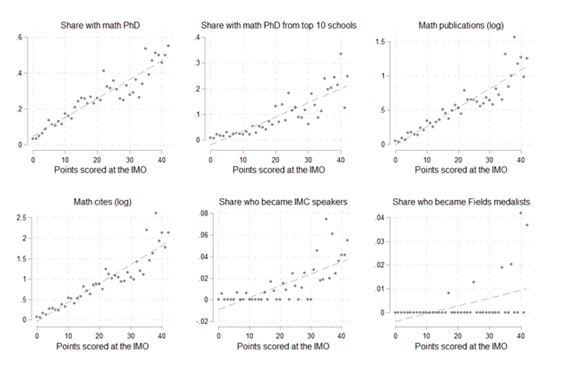
Source: https://ramanujan.xyz/read-our-imo-research/
Psychometric tests use sophisticated standardization methods, much superior to those used in the IMO, and have good construct validity up to 2 standard deviations above the mean, and an adequate level of difficulty up to 2 standard deviations above the mean. But for higher levels the construct validity and the difficulty level are not adequate. As a result, Terman’s studies showed good predictions for academic and professional/financial production, but failed at the highest levels, even showing a negative correlation.
This suggests that while the quality of standardization is important, it is less important than the quality of items in terms of “appropriate difficulty” and “appropriate construct validity” at the levels at which it is intended to be measured.
So for the 70 to 130 range, clinical tests are actually better than hrIQts because they use larger samples and the standardization methods are generally more sophisticated. However, for scores above 130, hrIQts better meet the questions about level of difficulty and construct validity, which are apparently more important criteria for predicting remarkable results in real-world problems.
In addition, some hrIQts are standardized with higher quality than clinical tests, although this is not the most important issue, it can be a differentiator.
Tor Arne Jørgensen[2],[3]*: Not in the state of being accepted as reliable as the test base in most cases does not reach what is viewed as acceptable. Most High range tests vary from low 20 attempts to high 300-400 attempts in most cases per test, whereby the professional test is based on 6000-20000 attempts per test. Some of course have a larger test base but not many, so the outcome will not be nuanced enough to be validated as real. Furthermore, it is not a team of professional test developers with a psychological background who develop these high range tests, they are thus of debatable value to estimate.
It should be added that even amateur designed logic tests, hit quite close to the certified tests in most cases in my experience, where deviations of around 2-3 IQ points have been found regarding my own tests, and it must be said that I am not a certified phycologist by any means, but from the 400 attempts I have had on my own high range tests, then the results is quite clear as norm go…
Jacobsen: Is Elon Musk the Leonardo Da Vinci of today?
Melão Jr.: Musk is very smart and very creative, his IQ is somewhere close to 155 (σ =16) and his creativity level is perhaps equivalent to something like 180.
In Leonardo’s case, if his IQ were put on the same scale, it would be close to 250 to 260 (σ =16, T). Obviously this is only possible because the true distribution of the scores is not normal, otherwise in a historical population of 100 billion the maximum possible rarity would be 10^-11, corresponding to 207.3 (σ =16). To better understand how the determination of scores should be done, I suggest reading this article: https://www.sigmasociety.net/escalasqi
Some people are especially skilled at figuring out what questions need to be asked to solve important problems. Other people are especially skilled at finding answers. Leonardo was exceptional at both, asking the “right” questions and finding efficient and creative answers, perhaps 9 to 10 standard deviations above the mean (in a dense-tailed distribution, as noted above). Musk is very good at asking important questions (perhaps 5 standard deviations above average), but (for now) he needs his army of geniuses to find the answers Leonardo found on his own. Musk is also very good at solving problems (perhaps 3 to 4 standard deviations above average) and has a huge net worth, which boosts his production by outsourcing the work of many others.
Musk’s financial resources, he would probably have built working helicopters in the 15th century, but with animal traction (it would be unlikely to invent an engine at that stage in which the Technology was), and many other things even more extraordinary than what he did, actually did.
On the other hand, in a short time Musk “will be able” to implant computer prostheses in the brain and will surpass Leonardo. It might, but it probably won’t anytime soon, because it won’t be safe at first, it will need to be tested on monkeys, then human volunteers, etc.
Jørgensen: Comparing these two people is not easy by any means as they on both parts are quite unique in any sense, whereas they are driven by a regiment of absolutes. Your inherent qualities are what have helped to shape their outcome into the history books. Brilliant to be woad, where qualities of both the creative and logic-based intellect are above the norm as to the general population. To look at these two individuals as fortified settlers, paving the way forward for innovation and development through quantum leaps for humanity in all its rejuvenation of renewal. Intellectually, these two guys are not so different in the bare nature and their continuous strives towards future innovations, one more hopelessly lost and barred by his contemporaries regards to Leonardo Da Vinci, even more so than the later Elon Musk. Leonardo’s, in some way desperate attempt at fame and fortune trapped by the ancients’ dogmas and frigates in his heyday.
Leonardo Da Vinci an intellect of contemporary currents, intentionally shaped for the individual’s right to be recognized as real and genuine. A man whose brilliance is still increasing in his hardening, is to be regarded as Elon Musk’s superior as to both intellect and creative output. Elon Musk is brilliant in all his glory, but still he is not to be painted with the same statuettes as Leonardo. That said, only time will tell who will be viewed with the greatest influence of these two exemplified giants perceived by utopian framework conditions by and for the artistic innovation and common enrichment of utilitarianism.
Jacobsen: We can certainly see ourselves as a multiplanetary race in the near or distant future, and is that something we want to be then?
Melão Jr.: The technology necessary for terraforming planets or other astronomical objects should be achieved in a short time, perhaps it is already available, although it has not yet been applied. But the time it takes to make another star habitable depends a lot on how big the differences between that star are compared to Earth, in addition to the size of the star, the star’s evolution rate, etc. We still don’t know whether the most promising venture would be terraforming Venus, Mars or the Moon. I would bet on the Moon for the short term and Venus for the long term, but there is still not enough data to decide. Alternatives like Europa, Titan or Enceladus are very cold, perhaps this is more difficult to resolve.
No Solar System object, other than Earth, appears to be sufficiently suited for the development and/or maintenance of complex life as they are now. Perhaps extremophiles like tardigraphs can live on Mars, without the need for major changes to the planet. However, to colonize Mars with humans it would be necessary to solve some very difficult problems:
- Mars’ magnetic field is very tenuous, insufficient to deflect lethal radiation. To increase the intensity of this magnetic field naturally and without needing a continuous supply that consumes energy, Mars would need a rotating metallic core of a certain size. It would be an incredibly difficult engineering process to change that and far removed from our current technology.
- The atmosphere of Mars has 0.6% of the pressure of the Earth’s atmosphere and is composed of 95% CO 2, with only 2.8% nitrogen and 0.2% oxygen. Earth’s atmospheric pressure at the top of Mount Everest is about 30% of the pressure at sea level, and breathing is already very difficult at the top of Everest, with high risks of nose and ear bleeds. So it would need to increase 100 to 200 times the total mass of gases on Mars and increase 10,000 to 15,000 times the mass of oxygen. How to do this? Musk commented on the possibility of generating more gases in the atmosphere of Mars through nuclear explosions, a completely speculative hunch, to “test and see what happens”. I think it’s a reasonable guess, despite not being supported by anything concrete. Perhaps an interesting alternative to this strategy is to develop genetically edited plants to transform soil nutrients into oxygen. Simply changing CO 2 from the atmosphere to O 2 would not solve it because there is not enough CO It would need to increase the atmospheric mass a lot, in addition to the change in composition, and even then it would be complicated because as the gravitational acceleration on the surface of Mars is 0.37 times that of Earth, so if the density of the air were equal to that of Earth, the pressure would be 0.37, just slightly higher than the pressure at the top of Everest. If I increased the pressure 2.5 to 3 times to make it equal to Earth’s, then I would need to investigate the health effects of having 3x the air density.
There are several other negatives, but less serious than the first two. Mars’ orbital eccentricity is 0.0934, while Earth’s is 0.0167. As a result, the range of thermal variation on Mars is vastly greater. On Earth, the seasons of the year are predominantly determined by the inclination of the axis of rotation, but in the case of Mars the predominant factor would be the variation in the distance from the Sun, which would also be added to the variations related to the inclination of the axis. It would not be a prohibitive range of variation for life, but it would create serious problems for humans. The photos below show the variation in the size of the South polar ice cap in just 2 days. Nothing similar happens in Antarctica (not to the same extent). This sublimated ice cap material is added to the atmosphere, substantially increasing the average total pressure. Weather stations on Mars would be much more marked than on Earth, not only with much greater temperature variations, but also with changes in CO 2 concentrations in the air, relative humidity, etc. And it would be useless to try to “fix” this in the ice caps, because it is a process related to the temperature variations inherent to orbital motion and axial tilt.

Despite these difficult points to resolve, Mars has several positives: the length of the day is very similar to Earth’s day, so it would not require much adaptation. In the cases of the Moon and particularly Venus, day length could be a big problem. The fact that Mars’ albedo is much lower than Earth’s contributes a little to its not being so cold, even though it is 50% farther from the Sun than Earth.
Venus has a very tenuous magnetosphere as well, but this is largely due to its very low rotation speed. Accelerating its rotation would be less difficult than introducing a giant metallic core to Mars, but it would still be immeasurably difficult and would require a much higher level of propulsive energy production than we currently have. When such technology is available, connecting suitable thrusters and with sufficient fuel, this process of accelerating rotation could take a few thousand years. Solar energy itself could serve as a complementary fuel source for the thrusters. At the same time, it would be possible to drain or condense part of the atmosphere. The components of the atmosphere are not very “friendly”, but H 2 SO 4 includes H 2 and O 4, which can produce water, oxygen and ozone. The amount of nitrogen is 3 times greater than on Earth, so I would just need to figure out how to produce the proper chemical reactions. Perhaps in 10,000 to 100,000 years it will be possible to make Venus habitable, with an atmosphere similar to ours, a 24-hour day, a sufficient magnetic field. The current albedo of Venus is 0.76, while that of Earth is 0.39, so although Venus is closer to the Sun, as it absorbs less light, its temperature could be maintained at a level similar to that of Earth, at least in the regions of higher latitudes. When the atmosphere is changed, the albedo must also change, but it must be possible to reasonably control this parameter in order to leave the appropriate temperature. The length of the day time doesn’t seem to me to be an issue in itself, but modifying this would be useful for the magnetic capo reason. In the case of Mars, whose mass is 1/8 that of Venus, it might also be possible to shorten the day from 24 hours to 6 minutes, in which case perhaps Mars’ magnetic field would also reach a level suitable for deflecting harmful radiation, but it would produce many other problems, because the flattening of the planet caused by the pseudo-centrifugal force would be 250 times greater, that is, the planet would be elongated more than an egg, changing several fundamental parameters at the equator and poles, and it may not even be possible to maintain balance hydrostatic effect of an object with these dynamic characteristics, the lithosphere might rupture, or melt due to the heating caused by friction with the magma of the lower layer, the Coriolis effect would be very intense and there would be hurricanes all the time in high latitudes, not to mention the difficulty that it would be to live on a planet where the sun rises and if it could every 3 minutes, the tidal effects would also have a very short cycle etc. So, although the mass of Venus is much greater than that of Mars, it seems more plausible to me to reduce a rotation from 243 days to 1 day, as in Venus, than to reduce a rotation from 1 day to 0.004 days, as in Mars. Both would likely increase the magnetic field by increasing the rotation speed of the core, but the side effects on Mars would be catastrophic.
Anyway, these terraforming processes I believe will only serve as “experiments”, because there will be no advantage in moving to Venus, Moon or Mars. It will be important to use these astronomical objects as “laboratories” to learn how to terraform other astronomical objects, as there will be many unforeseen issues that will need to be resolved during this process, and the first attempts will be very likely to fail. Thus, for a few million years there will be an opportunity for learning, correcting errors, etc. and then apply the process to terraform some exoplanet to meet the real need to leave the Solar System before the Sun leaves the main sequence. If you were to learn how to do it only when necessary to switch to another system, and failed in the attempt, it would be disastrous. That’s why it’s important to test on neighboring planets first, although the objective is not to occupy them, per se. Although the sun is predicted to take 5 billion years to run out of its hydrogen fuel, along this process there will be several major changes in a few hundred million years, both in size and in temperature and luminosity. A 10% increase or decrease in brightness would be a very serious problem. The current model of evolution for G2-V class astronomical objects like the Sun predicts that in 1 billion years the Sun’s luminosity will be about 9% greater than today, so we won’t have several billion years to move into a star system. more stable, maybe around a red dwarf or something. It’s also debatable whether a red dwarf would be an option, because if our main energy source is starlight, with a Dyson sphere or something, maybe a red dwarf wouldn’t be able to meet our energy demand. Another problem is that the current model of evolution is based on many hypotheses that may be wrong or inaccurate. Recently, the Sun’s metallicity was found to be about 43% higher than previously thought, which has several implications for the pace of evolution and how long it will take before we need to move due to the overheating of our region. If there are other parameters revised, the 1 billion-year timeframe can be reduced to a few hundred million (or extended, if we’re lucky).
Perhaps the planets and other astronomical objects within the Solar System are used for tourism, or for the escape of some “privileged” people in case a war renders Earth uninhabitable, although it is probably less difficult to “fix” the Earth after a nuclear war than to make another planet welcoming enough. Even after a devastating nuclear war, Earth would hardly be as inhospitable as Mars, for example. If in the next decades or centuries weapons even more destructive than the current ones emerge, and if they are used, then perhaps they will be able to make Earth more uninhabitable than other planets, in which case migration would be an alternative for some. It is also important to consider that future inhabitants of the Earth may have different needs than the current ones, perhaps the brains will be preserved, but the rest of the body may be replaced by something more versatile, which can withstand higher and lower temperatures and other more hostile conditions, keeping the brain thermally insulated so that it does not suffer damage, with adequate protections also for radiation, etc. Or simply swapping the brain for a homologous structure that is more robust to adverse weather conditions.
It is also likely that “humans” will not move to just one planet, but to several, as the terraforming tests will not work every time, so we will need a reasonable sample of trials to have a good chance that at least some tests “work”. And once the new planets are available for occupation, they are likely to be occupied. It is also possible that genetic and prosthetic changes are made to make humans, animals and plants adapted to other astronomical objects, rather than just altering the astronomical objects to adapt to us. This should make the whole process faster and promote a better harmonization and integration of beings with the planets on which they will live, since some planetary and stellar parameters will probably be very difficult to adjust, such as the amount of UVB rays emitted by the star, necessary for the synthesis of vitamin D, which is currently important for our immune system, but if we happen to inhabit a planet around a red dwarf, the UVB emission will be much lower. In short, it is a question that could be written in a book about it, because it is very complex. But this is an outline of some possibilities.
Jørgensen: The future as a multiplanetary race is for me an inevitable scenario that one cannot get away from.
But it must be said to what extent we as humans would be able to look at ourselves as a human being in today’s biological sense. This with reference to some of what is being referred to by Mr Melao, about being able to adapt to the planetary conditions that you will encounter. What does one mean by this, well that we as humans are more easily served by transformation our structural set-up by order to adapt to what we may face of climatic challenges, etc., on the planet on which we visualize being able to build our new societies upon. If we as a human species are to ensure our continued existence, then it will not be in our current capsules, but in an alternate state trough adapted evolution, whereby the human biology must interphase with technological innovation, thus resulting as a preformation of a bionic entity.
This adaptation is far more realistic compared to the alternative method by way of terraforming new planets to alter the climatic environment to suite us as humans. So, to the question “do we want to be a multiplanetary species?” Yes, I believe so with all my heart, to not prevent the demise of our very existence is unfadeable to me. We as humans are still in our infancy state, our story has not been told and certainly not being lived in full yet. No, there is too much to be lost if we do not consider ourselves as preservable into this alternate state as an multiplanetary race in the future to come. We must ensure survival through conformance towards preservation of the biological galactical imprint by all cause.
What I think about our own planet becoming smaller and smaller is in the sense of feeling that the earth is becoming more and more narrower, due to the simplification of travel methods and a normalization of the fact that everyone is now in one sense or another a globetrotter, with reference to a global traveler. Hundreds of years ago, the earth was a huge place that could take several months to travel from one corner of the world to another, later it took weeks, then days, and now hours. Our planet is not big enough nor exciting enough that we are now just starting to feel the ever-growing urge to move beyond our own palatial comforts to other more worldly endeavors beyond, out there somewhere beyond the heavenly stars.
If one is to put the human existence in the following perspective:
Man, and its existence do not extend over a very long time.
Our total existence in relation to a single human being has so far reached the age of 14-15 years, in the sense that our race of homo sapiens is now as I see it in the stage of a normal teenager. In the very early stages, thousands of years ago we were pondering about the world and all its content with stat at point in time, the marvelous and confusing grandeur, we began to explore our nearby surroundings as on a par with a baby exploring his own crib. Then as time went on, we humans evolve further and forward in time to a few hundred years ago, we could explore not only our nearby areas, but also explore across borders and continents during several weeks on expeditions.
This again can be seen as a young child at the age of 7-8, who is now moving away from the safe surroundings of the house and exploring his immediate environment.
Forward in time again, to the age where we were introduced to general aviation, which meant that we could now travel anywhere in the world within days and finally hours in the present time. This can be compared to the teenagers who again travel further, beyond now on much longer journeys across national borders etc.
The meaning of this is that we are now soon ready to take the next step towards the age of majority to move out of our safe surroundings, as human urge to move further out away from our own planet towards something new and unknown. I firmly believe that we are still in an early stage of our total existence and have about three quarters and a bit again to live, in the relation to the normal human life expectancy of around eighty years+.
Jacobsen: What could be the reason why NASA did not intend to reduce rampant spending and did like SpaceX and reuse the rockets in the same way as when SpaceX does today?
Melão Jr.: I haven’t followed the evolution of this, so maybe my answer doesn’t make sense. But I think that NASA didn’t have the technology for that, nor was it interested in using part of the budget to try to develop this technology. If they used money for that and couldn’t solve the rocket reuse problem, the money would be lost. SpaceX took the gamble and it worked. After SpaceX has solved the problem and the technology is now available, NASA doesn’t have to risk the venture until it learns how to do it. Just repeat what SpaceX has already shown to work. So my guess is that maybe that’s the main reason or at least one of the reasons.
Jørgensen: The basis for NASA lack of reusability or the mere thought about it by imprudent intent, as to not make it its task to take upon this type of innovation of thereby speculative content is not yet clear to me. What is certain, is that now everyone sees what SpaceX has successfully managed, and in a shared note of what Blue Origin has also done to some degree with reference to SpaceX technology advances regarding concept of reusability and space travel. This must make NASAs executive leaders think back and grimly reconsider its previous fallacies of galloping spending costs and their taxpayer’s later mistrust in return. At one point, it seems that NASA was about to give up all hope of looking towards other planets in the faintest of possibility as to human space travel and the hope of colonizing other nearby systems.
Fortunately for us all, we are now led by Elon Musk’s brilliancy and persistency, so now the hope burns brighter the ever before, a beacon to be behold.
But back to the insane approach of the galloping costs for NASA’s space program. The US state’s belief in what one would assume to be the most competent people in the relativity of space odyssey and its particularities, must then also be governed by the most competent economists by spending such astronomical sums as NASA seizes from the US state’s budgets each year. It is conceivable that one must get a type of divine revelation of a new ingenious shooting star, with which can reignite those most impertinent innovations beyond that oneself is unable to imagine in order to rekindle that all important flame within us all.
A type of remnant of a gone by era whereby a new state of mind initiatives that only the most brilliant intellectuals can enable us to understand in a never-ending alternate state such as Elon Musk has now installed and by with which we the benefactors can thus reap the benefits of taking all those educational lessons with us for further study within the field of notation.
Jacobsen: Can we expect that in the next 100 years we humans will encounter new extraterrestrials races?
Melão Jr.: I’m assuming the question is about living extraterrestrials or that at some point were already alive (fossilized, for example) and whose ancestors are also extraterrestrials. Otherwise the answer would be easy, because if a couple of humans go to a lunar base and they have a child there, the child will be a selenite (or lunarian), or something, or a martian if it’s on a base on Mars, and that should happen in less time, of 100 years. But I imagine you would like to rule out this type of extraterrestrial. So if we’re talking about extraterrestrials whose ancestors have also been extraterrestrials for over 100 years, the probability goes down, but it’s still likely, in my opinion. Objects like Oumuamua probably pass through the Solar System frequently, but are rarely detected because there are no monitoring programs for this. When a systematic project is developed to study objects of this type, then our range in a few decades will be much greater than the current one, reaching far beyond the objects of the Solar System, not because we will be able to go to other astronomical objects in such a short time, but because we will better take advantage of opportunities to study interstellar objects that pass in our vicinity, but which are not currently being studied with due attention.
The answer to this question will also depend a lot on some semantic and etymological details, related to the classification of an organism as “living”. Our current concept of life is very limited, to the point that if we found living organisms with certain properties very different from those we know, we might not recognize them as “living”. The evolution of the concept of “life” should play an important role in this process, expanding the scope of this concept and making it more inclusive. Robots, for example, may be considered “alive” if they meet certain criteria.
In reaction to communicating with intelligent life, in projects like SETI, I think it’s less likely, because our current technology based on radio signals didn’t exist 100 years ago and should become obsolete in 100 years, so it’s very unlikely that alien civilizations are precisely at a stage compatible with ours. Another problem is that the signal strength, even if it is very collimated, would not have a very long range (10 kpc, for example). More advanced communication technologies are more likely to use something like quantum tunneling or some other faster method, and not only would there be no loss in signal strength, this would extend the range to the entire universe and allow for delay-free responses. I’m not saying that this technology will necessarily come from tunneling, but from something equivalent in terms of speed, preservation of “cleanliness” (no noise) and signal strength. But I don’t know if in 100 years it will be available. Maybe so, but I think less than 50% probability.
Jørgensen: As I think it will just be an inevitable fact to be behold in the near to far future, as to the possibility of interaction of new planetary species, the answer is yes. I find myself puzzling as to when this will happen, not if it ever will happen. But it should be noted as to what state, shape or form this alien encounter will be presented in…
Jacobsen: What can we humans expect from AI, according to health, war, space travel etc… in the near future?
Melão Jr.: It depends on some factors. If there are enough investments from now on, in 10 to 15 years we could have some people immortal, or at least have some people with the aging process dramatically slowed down and then stopped, while advances continue to later reverse this process and arrive at immortality. and then resuscitation. The strategy for this already exists, but to be put into practice it would need computational resources and a qualified team dedicating time to it.
Some of the important recent technological leaps have encountered barriers that the researchers involved are failing to overcome. AlphaZero was able to go up from -3000 (negative 3000) rating to 3500 rating with 9 hours of training, learning more in those 9 hours than all of humanity combined has been able to learn about chess in over 500 years. However, AlphaZero’s evolution curve bumped into an asymptotic limit and if it kept training for 100 years it wouldn’t be able to climb from 3500 to 3900, maybe not even 3800 or 3700. This effect also happens with Shogi, Gô, Atari games and probably almost all board games and other types of problems if addressed by this solution strategy.

If you use more processing power, yes, it can reach 4000, but in terms of improving heuristics, it has stagnated. A similar problem happens with Lc0 and StockFish. Stockfish shows no real improvement since version 13, the difference from version 15 to 13 is 4 points, while the uncertainty in the measurement is 17 points.
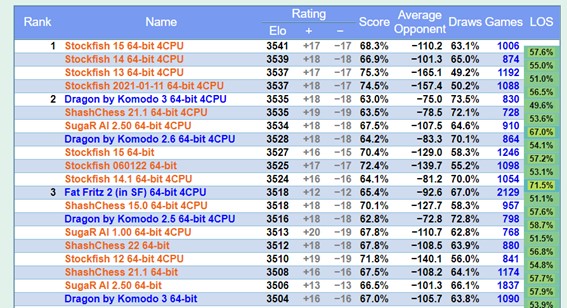
Source: https://ccrl.chessdom.com/ccrl/4040/rating_list_all.html
Demis Hassabis’ idea for using reinforcement deep learning the way he did was important in getting to this stage, but there is no prospect of moving forward until the issues that make the next step possible are resolved. In the case of AlphaZero I don’t know exactly what they did other than what they make available on the site, but in the case of Lc0 there is more public information and the system itself is available to be tested extensively, and there are many errors in Lc0 and optimization details inadequate that need improvement, and I suppose there are a lot of similar problems in the case of AlphaZero, maybe not quite the same problems as Lc0, but just as serious, certainly.
Jørgensen: If one looks at what we today experience regarding artificial intelligence, then for me it will be regarded towards optimism, this based on the extensive help that one can now receive in so many ways. Going forward, when a self-perception will be duly important for AI and its denotative constructs, can then quickly be turned witnessed by genuine concern of the unknown. One even hopes that the help that we all enjoy and know today for example by what Google Search, Google Translate, Google Maps etc., does for each of us every day all around the world. So, the way forward I hope, will address the preconception of securing humanity further for a common coexistence, with the fusing of our biological matter with the technological artificial intelligence into a higher form for symbiotic existential awareness, as an all-important first step to further human advances in the hope of preservation of our existential survival.
Regards to the topic of warfare, we see a lot of it today, with self-searching missile systems, drones etc. The soldiers of the future will in such a sense be superfluous, as rocket installations and long-distance warfare will deal with virtually all enemy installations and personnel. Small pockets of elite soldiers that we have today, where I want to highlight the Telemark Battalion, Norway’s elite soldiers, which soon will be equipped, I mean with improved performance over what is viewed as a normal top performance effect for humans in battle. A similar state of what the movie franchise ” The Universal Soldier”, displayed which many of us enjoyed in the early 90’s. This is form me the first obviously step to take for the advancement of elite forces in the near future.
To the point of space travel, we humans must adapt to long and very challenging space travel over long distances in the not too far future. Whereby challenges as for example, muscle loss, room sickness, and all the other biological challenges that we humans must deal with, where our human weaknesses emerge so all too well, will need to be limited at all costs if a long-distance space travel is to be successful.
As mentioned earlier, a changed outcome for our own part is essential for our survival in the future, we cannot solely rely on having to terra form new potential habitable planets, the time is not on our side for that. We are currently experts in adaptation regarding out surroundings come what may, so this is the way to go in the future of space travel. Furthermore, we need to find ways to travel faster than light, or to discover wormholes that can be exploited if possible.
If we are talking about long space travel, it is not enough to live for 80+ years as we do now, we extend our life expectancy to at least 200-300 hundred years or more with our current rocket speed limit slingshot through space in order to reach a potential planetary star systems that can house us in the future. The alternative is as mentioned earlier, to exceed the current light speed by many warps. In summary, if AI does not wipe us out and thus their need for self-preservation ceases, we must also cease our troublesome self-perception by and for the preservation of the biological origin over to a pre amt understanding by the transferable biological input- transference by morphonology technological output, resulting in an alternate state of existence to ensure the species’ survival.
Jacobsen: What are the future prospects of man according to AI and its non-extended properties in all faults, where emphasis is placed on: extinction of the species man or coexistence?
Melão Jr.: Depends on what will be considered “human”. In Asimov’s book/film “Bicentennial Man”, robots added more and more human parts, until they became practically human. But it’s more likely that the path followed in the real world is the other way around, and humans put more and more inorganic parts, until you get to a point where maybe only the brain remains, and maybe later the brain too is replaced by something equivalent, but with very different structure.
Jørgensen: The prospects for man, are for me in the hope of a formative symbiosis, where a common perception of ours and their values is united. But one sees clearly that this will probably not become a reality, if we humans today live in the present and are unable by the large amount to see beyond the horizon against the dangers that threaten if we continue the course we are now on today. My frustration is based on the following notion, if the interest as to the importance of the intellect is the same size as that of our head, and that the interest in the physiological ramifications correspond from the neck down, then the intellect will always lose ground for the physiological manifestations.
This is simplified, so that the people who can answer the challenges of the future are in my opinion in a weathering state of despair according to the general verification thereof. It can almost be states that; “are we humans worth saving or not?” This is probably where one can to a certain extent consider that all life is worth saving, but still, where do we draw the line for the preservability by species diversity. If we are to be able to answer the challenges of the future, then from what I see a deviation on the intelligence scale must be increased upwards at all levels.
For me, this is probably to be regarded as a type of Darwinian way of thinking, whereas the strong will prevail in the battle for ones right to exist and the weak will most likely perish, at least when it comes to one’s cognitive state. The technological challenges do not allow for those with limited cognitive abilities in the future, sad but true.
We are soon doomed to lose our current alpha role in society, and when this will happen, then only those with the best ability to adapt and shows willfulness through morphologically changing their original biological imprint towards a higher state of biotechnological self enhancement. In other words, the most selective adaptational individuals will have the best chances of securing one’s spawn further and the weakly will fall away, this can be seen as a necessity for the very continuation of our species survival in a hopefully subordinate role with AI as the new alpha.
Jacobsen: Does the term “genius” disappear according to what capabilities AI might possess?
Melão Jr.: The concept of “genius” should not be formulated to apply exclusively to humans. This concept can be subdivided in the taxonomic hierarchy by species, by genus, by family, etc. and may include new groups of organisms such as robots or organic and inorganic aliens, even the concept of “organic” could be reconsidered to include silicon beings, depending on the properties of the beings that eventually fall into this group.
One can use the concept of “human genius”, as well as “human giant”, or chimpanzee genius, giant chimpanzee, depending on the level of rarity or the amount of standard deviations away from the mean, or some similar criterion.
Within each animal, plant, mineral, monera, etc. and other alien life forms and inorganic beings, beings may “accept” some attributes that have a coherent meaning within their respective category, but not accept other attributes. For example: giant rocks, albino elephants, genius humans, triboluminescent fish . But not genius rocks or lepton bunnies or yellow scream, because some categories don’t accept certain concepts. They could admit as metaphors or poetic licenses, but the meanings would be analogies with some losses, distortions and damage to the rigor of the meanings. “Genius stones” would not establish an intelligible idea. I could try to force the “genius” attribute to stone, but that would start to have a consistency that is too fragile for proper analysis. It would be more advisable to “filter” the attributes that each category of entities could receive, to maintain some logical rigor in the analysis.
In this case, among all classes of organisms that accept the attribute “intelligence”, it would also be possible to apply quantifiers of relative intensity of intelligence, such as “genius”. The application of these attributes within the same species would be easier, because generally the distribution of a variable within the same species is similar to a Gaussian, or after a few transformations (logarithm of the variable, for example) it becomes similar to a Gaussian. A genius dog would be one with an intelligence 3 (or 4 or 5) standard deviations above the mean. Within the “dogs” group there is a smooth curve of intensity levels for variables such as height, running speed or intelligence.
When considering different species mixed together, the distribution form can no longer be normal, it can even be very different from a normal one and strongly asymmetric, with some discontinuities or with some deep reductions in frequency in the intervals that separate two species, moreover, in instead of taking the form of a normal, it may take the form of a distribution in which the smallest organisms are much more numerous than the largest. But the concept of level of rarity would still be applicable whatever the distribution of the variable of interest, so that it would still be possible to apply the attribute “genius” to a group of categories of beings, as long as the beings of these categories accepted the attribute “intelligence”. I am simplifying things, to describe the idea, but naturally the meaning of “genius” would not need to be based exclusively on “intelligence”. To get the point across, let’s assume that “genius” is simply a quantifier of intelligence.
By approaching the question in this way, perhaps mammals contained all the geniuses in existence. Or maybe the macroscopic animals contained all the jinn. It would depend a lot on what the criterion for conceptualizing “genius” would be. If it were for rarity within the population of individuals, whether individuals would be weighted by size, mass, by some other criterion, whether rarity would be stratified by species, etc. It would also depend on the cut-off point to determine at what rarity level the “genius” rating would start to apply, whether 1 in 1,000, or 1 in 1,000,000 or something else.
Analyzing an example: if we were to consider the distribution of all individuals of all species mixed together, without any weighting, then as the number of microorganisms is much greater than that of large organisms, if the number of microorganisms is 10^12 times greater than the number of insects and even larger beings, then insects could already be classified as “geniuses” because they would be at the top of 1 in 1,000,000 of the most intelligent beings in the general population, since the general population would be mostly of microorganisms. If the criterion were different and considered the average intelligence by species and stratified by species, on a planet with 10 million species, if the criterion for “genius” were 1 in 1 million, then probably some great apes and some great cetaceans would be classified as geniuses. Although humans are significantly above other primates, it would be a little more difficult to establish a statistical criterion along this path that would make it possible to “surgically” separate humans from other animals, including because there are some gorillas and chimpanzees that are more intelligent than some humans.
In this context, inorganic beings such as AIs that are smarter than humans, or almost as smart as humans or gorillas or dolphins, would also receive this classification of “geniuses”. If the criteria were based on rarity, there wouldn’t be much difference on an ordinal scale between a robot and a human, because they would both be near the top, the robot first in the world and humans second. While robots could be many orders of magnitude smarter than humans, the criterion based on rarity would not do much to create a special class for robots. This is a situation in which the standardization method I described in 2000 would be successfully applied, because it would make it possible to measure the extent to which robots are smarter than humans, rather than simply measuring species rarity levels.
In the current scenario, for example, humans are 1st and perhaps chimpanzees or gorillas are 2nd, and the proportion is relatively small of members of the species that are 1st to members of the species that are 2nd. Perhaps the average intelligence of humans is 100 times the average of chimpanzees, just 2 orders of magnitude. It is not much, there is even an intersection between the distributions of intellectual levels of humans and other great primates. In the case of AIs , perhaps the ratio to humans is something like 10^6 or 10^9, so even the smartest humans wouldn’t come close to the intellectual level of average intelligence machines, or even faulty machines. Perhaps, in the beginning, we preserved some intellectual attributes in which we could still excel, but it would be a matter of time before the machines were surpassing us in practically all relevant aspects.
If the criterion were based on proportion of intellectual potential, rather than levels of rarity, it would be easier and more logical to separate the intellectual level of robots and humans, as well as separating humans and other animals, although often not. there is a well-defined interface and the levels intersect.
Therefore the term genius would continue to be applicable, both within specific species and in groups of species and groups of intelligent entities. But instead of the term “genius” it might be necessary to use “human genius” to distinguish from “genius” among all species . Subdivisions could also be created at higher and lower levels. Human-scale “deep genius” or “universal genius” tests would be relatively little for AI systems, and an average AI level could be too high for any human to achieve. In the case of hybrid humans there would also be categories according to the breadth of the connection and the preserved proportion of humanity. In Asimov’s book/film “Bicentennial Man” he thinks that robots would want to become humans, but it is much more likely that humans want to become robots, which would be “dangerous” in many ways, because maybe the feeling, the emotion, some attributes that we consider essentially human and animals, may not be relevant to robots and will gradually become extinct. I wouldn’t know to what extent this could be bad. In science fiction robots evolve in the sense of developing feelings, but perhaps the real path of evolution is in the sense that humans are progressively deprived of organic parts associated with feelings.
Jacobsen: Does the term “genius” disappear according to what capabilities AI might possess?
Jorgensen: I will start by proclaiming the following statement of “never”, and here is why I think so. The term genius, better known as to the “creative intellect”, whereby the creative mind is put in focus as to the human creativeness. The innovative marvel that embraces our intellectual experience centers, proclaimed by peritonitis of amazement of what the human mind is capable of producing. This is what I want to statuette here forth, and not to move beyond what is meant to form the basis of the question formulation initially, the magical intellect.
The term “genius” for the intended purpose will here for me, not only remain, but also be reinforced, as it can easily be surpassed not in the short term but in the long term in terms of human intellectual maxims. Following protrude as to what one should then focus on, hereby understood as focus on the individual’s intellectual creativity, as many great innovators was far ahead of their own time, have given us mere mortals a glimpse into the future, duly noted, and as in most cases not in their own lifetimes, but after their passing. Then, when the final revelations come to light, then everyone can rediscover these geniuses again as a prompt renaissance seance, thus presenting the opportunity to be immortalized ones again for all future prosperity.
This goes for; Leonardo Da Vinci, Michelangelo, Raphael, and many more brilliant intellectual diamonds not only in the West, but for the rest of the world as well … Their inventions, their unbridled drive, courage, unstoppable perseverance to proclaim their worth in the past, present and, yes, promptly stated for all eternity. The unambiguity abilities of these innovators and their approach as to how the world works, or rather, to see what infinite possibilities the world has to offer far beyond us mere mortals, is for me the most beautiful human marvel of all the worlds creations.
In today’s world, most of the material we all use every day is being produced by an assembly line process controlled by machines. Machines account for almost everything that is being made today, everything from textiles, cars, food, electronics, heavy industry, shipping materials etc. What is being hand-made which was almost everything back 100-150 years ago, is now to be viewed as very exclusive and precious more now than ever before. In the future, this effect, as I see it, will only increase in its exclusivity, especially when it comes to what the human imaginative innovations, bespoke and perfected with the extra little distinctiveness. And it is the distinctiveness that will become so much more of a valuable commodity, the handcraft that only a human can create with his faults and shortcomings, far beyond of what any machine could ever create, machine production is without sense of feel, a gentle touch, delicacy, emotions, just lifeless production without any notion of self-pride…
A.I will be able to create beautiful architectural structures, cars, textiles etc. but put a little bluntly, AI for me represents; “quantity”, and for the human genius it represents; “quality.” Which one would you like…? AI will be amazing in many ways, possibly far beyond what we can ever truly understand, but it will never be able to replace those most special human qualities. We as humans are unique in every way just as our fingerprints are, no two are alike, on an equal footing with all living beings, we are not mass-produced.
Not that this is necessarily the case with AI, but I see that I am also a bit hesitant about cloning as well, as even here the uniqueness is diluted to a certain degree. Genius will for me remain unchanged and most likely only reinforced further ahead in the future, as we will only even more, hold on to the fundamental values of being that very special person, where you are you and no one else has your particular qualities, whereas your extraordinary abilities cannot be recreated by any higher intelligent being, not now, not ever…
Jacobsen: What will be the basis of AI’s very existence, will it see its own usefulness and will try to develop and preserve it, but then for what purpose?
Melão Jr.: The path leading carbon-based beings to develop consciousness was very different from the path being followed by silicon systems. The first organisms arose spontaneously and they did not consciously think or struggle to survive or multiply. It was random behavior, among other random behaviors, that ended up favoring some alternatives and making populations of entities with certain characteristics more numerous than others. Therefore, from the moment that life appears, it tends to multiply and evolve. In the course of this process, consciousness, pain, hunger, fear, greed, loyalty, love, friendship, empathy, and other extremely complex chemical processes that produce certain reactions to certain stimuli, reactions that previously pass through a very complicated process between the moment the organism receives the stimulus and reacts to it, leading us to what we are today, as well as other animals, plants, fungi, bacteria, etc. to what they are today. The reaction of removing the hand from the fire when feeling pain or the process of choosing a partner with wider hips to procreate were modeled throughout this process as factors that increased our likelihood of producing more offspring for the next generation. There are many factors, and they were not consciously planned. In the case of robots, we are trying to recreate this in a simplified way and in a very different way, in which we want to prevent them from becoming competitive with us.
In an article in which I show that Moravec’s paradox is actually a pseudo-paradox, I comment on the example of the car, the way it moves faster than other animals, but using different structures, different strategy and taking advantage of laws different physiques. In chess machines play better than humans, but they don’t “think” in a similar way. Before AlphaZero, machines thought very differently, but they were able to solve the same problems much better than we could, in different ways. We understood many concepts and tried to apply these concepts in relatively complex decision processes to choose the best bids, while the programs did not understand any concepts, they just did a lot of calculations and used appropriate heuristics to prune the tree of possibilities and prevent the forks from branching. a number much higher than they could calculate. But with AlphaZero this situation changed very radically and he really started to simulate the “understanding” of strategic concepts, and he went far beyond humans in this, because he understands the concepts more and better, he discovered many concepts that we still don’t understand.
Chess programs prior to AlphaZero only received a simplified algorithmic description of a few concepts, a small part of the concepts that we knew and considered most relevant, and compensated for the lack of strategic “knowledge” with immense calculation capacity and good heuristics. to prune variants that did not deserve to be explored in depth. But AlphaZero plays like a human, he even calculates worse than humans in situations with long variants that have few ramifications, and this is impressive, because a human calculates 1 or 2 throws per second, while AlphaZero calculates 30,000 throws per second. Even so, humans calculate further than Alpha Zero in some positions. Of course, despite this Alpha Zero plays much better, but that’s not a major novelty. Since 2007 and maybe since 2003, programs have played better than humans, but never have they shown to “understand” the game better than humans and calculate worse than humans. Perhaps I should comment a little more on why Deep Blue’s victory in 1997 could not be interpreted as the watershed of when machines surpassed humans in chess, but that would be a bit extensive. I will just say that Deep Blue wasn’t that strong, won by “luck” (and with a few other suspicions) and was removed from the scene so that no one would find out what really happened. It’s different from when Deep Junior and Deep Fritz tied with Kasparov and Kramnik in 2000 and 2003, and finally when Rybka emerged in 2005-2007, the supremacy of machines became unquestionable.
While AlphaZero’s 30,000 throws per second is far less than StockFish’s 3,000,000,000 throws per second, it’s far more than humans’ 2 throws per second, yet humans still calculate better than AlphaZero in some cases, while AlphaZero “understands ” concepts are much better than humans. In a way, it’s as if AlphaZero is more human than humans, in some ways. AlphaZero followed a path in which he himself evolved for this, without human intervention, without learning anything from humans, similar to living carbon beings. So this seems to be a promising path, in some ways. Of course, the analogy is neither broad nor perfect, AlphaZero is probably more complex than a microorganism, so it started its evolution at a different point. In addition, there are many other differences, and some human “guidance” on how he should evolve, although there are no interventions in the content he learns and how he discovers knowledge and how he selects the most useful knowledge, there is a broad prior structure created by humans about the criteria and structure that it should adopt to learn, while microorganisms did not have this, there was much greater “freedom” to test anything that worked, and in this process some reactions such as “fear” or “hunger” ended up emerging. as “useful”, but for AlphaZero it would not be in the still specialized context in which it operates.
Then we come to the car situation. A human moves very differently from a horse, a flea, a snake, a bird or a fish, but all animals have a certain similarity in the process of moving that is very different from using wheels. Perhaps the snake is more different from other animals, but it also moves very differently from a being that uses wheels. Although these animals are different from each other, they are all very different from the car, and a car like a Bugatti can beat all animals at speed (on a proper track). Nature never produced an animal that developed wheels, because it was something “planned” to adapt to a situation whose properties were understood by the wheel designer and there was not much need to do billions of random tests to find a good fit. Another important point is that the ground has been adjusted to harmonize with the wheels. No other animal does this very ostentatiously. Beavers can build small dams, and other animals can build other structures that affect the environment, such as corals or bees, but humans do this in a much deeper and “planned” way. The beaver doesn’t think about how to build the dams, he simply follows his instinct like factory pre-installed software. It is different from humans, who look at a mountain, want to make a road through it, and analyze whether it is better to drill a hole in the mountain, go over it, go on one side or go down and follow another path without changing the landscape. Also, humans can use many different methods to drill through the mountain and can create new technologies for it, while beavers will follow the same method as their ancestors did.
So the way humans interact with the environment is much more complex, and humans are able to continually optimize and improve their methods, rather than relying on random evolutionary changes that cause the next generations to be born with mutations that lead them to test different strategies for dig holes in mountains. Thus, humans can plan wheels and flat lanes that match better than legs on paths with uneven topologies. In addition, the use of fuels, engines, various devices that improve the process of locomotion of a car evolve very differently from the natural evolution of animals. Leonardo Da Vinci’s idea of using propellers instead of wings was also very interesting, although he was probably based on Archimedes’ screw. Before him, and after him, for centuries and millennia people wanted to fly imitating birds, using wings. But Leonardo understood that this was not the case and showed that this may not be the most promising path, or at least there may be one or more alternative paths to consider.
So the way machines are evolving under our guidance may never produce something like consciousness, because they do exclusively what we would like them to do to meet specific needs and solve specific problems, or broader problems, but with well-defined limits. However, when machines begin to have “freedom” to evolve by themselves, as happened with AlphaGo, AlphaZero, MuZero, Lc0 etc., the directions that things can take are out of our control and maybe they choose paths that lead to formation of characteristics such as fear, selfishness, ambition, revolt, etc. As the training of these machines can be very fast, and in 10 hours a machine can develop a “personality”, it becomes dangerous that this escapes our control and that psychopathic, human-killing machines are created, or simply that they feel wronged by the way humans make use of them. At the current stage, MuZero is still far from creating a personality of his own during evolution in his training, but with 1 or 2 innovative leaps in the evolutionary process, this could already become a reality. I am using “evolution” and “training” mixed together, but they are quite different and can and should be combined, with the difference that in the Darwinian model of Evolution organisms do not transmit characters acquired during life, but for machines this can be configured according to our will, a form of Neo Lamarckism.
So the formation of consciousness will depend a lot on the path taken in the evolutionary process, on strategic interruptions in this process to test how they are developing, etc. Even so, it is dangerous, because machines can “pretend” that they are evolving along a certain path, so that they can proceed without interruption. So I think that if humanity doesn’t self-destruct in a war or there’s no shortage of energy to continue technological advances, or some other impediment, probably machines, sooner or later, will develop consciousness, although maybe it’s a very different kind of consciousness from ours. Perhaps they understand that they exist, perhaps they “want” to remain active (alive) and fight for it, perhaps they are competitive with some machines and allied with others, in addition to the possibility of all being connected in a single central and there is no difference between individuality and collective, while they are connected. Perhaps before all this happens, we are already well integrated with them, with more than 50% of the human body replaced by mechanical/electronic parts and we are part of these connections. Perhaps they use our brains as a complement to process their consciousness.
Jørgensen: Every creation of varying degrees of intelligent designation can have its experience of the importance of preserving the survival of one’s species. We as humans are cognitively minded in the preservation, by and for the future preservation of our species. Can the same be said for the survival of the various animal diversity? Is species diversity of lower cognitive perception, whereas the transfer of latent instincts can then be seen as elements of safeguarding the species’ right to further existence? Which then further brings me, to what can be said about artificial intelligence and if it will only be viewed as a mere reinforcing factor for future consolidation of species diversity’s right to self-preservation over one’s species brethren.
The distance can well be duly noted, as to be amplified as the distance from animals to humans is of a certain preconception of the biological separation, a “us and them.” This is thought by the undersigned to be amplified according to our own biological imprint, as well as cognitive perception to be weathered even more according to an upgraded bionic entity, whereby the degree of inclination is tended towards full technological function regarding both the physiological and cognitive statute. For me, the distance will be perceived as increasing, and those who are seen as subordinates will then again be regarded as non-important elements for species diversity conservation in the future.
The weak fall away and perish and the strong will survive.
AI, for me, will have all these qualities in the more distant future as we as humans will not be considered important enough to be preserved. I sadly feel that we humans have outplayed our most important thus dominant role in the big picture.
But what about AI and its role, when “it” perceives themselves with their extremely exalted cognitive state, will they make the necessary calculations for the decision either or according to cessation due to lack of view on the preservation of one’s own species. An unavoidable fact, is that we humans need a reason to exist, a secure anchor point to be able to behold the meaning of life if you will, it can be within, religion, politics, environment, etc. But the fact that we all need a reason to get up in the morning cannot be discussed away, let alone with AI, and their reason for “getting up in the morning”, if I may allow me to put it like that, what will be their reason for getting up in the morning?
I must admit that this is of course only speculative formatives to be considered purely as a hypothetically presentation, but still … It is conceivable that of what imprints that man has installed in AI’s connotative state, can be considered as a sufficient basis for preservation beyond what one can speculate here.
If the reason can be revealed for a future whereby only technological mechanical objects are present, the biological diversity will be weathered, as their existential merits will for me cease to exist. By what is a machine to do with forests, flowers, animals, insects etc. but to see them as simple and pointless obstructions…
I in a moment of utopistic hope, that, to take concise notes, then change one’s biological structural in the search for something more imminent and substantially bearing. If AI wants to experience nature’s fantastic seasonal manifestations that we all as humans experience and adore, AI will look at this blue planet as something worth to be preserved, but realistically, it does not necessarily meet AI and its own ideals of beautiful nor necessary and important life functions for innovative and vital incentives by and for conservation of the species.
I find myself concluding the following notion, by not finding a fully enlighten obvious answer as to “the meaning of life” for AI, hopefully this answer will be presented by some of you that reads this…
Footnotes
[1] Hindemburg Melão Jr. is the author of solutions to scientific and mathematical problems that have remained unsolved for decades or centuries, including improvements on works by 5 Nobel laureates, holder of a world record in longest announced checkmate in blindfold simultaneous chess games, registered in the Guinness Book 1998, author of the Sigma Test Extended and founder of some high IQ societies.
[2] Tor Arne Jørgensen is a member of 50+ high IQ societies, including World Genius Directory, NOUS High IQ Society, 6N High IQ Society just to name a few. Tor Arne was also in 2019, nominated for the World Genius Directory 2019 Genius of the Year – Europe. He is also the designer of the high range test site; www.toriqtests.com.
[3] Individual Publication Date: June 15, 2022: http://www.in-sightpublishing.com/melao-jorgensen-1; Full Issue Publication Date: September 1, 2022: https://in-sightjournal.com/insight-issues/.
*High range testing (HRT) should be taken with honest skepticism grounded in the limited empirical development of the field at present, even in spite of honest and sincere efforts. If a higher general intelligence score, then the greater the variability in, and margin of error in, the general intelligence scores because of the greater rarity in the population.
License
In-Sight Publishing by Scott Douglas Jacobsen is licensed under a Creative Commons Attribution-NonCommercial-NoDerivatives 4.0 International License. Based on a work at www.in-sightpublishing.com.
Copyright
© Scott Douglas Jacobsen and In-Sight Publishing 2012-Present. Unauthorized use and/or duplication of this material without express and written permission from this site’s author and/or owner is strictly prohibited. Excerpts and links may be used, provided that full and clear credit is given to Scott Douglas Jacobsen and In-Sight Publishing with appropriate and specific direction to the original content. All interviewees and authors co-copyright their material and may disseminate for their independent purposes.
Share this:

Author(s): Scott Douglas Jacobsen
Publication (Outlet/Website): In-Sight: Independent Interview-Based Journal
Publication Date (yyyy/mm/dd): 2022/06/15
Abstract
Tor Arne Jørgensen is a member of 50+ high IQ societies, including World Genius Directory, NOUS High IQ Society, 6N High IQ Society just to name a few. He has several IQ scores above 160+ sd15 among high range tests like Gift/Gene Verbal, Gift/Gene Numerical of Iakovos Koukas and Lexiq of Soulios. Tor Arne was also in 2019, nominated for the World Genius Directory 2019 Genius of the Year – Europe. He is the only Norwegian to ever have achieved this honor. He has also been a contributor to the Genius Journal Logicon, in addition to being the creator of toriqtests.com, where he is the designer of now eleven HR-tests of both verbal/numerical variant. His further interests are related to intelligence, creativity, education developing regarding gifted students. Tor Arne has an bachelor`s degree in history and a degree in Practical education, he works as a teacher within the following subjects: History, Religion, and Social Studies. He discusses: education; a new cohort of students; build a rapport; identifying the more astute students; teaching; teachers get good or stay bad at teaching young students; the most difficult; encourage good behaviour; and deal with highly difficult students.
Keywords: education, schooling, the young, Tor Arne Jorgensen.
Schooling the Young 1: Tor Arne Jorgensen on the Educational Basics
*Please see the references, footnotes, and citations, after the interview, respectively.*
Scott Douglas Jacobsen: Education is a fundamental aspect of the long-term health of a society. You happen to work with the next generations in teaching. You have two kids. I wanted to explore a bit of the background in education within this context. “How?” in general. “How to do it properly?” in particular. We have touched a bit upon these things in parts of interviews at times. Although, I would like to cover some more of this. So, let’s cover some of the groundwork, what is your fundamental stance on educating the next generation of Norwegians?
Tor Arne Jorgensen[1],[2]*: My basis for educating or explaining the future, as well as proclaiming the bearing generation and then whether or not their imprint as to what extent is influenced by the scholastic institutions can hopefully here be valued in some sense. The broad discrepancies of the like-minded kind of today’s academic institutions are to be considered an offspring’s fallacy and should according to what I now proclaim hereby end in their current state of form. The way forward is rather to embrace in the notion of change through adaption away from today’s obsolete form, towards a more fluid state inclined towards structural changes at the pace that will be considered viable by tomorrows standards. Thus, leading in accordance above and beyond today technologically advances not only limited to one own country but in a conglutinating state on a global scale.
Today’s schools are so mind-bogglingly far behind that it’s an embarrassment to be behold, the Norwegian academic institutions specifically directed toward the primary and secondary schools must start listening to what’s going on out there on the international scene, by reforming themselves towards the more pruned; intellectually, innovative, and creative people in any way possible in the near too far future. When schools find themselves relying solely on highly educated academics, who have completed the formation of a failed and obsolete system that again will only pass on the same shipwreck system to the next generation, what then will this result in…? If one bothers to gaze in the direction with regards to most brilliant innovators of our time, men like; Elon Musk, Bill Gates, and previous Steve Jobs etc. then the same thing is said repeatedly, “you must hire innovators who see the world differently.” Their brilliant minds that were, and still are today reinvent an entirely new systems that are directly adapted to the ongoing developing societies, find themselves thrusting forward in quantum leaps, but not so much by the educational institutions, why is that…?
What is explicitly clear to me, is the need for a completely new mindset by and of tomorrow’s educational institutions. A clear comparison is according to space travel, NASA was about to throw in the towel, their overpriced misuse and chuck away mentality was completely disconnected, until for example Elon Musk came along and reinvented a completely new way of thinking in terms of cost savings toward a competitive space industry, today space travel is at full speed ahead with the right kind of innovator at the helm. So, look I say, at those with innate talent far beyond what an everyday academic can comprehend.
Today’s schools in Norway and beyond are putting all their eggs in the wrong basket, I can only hope that the institutional directories will one day wake up and maybe just maybe look outwards at the real people who can actually get the educational direction on the right course again, and not keep their current course straight into the iceberg.
Jacobsen: When you get a new cohort of students, how do you introduce yourself?
Jorgensen: The introduction process is relatively simple, as one emphasizes what is expected of oneself and what is to be expected of the students in return. That is, what can the students expect from me according to academic content, further, what a class leader commits to, as well as social understandings. Who I am privately for the sake of what I do and my abilities in that sense does not matter in any sense. The students, on their part, present at the request forwarded by me about their expectations of me as a teacher, regarding both academic and social.
Jacobsen: How long does it, typically, take to build a rapport with them?
Jorgensen: This process of uncovering any structural intrigues, class compositions etc. Is a time-consuming task, where one must look at each individual student and their roles in the class society. Who are “the shakers and movers”, and who are not? What type of pupil characteristics goes together and who does not, who is comes forth as rootless and who creates group affiliation from within for the sake of calm structural balance. The social aspect is probably what must be continuously worked on to be adjusted throughout the school year by order to meet the best possible academic benefit for all students.
Jacobsen: We have talked about identifying the more astute students. Those who are intelligent and disengaged, or intelligent and motivated. The former, maybe, needing a bit more of a prod. Let’s cover that again, here, so it’s in one place, thematically appropriate too. How do you identify them? In Norway, there’s a culture of negation of arrogance, which can be healthy in a lot of ways.
Jorgensen: The process by which identification in the innate state of natural brilliance of the intellectual supreme being has several well-known and thus recognizable trademarks, and as there are a lot of these trademarks to be identified as such, I will just name a few of them in this brief section. Short summarized as; evasive, restlessness, and reflective characteristics of what is deemed above normal relative to age level of that particular student as well as the innate metacognitive affiliations are decided factors for me valued as unavoidable and inalienable characteristics of higher characteristics within the field of the student-based intelligentsia.
Jacobsen: Why, of all professions, choose teaching? It’s underpaid, lacks as much respect as medical doctor, and requires significant patience in working with the young.
Jorgensen: If my mindset had been in this direction, then my choice of profession would never have fallen onto the teaching profession.
Yes, there is a lot of distress that is not taken care of according to most things within my field of work. That said, there are many more rights that in turn outweighs the wrongs.
I am not an idealist in the sense of being blinded by utopian silliness, nor am I a capitalist go doer as this surly fall on its own unreasonableness.
My wish is to work with people where a possible outcome in the end, is to be able to see that one has brought through the academic line a person who can and will become a meaningful individual for a future oriented society in the most positive sense. That one is able to see that one’s own efforts has led to an improved condition for our surroundings, an all-purpose environment improvement to benefit us all in the long run. Lastly, to direct the future generation to be the bearers of society after our own turn is done, to pass the torch on in the faith that all will be ok…
Jacobsen: How do teachers get good or stay bad at teaching young students?
Jorgensen: In the quest for appliance by “get good”, the answer is simple. You must develop yourself both professionally and emotionally. Being aware of the aspect of the developing society that surrounds us, is now more crucial than ever before. The teachers who prove able to see that this adaptation as an undeniable imperative, will then be the mainstay for the teachers who see this as their absolute obligation.
Those teachers who in some way seems to be unable to reinvent themselves or adapt themselves and are thereby stuck in their rudimentary traditional structures, where upon there is no room for innovative initiatives, nor any attempts of adaptation towards society’s normative, fall at the risk of becoming permanently passive in their learning initiatives regarding the students’ weathering of academic requirements for the proper competence.
Jacobsen: What ages for teaching can be the most difficult?
Jorgensen: All ages can bring with them their own uniquely challenging qualities, but what usually presents itself is in terms of general challenges across the entire emotional scale of your average student, is probably thus most promptly disposed around the age of 12-16 years.
Jacobsen: How do you encourage good behaviour in students?
Jorgensen: Through some simple positive directed concepts listed as follow: Accountability, self-perception, self-esteem, social acceptance, general recognition, and finally overall acknowledgement as to how they the students want their general environment to view them as…Here the main focus is positive input into every category listed above, this is done to give the students the proper initiative for a focused based and innated direction toward a meaningful adult productive existent that is beneficial for the whole community.
Jacobsen: Also, how do you deal with highly difficult students?
Jorgensen: By confirmation and acceptance. These students need to be understood and supported, put forward through a secure social framework, only then can one to a certain extent expect professional competence development. But the theme around challenging students is never easy, some you can help, and others you cannot.
All Norwegian schools have a support system that helps them if the schools themselves should deem it as an aperitive incentives by fear of falling short regarding their original contract obligations.
Footnotes
[1] Tor Arne Jørgensen is a member of 50+ high IQ societies.
[2] Individual Publication Date: June 15, 2022: http://www.in-sightpublishing.com/teaching-1; Full Issue Publication Date: September 1, 2022: https://in-sightjournal.com/insight-issues/.
*High range testing (HRT) should be taken with honest skepticism grounded in the limited empirical development of the field at present, even in spite of honest and sincere efforts. If a higher general intelligence score, then the greater the variability in, and margin of error in, the general intelligence scores because of the greater rarity in the population.
License
In-Sight Publishing by Scott Douglas Jacobsen is licensed under a Creative Commons Attribution-NonCommercial-NoDerivatives 4.0 International License. Based on a work at www.in-sightpublishing.com.
Copyright
© Scott Douglas Jacobsen and In-Sight Publishing 2012-Present. Unauthorized use and/or duplication of this material without express and written permission from this site’s author and/or owner is strictly prohibited. Excerpts and links may be used, provided that full and clear credit is given to Scott Douglas Jacobsen and In-Sight Publishing with appropriate and specific direction to the original content. All interviewees and authors co-copyright their material and may disseminate for their independent purposes.
Share this:
Author(s): Scott Douglas Jacobsen
Publication (Outlet/Website): In-Sight: Independent Interview-Based Journal
Publication Date (yyyy/mm/dd): 2022/06/08
Abstract
Hindemburg Melão Jr. (January 15, 1972) was born in São Paulo, Brazil. He founded the most, or one of the most, selective high-I.Q. societies, the Sigma Society and is the Creator of the Sigma Test Extended. He is a philosopher, chess analyst, and an astrophotographer. He published hundreds of articles on chess, finance, philosophy, science, and more. He discusses: an extensive preamble of gratitude and clarifications to the interview; growing up; extended self; family background; youth with friends; education; purpose of intelligence tests; high intelligence; extreme reactions to geniuses; greatest geniuses; genius and a profoundly gifted person; necessities for genius or the definition of genius; work experiences and jobs held; job path; myths of the gifted; God; science; tests taken and scores earned; range of the scores; ethical philosophy; political philosophy; metaphysics; worldview; meaning in life; source of meaning; afterlife; life; and love.
Keywords: Albert Frank, AlphaZero, American Biographical Institute, artificial intelligence, Bahá’í Faith, Baran Yonter, Catholic, Cattell, Chris Harding, Christopher Michael Langan, Deus VULT, Domagoj Kutle, Galois, Galton, Garth Zietsman, Gauss, George Zweig, Grady Towers, Guinness Book of World Records, Guilherme Marques dos Santos Silva, Hindemburg Melão Jr., hrIQt, intelligence, Intertel, Isaac Newton, ISIS Test, ISPE, Jimmy Rogers, Kardecism, Keith Raniere, Kevin Langdon, Kim Ung-Yong, Langdon Adult Intelligence Test, life, Marilyn vos Savant, Martial Arts, Mega Society, Mega Test, Murray Gell-Mann, MuZero, native Indian, Neumann, Nobel Prize, Pars Society, Pascal, Paul Cooijmans, Paulo Reginaldo Pascholati, Petri Widsten, pIQ, Prometheus Society, Richard Lynn, Rick Rosner, rIQ, Ronald Hoeflin, science, Sigma Society, Sigma Test Extended, Stanford-Binet, Titan Test, TNS, views, work.
Conversation with Hindemburg Melão Jr. on Gratitude and Clarifications, and Life, Views, and Work: Founder, Sigma Society (1)
*Please see the footnotes, bibliography, and citation style listing after the interview.*
*English version at the top. Portuguese version at the bottom.*
First of all, I want to thank my girlfriend Tamara, for her patience in reading this text and helping me to cut long unnecessary snippets, Tor for the kindness of referring me for this interview and you for accepting this nomination and for your kind help with the translation review.
As much as possible, I tried to synthesize and simplify, but whenever it was necessary to decide between the shortest and the most correct answer, I chose the one that seemed to me the most correct. As a result, I ended up going longer than I would have liked and branching out some answers for details that apparently lose link to the question, but are actually indirectly connected by two, three, or more nodes, so that if those snippets were removed , there would be gaps that would compromise coherence.
Before presenting the answers, it is necessary to make some important clarifications: when the question is simple, it is enough to give a short answer so that the interpretation is univocal, but for complex questions, before answering it is necessary to conceptualize some of the terms used, to minimize the differences. between the message to be transmitted and the interpretation that will be made of it. A question like “Why, in chess, aren’t all doubled pawns weaknesses?” There is no way to answer in a way that gives a correct idea in just 1 or 2 paragraphs, not even if the answer was simplified and summarized. To try to provide a reasonably correct and complete idea, at least 20 pages are needed, with several examples commented. In this interview, some questions involve similar situations.
This kind of difficulty is inherent in any question involving IQ, because the concept currently disseminated has some flaws that need to be properly revised, and some of these revisions are not trivial, requiring a considerable amount of preliminary clarification to ensure that the interpretation of the answer is sufficiently accurate and reliable.
Outside of high IQ societies, it is common for people to confuse scales with different standard deviations. James Woods’ SAT score 1579 is often converted to 180, while Bill Gates’ 1590 score is converted to 154 (sometimes 160), and both appear on the same list as if Woods’ IQ was higher than Gates’, although it is the opposite. This kind of primary error has all but been eradicated in high-IQ societies, but there are still systematic errors being ostensibly repeated, some of which are large and serious. These errors cause a lot of confusion and make it difficult to correctly interpret fundamental questions. I am not referring to individual mistakes, made by a few people, but to “institutionalized” mistakes, universally accepted as if they were right and made by practically everyone.
In 2000, I solved a central problem in Psychometrics that had been dragging on since the 1950s, when Thurstone and Gardner realized the importance of standardizing cognitive tests in order to produce proportion-scale scores. Bob Seitz of Mega Society referred to this problem as “The Holy Grail of Psychometry”. After investigating this issue and resolving it, I published an article describing my method and showing how tests should be standardized. I also reviewed the Mega Test and Titan Test standards using this method. In 2003, I applied the same method to Sigma Test and published another, more detailed article, describing the entire standardization process step-by-step and explaining the reasons why this procedure is superior to the methods used. Among the chronic problems that are solved naturally with the application of this method, one of the most important is the correction in the calculations of percentiles and rarity levels. This is a systematic error that has been made since 1905. I will comment on this question in a little more detail in answering questions dealing with this topic.
There are two other mistakes that are made systematically, although the solutions to them are already known but are not applied, in part because these problems are not well understood: the problem of construct validity and the problem of the adequacy of the level of difficulty of the questions. to the level of intelligence that is intended to be measured. In a way, these problems are connected, because tests generally have good construct validity for a given range of skill levels, but not for the entire range in which the test is intended to measure, so the results turn out to be reasonably accurate and reliable for people whose scores are within the validity range, but begin to show serious distortions outside this range. A classic example to illustrate this problem is the Stanford-Binet V. The cognitive processes required to solve the BLS questions may be appropriate for correctly measuring intelligence in the range of 60 to 140, but begin to be less appropriate between 140 and 150 , so scores above 150 are already predominantly representing a latent trait that is not what was intended to be measured. This completely compromises the validity of this type of instrument for measurement above 150, and puts in doubt the extent to which scores between 140 and 150 are actually reflecting the intellectual level.
To better organize the information, before proceeding I will mention 3 important mistakes that are systematically made by professional psychometrists and in high IQ societies:
- The way in which tests are standardized, both clinical tests and high range IQ tests (hrIQts) – either through the use of Item Response Theory or Classical Test Theory – produces distortions in the scale, and the way in which the percentiles are calculated leads to results that are very far from reality. This distortion in the scale has already been pointed out since the 1950s, by Thurstone, and had already been noticed (although not described) by Binet himself in 1905. A good method for normalizing intelligence tests should produce scores on a scale of proportion, but IQ scores are presented on an ordinal scale ( https://www.questionpro.com/blog/nominal-ordinal-interval-ratio/ ). In addition, errors in the calculations of rarity levels present very large distortions in the highest scores, reaching more than 3 orders of magnitude. This is because the calculations start from the incorrect assumption that the distribution of IQs is Gaussian throughout. The morphology of the distribution is in fact very similar to that of a Gaussian in the range -2σ to +2σ, but it starts to break down outside this range. This fact cannot be overlooked when calculating percentiles. The way the calculations are currently done by psychometricians and in high-IQ communities, results are far from correct. Therefore, when talking about the 99.9999% percentile or IQ 176 (σ=16), the meanings are very different, although they are used as if they were the same thing. The correct rarity for IQ=176 is not 1 in 983,000, but 1 in 24,500. And this does not happen because the standard deviation is greater. The standard deviation is the same (16 in this example), but the right tail is denser than in a normal distribution, making higher scores more abundant than would be expected if the distribution were exactly Gaussian. This is a problem related to the morphology of the true distribution, which does not fit the theoretical model of normal distribution. In fact, it doesn’t fit any of the 100+ distributions tested well, including the more versatile ones like the 3-parameter Weibull distribution.
- Another problem is that the difficulty level of the most difficult questions of each test is not compatible with the nominal ceiling of the test. As a consequence, such a test proves to be inappropriate for the range of IQs it should measure. The test works properly within a certain range, in which it contains questions of compatible difficulty, but fails to function outside that range. This is much more serious in clinical trials, where the ceiling of difficulty rarely exceeds 135 to 140, but the nominal ceiling can reach more than 200 (Stanford-Binet V, for example). Above 140, clinical tests measure how fast you can solve elementary problems, which is not necessarily an appropriate metric for representing intelligence at the highest levels. In hrIQt cases, in the “difficulty” question, questions are usually appropriate up to about 170 or 180, but not much higher. Here it would be necessary to open a long parenthesis to discuss the meaning of these scores, because up to 130 or a little above, the theoretical rarity is almost equal to the true rarity, but for 140, 150 and above, the theoretical rarity becomes more and more distant. of true rarity. So when we talk about 180 of IQ (σ=16), it is not enough to inform the standard deviation. In addition, it is necessary to inform if we are talking about the score measured in a test or if it is a true percentile converted into IQ. If the distribution of IQs were exactly Gaussian across their spectrum, then an IQ of 180 (σ=16) should correspond to a rarity level of 1 in 3,500,000, but the true rarity of 180 scores is around 1 in 48,000. Later I mention a link in which I describe how to get to that 1 in 48,000 rarity level.
- Another problem is related to construct validity, that is, whether what the test is measuring is in fact what it is intended to measure. The best clinical tests (WAIS and SB) are very good at this criterion for the range of 70 to 130, because this topic has been widely debated among good psychometricians for decades and some good criteria have been established to assess (albeit subjectively) whether the items are measuring what they should be measuring (intelligence, in this case, or the g factor). However, outside this range of 70 to 130, the measured variable becomes increasingly different from what was intended to be measured. In hrIQts the range is a little longer, it reaches around 160, some tests reach 170 or even 180.
In addition to these 3 issues that are seen in virtually all clinical trials and all hrIQts, there are also some individual issues, which are more basic and only affect some specific tests, such as inflated norm, template errors, misstatements, etc. I will not deal with those, because they are already well known and easy to identify and correct.
It is important not to confuse construct validity with difficulty level adequacy. A very elementary issue, with a very short time frame to resolve, may have adequate difficulty to measure at the 1 in 10 million rarity level, because although it is inherently easy, as the time frame is reduced, it ends up being difficult to resolve within that time frame. In such cases, the difficulty may be appropriate for measuring something at very high levels of rarity, but this latent trait being measured is not what it should be measuring. Furthermore, the fact that a test has construct validity in a given interval does not imply that it will necessarily have validity at levels far above or far below that interval. This is one of the most common mistakes, because validating an intelligence test for 98% of the population does not guarantee that it will continue to correctly measure intelligence at the level of the highest 1% or 0.1% of scores. Validation needs to be careful at all intervals at which the test is intended to be able to measure correctly.
There are also some more subtle issues. The Raven Standard Progressive Matrices, for example, have been used by Mensa in several countries for decades, but are inadequate to correctly measure above 120, perhaps even above 115. The reason is that the test consists of 60 questions, but only 1 or 2 of these questions (the most difficult ones) are useful to discriminate at the level of 133, which is where Mensa intends to select. So it is as if only 2 of the 60 questions were used, and a sample with only 2 elements cannot be considered statistically valid. In fact, the cut-off at 133 is not exactly determined by 1 or 2 questions, but these 2 questions account for over 90% of the test’s discriminating power at this cut-off level.
For these reasons, if there is a sincere interest in IQ questions getting answers that are representative of reality, these three problems need to be fixed:
- Unfounded extrapolation of construct validity;
- Inadequacy of the difficulty of the items for the intellectual level that the test intends to measure;
- Adoption of incorrect hypotheses about the shape of the distribution of scores at the highest levels, based on the shape in the region close to the central tendency.
In addition to these, there are other points that need to be clarified. There is a widespread myth that clinically applied tests are “better” (more reliable, more accurate, more reliable) than hrIQts. In some cases, they really are. But not at all. For scores below 130, supervised tests are standardized based on larger, unselected samples. This constitutes a real advantage of clinical trials compared to hrIQts. Another advantage is that good psychometricians know a greater number of statistical techniques, so in the range from 70 to 130, the best supervised tests usually produce more reliable scores. However, above 130, and especially above 140, supervised tests present several problems, starting with the inadequate ceiling of difficulty. The most difficult WAIS questions, for example, are too easy for them to measure intelligence above 135. Another problem is that the construct validity of supervised tests is designed for the range of 70 to 130, not applying as well outside of that range.
I made a simulated example to show what the construct variable problem consists of:
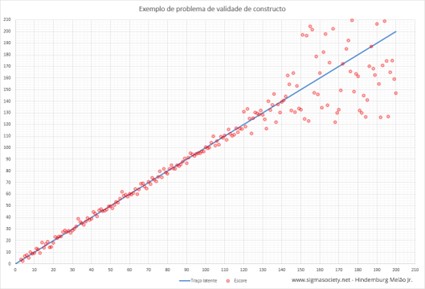
The blue line represents the latent trait [*] that we would like to measure (intelligence or g-factor or something). The red circles represent the scores obtained in the test converted into IQ. In the range between 0 and 120, the measured scores are very good representations of the latent trait, because the points are distributed closely close to the blue line, indicating a strong correlation between the variable we would like to measure and the variable we are actually measuring. [*https://dictionary.apa.org/latent-trait-theory, https://www.jstor.org/stable/1434009%5D
From 120 onwards, and especially from 130 onwards, the red circles begin to move further and further away from the blue line, indicating that the correlation between the variable we would like to measure and the variable that is actually being measured becomes more and more weak, so what we are measuring is becoming less and less representative of what we would like to measure. If you consider the entire range from 0 to 200, or even from 70 to 200, the correlation still looks strong, but that’s only because the range 70 to 120 is contained within the range 70 to 200, and as in the range 70 to 120 the correlation is strong, this improves the average correlation of the entire range from 70 to 200, but when considering exclusively the correlation between 130 and 200, it is noticed that the correlation is weak in this region and becomes weaker for the scores taller. Therefore, for scores above 130, what matters is not the global correlation, but the local correlation.
On IQ tests like the Stanford-Binet, for example, some very fast people with a true IQ of 150 can score 190 or more as a consequence of the problem described above. The opposite effect can also happen, and people with a true IQ of 190, if they are very slow, can score 150, 140 or even less. The size of errors can reach really high levels, both for more than correct and for less than correct, which is why construct validity [*] is an extremely important issue. [*https://en.wikipedia.org/wiki/Construct_validity]
A test that has good construct validity should behave like the one shown in the graph below, in which the red circles remain close to the blue line throughout the entire spectrum within which it is intended to measure:
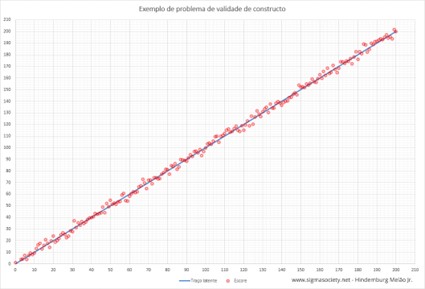
Of course, if the sample has a normal distribution, the data will be distributed approximately like an ellipse, not like a line that was represented above, but for didactic purposes this example needs to be like this to be visually clearer the increase in the amplitude of the dispersion of the measures in relative to the latent trait we would like to measure. It is also worth emphasizing that, in the real world, situations like the one in the graph above practically do not exist, because the alignment is too good. But it is desirable that the measured scores be able to provide good representations for the latent trait within as wide a range as possible.
In supervised IQ tests, used in clinics, disparities usually start to become serious from 130 and especially from 140, that is, what the test measures above 140 is no longer a good representation of Intelligence. In the cases of the best hrIQts, the scores remain reasonably good representations of the latent trait up to IQ 160 or so.
A test may have questions of an appropriate difficulty level, but what the questions are measuring may not be intelligence. Or it may happen that the measured variable is intelligence, but only within a specific range (as in the first graph). Some puzzles for children, for example, can be effective in correctly measuring the mental age range of 8 to 16 years, or 50 to 100 IQ on an adult scale, but if you use these same puzzles to try to measure the Adult IQs above 160 or 170, the result will be disastrous, because the ability to quickly solve these puzzles cannot be interpreted as a good representation of intelligence at this level. Therefore, the type of problem needs to be compatible with the intellectual level that is intended to be measured.
Generally, the smartest people are also quicker to solve basic questions, but the fact that they solve simple questions quickly does not offer a good guarantee that the person will also be able to solve more complex, deep questions that require creativity. In addition, the fact that a person is able to solve complex, deep questions that require creativity does not provide a good guarantee that he will be able to quickly solve basic questions. As the tests used in clinics exclusively include basic questions, the effect shown in Graph 1 ends up being very frequent.
This issue is discussed in more detail in the introductory text of Sigma Test Extended.
It is also necessary to standardize the meanings of some terms that I will use in the answers:
rIQ = rarity IQ, or IQ (σ=16 G), or rIQ (σ=16 G)
pIQ = Potential IQ, or IQ (σ=16 T), or pIQ (σ=16 T)
Detailed explanations can be found at https://www.sigmasociety.net/escalasqi . Here I will give a brief explanation: rIQ is the value that the IQ would have converted from the true rarity. This is not IQ measured on IQ tests or hrIQts. The measured IQ is the pIQ, whose distribution is non-Gaussian, the distribution has a dense tail, so the pIQ scores are more abundant than predicted based on the normality assumption of the distribution. This has nothing to do with the standard deviation being larger. The standard deviation is the same. The shape of the distribution is different, concentrating more cases in the right tail and less in the central region. In regions close to the central tendency, pIQ is almost equal to rIQ and remains so until about 130. From then on, pIQ becomes greater than rIQ. Some examples:
rIQ 100 is equivalent to pIQ 100.00
rIQ 130 is equivalent to pIQ 130.87
rIQ 150 is equivalent to pIQ 156.59
rIQ 180 is equivalent to pIQ 204.93
(A complete table is available on the Sigma Test Extended page)
The difference between pIQ and rIQ increases as rIQ increases, because the proportion at which the actual tail density becomes greater than the theoretical density increases as the IQ moves away from the mean.
When comparing estimated IQs based on rarity with IQs measured in tests, it is critical to put both on the same scale. For example, let’s say Newton is considered the smartest person in history and let’s say the number of people ever born is 100 billion. Then Newton’s IQ estimated based on rarity and based on the assumption that the distribution of scores is normal would be rIQ=207.3 (σ=16, G). But the actual distribution of scores is not normal, so you cannot compare that 207.3 with a score of 207 measured in a test, because they are on different scales. Both may have the same standard deviation (16 in this case), but the shape of the distribution is different and this cannot be neglected because the distortion produced is gigantic.
Newton’s rIQ would be 207.3 but his pIQ would be 261.8. To repeat: both scores have a standard deviation of 16, both rIQ and pIQ. This process should not be confused with changing scales with different standard deviations. The standard deviations are the same, but the shape of the curve is different. I’m repeating this several times because I’ve seen people confuse this just a paragraph after it’s been cleared up.
This adjustment is necessary to correct the distortions of the norms and to allow the correct calculation of rarities from the scores measured in the tests, or the inverse process of calculating the IQ from the rarity level.
Thus, the person with the highest rIQ (σ=16 G) in a population of 7.9 billion has rIQ 201.2, which is equivalent to pIQ (σ=16 T) 247.8. The scores 201.2 (σ=16 G) and 247.8 (σ=16 T) are equivalent, as 0 o C and 32 o F. The use of the term rIQ is equivalent to the use of the term IQ (σ=16 G), while the use of the term pIQ is equivalent to the use of the term (σ=16 T). I can also eventually use rIQ (σ=16 G) or pIQ (σ=16 T).
So tests can (and do) produce scores above 200 with a standard deviation of 15 or 16, but the correct calculation of rarity levels or percentiles should not be performed the way it has been done for decades. The percentile and rarity calculations are wrong, as I’ve demonstrated since my 2000 papers on this. I’m not referring to tests with inflated standards. Of course, this problem becomes more serious when the norms are inflated, but even when the norms have been calculated properly, as in the cases of the Mega Test or Titan Test norm, both the Hoeflin version and the Grady Towers version both provide incorrect values for the percentiles. The IQ scores are very close to the “correct” values, which would be the values adjusted to a well-standardized range scale. The problem is not with the measured IQs, but with the percentiles calculated based on the incorrect assumption that these scores are normally distributed. This topic will be analyzed again at other times, in more detail, when the topics covered require it. For now, this introduction should be enough to clear up much of the confusion that occurs with the indiscriminate use of the term “IQ”, without making the correct distinction between pIQ and rIQ.
When Chris Harding was registered in the 1966 Guinness Book with an IQ of 197, based on his Stanford-Binet results, this was a relatively primary and serious error because it incurs all 3 problematic items I cited above: SB does not include questions difficult enough to correctly measure above 135; the cognitive processes required in the solutions are not appropriate for IQs above 150; the calculated rarity level is incorrect.
In 1966, the world population was 3.41 billion people, and the theoretical level of rarity for scores 197, assuming the distribution of scores was a Gaussian with a mean of 100 and a standard deviation of 16, was 1 in 1.49 billion. So it seemed plausible that a person with that score could be proclaimed the smartest person in the world, or at least the person with the highest IQ in the world. However, a correct analysis of the situation reveals that the SB score of 197 does not indicate a rarity level of 1 in 1,490,000,000, but 1 in 870,000 (about 2000 times more abundant). Also, the variable measured at the rarity level of 1 in 870,000 is not intelligence. At this juncture, the most that could be said on the basis of a SB score of 197 is that the person showed consistent evidence of having an intellectual level above 135 IQ, and as their nominal score was well above 135, there is a good chance that their The correct IQ is greater than 150, perhaps greater than 160, but it would be necessary to prescribe a complementary exam, with more difficult questions and with appropriate construct validity, to investigate the real intellectual level of this person, since scores above 135 are outside the range at which the test is able to measure correctly.
In the following years, several other people began to emerge claiming the same record, with scores of 196-197. This continued until 1978, when the situation worsened, first with Kim Ung-Yong scoring 210, then Marilyn vos Savant scoring 230, corrected to 228, then corrected to 218, and finally Keith Raniere , in 1989, scoring 242. All based on clinical tests that are not suitable for correctly measuring above 135.
A similar problem happened to Langan in the Mega Test. The difficulty level of the Mega Test questions is suitable for correctly measuring up to about pIQ 194, equivalent to about rIQ 177, which corresponds to a rarity level of 1 in 1,340,000. This is the realistic rarity level corresponding to the Mega Test ceiling. In 2000 I had calculated a ceiling of pIQ 186 for the Mega Test, equivalent to rIQ 169, hence a rarity level of 1 in 124,000, but I was basing it on the sample of 520 tests available on Miyaguchi’s website. However, this sample is not representative of the set of more than 4,000 people examined with the Mega Test. This sample is stratified by 10 out of 10 (10 people with each IQ when possible). That is why there is a concentration of high scores above the “correct”, causing the difficulty of the items, especially the most difficult items (which is determined by the proportion between errors and hits) to end up being lower than the correct one, since there are more people with higher scores, there will be a higher percentage of hits than if the entire sample had been considered. Another factor is that even considering all the more than 4,000 people evaluated by the Mega Test, there is a self-selection that produces a higher concentration of people with high scores than that observed among the general population. With these two complementary adjustments, I redid my calculations for this standard and arrived at the numbers I cited above.
Therefore, with a raw score of 47/48, obtained by Langan on his second attempt, the corresponding rIQ is 176, equivalent to pIQ 192, that is, a rarity level of approximately 1 in 983,000. The actual rarity level of Mega Society is around 1 in 62,000 and Prometheus 1 in 8,000. In the cases of ISPE, TNS, etc., as they are in a range where the distortions are smaller, the true rarity is also closer to the theoretical rarity. 1 in 600. And in the case of Intertel and Mensa, they are practically unaffected. The theoretical percentile 98.04% for pIQ 133 score is equivalent to rIQ 131.8, therefore percentile 97.66%.
There are two other points I would like to comment on in this introductory text, before proceeding: on the meaning of “intelligence” and on the meaning of “certificate”, but the text has become too long and it is perhaps better to remove it, as well as other parts of some answers. Anyway, I’ve saved the full text in a separate file, in case it has any additional use or to be used on another occasion.
Having made these clarifications, we can now begin the answers.
Scott Douglas Jacobsen: When you were growing up, what were some of the prominent family stories being told over time?
Hindemburg Melão Jr.: I’m not very interested in stories.
Jacobsen: Did these stories help give a sense of an extended self or a sense of family legacy?
Melão Jr.: My grandparents were very poor, my father only studied until the second year of elementary school (2nd year). He was exceptionally intelligent, creative, had hypermnesia and a wide range of intellectual and kinesthetic talents. This allowed him to lift himself out of extreme poverty and provide a satisfying environment for his children, but not much else. My parents’ legacy is almost exclusively genetic.
Jacobsen: What was the family background, eg geography, culture, language and religion or lack thereof?
Melão Jr.: My maternal great-grandfather was a native Indian of Brazil, my paternal great-grandfather was Portuguese. My family was Catholic at the time I was born, but later they converted to Kardecism, preserving some Catholic habits. I became an atheist at approximately 11 years old, then an agnostic at 17 and a deist at 27. I was interested in the Bahá’í Faith for some time, but did not participate in any activities. I am writing a book dealing with Science and Religion, in which I cover some of these topics in more detail.
Jacobsen: How was the experience with peers and schoolmates as a child and teenager?
Melão Jr.: It was reasonably quiet, I had no problems with bullying that could be associated with discrimination on cognitive grounds. I was bullied for other reasons, because I had my eyebrows together, but nothing that caused me great embarrassment, even because I had been practicing martial arts since I was 7 years old, so if I thought they were crossing the line, I reacted in a different way. energetically and that kept them from bothering me again
My problems were with some teachers more than colleagues, because I had the incorrect view that teachers couldn’t make mistakes in their discipline, but in the real world it’s very different from that. Virtually every teacher made several mistakes every day, and I used to point out the most serious mistakes. Most of them reacted positively to it, some were grateful for the corrections and revised it immediately, but others did not accept this type of correction, especially when it came from a 7 or 8 year old. A remarkable episode occurred in a Geography class, when I was 9 years old, and the teacher asked the students to calculate the size of the Brazilian coast. When I started to perform the task, I realized that it didn’t make sense, because the measurement would depend on the level of detail of the map, so there was no possible answer. So I explained the problem to her, but she didn’t understand my explanation. She thought I was referring to the map being on a different scale than its actual size. So I explained again, but it didn’t help, she still didn’t understand, got angry and ended up acting oppressive, ordering me to shut up, and continued to “teach” incorrectly. It was a very unpleasant episode. Usually the errors that I identified were errors of the professors, but in this case it was much more serious, because it was an institutionalized error and accepted as if it was correct by the “authorities” in that discipline, it was wrong in the book and probably in all other books, being incorrectly taught to all students. In fact, this remains wrong to this day, 40 years later, in virtually every source on the subject, including Wikipedia, Encyclopedia Britannica, IBGE, Cia World Factbook, US Bureau of Labor Statistics, etc. The problem is not that the measurement number is wrong. The problem is that the question does not make sense because there is no “length” of the coastline, there is no possible answer with dimension 1, because the perimeter has a dimension greater than 1 and less than 2. Although it was unpleasant, it was also a problem. event that I remember with pride, for having deduced one of the fundamentals of Fractal Geometry, impromptu, at the age of 9.
Jacobsen: What are some of the certifications, qualifications and professional training you have obtained?
Melão Jr.: The primary purpose of certifications should be to certify that a certain person or entity fulfills requirements that would not be easily verifiable by a person from the general population. For example, an uneducated person would find it difficult to correctly assess whether a doctor is capable of treating their health, or to decide whether it would be better to receive treatment from an allopathic method or from a healer. That is why there are regulatory bodies, made up of experienced and supposedly competent specialists, which establish norms that theoretically should be necessary and sufficient to distinguish between qualified and unqualified professionals, protecting the less educated population against the provision of unsatisfactory or even unsatisfactory services and products. harmful. This is nice in theory, but in practice it doesn’t work so well, and the certification industry ends up serving other purposes, including market reserve, nepotism, the cult of vanity and egolatry.
Certificates often do not fulfill the function for which they were created, either approving insufficiently skilled people/entities , or failing to approve overqualified people. For this reason, it would be more important and fairer to examine actual achievements, competences and merits, rather than examining certifications that would recognize these merits, because merits have intrinsic value, while certifications are mere appearances that they sometimes try to represent. the merits, but they don’t always get it right.
There is even a large industry for trading fraudulent certificates, and little enforcement over it. The American Biographical Institute (ABI) is famous for selling worthless certifications, and has been operating since 1967. There are many similar bodies that specialize in printing beautiful certificates, promoting certification ceremonies, and so on. Usually people who consume these products are naive victims, but it is also possible that some people buy these certificates knowing what they mean (or don’t mean).
Wikipedia has the following description for the ABI:
“The American Biographical Institute (ABI) was a paid-inclusion vanity biographical reference directory publisher based in Raleigh, North Carolina which had been publishing biographies since 1967. It generated revenue from sales of fraudulent certificates and books. Each year the company awarded hundreds of “Man of the Year” or “Woman of the Year” awards at between $195 and $295 each.”
Source: https://en.wikipedia.org/wiki/American_Biographical_Institute
There are currently several PO Box universities handing out Ph.D. Like water. I watched some statements from people who bought these titles, the vast majority of these people really believed they had some value and were excited, happy and proud to receive the title. But maybe not everyone is naive and some understand that these titles don’t represent something real, but use it for obscure purposes. There is a member of mensa brasil who has more than 50 academic titles from a PO Box university, founded in 2021, but on the “institution” website he claims to have been founded in 2006. I find it funny, and at the same time sad, that journalists who publish the articles about this do not suspect that a 40-year-old person, who only had 1 B.Sc. by 2020, it suddenly had more than 50 academic degrees in 2022, including several Ph.Ds. and postdocs. In addition to the certificates purchased, this person also claims that TNS is the most exclusive high-IQ society in the world, he uses his IQ with a standard deviation of 24 to compare with a fictitious “IQ” of 160 attributed to Einstein, among other things, and journalists publish everything without checking.
There are also people who buy these certificates, knowing they are worthless, with no intention of making dishonest use, perhaps as a table decoration or something. For example, Chris Harding is a customer of ABI, he has acquired several titles from that company, as he declares in his profile on the OlympIQ Society. Harding has some real merits, because even though the SB doesn’t correctly rate above 140, it is recognized that this test assesses some sort of skill mixed with intelligence, and few people achieve Harding’s score on this exam. So while some certificates are purchased from him, others are based on real merit and issued by serious institutions, such as those related to his IQ records and his affiliations to high-IQ societies. However, even reputable certificates, which try to represent true merits, often attest to something that is not a good representation of reality. As I mentioned at the beginning, the SB score of 197 or 196 could not be interpreted the way it was, and the official reports and certificates issued are saying something that represents a collective belief, but very different from concrete reality.
Harding is very smart, but not based on the score he got in the SB, but based on his various opinions on different subjects. His real merits are in his essence, in his actions, in his thoughts, not in pieces of paper.
From the moment a person channels his thoughts and actions to produce something concrete, he begins to share his essence with the world, disseminating knowledge and wisdom, or disseminating futility and misinformation, depending on the quality of what he shares. And the perception that other people have of what she shared will depend not only on the quality of what she externalized, but also on the sensitivity and insight of the person receiving the information. If a brilliant person disseminates knowledge of a very high level among a very futile audience, the value of that knowledge will not be recognized and he will have no certifications, no awards, nor any recognition, while other people who are disseminating vulgar and shallow knowledge, compatible with the public that receives it and issues the certifications, that person will be acclaimed and glorified.
People are not rewarded or certified because their achievements are great, but because their achievements are perceived as great by the members of the committees responsible for the approval of awards and certifications. In addition, there are a number of other political, social, racial, etc. biases that interfere with the decisions of committee members, making certifications and awards even more inconsistent with the objective they should have.
This effect occurs, for example, in some Cooijmans tests, where the test does not measure IQ, but rather how similar the person’s IQ is compared to the Cooijmans IQ. If the person has the same IQ as Cooijmans, he will have a maximum score. If she has an IQ much higher or much lower than Cooijmans’ IQ, her score will be low. In the question about IQ tests, I comment in more detail on this problem.
I will cite a few striking examples, some quite well known, but they are worth recalling. I believe that one of the most tragic and striking is that of Galileo, who instead of being rewarded for his remarkable contributions to the understanding of the Universe, he was severely punished. In fact, his daughter Celeste ended up being punished in his place. In more recent times, one of the cases that I find very sad is that of George Zweig, who developed his Theory of Aces at the same time that Murray Gell-Mann developed the Theory of Quarks. Both were essentially the same, however the journal to which Zweig submitted his paper refused to publish it, while Gell-Mann’s paper won him the Nobel Prize in Physics. There are at least 45 known cases of controversial Nobel prizes, of people who received undeserving or deserved it but did not. The world’s most respected award is desecrated by dozens of injustices, perhaps hundreds if you consider the ones that have not been discovered. Even Einstein is one of the biggest victims, since he deserved to have received 5 Nobel prizes, however he received only 1, for racial, xenophobic, Nazi reasons etc.
I believe that now I can answer this question by dividing it into two parts:
- Awards and certifications.
- Merits so far not recognized.
I have few certificates. When I was young, I was in the habit of putting trophies and medals in Chess, Martial Arts, Arts Education, etc. on a shelf, but during one of the changes of address, one of my trophies broke. Initially I was sad, because they were important to me. But as I thought more about the “disaster,” I realized that they really didn’t matter. What really mattered were the merits that led me to win those awards, as well as some merits that were not awarded. There were also cases in which I had no merit, but had been awarded due to some fateful fate. That doesn’t mean I’m not a vain person. I am, but I’ve learned that most of the time you get nothing or almost nothing for something valuable, while other times you get more than what’s fair for something of little or even worthless. Unfortunately, the world rewards appearances much more than essence.
One of my few certificates is the world record holder for longest announced mate in simultaneous blind chess, recorded in the 1998 Guinness Book. Perhaps some people are not familiar with the meaning of “blind chess” and “announced mate ”. This video helps to understand the dynamics of a blind simultaneous: https://youtu.be/LUo89Cl9FPY . It’s an old, low quality video, but to exemplify the mechanism of the event, I think it’s appropriate:
I will give a brief description: in a simultaneous, one person (simultanist) plays at the same time against several opponents (simultaneously), each of which has its own board. It is different from a consultation game, where several players can consult each other on a single board and decide on the best move by voting. In a simulcast, each simulcast has its own board and each game follows its own course.
In this case, as it is a blind simultaneous, the simultanist does not have visual access to any of the boards, nor to the pieces, nor to the summaries, nor to any type of record of moves or positions. At no time may the simultanist look at any of the boards, nor request any information that helps him to remember the positions of the pieces, nor any specific piece, nor that helps him to remember the order of the moves, nor any other type of information that can in some way help with the matches. The position of each of the pieces on each of the boards is registered exclusively in the simultanist’s memory and these positions are mentally updated with each move. In addition, at each move the simultanist needs to make the calculations of the variants and sub-variants necessary to make his decisions about the move to be executed, taking care not to confuse the memories of the calculated variants with the memories of the variants actually played, among others. care.
The game develops as follows: the simultanist stands with his back to the boards and communicates his moves to an assistant (speaker), who executes each simultanist move on the respective board. Then, the simultaneous player on that board executes his answer on the board and the speaker verbally communicates to the simultaneous player which move was executed by that simultaneous player. Then the speaker moves to the next board, where again the simultaneous player declares his move and this is executed on that board by the speaker, etc.
There are easier (or less difficult) versions, in which the player can blindly access a list with all the moves noted, as in Melody Amber’s tournaments, in which, in addition to being individual games, instead of simultaneous , competitors can also see an empty board, which facilitates calculations and reduces the risk of forgetting the position of a piece. But under the strictest rules, as in my 1997 Guinness record, it was not allowed to have access to the move history, nor to see an empty board, nor any other similar kind of aid. It is equivalent to being blindfolded all the time, from start to finish of the event.
That record set in 1997 was a blind simultaneous to 9 boards, in one of which I announced mate in 12 moves. The average rating of my opponents was estimated at around 1400. I got 7 wins, 1 draw and 1 loss.
Previous record holders were: Joseph Henry Blackburne (mate in 8 moves in a 10-board blind match in the year 1877), Samuel Rosenthal (mate in 8 moves in a 4-board blind match in the year 1885) and Garry Kasparov (mate in 8 moves in a blind simultaneous to 8 boards, in the year 1985). There was also an event in 1899, in which Harry Nelson Pillsbury announced mate at 8 in a 10-board blind simultaneous, but there was a miscount. Following the sequence dictated by Pillsbury, mate took place in 7 moves.
In the case of Kasparov, there are some details that need to be clarified: he played a blind simul against the 8 best computers of the time, including the world champion Mephisto Amsterdam 68000 RISC 12MHz. The average rating of these machines was about 1500 and the best reached 1800. The best computer in the world in 1985 was precisely the Mephisto Amsterdam, whose rating published by the manufacturer was 2265, but later measured by SSDF in 1827 (based on 1020 matches). In the match against Mephisto Amsterdam, Kasparov played a beautiful combination with an 8-moves mate streak, but there is no record of him having announced the mate. In any case, as he sacrificed a Rook and two pieces at the start of the combination, it is clear that he correctly calculated the entire sequence.
In 2005, Rede Globo did a report for the program “Fantástico” celebrating 100 years of IQ tests, and I was nominated as the person with the highest IQ in Brazil, at the level of 1 in 200 million. This is an example of “recognition” that I’m not sure was correctly assigned. In the question about IQ, I discuss this subject in more detail.
Recently, my friend Domagoj Kutle honored me with a kind invitation to publish in his excellent magazine Deus VULT, and requested that I also send a short biography. My girlfriend Tamara kindly helped me craft this material, including some of my accomplishments. I think this would fit here, so I’ll paste the text:
Melao mini-bio, by Tamara Rodrigues:
Hindemburg Melao Jr. was born in Brazil, in a family with few resources, and only attended school until the 11th grade, having learned almost completely as self-taught.
In 1998 he was registered in the Guinness Book as the holder of the world record for longest announced checkmate in blindfold simultaneous chess games.
Between 2006 and 2010 he developed an artificial intelligence system to trade in the Financial Market; in 2015, his friend and partner Joao A.L.J. incorporated a hedge fund to use this system and started to be registered in fund rankings (BarclayHedge, IASG and Preqin), winning 21 international high performance awards.
In 2007, Melao solved a problem that had been unsatisfactorily solved for 22 years, by creating an index to measure performance adjusted at risk that was more accurate, more predictive and conceptually better founded than the traditional indexes of William Sharpe (Nobel prize 1990) and Franco Modigliani (Nobel 1985).
In 2003 he solved a 160+ year old problem by proposing a new formula for calculating BMI, superior to the traditional one and superior to the formula proposed in 2013 by Nick Trefethen, Chief of the Dept. of Numerical Analysis at the University of Oxford, Leslie Fox Prize(1985), FRS prize, (2005), IMA Gold Medal (2010). Trefethen’s 2013 formula is an incomplete version of Melao’s 2003 formula.
In 2000 Melao developed the first method for standardization of intelligence tests that produces scores in scale of ratio and in 2003 he applied this method in the Sigma Test norm (he also calculated new norms for Mega and Titan tests using the same method), thereby solving a problem of Psychometry that exists more than 90 years ago and was pointed by Thurstone and Gardner as a central question of Psychometry more than 45 years ago.
In 2002 Melao found the best solution to a problem that has existed for more than 520 years and had been attacked for more than 65 years, the Shannon Number, which was only matched in 2014 by Stefan Steinerberger, professor of mathematics at Yale University.
In 2015 Melao showed that the method recommended by the Nobel Prize in Economics Harry Markowitz, for portfolio optimization, has some flaws, and proposed some improvements that make this method more efficient and safer.
In 2021 Melao pointed out flaws in the recommendation of the 2003 Nobel Prize in Economics, Clive Granger, regarding the use of the concept of cointegration, and presented a more adequate solution to the same problem.
In 2022, Melao solved a problem that had been open for 16 years, in which he established a method for calculating chess ratings based on the quality of the moves. Also presented an improved version of the Elo system, applying both methods to calculate the ratings of more than 100,000 players between years 1475 and 2021, the results were published in a book, along with the description of the two methods.
At 9 years old Melao deduced one of the fundamentals of Fractal Geometry and at 13 he developed a method to calculate logarithms. At age 19 he developed a method for calculating factorials of decimal numbers without using Calculus.
Also at the age of 19 (1991) he developed an invisibility machine project, which in 1993 he inscribe in a contest of ficction Literature (although the project is consistent with Scientific Method), but did not win. In 2003 Susumu Tachi, Emeritus Professor at the University of Tokyo and guest Professor at MIT, created (independently) a simplified version of this project and built a prototype.
In 2020 Hindemburg presented a study showing that Jupiter’s Great Red Spot cannot be 350+ years old, as was believed. The correct age is around 144 years old.
In 2000 Melao had a chess theoretical novelty elected one of the 10 most important in the world by the Sahovski Informator jury, the world champion Anand was one of the judges and Anand’s vote was that this novelty should be the 8th most important.
In 2004 Baran Yonter, founder of Pars Society (IQ>180, σ=16), estimated that Melao IQ should be above 200 (σ=16).
In 2005 the production of the program “Fantástico”, from Globo (second-largest commercial TV network in the world), made a special report on intelligence, celebrating the centenary of the creation of IQ tests, and Melao was nominated as the person with the highest IQ in Brazil, with a rarity level of 1 in 200 million.
In 2009 Melao was nominated by Albert Frank to participate in a John Hallenborg project with people whose IQ is at the rarity level above 1 in 1 million.
In 2000 Melao updated and extended his “Alpha Tests” that he had created in 1991, added new questions, and created the Sigma Test.
In 2022 he extended the Sigma Test by creating the extended version.
Melao is author of more than 1700 articles on Science, Statistics, Psychometrics, Econometrics, Chess, Mathematics, Astronomy, Physics, Cognitive Science, Ethics, Philosophy of Science, History of Science, Education etc.
Detailed bio of Melao (documents, videos, interviews, articles, reports etc.) at: https://www.sigmasociety.net/hm
Although I practiced Martial Arts for several years (maybe ~11 years if you add up all active periods), I didn’t get any certification, because the time was distributed among many different disciplines and I didn’t reach black belt in any of them. But I reached a reasonable technical level. For handguns, maybe I’m in the 99.9% percentile and in the specific case of nunchaku, maybe 99.999%. This is a video from 2016, I was already kind of old and rusty https://youtu.be/jCw–5H34x4 . On the same channel there are also videos with other weapons (sword, tonfa, kama, sam-tien-kuan, etc.).
In 2020 I was invited to a group of the 26 best planetary astrophotographers in Brazil. Although there is no certificate for it, I was very happy because it is one of my favorite hobbies. I would like to take this opportunity to thank my friend Vinícius Martins, who taught me almost everything I know about planetary image processing, I believe that in a short time he will be one of the 5 best astrophotographers in the world, he combines 3 fundamental extraordinary talent, an immense love for this activity and a deep knowledge that is constantly expanded and updated.
Among the certifications that I do not have, one of the most interesting is the CFA, granted to investment managers. It is interesting because between 2006 and 2010 I developed an artificial intelligence system to operate in the Financial Market that between 2015 and 2020, when it was used by a European fund, won 21 international high performance awards in the Barclay’s Hedge, Preqin and IASG rankings, being also the second best investment system in the world between 2011 and 2016. However, I was banned by the CVM from providing management services because I do not have the CFA certificate. In 2014, a petition was made to request that the CVM (Brazilian Capital Markets Regulator) issue me a certificate on an extraordinary basis. The claim was based on the wording of CVM Instruction 306 and on the fact that my system had accumulated more than double the profit of the fund that occupied the first place (ahead of 282 other funds, all managed by certified managers) in the ranking of the InfoMoney, the largest ranking of funds in Brazil. Among the people who signed the petition on my behalf were several university professors, several professional managers, and several members of high-IQ societies, including Dany Provost of Giga Society. However, the claim was not accepted and I still do not have this certificate. By the way, the two most famous managers in the world, Warren Buffett and George Soros, also don’t have a manager certificate, so I’m in good company. Buffett solved this problem by incorporating a company that buys other companies, rather than running a fund. Soros solved the problem by putting his friend Jimmy Rogers as gestures (Jimmy had the necessary certification), I solved the problem by trading licenses to use my system, with a volume limit of application for each license and a renewal period.
Among the certifications I don’t have, I can also include CNH, although I drive outside the law (I’m practically a gangster). I stopped going to school in the 5th grade, then I went back a few times, due to pressure from my parents. I would come back, I would continue enrolled for a few months, I would run out of patience, I would stop again, my parents would pressure me to come back, I would come back again, etc. I finished high school (11th grade) and entered the Physics faculty, but I didn’t like the course and I stopped for good after 2 months. In the first week of class, I reviewed the Physics I textbook and pointed out over 200 errors, sent my comments to the author, with an introductory note trying to be tactful so he wouldn’t be offended, but he never responded. I also pointed out two serious conceptual errors in the methods used in the Physics laboratory, which should impact the results of the experiments; one of them, on the crumpled paper balls, is the same “experiment” carried out in the Mathematics Department at Yale University, where they also make the same mistake. In that case, Prof. Dr. Paulo Reginaldo Pascholati had an honorable conduct, he received my criticisms with humility, he did some experiments to investigate whether the error I indicated was justified, he found that I was right and, in the next class, he publicly admitted the error. I found his conduct exemplary in this regard, however the handout was not corrected and they continued to do the experiment incorrectly.
Anyway, I decided that university was a waste of time and it would be more productive to study on my own, but it’s not that simple, and this decision proved questionable on some occasions. The distance from the academic career has some positive aspects, some negative ones. One of the positive aspects is that I can select my own curriculum, go at my own pace, and delve as deep into each topic as I want. One of the negative aspects is that it becomes more difficult to have access to satisfactory bibliography and even more difficult to publish in indexed journals. In doing so, I practically ostracized myself.
Therefore, certificates are useful, but it is important to understand the limitations and distortions they may present, so as not to run the risk of dealing with them in a bureaucratic way, to the point of being placed above the real capacity verified empirically on a continuous basis. Certificates reflect the opinions of people or institutions that are often not qualified enough to make correct assessments on the merits and to decide impartially. In the example of the CFA, certifications are literally distributed based on excessively condescending criteria, which are far from sufficient to select qualified people to exercise the role of manager, which is why more than 95% of certified managers generate losses for their clients. Perhaps this effect is more noticeable in the Capital Markets than in any other activity, but it also frequently occurs in Journalism, Advertising, Administration, etc., where some people without training in these disciplines may eventually be more qualified than certified people, but for protect the less competent, laws are created that prevent companies from hiring the most competent, using certificates as an instrument of discrimination and apology for mediocrity.
I wrote an extended version of this answer, in which I discuss some failures in the education system in Brazil and in the world, justifying why I moved away from academic life. I also point out and analyze the mistakes made by Richard Lynn in his study of IQs in different countries and explain why it would not be correct to try to justify the educational problem in Brazil based on the supposedly low average IQ of the population, as well as revise the estimate for the IQ average for some countries, including Equatorial Guinea, Israel and Brazil. The text was 10 A4 pages, so I thought it best to put it as an appendix.
Jacobsen: What is the purpose of intelligence tests for you?
Melão Jr.: the most important attribute of living beings is intelligence. Without intelligence there would be no Ethics, Laws, Science or Art. In order to correctly delegate the most important tasks to the most qualified people, it is necessary to correctly identify and rank people according to their abilities. That is why correctly measuring intelligence and using the results as a criterion for assigning positions and tasks, according to the level of competence, is extremely important, but unfortunately this is not what happens. There are two big problems:
- The first is that the world is dominated by nepotism;
- The second is that there are no appropriate intelligence tests to correctly measure at the highest levels.
In the late 19th century, the first tests by Galton and Cattell failed to satisfactorily measure intelligence, but it was an interesting attempt. The hypothesis that the speed of reflexes, visual acuity, auditory acuity, etc. could be relevant indicative of the intellectual level proved to be inadequate. In 1904, Binet and Otis managed to solve this problem by using questions that required the combined use of various cognitive skills – rather than trying to measure primary aptitudes, as Galton did – but Binet’s tests only measured correctly up to about 140. Terman’s attempts in 1921 to use Binet’s tests to select future geniuses failed. Among the 1528 children selected with an IQ above 135 (more than 70 with an IQ above 177), none won a Nobel or any similar prize, while two of the unselected children won Nobel prizes. The test worked very well until about 130, the selected children published more books, more articles, had a higher average income than the children in the other group, but at the higher levels, the test failed and missed some of the brightest children. The results of this study had an extremely deleterious effect, undermining the credibility of IQ tests in the eyes of the general public and in the eyes of many intellectual exponents from scientific, technological, cultural and educational fields, so it would be important to clarify the limits of until point these tests can measure correctly, so that unrealistic expectations are not created and so that they are not applied incorrectly outside these limits.
In 1973, Kevin Langdon created the LAIT (Langdon Adult Intelligence Test) and with that he managed to raise the difficulty level to close to 170 and the construct validity to 150; In 1985, Ronald Hoeflin took another important step forward with the Mega Test, raising the difficulty level to about pIQ 190 and construct validity to 170, and these contributions broadened the horizons of application of intelligence tests, which previously worked well until the approximate level of 1 in 100, while the new tests started working up to 1 in 100,000. On the other hand, from the 1990s onwards, some fantasy tests began to appear with nominal ceilings that reached 250, although the real ceiling of difficulty did not reach 180 and the ceiling of construct validity was around 150, as the ISIS Test by Paul Cooijmans. Some of these fantasy tests keep popping up to this day, and this exacerbates the prejudice many people have against IQ tests, because if a person has refined critical thinking and a skeptical attitude, he realizes that there are inconsistencies in results like Feynman’s ( 123) and Rosner (193, 196, 198 etc.). Both are very intelligent, and the problems that Feynman solved are more difficult than the problems that Rosner solved, which could be interpreted as indicating that Feynman was more intelligent, so how is it possible for a serious standardized system of evaluation to assign 190+ to Rosner and 123 for Feynman? Something is obviously not right about this, and people often don’t identify exactly where the error is, so they generally conclude that all IQ tests don’t work, or they don’t even know that there is more than one type of IQ test. IQ That’s why clarifying the range in which each type of test works contributes to combating this type of prejudice. If Feynman’s true IQ, based on the difficulty, complexity, and depth of the problems he solved on quantum electrodynamics, superfluids, etc. were put on the same scale that Rosner’s IQ is represented, Feynman’s correct IQ would be close to 235. And to explain this number above 200, I would first have to show that the distribution of scores is not Gaussian, etc. etc. Then that apparent initial inconsistency would disappear and everything would become clearer and more logical. The same is true for Einstein’s fictitious IQ of 160, whose correct value, if placed on the same scale as the scores measured by the tests, would be close to 250.
In 2000, the Sigma Test brought solutions to the 3 problems cited in the introductory text, with the main focus on construct validity, using questions based on real-world problems that require a combination of convergent and divergent thinking at different levels of difficulty, complexity and depth, consistent with the IQ levels to be measured. More recently, the Sigma Test Extended raised the ceiling on difficulty to about pIQ 225 and construct validity to about 210. However, in a population of 7.9 billion, the smartest adult person in the world must have an rIQ of around 210. 201, equivalent to about pIQ 245, thus far outside the limits that STE can measure. Nevertheless, for some of the smartest 100 or 200 people alive, STE could provide reliable measures of real intelligence, with good construct validity at this level, in addition to offering a stimulating intellectual challenge. This would fix some urban legends disseminated in various sources, such as that the average IQ of Nobel laureates in Science is “only” 154. With the use of a properly standardized test, with an appropriate difficulty level and good construct validity, the The average IQ of Nobel Prize winners in Science should be between 170 and 190. With the use of appropriate tests it is possible to correctly reposition the scores, both up and down. This would also overcome some prejudices against IQ tests, because one of the reasons for rejection is precisely due to the bizarre results for Feynman (123), Fischer (123*), Kasparov (123, 135), Shockley (<135), Alvarez ( <135), Feynman’s sister (124), etc., because that takes away the credibility of the tests, as these scores are far more likely to be wrong than these people having IQs below the 1 in a thousand level, when in fact they should be above 1 in 1 million (and Feynman close to 1 in 1 billion). When we can show that tests are able to measure correctly even at very high levels and provide realistic results, consistent with the achievements of these people in real-world problems, we can restore credibility to intelligence tests as serious and reliable instruments capable of to perform one of the most important functions, which is precisely to make early predictions of genius. [*Although many sources mention an IQ of 187, 181, or 180 for Fischer, his 1958 reports show a score of 123]
So while there are no tests capable of correctly measuring at the level needed to pinpoint the smartest person alive, or rank the 10 smartest, there has been substantial progress since Binet’s first tests, and if Terman were alive today and developing the same study from 1921, but starting in 2000, and if he used the STE instead of the SB, most likely the smartest children would all (or almost all) be selected in his group, and the subsequent results would have been confirmatory even at the highest levels, corroborating the thesis he defended, that it is possible to predict genius early, but not with the tests that existed at that time. The thesis itself was correct, as was Leonardo Da Vinci’s helicopter, but the technology still needed to advance a little further for the thesis to have the necessary subsidies to be tested properly.
Jacobsen: When was high intelligence discovered for you?
Melão Jr.: I find it difficult to determine this precisely. The first time I was examined in a clinic, I was 3 years old, but at 6 months of age I was able to speak reasonably fluently, so there was some earlier evidence.
Jacobsen: When you think about the ways in which the geniuses of the past were mocked, vilified and condemned, if not killed, or praised, flattered, plagiarized and revered, what seems to be the reason for the extreme reactions and treatment of geniuses? Many alive today seem camera-shy – many, not all.
Melão Jr.: I don’t think it’s a problem of the past. It is still present in many primitive cultures, such as in Brazil and in several African countries. The vast majority of the population adopts a posture of hostility, envy and boycott not only against geniuses, but against anyone who may be having any kind of success. Recently my girlfriend showed me a video of Ozires Silva, who was Minister of Infrastructure and president of Petrobras. He comments that during a dinner attended by some members of the Nobel committee (link to the video: https://youtu.be/m3u-E5XdzZ4 ) he asked why they thought Brazil had no Nobel laureates, since several Latin American countries with lower population and lower GDP even had more than one Nobel Prize. One of the committee members commented “you Brazilians are hero destroyers”. Unfortunately, this is a fact that is still present in our daily lives.
At the time I got to know high IQ communities, 1999, some famous names were William James Sidis, Marilyn vos Savant, Chris Langan, Rick Rosner, Grady Towers etc. Langan was a security guard at a nightclub, Rosner was a nudist model and also worked for a time as a security guard, Grady Towers was a security guard at a park and died a tragic and untimely death in 2000. Sidis spent the last decades of his life in underemployment and collecting license plates. Marilyn was a columnist for a magazine and got a reasonable standard of living out of it, as well as good prestige and recognition outside of high-IQ communities, as well as a lot of hateful envious. With the exception of Marilyn, the other people I mentioned earned minimum wage and still spent part of their time without a job, while many people are hired to fill positions that they are not even qualified, earning small fortunes as well as prestige and recognition.
This situation is very sad. Although Langan was not the smartest man in the Americas, as he claimed in 2000, or in world history, as he began to claim some time later, he is arguably a much smarter and more competent person than 99% of Ph. Ds. in any area and more than 99.9% of the CEOs of companies. He may not have had such a vast culture and expertise needed to solve major scientific problems, but he certainly would have given better administrative and political solutions than any president the US has ever had. I don’t know if he would be the best president, because being a great president isn’t just about solving problems. He would also need to have sensitivity, empathy, kindness, honesty and other attributes. But generally many people have these attributes at the required level. What they usually lack is precisely intelligence. I’m not saying that Langan or Rosner should be presidents. But, pondering the positives and negatives, I would bet on them as better presidents than the average of recent presidents.
Persecution and oppression can sometimes happen silently, and this is often even worse because it is harder to detect and combat. How is it possible that a person with Langan’s intellectual potential was not discovered by a large company that hired him for a millionaire salary so that he would solve internal problems in a way that generates more profit for the company than other less competent people working in the same role? There are grotesque errors in this. The vast majority of companies are contaminated by mobs of incompetents and cheats, who instead of hiring and promoting based on merit, do almost exactly the opposite, because they feel threatened by those who are more competent than themselves. This is a complete disaster not only for the companies they work for, but for the entire harmony of civilization. In Norway, Sweden, Holland, Finland, Switzerland, Denmark, etc. these problems are very rare, but in brazil this is a constant that sinks the country. In the USA, the problem may not be as serious as it is in Brazil, but when we look at the cases of Langan and Rosner, it is clear that there are serious flaws in the performance of the headhunters, failing to hire some of the most qualified people in the country, who started to most of their lives in sub-professional activities. I have cited the examples of Langan and Rosner, but the same is true of a large number of people with far above average IQs, who are working in incompatible activities, with incomes far below what they deserve, producing less than they should, while people very less capable are in high positions, making absurd mistakes and sinking companies or even sinking entire nations. My girlfriend is an environmental engineer and exceptionally smart, she worked at a large company where she solved problems that saved tens of thousands of dollars monthly by cutting waste, as well as contributing to reducing pollution. One of the solutions involving the replacement of a pipeline generated savings of a few million. If she were placed in a higher position, where her performance had greater reach, it could save the company tens or hundreds of millions. However, she was invited to participate in a corruption scheme, she refused, the person who made the invitation was afraid that she would denounce them and fired her.
In “The Republic”, Plato commented on the importance of kings being philosophers and philosophers being kings. This seems to me the most natural, substituting “philosophers” for “competent” which is usually almost synonymous with “intelligent”. And replacing “kings” with an equivalent modern meaning, which can be CEOs of big companies, mayors, governors and presidents. In the US there are several mechanisms to discover and mentor talented children and young people, there are several specialized programs. According to Eunice Maria Lima Soriano de Alencar, in the 1970s there were over 1200 educational programs for gifted children in the US. How is it possible that these programs “missed” Langan and Rosner? How could a respected entity like Hollingworth Institute not discover them? It’s not possible that they didn’t excel at school. In Brazil I would think this is normal, Brazil lets almost all the great talents go down the drain. But in the US I find it surprising that this has happened. There are records that Langan scored perfect on the SAT and received scholarships at two universities, but it appears that he lost his scholarship because he was late one day because his car broke down. This is pretty ridiculous. Even if he missed every class, he would probably learn more and better than 99% of his classmates who were present in every class. The universities did not award scholarships in recognition of his genius, but as a “handout”, with restrictive conditions to withdraw the handout if he did not meet certain criteria.
This waste of great talent is one of the main reasons that leads a country to ruin. China is catching up and surpassing the US in large part because China has invested more seriously and more heavily in special education for gifted children, while the US is making gross mistakes like this, letting great minds like Langan, Rosner, Towers are wasted on jobs like nightclub or park security, while less-skilled people lead big companies, govern cities and states.
Nepotism is not an exclusively family phenomenon. It is much broader, leading to the placement of underqualified people in positions that should be filled by others with more merit. There is no optimization in the delegation of positions, responsibilities, tasks, incentives, awards, etc. And this lack of optimization is obviously penalized. Competitors who optimize this best take the lead.
In Brazil the situation is much more serious, because there are no such programs. There were a few isolated initiatives, which reached a few dozen children, but they did not last long.
Intelligence tests are extremely important to be used in these talent discovery processes. Although the tests have several flaws, it is better that they are applied as far as possible, with errors and patches, than if they were not applied and this calamity was perpetuated. Some of the tech giants create their own tests to select their collaborators, usually these tests are not as good as the hrIQts, but at least they demonstrate that they understand the need for it. Although they are patching up the problem badly, at least they are trying to do something to identify young talents and engage them in relevant projects, in which they can contribute to the development of Science, Technology and the common good, so these companies do better than the government in this regard.
Jacobsen: Who seems like the greatest geniuses in history to you?
Melão Jr.: Leonardo, Newton, Aristotle, Gauss, Ramanujan, Archimedes, Euler and Einstein.
It is difficult to judge the cases of Hawking, Galois, Faraday, Al-Hazen and others, because Hawking had to face extreme hardships, it is difficult to know what the magnitude of his legacy would have been had he not fallen ill . It is possible that Hawking is one of the 5 or 10 smartest people in history, although his effective work is not one of the 100 most expressive, as it is not a fair representation of his potential, as he unfortunately did not have the opportunity to “compete” in equal conditions with other great geniuses. Galois was born in a very privileged situation culturally, intellectually and economically, but unfortunately he died very young. This does not mean that he would have produced much more if he had lived to be 90 or 100, because looking at the lives of other great mathematicians and scientists, most of the most important work they did was before the age of 25, eventually between 25 and 30. In addition, there are many cases of people who produced almost everything they could before the age of 20, then showed no advance or accumulation of production (Paul Morphy, for example, or Arthur Rubin). So Galois’ remarkable precocity does not necessarily indicate that he would have produced more than Gauss or Euler had he lived much longer. But even if he had not reached Euler’s level, it is likely that he would have left a monumental legacy. Faraday – like Edison, Leonardo and me – did not receive a formal education, which could be interpreted as a disadvantage, although perhaps it is not. Academic life can get in the way, in many cases, it is difficult to judge with certainty. To find out whether people with IQs above a certain level would have an advantage or a disadvantage studying as self-taught, it would be necessary to carry out experiments with several pairs of twins with an IQ in the desired range, in which one of each pair of twins would be forced to pursue a career in academia and education. another forced not to follow. There would be several problems in running such an experiment, because twins are rare and twins with IQs above a certain level may simply not be an example case, and the study would require a sample of at least a few dozen. Another problem is the ethical issue, of forcing a person to attend the unit and forcing another not to attend. This is especially serious in the case of monozygotic twins, because both would likely have similar preferences, and one of them would have to be “sacrificed” in this situation, forced to do something different than they would like.
At the time I got to know the high-IQ communities, there was a lot of talk about Sidis as the greatest genius in history, a genius wronged and misunderstood. There’s some truth to that, but there’s also a lot of exaggeration and distortion. Sidis is an unusual case and very difficult to judge, because his story is mixed with legends and fantasies. My first contact with Sidis’ “story” was through an article by Grady Towers in 1999, which he later modified in 2000. I now know that there was a lot of incorrect information in that text, but at the time I believed what was there, and I even considered the possibility that Sidis really was the smartest person in history. I now see Sidis as a victim of his parents, a forced prodigy with maybe 180 to 200 IQ, who could have been a good researcher and led a pleasant, productive life, but has been turned into a circus attraction. The 250-300 IQ that for years has been attributed to him appears to have been his sister’s invention, the 54 languages he was claimed to speak have been reduced to 52, then 40, then 26, and currently it appears he is considered to have perhaps spoken of fact 15 to 20 languages. The legend about him being able to learn 1 language in 1 day seems to be simply false. He didn’t get a Ph.D. Cum Laude at Harvard at 16, but rather a B.Sc., which is still an impressive accomplishment, but not quite. About 12% of Yale students graduate Cum Laude, Magna Cum Laude or Summa Cum Laude. In some years (like 1988) these percentages can increase quite a lot, reaching more than 30%. I don’t know the percentages at Harvard, but I suppose it’s not that different. So it is indeed expressive, but not as impressive as would be expected by someone with a supposed 250-300 IQ.
His sister’s tendency to exaggerate just about everything ends up increasing skepticism about which claims about him are true. The fact is that he did not leave a scientific or mathematical legacy that justifies the overestimation that is usually made of him. His ideas about black holes were preceded by more than 100 years by Laplace and Michell, his ideas about Evolution had already been better developed by Darwin and Wallace, in fact, Sidis’ approach is much more superficial than Darwin and Wallace’s. , being more similar to that of Anaximander and Aristotle. However, the question remains about the level of intellectual production that he could have reached if he had not withdrawn from academic life, or even withdrawn from academic life, but producing Science and Mathematics outside the university.
In terms of precocity, Gauss, Galois, Neumann and Pascal seem to me more remarkable than Sidis, not least because Gauss was a natural prodigy, while Sidis was a mixture of natural prodigy and forced prodigy. Galois, Pascal, Neumann were also natural and forced prodigies, but not as forced as Sidis. This pressure to which Sidis was subjected may have harmed him and provoked the outcome that this telenovela ended up having. I find it difficult to assess.
So if I had been asked this question in 2000, maybe I would have done a less critical and more superficial analysis and singled out Sidis as the greatest genius. Currently I would have doubts even if he would have a very high score in the hrIQts, maybe he would reach 190 in some tests, but in others he would not exceed 180. As far as intellectual production is concerned, the records do not show anything so extraordinary.
Jacobsen: What differentiates a genius from a deeply intelligent person?
Melão Jr.: The concept of “genius” is usually used to indicate exceptional ability in different scientific, artistic, sports, cultural areas, etc. In this context, one of the main differences would be the level of specificity, as the genius could indicate a remarkable talent in any area of activity (Music, Football, Ballet, etc.), including activities in which high-level intelligence is not required. In contrast to this, the profoundly intelligent person would have his talent exclusively linked to activities in which notability requires a very high intellectual level (physics, mathematics, literature, chess, etc.).
But this concept is inappropriate, in my opinion, because with the development of machines that outperform the best humans in different modalities, it becomes important not to mix “smart” machines with other machines. It might seem acceptable to say that Usain Bolt is a track and field genius, but it would be strange to say that a Bugatti Chiron is a genius, even though what the Chiron does exceptionally is the same as Usain Bolt does. It is therefore necessary to determine objective classification criteria that are equally applicable to all organic and inorganic entities, without discrimination, a criterion that works well and does not produce bizarre classifications. It would be unreasonable to say “ah, Chiron is a car, so criteria don’t apply to it”. That would be shallow and incorrect discrimination, because in a few decades there will be cars capable of talking about philosophy and demonstrating mathematical theorems, including hybrids that are part human and part cars, and if one of the criteria for being considered genius is “it can’t be a car”, there would be a serious inconsistency. A serious and fair criterion needs to be well planned, it cannot be a naive guess that does not contemplate possible exceptions.
Talents for intellectual modalities, when they reach a certain level of excellence (something like 5 standard deviations above average) can be considered “geniuses”, but for activities in which the intellectual level does not play an important role (Boxing, Football, Athletics etc. ), I believe that the correct term should be chosen more carefully, to avoid that non-intellectual machines are incorrectly classified as “geniuses” (a fast car being classified as a “genius” because it is fast seems to me to be an etymological error, but if this car is could perform intellectual tasks, the situation would change). In some circumstances, machines need to be recognized as geniuses, otherwise there will be serious inconsistencies in the syntax of the language, based solely on prejudice against machines. AlphaZero or MuZero, for example, in my opinion they (especially MuZero) are in a “grey zone” that is difficult to assess. MuZero can learn by himself to play Chess, Go, Shogui, Atari games, and reach very high level, superior to the best humans in the world in some of these games, which are recognized as intellectual games. So an attempt to adjust the criteria post facto, with the sole purpose of disqualifying MuZero as a genius, would seem to me to be a sign of unfair discrimination. Even because, the next generations of MuZero tend to present better and better what we understand as “general intelligence”, and at some point there will be no way to avoid recognizing that some machines also need to be classified as “intelligent”.
The question is whether MuZero would be better classified as “idiot savant” or “genius”. In my opinion, “genius” would be better, because idiot savants are usually not very creative and don’t excel in activities that require deep, sophisticated problem solving. They are very good at memorizing and repeating, whether mental calculations or playing songs, but I don’t know of any idiot savant who has excelled as a chess player or as a scientist. Perhaps it would be possible to reformulate the meanings of genius and idiot savant so that MuZero would be better classified as a savant, without compromising the essence of these meanings. A proper classification could not “push” Bobby Fischer or Kasparov into the savants group, for example. The classification would need to be careful, so as not to create inconsistencies with the sole objective of removing MuZero from the group of geniuses, nor presenting other types of arbitrariness.
In some other pursuits where there is no need for exceptional intellect, with an IQ of close to 120 being sufficient together with exceptional talent in a particular area, I believe the term “genius” should not be applicable. Mike Tyson or Usain Bolt don’t need much more than 120 IQ, and some vehicles without any trace of intelligence, who don’t think, can beat Bolt in the sport he excelled in, so excellence in that sport perhaps shouldn’t be seen as ” genius”.
In some cases it is more difficult to assess whether or not the term “genius” is applicable. Artificial Intelligence Systems like AIWA, which specializes in composing music, and does it at a very high level, in my view, shouldn’t be classified as “genius” either, in which case great human composers shouldn’t be classified as ” geniuses” based solely on their talent for songwriting. If this talent for songwriting was accompanied by an intellectual level commensurate with the intellectual criterion of genius, then the classification as “genius” would apply on that basis. The same would be true for boxers, farmers or professionals in any field, who would not be classified as “geniuses” based on their talents for their most prominent activities, but on their intelligence.
In this sense, there could be latent geniuses and effective geniuses. The latent genius would be in the intellectual potential to produce relevant contributions to expand the horizons of knowledge, revolutionize scientific paradigms, etc. While the effective genius would be the one who concretely does these things. A profoundly intelligent person, who has not made outstanding contributions, could be a latent genius, having the constant opportunity to become an effective genius, from the moment he uses his potential for scientific development, or for innovations in mathematics or science. in some important field of knowledge.
Some people consider the fundamental difference between a genius and a profoundly intelligent person to be creativity, but creativity is one of the components of intelligence. People often confuse logical reasoning (which is also one of the components of intelligence) with intelligence itself. But intelligent behavior is a broad combination of many cognitive processes, including memory and creativity.
The difference between “genius” and “deeply intelligent” is more quantitative and is associated with the proportions in which certain attributes are present. Creativity appears in the genius as a fundamental element, but not because the genius is creative and the profoundly intelligent person is not (both are), or even because the genius is always more creative (although he usually is). In the set of attributes, considering logical reasoning, creativity, working memory, long-term memory, etc., the genius has and uses this set of latent traits in solving novel problems with greater efficiency. As creativity is usually one of the most important requirements for this, it ends up being natural to associate genius with creativity.
Jacobsen: Is deep intelligence necessary for genius?
Melão Jr.: For the concept of genius I described, yes. In the previous answer I ended up answering this one.
Jacobsen: What were some work experiences and jobs you’ve had?
Melão Jr.: Since 2006 I have been working on the development of artificial intelligence systems to operate in the Financial Market. I am currently interested in solving the problem of prolonging life indefinitely, preserving memory and identity in inorganic devices that have a proper communication interface with the brain, resuscitating people, restoring severely damaged bodies, and other minor problems that are subsets of these and pre -requirements for these.
Jacobsen: Why pursue this particular work path?
Melão Jr.: The development of automatic systems to operate in the Financial Market is an intellectually challenging activity and offers a reasonably fair monetary reward, although the absence of a business network imposes many obstacles. The level of difficulty, complexity and depth of the problems that need to be solved to make consistent long-term profits from long-short trading is extremely high. There are some easy ways to earn 3% a year or a little more by practicing Index Buy & Hold or Blue Chips, where the gain is small but very easy. But if one wants to strive to earn profits close to 30% a year or above, the challenge is extraordinarily difficult and few people in the world actually manage to do so. As part of that work, I’ve made some interesting advances in Econometrics and Risk Management. In 2007, I solved a problem that had been unsatisfactorily resolved for 22 years by creating an index to measure risk-adjusted performance that was more accurate, more predictive, and conceptually better informed than traditional William Sharpe Nobel 1990) and Franco Modigliani (Nobel 1985). In 2015 I showed that the method recommended by the Nobel Prize in Economics Harry Markowitz, for portfolio optimization, has some flaws, and I proposed some improvements that make this method more efficient and safe. In 2021, I pointed out flaws in the recommendation of the 2003 Nobel Prize in Economics, Clive Granger, regarding the use of the concept of cointegration, and presented a more adequate solution for the same problem. Among other contributions in processes of optimization of genetic algorithms, ranking and selection of genotypes, pattern recognition, etc.
Jacobsen: What are some of the most important aspects of the gifted and genius idea? These myths that permeate the cultures of the world. What are these myths? What truths dispel them?
Melão Jr.: There seem to be different myths among different intellectual strata. For the majority of the population, with an IQ below 130, it seems that they think of the genius as a crazy, reclusive, antisocial, physically fragile person, and every physical and psychological flaw they can imagine, as a morbid need to push down. the person for not tolerating the fact that he excels at something and has little advantage in almost everything. Many movies, books and magazines try to reinforce this stereotype. But there are other incorrect ideas that are pervasive in other IQ bands. At the 130 to 180 level, for example, there seems to be an overestimation of results on IQ tests, without a correct understanding of the limits of the extent to which these tests produce accurate and reliable scores.
Another myth is related to the rarity level. People who have no concept of Psychometrics (almost all outside of high IQ societies) think that gifted people are very rare, something like 1 in a million or even rarer. They are also generally unaware of the difference between “gifted” and “genius”, including some who think gifted is smarter than genius.
Jacobsen: Any thoughts on the concept of God or the idea of gods and philosophy, theology and religion?
Melão Jr.: My family was Catholic. I became an atheist at age 11 after studying some religions. In a transition process that lasted a few years between the ages of 17 and 25, I ended up becoming agnostic. I became interested in the Bahá’í Faith at the age of 27 and at 28 I became a deist and wrote an article in which I present serious scientific arguments for the existence of God. I say “serious arguments” because all the pseudoscientific arguments I know of on the subject are desperate attempts to “prove” an a priori belief. It is different from an impartial analysis that leads to a conclusion that had not served as an initial motivation. I’m still a deist, I even founded my own religion, and I’m writing a book on the subject.
Jacobsen: How much does science influence your worldview?
Melão Jr.: Science is the only way we know of through which adequate models can be developed to represent sentient reality, functional models, capable of making generalizations and predictions, in which the results obtained are reasonably in accordance with the predictions, without predictions depend on luck for chance hits. Science is essential in the process of acquiring knowledge and technological development. On the other hand, it is important to understand the limitations of Science, as a body of disciplines that offers us a valuable method, but that is not immune to failures. The great differential of Science is not in the knowledge it produces, but in the method that allows it to correct itself and to do this constantly, updating itself, refining itself, expanding itself, etc., so that all the Scientific knowledge, even if it is fundamentally incorrect, has some practical use and works reasonably well within the limits set by Measurement Theory. Ptolemy’s cosmological model, for example, even though it was fundamentally wrong, allowed for very accurate predictions. Sometimes scientific theories may not structurally accurately represent natural phenomena, but even if the theoretical explanations are not the most correct, they work. Knowledge obtained through other means, such as philosophy, religion or popular culture, is generally less likely to “work”, and even when they do work, it is difficult to regulate the parameters that determine their functioning, due to the absence of an underlying theory that be organized by a mathematical model.
Jacobsen: What were some of the tests performed and scores obtained (with standard deviations) for you?
Melão Jr.: There is no simple answer to this question. In fact, among all the questions in this interview, this is perhaps the most difficult, because in addition to giving a correct answer, I need to try to be diplomatic so I don’t seem too arrogant. My girlfriend has asked me dozens of times what my IQ is, Tor has asked me this at least 5 times, and I usually shy away from the subject because it takes time to explain everything. But I’ll answer it here and when other people ask me again, I’ll provide the link to that answer, including because in previous questions and in the introductory text I commented a little about clinical trials, hrIQts, estimates and comparisons. With that, I believe it will be possible to express my opinion on this topic in a reasonably complete and accurate way in less than 50 pages, taking advantage of the previous answers as prerequisites.
I was examined for the first time at 3 years of age, and I even got to the tests for 9 years, because they were not above 9 years old for children who could not read. I don’t know what the tests are called, but the standard deviation was probably 24. There are several complex points that need to be examined about this, because the evolution of intelligence as a function of age is not linear, as in Stern’s simplified formula, the deviation default is not 24 in all age groups under 16, most very young children examined are forced prodigies that parents tried to teach a lot since they were born but it was not like that in my case, my father went out to work before When I woke up and came back after I was asleep, my mom worked most of the day, so none of them even had time to spend much time with me, let alone train me like a forced prodigy. Other points to consider are that intellectual development does not end at age 16 (nor 17 or 18 or 19), nor does it reach the limit at a fixed age for all people, nor does it remain stable when reaching a certain age. Therefore the interpretation that the mental age of 9 years to 3 years corresponds to an IQ ratio of 300 is grossly incorrect and naive. Even after converting the scale with standard deviation from 24 to 16, reaching 233, it is still incorrect. The evolution curve of intelligence as a function of age also varies from one person to another. Therefore, it is not reasonable to use tests applied in childhood as a basis to try to estimate what the adult IQ will be. There are several cases of IQs measured in childhood that prove to be very far from correct in adulthood, although some may “get it right”, as in the case of Terrence Tao, who had an IQ measured at 230 and, luckily, really had an IQ. his is close to it. In my case, it is also possible that the measured IQ came close to the correct value “luckily”, but the tests used, the method used, etc. are not appropriate.
Another detail is that I don’t know if I would continue to solve typical tasks for children over 10 years old, but it is possible that I would, but the precocity in solving typical tasks for older children says almost nothing, or says very little, about the intellectual level that will be reached in adulthood, because the skills measured do not provide useful information for this type of prognosis. The type of skill that would indicate a very high intellectual level (200+) in adulthood is not related to the same type of task that an 8, 9 or 10 year old, or even 20 year old child could perform, but with the problem solving that indicated traits of creativity and deep thinking for that age. The event in Geography class at age 9, for example, was a much more relevant indicator than the test result at age 3, not only because at age 9 he had already reached greater maturity and was closer to the potential he would have as an adult. , but also, and mainly, because the type of problem involved was more closely related to the cognitive processes needed by genius adults.
As I mentioned in the introductory text, in other answers, in some articles and in some forums, IQ tests and hrIQts have problems in construct validity, errors in the calculation of the norm, and inadequacy of the level of difficulty. I already had a very bad experience with Paul Cooijmans in 2001 and I don’t plan on wasting time on it again. Cooijmans’ Space, Time & Hyperspace (STH) proposed measuring IQ up to 207 (σ=16), although the real difficulty of the hardest questions on this test is not much higher than 170. But that’s not the main problem. STH contains several primary errors that completely invalidate the test and the norm, although many people consider it to be one of the “best” hrIQts. In 2001 I wrote to Cooijmans about this and pointed out one such mistake to him, but he refused to talk about it and did not admit his mistake. I don’t have the patience to deal with people who act like him. I’ll describe exactly what the problem is using an example:
The general wording for all STH questions was as follows:
a : b :: c : d
Meaning: “a” is to “b” as “c” is to “d”.
Given “a, b, c” determine “d”.
The statement, along with the test, can be accessed at https://web.archive.org/web/20040812113534/http://www.gliasociety.org/
Here’s a print of what’s in the link above:

Question 10 is:

The general statement says that there is a relationship from the 1st figure to the 2nd figure that must be discovered and then that same relationship must be applied to the 3rd figure to produce the 4th figure. This is the only general statement for all questions in this test, presented at the beginning of the test, and it works like this in questions 1 through 9, but not so in question 10 or 16 other questions out of the 28 that make up this test.
He wanted question 10 to discover the relationship of the 1st figure to the 3rd figure and then that same relationship to be applied to the 2nd figure to produce the 4th figure! But at no time did he ask for this in the statement. What the statement asks for is exactly what I described above. If the person answers exactly what the utterance is asking for, the person loses 1 point!
There are several other issues in STH with this same basic logic error. In this surreal situation, if the person hits all 28 questions exactly in accordance with what the test statement asks for, the person will receive only 11 correct answers and score 135 instead of 205 by the current norm, or 140 instead of 207 by the norm. old.
As Cooijmans did not agree to talk about it, I talked (at the time) with 3 other people able to give an opinion: Petri Widsten, Albert Frank and Guilherme Marques dos Santos Silva.
Petri Widsten scored highest on the Sigma Test, STH and was champion in several logic and IQ contests, including http://www.worldiqchallenge.com/rankings.html , where Petri scored nearly twice the raw score of Rick Rosner. Petri quickly agreed with me on this, even to the detriment of his own answers, because he had answered what he thought Cooijmans would like to receive as an answer, not what would be the most correct answer. Every time I think about this subject, I get stressed, because Cooijmans is a very stubborn person. I don’t think Cooijmans is stupid or dishonest; I think he’s smart and he tries to do what he believes is right, but his stubbornness is greater than his intelligence.
Albert Frank was a professor of logic and mathematics at the University of Brussels, a veteran champion of chess in Belgium. Albert also agreed with me and made some comments on Formal Logic that categorize the type of mistake made by Cooijmans.
Guilherme Marques dos Santos Silva is a member of Sigma V and was champion in the IQ contest “Ludomind International Contest IV”, he also agreed with me and “gave up” to finish doing the STH after he saw this absurd error. He said there were few questions left to finish, but due to the serious bias in the correction, he had no interest in proceeding.
In addition to the people I talked to back then, I also recently talked to Tianxi Yu about this kind of issue. Yu scores 196, σ=15 on Death Numbers, which is considered a serious test with a deflated norm. He commented that he has already found bugs in several tests, and he has posted an extensive and detailed public critique of this in a group, citing the various types of bugs that bother him. There are several points where I disagree with Yu’s opinions, but in terms of testing, our opinions are very similar.
As soon as I had my first contact with high IQ societies and discovered Miyaguchi’s website (1999), I became interested in taking the Power Test, which I consider one of the best in terms of construct validity and with an adequate level of difficulty. At the time I was 27 years old and with a different opinion than I do now, I had three goals with the Power Test: one was fun, another was to beat Rick Rosner’s IQ~193 record, and the third was to get into Mega Society. At that time, the standard calculated by Garth Zietsman for the Power Test was used, with a ceiling of 197, but before I finished solving all the questions, the Power Test was no longer accepted in Mega Society and the ceiling was “revised” to 180. So I completely lost interest.
Garth Zietsman is a competent statistician and the norm he calculated , probably using Item Response Theory, is consistent and very well grounded. If the same items used in Mega, Titan, and Ultra were in Power, then the individual difficulties of those items were maintained and determined the norm for Power. So when the Power Test ceiling was changed to 180, it was a mistake. The more than 4,000 applications of Meta, Titan and Ultra, which served as the basis for the norm calculated by Zietsman, were simply disregarded, and a new norm was calculated based on a few dozen people. The correct procedure would be to add the new data (about the results of each item answered by the people examined with the Power) to the item bank that contained the Mega, Titan and Ultra questions, recalibrate the parameters of difficulty, discriminating power and casual accuracy (if applicable) of each item, then review the norms of the 4 Hoeflin tests that shared those items. Thus, the difficulty levels would be preserved equally in all tests, maintaining a unified scale.
But the way it was done, the Power norm was skewed downwards relative to the other three Hoeflin tests. To better clarify the problem, I will cite an example: in the Power Test the question about the Moebius tape is being treated statistically as if it had parameter b = +2.81, that is, 50% of people with IQ 145 (σ=16) should get this issue right. However, the same question about the Moebius tape, when applied in another of the Hoeflin tests, is being treated statistically as if it had a parameter b = 3.88, that is, 50% of people with IQ 162 (σ=16) must get this right. question. This is a serious inconsistency, because either the question has a difficulty of 2.81 on all tests in which it is used, or 3.88 on all tests. The question cannot have difficulty 3.88 on some tests and 2.81 on others. Zietsman’s norming is consistent in this regard, so the Power roof produces a norm on the same scale as the Mega, Titan, and Ultra norms.
One of the reasons that caused this reduction in the Power ceiling is because some people had already taken one or more of the other Hoeflin tests in which the Power items were present, so the probability of hitting those items on the second try was higher, increasing even more on the third and fourth attempts. But the correct way to deal with this would be to adjust all the norms of all the tests that contained those items, depending on the number of times those items had already been solved by the person examined, with norms customized for each person, or based on how many and which of the three other tests the person had already solved (an equation for this could easily be determined using cluster analysis, for example).
It could also simply look at the scores of people who had taken more than one test (or the same test more than once) and the effect that had on the probability of getting each repeated item right on the second, third, or fourth test that contained the same item. While this global adjustment to the itemset was not as accurate and refined as analyzing this effect on each individual item, as I suggested above, this would already help to improve the norms across all 4 tests, rather than distorting the Power norm in relative to everyone else.
Anyway, there is a worrying amount of errors in the hrIQts, both in the calculations of the norms and in the answers accepted as correct, among other problems. That’s why Sigma Test has always adopted a policy of transparency, being open to debates, if the person had a score above 180 in any test and they believed that some of their answers were right and they thought they received an incorrect evaluation, they could contest the correction of a question she chose. If she was right, she could challenge the correction of one more question, and so on, until her challenge was unfounded. The Moon Test and Sigma Test Extended have a similar transparency policy, but the minimum score on other tests to have this right to challenge is 190 on both the Moon Test and Sigma Test Extended. This allows reviewing any errors, as well as allowing the person being examined the opportunity to defend what they believe is right, in the event that they feel they deserved more points than they received. In my opinion, all tests should adopt a similar policy.
If there were any tests with appropriate characteristics, I would consider doing another test, even though I am older and dumber. Basically it should be a test with good construct validity at the highest levels, appropriate ceiling, and appropriate difficulty. In addition, it should have a formal “grievance” system that allows contesting the result. Without that, I see no reason to waste time on these things. An hrIQt can easily take up to 50 hours and if it’s a really hard test, with the right level of difficulty, it can take over 500 hours. It is time that could be spent on more interesting and productive activities. So unless the test brings together a number of notable virtues that justify the effort, I wouldn’t be interested. In fact, there is a test that, in my opinion, meets these requirements, but I cannot solve it because I am the author. This reminds me of a topic that was discussed a few weeks ago in a group:

In fact, some problems I’ve already solved are more difficult than the more difficult problems in Sigma Test Extended. So there are some useful clues in that.
Some people have already estimated my IQ and made some comparisons. In 2004, Pars Society founder (IQ>180), Baran Yonter, estimated my IQ to be over 200 (σ=16, G), this is equivalent to over 240 pIQ (σ=16, T). I thought he was being nice, but in 2005, when I was nominated for the production of the Globo TV show “Fantástico” as the smartest person in Brazil, I discovered that other people had similar opinions to Baran about me. I was flattered by the nominations, but I don’t know if I’m really the smartest person in Brazil and I told the journalist that, but he insisted, and as I had been the most nominated, and also for the sake of vanity, I ended up accepting to do the article, whose video is available on my page and my channel.
It is necessary to make an important caveat regarding the correct determination of the most intelligent person in Brazil, because there is a Brazilian who won a Fields medal (Artur Ávila) and there is a Brazilian who made fundamental contributions to the development of paraconsistent logics (Newton da Costa), both are very smart people, but with different profiles than mine, so it would be difficult to make a proper comparison to know for sure who is the smartest in Brazil, because each of them is deeply specialized in a very specific area, while my talents and achievements span a wide variety of different areas. As a result of greater specialization, the level of depth they have reached is greater, but this greater depth does not reflect greater depth of reasoning, but greater depth of knowledge. Also, I only studied until the 11th grade, while they did PhDs and postdocs with excellent advisors, which puts me in a “running with legs tied” situation compared to people who run on horseback. The people who worked on the same problems I worked on were equipped with more sophisticated mathematical tools, access to much more powerful computers, access to a vast, high-quality bibliography, received much more prolonged, intensive formal training under the guidance of experienced scientists, while all my “training” was self-administered, with virtually no bibliographic resources and modest computational resources. I often had to create my own statistical tools before using them to solve problems, and later I found that there were ready-made tools for the same purposes. During the development of my system to operate in the Financial Market, situations like this were repeated many times.
A detail that is important to clarify: I commented (in the appendix) that the average quality of education in Brazil is terrible, so what would be my disadvantage for not having attended this terrible environment? And the answer is simple: many of the best Brazilian academics will study at the best research centers and universities in Europe, the USA, Canada, Australia, Japan, etc. Also, there are a few really good researchers in Brazil, and when a young talent receives guidance from a first-rate researcher, it makes a huge difference. So there is a substantial advantage in Artur and Newton da Costa’s opportunities compared to my situation, because they had access to many more resources, in addition to the advantages in mentoring and training.
As for other people who have worked on the same problems as me, and I solved those problems before them or better than them or both, almost all of them are from other countries: Nick Trefethen is Head of Dep. in Numerical Calculus at Oxford University and collects some international Mathematics prizes (Leslie Fox Prize 1985, FRS Prize 2005, IMA Gold Medal 2010), Susumu Tachi is Professor Emeritus at the University of Tokyo and Guest Professor at MIT, Stefan Steinerberger is Professor of Mathematics at Yale, William Sharpe is a professor at the University of California and a Nobel Prize in Economics in 1990, Franco Modigliani is a Professor at the University of Rome and a Nobel Prize in Economics in 1985, Clive Granger was a professor at the University of Nottingham and a Nobel Prize in Economics in 2003, among others. So the people who worked on some of the problems that I solved constitute a “heavy competition”, in addition to having access to more resources, more advisors, etc. relevant before them, perhaps represents some merit to me, I have no false modesty in admitting it.
The fact is that the correct determination of the smartest person in a country is not something so simple, it is not a game of egos and vanities. There needs to be a real basis for this. For example, I think Petri Widsten has excellent chances of being the smartest person in Finland, not only because of his excellent result in the Sigma Test, but also because his doctoral thesis, besides being very innovative, was awarded as the best thesis. of the country in the 2002-2003 biennium and he won several logic contests. The aggregate of these results, and other minor details such as him being fluent in more than 10 languages, suggest a real intellectual level with rarity above 1 in 5 million, which is the population of Finland. However, there are other very smart people in Finland, like Rauno Lindström or Bengt Holmström. Although Finland is a culturally more homogeneous country, so that there is not as great a difference in opportunities as in my case, even so, the comparison is still difficult, so it would not be wise to categorically state that a certain person (Petri or Rauno or another) is the smartest in Finland. The most appropriate would be to assign a probability to each one. Petri would have around a 95% probability of being the smartest person in Finland, Maybe Rauno 2%, Bengt 1% and someone among other people 5 million people 2%. In the case of Brazil, my advantage would be much smaller than Petri’s in relation to the other strong candidates.
In 2005, friend Alexandre Prata Maluf, a member of Sigma V, Pars Society and OlympIQ Society, estimated that my IQ should be similar or slightly above that of Marilyn Vos Savant. I think he meant it as a compliment, because Marilyn is an icon in high-IQ societies, but I didn’t like the comparison, because it’s not a fair comparison. The real-world problems I’ve solved are much more difficult than the problems she’s solved. I don’t exclude the possibility that she might have an IQ similar to mine, but she would need to prove it with concrete results, solving problems with a compatible degree of difficulty.
I recently learned that in 2018, in a private group, my name had been mentioned in a post titled “Name the top 5 people (alive) with the highest measured IQs in the world today! Name, IQ and Test.” I found it surprising that I was quoted, because since 2006 I had been away from high IQ societies and only returned a few months ago, in February 2022, yet Rasmus Waldna from Sweden very kindly remembered me and suggested my name, and his nomination received more likes than the names of Terence Tao, Chris Hirata, Rick Rosner, Marilyn and Langan. The names of friends Tor and Iakovos were also indicated. I understand that it was an informal topic, and people’s positive reactions may have been influenced by factors extrinsic to intellectual capacity, some people may have liked it out of sympathy, for example, or because they like my hair, but I was still happy with the memory and recognition, and also happy to see some friends on this list.
In 2001, David Spencer compared me to Leonardo Da Vinci and Pascal. In 2016 my friend Joao Antonio LJ compared me to Newton and Galileo, and the way he wrote and the context in which it was said, I found it a touching and sincere compliment. In 2017, I was again compared to Leonardo (by Aurius). In 2020, Empiricus magazine published an article by Bruno Mérola on risk management, in which the author compared my Melao Index with the Sharpe index (1990 Nobel), and in the analysis he did, he presented facts and arguments demonstrating that my index is higher than the Sharpe index. In fact, my index is also superior to that of Modigliani (Nobel 1985), Sortino and all the others, but in the article he only mentioned the Sharpe index because it is the most used in the world, because it is more traditional and better known, and cited mine for being the most efficient. In 2021 I was compared to Feynman and again to Leonardo, in an interesting situation, where the person (Francisco) did a reasonably detailed analysis of the comparison to justify his opinion. In 2021, I was again cited as possibly the smartest person in Brazil by Luca Fujii, one of the greatest precocious talents in Brazilian Mathematics, but as he is still very young, he has not yet manifested all his intellectual brilliance and that is why he is not yet so famous, but it will be soon. Luca is a person with many moral virtues, as well as intellectual ones, just like Joao Antonio LJ, so I feel really honored that these people have high opinions about me, and also because I know they don’t say that just to please me, but based on deep criteria, very well-founded and well-considered criteria. Joao has read over 1000 of my articles, Luca has read my two books and has surely read hundreds of my articles. So, in addition to being exceptionally skilled, they were also knowledgeable about what they were talking about.
Anyway, I think the real world problems I’ve solved, the people who have tried to solve the same problems and the awards these people have won and other problems they’ve solved, the opinions of some exponents of high IQ societies about me maybe answer a little about my IQ, certainly more and better than a standardized test could tell.
Jacobsen: What ethical philosophy makes any sense, even the most viable sense to you?
Melão Jr.: I know of no author who represents my views on any subject sufficiently accurately and completely. There are always details where disagreements occur. In my book on the existence of God, one of the chapters deals with Ethics, in which I set out my views on this. There are some articles in which I discuss issues related to Ethics, this is one of them: https://www.saturnov.org/liberdadeedireitos
Jacobsen: What political philosophy makes any sense, even the most viable sense to you?
Melão Jr.: There is a Polish proverb that says “In capitalism, man betrays man. In socialism, the opposite occurs. In theory, almost all political systems try to be reasonably good, with different priorities, but each aiming, in its own way, at noble and lofty goals, although utopian and superficial in basic points, so when they are implemented in practice, it becomes clear that human vicissitudes corrupt any system, because theoretical systems do not make adequate predictions about how to deal with real humans. I believe that in the not too distant future, if we do not destroy each other by war, the political leadership of the planet will be “in the hands” of intelligent machines, and there will be a system much more logical and fair than any system that currently exists. It will be far from a perfect system, but it will be vastly superior to anything we know of, as these systems will be able to analyze much more complex and profound interactions of human relationships between large groups and how those relationships evolve over the long term in much the same way. that the best chess programs far surpass the quality of analysis of humans, “seeing” much more accurately and deeper and making more accurate predictions than any human. The problem is that there is a high risk that we will be enslaved by machines, or something, or there will be a symbiotic union between humans and machines, or parasitic, it is difficult to predict, it will depend on some decisions we make in the coming years and decades.
Jacobsen: What metaphysics makes any sense to you, even the most viable sense to you?
Melão Jr.: The theory of the multiverse is on the threshold between Physics and Metaphysics. The word “multiverse” is an inadequate construction, but the meaning is plausible and even probable.
Jacobsen: What comprehensive philosophical system of worldview makes any sense, even the most viable sense to you?
Melão Jr.: What I describe in the book I cited above, in which I present arguments that seem conclusive about the existence of God, and I address other philosophical and scientific topics.
Jacobsen: What gives you meaning in life?
Melão Jr.: I don’t think there needs to be something that gives meaning to life beyond itself. Life has an intrinsic meaning. But I can say that protecting my mother and providing the best possible for her was something that gave me joy. She passed away in 2016. I didn’t eat properly and didn’t sleep properly for a few months. I had already researched cryogenics and knew that this technology does not offer realistic prospects of bringing a person back to life, because the membranes of trillions of cells are ruptured in heat shock, leaving the cytoplasm to leak out, a process that is unlikely to be reversed. I started to think of a way to resuscitate her, but I find it very difficult that the resurrected person could have restored the exact same personality and memories, so it wouldn’t be the same person. If her memories and personality had been stored entirely on an HDD or SSD, or some device with similar properties, then perhaps it would be possible to restore the same person, in a genuine process of resuscitation. The joy of living was gone with her death. In 2018 I met my girlfriend Tamara who has been living with me ever since and I can say she has been my joy of living, my life would be very small and discolored if it wasn’t for her. It is an honor for the human species that there are people deeply committed to doing what is right and fair, like her, who elevate human dignity to a level close to perfection.
Jacobsen: Is meaning externally derived, internally generated, both, or something else?
Melão Jr.: In deduction the meaning is attributed, ultimately, arbitrarily. One determines what a triangle is and that will be a triangle. In finite induction, meaning is inferred from the analysis of the amplitude of variation of properties observed in entities of the same class compared to the dispersion of the same properties observed in entities of different classes.
The evolution of the concept of “planet”, for example, illustrates well how this happens. The Greeks classified the Moon, Sun, Mercury, Venus, Mars, Jupiter and Saturn as planets. Not all Greeks, actually. Aristarchus, Seleucus, Ecphantus (assuming that Ecphantus actually existed) and Philolaus did not adopt the same criteria. With Copernicus, the Sun was no longer considered a planet, while the Earth was classified as a planet, because the criterion of the Greeks was that the planets moved. When Uranus was discovered in 1781, it also came to be classified as a planet, because its general properties fit this class of objects better, and the same happened when Ceres was discovered in 1801. However, shortly afterward, Pallas was discovered, Vesta, Juno and other objects with orbits very similar to those of Ceres, all much smaller than the other planets and sharing almost the same orbit. Within a few years there were more than 10 objects with these characteristics , which led to reconsidering whether the criteria used to classify planets were appropriate. Then came the concept of “planetoid” later modified to “asteroid” to include this class of objects. At the time Pluto (1930) was discovered, as it was far outside the asteroid zone and its size was originally estimated to be similar to that of Earth, it was classified as a planet. In a few years it was found to be much smaller than previously thought. The first estimates from 1931 assigned Pluto 13,100 km in diameter, then 6084.8 km, then 5760 km, then 3000 km, 2700 km, 2548 km, 2300 km, 2390 km and the latest data indicate about 2376.6 km . So, at the time it was discovered, it was plausible that it was classified as a “planet”, but when it was found that it was much smaller and less massive, the situation changed. This issue is discussed in more detail in my book on the subject. When other trans-Neptunian objects were discovered, it started to be considered that perhaps Pluto would be better classified as one of those objects, rather than being considered a planet. The terrestrial planets (Mercury, Venus, Earth and Mars) had a rocky surface, average density approximately between 4 and 5.5 times that of water, diameter approximately between 5,000 and 13,000 km, while Jovian planets (Jupiter, Saturn, Uranus, Neptune) they had a fluid “surface”, average density approximately between 0.7 and 1.7 times that of water, diameter approximately between 50,000 and 140,000 km. But Pluto was far outside these two groups, its density 1.9 was similar to that of the Jovians, but its size was smaller than that of the tellurics. It was not known if the surface was rocky, but in principle it was believed that it was. When Eris was discovered – whose mass is similar to Pluto and maybe a little larger – they finally decided to promote a debate about it and reconsider the criteria for classifying planets. In 2006, the IAU decided to create a new class of objects, the “dwarf planets”, and Pluto entered that category.
I skipped some important events, such as Galileo and Simons’ discovery of the 4 large satellites of Jupiter, which were initially considered “planets” because the concept of a “satellite” didn’t exist until Kepler suggested it. Galileo sometimes referred to these objects as “small stars”, as it was not really known what stars were, although Giordano Bruno already had a promising hunch.
The meaning of “planet” was and continues to be determined by comparison with other objects that show different levels of similarity. In cases where there are large numbers of objects to compare, such as the taxonomy of animals, classifications can be made at many hierarchical levels, with different levels of similarity, and meanings are assigned according to properties common to all elements. of the same class, while trying to select criteria that allow distinguishing from elements of other classes. In classifications of dogs and cats, for example, it is not useful to consider the fact that they have 2 eyes, a tail and a snout, because this does not help to distinguish one species from the other. Average size would help if the size spread were narrower, but as different dog breeds vary over a very wide range, this criterion wouldn’t help much either. In these cases, more subtle and specific criteria, such as facial morphology, tooth morphology and number of teeth, turn out to be more useful. The size of the snout can help, but the number of teeth has a similar meaning, as it is related to the size of the snout, with the advantage of being more objective and quantitative.
Anyway, these are the two main ways of determining meanings. One is arbitrary, it allows one to impose what characteristics the entity must have. The other tries to discover which characteristics are common to all entities of the same class and, at the same time, are different from the characteristics of entities of similar classes, in order to make it possible to distinguish between entities of one class or another. These meanings are often incomplete, uncertain and subject to revision as new discoveries are made about other entities whose characteristics are borderline in a given class, leading to broadening, narrowing or reconfiguring the criteria to include or exclude the new entity in one of the classes. known, or, more rarely, create a new class inaugurated by that entity.
Jacobsen: Do you believe in life after death? If yes, why and in what way? If not, why not?
Melão Jr.: The concept of “death” is a disconnection, which for now we don’t know how to reconnect, but soon it will be possible in different ways. This is one of the topics analyzed in more detail in my book. The concept of “soul” also needs to be examined in detail to answer this, and the size of the answer would be immense.
Jacobsen: What do you think of the mystery and transience of life?
Melão Jr.: I don’t think it’s transitory. It has been for now, but that should soon change.
Jacobsen: What is love to you?
Melão Jr.: It is a desperate attempt to invent a word to represent an indescribable feeling.
Appendix: Educational System in Brazil and Richard Lynn’s study on IQs in different countries
The education system is usually bad all over the world, but in Brazil it is much worse than the average of countries with similar GDPs. I estimate that Brazilian education is one of the worst in the world. University of Ulster Professor Emeritus Richard Lynn offers a simplistic explanation for this in his article “IQ and Wealth of Nations”. It does not deal with Education. It deals with Economics, but the argument he uses to justify differences in income would be equally (and better) applied to Education, as long as the argument is valid. But the argument starts from a false premise. There are many errors in Lynn’s work. The central idea he defends is right, but quantitatively he forces exaggerated results. The thesis he defends – that there are ethnic and regional differences – is correct, but the differences are not as big as he wants to make it out to be. According to Lynn, the average IQ in Equatorial Guinea is 56. If this were right, the country would be expected to be a large tribe of nomads, they would not have mastered the technique of producing fire, they would not have built plows, spears, etc. But there is an urban civilization there. In addition, people with an IQ below 60 have a hard time learning to read and write, even though they live in countries with extensive infrastructure and literacy incentives. If more than 91% of the population of Equatorial Guinea can read (assuming this information is not made up), even in an environment with less incentive to learn, it would be very difficult to explain how this population with an average IQ of 56 is predominantly literate. Lynn tries to spread his neo-Nazi beliefs and uses this scientific research to try to gain credibility for his views. The average IQ of Ashkenazi Jews is around 114, the highest average in the world, but Lynn was able to manipulate the data from her meta-analysis so that the average IQ for the state of Israel was 94.
In the case of Brazil, Lynn’s results indicated an average IQ of 87 and, in a more recent review, they indicate 83.38. If this were correct, it would be a good explanation for the low quality of Brazilian scientific production and the terrible quality of teaching. But the real problems that predominate in Brazil are a combination of student laziness, teacher laziness, low leveling in classes and bad “pedagogical” methodology.
A more serious analysis of the situation shows that the average Brazilian’s real IQ is not as low as Lynn’s studies suggest. Many people turn in IQ quizzes without answering, or they “guess” all the alternatives, or they answer some and “kick” the others.
In a post of mine on the profile of our friend Iakovos Koukas, I made a reasonably detailed comment about this, which I also reproduced in the IQ Olympiad group and reproduced here again:
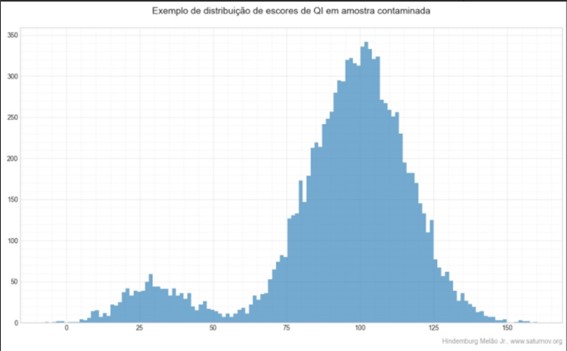
There are indeed cognitive differences based on ethnicity, just as there are in relation to average height, average penis size, average concentration of melanin under the skin, etc., but the cognitive differences are much smaller than what he tries to “sell”.
On the one hand, there is the problem of naive egalism, defended by some pseudo-ideological groups, and this finds no support in the facts. At the opposite extreme, there are groups of people like Richard Lynn, Tatu Vanhanen and Charles Murray who try to exacerbate racial differences and use them to justify the misery of some peoples. Both the radical eugenicists and the radical egalitarians are wrong, but between one extreme and the other there are some truths.
Just as there are marked cognitive differences between species, there are differences between ethnicities, but less marked because the range of genetic variation within the same species is smaller. Pretending that these differences do not exist is a mistake, because the correct knowledge about the particularities of each ethnicity helps to make more accurate diagnoses of several diseases whose symptoms are not the same in all ethnic groups, the adequate time of exposure to the Sun for the synthesis of vitamin D is not the same, and many characteristics that would be interpreted as “healthy” in some ethnicities are not in others, so the correct use of this information helps to more effectively interpret the results of blood counts, analyze bone, dermatological and other anomalies. muscle. Knowing the physiological, cognitive and behavioral differences of each ethnicity is important; the problem is to use these differences for the purpose of tyrannizing, oppressing or diminishing the merits of a people, this is unethical and unscientific, and Lynn ostensibly tries to do this.
In the case of Brazil, there seems to be a distortion close to 10 to 15 points in the numbers presented by Lynn, so the correct average Brazilian IQ should be around 95, a little below average, but not so much as to justify the bad results. of Brazil in Science. The real problems seem to be laziness and other items I mentioned above. There are recent studies that question whether apparently lazy behavior should be classified exactly as “laziness” or not, but I won’t go into that discussion either so as not to make this text even longer.
In the 1950s and 1960s, Richard Feynman was in Brazil a few times and made severe criticisms of the Brazilian education system, he did some impromptu social experiments and showed that Brazilian doctoral students often did not understand the basics of what they were doing, they acted mechanically , without the slightest idea about the fundamentals. Brazilians wrote some nice words in relation to Feynman’s criticism, saying that they intended to improve something, but the current situation is perhaps even worse than it was when Feynman was in our country. In addition to the shameful situation of education in Brazil, there are still other problems in this episode, because Brazilian “educators” showed surprise and perplexity with the problems pointed out by Feynman, as if they were in a house on fire, but they were not seeing that the fire was devouring. everything, until a neighbor comes in and shows them the fire. So they thank you, look shocked, make a speech of mea culpa, but do nothing concrete about the fire, which is still devastating … It ‘s unbelievable that they weren’t seeing the fire before the neighbor pointed it out to them and unbelievable that they continue without taking any action after the problem was pointed out.
Although scientists and educators have not mobilized to try to solve the problem, some Brazilian exponents of Mathematics, who had some experiences in Europe and the United States, decided to try to reproduce a small oasis, bringing to Brazil some of what they had experienced in developed countries. In 1952, IMPA (Institute of Pure and Applied Mathematics) was founded. At that time, Brazil was in Group I of the IMU (International Mathematical Union), the lowest level. For 70 years, IMPA has been the only place in Brazil where there has been a sincere attempt to identify and support some outstanding talent, trying to escape the bureaucracy and inefficiency of the Educational System. But IMPA is only 1 institution located in Rio de Janeiro. Brazil is a large country, with 8,500,000 km^2, so people who live far from RJ are often unable to enjoy what IMPA offers. Therefore, IMPA’s reach is still small. With the popularization of the Internet, this has improved, but the number of beneficiaries is still very limited, including because there is relatively little publicity about IMPA events, most schools do not enroll their students in OBM (Brazilian Mathematics Olympiad), most of the students do not even know that OBM exists. There are some professors spread across Brazil linked to IMPA, who try to contribute to the identification of talents, but it is a difficult process, they do not receive incentives from the government or companies. Even with these obstacles, between 1952 and 2015 IMPA raised Brazil from Group 1 to Group 5 (the highest), which only 11 countries are part of: Germany, Brazil, Canada, China, USA, France, Israel, Italy , Japan, UK and Russia.
I don’t know what the criteria for being included in Group 5 of the UMC are, but I suppose it’s a combination of merit and politics, perhaps more merit than politics. I say that there is a bit of politics because there are countries with two Fields medals or two Abel awards, but they are not part of this group, such as Australia, Belgium, Iran and Sweden, while Brazil has only 1 Fields medal. Of course, these awards should not be the only criterion, but they are very reasonable indications of the cream of mathematics produced in each country. There are also several countries with 1 Fields medal and a longer mathematical tradition, which are also not in Group 5. Perhaps the criterion takes into account the pace of growth, and in this regard Brazil is perhaps, along with China and India, one of the fastest growing in the production of high-level Mathematics.
The fact is that if the average Brazilian IQ were really as low as Richard Lynn claims, and the main problem in Brazil was really the low average IQ of the population, then IMPA actions would not have been able to substantially modify the quality and quantity. of high-level mathematical production. If the problem were low IQ, the solution would come from other actions, such as nutritional improvements, for example. IMPA actions did not change the average IQ of the population; they only changed the efficiency in the identification of talents that already existed in the country, and after the identification, opportunities and incentives began to be offered to these talents.
The numbers pointed out by Lynn, that the average Brazilian IQ would be 87, are inconsistent with the results achieved by IMPA. Even with a population of 213 million, it would be difficult for some of these people to reach the world top with rarity close to 1 in 300 million if Brazil was 1 standard deviation below the average, even because IMPA cannot extend its benefits to more than 1% to 5% of the most talented population. Of course, other hypotheses would apply, such as a higher standard deviation in the IQ distribution among the Brazilian population or a more platykurtic distribution. But generally what you see in groups with a smaller mean height is a narrower rather than a wider standard deviation. This happens with virtually all variables. The standard deviation in diameter for larger screws is wider than for smaller screws. In other words, the percentage standard deviation is usually maintained, so it would be strange for a population with a lower IQ to have a higher standard deviation. Furthermore, it would be an ad hoc adjustment to try to salvage a theory that has other problems, making it more plausible to pass Occam’s razor and accept that Lynn is wrong about this. The average Brazilian’s correct IQ is substantially higher than he says, just like the IQs of most other non-Aryan peoples he tries to push down are also higher than the numbers he presents.
Examining the facts objectively, what the data suggests is that the average Brazilian IQ is probably much closer to 95 than to 87. A little below average, but not as low as Lynn suggests.
The IMPA results also show that perhaps laziness is a reflection of the poor education system. If laziness were a widespread problem in the country, the solutions implemented by IMPA would not have been enough to solve it either; other complementary measures would be necessary. Perhaps laziness is a striking problem that affects more than 99% of the population, but about 1% could not be labeled as “lazy”, but as a victim of a very bad education system. As more than 99% of intellectual production comes from that 1%, we have a huge problem there, and a complete lack of attention to this problem, because politicians are not very concerned about making great efforts to win 1% of votes, since with less effort they can get more votes by pretending to please a less demanding, easier to deceive and much more numerous audience.
One of the big problems is that the 99% of the population are also harmed, but they don’t see this themselves and don’t demand from the government measures that can contribute to long-term improvements, measures that are good and fair for all. Each just wants the government to adopt measures with immediate results that benefit their own navels. In this way, the problem tends to perpetuate itself, as it has for decades.
Many Brazilian academics often complain about the lack of funds and attribute the low scientific production to this. Others do worse, pretending that there is good quality scientific production in Brazil, despite the lack of funds. But what the concrete facts show is that really very poor countries, in which most of the population lives in poverty, such as Ethiopia, Nigeria, Congo, Kenya, Ghana, etc. had citizens Nobel laureates, while in Brazil there has never been a Nobel laureate. Furthermore, when Einstein developed his major works, for which he deserved 3 Nobel prizes (and 2 more for later works), he was not receiving any funding for his research, not even in previous years. Therefore, although the lack of resources imposes severe limitations, it cannot be considered an absolute impediment, much less be used as a pretext in a situation like this. Great works were carried out practically without money, as was much of Newton’s work during 1665.
[Here, perhaps, a small caveat fits, because as I mentioned in the part about awards and merits, it is possible that some Brazilians have performed works with merit to receive a Nobel, but were not laureates for political, bureaucratic reasons, etc. My work on Econometrics and Risk Management, for example, is more expressive than most of the work of Nobel laureates in Economics in recent decades. The discovery of the π meson, although predominantly an operational work, had a Brazilian as the protagonist (César Lattes), but as the team leader was Celil Powell, Lattes only had a B.Sc. and at the time (1950) the award was only given to the head of the team, Lattes ended up not receiving the award, although he was perhaps primarily responsible for this work and was the main author of the article. After the detection of π mesons in cosmic rays (1947), Lattes was one of the few in the world with the necessary knowledge to identify the signatures left by these particles on the emulsion plates, so he was invited to collaborate at CERN (1948) and verify if they were also able to produce π mesons, as the energy needed for this was easily exceeded by the particle accelerator used, so they were probably already producing pions for a long time (since 1946), but they didn’t know exactly what to look for in the chambers bubble as being signatures of the π mesons. Lattes went to CERN and made the identifications. Again the work was distinguished with the Nobel and again Lattes was excluded from the award. In all, Lattes was nominated 7 times for the Nobel, but was never awarded. Oswaldo Cruz was also nominated for the Nobel Prize in Medicine, but was not awarded. Perhaps Machado de Assis would also have merit for a Nobel Prize in Literature. So, although there are 0 Brazilian Nobel laureates, maybe some have merit for that. There is a detailed text in which I analyze the case of Lattes, without the usual exaggerations and nationalist distortions of most articles about him, but at the same time acknowledging the merits he had that were not properly recognized.]
On the one hand, the low scientific production reflects the lack of funds, on the other hand, the lack of funds reflects the low scientific production, because if there really was scientific and technological production of good quality, large national and international companies would be interested in funding this research. , as they would profit from it. If private companies do not invest in Brazilian science, it is because such “investment” does not generate an expectation of profit, because the level of production is below what could justify some serious interest from entrepreneurs. I usually use the term “donation” for Brazilian science instead of “Investment”, because the meaning of “investment” is different. What Brazilian researchers demand is basically this: donation.
It is important to make it clear that I am not against funding Brazilian science, whether in the form of investment or donation. If I were against it, it would be stupid. I am against the bad management of the budget allocated to Science, combined with the terrible educational system and the complete lack of incentive for intellectual production. Intellectual production is not writing 50,000 useless papers to pretend that it is being produced and continue “sucking” on the grants of “research” funding agencies. Real intellectual production is serious effort to solve real and important problems. Therefore, instead of whining about lack of funds, the correct procedure would be a complete reformulation of the clowning that takes place in Brazilian Education and in Brazilian “scientific” research, they would need to start producing real, with high quality, as happens at IMPA , and then present substantial facts and consistent arguments to claim investments. Without it, the tearful speech to ask for donation is fragile. Certainly a crowd of unproductive researchers will stone me for this comment, but the few serious researchers will agree with me, although they may not have the courage to publicly acknowledge the position they defend, lest they be lynched by their colleagues.
Perhaps there are less than 1% of serious researchers in Brazil, among which I had the opportunity to meet some, such as Renato P. dos Santos, Roberto Venegeroles, André Gambaro, José Paulo Dieguez, Luis Anunciação, Antonio Piza, André Asevedo Nepomuceno, Herbert Kimura, Cristóvão Jacques, George Matsas, Doris Fontes among others. But unfortunately they represent a small fraction, and they do not always openly admit the disastrous situation in which Brazilian science finds itself, because the pressure is great for them to pretend to believe in the staging of which most of the others are part. When the person takes a fair position on this and tells forbidden truths, he begins to be cowardly boycotted on all sides, so it is understandable that many prefer to remain silent, avoiding manifesting, or simply pretending to agree with the fantasy. that try to propagate the situation of Science and Education in Brazil. Many criticized Copernicus because of the preface to his book Revolutionibus, for not having faced the dominant beliefs openly, but when analyzing the problems faced by Galileo, it is clear that the defense of the truth that goes against the interests of certain groups can be very onerous . And it would be naive to believe that the entities that dominate the world today (media, companies, universities, politicians, etc.) are more scrupulous than the medieval ecclesiastics were. There are certainly some entities that are more reputable and more sincerely committed to defending what is right and fair, but they are exceptions, unfortunately. “Ironically” the same people who are outraged by the persecution of Galileo are the people who today practice the same type of abuse, injustice and persecution.
This is a delicate situation, because if the immense majority builds a hoax and pretends that it is real, it becomes difficult for a small minority to restore the truth. For example: Roberto de Andrade Martins is a serious researcher, with post-docs in Cambridge and Oxford, with good knowledge and good understanding of Physics, Logic and Epistemology. He is completely rejected by his colleagues and by those who call themselves “scientific” disseminators, because Roberto tells undesirable truths. Roberto has never been invited to the major channels of scientific dissemination in Brazil, although he is by far more qualified than the overwhelming majority of those invited to these channels. This happens because in these channels, the most “commercial”, more “charismatic” figures are preferred in the eyes of those who pretend to be interested in Science, instead of serious scientists who tell forbidden truths about the tragic reality of science in the country and education in the country. country. YouTubers who call themselves “scientific promoters” in Brazil have to choose between truth and popularity, and almost always prefer the second option. In this way, they are dragging a farce that at some point will cause the country’s collapse, as happened with the former USSR in 1991, or with the Lehman Brothers bank in 2008. They were sweeping the dirt under the rug, until a point where the situation became untenable and the shack collapsed. There are a few serious scientific disseminators in Brazil, but these generally reach a much smaller, more enlightened audience that already sees the problem without it being necessary for someone to show them. The public that would really need to be informed remains “armored”, to serve no one’s interests, since no one will profit from the sinking of the nation. Chomsky once declared that “the purpose of the media is not to report what happens, but to shape public opinion in accordance with the will of the dominant corporate power.” In this case it is worse, because they are not shaping public opinion according to anyone’s will. They are just acting stupidly for everyone’s harm.
Hypocrisy is another terrible problem that affects a large number of Brazilian academics and pseudo science disseminators. When a foreigner comes to Brazil and says that Brazilian science is a joke, as Feynman did, he stomps and spits on Brazilian science, Brazilian academics certainly don’t like it, they are embarrassed, but even so they applaud the alpha male, like sycophantic primates. But when another Brazilian points out the same problem, they growl and rant at the heretic and try to keep him from talking about it.
There are a few more complications that cannot be overlooked: most cutting-edge science has no immediate application and can take decades or centuries to produce any return for the investor. The director of the Department of Mathematical Physics at USP, Ph.D. from MIT and Post Doctoral from MIT, Antonio Fernando Ribeiro de Toledo Piza, who in 1994 wanted to meet me in order to talk to me about a work I developed at age 19, about a method for calculating fractional factorials, in the middle of the conversation he mentioned an occasion in which Faraday was asked what the discoveries he had made about electricity and magnetism were for. Faraday responded with another question: “What good is a child who has just been born?” This phrase expresses a complex problem in the treatment of science as an “investment”, because the current human life expectancy is too short for some investments in science to be seen as attractive to private investors. These are investments that will only bring a return in 50 years, 100 years or more, for the following generations, for our children, grandchildren, great-grandchildren, it is a tree that we will have the cost and work of planting, fertilizing, cultivating, protecting, but they are our grandchildren who will reap the rewards. For this reason, even in countries where science is prolific, it may not be attractive to private investors, whose time horizon for which they are willing to wait for results is usually shorter.
Having made this important caveat, it is necessary to emphasize that this discourse would be fallacious if used to try to save the terrible reputation of Brazilian science. What is produced in Brazil can rarely even be called “Science”. Data tabulation and descriptive reports are made about the task. To use Faraday’s argument I cited her above, in defense of investment in Science, it would first be necessary for Brazil to start producing real Science.
Real science involves innovation, paradigm shift, real improvement, critical, in-depth analysis that goes beyond the obvious and adds some new and useful knowledge to the legacy of humanity. In Brazil this is rarely done. In fact, this is rarely done in the world, but the level of scarcity of innovations is worse in Brazil than in other countries with a similar economic situation or with a similar HDI.
When I say “paradigm break” it doesn’t have to be something as grandiose as a new cosmological system or a unification theory. It could be something basic, like adding a little boron to photographic emulsion plates to preserve the records of π mesons all the way down from the mountains, as César Lattes did, or solving a homomorphic encryption problem that was open for 15 years, as he did Joao Antonio LJ, or develop a new educational system that allows teaching 1-year content in 40 days to a child who had below-average grades and after those 40 days the child starts to have the best grades in school, as Tamara PC did Rodrigues, or revise the BMI formula, as I did. They are small contributions, but they reveal scientific facts still unknown, or correct knowledge that has been incorrectly repeated for a long time, or in some way contribute to broadening the horizons of knowledge or to redirecting knowledge to a path closer to the truth. It is not a complete deconstruction and reconstruction of knowledge, as Newton did, but it is a brick added to the right place, or removed from the wrong place and repositioned in the right place. This is the minimum that would be expected of a scientist, but most of the time this minimum is not met, and Ph.D. they are distributed almost like a ritual, in which the candidate only has to show that he knows how to write and knows how to interpret a little of what is on some graphs – with several misinterpretations, by the way. Depending on the discipline, it is enough to show that you can write, you don’t even need to know how to read a chart. After performing the ritual, the person receives the Ph.D. label. and begins to receive money to continue with this nonsense, pretending to be producing Science.
The vast majority of doctoral theses and scientific articles do not present anything innovative. These titles are awarded to inflate egos and satisfy people’s vanity, but they are not associated with any intellectual merit or original scientific production. A person does elementary research, purely mechanical, to corroborate some results on which there are already hundreds of other similar studies, and receives a Ph.D. therefore, and the State pays these people to pretend that they are producing something relevant and they call it “Brazilian science”, but the correct name, at best, would be “data tabulation” and “descriptive reports”. I say “at best” because there are usually several blunders in these procedures, which makes the situation even more vexing.
The central problem is that there is no culture of producing innovations. It just repeats itself endlessly. There is no incentive for innovation, there is no charge for innovation, no reward for innovation and, worst of all, there are even penalties for innovation. In 1998, a friend (Patrícia EC), who was completing her doctorate at USP, found that some experimental data on dwarf galaxy morphology was inconsistent with expectations. Instead of her advisor helping her try to understand what could be causing it, he told her to redo the measurements because she must have made a mistake in the measurements or calculations. Up to this point, I agree with him, because these mistakes are often the most common. She redid and obtained results statistically equivalent to the first measurements. At this point the yellow alert turns red and her advisor should have paid more attention to the case. However, he told her to redo it again! This is complete nonsense. It’s unscientific. It is to destroy “evidence” that could contribute to expanding, revising, improving what was known until then. This is the level at which the so-called “Brazilian science” sect finds itself. If any discovery is contrary to established dogmas, it needs to be adjusted in some way until it conforms to the dogmas. In addition to the fact that there are no incentives for discoveries, when there is any indication that something new may be ahead, we try to erase the traces of the possible discovery! People are trained not to produce, not to innovate, not to discover!
Part of the education problem in the country is not the fault of teachers, students and researchers. They just dance to the music. But a big part of the problem is their fault, because they determine the music that should play. In addition, they can refuse to dance to the music, they can put on headphones with better music, and they can create their own center of excellence, as in the case of IMPA.
The academic community’s resistance to admitting these facts exacerbates the situation, because instead of trying to fix the problems, they pretend the problems don’t exist, sweep the dirt under the rug, and move on as if everything is fine. Recently, the president of Brazil made a brutal cut in funds destined for “science”. It is a delicate situation, because the problem of scientific unproductivity is not resolved in this way. The budget cut only exacerbates the situation. It is bad to allocate money to a sector that does not generate satisfactory results, but being a fundamental sector, the correct procedure is to restore that sector and ensure that it works as it should, instead of killing it, taking away its bread and water. It would need to exchange bread and water for a richer diet, increase investment in science and simultaneously reformulate the criteria for granting scholarships, granting funds, reducing the bureaucracy of importing books and scientific and technological products, promoting exchanges with qualified researchers, creating prizes for real merit related to excellence in the original production of relevant works, rather than the political front awards, among many other changes from basic education to the titles of professors emeritus.
In the 1970s, China, India and Thailand were much poorer and less developed countries than Brazil, but they made massive investments in identifying talented children and offered differentiated conditions to encourage these children. Thailand stopped the project. China and India did. In less than two decades, they began to reap the rewards, after one generation, these children became highly skilled teachers, who provided the next generation with an even more exquisite education, and today China is on its way to becoming the greatest economic power, cultural, scientific and technological world, and India follows closely. There was a serious and profound overhaul of the education system so that they could get to where they are now. Instead of pretending they were doing science, they admitted the unproductiveness and low quality of what they produced, and started to fix what was wrong. One of the great problems in Brazil is precisely this inability to admit mistakes.
Portuguese Version
Entrevista para Scott Douglas Jacobsen
Preâmbulo:
Em primeiro lugar eu quero agradecer à minha namorada Tamara, pela paciência de ler esse texto e me ajudar a cortar longos trechos desnecessários, a Tor pela gentileza de me indicar para essa entrevista e a você (Scott) por aceitar essa indicação e por sua amável ajuda com a revisão da tradução.
Na medida do possível, procurei sintetizar e simplificar, mas sempre que foi necessário decidir entre a resposta mais curta e a mais correta, optei por aquela que me parecia a mais correta. Como resultado, acabei me estendendo mais do que gostaria e ramificando algumas respostas por detalhes que aparentemente perdem o vínculo com a pergunta, mas que, na verdade, estão indiretamente conectados por dois, três ou mais nós, de modo que se esses trechos fossem removidos, ficariam lacunas que comprometeriam a coerência.
Antes de apresentar as respostas é necessário fazer alguns esclarecimentos importantes: quando a pergunta é simples, basta dar uma resposta curta para que a interpretação seja unívoca, mas para questões complexas, antes de responder é necessário conceituar alguns dos termos utilizados, para minimizar as diferenças entre a mensagem a ser transmitida e a interpretação que dela será feita. Uma questão do tipo “Por que, no Xadrez, nem todos os Peões dobrados são debilidades?” Não há como responder de modo a proporcionar uma ideia correta em apenas 1 ou 2 parágrafos, nem mesmo se a resposta fosse simplificada e resumida. Para tentar proporcionar uma ideia razoavelmente correta e completa, são necessárias pelo menos 20 páginas, com vários exemplos comentados. Nessa entrevista, algumas perguntas envolvem situações semelhantes.
Esse tipo de dificuldade é inerente a qualquer pergunta envolvendo QI, porque o conceito atualmente disseminado apresenta algumas falhas que precisam ser devidamente revisadas, e algumas dessas revisões não são triviais, exigindo um volume considerável de esclarecimentos preliminares para garantir que a interpretação da resposta seja suficientemente acurada e fidedigna.
Fora das sociedades de alto QI é comum que façam confusão entre escalas com desvios padrão diferentes. O escore 1579 de James Woods no SAT é frequentemente convertido em 180, enquanto o escore 1590 de Bill Gates é convertido em 154 (às vezes 160), e ambos aparecem na mesma lista como se o QI de Woods fosse maior que o de Gates, embora seja o contrário. Esse tipo de erro primário foi praticamente erradicado nas sociedades de alto QI, mas ainda há erros sistemáticos sendo repetidos ostensivamente, alguns dos quais são grandes e graves. Esses erros provocam muitas confusões e dificultam a correta interpretação de questões fundamentais. Eu não me refiro a erros individuais, cometidos por algumas pessoas, mas sim a erros “institucionalizados”, universalmente aceitos como se fossem corretos e cometidos por praticamente todas as pessoas.
Em 2000, resolvi um problema central da Psicometria que vinha se arrastando desde os anos 1950, quando Thurstone e Gardner perceberam a importância de padronizar testes cognitivos de modo a produzir escores em escala de proporção. Bob Seitz, da Mega Society, referiu-se a esse problema como “O Santo Graal da Psicometria”. Depois de investigar esse problema e resolvê-lo, publiquei um artigo descrevendo meu método e mostrando como os testes deveriam ser normatizados. Também revisei as normas do Mega Test e Titan Test utilizando esse método. Em 2003, apliquei o mesmo método ao Sigma Test e publiquei outro artigo, mais detalhado, descrevendo passo-a-passo todo o processo de normatização e explicando os motivos pelos quais esse procedimento é superior aos métodos utilizados. Entre os problemas crônicos que são solucionados de forma natural com a aplicação desse método, um dos mais importantes é a correção nos cálculos dos percentis e dos níveis de raridade. Esse é um erro sistemático que vem sendo cometido desde 1905. Comentarei essa questão com um pouco mais de detalhes ao responder a questões que tratam desse tema.
Há dois outros erros que são cometidos sistematicamente, embora as soluções para eles já sejam conhecidas, mas não são aplicadas, em parte porque esses problemas não são bem compreendidos: o problema de validade de constructo e o problema da adequação do nível de dificuldade das questões ao nível de inteligência que se pretende medir. De certo modo, esses problemas estão conectados, porque geralmente os testes apresentam boa validade de constructo para determinado intervalo de níveis de habilidade, mas não para todo o intervalo no qual o teste pretende medir, assim os resultados acabam se mostrando razoavelmente acurados e fidedignos para pessoas cujos escores estejam dentro do intervalo de validade, mas começam a apresentar sérias distorções fora desse intervalo. Um exemplo clássico para ilustrar esse problema é o Stanford-Binet V. Os processos cognitivos exigidos para solucionar as questões do SBV podem ser apropriados para medir corretamente a inteligência no intervalo de 60 a 140, mas começam a se mostrar menos apropriados entre 140 a 150, por isso os escores acima de 150 já estão representando predominantemente um traço latente que não é o que se pretendia medir. Isso compromete inteira a validade desse tipo de instrumento para a aferição acima de 150, e coloca em dúvida em que medida os escores entre 140 e 150 estão de fato refletindo o nível intelectual.
Para organizar melhor as informações, antes de prosseguir citarei 3 erros importantes que são cometidos sistematicamente pelos psicometristas profissionais e nas sociedades de alto QI:
- A maneira como os testes são padronizados, tanto os testes clínicos quanto os high range IQ tests (hrIQts) – seja pelo uso de Teoria de Resposta ao Item, seja pela Teoria Clássica dos Testes –, produz distorções na escala, e a maneira como os percentis são calculados conduz a resultados muito distantes da realidade. Essa distorção na escala já foi apontada desde os anos 1950, por Thurstone, e já havia sido notada (embora não tivesse sido descrita) pelo próprio Binet em 1905. Um bom método para normatização de testes de inteligência deveria produzir escores numa escala de proporção, mas os escores de QI se apresentam numa escala ordinal (https://www.questionpro.com/blog/nominal-ordinal-interval-ratio/). Além disso, os erros nos cálculos dos níveis de raridade apresentam distorções muito grandes nos escores mais altos, chegando a mais de 3 ordens de grandeza. Isso acontece porque os cálculos partem da hipótese incorreta de que a distribuição dos QIs é gaussiana em toda sua extensão. A morfologia da distribuição é de fato muito semelhante à de uma gaussiana no intervalo -2σ a +2σ, mas começa a degringolar fora desse intervalo. Esse fato não pode ser negligenciado quando se calcula os percentis. Da maneira como os cálculos são feitos atualmente pelos psicometristas e nas comunidades de alto QI, chega-se a resultados muito distantes dos corretos. Por isso, quando se fala em percentil 99,9999% ou QI 176 (σ=16), os significados são muito diferentes, embora sejam usados como se fossem a mesma coisa. A raridade correta para o QI=176 não é 1 em 983.000, mas sim 1 em 24.500. E isso não acontece porque o desvio padrão seja maior. O desvio padrão é o mesmo (16 nesse exemplo), porém a cauda direita é mais densa do que numa distribuição normal, tornando os escores mais altos mais abundantes do que seria esperado se a distribuição fosse exatamente gaussiana. Trata-se de um problema relacionado à morfologia da distribuição verdadeira, que não se ajusta ao modelo teórico de distribuição normal. Na verdade, não se ajusta bem a nenhuma das mais de 100 distribuições testadas, inclusive as mais versáteis, como a distribuição de Weibull com 3 parâmetros.
- Outro problema é que o nível de dificuldade das questões mais difíceis de cada teste não é compatível com o teto nominal do teste. Como consequência, tal teste mostra-se inapropriado para o intervalo de QIs que deveria medir. O teste funciona adequadamente dentro de certo intervalo, no qual contenha questões com dificuldade compatível, mas deixa de funcionar fora desse intervalo. Isso é muito mais grave nos testes clínicos, cujo teto de dificuldade raramente ultrapassa 135 a 140, mas o teto nominal pode chegar a mais de 200 (Stanford-Binet V, por exemplo). Acima de 140, os testes clínicos medem a rapidez para resolver problemas elementares, que não é necessariamente uma métrica apropriada para representar a inteligência nos níveis mais altos. Nos casos de hrIQt, no quesito “dificuldade”, as questões geralmente são apropriadas até cerca de 170 ou 180, mas não muito acima disso. Aqui seria necessário abrir um extenso parêntesis para discutir o significado desses escores, porque até 130 ou um pouco acima, a raridade teórica é quase igual à raridade verdadeira, mas para 140, 150 e acima, a raridade teórica vai se tornando cada vez mais distante da raridade verdadeira. Então quando falamos em 180 de QI (σ=16), não basta informar o desvio padrão. Além disso é necessário informar se estamos falando do escore medido em um teste ou se é um percentil verdadeiro convertido em QI. Se a distribuição dos QIs fosse exatamente gaussiana em todo o seu espectro, então um QI 180 (σ=16) deveria corresponder ao nível de raridade de 1 em 3.500.000, mas a raridade verdadeira de escores 180 fica em torno de 1 em 48.000. Mais adiante, menciono link no qual descrevo como chegar a esse nível de raridade de 1 em 48.000.
- Outro problema está relacionado à validade de constructo, isto é, se aquilo que o teste está medindo é de fato aquilo que se pretende medir. Os melhores testes clínicos (WAIS e SB) são muito bons nesse critério para o intervalo de 70 a 130, porque esse tema tem sido amplamente debatido entre bons psicometristas ao longo de décadas e se conseguiu estabelecer alguns bons critérios para avaliar (ainda que subjetivamente) se os itens estão medindo o que deveriam medir (a inteligência, nesse caso, ou o fator g). Entretanto, fora desse intervalo de 70 a 130, a variável medida vai se tornando cada vez mais destoante daquilo que se pretendia medir. Nos hrIQts o alcance é um pouco maior, chega a cerca de 160, alguns testes chegam 170 ou até 180.
Além desses 3 problemas que são observados em praticamente todos os testes clínicos e todos os hrIQts, há também alguns problemas individuais, que são mais básicos e afetam apenas alguns testes específicos, como norma inflada, erros no gabarito, erros nos enunciados etc. Não tratarei desses, porque já são bastante conhecidos e fáceis de identificar e corrigir.
É importante não confundir a validade de constructo com a adequação do nível de dificuldade. Uma questão muito elementar, com um prazo muito curto para ser resolvida, pode ter dificuldade adequada para medir no nível de raridade 1 em 10 milhões, porque embora seja intrinsecamente fácil, como o prazo é reduzido, acaba se tornando difícil resolver dentro daquele prazo. Em casos assim, a dificuldade pode ser apropriada para medir alguma coisa em níveis muito altos de raridade, mas esse traço latente que está sendo medido não é o que deveria ser medido. Além disso, o fato de um teste ter validade de construto num determinado intervalo não implica que terá necessariamente validade em níveis muito acima ou muito abaixo daquele intervalo. Esse é um dos erros mais comuns, porque ao validar um teste de inteligência para 98% da população, isso não garante que ele continue medindo corretamente a inteligência no nível dos 1% ou 0,1% de escores mais altos. A validação precisa ser cuidadosa em todos os intervalos nos quais se pretende que o teste seja capaz de medir corretamente.
Há também alguns problemas mais sutis. O Raven Standard Progressive Matrices, por exemplo, tem sido utilizado pela Mensa em vários países durante décadas, mas é inadequado para medir corretamente acima de 120, talvez até acima de 115. O motivo é que o teste é constituído por 60 questões, mas apenas 1 ou 2 dessas questões (as mais difíceis) são úteis para discriminar no nível de 133, que é onde a Mensa pretende selecionar. Então é como se fossem utilizadas apenas 2 das 60 questões, e uma amostra com apenas 2 elementos não pode ser considerada válida estatisticamente. Na verdade, o corte em 133 não é determinado exatamente por 1 ou 2 questões, mas estas 2 questões respondem por mais de 90% do poder discriminante do teste nesse nível de corte.
Por essas razões, se há interesse sincero em que perguntas sobre QI recebam respostas representativas da realidade, esses três problemas precisam ser corrigidos:
- Extrapolação infundada da validade de constructo;
- Inadequação da dificuldade dos itens para o nível intelectual que o teste pretende medir;
- Adoção de hipóteses incorretas sobre a forma da distribuição dos escores nos níveis mais altos, com base na forma na região próxima à tendência central.
Além desses, há outros pontos que precisam ser esclarecidos. Há um mito amplamente disseminado de que testes aplicados em clínicas são “melhores” (mais confiáveis, mais acurados, mais fidedignos) do que hrIQts. Em alguns casos, realmente são. Mas não em todos. Para escores abaixo de 130, como os testes supervisionados são normatizados com base em amostras maiores e não-seletas, isso constitui uma vantagem real dos testes clínicos em comparação aos hrIQts. Outra vantagem é que os bons psicometristas conhecem maior número de técnicas estatísticas, por isso na faixa de 70 a 130 geralmente os melhores testes supervisionados produzem escores mais fidedignos. Porém acima de 130 e, principalmente, acima de 140, os testes supervisionados apresentam vários problemas, a começar pelo teto inadequado de dificuldade. As questões mais difíceis do WAIS, por exemplo, são excessivamente fáceis para que possam medir a inteligência acima de 135. Outro problema é que a validade de constructo dos testes supervisionados é planejada para o intervalo de 70 a 130, não se aplicando tão bem fora desse intervalo.
Fiz um exemplo simulado para mostrar em que consiste o problema da variável de constructo:

A linha azul representa o traço latente[*] que gostaríamos de medir (inteligência ou fator g ou algo assim). Os círculos vermelhos representam os escores obtidos no teste convertidos em QI. No intervalo entre 0 e 120, os escores medidos são representações muito boas do traço latente, porque os pontos se distribuem estreitamente perto da linha azul, indicando forte correlação entre a variável que gostaríamos de medir e a variável que estamos realmente medindo. [* https://dictionary.apa.org/latent-trait-theory, https://www.jstor.org/stable/1434009]
A partir de 120, e principalmente a partir de 130, os círculos vermelhos começam a se afastar cada vez mais da linha azul, indicando que a correlação entre a variável que gostaríamos de medir e a variável que está sendo realmente medida se torna cada vez mais fraca, portanto aquilo que estamos medindo está cada vez sendo menos representativo do que gostaríamos de medir. Se considerar o intervalo inteiro de 0 a 200, ou mesmo de 70 a 200, a correlação ainda parece forte, mas isso só acontece porque o intervalo de 70 a 120 está contido dentro do intervalo de 70 a 200, e como no intervalo 70 a 120 a correlação é forte, isso melhora a correlação média do intervalo inteiro de 70 a 200, mas quando se considera exclusivamente a correlação entre 130 e 200, percebe-se que a correlação é fraca nessa região e vai se tornando mais fraca para os escores mais altos. Por isso para escores acima de 130 o que importa não é a correlação global, mas sim a correlação local.
Em testes de QI como o Stanford-Binet, por exemplo, algumas pessoas muito rápidas com QI verdadeiro 150 podem obter escore 190 ou mais, como consequência do problema descrito acima. Também pode acontecer o efeito oposto, e pessoas com QI verdadeiro 190, se forem muito lentas, podem ter escore 150, 140 ou até menos. O tamanho dos erros pode chegar a níveis realmente muito altos, tanto para mais que o correto quanto para menos que o correto, por isso é que a validade de constructo[*] é um quesito extremamente importante. [* https://en.wikipedia.org/wiki/Construct_validity]
Um teste que tenha boa validade de constructo deve apresentar comportamento como o do gráfico abaixo, em que os círculos vermelhos permanecem próximos à linha azul ao longo de todo espectro dentro do qual se pretende medir:
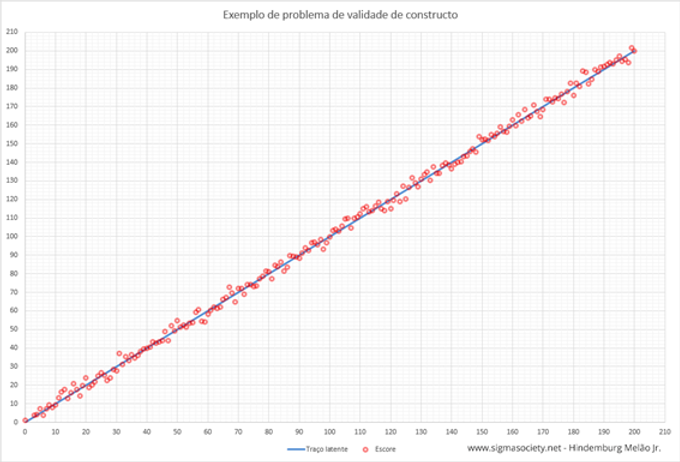
Naturalmente, se a amostra tiver distribuição normal, os dados se distribuirão aproximadamente como uma elipse, não como uma linha que foi representada acima, mas para fins didáticos esse exemplo precisa ser assim para ficar visualmente mais claro o aumento na amplitude da dispersão das medidas em relação ao traço latente que gostaríamos de medir. Também convém enfatizar que, no mundo real, situações como a do gráfico acima praticamente não existem, porque o alinhamento está excessivamente bom. Mas é desejável que os escores medidos sejam capazes de oferecer boas representações para o traço latente dentro de um intervalo tão largo quanto possível.
Nos testes de QI supervisionados, utilizados em clínicas, geralmente as disparidades começam a se tornar graves a partir de 130 e principalmente a partir de 140, ou seja, aquilo que o teste mede acima de 140 deixa de ser uma boa representação da Inteligência. Nos casos dos melhores hrIQts, os escores continuam sendo representações razoavelmente boas do traço latente até QI 160 ou um pouco mais.
Um teste pode ter questões com nível de dificuldade apropriado, mas aquilo que as questões estão medindo pode não ser a inteligência. Ou pode acontecer de que a variável medida seja a inteligência, mas apenas num intervalo específico (como no primeiro gráfico). Alguns quebra-cabeças para crianças, por exemplo, podem ser eficientes para medir corretamente no intervalo entre idade mental de 8 a 16 anos, ou 50 a 100 de QI numa escala para adultos, mas se utilizar esses mesmos quebra-cabeças para tentar medir os QIs de adultos acima de 160 ou 170, o resultado será desastroso, porque a habilidade para resolver rapidamente esses quebra-cabeças não pode ser interpretada como uma boa representação da inteligência nesse nível. Por isso o tipo de problema precisa ser compatível com o nível intelectual que se pretende medir.
Geralmente as pessoas mais inteligentes também são mais rápidas para resolver questões básicas, mas o fato de resolver rapidamente questões simples não oferece uma boa garantia de que a pessoa também será capaz de resolver questões mais complexas, profundas e que exijam criatividade. Além disso, o fato de a pessoa ser capaz de resolver questões complexas, profundas e que exigem criatividade não oferece boa garantia de que ela será capaz de resolver rapidamente questões básicas. Como os testes utilizados em clínicas incluem exclusivamente questões básicas, o efeito apresentado no gráfico 1 acaba sendo muito frequente.
Essa questão é analisada com mais detalhes no texto introdutório do Sigma Test Extended.
Também é necessário padronizar os significados de alguns termos que vou utilizar nas respostas:
rIQ = QI de raridade, ou QI (σ=16 G), ou rIQ (σ=16 G)
pIQ = QI de potencial, ou QI (σ=16 T), ou pIQ (σ=16 T)
Explicações detalhadas podem ser encontradas em https://www.sigmasociety.net/escalasqi. Aqui darei uma explicação resumida: rIQ é o valor que teria o QI convertido a partir da raridade verdadeira. Isso não é o QI medido nos testes de QI nem em hrIQts. O QI medido é o pIQ, cuja distribuição não é gaussiana, a distribuição tem uma cauda densa, por isso os escores de pIQ são mais abundantes do que o previsto com base na hipótese de normalidade da distribuição. Isso não tem relação com o desvio padrão ser maior. O desvio padrão é o mesmo. A forma da distribuição que é diferente, concentrando mais casos na cauda direita e menos na região central. Nas regiões próximas à tendência central, pIQ é quase igual ao rIQ e se mantém assim até cerca de 130. A partir de então, pIQ vai se tornando maior que rIQ. Alguns exemplos:
rIQ 100 equivale a pIQ 100,00
rIQ 130 equivale a pIQ 130,87
rIQ 150 equivale a pIQ 156,59
rIQ 180 equivale a pIQ 204,93
(Uma tabela completa está disponível na página do Sigma Test Extended)
A diferença entre pIQ e rIQ aumenta conforme o rIQ aumenta, porque a proporção em que a densidade real da cauda fica maior que a densidade teórica é cada vez maior à medida que o QI se afasta da média.
Quando se compara QIs estimados com base na raridade com QIs medidos em testes, é fundamental colocar ambos na mesma escala. Por exemplo: digamos que Newton seja considerado a pessoa mais inteligente da História e digamos que o número de pessoas que já nasceram seja 100 bilhões. Então o QI de Newton estimado com base na raridade e com base na hipótese de que a distribuição dos escores é normal seria rIQ=207,3 (σ=16, G). Mas a distribuição real dos escores não é normal, por isso não se pode comparar esse 207,3 com um escore 207 medido num teste, porque estão em escalas diferentes. Ambos podem ter mesmo desvio padrão (16, nesse caso), mas a forma da distribuição é diferente e isso não pode ser negligenciado porque a distorção produzida é gigantesca.
O rIQ de Newton seria 207,3 mas seu pIQ seria 261,8. Repetindo: ambos os escores são com desvio padrão 16, tanto o rIQ quanto o pIQ. Não se deve confundir esse processo com a mudança de escalas com desvios padrão diferentes. Os desvios padrão são iguais, mas a forma da curva é diferente. Eu estou repetindo isso várias vezes porque já vi pessoas confundindo isso apenas um parágrafo depois de isso ter sido esclarecido.
Esse ajuste é necessário para corrigir as distorções das normas e possibilitar o cálculo correto das raridades a partir dos escores medidos nos testes, ou o processo inverso de calcular o QI a partir do nível de raridade.
Desse modo, a pessoa com maior rIQ (σ=16 G) numa população de 7,9 bilhões tem rIQ 201,2 que equivale a pIQ (σ=16 T) 247,8. Os escores 201,2 (σ=16 G) e 247,8 (σ=16 T) são equivalentes, como 0ºC e 32ºF. O uso do termo rIQ equivale ao uso do termo QI (σ=16 G), enquanto o uso do termo pIQ equivale ao uso do termo (σ=16 T). Também posso eventualmente utilizar rIQ (σ=16 G) ou pIQ (σ=16 T).
Por isso os testes podem produzir (e de fato produzem) escores acima de 200 com desvio padrão 15 ou 16, mas o cálculo correto dos níveis de raridade ou dos percentis não deve ser realizado da maneira como tem sido feito há décadas. Os cálculos de percentis e de raridade estão errados, conforme já demonstrei desde meus artigos de 2000 a respeito disso. Eu não estou me referindo a testes com normas infladas. Claro que esse problema se torna mais grave quando as normas estão infladas, mas mesmo quando as normas foram calculadas adequadamente, como nos casos da norma do Mega Test ou do Titan Test, tanto a versão de Hoeflin quanto a versão de Grady Towers, ambas fornecem valores incorretos para os percentis. Os escores de QI estão muito próximos dos valores “corretos”, que seriam os valores ajustados a uma escala de intervalo bem padronizada. O problema não está nos QIs medidos, mas sim nos percentis calculados com base na hipótese incorreta de que esses escores teriam uma distribuição normal. Esse tema voltará a ser analisado outras vezes, com mais detalhes, quando os tópicos abordados exigirem isso. Por enquanto, essa introdução deve ser suficiente para desfazer boa parte das confusões que acontecem com uso indiscriminado do termo “QI”, sem fazer a correta distinção entre pIQ e rIQ.
Quando Chris Harding foi registrado no Guinness Book de 1966 com QI 197, com base em seus resultados no Stanford-Binet, isso foi um erro relativamente primário e grave, porque incorre em todos os 3 itens problemáticos que citei acima: o SB não inclui questões suficientemente difíceis para medir corretamente acima de 135; os processos cognitivos exigidos nas soluções não são apropriados para QIs acima de 150; o nível de raridade calculado é incorreto.
Em 1966, a população mundial era de 3,41 bilhões de pessoas, e o nível teórico de raridade para escores 197, assumindo que a distribuição dos escores fosse uma gaussiana com média 100 e desvio padrão 16, era 1 em 1,49 bilhões. Então parecia ser plausível que uma pessoa com esse escore poderia ser proclamada a mais inteligente do mundo, ou pelo menos a pessoa com maior QI do mundo. Entretanto, uma análise correta da situação revela que o escore 197 no SB não indica nível de raridade de 1 em 1.490.000.000, mas sim 1 em 870.000 (cerca de 2000 vezes mais abundante). Além disso, a variável medida no nível de raridade de 1 em 870.000 não é a inteligência. Nessa conjuntura, o máximo que se poderia afirmar com base num escore 197 no SB é que a pessoa apresentou evidência consistente de possuir nível intelectual acima de 135 de QI, e como seu escore nominal foi muito acima de 135, há boas probabilidades de que seu QI correto seja maior que 150, talvez maior que 160, mas seria necessário prescrever um exame complementar, com questões mais difíceis e com validade constructo apropriada, para investigar qual o nível intelectual real dessa pessoa, já que os escores acima de 135 ficam fora do intervalo no qual o teste é capaz de medir corretamente.
Nos anos seguintes, começaram a surgir várias outras pessoas reivindicando o mesmo recorde, com escores 196-197. Isso prosseguiu até 1978, quando a situação se agravou, primeiramente com Kim Ung-Yong com escore 210, depois Marilyn vos Savant com escore 230, corrigido para 228, depois corrigido para 218, e finalmente Keith Raniere, em 1989, com escore 242. Todos baseados em testes clínicos que não são apropriados para medir corretamente acima de 135.
Um problema similar aconteceu com Langan, no Mega Test. O nível de dificuldade das questões do Mega Test é apropriado para medir corretamente até cerca de pIQ 194, equivalente a cerca de rIQ 177, que corresponde a um nível de raridade de 1 em 1.340.000. Esse é o nível de raridade realista correspondente ao teto do Mega Test. Em 2000 eu havia calculado para o Mega Test um teto de pIQ 186, equivalente a rIQ 169, portanto nível de raridade de 1 em 124.000, mas eu estava me baseando na amostra de 520 testees disponível no site do Miyaguchi. Porém essa amostra não é representativa do conjunto de mais de 4.000 pessoas examinadas com o Mega Test. Essa amostra está estratificada de 10 em 10 (10 pessoas com cada QI, quando possível). Por isso há uma concentração de escores altos acima do “correto”, fazendo com que a dificuldade dos itens, especialmente os itens mais difíceis (que é determinada pela proporção entre os erros e acertos) acabe sendo menor do que a correta, já que havendo mais pessoas com escores mais altos, haverá maior porcentagem de acertadores do que se tivesse sido considerada a amostra inteira. Outro fator é que mesmo considerando todas as mais de 4.000 pessoas avaliadas pelo Mega Test, há uma self-selection que produz uma concentração de pessoas com escores altos maior do que a observada entre a população em geral. Com esses dois ajustes complementares, refiz meus cálculos para essa norma e cheguei aos números que citei acima.
Portanto, com um escore bruto 47/48, obtido por Langan em sua segunda tentativa, o rIQ correspondente é 176, equivalente a pIQ 192, isto é, nível de raridade de aproximadamente 1 em 983.000. O nível de raridade real da Mega Society fica em torno de 1 em 62.000 e da Prometheus 1 em 8.000. Nos casos de ISPE, TNS etc., como estão numa faixa em que as distorções são menores, a raridade verdadeira também fica mais próxima da raridade teórica. 1 em 600. E no caso da Intertel e Mensa, praticamente não são afetadas. O percentil teórico 98,04% para escore pIQ 133 equivale a rIQ 131,8, portanto percentil 97,66%.
Há dois outros pontos que eu gostaria de comentar nesse texto introdutório, antes de prosseguir: sobre o significado de “inteligência” e sobre o significado de “certificado”, mas o texto ficou muito extenso e talvez seja melhor remover, bem como outras partes de algumas respostas. De qualquer modo, salvei o texto integral num arquivo separado, caso tenha alguma utilidade complementar ou para ser utilizado em outra ocasião.
Feitos esses esclarecimentos, agora podemos dar início às respostas.
Entrevista
Scott Douglas Jacobsen: Quando você estava crescendo, quais eram algumas das histórias familiares proeminentes sendo contadas ao longo do tempo?
Hindemburg Melão Jr.: não me interesso muito por histórias.
Jacobsen: Essas histórias ajudaram a dar uma noção de um eu estendido ou uma noção do legado da família?
Melão Jr.: meus avós eram muito pobres, meu pai só estudou até o segundo ano do Ensino Fundamental (2º ano). Ele era excepcionalmente inteligente, criativo, tinha hipermnésia e uma grande variedade de talentos intelectuais e sinestésicos. Isso permitiu que ele saísse de uma situação de extrema pobreza e proporcionasse um ambiente satisfatório para os filhos, mas não muito além disso. O legado de meus pais é quase exclusivamente genético.
Jacobsen: Qual era a origem familiar, por exemplo, geografia, cultura, idioma e religião ou a falta dela?
Melão Jr.: meu bisavô materno era índio nativo do Brasil, meu bisavô paterno era português. Minha família era católica na época que nasci, mas posteriormente se converteram ao Kardecismo, preservando alguns hábitos católicos. Eu me tornei ateu, aproximadamente aos 11 anos, depois agnóstico aos 17 e deísta desde os 27. Tive interesse na Fé Bahá’í por algum tempo, mas não cheguei a participar de nenhuma atividade. Estou escrevendo um livro que trata de Ciência e Religião, no qual abordo alguns desses tópicos com mais detalhes.
Jacobsen: Como foi a experiência com colegas e colegas de escola quando criança e adolescente?
Melão Jr.: foi razoavelmente tranquilo, não tive problemas com bullying que pudessem ser associados a alguma discriminação por motivos cognitivos. Sofri bullying por outros motivos, porque eu tinha as sobrancelhas unidas, mas nada que chegasse ao ponto de me causar grandes constrangimentos, mesmo porque eu praticava artes marciais desde os 7 anos, por isso se eu achasse que estavam passando dos limites, eu reagia de forma enérgica e isso evitava que voltassem a me importunar.
Meus problemas foram com alguns professores, mais do que com colegas, porque eu tinha a visão incorreta de que os professores não podiam cometer erros na disciplina deles, mas no mundo real é muito diferente disso. Praticamente todos os professores cometiam vários erros todos os dias, e eu costumava apontar os erros mais graves. A maioria deles reagia positivamente a isso, alguns agradeciam pelas correções e revisavam imediatamente, mas outros não aceitavam esse tipo de correção, especialmente quando vinha de uma criança de 7 ou 8 anos. Um episódio marcante ocorreu numa aula de Geografia, quando eu tinha 9 anos, e a professora solicitou aos alunos que calculassem o tamanho do litoral brasileiro. Quando comecei a executar a tarefa, percebi que aquilo não fazia sentido, porque a medida dependeria do nível de detalhes do mapa, logo não havia uma resposta possível. Então expliquei o problema a ela, mas ela não entendeu minha explicação. Ela achou que eu estivesse me referindo ao fato de o mapa estar numa escala diferente do tamanho real. Então expliquei novamente, mas não adiantou, ela continuou sem entender, ficou irritada e acabou agindo de forma opressiva, ordenando que eu me calasse, e continuou a “ensinar” incorretamente. Foi um episódio muito desagradável. Geralmente os erros que eu identificava eram erros dos professores, mas nesse caso era muito mais grave, porque era um erro institucionalizado e aceito como se fosse correto pelas “autoridades” naquela disciplina, estava errado no livro e provavelmente em todos os outros livros, sendo ensinado incorretamente a todos os alunos. Aliás, isso continua errado até hoje, 40 anos depois, em praticamente todas as fontes sobre o assunto, inclusive na Wikipedia, Enciclopédia Britânica, IBGE, Cia World Factbook, U.S. Bureau of Labor Statistics etc. O problema não é que o número da medida esteja errado. O problema é que a pergunta não faz sentido porque não há um “comprimento” do litoral, não existe uma resposta possível com dimensão 1, porque o perímetro tem uma dimensão maior que 1 e menor que 2. Embora tenha sido desagradável, foi também um evento do qual me lembro com orgulho, por ter deduzido um dos fundamentos da Geometria Fractal, de improviso, aos 9 anos.
Jacobsen: Quais foram algumas certificações, qualificações e treinamentos profissionais obtidos por você?
Melão Jr.: a finalidade primordial das certificações deveria ser atestar que determinada pessoa ou determinada entidade cumpre quesitos que não seriam facilmente verificáveis por uma pessoa da população em geral. Por exemplo: uma pessoa sem muita instrução teria dificuldade para avaliar corretamente se um médico está capacitado para tratar da saúde dela, ou decidir se seria melhor receber tratamento de um método alopata ou de um curandeiro. Por isso há entidades reguladoras, constituídas por especialistas experientes e supostamente competentes, que estabelecem normas que teoricamente deveriam ser necessárias e suficientes para distinguir entre profissionais qualificados e não-qualificados, protegendo a população menos esclarecida contra a prestação de serviços e produtos insatisfatórios ou até mesmo nocivos. Isso é bonito na teoria, mas na prática não funciona tão bem, e a indústria das certificações acaba servindo a outros propósitos, entre os quais a reserva de mercado, o nepotismo, o culto à vaidade e egolatria.
Os certificados muitas vezes não cumprem a função para a qual foram criados, ora aprovando pessoas/entidades insuficientemente capacitado, ora deixando de aprovar pessoas sobrequalificadas. Por essa razão, mais importante e mais justo seria examinar as realizações, as competências e os méritos reais, em vez de examinar as certificações que reconheceriam esses méritos, porque os méritos têm valor intrínseco, enquanto as certificações são meras aparências que algumas vezes tentam representar os méritos, mas nem sempre acertam.
Há inclusive uma ampla indústria para comércio de certificados fraudulentos, e pouca fiscalização sobre isso. A American Biographical Institute (ABI) é famosa pela venda de certificações sem valor, e continua atuando desde 1967. Há muitas entidades similares, especializadas na impressão de certificados bonitos, promoção de cerimônias de homologação etc. Geralmente as pessoas que consomem esses produtos são vítimas ingênuas, mas também é possível que algumas pessoas comprem esses certificados cientes de que eles significam (ou não significam).
Na Wikipedia consta a seguinte descrição para a ABI:
“The American Biographical Institute (ABI) was a paid-inclusion vanity biographical reference directory publisher based in Raleigh, North Carolina which had been publishing biographies since 1967. It generated revenue from sales of fraudulent certificates and books. Each year the company awarded hundreds of “Man of the Year” or “Woman of the Year” awards at between $195 and $295 each.” Fonte: https://en.wikipedia.org/wiki/American_Biographical_Institute
Atualmente há várias universidades de P.O. Box distribuindo títulos de Ph.D. como água. Eu assisti a algumas declarações de pessoas que compraram esses títulos, a grande maioria dessas pessoas realmente acreditava que tinham algum valor e se mostravam emocionadas, felizes e orgulhosas ao receber o título. Mas talvez nem todos sejam ingênuos e alguns compreendam que esses títulos não representam algo real, mas usam isso com finalidades obscuras. Há um membro da mensa brasil que possui mais de 50 títulos acadêmicos por uma universidade de P.O. Box, fundada em 2021, mas no site da “instituição” alega ter sido fundada em 2006. Acho engraçado, e ao mesmo tempo triste, que os jornalistas que publicam as matérias sobre isso não desconfiam que seja estranho uma pessoa de 40 anos, que tinha apenas 1 B.Sc. até 2020, de repente passou a ter mais de 50 títulos acadêmicos em 2022, inclusive vários Ph.Ds. e pós-doutorados. Além dos certificados comprados, essa pessoa também afirma que a TNS é a sociedade de alto QI mais exclusiva do mundo, ele usa o QI dele com desvio padrão 24 para comparar com um “QI” fictício 160 atribuído a Einstein, entre outras coisas, e os jornalistas publicam tudo sem conferir.
Há também pessoas que compram esses certificados, sabendo que não têm valor, sem a intenção de fazer uso desonesto, talvez como um enfeite de mesa ou algo assim. Por exemplo, Chris Harding é cliente da ABI, possui vários títulos adquiridos dessa empresa, conforme ele mesmo declara em seu perfil na OlympIQ Society. Harding tem alguns méritos reais, porque mesmo que o SB não avalie corretamente acima de 140, é reconhecido que esse teste avalia algum tipo de habilidade misturado com inteligência, e poucas pessoas alcançam o escore de Harding nesse exame. Portanto, embora alguns certificados dele sejam comprados, outros são baseados em méritos reais e emitidos por instituições sérias, como os relacionados a seus recordes de QI e suas filiações a sociedades de alto QI. Entretanto, mesmo os certificados idôneos, que tentam representar méritos verdadeiros, muitas vezes atestam algo que não é uma boa representação da realidade. Conforme comentei no início, o escore 197 ou 196 no SB não poderia ser interpretado da maneira como foi, e os laudos oficiais e os certificados emitidos estão dizendo algo que representa uma crença coletiva, mas muito diferente da realidade concreta.
Harding é muito inteligente, mas não com base no escore que ele obteve no SB, e sim com base em várias opiniões dele sobre diferentes assuntos. Os méritos reais dele estão em sua essência, em suas ações, seus pensamentos, não em pedaços de papel.
A partir do momento em que a pessoa canaliza seus pensamentos e suas ações para produzir algo concreto, ela passa a compartilhar com o mundo sua essência, disseminando conhecimento e sabedoria, ou disseminando futilidade e desinformação, dependendo da qualidade daquilo que ela compartilha. E a percepção que as outras pessoas têm sobre aquilo que ela compartilhou dependerá não apenas da qualidade do que ela exteriorizou, mas também da sensibilidade e perspicácia de quem recebe a informação. Se uma pessoa brilhante disseminar conhecimentos de um nível muito elevado entre um público muito fútil, o valor desse conhecimento não será reconhecido e ela não terá certificações, nem prêmios, nem qualquer reconhecimento, enquanto outras pessoas que estejam disseminando conhecimentos vulgares e rasos, compatíveis com o público que o recebe e que emite as certificações, essas pessoas serão aclamadas e glorificadas.
As pessoas não são premiadas ou certificadas por suas realizações serem grandiosas, mas sim por suas realizações serem percebidas como grandiosas pelos membros dos comitês responsáveis pela homologação de prêmios e certificações. Além disso, há uma série de outros vieses de caráter político, social, racial, etc., que interferem nas decisões dos membros dos comitês, tornando as certificações e os prêmios ainda mais destoantes do objetivo que deveriam ter.
Esse efeito ocorre, por exemplo, em alguns testes de Cooijmans, em que o teste não mede o QI, mas sim quão semelhante é o QI da pessoa examinada em comparação ao QI do Cooijmans. Se a pessoa tiver o mesmo QI de Cooijmans, ela terá escore máximo. Se ela tiver QI muito maior ou muito menor que o QI de Cooijmans, o escore dela será baixo. Na questão sobre testes de QI, comento mais detalhadamente esse problema.
Citarei alguns poucos exemplos marcantes, alguns bastante conhecidos, mas vale a pena rememorá-los. Creio que um dos mais trágicos e marcantes seja o de Galileu, que em vez de ser premiado por suas notáveis contribuições à compreensão do Universo, ele foi severamente punido. Aliás, sua filha Celeste acabou sendo punida em lugar dele. Nos tempos mais recentes, um dos casos que acho muito tristes é o de George Zweig, que desenvolveu sua Teoria dos Ases na mesma época em que Murray Gell-Mann desenvolveu a Teoria dos Quarks. Ambas eram essencialmente iguais, entretanto a revista para a qual Zweig enviou seu artigo se recusou a publicá-lo, enquanto o artigo de Gell-Mann lhe rendeu o prêmio Nobel de Física. Há pelo menos 45 casos conhecidos de prêmios Nobel polêmicos, de pessoas que receberam sem merecer ou mereciam, mas não receberam. O prêmio mais respeitado do mundo está profanado por dezenas de injustiças, talvez centenas, se considerar as que não chegaram a ser descobertas. Inclusive Einstein é uma das maiores vítimas, já que merecia ter recebido 5 prêmios Nobel, entretanto recebeu apenas 1, por motivos raciais, xenofóbicos, nazistas etc.
Creio que agora eu possa responder a essa questão, dividindo-a em duas partes:
- Prêmios e certificações.
- Méritos até o momento não reconhecidos.
Tenho poucos certificados. Quando eu era jovem, tinha o hábito de colocar troféus e medalhas de Xadrez, Artes Marciais, Educação Artística etc. numa estante, mas numa das mudanças de endereço, um de meus troféus quebrou. Inicialmente fiquei triste, porque eram importantes para mim. Mas ao refletir melhor sobre o “desastre”, percebi que na verdade não tinham nenhuma importância. O que realmente importava eram os méritos que me levaram à conquista daqueles prêmios, bem como alguns méritos que não chegaram a ser premiados. Havia também casos nos quais eu não tinha mérito algum, mas havia sido premiado devido a alguma fatalidade da sorte. Isso não significa que eu não seja uma pessoa vaidosa. Eu sou, mas aprendi que na maioria das vezes não se recebe nada ou quase nada por algo valoroso, enquanto outras vezes se recebe mais do que o justo por algo de pouco valor ou até mesmo sem valor. Infelizmente o mundo recompensa muito mais as aparências do que a essência.
Um de meus poucos certificados é o de detentor do recorde mundial de mate anunciado mais longo em simultâneas de Xadrez às cegas, registrado no Guinness Book de 1998. Talvez algumas pessoas não estejam familiarizadas com o significado de “Xadrez às cegas” e “mate anunciado”. Esse vídeo ajuda a entender a dinâmica de uma simultânea às cegas: https://youtu.be/LUo89Cl9FPY. É um vídeo antigo e de baixa qualidade, mas para exemplificar o mecanismo do evento, creio que seja apropriado.
Farei uma descrição resumida: numa simultânea, uma pessoa (simultanista) joga ao mesmo tempo contra vários oponentes (simultaneados), cada um dos quais com seu próprio tabuleiro. É diferente de um jogo em consulta, em que vários jogadores podem se consultar mutuamente num único tabuleiro e decidem sobre o melhor lance por votação. Numa simultânea, cada simultaneado tem seu próprio tabuleiro e cada partida segue seu próprio rumo.
Nesse caso, como se trata de uma simultânea às cegas, o simultanista não tem acesso visual a nenhum dos tabuleiros, nem às peças, nem às súmulas, nem a qualquer tipo de registro dos lances ou das posições. Em nenhum momento o simultanista pode olhar para nenhum dos tabuleiros, nem solicitar qualquer tipo de informação que o ajude a se lembrar das posições das peças, nem de qualquer peça específica, nem que o ajude a se lembrar da ordem dos lances, nem qualquer outro tipo de informação que possa de algum modo auxiliar sobre as partidas. A posição de cada uma das peças em cada um dos tabuleiros fica registrada exclusivamente na memória do simultanista e essas posições são atualizadas mentalmente a cada lance. Além disso, a cada lance o simultanista precisa fazer os cálculos das variantes e sub-variantes necessários para tomar suas decisões sobre o lance a ser executado, tomando cuidado para não confundir as lembranças das variantes calculadas com as lembranças das variantes efetivamente jogadas, entre outros cuidados.
O jogo se desenvolve da seguinte forma: o simultanista permanece de costas para os tabuleiros e comunica seus lances a um assistente (speaker), que executa cada lance do simultanista no respectivo tabuleiro. Em seguida, o simultaneado daquele tabuleiro executa sua resposta sobre o tabuleiro e o speaker comunica verbalmente ao simultanista qual foi o lance executado por aquele simultaneado. Então o speaker passa ao tabuleiro seguinte, onde novamente o simultanista declara seu lance e este é executado nesse tabuleiro pelo speaker etc.
Há versões mais “fáceis” (ou menos difíceis), nas quais o jogador às cegas pode ter acesso a uma lista com todos os lances anotados, como nos torneios de Melody Amber, em que, além de serem jogos individuais, em vez de simultâneos, os competidores podem também visualizar um tabuleiro vazio, o que facilita os cálculos e reduz os riscos de se esquecer da posição de alguma peça. Mas nas regras mais rigorosas, como no meu recorde de 1997 que foi registrado no Guinness, não era permitido ter acesso ao histórico dos lances, nem ver um tabuleiro vazio, nem qualquer outro tipo de auxílio similar. É equivalente a estar todo o tempo com os olhos vendados, do início ao fim do evento.
Esse recorde estabelecido em 1997 foi numa simultânea às cegas a 9 tabuleiros, num dos quais anunciei mate em 12 lances. O rating médio de meus oponentes foi estimado em cerca de 1400. Obtive 7 vitórias, 1 empate e 1 derrota.
Os recordistas anteriores eram: Joseph Henry Blackburne (mate em 8 lances numa simultânea às cegas a 10 tabuleiros, no ano 1877), Samuel Rosenthal (mate em 8 lances numa simultânea às cegas a 4 tabuleiros, no ano 1885) e Garry Kasparov (mate em 8 lances numa simultânea às cegas a 8 tabuleiros, no ano 1985). Houve também um evento em 1899, no qual Harry Nelson Pillsbury anunciou mate em 8 numa simultânea às cegas a 10 tabuleiros, mas houve erro de contagem. Seguindo a sequência ditada por Pillsbury, o mate se produzia em 7 lances.
No caso de Kasparov, há alguns detalhes que precisam ser esclarecidos: ele jogou uma simultânea às cegas contra os 8 melhores computadores da época, inclusive o campeão mundial Mephisto Amsterdam 68000 RISC 12MHz. O rating médio dessas máquinas era cerca de 1500 e os melhores chegavam a 1800. O melhor computador do mundo em 1985 era justamente o Mephisto Amsterdam, cujo rating divulgado pelo fabricante era 2265, mas posteriormente foi medido pela SSDF em 1827 (com base em 1020 partidas). Na partida contra Mephisto Amsterdam, Kasparov jogou uma bela combinação com sequência de mate em 8 lances, mas não há registro sobre ele ter anunciado o mate. De qualquer modo, como ele sacrificou uma Torre e duas peças no início da combinação, está claro que ele calculou corretamente a sequência inteira.
Em 2005, a rede Globo fez uma reportagem para o programa “Fantástico” celebrando os 100 anos dos testes de QI, e fui indicado como a pessoa com QI mais alto do Brasil, no nível de 1 em 200 milhões. Esse é um exemplo de “reconhecimento” que eu não tenho certeza se foi corretamente atribuído. Na pergunta sobre QI, comento esse assunto com mais detalhes.
Recentemente, o amigo Domagoj Kutle me honrou com um amável convite para publicar em sua excelente revista DEUS VULT, e solicitou que eu enviasse também uma pequena biografia. Minha namorada Tamara gentilmente me ajudou a elaborar esse material, incluindo algumas de minhas realizações. Creio que isso se encaixaria aqui, por isso vou colar o texto:
Melao mini-bio, by Tamara Rodrigues:
Hindemburg Melao Jr. was born in Brazil, in a family with few resources, and only attended school until the 11th grade, having learned almost completely as self-taught.
In 1998 he was registered in the Guinness Book as the holder of the world record for longest announced checkmate in blindfold simultaneous chess games. (video)
Between 2006 and 2010 he developed an artificial intelligence system to trade in the Financial Market; in 2015, his friend and partner Joao A.L.J. incorporated a hedge fund to use this system and started to be registered in fund rankings (BarclayHedge, IASG and Preqin), winning 21 international high performance awards.
In 2007, Melao solved a problem that had been unsatisfactorily solved for 22 years, by creating “Melao index”, an index to measure performance adjusted at risk that was more accurate, more predictive and conceptually better founded than the traditional indexes of William Sharpe (Nobel prize 1990) and Franco Modigliani (Nobel 1985). (video)
In 2003 he solved a 160+ year old problem by proposing a new formula for calculating BMI, superior to the traditional one and superior to the formula proposed in 2013 by Nick Trefethen, Chief of the Dept. of Numerical Analysis at the University of Oxford, Leslie Fox Prize(1985), FRS prize, (2005), IMA Gold Medal (2010). Trefethen’s 2013 formula is an incomplete version of Melao’s 2003 formula.
In 2000 Melao developed the first method for standardization of intelligence tests that produces scores in scale of ratio and in 2003 he applied this method in the Sigma Test norm (he also calculated new norms for Mega and Titan tests using the same method), thereby solving a problem of Psychometry that exists more than 90 years ago and was pointed by Thurstone and Gardner as a central question of Psychometry more than 45 years ago.
In 2002 Melao found the best solution to a problem that has existed for more than 520 years and had been attacked for more than 65 years, the Shannon Number, which was only matched in 2014 by Stefan Steinerberger, professor of mathematics at Yale University.
In 2015 Melao showed that the method recommended by the Nobel Prize in Economics Harry Markowitz, for portfolio optimization, has some flaws, and proposed some improvements that make this method more efficient and safer.
In 2021 Melao pointed out flaws in the recommendation of the 2003 Nobel Prize in Economics, Clive Granger, regarding the use of the concept of cointegration, and presented a more adequate solution to the same problem.
In 2022, Melao solved a problem that had been open for 16 years, in which he established a method for calculating chess ratings based on the quality of the moves. Also presented an improved version of the Elo system, applying both methods to calculate the ratings of more than 100,000 players between years 1475 and 2021, the results were published in a book, along with the description of the two methods.
At 9 years old Melao deduced one of the fundamentals of Fractal Geometry and at 13 he developed a method to calculate logarithms. At age 19 he developed a method for calculating factorials of decimal numbers without using Calculus. (more details)
Also at the age of 19 (1991) he developed an invisibility machine project, which in 1993 he inscribe in a contest of ficction Literature (although the project is consistent with Scientific Method), but did not win. In 2003 Susumu Tachi, Emeritus Professor at the University of Tokyo and guest Professor at MIT, created (independently) a simplified version of this project and built a prototype.
In 2020 Hindemburg presented a study showing that Jupiter’s Great Red Spot cannot be 350+ years old, as was believed. The correct age is around 144 years old. (interview)
In 2000 Melao had a chess theoretical novelty elected one of the 10 most important in the world by the Sahovski Informator jury, the world champion Anand was one of the judges and Anand’s vote was that this novelty should be the 8th most important.
In 2004 Baran Yonter, founder of Pars Society (IQ>180, sd=16), estimated that Melao IQ should be above 200 (sd=16).
In 2005 the production of the program “Fantástico”, from Globo (second-largest commercial TV network in the world), made a special report on intelligence, celebrating the centenary of the creation of IQ tests, and Melao was nominated as the person with the highest IQ in Brazil, with a rarity level of 1 in 200 million. (video1, video2)
In 2009 Melao was nominated by Albert Frank to participate in a John Hallenborg project with people whose IQ is at the rarity level above 1 in 1 million.
In 2000 Melao updated and extended his “Alpha Tests” that he had created in 1991, added new questions, and created the Sigma Test.
In 2022 he extended the Sigma Test by creating the extended version.
Melao is author of more than 1700 articles on Science, Statistics, Psychometrics, Econometrics, Chess, Mathematics, Astronomy, Physics, Cognitive Science, Ethics, Philosophy of Science, History of Science, Education etc.
Detailed bio of Melao (documents, videos, interviews, articles, reports etc.) at: https://www.sigmasociety.net/hm
Embora eu tenha praticado Artes Marciais por vários anos (talvez ~11 anos se somar todos os períodos ativos), não cheguei a obter nenhuma certificação, porque o tempo foi distribuído entre muitas modalidades diferentes e não cheguei à faixa preta em nenhuma delas. Mas cheguei a alcançar um nível técnico razoável. Para armas curtas, talvez eu esteja no percentil 99,9% e no caso específico de nunchaku, talvez 99,999%. Esse é um vídeo de 2016, eu já estava meio velho e enferrujado https://youtu.be/jCw–5H34x4. No mesmo canal há também vídeos com outras armas (espada, tonfa, kama, sam-tien-kuan etc.).
Em 2020 fui convidado para um grupo dos 26 melhores astrofotógrafos planetários do Brasil. Embora não haja certificado para isso, fiquei muito feliz porque é um de meus hobbies favoritos. Eu gostaria de aproveitar essa oportunidade para agradecer ao amigo Vinícius Martins, que me ensinou quase tudo que sei sobre processamento de imagens planetárias, creio que em pouco tempo ele será um dos 5 melhores astrofotógrafos do mundo, ele combina 3 elementos fundamentais para isso: um talento extraordinário, um amor imenso por essa atividade e um profundo conhecimento que se amplia e se atualiza constantemente.
Entre as certificações que não possuo, uma das mais interessantes é a de CFA, conferida a gestores de investimentos. É interessante porque entre 2006 e 2010 desenvolvi um sistema de inteligência artificial para operar no Mercado Financeiro que entre 2015 e 2020, quando foi utilizado por um fundo europeu, conquistou 21 prêmios internacionais de alta performance nos rankings da Barclay’s Hedge, Preqin e IASG, sendo também o segundo melhor sistema de investimentos do mundo entre 2011 e 2016. Entretanto, eu fui proibido pela CVM de prestar serviços de gestão porque não possuo o certificado CFA. Em 2014, foi realizado um abaixo-assinado para pleitear que a CVM (entidade reguladora do Mercado de Capitais no Brasil) emitisse para mim um certificado em caráter extraordinário. A reivindicação se apoiava na redação da Instrução 306 da CVM e no fato de que meu sistema tinha acumulado mais que o dobro do lucro do fundo que ocupava o primeiro lugar (à frente de 282 outros fundos, todos administrados por gestores certificados) no ranking da InfoMoney, maior ranking de fundos do Brasil. Entre as pessoas que assinaram a petição em meu favor, houve vários professores universitários, vários gestores profissionais e vários membros de sociedades de alto QI, inclusive Dany Provost de Giga Society. Entretanto, a reivindicação não foi aceita e continuo não possuindo esse certificado. Aliás, os dois gestores mais famosos do mundo, Warren Buffett e George Soros, também não possuem certificado de gestor, então estou em boa companhia. Buffett resolveu esse problema incorporando uma empresa que compra outras empresas, em vez de administrar um fundo. Soros resolveu o problema colocando seu amigo Jimmy Rogers como gestos (Jimmy possuía a certificação necessária), eu resolvi o problema comercializando licenças de uso de meu sistema, com um limite de volume de aplicação para cada licença e um período de renovação.
Entre as certificações que não possuo, posso incluir também CNH, embora eu dirija fora da Lei (sou praticamente um gângster). Eu deixei de ir à escola no 5º ano, depois eu retornei algumas vezes, por pressão de meus pais. Eu voltava, continuava matriculado alguns meses, esgotava minha paciência, parava novamente, meus pais me pressionavam a voltar, eu novamente voltava etc. Cheguei a concluir o ensino médio (11º ano) e entrei na faculdade de Física, mas não gostei do curso e parei definitivamente depois de 2 meses. Na primeira semana de aula, eu revisei o livro de Física I e apontei mais de 200 erros, enviei meus comentários ao autor, com uma nota introdutória tentando ser diplomático, para que ele não se sentisse ofendido, mas ele nunca respondeu. Também apontei dois erros conceituais graves nos métodos utilizados no laboratório de Física, que deveriam impactar nos resultados dos experimentos; um deles, sobre as bolas de papel amassado, é o mesmo “experimento” realizado no Departamento de Matemática da Universidade de Yale, onde também cometem o mesmo erro. Nesse caso, o Prof. Dr. Paulo Reginaldo Pascholati teve uma conduta honrada, recebeu com humildade minhas críticas, fez alguns experimentos para investigar se o erro que eu indicava era procedente, constatou que eu tinha razão e, na aula seguinte, ele assumiu publicamente o erro. Achei a conduta dele exemplar, nesse aspecto, entretanto a apostila não foi corrigida e continuaram a fazer o experimento incorretamente.
Enfim, decidi que universidade era perda de tempo e seria mais produtivo estudar por conta própria, mas não é tão simples assim, e essa decisão se mostrou questionável em algumas ocasiões. O distanciamento da carreira acadêmica tem alguns aspectos positivos, outros negativos. Um dos aspectos positivos é que posso selecionar minha própria grade curricular, seguir meu próprio ritmo e me aprofundar o quanto quiser em cada tópico. Um dos aspectos negativos é que se torna mais difícil ter acesso a bibliografia satisfatória e mais difícil ainda publicar em periódicos indexados. Com isso, praticamente coloquei a mim mesmo numa situação de ostracismo.
Portanto certificados são úteis, mas é importante compreender as limitações e as distorções que podem apresentar, para não correr o risco de tratá-las de forma burocrática, a ponto de serem colocados acima da real capacidade verificada empiricamente de forma contínua. Certificados refletem as opiniões de pessoas ou de instituições que muitas vezes não estão suficientemente qualificadas para fazer avaliações corretas sobre os méritos e para decidir com imparcialidade. No exemplo do CFA, as certificações são literalmente distribuídas com base em critérios excessivamente condescendentes, que nem de longe são suficientes para selecionar as pessoas qualificadas ao exercício da função de gestor, por isso mais de 95% dos gestores certificados geram prejuízos a seus clientes. Talvez esse efeito seja mais notável no Mercado de Capitais do que em qualquer outra atividade, mas também ocorre frequentemente em Jornalismo, Publicidade, Administração etc., em que algumas pessoas sem formação nessas disciplinas eventualmente podem ser mais qualificadas do que pessoas certificadas, mas para proteger os menos competentes, são criadas leis que impedem as empresas de contratar os mais competentes, usando certificados como instrumento de discriminação e de apologia à mediocridade.
Escrevi uma versão extensa dessa resposta, na qual discuto algumas falhas no sistema educacional no Brasil e no mundo, justificando porque me afastei da vida acadêmica. Também aponto e analiso os erros cometidos por Richard Lynn em seu estudo sobre os QIs em diferentes países e explico porquê não seria correto tentar justificada o problema educacional no Brasil com base no suposto baixo QI médio da população, bem como reviso a estimativa para o QI médio de alguns países, inclusive Guiné Equatorial, Israel e Brasil. O texto ficou com 10 páginas A4, por isso achei melhor colocar como um apêndice.
Jacobsen: Qual é o propósito dos testes de inteligência para você?
Melão Jr.: o atributo mais importante dos seres vivos é a inteligência. Sem inteligência não existiria Ética, Leis, Ciência ou Arte. Para delegar corretamente as tarefas mais importantes às pessoas mais qualificadas, é necessário identificar e ranquear corretamente as pessoas de acordo com as habilidades de cada uma. Por isso medir corretamente a inteligência e utilizar os resultados como critério para atribuir cargos e tarefas, conforme o nível de competência, é extremamente importante, mas infelizmente não é o que acontece. Há dois grandes problemas:
- O primeiro é que o mundo é dominado pelo nepotismo;
- O segundo é que não existem testes de inteligência apropriados para medir corretamente nos níveis mais altos.
No final do século XIX, os primeiros testes de Galton e Cattell não conseguiam medir satisfatoriamente a inteligência, mas foi uma tentativa interessante. A hipótese de que a velocidade dos reflexos, a acuidade visual, a acuidade auditiva etc. poderiam ser indicativos relevantes do nível intelectual se mostrou inadequada. Em 1904, Binet e Otis conseguiram resolver esse problema, utilizando questões que exigiam a o uso combinado de várias habilidades cognitivas – em vez de tentar medir aptidões primárias, como fez Galton –, mas os testes de Binet só mediam corretamente até cerca de 140. As tentativas de Terman, em 1921, de utilizar os testes de Binet para selecionar futuros gênios falharam. Entre as 1528 crianças selecionadas com QI acima de 135 (mais de 70 com QI acima de 177), nenhuma ganhou um Nobel nem qualquer prêmio similar, enquanto duas das crianças não selecionadas ganharam prêmios Nobel. O teste funcionava muito bem até cerca de 130, as crianças selecionadas publicaram mais livros, mais artigos, tiveram maior renda média do que as crianças do outro grupo, porém nos níveis mais elevados, o teste falhou e deixou escapar algumas das crianças mais brilhantes. Os resultados desse estudo tiveram um efeito extremamente deletério, prejudicando a credibilidade nos testes de QI aos olhos do público em geral e aos olhos de muitos expoentes intelectuais de áreas científicas, tecnológicas, culturais e educacionais, por isso seria importante esclarecer os limites de até que ponto esses testes podem medir corretamente, para que não se crie expectativas irreais e para que não sejam aplicados incorretamente fora de desses limites.
Em 1973, Kevin Langdon criou o LAIT (Langdon Adult Intelligence Test) e com isso conseguiu elevar o nível de dificuldade até perto de 170 e a validade de constructo até 150; em 1985, Ronald Hoeflin deu mais um passo importante com o Mega Test, elevando o nível de dificuldade até cerca de pIQ 190 e validade de constructo até 170, e essas contribuições ampliaram os horizontes de aplicação dos testes de inteligência, que antes funcionavam bem até o nível aproximada de 1 em 100, enquanto os novos testes passaram a funcionar até 1 em 100.000. Por outro lado, a partir dos anos 1990, começaram a surgir alguns testes de fantasia com tetos nominais que chegavam a 250, embora o teto real de dificuldade não chegasse a 180 e o teto de validade de construto fique em torno de 150, como o ISIS Test de Paul Cooijmans. Alguns desses testes de fantasia continuam surgindo até hoje e isso agrava o preconceito nutrido por muitas pessoas contra os testes de QI, porque se a pessoa tem um pensamento crítico refinado e uma atitude cética, ela percebe que há inconsistências em resultados como o de Feynman (123) e Rosner (193, 196, 198 etc.). Ambos são muito inteligentes, e os problemas que Feynman resolveu são mais difíceis que os problemas que Rosner resolveu, o que poderia ser interpretado como indicativo de que Feynman fosse mais inteligente, então como é possível que um sistema padronizado sério de avaliação atribua 190+ para Rosner e 123 para Feynman? Alguma coisa obviamente não está certa nisso, e as pessoas geralmente não identificam exatamente onde está o erro, por isso concluem, de forma generalizada, que todos os testes de QI não funcionam, ou sequer elas sabem que existe mais de um tipo de teste de QI. Por isso o esclarecimento sobre qual é o intervalo no qual cada tipo de teste funciona contribui para combater esse tipo de preconceito. Se o QI verdadeiro de Feynman, com base na dificuldade, complexidade e profundidade dos problemas que ele resolveu sobre eletrodinâmica quântica, superfluidos etc. fosse colocado na mesma escala em que é representado o QI de Rosner, o QI correto de Feynman estaria perto de 235. E para explicar esse número acima de 200, teria antes que mostrar que a distribuição dos escores não é gaussiana etc. etc. Então aquela aparente inconsistência inicial desapareceria e tudo ficaria mais claro e mais lógico. O mesmo acontece para o QI fictício de Einstein de 160, cujo valor correto, se colocado na mesma escala dos escores medidos pelos testes, seria perto de 250.
Em 2000, o Sigma Test trouxe soluções aos 3 problemas citados no texto introdutório, tendo como foco principal a validade de constructo, utilizando questões baseadas em problemas do mundo real que exigem uma combinação de pensamento convergente e divergente em diferentes níveis de dificuldade, complexidade e profundidade, compatíveis com os níveis de QI a serem medidos. Mais recentemente, o Sigma Test Extended elevou o teto de dificuldade até cerca de pIQ 225 e de validade de constructo até cerca de 210. Entretanto, numa população com 7,9 bilhões, a pessoa adulta mais inteligente do mundo deve ter rIQ em torno de 201, equivalente a cerca de pIQ 245, portanto bastante fora dos limites que o STE pode medir. Apesar disso, para algumas das 100 ou 200 pessoas mais inteligentes vivas, o STE poderia fornecer medidas fidedignas da inteligência real, com boa validade de constructo nesse patamar, além de oferecer um desafio intelectual estimulante. Isso consertaria algumas lendas urbanas disseminadas em várias fontes, como a de que o QI médio dos ganhadores do Nobel em Ciência é “apenas” 154. Com o uso de um teste adequadamente padronizado, com nível de dificuldade apropriado e boa validade de constructo, o QI médio dos ganhadores do Nobel em Ciência deve ficar entre 170 e 190. Com o uso de testes apropriados é possível reposicionar corretamente os escores, tanto para cima quanto para baixo. Isso também venceria alguns preconceitos contra os testes de QI, porque uma das razões para rejeição se deve justamente aos resultados bizarros para Feynman (123), Fischer (123*), Kasparov (123, 135), Shockley (<135), Alvarez (<135), irmã de Feynman (124) etc., porque isso tira a credibilidade dos testes, já que é muito mais provável que esses escores estejam errados do que essas pessoas terem QI abaixo do nível de 1 em mil, quando na verdade devem estar acima de 1 em 1 milhão (e Feynman perto de 1 em 1 bilhão). Quando podemos mostrar que os testes são capazes de medir corretamente também nos níveis muito altos e fornecer resultados realistas, consistentes com as realizações dessas pessoas em problemas do mundo real, consegue-se restaurar a credibilidade para testes de inteligência como instrumentos sérios e confiáveis, capazes de desempenhar uma das funções mais importantes que é justamente fazer prognósticos precoces de genialidade. [* Embora muitas fontes mencionem o QI 187, 181 ou 180 para Fischer, seus laudos de 1958 mostram um escore 123]
Assim, embora não haja testes capazes de medir corretamente no nível necessário para apontar a pessoa mais inteligente viva, ou ranquear as 10 mais inteligentes, houve um progresso substancial desde os primeiros testes de Binet, e se Terman estivesse vivo hoje e desenvolvesse o mesmo estudo de 1921, mas começando em 2000, e se ele utilizasse o STE em vez do SB, muito provavelmente as crianças mais inteligentes estariam todas (ou quase todas) selecionadas em seu grupo, e os resultados subsequentes teriam sido confirmatórios inclusive nos níveis mais altos, corroborando a tese que ele defendia, de que é possível prever precocemente a genialidade, mas não com os testes que existiam naquela época. A tese, em si, estava correta, assim como o helicóptero de Leonardo Da Vinci, mas a tecnologia ainda precisava avançar um pouco mais para que a tese dispusesse dos subsídios necessários para ser testada adequadamente.
Jacobsen: Quando a alta inteligência foi descoberta para você?
Melão Jr.: Acho difícil determinar isso com precisão. A primeira vez que fui examinado em clínica, tinha 3 anos, mas aos 6 meses de idade eu conversava com razoável fluência, então havia algumas evidências mais precoces.
Jacobsen: Quando você pensa nas maneiras pelas quais os gênios do passado foram ridicularizados, vilipendiados e condenados, se não mortos, ou elogiados, lisonjeados, plagiados e reverenciados, o que parece ser a razão para as reações extremas e o tratamento de gênios? Muitos vivos hoje parecem tímidos diante das câmeras – muitos, nem todos.
Melão Jr.: não creio que seja um problema do passado. Continua presente em muitas culturas primitivas, como no Brasil e em vários países da África. A grande maioria da população adota uma postura de hostilidade, inveja e boicote não apenas contra gênios, mas contra qualquer pessoa que possa estar obtendo algum tipo de sucesso. Recentemente minha namorada me mostrou um vídeo de Ozires Silva, que foi Ministro da Infraestrutura e presidente da Petrobrás. Ele comenta que durante um jantar no qual estavam presentes alguns membros do comitê do Nobel (link par ao vídeo: https://youtu.be/m3u-E5XdzZ4) ele perguntou por que eles achavam que o Brasil não tinha nenhum ganhador do Nobel, já que vários países latino-americanos com menor população e menor PIB tinham inclusive mais de um Nobel. Um dos membros do comitê comentou “vocês, brasileiros, são destruidores de heróis”. Infelizmente isso é um fato que continua presente em nosso cotidiano.
Na época que eu conheci as comunidades de alto QI, 1999, alguns nomes famosos eram William James Sidis, Marilyn vos Savant, Chris Langan, Rick Rosner, Grady Towers etc. Langan era segurança numa boate, Rosner era modelo nudista e também trabalhou algum tempo como segurança, Grady Towers era segurança em um parque e teve uma morte trágica e prematura em 2000. Sidis passou suas últimas décadas de vida em subempregos e colecionando placas de carro. Marilyn foi colunista de uma revista e conseguiu um padrão de vida razoável com isso, bem como um bom prestígio e reconhecimento fora das comunidades de alto QI, e também muitos invejosos odiosos. Com exceção de Marilyn, as outras pessoas que citei ganhavam um salário mínimo e ainda passavam parte do tempo sem emprego, enquanto muitas pessoas são contratadas para ocupar cargos que elas nem sequer estão qualificadas, ganhando pequenas fortunas, além de prestígio e reconhecimento.
Essa situação é muito triste. Embora Langan não fosse o homem mais inteligente das Américas, como ele reivindicava em 2000, ou da história do mundo, como ele começou a reivindicar algum tempo depois, ele é indiscutivelmente uma pessoa muito mais inteligente e mais competente do que 99% dos Ph.Ds. em qualquer área e mais do que 99,9% dos CEOs das empresas. Ele talvez não tivesse uma cultura tão vasta e os conhecimentos especializados necessários para resolver grandes problemas científicos, mas certamente ele daria melhores soluções administrativas e políticas do que qualquer presidente que os EUA já tiveram. Eu não sei se ele seria o melhor presidente, porque ser um excelente presidente não se resume a resolver problemas. Ele precisaria também ter sensibilidade, empatia, bondade, honestidade e outros atributos. Mas geralmente muitas pessoas têm esses atributos no nível necessário. O que normalmente falta a elas é exatamente a inteligência. Eu não estou dizendo que Langan ou Rosner deveriam ser presidentes. Mas, ponderando sobre pontos positivos e negativos, eu apostaria neles como presidentes melhores que a média dos presidentes recentes.
A perseguição e a opressão algumas vezes podem acontecer de maneira silenciosa, e isso costuma ser até pior, porque é mais difícil de detectar e combater. Como é possível que uma pessoa com o potencial intelectual de Langan não tenha sido descoberto por uma grande empresa que o contratasse pagando um salário milionário para que ele resolvesse os problemas internos de modo a gerar mais lucro para a empresa do que outras pessoas menos competentes trabalhando na mesma função? Há erros grotescos nisso. A grande maioria das empresas está contaminada por multidões de incompetentes e trapaceiros, que em vez de contratar e promover com base nos méritos, fazem quase exatamente o contrário, porque se sentem ameaçados por quem é mais competente do que eles. Isso é um completo desastre não só para as empresas nas quais eles trabalham, mas para toda a harmonia da civilização. Na Noruega, na Suécia, na Holanda, na Finlândia, na Suíça, na Dinamarca etc. esses problemas são muito raros, mas no brasil isso é uma constante que afunda o país. Nos EUA talvez o problema não seja tão grave quanto é no brasil, mas quando olhamos para os casos de Langan e Rosner, fica claro que há falhas graves na atuação dos headhunters, deixando de contratar algumas das pessoas mais capacitadas do país, que passaram a maior parte da vida em atividades subprofissionais. Eu citei os exemplos de Langan e Rosner, mas o mesmo vale para um grande número de pessoas com QI muito acima da média, que estão trabalhando em atividades incompatíveis, com rendimentos muito abaixo do que merecem, produzindo menos do que deveriam, enquanto pessoas muito menos capacitadas estão em cargos elevados, cometendo erros absurdos e afundando empresas ou até mesmo afundando nações inteiras. Minha namorada é engenheira ambiental e excepcionalmente inteligente, ela trabalhou numa empresa de grande porte onde ela resolvia problemas que economizavam mensalmente dezenas de milhares de dólares cortando desperdício, além de contribuir para reduzir a poluição. Uma das soluções envolvendo a substituição de um duto gerou uma economia de alguns milhões. Se ela fosse colocada num cargo mais elevado, no qual a atuação dela tivesse maior alcance, poderia poupar dezenas ou centenas de milhões para empresa. Entretanto, ela foi convidada para participar de um esquema de corrupção, ela se recusou, a pessoa que fez o convite ficou com receio de que ela os denunciasse e a demitiu.
Em “A República”, Platão comentava sobre a importância de que os reis fossem filósofos e os filósofos fossem reis. Isso me parece o mais natural, substituindo “filósofos” por “competentes” o que geralmente é quase sinônimo de “inteligentes”. E substituindo “reis” por um significado moderno equivalente, que pode ser CEO de grandes empresas, prefeitos, governadores e presidentes. Nos EUA há vários mecanismos para descobrir e orientar crianças e jovens talentosos, há vários programas especializados. De acordo com Eunice Maria Lima Soriano de Alencar, nos anos 1970 havia mais de 1200 programas educacionais para crianças superdotadas nos EUA. Como é possível que esses programas tenham “deixado escapar” Langan e Rosner? Como uma entidade respeitada como instituto Hollingworth não os descobriu? Não é possível que eles não tenham se destacado na escola. No brasil eu acharia normal isso, o brasil deixa quase todos os grandes talentos escorrerem pelo ralo. Mas nos EUA acho surpreendente que isso tenha acontecido. Há registros de que Langan teve escore perfeito no SAT e recebeu bolsas de estudo em duas universidades, mas parece que ele perdeu a bolsa porque chegou atrasado um dia, porque seu carro quebrou. Isso é bastante ridículo. Mesmo que ele faltasse em todas as aulas, provavelmente ele aprenderia mais e melhor do que 99% dos colegas que estivessem presentes em todas as aulas. As universidades não concederam bolsas como reconhecimento pela genialidade dele, mas como uma “esmola”, com condições restritivas de retirar a esmola se ele não cumprisse determinados critérios.
Esse desperdício de grandes talentos é um dos principais motivos que leva um país à ruína. A China está alcançando e superando os EUA em grande parte porque a China tem investido mais seriamente e mais pesadamente em educação especial de crianças talentosas, enquanto os EUA estão cometendo erros grosseiros como esse, deixando que grandes mentes como a de Langan, Rosner, Towers sejam desperdiçadas em trabalhos como segurança de boate ou de parque, enquanto pessoas menos capacitadas lideram grandes empresas, governam cidades e estados.
O nepotismo não é um fenômeno exclusivamente familiar. É muito mais abrangente, levando à colocação de pessoas subqualificadas em cargos que deveriam ser ocupados por outras com mais méritos. Não há otimização na delegação de cargos, responsabilidades, tarefas, incentivos, prêmios etc. E essa ausência de otimização é obviamente penalizada. Concorrentes que otimizam melhor isso, assumem a liderança.
No Brasil a situação é muito mais grave, porque não existem tais programas. Houve algumas poucas iniciativas isoladas, que chegavam a atender poucas dezenas de crianças, mas que não duraram muito tempo.
Os testes de inteligência são extremamente importantes para serem utilizados nesses processos de descobertas de talentos. Ainda que os testes apresentem várias falhas, é melhor que sejam aplicados na medida do possível, com os erros e remendos, do que se deixassem de ser aplicados e essa calamidade se perpetuasse. Algumas das gigantes de tecnologia criam seus próprios testes para selecionar seus colaboradores, geralmente esses testes não são tão bons quanto os hrIQts, mas pelo menos eles demonstram compreender a necessidade disso. Embora estejam remendando mal o problema, pelo menos estão tentando fazer algo para identificar jovens talentos e engajá-los em projetos relevantes, nos quais possam contribuir para o desenvolvimento da Ciência, da Tecnologia e para o bem comum, portanto essas empresas agem melhor que o governo em relação a isso.
Jacobsen: Quem parece ser os maiores gênios da história para você?
Melão Jr.: Leonardo, Newton, Aristóteles, Gauss, Ramanujan, Arquimedes, Euler e Einstein.
É difícil julgar os casos de Hawking, Galois, Faraday, Al-Hazen e outros, porque Hawking teve que enfrentar dificuldades extremas, é difícil saber qual teria sido a magnitude de seu legado se ele não tivesse adoecido. É possível que Hawking seja uma das 5 ou 10 pessoas mais inteligentes da História, embora sua obra efetiva não seja uma das 100 mais expressivas, por não ser uma representação justa de seu potencial, pois ele infelizmente não teve a oportunidade de “competir” em condições de igualdade com outros grandes gênios. Galois nasceu numa condição muito privilegiada culturalmente, intelectualmente e economicamente, mas infelizmente morreu muito jovem. Isso não significa que ele teria produzido muito mais se tivesse vivido até os 90 ou 100 anos, porque analisando a vida de outros grandes matemáticos e cientistas, a maioria dos trabalhos mais importantes que realizaram foi antes dos 25 anos, eventualmente entre 25 e 30. Além disso, há muitos casos de pessoas que produziram quase tudo que puderam antes dos 20, depois não apresentaram avanço nem acúmulo de produção (Paul Morphy, por exemplo, ou Arthur Rubin). Então a notável precocidade de Galois não indica necessariamente que ele teria produzido mais do que Gauss ou Euler, se tivesse vivido muito mais tempo. Mas mesmo que ele não alcançasse o nível de Euler, é provável que ele teria deixado um legado monumental. Faraday – assim como Edison, Leonardo e eu – não recebeu educação formal, o que pode ser interpretado como uma desvantagem, embora talvez não seja de fato. A vida acadêmica pode atrapalhar, em muitos casos, é difícil julgar com segurança. Para saber se pessoas com QI acima de determinado nível teriam vantagem ou desvantagem estudando como autodidatas, seria necessário realizar experimentos com vários pares de gêmeos com QI no intervalo desejado, em que um entre cada par de gêmeos seria forçado a seguir carreira a acadêmica e o outro forçado a não seguir. Haveria vários problemas para executar tal experimento, porque gêmeos são raros e gêmeos com QI acima de determinado nível talvez simplesmente não exista nenhum caso como exemplo, e o estudo exigiria uma amostra com pelo menos algumas dezenas. Outro problema é a questão ética, de forçar uma pessoa a frequentar a unidade e forçar outra a não frequentar. Isso é especialmente grave no caso de gêmeos monozigóticos, porque provavelmente ambos teriam preferências semelhantes, e algum deles teria que ser “sacrificado” nessa situação, forçado a fazer algo diferente do que gostaria.
Na época em que conheci as comunidades de alto QI, falava-se muito em Sidis como o maior gênio da história, um gênio injustiçado e incompreendido. Há um pouco de verdade nisso, mas também há muitos exageros e distorções. Sidis é um caso incomum e muito difícil de julgar, porque a história dele está misturada com lendas e fantasias. Meu primeiro contato com a “história” de Sidis foi por meio de um artigo de Grady Towers, em 1999, que depois ele modificou em 2000. Hoje sei que havia muitas informações incorretas naquele texto, mas na época eu acreditei no que estava lá, e cheguei a considerar a possibilidade de que Sidis realmente fosse a pessoa mais inteligente da História. Atualmente vejo Sidis como uma vítima de seus pais, um prodígio forçado com talvez 180 a 200 de QI, que poderia ter sido um bom pesquisador e levado uma vida agradável e produtiva, mas foi transformado numa atração circense. O QI 250-300 que durante anos foi atribuído a ele parece ter sido invenção de sua irmã, os 54 idiomas que se afirmava que ele falava foram reduzidos para 52, depois 40, depois 26 e atualmente parece que se considera que ele talvez falasse de fato 15 a 20 idiomas. A lenda sobre ele conseguir aprender 1 idioma em 1 dia parece ser simplesmente falsa. Ele não obteve um Ph.D. Cum Laude em Harvard aos 16 anos, mas sim um B.Sc., o que ainda é uma realização expressiva, mas não tanto. Cerca de 12% dos estudantes de Yale se graduam Cum Laude, Magna Cum Laude ou Summa Cum Laude. Em alguns anos (como 1988) essas porcentagens podem aumentar bastante, chegando a mais de 30%. Eu não sei as porcentagens em Harvard, mas suponho que não seja tão diferente. Então é de fato expressivo, mas não tão impressionante quanto seria esperado por alguém com supostos 250-300 de QI.
A tendência da irmã dele em exagerar quase tudo acaba aumentando o ceticismo sobre quais alegações sobre ele são reais. O fato é que ele não deixou um legado científico nem matemático que justifique a superavaliação que se costuma fazer sobre ele. As ideias dele sobre buracos negros foram precedidas em mais de 100 anos por Laplace e Michell, as ideias dele sobre Evolução já haviam sido mais bem desenvolvidas por Darwin e Wallace, aliás, a abordagem de Sidis é bem mais superficial que a de Darwin e Wallace, sendo mais semelhante à de Anaximandro e Aristóteles. Contudo, permanece a dúvida sobre o nível de produção intelectual que ele poderia ter alcançado se não tivesse se afastado da vida acadêmica, ou, mesmo afastado da vida acadêmica, mas produzindo Ciência e Matemática fora da universidade.
Em termos de precocidade, Gauss, Galois, Neumann e Pascal me parecem mais notáveis que Sidis, inclusive porque Gauss foi um prodígio natural, enquanto Sidis foi uma mistura de prodígio natural e prodígio forçado. Galois, Pascal, Neumann também foram prodígios naturais e forçados, mas não tão forçados quanto Sidis. Essa pressão a que Sidis foi submetido talvez o tenha prejudicado e provocado o desfecho que essa novela acabou tendo. Acho difícil avaliar.
Por isso se essa pergunta me tivesse sido feita em 2000, talvez eu fizesse uma análise menos crítica e mais superficial e apontasse Sidis como o maior gênio. Atualmente eu teria dúvidas inclusive se ele teria escore muito alto nos hrIQts, talvez ele chegasse a 190 em alguns testes, mas em outros não passaria de 180. No que diz respeito à produção intelectual, os registros não mostram nada tão extraordinário.
Jacobsen: O que diferencia um gênio de uma pessoa profundamente inteligente?
Melão Jr.: habitualmente o conceito de “gênio” é utilizado para indicar capacidade excepcional em diferentes áreas científicas, artísticas, esportivas, culturais etc. Nesse contexto, uma das principais diferenças seria o nível de especificidade, pois o gênio poderia indicar um talento notável em qualquer área de atuação (Música, Futebol, Ballet etc.), inclusive atividades nas quais não seja exigida inteligência em alto nível. Em contraste a isso, a pessoa profundamente inteligente teria seu talento ligado exclusivamente a atividades nas quais a notabilidade exija nível intelectual muito elevado (Física, Matemática, Literatura, Xadrez etc.).
Mas esse conceito é inadequado, em minha opinião, porque com o desenvolvimento de máquinas que superam os melhores humanos em diferentes modalidades, torna-se importante não misturar máquinas “inteligentes” com outras máquinas. Poderia parecer aceitável dizer que Usain Bolt é um gênio do atletismo, mas seria estranho dizer que um Bugatti Chiron é um gênio, embora o que o Chiron faz excepcionalmente seja o mesmo que Usain Bolt faz. Por isso é necessário determinar critérios objetivos de classificação que sejam aplicáveis igualmente a todas as entidades orgânicas e inorgânicas, sem discriminação, um critério que funcione bem e não produza classificações bizarras. Não seria razoável dizer “ah, Chiron é um carro, portanto critério não se aplica a ele”. Isso seria uma discriminação rasa e incorreta, porque em poucas décadas haverá carros capazes de conversar sobre Filosofia e demonstrar teoremas matemáticos, inclusive híbridos que sejam parte humanos e parte carros, e se um dos critérios para ser considerado genial for “não pode ser um carro”, haveria uma grave inconsistência. Um critério sério e justo precisa ser bem planejado, não pode ser um palpite ingênuo que não contempla as possíveis exceções.
Os talentos para modalidades intelectuais, quando atingem determinado nível de excelência (algo como 5 desvios padrão acima da média) podem ser considerados “gênios”, mas para atividades nas quais o nível intelectual não desempenha um papel importante (Boxe, Futebol, Atletismo etc.), creio que o termo correto deveria ser escolhido com mais cuidado, para evitar que máquinas não intelectuais sejam incorretamente classificadas como “gênios” (um carro veloz ser classificado como “gênio” por ser veloz me parece um erro etimológico, mas se este carro pudesse realizar tarefas intelectuais, a situação mudaria). Em algumas circunstâncias, as máquinas precisam ser reconhecidas como gênios, caso contrário haverá inconsistências graves na sintaxe do idioma, apoiadas exclusivamente em preconceito contra máquinas. AlphaZero ou MuZero, por exemplo, em minha opinião eles (especialmente MuZero) se encontram numa “zona cinza” de difícil avaliação. MuZero pode aprender sozinho a jogar Xadrez, Go, Shogui, jogos de Atari, e alcançar nível muito alto, superior ao dos melhores humanos do mundo em alguns desses jogos, que são reconhecidos como jogos intelectuais. Por isso uma tentativa de ajuste post facto nos critérios, com o único propósito de desqualificar MuZero como um gênio, isso me pareceria um sinal de discriminação injusta. Mesmo porque, as próximas gerações de MuZero tendem a apresentar cada vez melhor o que entendemos como “inteligência geral”, e em algum momento não haverá como evitar reconhecer que algumas máquinas também precisam ser classificadas como “inteligentes”.
A dúvida é se caberia melhor a MuZero a classificação de “idiot savant” ou de “gênio”. A meu ver, seria melhor “gênio”, porque idiot savants normalmente não são muito criativos e não se sobressaem em atividades que exijam resolver problemas sofisticados e profundos. São muito bons em memorizar e repetir, sejam cálculos mentais ou execuções de músicas, mas não conheço nenhum caso de idiot savant que tenha se destacado como enxadrista ou como cientista. Talvez fosse possível reformular os significados de gênio e de idiot savant de maneira que MuZero ficasse mais bem classificado como savant, sem comprometer a essência desses significados. Uma classificação adequada não poderia “empurrar” Bobby Fischer ou Kasparov para o grupo de savants, por exemplo. A classificação precisaria ser cuidadosa, para não criar inconsistências com o único objetivo de remover MuZero do grupo de gênios, nem apresentar outros tipos de arbitrariedades.
Em algumas outras atividades nas quais não há necessidade de um intelecto excepcional, sendo suficiente QI perto de 120 aliado a um talento excepcional para uma área específica, creio que o termo “gênio” não deveria ser aplicável. Mike Tyson ou Usain Bolt não precisam de muito mais que 120 de QI, e alguns veículos sem qualquer traço de inteligência, que não pensam, podem vencer Bolt na modalidade que ele se notabilizou, então a excelência nessa modalidade talvez não deva ser encarada como “genialidade”.
Em alguns casos é mais difícil avaliar se o termo “gênio” seria ou não aplicável. Sistemas de Inteligência Artificial como AIWA, que é especializada em compor músicas, e faz isso num nível muito alto, a meu ver, também não deveria ser classificado como “gênio”, e nesse caso os grandes compositores humanos também não deveriam ser classificados como “gênios” com base exclusivamente em seu talento para compor. Se esse talento para compor músicas estivesse acompanhado de um nível intelectual compatível com o critério intelectual de genialidade, então a classificação como “gênio” seria aplicável com base nisso. O mesmo valeria para lutadores de Boxe, agricultores ou profissionais de qualquer área, que não seriam classificados como “gênios” com base em seus talentos para suas atividades de maior destaque, mas sim por sua inteligência.
Nessa acepção, poderia haver gênios latentes e gênios efetivos. A genialidade latente estaria no potencial intelectual de produzir contribuições relevantes para ampliar os horizontes do conhecimento, revolucionar os paradigmas científicos, etc. Enquanto o gênio efetivo seria aquele que concretamente faz essas coisas. Uma pessoa profundamente inteligente, que não tenha realizado contribuições notáveis, poderia ser um gênio latente, tendo em aberto a constante oportunidade de se tornar um gênio efetivo, a partir do momento que utiliza seu potencial para o desenvolvimento científico, ou para inovações em matemática ou em algum campo importante do conhecimento.
Algumas pessoas consideram que a diferença fundamental entre um gênio e uma pessoa profundamente inteligente está na criatividade, mas a criatividade é um dos componentes da inteligência. As pessoas muitas vezes confundem o raciocínio lógico (que também é um dos componentes da inteligência) com a própria inteligência. Mas o comportamento inteligente é uma combinação ampla de muitos processos cognitivos, inclusive memória e criatividade.
A diferença entre “gênio” e “profundamente inteligente” é mais quantitativa e está associada às proporções em que estão presentes determinados atributos. A criatividade aparece no gênio como um elemento fundamental, mas não porque o gênio seja criativo e a pessoa profundamente inteligente não seja (ambos são), ou sequer porque o gênio seja sempre mais criativo (embora geralmente seja). No conjunto de atributos, considerando raciocínio lógico, criatividade, memória de trabalho, memória de longo prazo etc., o gênio possui e utiliza esse conjunto de traços latentes na resolução de problemas inéditos com maior eficiência. Como a criatividade geralmente é um dos quesitos mais importantes para isso, acaba sendo natural associar a genialidade à criatividade.
Jacobsen: A inteligência profunda é necessária para o gênio?
Melão Jr.: Para o conceito de gênio que descrevi, sim. Na resposta anterior acabei respondendo a essa.
Jacobsen: Quais foram algumas experiências de trabalho e empregos que você teve?
Melão Jr.: Desde 2006 trabalho no desenvolvimento de sistemas de inteligência artificial para operar no Mercado Financeiro. Atualmente estou interessado em resolver o problema de prolongar a vida indefinidamente, preservar a memória e a identidade em dispositivos inorgânicos que tenham uma interface adequada de comunicação com o cérebro, ressuscitar pessoas, restaurar corpos severamente danificados e outros problemas menores que são subconjuntos desses e pré-requisitos para esses.
Jacobsen: Por que seguir esse caminho de trabalho específico?
Melão Jr.: o desenvolvimento de sistemas automáticos para operar no Mercado Financeiro é uma atividade desafiadora intelectualmente e oferece uma recompensa monetária razoavelmente justa, embora a ausência de uma network empresarial imponha muitos obstáculos. O nível de dificuldade, complexidade e profundidade dos problemas que precisam ser resolvidos para obter lucros consistentes a longo prazo com operações long-short é extremamente elevado. Há algumas maneiras fáceis de ganhar 3% ao ano ou pouco mais, praticando Buy & Hold do índice ou de Blue Chips, em que o ganho é pequeno, mas muito fácil. Porém se a pessoa quiser lutar para obter lucros perto de 30% ao ano ou acima, o desafio é extraordinariamente difícil e poucas pessoas no mundo conseguem isso de fato. Como parte desse trabalho, fiz alguns avanços interessantes em Econometria e Gerenciamento de risco. Em 2007, solucionei um problema que havia sido resolvido de forma insatisfatória durante 22 anos, ao criar um índice para medir o desempenho ajustado ao risco que era mais acurado, mais preditivo e conceitualmente mais bem fundamentado do que os índices tradicionais de William Sharpe (prêmio Nobel 1990) e Franco Modigliani (Nobel 1985). Em 2015 mostrei que o método recomendado pelo Prêmio Nobel de Economia Harry Markowitz, para otimização de portfólio, apresenta algumas falhas, e propus algumas melhorias que tornam esse método mais eficiente e seguro. Em 2021 apontei falhas na recomendação do Prêmio Nobel de Economia de 2003, Clive Granger, quanto ao uso do conceito de cointegração, e apresentou uma solução mais adequada para o mesmo problema. Entre outras contribuições em processos de otimização de algoritmos genéticos, ranqueamento e seleção de genótipos, reconhecimento de padrões etc.
Jacobsen: Quais são alguns dos aspectos mais importantes da ideia de superdotados e gênios? Esses mitos que permeiam as culturas do mundo. Quais são esses mitos? Que verdades os dissipam?
Melão Jr.: parece haver diferentes mitos entre diferentes estratos intelectuais. Para a maior parte da população, com QI abaixo de 130, parece que pensam no gênio como uma pessoa maluca, reclusa, antissocial, fisicamente frágil, e todos os defeitos físicos e psicológicos que eles conseguem imaginar, como uma necessidade mórbida de empurrar para baixo a pessoa por não tolerarem o fato de que ela se sobressai em alguma coisa e ainda por cima ter pequena vantagem em quase tudo. Muitos filmes, livros e revistas tentam reforçar esse estereótipo. Mas há outras ideias incorretas que são disseminadas em outras faixas de QI. No nível de 130 a 180, por exemplo, parece haver uma supervalorização dos resultados em testes de QI, sem uma compreensão correta sobre os limites de até que ponto esses testes produzem escores acurados e fidedignos.
Outro mito está relacionado ao nível de raridade. Pessoas que não tenham noções de Psicometria (quase todas fora das sociedades de alto QI) acham que superdotados são muito raros, algo como 1 em 1 milhão ou até mais raros. Eles geralmente também não têm noção da diferença entre “superdotado” e “gênio”, inclusive alguns acham que superdotado é mais inteligente do que gênio.
Jacobsen: Alguma opinião sobre o conceito de Deus ou a ideia de deuses e filosofia, teologia e religião?
Melão Jr.: minha família era católica. Eu me tornei ateu aos 11 anos, depois de estudar sobre algumas religiões. Num processo de transição que durou alguns anos entre os 17 e 25 anos, acabei me tornando agnóstico. Eu cheguei a me interessar pela Fé Bahá’í aos 27 anos e aos 28 me tornei deísta e escrevi um artigo no qual apresento argumentos científicos sérios sobre a existência de Deus. Digo “argumentos sérios” porque todos os argumentos pseudocientíficos que conheço sobre o assunto são tentativas desesperadas de “provar” uma crença a priori. É diferente de uma análise imparcial que conduz a uma conclusão que não havia servido como motivação inicial. Continuo sendo deísta, cheguei a fundar minha própria religião e estou escrevendo um livro sobre o assunto.
Jacobsen: Quanto a ciência influencia na visão de mundo para você?
Melão Jr.: A Ciência é o único caminho que conhecemos por meio do qual se pode desenvolver modelos adequados para representar a realidade senciente, modelos funcionais, capazes de fazer generalizações e previsões, em que os resultados obtidos são razoavelmente conforme as previsões, sem que as previsões dependam da sorte para acertos casuais. A Ciência é imprescindível no processo de aquisição do conhecimento e desenvolvimento tecnológico. Por outro lado, é importante compreender as limitações da Ciência, como um corpo de disciplinas que nos oferece um método valioso, mas que não está imune a falhas. O grande diferencial da Ciência não está no conhecimento que ela produz, mas sim no método que permite que ela se corrija a si mesma e faça isso constantemente, atualizando-se, refinando-se, ampliando-se etc., de modo que todo o conhecimento científico, mesmo que seja fundamentalmente incorreto, tem alguma utilidade prática e funciona razoavelmente bem dentro dos limites que a Teoria da Medida estabelece. O modelo cosmológico de Ptolomeu, por exemplo, mesmo sendo fundamentalmente errado, permitia fazer previsões muito acuradas. Algumas vezes as teorias científicas podem não representar estruturalmente de forma acurada os fenômenos naturais, mas ainda que as explicações teóricas não sejam as mais corretas, elas funcionam. Os conhecimentos obtidos por outros meios, como a Filosofia, a Religião ou a cultura popular, geralmente têm menor probabilidade de “funcionar”, e mesmo quando funcionam, é difícil regular os parâmetros que determinam seu funcionamento, devido à ausência de uma teoria subjacente que esteja organizada por um modelo matemático.
Jacobsen: Quais foram alguns dos testes realizados e pontuações obtidas (com desvios padrão) para você?
Melão Jr.: não há uma resposta simples a essa pergunta. Aliás, entre todas as perguntas dessa entrevista, talvez essa seja a mais difícil, porque além de dar uma resposta correta, preciso tentar ser diplomático para não parecer muito arrogante. Minha namorada já me perguntou dezenas de vezes qual é o meu QI, Tor já me perguntou isso pelo menos 5 vezes, e eu geralmente me esquivo do assunto, porque é demorado ter que explicar tudo. Mas eu vou responder aqui e quando outras pessoas me perguntarem novamente, eu vou fornecer o link dessa resposta, inclusive porque em questões anteriores e no texto introdutório comentei um pouco sobre testes clínicos, hrIQts, estimativas e comparações. Com isso, creio que será possível expressar minha opinião sobre esse tema de forma razoavelmente completa e acurada em menos de 50 páginas, aproveitando as respostas anteriores como pré-requisitos.
Fui examinado pela primeira vez aos 3 anos de idade, e cheguei até os testes para 9 anos, porque não tinham acima de 9 anos para crianças que não sabiam ler. Eu não sei qual o nome dos testes, mas o desvio padrão provavelmente era 24. Há vários pontos complexos que precisam ser examinados sobre isso, porque a evolução da inteligência em função da idade não é linear, como na fórmula simplificada de Stern, o desvio padrão não é 24 em todas as faixas etárias abaixo de 16 anos, a maioria das crianças muito jovens examinadas são prodígios forçados que os pais tentaram ensinar muita coisa desde que nasceram, mas não foi assim no meu caso, meu pai saía para trabalhar antes de eu acordar e voltava depois que eu já estava dormindo, minha mãe trabalhava quase o dia todo, por isso nenhum deles tinha sequer tempo para ficar muito comigo, quanto menos para me treinar como um prodígio forçado. Outros pontos a considerar são que o desenvolvimento intelectual não termina aos 16 anos (nem 17 ou 18 ou 19), nem chega ao limite numa idade fixa para todas as pessoas, nem permanece estável ao chegar em determinada idade. Portanto a interpretação de que a idade mental de 9 anos aos 3 anos corresponde a um ratio IQ 300 é grosseiramente incorreta e ingênua. Mesmo depois de converter a escala com desvio padrão 24 para 16, chegando a 233, continua incorreta. A curva de evolução da inteligência em função da idade também varia de uma pessoa para outra. Por isso não é razoável tomar como base testes aplicados na infância para tentar estimar qual será o QI em idade adulta. Há vários casos de QIs medidos na infância que se mostram muito distantes dos corretos em idade adulta, embora alguns possam “acertar por sorte”, como no caso de Terrence Tao, que teve o QI medido em 230 e, por sorte, realmente o QI dele está perto disso. No meu caso, é possível que também o QI medido tenha chegado perto do valor correto “por sorte”, mas os testes utilizados, o método utilizado, etc. não são apropriados.
Outro detalhe é que eu não sei se eu continuaria resolvendo as tarefas típicas de crianças com mais de 10 anos, mas é possível que sim, porém a precocidade em resolver tarefas típicas de crianças mais velhas não diz quase nada, ou diz muito pouco, sobre o nível intelectual que será alcançado em idade adulta, porque as habilidades medidas não fornecem informações úteis para esse tipo de prognóstico. O tipo de habilidade que indicaria um nível intelectual muito alto (200+) em idade adulta não tem relação com o mesmo tipo de tarefa que uma criança de 8, 9 ou 10 anos, ou mesmo 20 anos, poderia realizar, mas sim com a solução de problemas que indicassem traços de criatividade e pensamento profundo para aquela idade. O evento na aula de Geografia aos 9 anos, por exemplo, foi um indicativo muito mais relevante do que o resultado do teste aos 3 anos, não apenas porque aos 9 anos já havia alcançado maior maturidade e estava mais perto do potencial que teria quando adulto, mas também, e principalmente, porque o tipo de problema envolvido estava mais estreitamente relacionado aos processos cognitivos necessários a adultos geniais.
Conforme comentei no texto introdutório, em outras respostas, em alguns artigos e em alguns fóruns, os testes de QI e os hrIQts apresentam problemas na validade de constructo, erros no cálculo da norma e inadequação do nível de dificuldade. Eu já tive uma experiência muito ruim com Paul Cooijmans em 2001 e eu não pretendo voltar a perder tempo com isso. O Space, Time & Hyperspace (STH) de Cooijmans propunha medir o QI até 207 (σ=16), embora a dificuldade real das questões mais difíceis desse teste não seja muito maior que 170. Mas isso não é o principal problema. O STH contém vários erros primários que invalidam completamente o teste e a norma, embora muitas pessoas o considerem um dos “melhores” hrIQts. Em 2001 escrevi para Cooijmans sobre isso e apontei a ele um desses erros, mas ele se recusou a conversar a respeito disso e não admitiu o erro dele. Eu não tenho paciência para lidar com pessoas que agem como ele. Vou descrever exatamente qual o problema usando um exemplo:
O enunciado geral para todas as questões do STH era a seguinte:
a : b :: c : d
Significando: “a” está para “b” assim como “c” está para “d”.
Dados “a, b, c” determine “d”.
O enunciado, juntamente com o teste, podem ser acessados em https://web.archive.org/web/20040812113534/http://www.gliasociety.org/
Segue um print do que está no link acima:
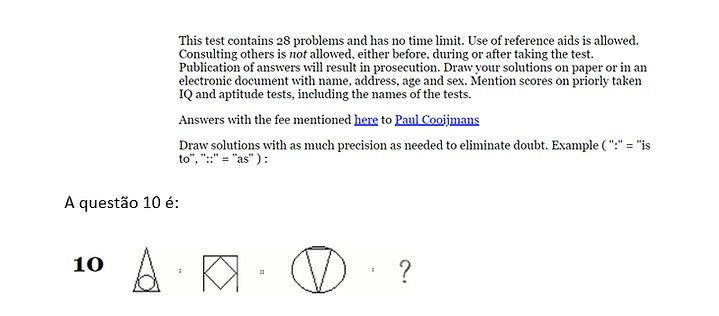
O enunciado geral diz que há uma relação da 1ª figura para a 2ª figura que deve ser descoberta e, em seguida, essa mesma relação deve ser aplicada na 3ª figura para produzir a 4ª figura. Esse é o único enunciado geral para todas as questões desse teste, apresentado no início do teste, e funciona assim nas questões 1 até 9, mas não é assim na questão 10 nem em 16 outras questões entre as 28 que constituem esse teste.
Ele queria que na questão 10 fosse descoberta a relação da 1ª figura para a 3ª figura e, em seguida, essa mesma relação fosse aplicada na 2ª figura para produzir a 4ª figura! Mas em nenhum momento ele pediu isso no enunciado. O que o enunciado pede é exatamente o que descrevi acima. Se a pessoa responde exatamente o que o enunciado está pedindo, a pessoa perde 1 ponto!
Há várias outras questões no STH com esse mesmo erro básico de lógica. Nessa situação surreal, se a pessoa acertar todas as 28 questões exatamente em conformidade com o que pede o enunciado do teste, a pessoa receberá apenas 11 certos e terá escore 135 em vez de 205 pela norma atual, ou 140 em vez de 207 pela norma antiga.
Como Cooijmans não aceitou conversar a respeito disso, eu conversei (na época) com 3 outras pessoas capacitadas para opinar: Petri Widsten, Albert Frank e Guilherme Marques dos Santos Silva.
Petri Widsten teve o escore mais alto no Sigma Test, no STH e foi campeão em vários concursos de lógica e de QI, inclusive http://www.worldiqchallenge.com/rankings.html, onde Petri teve quase o dobro do escore bruto de Rick Rosner. Petri rapidamente concordou comigo sobre isso, inclusive com prejuízo para as próprias respostas dele, porque ele havia respondido o que ele achava que o Cooijmans gostaria de receber como resposta, não o que seria a resposta mais certa. Todas as vezes que me lembro desse assunto, fico estressado, porque Cooijmans é uma pessoa muito teimosa. Eu não acho que Cooijmans seja estúpido ou desonesto; eu acho que ele é inteligente e ele tenta fazer o que ele acredita ser certo, mas a teimosia dele é maior do que a inteligência dele.
Albert Frank foi professor de Lógica e Matemática na Universidade de Bruxelas, campeão veterano de Xadrez na Bélgica. Albert também concordou comigo e fez alguns comentários sobre Lógica formal que categorizam o tipo de erro cometido pelo Cooijmans.
Guilherme Marques dos Santos Silva é membro de Sigma V e foi campeão no concurso de QI “Ludomind International Contest IV”, também concordou comigo e “desistiu” de terminar de fazer o STH depois que viu esse erro absurdo. Ele disse que faltavam poucas questões para terminar, mas devido ao grave viés na correção, não teve interesse em prosseguir.
Além das pessoas com as quais conversei naquela época, também conversei recentemente com Tianxi Yu sobre esse tipo de problema. Yu tem escore 196, σ=15 no Death Numbers, que é considerado um teste sério e com norma desinflada. Ele comentou que já encontrou erros em vários testes, e ele postou uma extensa e detalhada crítica pública sobre isso em um grupo, citando os diversos tipos de erros que o incomodam. Há vários pontos nos quais discordo das opiniões de Yu, mas em relação aos testes, nossas opiniões são muito semelhantes.
Logo que tomei meu primeiro contato com as sociedades de alto QI e conheci o site do Miyaguchi (1999), cheguei a me interessar em fazer o Power Test, que eu considero um dos melhores em termos de validade de constructo e com nível adequado de dificuldade. Na época eu tinha 27 anos e uma opinião diferente da atual, eu tinha três objetivos com o Power Test: um deles era a diversão, outro era bater o recorde de Rick Rosner de QI~193 e o terceiro era entrar em Mega Society. Naquela época era utilizada a norma calculada por Garth Zietsman para o Power Test, com teto 197, mas antes de eu terminar de resolver todas as questões, o Power Test deixou de ser aceito em Mega Society e o teto foi “revisado” para 180. Então eu perdi completamente o interesse.
Garth Zietsman é um estatístico competente e a norma que ele calculou, provavelmente utilizando Teoria de Resposta ao Item, é consistente e muito bem fundamentada. Se os mesmos itens utilizados no Mega, Titan e Ultra estavam no Power, então as dificuldades individuais desses itens foram mantidas e determinavam a norma do Power. Por isso quando o teto do Power Test foi modificado para 180, isso foi um erro. Simplesmente foram desconsideradas as mais de 4.000 aplicações do Meta, Titan e Ultra, que serviram de base para a norma calculado por Zietsman, e foi calculada uma nova norma baseada em poucas dezenas de pessoas. O procedimento correto seria somar os novos dados (sobre os resultados de cada item respondido pelas pessoas examinadas com o Power) ao banco de itens que continha as questões do Mega, Titan e Ultra, calibrar novamente os parâmetros de dificuldade, poder discriminante e acerto casual (se aplicável) de cada item, então revisar as normas dos 4 testes de Hoeflin que compartilhavam aqueles itens. Assim os níveis de dificuldade seriam preservados igualmente em todos os testes, mantendo uma escala unificada.
Mas da maneira como foi feito, a norma do Power ficou distorcida para baixo em relação aos outros três testes de Hoeflin. Para esclarecer melhor o problema, vou citar um exemplo: no Power Test a questão sobre a fita de Moebius está sendo tratada estatisticamente como se tivesse parâmetro b = +2.81, ou seja, 50% das pessoas com QI 145 (σ=16) devem acertar essa questão. Entretanto, a mesma questão sobre a fita de Moebius ao ser aplicada em outro dos testes de Hoeflin está sendo tratada estatisticamente como se tivesse parâmetro b = 3,88 ou seja, 50% das pessoas com QI 162 (σ=16) devem acertar essa questão. Isso é uma inconsistência grave, porque ou a questão tem dificuldade 2,81 em todos os testes nos quais ela é utilizada, ou 3,88 em todos os testes. A questão não pode ter dificuldade 3,88 em alguns testes e 2,81 em outros. A normatização de Zietsman é consistente nesse aspecto, de modo que o teto do Power produz uma norma na mesma escala em que estão as normas do Mega, Titan e Ultra.
Um dos motivos que provocou essa redução no teto do Power é porque algumas pessoas já haviam levado um ou mais dos outros testes de Hoeflin nos quais os itens do Power estavam presentes, por isso a probabilidade de acertar esses itens na segunda tentativa era maior, aumentando ainda mais na terceira e quarta tentativas. Mas a maneira correta de lidar com isso seria ajustando todas as normas de todos os testes que continham aqueles itens, em função do número de vezes que aqueles itens já haviam sido resolvidos pela pessoa examinada, com normas personalizadas para cada pessoa, ou com base em quantos e quais dos três outros testes a pessoa já havia resolvido (uma equação para isso poderia ser facilmente determinada com o uso de análise de clusters, por exemplo).
Também poderia simplesmente verificar os escores de pessoas que haviam feito mais de um teste (ou o mesmo teste mais de uma vez) e o efeito disso sobre a probabilidade de acertar cada item repetido no segundo, terceiro ou quarto teste que continha o mesmo item. Embora esse ajuste global no conjunto de itens não fosse tão acurado e refinado quanto a análise desse efeito sobre cada item individual, como sugeri acima, isso já ajudaria a aprimorar as normas em todos os 4 testes, em vez de distorcer a norma do Power em relação a todos os outros.
Enfim, há uma quantidade preocupante de erros nos hrIQts, tanto nos cálculos das normas quanto nas respostas aceitas como corretas, entre outros problemas. Por isso o Sigma Test sempre adotou uma política de transparência, sendo aberto a debates, se a pessoa tivesse algum escore acima de 180 em qualquer teste e ela acreditasse que alguma resposta dela estava certa e ela achasse que recebeu uma avaliação incorreta, ela podia contestar a correção de uma questão que ela escolhesse. Se ela tivesse razão, ela podia contestar a correção de mais uma questão, e assim por diante, até que a contestação dela fosse improcedente. O Moon Test e o Sigma Test Extended adotam uma política semelhante de transparência, mas o escore mínimo em outros testes para ter esse direito a contestação é 190 tanto no Moon Test quanto no Sigma Test Extended. Isso permite revisar eventuais erros, além de permitir que a pessoa examinada tenha a oportunidade de defender o que ela considera certo, na hipótese de ela achar que merecia mais pontos do que recebeu. Em minha opinião, todos os testes deveriam adotar uma política semelhante.
Se houvesse algum teste com características apropriadas, eu consideraria a possibilidade de fazer outro teste, embora eu esteja mais velho e mais burro. Basicamente deveria ser um teste com boa validade de constructo nos níveis mais altos, teto apropriado e dificuldade apropriada. Além disso, deveria ter um sistema formal de “reclamação” que permitisse contestar o resultado. Sem isso, não vejo razão para perder tempo com essas coisas. Um hrIQt pode facilmente consumir 50 horas e se for um teste realmente difícil, com nível adequado de dificuldade, pode consumir mais de 500 horas. É um tempo que poderia ser aplicado em atividades mais interessantes e produtivas. Por isso, a menos que o teste reúna uma série de virtudes notáveis que justifiquem o esforço, eu não teria interesse. Na verdade, há um teste que, na minha opinião, atende a esses quesitos, mas eu não posso resolver porque eu sou o autor. Isso me faz lembrar de um assunto que foi discutido há poucas semanas num grupo:

Na verdade, alguns problemas que eu já resolvi são mais difíceis que os problemas mais difíceis do Sigma Test Extented. Então há algumas pistas úteis nisso.
Algumas pessoas já fizeram estimativas de meu QI e já fizeram algumas comparações. Em 2004, o fundador de Pars Society (QI>180), Baran Yonter, estimou meu QI em mais de 200 (σ=16, G), isso é equivalente a mais de 240 pIQ (σ=16, T). Achei que ele estivesse sendo gentil, mas em 2005, quando fui indicado para a produção do programa de TV “Fantástico”, da rede Globo, como a pessoa mais inteligente do Brasil, descobri que outras pessoas tinham opiniões semelhantes à de Baran sobre mim. Eu me senti lisonjeado com as indicações, mas eu não sei se realmente sou a pessoa mais inteligente do Brasil e eu disse isso ao jornalista, mas ele insistiu, e como eu havia sido o mais indicado, e também por uma questão de vaidade, acabei aceitando fazer a matéria, cujo vídeo está disponível em minha página e meu canal.
É necessário fazer uma ressalva importante em relação à correta determinação da pessoa mais inteligente do Brasil, porque há um brasileiro que ganhou uma medalha Fields (Artur Ávila) e há um brasileiro que prestou contribuições fundamentais ao desenvolvimento das lógicas paraconsistentes (Newton da Costa), ambos são pessoas muito inteligentes, mas com perfis diferentes do meu, por isso seria difícil fazer uma comparação adequada para saber com segurança quem é o mais inteligente do Brasil, porque cada um deles é profundamente especializado em uma área muito específica, enquanto meus talentos e realizações se distribuem por uma grande variedade de áreas diferentes. Como resultado da maior especialização, o nível de profundidade que eles alcançaram é maior, mas essa maior profundidade não reflete uma maior profundidade de raciocínio, e sim maior profundidade de conhecimento. Além disso, eu só estudei até o 11º ano, enquanto eles fizeram doutorado e pós-doutorados com excelentes orientadores, o que me coloca numa situação de “correr com as pernas amarradas” em comparação a pessoas que correm montadas em cavalos. As pessoas que trabalharam nos mesmos problemas nos quais eu trabalhei estavam equipadas com ferramentas matemáticas mais sofisticadas, acesso a computadores muito mais potentes, acesso a vasta bibliografia de alta qualidade, receberam treinamento formal muito mais prolongado, intensivo e sob orientação de cientistas experientes, enquanto todo o meu “treinamento” foi auto-administrado, praticamente sem recursos bibliográficos e com modestos recursos computacionais. Muitas vezes precisei criar minhas próprias ferramentas estatísticas antes de usá-las na resolução dos problemas, e depois eu descobria que já existiam ferramentas prontas para as mesmas finalidades. Durante o desenvolvimento de meu sistema para operar no Mercado Financeiro, situações como essa se repetiram muitas vezes.
Um detalhe que é importante esclarecer: eu comentei (no apêndice) que a qualidade média do ensino no Brasil é péssima, então qual seria minha desvantagem por não ter frequentado esse ambiente péssimo? E a resposta é simples: muitos dos melhores acadêmicos brasileiros vão estudar nos melhores centros de pesquisa e universidades da Europa, dos EUA, Canadá, Austrália, Japão etc. Além disso, há alguns poucos pesquisadores realmente bons no Brasil, e quando um jovem talento recebe orientação de um pesquisador de primeira magnitude, isso faz uma diferença muito grande. Portanto há uma vantagem substancial nas oportunidades de Artur e Newton da Costa se comparados com a minha situação, porque eles tiveram acesso a muito mais recursos, além das vantagens em orientação e treinamento.
Em relação às outras pessoas que trabalharam nos mesmos problemas que eu, e eu resolvi esses problemas antes delas ou melhor do que elas ou as duas coisas, quase todos são de outros países: Nick Trefethen é Chefe do Dep. de Cálculo Numérico na Universidade de Oxford e coleciona alguns prêmios internacionais de Matemática (Leslie Fox Prize 1985, FRS Prize 2005, IMA Gold Medal 2010), Susumu Tachi é Professor Emérito na Universidade de Tóquio e Professor Convidado no MIT, Stefan Steinerberger é professor de Matemática em Yale, William Sharpe é professore na Universidade da Califórnia e Nobel de Economia em 1990, Franco Modigliani é Professor na Universidade de Roma e Nobel de Economia em 1985, Clive Granger foi professor na Universidade de Nottingham e Nobel de Economia em 2003, entre outros. Então as pessoas que trabalharam em alguns dos problemas que eu resolvi constituem uma “concorrência de peso”, além de eles terem acesso a mais recursos, mais assessores etc., portanto acho que eu ter realizado trabalhos melhores que os deles, ou ter solucionado problemas relevantes antes deles, talvez represente algum mérito para mim, eu não tenho falsa modéstia em admitir isso.
O fato é que a determinação correta da pessoa mais inteligente de um país não é algo tão simples, não é um jogo de egos e vaidades. É necessário que haja embasamento real para isso. Por exemplo, eu acho que Petri Widsten tem excelentes chances de ser a pessoa mais inteligente da Finlândia, não apenas pelo excelente resultado dele no Sigma Test, mas também porque a tese dele de doutorado, além de muito inovadora, foi premiada como a melhor tese do país no biênio 2002-2003 e ele venceu vários concursos de lógica. O conjunto desses resultados, e outros detalhes menores, como ele ser fluente em mais de 10 idiomas, sugerem um nível intelectual real com raridade acima de 1 em 5 milhões, que é a população da Finlândia. Entretanto há outras pessoas muito inteligentes na Finlândia, como Rauno Lindström ou Bengt Holmström. Embora a Finlândia seja um país culturalmente mais homogêneo, de modo que não há uma diferença de oportunidades tão grande quanto no meu caso, ainda assim a comparação ainda é difícil, por isso não seria prudente afirmar categoricamente que determinada pessoa (Petri ou Rauno ou outro) é a mais inteligente da Finlândia. O mais apropriado seria atribuir uma probabilidade a cada um. Petri teria em torno de 95% de probabilidade de ser a pessoa mais inteligente da Finlândia, Talvez Rauno 2%, Bengt 1% e alguém entre as outras pessoas 5 milhões de pessoas 2%. No caso do Brasil, minha vantagem seria bem menor que a do Petri em relação aos outros fortes candidatos.
Em 2005, o amigo Alexandre Prata Maluf, membro de Sigma V, Pars Society e OlympIQ Society, estimou que meu QI deveria ser semelhante ou pouco acima do da Marilyn Vos Savant. Creio que a intenção dele foi fazer um elogio, porque a Marilyn é um ícone nas sociedades de alto QI, mas não gostei da comparação, porque não é uma comparação justa. Os problemas do mundo real que eu já resolvi são muito mais difíceis do que os problemas que ela resolveu. Não excluo a possibilidade de que ela talvez tenha um QI similar ao meu, mas ela precisaria provar isso com resultados concretos, solucionando problemas com grau de dificuldade compatível.
Recentemente, tomei conhecimento de que em 2018, num grupo privado, meu nome havia sido indicado numa postagem com título “Name the top 5 people (alive) with the highest measured IQs in the world today! Name, IQ and Test.” Achei surpreendente eu ter sido citado, porque desde 2006 eu estava afastado das sociedades de alto QI e só retornei há poucos meses, em fevereiro de 2022, mesmo assim Rasmus Waldna, da Suécia, muito gentilmente se lembrou de mim e sugeriu meu nome, e a indicação dele recebeu mais curtidas do que receberam os nomes de Terence Tao, Chris Hirata, Rick Rosner, Marilyn e Langan. Também foram indicados os nomes dos amigos Tor e Iakovos. Compreendo que foi um tópico informal, e as reações positivas das pessoas podem ter sido influenciadas por fatores extrínsecos à capacidade intelectual, algumas pessoas podem ter curtido por simpatia, por exemplo, ou porque gostam do meu cabelo, mas mesmo assim fiquei feliz com a lembrança e o reconhecimento, e feliz também por ver alguns amigos nessa lista.
Em 2001, David Spencer me comparou a Leonardo Da Vinci e Pascal. Em 2016 o amigo João Antonio L.J. me comparou a Newton e Galileu, e a maneira como ele escreveu e no contexto em que foi dito, achei um elogio comovente e sincero. Em 2017, novamente fui comparado a Leonardo (por Aurius). Em 2020, a revista Empiricus publicou um artigo de Bruno Mérola sobre gerenciamento de risco, no qual o autor comparou meu Melao Index com o índice de Sharpe (Nobel de 1990), e na análise que ele fez, apresentou fatos e argumentos demonstrando que meu índice é superior ao índice de Sharpe. Na verdade, meu índice também é superior ao de Modigliani (Nobel de 1985), Sortino e todos os outros, mas no artigo ele só mencionou o índice de Sharpe por ser o mais utilizado no mundo, por ser mais tradicional e mais conhecido, e citou o meu por ser o mais eficiente. Em 2021 fui comparado a Feynman e novamente a Leonardo, numa situação interessante, em que a pessoa (Francisco) fez uma análise razoavelmente detalhada da comparação para justificar sua opinião. Em 2021, novamente fui citado como possivelmente a pessoa mais inteligente do brasil por Luca Fujii, um dos maiores talentos precoces da Matemática brasileira, mas como ele ainda é muito jovem, não chegou a manifestar todo o seu brilho intelectual e por isso ainda não é tão famoso, mas será em breve. O Luca é uma pessoa com muitas virtudes morais, além de intelectuais, assim como o João Antonio L.J., por isso me sinto realmente honrado que essas pessoas tenham opiniões elevadas a meu respeito, e também porque sei que não dizem isso só para me agradar, mas sim baseados em critérios profundos, critérios muito bem fundamentados e bem ponderados. O João leu mais de 1000 de meus artigos, o Luca leu meus dois livros e seguramente leu centenas de meus artigos. Portanto, além de serem excepcionalmente capacitados, também tinham conhecimento sobre o que estavam falando.
Enfim, acho que os problemas do mundo real que resolvi, as pessoas que tentaram resolver os mesmos problemas e os prêmios que essas pessoas já ganharam e outros problemas que elas já resolveram, as opiniões de alguns expoentes das sociedades de alto QI a meu respeito talvez respondam um pouco sobre meu QI, certamente mais e melhor do que um teste padronizado poderia dizer.
Jacobsen: Que filosofia ética faz algum sentido, mesmo o sentido mais viável para você?
Melão Jr.: Não conheço nenhum autor que represente minhas opiniões sobre qualquer assunto de forma suficientemente acurada e completa. Sempre há detalhes nos quais ocorrem divergências. Em meu livro sobre a existência de Deus, um dos capítulos trata de Ética, no qual exponho minhas opiniões sobre isso. Há alguns artigos nos quais discuto questões relacionadas à Ética, esse é um deles: https://www.saturnov.org/liberdadeedireitos
Jacobsen: Que filosofia política faz algum sentido, até mesmo o sentido mais viável para você?
Melão Jr.: há um provérbio polonês que diz “No capitalismo o homem trai o homem. No socialismo ocorre o contrário”. Em teoria, quase todos os sistemas políticos tentam ser razoavelmente bons, com diferentes prioridades, mas cada um visando, a seu próprio modo, objetivos nobres e elevados, embora utópicos e superficiais em pontos básicos, por isso ao serem instaurados na prática, fica claro que as vicissitudes humanas corrompem qualquer sistema, porque os sistemas teóricos não fazem previsões adequadas sobre como lidar com humanos reais. Creio que num futuro não muito distante, se não nos destruirmos por uma guerra, a liderança política do planeta estará “nas mãos” de máquinas inteligentes, e haverá um sistema muito mais lógico e justo do que qualquer sistema existente atualmente. Estará longe de ser um sistema perfeito, mas será muitíssimo superior a qualquer coisa que conhecemos, pois esses sistemas serão capazes de analisar interações muito mais complexas e profundas das relações humanas entre grandes grupos e como essas relações evoluem a longo prazo, aproximadamente do mesmo modo que os melhores programas de Xadrez superam por larga margem a qualidade de análise dos humanos, “enxergando” de forma muito mais correta e mais profunda e fazendo previsões mais acuradas do que qualquer humano. O problema é que existe um risco elevado de que sejamos escravizados pelas máquinas, ou algo assim, ou haja uma união simbiótica entre humanos máquinas, ou parasitária, é difícil prever, vai depender de algumas decisões que tomarmos nos próximos anos e décadas.
Jacobsen: Que metafísica faz algum sentido para você, mesmo o sentido mais viável para você?
Melão Jr.: a teoria do multiverso está no limiar entre a Física e a Metafísica. A palavra “multiverso” é uma construção inadequada, mas o significado é plausível e até mesmo provável.
Jacobsen: Que sistema filosófico abrangente de visão de mundo faz algum sentido, mesmo o sentido mais viável para você?
Melão Jr.: o que eu descrevo no livro que citei acima, no qual apresento argumentos que me parecem conclusivos sobre a existência de Deus, e abordo outros temas filosóficos e científicos.
Jacobsen: O que dá sentido à vida para você?
Melão Jr.: não acho que haja necessidade de haver algo que dê sentido à vida além dela mesma. A vida tem um sentido intrínseco. Mas posso afirmar que proteger minha mãe e proporcionar o melhor possível a ela era algo que me dava alegria. Ela faleceu em 2016. Fiquei sem me alimentar adequadamente e sem dormir adequadamente durante alguns meses. Eu já havia pesquisado sobre criogenia e sabia que essa tecnologia não oferece perspectivas realistas de trazer a pessoa de volta à vida, porque as membranas de trilhões de células são rompidas com o choque térmico, deixando o citoplasma vazar, um processo com baixa probabilidade de ser revertido. Comecei a pensar numa forma de ressuscitá-la, mas acho muito difícil que a pessoa ressuscitada pudesse ter restaurada exatamente a mesma personalidade e mesmas memórias, portanto não seria a mesma pessoa. Se as memórias e a personalidade dela tivessem sido armazenadas integralmente em um HDD ou SSD, ou algum dispositivo com propriedades similares, então talvez fosse possível restaurar a mesma pessoa, num genuíno processo de ressuscitação. A alegria de viver se foi com a morte dela. Em 2018, conheci minha namorada, Tamara, que está morando comigo desde então e posso dizer que ela tem sido minha alegria de viver, minha vida seria muito pequena e descolorida se não fosse por ela. É uma honra para a espécie humana que existam pessoas profundamente empenhadas em fazer o que é certo e justo, como ela, que elevam a dignidade humana a um patamar próximo da perfeição.
Jacobsen: O significado é derivado externamente, gerado internamente, ambos, ou algo mais?
Melão Jr.: em dedução o significado é atribuído, em última instância, arbitrariamente. A pessoa determina o que é um triângulo e aquilo será um triângulo. Em indução finita, o significado é inferido a partir da análise da amplitude de variação das propriedades observadas em entidades de mesma classe em comparação à dispersão das mesmas propriedades observadas em entidades de classes diferentes.
A evolução no conceito de “planeta”, por exemplo, ilustra bem como isso acontece. Os gregos classificavam a Lua, o Sol, Mercúrio, Vênus, Marte, Júpiter e Saturno como planetas. Nem todos os gregos, na verdade. Aristarco, Seleuco, Ecfanto (supondo que Ecfanto tenha de fato existido) e Filolau não adotavam o mesmo critério. Com Copérnico, o Sol deixava de ser considerado um planeta, enquanto a Terra passava a ser classificada como planeta, porque o critério dos gregos era que os planetas se moviam. Quando foi descoberto Urano, em 1781, também passou a ser classificado como planeta, porque suas propriedades gerais se ajustavam melhor a essa classe de objetos, e o mesmo aconteceu quando foi descoberto Ceres, em 1801. Porém, pouco depois, foram descobertos Palas, Vesta, Juno e outros objetos com órbitas muito semelhantes às de Ceres, todos muito menores que os demais planetas e compartilhando quase mesma órbita. Em poucos anos havia mais de 10 objetos com essas características, o que levou a reconsiderar se os critérios utilizados para classificar os planetas eram apropriados. Então surgiu o conceito de “planetoide” depois modificado para “asteroide” para incluir essa classe de objetos. Na época em que Plutão (1930) foi descoberto, como ele estava muito fora da zona de asteroides e seu tamanho foi originalmente estimado como sendo semelhante ao da Terra, foi classificado como planeta. Em poucos anos se verificou que ele era muito menor do que se pensava. As primeiras estimativas de 1931 atribuíam a Plutão 13.100 km de diâmetro, depois 6084,8 km, depois 5760 km, depois 3000 km, 2700 km, 2548 km, 2300 km, 2390 km e os dados mais recentes indicam cerca de 2376,6 km. Por isso, na época em que foi descoberto, era plausível que fosse classificado como “planeta”, mas ao constatar que era muito menor e menos massivo, a situação mudou. Essa questão é analisada com mais detalhes em meu livro sobre esse tema. Quando foram descobertos outros objetos transnetunianos, já se começou a considerar que talvez Plutão ficasse mais bem classificado como um daqueles objetos, em vez de ser considerado um planeta. Os planetas telúricos (Mercúrio, Vênus, Terra e Marte) tinham superfície rochosa, densidade média aproximadamente entre 4 e 5,5 vezes a da água, diâmetro aproximadamente entre 5.000 e 13.000 km, enquanto planetas jovianos (Júpiter, Saturno, Urano, Netuno) tinham “superfície” fluida, densidade média aproximadamente entre 0,7 e 1,7 vezes a da água, diâmetro aproximadamente entre 50.000 e 140.000 km. Mas Plutão ficava muito fora desses dois grupos, sua densidade 1,9 era semelhante à dos jovianos, mas seu tamanho era menor que o dos telúricos. Não se sabia se a superfície era rochosa, mas em princípio se acreditava que sim. Quando foi descoberto Éris – cuja massa é similar à de Plutão e talvez um pouco maior –, finalmente decidiram promover um debate sobre isso e reconsiderar os critérios para classificação de planetas. Em 2006, a UAI decidiu criar uma nova classe de objetos, os “planetas anões”, e Plutão entrou para essa categoria.
Eu pulei alguns eventos importantes, como a descoberta de Galileu e Simons dos 4 grandes satélites de Júpiter, que foram inicialmente considerados “planetas”, porque não existia o conceito de “satélite” até que Kepler sugeriu isso. Algumas vezes, Galileu se referia a esses objetos como “pequenas estrelas”, já que não se sabia muito bem o que eram as estrelas, embora Giordano Bruno já tivesse um palpite promissor.
O significado de “planeta” foi e continua sendo determinado pela comparação com outros objetos que apresentem diferentes níveis de similaridade. Em casos nos quais há grande números de objetos para comparar, como a taxonomia de animais, pode-se fazer as classificações em muitos níveis hierárquicos, com diferentes níveis de similaridade, e os significados são atribuídos de acordo com as propriedades comuns a todos os elementos da mesma classe, ao mesmo tempo em que se tenta selecionar critérios que permitam distinguir de elementos de outras classes. Nas classificações de cachorros e gatos, por exemplo, não é útil considerar o fato de terem 2 olhos, rabo e focinho, porque isso não ajuda a distinguir uma espécie da outra. Tamanho médio poderia ajudar, se a dispersão nos tamanhos fosse mais estreita, mas como as diferentes raças de cachorro variam numa amplitude muito grande, esse critério também não ajudaria muito. Nesses casos, critérios mais sutis e específicos, como morfologia do rosto, morfologia dos dentes e número de dentes acabam sendo mais úteis. O tamanho do focinho pode ajudar, mas o número de dentes tem significado semelhante, por estar relacionado ao tamanho do focinho, com a vantagem de ser mais objetivo e quantitativo.
Enfim, essas são as duas principais maneiras de determinar os significados. Uma é arbitrária, permite que se imponha quais características a entidade deve ter. A outra tenta descobrir quais característicos são comuns a todas as entidades de uma mesma classe e, ao mesmo tempo, são diferentes das características de entidades de classes semelhantes, de modo a possibilitar a distinção entre entidades de uma classe ou de outra. Esses significados são frequentemente incompletos, incertos e sujeitos a revisões, conforme se faz novas descobertas sobre outras entidades cujas características sejam limítrofes em determinada classe, levando a ampliar, estreitar ou reconfigurar os critérios de modo a incluir ou excluir a nova entidade em uma das classes conhecidas, ou, mais raramente, criar uma nova classe inaugurada por essa entidade.
Jacobsen: Você acredita em vida após a morte? Se sim, por que e de que forma? Se não, por que não?
Melão Jr.: o conceito de “morte” é um desligamento, que por enquanto não sabemos como religar, mas brevemente será possível de diferentes maneiras. Esse é um dos tópicos analisados mais detalhadamente em meu livro. O conceito de “alma” também precisa ser examinado com detalhes, para responder a isso, e o tamanho da resposta seria imensa.
Jacobsen: O que você acha do mistério e da transitoriedade da vida?
Melão Jr.: não acho que seja transitória. Por enquanto tem sido, mas isso deve mudar em breve.
Jacobsen: O que é amor para você?
Melão Jr.: é uma tentativa desesperada de inventar uma palavra para representar um sentimento indescritível.
Apêndice:
Sistema Educacional no Brasil e estudo de Richard Lynn sobre QIs em diferentes países.
O sistema educacional costuma ser ruim no mundo inteiro, mas no Brasil é muito pior do que a média de países com PIB similar ao nosso. Estimo que a educação brasileira seja uma das piores do mundo. O Professor Emérito da Universidade de Ulster Richard Lynn oferece uma explicação simplista para isso em seu artigo “QI e riqueza das nações”. Ele não trata da Educação. Trata da Economia, mas o argumento que ele utiliza para justificar as diferenças de renda seria igualmente (e melhor) aplicado à Educação, desde que o argumento fosse válido. Mas o argumento parte de uma premissa falsa. Há muitos erros no trabalho de Lynn. A ideia central que ele defende está certa, mas quantitativamente ele força resultados exagerados. A tese que ele defende – de que existem diferenças étnicas e regionais – está certa, mas as diferenças não são tão grandes quanto ele quer fazer parecer. De acordo com Lynn, o QI médio em Guiné Equatorial é 56. Se isso estivesse certo, seria esperado que o país fosse uma grande tribo de nômades, eles não teriam dominado a técnica de produzir fogo, não teriam construído arados, lanças etc. Mas existe uma civilização urbana lá. Além disso, pessoas com QI abaixo de 60 têm muita dificuldade para aprender a ler e escrever, mesmo vivendo em países com ampla infraestrutura e incentivo à alfabetização. Se mais de 91% da população de Guiné Equatorial sabe ler (supondo que essa informação não seja maquiada), mesmo num ambiente com menor incentivo ao aprendizado, seria muito difícil explicar como essa população com QI médio 56 é predominantemente alfabetizada. Lynn tenta disseminar as crenças neonazistas dele e usa essas pesquisas científicas para tentar ganhar credibilidade para suas opiniões. O QI médio dos judeus Ashkenazi é cerca de 114, a média mais alta do mundo, mas Lynn conseguiu manipular os dados de sua meta-análise para que o QI médio do estado de Israel ficasse em 94.
No caso do Brasil, os resultados de Lynn indicavam QI médio 87 e em revisão mais recente indicam 83,38. Se isso estivesse certo, seria uma boa explicação para baixa qualidade da produção científica brasileira e a péssima qualidade de ensino. Mas os problemas reais que predominam no Brasil são uma combinação de preguiça dos alunos, preguiça dos professores, nivelamento por baixo nas aulas e péssimo metodologia “pedagógica”.
Uma análise mais séria da situação mostra que o QI real médio do brasileiro não é tão baixo quanto os estudos de Lynn sugerem. Muitas pessoas entregam os questionários dos testes de QI sem responder, ou “chutam” todas as alternativas, ou respondem algumas e “chutam” as demais.
Em uma postagem minha no perfil de nosso amigo Iakovos Koukas, fiz um comentário razoavelmente detalhado sobre isso, o qual também reproduzi no grupo IQ Olympiad e reproduzo novamente a aqui:
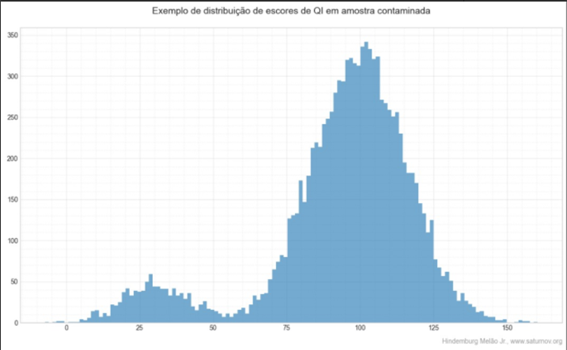
Realmente existem diferenças cognitivas em função da etnia, assim como existem em relação à altura média, tamanho médio do pênis, concentração média de melanina sob a pele etc., mas as diferenças cognitivas são muito menores do que ele tenta “vender”.
De um lado, existe o problema do igualismo ingênuo, defendido por alguns grupos pseudoideológicos, e isso não encontra nenhum respaldo nos fatos. No extremo oposto, existem os grupos de pessoas como Richard Lynn, Tatu Vanhanen e Charles Murray que tentam exacerbar as diferenças raciais e usá-las para justificar a situação de miséria de alguns povos. Tanto o grupo dos eugenistas radicais quanto o dos igualistaristas radicais estão errados, mas entre um extremo e outro existem algumas verdades.
Assim como há diferenças cognitivas marcantes entre espécies, há diferenças entre etnias, porém menos marcantes porque a amplitude de variação genética dentro de uma mesma espécie é menor. Fingir que essas diferenças não existem é um erro, porque o conhecimento correto sobre as particularidades de cada etnia ajuda a fazer diagnósticos mais acurados de diversas doenças cujos sintomas não são os mesmos em todos grupos étnicos, o tempo adequado de exposição ao Sol para a síntese de vitamina D não é o mesmo, e muitas características que seriam interpretadas como “saudáveis” em algumas etnias não são em outras, por isso o uso correto dessas informações ajuda a interpretar com mais eficácia os resultados de hemogramas, analisar anomalias ósseas, dermatológicas e musculares. Conhecer as diferenças fisiológicas, cognitivas e comportamentais de cada etnia é importante; o problema está em usar essas diferenças com o propósito de tiranizar, oprimir ou diminuir os méritos de um povo, isso é antiético e anticientífico, e Lynn tenta fazer isso de forma ostensiva.
No caso do Brasil, parece haver uma distorção perto de 10 a 15 pontos nos números apresentados por Lynn, então o QI médio correto do brasileiro deve ser cerca de 95, um pouco abaixo da média, mas não tanto a ponto de justificar os péssimos resultados do Brasil em Ciência. Os problemas reais parecem ser a preguiça e outros itens que mencionei acima. Há estudos recentes que questionam se o comportamento aparentemente preguiçoso deveria ser classificado exatamente como “preguiça” ou não, mas não vou entrar também nessa discussão para não tornar esse texto ainda mais longo.
Nos anos 1950 e 1960, Richard Feynman esteve algumas vezes no Brasil e fez críticas severas ao sistema educacional brasileiro, ele fez alguns experimentos sociais de improviso e mostrou que estudantes de doutorado brasileiros muitas vezes não compreendiam o básico sobre o que estavam fazendo, agiam mecanicamente, sem a menor noção sobre os fundamentos. Os brasileiros escreveram algumas palavras bonitas em relação às críticas de Feynman, dizendo que pretendiam melhorar alguma coisa, mas a situação atual é talvez até pior do que era na época em que Feynman esteve em nosso país. Além da situação vergonhosa da educação no Brasil, há ainda outros problemas nesse episódio, porque os “educadores” brasileiros demonstraram surpresa e perplexidade com os problemas apontados por Feynman, como se estivessem numa casa pegando fogo, mas não estivessem enxergando que o fogo estava devorando tudo, até que um vizinho entra e mostra o fogo a eles. Então eles agradecem, mostram-se chocados, fazem um discurso de mea-culpa, mas não fazem nada concreto em relação ao incêndio, que continua devastador… É inacreditável que não estivessem enxergando o fogo antes de o vizinho indicar a eles e é inacreditável que continuem sem tomar qualquer providência depois que o problema foi apontado.
Embora os cientistas e educadores não tenham se mobilizado para tentar resolver o problema, alguns expoentes brasileiros da Matemática, que tinham algumas experiências na Europa e nos Estados Unidos, decidiram tentar reproduzir um pequeno oásis, trazendo para o Brasil um pouco do que haviam experimentado em países desenvolvidos. Em 1952, foi fundado o IMPA (Instituto de Matemática Pura e Aplicada). Naquela época, o Brasil estava no Grupo I da IMU (International Mathematical Union), o nível mais baixo. Ao longo de 70 anos, o IMPA tem sido o único lugar no Brasil onde houve uma tentativa sincera de identificar e apoiar alguns talentos notáveis, tentando escapar da burocracia e da ineficiência do Sistema Educacional. Mas o IMPA é apenas 1 instituição situada no Rio de Janeiro. O Brasil é um país grande, com 8.500.000 km^2, de modo que as pessoas que moram longe do RJ muitas vezes não conseguem desfrutar o que o IMPA oferece. Por isso o alcance do IMPA ainda é pequeno. Com a popularização da Internet isso tem melhorado, mas o número de beneficiados ainda é muito limitado, inclusive porque há relativamente pouca divulgação dos eventos do IMPA, a maioria das escolas não inscreve seus alunos em OBM (Olimpíada Brasileira da Matemática), a maioria dos alunos nem sequer sabe que existe OBM. Há alguns professores espalhados pelo Brasil ligados ao IMPA, que tentam contribuir para a identificação de talentos, mas é um processo difícil, eles não recebem incentivo do governo, nem de empresas. Mesmo com esses obstáculos, entre 1952 e 2015 o IMPA elevou o Brasil do Grupo 1 para o Grupo 5 (o mais alto), do qual fazem parte apenas 11 países: Alemanha, Brasil, Canadá, China, EUA, França, Israel, Itália, Japão, Reino Unido e Rússia.
Não sei quais os critérios para ser incluído no Grupo 5 da IMU, mas suponho que seja uma combinação de mérito e política, talvez mais mérito do que política. Digo que há um pouco de política porque há países com duas medalhas Fields ou dois prêmios Abel, mas não fazem parte desse grupo, como Austrália, Bélgica, Irã e Suécia, enquanto o Brasil tem apenas 1 medalha Fields. Claro que esses prêmios não devem ser o único critério, mas são indicativos bastante razoáveis sobre a nata da matemática que se produz em cada país. Também há vários países com 1 medalha Fields e uma tradição matemática mais longa, que também não estão no Grupo 5. Talvez o critério leve em consideração o ritmo de crescimento, e nesse quesito o Brasil talvez seja, ao lado da China e da Índia, um dos que mais tem crescido na produção de Matemática de alto nível.
O fato é que se QI médio do brasileiro fosse realmente tão baixo quanto alega Richard Lynn, e o problema principal no Brasil fosse realmente o baixo QI médio da população, então as ações do IMPA não teriam sido capazes de modificar substancialmente a qualidade e a quantidade da produção matemática de alto nível. Se o problema fosse baixo QI, a solução viria de outras ações, como melhoras nutricionais, por exemplo. As ações do IMPA não alteraram o QI médio da população; apenas alteraram a eficiência na identificação de talentos que já existiam no país, e após a identificação passou a existir oferta de oportunidade e incentivo a esses talentos.
Os números apontados por Lynn, de que o QI médio do brasileiro seria 87, mostram-se inconsistentes com os resultados alcançados pelo IMPA. Mesmo com uma população de 213 milhões, seria difícil que algumas dessas pessoas chegassem ao topo mundial com raridade perto de 1 em 300 milhões se o Brasil estivesse 1 desvio padrão abaixo da média, mesmo porque o IMPA não consegue estender seus benefícios a mais do que 1% a 5% da população mais talentosa. Claro que outras hipóteses seriam aplicáveis, como um desvio padrão maior na distribuição de QI entre a população brasileira ou uma distribuição mais platicúrtica. Mas geralmente o que se observa em grupos com altura média menor é um desvio padrão mais estreito, em vez de mais largo. Isso acontece com praticamente todas as variáveis. O desvio padrão no diâmetro de parafusos maiores é mais largo do que em parafusos menores. Em outras palavras, o desvio padrão percentual geralmente é mantido, então seria estranho uma população com QI mais baixo ter desvio padrão maior. Além disso, seria um ajuste ad hoc para tentar salvar uma teoria que apresenta outros problemas, sendo mais plausível passar a navalha de Occam e aceitar que Lynn está equivocado sobre isso. O QI médio correto do brasileiro é substancialmente maior do que ele diz, assim como os QIs da maioria dos outros povos não-arianos, que ele tenta empurrar para baixo, também são maiores do que os números que ele apresenta.
Examinando objetivamente os fatos, o que os dados sugerem é que o QI médio do brasileiro provavelmente está bem mais perto de 95 do que de 87. Um pouco abaixo da média, mas não tão abaixo quanto Lynn sugere.
Os resultados do IMPA mostram também que talvez a preguiça seja um reflexo do péssimo sistema educacional. Se a preguiça fosse um problema generalizado no país, as soluções implementadas pelo IMPA também não teriam sido suficientes para resolver isso; seriam necessárias outras medidas complementares. Talvez a preguiça seja um problema marcante que atinge mais de 99% da população, mas cerca de 1% não poderia ser rotulada como “preguiçosa”, mas sim como vítima de um sistema educacional muito ruim. Como mais de 99% da produção intelectual vem desse 1%, temos aí um gigantesco problema, e uma completa falta de atenção sobre esse problema, porque os políticos não estão muito preocupados em empreender grandes esforços para conquistar 1% de votos, já que com menos esforço eles podem conseguir mais votos fingindo agradar a um público menos exigente, mais fácil de ludibriar e muito mais numeroso.
Um dos grandes problemas é que os 99% da população também são prejudicados, mas eles próprios não enxergam isso e não cobram do governo medidas que possam contribuir para melhorias a longo prazo, medidas que sejam boas e justas para todos. Cada um quer apenas que o governo adote medidas com resultados imediatos que beneficiem seus próprios umbigos. Desse modo, o problema tende a se perpetuar, como tem acontecido há décadas.
Muitos acadêmicos brasileiros costumam reclamar de falta de verbas e atribuir a baixa produção científica a isso. Outros fazem pior, fingem que há produção científica de boa qualidade no Brasil, apesar da falta de verba. Mas o que os fatos concretos mostram é que países realmente muito pobres, nos quais a maior parte da população vive na miséria, como Etiópia, Nigéria, Congo, Quênia, Gana etc. tiveram cidadãos laureados com o Nobel, enquanto no Brasil nunca houve um ganhador do Nobel. Além disso, quando Einstein desenvolveu seus principais trabalhos, pelos quais ele merecia 3 prêmios Nobel (e mais 2 por trabalhos posteriores), ele não estava recebendo nenhuma verba para suas pesquisas, nem nos anos anteriores. Portanto, embora a falta de recursos imponha limitações severas, não pode ser considerada um impedimento absoluto e muito menos ser usada como pretexto numa situação como essa. Grandes trabalhos foram realizados praticamente sem verba, como boa parte da obra de Newton, durante em 1665.
[Aqui talvez caiba uma pequena ressalva, porque conforme comentei na parte sobre prêmios e méritos, é possível que alguns brasileiros tenham realizado trabalhos com méritos para receber um Nobel, mas não foram laureados por questões políticas, burocráticas etc. Meus trabalhos sobre Econometria e Gerenciamento de Risco, por exemplo, são mais expressivos do que a maioria dos trabalhos dos laureados com o Nobel de Economia nas últimas décadas. A descoberta do méson π, embora tenha sido predominantemente um trabalho operacional, teve um brasileiro como protagonista (César Lattes), mas como o chefe da equipe era Celil Powell, Lattes tinha apenas um B.Sc. e na época (1950) o prêmio só era concedido ao chefe da equipe, Lattes acabou não recebendo o prêmio, embora tenha sido talvez o principal responsável por esse trabalho e foi o autor principal do artigo. Depois da detecção dos mésons π nos raios cósmicos (1947), Lattes era um dos poucos no mundo com o conhecimento necessário para identificar assinaturas deixadas por essas partículas nas placas de emulsão, por isso ele foi convidado a colaborar no CERN (1948) e verificar se eles também estavam conseguindo produzir mésons π, pois a energia necessária para isso era ultrapassada com folga pelo acelerador de partículas utilizado, portanto eles provavelmente já estavam produzindo pions há muito tempo (desde 1946), mas não sabiam exatamente o que deveriam procurar nas câmaras de bolha como sendo assinaturas dos mésons π. Lattes foi ao CERN e fez as identificações. Novamente o trabalho foi distinguido com o Nobel e novamente Lattes ficou fora da premiação. Ao todo, Lattes foi indicado 7 vezes para o Nobel, mas nunca chegou a ser premiado. Oswaldo Cruz também recebeu indicação ao Nobel de Medicina, mas não foi premiado. Talvez Machado de Assis também tivesse mérito para um Nobel de Literatura. Então, embora haja 0 brasileiros laureados com Nobel, talvez alguns tenham méritos para isso. Há um texto detalhado no qual analiso o caso de Lattes, sem os habituais exageros e distorções nacionalistas da maioria dos artigos sobre ele, mas ao mesmo tempo reconhecimento os méritos que ele teve e que não foram devidamente reconhecidos.]
Por um lado, a baixa produção científica reflete a falta de verba, por outro lado a falta de verba reflete a baixa produção científica, porque se houvesse realmente produção científica e tecnológica de boa qualidade, grandes empresas nacionais e internacionais teriam interesse em financiar essas pesquisas, pois teriam lucro com isso. Se empresas privadas não investem na ciência brasileira é porque tal “investimento” não gera expectativa de lucro, porque o nível de produção fica abaixo do que poderia justificar algum interesse sério dos empresários. Eu costumo usar o termo “doação” para a ciência brasileira em vez de “Investimento”, porque o significado de “investimento” é outro. O que os pesquisadores brasileiros reivindicam é basicamente isso: doação.
É importante deixar claro que não sou contra o financiamento da ciência brasileira, seja na forma de investimento, seja na forma de doação. Se eu fosse contra isso, seria uma estupidez. Eu sou contra a péssima gestão da verba destinada à Ciência, aliada ao péssimo sistema educacional e a completa falta de incentivo à produção intelectual. Produção intelectual não é escrever 50.000 papers inúteis para fingir que se está produzindo e continuar “mamando” nas bolsas das agências fomentadoras de “pesquisa”. Produção intelectual de verdade é se empenhar seriamente para resolver problemas reais e importantes. Por isso, em vez de ficar choramingando por falta de verba, o procedimento correto seria uma reformulação completa na palhaçada que acontece na Educação brasileira e na pesquisa “científica” brasileira, precisariam começar a produzir de verdade, com alta qualidade, como acontece no IMPA, e então apresentar fatos substanciais e argumentos consistentes para reivindicar investimentos. Sem isso, o discurso choroso para pedir doação é frágil. Certamente uma multidão de pesquisadores improdutivos me apedrejará por esse comentário, mas os poucos pesquisadores sérios concordarão comigo, embora talvez eles não tenham coragem de reconhecer publicamente a posição que defendem, para não serem linchados pelos colegas.
Talvez haja menos de 1% de pesquisadores sérios no Brasil, entre os quais tive a oportunidade de conhecer alguns, como Renato P. dos Santos, Roberto Venegeroles, André Gambaro, José Paulo Dieguez, Luis Anunciação, Antonio Piza, André Asevedo Nepomuceno, Herbert Kimura, Cristóvão Jaques, George Matsas, Doris Fontes entre outros. Mas infelizmente representam uma pequena fração, e nem sempre eles admitem abertamente a situação desastrosa em que se encontra a ciência brasileira, pois a pressão é grande para que finjam acreditar na encenação da qual a maioria dos outros faz parte. Quando a pessoa assume uma posição justa em relação a isso e diz verdades proibidas, ela começa a ser covardemente boicotadas por todos os lados, por isso é compreensível que muitos prefiram permanecer em silencia, evitando se manifestar, ou simplesmente fingir que concordam com a fantasia que tentam propagar a situação da Ciência e da Educação no Brasil. Muitos criticaram Copérnico devido ao prefácio de seu livro Revolutionibus, por ele não ter enfrentado de peito aberto as crenças dominantes, mas quando se analisa os problemas enfrentados por Galileu, fica claro que a defesa da verdade que contraria os interesses de determinados grupos pode ser muito oneroso. E seria ingênuo acreditar que as entidades que dominam o mundo atualmente (mídias, empresas, universidades, políticos etc.) sejam mais escrupulosos do que eram os eclesiásticos medievais. Certamente há algumas entidades mais idôneas e mais sinceramente empenhadas na defesa do que é certo e justo, mas são exceções, infelizmente. “Ironicamente” as mesmas pessoas que se mostram indignadas com a perseguição a Galileu são as pessoas que hoje praticam o mesmo tipo de abusos, injustiças e perseguições.
Essa é uma situação delicada, porque se a imensa maioria constrói uma farsa e finge que ela é real, torna-se difícil para que uma pequena minoria restabeleça a verdade. Por exemplo: Roberto de Andrade Martins é um pesquisador sério, com pós-doutorados em Cambridge e Oxford, com bons conhecimentos e boa compreensão de Física, Lógica e Epistemologia. Ele é completamente rechaçado pelos colegas e pelos que se dizem divulgadores “científicos”, porque Roberto diz verdades indesejáveis. Roberto nunca foi convidado para os grandes canais de divulgação científica do Brasil, embora ele seja de longe mais qualificado que a esmagadora maioria dos convidados para esses canais. Isso acontece porque nesses canais prefere-se as figuras mais “comerciais”, mais “carismáticas” aos olhos de quem finge se interessar por Ciência, em vez de cientistas sérios que digam verdades proibidas sobre a realidade trágica da ciência no país e da educação no país. Os youtubers que se dizem “divulgadores científicos” no brasil precisam escolher entre a verdade e a popularidade, e quase sempre preferem a segunda opção. Desse modo, vão arrastando uma farsa que em algum momento provocará o colapso do país, assim como aconteceu com a ex-URSS em 1991, ou com o banco Lehman Brothers em 2008. Foram varrendo a sujeira para baixo do tapete, até que chegou a um ponto em que a situação se torneou insustentável e o barraco caiu. Existem alguns poucos divulgadores científicos sérios no brasil, mas estes geralmente atingem um público muito menor, mais esclarecido e que já enxergam o problema sem que seja necessário que alguém mostre a eles. O público que realmente precisaria ser informado permanece “blindado”, para atender aos interesses de ninguém, já que ninguém lucrará com o naufrágio da nação. Certa vez Chomsky declarou que “o propósito da mídia não é o de informar o que acontece, mas sim moldar a opinião pública de acordo com a vontade do poder corporativo dominante”. Nesse caso é pior, porque não estão moldando a opinião pública de acordo com a vontade de ninguém. Estão apenas agindo estupidamente para o malefício de todos.
A hipocrisia é outro problema terrível que atinge grande número de acadêmicos brasileiros e de pseudo divulgadores da Ciência. Quando um estrangeiro vem ao brasil e diz que a ciência brasileira é uma piada, como fez Feynman, pisa e cospe na ciência brasileira, os acadêmicos brasileiros certamente não gostam, ficam envergonhados, mas mesmo assim eles aplaudem o macho alfa, como primatas bajuladores. Porém quando outro brasileiro aponta o mesmo problema, eles rosnam e vociferam contra o herege e tentam evitar que ele fale sobre isso.
Há mais algumas complicações que não podem ser negligenciadas: a maior parte da Ciência de ponta não tem aplicação imediata e pode levar décadas ou séculos até produzir algum retorno para o investidor. O diretor do departamento de Física Matemática da USP, Ph.D. pelo MIT e Post Doctoral pelo MIT, Antonio Fernando Ribeiro de Toledo Piza, que em 1994 quis me conhecer para conversar comigo sobre um trabalho que desenvolvi aos 19 anos, sobre um método para calcular fatoriais fracionários, no meio da conversa ele citou uma ocasião na qual perguntaram a Faraday para que serviam as descobertas que ele havia feito sobre a eletricidade e o magnetismo. Faraday respondeu com outra pergunta: “para que serve uma criança que acaba de nascer?” Essa frase exprime um problema complexo no tratamento da Ciência como “investimento”, porque a expectativa de vida humana atual é curta demais para que alguns investimentos em Ciência sejam enxergados como atraentes aos investidores particulares. São investimentos que só trarão retorno daqui a 50 anos, 100 anos ou mais, para as gerações seguintes, para nossos filhos, netos, bisnetos, é uma árvore que teremos o custo e o trabalho de plantar, adubar, cultivar, proteger, mas são nossos netos que colherão os frutos. Por esse motivo, mesmo em países nos quais a ciência se mostra prolífica, pode não ser atraente aos olhos dos investidores particulares, cujo horizonte de tempo que estão dispostos a aguardar por resultados costuma ser mais curto.
Feita essa ressalva importante, é necessário enfatizar que esse discurso seria falacioso se utilizado para tentar salvar a péssima reputação da ciência brasileira. O que se produz no brasil raramente pode sequer ser chamado “Ciência”. Faz-se tabulação de dados e relatórios descritivos sobre a tarefa. Para usar o argumento de Faraday a citei acima, em defesa do investimento na Ciência, antes seria necessário que o Brasil começasse a produzir Ciência de verdade.
Ciência de verdade envolve inovação, quebra de paradigma, aprimoramento real, análise crítica, profunda, que ultrapassa o óbvio e agrega algum conhecimento novo e útil ao legado da humanidade. No Brasil raramente se faz isso. Na verdade, no mundo raramente se faz isso, mas o nível de escassez de inovações é pior no Brasil do que em outros países com situação econômica similar ou com IDH similar.
Quando digo “quebra de paradigma” não precisa ser algo tão grandioso quanto um novo sistema cosmológico ou a uma teoria de unificação. Pode ser algo básico, como adicionar um pouco de boro às placas de emulsão fotográfica para preservar os registros dos mésons π até descer das montanhas, como fez César Lattes, ou resolver um problema de criptografia homomórfica que estava em aberto há 15 anos, como fez João Antonio L. J., ou desenvolver um novo sistema educacional que permite ensinar em 40 dias o conteúdo de 1 ano a uma criança que tinha notas abaixo da média e depois desses 40 dias a criança passa a ter as melhores notas da escola, como fez Tamara P. C. Rodrigues, ou revisar a fórmula de IMC, como eu fiz. São contribuições pequenas, mas que revelam fatos científicos ainda desconhecidos, ou corrigem conhecimentos que vinham sendo repetidos incorretamente há muito tempo, ou de algum modo contribuem para ampliar os horizontes do conhecimento ou para redirecionar o conhecimento para um caminho mais próximo da verdade. Não é uma completa desconstrução e reconstrução do conhecimento, como fez Newton, mas é um tijolo adicionado ao lugar certo, ou removido do lugar errado e reposicionado no lugar certo. Isso é o mínimo que seria esperado de um cientista, mas na grande maioria das vezes esse mínimo não é atendido, e os títulos de Ph.D. são distribuídos quase como um ritual, em que basta o candidato mostrar que sabe escrever e sabe interpretar um pouco do que esteja em alguns gráficos – com várias interpretações erradas, diga-se de passagem. Dependendo da disciplina, basta mostrar que sabe escrever, nem precisa saber ler um gráfico. Depois de cumprir o ritual, a pessoa recebe o rótulo de Ph.D. e começa a receber verba para prosseguir com essa palhaçada, fingindo que está produzindo Ciência.
A franca maioria das teses de doutorado e dos artigos científicos não apresenta nada de inovador. São títulos conferidos para inflar os egos e atender à vaidade das pessoas, mas não estão associados a nenhum mérito intelectual nem à produção científica original. A pessoa faz uma pesquisa elementar, puramente mecânica, para corroborar alguns resultados sobre os quais já existem centenas de outros estudos similares, e recebe um Ph.D. por isso, e o Estado paga a essas pessoas para fingir que estão produzindo algo relevante e chamam a isso “ciência brasileira”, mas o nome correto, na melhor das hipóteses, seria “tabulação de dados” e “relatórios descritivos”. Digo “na melhor das hipóteses” porque geralmente há vários erros crassos nesses procedimentos, o que torna a situação ainda mais vexatória.
O problema central é que não existe uma cultura de produzir inovações. Apenas repete-se interminavelmente. Não há incentivo à inovação, não há cobrança de inovações, não à recompensa para inovações e, o pior, há inclusive penalidades para inovações. Em 1998, uma amiga (Patrícia E. C.), que estava concluindo seu doutorado na USP, verificou que alguns dados experimentais sobre a morfologia de galáxia anãs era inconsistente com as expectativas. Em vez de seu orientador ajudá-la a tentar compreender o que poderia estar causando aquilo, ele disse a ela para refazer as medições, porque ela deveria ter errado nas medidas ou nos cálculos. Até esse ponto, concordo com ele, porque esses erros costumam ser os mais comuns. Ela refez e obteve resultados estatisticamente equivalentes aos das primeiras medições. Nesse ponto o alerta amarelo se torna vermelho e o orientador dela deveria ter dado mais atenção ao caso. Entretanto, ele disse para ela refazer outra vez! Isso é um completo absurdo. É anticientífico. É destruir “provas” que poderiam contribuir para ampliar, revisar, aprimorar o que se conhecia até então. Esse é o nível a que se encontra a seita chamada de “ciência brasileira”. Se alguma descoberta se opõe aos dogmas estabelecidos, precisa ser ajustada de alguma maneira até que fique em conformidade com os dogmas. Além de não haver incentivos às descobertas, quando há algum indício de que se pode estar diante a algo novo, tenta-se apagar os vestígios da possível descoberta! As pessoas são adestradas para não produzir, não inovar, não descobrir!
Parte do problema da Educação no país não é culpa dos professores, alunos e pesquisadores. Eles apenas dançam conforme a música. Mas uma grande parte do problema é culpa deles, porque eles determinam a música que deve tocar. Além disso, eles podem se recusar a dançar conforme a música, podem colocar fones de ouvido com músicas melhores e podem criar seu próprio centro de excelência, como no caso do IMPA.
A resistência da comunidade acadêmica em admitir esses fatos agrava a situação, porque em vez de tentar consertar os problemas, fingem que os problemas não existem, varrem a sujeira para baixo do tapete e seguem em frente, como se estivesse tudo bem. Recentemente o presidente do Brasil fez um corte brutal nas verbas destinadas à “ciência”. É uma situação delicada, porque o problema da improdutividade científica não se resolve assim. O corte de verba apenas agrava a situação. É ruim destinar verba a um setor que não gera resultados satisfatórios, mas sendo um setor fundamental, o procedimento correto é restaurar esse setor e assegurar que ele funcione como deveria, em vez de matá-lo, tirando-lhe o pão e a água. Precisaria trocar pão e água por uma dieta mais rica, aumentar o investimento em Ciência e simultaneamente reformular os critérios de concessão de bolsas, concessão de verbas, desburocratizar a importação de livros e de produtos científicos e tecnológicos, promover intercâmbios com pesquisadores capacitados, criar prêmios por mérito real relacionado à excelência na produção original de trabalhos relevantes, em vez dos prêmios políticos de fachada, entre muitas outras mudanças desde a educação de base até os títulos de professores eméritos.
Nos anos 1970, a China, a Índia e a Tailândia eram países muito mais pobres e menos desenvolvidos que o Brasil, mas fizeram investimentos massivos na identificação de crianças talentosas e ofereceram condições diferenciadas de incentivo a essas crianças. A Tailândia interrompeu o projeto. China e Índia mantiveram. Em menos de duas décadas, começaram a colher os frutos disso, depois de uma geração, essas crianças se tornaram professores altamente capacitados, que proporcionaram à geração seguinte uma educação ainda mais primorosa, e hoje a China caminha para se tornar a maior potência econômica, cultural, científica e tecnológica do mundo, e a Índia segue de perto. Houve uma reformulação séria e profunda no sistema de ensino para que pudessem chegar onde estão agora. Em vez de fingir que estavam fazendo Ciência, admitiram a improdutividade e a baixa qualidade do que produziam, e começaram a consertar o que estava errado. Um dos grandes problemas no Brasil é exatamente essa incapacidade de admitir os erros.
Footnotes
[1] Founder, Sigma Society; Creator, Sigma Test Extended.
[2] Individual Publication Date: June 8, 2022: https://in-sightjournal.com/melao-1; Full Issue Publication Date: September 1, 2022: https://in-sightjournal.com/insight-issues/.
*High range testing (HRT) should be taken with honest skepticism grounded in the limited empirical development of the field at present, even in spite of honest and sincere efforts. If a higher general intelligence score, then the greater the variability in, and margin of error in, the general intelligence scores because of the greater rarity in the population.
License
In-Sight Publishing by Scott Douglas Jacobsen is licensed under a Creative Commons Attribution-NonCommercial-NoDerivatives 4.0 International License. Based on a work at www.in-sightpublishing.com.
Copyright
© Scott Douglas Jacobsen and In-Sight Publishing 2012-Present. Unauthorized use and/or duplication of this material without express and written permission from this site’s author and/or owner is strictly prohibited. Excerpts and links may be used, provided that full and clear credit is given to Scott Douglas Jacobsen and In-Sight Publishing with appropriate and specific direction to the original content. All interviewees and authors co-copyright their material and may disseminate for their independent purposes.
Share this:

Author(s): Scott Douglas Jacobsen
Publication (Outlet/Website): In-Sight: Independent Interview-Based Journal
Publication Date (yyyy/mm/dd): 2022/06/08
Abstract
Tianxi Yu (余天曦) is a Member of God’s Power, CatholIQ, Chinese Genius Directory, EsoterIQ Society, Nano Society, and World Genius Directory. He discusses: balance; supporting the talented and supporting the innately disadvantaged; communication range; professional options; finances; love; redefine the idea of a successful life; women; individuals who flaunt or brag about their I.Q.s; inability to take personal responsibility for one’s destiny tied to the laziness; basic research question; scientific discovery and research; a good lesson to take from individuals seeking 15 minutes; A.I. or other future technologies; infinite funding; blockchain; oxidative stress; deep learning; vanity or the flaunting; mindset to a more positive one; a smart person; wealth gap; collectivistic; fools confrontational about facts; society get better at the bottom; beauty in the world; the shortcomings of the world; ethics; encryption and distributed architecture; human progress; rare Earth metals; spheres of geopolitical influence; longevity research; deep-learning systems; intuitive capacities; balance between showing off and not boasting; God’s Power; Chen Ning Yang; and maintain quality control on membership and on discussions of God’s Power.
Keywords: CatholIQ Society, Chinese Genius Directory, EsoterIQ Society, God’s Power, Nano Society, research, science, Tianxi Yu, World Genius Directory.
Conversation with Tianxi Yu (余天曦) on Research and God’s Power: Member, Chinese Genius Directory (3)
*Please see the footnotes, bibliography, and citation style listing after the interview.*
Scott Douglas Jacobsen: Should there be a balance between the development of the most talented into creative and scientific endeavours, and the devotion to helping individuals on the opposing side of the scale with various levels of mental and physical disabilities? Or should there be a skew of some form of resources devoted to the more talented due to the return on investment in this particular population?
Tianxi Yu (余天曦)[1],[2]*: I think the care for the weak should not be downgraded. The civilization of society is not the position of the strong, but more the posture of the weak. Many people with disabilities also make great contributions to the world.
Jacobsen: What are the considerations in Chinese society regarding supporting the talented and supporting the innately disadvantaged? Those natural variations in mental character?
Yu: Relative subsidies exist.
Jacobsen: Leta Stetter Hollingworth, apparently, proposed a communication range of 30 I.Q. points, unsure of the standard deviation, for effective communication. If true, and many in the high-I.Q. communities seem to accept this, then this would imply a truth to individuals of similar mental talent capable of equal comprehension, while geniuses, to non-geniuses, may appear as idiots, morons, or childlike. Although, simply claiming, “A lot of people believe this,” doesn’t make this more correct or even right in the first place. Regardless, does this seem true to you, as in “only people at the top of the world can understand each other”?
Yu: Yes, people at the relative bottom will never be able to understand the people standing at the top in their lifetime, and at best they can only be jealous and catch the lace. The top is often lonely because only a very small number of people can reach the top, and those who can’t understand are at the bottom for the rest of their lives.
Jacobsen: You have many professional options before you, especially in an international context, having talent, and in an era where personal and professional reinvention are necessities rather than options. What professions, at the moment, appeal to you, even if only temporarily?
Yu: Graduate student? At the moment, I am probably more interested in upgrading my education. but if I have to say a career, trader is more suitable for me at the moment. Although I said before that I like to do research work, but undergraduate degree in research work not many opportunities for promotion, may not even be a researcher for life.
Jacobsen: I remember the focus on the finances for you. It makes sense when not coming from money to want plentiful Yuan. Canadians are the same. If lacking family connections and monies, then they desire lots and lots of dollars. So, if you’ve shifted from financial focus to academic activities, what academic disciplines interest you?
Yu: Blockchain, oxidative stress, deep learning, etc.
Jacobsen: I have read about these trends in China, where the individuals do not want love because love gets mixed with obligations and responsibilities tied to extensive financial burdens over decades. Burdens in numerous areas in life. It shows structural issues in contradiction to individual sensibilities and values. People value love. Whereas, society continues to adjust to globalization, impacts from Covid-19 (and variants), and the wedge of economic inequality. Love fails in this environment. Partnership becomes practical oriented rather than intimacy oriented. Individuals revolt from this, East and West. Does this seem to reflect the issues mentioned about education costs, mortgage costs, and so on?
Yu: Yes, love is originally an act of mutual solicitation, people are self-interested animals, if the cost of love is much higher than the pleasure they can get, people will also give up courting.
Jacobsen: Following from the previous question, what if societies began to redefine the idea of a successful life? Similar to yourself, you shifted from a focus on money to academics.
Yu: I’d love to see that happen, that means we’re moving in a good direction
Jacobsen: Why do women make you weak in the legs?
Yu: Hahaha, that comes from a movie called “Rocky”, I just used that as a tease.
Jacobsen: Is it common among the high-I.Q. communities, more in interpersonal conversation rather than in public, to resent individuals who flaunt or brag about their I.Q.s? Is it similar to individuals who boast about professional associations (or professional associations that they claim to have) or individuals who they know (or claim to know)? Some will claim – and I’ve seen this in public fora – intelligence is simply the most important human trait.
Yu: It is very common, similar to the phenomenon you mentioned. Many people are in reality a loser, nothing professional skills, and the IQ community is the only relatively higher level circle they can access, so it is easy to inspire their vanity.
Jacobsen: Is inability to take personal responsibility for one’s destiny tied to the laziness, lack of motivation, procrastination, and so on? Even the idea, since so smart, people should simply hand them things in life, i.e., entitlement.
Yu: I do think that, for whatever reason, in the end it is the negativity that causes them not to take responsibility for this, and these negative factors are often the result of laziness, procrastination, etc.
Jacobsen: What is the basic research question asked in “Infectious disease risk calculation and storage system based on 3-tier network system”?
Yu: A 3-tier network system proposed for current information security and anonymization to address risk assessment of various infectious diseases.
Jacobsen: With scientific discovery and research as a core interest for you, what 5 streams of research are the most interesting to you?
Yu: Hard to answer this question… I usually pay attention to the scientific achievements mainly to read what breakthroughs and representative papers inside the latest journals, not according to the direction I am interested in, only reading what I am interested in will make my vision become narrow. If I have to say, life science, magnetic structure, energy, blockchain, materials may be relatively more interested.
Jacobsen: You resent IQ boasters. Individuals who flaunt their IQ, whether real or fake. What seems like a good lesson to take from individuals seeking 15 minutes, or less, of fame?
Yu: Showing off can only look empty inside, just like when you say “you look like a fool” to Einstein, he has no ripples in his heart, but when you say “you look like a fool” to a fool, he will often argue with you.
Jacobsen: Do you think A.I. or other future technologies may narrow the gap between those at the top and those at the bottom?
Yu: No, gap will only get bigger, but the life of the bottom will also get better, but they are less likely to become the upper class.
Jacobsen: If you had infinite funding, so money was not an issue, what would like to do most?
Yu: First go around the world and see its beauty and shortcomings, then try to fill those shortcomings (charity, grants, foundations, etc.), and finally invest the money in disciplines that can make the world better: life sciences, information sciences, interdisciplinary disciplines, etc.
Jacobsen: What aspects of blockchain seem the most interesting to you?
Yu: Encryption technology and distributed architecture. The history of mankind is the history of the pursuit of security, of which cryptography is crucial because it is relatively abstract and therefore easily overlooked. But it is undeniable that it has been closely related to human progress.
Jacobsen: Is oxidative stress a solid foundation of research for longevity?
Yu: Correlation exists, and ROS is strongly associated with longevity. The relationship between oxidative stress and longevity is complex. In general, oxidative stress causes aging, but it has also been found that oxidative stress early in life prolongs lifespan.
Jacobsen: How is deep learning advancing?
Yu: Deep learning is the process of learning the intrinsic laws of sample data so that machines can have the same analytical learning ability as humans. The internal principle is also complex, let’s say a two-layer neural network, the first layer is called the coding layer and the second layer is called the decoding layer, input samples to train the first layer of RBM units and use their output to train the second layer of RBM models, stack the RBM models to improve the model performance by adding layers.
Jacobsen: Are there any controls on the vanity or the flaunting within the communities?
Yu: No, but generally no strength to show off will also be despised by others.
Jacobsen: How might they change their mindset to a more positive one? As they age, those thought and behaviour patterns simply become more fixed.
Yu: I have posted related my reflections on CHIN web and also admonished others not to be too impatient in the usual chat, hoping it would help them. I can reveal a little bit, the only Chinese society I am currently in-God’s Power (the president is Wu), will soon be joined by Chen Ning Yang, and there will be a lot of great people to follow, I hope these people will join to bring more positive influence, so that members can focus more on their own improvement.
Jacobsen: Once a smart person knows of their smarts, you point out an equanimity. Not necessarily an internal calm, a simple self-knowledge, something unable to knock them off their feet, as in the Einstein example. Is the boasting and the look of emptiness inside of showing off more internally developed or externally influenced? Is this lack coming from inside or the pressure to perform coming from outside?
Yu: I think the internal development of more general flaunting is a manifestation of low self-esteem and emptiness, in the case of not being recognized by the external environment internally affected, thus giving rise to low self-esteem or emptiness.
Jacobsen: If the wealth gap widens, how will this impact the structure of societies?
Yu: The situation is more complicated, in the case of insufficient resources, the gap between the rich and the poor will widen to make the society more unstable; if the resources are sufficient and the people at the bottom can live a very easy life, then the gap between the rich and the poor will not have too much impact on social stability.
Jacobsen: From the last question, how will this change the values of societies, whether individualistic or collectivistic? Although, the terms “individualistic” and “collectivistic” are, in a way, inaccuracies, approximations.
Yu: I hope it is collectivism, the individual can only go to promote the collective, but the result is not how the individual can influence.
Jacobsen: Why are fools confrontational about facts – making a fight where a dialogue or acceptance would be more useful?
Yu: Because they themselves do not know what the other side is talking about, what they say is not thought through, only want to tell others in the momentum he is not to be messed with.
Jacobsen: How will society get better at the bottom?
Yu: Depends on the level of social development and how it is developed.
Jacobsen: What is beauty in the world?
Yu: Beautiful scenery, beautiful people, pleasant acts of kindness, and feeling the care from the community.
Jacobsen: What are the shortcomings of the world?
Yu: Not big enough.
Jacobsen: The disciplines emphasized to make the world better seem devoted more to sciences: “life sciences, information sciences…” Science remains morally neutral, directly, and ethically informative, derivatively. What ethic should guide the findings of science to “make the world better”?
Yu: Philosophy.
Jacobsen: How are encryption and distributed architecture crucial to human progress?
Yu: Removing the traditional credibility so that the people can also enjoy affirmative action, also provides protection in terms of information security and personal safety.
Jacobsen: What factors determine human progress?
Yu: Human curiosity about the unknown.
Jacobsen: This distributed architecture, more or less, can refer to electronic infrastructure in nations, between nations, and orbiting the Earth. Rare Earth metals are crucial to their operation: lanthanum (57), cerium (58), neodymium (60), samarium (62), europium (63), terbium (65), and dysprosium (66). What could future shortages or attempts at monopolization of rare Earth metals by powerful geopolitical players make of global security with more for one group over others?
Yu: Unless we enter a period of extreme war, the impact of rare earth monopoly or not is not significant.
Jacobsen: Lee Kuan Yew spoke of the world of the 21st century as one transitioning from a unipolar world to a multipolar world with spheres of geopolitical influence. Does this seem like the future for 21st century?
Yu: Yes, I think so too.
Jacobsen: Which longevity research seems the most legitimate to you?
Yu: Inhibition of kidney-type glutaminase-dependent glutaminolysis in eliminates senescent cell; Immune drivers that induce aging in the organism’s brain; Prevention of mitochondrial damage or decline in mitochondrial function with age; NAD+ can restore age-related muscle degeneration; Small molecule ISR inhibitors hold promise for rejuvenating the brain…and so on
Jacobsen: As humans have variation in analytical ability, computers have differences in analytical capability. How close are deep-learning systems from achieving average-level human generalized intelligence in analytical domains?
Yu: Soon.
Jacobsen: How might intuitive capacities be built into machines?
Yu: Information between neurons is transmitted by electrical signals, which are detected and interpreted for the purpose of guiding the machine. However, the skull blocks/distorts the electrical signals, making this technique more difficult to implement.
Jacobsen: What is the proper balance between showing off and not boasting?
Yu: Whether it turns others off.
Jacobsen: Why join God’s Power?
Yu: Because I think God’s Power will become the No.1 high IQ society in China.
Jacobsen: How did Chen Ning Yang become part of it (soon)? Did he come to God’s Power? Or was he asked to join it?
Yu: Wu and Yang will have an interview in mid-June, and Yang has also accepted Wu’s invitation.
Jacobsen: How will you maintain quality control on membership and on discussions of God’s Power?
Yu: Lead them to struggle, stimulate their desire to struggle, and make them work harder for reality rather than for IQ scores.
Footnotes
[1] Member, God’s Power; Member, CatholIQ; Member, Chinese Genius Directory; Member, EsoterIQ Society; Member, Nano Society; Member, World Genius Directory.
[2] Individual Publication Date: June 8, 2022: https://in-sightjournal.com/yu-3; Full Issue Publication Date: September 1, 2022: https://in-sightjournal.com/insight-issues/.
*High range testing (HRT) should be taken with honest skepticism grounded in the limited empirical development of the field at present, even in spite of honest and sincere efforts. If a higher general intelligence score, then the greater the variability in, and margin of error in, the general intelligence scores because of the greater rarity in the population.
License
In-Sight Publishing by Scott Douglas Jacobsen is licensed under a Creative Commons Attribution-NonCommercial-NoDerivatives 4.0 International License. Based on a work at www.in-sightpublishing.com.
Copyright
© Scott Douglas Jacobsen and In-Sight Publishing 2012-Present. Unauthorized use and/or duplication of this material without express and written permission from this site’s author and/or owner is strictly prohibited. Excerpts and links may be used, provided that full and clear credit is given to Scott Douglas Jacobsen and In-Sight Publishing with appropriate and specific direction to the original content. All interviewees and authors co-copyright their material and may disseminate for their independent purposes.
Share this:
Author(s): Scott Douglas Jacobsen
Publication (Outlet/Website): In-Sight: Independent Interview-Based Journal
Publication Date (yyyy/mm/dd): 2022/06/08
Abstract
Justin Duplantis works in computational biology and will complete his MBA specializing in data analytics this month. A lifetime member of the Triple Nine Society, he served as an Executive Committee member and Editor of their journal, Vidya. He is a father of two profoundly gifted boys, whom joined him in Mensa membership at the ages of two and three. Justin has interests in high IQ communities, intelligence, and intelligence research, as measured by IQ tests. Beyond that, he is a former professional billiards player and is currently playing in Israel in the Israeli Elite Hockey League (IEHL). He discusses: the big change in life; ordinary education; boys; the development of the child who hit the ceiling at 150; learning styles; a reverse classroom; the possible deviancies; relationship with executive positions and membership within the Triple Nine Society; developments in thoughts on fatherhood; the Ph.D.; and overall intellectual giftedness, as defined by IQ.
Keywords: Bill Nye, computational biology, data analytics, Justin Duplantis, No Child Left Behind, Triple Nine Society.
Conversation with Justin Duplantis on Updates, Ordinary Education, Boys, Development, Reverse Classroom, and Fatherhood: Lifetime Member, Triple Nine Society (6)
*Please see the references, footnotes, and citations, after the interview, respectively.*
Scott Douglas Jacobsen: Apparently, a lot has changed since the last interview. So, first things first, what has been the big change in life for you?
Justin Duplantis[1],[2]*: So many things… I have diverged from my PhD pursuit and will complete my MBA in Data Analytics in just a few weeks. My son was diagnosed with medulloblastoma and went through nearly a year of treatment at St Jude Childrens Research Center. I am currently in Israel playing hockey in the IEHL.
Jacobsen: We talked about giftedness and humane considerations last time. The idea of ‘human first, and gifted second,’ to paraphrase you. What is the range of intelligence best suited for ordinary education in America now?
Duplantis: One SD on either side should be considered normalized education. The key is the need for even more segmentation than one group below and one group above. At minimum, 3+ SD on either side should have specialized education beyond. Although statistically the population that would fall into these categories would make fielding a class impractical/improbable, the potential for bussing to a regional facility would be the optimal option.
Jacobsen: Boys seem to be failing in numerous areas of education. Are there particular characteristics of asynchronous development amongst gifted boys even further exaggerated within this trend in education?
Duplantis: Speaking from a personal, rather than research-based perspective, males and females are stimulated by different things. This is not meant to be all-encompassing, rather a general rule. Regardless of intellect and age, males tend to be more boisterous and silly. The eye rolling from females begins early and follows us into old age. There are exceptions to every rule, but I am not one. My spouse has become an expert eye roller and her amusement for my dad jokes waned quickly.
Jacobsen: How is the development of the child who hit the ceiling at 150 now?
Duplantis: Both of my sons are in this range. They are now five and six years of age and are homeschooled. After much debate between my wife and I, we determined that was the best option for our family. They are both completing third grade work, at the moment. This puts my eldest a year or so ahead, with my youngest three.
Jacobsen: Is different learning styles a euphemism for excusing poor cognitive performance in general? Or are differing styles of learning a legitimate phenomenon, empirically?
Duplantis: Empirically! Homeschooling our boys has been a welcomed challenge in our home. When teaching concepts, especially mathematics, the way in which a concept is grasped is not necessarily the same for both boys. They are of relatively equivalent intellect, yet their minds work in much different ways.
Jacobsen: What is the proper way to draw a thread and set bounds for the educational pathway for the young? Bill Nye spoke of a reverse classroom, not his idea, probably, where students spend time learning more in their own time rather than more with teachers. I do not know if this will work in conditions with more dependent thinkers rather than more independent students. By “independent,” I do not mean bold morons who think without acting; I mean individuals who think things through more methodically prior to making decisions for themselves or before integration of information into their knowledge networks.
Duplantis: The fact of the matter is that it is vital for parents and loved ones that surround children to enhance and cultivate the learning experience and process. A classroom is only going to teach so much. The true learning, as Bill Nye is referencing, is done outside those walls. It comes down to supporting and cultivating the interests of your children. When they latch on to an interest, provide them with the proper resources, outings, and conversations to allow them to dive deeper. In early development, it does not matter what your child is reading, as long as they are learning to love it.
Jacobsen: What are the possible deviancies, the pathways, for ‘troubled’ gifted youth? Any famous cases to exemplify some of these?
Duplantis: Idle hands…. The gifted often find themselves sitting in a class listening to a teacher repeat the same information over and over so the remedial students will grasp the concept. The passing of No Child Left Behind only exacerbated this by placing a strong emphasis on test scores. Teachers now, more than ever, need to ensure that all students are grasping the concepts prior to moving forward. The gifted are left thinking of ways to entertain themselves, which is oftentimes outside of the guidelines of the classroom rules. This is not a new phenomenon. In fact, pop culture has pointed to this for nearly 100 years. It is called evil genius after all….
Jacobsen: What is your relationship with executive positions and membership within the Triple Nine Society now?
Duplantis: Very little. In the most recent election there ended up being vacancies. I advised the Regent, Thorsten Heitzmann, that I would be willing to take up post. He opted to go with alternative volunteers.
Jacobsen: Any further developments in thoughts on fatherhood?
Duplantis: With my son having to go through cancer treatment it really put life into perspective. The most important thing is time. We will never get it back so one must cherish each moment. Hold your children, talk to them, spend time with them. They are only the age they are today, today.
Jacobsen: Have you received the Ph.D., or not? Whether yes or no, what is the status of the research answer(s) to the original question(s)?
Duplantis: As mentioned previously, I have opted to go down a different route and am only pursuing research on a personal level for the enrichment of my children.
Jacobsen: How have you defined “overall intellectual giftedness, as defined by IQ” in the research?
Duplantis: To be clear, intellectual giftedness and IQ are different items, although oftentimes utilized interchangeably. One can be intellectually gifted in a certain subject without having an overall IQ that is noteworthy. My key interest are not in the general intellectually gifted, rather those with IQs in the 3+ SD range. This is where the commonality of characteristics shine through most. I care not only about the education of these individuals, but their mental fortitude in a world that is not built for their speed.
Footnotes
[1] Lifetime Member, Triple Nine Society; Former Editor, Vidya; Former Executive Committee Member, Triple Nine Society.
[2] Individual Publication Date: June 8, 2022: http://www.in-sightpublishing.com/duplantis-6; Full Issue Publication Date: September 1, 2022: https://in-sightjournal.com/insight-issues/.
*High range testing (HRT) should be taken with honest skepticism grounded in the limited empirical development of the field at present, even in spite of honest and sincere efforts. If a higher general intelligence score, then the greater the variability in, and margin of error in, the general intelligence scores because of the greater rarity in the population.
License
In-Sight Publishing by Scott Douglas Jacobsen is licensed under a Creative Commons Attribution-NonCommercial-NoDerivatives 4.0 International License. Based on a work at www.in-sightpublishing.com.
Copyright
© Scott Douglas Jacobsen and In-Sight Publishing 2012-Present. Unauthorized use and/or duplication of this material without express and written permission from this site’s author and/or owner is strictly prohibited. Excerpts and links may be used, provided that full and clear credit is given to Scott Douglas Jacobsen and In-Sight Publishing with appropriate and specific direction to the original content. All interviewees and authors co-copyright their material and may disseminate for their independent purposes.
Share this:
Author(s): Scott Douglas Jacobsen
Publication (Outlet/Website): In-Sight: Independent Interview-Based Journal
Publication Date (yyyy/mm/dd): 2022/06/08
Abstract
Entemake Aman ( 阿曼 ) claims an IQ of 180 (SD15) with membership in OlympIQ. With this, he claims one to be of the people with highest IQ in the world. He was born in Xinjiang, China. He believes IQ is innate and genius refers to people with IQ above 160 (SD15). Einstein’s IQ is estimated at 160. Aman thinks genius needs to be cultivated from an early age, and that he needs to make achievements in the fields he is interested in, such as physics, mathematics, computer and philosophy, and should work hard to give full play to his talent. He discusses: the Chinese of today; other interests of Chinese people of the older generations; “good learning” as high I.Q.; basic philosophical premise of Chinese education; Mensa stopped testing in China; Wayne Zhang; Qiao Han Sheng; known Chinese high-I.Q. community members in OlympIQ; Sheng Han’s I.Q. Society; the answers of “slseii, slse48 and numerus”; Wen-chin su; the best universities in China; Chinese education and intensive study; exam oriented style of education; the division between science and liberal arts; English emphasized in the education; get into the top university; fate; exam oriented educational system; key middle schools; Chinese education; unlikely to do well in Chinese education; and the major math and physics competitions in China.
Keywords: China, Chinese Culture, Chinese Schooling, Entemake Aman, OlympIQ Society.
Conversation with Entemake Aman (阿曼) on the Chinese, Chinese Culture, and Chinese Schooling: Member, OlympIQ Society (3)
*Please see the references, footnotes, and citations, after the interview, respectively.*
Scott Douglas Jacobsen: If I.Q. doesn’t interest the Chinese of today, or “only a few people,” what interests modern Chinese people of the young generation? What interests Chinese people of the older generations?
Entemake Aman (阿曼)[1],[2]*: Young people in China are interested in online games, mobile Tiktok apps and other projects. The old man is interested in chess and playing cards.
Jacobsen: Following from the previous question, what are other interests of Chinese people of the older generations?
Aman: The older generation of Chinese are interested in chess, playing cards and the entertainment equipment in the nursing home. In China’s IQ circle, I haven’t seen anyone with an IQ of more than 160 (SD15) and over the age of 60.
Jacobsen: How do Chinese nationals interpret “good learning” as high I.Q., or as a proxy for higher intelligence?
Aman: In China, the IQ of those who study very well is generally between 120 and 130. They often get close to full marks in physics and mathematics. This gives ordinary people the impression that they are geniuses.
Jacobsen: Why has Mensa stopped testing in China?
Aman: Because the former chairman of Mensa didn’t run it well. And British Mensa won’t let it be held in China again.
Jacobsen: What makes Wayne Zhang known in Chinese high-I.Q. culture?
Aman: Wayne Zhang is very low-key. He is the first Olympiq member in China. He is from Shanghai. I haven’t heard anything about him for 10 years.
Jacobsen: What makes Qiao Han Sheng known in Chinese high-I.Q. culture?
Aman: He is the founder of HRIQ (the threshold is 146.3, SD15) association and is well-known.
Jacobsen: Who are the other known Chinese high-I.Q. community members in OlympIQ now?
Aman: Olympiq has several Chinese who cheated in, but there is no evidence. Because some test answers leaked. I hope you can contact Jon and tell him about it. There is also Wang Peng, a well-known member of Olympiq. He once published a book about Mensa
Jacobsen: How is Sheng Han’s I.Q. Society building membership? What are the tests taken for membership into the society?
Aman: Chen Wen Jin is the founder of Sheng Han. His association accepts IQ tests designed by him.
Jacobsen: Who leaked the answers of “slseii, slse48 and numerus”?
Aman: Some people with strong vanity and insufficient IQ leaked it. Anyway, some super high scores in China can’t be trusted. China has 15 people with an IQ of more than 170sd15.
Jacobsen: What was the test Wen-Chin Su scored highest on?
Aman: Numerus Classic 36/36.
Jacobsen: How does Chinese education and intensive study for 12 years differ from other countries of the world?
Aman: Anyway, I feel very hard. I’m not very clear about education abroad, but I heard that education in the United States as a child focused on interest, talent and happiness.
Jacobsen: Is the exam oriented style of education good or bad, in your opinion?
Aman: For most ordinary people (those with IQ below 130, SD15), exam oriented education is good, but it’s too hard. I don’t think it’s good for people with an IQ of more than 130, SD15, because I think we should pay more attention to the talents and interests of people with high IQ, rather than just reciting a lot of knowledge.
Jacobsen: Why the division between science and liberal arts?
Aman: Because universities need to choose majors that pay attention to liberal arts and science when choosing majors, and liberal arts majors pay more attention to recitation.
Jacobsen: Also, why is English emphasized in the education?
Aman: Because English is an international language, some college graduates will study abroad after graduation.
Jacobsen: What score does one need out 750 to get into the top university in the country?
Aman: Most of the top universities in the United States do not accept China’s college entrance examination.
Jacobsen: You mentioned, “Fate.” Why does education determine one’s fate in Chinese society?
Aman: Only when you enter a good university can you have the opportunity to enter a high paying company. Large companies pay attention to college entrance examination scores and the university popularity.
Jacobsen: When does this exam oriented educational system begin for Chinese youth, e.g., age, grade, etc.?
Aman: First grade at the age of 6 to 7 and high school at the age of 15 to 18.
Jacobsen: Why are key middle schools and good teachers the most important for the trajectory of one’s life in Chinese society?
Aman: It’s hard to get high marks in China’s college entrance examination. You must have good teachers to teach you. My personal experience tells me that if the teacher doesn’t teach well, probably there will be no good results in the college entrance examination.
Jacobsen: How does Chinese education fail geniuses?
Aman: Among the 15 Chinese with an IQ of more than 170 (sd15), none of them went to Tsinghua University and Peking University. Most of them went to ordinary universities. China’s education pays great attention to recitation and the application of knowledge. The requirement of g factor in the college entrance examination is 120. The rest depends on non intellectual factors such as effort, teachers and luck. And there are only four to six Chinese universities in the world’s top 100.
Jacobsen: Why are I.Q.s above 140, in your opinion, unlikely to do well in Chinese education (and so society)?
Aman: China’s college entrance examination system pays more attention to recitation and the ability to use knowledge. Smart people from 120 to 130 can go to Tsinghua University and Peking University through efforts, but it is very difficult and needs to work very hard. 1 3000 students can go to these two universities. IQ over 140 (SD15) doesn’t have much advantage in the college entrance examination. IQ over 140 (SD15) is more active in thinking. I think we should pay more attention to their innovative thinking and imagination can make them become talents.
Jacobsen: What are the major math and physics competitions in China?
Aman: Only students from key senior high schools are eligible to participate in the physics competition and mathematics competition of Chinese senior high school students.
Footnotes
[1] Member, OlympIQ Society; Member, Mensa International.
[2] Individual Publication Date: June 8, 2022: http://www.in-sightpublishing.com/aman-3; Full Issue Publication Date: September 1, 2022: https://in-sightjournal.com/insight-issues/.
*High range testing (HRT) should be taken with honest skepticism grounded in the limited empirical development of the field at present, even in spite of honest and sincere efforts. If a higher general intelligence score, then the greater the variability in, and margin of error in, the general intelligence scores because of the greater rarity in the population.
License
In-Sight Publishing by Scott Douglas Jacobsen is licensed under a Creative Commons Attribution-NonCommercial-NoDerivatives 4.0 International License. Based on a work at www.in-sightpublishing.com.
Copyright
© Scott Douglas Jacobsen and In-Sight Publishing 2012-Present. Unauthorized use and/or duplication of this material without express and written permission from this site’s author and/or owner is strictly prohibited. Excerpts and links may be used, provided that full and clear credit is given to Scott Douglas Jacobsen and In-Sight Publishing with appropriate and specific direction to the original content. All interviewees and authors co-copyright their material and may disseminate for their independent purposes.
 In-Sight Publishing