On High-Range Test Construction 20: Hindemburg Melão Jr., ‘Average IQ of students and teachers at top universities and schools in the United States’

Publisher: In-Sight Publishing
Publisher Founding: March 1, 2014
Web Domain: http://www.in-sightpublishing.com
Location: Fort Langley, Township of Langley, British Columbia, Canada
Journal: In-Sight: Independent Interview-Based Journal
Journal Founding: August 2, 2012
Frequency: Three (3) Times Per Year
Review Status: Non-Peer-Reviewed
Access: Electronic/Digital & Open Access
Fees: None (Free)
Volume Numbering: 12
Issue Numbering: 3
Section: E
Theme Type: Idea
Theme Premise: “Outliers and Outsiders”
Theme Part: 31
Formal Sub-Theme: High-Range Test Construction
Individual Publication Date: August 22, 2024
Issue Publication Date: September 1, 2024
Author(s): Hindemburg Melão Jr.
Author(s) Bio: Hindemburg Melão Jr. (January 15, 1972) was born in São Paulo, Brazil. He founded the most, or one of the most, selective high-I.Q. societies, the Sigma Society and is the Creator of the Sigma Test Extended. He is a philosopher, chess analyst, and an astrophotographer. He published hundreds of articles on chess, finance, philosophy, science, and more.
Word Count: 727
Image Credits: Hindemburg Melão Jr.
International Standard Serial Number (ISSN): 2369-6885
*Original publication here.*
*Translated using Google Translate.*
Please see the footnotes, bibliography, and citations, after the publication.*
Keywords: Average IQ in US universities, Correcting IQ distortions in SAT scores, IQ conversion formulas based on exam scores, IQ distortion in higher education institutions, Item Response Theory and Classical Test Theory, MIT engineers average IQ, Nobel laureates IQ discrepancies, SAT GRE Fuvest Enem IQ correlation.
On High-Range Test Construction 20: Hindemburg Melão Jr., ‘Average IQ of students and teachers at top universities and schools in the United States’
English
Scores obtained in exams such as SAT, GRE, Fuvest, Enem and similar can be converted into IQ scores, due to the similarity of the measured construct and due to the strong correlation between scores in these exams and in the main IQ tests.
In Brazil there are no widely publicized studies on the correlation between Enem scores and IQ or between Fuvest and IQ, but in the USA such studies are very common, and there are many different formulas to convert IQ into SAT, GRE or ACT scores and vice versa. . Some of these formulas are based on Item Response Theory, others are based on Classical Test Theory, others make custom adjustments. There are specific methods for SAT before 1974, others for the range from 1974 to 1995 and others for applications after 1995.
This makes it possible to know the approximate IQ of practically anyone who has entered a US university, as well as knowing the average IQ in different educational institutions. This includes the IQs of many famous personalities, all presidents and great scientists.
These numbers, however, present small distortions, and in some cases they are not small, especially in institutions where the average IQ is higher. This happens because if the person has an IQ of 180, but the SAT ceiling is around 154, then the result recorded and computed to calculate the average will be a maximum of 154, flattening the average to a lower value than the true one. Not to mention that the fact that a person has 180 or 190 or 200 does not guarantee that they will have a maximum score, resulting in even more serious distortions. One of the best examples of this was Nobel laureate in Physics Richard Feynman, one of the greatest geniuses of the 20th century, whose IQ was certainly above 200, but in the exam given at the university he obtained 123.
Other prominent scientists, including Nobel laureates, had scores well below correct, such as William Shockley and Luis Walter Alvarez, who had scores below 135, but both were Nobel laureates. Even though the merits of both are debatable, due to the fact that there are equivalent works that preceded them by more than 10 years, it is still unquestionable that they were great scientists, certainly above 160 or even 170 IQ.
Similar and even more serious distortions occur among Nobel laureates. Some sources, such as Garth Zietsman’s article on the Power Test norm, suggest that the average IQ of Nobel Science winners is only 155, and MIT engineers average 144. In 2001, I wrote an article discussing this distortion, and in a subjective estimate, I pointed out a probable IQ for Nobel winners of around 170 to 180 and at MIT around 150 to 160. This fact is confirmed when researchers at MIT or Nobel winners solve high-level IQ tests , with a more appropriate ceiling.
The fact is that at universities where the true average IQ is higher, the average measured IQ is skewed downward more than at universities where the average IQ is less high, because the test ceiling is skewed more severely in higher IQ populations. , since the asymptotic limit is the same, therefore it “steals” more points from those with a higher IQ.
In this article I apply a small adjustment to correct these distortions in the IQs of the main educational institutions in the USA, based on the relative frequency of IQs above the SAT ceiling and which had less than correct assessments. Other factors could also be considered for a more refined correction, considering self-selection of people who undergo such exams, as they are not representative of the general population average. On the other hand, these exams do not measure IQ itself, and the divergence between the measured variable and IQ increases with higher scores. Assuming that these two effects approximately compensate each other, it remains to correct the problem mentioned in the paragraphs above, although, naturally, there are also other details that would need to be considered for a more complete and accurate review.
If you are curious to know your IQ compared to the average of students at these institutions, check out our Sigma Test Light and our Sigma Test Extended. Also discover our books and articles that address this and other topics.
Below are the results for the average IQs of the main educational institutions [Ed. PDF here too.]:
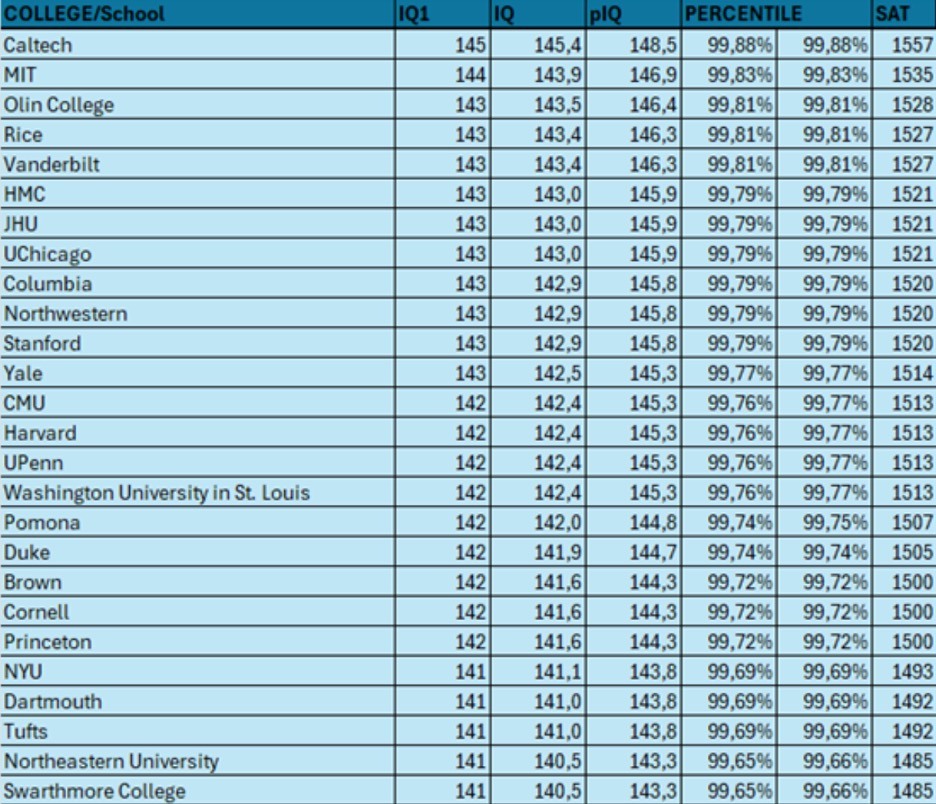
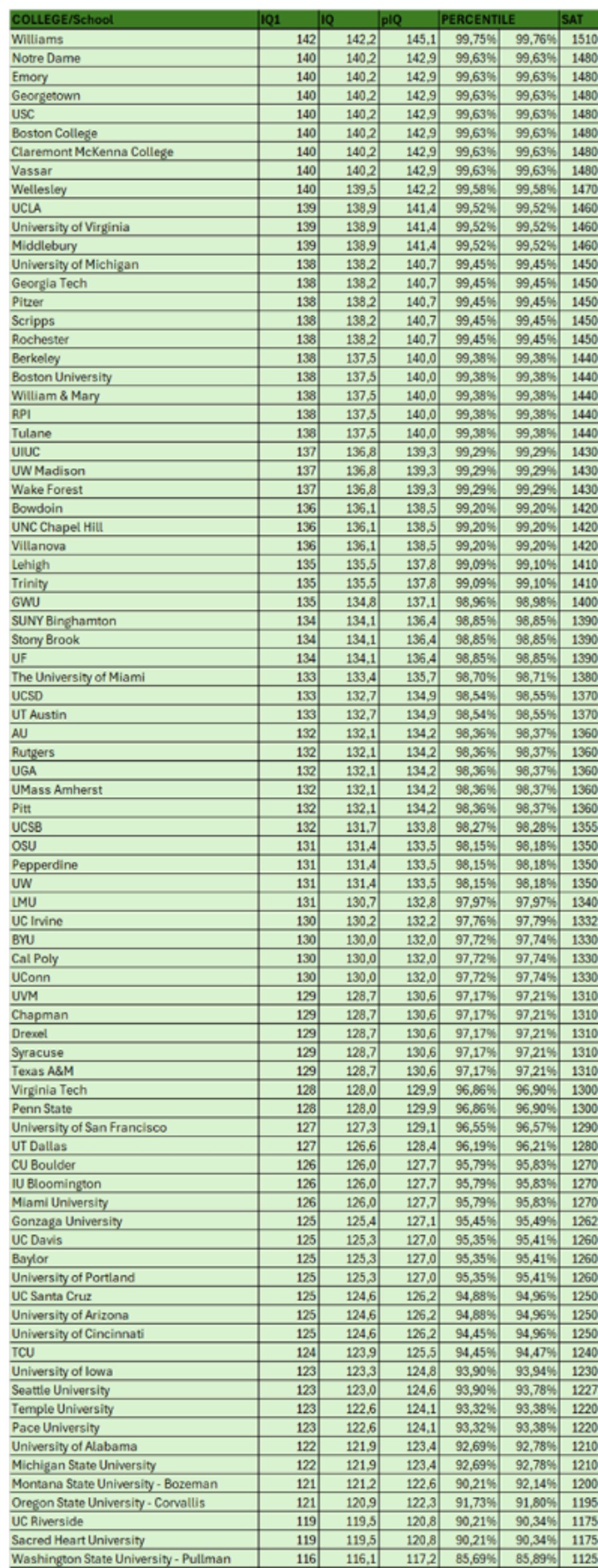
—
Português
Os escores obtidos em exames como SAT, GRE, Fuvest, Enem e similares podem ser convertidos em escores de QI, devido à similaridade do constructo medido e devido à forte correlação entre as pontuações nesses exames e nos principais testes de QI.
No Brasil não há estudos amplamente divulgados sobre correlação entre escores no Enem e QI ou entre Fuvest e QI, mas nos EUA são muito comuns tais estudos, inclusive há muitas formulas diferentes para converter QI em escores do SAT, GRE ou ACT e vice-versa. Algumas dessas fórmulas são baseadas em Teoria de Resposta ao Item, outras são baseadas em Teoria Clássica dos Testes, outras fazem ajustes personalizados. Há métodos específicos para SAT anterior a 1974, outros para o intervalo de 1974 a 1995 e outros para aplicações posteriores a 1995.
Isso torna possível conhecer o QI aproximado de praticamente qualquer pessoa que tenha ingressado numa universidade dos EUA, bem como se pode conhecer a média de QI nas diferentes instituições de ensino. Isso inclui os QIs de muitas personalidades famosas, todos os presidentes e grandes cientistas.
Esses números, porém, apresentam pequenas distorções, e em alguns casos não são pequenas, principalmente nas instituições nas quais o QI médio é mais alto. Isso acontece porque se a pessoa tem 180 de QI, mas o teto do SAT é cerca de 154, então o resultado registrado e computado para o cálculo da média será no máximo 154, achatando a média para um valor menor do que o verdadeiro. Isso sem contar que o fato de a pessoa ter 180 ou 190 ou 200 não garante que terá escore máximo, resultando em distorções ainda mais graves. Um dos melhores exemplos disso foi o Nobel de Física Richard Feynman, um dos maiores gênios do século XX, cujo QI era seguramente acima de 200, mas no exame aplicado na universidade obteve 123.
Outros proeminentes cientistas, inclusive ganhadores de Nobel, tiveram escores muito abaixo do correto, como William Shockley e Luis Walter Alvarez, que tiveram abaixo de 135, mas ambos foram laureados com o Nobel. Ainda que os méritos de ambos sejam discutíveis, pelo fato de haver trabalhos equivalentes que os precederam em mais de 10 anos, ainda assim é inquestionável que foram grandes cientistas, seguramente acima de 160 ou mesmo 170 de QI.
Distorções similares e ainda mais graves ocorrem entre ganhadores do Nobel. Algumas fontes, como o artigo de Garth Zietsman sobre a norma do Power Test, sugerem que o QI médio dos ganhadores do Nobel em Ciência seja de apenas 155, e os engenheiros do MIT tenham, em média, 144. Em 2001, escrevi um artigo discutindo tal distorção, e numa estimativa subjetiva, apontei como QI provável para ganhadores do Nobel cerca de 170 a 180 e no MIT cerca de 150 a 160. Esse fato se confirma quando pesquisadores no MIT ou ganhadores do Nobel resolvem testes de QI de alto nível, com teto mais apropriado.
O fato é que nas universidades nas quais o QI médio verdadeiro é mais alto, o QI médio medido é mais distorcido para baixo do que nas universidades onde o QI médio é menos alto, pois o teto dos testes distorce mais gravemente nas populações com maior QI, já que o limite assintótico é o mesmo, portanto “rouba” mais pontos de quem tem QI maior.
Nesse artigo aplico um pequeno ajuste para corrigir essas distorções nos QIs das principais instituições de ensino nos EUA, com base na frequência relativa de QIs acima do teto do SAT e que tiveram avaliações abaixo da correta. Outros fatores também poderiam ser considerados para uma correção mais refinada, considerando self-selection das pessoas que fazem tais exames, pois não são representativas da média geral da população. De outro lado, esses exames não medem o próprio QI, e a divergência entre a variável medida e o QI aumenta nos escores maiores. Supondo que esses dois efeitos se compensem aproximadamente, resta corrigir o problema citado nos parágrafos acima, embora, naturalmente, haja também outros detalhes que precisariam ser considerados para uma revisão mais completa e mais acurada.
Se você está curioso para conhecer seu QI em comparação à média dos alunos dessas instituições, conheça nosso Sigma Test Light e nosso Sigma Test Extended. Conheça também nossos livros e artigos que abordam esse e outros temas.
A seguir, os resultados para os QIs médios das principais instituições de ensino:
Footnotes
None
Citations
American Medical Association (AMA 11th Edition): Melão Jr. H. On High-Range Test Construction 20: Hindemburg Melão Jr., Average IQ of students and teachers at top universities and schools in the United States. August 2024; 12(3). http://www.in-sightpublishing.com/high-range-20
American Psychological Association (APA 7th Edition): Melão Jr., H. (2024, August 22). On High-Range Test Construction 20: Hindemburg Melão Jr., Average IQ of students and teachers at top universities and schools in the United States. In-Sight Publishing. 12(3).
Brazilian National Standards (ABNT): MELÃO JR., H. On High-Range Test Construction 20: Hindemburg Melão Jr., Average IQ of students and teachers at top universities and schools in the United States. In-Sight: Independent Interview-Based Journal, Fort Langley, v. 12, n. 3, 2024.
Chicago/Turabian, Author-Date (17th Edition): Melão Jr., Hindemburg. 2024. “On High-Range Test Construction 20: Hindemburg Melão Jr., Average IQ of students and teachers at top universities and schools in the United States.” In-Sight: Independent Interview-Based Journal 12, no. 3 (Summer). http://www.in-sightpublishing.com/high-range-20.
Chicago/Turabian, Notes & Bibliography (17th Edition): Melão Jr., H. “On High-Range Test Construction 20: Hindemburg Melão Jr., Average IQ of students and teachers at top universities and schools in the United States.” In-Sight: Independent Interview-Based Journal 12, no. 3 (August 2024). http://www.in-sightpublishing.com/high-range-20.
Harvard: Melão Jr., H. (2024) ‘On High-Range Test Construction 20: Hindemburg Melão Jr., Average IQ of students and teachers at top universities and schools in the United States’, In-Sight: Independent Interview-Based Journal, 12(3). http://www.in-sightpublishing.com/high-range-20.
Harvard (Australian): Melão Jr., H 2024, ‘On High-Range Test Construction 20: Hindemburg Melão Jr., Average IQ of students and teachers at top universities and schools in the United States’, In-Sight: Independent Interview-Based Journal, vol. 12, no. 3, http://www.in-sightpublishing.com/high-range-20.
Modern Language Association (MLA, 9th Edition): Melão Jr., Hindemburg. “On High-Range Test Construction 20: Hindemburg Melão Jr., Average IQ of students and teachers at top universities and schools in the United States.” In-Sight: Independent Interview-Based Journal, vo.12, no. 3, 2024, http://www.in-sightpublishing.com/high-range-20.
Vancouver/ICMJE: Melão Jr. H. On High-Range Test Construction 20: Hindemburg Melão Jr., Average IQ of students and teachers at top universities and schools in the United States [Internet]. 2024 Aug; 12(3). Available from: http://www.in-sightpublishing.com/high-range-20.
License & Copyright
In-Sight Publishing by Scott Douglas Jacobsen is licensed under a Creative Commons Attribution-NonCommercial-NoDerivatives 4.0 International License. ©Scott Douglas Jacobsen and In-Sight Publishing 2012-Present. Unauthorized use or duplication of material without express permission from Scott Douglas Jacobsen strictly prohibited, excerpts and links must use full credit to Scott Douglas Jacobsen and In-Sight Publishing with direction to the original content.

 In-Sight Publishing