January
*Updated January 25, 2026*
Free of Charge: Freethought, Humanism, and Freedom of Expression (PDF)
Publication Date: January, 2026; Edition: 2nd; Formats: EPUB, Apple Books, PDF, Kindle.
ISBN: 978-1-0673505; Document Word Count: 28,331; Language: English.
Preface: Scott Jacobsen.
Free of Charge: Freethought, Humanism, and Freedom of Expression is an interview-based book by Scott Douglas Jacobsen and Dr. Herb Silverman that treats “freethought” not as a vibe but as a civic discipline—reasoning without supernatural premises, paired with a naturalist ethic aimed at the common good. Moving through a dozen long-form conversations, the book links philosophical foundations to real-world advocacy: how secular coalitions organize, how lobbying and civic engagement work in practice, and why freedom of expression (and its close cousin, freedom of speech) is not a luxury right but a structural support for pluralistic democracy. Anchored in the evolution of modern humanist statements—Humanist Manifestos I–III and the Amsterdam Declarations—the volume traces a consistent anti-authoritarian throughline: opposition to theocracy, to ideological dogmatism, and to any state machinery that treats people as raw material for “higher” ends. It maps the ethical logic behind open societies—robust disagreement without intimidation or violence—and situates these principles within international human-rights frameworks (including Article 19 of the UDHR and its legal relatives), alongside national protections like the U.S. First Amendment. Just as importantly, Free of Charge pushes humanism outward: toward non-Western traditions, indigeneity, and a universalism that earns its name by expanding who gets heard and who gets counted. With discussions ranging from “critical intelligence” and evidence-based moral revision to education as a democratic competency (logic, science literacy, sex education, and religion taught as philosophy rather than indoctrination), the book reads as both primer and field manual—part intellectual history, part rights-based toolkit for a world that keeps trying to reinstall old certainties like they’re security updates.
Witness and Record: On Complicity and Clergy Abuse (PDF)
Publication Date: January, 2026; Edition: 1st; Formats: EPUB, Apple Books, PDF, Kindle.
ISBN: 978-1-0673505-7-4; Document Word Count: 116,409; Language: English.
Preface: Scott Jacobsen; Forewords: Katherine Archer, Amos Guiora, Hermina Nedelescu, Melanie Sakoda.
Witness and Record: On Complicity and Clergy Abuse is a multi-jurisdictional, interview-based anthology by Scott Douglas Jacobsen that examines clergy abuse and the institutional complicity that allows it to persist. Structured as long-form conversations and reportage-adjacent essays, the book brings together survivor testimony, advocacy experience, and professional analysis to map how sexual abuse, spiritual abuse, and power-asymmetrical relationships are enabled through silence, procedural evasion, and failures of independent accountability. Across Orthodox contexts (with comparative attention to Catholic and other settings), the volume documents recurring patterns: disclosure and retaliation, internal investigations that function as damage control, grooming and coercion in pastoral relationships, and the downstream costs borne by individuals and communities. It also tracks reform efforts and public-policy friction points, including California’s SB 894 and broader debates over consent, exploitation, and criminal accountability for adult clergy abuse. The collection includes contributions and forewords from Amos N. Guiora, Hermina Nedelescu, Katherine Archer, and Melanie Sakoda, alongside interviews and pieces spanning research, advocacy infrastructure, and institutional reform. The result is a consolidated record?part documentation, part moral audit intended to make denial harder, patterns clearer, and accountability thinkable.
Short Reflections on Age and Youth: The Strange Arithmetic of Living (PDF)
Publication Date: January, 2026; Edition: 2nd; Formats: EPUB, Apple Books, PDF, Kindle.
ISBN: 978-1-0673505-6-7; Document Word Count: 24,712; Language: English.
Preface: Scott Jacobsen.
Short Reflections on Age and Youth: The Strange Arithmetic of Living is a compact, dialogue-driven meditation on how to live sanely while the calendar keeps doing its rude little forward-walk. Coauthored by Scott Douglas Jacobsen and Dr. Herb Silverman, the book unfolds as a sequence of intergenerational conversations—part freethought field guide, part moral inventory—built around a humanist, evidence-based skepticism that treats aging, youth, and modern life as practical problems rather than occasions for supernatural consolation. Moving from civic responsibility and community-building to misinformation, moral vanity, and the changing “feel” of time, these reflections argue for a workable ethic: cultivate epistemic habits for deciding what is true, commit to being and doing good without fanfare, and learn how to belong to one another in a fractured media ecosystem. Along the way, Silverman and Jacobsen keep the tone psychologically realistic—admiring moral exemplars while naming their flaws, defending science without technocratic smugness, and returning again and again to the ordinary virtues that actually scale: curiosity, restraint, service, humor, and accountability. The result is a modest counterweight to contemporary confusion and despair—an invitation to treat life’s strange arithmetic not as a cosmic riddle to be “solved,” but as a finite, shared interval to be used well.
Grand Secretary Jerry W. Kopp on Freemasonry in Alberta and Canada: Brotherly Love, Relief, and Truth (PDF)
Publication Date: January, 2026; Edition: 2nd; Formats: EPUB, Apple Books, PDF, Kindle.
ISBN: 978-1-0673505-5-0; Document Word Count: 11,408; Language: English.
Preface: Scott Jacobsen.
Grand Secretary Jerry W. Kopp on Freemasonry in Alberta and Canada: Brotherly Love, Relief, and Truth is a collected, dialogue-driven volume that treats Freemasonry not as a cartoonish conspiracy trope, but as a civic and moral practice—rooted in tradition, expressed through ritual, and measured by what members actually do in their communities. Structured as a sequence of interviews (presented in parts) that move from personal origins and institutional roles to public misconceptions and lived practice, the book tracks Kopp’s account of the Craft as a “way of life” with duties, hierarchies, and responsibilities—administration, governance, and stewardship of charitable funds—rather than a smoky backroom mythology. Along the way, it walks the reader through the contested and often misunderstood terrain: how symbols and pass-phrases emerge from practical history and social trust, how charity operates (and why it is not supposed to be a vanity project), how educational support is framed as public-minded outreach, and why Freemasonry remains a magnet for accusations of “devil worship,” cultism, and grand plotting—claims Kopp treats as a misunderstanding of what the organization stands for. The through-line is ethical and methodological: brotherly love, relief, and truth as habits—done “without fanfare,” oriented toward self-responsibility rather than slogans, and aimed at strengthening the ordinary virtues of citizenship (honesty, service, restraint, and mutual respect) in a plural society where misconceptions travel faster than facts.
Philosophical and Historical Foundations of American Secularism: Founding Ideas, Key Conflicts, and Modern Stakes (PDF)
Publication Date: January, 2026; Edition: 2nd; Formats: EPUB, Apple Books, PDF, Kindle.
ISBN: 978-1-0673505-5-0; Document Word Count: 23,370; Language: English.
Preface: Scott Jacobsen.
Philosophical and Historical Foundations of American Secularism: Founding Ideas, Key Conflicts, and Modern Stakes is a collected, dialogue-driven volume that treats American secularism not as a slogan but as a lived argument—built from history, sharpened by law, and stress-tested in public life.
Structured as fifteen escalating conversations—moving from origin stories and “how we got here” to the messy work of pluralism, power, and policy—the book tracks the arc from colonial theocracies and the Enlightenment experiment to the constitutional machinery that made a godless republic possible (no religious test, no establishment, no backdoor “Christian nation” retrofit).
Along the way, it refuses the tidy textbook version of “secular progress” and instead walks through the contested terrain: anti-Catholic politics and the evolution toward non-religion, colonization and its ethical wreckage, Black history as American history, presidents as symbols and strategies, minority religions as both friction and safeguard, women’s freethought, everyday prejudice below the podium, and the slow emergence of modern scientific skepticism as a civic style of mind.
The through-line is methodological rather than devotional: how to separate validity from truth, rights from vibes, and coalition from tribal theatre—so that freedom of conscience becomes a practical discipline, not a decorative ideal.
Short Reflections on Secularism: Mathematical Philosophy Meets Secular Politics (PDF)
Publication Date: January, 2026; Edition: 2nd; Formats: EPUB, Apple Books, PDF, Kindle.
ISBN: 978-1-0673505-3-6; Document Word Count: 34,568; Language: English.
Preface: Scott Jacobsen.
“Short Reflections on Secularism: Mathematical Philosophy Meets Secular Politics” is a collected volume of extended, dialogue-driven pieces tracing the public life and intellectual method of one of American secularism’s most durable organisers, who is also, less widely recognised, a distinguished professor of mathematics. Structured to build in complexity from biographical grounding to practical civic strategy and then to philosophical reflection, the book follows Silverman’s trajectory from a Jewish upbringing in an Orthodox and cultural milieu to coalition-building, public advocacy, and rights-based challenges in the Bible Belt. Across the secularism sections, the emphasis is unapologetically practical: equal citizenship, church–state separation, minority rights, media literacy, and the strategic discipline of choosing battles without turning disagreement into tribal theatre. The mathematics and philosophy-of-mathematics sections are not decorative “STEM cameos,” but a compact epistemic toolkit—limits, proof, axioms, infinity, paradox, the difference between formal validity and truth about reality, and why abstract structures can unexpectedly map onto the physical world—pressed into service as a way of clarifying assumptions, resisting reification, and rebuilding better arguments in theology and politics alike. The through-line is neither slogan nor cult of personality, but method and responsibility: how a life trained in proof can still be animated by compassion, how movements outlast founders, and how, in an indifferent universe, ethics becomes a human project with real-world consequences.
The Good Men Project: Compendium XII (PDF)
Publication Date: January, 2026; Edition: 1st; Formats: EPUB, Apple Books, PDF, Kindle.
ISBN: 978-1-0673505-2-9; Document Word Count: 105,050; Language: English.
Preface: Scott Jacobsen.
The Good Men Project: Compendium XII is a record of public-ethics writing built from interviews, commentary, and close readings of accountability texts. Moving from the Beijing Platform for Action’s provisions on women’s health and violence to CEDAW Articles 25–26 and Canada’s Truth and Reconciliation Commission Calls to Action, the volume treats policy language as lived stakes. Interwoven are conversations with advocates and dissidents—among them Gissou Nia on human rights leadership and Waleed Al-Husseini on ex-Muslim organizing—alongside essays and “Ask” columns on demography, secular life, and terrorism debates. Each chapter stands alone: a document, an argument, a practical prompt for action.
Academic Women: Voices and Trajectories (PDF)
Publication Date: January, 2026; Edition: 1st; Formats: EPUB, Apple Books, PDF, Kindle.
ISBN: 978-1-0673505-1-2; Document Word Count: 89,661; Language: English.
Preface: Scott Jacobsen.
Academic Women: Voices and Trajectories is a collected volume of long-form interviews tracing the intellectual lives, research programs, and ethical commitments of women working across disciplines. Developed from work connected to the Ethics Center at the University of California, Irvine, beginning with the author’s Francisco Ayala Scholar appointment and later fellowships, these conversations foreground the lived realities of academic development alongside questions of public responsibility and evidence-based thinking. The volume features interviews with scholars and practitioners spanning psychology, memory research, decision science, medicine, literature, and economics, including (among others) Elizabeth Loftus, Susan Blackmore, Carol Tavris, Wendy Suzuki, Azra Raza, Hawa Abdi, Athene Donald, and Deirdre Nansen McCloskey. Each chapter stands as its own narrative and argument: interviewees recount educational pathways, formative influences, controversies in their fields, and practical advice for students navigating an increasingly demanding academic landscape. Across the collection, the through-line is neither slogan nor single thesis, but trajectory: how expertise is built over time, how intellectual courage is maintained under institutional pressure, and how women thinkers convert training into contribution.
A Further Inquiry 1: Identity, Allegiance, and the New Rhetorics of “Us” and “Them” (PDF)
Publication Date: January, 2026; Edition: 1st; Formats: EPUB, Apple Books, PDF, Kindle.
ISBN: 978-1-0673505-0-5; Document Word Count: 98,425; Language: English.
Foreword(s): Mathew Giagnorio.
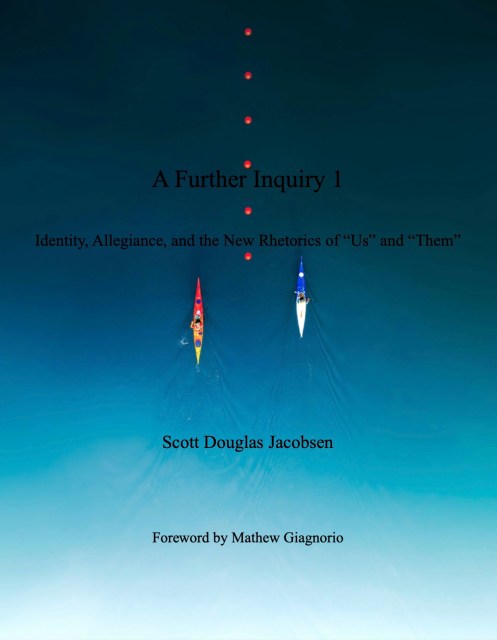
A Further Inquiry 1: Identity, Allegiance, and the New Rhetorics of “Us” and “Them” is a collected volume. It compiles long-form interviews, analytical essays, and reported pieces examining how identity, loyalty, and moral narratives shape contemporary public conflict. Topics include antisemitism and Israel–Palestine discourse; American secularism and church–state debates; Canadian economic indicators and trade uncertainty; student affordability advocacy; counterterrorism and radicalization; far-right extremism; cultural psychology and therapy; assisted dying law; ancestry and racial categories; and the role of journalism in contested moral claims. Several pieces present multi-part conversations with specialist guests, while others provide chronologies, issue briefs, or thematic syntheses. The volume also includes short creative interludes alongside policy and analysis. Across these varied formats, the book documents how public arguments are framed, how allegiances are demanded, and how complex realities are reduced into binary categories. The collection is presented as a record of inquiry rather than a single thesis, with each chapter standing on its own sources and claims. A foreword by Mathew Giagnorio situates the project in a tradition of disagreement and warns against substituting slogans for evidence in pluralist democracies in our time now.
Last updated May 3, 2025. These terms govern all In Sight Publishing content—past, present, and future—and supersede any prior notices. In Sight Publishing by Scott Douglas Jacobsen is licensed under a Creative Commons BY‑NC‑ND 4.0; © In Sight Publishing by Scott Douglas Jacobsen 2012–Present. All trademarks, performances, databases & branding are owned by their rights holders; no use without permission. Unauthorized copying, modification, framing or public communication is prohibited. External links are not endorsed. Cookies & tracking require consent, and data processing complies with PIPEDA & GDPR; no data from children < 13 (COPPA). Content meets WCAG 2.1 AA under the Accessible Canada Act & is preserved in open archival formats with backups. Excerpts & links require full credit & hyperlink; limited quoting under fair-dealing & fair-use. All content is informational; no liability for errors or omissions: Feedback welcome, and verified errors corrected promptly. For permissions or DMCA notices, email: scott.jacobsen2025@gmail.com. Site use is governed by BC laws; content is “as‑is,” liability limited, users indemnify us; moral, performers’ & database sui generis rights reserved.

 In-Sight Publishing