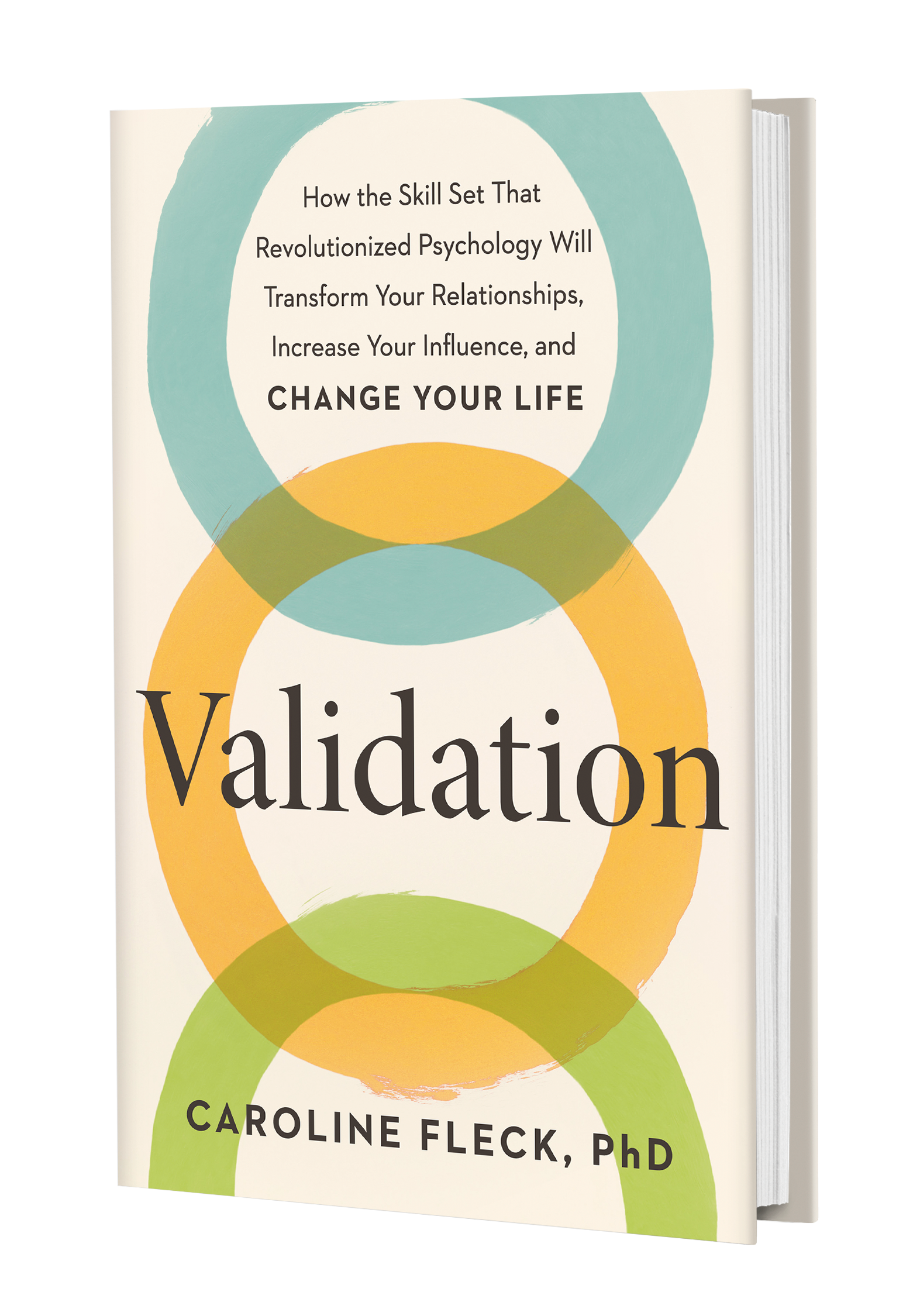
Dr. Caroline Fleck, ‘Validation’ and Dialectical Behavioral Therapy
Author(s): Scott Douglas Jacobsen
Publication (Outlet/Website): The Good Men Project
Publication Date (yyyy/mm/dd): 2025/04/01
Dr. Caroline Fleck, a licensed psychologist and clinical instructor, explains her groundbreaking book, Validation, (Amazon) and its roots in dialectical behaviour therapy (DBT)–cheat sheet. She outlines how validation balances change with acceptance, offering a transformative approach to treating conditions like borderline personality disorder. Fleck details how traditional therapies often dismiss genuine emotional experiences, fostering self-doubt and internalized blame. She emphasizes the need for mindful, empathetic communication that validates feelings and nurtures self-compassion, enabling individuals to challenge societal pressures and cultural norms that promote inauthenticity. Fleck also examines how parenting and even religious systems contribute to pervasive invalidation, advocating for a balanced approach that encourages acceptance and change. Her insights underscore the potential for meaningful transformation when emotions are authentically recognized and supported.
Scott Douglas Jacobsen: So today, we are here with Caroline Fleck, PhD, a licensed psychologist, clinical instructor at Stanford University, and highly sought-after business consultant. She holds a doctorate in psychology and neuroscience from Duke University and a BA in English and psychology from the University of Michigan.
She combines academic rigour with practical experience and is renowned for her expertise in dialectical behaviour therapy (DBT) and cognitive behavioural therapy (CBT). Caroline has transformed lives by empowering individuals to build stronger relationships and foster self-compassion. Her groundbreaking book, Validation, distills complex psychological principles into actionable skills that create lasting change in both personal and professional realms.
Caroline innovates, educates, and inspires globally—and occasionally does interviews with Canadians. Let’s get started with an overview question. What inspired you to write Validation? And can you share some of your journeys in getting Validation on bookshelves and grounding it in your expertise?
Dr. Caroline Fleck: Yes, so, Validation is a fascinating concept and a set of skills that revolutionized the field of clinical psychology when it started gaining recognition in the 1990s. These skills were introduced through dialectical behaviour therapy (DBT), which incorporated validation techniques to help therapists communicate acceptance.
Typically, behavioral therapies are very change-oriented. The goal is to change how someone thinks or behaves to alleviate symptoms and, ideally, treat them. What DBT did differently was balance this emphasis on change with a corresponding emphasis on acceptance.
And holy crap was that effective.
For the first time in history, we had a treatment that proved effective in addressing conditions like borderline personality disorder, suicidality, and self-harm—issues that had previously been considered untreatable. This led to a revolution. Well, a loud revolution within psychology, though outside the field, few people have heard about it.
As a dialectical behaviour therapist, I have witnessed firsthand the power of these skills—their effects on patients and their impact on how we think about psychology at large. It blows my mind that no one has written a book or talked about this more openly outside of academia or the mental health field. Until now, these skills have primarily been reserved for DBT therapists.
My mission, my ambition, was to raise their public awareness because they create meaningful change in nearly every relationship imaginable.
Jacobsen: Now, if you were to take a pre- and post-treatment snapshot of professional discussions before this methodology was recognized as effective, how would professionals have talked about borderline personality disorder or suicidality when these conditions were considered “untreatable”?
Fleck: Borderline personality disorder (BPD) is a particularly interesting case because it is perhaps the most stigmatized disorder in all of mental health. Frankly, in part, because we couldn’t treat it, we started to— in my opinion—blame the victims, unfairly placing the responsibility on individuals who had this disorder.
Now, it didn’t help that part of the criteria for BPD includes extreme mood swings, irritability, anger, and oscillating between loving and hating people. This can be a very difficult population to work with, that is for sure. But before DBT—and even still, frankly—the language clinicians and licensed professionals use to describe these patients is often veryalarming. You hear things like, “You don’t want too many borderlines on your case,” or “I don’t take borderlines; I don’t like being sued.”
People have said these things to me, even post-DBT. But before that, it was just accepted that this was an unworkable, untreatable group and that clinicians should avoid them at all costs in their practice. Fortunately, DBT—and validation in particular—has challenged us to adopt a more nonjudgmental, objective way of discussing and conceptualizing the condition.
But before that, I mean, it wasn’t good.
Jacobsen: Part of that nonjudgment comes from not essentializing people. I’ve noticed this a bit—it’s like when someone breaks a leg, and you say, “Why can’t you run? Start running! Oh my gosh, pick it up. Walk it off!” That’s the physical equivalent of what’s happening in mental health, alarmingly, from professionals, especially regarding some of these very severe incidents of mental illness.
Fleck: My head went in a million different directions—one, that’s an extremely astute point. Because what you’re describing is invalidation, right? These individuals are experiencing not only invalidation from their environment but also from trained professionals. They are being invalidated in their struggle.
No one says, “It makes sense that this is so hard. I understand why you’re struggling in this way.” Instead, as you described, the message is as if you’re telling someone with a broken leg to run: “What’s wrong with you?” That is incredibly damaging.
This is particularly important because borderline personality disorder (BPD) occurs at exponentially higher rates in individuals with a history of childhood sexual abuse. Invalidation is part of the etiology. Coming from an invalidating environment is part of what gives rise to this condition.
And then, to layer even more invalidation on top of it—you can see just how hard it is for someone to get out from under it.
Jacobsen: I just gave a talk yesterday before leaving for New York to a Christian group in Croatia. I’m not religious—I’m a humanist—but the focus was on how to combat clergy-related abuse.
One thing that came up from a colleague of mine was that the primary demographics of victims are young boys and adult women. Those populations and how they are treated when they come forward with claims follow the same framework. The ideology behind it reflects how we handle people who report abuse. Yes, false allegations happen—but they are very, very rare.
So right off the bat, the assumption should likely be true, statistically speaking. We’re not even being generous here—just in terms of prevalence. Yes, we should assume that the person is telling the truth.
Yet, if someone has these kinds of issues—whether it’s suicidality or a series of comorbidities that come with this complex of interrelated symptoms—there is often a structural correlate in how the brain is networked due to trauma or possibly some genetic precursor, whatever the cause may be.
How does DBT, and some value framework, help take advantage of our plasticity so that people can—maybe not completely transition to a healthier state of mind—but at least mitigate some of the more extreme symptoms of their condition?
Fleck: Well, part of what we’re doing—through validation in particular—is addressing the consequences of pervasive invalidation. For example, consider the experience of childhood sexual abuse, where the very people who are supposed to care for and protect you are mistreating or abusing you.
In these situations, when someone is pervasively or even severely invalidated, as is the case with abuse, they do not learn to trust their own emotions. They are told that their emotions are wrong—that they shouldn’t be feeling the way they do, that they should walk it off, or that they shouldn’t talk about it.
The underlying message is: Don’t trust your emotions.
As adults—or even in the aftermath of those experiences—these individuals often do not know how to validate their own emotions. They don’t know what they’re feeling or whether they should be feeling it. As a result, they frequently defer to the environment for cues on how they should act, think, or feel.
One of the most powerful things validation does is help people start to trust their read of a situation.
Unfortunately, although this issue is very pronounced in individuals who come from pervasively invalidating environments, my experience has been that most adults struggle with self-validation. Perhaps not to the same extreme—some may have a greater sense of emotional awareness and regulation—but as a culture, we are not great at self-validation.
We are good at problem-solving; that’s what we are wired for and trained to do. However, we do not recognize the validity of our experiences and emotions very well. That’s one of the reasons I wanted to bring these skills into broader discussions if that makes sense.
Jacobsen: Let’s say someone comes to you in your practice. They don’t necessarily have a formal diagnosis. Still, they exhibit a few key risk factors that suggest they might be heading in that direction.
And you see a pervasive sense of self-doubt—meaning they are consistently self-invalidating in their internal dialogue. How do you walk them through a session to help them start recognizing their emotions? How do you guide them to the point where they can say, “No, I do feel sad or anxious or bad about this. This was wrong—what this person did to me was wrong,” and so on?
Fleck: This morning, I had a session with a client, a mother who was beating herself up for forgetting to bring baked goods to her child’s school. She had signed up on the list of parents who were supposed to bring items, but she forgot.
She was subjecting herself to intense self-criticism and self-loathing. Honestly, anyone with that kind of inner voice would feel awful.
So, instead, I guided her toward looking at the valid reasons why she may have forgotten. Okay, let’s examine what’s valid here. You have three kids, you didn’t write it down, and you had other responsibilities—X, Y, or Z.
People often start getting nervous at that point because they think, “That sounds like making excuses.”
But that’s not what we are doing.
Jacobsen: Does their anxiety go up at that point?
Fleck: Yes, it absolutely can, depending on the person.
But I need to argue that if we want to prevent this from happening again, we need to understand the chain of cause and effect that led to this moment. That’s my entry point. And really, what I want them to do is begin to understand what led to this behaviour.
“Okay. All right. Now, you’re feeling guilty. Why are you feeling guilty? Let’s trace that back. If I were in your shoes, I’d feel guilty, too, given what you’re telling yourself. But if we look at the facts, does it make sense for you to feel this guilty? Does this degree of guilt fit the circumstances? I don’t think so.”
So I want them to say, “I can see why I feel guilty. I’m beating myself up. In some sense, it’s valid that I feel guilty. But also, I probably shouldn’t be beating myself up this much given the circumstances.” So, it’s this constant process of tracing cause and effect to determine what is valid here.
Jacobsen: Now, we’ve evolved a lot of cognitive systems; and I assume that, more or less, they tend to lean toward some homeostasis when working together. You can see that in what we now refer to as mental health. So, what goes awry in individuals who blow things way out of proportion?
For example, someone may be going through life, having a child, being a mom, baking something for school, and suddenly ending up in your office overwhelmed. What has gone wrong in that system—something that is probably evolutionarily useful but, in this context, unhelpful?
Fleck: Well, I see the roots of that developing much earlier in life. I also work a lot with parents. As a parent, I can completely relate to the innate urge to solve my child’s problems.
For example, let’s say my daughter tries out for the soccer team and wants to make it. But I know she didn’t practice consistently—she tried to cram it all in the day before tryouts when she needed more preparation.
When she’s disappointed that she didn’t make the team, my instinct is to focus on what she could do better next time. My instinct is to problem-solve—to help her figure out how to change the situation.
Why? Because I don’t want her to hurt. I want her to make the team and see things she could do differently to achieve that goal. But in doing this, I am teaching her to do the same thing to herself.
When she feels disappointed, she does not think, “Oh, it makes sense that I’m disappointed. I was really looking forward to this. I wanted to be on the team. Of course, I feel this way.”
Instead, she’s learned to immediately analyze what she did wrong and what she needs to do better next time. And if that pattern is reinforced repeatedly over time, by the time my child is 35 and forgets to bring baked goods to school, her inclination will not be to validate her emotions.
Instead, she’ll instinctively problem-solve what she did wrong and chastise herself for making a mistake. Does that make sense? I see the roots of this pattern forming very early in life.
When I work with parents, I’m not kidding—three-quarters of my work is focused on helping them validate their children’s emotions. That’s not to say they can’t problem-solve, but we need to create space for emotions first. It’s okay to be disappointed. I would be disappointed, too. That’s sad. That’s really frustrating. But we, as a culture, have difficulty sitting with our children’s negative emotions. Unsurprisingly, they grow up struggling to accept and regulate those emotions as adults.
Jacobsen: In one of your earlier responses, you hinted at a broader social issue—how our culture tends to invalidate people, at least enough for them to end up in your office. What are we doing, as a culture, that fosters so much self-invalidation? What mechanisms are we reinforcing that make people internalize these invalidating patterns?
Fleck: You touched on a huge source of cultural invalidation, which, for many people, can be the church. If you’ve been abused within a religious system, that experience can be profoundly confusing and invalidating. But even beyond abuse, there’s often this ingrained sense of Because I’m attracted to the person I’m attracted to, or because I like the things I like, I must be bad. I shouldn’t be this way. I shouldn’t be who I am. Religion, of course, can drive that message in deeply, but we see this pattern reinforced in different ways. Society repeatedly tells us that you should not be who you are. There’s something inherently wrong.
I remember attending a Tara Brach workshop years ago, and she did something I thought was incredibly risky—something I, as a therapist, would probably never do. She had the entire room close their eyes and said, “Now, raise your hand if you feel something is wrong with you.” Then she told everyone to open their eyes. Nearly every single person had their hand up. That was the moment that stuck with me. That is what I’m talking about.
We live with this pervasive sense that something is fundamentally wrong with us—something bad at our core. What validation communicates, instead, is acceptance. It says, “I see you. I hear you. I get you.” That is the message I don’t think we, as a culture, are skilled at providing—to ourselves or others. And that’s what I hope to achieve with my book.
Jacobsen: One concept that has come up a lot recently in conversations and writing is authenticity. Are many of these systems you’re hinting at essentially inauthenticity drivers—in the sense that people are conditioned to distrust themselves and self-invalidate? Are they absorbing the belief that their entire persona and psyche are wrong somehow, or at least in part? Another question came to mind, but I just lost it—sorry.
Fleck: No, that’s okay. If it comes back, great. If not, that’s fine too. And I love your questions.
On that first one, you’re touching on something that makes it difficult to wrap their heads around regarding validation: Isn’t validation just praise? We’ve spent our whole lives being told never to seek external validation. And I need to hammer this home—validation is not praise.
Praise causes people to contort and distort themselves in all sorts of ways to meet or exceed expectations. That’s not what validation communicates. And you’re absolutely right—so many systems in our culture reinforce this confusion. Look at social media. People think they are “seeking validation,” but they’re actually seeking and responding to praise—likes, thumbs-ups,heart emojis, etc.. And then they start changing or distorting themselves—with filters and curated posts—so they can obtain that heart emoji.
In the process, they lose themselves. It’s fascinating because I see all this discourse on TikTok—like #WomenWhoRelyOnMensValidation—and I think, if only they were actually getting validation.
Jacobsen: We see this play out on both the left and right; these dynamics even have explicit terms. They hold some utilitarian value for people at different points in their lives, helping them reach certain goals. But ultimately, they turn into caricatures.
One example—on both ends of the spectrum—is the rise of “trad wives” on one side and “boss girls” on the other. Personally, my sociopolitical bias leans toward the latter, but I think both of these archetypes ultimately drive women toward inauthenticity.
Oh, and I remembered my other question. If people don’t trust their judgment, they aren’t validating their sense of reality. That means their reality testing—their ability to assess what is true—is compromised. So, beyond just a loss of internal validation, does this leave them vulnerable to exploitation?
Fleck: One hundred percent. And that is exactly what happens. The more you defer to your environment to tell you what you should be thinking or feeling, the more vulnerable you are to that environment exploiting you—because it’s easy to do so.
And it doesn’t just happen in an ideological sense; it happens at all levels. You can be manipulated into buying things you don’t need, subscribing to belief systems that don’t serve you, or contorting yourself to fit into moulds that aren’t aligned with who you truly are. This kind of exploitation isn’t going to be in service of your true self—because why would it be? It’s much easier for an external force to tweak you into being a “better” version of yourself, a version that better serves them.
Jacobsen: How does mindfulness play into all of this?
Fleck: Mindfulness is a core part of validation. When I validate someone, I am mindful of them. And by mindful, I don’t just mean being present—I mean being nonjudgmental, simply aware of what is happening. It also involves understanding and empathy.
But here’s the key: You cannot validate someone without paying attention to them. You just can’t. And that’s one of the biggest issues we’re facing right now.
I’m trying to think of the right word for it… but attention is the most precious resource we have right now. And yet, we are bleeding it out everywhere.
We’re losing our attention to all these different devices, apps, and distractions, and in doing so, we’re pulling that attention away from the people we would otherwise be giving it to. I see it in something as simple as people who think they can multitask—saying, “I’m listening while I’m typing a text message.” But the reality is, they aren’t communicating that they’re listening. That’s not what comes across when someone is staring at their phone. And ultimately, validation is about communication. It’s about communicating some degree of acceptance—I see and hear you. But you do not see someone when your attention is pulled elsewhere.
Jacobsen: Not all communication is speech—it’s active listening, too.
Fleck: Exactly. At the most basic level, some mindfulness is always required for validation.
Jacobsen: You’ve mentioned mindfulness, validation, and your work with clients, but I wanted to ask—have you personally experienced depression? I’ve had a history of major depression a long time ago, and long-term mild anxiety. It probably didn’t help that I drink coffee, but I’ve channelled it into writing, so that’s my productive outlet. What about you? If you’re open to discussing it, how has your experience shaped your approach to validation in therapy? How do you communicate these ideas in writing?
Fleck: Yes, I struggled with depression from about 15 to 26—so at least a solid decade. That’s a long time. So long that I forgot what anything else felt like. And I did all the things—I went to therapy, I tried medication—and nothing worked. Eventually, I thought, I’m going to figure out how to treat depression myself. I’ll just become a doctor.
A big part of my reaction was how invalidating most of the therapy I had received felt. I didn’t feel heard—I felt judged. I felt, honestly, like what you described earlier with the broken leg analogy, as if I were being told, “Why don’t you just run?” That was the message I received, and it completely confused me. It made me blame myself so profoundly for not getting better.
So, when I went to grad school, my original plan was to study depression. That was my focus. But at the same time, I was really into meditation because out of everything I had tried, meditation was the one thing that seemed to help. It didn’t necessarily cure the depression, but it gave me just enough distance from my judgmental mind. And I thought, “There’s something here. I need to explore this.”
Dialectical behaviour therapy (DBT) was the first therapeutic approach to incorporate mindfulness as a core part of treatment. That was a huge draw for me—I had to study it. I ended up going deep into DBT, and in the process, I learned how to validate other people. It’s a required part of the training—you must prove that you can effectively use these skills with patients.
And wouldn’t you know it—I developed the ability to validate myself over time. That was incredibly powerful for me, and it has been essential in buffering against some of my mental health struggles.
Jacobsen: Switching gears a bit—here we are at CSW69 with Beijing+30, thinking about it. Are there gendered aspects to invalidation? I’m aware that some psychiatric diagnoses have seen shifts in the ratio of prevalence between men and women over time. For example, narcissism seems to be balancing out between genders, which is not the kind of parity we need.
But are the ways society invalidates men and women different? And are the ways men and women self-invalidate different? Is it significant enough to be worth commenting on?
Fleck: Yes, I mean, what doesn’t get talked about enough is how men experience invalidation. How women are invalidated has been well-documented, and we have a clearer understanding of how that contributes to mental health struggles. But with men, we tend to see the invalidation of their emotional worlds—and often, the direct punishment of emotional expression.
It’s not always in overt ways, like “I’ll give you something to cry about.” More often, it’s subtle—even within peer groups—this pervasive sense that certain emotions are off-limits. That you can’t and shouldn’t feel certain things. And that kind of message, given repeatedly, creates a profound sense of invalidation. It makes it difficult to recognize, manage, express, or even accept emotions when they do arise.
Jacobsen: The rhetorical question is: How do you validate an emotion when you don’t even have the language to identify it?
Fleck: This is one of the coolest things about mastering validation skills. If I get it right, one of the most powerful, validating things I can do is to look at someone and say, “Oh, you’re devastated. Of course, you are. That makes perfect sense.”
The act of naming an emotion—one they may not have even identified themselves with—can be incredibly profound. When you get it right, it’s like, on some level; you know them better than they know themselves. That’s an incredibly high level of validation to pull off.
The great thing is that a person doesn’t necessarily need to have an advanced vocabulary foremotions in order to be validated. They don’t even need to fully understand what they’re feeling. For someone to validate themselves, they would eventually need to develop that awareness. Still, for me to validate them, I can put into words what I presume they are experiencing.
Of course, if you get it wrong, it backfires. The person might feel completely unseen—like, “No, I’m not devastated. I’m just hungry.” And that’s fine. You drop down to an easier level and try again. But fundamentally, people don’t need the perfect vocabulary to receive validation.
Jacobsen: And for women?
Fleck: Oh, boy. It’s another level entirely. Women are constantly told they’re too dramatic, too upset, and too emotional. There’s this idea that emotions drive everything they say or do. Any strong desire or conviction they have is often dismissed as irrational.
I can only speak from personal experience here. Still, as a woman, I have internalized the message that my emotions undermine my thoughts and opinions. That my emotions make my reasoning less valid. If I’m frustrated, I’m being a bitch. If I express concern, I’m jealous. If I call something out, I’m overreacting.
And the problem is, when you hear those messages repeatedly, you start to doubt yourself. You start to feel like even your most rational, well-thought-out ideas will be minimized or dismissed just because you express them.
Then there’s another layer—the invalidation of women’s entire personhood. Beyond being seen as emotional, women are often only viewed through the lens of their sexuality. That’s tough for people to wrap their heads around, even today. So much of who we are, outside of sex and attraction, isn’t acknowledged, reinforced, or valued. And that creates massive distortions in how women are seen—and in how they see themselves.
In many ways, I think the invalidation that women experience is more visible and easier to identify. That’s often the case when a group has been historically oppressed. Because, at its core, oppression is the language of invalidation. It is systematic invalidation.
Jacobsen: You’ve mentioned family dynamics before and talked about how this starts early. Based on your experience with parenting and therapy, when would you say invalidation begins? At what age, do we start absorbing these patterns?
Fleck: Yes, I talk about this in my book—I give an example of a young child, maybe two or three years old, who’s told they’re about to have a baby brother or sister. They get so excited that they can’t wait. And then the baby arrives… and suddenly, they hate the baby. They lash out. I remember my brother getting mad at my mom and saying, “I wanted a puppy.”
Jacobsen: My sister wanted a sister and got a brother, and my brother wanted a dog and got a brother.
Fleck: Oh, man. So, for you, it started early.
Jacobsen: Yes.
Fleck: As parents, our instinct is often to say, “No, you don’t hate your brother. You love him.” Or, “You don’t feel that way; you’re just excited!” But right out of the gate, we are telling them what they are feeling is wrong. We’re overriding their emotions, dismissing what they express, and replacing it with what we want them to feel.
We have the power to do this because, as adults, we have bigger brains, more logic, and a broader understanding of the situation. But the child’s emotions are real to them. And when those emotions manifest as tantrums or resistance, we tend to push even harder to correct their experience. We don’t mean to invalidate them—we think we’re helping—but our message is: “What you’re feeling isn’t real or valid.” That pattern can start very early.
Jacobsen: I grew up in a small town, and many of my friends were older—especially older women. One thing I noticed, which seems to be pretty pervasive, is that past a certain age, there’s this cultural shift where women seem to disappear. It’s almost exponential—first, they fade into the background, and then they fade into the background of the background.
Other cultures handle aging differently, but in North America, once someone’s predefined role is no longer relevant, they just get shuffled off. “We don’t have a place for you anymore, so off you go.”
Fleck: Absolutely. And I think this overlaps with those issues around sexuality as well. In our society, if you are no longer conventionally sexually desirable, you start to disappear. If you no longer serve the function of mother, you start to disappear. The message is: “You’re not needed anymore. You don’t exist.”
It’s such a stark, black-and-white way of viewing people—as if these singular traits define their worth. And once those traits evolve, shift, or fade? So do they. They stop factoring into the social equation altogether. That’s what happens when we reduce people to these flat, singular dimensions. The moment they no longer check a particular box, they… disappear.
Shoulds—whether explicit or implied—are the antithesis of validation. A should suggests, “You should be something other than what you are.” And within that statement is the fundamental invalidation of who you are and what you’re experiencing.
It’s interesting when you start noticing the shoulds you impose—even just as a thought exercise. Look at how often we think: They should act this way. They shouldn’t act that way. They should vote this way. They shouldn’t think that way. These are constant, automatic judgments; there’s much to unpack in how they shape our perceptions of others.
To be clear, validation doesn’t mean endorsing everything about someone’s experience. I don’t have to validate all of it. I only have to find one thing that’s valid—maybe it’s their emotions, maybe it’s their thoughts, maybe it’s their behavior. Suppose I can authentically recognize one valid aspect of their experience and speak to that.hat is when the connection happens. That’s where change begins.
Jacobsen: One last question. Where is the theoretical foundation of psychological construct of “validation” limited? And with further research, how could it be refined and expanded? Because you’ve spoken about validation in a broad sense, are there gaps in the concept?
Fleck: Yes, we’ve seen this evolution in psychology. Carl Rogers—a major figure in the 1970s—was all about this concept of unconditional positive regard, which was essentially another way to describe validation. He believed that people will naturally grow into their fullest, actualized selves if they communicate enough validation.
Since then, we’ve found that while validation is crucial, it’s not enough. The impact is much greater when you combine validation with skills training, reinforcement, and other change strategies. For example, if a child falls off a bike, it’s validating to say, “Oh my gosh, that must have hurt. You must be so disappointed. You probably don’t want to ride anymore.” But at some point, you also need to follow up with, “Let me help you get back on the bike.”
That’s the key—it’s not acceptance or change. It’s acceptance and change. The real magic happens when you hold both polarities together, balancing them rather than seeing them as opposites. That’s how real growth happens.
Jacobsen: And with that, I’ll say—on the podium—thank you very much for your time. I appreciate it. It was great to hear your expertise.
Last updated May 3, 2025. These terms govern all In Sight Publishing content—past, present, and future—and supersede any prior notices. In Sight Publishing by Scott Douglas Jacobsen is licensed under a Creative Commons BY‑NC‑ND 4.0; © In Sight Publishing by Scott Douglas Jacobsen 2012–Present. All trademarks, performances, databases & branding are owned by their rights holders; no use without permission. Unauthorized copying, modification, framing or public communication is prohibited. External links are not endorsed. Cookies & tracking require consent, and data processing complies with PIPEDA & GDPR; no data from children < 13 (COPPA). Content meets WCAG 2.1 AA under the Accessible Canada Act & is preserved in open archival formats with backups. Excerpts & links require full credit & hyperlink; limited quoting under fair-dealing & fair-use. All content is informational; no liability for errors or omissions: Feedback welcome, and verified errors corrected promptly. For permissions or DMCA notices, email: scott.jacobsen2025@gmail.com. Site use is governed by BC laws; content is “as‑is,” liability limited, users indemnify us; moral, performers’ & database sui generis rights reserved.