[Review] Integrating Racial Justice into Your High-School Biology Classroom
Publisher: In-Sight Publishing
Publisher Founding: September 1, 2014
Publisher Location: Fort Langley, Township of Langley, British Columbia, Canada
Publication: Critical Science Newswire
Original Link: https://ncse.ngo/review-integrating-racial-justice-your-high-school-biology-classroom
Publication Date: October 18, 2024
Organization: National Center for Science Education
Organization Description: The National Center for Science Education promotes and defends accurate and effective science education because everyone deserves to engage with the evidence. One day, students of all ages will be scientifically literate, teachers will be prepared and empowered to teach accurate science, and scientific thinking and decision-making will ensure that all life can thrive and overcome challenges to our shared future.
By Glenn Branch
“[This book] is an excellent primer for those who would like to educate themselves on the complex historical interplay between history, science, and racial justice,” our reviewer writes.
“While bad (e.g., specious) science has historically oppressed people, good (e.g., robust) science can actually liberate them” (page 183). This passage, from the conclusion of Integrating Racial Justice into Your High-School Biology Classroom, succinctly summarizes the book’s thrust.
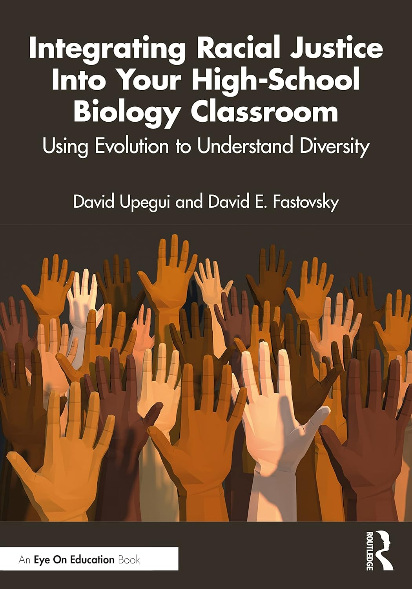 David Upegui (a science teacher) and David E. Fastovsky (a paleontologist) open their book with the argument that evolutionary theory is the best place to integrate racial justice into the K–12 curriculum. High school students are at the right developmental stage to discuss racial justice, and the history of evolution provides plenty of examples of specious and misappropriated uses of science for racial discrimination and oppression as well as the opportunity to highlight the nature of science and its self-correcting properties. They use the frameworks laid by critical scholars such as Paulo Freire, Henry Giroux, and Derek Hodson to argue that the purpose of general education, and science education specifically, is for students to use literacy for empowerment and liberation. By gaining an understanding of what modern evolutionary theory says about humanity’s diversity and interconnectedness, students can come to see how bad actors in the past relied on ignorant or biased assumptions to create false racial categories and stereotypes.
Through a series of suggested activities with accompanying articles and videos featuring scientists such as Joseph L. Graves Jr. (a member of NCSE’s board of directors) and Agustin Fuentes, Upegui and Fastovsky demonstrate ways in which these insights may be discussed in connection with teaching about evolution. These lessons also highlight the interdisciplinary nature of racial justice by combining the nature of science, specific evolutionary content, and an investigation of the historical, political, and economic factors that contributed to the past and present marginalization of certain groups in the United States and around the world.
The second half of the book provides teachers who choose to use these lessons an in-depth understanding of the history of racial oppression in the United States from the 17th century to the present, the history of “scientific” racism used to justify the trans-Atlantic slave trade and Jim Crow laws, the history of the development of evolutionary theory from before Darwin up to the present, and an overview of pedagogical practices for including racial justice in biology classes. While not all teachers will be willing or able to use the lessons in this book in their classrooms, it is an excellent primer for those who would like to educate themselves on the complex historical interplay between history, science, and racial justice.

Short Bio
Blake Touchet is NCSE’s Interim Director of Science Education.
License
In-Sight Publishing by Scott Douglas Jacobsen is licensed under a Creative Commons Attribution-NonCommercial-NoDerivatives 4.0 International License.
Based on work at www.in-sightpublishing.com.
Copyright
© Scott Douglas Jacobsen and In-Sight Publishing 2012-Present. Unauthorized use and/or duplication of this material without express and written permission from this site’s author and/or owner is strictly prohibited. Excerpts and links may be used, provided that full and clear credit is given to Scott Douglas Jacobsen, or the author(s), and In-Sight Publishing with appropriate and specific direction to the original content. All interviewees and authors copyright their material, as well, and may disseminate for their independent purposes.

 In-Sight Publishing