Explained: terminal illness and incurable suffering in assisted dying laws
Publisher: In-Sight Publishing
Publisher Founding: September 1, 2014
Publisher Location: Fort Langley, Township of Langley, British Columbia, Canada
Publication: Freethought Newswire
Original Link: https://humanists.uk/2024/09/30/explained-terminal-illness-and-incurable-suffering-in-assisted-dying-laws/
Publication Date: September 30, 2024
Organization: Humanists UK
Organization Description: Humanists UK is the operating name of the British Humanist Association. We are a charitable company (no. 228781), formed in 1896 and incorporated in 1928, and registered in England and Wales. Our governing document is our Articles of Association, which can be viewed here.
30 September, 2024
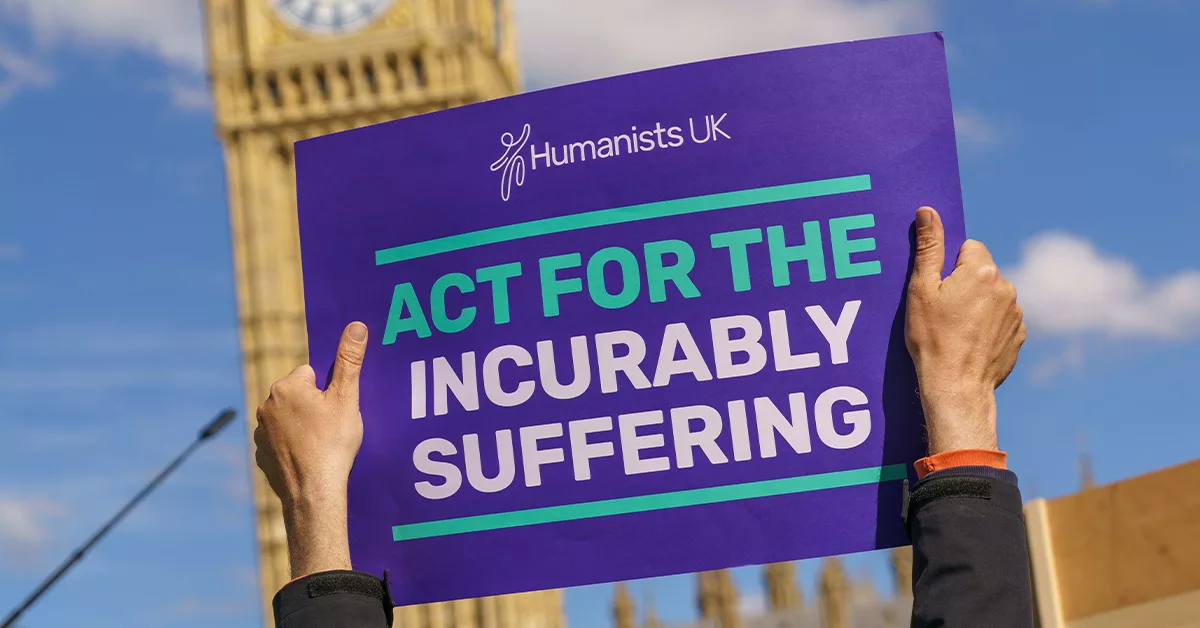
Discussions about assisted dying laws are full of jargon and technical phrases. Let’s try to explain two of them – perhaps the most important pair.
Generally speaking, assisted dying laws determine eligibility for patients based on either terminal illness or incurable suffering. And there are different definitions of these terms within different laws.
At Humanists UK, we believe that an adult of sound mind who is intolerably suffering from an incurable, physical condition and has a clear and settled wish to die should have the option of an assisted death. That is true whether someone is terminally ill or incurably suffering. Being able to die, with dignity, in a manner of our choosing should be understood as a fundamental human right.
Terminal illness
The meaning of ‘terminal illness’ varies between assisted dying bills/laws across the UK, USA, New Zealand, and Australia.
In the Assisted Dying for Terminally Ill Adults Bill [HL], which has been proposed in the House of Lords, terminal illness refers to diagnosed conditions which will inevitably worsen but cannot be reversed by treatment. Assisted dying is only available for when such conditions are expected to cause the death of the patient within six months. This does not include any disabilities or mental illnesses. Even if treatment can relieve some symptoms of the condition, if it cannot cure the condition, then it is still considered terminal.
Scotland’s Assisted Dying for Terminally Ill Adults (Scotland) Bill uses ‘terminally ill’ slightly differently. According to this bill, an eligible patient must ‘have an advanced and progressive disease, illness or condition from which they are unable to recover and that can reasonably be expected to cause their premature death.’ The Scottish approach is more compassionate for people suffering from conditions like Parkinson’s, Huntington’s and motor neurone disease because a doctor may not be sure that the person has less than six months left to live. In other cases, by the time a person does have six months left to live, that person may have lost mental capacity, or they may have suffered for months or even years beyond what they would wish.
There are different approaches to ‘terminal illness’ in other jurisdictions, for example, some require the condition to be expected to cause the patient’s death within twelve months rather than six. The crucial point is that a terminal illness is always an incurable condition that is expected to cause the patient’s death.
Incurable suffering
In many countries people are eligible for assisted dying if they are deemed to have intolerable and incurable suffering.
The Belgian Act defines incurable suffering as a ‘medically hopeless state of persistent and unbearable physical or psychological suffering which cannot be alleviated and which is the result of a serious and incurable condition’.
Canada’s Bill C-7 defines this as ‘grievous and irremediable’ diagnosed conditions.
The language we use is ‘intolerably suffering from an incurable, physical condition’.
Definitions vary but generally, incurable suffering refers to those patients with physical conditions that cause them constant unbearable mental or physical suffering and lack any likely chance of improvement. This includes conditions like locked-in syndrome and multiple sclerosis.
Humanists UK’s stance
We wholeheartedly support assisted dying for the terminally ill. We also support it for those who are incurably suffering because they have the most suffering ahead of them and therefore are some of those who most desperately need a change in the law.
We also support assisted dying for the incurably suffering. The legal battles of Tony Nicklinson and Paul Lambwere the most important in UK assisted dying law, yet neither Tony nor Paul would be eligible for an assisted death under the legislation that just focuses on the terminally ill. This is because their suffering, while unbearable, was not terminal.
Tony Nicklinson suffered from locked-in syndrome which meant he was paralysed below the neck and could not speak; he described his life as a ‘living nightmare’. Paul Lamb was in a car accident that left him paralysed below the neck and in chronic pain. Tony took his right-to-die case to the High Court, but died shortly after he lost. Paul continued Tony’s legacy of activism and, along with Tony’s wife Jane, took their case to the Court of Appeal and eventually the Supreme Court. They lost their legal battles because the courts determined it to be an issue for Parliament.
It is time for politicians to act. A compassionate change in the law should not discriminate against people like Tony Nicklinson and Paul Lamb, it should rectify the injustice they faced and grant the incurably suffering autonomy and dignity in their deaths.
Notes
For further comment or information, media should contact Humanists UK Assisted Dying Campaigner Nathan Stilwell at nathan@humanists.uk or phone 07456 200033.
If you have been affected by the current assisted dying legislation, and want to use your story to support a change in the law, please email campaigns@humanists.uk
Read six reasons we need an assisted dying law.
Read more about our analysis of the assisted dying inquiry.
Read more about our work to legalise assisted dying in the UK.
Humanists UK is the national charity working on behalf of non-religious people. Powered by over 120,000 members and supporters, we advance free thinking and promote humanism to create a tolerant society where rational thinking and kindness prevail. We provide ceremonies, pastoral care, education, and support services benefitting over a million people every year and our campaigns advance humanist thinking on ethical issues, human rights, and equal treatment for all.
License
In-Sight Publishing by Scott Douglas Jacobsen is licensed under a Creative Commons Attribution-NonCommercial-NoDerivatives 4.0 International License.
Based on work at www.in-sightpublishing.com.
Copyright
© Scott Douglas Jacobsen and In-Sight Publishing 2012-Present. Unauthorized use and/or duplication of this material without express and written permission from this site’s author and/or owner is strictly prohibited. Excerpts and links may be used, provided that full and clear credit is given to Scott Douglas Jacobsen, or the author(s), and In-Sight Publishing with appropriate and specific direction to the original content. All interviewees and authors copyright their material, as well, and may disseminate for their independent purposes.

 In-Sight Publishing