On American Comedy Writing 2: Joke Structure
Publisher: In-Sight Publishing
Publisher Founding: March 1, 2014
Web Domain: http://www.in-sightpublishing.com
Location: Fort Langley, Township of Langley, British Columbia, Canada
Journal: In-Sight: Independent Interview-Based Journal
Journal Founding: August 2, 2012
Frequency: Three (3) Times Per Year
Review Status: Non-Peer-Reviewed
Access: Electronic/Digital & Open Access
Fees: None (Free)
Volume Numbering: 12
Issue Numbering: 3
Section: E
Theme Type: Idea
Theme Premise: “Outliers and Outsiders”
Theme Part: 31
Formal Sub-Theme: American Comedy Writing
Individual Publication Date: August 22, 2024
Issue Publication Date: September 1, 2024
Author(s): Scott Douglas Jacobsen
Word Count: 3,562
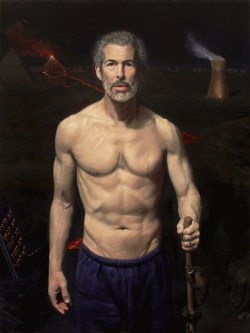
Image Credits: Lance Richlin.
International Standard Serial Number (ISSN): 2369-6885
*High range testing (HRT) should be taken with honest skepticism grounded in the limited development of the field at present, even in spite of honest and sincere efforts.*
*Please see the footnotes, bibliography, and citations, after the publication.*
Abstract
According to some semi-reputable sources gathered in a listing here, Rick G. Rosner may have among America’s, North America’s, and the world’s highest measured IQs at or above 190 (S.D. 15)/196 (S.D. 16) based on several high range test performances created by Christopher Harding, Jason Betts, Paul Cooijmans, and Ronald Hoeflin. He earned 12 years of college credit in less than a year and graduated with the equivalent of 8 majors. He has received 8 Writers Guild Awards and Emmy nominations, and was titled 2013 North American Genius of the Year by The World Genius Directory with the main “Genius” listing here. He has written for Remote Control, Crank Yankers, The Man Show, The Emmys, The Grammys, and Jimmy Kimmel Live!. He worked as a bouncer, a nude art model, a roller-skating waiter, and a stripper. In a television commercial, Domino’s Pizza named him the “World’s Smartest Man.” The commercial was taken off the air after Subway sandwiches issued a cease-and-desist. He was named “Best Bouncer” in the Denver Area, Colorado, by Westwood Magazine. Rosner spent much of the late Disco Era as an undercover high school student. In addition, he spent 25 years as a bar bouncer and American fake ID-catcher, and 25+ years as a stripper, and nearly 30 years as a writer for more than 2,500 hours of network television. Errol Morris featured Rosner in the interview series entitled First Person, where some of this history was covered by Morris. He came in second, or lost, on Jeopardy!, sued Who Wants to Be a Millionaire?over a flawed question and lost the lawsuit. He won one game and lost one game on Are You Smarter Than a Drunk Person? (He was drunk). Finally, he spent 37+ years working on a time-invariant variation of the Big Bang Theory. Currently, Rosner sits tweeting in a bathrobe (winter) or a towel (summer). He lives in Los Angeles, California with his wife, dog, and goldfish. He and his wife have a daughter. You can send him money or questions at LanceVersusRick@Gmail.Com, or a direct message via Twitter, or find him on LinkedIn, or see him on YouTube. Rosner discusses: the structure of a joke.
Keywords: American joke structure, callbacks, conservative entertainment, diverse population, FCC rules, modern shows, political comedy, punchline, regional context, streaming networks.
On American Comedy Writing 2: Joke Structure
Scott Douglas Jacobsen: What is the structure of an American joke? A joke does not have to be particularly American. There is no inherent difference between an American joke and any other joke, except for the knowledge base of the people it is intended for and their emotional makeup. America has many different regions and a diverse population, so the context varies widely.
Generally, a joke is an expression of glee at knowing, as humans succeed in the world by knowing things. George Saunders and I believe that laughter expresses joy at knowledge gained cheaply. Much knowledge is hard-earned, but a joke takes a complicated situation—the setup—and resolves it quickly with a punchline. People laugh because the joke occupied some mental real estate, and that space instantly collapses with the punchline.
Rick Rosner: A good comedian can do a bunch of callbacks, referring to previous punchlines. I saw Amy Schumer in one of her early stand-up specials do a punchline that was four punchlines in one because it contained three callbacks to earlier points in her routine. It was freaking amazing.
We could talk about the knowledge base that goes into jokes now in America—sex plays a big part, and previously taboo topics are easy targets. For one thing, many topics were off-limits on TV and in movies until the last few decades. TV in the ’50s and movies in the ’50s, ’60s, ’70s, and ’80s were pretty tame. Now, anything goes.
We used to have three broadcast networks that were subject to FCC rules for television, but streaming networks aren’t subject to the same limitations, so you can say anything you want. Modern shows, both done and crappy, try to explore all areas of experience. If those experiences are taboo, that is a bonus. It can be a crutch for bad TV and movies but also add dimension to quality productions.
Right now in America, there is deep frustration and exhaustion with current politics and the fact that morons and criminals have such powerful sway over life in our country. Many conservatives have been made so stupid, with the encouragement of their media and politicians, that their humour is terrible.
There is a conservative late-night talk show on Fox News called “Gutfeld!” hosted by Greg Gutfeld, who is not a comedian but one of their commentators. Carole and I watched the opening monologue-type stuff for the first time a few days ago, and we were laughing—not at the attempts at humour, but at how incredibly bad it is. Conservative humour seldom works in America because it is working from a constrained perspective, where the goal is mostly to laugh at liberals. It is often written by people who could not make it in mainstream comedy, so it falls flat.
Yes, there are things to laugh about with liberals, but you can’t exclusively laugh at them because, for one thing, American conservatives are much more laughable at this point. It hasn’t been this bad since the Civil War. So trying to laugh only at the less shitty political party generally doesn’t work, especially when the humour comes from a place of ignorance.
Jacobsen: Does this comedy divide happen in America in other ways? Are you talking more along political lines, specifically political party lines? Even political views—what about social lines, gender lines?
Rosner: They all overlap. Entertainment for Christians that does not go into any of the taboo areas has a huge overlap with entertainment for conservatives. It is similarly low-quality. Occasionally, you get a somewhat decent production. For example, there was one with the guy who played Jesus in Mel Gibson’s movie about Jesus. It was about a man who rescued children from sex traffickers, and they spent much money on it. It may have been watchable, though I did not see it.
Then it turns out that the guy the movie was based on—James, what is his name? James something, the actor—anyway, the real guy, who was supposed to be the true story inspiration for the movie, turned out to be involved in sex trafficking himself, which was bad luck for the producers. However, in general, Christian entertainment is not as good.
It is how, in the porn industry, 30 years ago, the women who did anal scenes in the ’90s were not as attractive as those who did not. That has changed now because anal is more mainstream, but back then, if you added this unsavoury extra requirement, you were drawing from a less attractive talent pool. Similarly, conservative entertainment draws from a weaker talent pool.
What else? On satellite radio, there are about seven different comedy channels. You have “Pure Comedy,” a clean comedy, and “Comedy Roundup,” a kind of country and western rural comedy. Both can be okay, but if I have a choice, I will turn away from pure comedy because it is less likely to deliver new and insightful material.
You have got “Raw Comedy,” which is the dirtiest channel. I love that. It is one of my top two or three favourite channels because I am more likely to hear a surprising and new point of view, as it has the fewest constraints. Then there’s “Canadian Comedy,” which, surprisingly, is in my top two channels. Comedy from your country is good.
Then you have Netflix and Comedy Central channels. Those are fine because they are not constrained.
One time, when I was in Albuquerque, I was listening to country-western music. The radio stations there were mostly pretty wretched, and the country-western station I found seemed to cater to a dumber, more traditional audience. Every song was about meeting a pretty blonde lady, settling on a farm, and having many blonde kids. It was traditional, and every song had the same simplistic theme.
So, there is another divide—rural people in America aren’t dumber than non-rural people. It’s tough to generalize, and it is not good to do so. But, for instance, to be a farmer, you’ve got to be incredibly smart because tough market forces are squeezing you, and you need to operate something like a John Deere combine. There’s a sophisticated computer in the John Deere, and you’ve got to be able to program that thing.
John Deere is notorious for having difficulty with repairs. They charge you an arm and a leg to get it fixed—you have to go to an official service company or find someone who can break the electronic lock on its programming. John Deere is particularly strict about not wanting anyone to hack their processors. So, there are a lot of sophisticated farmers out there, and I assume they watch the same sophisticated entertainment that non-dumb Americans watch. But the big divide is between smart Americans and dumb Americans.
As I’ve said a million times, the Republican Party started targeting less educated individuals 50 years ago, and now, 50 years into it, the Republican Party is the party of stupid people. Every news outlet’s political stance means that both sides have been dumbed down, so political messaging is generally punchy, short, and stupid. There’s smart, stupid comedy and stupid comedy for smart people, Jackass. It’s brutal physical comedy—people doing terrible things to themselves or at least putting their bodies at risk for fun. But it’s not put together by idiots. The risks they take are idiotic, but they are smart idiots.
Jacobsen: I only have a little more insight than that. What about the separation between dirty comedy and dry comedy? The dry comedy of someone Jay Leno, Tim Allen, or Jeff Allen versus the wet comedy of Lenny Bruce, George Carlin, or Richard Pryor.
Rosner: One example that comes to mind is Veep, a political comedy starring Julia Louis-Dreyfus for seven years. It was created by Armando Iannucci, a Brit who’s done political comedy for decades in the UK. It’s both dry and deadpan, yet also filthy. Every character on the show is a piece of shit—Julia Louis-Dreyfus plays the vice president of the US, and she’s cast of awful people surrounding her. The show is dry and doesn’t have a laugh track, but it’s also full of crude humour, with characters constantly saying and doing horrible things to each other.
On the other hand, you have a quality comedy that’s wholesome, Parks and Recreation. Greg Daniels, the same guy who did The Office, created it. The Office had lots of asshole characters, while Parks and Rec had fewer, but it still managed to pull out the comedy. You can go either way—something constructed can be dirty or not. It needs talented people putting in the effort.
I read a book called Sick in the Head by Judd Apatow, who’s been studying comedy since junior high school. It’s a 500-page book of interviews with almost every major comedian of the past 30 years, where they talk about how they do it. One theme throughout the book is the importance of putting in the work. If you’re making a show or a movie, the first joke you think of isn’t going to cut it—it’s probably going to be some cliché that would have been fine in the ’50s, but now everyone’s seen it a million times.
Everybody’s already seen everything, so you can’t go with your first joke. You mentioned Leno, who was a tamed comedian on The Tonight Show. I never saw him when he was revolutionary, but in the ’70s, he was part of a group of young revolutionary comedians. By the time he got to The Tonight Show in the ’90s, he was no longer revolutionary.
Often, he barely told jokes. He delivered lines with the cadence of jokes, and the audience had been conditioned to laugh. I’ve got the Olympics on with the sound off, and in the 200 meters, the American favoured to win came in second because he has COVID. So, I’m there. There’s a lot of COVID at the Olympics. In LA, the number of cases is up tenfold since two or three months ago.
But anyway, when writing comedy, you often get a group of people together with a basic script structure. Everyone yells out a bunch of jokes, so you end up with 10 or 12 for every point in the script. It would help if you did that to write effective comedy—you can’t stop at your first joke idea. Maybe you can a little if you’re a genius, but you need more effort.
Jacobsen: What about pacing and delivery timing? You touched on rhythm and training the audience to some extent.
Rosner: I always want things to move faster but am a sophisticated viewer. Taking too long between the next thing that happens is often indulgent. Carole and I watched a movie directed by Michael Keaton called Knox Goes Away, about a hitman with a debilitating brain disease—turbo Alzheimer’s. That movie lingered too long on the acting. Nobody wants to see that; we want things to move along. It could have been 15 minutes shorter by cutting the shots shorter.
We also watched a six-hour mystery show called The Good Girl’s Guide to Murder, about a high school girl who decides to solve a five-year-old murder in her small British town. That show could have been four hours or less if it had moved along because we knew everything that would happen. There’s a dog in it, and we knew it would get killed. Carole and I both called it—the dog gets killed, but they took too long to get there. Carole saw the dad character and said, “It’s the dad.” And yes, it was the dad. to spoil it, but she yelled it out an hour or two in, and we didn’t find out until the end of hour five. So yes, things need to move along because people have seen everything and can figure out everything. We know where you’re going, so get to it.
The faster you get to the point, the quicker you might surprise us with something unexpected. Refrain from testing our patience with painterly pauses.
Jacobsen: What about using contrast and surprise or absurdity in American comedy? How would you incorporate that in writing?
Rosner: It depends. It needs to be done by people who don’t suck at it. Veep feels real, but a bunch of absurd stuff happens in it. One character, who might be the dumbest on the show, has been developed across seven seasons. By season seven, he’s gone from being a White House aide to becoming stupider with each passing season. In the first season, he was a normal kind of asshole, but then they decided to make him downright stupid.
By season 7, he was stupid and running for something—Congress, president. He’d married his stepsister, which is not a good look for a politician. Not only did he marry his stepsister, but he was also in a fight with his stepdad. He hated his stepdad and ripped this perfectly nice guy apart on a national interview show, which is absurd. It’s also absurd that he would still have a chance after doing that, but he does politically. That show, though, is done by skilled practitioners.
You’ve got three absurdists from SNL who did a movie called Do Not Destroy: The Legend of Something Mountain, and it was absurd, stupid stuff from top to bottom, which was fine because those guys know what they’re doing. But some people—and you see this more in science fiction than comedy—don’t know the genre beyond having seen many movies. But that’s not good enough. It would help if you read modern science fiction to avoid rehashing clichés.
The same applies to comedy—you’ve got to know the field, so you’re not telling people a bunch of jokes they’ve already seen or can anticipate because they’ve watched enough other stuff. You must be competent and knowledgeable and have seen a wide range of material.
One of the sad things about Twitter is that I used to be able to read 300 jokes a day from comedians. It was all comedy, comedians messing around. Now, Elon Musk has turned it into a right-wing, anti-Semitic, racist swamp of MAGA assholes, and the comedians have mostly left. I barely write jokes on Twitter anymore—maybe 10% of my posts are jokes. I don’t see that many jokes in a day now. It’s mostly about trying to find effective ways to call out assholes for being assholes so they don’t win the next election. It’s a shame, and it is not good for comedy. At least I have a comedy radio in the car, so I can hear many jokes while driving.
One way to cover your bases—you were talking about cadence and pacing—is to keep the jokes popping. Tina Fey Productions and Robert Carlock have done shows Girls5eva and 30 Rock. It’s a couple of minute jokes with them, and they’re usually unexpected. If there are some familiar jokes, I don’t mind being able to yell out a punchline before they get to it. But if that happens on every punchline, it’s a problem. With the Tina Fey-Carlock productions, a 22-minute show will have 50 or 60 jokes, many of them crazy and out of nowhere. So, if five or eight of the jokes are predictable, I’m still okay with it.
Jacobsen: We live in the era of big data, which contaminates our entertainment, too, which is fine because it leads to better, more insightful content. Is the rule of three still valid or not?
Rosner: Yes, but everyone knows the rule of three. It’s more effective when your audience doesn’t know the rules. You go: thing 1, thing 2, funny thing. They may have been trained to appreciate the cadence and structure, which is good, so they’ll get the joke. But when amateurs can say, “Oh, that’s the rule of three,” that’s bad because they’re too familiar with it. Now you have to mess with the rule; Family Guy does.
Family Guy might take a situation and drag it out too long to the point where you can’t believe how much they’re messing with you. Peter Griffin might get in a fight with a giant rabbit or something equally ridiculous. Under a traditional comedy structure, the scene would go on for a short, reasonable amount of time so you can move to the next joke. But Family Guysays, “Screw you,” and makes the fight go on for three minutes—way too long. It becomes funny because they’re intentionally messing with you. Similarly, Family Guy might do the rule of seven or eight or ten, repeating a thing because it knows its audience is familiar with the rule of three and thinks it’s hacky, so they’re saying, “Screw you, we know.” So here you go.
Here it is, ten times a row—a character action repeated ten times. Suck it up. Can that be layered with other aspects of comedy, the callback? So you do a whole routine, but you only do three callbacks.
Everyone knows everything, so everything is fair game to be messed with. It’s not only fair game, but it’s obligatory. Comedy is about finding patterns, regularities, and common experiences in the world, pointing them out, and, if possible, making fun of their absurdity. I can point out failed routines. If we ever got together and listened to comedy radio, I could show you why most of the stuff that makes it to Sirius Comedy Radio works. Some routines, though, I have to change the channel because they’re not working, and they annoy me.
Today, I had to quit a routine because the guy was doing drug humour—talking about taking LSD and how he got in a car wreck because he swerved to avoid pyramids, which are old and hacky. Why are you talking about LSD? Maybe talk about a more modern drug. You’re also mischaracterizing LSD—it doesn’t give you full hallucinations from the history of humanity. That was absurd and hacky. You have to come from where people are, and right now, we’re not on LSD. Maybe you could tell an LSD joke if it’s relevant, but it has to connect with where we are today.
Jacobsen: There was a routine I thought was decent, however. You never know how old these routines are—they might be from 12 years ago or two years ago. This guy was talking about how depressing Planet Earth 2 is because of so much extinction and the planet feeling doomed. Then he started doing a David Attenborough narration of Planet Earth 3, where a skinny polar bear on a melting iceberg has to “suck cock for a salmon.” That seemed absurd yet topical and appropriately humorous. It had a bear, in this case, doing something desperate to survive—a familiar comedic trope that hasn’t been exhausted yet. It’s still a decent punchline, though maybe not in two years.
Rosner: I see much less straight slapstick humour, The Three Stooges. Yes, I don’t see as much of that. I see many American comedies that focus more on serious themes. Sirius Comedy Radio has comedy greats, but I usually turn the channel because it might be a routine from 30 years ago. I’m not going to learn anything new from it. It might be funny—Phyllis Diller’s funny with her routines from the ’60s—but it doesn’t teach me what I want to learn. I haven’t watched The Three Stooges in forever, even though many good contemporary comedians love them. Maybe I could learn something from them.
Jacobsen: Something I’ve noticed in much American comedy is the influence of Kevin Smith—heavy on dialogue, almost monologue at times, and pushing the time limits. It’s similar to what you mentioned about Seth MacFarlane with Family Guy.
Rosner: Yes, I don’t have many words. I only have small paragraphs of dialogue. The aim should always be to cut things down. I’m helping Carole with her book—she’ll read me passages, and her characters will say a couple of long sentences in a row. In this context, yes, I talk too much and say long things, but sentences are usually short in normal conversation. I’m always pushing her to pull words out of sentences and make the dialogue more natural.
It’s a standard. What do you call it? An amateur actor, a newbie, will want more lines. But an established, good actor might go through the script and say, “Let’s cut this down here,” or “I can do what this line does with a look.” So, yes, I’m generally not in favour of monologues. When was the last time Kevin Smith made a movie? If you do a monologue, it can be great, but it’s got to be full of new information. It’s got to…
Rosner: It can’t have a bunch of clichés in it unless you’re subverting something; the turning point in the second act is when things are at their most dire, and then a character gets up and gives an inspiring speech: “We’re gonna do it. We’re going to overcome.” That’s fine if the aliens cut that character in half, subverting what he said. But pure monologue is tough because we’ve seen that before.
Jacobsen: That’s enough for today.
Rosner: Yes, many words. I’ll clean it up. Was there anything new in that?
Jacobsen: There was. We covered more precisely what a joke is.
Rosner: We’ll talk tomorrow.
Jacobsen: Yes, talk to you then. Thank you. Bye.
Rosner: Bye.
Bibliography
None
Footnotes
None
Citations
American Medical Association (AMA 11th Edition): Jacobsen S. On American Comedy Writing 2: Joke Structure. August 2024; 12(3). http://www.in-sightpublishing.com/american-comedy-2
American Psychological Association (APA 7th Edition): Jacobsen, S. (2024, August 22). On American Comedy Writing 2: Joke Structure. In-Sight Publishing. 12(3).
Brazilian National Standards (ABNT): JACOBSEN, S. On American Comedy Writing 2: Joke Structure. In-Sight: Independent Interview-Based Journal, Fort Langley, v. 12, n. 3, 2024.
Chicago/Turabian, Author-Date (17th Edition): Jacobsen, Scott. 2024. “On American Comedy Writing 2: Joke Structure.” In-Sight: Independent Interview-Based Journal 12, no. 3 (Summer). http://www.in-sightpublishing.com/american-comedy-2.
Chicago/Turabian, Notes & Bibliography (17th Edition): Jacobsen, S “On American Comedy Writing 2: Joke Structure.” In-Sight: Independent Interview-Based Journal 12, no. 3 (August 2024).http://www.in-sightpublishing.com/american-comedy-2.
Harvard: Jacobsen, S. (2024) ‘On American Comedy Writing 2: Joke Structure’, In-Sight: Independent Interview-Based Journal, 12(3). <http://www.in-sightpublishing.com/american-comedy-2>.
Harvard (Australian): Jacobsen, S 2024, ‘On American Comedy Writing 2: Joke Structure’, In-Sight: Independent Interview-Based Journal, vol. 12, no. 3, <http://www.in-sightpublishing.com/american-comedy-2>.
Modern Language Association (MLA, 9th Edition): Jacobsen, Scott. “On American Comedy Writing 2: Joke Structure.” In-Sight: Independent Interview-Based Journal, vo.12, no. 3, 2024, http://www.in-sightpublishing.com/american-comedy-2.
Vancouver/ICMJE: Scott J. On American Comedy Writing 2: Joke Structure [Internet]. 2024 Aug; 12(3). Available from: http://www.in-sightpublishing.com/american-comedy-2.
License & Copyright
In-Sight Publishing by Scott Douglas Jacobsen is licensed under a Creative Commons Attribution-NonCommercial-NoDerivatives 4.0 International License. ©Scott Douglas Jacobsen and In-Sight Publishing 2012-Present. Unauthorized use or duplication of material without express permission from Scott Douglas Jacobsen strictly prohibited, excerpts and links must use full credit to Scott Douglas Jacobsen and In-Sight Publishing with direction to the original content.

 In-Sight Publishing