[Review] Teach for Climate Justice: A Vision for Transforming Education
Publisher: In-Sight Publishing
Publisher Founding: September 1, 2014
Publisher Location: Fort Langley, Township of Langley, British Columbia, Canada
Publication: Critical Science Newswire
Original Link: https://ncse.ngo/review-teach-climate-justice-vision-transforming-education
Publication Date: August 12, 2024
Organization: National Center for Science Education
Organization Description: The National Center for Science Education promotes and defends accurate and effective science education because everyone deserves to engage with the evidence. One day, students of all ages will be scientifically literate, teachers will be prepared and empowered to teach accurate science, and scientific thinking and decision-making will ensure that all life can thrive and overcome challenges to our shared future.
By Joseph Henderson
What does it mean to build “the beloved community” in the midst of escalating climate crises? This is the question that Tom Roderick seeks to answer in Teach for Climate Justice. Answering such a fraught question involves an education in the basics of climate change science, but for Roderick this is not even close to adequate given the stakes. Building thriving communities in a changed climate requires asking difficult questions about the nature of power and inequality, as these are the root causes of climate change and shape social impacts both now and into the future. Given his extensive background shaped by decades of work in social justice education, Roderick is exactly the right person to write such a book.
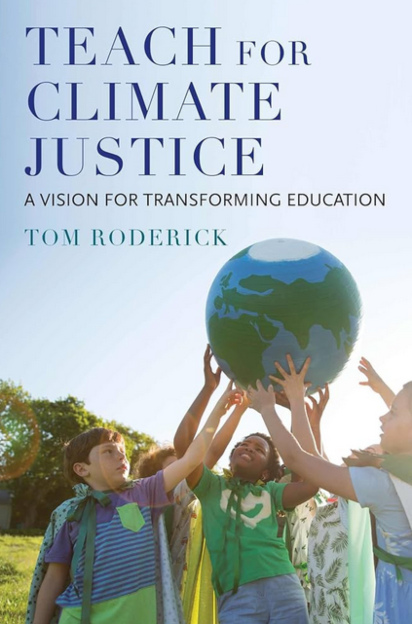
Teach for Climate Justice takes readers through some challenging intellectual terrain if they are unfamiliar with the historical and present-day environmental and social injustices at the heart of climate change. Roderick correctly roots the climate crisis in long-standing structures of capitalist exploitation of both people and planet and its related Global North/South pattern vis-à-vis colonial processes: “Rich nations, which have amassed wealth from extracting and depleting resources from colonized countries, have a moral obligation to share the wealth they have stolen to help those countries mitigate and adapt to the climate emergencies they are facing” (page 3). While well known to those of us in the social sciences, this was one of the first times I have encountered such an account in a book for general educators. This conversation is long overdue in my professional opinion, for these are the foundational dynamics at work in producing the climate crisis and that presently work to hinder adequate responses.
Roderick’s book moves quickly from a descriptive “is” to a normative program of “oughts” centered on his liberal commitments to social and ecological justice. It is my view that this is a necessary move in climate change education literature, for it focuses attention on the social and political dynamics that have produced climate change in the first place and that continue to shape our collective (in)ability to respond necessarily at scale. Thankfully, this is not another climate change education book written by someone from within the scientific community. This is unapologetically a book about climate justice in educational settings. “When climate education is offered it is generally about climate change rather than for a habitable planet, for the transition from fossil fuels to sustainable sources of energy, and for climate justice” (emphasis in original, page 2). While there’s still much work to be done in climate change science education, the field seems to be maturing toward greater engagement with other traditions and educational disciplines.
The book proceeds over eight chapters ranging from a “deep understanding of the climate crisis” to “teach[ing] for civil resistance.” Each chapter develops principled approaches to climate justice education via engagement with some of the leading thinkers on the subject and then shows how everyday teachers — both in the formal and informal sectors — are engaging in the embodied practices of climate justice pedagogy. We meet some of the heroic educators developing climate justice practices, and each chapter presents a series of prompts so readers can pause and reflect on their own professional practice. A major strength of this book is that the author takes difficult and emotionally challenging concepts about social and environmental injustice and makes them both digestible and actionable for the reader. This is no small feat given the magnitude of the issues facing people and the planet right now.
Roderick is a long-time educator and activist with decades of experience in social justice education as the founding executive director of the Morningside Center for Teaching Social Responsibility in New York City. His philosophical and moral commitments echo critical and emancipatory approaches to education that were more popular during the civil rights movements of the 1960s, when educators asked questions about social inequality and environmental injustices. Unfortunately, many of these approaches were sidelined during the 1980s, when “Nation at Risk” neoliberal educational policies repoliticized education toward capitalist market logic and positioned both educators and students as individual actors attempting to maximize their economic capacities. These programs continue to flail and break down due to their inherent contradictions, thus (re)opening the door to the more foundational questions that have intrigued educational thinkers for ages. We again find ourselves asking what education is for, this time during a time of intensifying climate crisis. For Tom Roderick, the purpose of education “must be to nurture a generation of courageous, intelligent, and wise nonviolent fighters for climate justice” (page 7). I can think of no more urgent educational task given the resurgence of fascism as the climate emergencies accelerate.
License
In-Sight Publishing by Scott Douglas Jacobsen is licensed under a Creative Commons Attribution-NonCommercial-NoDerivatives 4.0 International License.
Based on work at www.in-sightpublishing.com.
Copyright
© Scott Douglas Jacobsen and In-Sight Publishing 2012-Present. Unauthorized use and/or duplication of this material without express and written permission from this site’s author and/or owner is strictly prohibited. Excerpts and links may be used, provided that full and clear credit is given to Scott Douglas Jacobsen, or the author(s), and In-Sight Publishing with appropriate and specific direction to the original content. All interviewees and authors copyright their material, as well, and may disseminate for their independent purposes.

 In-Sight Publishing