The Greenhorn Chronicles 48: Lynne Denison Foster on Storytime with Brent Balisky (2)
Publisher: In-Sight Publishing
Publisher Founding: March 1, 2014
Web Domain: http://www.in-sightpublishing.com
Location: Fort Langley, Township of Langley, British Columbia, Canada
Journal: In-Sight: Independent Interview-Based Journal
Journal Founding: August 2, 2012
Frequency: Three (3) Times Per Year
Review Status: Non-Peer-Reviewed
Access: Electronic/Digital & Open Access
Fees: None (Free)
Volume Numbering: 12
Issue Numbering: 1
Section: A
Theme Type: Idea
Theme Premise: “Outliers and Outsiders”
Theme Part: 29
Formal Sub-Theme: “The Greenhorn Chronicles”
Individual Publication Date: October 1, 2023
Issue Publication Date: January 1, 2024
Author(s): Scott Douglas Jacobsen
Word Count: 1,474
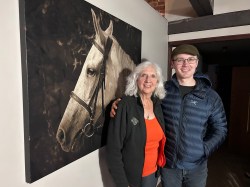
Image Credit: Scott Douglas Jacobsen.
International Standard Serial Number (ISSN): 2369-6885
*Interview conducted September 21, 2023.*
*Please see the footnotes, bibliography, and citations, after the publication.*
Abstract
Lynne Denison Foster is the mother of Rebecca Foster, owner of the Bale and Bucket restaurant, and Tiffany Foster, a professional equestrian show jumper ranked the highest in Canada. She was an aviation professional for 48 years, beginning with Pacific Western Airlines in 1969 in the Edmonton Reservation office and moving to Vancouver in 1973. She helped with the implementation of the first computerized reservations systems for a regional air carrier in North America. Since 1974, she has been an instructor and in 2012 was awarded BC Aviation Council’s Lifetime Achievement Award for her contribution to educating the aviation community. At Canadian/Air Canada, she trained CEOS, Pilots, Aircraft Groomers, and worked on training initiatives and programs for aviation safety management system, computerized reservation systems, corporate change, customer services, frontline leadership, human factors, interpersonal skills, management practices, and service quality. She taught at BCIT between 2000 and 2017. Foster was key in the development of the Aviation Operations Diploma Programs. She was Chief Instructor for 7 years. In 2015, she won BCIT’s Teaching Excellence Award. Foster discusses: a story with parenting principles with Brent Balisky.
Keywords: Brent Balisky, equestrianism, Eric Berne, Hans De Ceuster, Lynne Denison Foster, parenting, Rebecca Foster, Thomas Harris, Tiffany Foster, Transactional Analysis, Transactional Psychology.
The Greenhorn Chronicles 48: Lynne Denison Foster on Storytime with Brent Balisky (2)
Scott Douglas Jacobsen: So, in the article we found together in the 50th/bicentennial of Show Park magazine, it stated. Rebecca and Tiffany started early. Costs were an issue. What were the first reactions to the costs? How did you take that approach of facing the problem, problem solve, towards those kinds of costs when income may not necessarily be so high in a sport that was expensive at their level, even more expensive now?
Lynne Denison Foster: You should get Brent to tell you this story. Because he was telling it when we were at the World Equestrian Games in Normandy. I said to him, “Brent, tell me the story of how Tiffany Foster came to your barn as if I am not me.” He tells a really good story. So, you should ask him.
We came from the North Shore with three other families. They thought we had good money for our kids because the other families did.
Jacobsen: Which isn’t an uncommon thing in this industry.
Foster: Yes, basically, you have to. He kind of thought that we were… He spoke with the other parents of the other kids. Because he kind of saved me for the last, I guess. I don’t know. Tiffany and Rebecca were nice kids. And I was a nice person. So, we had a meeting with Tiffany and Rebecca, and Brent and Laura. He [Laughing] asked me how much I was willing to spend. Basically, what was in my budget for my kids…
Jacobsen: I can imagine how those conversations would go.
Foster: You should ask him, because it is a funny story. He says, “How much are you thinking of spending on your daughters’ lessons?” Brent would, probably, remember. I couldn’t remember. I said something like, “Uhhhh, probably, $12,000 a year.” [Laughing] He and Laura looked [Laughing] like, “Is she delusional?” Brent realized, ‘Oh, this lady has no idea how much these girls need if they want to ride and compete in equestrian sport.’ But he said, “Since these two scrawny little kids were such good little kids and the mother was nice, they decided at the time that they would give us a break.” At the time, he said, “It costs more than that. We need a working student. If you pay for your pony’s board, the girls could work for their lessons…” then he said, “Tiffany needs another horse.” Laura had this horse. They paid a lot of money for him, and he was injured. He was on rehab. They could free-lease him to Tiffany, and she could earn her lessons anddo a couple of other things if I paid for the board. That is how the girls got into that. He said, “The next day, there they were. The mother and two little girls hauling hay and mucking stalls.” Whenever my girls had to do something new, I went with them, showed them how it was done, explained what they needed to do, then “let’s do it together” and then “show me how you do it.” Rebecca was nervous. But they were confident because I was there. So, when they knew what they had to do, then it was like, “Okay, get out of my way, I know what I am doing.” Tiffany did a babysitting course when she was 12. A young couple from our church were her first customers. I asked them if I could come with Tiffany, orient her, and explain to her that a good babysitter didn’t just look after the kids, she should do more than that: cleaning up the kitchen, tidying up, etc. I followed the same formula with her: Do it together, explain, let me see how you do it, then do it alone. Even with Rebecca and her cooking, it was the same thing. That was another principle. “Let’s do it together, discover it, be clear and understand what our tasks are, and then I will watch you and give you advice, and then let you do it by yourself, when you are ready, I won’t be there anymore.”
Jacobsen: From your own perspective, these are principles, ways of thinking, ways of delivering those ways of thinking to your kids at appropriate ages, with appropriate consequences, even choosing those consequences. What about situations for yourself as a parent, as any parent has?
Foster: I think I was very lucky with the children that I had. They weren’t hard to raise. I have to say, like I find it more challenging as an adult parent to adult children than I did when they were children.
Jacobsen: How so?
Foster: They were devoted to me. They really were. Do you want another story?
Jacobsen: Please.
Foster: It is kind of late. I’ll do a quick one. We lived in North Vancouver. Part of being in grade 6, children were enrolled in outdoor school for 1 week and learned about nature. Rebecca, whose birthday is in January, was 2 years behind Tiffany in school. The same incident occurred with both of those girls. I took Tiffany to the bus. We lived right behind the school. We walked through this greenspace, which the girls called “Fairy Land.” It was easy for me to walk them with their little backpacks. She was getting on the bus to go to outdoor school. Tiffany asked, “Why aren’t you coming with me?”
“No, Tiffany, I can’t.”
“What?! You have to come.”
“Sorry, Tiffany, there are already enough parents who volunteered.”
“No, you have to come with me. You have to come with me! I don’t want to go by myself.”
She started crying. Clinging to me, and didn’t want to get on the bus, I finally convinced her by getting one of her friends to help me. She got on the bus and I saw her face looking out the window at me with tears coming down her face. Rebecca knew nothing about that. Two years later, “You’re not coming with me?” Exactly the same kind of reaction, they were attached to me, because their dad was a kid. He goofed around with them and loved them , but really didn’t parent them. That was part of it. Another time, okay, riding, they were, probably, 9 ½ and eleven. I decided that they should go to an English riding camp in the summer for a week. So, I was telling them I had registered them. The first words out of their mouths: “Are you coming?”
“No, no, it is a kids’ camp. I can’t go.”
“We’re not going if you’re not going.”
“It is going to be exciting,” blah-blah-blah. So, they wouldn’t go. They didn’t want to go and were upset. Then I found out there was a mother-daughter weekend camp in May. I said, “Hey, let’s go to this one, you’ll see. Then you’ll go to the other one without me.” So, we went to the mother-daughter [Laughing] camp. That was the first and only time I’ve ever ridden English, on this postage stamp piece of leather [Laughing].
Jacobsen: [Laughing].
Foster: I was used to sitting in a Western saddle with this big saddlehorn to hang onto, sitting on a big comfortable seat queueing on a trail ride. That was one thing I did for my daughters. I took this English riding camp. I was so sore. I could hardly move [Laughing].
Jacobsen: [Laughing].
Foster: They were not difficult children to raise. They were usually happier when their mother was around. You know what I am saying? There was another thing. I taught customer service and leadership skills to the staff and management at the airline. One thing that was very important in the Pacific Western/Canadian Airlines culture was the concept of reward and recognition: how necessary, critical, and important it is to humans… I studied this theory developed by a guy named Eric Berne, a Human Behavior psychologist. In the 70’s, Thomas Harris wrote a book called I’m OK – You’re OK, based on Berne’s research. It was very popular in those days.
Jacobsen: I recall these phrases.
Foster: He developed transactional analysis.
Jacobsen: Transactional Psychology.
Foster: Yes.
[Ed. My Belgian guest who joined me] Hans De Ceuster: Games People Play.
Jacobsen: Games People Play.
Foster: In the book, Games People Play, Eric Berne described three principle needs humans instinctively crave. You may be familiar with this as well. Although you’re probably more familiar with Maslow’s Hierarchy of Needs and all that. I liked Berne’s theory because it is much more simplified. He explains that humans crave three things: Recognition, Structure, and Stimulation. So, I did extensive research and included it in my course. Being in the Service industry, I focused most on recognition. But, as a parent, I realized that all three of them are important. That’s, basically, the principles that I raised my children by, in many ways.
Bibliography
None
Footnotes
None
Citations
American Medical Association (AMA 11th Edition): Jacobsen S. The Greenhorn Chronicles 48: Lynne Denison Foster on Storytime with Brent Balisky (2). October 2023; 12(1). http://www.in-sightpublishing.com/lynne-foster-2
American Psychological Association (APA 7th Edition): Jacobsen, S. (2023, October 1). The Greenhorn Chronicles 48: Lynne Denison Foster on Storytime with Brent Balisky (2). In-Sight Publishing. 12(1).
Brazilian National Standards (ABNT): JACOBSEN, S. The Greenhorn Chronicles 48: Lynne Denison Foster on Storytime with Brent Balisky (2). In-Sight: Independent Interview-Based Journal, Fort Langley, v. 12, n. 1, 2023.
Chicago/Turabian, Author-Date (17th Edition): Jacobsen, Scott. 2023. “The Greenhorn Chronicles 48: Lynne Denison Foster on Storytime with Brent Balisky (2).” In-Sight: Independent Interview-Based Journal 12, no. 1 (Winter). http://www.in-sightpublishing.com/lynne-foster-2.
Chicago/Turabian, Notes & Bibliography (17th Edition): Jacobsen, S “The Greenhorn Chronicles 48: Lynne Denison Foster on Storytime with Brent Balisky (2).” In-Sight: Independent Interview-Based Journal 12, no. 1 (October 2023).http://www.in-sightpublishing.com/lynne-foster-2.
Harvard: Jacobsen, S. (2023) ‘The Greenhorn Chronicles 48: Lynne Denison Foster on Storytime with Brent Balisky (2)’, In-Sight: Independent Interview-Based Journal, 12(1). <http://www.in-sightpublishing.com/lynne-foster-2>.
Harvard (Australian): Jacobsen, S 2023, ‘The Greenhorn Chronicles 48: Lynne Denison Foster on Storytime with Brent Balisky (2)’, In-Sight: Independent Interview-Based Journal, vol. 12, no. 1, <http://www.in-sightpublishing.com/lynne-foster-2>.
Modern Language Association (MLA, 9th Edition): Jacobsen, Scott. “The Greenhorn Chronicles 48: Lynne Denison Foster on Storytime with Brent Balisky (2).” In-Sight: Independent Interview-Based Journal, vo.12, no. 1, 2023, http://www.in-sightpublishing.com/lynne-foster-2.
Vancouver/ICMJE: Scott J. The Greenhorn Chronicles 48: Lynne Denison Foster on Storytime with Brent Balisky (2) [Internet]. 2023 Oct; 12(1). Available from: http://www.in-sightpublishing.com/lynne-foster-2.
License
In-Sight Publishing by Scott Douglas Jacobsen is licensed under a Creative Commons Attribution-NonCommercial-NoDerivatives 4.0 International License.
Based on work at www.in-sightpublishing.com.
Copyright
© Scott Douglas Jacobsen and In-Sight Publishing 2012-Present. Unauthorized use and/or duplication of this material without express and written permission from this site’s author and/or owner is strictly prohibited. Excerpts and links may be used, provided that full and clear credit is given to Scott Douglas Jacobsen, or the author(s), and In-Sight Publishing with appropriate and specific direction to the original content. All interviewees and authors copyright their material, as well, and may disseminate for their independent purposes.

 In-Sight Publishing